India Uncut
This blog has moved to its own domain. Please visit IndiaUncut.com for the all-new India
Uncut and bookmark it. The new site has much more content and some new sections, and you can read about them here and here. You can subscribe to full RSS feeds of all the sections from here.
This blogspot site will no longer be updated, except in case of emergencies, if the main site suffers a prolonged outage. Thanks - Amit.
Thursday, August 31, 2006
Let the cow decide when to hug
Reuters reports:
You may hug a steak, though.
(Link via separate emails from Arun Verma, Patrix, Dhoomketu and Shiju Thomas. I'm, like, overwhelmed.)
Previous posts on cows: 1, 2, 3, 4, 5, 6, 7, 8, 9, 10, 11, 12, 13, 14, 15, 16, 17, 18, 19, 20, 21, 22, 23, 24, 25, 26, 27, 28, 29, 30, 31 , 32, 33, 34, 35, 36, 37, 38, 39, 40, 41, 42, 43, 44, 45, 46, 47, 48, 49, 50, 51, 52, 53, 54.
Keep your distance. Avoid eye contact. And even if it looks cute, never hug a Swiss cow.Good. For too long now, cows have been treated like women, hugged and caressed regardless of consent. This is not good when it comes to women, and it's quite as bad when it comes to cows. Cows have feelings. Cows need their space. Respect cows.
Responding to numerous "reports of unpleasant meetings between hikers and cattle" along Switzerland's picture-perfect Alpine trails this summer, the Swiss Hiking Federation has laid down a few ground rules.
"Leave the animals in peace and do not touch them. Never caress a calf," the group's guidance, posted on the website www.swisshiking.ch, reads.
You may hug a steak, though.
(Link via separate emails from Arun Verma, Patrix, Dhoomketu and Shiju Thomas. I'm, like, overwhelmed.)
Previous posts on cows: 1, 2, 3, 4, 5, 6, 7, 8, 9, 10, 11, 12, 13, 14, 15, 16, 17, 18, 19, 20, 21, 22, 23, 24, 25, 26, 27, 28, 29, 30, 31 , 32, 33, 34, 35, 36, 37, 38, 39, 40, 41, 42, 43, 44, 45, 46, 47, 48, 49, 50, 51, 52, 53, 54.
Post a silly pig
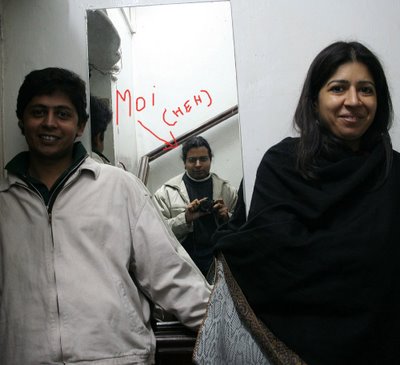
I decided a few months ago never to respond to these meme and tag thingies, but Kingsley's tagged me, and what the hell, here we go. I need to post a silly pig of myself, it seems. Hmm. I looked through the archives, and they're all silly, though the silliest pigs ever, of course, are the ones where one takes a pig of oneself through the mirror. Quintessential human silliness is revealed by that; you won't catch a cow doing that.
So below you see a pig I once took of myself through a mirror, with two friends of mine also present just for the heck of it. (I took their permission before uploading the pig, naturally.) The gent on the left with the goofy smile is Shriniwas Rao, cricket correspondent for the Indian Express; the sweet lady on the right is Mini Kapoor, who edits the books page for the Indian Express, and writes editorials for them as well. And that's me in the mirror. Don't the slender, artistic fingers, combining grace and a certain simian masculinity, instantly reveal that I'm a blogger?
The pig was taken at Cooco's in Lahore earlier this year (though on a later date than when I blogged about the place), in the narrow, winding stairway that leads to their rooftop. Apropos of nothing, I'm a huge fan of kababs.
Yes, yes, I know, silly me. Anyway, I think one has to tag people in this kind of a thingie, but I shall make my tags passable -- if you get tagged by me but wish to avoid public silliness, simply pass the tag on to someone else. (But be sporting, ok?) The people I'm tagging are: Jai (one of these?), aNTi, Peter, Saket and little n.
Update (September 1): Immense fun, everybody's posting silly pigs. Check out Jai (1 and 2), aNTi, Saket, little n, Kingsley, Chandru, Gaurav Mishra, Bombay Addict (1 and 2), Great Bong, Patrix, Nilu (1, 2, 3), Sakshi, Shoe Fiend, Krithiga, Neha Vishwanathan (1 and 2) and theothernilu.
Now that you know how ridiculous we all look, do you still want to read us?
Wednesday, August 30, 2006
So below you see a pig I once took of myself through a mirror, with two friends of mine also present just for the heck of it. (I took their permission before uploading the pig, naturally.) The gent on the left with the goofy smile is Shriniwas Rao, cricket correspondent for the Indian Express; the sweet lady on the right is Mini Kapoor, who edits the books page for the Indian Express, and writes editorials for them as well. And that's me in the mirror. Don't the slender, artistic fingers, combining grace and a certain simian masculinity, instantly reveal that I'm a blogger?
The pig was taken at Cooco's in Lahore earlier this year (though on a later date than when I blogged about the place), in the narrow, winding stairway that leads to their rooftop. Apropos of nothing, I'm a huge fan of kababs.

Yes, yes, I know, silly me. Anyway, I think one has to tag people in this kind of a thingie, but I shall make my tags passable -- if you get tagged by me but wish to avoid public silliness, simply pass the tag on to someone else. (But be sporting, ok?) The people I'm tagging are: Jai (one of these?), aNTi, Peter, Saket and little n.
Update (September 1): Immense fun, everybody's posting silly pigs. Check out Jai (1 and 2), aNTi, Saket, little n, Kingsley, Chandru, Gaurav Mishra, Bombay Addict (1 and 2), Great Bong, Patrix, Nilu (1, 2, 3), Sakshi, Shoe Fiend, Krithiga, Neha Vishwanathan (1 and 2) and theothernilu.
Now that you know how ridiculous we all look, do you still want to read us?
Can't ignore the call of nature
If you're a pilot, though, please don't lock yourself out of the cockpit.
Software for repelling mosquitoes
Midnight's Children and The Suitable Boy...
... are "virtually identical," says Stephen Thompson in the Scotsman on Sunday, in a review of Vikram Chandra's Sacred Games. He writes:
There are certain books that are so similar to one another they almost beg to be grouped together. This is largely true of Indian novels. Look closely at the ones published in the past, say, 25 years, and you'll see that they're virtually identical, in theme if not in style and content.
For me, Midnight's Children is indivisible from A Fine Balance, which in turn cannot be separated from A Suitable Boy. Directly or indirectly, all three books - and there are other notable examples - are concerned with the same thing: the state of Indian society in the wake of independence and partition.
It's hard to believe that such ignorant tripe, such self-evident nonsense, has been published in a mainstream publication. I came across this on Uma's blog, which also pointed me to posts by Edward Champion and Galley Cat on the subject.
I've noticed that many foreign publications, when they want something written on India or any other third-world country, prefer to have one of their contributors do a half-baked job than get a local expert. This does not stem from racism, but the mistaken belief that to make their audience relate to a subject, they need to get a writer who knows the audience, even if his grasp of the subject is not so good. That's what the Scotsman on Sunday has done here, unlike their daily counterpart, who wisely opted to commission the review to someone who actually knew Indian literature: Chandrahas Choudhury. His review is vastly better than Thompson's, one that does justice to both the subject and the audience.
And ah, I can't resist quoting another shockingly arrogant statement by Thompson: "Sacred Games may well be the first Indian detective novel." Can't a man who has clearly knows little of Indian literature stay away from such ludicrously sweeping statements? Poor Byomkesh Bakshi. (And I'm sure there must be many before Mr Bakshi!)
Monkey me, monkey you
Here's a nice excerpt from a Spiegel inderview with Frans de Waal, on chimps and bonobos and humans:
De Waal: There's plenty of intrigue going on beneath the surface. To help each other acquire power, chimpanzees form alliances based on giving and taking. It's the same thing with people. For example, unless US President George W. Bush doesn't give (British Prime Minister) Tony Blair, his biggest supporter, something significant soon, Blair will probably eventually withdraw his support for Bush.
SPIEGEL: You mean that the power game Blair and Bush are playing is essentially ape behavior?
De Waal: I'm convinced that that's the case. In people it starts already in childhood. If you put a group of two-year-olds in a room together, they quickly figure out who's the boss -- using fists, if necessary.
If you read de Waal's fascinating books, Chimpanzee Politics and Our Inner Ape, you might agree with me that monkey behaviour is basically human behaviour stripped bare. It ain't fun. I had alpha-male tendencies in my youth, all testosterone and ego and aggression, and compete compete compete, and I'm so tired of all that now. I need a holiday from the chimp in me, but just when I think I've left him behind me, I turn around and there he is, creeping, crawling, waiting to pounce.
(Link via email from Kind Friend. Also, speaking of monkeys...)
Where your taxes go: 6
Roll up yer shirtsleeves, Manmohan
Mush wants a fight!
Imagine Musharraf and Manmohan actually in a ring in their chaddis, fighting it out. LK Advani would be circling the ring on a cycle-rickshaw saying "I'm on a Rath Yatra. Whee!" Sonia Gandhi would be issuing instructions from Manmohan's corner. ("Turn left, turn left!") Bal Thackeray would be trying to dig up the surface of the ring with his fingernails. Arjun Singh would be trying to get the upper-caste referee replaced. And Benazir Bhutto would be chucking banana skins at Mush's feet hoping he falls down.
Politics is bloody, isn't it?
Good riddance
The Times of India reports:
A man in Orissa was so shocked after he heard that his wife had given birth to a girl child that he fell to the ground, hit his head against a wall and succumbed to his injuries.
Well, what to say now. Obviously one feels bad for the wife he left behind and the unwanted daughter, but if the chappie had an attitude like that, well, bye bye and give my regards to God before she whacks you 890 times with her titanium broomstick. Don't want a daughter, it seems. Whack!
The male sausage
Arun Verma points me, via email, to an immortal piece of news that begins:
A restaurant that failed to take action against an employee who chased a female co-worker with a sausage dangling from his fly has been ordered to pay damages and lost wages to another woman who witnessed it.
In reaction to this incident, women's groups have begun campaigning for the removal of sausages from the breakfast buffet menus of five-star hotels. They insist that sausages represent a continuation of the male hegemony that the feminist movement has been battling for the last few decades.
Ok, ok, so I made that bit about women's groups up. But it's an absurd world we live in, and anything can happen. In fact, it probably already has.
The Prince of Kurukshetra
Remember the game based on Mika kissing Rakhi Sawant, with its Pappi Points and Pappi Meter and so on? Well, Nikhil informs me via email that a similar game is being built based on the incident around Prince, the little feller who was rescued from a pit in Haryana. Who plays these things?
(I do, actually, once in a while, however tasteless I find them. Beat my score!)
Previous posts on Mika/Rakhi: 1, 2, 3.
Tuesday, August 29, 2006
Cops on the loose
Police arrest a man in Baltimore for stealing his own car.
They break up a party in Essex where some kids were having a good time.
I ask ya, why don't they just pick on this kid and leave the rest of us alone?
(Baltimore link via email from MadMan.)
Mallika Sherawat goes kissy kissy faint faint
I've always wondered why Rahul Bose doesn't brush his teeth more often.
Update: And isn't this report a gem?
Scratchity scratchity scratch
The devil and the deep blue sea
Narendra Modi and the Sangh Parivar are drifting apart, we are informed.
I'm opposed to both, of course, and wonder if this is a good thing (the monster weakens) or a bad thing (there are two monsters where there were one). Next they'll say Prakash Karat is parting ways from the Left Front, and then we'll really have monsters all around us. As Kalidasa once wrote:
Monsters on the Right of me
And monsters on the Left
My nightmares get the fright of me
Oh, I'm so bereft!
Ok, so maybe Kalidasa didn't write that. But he could have, and that's what matters.
Happiness
I was sitting and shooting the breeze with Peter a couple of days ago (bang bang), when he told me about a blog he liked called "Confused of Calcutta." He said that he first made a connection with the blog when he read a post that referred to a picture by Gerald Waller that was an old favourite of his. Well, I looked it up, and it's quite stunning, so here you go:
Click on the picture for a larger version. And in case you can't read the caption, it says:
A 6-year-old orphan from Austria ecstatically embraces a brand-new pair of shoes just given to him by the Red Cross.
The photograph is by Gerald Waller. And I can't help wondering if the boy in that picture still has the shoes. And what they must mean to him today. A childhood lost and regained?
You know you're too used to Firefox...
... when you try to open a new document in Microsoft Word by pressing Control T.
This means that too much of my writing is happening on my blog. Time to get down to writing some longer pieces the old-fashioned way.
Monday, August 28, 2006
Bob Dylan, "that little toad"
Here's a charming little nugget from a review of Bob Dylan: The Essential Interviews, by Louis Menand in the New Yorker:
The first time Joan Baez heard Dylan sing one of his own songs—he played “With God on Our Side” for her—she was floored. “I never thought anything so powerful could come out of that little toad,” she said. She proceeded to fall madly in love with him, and bought him a toothbrush.
Dylan wasn't the most fun man to interview, as Menand explains in his review. And his latest crib, as Oliver Burkeman writes in the Guardian, is about the acoustics of modern recordings. Burkemann quotes Dylan as telling Jonathan Lethem, "I don't know anybody who's made a record that sounds decent in the past 20 years, really."
Is he just being provocative, or does he really mean that? The answer is blowing you know where.
Sick of telemarketing calls
Chuck that mobile phone. You might even win a prize.
A clash of ethics
Yopu're hangin out with a bunch of immensely poor, needly people. You're in a position to help them, and dammit, you want to. But you can't, you see, because you're a journalist, and they're your sources.
Do check out a superb piece by Michael Wines, "To Fill Notebooks, and Then a Few Bellies," in the New York Times., dealing with just that dilemma. (The Human Imperative versus the Journalistic Imperative, you could say.) Sometimes, for a journalist, the right thing to do is not the right thing to do. (Link via email from Kind Friend.)
And what is unquestionably the wrong thing to do is to write about something that never happened, even if it makes the piece a lot better. I was horrified to find that David Foster Wallace had done just that in the New York Times piece I linked to so admiringly here. S Rajesh writes in:
Remember me telling you I don't remember the US Open moment Wallace talks about in the beginning of his piece? It so happens that I don't remember it coz it never happened - i researched youtube and found the rally he is talking about - check this out (rally starts around 8th minute). It's nowhere like what Wallace has described - it's Federer who is attacking and Agassi who is scrambling.
As it happens, NYT has a correction at the bottom of this page, but the mistake is baffling. Was Wallace thinking of some other point? With so much material available on the net, couldn't he -- and NYT's fact checkers -- have confirmed if the point really took place as he remembered it? Either way, it's a blemish in an otherwise exceptional piece.
"I thought we were friends, but whatever man"
"Eternal Salvation Or Triple Your Money Back"
The Church of the Subgenius certainly knows its marketing.
I think all religions should have money-back guarantees. I mean, what're you supposed to do if you blow yourself up and land up in Heaven™ and there are no virgins there? "We ran out of them centuries ago," the gatekeeper tells you, "didn't you get the SMS?" So what're you going to do then, sue?
Pradeep Thampi has a 23-feet-long...
... limousine. It's the longest car in Mumbai.
All his male friends must be rather jealous of him. They should think about what happens when he tries to take a U-turn, though.
So what is the world interested in?
WikiCharts are one way of finding out.
There's some fascinating stuff there, and at the time of blogging this, "List of Sex Positions," "Pornography," and "Sexual Intercourse" are Nos. 8 to 10. In order to understand my fellow humans, I suppose I must now persuse these pages. How tiresome.
Also, right now Eric Clapton is the highest musician in that list. Strange that he doesn't figure in the top ten of this recent list of greatest guitar solos ever, I'd have thought his solo in Crossroads would be a shoo-in there. And there's no album I like more for the guitaring in it than "Layla and Other Assorted Love Songs", by Derek and the Dominos, where Clapton and Duane Allman serve up some sublime stuff. Immense nostalgia comes.
That's a nice tongue you've got there
The term "kiss my ass" surely has a whole new meaning now for Jarislav Ernst.
Porn is good for you
So says Dhoomketu.
I suspect some lady love must have caught him viewing porn, and now he's scrambling to save his ass. "Porn is good for you," she's probably shrieking at him right now as she removes (only) her sandals. "I'll show you what's good for you."
Dhoom, my boy, next time try telling her that you were actually searching for 'prawn' not 'porn,' and then proceed to make this for her. The way to a woman's heart etc etc.
Do you like the name Waheeda Rehman?
I do. I think it has a certain grace and dignity to it, like the actress herself in some of her roles. However, she reveals to Shekhar Gupta that when she entered the film industry, she was asked to change it. She says:
They said first of all it’s too lengthy and the in thing is that everybody changes their name. Like, for instance, Madhubala, Meena Kumari, Nargis, even Dilip Kumar, even men change their names. I said they are them and I am me. My mother also said I don’t like the idea of her changing her name. Then they said it is too lengthy, who’s going to call you Waheeda Rehman? I said you don’t have to call me Waheeda Rehman, you only have to call me Waheeda. on the screen it’ll come as Waheeda Rehman because Rehman is my father’s name and I am really very proud of my name which my parents gave me. So then they said, you see, it has to be very juicy and very sexy.
Well, good for her to stand up to that rubbish. Had she been acting today, no doubt she would have been asked to change it to Waaheeda Rehhman or something. "It's the in thing," they would have told her. "Or rather, the iin thiing."
Pakistan minister justifies marital rape
An ANI story quotes Aamir Liaqat Hussain, Pakistan's "federal Minister of State for Religious Affairs," as saying that it was "un-Islamic to stop husbands from having sex with their wives even if they were doing so without their consent."
India has plenty of ministries that simply shouldn't exist, but boy, am I glad that we don't have a minister for "religious affairs." Religion and nationalism are two of the biggest threats to individual freedom, and the more importance you give them, the less freedom there inevitably is in a country.
That news piece, by the by, is about a lady named Kashmala Tariq who has said that "married women in her country should not be treated like 'buffaloes' when it comes to men forcing sex on them." Well, most men don't force sex on buffaloes, but I'm sure you get her point. More power to Tariq and her kind.
Vegetarianism and fidelity
Maria points me, via email, to a story about a crocodile in "a temple pond in Kasargod in Kerala" that eats no meat and survives on "generous helpings of local boiled red rice." Much fun, but I am compelled to ask here if the crocodile is vegetarian purely because of lack of opportunity, because no other creatures exist within that "temple pond." If so, what's the big deal? If the temple priests kept the croc hungry for a week and then inserted their arms between its teeth, and it refused to bite, now that would be something.
This is where I state my belief that the factor most responsible for much marital fidelity is lack of opportunity. 'Much', mind you, not 'all.' I'm sure some of you married men out there would look resolutely at the ceiling fan if a Halle Berry lookalike shed some clothes in front of you complaining about the heat. And for you admirably resolute men, I have a question:
Have you ever considered keeping a crocodile as a pet?
Sunday, August 27, 2006
God: 2,128,345+. Satan:10
Steve Wells points out that God has killed rather more people than Satan has.
I want to know what all my feminist friends have to say about this, the ones who go "God is a woman, God is a woman," and then expect me to open doors for them. (Why can't God do that?) God is a woman, huh? Well, that explains the cruelty!
And poor Satan's been hard done by here. "Why're you chaps always picking on me?" I can imagine him squeaking. "What about Osama and Mullah Omar? What about Rummy and Junior? Hell, I can bet even Salman Khan's got more blood on his hands than me, besides better biceps. We never had protein supplements back where I come from. Why do you think they call it hell?"
(Link via email from Rk.)
"The biggest money is in the smallest sales"
This review, of The Long Tail by Chris Anderson, appeared in a slightly modified form in today's Indian Express.
In 2004, Chris Anderson writes in his book The Long Tail, Lagaan opened on just two screens in the USA. And yet, there were 1.7 million Indians living in the USA, a large enough market to justify bigger exposure. But these 1.7 million Indians were thinly spread out in terms of geography, and there were few places which had enough of them around for a theatre to justify showing Lagaan. That’s the economics of scarcity in play; and yet, as Anderson explains in his seminal book, our world is gradually becoming a “world of abundance.”
The Long Tail has its genesis in an essay Anderson wrote in Wired Magazine, which he edits, in 2004, in which he described how the shape of business is changing fundamentally because of new ways of doing business, enabled by technology. His basic insight deals with the removal of the biggest limitation of traditional business, the “tyranny of physical space.” Consider places that retail music, for example. Even the largest megastores have a limit on how many albums they can display, and the result is an industry focussed on creating and pushing hits, and not looking much beyond. Anderson informs us, for example, that 90 percent of the music sales of Wal-Mart, America’s largest music retailer, comes from just 200 albums.
But all that has changed, and the internet is responsible. Anderson tells us, “ITunes offers nearly forty times as much selection as Wal-Mart. Netflix [a DVD rental store on the net] has eighteen times as many DVDs as Blockbuster and would have even more if there were DVDs to be had. Amazon has almost forty times as many books as a Borders superstore.” The result, in Anderson’s words, is the “largest explosion of variety in history.”
Now, you’d imagine that most of this, as Sturgeon’s Law would have it, is crud, and probably doesn’t sell. Not true. Anderson found that across businesses, the demand curve never drops to zero, and almost every piece of inventory sells something or the other. This Long Tail, as he terms it, can often amount to substantially large business. “The market for books that are not even sold in the average bookstore is already a third the size of the existing market,” he says, and cites Kevin Laws’s pithy observation, “The biggest money is in the smallest sales.”
The Long Tail is fed, essentially, by two phenomena: one, the tools of production have been democratised, and the costs of recording a song or publishing your thoughts have become negligible. Two, the means of distribution have expanded, and the costs of storing and transmitting bytes are next to nothing compared with the physical costs of getting a CD to a consumer through a regular store. All this choice can be overwhelming, of course, and Anderson describes how filters play a key part in this economy: For examples, Amazon’s reader reviews, Netflix’s recommendation engines, and even blogs.
This upturns conventional wisdom about the tastes of consumers. What we want has so far been circumscribed by what is available, and, as Anderson puts it, “the true shape of demand is revealed only when customers are offered infinite choice.” The choices available, and the means of navigating those choices, empower individuals by helping them find content and products to fit their specific needs and desires. “We now treat culture not as one big blanket,” Anderson writes at one point, “but as the superposition of many interwoven threads.”
These are fascinating times we live in, and The Long Tail helps us understand it just a little bit better.
For more, you could head over to Anderson's blog on The Long Tail. Also check out a couple of interviews of Anderson, one by Glenn and Helen Reynolds, and the other by Russ Roberts.
Saturday, August 26, 2006
National, anti-national, blah blah blah
The Times of India reports:
The BJP has accused Union HRD Minister Arjun Singh of surrendering to anti-national forces by declaring that there would be no compulsion on schoolchildren to sing the national song [Vande Mataram].
You'd think it was a bloody farce, but it's national politics. My position on Vande Mataram is this: if someone wants to sing it, they shouldn't be stopped, and if someone doesn't want to sing it, they shouldn't be forced. Neither the Muslim bodies not the Hindu right-wingers should be allowed to coerce anyone either way.
I actually feel silly stating that position, it seems so obvious to me. Don't you feel the same way? And yet, when Arjun Singh, a man whose politics I oppose in other contexts, takes just that position, he is called anti-national. Just what the blah is 'anti-national'? Indeed, just what the blah is 'national'? Just how many years will it take till we start thinking of individuals and their rights, and not about 'society' and 'nation' and all these broad, meaningless categories in whose name we justify the worst assaults on personal freedom?
That's a rhetorical question, and I do not want to know the answer. Enough depression comes.
A desperate, urgent need to get married
How desperate and urgent can it get? Arun Verma points me, via email, to a piece about how "the Las Vegas marriage bureau plans to close its all-night counter." It plans to move into "a new 8 a.m.-to-midnight schedule." It seems that many people are upset about this, though I can't figure out why. If you decide to get married at 1 am, is it really so hard to wait seven hours?
When it comes to sex, of course, that is biological, and when two people are hot and horny it's hard to wait. But marriage surely is not driven by hormones that brook no delay. I'd love it if people had the choice to get married whenever they please, but perhaps it isn't a bad thing if the hours when humans tend to be most intoxicated -- on alcohol, not just love -- are out of bounds. Remember Britney and Jason?
He wasn't pregnant
He just had his twin brother inside him.
While on twins, this is kinda cute. (NSFW.)
(SFW link via email from MadMan.)
Everybody's nude all the time
It's just that most of us cover it up with clothes.
Personally, I'd love to see more of this.
(Link via email from Gautam John.)
Redefining the 'exclusive interview'
Gautam John writes about how an interview with Jennifer Aniston that the Times of India claimed was exclusive was actually a copy of one that appeared in the Daily Mirror. MadMan points out in a comment, "It's 'exclusive' because it's exclusively plagiarised for ToI."
Can't argue with that!
Government money is our money
L Subramaniam, speaking about Bismillah Khan, says that the government should "provide free medical treatment" to Padma awardees. Now, it certainly is sad that Mr Khan couldn't afford proper medical treatement in his final days, but if Mr Subramaniam is so concerned about that, he should have paid for it himself. Too many people seem to behave as if the money government spends just falls randomly from the sky, and that they have an unlimited supply of it, and should spend it on noble causes. Not true. That money comes from you and me.
If we consider income tax alone, we work around four months a year to fill the government's coffers. Add other taxes -- everytime we buy anything the government gets a chunk of it -- and you could add another month or two. It's like being enslaved by the government for almost half a year.
Now, there are things we need the government for, like maintaining law and order and so on, and I'm quite happy to pay taxes for that. And sure, we're a poor country, so if it takes another chunk of taxes for poverty alleviation etc, I can live with it. (Though I'll maintain that such schemes show noble intent but little outcome.) But together, basic services and social welfare would cost us just a tiny fraction of the money we pay in taxes. Most government spending is simply wasted, and as it's my money, I feel entitled to question it. And what upsets me most is the kind of attitude that Subramaniam, with noble intent and immense compassion, no doubt, displays.
No matter how great a performer Mr Khan may have been, it is simply wrong to force me to spend my money supporting him. (That's what effectively happens when the government pays his medical bills.) Mr Subramaniam and the various people who feel that Mr Khan's medical expenses should be taken care of should dip into their own bank accounts for that purpose, which I admire but do not wish to contribute to, being pretty hard up myself. There should be a certain sanctity to government spending, a sense that this is the hard-earned money of millions of citizens like you or me, and should be spent only on essentials, like law and order, and roads, and so on. There should be accountability for how it is spent.
But of course there isn't, and a disconnect exists in people's minds between the taxes that they pay and what the government does with it. (Some examples: 1, 2, 3, 4, 5.) How will this ever change?
Death. And a hearty meal.
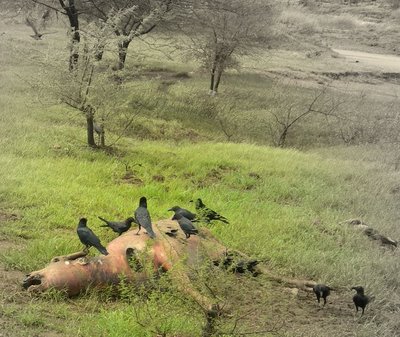
Check out this terrific picture by Sonia Faleiro. (She blogged about it here.) I love the way there's just that patch of green in the front part of the picture, which fades away into grey. Life and Death are both present in this picture, and one of them is an imposter.
(PS. I'm sure that's just my take of the picture. Sonia's a happy, cheerful person.)
Friday, August 25, 2006
There but for the grace of FSM...
In a feature on Dale Carnegie's How to Win Friends and Influence People, Richard Morrison writes:
Carnegie had a brutally mechanistic view of human nature. He believed that words and deeds are largely shaped by genes, upbringing and circumstance. “You deserve very little credit for being what you are,” he tells the reader. “And remember, the people who come to you irritated, bigoted, unreasoning, deserve very little discredit for being what they are.” [Itals in original.]
Simplistic and deterministic? Perhaps a bit. But while I wouldn't allow "genes, upbringing and circumstance" to serve as a justification for one's actions, they can help explain why people turn out the way they do. The bigots, racists and perverts of the world choose their own actions and must bear the consequences, but what makes them the way they are? If that cocktail of nature, nurture and circumstance had acted upon us, how would we have turned out?
And would we have blogged?
Neha is an Afghan Hound, Neha is an Afghan Hound!
I'm a huge fan of doggies.
And someday, I too shall write about my battles with my hair. If those battles are unsuccessful, that might be my last post. These are serious matters.
18-months-old. Leukemia. Needs bone marrow.
Blocking spyware (and octegenarian porn)
What to do when your aged daddy surfs porn all the time and his PC keeps getting screwed by spyware? Gautam John points us to Walter Mossberg's solution.
And yes, it works on young people's computers as well. Relax now.
Maths and politics
There's a superb feature in the New Yorker this week, by Sylvia Nasar and David Gruber, on all the fuss over the solution to the famous Poincaré conjecture. Grigory Perelman and Shing-Tung Yau star in this fascinating story, and even if, like me, you don't understand too much math, the sheer human drama of it is fascinating.
Thursday, August 24, 2006
How to deal with irritating email
Tired of people sending you mass email you don't want? Sick of being part of group mails where your name is in the "to" field instead of the "bcc" field, and everybody keeps wasting your time with "reply all?" Well, not to worry: send your tormenters this link: Thanks. No.
(Link via email from MadMan; I wonder why!)
Renaming the BBC
I think it should now be called the British Broadcasting Cow.
And its symbol should be an udder, so that instead of calling it the Beeb, people call it the Boob.
Udderstand?
Previous posts on cows: 1, 2, 3, 4, 5, 6, 7, 8, 9, 10, 11, 12, 13, 14, 15, 16, 17, 18, 19, 20, 21, 22, 23, 24, 25, 26, 27, 28, 29, 30, 31 , 32, 33, 34, 35, 36, 37, 38, 39, 40, 41, 42, 43, 44, 45, 46, 47, 48, 49, 50, 51, 52, 53.
What on earth is a penis pump?
Manish points me, via email, to a story about a gent in whose baggage a penis pump was discovered at O'Hare airport. It looked like a grenade, and the security chappies asked him what it was. He looked around, his momma was nearby. He couldn't say it was a penis pump in her presence, could he now?
So he said it's a bomb.
Maybe I'm sort of old, or just desperately uncool, but I don't have the slightest idea what a penis pump is, or what it's used for. I don't even want to think about it. The question in the headline is rhetorical, please don't send me emails with links or pictures. I don't want to know. Really.
Update: Sigh. I should have expected it. The mailbox is flooded with mails with "penis" in their title, and I'm not talking about the spam. These boys, I tell ya.
First up, [anonymous] and Abhishek Mehrotra point me to the Wikipedia page on penis pumps, which I'm sure they must have studied intently. Hmm.
Second up, KM and Ajeet Ganga send me links to news pieces about a judge "convicted of exposing himself while presiding over jury trials by using a sexual device." An excerpt:
At his trial this summer, his former court reporter, Lisa Foster, testified that she saw Thompson expose himself at least 15 times during trial between 2001 and 2003. Prosecutors said he also used a device known as a penis pump during at least four trials in the same period.
Well, they say justice is hard, but maybe this dude wanted it harder. Anyway, Sanjeev Naik then writes in with a movie recommendation:
Austin Powers comes back from being cryogenically frozen, takes a really long pee, and then when he goes to take back his stuff (a la a prisoner being released after years of incarceration), and there is a long sequence there with him being embarrassed (in front of Liz Hurley) as a penis pump is one of the things being returned to him.
"This is a grenade," he should have told her. "Should I Hurley?"
You'll do anything for love?
Not this, surely?
Thank FSM the couple in question didn't have kids. Imagine their confusion, suddenly finding that Daddy's disappeared and a second Mommy who looks like Daddy has turned up, and is always pawing the first Mommy and saying, "This is what you wanted, isn't it? Why're you ignoring me now?"
(Link via email from Amit Agarwal.)
Getting old with Scott Adams and Koena Mitra
Scott Adams explains, in a post titled "Benefits of Getting Old," why advancing years aren't necessarily a bad thing. And if you're male, Jiah Khan, Koena Mitra and Kim Sharma have some reasons for you as well. (Yes, yes, Jiah's been on this meme for a while now, and I wonder what the Big B feels about it. Surely temptation doesn't disappear with age?)
And what do I feel about getting old, you ask cheekily? Grmphh. I'll tell you when I get there.
(Adams link via email from n.)
Freedom in India
I make my debut today in one of my favourite online magazines, TCS Daily, with a piece titled "Transforming India's Mental Landscape." Broadly, it expounds on the theme I mentioned in this post: how, despite celebrating 59 years of independence, India still doesn't offer enough economic and individual freedoms to its citizens. I end the piece on a note of hope, and I hope I'm right. Is that recursive?
Wednesday, August 23, 2006
Cows that "moo with a Somerset drawl"
The BBC reports that language specialists have found that cows, just like humans, speak with an accent. It even has a link to an audio recording of different kinds of moos.
Sadly, there's no track of a cow singing "Moo your body, Moo your body." Cows are like humans not just in their accents, but in their sensuality as well. That's what I'm waiting for the BBC to report.
(Link via separate emails from readers TG Vasu, Sriram Krishnamoorthy and Ravi Gurnani.)
Previous posts on cows: 1, 2, 3, 4, 5, 6, 7, 8, 9, 10, 11, 12, 13, 14, 15, 16, 17, 18, 19, 20, 21, 22, 23, 24, 25, 26, 27, 28, 29, 30, 31 , 32, 33, 34, 35, 36, 37, 38, 39, 40, 41, 42, 43, 44, 45, 46, 47, 48, 49, 50, 51, 52.
Update (August 24): Falstaff writes in to direct me to a post on Language Log in which John Wells, the expert quoted in that news story, says that some of the words attributed to him were the "inventions of a public relations firm." Wells says that he finds it "highly unlikely" that cows could have an accent.
Bummer. I feel like a little boy from Andheri who's just been told that Santa Claus does not exist. "But Santa Cruz does, right?" I ask. "Please tell me at least Santa Cruz exists.
"And Bandra, what about Bandra?"
The fuss over Hitler's Cross
Arzan and Emperor Frost, via separate emails, brought my attention a couple of days ago to the much-discussed story of the chappies who run a restaurant in Mumbai called Hitler's Cross. Many people around the world are pissed, and understandably so: naming a restaurant after a murderer of millions is tasteless and replusive. I think anyone who agrees with that -- most of my readers, I would assume -- should show their displeasure by not going to that restaurant.
However, I do not think that the law should be brought into play, or that the restaurant's name should forcibly be changed, as Israel's consul general, Daniel Zonshine, is demanding. In a free country, people should have the right to express their admiration for any individual or ideology, provided they don't impinge on the rights of the others -- and I haven't read any reports about people being forced to eat at that restaurant.
Personally, I find the Communist hammer and sickle every bit as offensive as Hitler's Swastika, and I'm amazed that some political parties hang portraits of Stalin, no less a mass-murderer than Hitler, in their offices. People who proudly wear Che Guevara T-Shirts are acting out of quite the same ignorance and tastelessness as the misguided gents who started this silly restaurant. We don't demand they remove their T-Shirts, we don't demand that M Karunanidhi's son change his name, and we should, similarly, leave Hitler's Cross alone.
PS. Neela points me, via email, to this most amusing site called Brahmin Leather Works. I won't be surprised if the goondas in the Shiv Sena find out about these guys, based in Massachusetts, and call a bandh in Mumbai. That would be quite typical.
Also PS. And do read my earlier post on tolerance and taking offence, "Do not draw my unicorn." It was written at the time of the Danish cartoons controversy.
Update (August 24): Bobin James writes in to inform me that the restaurant's owners have decided to change its name.
If she complains of a headache...
Woman on top
Not God. (NSFW.)
No, no, I'm not that kind of an atheist. God may not exist (if God does and is reading this, Boo!), but sex certainly can be divine.
(Link via Dhoomketu.)
Tuesday, August 22, 2006
"Mozart and Metallica at the same time"
David Foster Wallace, the novelist who was a junior tennis player in his youth, has a remarkable essay on Roger Federer in the New York Times called "Federer as Religious Experience." It is as perfect a sports piece as I have read, which is befitting, I suppose, considering the subject. It has some stunning passages -- the second paragraph, for example, in which he describes a passage of play with such perfect rhythm that reading it is like playing the point, like being there. The footnotes are also marvellous.
Don DeLillo's written beautifully on baseball -- such as in the opening section of Underworld -- and it's a pity that none of the big Indian novelists has brought cricket alive in this manner. Indeed, I can't think of anyone who has written about cricket with so potent a combination of poetic force and analytical rigour.
(Link via separate emails from S Rajesh and Rk.)
72 lakhs per day
Where in India is that kind of taxpayers' money spent?
For the answer, check out Arjun Swarup's post here.
(I'd linked to a similar report some time ago, but the starkness of the figures in Arjun's post drives the point home pretty well, I'd think.)
Rev up that auto rickshaw
A couple of months ago I'd blogged about the Indian Autorickshaw Challenge. Well, Akshay emails me to let me know that blogger Scott Carney is taking part in it. Scott's team is called Curry in a Hurry, which can get messy in an auto, but I wish them all the best.
And the next time you hail an auto and the bugger refuses to stop, do consider that it might be a blogger practising for next year's race. Autos will never be the same again.
"Kids can be cruel..."
... but teenagers can be devastating."
I don't link much to the confessional kind of personal blogs, but I can't resist pointing you to a lovely post by eM, "Confessions of a Teenage Geek."
I can guarantee you that everyone who reads this post will go, "Hey, I was like that, I didn't fit in either." I sometimes wonder who did fit in.
Bhopal hooligans demand a ban on Kank
They're upset that Shah Rukh Khan has defended the Cola companies in the pesticide controversy.
I'm with Shah Rukh on two counts here. One, he's right about the cola controversy, as pieces by Arjun Swarup and Gurcharan Das bear out. And two, even if he was wrong, there is no excuse for the kind of gundagardi that has become popular in India. A peaceful protest is fine, but getting in the way of other people and damaging property is just criminal activity, and should be treated as such.
Of course, I continue to maintain that Shah Rukh's hamming-in-the-name-of-acting is excruciating. That's reason enough for me not to watch his movies, but I'd have no business stopping others from doing so. Ditto with colas, in fact.
Ass cheeks and writers go together
In a post titled "Work habits," Scott Adams writes, "... I can't write unless both of my ass cheeks are equally touching my chair and my feet are flat on the ground." He explains why that is so, and describes why his cat's "anti-productivity crusade" is also a factor.
Well, that explains it. So if you find that my blogging frequency has suddenly gone down, and many hours go by without a post, I'm probably shifting my ass cheeks around madly. And trying to draw Dilbert.
(Link via email from n.)
Paskistan (and Ghandi)
Nikhil Pahwa writes:
This is ridiculous - One agency (UPI) carries a report with a typo, calling Pakistan, "Paskistan". And then it spreads:
Starts from here - UPI.
Then: The Washington Times, The Daily India, Political Gateway, Monsters and Critics, North Korea Times
You do a google search for Paskistan, and... this
Hmm. I hope the meme doesn't spread too far, or my friends in Paskistan will be most upset.
(This reminds me, by the way, of how so many Western outlets spell 'Gandhi' as 'Ghandi'. Why? How did that start, I wonder.)
The transclucent underside of a lizard
Shilpa describes her battle with Guffawing Gekko. Most entertaining. I should keep a pet lizard. I am told that's a chick magnet.
Cupid and the condom order
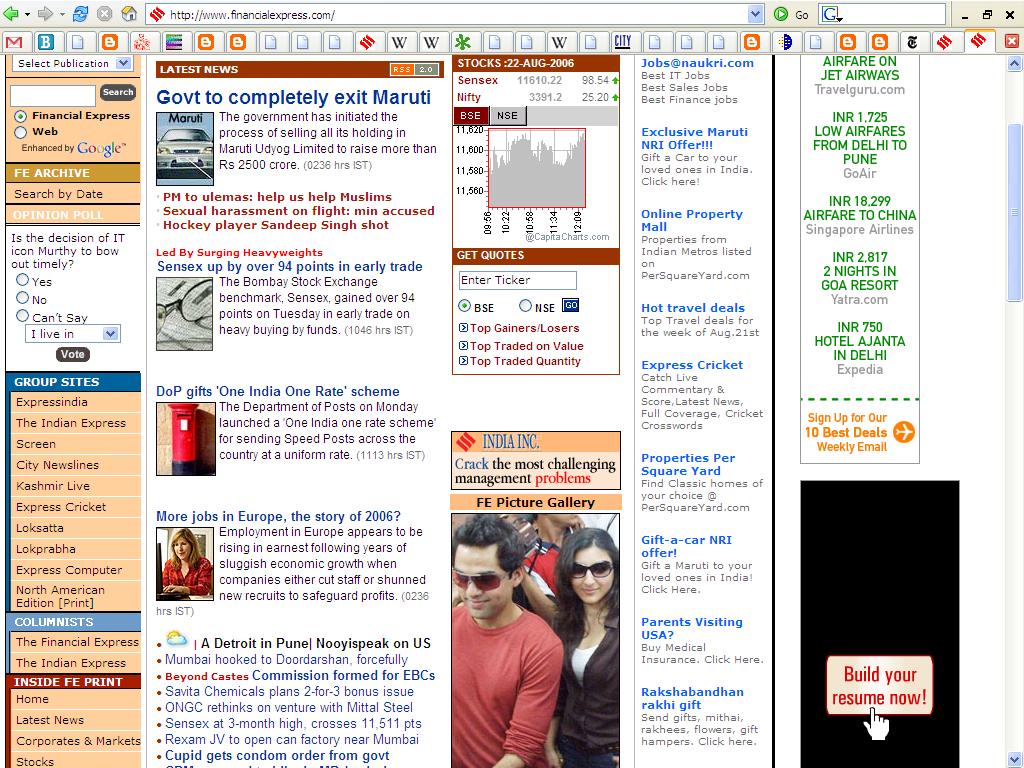
Well, it's amusing all right, but why on earth would the Financial Express link this one-sentence story from the front page of their website? (Screengrab here, headline's at the bottom, in bold.) Is it really so newsworthy that a company named Cupid Ltd is supplying condoms to the "Indian ministry of health and family welfare?"
On the other hand, I must confess that I didn't click on any of the other headlines on that page. I hope that doesn't mark a worrying trend.
(Link via email from MadMan.)
Monday, August 21, 2006
Movie channels blocked in Mumbai now
Peter just sent me an email alerting me to a post about how his cable operator has cut off all his movie channels. He called up the cable operator, who gave him a two-word answer: "Government block."
NDTV confirms the news, and says that this is "in response to a Bombay High Court order last December which banned TV channels from screening A and U/A rated films."
The lesson from this: if the executive don't get you, the judiciary will.
(I'll be updating this post if further developments take place. My accounts of the recent block on blogs: 1, 2, 3, 4.)
Update: The cable operators seem to be protesting. Deep Ganatra (via the Bloggers Collective email group) writes that his cable operator has stopped all channels, and is showing the following message on the screen:
Due to unprecedented raids on the cable operators for carrying satellite movie and entertainment channels having Adult content, All Maharashtra cable operators have shut down the channels till further directions from high court. Kindly bear with us. CODA.
(Update 1.5: Sameer reproduces the message carried by Incablenet in Prabhadevi on his post here.)
Update 2: MadMan writes in (via BC):
How dare they allow Cartoon Network to be shown on cable? Cartoon Network has been showing nudity for many years now and the government has done nothing! I can't begin to recall the number of times I've turned it on and seen naked mice and cats running freely in shows named "Tom and Jerry".
Heh, indeed. And I think I might have caught a naked cow or two as well. Aren't they sacred?
Update 2.5: aNTi emails me to let me know that Tom and Jerry ain't safe even in England.
Update 3: I've just received news that the cable operators have stopped showing all paid channels in Mumbai to protest against police raids that were carried out on eight cable operators and three multi-system operators, during which transmission equipment was seized. The cable operators' stand is that the onus of complying with the high court directive was on the television channels, and that they have been needlessly harassed.
Update 4 (August 22): Some reports: 1, 2, 3, 4.
Update 5 (August 22): These Swedish chappies have all the fun.
Update 6 (August 23, early hours): The cable operators in Mumbai have restored service, though none of the movie channels are being shown yet.
How to make cold coffee in 10 seconds
Put milk, coffee powder and sugar in a cold-coffee shaker, and drive over a stretch of the Western Express Highway in Mumbai.
Lajwanti D'Souza of Mid Day does an exceptional story on Mumbai's pothole-infested roads, armed with nothing but a cold-coffee shaker. Some might say it's gimmicky, but it drives the point home superbly.
(Link via email from reader Kartik Desikan.)
What President Bush is reading
Albert Camus's L'Etranger is part of President George W Bush's summer reading, and Adam Gopnik writes in the New Yorker:
As “Camus at Combat,” a new collection of his editorials—he was a working journalist—makes plain, the experience, first, of the Nazi occupation of France, and then of the struggle of Algerian independence against France led him to conclude that the “primitive” impulse to kill and torture shared a taproot with the habit of abstraction, of thinking of other people as a class of entities. Camus was no pacifist, but he deplored the logic of thinking in categories. “We have witnessed lying, humiliation, killing, deportation and torture, and in each instance it was impossible to persuade the people who were doing these things not to do them, because they were sure of themselves and because there is no way of persuading an abstraction, or, to put it another way, the representative of an ideology,” he wrote. Terror makes fear, and fear stops thinking.
Thinking in categories is a fault that runs across the Indian political spectrum as well. A few common categories: "multinationals," "imperialists," "upper castes," "lower castes," "bourgeoisie," "communalists," "pseudo-secularists," and, of course, "Muslims." So much damage has been done because we haven't, to use Gopnik's words, been able "to think about particular people, proximate causes, and obtainable objectives."
The heart of darkness
In an essay on John Updike's Terrorist, and on terrorism in general, Theodore Dalrymple writes:
It is not the personal that is political, but the political that is personal. People with unusually thin skins ascribe the small insults, humiliations, and setbacks consequent upon human existence to vast and malign political forces; and, projecting their own suffering onto the whole of mankind, conceive of schemes, usually involving violence, to remedy the situation that has so wounded them.
Dalrymple makes the case that "terrorism is not a simple, direct response to, or result of, social injustice, poverty, or any other objectively discernible human ill," and compares Updike's book to one of Joseph Conrad's novels:
Updike’s Terrorist has much in common with Conrad’s The Secret Agent, published 99 years previously. In both books, a double agent tries to get a third party to commit a bomb outrage; in both books, the secret agent ends up slain. In both books, the terrorists operate in a free society unsure how far it may go in restricting freedom to protect itself from those who wish to destroy it. The terrorists in Conrad are European anarchists and socialists; in Updike they are Muslims in America: but in neither case does the righting of any “objective” injustice motivate them. They act from a mixture of personal angst and resentment, which easily attaches itself to abstract grievances about the whole of society, thus disguising the real source of their consuming but sublimated rage.
Indeed, so many of the ideological stands I see people take around me come not from a worldview reached from detached contemplation but from that "mixture of personal angst and resentment," manifested upon a fashionable target. No one gives your writing the respect it deserves, blame it on those incestuous literary (or blogging!) cliques that keep outsiders at bay. MBA school refused you admission, well, who wants to join the bloodsucking corporate world anyway? You want to be known as warm and compassionate, attack the evil capitalists for the inequities in society. And if there are random frustrations you can't articulate, there's always Big Bad America to rant about, even if you use Microsoft and drink Coke and wear Nike. (Hating it in the abstract but loving it in the concrete, as Victor Davis Hansen might have put it.)
Naturally, these are caricatured and extreme examples, and not all believers in any ideology are motivated by personal demons they are in denial of. But I've seen too many of these types around, and so, I'm sure, have you. No?
(Link via email from Sonia; more Dalrymple links here.)
A pointless homage
Ustad Bismillah Khan is dead, and I'm sure there'll be many moving tributes to him in the days to come. Trust the government of India, though, to choose pointless (and costly) symbolism. The Times of India reports that the UP government has "declared a one-day mourning and ordered closure of all government schools, colleges and offices."
I'm okay with declaring one-day mournings, as long as they consist of symbolic gestures like flying flags at half mast, which harm nobody. But why close schools and colleges and offices? What's the connection? We correctly criticise the Shiv Sena everytime it calls a bandh, for the damage it does to the economy, well, this is a government mandated bandh, even if one limited to government organisations. Ludicrosity. If souls existed, Ustadsaab's soul would no doubt be going, "Wtf?"
Update: You'll hardly get a better tribute to Bismillah Khan than Falstaff's post, Bidai.
Locking up wives, and starving children
All the wankers of the world have suddenly become Kankers. You can't pick up a newspaper or turn on a TV channel these days without being assailed by Kank, with TV debates and print features about the shape of the "modern Indian marriage" and infidelity. It's also brought on a barrage of tasteless humour, exemplified by the headline on the left in the screengrab below. (You know where it's from, needless to say.)
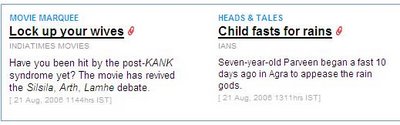
Speaking of modernity, the problem in India is not an excess of it but a scarcity. Consider, now, the headline on the right in that screengrab. A seven-year-old kid is fasting in Agra "to appease the rain gods," and had it been an adult, I'd have been in favour of leaving the idiot alone and letting him starve himself. But this is a kid, for FSM's sake, and the report seems to indicate that despite the authorities trying to make her eat, she has the tacit support of her family and her village. The report says:
Her fast has inspired hundreds of people to join her in prayers and bhajans (devotional songs). Parveen's family, which includes her five brothers and sisters, says that she is determined to starve herself until "Lord Indra smiles" and ensures rainfall.
"Her tapasya (meditation) will not go in vain," say villagers, worried over the scanty rainfall in some districts of western Uttar Pradesh.
If it rains, needless to say, the superstitions of all involved will be reinforced, and we'll see more of this bullshit in times to come. If it doesn't rain, they'll no doubt say that the girl's tapasya wasn't good enough, or they'll blame the authorities for breaking her fast. I shudder to imagine what effect this might have on the poor girl's mind, and what she might grow up to become.
Quizzaciousness, and bookacity
"Quizzing is a physical sport," some of us quizzing insiders in Mumbai often remind ourselves. Joining a gym last week was, thus, clearly a smart move, as I won a quiz yesterday after a long time. It was a general quiz with an emphasis on books and literature, and it took place in a charming little bookstore in Santa Cruz called the Readers Shop. Pradeep Ramarathnam conducted the quiz, and Aadisht Khanna and I won by a handsome margin of one point over Rajiv Rai and Ravi Venkatesh. Rishi Iyengar and Naveen Venkataraman came third, a further point behind, with Rishi slapping his forehead at the end of the quiz and muttering "Bonfire of the Vanities!" You must work out more, I keep telling the boy. I don't think he squats enough.
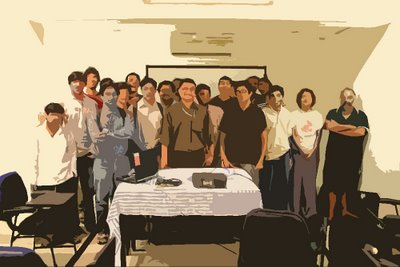
There was a quiz last Sunday as well, the last conducted by Gaurav Sabnis before his move abroad. I hadn't joined the gym then, and my lack of stamina told on me as my team led for the first two-thirds of the quiz before being overtaken by Dhoomketu's team, who reportedly meet for sprinting sessions at Juhu beach every morning. Rishi has a report of the proceedings here, and I reproduce below a picture of the (other) participants taken and photoshopped by me. As Shakespeare once wrote, "The effects conceal the defects, foolish knave. Et tu Brute?"
And ah, before I forget, let me recommend that if you find yourself anywhere in the vicinity of The Readers Shop, do drop in. (It's near the Santa Cruz Police Station, on the road connecting SV Road and Linking Road that has a Standard Chartered branch on it.) I didn't have as much time to browse there as I would have liked -- I will return there soon, much to my banker's regret -- but I did have time to note that the collection seemed to be fairly eclectic, and a bargain section outside the store might yield some treasures: I picked up a Modern Library edition of The Federalist for just 100 rupees.
And now if you'll excuse me, I need to do some stretches.
Browsing books as a contact sport
With reference to my post linking to Ram Guha's piece on Premier's, The Marauder's Map writes in to point me to this excellent piece by another fine writer, Suresh Menon, in which Menon informs us that Premier's might be shutting down. He also writes about "[t]he politics of bookshop browsing," and how it can be a "contact sport."
I'm a huge fan of contact sports. I will write about one in my next post.
Sunday, August 20, 2006
Guess who's doing passenger profiling now
The passengers themselves.
The Daily Mail reports:
British holidaymakers staged an unprecedented mutiny - refusing to allow their flight to take off until two men they feared were terrorists were forcibly removed.
The extraordinary scenes happened after some of the 150 passengers on a Malaga-Manchester flight overheard two men of Asian appearance apparently talking Arabic.
This is disgraceful. The passengers who feel worried have every right to get off the plane, at their own expense, but no right to demand that others be offloaded. I'm amazed that the airline caved in, and I hope the gentlemen "of Asian appearance" sue. Once they were past security check, the airline had no business offloading them. Sure, it could have searched them again, but no more than that.
I quite agree with Patrick Mercer, a Tory spokesman, who is quoted as saying, "This is a victory for terrorists." Notch one up for Osama.
(Link via email from MadMan.)
Update (August 24): Here's a follow-up, with a picture of the two offloaded chaps, who are 22-year-old students. One of them says: "Just because we're Muslim does not mean we are suicide bombers." I hate it when it seems necessary to state the obvious.
Blogger goes to massage parlour for nude photoshoot
And what's more, Jai Arjun Singh tells us:
Gyms are populated by beefy, thick-skinned but strangely charming young trainers who resemble the Deol boys in muscle structure as well as in their shy smiles... I’ve never been so unqualifiedly happy at a book launch or discussion. What could this mean?
Sadly, Jai hasn't yet put those pictures of his online, but my heart tells me that HT Tabloid will surely get hold of them.
On that note, check out this HT Tabloid story titled "What makes Preity get goose bumps!", which carries the line:
While Karan Johar is quite superstitions about number 8, Priety Zinta gets goose bumps when black cat crosses her way and Rani Mukherjee frequently says 'touch wood'.
Well, if Rani came across Jai's pics, it wouldn't be wood she'd be wanting to touch, that's for sure!
(Previous posts with Purplocity/Verniness: 1, 2, 3, 4, 5, 6, 7, 8, 9, 10, 11, 12, 13, 14.)
Freedom's on the march
Govt puts off RTI changes.
Men can watch women's soccer, rules Pak.
Apparently, female soccer players in Pakistan have to wear "baggy track suit trousers and long-sleeved shirts" while playing. They might as well wear shalwar kameez, I suppose. That way, even if the game isn't always flowing, at least the clothes will be.
Crystalline and Indigo kids?
Sonu Nigam is quoted as saying in the Indian Express:
I have been reading a lot of late, and according to the great spiritual healers the post-1980s generation will be the harbingers of Satyug. This is a cool, chilled-out and open generation that is not stuck-up. Within them however there are two kinds - the Crystalline, who are the emotional lot who will bring in this change through persuasion, and the Indigos, who will achieve it with rebellion.
What has he been reading (or smoking), I wondered after reading that para. A little Googling revealed that Crystalline children "are able to communicate telepathically, and are speaking to others in other dimensions as a normal event in the course of their play," while Indigo kids are supposed to have abilities that "are said to include purging HIV, advanced genius and psychic/telekinetic powers."
What a load of bull.
I'm certain Nigam will not be able to point to a single example of either of these two types of kids from his personal experience, but he's hardly the only Mumbai celeb who sees things in the world that aren't really there. Shobha De was on We the People yesterday, and the topic of discussion was marital infidelity. At one point De said something to the effect of infidelity being a "non-issue" for Indians in their 20s, and that all they cared about was "quality of life."
This is, again, an astonishing statement, based, no doubt, on a view of the world as she would like to see it (so that it fits some pet theory of hers, probably), and not as it is. Demanding fidelity from our partners is hardwired into human nature, and I recommend that De hop over to the nearest Barista and chat about this with some twenty-somethings.
Let me end this post by saying that that despite Nigam's fascination for New Age crud, he's an excellent singer. Can't say the same for De.
Update: Ken Falco writes in to point me to Jenny McCarthy's site, Indigo Moms. In an article there, McCarthy writes:
I was doing my usual research on environmental toxicities and found myself so obsessed with it that I once again lost sight of everything else. I learned about chemicals that are used in pajamas, such as flame retardants, and the toxic levels our children inhale throughout the night. I immediately got rid of anything that was flame retardant, including his mattress. This was followed by installing organic carpeting in his bedroom, and placing air filters in every room. Someone then told me I needed to change the paint in his bedroom to nontoxic paint. So I was at the store five minutes later buying paint that was edible, and then stayed up half the night painting the bedroom walls. I changed the pool water to Ozone, and even had a chakra balancing done on my house. What finally pushed me completely over was when I found out about electromagnetic toxicity.
Poor kid. I bet he's not allowed to drink Coke or Pepsi either.
Thoo!
Forgive me for being a cynic, but the proposed ban on spitting and littering in Mumbai is certain to become just another avenue for cops to collect bribes. They are effectively unaccountable and poorly paid, and the two factors combine to create conditions that make corruption inevitable. In those circumstances, the more discretion they get, the more opportunity they will have to misuse their power.
That doesn't mean spitting and littering should not be banned. But the skewed incentives that the cops work under need to be fixed. We're a country prime-ministered by an economist, and you would have thought that we'd have figured that by now.
Or maybe not.
Bhopal
When he hanged himself, he left a note saying he was committing suicide not because he was mentally unsound but with all his wits about him.
I believe him, I really do.
Saturday, August 19, 2006
A tribute to Mr Shanbhag
Ramachandra Guha has a lovely piece in the Telegraph on TS Shanbhag, the owner of Premier's, the famous bookstore in Bangalore. Guha writes:
... Premier’s has the most cultivated tastes of all the bookshops I know in India. It is only here that works of literature and history outnumber (and outsell) books designed to augment your bank balance or cure your soul. When it comes to fiction, Mr Shanbhag stocks not merely the latest Booker winner but the back-list of the author (if he has one). When J.M. Coetzee won that prize, even the pavement seller was selling Disgrace, but only in Premier’s would one find The Master of St. Petersburg as well. Mr Shanbhag keeps more, and better, hardback history than any other Indian shop I know; more, and better, literary fiction; and more, and better, translations.
That sounds rather familiar, for Strand in Mumbai is a similar store. And the owner of Strand, TN Shanbhag, is TS Shanbhag's uncle. It's surprising enough when someone builds a sustainable business out of the application of good taste, and it's surely astonishing that this skill should run in the family.
By the by, here's another piece by Guha on Premier's from three years ago.
Be careful where you send that email
Reuters tells us about two German ladies who were discussing their partners' poor sex drives over email, when one of them accidentally sent the mail to the entire company. After that, needless to say, the mails spread and spread.
Amusing as this is, a blast of recognition must surely accompany our reading of this news. Which of us has not pressed "reply all" instead of "reply", or committed a similar blunder? (That is a rhetorical question; please do not send me email answering it!)
Indeed, it isn't just email with which it can happen. A friend of mine has a habit of not locking his mobile phone keypad, and he was once bitching about a colleague over lunch. Ten minutes after the bitching session, the colleague calls him up. "So you think I am [snip snip snip], huh?" My friend's phone had accidentally dialled his number while the bitching was in progress, and the man heard every word.
Indeed, imagine how many relationships would be shattered if every email account in the world was suddenly thrown open for anyone to read. Ooh hoo hoo. Complete honesty would savage us all.
Update: Benjamen Walker has a great story here about the consequences of accidental phone calls. Make sure you download and listen.
(Link via email from Anand.)
Gaurav Sabnis joins a PSU
A few days ago my libertarian friend, Gaurav Sabnis, had stunned everyone with the announcement that he was going to join a PSU.
Today, he reveals which one.
That makes two close blogger buddies who've left Mumbai for the US within the last week. (Yazad Jal is in Yale now, to do an MBA.) The allnighters at Marine Plaza, after dinner at Noor Mohammadi, just won't be the same anymore -- if they happen at all. This is most terrible. I need a hug.
Middle East conflict deepens
Now the cows are resettling.
(Link via email from JK.)
Previous posts on cows: 1, 2, 3, 4, 5, 6, 7, 8, 9, 10, 11, 12, 13, 14, 15, 16, 17, 18, 19, 20, 21, 22, 23, 24, 25, 26, 27, 28, 29, 30, 31 , 32, 33, 34, 35, 36, 37, 38, 39, 40, 41, 42, 43, 44, 45, 46, 47, 48, 49, 50, 51.
Friday, August 18, 2006
The language of justice
It's bad enough to have courts that take years, or even decades, to decide cases, but it's even worse when you can't understand what the judge has decided because of his English. Mumbai Mirror reports that an advocate of the Mazgaon Court, Jamal Khan, has approached the Bombay High Court with a complaint against a magistrate there, SR Bedgale. Khan's complaint is that "[t]he English used by the magistrate is incomprehensible." Some examples he cites:
• "I cannot give the exact time when I admitted the hospital after the incident".
• "I was fallen down at my residence"; "I detained conscious at hospital".
• "They assaulted with the help of hands and legs".
• "Ganesh Chauvan tried to assault me to my face but I prohibited through my left hand."
I'm not sure how many languages the court is allowed to conduct its business in, but it's ludicrous if court officials aren't proficient in whichever language they choose to use. It's not that Bedgale is an exception, though -- the article quotes an advocate named YS Qureshi reporting a classic order by a magistrate named AD Chaudhary in 1990, in which Chaudhary said:
I have a woman before me who has a milk sucking baby. I have personally verified her sex and found that she is a woman and thus be given bail.
This, I must state with the highest admiration, is worthy of HT Tabloid, which runs a story today with the immortal headline, "Ex-IGP turns wife into daughter!" My joy knows no bounds.
(Previous posts with Purplocity/Verniness: 1, 2, 3, 4, 5, 6, 7, 8, 9, 10, 11, 12, 13.)
Romancing Rabri Devi
Whatever he may think of taxpayers' money, you can't say that Lalu Prasad Yadav doesn't have a heart. Consider his love for Rabri Devi:
While scores of railway projects wait to take off, work on the 20.9-km stretch between Hathua and Bathua Bazar on the Hathua-Bhatni section of North Eastern Railway is moving at a breakneck pace.
The reason: On completion, it will connect Union Railway Minister Lalu Prasad Yadav’s ancestral village, Phulwaria, with that of his wife Rabri Devi, Salar Kalan, just 2.9 km apart.
[...]
Rabri is learnt to have requested Yadav to get both their villages connected by rail some time back.
I shudder to think what would have happened had Lalu been civil aviation minister.
This particular railway line may not be a bad thing, of course, and may actually give the region's economy a slight boost, as railway lines tend to do. But the motive behind it is rather amusing, though I'm sure Rabri will be delighted, and Lalu will get some action the night the railway line is inaugurated.
"Leave that cow alone and come to bed, my love," Rabri will call out to him. "I need you to fix your engine to my bogey so we can go chug chug chug."
Some previous posts on Lalu: 1, 2, 3, 4, 5, 6, 7, 8, 9, 10, 11, 12, 13, 14, 15, 16.
(Link via email from Nazim Khan.)
Veena's Booker Mela...
... is up and running. Veena's invited bloggers to choose a book to review from the Booker longlist, and to send her the link when they're done. If you love books, I'm sure much fun will come.
I haven't reviewed a literary work in a long time, so I won't volunteer, but if you enjoy reading, go forth and pick a book. If you're upset with yourself for how little you read these days, as I perpetually am, a public commitment on her blog will make sure you read at least that one book soon!
If you can't find news to report...
... create it. Reuters reports:
A group of Indian television journalists gave a man matches and diesel to help him commit suicide in order to get dramatic footage which was later broadcast on the news, police said on Thursday.
The man died from severe burns to his body in hospital in Gaya town in the eastern state of Bihar on August 15, India's Independence Day.
[...]
"We have seized footage clearly showing a group of journalists handing over matches and some inflammable substance -- which we later verified to be diesel -- to the victim," acting Gaya police chief P.K. Sinha told Reuters by telephone.
I'm sure these gentlemen got a pat on the back from their boss in the studio. "Well done, well done," their bossie must have said. "But we should have got another angle in. You should have shot another take from a top angle."
(Link via email from reader Vikram Chandrashekar.)
Unleash the tiger
Or rather, save the tiger by unleashing the free market. Barun Mitra writes in the New York Times about how conservationists are failing to protect the tiger, but the free market would do a better job. He writes:
[L]ike forests, animals are renewable resources. If you think of tigers as products, it becomes clear that demand provides opportunity, rather than posing a threat. For instance, there are perhaps 1.5 billion head of cattle and buffalo and 2 billion goats and sheep in the world today. These are among the most exploited of animals, yet they are not in danger of dying out; there is incentive, in these instances, for humans to conserve.
So it can be for the tiger.
Read the full piece. Mitra, by the way, runs The Liberty Institute in Delhi.
(Link via Cafe Hayek, via email from Do Not Ask.)
Thursday, August 17, 2006
Such a cutie
Kaps at Sambhar Mafia wants to know who the person in the photo is. My first reaction is in the headline, though I know some readers will find it sexist. "After all," they will ask, "a woman is much more than just her looks." Well, an instinctive reaction is an instinctive reaction, what to do now? And immense admiration already does exist for this lady's achievements, which you no doubt share.
So tell, who is she?
Update: Falstaff writes, in the context of this picture, that "the ability to photograph well may be a key determinant of corporate success." He writes:
People with good passport photographs get picked for interviews over the rest of us, because they look like the kind of people the recruiter would want to work with. People like me get their resumes forwarded to the Department of Homeland Security as a safety risk. As a result people who photograph well gain more valuable and varied experience, and before you know it they're heading major multi-nationals while their less fortunate brethren are still hanging about boring other people with their baby pictures.
Good point. Needless to say, you need to have some basic looks to be able to photograph well, and I suspect my problems begin there. So even if I "say cheese with vehemence," as Falstaff suggests, it wouldn't work with me. Everyone at the studio would just look at me and wonder why I was so pissed, shrieking "cheese" like that.
By the by, in case you're still wondering, the lady in the pic in Indra Nooyi.
I'm going to explode
Passenger with brown skin and long beard calls airhostess over.
Passenger: Excuse me, there is something I need to tell you.
Airhostess: Yes sir, what is it?
Passenger: I'm going to explode.
Airhostess: What? Oh my God! Help! Security!
Old woman sitting besides the man: Wait. I'm going to explode as well.
Teenage girl sitting behind them: Me too. I'm going to explode.
Geriatric man besides teenage girl: I'm also going to explode.
Nine year old boy in front seat: I've already exploded. Hee hee.
What's going on? See this.
(Link via email from The Invizible Man.)
Wednesday, August 16, 2006
Shekhar Kapur has a Big Laugh
Via Uma, I discover this bizarre interview of Shekhar Kapur in which he says:
People talk of the Big Bang. If there was a beginning, there must be an end. But there is no linear time, so where is the end? I call it the Big Laugh. Someone laughed ‘ha, ha ha’ And between the first and the second ‘ha’s, came a few billion years.
Jeez. Later in the interview he says, "Deepak Chopra is a friend, but I’ve never read a book of his." Read Deepak Chopra books? With pseudogiri like this, Kapur could write them.
Is Pluto a planet?
Yes, according to a bunch of astronomers expected to vote on the matter soon, as are Ceres, Xena and Charon.
I hope they eventually discover life on Charon, perhaps in the form of rocks with legs. Just the thought of Charon Stone excites me.
A trace, a small scar
In a profile of Tom Stoppard, born as Tomas Straussler in Czechoslovakia in 1937, William Langley writes:
At 68, he is still discovering himself. When he was a boy, his mother drew a veil over the family's past. There had been a Jewish grandmother, she said, and this was why they had to leave Czechoslovakia. Only relatively recently did he learn the fully story.
His whole family was Jewish. Most of his relatives had been murdered in the death camps. His father, once the house doctor at the Bata shoe factory in Zlin, had been killed in a Japanese air raid. Some years ago, after a visit to Czechoslovakia, he wrote movingly of meeting an elderly woman, a former Bata employee, whose gashed hand had been stitched by Dr Straussler. "I touch it. In that moment, I am surprised by grief, a small catching up of all the grief I owe. I have nothing which came from my father, nothing he owned or touched, but here is his trace, a small scar."
(Link via Sonia.)
Portals to the worlds beneath...
... could hardly get cooler than these.
If people in India tried something like this, they'd certainly get stolen really fast, like these dustbins of yore.
(Frangipani link via email from Kind Friend, who also points me to Leo M's interesting account of travelling through Pakistan..)
Shah Rukh Khan's guard kills Shah Rukh Khan's guard
As they say, Who will watch the watchmen?
Rakhi Sawant and the obscenity law
Dibyo points me to news that Rakhi Sawant was recently refused permission by the Hyderabad police to perform at an event there. She was slated to do an act at the "annual general body meeting of Suchir India Developers Private Limited," but the cops got in the way and said that "no obscene acts will be allowed."
I really should have blogged about this yesterday, it would have been a suitably ironic comment on the nature of our freedom. (Like this one -- via Madhu; more here.) What right do cops have to rule on the content of a privately organised event for adults as long as no coercion of any kind is taking place? This is incredibly condescending, and the shareholders of Suchir India Developers Private Limited are effectively being told that they are not capable of deciding for themselves what is obscene and what isn't, so the state must do it for them. I'm just glad the state didn't land up to feed them Horlicks and change their diapers. Now, that's an obscene thought.
(More on Rakhi Sawant: 1, 2, 3.)
Tuesday, August 15, 2006
Yet another reason to get bigger boobs
"A bad-ass camera"
"Tee hee," goes President Musharraf
Here's a suggestion he hasn't heard before.
Combined orgasms in a cinema hall
I'm a huge fan of Jai Arjun Singh's writings on cinema, but I must confess here that my favourite bits of his writing are not about what happens on the screen, but about what happens in the hall. In a post about Kabhi Alvida Na Kehna, he writes:
One man spent half the film with his cellphone aimed at the screen, taking photos or videos; he recorded the entire “Where’s the Party Tonight?” song and then, irritatingly, played it back later, drowning out the sound from a subsequent scene.
Young boys in my row burst into orgasmic yelps each time there was anything resembling an innuendo in the dialogue, or if a woman appeared in a low-cut blouse. At one point Rani tells Shah Rukh, “Sorry, galti se dab gaya.” (She made an unintended cellphone call.) “Galti se dab gaya!!!!” screamed the lads ecstatically, and the collective outburst reminded me of Arthur Clarke’s short story “Love that Universe”, wherein billions of people are asked to synchronize their love-making so that the combined orgasms send out a crucial energy signal to a distant civilisation.
Ah, in case I forget, I'm also a huge fan of low-cut blouses. As Mother Teresa once remarked, "Come, my love, fix your eyes like rubies/ on my lovely, lovely ____."
It's my favourite couplet of hers, and compares favourably to Beethoven's poems. No?
When Sharad Pawar misled Mumbai
In an astonishing confession, and one that vastly increases my respect for the man, Sharad Pawar admits that he lied to the people of Mumbai. The context: the 1993 bomb blasts in Mumbai. Speaking to Shekhar Gupta, he says:
I recollect on March 12, I was sitting in Mantralaya and at about 12-12.30 pm I heard a big noise, it was the explosion in Air India’s office. Within ten minutes I got a message that explosions had happened in 11 places, more than 365 people had died. I immediately realised that all these places were essentially dominated by Hindus. I guessed there must be some design, and that design must be that Hindus should react against the minority.
[...]
So I straight went on television and I misled people, deliberately misled people, instead of 11 bomb explosions I said 12. And one of the places that I mentioned was Masjid Bandar, an area dominated by minorities. So I spread the message that it’s not only in Hindu areas, it’s in a Muslim area also. I also said that I had seen - because I’d immediately visited the Air India building - and I said I’d visited it and the type of material that had been used was used essentially by some of the southern Indian side terrorist organisations. And I tried to (point a) finger at the Sri Lankan side...
Pawar then says that "[u]ltimately investigations established ki that was the design." It's a fascinating interview, though I don't quite agree with Gupta when he says later that upper caste Gujaratis were targeted in the recent bomb blasts. That's confusing correlation (upper caste Gujjus tend to travel first class) with causation (that's why those coaches were attacked). I'm sure many other groups of people travel first class on the Western Line, and how accurate would it be to say that MBA bankers or Advertising professionals or Himesh Reshammiya fans were the targets of the attacks?
Pawar also has a comment on why the system of having zonal selectors in Indian cricket will be hard to change:
If I have to change the zonal system, I have to amend the constitution. And ultimately if I have to amend the constitution, then I have to get support from zonal representatives. (Laughs).
So to kill the vested interests, you first have to get the approval of the vested interests. Doesn't sound terribly realistic to me.
Monday, August 14, 2006
How the Indian army can "frustrate the ISI"
"By practicing safe sex."
Apparently, the ISI has been planning "to spread HIV among personnel of the Indian army and para-military forces." If this report is true, what could be the ISI's planned modus operandi? Send HIV-positive ladies to tempt armymen into indiscretion? Infect the blood received by armymen in blood transfusions? The scale at which they would have to do it is staggering, and implementation would be fraught with risk of discovery.
On the other hand, they could just leak the news of such a plan and screw the army that way. "Bloody condom again," I can imagine an armyman cribbing. "How I hate the ISI."
"I just called to say I love you"
Aadisht just informed me that if you dial directory enquiry in Mumbai (197), the background music you'll hear is the instrumental version of Stevie Wonder's hit. I wonder if the government servant who thought of that was merely young and idealistic, or whether he was just making fun of us all. "Those schmucks," he might well have thought, "they'll never get the irony!"
Update: MadMan informs me via email that when Airtel's customer-service chappies in Chennai Bangalore keep you on hold, they play "Unbreak My Heart." Why?
Hansdehar, the Knowledge Village
This is stunning: Reuters tells us about Hansdehar, a village in Western Haryana, where one can "see the names, jobs and other details of its 1,753 residents, browse photographs of their shops and read detailed specifications about their drainage and electricity facilities."
Check out the site. It has a complete listing of all the residents, religious places and tourist attractions, details of the Panchayat, and, most importantly, contact details of government officials and a survey of the infrstructure in the village. Information empowers people, and if the website also begins to incorporate information dug out using the RTI Act, its mere presence will make the government take this village extremely seriously.
"It will be a revolution," a farmer named Ajaib Singh is quoted as saying in the Reuters story, and not just in terms of government accountability. As the story elaborates:
Now Hansdehar farmers hope they will be able to get better prices for their crops by trading online through the National Commodity & Derivatives Exchange Ltd., cutting out middlemen.
Carpenters and masons will tout their services online. Others will upload their resumes to job hunting Web sites when the village's first Internet point is hooked up in Kanwal Singh's mother's house in the coming weeks.
Remarkable. I hope more villages follow Hansdehar's example.
(Link via email from Arjun Swarup.)
Update: Chenthil writes in
Most of the districts in Tamil Nadu have embraced IT for quite some time now. TN government is serious about e governance. For example, check the Cuddalore village site. You can check your name in electoral rolls, check the infrastructure projects and their budgets, download government forms, send an email to the collector. Almost all the districts in the state have embraced e governance.
Rockacious. I wonder if any studies have been done on the impact this has had on governance and the economy. That would be quite fascinating.
Update 2 (August 20): Ramya Kannan writes in to point out that Cuddalore is a district. Furthermore, she writes:
Whether all of them [the TN districts that are online] are truly functional and facilitate response is an issue that I would not want to get into, but yes, as far as districts go, we have websites for each one of them. Notable, certainly, yet not in the league of Hansedar, which is truly an instance where technology has been harnessed by the masses. Let us hope MS Swaminthan's Mission 2007 - Every village a knowledge centre - makes a true difference.
Then and Now 1: Shaftesbury Avenue, London
Shaftesbury Avenue, London, circa 1949:

Shaftesbury Avenue, London, circa 2006:

(Pic 1 by Chalmers Butterfield; more details here. Pic 2 by Tom Box; more details here. Links via email from MadMan.)
Sunday, August 13, 2006
Give us freedom, not flags
The Times of India reports:
I-Day is just two days away. There will be thousands of fluttering flags all over India — on masts, cars, houses, in the hands of joyous children... And yet, the real flags used on this historic occasion in 1947 are missing. Three of them, in fact. Shocking, but true.
Ok, so why is that shocking? Flags are mere symbols, just pieces of cloth. What is far more shocking is the absence of so many kinds of social and economic freedom in India, 59 years after political independence. Now, that worries me.
(Do read these two old posts by pals of mine expounding on that subject: "Waiting for the free-market Mahatma" and "Freedom vs Sovereignty.")
An al-Qaeda brainstorming session
David Malki is rocking at Wondermark.
This doesn't mean, of course, that I'm against the kind of security measures we see at airports. With shit like Mubtakkar around, it's necessary. I'm glad to see that security has been stepped up in Mumbai's malls as well. I don't mind losing a few minutes as they inspect my bag when I enter, though my camera is a bit shy, and keeps cribbing about how I let "all these men" feel her up. "All these men" are protecting us, Young Camera, and you really must appreciate that. Whoa, calm down with that flash, you're messing with the battery.
(Links via Boing Boing.)
Pop psychology and your email inbox
Sigh. Now they're saying that your email inbox reveals how you are as a person. In a piece by Jeffrey Zaslow, a psychologist named Dave Greenfield is quoted as saying, "If you keep your inbox full rather than empty, it may mean you keep your life cluttered in other ways." Another gentleman named Merlin Mann (a magical Surd? Nah!) says:
You have to treat your inbox like you treat your mailbox at home. You wouldn't store your bills inside your mailbox. And leaving spam in your inbox is like leaving garbage in your kitchen.
Well, in my case, the comparisons seem to bear out, as I'm a fairly untidy person, leaving books scattered around the house, and my email mailbox is a mess (even worse than when I last blogged about it). However, I'm not sure the analogy Mann makes holds up. The space I have in my email mailbox is effectively unlimited, while my meatspace mailbox and my kitchen are rather small. I use Gmail, and there are no benefits to keeping my inbox lean, but plenty of possible costs, as I may later wish to access email that doesn't seem important to me now. One can be perfectly organised in Gmail, using labels and search smartly, without deleting a single non-spam email.
On the other hand, maybe I'm just a slob in denial. Boo hoo.
(Link via Amit Agarwal.)
Eat that sinful pastry right away
It's them microbes that make you fat.
(Link via Falstaff.)
PS: No, no, I didn't mean it, I was being flippant. A combination of factors make you put on weight, and that pastry is certainly part of it. Look at all that chocolate. Think of the thousands of calories waiting to rush inside your body (because of your greed) and produce fat furiously. That pastry, I say with nothing but concern, will harm you.
Give it to me.
Preity Zinta on being a Bimbo
Speaking to HT Tabloid, Preity Zinta says
... I will advise those who want to come in the film industry that unless you complete your basic education, don't think of trying your hand here. A great look and hot body may make you successful but you will not become a successful actress but a successful bimbo. You will never get the credit for a hit film, because your contribution in the film will be nothing more than just being an on-screen bimbo.
Ms Zinta seems to be implying here that the lack of basic education will a) make you a bimbo and b) not get you credit for a hit film, presumably because you can't act without basic education. Well, well, well. Perhaps we can learn how to be a bimbo from Ms Zinta, but I don't think it's in the way the fine lady intends.
Earlier in the same piece, Minnisha Lamba tells us that "[i]t's very natural for a person to get glued to a face which is pretty and a body which is just wonderful." So now you know why I'm always walking around with Fevicol.
(Previous posts with Purplocity/Verniness: 1, 2, 3, 4, 5, 6, 7, 8, 9, 10, 11, 12)
Saturday, August 12, 2006
Indiacows?
Mandar Talvekar gets a marketing call from Indiabulls and decides to get cheeky.
If he continues like this, he'll end up causing them "psychological distress." Of course, he's not the ones making the calls, so the telemarketing chicas have only themselves to blame.
Previous posts on cows: 1, 2, 3, 4, 5, 6, 7, 8, 9, 10, 11, 12, 13, 14, 15, 16, 17, 18, 19, 20, 21, 22, 23, 24, 25, 26, 27, 28, 29, 30, 31 , 32, 33, 34, 35, 36, 37, 38, 39, 40, 41, 42, 43, 44, 45, 46, 47, 48, 49, 50.
"She asked for it"
That's the line the home ministry -- including Shivraj Patil, the home minister -- seems to be taking when it comes to violence against women. Consider this report by Monobina Gupta in the Telegraph:
A delegation headed by Renuka Chowdhury, in charge of the ministry of women and children, went to meet home minister Shivraj Patil recently to draw his attention to the rising violence against women.
[...]
Patil and his officials were far from agitated. Instead of giving the delegation a sympathetic hearing, the officials fired questions as Patil kept quiet. Why do women go out at night? Especially, why do they go out unescorted? Even worse was to come.
The officials started picking on the way women dress. Why do they dress provocatively? Their clothes are such that they invite male predators.
This is exactly what Bal Thackeray’s paper Saamna had written earlier after a rape in Mumbai.
This is appalling. Bal Thackeray's a private citizen, and one can ignore him, but this is the home ministry speaking. Shivraj Patil gets his salary from the taxes we pay; the home ministry runs on those taxes, a fair chunk of which comes from women. I'm lost for words.
First Natwar Singh, now Shivraj Patil: the senior ministers handpicked by Sonia Gandhi are a disgrace to the people they supposedly represent. I wonder what Mrs Gandhi would have to say about this.
The kindness of strangers
Reuters reports:
A Japanese man was arrested this week after making 37,760 silent calls to directory inquiries because he wanted to listen to the "kind" voices of female telephone operators. [...] "When I made a complaint call once, the operator dealt with it very kindly, so I wanted to hear these women's voices," the paper quoted him as telling police in Hiroshima, western Japan.
The report goes on to say that "Police believe the calls, made between March and July this year, caused psychological distress to more than 100 telephone operators." Yeah, I can just imagine what happens when one of them goes home and her husband wants dinner.
Husband: Darling, come, let's have dinner.
Operator: No, I'll have dinner. You stay hungry, no dinner for you.
Husband: [Baffled] Hey. What's up with you, why're you behaving like this? You're normally such a kind person.
Operator: Kind, kind, kind. I'm sick of being kind. I will never be kind in my life now. Never ever.
So the next day the husband decides that he needs some kindness in his life, and calls directory enquiry.
Celebrities as terrorist targets
The Telegraph reports that "Mumbai police are making arrangements to step up security for celebrities like Amitabh Bachchan, Shah Rukh Khan, Sachin Tendulkar and Mukesh Ambani." About time. As I wrote a couple of years ago (see fifth para), celebrities are logical targets for terrorists. I'm glad that the cops are being proactive here.
India, Pakistan, deterrence and peace
I used to wonder if India's decision to go nuclear actually backfired on us: after all, it was inevitable that Pakistan would follow, and India's conventional military superiority would effectively cease to matter, as both sides would have deterrence. Earlier, we'd know that in the event of war we were bound to win; now, we know that they're nuclear and a war might devastate both countries.
Well, Shekhar Gupta, writing in the Indian Express, reveals that Pakistan claimed to already have the bomb in 1990. He writes:
Many experts, including Seymour Hersh, believe that the then Pakistani foreign minister, Sahibzada Yaqub Khan, came to India to ‘defuse’ tension but actually unveiled a nuclear blackmail for the first time. In conversations with Indian leaders he threatened that they should not count on their conventional superiority if war broke out because Pakistan had the nukes and intended to use them in the very beginning.
[...]
It is unlikely that V.P. Singh and Gujral will tell you more on this. But Gujral will probably not deny that one conversation went something like this: Sahibzada told him that if there was a war now, it won’t be an ordinary one, that there will be flames rising from the mountains, the valleys, the plains and the rivers. And Gujral, gathering his nerves — and wits — quickly, replied, “I hope not, but please do remember, we have also been drinking the waters of the same rivers as you.”
Deterrence already, just by insinuation? Anyway, earlier in the article, Gupta writes that Pakistan liked to enter into conflict with India whenever they thought India was weak.
The Pakistani establishment has a chronic compulsion to test the waters whenever they think Indian politics is passing through a phase of confusion and weakness. They chose the summer of 1965 to start the war because they thought India’s armed forces were still punch-drunk from their defeat by China and Shastri had not yet had the time to fill the vacuum left by Nehru. Internally, they were also enthused, as so much of the subsequent literature by key Pakistani players in that war shows, by delusions that the Naga insurgency, the Dravida movement and even the vocal opposition of sections of the Left to India’s cause in the China war had all weakened India sufficiently for them to risk an assault on Kashmir. It is possible that they saw the fall of Rajiv Gandhi, and the arrival of a very weak V.P. Singh coalition as a similar opportunity.
The Naga insurgency? The Dravida movement? I suspect Pakistan made the mistake of believing their propaganda, which is, well, somewhat amusing.
I've often been attacked for being a peacenik when it comes to Pakistan, but that's an over-simplification. I just believe that we need to understand that India's enemy here is not 'Pakistan,' but Pakistan's military establishment, which thrives on the conflict with India -- indeed, its sustenence depends on it. Its interests are actually quite different from that of Pakistan's civil society -- again, a broad term -- who would, by and large, prefer peace and prosperity to conflict. In our battle against terrorism from across the border, they are our allies, not our enemies. We need to strengthen our allies, and beat our enemies.
Thus, I embrace what appears to many to be two contradictory approaches: an uncompromisingly hard line when it comes to terrorism, and a deepening of trade and people-to-people contact. Both work towards the same end. (I'll elaborate on this in a further article.)
Political correctness taken too far
I mean, look at this.
As Benjamin Franklin once said, "If all printers were determined not to print anything till they were sure it would offend nobody, there would be very little printed." That is particular pertinent to India, actually, with too many people getting offended by stuff over the last few weeks, like "Tits, Clits n Elephant Dicks." These days, 'Freedom of Expression' is becoming 'Freedom of Expression BUT...'
(Flickr link via email from MadMan.)
Don't bang the maid
Devangshu writes:
... India would be a very different place if a cross-sectional consensus on the desirability of banging the maid had not existed for centuries. Entire sub-castes are composed of little bastards, legitimised over time. These were all created by the tradition of banging the maid.
Indian history would be far less turbulent. So many of the protagonists of all those wonderfully fratricidial succession struggles would not have been conceived. Millions of sex-starved young bachelors would have gone virgins to their respective suhaag raats.
The rest of his story is about a chap he used to know who banged his maid, and was confronted by the maid's "official swain," a barber. Shit happened -- and as you will surely realise after you reach the tale's conclusion, somewhat painfully at that.
(Link via Peter.)
Friday, August 11, 2006
Google and Napoleonic France
In an article titled "The Alliance Against Google,", the Economist writes:
Prince Klemens Von Metternich, foreign minister of the Austrian Empire during the Napoleonic era and its aftermath, would have no trouble recognising Google. To him, the world's most popular web-search engine would closely resemble the Napoleonic France that in his youth humiliated Austria and Europe's other powers. Its rivals—Yahoo!, the largest of the traditional web gateways, eBay, the biggest online auction and trading site, and Microsoft, a software empire that owns MSN, a struggling web portal—would look a lot like Russia, Prussia, and Austria. Metternich responded by forging an alliance among those three monarchies to create a “balance of power” against France. Google's enemies, he might say, ought now to do the same thing.
Now, analogies are no doubt useful, but the internet and the real world are entirely different spaces, and my feeling is that the biggest threat to Google will come not from any of the established behemoths, but from a company that may not exist now, or is under the radar. What is that company and what will it do? I don't have a clue. Who could have predicted Google ten years ago? Not Page and Brin themselves, I'm guessing.
Can't afford a lawnmower?
Buy a minicow.
"I've never once had to cut the grass," says one of the minicow owners in the story linked above.
As you've no doubt heard, the best things come in cow packages.
(Link via email from Publia.)
Previous posts on cows: 1, 2, 3, 4, 5, 6, 7, 8, 9, 10, 11, 12, 13, 14, 15, 16, 17, 18, 19, 20, 21, 22, 23, 24, 25, 26, 27, 28, 29, 30, 31 , 32, 33, 34, 35, 36, 37, 38, 39, 40, 41, 42, 43, 44, 45, 46, 47, 48, 49.
Practise safe sex
Thursday, August 10, 2006
On books and reading
In a profile that David Remnick once did of Philip Roth (I can't find it online, sorry) in the New Yorker, Roth said:
[The evidence] is everywhere that the literary era has come to an end. The evidence is the culture, the evidence is the society, the evidence is the screen, the progression from the movie screen to the television screen to the computer. There's only so much time, so much room, and there are only so many habits of mind that can determine how people use the free time they have. Literature takes a habit of mind that has disappeared. It requires silence, some form of isolation, and sustained concentration in the presence of an enigmatic thing.
Indeed, in the last few years it has become fashionable to speak about the death of the novel. Well, here's what Don DeLillo once wrote to Jonathan Franzen in a letter:
The novel is whatever novelists are doing at a given time. If we're not doing the big social novel fifteen years from now, it'll probably mean our sensibilities have changed in ways that make such work less compelling to us--we won't stop because the market dried up. The writer leads, he doesn't follow.
Some other quotes by DeLillo on writing are collected here, though I first read this in David Remnick's New Yorker profile of DeLillo. I couldn't find that online either, but Remnick's profiles of Roth and DeLillo, along with a host of other great pieces by him, are collected in Reporting. Wonderful book. (All these pieces appeared in the New Yorker, and The Complete New Yorker is a fabulous buy.)
And what do I think of this? I'm afraid I don't have enough data to be able to judge whether people read more or less these days, and I won't extrapolate from personal experience. But it's clear that in our digital age, we're spoilt for choice for ways to spend our free time. Literature has competition, and that's a good thing. It will only affect bad books adversely, if at all. Good books will always find their readers. They will hunt them out, chase them down, sit on them and chant, "Read me, read me, read me." Only the compelling survive.
A world cup for homeless people
Scott Soshnick of Bloomberg writes about "a World Cup for homeless people, made possible with help from corporate sponsors such as Nike, Adidas, Coca-Cola and Bank of America."
I'm presuming that victory disqualifies you from taking part again. After all, with sponsors like that, the prize money is bound to get you a home somewhere.
India Uncut Ambition 3
I want to be a female-earlobe piercer.
You will note here how I write the last three words of the preceding sentence: not “female earlobe piercer”, which would wrongly indicate that I want a sex change, but “female-earlobe piercer”, which indicates that I want to pierce female earlobes, presumably while remaining male. Hyphens are important.
Also, let us not get into whether earlobes can be female, or merely the people they belong to. You know what I mean. Furthermore, I hate pedants.
I will become the most famous female-earlobe piercer in India, and women from all over the world will come to me to get their female earlobes pierced. They will come and sit on my newly upholstered stool, remove any piece of clothing that may happen to cover the ear, and announce: “Pierce me!”
Then my eyes will glint, and I will pull out The Longest Needle In The World™. They will look at it, and some of them will faint. The others will squeal, “Oh my goodness, that is so big. It is the biggest I have ever seen.” Their earlobes will quiver in anticipation.
And I will hold their chin, turn their head, and do the deed. Sometimes, if the lady in question is a supermodel – many such will visit me with female ears – I will drive it in one ear and out the other. “Oops,” I will then say. “Missed.”
“Tee hee,” they will reply.
Then one day it will end. A gentleman will walk into my parlour. “I want to pierce my ears,” he will say, in a gruff voice.
“That rhymes, monsieur,” I will say, “in a terrible way, but surely you are aware that I pierce only female ears. Who the hell are you, if I may be so impolite as to put it that way?”
“You are not only polite but precise,” the man will say. “I am the devil, and I have come to do a deal with you. If you pierce my ears, I will give you all that you want for four score years and ten, after which you shall burn in hell forever. I have the agreement copy in triplicate here with me.”
“And if I refuse your offer, and ask you to pierce off? Then what, monsieur?”
“Then you shall burn in hell from now itself.”
Silence will prevail until I break it, though it is somewhat redundant to put it that way. “I agree,” I will say. “Come, sit here.”
He will come and sit on my stool. I will take out out The Longest Needle In The World™. Then Iwill hold his chin and move it to one side.
“Be gentle,” he will remark, as he chuckles.
“I will,” I'll say. “I will treat you like a supermodel.”
Then I will plunge it in with all my force.
Previous India Uncut Ambitions: Hooch Inspector, Pothole Inspector.
Emotions v Sex (or why female brains are different from male ones)
Louann Brizendine, a UCSF neuropsychiatrist, is quoted in the San Francisco Chronicle:
Women have an eight-lane superhighway for processing emotion, while men have a small country road. [Men, however,] have O'Hare Airport as a hub for processing thoughts about sex, where women have the airfield nearby that lands small and private planes.
This is from Brizendine's book, The Female Brain. (A few days ago, I'd linked to another article on the subject of innate differences between male and female brians.) These differences are hardly surprising. It's commonly accepted that male and female bodies evolved differently in prehistoric times; how, then, could such evolution have bypassed the brain? Differences do not equate to inequality, needless to say, though I find myself wishing I had more female traits. This testosterone just screws me up, it messes with my life.
Anyway, a few conclusions that Brizendine has reached are reproduced at the bottom of the article:
Thoughts about sex enter women's brains once every couple of days; for men, thoughts about sex occur every minute.
Women use 20,000 words per day; men use 7,000 per day.
Women excel at knowing what people are feeling; men have difficulty spotting an emotion unless someone cries or threatens bodily harm.
On all these counts, you gotta envy them chicas. I mean, what're we going to do with Math? Count minutes?
Update: Falstaff writes in to point me to a post on Language Log by Mark Liberman, where Liberman contests Brizendine's data, while agreeing that "[t]here certainly are psychological and neurological differences between men and women, sometimes big ones." As long as these observations have no bearing on policy -- and they emphatically shouldn't -- I don't see what the fuss is about.
Update 2: Reader Arvind Gopu emails to point me to a nice post on Thinking Meat Blog that discusses the two articles I linked to. The writer says something similar to what I wrote in the update above:
I’m uncomfortable with the idea of saying that workplaces should accommodate employees who are mothers because women, according to Brizendine, “are wired to take care of children, and they want that time and need that time.” There are plenty of things that people are wired to want to do, and that in no way obligates anyone else to help them do them. [My emphasis.]
Exactly. Description doesn't imply prescription, as Steven Pinker would have put it.
How not to rob a bank
Steal the cheque-deposit machine instead of the ATM.
These chaps aren't too bright either. Could have made it to The Darwin Awards.
(First link via Nazim.)
Where your taxes go: 5
21 penguins rescued
The Octopus was also ok.
In a separate incident, five humans died trying to save a pigeon.
Don't you get it, I'm tired of blogging about people. People, people, people, all the time. People are so boring. People are all the same. People think they're important, and worth blogging about. People want to rule the world. People can't control their libido. People think they're invincible. People are getting older and, therefore, closer to death. People will die one day, all of them. Yes, animals will die too, but at least they're not pretentious, self-delusionary farts.
On the other hand, People read this blog. In fact, you might be part of People yourself. And you're wondering, Jeez, what's that jerk ranting about now? (That's a rhetorical question, or I'd answer it and say: People.) Ranting, panting, and that brings me to the question: why are wanting and wanking pronounced so differently? Why?
Update: Distressingly, animals can behave like People sometimes. Check out this obsessive compulsive kitty flushing a toilet repeatedly.
Wednesday, August 09, 2006
The best time for intercourse...
... is between 2am and 4am. So says Virmaran Jat, an 88-year-old gentleman in Rajasthan who recently "became the father of a baby boy and has sex daily and wants more kids."
"We need some Jats, that's what we need," the chappies who run the Catholic Church in Kerala must surely be muttering.
(Link 1 via km, link 2 via Ultrabrown.)
The Young Man and the Fish
Hemingway wouldn't have been very impressed by this story.
I can just imagine the sturgeon in question thinking, "How would you like it if I rode a landcraft over the land you live on and created waves of land that disturbed your repose? Huh? How would you like it if I went out to have landfood on weekend evenings and ate your relatives on nice shiny crockery? Huh? I so want to catch you in a net and dig a fork into you, but as I don't have a net on me now, this will have to do."
WHOMP.
Meanwhile, my plant is singing a song in the corner of the room. I think it's Pour Some Sugar On Me.
(Fish link via email from Arun Verma.)
And the houseboats are made of naan?
When I was a child, a tiny tiny tot, I thought that the Dal Lake had dal in it. It later turned out not to be the case, but had that been true, I suspect young Arzan Sam Wadia would have headed over to Srinagar for a meal or two. After all, he does seem miffed about "The Rising Cost of Dal in NYC."
Update: km writes in:
The daal situation here is really grave. So bad that "Ghar ki daal murgi barabar" is the first thing that comes to mind when I look at caviar-priced daal.
Needless to say, hopelessly amateur economists like me are watching the effect all this has on Indian buffet lunches with bated breath.
Hmm. And do you know what kind of lentils dead people like to eat?
Dal Ghost.
A comma worth US$2.13 million
Who says punctuation doesn't matter? Globe and Mail reports on a company called Rogers Communication Inc. that had a deal with a company called Aliant Inc. "to string Rogers' cable lines across thousands of utility poles in the Maritimes for an annual fee of $9.60 per pole." The contract Rogers thought it had signed tied the two companies into a five-year period, extendable into further five-year terms. But it screwed up in the wording. The report states:
Language buffs take note — Page 7 of the contract states: The agreement “shall continue in force for a period of five years from the date it is made, and thereafter for successive five year terms, unless and until terminated by one year prior notice in writing by either party.”
As you've probably guessed by now, the second comma messed it up for Rogers. Read the full story here. (If asked for a username-password, get it from BugMeNot.)
I can just imagine the chairman of the company lying down on his back, kicking all four of his limbs in the air, and bawling, "I'm being chased by a comma, I want my momma."
(Link via email from Rk.)
What came first, the chicken or the egg?
The egg.
Makes sense to me, and here's another question: What came first, roast chicken or omelette?
My answer is roast chicken. You see, humans would have started eating eggs regularly only after they began domesticating poultry, which they would have done purely because they liked the taste of it. Omelettes would thus have come about a bit later than roast chicken, though a boiled egg or two might casually have been consumed in the wild long before. Who knows?
My big toe has a question:
Big Toe: What came first, the toe or the foot?
(Link via email from Ravikiran.)
Previous posts with toes in them: 0.5, 1, 2, 3, 4, 5, 6.
Update: And if you want to learn how to make omelettes, Lalita will teach you. In her post she says, "Just like sex, making an omelette is all timing and tempi." As long as I don't have to spend months dating the egg...
Coke, Pepsi, and pesticide
Arjun Swarup makes an impressive debut on the Indian Economy Blog with a post titled "Cola Con," in which he points out:
There is massive, widespread adulteration in virtually every food item consumed today in India. The levels of pesticide in coffee is 190,000 times, and in apples, 100,000 times, according to some estimates. By contrast, the levels in colas are twenty-four times [emphasis in original].
Read the full post. I agree with Arjun's conclusion that this whole controversy is "a cocktail of politics, psuedo science, posturing and bad economics."
On that note, I'm off to get a cup of coffee. 190,000 times is fine by me, and perfectly safe; 24 is certainly much ado about nothing. For once, I say with bemusement, I agree with Shah Rukh Khan.
Update: "I want my DDT," says Gautam John.
Meanwhile, in the corner of the room, one plant says to me, "Hey, useless blogger, pour some Coke on me, please."
"Are you fricking mad," I say. "And aren't you a plant? Plants aren't supposed to talk."
"Fug off," said the plant. "I don't take shit from bloggers. Quickly come and pour some Coke on me."
So I go and pour some Coke on the plant. Then I sit back down and think about what to blog. Then the plant pipes in: "Hey, this is no good. All that talk about pesticide in Coke, just hype, there's hardly any. Certainly not enough to harm you, much as I wish that would happen. Pour some of your coffee on me, please."
So I pour some coffee on the spoilt scoundrel. "Ah," it says. "That's better. Way more pesticide. Thank you, and go away until I call again."
Natwar Singh's in demand
A senior member of the ruling party gets embroiled in a messy scam, and you imagine that the opposition would swoop down on him like vultures. Instead, in Natwar Singh's case, they're rushing to get in bed with him. It's quite disgraceful; and yet, disgrace isn't all that disgraceful in India.
Consider how quickly Ajay Jadeja and Mohammad Azharuddin got rehabilitated on Page 3 Planet after the match-fixing scandals, not to mention that scoundrel Mika. Natwar will be endorsing Coke next, telling us all, "Hey, I don't know about pesticides, but I do know that there's no oil in Coke. None at all. I can vouch for that."
The man's behaviour over the last few months is a perfect reflection of the attitude of a certain class of politicians towards power: they treat it like an entitlement, like India is their baap ki jaagir. "How dare you take power away from me?" he might as well be saying. "Do you know how many years I've been loyal to the Gandhi family?"
And he might add under his breath, "Many more than that upstart Manmohan."
Natwar's activities in this case are quite clear, and I hope the investigating authorities uncover the paper trail that nails the fellow. I'd be delighted to see him spend his last few years in jail, or go the Kenneth Lay way. It isn't often that twisted politicians get their comeuppance in India.
Paris Hilton loves Austria
Why so? In her own words:
Because they pay me $1 million to wave at crowds!
See the last line here.
Paris isn't quite so fond of Poland though. I was privy to an interesting chat between her and a Polish promoter (PP) recently.
PP: Please, Ms Hilton, please come and wave at crowds in Poland.
PH: How much will you pay me?
PP: We can pay you $800,000.
PH: 800k? That's nothing. Austria pays me 1 million, and they throw in free beer.
PP: Ms Hilton, we were a communist country not long ago, we're still recovering.
PH: No, I'm sorry. I need more than 800k to wave at crowds.
PP: Could you at least wiggle a finger at them then?
And did you catch what she said a few days back about being an iconic blonde? She wasn't till she said it, I'd say, but having said it, now she is. I'm a huge fan of brunettes.
(CNN link via email from little n.)
Tuesday, August 08, 2006
Profit as a dirty word (and Wodehouse v Simenon)
"Profit is a dirty word," Jawaharlal Nehru once said, and this attitude still persists among loads of people, including some in government. I was reminded of this today when I met up with my friend JAP, the blogger who is an IAS officer in his day job, running a PSU from Kolkata. He told me an interesting story about how, a couple of years ago, he went to his minister and proudly informed him that he had turned the previously loss-making PSU around, and it had made healthy profits that year. The minister frowned and said, in a worried voice:
"I think we should keep quiet about this."
Befuddled, I asked JAP why, and he told me that the minister, no doubt under a Nehruvian kind of conditioning, wasn't sure if making a profit was a good thing to do.
Oh, how I wish I was kidding and had made this up. Of course, JAP was all praises for the minister he currently works with, as also for PG Wodehouse's writing discipline and prolificacy. Pah. Wodehouse wrote just 96 books. What's that compared to Georges Simenon? Babyfood.
Update: Speaking of Nehru, catch him say "Yo Mahatma, I still got all my notes from Cambridge" in this illustrated strip on India's economic history, by some chappie named Horsey. Whoever thought Keynes and Hayek would land up on the same page as Nehru, Gandhi and Gandhi. Muchos funno. (Link via email from Kunal.)
Udita Goswami on kissing
Udita Goswami announces in HT Tabloid:
I have pledged that in any of my forthcoming films I will not give a lip kiss. I am not comfortable doing that. I belong to a traditional family and my values do not allow me to indulge in such acts.
Yes, people from traditional families do not "lip kiss." Indeed, they copulate without any contact between their body parts, and as films depict reality, that is precisely what they should restrict themselves to showing.
When asked about her kiss in Aksar, the fine lady says:
I can kiss only Emraan [Hashmi] comfortably. If I had to do a kissing shot with any other actor, I would have literally cried.
So people from traditional families must hump without body parts touching, but they can kiss Emraan Hashmi. I'm sure Hashmi must be rather, um, busy.
Santa Banta has more on Udita, by the by. In an article titled "I'd rather strip than kiss: Udita," the lady is reported as saying:
It's really painful to shoot smooch shots in front of dozens of people while shooting. What's irritating is the actor's stubble, which rubs with my skin when I touch him. This is the reason I finds a clean-shaven man much more kissable.
I always use some good quality cream and after every shot, I apply it on my face and body parts for a soothing effect after such UNPLEASANT EXPERIENCE. [Caps in original article. Why?]
I suppose Udita's growing as an actress, what else to say? Actually, I don't see why she should have to justify her decision to quit kissing on screen. Just because she used to kiss on screen doesn't mean that she should continue doing so, or that she owes anyone an explanation for changes her mind on the subject. After all, her lips are her own.
That's an interesting thought, actually. Do you think Indira Gandhi could have nationalised lips instead of banks?
(Previous posts on Purplocity/Verniness: 1, 2, 3, 4, 5, 6, 7, 8, 9, 10, 11.)
If marriage without sex is cruelty...
... is sex without marriage kindness? That's what km wants to know in reference to this article.
Do you want to be an Ayurvedic doctor?
Answer these multiple-choice questions:
Who said 'Christians have the right to convert?' - Sonia Gandhi, Sister Nirmala, Pope Benedict, Father Prakash.
After whom has Narendra Modi named India's biggest gas project on the Krishna Godavari basin? - Maharana Pratap, Dr Hedgewar, Syama Prasad Mookerjee, Pandit Deendayal Upadhyay.
Which day is observed as 'Black Day' by minorities and 'Victory Day' by RSS? - September 11, July 2, January 26, December 6.
According to a Times of India report, these are questions asked by "Gujarat Public Service Commission (GPSC) of candidates appearing for Ayurvedic medical officers' exam on Sunday."
This is almost surreal. I can just imagine a patient with a kidney stone asking his friendly neighbourhood Ayurveda practitioner, "Doc, what's wrong with me, will this pain ever end?" At that point, the doc looks at him gravely and says:
"Look, I really am not sure what's causing your pain, or even where your kidney is located. But let me tell you all about Father Prakash."
Dolphins, and the amorous couple
Check out the picture below. What do you see?

Is it a couple making out? Or is it nine dolphins?
I saw the couple, of course, and had to strain hard to see the dolphins. (See where the bottom one's tail ends up. Hmm.) But I disagree with Amit Agarwal's (no doubt tongue-in-cheek) assertion that I am therefore a pervert. I'd argue that anyone who sees dolphins there is a pervert. Leave them dolphins alone, ok?
(Pic via Amit.)
Reutersgate: Photography and Photoshoppy
If a top blogger did this, the mainstream media would do its bit of self-important moralising, but it's a mainstream news source that has been caught out, so we'll do the tut-tutting, ok? The web is abuzz with talk of a Reuters photographer, Adnan Hajj, getting caught manipulating pictures in Photoshop. Charles Johnson of Little Green Footballs, one of the bloggers who exposed Rathergate, was the man who uncovered the fraud.
Reuters has reacted appropriately to the criticism, firing Hajj and withdrawing all previous photographs by him. For more on the subject, do read Jeff Harrell's excellent analysis of the photoshopping by Hajj, and Richard North's account of a previous hoax pulled by the same chappie. (Most of these links are via Sriram, who has many more useful links in his post.)
I wouldn't hold it against Reuters too much: they did sack the guy and remove all his pictures, and in every large organisation there are likely to be a few bad apples. What is critical is that the company in question takes a zero-tolerance policy towards offenders, and has an internal mechanism in place to prevent such behaviour. Reuters seems to score on the first account, and are reportedly putting systems in place to make sure pictures are more thoroughly vetted before they get through.
One of the reasons that this episode happened is that American and British news organisations often have laxer rules for stringers -- especially those in war zones, from where reporting is at a premium -- than for inhouse staffers. I'm quite sure Reuters' staff photographers must be pretty pissed at this, and that none of them would ever attempt such a stunt. Reuters will, no doubt, scrutinise content from stringers and freelancers more carefully after this, though had the photoshopping been skillful, it could have been impossible to detect, regardless of internal processes. Now, that's worrying.
So what do I feel about photoshopping? you ask. Is it ethical? Well, in my view, using Photoshop for journalistic pictures is okay only as long as you don't distort the truth of the photograph. Cropping a picture for publication purposes or sharpening it is fine, and maybe brightening or darkening it, as long as it doesn't misrepresent what is in the picture. But adding or removing any element is simply not on. It's cheating. And it's clear from the photographs that Hajj cheated egregiously. Staging pictures is even worse, of course. (For more from a professional who freelances for AP, click here.)
And now, after all that, some comic relief.
Monday, August 07, 2006
"How can my friend sort out his tiny knob?"
That's one question Tim Harford gets asked while shooting for "Trust Me, I’m an Economist," his forthcoming show on BBC2. I rather enjoyed The Undercover Economist, but his show, sadly, will probably not be aired in India. And what does Harford learn about being a television presenter? Here's an excerpt from his piece:
1) You get called “the talent”.
2) Other people pay for your sandwiches.
3) You get to take a lot of taxis.
4) You get free clothes, chosen by the producer, who is fresh from producing What Not to Wear.
Just like it is in India, I can safely inform you. Television dumbs things down everywhere, but Harford's show is still likely to be much more illuminating than watching Harford on Koffee with Karan could be. Unless, of course, the Karan in question was Thapar, not Johar.
One problem the finest economist can't solve, by the by, is the one of the tiny knob. That knob is the nub of all of humankind's problems and, sadly, its continued existence. Imagine what a dramatically different species we would be if our reproduction was asexual.
From clever to invisible
The BBC maps out the Five Stages of Drunkenness.
I rather suspect blogging is a consequence of Stage 1. This is 'Feeling Clever', and is described thus:
This is when you suddenly become an expert on every subject in the known universe. You know you know everything and you want to pass on your knowledge to anyone who will listen. At this stage you are always right, and, of course, the person you are talking to is very wrong.
Sounds wearily familar, no? I don't consume alcohol too often, and have certainly never blogged while drunk, so I can only conclude that my parents were at Stage 1 when they conceived me, thus making it my permanent condition. Just why do you tolerate me?
(Link via email from MadMan.)
Relationships and straitjackets
Relationships are strange things, and sometimes it baffles me that they exist at all. When everyone's pretty much the same messed-up piece of work, with variations, how can we actually love somebody? And when the expectations of any two people in a relationship are inevitably different, how remarkable it is that any common ground they find is sustainable. And isn't it a paradox that you could be involved in a beautiful relationship in which you love unconditionally, but because it is trapped with a straitjacketed category like 'marriage' or 'platonic friendship', it has limits enforced on it, artificial constraints that distort its truth?
All apropos of nothing, of course, and not stuff I'll write more about on this blog. But I was rather pleased to find a great post by Falstaff in which he expounds rather well on similar matters. He writes:
Is it just that in an age obsessed with menus, with choices, with the drop-down box, we have turned even love into a multiple choice question? "How do you feel about this person? Are you a) a friend b) a lover c) a brother or d) a father". What about none of the above? What about Other (please specify)? What about feelings that are open-ended?
Or is it that we have been so poisoned by reason, by our quest for explicability, that the apprehension of another human being in his or her specificity has become impossible for us, and that we can only love people (as we may only hate them) by converting them into abstractions, into the idea of the other rather than the other itself? That having to face up to the reality of who the other person is, to their infinite humanity, is more than we are capable of, so that just as we must ignore what is human about someone to hate him or her, we must also ignore the details of the person we care for, in order to love them? Is this why we give names to our feelings - because we cannot experience them unless they are made intelligible to us, like a child who cannot eat his dinner unless it is cut into bite sized pieces?
Actually, we view not just relationships but all the world around us in "bite-sized pieces," because of our "quest for explicability" and an inability to fathom the true complexity of the world. So we see patterns where there are none, and fit all kinds of phenomena into a worldview we use, in part, to define who we are. But all common worldviews are somewhat simplistic, and putting a finger on who we are, is, well, a rather complex matter as well.
This is the paragraph where I could start to ramble self-importantly. Before that happens, I'll end this post.
India Uncut Aphorism 20
The devotees of the party in power are smug and arrogant. The devotees of the party out of power are insane.
Jane's Law, as blogged by Megan McArdle (who blogs as Jane Galt) here.
In an Indian context, the Left plays the unique double-role of acting as both the party in power -- propping up the UPA government -- and the opposition -- in opposing most of the government's policies that promote economic freedom. So does that make them smug, arrogant and insane? I wouldn't argue with that.
More Nuggets and Aphorisms here.
Sunday, August 06, 2006
"But I wuz watching Friends"
Woman gets stuck on toilet seat. Only gets up when TV is removed from toilet.
Ok, ok, I made that second line up. I really mustn't trivialise the lady's distress. Must have quite a pain in the ass.
(Link via email from Arun Verma.)
Bipasha Basu has a dog named Posto
If she was a blogger, would she have named it Blogposto?
Economists who blog
One of the joys of the online world, for me, are the number of excellent economics blogs out there. Marginal Revolution, Cafe Hayek, EconLog, and so on. (I touched on the subject in my review of Tim Harford's The Undercover Economist a while back.) Well, the Economist has an article on the subject, in which it points out that blogs go a long way in solving the problem of the "division of knowledge," which Freddy Hayek had once held as "analogous to, and at least as important as, the problem of the division of labour." The article states:
The faster flow of information and the waning importance of location—which blogs exemplify—have made it easier for economists from any university to have access to the best brains in their field. That anyone with an internet connection can sit in on a virtual lecture from Mr DeLong means that his ideas move freely beyond the boundaries of Berkeley, creating a welfare gain for professors and the public.
True. Check these blogs out, much fun.
(Link via Megan McArdle at Instapundit. McArdle writes one of the better economics blogs around, Asymmetrical Information.)
Update (August 7): Sharath Rao writes in to point me to a post by Greg Mankiw, a formidable economist-blogger, in which Mankiw asks his readers which blogs they regularly read. There's some good stuff in the comments there, and Sharath himself has a post on the subject.
Also, if the Economist link above takes you to a page asking for a password, try this link. (Also via Sharath.)
90,000 Pakistanis who love to watch pie-eating
Kevin Guilfoile explains the rules of cricket. (At the end, he also explains the rules of Hearts. But unlike most others, you see, I want Ray Davies. I'm the kind of player who plays Hearts not merely to win, which is a given, but to shoot the moon four times in a row. Only then can fun come.)
(Link via email from Patrix.)
The India-Pakistan tit-for-tat
Pakistan expels Indian diplomat.
India expels Pakistani diplomat.
Reminds me of something I'd written while in Pakistan.
Saturday, August 05, 2006
Spam, God, and pondy
I just love it when spammers invoke God. As in this bit from the email reproduced here:
I so much believe that God woud use you to financialy come to my rescuse! [Sic.]
Yeah, God can't do it herself because she doesn't have a bank account. I mean, imagine God going to a bank to open an account:
Customer Service Person: Yes ma'am, how can we help you?
God: That's an ironical question, my child. Anyway, I need to open an account with you.
CSP: No problem, ma'am, just fill out this form. Once we do an address verification, we shall activate your account.
God: Address verification?
CSP: Yes ma'am. We'll have to send someone over to where you stay to verify that you really do live there.
God: You want me to tell you where I stay?
CSP: Um, yes ma'am, we need that. Why, you don't want to tell us?
God: No, I could tell you... but first, I'd have to kill you.
Aw, okay, never mind. I know I shouldn't be making fun of God. She might just get upset and turn my blog into a pondy-talk site or something, like this. Not advisable.
And ah, that spam link is great fun, it features a series of emails in which the spammer is taken on a wild goose chase, something know as spambaiting. ("Whilst you are doing this, you will be helping to keep the scammers away from real potential victims and screwing around with the minds of deserving thieves.") Most delightful.
(Spambait link via email from Devangshu, Pornolize link via email from Ken. Hate those poker ads in the Pornolizer, though, most intrusive.)
What the fug?
Ken Falco writes in to say that he notices that I've "been swearing more than usual," and to point to "alternatives to fug." So here, check out Wikipedia's List of fictional expletives. 'Fug' is one of them, and I learn that it originated in The Naked and the Dead by Norman Mailer. The entry on the word informs us:
A famous story (explicitly denied by Mailer) has Tallulah Bankhead meeting Mailer and saying, "Oh, you're the young man who doesn't know how to spell 'fuck.'"
All quite delightful. My favourite expletive on the page is Belgium, largely because Belgium plays football. Fug, goofjuice, treefodder, skeet and Dingo Kidneys don't play football, though Surat may.
Dancing on treadmills
A few years back, a friend who has since written a book on cricket (whose title could be abbreviated to PFP) and I joined a gym together. We got one of those package deals that make it cheaper if you take two memberships at a time, which they called a dual membership or a couple membership or something similarly depraved. We joked, after paying up, that this probably meant we'd have to share the facilities in a literal sense. Jog on the same treadmill, one behind the other, instead of on two separate ones. And so on.
Well, what the fug? Halfway through the extraordinary video below, which features dancing on treadmills, the gentlemen featured do exactly that: run two to a treadmill. That's the easiest part of it, actually, and some of the dancing here is quite delectable, and superbly choreographed. Watch:
Naturally, these treadmills induce immense guilt in me. Not only have I left gymming long ago, I've gone quite a bit out of shape, like a self-indulgent blogpost. I need to exercise at home, at least. Ah, yes -- I think I'll take a walk now. I'll go to the kitchen and get a snack.
(Link via email from Jaspreet Singh, captain of the San Jose Panthers.)
Who says Mumbai isn't safe?
Friday, August 04, 2006
McCarthy and Bush, male and female, Castro and Coke
I shall sign off for the day now, and return 19 hours from now. In the meantime, some links:
Hendrik Hertzberg tells us in the New Yorker about something George W Bush has in common with Joseph McCarthy: both of them refer(red) to the Democratic Party as the Democrat Party. Hertzberg examines the origin of this misterminology, which he likens to "the partisan equivalent of flashing a gang sign." He quotes William F Buckley Jr's assertion that this "has the effect of injecting politics into language," on which note I direct you to this classic essay by George Orwell, "Politics and the English Language." (It's just one of the many delights of this great collection.)
The Economist has a fine article up on innate differences between male and female brains, a subject that, bizarrely, is considered by some to be too politically incorrect to even discuss. Pfaw. Differences do not imply inequality, and the differences are undeniable, across species. The article cites a study in which researchers "gave some vervet monkeys a selection of toys, including rag dolls, pans, balls and trucks." What did they find? "Male monkeys spent more time with the trucks and balls. Females played for longer with the dolls." Nothing to do with 'cultural sterotyping' here.
Speaking of differences between men and women, Stephen King and John Irving have requested JK Rowling to let Harry Potter live. "But he's male," she is reported to have replied. "It will give me such satisfaction to finish him off." (Ok, ok, I made that quote up.)
From authors to publishers. Penguin has a blog. Heh. Maybe Blogger should bring out a book now. No, seriously, it's a good move, but only if it is accompanied by a genuine respect from the writer of the blog for the medium, and isn't just another gimmicky attempt to get on the blogging bandwagon. Readers are smart enough to discern which it is, and I hope it's the real McCoy, and gives us a juicy, inside look into the publishing world.
On to politics. Peggy Noonan says in the Wall Street Journal that Fidel Castro may be dead, and now "it's time to kill Castroism." She suggests:
Declare the old way over. Declare a new U.S.-Cuban relationship, blow open the doors of commerce and human interaction, allow American investment and tourism, mix it up, reach out one by one and person by person to the people of Cuba. "Flood the zone." Flood it with incipient prosperity and the insinuation of democratic values. Let Castroism drown in it.
Hmm. And maybe Castro isn't dead and he'll just stomp out of his hospital bed and march over to a MacDonald's and make a final request. "Before I die," he will wheeze, "lemme have just one Coke. Just one."
Good riddance.
Update (August 5): Karthik PG writes in to point me to an interesting piece in the Guardian, "638 ways to kill Castro." Of course, it was Way No. 639 that finally seems to be working: Wait for Old Age to kill him. If you want to hire an assassin and can afford to be patient, Time will never fail ya.
Is your partner not giving you sexual satisfaction?
Call the cops.
(Of course, if you partner is a cop, then you're fugged. Not.)
Update: Ok, now this is not the way to react. Beat yourself to death if you're really that pissed.
And the bit about calling the cops was a frigging joke. Don't really do it. Go online and surf some pondy instead.
'Couple-surfing'
Apparently, it's becoming common for couples to sit together and surf the net -- on separate machines, of course -- a phenomonenon that is beginning to be known as 'couple-surfing'. And it even seems to help some relationships. An excerpt:
[A] couple -- married for 12 years -- say that for a while they communicated through weblogs without ever discussing their feelings face to face.
The Net is a boon for people who are verbally shy, and provides a great way to resolve disputes about facts, say some fans. Some couples play online games together, and computing seems to be a zone where men can be manly.
"For my birthday, he upgraded my RAM and I thought it was incredibly romantic," writes Jess.
If only it were that easy to please the women I know. "You upgraded my RAM?" I can imagine them screaming. "So effing what? Where's the portable hard drive I've been hinting at on my blog?"
(Link via Les, who pointed it out to me during lunch. I had kababs.)
Sit
Lakshmi writes in to say that the poem by Norman MacCaig that I linked to here reminded her of a poem by Vikram Seth called Sit. It's quite lovely, so here we go:
Sit, drink your coffee here; your work can wait awhile.
You're twenty-six, and still have some of life ahead.
No need for wit; just talk vacuities, and I'll
Reciprocate in kind, or laugh at you instead.
The world is too opaque, distressing and profound.
This twenty minutes' rendezvous will make my day:
To sit here in the sun, with grackles all around,
Staring with beady eyes, and you two feet away.
This is from Seth's collection, All You Who Sleep Tonight, which has some lovely stuff in it, such as the title poem (which I'd reproduced here), Protocols and Round and Round. Sweet.
50,000 doggies killed...
... in China, because of an "anti-rabies crackdown."
If the same perverse logic was to be pursued in India, what would an 'anti-corruption crackdown' entail?
(Link via Uma.)
The drama of Malgudi
Jhumpa Lahiri writes in the Boston Review about how she decided, in the midst of days that were "intensely brief and full," to read RK Narayan's Malgudi Days one chapter a day, thus going through the 32 chapters in about a month. Then see what happens:
With an infant in my lap and a toddler at my knee, I read the first story, “An Astrologer’s Day.” I turned the page once, then just once more—already, white space was signaling the finish. How could this be? I wondered. We’re just getting started. I anticipated a sketch, a vignette at best. But in spite of their signature shortness there is nothing scant about Narayan’s stories, no sense of having been deprived as we feel these days on airplanes, when we are handed Lilliputian meals in the name of dinner. In the course of four and a half pages, “An Astrologer’s Day” erects, complicates, and alters a life, and this is the difference between mere description and drama.
It's a lovely essay, read the full thing. (And Lahiri can whip out a pretty mean short story herself: "A Temporary Matter" in Interpreter of Maladies is one of my favourite stories.) As for Narayan, well, much as one of the marks of genius is simplicity, it is also true that the simplicity can then disguise that genius, even make it seem commonplace. I wonder if that is why Narayan isn't rated as high as he deserves to be in world literature. Give me a Narayan short any day over the linguistic pyrotechnics of a Rushdie or a Roy.
(Link via email from Quizman.)
Isn't it ironic...
... that you have immigrants suing to get into the USA? Just for that they should let them in.
"Yeah, we believe in the American dream," they'll say as they saunter in. "Where're the lawyers?"
(Link via email from Sameer.)
Update: KM writes in:
About that "immigrants suing to get in" post - it should be clarified that these are people who are already living in the US as Green Card holders (permanent residents.) It's not like they are "aliens" who are waiting to enter the country. The govt. would not give a rodent's ass for their lawsuits, of course.
Good point. Careless blogging (by me). Tsk tsk.
Thursday, August 03, 2006
Being cynical
Rahul Bhatia writes about something he worries about as a journalist:
There's a fear that the cynicism I see in older journalists will one day touch me. These are not frustrated journalists, but good ones. You realise it through their eyes: after 30 years in the business they're not upset because they haven't succeeded, they're upset because they see sad things everyday. It's unnerving because this cynicism seems inevitable. One by one, people slip into that state of knowing how things happen, of expecting things to go down a depressing path. They've gone past the stage of looking at suicide attempters as novelty and bad directors as entertainment. Here they see something deeper and sadder.
Sigh. Having friends like me clearly doesn't help Rahul, now that I'm given to ranting about the futility of life and how nothing has any meaning (all of which is true, but needn't be spoken of). And he knows, of course, that if we were sitting together and he said these things to me, I'd probably respond with something like:
"This cynicism seems inevitable?" Wipe that smile off your facelike thing, schmuck, this cynicism is inevitable, and that's because death is inevitable and there's no God or afterlife. Deal with that, dumbass!
Now let's go get some frappe.
(Our conversations these days, you see, take place in a venue where frappe is nearby, so some hope does exist.) And then we would toodle off morosely, two overweight men with vastly different amounts of hair, one 32-years-old and irredeemably cynical, while the other, I hope for his sake, will forever escape that state.
Flush mat karo, Munnabhai
For film-makers trying to shoot a comedy, I wonder whether there would be any amusement in having their shoot constantly interrupted by automatically flushing urinals. Lage raho Munnabhai!
(Link via email from Sakshi.)
Ayesha Takia has a lot to say
Ayesha Takia reveals in Indiatimes:
If I wrote a book, I’d have a lot to say, because the Indian film industry is like that.
Like what, you ask? Wait for the book. Or, more likely, the Indiatimes slideshow. Heh.
Plasma TVs are forever
Reuters reports that a survey conducted in the US has found that "three of four women would prefer a new plasma TV to a diamond necklace." Indeed, it has also found that "86 percent would prefer a new digital video camera to a pair of designer shoes," which clearly puts this lady in a minority.
So, all you young men reading this, the next time you go down on your knees to put a ring on someone's fingers, make sure there's a plasma TV on it. Run now, hit the gym.
(Link via email from Sycophancy.)
(Update: Just realised that Nishit mailed me the same link yesterday. I really should get more efficient with my email.)
Books as a signaling device
Sarah Crown writes in Culture Vulture about a survey that has concluded:
... books play a crucial role in influencing our opinions of strangers. Half of those asked admitted that they would look again or smile at someone on the basis of what they were reading ... A third of those surveyed said that they "would consider flirting with someone based on their choice of literature".
With me, the graph is simple: I'm reading a book at a public place; hot brown woman with short hair comes into sight, looks at my book; she notes that it is suitably highbrow, nods in approval, puts on her most charming smile, and looks up to check me out; the next moment she's rushing away, amazed that this messy slob of a man is actually literate.
Nah, reading books has never helped me in these matters.
But I guess in a situation where two strangers know nothing about the other person, what kind of book they're reading could serve as what economists call a signaling device. One of the things we look for in potential mates is shared interests, or values, and their choice of book can indicate just that. There are loads of other signalling devices in the human mating dance, and I shall save an elaboration on that fascinating subject, from my severely limited experience, for another time.
Ah, wait, you have a question, I see, at least the ladies among you. What should I catch a woman reading if I am to be impressed by her? That's easy. India Uncut.
(Crown link via email from Gaurav Mishra.)
Update: A blogger who wishes to remain anonymous writes in:
Quite an interesting point - many a nerd has sat with a tome hoping to be noticed by a literary-minded belle, not many have been successful.
To share a tale, though, I once encountered a lady in a Dallas pub who was reading Michel Foucault, and my recognition of the author was beneficial, to put it thus. Thus, the approach cuts both ways, it seems.
Beneficial? I would have liked some graphic detail, but still. And let's see, if you see a chica reading Foucault, what's a good opening line? Hmm, you could try this:
[In a sleazy French accent, with a drawl] Good evening mademoiselle. Are you aware that Monsieur Foucault was once paid for a television debate with a chunk of hashish? Well, I have a chunk of hashish with me as well. What say we partake some of it while we discuss Monsieur Foucault's work? I would love to tell you all about my forthcoming illustrated version of The History of Sexuality. He he he.
Hmm, wasn't that nifty? Strange how my pick-up lines never work.
Update 2 (August 4): Frigging 'ell, Falstaff's had a hard life.
A human trembling
Burning balls of fire
I wonder what made Suresh Chandra Maity conceive of punishment like this. A schoolboy complained that he was playing with three standard V girls when they "banged his head against a wall." This teacher called the girls to the teachers room. This followed:
Maity then made three paper-balls, placed them on their hands and set them on fire.
"Whoever is guilty will throw the balls," Suresh told them. This happened in front of three other teachers who did nothing to stop him.
Anushree and Bilkis panicked and dropped the paper-balls. Halima froze in fright and clutched it tightly, burning her hand till above her wrist.
And before this (!), the article described what happened next:
What followed was worse. The three were made to wait in the teachers' room while their parents were called. No first aid, no medicine for the sobbing Halima. For one-and-a-half hours, she waited in agony.
Obviously the law must take its course, but a part of me would like to see Maity backed up against a wall by the six parents concerned.
Parent 1: You like balls of fire, don't you?
Parent 2: We'll give you balls of fire alright.
Maity: What, what're you going to do with me?
Parent 3: [Whipping out a can of kerosene as the other parents whip out lighters] We're going to give you what you want, and make sure that every time you sit down in your life, you think of us.
No, no, I'm just joking, I'm quite against tribal justice. And as for the boy who complained about his head and a wall, lemme advise him that when he grows up, he will be banging his head against walls all the time when it comes to women. Better get used to it, boy.
Should Rediff be allowed to serve alcohol?
After this, that's just the question I'd like to see my female readers ask.
(Link via email from Prabhu, who blogs about it here.)
The cow and the farmer
If I remember correctly, none of my posts on cows so far have any mention of Lalu Prasad Yadav. It's never too late to correct this egregious blunder, so do check out this quote by him in this week's Economist (subs. link, sadly):
If you don't milk your cow fully it falls sick, and if the cow falls sick the farmer goes sick.
Unfortunately for us, Lalu doesn't quite explain the mechanics of how the second part of that statement plays itself out. If my cow gets a cold, for example, why should I fall sick? I'm not frigging french-kissing it and taking all its germs, am I? And I rather think any self-respecting cow would prefer to be sick than to have its titties manhandled every day.
Anyway, the article is not about cows, and Lalu says what he does while explaining "his solutions to the problems of the world's second largest railway network."
These solutions involve "volume-boosting and cost-cutting measures that have made diehard officials in the stuffy Railways Board shudder," which suits me just fine. Milk the udder, make them shudder, steer the rudder. And though I hear only good things about Lalu's stint in the railway ministry, the best of them probably is that it keeps him busy and out of Bihar's way. There's much merit in that.
Previous posts on cows: 1, 2, 3, 4, 5, 6, 7, 8, 9, 10, 11, 12, 13, 14, 15, 16, 17, 18, 19, 20, 21, 22, 23, 24, 25, 26, 27, 28, 29, 30, 31 , 32, 33, 34, 35, 36, 37, 38, 39, 40, 41, 42, 43, 44, 45, 46, 47, 48.
Some previous posts on Lalu: 1, 2, 3, 4, 5, 6, 7, 8, 9, 10, 11, 12, 13, 14, 15.
Wanna be a US citizen?
Wednesday, August 02, 2006
We're all monkeys. Messed-up monkeys
This has to be quite the most beautiful thing I've ever seen on YouTube. I'll thought I'll excerpt some of the VO here, but there are too many good bits in there. Watch:
(Link via email from Sriram.)
Update (August 3): The Learner informs me that the soundtrack to this is a spoken-word recording by Ernest Cline. You can buy the CD here.
Update (September 16): The You Tube link here is now dead, but The Learner informs me that it's available on Google video. Watch!
The oldest Indian blog?
Peter Griffin wants to know "who the first Indian blogger was." I have no idea, sadly, and I came on the scene fairly late myself, beginning 23 Yards in July 2004, and India Uncut in December that year. The first blogs I read were foreign ones, such as Kausfiles and Instapundit, though I don't read them so much these days. The first Indian blog I read, and I forget how I stumbled onto it, was by Nidhi Taparia, one that the lady eventually deleted. It was a charming personal blog, and I often felt embarrassed to read it, as if I was eavesdropping on a private conversation, or peeping into the window of a strangers house like a voyeur.
Around the same time, while googling for something related to quizzing, I discovered J Ramanand's blog -- Ramanand was the last winner of Mastermind India, and I've subsequently met him at many Pune quizzes. I also discovered Gaurav Sabnis, either through Nidhi or Ramanand's blogroll, and through him, bloggers like Ravikiran Rao, Yazad Jal and Madhu Menon. (All of them then blogged frequently, and well, but only make guest appearences at their own blogs these days.)
After beginning to blog, of course, the circle of bloggers I read, and came to know personally, expanded madly. I discovered that Hurree Babu was a woman and Putu the Cat was a man, both of which took me by surprise. (Though Hurree's identity shouldn't have been remotely susprising, as it's hardly a stretch for India's best lit critic to also be India's best litblogger.) I quickly made friends in cities across the country, and the world. I discovered people with common interests I'd never have met in my limited circle in Mumbai.
But this is not about me. Who is India's first blogger, do you know? Gaurav, Ravi and Yaz have been at it since 2002, but I'm sure there must be many who came before them, so do go forth and tell Pete the Meat if you happen to know.
(One of Pete's additional questions is which solo blog has the highest number of posts. Well, this is Post No. 3141 on India Uncut, so in terms of quantity-not-quality, I'm in with a shot!)
"I was hungry and wanted some milk"
Possible defence for the four-year-old kid charged with molestation in Patna, you think?
Actually, given the reputation Bihar and UP and so on have, for fudging age so that guys touching their 30s play under-19 cricket, the kid might well turn out to be much older. I can imagine the kid being interrogated.
"And how old are you, young man?"
"I'm not a young man, I'm a baby. I'm just four years old."
"What the fug? How can you be four? You have a frigging beard."
"But I also have diapers. See, see. I can pee in it if you want. Uncle, uncle, show me your whistle."
Can you boil eggs?
If not, some chappies at the gloriously named British Egg Information Service have a solution for you:
Their solution? A self-timing egg imbued with the powers of heat-sensitive invisible ink that turns black the minute that it is ready. All you need to do is decide whether you prefer your eggs soft, medium or hard-boiled, and buy accordingly.
And what about if I want an ommelette? No one gives a shit about that, is it? Boiled egg, boiled egg, boiled egg. Pfaw!
(Link via email from Gaurav Mishra.)
India Uncut Nugget 34
ONCE I LIVED IN CAPITALS,
MY LIFE INTENSELY PHALLIC,
but now I'm sadly lowercase,
with the occasional italic.
Roger McGough, the British poet who was a favourite of mine in my PHALLIC college days, but who I now, in my cynical Italic way, find somewhat gimmicky. Still, fun has to come, that's all, and his Collected Poems has plenty of it.
(I was reminded of this poem by this post of Gaurav's. Fugger. People make me do push-ups for punishment when I crack jokes like that. Run around Lokhandwala four times. Sing Robindro Shongeet backwards. And so on.)
More Nuggets and Aphorisms here.
Tuesday, August 01, 2006
If you want stress-free Yoghurt...
... you gotta have a stress-free cow. Watch:
Cheez, that commercial was shot as if the cow in question was an erotic object. Nothing wrong with that, I say.
(Link via email from Vikram Goyal.)
Previous posts on cows: 1, 2, 3, 4, 5, 6, 7, 8, 9, 10, 11, 12, 13, 14, 15, 16, 17, 18, 19, 20, 21, 22, 23, 24, 25, 26, 27, 28, 29, 30, 31 , 32, 33, 34, 35, 36, 37, 38, 39, 40, 41, 42, 43, 44, 45, 46, 47.
Oh, to be a sweeper at NTPC
Wassat, you ask. Why would I want to be a sweeper at NTPC? Well, consider this:
Lal Beni, who perhaps never went to school and works as a sweeper in National Thermal Power Corporation, draws an annual package of Rs 8,68,146. One Safal Ram working as a helper in the company enjoys a handsome package of Rs 8,98,369 per annum, according to the annual report of the Corporation.
[...] Satbir Singh, a driver who discontinued studies after 8th standard, earns Rs 9,18,941 per annum which is few thousands less than R D Kapoor, Bachelor of Engineering (Mechanical) and holds an MBA degree, and serves as Director in the same company and takes home Rs 10,62383, the report says
Sadly, the article does not delve into why these gents earn quite so much money, though the last line intriguingly states, "The company also claims that none of the employees mentioned is related to any directors in the Public Sector Unit." Huh?
(Link via Suman Kumar, via email from MadMan.)
Fair and Lovely (and why we feel the way we do)
Discussing a petition to Unilever against Fair and Lovely, Falstaff writes:
Why is it okay to argue that redder lips make you more beautiful, but not that fairer skin makes you lovely? How is Fair and Lovely any worse than eyeliner or lipstick?
Quite. It isn't necessarily true that the things we are instinctively attracted to are a social construct. Evolutionary psychologists would tell you that the instinctive preference for fair skin and red lips exists because in prehistoric times those were indicators of good health. (That doesn't mean that we consciously think of those matters, but that predispositions to be attracted to indicators of good health would raise the likelihood of the genes that cause those predispositions to flourish in the gene pool, for obvious reasons.) A fair bit of research bears out the hypothesis that our instinctive attractions have been shaped by evolutionary forces, such as the work of Victor Johnston. Describing a part of it, Newsweek writes:
On his Las Cruces, New Mexico, campus, Johnston designed a computer-graphics video that illustrates the spectrum of human beauty, starting with the “hypermasculinized” face (think Schwarzenegger) and morphing gradually to the other extreme, the “hyperfeminized” face (think Kidman). Johnston has shown the video to thousands of test subjects, both men and women, and asked them to choose at which point along the spectrum they find their ideal face. Men, it turns out, unanimously pick as most attractive the face with the most feminine features, which corresponds to a woman with the most accentuated “hormonal markers.” These are facial characteristics developed during puberty from the release of estrogen, which causes the lips to swell, the jaw to narrow and the eyes to widen. These features indicate fertility, and because they’re biologically programmed, they’re common to all cultures.
Women perceive beauty in a more nuanced way. They aren’t always attracted to the hypermasculinized, bushy-eyebrowed, wide-jawed caveman type, flush with testosterone. Their choice of a mate is informed by evolutionary complexities involving not only potential fertility and health but perceived ability to protect the female’s offspring through wealth and power.
Quite as you'd expect. There's more in Johnston book, "Why We Feel: The Science of Human Emotions". (More on that here.)
Needless to say, all this is just explanation, not justification. Explanations of human nature drawn from evolutionary psychology are often treated as politically incorrect because they are mistakenly thought of as being prescriptive, and not merely descriptive. Not so. I quite understand why many men prefer fair-skinned women, but I believe that the world would be a better place if that preference didn't exist. But everyone's got a right to their preferences, and hounding Fair and Lovely out of the market would hardly solve anything, even if that were to happen.
And what of my personal preferences, you ask? Well, Halle Berry and Bipasha Basu are pretty high on my hotness charts (dark is beautiful!), and in my everyday life, I tend to get attracted to short-haired, brown-skinned women, especially if they like Murakami and Calvino. Not the stereotypical man, I'm afraid, but I have as much of a right to my tastes as does anyone who prefers fair skin to dark.
Looking for a plug point at an airport?
Quick, before your battery dies, check the wiki that's been created to document just such matters.
Or why bother. Read a book or something.
(Link via email from Pete the Meat.)
Indian hair is better than acrylic
That's just one of the conclusions I draw from this story in DNA, about how celebs in the West "insist on Indian hair extensions," with the most preferred variety being 'Temple hair,' which "comes from temples such as the one dedicated to Lord Balaji in Tirupati, where devotees have their heads shaved."
So you lose it for God and then it ends up on Posh Spice. From an atheist's point of view, there's divine justice in that.
Osama bin Chicken
The Times of India informs us that "if one of his former friends is to be believed, Osama bin Laden used to chicken out when under fire."
The report doesn't mention if he was also scared of flying.
Write badly and win prizes!
Those to whom bad writing comes naturally don't know it, and those who know what bad writing is avoid it. For people in that second category, my advice is, for once, embrace it. The good Bombay Addict has organised a Bad Writing competition, a Bulwer-Lytton for bloggers, as it were, and I encourage you to take part.
For benchmarks of bad writing, there's no better place to look than mainstream media, as these posts point out: 1, 2, 3, 4, 5, 6, 7, 8, 9, 10, 11, 12.
The last time President Abdul Kalam saw a film...
... was in 1956, going by this account.
I wonder which film it was. One of these? Or Pather Panchali? Or maybe he saw the first version of 1984 and said to himself, "Scary shit. I'm not watching a film ever again, and I'll never have anything to do with government. Never."
Pamela Anderson goes swimming in a wedding gown
Well, if this could happen...
Two friends (and the heart of drama)
How people change: that is at the heart of great drama, whether it's Omkara or the story of any two friends who are changed by circumstance, and parted. Take Rajiv Gandhi and Arun Singh. In an interview by Shekhar Gupta, Singh relates how he and Gandhi parted ways. A fascinating excerpt:
He [Gandhi] wasn’t sure, and that is probably what hurt me the most, that he wasn’t sure that I was not making power-play. He had grown so used to a system and a structure where everyone was making a power-play. And he said to me in those very words, that we are two old friends, you can have any job you want. And I left with much bitterness, and much emotion, because I told him that that was the greatest insult to me. I didn’t want a job. And perhaps one reason for going so far away was to prove to him that I wasn’t interested in power.
I have never had the opportunity to say this... I loved the man, I had no intention of hurting him, but he thought I was.
Perhaps we'll never know the full story of what happened in those days. Perhaps there is no full story. Rajiv's version, had he been alive, would no doubt have been somewhat different. So would Sonia Gandhi's version. And none would necessarily have been truer than the others. That's where tragedy arises from, and comedy too, and there you have all of drama.
Midnight's Children and The Suitable Boy...
... are "virtually identical," says Stephen Thompson in the Scotsman on Sunday, in a review of Vikram Chandra's Sacred Games. He writes:
There are certain books that are so similar to one another they almost beg to be grouped together. This is largely true of Indian novels. Look closely at the ones published in the past, say, 25 years, and you'll see that they're virtually identical, in theme if not in style and content.
For me, Midnight's Children is indivisible from A Fine Balance, which in turn cannot be separated from A Suitable Boy. Directly or indirectly, all three books - and there are other notable examples - are concerned with the same thing: the state of Indian society in the wake of independence and partition.
It's hard to believe that such ignorant tripe, such self-evident nonsense, has been published in a mainstream publication. I came across this on Uma's blog, which also pointed me to posts by Edward Champion and Galley Cat on the subject.
I've noticed that many foreign publications, when they want something written on India or any other third-world country, prefer to have one of their contributors do a half-baked job than get a local expert. This does not stem from racism, but the mistaken belief that to make their audience relate to a subject, they need to get a writer who knows the audience, even if his grasp of the subject is not so good. That's what the Scotsman on Sunday has done here, unlike their daily counterpart, who wisely opted to commission the review to someone who actually knew Indian literature: Chandrahas Choudhury. His review is vastly better than Thompson's, one that does justice to both the subject and the audience.
And ah, I can't resist quoting another shockingly arrogant statement by Thompson: "Sacred Games may well be the first Indian detective novel." Can't a man who has clearly knows little of Indian literature stay away from such ludicrously sweeping statements? Poor Byomkesh Bakshi. (And I'm sure there must be many before Mr Bakshi!)
Monkey me, monkey you
Here's a nice excerpt from a Spiegel inderview with Frans de Waal, on chimps and bonobos and humans:
De Waal: There's plenty of intrigue going on beneath the surface. To help each other acquire power, chimpanzees form alliances based on giving and taking. It's the same thing with people. For example, unless US President George W. Bush doesn't give (British Prime Minister) Tony Blair, his biggest supporter, something significant soon, Blair will probably eventually withdraw his support for Bush.
SPIEGEL: You mean that the power game Blair and Bush are playing is essentially ape behavior?
De Waal: I'm convinced that that's the case. In people it starts already in childhood. If you put a group of two-year-olds in a room together, they quickly figure out who's the boss -- using fists, if necessary.
If you read de Waal's fascinating books, Chimpanzee Politics and Our Inner Ape, you might agree with me that monkey behaviour is basically human behaviour stripped bare. It ain't fun. I had alpha-male tendencies in my youth, all testosterone and ego and aggression, and compete compete compete, and I'm so tired of all that now. I need a holiday from the chimp in me, but just when I think I've left him behind me, I turn around and there he is, creeping, crawling, waiting to pounce.
(Link via email from Kind Friend. Also, speaking of monkeys...)
Where your taxes go: 6
Roll up yer shirtsleeves, Manmohan
Mush wants a fight!
Imagine Musharraf and Manmohan actually in a ring in their chaddis, fighting it out. LK Advani would be circling the ring on a cycle-rickshaw saying "I'm on a Rath Yatra. Whee!" Sonia Gandhi would be issuing instructions from Manmohan's corner. ("Turn left, turn left!") Bal Thackeray would be trying to dig up the surface of the ring with his fingernails. Arjun Singh would be trying to get the upper-caste referee replaced. And Benazir Bhutto would be chucking banana skins at Mush's feet hoping he falls down.
Politics is bloody, isn't it?
Good riddance
The Times of India reports:
A man in Orissa was so shocked after he heard that his wife had given birth to a girl child that he fell to the ground, hit his head against a wall and succumbed to his injuries.
Well, what to say now. Obviously one feels bad for the wife he left behind and the unwanted daughter, but if the chappie had an attitude like that, well, bye bye and give my regards to God before she whacks you 890 times with her titanium broomstick. Don't want a daughter, it seems. Whack!
The male sausage
Arun Verma points me, via email, to an immortal piece of news that begins:
A restaurant that failed to take action against an employee who chased a female co-worker with a sausage dangling from his fly has been ordered to pay damages and lost wages to another woman who witnessed it.
In reaction to this incident, women's groups have begun campaigning for the removal of sausages from the breakfast buffet menus of five-star hotels. They insist that sausages represent a continuation of the male hegemony that the feminist movement has been battling for the last few decades.
Ok, ok, so I made that bit about women's groups up. But it's an absurd world we live in, and anything can happen. In fact, it probably already has.
The Prince of Kurukshetra
Remember the game based on Mika kissing Rakhi Sawant, with its Pappi Points and Pappi Meter and so on? Well, Nikhil informs me via email that a similar game is being built based on the incident around Prince, the little feller who was rescued from a pit in Haryana. Who plays these things?
(I do, actually, once in a while, however tasteless I find them. Beat my score!)
Previous posts on Mika/Rakhi: 1, 2, 3.
Tuesday, August 29, 2006
Cops on the loose
Police arrest a man in Baltimore for stealing his own car.
They break up a party in Essex where some kids were having a good time.
I ask ya, why don't they just pick on this kid and leave the rest of us alone?
(Baltimore link via email from MadMan.)
Mallika Sherawat goes kissy kissy faint faint
I've always wondered why Rahul Bose doesn't brush his teeth more often.
Update: And isn't this report a gem?
Scratchity scratchity scratch
The devil and the deep blue sea
Narendra Modi and the Sangh Parivar are drifting apart, we are informed.
I'm opposed to both, of course, and wonder if this is a good thing (the monster weakens) or a bad thing (there are two monsters where there were one). Next they'll say Prakash Karat is parting ways from the Left Front, and then we'll really have monsters all around us. As Kalidasa once wrote:
Monsters on the Right of me
And monsters on the Left
My nightmares get the fright of me
Oh, I'm so bereft!
Ok, so maybe Kalidasa didn't write that. But he could have, and that's what matters.
Happiness
I was sitting and shooting the breeze with Peter a couple of days ago (bang bang), when he told me about a blog he liked called "Confused of Calcutta." He said that he first made a connection with the blog when he read a post that referred to a picture by Gerald Waller that was an old favourite of his. Well, I looked it up, and it's quite stunning, so here you go:
Click on the picture for a larger version. And in case you can't read the caption, it says:
A 6-year-old orphan from Austria ecstatically embraces a brand-new pair of shoes just given to him by the Red Cross.
The photograph is by Gerald Waller. And I can't help wondering if the boy in that picture still has the shoes. And what they must mean to him today. A childhood lost and regained?
You know you're too used to Firefox...
... when you try to open a new document in Microsoft Word by pressing Control T.
This means that too much of my writing is happening on my blog. Time to get down to writing some longer pieces the old-fashioned way.
Monday, August 28, 2006
Bob Dylan, "that little toad"
Here's a charming little nugget from a review of Bob Dylan: The Essential Interviews, by Louis Menand in the New Yorker:
The first time Joan Baez heard Dylan sing one of his own songs—he played “With God on Our Side” for her—she was floored. “I never thought anything so powerful could come out of that little toad,” she said. She proceeded to fall madly in love with him, and bought him a toothbrush.
Dylan wasn't the most fun man to interview, as Menand explains in his review. And his latest crib, as Oliver Burkeman writes in the Guardian, is about the acoustics of modern recordings. Burkemann quotes Dylan as telling Jonathan Lethem, "I don't know anybody who's made a record that sounds decent in the past 20 years, really."
Is he just being provocative, or does he really mean that? The answer is blowing you know where.
Sick of telemarketing calls
Chuck that mobile phone. You might even win a prize.
A clash of ethics
Yopu're hangin out with a bunch of immensely poor, needly people. You're in a position to help them, and dammit, you want to. But you can't, you see, because you're a journalist, and they're your sources.
Do check out a superb piece by Michael Wines, "To Fill Notebooks, and Then a Few Bellies," in the New York Times., dealing with just that dilemma. (The Human Imperative versus the Journalistic Imperative, you could say.) Sometimes, for a journalist, the right thing to do is not the right thing to do. (Link via email from Kind Friend.)
And what is unquestionably the wrong thing to do is to write about something that never happened, even if it makes the piece a lot better. I was horrified to find that David Foster Wallace had done just that in the New York Times piece I linked to so admiringly here. S Rajesh writes in:
Remember me telling you I don't remember the US Open moment Wallace talks about in the beginning of his piece? It so happens that I don't remember it coz it never happened - i researched youtube and found the rally he is talking about - check this out (rally starts around 8th minute). It's nowhere like what Wallace has described - it's Federer who is attacking and Agassi who is scrambling.
As it happens, NYT has a correction at the bottom of this page, but the mistake is baffling. Was Wallace thinking of some other point? With so much material available on the net, couldn't he -- and NYT's fact checkers -- have confirmed if the point really took place as he remembered it? Either way, it's a blemish in an otherwise exceptional piece.
"I thought we were friends, but whatever man"
"Eternal Salvation Or Triple Your Money Back"
The Church of the Subgenius certainly knows its marketing.
I think all religions should have money-back guarantees. I mean, what're you supposed to do if you blow yourself up and land up in Heaven™ and there are no virgins there? "We ran out of them centuries ago," the gatekeeper tells you, "didn't you get the SMS?" So what're you going to do then, sue?
Pradeep Thampi has a 23-feet-long...
... limousine. It's the longest car in Mumbai.
All his male friends must be rather jealous of him. They should think about what happens when he tries to take a U-turn, though.
So what is the world interested in?
WikiCharts are one way of finding out.
There's some fascinating stuff there, and at the time of blogging this, "List of Sex Positions," "Pornography," and "Sexual Intercourse" are Nos. 8 to 10. In order to understand my fellow humans, I suppose I must now persuse these pages. How tiresome.
Also, right now Eric Clapton is the highest musician in that list. Strange that he doesn't figure in the top ten of this recent list of greatest guitar solos ever, I'd have thought his solo in Crossroads would be a shoo-in there. And there's no album I like more for the guitaring in it than "Layla and Other Assorted Love Songs", by Derek and the Dominos, where Clapton and Duane Allman serve up some sublime stuff. Immense nostalgia comes.
That's a nice tongue you've got there
The term "kiss my ass" surely has a whole new meaning now for Jarislav Ernst.
Porn is good for you
So says Dhoomketu.
I suspect some lady love must have caught him viewing porn, and now he's scrambling to save his ass. "Porn is good for you," she's probably shrieking at him right now as she removes (only) her sandals. "I'll show you what's good for you."
Dhoom, my boy, next time try telling her that you were actually searching for 'prawn' not 'porn,' and then proceed to make this for her. The way to a woman's heart etc etc.
Do you like the name Waheeda Rehman?
I do. I think it has a certain grace and dignity to it, like the actress herself in some of her roles. However, she reveals to Shekhar Gupta that when she entered the film industry, she was asked to change it. She says:
They said first of all it’s too lengthy and the in thing is that everybody changes their name. Like, for instance, Madhubala, Meena Kumari, Nargis, even Dilip Kumar, even men change their names. I said they are them and I am me. My mother also said I don’t like the idea of her changing her name. Then they said it is too lengthy, who’s going to call you Waheeda Rehman? I said you don’t have to call me Waheeda Rehman, you only have to call me Waheeda. on the screen it’ll come as Waheeda Rehman because Rehman is my father’s name and I am really very proud of my name which my parents gave me. So then they said, you see, it has to be very juicy and very sexy.
Well, good for her to stand up to that rubbish. Had she been acting today, no doubt she would have been asked to change it to Waaheeda Rehhman or something. "It's the in thing," they would have told her. "Or rather, the iin thiing."
Pakistan minister justifies marital rape
An ANI story quotes Aamir Liaqat Hussain, Pakistan's "federal Minister of State for Religious Affairs," as saying that it was "un-Islamic to stop husbands from having sex with their wives even if they were doing so without their consent."
India has plenty of ministries that simply shouldn't exist, but boy, am I glad that we don't have a minister for "religious affairs." Religion and nationalism are two of the biggest threats to individual freedom, and the more importance you give them, the less freedom there inevitably is in a country.
That news piece, by the by, is about a lady named Kashmala Tariq who has said that "married women in her country should not be treated like 'buffaloes' when it comes to men forcing sex on them." Well, most men don't force sex on buffaloes, but I'm sure you get her point. More power to Tariq and her kind.
Vegetarianism and fidelity
Maria points me, via email, to a story about a crocodile in "a temple pond in Kasargod in Kerala" that eats no meat and survives on "generous helpings of local boiled red rice." Much fun, but I am compelled to ask here if the crocodile is vegetarian purely because of lack of opportunity, because no other creatures exist within that "temple pond." If so, what's the big deal? If the temple priests kept the croc hungry for a week and then inserted their arms between its teeth, and it refused to bite, now that would be something.
This is where I state my belief that the factor most responsible for much marital fidelity is lack of opportunity. 'Much', mind you, not 'all.' I'm sure some of you married men out there would look resolutely at the ceiling fan if a Halle Berry lookalike shed some clothes in front of you complaining about the heat. And for you admirably resolute men, I have a question:
Have you ever considered keeping a crocodile as a pet?
Sunday, August 27, 2006
God: 2,128,345+. Satan:10
Steve Wells points out that God has killed rather more people than Satan has.
I want to know what all my feminist friends have to say about this, the ones who go "God is a woman, God is a woman," and then expect me to open doors for them. (Why can't God do that?) God is a woman, huh? Well, that explains the cruelty!
And poor Satan's been hard done by here. "Why're you chaps always picking on me?" I can imagine him squeaking. "What about Osama and Mullah Omar? What about Rummy and Junior? Hell, I can bet even Salman Khan's got more blood on his hands than me, besides better biceps. We never had protein supplements back where I come from. Why do you think they call it hell?"
(Link via email from Rk.)
"The biggest money is in the smallest sales"
This review, of The Long Tail by Chris Anderson, appeared in a slightly modified form in today's Indian Express.
In 2004, Chris Anderson writes in his book The Long Tail, Lagaan opened on just two screens in the USA. And yet, there were 1.7 million Indians living in the USA, a large enough market to justify bigger exposure. But these 1.7 million Indians were thinly spread out in terms of geography, and there were few places which had enough of them around for a theatre to justify showing Lagaan. That’s the economics of scarcity in play; and yet, as Anderson explains in his seminal book, our world is gradually becoming a “world of abundance.”
The Long Tail has its genesis in an essay Anderson wrote in Wired Magazine, which he edits, in 2004, in which he described how the shape of business is changing fundamentally because of new ways of doing business, enabled by technology. His basic insight deals with the removal of the biggest limitation of traditional business, the “tyranny of physical space.” Consider places that retail music, for example. Even the largest megastores have a limit on how many albums they can display, and the result is an industry focussed on creating and pushing hits, and not looking much beyond. Anderson informs us, for example, that 90 percent of the music sales of Wal-Mart, America’s largest music retailer, comes from just 200 albums.
But all that has changed, and the internet is responsible. Anderson tells us, “ITunes offers nearly forty times as much selection as Wal-Mart. Netflix [a DVD rental store on the net] has eighteen times as many DVDs as Blockbuster and would have even more if there were DVDs to be had. Amazon has almost forty times as many books as a Borders superstore.” The result, in Anderson’s words, is the “largest explosion of variety in history.”
Now, you’d imagine that most of this, as Sturgeon’s Law would have it, is crud, and probably doesn’t sell. Not true. Anderson found that across businesses, the demand curve never drops to zero, and almost every piece of inventory sells something or the other. This Long Tail, as he terms it, can often amount to substantially large business. “The market for books that are not even sold in the average bookstore is already a third the size of the existing market,” he says, and cites Kevin Laws’s pithy observation, “The biggest money is in the smallest sales.”
The Long Tail is fed, essentially, by two phenomena: one, the tools of production have been democratised, and the costs of recording a song or publishing your thoughts have become negligible. Two, the means of distribution have expanded, and the costs of storing and transmitting bytes are next to nothing compared with the physical costs of getting a CD to a consumer through a regular store. All this choice can be overwhelming, of course, and Anderson describes how filters play a key part in this economy: For examples, Amazon’s reader reviews, Netflix’s recommendation engines, and even blogs.
This upturns conventional wisdom about the tastes of consumers. What we want has so far been circumscribed by what is available, and, as Anderson puts it, “the true shape of demand is revealed only when customers are offered infinite choice.” The choices available, and the means of navigating those choices, empower individuals by helping them find content and products to fit their specific needs and desires. “We now treat culture not as one big blanket,” Anderson writes at one point, “but as the superposition of many interwoven threads.”
These are fascinating times we live in, and The Long Tail helps us understand it just a little bit better.
For more, you could head over to Anderson's blog on The Long Tail. Also check out a couple of interviews of Anderson, one by Glenn and Helen Reynolds, and the other by Russ Roberts.
Saturday, August 26, 2006
National, anti-national, blah blah blah
The Times of India reports:
The BJP has accused Union HRD Minister Arjun Singh of surrendering to anti-national forces by declaring that there would be no compulsion on schoolchildren to sing the national song [Vande Mataram].
You'd think it was a bloody farce, but it's national politics. My position on Vande Mataram is this: if someone wants to sing it, they shouldn't be stopped, and if someone doesn't want to sing it, they shouldn't be forced. Neither the Muslim bodies not the Hindu right-wingers should be allowed to coerce anyone either way.
I actually feel silly stating that position, it seems so obvious to me. Don't you feel the same way? And yet, when Arjun Singh, a man whose politics I oppose in other contexts, takes just that position, he is called anti-national. Just what the blah is 'anti-national'? Indeed, just what the blah is 'national'? Just how many years will it take till we start thinking of individuals and their rights, and not about 'society' and 'nation' and all these broad, meaningless categories in whose name we justify the worst assaults on personal freedom?
That's a rhetorical question, and I do not want to know the answer. Enough depression comes.
A desperate, urgent need to get married
How desperate and urgent can it get? Arun Verma points me, via email, to a piece about how "the Las Vegas marriage bureau plans to close its all-night counter." It plans to move into "a new 8 a.m.-to-midnight schedule." It seems that many people are upset about this, though I can't figure out why. If you decide to get married at 1 am, is it really so hard to wait seven hours?
When it comes to sex, of course, that is biological, and when two people are hot and horny it's hard to wait. But marriage surely is not driven by hormones that brook no delay. I'd love it if people had the choice to get married whenever they please, but perhaps it isn't a bad thing if the hours when humans tend to be most intoxicated -- on alcohol, not just love -- are out of bounds. Remember Britney and Jason?
He wasn't pregnant
He just had his twin brother inside him.
While on twins, this is kinda cute. (NSFW.)
(SFW link via email from MadMan.)
Everybody's nude all the time
It's just that most of us cover it up with clothes.
Personally, I'd love to see more of this.
(Link via email from Gautam John.)
Redefining the 'exclusive interview'
Gautam John writes about how an interview with Jennifer Aniston that the Times of India claimed was exclusive was actually a copy of one that appeared in the Daily Mirror. MadMan points out in a comment, "It's 'exclusive' because it's exclusively plagiarised for ToI."
Can't argue with that!
Government money is our money
L Subramaniam, speaking about Bismillah Khan, says that the government should "provide free medical treatment" to Padma awardees. Now, it certainly is sad that Mr Khan couldn't afford proper medical treatement in his final days, but if Mr Subramaniam is so concerned about that, he should have paid for it himself. Too many people seem to behave as if the money government spends just falls randomly from the sky, and that they have an unlimited supply of it, and should spend it on noble causes. Not true. That money comes from you and me.
If we consider income tax alone, we work around four months a year to fill the government's coffers. Add other taxes -- everytime we buy anything the government gets a chunk of it -- and you could add another month or two. It's like being enslaved by the government for almost half a year.
Now, there are things we need the government for, like maintaining law and order and so on, and I'm quite happy to pay taxes for that. And sure, we're a poor country, so if it takes another chunk of taxes for poverty alleviation etc, I can live with it. (Though I'll maintain that such schemes show noble intent but little outcome.) But together, basic services and social welfare would cost us just a tiny fraction of the money we pay in taxes. Most government spending is simply wasted, and as it's my money, I feel entitled to question it. And what upsets me most is the kind of attitude that Subramaniam, with noble intent and immense compassion, no doubt, displays.
No matter how great a performer Mr Khan may have been, it is simply wrong to force me to spend my money supporting him. (That's what effectively happens when the government pays his medical bills.) Mr Subramaniam and the various people who feel that Mr Khan's medical expenses should be taken care of should dip into their own bank accounts for that purpose, which I admire but do not wish to contribute to, being pretty hard up myself. There should be a certain sanctity to government spending, a sense that this is the hard-earned money of millions of citizens like you or me, and should be spent only on essentials, like law and order, and roads, and so on. There should be accountability for how it is spent.
But of course there isn't, and a disconnect exists in people's minds between the taxes that they pay and what the government does with it. (Some examples: 1, 2, 3, 4, 5.) How will this ever change?
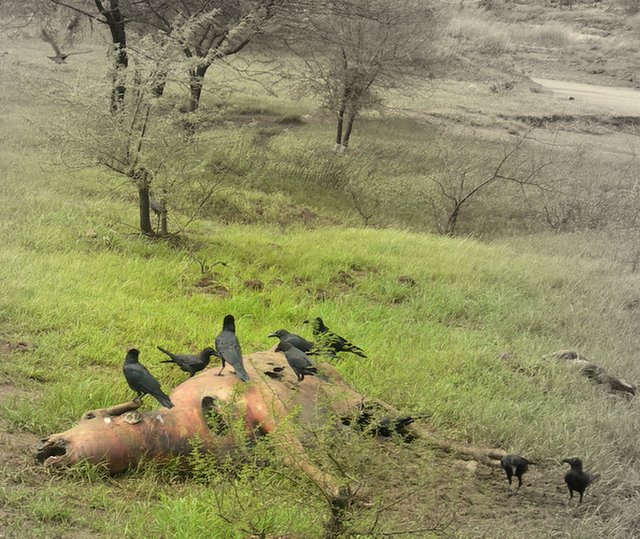
Death. And a hearty meal.
Check out this terrific picture by Sonia Faleiro. (She blogged about it here.) I love the way there's just that patch of green in the front part of the picture, which fades away into grey. Life and Death are both present in this picture, and one of them is an imposter.
(PS. I'm sure that's just my take of the picture. Sonia's a happy, cheerful person.)
Friday, August 25, 2006
There but for the grace of FSM...
In a feature on Dale Carnegie's How to Win Friends and Influence People, Richard Morrison writes:
Carnegie had a brutally mechanistic view of human nature. He believed that words and deeds are largely shaped by genes, upbringing and circumstance. “You deserve very little credit for being what you are,” he tells the reader. “And remember, the people who come to you irritated, bigoted, unreasoning, deserve very little discredit for being what they are.” [Itals in original.]
Simplistic and deterministic? Perhaps a bit. But while I wouldn't allow "genes, upbringing and circumstance" to serve as a justification for one's actions, they can help explain why people turn out the way they do. The bigots, racists and perverts of the world choose their own actions and must bear the consequences, but what makes them the way they are? If that cocktail of nature, nurture and circumstance had acted upon us, how would we have turned out?
And would we have blogged?
Neha is an Afghan Hound, Neha is an Afghan Hound!
I'm a huge fan of doggies.
And someday, I too shall write about my battles with my hair. If those battles are unsuccessful, that might be my last post. These are serious matters.
18-months-old. Leukemia. Needs bone marrow.
Blocking spyware (and octegenarian porn)
What to do when your aged daddy surfs porn all the time and his PC keeps getting screwed by spyware? Gautam John points us to Walter Mossberg's solution.
And yes, it works on young people's computers as well. Relax now.
Maths and politics
There's a superb feature in the New Yorker this week, by Sylvia Nasar and David Gruber, on all the fuss over the solution to the famous Poincaré conjecture. Grigory Perelman and Shing-Tung Yau star in this fascinating story, and even if, like me, you don't understand too much math, the sheer human drama of it is fascinating.
Thursday, August 24, 2006
How to deal with irritating email
Tired of people sending you mass email you don't want? Sick of being part of group mails where your name is in the "to" field instead of the "bcc" field, and everybody keeps wasting your time with "reply all?" Well, not to worry: send your tormenters this link: Thanks. No.
(Link via email from MadMan; I wonder why!)
Renaming the BBC
I think it should now be called the British Broadcasting Cow.
And its symbol should be an udder, so that instead of calling it the Beeb, people call it the Boob.
Udderstand?
Previous posts on cows: 1, 2, 3, 4, 5, 6, 7, 8, 9, 10, 11, 12, 13, 14, 15, 16, 17, 18, 19, 20, 21, 22, 23, 24, 25, 26, 27, 28, 29, 30, 31 , 32, 33, 34, 35, 36, 37, 38, 39, 40, 41, 42, 43, 44, 45, 46, 47, 48, 49, 50, 51, 52, 53.
What on earth is a penis pump?
Manish points me, via email, to a story about a gent in whose baggage a penis pump was discovered at O'Hare airport. It looked like a grenade, and the security chappies asked him what it was. He looked around, his momma was nearby. He couldn't say it was a penis pump in her presence, could he now?
So he said it's a bomb.
Maybe I'm sort of old, or just desperately uncool, but I don't have the slightest idea what a penis pump is, or what it's used for. I don't even want to think about it. The question in the headline is rhetorical, please don't send me emails with links or pictures. I don't want to know. Really.
Update: Sigh. I should have expected it. The mailbox is flooded with mails with "penis" in their title, and I'm not talking about the spam. These boys, I tell ya.
First up, [anonymous] and Abhishek Mehrotra point me to the Wikipedia page on penis pumps, which I'm sure they must have studied intently. Hmm.
Second up, KM and Ajeet Ganga send me links to news pieces about a judge "convicted of exposing himself while presiding over jury trials by using a sexual device." An excerpt:
At his trial this summer, his former court reporter, Lisa Foster, testified that she saw Thompson expose himself at least 15 times during trial between 2001 and 2003. Prosecutors said he also used a device known as a penis pump during at least four trials in the same period.
Well, they say justice is hard, but maybe this dude wanted it harder. Anyway, Sanjeev Naik then writes in with a movie recommendation:
Austin Powers comes back from being cryogenically frozen, takes a really long pee, and then when he goes to take back his stuff (a la a prisoner being released after years of incarceration), and there is a long sequence there with him being embarrassed (in front of Liz Hurley) as a penis pump is one of the things being returned to him.
"This is a grenade," he should have told her. "Should I Hurley?"
You'll do anything for love?
Not this, surely?
Thank FSM the couple in question didn't have kids. Imagine their confusion, suddenly finding that Daddy's disappeared and a second Mommy who looks like Daddy has turned up, and is always pawing the first Mommy and saying, "This is what you wanted, isn't it? Why're you ignoring me now?"
(Link via email from Amit Agarwal.)
Getting old with Scott Adams and Koena Mitra
Scott Adams explains, in a post titled "Benefits of Getting Old," why advancing years aren't necessarily a bad thing. And if you're male, Jiah Khan, Koena Mitra and Kim Sharma have some reasons for you as well. (Yes, yes, Jiah's been on this meme for a while now, and I wonder what the Big B feels about it. Surely temptation doesn't disappear with age?)
And what do I feel about getting old, you ask cheekily? Grmphh. I'll tell you when I get there.
(Adams link via email from n.)
Freedom in India
I make my debut today in one of my favourite online magazines, TCS Daily, with a piece titled "Transforming India's Mental Landscape." Broadly, it expounds on the theme I mentioned in this post: how, despite celebrating 59 years of independence, India still doesn't offer enough economic and individual freedoms to its citizens. I end the piece on a note of hope, and I hope I'm right. Is that recursive?
Wednesday, August 23, 2006
Cows that "moo with a Somerset drawl"
The BBC reports that language specialists have found that cows, just like humans, speak with an accent. It even has a link to an audio recording of different kinds of moos.
Sadly, there's no track of a cow singing "Moo your body, Moo your body." Cows are like humans not just in their accents, but in their sensuality as well. That's what I'm waiting for the BBC to report.
(Link via separate emails from readers TG Vasu, Sriram Krishnamoorthy and Ravi Gurnani.)
Previous posts on cows: 1, 2, 3, 4, 5, 6, 7, 8, 9, 10, 11, 12, 13, 14, 15, 16, 17, 18, 19, 20, 21, 22, 23, 24, 25, 26, 27, 28, 29, 30, 31 , 32, 33, 34, 35, 36, 37, 38, 39, 40, 41, 42, 43, 44, 45, 46, 47, 48, 49, 50, 51, 52.
Update (August 24): Falstaff writes in to direct me to a post on Language Log in which John Wells, the expert quoted in that news story, says that some of the words attributed to him were the "inventions of a public relations firm." Wells says that he finds it "highly unlikely" that cows could have an accent.
Bummer. I feel like a little boy from Andheri who's just been told that Santa Claus does not exist. "But Santa Cruz does, right?" I ask. "Please tell me at least Santa Cruz exists.
"And Bandra, what about Bandra?"
The fuss over Hitler's Cross
Arzan and Emperor Frost, via separate emails, brought my attention a couple of days ago to the much-discussed story of the chappies who run a restaurant in Mumbai called Hitler's Cross. Many people around the world are pissed, and understandably so: naming a restaurant after a murderer of millions is tasteless and replusive. I think anyone who agrees with that -- most of my readers, I would assume -- should show their displeasure by not going to that restaurant.
However, I do not think that the law should be brought into play, or that the restaurant's name should forcibly be changed, as Israel's consul general, Daniel Zonshine, is demanding. In a free country, people should have the right to express their admiration for any individual or ideology, provided they don't impinge on the rights of the others -- and I haven't read any reports about people being forced to eat at that restaurant.
Personally, I find the Communist hammer and sickle every bit as offensive as Hitler's Swastika, and I'm amazed that some political parties hang portraits of Stalin, no less a mass-murderer than Hitler, in their offices. People who proudly wear Che Guevara T-Shirts are acting out of quite the same ignorance and tastelessness as the misguided gents who started this silly restaurant. We don't demand they remove their T-Shirts, we don't demand that M Karunanidhi's son change his name, and we should, similarly, leave Hitler's Cross alone.
PS. Neela points me, via email, to this most amusing site called Brahmin Leather Works. I won't be surprised if the goondas in the Shiv Sena find out about these guys, based in Massachusetts, and call a bandh in Mumbai. That would be quite typical.
Also PS. And do read my earlier post on tolerance and taking offence, "Do not draw my unicorn." It was written at the time of the Danish cartoons controversy.
Update (August 24): Bobin James writes in to inform me that the restaurant's owners have decided to change its name.
If she complains of a headache...
Woman on top
Not God. (NSFW.)
No, no, I'm not that kind of an atheist. God may not exist (if God does and is reading this, Boo!), but sex certainly can be divine.
(Link via Dhoomketu.)
Tuesday, August 22, 2006
"Mozart and Metallica at the same time"
David Foster Wallace, the novelist who was a junior tennis player in his youth, has a remarkable essay on Roger Federer in the New York Times called "Federer as Religious Experience." It is as perfect a sports piece as I have read, which is befitting, I suppose, considering the subject. It has some stunning passages -- the second paragraph, for example, in which he describes a passage of play with such perfect rhythm that reading it is like playing the point, like being there. The footnotes are also marvellous.
Don DeLillo's written beautifully on baseball -- such as in the opening section of Underworld -- and it's a pity that none of the big Indian novelists has brought cricket alive in this manner. Indeed, I can't think of anyone who has written about cricket with so potent a combination of poetic force and analytical rigour.
(Link via separate emails from S Rajesh and Rk.)
72 lakhs per day
Where in India is that kind of taxpayers' money spent?
For the answer, check out Arjun Swarup's post here.
(I'd linked to a similar report some time ago, but the starkness of the figures in Arjun's post drives the point home pretty well, I'd think.)
Rev up that auto rickshaw
A couple of months ago I'd blogged about the Indian Autorickshaw Challenge. Well, Akshay emails me to let me know that blogger Scott Carney is taking part in it. Scott's team is called Curry in a Hurry, which can get messy in an auto, but I wish them all the best.
And the next time you hail an auto and the bugger refuses to stop, do consider that it might be a blogger practising for next year's race. Autos will never be the same again.
"Kids can be cruel..."
... but teenagers can be devastating."
I don't link much to the confessional kind of personal blogs, but I can't resist pointing you to a lovely post by eM, "Confessions of a Teenage Geek."
I can guarantee you that everyone who reads this post will go, "Hey, I was like that, I didn't fit in either." I sometimes wonder who did fit in.
Bhopal hooligans demand a ban on Kank
They're upset that Shah Rukh Khan has defended the Cola companies in the pesticide controversy.
I'm with Shah Rukh on two counts here. One, he's right about the cola controversy, as pieces by Arjun Swarup and Gurcharan Das bear out. And two, even if he was wrong, there is no excuse for the kind of gundagardi that has become popular in India. A peaceful protest is fine, but getting in the way of other people and damaging property is just criminal activity, and should be treated as such.
Of course, I continue to maintain that Shah Rukh's hamming-in-the-name-of-acting is excruciating. That's reason enough for me not to watch his movies, but I'd have no business stopping others from doing so. Ditto with colas, in fact.
Ass cheeks and writers go together
In a post titled "Work habits," Scott Adams writes, "... I can't write unless both of my ass cheeks are equally touching my chair and my feet are flat on the ground." He explains why that is so, and describes why his cat's "anti-productivity crusade" is also a factor.
Well, that explains it. So if you find that my blogging frequency has suddenly gone down, and many hours go by without a post, I'm probably shifting my ass cheeks around madly. And trying to draw Dilbert.
(Link via email from n.)
Paskistan (and Ghandi)
Nikhil Pahwa writes:
This is ridiculous - One agency (UPI) carries a report with a typo, calling Pakistan, "Paskistan". And then it spreads:
Starts from here - UPI.
Then: The Washington Times, The Daily India, Political Gateway, Monsters and Critics, North Korea Times
You do a google search for Paskistan, and... this
Hmm. I hope the meme doesn't spread too far, or my friends in Paskistan will be most upset.
(This reminds me, by the way, of how so many Western outlets spell 'Gandhi' as 'Ghandi'. Why? How did that start, I wonder.)
The transclucent underside of a lizard
Shilpa describes her battle with Guffawing Gekko. Most entertaining. I should keep a pet lizard. I am told that's a chick magnet.
Cupid and the condom order
Well, it's amusing all right, but why on earth would the Financial Express link this one-sentence story from the front page of their website? (Screengrab here, headline's at the bottom, in bold.) Is it really so newsworthy that a company named Cupid Ltd is supplying condoms to the "Indian ministry of health and family welfare?"
On the other hand, I must confess that I didn't click on any of the other headlines on that page. I hope that doesn't mark a worrying trend.
(Link via email from MadMan.)
Monday, August 21, 2006
Movie channels blocked in Mumbai now
Peter just sent me an email alerting me to a post about how his cable operator has cut off all his movie channels. He called up the cable operator, who gave him a two-word answer: "Government block."
NDTV confirms the news, and says that this is "in response to a Bombay High Court order last December which banned TV channels from screening A and U/A rated films."
The lesson from this: if the executive don't get you, the judiciary will.
(I'll be updating this post if further developments take place. My accounts of the recent block on blogs: 1, 2, 3, 4.)
Update: The cable operators seem to be protesting. Deep Ganatra (via the Bloggers Collective email group) writes that his cable operator has stopped all channels, and is showing the following message on the screen:
Due to unprecedented raids on the cable operators for carrying satellite movie and entertainment channels having Adult content, All Maharashtra cable operators have shut down the channels till further directions from high court. Kindly bear with us. CODA.
(Update 1.5: Sameer reproduces the message carried by Incablenet in Prabhadevi on his post here.)
Update 2: MadMan writes in (via BC):
How dare they allow Cartoon Network to be shown on cable? Cartoon Network has been showing nudity for many years now and the government has done nothing! I can't begin to recall the number of times I've turned it on and seen naked mice and cats running freely in shows named "Tom and Jerry".
Heh, indeed. And I think I might have caught a naked cow or two as well. Aren't they sacred?
Update 2.5: aNTi emails me to let me know that Tom and Jerry ain't safe even in England.
Update 3: I've just received news that the cable operators have stopped showing all paid channels in Mumbai to protest against police raids that were carried out on eight cable operators and three multi-system operators, during which transmission equipment was seized. The cable operators' stand is that the onus of complying with the high court directive was on the television channels, and that they have been needlessly harassed.
Update 4 (August 22): Some reports: 1, 2, 3, 4.
Update 5 (August 22): These Swedish chappies have all the fun.
Update 6 (August 23, early hours): The cable operators in Mumbai have restored service, though none of the movie channels are being shown yet.
How to make cold coffee in 10 seconds
Put milk, coffee powder and sugar in a cold-coffee shaker, and drive over a stretch of the Western Express Highway in Mumbai.
Lajwanti D'Souza of Mid Day does an exceptional story on Mumbai's pothole-infested roads, armed with nothing but a cold-coffee shaker. Some might say it's gimmicky, but it drives the point home superbly.
(Link via email from reader Kartik Desikan.)
What President Bush is reading
Albert Camus's L'Etranger is part of President George W Bush's summer reading, and Adam Gopnik writes in the New Yorker:
As “Camus at Combat,” a new collection of his editorials—he was a working journalist—makes plain, the experience, first, of the Nazi occupation of France, and then of the struggle of Algerian independence against France led him to conclude that the “primitive” impulse to kill and torture shared a taproot with the habit of abstraction, of thinking of other people as a class of entities. Camus was no pacifist, but he deplored the logic of thinking in categories. “We have witnessed lying, humiliation, killing, deportation and torture, and in each instance it was impossible to persuade the people who were doing these things not to do them, because they were sure of themselves and because there is no way of persuading an abstraction, or, to put it another way, the representative of an ideology,” he wrote. Terror makes fear, and fear stops thinking.
Thinking in categories is a fault that runs across the Indian political spectrum as well. A few common categories: "multinationals," "imperialists," "upper castes," "lower castes," "bourgeoisie," "communalists," "pseudo-secularists," and, of course, "Muslims." So much damage has been done because we haven't, to use Gopnik's words, been able "to think about particular people, proximate causes, and obtainable objectives."
The heart of darkness
In an essay on John Updike's Terrorist, and on terrorism in general, Theodore Dalrymple writes:
It is not the personal that is political, but the political that is personal. People with unusually thin skins ascribe the small insults, humiliations, and setbacks consequent upon human existence to vast and malign political forces; and, projecting their own suffering onto the whole of mankind, conceive of schemes, usually involving violence, to remedy the situation that has so wounded them.
Dalrymple makes the case that "terrorism is not a simple, direct response to, or result of, social injustice, poverty, or any other objectively discernible human ill," and compares Updike's book to one of Joseph Conrad's novels:
Updike’s Terrorist has much in common with Conrad’s The Secret Agent, published 99 years previously. In both books, a double agent tries to get a third party to commit a bomb outrage; in both books, the secret agent ends up slain. In both books, the terrorists operate in a free society unsure how far it may go in restricting freedom to protect itself from those who wish to destroy it. The terrorists in Conrad are European anarchists and socialists; in Updike they are Muslims in America: but in neither case does the righting of any “objective” injustice motivate them. They act from a mixture of personal angst and resentment, which easily attaches itself to abstract grievances about the whole of society, thus disguising the real source of their consuming but sublimated rage.
Indeed, so many of the ideological stands I see people take around me come not from a worldview reached from detached contemplation but from that "mixture of personal angst and resentment," manifested upon a fashionable target. No one gives your writing the respect it deserves, blame it on those incestuous literary (or blogging!) cliques that keep outsiders at bay. MBA school refused you admission, well, who wants to join the bloodsucking corporate world anyway? You want to be known as warm and compassionate, attack the evil capitalists for the inequities in society. And if there are random frustrations you can't articulate, there's always Big Bad America to rant about, even if you use Microsoft and drink Coke and wear Nike. (Hating it in the abstract but loving it in the concrete, as Victor Davis Hansen might have put it.)
Naturally, these are caricatured and extreme examples, and not all believers in any ideology are motivated by personal demons they are in denial of. But I've seen too many of these types around, and so, I'm sure, have you. No?
(Link via email from Sonia; more Dalrymple links here.)
A pointless homage
Ustad Bismillah Khan is dead, and I'm sure there'll be many moving tributes to him in the days to come. Trust the government of India, though, to choose pointless (and costly) symbolism. The Times of India reports that the UP government has "declared a one-day mourning and ordered closure of all government schools, colleges and offices."
I'm okay with declaring one-day mournings, as long as they consist of symbolic gestures like flying flags at half mast, which harm nobody. But why close schools and colleges and offices? What's the connection? We correctly criticise the Shiv Sena everytime it calls a bandh, for the damage it does to the economy, well, this is a government mandated bandh, even if one limited to government organisations. Ludicrosity. If souls existed, Ustadsaab's soul would no doubt be going, "Wtf?"
Update: You'll hardly get a better tribute to Bismillah Khan than Falstaff's post, Bidai.
Locking up wives, and starving children
All the wankers of the world have suddenly become Kankers. You can't pick up a newspaper or turn on a TV channel these days without being assailed by Kank, with TV debates and print features about the shape of the "modern Indian marriage" and infidelity. It's also brought on a barrage of tasteless humour, exemplified by the headline on the left in the screengrab below. (You know where it's from, needless to say.)
Speaking of modernity, the problem in India is not an excess of it but a scarcity. Consider, now, the headline on the right in that screengrab. A seven-year-old kid is fasting in Agra "to appease the rain gods," and had it been an adult, I'd have been in favour of leaving the idiot alone and letting him starve himself. But this is a kid, for FSM's sake, and the report seems to indicate that despite the authorities trying to make her eat, she has the tacit support of her family and her village. The report says:
Her fast has inspired hundreds of people to join her in prayers and bhajans (devotional songs). Parveen's family, which includes her five brothers and sisters, says that she is determined to starve herself until "Lord Indra smiles" and ensures rainfall.
"Her tapasya (meditation) will not go in vain," say villagers, worried over the scanty rainfall in some districts of western Uttar Pradesh.
If it rains, needless to say, the superstitions of all involved will be reinforced, and we'll see more of this bullshit in times to come. If it doesn't rain, they'll no doubt say that the girl's tapasya wasn't good enough, or they'll blame the authorities for breaking her fast. I shudder to imagine what effect this might have on the poor girl's mind, and what she might grow up to become.
Quizzaciousness, and bookacity
"Quizzing is a physical sport," some of us quizzing insiders in Mumbai often remind ourselves. Joining a gym last week was, thus, clearly a smart move, as I won a quiz yesterday after a long time. It was a general quiz with an emphasis on books and literature, and it took place in a charming little bookstore in Santa Cruz called the Readers Shop. Pradeep Ramarathnam conducted the quiz, and Aadisht Khanna and I won by a handsome margin of one point over Rajiv Rai and Ravi Venkatesh. Rishi Iyengar and Naveen Venkataraman came third, a further point behind, with Rishi slapping his forehead at the end of the quiz and muttering "Bonfire of the Vanities!" You must work out more, I keep telling the boy. I don't think he squats enough.
There was a quiz last Sunday as well, the last conducted by Gaurav Sabnis before his move abroad. I hadn't joined the gym then, and my lack of stamina told on me as my team led for the first two-thirds of the quiz before being overtaken by Dhoomketu's team, who reportedly meet for sprinting sessions at Juhu beach every morning. Rishi has a report of the proceedings here, and I reproduce below a picture of the (other) participants taken and photoshopped by me. As Shakespeare once wrote, "The effects conceal the defects, foolish knave. Et tu Brute?"

And ah, before I forget, let me recommend that if you find yourself anywhere in the vicinity of The Readers Shop, do drop in. (It's near the Santa Cruz Police Station, on the road connecting SV Road and Linking Road that has a Standard Chartered branch on it.) I didn't have as much time to browse there as I would have liked -- I will return there soon, much to my banker's regret -- but I did have time to note that the collection seemed to be fairly eclectic, and a bargain section outside the store might yield some treasures: I picked up a Modern Library edition of The Federalist for just 100 rupees.
And now if you'll excuse me, I need to do some stretches.
Browsing books as a contact sport
With reference to my post linking to Ram Guha's piece on Premier's, The Marauder's Map writes in to point me to this excellent piece by another fine writer, Suresh Menon, in which Menon informs us that Premier's might be shutting down. He also writes about "[t]he politics of bookshop browsing," and how it can be a "contact sport."
I'm a huge fan of contact sports. I will write about one in my next post.
Sunday, August 20, 2006
Guess who's doing passenger profiling now
The passengers themselves.
The Daily Mail reports:
British holidaymakers staged an unprecedented mutiny - refusing to allow their flight to take off until two men they feared were terrorists were forcibly removed.
The extraordinary scenes happened after some of the 150 passengers on a Malaga-Manchester flight overheard two men of Asian appearance apparently talking Arabic.
This is disgraceful. The passengers who feel worried have every right to get off the plane, at their own expense, but no right to demand that others be offloaded. I'm amazed that the airline caved in, and I hope the gentlemen "of Asian appearance" sue. Once they were past security check, the airline had no business offloading them. Sure, it could have searched them again, but no more than that.
I quite agree with Patrick Mercer, a Tory spokesman, who is quoted as saying, "This is a victory for terrorists." Notch one up for Osama.
(Link via email from MadMan.)
Update (August 24): Here's a follow-up, with a picture of the two offloaded chaps, who are 22-year-old students. One of them says: "Just because we're Muslim does not mean we are suicide bombers." I hate it when it seems necessary to state the obvious.
Blogger goes to massage parlour for nude photoshoot
And what's more, Jai Arjun Singh tells us:
Gyms are populated by beefy, thick-skinned but strangely charming young trainers who resemble the Deol boys in muscle structure as well as in their shy smiles... I’ve never been so unqualifiedly happy at a book launch or discussion. What could this mean?
Sadly, Jai hasn't yet put those pictures of his online, but my heart tells me that HT Tabloid will surely get hold of them.
On that note, check out this HT Tabloid story titled "What makes Preity get goose bumps!", which carries the line:
While Karan Johar is quite superstitions about number 8, Priety Zinta gets goose bumps when black cat crosses her way and Rani Mukherjee frequently says 'touch wood'.
Well, if Rani came across Jai's pics, it wouldn't be wood she'd be wanting to touch, that's for sure!
(Previous posts with Purplocity/Verniness: 1, 2, 3, 4, 5, 6, 7, 8, 9, 10, 11, 12, 13, 14.)
Freedom's on the march
Govt puts off RTI changes.
Men can watch women's soccer, rules Pak.
Apparently, female soccer players in Pakistan have to wear "baggy track suit trousers and long-sleeved shirts" while playing. They might as well wear shalwar kameez, I suppose. That way, even if the game isn't always flowing, at least the clothes will be.
Crystalline and Indigo kids?
Sonu Nigam is quoted as saying in the Indian Express:
I have been reading a lot of late, and according to the great spiritual healers the post-1980s generation will be the harbingers of Satyug. This is a cool, chilled-out and open generation that is not stuck-up. Within them however there are two kinds - the Crystalline, who are the emotional lot who will bring in this change through persuasion, and the Indigos, who will achieve it with rebellion.
What has he been reading (or smoking), I wondered after reading that para. A little Googling revealed that Crystalline children "are able to communicate telepathically, and are speaking to others in other dimensions as a normal event in the course of their play," while Indigo kids are supposed to have abilities that "are said to include purging HIV, advanced genius and psychic/telekinetic powers."
What a load of bull.
I'm certain Nigam will not be able to point to a single example of either of these two types of kids from his personal experience, but he's hardly the only Mumbai celeb who sees things in the world that aren't really there. Shobha De was on We the People yesterday, and the topic of discussion was marital infidelity. At one point De said something to the effect of infidelity being a "non-issue" for Indians in their 20s, and that all they cared about was "quality of life."
This is, again, an astonishing statement, based, no doubt, on a view of the world as she would like to see it (so that it fits some pet theory of hers, probably), and not as it is. Demanding fidelity from our partners is hardwired into human nature, and I recommend that De hop over to the nearest Barista and chat about this with some twenty-somethings.
Let me end this post by saying that that despite Nigam's fascination for New Age crud, he's an excellent singer. Can't say the same for De.
Update: Ken Falco writes in to point me to Jenny McCarthy's site, Indigo Moms. In an article there, McCarthy writes:
I was doing my usual research on environmental toxicities and found myself so obsessed with it that I once again lost sight of everything else. I learned about chemicals that are used in pajamas, such as flame retardants, and the toxic levels our children inhale throughout the night. I immediately got rid of anything that was flame retardant, including his mattress. This was followed by installing organic carpeting in his bedroom, and placing air filters in every room. Someone then told me I needed to change the paint in his bedroom to nontoxic paint. So I was at the store five minutes later buying paint that was edible, and then stayed up half the night painting the bedroom walls. I changed the pool water to Ozone, and even had a chakra balancing done on my house. What finally pushed me completely over was when I found out about electromagnetic toxicity.
Poor kid. I bet he's not allowed to drink Coke or Pepsi either.
Thoo!
Forgive me for being a cynic, but the proposed ban on spitting and littering in Mumbai is certain to become just another avenue for cops to collect bribes. They are effectively unaccountable and poorly paid, and the two factors combine to create conditions that make corruption inevitable. In those circumstances, the more discretion they get, the more opportunity they will have to misuse their power.
That doesn't mean spitting and littering should not be banned. But the skewed incentives that the cops work under need to be fixed. We're a country prime-ministered by an economist, and you would have thought that we'd have figured that by now.
Or maybe not.
Bhopal
When he hanged himself, he left a note saying he was committing suicide not because he was mentally unsound but with all his wits about him.
I believe him, I really do.
Saturday, August 19, 2006
A tribute to Mr Shanbhag
Ramachandra Guha has a lovely piece in the Telegraph on TS Shanbhag, the owner of Premier's, the famous bookstore in Bangalore. Guha writes:
... Premier’s has the most cultivated tastes of all the bookshops I know in India. It is only here that works of literature and history outnumber (and outsell) books designed to augment your bank balance or cure your soul. When it comes to fiction, Mr Shanbhag stocks not merely the latest Booker winner but the back-list of the author (if he has one). When J.M. Coetzee won that prize, even the pavement seller was selling Disgrace, but only in Premier’s would one find The Master of St. Petersburg as well. Mr Shanbhag keeps more, and better, hardback history than any other Indian shop I know; more, and better, literary fiction; and more, and better, translations.
That sounds rather familiar, for Strand in Mumbai is a similar store. And the owner of Strand, TN Shanbhag, is TS Shanbhag's uncle. It's surprising enough when someone builds a sustainable business out of the application of good taste, and it's surely astonishing that this skill should run in the family.
By the by, here's another piece by Guha on Premier's from three years ago.
Be careful where you send that email
Reuters tells us about two German ladies who were discussing their partners' poor sex drives over email, when one of them accidentally sent the mail to the entire company. After that, needless to say, the mails spread and spread.
Amusing as this is, a blast of recognition must surely accompany our reading of this news. Which of us has not pressed "reply all" instead of "reply", or committed a similar blunder? (That is a rhetorical question; please do not send me email answering it!)
Indeed, it isn't just email with which it can happen. A friend of mine has a habit of not locking his mobile phone keypad, and he was once bitching about a colleague over lunch. Ten minutes after the bitching session, the colleague calls him up. "So you think I am [snip snip snip], huh?" My friend's phone had accidentally dialled his number while the bitching was in progress, and the man heard every word.
Indeed, imagine how many relationships would be shattered if every email account in the world was suddenly thrown open for anyone to read. Ooh hoo hoo. Complete honesty would savage us all.
Update: Benjamen Walker has a great story here about the consequences of accidental phone calls. Make sure you download and listen.
(Link via email from Anand.)
Gaurav Sabnis joins a PSU
A few days ago my libertarian friend, Gaurav Sabnis, had stunned everyone with the announcement that he was going to join a PSU.
Today, he reveals which one.
That makes two close blogger buddies who've left Mumbai for the US within the last week. (Yazad Jal is in Yale now, to do an MBA.) The allnighters at Marine Plaza, after dinner at Noor Mohammadi, just won't be the same anymore -- if they happen at all. This is most terrible. I need a hug.
Middle East conflict deepens
Now the cows are resettling.
(Link via email from JK.)
Previous posts on cows: 1, 2, 3, 4, 5, 6, 7, 8, 9, 10, 11, 12, 13, 14, 15, 16, 17, 18, 19, 20, 21, 22, 23, 24, 25, 26, 27, 28, 29, 30, 31 , 32, 33, 34, 35, 36, 37, 38, 39, 40, 41, 42, 43, 44, 45, 46, 47, 48, 49, 50, 51.
Friday, August 18, 2006
The language of justice
It's bad enough to have courts that take years, or even decades, to decide cases, but it's even worse when you can't understand what the judge has decided because of his English. Mumbai Mirror reports that an advocate of the Mazgaon Court, Jamal Khan, has approached the Bombay High Court with a complaint against a magistrate there, SR Bedgale. Khan's complaint is that "[t]he English used by the magistrate is incomprehensible." Some examples he cites:
• "I cannot give the exact time when I admitted the hospital after the incident".
• "I was fallen down at my residence"; "I detained conscious at hospital".
• "They assaulted with the help of hands and legs".
• "Ganesh Chauvan tried to assault me to my face but I prohibited through my left hand."
I'm not sure how many languages the court is allowed to conduct its business in, but it's ludicrous if court officials aren't proficient in whichever language they choose to use. It's not that Bedgale is an exception, though -- the article quotes an advocate named YS Qureshi reporting a classic order by a magistrate named AD Chaudhary in 1990, in which Chaudhary said:
I have a woman before me who has a milk sucking baby. I have personally verified her sex and found that she is a woman and thus be given bail.
This, I must state with the highest admiration, is worthy of HT Tabloid, which runs a story today with the immortal headline, "Ex-IGP turns wife into daughter!" My joy knows no bounds.
(Previous posts with Purplocity/Verniness: 1, 2, 3, 4, 5, 6, 7, 8, 9, 10, 11, 12, 13.)
Romancing Rabri Devi
Whatever he may think of taxpayers' money, you can't say that Lalu Prasad Yadav doesn't have a heart. Consider his love for Rabri Devi:
While scores of railway projects wait to take off, work on the 20.9-km stretch between Hathua and Bathua Bazar on the Hathua-Bhatni section of North Eastern Railway is moving at a breakneck pace.
The reason: On completion, it will connect Union Railway Minister Lalu Prasad Yadav’s ancestral village, Phulwaria, with that of his wife Rabri Devi, Salar Kalan, just 2.9 km apart.
[...]
Rabri is learnt to have requested Yadav to get both their villages connected by rail some time back.
I shudder to think what would have happened had Lalu been civil aviation minister.
This particular railway line may not be a bad thing, of course, and may actually give the region's economy a slight boost, as railway lines tend to do. But the motive behind it is rather amusing, though I'm sure Rabri will be delighted, and Lalu will get some action the night the railway line is inaugurated.
"Leave that cow alone and come to bed, my love," Rabri will call out to him. "I need you to fix your engine to my bogey so we can go chug chug chug."
Some previous posts on Lalu: 1, 2, 3, 4, 5, 6, 7, 8, 9, 10, 11, 12, 13, 14, 15, 16.
(Link via email from Nazim Khan.)
Veena's Booker Mela...
... is up and running. Veena's invited bloggers to choose a book to review from the Booker longlist, and to send her the link when they're done. If you love books, I'm sure much fun will come.
I haven't reviewed a literary work in a long time, so I won't volunteer, but if you enjoy reading, go forth and pick a book. If you're upset with yourself for how little you read these days, as I perpetually am, a public commitment on her blog will make sure you read at least that one book soon!
If you can't find news to report...
... create it. Reuters reports:
A group of Indian television journalists gave a man matches and diesel to help him commit suicide in order to get dramatic footage which was later broadcast on the news, police said on Thursday.
The man died from severe burns to his body in hospital in Gaya town in the eastern state of Bihar on August 15, India's Independence Day.
[...]
"We have seized footage clearly showing a group of journalists handing over matches and some inflammable substance -- which we later verified to be diesel -- to the victim," acting Gaya police chief P.K. Sinha told Reuters by telephone.
I'm sure these gentlemen got a pat on the back from their boss in the studio. "Well done, well done," their bossie must have said. "But we should have got another angle in. You should have shot another take from a top angle."
(Link via email from reader Vikram Chandrashekar.)
Unleash the tiger
Or rather, save the tiger by unleashing the free market. Barun Mitra writes in the New York Times about how conservationists are failing to protect the tiger, but the free market would do a better job. He writes:
[L]ike forests, animals are renewable resources. If you think of tigers as products, it becomes clear that demand provides opportunity, rather than posing a threat. For instance, there are perhaps 1.5 billion head of cattle and buffalo and 2 billion goats and sheep in the world today. These are among the most exploited of animals, yet they are not in danger of dying out; there is incentive, in these instances, for humans to conserve.
So it can be for the tiger.
Read the full piece. Mitra, by the way, runs The Liberty Institute in Delhi.
(Link via Cafe Hayek, via email from Do Not Ask.)
Thursday, August 17, 2006
Such a cutie
Kaps at Sambhar Mafia wants to know who the person in the photo is. My first reaction is in the headline, though I know some readers will find it sexist. "After all," they will ask, "a woman is much more than just her looks." Well, an instinctive reaction is an instinctive reaction, what to do now? And immense admiration already does exist for this lady's achievements, which you no doubt share.
So tell, who is she?
Update: Falstaff writes, in the context of this picture, that "the ability to photograph well may be a key determinant of corporate success." He writes:
People with good passport photographs get picked for interviews over the rest of us, because they look like the kind of people the recruiter would want to work with. People like me get their resumes forwarded to the Department of Homeland Security as a safety risk. As a result people who photograph well gain more valuable and varied experience, and before you know it they're heading major multi-nationals while their less fortunate brethren are still hanging about boring other people with their baby pictures.
Good point. Needless to say, you need to have some basic looks to be able to photograph well, and I suspect my problems begin there. So even if I "say cheese with vehemence," as Falstaff suggests, it wouldn't work with me. Everyone at the studio would just look at me and wonder why I was so pissed, shrieking "cheese" like that.
By the by, in case you're still wondering, the lady in the pic in Indra Nooyi.
I'm going to explode
Passenger with brown skin and long beard calls airhostess over.
Passenger: Excuse me, there is something I need to tell you.
Airhostess: Yes sir, what is it?
Passenger: I'm going to explode.
Airhostess: What? Oh my God! Help! Security!
Old woman sitting besides the man: Wait. I'm going to explode as well.
Teenage girl sitting behind them: Me too. I'm going to explode.
Geriatric man besides teenage girl: I'm also going to explode.
Nine year old boy in front seat: I've already exploded. Hee hee.
What's going on? See this.
(Link via email from The Invizible Man.)
Wednesday, August 16, 2006
Shekhar Kapur has a Big Laugh
Via Uma, I discover this bizarre interview of Shekhar Kapur in which he says:
People talk of the Big Bang. If there was a beginning, there must be an end. But there is no linear time, so where is the end? I call it the Big Laugh. Someone laughed ‘ha, ha ha’ And between the first and the second ‘ha’s, came a few billion years.
Jeez. Later in the interview he says, "Deepak Chopra is a friend, but I’ve never read a book of his." Read Deepak Chopra books? With pseudogiri like this, Kapur could write them.
Is Pluto a planet?
Yes, according to a bunch of astronomers expected to vote on the matter soon, as are Ceres, Xena and Charon.
I hope they eventually discover life on Charon, perhaps in the form of rocks with legs. Just the thought of Charon Stone excites me.
A trace, a small scar
In a profile of Tom Stoppard, born as Tomas Straussler in Czechoslovakia in 1937, William Langley writes:
At 68, he is still discovering himself. When he was a boy, his mother drew a veil over the family's past. There had been a Jewish grandmother, she said, and this was why they had to leave Czechoslovakia. Only relatively recently did he learn the fully story.
His whole family was Jewish. Most of his relatives had been murdered in the death camps. His father, once the house doctor at the Bata shoe factory in Zlin, had been killed in a Japanese air raid. Some years ago, after a visit to Czechoslovakia, he wrote movingly of meeting an elderly woman, a former Bata employee, whose gashed hand had been stitched by Dr Straussler. "I touch it. In that moment, I am surprised by grief, a small catching up of all the grief I owe. I have nothing which came from my father, nothing he owned or touched, but here is his trace, a small scar."
(Link via Sonia.)
Portals to the worlds beneath...
... could hardly get cooler than these.
If people in India tried something like this, they'd certainly get stolen really fast, like these dustbins of yore.
(Frangipani link via email from Kind Friend, who also points me to Leo M's interesting account of travelling through Pakistan..)
Shah Rukh Khan's guard kills Shah Rukh Khan's guard
As they say, Who will watch the watchmen?
Rakhi Sawant and the obscenity law
Dibyo points me to news that Rakhi Sawant was recently refused permission by the Hyderabad police to perform at an event there. She was slated to do an act at the "annual general body meeting of Suchir India Developers Private Limited," but the cops got in the way and said that "no obscene acts will be allowed."
I really should have blogged about this yesterday, it would have been a suitably ironic comment on the nature of our freedom. (Like this one -- via Madhu; more here.) What right do cops have to rule on the content of a privately organised event for adults as long as no coercion of any kind is taking place? This is incredibly condescending, and the shareholders of Suchir India Developers Private Limited are effectively being told that they are not capable of deciding for themselves what is obscene and what isn't, so the state must do it for them. I'm just glad the state didn't land up to feed them Horlicks and change their diapers. Now, that's an obscene thought.
(More on Rakhi Sawant: 1, 2, 3.)
Tuesday, August 15, 2006
Yet another reason to get bigger boobs
"A bad-ass camera"
"Tee hee," goes President Musharraf
Here's a suggestion he hasn't heard before.
Combined orgasms in a cinema hall
I'm a huge fan of Jai Arjun Singh's writings on cinema, but I must confess here that my favourite bits of his writing are not about what happens on the screen, but about what happens in the hall. In a post about Kabhi Alvida Na Kehna, he writes:
One man spent half the film with his cellphone aimed at the screen, taking photos or videos; he recorded the entire “Where’s the Party Tonight?” song and then, irritatingly, played it back later, drowning out the sound from a subsequent scene.
Young boys in my row burst into orgasmic yelps each time there was anything resembling an innuendo in the dialogue, or if a woman appeared in a low-cut blouse. At one point Rani tells Shah Rukh, “Sorry, galti se dab gaya.” (She made an unintended cellphone call.) “Galti se dab gaya!!!!” screamed the lads ecstatically, and the collective outburst reminded me of Arthur Clarke’s short story “Love that Universe”, wherein billions of people are asked to synchronize their love-making so that the combined orgasms send out a crucial energy signal to a distant civilisation.
Ah, in case I forget, I'm also a huge fan of low-cut blouses. As Mother Teresa once remarked, "Come, my love, fix your eyes like rubies/ on my lovely, lovely ____."
It's my favourite couplet of hers, and compares favourably to Beethoven's poems. No?
When Sharad Pawar misled Mumbai
In an astonishing confession, and one that vastly increases my respect for the man, Sharad Pawar admits that he lied to the people of Mumbai. The context: the 1993 bomb blasts in Mumbai. Speaking to Shekhar Gupta, he says:
I recollect on March 12, I was sitting in Mantralaya and at about 12-12.30 pm I heard a big noise, it was the explosion in Air India’s office. Within ten minutes I got a message that explosions had happened in 11 places, more than 365 people had died. I immediately realised that all these places were essentially dominated by Hindus. I guessed there must be some design, and that design must be that Hindus should react against the minority.
[...]
So I straight went on television and I misled people, deliberately misled people, instead of 11 bomb explosions I said 12. And one of the places that I mentioned was Masjid Bandar, an area dominated by minorities. So I spread the message that it’s not only in Hindu areas, it’s in a Muslim area also. I also said that I had seen - because I’d immediately visited the Air India building - and I said I’d visited it and the type of material that had been used was used essentially by some of the southern Indian side terrorist organisations. And I tried to (point a) finger at the Sri Lankan side...
Pawar then says that "[u]ltimately investigations established ki that was the design." It's a fascinating interview, though I don't quite agree with Gupta when he says later that upper caste Gujaratis were targeted in the recent bomb blasts. That's confusing correlation (upper caste Gujjus tend to travel first class) with causation (that's why those coaches were attacked). I'm sure many other groups of people travel first class on the Western Line, and how accurate would it be to say that MBA bankers or Advertising professionals or Himesh Reshammiya fans were the targets of the attacks?
Pawar also has a comment on why the system of having zonal selectors in Indian cricket will be hard to change:
If I have to change the zonal system, I have to amend the constitution. And ultimately if I have to amend the constitution, then I have to get support from zonal representatives. (Laughs).
So to kill the vested interests, you first have to get the approval of the vested interests. Doesn't sound terribly realistic to me.
Monday, August 14, 2006
How the Indian army can "frustrate the ISI"
"By practicing safe sex."
Apparently, the ISI has been planning "to spread HIV among personnel of the Indian army and para-military forces." If this report is true, what could be the ISI's planned modus operandi? Send HIV-positive ladies to tempt armymen into indiscretion? Infect the blood received by armymen in blood transfusions? The scale at which they would have to do it is staggering, and implementation would be fraught with risk of discovery.
On the other hand, they could just leak the news of such a plan and screw the army that way. "Bloody condom again," I can imagine an armyman cribbing. "How I hate the ISI."
"I just called to say I love you"
Aadisht just informed me that if you dial directory enquiry in Mumbai (197), the background music you'll hear is the instrumental version of Stevie Wonder's hit. I wonder if the government servant who thought of that was merely young and idealistic, or whether he was just making fun of us all. "Those schmucks," he might well have thought, "they'll never get the irony!"
Update: MadMan informs me via email that when Airtel's customer-service chappies in Chennai Bangalore keep you on hold, they play "Unbreak My Heart." Why?
Hansdehar, the Knowledge Village
This is stunning: Reuters tells us about Hansdehar, a village in Western Haryana, where one can "see the names, jobs and other details of its 1,753 residents, browse photographs of their shops and read detailed specifications about their drainage and electricity facilities."
Check out the site. It has a complete listing of all the residents, religious places and tourist attractions, details of the Panchayat, and, most importantly, contact details of government officials and a survey of the infrstructure in the village. Information empowers people, and if the website also begins to incorporate information dug out using the RTI Act, its mere presence will make the government take this village extremely seriously.
"It will be a revolution," a farmer named Ajaib Singh is quoted as saying in the Reuters story, and not just in terms of government accountability. As the story elaborates:
Now Hansdehar farmers hope they will be able to get better prices for their crops by trading online through the National Commodity & Derivatives Exchange Ltd., cutting out middlemen.
Carpenters and masons will tout their services online. Others will upload their resumes to job hunting Web sites when the village's first Internet point is hooked up in Kanwal Singh's mother's house in the coming weeks.
Remarkable. I hope more villages follow Hansdehar's example.
(Link via email from Arjun Swarup.)
Update: Chenthil writes in
Most of the districts in Tamil Nadu have embraced IT for quite some time now. TN government is serious about e governance. For example, check the Cuddalore village site. You can check your name in electoral rolls, check the infrastructure projects and their budgets, download government forms, send an email to the collector. Almost all the districts in the state have embraced e governance.
Rockacious. I wonder if any studies have been done on the impact this has had on governance and the economy. That would be quite fascinating.
Update 2 (August 20): Ramya Kannan writes in to point out that Cuddalore is a district. Furthermore, she writes:
Whether all of them [the TN districts that are online] are truly functional and facilitate response is an issue that I would not want to get into, but yes, as far as districts go, we have websites for each one of them. Notable, certainly, yet not in the league of Hansedar, which is truly an instance where technology has been harnessed by the masses. Let us hope MS Swaminthan's Mission 2007 - Every village a knowledge centre - makes a true difference.
Then and Now 1: Shaftesbury Avenue, London
Shaftesbury Avenue, London, circa 1949:

Shaftesbury Avenue, London, circa 2006:

(Pic 1 by Chalmers Butterfield; more details here. Pic 2 by Tom Box; more details here. Links via email from MadMan.)
Sunday, August 13, 2006
Give us freedom, not flags
The Times of India reports:
I-Day is just two days away. There will be thousands of fluttering flags all over India — on masts, cars, houses, in the hands of joyous children... And yet, the real flags used on this historic occasion in 1947 are missing. Three of them, in fact. Shocking, but true.
Ok, so why is that shocking? Flags are mere symbols, just pieces of cloth. What is far more shocking is the absence of so many kinds of social and economic freedom in India, 59 years after political independence. Now, that worries me.
(Do read these two old posts by pals of mine expounding on that subject: "Waiting for the free-market Mahatma" and "Freedom vs Sovereignty.")
An al-Qaeda brainstorming session
David Malki is rocking at Wondermark.
This doesn't mean, of course, that I'm against the kind of security measures we see at airports. With shit like Mubtakkar around, it's necessary. I'm glad to see that security has been stepped up in Mumbai's malls as well. I don't mind losing a few minutes as they inspect my bag when I enter, though my camera is a bit shy, and keeps cribbing about how I let "all these men" feel her up. "All these men" are protecting us, Young Camera, and you really must appreciate that. Whoa, calm down with that flash, you're messing with the battery.
(Links via Boing Boing.)
Pop psychology and your email inbox
Sigh. Now they're saying that your email inbox reveals how you are as a person. In a piece by Jeffrey Zaslow, a psychologist named Dave Greenfield is quoted as saying, "If you keep your inbox full rather than empty, it may mean you keep your life cluttered in other ways." Another gentleman named Merlin Mann (a magical Surd? Nah!) says:
You have to treat your inbox like you treat your mailbox at home. You wouldn't store your bills inside your mailbox. And leaving spam in your inbox is like leaving garbage in your kitchen.
Well, in my case, the comparisons seem to bear out, as I'm a fairly untidy person, leaving books scattered around the house, and my email mailbox is a mess (even worse than when I last blogged about it). However, I'm not sure the analogy Mann makes holds up. The space I have in my email mailbox is effectively unlimited, while my meatspace mailbox and my kitchen are rather small. I use Gmail, and there are no benefits to keeping my inbox lean, but plenty of possible costs, as I may later wish to access email that doesn't seem important to me now. One can be perfectly organised in Gmail, using labels and search smartly, without deleting a single non-spam email.
On the other hand, maybe I'm just a slob in denial. Boo hoo.
(Link via Amit Agarwal.)
Eat that sinful pastry right away
It's them microbes that make you fat.
(Link via Falstaff.)
PS: No, no, I didn't mean it, I was being flippant. A combination of factors make you put on weight, and that pastry is certainly part of it. Look at all that chocolate. Think of the thousands of calories waiting to rush inside your body (because of your greed) and produce fat furiously. That pastry, I say with nothing but concern, will harm you.
Give it to me.
Preity Zinta on being a Bimbo
Speaking to HT Tabloid, Preity Zinta says
... I will advise those who want to come in the film industry that unless you complete your basic education, don't think of trying your hand here. A great look and hot body may make you successful but you will not become a successful actress but a successful bimbo. You will never get the credit for a hit film, because your contribution in the film will be nothing more than just being an on-screen bimbo.
Ms Zinta seems to be implying here that the lack of basic education will a) make you a bimbo and b) not get you credit for a hit film, presumably because you can't act without basic education. Well, well, well. Perhaps we can learn how to be a bimbo from Ms Zinta, but I don't think it's in the way the fine lady intends.
Earlier in the same piece, Minnisha Lamba tells us that "[i]t's very natural for a person to get glued to a face which is pretty and a body which is just wonderful." So now you know why I'm always walking around with Fevicol.
(Previous posts with Purplocity/Verniness: 1, 2, 3, 4, 5, 6, 7, 8, 9, 10, 11, 12)
Saturday, August 12, 2006
Indiacows?
Mandar Talvekar gets a marketing call from Indiabulls and decides to get cheeky.
If he continues like this, he'll end up causing them "psychological distress." Of course, he's not the ones making the calls, so the telemarketing chicas have only themselves to blame.
Previous posts on cows: 1, 2, 3, 4, 5, 6, 7, 8, 9, 10, 11, 12, 13, 14, 15, 16, 17, 18, 19, 20, 21, 22, 23, 24, 25, 26, 27, 28, 29, 30, 31 , 32, 33, 34, 35, 36, 37, 38, 39, 40, 41, 42, 43, 44, 45, 46, 47, 48, 49, 50.
"She asked for it"
That's the line the home ministry -- including Shivraj Patil, the home minister -- seems to be taking when it comes to violence against women. Consider this report by Monobina Gupta in the Telegraph:
A delegation headed by Renuka Chowdhury, in charge of the ministry of women and children, went to meet home minister Shivraj Patil recently to draw his attention to the rising violence against women.
[...]
Patil and his officials were far from agitated. Instead of giving the delegation a sympathetic hearing, the officials fired questions as Patil kept quiet. Why do women go out at night? Especially, why do they go out unescorted? Even worse was to come.
The officials started picking on the way women dress. Why do they dress provocatively? Their clothes are such that they invite male predators.
This is exactly what Bal Thackeray’s paper Saamna had written earlier after a rape in Mumbai.
This is appalling. Bal Thackeray's a private citizen, and one can ignore him, but this is the home ministry speaking. Shivraj Patil gets his salary from the taxes we pay; the home ministry runs on those taxes, a fair chunk of which comes from women. I'm lost for words.
First Natwar Singh, now Shivraj Patil: the senior ministers handpicked by Sonia Gandhi are a disgrace to the people they supposedly represent. I wonder what Mrs Gandhi would have to say about this.
The kindness of strangers
Reuters reports:
A Japanese man was arrested this week after making 37,760 silent calls to directory inquiries because he wanted to listen to the "kind" voices of female telephone operators. [...] "When I made a complaint call once, the operator dealt with it very kindly, so I wanted to hear these women's voices," the paper quoted him as telling police in Hiroshima, western Japan.
The report goes on to say that "Police believe the calls, made between March and July this year, caused psychological distress to more than 100 telephone operators." Yeah, I can just imagine what happens when one of them goes home and her husband wants dinner.
Husband: Darling, come, let's have dinner.
Operator: No, I'll have dinner. You stay hungry, no dinner for you.
Husband: [Baffled] Hey. What's up with you, why're you behaving like this? You're normally such a kind person.
Operator: Kind, kind, kind. I'm sick of being kind. I will never be kind in my life now. Never ever.
So the next day the husband decides that he needs some kindness in his life, and calls directory enquiry.
Celebrities as terrorist targets
The Telegraph reports that "Mumbai police are making arrangements to step up security for celebrities like Amitabh Bachchan, Shah Rukh Khan, Sachin Tendulkar and Mukesh Ambani." About time. As I wrote a couple of years ago (see fifth para), celebrities are logical targets for terrorists. I'm glad that the cops are being proactive here.
India, Pakistan, deterrence and peace
I used to wonder if India's decision to go nuclear actually backfired on us: after all, it was inevitable that Pakistan would follow, and India's conventional military superiority would effectively cease to matter, as both sides would have deterrence. Earlier, we'd know that in the event of war we were bound to win; now, we know that they're nuclear and a war might devastate both countries.
Well, Shekhar Gupta, writing in the Indian Express, reveals that Pakistan claimed to already have the bomb in 1990. He writes:
Many experts, including Seymour Hersh, believe that the then Pakistani foreign minister, Sahibzada Yaqub Khan, came to India to ‘defuse’ tension but actually unveiled a nuclear blackmail for the first time. In conversations with Indian leaders he threatened that they should not count on their conventional superiority if war broke out because Pakistan had the nukes and intended to use them in the very beginning.
[...]
It is unlikely that V.P. Singh and Gujral will tell you more on this. But Gujral will probably not deny that one conversation went something like this: Sahibzada told him that if there was a war now, it won’t be an ordinary one, that there will be flames rising from the mountains, the valleys, the plains and the rivers. And Gujral, gathering his nerves — and wits — quickly, replied, “I hope not, but please do remember, we have also been drinking the waters of the same rivers as you.”
Deterrence already, just by insinuation? Anyway, earlier in the article, Gupta writes that Pakistan liked to enter into conflict with India whenever they thought India was weak.
The Pakistani establishment has a chronic compulsion to test the waters whenever they think Indian politics is passing through a phase of confusion and weakness. They chose the summer of 1965 to start the war because they thought India’s armed forces were still punch-drunk from their defeat by China and Shastri had not yet had the time to fill the vacuum left by Nehru. Internally, they were also enthused, as so much of the subsequent literature by key Pakistani players in that war shows, by delusions that the Naga insurgency, the Dravida movement and even the vocal opposition of sections of the Left to India’s cause in the China war had all weakened India sufficiently for them to risk an assault on Kashmir. It is possible that they saw the fall of Rajiv Gandhi, and the arrival of a very weak V.P. Singh coalition as a similar opportunity.
The Naga insurgency? The Dravida movement? I suspect Pakistan made the mistake of believing their propaganda, which is, well, somewhat amusing.
I've often been attacked for being a peacenik when it comes to Pakistan, but that's an over-simplification. I just believe that we need to understand that India's enemy here is not 'Pakistan,' but Pakistan's military establishment, which thrives on the conflict with India -- indeed, its sustenence depends on it. Its interests are actually quite different from that of Pakistan's civil society -- again, a broad term -- who would, by and large, prefer peace and prosperity to conflict. In our battle against terrorism from across the border, they are our allies, not our enemies. We need to strengthen our allies, and beat our enemies.
Thus, I embrace what appears to many to be two contradictory approaches: an uncompromisingly hard line when it comes to terrorism, and a deepening of trade and people-to-people contact. Both work towards the same end. (I'll elaborate on this in a further article.)
Political correctness taken too far
I mean, look at this.
As Benjamin Franklin once said, "If all printers were determined not to print anything till they were sure it would offend nobody, there would be very little printed." That is particular pertinent to India, actually, with too many people getting offended by stuff over the last few weeks, like "Tits, Clits n Elephant Dicks." These days, 'Freedom of Expression' is becoming 'Freedom of Expression BUT...'
(Flickr link via email from MadMan.)
Don't bang the maid
Devangshu writes:
... India would be a very different place if a cross-sectional consensus on the desirability of banging the maid had not existed for centuries. Entire sub-castes are composed of little bastards, legitimised over time. These were all created by the tradition of banging the maid.
Indian history would be far less turbulent. So many of the protagonists of all those wonderfully fratricidial succession struggles would not have been conceived. Millions of sex-starved young bachelors would have gone virgins to their respective suhaag raats.
The rest of his story is about a chap he used to know who banged his maid, and was confronted by the maid's "official swain," a barber. Shit happened -- and as you will surely realise after you reach the tale's conclusion, somewhat painfully at that.
(Link via Peter.)
Friday, August 11, 2006
Google and Napoleonic France
In an article titled "The Alliance Against Google,", the Economist writes:
Prince Klemens Von Metternich, foreign minister of the Austrian Empire during the Napoleonic era and its aftermath, would have no trouble recognising Google. To him, the world's most popular web-search engine would closely resemble the Napoleonic France that in his youth humiliated Austria and Europe's other powers. Its rivals—Yahoo!, the largest of the traditional web gateways, eBay, the biggest online auction and trading site, and Microsoft, a software empire that owns MSN, a struggling web portal—would look a lot like Russia, Prussia, and Austria. Metternich responded by forging an alliance among those three monarchies to create a “balance of power” against France. Google's enemies, he might say, ought now to do the same thing.
Now, analogies are no doubt useful, but the internet and the real world are entirely different spaces, and my feeling is that the biggest threat to Google will come not from any of the established behemoths, but from a company that may not exist now, or is under the radar. What is that company and what will it do? I don't have a clue. Who could have predicted Google ten years ago? Not Page and Brin themselves, I'm guessing.
Can't afford a lawnmower?
Buy a minicow.
"I've never once had to cut the grass," says one of the minicow owners in the story linked above.
As you've no doubt heard, the best things come in cow packages.
(Link via email from Publia.)
Previous posts on cows: 1, 2, 3, 4, 5, 6, 7, 8, 9, 10, 11, 12, 13, 14, 15, 16, 17, 18, 19, 20, 21, 22, 23, 24, 25, 26, 27, 28, 29, 30, 31 , 32, 33, 34, 35, 36, 37, 38, 39, 40, 41, 42, 43, 44, 45, 46, 47, 48, 49.
Practise safe sex
Thursday, August 10, 2006
On books and reading
In a profile that David Remnick once did of Philip Roth (I can't find it online, sorry) in the New Yorker, Roth said:
[The evidence] is everywhere that the literary era has come to an end. The evidence is the culture, the evidence is the society, the evidence is the screen, the progression from the movie screen to the television screen to the computer. There's only so much time, so much room, and there are only so many habits of mind that can determine how people use the free time they have. Literature takes a habit of mind that has disappeared. It requires silence, some form of isolation, and sustained concentration in the presence of an enigmatic thing.
Indeed, in the last few years it has become fashionable to speak about the death of the novel. Well, here's what Don DeLillo once wrote to Jonathan Franzen in a letter:
The novel is whatever novelists are doing at a given time. If we're not doing the big social novel fifteen years from now, it'll probably mean our sensibilities have changed in ways that make such work less compelling to us--we won't stop because the market dried up. The writer leads, he doesn't follow.
Some other quotes by DeLillo on writing are collected here, though I first read this in David Remnick's New Yorker profile of DeLillo. I couldn't find that online either, but Remnick's profiles of Roth and DeLillo, along with a host of other great pieces by him, are collected in Reporting. Wonderful book. (All these pieces appeared in the New Yorker, and The Complete New Yorker is a fabulous buy.)
And what do I think of this? I'm afraid I don't have enough data to be able to judge whether people read more or less these days, and I won't extrapolate from personal experience. But it's clear that in our digital age, we're spoilt for choice for ways to spend our free time. Literature has competition, and that's a good thing. It will only affect bad books adversely, if at all. Good books will always find their readers. They will hunt them out, chase them down, sit on them and chant, "Read me, read me, read me." Only the compelling survive.
A world cup for homeless people
Scott Soshnick of Bloomberg writes about "a World Cup for homeless people, made possible with help from corporate sponsors such as Nike, Adidas, Coca-Cola and Bank of America."
I'm presuming that victory disqualifies you from taking part again. After all, with sponsors like that, the prize money is bound to get you a home somewhere.
India Uncut Ambition 3
I want to be a female-earlobe piercer.
You will note here how I write the last three words of the preceding sentence: not “female earlobe piercer”, which would wrongly indicate that I want a sex change, but “female-earlobe piercer”, which indicates that I want to pierce female earlobes, presumably while remaining male. Hyphens are important.
Also, let us not get into whether earlobes can be female, or merely the people they belong to. You know what I mean. Furthermore, I hate pedants.
I will become the most famous female-earlobe piercer in India, and women from all over the world will come to me to get their female earlobes pierced. They will come and sit on my newly upholstered stool, remove any piece of clothing that may happen to cover the ear, and announce: “Pierce me!”
Then my eyes will glint, and I will pull out The Longest Needle In The World™. They will look at it, and some of them will faint. The others will squeal, “Oh my goodness, that is so big. It is the biggest I have ever seen.” Their earlobes will quiver in anticipation.
And I will hold their chin, turn their head, and do the deed. Sometimes, if the lady in question is a supermodel – many such will visit me with female ears – I will drive it in one ear and out the other. “Oops,” I will then say. “Missed.”
“Tee hee,” they will reply.
Then one day it will end. A gentleman will walk into my parlour. “I want to pierce my ears,” he will say, in a gruff voice.
“That rhymes, monsieur,” I will say, “in a terrible way, but surely you are aware that I pierce only female ears. Who the hell are you, if I may be so impolite as to put it that way?”
“You are not only polite but precise,” the man will say. “I am the devil, and I have come to do a deal with you. If you pierce my ears, I will give you all that you want for four score years and ten, after which you shall burn in hell forever. I have the agreement copy in triplicate here with me.”
“And if I refuse your offer, and ask you to pierce off? Then what, monsieur?”
“Then you shall burn in hell from now itself.”
Silence will prevail until I break it, though it is somewhat redundant to put it that way. “I agree,” I will say. “Come, sit here.”
He will come and sit on my stool. I will take out out The Longest Needle In The World™. Then Iwill hold his chin and move it to one side.
“Be gentle,” he will remark, as he chuckles.
“I will,” I'll say. “I will treat you like a supermodel.”
Then I will plunge it in with all my force.
Previous India Uncut Ambitions: Hooch Inspector, Pothole Inspector.
Emotions v Sex (or why female brains are different from male ones)
Louann Brizendine, a UCSF neuropsychiatrist, is quoted in the San Francisco Chronicle:
Women have an eight-lane superhighway for processing emotion, while men have a small country road. [Men, however,] have O'Hare Airport as a hub for processing thoughts about sex, where women have the airfield nearby that lands small and private planes.
This is from Brizendine's book, The Female Brain. (A few days ago, I'd linked to another article on the subject of innate differences between male and female brians.) These differences are hardly surprising. It's commonly accepted that male and female bodies evolved differently in prehistoric times; how, then, could such evolution have bypassed the brain? Differences do not equate to inequality, needless to say, though I find myself wishing I had more female traits. This testosterone just screws me up, it messes with my life.
Anyway, a few conclusions that Brizendine has reached are reproduced at the bottom of the article:
Thoughts about sex enter women's brains once every couple of days; for men, thoughts about sex occur every minute.
Women use 20,000 words per day; men use 7,000 per day.
Women excel at knowing what people are feeling; men have difficulty spotting an emotion unless someone cries or threatens bodily harm.
On all these counts, you gotta envy them chicas. I mean, what're we going to do with Math? Count minutes?
Update: Falstaff writes in to point me to a post on Language Log by Mark Liberman, where Liberman contests Brizendine's data, while agreeing that "[t]here certainly are psychological and neurological differences between men and women, sometimes big ones." As long as these observations have no bearing on policy -- and they emphatically shouldn't -- I don't see what the fuss is about.
Update 2: Reader Arvind Gopu emails to point me to a nice post on Thinking Meat Blog that discusses the two articles I linked to. The writer says something similar to what I wrote in the update above:
I’m uncomfortable with the idea of saying that workplaces should accommodate employees who are mothers because women, according to Brizendine, “are wired to take care of children, and they want that time and need that time.” There are plenty of things that people are wired to want to do, and that in no way obligates anyone else to help them do them. [My emphasis.]
Exactly. Description doesn't imply prescription, as Steven Pinker would have put it.
How not to rob a bank
Steal the cheque-deposit machine instead of the ATM.
These chaps aren't too bright either. Could have made it to The Darwin Awards.
(First link via Nazim.)
Where your taxes go: 5
21 penguins rescued
The Octopus was also ok.
In a separate incident, five humans died trying to save a pigeon.
Don't you get it, I'm tired of blogging about people. People, people, people, all the time. People are so boring. People are all the same. People think they're important, and worth blogging about. People want to rule the world. People can't control their libido. People think they're invincible. People are getting older and, therefore, closer to death. People will die one day, all of them. Yes, animals will die too, but at least they're not pretentious, self-delusionary farts.
On the other hand, People read this blog. In fact, you might be part of People yourself. And you're wondering, Jeez, what's that jerk ranting about now? (That's a rhetorical question, or I'd answer it and say: People.) Ranting, panting, and that brings me to the question: why are wanting and wanking pronounced so differently? Why?
Update: Distressingly, animals can behave like People sometimes. Check out this obsessive compulsive kitty flushing a toilet repeatedly.
Wednesday, August 09, 2006
The best time for intercourse...
... is between 2am and 4am. So says Virmaran Jat, an 88-year-old gentleman in Rajasthan who recently "became the father of a baby boy and has sex daily and wants more kids."
"We need some Jats, that's what we need," the chappies who run the Catholic Church in Kerala must surely be muttering.
(Link 1 via km, link 2 via Ultrabrown.)
The Young Man and the Fish
Hemingway wouldn't have been very impressed by this story.
I can just imagine the sturgeon in question thinking, "How would you like it if I rode a landcraft over the land you live on and created waves of land that disturbed your repose? Huh? How would you like it if I went out to have landfood on weekend evenings and ate your relatives on nice shiny crockery? Huh? I so want to catch you in a net and dig a fork into you, but as I don't have a net on me now, this will have to do."
WHOMP.
Meanwhile, my plant is singing a song in the corner of the room. I think it's Pour Some Sugar On Me.
(Fish link via email from Arun Verma.)
And the houseboats are made of naan?
When I was a child, a tiny tiny tot, I thought that the Dal Lake had dal in it. It later turned out not to be the case, but had that been true, I suspect young Arzan Sam Wadia would have headed over to Srinagar for a meal or two. After all, he does seem miffed about "The Rising Cost of Dal in NYC."
Update: km writes in:
The daal situation here is really grave. So bad that "Ghar ki daal murgi barabar" is the first thing that comes to mind when I look at caviar-priced daal.
Needless to say, hopelessly amateur economists like me are watching the effect all this has on Indian buffet lunches with bated breath.
Hmm. And do you know what kind of lentils dead people like to eat?
Dal Ghost.
A comma worth US$2.13 million
Who says punctuation doesn't matter? Globe and Mail reports on a company called Rogers Communication Inc. that had a deal with a company called Aliant Inc. "to string Rogers' cable lines across thousands of utility poles in the Maritimes for an annual fee of $9.60 per pole." The contract Rogers thought it had signed tied the two companies into a five-year period, extendable into further five-year terms. But it screwed up in the wording. The report states:
Language buffs take note — Page 7 of the contract states: The agreement “shall continue in force for a period of five years from the date it is made, and thereafter for successive five year terms, unless and until terminated by one year prior notice in writing by either party.”
As you've probably guessed by now, the second comma messed it up for Rogers. Read the full story here. (If asked for a username-password, get it from BugMeNot.)
I can just imagine the chairman of the company lying down on his back, kicking all four of his limbs in the air, and bawling, "I'm being chased by a comma, I want my momma."
(Link via email from Rk.)
What came first, the chicken or the egg?
The egg.
Makes sense to me, and here's another question: What came first, roast chicken or omelette?
My answer is roast chicken. You see, humans would have started eating eggs regularly only after they began domesticating poultry, which they would have done purely because they liked the taste of it. Omelettes would thus have come about a bit later than roast chicken, though a boiled egg or two might casually have been consumed in the wild long before. Who knows?
My big toe has a question:
Big Toe: What came first, the toe or the foot?
(Link via email from Ravikiran.)
Previous posts with toes in them: 0.5, 1, 2, 3, 4, 5, 6.
Update: And if you want to learn how to make omelettes, Lalita will teach you. In her post she says, "Just like sex, making an omelette is all timing and tempi." As long as I don't have to spend months dating the egg...
Coke, Pepsi, and pesticide
Arjun Swarup makes an impressive debut on the Indian Economy Blog with a post titled "Cola Con," in which he points out:
There is massive, widespread adulteration in virtually every food item consumed today in India. The levels of pesticide in coffee is 190,000 times, and in apples, 100,000 times, according to some estimates. By contrast, the levels in colas are twenty-four times [emphasis in original].
Read the full post. I agree with Arjun's conclusion that this whole controversy is "a cocktail of politics, psuedo science, posturing and bad economics."
On that note, I'm off to get a cup of coffee. 190,000 times is fine by me, and perfectly safe; 24 is certainly much ado about nothing. For once, I say with bemusement, I agree with Shah Rukh Khan.
Update: "I want my DDT," says Gautam John.
Meanwhile, in the corner of the room, one plant says to me, "Hey, useless blogger, pour some Coke on me, please."
"Are you fricking mad," I say. "And aren't you a plant? Plants aren't supposed to talk."
"Fug off," said the plant. "I don't take shit from bloggers. Quickly come and pour some Coke on me."
So I go and pour some Coke on the plant. Then I sit back down and think about what to blog. Then the plant pipes in: "Hey, this is no good. All that talk about pesticide in Coke, just hype, there's hardly any. Certainly not enough to harm you, much as I wish that would happen. Pour some of your coffee on me, please."
So I pour some coffee on the spoilt scoundrel. "Ah," it says. "That's better. Way more pesticide. Thank you, and go away until I call again."
Natwar Singh's in demand
A senior member of the ruling party gets embroiled in a messy scam, and you imagine that the opposition would swoop down on him like vultures. Instead, in Natwar Singh's case, they're rushing to get in bed with him. It's quite disgraceful; and yet, disgrace isn't all that disgraceful in India.
Consider how quickly Ajay Jadeja and Mohammad Azharuddin got rehabilitated on Page 3 Planet after the match-fixing scandals, not to mention that scoundrel Mika. Natwar will be endorsing Coke next, telling us all, "Hey, I don't know about pesticides, but I do know that there's no oil in Coke. None at all. I can vouch for that."
The man's behaviour over the last few months is a perfect reflection of the attitude of a certain class of politicians towards power: they treat it like an entitlement, like India is their baap ki jaagir. "How dare you take power away from me?" he might as well be saying. "Do you know how many years I've been loyal to the Gandhi family?"
And he might add under his breath, "Many more than that upstart Manmohan."
Natwar's activities in this case are quite clear, and I hope the investigating authorities uncover the paper trail that nails the fellow. I'd be delighted to see him spend his last few years in jail, or go the Kenneth Lay way. It isn't often that twisted politicians get their comeuppance in India.
Paris Hilton loves Austria
Why so? In her own words:
Because they pay me $1 million to wave at crowds!
See the last line here.
Paris isn't quite so fond of Poland though. I was privy to an interesting chat between her and a Polish promoter (PP) recently.
PP: Please, Ms Hilton, please come and wave at crowds in Poland.
PH: How much will you pay me?
PP: We can pay you $800,000.
PH: 800k? That's nothing. Austria pays me 1 million, and they throw in free beer.
PP: Ms Hilton, we were a communist country not long ago, we're still recovering.
PH: No, I'm sorry. I need more than 800k to wave at crowds.
PP: Could you at least wiggle a finger at them then?
And did you catch what she said a few days back about being an iconic blonde? She wasn't till she said it, I'd say, but having said it, now she is. I'm a huge fan of brunettes.
(CNN link via email from little n.)
Tuesday, August 08, 2006
Profit as a dirty word (and Wodehouse v Simenon)
"Profit is a dirty word," Jawaharlal Nehru once said, and this attitude still persists among loads of people, including some in government. I was reminded of this today when I met up with my friend JAP, the blogger who is an IAS officer in his day job, running a PSU from Kolkata. He told me an interesting story about how, a couple of years ago, he went to his minister and proudly informed him that he had turned the previously loss-making PSU around, and it had made healthy profits that year. The minister frowned and said, in a worried voice:
"I think we should keep quiet about this."
Befuddled, I asked JAP why, and he told me that the minister, no doubt under a Nehruvian kind of conditioning, wasn't sure if making a profit was a good thing to do.
Oh, how I wish I was kidding and had made this up. Of course, JAP was all praises for the minister he currently works with, as also for PG Wodehouse's writing discipline and prolificacy. Pah. Wodehouse wrote just 96 books. What's that compared to Georges Simenon? Babyfood.
Update: Speaking of Nehru, catch him say "Yo Mahatma, I still got all my notes from Cambridge" in this illustrated strip on India's economic history, by some chappie named Horsey. Whoever thought Keynes and Hayek would land up on the same page as Nehru, Gandhi and Gandhi. Muchos funno. (Link via email from Kunal.)
Udita Goswami on kissing
Udita Goswami announces in HT Tabloid:
I have pledged that in any of my forthcoming films I will not give a lip kiss. I am not comfortable doing that. I belong to a traditional family and my values do not allow me to indulge in such acts.
Yes, people from traditional families do not "lip kiss." Indeed, they copulate without any contact between their body parts, and as films depict reality, that is precisely what they should restrict themselves to showing.
When asked about her kiss in Aksar, the fine lady says:
I can kiss only Emraan [Hashmi] comfortably. If I had to do a kissing shot with any other actor, I would have literally cried.
So people from traditional families must hump without body parts touching, but they can kiss Emraan Hashmi. I'm sure Hashmi must be rather, um, busy.
Santa Banta has more on Udita, by the by. In an article titled "I'd rather strip than kiss: Udita," the lady is reported as saying:
It's really painful to shoot smooch shots in front of dozens of people while shooting. What's irritating is the actor's stubble, which rubs with my skin when I touch him. This is the reason I finds a clean-shaven man much more kissable.
I always use some good quality cream and after every shot, I apply it on my face and body parts for a soothing effect after such UNPLEASANT EXPERIENCE. [Caps in original article. Why?]
I suppose Udita's growing as an actress, what else to say? Actually, I don't see why she should have to justify her decision to quit kissing on screen. Just because she used to kiss on screen doesn't mean that she should continue doing so, or that she owes anyone an explanation for changes her mind on the subject. After all, her lips are her own.
That's an interesting thought, actually. Do you think Indira Gandhi could have nationalised lips instead of banks?
(Previous posts on Purplocity/Verniness: 1, 2, 3, 4, 5, 6, 7, 8, 9, 10, 11.)
If marriage without sex is cruelty...
... is sex without marriage kindness? That's what km wants to know in reference to this article.
Do you want to be an Ayurvedic doctor?
Answer these multiple-choice questions:
Who said 'Christians have the right to convert?' - Sonia Gandhi, Sister Nirmala, Pope Benedict, Father Prakash.
After whom has Narendra Modi named India's biggest gas project on the Krishna Godavari basin? - Maharana Pratap, Dr Hedgewar, Syama Prasad Mookerjee, Pandit Deendayal Upadhyay.
Which day is observed as 'Black Day' by minorities and 'Victory Day' by RSS? - September 11, July 2, January 26, December 6.
According to a Times of India report, these are questions asked by "Gujarat Public Service Commission (GPSC) of candidates appearing for Ayurvedic medical officers' exam on Sunday."
This is almost surreal. I can just imagine a patient with a kidney stone asking his friendly neighbourhood Ayurveda practitioner, "Doc, what's wrong with me, will this pain ever end?" At that point, the doc looks at him gravely and says:
"Look, I really am not sure what's causing your pain, or even where your kidney is located. But let me tell you all about Father Prakash."
Dolphins, and the amorous couple
Check out the picture below. What do you see?

Is it a couple making out? Or is it nine dolphins?
I saw the couple, of course, and had to strain hard to see the dolphins. (See where the bottom one's tail ends up. Hmm.) But I disagree with Amit Agarwal's (no doubt tongue-in-cheek) assertion that I am therefore a pervert. I'd argue that anyone who sees dolphins there is a pervert. Leave them dolphins alone, ok?
(Pic via Amit.)
Reutersgate: Photography and Photoshoppy
If a top blogger did this, the mainstream media would do its bit of self-important moralising, but it's a mainstream news source that has been caught out, so we'll do the tut-tutting, ok? The web is abuzz with talk of a Reuters photographer, Adnan Hajj, getting caught manipulating pictures in Photoshop. Charles Johnson of Little Green Footballs, one of the bloggers who exposed Rathergate, was the man who uncovered the fraud.
Reuters has reacted appropriately to the criticism, firing Hajj and withdrawing all previous photographs by him. For more on the subject, do read Jeff Harrell's excellent analysis of the photoshopping by Hajj, and Richard North's account of a previous hoax pulled by the same chappie. (Most of these links are via Sriram, who has many more useful links in his post.)
I wouldn't hold it against Reuters too much: they did sack the guy and remove all his pictures, and in every large organisation there are likely to be a few bad apples. What is critical is that the company in question takes a zero-tolerance policy towards offenders, and has an internal mechanism in place to prevent such behaviour. Reuters seems to score on the first account, and are reportedly putting systems in place to make sure pictures are more thoroughly vetted before they get through.
One of the reasons that this episode happened is that American and British news organisations often have laxer rules for stringers -- especially those in war zones, from where reporting is at a premium -- than for inhouse staffers. I'm quite sure Reuters' staff photographers must be pretty pissed at this, and that none of them would ever attempt such a stunt. Reuters will, no doubt, scrutinise content from stringers and freelancers more carefully after this, though had the photoshopping been skillful, it could have been impossible to detect, regardless of internal processes. Now, that's worrying.
So what do I feel about photoshopping? you ask. Is it ethical? Well, in my view, using Photoshop for journalistic pictures is okay only as long as you don't distort the truth of the photograph. Cropping a picture for publication purposes or sharpening it is fine, and maybe brightening or darkening it, as long as it doesn't misrepresent what is in the picture. But adding or removing any element is simply not on. It's cheating. And it's clear from the photographs that Hajj cheated egregiously. Staging pictures is even worse, of course. (For more from a professional who freelances for AP, click here.)
And now, after all that, some comic relief.
Monday, August 07, 2006
"How can my friend sort out his tiny knob?"
That's one question Tim Harford gets asked while shooting for "Trust Me, I’m an Economist," his forthcoming show on BBC2. I rather enjoyed The Undercover Economist, but his show, sadly, will probably not be aired in India. And what does Harford learn about being a television presenter? Here's an excerpt from his piece:
1) You get called “the talent”.
2) Other people pay for your sandwiches.
3) You get to take a lot of taxis.
4) You get free clothes, chosen by the producer, who is fresh from producing What Not to Wear.
Just like it is in India, I can safely inform you. Television dumbs things down everywhere, but Harford's show is still likely to be much more illuminating than watching Harford on Koffee with Karan could be. Unless, of course, the Karan in question was Thapar, not Johar.
One problem the finest economist can't solve, by the by, is the one of the tiny knob. That knob is the nub of all of humankind's problems and, sadly, its continued existence. Imagine what a dramatically different species we would be if our reproduction was asexual.
From clever to invisible
The BBC maps out the Five Stages of Drunkenness.
I rather suspect blogging is a consequence of Stage 1. This is 'Feeling Clever', and is described thus:
This is when you suddenly become an expert on every subject in the known universe. You know you know everything and you want to pass on your knowledge to anyone who will listen. At this stage you are always right, and, of course, the person you are talking to is very wrong.
Sounds wearily familar, no? I don't consume alcohol too often, and have certainly never blogged while drunk, so I can only conclude that my parents were at Stage 1 when they conceived me, thus making it my permanent condition. Just why do you tolerate me?
(Link via email from MadMan.)
Relationships and straitjackets
Relationships are strange things, and sometimes it baffles me that they exist at all. When everyone's pretty much the same messed-up piece of work, with variations, how can we actually love somebody? And when the expectations of any two people in a relationship are inevitably different, how remarkable it is that any common ground they find is sustainable. And isn't it a paradox that you could be involved in a beautiful relationship in which you love unconditionally, but because it is trapped with a straitjacketed category like 'marriage' or 'platonic friendship', it has limits enforced on it, artificial constraints that distort its truth?
All apropos of nothing, of course, and not stuff I'll write more about on this blog. But I was rather pleased to find a great post by Falstaff in which he expounds rather well on similar matters. He writes:
Is it just that in an age obsessed with menus, with choices, with the drop-down box, we have turned even love into a multiple choice question? "How do you feel about this person? Are you a) a friend b) a lover c) a brother or d) a father". What about none of the above? What about Other (please specify)? What about feelings that are open-ended?
Or is it that we have been so poisoned by reason, by our quest for explicability, that the apprehension of another human being in his or her specificity has become impossible for us, and that we can only love people (as we may only hate them) by converting them into abstractions, into the idea of the other rather than the other itself? That having to face up to the reality of who the other person is, to their infinite humanity, is more than we are capable of, so that just as we must ignore what is human about someone to hate him or her, we must also ignore the details of the person we care for, in order to love them? Is this why we give names to our feelings - because we cannot experience them unless they are made intelligible to us, like a child who cannot eat his dinner unless it is cut into bite sized pieces?
Actually, we view not just relationships but all the world around us in "bite-sized pieces," because of our "quest for explicability" and an inability to fathom the true complexity of the world. So we see patterns where there are none, and fit all kinds of phenomena into a worldview we use, in part, to define who we are. But all common worldviews are somewhat simplistic, and putting a finger on who we are, is, well, a rather complex matter as well.
This is the paragraph where I could start to ramble self-importantly. Before that happens, I'll end this post.
India Uncut Aphorism 20
The devotees of the party in power are smug and arrogant. The devotees of the party out of power are insane.
Jane's Law, as blogged by Megan McArdle (who blogs as Jane Galt) here.
In an Indian context, the Left plays the unique double-role of acting as both the party in power -- propping up the UPA government -- and the opposition -- in opposing most of the government's policies that promote economic freedom. So does that make them smug, arrogant and insane? I wouldn't argue with that.
More Nuggets and Aphorisms here.
Sunday, August 06, 2006
"But I wuz watching Friends"
Woman gets stuck on toilet seat. Only gets up when TV is removed from toilet.
Ok, ok, I made that second line up. I really mustn't trivialise the lady's distress. Must have quite a pain in the ass.
(Link via email from Arun Verma.)
Bipasha Basu has a dog named Posto
If she was a blogger, would she have named it Blogposto?
Economists who blog
One of the joys of the online world, for me, are the number of excellent economics blogs out there. Marginal Revolution, Cafe Hayek, EconLog, and so on. (I touched on the subject in my review of Tim Harford's The Undercover Economist a while back.) Well, the Economist has an article on the subject, in which it points out that blogs go a long way in solving the problem of the "division of knowledge," which Freddy Hayek had once held as "analogous to, and at least as important as, the problem of the division of labour." The article states:
The faster flow of information and the waning importance of location—which blogs exemplify—have made it easier for economists from any university to have access to the best brains in their field. That anyone with an internet connection can sit in on a virtual lecture from Mr DeLong means that his ideas move freely beyond the boundaries of Berkeley, creating a welfare gain for professors and the public.
True. Check these blogs out, much fun.
(Link via Megan McArdle at Instapundit. McArdle writes one of the better economics blogs around, Asymmetrical Information.)
Update (August 7): Sharath Rao writes in to point me to a post by Greg Mankiw, a formidable economist-blogger, in which Mankiw asks his readers which blogs they regularly read. There's some good stuff in the comments there, and Sharath himself has a post on the subject.
Also, if the Economist link above takes you to a page asking for a password, try this link. (Also via Sharath.)
90,000 Pakistanis who love to watch pie-eating
Kevin Guilfoile explains the rules of cricket. (At the end, he also explains the rules of Hearts. But unlike most others, you see, I want Ray Davies. I'm the kind of player who plays Hearts not merely to win, which is a given, but to shoot the moon four times in a row. Only then can fun come.)
(Link via email from Patrix.)
The India-Pakistan tit-for-tat
Pakistan expels Indian diplomat.
India expels Pakistani diplomat.
Reminds me of something I'd written while in Pakistan.
Saturday, August 05, 2006
Spam, God, and pondy
I just love it when spammers invoke God. As in this bit from the email reproduced here:
I so much believe that God woud use you to financialy come to my rescuse! [Sic.]
Yeah, God can't do it herself because she doesn't have a bank account. I mean, imagine God going to a bank to open an account:
Customer Service Person: Yes ma'am, how can we help you?
God: That's an ironical question, my child. Anyway, I need to open an account with you.
CSP: No problem, ma'am, just fill out this form. Once we do an address verification, we shall activate your account.
God: Address verification?
CSP: Yes ma'am. We'll have to send someone over to where you stay to verify that you really do live there.
God: You want me to tell you where I stay?
CSP: Um, yes ma'am, we need that. Why, you don't want to tell us?
God: No, I could tell you... but first, I'd have to kill you.
Aw, okay, never mind. I know I shouldn't be making fun of God. She might just get upset and turn my blog into a pondy-talk site or something, like this. Not advisable.
And ah, that spam link is great fun, it features a series of emails in which the spammer is taken on a wild goose chase, something know as spambaiting. ("Whilst you are doing this, you will be helping to keep the scammers away from real potential victims and screwing around with the minds of deserving thieves.") Most delightful.
(Spambait link via email from Devangshu, Pornolize link via email from Ken. Hate those poker ads in the Pornolizer, though, most intrusive.)
What the fug?
Ken Falco writes in to say that he notices that I've "been swearing more than usual," and to point to "alternatives to fug." So here, check out Wikipedia's List of fictional expletives. 'Fug' is one of them, and I learn that it originated in The Naked and the Dead by Norman Mailer. The entry on the word informs us:
A famous story (explicitly denied by Mailer) has Tallulah Bankhead meeting Mailer and saying, "Oh, you're the young man who doesn't know how to spell 'fuck.'"
All quite delightful. My favourite expletive on the page is Belgium, largely because Belgium plays football. Fug, goofjuice, treefodder, skeet and Dingo Kidneys don't play football, though Surat may.
Dancing on treadmills
A few years back, a friend who has since written a book on cricket (whose title could be abbreviated to PFP) and I joined a gym together. We got one of those package deals that make it cheaper if you take two memberships at a time, which they called a dual membership or a couple membership or something similarly depraved. We joked, after paying up, that this probably meant we'd have to share the facilities in a literal sense. Jog on the same treadmill, one behind the other, instead of on two separate ones. And so on.
Well, what the fug? Halfway through the extraordinary video below, which features dancing on treadmills, the gentlemen featured do exactly that: run two to a treadmill. That's the easiest part of it, actually, and some of the dancing here is quite delectable, and superbly choreographed. Watch:
Naturally, these treadmills induce immense guilt in me. Not only have I left gymming long ago, I've gone quite a bit out of shape, like a self-indulgent blogpost. I need to exercise at home, at least. Ah, yes -- I think I'll take a walk now. I'll go to the kitchen and get a snack.
(Link via email from Jaspreet Singh, captain of the San Jose Panthers.)
Who says Mumbai isn't safe?
Friday, August 04, 2006
McCarthy and Bush, male and female, Castro and Coke
I shall sign off for the day now, and return 19 hours from now. In the meantime, some links:
Hendrik Hertzberg tells us in the New Yorker about something George W Bush has in common with Joseph McCarthy: both of them refer(red) to the Democratic Party as the Democrat Party. Hertzberg examines the origin of this misterminology, which he likens to "the partisan equivalent of flashing a gang sign." He quotes William F Buckley Jr's assertion that this "has the effect of injecting politics into language," on which note I direct you to this classic essay by George Orwell, "Politics and the English Language." (It's just one of the many delights of this great collection.)
The Economist has a fine article up on innate differences between male and female brains, a subject that, bizarrely, is considered by some to be too politically incorrect to even discuss. Pfaw. Differences do not imply inequality, and the differences are undeniable, across species. The article cites a study in which researchers "gave some vervet monkeys a selection of toys, including rag dolls, pans, balls and trucks." What did they find? "Male monkeys spent more time with the trucks and balls. Females played for longer with the dolls." Nothing to do with 'cultural sterotyping' here.
Speaking of differences between men and women, Stephen King and John Irving have requested JK Rowling to let Harry Potter live. "But he's male," she is reported to have replied. "It will give me such satisfaction to finish him off." (Ok, ok, I made that quote up.)
From authors to publishers. Penguin has a blog. Heh. Maybe Blogger should bring out a book now. No, seriously, it's a good move, but only if it is accompanied by a genuine respect from the writer of the blog for the medium, and isn't just another gimmicky attempt to get on the blogging bandwagon. Readers are smart enough to discern which it is, and I hope it's the real McCoy, and gives us a juicy, inside look into the publishing world.
On to politics. Peggy Noonan says in the Wall Street Journal that Fidel Castro may be dead, and now "it's time to kill Castroism." She suggests:
Declare the old way over. Declare a new U.S.-Cuban relationship, blow open the doors of commerce and human interaction, allow American investment and tourism, mix it up, reach out one by one and person by person to the people of Cuba. "Flood the zone." Flood it with incipient prosperity and the insinuation of democratic values. Let Castroism drown in it.
Hmm. And maybe Castro isn't dead and he'll just stomp out of his hospital bed and march over to a MacDonald's and make a final request. "Before I die," he will wheeze, "lemme have just one Coke. Just one."
Good riddance.
Update (August 5): Karthik PG writes in to point me to an interesting piece in the Guardian, "638 ways to kill Castro." Of course, it was Way No. 639 that finally seems to be working: Wait for Old Age to kill him. If you want to hire an assassin and can afford to be patient, Time will never fail ya.
Is your partner not giving you sexual satisfaction?
Call the cops.
(Of course, if you partner is a cop, then you're fugged. Not.)
Update: Ok, now this is not the way to react. Beat yourself to death if you're really that pissed.
And the bit about calling the cops was a frigging joke. Don't really do it. Go online and surf some pondy instead.
'Couple-surfing'
Apparently, it's becoming common for couples to sit together and surf the net -- on separate machines, of course -- a phenomonenon that is beginning to be known as 'couple-surfing'. And it even seems to help some relationships. An excerpt:
[A] couple -- married for 12 years -- say that for a while they communicated through weblogs without ever discussing their feelings face to face.
The Net is a boon for people who are verbally shy, and provides a great way to resolve disputes about facts, say some fans. Some couples play online games together, and computing seems to be a zone where men can be manly.
"For my birthday, he upgraded my RAM and I thought it was incredibly romantic," writes Jess.
If only it were that easy to please the women I know. "You upgraded my RAM?" I can imagine them screaming. "So effing what? Where's the portable hard drive I've been hinting at on my blog?"
(Link via Les, who pointed it out to me during lunch. I had kababs.)
Sit
Lakshmi writes in to say that the poem by Norman MacCaig that I linked to here reminded her of a poem by Vikram Seth called Sit. It's quite lovely, so here we go:
Sit, drink your coffee here; your work can wait awhile.
You're twenty-six, and still have some of life ahead.
No need for wit; just talk vacuities, and I'll
Reciprocate in kind, or laugh at you instead.
The world is too opaque, distressing and profound.
This twenty minutes' rendezvous will make my day:
To sit here in the sun, with grackles all around,
Staring with beady eyes, and you two feet away.
This is from Seth's collection, All You Who Sleep Tonight, which has some lovely stuff in it, such as the title poem (which I'd reproduced here), Protocols and Round and Round. Sweet.
50,000 doggies killed...
... in China, because of an "anti-rabies crackdown."
If the same perverse logic was to be pursued in India, what would an 'anti-corruption crackdown' entail?
(Link via Uma.)
The drama of Malgudi
Jhumpa Lahiri writes in the Boston Review about how she decided, in the midst of days that were "intensely brief and full," to read RK Narayan's Malgudi Days one chapter a day, thus going through the 32 chapters in about a month. Then see what happens:
With an infant in my lap and a toddler at my knee, I read the first story, “An Astrologer’s Day.” I turned the page once, then just once more—already, white space was signaling the finish. How could this be? I wondered. We’re just getting started. I anticipated a sketch, a vignette at best. But in spite of their signature shortness there is nothing scant about Narayan’s stories, no sense of having been deprived as we feel these days on airplanes, when we are handed Lilliputian meals in the name of dinner. In the course of four and a half pages, “An Astrologer’s Day” erects, complicates, and alters a life, and this is the difference between mere description and drama.
It's a lovely essay, read the full thing. (And Lahiri can whip out a pretty mean short story herself: "A Temporary Matter" in Interpreter of Maladies is one of my favourite stories.) As for Narayan, well, much as one of the marks of genius is simplicity, it is also true that the simplicity can then disguise that genius, even make it seem commonplace. I wonder if that is why Narayan isn't rated as high as he deserves to be in world literature. Give me a Narayan short any day over the linguistic pyrotechnics of a Rushdie or a Roy.
(Link via email from Quizman.)
Isn't it ironic...
... that you have immigrants suing to get into the USA? Just for that they should let them in.
"Yeah, we believe in the American dream," they'll say as they saunter in. "Where're the lawyers?"
(Link via email from Sameer.)
Update: KM writes in:
About that "immigrants suing to get in" post - it should be clarified that these are people who are already living in the US as Green Card holders (permanent residents.) It's not like they are "aliens" who are waiting to enter the country. The govt. would not give a rodent's ass for their lawsuits, of course.
Good point. Careless blogging (by me). Tsk tsk.
Thursday, August 03, 2006
Being cynical
Rahul Bhatia writes about something he worries about as a journalist:
There's a fear that the cynicism I see in older journalists will one day touch me. These are not frustrated journalists, but good ones. You realise it through their eyes: after 30 years in the business they're not upset because they haven't succeeded, they're upset because they see sad things everyday. It's unnerving because this cynicism seems inevitable. One by one, people slip into that state of knowing how things happen, of expecting things to go down a depressing path. They've gone past the stage of looking at suicide attempters as novelty and bad directors as entertainment. Here they see something deeper and sadder.
Sigh. Having friends like me clearly doesn't help Rahul, now that I'm given to ranting about the futility of life and how nothing has any meaning (all of which is true, but needn't be spoken of). And he knows, of course, that if we were sitting together and he said these things to me, I'd probably respond with something like:
"This cynicism seems inevitable?" Wipe that smile off your facelike thing, schmuck, this cynicism is inevitable, and that's because death is inevitable and there's no God or afterlife. Deal with that, dumbass!
Now let's go get some frappe.
(Our conversations these days, you see, take place in a venue where frappe is nearby, so some hope does exist.) And then we would toodle off morosely, two overweight men with vastly different amounts of hair, one 32-years-old and irredeemably cynical, while the other, I hope for his sake, will forever escape that state.
Flush mat karo, Munnabhai
For film-makers trying to shoot a comedy, I wonder whether there would be any amusement in having their shoot constantly interrupted by automatically flushing urinals. Lage raho Munnabhai!
(Link via email from Sakshi.)
Ayesha Takia has a lot to say
Ayesha Takia reveals in Indiatimes:
If I wrote a book, I’d have a lot to say, because the Indian film industry is like that.
Like what, you ask? Wait for the book. Or, more likely, the Indiatimes slideshow. Heh.
Plasma TVs are forever
Reuters reports that a survey conducted in the US has found that "three of four women would prefer a new plasma TV to a diamond necklace." Indeed, it has also found that "86 percent would prefer a new digital video camera to a pair of designer shoes," which clearly puts this lady in a minority.
So, all you young men reading this, the next time you go down on your knees to put a ring on someone's fingers, make sure there's a plasma TV on it. Run now, hit the gym.
(Link via email from Sycophancy.)
(Update: Just realised that Nishit mailed me the same link yesterday. I really should get more efficient with my email.)
Books as a signaling device
Sarah Crown writes in Culture Vulture about a survey that has concluded:
... books play a crucial role in influencing our opinions of strangers. Half of those asked admitted that they would look again or smile at someone on the basis of what they were reading ... A third of those surveyed said that they "would consider flirting with someone based on their choice of literature".
With me, the graph is simple: I'm reading a book at a public place; hot brown woman with short hair comes into sight, looks at my book; she notes that it is suitably highbrow, nods in approval, puts on her most charming smile, and looks up to check me out; the next moment she's rushing away, amazed that this messy slob of a man is actually literate.
Nah, reading books has never helped me in these matters.
But I guess in a situation where two strangers know nothing about the other person, what kind of book they're reading could serve as what economists call a signaling device. One of the things we look for in potential mates is shared interests, or values, and their choice of book can indicate just that. There are loads of other signalling devices in the human mating dance, and I shall save an elaboration on that fascinating subject, from my severely limited experience, for another time.
Ah, wait, you have a question, I see, at least the ladies among you. What should I catch a woman reading if I am to be impressed by her? That's easy. India Uncut.
(Crown link via email from Gaurav Mishra.)
Update: A blogger who wishes to remain anonymous writes in:
Quite an interesting point - many a nerd has sat with a tome hoping to be noticed by a literary-minded belle, not many have been successful.
To share a tale, though, I once encountered a lady in a Dallas pub who was reading Michel Foucault, and my recognition of the author was beneficial, to put it thus. Thus, the approach cuts both ways, it seems.
Beneficial? I would have liked some graphic detail, but still. And let's see, if you see a chica reading Foucault, what's a good opening line? Hmm, you could try this:
[In a sleazy French accent, with a drawl] Good evening mademoiselle. Are you aware that Monsieur Foucault was once paid for a television debate with a chunk of hashish? Well, I have a chunk of hashish with me as well. What say we partake some of it while we discuss Monsieur Foucault's work? I would love to tell you all about my forthcoming illustrated version of The History of Sexuality. He he he.
Hmm, wasn't that nifty? Strange how my pick-up lines never work.
Update 2 (August 4): Frigging 'ell, Falstaff's had a hard life.
A human trembling
Burning balls of fire
I wonder what made Suresh Chandra Maity conceive of punishment like this. A schoolboy complained that he was playing with three standard V girls when they "banged his head against a wall." This teacher called the girls to the teachers room. This followed:
Maity then made three paper-balls, placed them on their hands and set them on fire.
"Whoever is guilty will throw the balls," Suresh told them. This happened in front of three other teachers who did nothing to stop him.
Anushree and Bilkis panicked and dropped the paper-balls. Halima froze in fright and clutched it tightly, burning her hand till above her wrist.
And before this (!), the article described what happened next:
What followed was worse. The three were made to wait in the teachers' room while their parents were called. No first aid, no medicine for the sobbing Halima. For one-and-a-half hours, she waited in agony.
Obviously the law must take its course, but a part of me would like to see Maity backed up against a wall by the six parents concerned.
Parent 1: You like balls of fire, don't you?
Parent 2: We'll give you balls of fire alright.
Maity: What, what're you going to do with me?
Parent 3: [Whipping out a can of kerosene as the other parents whip out lighters] We're going to give you what you want, and make sure that every time you sit down in your life, you think of us.
No, no, I'm just joking, I'm quite against tribal justice. And as for the boy who complained about his head and a wall, lemme advise him that when he grows up, he will be banging his head against walls all the time when it comes to women. Better get used to it, boy.
Should Rediff be allowed to serve alcohol?
After this, that's just the question I'd like to see my female readers ask.
(Link via email from Prabhu, who blogs about it here.)
The cow and the farmer
If I remember correctly, none of my posts on cows so far have any mention of Lalu Prasad Yadav. It's never too late to correct this egregious blunder, so do check out this quote by him in this week's Economist (subs. link, sadly):
If you don't milk your cow fully it falls sick, and if the cow falls sick the farmer goes sick.
Unfortunately for us, Lalu doesn't quite explain the mechanics of how the second part of that statement plays itself out. If my cow gets a cold, for example, why should I fall sick? I'm not frigging french-kissing it and taking all its germs, am I? And I rather think any self-respecting cow would prefer to be sick than to have its titties manhandled every day.
Anyway, the article is not about cows, and Lalu says what he does while explaining "his solutions to the problems of the world's second largest railway network."
These solutions involve "volume-boosting and cost-cutting measures that have made diehard officials in the stuffy Railways Board shudder," which suits me just fine. Milk the udder, make them shudder, steer the rudder. And though I hear only good things about Lalu's stint in the railway ministry, the best of them probably is that it keeps him busy and out of Bihar's way. There's much merit in that.
Previous posts on cows: 1, 2, 3, 4, 5, 6, 7, 8, 9, 10, 11, 12, 13, 14, 15, 16, 17, 18, 19, 20, 21, 22, 23, 24, 25, 26, 27, 28, 29, 30, 31 , 32, 33, 34, 35, 36, 37, 38, 39, 40, 41, 42, 43, 44, 45, 46, 47, 48.
Some previous posts on Lalu: 1, 2, 3, 4, 5, 6, 7, 8, 9, 10, 11, 12, 13, 14, 15.
Wanna be a US citizen?
Wednesday, August 02, 2006
We're all monkeys. Messed-up monkeys
This has to be quite the most beautiful thing I've ever seen on YouTube. I'll thought I'll excerpt some of the VO here, but there are too many good bits in there. Watch:
(Link via email from Sriram.)
Update (August 3): The Learner informs me that the soundtrack to this is a spoken-word recording by Ernest Cline. You can buy the CD here.
Update (September 16): The You Tube link here is now dead, but The Learner informs me that it's available on Google video. Watch!
The oldest Indian blog?
Peter Griffin wants to know "who the first Indian blogger was." I have no idea, sadly, and I came on the scene fairly late myself, beginning 23 Yards in July 2004, and India Uncut in December that year. The first blogs I read were foreign ones, such as Kausfiles and Instapundit, though I don't read them so much these days. The first Indian blog I read, and I forget how I stumbled onto it, was by Nidhi Taparia, one that the lady eventually deleted. It was a charming personal blog, and I often felt embarrassed to read it, as if I was eavesdropping on a private conversation, or peeping into the window of a strangers house like a voyeur.
Around the same time, while googling for something related to quizzing, I discovered J Ramanand's blog -- Ramanand was the last winner of Mastermind India, and I've subsequently met him at many Pune quizzes. I also discovered Gaurav Sabnis, either through Nidhi or Ramanand's blogroll, and through him, bloggers like Ravikiran Rao, Yazad Jal and Madhu Menon. (All of them then blogged frequently, and well, but only make guest appearences at their own blogs these days.)
After beginning to blog, of course, the circle of bloggers I read, and came to know personally, expanded madly. I discovered that Hurree Babu was a woman and Putu the Cat was a man, both of which took me by surprise. (Though Hurree's identity shouldn't have been remotely susprising, as it's hardly a stretch for India's best lit critic to also be India's best litblogger.) I quickly made friends in cities across the country, and the world. I discovered people with common interests I'd never have met in my limited circle in Mumbai.
But this is not about me. Who is India's first blogger, do you know? Gaurav, Ravi and Yaz have been at it since 2002, but I'm sure there must be many who came before them, so do go forth and tell Pete the Meat if you happen to know.
(One of Pete's additional questions is which solo blog has the highest number of posts. Well, this is Post No. 3141 on India Uncut, so in terms of quantity-not-quality, I'm in with a shot!)
"I was hungry and wanted some milk"
Possible defence for the four-year-old kid charged with molestation in Patna, you think?
Actually, given the reputation Bihar and UP and so on have, for fudging age so that guys touching their 30s play under-19 cricket, the kid might well turn out to be much older. I can imagine the kid being interrogated.
"And how old are you, young man?"
"I'm not a young man, I'm a baby. I'm just four years old."
"What the fug? How can you be four? You have a frigging beard."
"But I also have diapers. See, see. I can pee in it if you want. Uncle, uncle, show me your whistle."
Can you boil eggs?
If not, some chappies at the gloriously named British Egg Information Service have a solution for you:
Their solution? A self-timing egg imbued with the powers of heat-sensitive invisible ink that turns black the minute that it is ready. All you need to do is decide whether you prefer your eggs soft, medium or hard-boiled, and buy accordingly.
And what about if I want an ommelette? No one gives a shit about that, is it? Boiled egg, boiled egg, boiled egg. Pfaw!
(Link via email from Gaurav Mishra.)
India Uncut Nugget 34
ONCE I LIVED IN CAPITALS,
MY LIFE INTENSELY PHALLIC,
but now I'm sadly lowercase,
with the occasional italic.
Roger McGough, the British poet who was a favourite of mine in my PHALLIC college days, but who I now, in my cynical Italic way, find somewhat gimmicky. Still, fun has to come, that's all, and his Collected Poems has plenty of it.
(I was reminded of this poem by this post of Gaurav's. Fugger. People make me do push-ups for punishment when I crack jokes like that. Run around Lokhandwala four times. Sing Robindro Shongeet backwards. And so on.)
More Nuggets and Aphorisms here.
Tuesday, August 01, 2006
If you want stress-free Yoghurt...
... you gotta have a stress-free cow. Watch:
Cheez, that commercial was shot as if the cow in question was an erotic object. Nothing wrong with that, I say.
(Link via email from Vikram Goyal.)
Previous posts on cows: 1, 2, 3, 4, 5, 6, 7, 8, 9, 10, 11, 12, 13, 14, 15, 16, 17, 18, 19, 20, 21, 22, 23, 24, 25, 26, 27, 28, 29, 30, 31 , 32, 33, 34, 35, 36, 37, 38, 39, 40, 41, 42, 43, 44, 45, 46, 47.
Oh, to be a sweeper at NTPC
Wassat, you ask. Why would I want to be a sweeper at NTPC? Well, consider this:
Lal Beni, who perhaps never went to school and works as a sweeper in National Thermal Power Corporation, draws an annual package of Rs 8,68,146. One Safal Ram working as a helper in the company enjoys a handsome package of Rs 8,98,369 per annum, according to the annual report of the Corporation.
[...] Satbir Singh, a driver who discontinued studies after 8th standard, earns Rs 9,18,941 per annum which is few thousands less than R D Kapoor, Bachelor of Engineering (Mechanical) and holds an MBA degree, and serves as Director in the same company and takes home Rs 10,62383, the report says
Sadly, the article does not delve into why these gents earn quite so much money, though the last line intriguingly states, "The company also claims that none of the employees mentioned is related to any directors in the Public Sector Unit." Huh?
(Link via Suman Kumar, via email from MadMan.)
Fair and Lovely (and why we feel the way we do)
Discussing a petition to Unilever against Fair and Lovely, Falstaff writes:
Why is it okay to argue that redder lips make you more beautiful, but not that fairer skin makes you lovely? How is Fair and Lovely any worse than eyeliner or lipstick?
Quite. It isn't necessarily true that the things we are instinctively attracted to are a social construct. Evolutionary psychologists would tell you that the instinctive preference for fair skin and red lips exists because in prehistoric times those were indicators of good health. (That doesn't mean that we consciously think of those matters, but that predispositions to be attracted to indicators of good health would raise the likelihood of the genes that cause those predispositions to flourish in the gene pool, for obvious reasons.) A fair bit of research bears out the hypothesis that our instinctive attractions have been shaped by evolutionary forces, such as the work of Victor Johnston. Describing a part of it, Newsweek writes:
On his Las Cruces, New Mexico, campus, Johnston designed a computer-graphics video that illustrates the spectrum of human beauty, starting with the “hypermasculinized” face (think Schwarzenegger) and morphing gradually to the other extreme, the “hyperfeminized” face (think Kidman). Johnston has shown the video to thousands of test subjects, both men and women, and asked them to choose at which point along the spectrum they find their ideal face. Men, it turns out, unanimously pick as most attractive the face with the most feminine features, which corresponds to a woman with the most accentuated “hormonal markers.” These are facial characteristics developed during puberty from the release of estrogen, which causes the lips to swell, the jaw to narrow and the eyes to widen. These features indicate fertility, and because they’re biologically programmed, they’re common to all cultures.
Women perceive beauty in a more nuanced way. They aren’t always attracted to the hypermasculinized, bushy-eyebrowed, wide-jawed caveman type, flush with testosterone. Their choice of a mate is informed by evolutionary complexities involving not only potential fertility and health but perceived ability to protect the female’s offspring through wealth and power.
Quite as you'd expect. There's more in Johnston book, "Why We Feel: The Science of Human Emotions". (More on that here.)
Needless to say, all this is just explanation, not justification. Explanations of human nature drawn from evolutionary psychology are often treated as politically incorrect because they are mistakenly thought of as being prescriptive, and not merely descriptive. Not so. I quite understand why many men prefer fair-skinned women, but I believe that the world would be a better place if that preference didn't exist. But everyone's got a right to their preferences, and hounding Fair and Lovely out of the market would hardly solve anything, even if that were to happen.
And what of my personal preferences, you ask? Well, Halle Berry and Bipasha Basu are pretty high on my hotness charts (dark is beautiful!), and in my everyday life, I tend to get attracted to short-haired, brown-skinned women, especially if they like Murakami and Calvino. Not the stereotypical man, I'm afraid, but I have as much of a right to my tastes as does anyone who prefers fair skin to dark.
Looking for a plug point at an airport?
Quick, before your battery dies, check the wiki that's been created to document just such matters.
Or why bother. Read a book or something.
(Link via email from Pete the Meat.)
Indian hair is better than acrylic
That's just one of the conclusions I draw from this story in DNA, about how celebs in the West "insist on Indian hair extensions," with the most preferred variety being 'Temple hair,' which "comes from temples such as the one dedicated to Lord Balaji in Tirupati, where devotees have their heads shaved."
So you lose it for God and then it ends up on Posh Spice. From an atheist's point of view, there's divine justice in that.
Osama bin Chicken
The Times of India informs us that "if one of his former friends is to be believed, Osama bin Laden used to chicken out when under fire."
The report doesn't mention if he was also scared of flying.
Write badly and win prizes!
Those to whom bad writing comes naturally don't know it, and those who know what bad writing is avoid it. For people in that second category, my advice is, for once, embrace it. The good Bombay Addict has organised a Bad Writing competition, a Bulwer-Lytton for bloggers, as it were, and I encourage you to take part.
For benchmarks of bad writing, there's no better place to look than mainstream media, as these posts point out: 1, 2, 3, 4, 5, 6, 7, 8, 9, 10, 11, 12.
The last time President Abdul Kalam saw a film...
... was in 1956, going by this account.
I wonder which film it was. One of these? Or Pather Panchali? Or maybe he saw the first version of 1984 and said to himself, "Scary shit. I'm not watching a film ever again, and I'll never have anything to do with government. Never."
Pamela Anderson goes swimming in a wedding gown
Well, if this could happen...
Two friends (and the heart of drama)
How people change: that is at the heart of great drama, whether it's Omkara or the story of any two friends who are changed by circumstance, and parted. Take Rajiv Gandhi and Arun Singh. In an interview by Shekhar Gupta, Singh relates how he and Gandhi parted ways. A fascinating excerpt:
He [Gandhi] wasn’t sure, and that is probably what hurt me the most, that he wasn’t sure that I was not making power-play. He had grown so used to a system and a structure where everyone was making a power-play. And he said to me in those very words, that we are two old friends, you can have any job you want. And I left with much bitterness, and much emotion, because I told him that that was the greatest insult to me. I didn’t want a job. And perhaps one reason for going so far away was to prove to him that I wasn’t interested in power.
I have never had the opportunity to say this... I loved the man, I had no intention of hurting him, but he thought I was.
Perhaps we'll never know the full story of what happened in those days. Perhaps there is no full story. Rajiv's version, had he been alive, would no doubt have been somewhat different. So would Sonia Gandhi's version. And none would necessarily have been truer than the others. That's where tragedy arises from, and comedy too, and there you have all of drama.
There are certain books that are so similar to one another they almost beg to be grouped together. This is largely true of Indian novels. Look closely at the ones published in the past, say, 25 years, and you'll see that they're virtually identical, in theme if not in style and content.It's hard to believe that such ignorant tripe, such self-evident nonsense, has been published in a mainstream publication. I came across this on Uma's blog, which also pointed me to posts by Edward Champion and Galley Cat on the subject.
For me, Midnight's Children is indivisible from A Fine Balance, which in turn cannot be separated from A Suitable Boy. Directly or indirectly, all three books - and there are other notable examples - are concerned with the same thing: the state of Indian society in the wake of independence and partition.
I've noticed that many foreign publications, when they want something written on India or any other third-world country, prefer to have one of their contributors do a half-baked job than get a local expert. This does not stem from racism, but the mistaken belief that to make their audience relate to a subject, they need to get a writer who knows the audience, even if his grasp of the subject is not so good. That's what the Scotsman on Sunday has done here, unlike their daily counterpart, who wisely opted to commission the review to someone who actually knew Indian literature: Chandrahas Choudhury. His review is vastly better than Thompson's, one that does justice to both the subject and the audience.
And ah, I can't resist quoting another shockingly arrogant statement by Thompson: "Sacred Games may well be the first Indian detective novel." Can't a man who has clearly knows little of Indian literature stay away from such ludicrously sweeping statements? Poor Byomkesh Bakshi. (And I'm sure there must be many before Mr Bakshi!)
Here's a nice excerpt from a Spiegel inderview with Frans de Waal, on chimps and bonobos and humans:
(Link via email from Kind Friend. Also, speaking of monkeys...)
De Waal: There's plenty of intrigue going on beneath the surface. To help each other acquire power, chimpanzees form alliances based on giving and taking. It's the same thing with people. For example, unless US President George W. Bush doesn't give (British Prime Minister) Tony Blair, his biggest supporter, something significant soon, Blair will probably eventually withdraw his support for Bush.If you read de Waal's fascinating books, Chimpanzee Politics and Our Inner Ape, you might agree with me that monkey behaviour is basically human behaviour stripped bare. It ain't fun. I had alpha-male tendencies in my youth, all testosterone and ego and aggression, and compete compete compete, and I'm so tired of all that now. I need a holiday from the chimp in me, but just when I think I've left him behind me, I turn around and there he is, creeping, crawling, waiting to pounce.
SPIEGEL: You mean that the power game Blair and Bush are playing is essentially ape behavior?
De Waal: I'm convinced that that's the case. In people it starts already in childhood. If you put a group of two-year-olds in a room together, they quickly figure out who's the boss -- using fists, if necessary.
(Link via email from Kind Friend. Also, speaking of monkeys...)
Where your taxes go: 6
Roll up yer shirtsleeves, Manmohan
Mush wants a fight!
Imagine Musharraf and Manmohan actually in a ring in their chaddis, fighting it out. LK Advani would be circling the ring on a cycle-rickshaw saying "I'm on a Rath Yatra. Whee!" Sonia Gandhi would be issuing instructions from Manmohan's corner. ("Turn left, turn left!") Bal Thackeray would be trying to dig up the surface of the ring with his fingernails. Arjun Singh would be trying to get the upper-caste referee replaced. And Benazir Bhutto would be chucking banana skins at Mush's feet hoping he falls down.
Politics is bloody, isn't it?
Good riddance
The Times of India reports:
A man in Orissa was so shocked after he heard that his wife had given birth to a girl child that he fell to the ground, hit his head against a wall and succumbed to his injuries.
Well, what to say now. Obviously one feels bad for the wife he left behind and the unwanted daughter, but if the chappie had an attitude like that, well, bye bye and give my regards to God before she whacks you 890 times with her titanium broomstick. Don't want a daughter, it seems. Whack!
The male sausage
Arun Verma points me, via email, to an immortal piece of news that begins:
A restaurant that failed to take action against an employee who chased a female co-worker with a sausage dangling from his fly has been ordered to pay damages and lost wages to another woman who witnessed it.
In reaction to this incident, women's groups have begun campaigning for the removal of sausages from the breakfast buffet menus of five-star hotels. They insist that sausages represent a continuation of the male hegemony that the feminist movement has been battling for the last few decades.
Ok, ok, so I made that bit about women's groups up. But it's an absurd world we live in, and anything can happen. In fact, it probably already has.
The Prince of Kurukshetra
Remember the game based on Mika kissing Rakhi Sawant, with its Pappi Points and Pappi Meter and so on? Well, Nikhil informs me via email that a similar game is being built based on the incident around Prince, the little feller who was rescued from a pit in Haryana. Who plays these things?
(I do, actually, once in a while, however tasteless I find them. Beat my score!)
Previous posts on Mika/Rakhi: 1, 2, 3.
Tuesday, August 29, 2006
Cops on the loose
Police arrest a man in Baltimore for stealing his own car.
They break up a party in Essex where some kids were having a good time.
I ask ya, why don't they just pick on this kid and leave the rest of us alone?
(Baltimore link via email from MadMan.)
Mallika Sherawat goes kissy kissy faint faint
I've always wondered why Rahul Bose doesn't brush his teeth more often.
Update: And isn't this report a gem?
Scratchity scratchity scratch
The devil and the deep blue sea
Narendra Modi and the Sangh Parivar are drifting apart, we are informed.
I'm opposed to both, of course, and wonder if this is a good thing (the monster weakens) or a bad thing (there are two monsters where there were one). Next they'll say Prakash Karat is parting ways from the Left Front, and then we'll really have monsters all around us. As Kalidasa once wrote:
Monsters on the Right of me
And monsters on the Left
My nightmares get the fright of me
Oh, I'm so bereft!
Ok, so maybe Kalidasa didn't write that. But he could have, and that's what matters.
Happiness
I was sitting and shooting the breeze with Peter a couple of days ago (bang bang), when he told me about a blog he liked called "Confused of Calcutta." He said that he first made a connection with the blog when he read a post that referred to a picture by Gerald Waller that was an old favourite of his. Well, I looked it up, and it's quite stunning, so here you go:
Click on the picture for a larger version. And in case you can't read the caption, it says:
A 6-year-old orphan from Austria ecstatically embraces a brand-new pair of shoes just given to him by the Red Cross.
The photograph is by Gerald Waller. And I can't help wondering if the boy in that picture still has the shoes. And what they must mean to him today. A childhood lost and regained?
You know you're too used to Firefox...
... when you try to open a new document in Microsoft Word by pressing Control T.
This means that too much of my writing is happening on my blog. Time to get down to writing some longer pieces the old-fashioned way.
Monday, August 28, 2006
Bob Dylan, "that little toad"
Here's a charming little nugget from a review of Bob Dylan: The Essential Interviews, by Louis Menand in the New Yorker:
The first time Joan Baez heard Dylan sing one of his own songs—he played “With God on Our Side” for her—she was floored. “I never thought anything so powerful could come out of that little toad,” she said. She proceeded to fall madly in love with him, and bought him a toothbrush.
Dylan wasn't the most fun man to interview, as Menand explains in his review. And his latest crib, as Oliver Burkeman writes in the Guardian, is about the acoustics of modern recordings. Burkemann quotes Dylan as telling Jonathan Lethem, "I don't know anybody who's made a record that sounds decent in the past 20 years, really."
Is he just being provocative, or does he really mean that? The answer is blowing you know where.
Sick of telemarketing calls
Chuck that mobile phone. You might even win a prize.
A clash of ethics
Yopu're hangin out with a bunch of immensely poor, needly people. You're in a position to help them, and dammit, you want to. But you can't, you see, because you're a journalist, and they're your sources.
Do check out a superb piece by Michael Wines, "To Fill Notebooks, and Then a Few Bellies," in the New York Times., dealing with just that dilemma. (The Human Imperative versus the Journalistic Imperative, you could say.) Sometimes, for a journalist, the right thing to do is not the right thing to do. (Link via email from Kind Friend.)
And what is unquestionably the wrong thing to do is to write about something that never happened, even if it makes the piece a lot better. I was horrified to find that David Foster Wallace had done just that in the New York Times piece I linked to so admiringly here. S Rajesh writes in:
Remember me telling you I don't remember the US Open moment Wallace talks about in the beginning of his piece? It so happens that I don't remember it coz it never happened - i researched youtube and found the rally he is talking about - check this out (rally starts around 8th minute). It's nowhere like what Wallace has described - it's Federer who is attacking and Agassi who is scrambling.
As it happens, NYT has a correction at the bottom of this page, but the mistake is baffling. Was Wallace thinking of some other point? With so much material available on the net, couldn't he -- and NYT's fact checkers -- have confirmed if the point really took place as he remembered it? Either way, it's a blemish in an otherwise exceptional piece.
"I thought we were friends, but whatever man"
"Eternal Salvation Or Triple Your Money Back"
The Church of the Subgenius certainly knows its marketing.
I think all religions should have money-back guarantees. I mean, what're you supposed to do if you blow yourself up and land up in Heaven™ and there are no virgins there? "We ran out of them centuries ago," the gatekeeper tells you, "didn't you get the SMS?" So what're you going to do then, sue?
Pradeep Thampi has a 23-feet-long...
... limousine. It's the longest car in Mumbai.
All his male friends must be rather jealous of him. They should think about what happens when he tries to take a U-turn, though.
So what is the world interested in?
WikiCharts are one way of finding out.
There's some fascinating stuff there, and at the time of blogging this, "List of Sex Positions," "Pornography," and "Sexual Intercourse" are Nos. 8 to 10. In order to understand my fellow humans, I suppose I must now persuse these pages. How tiresome.
Also, right now Eric Clapton is the highest musician in that list. Strange that he doesn't figure in the top ten of this recent list of greatest guitar solos ever, I'd have thought his solo in Crossroads would be a shoo-in there. And there's no album I like more for the guitaring in it than "Layla and Other Assorted Love Songs", by Derek and the Dominos, where Clapton and Duane Allman serve up some sublime stuff. Immense nostalgia comes.
That's a nice tongue you've got there
The term "kiss my ass" surely has a whole new meaning now for Jarislav Ernst.
Porn is good for you
So says Dhoomketu.
I suspect some lady love must have caught him viewing porn, and now he's scrambling to save his ass. "Porn is good for you," she's probably shrieking at him right now as she removes (only) her sandals. "I'll show you what's good for you."
Dhoom, my boy, next time try telling her that you were actually searching for 'prawn' not 'porn,' and then proceed to make this for her. The way to a woman's heart etc etc.
Do you like the name Waheeda Rehman?
I do. I think it has a certain grace and dignity to it, like the actress herself in some of her roles. However, she reveals to Shekhar Gupta that when she entered the film industry, she was asked to change it. She says:
They said first of all it’s too lengthy and the in thing is that everybody changes their name. Like, for instance, Madhubala, Meena Kumari, Nargis, even Dilip Kumar, even men change their names. I said they are them and I am me. My mother also said I don’t like the idea of her changing her name. Then they said it is too lengthy, who’s going to call you Waheeda Rehman? I said you don’t have to call me Waheeda Rehman, you only have to call me Waheeda. on the screen it’ll come as Waheeda Rehman because Rehman is my father’s name and I am really very proud of my name which my parents gave me. So then they said, you see, it has to be very juicy and very sexy.
Well, good for her to stand up to that rubbish. Had she been acting today, no doubt she would have been asked to change it to Waaheeda Rehhman or something. "It's the in thing," they would have told her. "Or rather, the iin thiing."
Pakistan minister justifies marital rape
An ANI story quotes Aamir Liaqat Hussain, Pakistan's "federal Minister of State for Religious Affairs," as saying that it was "un-Islamic to stop husbands from having sex with their wives even if they were doing so without their consent."
India has plenty of ministries that simply shouldn't exist, but boy, am I glad that we don't have a minister for "religious affairs." Religion and nationalism are two of the biggest threats to individual freedom, and the more importance you give them, the less freedom there inevitably is in a country.
That news piece, by the by, is about a lady named Kashmala Tariq who has said that "married women in her country should not be treated like 'buffaloes' when it comes to men forcing sex on them." Well, most men don't force sex on buffaloes, but I'm sure you get her point. More power to Tariq and her kind.
Vegetarianism and fidelity
Maria points me, via email, to a story about a crocodile in "a temple pond in Kasargod in Kerala" that eats no meat and survives on "generous helpings of local boiled red rice." Much fun, but I am compelled to ask here if the crocodile is vegetarian purely because of lack of opportunity, because no other creatures exist within that "temple pond." If so, what's the big deal? If the temple priests kept the croc hungry for a week and then inserted their arms between its teeth, and it refused to bite, now that would be something.
This is where I state my belief that the factor most responsible for much marital fidelity is lack of opportunity. 'Much', mind you, not 'all.' I'm sure some of you married men out there would look resolutely at the ceiling fan if a Halle Berry lookalike shed some clothes in front of you complaining about the heat. And for you admirably resolute men, I have a question:
Have you ever considered keeping a crocodile as a pet?
Sunday, August 27, 2006
God: 2,128,345+. Satan:10
Steve Wells points out that God has killed rather more people than Satan has.
I want to know what all my feminist friends have to say about this, the ones who go "God is a woman, God is a woman," and then expect me to open doors for them. (Why can't God do that?) God is a woman, huh? Well, that explains the cruelty!
And poor Satan's been hard done by here. "Why're you chaps always picking on me?" I can imagine him squeaking. "What about Osama and Mullah Omar? What about Rummy and Junior? Hell, I can bet even Salman Khan's got more blood on his hands than me, besides better biceps. We never had protein supplements back where I come from. Why do you think they call it hell?"
(Link via email from Rk.)
"The biggest money is in the smallest sales"
This review, of The Long Tail by Chris Anderson, appeared in a slightly modified form in today's Indian Express.
In 2004, Chris Anderson writes in his book The Long Tail, Lagaan opened on just two screens in the USA. And yet, there were 1.7 million Indians living in the USA, a large enough market to justify bigger exposure. But these 1.7 million Indians were thinly spread out in terms of geography, and there were few places which had enough of them around for a theatre to justify showing Lagaan. That’s the economics of scarcity in play; and yet, as Anderson explains in his seminal book, our world is gradually becoming a “world of abundance.”
The Long Tail has its genesis in an essay Anderson wrote in Wired Magazine, which he edits, in 2004, in which he described how the shape of business is changing fundamentally because of new ways of doing business, enabled by technology. His basic insight deals with the removal of the biggest limitation of traditional business, the “tyranny of physical space.” Consider places that retail music, for example. Even the largest megastores have a limit on how many albums they can display, and the result is an industry focussed on creating and pushing hits, and not looking much beyond. Anderson informs us, for example, that 90 percent of the music sales of Wal-Mart, America’s largest music retailer, comes from just 200 albums.
But all that has changed, and the internet is responsible. Anderson tells us, “ITunes offers nearly forty times as much selection as Wal-Mart. Netflix [a DVD rental store on the net] has eighteen times as many DVDs as Blockbuster and would have even more if there were DVDs to be had. Amazon has almost forty times as many books as a Borders superstore.” The result, in Anderson’s words, is the “largest explosion of variety in history.”
Now, you’d imagine that most of this, as Sturgeon’s Law would have it, is crud, and probably doesn’t sell. Not true. Anderson found that across businesses, the demand curve never drops to zero, and almost every piece of inventory sells something or the other. This Long Tail, as he terms it, can often amount to substantially large business. “The market for books that are not even sold in the average bookstore is already a third the size of the existing market,” he says, and cites Kevin Laws’s pithy observation, “The biggest money is in the smallest sales.”
The Long Tail is fed, essentially, by two phenomena: one, the tools of production have been democratised, and the costs of recording a song or publishing your thoughts have become negligible. Two, the means of distribution have expanded, and the costs of storing and transmitting bytes are next to nothing compared with the physical costs of getting a CD to a consumer through a regular store. All this choice can be overwhelming, of course, and Anderson describes how filters play a key part in this economy: For examples, Amazon’s reader reviews, Netflix’s recommendation engines, and even blogs.
This upturns conventional wisdom about the tastes of consumers. What we want has so far been circumscribed by what is available, and, as Anderson puts it, “the true shape of demand is revealed only when customers are offered infinite choice.” The choices available, and the means of navigating those choices, empower individuals by helping them find content and products to fit their specific needs and desires. “We now treat culture not as one big blanket,” Anderson writes at one point, “but as the superposition of many interwoven threads.”
These are fascinating times we live in, and The Long Tail helps us understand it just a little bit better.
For more, you could head over to Anderson's blog on The Long Tail. Also check out a couple of interviews of Anderson, one by Glenn and Helen Reynolds, and the other by Russ Roberts.
Saturday, August 26, 2006
National, anti-national, blah blah blah
The Times of India reports:
The BJP has accused Union HRD Minister Arjun Singh of surrendering to anti-national forces by declaring that there would be no compulsion on schoolchildren to sing the national song [Vande Mataram].
You'd think it was a bloody farce, but it's national politics. My position on Vande Mataram is this: if someone wants to sing it, they shouldn't be stopped, and if someone doesn't want to sing it, they shouldn't be forced. Neither the Muslim bodies not the Hindu right-wingers should be allowed to coerce anyone either way.
I actually feel silly stating that position, it seems so obvious to me. Don't you feel the same way? And yet, when Arjun Singh, a man whose politics I oppose in other contexts, takes just that position, he is called anti-national. Just what the blah is 'anti-national'? Indeed, just what the blah is 'national'? Just how many years will it take till we start thinking of individuals and their rights, and not about 'society' and 'nation' and all these broad, meaningless categories in whose name we justify the worst assaults on personal freedom?
That's a rhetorical question, and I do not want to know the answer. Enough depression comes.
A desperate, urgent need to get married
How desperate and urgent can it get? Arun Verma points me, via email, to a piece about how "the Las Vegas marriage bureau plans to close its all-night counter." It plans to move into "a new 8 a.m.-to-midnight schedule." It seems that many people are upset about this, though I can't figure out why. If you decide to get married at 1 am, is it really so hard to wait seven hours?
When it comes to sex, of course, that is biological, and when two people are hot and horny it's hard to wait. But marriage surely is not driven by hormones that brook no delay. I'd love it if people had the choice to get married whenever they please, but perhaps it isn't a bad thing if the hours when humans tend to be most intoxicated -- on alcohol, not just love -- are out of bounds. Remember Britney and Jason?
He wasn't pregnant
He just had his twin brother inside him.
While on twins, this is kinda cute. (NSFW.)
(SFW link via email from MadMan.)
Everybody's nude all the time
It's just that most of us cover it up with clothes.
Personally, I'd love to see more of this.
(Link via email from Gautam John.)
Redefining the 'exclusive interview'
Gautam John writes about how an interview with Jennifer Aniston that the Times of India claimed was exclusive was actually a copy of one that appeared in the Daily Mirror. MadMan points out in a comment, "It's 'exclusive' because it's exclusively plagiarised for ToI."
Can't argue with that!
Government money is our money
L Subramaniam, speaking about Bismillah Khan, says that the government should "provide free medical treatment" to Padma awardees. Now, it certainly is sad that Mr Khan couldn't afford proper medical treatement in his final days, but if Mr Subramaniam is so concerned about that, he should have paid for it himself. Too many people seem to behave as if the money government spends just falls randomly from the sky, and that they have an unlimited supply of it, and should spend it on noble causes. Not true. That money comes from you and me.
If we consider income tax alone, we work around four months a year to fill the government's coffers. Add other taxes -- everytime we buy anything the government gets a chunk of it -- and you could add another month or two. It's like being enslaved by the government for almost half a year.
Now, there are things we need the government for, like maintaining law and order and so on, and I'm quite happy to pay taxes for that. And sure, we're a poor country, so if it takes another chunk of taxes for poverty alleviation etc, I can live with it. (Though I'll maintain that such schemes show noble intent but little outcome.) But together, basic services and social welfare would cost us just a tiny fraction of the money we pay in taxes. Most government spending is simply wasted, and as it's my money, I feel entitled to question it. And what upsets me most is the kind of attitude that Subramaniam, with noble intent and immense compassion, no doubt, displays.
No matter how great a performer Mr Khan may have been, it is simply wrong to force me to spend my money supporting him. (That's what effectively happens when the government pays his medical bills.) Mr Subramaniam and the various people who feel that Mr Khan's medical expenses should be taken care of should dip into their own bank accounts for that purpose, which I admire but do not wish to contribute to, being pretty hard up myself. There should be a certain sanctity to government spending, a sense that this is the hard-earned money of millions of citizens like you or me, and should be spent only on essentials, like law and order, and roads, and so on. There should be accountability for how it is spent.
But of course there isn't, and a disconnect exists in people's minds between the taxes that they pay and what the government does with it. (Some examples: 1, 2, 3, 4, 5.) How will this ever change?
Death. And a hearty meal.
Check out this terrific picture by Sonia Faleiro. (She blogged about it here.) I love the way there's just that patch of green in the front part of the picture, which fades away into grey. Life and Death are both present in this picture, and one of them is an imposter.
(PS. I'm sure that's just my take of the picture. Sonia's a happy, cheerful person.)
Friday, August 25, 2006
There but for the grace of FSM...
In a feature on Dale Carnegie's How to Win Friends and Influence People, Richard Morrison writes:
Carnegie had a brutally mechanistic view of human nature. He believed that words and deeds are largely shaped by genes, upbringing and circumstance. “You deserve very little credit for being what you are,” he tells the reader. “And remember, the people who come to you irritated, bigoted, unreasoning, deserve very little discredit for being what they are.” [Itals in original.]
Simplistic and deterministic? Perhaps a bit. But while I wouldn't allow "genes, upbringing and circumstance" to serve as a justification for one's actions, they can help explain why people turn out the way they do. The bigots, racists and perverts of the world choose their own actions and must bear the consequences, but what makes them the way they are? If that cocktail of nature, nurture and circumstance had acted upon us, how would we have turned out?
And would we have blogged?
Neha is an Afghan Hound, Neha is an Afghan Hound!
I'm a huge fan of doggies.
And someday, I too shall write about my battles with my hair. If those battles are unsuccessful, that might be my last post. These are serious matters.
18-months-old. Leukemia. Needs bone marrow.
Blocking spyware (and octegenarian porn)
What to do when your aged daddy surfs porn all the time and his PC keeps getting screwed by spyware? Gautam John points us to Walter Mossberg's solution.
And yes, it works on young people's computers as well. Relax now.
Maths and politics
There's a superb feature in the New Yorker this week, by Sylvia Nasar and David Gruber, on all the fuss over the solution to the famous Poincaré conjecture. Grigory Perelman and Shing-Tung Yau star in this fascinating story, and even if, like me, you don't understand too much math, the sheer human drama of it is fascinating.
Thursday, August 24, 2006
How to deal with irritating email
Tired of people sending you mass email you don't want? Sick of being part of group mails where your name is in the "to" field instead of the "bcc" field, and everybody keeps wasting your time with "reply all?" Well, not to worry: send your tormenters this link: Thanks. No.
(Link via email from MadMan; I wonder why!)
Renaming the BBC
I think it should now be called the British Broadcasting Cow.
And its symbol should be an udder, so that instead of calling it the Beeb, people call it the Boob.
Udderstand?
Previous posts on cows: 1, 2, 3, 4, 5, 6, 7, 8, 9, 10, 11, 12, 13, 14, 15, 16, 17, 18, 19, 20, 21, 22, 23, 24, 25, 26, 27, 28, 29, 30, 31 , 32, 33, 34, 35, 36, 37, 38, 39, 40, 41, 42, 43, 44, 45, 46, 47, 48, 49, 50, 51, 52, 53.
What on earth is a penis pump?
Manish points me, via email, to a story about a gent in whose baggage a penis pump was discovered at O'Hare airport. It looked like a grenade, and the security chappies asked him what it was. He looked around, his momma was nearby. He couldn't say it was a penis pump in her presence, could he now?
So he said it's a bomb.
Maybe I'm sort of old, or just desperately uncool, but I don't have the slightest idea what a penis pump is, or what it's used for. I don't even want to think about it. The question in the headline is rhetorical, please don't send me emails with links or pictures. I don't want to know. Really.
Update: Sigh. I should have expected it. The mailbox is flooded with mails with "penis" in their title, and I'm not talking about the spam. These boys, I tell ya.
First up, [anonymous] and Abhishek Mehrotra point me to the Wikipedia page on penis pumps, which I'm sure they must have studied intently. Hmm.
Second up, KM and Ajeet Ganga send me links to news pieces about a judge "convicted of exposing himself while presiding over jury trials by using a sexual device." An excerpt:
At his trial this summer, his former court reporter, Lisa Foster, testified that she saw Thompson expose himself at least 15 times during trial between 2001 and 2003. Prosecutors said he also used a device known as a penis pump during at least four trials in the same period.
Well, they say justice is hard, but maybe this dude wanted it harder. Anyway, Sanjeev Naik then writes in with a movie recommendation:
Austin Powers comes back from being cryogenically frozen, takes a really long pee, and then when he goes to take back his stuff (a la a prisoner being released after years of incarceration), and there is a long sequence there with him being embarrassed (in front of Liz Hurley) as a penis pump is one of the things being returned to him.
"This is a grenade," he should have told her. "Should I Hurley?"
You'll do anything for love?
Not this, surely?
Thank FSM the couple in question didn't have kids. Imagine their confusion, suddenly finding that Daddy's disappeared and a second Mommy who looks like Daddy has turned up, and is always pawing the first Mommy and saying, "This is what you wanted, isn't it? Why're you ignoring me now?"
(Link via email from Amit Agarwal.)
Getting old with Scott Adams and Koena Mitra
Scott Adams explains, in a post titled "Benefits of Getting Old," why advancing years aren't necessarily a bad thing. And if you're male, Jiah Khan, Koena Mitra and Kim Sharma have some reasons for you as well. (Yes, yes, Jiah's been on this meme for a while now, and I wonder what the Big B feels about it. Surely temptation doesn't disappear with age?)
And what do I feel about getting old, you ask cheekily? Grmphh. I'll tell you when I get there.
(Adams link via email from n.)
Freedom in India
I make my debut today in one of my favourite online magazines, TCS Daily, with a piece titled "Transforming India's Mental Landscape." Broadly, it expounds on the theme I mentioned in this post: how, despite celebrating 59 years of independence, India still doesn't offer enough economic and individual freedoms to its citizens. I end the piece on a note of hope, and I hope I'm right. Is that recursive?
Wednesday, August 23, 2006
Cows that "moo with a Somerset drawl"
The BBC reports that language specialists have found that cows, just like humans, speak with an accent. It even has a link to an audio recording of different kinds of moos.
Sadly, there's no track of a cow singing "Moo your body, Moo your body." Cows are like humans not just in their accents, but in their sensuality as well. That's what I'm waiting for the BBC to report.
(Link via separate emails from readers TG Vasu, Sriram Krishnamoorthy and Ravi Gurnani.)
Previous posts on cows: 1, 2, 3, 4, 5, 6, 7, 8, 9, 10, 11, 12, 13, 14, 15, 16, 17, 18, 19, 20, 21, 22, 23, 24, 25, 26, 27, 28, 29, 30, 31 , 32, 33, 34, 35, 36, 37, 38, 39, 40, 41, 42, 43, 44, 45, 46, 47, 48, 49, 50, 51, 52.
Update (August 24): Falstaff writes in to direct me to a post on Language Log in which John Wells, the expert quoted in that news story, says that some of the words attributed to him were the "inventions of a public relations firm." Wells says that he finds it "highly unlikely" that cows could have an accent.
Bummer. I feel like a little boy from Andheri who's just been told that Santa Claus does not exist. "But Santa Cruz does, right?" I ask. "Please tell me at least Santa Cruz exists.
"And Bandra, what about Bandra?"
The fuss over Hitler's Cross
Arzan and Emperor Frost, via separate emails, brought my attention a couple of days ago to the much-discussed story of the chappies who run a restaurant in Mumbai called Hitler's Cross. Many people around the world are pissed, and understandably so: naming a restaurant after a murderer of millions is tasteless and replusive. I think anyone who agrees with that -- most of my readers, I would assume -- should show their displeasure by not going to that restaurant.
However, I do not think that the law should be brought into play, or that the restaurant's name should forcibly be changed, as Israel's consul general, Daniel Zonshine, is demanding. In a free country, people should have the right to express their admiration for any individual or ideology, provided they don't impinge on the rights of the others -- and I haven't read any reports about people being forced to eat at that restaurant.
Personally, I find the Communist hammer and sickle every bit as offensive as Hitler's Swastika, and I'm amazed that some political parties hang portraits of Stalin, no less a mass-murderer than Hitler, in their offices. People who proudly wear Che Guevara T-Shirts are acting out of quite the same ignorance and tastelessness as the misguided gents who started this silly restaurant. We don't demand they remove their T-Shirts, we don't demand that M Karunanidhi's son change his name, and we should, similarly, leave Hitler's Cross alone.
PS. Neela points me, via email, to this most amusing site called Brahmin Leather Works. I won't be surprised if the goondas in the Shiv Sena find out about these guys, based in Massachusetts, and call a bandh in Mumbai. That would be quite typical.
Also PS. And do read my earlier post on tolerance and taking offence, "Do not draw my unicorn." It was written at the time of the Danish cartoons controversy.
Update (August 24): Bobin James writes in to inform me that the restaurant's owners have decided to change its name.
If she complains of a headache...
Woman on top
Not God. (NSFW.)
No, no, I'm not that kind of an atheist. God may not exist (if God does and is reading this, Boo!), but sex certainly can be divine.
(Link via Dhoomketu.)
Tuesday, August 22, 2006
"Mozart and Metallica at the same time"
David Foster Wallace, the novelist who was a junior tennis player in his youth, has a remarkable essay on Roger Federer in the New York Times called "Federer as Religious Experience." It is as perfect a sports piece as I have read, which is befitting, I suppose, considering the subject. It has some stunning passages -- the second paragraph, for example, in which he describes a passage of play with such perfect rhythm that reading it is like playing the point, like being there. The footnotes are also marvellous.
Don DeLillo's written beautifully on baseball -- such as in the opening section of Underworld -- and it's a pity that none of the big Indian novelists has brought cricket alive in this manner. Indeed, I can't think of anyone who has written about cricket with so potent a combination of poetic force and analytical rigour.
(Link via separate emails from S Rajesh and Rk.)
72 lakhs per day
Where in India is that kind of taxpayers' money spent?
For the answer, check out Arjun Swarup's post here.
(I'd linked to a similar report some time ago, but the starkness of the figures in Arjun's post drives the point home pretty well, I'd think.)
Rev up that auto rickshaw
A couple of months ago I'd blogged about the Indian Autorickshaw Challenge. Well, Akshay emails me to let me know that blogger Scott Carney is taking part in it. Scott's team is called Curry in a Hurry, which can get messy in an auto, but I wish them all the best.
And the next time you hail an auto and the bugger refuses to stop, do consider that it might be a blogger practising for next year's race. Autos will never be the same again.
"Kids can be cruel..."
... but teenagers can be devastating."
I don't link much to the confessional kind of personal blogs, but I can't resist pointing you to a lovely post by eM, "Confessions of a Teenage Geek."
I can guarantee you that everyone who reads this post will go, "Hey, I was like that, I didn't fit in either." I sometimes wonder who did fit in.
Bhopal hooligans demand a ban on Kank
They're upset that Shah Rukh Khan has defended the Cola companies in the pesticide controversy.
I'm with Shah Rukh on two counts here. One, he's right about the cola controversy, as pieces by Arjun Swarup and Gurcharan Das bear out. And two, even if he was wrong, there is no excuse for the kind of gundagardi that has become popular in India. A peaceful protest is fine, but getting in the way of other people and damaging property is just criminal activity, and should be treated as such.
Of course, I continue to maintain that Shah Rukh's hamming-in-the-name-of-acting is excruciating. That's reason enough for me not to watch his movies, but I'd have no business stopping others from doing so. Ditto with colas, in fact.
Ass cheeks and writers go together
In a post titled "Work habits," Scott Adams writes, "... I can't write unless both of my ass cheeks are equally touching my chair and my feet are flat on the ground." He explains why that is so, and describes why his cat's "anti-productivity crusade" is also a factor.
Well, that explains it. So if you find that my blogging frequency has suddenly gone down, and many hours go by without a post, I'm probably shifting my ass cheeks around madly. And trying to draw Dilbert.
(Link via email from n.)
Paskistan (and Ghandi)
Nikhil Pahwa writes:
This is ridiculous - One agency (UPI) carries a report with a typo, calling Pakistan, "Paskistan". And then it spreads:
Starts from here - UPI.
Then: The Washington Times, The Daily India, Political Gateway, Monsters and Critics, North Korea Times
You do a google search for Paskistan, and... this
Hmm. I hope the meme doesn't spread too far, or my friends in Paskistan will be most upset.
(This reminds me, by the way, of how so many Western outlets spell 'Gandhi' as 'Ghandi'. Why? How did that start, I wonder.)
The transclucent underside of a lizard
Shilpa describes her battle with Guffawing Gekko. Most entertaining. I should keep a pet lizard. I am told that's a chick magnet.
Cupid and the condom order
Well, it's amusing all right, but why on earth would the Financial Express link this one-sentence story from the front page of their website? (Screengrab here, headline's at the bottom, in bold.) Is it really so newsworthy that a company named Cupid Ltd is supplying condoms to the "Indian ministry of health and family welfare?"
On the other hand, I must confess that I didn't click on any of the other headlines on that page. I hope that doesn't mark a worrying trend.
(Link via email from MadMan.)
Monday, August 21, 2006
Movie channels blocked in Mumbai now
Peter just sent me an email alerting me to a post about how his cable operator has cut off all his movie channels. He called up the cable operator, who gave him a two-word answer: "Government block."
NDTV confirms the news, and says that this is "in response to a Bombay High Court order last December which banned TV channels from screening A and U/A rated films."
The lesson from this: if the executive don't get you, the judiciary will.
(I'll be updating this post if further developments take place. My accounts of the recent block on blogs: 1, 2, 3, 4.)
Update: The cable operators seem to be protesting. Deep Ganatra (via the Bloggers Collective email group) writes that his cable operator has stopped all channels, and is showing the following message on the screen:
Due to unprecedented raids on the cable operators for carrying satellite movie and entertainment channels having Adult content, All Maharashtra cable operators have shut down the channels till further directions from high court. Kindly bear with us. CODA.
(Update 1.5: Sameer reproduces the message carried by Incablenet in Prabhadevi on his post here.)
Update 2: MadMan writes in (via BC):
How dare they allow Cartoon Network to be shown on cable? Cartoon Network has been showing nudity for many years now and the government has done nothing! I can't begin to recall the number of times I've turned it on and seen naked mice and cats running freely in shows named "Tom and Jerry".
Heh, indeed. And I think I might have caught a naked cow or two as well. Aren't they sacred?
Update 2.5: aNTi emails me to let me know that Tom and Jerry ain't safe even in England.
Update 3: I've just received news that the cable operators have stopped showing all paid channels in Mumbai to protest against police raids that were carried out on eight cable operators and three multi-system operators, during which transmission equipment was seized. The cable operators' stand is that the onus of complying with the high court directive was on the television channels, and that they have been needlessly harassed.
Update 4 (August 22): Some reports: 1, 2, 3, 4.
Update 5 (August 22): These Swedish chappies have all the fun.
Update 6 (August 23, early hours): The cable operators in Mumbai have restored service, though none of the movie channels are being shown yet.
How to make cold coffee in 10 seconds
Put milk, coffee powder and sugar in a cold-coffee shaker, and drive over a stretch of the Western Express Highway in Mumbai.
Lajwanti D'Souza of Mid Day does an exceptional story on Mumbai's pothole-infested roads, armed with nothing but a cold-coffee shaker. Some might say it's gimmicky, but it drives the point home superbly.
(Link via email from reader Kartik Desikan.)
What President Bush is reading
Albert Camus's L'Etranger is part of President George W Bush's summer reading, and Adam Gopnik writes in the New Yorker:
As “Camus at Combat,” a new collection of his editorials—he was a working journalist—makes plain, the experience, first, of the Nazi occupation of France, and then of the struggle of Algerian independence against France led him to conclude that the “primitive” impulse to kill and torture shared a taproot with the habit of abstraction, of thinking of other people as a class of entities. Camus was no pacifist, but he deplored the logic of thinking in categories. “We have witnessed lying, humiliation, killing, deportation and torture, and in each instance it was impossible to persuade the people who were doing these things not to do them, because they were sure of themselves and because there is no way of persuading an abstraction, or, to put it another way, the representative of an ideology,” he wrote. Terror makes fear, and fear stops thinking.
Thinking in categories is a fault that runs across the Indian political spectrum as well. A few common categories: "multinationals," "imperialists," "upper castes," "lower castes," "bourgeoisie," "communalists," "pseudo-secularists," and, of course, "Muslims." So much damage has been done because we haven't, to use Gopnik's words, been able "to think about particular people, proximate causes, and obtainable objectives."
The heart of darkness
In an essay on John Updike's Terrorist, and on terrorism in general, Theodore Dalrymple writes:
It is not the personal that is political, but the political that is personal. People with unusually thin skins ascribe the small insults, humiliations, and setbacks consequent upon human existence to vast and malign political forces; and, projecting their own suffering onto the whole of mankind, conceive of schemes, usually involving violence, to remedy the situation that has so wounded them.
Dalrymple makes the case that "terrorism is not a simple, direct response to, or result of, social injustice, poverty, or any other objectively discernible human ill," and compares Updike's book to one of Joseph Conrad's novels:
Updike’s Terrorist has much in common with Conrad’s The Secret Agent, published 99 years previously. In both books, a double agent tries to get a third party to commit a bomb outrage; in both books, the secret agent ends up slain. In both books, the terrorists operate in a free society unsure how far it may go in restricting freedom to protect itself from those who wish to destroy it. The terrorists in Conrad are European anarchists and socialists; in Updike they are Muslims in America: but in neither case does the righting of any “objective” injustice motivate them. They act from a mixture of personal angst and resentment, which easily attaches itself to abstract grievances about the whole of society, thus disguising the real source of their consuming but sublimated rage.
Indeed, so many of the ideological stands I see people take around me come not from a worldview reached from detached contemplation but from that "mixture of personal angst and resentment," manifested upon a fashionable target. No one gives your writing the respect it deserves, blame it on those incestuous literary (or blogging!) cliques that keep outsiders at bay. MBA school refused you admission, well, who wants to join the bloodsucking corporate world anyway? You want to be known as warm and compassionate, attack the evil capitalists for the inequities in society. And if there are random frustrations you can't articulate, there's always Big Bad America to rant about, even if you use Microsoft and drink Coke and wear Nike. (Hating it in the abstract but loving it in the concrete, as Victor Davis Hansen might have put it.)
Naturally, these are caricatured and extreme examples, and not all believers in any ideology are motivated by personal demons they are in denial of. But I've seen too many of these types around, and so, I'm sure, have you. No?
(Link via email from Sonia; more Dalrymple links here.)
A pointless homage
Ustad Bismillah Khan is dead, and I'm sure there'll be many moving tributes to him in the days to come. Trust the government of India, though, to choose pointless (and costly) symbolism. The Times of India reports that the UP government has "declared a one-day mourning and ordered closure of all government schools, colleges and offices."
I'm okay with declaring one-day mournings, as long as they consist of symbolic gestures like flying flags at half mast, which harm nobody. But why close schools and colleges and offices? What's the connection? We correctly criticise the Shiv Sena everytime it calls a bandh, for the damage it does to the economy, well, this is a government mandated bandh, even if one limited to government organisations. Ludicrosity. If souls existed, Ustadsaab's soul would no doubt be going, "Wtf?"
Update: You'll hardly get a better tribute to Bismillah Khan than Falstaff's post, Bidai.
Locking up wives, and starving children
All the wankers of the world have suddenly become Kankers. You can't pick up a newspaper or turn on a TV channel these days without being assailed by Kank, with TV debates and print features about the shape of the "modern Indian marriage" and infidelity. It's also brought on a barrage of tasteless humour, exemplified by the headline on the left in the screengrab below. (You know where it's from, needless to say.)
Speaking of modernity, the problem in India is not an excess of it but a scarcity. Consider, now, the headline on the right in that screengrab. A seven-year-old kid is fasting in Agra "to appease the rain gods," and had it been an adult, I'd have been in favour of leaving the idiot alone and letting him starve himself. But this is a kid, for FSM's sake, and the report seems to indicate that despite the authorities trying to make her eat, she has the tacit support of her family and her village. The report says:
Her fast has inspired hundreds of people to join her in prayers and bhajans (devotional songs). Parveen's family, which includes her five brothers and sisters, says that she is determined to starve herself until "Lord Indra smiles" and ensures rainfall.
"Her tapasya (meditation) will not go in vain," say villagers, worried over the scanty rainfall in some districts of western Uttar Pradesh.
If it rains, needless to say, the superstitions of all involved will be reinforced, and we'll see more of this bullshit in times to come. If it doesn't rain, they'll no doubt say that the girl's tapasya wasn't good enough, or they'll blame the authorities for breaking her fast. I shudder to imagine what effect this might have on the poor girl's mind, and what she might grow up to become.
Quizzaciousness, and bookacity
"Quizzing is a physical sport," some of us quizzing insiders in Mumbai often remind ourselves. Joining a gym last week was, thus, clearly a smart move, as I won a quiz yesterday after a long time. It was a general quiz with an emphasis on books and literature, and it took place in a charming little bookstore in Santa Cruz called the Readers Shop. Pradeep Ramarathnam conducted the quiz, and Aadisht Khanna and I won by a handsome margin of one point over Rajiv Rai and Ravi Venkatesh. Rishi Iyengar and Naveen Venkataraman came third, a further point behind, with Rishi slapping his forehead at the end of the quiz and muttering "Bonfire of the Vanities!" You must work out more, I keep telling the boy. I don't think he squats enough.
There was a quiz last Sunday as well, the last conducted by Gaurav Sabnis before his move abroad. I hadn't joined the gym then, and my lack of stamina told on me as my team led for the first two-thirds of the quiz before being overtaken by Dhoomketu's team, who reportedly meet for sprinting sessions at Juhu beach every morning. Rishi has a report of the proceedings here, and I reproduce below a picture of the (other) participants taken and photoshopped by me. As Shakespeare once wrote, "The effects conceal the defects, foolish knave. Et tu Brute?"
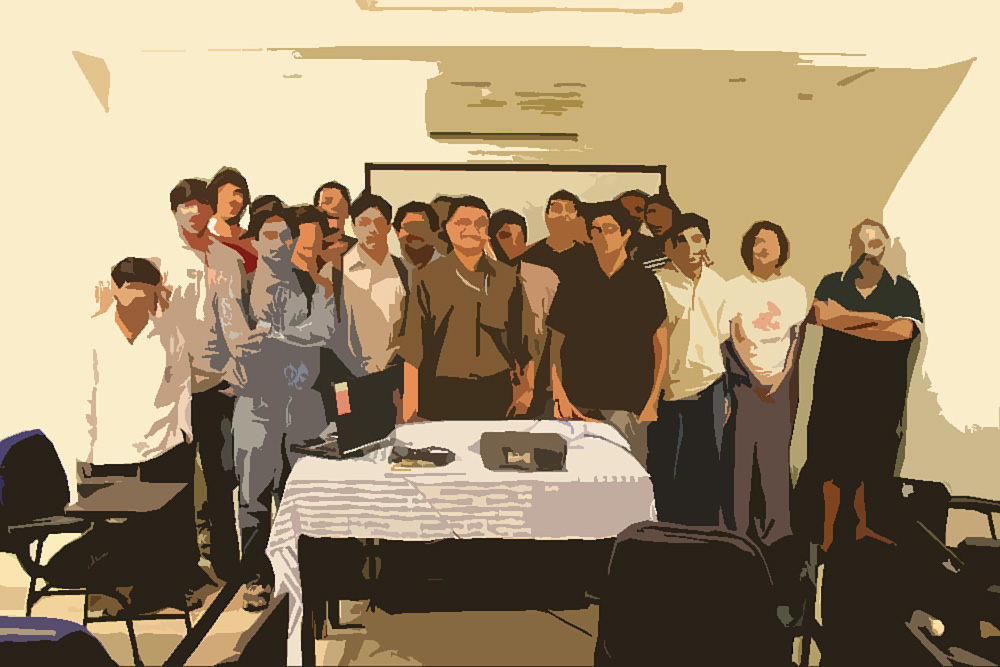
And ah, before I forget, let me recommend that if you find yourself anywhere in the vicinity of The Readers Shop, do drop in. (It's near the Santa Cruz Police Station, on the road connecting SV Road and Linking Road that has a Standard Chartered branch on it.) I didn't have as much time to browse there as I would have liked -- I will return there soon, much to my banker's regret -- but I did have time to note that the collection seemed to be fairly eclectic, and a bargain section outside the store might yield some treasures: I picked up a Modern Library edition of The Federalist for just 100 rupees.
And now if you'll excuse me, I need to do some stretches.
Browsing books as a contact sport
With reference to my post linking to Ram Guha's piece on Premier's, The Marauder's Map writes in to point me to this excellent piece by another fine writer, Suresh Menon, in which Menon informs us that Premier's might be shutting down. He also writes about "[t]he politics of bookshop browsing," and how it can be a "contact sport."
I'm a huge fan of contact sports. I will write about one in my next post.
Sunday, August 20, 2006
Guess who's doing passenger profiling now
The passengers themselves.
The Daily Mail reports:
British holidaymakers staged an unprecedented mutiny - refusing to allow their flight to take off until two men they feared were terrorists were forcibly removed.
The extraordinary scenes happened after some of the 150 passengers on a Malaga-Manchester flight overheard two men of Asian appearance apparently talking Arabic.
This is disgraceful. The passengers who feel worried have every right to get off the plane, at their own expense, but no right to demand that others be offloaded. I'm amazed that the airline caved in, and I hope the gentlemen "of Asian appearance" sue. Once they were past security check, the airline had no business offloading them. Sure, it could have searched them again, but no more than that.
I quite agree with Patrick Mercer, a Tory spokesman, who is quoted as saying, "This is a victory for terrorists." Notch one up for Osama.
(Link via email from MadMan.)
Update (August 24): Here's a follow-up, with a picture of the two offloaded chaps, who are 22-year-old students. One of them says: "Just because we're Muslim does not mean we are suicide bombers." I hate it when it seems necessary to state the obvious.
Blogger goes to massage parlour for nude photoshoot
And what's more, Jai Arjun Singh tells us:
Gyms are populated by beefy, thick-skinned but strangely charming young trainers who resemble the Deol boys in muscle structure as well as in their shy smiles... I’ve never been so unqualifiedly happy at a book launch or discussion. What could this mean?
Sadly, Jai hasn't yet put those pictures of his online, but my heart tells me that HT Tabloid will surely get hold of them.
On that note, check out this HT Tabloid story titled "What makes Preity get goose bumps!", which carries the line:
While Karan Johar is quite superstitions about number 8, Priety Zinta gets goose bumps when black cat crosses her way and Rani Mukherjee frequently says 'touch wood'.
Well, if Rani came across Jai's pics, it wouldn't be wood she'd be wanting to touch, that's for sure!
(Previous posts with Purplocity/Verniness: 1, 2, 3, 4, 5, 6, 7, 8, 9, 10, 11, 12, 13, 14.)
Freedom's on the march
Govt puts off RTI changes.
Men can watch women's soccer, rules Pak.
Apparently, female soccer players in Pakistan have to wear "baggy track suit trousers and long-sleeved shirts" while playing. They might as well wear shalwar kameez, I suppose. That way, even if the game isn't always flowing, at least the clothes will be.
Crystalline and Indigo kids?
Sonu Nigam is quoted as saying in the Indian Express:
I have been reading a lot of late, and according to the great spiritual healers the post-1980s generation will be the harbingers of Satyug. This is a cool, chilled-out and open generation that is not stuck-up. Within them however there are two kinds - the Crystalline, who are the emotional lot who will bring in this change through persuasion, and the Indigos, who will achieve it with rebellion.
What has he been reading (or smoking), I wondered after reading that para. A little Googling revealed that Crystalline children "are able to communicate telepathically, and are speaking to others in other dimensions as a normal event in the course of their play," while Indigo kids are supposed to have abilities that "are said to include purging HIV, advanced genius and psychic/telekinetic powers."
What a load of bull.
I'm certain Nigam will not be able to point to a single example of either of these two types of kids from his personal experience, but he's hardly the only Mumbai celeb who sees things in the world that aren't really there. Shobha De was on We the People yesterday, and the topic of discussion was marital infidelity. At one point De said something to the effect of infidelity being a "non-issue" for Indians in their 20s, and that all they cared about was "quality of life."
This is, again, an astonishing statement, based, no doubt, on a view of the world as she would like to see it (so that it fits some pet theory of hers, probably), and not as it is. Demanding fidelity from our partners is hardwired into human nature, and I recommend that De hop over to the nearest Barista and chat about this with some twenty-somethings.
Let me end this post by saying that that despite Nigam's fascination for New Age crud, he's an excellent singer. Can't say the same for De.
Update: Ken Falco writes in to point me to Jenny McCarthy's site, Indigo Moms. In an article there, McCarthy writes:
I was doing my usual research on environmental toxicities and found myself so obsessed with it that I once again lost sight of everything else. I learned about chemicals that are used in pajamas, such as flame retardants, and the toxic levels our children inhale throughout the night. I immediately got rid of anything that was flame retardant, including his mattress. This was followed by installing organic carpeting in his bedroom, and placing air filters in every room. Someone then told me I needed to change the paint in his bedroom to nontoxic paint. So I was at the store five minutes later buying paint that was edible, and then stayed up half the night painting the bedroom walls. I changed the pool water to Ozone, and even had a chakra balancing done on my house. What finally pushed me completely over was when I found out about electromagnetic toxicity.
Poor kid. I bet he's not allowed to drink Coke or Pepsi either.
Thoo!
Forgive me for being a cynic, but the proposed ban on spitting and littering in Mumbai is certain to become just another avenue for cops to collect bribes. They are effectively unaccountable and poorly paid, and the two factors combine to create conditions that make corruption inevitable. In those circumstances, the more discretion they get, the more opportunity they will have to misuse their power.
That doesn't mean spitting and littering should not be banned. But the skewed incentives that the cops work under need to be fixed. We're a country prime-ministered by an economist, and you would have thought that we'd have figured that by now.
Or maybe not.
Bhopal
When he hanged himself, he left a note saying he was committing suicide not because he was mentally unsound but with all his wits about him.
I believe him, I really do.
Saturday, August 19, 2006
A tribute to Mr Shanbhag
Ramachandra Guha has a lovely piece in the Telegraph on TS Shanbhag, the owner of Premier's, the famous bookstore in Bangalore. Guha writes:
... Premier’s has the most cultivated tastes of all the bookshops I know in India. It is only here that works of literature and history outnumber (and outsell) books designed to augment your bank balance or cure your soul. When it comes to fiction, Mr Shanbhag stocks not merely the latest Booker winner but the back-list of the author (if he has one). When J.M. Coetzee won that prize, even the pavement seller was selling Disgrace, but only in Premier’s would one find The Master of St. Petersburg as well. Mr Shanbhag keeps more, and better, hardback history than any other Indian shop I know; more, and better, literary fiction; and more, and better, translations.
That sounds rather familiar, for Strand in Mumbai is a similar store. And the owner of Strand, TN Shanbhag, is TS Shanbhag's uncle. It's surprising enough when someone builds a sustainable business out of the application of good taste, and it's surely astonishing that this skill should run in the family.
By the by, here's another piece by Guha on Premier's from three years ago.
Be careful where you send that email
Reuters tells us about two German ladies who were discussing their partners' poor sex drives over email, when one of them accidentally sent the mail to the entire company. After that, needless to say, the mails spread and spread.
Amusing as this is, a blast of recognition must surely accompany our reading of this news. Which of us has not pressed "reply all" instead of "reply", or committed a similar blunder? (That is a rhetorical question; please do not send me email answering it!)
Indeed, it isn't just email with which it can happen. A friend of mine has a habit of not locking his mobile phone keypad, and he was once bitching about a colleague over lunch. Ten minutes after the bitching session, the colleague calls him up. "So you think I am [snip snip snip], huh?" My friend's phone had accidentally dialled his number while the bitching was in progress, and the man heard every word.
Indeed, imagine how many relationships would be shattered if every email account in the world was suddenly thrown open for anyone to read. Ooh hoo hoo. Complete honesty would savage us all.
Update: Benjamen Walker has a great story here about the consequences of accidental phone calls. Make sure you download and listen.
(Link via email from Anand.)
Gaurav Sabnis joins a PSU
A few days ago my libertarian friend, Gaurav Sabnis, had stunned everyone with the announcement that he was going to join a PSU.
Today, he reveals which one.
That makes two close blogger buddies who've left Mumbai for the US within the last week. (Yazad Jal is in Yale now, to do an MBA.) The allnighters at Marine Plaza, after dinner at Noor Mohammadi, just won't be the same anymore -- if they happen at all. This is most terrible. I need a hug.
Middle East conflict deepens
Now the cows are resettling.
(Link via email from JK.)
Previous posts on cows: 1, 2, 3, 4, 5, 6, 7, 8, 9, 10, 11, 12, 13, 14, 15, 16, 17, 18, 19, 20, 21, 22, 23, 24, 25, 26, 27, 28, 29, 30, 31 , 32, 33, 34, 35, 36, 37, 38, 39, 40, 41, 42, 43, 44, 45, 46, 47, 48, 49, 50, 51.
Friday, August 18, 2006
The language of justice
It's bad enough to have courts that take years, or even decades, to decide cases, but it's even worse when you can't understand what the judge has decided because of his English. Mumbai Mirror reports that an advocate of the Mazgaon Court, Jamal Khan, has approached the Bombay High Court with a complaint against a magistrate there, SR Bedgale. Khan's complaint is that "[t]he English used by the magistrate is incomprehensible." Some examples he cites:
• "I cannot give the exact time when I admitted the hospital after the incident".
• "I was fallen down at my residence"; "I detained conscious at hospital".
• "They assaulted with the help of hands and legs".
• "Ganesh Chauvan tried to assault me to my face but I prohibited through my left hand."
I'm not sure how many languages the court is allowed to conduct its business in, but it's ludicrous if court officials aren't proficient in whichever language they choose to use. It's not that Bedgale is an exception, though -- the article quotes an advocate named YS Qureshi reporting a classic order by a magistrate named AD Chaudhary in 1990, in which Chaudhary said:
I have a woman before me who has a milk sucking baby. I have personally verified her sex and found that she is a woman and thus be given bail.
This, I must state with the highest admiration, is worthy of HT Tabloid, which runs a story today with the immortal headline, "Ex-IGP turns wife into daughter!" My joy knows no bounds.
(Previous posts with Purplocity/Verniness: 1, 2, 3, 4, 5, 6, 7, 8, 9, 10, 11, 12, 13.)
Romancing Rabri Devi
Whatever he may think of taxpayers' money, you can't say that Lalu Prasad Yadav doesn't have a heart. Consider his love for Rabri Devi:
While scores of railway projects wait to take off, work on the 20.9-km stretch between Hathua and Bathua Bazar on the Hathua-Bhatni section of North Eastern Railway is moving at a breakneck pace.
The reason: On completion, it will connect Union Railway Minister Lalu Prasad Yadav’s ancestral village, Phulwaria, with that of his wife Rabri Devi, Salar Kalan, just 2.9 km apart.
[...]
Rabri is learnt to have requested Yadav to get both their villages connected by rail some time back.
I shudder to think what would have happened had Lalu been civil aviation minister.
This particular railway line may not be a bad thing, of course, and may actually give the region's economy a slight boost, as railway lines tend to do. But the motive behind it is rather amusing, though I'm sure Rabri will be delighted, and Lalu will get some action the night the railway line is inaugurated.
"Leave that cow alone and come to bed, my love," Rabri will call out to him. "I need you to fix your engine to my bogey so we can go chug chug chug."
Some previous posts on Lalu: 1, 2, 3, 4, 5, 6, 7, 8, 9, 10, 11, 12, 13, 14, 15, 16.
(Link via email from Nazim Khan.)
Veena's Booker Mela...
... is up and running. Veena's invited bloggers to choose a book to review from the Booker longlist, and to send her the link when they're done. If you love books, I'm sure much fun will come.
I haven't reviewed a literary work in a long time, so I won't volunteer, but if you enjoy reading, go forth and pick a book. If you're upset with yourself for how little you read these days, as I perpetually am, a public commitment on her blog will make sure you read at least that one book soon!
If you can't find news to report...
... create it. Reuters reports:
A group of Indian television journalists gave a man matches and diesel to help him commit suicide in order to get dramatic footage which was later broadcast on the news, police said on Thursday.
The man died from severe burns to his body in hospital in Gaya town in the eastern state of Bihar on August 15, India's Independence Day.
[...]
"We have seized footage clearly showing a group of journalists handing over matches and some inflammable substance -- which we later verified to be diesel -- to the victim," acting Gaya police chief P.K. Sinha told Reuters by telephone.
I'm sure these gentlemen got a pat on the back from their boss in the studio. "Well done, well done," their bossie must have said. "But we should have got another angle in. You should have shot another take from a top angle."
(Link via email from reader Vikram Chandrashekar.)
Unleash the tiger
Or rather, save the tiger by unleashing the free market. Barun Mitra writes in the New York Times about how conservationists are failing to protect the tiger, but the free market would do a better job. He writes:
[L]ike forests, animals are renewable resources. If you think of tigers as products, it becomes clear that demand provides opportunity, rather than posing a threat. For instance, there are perhaps 1.5 billion head of cattle and buffalo and 2 billion goats and sheep in the world today. These are among the most exploited of animals, yet they are not in danger of dying out; there is incentive, in these instances, for humans to conserve.
So it can be for the tiger.
Read the full piece. Mitra, by the way, runs The Liberty Institute in Delhi.
(Link via Cafe Hayek, via email from Do Not Ask.)
Thursday, August 17, 2006
Such a cutie
Kaps at Sambhar Mafia wants to know who the person in the photo is. My first reaction is in the headline, though I know some readers will find it sexist. "After all," they will ask, "a woman is much more than just her looks." Well, an instinctive reaction is an instinctive reaction, what to do now? And immense admiration already does exist for this lady's achievements, which you no doubt share.
So tell, who is she?
Update: Falstaff writes, in the context of this picture, that "the ability to photograph well may be a key determinant of corporate success." He writes:
People with good passport photographs get picked for interviews over the rest of us, because they look like the kind of people the recruiter would want to work with. People like me get their resumes forwarded to the Department of Homeland Security as a safety risk. As a result people who photograph well gain more valuable and varied experience, and before you know it they're heading major multi-nationals while their less fortunate brethren are still hanging about boring other people with their baby pictures.
Good point. Needless to say, you need to have some basic looks to be able to photograph well, and I suspect my problems begin there. So even if I "say cheese with vehemence," as Falstaff suggests, it wouldn't work with me. Everyone at the studio would just look at me and wonder why I was so pissed, shrieking "cheese" like that.
By the by, in case you're still wondering, the lady in the pic in Indra Nooyi.
I'm going to explode
Passenger with brown skin and long beard calls airhostess over.
Passenger: Excuse me, there is something I need to tell you.
Airhostess: Yes sir, what is it?
Passenger: I'm going to explode.
Airhostess: What? Oh my God! Help! Security!
Old woman sitting besides the man: Wait. I'm going to explode as well.
Teenage girl sitting behind them: Me too. I'm going to explode.
Geriatric man besides teenage girl: I'm also going to explode.
Nine year old boy in front seat: I've already exploded. Hee hee.
What's going on? See this.
(Link via email from The Invizible Man.)
Wednesday, August 16, 2006
Shekhar Kapur has a Big Laugh
Via Uma, I discover this bizarre interview of Shekhar Kapur in which he says:
People talk of the Big Bang. If there was a beginning, there must be an end. But there is no linear time, so where is the end? I call it the Big Laugh. Someone laughed ‘ha, ha ha’ And between the first and the second ‘ha’s, came a few billion years.
Jeez. Later in the interview he says, "Deepak Chopra is a friend, but I’ve never read a book of his." Read Deepak Chopra books? With pseudogiri like this, Kapur could write them.
Is Pluto a planet?
Yes, according to a bunch of astronomers expected to vote on the matter soon, as are Ceres, Xena and Charon.
I hope they eventually discover life on Charon, perhaps in the form of rocks with legs. Just the thought of Charon Stone excites me.
A trace, a small scar
In a profile of Tom Stoppard, born as Tomas Straussler in Czechoslovakia in 1937, William Langley writes:
At 68, he is still discovering himself. When he was a boy, his mother drew a veil over the family's past. There had been a Jewish grandmother, she said, and this was why they had to leave Czechoslovakia. Only relatively recently did he learn the fully story.
His whole family was Jewish. Most of his relatives had been murdered in the death camps. His father, once the house doctor at the Bata shoe factory in Zlin, had been killed in a Japanese air raid. Some years ago, after a visit to Czechoslovakia, he wrote movingly of meeting an elderly woman, a former Bata employee, whose gashed hand had been stitched by Dr Straussler. "I touch it. In that moment, I am surprised by grief, a small catching up of all the grief I owe. I have nothing which came from my father, nothing he owned or touched, but here is his trace, a small scar."
(Link via Sonia.)
Portals to the worlds beneath...
... could hardly get cooler than these.
If people in India tried something like this, they'd certainly get stolen really fast, like these dustbins of yore.
(Frangipani link via email from Kind Friend, who also points me to Leo M's interesting account of travelling through Pakistan..)
Shah Rukh Khan's guard kills Shah Rukh Khan's guard
As they say, Who will watch the watchmen?
Rakhi Sawant and the obscenity law
Dibyo points me to news that Rakhi Sawant was recently refused permission by the Hyderabad police to perform at an event there. She was slated to do an act at the "annual general body meeting of Suchir India Developers Private Limited," but the cops got in the way and said that "no obscene acts will be allowed."
I really should have blogged about this yesterday, it would have been a suitably ironic comment on the nature of our freedom. (Like this one -- via Madhu; more here.) What right do cops have to rule on the content of a privately organised event for adults as long as no coercion of any kind is taking place? This is incredibly condescending, and the shareholders of Suchir India Developers Private Limited are effectively being told that they are not capable of deciding for themselves what is obscene and what isn't, so the state must do it for them. I'm just glad the state didn't land up to feed them Horlicks and change their diapers. Now, that's an obscene thought.
(More on Rakhi Sawant: 1, 2, 3.)
Tuesday, August 15, 2006
Yet another reason to get bigger boobs
"A bad-ass camera"
"Tee hee," goes President Musharraf
Here's a suggestion he hasn't heard before.
Combined orgasms in a cinema hall
I'm a huge fan of Jai Arjun Singh's writings on cinema, but I must confess here that my favourite bits of his writing are not about what happens on the screen, but about what happens in the hall. In a post about Kabhi Alvida Na Kehna, he writes:
One man spent half the film with his cellphone aimed at the screen, taking photos or videos; he recorded the entire “Where’s the Party Tonight?” song and then, irritatingly, played it back later, drowning out the sound from a subsequent scene.
Young boys in my row burst into orgasmic yelps each time there was anything resembling an innuendo in the dialogue, or if a woman appeared in a low-cut blouse. At one point Rani tells Shah Rukh, “Sorry, galti se dab gaya.” (She made an unintended cellphone call.) “Galti se dab gaya!!!!” screamed the lads ecstatically, and the collective outburst reminded me of Arthur Clarke’s short story “Love that Universe”, wherein billions of people are asked to synchronize their love-making so that the combined orgasms send out a crucial energy signal to a distant civilisation.
Ah, in case I forget, I'm also a huge fan of low-cut blouses. As Mother Teresa once remarked, "Come, my love, fix your eyes like rubies/ on my lovely, lovely ____."
It's my favourite couplet of hers, and compares favourably to Beethoven's poems. No?
When Sharad Pawar misled Mumbai
In an astonishing confession, and one that vastly increases my respect for the man, Sharad Pawar admits that he lied to the people of Mumbai. The context: the 1993 bomb blasts in Mumbai. Speaking to Shekhar Gupta, he says:
I recollect on March 12, I was sitting in Mantralaya and at about 12-12.30 pm I heard a big noise, it was the explosion in Air India’s office. Within ten minutes I got a message that explosions had happened in 11 places, more than 365 people had died. I immediately realised that all these places were essentially dominated by Hindus. I guessed there must be some design, and that design must be that Hindus should react against the minority.
[...]
So I straight went on television and I misled people, deliberately misled people, instead of 11 bomb explosions I said 12. And one of the places that I mentioned was Masjid Bandar, an area dominated by minorities. So I spread the message that it’s not only in Hindu areas, it’s in a Muslim area also. I also said that I had seen - because I’d immediately visited the Air India building - and I said I’d visited it and the type of material that had been used was used essentially by some of the southern Indian side terrorist organisations. And I tried to (point a) finger at the Sri Lankan side...
Pawar then says that "[u]ltimately investigations established ki that was the design." It's a fascinating interview, though I don't quite agree with Gupta when he says later that upper caste Gujaratis were targeted in the recent bomb blasts. That's confusing correlation (upper caste Gujjus tend to travel first class) with causation (that's why those coaches were attacked). I'm sure many other groups of people travel first class on the Western Line, and how accurate would it be to say that MBA bankers or Advertising professionals or Himesh Reshammiya fans were the targets of the attacks?
Pawar also has a comment on why the system of having zonal selectors in Indian cricket will be hard to change:
If I have to change the zonal system, I have to amend the constitution. And ultimately if I have to amend the constitution, then I have to get support from zonal representatives. (Laughs).
So to kill the vested interests, you first have to get the approval of the vested interests. Doesn't sound terribly realistic to me.
Monday, August 14, 2006
How the Indian army can "frustrate the ISI"
"By practicing safe sex."
Apparently, the ISI has been planning "to spread HIV among personnel of the Indian army and para-military forces." If this report is true, what could be the ISI's planned modus operandi? Send HIV-positive ladies to tempt armymen into indiscretion? Infect the blood received by armymen in blood transfusions? The scale at which they would have to do it is staggering, and implementation would be fraught with risk of discovery.
On the other hand, they could just leak the news of such a plan and screw the army that way. "Bloody condom again," I can imagine an armyman cribbing. "How I hate the ISI."
"I just called to say I love you"
Aadisht just informed me that if you dial directory enquiry in Mumbai (197), the background music you'll hear is the instrumental version of Stevie Wonder's hit. I wonder if the government servant who thought of that was merely young and idealistic, or whether he was just making fun of us all. "Those schmucks," he might well have thought, "they'll never get the irony!"
Update: MadMan informs me via email that when Airtel's customer-service chappies in Chennai Bangalore keep you on hold, they play "Unbreak My Heart." Why?
Hansdehar, the Knowledge Village
This is stunning: Reuters tells us about Hansdehar, a village in Western Haryana, where one can "see the names, jobs and other details of its 1,753 residents, browse photographs of their shops and read detailed specifications about their drainage and electricity facilities."
Check out the site. It has a complete listing of all the residents, religious places and tourist attractions, details of the Panchayat, and, most importantly, contact details of government officials and a survey of the infrstructure in the village. Information empowers people, and if the website also begins to incorporate information dug out using the RTI Act, its mere presence will make the government take this village extremely seriously.
"It will be a revolution," a farmer named Ajaib Singh is quoted as saying in the Reuters story, and not just in terms of government accountability. As the story elaborates:
Now Hansdehar farmers hope they will be able to get better prices for their crops by trading online through the National Commodity & Derivatives Exchange Ltd., cutting out middlemen.
Carpenters and masons will tout their services online. Others will upload their resumes to job hunting Web sites when the village's first Internet point is hooked up in Kanwal Singh's mother's house in the coming weeks.
Remarkable. I hope more villages follow Hansdehar's example.
(Link via email from Arjun Swarup.)
Update: Chenthil writes in
Most of the districts in Tamil Nadu have embraced IT for quite some time now. TN government is serious about e governance. For example, check the Cuddalore village site. You can check your name in electoral rolls, check the infrastructure projects and their budgets, download government forms, send an email to the collector. Almost all the districts in the state have embraced e governance.
Rockacious. I wonder if any studies have been done on the impact this has had on governance and the economy. That would be quite fascinating.
Update 2 (August 20): Ramya Kannan writes in to point out that Cuddalore is a district. Furthermore, she writes:
Whether all of them [the TN districts that are online] are truly functional and facilitate response is an issue that I would not want to get into, but yes, as far as districts go, we have websites for each one of them. Notable, certainly, yet not in the league of Hansedar, which is truly an instance where technology has been harnessed by the masses. Let us hope MS Swaminthan's Mission 2007 - Every village a knowledge centre - makes a true difference.
Then and Now 1: Shaftesbury Avenue, London
Shaftesbury Avenue, London, circa 1949:

Shaftesbury Avenue, London, circa 2006:

(Pic 1 by Chalmers Butterfield; more details here. Pic 2 by Tom Box; more details here. Links via email from MadMan.)
Sunday, August 13, 2006
Give us freedom, not flags
The Times of India reports:
I-Day is just two days away. There will be thousands of fluttering flags all over India — on masts, cars, houses, in the hands of joyous children... And yet, the real flags used on this historic occasion in 1947 are missing. Three of them, in fact. Shocking, but true.
Ok, so why is that shocking? Flags are mere symbols, just pieces of cloth. What is far more shocking is the absence of so many kinds of social and economic freedom in India, 59 years after political independence. Now, that worries me.
(Do read these two old posts by pals of mine expounding on that subject: "Waiting for the free-market Mahatma" and "Freedom vs Sovereignty.")
An al-Qaeda brainstorming session
David Malki is rocking at Wondermark.
This doesn't mean, of course, that I'm against the kind of security measures we see at airports. With shit like Mubtakkar around, it's necessary. I'm glad to see that security has been stepped up in Mumbai's malls as well. I don't mind losing a few minutes as they inspect my bag when I enter, though my camera is a bit shy, and keeps cribbing about how I let "all these men" feel her up. "All these men" are protecting us, Young Camera, and you really must appreciate that. Whoa, calm down with that flash, you're messing with the battery.
(Links via Boing Boing.)
Pop psychology and your email inbox
Sigh. Now they're saying that your email inbox reveals how you are as a person. In a piece by Jeffrey Zaslow, a psychologist named Dave Greenfield is quoted as saying, "If you keep your inbox full rather than empty, it may mean you keep your life cluttered in other ways." Another gentleman named Merlin Mann (a magical Surd? Nah!) says:
You have to treat your inbox like you treat your mailbox at home. You wouldn't store your bills inside your mailbox. And leaving spam in your inbox is like leaving garbage in your kitchen.
Well, in my case, the comparisons seem to bear out, as I'm a fairly untidy person, leaving books scattered around the house, and my email mailbox is a mess (even worse than when I last blogged about it). However, I'm not sure the analogy Mann makes holds up. The space I have in my email mailbox is effectively unlimited, while my meatspace mailbox and my kitchen are rather small. I use Gmail, and there are no benefits to keeping my inbox lean, but plenty of possible costs, as I may later wish to access email that doesn't seem important to me now. One can be perfectly organised in Gmail, using labels and search smartly, without deleting a single non-spam email.
On the other hand, maybe I'm just a slob in denial. Boo hoo.
(Link via Amit Agarwal.)
Eat that sinful pastry right away
It's them microbes that make you fat.
(Link via Falstaff.)
PS: No, no, I didn't mean it, I was being flippant. A combination of factors make you put on weight, and that pastry is certainly part of it. Look at all that chocolate. Think of the thousands of calories waiting to rush inside your body (because of your greed) and produce fat furiously. That pastry, I say with nothing but concern, will harm you.
Give it to me.
Preity Zinta on being a Bimbo
Speaking to HT Tabloid, Preity Zinta says
... I will advise those who want to come in the film industry that unless you complete your basic education, don't think of trying your hand here. A great look and hot body may make you successful but you will not become a successful actress but a successful bimbo. You will never get the credit for a hit film, because your contribution in the film will be nothing more than just being an on-screen bimbo.
Ms Zinta seems to be implying here that the lack of basic education will a) make you a bimbo and b) not get you credit for a hit film, presumably because you can't act without basic education. Well, well, well. Perhaps we can learn how to be a bimbo from Ms Zinta, but I don't think it's in the way the fine lady intends.
Earlier in the same piece, Minnisha Lamba tells us that "[i]t's very natural for a person to get glued to a face which is pretty and a body which is just wonderful." So now you know why I'm always walking around with Fevicol.
(Previous posts with Purplocity/Verniness: 1, 2, 3, 4, 5, 6, 7, 8, 9, 10, 11, 12)
Saturday, August 12, 2006
Indiacows?
Mandar Talvekar gets a marketing call from Indiabulls and decides to get cheeky.
If he continues like this, he'll end up causing them "psychological distress." Of course, he's not the ones making the calls, so the telemarketing chicas have only themselves to blame.
Previous posts on cows: 1, 2, 3, 4, 5, 6, 7, 8, 9, 10, 11, 12, 13, 14, 15, 16, 17, 18, 19, 20, 21, 22, 23, 24, 25, 26, 27, 28, 29, 30, 31 , 32, 33, 34, 35, 36, 37, 38, 39, 40, 41, 42, 43, 44, 45, 46, 47, 48, 49, 50.
"She asked for it"
That's the line the home ministry -- including Shivraj Patil, the home minister -- seems to be taking when it comes to violence against women. Consider this report by Monobina Gupta in the Telegraph:
A delegation headed by Renuka Chowdhury, in charge of the ministry of women and children, went to meet home minister Shivraj Patil recently to draw his attention to the rising violence against women.
[...]
Patil and his officials were far from agitated. Instead of giving the delegation a sympathetic hearing, the officials fired questions as Patil kept quiet. Why do women go out at night? Especially, why do they go out unescorted? Even worse was to come.
The officials started picking on the way women dress. Why do they dress provocatively? Their clothes are such that they invite male predators.
This is exactly what Bal Thackeray’s paper Saamna had written earlier after a rape in Mumbai.
This is appalling. Bal Thackeray's a private citizen, and one can ignore him, but this is the home ministry speaking. Shivraj Patil gets his salary from the taxes we pay; the home ministry runs on those taxes, a fair chunk of which comes from women. I'm lost for words.
First Natwar Singh, now Shivraj Patil: the senior ministers handpicked by Sonia Gandhi are a disgrace to the people they supposedly represent. I wonder what Mrs Gandhi would have to say about this.
The kindness of strangers
Reuters reports:
A Japanese man was arrested this week after making 37,760 silent calls to directory inquiries because he wanted to listen to the "kind" voices of female telephone operators. [...] "When I made a complaint call once, the operator dealt with it very kindly, so I wanted to hear these women's voices," the paper quoted him as telling police in Hiroshima, western Japan.
The report goes on to say that "Police believe the calls, made between March and July this year, caused psychological distress to more than 100 telephone operators." Yeah, I can just imagine what happens when one of them goes home and her husband wants dinner.
Husband: Darling, come, let's have dinner.
Operator: No, I'll have dinner. You stay hungry, no dinner for you.
Husband: [Baffled] Hey. What's up with you, why're you behaving like this? You're normally such a kind person.
Operator: Kind, kind, kind. I'm sick of being kind. I will never be kind in my life now. Never ever.
So the next day the husband decides that he needs some kindness in his life, and calls directory enquiry.
Celebrities as terrorist targets
The Telegraph reports that "Mumbai police are making arrangements to step up security for celebrities like Amitabh Bachchan, Shah Rukh Khan, Sachin Tendulkar and Mukesh Ambani." About time. As I wrote a couple of years ago (see fifth para), celebrities are logical targets for terrorists. I'm glad that the cops are being proactive here.
India, Pakistan, deterrence and peace
I used to wonder if India's decision to go nuclear actually backfired on us: after all, it was inevitable that Pakistan would follow, and India's conventional military superiority would effectively cease to matter, as both sides would have deterrence. Earlier, we'd know that in the event of war we were bound to win; now, we know that they're nuclear and a war might devastate both countries.
Well, Shekhar Gupta, writing in the Indian Express, reveals that Pakistan claimed to already have the bomb in 1990. He writes:
Many experts, including Seymour Hersh, believe that the then Pakistani foreign minister, Sahibzada Yaqub Khan, came to India to ‘defuse’ tension but actually unveiled a nuclear blackmail for the first time. In conversations with Indian leaders he threatened that they should not count on their conventional superiority if war broke out because Pakistan had the nukes and intended to use them in the very beginning.
[...]
It is unlikely that V.P. Singh and Gujral will tell you more on this. But Gujral will probably not deny that one conversation went something like this: Sahibzada told him that if there was a war now, it won’t be an ordinary one, that there will be flames rising from the mountains, the valleys, the plains and the rivers. And Gujral, gathering his nerves — and wits — quickly, replied, “I hope not, but please do remember, we have also been drinking the waters of the same rivers as you.”
Deterrence already, just by insinuation? Anyway, earlier in the article, Gupta writes that Pakistan liked to enter into conflict with India whenever they thought India was weak.
The Pakistani establishment has a chronic compulsion to test the waters whenever they think Indian politics is passing through a phase of confusion and weakness. They chose the summer of 1965 to start the war because they thought India’s armed forces were still punch-drunk from their defeat by China and Shastri had not yet had the time to fill the vacuum left by Nehru. Internally, they were also enthused, as so much of the subsequent literature by key Pakistani players in that war shows, by delusions that the Naga insurgency, the Dravida movement and even the vocal opposition of sections of the Left to India’s cause in the China war had all weakened India sufficiently for them to risk an assault on Kashmir. It is possible that they saw the fall of Rajiv Gandhi, and the arrival of a very weak V.P. Singh coalition as a similar opportunity.
The Naga insurgency? The Dravida movement? I suspect Pakistan made the mistake of believing their propaganda, which is, well, somewhat amusing.
I've often been attacked for being a peacenik when it comes to Pakistan, but that's an over-simplification. I just believe that we need to understand that India's enemy here is not 'Pakistan,' but Pakistan's military establishment, which thrives on the conflict with India -- indeed, its sustenence depends on it. Its interests are actually quite different from that of Pakistan's civil society -- again, a broad term -- who would, by and large, prefer peace and prosperity to conflict. In our battle against terrorism from across the border, they are our allies, not our enemies. We need to strengthen our allies, and beat our enemies.
Thus, I embrace what appears to many to be two contradictory approaches: an uncompromisingly hard line when it comes to terrorism, and a deepening of trade and people-to-people contact. Both work towards the same end. (I'll elaborate on this in a further article.)
Political correctness taken too far
I mean, look at this.
As Benjamin Franklin once said, "If all printers were determined not to print anything till they were sure it would offend nobody, there would be very little printed." That is particular pertinent to India, actually, with too many people getting offended by stuff over the last few weeks, like "Tits, Clits n Elephant Dicks." These days, 'Freedom of Expression' is becoming 'Freedom of Expression BUT...'
(Flickr link via email from MadMan.)
Don't bang the maid
Devangshu writes:
... India would be a very different place if a cross-sectional consensus on the desirability of banging the maid had not existed for centuries. Entire sub-castes are composed of little bastards, legitimised over time. These were all created by the tradition of banging the maid.
Indian history would be far less turbulent. So many of the protagonists of all those wonderfully fratricidial succession struggles would not have been conceived. Millions of sex-starved young bachelors would have gone virgins to their respective suhaag raats.
The rest of his story is about a chap he used to know who banged his maid, and was confronted by the maid's "official swain," a barber. Shit happened -- and as you will surely realise after you reach the tale's conclusion, somewhat painfully at that.
(Link via Peter.)
Friday, August 11, 2006
Google and Napoleonic France
In an article titled "The Alliance Against Google,", the Economist writes:
Prince Klemens Von Metternich, foreign minister of the Austrian Empire during the Napoleonic era and its aftermath, would have no trouble recognising Google. To him, the world's most popular web-search engine would closely resemble the Napoleonic France that in his youth humiliated Austria and Europe's other powers. Its rivals—Yahoo!, the largest of the traditional web gateways, eBay, the biggest online auction and trading site, and Microsoft, a software empire that owns MSN, a struggling web portal—would look a lot like Russia, Prussia, and Austria. Metternich responded by forging an alliance among those three monarchies to create a “balance of power” against France. Google's enemies, he might say, ought now to do the same thing.
Now, analogies are no doubt useful, but the internet and the real world are entirely different spaces, and my feeling is that the biggest threat to Google will come not from any of the established behemoths, but from a company that may not exist now, or is under the radar. What is that company and what will it do? I don't have a clue. Who could have predicted Google ten years ago? Not Page and Brin themselves, I'm guessing.
Can't afford a lawnmower?
Buy a minicow.
"I've never once had to cut the grass," says one of the minicow owners in the story linked above.
As you've no doubt heard, the best things come in cow packages.
(Link via email from Publia.)
Previous posts on cows: 1, 2, 3, 4, 5, 6, 7, 8, 9, 10, 11, 12, 13, 14, 15, 16, 17, 18, 19, 20, 21, 22, 23, 24, 25, 26, 27, 28, 29, 30, 31 , 32, 33, 34, 35, 36, 37, 38, 39, 40, 41, 42, 43, 44, 45, 46, 47, 48, 49.
Practise safe sex
Thursday, August 10, 2006
On books and reading
In a profile that David Remnick once did of Philip Roth (I can't find it online, sorry) in the New Yorker, Roth said:
[The evidence] is everywhere that the literary era has come to an end. The evidence is the culture, the evidence is the society, the evidence is the screen, the progression from the movie screen to the television screen to the computer. There's only so much time, so much room, and there are only so many habits of mind that can determine how people use the free time they have. Literature takes a habit of mind that has disappeared. It requires silence, some form of isolation, and sustained concentration in the presence of an enigmatic thing.
Indeed, in the last few years it has become fashionable to speak about the death of the novel. Well, here's what Don DeLillo once wrote to Jonathan Franzen in a letter:
The novel is whatever novelists are doing at a given time. If we're not doing the big social novel fifteen years from now, it'll probably mean our sensibilities have changed in ways that make such work less compelling to us--we won't stop because the market dried up. The writer leads, he doesn't follow.
Some other quotes by DeLillo on writing are collected here, though I first read this in David Remnick's New Yorker profile of DeLillo. I couldn't find that online either, but Remnick's profiles of Roth and DeLillo, along with a host of other great pieces by him, are collected in Reporting. Wonderful book. (All these pieces appeared in the New Yorker, and The Complete New Yorker is a fabulous buy.)
And what do I think of this? I'm afraid I don't have enough data to be able to judge whether people read more or less these days, and I won't extrapolate from personal experience. But it's clear that in our digital age, we're spoilt for choice for ways to spend our free time. Literature has competition, and that's a good thing. It will only affect bad books adversely, if at all. Good books will always find their readers. They will hunt them out, chase them down, sit on them and chant, "Read me, read me, read me." Only the compelling survive.
A world cup for homeless people
Scott Soshnick of Bloomberg writes about "a World Cup for homeless people, made possible with help from corporate sponsors such as Nike, Adidas, Coca-Cola and Bank of America."
I'm presuming that victory disqualifies you from taking part again. After all, with sponsors like that, the prize money is bound to get you a home somewhere.
India Uncut Ambition 3
I want to be a female-earlobe piercer.
You will note here how I write the last three words of the preceding sentence: not “female earlobe piercer”, which would wrongly indicate that I want a sex change, but “female-earlobe piercer”, which indicates that I want to pierce female earlobes, presumably while remaining male. Hyphens are important.
Also, let us not get into whether earlobes can be female, or merely the people they belong to. You know what I mean. Furthermore, I hate pedants.
I will become the most famous female-earlobe piercer in India, and women from all over the world will come to me to get their female earlobes pierced. They will come and sit on my newly upholstered stool, remove any piece of clothing that may happen to cover the ear, and announce: “Pierce me!”
Then my eyes will glint, and I will pull out The Longest Needle In The World™. They will look at it, and some of them will faint. The others will squeal, “Oh my goodness, that is so big. It is the biggest I have ever seen.” Their earlobes will quiver in anticipation.
And I will hold their chin, turn their head, and do the deed. Sometimes, if the lady in question is a supermodel – many such will visit me with female ears – I will drive it in one ear and out the other. “Oops,” I will then say. “Missed.”
“Tee hee,” they will reply.
Then one day it will end. A gentleman will walk into my parlour. “I want to pierce my ears,” he will say, in a gruff voice.
“That rhymes, monsieur,” I will say, “in a terrible way, but surely you are aware that I pierce only female ears. Who the hell are you, if I may be so impolite as to put it that way?”
“You are not only polite but precise,” the man will say. “I am the devil, and I have come to do a deal with you. If you pierce my ears, I will give you all that you want for four score years and ten, after which you shall burn in hell forever. I have the agreement copy in triplicate here with me.”
“And if I refuse your offer, and ask you to pierce off? Then what, monsieur?”
“Then you shall burn in hell from now itself.”
Silence will prevail until I break it, though it is somewhat redundant to put it that way. “I agree,” I will say. “Come, sit here.”
He will come and sit on my stool. I will take out out The Longest Needle In The World™. Then Iwill hold his chin and move it to one side.
“Be gentle,” he will remark, as he chuckles.
“I will,” I'll say. “I will treat you like a supermodel.”
Then I will plunge it in with all my force.
Previous India Uncut Ambitions: Hooch Inspector, Pothole Inspector.
Emotions v Sex (or why female brains are different from male ones)
Louann Brizendine, a UCSF neuropsychiatrist, is quoted in the San Francisco Chronicle:
Women have an eight-lane superhighway for processing emotion, while men have a small country road. [Men, however,] have O'Hare Airport as a hub for processing thoughts about sex, where women have the airfield nearby that lands small and private planes.
This is from Brizendine's book, The Female Brain. (A few days ago, I'd linked to another article on the subject of innate differences between male and female brians.) These differences are hardly surprising. It's commonly accepted that male and female bodies evolved differently in prehistoric times; how, then, could such evolution have bypassed the brain? Differences do not equate to inequality, needless to say, though I find myself wishing I had more female traits. This testosterone just screws me up, it messes with my life.
Anyway, a few conclusions that Brizendine has reached are reproduced at the bottom of the article:
Thoughts about sex enter women's brains once every couple of days; for men, thoughts about sex occur every minute.
Women use 20,000 words per day; men use 7,000 per day.
Women excel at knowing what people are feeling; men have difficulty spotting an emotion unless someone cries or threatens bodily harm.
On all these counts, you gotta envy them chicas. I mean, what're we going to do with Math? Count minutes?
Update: Falstaff writes in to point me to a post on Language Log by Mark Liberman, where Liberman contests Brizendine's data, while agreeing that "[t]here certainly are psychological and neurological differences between men and women, sometimes big ones." As long as these observations have no bearing on policy -- and they emphatically shouldn't -- I don't see what the fuss is about.
Update 2: Reader Arvind Gopu emails to point me to a nice post on Thinking Meat Blog that discusses the two articles I linked to. The writer says something similar to what I wrote in the update above:
I’m uncomfortable with the idea of saying that workplaces should accommodate employees who are mothers because women, according to Brizendine, “are wired to take care of children, and they want that time and need that time.” There are plenty of things that people are wired to want to do, and that in no way obligates anyone else to help them do them. [My emphasis.]
Exactly. Description doesn't imply prescription, as Steven Pinker would have put it.
How not to rob a bank
Steal the cheque-deposit machine instead of the ATM.
These chaps aren't too bright either. Could have made it to The Darwin Awards.
(First link via Nazim.)
Where your taxes go: 5
21 penguins rescued
The Octopus was also ok.
In a separate incident, five humans died trying to save a pigeon.
Don't you get it, I'm tired of blogging about people. People, people, people, all the time. People are so boring. People are all the same. People think they're important, and worth blogging about. People want to rule the world. People can't control their libido. People think they're invincible. People are getting older and, therefore, closer to death. People will die one day, all of them. Yes, animals will die too, but at least they're not pretentious, self-delusionary farts.
On the other hand, People read this blog. In fact, you might be part of People yourself. And you're wondering, Jeez, what's that jerk ranting about now? (That's a rhetorical question, or I'd answer it and say: People.) Ranting, panting, and that brings me to the question: why are wanting and wanking pronounced so differently? Why?
Update: Distressingly, animals can behave like People sometimes. Check out this obsessive compulsive kitty flushing a toilet repeatedly.
Wednesday, August 09, 2006
The best time for intercourse...
... is between 2am and 4am. So says Virmaran Jat, an 88-year-old gentleman in Rajasthan who recently "became the father of a baby boy and has sex daily and wants more kids."
"We need some Jats, that's what we need," the chappies who run the Catholic Church in Kerala must surely be muttering.
(Link 1 via km, link 2 via Ultrabrown.)
The Young Man and the Fish
Hemingway wouldn't have been very impressed by this story.
I can just imagine the sturgeon in question thinking, "How would you like it if I rode a landcraft over the land you live on and created waves of land that disturbed your repose? Huh? How would you like it if I went out to have landfood on weekend evenings and ate your relatives on nice shiny crockery? Huh? I so want to catch you in a net and dig a fork into you, but as I don't have a net on me now, this will have to do."
WHOMP.
Meanwhile, my plant is singing a song in the corner of the room. I think it's Pour Some Sugar On Me.
(Fish link via email from Arun Verma.)
And the houseboats are made of naan?
When I was a child, a tiny tiny tot, I thought that the Dal Lake had dal in it. It later turned out not to be the case, but had that been true, I suspect young Arzan Sam Wadia would have headed over to Srinagar for a meal or two. After all, he does seem miffed about "The Rising Cost of Dal in NYC."
Update: km writes in:
The daal situation here is really grave. So bad that "Ghar ki daal murgi barabar" is the first thing that comes to mind when I look at caviar-priced daal.
Needless to say, hopelessly amateur economists like me are watching the effect all this has on Indian buffet lunches with bated breath.
Hmm. And do you know what kind of lentils dead people like to eat?
Dal Ghost.
A comma worth US$2.13 million
Who says punctuation doesn't matter? Globe and Mail reports on a company called Rogers Communication Inc. that had a deal with a company called Aliant Inc. "to string Rogers' cable lines across thousands of utility poles in the Maritimes for an annual fee of $9.60 per pole." The contract Rogers thought it had signed tied the two companies into a five-year period, extendable into further five-year terms. But it screwed up in the wording. The report states:
Language buffs take note — Page 7 of the contract states: The agreement “shall continue in force for a period of five years from the date it is made, and thereafter for successive five year terms, unless and until terminated by one year prior notice in writing by either party.”
As you've probably guessed by now, the second comma messed it up for Rogers. Read the full story here. (If asked for a username-password, get it from BugMeNot.)
I can just imagine the chairman of the company lying down on his back, kicking all four of his limbs in the air, and bawling, "I'm being chased by a comma, I want my momma."
(Link via email from Rk.)
What came first, the chicken or the egg?
The egg.
Makes sense to me, and here's another question: What came first, roast chicken or omelette?
My answer is roast chicken. You see, humans would have started eating eggs regularly only after they began domesticating poultry, which they would have done purely because they liked the taste of it. Omelettes would thus have come about a bit later than roast chicken, though a boiled egg or two might casually have been consumed in the wild long before. Who knows?
My big toe has a question:
Big Toe: What came first, the toe or the foot?
(Link via email from Ravikiran.)
Previous posts with toes in them: 0.5, 1, 2, 3, 4, 5, 6.
Update: And if you want to learn how to make omelettes, Lalita will teach you. In her post she says, "Just like sex, making an omelette is all timing and tempi." As long as I don't have to spend months dating the egg...
Coke, Pepsi, and pesticide
Arjun Swarup makes an impressive debut on the Indian Economy Blog with a post titled "Cola Con," in which he points out:
There is massive, widespread adulteration in virtually every food item consumed today in India. The levels of pesticide in coffee is 190,000 times, and in apples, 100,000 times, according to some estimates. By contrast, the levels in colas are twenty-four times [emphasis in original].
Read the full post. I agree with Arjun's conclusion that this whole controversy is "a cocktail of politics, psuedo science, posturing and bad economics."
On that note, I'm off to get a cup of coffee. 190,000 times is fine by me, and perfectly safe; 24 is certainly much ado about nothing. For once, I say with bemusement, I agree with Shah Rukh Khan.
Update: "I want my DDT," says Gautam John.
Meanwhile, in the corner of the room, one plant says to me, "Hey, useless blogger, pour some Coke on me, please."
"Are you fricking mad," I say. "And aren't you a plant? Plants aren't supposed to talk."
"Fug off," said the plant. "I don't take shit from bloggers. Quickly come and pour some Coke on me."
So I go and pour some Coke on the plant. Then I sit back down and think about what to blog. Then the plant pipes in: "Hey, this is no good. All that talk about pesticide in Coke, just hype, there's hardly any. Certainly not enough to harm you, much as I wish that would happen. Pour some of your coffee on me, please."
So I pour some coffee on the spoilt scoundrel. "Ah," it says. "That's better. Way more pesticide. Thank you, and go away until I call again."
Natwar Singh's in demand
A senior member of the ruling party gets embroiled in a messy scam, and you imagine that the opposition would swoop down on him like vultures. Instead, in Natwar Singh's case, they're rushing to get in bed with him. It's quite disgraceful; and yet, disgrace isn't all that disgraceful in India.
Consider how quickly Ajay Jadeja and Mohammad Azharuddin got rehabilitated on Page 3 Planet after the match-fixing scandals, not to mention that scoundrel Mika. Natwar will be endorsing Coke next, telling us all, "Hey, I don't know about pesticides, but I do know that there's no oil in Coke. None at all. I can vouch for that."
The man's behaviour over the last few months is a perfect reflection of the attitude of a certain class of politicians towards power: they treat it like an entitlement, like India is their baap ki jaagir. "How dare you take power away from me?" he might as well be saying. "Do you know how many years I've been loyal to the Gandhi family?"
And he might add under his breath, "Many more than that upstart Manmohan."
Natwar's activities in this case are quite clear, and I hope the investigating authorities uncover the paper trail that nails the fellow. I'd be delighted to see him spend his last few years in jail, or go the Kenneth Lay way. It isn't often that twisted politicians get their comeuppance in India.
Paris Hilton loves Austria
Why so? In her own words:
Because they pay me $1 million to wave at crowds!
See the last line here.
Paris isn't quite so fond of Poland though. I was privy to an interesting chat between her and a Polish promoter (PP) recently.
PP: Please, Ms Hilton, please come and wave at crowds in Poland.
PH: How much will you pay me?
PP: We can pay you $800,000.
PH: 800k? That's nothing. Austria pays me 1 million, and they throw in free beer.
PP: Ms Hilton, we were a communist country not long ago, we're still recovering.
PH: No, I'm sorry. I need more than 800k to wave at crowds.
PP: Could you at least wiggle a finger at them then?
And did you catch what she said a few days back about being an iconic blonde? She wasn't till she said it, I'd say, but having said it, now she is. I'm a huge fan of brunettes.
(CNN link via email from little n.)
Tuesday, August 08, 2006
Profit as a dirty word (and Wodehouse v Simenon)
"Profit is a dirty word," Jawaharlal Nehru once said, and this attitude still persists among loads of people, including some in government. I was reminded of this today when I met up with my friend JAP, the blogger who is an IAS officer in his day job, running a PSU from Kolkata. He told me an interesting story about how, a couple of years ago, he went to his minister and proudly informed him that he had turned the previously loss-making PSU around, and it had made healthy profits that year. The minister frowned and said, in a worried voice:
"I think we should keep quiet about this."
Befuddled, I asked JAP why, and he told me that the minister, no doubt under a Nehruvian kind of conditioning, wasn't sure if making a profit was a good thing to do.
Oh, how I wish I was kidding and had made this up. Of course, JAP was all praises for the minister he currently works with, as also for PG Wodehouse's writing discipline and prolificacy. Pah. Wodehouse wrote just 96 books. What's that compared to Georges Simenon? Babyfood.
Update: Speaking of Nehru, catch him say "Yo Mahatma, I still got all my notes from Cambridge" in this illustrated strip on India's economic history, by some chappie named Horsey. Whoever thought Keynes and Hayek would land up on the same page as Nehru, Gandhi and Gandhi. Muchos funno. (Link via email from Kunal.)
Udita Goswami on kissing
Udita Goswami announces in HT Tabloid:
I have pledged that in any of my forthcoming films I will not give a lip kiss. I am not comfortable doing that. I belong to a traditional family and my values do not allow me to indulge in such acts.
Yes, people from traditional families do not "lip kiss." Indeed, they copulate without any contact between their body parts, and as films depict reality, that is precisely what they should restrict themselves to showing.
When asked about her kiss in Aksar, the fine lady says:
I can kiss only Emraan [Hashmi] comfortably. If I had to do a kissing shot with any other actor, I would have literally cried.
So people from traditional families must hump without body parts touching, but they can kiss Emraan Hashmi. I'm sure Hashmi must be rather, um, busy.
Santa Banta has more on Udita, by the by. In an article titled "I'd rather strip than kiss: Udita," the lady is reported as saying:
It's really painful to shoot smooch shots in front of dozens of people while shooting. What's irritating is the actor's stubble, which rubs with my skin when I touch him. This is the reason I finds a clean-shaven man much more kissable.
I always use some good quality cream and after every shot, I apply it on my face and body parts for a soothing effect after such UNPLEASANT EXPERIENCE. [Caps in original article. Why?]
I suppose Udita's growing as an actress, what else to say? Actually, I don't see why she should have to justify her decision to quit kissing on screen. Just because she used to kiss on screen doesn't mean that she should continue doing so, or that she owes anyone an explanation for changes her mind on the subject. After all, her lips are her own.
That's an interesting thought, actually. Do you think Indira Gandhi could have nationalised lips instead of banks?
(Previous posts on Purplocity/Verniness: 1, 2, 3, 4, 5, 6, 7, 8, 9, 10, 11.)
If marriage without sex is cruelty...
... is sex without marriage kindness? That's what km wants to know in reference to this article.
Do you want to be an Ayurvedic doctor?
Answer these multiple-choice questions:
Who said 'Christians have the right to convert?' - Sonia Gandhi, Sister Nirmala, Pope Benedict, Father Prakash.
After whom has Narendra Modi named India's biggest gas project on the Krishna Godavari basin? - Maharana Pratap, Dr Hedgewar, Syama Prasad Mookerjee, Pandit Deendayal Upadhyay.
Which day is observed as 'Black Day' by minorities and 'Victory Day' by RSS? - September 11, July 2, January 26, December 6.
According to a Times of India report, these are questions asked by "Gujarat Public Service Commission (GPSC) of candidates appearing for Ayurvedic medical officers' exam on Sunday."
This is almost surreal. I can just imagine a patient with a kidney stone asking his friendly neighbourhood Ayurveda practitioner, "Doc, what's wrong with me, will this pain ever end?" At that point, the doc looks at him gravely and says:
"Look, I really am not sure what's causing your pain, or even where your kidney is located. But let me tell you all about Father Prakash."
Dolphins, and the amorous couple
Check out the picture below. What do you see?

Is it a couple making out? Or is it nine dolphins?
I saw the couple, of course, and had to strain hard to see the dolphins. (See where the bottom one's tail ends up. Hmm.) But I disagree with Amit Agarwal's (no doubt tongue-in-cheek) assertion that I am therefore a pervert. I'd argue that anyone who sees dolphins there is a pervert. Leave them dolphins alone, ok?
(Pic via Amit.)
Reutersgate: Photography and Photoshoppy
If a top blogger did this, the mainstream media would do its bit of self-important moralising, but it's a mainstream news source that has been caught out, so we'll do the tut-tutting, ok? The web is abuzz with talk of a Reuters photographer, Adnan Hajj, getting caught manipulating pictures in Photoshop. Charles Johnson of Little Green Footballs, one of the bloggers who exposed Rathergate, was the man who uncovered the fraud.
Reuters has reacted appropriately to the criticism, firing Hajj and withdrawing all previous photographs by him. For more on the subject, do read Jeff Harrell's excellent analysis of the photoshopping by Hajj, and Richard North's account of a previous hoax pulled by the same chappie. (Most of these links are via Sriram, who has many more useful links in his post.)
I wouldn't hold it against Reuters too much: they did sack the guy and remove all his pictures, and in every large organisation there are likely to be a few bad apples. What is critical is that the company in question takes a zero-tolerance policy towards offenders, and has an internal mechanism in place to prevent such behaviour. Reuters seems to score on the first account, and are reportedly putting systems in place to make sure pictures are more thoroughly vetted before they get through.
One of the reasons that this episode happened is that American and British news organisations often have laxer rules for stringers -- especially those in war zones, from where reporting is at a premium -- than for inhouse staffers. I'm quite sure Reuters' staff photographers must be pretty pissed at this, and that none of them would ever attempt such a stunt. Reuters will, no doubt, scrutinise content from stringers and freelancers more carefully after this, though had the photoshopping been skillful, it could have been impossible to detect, regardless of internal processes. Now, that's worrying.
So what do I feel about photoshopping? you ask. Is it ethical? Well, in my view, using Photoshop for journalistic pictures is okay only as long as you don't distort the truth of the photograph. Cropping a picture for publication purposes or sharpening it is fine, and maybe brightening or darkening it, as long as it doesn't misrepresent what is in the picture. But adding or removing any element is simply not on. It's cheating. And it's clear from the photographs that Hajj cheated egregiously. Staging pictures is even worse, of course. (For more from a professional who freelances for AP, click here.)
And now, after all that, some comic relief.
Monday, August 07, 2006
"How can my friend sort out his tiny knob?"
That's one question Tim Harford gets asked while shooting for "Trust Me, I’m an Economist," his forthcoming show on BBC2. I rather enjoyed The Undercover Economist, but his show, sadly, will probably not be aired in India. And what does Harford learn about being a television presenter? Here's an excerpt from his piece:
1) You get called “the talent”.
2) Other people pay for your sandwiches.
3) You get to take a lot of taxis.
4) You get free clothes, chosen by the producer, who is fresh from producing What Not to Wear.
Just like it is in India, I can safely inform you. Television dumbs things down everywhere, but Harford's show is still likely to be much more illuminating than watching Harford on Koffee with Karan could be. Unless, of course, the Karan in question was Thapar, not Johar.
One problem the finest economist can't solve, by the by, is the one of the tiny knob. That knob is the nub of all of humankind's problems and, sadly, its continued existence. Imagine what a dramatically different species we would be if our reproduction was asexual.
From clever to invisible
The BBC maps out the Five Stages of Drunkenness.
I rather suspect blogging is a consequence of Stage 1. This is 'Feeling Clever', and is described thus:
This is when you suddenly become an expert on every subject in the known universe. You know you know everything and you want to pass on your knowledge to anyone who will listen. At this stage you are always right, and, of course, the person you are talking to is very wrong.
Sounds wearily familar, no? I don't consume alcohol too often, and have certainly never blogged while drunk, so I can only conclude that my parents were at Stage 1 when they conceived me, thus making it my permanent condition. Just why do you tolerate me?
(Link via email from MadMan.)
Relationships and straitjackets
Relationships are strange things, and sometimes it baffles me that they exist at all. When everyone's pretty much the same messed-up piece of work, with variations, how can we actually love somebody? And when the expectations of any two people in a relationship are inevitably different, how remarkable it is that any common ground they find is sustainable. And isn't it a paradox that you could be involved in a beautiful relationship in which you love unconditionally, but because it is trapped with a straitjacketed category like 'marriage' or 'platonic friendship', it has limits enforced on it, artificial constraints that distort its truth?
All apropos of nothing, of course, and not stuff I'll write more about on this blog. But I was rather pleased to find a great post by Falstaff in which he expounds rather well on similar matters. He writes:
Is it just that in an age obsessed with menus, with choices, with the drop-down box, we have turned even love into a multiple choice question? "How do you feel about this person? Are you a) a friend b) a lover c) a brother or d) a father". What about none of the above? What about Other (please specify)? What about feelings that are open-ended?
Or is it that we have been so poisoned by reason, by our quest for explicability, that the apprehension of another human being in his or her specificity has become impossible for us, and that we can only love people (as we may only hate them) by converting them into abstractions, into the idea of the other rather than the other itself? That having to face up to the reality of who the other person is, to their infinite humanity, is more than we are capable of, so that just as we must ignore what is human about someone to hate him or her, we must also ignore the details of the person we care for, in order to love them? Is this why we give names to our feelings - because we cannot experience them unless they are made intelligible to us, like a child who cannot eat his dinner unless it is cut into bite sized pieces?
Actually, we view not just relationships but all the world around us in "bite-sized pieces," because of our "quest for explicability" and an inability to fathom the true complexity of the world. So we see patterns where there are none, and fit all kinds of phenomena into a worldview we use, in part, to define who we are. But all common worldviews are somewhat simplistic, and putting a finger on who we are, is, well, a rather complex matter as well.
This is the paragraph where I could start to ramble self-importantly. Before that happens, I'll end this post.
India Uncut Aphorism 20
The devotees of the party in power are smug and arrogant. The devotees of the party out of power are insane.
Jane's Law, as blogged by Megan McArdle (who blogs as Jane Galt) here.
In an Indian context, the Left plays the unique double-role of acting as both the party in power -- propping up the UPA government -- and the opposition -- in opposing most of the government's policies that promote economic freedom. So does that make them smug, arrogant and insane? I wouldn't argue with that.
More Nuggets and Aphorisms here.
Sunday, August 06, 2006
"But I wuz watching Friends"
Woman gets stuck on toilet seat. Only gets up when TV is removed from toilet.
Ok, ok, I made that second line up. I really mustn't trivialise the lady's distress. Must have quite a pain in the ass.
(Link via email from Arun Verma.)
Bipasha Basu has a dog named Posto
If she was a blogger, would she have named it Blogposto?
Economists who blog
One of the joys of the online world, for me, are the number of excellent economics blogs out there. Marginal Revolution, Cafe Hayek, EconLog, and so on. (I touched on the subject in my review of Tim Harford's The Undercover Economist a while back.) Well, the Economist has an article on the subject, in which it points out that blogs go a long way in solving the problem of the "division of knowledge," which Freddy Hayek had once held as "analogous to, and at least as important as, the problem of the division of labour." The article states:
The faster flow of information and the waning importance of location—which blogs exemplify—have made it easier for economists from any university to have access to the best brains in their field. That anyone with an internet connection can sit in on a virtual lecture from Mr DeLong means that his ideas move freely beyond the boundaries of Berkeley, creating a welfare gain for professors and the public.
True. Check these blogs out, much fun.
(Link via Megan McArdle at Instapundit. McArdle writes one of the better economics blogs around, Asymmetrical Information.)
Update (August 7): Sharath Rao writes in to point me to a post by Greg Mankiw, a formidable economist-blogger, in which Mankiw asks his readers which blogs they regularly read. There's some good stuff in the comments there, and Sharath himself has a post on the subject.
Also, if the Economist link above takes you to a page asking for a password, try this link. (Also via Sharath.)
90,000 Pakistanis who love to watch pie-eating
Kevin Guilfoile explains the rules of cricket. (At the end, he also explains the rules of Hearts. But unlike most others, you see, I want Ray Davies. I'm the kind of player who plays Hearts not merely to win, which is a given, but to shoot the moon four times in a row. Only then can fun come.)
(Link via email from Patrix.)
The India-Pakistan tit-for-tat
Pakistan expels Indian diplomat.
India expels Pakistani diplomat.
Reminds me of something I'd written while in Pakistan.
Saturday, August 05, 2006
Spam, God, and pondy
I just love it when spammers invoke God. As in this bit from the email reproduced here:
I so much believe that God woud use you to financialy come to my rescuse! [Sic.]
Yeah, God can't do it herself because she doesn't have a bank account. I mean, imagine God going to a bank to open an account:
Customer Service Person: Yes ma'am, how can we help you?
God: That's an ironical question, my child. Anyway, I need to open an account with you.
CSP: No problem, ma'am, just fill out this form. Once we do an address verification, we shall activate your account.
God: Address verification?
CSP: Yes ma'am. We'll have to send someone over to where you stay to verify that you really do live there.
God: You want me to tell you where I stay?
CSP: Um, yes ma'am, we need that. Why, you don't want to tell us?
God: No, I could tell you... but first, I'd have to kill you.
Aw, okay, never mind. I know I shouldn't be making fun of God. She might just get upset and turn my blog into a pondy-talk site or something, like this. Not advisable.
And ah, that spam link is great fun, it features a series of emails in which the spammer is taken on a wild goose chase, something know as spambaiting. ("Whilst you are doing this, you will be helping to keep the scammers away from real potential victims and screwing around with the minds of deserving thieves.") Most delightful.
(Spambait link via email from Devangshu, Pornolize link via email from Ken. Hate those poker ads in the Pornolizer, though, most intrusive.)
What the fug?
Ken Falco writes in to say that he notices that I've "been swearing more than usual," and to point to "alternatives to fug." So here, check out Wikipedia's List of fictional expletives. 'Fug' is one of them, and I learn that it originated in The Naked and the Dead by Norman Mailer. The entry on the word informs us:
A famous story (explicitly denied by Mailer) has Tallulah Bankhead meeting Mailer and saying, "Oh, you're the young man who doesn't know how to spell 'fuck.'"
All quite delightful. My favourite expletive on the page is Belgium, largely because Belgium plays football. Fug, goofjuice, treefodder, skeet and Dingo Kidneys don't play football, though Surat may.
Dancing on treadmills
A few years back, a friend who has since written a book on cricket (whose title could be abbreviated to PFP) and I joined a gym together. We got one of those package deals that make it cheaper if you take two memberships at a time, which they called a dual membership or a couple membership or something similarly depraved. We joked, after paying up, that this probably meant we'd have to share the facilities in a literal sense. Jog on the same treadmill, one behind the other, instead of on two separate ones. And so on.
Well, what the fug? Halfway through the extraordinary video below, which features dancing on treadmills, the gentlemen featured do exactly that: run two to a treadmill. That's the easiest part of it, actually, and some of the dancing here is quite delectable, and superbly choreographed. Watch:
Naturally, these treadmills induce immense guilt in me. Not only have I left gymming long ago, I've gone quite a bit out of shape, like a self-indulgent blogpost. I need to exercise at home, at least. Ah, yes -- I think I'll take a walk now. I'll go to the kitchen and get a snack.
(Link via email from Jaspreet Singh, captain of the San Jose Panthers.)
Who says Mumbai isn't safe?
Friday, August 04, 2006
McCarthy and Bush, male and female, Castro and Coke
I shall sign off for the day now, and return 19 hours from now. In the meantime, some links:
Hendrik Hertzberg tells us in the New Yorker about something George W Bush has in common with Joseph McCarthy: both of them refer(red) to the Democratic Party as the Democrat Party. Hertzberg examines the origin of this misterminology, which he likens to "the partisan equivalent of flashing a gang sign." He quotes William F Buckley Jr's assertion that this "has the effect of injecting politics into language," on which note I direct you to this classic essay by George Orwell, "Politics and the English Language." (It's just one of the many delights of this great collection.)
The Economist has a fine article up on innate differences between male and female brains, a subject that, bizarrely, is considered by some to be too politically incorrect to even discuss. Pfaw. Differences do not imply inequality, and the differences are undeniable, across species. The article cites a study in which researchers "gave some vervet monkeys a selection of toys, including rag dolls, pans, balls and trucks." What did they find? "Male monkeys spent more time with the trucks and balls. Females played for longer with the dolls." Nothing to do with 'cultural sterotyping' here.
Speaking of differences between men and women, Stephen King and John Irving have requested JK Rowling to let Harry Potter live. "But he's male," she is reported to have replied. "It will give me such satisfaction to finish him off." (Ok, ok, I made that quote up.)
From authors to publishers. Penguin has a blog. Heh. Maybe Blogger should bring out a book now. No, seriously, it's a good move, but only if it is accompanied by a genuine respect from the writer of the blog for the medium, and isn't just another gimmicky attempt to get on the blogging bandwagon. Readers are smart enough to discern which it is, and I hope it's the real McCoy, and gives us a juicy, inside look into the publishing world.
On to politics. Peggy Noonan says in the Wall Street Journal that Fidel Castro may be dead, and now "it's time to kill Castroism." She suggests:
Declare the old way over. Declare a new U.S.-Cuban relationship, blow open the doors of commerce and human interaction, allow American investment and tourism, mix it up, reach out one by one and person by person to the people of Cuba. "Flood the zone." Flood it with incipient prosperity and the insinuation of democratic values. Let Castroism drown in it.
Hmm. And maybe Castro isn't dead and he'll just stomp out of his hospital bed and march over to a MacDonald's and make a final request. "Before I die," he will wheeze, "lemme have just one Coke. Just one."
Good riddance.
Update (August 5): Karthik PG writes in to point me to an interesting piece in the Guardian, "638 ways to kill Castro." Of course, it was Way No. 639 that finally seems to be working: Wait for Old Age to kill him. If you want to hire an assassin and can afford to be patient, Time will never fail ya.
Is your partner not giving you sexual satisfaction?
Call the cops.
(Of course, if you partner is a cop, then you're fugged. Not.)
Update: Ok, now this is not the way to react. Beat yourself to death if you're really that pissed.
And the bit about calling the cops was a frigging joke. Don't really do it. Go online and surf some pondy instead.
'Couple-surfing'
Apparently, it's becoming common for couples to sit together and surf the net -- on separate machines, of course -- a phenomonenon that is beginning to be known as 'couple-surfing'. And it even seems to help some relationships. An excerpt:
[A] couple -- married for 12 years -- say that for a while they communicated through weblogs without ever discussing their feelings face to face.
The Net is a boon for people who are verbally shy, and provides a great way to resolve disputes about facts, say some fans. Some couples play online games together, and computing seems to be a zone where men can be manly.
"For my birthday, he upgraded my RAM and I thought it was incredibly romantic," writes Jess.
If only it were that easy to please the women I know. "You upgraded my RAM?" I can imagine them screaming. "So effing what? Where's the portable hard drive I've been hinting at on my blog?"
(Link via Les, who pointed it out to me during lunch. I had kababs.)
Sit
Lakshmi writes in to say that the poem by Norman MacCaig that I linked to here reminded her of a poem by Vikram Seth called Sit. It's quite lovely, so here we go:
Sit, drink your coffee here; your work can wait awhile.
You're twenty-six, and still have some of life ahead.
No need for wit; just talk vacuities, and I'll
Reciprocate in kind, or laugh at you instead.
The world is too opaque, distressing and profound.
This twenty minutes' rendezvous will make my day:
To sit here in the sun, with grackles all around,
Staring with beady eyes, and you two feet away.
This is from Seth's collection, All You Who Sleep Tonight, which has some lovely stuff in it, such as the title poem (which I'd reproduced here), Protocols and Round and Round. Sweet.
50,000 doggies killed...
... in China, because of an "anti-rabies crackdown."
If the same perverse logic was to be pursued in India, what would an 'anti-corruption crackdown' entail?
(Link via Uma.)
The drama of Malgudi
Jhumpa Lahiri writes in the Boston Review about how she decided, in the midst of days that were "intensely brief and full," to read RK Narayan's Malgudi Days one chapter a day, thus going through the 32 chapters in about a month. Then see what happens:
With an infant in my lap and a toddler at my knee, I read the first story, “An Astrologer’s Day.” I turned the page once, then just once more—already, white space was signaling the finish. How could this be? I wondered. We’re just getting started. I anticipated a sketch, a vignette at best. But in spite of their signature shortness there is nothing scant about Narayan’s stories, no sense of having been deprived as we feel these days on airplanes, when we are handed Lilliputian meals in the name of dinner. In the course of four and a half pages, “An Astrologer’s Day” erects, complicates, and alters a life, and this is the difference between mere description and drama.
It's a lovely essay, read the full thing. (And Lahiri can whip out a pretty mean short story herself: "A Temporary Matter" in Interpreter of Maladies is one of my favourite stories.) As for Narayan, well, much as one of the marks of genius is simplicity, it is also true that the simplicity can then disguise that genius, even make it seem commonplace. I wonder if that is why Narayan isn't rated as high as he deserves to be in world literature. Give me a Narayan short any day over the linguistic pyrotechnics of a Rushdie or a Roy.
(Link via email from Quizman.)
Isn't it ironic...
... that you have immigrants suing to get into the USA? Just for that they should let them in.
"Yeah, we believe in the American dream," they'll say as they saunter in. "Where're the lawyers?"
(Link via email from Sameer.)
Update: KM writes in:
About that "immigrants suing to get in" post - it should be clarified that these are people who are already living in the US as Green Card holders (permanent residents.) It's not like they are "aliens" who are waiting to enter the country. The govt. would not give a rodent's ass for their lawsuits, of course.
Good point. Careless blogging (by me). Tsk tsk.
Thursday, August 03, 2006
Being cynical
Rahul Bhatia writes about something he worries about as a journalist:
There's a fear that the cynicism I see in older journalists will one day touch me. These are not frustrated journalists, but good ones. You realise it through their eyes: after 30 years in the business they're not upset because they haven't succeeded, they're upset because they see sad things everyday. It's unnerving because this cynicism seems inevitable. One by one, people slip into that state of knowing how things happen, of expecting things to go down a depressing path. They've gone past the stage of looking at suicide attempters as novelty and bad directors as entertainment. Here they see something deeper and sadder.
Sigh. Having friends like me clearly doesn't help Rahul, now that I'm given to ranting about the futility of life and how nothing has any meaning (all of which is true, but needn't be spoken of). And he knows, of course, that if we were sitting together and he said these things to me, I'd probably respond with something like:
"This cynicism seems inevitable?" Wipe that smile off your facelike thing, schmuck, this cynicism is inevitable, and that's because death is inevitable and there's no God or afterlife. Deal with that, dumbass!
Now let's go get some frappe.
(Our conversations these days, you see, take place in a venue where frappe is nearby, so some hope does exist.) And then we would toodle off morosely, two overweight men with vastly different amounts of hair, one 32-years-old and irredeemably cynical, while the other, I hope for his sake, will forever escape that state.
Flush mat karo, Munnabhai
For film-makers trying to shoot a comedy, I wonder whether there would be any amusement in having their shoot constantly interrupted by automatically flushing urinals. Lage raho Munnabhai!
(Link via email from Sakshi.)
Ayesha Takia has a lot to say
Ayesha Takia reveals in Indiatimes:
If I wrote a book, I’d have a lot to say, because the Indian film industry is like that.
Like what, you ask? Wait for the book. Or, more likely, the Indiatimes slideshow. Heh.
Plasma TVs are forever
Reuters reports that a survey conducted in the US has found that "three of four women would prefer a new plasma TV to a diamond necklace." Indeed, it has also found that "86 percent would prefer a new digital video camera to a pair of designer shoes," which clearly puts this lady in a minority.
So, all you young men reading this, the next time you go down on your knees to put a ring on someone's fingers, make sure there's a plasma TV on it. Run now, hit the gym.
(Link via email from Sycophancy.)
(Update: Just realised that Nishit mailed me the same link yesterday. I really should get more efficient with my email.)
Books as a signaling device
Sarah Crown writes in Culture Vulture about a survey that has concluded:
... books play a crucial role in influencing our opinions of strangers. Half of those asked admitted that they would look again or smile at someone on the basis of what they were reading ... A third of those surveyed said that they "would consider flirting with someone based on their choice of literature".
With me, the graph is simple: I'm reading a book at a public place; hot brown woman with short hair comes into sight, looks at my book; she notes that it is suitably highbrow, nods in approval, puts on her most charming smile, and looks up to check me out; the next moment she's rushing away, amazed that this messy slob of a man is actually literate.
Nah, reading books has never helped me in these matters.
But I guess in a situation where two strangers know nothing about the other person, what kind of book they're reading could serve as what economists call a signaling device. One of the things we look for in potential mates is shared interests, or values, and their choice of book can indicate just that. There are loads of other signalling devices in the human mating dance, and I shall save an elaboration on that fascinating subject, from my severely limited experience, for another time.
Ah, wait, you have a question, I see, at least the ladies among you. What should I catch a woman reading if I am to be impressed by her? That's easy. India Uncut.
(Crown link via email from Gaurav Mishra.)
Update: A blogger who wishes to remain anonymous writes in:
Quite an interesting point - many a nerd has sat with a tome hoping to be noticed by a literary-minded belle, not many have been successful.
To share a tale, though, I once encountered a lady in a Dallas pub who was reading Michel Foucault, and my recognition of the author was beneficial, to put it thus. Thus, the approach cuts both ways, it seems.
Beneficial? I would have liked some graphic detail, but still. And let's see, if you see a chica reading Foucault, what's a good opening line? Hmm, you could try this:
[In a sleazy French accent, with a drawl] Good evening mademoiselle. Are you aware that Monsieur Foucault was once paid for a television debate with a chunk of hashish? Well, I have a chunk of hashish with me as well. What say we partake some of it while we discuss Monsieur Foucault's work? I would love to tell you all about my forthcoming illustrated version of The History of Sexuality. He he he.
Hmm, wasn't that nifty? Strange how my pick-up lines never work.
Update 2 (August 4): Frigging 'ell, Falstaff's had a hard life.
A human trembling
Burning balls of fire
I wonder what made Suresh Chandra Maity conceive of punishment like this. A schoolboy complained that he was playing with three standard V girls when they "banged his head against a wall." This teacher called the girls to the teachers room. This followed:
Maity then made three paper-balls, placed them on their hands and set them on fire.
"Whoever is guilty will throw the balls," Suresh told them. This happened in front of three other teachers who did nothing to stop him.
Anushree and Bilkis panicked and dropped the paper-balls. Halima froze in fright and clutched it tightly, burning her hand till above her wrist.
And before this (!), the article described what happened next:
What followed was worse. The three were made to wait in the teachers' room while their parents were called. No first aid, no medicine for the sobbing Halima. For one-and-a-half hours, she waited in agony.
Obviously the law must take its course, but a part of me would like to see Maity backed up against a wall by the six parents concerned.
Parent 1: You like balls of fire, don't you?
Parent 2: We'll give you balls of fire alright.
Maity: What, what're you going to do with me?
Parent 3: [Whipping out a can of kerosene as the other parents whip out lighters] We're going to give you what you want, and make sure that every time you sit down in your life, you think of us.
No, no, I'm just joking, I'm quite against tribal justice. And as for the boy who complained about his head and a wall, lemme advise him that when he grows up, he will be banging his head against walls all the time when it comes to women. Better get used to it, boy.
Should Rediff be allowed to serve alcohol?
After this, that's just the question I'd like to see my female readers ask.
(Link via email from Prabhu, who blogs about it here.)
The cow and the farmer
If I remember correctly, none of my posts on cows so far have any mention of Lalu Prasad Yadav. It's never too late to correct this egregious blunder, so do check out this quote by him in this week's Economist (subs. link, sadly):
If you don't milk your cow fully it falls sick, and if the cow falls sick the farmer goes sick.
Unfortunately for us, Lalu doesn't quite explain the mechanics of how the second part of that statement plays itself out. If my cow gets a cold, for example, why should I fall sick? I'm not frigging french-kissing it and taking all its germs, am I? And I rather think any self-respecting cow would prefer to be sick than to have its titties manhandled every day.
Anyway, the article is not about cows, and Lalu says what he does while explaining "his solutions to the problems of the world's second largest railway network."
These solutions involve "volume-boosting and cost-cutting measures that have made diehard officials in the stuffy Railways Board shudder," which suits me just fine. Milk the udder, make them shudder, steer the rudder. And though I hear only good things about Lalu's stint in the railway ministry, the best of them probably is that it keeps him busy and out of Bihar's way. There's much merit in that.
Previous posts on cows: 1, 2, 3, 4, 5, 6, 7, 8, 9, 10, 11, 12, 13, 14, 15, 16, 17, 18, 19, 20, 21, 22, 23, 24, 25, 26, 27, 28, 29, 30, 31 , 32, 33, 34, 35, 36, 37, 38, 39, 40, 41, 42, 43, 44, 45, 46, 47, 48.
Some previous posts on Lalu: 1, 2, 3, 4, 5, 6, 7, 8, 9, 10, 11, 12, 13, 14, 15.
Wanna be a US citizen?
Wednesday, August 02, 2006
We're all monkeys. Messed-up monkeys
This has to be quite the most beautiful thing I've ever seen on YouTube. I'll thought I'll excerpt some of the VO here, but there are too many good bits in there. Watch:
(Link via email from Sriram.)
Update (August 3): The Learner informs me that the soundtrack to this is a spoken-word recording by Ernest Cline. You can buy the CD here.
Update (September 16): The You Tube link here is now dead, but The Learner informs me that it's available on Google video. Watch!
The oldest Indian blog?
Peter Griffin wants to know "who the first Indian blogger was." I have no idea, sadly, and I came on the scene fairly late myself, beginning 23 Yards in July 2004, and India Uncut in December that year. The first blogs I read were foreign ones, such as Kausfiles and Instapundit, though I don't read them so much these days. The first Indian blog I read, and I forget how I stumbled onto it, was by Nidhi Taparia, one that the lady eventually deleted. It was a charming personal blog, and I often felt embarrassed to read it, as if I was eavesdropping on a private conversation, or peeping into the window of a strangers house like a voyeur.
Around the same time, while googling for something related to quizzing, I discovered J Ramanand's blog -- Ramanand was the last winner of Mastermind India, and I've subsequently met him at many Pune quizzes. I also discovered Gaurav Sabnis, either through Nidhi or Ramanand's blogroll, and through him, bloggers like Ravikiran Rao, Yazad Jal and Madhu Menon. (All of them then blogged frequently, and well, but only make guest appearences at their own blogs these days.)
After beginning to blog, of course, the circle of bloggers I read, and came to know personally, expanded madly. I discovered that Hurree Babu was a woman and Putu the Cat was a man, both of which took me by surprise. (Though Hurree's identity shouldn't have been remotely susprising, as it's hardly a stretch for India's best lit critic to also be India's best litblogger.) I quickly made friends in cities across the country, and the world. I discovered people with common interests I'd never have met in my limited circle in Mumbai.
But this is not about me. Who is India's first blogger, do you know? Gaurav, Ravi and Yaz have been at it since 2002, but I'm sure there must be many who came before them, so do go forth and tell Pete the Meat if you happen to know.
(One of Pete's additional questions is which solo blog has the highest number of posts. Well, this is Post No. 3141 on India Uncut, so in terms of quantity-not-quality, I'm in with a shot!)
"I was hungry and wanted some milk"
Possible defence for the four-year-old kid charged with molestation in Patna, you think?
Actually, given the reputation Bihar and UP and so on have, for fudging age so that guys touching their 30s play under-19 cricket, the kid might well turn out to be much older. I can imagine the kid being interrogated.
"And how old are you, young man?"
"I'm not a young man, I'm a baby. I'm just four years old."
"What the fug? How can you be four? You have a frigging beard."
"But I also have diapers. See, see. I can pee in it if you want. Uncle, uncle, show me your whistle."
Can you boil eggs?
If not, some chappies at the gloriously named British Egg Information Service have a solution for you:
Their solution? A self-timing egg imbued with the powers of heat-sensitive invisible ink that turns black the minute that it is ready. All you need to do is decide whether you prefer your eggs soft, medium or hard-boiled, and buy accordingly.
And what about if I want an ommelette? No one gives a shit about that, is it? Boiled egg, boiled egg, boiled egg. Pfaw!
(Link via email from Gaurav Mishra.)
India Uncut Nugget 34
ONCE I LIVED IN CAPITALS,
MY LIFE INTENSELY PHALLIC,
but now I'm sadly lowercase,
with the occasional italic.
Roger McGough, the British poet who was a favourite of mine in my PHALLIC college days, but who I now, in my cynical Italic way, find somewhat gimmicky. Still, fun has to come, that's all, and his Collected Poems has plenty of it.
(I was reminded of this poem by this post of Gaurav's. Fugger. People make me do push-ups for punishment when I crack jokes like that. Run around Lokhandwala four times. Sing Robindro Shongeet backwards. And so on.)
More Nuggets and Aphorisms here.
Tuesday, August 01, 2006
If you want stress-free Yoghurt...
... you gotta have a stress-free cow. Watch:
Cheez, that commercial was shot as if the cow in question was an erotic object. Nothing wrong with that, I say.
(Link via email from Vikram Goyal.)
Previous posts on cows: 1, 2, 3, 4, 5, 6, 7, 8, 9, 10, 11, 12, 13, 14, 15, 16, 17, 18, 19, 20, 21, 22, 23, 24, 25, 26, 27, 28, 29, 30, 31 , 32, 33, 34, 35, 36, 37, 38, 39, 40, 41, 42, 43, 44, 45, 46, 47.
Oh, to be a sweeper at NTPC
Wassat, you ask. Why would I want to be a sweeper at NTPC? Well, consider this:
Lal Beni, who perhaps never went to school and works as a sweeper in National Thermal Power Corporation, draws an annual package of Rs 8,68,146. One Safal Ram working as a helper in the company enjoys a handsome package of Rs 8,98,369 per annum, according to the annual report of the Corporation.
[...] Satbir Singh, a driver who discontinued studies after 8th standard, earns Rs 9,18,941 per annum which is few thousands less than R D Kapoor, Bachelor of Engineering (Mechanical) and holds an MBA degree, and serves as Director in the same company and takes home Rs 10,62383, the report says
Sadly, the article does not delve into why these gents earn quite so much money, though the last line intriguingly states, "The company also claims that none of the employees mentioned is related to any directors in the Public Sector Unit." Huh?
(Link via Suman Kumar, via email from MadMan.)
Fair and Lovely (and why we feel the way we do)
Discussing a petition to Unilever against Fair and Lovely, Falstaff writes:
Why is it okay to argue that redder lips make you more beautiful, but not that fairer skin makes you lovely? How is Fair and Lovely any worse than eyeliner or lipstick?
Quite. It isn't necessarily true that the things we are instinctively attracted to are a social construct. Evolutionary psychologists would tell you that the instinctive preference for fair skin and red lips exists because in prehistoric times those were indicators of good health. (That doesn't mean that we consciously think of those matters, but that predispositions to be attracted to indicators of good health would raise the likelihood of the genes that cause those predispositions to flourish in the gene pool, for obvious reasons.) A fair bit of research bears out the hypothesis that our instinctive attractions have been shaped by evolutionary forces, such as the work of Victor Johnston. Describing a part of it, Newsweek writes:
On his Las Cruces, New Mexico, campus, Johnston designed a computer-graphics video that illustrates the spectrum of human beauty, starting with the “hypermasculinized” face (think Schwarzenegger) and morphing gradually to the other extreme, the “hyperfeminized” face (think Kidman). Johnston has shown the video to thousands of test subjects, both men and women, and asked them to choose at which point along the spectrum they find their ideal face. Men, it turns out, unanimously pick as most attractive the face with the most feminine features, which corresponds to a woman with the most accentuated “hormonal markers.” These are facial characteristics developed during puberty from the release of estrogen, which causes the lips to swell, the jaw to narrow and the eyes to widen. These features indicate fertility, and because they’re biologically programmed, they’re common to all cultures.
Women perceive beauty in a more nuanced way. They aren’t always attracted to the hypermasculinized, bushy-eyebrowed, wide-jawed caveman type, flush with testosterone. Their choice of a mate is informed by evolutionary complexities involving not only potential fertility and health but perceived ability to protect the female’s offspring through wealth and power.
Quite as you'd expect. There's more in Johnston book, "Why We Feel: The Science of Human Emotions". (More on that here.)
Needless to say, all this is just explanation, not justification. Explanations of human nature drawn from evolutionary psychology are often treated as politically incorrect because they are mistakenly thought of as being prescriptive, and not merely descriptive. Not so. I quite understand why many men prefer fair-skinned women, but I believe that the world would be a better place if that preference didn't exist. But everyone's got a right to their preferences, and hounding Fair and Lovely out of the market would hardly solve anything, even if that were to happen.
And what of my personal preferences, you ask? Well, Halle Berry and Bipasha Basu are pretty high on my hotness charts (dark is beautiful!), and in my everyday life, I tend to get attracted to short-haired, brown-skinned women, especially if they like Murakami and Calvino. Not the stereotypical man, I'm afraid, but I have as much of a right to my tastes as does anyone who prefers fair skin to dark.
Looking for a plug point at an airport?
Quick, before your battery dies, check the wiki that's been created to document just such matters.
Or why bother. Read a book or something.
(Link via email from Pete the Meat.)
Indian hair is better than acrylic
That's just one of the conclusions I draw from this story in DNA, about how celebs in the West "insist on Indian hair extensions," with the most preferred variety being 'Temple hair,' which "comes from temples such as the one dedicated to Lord Balaji in Tirupati, where devotees have their heads shaved."
So you lose it for God and then it ends up on Posh Spice. From an atheist's point of view, there's divine justice in that.
Osama bin Chicken
The Times of India informs us that "if one of his former friends is to be believed, Osama bin Laden used to chicken out when under fire."
The report doesn't mention if he was also scared of flying.
Write badly and win prizes!
Those to whom bad writing comes naturally don't know it, and those who know what bad writing is avoid it. For people in that second category, my advice is, for once, embrace it. The good Bombay Addict has organised a Bad Writing competition, a Bulwer-Lytton for bloggers, as it were, and I encourage you to take part.
For benchmarks of bad writing, there's no better place to look than mainstream media, as these posts point out: 1, 2, 3, 4, 5, 6, 7, 8, 9, 10, 11, 12.
The last time President Abdul Kalam saw a film...
... was in 1956, going by this account.
I wonder which film it was. One of these? Or Pather Panchali? Or maybe he saw the first version of 1984 and said to himself, "Scary shit. I'm not watching a film ever again, and I'll never have anything to do with government. Never."
Pamela Anderson goes swimming in a wedding gown
Well, if this could happen...
Two friends (and the heart of drama)
How people change: that is at the heart of great drama, whether it's Omkara or the story of any two friends who are changed by circumstance, and parted. Take Rajiv Gandhi and Arun Singh. In an interview by Shekhar Gupta, Singh relates how he and Gandhi parted ways. A fascinating excerpt:
He [Gandhi] wasn’t sure, and that is probably what hurt me the most, that he wasn’t sure that I was not making power-play. He had grown so used to a system and a structure where everyone was making a power-play. And he said to me in those very words, that we are two old friends, you can have any job you want. And I left with much bitterness, and much emotion, because I told him that that was the greatest insult to me. I didn’t want a job. And perhaps one reason for going so far away was to prove to him that I wasn’t interested in power.
I have never had the opportunity to say this... I loved the man, I had no intention of hurting him, but he thought I was.
Perhaps we'll never know the full story of what happened in those days. Perhaps there is no full story. Rajiv's version, had he been alive, would no doubt have been somewhat different. So would Sonia Gandhi's version. And none would necessarily have been truer than the others. That's where tragedy arises from, and comedy too, and there you have all of drama.
Mush wants a fight!
Imagine Musharraf and Manmohan actually in a ring in their chaddis, fighting it out. LK Advani would be circling the ring on a cycle-rickshaw saying "I'm on a Rath Yatra. Whee!" Sonia Gandhi would be issuing instructions from Manmohan's corner. ("Turn left, turn left!") Bal Thackeray would be trying to dig up the surface of the ring with his fingernails. Arjun Singh would be trying to get the upper-caste referee replaced. And Benazir Bhutto would be chucking banana skins at Mush's feet hoping he falls down.
Politics is bloody, isn't it?
Imagine Musharraf and Manmohan actually in a ring in their chaddis, fighting it out. LK Advani would be circling the ring on a cycle-rickshaw saying "I'm on a Rath Yatra. Whee!" Sonia Gandhi would be issuing instructions from Manmohan's corner. ("Turn left, turn left!") Bal Thackeray would be trying to dig up the surface of the ring with his fingernails. Arjun Singh would be trying to get the upper-caste referee replaced. And Benazir Bhutto would be chucking banana skins at Mush's feet hoping he falls down.
Politics is bloody, isn't it?
Good riddance
The Times of India reports:
A man in Orissa was so shocked after he heard that his wife had given birth to a girl child that he fell to the ground, hit his head against a wall and succumbed to his injuries.
Well, what to say now. Obviously one feels bad for the wife he left behind and the unwanted daughter, but if the chappie had an attitude like that, well, bye bye and give my regards to God before she whacks you 890 times with her titanium broomstick. Don't want a daughter, it seems. Whack!
The male sausage
Arun Verma points me, via email, to an immortal piece of news that begins:
A restaurant that failed to take action against an employee who chased a female co-worker with a sausage dangling from his fly has been ordered to pay damages and lost wages to another woman who witnessed it.
In reaction to this incident, women's groups have begun campaigning for the removal of sausages from the breakfast buffet menus of five-star hotels. They insist that sausages represent a continuation of the male hegemony that the feminist movement has been battling for the last few decades.
Ok, ok, so I made that bit about women's groups up. But it's an absurd world we live in, and anything can happen. In fact, it probably already has.
The Prince of Kurukshetra
Remember the game based on Mika kissing Rakhi Sawant, with its Pappi Points and Pappi Meter and so on? Well, Nikhil informs me via email that a similar game is being built based on the incident around Prince, the little feller who was rescued from a pit in Haryana. Who plays these things?
(I do, actually, once in a while, however tasteless I find them. Beat my score!)
Previous posts on Mika/Rakhi: 1, 2, 3.
Tuesday, August 29, 2006
Cops on the loose
Police arrest a man in Baltimore for stealing his own car.
They break up a party in Essex where some kids were having a good time.
I ask ya, why don't they just pick on this kid and leave the rest of us alone?
(Baltimore link via email from MadMan.)
Mallika Sherawat goes kissy kissy faint faint
I've always wondered why Rahul Bose doesn't brush his teeth more often.
Update: And isn't this report a gem?
Scratchity scratchity scratch
The devil and the deep blue sea
Narendra Modi and the Sangh Parivar are drifting apart, we are informed.
I'm opposed to both, of course, and wonder if this is a good thing (the monster weakens) or a bad thing (there are two monsters where there were one). Next they'll say Prakash Karat is parting ways from the Left Front, and then we'll really have monsters all around us. As Kalidasa once wrote:
Monsters on the Right of me
And monsters on the Left
My nightmares get the fright of me
Oh, I'm so bereft!
Ok, so maybe Kalidasa didn't write that. But he could have, and that's what matters.
Happiness
I was sitting and shooting the breeze with Peter a couple of days ago (bang bang), when he told me about a blog he liked called "Confused of Calcutta." He said that he first made a connection with the blog when he read a post that referred to a picture by Gerald Waller that was an old favourite of his. Well, I looked it up, and it's quite stunning, so here you go:
Click on the picture for a larger version. And in case you can't read the caption, it says:
A 6-year-old orphan from Austria ecstatically embraces a brand-new pair of shoes just given to him by the Red Cross.
The photograph is by Gerald Waller. And I can't help wondering if the boy in that picture still has the shoes. And what they must mean to him today. A childhood lost and regained?
You know you're too used to Firefox...
... when you try to open a new document in Microsoft Word by pressing Control T.
This means that too much of my writing is happening on my blog. Time to get down to writing some longer pieces the old-fashioned way.
Monday, August 28, 2006
Bob Dylan, "that little toad"
Here's a charming little nugget from a review of Bob Dylan: The Essential Interviews, by Louis Menand in the New Yorker:
The first time Joan Baez heard Dylan sing one of his own songs—he played “With God on Our Side” for her—she was floored. “I never thought anything so powerful could come out of that little toad,” she said. She proceeded to fall madly in love with him, and bought him a toothbrush.
Dylan wasn't the most fun man to interview, as Menand explains in his review. And his latest crib, as Oliver Burkeman writes in the Guardian, is about the acoustics of modern recordings. Burkemann quotes Dylan as telling Jonathan Lethem, "I don't know anybody who's made a record that sounds decent in the past 20 years, really."
Is he just being provocative, or does he really mean that? The answer is blowing you know where.
Sick of telemarketing calls
Chuck that mobile phone. You might even win a prize.
A clash of ethics
Yopu're hangin out with a bunch of immensely poor, needly people. You're in a position to help them, and dammit, you want to. But you can't, you see, because you're a journalist, and they're your sources.
Do check out a superb piece by Michael Wines, "To Fill Notebooks, and Then a Few Bellies," in the New York Times., dealing with just that dilemma. (The Human Imperative versus the Journalistic Imperative, you could say.) Sometimes, for a journalist, the right thing to do is not the right thing to do. (Link via email from Kind Friend.)
And what is unquestionably the wrong thing to do is to write about something that never happened, even if it makes the piece a lot better. I was horrified to find that David Foster Wallace had done just that in the New York Times piece I linked to so admiringly here. S Rajesh writes in:
Remember me telling you I don't remember the US Open moment Wallace talks about in the beginning of his piece? It so happens that I don't remember it coz it never happened - i researched youtube and found the rally he is talking about - check this out (rally starts around 8th minute). It's nowhere like what Wallace has described - it's Federer who is attacking and Agassi who is scrambling.
As it happens, NYT has a correction at the bottom of this page, but the mistake is baffling. Was Wallace thinking of some other point? With so much material available on the net, couldn't he -- and NYT's fact checkers -- have confirmed if the point really took place as he remembered it? Either way, it's a blemish in an otherwise exceptional piece.
"I thought we were friends, but whatever man"
"Eternal Salvation Or Triple Your Money Back"
The Church of the Subgenius certainly knows its marketing.
I think all religions should have money-back guarantees. I mean, what're you supposed to do if you blow yourself up and land up in Heaven™ and there are no virgins there? "We ran out of them centuries ago," the gatekeeper tells you, "didn't you get the SMS?" So what're you going to do then, sue?
Pradeep Thampi has a 23-feet-long...
... limousine. It's the longest car in Mumbai.
All his male friends must be rather jealous of him. They should think about what happens when he tries to take a U-turn, though.
So what is the world interested in?
WikiCharts are one way of finding out.
There's some fascinating stuff there, and at the time of blogging this, "List of Sex Positions," "Pornography," and "Sexual Intercourse" are Nos. 8 to 10. In order to understand my fellow humans, I suppose I must now persuse these pages. How tiresome.
Also, right now Eric Clapton is the highest musician in that list. Strange that he doesn't figure in the top ten of this recent list of greatest guitar solos ever, I'd have thought his solo in Crossroads would be a shoo-in there. And there's no album I like more for the guitaring in it than "Layla and Other Assorted Love Songs", by Derek and the Dominos, where Clapton and Duane Allman serve up some sublime stuff. Immense nostalgia comes.
That's a nice tongue you've got there
The term "kiss my ass" surely has a whole new meaning now for Jarislav Ernst.
Porn is good for you
So says Dhoomketu.
I suspect some lady love must have caught him viewing porn, and now he's scrambling to save his ass. "Porn is good for you," she's probably shrieking at him right now as she removes (only) her sandals. "I'll show you what's good for you."
Dhoom, my boy, next time try telling her that you were actually searching for 'prawn' not 'porn,' and then proceed to make this for her. The way to a woman's heart etc etc.
Do you like the name Waheeda Rehman?
I do. I think it has a certain grace and dignity to it, like the actress herself in some of her roles. However, she reveals to Shekhar Gupta that when she entered the film industry, she was asked to change it. She says:
They said first of all it’s too lengthy and the in thing is that everybody changes their name. Like, for instance, Madhubala, Meena Kumari, Nargis, even Dilip Kumar, even men change their names. I said they are them and I am me. My mother also said I don’t like the idea of her changing her name. Then they said it is too lengthy, who’s going to call you Waheeda Rehman? I said you don’t have to call me Waheeda Rehman, you only have to call me Waheeda. on the screen it’ll come as Waheeda Rehman because Rehman is my father’s name and I am really very proud of my name which my parents gave me. So then they said, you see, it has to be very juicy and very sexy.
Well, good for her to stand up to that rubbish. Had she been acting today, no doubt she would have been asked to change it to Waaheeda Rehhman or something. "It's the in thing," they would have told her. "Or rather, the iin thiing."
Pakistan minister justifies marital rape
An ANI story quotes Aamir Liaqat Hussain, Pakistan's "federal Minister of State for Religious Affairs," as saying that it was "un-Islamic to stop husbands from having sex with their wives even if they were doing so without their consent."
India has plenty of ministries that simply shouldn't exist, but boy, am I glad that we don't have a minister for "religious affairs." Religion and nationalism are two of the biggest threats to individual freedom, and the more importance you give them, the less freedom there inevitably is in a country.
That news piece, by the by, is about a lady named Kashmala Tariq who has said that "married women in her country should not be treated like 'buffaloes' when it comes to men forcing sex on them." Well, most men don't force sex on buffaloes, but I'm sure you get her point. More power to Tariq and her kind.
Vegetarianism and fidelity
Maria points me, via email, to a story about a crocodile in "a temple pond in Kasargod in Kerala" that eats no meat and survives on "generous helpings of local boiled red rice." Much fun, but I am compelled to ask here if the crocodile is vegetarian purely because of lack of opportunity, because no other creatures exist within that "temple pond." If so, what's the big deal? If the temple priests kept the croc hungry for a week and then inserted their arms between its teeth, and it refused to bite, now that would be something.
This is where I state my belief that the factor most responsible for much marital fidelity is lack of opportunity. 'Much', mind you, not 'all.' I'm sure some of you married men out there would look resolutely at the ceiling fan if a Halle Berry lookalike shed some clothes in front of you complaining about the heat. And for you admirably resolute men, I have a question:
Have you ever considered keeping a crocodile as a pet?
Sunday, August 27, 2006
God: 2,128,345+. Satan:10
Steve Wells points out that God has killed rather more people than Satan has.
I want to know what all my feminist friends have to say about this, the ones who go "God is a woman, God is a woman," and then expect me to open doors for them. (Why can't God do that?) God is a woman, huh? Well, that explains the cruelty!
And poor Satan's been hard done by here. "Why're you chaps always picking on me?" I can imagine him squeaking. "What about Osama and Mullah Omar? What about Rummy and Junior? Hell, I can bet even Salman Khan's got more blood on his hands than me, besides better biceps. We never had protein supplements back where I come from. Why do you think they call it hell?"
(Link via email from Rk.)
"The biggest money is in the smallest sales"
This review, of The Long Tail by Chris Anderson, appeared in a slightly modified form in today's Indian Express.
In 2004, Chris Anderson writes in his book The Long Tail, Lagaan opened on just two screens in the USA. And yet, there were 1.7 million Indians living in the USA, a large enough market to justify bigger exposure. But these 1.7 million Indians were thinly spread out in terms of geography, and there were few places which had enough of them around for a theatre to justify showing Lagaan. That’s the economics of scarcity in play; and yet, as Anderson explains in his seminal book, our world is gradually becoming a “world of abundance.”
The Long Tail has its genesis in an essay Anderson wrote in Wired Magazine, which he edits, in 2004, in which he described how the shape of business is changing fundamentally because of new ways of doing business, enabled by technology. His basic insight deals with the removal of the biggest limitation of traditional business, the “tyranny of physical space.” Consider places that retail music, for example. Even the largest megastores have a limit on how many albums they can display, and the result is an industry focussed on creating and pushing hits, and not looking much beyond. Anderson informs us, for example, that 90 percent of the music sales of Wal-Mart, America’s largest music retailer, comes from just 200 albums.
But all that has changed, and the internet is responsible. Anderson tells us, “ITunes offers nearly forty times as much selection as Wal-Mart. Netflix [a DVD rental store on the net] has eighteen times as many DVDs as Blockbuster and would have even more if there were DVDs to be had. Amazon has almost forty times as many books as a Borders superstore.” The result, in Anderson’s words, is the “largest explosion of variety in history.”
Now, you’d imagine that most of this, as Sturgeon’s Law would have it, is crud, and probably doesn’t sell. Not true. Anderson found that across businesses, the demand curve never drops to zero, and almost every piece of inventory sells something or the other. This Long Tail, as he terms it, can often amount to substantially large business. “The market for books that are not even sold in the average bookstore is already a third the size of the existing market,” he says, and cites Kevin Laws’s pithy observation, “The biggest money is in the smallest sales.”
The Long Tail is fed, essentially, by two phenomena: one, the tools of production have been democratised, and the costs of recording a song or publishing your thoughts have become negligible. Two, the means of distribution have expanded, and the costs of storing and transmitting bytes are next to nothing compared with the physical costs of getting a CD to a consumer through a regular store. All this choice can be overwhelming, of course, and Anderson describes how filters play a key part in this economy: For examples, Amazon’s reader reviews, Netflix’s recommendation engines, and even blogs.
This upturns conventional wisdom about the tastes of consumers. What we want has so far been circumscribed by what is available, and, as Anderson puts it, “the true shape of demand is revealed only when customers are offered infinite choice.” The choices available, and the means of navigating those choices, empower individuals by helping them find content and products to fit their specific needs and desires. “We now treat culture not as one big blanket,” Anderson writes at one point, “but as the superposition of many interwoven threads.”
These are fascinating times we live in, and The Long Tail helps us understand it just a little bit better.
For more, you could head over to Anderson's blog on The Long Tail. Also check out a couple of interviews of Anderson, one by Glenn and Helen Reynolds, and the other by Russ Roberts.
Saturday, August 26, 2006
National, anti-national, blah blah blah
The Times of India reports:
The BJP has accused Union HRD Minister Arjun Singh of surrendering to anti-national forces by declaring that there would be no compulsion on schoolchildren to sing the national song [Vande Mataram].
You'd think it was a bloody farce, but it's national politics. My position on Vande Mataram is this: if someone wants to sing it, they shouldn't be stopped, and if someone doesn't want to sing it, they shouldn't be forced. Neither the Muslim bodies not the Hindu right-wingers should be allowed to coerce anyone either way.
I actually feel silly stating that position, it seems so obvious to me. Don't you feel the same way? And yet, when Arjun Singh, a man whose politics I oppose in other contexts, takes just that position, he is called anti-national. Just what the blah is 'anti-national'? Indeed, just what the blah is 'national'? Just how many years will it take till we start thinking of individuals and their rights, and not about 'society' and 'nation' and all these broad, meaningless categories in whose name we justify the worst assaults on personal freedom?
That's a rhetorical question, and I do not want to know the answer. Enough depression comes.
A desperate, urgent need to get married
How desperate and urgent can it get? Arun Verma points me, via email, to a piece about how "the Las Vegas marriage bureau plans to close its all-night counter." It plans to move into "a new 8 a.m.-to-midnight schedule." It seems that many people are upset about this, though I can't figure out why. If you decide to get married at 1 am, is it really so hard to wait seven hours?
When it comes to sex, of course, that is biological, and when two people are hot and horny it's hard to wait. But marriage surely is not driven by hormones that brook no delay. I'd love it if people had the choice to get married whenever they please, but perhaps it isn't a bad thing if the hours when humans tend to be most intoxicated -- on alcohol, not just love -- are out of bounds. Remember Britney and Jason?
He wasn't pregnant
He just had his twin brother inside him.
While on twins, this is kinda cute. (NSFW.)
(SFW link via email from MadMan.)
Everybody's nude all the time
It's just that most of us cover it up with clothes.
Personally, I'd love to see more of this.
(Link via email from Gautam John.)
Redefining the 'exclusive interview'
Gautam John writes about how an interview with Jennifer Aniston that the Times of India claimed was exclusive was actually a copy of one that appeared in the Daily Mirror. MadMan points out in a comment, "It's 'exclusive' because it's exclusively plagiarised for ToI."
Can't argue with that!
Government money is our money
L Subramaniam, speaking about Bismillah Khan, says that the government should "provide free medical treatment" to Padma awardees. Now, it certainly is sad that Mr Khan couldn't afford proper medical treatement in his final days, but if Mr Subramaniam is so concerned about that, he should have paid for it himself. Too many people seem to behave as if the money government spends just falls randomly from the sky, and that they have an unlimited supply of it, and should spend it on noble causes. Not true. That money comes from you and me.
If we consider income tax alone, we work around four months a year to fill the government's coffers. Add other taxes -- everytime we buy anything the government gets a chunk of it -- and you could add another month or two. It's like being enslaved by the government for almost half a year.
Now, there are things we need the government for, like maintaining law and order and so on, and I'm quite happy to pay taxes for that. And sure, we're a poor country, so if it takes another chunk of taxes for poverty alleviation etc, I can live with it. (Though I'll maintain that such schemes show noble intent but little outcome.) But together, basic services and social welfare would cost us just a tiny fraction of the money we pay in taxes. Most government spending is simply wasted, and as it's my money, I feel entitled to question it. And what upsets me most is the kind of attitude that Subramaniam, with noble intent and immense compassion, no doubt, displays.
No matter how great a performer Mr Khan may have been, it is simply wrong to force me to spend my money supporting him. (That's what effectively happens when the government pays his medical bills.) Mr Subramaniam and the various people who feel that Mr Khan's medical expenses should be taken care of should dip into their own bank accounts for that purpose, which I admire but do not wish to contribute to, being pretty hard up myself. There should be a certain sanctity to government spending, a sense that this is the hard-earned money of millions of citizens like you or me, and should be spent only on essentials, like law and order, and roads, and so on. There should be accountability for how it is spent.
But of course there isn't, and a disconnect exists in people's minds between the taxes that they pay and what the government does with it. (Some examples: 1, 2, 3, 4, 5.) How will this ever change?
Death. And a hearty meal.
Check out this terrific picture by Sonia Faleiro. (She blogged about it here.) I love the way there's just that patch of green in the front part of the picture, which fades away into grey. Life and Death are both present in this picture, and one of them is an imposter.
(PS. I'm sure that's just my take of the picture. Sonia's a happy, cheerful person.)
Friday, August 25, 2006
There but for the grace of FSM...
In a feature on Dale Carnegie's How to Win Friends and Influence People, Richard Morrison writes:
Carnegie had a brutally mechanistic view of human nature. He believed that words and deeds are largely shaped by genes, upbringing and circumstance. “You deserve very little credit for being what you are,” he tells the reader. “And remember, the people who come to you irritated, bigoted, unreasoning, deserve very little discredit for being what they are.” [Itals in original.]
Simplistic and deterministic? Perhaps a bit. But while I wouldn't allow "genes, upbringing and circumstance" to serve as a justification for one's actions, they can help explain why people turn out the way they do. The bigots, racists and perverts of the world choose their own actions and must bear the consequences, but what makes them the way they are? If that cocktail of nature, nurture and circumstance had acted upon us, how would we have turned out?
And would we have blogged?
Neha is an Afghan Hound, Neha is an Afghan Hound!
I'm a huge fan of doggies.
And someday, I too shall write about my battles with my hair. If those battles are unsuccessful, that might be my last post. These are serious matters.
18-months-old. Leukemia. Needs bone marrow.
Blocking spyware (and octegenarian porn)
What to do when your aged daddy surfs porn all the time and his PC keeps getting screwed by spyware? Gautam John points us to Walter Mossberg's solution.
And yes, it works on young people's computers as well. Relax now.
Maths and politics
There's a superb feature in the New Yorker this week, by Sylvia Nasar and David Gruber, on all the fuss over the solution to the famous Poincaré conjecture. Grigory Perelman and Shing-Tung Yau star in this fascinating story, and even if, like me, you don't understand too much math, the sheer human drama of it is fascinating.
Thursday, August 24, 2006
How to deal with irritating email
Tired of people sending you mass email you don't want? Sick of being part of group mails where your name is in the "to" field instead of the "bcc" field, and everybody keeps wasting your time with "reply all?" Well, not to worry: send your tormenters this link: Thanks. No.
(Link via email from MadMan; I wonder why!)
Renaming the BBC
I think it should now be called the British Broadcasting Cow.
And its symbol should be an udder, so that instead of calling it the Beeb, people call it the Boob.
Udderstand?
Previous posts on cows: 1, 2, 3, 4, 5, 6, 7, 8, 9, 10, 11, 12, 13, 14, 15, 16, 17, 18, 19, 20, 21, 22, 23, 24, 25, 26, 27, 28, 29, 30, 31 , 32, 33, 34, 35, 36, 37, 38, 39, 40, 41, 42, 43, 44, 45, 46, 47, 48, 49, 50, 51, 52, 53.
What on earth is a penis pump?
Manish points me, via email, to a story about a gent in whose baggage a penis pump was discovered at O'Hare airport. It looked like a grenade, and the security chappies asked him what it was. He looked around, his momma was nearby. He couldn't say it was a penis pump in her presence, could he now?
So he said it's a bomb.
Maybe I'm sort of old, or just desperately uncool, but I don't have the slightest idea what a penis pump is, or what it's used for. I don't even want to think about it. The question in the headline is rhetorical, please don't send me emails with links or pictures. I don't want to know. Really.
Update: Sigh. I should have expected it. The mailbox is flooded with mails with "penis" in their title, and I'm not talking about the spam. These boys, I tell ya.
First up, [anonymous] and Abhishek Mehrotra point me to the Wikipedia page on penis pumps, which I'm sure they must have studied intently. Hmm.
Second up, KM and Ajeet Ganga send me links to news pieces about a judge "convicted of exposing himself while presiding over jury trials by using a sexual device." An excerpt:
At his trial this summer, his former court reporter, Lisa Foster, testified that she saw Thompson expose himself at least 15 times during trial between 2001 and 2003. Prosecutors said he also used a device known as a penis pump during at least four trials in the same period.
Well, they say justice is hard, but maybe this dude wanted it harder. Anyway, Sanjeev Naik then writes in with a movie recommendation:
Austin Powers comes back from being cryogenically frozen, takes a really long pee, and then when he goes to take back his stuff (a la a prisoner being released after years of incarceration), and there is a long sequence there with him being embarrassed (in front of Liz Hurley) as a penis pump is one of the things being returned to him.
"This is a grenade," he should have told her. "Should I Hurley?"
You'll do anything for love?
Not this, surely?
Thank FSM the couple in question didn't have kids. Imagine their confusion, suddenly finding that Daddy's disappeared and a second Mommy who looks like Daddy has turned up, and is always pawing the first Mommy and saying, "This is what you wanted, isn't it? Why're you ignoring me now?"
(Link via email from Amit Agarwal.)
Getting old with Scott Adams and Koena Mitra
Scott Adams explains, in a post titled "Benefits of Getting Old," why advancing years aren't necessarily a bad thing. And if you're male, Jiah Khan, Koena Mitra and Kim Sharma have some reasons for you as well. (Yes, yes, Jiah's been on this meme for a while now, and I wonder what the Big B feels about it. Surely temptation doesn't disappear with age?)
And what do I feel about getting old, you ask cheekily? Grmphh. I'll tell you when I get there.
(Adams link via email from n.)
Freedom in India
I make my debut today in one of my favourite online magazines, TCS Daily, with a piece titled "Transforming India's Mental Landscape." Broadly, it expounds on the theme I mentioned in this post: how, despite celebrating 59 years of independence, India still doesn't offer enough economic and individual freedoms to its citizens. I end the piece on a note of hope, and I hope I'm right. Is that recursive?
Wednesday, August 23, 2006
Cows that "moo with a Somerset drawl"
The BBC reports that language specialists have found that cows, just like humans, speak with an accent. It even has a link to an audio recording of different kinds of moos.
Sadly, there's no track of a cow singing "Moo your body, Moo your body." Cows are like humans not just in their accents, but in their sensuality as well. That's what I'm waiting for the BBC to report.
(Link via separate emails from readers TG Vasu, Sriram Krishnamoorthy and Ravi Gurnani.)
Previous posts on cows: 1, 2, 3, 4, 5, 6, 7, 8, 9, 10, 11, 12, 13, 14, 15, 16, 17, 18, 19, 20, 21, 22, 23, 24, 25, 26, 27, 28, 29, 30, 31 , 32, 33, 34, 35, 36, 37, 38, 39, 40, 41, 42, 43, 44, 45, 46, 47, 48, 49, 50, 51, 52.
Update (August 24): Falstaff writes in to direct me to a post on Language Log in which John Wells, the expert quoted in that news story, says that some of the words attributed to him were the "inventions of a public relations firm." Wells says that he finds it "highly unlikely" that cows could have an accent.
Bummer. I feel like a little boy from Andheri who's just been told that Santa Claus does not exist. "But Santa Cruz does, right?" I ask. "Please tell me at least Santa Cruz exists.
"And Bandra, what about Bandra?"
The fuss over Hitler's Cross
Arzan and Emperor Frost, via separate emails, brought my attention a couple of days ago to the much-discussed story of the chappies who run a restaurant in Mumbai called Hitler's Cross. Many people around the world are pissed, and understandably so: naming a restaurant after a murderer of millions is tasteless and replusive. I think anyone who agrees with that -- most of my readers, I would assume -- should show their displeasure by not going to that restaurant.
However, I do not think that the law should be brought into play, or that the restaurant's name should forcibly be changed, as Israel's consul general, Daniel Zonshine, is demanding. In a free country, people should have the right to express their admiration for any individual or ideology, provided they don't impinge on the rights of the others -- and I haven't read any reports about people being forced to eat at that restaurant.
Personally, I find the Communist hammer and sickle every bit as offensive as Hitler's Swastika, and I'm amazed that some political parties hang portraits of Stalin, no less a mass-murderer than Hitler, in their offices. People who proudly wear Che Guevara T-Shirts are acting out of quite the same ignorance and tastelessness as the misguided gents who started this silly restaurant. We don't demand they remove their T-Shirts, we don't demand that M Karunanidhi's son change his name, and we should, similarly, leave Hitler's Cross alone.
PS. Neela points me, via email, to this most amusing site called Brahmin Leather Works. I won't be surprised if the goondas in the Shiv Sena find out about these guys, based in Massachusetts, and call a bandh in Mumbai. That would be quite typical.
Also PS. And do read my earlier post on tolerance and taking offence, "Do not draw my unicorn." It was written at the time of the Danish cartoons controversy.
Update (August 24): Bobin James writes in to inform me that the restaurant's owners have decided to change its name.
If she complains of a headache...
Woman on top
Not God. (NSFW.)
No, no, I'm not that kind of an atheist. God may not exist (if God does and is reading this, Boo!), but sex certainly can be divine.
(Link via Dhoomketu.)
Tuesday, August 22, 2006
"Mozart and Metallica at the same time"
David Foster Wallace, the novelist who was a junior tennis player in his youth, has a remarkable essay on Roger Federer in the New York Times called "Federer as Religious Experience." It is as perfect a sports piece as I have read, which is befitting, I suppose, considering the subject. It has some stunning passages -- the second paragraph, for example, in which he describes a passage of play with such perfect rhythm that reading it is like playing the point, like being there. The footnotes are also marvellous.
Don DeLillo's written beautifully on baseball -- such as in the opening section of Underworld -- and it's a pity that none of the big Indian novelists has brought cricket alive in this manner. Indeed, I can't think of anyone who has written about cricket with so potent a combination of poetic force and analytical rigour.
(Link via separate emails from S Rajesh and Rk.)
72 lakhs per day
Where in India is that kind of taxpayers' money spent?
For the answer, check out Arjun Swarup's post here.
(I'd linked to a similar report some time ago, but the starkness of the figures in Arjun's post drives the point home pretty well, I'd think.)
Rev up that auto rickshaw
A couple of months ago I'd blogged about the Indian Autorickshaw Challenge. Well, Akshay emails me to let me know that blogger Scott Carney is taking part in it. Scott's team is called Curry in a Hurry, which can get messy in an auto, but I wish them all the best.
And the next time you hail an auto and the bugger refuses to stop, do consider that it might be a blogger practising for next year's race. Autos will never be the same again.
"Kids can be cruel..."
... but teenagers can be devastating."
I don't link much to the confessional kind of personal blogs, but I can't resist pointing you to a lovely post by eM, "Confessions of a Teenage Geek."
I can guarantee you that everyone who reads this post will go, "Hey, I was like that, I didn't fit in either." I sometimes wonder who did fit in.
Bhopal hooligans demand a ban on Kank
They're upset that Shah Rukh Khan has defended the Cola companies in the pesticide controversy.
I'm with Shah Rukh on two counts here. One, he's right about the cola controversy, as pieces by Arjun Swarup and Gurcharan Das bear out. And two, even if he was wrong, there is no excuse for the kind of gundagardi that has become popular in India. A peaceful protest is fine, but getting in the way of other people and damaging property is just criminal activity, and should be treated as such.
Of course, I continue to maintain that Shah Rukh's hamming-in-the-name-of-acting is excruciating. That's reason enough for me not to watch his movies, but I'd have no business stopping others from doing so. Ditto with colas, in fact.
Ass cheeks and writers go together
In a post titled "Work habits," Scott Adams writes, "... I can't write unless both of my ass cheeks are equally touching my chair and my feet are flat on the ground." He explains why that is so, and describes why his cat's "anti-productivity crusade" is also a factor.
Well, that explains it. So if you find that my blogging frequency has suddenly gone down, and many hours go by without a post, I'm probably shifting my ass cheeks around madly. And trying to draw Dilbert.
(Link via email from n.)
Paskistan (and Ghandi)
Nikhil Pahwa writes:
This is ridiculous - One agency (UPI) carries a report with a typo, calling Pakistan, "Paskistan". And then it spreads:
Starts from here - UPI.
Then: The Washington Times, The Daily India, Political Gateway, Monsters and Critics, North Korea Times
You do a google search for Paskistan, and... this
Hmm. I hope the meme doesn't spread too far, or my friends in Paskistan will be most upset.
(This reminds me, by the way, of how so many Western outlets spell 'Gandhi' as 'Ghandi'. Why? How did that start, I wonder.)
The transclucent underside of a lizard
Shilpa describes her battle with Guffawing Gekko. Most entertaining. I should keep a pet lizard. I am told that's a chick magnet.
Cupid and the condom order
Well, it's amusing all right, but why on earth would the Financial Express link this one-sentence story from the front page of their website? (Screengrab here, headline's at the bottom, in bold.) Is it really so newsworthy that a company named Cupid Ltd is supplying condoms to the "Indian ministry of health and family welfare?"
On the other hand, I must confess that I didn't click on any of the other headlines on that page. I hope that doesn't mark a worrying trend.
(Link via email from MadMan.)
Monday, August 21, 2006
Movie channels blocked in Mumbai now
Peter just sent me an email alerting me to a post about how his cable operator has cut off all his movie channels. He called up the cable operator, who gave him a two-word answer: "Government block."
NDTV confirms the news, and says that this is "in response to a Bombay High Court order last December which banned TV channels from screening A and U/A rated films."
The lesson from this: if the executive don't get you, the judiciary will.
(I'll be updating this post if further developments take place. My accounts of the recent block on blogs: 1, 2, 3, 4.)
Update: The cable operators seem to be protesting. Deep Ganatra (via the Bloggers Collective email group) writes that his cable operator has stopped all channels, and is showing the following message on the screen:
Due to unprecedented raids on the cable operators for carrying satellite movie and entertainment channels having Adult content, All Maharashtra cable operators have shut down the channels till further directions from high court. Kindly bear with us. CODA.
(Update 1.5: Sameer reproduces the message carried by Incablenet in Prabhadevi on his post here.)
Update 2: MadMan writes in (via BC):
How dare they allow Cartoon Network to be shown on cable? Cartoon Network has been showing nudity for many years now and the government has done nothing! I can't begin to recall the number of times I've turned it on and seen naked mice and cats running freely in shows named "Tom and Jerry".
Heh, indeed. And I think I might have caught a naked cow or two as well. Aren't they sacred?
Update 2.5: aNTi emails me to let me know that Tom and Jerry ain't safe even in England.
Update 3: I've just received news that the cable operators have stopped showing all paid channels in Mumbai to protest against police raids that were carried out on eight cable operators and three multi-system operators, during which transmission equipment was seized. The cable operators' stand is that the onus of complying with the high court directive was on the television channels, and that they have been needlessly harassed.
Update 4 (August 22): Some reports: 1, 2, 3, 4.
Update 5 (August 22): These Swedish chappies have all the fun.
Update 6 (August 23, early hours): The cable operators in Mumbai have restored service, though none of the movie channels are being shown yet.
How to make cold coffee in 10 seconds
Put milk, coffee powder and sugar in a cold-coffee shaker, and drive over a stretch of the Western Express Highway in Mumbai.
Lajwanti D'Souza of Mid Day does an exceptional story on Mumbai's pothole-infested roads, armed with nothing but a cold-coffee shaker. Some might say it's gimmicky, but it drives the point home superbly.
(Link via email from reader Kartik Desikan.)
What President Bush is reading
Albert Camus's L'Etranger is part of President George W Bush's summer reading, and Adam Gopnik writes in the New Yorker:
As “Camus at Combat,” a new collection of his editorials—he was a working journalist—makes plain, the experience, first, of the Nazi occupation of France, and then of the struggle of Algerian independence against France led him to conclude that the “primitive” impulse to kill and torture shared a taproot with the habit of abstraction, of thinking of other people as a class of entities. Camus was no pacifist, but he deplored the logic of thinking in categories. “We have witnessed lying, humiliation, killing, deportation and torture, and in each instance it was impossible to persuade the people who were doing these things not to do them, because they were sure of themselves and because there is no way of persuading an abstraction, or, to put it another way, the representative of an ideology,” he wrote. Terror makes fear, and fear stops thinking.
Thinking in categories is a fault that runs across the Indian political spectrum as well. A few common categories: "multinationals," "imperialists," "upper castes," "lower castes," "bourgeoisie," "communalists," "pseudo-secularists," and, of course, "Muslims." So much damage has been done because we haven't, to use Gopnik's words, been able "to think about particular people, proximate causes, and obtainable objectives."
The heart of darkness
In an essay on John Updike's Terrorist, and on terrorism in general, Theodore Dalrymple writes:
It is not the personal that is political, but the political that is personal. People with unusually thin skins ascribe the small insults, humiliations, and setbacks consequent upon human existence to vast and malign political forces; and, projecting their own suffering onto the whole of mankind, conceive of schemes, usually involving violence, to remedy the situation that has so wounded them.
Dalrymple makes the case that "terrorism is not a simple, direct response to, or result of, social injustice, poverty, or any other objectively discernible human ill," and compares Updike's book to one of Joseph Conrad's novels:
Updike’s Terrorist has much in common with Conrad’s The Secret Agent, published 99 years previously. In both books, a double agent tries to get a third party to commit a bomb outrage; in both books, the secret agent ends up slain. In both books, the terrorists operate in a free society unsure how far it may go in restricting freedom to protect itself from those who wish to destroy it. The terrorists in Conrad are European anarchists and socialists; in Updike they are Muslims in America: but in neither case does the righting of any “objective” injustice motivate them. They act from a mixture of personal angst and resentment, which easily attaches itself to abstract grievances about the whole of society, thus disguising the real source of their consuming but sublimated rage.
Indeed, so many of the ideological stands I see people take around me come not from a worldview reached from detached contemplation but from that "mixture of personal angst and resentment," manifested upon a fashionable target. No one gives your writing the respect it deserves, blame it on those incestuous literary (or blogging!) cliques that keep outsiders at bay. MBA school refused you admission, well, who wants to join the bloodsucking corporate world anyway? You want to be known as warm and compassionate, attack the evil capitalists for the inequities in society. And if there are random frustrations you can't articulate, there's always Big Bad America to rant about, even if you use Microsoft and drink Coke and wear Nike. (Hating it in the abstract but loving it in the concrete, as Victor Davis Hansen might have put it.)
Naturally, these are caricatured and extreme examples, and not all believers in any ideology are motivated by personal demons they are in denial of. But I've seen too many of these types around, and so, I'm sure, have you. No?
(Link via email from Sonia; more Dalrymple links here.)
A pointless homage
Ustad Bismillah Khan is dead, and I'm sure there'll be many moving tributes to him in the days to come. Trust the government of India, though, to choose pointless (and costly) symbolism. The Times of India reports that the UP government has "declared a one-day mourning and ordered closure of all government schools, colleges and offices."
I'm okay with declaring one-day mournings, as long as they consist of symbolic gestures like flying flags at half mast, which harm nobody. But why close schools and colleges and offices? What's the connection? We correctly criticise the Shiv Sena everytime it calls a bandh, for the damage it does to the economy, well, this is a government mandated bandh, even if one limited to government organisations. Ludicrosity. If souls existed, Ustadsaab's soul would no doubt be going, "Wtf?"
Update: You'll hardly get a better tribute to Bismillah Khan than Falstaff's post, Bidai.
Locking up wives, and starving children
All the wankers of the world have suddenly become Kankers. You can't pick up a newspaper or turn on a TV channel these days without being assailed by Kank, with TV debates and print features about the shape of the "modern Indian marriage" and infidelity. It's also brought on a barrage of tasteless humour, exemplified by the headline on the left in the screengrab below. (You know where it's from, needless to say.)
Speaking of modernity, the problem in India is not an excess of it but a scarcity. Consider, now, the headline on the right in that screengrab. A seven-year-old kid is fasting in Agra "to appease the rain gods," and had it been an adult, I'd have been in favour of leaving the idiot alone and letting him starve himself. But this is a kid, for FSM's sake, and the report seems to indicate that despite the authorities trying to make her eat, she has the tacit support of her family and her village. The report says:
Her fast has inspired hundreds of people to join her in prayers and bhajans (devotional songs). Parveen's family, which includes her five brothers and sisters, says that she is determined to starve herself until "Lord Indra smiles" and ensures rainfall.
"Her tapasya (meditation) will not go in vain," say villagers, worried over the scanty rainfall in some districts of western Uttar Pradesh.
If it rains, needless to say, the superstitions of all involved will be reinforced, and we'll see more of this bullshit in times to come. If it doesn't rain, they'll no doubt say that the girl's tapasya wasn't good enough, or they'll blame the authorities for breaking her fast. I shudder to imagine what effect this might have on the poor girl's mind, and what she might grow up to become.
Quizzaciousness, and bookacity
"Quizzing is a physical sport," some of us quizzing insiders in Mumbai often remind ourselves. Joining a gym last week was, thus, clearly a smart move, as I won a quiz yesterday after a long time. It was a general quiz with an emphasis on books and literature, and it took place in a charming little bookstore in Santa Cruz called the Readers Shop. Pradeep Ramarathnam conducted the quiz, and Aadisht Khanna and I won by a handsome margin of one point over Rajiv Rai and Ravi Venkatesh. Rishi Iyengar and Naveen Venkataraman came third, a further point behind, with Rishi slapping his forehead at the end of the quiz and muttering "Bonfire of the Vanities!" You must work out more, I keep telling the boy. I don't think he squats enough.
There was a quiz last Sunday as well, the last conducted by Gaurav Sabnis before his move abroad. I hadn't joined the gym then, and my lack of stamina told on me as my team led for the first two-thirds of the quiz before being overtaken by Dhoomketu's team, who reportedly meet for sprinting sessions at Juhu beach every morning. Rishi has a report of the proceedings here, and I reproduce below a picture of the (other) participants taken and photoshopped by me. As Shakespeare once wrote, "The effects conceal the defects, foolish knave. Et tu Brute?"

And ah, before I forget, let me recommend that if you find yourself anywhere in the vicinity of The Readers Shop, do drop in. (It's near the Santa Cruz Police Station, on the road connecting SV Road and Linking Road that has a Standard Chartered branch on it.) I didn't have as much time to browse there as I would have liked -- I will return there soon, much to my banker's regret -- but I did have time to note that the collection seemed to be fairly eclectic, and a bargain section outside the store might yield some treasures: I picked up a Modern Library edition of The Federalist for just 100 rupees.
And now if you'll excuse me, I need to do some stretches.
Browsing books as a contact sport
With reference to my post linking to Ram Guha's piece on Premier's, The Marauder's Map writes in to point me to this excellent piece by another fine writer, Suresh Menon, in which Menon informs us that Premier's might be shutting down. He also writes about "[t]he politics of bookshop browsing," and how it can be a "contact sport."
I'm a huge fan of contact sports. I will write about one in my next post.
Sunday, August 20, 2006
Guess who's doing passenger profiling now
The passengers themselves.
The Daily Mail reports:
British holidaymakers staged an unprecedented mutiny - refusing to allow their flight to take off until two men they feared were terrorists were forcibly removed.
The extraordinary scenes happened after some of the 150 passengers on a Malaga-Manchester flight overheard two men of Asian appearance apparently talking Arabic.
This is disgraceful. The passengers who feel worried have every right to get off the plane, at their own expense, but no right to demand that others be offloaded. I'm amazed that the airline caved in, and I hope the gentlemen "of Asian appearance" sue. Once they were past security check, the airline had no business offloading them. Sure, it could have searched them again, but no more than that.
I quite agree with Patrick Mercer, a Tory spokesman, who is quoted as saying, "This is a victory for terrorists." Notch one up for Osama.
(Link via email from MadMan.)
Update (August 24): Here's a follow-up, with a picture of the two offloaded chaps, who are 22-year-old students. One of them says: "Just because we're Muslim does not mean we are suicide bombers." I hate it when it seems necessary to state the obvious.
Blogger goes to massage parlour for nude photoshoot
And what's more, Jai Arjun Singh tells us:
Gyms are populated by beefy, thick-skinned but strangely charming young trainers who resemble the Deol boys in muscle structure as well as in their shy smiles... I’ve never been so unqualifiedly happy at a book launch or discussion. What could this mean?
Sadly, Jai hasn't yet put those pictures of his online, but my heart tells me that HT Tabloid will surely get hold of them.
On that note, check out this HT Tabloid story titled "What makes Preity get goose bumps!", which carries the line:
While Karan Johar is quite superstitions about number 8, Priety Zinta gets goose bumps when black cat crosses her way and Rani Mukherjee frequently says 'touch wood'.
Well, if Rani came across Jai's pics, it wouldn't be wood she'd be wanting to touch, that's for sure!
(Previous posts with Purplocity/Verniness: 1, 2, 3, 4, 5, 6, 7, 8, 9, 10, 11, 12, 13, 14.)
Freedom's on the march
Govt puts off RTI changes.
Men can watch women's soccer, rules Pak.
Apparently, female soccer players in Pakistan have to wear "baggy track suit trousers and long-sleeved shirts" while playing. They might as well wear shalwar kameez, I suppose. That way, even if the game isn't always flowing, at least the clothes will be.
Crystalline and Indigo kids?
Sonu Nigam is quoted as saying in the Indian Express:
I have been reading a lot of late, and according to the great spiritual healers the post-1980s generation will be the harbingers of Satyug. This is a cool, chilled-out and open generation that is not stuck-up. Within them however there are two kinds - the Crystalline, who are the emotional lot who will bring in this change through persuasion, and the Indigos, who will achieve it with rebellion.
What has he been reading (or smoking), I wondered after reading that para. A little Googling revealed that Crystalline children "are able to communicate telepathically, and are speaking to others in other dimensions as a normal event in the course of their play," while Indigo kids are supposed to have abilities that "are said to include purging HIV, advanced genius and psychic/telekinetic powers."
What a load of bull.
I'm certain Nigam will not be able to point to a single example of either of these two types of kids from his personal experience, but he's hardly the only Mumbai celeb who sees things in the world that aren't really there. Shobha De was on We the People yesterday, and the topic of discussion was marital infidelity. At one point De said something to the effect of infidelity being a "non-issue" for Indians in their 20s, and that all they cared about was "quality of life."
This is, again, an astonishing statement, based, no doubt, on a view of the world as she would like to see it (so that it fits some pet theory of hers, probably), and not as it is. Demanding fidelity from our partners is hardwired into human nature, and I recommend that De hop over to the nearest Barista and chat about this with some twenty-somethings.
Let me end this post by saying that that despite Nigam's fascination for New Age crud, he's an excellent singer. Can't say the same for De.
Update: Ken Falco writes in to point me to Jenny McCarthy's site, Indigo Moms. In an article there, McCarthy writes:
I was doing my usual research on environmental toxicities and found myself so obsessed with it that I once again lost sight of everything else. I learned about chemicals that are used in pajamas, such as flame retardants, and the toxic levels our children inhale throughout the night. I immediately got rid of anything that was flame retardant, including his mattress. This was followed by installing organic carpeting in his bedroom, and placing air filters in every room. Someone then told me I needed to change the paint in his bedroom to nontoxic paint. So I was at the store five minutes later buying paint that was edible, and then stayed up half the night painting the bedroom walls. I changed the pool water to Ozone, and even had a chakra balancing done on my house. What finally pushed me completely over was when I found out about electromagnetic toxicity.
Poor kid. I bet he's not allowed to drink Coke or Pepsi either.
Thoo!
Forgive me for being a cynic, but the proposed ban on spitting and littering in Mumbai is certain to become just another avenue for cops to collect bribes. They are effectively unaccountable and poorly paid, and the two factors combine to create conditions that make corruption inevitable. In those circumstances, the more discretion they get, the more opportunity they will have to misuse their power.
That doesn't mean spitting and littering should not be banned. But the skewed incentives that the cops work under need to be fixed. We're a country prime-ministered by an economist, and you would have thought that we'd have figured that by now.
Or maybe not.
Bhopal
When he hanged himself, he left a note saying he was committing suicide not because he was mentally unsound but with all his wits about him.
I believe him, I really do.
Saturday, August 19, 2006
A tribute to Mr Shanbhag
Ramachandra Guha has a lovely piece in the Telegraph on TS Shanbhag, the owner of Premier's, the famous bookstore in Bangalore. Guha writes:
... Premier’s has the most cultivated tastes of all the bookshops I know in India. It is only here that works of literature and history outnumber (and outsell) books designed to augment your bank balance or cure your soul. When it comes to fiction, Mr Shanbhag stocks not merely the latest Booker winner but the back-list of the author (if he has one). When J.M. Coetzee won that prize, even the pavement seller was selling Disgrace, but only in Premier’s would one find The Master of St. Petersburg as well. Mr Shanbhag keeps more, and better, hardback history than any other Indian shop I know; more, and better, literary fiction; and more, and better, translations.
That sounds rather familiar, for Strand in Mumbai is a similar store. And the owner of Strand, TN Shanbhag, is TS Shanbhag's uncle. It's surprising enough when someone builds a sustainable business out of the application of good taste, and it's surely astonishing that this skill should run in the family.
By the by, here's another piece by Guha on Premier's from three years ago.
Be careful where you send that email
Reuters tells us about two German ladies who were discussing their partners' poor sex drives over email, when one of them accidentally sent the mail to the entire company. After that, needless to say, the mails spread and spread.
Amusing as this is, a blast of recognition must surely accompany our reading of this news. Which of us has not pressed "reply all" instead of "reply", or committed a similar blunder? (That is a rhetorical question; please do not send me email answering it!)
Indeed, it isn't just email with which it can happen. A friend of mine has a habit of not locking his mobile phone keypad, and he was once bitching about a colleague over lunch. Ten minutes after the bitching session, the colleague calls him up. "So you think I am [snip snip snip], huh?" My friend's phone had accidentally dialled his number while the bitching was in progress, and the man heard every word.
Indeed, imagine how many relationships would be shattered if every email account in the world was suddenly thrown open for anyone to read. Ooh hoo hoo. Complete honesty would savage us all.
Update: Benjamen Walker has a great story here about the consequences of accidental phone calls. Make sure you download and listen.
(Link via email from Anand.)
Gaurav Sabnis joins a PSU
A few days ago my libertarian friend, Gaurav Sabnis, had stunned everyone with the announcement that he was going to join a PSU.
Today, he reveals which one.
That makes two close blogger buddies who've left Mumbai for the US within the last week. (Yazad Jal is in Yale now, to do an MBA.) The allnighters at Marine Plaza, after dinner at Noor Mohammadi, just won't be the same anymore -- if they happen at all. This is most terrible. I need a hug.
Middle East conflict deepens
Now the cows are resettling.
(Link via email from JK.)
Previous posts on cows: 1, 2, 3, 4, 5, 6, 7, 8, 9, 10, 11, 12, 13, 14, 15, 16, 17, 18, 19, 20, 21, 22, 23, 24, 25, 26, 27, 28, 29, 30, 31 , 32, 33, 34, 35, 36, 37, 38, 39, 40, 41, 42, 43, 44, 45, 46, 47, 48, 49, 50, 51.
Friday, August 18, 2006
The language of justice
It's bad enough to have courts that take years, or even decades, to decide cases, but it's even worse when you can't understand what the judge has decided because of his English. Mumbai Mirror reports that an advocate of the Mazgaon Court, Jamal Khan, has approached the Bombay High Court with a complaint against a magistrate there, SR Bedgale. Khan's complaint is that "[t]he English used by the magistrate is incomprehensible." Some examples he cites:
• "I cannot give the exact time when I admitted the hospital after the incident".
• "I was fallen down at my residence"; "I detained conscious at hospital".
• "They assaulted with the help of hands and legs".
• "Ganesh Chauvan tried to assault me to my face but I prohibited through my left hand."
I'm not sure how many languages the court is allowed to conduct its business in, but it's ludicrous if court officials aren't proficient in whichever language they choose to use. It's not that Bedgale is an exception, though -- the article quotes an advocate named YS Qureshi reporting a classic order by a magistrate named AD Chaudhary in 1990, in which Chaudhary said:
I have a woman before me who has a milk sucking baby. I have personally verified her sex and found that she is a woman and thus be given bail.
This, I must state with the highest admiration, is worthy of HT Tabloid, which runs a story today with the immortal headline, "Ex-IGP turns wife into daughter!" My joy knows no bounds.
(Previous posts with Purplocity/Verniness: 1, 2, 3, 4, 5, 6, 7, 8, 9, 10, 11, 12, 13.)
Romancing Rabri Devi
Whatever he may think of taxpayers' money, you can't say that Lalu Prasad Yadav doesn't have a heart. Consider his love for Rabri Devi:
While scores of railway projects wait to take off, work on the 20.9-km stretch between Hathua and Bathua Bazar on the Hathua-Bhatni section of North Eastern Railway is moving at a breakneck pace.
The reason: On completion, it will connect Union Railway Minister Lalu Prasad Yadav’s ancestral village, Phulwaria, with that of his wife Rabri Devi, Salar Kalan, just 2.9 km apart.
[...]
Rabri is learnt to have requested Yadav to get both their villages connected by rail some time back.
I shudder to think what would have happened had Lalu been civil aviation minister.
This particular railway line may not be a bad thing, of course, and may actually give the region's economy a slight boost, as railway lines tend to do. But the motive behind it is rather amusing, though I'm sure Rabri will be delighted, and Lalu will get some action the night the railway line is inaugurated.
"Leave that cow alone and come to bed, my love," Rabri will call out to him. "I need you to fix your engine to my bogey so we can go chug chug chug."
Some previous posts on Lalu: 1, 2, 3, 4, 5, 6, 7, 8, 9, 10, 11, 12, 13, 14, 15, 16.
(Link via email from Nazim Khan.)
Veena's Booker Mela...
... is up and running. Veena's invited bloggers to choose a book to review from the Booker longlist, and to send her the link when they're done. If you love books, I'm sure much fun will come.
I haven't reviewed a literary work in a long time, so I won't volunteer, but if you enjoy reading, go forth and pick a book. If you're upset with yourself for how little you read these days, as I perpetually am, a public commitment on her blog will make sure you read at least that one book soon!
If you can't find news to report...
... create it. Reuters reports:
A group of Indian television journalists gave a man matches and diesel to help him commit suicide in order to get dramatic footage which was later broadcast on the news, police said on Thursday.
The man died from severe burns to his body in hospital in Gaya town in the eastern state of Bihar on August 15, India's Independence Day.
[...]
"We have seized footage clearly showing a group of journalists handing over matches and some inflammable substance -- which we later verified to be diesel -- to the victim," acting Gaya police chief P.K. Sinha told Reuters by telephone.
I'm sure these gentlemen got a pat on the back from their boss in the studio. "Well done, well done," their bossie must have said. "But we should have got another angle in. You should have shot another take from a top angle."
(Link via email from reader Vikram Chandrashekar.)
Unleash the tiger
Or rather, save the tiger by unleashing the free market. Barun Mitra writes in the New York Times about how conservationists are failing to protect the tiger, but the free market would do a better job. He writes:
[L]ike forests, animals are renewable resources. If you think of tigers as products, it becomes clear that demand provides opportunity, rather than posing a threat. For instance, there are perhaps 1.5 billion head of cattle and buffalo and 2 billion goats and sheep in the world today. These are among the most exploited of animals, yet they are not in danger of dying out; there is incentive, in these instances, for humans to conserve.
So it can be for the tiger.
Read the full piece. Mitra, by the way, runs The Liberty Institute in Delhi.
(Link via Cafe Hayek, via email from Do Not Ask.)
Thursday, August 17, 2006
Such a cutie
Kaps at Sambhar Mafia wants to know who the person in the photo is. My first reaction is in the headline, though I know some readers will find it sexist. "After all," they will ask, "a woman is much more than just her looks." Well, an instinctive reaction is an instinctive reaction, what to do now? And immense admiration already does exist for this lady's achievements, which you no doubt share.
So tell, who is she?
Update: Falstaff writes, in the context of this picture, that "the ability to photograph well may be a key determinant of corporate success." He writes:
People with good passport photographs get picked for interviews over the rest of us, because they look like the kind of people the recruiter would want to work with. People like me get their resumes forwarded to the Department of Homeland Security as a safety risk. As a result people who photograph well gain more valuable and varied experience, and before you know it they're heading major multi-nationals while their less fortunate brethren are still hanging about boring other people with their baby pictures.
Good point. Needless to say, you need to have some basic looks to be able to photograph well, and I suspect my problems begin there. So even if I "say cheese with vehemence," as Falstaff suggests, it wouldn't work with me. Everyone at the studio would just look at me and wonder why I was so pissed, shrieking "cheese" like that.
By the by, in case you're still wondering, the lady in the pic in Indra Nooyi.
I'm going to explode
Passenger with brown skin and long beard calls airhostess over.
Passenger: Excuse me, there is something I need to tell you.
Airhostess: Yes sir, what is it?
Passenger: I'm going to explode.
Airhostess: What? Oh my God! Help! Security!
Old woman sitting besides the man: Wait. I'm going to explode as well.
Teenage girl sitting behind them: Me too. I'm going to explode.
Geriatric man besides teenage girl: I'm also going to explode.
Nine year old boy in front seat: I've already exploded. Hee hee.
What's going on? See this.
(Link via email from The Invizible Man.)
Wednesday, August 16, 2006
Shekhar Kapur has a Big Laugh
Via Uma, I discover this bizarre interview of Shekhar Kapur in which he says:
People talk of the Big Bang. If there was a beginning, there must be an end. But there is no linear time, so where is the end? I call it the Big Laugh. Someone laughed ‘ha, ha ha’ And between the first and the second ‘ha’s, came a few billion years.
Jeez. Later in the interview he says, "Deepak Chopra is a friend, but I’ve never read a book of his." Read Deepak Chopra books? With pseudogiri like this, Kapur could write them.
Is Pluto a planet?
Yes, according to a bunch of astronomers expected to vote on the matter soon, as are Ceres, Xena and Charon.
I hope they eventually discover life on Charon, perhaps in the form of rocks with legs. Just the thought of Charon Stone excites me.
A trace, a small scar
In a profile of Tom Stoppard, born as Tomas Straussler in Czechoslovakia in 1937, William Langley writes:
At 68, he is still discovering himself. When he was a boy, his mother drew a veil over the family's past. There had been a Jewish grandmother, she said, and this was why they had to leave Czechoslovakia. Only relatively recently did he learn the fully story.
His whole family was Jewish. Most of his relatives had been murdered in the death camps. His father, once the house doctor at the Bata shoe factory in Zlin, had been killed in a Japanese air raid. Some years ago, after a visit to Czechoslovakia, he wrote movingly of meeting an elderly woman, a former Bata employee, whose gashed hand had been stitched by Dr Straussler. "I touch it. In that moment, I am surprised by grief, a small catching up of all the grief I owe. I have nothing which came from my father, nothing he owned or touched, but here is his trace, a small scar."
(Link via Sonia.)
Portals to the worlds beneath...
... could hardly get cooler than these.
If people in India tried something like this, they'd certainly get stolen really fast, like these dustbins of yore.
(Frangipani link via email from Kind Friend, who also points me to Leo M's interesting account of travelling through Pakistan..)
Shah Rukh Khan's guard kills Shah Rukh Khan's guard
As they say, Who will watch the watchmen?
Rakhi Sawant and the obscenity law
Dibyo points me to news that Rakhi Sawant was recently refused permission by the Hyderabad police to perform at an event there. She was slated to do an act at the "annual general body meeting of Suchir India Developers Private Limited," but the cops got in the way and said that "no obscene acts will be allowed."
I really should have blogged about this yesterday, it would have been a suitably ironic comment on the nature of our freedom. (Like this one -- via Madhu; more here.) What right do cops have to rule on the content of a privately organised event for adults as long as no coercion of any kind is taking place? This is incredibly condescending, and the shareholders of Suchir India Developers Private Limited are effectively being told that they are not capable of deciding for themselves what is obscene and what isn't, so the state must do it for them. I'm just glad the state didn't land up to feed them Horlicks and change their diapers. Now, that's an obscene thought.
(More on Rakhi Sawant: 1, 2, 3.)
Tuesday, August 15, 2006
Yet another reason to get bigger boobs
"A bad-ass camera"
"Tee hee," goes President Musharraf
Here's a suggestion he hasn't heard before.
Combined orgasms in a cinema hall
I'm a huge fan of Jai Arjun Singh's writings on cinema, but I must confess here that my favourite bits of his writing are not about what happens on the screen, but about what happens in the hall. In a post about Kabhi Alvida Na Kehna, he writes:
One man spent half the film with his cellphone aimed at the screen, taking photos or videos; he recorded the entire “Where’s the Party Tonight?” song and then, irritatingly, played it back later, drowning out the sound from a subsequent scene.
Young boys in my row burst into orgasmic yelps each time there was anything resembling an innuendo in the dialogue, or if a woman appeared in a low-cut blouse. At one point Rani tells Shah Rukh, “Sorry, galti se dab gaya.” (She made an unintended cellphone call.) “Galti se dab gaya!!!!” screamed the lads ecstatically, and the collective outburst reminded me of Arthur Clarke’s short story “Love that Universe”, wherein billions of people are asked to synchronize their love-making so that the combined orgasms send out a crucial energy signal to a distant civilisation.
Ah, in case I forget, I'm also a huge fan of low-cut blouses. As Mother Teresa once remarked, "Come, my love, fix your eyes like rubies/ on my lovely, lovely ____."
It's my favourite couplet of hers, and compares favourably to Beethoven's poems. No?
When Sharad Pawar misled Mumbai
In an astonishing confession, and one that vastly increases my respect for the man, Sharad Pawar admits that he lied to the people of Mumbai. The context: the 1993 bomb blasts in Mumbai. Speaking to Shekhar Gupta, he says:
I recollect on March 12, I was sitting in Mantralaya and at about 12-12.30 pm I heard a big noise, it was the explosion in Air India’s office. Within ten minutes I got a message that explosions had happened in 11 places, more than 365 people had died. I immediately realised that all these places were essentially dominated by Hindus. I guessed there must be some design, and that design must be that Hindus should react against the minority.
[...]
So I straight went on television and I misled people, deliberately misled people, instead of 11 bomb explosions I said 12. And one of the places that I mentioned was Masjid Bandar, an area dominated by minorities. So I spread the message that it’s not only in Hindu areas, it’s in a Muslim area also. I also said that I had seen - because I’d immediately visited the Air India building - and I said I’d visited it and the type of material that had been used was used essentially by some of the southern Indian side terrorist organisations. And I tried to (point a) finger at the Sri Lankan side...
Pawar then says that "[u]ltimately investigations established ki that was the design." It's a fascinating interview, though I don't quite agree with Gupta when he says later that upper caste Gujaratis were targeted in the recent bomb blasts. That's confusing correlation (upper caste Gujjus tend to travel first class) with causation (that's why those coaches were attacked). I'm sure many other groups of people travel first class on the Western Line, and how accurate would it be to say that MBA bankers or Advertising professionals or Himesh Reshammiya fans were the targets of the attacks?
Pawar also has a comment on why the system of having zonal selectors in Indian cricket will be hard to change:
If I have to change the zonal system, I have to amend the constitution. And ultimately if I have to amend the constitution, then I have to get support from zonal representatives. (Laughs).
So to kill the vested interests, you first have to get the approval of the vested interests. Doesn't sound terribly realistic to me.
Monday, August 14, 2006
How the Indian army can "frustrate the ISI"
"By practicing safe sex."
Apparently, the ISI has been planning "to spread HIV among personnel of the Indian army and para-military forces." If this report is true, what could be the ISI's planned modus operandi? Send HIV-positive ladies to tempt armymen into indiscretion? Infect the blood received by armymen in blood transfusions? The scale at which they would have to do it is staggering, and implementation would be fraught with risk of discovery.
On the other hand, they could just leak the news of such a plan and screw the army that way. "Bloody condom again," I can imagine an armyman cribbing. "How I hate the ISI."
"I just called to say I love you"
Aadisht just informed me that if you dial directory enquiry in Mumbai (197), the background music you'll hear is the instrumental version of Stevie Wonder's hit. I wonder if the government servant who thought of that was merely young and idealistic, or whether he was just making fun of us all. "Those schmucks," he might well have thought, "they'll never get the irony!"
Update: MadMan informs me via email that when Airtel's customer-service chappies in Chennai Bangalore keep you on hold, they play "Unbreak My Heart." Why?
Hansdehar, the Knowledge Village
This is stunning: Reuters tells us about Hansdehar, a village in Western Haryana, where one can "see the names, jobs and other details of its 1,753 residents, browse photographs of their shops and read detailed specifications about their drainage and electricity facilities."
Check out the site. It has a complete listing of all the residents, religious places and tourist attractions, details of the Panchayat, and, most importantly, contact details of government officials and a survey of the infrstructure in the village. Information empowers people, and if the website also begins to incorporate information dug out using the RTI Act, its mere presence will make the government take this village extremely seriously.
"It will be a revolution," a farmer named Ajaib Singh is quoted as saying in the Reuters story, and not just in terms of government accountability. As the story elaborates:
Now Hansdehar farmers hope they will be able to get better prices for their crops by trading online through the National Commodity & Derivatives Exchange Ltd., cutting out middlemen.
Carpenters and masons will tout their services online. Others will upload their resumes to job hunting Web sites when the village's first Internet point is hooked up in Kanwal Singh's mother's house in the coming weeks.
Remarkable. I hope more villages follow Hansdehar's example.
(Link via email from Arjun Swarup.)
Update: Chenthil writes in
Most of the districts in Tamil Nadu have embraced IT for quite some time now. TN government is serious about e governance. For example, check the Cuddalore village site. You can check your name in electoral rolls, check the infrastructure projects and their budgets, download government forms, send an email to the collector. Almost all the districts in the state have embraced e governance.
Rockacious. I wonder if any studies have been done on the impact this has had on governance and the economy. That would be quite fascinating.
Update 2 (August 20): Ramya Kannan writes in to point out that Cuddalore is a district. Furthermore, she writes:
Whether all of them [the TN districts that are online] are truly functional and facilitate response is an issue that I would not want to get into, but yes, as far as districts go, we have websites for each one of them. Notable, certainly, yet not in the league of Hansedar, which is truly an instance where technology has been harnessed by the masses. Let us hope MS Swaminthan's Mission 2007 - Every village a knowledge centre - makes a true difference.
Then and Now 1: Shaftesbury Avenue, London
Shaftesbury Avenue, London, circa 1949:

Shaftesbury Avenue, London, circa 2006:

(Pic 1 by Chalmers Butterfield; more details here. Pic 2 by Tom Box; more details here. Links via email from MadMan.)
Sunday, August 13, 2006
Give us freedom, not flags
The Times of India reports:
I-Day is just two days away. There will be thousands of fluttering flags all over India — on masts, cars, houses, in the hands of joyous children... And yet, the real flags used on this historic occasion in 1947 are missing. Three of them, in fact. Shocking, but true.
Ok, so why is that shocking? Flags are mere symbols, just pieces of cloth. What is far more shocking is the absence of so many kinds of social and economic freedom in India, 59 years after political independence. Now, that worries me.
(Do read these two old posts by pals of mine expounding on that subject: "Waiting for the free-market Mahatma" and "Freedom vs Sovereignty.")
An al-Qaeda brainstorming session
David Malki is rocking at Wondermark.
This doesn't mean, of course, that I'm against the kind of security measures we see at airports. With shit like Mubtakkar around, it's necessary. I'm glad to see that security has been stepped up in Mumbai's malls as well. I don't mind losing a few minutes as they inspect my bag when I enter, though my camera is a bit shy, and keeps cribbing about how I let "all these men" feel her up. "All these men" are protecting us, Young Camera, and you really must appreciate that. Whoa, calm down with that flash, you're messing with the battery.
(Links via Boing Boing.)
Pop psychology and your email inbox
Sigh. Now they're saying that your email inbox reveals how you are as a person. In a piece by Jeffrey Zaslow, a psychologist named Dave Greenfield is quoted as saying, "If you keep your inbox full rather than empty, it may mean you keep your life cluttered in other ways." Another gentleman named Merlin Mann (a magical Surd? Nah!) says:
You have to treat your inbox like you treat your mailbox at home. You wouldn't store your bills inside your mailbox. And leaving spam in your inbox is like leaving garbage in your kitchen.
Well, in my case, the comparisons seem to bear out, as I'm a fairly untidy person, leaving books scattered around the house, and my email mailbox is a mess (even worse than when I last blogged about it). However, I'm not sure the analogy Mann makes holds up. The space I have in my email mailbox is effectively unlimited, while my meatspace mailbox and my kitchen are rather small. I use Gmail, and there are no benefits to keeping my inbox lean, but plenty of possible costs, as I may later wish to access email that doesn't seem important to me now. One can be perfectly organised in Gmail, using labels and search smartly, without deleting a single non-spam email.
On the other hand, maybe I'm just a slob in denial. Boo hoo.
(Link via Amit Agarwal.)
Eat that sinful pastry right away
It's them microbes that make you fat.
(Link via Falstaff.)
PS: No, no, I didn't mean it, I was being flippant. A combination of factors make you put on weight, and that pastry is certainly part of it. Look at all that chocolate. Think of the thousands of calories waiting to rush inside your body (because of your greed) and produce fat furiously. That pastry, I say with nothing but concern, will harm you.
Give it to me.
Preity Zinta on being a Bimbo
Speaking to HT Tabloid, Preity Zinta says
... I will advise those who want to come in the film industry that unless you complete your basic education, don't think of trying your hand here. A great look and hot body may make you successful but you will not become a successful actress but a successful bimbo. You will never get the credit for a hit film, because your contribution in the film will be nothing more than just being an on-screen bimbo.
Ms Zinta seems to be implying here that the lack of basic education will a) make you a bimbo and b) not get you credit for a hit film, presumably because you can't act without basic education. Well, well, well. Perhaps we can learn how to be a bimbo from Ms Zinta, but I don't think it's in the way the fine lady intends.
Earlier in the same piece, Minnisha Lamba tells us that "[i]t's very natural for a person to get glued to a face which is pretty and a body which is just wonderful." So now you know why I'm always walking around with Fevicol.
(Previous posts with Purplocity/Verniness: 1, 2, 3, 4, 5, 6, 7, 8, 9, 10, 11, 12)
Saturday, August 12, 2006
Indiacows?
Mandar Talvekar gets a marketing call from Indiabulls and decides to get cheeky.
If he continues like this, he'll end up causing them "psychological distress." Of course, he's not the ones making the calls, so the telemarketing chicas have only themselves to blame.
Previous posts on cows: 1, 2, 3, 4, 5, 6, 7, 8, 9, 10, 11, 12, 13, 14, 15, 16, 17, 18, 19, 20, 21, 22, 23, 24, 25, 26, 27, 28, 29, 30, 31 , 32, 33, 34, 35, 36, 37, 38, 39, 40, 41, 42, 43, 44, 45, 46, 47, 48, 49, 50.
"She asked for it"
That's the line the home ministry -- including Shivraj Patil, the home minister -- seems to be taking when it comes to violence against women. Consider this report by Monobina Gupta in the Telegraph:
A delegation headed by Renuka Chowdhury, in charge of the ministry of women and children, went to meet home minister Shivraj Patil recently to draw his attention to the rising violence against women.
[...]
Patil and his officials were far from agitated. Instead of giving the delegation a sympathetic hearing, the officials fired questions as Patil kept quiet. Why do women go out at night? Especially, why do they go out unescorted? Even worse was to come.
The officials started picking on the way women dress. Why do they dress provocatively? Their clothes are such that they invite male predators.
This is exactly what Bal Thackeray’s paper Saamna had written earlier after a rape in Mumbai.
This is appalling. Bal Thackeray's a private citizen, and one can ignore him, but this is the home ministry speaking. Shivraj Patil gets his salary from the taxes we pay; the home ministry runs on those taxes, a fair chunk of which comes from women. I'm lost for words.
First Natwar Singh, now Shivraj Patil: the senior ministers handpicked by Sonia Gandhi are a disgrace to the people they supposedly represent. I wonder what Mrs Gandhi would have to say about this.
The kindness of strangers
Reuters reports:
A Japanese man was arrested this week after making 37,760 silent calls to directory inquiries because he wanted to listen to the "kind" voices of female telephone operators. [...] "When I made a complaint call once, the operator dealt with it very kindly, so I wanted to hear these women's voices," the paper quoted him as telling police in Hiroshima, western Japan.
The report goes on to say that "Police believe the calls, made between March and July this year, caused psychological distress to more than 100 telephone operators." Yeah, I can just imagine what happens when one of them goes home and her husband wants dinner.
Husband: Darling, come, let's have dinner.
Operator: No, I'll have dinner. You stay hungry, no dinner for you.
Husband: [Baffled] Hey. What's up with you, why're you behaving like this? You're normally such a kind person.
Operator: Kind, kind, kind. I'm sick of being kind. I will never be kind in my life now. Never ever.
So the next day the husband decides that he needs some kindness in his life, and calls directory enquiry.
Celebrities as terrorist targets
The Telegraph reports that "Mumbai police are making arrangements to step up security for celebrities like Amitabh Bachchan, Shah Rukh Khan, Sachin Tendulkar and Mukesh Ambani." About time. As I wrote a couple of years ago (see fifth para), celebrities are logical targets for terrorists. I'm glad that the cops are being proactive here.
India, Pakistan, deterrence and peace
I used to wonder if India's decision to go nuclear actually backfired on us: after all, it was inevitable that Pakistan would follow, and India's conventional military superiority would effectively cease to matter, as both sides would have deterrence. Earlier, we'd know that in the event of war we were bound to win; now, we know that they're nuclear and a war might devastate both countries.
Well, Shekhar Gupta, writing in the Indian Express, reveals that Pakistan claimed to already have the bomb in 1990. He writes:
Many experts, including Seymour Hersh, believe that the then Pakistani foreign minister, Sahibzada Yaqub Khan, came to India to ‘defuse’ tension but actually unveiled a nuclear blackmail for the first time. In conversations with Indian leaders he threatened that they should not count on their conventional superiority if war broke out because Pakistan had the nukes and intended to use them in the very beginning.
[...]
It is unlikely that V.P. Singh and Gujral will tell you more on this. But Gujral will probably not deny that one conversation went something like this: Sahibzada told him that if there was a war now, it won’t be an ordinary one, that there will be flames rising from the mountains, the valleys, the plains and the rivers. And Gujral, gathering his nerves — and wits — quickly, replied, “I hope not, but please do remember, we have also been drinking the waters of the same rivers as you.”
Deterrence already, just by insinuation? Anyway, earlier in the article, Gupta writes that Pakistan liked to enter into conflict with India whenever they thought India was weak.
The Pakistani establishment has a chronic compulsion to test the waters whenever they think Indian politics is passing through a phase of confusion and weakness. They chose the summer of 1965 to start the war because they thought India’s armed forces were still punch-drunk from their defeat by China and Shastri had not yet had the time to fill the vacuum left by Nehru. Internally, they were also enthused, as so much of the subsequent literature by key Pakistani players in that war shows, by delusions that the Naga insurgency, the Dravida movement and even the vocal opposition of sections of the Left to India’s cause in the China war had all weakened India sufficiently for them to risk an assault on Kashmir. It is possible that they saw the fall of Rajiv Gandhi, and the arrival of a very weak V.P. Singh coalition as a similar opportunity.
The Naga insurgency? The Dravida movement? I suspect Pakistan made the mistake of believing their propaganda, which is, well, somewhat amusing.
I've often been attacked for being a peacenik when it comes to Pakistan, but that's an over-simplification. I just believe that we need to understand that India's enemy here is not 'Pakistan,' but Pakistan's military establishment, which thrives on the conflict with India -- indeed, its sustenence depends on it. Its interests are actually quite different from that of Pakistan's civil society -- again, a broad term -- who would, by and large, prefer peace and prosperity to conflict. In our battle against terrorism from across the border, they are our allies, not our enemies. We need to strengthen our allies, and beat our enemies.
Thus, I embrace what appears to many to be two contradictory approaches: an uncompromisingly hard line when it comes to terrorism, and a deepening of trade and people-to-people contact. Both work towards the same end. (I'll elaborate on this in a further article.)
Political correctness taken too far
I mean, look at this.
As Benjamin Franklin once said, "If all printers were determined not to print anything till they were sure it would offend nobody, there would be very little printed." That is particular pertinent to India, actually, with too many people getting offended by stuff over the last few weeks, like "Tits, Clits n Elephant Dicks." These days, 'Freedom of Expression' is becoming 'Freedom of Expression BUT...'
(Flickr link via email from MadMan.)
Don't bang the maid
Devangshu writes:
... India would be a very different place if a cross-sectional consensus on the desirability of banging the maid had not existed for centuries. Entire sub-castes are composed of little bastards, legitimised over time. These were all created by the tradition of banging the maid.
Indian history would be far less turbulent. So many of the protagonists of all those wonderfully fratricidial succession struggles would not have been conceived. Millions of sex-starved young bachelors would have gone virgins to their respective suhaag raats.
The rest of his story is about a chap he used to know who banged his maid, and was confronted by the maid's "official swain," a barber. Shit happened -- and as you will surely realise after you reach the tale's conclusion, somewhat painfully at that.
(Link via Peter.)
Friday, August 11, 2006
Google and Napoleonic France
In an article titled "The Alliance Against Google,", the Economist writes:
Prince Klemens Von Metternich, foreign minister of the Austrian Empire during the Napoleonic era and its aftermath, would have no trouble recognising Google. To him, the world's most popular web-search engine would closely resemble the Napoleonic France that in his youth humiliated Austria and Europe's other powers. Its rivals—Yahoo!, the largest of the traditional web gateways, eBay, the biggest online auction and trading site, and Microsoft, a software empire that owns MSN, a struggling web portal—would look a lot like Russia, Prussia, and Austria. Metternich responded by forging an alliance among those three monarchies to create a “balance of power” against France. Google's enemies, he might say, ought now to do the same thing.
Now, analogies are no doubt useful, but the internet and the real world are entirely different spaces, and my feeling is that the biggest threat to Google will come not from any of the established behemoths, but from a company that may not exist now, or is under the radar. What is that company and what will it do? I don't have a clue. Who could have predicted Google ten years ago? Not Page and Brin themselves, I'm guessing.
Can't afford a lawnmower?
Buy a minicow.
"I've never once had to cut the grass," says one of the minicow owners in the story linked above.
As you've no doubt heard, the best things come in cow packages.
(Link via email from Publia.)
Previous posts on cows: 1, 2, 3, 4, 5, 6, 7, 8, 9, 10, 11, 12, 13, 14, 15, 16, 17, 18, 19, 20, 21, 22, 23, 24, 25, 26, 27, 28, 29, 30, 31 , 32, 33, 34, 35, 36, 37, 38, 39, 40, 41, 42, 43, 44, 45, 46, 47, 48, 49.
Practise safe sex
Thursday, August 10, 2006
On books and reading
In a profile that David Remnick once did of Philip Roth (I can't find it online, sorry) in the New Yorker, Roth said:
[The evidence] is everywhere that the literary era has come to an end. The evidence is the culture, the evidence is the society, the evidence is the screen, the progression from the movie screen to the television screen to the computer. There's only so much time, so much room, and there are only so many habits of mind that can determine how people use the free time they have. Literature takes a habit of mind that has disappeared. It requires silence, some form of isolation, and sustained concentration in the presence of an enigmatic thing.
Indeed, in the last few years it has become fashionable to speak about the death of the novel. Well, here's what Don DeLillo once wrote to Jonathan Franzen in a letter:
The novel is whatever novelists are doing at a given time. If we're not doing the big social novel fifteen years from now, it'll probably mean our sensibilities have changed in ways that make such work less compelling to us--we won't stop because the market dried up. The writer leads, he doesn't follow.
Some other quotes by DeLillo on writing are collected here, though I first read this in David Remnick's New Yorker profile of DeLillo. I couldn't find that online either, but Remnick's profiles of Roth and DeLillo, along with a host of other great pieces by him, are collected in Reporting. Wonderful book. (All these pieces appeared in the New Yorker, and The Complete New Yorker is a fabulous buy.)
And what do I think of this? I'm afraid I don't have enough data to be able to judge whether people read more or less these days, and I won't extrapolate from personal experience. But it's clear that in our digital age, we're spoilt for choice for ways to spend our free time. Literature has competition, and that's a good thing. It will only affect bad books adversely, if at all. Good books will always find their readers. They will hunt them out, chase them down, sit on them and chant, "Read me, read me, read me." Only the compelling survive.
A world cup for homeless people
Scott Soshnick of Bloomberg writes about "a World Cup for homeless people, made possible with help from corporate sponsors such as Nike, Adidas, Coca-Cola and Bank of America."
I'm presuming that victory disqualifies you from taking part again. After all, with sponsors like that, the prize money is bound to get you a home somewhere.
India Uncut Ambition 3
I want to be a female-earlobe piercer.
You will note here how I write the last three words of the preceding sentence: not “female earlobe piercer”, which would wrongly indicate that I want a sex change, but “female-earlobe piercer”, which indicates that I want to pierce female earlobes, presumably while remaining male. Hyphens are important.
Also, let us not get into whether earlobes can be female, or merely the people they belong to. You know what I mean. Furthermore, I hate pedants.
I will become the most famous female-earlobe piercer in India, and women from all over the world will come to me to get their female earlobes pierced. They will come and sit on my newly upholstered stool, remove any piece of clothing that may happen to cover the ear, and announce: “Pierce me!”
Then my eyes will glint, and I will pull out The Longest Needle In The World™. They will look at it, and some of them will faint. The others will squeal, “Oh my goodness, that is so big. It is the biggest I have ever seen.” Their earlobes will quiver in anticipation.
And I will hold their chin, turn their head, and do the deed. Sometimes, if the lady in question is a supermodel – many such will visit me with female ears – I will drive it in one ear and out the other. “Oops,” I will then say. “Missed.”
“Tee hee,” they will reply.
Then one day it will end. A gentleman will walk into my parlour. “I want to pierce my ears,” he will say, in a gruff voice.
“That rhymes, monsieur,” I will say, “in a terrible way, but surely you are aware that I pierce only female ears. Who the hell are you, if I may be so impolite as to put it that way?”
“You are not only polite but precise,” the man will say. “I am the devil, and I have come to do a deal with you. If you pierce my ears, I will give you all that you want for four score years and ten, after which you shall burn in hell forever. I have the agreement copy in triplicate here with me.”
“And if I refuse your offer, and ask you to pierce off? Then what, monsieur?”
“Then you shall burn in hell from now itself.”
Silence will prevail until I break it, though it is somewhat redundant to put it that way. “I agree,” I will say. “Come, sit here.”
He will come and sit on my stool. I will take out out The Longest Needle In The World™. Then Iwill hold his chin and move it to one side.
“Be gentle,” he will remark, as he chuckles.
“I will,” I'll say. “I will treat you like a supermodel.”
Then I will plunge it in with all my force.
Previous India Uncut Ambitions: Hooch Inspector, Pothole Inspector.
Emotions v Sex (or why female brains are different from male ones)
Louann Brizendine, a UCSF neuropsychiatrist, is quoted in the San Francisco Chronicle:
Women have an eight-lane superhighway for processing emotion, while men have a small country road. [Men, however,] have O'Hare Airport as a hub for processing thoughts about sex, where women have the airfield nearby that lands small and private planes.
This is from Brizendine's book, The Female Brain. (A few days ago, I'd linked to another article on the subject of innate differences between male and female brians.) These differences are hardly surprising. It's commonly accepted that male and female bodies evolved differently in prehistoric times; how, then, could such evolution have bypassed the brain? Differences do not equate to inequality, needless to say, though I find myself wishing I had more female traits. This testosterone just screws me up, it messes with my life.
Anyway, a few conclusions that Brizendine has reached are reproduced at the bottom of the article:
Thoughts about sex enter women's brains once every couple of days; for men, thoughts about sex occur every minute.
Women use 20,000 words per day; men use 7,000 per day.
Women excel at knowing what people are feeling; men have difficulty spotting an emotion unless someone cries or threatens bodily harm.
On all these counts, you gotta envy them chicas. I mean, what're we going to do with Math? Count minutes?
Update: Falstaff writes in to point me to a post on Language Log by Mark Liberman, where Liberman contests Brizendine's data, while agreeing that "[t]here certainly are psychological and neurological differences between men and women, sometimes big ones." As long as these observations have no bearing on policy -- and they emphatically shouldn't -- I don't see what the fuss is about.
Update 2: Reader Arvind Gopu emails to point me to a nice post on Thinking Meat Blog that discusses the two articles I linked to. The writer says something similar to what I wrote in the update above:
I’m uncomfortable with the idea of saying that workplaces should accommodate employees who are mothers because women, according to Brizendine, “are wired to take care of children, and they want that time and need that time.” There are plenty of things that people are wired to want to do, and that in no way obligates anyone else to help them do them. [My emphasis.]
Exactly. Description doesn't imply prescription, as Steven Pinker would have put it.
How not to rob a bank
Steal the cheque-deposit machine instead of the ATM.
These chaps aren't too bright either. Could have made it to The Darwin Awards.
(First link via Nazim.)
Where your taxes go: 5
21 penguins rescued
The Octopus was also ok.
In a separate incident, five humans died trying to save a pigeon.
Don't you get it, I'm tired of blogging about people. People, people, people, all the time. People are so boring. People are all the same. People think they're important, and worth blogging about. People want to rule the world. People can't control their libido. People think they're invincible. People are getting older and, therefore, closer to death. People will die one day, all of them. Yes, animals will die too, but at least they're not pretentious, self-delusionary farts.
On the other hand, People read this blog. In fact, you might be part of People yourself. And you're wondering, Jeez, what's that jerk ranting about now? (That's a rhetorical question, or I'd answer it and say: People.) Ranting, panting, and that brings me to the question: why are wanting and wanking pronounced so differently? Why?
Update: Distressingly, animals can behave like People sometimes. Check out this obsessive compulsive kitty flushing a toilet repeatedly.
Wednesday, August 09, 2006
The best time for intercourse...
... is between 2am and 4am. So says Virmaran Jat, an 88-year-old gentleman in Rajasthan who recently "became the father of a baby boy and has sex daily and wants more kids."
"We need some Jats, that's what we need," the chappies who run the Catholic Church in Kerala must surely be muttering.
(Link 1 via km, link 2 via Ultrabrown.)
The Young Man and the Fish
Hemingway wouldn't have been very impressed by this story.
I can just imagine the sturgeon in question thinking, "How would you like it if I rode a landcraft over the land you live on and created waves of land that disturbed your repose? Huh? How would you like it if I went out to have landfood on weekend evenings and ate your relatives on nice shiny crockery? Huh? I so want to catch you in a net and dig a fork into you, but as I don't have a net on me now, this will have to do."
WHOMP.
Meanwhile, my plant is singing a song in the corner of the room. I think it's Pour Some Sugar On Me.
(Fish link via email from Arun Verma.)
And the houseboats are made of naan?
When I was a child, a tiny tiny tot, I thought that the Dal Lake had dal in it. It later turned out not to be the case, but had that been true, I suspect young Arzan Sam Wadia would have headed over to Srinagar for a meal or two. After all, he does seem miffed about "The Rising Cost of Dal in NYC."
Update: km writes in:
The daal situation here is really grave. So bad that "Ghar ki daal murgi barabar" is the first thing that comes to mind when I look at caviar-priced daal.
Needless to say, hopelessly amateur economists like me are watching the effect all this has on Indian buffet lunches with bated breath.
Hmm. And do you know what kind of lentils dead people like to eat?
Dal Ghost.
A comma worth US$2.13 million
Who says punctuation doesn't matter? Globe and Mail reports on a company called Rogers Communication Inc. that had a deal with a company called Aliant Inc. "to string Rogers' cable lines across thousands of utility poles in the Maritimes for an annual fee of $9.60 per pole." The contract Rogers thought it had signed tied the two companies into a five-year period, extendable into further five-year terms. But it screwed up in the wording. The report states:
Language buffs take note — Page 7 of the contract states: The agreement “shall continue in force for a period of five years from the date it is made, and thereafter for successive five year terms, unless and until terminated by one year prior notice in writing by either party.”
As you've probably guessed by now, the second comma messed it up for Rogers. Read the full story here. (If asked for a username-password, get it from BugMeNot.)
I can just imagine the chairman of the company lying down on his back, kicking all four of his limbs in the air, and bawling, "I'm being chased by a comma, I want my momma."
(Link via email from Rk.)
What came first, the chicken or the egg?
The egg.
Makes sense to me, and here's another question: What came first, roast chicken or omelette?
My answer is roast chicken. You see, humans would have started eating eggs regularly only after they began domesticating poultry, which they would have done purely because they liked the taste of it. Omelettes would thus have come about a bit later than roast chicken, though a boiled egg or two might casually have been consumed in the wild long before. Who knows?
My big toe has a question:
Big Toe: What came first, the toe or the foot?
(Link via email from Ravikiran.)
Previous posts with toes in them: 0.5, 1, 2, 3, 4, 5, 6.
Update: And if you want to learn how to make omelettes, Lalita will teach you. In her post she says, "Just like sex, making an omelette is all timing and tempi." As long as I don't have to spend months dating the egg...
Coke, Pepsi, and pesticide
Arjun Swarup makes an impressive debut on the Indian Economy Blog with a post titled "Cola Con," in which he points out:
There is massive, widespread adulteration in virtually every food item consumed today in India. The levels of pesticide in coffee is 190,000 times, and in apples, 100,000 times, according to some estimates. By contrast, the levels in colas are twenty-four times [emphasis in original].
Read the full post. I agree with Arjun's conclusion that this whole controversy is "a cocktail of politics, psuedo science, posturing and bad economics."
On that note, I'm off to get a cup of coffee. 190,000 times is fine by me, and perfectly safe; 24 is certainly much ado about nothing. For once, I say with bemusement, I agree with Shah Rukh Khan.
Update: "I want my DDT," says Gautam John.
Meanwhile, in the corner of the room, one plant says to me, "Hey, useless blogger, pour some Coke on me, please."
"Are you fricking mad," I say. "And aren't you a plant? Plants aren't supposed to talk."
"Fug off," said the plant. "I don't take shit from bloggers. Quickly come and pour some Coke on me."
So I go and pour some Coke on the plant. Then I sit back down and think about what to blog. Then the plant pipes in: "Hey, this is no good. All that talk about pesticide in Coke, just hype, there's hardly any. Certainly not enough to harm you, much as I wish that would happen. Pour some of your coffee on me, please."
So I pour some coffee on the spoilt scoundrel. "Ah," it says. "That's better. Way more pesticide. Thank you, and go away until I call again."
Natwar Singh's in demand
A senior member of the ruling party gets embroiled in a messy scam, and you imagine that the opposition would swoop down on him like vultures. Instead, in Natwar Singh's case, they're rushing to get in bed with him. It's quite disgraceful; and yet, disgrace isn't all that disgraceful in India.
Consider how quickly Ajay Jadeja and Mohammad Azharuddin got rehabilitated on Page 3 Planet after the match-fixing scandals, not to mention that scoundrel Mika. Natwar will be endorsing Coke next, telling us all, "Hey, I don't know about pesticides, but I do know that there's no oil in Coke. None at all. I can vouch for that."
The man's behaviour over the last few months is a perfect reflection of the attitude of a certain class of politicians towards power: they treat it like an entitlement, like India is their baap ki jaagir. "How dare you take power away from me?" he might as well be saying. "Do you know how many years I've been loyal to the Gandhi family?"
And he might add under his breath, "Many more than that upstart Manmohan."
Natwar's activities in this case are quite clear, and I hope the investigating authorities uncover the paper trail that nails the fellow. I'd be delighted to see him spend his last few years in jail, or go the Kenneth Lay way. It isn't often that twisted politicians get their comeuppance in India.
Paris Hilton loves Austria
Why so? In her own words:
Because they pay me $1 million to wave at crowds!
See the last line here.
Paris isn't quite so fond of Poland though. I was privy to an interesting chat between her and a Polish promoter (PP) recently.
PP: Please, Ms Hilton, please come and wave at crowds in Poland.
PH: How much will you pay me?
PP: We can pay you $800,000.
PH: 800k? That's nothing. Austria pays me 1 million, and they throw in free beer.
PP: Ms Hilton, we were a communist country not long ago, we're still recovering.
PH: No, I'm sorry. I need more than 800k to wave at crowds.
PP: Could you at least wiggle a finger at them then?
And did you catch what she said a few days back about being an iconic blonde? She wasn't till she said it, I'd say, but having said it, now she is. I'm a huge fan of brunettes.
(CNN link via email from little n.)
Tuesday, August 08, 2006
Profit as a dirty word (and Wodehouse v Simenon)
"Profit is a dirty word," Jawaharlal Nehru once said, and this attitude still persists among loads of people, including some in government. I was reminded of this today when I met up with my friend JAP, the blogger who is an IAS officer in his day job, running a PSU from Kolkata. He told me an interesting story about how, a couple of years ago, he went to his minister and proudly informed him that he had turned the previously loss-making PSU around, and it had made healthy profits that year. The minister frowned and said, in a worried voice:
"I think we should keep quiet about this."
Befuddled, I asked JAP why, and he told me that the minister, no doubt under a Nehruvian kind of conditioning, wasn't sure if making a profit was a good thing to do.
Oh, how I wish I was kidding and had made this up. Of course, JAP was all praises for the minister he currently works with, as also for PG Wodehouse's writing discipline and prolificacy. Pah. Wodehouse wrote just 96 books. What's that compared to Georges Simenon? Babyfood.
Update: Speaking of Nehru, catch him say "Yo Mahatma, I still got all my notes from Cambridge" in this illustrated strip on India's economic history, by some chappie named Horsey. Whoever thought Keynes and Hayek would land up on the same page as Nehru, Gandhi and Gandhi. Muchos funno. (Link via email from Kunal.)
Udita Goswami on kissing
Udita Goswami announces in HT Tabloid:
I have pledged that in any of my forthcoming films I will not give a lip kiss. I am not comfortable doing that. I belong to a traditional family and my values do not allow me to indulge in such acts.
Yes, people from traditional families do not "lip kiss." Indeed, they copulate without any contact between their body parts, and as films depict reality, that is precisely what they should restrict themselves to showing.
When asked about her kiss in Aksar, the fine lady says:
I can kiss only Emraan [Hashmi] comfortably. If I had to do a kissing shot with any other actor, I would have literally cried.
So people from traditional families must hump without body parts touching, but they can kiss Emraan Hashmi. I'm sure Hashmi must be rather, um, busy.
Santa Banta has more on Udita, by the by. In an article titled "I'd rather strip than kiss: Udita," the lady is reported as saying:
It's really painful to shoot smooch shots in front of dozens of people while shooting. What's irritating is the actor's stubble, which rubs with my skin when I touch him. This is the reason I finds a clean-shaven man much more kissable.
I always use some good quality cream and after every shot, I apply it on my face and body parts for a soothing effect after such UNPLEASANT EXPERIENCE. [Caps in original article. Why?]
I suppose Udita's growing as an actress, what else to say? Actually, I don't see why she should have to justify her decision to quit kissing on screen. Just because she used to kiss on screen doesn't mean that she should continue doing so, or that she owes anyone an explanation for changes her mind on the subject. After all, her lips are her own.
That's an interesting thought, actually. Do you think Indira Gandhi could have nationalised lips instead of banks?
(Previous posts on Purplocity/Verniness: 1, 2, 3, 4, 5, 6, 7, 8, 9, 10, 11.)
If marriage without sex is cruelty...
... is sex without marriage kindness? That's what km wants to know in reference to this article.
Do you want to be an Ayurvedic doctor?
Answer these multiple-choice questions:
Who said 'Christians have the right to convert?' - Sonia Gandhi, Sister Nirmala, Pope Benedict, Father Prakash.
After whom has Narendra Modi named India's biggest gas project on the Krishna Godavari basin? - Maharana Pratap, Dr Hedgewar, Syama Prasad Mookerjee, Pandit Deendayal Upadhyay.
Which day is observed as 'Black Day' by minorities and 'Victory Day' by RSS? - September 11, July 2, January 26, December 6.
According to a Times of India report, these are questions asked by "Gujarat Public Service Commission (GPSC) of candidates appearing for Ayurvedic medical officers' exam on Sunday."
This is almost surreal. I can just imagine a patient with a kidney stone asking his friendly neighbourhood Ayurveda practitioner, "Doc, what's wrong with me, will this pain ever end?" At that point, the doc looks at him gravely and says:
"Look, I really am not sure what's causing your pain, or even where your kidney is located. But let me tell you all about Father Prakash."
Dolphins, and the amorous couple
Check out the picture below. What do you see?

Is it a couple making out? Or is it nine dolphins?
I saw the couple, of course, and had to strain hard to see the dolphins. (See where the bottom one's tail ends up. Hmm.) But I disagree with Amit Agarwal's (no doubt tongue-in-cheek) assertion that I am therefore a pervert. I'd argue that anyone who sees dolphins there is a pervert. Leave them dolphins alone, ok?
(Pic via Amit.)
Reutersgate: Photography and Photoshoppy
If a top blogger did this, the mainstream media would do its bit of self-important moralising, but it's a mainstream news source that has been caught out, so we'll do the tut-tutting, ok? The web is abuzz with talk of a Reuters photographer, Adnan Hajj, getting caught manipulating pictures in Photoshop. Charles Johnson of Little Green Footballs, one of the bloggers who exposed Rathergate, was the man who uncovered the fraud.
Reuters has reacted appropriately to the criticism, firing Hajj and withdrawing all previous photographs by him. For more on the subject, do read Jeff Harrell's excellent analysis of the photoshopping by Hajj, and Richard North's account of a previous hoax pulled by the same chappie. (Most of these links are via Sriram, who has many more useful links in his post.)
I wouldn't hold it against Reuters too much: they did sack the guy and remove all his pictures, and in every large organisation there are likely to be a few bad apples. What is critical is that the company in question takes a zero-tolerance policy towards offenders, and has an internal mechanism in place to prevent such behaviour. Reuters seems to score on the first account, and are reportedly putting systems in place to make sure pictures are more thoroughly vetted before they get through.
One of the reasons that this episode happened is that American and British news organisations often have laxer rules for stringers -- especially those in war zones, from where reporting is at a premium -- than for inhouse staffers. I'm quite sure Reuters' staff photographers must be pretty pissed at this, and that none of them would ever attempt such a stunt. Reuters will, no doubt, scrutinise content from stringers and freelancers more carefully after this, though had the photoshopping been skillful, it could have been impossible to detect, regardless of internal processes. Now, that's worrying.
So what do I feel about photoshopping? you ask. Is it ethical? Well, in my view, using Photoshop for journalistic pictures is okay only as long as you don't distort the truth of the photograph. Cropping a picture for publication purposes or sharpening it is fine, and maybe brightening or darkening it, as long as it doesn't misrepresent what is in the picture. But adding or removing any element is simply not on. It's cheating. And it's clear from the photographs that Hajj cheated egregiously. Staging pictures is even worse, of course. (For more from a professional who freelances for AP, click here.)
And now, after all that, some comic relief.
Monday, August 07, 2006
"How can my friend sort out his tiny knob?"
That's one question Tim Harford gets asked while shooting for "Trust Me, I’m an Economist," his forthcoming show on BBC2. I rather enjoyed The Undercover Economist, but his show, sadly, will probably not be aired in India. And what does Harford learn about being a television presenter? Here's an excerpt from his piece:
1) You get called “the talent”.
2) Other people pay for your sandwiches.
3) You get to take a lot of taxis.
4) You get free clothes, chosen by the producer, who is fresh from producing What Not to Wear.
Just like it is in India, I can safely inform you. Television dumbs things down everywhere, but Harford's show is still likely to be much more illuminating than watching Harford on Koffee with Karan could be. Unless, of course, the Karan in question was Thapar, not Johar.
One problem the finest economist can't solve, by the by, is the one of the tiny knob. That knob is the nub of all of humankind's problems and, sadly, its continued existence. Imagine what a dramatically different species we would be if our reproduction was asexual.
From clever to invisible
The BBC maps out the Five Stages of Drunkenness.
I rather suspect blogging is a consequence of Stage 1. This is 'Feeling Clever', and is described thus:
This is when you suddenly become an expert on every subject in the known universe. You know you know everything and you want to pass on your knowledge to anyone who will listen. At this stage you are always right, and, of course, the person you are talking to is very wrong.
Sounds wearily familar, no? I don't consume alcohol too often, and have certainly never blogged while drunk, so I can only conclude that my parents were at Stage 1 when they conceived me, thus making it my permanent condition. Just why do you tolerate me?
(Link via email from MadMan.)
Relationships and straitjackets
Relationships are strange things, and sometimes it baffles me that they exist at all. When everyone's pretty much the same messed-up piece of work, with variations, how can we actually love somebody? And when the expectations of any two people in a relationship are inevitably different, how remarkable it is that any common ground they find is sustainable. And isn't it a paradox that you could be involved in a beautiful relationship in which you love unconditionally, but because it is trapped with a straitjacketed category like 'marriage' or 'platonic friendship', it has limits enforced on it, artificial constraints that distort its truth?
All apropos of nothing, of course, and not stuff I'll write more about on this blog. But I was rather pleased to find a great post by Falstaff in which he expounds rather well on similar matters. He writes:
Is it just that in an age obsessed with menus, with choices, with the drop-down box, we have turned even love into a multiple choice question? "How do you feel about this person? Are you a) a friend b) a lover c) a brother or d) a father". What about none of the above? What about Other (please specify)? What about feelings that are open-ended?
Or is it that we have been so poisoned by reason, by our quest for explicability, that the apprehension of another human being in his or her specificity has become impossible for us, and that we can only love people (as we may only hate them) by converting them into abstractions, into the idea of the other rather than the other itself? That having to face up to the reality of who the other person is, to their infinite humanity, is more than we are capable of, so that just as we must ignore what is human about someone to hate him or her, we must also ignore the details of the person we care for, in order to love them? Is this why we give names to our feelings - because we cannot experience them unless they are made intelligible to us, like a child who cannot eat his dinner unless it is cut into bite sized pieces?
Actually, we view not just relationships but all the world around us in "bite-sized pieces," because of our "quest for explicability" and an inability to fathom the true complexity of the world. So we see patterns where there are none, and fit all kinds of phenomena into a worldview we use, in part, to define who we are. But all common worldviews are somewhat simplistic, and putting a finger on who we are, is, well, a rather complex matter as well.
This is the paragraph where I could start to ramble self-importantly. Before that happens, I'll end this post.
India Uncut Aphorism 20
The devotees of the party in power are smug and arrogant. The devotees of the party out of power are insane.
Jane's Law, as blogged by Megan McArdle (who blogs as Jane Galt) here.
In an Indian context, the Left plays the unique double-role of acting as both the party in power -- propping up the UPA government -- and the opposition -- in opposing most of the government's policies that promote economic freedom. So does that make them smug, arrogant and insane? I wouldn't argue with that.
More Nuggets and Aphorisms here.
Sunday, August 06, 2006
"But I wuz watching Friends"
Woman gets stuck on toilet seat. Only gets up when TV is removed from toilet.
Ok, ok, I made that second line up. I really mustn't trivialise the lady's distress. Must have quite a pain in the ass.
(Link via email from Arun Verma.)
Bipasha Basu has a dog named Posto
If she was a blogger, would she have named it Blogposto?
Economists who blog
One of the joys of the online world, for me, are the number of excellent economics blogs out there. Marginal Revolution, Cafe Hayek, EconLog, and so on. (I touched on the subject in my review of Tim Harford's The Undercover Economist a while back.) Well, the Economist has an article on the subject, in which it points out that blogs go a long way in solving the problem of the "division of knowledge," which Freddy Hayek had once held as "analogous to, and at least as important as, the problem of the division of labour." The article states:
The faster flow of information and the waning importance of location—which blogs exemplify—have made it easier for economists from any university to have access to the best brains in their field. That anyone with an internet connection can sit in on a virtual lecture from Mr DeLong means that his ideas move freely beyond the boundaries of Berkeley, creating a welfare gain for professors and the public.
True. Check these blogs out, much fun.
(Link via Megan McArdle at Instapundit. McArdle writes one of the better economics blogs around, Asymmetrical Information.)
Update (August 7): Sharath Rao writes in to point me to a post by Greg Mankiw, a formidable economist-blogger, in which Mankiw asks his readers which blogs they regularly read. There's some good stuff in the comments there, and Sharath himself has a post on the subject.
Also, if the Economist link above takes you to a page asking for a password, try this link. (Also via Sharath.)
90,000 Pakistanis who love to watch pie-eating
Kevin Guilfoile explains the rules of cricket. (At the end, he also explains the rules of Hearts. But unlike most others, you see, I want Ray Davies. I'm the kind of player who plays Hearts not merely to win, which is a given, but to shoot the moon four times in a row. Only then can fun come.)
(Link via email from Patrix.)
The India-Pakistan tit-for-tat
Pakistan expels Indian diplomat.
India expels Pakistani diplomat.
Reminds me of something I'd written while in Pakistan.
Saturday, August 05, 2006
Spam, God, and pondy
I just love it when spammers invoke God. As in this bit from the email reproduced here:
I so much believe that God woud use you to financialy come to my rescuse! [Sic.]
Yeah, God can't do it herself because she doesn't have a bank account. I mean, imagine God going to a bank to open an account:
Customer Service Person: Yes ma'am, how can we help you?
God: That's an ironical question, my child. Anyway, I need to open an account with you.
CSP: No problem, ma'am, just fill out this form. Once we do an address verification, we shall activate your account.
God: Address verification?
CSP: Yes ma'am. We'll have to send someone over to where you stay to verify that you really do live there.
God: You want me to tell you where I stay?
CSP: Um, yes ma'am, we need that. Why, you don't want to tell us?
God: No, I could tell you... but first, I'd have to kill you.
Aw, okay, never mind. I know I shouldn't be making fun of God. She might just get upset and turn my blog into a pondy-talk site or something, like this. Not advisable.
And ah, that spam link is great fun, it features a series of emails in which the spammer is taken on a wild goose chase, something know as spambaiting. ("Whilst you are doing this, you will be helping to keep the scammers away from real potential victims and screwing around with the minds of deserving thieves.") Most delightful.
(Spambait link via email from Devangshu, Pornolize link via email from Ken. Hate those poker ads in the Pornolizer, though, most intrusive.)
What the fug?
Ken Falco writes in to say that he notices that I've "been swearing more than usual," and to point to "alternatives to fug." So here, check out Wikipedia's List of fictional expletives. 'Fug' is one of them, and I learn that it originated in The Naked and the Dead by Norman Mailer. The entry on the word informs us:
A famous story (explicitly denied by Mailer) has Tallulah Bankhead meeting Mailer and saying, "Oh, you're the young man who doesn't know how to spell 'fuck.'"
All quite delightful. My favourite expletive on the page is Belgium, largely because Belgium plays football. Fug, goofjuice, treefodder, skeet and Dingo Kidneys don't play football, though Surat may.
Dancing on treadmills
A few years back, a friend who has since written a book on cricket (whose title could be abbreviated to PFP) and I joined a gym together. We got one of those package deals that make it cheaper if you take two memberships at a time, which they called a dual membership or a couple membership or something similarly depraved. We joked, after paying up, that this probably meant we'd have to share the facilities in a literal sense. Jog on the same treadmill, one behind the other, instead of on two separate ones. And so on.
Well, what the fug? Halfway through the extraordinary video below, which features dancing on treadmills, the gentlemen featured do exactly that: run two to a treadmill. That's the easiest part of it, actually, and some of the dancing here is quite delectable, and superbly choreographed. Watch:
Naturally, these treadmills induce immense guilt in me. Not only have I left gymming long ago, I've gone quite a bit out of shape, like a self-indulgent blogpost. I need to exercise at home, at least. Ah, yes -- I think I'll take a walk now. I'll go to the kitchen and get a snack.
(Link via email from Jaspreet Singh, captain of the San Jose Panthers.)
Who says Mumbai isn't safe?
Friday, August 04, 2006
McCarthy and Bush, male and female, Castro and Coke
I shall sign off for the day now, and return 19 hours from now. In the meantime, some links:
Hendrik Hertzberg tells us in the New Yorker about something George W Bush has in common with Joseph McCarthy: both of them refer(red) to the Democratic Party as the Democrat Party. Hertzberg examines the origin of this misterminology, which he likens to "the partisan equivalent of flashing a gang sign." He quotes William F Buckley Jr's assertion that this "has the effect of injecting politics into language," on which note I direct you to this classic essay by George Orwell, "Politics and the English Language." (It's just one of the many delights of this great collection.)
The Economist has a fine article up on innate differences between male and female brains, a subject that, bizarrely, is considered by some to be too politically incorrect to even discuss. Pfaw. Differences do not imply inequality, and the differences are undeniable, across species. The article cites a study in which researchers "gave some vervet monkeys a selection of toys, including rag dolls, pans, balls and trucks." What did they find? "Male monkeys spent more time with the trucks and balls. Females played for longer with the dolls." Nothing to do with 'cultural sterotyping' here.
Speaking of differences between men and women, Stephen King and John Irving have requested JK Rowling to let Harry Potter live. "But he's male," she is reported to have replied. "It will give me such satisfaction to finish him off." (Ok, ok, I made that quote up.)
From authors to publishers. Penguin has a blog. Heh. Maybe Blogger should bring out a book now. No, seriously, it's a good move, but only if it is accompanied by a genuine respect from the writer of the blog for the medium, and isn't just another gimmicky attempt to get on the blogging bandwagon. Readers are smart enough to discern which it is, and I hope it's the real McCoy, and gives us a juicy, inside look into the publishing world.
On to politics. Peggy Noonan says in the Wall Street Journal that Fidel Castro may be dead, and now "it's time to kill Castroism." She suggests:
Declare the old way over. Declare a new U.S.-Cuban relationship, blow open the doors of commerce and human interaction, allow American investment and tourism, mix it up, reach out one by one and person by person to the people of Cuba. "Flood the zone." Flood it with incipient prosperity and the insinuation of democratic values. Let Castroism drown in it.
Hmm. And maybe Castro isn't dead and he'll just stomp out of his hospital bed and march over to a MacDonald's and make a final request. "Before I die," he will wheeze, "lemme have just one Coke. Just one."
Good riddance.
Update (August 5): Karthik PG writes in to point me to an interesting piece in the Guardian, "638 ways to kill Castro." Of course, it was Way No. 639 that finally seems to be working: Wait for Old Age to kill him. If you want to hire an assassin and can afford to be patient, Time will never fail ya.
Is your partner not giving you sexual satisfaction?
Call the cops.
(Of course, if you partner is a cop, then you're fugged. Not.)
Update: Ok, now this is not the way to react. Beat yourself to death if you're really that pissed.
And the bit about calling the cops was a frigging joke. Don't really do it. Go online and surf some pondy instead.
'Couple-surfing'
Apparently, it's becoming common for couples to sit together and surf the net -- on separate machines, of course -- a phenomonenon that is beginning to be known as 'couple-surfing'. And it even seems to help some relationships. An excerpt:
[A] couple -- married for 12 years -- say that for a while they communicated through weblogs without ever discussing their feelings face to face.
The Net is a boon for people who are verbally shy, and provides a great way to resolve disputes about facts, say some fans. Some couples play online games together, and computing seems to be a zone where men can be manly.
"For my birthday, he upgraded my RAM and I thought it was incredibly romantic," writes Jess.
If only it were that easy to please the women I know. "You upgraded my RAM?" I can imagine them screaming. "So effing what? Where's the portable hard drive I've been hinting at on my blog?"
(Link via Les, who pointed it out to me during lunch. I had kababs.)
Sit
Lakshmi writes in to say that the poem by Norman MacCaig that I linked to here reminded her of a poem by Vikram Seth called Sit. It's quite lovely, so here we go:
Sit, drink your coffee here; your work can wait awhile.
You're twenty-six, and still have some of life ahead.
No need for wit; just talk vacuities, and I'll
Reciprocate in kind, or laugh at you instead.
The world is too opaque, distressing and profound.
This twenty minutes' rendezvous will make my day:
To sit here in the sun, with grackles all around,
Staring with beady eyes, and you two feet away.
This is from Seth's collection, All You Who Sleep Tonight, which has some lovely stuff in it, such as the title poem (which I'd reproduced here), Protocols and Round and Round. Sweet.
50,000 doggies killed...
... in China, because of an "anti-rabies crackdown."
If the same perverse logic was to be pursued in India, what would an 'anti-corruption crackdown' entail?
(Link via Uma.)
The drama of Malgudi
Jhumpa Lahiri writes in the Boston Review about how she decided, in the midst of days that were "intensely brief and full," to read RK Narayan's Malgudi Days one chapter a day, thus going through the 32 chapters in about a month. Then see what happens:
With an infant in my lap and a toddler at my knee, I read the first story, “An Astrologer’s Day.” I turned the page once, then just once more—already, white space was signaling the finish. How could this be? I wondered. We’re just getting started. I anticipated a sketch, a vignette at best. But in spite of their signature shortness there is nothing scant about Narayan’s stories, no sense of having been deprived as we feel these days on airplanes, when we are handed Lilliputian meals in the name of dinner. In the course of four and a half pages, “An Astrologer’s Day” erects, complicates, and alters a life, and this is the difference between mere description and drama.
It's a lovely essay, read the full thing. (And Lahiri can whip out a pretty mean short story herself: "A Temporary Matter" in Interpreter of Maladies is one of my favourite stories.) As for Narayan, well, much as one of the marks of genius is simplicity, it is also true that the simplicity can then disguise that genius, even make it seem commonplace. I wonder if that is why Narayan isn't rated as high as he deserves to be in world literature. Give me a Narayan short any day over the linguistic pyrotechnics of a Rushdie or a Roy.
(Link via email from Quizman.)
Isn't it ironic...
... that you have immigrants suing to get into the USA? Just for that they should let them in.
"Yeah, we believe in the American dream," they'll say as they saunter in. "Where're the lawyers?"
(Link via email from Sameer.)
Update: KM writes in:
About that "immigrants suing to get in" post - it should be clarified that these are people who are already living in the US as Green Card holders (permanent residents.) It's not like they are "aliens" who are waiting to enter the country. The govt. would not give a rodent's ass for their lawsuits, of course.
Good point. Careless blogging (by me). Tsk tsk.
Thursday, August 03, 2006
Being cynical
Rahul Bhatia writes about something he worries about as a journalist:
There's a fear that the cynicism I see in older journalists will one day touch me. These are not frustrated journalists, but good ones. You realise it through their eyes: after 30 years in the business they're not upset because they haven't succeeded, they're upset because they see sad things everyday. It's unnerving because this cynicism seems inevitable. One by one, people slip into that state of knowing how things happen, of expecting things to go down a depressing path. They've gone past the stage of looking at suicide attempters as novelty and bad directors as entertainment. Here they see something deeper and sadder.
Sigh. Having friends like me clearly doesn't help Rahul, now that I'm given to ranting about the futility of life and how nothing has any meaning (all of which is true, but needn't be spoken of). And he knows, of course, that if we were sitting together and he said these things to me, I'd probably respond with something like:
"This cynicism seems inevitable?" Wipe that smile off your facelike thing, schmuck, this cynicism is inevitable, and that's because death is inevitable and there's no God or afterlife. Deal with that, dumbass!
Now let's go get some frappe.
(Our conversations these days, you see, take place in a venue where frappe is nearby, so some hope does exist.) And then we would toodle off morosely, two overweight men with vastly different amounts of hair, one 32-years-old and irredeemably cynical, while the other, I hope for his sake, will forever escape that state.
Flush mat karo, Munnabhai
For film-makers trying to shoot a comedy, I wonder whether there would be any amusement in having their shoot constantly interrupted by automatically flushing urinals. Lage raho Munnabhai!
(Link via email from Sakshi.)
Ayesha Takia has a lot to say
Ayesha Takia reveals in Indiatimes:
If I wrote a book, I’d have a lot to say, because the Indian film industry is like that.
Like what, you ask? Wait for the book. Or, more likely, the Indiatimes slideshow. Heh.
Plasma TVs are forever
Reuters reports that a survey conducted in the US has found that "three of four women would prefer a new plasma TV to a diamond necklace." Indeed, it has also found that "86 percent would prefer a new digital video camera to a pair of designer shoes," which clearly puts this lady in a minority.
So, all you young men reading this, the next time you go down on your knees to put a ring on someone's fingers, make sure there's a plasma TV on it. Run now, hit the gym.
(Link via email from Sycophancy.)
(Update: Just realised that Nishit mailed me the same link yesterday. I really should get more efficient with my email.)
Books as a signaling device
Sarah Crown writes in Culture Vulture about a survey that has concluded:
... books play a crucial role in influencing our opinions of strangers. Half of those asked admitted that they would look again or smile at someone on the basis of what they were reading ... A third of those surveyed said that they "would consider flirting with someone based on their choice of literature".
With me, the graph is simple: I'm reading a book at a public place; hot brown woman with short hair comes into sight, looks at my book; she notes that it is suitably highbrow, nods in approval, puts on her most charming smile, and looks up to check me out; the next moment she's rushing away, amazed that this messy slob of a man is actually literate.
Nah, reading books has never helped me in these matters.
But I guess in a situation where two strangers know nothing about the other person, what kind of book they're reading could serve as what economists call a signaling device. One of the things we look for in potential mates is shared interests, or values, and their choice of book can indicate just that. There are loads of other signalling devices in the human mating dance, and I shall save an elaboration on that fascinating subject, from my severely limited experience, for another time.
Ah, wait, you have a question, I see, at least the ladies among you. What should I catch a woman reading if I am to be impressed by her? That's easy. India Uncut.
(Crown link via email from Gaurav Mishra.)
Update: A blogger who wishes to remain anonymous writes in:
Quite an interesting point - many a nerd has sat with a tome hoping to be noticed by a literary-minded belle, not many have been successful.
To share a tale, though, I once encountered a lady in a Dallas pub who was reading Michel Foucault, and my recognition of the author was beneficial, to put it thus. Thus, the approach cuts both ways, it seems.
Beneficial? I would have liked some graphic detail, but still. And let's see, if you see a chica reading Foucault, what's a good opening line? Hmm, you could try this:
[In a sleazy French accent, with a drawl] Good evening mademoiselle. Are you aware that Monsieur Foucault was once paid for a television debate with a chunk of hashish? Well, I have a chunk of hashish with me as well. What say we partake some of it while we discuss Monsieur Foucault's work? I would love to tell you all about my forthcoming illustrated version of The History of Sexuality. He he he.
Hmm, wasn't that nifty? Strange how my pick-up lines never work.
Update 2 (August 4): Frigging 'ell, Falstaff's had a hard life.
A human trembling
Burning balls of fire
I wonder what made Suresh Chandra Maity conceive of punishment like this. A schoolboy complained that he was playing with three standard V girls when they "banged his head against a wall." This teacher called the girls to the teachers room. This followed:
Maity then made three paper-balls, placed them on their hands and set them on fire.
"Whoever is guilty will throw the balls," Suresh told them. This happened in front of three other teachers who did nothing to stop him.
Anushree and Bilkis panicked and dropped the paper-balls. Halima froze in fright and clutched it tightly, burning her hand till above her wrist.
And before this (!), the article described what happened next:
What followed was worse. The three were made to wait in the teachers' room while their parents were called. No first aid, no medicine for the sobbing Halima. For one-and-a-half hours, she waited in agony.
Obviously the law must take its course, but a part of me would like to see Maity backed up against a wall by the six parents concerned.
Parent 1: You like balls of fire, don't you?
Parent 2: We'll give you balls of fire alright.
Maity: What, what're you going to do with me?
Parent 3: [Whipping out a can of kerosene as the other parents whip out lighters] We're going to give you what you want, and make sure that every time you sit down in your life, you think of us.
No, no, I'm just joking, I'm quite against tribal justice. And as for the boy who complained about his head and a wall, lemme advise him that when he grows up, he will be banging his head against walls all the time when it comes to women. Better get used to it, boy.
Should Rediff be allowed to serve alcohol?
After this, that's just the question I'd like to see my female readers ask.
(Link via email from Prabhu, who blogs about it here.)
The cow and the farmer
If I remember correctly, none of my posts on cows so far have any mention of Lalu Prasad Yadav. It's never too late to correct this egregious blunder, so do check out this quote by him in this week's Economist (subs. link, sadly):
If you don't milk your cow fully it falls sick, and if the cow falls sick the farmer goes sick.
Unfortunately for us, Lalu doesn't quite explain the mechanics of how the second part of that statement plays itself out. If my cow gets a cold, for example, why should I fall sick? I'm not frigging french-kissing it and taking all its germs, am I? And I rather think any self-respecting cow would prefer to be sick than to have its titties manhandled every day.
Anyway, the article is not about cows, and Lalu says what he does while explaining "his solutions to the problems of the world's second largest railway network."
These solutions involve "volume-boosting and cost-cutting measures that have made diehard officials in the stuffy Railways Board shudder," which suits me just fine. Milk the udder, make them shudder, steer the rudder. And though I hear only good things about Lalu's stint in the railway ministry, the best of them probably is that it keeps him busy and out of Bihar's way. There's much merit in that.
Previous posts on cows: 1, 2, 3, 4, 5, 6, 7, 8, 9, 10, 11, 12, 13, 14, 15, 16, 17, 18, 19, 20, 21, 22, 23, 24, 25, 26, 27, 28, 29, 30, 31 , 32, 33, 34, 35, 36, 37, 38, 39, 40, 41, 42, 43, 44, 45, 46, 47, 48.
Some previous posts on Lalu: 1, 2, 3, 4, 5, 6, 7, 8, 9, 10, 11, 12, 13, 14, 15.
Wanna be a US citizen?
Wednesday, August 02, 2006
We're all monkeys. Messed-up monkeys
This has to be quite the most beautiful thing I've ever seen on YouTube. I'll thought I'll excerpt some of the VO here, but there are too many good bits in there. Watch:
(Link via email from Sriram.)
Update (August 3): The Learner informs me that the soundtrack to this is a spoken-word recording by Ernest Cline. You can buy the CD here.
Update (September 16): The You Tube link here is now dead, but The Learner informs me that it's available on Google video. Watch!
The oldest Indian blog?
Peter Griffin wants to know "who the first Indian blogger was." I have no idea, sadly, and I came on the scene fairly late myself, beginning 23 Yards in July 2004, and India Uncut in December that year. The first blogs I read were foreign ones, such as Kausfiles and Instapundit, though I don't read them so much these days. The first Indian blog I read, and I forget how I stumbled onto it, was by Nidhi Taparia, one that the lady eventually deleted. It was a charming personal blog, and I often felt embarrassed to read it, as if I was eavesdropping on a private conversation, or peeping into the window of a strangers house like a voyeur.
Around the same time, while googling for something related to quizzing, I discovered J Ramanand's blog -- Ramanand was the last winner of Mastermind India, and I've subsequently met him at many Pune quizzes. I also discovered Gaurav Sabnis, either through Nidhi or Ramanand's blogroll, and through him, bloggers like Ravikiran Rao, Yazad Jal and Madhu Menon. (All of them then blogged frequently, and well, but only make guest appearences at their own blogs these days.)
After beginning to blog, of course, the circle of bloggers I read, and came to know personally, expanded madly. I discovered that Hurree Babu was a woman and Putu the Cat was a man, both of which took me by surprise. (Though Hurree's identity shouldn't have been remotely susprising, as it's hardly a stretch for India's best lit critic to also be India's best litblogger.) I quickly made friends in cities across the country, and the world. I discovered people with common interests I'd never have met in my limited circle in Mumbai.
But this is not about me. Who is India's first blogger, do you know? Gaurav, Ravi and Yaz have been at it since 2002, but I'm sure there must be many who came before them, so do go forth and tell Pete the Meat if you happen to know.
(One of Pete's additional questions is which solo blog has the highest number of posts. Well, this is Post No. 3141 on India Uncut, so in terms of quantity-not-quality, I'm in with a shot!)
"I was hungry and wanted some milk"
Possible defence for the four-year-old kid charged with molestation in Patna, you think?
Actually, given the reputation Bihar and UP and so on have, for fudging age so that guys touching their 30s play under-19 cricket, the kid might well turn out to be much older. I can imagine the kid being interrogated.
"And how old are you, young man?"
"I'm not a young man, I'm a baby. I'm just four years old."
"What the fug? How can you be four? You have a frigging beard."
"But I also have diapers. See, see. I can pee in it if you want. Uncle, uncle, show me your whistle."
Can you boil eggs?
If not, some chappies at the gloriously named British Egg Information Service have a solution for you:
Their solution? A self-timing egg imbued with the powers of heat-sensitive invisible ink that turns black the minute that it is ready. All you need to do is decide whether you prefer your eggs soft, medium or hard-boiled, and buy accordingly.
And what about if I want an ommelette? No one gives a shit about that, is it? Boiled egg, boiled egg, boiled egg. Pfaw!
(Link via email from Gaurav Mishra.)
India Uncut Nugget 34
ONCE I LIVED IN CAPITALS,
MY LIFE INTENSELY PHALLIC,
but now I'm sadly lowercase,
with the occasional italic.
Roger McGough, the British poet who was a favourite of mine in my PHALLIC college days, but who I now, in my cynical Italic way, find somewhat gimmicky. Still, fun has to come, that's all, and his Collected Poems has plenty of it.
(I was reminded of this poem by this post of Gaurav's. Fugger. People make me do push-ups for punishment when I crack jokes like that. Run around Lokhandwala four times. Sing Robindro Shongeet backwards. And so on.)
More Nuggets and Aphorisms here.
Tuesday, August 01, 2006
If you want stress-free Yoghurt...
... you gotta have a stress-free cow. Watch:
Cheez, that commercial was shot as if the cow in question was an erotic object. Nothing wrong with that, I say.
(Link via email from Vikram Goyal.)
Previous posts on cows: 1, 2, 3, 4, 5, 6, 7, 8, 9, 10, 11, 12, 13, 14, 15, 16, 17, 18, 19, 20, 21, 22, 23, 24, 25, 26, 27, 28, 29, 30, 31 , 32, 33, 34, 35, 36, 37, 38, 39, 40, 41, 42, 43, 44, 45, 46, 47.
Oh, to be a sweeper at NTPC
Wassat, you ask. Why would I want to be a sweeper at NTPC? Well, consider this:
Lal Beni, who perhaps never went to school and works as a sweeper in National Thermal Power Corporation, draws an annual package of Rs 8,68,146. One Safal Ram working as a helper in the company enjoys a handsome package of Rs 8,98,369 per annum, according to the annual report of the Corporation.
[...] Satbir Singh, a driver who discontinued studies after 8th standard, earns Rs 9,18,941 per annum which is few thousands less than R D Kapoor, Bachelor of Engineering (Mechanical) and holds an MBA degree, and serves as Director in the same company and takes home Rs 10,62383, the report says
Sadly, the article does not delve into why these gents earn quite so much money, though the last line intriguingly states, "The company also claims that none of the employees mentioned is related to any directors in the Public Sector Unit." Huh?
(Link via Suman Kumar, via email from MadMan.)
Fair and Lovely (and why we feel the way we do)
Discussing a petition to Unilever against Fair and Lovely, Falstaff writes:
Why is it okay to argue that redder lips make you more beautiful, but not that fairer skin makes you lovely? How is Fair and Lovely any worse than eyeliner or lipstick?
Quite. It isn't necessarily true that the things we are instinctively attracted to are a social construct. Evolutionary psychologists would tell you that the instinctive preference for fair skin and red lips exists because in prehistoric times those were indicators of good health. (That doesn't mean that we consciously think of those matters, but that predispositions to be attracted to indicators of good health would raise the likelihood of the genes that cause those predispositions to flourish in the gene pool, for obvious reasons.) A fair bit of research bears out the hypothesis that our instinctive attractions have been shaped by evolutionary forces, such as the work of Victor Johnston. Describing a part of it, Newsweek writes:
On his Las Cruces, New Mexico, campus, Johnston designed a computer-graphics video that illustrates the spectrum of human beauty, starting with the “hypermasculinized” face (think Schwarzenegger) and morphing gradually to the other extreme, the “hyperfeminized” face (think Kidman). Johnston has shown the video to thousands of test subjects, both men and women, and asked them to choose at which point along the spectrum they find their ideal face. Men, it turns out, unanimously pick as most attractive the face with the most feminine features, which corresponds to a woman with the most accentuated “hormonal markers.” These are facial characteristics developed during puberty from the release of estrogen, which causes the lips to swell, the jaw to narrow and the eyes to widen. These features indicate fertility, and because they’re biologically programmed, they’re common to all cultures.
Women perceive beauty in a more nuanced way. They aren’t always attracted to the hypermasculinized, bushy-eyebrowed, wide-jawed caveman type, flush with testosterone. Their choice of a mate is informed by evolutionary complexities involving not only potential fertility and health but perceived ability to protect the female’s offspring through wealth and power.
Quite as you'd expect. There's more in Johnston book, "Why We Feel: The Science of Human Emotions". (More on that here.)
Needless to say, all this is just explanation, not justification. Explanations of human nature drawn from evolutionary psychology are often treated as politically incorrect because they are mistakenly thought of as being prescriptive, and not merely descriptive. Not so. I quite understand why many men prefer fair-skinned women, but I believe that the world would be a better place if that preference didn't exist. But everyone's got a right to their preferences, and hounding Fair and Lovely out of the market would hardly solve anything, even if that were to happen.
And what of my personal preferences, you ask? Well, Halle Berry and Bipasha Basu are pretty high on my hotness charts (dark is beautiful!), and in my everyday life, I tend to get attracted to short-haired, brown-skinned women, especially if they like Murakami and Calvino. Not the stereotypical man, I'm afraid, but I have as much of a right to my tastes as does anyone who prefers fair skin to dark.
Looking for a plug point at an airport?
Quick, before your battery dies, check the wiki that's been created to document just such matters.
Or why bother. Read a book or something.
(Link via email from Pete the Meat.)
Indian hair is better than acrylic
That's just one of the conclusions I draw from this story in DNA, about how celebs in the West "insist on Indian hair extensions," with the most preferred variety being 'Temple hair,' which "comes from temples such as the one dedicated to Lord Balaji in Tirupati, where devotees have their heads shaved."
So you lose it for God and then it ends up on Posh Spice. From an atheist's point of view, there's divine justice in that.
Osama bin Chicken
The Times of India informs us that "if one of his former friends is to be believed, Osama bin Laden used to chicken out when under fire."
The report doesn't mention if he was also scared of flying.
Write badly and win prizes!
Those to whom bad writing comes naturally don't know it, and those who know what bad writing is avoid it. For people in that second category, my advice is, for once, embrace it. The good Bombay Addict has organised a Bad Writing competition, a Bulwer-Lytton for bloggers, as it were, and I encourage you to take part.
For benchmarks of bad writing, there's no better place to look than mainstream media, as these posts point out: 1, 2, 3, 4, 5, 6, 7, 8, 9, 10, 11, 12.
The last time President Abdul Kalam saw a film...
... was in 1956, going by this account.
I wonder which film it was. One of these? Or Pather Panchali? Or maybe he saw the first version of 1984 and said to himself, "Scary shit. I'm not watching a film ever again, and I'll never have anything to do with government. Never."
Pamela Anderson goes swimming in a wedding gown
Well, if this could happen...
Two friends (and the heart of drama)
How people change: that is at the heart of great drama, whether it's Omkara or the story of any two friends who are changed by circumstance, and parted. Take Rajiv Gandhi and Arun Singh. In an interview by Shekhar Gupta, Singh relates how he and Gandhi parted ways. A fascinating excerpt:
He [Gandhi] wasn’t sure, and that is probably what hurt me the most, that he wasn’t sure that I was not making power-play. He had grown so used to a system and a structure where everyone was making a power-play. And he said to me in those very words, that we are two old friends, you can have any job you want. And I left with much bitterness, and much emotion, because I told him that that was the greatest insult to me. I didn’t want a job. And perhaps one reason for going so far away was to prove to him that I wasn’t interested in power.
I have never had the opportunity to say this... I loved the man, I had no intention of hurting him, but he thought I was.
Perhaps we'll never know the full story of what happened in those days. Perhaps there is no full story. Rajiv's version, had he been alive, would no doubt have been somewhat different. So would Sonia Gandhi's version. And none would necessarily have been truer than the others. That's where tragedy arises from, and comedy too, and there you have all of drama.
A man in Orissa was so shocked after he heard that his wife had given birth to a girl child that he fell to the ground, hit his head against a wall and succumbed to his injuries.Well, what to say now. Obviously one feels bad for the wife he left behind and the unwanted daughter, but if the chappie had an attitude like that, well, bye bye and give my regards to God before she whacks you 890 times with her titanium broomstick. Don't want a daughter, it seems. Whack!
Arun Verma points me, via email, to an immortal piece of news that begins:
Ok, ok, so I made that bit about women's groups up. But it's an absurd world we live in, and anything can happen. In fact, it probably already has.
A restaurant that failed to take action against an employee who chased a female co-worker with a sausage dangling from his fly has been ordered to pay damages and lost wages to another woman who witnessed it.In reaction to this incident, women's groups have begun campaigning for the removal of sausages from the breakfast buffet menus of five-star hotels. They insist that sausages represent a continuation of the male hegemony that the feminist movement has been battling for the last few decades.
Ok, ok, so I made that bit about women's groups up. But it's an absurd world we live in, and anything can happen. In fact, it probably already has.
The Prince of Kurukshetra
Remember the game based on Mika kissing Rakhi Sawant, with its Pappi Points and Pappi Meter and so on? Well, Nikhil informs me via email that a similar game is being built based on the incident around Prince, the little feller who was rescued from a pit in Haryana. Who plays these things?
(I do, actually, once in a while, however tasteless I find them. Beat my score!)
Previous posts on Mika/Rakhi: 1, 2, 3.
Tuesday, August 29, 2006
(I do, actually, once in a while, however tasteless I find them. Beat my score!)
Previous posts on Mika/Rakhi: 1, 2, 3.
Cops on the loose
Police arrest a man in Baltimore for stealing his own car.
They break up a party in Essex where some kids were having a good time.
I ask ya, why don't they just pick on this kid and leave the rest of us alone?
(Baltimore link via email from MadMan.)
Mallika Sherawat goes kissy kissy faint faint
I've always wondered why Rahul Bose doesn't brush his teeth more often.
Update: And isn't this report a gem?
Scratchity scratchity scratch
The devil and the deep blue sea
Narendra Modi and the Sangh Parivar are drifting apart, we are informed.
I'm opposed to both, of course, and wonder if this is a good thing (the monster weakens) or a bad thing (there are two monsters where there were one). Next they'll say Prakash Karat is parting ways from the Left Front, and then we'll really have monsters all around us. As Kalidasa once wrote:
Monsters on the Right of me
And monsters on the Left
My nightmares get the fright of me
Oh, I'm so bereft!
Ok, so maybe Kalidasa didn't write that. But he could have, and that's what matters.
Happiness
I was sitting and shooting the breeze with Peter a couple of days ago (bang bang), when he told me about a blog he liked called "Confused of Calcutta." He said that he first made a connection with the blog when he read a post that referred to a picture by Gerald Waller that was an old favourite of his. Well, I looked it up, and it's quite stunning, so here you go:
Click on the picture for a larger version. And in case you can't read the caption, it says:
A 6-year-old orphan from Austria ecstatically embraces a brand-new pair of shoes just given to him by the Red Cross.
The photograph is by Gerald Waller. And I can't help wondering if the boy in that picture still has the shoes. And what they must mean to him today. A childhood lost and regained?
You know you're too used to Firefox...
... when you try to open a new document in Microsoft Word by pressing Control T.
This means that too much of my writing is happening on my blog. Time to get down to writing some longer pieces the old-fashioned way.
Monday, August 28, 2006
Bob Dylan, "that little toad"
Here's a charming little nugget from a review of Bob Dylan: The Essential Interviews, by Louis Menand in the New Yorker:
The first time Joan Baez heard Dylan sing one of his own songs—he played “With God on Our Side” for her—she was floored. “I never thought anything so powerful could come out of that little toad,” she said. She proceeded to fall madly in love with him, and bought him a toothbrush.
Dylan wasn't the most fun man to interview, as Menand explains in his review. And his latest crib, as Oliver Burkeman writes in the Guardian, is about the acoustics of modern recordings. Burkemann quotes Dylan as telling Jonathan Lethem, "I don't know anybody who's made a record that sounds decent in the past 20 years, really."
Is he just being provocative, or does he really mean that? The answer is blowing you know where.
Sick of telemarketing calls
Chuck that mobile phone. You might even win a prize.
A clash of ethics
Yopu're hangin out with a bunch of immensely poor, needly people. You're in a position to help them, and dammit, you want to. But you can't, you see, because you're a journalist, and they're your sources.
Do check out a superb piece by Michael Wines, "To Fill Notebooks, and Then a Few Bellies," in the New York Times., dealing with just that dilemma. (The Human Imperative versus the Journalistic Imperative, you could say.) Sometimes, for a journalist, the right thing to do is not the right thing to do. (Link via email from Kind Friend.)
And what is unquestionably the wrong thing to do is to write about something that never happened, even if it makes the piece a lot better. I was horrified to find that David Foster Wallace had done just that in the New York Times piece I linked to so admiringly here. S Rajesh writes in:
Remember me telling you I don't remember the US Open moment Wallace talks about in the beginning of his piece? It so happens that I don't remember it coz it never happened - i researched youtube and found the rally he is talking about - check this out (rally starts around 8th minute). It's nowhere like what Wallace has described - it's Federer who is attacking and Agassi who is scrambling.
As it happens, NYT has a correction at the bottom of this page, but the mistake is baffling. Was Wallace thinking of some other point? With so much material available on the net, couldn't he -- and NYT's fact checkers -- have confirmed if the point really took place as he remembered it? Either way, it's a blemish in an otherwise exceptional piece.
"I thought we were friends, but whatever man"
"Eternal Salvation Or Triple Your Money Back"
The Church of the Subgenius certainly knows its marketing.
I think all religions should have money-back guarantees. I mean, what're you supposed to do if you blow yourself up and land up in Heaven™ and there are no virgins there? "We ran out of them centuries ago," the gatekeeper tells you, "didn't you get the SMS?" So what're you going to do then, sue?
Pradeep Thampi has a 23-feet-long...
... limousine. It's the longest car in Mumbai.
All his male friends must be rather jealous of him. They should think about what happens when he tries to take a U-turn, though.
So what is the world interested in?
WikiCharts are one way of finding out.
There's some fascinating stuff there, and at the time of blogging this, "List of Sex Positions," "Pornography," and "Sexual Intercourse" are Nos. 8 to 10. In order to understand my fellow humans, I suppose I must now persuse these pages. How tiresome.
Also, right now Eric Clapton is the highest musician in that list. Strange that he doesn't figure in the top ten of this recent list of greatest guitar solos ever, I'd have thought his solo in Crossroads would be a shoo-in there. And there's no album I like more for the guitaring in it than "Layla and Other Assorted Love Songs", by Derek and the Dominos, where Clapton and Duane Allman serve up some sublime stuff. Immense nostalgia comes.
That's a nice tongue you've got there
The term "kiss my ass" surely has a whole new meaning now for Jarislav Ernst.
Porn is good for you
So says Dhoomketu.
I suspect some lady love must have caught him viewing porn, and now he's scrambling to save his ass. "Porn is good for you," she's probably shrieking at him right now as she removes (only) her sandals. "I'll show you what's good for you."
Dhoom, my boy, next time try telling her that you were actually searching for 'prawn' not 'porn,' and then proceed to make this for her. The way to a woman's heart etc etc.
Do you like the name Waheeda Rehman?
I do. I think it has a certain grace and dignity to it, like the actress herself in some of her roles. However, she reveals to Shekhar Gupta that when she entered the film industry, she was asked to change it. She says:
They said first of all it’s too lengthy and the in thing is that everybody changes their name. Like, for instance, Madhubala, Meena Kumari, Nargis, even Dilip Kumar, even men change their names. I said they are them and I am me. My mother also said I don’t like the idea of her changing her name. Then they said it is too lengthy, who’s going to call you Waheeda Rehman? I said you don’t have to call me Waheeda Rehman, you only have to call me Waheeda. on the screen it’ll come as Waheeda Rehman because Rehman is my father’s name and I am really very proud of my name which my parents gave me. So then they said, you see, it has to be very juicy and very sexy.
Well, good for her to stand up to that rubbish. Had she been acting today, no doubt she would have been asked to change it to Waaheeda Rehhman or something. "It's the in thing," they would have told her. "Or rather, the iin thiing."
Pakistan minister justifies marital rape
An ANI story quotes Aamir Liaqat Hussain, Pakistan's "federal Minister of State for Religious Affairs," as saying that it was "un-Islamic to stop husbands from having sex with their wives even if they were doing so without their consent."
India has plenty of ministries that simply shouldn't exist, but boy, am I glad that we don't have a minister for "religious affairs." Religion and nationalism are two of the biggest threats to individual freedom, and the more importance you give them, the less freedom there inevitably is in a country.
That news piece, by the by, is about a lady named Kashmala Tariq who has said that "married women in her country should not be treated like 'buffaloes' when it comes to men forcing sex on them." Well, most men don't force sex on buffaloes, but I'm sure you get her point. More power to Tariq and her kind.
Vegetarianism and fidelity
Maria points me, via email, to a story about a crocodile in "a temple pond in Kasargod in Kerala" that eats no meat and survives on "generous helpings of local boiled red rice." Much fun, but I am compelled to ask here if the crocodile is vegetarian purely because of lack of opportunity, because no other creatures exist within that "temple pond." If so, what's the big deal? If the temple priests kept the croc hungry for a week and then inserted their arms between its teeth, and it refused to bite, now that would be something.
This is where I state my belief that the factor most responsible for much marital fidelity is lack of opportunity. 'Much', mind you, not 'all.' I'm sure some of you married men out there would look resolutely at the ceiling fan if a Halle Berry lookalike shed some clothes in front of you complaining about the heat. And for you admirably resolute men, I have a question:
Have you ever considered keeping a crocodile as a pet?
Sunday, August 27, 2006
God: 2,128,345+. Satan:10
Steve Wells points out that God has killed rather more people than Satan has.
I want to know what all my feminist friends have to say about this, the ones who go "God is a woman, God is a woman," and then expect me to open doors for them. (Why can't God do that?) God is a woman, huh? Well, that explains the cruelty!
And poor Satan's been hard done by here. "Why're you chaps always picking on me?" I can imagine him squeaking. "What about Osama and Mullah Omar? What about Rummy and Junior? Hell, I can bet even Salman Khan's got more blood on his hands than me, besides better biceps. We never had protein supplements back where I come from. Why do you think they call it hell?"
(Link via email from Rk.)
"The biggest money is in the smallest sales"
This review, of The Long Tail by Chris Anderson, appeared in a slightly modified form in today's Indian Express.
In 2004, Chris Anderson writes in his book The Long Tail, Lagaan opened on just two screens in the USA. And yet, there were 1.7 million Indians living in the USA, a large enough market to justify bigger exposure. But these 1.7 million Indians were thinly spread out in terms of geography, and there were few places which had enough of them around for a theatre to justify showing Lagaan. That’s the economics of scarcity in play; and yet, as Anderson explains in his seminal book, our world is gradually becoming a “world of abundance.”
The Long Tail has its genesis in an essay Anderson wrote in Wired Magazine, which he edits, in 2004, in which he described how the shape of business is changing fundamentally because of new ways of doing business, enabled by technology. His basic insight deals with the removal of the biggest limitation of traditional business, the “tyranny of physical space.” Consider places that retail music, for example. Even the largest megastores have a limit on how many albums they can display, and the result is an industry focussed on creating and pushing hits, and not looking much beyond. Anderson informs us, for example, that 90 percent of the music sales of Wal-Mart, America’s largest music retailer, comes from just 200 albums.
But all that has changed, and the internet is responsible. Anderson tells us, “ITunes offers nearly forty times as much selection as Wal-Mart. Netflix [a DVD rental store on the net] has eighteen times as many DVDs as Blockbuster and would have even more if there were DVDs to be had. Amazon has almost forty times as many books as a Borders superstore.” The result, in Anderson’s words, is the “largest explosion of variety in history.”
Now, you’d imagine that most of this, as Sturgeon’s Law would have it, is crud, and probably doesn’t sell. Not true. Anderson found that across businesses, the demand curve never drops to zero, and almost every piece of inventory sells something or the other. This Long Tail, as he terms it, can often amount to substantially large business. “The market for books that are not even sold in the average bookstore is already a third the size of the existing market,” he says, and cites Kevin Laws’s pithy observation, “The biggest money is in the smallest sales.”
The Long Tail is fed, essentially, by two phenomena: one, the tools of production have been democratised, and the costs of recording a song or publishing your thoughts have become negligible. Two, the means of distribution have expanded, and the costs of storing and transmitting bytes are next to nothing compared with the physical costs of getting a CD to a consumer through a regular store. All this choice can be overwhelming, of course, and Anderson describes how filters play a key part in this economy: For examples, Amazon’s reader reviews, Netflix’s recommendation engines, and even blogs.
This upturns conventional wisdom about the tastes of consumers. What we want has so far been circumscribed by what is available, and, as Anderson puts it, “the true shape of demand is revealed only when customers are offered infinite choice.” The choices available, and the means of navigating those choices, empower individuals by helping them find content and products to fit their specific needs and desires. “We now treat culture not as one big blanket,” Anderson writes at one point, “but as the superposition of many interwoven threads.”
These are fascinating times we live in, and The Long Tail helps us understand it just a little bit better.
For more, you could head over to Anderson's blog on The Long Tail. Also check out a couple of interviews of Anderson, one by Glenn and Helen Reynolds, and the other by Russ Roberts.
Saturday, August 26, 2006
National, anti-national, blah blah blah
The Times of India reports:
The BJP has accused Union HRD Minister Arjun Singh of surrendering to anti-national forces by declaring that there would be no compulsion on schoolchildren to sing the national song [Vande Mataram].
You'd think it was a bloody farce, but it's national politics. My position on Vande Mataram is this: if someone wants to sing it, they shouldn't be stopped, and if someone doesn't want to sing it, they shouldn't be forced. Neither the Muslim bodies not the Hindu right-wingers should be allowed to coerce anyone either way.
I actually feel silly stating that position, it seems so obvious to me. Don't you feel the same way? And yet, when Arjun Singh, a man whose politics I oppose in other contexts, takes just that position, he is called anti-national. Just what the blah is 'anti-national'? Indeed, just what the blah is 'national'? Just how many years will it take till we start thinking of individuals and their rights, and not about 'society' and 'nation' and all these broad, meaningless categories in whose name we justify the worst assaults on personal freedom?
That's a rhetorical question, and I do not want to know the answer. Enough depression comes.
A desperate, urgent need to get married
How desperate and urgent can it get? Arun Verma points me, via email, to a piece about how "the Las Vegas marriage bureau plans to close its all-night counter." It plans to move into "a new 8 a.m.-to-midnight schedule." It seems that many people are upset about this, though I can't figure out why. If you decide to get married at 1 am, is it really so hard to wait seven hours?
When it comes to sex, of course, that is biological, and when two people are hot and horny it's hard to wait. But marriage surely is not driven by hormones that brook no delay. I'd love it if people had the choice to get married whenever they please, but perhaps it isn't a bad thing if the hours when humans tend to be most intoxicated -- on alcohol, not just love -- are out of bounds. Remember Britney and Jason?
He wasn't pregnant
He just had his twin brother inside him.
While on twins, this is kinda cute. (NSFW.)
(SFW link via email from MadMan.)
Everybody's nude all the time
It's just that most of us cover it up with clothes.
Personally, I'd love to see more of this.
(Link via email from Gautam John.)
Redefining the 'exclusive interview'
Gautam John writes about how an interview with Jennifer Aniston that the Times of India claimed was exclusive was actually a copy of one that appeared in the Daily Mirror. MadMan points out in a comment, "It's 'exclusive' because it's exclusively plagiarised for ToI."
Can't argue with that!
Government money is our money
L Subramaniam, speaking about Bismillah Khan, says that the government should "provide free medical treatment" to Padma awardees. Now, it certainly is sad that Mr Khan couldn't afford proper medical treatement in his final days, but if Mr Subramaniam is so concerned about that, he should have paid for it himself. Too many people seem to behave as if the money government spends just falls randomly from the sky, and that they have an unlimited supply of it, and should spend it on noble causes. Not true. That money comes from you and me.
If we consider income tax alone, we work around four months a year to fill the government's coffers. Add other taxes -- everytime we buy anything the government gets a chunk of it -- and you could add another month or two. It's like being enslaved by the government for almost half a year.
Now, there are things we need the government for, like maintaining law and order and so on, and I'm quite happy to pay taxes for that. And sure, we're a poor country, so if it takes another chunk of taxes for poverty alleviation etc, I can live with it. (Though I'll maintain that such schemes show noble intent but little outcome.) But together, basic services and social welfare would cost us just a tiny fraction of the money we pay in taxes. Most government spending is simply wasted, and as it's my money, I feel entitled to question it. And what upsets me most is the kind of attitude that Subramaniam, with noble intent and immense compassion, no doubt, displays.
No matter how great a performer Mr Khan may have been, it is simply wrong to force me to spend my money supporting him. (That's what effectively happens when the government pays his medical bills.) Mr Subramaniam and the various people who feel that Mr Khan's medical expenses should be taken care of should dip into their own bank accounts for that purpose, which I admire but do not wish to contribute to, being pretty hard up myself. There should be a certain sanctity to government spending, a sense that this is the hard-earned money of millions of citizens like you or me, and should be spent only on essentials, like law and order, and roads, and so on. There should be accountability for how it is spent.
But of course there isn't, and a disconnect exists in people's minds between the taxes that they pay and what the government does with it. (Some examples: 1, 2, 3, 4, 5.) How will this ever change?
Death. And a hearty meal.
Check out this terrific picture by Sonia Faleiro. (She blogged about it here.) I love the way there's just that patch of green in the front part of the picture, which fades away into grey. Life and Death are both present in this picture, and one of them is an imposter.
(PS. I'm sure that's just my take of the picture. Sonia's a happy, cheerful person.)
Friday, August 25, 2006
There but for the grace of FSM...
In a feature on Dale Carnegie's How to Win Friends and Influence People, Richard Morrison writes:
Carnegie had a brutally mechanistic view of human nature. He believed that words and deeds are largely shaped by genes, upbringing and circumstance. “You deserve very little credit for being what you are,” he tells the reader. “And remember, the people who come to you irritated, bigoted, unreasoning, deserve very little discredit for being what they are.” [Itals in original.]
Simplistic and deterministic? Perhaps a bit. But while I wouldn't allow "genes, upbringing and circumstance" to serve as a justification for one's actions, they can help explain why people turn out the way they do. The bigots, racists and perverts of the world choose their own actions and must bear the consequences, but what makes them the way they are? If that cocktail of nature, nurture and circumstance had acted upon us, how would we have turned out?
And would we have blogged?
Neha is an Afghan Hound, Neha is an Afghan Hound!
I'm a huge fan of doggies.
And someday, I too shall write about my battles with my hair. If those battles are unsuccessful, that might be my last post. These are serious matters.
18-months-old. Leukemia. Needs bone marrow.
Blocking spyware (and octegenarian porn)
What to do when your aged daddy surfs porn all the time and his PC keeps getting screwed by spyware? Gautam John points us to Walter Mossberg's solution.
And yes, it works on young people's computers as well. Relax now.
Maths and politics
There's a superb feature in the New Yorker this week, by Sylvia Nasar and David Gruber, on all the fuss over the solution to the famous Poincaré conjecture. Grigory Perelman and Shing-Tung Yau star in this fascinating story, and even if, like me, you don't understand too much math, the sheer human drama of it is fascinating.
Thursday, August 24, 2006
How to deal with irritating email
Tired of people sending you mass email you don't want? Sick of being part of group mails where your name is in the "to" field instead of the "bcc" field, and everybody keeps wasting your time with "reply all?" Well, not to worry: send your tormenters this link: Thanks. No.
(Link via email from MadMan; I wonder why!)
Renaming the BBC
I think it should now be called the British Broadcasting Cow.
And its symbol should be an udder, so that instead of calling it the Beeb, people call it the Boob.
Udderstand?
Previous posts on cows: 1, 2, 3, 4, 5, 6, 7, 8, 9, 10, 11, 12, 13, 14, 15, 16, 17, 18, 19, 20, 21, 22, 23, 24, 25, 26, 27, 28, 29, 30, 31 , 32, 33, 34, 35, 36, 37, 38, 39, 40, 41, 42, 43, 44, 45, 46, 47, 48, 49, 50, 51, 52, 53.
What on earth is a penis pump?
Manish points me, via email, to a story about a gent in whose baggage a penis pump was discovered at O'Hare airport. It looked like a grenade, and the security chappies asked him what it was. He looked around, his momma was nearby. He couldn't say it was a penis pump in her presence, could he now?
So he said it's a bomb.
Maybe I'm sort of old, or just desperately uncool, but I don't have the slightest idea what a penis pump is, or what it's used for. I don't even want to think about it. The question in the headline is rhetorical, please don't send me emails with links or pictures. I don't want to know. Really.
Update: Sigh. I should have expected it. The mailbox is flooded with mails with "penis" in their title, and I'm not talking about the spam. These boys, I tell ya.
First up, [anonymous] and Abhishek Mehrotra point me to the Wikipedia page on penis pumps, which I'm sure they must have studied intently. Hmm.
Second up, KM and Ajeet Ganga send me links to news pieces about a judge "convicted of exposing himself while presiding over jury trials by using a sexual device." An excerpt:
At his trial this summer, his former court reporter, Lisa Foster, testified that she saw Thompson expose himself at least 15 times during trial between 2001 and 2003. Prosecutors said he also used a device known as a penis pump during at least four trials in the same period.
Well, they say justice is hard, but maybe this dude wanted it harder. Anyway, Sanjeev Naik then writes in with a movie recommendation:
Austin Powers comes back from being cryogenically frozen, takes a really long pee, and then when he goes to take back his stuff (a la a prisoner being released after years of incarceration), and there is a long sequence there with him being embarrassed (in front of Liz Hurley) as a penis pump is one of the things being returned to him.
"This is a grenade," he should have told her. "Should I Hurley?"
You'll do anything for love?
Not this, surely?
Thank FSM the couple in question didn't have kids. Imagine their confusion, suddenly finding that Daddy's disappeared and a second Mommy who looks like Daddy has turned up, and is always pawing the first Mommy and saying, "This is what you wanted, isn't it? Why're you ignoring me now?"
(Link via email from Amit Agarwal.)
Getting old with Scott Adams and Koena Mitra
Scott Adams explains, in a post titled "Benefits of Getting Old," why advancing years aren't necessarily a bad thing. And if you're male, Jiah Khan, Koena Mitra and Kim Sharma have some reasons for you as well. (Yes, yes, Jiah's been on this meme for a while now, and I wonder what the Big B feels about it. Surely temptation doesn't disappear with age?)
And what do I feel about getting old, you ask cheekily? Grmphh. I'll tell you when I get there.
(Adams link via email from n.)
Freedom in India
I make my debut today in one of my favourite online magazines, TCS Daily, with a piece titled "Transforming India's Mental Landscape." Broadly, it expounds on the theme I mentioned in this post: how, despite celebrating 59 years of independence, India still doesn't offer enough economic and individual freedoms to its citizens. I end the piece on a note of hope, and I hope I'm right. Is that recursive?
Wednesday, August 23, 2006
Cows that "moo with a Somerset drawl"
The BBC reports that language specialists have found that cows, just like humans, speak with an accent. It even has a link to an audio recording of different kinds of moos.
Sadly, there's no track of a cow singing "Moo your body, Moo your body." Cows are like humans not just in their accents, but in their sensuality as well. That's what I'm waiting for the BBC to report.
(Link via separate emails from readers TG Vasu, Sriram Krishnamoorthy and Ravi Gurnani.)
Previous posts on cows: 1, 2, 3, 4, 5, 6, 7, 8, 9, 10, 11, 12, 13, 14, 15, 16, 17, 18, 19, 20, 21, 22, 23, 24, 25, 26, 27, 28, 29, 30, 31 , 32, 33, 34, 35, 36, 37, 38, 39, 40, 41, 42, 43, 44, 45, 46, 47, 48, 49, 50, 51, 52.
Update (August 24): Falstaff writes in to direct me to a post on Language Log in which John Wells, the expert quoted in that news story, says that some of the words attributed to him were the "inventions of a public relations firm." Wells says that he finds it "highly unlikely" that cows could have an accent.
Bummer. I feel like a little boy from Andheri who's just been told that Santa Claus does not exist. "But Santa Cruz does, right?" I ask. "Please tell me at least Santa Cruz exists.
"And Bandra, what about Bandra?"
The fuss over Hitler's Cross
Arzan and Emperor Frost, via separate emails, brought my attention a couple of days ago to the much-discussed story of the chappies who run a restaurant in Mumbai called Hitler's Cross. Many people around the world are pissed, and understandably so: naming a restaurant after a murderer of millions is tasteless and replusive. I think anyone who agrees with that -- most of my readers, I would assume -- should show their displeasure by not going to that restaurant.
However, I do not think that the law should be brought into play, or that the restaurant's name should forcibly be changed, as Israel's consul general, Daniel Zonshine, is demanding. In a free country, people should have the right to express their admiration for any individual or ideology, provided they don't impinge on the rights of the others -- and I haven't read any reports about people being forced to eat at that restaurant.
Personally, I find the Communist hammer and sickle every bit as offensive as Hitler's Swastika, and I'm amazed that some political parties hang portraits of Stalin, no less a mass-murderer than Hitler, in their offices. People who proudly wear Che Guevara T-Shirts are acting out of quite the same ignorance and tastelessness as the misguided gents who started this silly restaurant. We don't demand they remove their T-Shirts, we don't demand that M Karunanidhi's son change his name, and we should, similarly, leave Hitler's Cross alone.
PS. Neela points me, via email, to this most amusing site called Brahmin Leather Works. I won't be surprised if the goondas in the Shiv Sena find out about these guys, based in Massachusetts, and call a bandh in Mumbai. That would be quite typical.
Also PS. And do read my earlier post on tolerance and taking offence, "Do not draw my unicorn." It was written at the time of the Danish cartoons controversy.
Update (August 24): Bobin James writes in to inform me that the restaurant's owners have decided to change its name.
If she complains of a headache...
Woman on top
Not God. (NSFW.)
No, no, I'm not that kind of an atheist. God may not exist (if God does and is reading this, Boo!), but sex certainly can be divine.
(Link via Dhoomketu.)
Tuesday, August 22, 2006
"Mozart and Metallica at the same time"
David Foster Wallace, the novelist who was a junior tennis player in his youth, has a remarkable essay on Roger Federer in the New York Times called "Federer as Religious Experience." It is as perfect a sports piece as I have read, which is befitting, I suppose, considering the subject. It has some stunning passages -- the second paragraph, for example, in which he describes a passage of play with such perfect rhythm that reading it is like playing the point, like being there. The footnotes are also marvellous.
Don DeLillo's written beautifully on baseball -- such as in the opening section of Underworld -- and it's a pity that none of the big Indian novelists has brought cricket alive in this manner. Indeed, I can't think of anyone who has written about cricket with so potent a combination of poetic force and analytical rigour.
(Link via separate emails from S Rajesh and Rk.)
72 lakhs per day
Where in India is that kind of taxpayers' money spent?
For the answer, check out Arjun Swarup's post here.
(I'd linked to a similar report some time ago, but the starkness of the figures in Arjun's post drives the point home pretty well, I'd think.)
Rev up that auto rickshaw
A couple of months ago I'd blogged about the Indian Autorickshaw Challenge. Well, Akshay emails me to let me know that blogger Scott Carney is taking part in it. Scott's team is called Curry in a Hurry, which can get messy in an auto, but I wish them all the best.
And the next time you hail an auto and the bugger refuses to stop, do consider that it might be a blogger practising for next year's race. Autos will never be the same again.
"Kids can be cruel..."
... but teenagers can be devastating."
I don't link much to the confessional kind of personal blogs, but I can't resist pointing you to a lovely post by eM, "Confessions of a Teenage Geek."
I can guarantee you that everyone who reads this post will go, "Hey, I was like that, I didn't fit in either." I sometimes wonder who did fit in.
Bhopal hooligans demand a ban on Kank
They're upset that Shah Rukh Khan has defended the Cola companies in the pesticide controversy.
I'm with Shah Rukh on two counts here. One, he's right about the cola controversy, as pieces by Arjun Swarup and Gurcharan Das bear out. And two, even if he was wrong, there is no excuse for the kind of gundagardi that has become popular in India. A peaceful protest is fine, but getting in the way of other people and damaging property is just criminal activity, and should be treated as such.
Of course, I continue to maintain that Shah Rukh's hamming-in-the-name-of-acting is excruciating. That's reason enough for me not to watch his movies, but I'd have no business stopping others from doing so. Ditto with colas, in fact.
Ass cheeks and writers go together
In a post titled "Work habits," Scott Adams writes, "... I can't write unless both of my ass cheeks are equally touching my chair and my feet are flat on the ground." He explains why that is so, and describes why his cat's "anti-productivity crusade" is also a factor.
Well, that explains it. So if you find that my blogging frequency has suddenly gone down, and many hours go by without a post, I'm probably shifting my ass cheeks around madly. And trying to draw Dilbert.
(Link via email from n.)
Paskistan (and Ghandi)
Nikhil Pahwa writes:
This is ridiculous - One agency (UPI) carries a report with a typo, calling Pakistan, "Paskistan". And then it spreads:
Starts from here - UPI.
Then: The Washington Times, The Daily India, Political Gateway, Monsters and Critics, North Korea Times
You do a google search for Paskistan, and... this
Hmm. I hope the meme doesn't spread too far, or my friends in Paskistan will be most upset.
(This reminds me, by the way, of how so many Western outlets spell 'Gandhi' as 'Ghandi'. Why? How did that start, I wonder.)
The transclucent underside of a lizard
Shilpa describes her battle with Guffawing Gekko. Most entertaining. I should keep a pet lizard. I am told that's a chick magnet.
Cupid and the condom order
Well, it's amusing all right, but why on earth would the Financial Express link this one-sentence story from the front page of their website? (Screengrab here, headline's at the bottom, in bold.) Is it really so newsworthy that a company named Cupid Ltd is supplying condoms to the "Indian ministry of health and family welfare?"
On the other hand, I must confess that I didn't click on any of the other headlines on that page. I hope that doesn't mark a worrying trend.
(Link via email from MadMan.)
Monday, August 21, 2006
Movie channels blocked in Mumbai now
Peter just sent me an email alerting me to a post about how his cable operator has cut off all his movie channels. He called up the cable operator, who gave him a two-word answer: "Government block."
NDTV confirms the news, and says that this is "in response to a Bombay High Court order last December which banned TV channels from screening A and U/A rated films."
The lesson from this: if the executive don't get you, the judiciary will.
(I'll be updating this post if further developments take place. My accounts of the recent block on blogs: 1, 2, 3, 4.)
Update: The cable operators seem to be protesting. Deep Ganatra (via the Bloggers Collective email group) writes that his cable operator has stopped all channels, and is showing the following message on the screen:
Due to unprecedented raids on the cable operators for carrying satellite movie and entertainment channels having Adult content, All Maharashtra cable operators have shut down the channels till further directions from high court. Kindly bear with us. CODA.
(Update 1.5: Sameer reproduces the message carried by Incablenet in Prabhadevi on his post here.)
Update 2: MadMan writes in (via BC):
How dare they allow Cartoon Network to be shown on cable? Cartoon Network has been showing nudity for many years now and the government has done nothing! I can't begin to recall the number of times I've turned it on and seen naked mice and cats running freely in shows named "Tom and Jerry".
Heh, indeed. And I think I might have caught a naked cow or two as well. Aren't they sacred?
Update 2.5: aNTi emails me to let me know that Tom and Jerry ain't safe even in England.
Update 3: I've just received news that the cable operators have stopped showing all paid channels in Mumbai to protest against police raids that were carried out on eight cable operators and three multi-system operators, during which transmission equipment was seized. The cable operators' stand is that the onus of complying with the high court directive was on the television channels, and that they have been needlessly harassed.
Update 4 (August 22): Some reports: 1, 2, 3, 4.
Update 5 (August 22): These Swedish chappies have all the fun.
Update 6 (August 23, early hours): The cable operators in Mumbai have restored service, though none of the movie channels are being shown yet.
How to make cold coffee in 10 seconds
Put milk, coffee powder and sugar in a cold-coffee shaker, and drive over a stretch of the Western Express Highway in Mumbai.
Lajwanti D'Souza of Mid Day does an exceptional story on Mumbai's pothole-infested roads, armed with nothing but a cold-coffee shaker. Some might say it's gimmicky, but it drives the point home superbly.
(Link via email from reader Kartik Desikan.)
What President Bush is reading
Albert Camus's L'Etranger is part of President George W Bush's summer reading, and Adam Gopnik writes in the New Yorker:
As “Camus at Combat,” a new collection of his editorials—he was a working journalist—makes plain, the experience, first, of the Nazi occupation of France, and then of the struggle of Algerian independence against France led him to conclude that the “primitive” impulse to kill and torture shared a taproot with the habit of abstraction, of thinking of other people as a class of entities. Camus was no pacifist, but he deplored the logic of thinking in categories. “We have witnessed lying, humiliation, killing, deportation and torture, and in each instance it was impossible to persuade the people who were doing these things not to do them, because they were sure of themselves and because there is no way of persuading an abstraction, or, to put it another way, the representative of an ideology,” he wrote. Terror makes fear, and fear stops thinking.
Thinking in categories is a fault that runs across the Indian political spectrum as well. A few common categories: "multinationals," "imperialists," "upper castes," "lower castes," "bourgeoisie," "communalists," "pseudo-secularists," and, of course, "Muslims." So much damage has been done because we haven't, to use Gopnik's words, been able "to think about particular people, proximate causes, and obtainable objectives."
The heart of darkness
In an essay on John Updike's Terrorist, and on terrorism in general, Theodore Dalrymple writes:
It is not the personal that is political, but the political that is personal. People with unusually thin skins ascribe the small insults, humiliations, and setbacks consequent upon human existence to vast and malign political forces; and, projecting their own suffering onto the whole of mankind, conceive of schemes, usually involving violence, to remedy the situation that has so wounded them.
Dalrymple makes the case that "terrorism is not a simple, direct response to, or result of, social injustice, poverty, or any other objectively discernible human ill," and compares Updike's book to one of Joseph Conrad's novels:
Updike’s Terrorist has much in common with Conrad’s The Secret Agent, published 99 years previously. In both books, a double agent tries to get a third party to commit a bomb outrage; in both books, the secret agent ends up slain. In both books, the terrorists operate in a free society unsure how far it may go in restricting freedom to protect itself from those who wish to destroy it. The terrorists in Conrad are European anarchists and socialists; in Updike they are Muslims in America: but in neither case does the righting of any “objective” injustice motivate them. They act from a mixture of personal angst and resentment, which easily attaches itself to abstract grievances about the whole of society, thus disguising the real source of their consuming but sublimated rage.
Indeed, so many of the ideological stands I see people take around me come not from a worldview reached from detached contemplation but from that "mixture of personal angst and resentment," manifested upon a fashionable target. No one gives your writing the respect it deserves, blame it on those incestuous literary (or blogging!) cliques that keep outsiders at bay. MBA school refused you admission, well, who wants to join the bloodsucking corporate world anyway? You want to be known as warm and compassionate, attack the evil capitalists for the inequities in society. And if there are random frustrations you can't articulate, there's always Big Bad America to rant about, even if you use Microsoft and drink Coke and wear Nike. (Hating it in the abstract but loving it in the concrete, as Victor Davis Hansen might have put it.)
Naturally, these are caricatured and extreme examples, and not all believers in any ideology are motivated by personal demons they are in denial of. But I've seen too many of these types around, and so, I'm sure, have you. No?
(Link via email from Sonia; more Dalrymple links here.)
A pointless homage
Ustad Bismillah Khan is dead, and I'm sure there'll be many moving tributes to him in the days to come. Trust the government of India, though, to choose pointless (and costly) symbolism. The Times of India reports that the UP government has "declared a one-day mourning and ordered closure of all government schools, colleges and offices."
I'm okay with declaring one-day mournings, as long as they consist of symbolic gestures like flying flags at half mast, which harm nobody. But why close schools and colleges and offices? What's the connection? We correctly criticise the Shiv Sena everytime it calls a bandh, for the damage it does to the economy, well, this is a government mandated bandh, even if one limited to government organisations. Ludicrosity. If souls existed, Ustadsaab's soul would no doubt be going, "Wtf?"
Update: You'll hardly get a better tribute to Bismillah Khan than Falstaff's post, Bidai.
Locking up wives, and starving children
All the wankers of the world have suddenly become Kankers. You can't pick up a newspaper or turn on a TV channel these days without being assailed by Kank, with TV debates and print features about the shape of the "modern Indian marriage" and infidelity. It's also brought on a barrage of tasteless humour, exemplified by the headline on the left in the screengrab below. (You know where it's from, needless to say.)
Speaking of modernity, the problem in India is not an excess of it but a scarcity. Consider, now, the headline on the right in that screengrab. A seven-year-old kid is fasting in Agra "to appease the rain gods," and had it been an adult, I'd have been in favour of leaving the idiot alone and letting him starve himself. But this is a kid, for FSM's sake, and the report seems to indicate that despite the authorities trying to make her eat, she has the tacit support of her family and her village. The report says:
Her fast has inspired hundreds of people to join her in prayers and bhajans (devotional songs). Parveen's family, which includes her five brothers and sisters, says that she is determined to starve herself until "Lord Indra smiles" and ensures rainfall.
"Her tapasya (meditation) will not go in vain," say villagers, worried over the scanty rainfall in some districts of western Uttar Pradesh.
If it rains, needless to say, the superstitions of all involved will be reinforced, and we'll see more of this bullshit in times to come. If it doesn't rain, they'll no doubt say that the girl's tapasya wasn't good enough, or they'll blame the authorities for breaking her fast. I shudder to imagine what effect this might have on the poor girl's mind, and what she might grow up to become.
Quizzaciousness, and bookacity
"Quizzing is a physical sport," some of us quizzing insiders in Mumbai often remind ourselves. Joining a gym last week was, thus, clearly a smart move, as I won a quiz yesterday after a long time. It was a general quiz with an emphasis on books and literature, and it took place in a charming little bookstore in Santa Cruz called the Readers Shop. Pradeep Ramarathnam conducted the quiz, and Aadisht Khanna and I won by a handsome margin of one point over Rajiv Rai and Ravi Venkatesh. Rishi Iyengar and Naveen Venkataraman came third, a further point behind, with Rishi slapping his forehead at the end of the quiz and muttering "Bonfire of the Vanities!" You must work out more, I keep telling the boy. I don't think he squats enough.
There was a quiz last Sunday as well, the last conducted by Gaurav Sabnis before his move abroad. I hadn't joined the gym then, and my lack of stamina told on me as my team led for the first two-thirds of the quiz before being overtaken by Dhoomketu's team, who reportedly meet for sprinting sessions at Juhu beach every morning. Rishi has a report of the proceedings here, and I reproduce below a picture of the (other) participants taken and photoshopped by me. As Shakespeare once wrote, "The effects conceal the defects, foolish knave. Et tu Brute?"

And ah, before I forget, let me recommend that if you find yourself anywhere in the vicinity of The Readers Shop, do drop in. (It's near the Santa Cruz Police Station, on the road connecting SV Road and Linking Road that has a Standard Chartered branch on it.) I didn't have as much time to browse there as I would have liked -- I will return there soon, much to my banker's regret -- but I did have time to note that the collection seemed to be fairly eclectic, and a bargain section outside the store might yield some treasures: I picked up a Modern Library edition of The Federalist for just 100 rupees.
And now if you'll excuse me, I need to do some stretches.
Browsing books as a contact sport
With reference to my post linking to Ram Guha's piece on Premier's, The Marauder's Map writes in to point me to this excellent piece by another fine writer, Suresh Menon, in which Menon informs us that Premier's might be shutting down. He also writes about "[t]he politics of bookshop browsing," and how it can be a "contact sport."
I'm a huge fan of contact sports. I will write about one in my next post.
Sunday, August 20, 2006
Guess who's doing passenger profiling now
The passengers themselves.
The Daily Mail reports:
British holidaymakers staged an unprecedented mutiny - refusing to allow their flight to take off until two men they feared were terrorists were forcibly removed.
The extraordinary scenes happened after some of the 150 passengers on a Malaga-Manchester flight overheard two men of Asian appearance apparently talking Arabic.
This is disgraceful. The passengers who feel worried have every right to get off the plane, at their own expense, but no right to demand that others be offloaded. I'm amazed that the airline caved in, and I hope the gentlemen "of Asian appearance" sue. Once they were past security check, the airline had no business offloading them. Sure, it could have searched them again, but no more than that.
I quite agree with Patrick Mercer, a Tory spokesman, who is quoted as saying, "This is a victory for terrorists." Notch one up for Osama.
(Link via email from MadMan.)
Update (August 24): Here's a follow-up, with a picture of the two offloaded chaps, who are 22-year-old students. One of them says: "Just because we're Muslim does not mean we are suicide bombers." I hate it when it seems necessary to state the obvious.
Blogger goes to massage parlour for nude photoshoot
And what's more, Jai Arjun Singh tells us:
Gyms are populated by beefy, thick-skinned but strangely charming young trainers who resemble the Deol boys in muscle structure as well as in their shy smiles... I’ve never been so unqualifiedly happy at a book launch or discussion. What could this mean?
Sadly, Jai hasn't yet put those pictures of his online, but my heart tells me that HT Tabloid will surely get hold of them.
On that note, check out this HT Tabloid story titled "What makes Preity get goose bumps!", which carries the line:
While Karan Johar is quite superstitions about number 8, Priety Zinta gets goose bumps when black cat crosses her way and Rani Mukherjee frequently says 'touch wood'.
Well, if Rani came across Jai's pics, it wouldn't be wood she'd be wanting to touch, that's for sure!
(Previous posts with Purplocity/Verniness: 1, 2, 3, 4, 5, 6, 7, 8, 9, 10, 11, 12, 13, 14.)
Freedom's on the march
Govt puts off RTI changes.
Men can watch women's soccer, rules Pak.
Apparently, female soccer players in Pakistan have to wear "baggy track suit trousers and long-sleeved shirts" while playing. They might as well wear shalwar kameez, I suppose. That way, even if the game isn't always flowing, at least the clothes will be.
Crystalline and Indigo kids?
Sonu Nigam is quoted as saying in the Indian Express:
I have been reading a lot of late, and according to the great spiritual healers the post-1980s generation will be the harbingers of Satyug. This is a cool, chilled-out and open generation that is not stuck-up. Within them however there are two kinds - the Crystalline, who are the emotional lot who will bring in this change through persuasion, and the Indigos, who will achieve it with rebellion.
What has he been reading (or smoking), I wondered after reading that para. A little Googling revealed that Crystalline children "are able to communicate telepathically, and are speaking to others in other dimensions as a normal event in the course of their play," while Indigo kids are supposed to have abilities that "are said to include purging HIV, advanced genius and psychic/telekinetic powers."
What a load of bull.
I'm certain Nigam will not be able to point to a single example of either of these two types of kids from his personal experience, but he's hardly the only Mumbai celeb who sees things in the world that aren't really there. Shobha De was on We the People yesterday, and the topic of discussion was marital infidelity. At one point De said something to the effect of infidelity being a "non-issue" for Indians in their 20s, and that all they cared about was "quality of life."
This is, again, an astonishing statement, based, no doubt, on a view of the world as she would like to see it (so that it fits some pet theory of hers, probably), and not as it is. Demanding fidelity from our partners is hardwired into human nature, and I recommend that De hop over to the nearest Barista and chat about this with some twenty-somethings.
Let me end this post by saying that that despite Nigam's fascination for New Age crud, he's an excellent singer. Can't say the same for De.
Update: Ken Falco writes in to point me to Jenny McCarthy's site, Indigo Moms. In an article there, McCarthy writes:
I was doing my usual research on environmental toxicities and found myself so obsessed with it that I once again lost sight of everything else. I learned about chemicals that are used in pajamas, such as flame retardants, and the toxic levels our children inhale throughout the night. I immediately got rid of anything that was flame retardant, including his mattress. This was followed by installing organic carpeting in his bedroom, and placing air filters in every room. Someone then told me I needed to change the paint in his bedroom to nontoxic paint. So I was at the store five minutes later buying paint that was edible, and then stayed up half the night painting the bedroom walls. I changed the pool water to Ozone, and even had a chakra balancing done on my house. What finally pushed me completely over was when I found out about electromagnetic toxicity.
Poor kid. I bet he's not allowed to drink Coke or Pepsi either.
Thoo!
Forgive me for being a cynic, but the proposed ban on spitting and littering in Mumbai is certain to become just another avenue for cops to collect bribes. They are effectively unaccountable and poorly paid, and the two factors combine to create conditions that make corruption inevitable. In those circumstances, the more discretion they get, the more opportunity they will have to misuse their power.
That doesn't mean spitting and littering should not be banned. But the skewed incentives that the cops work under need to be fixed. We're a country prime-ministered by an economist, and you would have thought that we'd have figured that by now.
Or maybe not.
Bhopal
When he hanged himself, he left a note saying he was committing suicide not because he was mentally unsound but with all his wits about him.
I believe him, I really do.
Saturday, August 19, 2006
A tribute to Mr Shanbhag
Ramachandra Guha has a lovely piece in the Telegraph on TS Shanbhag, the owner of Premier's, the famous bookstore in Bangalore. Guha writes:
... Premier’s has the most cultivated tastes of all the bookshops I know in India. It is only here that works of literature and history outnumber (and outsell) books designed to augment your bank balance or cure your soul. When it comes to fiction, Mr Shanbhag stocks not merely the latest Booker winner but the back-list of the author (if he has one). When J.M. Coetzee won that prize, even the pavement seller was selling Disgrace, but only in Premier’s would one find The Master of St. Petersburg as well. Mr Shanbhag keeps more, and better, hardback history than any other Indian shop I know; more, and better, literary fiction; and more, and better, translations.
That sounds rather familiar, for Strand in Mumbai is a similar store. And the owner of Strand, TN Shanbhag, is TS Shanbhag's uncle. It's surprising enough when someone builds a sustainable business out of the application of good taste, and it's surely astonishing that this skill should run in the family.
By the by, here's another piece by Guha on Premier's from three years ago.
Be careful where you send that email
Reuters tells us about two German ladies who were discussing their partners' poor sex drives over email, when one of them accidentally sent the mail to the entire company. After that, needless to say, the mails spread and spread.
Amusing as this is, a blast of recognition must surely accompany our reading of this news. Which of us has not pressed "reply all" instead of "reply", or committed a similar blunder? (That is a rhetorical question; please do not send me email answering it!)
Indeed, it isn't just email with which it can happen. A friend of mine has a habit of not locking his mobile phone keypad, and he was once bitching about a colleague over lunch. Ten minutes after the bitching session, the colleague calls him up. "So you think I am [snip snip snip], huh?" My friend's phone had accidentally dialled his number while the bitching was in progress, and the man heard every word.
Indeed, imagine how many relationships would be shattered if every email account in the world was suddenly thrown open for anyone to read. Ooh hoo hoo. Complete honesty would savage us all.
Update: Benjamen Walker has a great story here about the consequences of accidental phone calls. Make sure you download and listen.
(Link via email from Anand.)
Gaurav Sabnis joins a PSU
A few days ago my libertarian friend, Gaurav Sabnis, had stunned everyone with the announcement that he was going to join a PSU.
Today, he reveals which one.
That makes two close blogger buddies who've left Mumbai for the US within the last week. (Yazad Jal is in Yale now, to do an MBA.) The allnighters at Marine Plaza, after dinner at Noor Mohammadi, just won't be the same anymore -- if they happen at all. This is most terrible. I need a hug.
Middle East conflict deepens
Now the cows are resettling.
(Link via email from JK.)
Previous posts on cows: 1, 2, 3, 4, 5, 6, 7, 8, 9, 10, 11, 12, 13, 14, 15, 16, 17, 18, 19, 20, 21, 22, 23, 24, 25, 26, 27, 28, 29, 30, 31 , 32, 33, 34, 35, 36, 37, 38, 39, 40, 41, 42, 43, 44, 45, 46, 47, 48, 49, 50, 51.
Friday, August 18, 2006
The language of justice
It's bad enough to have courts that take years, or even decades, to decide cases, but it's even worse when you can't understand what the judge has decided because of his English. Mumbai Mirror reports that an advocate of the Mazgaon Court, Jamal Khan, has approached the Bombay High Court with a complaint against a magistrate there, SR Bedgale. Khan's complaint is that "[t]he English used by the magistrate is incomprehensible." Some examples he cites:
• "I cannot give the exact time when I admitted the hospital after the incident".
• "I was fallen down at my residence"; "I detained conscious at hospital".
• "They assaulted with the help of hands and legs".
• "Ganesh Chauvan tried to assault me to my face but I prohibited through my left hand."
I'm not sure how many languages the court is allowed to conduct its business in, but it's ludicrous if court officials aren't proficient in whichever language they choose to use. It's not that Bedgale is an exception, though -- the article quotes an advocate named YS Qureshi reporting a classic order by a magistrate named AD Chaudhary in 1990, in which Chaudhary said:
I have a woman before me who has a milk sucking baby. I have personally verified her sex and found that she is a woman and thus be given bail.
This, I must state with the highest admiration, is worthy of HT Tabloid, which runs a story today with the immortal headline, "Ex-IGP turns wife into daughter!" My joy knows no bounds.
(Previous posts with Purplocity/Verniness: 1, 2, 3, 4, 5, 6, 7, 8, 9, 10, 11, 12, 13.)
Romancing Rabri Devi
Whatever he may think of taxpayers' money, you can't say that Lalu Prasad Yadav doesn't have a heart. Consider his love for Rabri Devi:
While scores of railway projects wait to take off, work on the 20.9-km stretch between Hathua and Bathua Bazar on the Hathua-Bhatni section of North Eastern Railway is moving at a breakneck pace.
The reason: On completion, it will connect Union Railway Minister Lalu Prasad Yadav’s ancestral village, Phulwaria, with that of his wife Rabri Devi, Salar Kalan, just 2.9 km apart.
[...]
Rabri is learnt to have requested Yadav to get both their villages connected by rail some time back.
I shudder to think what would have happened had Lalu been civil aviation minister.
This particular railway line may not be a bad thing, of course, and may actually give the region's economy a slight boost, as railway lines tend to do. But the motive behind it is rather amusing, though I'm sure Rabri will be delighted, and Lalu will get some action the night the railway line is inaugurated.
"Leave that cow alone and come to bed, my love," Rabri will call out to him. "I need you to fix your engine to my bogey so we can go chug chug chug."
Some previous posts on Lalu: 1, 2, 3, 4, 5, 6, 7, 8, 9, 10, 11, 12, 13, 14, 15, 16.
(Link via email from Nazim Khan.)
Veena's Booker Mela...
... is up and running. Veena's invited bloggers to choose a book to review from the Booker longlist, and to send her the link when they're done. If you love books, I'm sure much fun will come.
I haven't reviewed a literary work in a long time, so I won't volunteer, but if you enjoy reading, go forth and pick a book. If you're upset with yourself for how little you read these days, as I perpetually am, a public commitment on her blog will make sure you read at least that one book soon!
If you can't find news to report...
... create it. Reuters reports:
A group of Indian television journalists gave a man matches and diesel to help him commit suicide in order to get dramatic footage which was later broadcast on the news, police said on Thursday.
The man died from severe burns to his body in hospital in Gaya town in the eastern state of Bihar on August 15, India's Independence Day.
[...]
"We have seized footage clearly showing a group of journalists handing over matches and some inflammable substance -- which we later verified to be diesel -- to the victim," acting Gaya police chief P.K. Sinha told Reuters by telephone.
I'm sure these gentlemen got a pat on the back from their boss in the studio. "Well done, well done," their bossie must have said. "But we should have got another angle in. You should have shot another take from a top angle."
(Link via email from reader Vikram Chandrashekar.)
Unleash the tiger
Or rather, save the tiger by unleashing the free market. Barun Mitra writes in the New York Times about how conservationists are failing to protect the tiger, but the free market would do a better job. He writes:
[L]ike forests, animals are renewable resources. If you think of tigers as products, it becomes clear that demand provides opportunity, rather than posing a threat. For instance, there are perhaps 1.5 billion head of cattle and buffalo and 2 billion goats and sheep in the world today. These are among the most exploited of animals, yet they are not in danger of dying out; there is incentive, in these instances, for humans to conserve.
So it can be for the tiger.
Read the full piece. Mitra, by the way, runs The Liberty Institute in Delhi.
(Link via Cafe Hayek, via email from Do Not Ask.)
Thursday, August 17, 2006
Such a cutie
Kaps at Sambhar Mafia wants to know who the person in the photo is. My first reaction is in the headline, though I know some readers will find it sexist. "After all," they will ask, "a woman is much more than just her looks." Well, an instinctive reaction is an instinctive reaction, what to do now? And immense admiration already does exist for this lady's achievements, which you no doubt share.
So tell, who is she?
Update: Falstaff writes, in the context of this picture, that "the ability to photograph well may be a key determinant of corporate success." He writes:
People with good passport photographs get picked for interviews over the rest of us, because they look like the kind of people the recruiter would want to work with. People like me get their resumes forwarded to the Department of Homeland Security as a safety risk. As a result people who photograph well gain more valuable and varied experience, and before you know it they're heading major multi-nationals while their less fortunate brethren are still hanging about boring other people with their baby pictures.
Good point. Needless to say, you need to have some basic looks to be able to photograph well, and I suspect my problems begin there. So even if I "say cheese with vehemence," as Falstaff suggests, it wouldn't work with me. Everyone at the studio would just look at me and wonder why I was so pissed, shrieking "cheese" like that.
By the by, in case you're still wondering, the lady in the pic in Indra Nooyi.
I'm going to explode
Passenger with brown skin and long beard calls airhostess over.
Passenger: Excuse me, there is something I need to tell you.
Airhostess: Yes sir, what is it?
Passenger: I'm going to explode.
Airhostess: What? Oh my God! Help! Security!
Old woman sitting besides the man: Wait. I'm going to explode as well.
Teenage girl sitting behind them: Me too. I'm going to explode.
Geriatric man besides teenage girl: I'm also going to explode.
Nine year old boy in front seat: I've already exploded. Hee hee.
What's going on? See this.
(Link via email from The Invizible Man.)
Wednesday, August 16, 2006
Shekhar Kapur has a Big Laugh
Via Uma, I discover this bizarre interview of Shekhar Kapur in which he says:
People talk of the Big Bang. If there was a beginning, there must be an end. But there is no linear time, so where is the end? I call it the Big Laugh. Someone laughed ‘ha, ha ha’ And between the first and the second ‘ha’s, came a few billion years.
Jeez. Later in the interview he says, "Deepak Chopra is a friend, but I’ve never read a book of his." Read Deepak Chopra books? With pseudogiri like this, Kapur could write them.
Is Pluto a planet?
Yes, according to a bunch of astronomers expected to vote on the matter soon, as are Ceres, Xena and Charon.
I hope they eventually discover life on Charon, perhaps in the form of rocks with legs. Just the thought of Charon Stone excites me.
A trace, a small scar
In a profile of Tom Stoppard, born as Tomas Straussler in Czechoslovakia in 1937, William Langley writes:
At 68, he is still discovering himself. When he was a boy, his mother drew a veil over the family's past. There had been a Jewish grandmother, she said, and this was why they had to leave Czechoslovakia. Only relatively recently did he learn the fully story.
His whole family was Jewish. Most of his relatives had been murdered in the death camps. His father, once the house doctor at the Bata shoe factory in Zlin, had been killed in a Japanese air raid. Some years ago, after a visit to Czechoslovakia, he wrote movingly of meeting an elderly woman, a former Bata employee, whose gashed hand had been stitched by Dr Straussler. "I touch it. In that moment, I am surprised by grief, a small catching up of all the grief I owe. I have nothing which came from my father, nothing he owned or touched, but here is his trace, a small scar."
(Link via Sonia.)
Portals to the worlds beneath...
... could hardly get cooler than these.
If people in India tried something like this, they'd certainly get stolen really fast, like these dustbins of yore.
(Frangipani link via email from Kind Friend, who also points me to Leo M's interesting account of travelling through Pakistan..)
Shah Rukh Khan's guard kills Shah Rukh Khan's guard
As they say, Who will watch the watchmen?
Rakhi Sawant and the obscenity law
Dibyo points me to news that Rakhi Sawant was recently refused permission by the Hyderabad police to perform at an event there. She was slated to do an act at the "annual general body meeting of Suchir India Developers Private Limited," but the cops got in the way and said that "no obscene acts will be allowed."
I really should have blogged about this yesterday, it would have been a suitably ironic comment on the nature of our freedom. (Like this one -- via Madhu; more here.) What right do cops have to rule on the content of a privately organised event for adults as long as no coercion of any kind is taking place? This is incredibly condescending, and the shareholders of Suchir India Developers Private Limited are effectively being told that they are not capable of deciding for themselves what is obscene and what isn't, so the state must do it for them. I'm just glad the state didn't land up to feed them Horlicks and change their diapers. Now, that's an obscene thought.
(More on Rakhi Sawant: 1, 2, 3.)
Tuesday, August 15, 2006
Yet another reason to get bigger boobs
"A bad-ass camera"
"Tee hee," goes President Musharraf
Here's a suggestion he hasn't heard before.
Combined orgasms in a cinema hall
I'm a huge fan of Jai Arjun Singh's writings on cinema, but I must confess here that my favourite bits of his writing are not about what happens on the screen, but about what happens in the hall. In a post about Kabhi Alvida Na Kehna, he writes:
One man spent half the film with his cellphone aimed at the screen, taking photos or videos; he recorded the entire “Where’s the Party Tonight?” song and then, irritatingly, played it back later, drowning out the sound from a subsequent scene.
Young boys in my row burst into orgasmic yelps each time there was anything resembling an innuendo in the dialogue, or if a woman appeared in a low-cut blouse. At one point Rani tells Shah Rukh, “Sorry, galti se dab gaya.” (She made an unintended cellphone call.) “Galti se dab gaya!!!!” screamed the lads ecstatically, and the collective outburst reminded me of Arthur Clarke’s short story “Love that Universe”, wherein billions of people are asked to synchronize their love-making so that the combined orgasms send out a crucial energy signal to a distant civilisation.
Ah, in case I forget, I'm also a huge fan of low-cut blouses. As Mother Teresa once remarked, "Come, my love, fix your eyes like rubies/ on my lovely, lovely ____."
It's my favourite couplet of hers, and compares favourably to Beethoven's poems. No?
When Sharad Pawar misled Mumbai
In an astonishing confession, and one that vastly increases my respect for the man, Sharad Pawar admits that he lied to the people of Mumbai. The context: the 1993 bomb blasts in Mumbai. Speaking to Shekhar Gupta, he says:
I recollect on March 12, I was sitting in Mantralaya and at about 12-12.30 pm I heard a big noise, it was the explosion in Air India’s office. Within ten minutes I got a message that explosions had happened in 11 places, more than 365 people had died. I immediately realised that all these places were essentially dominated by Hindus. I guessed there must be some design, and that design must be that Hindus should react against the minority.
[...]
So I straight went on television and I misled people, deliberately misled people, instead of 11 bomb explosions I said 12. And one of the places that I mentioned was Masjid Bandar, an area dominated by minorities. So I spread the message that it’s not only in Hindu areas, it’s in a Muslim area also. I also said that I had seen - because I’d immediately visited the Air India building - and I said I’d visited it and the type of material that had been used was used essentially by some of the southern Indian side terrorist organisations. And I tried to (point a) finger at the Sri Lankan side...
Pawar then says that "[u]ltimately investigations established ki that was the design." It's a fascinating interview, though I don't quite agree with Gupta when he says later that upper caste Gujaratis were targeted in the recent bomb blasts. That's confusing correlation (upper caste Gujjus tend to travel first class) with causation (that's why those coaches were attacked). I'm sure many other groups of people travel first class on the Western Line, and how accurate would it be to say that MBA bankers or Advertising professionals or Himesh Reshammiya fans were the targets of the attacks?
Pawar also has a comment on why the system of having zonal selectors in Indian cricket will be hard to change:
If I have to change the zonal system, I have to amend the constitution. And ultimately if I have to amend the constitution, then I have to get support from zonal representatives. (Laughs).
So to kill the vested interests, you first have to get the approval of the vested interests. Doesn't sound terribly realistic to me.
Monday, August 14, 2006
How the Indian army can "frustrate the ISI"
"By practicing safe sex."
Apparently, the ISI has been planning "to spread HIV among personnel of the Indian army and para-military forces." If this report is true, what could be the ISI's planned modus operandi? Send HIV-positive ladies to tempt armymen into indiscretion? Infect the blood received by armymen in blood transfusions? The scale at which they would have to do it is staggering, and implementation would be fraught with risk of discovery.
On the other hand, they could just leak the news of such a plan and screw the army that way. "Bloody condom again," I can imagine an armyman cribbing. "How I hate the ISI."
"I just called to say I love you"
Aadisht just informed me that if you dial directory enquiry in Mumbai (197), the background music you'll hear is the instrumental version of Stevie Wonder's hit. I wonder if the government servant who thought of that was merely young and idealistic, or whether he was just making fun of us all. "Those schmucks," he might well have thought, "they'll never get the irony!"
Update: MadMan informs me via email that when Airtel's customer-service chappies in Chennai Bangalore keep you on hold, they play "Unbreak My Heart." Why?
Hansdehar, the Knowledge Village
This is stunning: Reuters tells us about Hansdehar, a village in Western Haryana, where one can "see the names, jobs and other details of its 1,753 residents, browse photographs of their shops and read detailed specifications about their drainage and electricity facilities."
Check out the site. It has a complete listing of all the residents, religious places and tourist attractions, details of the Panchayat, and, most importantly, contact details of government officials and a survey of the infrstructure in the village. Information empowers people, and if the website also begins to incorporate information dug out using the RTI Act, its mere presence will make the government take this village extremely seriously.
"It will be a revolution," a farmer named Ajaib Singh is quoted as saying in the Reuters story, and not just in terms of government accountability. As the story elaborates:
Now Hansdehar farmers hope they will be able to get better prices for their crops by trading online through the National Commodity & Derivatives Exchange Ltd., cutting out middlemen.
Carpenters and masons will tout their services online. Others will upload their resumes to job hunting Web sites when the village's first Internet point is hooked up in Kanwal Singh's mother's house in the coming weeks.
Remarkable. I hope more villages follow Hansdehar's example.
(Link via email from Arjun Swarup.)
Update: Chenthil writes in
Most of the districts in Tamil Nadu have embraced IT for quite some time now. TN government is serious about e governance. For example, check the Cuddalore village site. You can check your name in electoral rolls, check the infrastructure projects and their budgets, download government forms, send an email to the collector. Almost all the districts in the state have embraced e governance.
Rockacious. I wonder if any studies have been done on the impact this has had on governance and the economy. That would be quite fascinating.
Update 2 (August 20): Ramya Kannan writes in to point out that Cuddalore is a district. Furthermore, she writes:
Whether all of them [the TN districts that are online] are truly functional and facilitate response is an issue that I would not want to get into, but yes, as far as districts go, we have websites for each one of them. Notable, certainly, yet not in the league of Hansedar, which is truly an instance where technology has been harnessed by the masses. Let us hope MS Swaminthan's Mission 2007 - Every village a knowledge centre - makes a true difference.
Then and Now 1: Shaftesbury Avenue, London
Shaftesbury Avenue, London, circa 1949:

Shaftesbury Avenue, London, circa 2006:

(Pic 1 by Chalmers Butterfield; more details here. Pic 2 by Tom Box; more details here. Links via email from MadMan.)
Sunday, August 13, 2006
Give us freedom, not flags
The Times of India reports:
I-Day is just two days away. There will be thousands of fluttering flags all over India — on masts, cars, houses, in the hands of joyous children... And yet, the real flags used on this historic occasion in 1947 are missing. Three of them, in fact. Shocking, but true.
Ok, so why is that shocking? Flags are mere symbols, just pieces of cloth. What is far more shocking is the absence of so many kinds of social and economic freedom in India, 59 years after political independence. Now, that worries me.
(Do read these two old posts by pals of mine expounding on that subject: "Waiting for the free-market Mahatma" and "Freedom vs Sovereignty.")
An al-Qaeda brainstorming session
David Malki is rocking at Wondermark.
This doesn't mean, of course, that I'm against the kind of security measures we see at airports. With shit like Mubtakkar around, it's necessary. I'm glad to see that security has been stepped up in Mumbai's malls as well. I don't mind losing a few minutes as they inspect my bag when I enter, though my camera is a bit shy, and keeps cribbing about how I let "all these men" feel her up. "All these men" are protecting us, Young Camera, and you really must appreciate that. Whoa, calm down with that flash, you're messing with the battery.
(Links via Boing Boing.)
Pop psychology and your email inbox
Sigh. Now they're saying that your email inbox reveals how you are as a person. In a piece by Jeffrey Zaslow, a psychologist named Dave Greenfield is quoted as saying, "If you keep your inbox full rather than empty, it may mean you keep your life cluttered in other ways." Another gentleman named Merlin Mann (a magical Surd? Nah!) says:
You have to treat your inbox like you treat your mailbox at home. You wouldn't store your bills inside your mailbox. And leaving spam in your inbox is like leaving garbage in your kitchen.
Well, in my case, the comparisons seem to bear out, as I'm a fairly untidy person, leaving books scattered around the house, and my email mailbox is a mess (even worse than when I last blogged about it). However, I'm not sure the analogy Mann makes holds up. The space I have in my email mailbox is effectively unlimited, while my meatspace mailbox and my kitchen are rather small. I use Gmail, and there are no benefits to keeping my inbox lean, but plenty of possible costs, as I may later wish to access email that doesn't seem important to me now. One can be perfectly organised in Gmail, using labels and search smartly, without deleting a single non-spam email.
On the other hand, maybe I'm just a slob in denial. Boo hoo.
(Link via Amit Agarwal.)
Eat that sinful pastry right away
It's them microbes that make you fat.
(Link via Falstaff.)
PS: No, no, I didn't mean it, I was being flippant. A combination of factors make you put on weight, and that pastry is certainly part of it. Look at all that chocolate. Think of the thousands of calories waiting to rush inside your body (because of your greed) and produce fat furiously. That pastry, I say with nothing but concern, will harm you.
Give it to me.
Preity Zinta on being a Bimbo
Speaking to HT Tabloid, Preity Zinta says
... I will advise those who want to come in the film industry that unless you complete your basic education, don't think of trying your hand here. A great look and hot body may make you successful but you will not become a successful actress but a successful bimbo. You will never get the credit for a hit film, because your contribution in the film will be nothing more than just being an on-screen bimbo.
Ms Zinta seems to be implying here that the lack of basic education will a) make you a bimbo and b) not get you credit for a hit film, presumably because you can't act without basic education. Well, well, well. Perhaps we can learn how to be a bimbo from Ms Zinta, but I don't think it's in the way the fine lady intends.
Earlier in the same piece, Minnisha Lamba tells us that "[i]t's very natural for a person to get glued to a face which is pretty and a body which is just wonderful." So now you know why I'm always walking around with Fevicol.
(Previous posts with Purplocity/Verniness: 1, 2, 3, 4, 5, 6, 7, 8, 9, 10, 11, 12)
Saturday, August 12, 2006
Indiacows?
Mandar Talvekar gets a marketing call from Indiabulls and decides to get cheeky.
If he continues like this, he'll end up causing them "psychological distress." Of course, he's not the ones making the calls, so the telemarketing chicas have only themselves to blame.
Previous posts on cows: 1, 2, 3, 4, 5, 6, 7, 8, 9, 10, 11, 12, 13, 14, 15, 16, 17, 18, 19, 20, 21, 22, 23, 24, 25, 26, 27, 28, 29, 30, 31 , 32, 33, 34, 35, 36, 37, 38, 39, 40, 41, 42, 43, 44, 45, 46, 47, 48, 49, 50.
"She asked for it"
That's the line the home ministry -- including Shivraj Patil, the home minister -- seems to be taking when it comes to violence against women. Consider this report by Monobina Gupta in the Telegraph:
A delegation headed by Renuka Chowdhury, in charge of the ministry of women and children, went to meet home minister Shivraj Patil recently to draw his attention to the rising violence against women.
[...]
Patil and his officials were far from agitated. Instead of giving the delegation a sympathetic hearing, the officials fired questions as Patil kept quiet. Why do women go out at night? Especially, why do they go out unescorted? Even worse was to come.
The officials started picking on the way women dress. Why do they dress provocatively? Their clothes are such that they invite male predators.
This is exactly what Bal Thackeray’s paper Saamna had written earlier after a rape in Mumbai.
This is appalling. Bal Thackeray's a private citizen, and one can ignore him, but this is the home ministry speaking. Shivraj Patil gets his salary from the taxes we pay; the home ministry runs on those taxes, a fair chunk of which comes from women. I'm lost for words.
First Natwar Singh, now Shivraj Patil: the senior ministers handpicked by Sonia Gandhi are a disgrace to the people they supposedly represent. I wonder what Mrs Gandhi would have to say about this.
The kindness of strangers
Reuters reports:
A Japanese man was arrested this week after making 37,760 silent calls to directory inquiries because he wanted to listen to the "kind" voices of female telephone operators. [...] "When I made a complaint call once, the operator dealt with it very kindly, so I wanted to hear these women's voices," the paper quoted him as telling police in Hiroshima, western Japan.
The report goes on to say that "Police believe the calls, made between March and July this year, caused psychological distress to more than 100 telephone operators." Yeah, I can just imagine what happens when one of them goes home and her husband wants dinner.
Husband: Darling, come, let's have dinner.
Operator: No, I'll have dinner. You stay hungry, no dinner for you.
Husband: [Baffled] Hey. What's up with you, why're you behaving like this? You're normally such a kind person.
Operator: Kind, kind, kind. I'm sick of being kind. I will never be kind in my life now. Never ever.
So the next day the husband decides that he needs some kindness in his life, and calls directory enquiry.
Celebrities as terrorist targets
The Telegraph reports that "Mumbai police are making arrangements to step up security for celebrities like Amitabh Bachchan, Shah Rukh Khan, Sachin Tendulkar and Mukesh Ambani." About time. As I wrote a couple of years ago (see fifth para), celebrities are logical targets for terrorists. I'm glad that the cops are being proactive here.
India, Pakistan, deterrence and peace
I used to wonder if India's decision to go nuclear actually backfired on us: after all, it was inevitable that Pakistan would follow, and India's conventional military superiority would effectively cease to matter, as both sides would have deterrence. Earlier, we'd know that in the event of war we were bound to win; now, we know that they're nuclear and a war might devastate both countries.
Well, Shekhar Gupta, writing in the Indian Express, reveals that Pakistan claimed to already have the bomb in 1990. He writes:
Many experts, including Seymour Hersh, believe that the then Pakistani foreign minister, Sahibzada Yaqub Khan, came to India to ‘defuse’ tension but actually unveiled a nuclear blackmail for the first time. In conversations with Indian leaders he threatened that they should not count on their conventional superiority if war broke out because Pakistan had the nukes and intended to use them in the very beginning.
[...]
It is unlikely that V.P. Singh and Gujral will tell you more on this. But Gujral will probably not deny that one conversation went something like this: Sahibzada told him that if there was a war now, it won’t be an ordinary one, that there will be flames rising from the mountains, the valleys, the plains and the rivers. And Gujral, gathering his nerves — and wits — quickly, replied, “I hope not, but please do remember, we have also been drinking the waters of the same rivers as you.”
Deterrence already, just by insinuation? Anyway, earlier in the article, Gupta writes that Pakistan liked to enter into conflict with India whenever they thought India was weak.
The Pakistani establishment has a chronic compulsion to test the waters whenever they think Indian politics is passing through a phase of confusion and weakness. They chose the summer of 1965 to start the war because they thought India’s armed forces were still punch-drunk from their defeat by China and Shastri had not yet had the time to fill the vacuum left by Nehru. Internally, they were also enthused, as so much of the subsequent literature by key Pakistani players in that war shows, by delusions that the Naga insurgency, the Dravida movement and even the vocal opposition of sections of the Left to India’s cause in the China war had all weakened India sufficiently for them to risk an assault on Kashmir. It is possible that they saw the fall of Rajiv Gandhi, and the arrival of a very weak V.P. Singh coalition as a similar opportunity.
The Naga insurgency? The Dravida movement? I suspect Pakistan made the mistake of believing their propaganda, which is, well, somewhat amusing.
I've often been attacked for being a peacenik when it comes to Pakistan, but that's an over-simplification. I just believe that we need to understand that India's enemy here is not 'Pakistan,' but Pakistan's military establishment, which thrives on the conflict with India -- indeed, its sustenence depends on it. Its interests are actually quite different from that of Pakistan's civil society -- again, a broad term -- who would, by and large, prefer peace and prosperity to conflict. In our battle against terrorism from across the border, they are our allies, not our enemies. We need to strengthen our allies, and beat our enemies.
Thus, I embrace what appears to many to be two contradictory approaches: an uncompromisingly hard line when it comes to terrorism, and a deepening of trade and people-to-people contact. Both work towards the same end. (I'll elaborate on this in a further article.)
Political correctness taken too far
I mean, look at this.
As Benjamin Franklin once said, "If all printers were determined not to print anything till they were sure it would offend nobody, there would be very little printed." That is particular pertinent to India, actually, with too many people getting offended by stuff over the last few weeks, like "Tits, Clits n Elephant Dicks." These days, 'Freedom of Expression' is becoming 'Freedom of Expression BUT...'
(Flickr link via email from MadMan.)
Don't bang the maid
Devangshu writes:
... India would be a very different place if a cross-sectional consensus on the desirability of banging the maid had not existed for centuries. Entire sub-castes are composed of little bastards, legitimised over time. These were all created by the tradition of banging the maid.
Indian history would be far less turbulent. So many of the protagonists of all those wonderfully fratricidial succession struggles would not have been conceived. Millions of sex-starved young bachelors would have gone virgins to their respective suhaag raats.
The rest of his story is about a chap he used to know who banged his maid, and was confronted by the maid's "official swain," a barber. Shit happened -- and as you will surely realise after you reach the tale's conclusion, somewhat painfully at that.
(Link via Peter.)
Friday, August 11, 2006
Google and Napoleonic France
In an article titled "The Alliance Against Google,", the Economist writes:
Prince Klemens Von Metternich, foreign minister of the Austrian Empire during the Napoleonic era and its aftermath, would have no trouble recognising Google. To him, the world's most popular web-search engine would closely resemble the Napoleonic France that in his youth humiliated Austria and Europe's other powers. Its rivals—Yahoo!, the largest of the traditional web gateways, eBay, the biggest online auction and trading site, and Microsoft, a software empire that owns MSN, a struggling web portal—would look a lot like Russia, Prussia, and Austria. Metternich responded by forging an alliance among those three monarchies to create a “balance of power” against France. Google's enemies, he might say, ought now to do the same thing.
Now, analogies are no doubt useful, but the internet and the real world are entirely different spaces, and my feeling is that the biggest threat to Google will come not from any of the established behemoths, but from a company that may not exist now, or is under the radar. What is that company and what will it do? I don't have a clue. Who could have predicted Google ten years ago? Not Page and Brin themselves, I'm guessing.
Can't afford a lawnmower?
Buy a minicow.
"I've never once had to cut the grass," says one of the minicow owners in the story linked above.
As you've no doubt heard, the best things come in cow packages.
(Link via email from Publia.)
Previous posts on cows: 1, 2, 3, 4, 5, 6, 7, 8, 9, 10, 11, 12, 13, 14, 15, 16, 17, 18, 19, 20, 21, 22, 23, 24, 25, 26, 27, 28, 29, 30, 31 , 32, 33, 34, 35, 36, 37, 38, 39, 40, 41, 42, 43, 44, 45, 46, 47, 48, 49.
Practise safe sex
Thursday, August 10, 2006
On books and reading
In a profile that David Remnick once did of Philip Roth (I can't find it online, sorry) in the New Yorker, Roth said:
[The evidence] is everywhere that the literary era has come to an end. The evidence is the culture, the evidence is the society, the evidence is the screen, the progression from the movie screen to the television screen to the computer. There's only so much time, so much room, and there are only so many habits of mind that can determine how people use the free time they have. Literature takes a habit of mind that has disappeared. It requires silence, some form of isolation, and sustained concentration in the presence of an enigmatic thing.
Indeed, in the last few years it has become fashionable to speak about the death of the novel. Well, here's what Don DeLillo once wrote to Jonathan Franzen in a letter:
The novel is whatever novelists are doing at a given time. If we're not doing the big social novel fifteen years from now, it'll probably mean our sensibilities have changed in ways that make such work less compelling to us--we won't stop because the market dried up. The writer leads, he doesn't follow.
Some other quotes by DeLillo on writing are collected here, though I first read this in David Remnick's New Yorker profile of DeLillo. I couldn't find that online either, but Remnick's profiles of Roth and DeLillo, along with a host of other great pieces by him, are collected in Reporting. Wonderful book. (All these pieces appeared in the New Yorker, and The Complete New Yorker is a fabulous buy.)
And what do I think of this? I'm afraid I don't have enough data to be able to judge whether people read more or less these days, and I won't extrapolate from personal experience. But it's clear that in our digital age, we're spoilt for choice for ways to spend our free time. Literature has competition, and that's a good thing. It will only affect bad books adversely, if at all. Good books will always find their readers. They will hunt them out, chase them down, sit on them and chant, "Read me, read me, read me." Only the compelling survive.
A world cup for homeless people
Scott Soshnick of Bloomberg writes about "a World Cup for homeless people, made possible with help from corporate sponsors such as Nike, Adidas, Coca-Cola and Bank of America."
I'm presuming that victory disqualifies you from taking part again. After all, with sponsors like that, the prize money is bound to get you a home somewhere.
India Uncut Ambition 3
I want to be a female-earlobe piercer.
You will note here how I write the last three words of the preceding sentence: not “female earlobe piercer”, which would wrongly indicate that I want a sex change, but “female-earlobe piercer”, which indicates that I want to pierce female earlobes, presumably while remaining male. Hyphens are important.
Also, let us not get into whether earlobes can be female, or merely the people they belong to. You know what I mean. Furthermore, I hate pedants.
I will become the most famous female-earlobe piercer in India, and women from all over the world will come to me to get their female earlobes pierced. They will come and sit on my newly upholstered stool, remove any piece of clothing that may happen to cover the ear, and announce: “Pierce me!”
Then my eyes will glint, and I will pull out The Longest Needle In The World™. They will look at it, and some of them will faint. The others will squeal, “Oh my goodness, that is so big. It is the biggest I have ever seen.” Their earlobes will quiver in anticipation.
And I will hold their chin, turn their head, and do the deed. Sometimes, if the lady in question is a supermodel – many such will visit me with female ears – I will drive it in one ear and out the other. “Oops,” I will then say. “Missed.”
“Tee hee,” they will reply.
Then one day it will end. A gentleman will walk into my parlour. “I want to pierce my ears,” he will say, in a gruff voice.
“That rhymes, monsieur,” I will say, “in a terrible way, but surely you are aware that I pierce only female ears. Who the hell are you, if I may be so impolite as to put it that way?”
“You are not only polite but precise,” the man will say. “I am the devil, and I have come to do a deal with you. If you pierce my ears, I will give you all that you want for four score years and ten, after which you shall burn in hell forever. I have the agreement copy in triplicate here with me.”
“And if I refuse your offer, and ask you to pierce off? Then what, monsieur?”
“Then you shall burn in hell from now itself.”
Silence will prevail until I break it, though it is somewhat redundant to put it that way. “I agree,” I will say. “Come, sit here.”
He will come and sit on my stool. I will take out out The Longest Needle In The World™. Then Iwill hold his chin and move it to one side.
“Be gentle,” he will remark, as he chuckles.
“I will,” I'll say. “I will treat you like a supermodel.”
Then I will plunge it in with all my force.
Previous India Uncut Ambitions: Hooch Inspector, Pothole Inspector.
Emotions v Sex (or why female brains are different from male ones)
Louann Brizendine, a UCSF neuropsychiatrist, is quoted in the San Francisco Chronicle:
Women have an eight-lane superhighway for processing emotion, while men have a small country road. [Men, however,] have O'Hare Airport as a hub for processing thoughts about sex, where women have the airfield nearby that lands small and private planes.
This is from Brizendine's book, The Female Brain. (A few days ago, I'd linked to another article on the subject of innate differences between male and female brians.) These differences are hardly surprising. It's commonly accepted that male and female bodies evolved differently in prehistoric times; how, then, could such evolution have bypassed the brain? Differences do not equate to inequality, needless to say, though I find myself wishing I had more female traits. This testosterone just screws me up, it messes with my life.
Anyway, a few conclusions that Brizendine has reached are reproduced at the bottom of the article:
Thoughts about sex enter women's brains once every couple of days; for men, thoughts about sex occur every minute.
Women use 20,000 words per day; men use 7,000 per day.
Women excel at knowing what people are feeling; men have difficulty spotting an emotion unless someone cries or threatens bodily harm.
On all these counts, you gotta envy them chicas. I mean, what're we going to do with Math? Count minutes?
Update: Falstaff writes in to point me to a post on Language Log by Mark Liberman, where Liberman contests Brizendine's data, while agreeing that "[t]here certainly are psychological and neurological differences between men and women, sometimes big ones." As long as these observations have no bearing on policy -- and they emphatically shouldn't -- I don't see what the fuss is about.
Update 2: Reader Arvind Gopu emails to point me to a nice post on Thinking Meat Blog that discusses the two articles I linked to. The writer says something similar to what I wrote in the update above:
I’m uncomfortable with the idea of saying that workplaces should accommodate employees who are mothers because women, according to Brizendine, “are wired to take care of children, and they want that time and need that time.” There are plenty of things that people are wired to want to do, and that in no way obligates anyone else to help them do them. [My emphasis.]
Exactly. Description doesn't imply prescription, as Steven Pinker would have put it.
How not to rob a bank
Steal the cheque-deposit machine instead of the ATM.
These chaps aren't too bright either. Could have made it to The Darwin Awards.
(First link via Nazim.)
Where your taxes go: 5
21 penguins rescued
The Octopus was also ok.
In a separate incident, five humans died trying to save a pigeon.
Don't you get it, I'm tired of blogging about people. People, people, people, all the time. People are so boring. People are all the same. People think they're important, and worth blogging about. People want to rule the world. People can't control their libido. People think they're invincible. People are getting older and, therefore, closer to death. People will die one day, all of them. Yes, animals will die too, but at least they're not pretentious, self-delusionary farts.
On the other hand, People read this blog. In fact, you might be part of People yourself. And you're wondering, Jeez, what's that jerk ranting about now? (That's a rhetorical question, or I'd answer it and say: People.) Ranting, panting, and that brings me to the question: why are wanting and wanking pronounced so differently? Why?
Update: Distressingly, animals can behave like People sometimes. Check out this obsessive compulsive kitty flushing a toilet repeatedly.
Wednesday, August 09, 2006
The best time for intercourse...
... is between 2am and 4am. So says Virmaran Jat, an 88-year-old gentleman in Rajasthan who recently "became the father of a baby boy and has sex daily and wants more kids."
"We need some Jats, that's what we need," the chappies who run the Catholic Church in Kerala must surely be muttering.
(Link 1 via km, link 2 via Ultrabrown.)
The Young Man and the Fish
Hemingway wouldn't have been very impressed by this story.
I can just imagine the sturgeon in question thinking, "How would you like it if I rode a landcraft over the land you live on and created waves of land that disturbed your repose? Huh? How would you like it if I went out to have landfood on weekend evenings and ate your relatives on nice shiny crockery? Huh? I so want to catch you in a net and dig a fork into you, but as I don't have a net on me now, this will have to do."
WHOMP.
Meanwhile, my plant is singing a song in the corner of the room. I think it's Pour Some Sugar On Me.
(Fish link via email from Arun Verma.)
And the houseboats are made of naan?
When I was a child, a tiny tiny tot, I thought that the Dal Lake had dal in it. It later turned out not to be the case, but had that been true, I suspect young Arzan Sam Wadia would have headed over to Srinagar for a meal or two. After all, he does seem miffed about "The Rising Cost of Dal in NYC."
Update: km writes in:
The daal situation here is really grave. So bad that "Ghar ki daal murgi barabar" is the first thing that comes to mind when I look at caviar-priced daal.
Needless to say, hopelessly amateur economists like me are watching the effect all this has on Indian buffet lunches with bated breath.
Hmm. And do you know what kind of lentils dead people like to eat?
Dal Ghost.
A comma worth US$2.13 million
Who says punctuation doesn't matter? Globe and Mail reports on a company called Rogers Communication Inc. that had a deal with a company called Aliant Inc. "to string Rogers' cable lines across thousands of utility poles in the Maritimes for an annual fee of $9.60 per pole." The contract Rogers thought it had signed tied the two companies into a five-year period, extendable into further five-year terms. But it screwed up in the wording. The report states:
Language buffs take note — Page 7 of the contract states: The agreement “shall continue in force for a period of five years from the date it is made, and thereafter for successive five year terms, unless and until terminated by one year prior notice in writing by either party.”
As you've probably guessed by now, the second comma messed it up for Rogers. Read the full story here. (If asked for a username-password, get it from BugMeNot.)
I can just imagine the chairman of the company lying down on his back, kicking all four of his limbs in the air, and bawling, "I'm being chased by a comma, I want my momma."
(Link via email from Rk.)
What came first, the chicken or the egg?
The egg.
Makes sense to me, and here's another question: What came first, roast chicken or omelette?
My answer is roast chicken. You see, humans would have started eating eggs regularly only after they began domesticating poultry, which they would have done purely because they liked the taste of it. Omelettes would thus have come about a bit later than roast chicken, though a boiled egg or two might casually have been consumed in the wild long before. Who knows?
My big toe has a question:
Big Toe: What came first, the toe or the foot?
(Link via email from Ravikiran.)
Previous posts with toes in them: 0.5, 1, 2, 3, 4, 5, 6.
Update: And if you want to learn how to make omelettes, Lalita will teach you. In her post she says, "Just like sex, making an omelette is all timing and tempi." As long as I don't have to spend months dating the egg...
Coke, Pepsi, and pesticide
Arjun Swarup makes an impressive debut on the Indian Economy Blog with a post titled "Cola Con," in which he points out:
There is massive, widespread adulteration in virtually every food item consumed today in India. The levels of pesticide in coffee is 190,000 times, and in apples, 100,000 times, according to some estimates. By contrast, the levels in colas are twenty-four times [emphasis in original].
Read the full post. I agree with Arjun's conclusion that this whole controversy is "a cocktail of politics, psuedo science, posturing and bad economics."
On that note, I'm off to get a cup of coffee. 190,000 times is fine by me, and perfectly safe; 24 is certainly much ado about nothing. For once, I say with bemusement, I agree with Shah Rukh Khan.
Update: "I want my DDT," says Gautam John.
Meanwhile, in the corner of the room, one plant says to me, "Hey, useless blogger, pour some Coke on me, please."
"Are you fricking mad," I say. "And aren't you a plant? Plants aren't supposed to talk."
"Fug off," said the plant. "I don't take shit from bloggers. Quickly come and pour some Coke on me."
So I go and pour some Coke on the plant. Then I sit back down and think about what to blog. Then the plant pipes in: "Hey, this is no good. All that talk about pesticide in Coke, just hype, there's hardly any. Certainly not enough to harm you, much as I wish that would happen. Pour some of your coffee on me, please."
So I pour some coffee on the spoilt scoundrel. "Ah," it says. "That's better. Way more pesticide. Thank you, and go away until I call again."
Natwar Singh's in demand
A senior member of the ruling party gets embroiled in a messy scam, and you imagine that the opposition would swoop down on him like vultures. Instead, in Natwar Singh's case, they're rushing to get in bed with him. It's quite disgraceful; and yet, disgrace isn't all that disgraceful in India.
Consider how quickly Ajay Jadeja and Mohammad Azharuddin got rehabilitated on Page 3 Planet after the match-fixing scandals, not to mention that scoundrel Mika. Natwar will be endorsing Coke next, telling us all, "Hey, I don't know about pesticides, but I do know that there's no oil in Coke. None at all. I can vouch for that."
The man's behaviour over the last few months is a perfect reflection of the attitude of a certain class of politicians towards power: they treat it like an entitlement, like India is their baap ki jaagir. "How dare you take power away from me?" he might as well be saying. "Do you know how many years I've been loyal to the Gandhi family?"
And he might add under his breath, "Many more than that upstart Manmohan."
Natwar's activities in this case are quite clear, and I hope the investigating authorities uncover the paper trail that nails the fellow. I'd be delighted to see him spend his last few years in jail, or go the Kenneth Lay way. It isn't often that twisted politicians get their comeuppance in India.
Paris Hilton loves Austria
Why so? In her own words:
Because they pay me $1 million to wave at crowds!
See the last line here.
Paris isn't quite so fond of Poland though. I was privy to an interesting chat between her and a Polish promoter (PP) recently.
PP: Please, Ms Hilton, please come and wave at crowds in Poland.
PH: How much will you pay me?
PP: We can pay you $800,000.
PH: 800k? That's nothing. Austria pays me 1 million, and they throw in free beer.
PP: Ms Hilton, we were a communist country not long ago, we're still recovering.
PH: No, I'm sorry. I need more than 800k to wave at crowds.
PP: Could you at least wiggle a finger at them then?
And did you catch what she said a few days back about being an iconic blonde? She wasn't till she said it, I'd say, but having said it, now she is. I'm a huge fan of brunettes.
(CNN link via email from little n.)
Tuesday, August 08, 2006
Profit as a dirty word (and Wodehouse v Simenon)
"Profit is a dirty word," Jawaharlal Nehru once said, and this attitude still persists among loads of people, including some in government. I was reminded of this today when I met up with my friend JAP, the blogger who is an IAS officer in his day job, running a PSU from Kolkata. He told me an interesting story about how, a couple of years ago, he went to his minister and proudly informed him that he had turned the previously loss-making PSU around, and it had made healthy profits that year. The minister frowned and said, in a worried voice:
"I think we should keep quiet about this."
Befuddled, I asked JAP why, and he told me that the minister, no doubt under a Nehruvian kind of conditioning, wasn't sure if making a profit was a good thing to do.
Oh, how I wish I was kidding and had made this up. Of course, JAP was all praises for the minister he currently works with, as also for PG Wodehouse's writing discipline and prolificacy. Pah. Wodehouse wrote just 96 books. What's that compared to Georges Simenon? Babyfood.
Update: Speaking of Nehru, catch him say "Yo Mahatma, I still got all my notes from Cambridge" in this illustrated strip on India's economic history, by some chappie named Horsey. Whoever thought Keynes and Hayek would land up on the same page as Nehru, Gandhi and Gandhi. Muchos funno. (Link via email from Kunal.)
Udita Goswami on kissing
Udita Goswami announces in HT Tabloid:
I have pledged that in any of my forthcoming films I will not give a lip kiss. I am not comfortable doing that. I belong to a traditional family and my values do not allow me to indulge in such acts.
Yes, people from traditional families do not "lip kiss." Indeed, they copulate without any contact between their body parts, and as films depict reality, that is precisely what they should restrict themselves to showing.
When asked about her kiss in Aksar, the fine lady says:
I can kiss only Emraan [Hashmi] comfortably. If I had to do a kissing shot with any other actor, I would have literally cried.
So people from traditional families must hump without body parts touching, but they can kiss Emraan Hashmi. I'm sure Hashmi must be rather, um, busy.
Santa Banta has more on Udita, by the by. In an article titled "I'd rather strip than kiss: Udita," the lady is reported as saying:
It's really painful to shoot smooch shots in front of dozens of people while shooting. What's irritating is the actor's stubble, which rubs with my skin when I touch him. This is the reason I finds a clean-shaven man much more kissable.
I always use some good quality cream and after every shot, I apply it on my face and body parts for a soothing effect after such UNPLEASANT EXPERIENCE. [Caps in original article. Why?]
I suppose Udita's growing as an actress, what else to say? Actually, I don't see why she should have to justify her decision to quit kissing on screen. Just because she used to kiss on screen doesn't mean that she should continue doing so, or that she owes anyone an explanation for changes her mind on the subject. After all, her lips are her own.
That's an interesting thought, actually. Do you think Indira Gandhi could have nationalised lips instead of banks?
(Previous posts on Purplocity/Verniness: 1, 2, 3, 4, 5, 6, 7, 8, 9, 10, 11.)
If marriage without sex is cruelty...
... is sex without marriage kindness? That's what km wants to know in reference to this article.
Do you want to be an Ayurvedic doctor?
Answer these multiple-choice questions:
Who said 'Christians have the right to convert?' - Sonia Gandhi, Sister Nirmala, Pope Benedict, Father Prakash.
After whom has Narendra Modi named India's biggest gas project on the Krishna Godavari basin? - Maharana Pratap, Dr Hedgewar, Syama Prasad Mookerjee, Pandit Deendayal Upadhyay.
Which day is observed as 'Black Day' by minorities and 'Victory Day' by RSS? - September 11, July 2, January 26, December 6.
According to a Times of India report, these are questions asked by "Gujarat Public Service Commission (GPSC) of candidates appearing for Ayurvedic medical officers' exam on Sunday."
This is almost surreal. I can just imagine a patient with a kidney stone asking his friendly neighbourhood Ayurveda practitioner, "Doc, what's wrong with me, will this pain ever end?" At that point, the doc looks at him gravely and says:
"Look, I really am not sure what's causing your pain, or even where your kidney is located. But let me tell you all about Father Prakash."
Dolphins, and the amorous couple
Check out the picture below. What do you see?

Is it a couple making out? Or is it nine dolphins?
I saw the couple, of course, and had to strain hard to see the dolphins. (See where the bottom one's tail ends up. Hmm.) But I disagree with Amit Agarwal's (no doubt tongue-in-cheek) assertion that I am therefore a pervert. I'd argue that anyone who sees dolphins there is a pervert. Leave them dolphins alone, ok?
(Pic via Amit.)
Reutersgate: Photography and Photoshoppy
If a top blogger did this, the mainstream media would do its bit of self-important moralising, but it's a mainstream news source that has been caught out, so we'll do the tut-tutting, ok? The web is abuzz with talk of a Reuters photographer, Adnan Hajj, getting caught manipulating pictures in Photoshop. Charles Johnson of Little Green Footballs, one of the bloggers who exposed Rathergate, was the man who uncovered the fraud.
Reuters has reacted appropriately to the criticism, firing Hajj and withdrawing all previous photographs by him. For more on the subject, do read Jeff Harrell's excellent analysis of the photoshopping by Hajj, and Richard North's account of a previous hoax pulled by the same chappie. (Most of these links are via Sriram, who has many more useful links in his post.)
I wouldn't hold it against Reuters too much: they did sack the guy and remove all his pictures, and in every large organisation there are likely to be a few bad apples. What is critical is that the company in question takes a zero-tolerance policy towards offenders, and has an internal mechanism in place to prevent such behaviour. Reuters seems to score on the first account, and are reportedly putting systems in place to make sure pictures are more thoroughly vetted before they get through.
One of the reasons that this episode happened is that American and British news organisations often have laxer rules for stringers -- especially those in war zones, from where reporting is at a premium -- than for inhouse staffers. I'm quite sure Reuters' staff photographers must be pretty pissed at this, and that none of them would ever attempt such a stunt. Reuters will, no doubt, scrutinise content from stringers and freelancers more carefully after this, though had the photoshopping been skillful, it could have been impossible to detect, regardless of internal processes. Now, that's worrying.
So what do I feel about photoshopping? you ask. Is it ethical? Well, in my view, using Photoshop for journalistic pictures is okay only as long as you don't distort the truth of the photograph. Cropping a picture for publication purposes or sharpening it is fine, and maybe brightening or darkening it, as long as it doesn't misrepresent what is in the picture. But adding or removing any element is simply not on. It's cheating. And it's clear from the photographs that Hajj cheated egregiously. Staging pictures is even worse, of course. (For more from a professional who freelances for AP, click here.)
And now, after all that, some comic relief.
Monday, August 07, 2006
"How can my friend sort out his tiny knob?"
That's one question Tim Harford gets asked while shooting for "Trust Me, I’m an Economist," his forthcoming show on BBC2. I rather enjoyed The Undercover Economist, but his show, sadly, will probably not be aired in India. And what does Harford learn about being a television presenter? Here's an excerpt from his piece:
1) You get called “the talent”.
2) Other people pay for your sandwiches.
3) You get to take a lot of taxis.
4) You get free clothes, chosen by the producer, who is fresh from producing What Not to Wear.
Just like it is in India, I can safely inform you. Television dumbs things down everywhere, but Harford's show is still likely to be much more illuminating than watching Harford on Koffee with Karan could be. Unless, of course, the Karan in question was Thapar, not Johar.
One problem the finest economist can't solve, by the by, is the one of the tiny knob. That knob is the nub of all of humankind's problems and, sadly, its continued existence. Imagine what a dramatically different species we would be if our reproduction was asexual.
From clever to invisible
The BBC maps out the Five Stages of Drunkenness.
I rather suspect blogging is a consequence of Stage 1. This is 'Feeling Clever', and is described thus:
This is when you suddenly become an expert on every subject in the known universe. You know you know everything and you want to pass on your knowledge to anyone who will listen. At this stage you are always right, and, of course, the person you are talking to is very wrong.
Sounds wearily familar, no? I don't consume alcohol too often, and have certainly never blogged while drunk, so I can only conclude that my parents were at Stage 1 when they conceived me, thus making it my permanent condition. Just why do you tolerate me?
(Link via email from MadMan.)
Relationships and straitjackets
Relationships are strange things, and sometimes it baffles me that they exist at all. When everyone's pretty much the same messed-up piece of work, with variations, how can we actually love somebody? And when the expectations of any two people in a relationship are inevitably different, how remarkable it is that any common ground they find is sustainable. And isn't it a paradox that you could be involved in a beautiful relationship in which you love unconditionally, but because it is trapped with a straitjacketed category like 'marriage' or 'platonic friendship', it has limits enforced on it, artificial constraints that distort its truth?
All apropos of nothing, of course, and not stuff I'll write more about on this blog. But I was rather pleased to find a great post by Falstaff in which he expounds rather well on similar matters. He writes:
Is it just that in an age obsessed with menus, with choices, with the drop-down box, we have turned even love into a multiple choice question? "How do you feel about this person? Are you a) a friend b) a lover c) a brother or d) a father". What about none of the above? What about Other (please specify)? What about feelings that are open-ended?
Or is it that we have been so poisoned by reason, by our quest for explicability, that the apprehension of another human being in his or her specificity has become impossible for us, and that we can only love people (as we may only hate them) by converting them into abstractions, into the idea of the other rather than the other itself? That having to face up to the reality of who the other person is, to their infinite humanity, is more than we are capable of, so that just as we must ignore what is human about someone to hate him or her, we must also ignore the details of the person we care for, in order to love them? Is this why we give names to our feelings - because we cannot experience them unless they are made intelligible to us, like a child who cannot eat his dinner unless it is cut into bite sized pieces?
Actually, we view not just relationships but all the world around us in "bite-sized pieces," because of our "quest for explicability" and an inability to fathom the true complexity of the world. So we see patterns where there are none, and fit all kinds of phenomena into a worldview we use, in part, to define who we are. But all common worldviews are somewhat simplistic, and putting a finger on who we are, is, well, a rather complex matter as well.
This is the paragraph where I could start to ramble self-importantly. Before that happens, I'll end this post.
India Uncut Aphorism 20
The devotees of the party in power are smug and arrogant. The devotees of the party out of power are insane.
Jane's Law, as blogged by Megan McArdle (who blogs as Jane Galt) here.
In an Indian context, the Left plays the unique double-role of acting as both the party in power -- propping up the UPA government -- and the opposition -- in opposing most of the government's policies that promote economic freedom. So does that make them smug, arrogant and insane? I wouldn't argue with that.
More Nuggets and Aphorisms here.
Sunday, August 06, 2006
"But I wuz watching Friends"
Woman gets stuck on toilet seat. Only gets up when TV is removed from toilet.
Ok, ok, I made that second line up. I really mustn't trivialise the lady's distress. Must have quite a pain in the ass.
(Link via email from Arun Verma.)
Bipasha Basu has a dog named Posto
If she was a blogger, would she have named it Blogposto?
Economists who blog
One of the joys of the online world, for me, are the number of excellent economics blogs out there. Marginal Revolution, Cafe Hayek, EconLog, and so on. (I touched on the subject in my review of Tim Harford's The Undercover Economist a while back.) Well, the Economist has an article on the subject, in which it points out that blogs go a long way in solving the problem of the "division of knowledge," which Freddy Hayek had once held as "analogous to, and at least as important as, the problem of the division of labour." The article states:
The faster flow of information and the waning importance of location—which blogs exemplify—have made it easier for economists from any university to have access to the best brains in their field. That anyone with an internet connection can sit in on a virtual lecture from Mr DeLong means that his ideas move freely beyond the boundaries of Berkeley, creating a welfare gain for professors and the public.
True. Check these blogs out, much fun.
(Link via Megan McArdle at Instapundit. McArdle writes one of the better economics blogs around, Asymmetrical Information.)
Update (August 7): Sharath Rao writes in to point me to a post by Greg Mankiw, a formidable economist-blogger, in which Mankiw asks his readers which blogs they regularly read. There's some good stuff in the comments there, and Sharath himself has a post on the subject.
Also, if the Economist link above takes you to a page asking for a password, try this link. (Also via Sharath.)
90,000 Pakistanis who love to watch pie-eating
Kevin Guilfoile explains the rules of cricket. (At the end, he also explains the rules of Hearts. But unlike most others, you see, I want Ray Davies. I'm the kind of player who plays Hearts not merely to win, which is a given, but to shoot the moon four times in a row. Only then can fun come.)
(Link via email from Patrix.)
The India-Pakistan tit-for-tat
Pakistan expels Indian diplomat.
India expels Pakistani diplomat.
Reminds me of something I'd written while in Pakistan.
Saturday, August 05, 2006
Spam, God, and pondy
I just love it when spammers invoke God. As in this bit from the email reproduced here:
I so much believe that God woud use you to financialy come to my rescuse! [Sic.]
Yeah, God can't do it herself because she doesn't have a bank account. I mean, imagine God going to a bank to open an account:
Customer Service Person: Yes ma'am, how can we help you?
God: That's an ironical question, my child. Anyway, I need to open an account with you.
CSP: No problem, ma'am, just fill out this form. Once we do an address verification, we shall activate your account.
God: Address verification?
CSP: Yes ma'am. We'll have to send someone over to where you stay to verify that you really do live there.
God: You want me to tell you where I stay?
CSP: Um, yes ma'am, we need that. Why, you don't want to tell us?
God: No, I could tell you... but first, I'd have to kill you.
Aw, okay, never mind. I know I shouldn't be making fun of God. She might just get upset and turn my blog into a pondy-talk site or something, like this. Not advisable.
And ah, that spam link is great fun, it features a series of emails in which the spammer is taken on a wild goose chase, something know as spambaiting. ("Whilst you are doing this, you will be helping to keep the scammers away from real potential victims and screwing around with the minds of deserving thieves.") Most delightful.
(Spambait link via email from Devangshu, Pornolize link via email from Ken. Hate those poker ads in the Pornolizer, though, most intrusive.)
What the fug?
Ken Falco writes in to say that he notices that I've "been swearing more than usual," and to point to "alternatives to fug." So here, check out Wikipedia's List of fictional expletives. 'Fug' is one of them, and I learn that it originated in The Naked and the Dead by Norman Mailer. The entry on the word informs us:
A famous story (explicitly denied by Mailer) has Tallulah Bankhead meeting Mailer and saying, "Oh, you're the young man who doesn't know how to spell 'fuck.'"
All quite delightful. My favourite expletive on the page is Belgium, largely because Belgium plays football. Fug, goofjuice, treefodder, skeet and Dingo Kidneys don't play football, though Surat may.
Dancing on treadmills
A few years back, a friend who has since written a book on cricket (whose title could be abbreviated to PFP) and I joined a gym together. We got one of those package deals that make it cheaper if you take two memberships at a time, which they called a dual membership or a couple membership or something similarly depraved. We joked, after paying up, that this probably meant we'd have to share the facilities in a literal sense. Jog on the same treadmill, one behind the other, instead of on two separate ones. And so on.
Well, what the fug? Halfway through the extraordinary video below, which features dancing on treadmills, the gentlemen featured do exactly that: run two to a treadmill. That's the easiest part of it, actually, and some of the dancing here is quite delectable, and superbly choreographed. Watch:
Naturally, these treadmills induce immense guilt in me. Not only have I left gymming long ago, I've gone quite a bit out of shape, like a self-indulgent blogpost. I need to exercise at home, at least. Ah, yes -- I think I'll take a walk now. I'll go to the kitchen and get a snack.
(Link via email from Jaspreet Singh, captain of the San Jose Panthers.)
Who says Mumbai isn't safe?
Friday, August 04, 2006
McCarthy and Bush, male and female, Castro and Coke
I shall sign off for the day now, and return 19 hours from now. In the meantime, some links:
Hendrik Hertzberg tells us in the New Yorker about something George W Bush has in common with Joseph McCarthy: both of them refer(red) to the Democratic Party as the Democrat Party. Hertzberg examines the origin of this misterminology, which he likens to "the partisan equivalent of flashing a gang sign." He quotes William F Buckley Jr's assertion that this "has the effect of injecting politics into language," on which note I direct you to this classic essay by George Orwell, "Politics and the English Language." (It's just one of the many delights of this great collection.)
The Economist has a fine article up on innate differences between male and female brains, a subject that, bizarrely, is considered by some to be too politically incorrect to even discuss. Pfaw. Differences do not imply inequality, and the differences are undeniable, across species. The article cites a study in which researchers "gave some vervet monkeys a selection of toys, including rag dolls, pans, balls and trucks." What did they find? "Male monkeys spent more time with the trucks and balls. Females played for longer with the dolls." Nothing to do with 'cultural sterotyping' here.
Speaking of differences between men and women, Stephen King and John Irving have requested JK Rowling to let Harry Potter live. "But he's male," she is reported to have replied. "It will give me such satisfaction to finish him off." (Ok, ok, I made that quote up.)
From authors to publishers. Penguin has a blog. Heh. Maybe Blogger should bring out a book now. No, seriously, it's a good move, but only if it is accompanied by a genuine respect from the writer of the blog for the medium, and isn't just another gimmicky attempt to get on the blogging bandwagon. Readers are smart enough to discern which it is, and I hope it's the real McCoy, and gives us a juicy, inside look into the publishing world.
On to politics. Peggy Noonan says in the Wall Street Journal that Fidel Castro may be dead, and now "it's time to kill Castroism." She suggests:
Declare the old way over. Declare a new U.S.-Cuban relationship, blow open the doors of commerce and human interaction, allow American investment and tourism, mix it up, reach out one by one and person by person to the people of Cuba. "Flood the zone." Flood it with incipient prosperity and the insinuation of democratic values. Let Castroism drown in it.
Hmm. And maybe Castro isn't dead and he'll just stomp out of his hospital bed and march over to a MacDonald's and make a final request. "Before I die," he will wheeze, "lemme have just one Coke. Just one."
Good riddance.
Update (August 5): Karthik PG writes in to point me to an interesting piece in the Guardian, "638 ways to kill Castro." Of course, it was Way No. 639 that finally seems to be working: Wait for Old Age to kill him. If you want to hire an assassin and can afford to be patient, Time will never fail ya.
Is your partner not giving you sexual satisfaction?
Call the cops.
(Of course, if you partner is a cop, then you're fugged. Not.)
Update: Ok, now this is not the way to react. Beat yourself to death if you're really that pissed.
And the bit about calling the cops was a frigging joke. Don't really do it. Go online and surf some pondy instead.
'Couple-surfing'
Apparently, it's becoming common for couples to sit together and surf the net -- on separate machines, of course -- a phenomonenon that is beginning to be known as 'couple-surfing'. And it even seems to help some relationships. An excerpt:
[A] couple -- married for 12 years -- say that for a while they communicated through weblogs without ever discussing their feelings face to face.
The Net is a boon for people who are verbally shy, and provides a great way to resolve disputes about facts, say some fans. Some couples play online games together, and computing seems to be a zone where men can be manly.
"For my birthday, he upgraded my RAM and I thought it was incredibly romantic," writes Jess.
If only it were that easy to please the women I know. "You upgraded my RAM?" I can imagine them screaming. "So effing what? Where's the portable hard drive I've been hinting at on my blog?"
(Link via Les, who pointed it out to me during lunch. I had kababs.)
Sit
Lakshmi writes in to say that the poem by Norman MacCaig that I linked to here reminded her of a poem by Vikram Seth called Sit. It's quite lovely, so here we go:
Sit, drink your coffee here; your work can wait awhile.
You're twenty-six, and still have some of life ahead.
No need for wit; just talk vacuities, and I'll
Reciprocate in kind, or laugh at you instead.
The world is too opaque, distressing and profound.
This twenty minutes' rendezvous will make my day:
To sit here in the sun, with grackles all around,
Staring with beady eyes, and you two feet away.
This is from Seth's collection, All You Who Sleep Tonight, which has some lovely stuff in it, such as the title poem (which I'd reproduced here), Protocols and Round and Round. Sweet.
50,000 doggies killed...
... in China, because of an "anti-rabies crackdown."
If the same perverse logic was to be pursued in India, what would an 'anti-corruption crackdown' entail?
(Link via Uma.)
The drama of Malgudi
Jhumpa Lahiri writes in the Boston Review about how she decided, in the midst of days that were "intensely brief and full," to read RK Narayan's Malgudi Days one chapter a day, thus going through the 32 chapters in about a month. Then see what happens:
With an infant in my lap and a toddler at my knee, I read the first story, “An Astrologer’s Day.” I turned the page once, then just once more—already, white space was signaling the finish. How could this be? I wondered. We’re just getting started. I anticipated a sketch, a vignette at best. But in spite of their signature shortness there is nothing scant about Narayan’s stories, no sense of having been deprived as we feel these days on airplanes, when we are handed Lilliputian meals in the name of dinner. In the course of four and a half pages, “An Astrologer’s Day” erects, complicates, and alters a life, and this is the difference between mere description and drama.
It's a lovely essay, read the full thing. (And Lahiri can whip out a pretty mean short story herself: "A Temporary Matter" in Interpreter of Maladies is one of my favourite stories.) As for Narayan, well, much as one of the marks of genius is simplicity, it is also true that the simplicity can then disguise that genius, even make it seem commonplace. I wonder if that is why Narayan isn't rated as high as he deserves to be in world literature. Give me a Narayan short any day over the linguistic pyrotechnics of a Rushdie or a Roy.
(Link via email from Quizman.)
Isn't it ironic...
... that you have immigrants suing to get into the USA? Just for that they should let them in.
"Yeah, we believe in the American dream," they'll say as they saunter in. "Where're the lawyers?"
(Link via email from Sameer.)
Update: KM writes in:
About that "immigrants suing to get in" post - it should be clarified that these are people who are already living in the US as Green Card holders (permanent residents.) It's not like they are "aliens" who are waiting to enter the country. The govt. would not give a rodent's ass for their lawsuits, of course.
Good point. Careless blogging (by me). Tsk tsk.
Thursday, August 03, 2006
Being cynical
Rahul Bhatia writes about something he worries about as a journalist:
There's a fear that the cynicism I see in older journalists will one day touch me. These are not frustrated journalists, but good ones. You realise it through their eyes: after 30 years in the business they're not upset because they haven't succeeded, they're upset because they see sad things everyday. It's unnerving because this cynicism seems inevitable. One by one, people slip into that state of knowing how things happen, of expecting things to go down a depressing path. They've gone past the stage of looking at suicide attempters as novelty and bad directors as entertainment. Here they see something deeper and sadder.
Sigh. Having friends like me clearly doesn't help Rahul, now that I'm given to ranting about the futility of life and how nothing has any meaning (all of which is true, but needn't be spoken of). And he knows, of course, that if we were sitting together and he said these things to me, I'd probably respond with something like:
"This cynicism seems inevitable?" Wipe that smile off your facelike thing, schmuck, this cynicism is inevitable, and that's because death is inevitable and there's no God or afterlife. Deal with that, dumbass!
Now let's go get some frappe.
(Our conversations these days, you see, take place in a venue where frappe is nearby, so some hope does exist.) And then we would toodle off morosely, two overweight men with vastly different amounts of hair, one 32-years-old and irredeemably cynical, while the other, I hope for his sake, will forever escape that state.
Flush mat karo, Munnabhai
For film-makers trying to shoot a comedy, I wonder whether there would be any amusement in having their shoot constantly interrupted by automatically flushing urinals. Lage raho Munnabhai!
(Link via email from Sakshi.)
Ayesha Takia has a lot to say
Ayesha Takia reveals in Indiatimes:
If I wrote a book, I’d have a lot to say, because the Indian film industry is like that.
Like what, you ask? Wait for the book. Or, more likely, the Indiatimes slideshow. Heh.
Plasma TVs are forever
Reuters reports that a survey conducted in the US has found that "three of four women would prefer a new plasma TV to a diamond necklace." Indeed, it has also found that "86 percent would prefer a new digital video camera to a pair of designer shoes," which clearly puts this lady in a minority.
So, all you young men reading this, the next time you go down on your knees to put a ring on someone's fingers, make sure there's a plasma TV on it. Run now, hit the gym.
(Link via email from Sycophancy.)
(Update: Just realised that Nishit mailed me the same link yesterday. I really should get more efficient with my email.)
Books as a signaling device
Sarah Crown writes in Culture Vulture about a survey that has concluded:
... books play a crucial role in influencing our opinions of strangers. Half of those asked admitted that they would look again or smile at someone on the basis of what they were reading ... A third of those surveyed said that they "would consider flirting with someone based on their choice of literature".
With me, the graph is simple: I'm reading a book at a public place; hot brown woman with short hair comes into sight, looks at my book; she notes that it is suitably highbrow, nods in approval, puts on her most charming smile, and looks up to check me out; the next moment she's rushing away, amazed that this messy slob of a man is actually literate.
Nah, reading books has never helped me in these matters.
But I guess in a situation where two strangers know nothing about the other person, what kind of book they're reading could serve as what economists call a signaling device. One of the things we look for in potential mates is shared interests, or values, and their choice of book can indicate just that. There are loads of other signalling devices in the human mating dance, and I shall save an elaboration on that fascinating subject, from my severely limited experience, for another time.
Ah, wait, you have a question, I see, at least the ladies among you. What should I catch a woman reading if I am to be impressed by her? That's easy. India Uncut.
(Crown link via email from Gaurav Mishra.)
Update: A blogger who wishes to remain anonymous writes in:
Quite an interesting point - many a nerd has sat with a tome hoping to be noticed by a literary-minded belle, not many have been successful.
To share a tale, though, I once encountered a lady in a Dallas pub who was reading Michel Foucault, and my recognition of the author was beneficial, to put it thus. Thus, the approach cuts both ways, it seems.
Beneficial? I would have liked some graphic detail, but still. And let's see, if you see a chica reading Foucault, what's a good opening line? Hmm, you could try this:
[In a sleazy French accent, with a drawl] Good evening mademoiselle. Are you aware that Monsieur Foucault was once paid for a television debate with a chunk of hashish? Well, I have a chunk of hashish with me as well. What say we partake some of it while we discuss Monsieur Foucault's work? I would love to tell you all about my forthcoming illustrated version of The History of Sexuality. He he he.
Hmm, wasn't that nifty? Strange how my pick-up lines never work.
Update 2 (August 4): Frigging 'ell, Falstaff's had a hard life.
A human trembling
Burning balls of fire
I wonder what made Suresh Chandra Maity conceive of punishment like this. A schoolboy complained that he was playing with three standard V girls when they "banged his head against a wall." This teacher called the girls to the teachers room. This followed:
Maity then made three paper-balls, placed them on their hands and set them on fire.
"Whoever is guilty will throw the balls," Suresh told them. This happened in front of three other teachers who did nothing to stop him.
Anushree and Bilkis panicked and dropped the paper-balls. Halima froze in fright and clutched it tightly, burning her hand till above her wrist.
And before this (!), the article described what happened next:
What followed was worse. The three were made to wait in the teachers' room while their parents were called. No first aid, no medicine for the sobbing Halima. For one-and-a-half hours, she waited in agony.
Obviously the law must take its course, but a part of me would like to see Maity backed up against a wall by the six parents concerned.
Parent 1: You like balls of fire, don't you?
Parent 2: We'll give you balls of fire alright.
Maity: What, what're you going to do with me?
Parent 3: [Whipping out a can of kerosene as the other parents whip out lighters] We're going to give you what you want, and make sure that every time you sit down in your life, you think of us.
No, no, I'm just joking, I'm quite against tribal justice. And as for the boy who complained about his head and a wall, lemme advise him that when he grows up, he will be banging his head against walls all the time when it comes to women. Better get used to it, boy.
Should Rediff be allowed to serve alcohol?
After this, that's just the question I'd like to see my female readers ask.
(Link via email from Prabhu, who blogs about it here.)
The cow and the farmer
If I remember correctly, none of my posts on cows so far have any mention of Lalu Prasad Yadav. It's never too late to correct this egregious blunder, so do check out this quote by him in this week's Economist (subs. link, sadly):
If you don't milk your cow fully it falls sick, and if the cow falls sick the farmer goes sick.
Unfortunately for us, Lalu doesn't quite explain the mechanics of how the second part of that statement plays itself out. If my cow gets a cold, for example, why should I fall sick? I'm not frigging french-kissing it and taking all its germs, am I? And I rather think any self-respecting cow would prefer to be sick than to have its titties manhandled every day.
Anyway, the article is not about cows, and Lalu says what he does while explaining "his solutions to the problems of the world's second largest railway network."
These solutions involve "volume-boosting and cost-cutting measures that have made diehard officials in the stuffy Railways Board shudder," which suits me just fine. Milk the udder, make them shudder, steer the rudder. And though I hear only good things about Lalu's stint in the railway ministry, the best of them probably is that it keeps him busy and out of Bihar's way. There's much merit in that.
Previous posts on cows: 1, 2, 3, 4, 5, 6, 7, 8, 9, 10, 11, 12, 13, 14, 15, 16, 17, 18, 19, 20, 21, 22, 23, 24, 25, 26, 27, 28, 29, 30, 31 , 32, 33, 34, 35, 36, 37, 38, 39, 40, 41, 42, 43, 44, 45, 46, 47, 48.
Some previous posts on Lalu: 1, 2, 3, 4, 5, 6, 7, 8, 9, 10, 11, 12, 13, 14, 15.
Wanna be a US citizen?
Wednesday, August 02, 2006
We're all monkeys. Messed-up monkeys
This has to be quite the most beautiful thing I've ever seen on YouTube. I'll thought I'll excerpt some of the VO here, but there are too many good bits in there. Watch:
(Link via email from Sriram.)
Update (August 3): The Learner informs me that the soundtrack to this is a spoken-word recording by Ernest Cline. You can buy the CD here.
Update (September 16): The You Tube link here is now dead, but The Learner informs me that it's available on Google video. Watch!
The oldest Indian blog?
Peter Griffin wants to know "who the first Indian blogger was." I have no idea, sadly, and I came on the scene fairly late myself, beginning 23 Yards in July 2004, and India Uncut in December that year. The first blogs I read were foreign ones, such as Kausfiles and Instapundit, though I don't read them so much these days. The first Indian blog I read, and I forget how I stumbled onto it, was by Nidhi Taparia, one that the lady eventually deleted. It was a charming personal blog, and I often felt embarrassed to read it, as if I was eavesdropping on a private conversation, or peeping into the window of a strangers house like a voyeur.
Around the same time, while googling for something related to quizzing, I discovered J Ramanand's blog -- Ramanand was the last winner of Mastermind India, and I've subsequently met him at many Pune quizzes. I also discovered Gaurav Sabnis, either through Nidhi or Ramanand's blogroll, and through him, bloggers like Ravikiran Rao, Yazad Jal and Madhu Menon. (All of them then blogged frequently, and well, but only make guest appearences at their own blogs these days.)
After beginning to blog, of course, the circle of bloggers I read, and came to know personally, expanded madly. I discovered that Hurree Babu was a woman and Putu the Cat was a man, both of which took me by surprise. (Though Hurree's identity shouldn't have been remotely susprising, as it's hardly a stretch for India's best lit critic to also be India's best litblogger.) I quickly made friends in cities across the country, and the world. I discovered people with common interests I'd never have met in my limited circle in Mumbai.
But this is not about me. Who is India's first blogger, do you know? Gaurav, Ravi and Yaz have been at it since 2002, but I'm sure there must be many who came before them, so do go forth and tell Pete the Meat if you happen to know.
(One of Pete's additional questions is which solo blog has the highest number of posts. Well, this is Post No. 3141 on India Uncut, so in terms of quantity-not-quality, I'm in with a shot!)
"I was hungry and wanted some milk"
Possible defence for the four-year-old kid charged with molestation in Patna, you think?
Actually, given the reputation Bihar and UP and so on have, for fudging age so that guys touching their 30s play under-19 cricket, the kid might well turn out to be much older. I can imagine the kid being interrogated.
"And how old are you, young man?"
"I'm not a young man, I'm a baby. I'm just four years old."
"What the fug? How can you be four? You have a frigging beard."
"But I also have diapers. See, see. I can pee in it if you want. Uncle, uncle, show me your whistle."
Can you boil eggs?
If not, some chappies at the gloriously named British Egg Information Service have a solution for you:
Their solution? A self-timing egg imbued with the powers of heat-sensitive invisible ink that turns black the minute that it is ready. All you need to do is decide whether you prefer your eggs soft, medium or hard-boiled, and buy accordingly.
And what about if I want an ommelette? No one gives a shit about that, is it? Boiled egg, boiled egg, boiled egg. Pfaw!
(Link via email from Gaurav Mishra.)
India Uncut Nugget 34
ONCE I LIVED IN CAPITALS,
MY LIFE INTENSELY PHALLIC,
but now I'm sadly lowercase,
with the occasional italic.
Roger McGough, the British poet who was a favourite of mine in my PHALLIC college days, but who I now, in my cynical Italic way, find somewhat gimmicky. Still, fun has to come, that's all, and his Collected Poems has plenty of it.
(I was reminded of this poem by this post of Gaurav's. Fugger. People make me do push-ups for punishment when I crack jokes like that. Run around Lokhandwala four times. Sing Robindro Shongeet backwards. And so on.)
More Nuggets and Aphorisms here.
Tuesday, August 01, 2006
If you want stress-free Yoghurt...
... you gotta have a stress-free cow. Watch:
Cheez, that commercial was shot as if the cow in question was an erotic object. Nothing wrong with that, I say.
(Link via email from Vikram Goyal.)
Previous posts on cows: 1, 2, 3, 4, 5, 6, 7, 8, 9, 10, 11, 12, 13, 14, 15, 16, 17, 18, 19, 20, 21, 22, 23, 24, 25, 26, 27, 28, 29, 30, 31 , 32, 33, 34, 35, 36, 37, 38, 39, 40, 41, 42, 43, 44, 45, 46, 47.
Oh, to be a sweeper at NTPC
Wassat, you ask. Why would I want to be a sweeper at NTPC? Well, consider this:
Lal Beni, who perhaps never went to school and works as a sweeper in National Thermal Power Corporation, draws an annual package of Rs 8,68,146. One Safal Ram working as a helper in the company enjoys a handsome package of Rs 8,98,369 per annum, according to the annual report of the Corporation.
[...] Satbir Singh, a driver who discontinued studies after 8th standard, earns Rs 9,18,941 per annum which is few thousands less than R D Kapoor, Bachelor of Engineering (Mechanical) and holds an MBA degree, and serves as Director in the same company and takes home Rs 10,62383, the report says
Sadly, the article does not delve into why these gents earn quite so much money, though the last line intriguingly states, "The company also claims that none of the employees mentioned is related to any directors in the Public Sector Unit." Huh?
(Link via Suman Kumar, via email from MadMan.)
Fair and Lovely (and why we feel the way we do)
Discussing a petition to Unilever against Fair and Lovely, Falstaff writes:
Why is it okay to argue that redder lips make you more beautiful, but not that fairer skin makes you lovely? How is Fair and Lovely any worse than eyeliner or lipstick?
Quite. It isn't necessarily true that the things we are instinctively attracted to are a social construct. Evolutionary psychologists would tell you that the instinctive preference for fair skin and red lips exists because in prehistoric times those were indicators of good health. (That doesn't mean that we consciously think of those matters, but that predispositions to be attracted to indicators of good health would raise the likelihood of the genes that cause those predispositions to flourish in the gene pool, for obvious reasons.) A fair bit of research bears out the hypothesis that our instinctive attractions have been shaped by evolutionary forces, such as the work of Victor Johnston. Describing a part of it, Newsweek writes:
On his Las Cruces, New Mexico, campus, Johnston designed a computer-graphics video that illustrates the spectrum of human beauty, starting with the “hypermasculinized” face (think Schwarzenegger) and morphing gradually to the other extreme, the “hyperfeminized” face (think Kidman). Johnston has shown the video to thousands of test subjects, both men and women, and asked them to choose at which point along the spectrum they find their ideal face. Men, it turns out, unanimously pick as most attractive the face with the most feminine features, which corresponds to a woman with the most accentuated “hormonal markers.” These are facial characteristics developed during puberty from the release of estrogen, which causes the lips to swell, the jaw to narrow and the eyes to widen. These features indicate fertility, and because they’re biologically programmed, they’re common to all cultures.
Women perceive beauty in a more nuanced way. They aren’t always attracted to the hypermasculinized, bushy-eyebrowed, wide-jawed caveman type, flush with testosterone. Their choice of a mate is informed by evolutionary complexities involving not only potential fertility and health but perceived ability to protect the female’s offspring through wealth and power.
Quite as you'd expect. There's more in Johnston book, "Why We Feel: The Science of Human Emotions". (More on that here.)
Needless to say, all this is just explanation, not justification. Explanations of human nature drawn from evolutionary psychology are often treated as politically incorrect because they are mistakenly thought of as being prescriptive, and not merely descriptive. Not so. I quite understand why many men prefer fair-skinned women, but I believe that the world would be a better place if that preference didn't exist. But everyone's got a right to their preferences, and hounding Fair and Lovely out of the market would hardly solve anything, even if that were to happen.
And what of my personal preferences, you ask? Well, Halle Berry and Bipasha Basu are pretty high on my hotness charts (dark is beautiful!), and in my everyday life, I tend to get attracted to short-haired, brown-skinned women, especially if they like Murakami and Calvino. Not the stereotypical man, I'm afraid, but I have as much of a right to my tastes as does anyone who prefers fair skin to dark.
Looking for a plug point at an airport?
Quick, before your battery dies, check the wiki that's been created to document just such matters.
Or why bother. Read a book or something.
(Link via email from Pete the Meat.)
Indian hair is better than acrylic
That's just one of the conclusions I draw from this story in DNA, about how celebs in the West "insist on Indian hair extensions," with the most preferred variety being 'Temple hair,' which "comes from temples such as the one dedicated to Lord Balaji in Tirupati, where devotees have their heads shaved."
So you lose it for God and then it ends up on Posh Spice. From an atheist's point of view, there's divine justice in that.
Osama bin Chicken
The Times of India informs us that "if one of his former friends is to be believed, Osama bin Laden used to chicken out when under fire."
The report doesn't mention if he was also scared of flying.
Write badly and win prizes!
Those to whom bad writing comes naturally don't know it, and those who know what bad writing is avoid it. For people in that second category, my advice is, for once, embrace it. The good Bombay Addict has organised a Bad Writing competition, a Bulwer-Lytton for bloggers, as it were, and I encourage you to take part.
For benchmarks of bad writing, there's no better place to look than mainstream media, as these posts point out: 1, 2, 3, 4, 5, 6, 7, 8, 9, 10, 11, 12.
The last time President Abdul Kalam saw a film...
... was in 1956, going by this account.
I wonder which film it was. One of these? Or Pather Panchali? Or maybe he saw the first version of 1984 and said to himself, "Scary shit. I'm not watching a film ever again, and I'll never have anything to do with government. Never."
Pamela Anderson goes swimming in a wedding gown
Well, if this could happen...
Two friends (and the heart of drama)
How people change: that is at the heart of great drama, whether it's Omkara or the story of any two friends who are changed by circumstance, and parted. Take Rajiv Gandhi and Arun Singh. In an interview by Shekhar Gupta, Singh relates how he and Gandhi parted ways. A fascinating excerpt:
He [Gandhi] wasn’t sure, and that is probably what hurt me the most, that he wasn’t sure that I was not making power-play. He had grown so used to a system and a structure where everyone was making a power-play. And he said to me in those very words, that we are two old friends, you can have any job you want. And I left with much bitterness, and much emotion, because I told him that that was the greatest insult to me. I didn’t want a job. And perhaps one reason for going so far away was to prove to him that I wasn’t interested in power.
I have never had the opportunity to say this... I loved the man, I had no intention of hurting him, but he thought I was.
Perhaps we'll never know the full story of what happened in those days. Perhaps there is no full story. Rajiv's version, had he been alive, would no doubt have been somewhat different. So would Sonia Gandhi's version. And none would necessarily have been truer than the others. That's where tragedy arises from, and comedy too, and there you have all of drama.
They break up a party in Essex where some kids were having a good time.
I ask ya, why don't they just pick on this kid and leave the rest of us alone?
(Baltimore link via email from MadMan.)
I've always wondered why Rahul Bose doesn't brush his teeth more often.
Update: And isn't this report a gem?
Scratchity scratchity scratch
The devil and the deep blue sea
Narendra Modi and the Sangh Parivar are drifting apart, we are informed.
I'm opposed to both, of course, and wonder if this is a good thing (the monster weakens) or a bad thing (there are two monsters where there were one). Next they'll say Prakash Karat is parting ways from the Left Front, and then we'll really have monsters all around us. As Kalidasa once wrote:
Monsters on the Right of me
And monsters on the Left
My nightmares get the fright of me
Oh, I'm so bereft!
Ok, so maybe Kalidasa didn't write that. But he could have, and that's what matters.
Happiness
I was sitting and shooting the breeze with Peter a couple of days ago (bang bang), when he told me about a blog he liked called "Confused of Calcutta." He said that he first made a connection with the blog when he read a post that referred to a picture by Gerald Waller that was an old favourite of his. Well, I looked it up, and it's quite stunning, so here you go:
Click on the picture for a larger version. And in case you can't read the caption, it says:
A 6-year-old orphan from Austria ecstatically embraces a brand-new pair of shoes just given to him by the Red Cross.
The photograph is by Gerald Waller. And I can't help wondering if the boy in that picture still has the shoes. And what they must mean to him today. A childhood lost and regained?
You know you're too used to Firefox...
... when you try to open a new document in Microsoft Word by pressing Control T.
This means that too much of my writing is happening on my blog. Time to get down to writing some longer pieces the old-fashioned way.
Monday, August 28, 2006
Bob Dylan, "that little toad"
Here's a charming little nugget from a review of Bob Dylan: The Essential Interviews, by Louis Menand in the New Yorker:
The first time Joan Baez heard Dylan sing one of his own songs—he played “With God on Our Side” for her—she was floored. “I never thought anything so powerful could come out of that little toad,” she said. She proceeded to fall madly in love with him, and bought him a toothbrush.
Dylan wasn't the most fun man to interview, as Menand explains in his review. And his latest crib, as Oliver Burkeman writes in the Guardian, is about the acoustics of modern recordings. Burkemann quotes Dylan as telling Jonathan Lethem, "I don't know anybody who's made a record that sounds decent in the past 20 years, really."
Is he just being provocative, or does he really mean that? The answer is blowing you know where.
Sick of telemarketing calls
Chuck that mobile phone. You might even win a prize.
A clash of ethics
Yopu're hangin out with a bunch of immensely poor, needly people. You're in a position to help them, and dammit, you want to. But you can't, you see, because you're a journalist, and they're your sources.
Do check out a superb piece by Michael Wines, "To Fill Notebooks, and Then a Few Bellies," in the New York Times., dealing with just that dilemma. (The Human Imperative versus the Journalistic Imperative, you could say.) Sometimes, for a journalist, the right thing to do is not the right thing to do. (Link via email from Kind Friend.)
And what is unquestionably the wrong thing to do is to write about something that never happened, even if it makes the piece a lot better. I was horrified to find that David Foster Wallace had done just that in the New York Times piece I linked to so admiringly here. S Rajesh writes in:
Remember me telling you I don't remember the US Open moment Wallace talks about in the beginning of his piece? It so happens that I don't remember it coz it never happened - i researched youtube and found the rally he is talking about - check this out (rally starts around 8th minute). It's nowhere like what Wallace has described - it's Federer who is attacking and Agassi who is scrambling.
As it happens, NYT has a correction at the bottom of this page, but the mistake is baffling. Was Wallace thinking of some other point? With so much material available on the net, couldn't he -- and NYT's fact checkers -- have confirmed if the point really took place as he remembered it? Either way, it's a blemish in an otherwise exceptional piece.
"I thought we were friends, but whatever man"
"Eternal Salvation Or Triple Your Money Back"
The Church of the Subgenius certainly knows its marketing.
I think all religions should have money-back guarantees. I mean, what're you supposed to do if you blow yourself up and land up in Heaven™ and there are no virgins there? "We ran out of them centuries ago," the gatekeeper tells you, "didn't you get the SMS?" So what're you going to do then, sue?
Pradeep Thampi has a 23-feet-long...
... limousine. It's the longest car in Mumbai.
All his male friends must be rather jealous of him. They should think about what happens when he tries to take a U-turn, though.
So what is the world interested in?
WikiCharts are one way of finding out.
There's some fascinating stuff there, and at the time of blogging this, "List of Sex Positions," "Pornography," and "Sexual Intercourse" are Nos. 8 to 10. In order to understand my fellow humans, I suppose I must now persuse these pages. How tiresome.
Also, right now Eric Clapton is the highest musician in that list. Strange that he doesn't figure in the top ten of this recent list of greatest guitar solos ever, I'd have thought his solo in Crossroads would be a shoo-in there. And there's no album I like more for the guitaring in it than "Layla and Other Assorted Love Songs", by Derek and the Dominos, where Clapton and Duane Allman serve up some sublime stuff. Immense nostalgia comes.
That's a nice tongue you've got there
The term "kiss my ass" surely has a whole new meaning now for Jarislav Ernst.
Porn is good for you
So says Dhoomketu.
I suspect some lady love must have caught him viewing porn, and now he's scrambling to save his ass. "Porn is good for you," she's probably shrieking at him right now as she removes (only) her sandals. "I'll show you what's good for you."
Dhoom, my boy, next time try telling her that you were actually searching for 'prawn' not 'porn,' and then proceed to make this for her. The way to a woman's heart etc etc.
Do you like the name Waheeda Rehman?
I do. I think it has a certain grace and dignity to it, like the actress herself in some of her roles. However, she reveals to Shekhar Gupta that when she entered the film industry, she was asked to change it. She says:
They said first of all it’s too lengthy and the in thing is that everybody changes their name. Like, for instance, Madhubala, Meena Kumari, Nargis, even Dilip Kumar, even men change their names. I said they are them and I am me. My mother also said I don’t like the idea of her changing her name. Then they said it is too lengthy, who’s going to call you Waheeda Rehman? I said you don’t have to call me Waheeda Rehman, you only have to call me Waheeda. on the screen it’ll come as Waheeda Rehman because Rehman is my father’s name and I am really very proud of my name which my parents gave me. So then they said, you see, it has to be very juicy and very sexy.
Well, good for her to stand up to that rubbish. Had she been acting today, no doubt she would have been asked to change it to Waaheeda Rehhman or something. "It's the in thing," they would have told her. "Or rather, the iin thiing."
Pakistan minister justifies marital rape
An ANI story quotes Aamir Liaqat Hussain, Pakistan's "federal Minister of State for Religious Affairs," as saying that it was "un-Islamic to stop husbands from having sex with their wives even if they were doing so without their consent."
India has plenty of ministries that simply shouldn't exist, but boy, am I glad that we don't have a minister for "religious affairs." Religion and nationalism are two of the biggest threats to individual freedom, and the more importance you give them, the less freedom there inevitably is in a country.
That news piece, by the by, is about a lady named Kashmala Tariq who has said that "married women in her country should not be treated like 'buffaloes' when it comes to men forcing sex on them." Well, most men don't force sex on buffaloes, but I'm sure you get her point. More power to Tariq and her kind.
Vegetarianism and fidelity
Maria points me, via email, to a story about a crocodile in "a temple pond in Kasargod in Kerala" that eats no meat and survives on "generous helpings of local boiled red rice." Much fun, but I am compelled to ask here if the crocodile is vegetarian purely because of lack of opportunity, because no other creatures exist within that "temple pond." If so, what's the big deal? If the temple priests kept the croc hungry for a week and then inserted their arms between its teeth, and it refused to bite, now that would be something.
This is where I state my belief that the factor most responsible for much marital fidelity is lack of opportunity. 'Much', mind you, not 'all.' I'm sure some of you married men out there would look resolutely at the ceiling fan if a Halle Berry lookalike shed some clothes in front of you complaining about the heat. And for you admirably resolute men, I have a question:
Have you ever considered keeping a crocodile as a pet?
Sunday, August 27, 2006
God: 2,128,345+. Satan:10
Steve Wells points out that God has killed rather more people than Satan has.
I want to know what all my feminist friends have to say about this, the ones who go "God is a woman, God is a woman," and then expect me to open doors for them. (Why can't God do that?) God is a woman, huh? Well, that explains the cruelty!
And poor Satan's been hard done by here. "Why're you chaps always picking on me?" I can imagine him squeaking. "What about Osama and Mullah Omar? What about Rummy and Junior? Hell, I can bet even Salman Khan's got more blood on his hands than me, besides better biceps. We never had protein supplements back where I come from. Why do you think they call it hell?"
(Link via email from Rk.)
"The biggest money is in the smallest sales"
This review, of The Long Tail by Chris Anderson, appeared in a slightly modified form in today's Indian Express.
In 2004, Chris Anderson writes in his book The Long Tail, Lagaan opened on just two screens in the USA. And yet, there were 1.7 million Indians living in the USA, a large enough market to justify bigger exposure. But these 1.7 million Indians were thinly spread out in terms of geography, and there were few places which had enough of them around for a theatre to justify showing Lagaan. That’s the economics of scarcity in play; and yet, as Anderson explains in his seminal book, our world is gradually becoming a “world of abundance.”
The Long Tail has its genesis in an essay Anderson wrote in Wired Magazine, which he edits, in 2004, in which he described how the shape of business is changing fundamentally because of new ways of doing business, enabled by technology. His basic insight deals with the removal of the biggest limitation of traditional business, the “tyranny of physical space.” Consider places that retail music, for example. Even the largest megastores have a limit on how many albums they can display, and the result is an industry focussed on creating and pushing hits, and not looking much beyond. Anderson informs us, for example, that 90 percent of the music sales of Wal-Mart, America’s largest music retailer, comes from just 200 albums.
But all that has changed, and the internet is responsible. Anderson tells us, “ITunes offers nearly forty times as much selection as Wal-Mart. Netflix [a DVD rental store on the net] has eighteen times as many DVDs as Blockbuster and would have even more if there were DVDs to be had. Amazon has almost forty times as many books as a Borders superstore.” The result, in Anderson’s words, is the “largest explosion of variety in history.”
Now, you’d imagine that most of this, as Sturgeon’s Law would have it, is crud, and probably doesn’t sell. Not true. Anderson found that across businesses, the demand curve never drops to zero, and almost every piece of inventory sells something or the other. This Long Tail, as he terms it, can often amount to substantially large business. “The market for books that are not even sold in the average bookstore is already a third the size of the existing market,” he says, and cites Kevin Laws’s pithy observation, “The biggest money is in the smallest sales.”
The Long Tail is fed, essentially, by two phenomena: one, the tools of production have been democratised, and the costs of recording a song or publishing your thoughts have become negligible. Two, the means of distribution have expanded, and the costs of storing and transmitting bytes are next to nothing compared with the physical costs of getting a CD to a consumer through a regular store. All this choice can be overwhelming, of course, and Anderson describes how filters play a key part in this economy: For examples, Amazon’s reader reviews, Netflix’s recommendation engines, and even blogs.
This upturns conventional wisdom about the tastes of consumers. What we want has so far been circumscribed by what is available, and, as Anderson puts it, “the true shape of demand is revealed only when customers are offered infinite choice.” The choices available, and the means of navigating those choices, empower individuals by helping them find content and products to fit their specific needs and desires. “We now treat culture not as one big blanket,” Anderson writes at one point, “but as the superposition of many interwoven threads.”
These are fascinating times we live in, and The Long Tail helps us understand it just a little bit better.
For more, you could head over to Anderson's blog on The Long Tail. Also check out a couple of interviews of Anderson, one by Glenn and Helen Reynolds, and the other by Russ Roberts.
Saturday, August 26, 2006
National, anti-national, blah blah blah
The Times of India reports:
The BJP has accused Union HRD Minister Arjun Singh of surrendering to anti-national forces by declaring that there would be no compulsion on schoolchildren to sing the national song [Vande Mataram].
You'd think it was a bloody farce, but it's national politics. My position on Vande Mataram is this: if someone wants to sing it, they shouldn't be stopped, and if someone doesn't want to sing it, they shouldn't be forced. Neither the Muslim bodies not the Hindu right-wingers should be allowed to coerce anyone either way.
I actually feel silly stating that position, it seems so obvious to me. Don't you feel the same way? And yet, when Arjun Singh, a man whose politics I oppose in other contexts, takes just that position, he is called anti-national. Just what the blah is 'anti-national'? Indeed, just what the blah is 'national'? Just how many years will it take till we start thinking of individuals and their rights, and not about 'society' and 'nation' and all these broad, meaningless categories in whose name we justify the worst assaults on personal freedom?
That's a rhetorical question, and I do not want to know the answer. Enough depression comes.
A desperate, urgent need to get married
How desperate and urgent can it get? Arun Verma points me, via email, to a piece about how "the Las Vegas marriage bureau plans to close its all-night counter." It plans to move into "a new 8 a.m.-to-midnight schedule." It seems that many people are upset about this, though I can't figure out why. If you decide to get married at 1 am, is it really so hard to wait seven hours?
When it comes to sex, of course, that is biological, and when two people are hot and horny it's hard to wait. But marriage surely is not driven by hormones that brook no delay. I'd love it if people had the choice to get married whenever they please, but perhaps it isn't a bad thing if the hours when humans tend to be most intoxicated -- on alcohol, not just love -- are out of bounds. Remember Britney and Jason?
He wasn't pregnant
He just had his twin brother inside him.
While on twins, this is kinda cute. (NSFW.)
(SFW link via email from MadMan.)
Everybody's nude all the time
It's just that most of us cover it up with clothes.
Personally, I'd love to see more of this.
(Link via email from Gautam John.)
Redefining the 'exclusive interview'
Gautam John writes about how an interview with Jennifer Aniston that the Times of India claimed was exclusive was actually a copy of one that appeared in the Daily Mirror. MadMan points out in a comment, "It's 'exclusive' because it's exclusively plagiarised for ToI."
Can't argue with that!
Government money is our money
L Subramaniam, speaking about Bismillah Khan, says that the government should "provide free medical treatment" to Padma awardees. Now, it certainly is sad that Mr Khan couldn't afford proper medical treatement in his final days, but if Mr Subramaniam is so concerned about that, he should have paid for it himself. Too many people seem to behave as if the money government spends just falls randomly from the sky, and that they have an unlimited supply of it, and should spend it on noble causes. Not true. That money comes from you and me.
If we consider income tax alone, we work around four months a year to fill the government's coffers. Add other taxes -- everytime we buy anything the government gets a chunk of it -- and you could add another month or two. It's like being enslaved by the government for almost half a year.
Now, there are things we need the government for, like maintaining law and order and so on, and I'm quite happy to pay taxes for that. And sure, we're a poor country, so if it takes another chunk of taxes for poverty alleviation etc, I can live with it. (Though I'll maintain that such schemes show noble intent but little outcome.) But together, basic services and social welfare would cost us just a tiny fraction of the money we pay in taxes. Most government spending is simply wasted, and as it's my money, I feel entitled to question it. And what upsets me most is the kind of attitude that Subramaniam, with noble intent and immense compassion, no doubt, displays.
No matter how great a performer Mr Khan may have been, it is simply wrong to force me to spend my money supporting him. (That's what effectively happens when the government pays his medical bills.) Mr Subramaniam and the various people who feel that Mr Khan's medical expenses should be taken care of should dip into their own bank accounts for that purpose, which I admire but do not wish to contribute to, being pretty hard up myself. There should be a certain sanctity to government spending, a sense that this is the hard-earned money of millions of citizens like you or me, and should be spent only on essentials, like law and order, and roads, and so on. There should be accountability for how it is spent.
But of course there isn't, and a disconnect exists in people's minds between the taxes that they pay and what the government does with it. (Some examples: 1, 2, 3, 4, 5.) How will this ever change?
Death. And a hearty meal.
Check out this terrific picture by Sonia Faleiro. (She blogged about it here.) I love the way there's just that patch of green in the front part of the picture, which fades away into grey. Life and Death are both present in this picture, and one of them is an imposter.
(PS. I'm sure that's just my take of the picture. Sonia's a happy, cheerful person.)
Friday, August 25, 2006
There but for the grace of FSM...
In a feature on Dale Carnegie's How to Win Friends and Influence People, Richard Morrison writes:
Carnegie had a brutally mechanistic view of human nature. He believed that words and deeds are largely shaped by genes, upbringing and circumstance. “You deserve very little credit for being what you are,” he tells the reader. “And remember, the people who come to you irritated, bigoted, unreasoning, deserve very little discredit for being what they are.” [Itals in original.]
Simplistic and deterministic? Perhaps a bit. But while I wouldn't allow "genes, upbringing and circumstance" to serve as a justification for one's actions, they can help explain why people turn out the way they do. The bigots, racists and perverts of the world choose their own actions and must bear the consequences, but what makes them the way they are? If that cocktail of nature, nurture and circumstance had acted upon us, how would we have turned out?
And would we have blogged?
Neha is an Afghan Hound, Neha is an Afghan Hound!
I'm a huge fan of doggies.
And someday, I too shall write about my battles with my hair. If those battles are unsuccessful, that might be my last post. These are serious matters.
18-months-old. Leukemia. Needs bone marrow.
Blocking spyware (and octegenarian porn)
What to do when your aged daddy surfs porn all the time and his PC keeps getting screwed by spyware? Gautam John points us to Walter Mossberg's solution.
And yes, it works on young people's computers as well. Relax now.
Maths and politics
There's a superb feature in the New Yorker this week, by Sylvia Nasar and David Gruber, on all the fuss over the solution to the famous Poincaré conjecture. Grigory Perelman and Shing-Tung Yau star in this fascinating story, and even if, like me, you don't understand too much math, the sheer human drama of it is fascinating.
Thursday, August 24, 2006
How to deal with irritating email
Tired of people sending you mass email you don't want? Sick of being part of group mails where your name is in the "to" field instead of the "bcc" field, and everybody keeps wasting your time with "reply all?" Well, not to worry: send your tormenters this link: Thanks. No.
(Link via email from MadMan; I wonder why!)
Renaming the BBC
I think it should now be called the British Broadcasting Cow.
And its symbol should be an udder, so that instead of calling it the Beeb, people call it the Boob.
Udderstand?
Previous posts on cows: 1, 2, 3, 4, 5, 6, 7, 8, 9, 10, 11, 12, 13, 14, 15, 16, 17, 18, 19, 20, 21, 22, 23, 24, 25, 26, 27, 28, 29, 30, 31 , 32, 33, 34, 35, 36, 37, 38, 39, 40, 41, 42, 43, 44, 45, 46, 47, 48, 49, 50, 51, 52, 53.
What on earth is a penis pump?
Manish points me, via email, to a story about a gent in whose baggage a penis pump was discovered at O'Hare airport. It looked like a grenade, and the security chappies asked him what it was. He looked around, his momma was nearby. He couldn't say it was a penis pump in her presence, could he now?
So he said it's a bomb.
Maybe I'm sort of old, or just desperately uncool, but I don't have the slightest idea what a penis pump is, or what it's used for. I don't even want to think about it. The question in the headline is rhetorical, please don't send me emails with links or pictures. I don't want to know. Really.
Update: Sigh. I should have expected it. The mailbox is flooded with mails with "penis" in their title, and I'm not talking about the spam. These boys, I tell ya.
First up, [anonymous] and Abhishek Mehrotra point me to the Wikipedia page on penis pumps, which I'm sure they must have studied intently. Hmm.
Second up, KM and Ajeet Ganga send me links to news pieces about a judge "convicted of exposing himself while presiding over jury trials by using a sexual device." An excerpt:
At his trial this summer, his former court reporter, Lisa Foster, testified that she saw Thompson expose himself at least 15 times during trial between 2001 and 2003. Prosecutors said he also used a device known as a penis pump during at least four trials in the same period.
Well, they say justice is hard, but maybe this dude wanted it harder. Anyway, Sanjeev Naik then writes in with a movie recommendation:
Austin Powers comes back from being cryogenically frozen, takes a really long pee, and then when he goes to take back his stuff (a la a prisoner being released after years of incarceration), and there is a long sequence there with him being embarrassed (in front of Liz Hurley) as a penis pump is one of the things being returned to him.
"This is a grenade," he should have told her. "Should I Hurley?"
You'll do anything for love?
Not this, surely?
Thank FSM the couple in question didn't have kids. Imagine their confusion, suddenly finding that Daddy's disappeared and a second Mommy who looks like Daddy has turned up, and is always pawing the first Mommy and saying, "This is what you wanted, isn't it? Why're you ignoring me now?"
(Link via email from Amit Agarwal.)
Getting old with Scott Adams and Koena Mitra
Scott Adams explains, in a post titled "Benefits of Getting Old," why advancing years aren't necessarily a bad thing. And if you're male, Jiah Khan, Koena Mitra and Kim Sharma have some reasons for you as well. (Yes, yes, Jiah's been on this meme for a while now, and I wonder what the Big B feels about it. Surely temptation doesn't disappear with age?)
And what do I feel about getting old, you ask cheekily? Grmphh. I'll tell you when I get there.
(Adams link via email from n.)
Freedom in India
I make my debut today in one of my favourite online magazines, TCS Daily, with a piece titled "Transforming India's Mental Landscape." Broadly, it expounds on the theme I mentioned in this post: how, despite celebrating 59 years of independence, India still doesn't offer enough economic and individual freedoms to its citizens. I end the piece on a note of hope, and I hope I'm right. Is that recursive?
Wednesday, August 23, 2006
Cows that "moo with a Somerset drawl"
The BBC reports that language specialists have found that cows, just like humans, speak with an accent. It even has a link to an audio recording of different kinds of moos.
Sadly, there's no track of a cow singing "Moo your body, Moo your body." Cows are like humans not just in their accents, but in their sensuality as well. That's what I'm waiting for the BBC to report.
(Link via separate emails from readers TG Vasu, Sriram Krishnamoorthy and Ravi Gurnani.)
Previous posts on cows: 1, 2, 3, 4, 5, 6, 7, 8, 9, 10, 11, 12, 13, 14, 15, 16, 17, 18, 19, 20, 21, 22, 23, 24, 25, 26, 27, 28, 29, 30, 31 , 32, 33, 34, 35, 36, 37, 38, 39, 40, 41, 42, 43, 44, 45, 46, 47, 48, 49, 50, 51, 52.
Update (August 24): Falstaff writes in to direct me to a post on Language Log in which John Wells, the expert quoted in that news story, says that some of the words attributed to him were the "inventions of a public relations firm." Wells says that he finds it "highly unlikely" that cows could have an accent.
Bummer. I feel like a little boy from Andheri who's just been told that Santa Claus does not exist. "But Santa Cruz does, right?" I ask. "Please tell me at least Santa Cruz exists.
"And Bandra, what about Bandra?"
The fuss over Hitler's Cross
Arzan and Emperor Frost, via separate emails, brought my attention a couple of days ago to the much-discussed story of the chappies who run a restaurant in Mumbai called Hitler's Cross. Many people around the world are pissed, and understandably so: naming a restaurant after a murderer of millions is tasteless and replusive. I think anyone who agrees with that -- most of my readers, I would assume -- should show their displeasure by not going to that restaurant.
However, I do not think that the law should be brought into play, or that the restaurant's name should forcibly be changed, as Israel's consul general, Daniel Zonshine, is demanding. In a free country, people should have the right to express their admiration for any individual or ideology, provided they don't impinge on the rights of the others -- and I haven't read any reports about people being forced to eat at that restaurant.
Personally, I find the Communist hammer and sickle every bit as offensive as Hitler's Swastika, and I'm amazed that some political parties hang portraits of Stalin, no less a mass-murderer than Hitler, in their offices. People who proudly wear Che Guevara T-Shirts are acting out of quite the same ignorance and tastelessness as the misguided gents who started this silly restaurant. We don't demand they remove their T-Shirts, we don't demand that M Karunanidhi's son change his name, and we should, similarly, leave Hitler's Cross alone.
PS. Neela points me, via email, to this most amusing site called Brahmin Leather Works. I won't be surprised if the goondas in the Shiv Sena find out about these guys, based in Massachusetts, and call a bandh in Mumbai. That would be quite typical.
Also PS. And do read my earlier post on tolerance and taking offence, "Do not draw my unicorn." It was written at the time of the Danish cartoons controversy.
Update (August 24): Bobin James writes in to inform me that the restaurant's owners have decided to change its name.
If she complains of a headache...
Woman on top
Not God. (NSFW.)
No, no, I'm not that kind of an atheist. God may not exist (if God does and is reading this, Boo!), but sex certainly can be divine.
(Link via Dhoomketu.)
Tuesday, August 22, 2006
"Mozart and Metallica at the same time"
David Foster Wallace, the novelist who was a junior tennis player in his youth, has a remarkable essay on Roger Federer in the New York Times called "Federer as Religious Experience." It is as perfect a sports piece as I have read, which is befitting, I suppose, considering the subject. It has some stunning passages -- the second paragraph, for example, in which he describes a passage of play with such perfect rhythm that reading it is like playing the point, like being there. The footnotes are also marvellous.
Don DeLillo's written beautifully on baseball -- such as in the opening section of Underworld -- and it's a pity that none of the big Indian novelists has brought cricket alive in this manner. Indeed, I can't think of anyone who has written about cricket with so potent a combination of poetic force and analytical rigour.
(Link via separate emails from S Rajesh and Rk.)
72 lakhs per day
Where in India is that kind of taxpayers' money spent?
For the answer, check out Arjun Swarup's post here.
(I'd linked to a similar report some time ago, but the starkness of the figures in Arjun's post drives the point home pretty well, I'd think.)
Rev up that auto rickshaw
A couple of months ago I'd blogged about the Indian Autorickshaw Challenge. Well, Akshay emails me to let me know that blogger Scott Carney is taking part in it. Scott's team is called Curry in a Hurry, which can get messy in an auto, but I wish them all the best.
And the next time you hail an auto and the bugger refuses to stop, do consider that it might be a blogger practising for next year's race. Autos will never be the same again.
"Kids can be cruel..."
... but teenagers can be devastating."
I don't link much to the confessional kind of personal blogs, but I can't resist pointing you to a lovely post by eM, "Confessions of a Teenage Geek."
I can guarantee you that everyone who reads this post will go, "Hey, I was like that, I didn't fit in either." I sometimes wonder who did fit in.
Bhopal hooligans demand a ban on Kank
They're upset that Shah Rukh Khan has defended the Cola companies in the pesticide controversy.
I'm with Shah Rukh on two counts here. One, he's right about the cola controversy, as pieces by Arjun Swarup and Gurcharan Das bear out. And two, even if he was wrong, there is no excuse for the kind of gundagardi that has become popular in India. A peaceful protest is fine, but getting in the way of other people and damaging property is just criminal activity, and should be treated as such.
Of course, I continue to maintain that Shah Rukh's hamming-in-the-name-of-acting is excruciating. That's reason enough for me not to watch his movies, but I'd have no business stopping others from doing so. Ditto with colas, in fact.
Ass cheeks and writers go together
In a post titled "Work habits," Scott Adams writes, "... I can't write unless both of my ass cheeks are equally touching my chair and my feet are flat on the ground." He explains why that is so, and describes why his cat's "anti-productivity crusade" is also a factor.
Well, that explains it. So if you find that my blogging frequency has suddenly gone down, and many hours go by without a post, I'm probably shifting my ass cheeks around madly. And trying to draw Dilbert.
(Link via email from n.)
Paskistan (and Ghandi)
Nikhil Pahwa writes:
This is ridiculous - One agency (UPI) carries a report with a typo, calling Pakistan, "Paskistan". And then it spreads:
Starts from here - UPI.
Then: The Washington Times, The Daily India, Political Gateway, Monsters and Critics, North Korea Times
You do a google search for Paskistan, and... this
Hmm. I hope the meme doesn't spread too far, or my friends in Paskistan will be most upset.
(This reminds me, by the way, of how so many Western outlets spell 'Gandhi' as 'Ghandi'. Why? How did that start, I wonder.)
The transclucent underside of a lizard
Shilpa describes her battle with Guffawing Gekko. Most entertaining. I should keep a pet lizard. I am told that's a chick magnet.
Cupid and the condom order
Well, it's amusing all right, but why on earth would the Financial Express link this one-sentence story from the front page of their website? (Screengrab here, headline's at the bottom, in bold.) Is it really so newsworthy that a company named Cupid Ltd is supplying condoms to the "Indian ministry of health and family welfare?"
On the other hand, I must confess that I didn't click on any of the other headlines on that page. I hope that doesn't mark a worrying trend.
(Link via email from MadMan.)
Monday, August 21, 2006
Movie channels blocked in Mumbai now
Peter just sent me an email alerting me to a post about how his cable operator has cut off all his movie channels. He called up the cable operator, who gave him a two-word answer: "Government block."
NDTV confirms the news, and says that this is "in response to a Bombay High Court order last December which banned TV channels from screening A and U/A rated films."
The lesson from this: if the executive don't get you, the judiciary will.
(I'll be updating this post if further developments take place. My accounts of the recent block on blogs: 1, 2, 3, 4.)
Update: The cable operators seem to be protesting. Deep Ganatra (via the Bloggers Collective email group) writes that his cable operator has stopped all channels, and is showing the following message on the screen:
Due to unprecedented raids on the cable operators for carrying satellite movie and entertainment channels having Adult content, All Maharashtra cable operators have shut down the channels till further directions from high court. Kindly bear with us. CODA.
(Update 1.5: Sameer reproduces the message carried by Incablenet in Prabhadevi on his post here.)
Update 2: MadMan writes in (via BC):
How dare they allow Cartoon Network to be shown on cable? Cartoon Network has been showing nudity for many years now and the government has done nothing! I can't begin to recall the number of times I've turned it on and seen naked mice and cats running freely in shows named "Tom and Jerry".
Heh, indeed. And I think I might have caught a naked cow or two as well. Aren't they sacred?
Update 2.5: aNTi emails me to let me know that Tom and Jerry ain't safe even in England.
Update 3: I've just received news that the cable operators have stopped showing all paid channels in Mumbai to protest against police raids that were carried out on eight cable operators and three multi-system operators, during which transmission equipment was seized. The cable operators' stand is that the onus of complying with the high court directive was on the television channels, and that they have been needlessly harassed.
Update 4 (August 22): Some reports: 1, 2, 3, 4.
Update 5 (August 22): These Swedish chappies have all the fun.
Update 6 (August 23, early hours): The cable operators in Mumbai have restored service, though none of the movie channels are being shown yet.
How to make cold coffee in 10 seconds
Put milk, coffee powder and sugar in a cold-coffee shaker, and drive over a stretch of the Western Express Highway in Mumbai.
Lajwanti D'Souza of Mid Day does an exceptional story on Mumbai's pothole-infested roads, armed with nothing but a cold-coffee shaker. Some might say it's gimmicky, but it drives the point home superbly.
(Link via email from reader Kartik Desikan.)
What President Bush is reading
Albert Camus's L'Etranger is part of President George W Bush's summer reading, and Adam Gopnik writes in the New Yorker:
As “Camus at Combat,” a new collection of his editorials—he was a working journalist—makes plain, the experience, first, of the Nazi occupation of France, and then of the struggle of Algerian independence against France led him to conclude that the “primitive” impulse to kill and torture shared a taproot with the habit of abstraction, of thinking of other people as a class of entities. Camus was no pacifist, but he deplored the logic of thinking in categories. “We have witnessed lying, humiliation, killing, deportation and torture, and in each instance it was impossible to persuade the people who were doing these things not to do them, because they were sure of themselves and because there is no way of persuading an abstraction, or, to put it another way, the representative of an ideology,” he wrote. Terror makes fear, and fear stops thinking.
Thinking in categories is a fault that runs across the Indian political spectrum as well. A few common categories: "multinationals," "imperialists," "upper castes," "lower castes," "bourgeoisie," "communalists," "pseudo-secularists," and, of course, "Muslims." So much damage has been done because we haven't, to use Gopnik's words, been able "to think about particular people, proximate causes, and obtainable objectives."
The heart of darkness
In an essay on John Updike's Terrorist, and on terrorism in general, Theodore Dalrymple writes:
It is not the personal that is political, but the political that is personal. People with unusually thin skins ascribe the small insults, humiliations, and setbacks consequent upon human existence to vast and malign political forces; and, projecting their own suffering onto the whole of mankind, conceive of schemes, usually involving violence, to remedy the situation that has so wounded them.
Dalrymple makes the case that "terrorism is not a simple, direct response to, or result of, social injustice, poverty, or any other objectively discernible human ill," and compares Updike's book to one of Joseph Conrad's novels:
Updike’s Terrorist has much in common with Conrad’s The Secret Agent, published 99 years previously. In both books, a double agent tries to get a third party to commit a bomb outrage; in both books, the secret agent ends up slain. In both books, the terrorists operate in a free society unsure how far it may go in restricting freedom to protect itself from those who wish to destroy it. The terrorists in Conrad are European anarchists and socialists; in Updike they are Muslims in America: but in neither case does the righting of any “objective” injustice motivate them. They act from a mixture of personal angst and resentment, which easily attaches itself to abstract grievances about the whole of society, thus disguising the real source of their consuming but sublimated rage.
Indeed, so many of the ideological stands I see people take around me come not from a worldview reached from detached contemplation but from that "mixture of personal angst and resentment," manifested upon a fashionable target. No one gives your writing the respect it deserves, blame it on those incestuous literary (or blogging!) cliques that keep outsiders at bay. MBA school refused you admission, well, who wants to join the bloodsucking corporate world anyway? You want to be known as warm and compassionate, attack the evil capitalists for the inequities in society. And if there are random frustrations you can't articulate, there's always Big Bad America to rant about, even if you use Microsoft and drink Coke and wear Nike. (Hating it in the abstract but loving it in the concrete, as Victor Davis Hansen might have put it.)
Naturally, these are caricatured and extreme examples, and not all believers in any ideology are motivated by personal demons they are in denial of. But I've seen too many of these types around, and so, I'm sure, have you. No?
(Link via email from Sonia; more Dalrymple links here.)
A pointless homage
Ustad Bismillah Khan is dead, and I'm sure there'll be many moving tributes to him in the days to come. Trust the government of India, though, to choose pointless (and costly) symbolism. The Times of India reports that the UP government has "declared a one-day mourning and ordered closure of all government schools, colleges and offices."
I'm okay with declaring one-day mournings, as long as they consist of symbolic gestures like flying flags at half mast, which harm nobody. But why close schools and colleges and offices? What's the connection? We correctly criticise the Shiv Sena everytime it calls a bandh, for the damage it does to the economy, well, this is a government mandated bandh, even if one limited to government organisations. Ludicrosity. If souls existed, Ustadsaab's soul would no doubt be going, "Wtf?"
Update: You'll hardly get a better tribute to Bismillah Khan than Falstaff's post, Bidai.
Locking up wives, and starving children
All the wankers of the world have suddenly become Kankers. You can't pick up a newspaper or turn on a TV channel these days without being assailed by Kank, with TV debates and print features about the shape of the "modern Indian marriage" and infidelity. It's also brought on a barrage of tasteless humour, exemplified by the headline on the left in the screengrab below. (You know where it's from, needless to say.)
Speaking of modernity, the problem in India is not an excess of it but a scarcity. Consider, now, the headline on the right in that screengrab. A seven-year-old kid is fasting in Agra "to appease the rain gods," and had it been an adult, I'd have been in favour of leaving the idiot alone and letting him starve himself. But this is a kid, for FSM's sake, and the report seems to indicate that despite the authorities trying to make her eat, she has the tacit support of her family and her village. The report says:
Her fast has inspired hundreds of people to join her in prayers and bhajans (devotional songs). Parveen's family, which includes her five brothers and sisters, says that she is determined to starve herself until "Lord Indra smiles" and ensures rainfall.
"Her tapasya (meditation) will not go in vain," say villagers, worried over the scanty rainfall in some districts of western Uttar Pradesh.
If it rains, needless to say, the superstitions of all involved will be reinforced, and we'll see more of this bullshit in times to come. If it doesn't rain, they'll no doubt say that the girl's tapasya wasn't good enough, or they'll blame the authorities for breaking her fast. I shudder to imagine what effect this might have on the poor girl's mind, and what she might grow up to become.
Quizzaciousness, and bookacity
"Quizzing is a physical sport," some of us quizzing insiders in Mumbai often remind ourselves. Joining a gym last week was, thus, clearly a smart move, as I won a quiz yesterday after a long time. It was a general quiz with an emphasis on books and literature, and it took place in a charming little bookstore in Santa Cruz called the Readers Shop. Pradeep Ramarathnam conducted the quiz, and Aadisht Khanna and I won by a handsome margin of one point over Rajiv Rai and Ravi Venkatesh. Rishi Iyengar and Naveen Venkataraman came third, a further point behind, with Rishi slapping his forehead at the end of the quiz and muttering "Bonfire of the Vanities!" You must work out more, I keep telling the boy. I don't think he squats enough.
There was a quiz last Sunday as well, the last conducted by Gaurav Sabnis before his move abroad. I hadn't joined the gym then, and my lack of stamina told on me as my team led for the first two-thirds of the quiz before being overtaken by Dhoomketu's team, who reportedly meet for sprinting sessions at Juhu beach every morning. Rishi has a report of the proceedings here, and I reproduce below a picture of the (other) participants taken and photoshopped by me. As Shakespeare once wrote, "The effects conceal the defects, foolish knave. Et tu Brute?"

And ah, before I forget, let me recommend that if you find yourself anywhere in the vicinity of The Readers Shop, do drop in. (It's near the Santa Cruz Police Station, on the road connecting SV Road and Linking Road that has a Standard Chartered branch on it.) I didn't have as much time to browse there as I would have liked -- I will return there soon, much to my banker's regret -- but I did have time to note that the collection seemed to be fairly eclectic, and a bargain section outside the store might yield some treasures: I picked up a Modern Library edition of The Federalist for just 100 rupees.
And now if you'll excuse me, I need to do some stretches.
Browsing books as a contact sport
With reference to my post linking to Ram Guha's piece on Premier's, The Marauder's Map writes in to point me to this excellent piece by another fine writer, Suresh Menon, in which Menon informs us that Premier's might be shutting down. He also writes about "[t]he politics of bookshop browsing," and how it can be a "contact sport."
I'm a huge fan of contact sports. I will write about one in my next post.
Sunday, August 20, 2006
Guess who's doing passenger profiling now
The passengers themselves.
The Daily Mail reports:
British holidaymakers staged an unprecedented mutiny - refusing to allow their flight to take off until two men they feared were terrorists were forcibly removed.
The extraordinary scenes happened after some of the 150 passengers on a Malaga-Manchester flight overheard two men of Asian appearance apparently talking Arabic.
This is disgraceful. The passengers who feel worried have every right to get off the plane, at their own expense, but no right to demand that others be offloaded. I'm amazed that the airline caved in, and I hope the gentlemen "of Asian appearance" sue. Once they were past security check, the airline had no business offloading them. Sure, it could have searched them again, but no more than that.
I quite agree with Patrick Mercer, a Tory spokesman, who is quoted as saying, "This is a victory for terrorists." Notch one up for Osama.
(Link via email from MadMan.)
Update (August 24): Here's a follow-up, with a picture of the two offloaded chaps, who are 22-year-old students. One of them says: "Just because we're Muslim does not mean we are suicide bombers." I hate it when it seems necessary to state the obvious.
Blogger goes to massage parlour for nude photoshoot
And what's more, Jai Arjun Singh tells us:
Gyms are populated by beefy, thick-skinned but strangely charming young trainers who resemble the Deol boys in muscle structure as well as in their shy smiles... I’ve never been so unqualifiedly happy at a book launch or discussion. What could this mean?
Sadly, Jai hasn't yet put those pictures of his online, but my heart tells me that HT Tabloid will surely get hold of them.
On that note, check out this HT Tabloid story titled "What makes Preity get goose bumps!", which carries the line:
While Karan Johar is quite superstitions about number 8, Priety Zinta gets goose bumps when black cat crosses her way and Rani Mukherjee frequently says 'touch wood'.
Well, if Rani came across Jai's pics, it wouldn't be wood she'd be wanting to touch, that's for sure!
(Previous posts with Purplocity/Verniness: 1, 2, 3, 4, 5, 6, 7, 8, 9, 10, 11, 12, 13, 14.)
Freedom's on the march
Govt puts off RTI changes.
Men can watch women's soccer, rules Pak.
Apparently, female soccer players in Pakistan have to wear "baggy track suit trousers and long-sleeved shirts" while playing. They might as well wear shalwar kameez, I suppose. That way, even if the game isn't always flowing, at least the clothes will be.
Crystalline and Indigo kids?
Sonu Nigam is quoted as saying in the Indian Express:
I have been reading a lot of late, and according to the great spiritual healers the post-1980s generation will be the harbingers of Satyug. This is a cool, chilled-out and open generation that is not stuck-up. Within them however there are two kinds - the Crystalline, who are the emotional lot who will bring in this change through persuasion, and the Indigos, who will achieve it with rebellion.
What has he been reading (or smoking), I wondered after reading that para. A little Googling revealed that Crystalline children "are able to communicate telepathically, and are speaking to others in other dimensions as a normal event in the course of their play," while Indigo kids are supposed to have abilities that "are said to include purging HIV, advanced genius and psychic/telekinetic powers."
What a load of bull.
I'm certain Nigam will not be able to point to a single example of either of these two types of kids from his personal experience, but he's hardly the only Mumbai celeb who sees things in the world that aren't really there. Shobha De was on We the People yesterday, and the topic of discussion was marital infidelity. At one point De said something to the effect of infidelity being a "non-issue" for Indians in their 20s, and that all they cared about was "quality of life."
This is, again, an astonishing statement, based, no doubt, on a view of the world as she would like to see it (so that it fits some pet theory of hers, probably), and not as it is. Demanding fidelity from our partners is hardwired into human nature, and I recommend that De hop over to the nearest Barista and chat about this with some twenty-somethings.
Let me end this post by saying that that despite Nigam's fascination for New Age crud, he's an excellent singer. Can't say the same for De.
Update: Ken Falco writes in to point me to Jenny McCarthy's site, Indigo Moms. In an article there, McCarthy writes:
I was doing my usual research on environmental toxicities and found myself so obsessed with it that I once again lost sight of everything else. I learned about chemicals that are used in pajamas, such as flame retardants, and the toxic levels our children inhale throughout the night. I immediately got rid of anything that was flame retardant, including his mattress. This was followed by installing organic carpeting in his bedroom, and placing air filters in every room. Someone then told me I needed to change the paint in his bedroom to nontoxic paint. So I was at the store five minutes later buying paint that was edible, and then stayed up half the night painting the bedroom walls. I changed the pool water to Ozone, and even had a chakra balancing done on my house. What finally pushed me completely over was when I found out about electromagnetic toxicity.
Poor kid. I bet he's not allowed to drink Coke or Pepsi either.
Thoo!
Forgive me for being a cynic, but the proposed ban on spitting and littering in Mumbai is certain to become just another avenue for cops to collect bribes. They are effectively unaccountable and poorly paid, and the two factors combine to create conditions that make corruption inevitable. In those circumstances, the more discretion they get, the more opportunity they will have to misuse their power.
That doesn't mean spitting and littering should not be banned. But the skewed incentives that the cops work under need to be fixed. We're a country prime-ministered by an economist, and you would have thought that we'd have figured that by now.
Or maybe not.
Bhopal
When he hanged himself, he left a note saying he was committing suicide not because he was mentally unsound but with all his wits about him.
I believe him, I really do.
Saturday, August 19, 2006
A tribute to Mr Shanbhag
Ramachandra Guha has a lovely piece in the Telegraph on TS Shanbhag, the owner of Premier's, the famous bookstore in Bangalore. Guha writes:
... Premier’s has the most cultivated tastes of all the bookshops I know in India. It is only here that works of literature and history outnumber (and outsell) books designed to augment your bank balance or cure your soul. When it comes to fiction, Mr Shanbhag stocks not merely the latest Booker winner but the back-list of the author (if he has one). When J.M. Coetzee won that prize, even the pavement seller was selling Disgrace, but only in Premier’s would one find The Master of St. Petersburg as well. Mr Shanbhag keeps more, and better, hardback history than any other Indian shop I know; more, and better, literary fiction; and more, and better, translations.
That sounds rather familiar, for Strand in Mumbai is a similar store. And the owner of Strand, TN Shanbhag, is TS Shanbhag's uncle. It's surprising enough when someone builds a sustainable business out of the application of good taste, and it's surely astonishing that this skill should run in the family.
By the by, here's another piece by Guha on Premier's from three years ago.
Be careful where you send that email
Reuters tells us about two German ladies who were discussing their partners' poor sex drives over email, when one of them accidentally sent the mail to the entire company. After that, needless to say, the mails spread and spread.
Amusing as this is, a blast of recognition must surely accompany our reading of this news. Which of us has not pressed "reply all" instead of "reply", or committed a similar blunder? (That is a rhetorical question; please do not send me email answering it!)
Indeed, it isn't just email with which it can happen. A friend of mine has a habit of not locking his mobile phone keypad, and he was once bitching about a colleague over lunch. Ten minutes after the bitching session, the colleague calls him up. "So you think I am [snip snip snip], huh?" My friend's phone had accidentally dialled his number while the bitching was in progress, and the man heard every word.
Indeed, imagine how many relationships would be shattered if every email account in the world was suddenly thrown open for anyone to read. Ooh hoo hoo. Complete honesty would savage us all.
Update: Benjamen Walker has a great story here about the consequences of accidental phone calls. Make sure you download and listen.
(Link via email from Anand.)
Gaurav Sabnis joins a PSU
A few days ago my libertarian friend, Gaurav Sabnis, had stunned everyone with the announcement that he was going to join a PSU.
Today, he reveals which one.
That makes two close blogger buddies who've left Mumbai for the US within the last week. (Yazad Jal is in Yale now, to do an MBA.) The allnighters at Marine Plaza, after dinner at Noor Mohammadi, just won't be the same anymore -- if they happen at all. This is most terrible. I need a hug.
Middle East conflict deepens
Now the cows are resettling.
(Link via email from JK.)
Previous posts on cows: 1, 2, 3, 4, 5, 6, 7, 8, 9, 10, 11, 12, 13, 14, 15, 16, 17, 18, 19, 20, 21, 22, 23, 24, 25, 26, 27, 28, 29, 30, 31 , 32, 33, 34, 35, 36, 37, 38, 39, 40, 41, 42, 43, 44, 45, 46, 47, 48, 49, 50, 51.
Friday, August 18, 2006
The language of justice
It's bad enough to have courts that take years, or even decades, to decide cases, but it's even worse when you can't understand what the judge has decided because of his English. Mumbai Mirror reports that an advocate of the Mazgaon Court, Jamal Khan, has approached the Bombay High Court with a complaint against a magistrate there, SR Bedgale. Khan's complaint is that "[t]he English used by the magistrate is incomprehensible." Some examples he cites:
• "I cannot give the exact time when I admitted the hospital after the incident".
• "I was fallen down at my residence"; "I detained conscious at hospital".
• "They assaulted with the help of hands and legs".
• "Ganesh Chauvan tried to assault me to my face but I prohibited through my left hand."
I'm not sure how many languages the court is allowed to conduct its business in, but it's ludicrous if court officials aren't proficient in whichever language they choose to use. It's not that Bedgale is an exception, though -- the article quotes an advocate named YS Qureshi reporting a classic order by a magistrate named AD Chaudhary in 1990, in which Chaudhary said:
I have a woman before me who has a milk sucking baby. I have personally verified her sex and found that she is a woman and thus be given bail.
This, I must state with the highest admiration, is worthy of HT Tabloid, which runs a story today with the immortal headline, "Ex-IGP turns wife into daughter!" My joy knows no bounds.
(Previous posts with Purplocity/Verniness: 1, 2, 3, 4, 5, 6, 7, 8, 9, 10, 11, 12, 13.)
Romancing Rabri Devi
Whatever he may think of taxpayers' money, you can't say that Lalu Prasad Yadav doesn't have a heart. Consider his love for Rabri Devi:
While scores of railway projects wait to take off, work on the 20.9-km stretch between Hathua and Bathua Bazar on the Hathua-Bhatni section of North Eastern Railway is moving at a breakneck pace.
The reason: On completion, it will connect Union Railway Minister Lalu Prasad Yadav’s ancestral village, Phulwaria, with that of his wife Rabri Devi, Salar Kalan, just 2.9 km apart.
[...]
Rabri is learnt to have requested Yadav to get both their villages connected by rail some time back.
I shudder to think what would have happened had Lalu been civil aviation minister.
This particular railway line may not be a bad thing, of course, and may actually give the region's economy a slight boost, as railway lines tend to do. But the motive behind it is rather amusing, though I'm sure Rabri will be delighted, and Lalu will get some action the night the railway line is inaugurated.
"Leave that cow alone and come to bed, my love," Rabri will call out to him. "I need you to fix your engine to my bogey so we can go chug chug chug."
Some previous posts on Lalu: 1, 2, 3, 4, 5, 6, 7, 8, 9, 10, 11, 12, 13, 14, 15, 16.
(Link via email from Nazim Khan.)
Veena's Booker Mela...
... is up and running. Veena's invited bloggers to choose a book to review from the Booker longlist, and to send her the link when they're done. If you love books, I'm sure much fun will come.
I haven't reviewed a literary work in a long time, so I won't volunteer, but if you enjoy reading, go forth and pick a book. If you're upset with yourself for how little you read these days, as I perpetually am, a public commitment on her blog will make sure you read at least that one book soon!
If you can't find news to report...
... create it. Reuters reports:
A group of Indian television journalists gave a man matches and diesel to help him commit suicide in order to get dramatic footage which was later broadcast on the news, police said on Thursday.
The man died from severe burns to his body in hospital in Gaya town in the eastern state of Bihar on August 15, India's Independence Day.
[...]
"We have seized footage clearly showing a group of journalists handing over matches and some inflammable substance -- which we later verified to be diesel -- to the victim," acting Gaya police chief P.K. Sinha told Reuters by telephone.
I'm sure these gentlemen got a pat on the back from their boss in the studio. "Well done, well done," their bossie must have said. "But we should have got another angle in. You should have shot another take from a top angle."
(Link via email from reader Vikram Chandrashekar.)
Unleash the tiger
Or rather, save the tiger by unleashing the free market. Barun Mitra writes in the New York Times about how conservationists are failing to protect the tiger, but the free market would do a better job. He writes:
[L]ike forests, animals are renewable resources. If you think of tigers as products, it becomes clear that demand provides opportunity, rather than posing a threat. For instance, there are perhaps 1.5 billion head of cattle and buffalo and 2 billion goats and sheep in the world today. These are among the most exploited of animals, yet they are not in danger of dying out; there is incentive, in these instances, for humans to conserve.
So it can be for the tiger.
Read the full piece. Mitra, by the way, runs The Liberty Institute in Delhi.
(Link via Cafe Hayek, via email from Do Not Ask.)
Thursday, August 17, 2006
Such a cutie
Kaps at Sambhar Mafia wants to know who the person in the photo is. My first reaction is in the headline, though I know some readers will find it sexist. "After all," they will ask, "a woman is much more than just her looks." Well, an instinctive reaction is an instinctive reaction, what to do now? And immense admiration already does exist for this lady's achievements, which you no doubt share.
So tell, who is she?
Update: Falstaff writes, in the context of this picture, that "the ability to photograph well may be a key determinant of corporate success." He writes:
People with good passport photographs get picked for interviews over the rest of us, because they look like the kind of people the recruiter would want to work with. People like me get their resumes forwarded to the Department of Homeland Security as a safety risk. As a result people who photograph well gain more valuable and varied experience, and before you know it they're heading major multi-nationals while their less fortunate brethren are still hanging about boring other people with their baby pictures.
Good point. Needless to say, you need to have some basic looks to be able to photograph well, and I suspect my problems begin there. So even if I "say cheese with vehemence," as Falstaff suggests, it wouldn't work with me. Everyone at the studio would just look at me and wonder why I was so pissed, shrieking "cheese" like that.
By the by, in case you're still wondering, the lady in the pic in Indra Nooyi.
I'm going to explode
Passenger with brown skin and long beard calls airhostess over.
Passenger: Excuse me, there is something I need to tell you.
Airhostess: Yes sir, what is it?
Passenger: I'm going to explode.
Airhostess: What? Oh my God! Help! Security!
Old woman sitting besides the man: Wait. I'm going to explode as well.
Teenage girl sitting behind them: Me too. I'm going to explode.
Geriatric man besides teenage girl: I'm also going to explode.
Nine year old boy in front seat: I've already exploded. Hee hee.
What's going on? See this.
(Link via email from The Invizible Man.)
Wednesday, August 16, 2006
Shekhar Kapur has a Big Laugh
Via Uma, I discover this bizarre interview of Shekhar Kapur in which he says:
People talk of the Big Bang. If there was a beginning, there must be an end. But there is no linear time, so where is the end? I call it the Big Laugh. Someone laughed ‘ha, ha ha’ And between the first and the second ‘ha’s, came a few billion years.
Jeez. Later in the interview he says, "Deepak Chopra is a friend, but I’ve never read a book of his." Read Deepak Chopra books? With pseudogiri like this, Kapur could write them.
Is Pluto a planet?
Yes, according to a bunch of astronomers expected to vote on the matter soon, as are Ceres, Xena and Charon.
I hope they eventually discover life on Charon, perhaps in the form of rocks with legs. Just the thought of Charon Stone excites me.
A trace, a small scar
In a profile of Tom Stoppard, born as Tomas Straussler in Czechoslovakia in 1937, William Langley writes:
At 68, he is still discovering himself. When he was a boy, his mother drew a veil over the family's past. There had been a Jewish grandmother, she said, and this was why they had to leave Czechoslovakia. Only relatively recently did he learn the fully story.
His whole family was Jewish. Most of his relatives had been murdered in the death camps. His father, once the house doctor at the Bata shoe factory in Zlin, had been killed in a Japanese air raid. Some years ago, after a visit to Czechoslovakia, he wrote movingly of meeting an elderly woman, a former Bata employee, whose gashed hand had been stitched by Dr Straussler. "I touch it. In that moment, I am surprised by grief, a small catching up of all the grief I owe. I have nothing which came from my father, nothing he owned or touched, but here is his trace, a small scar."
(Link via Sonia.)
Portals to the worlds beneath...
... could hardly get cooler than these.
If people in India tried something like this, they'd certainly get stolen really fast, like these dustbins of yore.
(Frangipani link via email from Kind Friend, who also points me to Leo M's interesting account of travelling through Pakistan..)
Shah Rukh Khan's guard kills Shah Rukh Khan's guard
As they say, Who will watch the watchmen?
Rakhi Sawant and the obscenity law
Dibyo points me to news that Rakhi Sawant was recently refused permission by the Hyderabad police to perform at an event there. She was slated to do an act at the "annual general body meeting of Suchir India Developers Private Limited," but the cops got in the way and said that "no obscene acts will be allowed."
I really should have blogged about this yesterday, it would have been a suitably ironic comment on the nature of our freedom. (Like this one -- via Madhu; more here.) What right do cops have to rule on the content of a privately organised event for adults as long as no coercion of any kind is taking place? This is incredibly condescending, and the shareholders of Suchir India Developers Private Limited are effectively being told that they are not capable of deciding for themselves what is obscene and what isn't, so the state must do it for them. I'm just glad the state didn't land up to feed them Horlicks and change their diapers. Now, that's an obscene thought.
(More on Rakhi Sawant: 1, 2, 3.)
Tuesday, August 15, 2006
Yet another reason to get bigger boobs
"A bad-ass camera"
"Tee hee," goes President Musharraf
Here's a suggestion he hasn't heard before.
Combined orgasms in a cinema hall
I'm a huge fan of Jai Arjun Singh's writings on cinema, but I must confess here that my favourite bits of his writing are not about what happens on the screen, but about what happens in the hall. In a post about Kabhi Alvida Na Kehna, he writes:
One man spent half the film with his cellphone aimed at the screen, taking photos or videos; he recorded the entire “Where’s the Party Tonight?” song and then, irritatingly, played it back later, drowning out the sound from a subsequent scene.
Young boys in my row burst into orgasmic yelps each time there was anything resembling an innuendo in the dialogue, or if a woman appeared in a low-cut blouse. At one point Rani tells Shah Rukh, “Sorry, galti se dab gaya.” (She made an unintended cellphone call.) “Galti se dab gaya!!!!” screamed the lads ecstatically, and the collective outburst reminded me of Arthur Clarke’s short story “Love that Universe”, wherein billions of people are asked to synchronize their love-making so that the combined orgasms send out a crucial energy signal to a distant civilisation.
Ah, in case I forget, I'm also a huge fan of low-cut blouses. As Mother Teresa once remarked, "Come, my love, fix your eyes like rubies/ on my lovely, lovely ____."
It's my favourite couplet of hers, and compares favourably to Beethoven's poems. No?
When Sharad Pawar misled Mumbai
In an astonishing confession, and one that vastly increases my respect for the man, Sharad Pawar admits that he lied to the people of Mumbai. The context: the 1993 bomb blasts in Mumbai. Speaking to Shekhar Gupta, he says:
I recollect on March 12, I was sitting in Mantralaya and at about 12-12.30 pm I heard a big noise, it was the explosion in Air India’s office. Within ten minutes I got a message that explosions had happened in 11 places, more than 365 people had died. I immediately realised that all these places were essentially dominated by Hindus. I guessed there must be some design, and that design must be that Hindus should react against the minority.
[...]
So I straight went on television and I misled people, deliberately misled people, instead of 11 bomb explosions I said 12. And one of the places that I mentioned was Masjid Bandar, an area dominated by minorities. So I spread the message that it’s not only in Hindu areas, it’s in a Muslim area also. I also said that I had seen - because I’d immediately visited the Air India building - and I said I’d visited it and the type of material that had been used was used essentially by some of the southern Indian side terrorist organisations. And I tried to (point a) finger at the Sri Lankan side...
Pawar then says that "[u]ltimately investigations established ki that was the design." It's a fascinating interview, though I don't quite agree with Gupta when he says later that upper caste Gujaratis were targeted in the recent bomb blasts. That's confusing correlation (upper caste Gujjus tend to travel first class) with causation (that's why those coaches were attacked). I'm sure many other groups of people travel first class on the Western Line, and how accurate would it be to say that MBA bankers or Advertising professionals or Himesh Reshammiya fans were the targets of the attacks?
Pawar also has a comment on why the system of having zonal selectors in Indian cricket will be hard to change:
If I have to change the zonal system, I have to amend the constitution. And ultimately if I have to amend the constitution, then I have to get support from zonal representatives. (Laughs).
So to kill the vested interests, you first have to get the approval of the vested interests. Doesn't sound terribly realistic to me.
Monday, August 14, 2006
How the Indian army can "frustrate the ISI"
"By practicing safe sex."
Apparently, the ISI has been planning "to spread HIV among personnel of the Indian army and para-military forces." If this report is true, what could be the ISI's planned modus operandi? Send HIV-positive ladies to tempt armymen into indiscretion? Infect the blood received by armymen in blood transfusions? The scale at which they would have to do it is staggering, and implementation would be fraught with risk of discovery.
On the other hand, they could just leak the news of such a plan and screw the army that way. "Bloody condom again," I can imagine an armyman cribbing. "How I hate the ISI."
"I just called to say I love you"
Aadisht just informed me that if you dial directory enquiry in Mumbai (197), the background music you'll hear is the instrumental version of Stevie Wonder's hit. I wonder if the government servant who thought of that was merely young and idealistic, or whether he was just making fun of us all. "Those schmucks," he might well have thought, "they'll never get the irony!"
Update: MadMan informs me via email that when Airtel's customer-service chappies in Chennai Bangalore keep you on hold, they play "Unbreak My Heart." Why?
Hansdehar, the Knowledge Village
This is stunning: Reuters tells us about Hansdehar, a village in Western Haryana, where one can "see the names, jobs and other details of its 1,753 residents, browse photographs of their shops and read detailed specifications about their drainage and electricity facilities."
Check out the site. It has a complete listing of all the residents, religious places and tourist attractions, details of the Panchayat, and, most importantly, contact details of government officials and a survey of the infrstructure in the village. Information empowers people, and if the website also begins to incorporate information dug out using the RTI Act, its mere presence will make the government take this village extremely seriously.
"It will be a revolution," a farmer named Ajaib Singh is quoted as saying in the Reuters story, and not just in terms of government accountability. As the story elaborates:
Now Hansdehar farmers hope they will be able to get better prices for their crops by trading online through the National Commodity & Derivatives Exchange Ltd., cutting out middlemen.
Carpenters and masons will tout their services online. Others will upload their resumes to job hunting Web sites when the village's first Internet point is hooked up in Kanwal Singh's mother's house in the coming weeks.
Remarkable. I hope more villages follow Hansdehar's example.
(Link via email from Arjun Swarup.)
Update: Chenthil writes in
Most of the districts in Tamil Nadu have embraced IT for quite some time now. TN government is serious about e governance. For example, check the Cuddalore village site. You can check your name in electoral rolls, check the infrastructure projects and their budgets, download government forms, send an email to the collector. Almost all the districts in the state have embraced e governance.
Rockacious. I wonder if any studies have been done on the impact this has had on governance and the economy. That would be quite fascinating.
Update 2 (August 20): Ramya Kannan writes in to point out that Cuddalore is a district. Furthermore, she writes:
Whether all of them [the TN districts that are online] are truly functional and facilitate response is an issue that I would not want to get into, but yes, as far as districts go, we have websites for each one of them. Notable, certainly, yet not in the league of Hansedar, which is truly an instance where technology has been harnessed by the masses. Let us hope MS Swaminthan's Mission 2007 - Every village a knowledge centre - makes a true difference.
Then and Now 1: Shaftesbury Avenue, London
Shaftesbury Avenue, London, circa 1949:

Shaftesbury Avenue, London, circa 2006:

(Pic 1 by Chalmers Butterfield; more details here. Pic 2 by Tom Box; more details here. Links via email from MadMan.)
Sunday, August 13, 2006
Give us freedom, not flags
The Times of India reports:
I-Day is just two days away. There will be thousands of fluttering flags all over India — on masts, cars, houses, in the hands of joyous children... And yet, the real flags used on this historic occasion in 1947 are missing. Three of them, in fact. Shocking, but true.
Ok, so why is that shocking? Flags are mere symbols, just pieces of cloth. What is far more shocking is the absence of so many kinds of social and economic freedom in India, 59 years after political independence. Now, that worries me.
(Do read these two old posts by pals of mine expounding on that subject: "Waiting for the free-market Mahatma" and "Freedom vs Sovereignty.")
An al-Qaeda brainstorming session
David Malki is rocking at Wondermark.
This doesn't mean, of course, that I'm against the kind of security measures we see at airports. With shit like Mubtakkar around, it's necessary. I'm glad to see that security has been stepped up in Mumbai's malls as well. I don't mind losing a few minutes as they inspect my bag when I enter, though my camera is a bit shy, and keeps cribbing about how I let "all these men" feel her up. "All these men" are protecting us, Young Camera, and you really must appreciate that. Whoa, calm down with that flash, you're messing with the battery.
(Links via Boing Boing.)
Pop psychology and your email inbox
Sigh. Now they're saying that your email inbox reveals how you are as a person. In a piece by Jeffrey Zaslow, a psychologist named Dave Greenfield is quoted as saying, "If you keep your inbox full rather than empty, it may mean you keep your life cluttered in other ways." Another gentleman named Merlin Mann (a magical Surd? Nah!) says:
You have to treat your inbox like you treat your mailbox at home. You wouldn't store your bills inside your mailbox. And leaving spam in your inbox is like leaving garbage in your kitchen.
Well, in my case, the comparisons seem to bear out, as I'm a fairly untidy person, leaving books scattered around the house, and my email mailbox is a mess (even worse than when I last blogged about it). However, I'm not sure the analogy Mann makes holds up. The space I have in my email mailbox is effectively unlimited, while my meatspace mailbox and my kitchen are rather small. I use Gmail, and there are no benefits to keeping my inbox lean, but plenty of possible costs, as I may later wish to access email that doesn't seem important to me now. One can be perfectly organised in Gmail, using labels and search smartly, without deleting a single non-spam email.
On the other hand, maybe I'm just a slob in denial. Boo hoo.
(Link via Amit Agarwal.)
Eat that sinful pastry right away
It's them microbes that make you fat.
(Link via Falstaff.)
PS: No, no, I didn't mean it, I was being flippant. A combination of factors make you put on weight, and that pastry is certainly part of it. Look at all that chocolate. Think of the thousands of calories waiting to rush inside your body (because of your greed) and produce fat furiously. That pastry, I say with nothing but concern, will harm you.
Give it to me.
Preity Zinta on being a Bimbo
Speaking to HT Tabloid, Preity Zinta says
... I will advise those who want to come in the film industry that unless you complete your basic education, don't think of trying your hand here. A great look and hot body may make you successful but you will not become a successful actress but a successful bimbo. You will never get the credit for a hit film, because your contribution in the film will be nothing more than just being an on-screen bimbo.
Ms Zinta seems to be implying here that the lack of basic education will a) make you a bimbo and b) not get you credit for a hit film, presumably because you can't act without basic education. Well, well, well. Perhaps we can learn how to be a bimbo from Ms Zinta, but I don't think it's in the way the fine lady intends.
Earlier in the same piece, Minnisha Lamba tells us that "[i]t's very natural for a person to get glued to a face which is pretty and a body which is just wonderful." So now you know why I'm always walking around with Fevicol.
(Previous posts with Purplocity/Verniness: 1, 2, 3, 4, 5, 6, 7, 8, 9, 10, 11, 12)
Saturday, August 12, 2006
Indiacows?
Mandar Talvekar gets a marketing call from Indiabulls and decides to get cheeky.
If he continues like this, he'll end up causing them "psychological distress." Of course, he's not the ones making the calls, so the telemarketing chicas have only themselves to blame.
Previous posts on cows: 1, 2, 3, 4, 5, 6, 7, 8, 9, 10, 11, 12, 13, 14, 15, 16, 17, 18, 19, 20, 21, 22, 23, 24, 25, 26, 27, 28, 29, 30, 31 , 32, 33, 34, 35, 36, 37, 38, 39, 40, 41, 42, 43, 44, 45, 46, 47, 48, 49, 50.
"She asked for it"
That's the line the home ministry -- including Shivraj Patil, the home minister -- seems to be taking when it comes to violence against women. Consider this report by Monobina Gupta in the Telegraph:
A delegation headed by Renuka Chowdhury, in charge of the ministry of women and children, went to meet home minister Shivraj Patil recently to draw his attention to the rising violence against women.
[...]
Patil and his officials were far from agitated. Instead of giving the delegation a sympathetic hearing, the officials fired questions as Patil kept quiet. Why do women go out at night? Especially, why do they go out unescorted? Even worse was to come.
The officials started picking on the way women dress. Why do they dress provocatively? Their clothes are such that they invite male predators.
This is exactly what Bal Thackeray’s paper Saamna had written earlier after a rape in Mumbai.
This is appalling. Bal Thackeray's a private citizen, and one can ignore him, but this is the home ministry speaking. Shivraj Patil gets his salary from the taxes we pay; the home ministry runs on those taxes, a fair chunk of which comes from women. I'm lost for words.
First Natwar Singh, now Shivraj Patil: the senior ministers handpicked by Sonia Gandhi are a disgrace to the people they supposedly represent. I wonder what Mrs Gandhi would have to say about this.
The kindness of strangers
Reuters reports:
A Japanese man was arrested this week after making 37,760 silent calls to directory inquiries because he wanted to listen to the "kind" voices of female telephone operators. [...] "When I made a complaint call once, the operator dealt with it very kindly, so I wanted to hear these women's voices," the paper quoted him as telling police in Hiroshima, western Japan.
The report goes on to say that "Police believe the calls, made between March and July this year, caused psychological distress to more than 100 telephone operators." Yeah, I can just imagine what happens when one of them goes home and her husband wants dinner.
Husband: Darling, come, let's have dinner.
Operator: No, I'll have dinner. You stay hungry, no dinner for you.
Husband: [Baffled] Hey. What's up with you, why're you behaving like this? You're normally such a kind person.
Operator: Kind, kind, kind. I'm sick of being kind. I will never be kind in my life now. Never ever.
So the next day the husband decides that he needs some kindness in his life, and calls directory enquiry.
Celebrities as terrorist targets
The Telegraph reports that "Mumbai police are making arrangements to step up security for celebrities like Amitabh Bachchan, Shah Rukh Khan, Sachin Tendulkar and Mukesh Ambani." About time. As I wrote a couple of years ago (see fifth para), celebrities are logical targets for terrorists. I'm glad that the cops are being proactive here.
India, Pakistan, deterrence and peace
I used to wonder if India's decision to go nuclear actually backfired on us: after all, it was inevitable that Pakistan would follow, and India's conventional military superiority would effectively cease to matter, as both sides would have deterrence. Earlier, we'd know that in the event of war we were bound to win; now, we know that they're nuclear and a war might devastate both countries.
Well, Shekhar Gupta, writing in the Indian Express, reveals that Pakistan claimed to already have the bomb in 1990. He writes:
Many experts, including Seymour Hersh, believe that the then Pakistani foreign minister, Sahibzada Yaqub Khan, came to India to ‘defuse’ tension but actually unveiled a nuclear blackmail for the first time. In conversations with Indian leaders he threatened that they should not count on their conventional superiority if war broke out because Pakistan had the nukes and intended to use them in the very beginning.
[...]
It is unlikely that V.P. Singh and Gujral will tell you more on this. But Gujral will probably not deny that one conversation went something like this: Sahibzada told him that if there was a war now, it won’t be an ordinary one, that there will be flames rising from the mountains, the valleys, the plains and the rivers. And Gujral, gathering his nerves — and wits — quickly, replied, “I hope not, but please do remember, we have also been drinking the waters of the same rivers as you.”
Deterrence already, just by insinuation? Anyway, earlier in the article, Gupta writes that Pakistan liked to enter into conflict with India whenever they thought India was weak.
The Pakistani establishment has a chronic compulsion to test the waters whenever they think Indian politics is passing through a phase of confusion and weakness. They chose the summer of 1965 to start the war because they thought India’s armed forces were still punch-drunk from their defeat by China and Shastri had not yet had the time to fill the vacuum left by Nehru. Internally, they were also enthused, as so much of the subsequent literature by key Pakistani players in that war shows, by delusions that the Naga insurgency, the Dravida movement and even the vocal opposition of sections of the Left to India’s cause in the China war had all weakened India sufficiently for them to risk an assault on Kashmir. It is possible that they saw the fall of Rajiv Gandhi, and the arrival of a very weak V.P. Singh coalition as a similar opportunity.
The Naga insurgency? The Dravida movement? I suspect Pakistan made the mistake of believing their propaganda, which is, well, somewhat amusing.
I've often been attacked for being a peacenik when it comes to Pakistan, but that's an over-simplification. I just believe that we need to understand that India's enemy here is not 'Pakistan,' but Pakistan's military establishment, which thrives on the conflict with India -- indeed, its sustenence depends on it. Its interests are actually quite different from that of Pakistan's civil society -- again, a broad term -- who would, by and large, prefer peace and prosperity to conflict. In our battle against terrorism from across the border, they are our allies, not our enemies. We need to strengthen our allies, and beat our enemies.
Thus, I embrace what appears to many to be two contradictory approaches: an uncompromisingly hard line when it comes to terrorism, and a deepening of trade and people-to-people contact. Both work towards the same end. (I'll elaborate on this in a further article.)
Political correctness taken too far
I mean, look at this.
As Benjamin Franklin once said, "If all printers were determined not to print anything till they were sure it would offend nobody, there would be very little printed." That is particular pertinent to India, actually, with too many people getting offended by stuff over the last few weeks, like "Tits, Clits n Elephant Dicks." These days, 'Freedom of Expression' is becoming 'Freedom of Expression BUT...'
(Flickr link via email from MadMan.)
Don't bang the maid
Devangshu writes:
... India would be a very different place if a cross-sectional consensus on the desirability of banging the maid had not existed for centuries. Entire sub-castes are composed of little bastards, legitimised over time. These were all created by the tradition of banging the maid.
Indian history would be far less turbulent. So many of the protagonists of all those wonderfully fratricidial succession struggles would not have been conceived. Millions of sex-starved young bachelors would have gone virgins to their respective suhaag raats.
The rest of his story is about a chap he used to know who banged his maid, and was confronted by the maid's "official swain," a barber. Shit happened -- and as you will surely realise after you reach the tale's conclusion, somewhat painfully at that.
(Link via Peter.)
Friday, August 11, 2006
Google and Napoleonic France
In an article titled "The Alliance Against Google,", the Economist writes:
Prince Klemens Von Metternich, foreign minister of the Austrian Empire during the Napoleonic era and its aftermath, would have no trouble recognising Google. To him, the world's most popular web-search engine would closely resemble the Napoleonic France that in his youth humiliated Austria and Europe's other powers. Its rivals—Yahoo!, the largest of the traditional web gateways, eBay, the biggest online auction and trading site, and Microsoft, a software empire that owns MSN, a struggling web portal—would look a lot like Russia, Prussia, and Austria. Metternich responded by forging an alliance among those three monarchies to create a “balance of power” against France. Google's enemies, he might say, ought now to do the same thing.
Now, analogies are no doubt useful, but the internet and the real world are entirely different spaces, and my feeling is that the biggest threat to Google will come not from any of the established behemoths, but from a company that may not exist now, or is under the radar. What is that company and what will it do? I don't have a clue. Who could have predicted Google ten years ago? Not Page and Brin themselves, I'm guessing.
Can't afford a lawnmower?
Buy a minicow.
"I've never once had to cut the grass," says one of the minicow owners in the story linked above.
As you've no doubt heard, the best things come in cow packages.
(Link via email from Publia.)
Previous posts on cows: 1, 2, 3, 4, 5, 6, 7, 8, 9, 10, 11, 12, 13, 14, 15, 16, 17, 18, 19, 20, 21, 22, 23, 24, 25, 26, 27, 28, 29, 30, 31 , 32, 33, 34, 35, 36, 37, 38, 39, 40, 41, 42, 43, 44, 45, 46, 47, 48, 49.
Practise safe sex
Thursday, August 10, 2006
On books and reading
In a profile that David Remnick once did of Philip Roth (I can't find it online, sorry) in the New Yorker, Roth said:
[The evidence] is everywhere that the literary era has come to an end. The evidence is the culture, the evidence is the society, the evidence is the screen, the progression from the movie screen to the television screen to the computer. There's only so much time, so much room, and there are only so many habits of mind that can determine how people use the free time they have. Literature takes a habit of mind that has disappeared. It requires silence, some form of isolation, and sustained concentration in the presence of an enigmatic thing.
Indeed, in the last few years it has become fashionable to speak about the death of the novel. Well, here's what Don DeLillo once wrote to Jonathan Franzen in a letter:
The novel is whatever novelists are doing at a given time. If we're not doing the big social novel fifteen years from now, it'll probably mean our sensibilities have changed in ways that make such work less compelling to us--we won't stop because the market dried up. The writer leads, he doesn't follow.
Some other quotes by DeLillo on writing are collected here, though I first read this in David Remnick's New Yorker profile of DeLillo. I couldn't find that online either, but Remnick's profiles of Roth and DeLillo, along with a host of other great pieces by him, are collected in Reporting. Wonderful book. (All these pieces appeared in the New Yorker, and The Complete New Yorker is a fabulous buy.)
And what do I think of this? I'm afraid I don't have enough data to be able to judge whether people read more or less these days, and I won't extrapolate from personal experience. But it's clear that in our digital age, we're spoilt for choice for ways to spend our free time. Literature has competition, and that's a good thing. It will only affect bad books adversely, if at all. Good books will always find their readers. They will hunt them out, chase them down, sit on them and chant, "Read me, read me, read me." Only the compelling survive.
A world cup for homeless people
Scott Soshnick of Bloomberg writes about "a World Cup for homeless people, made possible with help from corporate sponsors such as Nike, Adidas, Coca-Cola and Bank of America."
I'm presuming that victory disqualifies you from taking part again. After all, with sponsors like that, the prize money is bound to get you a home somewhere.
India Uncut Ambition 3
I want to be a female-earlobe piercer.
You will note here how I write the last three words of the preceding sentence: not “female earlobe piercer”, which would wrongly indicate that I want a sex change, but “female-earlobe piercer”, which indicates that I want to pierce female earlobes, presumably while remaining male. Hyphens are important.
Also, let us not get into whether earlobes can be female, or merely the people they belong to. You know what I mean. Furthermore, I hate pedants.
I will become the most famous female-earlobe piercer in India, and women from all over the world will come to me to get their female earlobes pierced. They will come and sit on my newly upholstered stool, remove any piece of clothing that may happen to cover the ear, and announce: “Pierce me!”
Then my eyes will glint, and I will pull out The Longest Needle In The World™. They will look at it, and some of them will faint. The others will squeal, “Oh my goodness, that is so big. It is the biggest I have ever seen.” Their earlobes will quiver in anticipation.
And I will hold their chin, turn their head, and do the deed. Sometimes, if the lady in question is a supermodel – many such will visit me with female ears – I will drive it in one ear and out the other. “Oops,” I will then say. “Missed.”
“Tee hee,” they will reply.
Then one day it will end. A gentleman will walk into my parlour. “I want to pierce my ears,” he will say, in a gruff voice.
“That rhymes, monsieur,” I will say, “in a terrible way, but surely you are aware that I pierce only female ears. Who the hell are you, if I may be so impolite as to put it that way?”
“You are not only polite but precise,” the man will say. “I am the devil, and I have come to do a deal with you. If you pierce my ears, I will give you all that you want for four score years and ten, after which you shall burn in hell forever. I have the agreement copy in triplicate here with me.”
“And if I refuse your offer, and ask you to pierce off? Then what, monsieur?”
“Then you shall burn in hell from now itself.”
Silence will prevail until I break it, though it is somewhat redundant to put it that way. “I agree,” I will say. “Come, sit here.”
He will come and sit on my stool. I will take out out The Longest Needle In The World™. Then Iwill hold his chin and move it to one side.
“Be gentle,” he will remark, as he chuckles.
“I will,” I'll say. “I will treat you like a supermodel.”
Then I will plunge it in with all my force.
Previous India Uncut Ambitions: Hooch Inspector, Pothole Inspector.
Emotions v Sex (or why female brains are different from male ones)
Louann Brizendine, a UCSF neuropsychiatrist, is quoted in the San Francisco Chronicle:
Women have an eight-lane superhighway for processing emotion, while men have a small country road. [Men, however,] have O'Hare Airport as a hub for processing thoughts about sex, where women have the airfield nearby that lands small and private planes.
This is from Brizendine's book, The Female Brain. (A few days ago, I'd linked to another article on the subject of innate differences between male and female brians.) These differences are hardly surprising. It's commonly accepted that male and female bodies evolved differently in prehistoric times; how, then, could such evolution have bypassed the brain? Differences do not equate to inequality, needless to say, though I find myself wishing I had more female traits. This testosterone just screws me up, it messes with my life.
Anyway, a few conclusions that Brizendine has reached are reproduced at the bottom of the article:
Thoughts about sex enter women's brains once every couple of days; for men, thoughts about sex occur every minute.
Women use 20,000 words per day; men use 7,000 per day.
Women excel at knowing what people are feeling; men have difficulty spotting an emotion unless someone cries or threatens bodily harm.
On all these counts, you gotta envy them chicas. I mean, what're we going to do with Math? Count minutes?
Update: Falstaff writes in to point me to a post on Language Log by Mark Liberman, where Liberman contests Brizendine's data, while agreeing that "[t]here certainly are psychological and neurological differences between men and women, sometimes big ones." As long as these observations have no bearing on policy -- and they emphatically shouldn't -- I don't see what the fuss is about.
Update 2: Reader Arvind Gopu emails to point me to a nice post on Thinking Meat Blog that discusses the two articles I linked to. The writer says something similar to what I wrote in the update above:
I’m uncomfortable with the idea of saying that workplaces should accommodate employees who are mothers because women, according to Brizendine, “are wired to take care of children, and they want that time and need that time.” There are plenty of things that people are wired to want to do, and that in no way obligates anyone else to help them do them. [My emphasis.]
Exactly. Description doesn't imply prescription, as Steven Pinker would have put it.
How not to rob a bank
Steal the cheque-deposit machine instead of the ATM.
These chaps aren't too bright either. Could have made it to The Darwin Awards.
(First link via Nazim.)
Where your taxes go: 5
21 penguins rescued
The Octopus was also ok.
In a separate incident, five humans died trying to save a pigeon.
Don't you get it, I'm tired of blogging about people. People, people, people, all the time. People are so boring. People are all the same. People think they're important, and worth blogging about. People want to rule the world. People can't control their libido. People think they're invincible. People are getting older and, therefore, closer to death. People will die one day, all of them. Yes, animals will die too, but at least they're not pretentious, self-delusionary farts.
On the other hand, People read this blog. In fact, you might be part of People yourself. And you're wondering, Jeez, what's that jerk ranting about now? (That's a rhetorical question, or I'd answer it and say: People.) Ranting, panting, and that brings me to the question: why are wanting and wanking pronounced so differently? Why?
Update: Distressingly, animals can behave like People sometimes. Check out this obsessive compulsive kitty flushing a toilet repeatedly.
Wednesday, August 09, 2006
The best time for intercourse...
... is between 2am and 4am. So says Virmaran Jat, an 88-year-old gentleman in Rajasthan who recently "became the father of a baby boy and has sex daily and wants more kids."
"We need some Jats, that's what we need," the chappies who run the Catholic Church in Kerala must surely be muttering.
(Link 1 via km, link 2 via Ultrabrown.)
The Young Man and the Fish
Hemingway wouldn't have been very impressed by this story.
I can just imagine the sturgeon in question thinking, "How would you like it if I rode a landcraft over the land you live on and created waves of land that disturbed your repose? Huh? How would you like it if I went out to have landfood on weekend evenings and ate your relatives on nice shiny crockery? Huh? I so want to catch you in a net and dig a fork into you, but as I don't have a net on me now, this will have to do."
WHOMP.
Meanwhile, my plant is singing a song in the corner of the room. I think it's Pour Some Sugar On Me.
(Fish link via email from Arun Verma.)
And the houseboats are made of naan?
When I was a child, a tiny tiny tot, I thought that the Dal Lake had dal in it. It later turned out not to be the case, but had that been true, I suspect young Arzan Sam Wadia would have headed over to Srinagar for a meal or two. After all, he does seem miffed about "The Rising Cost of Dal in NYC."
Update: km writes in:
The daal situation here is really grave. So bad that "Ghar ki daal murgi barabar" is the first thing that comes to mind when I look at caviar-priced daal.
Needless to say, hopelessly amateur economists like me are watching the effect all this has on Indian buffet lunches with bated breath.
Hmm. And do you know what kind of lentils dead people like to eat?
Dal Ghost.
A comma worth US$2.13 million
Who says punctuation doesn't matter? Globe and Mail reports on a company called Rogers Communication Inc. that had a deal with a company called Aliant Inc. "to string Rogers' cable lines across thousands of utility poles in the Maritimes for an annual fee of $9.60 per pole." The contract Rogers thought it had signed tied the two companies into a five-year period, extendable into further five-year terms. But it screwed up in the wording. The report states:
Language buffs take note — Page 7 of the contract states: The agreement “shall continue in force for a period of five years from the date it is made, and thereafter for successive five year terms, unless and until terminated by one year prior notice in writing by either party.”
As you've probably guessed by now, the second comma messed it up for Rogers. Read the full story here. (If asked for a username-password, get it from BugMeNot.)
I can just imagine the chairman of the company lying down on his back, kicking all four of his limbs in the air, and bawling, "I'm being chased by a comma, I want my momma."
(Link via email from Rk.)
What came first, the chicken or the egg?
The egg.
Makes sense to me, and here's another question: What came first, roast chicken or omelette?
My answer is roast chicken. You see, humans would have started eating eggs regularly only after they began domesticating poultry, which they would have done purely because they liked the taste of it. Omelettes would thus have come about a bit later than roast chicken, though a boiled egg or two might casually have been consumed in the wild long before. Who knows?
My big toe has a question:
Big Toe: What came first, the toe or the foot?
(Link via email from Ravikiran.)
Previous posts with toes in them: 0.5, 1, 2, 3, 4, 5, 6.
Update: And if you want to learn how to make omelettes, Lalita will teach you. In her post she says, "Just like sex, making an omelette is all timing and tempi." As long as I don't have to spend months dating the egg...
Coke, Pepsi, and pesticide
Arjun Swarup makes an impressive debut on the Indian Economy Blog with a post titled "Cola Con," in which he points out:
There is massive, widespread adulteration in virtually every food item consumed today in India. The levels of pesticide in coffee is 190,000 times, and in apples, 100,000 times, according to some estimates. By contrast, the levels in colas are twenty-four times [emphasis in original].
Read the full post. I agree with Arjun's conclusion that this whole controversy is "a cocktail of politics, psuedo science, posturing and bad economics."
On that note, I'm off to get a cup of coffee. 190,000 times is fine by me, and perfectly safe; 24 is certainly much ado about nothing. For once, I say with bemusement, I agree with Shah Rukh Khan.
Update: "I want my DDT," says Gautam John.
Meanwhile, in the corner of the room, one plant says to me, "Hey, useless blogger, pour some Coke on me, please."
"Are you fricking mad," I say. "And aren't you a plant? Plants aren't supposed to talk."
"Fug off," said the plant. "I don't take shit from bloggers. Quickly come and pour some Coke on me."
So I go and pour some Coke on the plant. Then I sit back down and think about what to blog. Then the plant pipes in: "Hey, this is no good. All that talk about pesticide in Coke, just hype, there's hardly any. Certainly not enough to harm you, much as I wish that would happen. Pour some of your coffee on me, please."
So I pour some coffee on the spoilt scoundrel. "Ah," it says. "That's better. Way more pesticide. Thank you, and go away until I call again."
Natwar Singh's in demand
A senior member of the ruling party gets embroiled in a messy scam, and you imagine that the opposition would swoop down on him like vultures. Instead, in Natwar Singh's case, they're rushing to get in bed with him. It's quite disgraceful; and yet, disgrace isn't all that disgraceful in India.
Consider how quickly Ajay Jadeja and Mohammad Azharuddin got rehabilitated on Page 3 Planet after the match-fixing scandals, not to mention that scoundrel Mika. Natwar will be endorsing Coke next, telling us all, "Hey, I don't know about pesticides, but I do know that there's no oil in Coke. None at all. I can vouch for that."
The man's behaviour over the last few months is a perfect reflection of the attitude of a certain class of politicians towards power: they treat it like an entitlement, like India is their baap ki jaagir. "How dare you take power away from me?" he might as well be saying. "Do you know how many years I've been loyal to the Gandhi family?"
And he might add under his breath, "Many more than that upstart Manmohan."
Natwar's activities in this case are quite clear, and I hope the investigating authorities uncover the paper trail that nails the fellow. I'd be delighted to see him spend his last few years in jail, or go the Kenneth Lay way. It isn't often that twisted politicians get their comeuppance in India.
Paris Hilton loves Austria
Why so? In her own words:
Because they pay me $1 million to wave at crowds!
See the last line here.
Paris isn't quite so fond of Poland though. I was privy to an interesting chat between her and a Polish promoter (PP) recently.
PP: Please, Ms Hilton, please come and wave at crowds in Poland.
PH: How much will you pay me?
PP: We can pay you $800,000.
PH: 800k? That's nothing. Austria pays me 1 million, and they throw in free beer.
PP: Ms Hilton, we were a communist country not long ago, we're still recovering.
PH: No, I'm sorry. I need more than 800k to wave at crowds.
PP: Could you at least wiggle a finger at them then?
And did you catch what she said a few days back about being an iconic blonde? She wasn't till she said it, I'd say, but having said it, now she is. I'm a huge fan of brunettes.
(CNN link via email from little n.)
Tuesday, August 08, 2006
Profit as a dirty word (and Wodehouse v Simenon)
"Profit is a dirty word," Jawaharlal Nehru once said, and this attitude still persists among loads of people, including some in government. I was reminded of this today when I met up with my friend JAP, the blogger who is an IAS officer in his day job, running a PSU from Kolkata. He told me an interesting story about how, a couple of years ago, he went to his minister and proudly informed him that he had turned the previously loss-making PSU around, and it had made healthy profits that year. The minister frowned and said, in a worried voice:
"I think we should keep quiet about this."
Befuddled, I asked JAP why, and he told me that the minister, no doubt under a Nehruvian kind of conditioning, wasn't sure if making a profit was a good thing to do.
Oh, how I wish I was kidding and had made this up. Of course, JAP was all praises for the minister he currently works with, as also for PG Wodehouse's writing discipline and prolificacy. Pah. Wodehouse wrote just 96 books. What's that compared to Georges Simenon? Babyfood.
Update: Speaking of Nehru, catch him say "Yo Mahatma, I still got all my notes from Cambridge" in this illustrated strip on India's economic history, by some chappie named Horsey. Whoever thought Keynes and Hayek would land up on the same page as Nehru, Gandhi and Gandhi. Muchos funno. (Link via email from Kunal.)
Udita Goswami on kissing
Udita Goswami announces in HT Tabloid:
I have pledged that in any of my forthcoming films I will not give a lip kiss. I am not comfortable doing that. I belong to a traditional family and my values do not allow me to indulge in such acts.
Yes, people from traditional families do not "lip kiss." Indeed, they copulate without any contact between their body parts, and as films depict reality, that is precisely what they should restrict themselves to showing.
When asked about her kiss in Aksar, the fine lady says:
I can kiss only Emraan [Hashmi] comfortably. If I had to do a kissing shot with any other actor, I would have literally cried.
So people from traditional families must hump without body parts touching, but they can kiss Emraan Hashmi. I'm sure Hashmi must be rather, um, busy.
Santa Banta has more on Udita, by the by. In an article titled "I'd rather strip than kiss: Udita," the lady is reported as saying:
It's really painful to shoot smooch shots in front of dozens of people while shooting. What's irritating is the actor's stubble, which rubs with my skin when I touch him. This is the reason I finds a clean-shaven man much more kissable.
I always use some good quality cream and after every shot, I apply it on my face and body parts for a soothing effect after such UNPLEASANT EXPERIENCE. [Caps in original article. Why?]
I suppose Udita's growing as an actress, what else to say? Actually, I don't see why she should have to justify her decision to quit kissing on screen. Just because she used to kiss on screen doesn't mean that she should continue doing so, or that she owes anyone an explanation for changes her mind on the subject. After all, her lips are her own.
That's an interesting thought, actually. Do you think Indira Gandhi could have nationalised lips instead of banks?
(Previous posts on Purplocity/Verniness: 1, 2, 3, 4, 5, 6, 7, 8, 9, 10, 11.)
If marriage without sex is cruelty...
... is sex without marriage kindness? That's what km wants to know in reference to this article.
Do you want to be an Ayurvedic doctor?
Answer these multiple-choice questions:
Who said 'Christians have the right to convert?' - Sonia Gandhi, Sister Nirmala, Pope Benedict, Father Prakash.
After whom has Narendra Modi named India's biggest gas project on the Krishna Godavari basin? - Maharana Pratap, Dr Hedgewar, Syama Prasad Mookerjee, Pandit Deendayal Upadhyay.
Which day is observed as 'Black Day' by minorities and 'Victory Day' by RSS? - September 11, July 2, January 26, December 6.
According to a Times of India report, these are questions asked by "Gujarat Public Service Commission (GPSC) of candidates appearing for Ayurvedic medical officers' exam on Sunday."
This is almost surreal. I can just imagine a patient with a kidney stone asking his friendly neighbourhood Ayurveda practitioner, "Doc, what's wrong with me, will this pain ever end?" At that point, the doc looks at him gravely and says:
"Look, I really am not sure what's causing your pain, or even where your kidney is located. But let me tell you all about Father Prakash."
Dolphins, and the amorous couple
Check out the picture below. What do you see?

Is it a couple making out? Or is it nine dolphins?
I saw the couple, of course, and had to strain hard to see the dolphins. (See where the bottom one's tail ends up. Hmm.) But I disagree with Amit Agarwal's (no doubt tongue-in-cheek) assertion that I am therefore a pervert. I'd argue that anyone who sees dolphins there is a pervert. Leave them dolphins alone, ok?
(Pic via Amit.)
Reutersgate: Photography and Photoshoppy
If a top blogger did this, the mainstream media would do its bit of self-important moralising, but it's a mainstream news source that has been caught out, so we'll do the tut-tutting, ok? The web is abuzz with talk of a Reuters photographer, Adnan Hajj, getting caught manipulating pictures in Photoshop. Charles Johnson of Little Green Footballs, one of the bloggers who exposed Rathergate, was the man who uncovered the fraud.
Reuters has reacted appropriately to the criticism, firing Hajj and withdrawing all previous photographs by him. For more on the subject, do read Jeff Harrell's excellent analysis of the photoshopping by Hajj, and Richard North's account of a previous hoax pulled by the same chappie. (Most of these links are via Sriram, who has many more useful links in his post.)
I wouldn't hold it against Reuters too much: they did sack the guy and remove all his pictures, and in every large organisation there are likely to be a few bad apples. What is critical is that the company in question takes a zero-tolerance policy towards offenders, and has an internal mechanism in place to prevent such behaviour. Reuters seems to score on the first account, and are reportedly putting systems in place to make sure pictures are more thoroughly vetted before they get through.
One of the reasons that this episode happened is that American and British news organisations often have laxer rules for stringers -- especially those in war zones, from where reporting is at a premium -- than for inhouse staffers. I'm quite sure Reuters' staff photographers must be pretty pissed at this, and that none of them would ever attempt such a stunt. Reuters will, no doubt, scrutinise content from stringers and freelancers more carefully after this, though had the photoshopping been skillful, it could have been impossible to detect, regardless of internal processes. Now, that's worrying.
So what do I feel about photoshopping? you ask. Is it ethical? Well, in my view, using Photoshop for journalistic pictures is okay only as long as you don't distort the truth of the photograph. Cropping a picture for publication purposes or sharpening it is fine, and maybe brightening or darkening it, as long as it doesn't misrepresent what is in the picture. But adding or removing any element is simply not on. It's cheating. And it's clear from the photographs that Hajj cheated egregiously. Staging pictures is even worse, of course. (For more from a professional who freelances for AP, click here.)
And now, after all that, some comic relief.
Monday, August 07, 2006
"How can my friend sort out his tiny knob?"
That's one question Tim Harford gets asked while shooting for "Trust Me, I’m an Economist," his forthcoming show on BBC2. I rather enjoyed The Undercover Economist, but his show, sadly, will probably not be aired in India. And what does Harford learn about being a television presenter? Here's an excerpt from his piece:
1) You get called “the talent”.
2) Other people pay for your sandwiches.
3) You get to take a lot of taxis.
4) You get free clothes, chosen by the producer, who is fresh from producing What Not to Wear.
Just like it is in India, I can safely inform you. Television dumbs things down everywhere, but Harford's show is still likely to be much more illuminating than watching Harford on Koffee with Karan could be. Unless, of course, the Karan in question was Thapar, not Johar.
One problem the finest economist can't solve, by the by, is the one of the tiny knob. That knob is the nub of all of humankind's problems and, sadly, its continued existence. Imagine what a dramatically different species we would be if our reproduction was asexual.
From clever to invisible
The BBC maps out the Five Stages of Drunkenness.
I rather suspect blogging is a consequence of Stage 1. This is 'Feeling Clever', and is described thus:
This is when you suddenly become an expert on every subject in the known universe. You know you know everything and you want to pass on your knowledge to anyone who will listen. At this stage you are always right, and, of course, the person you are talking to is very wrong.
Sounds wearily familar, no? I don't consume alcohol too often, and have certainly never blogged while drunk, so I can only conclude that my parents were at Stage 1 when they conceived me, thus making it my permanent condition. Just why do you tolerate me?
(Link via email from MadMan.)
Relationships and straitjackets
Relationships are strange things, and sometimes it baffles me that they exist at all. When everyone's pretty much the same messed-up piece of work, with variations, how can we actually love somebody? And when the expectations of any two people in a relationship are inevitably different, how remarkable it is that any common ground they find is sustainable. And isn't it a paradox that you could be involved in a beautiful relationship in which you love unconditionally, but because it is trapped with a straitjacketed category like 'marriage' or 'platonic friendship', it has limits enforced on it, artificial constraints that distort its truth?
All apropos of nothing, of course, and not stuff I'll write more about on this blog. But I was rather pleased to find a great post by Falstaff in which he expounds rather well on similar matters. He writes:
Is it just that in an age obsessed with menus, with choices, with the drop-down box, we have turned even love into a multiple choice question? "How do you feel about this person? Are you a) a friend b) a lover c) a brother or d) a father". What about none of the above? What about Other (please specify)? What about feelings that are open-ended?
Or is it that we have been so poisoned by reason, by our quest for explicability, that the apprehension of another human being in his or her specificity has become impossible for us, and that we can only love people (as we may only hate them) by converting them into abstractions, into the idea of the other rather than the other itself? That having to face up to the reality of who the other person is, to their infinite humanity, is more than we are capable of, so that just as we must ignore what is human about someone to hate him or her, we must also ignore the details of the person we care for, in order to love them? Is this why we give names to our feelings - because we cannot experience them unless they are made intelligible to us, like a child who cannot eat his dinner unless it is cut into bite sized pieces?
Actually, we view not just relationships but all the world around us in "bite-sized pieces," because of our "quest for explicability" and an inability to fathom the true complexity of the world. So we see patterns where there are none, and fit all kinds of phenomena into a worldview we use, in part, to define who we are. But all common worldviews are somewhat simplistic, and putting a finger on who we are, is, well, a rather complex matter as well.
This is the paragraph where I could start to ramble self-importantly. Before that happens, I'll end this post.
India Uncut Aphorism 20
The devotees of the party in power are smug and arrogant. The devotees of the party out of power are insane.
Jane's Law, as blogged by Megan McArdle (who blogs as Jane Galt) here.
In an Indian context, the Left plays the unique double-role of acting as both the party in power -- propping up the UPA government -- and the opposition -- in opposing most of the government's policies that promote economic freedom. So does that make them smug, arrogant and insane? I wouldn't argue with that.
More Nuggets and Aphorisms here.
Sunday, August 06, 2006
"But I wuz watching Friends"
Woman gets stuck on toilet seat. Only gets up when TV is removed from toilet.
Ok, ok, I made that second line up. I really mustn't trivialise the lady's distress. Must have quite a pain in the ass.
(Link via email from Arun Verma.)
Bipasha Basu has a dog named Posto
If she was a blogger, would she have named it Blogposto?
Economists who blog
One of the joys of the online world, for me, are the number of excellent economics blogs out there. Marginal Revolution, Cafe Hayek, EconLog, and so on. (I touched on the subject in my review of Tim Harford's The Undercover Economist a while back.) Well, the Economist has an article on the subject, in which it points out that blogs go a long way in solving the problem of the "division of knowledge," which Freddy Hayek had once held as "analogous to, and at least as important as, the problem of the division of labour." The article states:
The faster flow of information and the waning importance of location—which blogs exemplify—have made it easier for economists from any university to have access to the best brains in their field. That anyone with an internet connection can sit in on a virtual lecture from Mr DeLong means that his ideas move freely beyond the boundaries of Berkeley, creating a welfare gain for professors and the public.
True. Check these blogs out, much fun.
(Link via Megan McArdle at Instapundit. McArdle writes one of the better economics blogs around, Asymmetrical Information.)
Update (August 7): Sharath Rao writes in to point me to a post by Greg Mankiw, a formidable economist-blogger, in which Mankiw asks his readers which blogs they regularly read. There's some good stuff in the comments there, and Sharath himself has a post on the subject.
Also, if the Economist link above takes you to a page asking for a password, try this link. (Also via Sharath.)
90,000 Pakistanis who love to watch pie-eating
Kevin Guilfoile explains the rules of cricket. (At the end, he also explains the rules of Hearts. But unlike most others, you see, I want Ray Davies. I'm the kind of player who plays Hearts not merely to win, which is a given, but to shoot the moon four times in a row. Only then can fun come.)
(Link via email from Patrix.)
The India-Pakistan tit-for-tat
Pakistan expels Indian diplomat.
India expels Pakistani diplomat.
Reminds me of something I'd written while in Pakistan.
Saturday, August 05, 2006
Spam, God, and pondy
I just love it when spammers invoke God. As in this bit from the email reproduced here:
I so much believe that God woud use you to financialy come to my rescuse! [Sic.]
Yeah, God can't do it herself because she doesn't have a bank account. I mean, imagine God going to a bank to open an account:
Customer Service Person: Yes ma'am, how can we help you?
God: That's an ironical question, my child. Anyway, I need to open an account with you.
CSP: No problem, ma'am, just fill out this form. Once we do an address verification, we shall activate your account.
God: Address verification?
CSP: Yes ma'am. We'll have to send someone over to where you stay to verify that you really do live there.
God: You want me to tell you where I stay?
CSP: Um, yes ma'am, we need that. Why, you don't want to tell us?
God: No, I could tell you... but first, I'd have to kill you.
Aw, okay, never mind. I know I shouldn't be making fun of God. She might just get upset and turn my blog into a pondy-talk site or something, like this. Not advisable.
And ah, that spam link is great fun, it features a series of emails in which the spammer is taken on a wild goose chase, something know as spambaiting. ("Whilst you are doing this, you will be helping to keep the scammers away from real potential victims and screwing around with the minds of deserving thieves.") Most delightful.
(Spambait link via email from Devangshu, Pornolize link via email from Ken. Hate those poker ads in the Pornolizer, though, most intrusive.)
What the fug?
Ken Falco writes in to say that he notices that I've "been swearing more than usual," and to point to "alternatives to fug." So here, check out Wikipedia's List of fictional expletives. 'Fug' is one of them, and I learn that it originated in The Naked and the Dead by Norman Mailer. The entry on the word informs us:
A famous story (explicitly denied by Mailer) has Tallulah Bankhead meeting Mailer and saying, "Oh, you're the young man who doesn't know how to spell 'fuck.'"
All quite delightful. My favourite expletive on the page is Belgium, largely because Belgium plays football. Fug, goofjuice, treefodder, skeet and Dingo Kidneys don't play football, though Surat may.
Dancing on treadmills
A few years back, a friend who has since written a book on cricket (whose title could be abbreviated to PFP) and I joined a gym together. We got one of those package deals that make it cheaper if you take two memberships at a time, which they called a dual membership or a couple membership or something similarly depraved. We joked, after paying up, that this probably meant we'd have to share the facilities in a literal sense. Jog on the same treadmill, one behind the other, instead of on two separate ones. And so on.
Well, what the fug? Halfway through the extraordinary video below, which features dancing on treadmills, the gentlemen featured do exactly that: run two to a treadmill. That's the easiest part of it, actually, and some of the dancing here is quite delectable, and superbly choreographed. Watch:
Naturally, these treadmills induce immense guilt in me. Not only have I left gymming long ago, I've gone quite a bit out of shape, like a self-indulgent blogpost. I need to exercise at home, at least. Ah, yes -- I think I'll take a walk now. I'll go to the kitchen and get a snack.
(Link via email from Jaspreet Singh, captain of the San Jose Panthers.)
Who says Mumbai isn't safe?
Friday, August 04, 2006
McCarthy and Bush, male and female, Castro and Coke
I shall sign off for the day now, and return 19 hours from now. In the meantime, some links:
Hendrik Hertzberg tells us in the New Yorker about something George W Bush has in common with Joseph McCarthy: both of them refer(red) to the Democratic Party as the Democrat Party. Hertzberg examines the origin of this misterminology, which he likens to "the partisan equivalent of flashing a gang sign." He quotes William F Buckley Jr's assertion that this "has the effect of injecting politics into language," on which note I direct you to this classic essay by George Orwell, "Politics and the English Language." (It's just one of the many delights of this great collection.)
The Economist has a fine article up on innate differences between male and female brains, a subject that, bizarrely, is considered by some to be too politically incorrect to even discuss. Pfaw. Differences do not imply inequality, and the differences are undeniable, across species. The article cites a study in which researchers "gave some vervet monkeys a selection of toys, including rag dolls, pans, balls and trucks." What did they find? "Male monkeys spent more time with the trucks and balls. Females played for longer with the dolls." Nothing to do with 'cultural sterotyping' here.
Speaking of differences between men and women, Stephen King and John Irving have requested JK Rowling to let Harry Potter live. "But he's male," she is reported to have replied. "It will give me such satisfaction to finish him off." (Ok, ok, I made that quote up.)
From authors to publishers. Penguin has a blog. Heh. Maybe Blogger should bring out a book now. No, seriously, it's a good move, but only if it is accompanied by a genuine respect from the writer of the blog for the medium, and isn't just another gimmicky attempt to get on the blogging bandwagon. Readers are smart enough to discern which it is, and I hope it's the real McCoy, and gives us a juicy, inside look into the publishing world.
On to politics. Peggy Noonan says in the Wall Street Journal that Fidel Castro may be dead, and now "it's time to kill Castroism." She suggests:
Declare the old way over. Declare a new U.S.-Cuban relationship, blow open the doors of commerce and human interaction, allow American investment and tourism, mix it up, reach out one by one and person by person to the people of Cuba. "Flood the zone." Flood it with incipient prosperity and the insinuation of democratic values. Let Castroism drown in it.
Hmm. And maybe Castro isn't dead and he'll just stomp out of his hospital bed and march over to a MacDonald's and make a final request. "Before I die," he will wheeze, "lemme have just one Coke. Just one."
Good riddance.
Update (August 5): Karthik PG writes in to point me to an interesting piece in the Guardian, "638 ways to kill Castro." Of course, it was Way No. 639 that finally seems to be working: Wait for Old Age to kill him. If you want to hire an assassin and can afford to be patient, Time will never fail ya.
Is your partner not giving you sexual satisfaction?
Call the cops.
(Of course, if you partner is a cop, then you're fugged. Not.)
Update: Ok, now this is not the way to react. Beat yourself to death if you're really that pissed.
And the bit about calling the cops was a frigging joke. Don't really do it. Go online and surf some pondy instead.
'Couple-surfing'
Apparently, it's becoming common for couples to sit together and surf the net -- on separate machines, of course -- a phenomonenon that is beginning to be known as 'couple-surfing'. And it even seems to help some relationships. An excerpt:
[A] couple -- married for 12 years -- say that for a while they communicated through weblogs without ever discussing their feelings face to face.
The Net is a boon for people who are verbally shy, and provides a great way to resolve disputes about facts, say some fans. Some couples play online games together, and computing seems to be a zone where men can be manly.
"For my birthday, he upgraded my RAM and I thought it was incredibly romantic," writes Jess.
If only it were that easy to please the women I know. "You upgraded my RAM?" I can imagine them screaming. "So effing what? Where's the portable hard drive I've been hinting at on my blog?"
(Link via Les, who pointed it out to me during lunch. I had kababs.)
Sit
Lakshmi writes in to say that the poem by Norman MacCaig that I linked to here reminded her of a poem by Vikram Seth called Sit. It's quite lovely, so here we go:
Sit, drink your coffee here; your work can wait awhile.
You're twenty-six, and still have some of life ahead.
No need for wit; just talk vacuities, and I'll
Reciprocate in kind, or laugh at you instead.
The world is too opaque, distressing and profound.
This twenty minutes' rendezvous will make my day:
To sit here in the sun, with grackles all around,
Staring with beady eyes, and you two feet away.
This is from Seth's collection, All You Who Sleep Tonight, which has some lovely stuff in it, such as the title poem (which I'd reproduced here), Protocols and Round and Round. Sweet.
50,000 doggies killed...
... in China, because of an "anti-rabies crackdown."
If the same perverse logic was to be pursued in India, what would an 'anti-corruption crackdown' entail?
(Link via Uma.)
The drama of Malgudi
Jhumpa Lahiri writes in the Boston Review about how she decided, in the midst of days that were "intensely brief and full," to read RK Narayan's Malgudi Days one chapter a day, thus going through the 32 chapters in about a month. Then see what happens:
With an infant in my lap and a toddler at my knee, I read the first story, “An Astrologer’s Day.” I turned the page once, then just once more—already, white space was signaling the finish. How could this be? I wondered. We’re just getting started. I anticipated a sketch, a vignette at best. But in spite of their signature shortness there is nothing scant about Narayan’s stories, no sense of having been deprived as we feel these days on airplanes, when we are handed Lilliputian meals in the name of dinner. In the course of four and a half pages, “An Astrologer’s Day” erects, complicates, and alters a life, and this is the difference between mere description and drama.
It's a lovely essay, read the full thing. (And Lahiri can whip out a pretty mean short story herself: "A Temporary Matter" in Interpreter of Maladies is one of my favourite stories.) As for Narayan, well, much as one of the marks of genius is simplicity, it is also true that the simplicity can then disguise that genius, even make it seem commonplace. I wonder if that is why Narayan isn't rated as high as he deserves to be in world literature. Give me a Narayan short any day over the linguistic pyrotechnics of a Rushdie or a Roy.
(Link via email from Quizman.)
Isn't it ironic...
... that you have immigrants suing to get into the USA? Just for that they should let them in.
"Yeah, we believe in the American dream," they'll say as they saunter in. "Where're the lawyers?"
(Link via email from Sameer.)
Update: KM writes in:
About that "immigrants suing to get in" post - it should be clarified that these are people who are already living in the US as Green Card holders (permanent residents.) It's not like they are "aliens" who are waiting to enter the country. The govt. would not give a rodent's ass for their lawsuits, of course.
Good point. Careless blogging (by me). Tsk tsk.
Thursday, August 03, 2006
Being cynical
Rahul Bhatia writes about something he worries about as a journalist:
There's a fear that the cynicism I see in older journalists will one day touch me. These are not frustrated journalists, but good ones. You realise it through their eyes: after 30 years in the business they're not upset because they haven't succeeded, they're upset because they see sad things everyday. It's unnerving because this cynicism seems inevitable. One by one, people slip into that state of knowing how things happen, of expecting things to go down a depressing path. They've gone past the stage of looking at suicide attempters as novelty and bad directors as entertainment. Here they see something deeper and sadder.
Sigh. Having friends like me clearly doesn't help Rahul, now that I'm given to ranting about the futility of life and how nothing has any meaning (all of which is true, but needn't be spoken of). And he knows, of course, that if we were sitting together and he said these things to me, I'd probably respond with something like:
"This cynicism seems inevitable?" Wipe that smile off your facelike thing, schmuck, this cynicism is inevitable, and that's because death is inevitable and there's no God or afterlife. Deal with that, dumbass!
Now let's go get some frappe.
(Our conversations these days, you see, take place in a venue where frappe is nearby, so some hope does exist.) And then we would toodle off morosely, two overweight men with vastly different amounts of hair, one 32-years-old and irredeemably cynical, while the other, I hope for his sake, will forever escape that state.
Flush mat karo, Munnabhai
For film-makers trying to shoot a comedy, I wonder whether there would be any amusement in having their shoot constantly interrupted by automatically flushing urinals. Lage raho Munnabhai!
(Link via email from Sakshi.)
Ayesha Takia has a lot to say
Ayesha Takia reveals in Indiatimes:
If I wrote a book, I’d have a lot to say, because the Indian film industry is like that.
Like what, you ask? Wait for the book. Or, more likely, the Indiatimes slideshow. Heh.
Plasma TVs are forever
Reuters reports that a survey conducted in the US has found that "three of four women would prefer a new plasma TV to a diamond necklace." Indeed, it has also found that "86 percent would prefer a new digital video camera to a pair of designer shoes," which clearly puts this lady in a minority.
So, all you young men reading this, the next time you go down on your knees to put a ring on someone's fingers, make sure there's a plasma TV on it. Run now, hit the gym.
(Link via email from Sycophancy.)
(Update: Just realised that Nishit mailed me the same link yesterday. I really should get more efficient with my email.)
Books as a signaling device
Sarah Crown writes in Culture Vulture about a survey that has concluded:
... books play a crucial role in influencing our opinions of strangers. Half of those asked admitted that they would look again or smile at someone on the basis of what they were reading ... A third of those surveyed said that they "would consider flirting with someone based on their choice of literature".
With me, the graph is simple: I'm reading a book at a public place; hot brown woman with short hair comes into sight, looks at my book; she notes that it is suitably highbrow, nods in approval, puts on her most charming smile, and looks up to check me out; the next moment she's rushing away, amazed that this messy slob of a man is actually literate.
Nah, reading books has never helped me in these matters.
But I guess in a situation where two strangers know nothing about the other person, what kind of book they're reading could serve as what economists call a signaling device. One of the things we look for in potential mates is shared interests, or values, and their choice of book can indicate just that. There are loads of other signalling devices in the human mating dance, and I shall save an elaboration on that fascinating subject, from my severely limited experience, for another time.
Ah, wait, you have a question, I see, at least the ladies among you. What should I catch a woman reading if I am to be impressed by her? That's easy. India Uncut.
(Crown link via email from Gaurav Mishra.)
Update: A blogger who wishes to remain anonymous writes in:
Quite an interesting point - many a nerd has sat with a tome hoping to be noticed by a literary-minded belle, not many have been successful.
To share a tale, though, I once encountered a lady in a Dallas pub who was reading Michel Foucault, and my recognition of the author was beneficial, to put it thus. Thus, the approach cuts both ways, it seems.
Beneficial? I would have liked some graphic detail, but still. And let's see, if you see a chica reading Foucault, what's a good opening line? Hmm, you could try this:
[In a sleazy French accent, with a drawl] Good evening mademoiselle. Are you aware that Monsieur Foucault was once paid for a television debate with a chunk of hashish? Well, I have a chunk of hashish with me as well. What say we partake some of it while we discuss Monsieur Foucault's work? I would love to tell you all about my forthcoming illustrated version of The History of Sexuality. He he he.
Hmm, wasn't that nifty? Strange how my pick-up lines never work.
Update 2 (August 4): Frigging 'ell, Falstaff's had a hard life.
A human trembling
Burning balls of fire
I wonder what made Suresh Chandra Maity conceive of punishment like this. A schoolboy complained that he was playing with three standard V girls when they "banged his head against a wall." This teacher called the girls to the teachers room. This followed:
Maity then made three paper-balls, placed them on their hands and set them on fire.
"Whoever is guilty will throw the balls," Suresh told them. This happened in front of three other teachers who did nothing to stop him.
Anushree and Bilkis panicked and dropped the paper-balls. Halima froze in fright and clutched it tightly, burning her hand till above her wrist.
And before this (!), the article described what happened next:
What followed was worse. The three were made to wait in the teachers' room while their parents were called. No first aid, no medicine for the sobbing Halima. For one-and-a-half hours, she waited in agony.
Obviously the law must take its course, but a part of me would like to see Maity backed up against a wall by the six parents concerned.
Parent 1: You like balls of fire, don't you?
Parent 2: We'll give you balls of fire alright.
Maity: What, what're you going to do with me?
Parent 3: [Whipping out a can of kerosene as the other parents whip out lighters] We're going to give you what you want, and make sure that every time you sit down in your life, you think of us.
No, no, I'm just joking, I'm quite against tribal justice. And as for the boy who complained about his head and a wall, lemme advise him that when he grows up, he will be banging his head against walls all the time when it comes to women. Better get used to it, boy.
Should Rediff be allowed to serve alcohol?
After this, that's just the question I'd like to see my female readers ask.
(Link via email from Prabhu, who blogs about it here.)
The cow and the farmer
If I remember correctly, none of my posts on cows so far have any mention of Lalu Prasad Yadav. It's never too late to correct this egregious blunder, so do check out this quote by him in this week's Economist (subs. link, sadly):
If you don't milk your cow fully it falls sick, and if the cow falls sick the farmer goes sick.
Unfortunately for us, Lalu doesn't quite explain the mechanics of how the second part of that statement plays itself out. If my cow gets a cold, for example, why should I fall sick? I'm not frigging french-kissing it and taking all its germs, am I? And I rather think any self-respecting cow would prefer to be sick than to have its titties manhandled every day.
Anyway, the article is not about cows, and Lalu says what he does while explaining "his solutions to the problems of the world's second largest railway network."
These solutions involve "volume-boosting and cost-cutting measures that have made diehard officials in the stuffy Railways Board shudder," which suits me just fine. Milk the udder, make them shudder, steer the rudder. And though I hear only good things about Lalu's stint in the railway ministry, the best of them probably is that it keeps him busy and out of Bihar's way. There's much merit in that.
Previous posts on cows: 1, 2, 3, 4, 5, 6, 7, 8, 9, 10, 11, 12, 13, 14, 15, 16, 17, 18, 19, 20, 21, 22, 23, 24, 25, 26, 27, 28, 29, 30, 31 , 32, 33, 34, 35, 36, 37, 38, 39, 40, 41, 42, 43, 44, 45, 46, 47, 48.
Some previous posts on Lalu: 1, 2, 3, 4, 5, 6, 7, 8, 9, 10, 11, 12, 13, 14, 15.
Wanna be a US citizen?
Wednesday, August 02, 2006
We're all monkeys. Messed-up monkeys
This has to be quite the most beautiful thing I've ever seen on YouTube. I'll thought I'll excerpt some of the VO here, but there are too many good bits in there. Watch:
(Link via email from Sriram.)
Update (August 3): The Learner informs me that the soundtrack to this is a spoken-word recording by Ernest Cline. You can buy the CD here.
Update (September 16): The You Tube link here is now dead, but The Learner informs me that it's available on Google video. Watch!
The oldest Indian blog?
Peter Griffin wants to know "who the first Indian blogger was." I have no idea, sadly, and I came on the scene fairly late myself, beginning 23 Yards in July 2004, and India Uncut in December that year. The first blogs I read were foreign ones, such as Kausfiles and Instapundit, though I don't read them so much these days. The first Indian blog I read, and I forget how I stumbled onto it, was by Nidhi Taparia, one that the lady eventually deleted. It was a charming personal blog, and I often felt embarrassed to read it, as if I was eavesdropping on a private conversation, or peeping into the window of a strangers house like a voyeur.
Around the same time, while googling for something related to quizzing, I discovered J Ramanand's blog -- Ramanand was the last winner of Mastermind India, and I've subsequently met him at many Pune quizzes. I also discovered Gaurav Sabnis, either through Nidhi or Ramanand's blogroll, and through him, bloggers like Ravikiran Rao, Yazad Jal and Madhu Menon. (All of them then blogged frequently, and well, but only make guest appearences at their own blogs these days.)
After beginning to blog, of course, the circle of bloggers I read, and came to know personally, expanded madly. I discovered that Hurree Babu was a woman and Putu the Cat was a man, both of which took me by surprise. (Though Hurree's identity shouldn't have been remotely susprising, as it's hardly a stretch for India's best lit critic to also be India's best litblogger.) I quickly made friends in cities across the country, and the world. I discovered people with common interests I'd never have met in my limited circle in Mumbai.
But this is not about me. Who is India's first blogger, do you know? Gaurav, Ravi and Yaz have been at it since 2002, but I'm sure there must be many who came before them, so do go forth and tell Pete the Meat if you happen to know.
(One of Pete's additional questions is which solo blog has the highest number of posts. Well, this is Post No. 3141 on India Uncut, so in terms of quantity-not-quality, I'm in with a shot!)
"I was hungry and wanted some milk"
Possible defence for the four-year-old kid charged with molestation in Patna, you think?
Actually, given the reputation Bihar and UP and so on have, for fudging age so that guys touching their 30s play under-19 cricket, the kid might well turn out to be much older. I can imagine the kid being interrogated.
"And how old are you, young man?"
"I'm not a young man, I'm a baby. I'm just four years old."
"What the fug? How can you be four? You have a frigging beard."
"But I also have diapers. See, see. I can pee in it if you want. Uncle, uncle, show me your whistle."
Can you boil eggs?
If not, some chappies at the gloriously named British Egg Information Service have a solution for you:
Their solution? A self-timing egg imbued with the powers of heat-sensitive invisible ink that turns black the minute that it is ready. All you need to do is decide whether you prefer your eggs soft, medium or hard-boiled, and buy accordingly.
And what about if I want an ommelette? No one gives a shit about that, is it? Boiled egg, boiled egg, boiled egg. Pfaw!
(Link via email from Gaurav Mishra.)
India Uncut Nugget 34
ONCE I LIVED IN CAPITALS,
MY LIFE INTENSELY PHALLIC,
but now I'm sadly lowercase,
with the occasional italic.
Roger McGough, the British poet who was a favourite of mine in my PHALLIC college days, but who I now, in my cynical Italic way, find somewhat gimmicky. Still, fun has to come, that's all, and his Collected Poems has plenty of it.
(I was reminded of this poem by this post of Gaurav's. Fugger. People make me do push-ups for punishment when I crack jokes like that. Run around Lokhandwala four times. Sing Robindro Shongeet backwards. And so on.)
More Nuggets and Aphorisms here.
Tuesday, August 01, 2006
If you want stress-free Yoghurt...
... you gotta have a stress-free cow. Watch:
Cheez, that commercial was shot as if the cow in question was an erotic object. Nothing wrong with that, I say.
(Link via email from Vikram Goyal.)
Previous posts on cows: 1, 2, 3, 4, 5, 6, 7, 8, 9, 10, 11, 12, 13, 14, 15, 16, 17, 18, 19, 20, 21, 22, 23, 24, 25, 26, 27, 28, 29, 30, 31 , 32, 33, 34, 35, 36, 37, 38, 39, 40, 41, 42, 43, 44, 45, 46, 47.
Oh, to be a sweeper at NTPC
Wassat, you ask. Why would I want to be a sweeper at NTPC? Well, consider this:
Lal Beni, who perhaps never went to school and works as a sweeper in National Thermal Power Corporation, draws an annual package of Rs 8,68,146. One Safal Ram working as a helper in the company enjoys a handsome package of Rs 8,98,369 per annum, according to the annual report of the Corporation.
[...] Satbir Singh, a driver who discontinued studies after 8th standard, earns Rs 9,18,941 per annum which is few thousands less than R D Kapoor, Bachelor of Engineering (Mechanical) and holds an MBA degree, and serves as Director in the same company and takes home Rs 10,62383, the report says
Sadly, the article does not delve into why these gents earn quite so much money, though the last line intriguingly states, "The company also claims that none of the employees mentioned is related to any directors in the Public Sector Unit." Huh?
(Link via Suman Kumar, via email from MadMan.)
Fair and Lovely (and why we feel the way we do)
Discussing a petition to Unilever against Fair and Lovely, Falstaff writes:
Why is it okay to argue that redder lips make you more beautiful, but not that fairer skin makes you lovely? How is Fair and Lovely any worse than eyeliner or lipstick?
Quite. It isn't necessarily true that the things we are instinctively attracted to are a social construct. Evolutionary psychologists would tell you that the instinctive preference for fair skin and red lips exists because in prehistoric times those were indicators of good health. (That doesn't mean that we consciously think of those matters, but that predispositions to be attracted to indicators of good health would raise the likelihood of the genes that cause those predispositions to flourish in the gene pool, for obvious reasons.) A fair bit of research bears out the hypothesis that our instinctive attractions have been shaped by evolutionary forces, such as the work of Victor Johnston. Describing a part of it, Newsweek writes:
On his Las Cruces, New Mexico, campus, Johnston designed a computer-graphics video that illustrates the spectrum of human beauty, starting with the “hypermasculinized” face (think Schwarzenegger) and morphing gradually to the other extreme, the “hyperfeminized” face (think Kidman). Johnston has shown the video to thousands of test subjects, both men and women, and asked them to choose at which point along the spectrum they find their ideal face. Men, it turns out, unanimously pick as most attractive the face with the most feminine features, which corresponds to a woman with the most accentuated “hormonal markers.” These are facial characteristics developed during puberty from the release of estrogen, which causes the lips to swell, the jaw to narrow and the eyes to widen. These features indicate fertility, and because they’re biologically programmed, they’re common to all cultures.
Women perceive beauty in a more nuanced way. They aren’t always attracted to the hypermasculinized, bushy-eyebrowed, wide-jawed caveman type, flush with testosterone. Their choice of a mate is informed by evolutionary complexities involving not only potential fertility and health but perceived ability to protect the female’s offspring through wealth and power.
Quite as you'd expect. There's more in Johnston book, "Why We Feel: The Science of Human Emotions". (More on that here.)
Needless to say, all this is just explanation, not justification. Explanations of human nature drawn from evolutionary psychology are often treated as politically incorrect because they are mistakenly thought of as being prescriptive, and not merely descriptive. Not so. I quite understand why many men prefer fair-skinned women, but I believe that the world would be a better place if that preference didn't exist. But everyone's got a right to their preferences, and hounding Fair and Lovely out of the market would hardly solve anything, even if that were to happen.
And what of my personal preferences, you ask? Well, Halle Berry and Bipasha Basu are pretty high on my hotness charts (dark is beautiful!), and in my everyday life, I tend to get attracted to short-haired, brown-skinned women, especially if they like Murakami and Calvino. Not the stereotypical man, I'm afraid, but I have as much of a right to my tastes as does anyone who prefers fair skin to dark.
Looking for a plug point at an airport?
Quick, before your battery dies, check the wiki that's been created to document just such matters.
Or why bother. Read a book or something.
(Link via email from Pete the Meat.)
Indian hair is better than acrylic
That's just one of the conclusions I draw from this story in DNA, about how celebs in the West "insist on Indian hair extensions," with the most preferred variety being 'Temple hair,' which "comes from temples such as the one dedicated to Lord Balaji in Tirupati, where devotees have their heads shaved."
So you lose it for God and then it ends up on Posh Spice. From an atheist's point of view, there's divine justice in that.
Osama bin Chicken
The Times of India informs us that "if one of his former friends is to be believed, Osama bin Laden used to chicken out when under fire."
The report doesn't mention if he was also scared of flying.
Write badly and win prizes!
Those to whom bad writing comes naturally don't know it, and those who know what bad writing is avoid it. For people in that second category, my advice is, for once, embrace it. The good Bombay Addict has organised a Bad Writing competition, a Bulwer-Lytton for bloggers, as it were, and I encourage you to take part.
For benchmarks of bad writing, there's no better place to look than mainstream media, as these posts point out: 1, 2, 3, 4, 5, 6, 7, 8, 9, 10, 11, 12.
The last time President Abdul Kalam saw a film...
... was in 1956, going by this account.
I wonder which film it was. One of these? Or Pather Panchali? Or maybe he saw the first version of 1984 and said to himself, "Scary shit. I'm not watching a film ever again, and I'll never have anything to do with government. Never."
Pamela Anderson goes swimming in a wedding gown
Well, if this could happen...
Two friends (and the heart of drama)
How people change: that is at the heart of great drama, whether it's Omkara or the story of any two friends who are changed by circumstance, and parted. Take Rajiv Gandhi and Arun Singh. In an interview by Shekhar Gupta, Singh relates how he and Gandhi parted ways. A fascinating excerpt:
He [Gandhi] wasn’t sure, and that is probably what hurt me the most, that he wasn’t sure that I was not making power-play. He had grown so used to a system and a structure where everyone was making a power-play. And he said to me in those very words, that we are two old friends, you can have any job you want. And I left with much bitterness, and much emotion, because I told him that that was the greatest insult to me. I didn’t want a job. And perhaps one reason for going so far away was to prove to him that I wasn’t interested in power.
I have never had the opportunity to say this... I loved the man, I had no intention of hurting him, but he thought I was.
Perhaps we'll never know the full story of what happened in those days. Perhaps there is no full story. Rajiv's version, had he been alive, would no doubt have been somewhat different. So would Sonia Gandhi's version. And none would necessarily have been truer than the others. That's where tragedy arises from, and comedy too, and there you have all of drama.
Narendra Modi and the Sangh Parivar are drifting apart, we are informed.
I'm opposed to both, of course, and wonder if this is a good thing (the monster weakens) or a bad thing (there are two monsters where there were one). Next they'll say Prakash Karat is parting ways from the Left Front, and then we'll really have monsters all around us. As Kalidasa once wrote:
Monsters on the Right of meOk, so maybe Kalidasa didn't write that. But he could have, and that's what matters.
And monsters on the Left
My nightmares get the fright of me
Oh, I'm so bereft!
Happiness
I was sitting and shooting the breeze with Peter a couple of days ago (bang bang), when he told me about a blog he liked called "Confused of Calcutta." He said that he first made a connection with the blog when he read a post that referred to a picture by Gerald Waller that was an old favourite of his. Well, I looked it up, and it's quite stunning, so here you go:
Click on the picture for a larger version. And in case you can't read the caption, it says:
A 6-year-old orphan from Austria ecstatically embraces a brand-new pair of shoes just given to him by the Red Cross.
The photograph is by Gerald Waller. And I can't help wondering if the boy in that picture still has the shoes. And what they must mean to him today. A childhood lost and regained?
You know you're too used to Firefox...
... when you try to open a new document in Microsoft Word by pressing Control T.
This means that too much of my writing is happening on my blog. Time to get down to writing some longer pieces the old-fashioned way.
Monday, August 28, 2006
Bob Dylan, "that little toad"
Here's a charming little nugget from a review of Bob Dylan: The Essential Interviews, by Louis Menand in the New Yorker:
The first time Joan Baez heard Dylan sing one of his own songs—he played “With God on Our Side” for her—she was floored. “I never thought anything so powerful could come out of that little toad,” she said. She proceeded to fall madly in love with him, and bought him a toothbrush.
Dylan wasn't the most fun man to interview, as Menand explains in his review. And his latest crib, as Oliver Burkeman writes in the Guardian, is about the acoustics of modern recordings. Burkemann quotes Dylan as telling Jonathan Lethem, "I don't know anybody who's made a record that sounds decent in the past 20 years, really."
Is he just being provocative, or does he really mean that? The answer is blowing you know where.
Sick of telemarketing calls
Chuck that mobile phone. You might even win a prize.
A clash of ethics
Yopu're hangin out with a bunch of immensely poor, needly people. You're in a position to help them, and dammit, you want to. But you can't, you see, because you're a journalist, and they're your sources.
Do check out a superb piece by Michael Wines, "To Fill Notebooks, and Then a Few Bellies," in the New York Times., dealing with just that dilemma. (The Human Imperative versus the Journalistic Imperative, you could say.) Sometimes, for a journalist, the right thing to do is not the right thing to do. (Link via email from Kind Friend.)
And what is unquestionably the wrong thing to do is to write about something that never happened, even if it makes the piece a lot better. I was horrified to find that David Foster Wallace had done just that in the New York Times piece I linked to so admiringly here. S Rajesh writes in:
Remember me telling you I don't remember the US Open moment Wallace talks about in the beginning of his piece? It so happens that I don't remember it coz it never happened - i researched youtube and found the rally he is talking about - check this out (rally starts around 8th minute). It's nowhere like what Wallace has described - it's Federer who is attacking and Agassi who is scrambling.
As it happens, NYT has a correction at the bottom of this page, but the mistake is baffling. Was Wallace thinking of some other point? With so much material available on the net, couldn't he -- and NYT's fact checkers -- have confirmed if the point really took place as he remembered it? Either way, it's a blemish in an otherwise exceptional piece.
"I thought we were friends, but whatever man"
"Eternal Salvation Or Triple Your Money Back"
The Church of the Subgenius certainly knows its marketing.
I think all religions should have money-back guarantees. I mean, what're you supposed to do if you blow yourself up and land up in Heaven™ and there are no virgins there? "We ran out of them centuries ago," the gatekeeper tells you, "didn't you get the SMS?" So what're you going to do then, sue?
Pradeep Thampi has a 23-feet-long...
... limousine. It's the longest car in Mumbai.
All his male friends must be rather jealous of him. They should think about what happens when he tries to take a U-turn, though.
So what is the world interested in?
WikiCharts are one way of finding out.
There's some fascinating stuff there, and at the time of blogging this, "List of Sex Positions," "Pornography," and "Sexual Intercourse" are Nos. 8 to 10. In order to understand my fellow humans, I suppose I must now persuse these pages. How tiresome.
Also, right now Eric Clapton is the highest musician in that list. Strange that he doesn't figure in the top ten of this recent list of greatest guitar solos ever, I'd have thought his solo in Crossroads would be a shoo-in there. And there's no album I like more for the guitaring in it than "Layla and Other Assorted Love Songs", by Derek and the Dominos, where Clapton and Duane Allman serve up some sublime stuff. Immense nostalgia comes.
That's a nice tongue you've got there
The term "kiss my ass" surely has a whole new meaning now for Jarislav Ernst.
Porn is good for you
So says Dhoomketu.
I suspect some lady love must have caught him viewing porn, and now he's scrambling to save his ass. "Porn is good for you," she's probably shrieking at him right now as she removes (only) her sandals. "I'll show you what's good for you."
Dhoom, my boy, next time try telling her that you were actually searching for 'prawn' not 'porn,' and then proceed to make this for her. The way to a woman's heart etc etc.
Do you like the name Waheeda Rehman?
I do. I think it has a certain grace and dignity to it, like the actress herself in some of her roles. However, she reveals to Shekhar Gupta that when she entered the film industry, she was asked to change it. She says:
They said first of all it’s too lengthy and the in thing is that everybody changes their name. Like, for instance, Madhubala, Meena Kumari, Nargis, even Dilip Kumar, even men change their names. I said they are them and I am me. My mother also said I don’t like the idea of her changing her name. Then they said it is too lengthy, who’s going to call you Waheeda Rehman? I said you don’t have to call me Waheeda Rehman, you only have to call me Waheeda. on the screen it’ll come as Waheeda Rehman because Rehman is my father’s name and I am really very proud of my name which my parents gave me. So then they said, you see, it has to be very juicy and very sexy.
Well, good for her to stand up to that rubbish. Had she been acting today, no doubt she would have been asked to change it to Waaheeda Rehhman or something. "It's the in thing," they would have told her. "Or rather, the iin thiing."
Pakistan minister justifies marital rape
An ANI story quotes Aamir Liaqat Hussain, Pakistan's "federal Minister of State for Religious Affairs," as saying that it was "un-Islamic to stop husbands from having sex with their wives even if they were doing so without their consent."
India has plenty of ministries that simply shouldn't exist, but boy, am I glad that we don't have a minister for "religious affairs." Religion and nationalism are two of the biggest threats to individual freedom, and the more importance you give them, the less freedom there inevitably is in a country.
That news piece, by the by, is about a lady named Kashmala Tariq who has said that "married women in her country should not be treated like 'buffaloes' when it comes to men forcing sex on them." Well, most men don't force sex on buffaloes, but I'm sure you get her point. More power to Tariq and her kind.
Vegetarianism and fidelity
Maria points me, via email, to a story about a crocodile in "a temple pond in Kasargod in Kerala" that eats no meat and survives on "generous helpings of local boiled red rice." Much fun, but I am compelled to ask here if the crocodile is vegetarian purely because of lack of opportunity, because no other creatures exist within that "temple pond." If so, what's the big deal? If the temple priests kept the croc hungry for a week and then inserted their arms between its teeth, and it refused to bite, now that would be something.
This is where I state my belief that the factor most responsible for much marital fidelity is lack of opportunity. 'Much', mind you, not 'all.' I'm sure some of you married men out there would look resolutely at the ceiling fan if a Halle Berry lookalike shed some clothes in front of you complaining about the heat. And for you admirably resolute men, I have a question:
Have you ever considered keeping a crocodile as a pet?
Sunday, August 27, 2006
God: 2,128,345+. Satan:10
Steve Wells points out that God has killed rather more people than Satan has.
I want to know what all my feminist friends have to say about this, the ones who go "God is a woman, God is a woman," and then expect me to open doors for them. (Why can't God do that?) God is a woman, huh? Well, that explains the cruelty!
And poor Satan's been hard done by here. "Why're you chaps always picking on me?" I can imagine him squeaking. "What about Osama and Mullah Omar? What about Rummy and Junior? Hell, I can bet even Salman Khan's got more blood on his hands than me, besides better biceps. We never had protein supplements back where I come from. Why do you think they call it hell?"
(Link via email from Rk.)
"The biggest money is in the smallest sales"
This review, of The Long Tail by Chris Anderson, appeared in a slightly modified form in today's Indian Express.
In 2004, Chris Anderson writes in his book The Long Tail, Lagaan opened on just two screens in the USA. And yet, there were 1.7 million Indians living in the USA, a large enough market to justify bigger exposure. But these 1.7 million Indians were thinly spread out in terms of geography, and there were few places which had enough of them around for a theatre to justify showing Lagaan. That’s the economics of scarcity in play; and yet, as Anderson explains in his seminal book, our world is gradually becoming a “world of abundance.”
The Long Tail has its genesis in an essay Anderson wrote in Wired Magazine, which he edits, in 2004, in which he described how the shape of business is changing fundamentally because of new ways of doing business, enabled by technology. His basic insight deals with the removal of the biggest limitation of traditional business, the “tyranny of physical space.” Consider places that retail music, for example. Even the largest megastores have a limit on how many albums they can display, and the result is an industry focussed on creating and pushing hits, and not looking much beyond. Anderson informs us, for example, that 90 percent of the music sales of Wal-Mart, America’s largest music retailer, comes from just 200 albums.
But all that has changed, and the internet is responsible. Anderson tells us, “ITunes offers nearly forty times as much selection as Wal-Mart. Netflix [a DVD rental store on the net] has eighteen times as many DVDs as Blockbuster and would have even more if there were DVDs to be had. Amazon has almost forty times as many books as a Borders superstore.” The result, in Anderson’s words, is the “largest explosion of variety in history.”
Now, you’d imagine that most of this, as Sturgeon’s Law would have it, is crud, and probably doesn’t sell. Not true. Anderson found that across businesses, the demand curve never drops to zero, and almost every piece of inventory sells something or the other. This Long Tail, as he terms it, can often amount to substantially large business. “The market for books that are not even sold in the average bookstore is already a third the size of the existing market,” he says, and cites Kevin Laws’s pithy observation, “The biggest money is in the smallest sales.”
The Long Tail is fed, essentially, by two phenomena: one, the tools of production have been democratised, and the costs of recording a song or publishing your thoughts have become negligible. Two, the means of distribution have expanded, and the costs of storing and transmitting bytes are next to nothing compared with the physical costs of getting a CD to a consumer through a regular store. All this choice can be overwhelming, of course, and Anderson describes how filters play a key part in this economy: For examples, Amazon’s reader reviews, Netflix’s recommendation engines, and even blogs.
This upturns conventional wisdom about the tastes of consumers. What we want has so far been circumscribed by what is available, and, as Anderson puts it, “the true shape of demand is revealed only when customers are offered infinite choice.” The choices available, and the means of navigating those choices, empower individuals by helping them find content and products to fit their specific needs and desires. “We now treat culture not as one big blanket,” Anderson writes at one point, “but as the superposition of many interwoven threads.”
These are fascinating times we live in, and The Long Tail helps us understand it just a little bit better.
For more, you could head over to Anderson's blog on The Long Tail. Also check out a couple of interviews of Anderson, one by Glenn and Helen Reynolds, and the other by Russ Roberts.
Saturday, August 26, 2006
National, anti-national, blah blah blah
The Times of India reports:
The BJP has accused Union HRD Minister Arjun Singh of surrendering to anti-national forces by declaring that there would be no compulsion on schoolchildren to sing the national song [Vande Mataram].
You'd think it was a bloody farce, but it's national politics. My position on Vande Mataram is this: if someone wants to sing it, they shouldn't be stopped, and if someone doesn't want to sing it, they shouldn't be forced. Neither the Muslim bodies not the Hindu right-wingers should be allowed to coerce anyone either way.
I actually feel silly stating that position, it seems so obvious to me. Don't you feel the same way? And yet, when Arjun Singh, a man whose politics I oppose in other contexts, takes just that position, he is called anti-national. Just what the blah is 'anti-national'? Indeed, just what the blah is 'national'? Just how many years will it take till we start thinking of individuals and their rights, and not about 'society' and 'nation' and all these broad, meaningless categories in whose name we justify the worst assaults on personal freedom?
That's a rhetorical question, and I do not want to know the answer. Enough depression comes.
A desperate, urgent need to get married
How desperate and urgent can it get? Arun Verma points me, via email, to a piece about how "the Las Vegas marriage bureau plans to close its all-night counter." It plans to move into "a new 8 a.m.-to-midnight schedule." It seems that many people are upset about this, though I can't figure out why. If you decide to get married at 1 am, is it really so hard to wait seven hours?
When it comes to sex, of course, that is biological, and when two people are hot and horny it's hard to wait. But marriage surely is not driven by hormones that brook no delay. I'd love it if people had the choice to get married whenever they please, but perhaps it isn't a bad thing if the hours when humans tend to be most intoxicated -- on alcohol, not just love -- are out of bounds. Remember Britney and Jason?
He wasn't pregnant
He just had his twin brother inside him.
While on twins, this is kinda cute. (NSFW.)
(SFW link via email from MadMan.)
Everybody's nude all the time
It's just that most of us cover it up with clothes.
Personally, I'd love to see more of this.
(Link via email from Gautam John.)
Redefining the 'exclusive interview'
Gautam John writes about how an interview with Jennifer Aniston that the Times of India claimed was exclusive was actually a copy of one that appeared in the Daily Mirror. MadMan points out in a comment, "It's 'exclusive' because it's exclusively plagiarised for ToI."
Can't argue with that!
Government money is our money
L Subramaniam, speaking about Bismillah Khan, says that the government should "provide free medical treatment" to Padma awardees. Now, it certainly is sad that Mr Khan couldn't afford proper medical treatement in his final days, but if Mr Subramaniam is so concerned about that, he should have paid for it himself. Too many people seem to behave as if the money government spends just falls randomly from the sky, and that they have an unlimited supply of it, and should spend it on noble causes. Not true. That money comes from you and me.
If we consider income tax alone, we work around four months a year to fill the government's coffers. Add other taxes -- everytime we buy anything the government gets a chunk of it -- and you could add another month or two. It's like being enslaved by the government for almost half a year.
Now, there are things we need the government for, like maintaining law and order and so on, and I'm quite happy to pay taxes for that. And sure, we're a poor country, so if it takes another chunk of taxes for poverty alleviation etc, I can live with it. (Though I'll maintain that such schemes show noble intent but little outcome.) But together, basic services and social welfare would cost us just a tiny fraction of the money we pay in taxes. Most government spending is simply wasted, and as it's my money, I feel entitled to question it. And what upsets me most is the kind of attitude that Subramaniam, with noble intent and immense compassion, no doubt, displays.
No matter how great a performer Mr Khan may have been, it is simply wrong to force me to spend my money supporting him. (That's what effectively happens when the government pays his medical bills.) Mr Subramaniam and the various people who feel that Mr Khan's medical expenses should be taken care of should dip into their own bank accounts for that purpose, which I admire but do not wish to contribute to, being pretty hard up myself. There should be a certain sanctity to government spending, a sense that this is the hard-earned money of millions of citizens like you or me, and should be spent only on essentials, like law and order, and roads, and so on. There should be accountability for how it is spent.
But of course there isn't, and a disconnect exists in people's minds between the taxes that they pay and what the government does with it. (Some examples: 1, 2, 3, 4, 5.) How will this ever change?
Death. And a hearty meal.
Check out this terrific picture by Sonia Faleiro. (She blogged about it here.) I love the way there's just that patch of green in the front part of the picture, which fades away into grey. Life and Death are both present in this picture, and one of them is an imposter.
(PS. I'm sure that's just my take of the picture. Sonia's a happy, cheerful person.)
Friday, August 25, 2006
There but for the grace of FSM...
In a feature on Dale Carnegie's How to Win Friends and Influence People, Richard Morrison writes:
Carnegie had a brutally mechanistic view of human nature. He believed that words and deeds are largely shaped by genes, upbringing and circumstance. “You deserve very little credit for being what you are,” he tells the reader. “And remember, the people who come to you irritated, bigoted, unreasoning, deserve very little discredit for being what they are.” [Itals in original.]
Simplistic and deterministic? Perhaps a bit. But while I wouldn't allow "genes, upbringing and circumstance" to serve as a justification for one's actions, they can help explain why people turn out the way they do. The bigots, racists and perverts of the world choose their own actions and must bear the consequences, but what makes them the way they are? If that cocktail of nature, nurture and circumstance had acted upon us, how would we have turned out?
And would we have blogged?
Neha is an Afghan Hound, Neha is an Afghan Hound!
I'm a huge fan of doggies.
And someday, I too shall write about my battles with my hair. If those battles are unsuccessful, that might be my last post. These are serious matters.
18-months-old. Leukemia. Needs bone marrow.
Blocking spyware (and octegenarian porn)
What to do when your aged daddy surfs porn all the time and his PC keeps getting screwed by spyware? Gautam John points us to Walter Mossberg's solution.
And yes, it works on young people's computers as well. Relax now.
Maths and politics
There's a superb feature in the New Yorker this week, by Sylvia Nasar and David Gruber, on all the fuss over the solution to the famous Poincaré conjecture. Grigory Perelman and Shing-Tung Yau star in this fascinating story, and even if, like me, you don't understand too much math, the sheer human drama of it is fascinating.
Thursday, August 24, 2006
How to deal with irritating email
Tired of people sending you mass email you don't want? Sick of being part of group mails where your name is in the "to" field instead of the "bcc" field, and everybody keeps wasting your time with "reply all?" Well, not to worry: send your tormenters this link: Thanks. No.
(Link via email from MadMan; I wonder why!)
Renaming the BBC
I think it should now be called the British Broadcasting Cow.
And its symbol should be an udder, so that instead of calling it the Beeb, people call it the Boob.
Udderstand?
Previous posts on cows: 1, 2, 3, 4, 5, 6, 7, 8, 9, 10, 11, 12, 13, 14, 15, 16, 17, 18, 19, 20, 21, 22, 23, 24, 25, 26, 27, 28, 29, 30, 31 , 32, 33, 34, 35, 36, 37, 38, 39, 40, 41, 42, 43, 44, 45, 46, 47, 48, 49, 50, 51, 52, 53.
What on earth is a penis pump?
Manish points me, via email, to a story about a gent in whose baggage a penis pump was discovered at O'Hare airport. It looked like a grenade, and the security chappies asked him what it was. He looked around, his momma was nearby. He couldn't say it was a penis pump in her presence, could he now?
So he said it's a bomb.
Maybe I'm sort of old, or just desperately uncool, but I don't have the slightest idea what a penis pump is, or what it's used for. I don't even want to think about it. The question in the headline is rhetorical, please don't send me emails with links or pictures. I don't want to know. Really.
Update: Sigh. I should have expected it. The mailbox is flooded with mails with "penis" in their title, and I'm not talking about the spam. These boys, I tell ya.
First up, [anonymous] and Abhishek Mehrotra point me to the Wikipedia page on penis pumps, which I'm sure they must have studied intently. Hmm.
Second up, KM and Ajeet Ganga send me links to news pieces about a judge "convicted of exposing himself while presiding over jury trials by using a sexual device." An excerpt:
At his trial this summer, his former court reporter, Lisa Foster, testified that she saw Thompson expose himself at least 15 times during trial between 2001 and 2003. Prosecutors said he also used a device known as a penis pump during at least four trials in the same period.
Well, they say justice is hard, but maybe this dude wanted it harder. Anyway, Sanjeev Naik then writes in with a movie recommendation:
Austin Powers comes back from being cryogenically frozen, takes a really long pee, and then when he goes to take back his stuff (a la a prisoner being released after years of incarceration), and there is a long sequence there with him being embarrassed (in front of Liz Hurley) as a penis pump is one of the things being returned to him.
"This is a grenade," he should have told her. "Should I Hurley?"
You'll do anything for love?
Not this, surely?
Thank FSM the couple in question didn't have kids. Imagine their confusion, suddenly finding that Daddy's disappeared and a second Mommy who looks like Daddy has turned up, and is always pawing the first Mommy and saying, "This is what you wanted, isn't it? Why're you ignoring me now?"
(Link via email from Amit Agarwal.)
Getting old with Scott Adams and Koena Mitra
Scott Adams explains, in a post titled "Benefits of Getting Old," why advancing years aren't necessarily a bad thing. And if you're male, Jiah Khan, Koena Mitra and Kim Sharma have some reasons for you as well. (Yes, yes, Jiah's been on this meme for a while now, and I wonder what the Big B feels about it. Surely temptation doesn't disappear with age?)
And what do I feel about getting old, you ask cheekily? Grmphh. I'll tell you when I get there.
(Adams link via email from n.)
Freedom in India
I make my debut today in one of my favourite online magazines, TCS Daily, with a piece titled "Transforming India's Mental Landscape." Broadly, it expounds on the theme I mentioned in this post: how, despite celebrating 59 years of independence, India still doesn't offer enough economic and individual freedoms to its citizens. I end the piece on a note of hope, and I hope I'm right. Is that recursive?
Wednesday, August 23, 2006
Cows that "moo with a Somerset drawl"
The BBC reports that language specialists have found that cows, just like humans, speak with an accent. It even has a link to an audio recording of different kinds of moos.
Sadly, there's no track of a cow singing "Moo your body, Moo your body." Cows are like humans not just in their accents, but in their sensuality as well. That's what I'm waiting for the BBC to report.
(Link via separate emails from readers TG Vasu, Sriram Krishnamoorthy and Ravi Gurnani.)
Previous posts on cows: 1, 2, 3, 4, 5, 6, 7, 8, 9, 10, 11, 12, 13, 14, 15, 16, 17, 18, 19, 20, 21, 22, 23, 24, 25, 26, 27, 28, 29, 30, 31 , 32, 33, 34, 35, 36, 37, 38, 39, 40, 41, 42, 43, 44, 45, 46, 47, 48, 49, 50, 51, 52.
Update (August 24): Falstaff writes in to direct me to a post on Language Log in which John Wells, the expert quoted in that news story, says that some of the words attributed to him were the "inventions of a public relations firm." Wells says that he finds it "highly unlikely" that cows could have an accent.
Bummer. I feel like a little boy from Andheri who's just been told that Santa Claus does not exist. "But Santa Cruz does, right?" I ask. "Please tell me at least Santa Cruz exists.
"And Bandra, what about Bandra?"
The fuss over Hitler's Cross
Arzan and Emperor Frost, via separate emails, brought my attention a couple of days ago to the much-discussed story of the chappies who run a restaurant in Mumbai called Hitler's Cross. Many people around the world are pissed, and understandably so: naming a restaurant after a murderer of millions is tasteless and replusive. I think anyone who agrees with that -- most of my readers, I would assume -- should show their displeasure by not going to that restaurant.
However, I do not think that the law should be brought into play, or that the restaurant's name should forcibly be changed, as Israel's consul general, Daniel Zonshine, is demanding. In a free country, people should have the right to express their admiration for any individual or ideology, provided they don't impinge on the rights of the others -- and I haven't read any reports about people being forced to eat at that restaurant.
Personally, I find the Communist hammer and sickle every bit as offensive as Hitler's Swastika, and I'm amazed that some political parties hang portraits of Stalin, no less a mass-murderer than Hitler, in their offices. People who proudly wear Che Guevara T-Shirts are acting out of quite the same ignorance and tastelessness as the misguided gents who started this silly restaurant. We don't demand they remove their T-Shirts, we don't demand that M Karunanidhi's son change his name, and we should, similarly, leave Hitler's Cross alone.
PS. Neela points me, via email, to this most amusing site called Brahmin Leather Works. I won't be surprised if the goondas in the Shiv Sena find out about these guys, based in Massachusetts, and call a bandh in Mumbai. That would be quite typical.
Also PS. And do read my earlier post on tolerance and taking offence, "Do not draw my unicorn." It was written at the time of the Danish cartoons controversy.
Update (August 24): Bobin James writes in to inform me that the restaurant's owners have decided to change its name.
If she complains of a headache...
Woman on top
Not God. (NSFW.)
No, no, I'm not that kind of an atheist. God may not exist (if God does and is reading this, Boo!), but sex certainly can be divine.
(Link via Dhoomketu.)
Tuesday, August 22, 2006
"Mozart and Metallica at the same time"
David Foster Wallace, the novelist who was a junior tennis player in his youth, has a remarkable essay on Roger Federer in the New York Times called "Federer as Religious Experience." It is as perfect a sports piece as I have read, which is befitting, I suppose, considering the subject. It has some stunning passages -- the second paragraph, for example, in which he describes a passage of play with such perfect rhythm that reading it is like playing the point, like being there. The footnotes are also marvellous.
Don DeLillo's written beautifully on baseball -- such as in the opening section of Underworld -- and it's a pity that none of the big Indian novelists has brought cricket alive in this manner. Indeed, I can't think of anyone who has written about cricket with so potent a combination of poetic force and analytical rigour.
(Link via separate emails from S Rajesh and Rk.)
72 lakhs per day
Where in India is that kind of taxpayers' money spent?
For the answer, check out Arjun Swarup's post here.
(I'd linked to a similar report some time ago, but the starkness of the figures in Arjun's post drives the point home pretty well, I'd think.)
Rev up that auto rickshaw
A couple of months ago I'd blogged about the Indian Autorickshaw Challenge. Well, Akshay emails me to let me know that blogger Scott Carney is taking part in it. Scott's team is called Curry in a Hurry, which can get messy in an auto, but I wish them all the best.
And the next time you hail an auto and the bugger refuses to stop, do consider that it might be a blogger practising for next year's race. Autos will never be the same again.
"Kids can be cruel..."
... but teenagers can be devastating."
I don't link much to the confessional kind of personal blogs, but I can't resist pointing you to a lovely post by eM, "Confessions of a Teenage Geek."
I can guarantee you that everyone who reads this post will go, "Hey, I was like that, I didn't fit in either." I sometimes wonder who did fit in.
Bhopal hooligans demand a ban on Kank
They're upset that Shah Rukh Khan has defended the Cola companies in the pesticide controversy.
I'm with Shah Rukh on two counts here. One, he's right about the cola controversy, as pieces by Arjun Swarup and Gurcharan Das bear out. And two, even if he was wrong, there is no excuse for the kind of gundagardi that has become popular in India. A peaceful protest is fine, but getting in the way of other people and damaging property is just criminal activity, and should be treated as such.
Of course, I continue to maintain that Shah Rukh's hamming-in-the-name-of-acting is excruciating. That's reason enough for me not to watch his movies, but I'd have no business stopping others from doing so. Ditto with colas, in fact.
Ass cheeks and writers go together
In a post titled "Work habits," Scott Adams writes, "... I can't write unless both of my ass cheeks are equally touching my chair and my feet are flat on the ground." He explains why that is so, and describes why his cat's "anti-productivity crusade" is also a factor.
Well, that explains it. So if you find that my blogging frequency has suddenly gone down, and many hours go by without a post, I'm probably shifting my ass cheeks around madly. And trying to draw Dilbert.
(Link via email from n.)
Paskistan (and Ghandi)
Nikhil Pahwa writes:
This is ridiculous - One agency (UPI) carries a report with a typo, calling Pakistan, "Paskistan". And then it spreads:
Starts from here - UPI.
Then: The Washington Times, The Daily India, Political Gateway, Monsters and Critics, North Korea Times
You do a google search for Paskistan, and... this
Hmm. I hope the meme doesn't spread too far, or my friends in Paskistan will be most upset.
(This reminds me, by the way, of how so many Western outlets spell 'Gandhi' as 'Ghandi'. Why? How did that start, I wonder.)
The transclucent underside of a lizard
Shilpa describes her battle with Guffawing Gekko. Most entertaining. I should keep a pet lizard. I am told that's a chick magnet.
Cupid and the condom order
Well, it's amusing all right, but why on earth would the Financial Express link this one-sentence story from the front page of their website? (Screengrab here, headline's at the bottom, in bold.) Is it really so newsworthy that a company named Cupid Ltd is supplying condoms to the "Indian ministry of health and family welfare?"
On the other hand, I must confess that I didn't click on any of the other headlines on that page. I hope that doesn't mark a worrying trend.
(Link via email from MadMan.)
Monday, August 21, 2006
Movie channels blocked in Mumbai now
Peter just sent me an email alerting me to a post about how his cable operator has cut off all his movie channels. He called up the cable operator, who gave him a two-word answer: "Government block."
NDTV confirms the news, and says that this is "in response to a Bombay High Court order last December which banned TV channels from screening A and U/A rated films."
The lesson from this: if the executive don't get you, the judiciary will.
(I'll be updating this post if further developments take place. My accounts of the recent block on blogs: 1, 2, 3, 4.)
Update: The cable operators seem to be protesting. Deep Ganatra (via the Bloggers Collective email group) writes that his cable operator has stopped all channels, and is showing the following message on the screen:
Due to unprecedented raids on the cable operators for carrying satellite movie and entertainment channels having Adult content, All Maharashtra cable operators have shut down the channels till further directions from high court. Kindly bear with us. CODA.
(Update 1.5: Sameer reproduces the message carried by Incablenet in Prabhadevi on his post here.)
Update 2: MadMan writes in (via BC):
How dare they allow Cartoon Network to be shown on cable? Cartoon Network has been showing nudity for many years now and the government has done nothing! I can't begin to recall the number of times I've turned it on and seen naked mice and cats running freely in shows named "Tom and Jerry".
Heh, indeed. And I think I might have caught a naked cow or two as well. Aren't they sacred?
Update 2.5: aNTi emails me to let me know that Tom and Jerry ain't safe even in England.
Update 3: I've just received news that the cable operators have stopped showing all paid channels in Mumbai to protest against police raids that were carried out on eight cable operators and three multi-system operators, during which transmission equipment was seized. The cable operators' stand is that the onus of complying with the high court directive was on the television channels, and that they have been needlessly harassed.
Update 4 (August 22): Some reports: 1, 2, 3, 4.
Update 5 (August 22): These Swedish chappies have all the fun.
Update 6 (August 23, early hours): The cable operators in Mumbai have restored service, though none of the movie channels are being shown yet.
How to make cold coffee in 10 seconds
Put milk, coffee powder and sugar in a cold-coffee shaker, and drive over a stretch of the Western Express Highway in Mumbai.
Lajwanti D'Souza of Mid Day does an exceptional story on Mumbai's pothole-infested roads, armed with nothing but a cold-coffee shaker. Some might say it's gimmicky, but it drives the point home superbly.
(Link via email from reader Kartik Desikan.)
What President Bush is reading
Albert Camus's L'Etranger is part of President George W Bush's summer reading, and Adam Gopnik writes in the New Yorker:
As “Camus at Combat,” a new collection of his editorials—he was a working journalist—makes plain, the experience, first, of the Nazi occupation of France, and then of the struggle of Algerian independence against France led him to conclude that the “primitive” impulse to kill and torture shared a taproot with the habit of abstraction, of thinking of other people as a class of entities. Camus was no pacifist, but he deplored the logic of thinking in categories. “We have witnessed lying, humiliation, killing, deportation and torture, and in each instance it was impossible to persuade the people who were doing these things not to do them, because they were sure of themselves and because there is no way of persuading an abstraction, or, to put it another way, the representative of an ideology,” he wrote. Terror makes fear, and fear stops thinking.
Thinking in categories is a fault that runs across the Indian political spectrum as well. A few common categories: "multinationals," "imperialists," "upper castes," "lower castes," "bourgeoisie," "communalists," "pseudo-secularists," and, of course, "Muslims." So much damage has been done because we haven't, to use Gopnik's words, been able "to think about particular people, proximate causes, and obtainable objectives."
The heart of darkness
In an essay on John Updike's Terrorist, and on terrorism in general, Theodore Dalrymple writes:
It is not the personal that is political, but the political that is personal. People with unusually thin skins ascribe the small insults, humiliations, and setbacks consequent upon human existence to vast and malign political forces; and, projecting their own suffering onto the whole of mankind, conceive of schemes, usually involving violence, to remedy the situation that has so wounded them.
Dalrymple makes the case that "terrorism is not a simple, direct response to, or result of, social injustice, poverty, or any other objectively discernible human ill," and compares Updike's book to one of Joseph Conrad's novels:
Updike’s Terrorist has much in common with Conrad’s The Secret Agent, published 99 years previously. In both books, a double agent tries to get a third party to commit a bomb outrage; in both books, the secret agent ends up slain. In both books, the terrorists operate in a free society unsure how far it may go in restricting freedom to protect itself from those who wish to destroy it. The terrorists in Conrad are European anarchists and socialists; in Updike they are Muslims in America: but in neither case does the righting of any “objective” injustice motivate them. They act from a mixture of personal angst and resentment, which easily attaches itself to abstract grievances about the whole of society, thus disguising the real source of their consuming but sublimated rage.
Indeed, so many of the ideological stands I see people take around me come not from a worldview reached from detached contemplation but from that "mixture of personal angst and resentment," manifested upon a fashionable target. No one gives your writing the respect it deserves, blame it on those incestuous literary (or blogging!) cliques that keep outsiders at bay. MBA school refused you admission, well, who wants to join the bloodsucking corporate world anyway? You want to be known as warm and compassionate, attack the evil capitalists for the inequities in society. And if there are random frustrations you can't articulate, there's always Big Bad America to rant about, even if you use Microsoft and drink Coke and wear Nike. (Hating it in the abstract but loving it in the concrete, as Victor Davis Hansen might have put it.)
Naturally, these are caricatured and extreme examples, and not all believers in any ideology are motivated by personal demons they are in denial of. But I've seen too many of these types around, and so, I'm sure, have you. No?
(Link via email from Sonia; more Dalrymple links here.)
A pointless homage
Ustad Bismillah Khan is dead, and I'm sure there'll be many moving tributes to him in the days to come. Trust the government of India, though, to choose pointless (and costly) symbolism. The Times of India reports that the UP government has "declared a one-day mourning and ordered closure of all government schools, colleges and offices."
I'm okay with declaring one-day mournings, as long as they consist of symbolic gestures like flying flags at half mast, which harm nobody. But why close schools and colleges and offices? What's the connection? We correctly criticise the Shiv Sena everytime it calls a bandh, for the damage it does to the economy, well, this is a government mandated bandh, even if one limited to government organisations. Ludicrosity. If souls existed, Ustadsaab's soul would no doubt be going, "Wtf?"
Update: You'll hardly get a better tribute to Bismillah Khan than Falstaff's post, Bidai.
Locking up wives, and starving children
All the wankers of the world have suddenly become Kankers. You can't pick up a newspaper or turn on a TV channel these days without being assailed by Kank, with TV debates and print features about the shape of the "modern Indian marriage" and infidelity. It's also brought on a barrage of tasteless humour, exemplified by the headline on the left in the screengrab below. (You know where it's from, needless to say.)
Speaking of modernity, the problem in India is not an excess of it but a scarcity. Consider, now, the headline on the right in that screengrab. A seven-year-old kid is fasting in Agra "to appease the rain gods," and had it been an adult, I'd have been in favour of leaving the idiot alone and letting him starve himself. But this is a kid, for FSM's sake, and the report seems to indicate that despite the authorities trying to make her eat, she has the tacit support of her family and her village. The report says:
Her fast has inspired hundreds of people to join her in prayers and bhajans (devotional songs). Parveen's family, which includes her five brothers and sisters, says that she is determined to starve herself until "Lord Indra smiles" and ensures rainfall.
"Her tapasya (meditation) will not go in vain," say villagers, worried over the scanty rainfall in some districts of western Uttar Pradesh.
If it rains, needless to say, the superstitions of all involved will be reinforced, and we'll see more of this bullshit in times to come. If it doesn't rain, they'll no doubt say that the girl's tapasya wasn't good enough, or they'll blame the authorities for breaking her fast. I shudder to imagine what effect this might have on the poor girl's mind, and what she might grow up to become.
Quizzaciousness, and bookacity
"Quizzing is a physical sport," some of us quizzing insiders in Mumbai often remind ourselves. Joining a gym last week was, thus, clearly a smart move, as I won a quiz yesterday after a long time. It was a general quiz with an emphasis on books and literature, and it took place in a charming little bookstore in Santa Cruz called the Readers Shop. Pradeep Ramarathnam conducted the quiz, and Aadisht Khanna and I won by a handsome margin of one point over Rajiv Rai and Ravi Venkatesh. Rishi Iyengar and Naveen Venkataraman came third, a further point behind, with Rishi slapping his forehead at the end of the quiz and muttering "Bonfire of the Vanities!" You must work out more, I keep telling the boy. I don't think he squats enough.
There was a quiz last Sunday as well, the last conducted by Gaurav Sabnis before his move abroad. I hadn't joined the gym then, and my lack of stamina told on me as my team led for the first two-thirds of the quiz before being overtaken by Dhoomketu's team, who reportedly meet for sprinting sessions at Juhu beach every morning. Rishi has a report of the proceedings here, and I reproduce below a picture of the (other) participants taken and photoshopped by me. As Shakespeare once wrote, "The effects conceal the defects, foolish knave. Et tu Brute?"

And ah, before I forget, let me recommend that if you find yourself anywhere in the vicinity of The Readers Shop, do drop in. (It's near the Santa Cruz Police Station, on the road connecting SV Road and Linking Road that has a Standard Chartered branch on it.) I didn't have as much time to browse there as I would have liked -- I will return there soon, much to my banker's regret -- but I did have time to note that the collection seemed to be fairly eclectic, and a bargain section outside the store might yield some treasures: I picked up a Modern Library edition of The Federalist for just 100 rupees.
And now if you'll excuse me, I need to do some stretches.
Browsing books as a contact sport
With reference to my post linking to Ram Guha's piece on Premier's, The Marauder's Map writes in to point me to this excellent piece by another fine writer, Suresh Menon, in which Menon informs us that Premier's might be shutting down. He also writes about "[t]he politics of bookshop browsing," and how it can be a "contact sport."
I'm a huge fan of contact sports. I will write about one in my next post.
Sunday, August 20, 2006
Guess who's doing passenger profiling now
The passengers themselves.
The Daily Mail reports:
British holidaymakers staged an unprecedented mutiny - refusing to allow their flight to take off until two men they feared were terrorists were forcibly removed.
The extraordinary scenes happened after some of the 150 passengers on a Malaga-Manchester flight overheard two men of Asian appearance apparently talking Arabic.
This is disgraceful. The passengers who feel worried have every right to get off the plane, at their own expense, but no right to demand that others be offloaded. I'm amazed that the airline caved in, and I hope the gentlemen "of Asian appearance" sue. Once they were past security check, the airline had no business offloading them. Sure, it could have searched them again, but no more than that.
I quite agree with Patrick Mercer, a Tory spokesman, who is quoted as saying, "This is a victory for terrorists." Notch one up for Osama.
(Link via email from MadMan.)
Update (August 24): Here's a follow-up, with a picture of the two offloaded chaps, who are 22-year-old students. One of them says: "Just because we're Muslim does not mean we are suicide bombers." I hate it when it seems necessary to state the obvious.
Blogger goes to massage parlour for nude photoshoot
And what's more, Jai Arjun Singh tells us:
Gyms are populated by beefy, thick-skinned but strangely charming young trainers who resemble the Deol boys in muscle structure as well as in their shy smiles... I’ve never been so unqualifiedly happy at a book launch or discussion. What could this mean?
Sadly, Jai hasn't yet put those pictures of his online, but my heart tells me that HT Tabloid will surely get hold of them.
On that note, check out this HT Tabloid story titled "What makes Preity get goose bumps!", which carries the line:
While Karan Johar is quite superstitions about number 8, Priety Zinta gets goose bumps when black cat crosses her way and Rani Mukherjee frequently says 'touch wood'.
Well, if Rani came across Jai's pics, it wouldn't be wood she'd be wanting to touch, that's for sure!
(Previous posts with Purplocity/Verniness: 1, 2, 3, 4, 5, 6, 7, 8, 9, 10, 11, 12, 13, 14.)
Freedom's on the march
Govt puts off RTI changes.
Men can watch women's soccer, rules Pak.
Apparently, female soccer players in Pakistan have to wear "baggy track suit trousers and long-sleeved shirts" while playing. They might as well wear shalwar kameez, I suppose. That way, even if the game isn't always flowing, at least the clothes will be.
Crystalline and Indigo kids?
Sonu Nigam is quoted as saying in the Indian Express:
I have been reading a lot of late, and according to the great spiritual healers the post-1980s generation will be the harbingers of Satyug. This is a cool, chilled-out and open generation that is not stuck-up. Within them however there are two kinds - the Crystalline, who are the emotional lot who will bring in this change through persuasion, and the Indigos, who will achieve it with rebellion.
What has he been reading (or smoking), I wondered after reading that para. A little Googling revealed that Crystalline children "are able to communicate telepathically, and are speaking to others in other dimensions as a normal event in the course of their play," while Indigo kids are supposed to have abilities that "are said to include purging HIV, advanced genius and psychic/telekinetic powers."
What a load of bull.
I'm certain Nigam will not be able to point to a single example of either of these two types of kids from his personal experience, but he's hardly the only Mumbai celeb who sees things in the world that aren't really there. Shobha De was on We the People yesterday, and the topic of discussion was marital infidelity. At one point De said something to the effect of infidelity being a "non-issue" for Indians in their 20s, and that all they cared about was "quality of life."
This is, again, an astonishing statement, based, no doubt, on a view of the world as she would like to see it (so that it fits some pet theory of hers, probably), and not as it is. Demanding fidelity from our partners is hardwired into human nature, and I recommend that De hop over to the nearest Barista and chat about this with some twenty-somethings.
Let me end this post by saying that that despite Nigam's fascination for New Age crud, he's an excellent singer. Can't say the same for De.
Update: Ken Falco writes in to point me to Jenny McCarthy's site, Indigo Moms. In an article there, McCarthy writes:
I was doing my usual research on environmental toxicities and found myself so obsessed with it that I once again lost sight of everything else. I learned about chemicals that are used in pajamas, such as flame retardants, and the toxic levels our children inhale throughout the night. I immediately got rid of anything that was flame retardant, including his mattress. This was followed by installing organic carpeting in his bedroom, and placing air filters in every room. Someone then told me I needed to change the paint in his bedroom to nontoxic paint. So I was at the store five minutes later buying paint that was edible, and then stayed up half the night painting the bedroom walls. I changed the pool water to Ozone, and even had a chakra balancing done on my house. What finally pushed me completely over was when I found out about electromagnetic toxicity.
Poor kid. I bet he's not allowed to drink Coke or Pepsi either.
Thoo!
Forgive me for being a cynic, but the proposed ban on spitting and littering in Mumbai is certain to become just another avenue for cops to collect bribes. They are effectively unaccountable and poorly paid, and the two factors combine to create conditions that make corruption inevitable. In those circumstances, the more discretion they get, the more opportunity they will have to misuse their power.
That doesn't mean spitting and littering should not be banned. But the skewed incentives that the cops work under need to be fixed. We're a country prime-ministered by an economist, and you would have thought that we'd have figured that by now.
Or maybe not.
Bhopal
When he hanged himself, he left a note saying he was committing suicide not because he was mentally unsound but with all his wits about him.
I believe him, I really do.
Saturday, August 19, 2006
A tribute to Mr Shanbhag
Ramachandra Guha has a lovely piece in the Telegraph on TS Shanbhag, the owner of Premier's, the famous bookstore in Bangalore. Guha writes:
... Premier’s has the most cultivated tastes of all the bookshops I know in India. It is only here that works of literature and history outnumber (and outsell) books designed to augment your bank balance or cure your soul. When it comes to fiction, Mr Shanbhag stocks not merely the latest Booker winner but the back-list of the author (if he has one). When J.M. Coetzee won that prize, even the pavement seller was selling Disgrace, but only in Premier’s would one find The Master of St. Petersburg as well. Mr Shanbhag keeps more, and better, hardback history than any other Indian shop I know; more, and better, literary fiction; and more, and better, translations.
That sounds rather familiar, for Strand in Mumbai is a similar store. And the owner of Strand, TN Shanbhag, is TS Shanbhag's uncle. It's surprising enough when someone builds a sustainable business out of the application of good taste, and it's surely astonishing that this skill should run in the family.
By the by, here's another piece by Guha on Premier's from three years ago.
Be careful where you send that email
Reuters tells us about two German ladies who were discussing their partners' poor sex drives over email, when one of them accidentally sent the mail to the entire company. After that, needless to say, the mails spread and spread.
Amusing as this is, a blast of recognition must surely accompany our reading of this news. Which of us has not pressed "reply all" instead of "reply", or committed a similar blunder? (That is a rhetorical question; please do not send me email answering it!)
Indeed, it isn't just email with which it can happen. A friend of mine has a habit of not locking his mobile phone keypad, and he was once bitching about a colleague over lunch. Ten minutes after the bitching session, the colleague calls him up. "So you think I am [snip snip snip], huh?" My friend's phone had accidentally dialled his number while the bitching was in progress, and the man heard every word.
Indeed, imagine how many relationships would be shattered if every email account in the world was suddenly thrown open for anyone to read. Ooh hoo hoo. Complete honesty would savage us all.
Update: Benjamen Walker has a great story here about the consequences of accidental phone calls. Make sure you download and listen.
(Link via email from Anand.)
Gaurav Sabnis joins a PSU
A few days ago my libertarian friend, Gaurav Sabnis, had stunned everyone with the announcement that he was going to join a PSU.
Today, he reveals which one.
That makes two close blogger buddies who've left Mumbai for the US within the last week. (Yazad Jal is in Yale now, to do an MBA.) The allnighters at Marine Plaza, after dinner at Noor Mohammadi, just won't be the same anymore -- if they happen at all. This is most terrible. I need a hug.
Middle East conflict deepens
Now the cows are resettling.
(Link via email from JK.)
Previous posts on cows: 1, 2, 3, 4, 5, 6, 7, 8, 9, 10, 11, 12, 13, 14, 15, 16, 17, 18, 19, 20, 21, 22, 23, 24, 25, 26, 27, 28, 29, 30, 31 , 32, 33, 34, 35, 36, 37, 38, 39, 40, 41, 42, 43, 44, 45, 46, 47, 48, 49, 50, 51.
Friday, August 18, 2006
The language of justice
It's bad enough to have courts that take years, or even decades, to decide cases, but it's even worse when you can't understand what the judge has decided because of his English. Mumbai Mirror reports that an advocate of the Mazgaon Court, Jamal Khan, has approached the Bombay High Court with a complaint against a magistrate there, SR Bedgale. Khan's complaint is that "[t]he English used by the magistrate is incomprehensible." Some examples he cites:
• "I cannot give the exact time when I admitted the hospital after the incident".
• "I was fallen down at my residence"; "I detained conscious at hospital".
• "They assaulted with the help of hands and legs".
• "Ganesh Chauvan tried to assault me to my face but I prohibited through my left hand."
I'm not sure how many languages the court is allowed to conduct its business in, but it's ludicrous if court officials aren't proficient in whichever language they choose to use. It's not that Bedgale is an exception, though -- the article quotes an advocate named YS Qureshi reporting a classic order by a magistrate named AD Chaudhary in 1990, in which Chaudhary said:
I have a woman before me who has a milk sucking baby. I have personally verified her sex and found that she is a woman and thus be given bail.
This, I must state with the highest admiration, is worthy of HT Tabloid, which runs a story today with the immortal headline, "Ex-IGP turns wife into daughter!" My joy knows no bounds.
(Previous posts with Purplocity/Verniness: 1, 2, 3, 4, 5, 6, 7, 8, 9, 10, 11, 12, 13.)
Romancing Rabri Devi
Whatever he may think of taxpayers' money, you can't say that Lalu Prasad Yadav doesn't have a heart. Consider his love for Rabri Devi:
While scores of railway projects wait to take off, work on the 20.9-km stretch between Hathua and Bathua Bazar on the Hathua-Bhatni section of North Eastern Railway is moving at a breakneck pace.
The reason: On completion, it will connect Union Railway Minister Lalu Prasad Yadav’s ancestral village, Phulwaria, with that of his wife Rabri Devi, Salar Kalan, just 2.9 km apart.
[...]
Rabri is learnt to have requested Yadav to get both their villages connected by rail some time back.
I shudder to think what would have happened had Lalu been civil aviation minister.
This particular railway line may not be a bad thing, of course, and may actually give the region's economy a slight boost, as railway lines tend to do. But the motive behind it is rather amusing, though I'm sure Rabri will be delighted, and Lalu will get some action the night the railway line is inaugurated.
"Leave that cow alone and come to bed, my love," Rabri will call out to him. "I need you to fix your engine to my bogey so we can go chug chug chug."
Some previous posts on Lalu: 1, 2, 3, 4, 5, 6, 7, 8, 9, 10, 11, 12, 13, 14, 15, 16.
(Link via email from Nazim Khan.)
Veena's Booker Mela...
... is up and running. Veena's invited bloggers to choose a book to review from the Booker longlist, and to send her the link when they're done. If you love books, I'm sure much fun will come.
I haven't reviewed a literary work in a long time, so I won't volunteer, but if you enjoy reading, go forth and pick a book. If you're upset with yourself for how little you read these days, as I perpetually am, a public commitment on her blog will make sure you read at least that one book soon!
If you can't find news to report...
... create it. Reuters reports:
A group of Indian television journalists gave a man matches and diesel to help him commit suicide in order to get dramatic footage which was later broadcast on the news, police said on Thursday.
The man died from severe burns to his body in hospital in Gaya town in the eastern state of Bihar on August 15, India's Independence Day.
[...]
"We have seized footage clearly showing a group of journalists handing over matches and some inflammable substance -- which we later verified to be diesel -- to the victim," acting Gaya police chief P.K. Sinha told Reuters by telephone.
I'm sure these gentlemen got a pat on the back from their boss in the studio. "Well done, well done," their bossie must have said. "But we should have got another angle in. You should have shot another take from a top angle."
(Link via email from reader Vikram Chandrashekar.)
Unleash the tiger
Or rather, save the tiger by unleashing the free market. Barun Mitra writes in the New York Times about how conservationists are failing to protect the tiger, but the free market would do a better job. He writes:
[L]ike forests, animals are renewable resources. If you think of tigers as products, it becomes clear that demand provides opportunity, rather than posing a threat. For instance, there are perhaps 1.5 billion head of cattle and buffalo and 2 billion goats and sheep in the world today. These are among the most exploited of animals, yet they are not in danger of dying out; there is incentive, in these instances, for humans to conserve.
So it can be for the tiger.
Read the full piece. Mitra, by the way, runs The Liberty Institute in Delhi.
(Link via Cafe Hayek, via email from Do Not Ask.)
Thursday, August 17, 2006
Such a cutie
Kaps at Sambhar Mafia wants to know who the person in the photo is. My first reaction is in the headline, though I know some readers will find it sexist. "After all," they will ask, "a woman is much more than just her looks." Well, an instinctive reaction is an instinctive reaction, what to do now? And immense admiration already does exist for this lady's achievements, which you no doubt share.
So tell, who is she?
Update: Falstaff writes, in the context of this picture, that "the ability to photograph well may be a key determinant of corporate success." He writes:
People with good passport photographs get picked for interviews over the rest of us, because they look like the kind of people the recruiter would want to work with. People like me get their resumes forwarded to the Department of Homeland Security as a safety risk. As a result people who photograph well gain more valuable and varied experience, and before you know it they're heading major multi-nationals while their less fortunate brethren are still hanging about boring other people with their baby pictures.
Good point. Needless to say, you need to have some basic looks to be able to photograph well, and I suspect my problems begin there. So even if I "say cheese with vehemence," as Falstaff suggests, it wouldn't work with me. Everyone at the studio would just look at me and wonder why I was so pissed, shrieking "cheese" like that.
By the by, in case you're still wondering, the lady in the pic in Indra Nooyi.
I'm going to explode
Passenger with brown skin and long beard calls airhostess over.
Passenger: Excuse me, there is something I need to tell you.
Airhostess: Yes sir, what is it?
Passenger: I'm going to explode.
Airhostess: What? Oh my God! Help! Security!
Old woman sitting besides the man: Wait. I'm going to explode as well.
Teenage girl sitting behind them: Me too. I'm going to explode.
Geriatric man besides teenage girl: I'm also going to explode.
Nine year old boy in front seat: I've already exploded. Hee hee.
What's going on? See this.
(Link via email from The Invizible Man.)
Wednesday, August 16, 2006
Shekhar Kapur has a Big Laugh
Via Uma, I discover this bizarre interview of Shekhar Kapur in which he says:
People talk of the Big Bang. If there was a beginning, there must be an end. But there is no linear time, so where is the end? I call it the Big Laugh. Someone laughed ‘ha, ha ha’ And between the first and the second ‘ha’s, came a few billion years.
Jeez. Later in the interview he says, "Deepak Chopra is a friend, but I’ve never read a book of his." Read Deepak Chopra books? With pseudogiri like this, Kapur could write them.
Is Pluto a planet?
Yes, according to a bunch of astronomers expected to vote on the matter soon, as are Ceres, Xena and Charon.
I hope they eventually discover life on Charon, perhaps in the form of rocks with legs. Just the thought of Charon Stone excites me.
A trace, a small scar
In a profile of Tom Stoppard, born as Tomas Straussler in Czechoslovakia in 1937, William Langley writes:
At 68, he is still discovering himself. When he was a boy, his mother drew a veil over the family's past. There had been a Jewish grandmother, she said, and this was why they had to leave Czechoslovakia. Only relatively recently did he learn the fully story.
His whole family was Jewish. Most of his relatives had been murdered in the death camps. His father, once the house doctor at the Bata shoe factory in Zlin, had been killed in a Japanese air raid. Some years ago, after a visit to Czechoslovakia, he wrote movingly of meeting an elderly woman, a former Bata employee, whose gashed hand had been stitched by Dr Straussler. "I touch it. In that moment, I am surprised by grief, a small catching up of all the grief I owe. I have nothing which came from my father, nothing he owned or touched, but here is his trace, a small scar."
(Link via Sonia.)
Portals to the worlds beneath...
... could hardly get cooler than these.
If people in India tried something like this, they'd certainly get stolen really fast, like these dustbins of yore.
(Frangipani link via email from Kind Friend, who also points me to Leo M's interesting account of travelling through Pakistan..)
Shah Rukh Khan's guard kills Shah Rukh Khan's guard
As they say, Who will watch the watchmen?
Rakhi Sawant and the obscenity law
Dibyo points me to news that Rakhi Sawant was recently refused permission by the Hyderabad police to perform at an event there. She was slated to do an act at the "annual general body meeting of Suchir India Developers Private Limited," but the cops got in the way and said that "no obscene acts will be allowed."
I really should have blogged about this yesterday, it would have been a suitably ironic comment on the nature of our freedom. (Like this one -- via Madhu; more here.) What right do cops have to rule on the content of a privately organised event for adults as long as no coercion of any kind is taking place? This is incredibly condescending, and the shareholders of Suchir India Developers Private Limited are effectively being told that they are not capable of deciding for themselves what is obscene and what isn't, so the state must do it for them. I'm just glad the state didn't land up to feed them Horlicks and change their diapers. Now, that's an obscene thought.
(More on Rakhi Sawant: 1, 2, 3.)
Tuesday, August 15, 2006
Yet another reason to get bigger boobs
"A bad-ass camera"
"Tee hee," goes President Musharraf
Here's a suggestion he hasn't heard before.
Combined orgasms in a cinema hall
I'm a huge fan of Jai Arjun Singh's writings on cinema, but I must confess here that my favourite bits of his writing are not about what happens on the screen, but about what happens in the hall. In a post about Kabhi Alvida Na Kehna, he writes:
One man spent half the film with his cellphone aimed at the screen, taking photos or videos; he recorded the entire “Where’s the Party Tonight?” song and then, irritatingly, played it back later, drowning out the sound from a subsequent scene.
Young boys in my row burst into orgasmic yelps each time there was anything resembling an innuendo in the dialogue, or if a woman appeared in a low-cut blouse. At one point Rani tells Shah Rukh, “Sorry, galti se dab gaya.” (She made an unintended cellphone call.) “Galti se dab gaya!!!!” screamed the lads ecstatically, and the collective outburst reminded me of Arthur Clarke’s short story “Love that Universe”, wherein billions of people are asked to synchronize their love-making so that the combined orgasms send out a crucial energy signal to a distant civilisation.
Ah, in case I forget, I'm also a huge fan of low-cut blouses. As Mother Teresa once remarked, "Come, my love, fix your eyes like rubies/ on my lovely, lovely ____."
It's my favourite couplet of hers, and compares favourably to Beethoven's poems. No?
When Sharad Pawar misled Mumbai
In an astonishing confession, and one that vastly increases my respect for the man, Sharad Pawar admits that he lied to the people of Mumbai. The context: the 1993 bomb blasts in Mumbai. Speaking to Shekhar Gupta, he says:
I recollect on March 12, I was sitting in Mantralaya and at about 12-12.30 pm I heard a big noise, it was the explosion in Air India’s office. Within ten minutes I got a message that explosions had happened in 11 places, more than 365 people had died. I immediately realised that all these places were essentially dominated by Hindus. I guessed there must be some design, and that design must be that Hindus should react against the minority.
[...]
So I straight went on television and I misled people, deliberately misled people, instead of 11 bomb explosions I said 12. And one of the places that I mentioned was Masjid Bandar, an area dominated by minorities. So I spread the message that it’s not only in Hindu areas, it’s in a Muslim area also. I also said that I had seen - because I’d immediately visited the Air India building - and I said I’d visited it and the type of material that had been used was used essentially by some of the southern Indian side terrorist organisations. And I tried to (point a) finger at the Sri Lankan side...
Pawar then says that "[u]ltimately investigations established ki that was the design." It's a fascinating interview, though I don't quite agree with Gupta when he says later that upper caste Gujaratis were targeted in the recent bomb blasts. That's confusing correlation (upper caste Gujjus tend to travel first class) with causation (that's why those coaches were attacked). I'm sure many other groups of people travel first class on the Western Line, and how accurate would it be to say that MBA bankers or Advertising professionals or Himesh Reshammiya fans were the targets of the attacks?
Pawar also has a comment on why the system of having zonal selectors in Indian cricket will be hard to change:
If I have to change the zonal system, I have to amend the constitution. And ultimately if I have to amend the constitution, then I have to get support from zonal representatives. (Laughs).
So to kill the vested interests, you first have to get the approval of the vested interests. Doesn't sound terribly realistic to me.
Monday, August 14, 2006
How the Indian army can "frustrate the ISI"
"By practicing safe sex."
Apparently, the ISI has been planning "to spread HIV among personnel of the Indian army and para-military forces." If this report is true, what could be the ISI's planned modus operandi? Send HIV-positive ladies to tempt armymen into indiscretion? Infect the blood received by armymen in blood transfusions? The scale at which they would have to do it is staggering, and implementation would be fraught with risk of discovery.
On the other hand, they could just leak the news of such a plan and screw the army that way. "Bloody condom again," I can imagine an armyman cribbing. "How I hate the ISI."
"I just called to say I love you"
Aadisht just informed me that if you dial directory enquiry in Mumbai (197), the background music you'll hear is the instrumental version of Stevie Wonder's hit. I wonder if the government servant who thought of that was merely young and idealistic, or whether he was just making fun of us all. "Those schmucks," he might well have thought, "they'll never get the irony!"
Update: MadMan informs me via email that when Airtel's customer-service chappies in Chennai Bangalore keep you on hold, they play "Unbreak My Heart." Why?
Hansdehar, the Knowledge Village
This is stunning: Reuters tells us about Hansdehar, a village in Western Haryana, where one can "see the names, jobs and other details of its 1,753 residents, browse photographs of their shops and read detailed specifications about their drainage and electricity facilities."
Check out the site. It has a complete listing of all the residents, religious places and tourist attractions, details of the Panchayat, and, most importantly, contact details of government officials and a survey of the infrstructure in the village. Information empowers people, and if the website also begins to incorporate information dug out using the RTI Act, its mere presence will make the government take this village extremely seriously.
"It will be a revolution," a farmer named Ajaib Singh is quoted as saying in the Reuters story, and not just in terms of government accountability. As the story elaborates:
Now Hansdehar farmers hope they will be able to get better prices for their crops by trading online through the National Commodity & Derivatives Exchange Ltd., cutting out middlemen.
Carpenters and masons will tout their services online. Others will upload their resumes to job hunting Web sites when the village's first Internet point is hooked up in Kanwal Singh's mother's house in the coming weeks.
Remarkable. I hope more villages follow Hansdehar's example.
(Link via email from Arjun Swarup.)
Update: Chenthil writes in
Most of the districts in Tamil Nadu have embraced IT for quite some time now. TN government is serious about e governance. For example, check the Cuddalore village site. You can check your name in electoral rolls, check the infrastructure projects and their budgets, download government forms, send an email to the collector. Almost all the districts in the state have embraced e governance.
Rockacious. I wonder if any studies have been done on the impact this has had on governance and the economy. That would be quite fascinating.
Update 2 (August 20): Ramya Kannan writes in to point out that Cuddalore is a district. Furthermore, she writes:
Whether all of them [the TN districts that are online] are truly functional and facilitate response is an issue that I would not want to get into, but yes, as far as districts go, we have websites for each one of them. Notable, certainly, yet not in the league of Hansedar, which is truly an instance where technology has been harnessed by the masses. Let us hope MS Swaminthan's Mission 2007 - Every village a knowledge centre - makes a true difference.
Then and Now 1: Shaftesbury Avenue, London
Shaftesbury Avenue, London, circa 1949:

Shaftesbury Avenue, London, circa 2006:

(Pic 1 by Chalmers Butterfield; more details here. Pic 2 by Tom Box; more details here. Links via email from MadMan.)
Sunday, August 13, 2006
Give us freedom, not flags
The Times of India reports:
I-Day is just two days away. There will be thousands of fluttering flags all over India — on masts, cars, houses, in the hands of joyous children... And yet, the real flags used on this historic occasion in 1947 are missing. Three of them, in fact. Shocking, but true.
Ok, so why is that shocking? Flags are mere symbols, just pieces of cloth. What is far more shocking is the absence of so many kinds of social and economic freedom in India, 59 years after political independence. Now, that worries me.
(Do read these two old posts by pals of mine expounding on that subject: "Waiting for the free-market Mahatma" and "Freedom vs Sovereignty.")
An al-Qaeda brainstorming session
David Malki is rocking at Wondermark.
This doesn't mean, of course, that I'm against the kind of security measures we see at airports. With shit like Mubtakkar around, it's necessary. I'm glad to see that security has been stepped up in Mumbai's malls as well. I don't mind losing a few minutes as they inspect my bag when I enter, though my camera is a bit shy, and keeps cribbing about how I let "all these men" feel her up. "All these men" are protecting us, Young Camera, and you really must appreciate that. Whoa, calm down with that flash, you're messing with the battery.
(Links via Boing Boing.)
Pop psychology and your email inbox
Sigh. Now they're saying that your email inbox reveals how you are as a person. In a piece by Jeffrey Zaslow, a psychologist named Dave Greenfield is quoted as saying, "If you keep your inbox full rather than empty, it may mean you keep your life cluttered in other ways." Another gentleman named Merlin Mann (a magical Surd? Nah!) says:
You have to treat your inbox like you treat your mailbox at home. You wouldn't store your bills inside your mailbox. And leaving spam in your inbox is like leaving garbage in your kitchen.
Well, in my case, the comparisons seem to bear out, as I'm a fairly untidy person, leaving books scattered around the house, and my email mailbox is a mess (even worse than when I last blogged about it). However, I'm not sure the analogy Mann makes holds up. The space I have in my email mailbox is effectively unlimited, while my meatspace mailbox and my kitchen are rather small. I use Gmail, and there are no benefits to keeping my inbox lean, but plenty of possible costs, as I may later wish to access email that doesn't seem important to me now. One can be perfectly organised in Gmail, using labels and search smartly, without deleting a single non-spam email.
On the other hand, maybe I'm just a slob in denial. Boo hoo.
(Link via Amit Agarwal.)
Eat that sinful pastry right away
It's them microbes that make you fat.
(Link via Falstaff.)
PS: No, no, I didn't mean it, I was being flippant. A combination of factors make you put on weight, and that pastry is certainly part of it. Look at all that chocolate. Think of the thousands of calories waiting to rush inside your body (because of your greed) and produce fat furiously. That pastry, I say with nothing but concern, will harm you.
Give it to me.
Preity Zinta on being a Bimbo
Speaking to HT Tabloid, Preity Zinta says
... I will advise those who want to come in the film industry that unless you complete your basic education, don't think of trying your hand here. A great look and hot body may make you successful but you will not become a successful actress but a successful bimbo. You will never get the credit for a hit film, because your contribution in the film will be nothing more than just being an on-screen bimbo.
Ms Zinta seems to be implying here that the lack of basic education will a) make you a bimbo and b) not get you credit for a hit film, presumably because you can't act without basic education. Well, well, well. Perhaps we can learn how to be a bimbo from Ms Zinta, but I don't think it's in the way the fine lady intends.
Earlier in the same piece, Minnisha Lamba tells us that "[i]t's very natural for a person to get glued to a face which is pretty and a body which is just wonderful." So now you know why I'm always walking around with Fevicol.
(Previous posts with Purplocity/Verniness: 1, 2, 3, 4, 5, 6, 7, 8, 9, 10, 11, 12)
Saturday, August 12, 2006
Indiacows?
Mandar Talvekar gets a marketing call from Indiabulls and decides to get cheeky.
If he continues like this, he'll end up causing them "psychological distress." Of course, he's not the ones making the calls, so the telemarketing chicas have only themselves to blame.
Previous posts on cows: 1, 2, 3, 4, 5, 6, 7, 8, 9, 10, 11, 12, 13, 14, 15, 16, 17, 18, 19, 20, 21, 22, 23, 24, 25, 26, 27, 28, 29, 30, 31 , 32, 33, 34, 35, 36, 37, 38, 39, 40, 41, 42, 43, 44, 45, 46, 47, 48, 49, 50.
"She asked for it"
That's the line the home ministry -- including Shivraj Patil, the home minister -- seems to be taking when it comes to violence against women. Consider this report by Monobina Gupta in the Telegraph:
A delegation headed by Renuka Chowdhury, in charge of the ministry of women and children, went to meet home minister Shivraj Patil recently to draw his attention to the rising violence against women.
[...]
Patil and his officials were far from agitated. Instead of giving the delegation a sympathetic hearing, the officials fired questions as Patil kept quiet. Why do women go out at night? Especially, why do they go out unescorted? Even worse was to come.
The officials started picking on the way women dress. Why do they dress provocatively? Their clothes are such that they invite male predators.
This is exactly what Bal Thackeray’s paper Saamna had written earlier after a rape in Mumbai.
This is appalling. Bal Thackeray's a private citizen, and one can ignore him, but this is the home ministry speaking. Shivraj Patil gets his salary from the taxes we pay; the home ministry runs on those taxes, a fair chunk of which comes from women. I'm lost for words.
First Natwar Singh, now Shivraj Patil: the senior ministers handpicked by Sonia Gandhi are a disgrace to the people they supposedly represent. I wonder what Mrs Gandhi would have to say about this.
The kindness of strangers
Reuters reports:
A Japanese man was arrested this week after making 37,760 silent calls to directory inquiries because he wanted to listen to the "kind" voices of female telephone operators. [...] "When I made a complaint call once, the operator dealt with it very kindly, so I wanted to hear these women's voices," the paper quoted him as telling police in Hiroshima, western Japan.
The report goes on to say that "Police believe the calls, made between March and July this year, caused psychological distress to more than 100 telephone operators." Yeah, I can just imagine what happens when one of them goes home and her husband wants dinner.
Husband: Darling, come, let's have dinner.
Operator: No, I'll have dinner. You stay hungry, no dinner for you.
Husband: [Baffled] Hey. What's up with you, why're you behaving like this? You're normally such a kind person.
Operator: Kind, kind, kind. I'm sick of being kind. I will never be kind in my life now. Never ever.
So the next day the husband decides that he needs some kindness in his life, and calls directory enquiry.
Celebrities as terrorist targets
The Telegraph reports that "Mumbai police are making arrangements to step up security for celebrities like Amitabh Bachchan, Shah Rukh Khan, Sachin Tendulkar and Mukesh Ambani." About time. As I wrote a couple of years ago (see fifth para), celebrities are logical targets for terrorists. I'm glad that the cops are being proactive here.
India, Pakistan, deterrence and peace
I used to wonder if India's decision to go nuclear actually backfired on us: after all, it was inevitable that Pakistan would follow, and India's conventional military superiority would effectively cease to matter, as both sides would have deterrence. Earlier, we'd know that in the event of war we were bound to win; now, we know that they're nuclear and a war might devastate both countries.
Well, Shekhar Gupta, writing in the Indian Express, reveals that Pakistan claimed to already have the bomb in 1990. He writes:
Many experts, including Seymour Hersh, believe that the then Pakistani foreign minister, Sahibzada Yaqub Khan, came to India to ‘defuse’ tension but actually unveiled a nuclear blackmail for the first time. In conversations with Indian leaders he threatened that they should not count on their conventional superiority if war broke out because Pakistan had the nukes and intended to use them in the very beginning.
[...]
It is unlikely that V.P. Singh and Gujral will tell you more on this. But Gujral will probably not deny that one conversation went something like this: Sahibzada told him that if there was a war now, it won’t be an ordinary one, that there will be flames rising from the mountains, the valleys, the plains and the rivers. And Gujral, gathering his nerves — and wits — quickly, replied, “I hope not, but please do remember, we have also been drinking the waters of the same rivers as you.”
Deterrence already, just by insinuation? Anyway, earlier in the article, Gupta writes that Pakistan liked to enter into conflict with India whenever they thought India was weak.
The Pakistani establishment has a chronic compulsion to test the waters whenever they think Indian politics is passing through a phase of confusion and weakness. They chose the summer of 1965 to start the war because they thought India’s armed forces were still punch-drunk from their defeat by China and Shastri had not yet had the time to fill the vacuum left by Nehru. Internally, they were also enthused, as so much of the subsequent literature by key Pakistani players in that war shows, by delusions that the Naga insurgency, the Dravida movement and even the vocal opposition of sections of the Left to India’s cause in the China war had all weakened India sufficiently for them to risk an assault on Kashmir. It is possible that they saw the fall of Rajiv Gandhi, and the arrival of a very weak V.P. Singh coalition as a similar opportunity.
The Naga insurgency? The Dravida movement? I suspect Pakistan made the mistake of believing their propaganda, which is, well, somewhat amusing.
I've often been attacked for being a peacenik when it comes to Pakistan, but that's an over-simplification. I just believe that we need to understand that India's enemy here is not 'Pakistan,' but Pakistan's military establishment, which thrives on the conflict with India -- indeed, its sustenence depends on it. Its interests are actually quite different from that of Pakistan's civil society -- again, a broad term -- who would, by and large, prefer peace and prosperity to conflict. In our battle against terrorism from across the border, they are our allies, not our enemies. We need to strengthen our allies, and beat our enemies.
Thus, I embrace what appears to many to be two contradictory approaches: an uncompromisingly hard line when it comes to terrorism, and a deepening of trade and people-to-people contact. Both work towards the same end. (I'll elaborate on this in a further article.)
Political correctness taken too far
I mean, look at this.
As Benjamin Franklin once said, "If all printers were determined not to print anything till they were sure it would offend nobody, there would be very little printed." That is particular pertinent to India, actually, with too many people getting offended by stuff over the last few weeks, like "Tits, Clits n Elephant Dicks." These days, 'Freedom of Expression' is becoming 'Freedom of Expression BUT...'
(Flickr link via email from MadMan.)
Don't bang the maid
Devangshu writes:
... India would be a very different place if a cross-sectional consensus on the desirability of banging the maid had not existed for centuries. Entire sub-castes are composed of little bastards, legitimised over time. These were all created by the tradition of banging the maid.
Indian history would be far less turbulent. So many of the protagonists of all those wonderfully fratricidial succession struggles would not have been conceived. Millions of sex-starved young bachelors would have gone virgins to their respective suhaag raats.
The rest of his story is about a chap he used to know who banged his maid, and was confronted by the maid's "official swain," a barber. Shit happened -- and as you will surely realise after you reach the tale's conclusion, somewhat painfully at that.
(Link via Peter.)
Friday, August 11, 2006
Google and Napoleonic France
In an article titled "The Alliance Against Google,", the Economist writes:
Prince Klemens Von Metternich, foreign minister of the Austrian Empire during the Napoleonic era and its aftermath, would have no trouble recognising Google. To him, the world's most popular web-search engine would closely resemble the Napoleonic France that in his youth humiliated Austria and Europe's other powers. Its rivals—Yahoo!, the largest of the traditional web gateways, eBay, the biggest online auction and trading site, and Microsoft, a software empire that owns MSN, a struggling web portal—would look a lot like Russia, Prussia, and Austria. Metternich responded by forging an alliance among those three monarchies to create a “balance of power” against France. Google's enemies, he might say, ought now to do the same thing.
Now, analogies are no doubt useful, but the internet and the real world are entirely different spaces, and my feeling is that the biggest threat to Google will come not from any of the established behemoths, but from a company that may not exist now, or is under the radar. What is that company and what will it do? I don't have a clue. Who could have predicted Google ten years ago? Not Page and Brin themselves, I'm guessing.
Can't afford a lawnmower?
Buy a minicow.
"I've never once had to cut the grass," says one of the minicow owners in the story linked above.
As you've no doubt heard, the best things come in cow packages.
(Link via email from Publia.)
Previous posts on cows: 1, 2, 3, 4, 5, 6, 7, 8, 9, 10, 11, 12, 13, 14, 15, 16, 17, 18, 19, 20, 21, 22, 23, 24, 25, 26, 27, 28, 29, 30, 31 , 32, 33, 34, 35, 36, 37, 38, 39, 40, 41, 42, 43, 44, 45, 46, 47, 48, 49.
Practise safe sex
Thursday, August 10, 2006
On books and reading
In a profile that David Remnick once did of Philip Roth (I can't find it online, sorry) in the New Yorker, Roth said:
[The evidence] is everywhere that the literary era has come to an end. The evidence is the culture, the evidence is the society, the evidence is the screen, the progression from the movie screen to the television screen to the computer. There's only so much time, so much room, and there are only so many habits of mind that can determine how people use the free time they have. Literature takes a habit of mind that has disappeared. It requires silence, some form of isolation, and sustained concentration in the presence of an enigmatic thing.
Indeed, in the last few years it has become fashionable to speak about the death of the novel. Well, here's what Don DeLillo once wrote to Jonathan Franzen in a letter:
The novel is whatever novelists are doing at a given time. If we're not doing the big social novel fifteen years from now, it'll probably mean our sensibilities have changed in ways that make such work less compelling to us--we won't stop because the market dried up. The writer leads, he doesn't follow.
Some other quotes by DeLillo on writing are collected here, though I first read this in David Remnick's New Yorker profile of DeLillo. I couldn't find that online either, but Remnick's profiles of Roth and DeLillo, along with a host of other great pieces by him, are collected in Reporting. Wonderful book. (All these pieces appeared in the New Yorker, and The Complete New Yorker is a fabulous buy.)
And what do I think of this? I'm afraid I don't have enough data to be able to judge whether people read more or less these days, and I won't extrapolate from personal experience. But it's clear that in our digital age, we're spoilt for choice for ways to spend our free time. Literature has competition, and that's a good thing. It will only affect bad books adversely, if at all. Good books will always find their readers. They will hunt them out, chase them down, sit on them and chant, "Read me, read me, read me." Only the compelling survive.
A world cup for homeless people
Scott Soshnick of Bloomberg writes about "a World Cup for homeless people, made possible with help from corporate sponsors such as Nike, Adidas, Coca-Cola and Bank of America."
I'm presuming that victory disqualifies you from taking part again. After all, with sponsors like that, the prize money is bound to get you a home somewhere.
India Uncut Ambition 3
I want to be a female-earlobe piercer.
You will note here how I write the last three words of the preceding sentence: not “female earlobe piercer”, which would wrongly indicate that I want a sex change, but “female-earlobe piercer”, which indicates that I want to pierce female earlobes, presumably while remaining male. Hyphens are important.
Also, let us not get into whether earlobes can be female, or merely the people they belong to. You know what I mean. Furthermore, I hate pedants.
I will become the most famous female-earlobe piercer in India, and women from all over the world will come to me to get their female earlobes pierced. They will come and sit on my newly upholstered stool, remove any piece of clothing that may happen to cover the ear, and announce: “Pierce me!”
Then my eyes will glint, and I will pull out The Longest Needle In The World™. They will look at it, and some of them will faint. The others will squeal, “Oh my goodness, that is so big. It is the biggest I have ever seen.” Their earlobes will quiver in anticipation.
And I will hold their chin, turn their head, and do the deed. Sometimes, if the lady in question is a supermodel – many such will visit me with female ears – I will drive it in one ear and out the other. “Oops,” I will then say. “Missed.”
“Tee hee,” they will reply.
Then one day it will end. A gentleman will walk into my parlour. “I want to pierce my ears,” he will say, in a gruff voice.
“That rhymes, monsieur,” I will say, “in a terrible way, but surely you are aware that I pierce only female ears. Who the hell are you, if I may be so impolite as to put it that way?”
“You are not only polite but precise,” the man will say. “I am the devil, and I have come to do a deal with you. If you pierce my ears, I will give you all that you want for four score years and ten, after which you shall burn in hell forever. I have the agreement copy in triplicate here with me.”
“And if I refuse your offer, and ask you to pierce off? Then what, monsieur?”
“Then you shall burn in hell from now itself.”
Silence will prevail until I break it, though it is somewhat redundant to put it that way. “I agree,” I will say. “Come, sit here.”
He will come and sit on my stool. I will take out out The Longest Needle In The World™. Then Iwill hold his chin and move it to one side.
“Be gentle,” he will remark, as he chuckles.
“I will,” I'll say. “I will treat you like a supermodel.”
Then I will plunge it in with all my force.
Previous India Uncut Ambitions: Hooch Inspector, Pothole Inspector.
Emotions v Sex (or why female brains are different from male ones)
Louann Brizendine, a UCSF neuropsychiatrist, is quoted in the San Francisco Chronicle:
Women have an eight-lane superhighway for processing emotion, while men have a small country road. [Men, however,] have O'Hare Airport as a hub for processing thoughts about sex, where women have the airfield nearby that lands small and private planes.
This is from Brizendine's book, The Female Brain. (A few days ago, I'd linked to another article on the subject of innate differences between male and female brians.) These differences are hardly surprising. It's commonly accepted that male and female bodies evolved differently in prehistoric times; how, then, could such evolution have bypassed the brain? Differences do not equate to inequality, needless to say, though I find myself wishing I had more female traits. This testosterone just screws me up, it messes with my life.
Anyway, a few conclusions that Brizendine has reached are reproduced at the bottom of the article:
Thoughts about sex enter women's brains once every couple of days; for men, thoughts about sex occur every minute.
Women use 20,000 words per day; men use 7,000 per day.
Women excel at knowing what people are feeling; men have difficulty spotting an emotion unless someone cries or threatens bodily harm.
On all these counts, you gotta envy them chicas. I mean, what're we going to do with Math? Count minutes?
Update: Falstaff writes in to point me to a post on Language Log by Mark Liberman, where Liberman contests Brizendine's data, while agreeing that "[t]here certainly are psychological and neurological differences between men and women, sometimes big ones." As long as these observations have no bearing on policy -- and they emphatically shouldn't -- I don't see what the fuss is about.
Update 2: Reader Arvind Gopu emails to point me to a nice post on Thinking Meat Blog that discusses the two articles I linked to. The writer says something similar to what I wrote in the update above:
I’m uncomfortable with the idea of saying that workplaces should accommodate employees who are mothers because women, according to Brizendine, “are wired to take care of children, and they want that time and need that time.” There are plenty of things that people are wired to want to do, and that in no way obligates anyone else to help them do them. [My emphasis.]
Exactly. Description doesn't imply prescription, as Steven Pinker would have put it.
How not to rob a bank
Steal the cheque-deposit machine instead of the ATM.
These chaps aren't too bright either. Could have made it to The Darwin Awards.
(First link via Nazim.)
Where your taxes go: 5
21 penguins rescued
The Octopus was also ok.
In a separate incident, five humans died trying to save a pigeon.
Don't you get it, I'm tired of blogging about people. People, people, people, all the time. People are so boring. People are all the same. People think they're important, and worth blogging about. People want to rule the world. People can't control their libido. People think they're invincible. People are getting older and, therefore, closer to death. People will die one day, all of them. Yes, animals will die too, but at least they're not pretentious, self-delusionary farts.
On the other hand, People read this blog. In fact, you might be part of People yourself. And you're wondering, Jeez, what's that jerk ranting about now? (That's a rhetorical question, or I'd answer it and say: People.) Ranting, panting, and that brings me to the question: why are wanting and wanking pronounced so differently? Why?
Update: Distressingly, animals can behave like People sometimes. Check out this obsessive compulsive kitty flushing a toilet repeatedly.
Wednesday, August 09, 2006
The best time for intercourse...
... is between 2am and 4am. So says Virmaran Jat, an 88-year-old gentleman in Rajasthan who recently "became the father of a baby boy and has sex daily and wants more kids."
"We need some Jats, that's what we need," the chappies who run the Catholic Church in Kerala must surely be muttering.
(Link 1 via km, link 2 via Ultrabrown.)
The Young Man and the Fish
Hemingway wouldn't have been very impressed by this story.
I can just imagine the sturgeon in question thinking, "How would you like it if I rode a landcraft over the land you live on and created waves of land that disturbed your repose? Huh? How would you like it if I went out to have landfood on weekend evenings and ate your relatives on nice shiny crockery? Huh? I so want to catch you in a net and dig a fork into you, but as I don't have a net on me now, this will have to do."
WHOMP.
Meanwhile, my plant is singing a song in the corner of the room. I think it's Pour Some Sugar On Me.
(Fish link via email from Arun Verma.)
And the houseboats are made of naan?
When I was a child, a tiny tiny tot, I thought that the Dal Lake had dal in it. It later turned out not to be the case, but had that been true, I suspect young Arzan Sam Wadia would have headed over to Srinagar for a meal or two. After all, he does seem miffed about "The Rising Cost of Dal in NYC."
Update: km writes in:
The daal situation here is really grave. So bad that "Ghar ki daal murgi barabar" is the first thing that comes to mind when I look at caviar-priced daal.
Needless to say, hopelessly amateur economists like me are watching the effect all this has on Indian buffet lunches with bated breath.
Hmm. And do you know what kind of lentils dead people like to eat?
Dal Ghost.
A comma worth US$2.13 million
Who says punctuation doesn't matter? Globe and Mail reports on a company called Rogers Communication Inc. that had a deal with a company called Aliant Inc. "to string Rogers' cable lines across thousands of utility poles in the Maritimes for an annual fee of $9.60 per pole." The contract Rogers thought it had signed tied the two companies into a five-year period, extendable into further five-year terms. But it screwed up in the wording. The report states:
Language buffs take note — Page 7 of the contract states: The agreement “shall continue in force for a period of five years from the date it is made, and thereafter for successive five year terms, unless and until terminated by one year prior notice in writing by either party.”
As you've probably guessed by now, the second comma messed it up for Rogers. Read the full story here. (If asked for a username-password, get it from BugMeNot.)
I can just imagine the chairman of the company lying down on his back, kicking all four of his limbs in the air, and bawling, "I'm being chased by a comma, I want my momma."
(Link via email from Rk.)
What came first, the chicken or the egg?
The egg.
Makes sense to me, and here's another question: What came first, roast chicken or omelette?
My answer is roast chicken. You see, humans would have started eating eggs regularly only after they began domesticating poultry, which they would have done purely because they liked the taste of it. Omelettes would thus have come about a bit later than roast chicken, though a boiled egg or two might casually have been consumed in the wild long before. Who knows?
My big toe has a question:
Big Toe: What came first, the toe or the foot?
(Link via email from Ravikiran.)
Previous posts with toes in them: 0.5, 1, 2, 3, 4, 5, 6.
Update: And if you want to learn how to make omelettes, Lalita will teach you. In her post she says, "Just like sex, making an omelette is all timing and tempi." As long as I don't have to spend months dating the egg...
Coke, Pepsi, and pesticide
Arjun Swarup makes an impressive debut on the Indian Economy Blog with a post titled "Cola Con," in which he points out:
There is massive, widespread adulteration in virtually every food item consumed today in India. The levels of pesticide in coffee is 190,000 times, and in apples, 100,000 times, according to some estimates. By contrast, the levels in colas are twenty-four times [emphasis in original].
Read the full post. I agree with Arjun's conclusion that this whole controversy is "a cocktail of politics, psuedo science, posturing and bad economics."
On that note, I'm off to get a cup of coffee. 190,000 times is fine by me, and perfectly safe; 24 is certainly much ado about nothing. For once, I say with bemusement, I agree with Shah Rukh Khan.
Update: "I want my DDT," says Gautam John.
Meanwhile, in the corner of the room, one plant says to me, "Hey, useless blogger, pour some Coke on me, please."
"Are you fricking mad," I say. "And aren't you a plant? Plants aren't supposed to talk."
"Fug off," said the plant. "I don't take shit from bloggers. Quickly come and pour some Coke on me."
So I go and pour some Coke on the plant. Then I sit back down and think about what to blog. Then the plant pipes in: "Hey, this is no good. All that talk about pesticide in Coke, just hype, there's hardly any. Certainly not enough to harm you, much as I wish that would happen. Pour some of your coffee on me, please."
So I pour some coffee on the spoilt scoundrel. "Ah," it says. "That's better. Way more pesticide. Thank you, and go away until I call again."
Natwar Singh's in demand
A senior member of the ruling party gets embroiled in a messy scam, and you imagine that the opposition would swoop down on him like vultures. Instead, in Natwar Singh's case, they're rushing to get in bed with him. It's quite disgraceful; and yet, disgrace isn't all that disgraceful in India.
Consider how quickly Ajay Jadeja and Mohammad Azharuddin got rehabilitated on Page 3 Planet after the match-fixing scandals, not to mention that scoundrel Mika. Natwar will be endorsing Coke next, telling us all, "Hey, I don't know about pesticides, but I do know that there's no oil in Coke. None at all. I can vouch for that."
The man's behaviour over the last few months is a perfect reflection of the attitude of a certain class of politicians towards power: they treat it like an entitlement, like India is their baap ki jaagir. "How dare you take power away from me?" he might as well be saying. "Do you know how many years I've been loyal to the Gandhi family?"
And he might add under his breath, "Many more than that upstart Manmohan."
Natwar's activities in this case are quite clear, and I hope the investigating authorities uncover the paper trail that nails the fellow. I'd be delighted to see him spend his last few years in jail, or go the Kenneth Lay way. It isn't often that twisted politicians get their comeuppance in India.
Paris Hilton loves Austria
Why so? In her own words:
Because they pay me $1 million to wave at crowds!
See the last line here.
Paris isn't quite so fond of Poland though. I was privy to an interesting chat between her and a Polish promoter (PP) recently.
PP: Please, Ms Hilton, please come and wave at crowds in Poland.
PH: How much will you pay me?
PP: We can pay you $800,000.
PH: 800k? That's nothing. Austria pays me 1 million, and they throw in free beer.
PP: Ms Hilton, we were a communist country not long ago, we're still recovering.
PH: No, I'm sorry. I need more than 800k to wave at crowds.
PP: Could you at least wiggle a finger at them then?
And did you catch what she said a few days back about being an iconic blonde? She wasn't till she said it, I'd say, but having said it, now she is. I'm a huge fan of brunettes.
(CNN link via email from little n.)
Tuesday, August 08, 2006
Profit as a dirty word (and Wodehouse v Simenon)
"Profit is a dirty word," Jawaharlal Nehru once said, and this attitude still persists among loads of people, including some in government. I was reminded of this today when I met up with my friend JAP, the blogger who is an IAS officer in his day job, running a PSU from Kolkata. He told me an interesting story about how, a couple of years ago, he went to his minister and proudly informed him that he had turned the previously loss-making PSU around, and it had made healthy profits that year. The minister frowned and said, in a worried voice:
"I think we should keep quiet about this."
Befuddled, I asked JAP why, and he told me that the minister, no doubt under a Nehruvian kind of conditioning, wasn't sure if making a profit was a good thing to do.
Oh, how I wish I was kidding and had made this up. Of course, JAP was all praises for the minister he currently works with, as also for PG Wodehouse's writing discipline and prolificacy. Pah. Wodehouse wrote just 96 books. What's that compared to Georges Simenon? Babyfood.
Update: Speaking of Nehru, catch him say "Yo Mahatma, I still got all my notes from Cambridge" in this illustrated strip on India's economic history, by some chappie named Horsey. Whoever thought Keynes and Hayek would land up on the same page as Nehru, Gandhi and Gandhi. Muchos funno. (Link via email from Kunal.)
Udita Goswami on kissing
Udita Goswami announces in HT Tabloid:
I have pledged that in any of my forthcoming films I will not give a lip kiss. I am not comfortable doing that. I belong to a traditional family and my values do not allow me to indulge in such acts.
Yes, people from traditional families do not "lip kiss." Indeed, they copulate without any contact between their body parts, and as films depict reality, that is precisely what they should restrict themselves to showing.
When asked about her kiss in Aksar, the fine lady says:
I can kiss only Emraan [Hashmi] comfortably. If I had to do a kissing shot with any other actor, I would have literally cried.
So people from traditional families must hump without body parts touching, but they can kiss Emraan Hashmi. I'm sure Hashmi must be rather, um, busy.
Santa Banta has more on Udita, by the by. In an article titled "I'd rather strip than kiss: Udita," the lady is reported as saying:
It's really painful to shoot smooch shots in front of dozens of people while shooting. What's irritating is the actor's stubble, which rubs with my skin when I touch him. This is the reason I finds a clean-shaven man much more kissable.
I always use some good quality cream and after every shot, I apply it on my face and body parts for a soothing effect after such UNPLEASANT EXPERIENCE. [Caps in original article. Why?]
I suppose Udita's growing as an actress, what else to say? Actually, I don't see why she should have to justify her decision to quit kissing on screen. Just because she used to kiss on screen doesn't mean that she should continue doing so, or that she owes anyone an explanation for changes her mind on the subject. After all, her lips are her own.
That's an interesting thought, actually. Do you think Indira Gandhi could have nationalised lips instead of banks?
(Previous posts on Purplocity/Verniness: 1, 2, 3, 4, 5, 6, 7, 8, 9, 10, 11.)
If marriage without sex is cruelty...
... is sex without marriage kindness? That's what km wants to know in reference to this article.
Do you want to be an Ayurvedic doctor?
Answer these multiple-choice questions:
Who said 'Christians have the right to convert?' - Sonia Gandhi, Sister Nirmala, Pope Benedict, Father Prakash.
After whom has Narendra Modi named India's biggest gas project on the Krishna Godavari basin? - Maharana Pratap, Dr Hedgewar, Syama Prasad Mookerjee, Pandit Deendayal Upadhyay.
Which day is observed as 'Black Day' by minorities and 'Victory Day' by RSS? - September 11, July 2, January 26, December 6.
According to a Times of India report, these are questions asked by "Gujarat Public Service Commission (GPSC) of candidates appearing for Ayurvedic medical officers' exam on Sunday."
This is almost surreal. I can just imagine a patient with a kidney stone asking his friendly neighbourhood Ayurveda practitioner, "Doc, what's wrong with me, will this pain ever end?" At that point, the doc looks at him gravely and says:
"Look, I really am not sure what's causing your pain, or even where your kidney is located. But let me tell you all about Father Prakash."
Dolphins, and the amorous couple
Check out the picture below. What do you see?

Is it a couple making out? Or is it nine dolphins?
I saw the couple, of course, and had to strain hard to see the dolphins. (See where the bottom one's tail ends up. Hmm.) But I disagree with Amit Agarwal's (no doubt tongue-in-cheek) assertion that I am therefore a pervert. I'd argue that anyone who sees dolphins there is a pervert. Leave them dolphins alone, ok?
(Pic via Amit.)
Reutersgate: Photography and Photoshoppy
If a top blogger did this, the mainstream media would do its bit of self-important moralising, but it's a mainstream news source that has been caught out, so we'll do the tut-tutting, ok? The web is abuzz with talk of a Reuters photographer, Adnan Hajj, getting caught manipulating pictures in Photoshop. Charles Johnson of Little Green Footballs, one of the bloggers who exposed Rathergate, was the man who uncovered the fraud.
Reuters has reacted appropriately to the criticism, firing Hajj and withdrawing all previous photographs by him. For more on the subject, do read Jeff Harrell's excellent analysis of the photoshopping by Hajj, and Richard North's account of a previous hoax pulled by the same chappie. (Most of these links are via Sriram, who has many more useful links in his post.)
I wouldn't hold it against Reuters too much: they did sack the guy and remove all his pictures, and in every large organisation there are likely to be a few bad apples. What is critical is that the company in question takes a zero-tolerance policy towards offenders, and has an internal mechanism in place to prevent such behaviour. Reuters seems to score on the first account, and are reportedly putting systems in place to make sure pictures are more thoroughly vetted before they get through.
One of the reasons that this episode happened is that American and British news organisations often have laxer rules for stringers -- especially those in war zones, from where reporting is at a premium -- than for inhouse staffers. I'm quite sure Reuters' staff photographers must be pretty pissed at this, and that none of them would ever attempt such a stunt. Reuters will, no doubt, scrutinise content from stringers and freelancers more carefully after this, though had the photoshopping been skillful, it could have been impossible to detect, regardless of internal processes. Now, that's worrying.
So what do I feel about photoshopping? you ask. Is it ethical? Well, in my view, using Photoshop for journalistic pictures is okay only as long as you don't distort the truth of the photograph. Cropping a picture for publication purposes or sharpening it is fine, and maybe brightening or darkening it, as long as it doesn't misrepresent what is in the picture. But adding or removing any element is simply not on. It's cheating. And it's clear from the photographs that Hajj cheated egregiously. Staging pictures is even worse, of course. (For more from a professional who freelances for AP, click here.)
And now, after all that, some comic relief.
Monday, August 07, 2006
"How can my friend sort out his tiny knob?"
That's one question Tim Harford gets asked while shooting for "Trust Me, I’m an Economist," his forthcoming show on BBC2. I rather enjoyed The Undercover Economist, but his show, sadly, will probably not be aired in India. And what does Harford learn about being a television presenter? Here's an excerpt from his piece:
1) You get called “the talent”.
2) Other people pay for your sandwiches.
3) You get to take a lot of taxis.
4) You get free clothes, chosen by the producer, who is fresh from producing What Not to Wear.
Just like it is in India, I can safely inform you. Television dumbs things down everywhere, but Harford's show is still likely to be much more illuminating than watching Harford on Koffee with Karan could be. Unless, of course, the Karan in question was Thapar, not Johar.
One problem the finest economist can't solve, by the by, is the one of the tiny knob. That knob is the nub of all of humankind's problems and, sadly, its continued existence. Imagine what a dramatically different species we would be if our reproduction was asexual.
From clever to invisible
The BBC maps out the Five Stages of Drunkenness.
I rather suspect blogging is a consequence of Stage 1. This is 'Feeling Clever', and is described thus:
This is when you suddenly become an expert on every subject in the known universe. You know you know everything and you want to pass on your knowledge to anyone who will listen. At this stage you are always right, and, of course, the person you are talking to is very wrong.
Sounds wearily familar, no? I don't consume alcohol too often, and have certainly never blogged while drunk, so I can only conclude that my parents were at Stage 1 when they conceived me, thus making it my permanent condition. Just why do you tolerate me?
(Link via email from MadMan.)
Relationships and straitjackets
Relationships are strange things, and sometimes it baffles me that they exist at all. When everyone's pretty much the same messed-up piece of work, with variations, how can we actually love somebody? And when the expectations of any two people in a relationship are inevitably different, how remarkable it is that any common ground they find is sustainable. And isn't it a paradox that you could be involved in a beautiful relationship in which you love unconditionally, but because it is trapped with a straitjacketed category like 'marriage' or 'platonic friendship', it has limits enforced on it, artificial constraints that distort its truth?
All apropos of nothing, of course, and not stuff I'll write more about on this blog. But I was rather pleased to find a great post by Falstaff in which he expounds rather well on similar matters. He writes:
Is it just that in an age obsessed with menus, with choices, with the drop-down box, we have turned even love into a multiple choice question? "How do you feel about this person? Are you a) a friend b) a lover c) a brother or d) a father". What about none of the above? What about Other (please specify)? What about feelings that are open-ended?
Or is it that we have been so poisoned by reason, by our quest for explicability, that the apprehension of another human being in his or her specificity has become impossible for us, and that we can only love people (as we may only hate them) by converting them into abstractions, into the idea of the other rather than the other itself? That having to face up to the reality of who the other person is, to their infinite humanity, is more than we are capable of, so that just as we must ignore what is human about someone to hate him or her, we must also ignore the details of the person we care for, in order to love them? Is this why we give names to our feelings - because we cannot experience them unless they are made intelligible to us, like a child who cannot eat his dinner unless it is cut into bite sized pieces?
Actually, we view not just relationships but all the world around us in "bite-sized pieces," because of our "quest for explicability" and an inability to fathom the true complexity of the world. So we see patterns where there are none, and fit all kinds of phenomena into a worldview we use, in part, to define who we are. But all common worldviews are somewhat simplistic, and putting a finger on who we are, is, well, a rather complex matter as well.
This is the paragraph where I could start to ramble self-importantly. Before that happens, I'll end this post.
India Uncut Aphorism 20
The devotees of the party in power are smug and arrogant. The devotees of the party out of power are insane.
Jane's Law, as blogged by Megan McArdle (who blogs as Jane Galt) here.
In an Indian context, the Left plays the unique double-role of acting as both the party in power -- propping up the UPA government -- and the opposition -- in opposing most of the government's policies that promote economic freedom. So does that make them smug, arrogant and insane? I wouldn't argue with that.
More Nuggets and Aphorisms here.
Sunday, August 06, 2006
"But I wuz watching Friends"
Woman gets stuck on toilet seat. Only gets up when TV is removed from toilet.
Ok, ok, I made that second line up. I really mustn't trivialise the lady's distress. Must have quite a pain in the ass.
(Link via email from Arun Verma.)
Bipasha Basu has a dog named Posto
If she was a blogger, would she have named it Blogposto?
Economists who blog
One of the joys of the online world, for me, are the number of excellent economics blogs out there. Marginal Revolution, Cafe Hayek, EconLog, and so on. (I touched on the subject in my review of Tim Harford's The Undercover Economist a while back.) Well, the Economist has an article on the subject, in which it points out that blogs go a long way in solving the problem of the "division of knowledge," which Freddy Hayek had once held as "analogous to, and at least as important as, the problem of the division of labour." The article states:
The faster flow of information and the waning importance of location—which blogs exemplify—have made it easier for economists from any university to have access to the best brains in their field. That anyone with an internet connection can sit in on a virtual lecture from Mr DeLong means that his ideas move freely beyond the boundaries of Berkeley, creating a welfare gain for professors and the public.
True. Check these blogs out, much fun.
(Link via Megan McArdle at Instapundit. McArdle writes one of the better economics blogs around, Asymmetrical Information.)
Update (August 7): Sharath Rao writes in to point me to a post by Greg Mankiw, a formidable economist-blogger, in which Mankiw asks his readers which blogs they regularly read. There's some good stuff in the comments there, and Sharath himself has a post on the subject.
Also, if the Economist link above takes you to a page asking for a password, try this link. (Also via Sharath.)
90,000 Pakistanis who love to watch pie-eating
Kevin Guilfoile explains the rules of cricket. (At the end, he also explains the rules of Hearts. But unlike most others, you see, I want Ray Davies. I'm the kind of player who plays Hearts not merely to win, which is a given, but to shoot the moon four times in a row. Only then can fun come.)
(Link via email from Patrix.)
The India-Pakistan tit-for-tat
Pakistan expels Indian diplomat.
India expels Pakistani diplomat.
Reminds me of something I'd written while in Pakistan.
Saturday, August 05, 2006
Spam, God, and pondy
I just love it when spammers invoke God. As in this bit from the email reproduced here:
I so much believe that God woud use you to financialy come to my rescuse! [Sic.]
Yeah, God can't do it herself because she doesn't have a bank account. I mean, imagine God going to a bank to open an account:
Customer Service Person: Yes ma'am, how can we help you?
God: That's an ironical question, my child. Anyway, I need to open an account with you.
CSP: No problem, ma'am, just fill out this form. Once we do an address verification, we shall activate your account.
God: Address verification?
CSP: Yes ma'am. We'll have to send someone over to where you stay to verify that you really do live there.
God: You want me to tell you where I stay?
CSP: Um, yes ma'am, we need that. Why, you don't want to tell us?
God: No, I could tell you... but first, I'd have to kill you.
Aw, okay, never mind. I know I shouldn't be making fun of God. She might just get upset and turn my blog into a pondy-talk site or something, like this. Not advisable.
And ah, that spam link is great fun, it features a series of emails in which the spammer is taken on a wild goose chase, something know as spambaiting. ("Whilst you are doing this, you will be helping to keep the scammers away from real potential victims and screwing around with the minds of deserving thieves.") Most delightful.
(Spambait link via email from Devangshu, Pornolize link via email from Ken. Hate those poker ads in the Pornolizer, though, most intrusive.)
What the fug?
Ken Falco writes in to say that he notices that I've "been swearing more than usual," and to point to "alternatives to fug." So here, check out Wikipedia's List of fictional expletives. 'Fug' is one of them, and I learn that it originated in The Naked and the Dead by Norman Mailer. The entry on the word informs us:
A famous story (explicitly denied by Mailer) has Tallulah Bankhead meeting Mailer and saying, "Oh, you're the young man who doesn't know how to spell 'fuck.'"
All quite delightful. My favourite expletive on the page is Belgium, largely because Belgium plays football. Fug, goofjuice, treefodder, skeet and Dingo Kidneys don't play football, though Surat may.
Dancing on treadmills
A few years back, a friend who has since written a book on cricket (whose title could be abbreviated to PFP) and I joined a gym together. We got one of those package deals that make it cheaper if you take two memberships at a time, which they called a dual membership or a couple membership or something similarly depraved. We joked, after paying up, that this probably meant we'd have to share the facilities in a literal sense. Jog on the same treadmill, one behind the other, instead of on two separate ones. And so on.
Well, what the fug? Halfway through the extraordinary video below, which features dancing on treadmills, the gentlemen featured do exactly that: run two to a treadmill. That's the easiest part of it, actually, and some of the dancing here is quite delectable, and superbly choreographed. Watch:
Naturally, these treadmills induce immense guilt in me. Not only have I left gymming long ago, I've gone quite a bit out of shape, like a self-indulgent blogpost. I need to exercise at home, at least. Ah, yes -- I think I'll take a walk now. I'll go to the kitchen and get a snack.
(Link via email from Jaspreet Singh, captain of the San Jose Panthers.)
Who says Mumbai isn't safe?
Friday, August 04, 2006
McCarthy and Bush, male and female, Castro and Coke
I shall sign off for the day now, and return 19 hours from now. In the meantime, some links:
Hendrik Hertzberg tells us in the New Yorker about something George W Bush has in common with Joseph McCarthy: both of them refer(red) to the Democratic Party as the Democrat Party. Hertzberg examines the origin of this misterminology, which he likens to "the partisan equivalent of flashing a gang sign." He quotes William F Buckley Jr's assertion that this "has the effect of injecting politics into language," on which note I direct you to this classic essay by George Orwell, "Politics and the English Language." (It's just one of the many delights of this great collection.)
The Economist has a fine article up on innate differences between male and female brains, a subject that, bizarrely, is considered by some to be too politically incorrect to even discuss. Pfaw. Differences do not imply inequality, and the differences are undeniable, across species. The article cites a study in which researchers "gave some vervet monkeys a selection of toys, including rag dolls, pans, balls and trucks." What did they find? "Male monkeys spent more time with the trucks and balls. Females played for longer with the dolls." Nothing to do with 'cultural sterotyping' here.
Speaking of differences between men and women, Stephen King and John Irving have requested JK Rowling to let Harry Potter live. "But he's male," she is reported to have replied. "It will give me such satisfaction to finish him off." (Ok, ok, I made that quote up.)
From authors to publishers. Penguin has a blog. Heh. Maybe Blogger should bring out a book now. No, seriously, it's a good move, but only if it is accompanied by a genuine respect from the writer of the blog for the medium, and isn't just another gimmicky attempt to get on the blogging bandwagon. Readers are smart enough to discern which it is, and I hope it's the real McCoy, and gives us a juicy, inside look into the publishing world.
On to politics. Peggy Noonan says in the Wall Street Journal that Fidel Castro may be dead, and now "it's time to kill Castroism." She suggests:
Declare the old way over. Declare a new U.S.-Cuban relationship, blow open the doors of commerce and human interaction, allow American investment and tourism, mix it up, reach out one by one and person by person to the people of Cuba. "Flood the zone." Flood it with incipient prosperity and the insinuation of democratic values. Let Castroism drown in it.
Hmm. And maybe Castro isn't dead and he'll just stomp out of his hospital bed and march over to a MacDonald's and make a final request. "Before I die," he will wheeze, "lemme have just one Coke. Just one."
Good riddance.
Update (August 5): Karthik PG writes in to point me to an interesting piece in the Guardian, "638 ways to kill Castro." Of course, it was Way No. 639 that finally seems to be working: Wait for Old Age to kill him. If you want to hire an assassin and can afford to be patient, Time will never fail ya.
Is your partner not giving you sexual satisfaction?
Call the cops.
(Of course, if you partner is a cop, then you're fugged. Not.)
Update: Ok, now this is not the way to react. Beat yourself to death if you're really that pissed.
And the bit about calling the cops was a frigging joke. Don't really do it. Go online and surf some pondy instead.
'Couple-surfing'
Apparently, it's becoming common for couples to sit together and surf the net -- on separate machines, of course -- a phenomonenon that is beginning to be known as 'couple-surfing'. And it even seems to help some relationships. An excerpt:
[A] couple -- married for 12 years -- say that for a while they communicated through weblogs without ever discussing their feelings face to face.
The Net is a boon for people who are verbally shy, and provides a great way to resolve disputes about facts, say some fans. Some couples play online games together, and computing seems to be a zone where men can be manly.
"For my birthday, he upgraded my RAM and I thought it was incredibly romantic," writes Jess.
If only it were that easy to please the women I know. "You upgraded my RAM?" I can imagine them screaming. "So effing what? Where's the portable hard drive I've been hinting at on my blog?"
(Link via Les, who pointed it out to me during lunch. I had kababs.)
Sit
Lakshmi writes in to say that the poem by Norman MacCaig that I linked to here reminded her of a poem by Vikram Seth called Sit. It's quite lovely, so here we go:
Sit, drink your coffee here; your work can wait awhile.
You're twenty-six, and still have some of life ahead.
No need for wit; just talk vacuities, and I'll
Reciprocate in kind, or laugh at you instead.
The world is too opaque, distressing and profound.
This twenty minutes' rendezvous will make my day:
To sit here in the sun, with grackles all around,
Staring with beady eyes, and you two feet away.
This is from Seth's collection, All You Who Sleep Tonight, which has some lovely stuff in it, such as the title poem (which I'd reproduced here), Protocols and Round and Round. Sweet.
50,000 doggies killed...
... in China, because of an "anti-rabies crackdown."
If the same perverse logic was to be pursued in India, what would an 'anti-corruption crackdown' entail?
(Link via Uma.)
The drama of Malgudi
Jhumpa Lahiri writes in the Boston Review about how she decided, in the midst of days that were "intensely brief and full," to read RK Narayan's Malgudi Days one chapter a day, thus going through the 32 chapters in about a month. Then see what happens:
With an infant in my lap and a toddler at my knee, I read the first story, “An Astrologer’s Day.” I turned the page once, then just once more—already, white space was signaling the finish. How could this be? I wondered. We’re just getting started. I anticipated a sketch, a vignette at best. But in spite of their signature shortness there is nothing scant about Narayan’s stories, no sense of having been deprived as we feel these days on airplanes, when we are handed Lilliputian meals in the name of dinner. In the course of four and a half pages, “An Astrologer’s Day” erects, complicates, and alters a life, and this is the difference between mere description and drama.
It's a lovely essay, read the full thing. (And Lahiri can whip out a pretty mean short story herself: "A Temporary Matter" in Interpreter of Maladies is one of my favourite stories.) As for Narayan, well, much as one of the marks of genius is simplicity, it is also true that the simplicity can then disguise that genius, even make it seem commonplace. I wonder if that is why Narayan isn't rated as high as he deserves to be in world literature. Give me a Narayan short any day over the linguistic pyrotechnics of a Rushdie or a Roy.
(Link via email from Quizman.)
Isn't it ironic...
... that you have immigrants suing to get into the USA? Just for that they should let them in.
"Yeah, we believe in the American dream," they'll say as they saunter in. "Where're the lawyers?"
(Link via email from Sameer.)
Update: KM writes in:
About that "immigrants suing to get in" post - it should be clarified that these are people who are already living in the US as Green Card holders (permanent residents.) It's not like they are "aliens" who are waiting to enter the country. The govt. would not give a rodent's ass for their lawsuits, of course.
Good point. Careless blogging (by me). Tsk tsk.
Thursday, August 03, 2006
Being cynical
Rahul Bhatia writes about something he worries about as a journalist:
There's a fear that the cynicism I see in older journalists will one day touch me. These are not frustrated journalists, but good ones. You realise it through their eyes: after 30 years in the business they're not upset because they haven't succeeded, they're upset because they see sad things everyday. It's unnerving because this cynicism seems inevitable. One by one, people slip into that state of knowing how things happen, of expecting things to go down a depressing path. They've gone past the stage of looking at suicide attempters as novelty and bad directors as entertainment. Here they see something deeper and sadder.
Sigh. Having friends like me clearly doesn't help Rahul, now that I'm given to ranting about the futility of life and how nothing has any meaning (all of which is true, but needn't be spoken of). And he knows, of course, that if we were sitting together and he said these things to me, I'd probably respond with something like:
"This cynicism seems inevitable?" Wipe that smile off your facelike thing, schmuck, this cynicism is inevitable, and that's because death is inevitable and there's no God or afterlife. Deal with that, dumbass!
Now let's go get some frappe.
(Our conversations these days, you see, take place in a venue where frappe is nearby, so some hope does exist.) And then we would toodle off morosely, two overweight men with vastly different amounts of hair, one 32-years-old and irredeemably cynical, while the other, I hope for his sake, will forever escape that state.
Flush mat karo, Munnabhai
For film-makers trying to shoot a comedy, I wonder whether there would be any amusement in having their shoot constantly interrupted by automatically flushing urinals. Lage raho Munnabhai!
(Link via email from Sakshi.)
Ayesha Takia has a lot to say
Ayesha Takia reveals in Indiatimes:
If I wrote a book, I’d have a lot to say, because the Indian film industry is like that.
Like what, you ask? Wait for the book. Or, more likely, the Indiatimes slideshow. Heh.
Plasma TVs are forever
Reuters reports that a survey conducted in the US has found that "three of four women would prefer a new plasma TV to a diamond necklace." Indeed, it has also found that "86 percent would prefer a new digital video camera to a pair of designer shoes," which clearly puts this lady in a minority.
So, all you young men reading this, the next time you go down on your knees to put a ring on someone's fingers, make sure there's a plasma TV on it. Run now, hit the gym.
(Link via email from Sycophancy.)
(Update: Just realised that Nishit mailed me the same link yesterday. I really should get more efficient with my email.)
Books as a signaling device
Sarah Crown writes in Culture Vulture about a survey that has concluded:
... books play a crucial role in influencing our opinions of strangers. Half of those asked admitted that they would look again or smile at someone on the basis of what they were reading ... A third of those surveyed said that they "would consider flirting with someone based on their choice of literature".
With me, the graph is simple: I'm reading a book at a public place; hot brown woman with short hair comes into sight, looks at my book; she notes that it is suitably highbrow, nods in approval, puts on her most charming smile, and looks up to check me out; the next moment she's rushing away, amazed that this messy slob of a man is actually literate.
Nah, reading books has never helped me in these matters.
But I guess in a situation where two strangers know nothing about the other person, what kind of book they're reading could serve as what economists call a signaling device. One of the things we look for in potential mates is shared interests, or values, and their choice of book can indicate just that. There are loads of other signalling devices in the human mating dance, and I shall save an elaboration on that fascinating subject, from my severely limited experience, for another time.
Ah, wait, you have a question, I see, at least the ladies among you. What should I catch a woman reading if I am to be impressed by her? That's easy. India Uncut.
(Crown link via email from Gaurav Mishra.)
Update: A blogger who wishes to remain anonymous writes in:
Quite an interesting point - many a nerd has sat with a tome hoping to be noticed by a literary-minded belle, not many have been successful.
To share a tale, though, I once encountered a lady in a Dallas pub who was reading Michel Foucault, and my recognition of the author was beneficial, to put it thus. Thus, the approach cuts both ways, it seems.
Beneficial? I would have liked some graphic detail, but still. And let's see, if you see a chica reading Foucault, what's a good opening line? Hmm, you could try this:
[In a sleazy French accent, with a drawl] Good evening mademoiselle. Are you aware that Monsieur Foucault was once paid for a television debate with a chunk of hashish? Well, I have a chunk of hashish with me as well. What say we partake some of it while we discuss Monsieur Foucault's work? I would love to tell you all about my forthcoming illustrated version of The History of Sexuality. He he he.
Hmm, wasn't that nifty? Strange how my pick-up lines never work.
Update 2 (August 4): Frigging 'ell, Falstaff's had a hard life.
A human trembling
Burning balls of fire
I wonder what made Suresh Chandra Maity conceive of punishment like this. A schoolboy complained that he was playing with three standard V girls when they "banged his head against a wall." This teacher called the girls to the teachers room. This followed:
Maity then made three paper-balls, placed them on their hands and set them on fire.
"Whoever is guilty will throw the balls," Suresh told them. This happened in front of three other teachers who did nothing to stop him.
Anushree and Bilkis panicked and dropped the paper-balls. Halima froze in fright and clutched it tightly, burning her hand till above her wrist.
And before this (!), the article described what happened next:
What followed was worse. The three were made to wait in the teachers' room while their parents were called. No first aid, no medicine for the sobbing Halima. For one-and-a-half hours, she waited in agony.
Obviously the law must take its course, but a part of me would like to see Maity backed up against a wall by the six parents concerned.
Parent 1: You like balls of fire, don't you?
Parent 2: We'll give you balls of fire alright.
Maity: What, what're you going to do with me?
Parent 3: [Whipping out a can of kerosene as the other parents whip out lighters] We're going to give you what you want, and make sure that every time you sit down in your life, you think of us.
No, no, I'm just joking, I'm quite against tribal justice. And as for the boy who complained about his head and a wall, lemme advise him that when he grows up, he will be banging his head against walls all the time when it comes to women. Better get used to it, boy.
Should Rediff be allowed to serve alcohol?
After this, that's just the question I'd like to see my female readers ask.
(Link via email from Prabhu, who blogs about it here.)
The cow and the farmer
If I remember correctly, none of my posts on cows so far have any mention of Lalu Prasad Yadav. It's never too late to correct this egregious blunder, so do check out this quote by him in this week's Economist (subs. link, sadly):
If you don't milk your cow fully it falls sick, and if the cow falls sick the farmer goes sick.
Unfortunately for us, Lalu doesn't quite explain the mechanics of how the second part of that statement plays itself out. If my cow gets a cold, for example, why should I fall sick? I'm not frigging french-kissing it and taking all its germs, am I? And I rather think any self-respecting cow would prefer to be sick than to have its titties manhandled every day.
Anyway, the article is not about cows, and Lalu says what he does while explaining "his solutions to the problems of the world's second largest railway network."
These solutions involve "volume-boosting and cost-cutting measures that have made diehard officials in the stuffy Railways Board shudder," which suits me just fine. Milk the udder, make them shudder, steer the rudder. And though I hear only good things about Lalu's stint in the railway ministry, the best of them probably is that it keeps him busy and out of Bihar's way. There's much merit in that.
Previous posts on cows: 1, 2, 3, 4, 5, 6, 7, 8, 9, 10, 11, 12, 13, 14, 15, 16, 17, 18, 19, 20, 21, 22, 23, 24, 25, 26, 27, 28, 29, 30, 31 , 32, 33, 34, 35, 36, 37, 38, 39, 40, 41, 42, 43, 44, 45, 46, 47, 48.
Some previous posts on Lalu: 1, 2, 3, 4, 5, 6, 7, 8, 9, 10, 11, 12, 13, 14, 15.
Wanna be a US citizen?
Wednesday, August 02, 2006
We're all monkeys. Messed-up monkeys
This has to be quite the most beautiful thing I've ever seen on YouTube. I'll thought I'll excerpt some of the VO here, but there are too many good bits in there. Watch:
(Link via email from Sriram.)
Update (August 3): The Learner informs me that the soundtrack to this is a spoken-word recording by Ernest Cline. You can buy the CD here.
Update (September 16): The You Tube link here is now dead, but The Learner informs me that it's available on Google video. Watch!
The oldest Indian blog?
Peter Griffin wants to know "who the first Indian blogger was." I have no idea, sadly, and I came on the scene fairly late myself, beginning 23 Yards in July 2004, and India Uncut in December that year. The first blogs I read were foreign ones, such as Kausfiles and Instapundit, though I don't read them so much these days. The first Indian blog I read, and I forget how I stumbled onto it, was by Nidhi Taparia, one that the lady eventually deleted. It was a charming personal blog, and I often felt embarrassed to read it, as if I was eavesdropping on a private conversation, or peeping into the window of a strangers house like a voyeur.
Around the same time, while googling for something related to quizzing, I discovered J Ramanand's blog -- Ramanand was the last winner of Mastermind India, and I've subsequently met him at many Pune quizzes. I also discovered Gaurav Sabnis, either through Nidhi or Ramanand's blogroll, and through him, bloggers like Ravikiran Rao, Yazad Jal and Madhu Menon. (All of them then blogged frequently, and well, but only make guest appearences at their own blogs these days.)
After beginning to blog, of course, the circle of bloggers I read, and came to know personally, expanded madly. I discovered that Hurree Babu was a woman and Putu the Cat was a man, both of which took me by surprise. (Though Hurree's identity shouldn't have been remotely susprising, as it's hardly a stretch for India's best lit critic to also be India's best litblogger.) I quickly made friends in cities across the country, and the world. I discovered people with common interests I'd never have met in my limited circle in Mumbai.
But this is not about me. Who is India's first blogger, do you know? Gaurav, Ravi and Yaz have been at it since 2002, but I'm sure there must be many who came before them, so do go forth and tell Pete the Meat if you happen to know.
(One of Pete's additional questions is which solo blog has the highest number of posts. Well, this is Post No. 3141 on India Uncut, so in terms of quantity-not-quality, I'm in with a shot!)
"I was hungry and wanted some milk"
Possible defence for the four-year-old kid charged with molestation in Patna, you think?
Actually, given the reputation Bihar and UP and so on have, for fudging age so that guys touching their 30s play under-19 cricket, the kid might well turn out to be much older. I can imagine the kid being interrogated.
"And how old are you, young man?"
"I'm not a young man, I'm a baby. I'm just four years old."
"What the fug? How can you be four? You have a frigging beard."
"But I also have diapers. See, see. I can pee in it if you want. Uncle, uncle, show me your whistle."
Can you boil eggs?
If not, some chappies at the gloriously named British Egg Information Service have a solution for you:
Their solution? A self-timing egg imbued with the powers of heat-sensitive invisible ink that turns black the minute that it is ready. All you need to do is decide whether you prefer your eggs soft, medium or hard-boiled, and buy accordingly.
And what about if I want an ommelette? No one gives a shit about that, is it? Boiled egg, boiled egg, boiled egg. Pfaw!
(Link via email from Gaurav Mishra.)
India Uncut Nugget 34
ONCE I LIVED IN CAPITALS,
MY LIFE INTENSELY PHALLIC,
but now I'm sadly lowercase,
with the occasional italic.
Roger McGough, the British poet who was a favourite of mine in my PHALLIC college days, but who I now, in my cynical Italic way, find somewhat gimmicky. Still, fun has to come, that's all, and his Collected Poems has plenty of it.
(I was reminded of this poem by this post of Gaurav's. Fugger. People make me do push-ups for punishment when I crack jokes like that. Run around Lokhandwala four times. Sing Robindro Shongeet backwards. And so on.)
More Nuggets and Aphorisms here.
Tuesday, August 01, 2006
If you want stress-free Yoghurt...
... you gotta have a stress-free cow. Watch:
Cheez, that commercial was shot as if the cow in question was an erotic object. Nothing wrong with that, I say.
(Link via email from Vikram Goyal.)
Previous posts on cows: 1, 2, 3, 4, 5, 6, 7, 8, 9, 10, 11, 12, 13, 14, 15, 16, 17, 18, 19, 20, 21, 22, 23, 24, 25, 26, 27, 28, 29, 30, 31 , 32, 33, 34, 35, 36, 37, 38, 39, 40, 41, 42, 43, 44, 45, 46, 47.
Oh, to be a sweeper at NTPC
Wassat, you ask. Why would I want to be a sweeper at NTPC? Well, consider this:
Lal Beni, who perhaps never went to school and works as a sweeper in National Thermal Power Corporation, draws an annual package of Rs 8,68,146. One Safal Ram working as a helper in the company enjoys a handsome package of Rs 8,98,369 per annum, according to the annual report of the Corporation.
[...] Satbir Singh, a driver who discontinued studies after 8th standard, earns Rs 9,18,941 per annum which is few thousands less than R D Kapoor, Bachelor of Engineering (Mechanical) and holds an MBA degree, and serves as Director in the same company and takes home Rs 10,62383, the report says
Sadly, the article does not delve into why these gents earn quite so much money, though the last line intriguingly states, "The company also claims that none of the employees mentioned is related to any directors in the Public Sector Unit." Huh?
(Link via Suman Kumar, via email from MadMan.)
Fair and Lovely (and why we feel the way we do)
Discussing a petition to Unilever against Fair and Lovely, Falstaff writes:
Why is it okay to argue that redder lips make you more beautiful, but not that fairer skin makes you lovely? How is Fair and Lovely any worse than eyeliner or lipstick?
Quite. It isn't necessarily true that the things we are instinctively attracted to are a social construct. Evolutionary psychologists would tell you that the instinctive preference for fair skin and red lips exists because in prehistoric times those were indicators of good health. (That doesn't mean that we consciously think of those matters, but that predispositions to be attracted to indicators of good health would raise the likelihood of the genes that cause those predispositions to flourish in the gene pool, for obvious reasons.) A fair bit of research bears out the hypothesis that our instinctive attractions have been shaped by evolutionary forces, such as the work of Victor Johnston. Describing a part of it, Newsweek writes:
On his Las Cruces, New Mexico, campus, Johnston designed a computer-graphics video that illustrates the spectrum of human beauty, starting with the “hypermasculinized” face (think Schwarzenegger) and morphing gradually to the other extreme, the “hyperfeminized” face (think Kidman). Johnston has shown the video to thousands of test subjects, both men and women, and asked them to choose at which point along the spectrum they find their ideal face. Men, it turns out, unanimously pick as most attractive the face with the most feminine features, which corresponds to a woman with the most accentuated “hormonal markers.” These are facial characteristics developed during puberty from the release of estrogen, which causes the lips to swell, the jaw to narrow and the eyes to widen. These features indicate fertility, and because they’re biologically programmed, they’re common to all cultures.
Women perceive beauty in a more nuanced way. They aren’t always attracted to the hypermasculinized, bushy-eyebrowed, wide-jawed caveman type, flush with testosterone. Their choice of a mate is informed by evolutionary complexities involving not only potential fertility and health but perceived ability to protect the female’s offspring through wealth and power.
Quite as you'd expect. There's more in Johnston book, "Why We Feel: The Science of Human Emotions". (More on that here.)
Needless to say, all this is just explanation, not justification. Explanations of human nature drawn from evolutionary psychology are often treated as politically incorrect because they are mistakenly thought of as being prescriptive, and not merely descriptive. Not so. I quite understand why many men prefer fair-skinned women, but I believe that the world would be a better place if that preference didn't exist. But everyone's got a right to their preferences, and hounding Fair and Lovely out of the market would hardly solve anything, even if that were to happen.
And what of my personal preferences, you ask? Well, Halle Berry and Bipasha Basu are pretty high on my hotness charts (dark is beautiful!), and in my everyday life, I tend to get attracted to short-haired, brown-skinned women, especially if they like Murakami and Calvino. Not the stereotypical man, I'm afraid, but I have as much of a right to my tastes as does anyone who prefers fair skin to dark.
Looking for a plug point at an airport?
Quick, before your battery dies, check the wiki that's been created to document just such matters.
Or why bother. Read a book or something.
(Link via email from Pete the Meat.)
Indian hair is better than acrylic
That's just one of the conclusions I draw from this story in DNA, about how celebs in the West "insist on Indian hair extensions," with the most preferred variety being 'Temple hair,' which "comes from temples such as the one dedicated to Lord Balaji in Tirupati, where devotees have their heads shaved."
So you lose it for God and then it ends up on Posh Spice. From an atheist's point of view, there's divine justice in that.
Osama bin Chicken
The Times of India informs us that "if one of his former friends is to be believed, Osama bin Laden used to chicken out when under fire."
The report doesn't mention if he was also scared of flying.
Write badly and win prizes!
Those to whom bad writing comes naturally don't know it, and those who know what bad writing is avoid it. For people in that second category, my advice is, for once, embrace it. The good Bombay Addict has organised a Bad Writing competition, a Bulwer-Lytton for bloggers, as it were, and I encourage you to take part.
For benchmarks of bad writing, there's no better place to look than mainstream media, as these posts point out: 1, 2, 3, 4, 5, 6, 7, 8, 9, 10, 11, 12.
The last time President Abdul Kalam saw a film...
... was in 1956, going by this account.
I wonder which film it was. One of these? Or Pather Panchali? Or maybe he saw the first version of 1984 and said to himself, "Scary shit. I'm not watching a film ever again, and I'll never have anything to do with government. Never."
Pamela Anderson goes swimming in a wedding gown
Well, if this could happen...
Two friends (and the heart of drama)
How people change: that is at the heart of great drama, whether it's Omkara or the story of any two friends who are changed by circumstance, and parted. Take Rajiv Gandhi and Arun Singh. In an interview by Shekhar Gupta, Singh relates how he and Gandhi parted ways. A fascinating excerpt:
He [Gandhi] wasn’t sure, and that is probably what hurt me the most, that he wasn’t sure that I was not making power-play. He had grown so used to a system and a structure where everyone was making a power-play. And he said to me in those very words, that we are two old friends, you can have any job you want. And I left with much bitterness, and much emotion, because I told him that that was the greatest insult to me. I didn’t want a job. And perhaps one reason for going so far away was to prove to him that I wasn’t interested in power.
I have never had the opportunity to say this... I loved the man, I had no intention of hurting him, but he thought I was.
Perhaps we'll never know the full story of what happened in those days. Perhaps there is no full story. Rajiv's version, had he been alive, would no doubt have been somewhat different. So would Sonia Gandhi's version. And none would necessarily have been truer than the others. That's where tragedy arises from, and comedy too, and there you have all of drama.
Click on the picture for a larger version. And in case you can't read the caption, it says:A 6-year-old orphan from Austria ecstatically embraces a brand-new pair of shoes just given to him by the Red Cross.The photograph is by Gerald Waller. And I can't help wondering if the boy in that picture still has the shoes. And what they must mean to him today. A childhood lost and regained?
... when you try to open a new document in Microsoft Word by pressing Control T.
This means that too much of my writing is happening on my blog. Time to get down to writing some longer pieces the old-fashioned way.
Monday, August 28, 2006
Here's a charming little nugget from a review of Bob Dylan: The Essential Interviews, by Louis Menand in the New Yorker:
Is he just being provocative, or does he really mean that? The answer is blowing you know where.
The first time Joan Baez heard Dylan sing one of his own songs—he played “With God on Our Side” for her—she was floored. “I never thought anything so powerful could come out of that little toad,” she said. She proceeded to fall madly in love with him, and bought him a toothbrush.Dylan wasn't the most fun man to interview, as Menand explains in his review. And his latest crib, as Oliver Burkeman writes in the Guardian, is about the acoustics of modern recordings. Burkemann quotes Dylan as telling Jonathan Lethem, "I don't know anybody who's made a record that sounds decent in the past 20 years, really."
Is he just being provocative, or does he really mean that? The answer is blowing you know where.
Sick of telemarketing calls
Chuck that mobile phone. You might even win a prize.
A clash of ethics
Yopu're hangin out with a bunch of immensely poor, needly people. You're in a position to help them, and dammit, you want to. But you can't, you see, because you're a journalist, and they're your sources.
Do check out a superb piece by Michael Wines, "To Fill Notebooks, and Then a Few Bellies," in the New York Times., dealing with just that dilemma. (The Human Imperative versus the Journalistic Imperative, you could say.) Sometimes, for a journalist, the right thing to do is not the right thing to do. (Link via email from Kind Friend.)
And what is unquestionably the wrong thing to do is to write about something that never happened, even if it makes the piece a lot better. I was horrified to find that David Foster Wallace had done just that in the New York Times piece I linked to so admiringly here. S Rajesh writes in:
Remember me telling you I don't remember the US Open moment Wallace talks about in the beginning of his piece? It so happens that I don't remember it coz it never happened - i researched youtube and found the rally he is talking about - check this out (rally starts around 8th minute). It's nowhere like what Wallace has described - it's Federer who is attacking and Agassi who is scrambling.
As it happens, NYT has a correction at the bottom of this page, but the mistake is baffling. Was Wallace thinking of some other point? With so much material available on the net, couldn't he -- and NYT's fact checkers -- have confirmed if the point really took place as he remembered it? Either way, it's a blemish in an otherwise exceptional piece.
"I thought we were friends, but whatever man"
"Eternal Salvation Or Triple Your Money Back"
The Church of the Subgenius certainly knows its marketing.
I think all religions should have money-back guarantees. I mean, what're you supposed to do if you blow yourself up and land up in Heaven™ and there are no virgins there? "We ran out of them centuries ago," the gatekeeper tells you, "didn't you get the SMS?" So what're you going to do then, sue?
Pradeep Thampi has a 23-feet-long...
... limousine. It's the longest car in Mumbai.
All his male friends must be rather jealous of him. They should think about what happens when he tries to take a U-turn, though.
So what is the world interested in?
WikiCharts are one way of finding out.
There's some fascinating stuff there, and at the time of blogging this, "List of Sex Positions," "Pornography," and "Sexual Intercourse" are Nos. 8 to 10. In order to understand my fellow humans, I suppose I must now persuse these pages. How tiresome.
Also, right now Eric Clapton is the highest musician in that list. Strange that he doesn't figure in the top ten of this recent list of greatest guitar solos ever, I'd have thought his solo in Crossroads would be a shoo-in there. And there's no album I like more for the guitaring in it than "Layla and Other Assorted Love Songs", by Derek and the Dominos, where Clapton and Duane Allman serve up some sublime stuff. Immense nostalgia comes.
That's a nice tongue you've got there
The term "kiss my ass" surely has a whole new meaning now for Jarislav Ernst.
Porn is good for you
So says Dhoomketu.
I suspect some lady love must have caught him viewing porn, and now he's scrambling to save his ass. "Porn is good for you," she's probably shrieking at him right now as she removes (only) her sandals. "I'll show you what's good for you."
Dhoom, my boy, next time try telling her that you were actually searching for 'prawn' not 'porn,' and then proceed to make this for her. The way to a woman's heart etc etc.
Do you like the name Waheeda Rehman?
I do. I think it has a certain grace and dignity to it, like the actress herself in some of her roles. However, she reveals to Shekhar Gupta that when she entered the film industry, she was asked to change it. She says:
They said first of all it’s too lengthy and the in thing is that everybody changes their name. Like, for instance, Madhubala, Meena Kumari, Nargis, even Dilip Kumar, even men change their names. I said they are them and I am me. My mother also said I don’t like the idea of her changing her name. Then they said it is too lengthy, who’s going to call you Waheeda Rehman? I said you don’t have to call me Waheeda Rehman, you only have to call me Waheeda. on the screen it’ll come as Waheeda Rehman because Rehman is my father’s name and I am really very proud of my name which my parents gave me. So then they said, you see, it has to be very juicy and very sexy.
Well, good for her to stand up to that rubbish. Had she been acting today, no doubt she would have been asked to change it to Waaheeda Rehhman or something. "It's the in thing," they would have told her. "Or rather, the iin thiing."
Pakistan minister justifies marital rape
An ANI story quotes Aamir Liaqat Hussain, Pakistan's "federal Minister of State for Religious Affairs," as saying that it was "un-Islamic to stop husbands from having sex with their wives even if they were doing so without their consent."
India has plenty of ministries that simply shouldn't exist, but boy, am I glad that we don't have a minister for "religious affairs." Religion and nationalism are two of the biggest threats to individual freedom, and the more importance you give them, the less freedom there inevitably is in a country.
That news piece, by the by, is about a lady named Kashmala Tariq who has said that "married women in her country should not be treated like 'buffaloes' when it comes to men forcing sex on them." Well, most men don't force sex on buffaloes, but I'm sure you get her point. More power to Tariq and her kind.
Vegetarianism and fidelity
Maria points me, via email, to a story about a crocodile in "a temple pond in Kasargod in Kerala" that eats no meat and survives on "generous helpings of local boiled red rice." Much fun, but I am compelled to ask here if the crocodile is vegetarian purely because of lack of opportunity, because no other creatures exist within that "temple pond." If so, what's the big deal? If the temple priests kept the croc hungry for a week and then inserted their arms between its teeth, and it refused to bite, now that would be something.
This is where I state my belief that the factor most responsible for much marital fidelity is lack of opportunity. 'Much', mind you, not 'all.' I'm sure some of you married men out there would look resolutely at the ceiling fan if a Halle Berry lookalike shed some clothes in front of you complaining about the heat. And for you admirably resolute men, I have a question:
Have you ever considered keeping a crocodile as a pet?
Sunday, August 27, 2006
God: 2,128,345+. Satan:10
Steve Wells points out that God has killed rather more people than Satan has.
I want to know what all my feminist friends have to say about this, the ones who go "God is a woman, God is a woman," and then expect me to open doors for them. (Why can't God do that?) God is a woman, huh? Well, that explains the cruelty!
And poor Satan's been hard done by here. "Why're you chaps always picking on me?" I can imagine him squeaking. "What about Osama and Mullah Omar? What about Rummy and Junior? Hell, I can bet even Salman Khan's got more blood on his hands than me, besides better biceps. We never had protein supplements back where I come from. Why do you think they call it hell?"
(Link via email from Rk.)
"The biggest money is in the smallest sales"
This review, of The Long Tail by Chris Anderson, appeared in a slightly modified form in today's Indian Express.
In 2004, Chris Anderson writes in his book The Long Tail, Lagaan opened on just two screens in the USA. And yet, there were 1.7 million Indians living in the USA, a large enough market to justify bigger exposure. But these 1.7 million Indians were thinly spread out in terms of geography, and there were few places which had enough of them around for a theatre to justify showing Lagaan. That’s the economics of scarcity in play; and yet, as Anderson explains in his seminal book, our world is gradually becoming a “world of abundance.”
The Long Tail has its genesis in an essay Anderson wrote in Wired Magazine, which he edits, in 2004, in which he described how the shape of business is changing fundamentally because of new ways of doing business, enabled by technology. His basic insight deals with the removal of the biggest limitation of traditional business, the “tyranny of physical space.” Consider places that retail music, for example. Even the largest megastores have a limit on how many albums they can display, and the result is an industry focussed on creating and pushing hits, and not looking much beyond. Anderson informs us, for example, that 90 percent of the music sales of Wal-Mart, America’s largest music retailer, comes from just 200 albums.
But all that has changed, and the internet is responsible. Anderson tells us, “ITunes offers nearly forty times as much selection as Wal-Mart. Netflix [a DVD rental store on the net] has eighteen times as many DVDs as Blockbuster and would have even more if there were DVDs to be had. Amazon has almost forty times as many books as a Borders superstore.” The result, in Anderson’s words, is the “largest explosion of variety in history.”
Now, you’d imagine that most of this, as Sturgeon’s Law would have it, is crud, and probably doesn’t sell. Not true. Anderson found that across businesses, the demand curve never drops to zero, and almost every piece of inventory sells something or the other. This Long Tail, as he terms it, can often amount to substantially large business. “The market for books that are not even sold in the average bookstore is already a third the size of the existing market,” he says, and cites Kevin Laws’s pithy observation, “The biggest money is in the smallest sales.”
The Long Tail is fed, essentially, by two phenomena: one, the tools of production have been democratised, and the costs of recording a song or publishing your thoughts have become negligible. Two, the means of distribution have expanded, and the costs of storing and transmitting bytes are next to nothing compared with the physical costs of getting a CD to a consumer through a regular store. All this choice can be overwhelming, of course, and Anderson describes how filters play a key part in this economy: For examples, Amazon’s reader reviews, Netflix’s recommendation engines, and even blogs.
This upturns conventional wisdom about the tastes of consumers. What we want has so far been circumscribed by what is available, and, as Anderson puts it, “the true shape of demand is revealed only when customers are offered infinite choice.” The choices available, and the means of navigating those choices, empower individuals by helping them find content and products to fit their specific needs and desires. “We now treat culture not as one big blanket,” Anderson writes at one point, “but as the superposition of many interwoven threads.”
These are fascinating times we live in, and The Long Tail helps us understand it just a little bit better.
For more, you could head over to Anderson's blog on The Long Tail. Also check out a couple of interviews of Anderson, one by Glenn and Helen Reynolds, and the other by Russ Roberts.
Saturday, August 26, 2006
National, anti-national, blah blah blah
The Times of India reports:
The BJP has accused Union HRD Minister Arjun Singh of surrendering to anti-national forces by declaring that there would be no compulsion on schoolchildren to sing the national song [Vande Mataram].
You'd think it was a bloody farce, but it's national politics. My position on Vande Mataram is this: if someone wants to sing it, they shouldn't be stopped, and if someone doesn't want to sing it, they shouldn't be forced. Neither the Muslim bodies not the Hindu right-wingers should be allowed to coerce anyone either way.
I actually feel silly stating that position, it seems so obvious to me. Don't you feel the same way? And yet, when Arjun Singh, a man whose politics I oppose in other contexts, takes just that position, he is called anti-national. Just what the blah is 'anti-national'? Indeed, just what the blah is 'national'? Just how many years will it take till we start thinking of individuals and their rights, and not about 'society' and 'nation' and all these broad, meaningless categories in whose name we justify the worst assaults on personal freedom?
That's a rhetorical question, and I do not want to know the answer. Enough depression comes.
A desperate, urgent need to get married
How desperate and urgent can it get? Arun Verma points me, via email, to a piece about how "the Las Vegas marriage bureau plans to close its all-night counter." It plans to move into "a new 8 a.m.-to-midnight schedule." It seems that many people are upset about this, though I can't figure out why. If you decide to get married at 1 am, is it really so hard to wait seven hours?
When it comes to sex, of course, that is biological, and when two people are hot and horny it's hard to wait. But marriage surely is not driven by hormones that brook no delay. I'd love it if people had the choice to get married whenever they please, but perhaps it isn't a bad thing if the hours when humans tend to be most intoxicated -- on alcohol, not just love -- are out of bounds. Remember Britney and Jason?
He wasn't pregnant
He just had his twin brother inside him.
While on twins, this is kinda cute. (NSFW.)
(SFW link via email from MadMan.)
Everybody's nude all the time
It's just that most of us cover it up with clothes.
Personally, I'd love to see more of this.
(Link via email from Gautam John.)
Redefining the 'exclusive interview'
Gautam John writes about how an interview with Jennifer Aniston that the Times of India claimed was exclusive was actually a copy of one that appeared in the Daily Mirror. MadMan points out in a comment, "It's 'exclusive' because it's exclusively plagiarised for ToI."
Can't argue with that!
Government money is our money
L Subramaniam, speaking about Bismillah Khan, says that the government should "provide free medical treatment" to Padma awardees. Now, it certainly is sad that Mr Khan couldn't afford proper medical treatement in his final days, but if Mr Subramaniam is so concerned about that, he should have paid for it himself. Too many people seem to behave as if the money government spends just falls randomly from the sky, and that they have an unlimited supply of it, and should spend it on noble causes. Not true. That money comes from you and me.
If we consider income tax alone, we work around four months a year to fill the government's coffers. Add other taxes -- everytime we buy anything the government gets a chunk of it -- and you could add another month or two. It's like being enslaved by the government for almost half a year.
Now, there are things we need the government for, like maintaining law and order and so on, and I'm quite happy to pay taxes for that. And sure, we're a poor country, so if it takes another chunk of taxes for poverty alleviation etc, I can live with it. (Though I'll maintain that such schemes show noble intent but little outcome.) But together, basic services and social welfare would cost us just a tiny fraction of the money we pay in taxes. Most government spending is simply wasted, and as it's my money, I feel entitled to question it. And what upsets me most is the kind of attitude that Subramaniam, with noble intent and immense compassion, no doubt, displays.
No matter how great a performer Mr Khan may have been, it is simply wrong to force me to spend my money supporting him. (That's what effectively happens when the government pays his medical bills.) Mr Subramaniam and the various people who feel that Mr Khan's medical expenses should be taken care of should dip into their own bank accounts for that purpose, which I admire but do not wish to contribute to, being pretty hard up myself. There should be a certain sanctity to government spending, a sense that this is the hard-earned money of millions of citizens like you or me, and should be spent only on essentials, like law and order, and roads, and so on. There should be accountability for how it is spent.
But of course there isn't, and a disconnect exists in people's minds between the taxes that they pay and what the government does with it. (Some examples: 1, 2, 3, 4, 5.) How will this ever change?
Death. And a hearty meal.
Check out this terrific picture by Sonia Faleiro. (She blogged about it here.) I love the way there's just that patch of green in the front part of the picture, which fades away into grey. Life and Death are both present in this picture, and one of them is an imposter.
(PS. I'm sure that's just my take of the picture. Sonia's a happy, cheerful person.)
Friday, August 25, 2006
There but for the grace of FSM...
In a feature on Dale Carnegie's How to Win Friends and Influence People, Richard Morrison writes:
Carnegie had a brutally mechanistic view of human nature. He believed that words and deeds are largely shaped by genes, upbringing and circumstance. “You deserve very little credit for being what you are,” he tells the reader. “And remember, the people who come to you irritated, bigoted, unreasoning, deserve very little discredit for being what they are.” [Itals in original.]
Simplistic and deterministic? Perhaps a bit. But while I wouldn't allow "genes, upbringing and circumstance" to serve as a justification for one's actions, they can help explain why people turn out the way they do. The bigots, racists and perverts of the world choose their own actions and must bear the consequences, but what makes them the way they are? If that cocktail of nature, nurture and circumstance had acted upon us, how would we have turned out?
And would we have blogged?
Neha is an Afghan Hound, Neha is an Afghan Hound!
I'm a huge fan of doggies.
And someday, I too shall write about my battles with my hair. If those battles are unsuccessful, that might be my last post. These are serious matters.
18-months-old. Leukemia. Needs bone marrow.
Blocking spyware (and octegenarian porn)
What to do when your aged daddy surfs porn all the time and his PC keeps getting screwed by spyware? Gautam John points us to Walter Mossberg's solution.
And yes, it works on young people's computers as well. Relax now.
Maths and politics
There's a superb feature in the New Yorker this week, by Sylvia Nasar and David Gruber, on all the fuss over the solution to the famous Poincaré conjecture. Grigory Perelman and Shing-Tung Yau star in this fascinating story, and even if, like me, you don't understand too much math, the sheer human drama of it is fascinating.
Thursday, August 24, 2006
How to deal with irritating email
Tired of people sending you mass email you don't want? Sick of being part of group mails where your name is in the "to" field instead of the "bcc" field, and everybody keeps wasting your time with "reply all?" Well, not to worry: send your tormenters this link: Thanks. No.
(Link via email from MadMan; I wonder why!)
Renaming the BBC
I think it should now be called the British Broadcasting Cow.
And its symbol should be an udder, so that instead of calling it the Beeb, people call it the Boob.
Udderstand?
Previous posts on cows: 1, 2, 3, 4, 5, 6, 7, 8, 9, 10, 11, 12, 13, 14, 15, 16, 17, 18, 19, 20, 21, 22, 23, 24, 25, 26, 27, 28, 29, 30, 31 , 32, 33, 34, 35, 36, 37, 38, 39, 40, 41, 42, 43, 44, 45, 46, 47, 48, 49, 50, 51, 52, 53.
What on earth is a penis pump?
Manish points me, via email, to a story about a gent in whose baggage a penis pump was discovered at O'Hare airport. It looked like a grenade, and the security chappies asked him what it was. He looked around, his momma was nearby. He couldn't say it was a penis pump in her presence, could he now?
So he said it's a bomb.
Maybe I'm sort of old, or just desperately uncool, but I don't have the slightest idea what a penis pump is, or what it's used for. I don't even want to think about it. The question in the headline is rhetorical, please don't send me emails with links or pictures. I don't want to know. Really.
Update: Sigh. I should have expected it. The mailbox is flooded with mails with "penis" in their title, and I'm not talking about the spam. These boys, I tell ya.
First up, [anonymous] and Abhishek Mehrotra point me to the Wikipedia page on penis pumps, which I'm sure they must have studied intently. Hmm.
Second up, KM and Ajeet Ganga send me links to news pieces about a judge "convicted of exposing himself while presiding over jury trials by using a sexual device." An excerpt:
At his trial this summer, his former court reporter, Lisa Foster, testified that she saw Thompson expose himself at least 15 times during trial between 2001 and 2003. Prosecutors said he also used a device known as a penis pump during at least four trials in the same period.
Well, they say justice is hard, but maybe this dude wanted it harder. Anyway, Sanjeev Naik then writes in with a movie recommendation:
Austin Powers comes back from being cryogenically frozen, takes a really long pee, and then when he goes to take back his stuff (a la a prisoner being released after years of incarceration), and there is a long sequence there with him being embarrassed (in front of Liz Hurley) as a penis pump is one of the things being returned to him.
"This is a grenade," he should have told her. "Should I Hurley?"
You'll do anything for love?
Not this, surely?
Thank FSM the couple in question didn't have kids. Imagine their confusion, suddenly finding that Daddy's disappeared and a second Mommy who looks like Daddy has turned up, and is always pawing the first Mommy and saying, "This is what you wanted, isn't it? Why're you ignoring me now?"
(Link via email from Amit Agarwal.)
Getting old with Scott Adams and Koena Mitra
Scott Adams explains, in a post titled "Benefits of Getting Old," why advancing years aren't necessarily a bad thing. And if you're male, Jiah Khan, Koena Mitra and Kim Sharma have some reasons for you as well. (Yes, yes, Jiah's been on this meme for a while now, and I wonder what the Big B feels about it. Surely temptation doesn't disappear with age?)
And what do I feel about getting old, you ask cheekily? Grmphh. I'll tell you when I get there.
(Adams link via email from n.)
Freedom in India
I make my debut today in one of my favourite online magazines, TCS Daily, with a piece titled "Transforming India's Mental Landscape." Broadly, it expounds on the theme I mentioned in this post: how, despite celebrating 59 years of independence, India still doesn't offer enough economic and individual freedoms to its citizens. I end the piece on a note of hope, and I hope I'm right. Is that recursive?
Wednesday, August 23, 2006
Cows that "moo with a Somerset drawl"
The BBC reports that language specialists have found that cows, just like humans, speak with an accent. It even has a link to an audio recording of different kinds of moos.
Sadly, there's no track of a cow singing "Moo your body, Moo your body." Cows are like humans not just in their accents, but in their sensuality as well. That's what I'm waiting for the BBC to report.
(Link via separate emails from readers TG Vasu, Sriram Krishnamoorthy and Ravi Gurnani.)
Previous posts on cows: 1, 2, 3, 4, 5, 6, 7, 8, 9, 10, 11, 12, 13, 14, 15, 16, 17, 18, 19, 20, 21, 22, 23, 24, 25, 26, 27, 28, 29, 30, 31 , 32, 33, 34, 35, 36, 37, 38, 39, 40, 41, 42, 43, 44, 45, 46, 47, 48, 49, 50, 51, 52.
Update (August 24): Falstaff writes in to direct me to a post on Language Log in which John Wells, the expert quoted in that news story, says that some of the words attributed to him were the "inventions of a public relations firm." Wells says that he finds it "highly unlikely" that cows could have an accent.
Bummer. I feel like a little boy from Andheri who's just been told that Santa Claus does not exist. "But Santa Cruz does, right?" I ask. "Please tell me at least Santa Cruz exists.
"And Bandra, what about Bandra?"
The fuss over Hitler's Cross
Arzan and Emperor Frost, via separate emails, brought my attention a couple of days ago to the much-discussed story of the chappies who run a restaurant in Mumbai called Hitler's Cross. Many people around the world are pissed, and understandably so: naming a restaurant after a murderer of millions is tasteless and replusive. I think anyone who agrees with that -- most of my readers, I would assume -- should show their displeasure by not going to that restaurant.
However, I do not think that the law should be brought into play, or that the restaurant's name should forcibly be changed, as Israel's consul general, Daniel Zonshine, is demanding. In a free country, people should have the right to express their admiration for any individual or ideology, provided they don't impinge on the rights of the others -- and I haven't read any reports about people being forced to eat at that restaurant.
Personally, I find the Communist hammer and sickle every bit as offensive as Hitler's Swastika, and I'm amazed that some political parties hang portraits of Stalin, no less a mass-murderer than Hitler, in their offices. People who proudly wear Che Guevara T-Shirts are acting out of quite the same ignorance and tastelessness as the misguided gents who started this silly restaurant. We don't demand they remove their T-Shirts, we don't demand that M Karunanidhi's son change his name, and we should, similarly, leave Hitler's Cross alone.
PS. Neela points me, via email, to this most amusing site called Brahmin Leather Works. I won't be surprised if the goondas in the Shiv Sena find out about these guys, based in Massachusetts, and call a bandh in Mumbai. That would be quite typical.
Also PS. And do read my earlier post on tolerance and taking offence, "Do not draw my unicorn." It was written at the time of the Danish cartoons controversy.
Update (August 24): Bobin James writes in to inform me that the restaurant's owners have decided to change its name.
If she complains of a headache...
Woman on top
Not God. (NSFW.)
No, no, I'm not that kind of an atheist. God may not exist (if God does and is reading this, Boo!), but sex certainly can be divine.
(Link via Dhoomketu.)
Tuesday, August 22, 2006
"Mozart and Metallica at the same time"
David Foster Wallace, the novelist who was a junior tennis player in his youth, has a remarkable essay on Roger Federer in the New York Times called "Federer as Religious Experience." It is as perfect a sports piece as I have read, which is befitting, I suppose, considering the subject. It has some stunning passages -- the second paragraph, for example, in which he describes a passage of play with such perfect rhythm that reading it is like playing the point, like being there. The footnotes are also marvellous.
Don DeLillo's written beautifully on baseball -- such as in the opening section of Underworld -- and it's a pity that none of the big Indian novelists has brought cricket alive in this manner. Indeed, I can't think of anyone who has written about cricket with so potent a combination of poetic force and analytical rigour.
(Link via separate emails from S Rajesh and Rk.)
72 lakhs per day
Where in India is that kind of taxpayers' money spent?
For the answer, check out Arjun Swarup's post here.
(I'd linked to a similar report some time ago, but the starkness of the figures in Arjun's post drives the point home pretty well, I'd think.)
Rev up that auto rickshaw
A couple of months ago I'd blogged about the Indian Autorickshaw Challenge. Well, Akshay emails me to let me know that blogger Scott Carney is taking part in it. Scott's team is called Curry in a Hurry, which can get messy in an auto, but I wish them all the best.
And the next time you hail an auto and the bugger refuses to stop, do consider that it might be a blogger practising for next year's race. Autos will never be the same again.
"Kids can be cruel..."
... but teenagers can be devastating."
I don't link much to the confessional kind of personal blogs, but I can't resist pointing you to a lovely post by eM, "Confessions of a Teenage Geek."
I can guarantee you that everyone who reads this post will go, "Hey, I was like that, I didn't fit in either." I sometimes wonder who did fit in.
Bhopal hooligans demand a ban on Kank
They're upset that Shah Rukh Khan has defended the Cola companies in the pesticide controversy.
I'm with Shah Rukh on two counts here. One, he's right about the cola controversy, as pieces by Arjun Swarup and Gurcharan Das bear out. And two, even if he was wrong, there is no excuse for the kind of gundagardi that has become popular in India. A peaceful protest is fine, but getting in the way of other people and damaging property is just criminal activity, and should be treated as such.
Of course, I continue to maintain that Shah Rukh's hamming-in-the-name-of-acting is excruciating. That's reason enough for me not to watch his movies, but I'd have no business stopping others from doing so. Ditto with colas, in fact.
Ass cheeks and writers go together
In a post titled "Work habits," Scott Adams writes, "... I can't write unless both of my ass cheeks are equally touching my chair and my feet are flat on the ground." He explains why that is so, and describes why his cat's "anti-productivity crusade" is also a factor.
Well, that explains it. So if you find that my blogging frequency has suddenly gone down, and many hours go by without a post, I'm probably shifting my ass cheeks around madly. And trying to draw Dilbert.
(Link via email from n.)
Paskistan (and Ghandi)
Nikhil Pahwa writes:
This is ridiculous - One agency (UPI) carries a report with a typo, calling Pakistan, "Paskistan". And then it spreads:
Starts from here - UPI.
Then: The Washington Times, The Daily India, Political Gateway, Monsters and Critics, North Korea Times
You do a google search for Paskistan, and... this
Hmm. I hope the meme doesn't spread too far, or my friends in Paskistan will be most upset.
(This reminds me, by the way, of how so many Western outlets spell 'Gandhi' as 'Ghandi'. Why? How did that start, I wonder.)
The transclucent underside of a lizard
Shilpa describes her battle with Guffawing Gekko. Most entertaining. I should keep a pet lizard. I am told that's a chick magnet.
Cupid and the condom order
Well, it's amusing all right, but why on earth would the Financial Express link this one-sentence story from the front page of their website? (Screengrab here, headline's at the bottom, in bold.) Is it really so newsworthy that a company named Cupid Ltd is supplying condoms to the "Indian ministry of health and family welfare?"
On the other hand, I must confess that I didn't click on any of the other headlines on that page. I hope that doesn't mark a worrying trend.
(Link via email from MadMan.)
Monday, August 21, 2006
Movie channels blocked in Mumbai now
Peter just sent me an email alerting me to a post about how his cable operator has cut off all his movie channels. He called up the cable operator, who gave him a two-word answer: "Government block."
NDTV confirms the news, and says that this is "in response to a Bombay High Court order last December which banned TV channels from screening A and U/A rated films."
The lesson from this: if the executive don't get you, the judiciary will.
(I'll be updating this post if further developments take place. My accounts of the recent block on blogs: 1, 2, 3, 4.)
Update: The cable operators seem to be protesting. Deep Ganatra (via the Bloggers Collective email group) writes that his cable operator has stopped all channels, and is showing the following message on the screen:
Due to unprecedented raids on the cable operators for carrying satellite movie and entertainment channels having Adult content, All Maharashtra cable operators have shut down the channels till further directions from high court. Kindly bear with us. CODA.
(Update 1.5: Sameer reproduces the message carried by Incablenet in Prabhadevi on his post here.)
Update 2: MadMan writes in (via BC):
How dare they allow Cartoon Network to be shown on cable? Cartoon Network has been showing nudity for many years now and the government has done nothing! I can't begin to recall the number of times I've turned it on and seen naked mice and cats running freely in shows named "Tom and Jerry".
Heh, indeed. And I think I might have caught a naked cow or two as well. Aren't they sacred?
Update 2.5: aNTi emails me to let me know that Tom and Jerry ain't safe even in England.
Update 3: I've just received news that the cable operators have stopped showing all paid channels in Mumbai to protest against police raids that were carried out on eight cable operators and three multi-system operators, during which transmission equipment was seized. The cable operators' stand is that the onus of complying with the high court directive was on the television channels, and that they have been needlessly harassed.
Update 4 (August 22): Some reports: 1, 2, 3, 4.
Update 5 (August 22): These Swedish chappies have all the fun.
Update 6 (August 23, early hours): The cable operators in Mumbai have restored service, though none of the movie channels are being shown yet.
How to make cold coffee in 10 seconds
Put milk, coffee powder and sugar in a cold-coffee shaker, and drive over a stretch of the Western Express Highway in Mumbai.
Lajwanti D'Souza of Mid Day does an exceptional story on Mumbai's pothole-infested roads, armed with nothing but a cold-coffee shaker. Some might say it's gimmicky, but it drives the point home superbly.
(Link via email from reader Kartik Desikan.)
What President Bush is reading
Albert Camus's L'Etranger is part of President George W Bush's summer reading, and Adam Gopnik writes in the New Yorker:
As “Camus at Combat,” a new collection of his editorials—he was a working journalist—makes plain, the experience, first, of the Nazi occupation of France, and then of the struggle of Algerian independence against France led him to conclude that the “primitive” impulse to kill and torture shared a taproot with the habit of abstraction, of thinking of other people as a class of entities. Camus was no pacifist, but he deplored the logic of thinking in categories. “We have witnessed lying, humiliation, killing, deportation and torture, and in each instance it was impossible to persuade the people who were doing these things not to do them, because they were sure of themselves and because there is no way of persuading an abstraction, or, to put it another way, the representative of an ideology,” he wrote. Terror makes fear, and fear stops thinking.
Thinking in categories is a fault that runs across the Indian political spectrum as well. A few common categories: "multinationals," "imperialists," "upper castes," "lower castes," "bourgeoisie," "communalists," "pseudo-secularists," and, of course, "Muslims." So much damage has been done because we haven't, to use Gopnik's words, been able "to think about particular people, proximate causes, and obtainable objectives."
The heart of darkness
In an essay on John Updike's Terrorist, and on terrorism in general, Theodore Dalrymple writes:
It is not the personal that is political, but the political that is personal. People with unusually thin skins ascribe the small insults, humiliations, and setbacks consequent upon human existence to vast and malign political forces; and, projecting their own suffering onto the whole of mankind, conceive of schemes, usually involving violence, to remedy the situation that has so wounded them.
Dalrymple makes the case that "terrorism is not a simple, direct response to, or result of, social injustice, poverty, or any other objectively discernible human ill," and compares Updike's book to one of Joseph Conrad's novels:
Updike’s Terrorist has much in common with Conrad’s The Secret Agent, published 99 years previously. In both books, a double agent tries to get a third party to commit a bomb outrage; in both books, the secret agent ends up slain. In both books, the terrorists operate in a free society unsure how far it may go in restricting freedom to protect itself from those who wish to destroy it. The terrorists in Conrad are European anarchists and socialists; in Updike they are Muslims in America: but in neither case does the righting of any “objective” injustice motivate them. They act from a mixture of personal angst and resentment, which easily attaches itself to abstract grievances about the whole of society, thus disguising the real source of their consuming but sublimated rage.
Indeed, so many of the ideological stands I see people take around me come not from a worldview reached from detached contemplation but from that "mixture of personal angst and resentment," manifested upon a fashionable target. No one gives your writing the respect it deserves, blame it on those incestuous literary (or blogging!) cliques that keep outsiders at bay. MBA school refused you admission, well, who wants to join the bloodsucking corporate world anyway? You want to be known as warm and compassionate, attack the evil capitalists for the inequities in society. And if there are random frustrations you can't articulate, there's always Big Bad America to rant about, even if you use Microsoft and drink Coke and wear Nike. (Hating it in the abstract but loving it in the concrete, as Victor Davis Hansen might have put it.)
Naturally, these are caricatured and extreme examples, and not all believers in any ideology are motivated by personal demons they are in denial of. But I've seen too many of these types around, and so, I'm sure, have you. No?
(Link via email from Sonia; more Dalrymple links here.)
A pointless homage
Ustad Bismillah Khan is dead, and I'm sure there'll be many moving tributes to him in the days to come. Trust the government of India, though, to choose pointless (and costly) symbolism. The Times of India reports that the UP government has "declared a one-day mourning and ordered closure of all government schools, colleges and offices."
I'm okay with declaring one-day mournings, as long as they consist of symbolic gestures like flying flags at half mast, which harm nobody. But why close schools and colleges and offices? What's the connection? We correctly criticise the Shiv Sena everytime it calls a bandh, for the damage it does to the economy, well, this is a government mandated bandh, even if one limited to government organisations. Ludicrosity. If souls existed, Ustadsaab's soul would no doubt be going, "Wtf?"
Update: You'll hardly get a better tribute to Bismillah Khan than Falstaff's post, Bidai.
Locking up wives, and starving children
All the wankers of the world have suddenly become Kankers. You can't pick up a newspaper or turn on a TV channel these days without being assailed by Kank, with TV debates and print features about the shape of the "modern Indian marriage" and infidelity. It's also brought on a barrage of tasteless humour, exemplified by the headline on the left in the screengrab below. (You know where it's from, needless to say.)
Speaking of modernity, the problem in India is not an excess of it but a scarcity. Consider, now, the headline on the right in that screengrab. A seven-year-old kid is fasting in Agra "to appease the rain gods," and had it been an adult, I'd have been in favour of leaving the idiot alone and letting him starve himself. But this is a kid, for FSM's sake, and the report seems to indicate that despite the authorities trying to make her eat, she has the tacit support of her family and her village. The report says:
Her fast has inspired hundreds of people to join her in prayers and bhajans (devotional songs). Parveen's family, which includes her five brothers and sisters, says that she is determined to starve herself until "Lord Indra smiles" and ensures rainfall.
"Her tapasya (meditation) will not go in vain," say villagers, worried over the scanty rainfall in some districts of western Uttar Pradesh.
If it rains, needless to say, the superstitions of all involved will be reinforced, and we'll see more of this bullshit in times to come. If it doesn't rain, they'll no doubt say that the girl's tapasya wasn't good enough, or they'll blame the authorities for breaking her fast. I shudder to imagine what effect this might have on the poor girl's mind, and what she might grow up to become.
Quizzaciousness, and bookacity
"Quizzing is a physical sport," some of us quizzing insiders in Mumbai often remind ourselves. Joining a gym last week was, thus, clearly a smart move, as I won a quiz yesterday after a long time. It was a general quiz with an emphasis on books and literature, and it took place in a charming little bookstore in Santa Cruz called the Readers Shop. Pradeep Ramarathnam conducted the quiz, and Aadisht Khanna and I won by a handsome margin of one point over Rajiv Rai and Ravi Venkatesh. Rishi Iyengar and Naveen Venkataraman came third, a further point behind, with Rishi slapping his forehead at the end of the quiz and muttering "Bonfire of the Vanities!" You must work out more, I keep telling the boy. I don't think he squats enough.
There was a quiz last Sunday as well, the last conducted by Gaurav Sabnis before his move abroad. I hadn't joined the gym then, and my lack of stamina told on me as my team led for the first two-thirds of the quiz before being overtaken by Dhoomketu's team, who reportedly meet for sprinting sessions at Juhu beach every morning. Rishi has a report of the proceedings here, and I reproduce below a picture of the (other) participants taken and photoshopped by me. As Shakespeare once wrote, "The effects conceal the defects, foolish knave. Et tu Brute?"

And ah, before I forget, let me recommend that if you find yourself anywhere in the vicinity of The Readers Shop, do drop in. (It's near the Santa Cruz Police Station, on the road connecting SV Road and Linking Road that has a Standard Chartered branch on it.) I didn't have as much time to browse there as I would have liked -- I will return there soon, much to my banker's regret -- but I did have time to note that the collection seemed to be fairly eclectic, and a bargain section outside the store might yield some treasures: I picked up a Modern Library edition of The Federalist for just 100 rupees.
And now if you'll excuse me, I need to do some stretches.
Browsing books as a contact sport
With reference to my post linking to Ram Guha's piece on Premier's, The Marauder's Map writes in to point me to this excellent piece by another fine writer, Suresh Menon, in which Menon informs us that Premier's might be shutting down. He also writes about "[t]he politics of bookshop browsing," and how it can be a "contact sport."
I'm a huge fan of contact sports. I will write about one in my next post.
Sunday, August 20, 2006
Guess who's doing passenger profiling now
The passengers themselves.
The Daily Mail reports:
British holidaymakers staged an unprecedented mutiny - refusing to allow their flight to take off until two men they feared were terrorists were forcibly removed.
The extraordinary scenes happened after some of the 150 passengers on a Malaga-Manchester flight overheard two men of Asian appearance apparently talking Arabic.
This is disgraceful. The passengers who feel worried have every right to get off the plane, at their own expense, but no right to demand that others be offloaded. I'm amazed that the airline caved in, and I hope the gentlemen "of Asian appearance" sue. Once they were past security check, the airline had no business offloading them. Sure, it could have searched them again, but no more than that.
I quite agree with Patrick Mercer, a Tory spokesman, who is quoted as saying, "This is a victory for terrorists." Notch one up for Osama.
(Link via email from MadMan.)
Update (August 24): Here's a follow-up, with a picture of the two offloaded chaps, who are 22-year-old students. One of them says: "Just because we're Muslim does not mean we are suicide bombers." I hate it when it seems necessary to state the obvious.
Blogger goes to massage parlour for nude photoshoot
And what's more, Jai Arjun Singh tells us:
Gyms are populated by beefy, thick-skinned but strangely charming young trainers who resemble the Deol boys in muscle structure as well as in their shy smiles... I’ve never been so unqualifiedly happy at a book launch or discussion. What could this mean?
Sadly, Jai hasn't yet put those pictures of his online, but my heart tells me that HT Tabloid will surely get hold of them.
On that note, check out this HT Tabloid story titled "What makes Preity get goose bumps!", which carries the line:
While Karan Johar is quite superstitions about number 8, Priety Zinta gets goose bumps when black cat crosses her way and Rani Mukherjee frequently says 'touch wood'.
Well, if Rani came across Jai's pics, it wouldn't be wood she'd be wanting to touch, that's for sure!
(Previous posts with Purplocity/Verniness: 1, 2, 3, 4, 5, 6, 7, 8, 9, 10, 11, 12, 13, 14.)
Freedom's on the march
Govt puts off RTI changes.
Men can watch women's soccer, rules Pak.
Apparently, female soccer players in Pakistan have to wear "baggy track suit trousers and long-sleeved shirts" while playing. They might as well wear shalwar kameez, I suppose. That way, even if the game isn't always flowing, at least the clothes will be.
Crystalline and Indigo kids?
Sonu Nigam is quoted as saying in the Indian Express:
I have been reading a lot of late, and according to the great spiritual healers the post-1980s generation will be the harbingers of Satyug. This is a cool, chilled-out and open generation that is not stuck-up. Within them however there are two kinds - the Crystalline, who are the emotional lot who will bring in this change through persuasion, and the Indigos, who will achieve it with rebellion.
What has he been reading (or smoking), I wondered after reading that para. A little Googling revealed that Crystalline children "are able to communicate telepathically, and are speaking to others in other dimensions as a normal event in the course of their play," while Indigo kids are supposed to have abilities that "are said to include purging HIV, advanced genius and psychic/telekinetic powers."
What a load of bull.
I'm certain Nigam will not be able to point to a single example of either of these two types of kids from his personal experience, but he's hardly the only Mumbai celeb who sees things in the world that aren't really there. Shobha De was on We the People yesterday, and the topic of discussion was marital infidelity. At one point De said something to the effect of infidelity being a "non-issue" for Indians in their 20s, and that all they cared about was "quality of life."
This is, again, an astonishing statement, based, no doubt, on a view of the world as she would like to see it (so that it fits some pet theory of hers, probably), and not as it is. Demanding fidelity from our partners is hardwired into human nature, and I recommend that De hop over to the nearest Barista and chat about this with some twenty-somethings.
Let me end this post by saying that that despite Nigam's fascination for New Age crud, he's an excellent singer. Can't say the same for De.
Update: Ken Falco writes in to point me to Jenny McCarthy's site, Indigo Moms. In an article there, McCarthy writes:
I was doing my usual research on environmental toxicities and found myself so obsessed with it that I once again lost sight of everything else. I learned about chemicals that are used in pajamas, such as flame retardants, and the toxic levels our children inhale throughout the night. I immediately got rid of anything that was flame retardant, including his mattress. This was followed by installing organic carpeting in his bedroom, and placing air filters in every room. Someone then told me I needed to change the paint in his bedroom to nontoxic paint. So I was at the store five minutes later buying paint that was edible, and then stayed up half the night painting the bedroom walls. I changed the pool water to Ozone, and even had a chakra balancing done on my house. What finally pushed me completely over was when I found out about electromagnetic toxicity.
Poor kid. I bet he's not allowed to drink Coke or Pepsi either.
Thoo!
Forgive me for being a cynic, but the proposed ban on spitting and littering in Mumbai is certain to become just another avenue for cops to collect bribes. They are effectively unaccountable and poorly paid, and the two factors combine to create conditions that make corruption inevitable. In those circumstances, the more discretion they get, the more opportunity they will have to misuse their power.
That doesn't mean spitting and littering should not be banned. But the skewed incentives that the cops work under need to be fixed. We're a country prime-ministered by an economist, and you would have thought that we'd have figured that by now.
Or maybe not.
Bhopal
When he hanged himself, he left a note saying he was committing suicide not because he was mentally unsound but with all his wits about him.
I believe him, I really do.
Saturday, August 19, 2006
A tribute to Mr Shanbhag
Ramachandra Guha has a lovely piece in the Telegraph on TS Shanbhag, the owner of Premier's, the famous bookstore in Bangalore. Guha writes:
... Premier’s has the most cultivated tastes of all the bookshops I know in India. It is only here that works of literature and history outnumber (and outsell) books designed to augment your bank balance or cure your soul. When it comes to fiction, Mr Shanbhag stocks not merely the latest Booker winner but the back-list of the author (if he has one). When J.M. Coetzee won that prize, even the pavement seller was selling Disgrace, but only in Premier’s would one find The Master of St. Petersburg as well. Mr Shanbhag keeps more, and better, hardback history than any other Indian shop I know; more, and better, literary fiction; and more, and better, translations.
That sounds rather familiar, for Strand in Mumbai is a similar store. And the owner of Strand, TN Shanbhag, is TS Shanbhag's uncle. It's surprising enough when someone builds a sustainable business out of the application of good taste, and it's surely astonishing that this skill should run in the family.
By the by, here's another piece by Guha on Premier's from three years ago.
Be careful where you send that email
Reuters tells us about two German ladies who were discussing their partners' poor sex drives over email, when one of them accidentally sent the mail to the entire company. After that, needless to say, the mails spread and spread.
Amusing as this is, a blast of recognition must surely accompany our reading of this news. Which of us has not pressed "reply all" instead of "reply", or committed a similar blunder? (That is a rhetorical question; please do not send me email answering it!)
Indeed, it isn't just email with which it can happen. A friend of mine has a habit of not locking his mobile phone keypad, and he was once bitching about a colleague over lunch. Ten minutes after the bitching session, the colleague calls him up. "So you think I am [snip snip snip], huh?" My friend's phone had accidentally dialled his number while the bitching was in progress, and the man heard every word.
Indeed, imagine how many relationships would be shattered if every email account in the world was suddenly thrown open for anyone to read. Ooh hoo hoo. Complete honesty would savage us all.
Update: Benjamen Walker has a great story here about the consequences of accidental phone calls. Make sure you download and listen.
(Link via email from Anand.)
Gaurav Sabnis joins a PSU
A few days ago my libertarian friend, Gaurav Sabnis, had stunned everyone with the announcement that he was going to join a PSU.
Today, he reveals which one.
That makes two close blogger buddies who've left Mumbai for the US within the last week. (Yazad Jal is in Yale now, to do an MBA.) The allnighters at Marine Plaza, after dinner at Noor Mohammadi, just won't be the same anymore -- if they happen at all. This is most terrible. I need a hug.
Middle East conflict deepens
Now the cows are resettling.
(Link via email from JK.)
Previous posts on cows: 1, 2, 3, 4, 5, 6, 7, 8, 9, 10, 11, 12, 13, 14, 15, 16, 17, 18, 19, 20, 21, 22, 23, 24, 25, 26, 27, 28, 29, 30, 31 , 32, 33, 34, 35, 36, 37, 38, 39, 40, 41, 42, 43, 44, 45, 46, 47, 48, 49, 50, 51.
Friday, August 18, 2006
The language of justice
It's bad enough to have courts that take years, or even decades, to decide cases, but it's even worse when you can't understand what the judge has decided because of his English. Mumbai Mirror reports that an advocate of the Mazgaon Court, Jamal Khan, has approached the Bombay High Court with a complaint against a magistrate there, SR Bedgale. Khan's complaint is that "[t]he English used by the magistrate is incomprehensible." Some examples he cites:
• "I cannot give the exact time when I admitted the hospital after the incident".
• "I was fallen down at my residence"; "I detained conscious at hospital".
• "They assaulted with the help of hands and legs".
• "Ganesh Chauvan tried to assault me to my face but I prohibited through my left hand."
I'm not sure how many languages the court is allowed to conduct its business in, but it's ludicrous if court officials aren't proficient in whichever language they choose to use. It's not that Bedgale is an exception, though -- the article quotes an advocate named YS Qureshi reporting a classic order by a magistrate named AD Chaudhary in 1990, in which Chaudhary said:
I have a woman before me who has a milk sucking baby. I have personally verified her sex and found that she is a woman and thus be given bail.
This, I must state with the highest admiration, is worthy of HT Tabloid, which runs a story today with the immortal headline, "Ex-IGP turns wife into daughter!" My joy knows no bounds.
(Previous posts with Purplocity/Verniness: 1, 2, 3, 4, 5, 6, 7, 8, 9, 10, 11, 12, 13.)
Romancing Rabri Devi
Whatever he may think of taxpayers' money, you can't say that Lalu Prasad Yadav doesn't have a heart. Consider his love for Rabri Devi:
While scores of railway projects wait to take off, work on the 20.9-km stretch between Hathua and Bathua Bazar on the Hathua-Bhatni section of North Eastern Railway is moving at a breakneck pace.
The reason: On completion, it will connect Union Railway Minister Lalu Prasad Yadav’s ancestral village, Phulwaria, with that of his wife Rabri Devi, Salar Kalan, just 2.9 km apart.
[...]
Rabri is learnt to have requested Yadav to get both their villages connected by rail some time back.
I shudder to think what would have happened had Lalu been civil aviation minister.
This particular railway line may not be a bad thing, of course, and may actually give the region's economy a slight boost, as railway lines tend to do. But the motive behind it is rather amusing, though I'm sure Rabri will be delighted, and Lalu will get some action the night the railway line is inaugurated.
"Leave that cow alone and come to bed, my love," Rabri will call out to him. "I need you to fix your engine to my bogey so we can go chug chug chug."
Some previous posts on Lalu: 1, 2, 3, 4, 5, 6, 7, 8, 9, 10, 11, 12, 13, 14, 15, 16.
(Link via email from Nazim Khan.)
Veena's Booker Mela...
... is up and running. Veena's invited bloggers to choose a book to review from the Booker longlist, and to send her the link when they're done. If you love books, I'm sure much fun will come.
I haven't reviewed a literary work in a long time, so I won't volunteer, but if you enjoy reading, go forth and pick a book. If you're upset with yourself for how little you read these days, as I perpetually am, a public commitment on her blog will make sure you read at least that one book soon!
If you can't find news to report...
... create it. Reuters reports:
A group of Indian television journalists gave a man matches and diesel to help him commit suicide in order to get dramatic footage which was later broadcast on the news, police said on Thursday.
The man died from severe burns to his body in hospital in Gaya town in the eastern state of Bihar on August 15, India's Independence Day.
[...]
"We have seized footage clearly showing a group of journalists handing over matches and some inflammable substance -- which we later verified to be diesel -- to the victim," acting Gaya police chief P.K. Sinha told Reuters by telephone.
I'm sure these gentlemen got a pat on the back from their boss in the studio. "Well done, well done," their bossie must have said. "But we should have got another angle in. You should have shot another take from a top angle."
(Link via email from reader Vikram Chandrashekar.)
Unleash the tiger
Or rather, save the tiger by unleashing the free market. Barun Mitra writes in the New York Times about how conservationists are failing to protect the tiger, but the free market would do a better job. He writes:
[L]ike forests, animals are renewable resources. If you think of tigers as products, it becomes clear that demand provides opportunity, rather than posing a threat. For instance, there are perhaps 1.5 billion head of cattle and buffalo and 2 billion goats and sheep in the world today. These are among the most exploited of animals, yet they are not in danger of dying out; there is incentive, in these instances, for humans to conserve.
So it can be for the tiger.
Read the full piece. Mitra, by the way, runs The Liberty Institute in Delhi.
(Link via Cafe Hayek, via email from Do Not Ask.)
Thursday, August 17, 2006
Such a cutie
Kaps at Sambhar Mafia wants to know who the person in the photo is. My first reaction is in the headline, though I know some readers will find it sexist. "After all," they will ask, "a woman is much more than just her looks." Well, an instinctive reaction is an instinctive reaction, what to do now? And immense admiration already does exist for this lady's achievements, which you no doubt share.
So tell, who is she?
Update: Falstaff writes, in the context of this picture, that "the ability to photograph well may be a key determinant of corporate success." He writes:
People with good passport photographs get picked for interviews over the rest of us, because they look like the kind of people the recruiter would want to work with. People like me get their resumes forwarded to the Department of Homeland Security as a safety risk. As a result people who photograph well gain more valuable and varied experience, and before you know it they're heading major multi-nationals while their less fortunate brethren are still hanging about boring other people with their baby pictures.
Good point. Needless to say, you need to have some basic looks to be able to photograph well, and I suspect my problems begin there. So even if I "say cheese with vehemence," as Falstaff suggests, it wouldn't work with me. Everyone at the studio would just look at me and wonder why I was so pissed, shrieking "cheese" like that.
By the by, in case you're still wondering, the lady in the pic in Indra Nooyi.
I'm going to explode
Passenger with brown skin and long beard calls airhostess over.
Passenger: Excuse me, there is something I need to tell you.
Airhostess: Yes sir, what is it?
Passenger: I'm going to explode.
Airhostess: What? Oh my God! Help! Security!
Old woman sitting besides the man: Wait. I'm going to explode as well.
Teenage girl sitting behind them: Me too. I'm going to explode.
Geriatric man besides teenage girl: I'm also going to explode.
Nine year old boy in front seat: I've already exploded. Hee hee.
What's going on? See this.
(Link via email from The Invizible Man.)
Wednesday, August 16, 2006
Shekhar Kapur has a Big Laugh
Via Uma, I discover this bizarre interview of Shekhar Kapur in which he says:
People talk of the Big Bang. If there was a beginning, there must be an end. But there is no linear time, so where is the end? I call it the Big Laugh. Someone laughed ‘ha, ha ha’ And between the first and the second ‘ha’s, came a few billion years.
Jeez. Later in the interview he says, "Deepak Chopra is a friend, but I’ve never read a book of his." Read Deepak Chopra books? With pseudogiri like this, Kapur could write them.
Is Pluto a planet?
Yes, according to a bunch of astronomers expected to vote on the matter soon, as are Ceres, Xena and Charon.
I hope they eventually discover life on Charon, perhaps in the form of rocks with legs. Just the thought of Charon Stone excites me.
A trace, a small scar
In a profile of Tom Stoppard, born as Tomas Straussler in Czechoslovakia in 1937, William Langley writes:
At 68, he is still discovering himself. When he was a boy, his mother drew a veil over the family's past. There had been a Jewish grandmother, she said, and this was why they had to leave Czechoslovakia. Only relatively recently did he learn the fully story.
His whole family was Jewish. Most of his relatives had been murdered in the death camps. His father, once the house doctor at the Bata shoe factory in Zlin, had been killed in a Japanese air raid. Some years ago, after a visit to Czechoslovakia, he wrote movingly of meeting an elderly woman, a former Bata employee, whose gashed hand had been stitched by Dr Straussler. "I touch it. In that moment, I am surprised by grief, a small catching up of all the grief I owe. I have nothing which came from my father, nothing he owned or touched, but here is his trace, a small scar."
(Link via Sonia.)
Portals to the worlds beneath...
... could hardly get cooler than these.
If people in India tried something like this, they'd certainly get stolen really fast, like these dustbins of yore.
(Frangipani link via email from Kind Friend, who also points me to Leo M's interesting account of travelling through Pakistan..)
Shah Rukh Khan's guard kills Shah Rukh Khan's guard
As they say, Who will watch the watchmen?
Rakhi Sawant and the obscenity law
Dibyo points me to news that Rakhi Sawant was recently refused permission by the Hyderabad police to perform at an event there. She was slated to do an act at the "annual general body meeting of Suchir India Developers Private Limited," but the cops got in the way and said that "no obscene acts will be allowed."
I really should have blogged about this yesterday, it would have been a suitably ironic comment on the nature of our freedom. (Like this one -- via Madhu; more here.) What right do cops have to rule on the content of a privately organised event for adults as long as no coercion of any kind is taking place? This is incredibly condescending, and the shareholders of Suchir India Developers Private Limited are effectively being told that they are not capable of deciding for themselves what is obscene and what isn't, so the state must do it for them. I'm just glad the state didn't land up to feed them Horlicks and change their diapers. Now, that's an obscene thought.
(More on Rakhi Sawant: 1, 2, 3.)
Tuesday, August 15, 2006
Yet another reason to get bigger boobs
"A bad-ass camera"
"Tee hee," goes President Musharraf
Here's a suggestion he hasn't heard before.
Combined orgasms in a cinema hall
I'm a huge fan of Jai Arjun Singh's writings on cinema, but I must confess here that my favourite bits of his writing are not about what happens on the screen, but about what happens in the hall. In a post about Kabhi Alvida Na Kehna, he writes:
One man spent half the film with his cellphone aimed at the screen, taking photos or videos; he recorded the entire “Where’s the Party Tonight?” song and then, irritatingly, played it back later, drowning out the sound from a subsequent scene.
Young boys in my row burst into orgasmic yelps each time there was anything resembling an innuendo in the dialogue, or if a woman appeared in a low-cut blouse. At one point Rani tells Shah Rukh, “Sorry, galti se dab gaya.” (She made an unintended cellphone call.) “Galti se dab gaya!!!!” screamed the lads ecstatically, and the collective outburst reminded me of Arthur Clarke’s short story “Love that Universe”, wherein billions of people are asked to synchronize their love-making so that the combined orgasms send out a crucial energy signal to a distant civilisation.
Ah, in case I forget, I'm also a huge fan of low-cut blouses. As Mother Teresa once remarked, "Come, my love, fix your eyes like rubies/ on my lovely, lovely ____."
It's my favourite couplet of hers, and compares favourably to Beethoven's poems. No?
When Sharad Pawar misled Mumbai
In an astonishing confession, and one that vastly increases my respect for the man, Sharad Pawar admits that he lied to the people of Mumbai. The context: the 1993 bomb blasts in Mumbai. Speaking to Shekhar Gupta, he says:
I recollect on March 12, I was sitting in Mantralaya and at about 12-12.30 pm I heard a big noise, it was the explosion in Air India’s office. Within ten minutes I got a message that explosions had happened in 11 places, more than 365 people had died. I immediately realised that all these places were essentially dominated by Hindus. I guessed there must be some design, and that design must be that Hindus should react against the minority.
[...]
So I straight went on television and I misled people, deliberately misled people, instead of 11 bomb explosions I said 12. And one of the places that I mentioned was Masjid Bandar, an area dominated by minorities. So I spread the message that it’s not only in Hindu areas, it’s in a Muslim area also. I also said that I had seen - because I’d immediately visited the Air India building - and I said I’d visited it and the type of material that had been used was used essentially by some of the southern Indian side terrorist organisations. And I tried to (point a) finger at the Sri Lankan side...
Pawar then says that "[u]ltimately investigations established ki that was the design." It's a fascinating interview, though I don't quite agree with Gupta when he says later that upper caste Gujaratis were targeted in the recent bomb blasts. That's confusing correlation (upper caste Gujjus tend to travel first class) with causation (that's why those coaches were attacked). I'm sure many other groups of people travel first class on the Western Line, and how accurate would it be to say that MBA bankers or Advertising professionals or Himesh Reshammiya fans were the targets of the attacks?
Pawar also has a comment on why the system of having zonal selectors in Indian cricket will be hard to change:
If I have to change the zonal system, I have to amend the constitution. And ultimately if I have to amend the constitution, then I have to get support from zonal representatives. (Laughs).
So to kill the vested interests, you first have to get the approval of the vested interests. Doesn't sound terribly realistic to me.
Monday, August 14, 2006
How the Indian army can "frustrate the ISI"
"By practicing safe sex."
Apparently, the ISI has been planning "to spread HIV among personnel of the Indian army and para-military forces." If this report is true, what could be the ISI's planned modus operandi? Send HIV-positive ladies to tempt armymen into indiscretion? Infect the blood received by armymen in blood transfusions? The scale at which they would have to do it is staggering, and implementation would be fraught with risk of discovery.
On the other hand, they could just leak the news of such a plan and screw the army that way. "Bloody condom again," I can imagine an armyman cribbing. "How I hate the ISI."
"I just called to say I love you"
Aadisht just informed me that if you dial directory enquiry in Mumbai (197), the background music you'll hear is the instrumental version of Stevie Wonder's hit. I wonder if the government servant who thought of that was merely young and idealistic, or whether he was just making fun of us all. "Those schmucks," he might well have thought, "they'll never get the irony!"
Update: MadMan informs me via email that when Airtel's customer-service chappies in Chennai Bangalore keep you on hold, they play "Unbreak My Heart." Why?
Hansdehar, the Knowledge Village
This is stunning: Reuters tells us about Hansdehar, a village in Western Haryana, where one can "see the names, jobs and other details of its 1,753 residents, browse photographs of their shops and read detailed specifications about their drainage and electricity facilities."
Check out the site. It has a complete listing of all the residents, religious places and tourist attractions, details of the Panchayat, and, most importantly, contact details of government officials and a survey of the infrstructure in the village. Information empowers people, and if the website also begins to incorporate information dug out using the RTI Act, its mere presence will make the government take this village extremely seriously.
"It will be a revolution," a farmer named Ajaib Singh is quoted as saying in the Reuters story, and not just in terms of government accountability. As the story elaborates:
Now Hansdehar farmers hope they will be able to get better prices for their crops by trading online through the National Commodity & Derivatives Exchange Ltd., cutting out middlemen.
Carpenters and masons will tout their services online. Others will upload their resumes to job hunting Web sites when the village's first Internet point is hooked up in Kanwal Singh's mother's house in the coming weeks.
Remarkable. I hope more villages follow Hansdehar's example.
(Link via email from Arjun Swarup.)
Update: Chenthil writes in
Most of the districts in Tamil Nadu have embraced IT for quite some time now. TN government is serious about e governance. For example, check the Cuddalore village site. You can check your name in electoral rolls, check the infrastructure projects and their budgets, download government forms, send an email to the collector. Almost all the districts in the state have embraced e governance.
Rockacious. I wonder if any studies have been done on the impact this has had on governance and the economy. That would be quite fascinating.
Update 2 (August 20): Ramya Kannan writes in to point out that Cuddalore is a district. Furthermore, she writes:
Whether all of them [the TN districts that are online] are truly functional and facilitate response is an issue that I would not want to get into, but yes, as far as districts go, we have websites for each one of them. Notable, certainly, yet not in the league of Hansedar, which is truly an instance where technology has been harnessed by the masses. Let us hope MS Swaminthan's Mission 2007 - Every village a knowledge centre - makes a true difference.
Then and Now 1: Shaftesbury Avenue, London
Shaftesbury Avenue, London, circa 1949:

Shaftesbury Avenue, London, circa 2006:

(Pic 1 by Chalmers Butterfield; more details here. Pic 2 by Tom Box; more details here. Links via email from MadMan.)
Sunday, August 13, 2006
Give us freedom, not flags
The Times of India reports:
I-Day is just two days away. There will be thousands of fluttering flags all over India — on masts, cars, houses, in the hands of joyous children... And yet, the real flags used on this historic occasion in 1947 are missing. Three of them, in fact. Shocking, but true.
Ok, so why is that shocking? Flags are mere symbols, just pieces of cloth. What is far more shocking is the absence of so many kinds of social and economic freedom in India, 59 years after political independence. Now, that worries me.
(Do read these two old posts by pals of mine expounding on that subject: "Waiting for the free-market Mahatma" and "Freedom vs Sovereignty.")
An al-Qaeda brainstorming session
David Malki is rocking at Wondermark.
This doesn't mean, of course, that I'm against the kind of security measures we see at airports. With shit like Mubtakkar around, it's necessary. I'm glad to see that security has been stepped up in Mumbai's malls as well. I don't mind losing a few minutes as they inspect my bag when I enter, though my camera is a bit shy, and keeps cribbing about how I let "all these men" feel her up. "All these men" are protecting us, Young Camera, and you really must appreciate that. Whoa, calm down with that flash, you're messing with the battery.
(Links via Boing Boing.)
Pop psychology and your email inbox
Sigh. Now they're saying that your email inbox reveals how you are as a person. In a piece by Jeffrey Zaslow, a psychologist named Dave Greenfield is quoted as saying, "If you keep your inbox full rather than empty, it may mean you keep your life cluttered in other ways." Another gentleman named Merlin Mann (a magical Surd? Nah!) says:
You have to treat your inbox like you treat your mailbox at home. You wouldn't store your bills inside your mailbox. And leaving spam in your inbox is like leaving garbage in your kitchen.
Well, in my case, the comparisons seem to bear out, as I'm a fairly untidy person, leaving books scattered around the house, and my email mailbox is a mess (even worse than when I last blogged about it). However, I'm not sure the analogy Mann makes holds up. The space I have in my email mailbox is effectively unlimited, while my meatspace mailbox and my kitchen are rather small. I use Gmail, and there are no benefits to keeping my inbox lean, but plenty of possible costs, as I may later wish to access email that doesn't seem important to me now. One can be perfectly organised in Gmail, using labels and search smartly, without deleting a single non-spam email.
On the other hand, maybe I'm just a slob in denial. Boo hoo.
(Link via Amit Agarwal.)
Eat that sinful pastry right away
It's them microbes that make you fat.
(Link via Falstaff.)
PS: No, no, I didn't mean it, I was being flippant. A combination of factors make you put on weight, and that pastry is certainly part of it. Look at all that chocolate. Think of the thousands of calories waiting to rush inside your body (because of your greed) and produce fat furiously. That pastry, I say with nothing but concern, will harm you.
Give it to me.
Preity Zinta on being a Bimbo
Speaking to HT Tabloid, Preity Zinta says
... I will advise those who want to come in the film industry that unless you complete your basic education, don't think of trying your hand here. A great look and hot body may make you successful but you will not become a successful actress but a successful bimbo. You will never get the credit for a hit film, because your contribution in the film will be nothing more than just being an on-screen bimbo.
Ms Zinta seems to be implying here that the lack of basic education will a) make you a bimbo and b) not get you credit for a hit film, presumably because you can't act without basic education. Well, well, well. Perhaps we can learn how to be a bimbo from Ms Zinta, but I don't think it's in the way the fine lady intends.
Earlier in the same piece, Minnisha Lamba tells us that "[i]t's very natural for a person to get glued to a face which is pretty and a body which is just wonderful." So now you know why I'm always walking around with Fevicol.
(Previous posts with Purplocity/Verniness: 1, 2, 3, 4, 5, 6, 7, 8, 9, 10, 11, 12)
Saturday, August 12, 2006
Indiacows?
Mandar Talvekar gets a marketing call from Indiabulls and decides to get cheeky.
If he continues like this, he'll end up causing them "psychological distress." Of course, he's not the ones making the calls, so the telemarketing chicas have only themselves to blame.
Previous posts on cows: 1, 2, 3, 4, 5, 6, 7, 8, 9, 10, 11, 12, 13, 14, 15, 16, 17, 18, 19, 20, 21, 22, 23, 24, 25, 26, 27, 28, 29, 30, 31 , 32, 33, 34, 35, 36, 37, 38, 39, 40, 41, 42, 43, 44, 45, 46, 47, 48, 49, 50.
"She asked for it"
That's the line the home ministry -- including Shivraj Patil, the home minister -- seems to be taking when it comes to violence against women. Consider this report by Monobina Gupta in the Telegraph:
A delegation headed by Renuka Chowdhury, in charge of the ministry of women and children, went to meet home minister Shivraj Patil recently to draw his attention to the rising violence against women.
[...]
Patil and his officials were far from agitated. Instead of giving the delegation a sympathetic hearing, the officials fired questions as Patil kept quiet. Why do women go out at night? Especially, why do they go out unescorted? Even worse was to come.
The officials started picking on the way women dress. Why do they dress provocatively? Their clothes are such that they invite male predators.
This is exactly what Bal Thackeray’s paper Saamna had written earlier after a rape in Mumbai.
This is appalling. Bal Thackeray's a private citizen, and one can ignore him, but this is the home ministry speaking. Shivraj Patil gets his salary from the taxes we pay; the home ministry runs on those taxes, a fair chunk of which comes from women. I'm lost for words.
First Natwar Singh, now Shivraj Patil: the senior ministers handpicked by Sonia Gandhi are a disgrace to the people they supposedly represent. I wonder what Mrs Gandhi would have to say about this.
The kindness of strangers
Reuters reports:
A Japanese man was arrested this week after making 37,760 silent calls to directory inquiries because he wanted to listen to the "kind" voices of female telephone operators. [...] "When I made a complaint call once, the operator dealt with it very kindly, so I wanted to hear these women's voices," the paper quoted him as telling police in Hiroshima, western Japan.
The report goes on to say that "Police believe the calls, made between March and July this year, caused psychological distress to more than 100 telephone operators." Yeah, I can just imagine what happens when one of them goes home and her husband wants dinner.
Husband: Darling, come, let's have dinner.
Operator: No, I'll have dinner. You stay hungry, no dinner for you.
Husband: [Baffled] Hey. What's up with you, why're you behaving like this? You're normally such a kind person.
Operator: Kind, kind, kind. I'm sick of being kind. I will never be kind in my life now. Never ever.
So the next day the husband decides that he needs some kindness in his life, and calls directory enquiry.
Celebrities as terrorist targets
The Telegraph reports that "Mumbai police are making arrangements to step up security for celebrities like Amitabh Bachchan, Shah Rukh Khan, Sachin Tendulkar and Mukesh Ambani." About time. As I wrote a couple of years ago (see fifth para), celebrities are logical targets for terrorists. I'm glad that the cops are being proactive here.
India, Pakistan, deterrence and peace
I used to wonder if India's decision to go nuclear actually backfired on us: after all, it was inevitable that Pakistan would follow, and India's conventional military superiority would effectively cease to matter, as both sides would have deterrence. Earlier, we'd know that in the event of war we were bound to win; now, we know that they're nuclear and a war might devastate both countries.
Well, Shekhar Gupta, writing in the Indian Express, reveals that Pakistan claimed to already have the bomb in 1990. He writes:
Many experts, including Seymour Hersh, believe that the then Pakistani foreign minister, Sahibzada Yaqub Khan, came to India to ‘defuse’ tension but actually unveiled a nuclear blackmail for the first time. In conversations with Indian leaders he threatened that they should not count on their conventional superiority if war broke out because Pakistan had the nukes and intended to use them in the very beginning.
[...]
It is unlikely that V.P. Singh and Gujral will tell you more on this. But Gujral will probably not deny that one conversation went something like this: Sahibzada told him that if there was a war now, it won’t be an ordinary one, that there will be flames rising from the mountains, the valleys, the plains and the rivers. And Gujral, gathering his nerves — and wits — quickly, replied, “I hope not, but please do remember, we have also been drinking the waters of the same rivers as you.”
Deterrence already, just by insinuation? Anyway, earlier in the article, Gupta writes that Pakistan liked to enter into conflict with India whenever they thought India was weak.
The Pakistani establishment has a chronic compulsion to test the waters whenever they think Indian politics is passing through a phase of confusion and weakness. They chose the summer of 1965 to start the war because they thought India’s armed forces were still punch-drunk from their defeat by China and Shastri had not yet had the time to fill the vacuum left by Nehru. Internally, they were also enthused, as so much of the subsequent literature by key Pakistani players in that war shows, by delusions that the Naga insurgency, the Dravida movement and even the vocal opposition of sections of the Left to India’s cause in the China war had all weakened India sufficiently for them to risk an assault on Kashmir. It is possible that they saw the fall of Rajiv Gandhi, and the arrival of a very weak V.P. Singh coalition as a similar opportunity.
The Naga insurgency? The Dravida movement? I suspect Pakistan made the mistake of believing their propaganda, which is, well, somewhat amusing.
I've often been attacked for being a peacenik when it comes to Pakistan, but that's an over-simplification. I just believe that we need to understand that India's enemy here is not 'Pakistan,' but Pakistan's military establishment, which thrives on the conflict with India -- indeed, its sustenence depends on it. Its interests are actually quite different from that of Pakistan's civil society -- again, a broad term -- who would, by and large, prefer peace and prosperity to conflict. In our battle against terrorism from across the border, they are our allies, not our enemies. We need to strengthen our allies, and beat our enemies.
Thus, I embrace what appears to many to be two contradictory approaches: an uncompromisingly hard line when it comes to terrorism, and a deepening of trade and people-to-people contact. Both work towards the same end. (I'll elaborate on this in a further article.)
Political correctness taken too far
I mean, look at this.
As Benjamin Franklin once said, "If all printers were determined not to print anything till they were sure it would offend nobody, there would be very little printed." That is particular pertinent to India, actually, with too many people getting offended by stuff over the last few weeks, like "Tits, Clits n Elephant Dicks." These days, 'Freedom of Expression' is becoming 'Freedom of Expression BUT...'
(Flickr link via email from MadMan.)
Don't bang the maid
Devangshu writes:
... India would be a very different place if a cross-sectional consensus on the desirability of banging the maid had not existed for centuries. Entire sub-castes are composed of little bastards, legitimised over time. These were all created by the tradition of banging the maid.
Indian history would be far less turbulent. So many of the protagonists of all those wonderfully fratricidial succession struggles would not have been conceived. Millions of sex-starved young bachelors would have gone virgins to their respective suhaag raats.
The rest of his story is about a chap he used to know who banged his maid, and was confronted by the maid's "official swain," a barber. Shit happened -- and as you will surely realise after you reach the tale's conclusion, somewhat painfully at that.
(Link via Peter.)
Friday, August 11, 2006
Google and Napoleonic France
In an article titled "The Alliance Against Google,", the Economist writes:
Prince Klemens Von Metternich, foreign minister of the Austrian Empire during the Napoleonic era and its aftermath, would have no trouble recognising Google. To him, the world's most popular web-search engine would closely resemble the Napoleonic France that in his youth humiliated Austria and Europe's other powers. Its rivals—Yahoo!, the largest of the traditional web gateways, eBay, the biggest online auction and trading site, and Microsoft, a software empire that owns MSN, a struggling web portal—would look a lot like Russia, Prussia, and Austria. Metternich responded by forging an alliance among those three monarchies to create a “balance of power” against France. Google's enemies, he might say, ought now to do the same thing.
Now, analogies are no doubt useful, but the internet and the real world are entirely different spaces, and my feeling is that the biggest threat to Google will come not from any of the established behemoths, but from a company that may not exist now, or is under the radar. What is that company and what will it do? I don't have a clue. Who could have predicted Google ten years ago? Not Page and Brin themselves, I'm guessing.
Can't afford a lawnmower?
Buy a minicow.
"I've never once had to cut the grass," says one of the minicow owners in the story linked above.
As you've no doubt heard, the best things come in cow packages.
(Link via email from Publia.)
Previous posts on cows: 1, 2, 3, 4, 5, 6, 7, 8, 9, 10, 11, 12, 13, 14, 15, 16, 17, 18, 19, 20, 21, 22, 23, 24, 25, 26, 27, 28, 29, 30, 31 , 32, 33, 34, 35, 36, 37, 38, 39, 40, 41, 42, 43, 44, 45, 46, 47, 48, 49.
Practise safe sex
Thursday, August 10, 2006
On books and reading
In a profile that David Remnick once did of Philip Roth (I can't find it online, sorry) in the New Yorker, Roth said:
[The evidence] is everywhere that the literary era has come to an end. The evidence is the culture, the evidence is the society, the evidence is the screen, the progression from the movie screen to the television screen to the computer. There's only so much time, so much room, and there are only so many habits of mind that can determine how people use the free time they have. Literature takes a habit of mind that has disappeared. It requires silence, some form of isolation, and sustained concentration in the presence of an enigmatic thing.
Indeed, in the last few years it has become fashionable to speak about the death of the novel. Well, here's what Don DeLillo once wrote to Jonathan Franzen in a letter:
The novel is whatever novelists are doing at a given time. If we're not doing the big social novel fifteen years from now, it'll probably mean our sensibilities have changed in ways that make such work less compelling to us--we won't stop because the market dried up. The writer leads, he doesn't follow.
Some other quotes by DeLillo on writing are collected here, though I first read this in David Remnick's New Yorker profile of DeLillo. I couldn't find that online either, but Remnick's profiles of Roth and DeLillo, along with a host of other great pieces by him, are collected in Reporting. Wonderful book. (All these pieces appeared in the New Yorker, and The Complete New Yorker is a fabulous buy.)
And what do I think of this? I'm afraid I don't have enough data to be able to judge whether people read more or less these days, and I won't extrapolate from personal experience. But it's clear that in our digital age, we're spoilt for choice for ways to spend our free time. Literature has competition, and that's a good thing. It will only affect bad books adversely, if at all. Good books will always find their readers. They will hunt them out, chase them down, sit on them and chant, "Read me, read me, read me." Only the compelling survive.
A world cup for homeless people
Scott Soshnick of Bloomberg writes about "a World Cup for homeless people, made possible with help from corporate sponsors such as Nike, Adidas, Coca-Cola and Bank of America."
I'm presuming that victory disqualifies you from taking part again. After all, with sponsors like that, the prize money is bound to get you a home somewhere.
India Uncut Ambition 3
I want to be a female-earlobe piercer.
You will note here how I write the last three words of the preceding sentence: not “female earlobe piercer”, which would wrongly indicate that I want a sex change, but “female-earlobe piercer”, which indicates that I want to pierce female earlobes, presumably while remaining male. Hyphens are important.
Also, let us not get into whether earlobes can be female, or merely the people they belong to. You know what I mean. Furthermore, I hate pedants.
I will become the most famous female-earlobe piercer in India, and women from all over the world will come to me to get their female earlobes pierced. They will come and sit on my newly upholstered stool, remove any piece of clothing that may happen to cover the ear, and announce: “Pierce me!”
Then my eyes will glint, and I will pull out The Longest Needle In The World™. They will look at it, and some of them will faint. The others will squeal, “Oh my goodness, that is so big. It is the biggest I have ever seen.” Their earlobes will quiver in anticipation.
And I will hold their chin, turn their head, and do the deed. Sometimes, if the lady in question is a supermodel – many such will visit me with female ears – I will drive it in one ear and out the other. “Oops,” I will then say. “Missed.”
“Tee hee,” they will reply.
Then one day it will end. A gentleman will walk into my parlour. “I want to pierce my ears,” he will say, in a gruff voice.
“That rhymes, monsieur,” I will say, “in a terrible way, but surely you are aware that I pierce only female ears. Who the hell are you, if I may be so impolite as to put it that way?”
“You are not only polite but precise,” the man will say. “I am the devil, and I have come to do a deal with you. If you pierce my ears, I will give you all that you want for four score years and ten, after which you shall burn in hell forever. I have the agreement copy in triplicate here with me.”
“And if I refuse your offer, and ask you to pierce off? Then what, monsieur?”
“Then you shall burn in hell from now itself.”
Silence will prevail until I break it, though it is somewhat redundant to put it that way. “I agree,” I will say. “Come, sit here.”
He will come and sit on my stool. I will take out out The Longest Needle In The World™. Then Iwill hold his chin and move it to one side.
“Be gentle,” he will remark, as he chuckles.
“I will,” I'll say. “I will treat you like a supermodel.”
Then I will plunge it in with all my force.
Previous India Uncut Ambitions: Hooch Inspector, Pothole Inspector.
Emotions v Sex (or why female brains are different from male ones)
Louann Brizendine, a UCSF neuropsychiatrist, is quoted in the San Francisco Chronicle:
Women have an eight-lane superhighway for processing emotion, while men have a small country road. [Men, however,] have O'Hare Airport as a hub for processing thoughts about sex, where women have the airfield nearby that lands small and private planes.
This is from Brizendine's book, The Female Brain. (A few days ago, I'd linked to another article on the subject of innate differences between male and female brians.) These differences are hardly surprising. It's commonly accepted that male and female bodies evolved differently in prehistoric times; how, then, could such evolution have bypassed the brain? Differences do not equate to inequality, needless to say, though I find myself wishing I had more female traits. This testosterone just screws me up, it messes with my life.
Anyway, a few conclusions that Brizendine has reached are reproduced at the bottom of the article:
Thoughts about sex enter women's brains once every couple of days; for men, thoughts about sex occur every minute.
Women use 20,000 words per day; men use 7,000 per day.
Women excel at knowing what people are feeling; men have difficulty spotting an emotion unless someone cries or threatens bodily harm.
On all these counts, you gotta envy them chicas. I mean, what're we going to do with Math? Count minutes?
Update: Falstaff writes in to point me to a post on Language Log by Mark Liberman, where Liberman contests Brizendine's data, while agreeing that "[t]here certainly are psychological and neurological differences between men and women, sometimes big ones." As long as these observations have no bearing on policy -- and they emphatically shouldn't -- I don't see what the fuss is about.
Update 2: Reader Arvind Gopu emails to point me to a nice post on Thinking Meat Blog that discusses the two articles I linked to. The writer says something similar to what I wrote in the update above:
I’m uncomfortable with the idea of saying that workplaces should accommodate employees who are mothers because women, according to Brizendine, “are wired to take care of children, and they want that time and need that time.” There are plenty of things that people are wired to want to do, and that in no way obligates anyone else to help them do them. [My emphasis.]
Exactly. Description doesn't imply prescription, as Steven Pinker would have put it.
How not to rob a bank
Steal the cheque-deposit machine instead of the ATM.
These chaps aren't too bright either. Could have made it to The Darwin Awards.
(First link via Nazim.)
Where your taxes go: 5
21 penguins rescued
The Octopus was also ok.
In a separate incident, five humans died trying to save a pigeon.
Don't you get it, I'm tired of blogging about people. People, people, people, all the time. People are so boring. People are all the same. People think they're important, and worth blogging about. People want to rule the world. People can't control their libido. People think they're invincible. People are getting older and, therefore, closer to death. People will die one day, all of them. Yes, animals will die too, but at least they're not pretentious, self-delusionary farts.
On the other hand, People read this blog. In fact, you might be part of People yourself. And you're wondering, Jeez, what's that jerk ranting about now? (That's a rhetorical question, or I'd answer it and say: People.) Ranting, panting, and that brings me to the question: why are wanting and wanking pronounced so differently? Why?
Update: Distressingly, animals can behave like People sometimes. Check out this obsessive compulsive kitty flushing a toilet repeatedly.
Wednesday, August 09, 2006
The best time for intercourse...
... is between 2am and 4am. So says Virmaran Jat, an 88-year-old gentleman in Rajasthan who recently "became the father of a baby boy and has sex daily and wants more kids."
"We need some Jats, that's what we need," the chappies who run the Catholic Church in Kerala must surely be muttering.
(Link 1 via km, link 2 via Ultrabrown.)
The Young Man and the Fish
Hemingway wouldn't have been very impressed by this story.
I can just imagine the sturgeon in question thinking, "How would you like it if I rode a landcraft over the land you live on and created waves of land that disturbed your repose? Huh? How would you like it if I went out to have landfood on weekend evenings and ate your relatives on nice shiny crockery? Huh? I so want to catch you in a net and dig a fork into you, but as I don't have a net on me now, this will have to do."
WHOMP.
Meanwhile, my plant is singing a song in the corner of the room. I think it's Pour Some Sugar On Me.
(Fish link via email from Arun Verma.)
And the houseboats are made of naan?
When I was a child, a tiny tiny tot, I thought that the Dal Lake had dal in it. It later turned out not to be the case, but had that been true, I suspect young Arzan Sam Wadia would have headed over to Srinagar for a meal or two. After all, he does seem miffed about "The Rising Cost of Dal in NYC."
Update: km writes in:
The daal situation here is really grave. So bad that "Ghar ki daal murgi barabar" is the first thing that comes to mind when I look at caviar-priced daal.
Needless to say, hopelessly amateur economists like me are watching the effect all this has on Indian buffet lunches with bated breath.
Hmm. And do you know what kind of lentils dead people like to eat?
Dal Ghost.
A comma worth US$2.13 million
Who says punctuation doesn't matter? Globe and Mail reports on a company called Rogers Communication Inc. that had a deal with a company called Aliant Inc. "to string Rogers' cable lines across thousands of utility poles in the Maritimes for an annual fee of $9.60 per pole." The contract Rogers thought it had signed tied the two companies into a five-year period, extendable into further five-year terms. But it screwed up in the wording. The report states:
Language buffs take note — Page 7 of the contract states: The agreement “shall continue in force for a period of five years from the date it is made, and thereafter for successive five year terms, unless and until terminated by one year prior notice in writing by either party.”
As you've probably guessed by now, the second comma messed it up for Rogers. Read the full story here. (If asked for a username-password, get it from BugMeNot.)
I can just imagine the chairman of the company lying down on his back, kicking all four of his limbs in the air, and bawling, "I'm being chased by a comma, I want my momma."
(Link via email from Rk.)
What came first, the chicken or the egg?
The egg.
Makes sense to me, and here's another question: What came first, roast chicken or omelette?
My answer is roast chicken. You see, humans would have started eating eggs regularly only after they began domesticating poultry, which they would have done purely because they liked the taste of it. Omelettes would thus have come about a bit later than roast chicken, though a boiled egg or two might casually have been consumed in the wild long before. Who knows?
My big toe has a question:
Big Toe: What came first, the toe or the foot?
(Link via email from Ravikiran.)
Previous posts with toes in them: 0.5, 1, 2, 3, 4, 5, 6.
Update: And if you want to learn how to make omelettes, Lalita will teach you. In her post she says, "Just like sex, making an omelette is all timing and tempi." As long as I don't have to spend months dating the egg...
Coke, Pepsi, and pesticide
Arjun Swarup makes an impressive debut on the Indian Economy Blog with a post titled "Cola Con," in which he points out:
There is massive, widespread adulteration in virtually every food item consumed today in India. The levels of pesticide in coffee is 190,000 times, and in apples, 100,000 times, according to some estimates. By contrast, the levels in colas are twenty-four times [emphasis in original].
Read the full post. I agree with Arjun's conclusion that this whole controversy is "a cocktail of politics, psuedo science, posturing and bad economics."
On that note, I'm off to get a cup of coffee. 190,000 times is fine by me, and perfectly safe; 24 is certainly much ado about nothing. For once, I say with bemusement, I agree with Shah Rukh Khan.
Update: "I want my DDT," says Gautam John.
Meanwhile, in the corner of the room, one plant says to me, "Hey, useless blogger, pour some Coke on me, please."
"Are you fricking mad," I say. "And aren't you a plant? Plants aren't supposed to talk."
"Fug off," said the plant. "I don't take shit from bloggers. Quickly come and pour some Coke on me."
So I go and pour some Coke on the plant. Then I sit back down and think about what to blog. Then the plant pipes in: "Hey, this is no good. All that talk about pesticide in Coke, just hype, there's hardly any. Certainly not enough to harm you, much as I wish that would happen. Pour some of your coffee on me, please."
So I pour some coffee on the spoilt scoundrel. "Ah," it says. "That's better. Way more pesticide. Thank you, and go away until I call again."
Natwar Singh's in demand
A senior member of the ruling party gets embroiled in a messy scam, and you imagine that the opposition would swoop down on him like vultures. Instead, in Natwar Singh's case, they're rushing to get in bed with him. It's quite disgraceful; and yet, disgrace isn't all that disgraceful in India.
Consider how quickly Ajay Jadeja and Mohammad Azharuddin got rehabilitated on Page 3 Planet after the match-fixing scandals, not to mention that scoundrel Mika. Natwar will be endorsing Coke next, telling us all, "Hey, I don't know about pesticides, but I do know that there's no oil in Coke. None at all. I can vouch for that."
The man's behaviour over the last few months is a perfect reflection of the attitude of a certain class of politicians towards power: they treat it like an entitlement, like India is their baap ki jaagir. "How dare you take power away from me?" he might as well be saying. "Do you know how many years I've been loyal to the Gandhi family?"
And he might add under his breath, "Many more than that upstart Manmohan."
Natwar's activities in this case are quite clear, and I hope the investigating authorities uncover the paper trail that nails the fellow. I'd be delighted to see him spend his last few years in jail, or go the Kenneth Lay way. It isn't often that twisted politicians get their comeuppance in India.
Paris Hilton loves Austria
Why so? In her own words:
Because they pay me $1 million to wave at crowds!
See the last line here.
Paris isn't quite so fond of Poland though. I was privy to an interesting chat between her and a Polish promoter (PP) recently.
PP: Please, Ms Hilton, please come and wave at crowds in Poland.
PH: How much will you pay me?
PP: We can pay you $800,000.
PH: 800k? That's nothing. Austria pays me 1 million, and they throw in free beer.
PP: Ms Hilton, we were a communist country not long ago, we're still recovering.
PH: No, I'm sorry. I need more than 800k to wave at crowds.
PP: Could you at least wiggle a finger at them then?
And did you catch what she said a few days back about being an iconic blonde? She wasn't till she said it, I'd say, but having said it, now she is. I'm a huge fan of brunettes.
(CNN link via email from little n.)
Tuesday, August 08, 2006
Profit as a dirty word (and Wodehouse v Simenon)
"Profit is a dirty word," Jawaharlal Nehru once said, and this attitude still persists among loads of people, including some in government. I was reminded of this today when I met up with my friend JAP, the blogger who is an IAS officer in his day job, running a PSU from Kolkata. He told me an interesting story about how, a couple of years ago, he went to his minister and proudly informed him that he had turned the previously loss-making PSU around, and it had made healthy profits that year. The minister frowned and said, in a worried voice:
"I think we should keep quiet about this."
Befuddled, I asked JAP why, and he told me that the minister, no doubt under a Nehruvian kind of conditioning, wasn't sure if making a profit was a good thing to do.
Oh, how I wish I was kidding and had made this up. Of course, JAP was all praises for the minister he currently works with, as also for PG Wodehouse's writing discipline and prolificacy. Pah. Wodehouse wrote just 96 books. What's that compared to Georges Simenon? Babyfood.
Update: Speaking of Nehru, catch him say "Yo Mahatma, I still got all my notes from Cambridge" in this illustrated strip on India's economic history, by some chappie named Horsey. Whoever thought Keynes and Hayek would land up on the same page as Nehru, Gandhi and Gandhi. Muchos funno. (Link via email from Kunal.)
Udita Goswami on kissing
Udita Goswami announces in HT Tabloid:
I have pledged that in any of my forthcoming films I will not give a lip kiss. I am not comfortable doing that. I belong to a traditional family and my values do not allow me to indulge in such acts.
Yes, people from traditional families do not "lip kiss." Indeed, they copulate without any contact between their body parts, and as films depict reality, that is precisely what they should restrict themselves to showing.
When asked about her kiss in Aksar, the fine lady says:
I can kiss only Emraan [Hashmi] comfortably. If I had to do a kissing shot with any other actor, I would have literally cried.
So people from traditional families must hump without body parts touching, but they can kiss Emraan Hashmi. I'm sure Hashmi must be rather, um, busy.
Santa Banta has more on Udita, by the by. In an article titled "I'd rather strip than kiss: Udita," the lady is reported as saying:
It's really painful to shoot smooch shots in front of dozens of people while shooting. What's irritating is the actor's stubble, which rubs with my skin when I touch him. This is the reason I finds a clean-shaven man much more kissable.
I always use some good quality cream and after every shot, I apply it on my face and body parts for a soothing effect after such UNPLEASANT EXPERIENCE. [Caps in original article. Why?]
I suppose Udita's growing as an actress, what else to say? Actually, I don't see why she should have to justify her decision to quit kissing on screen. Just because she used to kiss on screen doesn't mean that she should continue doing so, or that she owes anyone an explanation for changes her mind on the subject. After all, her lips are her own.
That's an interesting thought, actually. Do you think Indira Gandhi could have nationalised lips instead of banks?
(Previous posts on Purplocity/Verniness: 1, 2, 3, 4, 5, 6, 7, 8, 9, 10, 11.)
If marriage without sex is cruelty...
... is sex without marriage kindness? That's what km wants to know in reference to this article.
Do you want to be an Ayurvedic doctor?
Answer these multiple-choice questions:
Who said 'Christians have the right to convert?' - Sonia Gandhi, Sister Nirmala, Pope Benedict, Father Prakash.
After whom has Narendra Modi named India's biggest gas project on the Krishna Godavari basin? - Maharana Pratap, Dr Hedgewar, Syama Prasad Mookerjee, Pandit Deendayal Upadhyay.
Which day is observed as 'Black Day' by minorities and 'Victory Day' by RSS? - September 11, July 2, January 26, December 6.
According to a Times of India report, these are questions asked by "Gujarat Public Service Commission (GPSC) of candidates appearing for Ayurvedic medical officers' exam on Sunday."
This is almost surreal. I can just imagine a patient with a kidney stone asking his friendly neighbourhood Ayurveda practitioner, "Doc, what's wrong with me, will this pain ever end?" At that point, the doc looks at him gravely and says:
"Look, I really am not sure what's causing your pain, or even where your kidney is located. But let me tell you all about Father Prakash."
Dolphins, and the amorous couple
Check out the picture below. What do you see?

Is it a couple making out? Or is it nine dolphins?
I saw the couple, of course, and had to strain hard to see the dolphins. (See where the bottom one's tail ends up. Hmm.) But I disagree with Amit Agarwal's (no doubt tongue-in-cheek) assertion that I am therefore a pervert. I'd argue that anyone who sees dolphins there is a pervert. Leave them dolphins alone, ok?
(Pic via Amit.)
Reutersgate: Photography and Photoshoppy
If a top blogger did this, the mainstream media would do its bit of self-important moralising, but it's a mainstream news source that has been caught out, so we'll do the tut-tutting, ok? The web is abuzz with talk of a Reuters photographer, Adnan Hajj, getting caught manipulating pictures in Photoshop. Charles Johnson of Little Green Footballs, one of the bloggers who exposed Rathergate, was the man who uncovered the fraud.
Reuters has reacted appropriately to the criticism, firing Hajj and withdrawing all previous photographs by him. For more on the subject, do read Jeff Harrell's excellent analysis of the photoshopping by Hajj, and Richard North's account of a previous hoax pulled by the same chappie. (Most of these links are via Sriram, who has many more useful links in his post.)
I wouldn't hold it against Reuters too much: they did sack the guy and remove all his pictures, and in every large organisation there are likely to be a few bad apples. What is critical is that the company in question takes a zero-tolerance policy towards offenders, and has an internal mechanism in place to prevent such behaviour. Reuters seems to score on the first account, and are reportedly putting systems in place to make sure pictures are more thoroughly vetted before they get through.
One of the reasons that this episode happened is that American and British news organisations often have laxer rules for stringers -- especially those in war zones, from where reporting is at a premium -- than for inhouse staffers. I'm quite sure Reuters' staff photographers must be pretty pissed at this, and that none of them would ever attempt such a stunt. Reuters will, no doubt, scrutinise content from stringers and freelancers more carefully after this, though had the photoshopping been skillful, it could have been impossible to detect, regardless of internal processes. Now, that's worrying.
So what do I feel about photoshopping? you ask. Is it ethical? Well, in my view, using Photoshop for journalistic pictures is okay only as long as you don't distort the truth of the photograph. Cropping a picture for publication purposes or sharpening it is fine, and maybe brightening or darkening it, as long as it doesn't misrepresent what is in the picture. But adding or removing any element is simply not on. It's cheating. And it's clear from the photographs that Hajj cheated egregiously. Staging pictures is even worse, of course. (For more from a professional who freelances for AP, click here.)
And now, after all that, some comic relief.
Monday, August 07, 2006
"How can my friend sort out his tiny knob?"
That's one question Tim Harford gets asked while shooting for "Trust Me, I’m an Economist," his forthcoming show on BBC2. I rather enjoyed The Undercover Economist, but his show, sadly, will probably not be aired in India. And what does Harford learn about being a television presenter? Here's an excerpt from his piece:
1) You get called “the talent”.
2) Other people pay for your sandwiches.
3) You get to take a lot of taxis.
4) You get free clothes, chosen by the producer, who is fresh from producing What Not to Wear.
Just like it is in India, I can safely inform you. Television dumbs things down everywhere, but Harford's show is still likely to be much more illuminating than watching Harford on Koffee with Karan could be. Unless, of course, the Karan in question was Thapar, not Johar.
One problem the finest economist can't solve, by the by, is the one of the tiny knob. That knob is the nub of all of humankind's problems and, sadly, its continued existence. Imagine what a dramatically different species we would be if our reproduction was asexual.
From clever to invisible
The BBC maps out the Five Stages of Drunkenness.
I rather suspect blogging is a consequence of Stage 1. This is 'Feeling Clever', and is described thus:
This is when you suddenly become an expert on every subject in the known universe. You know you know everything and you want to pass on your knowledge to anyone who will listen. At this stage you are always right, and, of course, the person you are talking to is very wrong.
Sounds wearily familar, no? I don't consume alcohol too often, and have certainly never blogged while drunk, so I can only conclude that my parents were at Stage 1 when they conceived me, thus making it my permanent condition. Just why do you tolerate me?
(Link via email from MadMan.)
Relationships and straitjackets
Relationships are strange things, and sometimes it baffles me that they exist at all. When everyone's pretty much the same messed-up piece of work, with variations, how can we actually love somebody? And when the expectations of any two people in a relationship are inevitably different, how remarkable it is that any common ground they find is sustainable. And isn't it a paradox that you could be involved in a beautiful relationship in which you love unconditionally, but because it is trapped with a straitjacketed category like 'marriage' or 'platonic friendship', it has limits enforced on it, artificial constraints that distort its truth?
All apropos of nothing, of course, and not stuff I'll write more about on this blog. But I was rather pleased to find a great post by Falstaff in which he expounds rather well on similar matters. He writes:
Is it just that in an age obsessed with menus, with choices, with the drop-down box, we have turned even love into a multiple choice question? "How do you feel about this person? Are you a) a friend b) a lover c) a brother or d) a father". What about none of the above? What about Other (please specify)? What about feelings that are open-ended?
Or is it that we have been so poisoned by reason, by our quest for explicability, that the apprehension of another human being in his or her specificity has become impossible for us, and that we can only love people (as we may only hate them) by converting them into abstractions, into the idea of the other rather than the other itself? That having to face up to the reality of who the other person is, to their infinite humanity, is more than we are capable of, so that just as we must ignore what is human about someone to hate him or her, we must also ignore the details of the person we care for, in order to love them? Is this why we give names to our feelings - because we cannot experience them unless they are made intelligible to us, like a child who cannot eat his dinner unless it is cut into bite sized pieces?
Actually, we view not just relationships but all the world around us in "bite-sized pieces," because of our "quest for explicability" and an inability to fathom the true complexity of the world. So we see patterns where there are none, and fit all kinds of phenomena into a worldview we use, in part, to define who we are. But all common worldviews are somewhat simplistic, and putting a finger on who we are, is, well, a rather complex matter as well.
This is the paragraph where I could start to ramble self-importantly. Before that happens, I'll end this post.
India Uncut Aphorism 20
The devotees of the party in power are smug and arrogant. The devotees of the party out of power are insane.
Jane's Law, as blogged by Megan McArdle (who blogs as Jane Galt) here.
In an Indian context, the Left plays the unique double-role of acting as both the party in power -- propping up the UPA government -- and the opposition -- in opposing most of the government's policies that promote economic freedom. So does that make them smug, arrogant and insane? I wouldn't argue with that.
More Nuggets and Aphorisms here.
Sunday, August 06, 2006
"But I wuz watching Friends"
Woman gets stuck on toilet seat. Only gets up when TV is removed from toilet.
Ok, ok, I made that second line up. I really mustn't trivialise the lady's distress. Must have quite a pain in the ass.
(Link via email from Arun Verma.)
Bipasha Basu has a dog named Posto
If she was a blogger, would she have named it Blogposto?
Economists who blog
One of the joys of the online world, for me, are the number of excellent economics blogs out there. Marginal Revolution, Cafe Hayek, EconLog, and so on. (I touched on the subject in my review of Tim Harford's The Undercover Economist a while back.) Well, the Economist has an article on the subject, in which it points out that blogs go a long way in solving the problem of the "division of knowledge," which Freddy Hayek had once held as "analogous to, and at least as important as, the problem of the division of labour." The article states:
The faster flow of information and the waning importance of location—which blogs exemplify—have made it easier for economists from any university to have access to the best brains in their field. That anyone with an internet connection can sit in on a virtual lecture from Mr DeLong means that his ideas move freely beyond the boundaries of Berkeley, creating a welfare gain for professors and the public.
True. Check these blogs out, much fun.
(Link via Megan McArdle at Instapundit. McArdle writes one of the better economics blogs around, Asymmetrical Information.)
Update (August 7): Sharath Rao writes in to point me to a post by Greg Mankiw, a formidable economist-blogger, in which Mankiw asks his readers which blogs they regularly read. There's some good stuff in the comments there, and Sharath himself has a post on the subject.
Also, if the Economist link above takes you to a page asking for a password, try this link. (Also via Sharath.)
90,000 Pakistanis who love to watch pie-eating
Kevin Guilfoile explains the rules of cricket. (At the end, he also explains the rules of Hearts. But unlike most others, you see, I want Ray Davies. I'm the kind of player who plays Hearts not merely to win, which is a given, but to shoot the moon four times in a row. Only then can fun come.)
(Link via email from Patrix.)
The India-Pakistan tit-for-tat
Pakistan expels Indian diplomat.
India expels Pakistani diplomat.
Reminds me of something I'd written while in Pakistan.
Saturday, August 05, 2006
Spam, God, and pondy
I just love it when spammers invoke God. As in this bit from the email reproduced here:
I so much believe that God woud use you to financialy come to my rescuse! [Sic.]
Yeah, God can't do it herself because she doesn't have a bank account. I mean, imagine God going to a bank to open an account:
Customer Service Person: Yes ma'am, how can we help you?
God: That's an ironical question, my child. Anyway, I need to open an account with you.
CSP: No problem, ma'am, just fill out this form. Once we do an address verification, we shall activate your account.
God: Address verification?
CSP: Yes ma'am. We'll have to send someone over to where you stay to verify that you really do live there.
God: You want me to tell you where I stay?
CSP: Um, yes ma'am, we need that. Why, you don't want to tell us?
God: No, I could tell you... but first, I'd have to kill you.
Aw, okay, never mind. I know I shouldn't be making fun of God. She might just get upset and turn my blog into a pondy-talk site or something, like this. Not advisable.
And ah, that spam link is great fun, it features a series of emails in which the spammer is taken on a wild goose chase, something know as spambaiting. ("Whilst you are doing this, you will be helping to keep the scammers away from real potential victims and screwing around with the minds of deserving thieves.") Most delightful.
(Spambait link via email from Devangshu, Pornolize link via email from Ken. Hate those poker ads in the Pornolizer, though, most intrusive.)
What the fug?
Ken Falco writes in to say that he notices that I've "been swearing more than usual," and to point to "alternatives to fug." So here, check out Wikipedia's List of fictional expletives. 'Fug' is one of them, and I learn that it originated in The Naked and the Dead by Norman Mailer. The entry on the word informs us:
A famous story (explicitly denied by Mailer) has Tallulah Bankhead meeting Mailer and saying, "Oh, you're the young man who doesn't know how to spell 'fuck.'"
All quite delightful. My favourite expletive on the page is Belgium, largely because Belgium plays football. Fug, goofjuice, treefodder, skeet and Dingo Kidneys don't play football, though Surat may.
Dancing on treadmills
A few years back, a friend who has since written a book on cricket (whose title could be abbreviated to PFP) and I joined a gym together. We got one of those package deals that make it cheaper if you take two memberships at a time, which they called a dual membership or a couple membership or something similarly depraved. We joked, after paying up, that this probably meant we'd have to share the facilities in a literal sense. Jog on the same treadmill, one behind the other, instead of on two separate ones. And so on.
Well, what the fug? Halfway through the extraordinary video below, which features dancing on treadmills, the gentlemen featured do exactly that: run two to a treadmill. That's the easiest part of it, actually, and some of the dancing here is quite delectable, and superbly choreographed. Watch:
Naturally, these treadmills induce immense guilt in me. Not only have I left gymming long ago, I've gone quite a bit out of shape, like a self-indulgent blogpost. I need to exercise at home, at least. Ah, yes -- I think I'll take a walk now. I'll go to the kitchen and get a snack.
(Link via email from Jaspreet Singh, captain of the San Jose Panthers.)
Who says Mumbai isn't safe?
Friday, August 04, 2006
McCarthy and Bush, male and female, Castro and Coke
I shall sign off for the day now, and return 19 hours from now. In the meantime, some links:
Hendrik Hertzberg tells us in the New Yorker about something George W Bush has in common with Joseph McCarthy: both of them refer(red) to the Democratic Party as the Democrat Party. Hertzberg examines the origin of this misterminology, which he likens to "the partisan equivalent of flashing a gang sign." He quotes William F Buckley Jr's assertion that this "has the effect of injecting politics into language," on which note I direct you to this classic essay by George Orwell, "Politics and the English Language." (It's just one of the many delights of this great collection.)
The Economist has a fine article up on innate differences between male and female brains, a subject that, bizarrely, is considered by some to be too politically incorrect to even discuss. Pfaw. Differences do not imply inequality, and the differences are undeniable, across species. The article cites a study in which researchers "gave some vervet monkeys a selection of toys, including rag dolls, pans, balls and trucks." What did they find? "Male monkeys spent more time with the trucks and balls. Females played for longer with the dolls." Nothing to do with 'cultural sterotyping' here.
Speaking of differences between men and women, Stephen King and John Irving have requested JK Rowling to let Harry Potter live. "But he's male," she is reported to have replied. "It will give me such satisfaction to finish him off." (Ok, ok, I made that quote up.)
From authors to publishers. Penguin has a blog. Heh. Maybe Blogger should bring out a book now. No, seriously, it's a good move, but only if it is accompanied by a genuine respect from the writer of the blog for the medium, and isn't just another gimmicky attempt to get on the blogging bandwagon. Readers are smart enough to discern which it is, and I hope it's the real McCoy, and gives us a juicy, inside look into the publishing world.
On to politics. Peggy Noonan says in the Wall Street Journal that Fidel Castro may be dead, and now "it's time to kill Castroism." She suggests:
Declare the old way over. Declare a new U.S.-Cuban relationship, blow open the doors of commerce and human interaction, allow American investment and tourism, mix it up, reach out one by one and person by person to the people of Cuba. "Flood the zone." Flood it with incipient prosperity and the insinuation of democratic values. Let Castroism drown in it.
Hmm. And maybe Castro isn't dead and he'll just stomp out of his hospital bed and march over to a MacDonald's and make a final request. "Before I die," he will wheeze, "lemme have just one Coke. Just one."
Good riddance.
Update (August 5): Karthik PG writes in to point me to an interesting piece in the Guardian, "638 ways to kill Castro." Of course, it was Way No. 639 that finally seems to be working: Wait for Old Age to kill him. If you want to hire an assassin and can afford to be patient, Time will never fail ya.
Is your partner not giving you sexual satisfaction?
Call the cops.
(Of course, if you partner is a cop, then you're fugged. Not.)
Update: Ok, now this is not the way to react. Beat yourself to death if you're really that pissed.
And the bit about calling the cops was a frigging joke. Don't really do it. Go online and surf some pondy instead.
'Couple-surfing'
Apparently, it's becoming common for couples to sit together and surf the net -- on separate machines, of course -- a phenomonenon that is beginning to be known as 'couple-surfing'. And it even seems to help some relationships. An excerpt:
[A] couple -- married for 12 years -- say that for a while they communicated through weblogs without ever discussing their feelings face to face.
The Net is a boon for people who are verbally shy, and provides a great way to resolve disputes about facts, say some fans. Some couples play online games together, and computing seems to be a zone where men can be manly.
"For my birthday, he upgraded my RAM and I thought it was incredibly romantic," writes Jess.
If only it were that easy to please the women I know. "You upgraded my RAM?" I can imagine them screaming. "So effing what? Where's the portable hard drive I've been hinting at on my blog?"
(Link via Les, who pointed it out to me during lunch. I had kababs.)
Sit
Lakshmi writes in to say that the poem by Norman MacCaig that I linked to here reminded her of a poem by Vikram Seth called Sit. It's quite lovely, so here we go:
Sit, drink your coffee here; your work can wait awhile.
You're twenty-six, and still have some of life ahead.
No need for wit; just talk vacuities, and I'll
Reciprocate in kind, or laugh at you instead.
The world is too opaque, distressing and profound.
This twenty minutes' rendezvous will make my day:
To sit here in the sun, with grackles all around,
Staring with beady eyes, and you two feet away.
This is from Seth's collection, All You Who Sleep Tonight, which has some lovely stuff in it, such as the title poem (which I'd reproduced here), Protocols and Round and Round. Sweet.
50,000 doggies killed...
... in China, because of an "anti-rabies crackdown."
If the same perverse logic was to be pursued in India, what would an 'anti-corruption crackdown' entail?
(Link via Uma.)
The drama of Malgudi
Jhumpa Lahiri writes in the Boston Review about how she decided, in the midst of days that were "intensely brief and full," to read RK Narayan's Malgudi Days one chapter a day, thus going through the 32 chapters in about a month. Then see what happens:
With an infant in my lap and a toddler at my knee, I read the first story, “An Astrologer’s Day.” I turned the page once, then just once more—already, white space was signaling the finish. How could this be? I wondered. We’re just getting started. I anticipated a sketch, a vignette at best. But in spite of their signature shortness there is nothing scant about Narayan’s stories, no sense of having been deprived as we feel these days on airplanes, when we are handed Lilliputian meals in the name of dinner. In the course of four and a half pages, “An Astrologer’s Day” erects, complicates, and alters a life, and this is the difference between mere description and drama.
It's a lovely essay, read the full thing. (And Lahiri can whip out a pretty mean short story herself: "A Temporary Matter" in Interpreter of Maladies is one of my favourite stories.) As for Narayan, well, much as one of the marks of genius is simplicity, it is also true that the simplicity can then disguise that genius, even make it seem commonplace. I wonder if that is why Narayan isn't rated as high as he deserves to be in world literature. Give me a Narayan short any day over the linguistic pyrotechnics of a Rushdie or a Roy.
(Link via email from Quizman.)
Isn't it ironic...
... that you have immigrants suing to get into the USA? Just for that they should let them in.
"Yeah, we believe in the American dream," they'll say as they saunter in. "Where're the lawyers?"
(Link via email from Sameer.)
Update: KM writes in:
About that "immigrants suing to get in" post - it should be clarified that these are people who are already living in the US as Green Card holders (permanent residents.) It's not like they are "aliens" who are waiting to enter the country. The govt. would not give a rodent's ass for their lawsuits, of course.
Good point. Careless blogging (by me). Tsk tsk.
Thursday, August 03, 2006
Being cynical
Rahul Bhatia writes about something he worries about as a journalist:
There's a fear that the cynicism I see in older journalists will one day touch me. These are not frustrated journalists, but good ones. You realise it through their eyes: after 30 years in the business they're not upset because they haven't succeeded, they're upset because they see sad things everyday. It's unnerving because this cynicism seems inevitable. One by one, people slip into that state of knowing how things happen, of expecting things to go down a depressing path. They've gone past the stage of looking at suicide attempters as novelty and bad directors as entertainment. Here they see something deeper and sadder.
Sigh. Having friends like me clearly doesn't help Rahul, now that I'm given to ranting about the futility of life and how nothing has any meaning (all of which is true, but needn't be spoken of). And he knows, of course, that if we were sitting together and he said these things to me, I'd probably respond with something like:
"This cynicism seems inevitable?" Wipe that smile off your facelike thing, schmuck, this cynicism is inevitable, and that's because death is inevitable and there's no God or afterlife. Deal with that, dumbass!
Now let's go get some frappe.
(Our conversations these days, you see, take place in a venue where frappe is nearby, so some hope does exist.) And then we would toodle off morosely, two overweight men with vastly different amounts of hair, one 32-years-old and irredeemably cynical, while the other, I hope for his sake, will forever escape that state.
Flush mat karo, Munnabhai
For film-makers trying to shoot a comedy, I wonder whether there would be any amusement in having their shoot constantly interrupted by automatically flushing urinals. Lage raho Munnabhai!
(Link via email from Sakshi.)
Ayesha Takia has a lot to say
Ayesha Takia reveals in Indiatimes:
If I wrote a book, I’d have a lot to say, because the Indian film industry is like that.
Like what, you ask? Wait for the book. Or, more likely, the Indiatimes slideshow. Heh.
Plasma TVs are forever
Reuters reports that a survey conducted in the US has found that "three of four women would prefer a new plasma TV to a diamond necklace." Indeed, it has also found that "86 percent would prefer a new digital video camera to a pair of designer shoes," which clearly puts this lady in a minority.
So, all you young men reading this, the next time you go down on your knees to put a ring on someone's fingers, make sure there's a plasma TV on it. Run now, hit the gym.
(Link via email from Sycophancy.)
(Update: Just realised that Nishit mailed me the same link yesterday. I really should get more efficient with my email.)
Books as a signaling device
Sarah Crown writes in Culture Vulture about a survey that has concluded:
... books play a crucial role in influencing our opinions of strangers. Half of those asked admitted that they would look again or smile at someone on the basis of what they were reading ... A third of those surveyed said that they "would consider flirting with someone based on their choice of literature".
With me, the graph is simple: I'm reading a book at a public place; hot brown woman with short hair comes into sight, looks at my book; she notes that it is suitably highbrow, nods in approval, puts on her most charming smile, and looks up to check me out; the next moment she's rushing away, amazed that this messy slob of a man is actually literate.
Nah, reading books has never helped me in these matters.
But I guess in a situation where two strangers know nothing about the other person, what kind of book they're reading could serve as what economists call a signaling device. One of the things we look for in potential mates is shared interests, or values, and their choice of book can indicate just that. There are loads of other signalling devices in the human mating dance, and I shall save an elaboration on that fascinating subject, from my severely limited experience, for another time.
Ah, wait, you have a question, I see, at least the ladies among you. What should I catch a woman reading if I am to be impressed by her? That's easy. India Uncut.
(Crown link via email from Gaurav Mishra.)
Update: A blogger who wishes to remain anonymous writes in:
Quite an interesting point - many a nerd has sat with a tome hoping to be noticed by a literary-minded belle, not many have been successful.
To share a tale, though, I once encountered a lady in a Dallas pub who was reading Michel Foucault, and my recognition of the author was beneficial, to put it thus. Thus, the approach cuts both ways, it seems.
Beneficial? I would have liked some graphic detail, but still. And let's see, if you see a chica reading Foucault, what's a good opening line? Hmm, you could try this:
[In a sleazy French accent, with a drawl] Good evening mademoiselle. Are you aware that Monsieur Foucault was once paid for a television debate with a chunk of hashish? Well, I have a chunk of hashish with me as well. What say we partake some of it while we discuss Monsieur Foucault's work? I would love to tell you all about my forthcoming illustrated version of The History of Sexuality. He he he.
Hmm, wasn't that nifty? Strange how my pick-up lines never work.
Update 2 (August 4): Frigging 'ell, Falstaff's had a hard life.
A human trembling
Burning balls of fire
I wonder what made Suresh Chandra Maity conceive of punishment like this. A schoolboy complained that he was playing with three standard V girls when they "banged his head against a wall." This teacher called the girls to the teachers room. This followed:
Maity then made three paper-balls, placed them on their hands and set them on fire.
"Whoever is guilty will throw the balls," Suresh told them. This happened in front of three other teachers who did nothing to stop him.
Anushree and Bilkis panicked and dropped the paper-balls. Halima froze in fright and clutched it tightly, burning her hand till above her wrist.
And before this (!), the article described what happened next:
What followed was worse. The three were made to wait in the teachers' room while their parents were called. No first aid, no medicine for the sobbing Halima. For one-and-a-half hours, she waited in agony.
Obviously the law must take its course, but a part of me would like to see Maity backed up against a wall by the six parents concerned.
Parent 1: You like balls of fire, don't you?
Parent 2: We'll give you balls of fire alright.
Maity: What, what're you going to do with me?
Parent 3: [Whipping out a can of kerosene as the other parents whip out lighters] We're going to give you what you want, and make sure that every time you sit down in your life, you think of us.
No, no, I'm just joking, I'm quite against tribal justice. And as for the boy who complained about his head and a wall, lemme advise him that when he grows up, he will be banging his head against walls all the time when it comes to women. Better get used to it, boy.
Should Rediff be allowed to serve alcohol?
After this, that's just the question I'd like to see my female readers ask.
(Link via email from Prabhu, who blogs about it here.)
The cow and the farmer
If I remember correctly, none of my posts on cows so far have any mention of Lalu Prasad Yadav. It's never too late to correct this egregious blunder, so do check out this quote by him in this week's Economist (subs. link, sadly):
If you don't milk your cow fully it falls sick, and if the cow falls sick the farmer goes sick.
Unfortunately for us, Lalu doesn't quite explain the mechanics of how the second part of that statement plays itself out. If my cow gets a cold, for example, why should I fall sick? I'm not frigging french-kissing it and taking all its germs, am I? And I rather think any self-respecting cow would prefer to be sick than to have its titties manhandled every day.
Anyway, the article is not about cows, and Lalu says what he does while explaining "his solutions to the problems of the world's second largest railway network."
These solutions involve "volume-boosting and cost-cutting measures that have made diehard officials in the stuffy Railways Board shudder," which suits me just fine. Milk the udder, make them shudder, steer the rudder. And though I hear only good things about Lalu's stint in the railway ministry, the best of them probably is that it keeps him busy and out of Bihar's way. There's much merit in that.
Previous posts on cows: 1, 2, 3, 4, 5, 6, 7, 8, 9, 10, 11, 12, 13, 14, 15, 16, 17, 18, 19, 20, 21, 22, 23, 24, 25, 26, 27, 28, 29, 30, 31 , 32, 33, 34, 35, 36, 37, 38, 39, 40, 41, 42, 43, 44, 45, 46, 47, 48.
Some previous posts on Lalu: 1, 2, 3, 4, 5, 6, 7, 8, 9, 10, 11, 12, 13, 14, 15.
Wanna be a US citizen?
Wednesday, August 02, 2006
We're all monkeys. Messed-up monkeys
This has to be quite the most beautiful thing I've ever seen on YouTube. I'll thought I'll excerpt some of the VO here, but there are too many good bits in there. Watch:
(Link via email from Sriram.)
Update (August 3): The Learner informs me that the soundtrack to this is a spoken-word recording by Ernest Cline. You can buy the CD here.
Update (September 16): The You Tube link here is now dead, but The Learner informs me that it's available on Google video. Watch!
The oldest Indian blog?
Peter Griffin wants to know "who the first Indian blogger was." I have no idea, sadly, and I came on the scene fairly late myself, beginning 23 Yards in July 2004, and India Uncut in December that year. The first blogs I read were foreign ones, such as Kausfiles and Instapundit, though I don't read them so much these days. The first Indian blog I read, and I forget how I stumbled onto it, was by Nidhi Taparia, one that the lady eventually deleted. It was a charming personal blog, and I often felt embarrassed to read it, as if I was eavesdropping on a private conversation, or peeping into the window of a strangers house like a voyeur.
Around the same time, while googling for something related to quizzing, I discovered J Ramanand's blog -- Ramanand was the last winner of Mastermind India, and I've subsequently met him at many Pune quizzes. I also discovered Gaurav Sabnis, either through Nidhi or Ramanand's blogroll, and through him, bloggers like Ravikiran Rao, Yazad Jal and Madhu Menon. (All of them then blogged frequently, and well, but only make guest appearences at their own blogs these days.)
After beginning to blog, of course, the circle of bloggers I read, and came to know personally, expanded madly. I discovered that Hurree Babu was a woman and Putu the Cat was a man, both of which took me by surprise. (Though Hurree's identity shouldn't have been remotely susprising, as it's hardly a stretch for India's best lit critic to also be India's best litblogger.) I quickly made friends in cities across the country, and the world. I discovered people with common interests I'd never have met in my limited circle in Mumbai.
But this is not about me. Who is India's first blogger, do you know? Gaurav, Ravi and Yaz have been at it since 2002, but I'm sure there must be many who came before them, so do go forth and tell Pete the Meat if you happen to know.
(One of Pete's additional questions is which solo blog has the highest number of posts. Well, this is Post No. 3141 on India Uncut, so in terms of quantity-not-quality, I'm in with a shot!)
"I was hungry and wanted some milk"
Possible defence for the four-year-old kid charged with molestation in Patna, you think?
Actually, given the reputation Bihar and UP and so on have, for fudging age so that guys touching their 30s play under-19 cricket, the kid might well turn out to be much older. I can imagine the kid being interrogated.
"And how old are you, young man?"
"I'm not a young man, I'm a baby. I'm just four years old."
"What the fug? How can you be four? You have a frigging beard."
"But I also have diapers. See, see. I can pee in it if you want. Uncle, uncle, show me your whistle."
Can you boil eggs?
If not, some chappies at the gloriously named British Egg Information Service have a solution for you:
Their solution? A self-timing egg imbued with the powers of heat-sensitive invisible ink that turns black the minute that it is ready. All you need to do is decide whether you prefer your eggs soft, medium or hard-boiled, and buy accordingly.
And what about if I want an ommelette? No one gives a shit about that, is it? Boiled egg, boiled egg, boiled egg. Pfaw!
(Link via email from Gaurav Mishra.)
India Uncut Nugget 34
ONCE I LIVED IN CAPITALS,
MY LIFE INTENSELY PHALLIC,
but now I'm sadly lowercase,
with the occasional italic.
Roger McGough, the British poet who was a favourite of mine in my PHALLIC college days, but who I now, in my cynical Italic way, find somewhat gimmicky. Still, fun has to come, that's all, and his Collected Poems has plenty of it.
(I was reminded of this poem by this post of Gaurav's. Fugger. People make me do push-ups for punishment when I crack jokes like that. Run around Lokhandwala four times. Sing Robindro Shongeet backwards. And so on.)
More Nuggets and Aphorisms here.
Tuesday, August 01, 2006
If you want stress-free Yoghurt...
... you gotta have a stress-free cow. Watch:
Cheez, that commercial was shot as if the cow in question was an erotic object. Nothing wrong with that, I say.
(Link via email from Vikram Goyal.)
Previous posts on cows: 1, 2, 3, 4, 5, 6, 7, 8, 9, 10, 11, 12, 13, 14, 15, 16, 17, 18, 19, 20, 21, 22, 23, 24, 25, 26, 27, 28, 29, 30, 31 , 32, 33, 34, 35, 36, 37, 38, 39, 40, 41, 42, 43, 44, 45, 46, 47.
Oh, to be a sweeper at NTPC
Wassat, you ask. Why would I want to be a sweeper at NTPC? Well, consider this:
Lal Beni, who perhaps never went to school and works as a sweeper in National Thermal Power Corporation, draws an annual package of Rs 8,68,146. One Safal Ram working as a helper in the company enjoys a handsome package of Rs 8,98,369 per annum, according to the annual report of the Corporation.
[...] Satbir Singh, a driver who discontinued studies after 8th standard, earns Rs 9,18,941 per annum which is few thousands less than R D Kapoor, Bachelor of Engineering (Mechanical) and holds an MBA degree, and serves as Director in the same company and takes home Rs 10,62383, the report says
Sadly, the article does not delve into why these gents earn quite so much money, though the last line intriguingly states, "The company also claims that none of the employees mentioned is related to any directors in the Public Sector Unit." Huh?
(Link via Suman Kumar, via email from MadMan.)
Fair and Lovely (and why we feel the way we do)
Discussing a petition to Unilever against Fair and Lovely, Falstaff writes:
Why is it okay to argue that redder lips make you more beautiful, but not that fairer skin makes you lovely? How is Fair and Lovely any worse than eyeliner or lipstick?
Quite. It isn't necessarily true that the things we are instinctively attracted to are a social construct. Evolutionary psychologists would tell you that the instinctive preference for fair skin and red lips exists because in prehistoric times those were indicators of good health. (That doesn't mean that we consciously think of those matters, but that predispositions to be attracted to indicators of good health would raise the likelihood of the genes that cause those predispositions to flourish in the gene pool, for obvious reasons.) A fair bit of research bears out the hypothesis that our instinctive attractions have been shaped by evolutionary forces, such as the work of Victor Johnston. Describing a part of it, Newsweek writes:
On his Las Cruces, New Mexico, campus, Johnston designed a computer-graphics video that illustrates the spectrum of human beauty, starting with the “hypermasculinized” face (think Schwarzenegger) and morphing gradually to the other extreme, the “hyperfeminized” face (think Kidman). Johnston has shown the video to thousands of test subjects, both men and women, and asked them to choose at which point along the spectrum they find their ideal face. Men, it turns out, unanimously pick as most attractive the face with the most feminine features, which corresponds to a woman with the most accentuated “hormonal markers.” These are facial characteristics developed during puberty from the release of estrogen, which causes the lips to swell, the jaw to narrow and the eyes to widen. These features indicate fertility, and because they’re biologically programmed, they’re common to all cultures.
Women perceive beauty in a more nuanced way. They aren’t always attracted to the hypermasculinized, bushy-eyebrowed, wide-jawed caveman type, flush with testosterone. Their choice of a mate is informed by evolutionary complexities involving not only potential fertility and health but perceived ability to protect the female’s offspring through wealth and power.
Quite as you'd expect. There's more in Johnston book, "Why We Feel: The Science of Human Emotions". (More on that here.)
Needless to say, all this is just explanation, not justification. Explanations of human nature drawn from evolutionary psychology are often treated as politically incorrect because they are mistakenly thought of as being prescriptive, and not merely descriptive. Not so. I quite understand why many men prefer fair-skinned women, but I believe that the world would be a better place if that preference didn't exist. But everyone's got a right to their preferences, and hounding Fair and Lovely out of the market would hardly solve anything, even if that were to happen.
And what of my personal preferences, you ask? Well, Halle Berry and Bipasha Basu are pretty high on my hotness charts (dark is beautiful!), and in my everyday life, I tend to get attracted to short-haired, brown-skinned women, especially if they like Murakami and Calvino. Not the stereotypical man, I'm afraid, but I have as much of a right to my tastes as does anyone who prefers fair skin to dark.
Looking for a plug point at an airport?
Quick, before your battery dies, check the wiki that's been created to document just such matters.
Or why bother. Read a book or something.
(Link via email from Pete the Meat.)
Indian hair is better than acrylic
That's just one of the conclusions I draw from this story in DNA, about how celebs in the West "insist on Indian hair extensions," with the most preferred variety being 'Temple hair,' which "comes from temples such as the one dedicated to Lord Balaji in Tirupati, where devotees have their heads shaved."
So you lose it for God and then it ends up on Posh Spice. From an atheist's point of view, there's divine justice in that.
Osama bin Chicken
The Times of India informs us that "if one of his former friends is to be believed, Osama bin Laden used to chicken out when under fire."
The report doesn't mention if he was also scared of flying.
Write badly and win prizes!
Those to whom bad writing comes naturally don't know it, and those who know what bad writing is avoid it. For people in that second category, my advice is, for once, embrace it. The good Bombay Addict has organised a Bad Writing competition, a Bulwer-Lytton for bloggers, as it were, and I encourage you to take part.
For benchmarks of bad writing, there's no better place to look than mainstream media, as these posts point out: 1, 2, 3, 4, 5, 6, 7, 8, 9, 10, 11, 12.
The last time President Abdul Kalam saw a film...
... was in 1956, going by this account.
I wonder which film it was. One of these? Or Pather Panchali? Or maybe he saw the first version of 1984 and said to himself, "Scary shit. I'm not watching a film ever again, and I'll never have anything to do with government. Never."
Pamela Anderson goes swimming in a wedding gown
Well, if this could happen...
Two friends (and the heart of drama)
How people change: that is at the heart of great drama, whether it's Omkara or the story of any two friends who are changed by circumstance, and parted. Take Rajiv Gandhi and Arun Singh. In an interview by Shekhar Gupta, Singh relates how he and Gandhi parted ways. A fascinating excerpt:
He [Gandhi] wasn’t sure, and that is probably what hurt me the most, that he wasn’t sure that I was not making power-play. He had grown so used to a system and a structure where everyone was making a power-play. And he said to me in those very words, that we are two old friends, you can have any job you want. And I left with much bitterness, and much emotion, because I told him that that was the greatest insult to me. I didn’t want a job. And perhaps one reason for going so far away was to prove to him that I wasn’t interested in power.
I have never had the opportunity to say this... I loved the man, I had no intention of hurting him, but he thought I was.
Perhaps we'll never know the full story of what happened in those days. Perhaps there is no full story. Rajiv's version, had he been alive, would no doubt have been somewhat different. So would Sonia Gandhi's version. And none would necessarily have been truer than the others. That's where tragedy arises from, and comedy too, and there you have all of drama.
Yopu're hangin out with a bunch of immensely poor, needly people. You're in a position to help them, and dammit, you want to. But you can't, you see, because you're a journalist, and they're your sources.
Do check out a superb piece by Michael Wines, "To Fill Notebooks, and Then a Few Bellies," in the New York Times., dealing with just that dilemma. (The Human Imperative versus the Journalistic Imperative, you could say.) Sometimes, for a journalist, the right thing to do is not the right thing to do. (Link via email from Kind Friend.)
And what is unquestionably the wrong thing to do is to write about something that never happened, even if it makes the piece a lot better. I was horrified to find that David Foster Wallace had done just that in the New York Times piece I linked to so admiringly here. S Rajesh writes in:
Do check out a superb piece by Michael Wines, "To Fill Notebooks, and Then a Few Bellies," in the New York Times., dealing with just that dilemma. (The Human Imperative versus the Journalistic Imperative, you could say.) Sometimes, for a journalist, the right thing to do is not the right thing to do. (Link via email from Kind Friend.)
And what is unquestionably the wrong thing to do is to write about something that never happened, even if it makes the piece a lot better. I was horrified to find that David Foster Wallace had done just that in the New York Times piece I linked to so admiringly here. S Rajesh writes in:
Remember me telling you I don't remember the US Open moment Wallace talks about in the beginning of his piece? It so happens that I don't remember it coz it never happened - i researched youtube and found the rally he is talking about - check this out (rally starts around 8th minute). It's nowhere like what Wallace has described - it's Federer who is attacking and Agassi who is scrambling.As it happens, NYT has a correction at the bottom of this page, but the mistake is baffling. Was Wallace thinking of some other point? With so much material available on the net, couldn't he -- and NYT's fact checkers -- have confirmed if the point really took place as he remembered it? Either way, it's a blemish in an otherwise exceptional piece.
"I thought we were friends, but whatever man"
"Eternal Salvation Or Triple Your Money Back"
The Church of the Subgenius certainly knows its marketing.
I think all religions should have money-back guarantees. I mean, what're you supposed to do if you blow yourself up and land up in Heaven™ and there are no virgins there? "We ran out of them centuries ago," the gatekeeper tells you, "didn't you get the SMS?" So what're you going to do then, sue?
Pradeep Thampi has a 23-feet-long...
... limousine. It's the longest car in Mumbai.
All his male friends must be rather jealous of him. They should think about what happens when he tries to take a U-turn, though.
So what is the world interested in?
WikiCharts are one way of finding out.
There's some fascinating stuff there, and at the time of blogging this, "List of Sex Positions," "Pornography," and "Sexual Intercourse" are Nos. 8 to 10. In order to understand my fellow humans, I suppose I must now persuse these pages. How tiresome.
Also, right now Eric Clapton is the highest musician in that list. Strange that he doesn't figure in the top ten of this recent list of greatest guitar solos ever, I'd have thought his solo in Crossroads would be a shoo-in there. And there's no album I like more for the guitaring in it than "Layla and Other Assorted Love Songs", by Derek and the Dominos, where Clapton and Duane Allman serve up some sublime stuff. Immense nostalgia comes.
That's a nice tongue you've got there
The term "kiss my ass" surely has a whole new meaning now for Jarislav Ernst.
Porn is good for you
So says Dhoomketu.
I suspect some lady love must have caught him viewing porn, and now he's scrambling to save his ass. "Porn is good for you," she's probably shrieking at him right now as she removes (only) her sandals. "I'll show you what's good for you."
Dhoom, my boy, next time try telling her that you were actually searching for 'prawn' not 'porn,' and then proceed to make this for her. The way to a woman's heart etc etc.
Do you like the name Waheeda Rehman?
I do. I think it has a certain grace and dignity to it, like the actress herself in some of her roles. However, she reveals to Shekhar Gupta that when she entered the film industry, she was asked to change it. She says:
They said first of all it’s too lengthy and the in thing is that everybody changes their name. Like, for instance, Madhubala, Meena Kumari, Nargis, even Dilip Kumar, even men change their names. I said they are them and I am me. My mother also said I don’t like the idea of her changing her name. Then they said it is too lengthy, who’s going to call you Waheeda Rehman? I said you don’t have to call me Waheeda Rehman, you only have to call me Waheeda. on the screen it’ll come as Waheeda Rehman because Rehman is my father’s name and I am really very proud of my name which my parents gave me. So then they said, you see, it has to be very juicy and very sexy.
Well, good for her to stand up to that rubbish. Had she been acting today, no doubt she would have been asked to change it to Waaheeda Rehhman or something. "It's the in thing," they would have told her. "Or rather, the iin thiing."
Pakistan minister justifies marital rape
An ANI story quotes Aamir Liaqat Hussain, Pakistan's "federal Minister of State for Religious Affairs," as saying that it was "un-Islamic to stop husbands from having sex with their wives even if they were doing so without their consent."
India has plenty of ministries that simply shouldn't exist, but boy, am I glad that we don't have a minister for "religious affairs." Religion and nationalism are two of the biggest threats to individual freedom, and the more importance you give them, the less freedom there inevitably is in a country.
That news piece, by the by, is about a lady named Kashmala Tariq who has said that "married women in her country should not be treated like 'buffaloes' when it comes to men forcing sex on them." Well, most men don't force sex on buffaloes, but I'm sure you get her point. More power to Tariq and her kind.
Vegetarianism and fidelity
Maria points me, via email, to a story about a crocodile in "a temple pond in Kasargod in Kerala" that eats no meat and survives on "generous helpings of local boiled red rice." Much fun, but I am compelled to ask here if the crocodile is vegetarian purely because of lack of opportunity, because no other creatures exist within that "temple pond." If so, what's the big deal? If the temple priests kept the croc hungry for a week and then inserted their arms between its teeth, and it refused to bite, now that would be something.
This is where I state my belief that the factor most responsible for much marital fidelity is lack of opportunity. 'Much', mind you, not 'all.' I'm sure some of you married men out there would look resolutely at the ceiling fan if a Halle Berry lookalike shed some clothes in front of you complaining about the heat. And for you admirably resolute men, I have a question:
Have you ever considered keeping a crocodile as a pet?
Sunday, August 27, 2006
God: 2,128,345+. Satan:10
Steve Wells points out that God has killed rather more people than Satan has.
I want to know what all my feminist friends have to say about this, the ones who go "God is a woman, God is a woman," and then expect me to open doors for them. (Why can't God do that?) God is a woman, huh? Well, that explains the cruelty!
And poor Satan's been hard done by here. "Why're you chaps always picking on me?" I can imagine him squeaking. "What about Osama and Mullah Omar? What about Rummy and Junior? Hell, I can bet even Salman Khan's got more blood on his hands than me, besides better biceps. We never had protein supplements back where I come from. Why do you think they call it hell?"
(Link via email from Rk.)
"The biggest money is in the smallest sales"
This review, of The Long Tail by Chris Anderson, appeared in a slightly modified form in today's Indian Express.
In 2004, Chris Anderson writes in his book The Long Tail, Lagaan opened on just two screens in the USA. And yet, there were 1.7 million Indians living in the USA, a large enough market to justify bigger exposure. But these 1.7 million Indians were thinly spread out in terms of geography, and there were few places which had enough of them around for a theatre to justify showing Lagaan. That’s the economics of scarcity in play; and yet, as Anderson explains in his seminal book, our world is gradually becoming a “world of abundance.”
The Long Tail has its genesis in an essay Anderson wrote in Wired Magazine, which he edits, in 2004, in which he described how the shape of business is changing fundamentally because of new ways of doing business, enabled by technology. His basic insight deals with the removal of the biggest limitation of traditional business, the “tyranny of physical space.” Consider places that retail music, for example. Even the largest megastores have a limit on how many albums they can display, and the result is an industry focussed on creating and pushing hits, and not looking much beyond. Anderson informs us, for example, that 90 percent of the music sales of Wal-Mart, America’s largest music retailer, comes from just 200 albums.
But all that has changed, and the internet is responsible. Anderson tells us, “ITunes offers nearly forty times as much selection as Wal-Mart. Netflix [a DVD rental store on the net] has eighteen times as many DVDs as Blockbuster and would have even more if there were DVDs to be had. Amazon has almost forty times as many books as a Borders superstore.” The result, in Anderson’s words, is the “largest explosion of variety in history.”
Now, you’d imagine that most of this, as Sturgeon’s Law would have it, is crud, and probably doesn’t sell. Not true. Anderson found that across businesses, the demand curve never drops to zero, and almost every piece of inventory sells something or the other. This Long Tail, as he terms it, can often amount to substantially large business. “The market for books that are not even sold in the average bookstore is already a third the size of the existing market,” he says, and cites Kevin Laws’s pithy observation, “The biggest money is in the smallest sales.”
The Long Tail is fed, essentially, by two phenomena: one, the tools of production have been democratised, and the costs of recording a song or publishing your thoughts have become negligible. Two, the means of distribution have expanded, and the costs of storing and transmitting bytes are next to nothing compared with the physical costs of getting a CD to a consumer through a regular store. All this choice can be overwhelming, of course, and Anderson describes how filters play a key part in this economy: For examples, Amazon’s reader reviews, Netflix’s recommendation engines, and even blogs.
This upturns conventional wisdom about the tastes of consumers. What we want has so far been circumscribed by what is available, and, as Anderson puts it, “the true shape of demand is revealed only when customers are offered infinite choice.” The choices available, and the means of navigating those choices, empower individuals by helping them find content and products to fit their specific needs and desires. “We now treat culture not as one big blanket,” Anderson writes at one point, “but as the superposition of many interwoven threads.”
These are fascinating times we live in, and The Long Tail helps us understand it just a little bit better.
For more, you could head over to Anderson's blog on The Long Tail. Also check out a couple of interviews of Anderson, one by Glenn and Helen Reynolds, and the other by Russ Roberts.
Saturday, August 26, 2006
National, anti-national, blah blah blah
The Times of India reports:
The BJP has accused Union HRD Minister Arjun Singh of surrendering to anti-national forces by declaring that there would be no compulsion on schoolchildren to sing the national song [Vande Mataram].
You'd think it was a bloody farce, but it's national politics. My position on Vande Mataram is this: if someone wants to sing it, they shouldn't be stopped, and if someone doesn't want to sing it, they shouldn't be forced. Neither the Muslim bodies not the Hindu right-wingers should be allowed to coerce anyone either way.
I actually feel silly stating that position, it seems so obvious to me. Don't you feel the same way? And yet, when Arjun Singh, a man whose politics I oppose in other contexts, takes just that position, he is called anti-national. Just what the blah is 'anti-national'? Indeed, just what the blah is 'national'? Just how many years will it take till we start thinking of individuals and their rights, and not about 'society' and 'nation' and all these broad, meaningless categories in whose name we justify the worst assaults on personal freedom?
That's a rhetorical question, and I do not want to know the answer. Enough depression comes.
A desperate, urgent need to get married
How desperate and urgent can it get? Arun Verma points me, via email, to a piece about how "the Las Vegas marriage bureau plans to close its all-night counter." It plans to move into "a new 8 a.m.-to-midnight schedule." It seems that many people are upset about this, though I can't figure out why. If you decide to get married at 1 am, is it really so hard to wait seven hours?
When it comes to sex, of course, that is biological, and when two people are hot and horny it's hard to wait. But marriage surely is not driven by hormones that brook no delay. I'd love it if people had the choice to get married whenever they please, but perhaps it isn't a bad thing if the hours when humans tend to be most intoxicated -- on alcohol, not just love -- are out of bounds. Remember Britney and Jason?
He wasn't pregnant
He just had his twin brother inside him.
While on twins, this is kinda cute. (NSFW.)
(SFW link via email from MadMan.)
Everybody's nude all the time
It's just that most of us cover it up with clothes.
Personally, I'd love to see more of this.
(Link via email from Gautam John.)
Redefining the 'exclusive interview'
Gautam John writes about how an interview with Jennifer Aniston that the Times of India claimed was exclusive was actually a copy of one that appeared in the Daily Mirror. MadMan points out in a comment, "It's 'exclusive' because it's exclusively plagiarised for ToI."
Can't argue with that!
Government money is our money
L Subramaniam, speaking about Bismillah Khan, says that the government should "provide free medical treatment" to Padma awardees. Now, it certainly is sad that Mr Khan couldn't afford proper medical treatement in his final days, but if Mr Subramaniam is so concerned about that, he should have paid for it himself. Too many people seem to behave as if the money government spends just falls randomly from the sky, and that they have an unlimited supply of it, and should spend it on noble causes. Not true. That money comes from you and me.
If we consider income tax alone, we work around four months a year to fill the government's coffers. Add other taxes -- everytime we buy anything the government gets a chunk of it -- and you could add another month or two. It's like being enslaved by the government for almost half a year.
Now, there are things we need the government for, like maintaining law and order and so on, and I'm quite happy to pay taxes for that. And sure, we're a poor country, so if it takes another chunk of taxes for poverty alleviation etc, I can live with it. (Though I'll maintain that such schemes show noble intent but little outcome.) But together, basic services and social welfare would cost us just a tiny fraction of the money we pay in taxes. Most government spending is simply wasted, and as it's my money, I feel entitled to question it. And what upsets me most is the kind of attitude that Subramaniam, with noble intent and immense compassion, no doubt, displays.
No matter how great a performer Mr Khan may have been, it is simply wrong to force me to spend my money supporting him. (That's what effectively happens when the government pays his medical bills.) Mr Subramaniam and the various people who feel that Mr Khan's medical expenses should be taken care of should dip into their own bank accounts for that purpose, which I admire but do not wish to contribute to, being pretty hard up myself. There should be a certain sanctity to government spending, a sense that this is the hard-earned money of millions of citizens like you or me, and should be spent only on essentials, like law and order, and roads, and so on. There should be accountability for how it is spent.
But of course there isn't, and a disconnect exists in people's minds between the taxes that they pay and what the government does with it. (Some examples: 1, 2, 3, 4, 5.) How will this ever change?
Death. And a hearty meal.
Check out this terrific picture by Sonia Faleiro. (She blogged about it here.) I love the way there's just that patch of green in the front part of the picture, which fades away into grey. Life and Death are both present in this picture, and one of them is an imposter.
(PS. I'm sure that's just my take of the picture. Sonia's a happy, cheerful person.)
Friday, August 25, 2006
There but for the grace of FSM...
In a feature on Dale Carnegie's How to Win Friends and Influence People, Richard Morrison writes:
Carnegie had a brutally mechanistic view of human nature. He believed that words and deeds are largely shaped by genes, upbringing and circumstance. “You deserve very little credit for being what you are,” he tells the reader. “And remember, the people who come to you irritated, bigoted, unreasoning, deserve very little discredit for being what they are.” [Itals in original.]
Simplistic and deterministic? Perhaps a bit. But while I wouldn't allow "genes, upbringing and circumstance" to serve as a justification for one's actions, they can help explain why people turn out the way they do. The bigots, racists and perverts of the world choose their own actions and must bear the consequences, but what makes them the way they are? If that cocktail of nature, nurture and circumstance had acted upon us, how would we have turned out?
And would we have blogged?
Neha is an Afghan Hound, Neha is an Afghan Hound!
I'm a huge fan of doggies.
And someday, I too shall write about my battles with my hair. If those battles are unsuccessful, that might be my last post. These are serious matters.
18-months-old. Leukemia. Needs bone marrow.
Blocking spyware (and octegenarian porn)
What to do when your aged daddy surfs porn all the time and his PC keeps getting screwed by spyware? Gautam John points us to Walter Mossberg's solution.
And yes, it works on young people's computers as well. Relax now.
Maths and politics
There's a superb feature in the New Yorker this week, by Sylvia Nasar and David Gruber, on all the fuss over the solution to the famous Poincaré conjecture. Grigory Perelman and Shing-Tung Yau star in this fascinating story, and even if, like me, you don't understand too much math, the sheer human drama of it is fascinating.
Thursday, August 24, 2006
How to deal with irritating email
Tired of people sending you mass email you don't want? Sick of being part of group mails where your name is in the "to" field instead of the "bcc" field, and everybody keeps wasting your time with "reply all?" Well, not to worry: send your tormenters this link: Thanks. No.
(Link via email from MadMan; I wonder why!)
Renaming the BBC
I think it should now be called the British Broadcasting Cow.
And its symbol should be an udder, so that instead of calling it the Beeb, people call it the Boob.
Udderstand?
Previous posts on cows: 1, 2, 3, 4, 5, 6, 7, 8, 9, 10, 11, 12, 13, 14, 15, 16, 17, 18, 19, 20, 21, 22, 23, 24, 25, 26, 27, 28, 29, 30, 31 , 32, 33, 34, 35, 36, 37, 38, 39, 40, 41, 42, 43, 44, 45, 46, 47, 48, 49, 50, 51, 52, 53.
What on earth is a penis pump?
Manish points me, via email, to a story about a gent in whose baggage a penis pump was discovered at O'Hare airport. It looked like a grenade, and the security chappies asked him what it was. He looked around, his momma was nearby. He couldn't say it was a penis pump in her presence, could he now?
So he said it's a bomb.
Maybe I'm sort of old, or just desperately uncool, but I don't have the slightest idea what a penis pump is, or what it's used for. I don't even want to think about it. The question in the headline is rhetorical, please don't send me emails with links or pictures. I don't want to know. Really.
Update: Sigh. I should have expected it. The mailbox is flooded with mails with "penis" in their title, and I'm not talking about the spam. These boys, I tell ya.
First up, [anonymous] and Abhishek Mehrotra point me to the Wikipedia page on penis pumps, which I'm sure they must have studied intently. Hmm.
Second up, KM and Ajeet Ganga send me links to news pieces about a judge "convicted of exposing himself while presiding over jury trials by using a sexual device." An excerpt:
At his trial this summer, his former court reporter, Lisa Foster, testified that she saw Thompson expose himself at least 15 times during trial between 2001 and 2003. Prosecutors said he also used a device known as a penis pump during at least four trials in the same period.
Well, they say justice is hard, but maybe this dude wanted it harder. Anyway, Sanjeev Naik then writes in with a movie recommendation:
Austin Powers comes back from being cryogenically frozen, takes a really long pee, and then when he goes to take back his stuff (a la a prisoner being released after years of incarceration), and there is a long sequence there with him being embarrassed (in front of Liz Hurley) as a penis pump is one of the things being returned to him.
"This is a grenade," he should have told her. "Should I Hurley?"
You'll do anything for love?
Not this, surely?
Thank FSM the couple in question didn't have kids. Imagine their confusion, suddenly finding that Daddy's disappeared and a second Mommy who looks like Daddy has turned up, and is always pawing the first Mommy and saying, "This is what you wanted, isn't it? Why're you ignoring me now?"
(Link via email from Amit Agarwal.)
Getting old with Scott Adams and Koena Mitra
Scott Adams explains, in a post titled "Benefits of Getting Old," why advancing years aren't necessarily a bad thing. And if you're male, Jiah Khan, Koena Mitra and Kim Sharma have some reasons for you as well. (Yes, yes, Jiah's been on this meme for a while now, and I wonder what the Big B feels about it. Surely temptation doesn't disappear with age?)
And what do I feel about getting old, you ask cheekily? Grmphh. I'll tell you when I get there.
(Adams link via email from n.)
Freedom in India
I make my debut today in one of my favourite online magazines, TCS Daily, with a piece titled "Transforming India's Mental Landscape." Broadly, it expounds on the theme I mentioned in this post: how, despite celebrating 59 years of independence, India still doesn't offer enough economic and individual freedoms to its citizens. I end the piece on a note of hope, and I hope I'm right. Is that recursive?
Wednesday, August 23, 2006
Cows that "moo with a Somerset drawl"
The BBC reports that language specialists have found that cows, just like humans, speak with an accent. It even has a link to an audio recording of different kinds of moos.
Sadly, there's no track of a cow singing "Moo your body, Moo your body." Cows are like humans not just in their accents, but in their sensuality as well. That's what I'm waiting for the BBC to report.
(Link via separate emails from readers TG Vasu, Sriram Krishnamoorthy and Ravi Gurnani.)
Previous posts on cows: 1, 2, 3, 4, 5, 6, 7, 8, 9, 10, 11, 12, 13, 14, 15, 16, 17, 18, 19, 20, 21, 22, 23, 24, 25, 26, 27, 28, 29, 30, 31 , 32, 33, 34, 35, 36, 37, 38, 39, 40, 41, 42, 43, 44, 45, 46, 47, 48, 49, 50, 51, 52.
Update (August 24): Falstaff writes in to direct me to a post on Language Log in which John Wells, the expert quoted in that news story, says that some of the words attributed to him were the "inventions of a public relations firm." Wells says that he finds it "highly unlikely" that cows could have an accent.
Bummer. I feel like a little boy from Andheri who's just been told that Santa Claus does not exist. "But Santa Cruz does, right?" I ask. "Please tell me at least Santa Cruz exists.
"And Bandra, what about Bandra?"
The fuss over Hitler's Cross
Arzan and Emperor Frost, via separate emails, brought my attention a couple of days ago to the much-discussed story of the chappies who run a restaurant in Mumbai called Hitler's Cross. Many people around the world are pissed, and understandably so: naming a restaurant after a murderer of millions is tasteless and replusive. I think anyone who agrees with that -- most of my readers, I would assume -- should show their displeasure by not going to that restaurant.
However, I do not think that the law should be brought into play, or that the restaurant's name should forcibly be changed, as Israel's consul general, Daniel Zonshine, is demanding. In a free country, people should have the right to express their admiration for any individual or ideology, provided they don't impinge on the rights of the others -- and I haven't read any reports about people being forced to eat at that restaurant.
Personally, I find the Communist hammer and sickle every bit as offensive as Hitler's Swastika, and I'm amazed that some political parties hang portraits of Stalin, no less a mass-murderer than Hitler, in their offices. People who proudly wear Che Guevara T-Shirts are acting out of quite the same ignorance and tastelessness as the misguided gents who started this silly restaurant. We don't demand they remove their T-Shirts, we don't demand that M Karunanidhi's son change his name, and we should, similarly, leave Hitler's Cross alone.
PS. Neela points me, via email, to this most amusing site called Brahmin Leather Works. I won't be surprised if the goondas in the Shiv Sena find out about these guys, based in Massachusetts, and call a bandh in Mumbai. That would be quite typical.
Also PS. And do read my earlier post on tolerance and taking offence, "Do not draw my unicorn." It was written at the time of the Danish cartoons controversy.
Update (August 24): Bobin James writes in to inform me that the restaurant's owners have decided to change its name.
If she complains of a headache...
Woman on top
Not God. (NSFW.)
No, no, I'm not that kind of an atheist. God may not exist (if God does and is reading this, Boo!), but sex certainly can be divine.
(Link via Dhoomketu.)
Tuesday, August 22, 2006
"Mozart and Metallica at the same time"
David Foster Wallace, the novelist who was a junior tennis player in his youth, has a remarkable essay on Roger Federer in the New York Times called "Federer as Religious Experience." It is as perfect a sports piece as I have read, which is befitting, I suppose, considering the subject. It has some stunning passages -- the second paragraph, for example, in which he describes a passage of play with such perfect rhythm that reading it is like playing the point, like being there. The footnotes are also marvellous.
Don DeLillo's written beautifully on baseball -- such as in the opening section of Underworld -- and it's a pity that none of the big Indian novelists has brought cricket alive in this manner. Indeed, I can't think of anyone who has written about cricket with so potent a combination of poetic force and analytical rigour.
(Link via separate emails from S Rajesh and Rk.)
72 lakhs per day
Where in India is that kind of taxpayers' money spent?
For the answer, check out Arjun Swarup's post here.
(I'd linked to a similar report some time ago, but the starkness of the figures in Arjun's post drives the point home pretty well, I'd think.)
Rev up that auto rickshaw
A couple of months ago I'd blogged about the Indian Autorickshaw Challenge. Well, Akshay emails me to let me know that blogger Scott Carney is taking part in it. Scott's team is called Curry in a Hurry, which can get messy in an auto, but I wish them all the best.
And the next time you hail an auto and the bugger refuses to stop, do consider that it might be a blogger practising for next year's race. Autos will never be the same again.
"Kids can be cruel..."
... but teenagers can be devastating."
I don't link much to the confessional kind of personal blogs, but I can't resist pointing you to a lovely post by eM, "Confessions of a Teenage Geek."
I can guarantee you that everyone who reads this post will go, "Hey, I was like that, I didn't fit in either." I sometimes wonder who did fit in.
Bhopal hooligans demand a ban on Kank
They're upset that Shah Rukh Khan has defended the Cola companies in the pesticide controversy.
I'm with Shah Rukh on two counts here. One, he's right about the cola controversy, as pieces by Arjun Swarup and Gurcharan Das bear out. And two, even if he was wrong, there is no excuse for the kind of gundagardi that has become popular in India. A peaceful protest is fine, but getting in the way of other people and damaging property is just criminal activity, and should be treated as such.
Of course, I continue to maintain that Shah Rukh's hamming-in-the-name-of-acting is excruciating. That's reason enough for me not to watch his movies, but I'd have no business stopping others from doing so. Ditto with colas, in fact.
Ass cheeks and writers go together
In a post titled "Work habits," Scott Adams writes, "... I can't write unless both of my ass cheeks are equally touching my chair and my feet are flat on the ground." He explains why that is so, and describes why his cat's "anti-productivity crusade" is also a factor.
Well, that explains it. So if you find that my blogging frequency has suddenly gone down, and many hours go by without a post, I'm probably shifting my ass cheeks around madly. And trying to draw Dilbert.
(Link via email from n.)
Paskistan (and Ghandi)
Nikhil Pahwa writes:
This is ridiculous - One agency (UPI) carries a report with a typo, calling Pakistan, "Paskistan". And then it spreads:
Starts from here - UPI.
Then: The Washington Times, The Daily India, Political Gateway, Monsters and Critics, North Korea Times
You do a google search for Paskistan, and... this
Hmm. I hope the meme doesn't spread too far, or my friends in Paskistan will be most upset.
(This reminds me, by the way, of how so many Western outlets spell 'Gandhi' as 'Ghandi'. Why? How did that start, I wonder.)
The transclucent underside of a lizard
Shilpa describes her battle with Guffawing Gekko. Most entertaining. I should keep a pet lizard. I am told that's a chick magnet.
Cupid and the condom order
Well, it's amusing all right, but why on earth would the Financial Express link this one-sentence story from the front page of their website? (Screengrab here, headline's at the bottom, in bold.) Is it really so newsworthy that a company named Cupid Ltd is supplying condoms to the "Indian ministry of health and family welfare?"
On the other hand, I must confess that I didn't click on any of the other headlines on that page. I hope that doesn't mark a worrying trend.
(Link via email from MadMan.)
Monday, August 21, 2006
Movie channels blocked in Mumbai now
Peter just sent me an email alerting me to a post about how his cable operator has cut off all his movie channels. He called up the cable operator, who gave him a two-word answer: "Government block."
NDTV confirms the news, and says that this is "in response to a Bombay High Court order last December which banned TV channels from screening A and U/A rated films."
The lesson from this: if the executive don't get you, the judiciary will.
(I'll be updating this post if further developments take place. My accounts of the recent block on blogs: 1, 2, 3, 4.)
Update: The cable operators seem to be protesting. Deep Ganatra (via the Bloggers Collective email group) writes that his cable operator has stopped all channels, and is showing the following message on the screen:
Due to unprecedented raids on the cable operators for carrying satellite movie and entertainment channels having Adult content, All Maharashtra cable operators have shut down the channels till further directions from high court. Kindly bear with us. CODA.
(Update 1.5: Sameer reproduces the message carried by Incablenet in Prabhadevi on his post here.)
Update 2: MadMan writes in (via BC):
How dare they allow Cartoon Network to be shown on cable? Cartoon Network has been showing nudity for many years now and the government has done nothing! I can't begin to recall the number of times I've turned it on and seen naked mice and cats running freely in shows named "Tom and Jerry".
Heh, indeed. And I think I might have caught a naked cow or two as well. Aren't they sacred?
Update 2.5: aNTi emails me to let me know that Tom and Jerry ain't safe even in England.
Update 3: I've just received news that the cable operators have stopped showing all paid channels in Mumbai to protest against police raids that were carried out on eight cable operators and three multi-system operators, during which transmission equipment was seized. The cable operators' stand is that the onus of complying with the high court directive was on the television channels, and that they have been needlessly harassed.
Update 4 (August 22): Some reports: 1, 2, 3, 4.
Update 5 (August 22): These Swedish chappies have all the fun.
Update 6 (August 23, early hours): The cable operators in Mumbai have restored service, though none of the movie channels are being shown yet.
How to make cold coffee in 10 seconds
Put milk, coffee powder and sugar in a cold-coffee shaker, and drive over a stretch of the Western Express Highway in Mumbai.
Lajwanti D'Souza of Mid Day does an exceptional story on Mumbai's pothole-infested roads, armed with nothing but a cold-coffee shaker. Some might say it's gimmicky, but it drives the point home superbly.
(Link via email from reader Kartik Desikan.)
What President Bush is reading
Albert Camus's L'Etranger is part of President George W Bush's summer reading, and Adam Gopnik writes in the New Yorker:
As “Camus at Combat,” a new collection of his editorials—he was a working journalist—makes plain, the experience, first, of the Nazi occupation of France, and then of the struggle of Algerian independence against France led him to conclude that the “primitive” impulse to kill and torture shared a taproot with the habit of abstraction, of thinking of other people as a class of entities. Camus was no pacifist, but he deplored the logic of thinking in categories. “We have witnessed lying, humiliation, killing, deportation and torture, and in each instance it was impossible to persuade the people who were doing these things not to do them, because they were sure of themselves and because there is no way of persuading an abstraction, or, to put it another way, the representative of an ideology,” he wrote. Terror makes fear, and fear stops thinking.
Thinking in categories is a fault that runs across the Indian political spectrum as well. A few common categories: "multinationals," "imperialists," "upper castes," "lower castes," "bourgeoisie," "communalists," "pseudo-secularists," and, of course, "Muslims." So much damage has been done because we haven't, to use Gopnik's words, been able "to think about particular people, proximate causes, and obtainable objectives."
The heart of darkness
In an essay on John Updike's Terrorist, and on terrorism in general, Theodore Dalrymple writes:
It is not the personal that is political, but the political that is personal. People with unusually thin skins ascribe the small insults, humiliations, and setbacks consequent upon human existence to vast and malign political forces; and, projecting their own suffering onto the whole of mankind, conceive of schemes, usually involving violence, to remedy the situation that has so wounded them.
Dalrymple makes the case that "terrorism is not a simple, direct response to, or result of, social injustice, poverty, or any other objectively discernible human ill," and compares Updike's book to one of Joseph Conrad's novels:
Updike’s Terrorist has much in common with Conrad’s The Secret Agent, published 99 years previously. In both books, a double agent tries to get a third party to commit a bomb outrage; in both books, the secret agent ends up slain. In both books, the terrorists operate in a free society unsure how far it may go in restricting freedom to protect itself from those who wish to destroy it. The terrorists in Conrad are European anarchists and socialists; in Updike they are Muslims in America: but in neither case does the righting of any “objective” injustice motivate them. They act from a mixture of personal angst and resentment, which easily attaches itself to abstract grievances about the whole of society, thus disguising the real source of their consuming but sublimated rage.
Indeed, so many of the ideological stands I see people take around me come not from a worldview reached from detached contemplation but from that "mixture of personal angst and resentment," manifested upon a fashionable target. No one gives your writing the respect it deserves, blame it on those incestuous literary (or blogging!) cliques that keep outsiders at bay. MBA school refused you admission, well, who wants to join the bloodsucking corporate world anyway? You want to be known as warm and compassionate, attack the evil capitalists for the inequities in society. And if there are random frustrations you can't articulate, there's always Big Bad America to rant about, even if you use Microsoft and drink Coke and wear Nike. (Hating it in the abstract but loving it in the concrete, as Victor Davis Hansen might have put it.)
Naturally, these are caricatured and extreme examples, and not all believers in any ideology are motivated by personal demons they are in denial of. But I've seen too many of these types around, and so, I'm sure, have you. No?
(Link via email from Sonia; more Dalrymple links here.)
A pointless homage
Ustad Bismillah Khan is dead, and I'm sure there'll be many moving tributes to him in the days to come. Trust the government of India, though, to choose pointless (and costly) symbolism. The Times of India reports that the UP government has "declared a one-day mourning and ordered closure of all government schools, colleges and offices."
I'm okay with declaring one-day mournings, as long as they consist of symbolic gestures like flying flags at half mast, which harm nobody. But why close schools and colleges and offices? What's the connection? We correctly criticise the Shiv Sena everytime it calls a bandh, for the damage it does to the economy, well, this is a government mandated bandh, even if one limited to government organisations. Ludicrosity. If souls existed, Ustadsaab's soul would no doubt be going, "Wtf?"
Update: You'll hardly get a better tribute to Bismillah Khan than Falstaff's post, Bidai.
Locking up wives, and starving children
All the wankers of the world have suddenly become Kankers. You can't pick up a newspaper or turn on a TV channel these days without being assailed by Kank, with TV debates and print features about the shape of the "modern Indian marriage" and infidelity. It's also brought on a barrage of tasteless humour, exemplified by the headline on the left in the screengrab below. (You know where it's from, needless to say.)
Speaking of modernity, the problem in India is not an excess of it but a scarcity. Consider, now, the headline on the right in that screengrab. A seven-year-old kid is fasting in Agra "to appease the rain gods," and had it been an adult, I'd have been in favour of leaving the idiot alone and letting him starve himself. But this is a kid, for FSM's sake, and the report seems to indicate that despite the authorities trying to make her eat, she has the tacit support of her family and her village. The report says:
Her fast has inspired hundreds of people to join her in prayers and bhajans (devotional songs). Parveen's family, which includes her five brothers and sisters, says that she is determined to starve herself until "Lord Indra smiles" and ensures rainfall.
"Her tapasya (meditation) will not go in vain," say villagers, worried over the scanty rainfall in some districts of western Uttar Pradesh.
If it rains, needless to say, the superstitions of all involved will be reinforced, and we'll see more of this bullshit in times to come. If it doesn't rain, they'll no doubt say that the girl's tapasya wasn't good enough, or they'll blame the authorities for breaking her fast. I shudder to imagine what effect this might have on the poor girl's mind, and what she might grow up to become.
Quizzaciousness, and bookacity
"Quizzing is a physical sport," some of us quizzing insiders in Mumbai often remind ourselves. Joining a gym last week was, thus, clearly a smart move, as I won a quiz yesterday after a long time. It was a general quiz with an emphasis on books and literature, and it took place in a charming little bookstore in Santa Cruz called the Readers Shop. Pradeep Ramarathnam conducted the quiz, and Aadisht Khanna and I won by a handsome margin of one point over Rajiv Rai and Ravi Venkatesh. Rishi Iyengar and Naveen Venkataraman came third, a further point behind, with Rishi slapping his forehead at the end of the quiz and muttering "Bonfire of the Vanities!" You must work out more, I keep telling the boy. I don't think he squats enough.
There was a quiz last Sunday as well, the last conducted by Gaurav Sabnis before his move abroad. I hadn't joined the gym then, and my lack of stamina told on me as my team led for the first two-thirds of the quiz before being overtaken by Dhoomketu's team, who reportedly meet for sprinting sessions at Juhu beach every morning. Rishi has a report of the proceedings here, and I reproduce below a picture of the (other) participants taken and photoshopped by me. As Shakespeare once wrote, "The effects conceal the defects, foolish knave. Et tu Brute?"

And ah, before I forget, let me recommend that if you find yourself anywhere in the vicinity of The Readers Shop, do drop in. (It's near the Santa Cruz Police Station, on the road connecting SV Road and Linking Road that has a Standard Chartered branch on it.) I didn't have as much time to browse there as I would have liked -- I will return there soon, much to my banker's regret -- but I did have time to note that the collection seemed to be fairly eclectic, and a bargain section outside the store might yield some treasures: I picked up a Modern Library edition of The Federalist for just 100 rupees.
And now if you'll excuse me, I need to do some stretches.
Browsing books as a contact sport
With reference to my post linking to Ram Guha's piece on Premier's, The Marauder's Map writes in to point me to this excellent piece by another fine writer, Suresh Menon, in which Menon informs us that Premier's might be shutting down. He also writes about "[t]he politics of bookshop browsing," and how it can be a "contact sport."
I'm a huge fan of contact sports. I will write about one in my next post.
Sunday, August 20, 2006
Guess who's doing passenger profiling now
The passengers themselves.
The Daily Mail reports:
British holidaymakers staged an unprecedented mutiny - refusing to allow their flight to take off until two men they feared were terrorists were forcibly removed.
The extraordinary scenes happened after some of the 150 passengers on a Malaga-Manchester flight overheard two men of Asian appearance apparently talking Arabic.
This is disgraceful. The passengers who feel worried have every right to get off the plane, at their own expense, but no right to demand that others be offloaded. I'm amazed that the airline caved in, and I hope the gentlemen "of Asian appearance" sue. Once they were past security check, the airline had no business offloading them. Sure, it could have searched them again, but no more than that.
I quite agree with Patrick Mercer, a Tory spokesman, who is quoted as saying, "This is a victory for terrorists." Notch one up for Osama.
(Link via email from MadMan.)
Update (August 24): Here's a follow-up, with a picture of the two offloaded chaps, who are 22-year-old students. One of them says: "Just because we're Muslim does not mean we are suicide bombers." I hate it when it seems necessary to state the obvious.
Blogger goes to massage parlour for nude photoshoot
And what's more, Jai Arjun Singh tells us:
Gyms are populated by beefy, thick-skinned but strangely charming young trainers who resemble the Deol boys in muscle structure as well as in their shy smiles... I’ve never been so unqualifiedly happy at a book launch or discussion. What could this mean?
Sadly, Jai hasn't yet put those pictures of his online, but my heart tells me that HT Tabloid will surely get hold of them.
On that note, check out this HT Tabloid story titled "What makes Preity get goose bumps!", which carries the line:
While Karan Johar is quite superstitions about number 8, Priety Zinta gets goose bumps when black cat crosses her way and Rani Mukherjee frequently says 'touch wood'.
Well, if Rani came across Jai's pics, it wouldn't be wood she'd be wanting to touch, that's for sure!
(Previous posts with Purplocity/Verniness: 1, 2, 3, 4, 5, 6, 7, 8, 9, 10, 11, 12, 13, 14.)
Freedom's on the march
Govt puts off RTI changes.
Men can watch women's soccer, rules Pak.
Apparently, female soccer players in Pakistan have to wear "baggy track suit trousers and long-sleeved shirts" while playing. They might as well wear shalwar kameez, I suppose. That way, even if the game isn't always flowing, at least the clothes will be.
Crystalline and Indigo kids?
Sonu Nigam is quoted as saying in the Indian Express:
I have been reading a lot of late, and according to the great spiritual healers the post-1980s generation will be the harbingers of Satyug. This is a cool, chilled-out and open generation that is not stuck-up. Within them however there are two kinds - the Crystalline, who are the emotional lot who will bring in this change through persuasion, and the Indigos, who will achieve it with rebellion.
What has he been reading (or smoking), I wondered after reading that para. A little Googling revealed that Crystalline children "are able to communicate telepathically, and are speaking to others in other dimensions as a normal event in the course of their play," while Indigo kids are supposed to have abilities that "are said to include purging HIV, advanced genius and psychic/telekinetic powers."
What a load of bull.
I'm certain Nigam will not be able to point to a single example of either of these two types of kids from his personal experience, but he's hardly the only Mumbai celeb who sees things in the world that aren't really there. Shobha De was on We the People yesterday, and the topic of discussion was marital infidelity. At one point De said something to the effect of infidelity being a "non-issue" for Indians in their 20s, and that all they cared about was "quality of life."
This is, again, an astonishing statement, based, no doubt, on a view of the world as she would like to see it (so that it fits some pet theory of hers, probably), and not as it is. Demanding fidelity from our partners is hardwired into human nature, and I recommend that De hop over to the nearest Barista and chat about this with some twenty-somethings.
Let me end this post by saying that that despite Nigam's fascination for New Age crud, he's an excellent singer. Can't say the same for De.
Update: Ken Falco writes in to point me to Jenny McCarthy's site, Indigo Moms. In an article there, McCarthy writes:
I was doing my usual research on environmental toxicities and found myself so obsessed with it that I once again lost sight of everything else. I learned about chemicals that are used in pajamas, such as flame retardants, and the toxic levels our children inhale throughout the night. I immediately got rid of anything that was flame retardant, including his mattress. This was followed by installing organic carpeting in his bedroom, and placing air filters in every room. Someone then told me I needed to change the paint in his bedroom to nontoxic paint. So I was at the store five minutes later buying paint that was edible, and then stayed up half the night painting the bedroom walls. I changed the pool water to Ozone, and even had a chakra balancing done on my house. What finally pushed me completely over was when I found out about electromagnetic toxicity.
Poor kid. I bet he's not allowed to drink Coke or Pepsi either.
Thoo!
Forgive me for being a cynic, but the proposed ban on spitting and littering in Mumbai is certain to become just another avenue for cops to collect bribes. They are effectively unaccountable and poorly paid, and the two factors combine to create conditions that make corruption inevitable. In those circumstances, the more discretion they get, the more opportunity they will have to misuse their power.
That doesn't mean spitting and littering should not be banned. But the skewed incentives that the cops work under need to be fixed. We're a country prime-ministered by an economist, and you would have thought that we'd have figured that by now.
Or maybe not.
Bhopal
When he hanged himself, he left a note saying he was committing suicide not because he was mentally unsound but with all his wits about him.
I believe him, I really do.
Saturday, August 19, 2006
A tribute to Mr Shanbhag
Ramachandra Guha has a lovely piece in the Telegraph on TS Shanbhag, the owner of Premier's, the famous bookstore in Bangalore. Guha writes:
... Premier’s has the most cultivated tastes of all the bookshops I know in India. It is only here that works of literature and history outnumber (and outsell) books designed to augment your bank balance or cure your soul. When it comes to fiction, Mr Shanbhag stocks not merely the latest Booker winner but the back-list of the author (if he has one). When J.M. Coetzee won that prize, even the pavement seller was selling Disgrace, but only in Premier’s would one find The Master of St. Petersburg as well. Mr Shanbhag keeps more, and better, hardback history than any other Indian shop I know; more, and better, literary fiction; and more, and better, translations.
That sounds rather familiar, for Strand in Mumbai is a similar store. And the owner of Strand, TN Shanbhag, is TS Shanbhag's uncle. It's surprising enough when someone builds a sustainable business out of the application of good taste, and it's surely astonishing that this skill should run in the family.
By the by, here's another piece by Guha on Premier's from three years ago.
Be careful where you send that email
Reuters tells us about two German ladies who were discussing their partners' poor sex drives over email, when one of them accidentally sent the mail to the entire company. After that, needless to say, the mails spread and spread.
Amusing as this is, a blast of recognition must surely accompany our reading of this news. Which of us has not pressed "reply all" instead of "reply", or committed a similar blunder? (That is a rhetorical question; please do not send me email answering it!)
Indeed, it isn't just email with which it can happen. A friend of mine has a habit of not locking his mobile phone keypad, and he was once bitching about a colleague over lunch. Ten minutes after the bitching session, the colleague calls him up. "So you think I am [snip snip snip], huh?" My friend's phone had accidentally dialled his number while the bitching was in progress, and the man heard every word.
Indeed, imagine how many relationships would be shattered if every email account in the world was suddenly thrown open for anyone to read. Ooh hoo hoo. Complete honesty would savage us all.
Update: Benjamen Walker has a great story here about the consequences of accidental phone calls. Make sure you download and listen.
(Link via email from Anand.)
Gaurav Sabnis joins a PSU
A few days ago my libertarian friend, Gaurav Sabnis, had stunned everyone with the announcement that he was going to join a PSU.
Today, he reveals which one.
That makes two close blogger buddies who've left Mumbai for the US within the last week. (Yazad Jal is in Yale now, to do an MBA.) The allnighters at Marine Plaza, after dinner at Noor Mohammadi, just won't be the same anymore -- if they happen at all. This is most terrible. I need a hug.
Middle East conflict deepens
Now the cows are resettling.
(Link via email from JK.)
Previous posts on cows: 1, 2, 3, 4, 5, 6, 7, 8, 9, 10, 11, 12, 13, 14, 15, 16, 17, 18, 19, 20, 21, 22, 23, 24, 25, 26, 27, 28, 29, 30, 31 , 32, 33, 34, 35, 36, 37, 38, 39, 40, 41, 42, 43, 44, 45, 46, 47, 48, 49, 50, 51.
Friday, August 18, 2006
The language of justice
It's bad enough to have courts that take years, or even decades, to decide cases, but it's even worse when you can't understand what the judge has decided because of his English. Mumbai Mirror reports that an advocate of the Mazgaon Court, Jamal Khan, has approached the Bombay High Court with a complaint against a magistrate there, SR Bedgale. Khan's complaint is that "[t]he English used by the magistrate is incomprehensible." Some examples he cites:
• "I cannot give the exact time when I admitted the hospital after the incident".
• "I was fallen down at my residence"; "I detained conscious at hospital".
• "They assaulted with the help of hands and legs".
• "Ganesh Chauvan tried to assault me to my face but I prohibited through my left hand."
I'm not sure how many languages the court is allowed to conduct its business in, but it's ludicrous if court officials aren't proficient in whichever language they choose to use. It's not that Bedgale is an exception, though -- the article quotes an advocate named YS Qureshi reporting a classic order by a magistrate named AD Chaudhary in 1990, in which Chaudhary said:
I have a woman before me who has a milk sucking baby. I have personally verified her sex and found that she is a woman and thus be given bail.
This, I must state with the highest admiration, is worthy of HT Tabloid, which runs a story today with the immortal headline, "Ex-IGP turns wife into daughter!" My joy knows no bounds.
(Previous posts with Purplocity/Verniness: 1, 2, 3, 4, 5, 6, 7, 8, 9, 10, 11, 12, 13.)
Romancing Rabri Devi
Whatever he may think of taxpayers' money, you can't say that Lalu Prasad Yadav doesn't have a heart. Consider his love for Rabri Devi:
While scores of railway projects wait to take off, work on the 20.9-km stretch between Hathua and Bathua Bazar on the Hathua-Bhatni section of North Eastern Railway is moving at a breakneck pace.
The reason: On completion, it will connect Union Railway Minister Lalu Prasad Yadav’s ancestral village, Phulwaria, with that of his wife Rabri Devi, Salar Kalan, just 2.9 km apart.
[...]
Rabri is learnt to have requested Yadav to get both their villages connected by rail some time back.
I shudder to think what would have happened had Lalu been civil aviation minister.
This particular railway line may not be a bad thing, of course, and may actually give the region's economy a slight boost, as railway lines tend to do. But the motive behind it is rather amusing, though I'm sure Rabri will be delighted, and Lalu will get some action the night the railway line is inaugurated.
"Leave that cow alone and come to bed, my love," Rabri will call out to him. "I need you to fix your engine to my bogey so we can go chug chug chug."
Some previous posts on Lalu: 1, 2, 3, 4, 5, 6, 7, 8, 9, 10, 11, 12, 13, 14, 15, 16.
(Link via email from Nazim Khan.)
Veena's Booker Mela...
... is up and running. Veena's invited bloggers to choose a book to review from the Booker longlist, and to send her the link when they're done. If you love books, I'm sure much fun will come.
I haven't reviewed a literary work in a long time, so I won't volunteer, but if you enjoy reading, go forth and pick a book. If you're upset with yourself for how little you read these days, as I perpetually am, a public commitment on her blog will make sure you read at least that one book soon!
If you can't find news to report...
... create it. Reuters reports:
A group of Indian television journalists gave a man matches and diesel to help him commit suicide in order to get dramatic footage which was later broadcast on the news, police said on Thursday.
The man died from severe burns to his body in hospital in Gaya town in the eastern state of Bihar on August 15, India's Independence Day.
[...]
"We have seized footage clearly showing a group of journalists handing over matches and some inflammable substance -- which we later verified to be diesel -- to the victim," acting Gaya police chief P.K. Sinha told Reuters by telephone.
I'm sure these gentlemen got a pat on the back from their boss in the studio. "Well done, well done," their bossie must have said. "But we should have got another angle in. You should have shot another take from a top angle."
(Link via email from reader Vikram Chandrashekar.)
Unleash the tiger
Or rather, save the tiger by unleashing the free market. Barun Mitra writes in the New York Times about how conservationists are failing to protect the tiger, but the free market would do a better job. He writes:
[L]ike forests, animals are renewable resources. If you think of tigers as products, it becomes clear that demand provides opportunity, rather than posing a threat. For instance, there are perhaps 1.5 billion head of cattle and buffalo and 2 billion goats and sheep in the world today. These are among the most exploited of animals, yet they are not in danger of dying out; there is incentive, in these instances, for humans to conserve.
So it can be for the tiger.
Read the full piece. Mitra, by the way, runs The Liberty Institute in Delhi.
(Link via Cafe Hayek, via email from Do Not Ask.)
Thursday, August 17, 2006
Such a cutie
Kaps at Sambhar Mafia wants to know who the person in the photo is. My first reaction is in the headline, though I know some readers will find it sexist. "After all," they will ask, "a woman is much more than just her looks." Well, an instinctive reaction is an instinctive reaction, what to do now? And immense admiration already does exist for this lady's achievements, which you no doubt share.
So tell, who is she?
Update: Falstaff writes, in the context of this picture, that "the ability to photograph well may be a key determinant of corporate success." He writes:
People with good passport photographs get picked for interviews over the rest of us, because they look like the kind of people the recruiter would want to work with. People like me get their resumes forwarded to the Department of Homeland Security as a safety risk. As a result people who photograph well gain more valuable and varied experience, and before you know it they're heading major multi-nationals while their less fortunate brethren are still hanging about boring other people with their baby pictures.
Good point. Needless to say, you need to have some basic looks to be able to photograph well, and I suspect my problems begin there. So even if I "say cheese with vehemence," as Falstaff suggests, it wouldn't work with me. Everyone at the studio would just look at me and wonder why I was so pissed, shrieking "cheese" like that.
By the by, in case you're still wondering, the lady in the pic in Indra Nooyi.
I'm going to explode
Passenger with brown skin and long beard calls airhostess over.
Passenger: Excuse me, there is something I need to tell you.
Airhostess: Yes sir, what is it?
Passenger: I'm going to explode.
Airhostess: What? Oh my God! Help! Security!
Old woman sitting besides the man: Wait. I'm going to explode as well.
Teenage girl sitting behind them: Me too. I'm going to explode.
Geriatric man besides teenage girl: I'm also going to explode.
Nine year old boy in front seat: I've already exploded. Hee hee.
What's going on? See this.
(Link via email from The Invizible Man.)
Wednesday, August 16, 2006
Shekhar Kapur has a Big Laugh
Via Uma, I discover this bizarre interview of Shekhar Kapur in which he says:
People talk of the Big Bang. If there was a beginning, there must be an end. But there is no linear time, so where is the end? I call it the Big Laugh. Someone laughed ‘ha, ha ha’ And between the first and the second ‘ha’s, came a few billion years.
Jeez. Later in the interview he says, "Deepak Chopra is a friend, but I’ve never read a book of his." Read Deepak Chopra books? With pseudogiri like this, Kapur could write them.
Is Pluto a planet?
Yes, according to a bunch of astronomers expected to vote on the matter soon, as are Ceres, Xena and Charon.
I hope they eventually discover life on Charon, perhaps in the form of rocks with legs. Just the thought of Charon Stone excites me.
A trace, a small scar
In a profile of Tom Stoppard, born as Tomas Straussler in Czechoslovakia in 1937, William Langley writes:
At 68, he is still discovering himself. When he was a boy, his mother drew a veil over the family's past. There had been a Jewish grandmother, she said, and this was why they had to leave Czechoslovakia. Only relatively recently did he learn the fully story.
His whole family was Jewish. Most of his relatives had been murdered in the death camps. His father, once the house doctor at the Bata shoe factory in Zlin, had been killed in a Japanese air raid. Some years ago, after a visit to Czechoslovakia, he wrote movingly of meeting an elderly woman, a former Bata employee, whose gashed hand had been stitched by Dr Straussler. "I touch it. In that moment, I am surprised by grief, a small catching up of all the grief I owe. I have nothing which came from my father, nothing he owned or touched, but here is his trace, a small scar."
(Link via Sonia.)
Portals to the worlds beneath...
... could hardly get cooler than these.
If people in India tried something like this, they'd certainly get stolen really fast, like these dustbins of yore.
(Frangipani link via email from Kind Friend, who also points me to Leo M's interesting account of travelling through Pakistan..)
Shah Rukh Khan's guard kills Shah Rukh Khan's guard
As they say, Who will watch the watchmen?
Rakhi Sawant and the obscenity law
Dibyo points me to news that Rakhi Sawant was recently refused permission by the Hyderabad police to perform at an event there. She was slated to do an act at the "annual general body meeting of Suchir India Developers Private Limited," but the cops got in the way and said that "no obscene acts will be allowed."
I really should have blogged about this yesterday, it would have been a suitably ironic comment on the nature of our freedom. (Like this one -- via Madhu; more here.) What right do cops have to rule on the content of a privately organised event for adults as long as no coercion of any kind is taking place? This is incredibly condescending, and the shareholders of Suchir India Developers Private Limited are effectively being told that they are not capable of deciding for themselves what is obscene and what isn't, so the state must do it for them. I'm just glad the state didn't land up to feed them Horlicks and change their diapers. Now, that's an obscene thought.
(More on Rakhi Sawant: 1, 2, 3.)
Tuesday, August 15, 2006
Yet another reason to get bigger boobs
"A bad-ass camera"
"Tee hee," goes President Musharraf
Here's a suggestion he hasn't heard before.
Combined orgasms in a cinema hall
I'm a huge fan of Jai Arjun Singh's writings on cinema, but I must confess here that my favourite bits of his writing are not about what happens on the screen, but about what happens in the hall. In a post about Kabhi Alvida Na Kehna, he writes:
One man spent half the film with his cellphone aimed at the screen, taking photos or videos; he recorded the entire “Where’s the Party Tonight?” song and then, irritatingly, played it back later, drowning out the sound from a subsequent scene.
Young boys in my row burst into orgasmic yelps each time there was anything resembling an innuendo in the dialogue, or if a woman appeared in a low-cut blouse. At one point Rani tells Shah Rukh, “Sorry, galti se dab gaya.” (She made an unintended cellphone call.) “Galti se dab gaya!!!!” screamed the lads ecstatically, and the collective outburst reminded me of Arthur Clarke’s short story “Love that Universe”, wherein billions of people are asked to synchronize their love-making so that the combined orgasms send out a crucial energy signal to a distant civilisation.
Ah, in case I forget, I'm also a huge fan of low-cut blouses. As Mother Teresa once remarked, "Come, my love, fix your eyes like rubies/ on my lovely, lovely ____."
It's my favourite couplet of hers, and compares favourably to Beethoven's poems. No?
When Sharad Pawar misled Mumbai
In an astonishing confession, and one that vastly increases my respect for the man, Sharad Pawar admits that he lied to the people of Mumbai. The context: the 1993 bomb blasts in Mumbai. Speaking to Shekhar Gupta, he says:
I recollect on March 12, I was sitting in Mantralaya and at about 12-12.30 pm I heard a big noise, it was the explosion in Air India’s office. Within ten minutes I got a message that explosions had happened in 11 places, more than 365 people had died. I immediately realised that all these places were essentially dominated by Hindus. I guessed there must be some design, and that design must be that Hindus should react against the minority.
[...]
So I straight went on television and I misled people, deliberately misled people, instead of 11 bomb explosions I said 12. And one of the places that I mentioned was Masjid Bandar, an area dominated by minorities. So I spread the message that it’s not only in Hindu areas, it’s in a Muslim area also. I also said that I had seen - because I’d immediately visited the Air India building - and I said I’d visited it and the type of material that had been used was used essentially by some of the southern Indian side terrorist organisations. And I tried to (point a) finger at the Sri Lankan side...
Pawar then says that "[u]ltimately investigations established ki that was the design." It's a fascinating interview, though I don't quite agree with Gupta when he says later that upper caste Gujaratis were targeted in the recent bomb blasts. That's confusing correlation (upper caste Gujjus tend to travel first class) with causation (that's why those coaches were attacked). I'm sure many other groups of people travel first class on the Western Line, and how accurate would it be to say that MBA bankers or Advertising professionals or Himesh Reshammiya fans were the targets of the attacks?
Pawar also has a comment on why the system of having zonal selectors in Indian cricket will be hard to change:
If I have to change the zonal system, I have to amend the constitution. And ultimately if I have to amend the constitution, then I have to get support from zonal representatives. (Laughs).
So to kill the vested interests, you first have to get the approval of the vested interests. Doesn't sound terribly realistic to me.
Monday, August 14, 2006
How the Indian army can "frustrate the ISI"
"By practicing safe sex."
Apparently, the ISI has been planning "to spread HIV among personnel of the Indian army and para-military forces." If this report is true, what could be the ISI's planned modus operandi? Send HIV-positive ladies to tempt armymen into indiscretion? Infect the blood received by armymen in blood transfusions? The scale at which they would have to do it is staggering, and implementation would be fraught with risk of discovery.
On the other hand, they could just leak the news of such a plan and screw the army that way. "Bloody condom again," I can imagine an armyman cribbing. "How I hate the ISI."
"I just called to say I love you"
Aadisht just informed me that if you dial directory enquiry in Mumbai (197), the background music you'll hear is the instrumental version of Stevie Wonder's hit. I wonder if the government servant who thought of that was merely young and idealistic, or whether he was just making fun of us all. "Those schmucks," he might well have thought, "they'll never get the irony!"
Update: MadMan informs me via email that when Airtel's customer-service chappies in Chennai Bangalore keep you on hold, they play "Unbreak My Heart." Why?
Hansdehar, the Knowledge Village
This is stunning: Reuters tells us about Hansdehar, a village in Western Haryana, where one can "see the names, jobs and other details of its 1,753 residents, browse photographs of their shops and read detailed specifications about their drainage and electricity facilities."
Check out the site. It has a complete listing of all the residents, religious places and tourist attractions, details of the Panchayat, and, most importantly, contact details of government officials and a survey of the infrstructure in the village. Information empowers people, and if the website also begins to incorporate information dug out using the RTI Act, its mere presence will make the government take this village extremely seriously.
"It will be a revolution," a farmer named Ajaib Singh is quoted as saying in the Reuters story, and not just in terms of government accountability. As the story elaborates:
Now Hansdehar farmers hope they will be able to get better prices for their crops by trading online through the National Commodity & Derivatives Exchange Ltd., cutting out middlemen.
Carpenters and masons will tout their services online. Others will upload their resumes to job hunting Web sites when the village's first Internet point is hooked up in Kanwal Singh's mother's house in the coming weeks.
Remarkable. I hope more villages follow Hansdehar's example.
(Link via email from Arjun Swarup.)
Update: Chenthil writes in
Most of the districts in Tamil Nadu have embraced IT for quite some time now. TN government is serious about e governance. For example, check the Cuddalore village site. You can check your name in electoral rolls, check the infrastructure projects and their budgets, download government forms, send an email to the collector. Almost all the districts in the state have embraced e governance.
Rockacious. I wonder if any studies have been done on the impact this has had on governance and the economy. That would be quite fascinating.
Update 2 (August 20): Ramya Kannan writes in to point out that Cuddalore is a district. Furthermore, she writes:
Whether all of them [the TN districts that are online] are truly functional and facilitate response is an issue that I would not want to get into, but yes, as far as districts go, we have websites for each one of them. Notable, certainly, yet not in the league of Hansedar, which is truly an instance where technology has been harnessed by the masses. Let us hope MS Swaminthan's Mission 2007 - Every village a knowledge centre - makes a true difference.
Then and Now 1: Shaftesbury Avenue, London
Shaftesbury Avenue, London, circa 1949:

Shaftesbury Avenue, London, circa 2006:

(Pic 1 by Chalmers Butterfield; more details here. Pic 2 by Tom Box; more details here. Links via email from MadMan.)
Sunday, August 13, 2006
Give us freedom, not flags
The Times of India reports:
I-Day is just two days away. There will be thousands of fluttering flags all over India — on masts, cars, houses, in the hands of joyous children... And yet, the real flags used on this historic occasion in 1947 are missing. Three of them, in fact. Shocking, but true.
Ok, so why is that shocking? Flags are mere symbols, just pieces of cloth. What is far more shocking is the absence of so many kinds of social and economic freedom in India, 59 years after political independence. Now, that worries me.
(Do read these two old posts by pals of mine expounding on that subject: "Waiting for the free-market Mahatma" and "Freedom vs Sovereignty.")
An al-Qaeda brainstorming session
David Malki is rocking at Wondermark.
This doesn't mean, of course, that I'm against the kind of security measures we see at airports. With shit like Mubtakkar around, it's necessary. I'm glad to see that security has been stepped up in Mumbai's malls as well. I don't mind losing a few minutes as they inspect my bag when I enter, though my camera is a bit shy, and keeps cribbing about how I let "all these men" feel her up. "All these men" are protecting us, Young Camera, and you really must appreciate that. Whoa, calm down with that flash, you're messing with the battery.
(Links via Boing Boing.)
Pop psychology and your email inbox
Sigh. Now they're saying that your email inbox reveals how you are as a person. In a piece by Jeffrey Zaslow, a psychologist named Dave Greenfield is quoted as saying, "If you keep your inbox full rather than empty, it may mean you keep your life cluttered in other ways." Another gentleman named Merlin Mann (a magical Surd? Nah!) says:
You have to treat your inbox like you treat your mailbox at home. You wouldn't store your bills inside your mailbox. And leaving spam in your inbox is like leaving garbage in your kitchen.
Well, in my case, the comparisons seem to bear out, as I'm a fairly untidy person, leaving books scattered around the house, and my email mailbox is a mess (even worse than when I last blogged about it). However, I'm not sure the analogy Mann makes holds up. The space I have in my email mailbox is effectively unlimited, while my meatspace mailbox and my kitchen are rather small. I use Gmail, and there are no benefits to keeping my inbox lean, but plenty of possible costs, as I may later wish to access email that doesn't seem important to me now. One can be perfectly organised in Gmail, using labels and search smartly, without deleting a single non-spam email.
On the other hand, maybe I'm just a slob in denial. Boo hoo.
(Link via Amit Agarwal.)
Eat that sinful pastry right away
It's them microbes that make you fat.
(Link via Falstaff.)
PS: No, no, I didn't mean it, I was being flippant. A combination of factors make you put on weight, and that pastry is certainly part of it. Look at all that chocolate. Think of the thousands of calories waiting to rush inside your body (because of your greed) and produce fat furiously. That pastry, I say with nothing but concern, will harm you.
Give it to me.
Preity Zinta on being a Bimbo
Speaking to HT Tabloid, Preity Zinta says
... I will advise those who want to come in the film industry that unless you complete your basic education, don't think of trying your hand here. A great look and hot body may make you successful but you will not become a successful actress but a successful bimbo. You will never get the credit for a hit film, because your contribution in the film will be nothing more than just being an on-screen bimbo.
Ms Zinta seems to be implying here that the lack of basic education will a) make you a bimbo and b) not get you credit for a hit film, presumably because you can't act without basic education. Well, well, well. Perhaps we can learn how to be a bimbo from Ms Zinta, but I don't think it's in the way the fine lady intends.
Earlier in the same piece, Minnisha Lamba tells us that "[i]t's very natural for a person to get glued to a face which is pretty and a body which is just wonderful." So now you know why I'm always walking around with Fevicol.
(Previous posts with Purplocity/Verniness: 1, 2, 3, 4, 5, 6, 7, 8, 9, 10, 11, 12)
Saturday, August 12, 2006
Indiacows?
Mandar Talvekar gets a marketing call from Indiabulls and decides to get cheeky.
If he continues like this, he'll end up causing them "psychological distress." Of course, he's not the ones making the calls, so the telemarketing chicas have only themselves to blame.
Previous posts on cows: 1, 2, 3, 4, 5, 6, 7, 8, 9, 10, 11, 12, 13, 14, 15, 16, 17, 18, 19, 20, 21, 22, 23, 24, 25, 26, 27, 28, 29, 30, 31 , 32, 33, 34, 35, 36, 37, 38, 39, 40, 41, 42, 43, 44, 45, 46, 47, 48, 49, 50.
"She asked for it"
That's the line the home ministry -- including Shivraj Patil, the home minister -- seems to be taking when it comes to violence against women. Consider this report by Monobina Gupta in the Telegraph:
A delegation headed by Renuka Chowdhury, in charge of the ministry of women and children, went to meet home minister Shivraj Patil recently to draw his attention to the rising violence against women.
[...]
Patil and his officials were far from agitated. Instead of giving the delegation a sympathetic hearing, the officials fired questions as Patil kept quiet. Why do women go out at night? Especially, why do they go out unescorted? Even worse was to come.
The officials started picking on the way women dress. Why do they dress provocatively? Their clothes are such that they invite male predators.
This is exactly what Bal Thackeray’s paper Saamna had written earlier after a rape in Mumbai.
This is appalling. Bal Thackeray's a private citizen, and one can ignore him, but this is the home ministry speaking. Shivraj Patil gets his salary from the taxes we pay; the home ministry runs on those taxes, a fair chunk of which comes from women. I'm lost for words.
First Natwar Singh, now Shivraj Patil: the senior ministers handpicked by Sonia Gandhi are a disgrace to the people they supposedly represent. I wonder what Mrs Gandhi would have to say about this.
The kindness of strangers
Reuters reports:
A Japanese man was arrested this week after making 37,760 silent calls to directory inquiries because he wanted to listen to the "kind" voices of female telephone operators. [...] "When I made a complaint call once, the operator dealt with it very kindly, so I wanted to hear these women's voices," the paper quoted him as telling police in Hiroshima, western Japan.
The report goes on to say that "Police believe the calls, made between March and July this year, caused psychological distress to more than 100 telephone operators." Yeah, I can just imagine what happens when one of them goes home and her husband wants dinner.
Husband: Darling, come, let's have dinner.
Operator: No, I'll have dinner. You stay hungry, no dinner for you.
Husband: [Baffled] Hey. What's up with you, why're you behaving like this? You're normally such a kind person.
Operator: Kind, kind, kind. I'm sick of being kind. I will never be kind in my life now. Never ever.
So the next day the husband decides that he needs some kindness in his life, and calls directory enquiry.
Celebrities as terrorist targets
The Telegraph reports that "Mumbai police are making arrangements to step up security for celebrities like Amitabh Bachchan, Shah Rukh Khan, Sachin Tendulkar and Mukesh Ambani." About time. As I wrote a couple of years ago (see fifth para), celebrities are logical targets for terrorists. I'm glad that the cops are being proactive here.
India, Pakistan, deterrence and peace
I used to wonder if India's decision to go nuclear actually backfired on us: after all, it was inevitable that Pakistan would follow, and India's conventional military superiority would effectively cease to matter, as both sides would have deterrence. Earlier, we'd know that in the event of war we were bound to win; now, we know that they're nuclear and a war might devastate both countries.
Well, Shekhar Gupta, writing in the Indian Express, reveals that Pakistan claimed to already have the bomb in 1990. He writes:
Many experts, including Seymour Hersh, believe that the then Pakistani foreign minister, Sahibzada Yaqub Khan, came to India to ‘defuse’ tension but actually unveiled a nuclear blackmail for the first time. In conversations with Indian leaders he threatened that they should not count on their conventional superiority if war broke out because Pakistan had the nukes and intended to use them in the very beginning.
[...]
It is unlikely that V.P. Singh and Gujral will tell you more on this. But Gujral will probably not deny that one conversation went something like this: Sahibzada told him that if there was a war now, it won’t be an ordinary one, that there will be flames rising from the mountains, the valleys, the plains and the rivers. And Gujral, gathering his nerves — and wits — quickly, replied, “I hope not, but please do remember, we have also been drinking the waters of the same rivers as you.”
Deterrence already, just by insinuation? Anyway, earlier in the article, Gupta writes that Pakistan liked to enter into conflict with India whenever they thought India was weak.
The Pakistani establishment has a chronic compulsion to test the waters whenever they think Indian politics is passing through a phase of confusion and weakness. They chose the summer of 1965 to start the war because they thought India’s armed forces were still punch-drunk from their defeat by China and Shastri had not yet had the time to fill the vacuum left by Nehru. Internally, they were also enthused, as so much of the subsequent literature by key Pakistani players in that war shows, by delusions that the Naga insurgency, the Dravida movement and even the vocal opposition of sections of the Left to India’s cause in the China war had all weakened India sufficiently for them to risk an assault on Kashmir. It is possible that they saw the fall of Rajiv Gandhi, and the arrival of a very weak V.P. Singh coalition as a similar opportunity.
The Naga insurgency? The Dravida movement? I suspect Pakistan made the mistake of believing their propaganda, which is, well, somewhat amusing.
I've often been attacked for being a peacenik when it comes to Pakistan, but that's an over-simplification. I just believe that we need to understand that India's enemy here is not 'Pakistan,' but Pakistan's military establishment, which thrives on the conflict with India -- indeed, its sustenence depends on it. Its interests are actually quite different from that of Pakistan's civil society -- again, a broad term -- who would, by and large, prefer peace and prosperity to conflict. In our battle against terrorism from across the border, they are our allies, not our enemies. We need to strengthen our allies, and beat our enemies.
Thus, I embrace what appears to many to be two contradictory approaches: an uncompromisingly hard line when it comes to terrorism, and a deepening of trade and people-to-people contact. Both work towards the same end. (I'll elaborate on this in a further article.)
Political correctness taken too far
I mean, look at this.
As Benjamin Franklin once said, "If all printers were determined not to print anything till they were sure it would offend nobody, there would be very little printed." That is particular pertinent to India, actually, with too many people getting offended by stuff over the last few weeks, like "Tits, Clits n Elephant Dicks." These days, 'Freedom of Expression' is becoming 'Freedom of Expression BUT...'
(Flickr link via email from MadMan.)
Don't bang the maid
Devangshu writes:
... India would be a very different place if a cross-sectional consensus on the desirability of banging the maid had not existed for centuries. Entire sub-castes are composed of little bastards, legitimised over time. These were all created by the tradition of banging the maid.
Indian history would be far less turbulent. So many of the protagonists of all those wonderfully fratricidial succession struggles would not have been conceived. Millions of sex-starved young bachelors would have gone virgins to their respective suhaag raats.
The rest of his story is about a chap he used to know who banged his maid, and was confronted by the maid's "official swain," a barber. Shit happened -- and as you will surely realise after you reach the tale's conclusion, somewhat painfully at that.
(Link via Peter.)
Friday, August 11, 2006
Google and Napoleonic France
In an article titled "The Alliance Against Google,", the Economist writes:
Prince Klemens Von Metternich, foreign minister of the Austrian Empire during the Napoleonic era and its aftermath, would have no trouble recognising Google. To him, the world's most popular web-search engine would closely resemble the Napoleonic France that in his youth humiliated Austria and Europe's other powers. Its rivals—Yahoo!, the largest of the traditional web gateways, eBay, the biggest online auction and trading site, and Microsoft, a software empire that owns MSN, a struggling web portal—would look a lot like Russia, Prussia, and Austria. Metternich responded by forging an alliance among those three monarchies to create a “balance of power” against France. Google's enemies, he might say, ought now to do the same thing.
Now, analogies are no doubt useful, but the internet and the real world are entirely different spaces, and my feeling is that the biggest threat to Google will come not from any of the established behemoths, but from a company that may not exist now, or is under the radar. What is that company and what will it do? I don't have a clue. Who could have predicted Google ten years ago? Not Page and Brin themselves, I'm guessing.
Can't afford a lawnmower?
Buy a minicow.
"I've never once had to cut the grass," says one of the minicow owners in the story linked above.
As you've no doubt heard, the best things come in cow packages.
(Link via email from Publia.)
Previous posts on cows: 1, 2, 3, 4, 5, 6, 7, 8, 9, 10, 11, 12, 13, 14, 15, 16, 17, 18, 19, 20, 21, 22, 23, 24, 25, 26, 27, 28, 29, 30, 31 , 32, 33, 34, 35, 36, 37, 38, 39, 40, 41, 42, 43, 44, 45, 46, 47, 48, 49.
Practise safe sex
Thursday, August 10, 2006
On books and reading
In a profile that David Remnick once did of Philip Roth (I can't find it online, sorry) in the New Yorker, Roth said:
[The evidence] is everywhere that the literary era has come to an end. The evidence is the culture, the evidence is the society, the evidence is the screen, the progression from the movie screen to the television screen to the computer. There's only so much time, so much room, and there are only so many habits of mind that can determine how people use the free time they have. Literature takes a habit of mind that has disappeared. It requires silence, some form of isolation, and sustained concentration in the presence of an enigmatic thing.
Indeed, in the last few years it has become fashionable to speak about the death of the novel. Well, here's what Don DeLillo once wrote to Jonathan Franzen in a letter:
The novel is whatever novelists are doing at a given time. If we're not doing the big social novel fifteen years from now, it'll probably mean our sensibilities have changed in ways that make such work less compelling to us--we won't stop because the market dried up. The writer leads, he doesn't follow.
Some other quotes by DeLillo on writing are collected here, though I first read this in David Remnick's New Yorker profile of DeLillo. I couldn't find that online either, but Remnick's profiles of Roth and DeLillo, along with a host of other great pieces by him, are collected in Reporting. Wonderful book. (All these pieces appeared in the New Yorker, and The Complete New Yorker is a fabulous buy.)
And what do I think of this? I'm afraid I don't have enough data to be able to judge whether people read more or less these days, and I won't extrapolate from personal experience. But it's clear that in our digital age, we're spoilt for choice for ways to spend our free time. Literature has competition, and that's a good thing. It will only affect bad books adversely, if at all. Good books will always find their readers. They will hunt them out, chase them down, sit on them and chant, "Read me, read me, read me." Only the compelling survive.
A world cup for homeless people
Scott Soshnick of Bloomberg writes about "a World Cup for homeless people, made possible with help from corporate sponsors such as Nike, Adidas, Coca-Cola and Bank of America."
I'm presuming that victory disqualifies you from taking part again. After all, with sponsors like that, the prize money is bound to get you a home somewhere.
India Uncut Ambition 3
I want to be a female-earlobe piercer.
You will note here how I write the last three words of the preceding sentence: not “female earlobe piercer”, which would wrongly indicate that I want a sex change, but “female-earlobe piercer”, which indicates that I want to pierce female earlobes, presumably while remaining male. Hyphens are important.
Also, let us not get into whether earlobes can be female, or merely the people they belong to. You know what I mean. Furthermore, I hate pedants.
I will become the most famous female-earlobe piercer in India, and women from all over the world will come to me to get their female earlobes pierced. They will come and sit on my newly upholstered stool, remove any piece of clothing that may happen to cover the ear, and announce: “Pierce me!”
Then my eyes will glint, and I will pull out The Longest Needle In The World™. They will look at it, and some of them will faint. The others will squeal, “Oh my goodness, that is so big. It is the biggest I have ever seen.” Their earlobes will quiver in anticipation.
And I will hold their chin, turn their head, and do the deed. Sometimes, if the lady in question is a supermodel – many such will visit me with female ears – I will drive it in one ear and out the other. “Oops,” I will then say. “Missed.”
“Tee hee,” they will reply.
Then one day it will end. A gentleman will walk into my parlour. “I want to pierce my ears,” he will say, in a gruff voice.
“That rhymes, monsieur,” I will say, “in a terrible way, but surely you are aware that I pierce only female ears. Who the hell are you, if I may be so impolite as to put it that way?”
“You are not only polite but precise,” the man will say. “I am the devil, and I have come to do a deal with you. If you pierce my ears, I will give you all that you want for four score years and ten, after which you shall burn in hell forever. I have the agreement copy in triplicate here with me.”
“And if I refuse your offer, and ask you to pierce off? Then what, monsieur?”
“Then you shall burn in hell from now itself.”
Silence will prevail until I break it, though it is somewhat redundant to put it that way. “I agree,” I will say. “Come, sit here.”
He will come and sit on my stool. I will take out out The Longest Needle In The World™. Then Iwill hold his chin and move it to one side.
“Be gentle,” he will remark, as he chuckles.
“I will,” I'll say. “I will treat you like a supermodel.”
Then I will plunge it in with all my force.
Previous India Uncut Ambitions: Hooch Inspector, Pothole Inspector.
Emotions v Sex (or why female brains are different from male ones)
Louann Brizendine, a UCSF neuropsychiatrist, is quoted in the San Francisco Chronicle:
Women have an eight-lane superhighway for processing emotion, while men have a small country road. [Men, however,] have O'Hare Airport as a hub for processing thoughts about sex, where women have the airfield nearby that lands small and private planes.
This is from Brizendine's book, The Female Brain. (A few days ago, I'd linked to another article on the subject of innate differences between male and female brians.) These differences are hardly surprising. It's commonly accepted that male and female bodies evolved differently in prehistoric times; how, then, could such evolution have bypassed the brain? Differences do not equate to inequality, needless to say, though I find myself wishing I had more female traits. This testosterone just screws me up, it messes with my life.
Anyway, a few conclusions that Brizendine has reached are reproduced at the bottom of the article:
Thoughts about sex enter women's brains once every couple of days; for men, thoughts about sex occur every minute.
Women use 20,000 words per day; men use 7,000 per day.
Women excel at knowing what people are feeling; men have difficulty spotting an emotion unless someone cries or threatens bodily harm.
On all these counts, you gotta envy them chicas. I mean, what're we going to do with Math? Count minutes?
Update: Falstaff writes in to point me to a post on Language Log by Mark Liberman, where Liberman contests Brizendine's data, while agreeing that "[t]here certainly are psychological and neurological differences between men and women, sometimes big ones." As long as these observations have no bearing on policy -- and they emphatically shouldn't -- I don't see what the fuss is about.
Update 2: Reader Arvind Gopu emails to point me to a nice post on Thinking Meat Blog that discusses the two articles I linked to. The writer says something similar to what I wrote in the update above:
I’m uncomfortable with the idea of saying that workplaces should accommodate employees who are mothers because women, according to Brizendine, “are wired to take care of children, and they want that time and need that time.” There are plenty of things that people are wired to want to do, and that in no way obligates anyone else to help them do them. [My emphasis.]
Exactly. Description doesn't imply prescription, as Steven Pinker would have put it.
How not to rob a bank
Steal the cheque-deposit machine instead of the ATM.
These chaps aren't too bright either. Could have made it to The Darwin Awards.
(First link via Nazim.)
Where your taxes go: 5
21 penguins rescued
The Octopus was also ok.
In a separate incident, five humans died trying to save a pigeon.
Don't you get it, I'm tired of blogging about people. People, people, people, all the time. People are so boring. People are all the same. People think they're important, and worth blogging about. People want to rule the world. People can't control their libido. People think they're invincible. People are getting older and, therefore, closer to death. People will die one day, all of them. Yes, animals will die too, but at least they're not pretentious, self-delusionary farts.
On the other hand, People read this blog. In fact, you might be part of People yourself. And you're wondering, Jeez, what's that jerk ranting about now? (That's a rhetorical question, or I'd answer it and say: People.) Ranting, panting, and that brings me to the question: why are wanting and wanking pronounced so differently? Why?
Update: Distressingly, animals can behave like People sometimes. Check out this obsessive compulsive kitty flushing a toilet repeatedly.
Wednesday, August 09, 2006
The best time for intercourse...
... is between 2am and 4am. So says Virmaran Jat, an 88-year-old gentleman in Rajasthan who recently "became the father of a baby boy and has sex daily and wants more kids."
"We need some Jats, that's what we need," the chappies who run the Catholic Church in Kerala must surely be muttering.
(Link 1 via km, link 2 via Ultrabrown.)
The Young Man and the Fish
Hemingway wouldn't have been very impressed by this story.
I can just imagine the sturgeon in question thinking, "How would you like it if I rode a landcraft over the land you live on and created waves of land that disturbed your repose? Huh? How would you like it if I went out to have landfood on weekend evenings and ate your relatives on nice shiny crockery? Huh? I so want to catch you in a net and dig a fork into you, but as I don't have a net on me now, this will have to do."
WHOMP.
Meanwhile, my plant is singing a song in the corner of the room. I think it's Pour Some Sugar On Me.
(Fish link via email from Arun Verma.)
And the houseboats are made of naan?
When I was a child, a tiny tiny tot, I thought that the Dal Lake had dal in it. It later turned out not to be the case, but had that been true, I suspect young Arzan Sam Wadia would have headed over to Srinagar for a meal or two. After all, he does seem miffed about "The Rising Cost of Dal in NYC."
Update: km writes in:
The daal situation here is really grave. So bad that "Ghar ki daal murgi barabar" is the first thing that comes to mind when I look at caviar-priced daal.
Needless to say, hopelessly amateur economists like me are watching the effect all this has on Indian buffet lunches with bated breath.
Hmm. And do you know what kind of lentils dead people like to eat?
Dal Ghost.
A comma worth US$2.13 million
Who says punctuation doesn't matter? Globe and Mail reports on a company called Rogers Communication Inc. that had a deal with a company called Aliant Inc. "to string Rogers' cable lines across thousands of utility poles in the Maritimes for an annual fee of $9.60 per pole." The contract Rogers thought it had signed tied the two companies into a five-year period, extendable into further five-year terms. But it screwed up in the wording. The report states:
Language buffs take note — Page 7 of the contract states: The agreement “shall continue in force for a period of five years from the date it is made, and thereafter for successive five year terms, unless and until terminated by one year prior notice in writing by either party.”
As you've probably guessed by now, the second comma messed it up for Rogers. Read the full story here. (If asked for a username-password, get it from BugMeNot.)
I can just imagine the chairman of the company lying down on his back, kicking all four of his limbs in the air, and bawling, "I'm being chased by a comma, I want my momma."
(Link via email from Rk.)
What came first, the chicken or the egg?
The egg.
Makes sense to me, and here's another question: What came first, roast chicken or omelette?
My answer is roast chicken. You see, humans would have started eating eggs regularly only after they began domesticating poultry, which they would have done purely because they liked the taste of it. Omelettes would thus have come about a bit later than roast chicken, though a boiled egg or two might casually have been consumed in the wild long before. Who knows?
My big toe has a question:
Big Toe: What came first, the toe or the foot?
(Link via email from Ravikiran.)
Previous posts with toes in them: 0.5, 1, 2, 3, 4, 5, 6.
Update: And if you want to learn how to make omelettes, Lalita will teach you. In her post she says, "Just like sex, making an omelette is all timing and tempi." As long as I don't have to spend months dating the egg...
Coke, Pepsi, and pesticide
Arjun Swarup makes an impressive debut on the Indian Economy Blog with a post titled "Cola Con," in which he points out:
There is massive, widespread adulteration in virtually every food item consumed today in India. The levels of pesticide in coffee is 190,000 times, and in apples, 100,000 times, according to some estimates. By contrast, the levels in colas are twenty-four times [emphasis in original].
Read the full post. I agree with Arjun's conclusion that this whole controversy is "a cocktail of politics, psuedo science, posturing and bad economics."
On that note, I'm off to get a cup of coffee. 190,000 times is fine by me, and perfectly safe; 24 is certainly much ado about nothing. For once, I say with bemusement, I agree with Shah Rukh Khan.
Update: "I want my DDT," says Gautam John.
Meanwhile, in the corner of the room, one plant says to me, "Hey, useless blogger, pour some Coke on me, please."
"Are you fricking mad," I say. "And aren't you a plant? Plants aren't supposed to talk."
"Fug off," said the plant. "I don't take shit from bloggers. Quickly come and pour some Coke on me."
So I go and pour some Coke on the plant. Then I sit back down and think about what to blog. Then the plant pipes in: "Hey, this is no good. All that talk about pesticide in Coke, just hype, there's hardly any. Certainly not enough to harm you, much as I wish that would happen. Pour some of your coffee on me, please."
So I pour some coffee on the spoilt scoundrel. "Ah," it says. "That's better. Way more pesticide. Thank you, and go away until I call again."
Natwar Singh's in demand
A senior member of the ruling party gets embroiled in a messy scam, and you imagine that the opposition would swoop down on him like vultures. Instead, in Natwar Singh's case, they're rushing to get in bed with him. It's quite disgraceful; and yet, disgrace isn't all that disgraceful in India.
Consider how quickly Ajay Jadeja and Mohammad Azharuddin got rehabilitated on Page 3 Planet after the match-fixing scandals, not to mention that scoundrel Mika. Natwar will be endorsing Coke next, telling us all, "Hey, I don't know about pesticides, but I do know that there's no oil in Coke. None at all. I can vouch for that."
The man's behaviour over the last few months is a perfect reflection of the attitude of a certain class of politicians towards power: they treat it like an entitlement, like India is their baap ki jaagir. "How dare you take power away from me?" he might as well be saying. "Do you know how many years I've been loyal to the Gandhi family?"
And he might add under his breath, "Many more than that upstart Manmohan."
Natwar's activities in this case are quite clear, and I hope the investigating authorities uncover the paper trail that nails the fellow. I'd be delighted to see him spend his last few years in jail, or go the Kenneth Lay way. It isn't often that twisted politicians get their comeuppance in India.
Paris Hilton loves Austria
Why so? In her own words:
Because they pay me $1 million to wave at crowds!
See the last line here.
Paris isn't quite so fond of Poland though. I was privy to an interesting chat between her and a Polish promoter (PP) recently.
PP: Please, Ms Hilton, please come and wave at crowds in Poland.
PH: How much will you pay me?
PP: We can pay you $800,000.
PH: 800k? That's nothing. Austria pays me 1 million, and they throw in free beer.
PP: Ms Hilton, we were a communist country not long ago, we're still recovering.
PH: No, I'm sorry. I need more than 800k to wave at crowds.
PP: Could you at least wiggle a finger at them then?
And did you catch what she said a few days back about being an iconic blonde? She wasn't till she said it, I'd say, but having said it, now she is. I'm a huge fan of brunettes.
(CNN link via email from little n.)
Tuesday, August 08, 2006
Profit as a dirty word (and Wodehouse v Simenon)
"Profit is a dirty word," Jawaharlal Nehru once said, and this attitude still persists among loads of people, including some in government. I was reminded of this today when I met up with my friend JAP, the blogger who is an IAS officer in his day job, running a PSU from Kolkata. He told me an interesting story about how, a couple of years ago, he went to his minister and proudly informed him that he had turned the previously loss-making PSU around, and it had made healthy profits that year. The minister frowned and said, in a worried voice:
"I think we should keep quiet about this."
Befuddled, I asked JAP why, and he told me that the minister, no doubt under a Nehruvian kind of conditioning, wasn't sure if making a profit was a good thing to do.
Oh, how I wish I was kidding and had made this up. Of course, JAP was all praises for the minister he currently works with, as also for PG Wodehouse's writing discipline and prolificacy. Pah. Wodehouse wrote just 96 books. What's that compared to Georges Simenon? Babyfood.
Update: Speaking of Nehru, catch him say "Yo Mahatma, I still got all my notes from Cambridge" in this illustrated strip on India's economic history, by some chappie named Horsey. Whoever thought Keynes and Hayek would land up on the same page as Nehru, Gandhi and Gandhi. Muchos funno. (Link via email from Kunal.)
Udita Goswami on kissing
Udita Goswami announces in HT Tabloid:
I have pledged that in any of my forthcoming films I will not give a lip kiss. I am not comfortable doing that. I belong to a traditional family and my values do not allow me to indulge in such acts.
Yes, people from traditional families do not "lip kiss." Indeed, they copulate without any contact between their body parts, and as films depict reality, that is precisely what they should restrict themselves to showing.
When asked about her kiss in Aksar, the fine lady says:
I can kiss only Emraan [Hashmi] comfortably. If I had to do a kissing shot with any other actor, I would have literally cried.
So people from traditional families must hump without body parts touching, but they can kiss Emraan Hashmi. I'm sure Hashmi must be rather, um, busy.
Santa Banta has more on Udita, by the by. In an article titled "I'd rather strip than kiss: Udita," the lady is reported as saying:
It's really painful to shoot smooch shots in front of dozens of people while shooting. What's irritating is the actor's stubble, which rubs with my skin when I touch him. This is the reason I finds a clean-shaven man much more kissable.
I always use some good quality cream and after every shot, I apply it on my face and body parts for a soothing effect after such UNPLEASANT EXPERIENCE. [Caps in original article. Why?]
I suppose Udita's growing as an actress, what else to say? Actually, I don't see why she should have to justify her decision to quit kissing on screen. Just because she used to kiss on screen doesn't mean that she should continue doing so, or that she owes anyone an explanation for changes her mind on the subject. After all, her lips are her own.
That's an interesting thought, actually. Do you think Indira Gandhi could have nationalised lips instead of banks?
(Previous posts on Purplocity/Verniness: 1, 2, 3, 4, 5, 6, 7, 8, 9, 10, 11.)
If marriage without sex is cruelty...
... is sex without marriage kindness? That's what km wants to know in reference to this article.
Do you want to be an Ayurvedic doctor?
Answer these multiple-choice questions:
Who said 'Christians have the right to convert?' - Sonia Gandhi, Sister Nirmala, Pope Benedict, Father Prakash.
After whom has Narendra Modi named India's biggest gas project on the Krishna Godavari basin? - Maharana Pratap, Dr Hedgewar, Syama Prasad Mookerjee, Pandit Deendayal Upadhyay.
Which day is observed as 'Black Day' by minorities and 'Victory Day' by RSS? - September 11, July 2, January 26, December 6.
According to a Times of India report, these are questions asked by "Gujarat Public Service Commission (GPSC) of candidates appearing for Ayurvedic medical officers' exam on Sunday."
This is almost surreal. I can just imagine a patient with a kidney stone asking his friendly neighbourhood Ayurveda practitioner, "Doc, what's wrong with me, will this pain ever end?" At that point, the doc looks at him gravely and says:
"Look, I really am not sure what's causing your pain, or even where your kidney is located. But let me tell you all about Father Prakash."
Dolphins, and the amorous couple
Check out the picture below. What do you see?

Is it a couple making out? Or is it nine dolphins?
I saw the couple, of course, and had to strain hard to see the dolphins. (See where the bottom one's tail ends up. Hmm.) But I disagree with Amit Agarwal's (no doubt tongue-in-cheek) assertion that I am therefore a pervert. I'd argue that anyone who sees dolphins there is a pervert. Leave them dolphins alone, ok?
(Pic via Amit.)
Reutersgate: Photography and Photoshoppy
If a top blogger did this, the mainstream media would do its bit of self-important moralising, but it's a mainstream news source that has been caught out, so we'll do the tut-tutting, ok? The web is abuzz with talk of a Reuters photographer, Adnan Hajj, getting caught manipulating pictures in Photoshop. Charles Johnson of Little Green Footballs, one of the bloggers who exposed Rathergate, was the man who uncovered the fraud.
Reuters has reacted appropriately to the criticism, firing Hajj and withdrawing all previous photographs by him. For more on the subject, do read Jeff Harrell's excellent analysis of the photoshopping by Hajj, and Richard North's account of a previous hoax pulled by the same chappie. (Most of these links are via Sriram, who has many more useful links in his post.)
I wouldn't hold it against Reuters too much: they did sack the guy and remove all his pictures, and in every large organisation there are likely to be a few bad apples. What is critical is that the company in question takes a zero-tolerance policy towards offenders, and has an internal mechanism in place to prevent such behaviour. Reuters seems to score on the first account, and are reportedly putting systems in place to make sure pictures are more thoroughly vetted before they get through.
One of the reasons that this episode happened is that American and British news organisations often have laxer rules for stringers -- especially those in war zones, from where reporting is at a premium -- than for inhouse staffers. I'm quite sure Reuters' staff photographers must be pretty pissed at this, and that none of them would ever attempt such a stunt. Reuters will, no doubt, scrutinise content from stringers and freelancers more carefully after this, though had the photoshopping been skillful, it could have been impossible to detect, regardless of internal processes. Now, that's worrying.
So what do I feel about photoshopping? you ask. Is it ethical? Well, in my view, using Photoshop for journalistic pictures is okay only as long as you don't distort the truth of the photograph. Cropping a picture for publication purposes or sharpening it is fine, and maybe brightening or darkening it, as long as it doesn't misrepresent what is in the picture. But adding or removing any element is simply not on. It's cheating. And it's clear from the photographs that Hajj cheated egregiously. Staging pictures is even worse, of course. (For more from a professional who freelances for AP, click here.)
And now, after all that, some comic relief.
Monday, August 07, 2006
"How can my friend sort out his tiny knob?"
That's one question Tim Harford gets asked while shooting for "Trust Me, I’m an Economist," his forthcoming show on BBC2. I rather enjoyed The Undercover Economist, but his show, sadly, will probably not be aired in India. And what does Harford learn about being a television presenter? Here's an excerpt from his piece:
1) You get called “the talent”.
2) Other people pay for your sandwiches.
3) You get to take a lot of taxis.
4) You get free clothes, chosen by the producer, who is fresh from producing What Not to Wear.
Just like it is in India, I can safely inform you. Television dumbs things down everywhere, but Harford's show is still likely to be much more illuminating than watching Harford on Koffee with Karan could be. Unless, of course, the Karan in question was Thapar, not Johar.
One problem the finest economist can't solve, by the by, is the one of the tiny knob. That knob is the nub of all of humankind's problems and, sadly, its continued existence. Imagine what a dramatically different species we would be if our reproduction was asexual.
From clever to invisible
The BBC maps out the Five Stages of Drunkenness.
I rather suspect blogging is a consequence of Stage 1. This is 'Feeling Clever', and is described thus:
This is when you suddenly become an expert on every subject in the known universe. You know you know everything and you want to pass on your knowledge to anyone who will listen. At this stage you are always right, and, of course, the person you are talking to is very wrong.
Sounds wearily familar, no? I don't consume alcohol too often, and have certainly never blogged while drunk, so I can only conclude that my parents were at Stage 1 when they conceived me, thus making it my permanent condition. Just why do you tolerate me?
(Link via email from MadMan.)
Relationships and straitjackets
Relationships are strange things, and sometimes it baffles me that they exist at all. When everyone's pretty much the same messed-up piece of work, with variations, how can we actually love somebody? And when the expectations of any two people in a relationship are inevitably different, how remarkable it is that any common ground they find is sustainable. And isn't it a paradox that you could be involved in a beautiful relationship in which you love unconditionally, but because it is trapped with a straitjacketed category like 'marriage' or 'platonic friendship', it has limits enforced on it, artificial constraints that distort its truth?
All apropos of nothing, of course, and not stuff I'll write more about on this blog. But I was rather pleased to find a great post by Falstaff in which he expounds rather well on similar matters. He writes:
Is it just that in an age obsessed with menus, with choices, with the drop-down box, we have turned even love into a multiple choice question? "How do you feel about this person? Are you a) a friend b) a lover c) a brother or d) a father". What about none of the above? What about Other (please specify)? What about feelings that are open-ended?
Or is it that we have been so poisoned by reason, by our quest for explicability, that the apprehension of another human being in his or her specificity has become impossible for us, and that we can only love people (as we may only hate them) by converting them into abstractions, into the idea of the other rather than the other itself? That having to face up to the reality of who the other person is, to their infinite humanity, is more than we are capable of, so that just as we must ignore what is human about someone to hate him or her, we must also ignore the details of the person we care for, in order to love them? Is this why we give names to our feelings - because we cannot experience them unless they are made intelligible to us, like a child who cannot eat his dinner unless it is cut into bite sized pieces?
Actually, we view not just relationships but all the world around us in "bite-sized pieces," because of our "quest for explicability" and an inability to fathom the true complexity of the world. So we see patterns where there are none, and fit all kinds of phenomena into a worldview we use, in part, to define who we are. But all common worldviews are somewhat simplistic, and putting a finger on who we are, is, well, a rather complex matter as well.
This is the paragraph where I could start to ramble self-importantly. Before that happens, I'll end this post.
India Uncut Aphorism 20
The devotees of the party in power are smug and arrogant. The devotees of the party out of power are insane.
Jane's Law, as blogged by Megan McArdle (who blogs as Jane Galt) here.
In an Indian context, the Left plays the unique double-role of acting as both the party in power -- propping up the UPA government -- and the opposition -- in opposing most of the government's policies that promote economic freedom. So does that make them smug, arrogant and insane? I wouldn't argue with that.
More Nuggets and Aphorisms here.
Sunday, August 06, 2006
"But I wuz watching Friends"
Woman gets stuck on toilet seat. Only gets up when TV is removed from toilet.
Ok, ok, I made that second line up. I really mustn't trivialise the lady's distress. Must have quite a pain in the ass.
(Link via email from Arun Verma.)
Bipasha Basu has a dog named Posto
If she was a blogger, would she have named it Blogposto?
Economists who blog
One of the joys of the online world, for me, are the number of excellent economics blogs out there. Marginal Revolution, Cafe Hayek, EconLog, and so on. (I touched on the subject in my review of Tim Harford's The Undercover Economist a while back.) Well, the Economist has an article on the subject, in which it points out that blogs go a long way in solving the problem of the "division of knowledge," which Freddy Hayek had once held as "analogous to, and at least as important as, the problem of the division of labour." The article states:
The faster flow of information and the waning importance of location—which blogs exemplify—have made it easier for economists from any university to have access to the best brains in their field. That anyone with an internet connection can sit in on a virtual lecture from Mr DeLong means that his ideas move freely beyond the boundaries of Berkeley, creating a welfare gain for professors and the public.
True. Check these blogs out, much fun.
(Link via Megan McArdle at Instapundit. McArdle writes one of the better economics blogs around, Asymmetrical Information.)
Update (August 7): Sharath Rao writes in to point me to a post by Greg Mankiw, a formidable economist-blogger, in which Mankiw asks his readers which blogs they regularly read. There's some good stuff in the comments there, and Sharath himself has a post on the subject.
Also, if the Economist link above takes you to a page asking for a password, try this link. (Also via Sharath.)
90,000 Pakistanis who love to watch pie-eating
Kevin Guilfoile explains the rules of cricket. (At the end, he also explains the rules of Hearts. But unlike most others, you see, I want Ray Davies. I'm the kind of player who plays Hearts not merely to win, which is a given, but to shoot the moon four times in a row. Only then can fun come.)
(Link via email from Patrix.)
The India-Pakistan tit-for-tat
Pakistan expels Indian diplomat.
India expels Pakistani diplomat.
Reminds me of something I'd written while in Pakistan.
Saturday, August 05, 2006
Spam, God, and pondy
I just love it when spammers invoke God. As in this bit from the email reproduced here:
I so much believe that God woud use you to financialy come to my rescuse! [Sic.]
Yeah, God can't do it herself because she doesn't have a bank account. I mean, imagine God going to a bank to open an account:
Customer Service Person: Yes ma'am, how can we help you?
God: That's an ironical question, my child. Anyway, I need to open an account with you.
CSP: No problem, ma'am, just fill out this form. Once we do an address verification, we shall activate your account.
God: Address verification?
CSP: Yes ma'am. We'll have to send someone over to where you stay to verify that you really do live there.
God: You want me to tell you where I stay?
CSP: Um, yes ma'am, we need that. Why, you don't want to tell us?
God: No, I could tell you... but first, I'd have to kill you.
Aw, okay, never mind. I know I shouldn't be making fun of God. She might just get upset and turn my blog into a pondy-talk site or something, like this. Not advisable.
And ah, that spam link is great fun, it features a series of emails in which the spammer is taken on a wild goose chase, something know as spambaiting. ("Whilst you are doing this, you will be helping to keep the scammers away from real potential victims and screwing around with the minds of deserving thieves.") Most delightful.
(Spambait link via email from Devangshu, Pornolize link via email from Ken. Hate those poker ads in the Pornolizer, though, most intrusive.)
What the fug?
Ken Falco writes in to say that he notices that I've "been swearing more than usual," and to point to "alternatives to fug." So here, check out Wikipedia's List of fictional expletives. 'Fug' is one of them, and I learn that it originated in The Naked and the Dead by Norman Mailer. The entry on the word informs us:
A famous story (explicitly denied by Mailer) has Tallulah Bankhead meeting Mailer and saying, "Oh, you're the young man who doesn't know how to spell 'fuck.'"
All quite delightful. My favourite expletive on the page is Belgium, largely because Belgium plays football. Fug, goofjuice, treefodder, skeet and Dingo Kidneys don't play football, though Surat may.
Dancing on treadmills
A few years back, a friend who has since written a book on cricket (whose title could be abbreviated to PFP) and I joined a gym together. We got one of those package deals that make it cheaper if you take two memberships at a time, which they called a dual membership or a couple membership or something similarly depraved. We joked, after paying up, that this probably meant we'd have to share the facilities in a literal sense. Jog on the same treadmill, one behind the other, instead of on two separate ones. And so on.
Well, what the fug? Halfway through the extraordinary video below, which features dancing on treadmills, the gentlemen featured do exactly that: run two to a treadmill. That's the easiest part of it, actually, and some of the dancing here is quite delectable, and superbly choreographed. Watch:
Naturally, these treadmills induce immense guilt in me. Not only have I left gymming long ago, I've gone quite a bit out of shape, like a self-indulgent blogpost. I need to exercise at home, at least. Ah, yes -- I think I'll take a walk now. I'll go to the kitchen and get a snack.
(Link via email from Jaspreet Singh, captain of the San Jose Panthers.)
Who says Mumbai isn't safe?
Friday, August 04, 2006
McCarthy and Bush, male and female, Castro and Coke
I shall sign off for the day now, and return 19 hours from now. In the meantime, some links:
Hendrik Hertzberg tells us in the New Yorker about something George W Bush has in common with Joseph McCarthy: both of them refer(red) to the Democratic Party as the Democrat Party. Hertzberg examines the origin of this misterminology, which he likens to "the partisan equivalent of flashing a gang sign." He quotes William F Buckley Jr's assertion that this "has the effect of injecting politics into language," on which note I direct you to this classic essay by George Orwell, "Politics and the English Language." (It's just one of the many delights of this great collection.)
The Economist has a fine article up on innate differences between male and female brains, a subject that, bizarrely, is considered by some to be too politically incorrect to even discuss. Pfaw. Differences do not imply inequality, and the differences are undeniable, across species. The article cites a study in which researchers "gave some vervet monkeys a selection of toys, including rag dolls, pans, balls and trucks." What did they find? "Male monkeys spent more time with the trucks and balls. Females played for longer with the dolls." Nothing to do with 'cultural sterotyping' here.
Speaking of differences between men and women, Stephen King and John Irving have requested JK Rowling to let Harry Potter live. "But he's male," she is reported to have replied. "It will give me such satisfaction to finish him off." (Ok, ok, I made that quote up.)
From authors to publishers. Penguin has a blog. Heh. Maybe Blogger should bring out a book now. No, seriously, it's a good move, but only if it is accompanied by a genuine respect from the writer of the blog for the medium, and isn't just another gimmicky attempt to get on the blogging bandwagon. Readers are smart enough to discern which it is, and I hope it's the real McCoy, and gives us a juicy, inside look into the publishing world.
On to politics. Peggy Noonan says in the Wall Street Journal that Fidel Castro may be dead, and now "it's time to kill Castroism." She suggests:
Declare the old way over. Declare a new U.S.-Cuban relationship, blow open the doors of commerce and human interaction, allow American investment and tourism, mix it up, reach out one by one and person by person to the people of Cuba. "Flood the zone." Flood it with incipient prosperity and the insinuation of democratic values. Let Castroism drown in it.
Hmm. And maybe Castro isn't dead and he'll just stomp out of his hospital bed and march over to a MacDonald's and make a final request. "Before I die," he will wheeze, "lemme have just one Coke. Just one."
Good riddance.
Update (August 5): Karthik PG writes in to point me to an interesting piece in the Guardian, "638 ways to kill Castro." Of course, it was Way No. 639 that finally seems to be working: Wait for Old Age to kill him. If you want to hire an assassin and can afford to be patient, Time will never fail ya.
Is your partner not giving you sexual satisfaction?
Call the cops.
(Of course, if you partner is a cop, then you're fugged. Not.)
Update: Ok, now this is not the way to react. Beat yourself to death if you're really that pissed.
And the bit about calling the cops was a frigging joke. Don't really do it. Go online and surf some pondy instead.
'Couple-surfing'
Apparently, it's becoming common for couples to sit together and surf the net -- on separate machines, of course -- a phenomonenon that is beginning to be known as 'couple-surfing'. And it even seems to help some relationships. An excerpt:
[A] couple -- married for 12 years -- say that for a while they communicated through weblogs without ever discussing their feelings face to face.
The Net is a boon for people who are verbally shy, and provides a great way to resolve disputes about facts, say some fans. Some couples play online games together, and computing seems to be a zone where men can be manly.
"For my birthday, he upgraded my RAM and I thought it was incredibly romantic," writes Jess.
If only it were that easy to please the women I know. "You upgraded my RAM?" I can imagine them screaming. "So effing what? Where's the portable hard drive I've been hinting at on my blog?"
(Link via Les, who pointed it out to me during lunch. I had kababs.)
Sit
Lakshmi writes in to say that the poem by Norman MacCaig that I linked to here reminded her of a poem by Vikram Seth called Sit. It's quite lovely, so here we go:
Sit, drink your coffee here; your work can wait awhile.
You're twenty-six, and still have some of life ahead.
No need for wit; just talk vacuities, and I'll
Reciprocate in kind, or laugh at you instead.
The world is too opaque, distressing and profound.
This twenty minutes' rendezvous will make my day:
To sit here in the sun, with grackles all around,
Staring with beady eyes, and you two feet away.
This is from Seth's collection, All You Who Sleep Tonight, which has some lovely stuff in it, such as the title poem (which I'd reproduced here), Protocols and Round and Round. Sweet.
50,000 doggies killed...
... in China, because of an "anti-rabies crackdown."
If the same perverse logic was to be pursued in India, what would an 'anti-corruption crackdown' entail?
(Link via Uma.)
The drama of Malgudi
Jhumpa Lahiri writes in the Boston Review about how she decided, in the midst of days that were "intensely brief and full," to read RK Narayan's Malgudi Days one chapter a day, thus going through the 32 chapters in about a month. Then see what happens:
With an infant in my lap and a toddler at my knee, I read the first story, “An Astrologer’s Day.” I turned the page once, then just once more—already, white space was signaling the finish. How could this be? I wondered. We’re just getting started. I anticipated a sketch, a vignette at best. But in spite of their signature shortness there is nothing scant about Narayan’s stories, no sense of having been deprived as we feel these days on airplanes, when we are handed Lilliputian meals in the name of dinner. In the course of four and a half pages, “An Astrologer’s Day” erects, complicates, and alters a life, and this is the difference between mere description and drama.
It's a lovely essay, read the full thing. (And Lahiri can whip out a pretty mean short story herself: "A Temporary Matter" in Interpreter of Maladies is one of my favourite stories.) As for Narayan, well, much as one of the marks of genius is simplicity, it is also true that the simplicity can then disguise that genius, even make it seem commonplace. I wonder if that is why Narayan isn't rated as high as he deserves to be in world literature. Give me a Narayan short any day over the linguistic pyrotechnics of a Rushdie or a Roy.
(Link via email from Quizman.)
Isn't it ironic...
... that you have immigrants suing to get into the USA? Just for that they should let them in.
"Yeah, we believe in the American dream," they'll say as they saunter in. "Where're the lawyers?"
(Link via email from Sameer.)
Update: KM writes in:
About that "immigrants suing to get in" post - it should be clarified that these are people who are already living in the US as Green Card holders (permanent residents.) It's not like they are "aliens" who are waiting to enter the country. The govt. would not give a rodent's ass for their lawsuits, of course.
Good point. Careless blogging (by me). Tsk tsk.
Thursday, August 03, 2006
Being cynical
Rahul Bhatia writes about something he worries about as a journalist:
There's a fear that the cynicism I see in older journalists will one day touch me. These are not frustrated journalists, but good ones. You realise it through their eyes: after 30 years in the business they're not upset because they haven't succeeded, they're upset because they see sad things everyday. It's unnerving because this cynicism seems inevitable. One by one, people slip into that state of knowing how things happen, of expecting things to go down a depressing path. They've gone past the stage of looking at suicide attempters as novelty and bad directors as entertainment. Here they see something deeper and sadder.
Sigh. Having friends like me clearly doesn't help Rahul, now that I'm given to ranting about the futility of life and how nothing has any meaning (all of which is true, but needn't be spoken of). And he knows, of course, that if we were sitting together and he said these things to me, I'd probably respond with something like:
"This cynicism seems inevitable?" Wipe that smile off your facelike thing, schmuck, this cynicism is inevitable, and that's because death is inevitable and there's no God or afterlife. Deal with that, dumbass!
Now let's go get some frappe.
(Our conversations these days, you see, take place in a venue where frappe is nearby, so some hope does exist.) And then we would toodle off morosely, two overweight men with vastly different amounts of hair, one 32-years-old and irredeemably cynical, while the other, I hope for his sake, will forever escape that state.
Flush mat karo, Munnabhai
For film-makers trying to shoot a comedy, I wonder whether there would be any amusement in having their shoot constantly interrupted by automatically flushing urinals. Lage raho Munnabhai!
(Link via email from Sakshi.)
Ayesha Takia has a lot to say
Ayesha Takia reveals in Indiatimes:
If I wrote a book, I’d have a lot to say, because the Indian film industry is like that.
Like what, you ask? Wait for the book. Or, more likely, the Indiatimes slideshow. Heh.
Plasma TVs are forever
Reuters reports that a survey conducted in the US has found that "three of four women would prefer a new plasma TV to a diamond necklace." Indeed, it has also found that "86 percent would prefer a new digital video camera to a pair of designer shoes," which clearly puts this lady in a minority.
So, all you young men reading this, the next time you go down on your knees to put a ring on someone's fingers, make sure there's a plasma TV on it. Run now, hit the gym.
(Link via email from Sycophancy.)
(Update: Just realised that Nishit mailed me the same link yesterday. I really should get more efficient with my email.)
Books as a signaling device
Sarah Crown writes in Culture Vulture about a survey that has concluded:
... books play a crucial role in influencing our opinions of strangers. Half of those asked admitted that they would look again or smile at someone on the basis of what they were reading ... A third of those surveyed said that they "would consider flirting with someone based on their choice of literature".
With me, the graph is simple: I'm reading a book at a public place; hot brown woman with short hair comes into sight, looks at my book; she notes that it is suitably highbrow, nods in approval, puts on her most charming smile, and looks up to check me out; the next moment she's rushing away, amazed that this messy slob of a man is actually literate.
Nah, reading books has never helped me in these matters.
But I guess in a situation where two strangers know nothing about the other person, what kind of book they're reading could serve as what economists call a signaling device. One of the things we look for in potential mates is shared interests, or values, and their choice of book can indicate just that. There are loads of other signalling devices in the human mating dance, and I shall save an elaboration on that fascinating subject, from my severely limited experience, for another time.
Ah, wait, you have a question, I see, at least the ladies among you. What should I catch a woman reading if I am to be impressed by her? That's easy. India Uncut.
(Crown link via email from Gaurav Mishra.)
Update: A blogger who wishes to remain anonymous writes in:
Quite an interesting point - many a nerd has sat with a tome hoping to be noticed by a literary-minded belle, not many have been successful.
To share a tale, though, I once encountered a lady in a Dallas pub who was reading Michel Foucault, and my recognition of the author was beneficial, to put it thus. Thus, the approach cuts both ways, it seems.
Beneficial? I would have liked some graphic detail, but still. And let's see, if you see a chica reading Foucault, what's a good opening line? Hmm, you could try this:
[In a sleazy French accent, with a drawl] Good evening mademoiselle. Are you aware that Monsieur Foucault was once paid for a television debate with a chunk of hashish? Well, I have a chunk of hashish with me as well. What say we partake some of it while we discuss Monsieur Foucault's work? I would love to tell you all about my forthcoming illustrated version of The History of Sexuality. He he he.
Hmm, wasn't that nifty? Strange how my pick-up lines never work.
Update 2 (August 4): Frigging 'ell, Falstaff's had a hard life.
A human trembling
Burning balls of fire
I wonder what made Suresh Chandra Maity conceive of punishment like this. A schoolboy complained that he was playing with three standard V girls when they "banged his head against a wall." This teacher called the girls to the teachers room. This followed:
Maity then made three paper-balls, placed them on their hands and set them on fire.
"Whoever is guilty will throw the balls," Suresh told them. This happened in front of three other teachers who did nothing to stop him.
Anushree and Bilkis panicked and dropped the paper-balls. Halima froze in fright and clutched it tightly, burning her hand till above her wrist.
And before this (!), the article described what happened next:
What followed was worse. The three were made to wait in the teachers' room while their parents were called. No first aid, no medicine for the sobbing Halima. For one-and-a-half hours, she waited in agony.
Obviously the law must take its course, but a part of me would like to see Maity backed up against a wall by the six parents concerned.
Parent 1: You like balls of fire, don't you?
Parent 2: We'll give you balls of fire alright.
Maity: What, what're you going to do with me?
Parent 3: [Whipping out a can of kerosene as the other parents whip out lighters] We're going to give you what you want, and make sure that every time you sit down in your life, you think of us.
No, no, I'm just joking, I'm quite against tribal justice. And as for the boy who complained about his head and a wall, lemme advise him that when he grows up, he will be banging his head against walls all the time when it comes to women. Better get used to it, boy.
Should Rediff be allowed to serve alcohol?
After this, that's just the question I'd like to see my female readers ask.
(Link via email from Prabhu, who blogs about it here.)
The cow and the farmer
If I remember correctly, none of my posts on cows so far have any mention of Lalu Prasad Yadav. It's never too late to correct this egregious blunder, so do check out this quote by him in this week's Economist (subs. link, sadly):
If you don't milk your cow fully it falls sick, and if the cow falls sick the farmer goes sick.
Unfortunately for us, Lalu doesn't quite explain the mechanics of how the second part of that statement plays itself out. If my cow gets a cold, for example, why should I fall sick? I'm not frigging french-kissing it and taking all its germs, am I? And I rather think any self-respecting cow would prefer to be sick than to have its titties manhandled every day.
Anyway, the article is not about cows, and Lalu says what he does while explaining "his solutions to the problems of the world's second largest railway network."
These solutions involve "volume-boosting and cost-cutting measures that have made diehard officials in the stuffy Railways Board shudder," which suits me just fine. Milk the udder, make them shudder, steer the rudder. And though I hear only good things about Lalu's stint in the railway ministry, the best of them probably is that it keeps him busy and out of Bihar's way. There's much merit in that.
Previous posts on cows: 1, 2, 3, 4, 5, 6, 7, 8, 9, 10, 11, 12, 13, 14, 15, 16, 17, 18, 19, 20, 21, 22, 23, 24, 25, 26, 27, 28, 29, 30, 31 , 32, 33, 34, 35, 36, 37, 38, 39, 40, 41, 42, 43, 44, 45, 46, 47, 48.
Some previous posts on Lalu: 1, 2, 3, 4, 5, 6, 7, 8, 9, 10, 11, 12, 13, 14, 15.
Wanna be a US citizen?
Wednesday, August 02, 2006
We're all monkeys. Messed-up monkeys
This has to be quite the most beautiful thing I've ever seen on YouTube. I'll thought I'll excerpt some of the VO here, but there are too many good bits in there. Watch:
(Link via email from Sriram.)
Update (August 3): The Learner informs me that the soundtrack to this is a spoken-word recording by Ernest Cline. You can buy the CD here.
Update (September 16): The You Tube link here is now dead, but The Learner informs me that it's available on Google video. Watch!
The oldest Indian blog?
Peter Griffin wants to know "who the first Indian blogger was." I have no idea, sadly, and I came on the scene fairly late myself, beginning 23 Yards in July 2004, and India Uncut in December that year. The first blogs I read were foreign ones, such as Kausfiles and Instapundit, though I don't read them so much these days. The first Indian blog I read, and I forget how I stumbled onto it, was by Nidhi Taparia, one that the lady eventually deleted. It was a charming personal blog, and I often felt embarrassed to read it, as if I was eavesdropping on a private conversation, or peeping into the window of a strangers house like a voyeur.
Around the same time, while googling for something related to quizzing, I discovered J Ramanand's blog -- Ramanand was the last winner of Mastermind India, and I've subsequently met him at many Pune quizzes. I also discovered Gaurav Sabnis, either through Nidhi or Ramanand's blogroll, and through him, bloggers like Ravikiran Rao, Yazad Jal and Madhu Menon. (All of them then blogged frequently, and well, but only make guest appearences at their own blogs these days.)
After beginning to blog, of course, the circle of bloggers I read, and came to know personally, expanded madly. I discovered that Hurree Babu was a woman and Putu the Cat was a man, both of which took me by surprise. (Though Hurree's identity shouldn't have been remotely susprising, as it's hardly a stretch for India's best lit critic to also be India's best litblogger.) I quickly made friends in cities across the country, and the world. I discovered people with common interests I'd never have met in my limited circle in Mumbai.
But this is not about me. Who is India's first blogger, do you know? Gaurav, Ravi and Yaz have been at it since 2002, but I'm sure there must be many who came before them, so do go forth and tell Pete the Meat if you happen to know.
(One of Pete's additional questions is which solo blog has the highest number of posts. Well, this is Post No. 3141 on India Uncut, so in terms of quantity-not-quality, I'm in with a shot!)
"I was hungry and wanted some milk"
Possible defence for the four-year-old kid charged with molestation in Patna, you think?
Actually, given the reputation Bihar and UP and so on have, for fudging age so that guys touching their 30s play under-19 cricket, the kid might well turn out to be much older. I can imagine the kid being interrogated.
"And how old are you, young man?"
"I'm not a young man, I'm a baby. I'm just four years old."
"What the fug? How can you be four? You have a frigging beard."
"But I also have diapers. See, see. I can pee in it if you want. Uncle, uncle, show me your whistle."
Can you boil eggs?
If not, some chappies at the gloriously named British Egg Information Service have a solution for you:
Their solution? A self-timing egg imbued with the powers of heat-sensitive invisible ink that turns black the minute that it is ready. All you need to do is decide whether you prefer your eggs soft, medium or hard-boiled, and buy accordingly.
And what about if I want an ommelette? No one gives a shit about that, is it? Boiled egg, boiled egg, boiled egg. Pfaw!
(Link via email from Gaurav Mishra.)
India Uncut Nugget 34
ONCE I LIVED IN CAPITALS,
MY LIFE INTENSELY PHALLIC,
but now I'm sadly lowercase,
with the occasional italic.
Roger McGough, the British poet who was a favourite of mine in my PHALLIC college days, but who I now, in my cynical Italic way, find somewhat gimmicky. Still, fun has to come, that's all, and his Collected Poems has plenty of it.
(I was reminded of this poem by this post of Gaurav's. Fugger. People make me do push-ups for punishment when I crack jokes like that. Run around Lokhandwala four times. Sing Robindro Shongeet backwards. And so on.)
More Nuggets and Aphorisms here.
Tuesday, August 01, 2006
If you want stress-free Yoghurt...
... you gotta have a stress-free cow. Watch:
Cheez, that commercial was shot as if the cow in question was an erotic object. Nothing wrong with that, I say.
(Link via email from Vikram Goyal.)
Previous posts on cows: 1, 2, 3, 4, 5, 6, 7, 8, 9, 10, 11, 12, 13, 14, 15, 16, 17, 18, 19, 20, 21, 22, 23, 24, 25, 26, 27, 28, 29, 30, 31 , 32, 33, 34, 35, 36, 37, 38, 39, 40, 41, 42, 43, 44, 45, 46, 47.
Oh, to be a sweeper at NTPC
Wassat, you ask. Why would I want to be a sweeper at NTPC? Well, consider this:
Lal Beni, who perhaps never went to school and works as a sweeper in National Thermal Power Corporation, draws an annual package of Rs 8,68,146. One Safal Ram working as a helper in the company enjoys a handsome package of Rs 8,98,369 per annum, according to the annual report of the Corporation.
[...] Satbir Singh, a driver who discontinued studies after 8th standard, earns Rs 9,18,941 per annum which is few thousands less than R D Kapoor, Bachelor of Engineering (Mechanical) and holds an MBA degree, and serves as Director in the same company and takes home Rs 10,62383, the report says
Sadly, the article does not delve into why these gents earn quite so much money, though the last line intriguingly states, "The company also claims that none of the employees mentioned is related to any directors in the Public Sector Unit." Huh?
(Link via Suman Kumar, via email from MadMan.)
Fair and Lovely (and why we feel the way we do)
Discussing a petition to Unilever against Fair and Lovely, Falstaff writes:
Why is it okay to argue that redder lips make you more beautiful, but not that fairer skin makes you lovely? How is Fair and Lovely any worse than eyeliner or lipstick?
Quite. It isn't necessarily true that the things we are instinctively attracted to are a social construct. Evolutionary psychologists would tell you that the instinctive preference for fair skin and red lips exists because in prehistoric times those were indicators of good health. (That doesn't mean that we consciously think of those matters, but that predispositions to be attracted to indicators of good health would raise the likelihood of the genes that cause those predispositions to flourish in the gene pool, for obvious reasons.) A fair bit of research bears out the hypothesis that our instinctive attractions have been shaped by evolutionary forces, such as the work of Victor Johnston. Describing a part of it, Newsweek writes:
On his Las Cruces, New Mexico, campus, Johnston designed a computer-graphics video that illustrates the spectrum of human beauty, starting with the “hypermasculinized” face (think Schwarzenegger) and morphing gradually to the other extreme, the “hyperfeminized” face (think Kidman). Johnston has shown the video to thousands of test subjects, both men and women, and asked them to choose at which point along the spectrum they find their ideal face. Men, it turns out, unanimously pick as most attractive the face with the most feminine features, which corresponds to a woman with the most accentuated “hormonal markers.” These are facial characteristics developed during puberty from the release of estrogen, which causes the lips to swell, the jaw to narrow and the eyes to widen. These features indicate fertility, and because they’re biologically programmed, they’re common to all cultures.
Women perceive beauty in a more nuanced way. They aren’t always attracted to the hypermasculinized, bushy-eyebrowed, wide-jawed caveman type, flush with testosterone. Their choice of a mate is informed by evolutionary complexities involving not only potential fertility and health but perceived ability to protect the female’s offspring through wealth and power.
Quite as you'd expect. There's more in Johnston book, "Why We Feel: The Science of Human Emotions". (More on that here.)
Needless to say, all this is just explanation, not justification. Explanations of human nature drawn from evolutionary psychology are often treated as politically incorrect because they are mistakenly thought of as being prescriptive, and not merely descriptive. Not so. I quite understand why many men prefer fair-skinned women, but I believe that the world would be a better place if that preference didn't exist. But everyone's got a right to their preferences, and hounding Fair and Lovely out of the market would hardly solve anything, even if that were to happen.
And what of my personal preferences, you ask? Well, Halle Berry and Bipasha Basu are pretty high on my hotness charts (dark is beautiful!), and in my everyday life, I tend to get attracted to short-haired, brown-skinned women, especially if they like Murakami and Calvino. Not the stereotypical man, I'm afraid, but I have as much of a right to my tastes as does anyone who prefers fair skin to dark.
Looking for a plug point at an airport?
Quick, before your battery dies, check the wiki that's been created to document just such matters.
Or why bother. Read a book or something.
(Link via email from Pete the Meat.)
Indian hair is better than acrylic
That's just one of the conclusions I draw from this story in DNA, about how celebs in the West "insist on Indian hair extensions," with the most preferred variety being 'Temple hair,' which "comes from temples such as the one dedicated to Lord Balaji in Tirupati, where devotees have their heads shaved."
So you lose it for God and then it ends up on Posh Spice. From an atheist's point of view, there's divine justice in that.
Osama bin Chicken
The Times of India informs us that "if one of his former friends is to be believed, Osama bin Laden used to chicken out when under fire."
The report doesn't mention if he was also scared of flying.
Write badly and win prizes!
Those to whom bad writing comes naturally don't know it, and those who know what bad writing is avoid it. For people in that second category, my advice is, for once, embrace it. The good Bombay Addict has organised a Bad Writing competition, a Bulwer-Lytton for bloggers, as it were, and I encourage you to take part.
For benchmarks of bad writing, there's no better place to look than mainstream media, as these posts point out: 1, 2, 3, 4, 5, 6, 7, 8, 9, 10, 11, 12.
The last time President Abdul Kalam saw a film...
... was in 1956, going by this account.
I wonder which film it was. One of these? Or Pather Panchali? Or maybe he saw the first version of 1984 and said to himself, "Scary shit. I'm not watching a film ever again, and I'll never have anything to do with government. Never."
Pamela Anderson goes swimming in a wedding gown
Well, if this could happen...
Two friends (and the heart of drama)
How people change: that is at the heart of great drama, whether it's Omkara or the story of any two friends who are changed by circumstance, and parted. Take Rajiv Gandhi and Arun Singh. In an interview by Shekhar Gupta, Singh relates how he and Gandhi parted ways. A fascinating excerpt:
He [Gandhi] wasn’t sure, and that is probably what hurt me the most, that he wasn’t sure that I was not making power-play. He had grown so used to a system and a structure where everyone was making a power-play. And he said to me in those very words, that we are two old friends, you can have any job you want. And I left with much bitterness, and much emotion, because I told him that that was the greatest insult to me. I didn’t want a job. And perhaps one reason for going so far away was to prove to him that I wasn’t interested in power.
I have never had the opportunity to say this... I loved the man, I had no intention of hurting him, but he thought I was.
Perhaps we'll never know the full story of what happened in those days. Perhaps there is no full story. Rajiv's version, had he been alive, would no doubt have been somewhat different. So would Sonia Gandhi's version. And none would necessarily have been truer than the others. That's where tragedy arises from, and comedy too, and there you have all of drama.
The Church of the Subgenius certainly knows its marketing.
I think all religions should have money-back guarantees. I mean, what're you supposed to do if you blow yourself up and land up in Heaven™ and there are no virgins there? "We ran out of them centuries ago," the gatekeeper tells you, "didn't you get the SMS?" So what're you going to do then, sue?
Pradeep Thampi has a 23-feet-long...
... limousine. It's the longest car in Mumbai.
All his male friends must be rather jealous of him. They should think about what happens when he tries to take a U-turn, though.
So what is the world interested in?
WikiCharts are one way of finding out.
There's some fascinating stuff there, and at the time of blogging this, "List of Sex Positions," "Pornography," and "Sexual Intercourse" are Nos. 8 to 10. In order to understand my fellow humans, I suppose I must now persuse these pages. How tiresome.
Also, right now Eric Clapton is the highest musician in that list. Strange that he doesn't figure in the top ten of this recent list of greatest guitar solos ever, I'd have thought his solo in Crossroads would be a shoo-in there. And there's no album I like more for the guitaring in it than "Layla and Other Assorted Love Songs", by Derek and the Dominos, where Clapton and Duane Allman serve up some sublime stuff. Immense nostalgia comes.
That's a nice tongue you've got there
The term "kiss my ass" surely has a whole new meaning now for Jarislav Ernst.
Porn is good for you
So says Dhoomketu.
I suspect some lady love must have caught him viewing porn, and now he's scrambling to save his ass. "Porn is good for you," she's probably shrieking at him right now as she removes (only) her sandals. "I'll show you what's good for you."
Dhoom, my boy, next time try telling her that you were actually searching for 'prawn' not 'porn,' and then proceed to make this for her. The way to a woman's heart etc etc.
Do you like the name Waheeda Rehman?
I do. I think it has a certain grace and dignity to it, like the actress herself in some of her roles. However, she reveals to Shekhar Gupta that when she entered the film industry, she was asked to change it. She says:
They said first of all it’s too lengthy and the in thing is that everybody changes their name. Like, for instance, Madhubala, Meena Kumari, Nargis, even Dilip Kumar, even men change their names. I said they are them and I am me. My mother also said I don’t like the idea of her changing her name. Then they said it is too lengthy, who’s going to call you Waheeda Rehman? I said you don’t have to call me Waheeda Rehman, you only have to call me Waheeda. on the screen it’ll come as Waheeda Rehman because Rehman is my father’s name and I am really very proud of my name which my parents gave me. So then they said, you see, it has to be very juicy and very sexy.
Well, good for her to stand up to that rubbish. Had she been acting today, no doubt she would have been asked to change it to Waaheeda Rehhman or something. "It's the in thing," they would have told her. "Or rather, the iin thiing."
Pakistan minister justifies marital rape
An ANI story quotes Aamir Liaqat Hussain, Pakistan's "federal Minister of State for Religious Affairs," as saying that it was "un-Islamic to stop husbands from having sex with their wives even if they were doing so without their consent."
India has plenty of ministries that simply shouldn't exist, but boy, am I glad that we don't have a minister for "religious affairs." Religion and nationalism are two of the biggest threats to individual freedom, and the more importance you give them, the less freedom there inevitably is in a country.
That news piece, by the by, is about a lady named Kashmala Tariq who has said that "married women in her country should not be treated like 'buffaloes' when it comes to men forcing sex on them." Well, most men don't force sex on buffaloes, but I'm sure you get her point. More power to Tariq and her kind.
Vegetarianism and fidelity
Maria points me, via email, to a story about a crocodile in "a temple pond in Kasargod in Kerala" that eats no meat and survives on "generous helpings of local boiled red rice." Much fun, but I am compelled to ask here if the crocodile is vegetarian purely because of lack of opportunity, because no other creatures exist within that "temple pond." If so, what's the big deal? If the temple priests kept the croc hungry for a week and then inserted their arms between its teeth, and it refused to bite, now that would be something.
This is where I state my belief that the factor most responsible for much marital fidelity is lack of opportunity. 'Much', mind you, not 'all.' I'm sure some of you married men out there would look resolutely at the ceiling fan if a Halle Berry lookalike shed some clothes in front of you complaining about the heat. And for you admirably resolute men, I have a question:
Have you ever considered keeping a crocodile as a pet?
Sunday, August 27, 2006
God: 2,128,345+. Satan:10
Steve Wells points out that God has killed rather more people than Satan has.
I want to know what all my feminist friends have to say about this, the ones who go "God is a woman, God is a woman," and then expect me to open doors for them. (Why can't God do that?) God is a woman, huh? Well, that explains the cruelty!
And poor Satan's been hard done by here. "Why're you chaps always picking on me?" I can imagine him squeaking. "What about Osama and Mullah Omar? What about Rummy and Junior? Hell, I can bet even Salman Khan's got more blood on his hands than me, besides better biceps. We never had protein supplements back where I come from. Why do you think they call it hell?"
(Link via email from Rk.)
"The biggest money is in the smallest sales"
This review, of The Long Tail by Chris Anderson, appeared in a slightly modified form in today's Indian Express.
In 2004, Chris Anderson writes in his book The Long Tail, Lagaan opened on just two screens in the USA. And yet, there were 1.7 million Indians living in the USA, a large enough market to justify bigger exposure. But these 1.7 million Indians were thinly spread out in terms of geography, and there were few places which had enough of them around for a theatre to justify showing Lagaan. That’s the economics of scarcity in play; and yet, as Anderson explains in his seminal book, our world is gradually becoming a “world of abundance.”
The Long Tail has its genesis in an essay Anderson wrote in Wired Magazine, which he edits, in 2004, in which he described how the shape of business is changing fundamentally because of new ways of doing business, enabled by technology. His basic insight deals with the removal of the biggest limitation of traditional business, the “tyranny of physical space.” Consider places that retail music, for example. Even the largest megastores have a limit on how many albums they can display, and the result is an industry focussed on creating and pushing hits, and not looking much beyond. Anderson informs us, for example, that 90 percent of the music sales of Wal-Mart, America’s largest music retailer, comes from just 200 albums.
But all that has changed, and the internet is responsible. Anderson tells us, “ITunes offers nearly forty times as much selection as Wal-Mart. Netflix [a DVD rental store on the net] has eighteen times as many DVDs as Blockbuster and would have even more if there were DVDs to be had. Amazon has almost forty times as many books as a Borders superstore.” The result, in Anderson’s words, is the “largest explosion of variety in history.”
Now, you’d imagine that most of this, as Sturgeon’s Law would have it, is crud, and probably doesn’t sell. Not true. Anderson found that across businesses, the demand curve never drops to zero, and almost every piece of inventory sells something or the other. This Long Tail, as he terms it, can often amount to substantially large business. “The market for books that are not even sold in the average bookstore is already a third the size of the existing market,” he says, and cites Kevin Laws’s pithy observation, “The biggest money is in the smallest sales.”
The Long Tail is fed, essentially, by two phenomena: one, the tools of production have been democratised, and the costs of recording a song or publishing your thoughts have become negligible. Two, the means of distribution have expanded, and the costs of storing and transmitting bytes are next to nothing compared with the physical costs of getting a CD to a consumer through a regular store. All this choice can be overwhelming, of course, and Anderson describes how filters play a key part in this economy: For examples, Amazon’s reader reviews, Netflix’s recommendation engines, and even blogs.
This upturns conventional wisdom about the tastes of consumers. What we want has so far been circumscribed by what is available, and, as Anderson puts it, “the true shape of demand is revealed only when customers are offered infinite choice.” The choices available, and the means of navigating those choices, empower individuals by helping them find content and products to fit their specific needs and desires. “We now treat culture not as one big blanket,” Anderson writes at one point, “but as the superposition of many interwoven threads.”
These are fascinating times we live in, and The Long Tail helps us understand it just a little bit better.
For more, you could head over to Anderson's blog on The Long Tail. Also check out a couple of interviews of Anderson, one by Glenn and Helen Reynolds, and the other by Russ Roberts.
Saturday, August 26, 2006
National, anti-national, blah blah blah
The Times of India reports:
The BJP has accused Union HRD Minister Arjun Singh of surrendering to anti-national forces by declaring that there would be no compulsion on schoolchildren to sing the national song [Vande Mataram].
You'd think it was a bloody farce, but it's national politics. My position on Vande Mataram is this: if someone wants to sing it, they shouldn't be stopped, and if someone doesn't want to sing it, they shouldn't be forced. Neither the Muslim bodies not the Hindu right-wingers should be allowed to coerce anyone either way.
I actually feel silly stating that position, it seems so obvious to me. Don't you feel the same way? And yet, when Arjun Singh, a man whose politics I oppose in other contexts, takes just that position, he is called anti-national. Just what the blah is 'anti-national'? Indeed, just what the blah is 'national'? Just how many years will it take till we start thinking of individuals and their rights, and not about 'society' and 'nation' and all these broad, meaningless categories in whose name we justify the worst assaults on personal freedom?
That's a rhetorical question, and I do not want to know the answer. Enough depression comes.
A desperate, urgent need to get married
How desperate and urgent can it get? Arun Verma points me, via email, to a piece about how "the Las Vegas marriage bureau plans to close its all-night counter." It plans to move into "a new 8 a.m.-to-midnight schedule." It seems that many people are upset about this, though I can't figure out why. If you decide to get married at 1 am, is it really so hard to wait seven hours?
When it comes to sex, of course, that is biological, and when two people are hot and horny it's hard to wait. But marriage surely is not driven by hormones that brook no delay. I'd love it if people had the choice to get married whenever they please, but perhaps it isn't a bad thing if the hours when humans tend to be most intoxicated -- on alcohol, not just love -- are out of bounds. Remember Britney and Jason?
He wasn't pregnant
He just had his twin brother inside him.
While on twins, this is kinda cute. (NSFW.)
(SFW link via email from MadMan.)
Everybody's nude all the time
It's just that most of us cover it up with clothes.
Personally, I'd love to see more of this.
(Link via email from Gautam John.)
Redefining the 'exclusive interview'
Gautam John writes about how an interview with Jennifer Aniston that the Times of India claimed was exclusive was actually a copy of one that appeared in the Daily Mirror. MadMan points out in a comment, "It's 'exclusive' because it's exclusively plagiarised for ToI."
Can't argue with that!
Government money is our money
L Subramaniam, speaking about Bismillah Khan, says that the government should "provide free medical treatment" to Padma awardees. Now, it certainly is sad that Mr Khan couldn't afford proper medical treatement in his final days, but if Mr Subramaniam is so concerned about that, he should have paid for it himself. Too many people seem to behave as if the money government spends just falls randomly from the sky, and that they have an unlimited supply of it, and should spend it on noble causes. Not true. That money comes from you and me.
If we consider income tax alone, we work around four months a year to fill the government's coffers. Add other taxes -- everytime we buy anything the government gets a chunk of it -- and you could add another month or two. It's like being enslaved by the government for almost half a year.
Now, there are things we need the government for, like maintaining law and order and so on, and I'm quite happy to pay taxes for that. And sure, we're a poor country, so if it takes another chunk of taxes for poverty alleviation etc, I can live with it. (Though I'll maintain that such schemes show noble intent but little outcome.) But together, basic services and social welfare would cost us just a tiny fraction of the money we pay in taxes. Most government spending is simply wasted, and as it's my money, I feel entitled to question it. And what upsets me most is the kind of attitude that Subramaniam, with noble intent and immense compassion, no doubt, displays.
No matter how great a performer Mr Khan may have been, it is simply wrong to force me to spend my money supporting him. (That's what effectively happens when the government pays his medical bills.) Mr Subramaniam and the various people who feel that Mr Khan's medical expenses should be taken care of should dip into their own bank accounts for that purpose, which I admire but do not wish to contribute to, being pretty hard up myself. There should be a certain sanctity to government spending, a sense that this is the hard-earned money of millions of citizens like you or me, and should be spent only on essentials, like law and order, and roads, and so on. There should be accountability for how it is spent.
But of course there isn't, and a disconnect exists in people's minds between the taxes that they pay and what the government does with it. (Some examples: 1, 2, 3, 4, 5.) How will this ever change?
Death. And a hearty meal.
Check out this terrific picture by Sonia Faleiro. (She blogged about it here.) I love the way there's just that patch of green in the front part of the picture, which fades away into grey. Life and Death are both present in this picture, and one of them is an imposter.
(PS. I'm sure that's just my take of the picture. Sonia's a happy, cheerful person.)
Friday, August 25, 2006
There but for the grace of FSM...
In a feature on Dale Carnegie's How to Win Friends and Influence People, Richard Morrison writes:
Carnegie had a brutally mechanistic view of human nature. He believed that words and deeds are largely shaped by genes, upbringing and circumstance. “You deserve very little credit for being what you are,” he tells the reader. “And remember, the people who come to you irritated, bigoted, unreasoning, deserve very little discredit for being what they are.” [Itals in original.]
Simplistic and deterministic? Perhaps a bit. But while I wouldn't allow "genes, upbringing and circumstance" to serve as a justification for one's actions, they can help explain why people turn out the way they do. The bigots, racists and perverts of the world choose their own actions and must bear the consequences, but what makes them the way they are? If that cocktail of nature, nurture and circumstance had acted upon us, how would we have turned out?
And would we have blogged?
Neha is an Afghan Hound, Neha is an Afghan Hound!
I'm a huge fan of doggies.
And someday, I too shall write about my battles with my hair. If those battles are unsuccessful, that might be my last post. These are serious matters.
18-months-old. Leukemia. Needs bone marrow.
Blocking spyware (and octegenarian porn)
What to do when your aged daddy surfs porn all the time and his PC keeps getting screwed by spyware? Gautam John points us to Walter Mossberg's solution.
And yes, it works on young people's computers as well. Relax now.
Maths and politics
There's a superb feature in the New Yorker this week, by Sylvia Nasar and David Gruber, on all the fuss over the solution to the famous Poincaré conjecture. Grigory Perelman and Shing-Tung Yau star in this fascinating story, and even if, like me, you don't understand too much math, the sheer human drama of it is fascinating.
Thursday, August 24, 2006
How to deal with irritating email
Tired of people sending you mass email you don't want? Sick of being part of group mails where your name is in the "to" field instead of the "bcc" field, and everybody keeps wasting your time with "reply all?" Well, not to worry: send your tormenters this link: Thanks. No.
(Link via email from MadMan; I wonder why!)
Renaming the BBC
I think it should now be called the British Broadcasting Cow.
And its symbol should be an udder, so that instead of calling it the Beeb, people call it the Boob.
Udderstand?
Previous posts on cows: 1, 2, 3, 4, 5, 6, 7, 8, 9, 10, 11, 12, 13, 14, 15, 16, 17, 18, 19, 20, 21, 22, 23, 24, 25, 26, 27, 28, 29, 30, 31 , 32, 33, 34, 35, 36, 37, 38, 39, 40, 41, 42, 43, 44, 45, 46, 47, 48, 49, 50, 51, 52, 53.
What on earth is a penis pump?
Manish points me, via email, to a story about a gent in whose baggage a penis pump was discovered at O'Hare airport. It looked like a grenade, and the security chappies asked him what it was. He looked around, his momma was nearby. He couldn't say it was a penis pump in her presence, could he now?
So he said it's a bomb.
Maybe I'm sort of old, or just desperately uncool, but I don't have the slightest idea what a penis pump is, or what it's used for. I don't even want to think about it. The question in the headline is rhetorical, please don't send me emails with links or pictures. I don't want to know. Really.
Update: Sigh. I should have expected it. The mailbox is flooded with mails with "penis" in their title, and I'm not talking about the spam. These boys, I tell ya.
First up, [anonymous] and Abhishek Mehrotra point me to the Wikipedia page on penis pumps, which I'm sure they must have studied intently. Hmm.
Second up, KM and Ajeet Ganga send me links to news pieces about a judge "convicted of exposing himself while presiding over jury trials by using a sexual device." An excerpt:
At his trial this summer, his former court reporter, Lisa Foster, testified that she saw Thompson expose himself at least 15 times during trial between 2001 and 2003. Prosecutors said he also used a device known as a penis pump during at least four trials in the same period.
Well, they say justice is hard, but maybe this dude wanted it harder. Anyway, Sanjeev Naik then writes in with a movie recommendation:
Austin Powers comes back from being cryogenically frozen, takes a really long pee, and then when he goes to take back his stuff (a la a prisoner being released after years of incarceration), and there is a long sequence there with him being embarrassed (in front of Liz Hurley) as a penis pump is one of the things being returned to him.
"This is a grenade," he should have told her. "Should I Hurley?"
You'll do anything for love?
Not this, surely?
Thank FSM the couple in question didn't have kids. Imagine their confusion, suddenly finding that Daddy's disappeared and a second Mommy who looks like Daddy has turned up, and is always pawing the first Mommy and saying, "This is what you wanted, isn't it? Why're you ignoring me now?"
(Link via email from Amit Agarwal.)
Getting old with Scott Adams and Koena Mitra
Scott Adams explains, in a post titled "Benefits of Getting Old," why advancing years aren't necessarily a bad thing. And if you're male, Jiah Khan, Koena Mitra and Kim Sharma have some reasons for you as well. (Yes, yes, Jiah's been on this meme for a while now, and I wonder what the Big B feels about it. Surely temptation doesn't disappear with age?)
And what do I feel about getting old, you ask cheekily? Grmphh. I'll tell you when I get there.
(Adams link via email from n.)
Freedom in India
I make my debut today in one of my favourite online magazines, TCS Daily, with a piece titled "Transforming India's Mental Landscape." Broadly, it expounds on the theme I mentioned in this post: how, despite celebrating 59 years of independence, India still doesn't offer enough economic and individual freedoms to its citizens. I end the piece on a note of hope, and I hope I'm right. Is that recursive?
Wednesday, August 23, 2006
Cows that "moo with a Somerset drawl"
The BBC reports that language specialists have found that cows, just like humans, speak with an accent. It even has a link to an audio recording of different kinds of moos.
Sadly, there's no track of a cow singing "Moo your body, Moo your body." Cows are like humans not just in their accents, but in their sensuality as well. That's what I'm waiting for the BBC to report.
(Link via separate emails from readers TG Vasu, Sriram Krishnamoorthy and Ravi Gurnani.)
Previous posts on cows: 1, 2, 3, 4, 5, 6, 7, 8, 9, 10, 11, 12, 13, 14, 15, 16, 17, 18, 19, 20, 21, 22, 23, 24, 25, 26, 27, 28, 29, 30, 31 , 32, 33, 34, 35, 36, 37, 38, 39, 40, 41, 42, 43, 44, 45, 46, 47, 48, 49, 50, 51, 52.
Update (August 24): Falstaff writes in to direct me to a post on Language Log in which John Wells, the expert quoted in that news story, says that some of the words attributed to him were the "inventions of a public relations firm." Wells says that he finds it "highly unlikely" that cows could have an accent.
Bummer. I feel like a little boy from Andheri who's just been told that Santa Claus does not exist. "But Santa Cruz does, right?" I ask. "Please tell me at least Santa Cruz exists.
"And Bandra, what about Bandra?"
The fuss over Hitler's Cross
Arzan and Emperor Frost, via separate emails, brought my attention a couple of days ago to the much-discussed story of the chappies who run a restaurant in Mumbai called Hitler's Cross. Many people around the world are pissed, and understandably so: naming a restaurant after a murderer of millions is tasteless and replusive. I think anyone who agrees with that -- most of my readers, I would assume -- should show their displeasure by not going to that restaurant.
However, I do not think that the law should be brought into play, or that the restaurant's name should forcibly be changed, as Israel's consul general, Daniel Zonshine, is demanding. In a free country, people should have the right to express their admiration for any individual or ideology, provided they don't impinge on the rights of the others -- and I haven't read any reports about people being forced to eat at that restaurant.
Personally, I find the Communist hammer and sickle every bit as offensive as Hitler's Swastika, and I'm amazed that some political parties hang portraits of Stalin, no less a mass-murderer than Hitler, in their offices. People who proudly wear Che Guevara T-Shirts are acting out of quite the same ignorance and tastelessness as the misguided gents who started this silly restaurant. We don't demand they remove their T-Shirts, we don't demand that M Karunanidhi's son change his name, and we should, similarly, leave Hitler's Cross alone.
PS. Neela points me, via email, to this most amusing site called Brahmin Leather Works. I won't be surprised if the goondas in the Shiv Sena find out about these guys, based in Massachusetts, and call a bandh in Mumbai. That would be quite typical.
Also PS. And do read my earlier post on tolerance and taking offence, "Do not draw my unicorn." It was written at the time of the Danish cartoons controversy.
Update (August 24): Bobin James writes in to inform me that the restaurant's owners have decided to change its name.
If she complains of a headache...
Woman on top
Not God. (NSFW.)
No, no, I'm not that kind of an atheist. God may not exist (if God does and is reading this, Boo!), but sex certainly can be divine.
(Link via Dhoomketu.)
Tuesday, August 22, 2006
"Mozart and Metallica at the same time"
David Foster Wallace, the novelist who was a junior tennis player in his youth, has a remarkable essay on Roger Federer in the New York Times called "Federer as Religious Experience." It is as perfect a sports piece as I have read, which is befitting, I suppose, considering the subject. It has some stunning passages -- the second paragraph, for example, in which he describes a passage of play with such perfect rhythm that reading it is like playing the point, like being there. The footnotes are also marvellous.
Don DeLillo's written beautifully on baseball -- such as in the opening section of Underworld -- and it's a pity that none of the big Indian novelists has brought cricket alive in this manner. Indeed, I can't think of anyone who has written about cricket with so potent a combination of poetic force and analytical rigour.
(Link via separate emails from S Rajesh and Rk.)
72 lakhs per day
Where in India is that kind of taxpayers' money spent?
For the answer, check out Arjun Swarup's post here.
(I'd linked to a similar report some time ago, but the starkness of the figures in Arjun's post drives the point home pretty well, I'd think.)
Rev up that auto rickshaw
A couple of months ago I'd blogged about the Indian Autorickshaw Challenge. Well, Akshay emails me to let me know that blogger Scott Carney is taking part in it. Scott's team is called Curry in a Hurry, which can get messy in an auto, but I wish them all the best.
And the next time you hail an auto and the bugger refuses to stop, do consider that it might be a blogger practising for next year's race. Autos will never be the same again.
"Kids can be cruel..."
... but teenagers can be devastating."
I don't link much to the confessional kind of personal blogs, but I can't resist pointing you to a lovely post by eM, "Confessions of a Teenage Geek."
I can guarantee you that everyone who reads this post will go, "Hey, I was like that, I didn't fit in either." I sometimes wonder who did fit in.
Bhopal hooligans demand a ban on Kank
They're upset that Shah Rukh Khan has defended the Cola companies in the pesticide controversy.
I'm with Shah Rukh on two counts here. One, he's right about the cola controversy, as pieces by Arjun Swarup and Gurcharan Das bear out. And two, even if he was wrong, there is no excuse for the kind of gundagardi that has become popular in India. A peaceful protest is fine, but getting in the way of other people and damaging property is just criminal activity, and should be treated as such.
Of course, I continue to maintain that Shah Rukh's hamming-in-the-name-of-acting is excruciating. That's reason enough for me not to watch his movies, but I'd have no business stopping others from doing so. Ditto with colas, in fact.
Ass cheeks and writers go together
In a post titled "Work habits," Scott Adams writes, "... I can't write unless both of my ass cheeks are equally touching my chair and my feet are flat on the ground." He explains why that is so, and describes why his cat's "anti-productivity crusade" is also a factor.
Well, that explains it. So if you find that my blogging frequency has suddenly gone down, and many hours go by without a post, I'm probably shifting my ass cheeks around madly. And trying to draw Dilbert.
(Link via email from n.)
Paskistan (and Ghandi)
Nikhil Pahwa writes:
This is ridiculous - One agency (UPI) carries a report with a typo, calling Pakistan, "Paskistan". And then it spreads:
Starts from here - UPI.
Then: The Washington Times, The Daily India, Political Gateway, Monsters and Critics, North Korea Times
You do a google search for Paskistan, and... this
Hmm. I hope the meme doesn't spread too far, or my friends in Paskistan will be most upset.
(This reminds me, by the way, of how so many Western outlets spell 'Gandhi' as 'Ghandi'. Why? How did that start, I wonder.)
The transclucent underside of a lizard
Shilpa describes her battle with Guffawing Gekko. Most entertaining. I should keep a pet lizard. I am told that's a chick magnet.
Cupid and the condom order
Well, it's amusing all right, but why on earth would the Financial Express link this one-sentence story from the front page of their website? (Screengrab here, headline's at the bottom, in bold.) Is it really so newsworthy that a company named Cupid Ltd is supplying condoms to the "Indian ministry of health and family welfare?"
On the other hand, I must confess that I didn't click on any of the other headlines on that page. I hope that doesn't mark a worrying trend.
(Link via email from MadMan.)
Monday, August 21, 2006
Movie channels blocked in Mumbai now
Peter just sent me an email alerting me to a post about how his cable operator has cut off all his movie channels. He called up the cable operator, who gave him a two-word answer: "Government block."
NDTV confirms the news, and says that this is "in response to a Bombay High Court order last December which banned TV channels from screening A and U/A rated films."
The lesson from this: if the executive don't get you, the judiciary will.
(I'll be updating this post if further developments take place. My accounts of the recent block on blogs: 1, 2, 3, 4.)
Update: The cable operators seem to be protesting. Deep Ganatra (via the Bloggers Collective email group) writes that his cable operator has stopped all channels, and is showing the following message on the screen:
Due to unprecedented raids on the cable operators for carrying satellite movie and entertainment channels having Adult content, All Maharashtra cable operators have shut down the channels till further directions from high court. Kindly bear with us. CODA.
(Update 1.5: Sameer reproduces the message carried by Incablenet in Prabhadevi on his post here.)
Update 2: MadMan writes in (via BC):
How dare they allow Cartoon Network to be shown on cable? Cartoon Network has been showing nudity for many years now and the government has done nothing! I can't begin to recall the number of times I've turned it on and seen naked mice and cats running freely in shows named "Tom and Jerry".
Heh, indeed. And I think I might have caught a naked cow or two as well. Aren't they sacred?
Update 2.5: aNTi emails me to let me know that Tom and Jerry ain't safe even in England.
Update 3: I've just received news that the cable operators have stopped showing all paid channels in Mumbai to protest against police raids that were carried out on eight cable operators and three multi-system operators, during which transmission equipment was seized. The cable operators' stand is that the onus of complying with the high court directive was on the television channels, and that they have been needlessly harassed.
Update 4 (August 22): Some reports: 1, 2, 3, 4.
Update 5 (August 22): These Swedish chappies have all the fun.
Update 6 (August 23, early hours): The cable operators in Mumbai have restored service, though none of the movie channels are being shown yet.
How to make cold coffee in 10 seconds
Put milk, coffee powder and sugar in a cold-coffee shaker, and drive over a stretch of the Western Express Highway in Mumbai.
Lajwanti D'Souza of Mid Day does an exceptional story on Mumbai's pothole-infested roads, armed with nothing but a cold-coffee shaker. Some might say it's gimmicky, but it drives the point home superbly.
(Link via email from reader Kartik Desikan.)
What President Bush is reading
Albert Camus's L'Etranger is part of President George W Bush's summer reading, and Adam Gopnik writes in the New Yorker:
As “Camus at Combat,” a new collection of his editorials—he was a working journalist—makes plain, the experience, first, of the Nazi occupation of France, and then of the struggle of Algerian independence against France led him to conclude that the “primitive” impulse to kill and torture shared a taproot with the habit of abstraction, of thinking of other people as a class of entities. Camus was no pacifist, but he deplored the logic of thinking in categories. “We have witnessed lying, humiliation, killing, deportation and torture, and in each instance it was impossible to persuade the people who were doing these things not to do them, because they were sure of themselves and because there is no way of persuading an abstraction, or, to put it another way, the representative of an ideology,” he wrote. Terror makes fear, and fear stops thinking.
Thinking in categories is a fault that runs across the Indian political spectrum as well. A few common categories: "multinationals," "imperialists," "upper castes," "lower castes," "bourgeoisie," "communalists," "pseudo-secularists," and, of course, "Muslims." So much damage has been done because we haven't, to use Gopnik's words, been able "to think about particular people, proximate causes, and obtainable objectives."
The heart of darkness
In an essay on John Updike's Terrorist, and on terrorism in general, Theodore Dalrymple writes:
It is not the personal that is political, but the political that is personal. People with unusually thin skins ascribe the small insults, humiliations, and setbacks consequent upon human existence to vast and malign political forces; and, projecting their own suffering onto the whole of mankind, conceive of schemes, usually involving violence, to remedy the situation that has so wounded them.
Dalrymple makes the case that "terrorism is not a simple, direct response to, or result of, social injustice, poverty, or any other objectively discernible human ill," and compares Updike's book to one of Joseph Conrad's novels:
Updike’s Terrorist has much in common with Conrad’s The Secret Agent, published 99 years previously. In both books, a double agent tries to get a third party to commit a bomb outrage; in both books, the secret agent ends up slain. In both books, the terrorists operate in a free society unsure how far it may go in restricting freedom to protect itself from those who wish to destroy it. The terrorists in Conrad are European anarchists and socialists; in Updike they are Muslims in America: but in neither case does the righting of any “objective” injustice motivate them. They act from a mixture of personal angst and resentment, which easily attaches itself to abstract grievances about the whole of society, thus disguising the real source of their consuming but sublimated rage.
Indeed, so many of the ideological stands I see people take around me come not from a worldview reached from detached contemplation but from that "mixture of personal angst and resentment," manifested upon a fashionable target. No one gives your writing the respect it deserves, blame it on those incestuous literary (or blogging!) cliques that keep outsiders at bay. MBA school refused you admission, well, who wants to join the bloodsucking corporate world anyway? You want to be known as warm and compassionate, attack the evil capitalists for the inequities in society. And if there are random frustrations you can't articulate, there's always Big Bad America to rant about, even if you use Microsoft and drink Coke and wear Nike. (Hating it in the abstract but loving it in the concrete, as Victor Davis Hansen might have put it.)
Naturally, these are caricatured and extreme examples, and not all believers in any ideology are motivated by personal demons they are in denial of. But I've seen too many of these types around, and so, I'm sure, have you. No?
(Link via email from Sonia; more Dalrymple links here.)
A pointless homage
Ustad Bismillah Khan is dead, and I'm sure there'll be many moving tributes to him in the days to come. Trust the government of India, though, to choose pointless (and costly) symbolism. The Times of India reports that the UP government has "declared a one-day mourning and ordered closure of all government schools, colleges and offices."
I'm okay with declaring one-day mournings, as long as they consist of symbolic gestures like flying flags at half mast, which harm nobody. But why close schools and colleges and offices? What's the connection? We correctly criticise the Shiv Sena everytime it calls a bandh, for the damage it does to the economy, well, this is a government mandated bandh, even if one limited to government organisations. Ludicrosity. If souls existed, Ustadsaab's soul would no doubt be going, "Wtf?"
Update: You'll hardly get a better tribute to Bismillah Khan than Falstaff's post, Bidai.
Locking up wives, and starving children
All the wankers of the world have suddenly become Kankers. You can't pick up a newspaper or turn on a TV channel these days without being assailed by Kank, with TV debates and print features about the shape of the "modern Indian marriage" and infidelity. It's also brought on a barrage of tasteless humour, exemplified by the headline on the left in the screengrab below. (You know where it's from, needless to say.)
Speaking of modernity, the problem in India is not an excess of it but a scarcity. Consider, now, the headline on the right in that screengrab. A seven-year-old kid is fasting in Agra "to appease the rain gods," and had it been an adult, I'd have been in favour of leaving the idiot alone and letting him starve himself. But this is a kid, for FSM's sake, and the report seems to indicate that despite the authorities trying to make her eat, she has the tacit support of her family and her village. The report says:
Her fast has inspired hundreds of people to join her in prayers and bhajans (devotional songs). Parveen's family, which includes her five brothers and sisters, says that she is determined to starve herself until "Lord Indra smiles" and ensures rainfall.
"Her tapasya (meditation) will not go in vain," say villagers, worried over the scanty rainfall in some districts of western Uttar Pradesh.
If it rains, needless to say, the superstitions of all involved will be reinforced, and we'll see more of this bullshit in times to come. If it doesn't rain, they'll no doubt say that the girl's tapasya wasn't good enough, or they'll blame the authorities for breaking her fast. I shudder to imagine what effect this might have on the poor girl's mind, and what she might grow up to become.
Quizzaciousness, and bookacity
"Quizzing is a physical sport," some of us quizzing insiders in Mumbai often remind ourselves. Joining a gym last week was, thus, clearly a smart move, as I won a quiz yesterday after a long time. It was a general quiz with an emphasis on books and literature, and it took place in a charming little bookstore in Santa Cruz called the Readers Shop. Pradeep Ramarathnam conducted the quiz, and Aadisht Khanna and I won by a handsome margin of one point over Rajiv Rai and Ravi Venkatesh. Rishi Iyengar and Naveen Venkataraman came third, a further point behind, with Rishi slapping his forehead at the end of the quiz and muttering "Bonfire of the Vanities!" You must work out more, I keep telling the boy. I don't think he squats enough.
There was a quiz last Sunday as well, the last conducted by Gaurav Sabnis before his move abroad. I hadn't joined the gym then, and my lack of stamina told on me as my team led for the first two-thirds of the quiz before being overtaken by Dhoomketu's team, who reportedly meet for sprinting sessions at Juhu beach every morning. Rishi has a report of the proceedings here, and I reproduce below a picture of the (other) participants taken and photoshopped by me. As Shakespeare once wrote, "The effects conceal the defects, foolish knave. Et tu Brute?"

And ah, before I forget, let me recommend that if you find yourself anywhere in the vicinity of The Readers Shop, do drop in. (It's near the Santa Cruz Police Station, on the road connecting SV Road and Linking Road that has a Standard Chartered branch on it.) I didn't have as much time to browse there as I would have liked -- I will return there soon, much to my banker's regret -- but I did have time to note that the collection seemed to be fairly eclectic, and a bargain section outside the store might yield some treasures: I picked up a Modern Library edition of The Federalist for just 100 rupees.
And now if you'll excuse me, I need to do some stretches.
Browsing books as a contact sport
With reference to my post linking to Ram Guha's piece on Premier's, The Marauder's Map writes in to point me to this excellent piece by another fine writer, Suresh Menon, in which Menon informs us that Premier's might be shutting down. He also writes about "[t]he politics of bookshop browsing," and how it can be a "contact sport."
I'm a huge fan of contact sports. I will write about one in my next post.
Sunday, August 20, 2006
Guess who's doing passenger profiling now
The passengers themselves.
The Daily Mail reports:
British holidaymakers staged an unprecedented mutiny - refusing to allow their flight to take off until two men they feared were terrorists were forcibly removed.
The extraordinary scenes happened after some of the 150 passengers on a Malaga-Manchester flight overheard two men of Asian appearance apparently talking Arabic.
This is disgraceful. The passengers who feel worried have every right to get off the plane, at their own expense, but no right to demand that others be offloaded. I'm amazed that the airline caved in, and I hope the gentlemen "of Asian appearance" sue. Once they were past security check, the airline had no business offloading them. Sure, it could have searched them again, but no more than that.
I quite agree with Patrick Mercer, a Tory spokesman, who is quoted as saying, "This is a victory for terrorists." Notch one up for Osama.
(Link via email from MadMan.)
Update (August 24): Here's a follow-up, with a picture of the two offloaded chaps, who are 22-year-old students. One of them says: "Just because we're Muslim does not mean we are suicide bombers." I hate it when it seems necessary to state the obvious.
Blogger goes to massage parlour for nude photoshoot
And what's more, Jai Arjun Singh tells us:
Gyms are populated by beefy, thick-skinned but strangely charming young trainers who resemble the Deol boys in muscle structure as well as in their shy smiles... I’ve never been so unqualifiedly happy at a book launch or discussion. What could this mean?
Sadly, Jai hasn't yet put those pictures of his online, but my heart tells me that HT Tabloid will surely get hold of them.
On that note, check out this HT Tabloid story titled "What makes Preity get goose bumps!", which carries the line:
While Karan Johar is quite superstitions about number 8, Priety Zinta gets goose bumps when black cat crosses her way and Rani Mukherjee frequently says 'touch wood'.
Well, if Rani came across Jai's pics, it wouldn't be wood she'd be wanting to touch, that's for sure!
(Previous posts with Purplocity/Verniness: 1, 2, 3, 4, 5, 6, 7, 8, 9, 10, 11, 12, 13, 14.)
Freedom's on the march
Govt puts off RTI changes.
Men can watch women's soccer, rules Pak.
Apparently, female soccer players in Pakistan have to wear "baggy track suit trousers and long-sleeved shirts" while playing. They might as well wear shalwar kameez, I suppose. That way, even if the game isn't always flowing, at least the clothes will be.
Crystalline and Indigo kids?
Sonu Nigam is quoted as saying in the Indian Express:
I have been reading a lot of late, and according to the great spiritual healers the post-1980s generation will be the harbingers of Satyug. This is a cool, chilled-out and open generation that is not stuck-up. Within them however there are two kinds - the Crystalline, who are the emotional lot who will bring in this change through persuasion, and the Indigos, who will achieve it with rebellion.
What has he been reading (or smoking), I wondered after reading that para. A little Googling revealed that Crystalline children "are able to communicate telepathically, and are speaking to others in other dimensions as a normal event in the course of their play," while Indigo kids are supposed to have abilities that "are said to include purging HIV, advanced genius and psychic/telekinetic powers."
What a load of bull.
I'm certain Nigam will not be able to point to a single example of either of these two types of kids from his personal experience, but he's hardly the only Mumbai celeb who sees things in the world that aren't really there. Shobha De was on We the People yesterday, and the topic of discussion was marital infidelity. At one point De said something to the effect of infidelity being a "non-issue" for Indians in their 20s, and that all they cared about was "quality of life."
This is, again, an astonishing statement, based, no doubt, on a view of the world as she would like to see it (so that it fits some pet theory of hers, probably), and not as it is. Demanding fidelity from our partners is hardwired into human nature, and I recommend that De hop over to the nearest Barista and chat about this with some twenty-somethings.
Let me end this post by saying that that despite Nigam's fascination for New Age crud, he's an excellent singer. Can't say the same for De.
Update: Ken Falco writes in to point me to Jenny McCarthy's site, Indigo Moms. In an article there, McCarthy writes:
I was doing my usual research on environmental toxicities and found myself so obsessed with it that I once again lost sight of everything else. I learned about chemicals that are used in pajamas, such as flame retardants, and the toxic levels our children inhale throughout the night. I immediately got rid of anything that was flame retardant, including his mattress. This was followed by installing organic carpeting in his bedroom, and placing air filters in every room. Someone then told me I needed to change the paint in his bedroom to nontoxic paint. So I was at the store five minutes later buying paint that was edible, and then stayed up half the night painting the bedroom walls. I changed the pool water to Ozone, and even had a chakra balancing done on my house. What finally pushed me completely over was when I found out about electromagnetic toxicity.
Poor kid. I bet he's not allowed to drink Coke or Pepsi either.
Thoo!
Forgive me for being a cynic, but the proposed ban on spitting and littering in Mumbai is certain to become just another avenue for cops to collect bribes. They are effectively unaccountable and poorly paid, and the two factors combine to create conditions that make corruption inevitable. In those circumstances, the more discretion they get, the more opportunity they will have to misuse their power.
That doesn't mean spitting and littering should not be banned. But the skewed incentives that the cops work under need to be fixed. We're a country prime-ministered by an economist, and you would have thought that we'd have figured that by now.
Or maybe not.
Bhopal
When he hanged himself, he left a note saying he was committing suicide not because he was mentally unsound but with all his wits about him.
I believe him, I really do.
Saturday, August 19, 2006
A tribute to Mr Shanbhag
Ramachandra Guha has a lovely piece in the Telegraph on TS Shanbhag, the owner of Premier's, the famous bookstore in Bangalore. Guha writes:
... Premier’s has the most cultivated tastes of all the bookshops I know in India. It is only here that works of literature and history outnumber (and outsell) books designed to augment your bank balance or cure your soul. When it comes to fiction, Mr Shanbhag stocks not merely the latest Booker winner but the back-list of the author (if he has one). When J.M. Coetzee won that prize, even the pavement seller was selling Disgrace, but only in Premier’s would one find The Master of St. Petersburg as well. Mr Shanbhag keeps more, and better, hardback history than any other Indian shop I know; more, and better, literary fiction; and more, and better, translations.
That sounds rather familiar, for Strand in Mumbai is a similar store. And the owner of Strand, TN Shanbhag, is TS Shanbhag's uncle. It's surprising enough when someone builds a sustainable business out of the application of good taste, and it's surely astonishing that this skill should run in the family.
By the by, here's another piece by Guha on Premier's from three years ago.
Be careful where you send that email
Reuters tells us about two German ladies who were discussing their partners' poor sex drives over email, when one of them accidentally sent the mail to the entire company. After that, needless to say, the mails spread and spread.
Amusing as this is, a blast of recognition must surely accompany our reading of this news. Which of us has not pressed "reply all" instead of "reply", or committed a similar blunder? (That is a rhetorical question; please do not send me email answering it!)
Indeed, it isn't just email with which it can happen. A friend of mine has a habit of not locking his mobile phone keypad, and he was once bitching about a colleague over lunch. Ten minutes after the bitching session, the colleague calls him up. "So you think I am [snip snip snip], huh?" My friend's phone had accidentally dialled his number while the bitching was in progress, and the man heard every word.
Indeed, imagine how many relationships would be shattered if every email account in the world was suddenly thrown open for anyone to read. Ooh hoo hoo. Complete honesty would savage us all.
Update: Benjamen Walker has a great story here about the consequences of accidental phone calls. Make sure you download and listen.
(Link via email from Anand.)
Gaurav Sabnis joins a PSU
A few days ago my libertarian friend, Gaurav Sabnis, had stunned everyone with the announcement that he was going to join a PSU.
Today, he reveals which one.
That makes two close blogger buddies who've left Mumbai for the US within the last week. (Yazad Jal is in Yale now, to do an MBA.) The allnighters at Marine Plaza, after dinner at Noor Mohammadi, just won't be the same anymore -- if they happen at all. This is most terrible. I need a hug.
Middle East conflict deepens
Now the cows are resettling.
(Link via email from JK.)
Previous posts on cows: 1, 2, 3, 4, 5, 6, 7, 8, 9, 10, 11, 12, 13, 14, 15, 16, 17, 18, 19, 20, 21, 22, 23, 24, 25, 26, 27, 28, 29, 30, 31 , 32, 33, 34, 35, 36, 37, 38, 39, 40, 41, 42, 43, 44, 45, 46, 47, 48, 49, 50, 51.
Friday, August 18, 2006
The language of justice
It's bad enough to have courts that take years, or even decades, to decide cases, but it's even worse when you can't understand what the judge has decided because of his English. Mumbai Mirror reports that an advocate of the Mazgaon Court, Jamal Khan, has approached the Bombay High Court with a complaint against a magistrate there, SR Bedgale. Khan's complaint is that "[t]he English used by the magistrate is incomprehensible." Some examples he cites:
• "I cannot give the exact time when I admitted the hospital after the incident".
• "I was fallen down at my residence"; "I detained conscious at hospital".
• "They assaulted with the help of hands and legs".
• "Ganesh Chauvan tried to assault me to my face but I prohibited through my left hand."
I'm not sure how many languages the court is allowed to conduct its business in, but it's ludicrous if court officials aren't proficient in whichever language they choose to use. It's not that Bedgale is an exception, though -- the article quotes an advocate named YS Qureshi reporting a classic order by a magistrate named AD Chaudhary in 1990, in which Chaudhary said:
I have a woman before me who has a milk sucking baby. I have personally verified her sex and found that she is a woman and thus be given bail.
This, I must state with the highest admiration, is worthy of HT Tabloid, which runs a story today with the immortal headline, "Ex-IGP turns wife into daughter!" My joy knows no bounds.
(Previous posts with Purplocity/Verniness: 1, 2, 3, 4, 5, 6, 7, 8, 9, 10, 11, 12, 13.)
Romancing Rabri Devi
Whatever he may think of taxpayers' money, you can't say that Lalu Prasad Yadav doesn't have a heart. Consider his love for Rabri Devi:
While scores of railway projects wait to take off, work on the 20.9-km stretch between Hathua and Bathua Bazar on the Hathua-Bhatni section of North Eastern Railway is moving at a breakneck pace.
The reason: On completion, it will connect Union Railway Minister Lalu Prasad Yadav’s ancestral village, Phulwaria, with that of his wife Rabri Devi, Salar Kalan, just 2.9 km apart.
[...]
Rabri is learnt to have requested Yadav to get both their villages connected by rail some time back.
I shudder to think what would have happened had Lalu been civil aviation minister.
This particular railway line may not be a bad thing, of course, and may actually give the region's economy a slight boost, as railway lines tend to do. But the motive behind it is rather amusing, though I'm sure Rabri will be delighted, and Lalu will get some action the night the railway line is inaugurated.
"Leave that cow alone and come to bed, my love," Rabri will call out to him. "I need you to fix your engine to my bogey so we can go chug chug chug."
Some previous posts on Lalu: 1, 2, 3, 4, 5, 6, 7, 8, 9, 10, 11, 12, 13, 14, 15, 16.
(Link via email from Nazim Khan.)
Veena's Booker Mela...
... is up and running. Veena's invited bloggers to choose a book to review from the Booker longlist, and to send her the link when they're done. If you love books, I'm sure much fun will come.
I haven't reviewed a literary work in a long time, so I won't volunteer, but if you enjoy reading, go forth and pick a book. If you're upset with yourself for how little you read these days, as I perpetually am, a public commitment on her blog will make sure you read at least that one book soon!
If you can't find news to report...
... create it. Reuters reports:
A group of Indian television journalists gave a man matches and diesel to help him commit suicide in order to get dramatic footage which was later broadcast on the news, police said on Thursday.
The man died from severe burns to his body in hospital in Gaya town in the eastern state of Bihar on August 15, India's Independence Day.
[...]
"We have seized footage clearly showing a group of journalists handing over matches and some inflammable substance -- which we later verified to be diesel -- to the victim," acting Gaya police chief P.K. Sinha told Reuters by telephone.
I'm sure these gentlemen got a pat on the back from their boss in the studio. "Well done, well done," their bossie must have said. "But we should have got another angle in. You should have shot another take from a top angle."
(Link via email from reader Vikram Chandrashekar.)
Unleash the tiger
Or rather, save the tiger by unleashing the free market. Barun Mitra writes in the New York Times about how conservationists are failing to protect the tiger, but the free market would do a better job. He writes:
[L]ike forests, animals are renewable resources. If you think of tigers as products, it becomes clear that demand provides opportunity, rather than posing a threat. For instance, there are perhaps 1.5 billion head of cattle and buffalo and 2 billion goats and sheep in the world today. These are among the most exploited of animals, yet they are not in danger of dying out; there is incentive, in these instances, for humans to conserve.
So it can be for the tiger.
Read the full piece. Mitra, by the way, runs The Liberty Institute in Delhi.
(Link via Cafe Hayek, via email from Do Not Ask.)
Thursday, August 17, 2006
Such a cutie
Kaps at Sambhar Mafia wants to know who the person in the photo is. My first reaction is in the headline, though I know some readers will find it sexist. "After all," they will ask, "a woman is much more than just her looks." Well, an instinctive reaction is an instinctive reaction, what to do now? And immense admiration already does exist for this lady's achievements, which you no doubt share.
So tell, who is she?
Update: Falstaff writes, in the context of this picture, that "the ability to photograph well may be a key determinant of corporate success." He writes:
People with good passport photographs get picked for interviews over the rest of us, because they look like the kind of people the recruiter would want to work with. People like me get their resumes forwarded to the Department of Homeland Security as a safety risk. As a result people who photograph well gain more valuable and varied experience, and before you know it they're heading major multi-nationals while their less fortunate brethren are still hanging about boring other people with their baby pictures.
Good point. Needless to say, you need to have some basic looks to be able to photograph well, and I suspect my problems begin there. So even if I "say cheese with vehemence," as Falstaff suggests, it wouldn't work with me. Everyone at the studio would just look at me and wonder why I was so pissed, shrieking "cheese" like that.
By the by, in case you're still wondering, the lady in the pic in Indra Nooyi.
I'm going to explode
Passenger with brown skin and long beard calls airhostess over.
Passenger: Excuse me, there is something I need to tell you.
Airhostess: Yes sir, what is it?
Passenger: I'm going to explode.
Airhostess: What? Oh my God! Help! Security!
Old woman sitting besides the man: Wait. I'm going to explode as well.
Teenage girl sitting behind them: Me too. I'm going to explode.
Geriatric man besides teenage girl: I'm also going to explode.
Nine year old boy in front seat: I've already exploded. Hee hee.
What's going on? See this.
(Link via email from The Invizible Man.)
Wednesday, August 16, 2006
Shekhar Kapur has a Big Laugh
Via Uma, I discover this bizarre interview of Shekhar Kapur in which he says:
People talk of the Big Bang. If there was a beginning, there must be an end. But there is no linear time, so where is the end? I call it the Big Laugh. Someone laughed ‘ha, ha ha’ And between the first and the second ‘ha’s, came a few billion years.
Jeez. Later in the interview he says, "Deepak Chopra is a friend, but I’ve never read a book of his." Read Deepak Chopra books? With pseudogiri like this, Kapur could write them.
Is Pluto a planet?
Yes, according to a bunch of astronomers expected to vote on the matter soon, as are Ceres, Xena and Charon.
I hope they eventually discover life on Charon, perhaps in the form of rocks with legs. Just the thought of Charon Stone excites me.
A trace, a small scar
In a profile of Tom Stoppard, born as Tomas Straussler in Czechoslovakia in 1937, William Langley writes:
At 68, he is still discovering himself. When he was a boy, his mother drew a veil over the family's past. There had been a Jewish grandmother, she said, and this was why they had to leave Czechoslovakia. Only relatively recently did he learn the fully story.
His whole family was Jewish. Most of his relatives had been murdered in the death camps. His father, once the house doctor at the Bata shoe factory in Zlin, had been killed in a Japanese air raid. Some years ago, after a visit to Czechoslovakia, he wrote movingly of meeting an elderly woman, a former Bata employee, whose gashed hand had been stitched by Dr Straussler. "I touch it. In that moment, I am surprised by grief, a small catching up of all the grief I owe. I have nothing which came from my father, nothing he owned or touched, but here is his trace, a small scar."
(Link via Sonia.)
Portals to the worlds beneath...
... could hardly get cooler than these.
If people in India tried something like this, they'd certainly get stolen really fast, like these dustbins of yore.
(Frangipani link via email from Kind Friend, who also points me to Leo M's interesting account of travelling through Pakistan..)
Shah Rukh Khan's guard kills Shah Rukh Khan's guard
As they say, Who will watch the watchmen?
Rakhi Sawant and the obscenity law
Dibyo points me to news that Rakhi Sawant was recently refused permission by the Hyderabad police to perform at an event there. She was slated to do an act at the "annual general body meeting of Suchir India Developers Private Limited," but the cops got in the way and said that "no obscene acts will be allowed."
I really should have blogged about this yesterday, it would have been a suitably ironic comment on the nature of our freedom. (Like this one -- via Madhu; more here.) What right do cops have to rule on the content of a privately organised event for adults as long as no coercion of any kind is taking place? This is incredibly condescending, and the shareholders of Suchir India Developers Private Limited are effectively being told that they are not capable of deciding for themselves what is obscene and what isn't, so the state must do it for them. I'm just glad the state didn't land up to feed them Horlicks and change their diapers. Now, that's an obscene thought.
(More on Rakhi Sawant: 1, 2, 3.)
Tuesday, August 15, 2006
Yet another reason to get bigger boobs
"A bad-ass camera"
"Tee hee," goes President Musharraf
Here's a suggestion he hasn't heard before.
Combined orgasms in a cinema hall
I'm a huge fan of Jai Arjun Singh's writings on cinema, but I must confess here that my favourite bits of his writing are not about what happens on the screen, but about what happens in the hall. In a post about Kabhi Alvida Na Kehna, he writes:
One man spent half the film with his cellphone aimed at the screen, taking photos or videos; he recorded the entire “Where’s the Party Tonight?” song and then, irritatingly, played it back later, drowning out the sound from a subsequent scene.
Young boys in my row burst into orgasmic yelps each time there was anything resembling an innuendo in the dialogue, or if a woman appeared in a low-cut blouse. At one point Rani tells Shah Rukh, “Sorry, galti se dab gaya.” (She made an unintended cellphone call.) “Galti se dab gaya!!!!” screamed the lads ecstatically, and the collective outburst reminded me of Arthur Clarke’s short story “Love that Universe”, wherein billions of people are asked to synchronize their love-making so that the combined orgasms send out a crucial energy signal to a distant civilisation.
Ah, in case I forget, I'm also a huge fan of low-cut blouses. As Mother Teresa once remarked, "Come, my love, fix your eyes like rubies/ on my lovely, lovely ____."
It's my favourite couplet of hers, and compares favourably to Beethoven's poems. No?
When Sharad Pawar misled Mumbai
In an astonishing confession, and one that vastly increases my respect for the man, Sharad Pawar admits that he lied to the people of Mumbai. The context: the 1993 bomb blasts in Mumbai. Speaking to Shekhar Gupta, he says:
I recollect on March 12, I was sitting in Mantralaya and at about 12-12.30 pm I heard a big noise, it was the explosion in Air India’s office. Within ten minutes I got a message that explosions had happened in 11 places, more than 365 people had died. I immediately realised that all these places were essentially dominated by Hindus. I guessed there must be some design, and that design must be that Hindus should react against the minority.
[...]
So I straight went on television and I misled people, deliberately misled people, instead of 11 bomb explosions I said 12. And one of the places that I mentioned was Masjid Bandar, an area dominated by minorities. So I spread the message that it’s not only in Hindu areas, it’s in a Muslim area also. I also said that I had seen - because I’d immediately visited the Air India building - and I said I’d visited it and the type of material that had been used was used essentially by some of the southern Indian side terrorist organisations. And I tried to (point a) finger at the Sri Lankan side...
Pawar then says that "[u]ltimately investigations established ki that was the design." It's a fascinating interview, though I don't quite agree with Gupta when he says later that upper caste Gujaratis were targeted in the recent bomb blasts. That's confusing correlation (upper caste Gujjus tend to travel first class) with causation (that's why those coaches were attacked). I'm sure many other groups of people travel first class on the Western Line, and how accurate would it be to say that MBA bankers or Advertising professionals or Himesh Reshammiya fans were the targets of the attacks?
Pawar also has a comment on why the system of having zonal selectors in Indian cricket will be hard to change:
If I have to change the zonal system, I have to amend the constitution. And ultimately if I have to amend the constitution, then I have to get support from zonal representatives. (Laughs).
So to kill the vested interests, you first have to get the approval of the vested interests. Doesn't sound terribly realistic to me.
Monday, August 14, 2006
How the Indian army can "frustrate the ISI"
"By practicing safe sex."
Apparently, the ISI has been planning "to spread HIV among personnel of the Indian army and para-military forces." If this report is true, what could be the ISI's planned modus operandi? Send HIV-positive ladies to tempt armymen into indiscretion? Infect the blood received by armymen in blood transfusions? The scale at which they would have to do it is staggering, and implementation would be fraught with risk of discovery.
On the other hand, they could just leak the news of such a plan and screw the army that way. "Bloody condom again," I can imagine an armyman cribbing. "How I hate the ISI."
"I just called to say I love you"
Aadisht just informed me that if you dial directory enquiry in Mumbai (197), the background music you'll hear is the instrumental version of Stevie Wonder's hit. I wonder if the government servant who thought of that was merely young and idealistic, or whether he was just making fun of us all. "Those schmucks," he might well have thought, "they'll never get the irony!"
Update: MadMan informs me via email that when Airtel's customer-service chappies in Chennai Bangalore keep you on hold, they play "Unbreak My Heart." Why?
Hansdehar, the Knowledge Village
This is stunning: Reuters tells us about Hansdehar, a village in Western Haryana, where one can "see the names, jobs and other details of its 1,753 residents, browse photographs of their shops and read detailed specifications about their drainage and electricity facilities."
Check out the site. It has a complete listing of all the residents, religious places and tourist attractions, details of the Panchayat, and, most importantly, contact details of government officials and a survey of the infrstructure in the village. Information empowers people, and if the website also begins to incorporate information dug out using the RTI Act, its mere presence will make the government take this village extremely seriously.
"It will be a revolution," a farmer named Ajaib Singh is quoted as saying in the Reuters story, and not just in terms of government accountability. As the story elaborates:
Now Hansdehar farmers hope they will be able to get better prices for their crops by trading online through the National Commodity & Derivatives Exchange Ltd., cutting out middlemen.
Carpenters and masons will tout their services online. Others will upload their resumes to job hunting Web sites when the village's first Internet point is hooked up in Kanwal Singh's mother's house in the coming weeks.
Remarkable. I hope more villages follow Hansdehar's example.
(Link via email from Arjun Swarup.)
Update: Chenthil writes in
Most of the districts in Tamil Nadu have embraced IT for quite some time now. TN government is serious about e governance. For example, check the Cuddalore village site. You can check your name in electoral rolls, check the infrastructure projects and their budgets, download government forms, send an email to the collector. Almost all the districts in the state have embraced e governance.
Rockacious. I wonder if any studies have been done on the impact this has had on governance and the economy. That would be quite fascinating.
Update 2 (August 20): Ramya Kannan writes in to point out that Cuddalore is a district. Furthermore, she writes:
Whether all of them [the TN districts that are online] are truly functional and facilitate response is an issue that I would not want to get into, but yes, as far as districts go, we have websites for each one of them. Notable, certainly, yet not in the league of Hansedar, which is truly an instance where technology has been harnessed by the masses. Let us hope MS Swaminthan's Mission 2007 - Every village a knowledge centre - makes a true difference.
Then and Now 1: Shaftesbury Avenue, London
Shaftesbury Avenue, London, circa 1949:

Shaftesbury Avenue, London, circa 2006:

(Pic 1 by Chalmers Butterfield; more details here. Pic 2 by Tom Box; more details here. Links via email from MadMan.)
Sunday, August 13, 2006
Give us freedom, not flags
The Times of India reports:
I-Day is just two days away. There will be thousands of fluttering flags all over India — on masts, cars, houses, in the hands of joyous children... And yet, the real flags used on this historic occasion in 1947 are missing. Three of them, in fact. Shocking, but true.
Ok, so why is that shocking? Flags are mere symbols, just pieces of cloth. What is far more shocking is the absence of so many kinds of social and economic freedom in India, 59 years after political independence. Now, that worries me.
(Do read these two old posts by pals of mine expounding on that subject: "Waiting for the free-market Mahatma" and "Freedom vs Sovereignty.")
An al-Qaeda brainstorming session
David Malki is rocking at Wondermark.
This doesn't mean, of course, that I'm against the kind of security measures we see at airports. With shit like Mubtakkar around, it's necessary. I'm glad to see that security has been stepped up in Mumbai's malls as well. I don't mind losing a few minutes as they inspect my bag when I enter, though my camera is a bit shy, and keeps cribbing about how I let "all these men" feel her up. "All these men" are protecting us, Young Camera, and you really must appreciate that. Whoa, calm down with that flash, you're messing with the battery.
(Links via Boing Boing.)
Pop psychology and your email inbox
Sigh. Now they're saying that your email inbox reveals how you are as a person. In a piece by Jeffrey Zaslow, a psychologist named Dave Greenfield is quoted as saying, "If you keep your inbox full rather than empty, it may mean you keep your life cluttered in other ways." Another gentleman named Merlin Mann (a magical Surd? Nah!) says:
You have to treat your inbox like you treat your mailbox at home. You wouldn't store your bills inside your mailbox. And leaving spam in your inbox is like leaving garbage in your kitchen.
Well, in my case, the comparisons seem to bear out, as I'm a fairly untidy person, leaving books scattered around the house, and my email mailbox is a mess (even worse than when I last blogged about it). However, I'm not sure the analogy Mann makes holds up. The space I have in my email mailbox is effectively unlimited, while my meatspace mailbox and my kitchen are rather small. I use Gmail, and there are no benefits to keeping my inbox lean, but plenty of possible costs, as I may later wish to access email that doesn't seem important to me now. One can be perfectly organised in Gmail, using labels and search smartly, without deleting a single non-spam email.
On the other hand, maybe I'm just a slob in denial. Boo hoo.
(Link via Amit Agarwal.)
Eat that sinful pastry right away
It's them microbes that make you fat.
(Link via Falstaff.)
PS: No, no, I didn't mean it, I was being flippant. A combination of factors make you put on weight, and that pastry is certainly part of it. Look at all that chocolate. Think of the thousands of calories waiting to rush inside your body (because of your greed) and produce fat furiously. That pastry, I say with nothing but concern, will harm you.
Give it to me.
Preity Zinta on being a Bimbo
Speaking to HT Tabloid, Preity Zinta says
... I will advise those who want to come in the film industry that unless you complete your basic education, don't think of trying your hand here. A great look and hot body may make you successful but you will not become a successful actress but a successful bimbo. You will never get the credit for a hit film, because your contribution in the film will be nothing more than just being an on-screen bimbo.
Ms Zinta seems to be implying here that the lack of basic education will a) make you a bimbo and b) not get you credit for a hit film, presumably because you can't act without basic education. Well, well, well. Perhaps we can learn how to be a bimbo from Ms Zinta, but I don't think it's in the way the fine lady intends.
Earlier in the same piece, Minnisha Lamba tells us that "[i]t's very natural for a person to get glued to a face which is pretty and a body which is just wonderful." So now you know why I'm always walking around with Fevicol.
(Previous posts with Purplocity/Verniness: 1, 2, 3, 4, 5, 6, 7, 8, 9, 10, 11, 12)
Saturday, August 12, 2006
Indiacows?
Mandar Talvekar gets a marketing call from Indiabulls and decides to get cheeky.
If he continues like this, he'll end up causing them "psychological distress." Of course, he's not the ones making the calls, so the telemarketing chicas have only themselves to blame.
Previous posts on cows: 1, 2, 3, 4, 5, 6, 7, 8, 9, 10, 11, 12, 13, 14, 15, 16, 17, 18, 19, 20, 21, 22, 23, 24, 25, 26, 27, 28, 29, 30, 31 , 32, 33, 34, 35, 36, 37, 38, 39, 40, 41, 42, 43, 44, 45, 46, 47, 48, 49, 50.
"She asked for it"
That's the line the home ministry -- including Shivraj Patil, the home minister -- seems to be taking when it comes to violence against women. Consider this report by Monobina Gupta in the Telegraph:
A delegation headed by Renuka Chowdhury, in charge of the ministry of women and children, went to meet home minister Shivraj Patil recently to draw his attention to the rising violence against women.
[...]
Patil and his officials were far from agitated. Instead of giving the delegation a sympathetic hearing, the officials fired questions as Patil kept quiet. Why do women go out at night? Especially, why do they go out unescorted? Even worse was to come.
The officials started picking on the way women dress. Why do they dress provocatively? Their clothes are such that they invite male predators.
This is exactly what Bal Thackeray’s paper Saamna had written earlier after a rape in Mumbai.
This is appalling. Bal Thackeray's a private citizen, and one can ignore him, but this is the home ministry speaking. Shivraj Patil gets his salary from the taxes we pay; the home ministry runs on those taxes, a fair chunk of which comes from women. I'm lost for words.
First Natwar Singh, now Shivraj Patil: the senior ministers handpicked by Sonia Gandhi are a disgrace to the people they supposedly represent. I wonder what Mrs Gandhi would have to say about this.
The kindness of strangers
Reuters reports:
A Japanese man was arrested this week after making 37,760 silent calls to directory inquiries because he wanted to listen to the "kind" voices of female telephone operators. [...] "When I made a complaint call once, the operator dealt with it very kindly, so I wanted to hear these women's voices," the paper quoted him as telling police in Hiroshima, western Japan.
The report goes on to say that "Police believe the calls, made between March and July this year, caused psychological distress to more than 100 telephone operators." Yeah, I can just imagine what happens when one of them goes home and her husband wants dinner.
Husband: Darling, come, let's have dinner.
Operator: No, I'll have dinner. You stay hungry, no dinner for you.
Husband: [Baffled] Hey. What's up with you, why're you behaving like this? You're normally such a kind person.
Operator: Kind, kind, kind. I'm sick of being kind. I will never be kind in my life now. Never ever.
So the next day the husband decides that he needs some kindness in his life, and calls directory enquiry.
Celebrities as terrorist targets
The Telegraph reports that "Mumbai police are making arrangements to step up security for celebrities like Amitabh Bachchan, Shah Rukh Khan, Sachin Tendulkar and Mukesh Ambani." About time. As I wrote a couple of years ago (see fifth para), celebrities are logical targets for terrorists. I'm glad that the cops are being proactive here.
India, Pakistan, deterrence and peace
I used to wonder if India's decision to go nuclear actually backfired on us: after all, it was inevitable that Pakistan would follow, and India's conventional military superiority would effectively cease to matter, as both sides would have deterrence. Earlier, we'd know that in the event of war we were bound to win; now, we know that they're nuclear and a war might devastate both countries.
Well, Shekhar Gupta, writing in the Indian Express, reveals that Pakistan claimed to already have the bomb in 1990. He writes:
Many experts, including Seymour Hersh, believe that the then Pakistani foreign minister, Sahibzada Yaqub Khan, came to India to ‘defuse’ tension but actually unveiled a nuclear blackmail for the first time. In conversations with Indian leaders he threatened that they should not count on their conventional superiority if war broke out because Pakistan had the nukes and intended to use them in the very beginning.
[...]
It is unlikely that V.P. Singh and Gujral will tell you more on this. But Gujral will probably not deny that one conversation went something like this: Sahibzada told him that if there was a war now, it won’t be an ordinary one, that there will be flames rising from the mountains, the valleys, the plains and the rivers. And Gujral, gathering his nerves — and wits — quickly, replied, “I hope not, but please do remember, we have also been drinking the waters of the same rivers as you.”
Deterrence already, just by insinuation? Anyway, earlier in the article, Gupta writes that Pakistan liked to enter into conflict with India whenever they thought India was weak.
The Pakistani establishment has a chronic compulsion to test the waters whenever they think Indian politics is passing through a phase of confusion and weakness. They chose the summer of 1965 to start the war because they thought India’s armed forces were still punch-drunk from their defeat by China and Shastri had not yet had the time to fill the vacuum left by Nehru. Internally, they were also enthused, as so much of the subsequent literature by key Pakistani players in that war shows, by delusions that the Naga insurgency, the Dravida movement and even the vocal opposition of sections of the Left to India’s cause in the China war had all weakened India sufficiently for them to risk an assault on Kashmir. It is possible that they saw the fall of Rajiv Gandhi, and the arrival of a very weak V.P. Singh coalition as a similar opportunity.
The Naga insurgency? The Dravida movement? I suspect Pakistan made the mistake of believing their propaganda, which is, well, somewhat amusing.
I've often been attacked for being a peacenik when it comes to Pakistan, but that's an over-simplification. I just believe that we need to understand that India's enemy here is not 'Pakistan,' but Pakistan's military establishment, which thrives on the conflict with India -- indeed, its sustenence depends on it. Its interests are actually quite different from that of Pakistan's civil society -- again, a broad term -- who would, by and large, prefer peace and prosperity to conflict. In our battle against terrorism from across the border, they are our allies, not our enemies. We need to strengthen our allies, and beat our enemies.
Thus, I embrace what appears to many to be two contradictory approaches: an uncompromisingly hard line when it comes to terrorism, and a deepening of trade and people-to-people contact. Both work towards the same end. (I'll elaborate on this in a further article.)
Political correctness taken too far
I mean, look at this.
As Benjamin Franklin once said, "If all printers were determined not to print anything till they were sure it would offend nobody, there would be very little printed." That is particular pertinent to India, actually, with too many people getting offended by stuff over the last few weeks, like "Tits, Clits n Elephant Dicks." These days, 'Freedom of Expression' is becoming 'Freedom of Expression BUT...'
(Flickr link via email from MadMan.)
Don't bang the maid
Devangshu writes:
... India would be a very different place if a cross-sectional consensus on the desirability of banging the maid had not existed for centuries. Entire sub-castes are composed of little bastards, legitimised over time. These were all created by the tradition of banging the maid.
Indian history would be far less turbulent. So many of the protagonists of all those wonderfully fratricidial succession struggles would not have been conceived. Millions of sex-starved young bachelors would have gone virgins to their respective suhaag raats.
The rest of his story is about a chap he used to know who banged his maid, and was confronted by the maid's "official swain," a barber. Shit happened -- and as you will surely realise after you reach the tale's conclusion, somewhat painfully at that.
(Link via Peter.)
Friday, August 11, 2006
Google and Napoleonic France
In an article titled "The Alliance Against Google,", the Economist writes:
Prince Klemens Von Metternich, foreign minister of the Austrian Empire during the Napoleonic era and its aftermath, would have no trouble recognising Google. To him, the world's most popular web-search engine would closely resemble the Napoleonic France that in his youth humiliated Austria and Europe's other powers. Its rivals—Yahoo!, the largest of the traditional web gateways, eBay, the biggest online auction and trading site, and Microsoft, a software empire that owns MSN, a struggling web portal—would look a lot like Russia, Prussia, and Austria. Metternich responded by forging an alliance among those three monarchies to create a “balance of power” against France. Google's enemies, he might say, ought now to do the same thing.
Now, analogies are no doubt useful, but the internet and the real world are entirely different spaces, and my feeling is that the biggest threat to Google will come not from any of the established behemoths, but from a company that may not exist now, or is under the radar. What is that company and what will it do? I don't have a clue. Who could have predicted Google ten years ago? Not Page and Brin themselves, I'm guessing.
Can't afford a lawnmower?
Buy a minicow.
"I've never once had to cut the grass," says one of the minicow owners in the story linked above.
As you've no doubt heard, the best things come in cow packages.
(Link via email from Publia.)
Previous posts on cows: 1, 2, 3, 4, 5, 6, 7, 8, 9, 10, 11, 12, 13, 14, 15, 16, 17, 18, 19, 20, 21, 22, 23, 24, 25, 26, 27, 28, 29, 30, 31 , 32, 33, 34, 35, 36, 37, 38, 39, 40, 41, 42, 43, 44, 45, 46, 47, 48, 49.
Practise safe sex
Thursday, August 10, 2006
On books and reading
In a profile that David Remnick once did of Philip Roth (I can't find it online, sorry) in the New Yorker, Roth said:
[The evidence] is everywhere that the literary era has come to an end. The evidence is the culture, the evidence is the society, the evidence is the screen, the progression from the movie screen to the television screen to the computer. There's only so much time, so much room, and there are only so many habits of mind that can determine how people use the free time they have. Literature takes a habit of mind that has disappeared. It requires silence, some form of isolation, and sustained concentration in the presence of an enigmatic thing.
Indeed, in the last few years it has become fashionable to speak about the death of the novel. Well, here's what Don DeLillo once wrote to Jonathan Franzen in a letter:
The novel is whatever novelists are doing at a given time. If we're not doing the big social novel fifteen years from now, it'll probably mean our sensibilities have changed in ways that make such work less compelling to us--we won't stop because the market dried up. The writer leads, he doesn't follow.
Some other quotes by DeLillo on writing are collected here, though I first read this in David Remnick's New Yorker profile of DeLillo. I couldn't find that online either, but Remnick's profiles of Roth and DeLillo, along with a host of other great pieces by him, are collected in Reporting. Wonderful book. (All these pieces appeared in the New Yorker, and The Complete New Yorker is a fabulous buy.)
And what do I think of this? I'm afraid I don't have enough data to be able to judge whether people read more or less these days, and I won't extrapolate from personal experience. But it's clear that in our digital age, we're spoilt for choice for ways to spend our free time. Literature has competition, and that's a good thing. It will only affect bad books adversely, if at all. Good books will always find their readers. They will hunt them out, chase them down, sit on them and chant, "Read me, read me, read me." Only the compelling survive.
A world cup for homeless people
Scott Soshnick of Bloomberg writes about "a World Cup for homeless people, made possible with help from corporate sponsors such as Nike, Adidas, Coca-Cola and Bank of America."
I'm presuming that victory disqualifies you from taking part again. After all, with sponsors like that, the prize money is bound to get you a home somewhere.
India Uncut Ambition 3
I want to be a female-earlobe piercer.
You will note here how I write the last three words of the preceding sentence: not “female earlobe piercer”, which would wrongly indicate that I want a sex change, but “female-earlobe piercer”, which indicates that I want to pierce female earlobes, presumably while remaining male. Hyphens are important.
Also, let us not get into whether earlobes can be female, or merely the people they belong to. You know what I mean. Furthermore, I hate pedants.
I will become the most famous female-earlobe piercer in India, and women from all over the world will come to me to get their female earlobes pierced. They will come and sit on my newly upholstered stool, remove any piece of clothing that may happen to cover the ear, and announce: “Pierce me!”
Then my eyes will glint, and I will pull out The Longest Needle In The World™. They will look at it, and some of them will faint. The others will squeal, “Oh my goodness, that is so big. It is the biggest I have ever seen.” Their earlobes will quiver in anticipation.
And I will hold their chin, turn their head, and do the deed. Sometimes, if the lady in question is a supermodel – many such will visit me with female ears – I will drive it in one ear and out the other. “Oops,” I will then say. “Missed.”
“Tee hee,” they will reply.
Then one day it will end. A gentleman will walk into my parlour. “I want to pierce my ears,” he will say, in a gruff voice.
“That rhymes, monsieur,” I will say, “in a terrible way, but surely you are aware that I pierce only female ears. Who the hell are you, if I may be so impolite as to put it that way?”
“You are not only polite but precise,” the man will say. “I am the devil, and I have come to do a deal with you. If you pierce my ears, I will give you all that you want for four score years and ten, after which you shall burn in hell forever. I have the agreement copy in triplicate here with me.”
“And if I refuse your offer, and ask you to pierce off? Then what, monsieur?”
“Then you shall burn in hell from now itself.”
Silence will prevail until I break it, though it is somewhat redundant to put it that way. “I agree,” I will say. “Come, sit here.”
He will come and sit on my stool. I will take out out The Longest Needle In The World™. Then Iwill hold his chin and move it to one side.
“Be gentle,” he will remark, as he chuckles.
“I will,” I'll say. “I will treat you like a supermodel.”
Then I will plunge it in with all my force.
Previous India Uncut Ambitions: Hooch Inspector, Pothole Inspector.
Emotions v Sex (or why female brains are different from male ones)
Louann Brizendine, a UCSF neuropsychiatrist, is quoted in the San Francisco Chronicle:
Women have an eight-lane superhighway for processing emotion, while men have a small country road. [Men, however,] have O'Hare Airport as a hub for processing thoughts about sex, where women have the airfield nearby that lands small and private planes.
This is from Brizendine's book, The Female Brain. (A few days ago, I'd linked to another article on the subject of innate differences between male and female brians.) These differences are hardly surprising. It's commonly accepted that male and female bodies evolved differently in prehistoric times; how, then, could such evolution have bypassed the brain? Differences do not equate to inequality, needless to say, though I find myself wishing I had more female traits. This testosterone just screws me up, it messes with my life.
Anyway, a few conclusions that Brizendine has reached are reproduced at the bottom of the article:
Thoughts about sex enter women's brains once every couple of days; for men, thoughts about sex occur every minute.
Women use 20,000 words per day; men use 7,000 per day.
Women excel at knowing what people are feeling; men have difficulty spotting an emotion unless someone cries or threatens bodily harm.
On all these counts, you gotta envy them chicas. I mean, what're we going to do with Math? Count minutes?
Update: Falstaff writes in to point me to a post on Language Log by Mark Liberman, where Liberman contests Brizendine's data, while agreeing that "[t]here certainly are psychological and neurological differences between men and women, sometimes big ones." As long as these observations have no bearing on policy -- and they emphatically shouldn't -- I don't see what the fuss is about.
Update 2: Reader Arvind Gopu emails to point me to a nice post on Thinking Meat Blog that discusses the two articles I linked to. The writer says something similar to what I wrote in the update above:
I’m uncomfortable with the idea of saying that workplaces should accommodate employees who are mothers because women, according to Brizendine, “are wired to take care of children, and they want that time and need that time.” There are plenty of things that people are wired to want to do, and that in no way obligates anyone else to help them do them. [My emphasis.]
Exactly. Description doesn't imply prescription, as Steven Pinker would have put it.
How not to rob a bank
Steal the cheque-deposit machine instead of the ATM.
These chaps aren't too bright either. Could have made it to The Darwin Awards.
(First link via Nazim.)
Where your taxes go: 5
21 penguins rescued
The Octopus was also ok.
In a separate incident, five humans died trying to save a pigeon.
Don't you get it, I'm tired of blogging about people. People, people, people, all the time. People are so boring. People are all the same. People think they're important, and worth blogging about. People want to rule the world. People can't control their libido. People think they're invincible. People are getting older and, therefore, closer to death. People will die one day, all of them. Yes, animals will die too, but at least they're not pretentious, self-delusionary farts.
On the other hand, People read this blog. In fact, you might be part of People yourself. And you're wondering, Jeez, what's that jerk ranting about now? (That's a rhetorical question, or I'd answer it and say: People.) Ranting, panting, and that brings me to the question: why are wanting and wanking pronounced so differently? Why?
Update: Distressingly, animals can behave like People sometimes. Check out this obsessive compulsive kitty flushing a toilet repeatedly.
Wednesday, August 09, 2006
The best time for intercourse...
... is between 2am and 4am. So says Virmaran Jat, an 88-year-old gentleman in Rajasthan who recently "became the father of a baby boy and has sex daily and wants more kids."
"We need some Jats, that's what we need," the chappies who run the Catholic Church in Kerala must surely be muttering.
(Link 1 via km, link 2 via Ultrabrown.)
The Young Man and the Fish
Hemingway wouldn't have been very impressed by this story.
I can just imagine the sturgeon in question thinking, "How would you like it if I rode a landcraft over the land you live on and created waves of land that disturbed your repose? Huh? How would you like it if I went out to have landfood on weekend evenings and ate your relatives on nice shiny crockery? Huh? I so want to catch you in a net and dig a fork into you, but as I don't have a net on me now, this will have to do."
WHOMP.
Meanwhile, my plant is singing a song in the corner of the room. I think it's Pour Some Sugar On Me.
(Fish link via email from Arun Verma.)
And the houseboats are made of naan?
When I was a child, a tiny tiny tot, I thought that the Dal Lake had dal in it. It later turned out not to be the case, but had that been true, I suspect young Arzan Sam Wadia would have headed over to Srinagar for a meal or two. After all, he does seem miffed about "The Rising Cost of Dal in NYC."
Update: km writes in:
The daal situation here is really grave. So bad that "Ghar ki daal murgi barabar" is the first thing that comes to mind when I look at caviar-priced daal.
Needless to say, hopelessly amateur economists like me are watching the effect all this has on Indian buffet lunches with bated breath.
Hmm. And do you know what kind of lentils dead people like to eat?
Dal Ghost.
A comma worth US$2.13 million
Who says punctuation doesn't matter? Globe and Mail reports on a company called Rogers Communication Inc. that had a deal with a company called Aliant Inc. "to string Rogers' cable lines across thousands of utility poles in the Maritimes for an annual fee of $9.60 per pole." The contract Rogers thought it had signed tied the two companies into a five-year period, extendable into further five-year terms. But it screwed up in the wording. The report states:
Language buffs take note — Page 7 of the contract states: The agreement “shall continue in force for a period of five years from the date it is made, and thereafter for successive five year terms, unless and until terminated by one year prior notice in writing by either party.”
As you've probably guessed by now, the second comma messed it up for Rogers. Read the full story here. (If asked for a username-password, get it from BugMeNot.)
I can just imagine the chairman of the company lying down on his back, kicking all four of his limbs in the air, and bawling, "I'm being chased by a comma, I want my momma."
(Link via email from Rk.)
What came first, the chicken or the egg?
The egg.
Makes sense to me, and here's another question: What came first, roast chicken or omelette?
My answer is roast chicken. You see, humans would have started eating eggs regularly only after they began domesticating poultry, which they would have done purely because they liked the taste of it. Omelettes would thus have come about a bit later than roast chicken, though a boiled egg or two might casually have been consumed in the wild long before. Who knows?
My big toe has a question:
Big Toe: What came first, the toe or the foot?
(Link via email from Ravikiran.)
Previous posts with toes in them: 0.5, 1, 2, 3, 4, 5, 6.
Update: And if you want to learn how to make omelettes, Lalita will teach you. In her post she says, "Just like sex, making an omelette is all timing and tempi." As long as I don't have to spend months dating the egg...
Coke, Pepsi, and pesticide
Arjun Swarup makes an impressive debut on the Indian Economy Blog with a post titled "Cola Con," in which he points out:
There is massive, widespread adulteration in virtually every food item consumed today in India. The levels of pesticide in coffee is 190,000 times, and in apples, 100,000 times, according to some estimates. By contrast, the levels in colas are twenty-four times [emphasis in original].
Read the full post. I agree with Arjun's conclusion that this whole controversy is "a cocktail of politics, psuedo science, posturing and bad economics."
On that note, I'm off to get a cup of coffee. 190,000 times is fine by me, and perfectly safe; 24 is certainly much ado about nothing. For once, I say with bemusement, I agree with Shah Rukh Khan.
Update: "I want my DDT," says Gautam John.
Meanwhile, in the corner of the room, one plant says to me, "Hey, useless blogger, pour some Coke on me, please."
"Are you fricking mad," I say. "And aren't you a plant? Plants aren't supposed to talk."
"Fug off," said the plant. "I don't take shit from bloggers. Quickly come and pour some Coke on me."
So I go and pour some Coke on the plant. Then I sit back down and think about what to blog. Then the plant pipes in: "Hey, this is no good. All that talk about pesticide in Coke, just hype, there's hardly any. Certainly not enough to harm you, much as I wish that would happen. Pour some of your coffee on me, please."
So I pour some coffee on the spoilt scoundrel. "Ah," it says. "That's better. Way more pesticide. Thank you, and go away until I call again."
Natwar Singh's in demand
A senior member of the ruling party gets embroiled in a messy scam, and you imagine that the opposition would swoop down on him like vultures. Instead, in Natwar Singh's case, they're rushing to get in bed with him. It's quite disgraceful; and yet, disgrace isn't all that disgraceful in India.
Consider how quickly Ajay Jadeja and Mohammad Azharuddin got rehabilitated on Page 3 Planet after the match-fixing scandals, not to mention that scoundrel Mika. Natwar will be endorsing Coke next, telling us all, "Hey, I don't know about pesticides, but I do know that there's no oil in Coke. None at all. I can vouch for that."
The man's behaviour over the last few months is a perfect reflection of the attitude of a certain class of politicians towards power: they treat it like an entitlement, like India is their baap ki jaagir. "How dare you take power away from me?" he might as well be saying. "Do you know how many years I've been loyal to the Gandhi family?"
And he might add under his breath, "Many more than that upstart Manmohan."
Natwar's activities in this case are quite clear, and I hope the investigating authorities uncover the paper trail that nails the fellow. I'd be delighted to see him spend his last few years in jail, or go the Kenneth Lay way. It isn't often that twisted politicians get their comeuppance in India.
Paris Hilton loves Austria
Why so? In her own words:
Because they pay me $1 million to wave at crowds!
See the last line here.
Paris isn't quite so fond of Poland though. I was privy to an interesting chat between her and a Polish promoter (PP) recently.
PP: Please, Ms Hilton, please come and wave at crowds in Poland.
PH: How much will you pay me?
PP: We can pay you $800,000.
PH: 800k? That's nothing. Austria pays me 1 million, and they throw in free beer.
PP: Ms Hilton, we were a communist country not long ago, we're still recovering.
PH: No, I'm sorry. I need more than 800k to wave at crowds.
PP: Could you at least wiggle a finger at them then?
And did you catch what she said a few days back about being an iconic blonde? She wasn't till she said it, I'd say, but having said it, now she is. I'm a huge fan of brunettes.
(CNN link via email from little n.)
Tuesday, August 08, 2006
Profit as a dirty word (and Wodehouse v Simenon)
"Profit is a dirty word," Jawaharlal Nehru once said, and this attitude still persists among loads of people, including some in government. I was reminded of this today when I met up with my friend JAP, the blogger who is an IAS officer in his day job, running a PSU from Kolkata. He told me an interesting story about how, a couple of years ago, he went to his minister and proudly informed him that he had turned the previously loss-making PSU around, and it had made healthy profits that year. The minister frowned and said, in a worried voice:
"I think we should keep quiet about this."
Befuddled, I asked JAP why, and he told me that the minister, no doubt under a Nehruvian kind of conditioning, wasn't sure if making a profit was a good thing to do.
Oh, how I wish I was kidding and had made this up. Of course, JAP was all praises for the minister he currently works with, as also for PG Wodehouse's writing discipline and prolificacy. Pah. Wodehouse wrote just 96 books. What's that compared to Georges Simenon? Babyfood.
Update: Speaking of Nehru, catch him say "Yo Mahatma, I still got all my notes from Cambridge" in this illustrated strip on India's economic history, by some chappie named Horsey. Whoever thought Keynes and Hayek would land up on the same page as Nehru, Gandhi and Gandhi. Muchos funno. (Link via email from Kunal.)
Udita Goswami on kissing
Udita Goswami announces in HT Tabloid:
I have pledged that in any of my forthcoming films I will not give a lip kiss. I am not comfortable doing that. I belong to a traditional family and my values do not allow me to indulge in such acts.
Yes, people from traditional families do not "lip kiss." Indeed, they copulate without any contact between their body parts, and as films depict reality, that is precisely what they should restrict themselves to showing.
When asked about her kiss in Aksar, the fine lady says:
I can kiss only Emraan [Hashmi] comfortably. If I had to do a kissing shot with any other actor, I would have literally cried.
So people from traditional families must hump without body parts touching, but they can kiss Emraan Hashmi. I'm sure Hashmi must be rather, um, busy.
Santa Banta has more on Udita, by the by. In an article titled "I'd rather strip than kiss: Udita," the lady is reported as saying:
It's really painful to shoot smooch shots in front of dozens of people while shooting. What's irritating is the actor's stubble, which rubs with my skin when I touch him. This is the reason I finds a clean-shaven man much more kissable.
I always use some good quality cream and after every shot, I apply it on my face and body parts for a soothing effect after such UNPLEASANT EXPERIENCE. [Caps in original article. Why?]
I suppose Udita's growing as an actress, what else to say? Actually, I don't see why she should have to justify her decision to quit kissing on screen. Just because she used to kiss on screen doesn't mean that she should continue doing so, or that she owes anyone an explanation for changes her mind on the subject. After all, her lips are her own.
That's an interesting thought, actually. Do you think Indira Gandhi could have nationalised lips instead of banks?
(Previous posts on Purplocity/Verniness: 1, 2, 3, 4, 5, 6, 7, 8, 9, 10, 11.)
If marriage without sex is cruelty...
... is sex without marriage kindness? That's what km wants to know in reference to this article.
Do you want to be an Ayurvedic doctor?
Answer these multiple-choice questions:
Who said 'Christians have the right to convert?' - Sonia Gandhi, Sister Nirmala, Pope Benedict, Father Prakash.
After whom has Narendra Modi named India's biggest gas project on the Krishna Godavari basin? - Maharana Pratap, Dr Hedgewar, Syama Prasad Mookerjee, Pandit Deendayal Upadhyay.
Which day is observed as 'Black Day' by minorities and 'Victory Day' by RSS? - September 11, July 2, January 26, December 6.
According to a Times of India report, these are questions asked by "Gujarat Public Service Commission (GPSC) of candidates appearing for Ayurvedic medical officers' exam on Sunday."
This is almost surreal. I can just imagine a patient with a kidney stone asking his friendly neighbourhood Ayurveda practitioner, "Doc, what's wrong with me, will this pain ever end?" At that point, the doc looks at him gravely and says:
"Look, I really am not sure what's causing your pain, or even where your kidney is located. But let me tell you all about Father Prakash."
Dolphins, and the amorous couple
Check out the picture below. What do you see?

Is it a couple making out? Or is it nine dolphins?
I saw the couple, of course, and had to strain hard to see the dolphins. (See where the bottom one's tail ends up. Hmm.) But I disagree with Amit Agarwal's (no doubt tongue-in-cheek) assertion that I am therefore a pervert. I'd argue that anyone who sees dolphins there is a pervert. Leave them dolphins alone, ok?
(Pic via Amit.)
Reutersgate: Photography and Photoshoppy
If a top blogger did this, the mainstream media would do its bit of self-important moralising, but it's a mainstream news source that has been caught out, so we'll do the tut-tutting, ok? The web is abuzz with talk of a Reuters photographer, Adnan Hajj, getting caught manipulating pictures in Photoshop. Charles Johnson of Little Green Footballs, one of the bloggers who exposed Rathergate, was the man who uncovered the fraud.
Reuters has reacted appropriately to the criticism, firing Hajj and withdrawing all previous photographs by him. For more on the subject, do read Jeff Harrell's excellent analysis of the photoshopping by Hajj, and Richard North's account of a previous hoax pulled by the same chappie. (Most of these links are via Sriram, who has many more useful links in his post.)
I wouldn't hold it against Reuters too much: they did sack the guy and remove all his pictures, and in every large organisation there are likely to be a few bad apples. What is critical is that the company in question takes a zero-tolerance policy towards offenders, and has an internal mechanism in place to prevent such behaviour. Reuters seems to score on the first account, and are reportedly putting systems in place to make sure pictures are more thoroughly vetted before they get through.
One of the reasons that this episode happened is that American and British news organisations often have laxer rules for stringers -- especially those in war zones, from where reporting is at a premium -- than for inhouse staffers. I'm quite sure Reuters' staff photographers must be pretty pissed at this, and that none of them would ever attempt such a stunt. Reuters will, no doubt, scrutinise content from stringers and freelancers more carefully after this, though had the photoshopping been skillful, it could have been impossible to detect, regardless of internal processes. Now, that's worrying.
So what do I feel about photoshopping? you ask. Is it ethical? Well, in my view, using Photoshop for journalistic pictures is okay only as long as you don't distort the truth of the photograph. Cropping a picture for publication purposes or sharpening it is fine, and maybe brightening or darkening it, as long as it doesn't misrepresent what is in the picture. But adding or removing any element is simply not on. It's cheating. And it's clear from the photographs that Hajj cheated egregiously. Staging pictures is even worse, of course. (For more from a professional who freelances for AP, click here.)
And now, after all that, some comic relief.
Monday, August 07, 2006
"How can my friend sort out his tiny knob?"
That's one question Tim Harford gets asked while shooting for "Trust Me, I’m an Economist," his forthcoming show on BBC2. I rather enjoyed The Undercover Economist, but his show, sadly, will probably not be aired in India. And what does Harford learn about being a television presenter? Here's an excerpt from his piece:
1) You get called “the talent”.
2) Other people pay for your sandwiches.
3) You get to take a lot of taxis.
4) You get free clothes, chosen by the producer, who is fresh from producing What Not to Wear.
Just like it is in India, I can safely inform you. Television dumbs things down everywhere, but Harford's show is still likely to be much more illuminating than watching Harford on Koffee with Karan could be. Unless, of course, the Karan in question was Thapar, not Johar.
One problem the finest economist can't solve, by the by, is the one of the tiny knob. That knob is the nub of all of humankind's problems and, sadly, its continued existence. Imagine what a dramatically different species we would be if our reproduction was asexual.
From clever to invisible
The BBC maps out the Five Stages of Drunkenness.
I rather suspect blogging is a consequence of Stage 1. This is 'Feeling Clever', and is described thus:
This is when you suddenly become an expert on every subject in the known universe. You know you know everything and you want to pass on your knowledge to anyone who will listen. At this stage you are always right, and, of course, the person you are talking to is very wrong.
Sounds wearily familar, no? I don't consume alcohol too often, and have certainly never blogged while drunk, so I can only conclude that my parents were at Stage 1 when they conceived me, thus making it my permanent condition. Just why do you tolerate me?
(Link via email from MadMan.)
Relationships and straitjackets
Relationships are strange things, and sometimes it baffles me that they exist at all. When everyone's pretty much the same messed-up piece of work, with variations, how can we actually love somebody? And when the expectations of any two people in a relationship are inevitably different, how remarkable it is that any common ground they find is sustainable. And isn't it a paradox that you could be involved in a beautiful relationship in which you love unconditionally, but because it is trapped with a straitjacketed category like 'marriage' or 'platonic friendship', it has limits enforced on it, artificial constraints that distort its truth?
All apropos of nothing, of course, and not stuff I'll write more about on this blog. But I was rather pleased to find a great post by Falstaff in which he expounds rather well on similar matters. He writes:
Is it just that in an age obsessed with menus, with choices, with the drop-down box, we have turned even love into a multiple choice question? "How do you feel about this person? Are you a) a friend b) a lover c) a brother or d) a father". What about none of the above? What about Other (please specify)? What about feelings that are open-ended?
Or is it that we have been so poisoned by reason, by our quest for explicability, that the apprehension of another human being in his or her specificity has become impossible for us, and that we can only love people (as we may only hate them) by converting them into abstractions, into the idea of the other rather than the other itself? That having to face up to the reality of who the other person is, to their infinite humanity, is more than we are capable of, so that just as we must ignore what is human about someone to hate him or her, we must also ignore the details of the person we care for, in order to love them? Is this why we give names to our feelings - because we cannot experience them unless they are made intelligible to us, like a child who cannot eat his dinner unless it is cut into bite sized pieces?
Actually, we view not just relationships but all the world around us in "bite-sized pieces," because of our "quest for explicability" and an inability to fathom the true complexity of the world. So we see patterns where there are none, and fit all kinds of phenomena into a worldview we use, in part, to define who we are. But all common worldviews are somewhat simplistic, and putting a finger on who we are, is, well, a rather complex matter as well.
This is the paragraph where I could start to ramble self-importantly. Before that happens, I'll end this post.
India Uncut Aphorism 20
The devotees of the party in power are smug and arrogant. The devotees of the party out of power are insane.
Jane's Law, as blogged by Megan McArdle (who blogs as Jane Galt) here.
In an Indian context, the Left plays the unique double-role of acting as both the party in power -- propping up the UPA government -- and the opposition -- in opposing most of the government's policies that promote economic freedom. So does that make them smug, arrogant and insane? I wouldn't argue with that.
More Nuggets and Aphorisms here.
Sunday, August 06, 2006
"But I wuz watching Friends"
Woman gets stuck on toilet seat. Only gets up when TV is removed from toilet.
Ok, ok, I made that second line up. I really mustn't trivialise the lady's distress. Must have quite a pain in the ass.
(Link via email from Arun Verma.)
Bipasha Basu has a dog named Posto
If she was a blogger, would she have named it Blogposto?
Economists who blog
One of the joys of the online world, for me, are the number of excellent economics blogs out there. Marginal Revolution, Cafe Hayek, EconLog, and so on. (I touched on the subject in my review of Tim Harford's The Undercover Economist a while back.) Well, the Economist has an article on the subject, in which it points out that blogs go a long way in solving the problem of the "division of knowledge," which Freddy Hayek had once held as "analogous to, and at least as important as, the problem of the division of labour." The article states:
The faster flow of information and the waning importance of location—which blogs exemplify—have made it easier for economists from any university to have access to the best brains in their field. That anyone with an internet connection can sit in on a virtual lecture from Mr DeLong means that his ideas move freely beyond the boundaries of Berkeley, creating a welfare gain for professors and the public.
True. Check these blogs out, much fun.
(Link via Megan McArdle at Instapundit. McArdle writes one of the better economics blogs around, Asymmetrical Information.)
Update (August 7): Sharath Rao writes in to point me to a post by Greg Mankiw, a formidable economist-blogger, in which Mankiw asks his readers which blogs they regularly read. There's some good stuff in the comments there, and Sharath himself has a post on the subject.
Also, if the Economist link above takes you to a page asking for a password, try this link. (Also via Sharath.)
90,000 Pakistanis who love to watch pie-eating
Kevin Guilfoile explains the rules of cricket. (At the end, he also explains the rules of Hearts. But unlike most others, you see, I want Ray Davies. I'm the kind of player who plays Hearts not merely to win, which is a given, but to shoot the moon four times in a row. Only then can fun come.)
(Link via email from Patrix.)
The India-Pakistan tit-for-tat
Pakistan expels Indian diplomat.
India expels Pakistani diplomat.
Reminds me of something I'd written while in Pakistan.
Saturday, August 05, 2006
Spam, God, and pondy
I just love it when spammers invoke God. As in this bit from the email reproduced here:
I so much believe that God woud use you to financialy come to my rescuse! [Sic.]
Yeah, God can't do it herself because she doesn't have a bank account. I mean, imagine God going to a bank to open an account:
Customer Service Person: Yes ma'am, how can we help you?
God: That's an ironical question, my child. Anyway, I need to open an account with you.
CSP: No problem, ma'am, just fill out this form. Once we do an address verification, we shall activate your account.
God: Address verification?
CSP: Yes ma'am. We'll have to send someone over to where you stay to verify that you really do live there.
God: You want me to tell you where I stay?
CSP: Um, yes ma'am, we need that. Why, you don't want to tell us?
God: No, I could tell you... but first, I'd have to kill you.
Aw, okay, never mind. I know I shouldn't be making fun of God. She might just get upset and turn my blog into a pondy-talk site or something, like this. Not advisable.
And ah, that spam link is great fun, it features a series of emails in which the spammer is taken on a wild goose chase, something know as spambaiting. ("Whilst you are doing this, you will be helping to keep the scammers away from real potential victims and screwing around with the minds of deserving thieves.") Most delightful.
(Spambait link via email from Devangshu, Pornolize link via email from Ken. Hate those poker ads in the Pornolizer, though, most intrusive.)
What the fug?
Ken Falco writes in to say that he notices that I've "been swearing more than usual," and to point to "alternatives to fug." So here, check out Wikipedia's List of fictional expletives. 'Fug' is one of them, and I learn that it originated in The Naked and the Dead by Norman Mailer. The entry on the word informs us:
A famous story (explicitly denied by Mailer) has Tallulah Bankhead meeting Mailer and saying, "Oh, you're the young man who doesn't know how to spell 'fuck.'"
All quite delightful. My favourite expletive on the page is Belgium, largely because Belgium plays football. Fug, goofjuice, treefodder, skeet and Dingo Kidneys don't play football, though Surat may.
Dancing on treadmills
A few years back, a friend who has since written a book on cricket (whose title could be abbreviated to PFP) and I joined a gym together. We got one of those package deals that make it cheaper if you take two memberships at a time, which they called a dual membership or a couple membership or something similarly depraved. We joked, after paying up, that this probably meant we'd have to share the facilities in a literal sense. Jog on the same treadmill, one behind the other, instead of on two separate ones. And so on.
Well, what the fug? Halfway through the extraordinary video below, which features dancing on treadmills, the gentlemen featured do exactly that: run two to a treadmill. That's the easiest part of it, actually, and some of the dancing here is quite delectable, and superbly choreographed. Watch:
Naturally, these treadmills induce immense guilt in me. Not only have I left gymming long ago, I've gone quite a bit out of shape, like a self-indulgent blogpost. I need to exercise at home, at least. Ah, yes -- I think I'll take a walk now. I'll go to the kitchen and get a snack.
(Link via email from Jaspreet Singh, captain of the San Jose Panthers.)
Who says Mumbai isn't safe?
Friday, August 04, 2006
McCarthy and Bush, male and female, Castro and Coke
I shall sign off for the day now, and return 19 hours from now. In the meantime, some links:
Hendrik Hertzberg tells us in the New Yorker about something George W Bush has in common with Joseph McCarthy: both of them refer(red) to the Democratic Party as the Democrat Party. Hertzberg examines the origin of this misterminology, which he likens to "the partisan equivalent of flashing a gang sign." He quotes William F Buckley Jr's assertion that this "has the effect of injecting politics into language," on which note I direct you to this classic essay by George Orwell, "Politics and the English Language." (It's just one of the many delights of this great collection.)
The Economist has a fine article up on innate differences between male and female brains, a subject that, bizarrely, is considered by some to be too politically incorrect to even discuss. Pfaw. Differences do not imply inequality, and the differences are undeniable, across species. The article cites a study in which researchers "gave some vervet monkeys a selection of toys, including rag dolls, pans, balls and trucks." What did they find? "Male monkeys spent more time with the trucks and balls. Females played for longer with the dolls." Nothing to do with 'cultural sterotyping' here.
Speaking of differences between men and women, Stephen King and John Irving have requested JK Rowling to let Harry Potter live. "But he's male," she is reported to have replied. "It will give me such satisfaction to finish him off." (Ok, ok, I made that quote up.)
From authors to publishers. Penguin has a blog. Heh. Maybe Blogger should bring out a book now. No, seriously, it's a good move, but only if it is accompanied by a genuine respect from the writer of the blog for the medium, and isn't just another gimmicky attempt to get on the blogging bandwagon. Readers are smart enough to discern which it is, and I hope it's the real McCoy, and gives us a juicy, inside look into the publishing world.
On to politics. Peggy Noonan says in the Wall Street Journal that Fidel Castro may be dead, and now "it's time to kill Castroism." She suggests:
Declare the old way over. Declare a new U.S.-Cuban relationship, blow open the doors of commerce and human interaction, allow American investment and tourism, mix it up, reach out one by one and person by person to the people of Cuba. "Flood the zone." Flood it with incipient prosperity and the insinuation of democratic values. Let Castroism drown in it.
Hmm. And maybe Castro isn't dead and he'll just stomp out of his hospital bed and march over to a MacDonald's and make a final request. "Before I die," he will wheeze, "lemme have just one Coke. Just one."
Good riddance.
Update (August 5): Karthik PG writes in to point me to an interesting piece in the Guardian, "638 ways to kill Castro." Of course, it was Way No. 639 that finally seems to be working: Wait for Old Age to kill him. If you want to hire an assassin and can afford to be patient, Time will never fail ya.
Is your partner not giving you sexual satisfaction?
Call the cops.
(Of course, if you partner is a cop, then you're fugged. Not.)
Update: Ok, now this is not the way to react. Beat yourself to death if you're really that pissed.
And the bit about calling the cops was a frigging joke. Don't really do it. Go online and surf some pondy instead.
'Couple-surfing'
Apparently, it's becoming common for couples to sit together and surf the net -- on separate machines, of course -- a phenomonenon that is beginning to be known as 'couple-surfing'. And it even seems to help some relationships. An excerpt:
[A] couple -- married for 12 years -- say that for a while they communicated through weblogs without ever discussing their feelings face to face.
The Net is a boon for people who are verbally shy, and provides a great way to resolve disputes about facts, say some fans. Some couples play online games together, and computing seems to be a zone where men can be manly.
"For my birthday, he upgraded my RAM and I thought it was incredibly romantic," writes Jess.
If only it were that easy to please the women I know. "You upgraded my RAM?" I can imagine them screaming. "So effing what? Where's the portable hard drive I've been hinting at on my blog?"
(Link via Les, who pointed it out to me during lunch. I had kababs.)
Sit
Lakshmi writes in to say that the poem by Norman MacCaig that I linked to here reminded her of a poem by Vikram Seth called Sit. It's quite lovely, so here we go:
Sit, drink your coffee here; your work can wait awhile.
You're twenty-six, and still have some of life ahead.
No need for wit; just talk vacuities, and I'll
Reciprocate in kind, or laugh at you instead.
The world is too opaque, distressing and profound.
This twenty minutes' rendezvous will make my day:
To sit here in the sun, with grackles all around,
Staring with beady eyes, and you two feet away.
This is from Seth's collection, All You Who Sleep Tonight, which has some lovely stuff in it, such as the title poem (which I'd reproduced here), Protocols and Round and Round. Sweet.
50,000 doggies killed...
... in China, because of an "anti-rabies crackdown."
If the same perverse logic was to be pursued in India, what would an 'anti-corruption crackdown' entail?
(Link via Uma.)
The drama of Malgudi
Jhumpa Lahiri writes in the Boston Review about how she decided, in the midst of days that were "intensely brief and full," to read RK Narayan's Malgudi Days one chapter a day, thus going through the 32 chapters in about a month. Then see what happens:
With an infant in my lap and a toddler at my knee, I read the first story, “An Astrologer’s Day.” I turned the page once, then just once more—already, white space was signaling the finish. How could this be? I wondered. We’re just getting started. I anticipated a sketch, a vignette at best. But in spite of their signature shortness there is nothing scant about Narayan’s stories, no sense of having been deprived as we feel these days on airplanes, when we are handed Lilliputian meals in the name of dinner. In the course of four and a half pages, “An Astrologer’s Day” erects, complicates, and alters a life, and this is the difference between mere description and drama.
It's a lovely essay, read the full thing. (And Lahiri can whip out a pretty mean short story herself: "A Temporary Matter" in Interpreter of Maladies is one of my favourite stories.) As for Narayan, well, much as one of the marks of genius is simplicity, it is also true that the simplicity can then disguise that genius, even make it seem commonplace. I wonder if that is why Narayan isn't rated as high as he deserves to be in world literature. Give me a Narayan short any day over the linguistic pyrotechnics of a Rushdie or a Roy.
(Link via email from Quizman.)
Isn't it ironic...
... that you have immigrants suing to get into the USA? Just for that they should let them in.
"Yeah, we believe in the American dream," they'll say as they saunter in. "Where're the lawyers?"
(Link via email from Sameer.)
Update: KM writes in:
About that "immigrants suing to get in" post - it should be clarified that these are people who are already living in the US as Green Card holders (permanent residents.) It's not like they are "aliens" who are waiting to enter the country. The govt. would not give a rodent's ass for their lawsuits, of course.
Good point. Careless blogging (by me). Tsk tsk.
Thursday, August 03, 2006
Being cynical
Rahul Bhatia writes about something he worries about as a journalist:
There's a fear that the cynicism I see in older journalists will one day touch me. These are not frustrated journalists, but good ones. You realise it through their eyes: after 30 years in the business they're not upset because they haven't succeeded, they're upset because they see sad things everyday. It's unnerving because this cynicism seems inevitable. One by one, people slip into that state of knowing how things happen, of expecting things to go down a depressing path. They've gone past the stage of looking at suicide attempters as novelty and bad directors as entertainment. Here they see something deeper and sadder.
Sigh. Having friends like me clearly doesn't help Rahul, now that I'm given to ranting about the futility of life and how nothing has any meaning (all of which is true, but needn't be spoken of). And he knows, of course, that if we were sitting together and he said these things to me, I'd probably respond with something like:
"This cynicism seems inevitable?" Wipe that smile off your facelike thing, schmuck, this cynicism is inevitable, and that's because death is inevitable and there's no God or afterlife. Deal with that, dumbass!
Now let's go get some frappe.
(Our conversations these days, you see, take place in a venue where frappe is nearby, so some hope does exist.) And then we would toodle off morosely, two overweight men with vastly different amounts of hair, one 32-years-old and irredeemably cynical, while the other, I hope for his sake, will forever escape that state.
Flush mat karo, Munnabhai
For film-makers trying to shoot a comedy, I wonder whether there would be any amusement in having their shoot constantly interrupted by automatically flushing urinals. Lage raho Munnabhai!
(Link via email from Sakshi.)
Ayesha Takia has a lot to say
Ayesha Takia reveals in Indiatimes:
If I wrote a book, I’d have a lot to say, because the Indian film industry is like that.
Like what, you ask? Wait for the book. Or, more likely, the Indiatimes slideshow. Heh.
Plasma TVs are forever
Reuters reports that a survey conducted in the US has found that "three of four women would prefer a new plasma TV to a diamond necklace." Indeed, it has also found that "86 percent would prefer a new digital video camera to a pair of designer shoes," which clearly puts this lady in a minority.
So, all you young men reading this, the next time you go down on your knees to put a ring on someone's fingers, make sure there's a plasma TV on it. Run now, hit the gym.
(Link via email from Sycophancy.)
(Update: Just realised that Nishit mailed me the same link yesterday. I really should get more efficient with my email.)
Books as a signaling device
Sarah Crown writes in Culture Vulture about a survey that has concluded:
... books play a crucial role in influencing our opinions of strangers. Half of those asked admitted that they would look again or smile at someone on the basis of what they were reading ... A third of those surveyed said that they "would consider flirting with someone based on their choice of literature".
With me, the graph is simple: I'm reading a book at a public place; hot brown woman with short hair comes into sight, looks at my book; she notes that it is suitably highbrow, nods in approval, puts on her most charming smile, and looks up to check me out; the next moment she's rushing away, amazed that this messy slob of a man is actually literate.
Nah, reading books has never helped me in these matters.
But I guess in a situation where two strangers know nothing about the other person, what kind of book they're reading could serve as what economists call a signaling device. One of the things we look for in potential mates is shared interests, or values, and their choice of book can indicate just that. There are loads of other signalling devices in the human mating dance, and I shall save an elaboration on that fascinating subject, from my severely limited experience, for another time.
Ah, wait, you have a question, I see, at least the ladies among you. What should I catch a woman reading if I am to be impressed by her? That's easy. India Uncut.
(Crown link via email from Gaurav Mishra.)
Update: A blogger who wishes to remain anonymous writes in:
Quite an interesting point - many a nerd has sat with a tome hoping to be noticed by a literary-minded belle, not many have been successful.
To share a tale, though, I once encountered a lady in a Dallas pub who was reading Michel Foucault, and my recognition of the author was beneficial, to put it thus. Thus, the approach cuts both ways, it seems.
Beneficial? I would have liked some graphic detail, but still. And let's see, if you see a chica reading Foucault, what's a good opening line? Hmm, you could try this:
[In a sleazy French accent, with a drawl] Good evening mademoiselle. Are you aware that Monsieur Foucault was once paid for a television debate with a chunk of hashish? Well, I have a chunk of hashish with me as well. What say we partake some of it while we discuss Monsieur Foucault's work? I would love to tell you all about my forthcoming illustrated version of The History of Sexuality. He he he.
Hmm, wasn't that nifty? Strange how my pick-up lines never work.
Update 2 (August 4): Frigging 'ell, Falstaff's had a hard life.
A human trembling
Burning balls of fire
I wonder what made Suresh Chandra Maity conceive of punishment like this. A schoolboy complained that he was playing with three standard V girls when they "banged his head against a wall." This teacher called the girls to the teachers room. This followed:
Maity then made three paper-balls, placed them on their hands and set them on fire.
"Whoever is guilty will throw the balls," Suresh told them. This happened in front of three other teachers who did nothing to stop him.
Anushree and Bilkis panicked and dropped the paper-balls. Halima froze in fright and clutched it tightly, burning her hand till above her wrist.
And before this (!), the article described what happened next:
What followed was worse. The three were made to wait in the teachers' room while their parents were called. No first aid, no medicine for the sobbing Halima. For one-and-a-half hours, she waited in agony.
Obviously the law must take its course, but a part of me would like to see Maity backed up against a wall by the six parents concerned.
Parent 1: You like balls of fire, don't you?
Parent 2: We'll give you balls of fire alright.
Maity: What, what're you going to do with me?
Parent 3: [Whipping out a can of kerosene as the other parents whip out lighters] We're going to give you what you want, and make sure that every time you sit down in your life, you think of us.
No, no, I'm just joking, I'm quite against tribal justice. And as for the boy who complained about his head and a wall, lemme advise him that when he grows up, he will be banging his head against walls all the time when it comes to women. Better get used to it, boy.
Should Rediff be allowed to serve alcohol?
After this, that's just the question I'd like to see my female readers ask.
(Link via email from Prabhu, who blogs about it here.)
The cow and the farmer
If I remember correctly, none of my posts on cows so far have any mention of Lalu Prasad Yadav. It's never too late to correct this egregious blunder, so do check out this quote by him in this week's Economist (subs. link, sadly):
If you don't milk your cow fully it falls sick, and if the cow falls sick the farmer goes sick.
Unfortunately for us, Lalu doesn't quite explain the mechanics of how the second part of that statement plays itself out. If my cow gets a cold, for example, why should I fall sick? I'm not frigging french-kissing it and taking all its germs, am I? And I rather think any self-respecting cow would prefer to be sick than to have its titties manhandled every day.
Anyway, the article is not about cows, and Lalu says what he does while explaining "his solutions to the problems of the world's second largest railway network."
These solutions involve "volume-boosting and cost-cutting measures that have made diehard officials in the stuffy Railways Board shudder," which suits me just fine. Milk the udder, make them shudder, steer the rudder. And though I hear only good things about Lalu's stint in the railway ministry, the best of them probably is that it keeps him busy and out of Bihar's way. There's much merit in that.
Previous posts on cows: 1, 2, 3, 4, 5, 6, 7, 8, 9, 10, 11, 12, 13, 14, 15, 16, 17, 18, 19, 20, 21, 22, 23, 24, 25, 26, 27, 28, 29, 30, 31 , 32, 33, 34, 35, 36, 37, 38, 39, 40, 41, 42, 43, 44, 45, 46, 47, 48.
Some previous posts on Lalu: 1, 2, 3, 4, 5, 6, 7, 8, 9, 10, 11, 12, 13, 14, 15.
Wanna be a US citizen?
Wednesday, August 02, 2006
We're all monkeys. Messed-up monkeys
This has to be quite the most beautiful thing I've ever seen on YouTube. I'll thought I'll excerpt some of the VO here, but there are too many good bits in there. Watch:
(Link via email from Sriram.)
Update (August 3): The Learner informs me that the soundtrack to this is a spoken-word recording by Ernest Cline. You can buy the CD here.
Update (September 16): The You Tube link here is now dead, but The Learner informs me that it's available on Google video. Watch!
The oldest Indian blog?
Peter Griffin wants to know "who the first Indian blogger was." I have no idea, sadly, and I came on the scene fairly late myself, beginning 23 Yards in July 2004, and India Uncut in December that year. The first blogs I read were foreign ones, such as Kausfiles and Instapundit, though I don't read them so much these days. The first Indian blog I read, and I forget how I stumbled onto it, was by Nidhi Taparia, one that the lady eventually deleted. It was a charming personal blog, and I often felt embarrassed to read it, as if I was eavesdropping on a private conversation, or peeping into the window of a strangers house like a voyeur.
Around the same time, while googling for something related to quizzing, I discovered J Ramanand's blog -- Ramanand was the last winner of Mastermind India, and I've subsequently met him at many Pune quizzes. I also discovered Gaurav Sabnis, either through Nidhi or Ramanand's blogroll, and through him, bloggers like Ravikiran Rao, Yazad Jal and Madhu Menon. (All of them then blogged frequently, and well, but only make guest appearences at their own blogs these days.)
After beginning to blog, of course, the circle of bloggers I read, and came to know personally, expanded madly. I discovered that Hurree Babu was a woman and Putu the Cat was a man, both of which took me by surprise. (Though Hurree's identity shouldn't have been remotely susprising, as it's hardly a stretch for India's best lit critic to also be India's best litblogger.) I quickly made friends in cities across the country, and the world. I discovered people with common interests I'd never have met in my limited circle in Mumbai.
But this is not about me. Who is India's first blogger, do you know? Gaurav, Ravi and Yaz have been at it since 2002, but I'm sure there must be many who came before them, so do go forth and tell Pete the Meat if you happen to know.
(One of Pete's additional questions is which solo blog has the highest number of posts. Well, this is Post No. 3141 on India Uncut, so in terms of quantity-not-quality, I'm in with a shot!)
"I was hungry and wanted some milk"
Possible defence for the four-year-old kid charged with molestation in Patna, you think?
Actually, given the reputation Bihar and UP and so on have, for fudging age so that guys touching their 30s play under-19 cricket, the kid might well turn out to be much older. I can imagine the kid being interrogated.
"And how old are you, young man?"
"I'm not a young man, I'm a baby. I'm just four years old."
"What the fug? How can you be four? You have a frigging beard."
"But I also have diapers. See, see. I can pee in it if you want. Uncle, uncle, show me your whistle."
Can you boil eggs?
If not, some chappies at the gloriously named British Egg Information Service have a solution for you:
Their solution? A self-timing egg imbued with the powers of heat-sensitive invisible ink that turns black the minute that it is ready. All you need to do is decide whether you prefer your eggs soft, medium or hard-boiled, and buy accordingly.
And what about if I want an ommelette? No one gives a shit about that, is it? Boiled egg, boiled egg, boiled egg. Pfaw!
(Link via email from Gaurav Mishra.)
India Uncut Nugget 34
ONCE I LIVED IN CAPITALS,
MY LIFE INTENSELY PHALLIC,
but now I'm sadly lowercase,
with the occasional italic.
Roger McGough, the British poet who was a favourite of mine in my PHALLIC college days, but who I now, in my cynical Italic way, find somewhat gimmicky. Still, fun has to come, that's all, and his Collected Poems has plenty of it.
(I was reminded of this poem by this post of Gaurav's. Fugger. People make me do push-ups for punishment when I crack jokes like that. Run around Lokhandwala four times. Sing Robindro Shongeet backwards. And so on.)
More Nuggets and Aphorisms here.
Tuesday, August 01, 2006
If you want stress-free Yoghurt...
... you gotta have a stress-free cow. Watch:
Cheez, that commercial was shot as if the cow in question was an erotic object. Nothing wrong with that, I say.
(Link via email from Vikram Goyal.)
Previous posts on cows: 1, 2, 3, 4, 5, 6, 7, 8, 9, 10, 11, 12, 13, 14, 15, 16, 17, 18, 19, 20, 21, 22, 23, 24, 25, 26, 27, 28, 29, 30, 31 , 32, 33, 34, 35, 36, 37, 38, 39, 40, 41, 42, 43, 44, 45, 46, 47.
Oh, to be a sweeper at NTPC
Wassat, you ask. Why would I want to be a sweeper at NTPC? Well, consider this:
Lal Beni, who perhaps never went to school and works as a sweeper in National Thermal Power Corporation, draws an annual package of Rs 8,68,146. One Safal Ram working as a helper in the company enjoys a handsome package of Rs 8,98,369 per annum, according to the annual report of the Corporation.
[...] Satbir Singh, a driver who discontinued studies after 8th standard, earns Rs 9,18,941 per annum which is few thousands less than R D Kapoor, Bachelor of Engineering (Mechanical) and holds an MBA degree, and serves as Director in the same company and takes home Rs 10,62383, the report says
Sadly, the article does not delve into why these gents earn quite so much money, though the last line intriguingly states, "The company also claims that none of the employees mentioned is related to any directors in the Public Sector Unit." Huh?
(Link via Suman Kumar, via email from MadMan.)
Fair and Lovely (and why we feel the way we do)
Discussing a petition to Unilever against Fair and Lovely, Falstaff writes:
Why is it okay to argue that redder lips make you more beautiful, but not that fairer skin makes you lovely? How is Fair and Lovely any worse than eyeliner or lipstick?
Quite. It isn't necessarily true that the things we are instinctively attracted to are a social construct. Evolutionary psychologists would tell you that the instinctive preference for fair skin and red lips exists because in prehistoric times those were indicators of good health. (That doesn't mean that we consciously think of those matters, but that predispositions to be attracted to indicators of good health would raise the likelihood of the genes that cause those predispositions to flourish in the gene pool, for obvious reasons.) A fair bit of research bears out the hypothesis that our instinctive attractions have been shaped by evolutionary forces, such as the work of Victor Johnston. Describing a part of it, Newsweek writes:
On his Las Cruces, New Mexico, campus, Johnston designed a computer-graphics video that illustrates the spectrum of human beauty, starting with the “hypermasculinized” face (think Schwarzenegger) and morphing gradually to the other extreme, the “hyperfeminized” face (think Kidman). Johnston has shown the video to thousands of test subjects, both men and women, and asked them to choose at which point along the spectrum they find their ideal face. Men, it turns out, unanimously pick as most attractive the face with the most feminine features, which corresponds to a woman with the most accentuated “hormonal markers.” These are facial characteristics developed during puberty from the release of estrogen, which causes the lips to swell, the jaw to narrow and the eyes to widen. These features indicate fertility, and because they’re biologically programmed, they’re common to all cultures.
Women perceive beauty in a more nuanced way. They aren’t always attracted to the hypermasculinized, bushy-eyebrowed, wide-jawed caveman type, flush with testosterone. Their choice of a mate is informed by evolutionary complexities involving not only potential fertility and health but perceived ability to protect the female’s offspring through wealth and power.
Quite as you'd expect. There's more in Johnston book, "Why We Feel: The Science of Human Emotions". (More on that here.)
Needless to say, all this is just explanation, not justification. Explanations of human nature drawn from evolutionary psychology are often treated as politically incorrect because they are mistakenly thought of as being prescriptive, and not merely descriptive. Not so. I quite understand why many men prefer fair-skinned women, but I believe that the world would be a better place if that preference didn't exist. But everyone's got a right to their preferences, and hounding Fair and Lovely out of the market would hardly solve anything, even if that were to happen.
And what of my personal preferences, you ask? Well, Halle Berry and Bipasha Basu are pretty high on my hotness charts (dark is beautiful!), and in my everyday life, I tend to get attracted to short-haired, brown-skinned women, especially if they like Murakami and Calvino. Not the stereotypical man, I'm afraid, but I have as much of a right to my tastes as does anyone who prefers fair skin to dark.
Looking for a plug point at an airport?
Quick, before your battery dies, check the wiki that's been created to document just such matters.
Or why bother. Read a book or something.
(Link via email from Pete the Meat.)
Indian hair is better than acrylic
That's just one of the conclusions I draw from this story in DNA, about how celebs in the West "insist on Indian hair extensions," with the most preferred variety being 'Temple hair,' which "comes from temples such as the one dedicated to Lord Balaji in Tirupati, where devotees have their heads shaved."
So you lose it for God and then it ends up on Posh Spice. From an atheist's point of view, there's divine justice in that.
Osama bin Chicken
The Times of India informs us that "if one of his former friends is to be believed, Osama bin Laden used to chicken out when under fire."
The report doesn't mention if he was also scared of flying.
Write badly and win prizes!
Those to whom bad writing comes naturally don't know it, and those who know what bad writing is avoid it. For people in that second category, my advice is, for once, embrace it. The good Bombay Addict has organised a Bad Writing competition, a Bulwer-Lytton for bloggers, as it were, and I encourage you to take part.
For benchmarks of bad writing, there's no better place to look than mainstream media, as these posts point out: 1, 2, 3, 4, 5, 6, 7, 8, 9, 10, 11, 12.
The last time President Abdul Kalam saw a film...
... was in 1956, going by this account.
I wonder which film it was. One of these? Or Pather Panchali? Or maybe he saw the first version of 1984 and said to himself, "Scary shit. I'm not watching a film ever again, and I'll never have anything to do with government. Never."
Pamela Anderson goes swimming in a wedding gown
Well, if this could happen...
Two friends (and the heart of drama)
How people change: that is at the heart of great drama, whether it's Omkara or the story of any two friends who are changed by circumstance, and parted. Take Rajiv Gandhi and Arun Singh. In an interview by Shekhar Gupta, Singh relates how he and Gandhi parted ways. A fascinating excerpt:
He [Gandhi] wasn’t sure, and that is probably what hurt me the most, that he wasn’t sure that I was not making power-play. He had grown so used to a system and a structure where everyone was making a power-play. And he said to me in those very words, that we are two old friends, you can have any job you want. And I left with much bitterness, and much emotion, because I told him that that was the greatest insult to me. I didn’t want a job. And perhaps one reason for going so far away was to prove to him that I wasn’t interested in power.
I have never had the opportunity to say this... I loved the man, I had no intention of hurting him, but he thought I was.
Perhaps we'll never know the full story of what happened in those days. Perhaps there is no full story. Rajiv's version, had he been alive, would no doubt have been somewhat different. So would Sonia Gandhi's version. And none would necessarily have been truer than the others. That's where tragedy arises from, and comedy too, and there you have all of drama.
All his male friends must be rather jealous of him. They should think about what happens when he tries to take a U-turn, though.
WikiCharts are one way of finding out.
There's some fascinating stuff there, and at the time of blogging this, "List of Sex Positions," "Pornography," and "Sexual Intercourse" are Nos. 8 to 10. In order to understand my fellow humans, I suppose I must now persuse these pages. How tiresome.
Also, right now Eric Clapton is the highest musician in that list. Strange that he doesn't figure in the top ten of this recent list of greatest guitar solos ever, I'd have thought his solo in Crossroads would be a shoo-in there. And there's no album I like more for the guitaring in it than "Layla and Other Assorted Love Songs", by Derek and the Dominos, where Clapton and Duane Allman serve up some sublime stuff. Immense nostalgia comes.
There's some fascinating stuff there, and at the time of blogging this, "List of Sex Positions," "Pornography," and "Sexual Intercourse" are Nos. 8 to 10. In order to understand my fellow humans, I suppose I must now persuse these pages. How tiresome.
Also, right now Eric Clapton is the highest musician in that list. Strange that he doesn't figure in the top ten of this recent list of greatest guitar solos ever, I'd have thought his solo in Crossroads would be a shoo-in there. And there's no album I like more for the guitaring in it than "Layla and Other Assorted Love Songs", by Derek and the Dominos, where Clapton and Duane Allman serve up some sublime stuff. Immense nostalgia comes.
That's a nice tongue you've got there
The term "kiss my ass" surely has a whole new meaning now for Jarislav Ernst.
Porn is good for you
So says Dhoomketu.
I suspect some lady love must have caught him viewing porn, and now he's scrambling to save his ass. "Porn is good for you," she's probably shrieking at him right now as she removes (only) her sandals. "I'll show you what's good for you."
Dhoom, my boy, next time try telling her that you were actually searching for 'prawn' not 'porn,' and then proceed to make this for her. The way to a woman's heart etc etc.
Do you like the name Waheeda Rehman?
I do. I think it has a certain grace and dignity to it, like the actress herself in some of her roles. However, she reveals to Shekhar Gupta that when she entered the film industry, she was asked to change it. She says:
They said first of all it’s too lengthy and the in thing is that everybody changes their name. Like, for instance, Madhubala, Meena Kumari, Nargis, even Dilip Kumar, even men change their names. I said they are them and I am me. My mother also said I don’t like the idea of her changing her name. Then they said it is too lengthy, who’s going to call you Waheeda Rehman? I said you don’t have to call me Waheeda Rehman, you only have to call me Waheeda. on the screen it’ll come as Waheeda Rehman because Rehman is my father’s name and I am really very proud of my name which my parents gave me. So then they said, you see, it has to be very juicy and very sexy.
Well, good for her to stand up to that rubbish. Had she been acting today, no doubt she would have been asked to change it to Waaheeda Rehhman or something. "It's the in thing," they would have told her. "Or rather, the iin thiing."
Pakistan minister justifies marital rape
An ANI story quotes Aamir Liaqat Hussain, Pakistan's "federal Minister of State for Religious Affairs," as saying that it was "un-Islamic to stop husbands from having sex with their wives even if they were doing so without their consent."
India has plenty of ministries that simply shouldn't exist, but boy, am I glad that we don't have a minister for "religious affairs." Religion and nationalism are two of the biggest threats to individual freedom, and the more importance you give them, the less freedom there inevitably is in a country.
That news piece, by the by, is about a lady named Kashmala Tariq who has said that "married women in her country should not be treated like 'buffaloes' when it comes to men forcing sex on them." Well, most men don't force sex on buffaloes, but I'm sure you get her point. More power to Tariq and her kind.
Vegetarianism and fidelity
Maria points me, via email, to a story about a crocodile in "a temple pond in Kasargod in Kerala" that eats no meat and survives on "generous helpings of local boiled red rice." Much fun, but I am compelled to ask here if the crocodile is vegetarian purely because of lack of opportunity, because no other creatures exist within that "temple pond." If so, what's the big deal? If the temple priests kept the croc hungry for a week and then inserted their arms between its teeth, and it refused to bite, now that would be something.
This is where I state my belief that the factor most responsible for much marital fidelity is lack of opportunity. 'Much', mind you, not 'all.' I'm sure some of you married men out there would look resolutely at the ceiling fan if a Halle Berry lookalike shed some clothes in front of you complaining about the heat. And for you admirably resolute men, I have a question:
Have you ever considered keeping a crocodile as a pet?
Sunday, August 27, 2006
God: 2,128,345+. Satan:10
Steve Wells points out that God has killed rather more people than Satan has.
I want to know what all my feminist friends have to say about this, the ones who go "God is a woman, God is a woman," and then expect me to open doors for them. (Why can't God do that?) God is a woman, huh? Well, that explains the cruelty!
And poor Satan's been hard done by here. "Why're you chaps always picking on me?" I can imagine him squeaking. "What about Osama and Mullah Omar? What about Rummy and Junior? Hell, I can bet even Salman Khan's got more blood on his hands than me, besides better biceps. We never had protein supplements back where I come from. Why do you think they call it hell?"
(Link via email from Rk.)
"The biggest money is in the smallest sales"
This review, of The Long Tail by Chris Anderson, appeared in a slightly modified form in today's Indian Express.
In 2004, Chris Anderson writes in his book The Long Tail, Lagaan opened on just two screens in the USA. And yet, there were 1.7 million Indians living in the USA, a large enough market to justify bigger exposure. But these 1.7 million Indians were thinly spread out in terms of geography, and there were few places which had enough of them around for a theatre to justify showing Lagaan. That’s the economics of scarcity in play; and yet, as Anderson explains in his seminal book, our world is gradually becoming a “world of abundance.”
The Long Tail has its genesis in an essay Anderson wrote in Wired Magazine, which he edits, in 2004, in which he described how the shape of business is changing fundamentally because of new ways of doing business, enabled by technology. His basic insight deals with the removal of the biggest limitation of traditional business, the “tyranny of physical space.” Consider places that retail music, for example. Even the largest megastores have a limit on how many albums they can display, and the result is an industry focussed on creating and pushing hits, and not looking much beyond. Anderson informs us, for example, that 90 percent of the music sales of Wal-Mart, America’s largest music retailer, comes from just 200 albums.
But all that has changed, and the internet is responsible. Anderson tells us, “ITunes offers nearly forty times as much selection as Wal-Mart. Netflix [a DVD rental store on the net] has eighteen times as many DVDs as Blockbuster and would have even more if there were DVDs to be had. Amazon has almost forty times as many books as a Borders superstore.” The result, in Anderson’s words, is the “largest explosion of variety in history.”
Now, you’d imagine that most of this, as Sturgeon’s Law would have it, is crud, and probably doesn’t sell. Not true. Anderson found that across businesses, the demand curve never drops to zero, and almost every piece of inventory sells something or the other. This Long Tail, as he terms it, can often amount to substantially large business. “The market for books that are not even sold in the average bookstore is already a third the size of the existing market,” he says, and cites Kevin Laws’s pithy observation, “The biggest money is in the smallest sales.”
The Long Tail is fed, essentially, by two phenomena: one, the tools of production have been democratised, and the costs of recording a song or publishing your thoughts have become negligible. Two, the means of distribution have expanded, and the costs of storing and transmitting bytes are next to nothing compared with the physical costs of getting a CD to a consumer through a regular store. All this choice can be overwhelming, of course, and Anderson describes how filters play a key part in this economy: For examples, Amazon’s reader reviews, Netflix’s recommendation engines, and even blogs.
This upturns conventional wisdom about the tastes of consumers. What we want has so far been circumscribed by what is available, and, as Anderson puts it, “the true shape of demand is revealed only when customers are offered infinite choice.” The choices available, and the means of navigating those choices, empower individuals by helping them find content and products to fit their specific needs and desires. “We now treat culture not as one big blanket,” Anderson writes at one point, “but as the superposition of many interwoven threads.”
These are fascinating times we live in, and The Long Tail helps us understand it just a little bit better.
For more, you could head over to Anderson's blog on The Long Tail. Also check out a couple of interviews of Anderson, one by Glenn and Helen Reynolds, and the other by Russ Roberts.
Saturday, August 26, 2006
National, anti-national, blah blah blah
The Times of India reports:
The BJP has accused Union HRD Minister Arjun Singh of surrendering to anti-national forces by declaring that there would be no compulsion on schoolchildren to sing the national song [Vande Mataram].
You'd think it was a bloody farce, but it's national politics. My position on Vande Mataram is this: if someone wants to sing it, they shouldn't be stopped, and if someone doesn't want to sing it, they shouldn't be forced. Neither the Muslim bodies not the Hindu right-wingers should be allowed to coerce anyone either way.
I actually feel silly stating that position, it seems so obvious to me. Don't you feel the same way? And yet, when Arjun Singh, a man whose politics I oppose in other contexts, takes just that position, he is called anti-national. Just what the blah is 'anti-national'? Indeed, just what the blah is 'national'? Just how many years will it take till we start thinking of individuals and their rights, and not about 'society' and 'nation' and all these broad, meaningless categories in whose name we justify the worst assaults on personal freedom?
That's a rhetorical question, and I do not want to know the answer. Enough depression comes.
A desperate, urgent need to get married
How desperate and urgent can it get? Arun Verma points me, via email, to a piece about how "the Las Vegas marriage bureau plans to close its all-night counter." It plans to move into "a new 8 a.m.-to-midnight schedule." It seems that many people are upset about this, though I can't figure out why. If you decide to get married at 1 am, is it really so hard to wait seven hours?
When it comes to sex, of course, that is biological, and when two people are hot and horny it's hard to wait. But marriage surely is not driven by hormones that brook no delay. I'd love it if people had the choice to get married whenever they please, but perhaps it isn't a bad thing if the hours when humans tend to be most intoxicated -- on alcohol, not just love -- are out of bounds. Remember Britney and Jason?
He wasn't pregnant
He just had his twin brother inside him.
While on twins, this is kinda cute. (NSFW.)
(SFW link via email from MadMan.)
Everybody's nude all the time
It's just that most of us cover it up with clothes.
Personally, I'd love to see more of this.
(Link via email from Gautam John.)
Redefining the 'exclusive interview'
Gautam John writes about how an interview with Jennifer Aniston that the Times of India claimed was exclusive was actually a copy of one that appeared in the Daily Mirror. MadMan points out in a comment, "It's 'exclusive' because it's exclusively plagiarised for ToI."
Can't argue with that!
Government money is our money
L Subramaniam, speaking about Bismillah Khan, says that the government should "provide free medical treatment" to Padma awardees. Now, it certainly is sad that Mr Khan couldn't afford proper medical treatement in his final days, but if Mr Subramaniam is so concerned about that, he should have paid for it himself. Too many people seem to behave as if the money government spends just falls randomly from the sky, and that they have an unlimited supply of it, and should spend it on noble causes. Not true. That money comes from you and me.
If we consider income tax alone, we work around four months a year to fill the government's coffers. Add other taxes -- everytime we buy anything the government gets a chunk of it -- and you could add another month or two. It's like being enslaved by the government for almost half a year.
Now, there are things we need the government for, like maintaining law and order and so on, and I'm quite happy to pay taxes for that. And sure, we're a poor country, so if it takes another chunk of taxes for poverty alleviation etc, I can live with it. (Though I'll maintain that such schemes show noble intent but little outcome.) But together, basic services and social welfare would cost us just a tiny fraction of the money we pay in taxes. Most government spending is simply wasted, and as it's my money, I feel entitled to question it. And what upsets me most is the kind of attitude that Subramaniam, with noble intent and immense compassion, no doubt, displays.
No matter how great a performer Mr Khan may have been, it is simply wrong to force me to spend my money supporting him. (That's what effectively happens when the government pays his medical bills.) Mr Subramaniam and the various people who feel that Mr Khan's medical expenses should be taken care of should dip into their own bank accounts for that purpose, which I admire but do not wish to contribute to, being pretty hard up myself. There should be a certain sanctity to government spending, a sense that this is the hard-earned money of millions of citizens like you or me, and should be spent only on essentials, like law and order, and roads, and so on. There should be accountability for how it is spent.
But of course there isn't, and a disconnect exists in people's minds between the taxes that they pay and what the government does with it. (Some examples: 1, 2, 3, 4, 5.) How will this ever change?
Death. And a hearty meal.
Check out this terrific picture by Sonia Faleiro. (She blogged about it here.) I love the way there's just that patch of green in the front part of the picture, which fades away into grey. Life and Death are both present in this picture, and one of them is an imposter.
(PS. I'm sure that's just my take of the picture. Sonia's a happy, cheerful person.)
Friday, August 25, 2006
There but for the grace of FSM...
In a feature on Dale Carnegie's How to Win Friends and Influence People, Richard Morrison writes:
Carnegie had a brutally mechanistic view of human nature. He believed that words and deeds are largely shaped by genes, upbringing and circumstance. “You deserve very little credit for being what you are,” he tells the reader. “And remember, the people who come to you irritated, bigoted, unreasoning, deserve very little discredit for being what they are.” [Itals in original.]
Simplistic and deterministic? Perhaps a bit. But while I wouldn't allow "genes, upbringing and circumstance" to serve as a justification for one's actions, they can help explain why people turn out the way they do. The bigots, racists and perverts of the world choose their own actions and must bear the consequences, but what makes them the way they are? If that cocktail of nature, nurture and circumstance had acted upon us, how would we have turned out?
And would we have blogged?
Neha is an Afghan Hound, Neha is an Afghan Hound!
I'm a huge fan of doggies.
And someday, I too shall write about my battles with my hair. If those battles are unsuccessful, that might be my last post. These are serious matters.
18-months-old. Leukemia. Needs bone marrow.
Blocking spyware (and octegenarian porn)
What to do when your aged daddy surfs porn all the time and his PC keeps getting screwed by spyware? Gautam John points us to Walter Mossberg's solution.
And yes, it works on young people's computers as well. Relax now.
Maths and politics
There's a superb feature in the New Yorker this week, by Sylvia Nasar and David Gruber, on all the fuss over the solution to the famous Poincaré conjecture. Grigory Perelman and Shing-Tung Yau star in this fascinating story, and even if, like me, you don't understand too much math, the sheer human drama of it is fascinating.
Thursday, August 24, 2006
How to deal with irritating email
Tired of people sending you mass email you don't want? Sick of being part of group mails where your name is in the "to" field instead of the "bcc" field, and everybody keeps wasting your time with "reply all?" Well, not to worry: send your tormenters this link: Thanks. No.
(Link via email from MadMan; I wonder why!)
Renaming the BBC
I think it should now be called the British Broadcasting Cow.
And its symbol should be an udder, so that instead of calling it the Beeb, people call it the Boob.
Udderstand?
Previous posts on cows: 1, 2, 3, 4, 5, 6, 7, 8, 9, 10, 11, 12, 13, 14, 15, 16, 17, 18, 19, 20, 21, 22, 23, 24, 25, 26, 27, 28, 29, 30, 31 , 32, 33, 34, 35, 36, 37, 38, 39, 40, 41, 42, 43, 44, 45, 46, 47, 48, 49, 50, 51, 52, 53.
What on earth is a penis pump?
Manish points me, via email, to a story about a gent in whose baggage a penis pump was discovered at O'Hare airport. It looked like a grenade, and the security chappies asked him what it was. He looked around, his momma was nearby. He couldn't say it was a penis pump in her presence, could he now?
So he said it's a bomb.
Maybe I'm sort of old, or just desperately uncool, but I don't have the slightest idea what a penis pump is, or what it's used for. I don't even want to think about it. The question in the headline is rhetorical, please don't send me emails with links or pictures. I don't want to know. Really.
Update: Sigh. I should have expected it. The mailbox is flooded with mails with "penis" in their title, and I'm not talking about the spam. These boys, I tell ya.
First up, [anonymous] and Abhishek Mehrotra point me to the Wikipedia page on penis pumps, which I'm sure they must have studied intently. Hmm.
Second up, KM and Ajeet Ganga send me links to news pieces about a judge "convicted of exposing himself while presiding over jury trials by using a sexual device." An excerpt:
At his trial this summer, his former court reporter, Lisa Foster, testified that she saw Thompson expose himself at least 15 times during trial between 2001 and 2003. Prosecutors said he also used a device known as a penis pump during at least four trials in the same period.
Well, they say justice is hard, but maybe this dude wanted it harder. Anyway, Sanjeev Naik then writes in with a movie recommendation:
Austin Powers comes back from being cryogenically frozen, takes a really long pee, and then when he goes to take back his stuff (a la a prisoner being released after years of incarceration), and there is a long sequence there with him being embarrassed (in front of Liz Hurley) as a penis pump is one of the things being returned to him.
"This is a grenade," he should have told her. "Should I Hurley?"
You'll do anything for love?
Not this, surely?
Thank FSM the couple in question didn't have kids. Imagine their confusion, suddenly finding that Daddy's disappeared and a second Mommy who looks like Daddy has turned up, and is always pawing the first Mommy and saying, "This is what you wanted, isn't it? Why're you ignoring me now?"
(Link via email from Amit Agarwal.)
Getting old with Scott Adams and Koena Mitra
Scott Adams explains, in a post titled "Benefits of Getting Old," why advancing years aren't necessarily a bad thing. And if you're male, Jiah Khan, Koena Mitra and Kim Sharma have some reasons for you as well. (Yes, yes, Jiah's been on this meme for a while now, and I wonder what the Big B feels about it. Surely temptation doesn't disappear with age?)
And what do I feel about getting old, you ask cheekily? Grmphh. I'll tell you when I get there.
(Adams link via email from n.)
Freedom in India
I make my debut today in one of my favourite online magazines, TCS Daily, with a piece titled "Transforming India's Mental Landscape." Broadly, it expounds on the theme I mentioned in this post: how, despite celebrating 59 years of independence, India still doesn't offer enough economic and individual freedoms to its citizens. I end the piece on a note of hope, and I hope I'm right. Is that recursive?
Wednesday, August 23, 2006
Cows that "moo with a Somerset drawl"
The BBC reports that language specialists have found that cows, just like humans, speak with an accent. It even has a link to an audio recording of different kinds of moos.
Sadly, there's no track of a cow singing "Moo your body, Moo your body." Cows are like humans not just in their accents, but in their sensuality as well. That's what I'm waiting for the BBC to report.
(Link via separate emails from readers TG Vasu, Sriram Krishnamoorthy and Ravi Gurnani.)
Previous posts on cows: 1, 2, 3, 4, 5, 6, 7, 8, 9, 10, 11, 12, 13, 14, 15, 16, 17, 18, 19, 20, 21, 22, 23, 24, 25, 26, 27, 28, 29, 30, 31 , 32, 33, 34, 35, 36, 37, 38, 39, 40, 41, 42, 43, 44, 45, 46, 47, 48, 49, 50, 51, 52.
Update (August 24): Falstaff writes in to direct me to a post on Language Log in which John Wells, the expert quoted in that news story, says that some of the words attributed to him were the "inventions of a public relations firm." Wells says that he finds it "highly unlikely" that cows could have an accent.
Bummer. I feel like a little boy from Andheri who's just been told that Santa Claus does not exist. "But Santa Cruz does, right?" I ask. "Please tell me at least Santa Cruz exists.
"And Bandra, what about Bandra?"
The fuss over Hitler's Cross
Arzan and Emperor Frost, via separate emails, brought my attention a couple of days ago to the much-discussed story of the chappies who run a restaurant in Mumbai called Hitler's Cross. Many people around the world are pissed, and understandably so: naming a restaurant after a murderer of millions is tasteless and replusive. I think anyone who agrees with that -- most of my readers, I would assume -- should show their displeasure by not going to that restaurant.
However, I do not think that the law should be brought into play, or that the restaurant's name should forcibly be changed, as Israel's consul general, Daniel Zonshine, is demanding. In a free country, people should have the right to express their admiration for any individual or ideology, provided they don't impinge on the rights of the others -- and I haven't read any reports about people being forced to eat at that restaurant.
Personally, I find the Communist hammer and sickle every bit as offensive as Hitler's Swastika, and I'm amazed that some political parties hang portraits of Stalin, no less a mass-murderer than Hitler, in their offices. People who proudly wear Che Guevara T-Shirts are acting out of quite the same ignorance and tastelessness as the misguided gents who started this silly restaurant. We don't demand they remove their T-Shirts, we don't demand that M Karunanidhi's son change his name, and we should, similarly, leave Hitler's Cross alone.
PS. Neela points me, via email, to this most amusing site called Brahmin Leather Works. I won't be surprised if the goondas in the Shiv Sena find out about these guys, based in Massachusetts, and call a bandh in Mumbai. That would be quite typical.
Also PS. And do read my earlier post on tolerance and taking offence, "Do not draw my unicorn." It was written at the time of the Danish cartoons controversy.
Update (August 24): Bobin James writes in to inform me that the restaurant's owners have decided to change its name.
If she complains of a headache...
Woman on top
Not God. (NSFW.)
No, no, I'm not that kind of an atheist. God may not exist (if God does and is reading this, Boo!), but sex certainly can be divine.
(Link via Dhoomketu.)
Tuesday, August 22, 2006
"Mozart and Metallica at the same time"
David Foster Wallace, the novelist who was a junior tennis player in his youth, has a remarkable essay on Roger Federer in the New York Times called "Federer as Religious Experience." It is as perfect a sports piece as I have read, which is befitting, I suppose, considering the subject. It has some stunning passages -- the second paragraph, for example, in which he describes a passage of play with such perfect rhythm that reading it is like playing the point, like being there. The footnotes are also marvellous.
Don DeLillo's written beautifully on baseball -- such as in the opening section of Underworld -- and it's a pity that none of the big Indian novelists has brought cricket alive in this manner. Indeed, I can't think of anyone who has written about cricket with so potent a combination of poetic force and analytical rigour.
(Link via separate emails from S Rajesh and Rk.)
72 lakhs per day
Where in India is that kind of taxpayers' money spent?
For the answer, check out Arjun Swarup's post here.
(I'd linked to a similar report some time ago, but the starkness of the figures in Arjun's post drives the point home pretty well, I'd think.)
Rev up that auto rickshaw
A couple of months ago I'd blogged about the Indian Autorickshaw Challenge. Well, Akshay emails me to let me know that blogger Scott Carney is taking part in it. Scott's team is called Curry in a Hurry, which can get messy in an auto, but I wish them all the best.
And the next time you hail an auto and the bugger refuses to stop, do consider that it might be a blogger practising for next year's race. Autos will never be the same again.
"Kids can be cruel..."
... but teenagers can be devastating."
I don't link much to the confessional kind of personal blogs, but I can't resist pointing you to a lovely post by eM, "Confessions of a Teenage Geek."
I can guarantee you that everyone who reads this post will go, "Hey, I was like that, I didn't fit in either." I sometimes wonder who did fit in.
Bhopal hooligans demand a ban on Kank
They're upset that Shah Rukh Khan has defended the Cola companies in the pesticide controversy.
I'm with Shah Rukh on two counts here. One, he's right about the cola controversy, as pieces by Arjun Swarup and Gurcharan Das bear out. And two, even if he was wrong, there is no excuse for the kind of gundagardi that has become popular in India. A peaceful protest is fine, but getting in the way of other people and damaging property is just criminal activity, and should be treated as such.
Of course, I continue to maintain that Shah Rukh's hamming-in-the-name-of-acting is excruciating. That's reason enough for me not to watch his movies, but I'd have no business stopping others from doing so. Ditto with colas, in fact.
Ass cheeks and writers go together
In a post titled "Work habits," Scott Adams writes, "... I can't write unless both of my ass cheeks are equally touching my chair and my feet are flat on the ground." He explains why that is so, and describes why his cat's "anti-productivity crusade" is also a factor.
Well, that explains it. So if you find that my blogging frequency has suddenly gone down, and many hours go by without a post, I'm probably shifting my ass cheeks around madly. And trying to draw Dilbert.
(Link via email from n.)
Paskistan (and Ghandi)
Nikhil Pahwa writes:
This is ridiculous - One agency (UPI) carries a report with a typo, calling Pakistan, "Paskistan". And then it spreads:
Starts from here - UPI.
Then: The Washington Times, The Daily India, Political Gateway, Monsters and Critics, North Korea Times
You do a google search for Paskistan, and... this
Hmm. I hope the meme doesn't spread too far, or my friends in Paskistan will be most upset.
(This reminds me, by the way, of how so many Western outlets spell 'Gandhi' as 'Ghandi'. Why? How did that start, I wonder.)
The transclucent underside of a lizard
Shilpa describes her battle with Guffawing Gekko. Most entertaining. I should keep a pet lizard. I am told that's a chick magnet.
Cupid and the condom order
Well, it's amusing all right, but why on earth would the Financial Express link this one-sentence story from the front page of their website? (Screengrab here, headline's at the bottom, in bold.) Is it really so newsworthy that a company named Cupid Ltd is supplying condoms to the "Indian ministry of health and family welfare?"
On the other hand, I must confess that I didn't click on any of the other headlines on that page. I hope that doesn't mark a worrying trend.
(Link via email from MadMan.)
Monday, August 21, 2006
Movie channels blocked in Mumbai now
Peter just sent me an email alerting me to a post about how his cable operator has cut off all his movie channels. He called up the cable operator, who gave him a two-word answer: "Government block."
NDTV confirms the news, and says that this is "in response to a Bombay High Court order last December which banned TV channels from screening A and U/A rated films."
The lesson from this: if the executive don't get you, the judiciary will.
(I'll be updating this post if further developments take place. My accounts of the recent block on blogs: 1, 2, 3, 4.)
Update: The cable operators seem to be protesting. Deep Ganatra (via the Bloggers Collective email group) writes that his cable operator has stopped all channels, and is showing the following message on the screen:
Due to unprecedented raids on the cable operators for carrying satellite movie and entertainment channels having Adult content, All Maharashtra cable operators have shut down the channels till further directions from high court. Kindly bear with us. CODA.
(Update 1.5: Sameer reproduces the message carried by Incablenet in Prabhadevi on his post here.)
Update 2: MadMan writes in (via BC):
How dare they allow Cartoon Network to be shown on cable? Cartoon Network has been showing nudity for many years now and the government has done nothing! I can't begin to recall the number of times I've turned it on and seen naked mice and cats running freely in shows named "Tom and Jerry".
Heh, indeed. And I think I might have caught a naked cow or two as well. Aren't they sacred?
Update 2.5: aNTi emails me to let me know that Tom and Jerry ain't safe even in England.
Update 3: I've just received news that the cable operators have stopped showing all paid channels in Mumbai to protest against police raids that were carried out on eight cable operators and three multi-system operators, during which transmission equipment was seized. The cable operators' stand is that the onus of complying with the high court directive was on the television channels, and that they have been needlessly harassed.
Update 4 (August 22): Some reports: 1, 2, 3, 4.
Update 5 (August 22): These Swedish chappies have all the fun.
Update 6 (August 23, early hours): The cable operators in Mumbai have restored service, though none of the movie channels are being shown yet.
How to make cold coffee in 10 seconds
Put milk, coffee powder and sugar in a cold-coffee shaker, and drive over a stretch of the Western Express Highway in Mumbai.
Lajwanti D'Souza of Mid Day does an exceptional story on Mumbai's pothole-infested roads, armed with nothing but a cold-coffee shaker. Some might say it's gimmicky, but it drives the point home superbly.
(Link via email from reader Kartik Desikan.)
What President Bush is reading
Albert Camus's L'Etranger is part of President George W Bush's summer reading, and Adam Gopnik writes in the New Yorker:
As “Camus at Combat,” a new collection of his editorials—he was a working journalist—makes plain, the experience, first, of the Nazi occupation of France, and then of the struggle of Algerian independence against France led him to conclude that the “primitive” impulse to kill and torture shared a taproot with the habit of abstraction, of thinking of other people as a class of entities. Camus was no pacifist, but he deplored the logic of thinking in categories. “We have witnessed lying, humiliation, killing, deportation and torture, and in each instance it was impossible to persuade the people who were doing these things not to do them, because they were sure of themselves and because there is no way of persuading an abstraction, or, to put it another way, the representative of an ideology,” he wrote. Terror makes fear, and fear stops thinking.
Thinking in categories is a fault that runs across the Indian political spectrum as well. A few common categories: "multinationals," "imperialists," "upper castes," "lower castes," "bourgeoisie," "communalists," "pseudo-secularists," and, of course, "Muslims." So much damage has been done because we haven't, to use Gopnik's words, been able "to think about particular people, proximate causes, and obtainable objectives."
The heart of darkness
In an essay on John Updike's Terrorist, and on terrorism in general, Theodore Dalrymple writes:
It is not the personal that is political, but the political that is personal. People with unusually thin skins ascribe the small insults, humiliations, and setbacks consequent upon human existence to vast and malign political forces; and, projecting their own suffering onto the whole of mankind, conceive of schemes, usually involving violence, to remedy the situation that has so wounded them.
Dalrymple makes the case that "terrorism is not a simple, direct response to, or result of, social injustice, poverty, or any other objectively discernible human ill," and compares Updike's book to one of Joseph Conrad's novels:
Updike’s Terrorist has much in common with Conrad’s The Secret Agent, published 99 years previously. In both books, a double agent tries to get a third party to commit a bomb outrage; in both books, the secret agent ends up slain. In both books, the terrorists operate in a free society unsure how far it may go in restricting freedom to protect itself from those who wish to destroy it. The terrorists in Conrad are European anarchists and socialists; in Updike they are Muslims in America: but in neither case does the righting of any “objective” injustice motivate them. They act from a mixture of personal angst and resentment, which easily attaches itself to abstract grievances about the whole of society, thus disguising the real source of their consuming but sublimated rage.
Indeed, so many of the ideological stands I see people take around me come not from a worldview reached from detached contemplation but from that "mixture of personal angst and resentment," manifested upon a fashionable target. No one gives your writing the respect it deserves, blame it on those incestuous literary (or blogging!) cliques that keep outsiders at bay. MBA school refused you admission, well, who wants to join the bloodsucking corporate world anyway? You want to be known as warm and compassionate, attack the evil capitalists for the inequities in society. And if there are random frustrations you can't articulate, there's always Big Bad America to rant about, even if you use Microsoft and drink Coke and wear Nike. (Hating it in the abstract but loving it in the concrete, as Victor Davis Hansen might have put it.)
Naturally, these are caricatured and extreme examples, and not all believers in any ideology are motivated by personal demons they are in denial of. But I've seen too many of these types around, and so, I'm sure, have you. No?
(Link via email from Sonia; more Dalrymple links here.)
A pointless homage
Ustad Bismillah Khan is dead, and I'm sure there'll be many moving tributes to him in the days to come. Trust the government of India, though, to choose pointless (and costly) symbolism. The Times of India reports that the UP government has "declared a one-day mourning and ordered closure of all government schools, colleges and offices."
I'm okay with declaring one-day mournings, as long as they consist of symbolic gestures like flying flags at half mast, which harm nobody. But why close schools and colleges and offices? What's the connection? We correctly criticise the Shiv Sena everytime it calls a bandh, for the damage it does to the economy, well, this is a government mandated bandh, even if one limited to government organisations. Ludicrosity. If souls existed, Ustadsaab's soul would no doubt be going, "Wtf?"
Update: You'll hardly get a better tribute to Bismillah Khan than Falstaff's post, Bidai.
Locking up wives, and starving children
All the wankers of the world have suddenly become Kankers. You can't pick up a newspaper or turn on a TV channel these days without being assailed by Kank, with TV debates and print features about the shape of the "modern Indian marriage" and infidelity. It's also brought on a barrage of tasteless humour, exemplified by the headline on the left in the screengrab below. (You know where it's from, needless to say.)
Speaking of modernity, the problem in India is not an excess of it but a scarcity. Consider, now, the headline on the right in that screengrab. A seven-year-old kid is fasting in Agra "to appease the rain gods," and had it been an adult, I'd have been in favour of leaving the idiot alone and letting him starve himself. But this is a kid, for FSM's sake, and the report seems to indicate that despite the authorities trying to make her eat, she has the tacit support of her family and her village. The report says:
Her fast has inspired hundreds of people to join her in prayers and bhajans (devotional songs). Parveen's family, which includes her five brothers and sisters, says that she is determined to starve herself until "Lord Indra smiles" and ensures rainfall.
"Her tapasya (meditation) will not go in vain," say villagers, worried over the scanty rainfall in some districts of western Uttar Pradesh.
If it rains, needless to say, the superstitions of all involved will be reinforced, and we'll see more of this bullshit in times to come. If it doesn't rain, they'll no doubt say that the girl's tapasya wasn't good enough, or they'll blame the authorities for breaking her fast. I shudder to imagine what effect this might have on the poor girl's mind, and what she might grow up to become.
Quizzaciousness, and bookacity
"Quizzing is a physical sport," some of us quizzing insiders in Mumbai often remind ourselves. Joining a gym last week was, thus, clearly a smart move, as I won a quiz yesterday after a long time. It was a general quiz with an emphasis on books and literature, and it took place in a charming little bookstore in Santa Cruz called the Readers Shop. Pradeep Ramarathnam conducted the quiz, and Aadisht Khanna and I won by a handsome margin of one point over Rajiv Rai and Ravi Venkatesh. Rishi Iyengar and Naveen Venkataraman came third, a further point behind, with Rishi slapping his forehead at the end of the quiz and muttering "Bonfire of the Vanities!" You must work out more, I keep telling the boy. I don't think he squats enough.
There was a quiz last Sunday as well, the last conducted by Gaurav Sabnis before his move abroad. I hadn't joined the gym then, and my lack of stamina told on me as my team led for the first two-thirds of the quiz before being overtaken by Dhoomketu's team, who reportedly meet for sprinting sessions at Juhu beach every morning. Rishi has a report of the proceedings here, and I reproduce below a picture of the (other) participants taken and photoshopped by me. As Shakespeare once wrote, "The effects conceal the defects, foolish knave. Et tu Brute?"

And ah, before I forget, let me recommend that if you find yourself anywhere in the vicinity of The Readers Shop, do drop in. (It's near the Santa Cruz Police Station, on the road connecting SV Road and Linking Road that has a Standard Chartered branch on it.) I didn't have as much time to browse there as I would have liked -- I will return there soon, much to my banker's regret -- but I did have time to note that the collection seemed to be fairly eclectic, and a bargain section outside the store might yield some treasures: I picked up a Modern Library edition of The Federalist for just 100 rupees.
And now if you'll excuse me, I need to do some stretches.
Browsing books as a contact sport
With reference to my post linking to Ram Guha's piece on Premier's, The Marauder's Map writes in to point me to this excellent piece by another fine writer, Suresh Menon, in which Menon informs us that Premier's might be shutting down. He also writes about "[t]he politics of bookshop browsing," and how it can be a "contact sport."
I'm a huge fan of contact sports. I will write about one in my next post.
Sunday, August 20, 2006
Guess who's doing passenger profiling now
The passengers themselves.
The Daily Mail reports:
British holidaymakers staged an unprecedented mutiny - refusing to allow their flight to take off until two men they feared were terrorists were forcibly removed.
The extraordinary scenes happened after some of the 150 passengers on a Malaga-Manchester flight overheard two men of Asian appearance apparently talking Arabic.
This is disgraceful. The passengers who feel worried have every right to get off the plane, at their own expense, but no right to demand that others be offloaded. I'm amazed that the airline caved in, and I hope the gentlemen "of Asian appearance" sue. Once they were past security check, the airline had no business offloading them. Sure, it could have searched them again, but no more than that.
I quite agree with Patrick Mercer, a Tory spokesman, who is quoted as saying, "This is a victory for terrorists." Notch one up for Osama.
(Link via email from MadMan.)
Update (August 24): Here's a follow-up, with a picture of the two offloaded chaps, who are 22-year-old students. One of them says: "Just because we're Muslim does not mean we are suicide bombers." I hate it when it seems necessary to state the obvious.
Blogger goes to massage parlour for nude photoshoot
And what's more, Jai Arjun Singh tells us:
Gyms are populated by beefy, thick-skinned but strangely charming young trainers who resemble the Deol boys in muscle structure as well as in their shy smiles... I’ve never been so unqualifiedly happy at a book launch or discussion. What could this mean?
Sadly, Jai hasn't yet put those pictures of his online, but my heart tells me that HT Tabloid will surely get hold of them.
On that note, check out this HT Tabloid story titled "What makes Preity get goose bumps!", which carries the line:
While Karan Johar is quite superstitions about number 8, Priety Zinta gets goose bumps when black cat crosses her way and Rani Mukherjee frequently says 'touch wood'.
Well, if Rani came across Jai's pics, it wouldn't be wood she'd be wanting to touch, that's for sure!
(Previous posts with Purplocity/Verniness: 1, 2, 3, 4, 5, 6, 7, 8, 9, 10, 11, 12, 13, 14.)
Freedom's on the march
Govt puts off RTI changes.
Men can watch women's soccer, rules Pak.
Apparently, female soccer players in Pakistan have to wear "baggy track suit trousers and long-sleeved shirts" while playing. They might as well wear shalwar kameez, I suppose. That way, even if the game isn't always flowing, at least the clothes will be.
Crystalline and Indigo kids?
Sonu Nigam is quoted as saying in the Indian Express:
I have been reading a lot of late, and according to the great spiritual healers the post-1980s generation will be the harbingers of Satyug. This is a cool, chilled-out and open generation that is not stuck-up. Within them however there are two kinds - the Crystalline, who are the emotional lot who will bring in this change through persuasion, and the Indigos, who will achieve it with rebellion.
What has he been reading (or smoking), I wondered after reading that para. A little Googling revealed that Crystalline children "are able to communicate telepathically, and are speaking to others in other dimensions as a normal event in the course of their play," while Indigo kids are supposed to have abilities that "are said to include purging HIV, advanced genius and psychic/telekinetic powers."
What a load of bull.
I'm certain Nigam will not be able to point to a single example of either of these two types of kids from his personal experience, but he's hardly the only Mumbai celeb who sees things in the world that aren't really there. Shobha De was on We the People yesterday, and the topic of discussion was marital infidelity. At one point De said something to the effect of infidelity being a "non-issue" for Indians in their 20s, and that all they cared about was "quality of life."
This is, again, an astonishing statement, based, no doubt, on a view of the world as she would like to see it (so that it fits some pet theory of hers, probably), and not as it is. Demanding fidelity from our partners is hardwired into human nature, and I recommend that De hop over to the nearest Barista and chat about this with some twenty-somethings.
Let me end this post by saying that that despite Nigam's fascination for New Age crud, he's an excellent singer. Can't say the same for De.
Update: Ken Falco writes in to point me to Jenny McCarthy's site, Indigo Moms. In an article there, McCarthy writes:
I was doing my usual research on environmental toxicities and found myself so obsessed with it that I once again lost sight of everything else. I learned about chemicals that are used in pajamas, such as flame retardants, and the toxic levels our children inhale throughout the night. I immediately got rid of anything that was flame retardant, including his mattress. This was followed by installing organic carpeting in his bedroom, and placing air filters in every room. Someone then told me I needed to change the paint in his bedroom to nontoxic paint. So I was at the store five minutes later buying paint that was edible, and then stayed up half the night painting the bedroom walls. I changed the pool water to Ozone, and even had a chakra balancing done on my house. What finally pushed me completely over was when I found out about electromagnetic toxicity.
Poor kid. I bet he's not allowed to drink Coke or Pepsi either.
Thoo!
Forgive me for being a cynic, but the proposed ban on spitting and littering in Mumbai is certain to become just another avenue for cops to collect bribes. They are effectively unaccountable and poorly paid, and the two factors combine to create conditions that make corruption inevitable. In those circumstances, the more discretion they get, the more opportunity they will have to misuse their power.
That doesn't mean spitting and littering should not be banned. But the skewed incentives that the cops work under need to be fixed. We're a country prime-ministered by an economist, and you would have thought that we'd have figured that by now.
Or maybe not.
Bhopal
When he hanged himself, he left a note saying he was committing suicide not because he was mentally unsound but with all his wits about him.
I believe him, I really do.
Saturday, August 19, 2006
A tribute to Mr Shanbhag
Ramachandra Guha has a lovely piece in the Telegraph on TS Shanbhag, the owner of Premier's, the famous bookstore in Bangalore. Guha writes:
... Premier’s has the most cultivated tastes of all the bookshops I know in India. It is only here that works of literature and history outnumber (and outsell) books designed to augment your bank balance or cure your soul. When it comes to fiction, Mr Shanbhag stocks not merely the latest Booker winner but the back-list of the author (if he has one). When J.M. Coetzee won that prize, even the pavement seller was selling Disgrace, but only in Premier’s would one find The Master of St. Petersburg as well. Mr Shanbhag keeps more, and better, hardback history than any other Indian shop I know; more, and better, literary fiction; and more, and better, translations.
That sounds rather familiar, for Strand in Mumbai is a similar store. And the owner of Strand, TN Shanbhag, is TS Shanbhag's uncle. It's surprising enough when someone builds a sustainable business out of the application of good taste, and it's surely astonishing that this skill should run in the family.
By the by, here's another piece by Guha on Premier's from three years ago.
Be careful where you send that email
Reuters tells us about two German ladies who were discussing their partners' poor sex drives over email, when one of them accidentally sent the mail to the entire company. After that, needless to say, the mails spread and spread.
Amusing as this is, a blast of recognition must surely accompany our reading of this news. Which of us has not pressed "reply all" instead of "reply", or committed a similar blunder? (That is a rhetorical question; please do not send me email answering it!)
Indeed, it isn't just email with which it can happen. A friend of mine has a habit of not locking his mobile phone keypad, and he was once bitching about a colleague over lunch. Ten minutes after the bitching session, the colleague calls him up. "So you think I am [snip snip snip], huh?" My friend's phone had accidentally dialled his number while the bitching was in progress, and the man heard every word.
Indeed, imagine how many relationships would be shattered if every email account in the world was suddenly thrown open for anyone to read. Ooh hoo hoo. Complete honesty would savage us all.
Update: Benjamen Walker has a great story here about the consequences of accidental phone calls. Make sure you download and listen.
(Link via email from Anand.)
Gaurav Sabnis joins a PSU
A few days ago my libertarian friend, Gaurav Sabnis, had stunned everyone with the announcement that he was going to join a PSU.
Today, he reveals which one.
That makes two close blogger buddies who've left Mumbai for the US within the last week. (Yazad Jal is in Yale now, to do an MBA.) The allnighters at Marine Plaza, after dinner at Noor Mohammadi, just won't be the same anymore -- if they happen at all. This is most terrible. I need a hug.
Middle East conflict deepens
Now the cows are resettling.
(Link via email from JK.)
Previous posts on cows: 1, 2, 3, 4, 5, 6, 7, 8, 9, 10, 11, 12, 13, 14, 15, 16, 17, 18, 19, 20, 21, 22, 23, 24, 25, 26, 27, 28, 29, 30, 31 , 32, 33, 34, 35, 36, 37, 38, 39, 40, 41, 42, 43, 44, 45, 46, 47, 48, 49, 50, 51.
Friday, August 18, 2006
The language of justice
It's bad enough to have courts that take years, or even decades, to decide cases, but it's even worse when you can't understand what the judge has decided because of his English. Mumbai Mirror reports that an advocate of the Mazgaon Court, Jamal Khan, has approached the Bombay High Court with a complaint against a magistrate there, SR Bedgale. Khan's complaint is that "[t]he English used by the magistrate is incomprehensible." Some examples he cites:
• "I cannot give the exact time when I admitted the hospital after the incident".
• "I was fallen down at my residence"; "I detained conscious at hospital".
• "They assaulted with the help of hands and legs".
• "Ganesh Chauvan tried to assault me to my face but I prohibited through my left hand."
I'm not sure how many languages the court is allowed to conduct its business in, but it's ludicrous if court officials aren't proficient in whichever language they choose to use. It's not that Bedgale is an exception, though -- the article quotes an advocate named YS Qureshi reporting a classic order by a magistrate named AD Chaudhary in 1990, in which Chaudhary said:
I have a woman before me who has a milk sucking baby. I have personally verified her sex and found that she is a woman and thus be given bail.
This, I must state with the highest admiration, is worthy of HT Tabloid, which runs a story today with the immortal headline, "Ex-IGP turns wife into daughter!" My joy knows no bounds.
(Previous posts with Purplocity/Verniness: 1, 2, 3, 4, 5, 6, 7, 8, 9, 10, 11, 12, 13.)
Romancing Rabri Devi
Whatever he may think of taxpayers' money, you can't say that Lalu Prasad Yadav doesn't have a heart. Consider his love for Rabri Devi:
While scores of railway projects wait to take off, work on the 20.9-km stretch between Hathua and Bathua Bazar on the Hathua-Bhatni section of North Eastern Railway is moving at a breakneck pace.
The reason: On completion, it will connect Union Railway Minister Lalu Prasad Yadav’s ancestral village, Phulwaria, with that of his wife Rabri Devi, Salar Kalan, just 2.9 km apart.
[...]
Rabri is learnt to have requested Yadav to get both their villages connected by rail some time back.
I shudder to think what would have happened had Lalu been civil aviation minister.
This particular railway line may not be a bad thing, of course, and may actually give the region's economy a slight boost, as railway lines tend to do. But the motive behind it is rather amusing, though I'm sure Rabri will be delighted, and Lalu will get some action the night the railway line is inaugurated.
"Leave that cow alone and come to bed, my love," Rabri will call out to him. "I need you to fix your engine to my bogey so we can go chug chug chug."
Some previous posts on Lalu: 1, 2, 3, 4, 5, 6, 7, 8, 9, 10, 11, 12, 13, 14, 15, 16.
(Link via email from Nazim Khan.)
Veena's Booker Mela...
... is up and running. Veena's invited bloggers to choose a book to review from the Booker longlist, and to send her the link when they're done. If you love books, I'm sure much fun will come.
I haven't reviewed a literary work in a long time, so I won't volunteer, but if you enjoy reading, go forth and pick a book. If you're upset with yourself for how little you read these days, as I perpetually am, a public commitment on her blog will make sure you read at least that one book soon!
If you can't find news to report...
... create it. Reuters reports:
A group of Indian television journalists gave a man matches and diesel to help him commit suicide in order to get dramatic footage which was later broadcast on the news, police said on Thursday.
The man died from severe burns to his body in hospital in Gaya town in the eastern state of Bihar on August 15, India's Independence Day.
[...]
"We have seized footage clearly showing a group of journalists handing over matches and some inflammable substance -- which we later verified to be diesel -- to the victim," acting Gaya police chief P.K. Sinha told Reuters by telephone.
I'm sure these gentlemen got a pat on the back from their boss in the studio. "Well done, well done," their bossie must have said. "But we should have got another angle in. You should have shot another take from a top angle."
(Link via email from reader Vikram Chandrashekar.)
Unleash the tiger
Or rather, save the tiger by unleashing the free market. Barun Mitra writes in the New York Times about how conservationists are failing to protect the tiger, but the free market would do a better job. He writes:
[L]ike forests, animals are renewable resources. If you think of tigers as products, it becomes clear that demand provides opportunity, rather than posing a threat. For instance, there are perhaps 1.5 billion head of cattle and buffalo and 2 billion goats and sheep in the world today. These are among the most exploited of animals, yet they are not in danger of dying out; there is incentive, in these instances, for humans to conserve.
So it can be for the tiger.
Read the full piece. Mitra, by the way, runs The Liberty Institute in Delhi.
(Link via Cafe Hayek, via email from Do Not Ask.)
Thursday, August 17, 2006
Such a cutie
Kaps at Sambhar Mafia wants to know who the person in the photo is. My first reaction is in the headline, though I know some readers will find it sexist. "After all," they will ask, "a woman is much more than just her looks." Well, an instinctive reaction is an instinctive reaction, what to do now? And immense admiration already does exist for this lady's achievements, which you no doubt share.
So tell, who is she?
Update: Falstaff writes, in the context of this picture, that "the ability to photograph well may be a key determinant of corporate success." He writes:
People with good passport photographs get picked for interviews over the rest of us, because they look like the kind of people the recruiter would want to work with. People like me get their resumes forwarded to the Department of Homeland Security as a safety risk. As a result people who photograph well gain more valuable and varied experience, and before you know it they're heading major multi-nationals while their less fortunate brethren are still hanging about boring other people with their baby pictures.
Good point. Needless to say, you need to have some basic looks to be able to photograph well, and I suspect my problems begin there. So even if I "say cheese with vehemence," as Falstaff suggests, it wouldn't work with me. Everyone at the studio would just look at me and wonder why I was so pissed, shrieking "cheese" like that.
By the by, in case you're still wondering, the lady in the pic in Indra Nooyi.
I'm going to explode
Passenger with brown skin and long beard calls airhostess over.
Passenger: Excuse me, there is something I need to tell you.
Airhostess: Yes sir, what is it?
Passenger: I'm going to explode.
Airhostess: What? Oh my God! Help! Security!
Old woman sitting besides the man: Wait. I'm going to explode as well.
Teenage girl sitting behind them: Me too. I'm going to explode.
Geriatric man besides teenage girl: I'm also going to explode.
Nine year old boy in front seat: I've already exploded. Hee hee.
What's going on? See this.
(Link via email from The Invizible Man.)
Wednesday, August 16, 2006
Shekhar Kapur has a Big Laugh
Via Uma, I discover this bizarre interview of Shekhar Kapur in which he says:
People talk of the Big Bang. If there was a beginning, there must be an end. But there is no linear time, so where is the end? I call it the Big Laugh. Someone laughed ‘ha, ha ha’ And between the first and the second ‘ha’s, came a few billion years.
Jeez. Later in the interview he says, "Deepak Chopra is a friend, but I’ve never read a book of his." Read Deepak Chopra books? With pseudogiri like this, Kapur could write them.
Is Pluto a planet?
Yes, according to a bunch of astronomers expected to vote on the matter soon, as are Ceres, Xena and Charon.
I hope they eventually discover life on Charon, perhaps in the form of rocks with legs. Just the thought of Charon Stone excites me.
A trace, a small scar
In a profile of Tom Stoppard, born as Tomas Straussler in Czechoslovakia in 1937, William Langley writes:
At 68, he is still discovering himself. When he was a boy, his mother drew a veil over the family's past. There had been a Jewish grandmother, she said, and this was why they had to leave Czechoslovakia. Only relatively recently did he learn the fully story.
His whole family was Jewish. Most of his relatives had been murdered in the death camps. His father, once the house doctor at the Bata shoe factory in Zlin, had been killed in a Japanese air raid. Some years ago, after a visit to Czechoslovakia, he wrote movingly of meeting an elderly woman, a former Bata employee, whose gashed hand had been stitched by Dr Straussler. "I touch it. In that moment, I am surprised by grief, a small catching up of all the grief I owe. I have nothing which came from my father, nothing he owned or touched, but here is his trace, a small scar."
(Link via Sonia.)
Portals to the worlds beneath...
... could hardly get cooler than these.
If people in India tried something like this, they'd certainly get stolen really fast, like these dustbins of yore.
(Frangipani link via email from Kind Friend, who also points me to Leo M's interesting account of travelling through Pakistan..)
Shah Rukh Khan's guard kills Shah Rukh Khan's guard
As they say, Who will watch the watchmen?
Rakhi Sawant and the obscenity law
Dibyo points me to news that Rakhi Sawant was recently refused permission by the Hyderabad police to perform at an event there. She was slated to do an act at the "annual general body meeting of Suchir India Developers Private Limited," but the cops got in the way and said that "no obscene acts will be allowed."
I really should have blogged about this yesterday, it would have been a suitably ironic comment on the nature of our freedom. (Like this one -- via Madhu; more here.) What right do cops have to rule on the content of a privately organised event for adults as long as no coercion of any kind is taking place? This is incredibly condescending, and the shareholders of Suchir India Developers Private Limited are effectively being told that they are not capable of deciding for themselves what is obscene and what isn't, so the state must do it for them. I'm just glad the state didn't land up to feed them Horlicks and change their diapers. Now, that's an obscene thought.
(More on Rakhi Sawant: 1, 2, 3.)
Tuesday, August 15, 2006
Yet another reason to get bigger boobs
"A bad-ass camera"
"Tee hee," goes President Musharraf
Here's a suggestion he hasn't heard before.
Combined orgasms in a cinema hall
I'm a huge fan of Jai Arjun Singh's writings on cinema, but I must confess here that my favourite bits of his writing are not about what happens on the screen, but about what happens in the hall. In a post about Kabhi Alvida Na Kehna, he writes:
One man spent half the film with his cellphone aimed at the screen, taking photos or videos; he recorded the entire “Where’s the Party Tonight?” song and then, irritatingly, played it back later, drowning out the sound from a subsequent scene.
Young boys in my row burst into orgasmic yelps each time there was anything resembling an innuendo in the dialogue, or if a woman appeared in a low-cut blouse. At one point Rani tells Shah Rukh, “Sorry, galti se dab gaya.” (She made an unintended cellphone call.) “Galti se dab gaya!!!!” screamed the lads ecstatically, and the collective outburst reminded me of Arthur Clarke’s short story “Love that Universe”, wherein billions of people are asked to synchronize their love-making so that the combined orgasms send out a crucial energy signal to a distant civilisation.
Ah, in case I forget, I'm also a huge fan of low-cut blouses. As Mother Teresa once remarked, "Come, my love, fix your eyes like rubies/ on my lovely, lovely ____."
It's my favourite couplet of hers, and compares favourably to Beethoven's poems. No?
When Sharad Pawar misled Mumbai
In an astonishing confession, and one that vastly increases my respect for the man, Sharad Pawar admits that he lied to the people of Mumbai. The context: the 1993 bomb blasts in Mumbai. Speaking to Shekhar Gupta, he says:
I recollect on March 12, I was sitting in Mantralaya and at about 12-12.30 pm I heard a big noise, it was the explosion in Air India’s office. Within ten minutes I got a message that explosions had happened in 11 places, more than 365 people had died. I immediately realised that all these places were essentially dominated by Hindus. I guessed there must be some design, and that design must be that Hindus should react against the minority.
[...]
So I straight went on television and I misled people, deliberately misled people, instead of 11 bomb explosions I said 12. And one of the places that I mentioned was Masjid Bandar, an area dominated by minorities. So I spread the message that it’s not only in Hindu areas, it’s in a Muslim area also. I also said that I had seen - because I’d immediately visited the Air India building - and I said I’d visited it and the type of material that had been used was used essentially by some of the southern Indian side terrorist organisations. And I tried to (point a) finger at the Sri Lankan side...
Pawar then says that "[u]ltimately investigations established ki that was the design." It's a fascinating interview, though I don't quite agree with Gupta when he says later that upper caste Gujaratis were targeted in the recent bomb blasts. That's confusing correlation (upper caste Gujjus tend to travel first class) with causation (that's why those coaches were attacked). I'm sure many other groups of people travel first class on the Western Line, and how accurate would it be to say that MBA bankers or Advertising professionals or Himesh Reshammiya fans were the targets of the attacks?
Pawar also has a comment on why the system of having zonal selectors in Indian cricket will be hard to change:
If I have to change the zonal system, I have to amend the constitution. And ultimately if I have to amend the constitution, then I have to get support from zonal representatives. (Laughs).
So to kill the vested interests, you first have to get the approval of the vested interests. Doesn't sound terribly realistic to me.
Monday, August 14, 2006
How the Indian army can "frustrate the ISI"
"By practicing safe sex."
Apparently, the ISI has been planning "to spread HIV among personnel of the Indian army and para-military forces." If this report is true, what could be the ISI's planned modus operandi? Send HIV-positive ladies to tempt armymen into indiscretion? Infect the blood received by armymen in blood transfusions? The scale at which they would have to do it is staggering, and implementation would be fraught with risk of discovery.
On the other hand, they could just leak the news of such a plan and screw the army that way. "Bloody condom again," I can imagine an armyman cribbing. "How I hate the ISI."
"I just called to say I love you"
Aadisht just informed me that if you dial directory enquiry in Mumbai (197), the background music you'll hear is the instrumental version of Stevie Wonder's hit. I wonder if the government servant who thought of that was merely young and idealistic, or whether he was just making fun of us all. "Those schmucks," he might well have thought, "they'll never get the irony!"
Update: MadMan informs me via email that when Airtel's customer-service chappies in Chennai Bangalore keep you on hold, they play "Unbreak My Heart." Why?
Hansdehar, the Knowledge Village
This is stunning: Reuters tells us about Hansdehar, a village in Western Haryana, where one can "see the names, jobs and other details of its 1,753 residents, browse photographs of their shops and read detailed specifications about their drainage and electricity facilities."
Check out the site. It has a complete listing of all the residents, religious places and tourist attractions, details of the Panchayat, and, most importantly, contact details of government officials and a survey of the infrstructure in the village. Information empowers people, and if the website also begins to incorporate information dug out using the RTI Act, its mere presence will make the government take this village extremely seriously.
"It will be a revolution," a farmer named Ajaib Singh is quoted as saying in the Reuters story, and not just in terms of government accountability. As the story elaborates:
Now Hansdehar farmers hope they will be able to get better prices for their crops by trading online through the National Commodity & Derivatives Exchange Ltd., cutting out middlemen.
Carpenters and masons will tout their services online. Others will upload their resumes to job hunting Web sites when the village's first Internet point is hooked up in Kanwal Singh's mother's house in the coming weeks.
Remarkable. I hope more villages follow Hansdehar's example.
(Link via email from Arjun Swarup.)
Update: Chenthil writes in
Most of the districts in Tamil Nadu have embraced IT for quite some time now. TN government is serious about e governance. For example, check the Cuddalore village site. You can check your name in electoral rolls, check the infrastructure projects and their budgets, download government forms, send an email to the collector. Almost all the districts in the state have embraced e governance.
Rockacious. I wonder if any studies have been done on the impact this has had on governance and the economy. That would be quite fascinating.
Update 2 (August 20): Ramya Kannan writes in to point out that Cuddalore is a district. Furthermore, she writes:
Whether all of them [the TN districts that are online] are truly functional and facilitate response is an issue that I would not want to get into, but yes, as far as districts go, we have websites for each one of them. Notable, certainly, yet not in the league of Hansedar, which is truly an instance where technology has been harnessed by the masses. Let us hope MS Swaminthan's Mission 2007 - Every village a knowledge centre - makes a true difference.
Then and Now 1: Shaftesbury Avenue, London
Shaftesbury Avenue, London, circa 1949:

Shaftesbury Avenue, London, circa 2006:

(Pic 1 by Chalmers Butterfield; more details here. Pic 2 by Tom Box; more details here. Links via email from MadMan.)
Sunday, August 13, 2006
Give us freedom, not flags
The Times of India reports:
I-Day is just two days away. There will be thousands of fluttering flags all over India — on masts, cars, houses, in the hands of joyous children... And yet, the real flags used on this historic occasion in 1947 are missing. Three of them, in fact. Shocking, but true.
Ok, so why is that shocking? Flags are mere symbols, just pieces of cloth. What is far more shocking is the absence of so many kinds of social and economic freedom in India, 59 years after political independence. Now, that worries me.
(Do read these two old posts by pals of mine expounding on that subject: "Waiting for the free-market Mahatma" and "Freedom vs Sovereignty.")
An al-Qaeda brainstorming session
David Malki is rocking at Wondermark.
This doesn't mean, of course, that I'm against the kind of security measures we see at airports. With shit like Mubtakkar around, it's necessary. I'm glad to see that security has been stepped up in Mumbai's malls as well. I don't mind losing a few minutes as they inspect my bag when I enter, though my camera is a bit shy, and keeps cribbing about how I let "all these men" feel her up. "All these men" are protecting us, Young Camera, and you really must appreciate that. Whoa, calm down with that flash, you're messing with the battery.
(Links via Boing Boing.)
Pop psychology and your email inbox
Sigh. Now they're saying that your email inbox reveals how you are as a person. In a piece by Jeffrey Zaslow, a psychologist named Dave Greenfield is quoted as saying, "If you keep your inbox full rather than empty, it may mean you keep your life cluttered in other ways." Another gentleman named Merlin Mann (a magical Surd? Nah!) says:
You have to treat your inbox like you treat your mailbox at home. You wouldn't store your bills inside your mailbox. And leaving spam in your inbox is like leaving garbage in your kitchen.
Well, in my case, the comparisons seem to bear out, as I'm a fairly untidy person, leaving books scattered around the house, and my email mailbox is a mess (even worse than when I last blogged about it). However, I'm not sure the analogy Mann makes holds up. The space I have in my email mailbox is effectively unlimited, while my meatspace mailbox and my kitchen are rather small. I use Gmail, and there are no benefits to keeping my inbox lean, but plenty of possible costs, as I may later wish to access email that doesn't seem important to me now. One can be perfectly organised in Gmail, using labels and search smartly, without deleting a single non-spam email.
On the other hand, maybe I'm just a slob in denial. Boo hoo.
(Link via Amit Agarwal.)
Eat that sinful pastry right away
It's them microbes that make you fat.
(Link via Falstaff.)
PS: No, no, I didn't mean it, I was being flippant. A combination of factors make you put on weight, and that pastry is certainly part of it. Look at all that chocolate. Think of the thousands of calories waiting to rush inside your body (because of your greed) and produce fat furiously. That pastry, I say with nothing but concern, will harm you.
Give it to me.
Preity Zinta on being a Bimbo
Speaking to HT Tabloid, Preity Zinta says
... I will advise those who want to come in the film industry that unless you complete your basic education, don't think of trying your hand here. A great look and hot body may make you successful but you will not become a successful actress but a successful bimbo. You will never get the credit for a hit film, because your contribution in the film will be nothing more than just being an on-screen bimbo.
Ms Zinta seems to be implying here that the lack of basic education will a) make you a bimbo and b) not get you credit for a hit film, presumably because you can't act without basic education. Well, well, well. Perhaps we can learn how to be a bimbo from Ms Zinta, but I don't think it's in the way the fine lady intends.
Earlier in the same piece, Minnisha Lamba tells us that "[i]t's very natural for a person to get glued to a face which is pretty and a body which is just wonderful." So now you know why I'm always walking around with Fevicol.
(Previous posts with Purplocity/Verniness: 1, 2, 3, 4, 5, 6, 7, 8, 9, 10, 11, 12)
Saturday, August 12, 2006
Indiacows?
Mandar Talvekar gets a marketing call from Indiabulls and decides to get cheeky.
If he continues like this, he'll end up causing them "psychological distress." Of course, he's not the ones making the calls, so the telemarketing chicas have only themselves to blame.
Previous posts on cows: 1, 2, 3, 4, 5, 6, 7, 8, 9, 10, 11, 12, 13, 14, 15, 16, 17, 18, 19, 20, 21, 22, 23, 24, 25, 26, 27, 28, 29, 30, 31 , 32, 33, 34, 35, 36, 37, 38, 39, 40, 41, 42, 43, 44, 45, 46, 47, 48, 49, 50.
"She asked for it"
That's the line the home ministry -- including Shivraj Patil, the home minister -- seems to be taking when it comes to violence against women. Consider this report by Monobina Gupta in the Telegraph:
A delegation headed by Renuka Chowdhury, in charge of the ministry of women and children, went to meet home minister Shivraj Patil recently to draw his attention to the rising violence against women.
[...]
Patil and his officials were far from agitated. Instead of giving the delegation a sympathetic hearing, the officials fired questions as Patil kept quiet. Why do women go out at night? Especially, why do they go out unescorted? Even worse was to come.
The officials started picking on the way women dress. Why do they dress provocatively? Their clothes are such that they invite male predators.
This is exactly what Bal Thackeray’s paper Saamna had written earlier after a rape in Mumbai.
This is appalling. Bal Thackeray's a private citizen, and one can ignore him, but this is the home ministry speaking. Shivraj Patil gets his salary from the taxes we pay; the home ministry runs on those taxes, a fair chunk of which comes from women. I'm lost for words.
First Natwar Singh, now Shivraj Patil: the senior ministers handpicked by Sonia Gandhi are a disgrace to the people they supposedly represent. I wonder what Mrs Gandhi would have to say about this.
The kindness of strangers
Reuters reports:
A Japanese man was arrested this week after making 37,760 silent calls to directory inquiries because he wanted to listen to the "kind" voices of female telephone operators. [...] "When I made a complaint call once, the operator dealt with it very kindly, so I wanted to hear these women's voices," the paper quoted him as telling police in Hiroshima, western Japan.
The report goes on to say that "Police believe the calls, made between March and July this year, caused psychological distress to more than 100 telephone operators." Yeah, I can just imagine what happens when one of them goes home and her husband wants dinner.
Husband: Darling, come, let's have dinner.
Operator: No, I'll have dinner. You stay hungry, no dinner for you.
Husband: [Baffled] Hey. What's up with you, why're you behaving like this? You're normally such a kind person.
Operator: Kind, kind, kind. I'm sick of being kind. I will never be kind in my life now. Never ever.
So the next day the husband decides that he needs some kindness in his life, and calls directory enquiry.
Celebrities as terrorist targets
The Telegraph reports that "Mumbai police are making arrangements to step up security for celebrities like Amitabh Bachchan, Shah Rukh Khan, Sachin Tendulkar and Mukesh Ambani." About time. As I wrote a couple of years ago (see fifth para), celebrities are logical targets for terrorists. I'm glad that the cops are being proactive here.
India, Pakistan, deterrence and peace
I used to wonder if India's decision to go nuclear actually backfired on us: after all, it was inevitable that Pakistan would follow, and India's conventional military superiority would effectively cease to matter, as both sides would have deterrence. Earlier, we'd know that in the event of war we were bound to win; now, we know that they're nuclear and a war might devastate both countries.
Well, Shekhar Gupta, writing in the Indian Express, reveals that Pakistan claimed to already have the bomb in 1990. He writes:
Many experts, including Seymour Hersh, believe that the then Pakistani foreign minister, Sahibzada Yaqub Khan, came to India to ‘defuse’ tension but actually unveiled a nuclear blackmail for the first time. In conversations with Indian leaders he threatened that they should not count on their conventional superiority if war broke out because Pakistan had the nukes and intended to use them in the very beginning.
[...]
It is unlikely that V.P. Singh and Gujral will tell you more on this. But Gujral will probably not deny that one conversation went something like this: Sahibzada told him that if there was a war now, it won’t be an ordinary one, that there will be flames rising from the mountains, the valleys, the plains and the rivers. And Gujral, gathering his nerves — and wits — quickly, replied, “I hope not, but please do remember, we have also been drinking the waters of the same rivers as you.”
Deterrence already, just by insinuation? Anyway, earlier in the article, Gupta writes that Pakistan liked to enter into conflict with India whenever they thought India was weak.
The Pakistani establishment has a chronic compulsion to test the waters whenever they think Indian politics is passing through a phase of confusion and weakness. They chose the summer of 1965 to start the war because they thought India’s armed forces were still punch-drunk from their defeat by China and Shastri had not yet had the time to fill the vacuum left by Nehru. Internally, they were also enthused, as so much of the subsequent literature by key Pakistani players in that war shows, by delusions that the Naga insurgency, the Dravida movement and even the vocal opposition of sections of the Left to India’s cause in the China war had all weakened India sufficiently for them to risk an assault on Kashmir. It is possible that they saw the fall of Rajiv Gandhi, and the arrival of a very weak V.P. Singh coalition as a similar opportunity.
The Naga insurgency? The Dravida movement? I suspect Pakistan made the mistake of believing their propaganda, which is, well, somewhat amusing.
I've often been attacked for being a peacenik when it comes to Pakistan, but that's an over-simplification. I just believe that we need to understand that India's enemy here is not 'Pakistan,' but Pakistan's military establishment, which thrives on the conflict with India -- indeed, its sustenence depends on it. Its interests are actually quite different from that of Pakistan's civil society -- again, a broad term -- who would, by and large, prefer peace and prosperity to conflict. In our battle against terrorism from across the border, they are our allies, not our enemies. We need to strengthen our allies, and beat our enemies.
Thus, I embrace what appears to many to be two contradictory approaches: an uncompromisingly hard line when it comes to terrorism, and a deepening of trade and people-to-people contact. Both work towards the same end. (I'll elaborate on this in a further article.)
Political correctness taken too far
I mean, look at this.
As Benjamin Franklin once said, "If all printers were determined not to print anything till they were sure it would offend nobody, there would be very little printed." That is particular pertinent to India, actually, with too many people getting offended by stuff over the last few weeks, like "Tits, Clits n Elephant Dicks." These days, 'Freedom of Expression' is becoming 'Freedom of Expression BUT...'
(Flickr link via email from MadMan.)
Don't bang the maid
Devangshu writes:
... India would be a very different place if a cross-sectional consensus on the desirability of banging the maid had not existed for centuries. Entire sub-castes are composed of little bastards, legitimised over time. These were all created by the tradition of banging the maid.
Indian history would be far less turbulent. So many of the protagonists of all those wonderfully fratricidial succession struggles would not have been conceived. Millions of sex-starved young bachelors would have gone virgins to their respective suhaag raats.
The rest of his story is about a chap he used to know who banged his maid, and was confronted by the maid's "official swain," a barber. Shit happened -- and as you will surely realise after you reach the tale's conclusion, somewhat painfully at that.
(Link via Peter.)
Friday, August 11, 2006
Google and Napoleonic France
In an article titled "The Alliance Against Google,", the Economist writes:
Prince Klemens Von Metternich, foreign minister of the Austrian Empire during the Napoleonic era and its aftermath, would have no trouble recognising Google. To him, the world's most popular web-search engine would closely resemble the Napoleonic France that in his youth humiliated Austria and Europe's other powers. Its rivals—Yahoo!, the largest of the traditional web gateways, eBay, the biggest online auction and trading site, and Microsoft, a software empire that owns MSN, a struggling web portal—would look a lot like Russia, Prussia, and Austria. Metternich responded by forging an alliance among those three monarchies to create a “balance of power” against France. Google's enemies, he might say, ought now to do the same thing.
Now, analogies are no doubt useful, but the internet and the real world are entirely different spaces, and my feeling is that the biggest threat to Google will come not from any of the established behemoths, but from a company that may not exist now, or is under the radar. What is that company and what will it do? I don't have a clue. Who could have predicted Google ten years ago? Not Page and Brin themselves, I'm guessing.
Can't afford a lawnmower?
Buy a minicow.
"I've never once had to cut the grass," says one of the minicow owners in the story linked above.
As you've no doubt heard, the best things come in cow packages.
(Link via email from Publia.)
Previous posts on cows: 1, 2, 3, 4, 5, 6, 7, 8, 9, 10, 11, 12, 13, 14, 15, 16, 17, 18, 19, 20, 21, 22, 23, 24, 25, 26, 27, 28, 29, 30, 31 , 32, 33, 34, 35, 36, 37, 38, 39, 40, 41, 42, 43, 44, 45, 46, 47, 48, 49.
Practise safe sex
Thursday, August 10, 2006
On books and reading
In a profile that David Remnick once did of Philip Roth (I can't find it online, sorry) in the New Yorker, Roth said:
[The evidence] is everywhere that the literary era has come to an end. The evidence is the culture, the evidence is the society, the evidence is the screen, the progression from the movie screen to the television screen to the computer. There's only so much time, so much room, and there are only so many habits of mind that can determine how people use the free time they have. Literature takes a habit of mind that has disappeared. It requires silence, some form of isolation, and sustained concentration in the presence of an enigmatic thing.
Indeed, in the last few years it has become fashionable to speak about the death of the novel. Well, here's what Don DeLillo once wrote to Jonathan Franzen in a letter:
The novel is whatever novelists are doing at a given time. If we're not doing the big social novel fifteen years from now, it'll probably mean our sensibilities have changed in ways that make such work less compelling to us--we won't stop because the market dried up. The writer leads, he doesn't follow.
Some other quotes by DeLillo on writing are collected here, though I first read this in David Remnick's New Yorker profile of DeLillo. I couldn't find that online either, but Remnick's profiles of Roth and DeLillo, along with a host of other great pieces by him, are collected in Reporting. Wonderful book. (All these pieces appeared in the New Yorker, and The Complete New Yorker is a fabulous buy.)
And what do I think of this? I'm afraid I don't have enough data to be able to judge whether people read more or less these days, and I won't extrapolate from personal experience. But it's clear that in our digital age, we're spoilt for choice for ways to spend our free time. Literature has competition, and that's a good thing. It will only affect bad books adversely, if at all. Good books will always find their readers. They will hunt them out, chase them down, sit on them and chant, "Read me, read me, read me." Only the compelling survive.
A world cup for homeless people
Scott Soshnick of Bloomberg writes about "a World Cup for homeless people, made possible with help from corporate sponsors such as Nike, Adidas, Coca-Cola and Bank of America."
I'm presuming that victory disqualifies you from taking part again. After all, with sponsors like that, the prize money is bound to get you a home somewhere.
India Uncut Ambition 3
I want to be a female-earlobe piercer.
You will note here how I write the last three words of the preceding sentence: not “female earlobe piercer”, which would wrongly indicate that I want a sex change, but “female-earlobe piercer”, which indicates that I want to pierce female earlobes, presumably while remaining male. Hyphens are important.
Also, let us not get into whether earlobes can be female, or merely the people they belong to. You know what I mean. Furthermore, I hate pedants.
I will become the most famous female-earlobe piercer in India, and women from all over the world will come to me to get their female earlobes pierced. They will come and sit on my newly upholstered stool, remove any piece of clothing that may happen to cover the ear, and announce: “Pierce me!”
Then my eyes will glint, and I will pull out The Longest Needle In The World™. They will look at it, and some of them will faint. The others will squeal, “Oh my goodness, that is so big. It is the biggest I have ever seen.” Their earlobes will quiver in anticipation.
And I will hold their chin, turn their head, and do the deed. Sometimes, if the lady in question is a supermodel – many such will visit me with female ears – I will drive it in one ear and out the other. “Oops,” I will then say. “Missed.”
“Tee hee,” they will reply.
Then one day it will end. A gentleman will walk into my parlour. “I want to pierce my ears,” he will say, in a gruff voice.
“That rhymes, monsieur,” I will say, “in a terrible way, but surely you are aware that I pierce only female ears. Who the hell are you, if I may be so impolite as to put it that way?”
“You are not only polite but precise,” the man will say. “I am the devil, and I have come to do a deal with you. If you pierce my ears, I will give you all that you want for four score years and ten, after which you shall burn in hell forever. I have the agreement copy in triplicate here with me.”
“And if I refuse your offer, and ask you to pierce off? Then what, monsieur?”
“Then you shall burn in hell from now itself.”
Silence will prevail until I break it, though it is somewhat redundant to put it that way. “I agree,” I will say. “Come, sit here.”
He will come and sit on my stool. I will take out out The Longest Needle In The World™. Then Iwill hold his chin and move it to one side.
“Be gentle,” he will remark, as he chuckles.
“I will,” I'll say. “I will treat you like a supermodel.”
Then I will plunge it in with all my force.
Previous India Uncut Ambitions: Hooch Inspector, Pothole Inspector.
Emotions v Sex (or why female brains are different from male ones)
Louann Brizendine, a UCSF neuropsychiatrist, is quoted in the San Francisco Chronicle:
Women have an eight-lane superhighway for processing emotion, while men have a small country road. [Men, however,] have O'Hare Airport as a hub for processing thoughts about sex, where women have the airfield nearby that lands small and private planes.
This is from Brizendine's book, The Female Brain. (A few days ago, I'd linked to another article on the subject of innate differences between male and female brians.) These differences are hardly surprising. It's commonly accepted that male and female bodies evolved differently in prehistoric times; how, then, could such evolution have bypassed the brain? Differences do not equate to inequality, needless to say, though I find myself wishing I had more female traits. This testosterone just screws me up, it messes with my life.
Anyway, a few conclusions that Brizendine has reached are reproduced at the bottom of the article:
Thoughts about sex enter women's brains once every couple of days; for men, thoughts about sex occur every minute.
Women use 20,000 words per day; men use 7,000 per day.
Women excel at knowing what people are feeling; men have difficulty spotting an emotion unless someone cries or threatens bodily harm.
On all these counts, you gotta envy them chicas. I mean, what're we going to do with Math? Count minutes?
Update: Falstaff writes in to point me to a post on Language Log by Mark Liberman, where Liberman contests Brizendine's data, while agreeing that "[t]here certainly are psychological and neurological differences between men and women, sometimes big ones." As long as these observations have no bearing on policy -- and they emphatically shouldn't -- I don't see what the fuss is about.
Update 2: Reader Arvind Gopu emails to point me to a nice post on Thinking Meat Blog that discusses the two articles I linked to. The writer says something similar to what I wrote in the update above:
I’m uncomfortable with the idea of saying that workplaces should accommodate employees who are mothers because women, according to Brizendine, “are wired to take care of children, and they want that time and need that time.” There are plenty of things that people are wired to want to do, and that in no way obligates anyone else to help them do them. [My emphasis.]
Exactly. Description doesn't imply prescription, as Steven Pinker would have put it.
How not to rob a bank
Steal the cheque-deposit machine instead of the ATM.
These chaps aren't too bright either. Could have made it to The Darwin Awards.
(First link via Nazim.)
Where your taxes go: 5
21 penguins rescued
The Octopus was also ok.
In a separate incident, five humans died trying to save a pigeon.
Don't you get it, I'm tired of blogging about people. People, people, people, all the time. People are so boring. People are all the same. People think they're important, and worth blogging about. People want to rule the world. People can't control their libido. People think they're invincible. People are getting older and, therefore, closer to death. People will die one day, all of them. Yes, animals will die too, but at least they're not pretentious, self-delusionary farts.
On the other hand, People read this blog. In fact, you might be part of People yourself. And you're wondering, Jeez, what's that jerk ranting about now? (That's a rhetorical question, or I'd answer it and say: People.) Ranting, panting, and that brings me to the question: why are wanting and wanking pronounced so differently? Why?
Update: Distressingly, animals can behave like People sometimes. Check out this obsessive compulsive kitty flushing a toilet repeatedly.
Wednesday, August 09, 2006
The best time for intercourse...
... is between 2am and 4am. So says Virmaran Jat, an 88-year-old gentleman in Rajasthan who recently "became the father of a baby boy and has sex daily and wants more kids."
"We need some Jats, that's what we need," the chappies who run the Catholic Church in Kerala must surely be muttering.
(Link 1 via km, link 2 via Ultrabrown.)
The Young Man and the Fish
Hemingway wouldn't have been very impressed by this story.
I can just imagine the sturgeon in question thinking, "How would you like it if I rode a landcraft over the land you live on and created waves of land that disturbed your repose? Huh? How would you like it if I went out to have landfood on weekend evenings and ate your relatives on nice shiny crockery? Huh? I so want to catch you in a net and dig a fork into you, but as I don't have a net on me now, this will have to do."
WHOMP.
Meanwhile, my plant is singing a song in the corner of the room. I think it's Pour Some Sugar On Me.
(Fish link via email from Arun Verma.)
And the houseboats are made of naan?
When I was a child, a tiny tiny tot, I thought that the Dal Lake had dal in it. It later turned out not to be the case, but had that been true, I suspect young Arzan Sam Wadia would have headed over to Srinagar for a meal or two. After all, he does seem miffed about "The Rising Cost of Dal in NYC."
Update: km writes in:
The daal situation here is really grave. So bad that "Ghar ki daal murgi barabar" is the first thing that comes to mind when I look at caviar-priced daal.
Needless to say, hopelessly amateur economists like me are watching the effect all this has on Indian buffet lunches with bated breath.
Hmm. And do you know what kind of lentils dead people like to eat?
Dal Ghost.
A comma worth US$2.13 million
Who says punctuation doesn't matter? Globe and Mail reports on a company called Rogers Communication Inc. that had a deal with a company called Aliant Inc. "to string Rogers' cable lines across thousands of utility poles in the Maritimes for an annual fee of $9.60 per pole." The contract Rogers thought it had signed tied the two companies into a five-year period, extendable into further five-year terms. But it screwed up in the wording. The report states:
Language buffs take note — Page 7 of the contract states: The agreement “shall continue in force for a period of five years from the date it is made, and thereafter for successive five year terms, unless and until terminated by one year prior notice in writing by either party.”
As you've probably guessed by now, the second comma messed it up for Rogers. Read the full story here. (If asked for a username-password, get it from BugMeNot.)
I can just imagine the chairman of the company lying down on his back, kicking all four of his limbs in the air, and bawling, "I'm being chased by a comma, I want my momma."
(Link via email from Rk.)
What came first, the chicken or the egg?
The egg.
Makes sense to me, and here's another question: What came first, roast chicken or omelette?
My answer is roast chicken. You see, humans would have started eating eggs regularly only after they began domesticating poultry, which they would have done purely because they liked the taste of it. Omelettes would thus have come about a bit later than roast chicken, though a boiled egg or two might casually have been consumed in the wild long before. Who knows?
My big toe has a question:
Big Toe: What came first, the toe or the foot?
(Link via email from Ravikiran.)
Previous posts with toes in them: 0.5, 1, 2, 3, 4, 5, 6.
Update: And if you want to learn how to make omelettes, Lalita will teach you. In her post she says, "Just like sex, making an omelette is all timing and tempi." As long as I don't have to spend months dating the egg...
Coke, Pepsi, and pesticide
Arjun Swarup makes an impressive debut on the Indian Economy Blog with a post titled "Cola Con," in which he points out:
There is massive, widespread adulteration in virtually every food item consumed today in India. The levels of pesticide in coffee is 190,000 times, and in apples, 100,000 times, according to some estimates. By contrast, the levels in colas are twenty-four times [emphasis in original].
Read the full post. I agree with Arjun's conclusion that this whole controversy is "a cocktail of politics, psuedo science, posturing and bad economics."
On that note, I'm off to get a cup of coffee. 190,000 times is fine by me, and perfectly safe; 24 is certainly much ado about nothing. For once, I say with bemusement, I agree with Shah Rukh Khan.
Update: "I want my DDT," says Gautam John.
Meanwhile, in the corner of the room, one plant says to me, "Hey, useless blogger, pour some Coke on me, please."
"Are you fricking mad," I say. "And aren't you a plant? Plants aren't supposed to talk."
"Fug off," said the plant. "I don't take shit from bloggers. Quickly come and pour some Coke on me."
So I go and pour some Coke on the plant. Then I sit back down and think about what to blog. Then the plant pipes in: "Hey, this is no good. All that talk about pesticide in Coke, just hype, there's hardly any. Certainly not enough to harm you, much as I wish that would happen. Pour some of your coffee on me, please."
So I pour some coffee on the spoilt scoundrel. "Ah," it says. "That's better. Way more pesticide. Thank you, and go away until I call again."
Natwar Singh's in demand
A senior member of the ruling party gets embroiled in a messy scam, and you imagine that the opposition would swoop down on him like vultures. Instead, in Natwar Singh's case, they're rushing to get in bed with him. It's quite disgraceful; and yet, disgrace isn't all that disgraceful in India.
Consider how quickly Ajay Jadeja and Mohammad Azharuddin got rehabilitated on Page 3 Planet after the match-fixing scandals, not to mention that scoundrel Mika. Natwar will be endorsing Coke next, telling us all, "Hey, I don't know about pesticides, but I do know that there's no oil in Coke. None at all. I can vouch for that."
The man's behaviour over the last few months is a perfect reflection of the attitude of a certain class of politicians towards power: they treat it like an entitlement, like India is their baap ki jaagir. "How dare you take power away from me?" he might as well be saying. "Do you know how many years I've been loyal to the Gandhi family?"
And he might add under his breath, "Many more than that upstart Manmohan."
Natwar's activities in this case are quite clear, and I hope the investigating authorities uncover the paper trail that nails the fellow. I'd be delighted to see him spend his last few years in jail, or go the Kenneth Lay way. It isn't often that twisted politicians get their comeuppance in India.
Paris Hilton loves Austria
Why so? In her own words:
Because they pay me $1 million to wave at crowds!
See the last line here.
Paris isn't quite so fond of Poland though. I was privy to an interesting chat between her and a Polish promoter (PP) recently.
PP: Please, Ms Hilton, please come and wave at crowds in Poland.
PH: How much will you pay me?
PP: We can pay you $800,000.
PH: 800k? That's nothing. Austria pays me 1 million, and they throw in free beer.
PP: Ms Hilton, we were a communist country not long ago, we're still recovering.
PH: No, I'm sorry. I need more than 800k to wave at crowds.
PP: Could you at least wiggle a finger at them then?
And did you catch what she said a few days back about being an iconic blonde? She wasn't till she said it, I'd say, but having said it, now she is. I'm a huge fan of brunettes.
(CNN link via email from little n.)
Tuesday, August 08, 2006
Profit as a dirty word (and Wodehouse v Simenon)
"Profit is a dirty word," Jawaharlal Nehru once said, and this attitude still persists among loads of people, including some in government. I was reminded of this today when I met up with my friend JAP, the blogger who is an IAS officer in his day job, running a PSU from Kolkata. He told me an interesting story about how, a couple of years ago, he went to his minister and proudly informed him that he had turned the previously loss-making PSU around, and it had made healthy profits that year. The minister frowned and said, in a worried voice:
"I think we should keep quiet about this."
Befuddled, I asked JAP why, and he told me that the minister, no doubt under a Nehruvian kind of conditioning, wasn't sure if making a profit was a good thing to do.
Oh, how I wish I was kidding and had made this up. Of course, JAP was all praises for the minister he currently works with, as also for PG Wodehouse's writing discipline and prolificacy. Pah. Wodehouse wrote just 96 books. What's that compared to Georges Simenon? Babyfood.
Update: Speaking of Nehru, catch him say "Yo Mahatma, I still got all my notes from Cambridge" in this illustrated strip on India's economic history, by some chappie named Horsey. Whoever thought Keynes and Hayek would land up on the same page as Nehru, Gandhi and Gandhi. Muchos funno. (Link via email from Kunal.)
Udita Goswami on kissing
Udita Goswami announces in HT Tabloid:
I have pledged that in any of my forthcoming films I will not give a lip kiss. I am not comfortable doing that. I belong to a traditional family and my values do not allow me to indulge in such acts.
Yes, people from traditional families do not "lip kiss." Indeed, they copulate without any contact between their body parts, and as films depict reality, that is precisely what they should restrict themselves to showing.
When asked about her kiss in Aksar, the fine lady says:
I can kiss only Emraan [Hashmi] comfortably. If I had to do a kissing shot with any other actor, I would have literally cried.
So people from traditional families must hump without body parts touching, but they can kiss Emraan Hashmi. I'm sure Hashmi must be rather, um, busy.
Santa Banta has more on Udita, by the by. In an article titled "I'd rather strip than kiss: Udita," the lady is reported as saying:
It's really painful to shoot smooch shots in front of dozens of people while shooting. What's irritating is the actor's stubble, which rubs with my skin when I touch him. This is the reason I finds a clean-shaven man much more kissable.
I always use some good quality cream and after every shot, I apply it on my face and body parts for a soothing effect after such UNPLEASANT EXPERIENCE. [Caps in original article. Why?]
I suppose Udita's growing as an actress, what else to say? Actually, I don't see why she should have to justify her decision to quit kissing on screen. Just because she used to kiss on screen doesn't mean that she should continue doing so, or that she owes anyone an explanation for changes her mind on the subject. After all, her lips are her own.
That's an interesting thought, actually. Do you think Indira Gandhi could have nationalised lips instead of banks?
(Previous posts on Purplocity/Verniness: 1, 2, 3, 4, 5, 6, 7, 8, 9, 10, 11.)
If marriage without sex is cruelty...
... is sex without marriage kindness? That's what km wants to know in reference to this article.
Do you want to be an Ayurvedic doctor?
Answer these multiple-choice questions:
Who said 'Christians have the right to convert?' - Sonia Gandhi, Sister Nirmala, Pope Benedict, Father Prakash.
After whom has Narendra Modi named India's biggest gas project on the Krishna Godavari basin? - Maharana Pratap, Dr Hedgewar, Syama Prasad Mookerjee, Pandit Deendayal Upadhyay.
Which day is observed as 'Black Day' by minorities and 'Victory Day' by RSS? - September 11, July 2, January 26, December 6.
According to a Times of India report, these are questions asked by "Gujarat Public Service Commission (GPSC) of candidates appearing for Ayurvedic medical officers' exam on Sunday."
This is almost surreal. I can just imagine a patient with a kidney stone asking his friendly neighbourhood Ayurveda practitioner, "Doc, what's wrong with me, will this pain ever end?" At that point, the doc looks at him gravely and says:
"Look, I really am not sure what's causing your pain, or even where your kidney is located. But let me tell you all about Father Prakash."
Dolphins, and the amorous couple
Check out the picture below. What do you see?

Is it a couple making out? Or is it nine dolphins?
I saw the couple, of course, and had to strain hard to see the dolphins. (See where the bottom one's tail ends up. Hmm.) But I disagree with Amit Agarwal's (no doubt tongue-in-cheek) assertion that I am therefore a pervert. I'd argue that anyone who sees dolphins there is a pervert. Leave them dolphins alone, ok?
(Pic via Amit.)
Reutersgate: Photography and Photoshoppy
If a top blogger did this, the mainstream media would do its bit of self-important moralising, but it's a mainstream news source that has been caught out, so we'll do the tut-tutting, ok? The web is abuzz with talk of a Reuters photographer, Adnan Hajj, getting caught manipulating pictures in Photoshop. Charles Johnson of Little Green Footballs, one of the bloggers who exposed Rathergate, was the man who uncovered the fraud.
Reuters has reacted appropriately to the criticism, firing Hajj and withdrawing all previous photographs by him. For more on the subject, do read Jeff Harrell's excellent analysis of the photoshopping by Hajj, and Richard North's account of a previous hoax pulled by the same chappie. (Most of these links are via Sriram, who has many more useful links in his post.)
I wouldn't hold it against Reuters too much: they did sack the guy and remove all his pictures, and in every large organisation there are likely to be a few bad apples. What is critical is that the company in question takes a zero-tolerance policy towards offenders, and has an internal mechanism in place to prevent such behaviour. Reuters seems to score on the first account, and are reportedly putting systems in place to make sure pictures are more thoroughly vetted before they get through.
One of the reasons that this episode happened is that American and British news organisations often have laxer rules for stringers -- especially those in war zones, from where reporting is at a premium -- than for inhouse staffers. I'm quite sure Reuters' staff photographers must be pretty pissed at this, and that none of them would ever attempt such a stunt. Reuters will, no doubt, scrutinise content from stringers and freelancers more carefully after this, though had the photoshopping been skillful, it could have been impossible to detect, regardless of internal processes. Now, that's worrying.
So what do I feel about photoshopping? you ask. Is it ethical? Well, in my view, using Photoshop for journalistic pictures is okay only as long as you don't distort the truth of the photograph. Cropping a picture for publication purposes or sharpening it is fine, and maybe brightening or darkening it, as long as it doesn't misrepresent what is in the picture. But adding or removing any element is simply not on. It's cheating. And it's clear from the photographs that Hajj cheated egregiously. Staging pictures is even worse, of course. (For more from a professional who freelances for AP, click here.)
And now, after all that, some comic relief.
Monday, August 07, 2006
"How can my friend sort out his tiny knob?"
That's one question Tim Harford gets asked while shooting for "Trust Me, I’m an Economist," his forthcoming show on BBC2. I rather enjoyed The Undercover Economist, but his show, sadly, will probably not be aired in India. And what does Harford learn about being a television presenter? Here's an excerpt from his piece:
1) You get called “the talent”.
2) Other people pay for your sandwiches.
3) You get to take a lot of taxis.
4) You get free clothes, chosen by the producer, who is fresh from producing What Not to Wear.
Just like it is in India, I can safely inform you. Television dumbs things down everywhere, but Harford's show is still likely to be much more illuminating than watching Harford on Koffee with Karan could be. Unless, of course, the Karan in question was Thapar, not Johar.
One problem the finest economist can't solve, by the by, is the one of the tiny knob. That knob is the nub of all of humankind's problems and, sadly, its continued existence. Imagine what a dramatically different species we would be if our reproduction was asexual.
From clever to invisible
The BBC maps out the Five Stages of Drunkenness.
I rather suspect blogging is a consequence of Stage 1. This is 'Feeling Clever', and is described thus:
This is when you suddenly become an expert on every subject in the known universe. You know you know everything and you want to pass on your knowledge to anyone who will listen. At this stage you are always right, and, of course, the person you are talking to is very wrong.
Sounds wearily familar, no? I don't consume alcohol too often, and have certainly never blogged while drunk, so I can only conclude that my parents were at Stage 1 when they conceived me, thus making it my permanent condition. Just why do you tolerate me?
(Link via email from MadMan.)
Relationships and straitjackets
Relationships are strange things, and sometimes it baffles me that they exist at all. When everyone's pretty much the same messed-up piece of work, with variations, how can we actually love somebody? And when the expectations of any two people in a relationship are inevitably different, how remarkable it is that any common ground they find is sustainable. And isn't it a paradox that you could be involved in a beautiful relationship in which you love unconditionally, but because it is trapped with a straitjacketed category like 'marriage' or 'platonic friendship', it has limits enforced on it, artificial constraints that distort its truth?
All apropos of nothing, of course, and not stuff I'll write more about on this blog. But I was rather pleased to find a great post by Falstaff in which he expounds rather well on similar matters. He writes:
Is it just that in an age obsessed with menus, with choices, with the drop-down box, we have turned even love into a multiple choice question? "How do you feel about this person? Are you a) a friend b) a lover c) a brother or d) a father". What about none of the above? What about Other (please specify)? What about feelings that are open-ended?
Or is it that we have been so poisoned by reason, by our quest for explicability, that the apprehension of another human being in his or her specificity has become impossible for us, and that we can only love people (as we may only hate them) by converting them into abstractions, into the idea of the other rather than the other itself? That having to face up to the reality of who the other person is, to their infinite humanity, is more than we are capable of, so that just as we must ignore what is human about someone to hate him or her, we must also ignore the details of the person we care for, in order to love them? Is this why we give names to our feelings - because we cannot experience them unless they are made intelligible to us, like a child who cannot eat his dinner unless it is cut into bite sized pieces?
Actually, we view not just relationships but all the world around us in "bite-sized pieces," because of our "quest for explicability" and an inability to fathom the true complexity of the world. So we see patterns where there are none, and fit all kinds of phenomena into a worldview we use, in part, to define who we are. But all common worldviews are somewhat simplistic, and putting a finger on who we are, is, well, a rather complex matter as well.
This is the paragraph where I could start to ramble self-importantly. Before that happens, I'll end this post.
India Uncut Aphorism 20
The devotees of the party in power are smug and arrogant. The devotees of the party out of power are insane.
Jane's Law, as blogged by Megan McArdle (who blogs as Jane Galt) here.
In an Indian context, the Left plays the unique double-role of acting as both the party in power -- propping up the UPA government -- and the opposition -- in opposing most of the government's policies that promote economic freedom. So does that make them smug, arrogant and insane? I wouldn't argue with that.
More Nuggets and Aphorisms here.
Sunday, August 06, 2006
"But I wuz watching Friends"
Woman gets stuck on toilet seat. Only gets up when TV is removed from toilet.
Ok, ok, I made that second line up. I really mustn't trivialise the lady's distress. Must have quite a pain in the ass.
(Link via email from Arun Verma.)
Bipasha Basu has a dog named Posto
If she was a blogger, would she have named it Blogposto?
Economists who blog
One of the joys of the online world, for me, are the number of excellent economics blogs out there. Marginal Revolution, Cafe Hayek, EconLog, and so on. (I touched on the subject in my review of Tim Harford's The Undercover Economist a while back.) Well, the Economist has an article on the subject, in which it points out that blogs go a long way in solving the problem of the "division of knowledge," which Freddy Hayek had once held as "analogous to, and at least as important as, the problem of the division of labour." The article states:
The faster flow of information and the waning importance of location—which blogs exemplify—have made it easier for economists from any university to have access to the best brains in their field. That anyone with an internet connection can sit in on a virtual lecture from Mr DeLong means that his ideas move freely beyond the boundaries of Berkeley, creating a welfare gain for professors and the public.
True. Check these blogs out, much fun.
(Link via Megan McArdle at Instapundit. McArdle writes one of the better economics blogs around, Asymmetrical Information.)
Update (August 7): Sharath Rao writes in to point me to a post by Greg Mankiw, a formidable economist-blogger, in which Mankiw asks his readers which blogs they regularly read. There's some good stuff in the comments there, and Sharath himself has a post on the subject.
Also, if the Economist link above takes you to a page asking for a password, try this link. (Also via Sharath.)
90,000 Pakistanis who love to watch pie-eating
Kevin Guilfoile explains the rules of cricket. (At the end, he also explains the rules of Hearts. But unlike most others, you see, I want Ray Davies. I'm the kind of player who plays Hearts not merely to win, which is a given, but to shoot the moon four times in a row. Only then can fun come.)
(Link via email from Patrix.)
The India-Pakistan tit-for-tat
Pakistan expels Indian diplomat.
India expels Pakistani diplomat.
Reminds me of something I'd written while in Pakistan.
Saturday, August 05, 2006
Spam, God, and pondy
I just love it when spammers invoke God. As in this bit from the email reproduced here:
I so much believe that God woud use you to financialy come to my rescuse! [Sic.]
Yeah, God can't do it herself because she doesn't have a bank account. I mean, imagine God going to a bank to open an account:
Customer Service Person: Yes ma'am, how can we help you?
God: That's an ironical question, my child. Anyway, I need to open an account with you.
CSP: No problem, ma'am, just fill out this form. Once we do an address verification, we shall activate your account.
God: Address verification?
CSP: Yes ma'am. We'll have to send someone over to where you stay to verify that you really do live there.
God: You want me to tell you where I stay?
CSP: Um, yes ma'am, we need that. Why, you don't want to tell us?
God: No, I could tell you... but first, I'd have to kill you.
Aw, okay, never mind. I know I shouldn't be making fun of God. She might just get upset and turn my blog into a pondy-talk site or something, like this. Not advisable.
And ah, that spam link is great fun, it features a series of emails in which the spammer is taken on a wild goose chase, something know as spambaiting. ("Whilst you are doing this, you will be helping to keep the scammers away from real potential victims and screwing around with the minds of deserving thieves.") Most delightful.
(Spambait link via email from Devangshu, Pornolize link via email from Ken. Hate those poker ads in the Pornolizer, though, most intrusive.)
What the fug?
Ken Falco writes in to say that he notices that I've "been swearing more than usual," and to point to "alternatives to fug." So here, check out Wikipedia's List of fictional expletives. 'Fug' is one of them, and I learn that it originated in The Naked and the Dead by Norman Mailer. The entry on the word informs us:
A famous story (explicitly denied by Mailer) has Tallulah Bankhead meeting Mailer and saying, "Oh, you're the young man who doesn't know how to spell 'fuck.'"
All quite delightful. My favourite expletive on the page is Belgium, largely because Belgium plays football. Fug, goofjuice, treefodder, skeet and Dingo Kidneys don't play football, though Surat may.
Dancing on treadmills
A few years back, a friend who has since written a book on cricket (whose title could be abbreviated to PFP) and I joined a gym together. We got one of those package deals that make it cheaper if you take two memberships at a time, which they called a dual membership or a couple membership or something similarly depraved. We joked, after paying up, that this probably meant we'd have to share the facilities in a literal sense. Jog on the same treadmill, one behind the other, instead of on two separate ones. And so on.
Well, what the fug? Halfway through the extraordinary video below, which features dancing on treadmills, the gentlemen featured do exactly that: run two to a treadmill. That's the easiest part of it, actually, and some of the dancing here is quite delectable, and superbly choreographed. Watch:
Naturally, these treadmills induce immense guilt in me. Not only have I left gymming long ago, I've gone quite a bit out of shape, like a self-indulgent blogpost. I need to exercise at home, at least. Ah, yes -- I think I'll take a walk now. I'll go to the kitchen and get a snack.
(Link via email from Jaspreet Singh, captain of the San Jose Panthers.)
Who says Mumbai isn't safe?
Friday, August 04, 2006
McCarthy and Bush, male and female, Castro and Coke
I shall sign off for the day now, and return 19 hours from now. In the meantime, some links:
Hendrik Hertzberg tells us in the New Yorker about something George W Bush has in common with Joseph McCarthy: both of them refer(red) to the Democratic Party as the Democrat Party. Hertzberg examines the origin of this misterminology, which he likens to "the partisan equivalent of flashing a gang sign." He quotes William F Buckley Jr's assertion that this "has the effect of injecting politics into language," on which note I direct you to this classic essay by George Orwell, "Politics and the English Language." (It's just one of the many delights of this great collection.)
The Economist has a fine article up on innate differences between male and female brains, a subject that, bizarrely, is considered by some to be too politically incorrect to even discuss. Pfaw. Differences do not imply inequality, and the differences are undeniable, across species. The article cites a study in which researchers "gave some vervet monkeys a selection of toys, including rag dolls, pans, balls and trucks." What did they find? "Male monkeys spent more time with the trucks and balls. Females played for longer with the dolls." Nothing to do with 'cultural sterotyping' here.
Speaking of differences between men and women, Stephen King and John Irving have requested JK Rowling to let Harry Potter live. "But he's male," she is reported to have replied. "It will give me such satisfaction to finish him off." (Ok, ok, I made that quote up.)
From authors to publishers. Penguin has a blog. Heh. Maybe Blogger should bring out a book now. No, seriously, it's a good move, but only if it is accompanied by a genuine respect from the writer of the blog for the medium, and isn't just another gimmicky attempt to get on the blogging bandwagon. Readers are smart enough to discern which it is, and I hope it's the real McCoy, and gives us a juicy, inside look into the publishing world.
On to politics. Peggy Noonan says in the Wall Street Journal that Fidel Castro may be dead, and now "it's time to kill Castroism." She suggests:
Declare the old way over. Declare a new U.S.-Cuban relationship, blow open the doors of commerce and human interaction, allow American investment and tourism, mix it up, reach out one by one and person by person to the people of Cuba. "Flood the zone." Flood it with incipient prosperity and the insinuation of democratic values. Let Castroism drown in it.
Hmm. And maybe Castro isn't dead and he'll just stomp out of his hospital bed and march over to a MacDonald's and make a final request. "Before I die," he will wheeze, "lemme have just one Coke. Just one."
Good riddance.
Update (August 5): Karthik PG writes in to point me to an interesting piece in the Guardian, "638 ways to kill Castro." Of course, it was Way No. 639 that finally seems to be working: Wait for Old Age to kill him. If you want to hire an assassin and can afford to be patient, Time will never fail ya.
Is your partner not giving you sexual satisfaction?
Call the cops.
(Of course, if you partner is a cop, then you're fugged. Not.)
Update: Ok, now this is not the way to react. Beat yourself to death if you're really that pissed.
And the bit about calling the cops was a frigging joke. Don't really do it. Go online and surf some pondy instead.
'Couple-surfing'
Apparently, it's becoming common for couples to sit together and surf the net -- on separate machines, of course -- a phenomonenon that is beginning to be known as 'couple-surfing'. And it even seems to help some relationships. An excerpt:
[A] couple -- married for 12 years -- say that for a while they communicated through weblogs without ever discussing their feelings face to face.
The Net is a boon for people who are verbally shy, and provides a great way to resolve disputes about facts, say some fans. Some couples play online games together, and computing seems to be a zone where men can be manly.
"For my birthday, he upgraded my RAM and I thought it was incredibly romantic," writes Jess.
If only it were that easy to please the women I know. "You upgraded my RAM?" I can imagine them screaming. "So effing what? Where's the portable hard drive I've been hinting at on my blog?"
(Link via Les, who pointed it out to me during lunch. I had kababs.)
Sit
Lakshmi writes in to say that the poem by Norman MacCaig that I linked to here reminded her of a poem by Vikram Seth called Sit. It's quite lovely, so here we go:
Sit, drink your coffee here; your work can wait awhile.
You're twenty-six, and still have some of life ahead.
No need for wit; just talk vacuities, and I'll
Reciprocate in kind, or laugh at you instead.
The world is too opaque, distressing and profound.
This twenty minutes' rendezvous will make my day:
To sit here in the sun, with grackles all around,
Staring with beady eyes, and you two feet away.
This is from Seth's collection, All You Who Sleep Tonight, which has some lovely stuff in it, such as the title poem (which I'd reproduced here), Protocols and Round and Round. Sweet.
50,000 doggies killed...
... in China, because of an "anti-rabies crackdown."
If the same perverse logic was to be pursued in India, what would an 'anti-corruption crackdown' entail?
(Link via Uma.)
The drama of Malgudi
Jhumpa Lahiri writes in the Boston Review about how she decided, in the midst of days that were "intensely brief and full," to read RK Narayan's Malgudi Days one chapter a day, thus going through the 32 chapters in about a month. Then see what happens:
With an infant in my lap and a toddler at my knee, I read the first story, “An Astrologer’s Day.” I turned the page once, then just once more—already, white space was signaling the finish. How could this be? I wondered. We’re just getting started. I anticipated a sketch, a vignette at best. But in spite of their signature shortness there is nothing scant about Narayan’s stories, no sense of having been deprived as we feel these days on airplanes, when we are handed Lilliputian meals in the name of dinner. In the course of four and a half pages, “An Astrologer’s Day” erects, complicates, and alters a life, and this is the difference between mere description and drama.
It's a lovely essay, read the full thing. (And Lahiri can whip out a pretty mean short story herself: "A Temporary Matter" in Interpreter of Maladies is one of my favourite stories.) As for Narayan, well, much as one of the marks of genius is simplicity, it is also true that the simplicity can then disguise that genius, even make it seem commonplace. I wonder if that is why Narayan isn't rated as high as he deserves to be in world literature. Give me a Narayan short any day over the linguistic pyrotechnics of a Rushdie or a Roy.
(Link via email from Quizman.)
Isn't it ironic...
... that you have immigrants suing to get into the USA? Just for that they should let them in.
"Yeah, we believe in the American dream," they'll say as they saunter in. "Where're the lawyers?"
(Link via email from Sameer.)
Update: KM writes in:
About that "immigrants suing to get in" post - it should be clarified that these are people who are already living in the US as Green Card holders (permanent residents.) It's not like they are "aliens" who are waiting to enter the country. The govt. would not give a rodent's ass for their lawsuits, of course.
Good point. Careless blogging (by me). Tsk tsk.
Thursday, August 03, 2006
Being cynical
Rahul Bhatia writes about something he worries about as a journalist:
There's a fear that the cynicism I see in older journalists will one day touch me. These are not frustrated journalists, but good ones. You realise it through their eyes: after 30 years in the business they're not upset because they haven't succeeded, they're upset because they see sad things everyday. It's unnerving because this cynicism seems inevitable. One by one, people slip into that state of knowing how things happen, of expecting things to go down a depressing path. They've gone past the stage of looking at suicide attempters as novelty and bad directors as entertainment. Here they see something deeper and sadder.
Sigh. Having friends like me clearly doesn't help Rahul, now that I'm given to ranting about the futility of life and how nothing has any meaning (all of which is true, but needn't be spoken of). And he knows, of course, that if we were sitting together and he said these things to me, I'd probably respond with something like:
"This cynicism seems inevitable?" Wipe that smile off your facelike thing, schmuck, this cynicism is inevitable, and that's because death is inevitable and there's no God or afterlife. Deal with that, dumbass!
Now let's go get some frappe.
(Our conversations these days, you see, take place in a venue where frappe is nearby, so some hope does exist.) And then we would toodle off morosely, two overweight men with vastly different amounts of hair, one 32-years-old and irredeemably cynical, while the other, I hope for his sake, will forever escape that state.
Flush mat karo, Munnabhai
For film-makers trying to shoot a comedy, I wonder whether there would be any amusement in having their shoot constantly interrupted by automatically flushing urinals. Lage raho Munnabhai!
(Link via email from Sakshi.)
Ayesha Takia has a lot to say
Ayesha Takia reveals in Indiatimes:
If I wrote a book, I’d have a lot to say, because the Indian film industry is like that.
Like what, you ask? Wait for the book. Or, more likely, the Indiatimes slideshow. Heh.
Plasma TVs are forever
Reuters reports that a survey conducted in the US has found that "three of four women would prefer a new plasma TV to a diamond necklace." Indeed, it has also found that "86 percent would prefer a new digital video camera to a pair of designer shoes," which clearly puts this lady in a minority.
So, all you young men reading this, the next time you go down on your knees to put a ring on someone's fingers, make sure there's a plasma TV on it. Run now, hit the gym.
(Link via email from Sycophancy.)
(Update: Just realised that Nishit mailed me the same link yesterday. I really should get more efficient with my email.)
Books as a signaling device
Sarah Crown writes in Culture Vulture about a survey that has concluded:
... books play a crucial role in influencing our opinions of strangers. Half of those asked admitted that they would look again or smile at someone on the basis of what they were reading ... A third of those surveyed said that they "would consider flirting with someone based on their choice of literature".
With me, the graph is simple: I'm reading a book at a public place; hot brown woman with short hair comes into sight, looks at my book; she notes that it is suitably highbrow, nods in approval, puts on her most charming smile, and looks up to check me out; the next moment she's rushing away, amazed that this messy slob of a man is actually literate.
Nah, reading books has never helped me in these matters.
But I guess in a situation where two strangers know nothing about the other person, what kind of book they're reading could serve as what economists call a signaling device. One of the things we look for in potential mates is shared interests, or values, and their choice of book can indicate just that. There are loads of other signalling devices in the human mating dance, and I shall save an elaboration on that fascinating subject, from my severely limited experience, for another time.
Ah, wait, you have a question, I see, at least the ladies among you. What should I catch a woman reading if I am to be impressed by her? That's easy. India Uncut.
(Crown link via email from Gaurav Mishra.)
Update: A blogger who wishes to remain anonymous writes in:
Quite an interesting point - many a nerd has sat with a tome hoping to be noticed by a literary-minded belle, not many have been successful.
To share a tale, though, I once encountered a lady in a Dallas pub who was reading Michel Foucault, and my recognition of the author was beneficial, to put it thus. Thus, the approach cuts both ways, it seems.
Beneficial? I would have liked some graphic detail, but still. And let's see, if you see a chica reading Foucault, what's a good opening line? Hmm, you could try this:
[In a sleazy French accent, with a drawl] Good evening mademoiselle. Are you aware that Monsieur Foucault was once paid for a television debate with a chunk of hashish? Well, I have a chunk of hashish with me as well. What say we partake some of it while we discuss Monsieur Foucault's work? I would love to tell you all about my forthcoming illustrated version of The History of Sexuality. He he he.
Hmm, wasn't that nifty? Strange how my pick-up lines never work.
Update 2 (August 4): Frigging 'ell, Falstaff's had a hard life.
A human trembling
Burning balls of fire
I wonder what made Suresh Chandra Maity conceive of punishment like this. A schoolboy complained that he was playing with three standard V girls when they "banged his head against a wall." This teacher called the girls to the teachers room. This followed:
Maity then made three paper-balls, placed them on their hands and set them on fire.
"Whoever is guilty will throw the balls," Suresh told them. This happened in front of three other teachers who did nothing to stop him.
Anushree and Bilkis panicked and dropped the paper-balls. Halima froze in fright and clutched it tightly, burning her hand till above her wrist.
And before this (!), the article described what happened next:
What followed was worse. The three were made to wait in the teachers' room while their parents were called. No first aid, no medicine for the sobbing Halima. For one-and-a-half hours, she waited in agony.
Obviously the law must take its course, but a part of me would like to see Maity backed up against a wall by the six parents concerned.
Parent 1: You like balls of fire, don't you?
Parent 2: We'll give you balls of fire alright.
Maity: What, what're you going to do with me?
Parent 3: [Whipping out a can of kerosene as the other parents whip out lighters] We're going to give you what you want, and make sure that every time you sit down in your life, you think of us.
No, no, I'm just joking, I'm quite against tribal justice. And as for the boy who complained about his head and a wall, lemme advise him that when he grows up, he will be banging his head against walls all the time when it comes to women. Better get used to it, boy.
Should Rediff be allowed to serve alcohol?
After this, that's just the question I'd like to see my female readers ask.
(Link via email from Prabhu, who blogs about it here.)
The cow and the farmer
If I remember correctly, none of my posts on cows so far have any mention of Lalu Prasad Yadav. It's never too late to correct this egregious blunder, so do check out this quote by him in this week's Economist (subs. link, sadly):
If you don't milk your cow fully it falls sick, and if the cow falls sick the farmer goes sick.
Unfortunately for us, Lalu doesn't quite explain the mechanics of how the second part of that statement plays itself out. If my cow gets a cold, for example, why should I fall sick? I'm not frigging french-kissing it and taking all its germs, am I? And I rather think any self-respecting cow would prefer to be sick than to have its titties manhandled every day.
Anyway, the article is not about cows, and Lalu says what he does while explaining "his solutions to the problems of the world's second largest railway network."
These solutions involve "volume-boosting and cost-cutting measures that have made diehard officials in the stuffy Railways Board shudder," which suits me just fine. Milk the udder, make them shudder, steer the rudder. And though I hear only good things about Lalu's stint in the railway ministry, the best of them probably is that it keeps him busy and out of Bihar's way. There's much merit in that.
Previous posts on cows: 1, 2, 3, 4, 5, 6, 7, 8, 9, 10, 11, 12, 13, 14, 15, 16, 17, 18, 19, 20, 21, 22, 23, 24, 25, 26, 27, 28, 29, 30, 31 , 32, 33, 34, 35, 36, 37, 38, 39, 40, 41, 42, 43, 44, 45, 46, 47, 48.
Some previous posts on Lalu: 1, 2, 3, 4, 5, 6, 7, 8, 9, 10, 11, 12, 13, 14, 15.
Wanna be a US citizen?
Wednesday, August 02, 2006
We're all monkeys. Messed-up monkeys
This has to be quite the most beautiful thing I've ever seen on YouTube. I'll thought I'll excerpt some of the VO here, but there are too many good bits in there. Watch:
(Link via email from Sriram.)
Update (August 3): The Learner informs me that the soundtrack to this is a spoken-word recording by Ernest Cline. You can buy the CD here.
Update (September 16): The You Tube link here is now dead, but The Learner informs me that it's available on Google video. Watch!
The oldest Indian blog?
Peter Griffin wants to know "who the first Indian blogger was." I have no idea, sadly, and I came on the scene fairly late myself, beginning 23 Yards in July 2004, and India Uncut in December that year. The first blogs I read were foreign ones, such as Kausfiles and Instapundit, though I don't read them so much these days. The first Indian blog I read, and I forget how I stumbled onto it, was by Nidhi Taparia, one that the lady eventually deleted. It was a charming personal blog, and I often felt embarrassed to read it, as if I was eavesdropping on a private conversation, or peeping into the window of a strangers house like a voyeur.
Around the same time, while googling for something related to quizzing, I discovered J Ramanand's blog -- Ramanand was the last winner of Mastermind India, and I've subsequently met him at many Pune quizzes. I also discovered Gaurav Sabnis, either through Nidhi or Ramanand's blogroll, and through him, bloggers like Ravikiran Rao, Yazad Jal and Madhu Menon. (All of them then blogged frequently, and well, but only make guest appearences at their own blogs these days.)
After beginning to blog, of course, the circle of bloggers I read, and came to know personally, expanded madly. I discovered that Hurree Babu was a woman and Putu the Cat was a man, both of which took me by surprise. (Though Hurree's identity shouldn't have been remotely susprising, as it's hardly a stretch for India's best lit critic to also be India's best litblogger.) I quickly made friends in cities across the country, and the world. I discovered people with common interests I'd never have met in my limited circle in Mumbai.
But this is not about me. Who is India's first blogger, do you know? Gaurav, Ravi and Yaz have been at it since 2002, but I'm sure there must be many who came before them, so do go forth and tell Pete the Meat if you happen to know.
(One of Pete's additional questions is which solo blog has the highest number of posts. Well, this is Post No. 3141 on India Uncut, so in terms of quantity-not-quality, I'm in with a shot!)
"I was hungry and wanted some milk"
Possible defence for the four-year-old kid charged with molestation in Patna, you think?
Actually, given the reputation Bihar and UP and so on have, for fudging age so that guys touching their 30s play under-19 cricket, the kid might well turn out to be much older. I can imagine the kid being interrogated.
"And how old are you, young man?"
"I'm not a young man, I'm a baby. I'm just four years old."
"What the fug? How can you be four? You have a frigging beard."
"But I also have diapers. See, see. I can pee in it if you want. Uncle, uncle, show me your whistle."
Can you boil eggs?
If not, some chappies at the gloriously named British Egg Information Service have a solution for you:
Their solution? A self-timing egg imbued with the powers of heat-sensitive invisible ink that turns black the minute that it is ready. All you need to do is decide whether you prefer your eggs soft, medium or hard-boiled, and buy accordingly.
And what about if I want an ommelette? No one gives a shit about that, is it? Boiled egg, boiled egg, boiled egg. Pfaw!
(Link via email from Gaurav Mishra.)
India Uncut Nugget 34
ONCE I LIVED IN CAPITALS,
MY LIFE INTENSELY PHALLIC,
but now I'm sadly lowercase,
with the occasional italic.
Roger McGough, the British poet who was a favourite of mine in my PHALLIC college days, but who I now, in my cynical Italic way, find somewhat gimmicky. Still, fun has to come, that's all, and his Collected Poems has plenty of it.
(I was reminded of this poem by this post of Gaurav's. Fugger. People make me do push-ups for punishment when I crack jokes like that. Run around Lokhandwala four times. Sing Robindro Shongeet backwards. And so on.)
More Nuggets and Aphorisms here.
Tuesday, August 01, 2006
If you want stress-free Yoghurt...
... you gotta have a stress-free cow. Watch:
Cheez, that commercial was shot as if the cow in question was an erotic object. Nothing wrong with that, I say.
(Link via email from Vikram Goyal.)
Previous posts on cows: 1, 2, 3, 4, 5, 6, 7, 8, 9, 10, 11, 12, 13, 14, 15, 16, 17, 18, 19, 20, 21, 22, 23, 24, 25, 26, 27, 28, 29, 30, 31 , 32, 33, 34, 35, 36, 37, 38, 39, 40, 41, 42, 43, 44, 45, 46, 47.
Oh, to be a sweeper at NTPC
Wassat, you ask. Why would I want to be a sweeper at NTPC? Well, consider this:
Lal Beni, who perhaps never went to school and works as a sweeper in National Thermal Power Corporation, draws an annual package of Rs 8,68,146. One Safal Ram working as a helper in the company enjoys a handsome package of Rs 8,98,369 per annum, according to the annual report of the Corporation.
[...] Satbir Singh, a driver who discontinued studies after 8th standard, earns Rs 9,18,941 per annum which is few thousands less than R D Kapoor, Bachelor of Engineering (Mechanical) and holds an MBA degree, and serves as Director in the same company and takes home Rs 10,62383, the report says
Sadly, the article does not delve into why these gents earn quite so much money, though the last line intriguingly states, "The company also claims that none of the employees mentioned is related to any directors in the Public Sector Unit." Huh?
(Link via Suman Kumar, via email from MadMan.)
Fair and Lovely (and why we feel the way we do)
Discussing a petition to Unilever against Fair and Lovely, Falstaff writes:
Why is it okay to argue that redder lips make you more beautiful, but not that fairer skin makes you lovely? How is Fair and Lovely any worse than eyeliner or lipstick?
Quite. It isn't necessarily true that the things we are instinctively attracted to are a social construct. Evolutionary psychologists would tell you that the instinctive preference for fair skin and red lips exists because in prehistoric times those were indicators of good health. (That doesn't mean that we consciously think of those matters, but that predispositions to be attracted to indicators of good health would raise the likelihood of the genes that cause those predispositions to flourish in the gene pool, for obvious reasons.) A fair bit of research bears out the hypothesis that our instinctive attractions have been shaped by evolutionary forces, such as the work of Victor Johnston. Describing a part of it, Newsweek writes:
On his Las Cruces, New Mexico, campus, Johnston designed a computer-graphics video that illustrates the spectrum of human beauty, starting with the “hypermasculinized” face (think Schwarzenegger) and morphing gradually to the other extreme, the “hyperfeminized” face (think Kidman). Johnston has shown the video to thousands of test subjects, both men and women, and asked them to choose at which point along the spectrum they find their ideal face. Men, it turns out, unanimously pick as most attractive the face with the most feminine features, which corresponds to a woman with the most accentuated “hormonal markers.” These are facial characteristics developed during puberty from the release of estrogen, which causes the lips to swell, the jaw to narrow and the eyes to widen. These features indicate fertility, and because they’re biologically programmed, they’re common to all cultures.
Women perceive beauty in a more nuanced way. They aren’t always attracted to the hypermasculinized, bushy-eyebrowed, wide-jawed caveman type, flush with testosterone. Their choice of a mate is informed by evolutionary complexities involving not only potential fertility and health but perceived ability to protect the female’s offspring through wealth and power.
Quite as you'd expect. There's more in Johnston book, "Why We Feel: The Science of Human Emotions". (More on that here.)
Needless to say, all this is just explanation, not justification. Explanations of human nature drawn from evolutionary psychology are often treated as politically incorrect because they are mistakenly thought of as being prescriptive, and not merely descriptive. Not so. I quite understand why many men prefer fair-skinned women, but I believe that the world would be a better place if that preference didn't exist. But everyone's got a right to their preferences, and hounding Fair and Lovely out of the market would hardly solve anything, even if that were to happen.
And what of my personal preferences, you ask? Well, Halle Berry and Bipasha Basu are pretty high on my hotness charts (dark is beautiful!), and in my everyday life, I tend to get attracted to short-haired, brown-skinned women, especially if they like Murakami and Calvino. Not the stereotypical man, I'm afraid, but I have as much of a right to my tastes as does anyone who prefers fair skin to dark.
Looking for a plug point at an airport?
Quick, before your battery dies, check the wiki that's been created to document just such matters.
Or why bother. Read a book or something.
(Link via email from Pete the Meat.)
Indian hair is better than acrylic
That's just one of the conclusions I draw from this story in DNA, about how celebs in the West "insist on Indian hair extensions," with the most preferred variety being 'Temple hair,' which "comes from temples such as the one dedicated to Lord Balaji in Tirupati, where devotees have their heads shaved."
So you lose it for God and then it ends up on Posh Spice. From an atheist's point of view, there's divine justice in that.
Osama bin Chicken
The Times of India informs us that "if one of his former friends is to be believed, Osama bin Laden used to chicken out when under fire."
The report doesn't mention if he was also scared of flying.
Write badly and win prizes!
Those to whom bad writing comes naturally don't know it, and those who know what bad writing is avoid it. For people in that second category, my advice is, for once, embrace it. The good Bombay Addict has organised a Bad Writing competition, a Bulwer-Lytton for bloggers, as it were, and I encourage you to take part.
For benchmarks of bad writing, there's no better place to look than mainstream media, as these posts point out: 1, 2, 3, 4, 5, 6, 7, 8, 9, 10, 11, 12.
The last time President Abdul Kalam saw a film...
... was in 1956, going by this account.
I wonder which film it was. One of these? Or Pather Panchali? Or maybe he saw the first version of 1984 and said to himself, "Scary shit. I'm not watching a film ever again, and I'll never have anything to do with government. Never."
Pamela Anderson goes swimming in a wedding gown
Well, if this could happen...
Two friends (and the heart of drama)
How people change: that is at the heart of great drama, whether it's Omkara or the story of any two friends who are changed by circumstance, and parted. Take Rajiv Gandhi and Arun Singh. In an interview by Shekhar Gupta, Singh relates how he and Gandhi parted ways. A fascinating excerpt:
He [Gandhi] wasn’t sure, and that is probably what hurt me the most, that he wasn’t sure that I was not making power-play. He had grown so used to a system and a structure where everyone was making a power-play. And he said to me in those very words, that we are two old friends, you can have any job you want. And I left with much bitterness, and much emotion, because I told him that that was the greatest insult to me. I didn’t want a job. And perhaps one reason for going so far away was to prove to him that I wasn’t interested in power.
I have never had the opportunity to say this... I loved the man, I had no intention of hurting him, but he thought I was.
Perhaps we'll never know the full story of what happened in those days. Perhaps there is no full story. Rajiv's version, had he been alive, would no doubt have been somewhat different. So would Sonia Gandhi's version. And none would necessarily have been truer than the others. That's where tragedy arises from, and comedy too, and there you have all of drama.
So says Dhoomketu.
I suspect some lady love must have caught him viewing porn, and now he's scrambling to save his ass. "Porn is good for you," she's probably shrieking at him right now as she removes (only) her sandals. "I'll show you what's good for you."
Dhoom, my boy, next time try telling her that you were actually searching for 'prawn' not 'porn,' and then proceed to make this for her. The way to a woman's heart etc etc.
I suspect some lady love must have caught him viewing porn, and now he's scrambling to save his ass. "Porn is good for you," she's probably shrieking at him right now as she removes (only) her sandals. "I'll show you what's good for you."
Dhoom, my boy, next time try telling her that you were actually searching for 'prawn' not 'porn,' and then proceed to make this for her. The way to a woman's heart etc etc.
Do you like the name Waheeda Rehman?
I do. I think it has a certain grace and dignity to it, like the actress herself in some of her roles. However, she reveals to Shekhar Gupta that when she entered the film industry, she was asked to change it. She says:
They said first of all it’s too lengthy and the in thing is that everybody changes their name. Like, for instance, Madhubala, Meena Kumari, Nargis, even Dilip Kumar, even men change their names. I said they are them and I am me. My mother also said I don’t like the idea of her changing her name. Then they said it is too lengthy, who’s going to call you Waheeda Rehman? I said you don’t have to call me Waheeda Rehman, you only have to call me Waheeda. on the screen it’ll come as Waheeda Rehman because Rehman is my father’s name and I am really very proud of my name which my parents gave me. So then they said, you see, it has to be very juicy and very sexy.
Well, good for her to stand up to that rubbish. Had she been acting today, no doubt she would have been asked to change it to Waaheeda Rehhman or something. "It's the in thing," they would have told her. "Or rather, the iin thiing."
Pakistan minister justifies marital rape
An ANI story quotes Aamir Liaqat Hussain, Pakistan's "federal Minister of State for Religious Affairs," as saying that it was "un-Islamic to stop husbands from having sex with their wives even if they were doing so without their consent."
India has plenty of ministries that simply shouldn't exist, but boy, am I glad that we don't have a minister for "religious affairs." Religion and nationalism are two of the biggest threats to individual freedom, and the more importance you give them, the less freedom there inevitably is in a country.
That news piece, by the by, is about a lady named Kashmala Tariq who has said that "married women in her country should not be treated like 'buffaloes' when it comes to men forcing sex on them." Well, most men don't force sex on buffaloes, but I'm sure you get her point. More power to Tariq and her kind.
Vegetarianism and fidelity
Maria points me, via email, to a story about a crocodile in "a temple pond in Kasargod in Kerala" that eats no meat and survives on "generous helpings of local boiled red rice." Much fun, but I am compelled to ask here if the crocodile is vegetarian purely because of lack of opportunity, because no other creatures exist within that "temple pond." If so, what's the big deal? If the temple priests kept the croc hungry for a week and then inserted their arms between its teeth, and it refused to bite, now that would be something.
This is where I state my belief that the factor most responsible for much marital fidelity is lack of opportunity. 'Much', mind you, not 'all.' I'm sure some of you married men out there would look resolutely at the ceiling fan if a Halle Berry lookalike shed some clothes in front of you complaining about the heat. And for you admirably resolute men, I have a question:
Have you ever considered keeping a crocodile as a pet?
Sunday, August 27, 2006
God: 2,128,345+. Satan:10
Steve Wells points out that God has killed rather more people than Satan has.
I want to know what all my feminist friends have to say about this, the ones who go "God is a woman, God is a woman," and then expect me to open doors for them. (Why can't God do that?) God is a woman, huh? Well, that explains the cruelty!
And poor Satan's been hard done by here. "Why're you chaps always picking on me?" I can imagine him squeaking. "What about Osama and Mullah Omar? What about Rummy and Junior? Hell, I can bet even Salman Khan's got more blood on his hands than me, besides better biceps. We never had protein supplements back where I come from. Why do you think they call it hell?"
(Link via email from Rk.)
"The biggest money is in the smallest sales"
This review, of The Long Tail by Chris Anderson, appeared in a slightly modified form in today's Indian Express.
In 2004, Chris Anderson writes in his book The Long Tail, Lagaan opened on just two screens in the USA. And yet, there were 1.7 million Indians living in the USA, a large enough market to justify bigger exposure. But these 1.7 million Indians were thinly spread out in terms of geography, and there were few places which had enough of them around for a theatre to justify showing Lagaan. That’s the economics of scarcity in play; and yet, as Anderson explains in his seminal book, our world is gradually becoming a “world of abundance.”
The Long Tail has its genesis in an essay Anderson wrote in Wired Magazine, which he edits, in 2004, in which he described how the shape of business is changing fundamentally because of new ways of doing business, enabled by technology. His basic insight deals with the removal of the biggest limitation of traditional business, the “tyranny of physical space.” Consider places that retail music, for example. Even the largest megastores have a limit on how many albums they can display, and the result is an industry focussed on creating and pushing hits, and not looking much beyond. Anderson informs us, for example, that 90 percent of the music sales of Wal-Mart, America’s largest music retailer, comes from just 200 albums.
But all that has changed, and the internet is responsible. Anderson tells us, “ITunes offers nearly forty times as much selection as Wal-Mart. Netflix [a DVD rental store on the net] has eighteen times as many DVDs as Blockbuster and would have even more if there were DVDs to be had. Amazon has almost forty times as many books as a Borders superstore.” The result, in Anderson’s words, is the “largest explosion of variety in history.”
Now, you’d imagine that most of this, as Sturgeon’s Law would have it, is crud, and probably doesn’t sell. Not true. Anderson found that across businesses, the demand curve never drops to zero, and almost every piece of inventory sells something or the other. This Long Tail, as he terms it, can often amount to substantially large business. “The market for books that are not even sold in the average bookstore is already a third the size of the existing market,” he says, and cites Kevin Laws’s pithy observation, “The biggest money is in the smallest sales.”
The Long Tail is fed, essentially, by two phenomena: one, the tools of production have been democratised, and the costs of recording a song or publishing your thoughts have become negligible. Two, the means of distribution have expanded, and the costs of storing and transmitting bytes are next to nothing compared with the physical costs of getting a CD to a consumer through a regular store. All this choice can be overwhelming, of course, and Anderson describes how filters play a key part in this economy: For examples, Amazon’s reader reviews, Netflix’s recommendation engines, and even blogs.
This upturns conventional wisdom about the tastes of consumers. What we want has so far been circumscribed by what is available, and, as Anderson puts it, “the true shape of demand is revealed only when customers are offered infinite choice.” The choices available, and the means of navigating those choices, empower individuals by helping them find content and products to fit their specific needs and desires. “We now treat culture not as one big blanket,” Anderson writes at one point, “but as the superposition of many interwoven threads.”
These are fascinating times we live in, and The Long Tail helps us understand it just a little bit better.
For more, you could head over to Anderson's blog on The Long Tail. Also check out a couple of interviews of Anderson, one by Glenn and Helen Reynolds, and the other by Russ Roberts.
Saturday, August 26, 2006
National, anti-national, blah blah blah
The Times of India reports:
The BJP has accused Union HRD Minister Arjun Singh of surrendering to anti-national forces by declaring that there would be no compulsion on schoolchildren to sing the national song [Vande Mataram].
You'd think it was a bloody farce, but it's national politics. My position on Vande Mataram is this: if someone wants to sing it, they shouldn't be stopped, and if someone doesn't want to sing it, they shouldn't be forced. Neither the Muslim bodies not the Hindu right-wingers should be allowed to coerce anyone either way.
I actually feel silly stating that position, it seems so obvious to me. Don't you feel the same way? And yet, when Arjun Singh, a man whose politics I oppose in other contexts, takes just that position, he is called anti-national. Just what the blah is 'anti-national'? Indeed, just what the blah is 'national'? Just how many years will it take till we start thinking of individuals and their rights, and not about 'society' and 'nation' and all these broad, meaningless categories in whose name we justify the worst assaults on personal freedom?
That's a rhetorical question, and I do not want to know the answer. Enough depression comes.
A desperate, urgent need to get married
How desperate and urgent can it get? Arun Verma points me, via email, to a piece about how "the Las Vegas marriage bureau plans to close its all-night counter." It plans to move into "a new 8 a.m.-to-midnight schedule." It seems that many people are upset about this, though I can't figure out why. If you decide to get married at 1 am, is it really so hard to wait seven hours?
When it comes to sex, of course, that is biological, and when two people are hot and horny it's hard to wait. But marriage surely is not driven by hormones that brook no delay. I'd love it if people had the choice to get married whenever they please, but perhaps it isn't a bad thing if the hours when humans tend to be most intoxicated -- on alcohol, not just love -- are out of bounds. Remember Britney and Jason?
He wasn't pregnant
He just had his twin brother inside him.
While on twins, this is kinda cute. (NSFW.)
(SFW link via email from MadMan.)
Everybody's nude all the time
It's just that most of us cover it up with clothes.
Personally, I'd love to see more of this.
(Link via email from Gautam John.)
Redefining the 'exclusive interview'
Gautam John writes about how an interview with Jennifer Aniston that the Times of India claimed was exclusive was actually a copy of one that appeared in the Daily Mirror. MadMan points out in a comment, "It's 'exclusive' because it's exclusively plagiarised for ToI."
Can't argue with that!
Government money is our money
L Subramaniam, speaking about Bismillah Khan, says that the government should "provide free medical treatment" to Padma awardees. Now, it certainly is sad that Mr Khan couldn't afford proper medical treatement in his final days, but if Mr Subramaniam is so concerned about that, he should have paid for it himself. Too many people seem to behave as if the money government spends just falls randomly from the sky, and that they have an unlimited supply of it, and should spend it on noble causes. Not true. That money comes from you and me.
If we consider income tax alone, we work around four months a year to fill the government's coffers. Add other taxes -- everytime we buy anything the government gets a chunk of it -- and you could add another month or two. It's like being enslaved by the government for almost half a year.
Now, there are things we need the government for, like maintaining law and order and so on, and I'm quite happy to pay taxes for that. And sure, we're a poor country, so if it takes another chunk of taxes for poverty alleviation etc, I can live with it. (Though I'll maintain that such schemes show noble intent but little outcome.) But together, basic services and social welfare would cost us just a tiny fraction of the money we pay in taxes. Most government spending is simply wasted, and as it's my money, I feel entitled to question it. And what upsets me most is the kind of attitude that Subramaniam, with noble intent and immense compassion, no doubt, displays.
No matter how great a performer Mr Khan may have been, it is simply wrong to force me to spend my money supporting him. (That's what effectively happens when the government pays his medical bills.) Mr Subramaniam and the various people who feel that Mr Khan's medical expenses should be taken care of should dip into their own bank accounts for that purpose, which I admire but do not wish to contribute to, being pretty hard up myself. There should be a certain sanctity to government spending, a sense that this is the hard-earned money of millions of citizens like you or me, and should be spent only on essentials, like law and order, and roads, and so on. There should be accountability for how it is spent.
But of course there isn't, and a disconnect exists in people's minds between the taxes that they pay and what the government does with it. (Some examples: 1, 2, 3, 4, 5.) How will this ever change?
Death. And a hearty meal.
Check out this terrific picture by Sonia Faleiro. (She blogged about it here.) I love the way there's just that patch of green in the front part of the picture, which fades away into grey. Life and Death are both present in this picture, and one of them is an imposter.
(PS. I'm sure that's just my take of the picture. Sonia's a happy, cheerful person.)
Friday, August 25, 2006
There but for the grace of FSM...
In a feature on Dale Carnegie's How to Win Friends and Influence People, Richard Morrison writes:
Carnegie had a brutally mechanistic view of human nature. He believed that words and deeds are largely shaped by genes, upbringing and circumstance. “You deserve very little credit for being what you are,” he tells the reader. “And remember, the people who come to you irritated, bigoted, unreasoning, deserve very little discredit for being what they are.” [Itals in original.]
Simplistic and deterministic? Perhaps a bit. But while I wouldn't allow "genes, upbringing and circumstance" to serve as a justification for one's actions, they can help explain why people turn out the way they do. The bigots, racists and perverts of the world choose their own actions and must bear the consequences, but what makes them the way they are? If that cocktail of nature, nurture and circumstance had acted upon us, how would we have turned out?
And would we have blogged?
Neha is an Afghan Hound, Neha is an Afghan Hound!
I'm a huge fan of doggies.
And someday, I too shall write about my battles with my hair. If those battles are unsuccessful, that might be my last post. These are serious matters.
18-months-old. Leukemia. Needs bone marrow.
Blocking spyware (and octegenarian porn)
What to do when your aged daddy surfs porn all the time and his PC keeps getting screwed by spyware? Gautam John points us to Walter Mossberg's solution.
And yes, it works on young people's computers as well. Relax now.
Maths and politics
There's a superb feature in the New Yorker this week, by Sylvia Nasar and David Gruber, on all the fuss over the solution to the famous Poincaré conjecture. Grigory Perelman and Shing-Tung Yau star in this fascinating story, and even if, like me, you don't understand too much math, the sheer human drama of it is fascinating.
Thursday, August 24, 2006
How to deal with irritating email
Tired of people sending you mass email you don't want? Sick of being part of group mails where your name is in the "to" field instead of the "bcc" field, and everybody keeps wasting your time with "reply all?" Well, not to worry: send your tormenters this link: Thanks. No.
(Link via email from MadMan; I wonder why!)
Renaming the BBC
I think it should now be called the British Broadcasting Cow.
And its symbol should be an udder, so that instead of calling it the Beeb, people call it the Boob.
Udderstand?
Previous posts on cows: 1, 2, 3, 4, 5, 6, 7, 8, 9, 10, 11, 12, 13, 14, 15, 16, 17, 18, 19, 20, 21, 22, 23, 24, 25, 26, 27, 28, 29, 30, 31 , 32, 33, 34, 35, 36, 37, 38, 39, 40, 41, 42, 43, 44, 45, 46, 47, 48, 49, 50, 51, 52, 53.
What on earth is a penis pump?
Manish points me, via email, to a story about a gent in whose baggage a penis pump was discovered at O'Hare airport. It looked like a grenade, and the security chappies asked him what it was. He looked around, his momma was nearby. He couldn't say it was a penis pump in her presence, could he now?
So he said it's a bomb.
Maybe I'm sort of old, or just desperately uncool, but I don't have the slightest idea what a penis pump is, or what it's used for. I don't even want to think about it. The question in the headline is rhetorical, please don't send me emails with links or pictures. I don't want to know. Really.
Update: Sigh. I should have expected it. The mailbox is flooded with mails with "penis" in their title, and I'm not talking about the spam. These boys, I tell ya.
First up, [anonymous] and Abhishek Mehrotra point me to the Wikipedia page on penis pumps, which I'm sure they must have studied intently. Hmm.
Second up, KM and Ajeet Ganga send me links to news pieces about a judge "convicted of exposing himself while presiding over jury trials by using a sexual device." An excerpt:
At his trial this summer, his former court reporter, Lisa Foster, testified that she saw Thompson expose himself at least 15 times during trial between 2001 and 2003. Prosecutors said he also used a device known as a penis pump during at least four trials in the same period.
Well, they say justice is hard, but maybe this dude wanted it harder. Anyway, Sanjeev Naik then writes in with a movie recommendation:
Austin Powers comes back from being cryogenically frozen, takes a really long pee, and then when he goes to take back his stuff (a la a prisoner being released after years of incarceration), and there is a long sequence there with him being embarrassed (in front of Liz Hurley) as a penis pump is one of the things being returned to him.
"This is a grenade," he should have told her. "Should I Hurley?"
You'll do anything for love?
Not this, surely?
Thank FSM the couple in question didn't have kids. Imagine their confusion, suddenly finding that Daddy's disappeared and a second Mommy who looks like Daddy has turned up, and is always pawing the first Mommy and saying, "This is what you wanted, isn't it? Why're you ignoring me now?"
(Link via email from Amit Agarwal.)
Getting old with Scott Adams and Koena Mitra
Scott Adams explains, in a post titled "Benefits of Getting Old," why advancing years aren't necessarily a bad thing. And if you're male, Jiah Khan, Koena Mitra and Kim Sharma have some reasons for you as well. (Yes, yes, Jiah's been on this meme for a while now, and I wonder what the Big B feels about it. Surely temptation doesn't disappear with age?)
And what do I feel about getting old, you ask cheekily? Grmphh. I'll tell you when I get there.
(Adams link via email from n.)
Freedom in India
I make my debut today in one of my favourite online magazines, TCS Daily, with a piece titled "Transforming India's Mental Landscape." Broadly, it expounds on the theme I mentioned in this post: how, despite celebrating 59 years of independence, India still doesn't offer enough economic and individual freedoms to its citizens. I end the piece on a note of hope, and I hope I'm right. Is that recursive?
Wednesday, August 23, 2006
Cows that "moo with a Somerset drawl"
The BBC reports that language specialists have found that cows, just like humans, speak with an accent. It even has a link to an audio recording of different kinds of moos.
Sadly, there's no track of a cow singing "Moo your body, Moo your body." Cows are like humans not just in their accents, but in their sensuality as well. That's what I'm waiting for the BBC to report.
(Link via separate emails from readers TG Vasu, Sriram Krishnamoorthy and Ravi Gurnani.)
Previous posts on cows: 1, 2, 3, 4, 5, 6, 7, 8, 9, 10, 11, 12, 13, 14, 15, 16, 17, 18, 19, 20, 21, 22, 23, 24, 25, 26, 27, 28, 29, 30, 31 , 32, 33, 34, 35, 36, 37, 38, 39, 40, 41, 42, 43, 44, 45, 46, 47, 48, 49, 50, 51, 52.
Update (August 24): Falstaff writes in to direct me to a post on Language Log in which John Wells, the expert quoted in that news story, says that some of the words attributed to him were the "inventions of a public relations firm." Wells says that he finds it "highly unlikely" that cows could have an accent.
Bummer. I feel like a little boy from Andheri who's just been told that Santa Claus does not exist. "But Santa Cruz does, right?" I ask. "Please tell me at least Santa Cruz exists.
"And Bandra, what about Bandra?"
The fuss over Hitler's Cross
Arzan and Emperor Frost, via separate emails, brought my attention a couple of days ago to the much-discussed story of the chappies who run a restaurant in Mumbai called Hitler's Cross. Many people around the world are pissed, and understandably so: naming a restaurant after a murderer of millions is tasteless and replusive. I think anyone who agrees with that -- most of my readers, I would assume -- should show their displeasure by not going to that restaurant.
However, I do not think that the law should be brought into play, or that the restaurant's name should forcibly be changed, as Israel's consul general, Daniel Zonshine, is demanding. In a free country, people should have the right to express their admiration for any individual or ideology, provided they don't impinge on the rights of the others -- and I haven't read any reports about people being forced to eat at that restaurant.
Personally, I find the Communist hammer and sickle every bit as offensive as Hitler's Swastika, and I'm amazed that some political parties hang portraits of Stalin, no less a mass-murderer than Hitler, in their offices. People who proudly wear Che Guevara T-Shirts are acting out of quite the same ignorance and tastelessness as the misguided gents who started this silly restaurant. We don't demand they remove their T-Shirts, we don't demand that M Karunanidhi's son change his name, and we should, similarly, leave Hitler's Cross alone.
PS. Neela points me, via email, to this most amusing site called Brahmin Leather Works. I won't be surprised if the goondas in the Shiv Sena find out about these guys, based in Massachusetts, and call a bandh in Mumbai. That would be quite typical.
Also PS. And do read my earlier post on tolerance and taking offence, "Do not draw my unicorn." It was written at the time of the Danish cartoons controversy.
Update (August 24): Bobin James writes in to inform me that the restaurant's owners have decided to change its name.
If she complains of a headache...
Woman on top
Not God. (NSFW.)
No, no, I'm not that kind of an atheist. God may not exist (if God does and is reading this, Boo!), but sex certainly can be divine.
(Link via Dhoomketu.)
Tuesday, August 22, 2006
"Mozart and Metallica at the same time"
David Foster Wallace, the novelist who was a junior tennis player in his youth, has a remarkable essay on Roger Federer in the New York Times called "Federer as Religious Experience." It is as perfect a sports piece as I have read, which is befitting, I suppose, considering the subject. It has some stunning passages -- the second paragraph, for example, in which he describes a passage of play with such perfect rhythm that reading it is like playing the point, like being there. The footnotes are also marvellous.
Don DeLillo's written beautifully on baseball -- such as in the opening section of Underworld -- and it's a pity that none of the big Indian novelists has brought cricket alive in this manner. Indeed, I can't think of anyone who has written about cricket with so potent a combination of poetic force and analytical rigour.
(Link via separate emails from S Rajesh and Rk.)
72 lakhs per day
Where in India is that kind of taxpayers' money spent?
For the answer, check out Arjun Swarup's post here.
(I'd linked to a similar report some time ago, but the starkness of the figures in Arjun's post drives the point home pretty well, I'd think.)
Rev up that auto rickshaw
A couple of months ago I'd blogged about the Indian Autorickshaw Challenge. Well, Akshay emails me to let me know that blogger Scott Carney is taking part in it. Scott's team is called Curry in a Hurry, which can get messy in an auto, but I wish them all the best.
And the next time you hail an auto and the bugger refuses to stop, do consider that it might be a blogger practising for next year's race. Autos will never be the same again.
"Kids can be cruel..."
... but teenagers can be devastating."
I don't link much to the confessional kind of personal blogs, but I can't resist pointing you to a lovely post by eM, "Confessions of a Teenage Geek."
I can guarantee you that everyone who reads this post will go, "Hey, I was like that, I didn't fit in either." I sometimes wonder who did fit in.
Bhopal hooligans demand a ban on Kank
They're upset that Shah Rukh Khan has defended the Cola companies in the pesticide controversy.
I'm with Shah Rukh on two counts here. One, he's right about the cola controversy, as pieces by Arjun Swarup and Gurcharan Das bear out. And two, even if he was wrong, there is no excuse for the kind of gundagardi that has become popular in India. A peaceful protest is fine, but getting in the way of other people and damaging property is just criminal activity, and should be treated as such.
Of course, I continue to maintain that Shah Rukh's hamming-in-the-name-of-acting is excruciating. That's reason enough for me not to watch his movies, but I'd have no business stopping others from doing so. Ditto with colas, in fact.
Ass cheeks and writers go together
In a post titled "Work habits," Scott Adams writes, "... I can't write unless both of my ass cheeks are equally touching my chair and my feet are flat on the ground." He explains why that is so, and describes why his cat's "anti-productivity crusade" is also a factor.
Well, that explains it. So if you find that my blogging frequency has suddenly gone down, and many hours go by without a post, I'm probably shifting my ass cheeks around madly. And trying to draw Dilbert.
(Link via email from n.)
Paskistan (and Ghandi)
Nikhil Pahwa writes:
This is ridiculous - One agency (UPI) carries a report with a typo, calling Pakistan, "Paskistan". And then it spreads:
Starts from here - UPI.
Then: The Washington Times, The Daily India, Political Gateway, Monsters and Critics, North Korea Times
You do a google search for Paskistan, and... this
Hmm. I hope the meme doesn't spread too far, or my friends in Paskistan will be most upset.
(This reminds me, by the way, of how so many Western outlets spell 'Gandhi' as 'Ghandi'. Why? How did that start, I wonder.)
The transclucent underside of a lizard
Shilpa describes her battle with Guffawing Gekko. Most entertaining. I should keep a pet lizard. I am told that's a chick magnet.
Cupid and the condom order
Well, it's amusing all right, but why on earth would the Financial Express link this one-sentence story from the front page of their website? (Screengrab here, headline's at the bottom, in bold.) Is it really so newsworthy that a company named Cupid Ltd is supplying condoms to the "Indian ministry of health and family welfare?"
On the other hand, I must confess that I didn't click on any of the other headlines on that page. I hope that doesn't mark a worrying trend.
(Link via email from MadMan.)
Monday, August 21, 2006
Movie channels blocked in Mumbai now
Peter just sent me an email alerting me to a post about how his cable operator has cut off all his movie channels. He called up the cable operator, who gave him a two-word answer: "Government block."
NDTV confirms the news, and says that this is "in response to a Bombay High Court order last December which banned TV channels from screening A and U/A rated films."
The lesson from this: if the executive don't get you, the judiciary will.
(I'll be updating this post if further developments take place. My accounts of the recent block on blogs: 1, 2, 3, 4.)
Update: The cable operators seem to be protesting. Deep Ganatra (via the Bloggers Collective email group) writes that his cable operator has stopped all channels, and is showing the following message on the screen:
Due to unprecedented raids on the cable operators for carrying satellite movie and entertainment channels having Adult content, All Maharashtra cable operators have shut down the channels till further directions from high court. Kindly bear with us. CODA.
(Update 1.5: Sameer reproduces the message carried by Incablenet in Prabhadevi on his post here.)
Update 2: MadMan writes in (via BC):
How dare they allow Cartoon Network to be shown on cable? Cartoon Network has been showing nudity for many years now and the government has done nothing! I can't begin to recall the number of times I've turned it on and seen naked mice and cats running freely in shows named "Tom and Jerry".
Heh, indeed. And I think I might have caught a naked cow or two as well. Aren't they sacred?
Update 2.5: aNTi emails me to let me know that Tom and Jerry ain't safe even in England.
Update 3: I've just received news that the cable operators have stopped showing all paid channels in Mumbai to protest against police raids that were carried out on eight cable operators and three multi-system operators, during which transmission equipment was seized. The cable operators' stand is that the onus of complying with the high court directive was on the television channels, and that they have been needlessly harassed.
Update 4 (August 22): Some reports: 1, 2, 3, 4.
Update 5 (August 22): These Swedish chappies have all the fun.
Update 6 (August 23, early hours): The cable operators in Mumbai have restored service, though none of the movie channels are being shown yet.
How to make cold coffee in 10 seconds
Put milk, coffee powder and sugar in a cold-coffee shaker, and drive over a stretch of the Western Express Highway in Mumbai.
Lajwanti D'Souza of Mid Day does an exceptional story on Mumbai's pothole-infested roads, armed with nothing but a cold-coffee shaker. Some might say it's gimmicky, but it drives the point home superbly.
(Link via email from reader Kartik Desikan.)
What President Bush is reading
Albert Camus's L'Etranger is part of President George W Bush's summer reading, and Adam Gopnik writes in the New Yorker:
As “Camus at Combat,” a new collection of his editorials—he was a working journalist—makes plain, the experience, first, of the Nazi occupation of France, and then of the struggle of Algerian independence against France led him to conclude that the “primitive” impulse to kill and torture shared a taproot with the habit of abstraction, of thinking of other people as a class of entities. Camus was no pacifist, but he deplored the logic of thinking in categories. “We have witnessed lying, humiliation, killing, deportation and torture, and in each instance it was impossible to persuade the people who were doing these things not to do them, because they were sure of themselves and because there is no way of persuading an abstraction, or, to put it another way, the representative of an ideology,” he wrote. Terror makes fear, and fear stops thinking.
Thinking in categories is a fault that runs across the Indian political spectrum as well. A few common categories: "multinationals," "imperialists," "upper castes," "lower castes," "bourgeoisie," "communalists," "pseudo-secularists," and, of course, "Muslims." So much damage has been done because we haven't, to use Gopnik's words, been able "to think about particular people, proximate causes, and obtainable objectives."
The heart of darkness
In an essay on John Updike's Terrorist, and on terrorism in general, Theodore Dalrymple writes:
It is not the personal that is political, but the political that is personal. People with unusually thin skins ascribe the small insults, humiliations, and setbacks consequent upon human existence to vast and malign political forces; and, projecting their own suffering onto the whole of mankind, conceive of schemes, usually involving violence, to remedy the situation that has so wounded them.
Dalrymple makes the case that "terrorism is not a simple, direct response to, or result of, social injustice, poverty, or any other objectively discernible human ill," and compares Updike's book to one of Joseph Conrad's novels:
Updike’s Terrorist has much in common with Conrad’s The Secret Agent, published 99 years previously. In both books, a double agent tries to get a third party to commit a bomb outrage; in both books, the secret agent ends up slain. In both books, the terrorists operate in a free society unsure how far it may go in restricting freedom to protect itself from those who wish to destroy it. The terrorists in Conrad are European anarchists and socialists; in Updike they are Muslims in America: but in neither case does the righting of any “objective” injustice motivate them. They act from a mixture of personal angst and resentment, which easily attaches itself to abstract grievances about the whole of society, thus disguising the real source of their consuming but sublimated rage.
Indeed, so many of the ideological stands I see people take around me come not from a worldview reached from detached contemplation but from that "mixture of personal angst and resentment," manifested upon a fashionable target. No one gives your writing the respect it deserves, blame it on those incestuous literary (or blogging!) cliques that keep outsiders at bay. MBA school refused you admission, well, who wants to join the bloodsucking corporate world anyway? You want to be known as warm and compassionate, attack the evil capitalists for the inequities in society. And if there are random frustrations you can't articulate, there's always Big Bad America to rant about, even if you use Microsoft and drink Coke and wear Nike. (Hating it in the abstract but loving it in the concrete, as Victor Davis Hansen might have put it.)
Naturally, these are caricatured and extreme examples, and not all believers in any ideology are motivated by personal demons they are in denial of. But I've seen too many of these types around, and so, I'm sure, have you. No?
(Link via email from Sonia; more Dalrymple links here.)
A pointless homage
Ustad Bismillah Khan is dead, and I'm sure there'll be many moving tributes to him in the days to come. Trust the government of India, though, to choose pointless (and costly) symbolism. The Times of India reports that the UP government has "declared a one-day mourning and ordered closure of all government schools, colleges and offices."
I'm okay with declaring one-day mournings, as long as they consist of symbolic gestures like flying flags at half mast, which harm nobody. But why close schools and colleges and offices? What's the connection? We correctly criticise the Shiv Sena everytime it calls a bandh, for the damage it does to the economy, well, this is a government mandated bandh, even if one limited to government organisations. Ludicrosity. If souls existed, Ustadsaab's soul would no doubt be going, "Wtf?"
Update: You'll hardly get a better tribute to Bismillah Khan than Falstaff's post, Bidai.
Locking up wives, and starving children
All the wankers of the world have suddenly become Kankers. You can't pick up a newspaper or turn on a TV channel these days without being assailed by Kank, with TV debates and print features about the shape of the "modern Indian marriage" and infidelity. It's also brought on a barrage of tasteless humour, exemplified by the headline on the left in the screengrab below. (You know where it's from, needless to say.)
Speaking of modernity, the problem in India is not an excess of it but a scarcity. Consider, now, the headline on the right in that screengrab. A seven-year-old kid is fasting in Agra "to appease the rain gods," and had it been an adult, I'd have been in favour of leaving the idiot alone and letting him starve himself. But this is a kid, for FSM's sake, and the report seems to indicate that despite the authorities trying to make her eat, she has the tacit support of her family and her village. The report says:
Her fast has inspired hundreds of people to join her in prayers and bhajans (devotional songs). Parveen's family, which includes her five brothers and sisters, says that she is determined to starve herself until "Lord Indra smiles" and ensures rainfall.
"Her tapasya (meditation) will not go in vain," say villagers, worried over the scanty rainfall in some districts of western Uttar Pradesh.
If it rains, needless to say, the superstitions of all involved will be reinforced, and we'll see more of this bullshit in times to come. If it doesn't rain, they'll no doubt say that the girl's tapasya wasn't good enough, or they'll blame the authorities for breaking her fast. I shudder to imagine what effect this might have on the poor girl's mind, and what she might grow up to become.
Quizzaciousness, and bookacity
"Quizzing is a physical sport," some of us quizzing insiders in Mumbai often remind ourselves. Joining a gym last week was, thus, clearly a smart move, as I won a quiz yesterday after a long time. It was a general quiz with an emphasis on books and literature, and it took place in a charming little bookstore in Santa Cruz called the Readers Shop. Pradeep Ramarathnam conducted the quiz, and Aadisht Khanna and I won by a handsome margin of one point over Rajiv Rai and Ravi Venkatesh. Rishi Iyengar and Naveen Venkataraman came third, a further point behind, with Rishi slapping his forehead at the end of the quiz and muttering "Bonfire of the Vanities!" You must work out more, I keep telling the boy. I don't think he squats enough.
There was a quiz last Sunday as well, the last conducted by Gaurav Sabnis before his move abroad. I hadn't joined the gym then, and my lack of stamina told on me as my team led for the first two-thirds of the quiz before being overtaken by Dhoomketu's team, who reportedly meet for sprinting sessions at Juhu beach every morning. Rishi has a report of the proceedings here, and I reproduce below a picture of the (other) participants taken and photoshopped by me. As Shakespeare once wrote, "The effects conceal the defects, foolish knave. Et tu Brute?"

And ah, before I forget, let me recommend that if you find yourself anywhere in the vicinity of The Readers Shop, do drop in. (It's near the Santa Cruz Police Station, on the road connecting SV Road and Linking Road that has a Standard Chartered branch on it.) I didn't have as much time to browse there as I would have liked -- I will return there soon, much to my banker's regret -- but I did have time to note that the collection seemed to be fairly eclectic, and a bargain section outside the store might yield some treasures: I picked up a Modern Library edition of The Federalist for just 100 rupees.
And now if you'll excuse me, I need to do some stretches.
Browsing books as a contact sport
With reference to my post linking to Ram Guha's piece on Premier's, The Marauder's Map writes in to point me to this excellent piece by another fine writer, Suresh Menon, in which Menon informs us that Premier's might be shutting down. He also writes about "[t]he politics of bookshop browsing," and how it can be a "contact sport."
I'm a huge fan of contact sports. I will write about one in my next post.
Sunday, August 20, 2006
Guess who's doing passenger profiling now
The passengers themselves.
The Daily Mail reports:
British holidaymakers staged an unprecedented mutiny - refusing to allow their flight to take off until two men they feared were terrorists were forcibly removed.
The extraordinary scenes happened after some of the 150 passengers on a Malaga-Manchester flight overheard two men of Asian appearance apparently talking Arabic.
This is disgraceful. The passengers who feel worried have every right to get off the plane, at their own expense, but no right to demand that others be offloaded. I'm amazed that the airline caved in, and I hope the gentlemen "of Asian appearance" sue. Once they were past security check, the airline had no business offloading them. Sure, it could have searched them again, but no more than that.
I quite agree with Patrick Mercer, a Tory spokesman, who is quoted as saying, "This is a victory for terrorists." Notch one up for Osama.
(Link via email from MadMan.)
Update (August 24): Here's a follow-up, with a picture of the two offloaded chaps, who are 22-year-old students. One of them says: "Just because we're Muslim does not mean we are suicide bombers." I hate it when it seems necessary to state the obvious.
Blogger goes to massage parlour for nude photoshoot
And what's more, Jai Arjun Singh tells us:
Gyms are populated by beefy, thick-skinned but strangely charming young trainers who resemble the Deol boys in muscle structure as well as in their shy smiles... I’ve never been so unqualifiedly happy at a book launch or discussion. What could this mean?
Sadly, Jai hasn't yet put those pictures of his online, but my heart tells me that HT Tabloid will surely get hold of them.
On that note, check out this HT Tabloid story titled "What makes Preity get goose bumps!", which carries the line:
While Karan Johar is quite superstitions about number 8, Priety Zinta gets goose bumps when black cat crosses her way and Rani Mukherjee frequently says 'touch wood'.
Well, if Rani came across Jai's pics, it wouldn't be wood she'd be wanting to touch, that's for sure!
(Previous posts with Purplocity/Verniness: 1, 2, 3, 4, 5, 6, 7, 8, 9, 10, 11, 12, 13, 14.)
Freedom's on the march
Govt puts off RTI changes.
Men can watch women's soccer, rules Pak.
Apparently, female soccer players in Pakistan have to wear "baggy track suit trousers and long-sleeved shirts" while playing. They might as well wear shalwar kameez, I suppose. That way, even if the game isn't always flowing, at least the clothes will be.
Crystalline and Indigo kids?
Sonu Nigam is quoted as saying in the Indian Express:
I have been reading a lot of late, and according to the great spiritual healers the post-1980s generation will be the harbingers of Satyug. This is a cool, chilled-out and open generation that is not stuck-up. Within them however there are two kinds - the Crystalline, who are the emotional lot who will bring in this change through persuasion, and the Indigos, who will achieve it with rebellion.
What has he been reading (or smoking), I wondered after reading that para. A little Googling revealed that Crystalline children "are able to communicate telepathically, and are speaking to others in other dimensions as a normal event in the course of their play," while Indigo kids are supposed to have abilities that "are said to include purging HIV, advanced genius and psychic/telekinetic powers."
What a load of bull.
I'm certain Nigam will not be able to point to a single example of either of these two types of kids from his personal experience, but he's hardly the only Mumbai celeb who sees things in the world that aren't really there. Shobha De was on We the People yesterday, and the topic of discussion was marital infidelity. At one point De said something to the effect of infidelity being a "non-issue" for Indians in their 20s, and that all they cared about was "quality of life."
This is, again, an astonishing statement, based, no doubt, on a view of the world as she would like to see it (so that it fits some pet theory of hers, probably), and not as it is. Demanding fidelity from our partners is hardwired into human nature, and I recommend that De hop over to the nearest Barista and chat about this with some twenty-somethings.
Let me end this post by saying that that despite Nigam's fascination for New Age crud, he's an excellent singer. Can't say the same for De.
Update: Ken Falco writes in to point me to Jenny McCarthy's site, Indigo Moms. In an article there, McCarthy writes:
I was doing my usual research on environmental toxicities and found myself so obsessed with it that I once again lost sight of everything else. I learned about chemicals that are used in pajamas, such as flame retardants, and the toxic levels our children inhale throughout the night. I immediately got rid of anything that was flame retardant, including his mattress. This was followed by installing organic carpeting in his bedroom, and placing air filters in every room. Someone then told me I needed to change the paint in his bedroom to nontoxic paint. So I was at the store five minutes later buying paint that was edible, and then stayed up half the night painting the bedroom walls. I changed the pool water to Ozone, and even had a chakra balancing done on my house. What finally pushed me completely over was when I found out about electromagnetic toxicity.
Poor kid. I bet he's not allowed to drink Coke or Pepsi either.
Thoo!
Forgive me for being a cynic, but the proposed ban on spitting and littering in Mumbai is certain to become just another avenue for cops to collect bribes. They are effectively unaccountable and poorly paid, and the two factors combine to create conditions that make corruption inevitable. In those circumstances, the more discretion they get, the more opportunity they will have to misuse their power.
That doesn't mean spitting and littering should not be banned. But the skewed incentives that the cops work under need to be fixed. We're a country prime-ministered by an economist, and you would have thought that we'd have figured that by now.
Or maybe not.
Bhopal
When he hanged himself, he left a note saying he was committing suicide not because he was mentally unsound but with all his wits about him.
I believe him, I really do.
Saturday, August 19, 2006
A tribute to Mr Shanbhag
Ramachandra Guha has a lovely piece in the Telegraph on TS Shanbhag, the owner of Premier's, the famous bookstore in Bangalore. Guha writes:
... Premier’s has the most cultivated tastes of all the bookshops I know in India. It is only here that works of literature and history outnumber (and outsell) books designed to augment your bank balance or cure your soul. When it comes to fiction, Mr Shanbhag stocks not merely the latest Booker winner but the back-list of the author (if he has one). When J.M. Coetzee won that prize, even the pavement seller was selling Disgrace, but only in Premier’s would one find The Master of St. Petersburg as well. Mr Shanbhag keeps more, and better, hardback history than any other Indian shop I know; more, and better, literary fiction; and more, and better, translations.
That sounds rather familiar, for Strand in Mumbai is a similar store. And the owner of Strand, TN Shanbhag, is TS Shanbhag's uncle. It's surprising enough when someone builds a sustainable business out of the application of good taste, and it's surely astonishing that this skill should run in the family.
By the by, here's another piece by Guha on Premier's from three years ago.
Be careful where you send that email
Reuters tells us about two German ladies who were discussing their partners' poor sex drives over email, when one of them accidentally sent the mail to the entire company. After that, needless to say, the mails spread and spread.
Amusing as this is, a blast of recognition must surely accompany our reading of this news. Which of us has not pressed "reply all" instead of "reply", or committed a similar blunder? (That is a rhetorical question; please do not send me email answering it!)
Indeed, it isn't just email with which it can happen. A friend of mine has a habit of not locking his mobile phone keypad, and he was once bitching about a colleague over lunch. Ten minutes after the bitching session, the colleague calls him up. "So you think I am [snip snip snip], huh?" My friend's phone had accidentally dialled his number while the bitching was in progress, and the man heard every word.
Indeed, imagine how many relationships would be shattered if every email account in the world was suddenly thrown open for anyone to read. Ooh hoo hoo. Complete honesty would savage us all.
Update: Benjamen Walker has a great story here about the consequences of accidental phone calls. Make sure you download and listen.
(Link via email from Anand.)
Gaurav Sabnis joins a PSU
A few days ago my libertarian friend, Gaurav Sabnis, had stunned everyone with the announcement that he was going to join a PSU.
Today, he reveals which one.
That makes two close blogger buddies who've left Mumbai for the US within the last week. (Yazad Jal is in Yale now, to do an MBA.) The allnighters at Marine Plaza, after dinner at Noor Mohammadi, just won't be the same anymore -- if they happen at all. This is most terrible. I need a hug.
Middle East conflict deepens
Now the cows are resettling.
(Link via email from JK.)
Previous posts on cows: 1, 2, 3, 4, 5, 6, 7, 8, 9, 10, 11, 12, 13, 14, 15, 16, 17, 18, 19, 20, 21, 22, 23, 24, 25, 26, 27, 28, 29, 30, 31 , 32, 33, 34, 35, 36, 37, 38, 39, 40, 41, 42, 43, 44, 45, 46, 47, 48, 49, 50, 51.
Friday, August 18, 2006
The language of justice
It's bad enough to have courts that take years, or even decades, to decide cases, but it's even worse when you can't understand what the judge has decided because of his English. Mumbai Mirror reports that an advocate of the Mazgaon Court, Jamal Khan, has approached the Bombay High Court with a complaint against a magistrate there, SR Bedgale. Khan's complaint is that "[t]he English used by the magistrate is incomprehensible." Some examples he cites:
• "I cannot give the exact time when I admitted the hospital after the incident".
• "I was fallen down at my residence"; "I detained conscious at hospital".
• "They assaulted with the help of hands and legs".
• "Ganesh Chauvan tried to assault me to my face but I prohibited through my left hand."
I'm not sure how many languages the court is allowed to conduct its business in, but it's ludicrous if court officials aren't proficient in whichever language they choose to use. It's not that Bedgale is an exception, though -- the article quotes an advocate named YS Qureshi reporting a classic order by a magistrate named AD Chaudhary in 1990, in which Chaudhary said:
I have a woman before me who has a milk sucking baby. I have personally verified her sex and found that she is a woman and thus be given bail.
This, I must state with the highest admiration, is worthy of HT Tabloid, which runs a story today with the immortal headline, "Ex-IGP turns wife into daughter!" My joy knows no bounds.
(Previous posts with Purplocity/Verniness: 1, 2, 3, 4, 5, 6, 7, 8, 9, 10, 11, 12, 13.)
Romancing Rabri Devi
Whatever he may think of taxpayers' money, you can't say that Lalu Prasad Yadav doesn't have a heart. Consider his love for Rabri Devi:
While scores of railway projects wait to take off, work on the 20.9-km stretch between Hathua and Bathua Bazar on the Hathua-Bhatni section of North Eastern Railway is moving at a breakneck pace.
The reason: On completion, it will connect Union Railway Minister Lalu Prasad Yadav’s ancestral village, Phulwaria, with that of his wife Rabri Devi, Salar Kalan, just 2.9 km apart.
[...]
Rabri is learnt to have requested Yadav to get both their villages connected by rail some time back.
I shudder to think what would have happened had Lalu been civil aviation minister.
This particular railway line may not be a bad thing, of course, and may actually give the region's economy a slight boost, as railway lines tend to do. But the motive behind it is rather amusing, though I'm sure Rabri will be delighted, and Lalu will get some action the night the railway line is inaugurated.
"Leave that cow alone and come to bed, my love," Rabri will call out to him. "I need you to fix your engine to my bogey so we can go chug chug chug."
Some previous posts on Lalu: 1, 2, 3, 4, 5, 6, 7, 8, 9, 10, 11, 12, 13, 14, 15, 16.
(Link via email from Nazim Khan.)
Veena's Booker Mela...
... is up and running. Veena's invited bloggers to choose a book to review from the Booker longlist, and to send her the link when they're done. If you love books, I'm sure much fun will come.
I haven't reviewed a literary work in a long time, so I won't volunteer, but if you enjoy reading, go forth and pick a book. If you're upset with yourself for how little you read these days, as I perpetually am, a public commitment on her blog will make sure you read at least that one book soon!
If you can't find news to report...
... create it. Reuters reports:
A group of Indian television journalists gave a man matches and diesel to help him commit suicide in order to get dramatic footage which was later broadcast on the news, police said on Thursday.
The man died from severe burns to his body in hospital in Gaya town in the eastern state of Bihar on August 15, India's Independence Day.
[...]
"We have seized footage clearly showing a group of journalists handing over matches and some inflammable substance -- which we later verified to be diesel -- to the victim," acting Gaya police chief P.K. Sinha told Reuters by telephone.
I'm sure these gentlemen got a pat on the back from their boss in the studio. "Well done, well done," their bossie must have said. "But we should have got another angle in. You should have shot another take from a top angle."
(Link via email from reader Vikram Chandrashekar.)
Unleash the tiger
Or rather, save the tiger by unleashing the free market. Barun Mitra writes in the New York Times about how conservationists are failing to protect the tiger, but the free market would do a better job. He writes:
[L]ike forests, animals are renewable resources. If you think of tigers as products, it becomes clear that demand provides opportunity, rather than posing a threat. For instance, there are perhaps 1.5 billion head of cattle and buffalo and 2 billion goats and sheep in the world today. These are among the most exploited of animals, yet they are not in danger of dying out; there is incentive, in these instances, for humans to conserve.
So it can be for the tiger.
Read the full piece. Mitra, by the way, runs The Liberty Institute in Delhi.
(Link via Cafe Hayek, via email from Do Not Ask.)
Thursday, August 17, 2006
Such a cutie
Kaps at Sambhar Mafia wants to know who the person in the photo is. My first reaction is in the headline, though I know some readers will find it sexist. "After all," they will ask, "a woman is much more than just her looks." Well, an instinctive reaction is an instinctive reaction, what to do now? And immense admiration already does exist for this lady's achievements, which you no doubt share.
So tell, who is she?
Update: Falstaff writes, in the context of this picture, that "the ability to photograph well may be a key determinant of corporate success." He writes:
People with good passport photographs get picked for interviews over the rest of us, because they look like the kind of people the recruiter would want to work with. People like me get their resumes forwarded to the Department of Homeland Security as a safety risk. As a result people who photograph well gain more valuable and varied experience, and before you know it they're heading major multi-nationals while their less fortunate brethren are still hanging about boring other people with their baby pictures.
Good point. Needless to say, you need to have some basic looks to be able to photograph well, and I suspect my problems begin there. So even if I "say cheese with vehemence," as Falstaff suggests, it wouldn't work with me. Everyone at the studio would just look at me and wonder why I was so pissed, shrieking "cheese" like that.
By the by, in case you're still wondering, the lady in the pic in Indra Nooyi.
I'm going to explode
Passenger with brown skin and long beard calls airhostess over.
Passenger: Excuse me, there is something I need to tell you.
Airhostess: Yes sir, what is it?
Passenger: I'm going to explode.
Airhostess: What? Oh my God! Help! Security!
Old woman sitting besides the man: Wait. I'm going to explode as well.
Teenage girl sitting behind them: Me too. I'm going to explode.
Geriatric man besides teenage girl: I'm also going to explode.
Nine year old boy in front seat: I've already exploded. Hee hee.
What's going on? See this.
(Link via email from The Invizible Man.)
Wednesday, August 16, 2006
Shekhar Kapur has a Big Laugh
Via Uma, I discover this bizarre interview of Shekhar Kapur in which he says:
People talk of the Big Bang. If there was a beginning, there must be an end. But there is no linear time, so where is the end? I call it the Big Laugh. Someone laughed ‘ha, ha ha’ And between the first and the second ‘ha’s, came a few billion years.
Jeez. Later in the interview he says, "Deepak Chopra is a friend, but I’ve never read a book of his." Read Deepak Chopra books? With pseudogiri like this, Kapur could write them.
Is Pluto a planet?
Yes, according to a bunch of astronomers expected to vote on the matter soon, as are Ceres, Xena and Charon.
I hope they eventually discover life on Charon, perhaps in the form of rocks with legs. Just the thought of Charon Stone excites me.
A trace, a small scar
In a profile of Tom Stoppard, born as Tomas Straussler in Czechoslovakia in 1937, William Langley writes:
At 68, he is still discovering himself. When he was a boy, his mother drew a veil over the family's past. There had been a Jewish grandmother, she said, and this was why they had to leave Czechoslovakia. Only relatively recently did he learn the fully story.
His whole family was Jewish. Most of his relatives had been murdered in the death camps. His father, once the house doctor at the Bata shoe factory in Zlin, had been killed in a Japanese air raid. Some years ago, after a visit to Czechoslovakia, he wrote movingly of meeting an elderly woman, a former Bata employee, whose gashed hand had been stitched by Dr Straussler. "I touch it. In that moment, I am surprised by grief, a small catching up of all the grief I owe. I have nothing which came from my father, nothing he owned or touched, but here is his trace, a small scar."
(Link via Sonia.)
Portals to the worlds beneath...
... could hardly get cooler than these.
If people in India tried something like this, they'd certainly get stolen really fast, like these dustbins of yore.
(Frangipani link via email from Kind Friend, who also points me to Leo M's interesting account of travelling through Pakistan..)
Shah Rukh Khan's guard kills Shah Rukh Khan's guard
As they say, Who will watch the watchmen?
Rakhi Sawant and the obscenity law
Dibyo points me to news that Rakhi Sawant was recently refused permission by the Hyderabad police to perform at an event there. She was slated to do an act at the "annual general body meeting of Suchir India Developers Private Limited," but the cops got in the way and said that "no obscene acts will be allowed."
I really should have blogged about this yesterday, it would have been a suitably ironic comment on the nature of our freedom. (Like this one -- via Madhu; more here.) What right do cops have to rule on the content of a privately organised event for adults as long as no coercion of any kind is taking place? This is incredibly condescending, and the shareholders of Suchir India Developers Private Limited are effectively being told that they are not capable of deciding for themselves what is obscene and what isn't, so the state must do it for them. I'm just glad the state didn't land up to feed them Horlicks and change their diapers. Now, that's an obscene thought.
(More on Rakhi Sawant: 1, 2, 3.)
Tuesday, August 15, 2006
Yet another reason to get bigger boobs
"A bad-ass camera"
"Tee hee," goes President Musharraf
Here's a suggestion he hasn't heard before.
Combined orgasms in a cinema hall
I'm a huge fan of Jai Arjun Singh's writings on cinema, but I must confess here that my favourite bits of his writing are not about what happens on the screen, but about what happens in the hall. In a post about Kabhi Alvida Na Kehna, he writes:
One man spent half the film with his cellphone aimed at the screen, taking photos or videos; he recorded the entire “Where’s the Party Tonight?” song and then, irritatingly, played it back later, drowning out the sound from a subsequent scene.
Young boys in my row burst into orgasmic yelps each time there was anything resembling an innuendo in the dialogue, or if a woman appeared in a low-cut blouse. At one point Rani tells Shah Rukh, “Sorry, galti se dab gaya.” (She made an unintended cellphone call.) “Galti se dab gaya!!!!” screamed the lads ecstatically, and the collective outburst reminded me of Arthur Clarke’s short story “Love that Universe”, wherein billions of people are asked to synchronize their love-making so that the combined orgasms send out a crucial energy signal to a distant civilisation.
Ah, in case I forget, I'm also a huge fan of low-cut blouses. As Mother Teresa once remarked, "Come, my love, fix your eyes like rubies/ on my lovely, lovely ____."
It's my favourite couplet of hers, and compares favourably to Beethoven's poems. No?
When Sharad Pawar misled Mumbai
In an astonishing confession, and one that vastly increases my respect for the man, Sharad Pawar admits that he lied to the people of Mumbai. The context: the 1993 bomb blasts in Mumbai. Speaking to Shekhar Gupta, he says:
I recollect on March 12, I was sitting in Mantralaya and at about 12-12.30 pm I heard a big noise, it was the explosion in Air India’s office. Within ten minutes I got a message that explosions had happened in 11 places, more than 365 people had died. I immediately realised that all these places were essentially dominated by Hindus. I guessed there must be some design, and that design must be that Hindus should react against the minority.
[...]
So I straight went on television and I misled people, deliberately misled people, instead of 11 bomb explosions I said 12. And one of the places that I mentioned was Masjid Bandar, an area dominated by minorities. So I spread the message that it’s not only in Hindu areas, it’s in a Muslim area also. I also said that I had seen - because I’d immediately visited the Air India building - and I said I’d visited it and the type of material that had been used was used essentially by some of the southern Indian side terrorist organisations. And I tried to (point a) finger at the Sri Lankan side...
Pawar then says that "[u]ltimately investigations established ki that was the design." It's a fascinating interview, though I don't quite agree with Gupta when he says later that upper caste Gujaratis were targeted in the recent bomb blasts. That's confusing correlation (upper caste Gujjus tend to travel first class) with causation (that's why those coaches were attacked). I'm sure many other groups of people travel first class on the Western Line, and how accurate would it be to say that MBA bankers or Advertising professionals or Himesh Reshammiya fans were the targets of the attacks?
Pawar also has a comment on why the system of having zonal selectors in Indian cricket will be hard to change:
If I have to change the zonal system, I have to amend the constitution. And ultimately if I have to amend the constitution, then I have to get support from zonal representatives. (Laughs).
So to kill the vested interests, you first have to get the approval of the vested interests. Doesn't sound terribly realistic to me.
Monday, August 14, 2006
How the Indian army can "frustrate the ISI"
"By practicing safe sex."
Apparently, the ISI has been planning "to spread HIV among personnel of the Indian army and para-military forces." If this report is true, what could be the ISI's planned modus operandi? Send HIV-positive ladies to tempt armymen into indiscretion? Infect the blood received by armymen in blood transfusions? The scale at which they would have to do it is staggering, and implementation would be fraught with risk of discovery.
On the other hand, they could just leak the news of such a plan and screw the army that way. "Bloody condom again," I can imagine an armyman cribbing. "How I hate the ISI."
"I just called to say I love you"
Aadisht just informed me that if you dial directory enquiry in Mumbai (197), the background music you'll hear is the instrumental version of Stevie Wonder's hit. I wonder if the government servant who thought of that was merely young and idealistic, or whether he was just making fun of us all. "Those schmucks," he might well have thought, "they'll never get the irony!"
Update: MadMan informs me via email that when Airtel's customer-service chappies in Chennai Bangalore keep you on hold, they play "Unbreak My Heart." Why?
Hansdehar, the Knowledge Village
This is stunning: Reuters tells us about Hansdehar, a village in Western Haryana, where one can "see the names, jobs and other details of its 1,753 residents, browse photographs of their shops and read detailed specifications about their drainage and electricity facilities."
Check out the site. It has a complete listing of all the residents, religious places and tourist attractions, details of the Panchayat, and, most importantly, contact details of government officials and a survey of the infrstructure in the village. Information empowers people, and if the website also begins to incorporate information dug out using the RTI Act, its mere presence will make the government take this village extremely seriously.
"It will be a revolution," a farmer named Ajaib Singh is quoted as saying in the Reuters story, and not just in terms of government accountability. As the story elaborates:
Now Hansdehar farmers hope they will be able to get better prices for their crops by trading online through the National Commodity & Derivatives Exchange Ltd., cutting out middlemen.
Carpenters and masons will tout their services online. Others will upload their resumes to job hunting Web sites when the village's first Internet point is hooked up in Kanwal Singh's mother's house in the coming weeks.
Remarkable. I hope more villages follow Hansdehar's example.
(Link via email from Arjun Swarup.)
Update: Chenthil writes in
Most of the districts in Tamil Nadu have embraced IT for quite some time now. TN government is serious about e governance. For example, check the Cuddalore village site. You can check your name in electoral rolls, check the infrastructure projects and their budgets, download government forms, send an email to the collector. Almost all the districts in the state have embraced e governance.
Rockacious. I wonder if any studies have been done on the impact this has had on governance and the economy. That would be quite fascinating.
Update 2 (August 20): Ramya Kannan writes in to point out that Cuddalore is a district. Furthermore, she writes:
Whether all of them [the TN districts that are online] are truly functional and facilitate response is an issue that I would not want to get into, but yes, as far as districts go, we have websites for each one of them. Notable, certainly, yet not in the league of Hansedar, which is truly an instance where technology has been harnessed by the masses. Let us hope MS Swaminthan's Mission 2007 - Every village a knowledge centre - makes a true difference.
Then and Now 1: Shaftesbury Avenue, London
Shaftesbury Avenue, London, circa 1949:

Shaftesbury Avenue, London, circa 2006:

(Pic 1 by Chalmers Butterfield; more details here. Pic 2 by Tom Box; more details here. Links via email from MadMan.)
Sunday, August 13, 2006
Give us freedom, not flags
The Times of India reports:
I-Day is just two days away. There will be thousands of fluttering flags all over India — on masts, cars, houses, in the hands of joyous children... And yet, the real flags used on this historic occasion in 1947 are missing. Three of them, in fact. Shocking, but true.
Ok, so why is that shocking? Flags are mere symbols, just pieces of cloth. What is far more shocking is the absence of so many kinds of social and economic freedom in India, 59 years after political independence. Now, that worries me.
(Do read these two old posts by pals of mine expounding on that subject: "Waiting for the free-market Mahatma" and "Freedom vs Sovereignty.")
An al-Qaeda brainstorming session
David Malki is rocking at Wondermark.
This doesn't mean, of course, that I'm against the kind of security measures we see at airports. With shit like Mubtakkar around, it's necessary. I'm glad to see that security has been stepped up in Mumbai's malls as well. I don't mind losing a few minutes as they inspect my bag when I enter, though my camera is a bit shy, and keeps cribbing about how I let "all these men" feel her up. "All these men" are protecting us, Young Camera, and you really must appreciate that. Whoa, calm down with that flash, you're messing with the battery.
(Links via Boing Boing.)
Pop psychology and your email inbox
Sigh. Now they're saying that your email inbox reveals how you are as a person. In a piece by Jeffrey Zaslow, a psychologist named Dave Greenfield is quoted as saying, "If you keep your inbox full rather than empty, it may mean you keep your life cluttered in other ways." Another gentleman named Merlin Mann (a magical Surd? Nah!) says:
You have to treat your inbox like you treat your mailbox at home. You wouldn't store your bills inside your mailbox. And leaving spam in your inbox is like leaving garbage in your kitchen.
Well, in my case, the comparisons seem to bear out, as I'm a fairly untidy person, leaving books scattered around the house, and my email mailbox is a mess (even worse than when I last blogged about it). However, I'm not sure the analogy Mann makes holds up. The space I have in my email mailbox is effectively unlimited, while my meatspace mailbox and my kitchen are rather small. I use Gmail, and there are no benefits to keeping my inbox lean, but plenty of possible costs, as I may later wish to access email that doesn't seem important to me now. One can be perfectly organised in Gmail, using labels and search smartly, without deleting a single non-spam email.
On the other hand, maybe I'm just a slob in denial. Boo hoo.
(Link via Amit Agarwal.)
Eat that sinful pastry right away
It's them microbes that make you fat.
(Link via Falstaff.)
PS: No, no, I didn't mean it, I was being flippant. A combination of factors make you put on weight, and that pastry is certainly part of it. Look at all that chocolate. Think of the thousands of calories waiting to rush inside your body (because of your greed) and produce fat furiously. That pastry, I say with nothing but concern, will harm you.
Give it to me.
Preity Zinta on being a Bimbo
Speaking to HT Tabloid, Preity Zinta says
... I will advise those who want to come in the film industry that unless you complete your basic education, don't think of trying your hand here. A great look and hot body may make you successful but you will not become a successful actress but a successful bimbo. You will never get the credit for a hit film, because your contribution in the film will be nothing more than just being an on-screen bimbo.
Ms Zinta seems to be implying here that the lack of basic education will a) make you a bimbo and b) not get you credit for a hit film, presumably because you can't act without basic education. Well, well, well. Perhaps we can learn how to be a bimbo from Ms Zinta, but I don't think it's in the way the fine lady intends.
Earlier in the same piece, Minnisha Lamba tells us that "[i]t's very natural for a person to get glued to a face which is pretty and a body which is just wonderful." So now you know why I'm always walking around with Fevicol.
(Previous posts with Purplocity/Verniness: 1, 2, 3, 4, 5, 6, 7, 8, 9, 10, 11, 12)
Saturday, August 12, 2006
Indiacows?
Mandar Talvekar gets a marketing call from Indiabulls and decides to get cheeky.
If he continues like this, he'll end up causing them "psychological distress." Of course, he's not the ones making the calls, so the telemarketing chicas have only themselves to blame.
Previous posts on cows: 1, 2, 3, 4, 5, 6, 7, 8, 9, 10, 11, 12, 13, 14, 15, 16, 17, 18, 19, 20, 21, 22, 23, 24, 25, 26, 27, 28, 29, 30, 31 , 32, 33, 34, 35, 36, 37, 38, 39, 40, 41, 42, 43, 44, 45, 46, 47, 48, 49, 50.
"She asked for it"
That's the line the home ministry -- including Shivraj Patil, the home minister -- seems to be taking when it comes to violence against women. Consider this report by Monobina Gupta in the Telegraph:
A delegation headed by Renuka Chowdhury, in charge of the ministry of women and children, went to meet home minister Shivraj Patil recently to draw his attention to the rising violence against women.
[...]
Patil and his officials were far from agitated. Instead of giving the delegation a sympathetic hearing, the officials fired questions as Patil kept quiet. Why do women go out at night? Especially, why do they go out unescorted? Even worse was to come.
The officials started picking on the way women dress. Why do they dress provocatively? Their clothes are such that they invite male predators.
This is exactly what Bal Thackeray’s paper Saamna had written earlier after a rape in Mumbai.
This is appalling. Bal Thackeray's a private citizen, and one can ignore him, but this is the home ministry speaking. Shivraj Patil gets his salary from the taxes we pay; the home ministry runs on those taxes, a fair chunk of which comes from women. I'm lost for words.
First Natwar Singh, now Shivraj Patil: the senior ministers handpicked by Sonia Gandhi are a disgrace to the people they supposedly represent. I wonder what Mrs Gandhi would have to say about this.
The kindness of strangers
Reuters reports:
A Japanese man was arrested this week after making 37,760 silent calls to directory inquiries because he wanted to listen to the "kind" voices of female telephone operators. [...] "When I made a complaint call once, the operator dealt with it very kindly, so I wanted to hear these women's voices," the paper quoted him as telling police in Hiroshima, western Japan.
The report goes on to say that "Police believe the calls, made between March and July this year, caused psychological distress to more than 100 telephone operators." Yeah, I can just imagine what happens when one of them goes home and her husband wants dinner.
Husband: Darling, come, let's have dinner.
Operator: No, I'll have dinner. You stay hungry, no dinner for you.
Husband: [Baffled] Hey. What's up with you, why're you behaving like this? You're normally such a kind person.
Operator: Kind, kind, kind. I'm sick of being kind. I will never be kind in my life now. Never ever.
So the next day the husband decides that he needs some kindness in his life, and calls directory enquiry.
Celebrities as terrorist targets
The Telegraph reports that "Mumbai police are making arrangements to step up security for celebrities like Amitabh Bachchan, Shah Rukh Khan, Sachin Tendulkar and Mukesh Ambani." About time. As I wrote a couple of years ago (see fifth para), celebrities are logical targets for terrorists. I'm glad that the cops are being proactive here.
India, Pakistan, deterrence and peace
I used to wonder if India's decision to go nuclear actually backfired on us: after all, it was inevitable that Pakistan would follow, and India's conventional military superiority would effectively cease to matter, as both sides would have deterrence. Earlier, we'd know that in the event of war we were bound to win; now, we know that they're nuclear and a war might devastate both countries.
Well, Shekhar Gupta, writing in the Indian Express, reveals that Pakistan claimed to already have the bomb in 1990. He writes:
Many experts, including Seymour Hersh, believe that the then Pakistani foreign minister, Sahibzada Yaqub Khan, came to India to ‘defuse’ tension but actually unveiled a nuclear blackmail for the first time. In conversations with Indian leaders he threatened that they should not count on their conventional superiority if war broke out because Pakistan had the nukes and intended to use them in the very beginning.
[...]
It is unlikely that V.P. Singh and Gujral will tell you more on this. But Gujral will probably not deny that one conversation went something like this: Sahibzada told him that if there was a war now, it won’t be an ordinary one, that there will be flames rising from the mountains, the valleys, the plains and the rivers. And Gujral, gathering his nerves — and wits — quickly, replied, “I hope not, but please do remember, we have also been drinking the waters of the same rivers as you.”
Deterrence already, just by insinuation? Anyway, earlier in the article, Gupta writes that Pakistan liked to enter into conflict with India whenever they thought India was weak.
The Pakistani establishment has a chronic compulsion to test the waters whenever they think Indian politics is passing through a phase of confusion and weakness. They chose the summer of 1965 to start the war because they thought India’s armed forces were still punch-drunk from their defeat by China and Shastri had not yet had the time to fill the vacuum left by Nehru. Internally, they were also enthused, as so much of the subsequent literature by key Pakistani players in that war shows, by delusions that the Naga insurgency, the Dravida movement and even the vocal opposition of sections of the Left to India’s cause in the China war had all weakened India sufficiently for them to risk an assault on Kashmir. It is possible that they saw the fall of Rajiv Gandhi, and the arrival of a very weak V.P. Singh coalition as a similar opportunity.
The Naga insurgency? The Dravida movement? I suspect Pakistan made the mistake of believing their propaganda, which is, well, somewhat amusing.
I've often been attacked for being a peacenik when it comes to Pakistan, but that's an over-simplification. I just believe that we need to understand that India's enemy here is not 'Pakistan,' but Pakistan's military establishment, which thrives on the conflict with India -- indeed, its sustenence depends on it. Its interests are actually quite different from that of Pakistan's civil society -- again, a broad term -- who would, by and large, prefer peace and prosperity to conflict. In our battle against terrorism from across the border, they are our allies, not our enemies. We need to strengthen our allies, and beat our enemies.
Thus, I embrace what appears to many to be two contradictory approaches: an uncompromisingly hard line when it comes to terrorism, and a deepening of trade and people-to-people contact. Both work towards the same end. (I'll elaborate on this in a further article.)
Political correctness taken too far
I mean, look at this.
As Benjamin Franklin once said, "If all printers were determined not to print anything till they were sure it would offend nobody, there would be very little printed." That is particular pertinent to India, actually, with too many people getting offended by stuff over the last few weeks, like "Tits, Clits n Elephant Dicks." These days, 'Freedom of Expression' is becoming 'Freedom of Expression BUT...'
(Flickr link via email from MadMan.)
Don't bang the maid
Devangshu writes:
... India would be a very different place if a cross-sectional consensus on the desirability of banging the maid had not existed for centuries. Entire sub-castes are composed of little bastards, legitimised over time. These were all created by the tradition of banging the maid.
Indian history would be far less turbulent. So many of the protagonists of all those wonderfully fratricidial succession struggles would not have been conceived. Millions of sex-starved young bachelors would have gone virgins to their respective suhaag raats.
The rest of his story is about a chap he used to know who banged his maid, and was confronted by the maid's "official swain," a barber. Shit happened -- and as you will surely realise after you reach the tale's conclusion, somewhat painfully at that.
(Link via Peter.)
Friday, August 11, 2006
Google and Napoleonic France
In an article titled "The Alliance Against Google,", the Economist writes:
Prince Klemens Von Metternich, foreign minister of the Austrian Empire during the Napoleonic era and its aftermath, would have no trouble recognising Google. To him, the world's most popular web-search engine would closely resemble the Napoleonic France that in his youth humiliated Austria and Europe's other powers. Its rivals—Yahoo!, the largest of the traditional web gateways, eBay, the biggest online auction and trading site, and Microsoft, a software empire that owns MSN, a struggling web portal—would look a lot like Russia, Prussia, and Austria. Metternich responded by forging an alliance among those three monarchies to create a “balance of power” against France. Google's enemies, he might say, ought now to do the same thing.
Now, analogies are no doubt useful, but the internet and the real world are entirely different spaces, and my feeling is that the biggest threat to Google will come not from any of the established behemoths, but from a company that may not exist now, or is under the radar. What is that company and what will it do? I don't have a clue. Who could have predicted Google ten years ago? Not Page and Brin themselves, I'm guessing.
Can't afford a lawnmower?
Buy a minicow.
"I've never once had to cut the grass," says one of the minicow owners in the story linked above.
As you've no doubt heard, the best things come in cow packages.
(Link via email from Publia.)
Previous posts on cows: 1, 2, 3, 4, 5, 6, 7, 8, 9, 10, 11, 12, 13, 14, 15, 16, 17, 18, 19, 20, 21, 22, 23, 24, 25, 26, 27, 28, 29, 30, 31 , 32, 33, 34, 35, 36, 37, 38, 39, 40, 41, 42, 43, 44, 45, 46, 47, 48, 49.
Practise safe sex
Thursday, August 10, 2006
On books and reading
In a profile that David Remnick once did of Philip Roth (I can't find it online, sorry) in the New Yorker, Roth said:
[The evidence] is everywhere that the literary era has come to an end. The evidence is the culture, the evidence is the society, the evidence is the screen, the progression from the movie screen to the television screen to the computer. There's only so much time, so much room, and there are only so many habits of mind that can determine how people use the free time they have. Literature takes a habit of mind that has disappeared. It requires silence, some form of isolation, and sustained concentration in the presence of an enigmatic thing.
Indeed, in the last few years it has become fashionable to speak about the death of the novel. Well, here's what Don DeLillo once wrote to Jonathan Franzen in a letter:
The novel is whatever novelists are doing at a given time. If we're not doing the big social novel fifteen years from now, it'll probably mean our sensibilities have changed in ways that make such work less compelling to us--we won't stop because the market dried up. The writer leads, he doesn't follow.
Some other quotes by DeLillo on writing are collected here, though I first read this in David Remnick's New Yorker profile of DeLillo. I couldn't find that online either, but Remnick's profiles of Roth and DeLillo, along with a host of other great pieces by him, are collected in Reporting. Wonderful book. (All these pieces appeared in the New Yorker, and The Complete New Yorker is a fabulous buy.)
And what do I think of this? I'm afraid I don't have enough data to be able to judge whether people read more or less these days, and I won't extrapolate from personal experience. But it's clear that in our digital age, we're spoilt for choice for ways to spend our free time. Literature has competition, and that's a good thing. It will only affect bad books adversely, if at all. Good books will always find their readers. They will hunt them out, chase them down, sit on them and chant, "Read me, read me, read me." Only the compelling survive.
A world cup for homeless people
Scott Soshnick of Bloomberg writes about "a World Cup for homeless people, made possible with help from corporate sponsors such as Nike, Adidas, Coca-Cola and Bank of America."
I'm presuming that victory disqualifies you from taking part again. After all, with sponsors like that, the prize money is bound to get you a home somewhere.
India Uncut Ambition 3
I want to be a female-earlobe piercer.
You will note here how I write the last three words of the preceding sentence: not “female earlobe piercer”, which would wrongly indicate that I want a sex change, but “female-earlobe piercer”, which indicates that I want to pierce female earlobes, presumably while remaining male. Hyphens are important.
Also, let us not get into whether earlobes can be female, or merely the people they belong to. You know what I mean. Furthermore, I hate pedants.
I will become the most famous female-earlobe piercer in India, and women from all over the world will come to me to get their female earlobes pierced. They will come and sit on my newly upholstered stool, remove any piece of clothing that may happen to cover the ear, and announce: “Pierce me!”
Then my eyes will glint, and I will pull out The Longest Needle In The World™. They will look at it, and some of them will faint. The others will squeal, “Oh my goodness, that is so big. It is the biggest I have ever seen.” Their earlobes will quiver in anticipation.
And I will hold their chin, turn their head, and do the deed. Sometimes, if the lady in question is a supermodel – many such will visit me with female ears – I will drive it in one ear and out the other. “Oops,” I will then say. “Missed.”
“Tee hee,” they will reply.
Then one day it will end. A gentleman will walk into my parlour. “I want to pierce my ears,” he will say, in a gruff voice.
“That rhymes, monsieur,” I will say, “in a terrible way, but surely you are aware that I pierce only female ears. Who the hell are you, if I may be so impolite as to put it that way?”
“You are not only polite but precise,” the man will say. “I am the devil, and I have come to do a deal with you. If you pierce my ears, I will give you all that you want for four score years and ten, after which you shall burn in hell forever. I have the agreement copy in triplicate here with me.”
“And if I refuse your offer, and ask you to pierce off? Then what, monsieur?”
“Then you shall burn in hell from now itself.”
Silence will prevail until I break it, though it is somewhat redundant to put it that way. “I agree,” I will say. “Come, sit here.”
He will come and sit on my stool. I will take out out The Longest Needle In The World™. Then Iwill hold his chin and move it to one side.
“Be gentle,” he will remark, as he chuckles.
“I will,” I'll say. “I will treat you like a supermodel.”
Then I will plunge it in with all my force.
Previous India Uncut Ambitions: Hooch Inspector, Pothole Inspector.
Emotions v Sex (or why female brains are different from male ones)
Louann Brizendine, a UCSF neuropsychiatrist, is quoted in the San Francisco Chronicle:
Women have an eight-lane superhighway for processing emotion, while men have a small country road. [Men, however,] have O'Hare Airport as a hub for processing thoughts about sex, where women have the airfield nearby that lands small and private planes.
This is from Brizendine's book, The Female Brain. (A few days ago, I'd linked to another article on the subject of innate differences between male and female brians.) These differences are hardly surprising. It's commonly accepted that male and female bodies evolved differently in prehistoric times; how, then, could such evolution have bypassed the brain? Differences do not equate to inequality, needless to say, though I find myself wishing I had more female traits. This testosterone just screws me up, it messes with my life.
Anyway, a few conclusions that Brizendine has reached are reproduced at the bottom of the article:
Thoughts about sex enter women's brains once every couple of days; for men, thoughts about sex occur every minute.
Women use 20,000 words per day; men use 7,000 per day.
Women excel at knowing what people are feeling; men have difficulty spotting an emotion unless someone cries or threatens bodily harm.
On all these counts, you gotta envy them chicas. I mean, what're we going to do with Math? Count minutes?
Update: Falstaff writes in to point me to a post on Language Log by Mark Liberman, where Liberman contests Brizendine's data, while agreeing that "[t]here certainly are psychological and neurological differences between men and women, sometimes big ones." As long as these observations have no bearing on policy -- and they emphatically shouldn't -- I don't see what the fuss is about.
Update 2: Reader Arvind Gopu emails to point me to a nice post on Thinking Meat Blog that discusses the two articles I linked to. The writer says something similar to what I wrote in the update above:
I’m uncomfortable with the idea of saying that workplaces should accommodate employees who are mothers because women, according to Brizendine, “are wired to take care of children, and they want that time and need that time.” There are plenty of things that people are wired to want to do, and that in no way obligates anyone else to help them do them. [My emphasis.]
Exactly. Description doesn't imply prescription, as Steven Pinker would have put it.
How not to rob a bank
Steal the cheque-deposit machine instead of the ATM.
These chaps aren't too bright either. Could have made it to The Darwin Awards.
(First link via Nazim.)
Where your taxes go: 5
21 penguins rescued
The Octopus was also ok.
In a separate incident, five humans died trying to save a pigeon.
Don't you get it, I'm tired of blogging about people. People, people, people, all the time. People are so boring. People are all the same. People think they're important, and worth blogging about. People want to rule the world. People can't control their libido. People think they're invincible. People are getting older and, therefore, closer to death. People will die one day, all of them. Yes, animals will die too, but at least they're not pretentious, self-delusionary farts.
On the other hand, People read this blog. In fact, you might be part of People yourself. And you're wondering, Jeez, what's that jerk ranting about now? (That's a rhetorical question, or I'd answer it and say: People.) Ranting, panting, and that brings me to the question: why are wanting and wanking pronounced so differently? Why?
Update: Distressingly, animals can behave like People sometimes. Check out this obsessive compulsive kitty flushing a toilet repeatedly.
Wednesday, August 09, 2006
The best time for intercourse...
... is between 2am and 4am. So says Virmaran Jat, an 88-year-old gentleman in Rajasthan who recently "became the father of a baby boy and has sex daily and wants more kids."
"We need some Jats, that's what we need," the chappies who run the Catholic Church in Kerala must surely be muttering.
(Link 1 via km, link 2 via Ultrabrown.)
The Young Man and the Fish
Hemingway wouldn't have been very impressed by this story.
I can just imagine the sturgeon in question thinking, "How would you like it if I rode a landcraft over the land you live on and created waves of land that disturbed your repose? Huh? How would you like it if I went out to have landfood on weekend evenings and ate your relatives on nice shiny crockery? Huh? I so want to catch you in a net and dig a fork into you, but as I don't have a net on me now, this will have to do."
WHOMP.
Meanwhile, my plant is singing a song in the corner of the room. I think it's Pour Some Sugar On Me.
(Fish link via email from Arun Verma.)
And the houseboats are made of naan?
When I was a child, a tiny tiny tot, I thought that the Dal Lake had dal in it. It later turned out not to be the case, but had that been true, I suspect young Arzan Sam Wadia would have headed over to Srinagar for a meal or two. After all, he does seem miffed about "The Rising Cost of Dal in NYC."
Update: km writes in:
The daal situation here is really grave. So bad that "Ghar ki daal murgi barabar" is the first thing that comes to mind when I look at caviar-priced daal.
Needless to say, hopelessly amateur economists like me are watching the effect all this has on Indian buffet lunches with bated breath.
Hmm. And do you know what kind of lentils dead people like to eat?
Dal Ghost.
A comma worth US$2.13 million
Who says punctuation doesn't matter? Globe and Mail reports on a company called Rogers Communication Inc. that had a deal with a company called Aliant Inc. "to string Rogers' cable lines across thousands of utility poles in the Maritimes for an annual fee of $9.60 per pole." The contract Rogers thought it had signed tied the two companies into a five-year period, extendable into further five-year terms. But it screwed up in the wording. The report states:
Language buffs take note — Page 7 of the contract states: The agreement “shall continue in force for a period of five years from the date it is made, and thereafter for successive five year terms, unless and until terminated by one year prior notice in writing by either party.”
As you've probably guessed by now, the second comma messed it up for Rogers. Read the full story here. (If asked for a username-password, get it from BugMeNot.)
I can just imagine the chairman of the company lying down on his back, kicking all four of his limbs in the air, and bawling, "I'm being chased by a comma, I want my momma."
(Link via email from Rk.)
What came first, the chicken or the egg?
The egg.
Makes sense to me, and here's another question: What came first, roast chicken or omelette?
My answer is roast chicken. You see, humans would have started eating eggs regularly only after they began domesticating poultry, which they would have done purely because they liked the taste of it. Omelettes would thus have come about a bit later than roast chicken, though a boiled egg or two might casually have been consumed in the wild long before. Who knows?
My big toe has a question:
Big Toe: What came first, the toe or the foot?
(Link via email from Ravikiran.)
Previous posts with toes in them: 0.5, 1, 2, 3, 4, 5, 6.
Update: And if you want to learn how to make omelettes, Lalita will teach you. In her post she says, "Just like sex, making an omelette is all timing and tempi." As long as I don't have to spend months dating the egg...
Coke, Pepsi, and pesticide
Arjun Swarup makes an impressive debut on the Indian Economy Blog with a post titled "Cola Con," in which he points out:
There is massive, widespread adulteration in virtually every food item consumed today in India. The levels of pesticide in coffee is 190,000 times, and in apples, 100,000 times, according to some estimates. By contrast, the levels in colas are twenty-four times [emphasis in original].
Read the full post. I agree with Arjun's conclusion that this whole controversy is "a cocktail of politics, psuedo science, posturing and bad economics."
On that note, I'm off to get a cup of coffee. 190,000 times is fine by me, and perfectly safe; 24 is certainly much ado about nothing. For once, I say with bemusement, I agree with Shah Rukh Khan.
Update: "I want my DDT," says Gautam John.
Meanwhile, in the corner of the room, one plant says to me, "Hey, useless blogger, pour some Coke on me, please."
"Are you fricking mad," I say. "And aren't you a plant? Plants aren't supposed to talk."
"Fug off," said the plant. "I don't take shit from bloggers. Quickly come and pour some Coke on me."
So I go and pour some Coke on the plant. Then I sit back down and think about what to blog. Then the plant pipes in: "Hey, this is no good. All that talk about pesticide in Coke, just hype, there's hardly any. Certainly not enough to harm you, much as I wish that would happen. Pour some of your coffee on me, please."
So I pour some coffee on the spoilt scoundrel. "Ah," it says. "That's better. Way more pesticide. Thank you, and go away until I call again."
Natwar Singh's in demand
A senior member of the ruling party gets embroiled in a messy scam, and you imagine that the opposition would swoop down on him like vultures. Instead, in Natwar Singh's case, they're rushing to get in bed with him. It's quite disgraceful; and yet, disgrace isn't all that disgraceful in India.
Consider how quickly Ajay Jadeja and Mohammad Azharuddin got rehabilitated on Page 3 Planet after the match-fixing scandals, not to mention that scoundrel Mika. Natwar will be endorsing Coke next, telling us all, "Hey, I don't know about pesticides, but I do know that there's no oil in Coke. None at all. I can vouch for that."
The man's behaviour over the last few months is a perfect reflection of the attitude of a certain class of politicians towards power: they treat it like an entitlement, like India is their baap ki jaagir. "How dare you take power away from me?" he might as well be saying. "Do you know how many years I've been loyal to the Gandhi family?"
And he might add under his breath, "Many more than that upstart Manmohan."
Natwar's activities in this case are quite clear, and I hope the investigating authorities uncover the paper trail that nails the fellow. I'd be delighted to see him spend his last few years in jail, or go the Kenneth Lay way. It isn't often that twisted politicians get their comeuppance in India.
Paris Hilton loves Austria
Why so? In her own words:
Because they pay me $1 million to wave at crowds!
See the last line here.
Paris isn't quite so fond of Poland though. I was privy to an interesting chat between her and a Polish promoter (PP) recently.
PP: Please, Ms Hilton, please come and wave at crowds in Poland.
PH: How much will you pay me?
PP: We can pay you $800,000.
PH: 800k? That's nothing. Austria pays me 1 million, and they throw in free beer.
PP: Ms Hilton, we were a communist country not long ago, we're still recovering.
PH: No, I'm sorry. I need more than 800k to wave at crowds.
PP: Could you at least wiggle a finger at them then?
And did you catch what she said a few days back about being an iconic blonde? She wasn't till she said it, I'd say, but having said it, now she is. I'm a huge fan of brunettes.
(CNN link via email from little n.)
Tuesday, August 08, 2006
Profit as a dirty word (and Wodehouse v Simenon)
"Profit is a dirty word," Jawaharlal Nehru once said, and this attitude still persists among loads of people, including some in government. I was reminded of this today when I met up with my friend JAP, the blogger who is an IAS officer in his day job, running a PSU from Kolkata. He told me an interesting story about how, a couple of years ago, he went to his minister and proudly informed him that he had turned the previously loss-making PSU around, and it had made healthy profits that year. The minister frowned and said, in a worried voice:
"I think we should keep quiet about this."
Befuddled, I asked JAP why, and he told me that the minister, no doubt under a Nehruvian kind of conditioning, wasn't sure if making a profit was a good thing to do.
Oh, how I wish I was kidding and had made this up. Of course, JAP was all praises for the minister he currently works with, as also for PG Wodehouse's writing discipline and prolificacy. Pah. Wodehouse wrote just 96 books. What's that compared to Georges Simenon? Babyfood.
Update: Speaking of Nehru, catch him say "Yo Mahatma, I still got all my notes from Cambridge" in this illustrated strip on India's economic history, by some chappie named Horsey. Whoever thought Keynes and Hayek would land up on the same page as Nehru, Gandhi and Gandhi. Muchos funno. (Link via email from Kunal.)
Udita Goswami on kissing
Udita Goswami announces in HT Tabloid:
I have pledged that in any of my forthcoming films I will not give a lip kiss. I am not comfortable doing that. I belong to a traditional family and my values do not allow me to indulge in such acts.
Yes, people from traditional families do not "lip kiss." Indeed, they copulate without any contact between their body parts, and as films depict reality, that is precisely what they should restrict themselves to showing.
When asked about her kiss in Aksar, the fine lady says:
I can kiss only Emraan [Hashmi] comfortably. If I had to do a kissing shot with any other actor, I would have literally cried.
So people from traditional families must hump without body parts touching, but they can kiss Emraan Hashmi. I'm sure Hashmi must be rather, um, busy.
Santa Banta has more on Udita, by the by. In an article titled "I'd rather strip than kiss: Udita," the lady is reported as saying:
It's really painful to shoot smooch shots in front of dozens of people while shooting. What's irritating is the actor's stubble, which rubs with my skin when I touch him. This is the reason I finds a clean-shaven man much more kissable.
I always use some good quality cream and after every shot, I apply it on my face and body parts for a soothing effect after such UNPLEASANT EXPERIENCE. [Caps in original article. Why?]
I suppose Udita's growing as an actress, what else to say? Actually, I don't see why she should have to justify her decision to quit kissing on screen. Just because she used to kiss on screen doesn't mean that she should continue doing so, or that she owes anyone an explanation for changes her mind on the subject. After all, her lips are her own.
That's an interesting thought, actually. Do you think Indira Gandhi could have nationalised lips instead of banks?
(Previous posts on Purplocity/Verniness: 1, 2, 3, 4, 5, 6, 7, 8, 9, 10, 11.)
If marriage without sex is cruelty...
... is sex without marriage kindness? That's what km wants to know in reference to this article.
Do you want to be an Ayurvedic doctor?
Answer these multiple-choice questions:
Who said 'Christians have the right to convert?' - Sonia Gandhi, Sister Nirmala, Pope Benedict, Father Prakash.
After whom has Narendra Modi named India's biggest gas project on the Krishna Godavari basin? - Maharana Pratap, Dr Hedgewar, Syama Prasad Mookerjee, Pandit Deendayal Upadhyay.
Which day is observed as 'Black Day' by minorities and 'Victory Day' by RSS? - September 11, July 2, January 26, December 6.
According to a Times of India report, these are questions asked by "Gujarat Public Service Commission (GPSC) of candidates appearing for Ayurvedic medical officers' exam on Sunday."
This is almost surreal. I can just imagine a patient with a kidney stone asking his friendly neighbourhood Ayurveda practitioner, "Doc, what's wrong with me, will this pain ever end?" At that point, the doc looks at him gravely and says:
"Look, I really am not sure what's causing your pain, or even where your kidney is located. But let me tell you all about Father Prakash."
Dolphins, and the amorous couple
Check out the picture below. What do you see?

Is it a couple making out? Or is it nine dolphins?
I saw the couple, of course, and had to strain hard to see the dolphins. (See where the bottom one's tail ends up. Hmm.) But I disagree with Amit Agarwal's (no doubt tongue-in-cheek) assertion that I am therefore a pervert. I'd argue that anyone who sees dolphins there is a pervert. Leave them dolphins alone, ok?
(Pic via Amit.)
Reutersgate: Photography and Photoshoppy
If a top blogger did this, the mainstream media would do its bit of self-important moralising, but it's a mainstream news source that has been caught out, so we'll do the tut-tutting, ok? The web is abuzz with talk of a Reuters photographer, Adnan Hajj, getting caught manipulating pictures in Photoshop. Charles Johnson of Little Green Footballs, one of the bloggers who exposed Rathergate, was the man who uncovered the fraud.
Reuters has reacted appropriately to the criticism, firing Hajj and withdrawing all previous photographs by him. For more on the subject, do read Jeff Harrell's excellent analysis of the photoshopping by Hajj, and Richard North's account of a previous hoax pulled by the same chappie. (Most of these links are via Sriram, who has many more useful links in his post.)
I wouldn't hold it against Reuters too much: they did sack the guy and remove all his pictures, and in every large organisation there are likely to be a few bad apples. What is critical is that the company in question takes a zero-tolerance policy towards offenders, and has an internal mechanism in place to prevent such behaviour. Reuters seems to score on the first account, and are reportedly putting systems in place to make sure pictures are more thoroughly vetted before they get through.
One of the reasons that this episode happened is that American and British news organisations often have laxer rules for stringers -- especially those in war zones, from where reporting is at a premium -- than for inhouse staffers. I'm quite sure Reuters' staff photographers must be pretty pissed at this, and that none of them would ever attempt such a stunt. Reuters will, no doubt, scrutinise content from stringers and freelancers more carefully after this, though had the photoshopping been skillful, it could have been impossible to detect, regardless of internal processes. Now, that's worrying.
So what do I feel about photoshopping? you ask. Is it ethical? Well, in my view, using Photoshop for journalistic pictures is okay only as long as you don't distort the truth of the photograph. Cropping a picture for publication purposes or sharpening it is fine, and maybe brightening or darkening it, as long as it doesn't misrepresent what is in the picture. But adding or removing any element is simply not on. It's cheating. And it's clear from the photographs that Hajj cheated egregiously. Staging pictures is even worse, of course. (For more from a professional who freelances for AP, click here.)
And now, after all that, some comic relief.
Monday, August 07, 2006
"How can my friend sort out his tiny knob?"
That's one question Tim Harford gets asked while shooting for "Trust Me, I’m an Economist," his forthcoming show on BBC2. I rather enjoyed The Undercover Economist, but his show, sadly, will probably not be aired in India. And what does Harford learn about being a television presenter? Here's an excerpt from his piece:
1) You get called “the talent”.
2) Other people pay for your sandwiches.
3) You get to take a lot of taxis.
4) You get free clothes, chosen by the producer, who is fresh from producing What Not to Wear.
Just like it is in India, I can safely inform you. Television dumbs things down everywhere, but Harford's show is still likely to be much more illuminating than watching Harford on Koffee with Karan could be. Unless, of course, the Karan in question was Thapar, not Johar.
One problem the finest economist can't solve, by the by, is the one of the tiny knob. That knob is the nub of all of humankind's problems and, sadly, its continued existence. Imagine what a dramatically different species we would be if our reproduction was asexual.
From clever to invisible
The BBC maps out the Five Stages of Drunkenness.
I rather suspect blogging is a consequence of Stage 1. This is 'Feeling Clever', and is described thus:
This is when you suddenly become an expert on every subject in the known universe. You know you know everything and you want to pass on your knowledge to anyone who will listen. At this stage you are always right, and, of course, the person you are talking to is very wrong.
Sounds wearily familar, no? I don't consume alcohol too often, and have certainly never blogged while drunk, so I can only conclude that my parents were at Stage 1 when they conceived me, thus making it my permanent condition. Just why do you tolerate me?
(Link via email from MadMan.)
Relationships and straitjackets
Relationships are strange things, and sometimes it baffles me that they exist at all. When everyone's pretty much the same messed-up piece of work, with variations, how can we actually love somebody? And when the expectations of any two people in a relationship are inevitably different, how remarkable it is that any common ground they find is sustainable. And isn't it a paradox that you could be involved in a beautiful relationship in which you love unconditionally, but because it is trapped with a straitjacketed category like 'marriage' or 'platonic friendship', it has limits enforced on it, artificial constraints that distort its truth?
All apropos of nothing, of course, and not stuff I'll write more about on this blog. But I was rather pleased to find a great post by Falstaff in which he expounds rather well on similar matters. He writes:
Is it just that in an age obsessed with menus, with choices, with the drop-down box, we have turned even love into a multiple choice question? "How do you feel about this person? Are you a) a friend b) a lover c) a brother or d) a father". What about none of the above? What about Other (please specify)? What about feelings that are open-ended?
Or is it that we have been so poisoned by reason, by our quest for explicability, that the apprehension of another human being in his or her specificity has become impossible for us, and that we can only love people (as we may only hate them) by converting them into abstractions, into the idea of the other rather than the other itself? That having to face up to the reality of who the other person is, to their infinite humanity, is more than we are capable of, so that just as we must ignore what is human about someone to hate him or her, we must also ignore the details of the person we care for, in order to love them? Is this why we give names to our feelings - because we cannot experience them unless they are made intelligible to us, like a child who cannot eat his dinner unless it is cut into bite sized pieces?
Actually, we view not just relationships but all the world around us in "bite-sized pieces," because of our "quest for explicability" and an inability to fathom the true complexity of the world. So we see patterns where there are none, and fit all kinds of phenomena into a worldview we use, in part, to define who we are. But all common worldviews are somewhat simplistic, and putting a finger on who we are, is, well, a rather complex matter as well.
This is the paragraph where I could start to ramble self-importantly. Before that happens, I'll end this post.
India Uncut Aphorism 20
The devotees of the party in power are smug and arrogant. The devotees of the party out of power are insane.
Jane's Law, as blogged by Megan McArdle (who blogs as Jane Galt) here.
In an Indian context, the Left plays the unique double-role of acting as both the party in power -- propping up the UPA government -- and the opposition -- in opposing most of the government's policies that promote economic freedom. So does that make them smug, arrogant and insane? I wouldn't argue with that.
More Nuggets and Aphorisms here.
Sunday, August 06, 2006
"But I wuz watching Friends"
Woman gets stuck on toilet seat. Only gets up when TV is removed from toilet.
Ok, ok, I made that second line up. I really mustn't trivialise the lady's distress. Must have quite a pain in the ass.
(Link via email from Arun Verma.)
Bipasha Basu has a dog named Posto
If she was a blogger, would she have named it Blogposto?
Economists who blog
One of the joys of the online world, for me, are the number of excellent economics blogs out there. Marginal Revolution, Cafe Hayek, EconLog, and so on. (I touched on the subject in my review of Tim Harford's The Undercover Economist a while back.) Well, the Economist has an article on the subject, in which it points out that blogs go a long way in solving the problem of the "division of knowledge," which Freddy Hayek had once held as "analogous to, and at least as important as, the problem of the division of labour." The article states:
The faster flow of information and the waning importance of location—which blogs exemplify—have made it easier for economists from any university to have access to the best brains in their field. That anyone with an internet connection can sit in on a virtual lecture from Mr DeLong means that his ideas move freely beyond the boundaries of Berkeley, creating a welfare gain for professors and the public.
True. Check these blogs out, much fun.
(Link via Megan McArdle at Instapundit. McArdle writes one of the better economics blogs around, Asymmetrical Information.)
Update (August 7): Sharath Rao writes in to point me to a post by Greg Mankiw, a formidable economist-blogger, in which Mankiw asks his readers which blogs they regularly read. There's some good stuff in the comments there, and Sharath himself has a post on the subject.
Also, if the Economist link above takes you to a page asking for a password, try this link. (Also via Sharath.)
90,000 Pakistanis who love to watch pie-eating
Kevin Guilfoile explains the rules of cricket. (At the end, he also explains the rules of Hearts. But unlike most others, you see, I want Ray Davies. I'm the kind of player who plays Hearts not merely to win, which is a given, but to shoot the moon four times in a row. Only then can fun come.)
(Link via email from Patrix.)
The India-Pakistan tit-for-tat
Pakistan expels Indian diplomat.
India expels Pakistani diplomat.
Reminds me of something I'd written while in Pakistan.
Saturday, August 05, 2006
Spam, God, and pondy
I just love it when spammers invoke God. As in this bit from the email reproduced here:
I so much believe that God woud use you to financialy come to my rescuse! [Sic.]
Yeah, God can't do it herself because she doesn't have a bank account. I mean, imagine God going to a bank to open an account:
Customer Service Person: Yes ma'am, how can we help you?
God: That's an ironical question, my child. Anyway, I need to open an account with you.
CSP: No problem, ma'am, just fill out this form. Once we do an address verification, we shall activate your account.
God: Address verification?
CSP: Yes ma'am. We'll have to send someone over to where you stay to verify that you really do live there.
God: You want me to tell you where I stay?
CSP: Um, yes ma'am, we need that. Why, you don't want to tell us?
God: No, I could tell you... but first, I'd have to kill you.
Aw, okay, never mind. I know I shouldn't be making fun of God. She might just get upset and turn my blog into a pondy-talk site or something, like this. Not advisable.
And ah, that spam link is great fun, it features a series of emails in which the spammer is taken on a wild goose chase, something know as spambaiting. ("Whilst you are doing this, you will be helping to keep the scammers away from real potential victims and screwing around with the minds of deserving thieves.") Most delightful.
(Spambait link via email from Devangshu, Pornolize link via email from Ken. Hate those poker ads in the Pornolizer, though, most intrusive.)
What the fug?
Ken Falco writes in to say that he notices that I've "been swearing more than usual," and to point to "alternatives to fug." So here, check out Wikipedia's List of fictional expletives. 'Fug' is one of them, and I learn that it originated in The Naked and the Dead by Norman Mailer. The entry on the word informs us:
A famous story (explicitly denied by Mailer) has Tallulah Bankhead meeting Mailer and saying, "Oh, you're the young man who doesn't know how to spell 'fuck.'"
All quite delightful. My favourite expletive on the page is Belgium, largely because Belgium plays football. Fug, goofjuice, treefodder, skeet and Dingo Kidneys don't play football, though Surat may.
Dancing on treadmills
A few years back, a friend who has since written a book on cricket (whose title could be abbreviated to PFP) and I joined a gym together. We got one of those package deals that make it cheaper if you take two memberships at a time, which they called a dual membership or a couple membership or something similarly depraved. We joked, after paying up, that this probably meant we'd have to share the facilities in a literal sense. Jog on the same treadmill, one behind the other, instead of on two separate ones. And so on.
Well, what the fug? Halfway through the extraordinary video below, which features dancing on treadmills, the gentlemen featured do exactly that: run two to a treadmill. That's the easiest part of it, actually, and some of the dancing here is quite delectable, and superbly choreographed. Watch:
Naturally, these treadmills induce immense guilt in me. Not only have I left gymming long ago, I've gone quite a bit out of shape, like a self-indulgent blogpost. I need to exercise at home, at least. Ah, yes -- I think I'll take a walk now. I'll go to the kitchen and get a snack.
(Link via email from Jaspreet Singh, captain of the San Jose Panthers.)
Who says Mumbai isn't safe?
Friday, August 04, 2006
McCarthy and Bush, male and female, Castro and Coke
I shall sign off for the day now, and return 19 hours from now. In the meantime, some links:
Hendrik Hertzberg tells us in the New Yorker about something George W Bush has in common with Joseph McCarthy: both of them refer(red) to the Democratic Party as the Democrat Party. Hertzberg examines the origin of this misterminology, which he likens to "the partisan equivalent of flashing a gang sign." He quotes William F Buckley Jr's assertion that this "has the effect of injecting politics into language," on which note I direct you to this classic essay by George Orwell, "Politics and the English Language." (It's just one of the many delights of this great collection.)
The Economist has a fine article up on innate differences between male and female brains, a subject that, bizarrely, is considered by some to be too politically incorrect to even discuss. Pfaw. Differences do not imply inequality, and the differences are undeniable, across species. The article cites a study in which researchers "gave some vervet monkeys a selection of toys, including rag dolls, pans, balls and trucks." What did they find? "Male monkeys spent more time with the trucks and balls. Females played for longer with the dolls." Nothing to do with 'cultural sterotyping' here.
Speaking of differences between men and women, Stephen King and John Irving have requested JK Rowling to let Harry Potter live. "But he's male," she is reported to have replied. "It will give me such satisfaction to finish him off." (Ok, ok, I made that quote up.)
From authors to publishers. Penguin has a blog. Heh. Maybe Blogger should bring out a book now. No, seriously, it's a good move, but only if it is accompanied by a genuine respect from the writer of the blog for the medium, and isn't just another gimmicky attempt to get on the blogging bandwagon. Readers are smart enough to discern which it is, and I hope it's the real McCoy, and gives us a juicy, inside look into the publishing world.
On to politics. Peggy Noonan says in the Wall Street Journal that Fidel Castro may be dead, and now "it's time to kill Castroism." She suggests:
Declare the old way over. Declare a new U.S.-Cuban relationship, blow open the doors of commerce and human interaction, allow American investment and tourism, mix it up, reach out one by one and person by person to the people of Cuba. "Flood the zone." Flood it with incipient prosperity and the insinuation of democratic values. Let Castroism drown in it.
Hmm. And maybe Castro isn't dead and he'll just stomp out of his hospital bed and march over to a MacDonald's and make a final request. "Before I die," he will wheeze, "lemme have just one Coke. Just one."
Good riddance.
Update (August 5): Karthik PG writes in to point me to an interesting piece in the Guardian, "638 ways to kill Castro." Of course, it was Way No. 639 that finally seems to be working: Wait for Old Age to kill him. If you want to hire an assassin and can afford to be patient, Time will never fail ya.
Is your partner not giving you sexual satisfaction?
Call the cops.
(Of course, if you partner is a cop, then you're fugged. Not.)
Update: Ok, now this is not the way to react. Beat yourself to death if you're really that pissed.
And the bit about calling the cops was a frigging joke. Don't really do it. Go online and surf some pondy instead.
'Couple-surfing'
Apparently, it's becoming common for couples to sit together and surf the net -- on separate machines, of course -- a phenomonenon that is beginning to be known as 'couple-surfing'. And it even seems to help some relationships. An excerpt:
[A] couple -- married for 12 years -- say that for a while they communicated through weblogs without ever discussing their feelings face to face.
The Net is a boon for people who are verbally shy, and provides a great way to resolve disputes about facts, say some fans. Some couples play online games together, and computing seems to be a zone where men can be manly.
"For my birthday, he upgraded my RAM and I thought it was incredibly romantic," writes Jess.
If only it were that easy to please the women I know. "You upgraded my RAM?" I can imagine them screaming. "So effing what? Where's the portable hard drive I've been hinting at on my blog?"
(Link via Les, who pointed it out to me during lunch. I had kababs.)
Sit
Lakshmi writes in to say that the poem by Norman MacCaig that I linked to here reminded her of a poem by Vikram Seth called Sit. It's quite lovely, so here we go:
Sit, drink your coffee here; your work can wait awhile.
You're twenty-six, and still have some of life ahead.
No need for wit; just talk vacuities, and I'll
Reciprocate in kind, or laugh at you instead.
The world is too opaque, distressing and profound.
This twenty minutes' rendezvous will make my day:
To sit here in the sun, with grackles all around,
Staring with beady eyes, and you two feet away.
This is from Seth's collection, All You Who Sleep Tonight, which has some lovely stuff in it, such as the title poem (which I'd reproduced here), Protocols and Round and Round. Sweet.
50,000 doggies killed...
... in China, because of an "anti-rabies crackdown."
If the same perverse logic was to be pursued in India, what would an 'anti-corruption crackdown' entail?
(Link via Uma.)
The drama of Malgudi
Jhumpa Lahiri writes in the Boston Review about how she decided, in the midst of days that were "intensely brief and full," to read RK Narayan's Malgudi Days one chapter a day, thus going through the 32 chapters in about a month. Then see what happens:
With an infant in my lap and a toddler at my knee, I read the first story, “An Astrologer’s Day.” I turned the page once, then just once more—already, white space was signaling the finish. How could this be? I wondered. We’re just getting started. I anticipated a sketch, a vignette at best. But in spite of their signature shortness there is nothing scant about Narayan’s stories, no sense of having been deprived as we feel these days on airplanes, when we are handed Lilliputian meals in the name of dinner. In the course of four and a half pages, “An Astrologer’s Day” erects, complicates, and alters a life, and this is the difference between mere description and drama.
It's a lovely essay, read the full thing. (And Lahiri can whip out a pretty mean short story herself: "A Temporary Matter" in Interpreter of Maladies is one of my favourite stories.) As for Narayan, well, much as one of the marks of genius is simplicity, it is also true that the simplicity can then disguise that genius, even make it seem commonplace. I wonder if that is why Narayan isn't rated as high as he deserves to be in world literature. Give me a Narayan short any day over the linguistic pyrotechnics of a Rushdie or a Roy.
(Link via email from Quizman.)
Isn't it ironic...
... that you have immigrants suing to get into the USA? Just for that they should let them in.
"Yeah, we believe in the American dream," they'll say as they saunter in. "Where're the lawyers?"
(Link via email from Sameer.)
Update: KM writes in:
About that "immigrants suing to get in" post - it should be clarified that these are people who are already living in the US as Green Card holders (permanent residents.) It's not like they are "aliens" who are waiting to enter the country. The govt. would not give a rodent's ass for their lawsuits, of course.
Good point. Careless blogging (by me). Tsk tsk.
Thursday, August 03, 2006
Being cynical
Rahul Bhatia writes about something he worries about as a journalist:
There's a fear that the cynicism I see in older journalists will one day touch me. These are not frustrated journalists, but good ones. You realise it through their eyes: after 30 years in the business they're not upset because they haven't succeeded, they're upset because they see sad things everyday. It's unnerving because this cynicism seems inevitable. One by one, people slip into that state of knowing how things happen, of expecting things to go down a depressing path. They've gone past the stage of looking at suicide attempters as novelty and bad directors as entertainment. Here they see something deeper and sadder.
Sigh. Having friends like me clearly doesn't help Rahul, now that I'm given to ranting about the futility of life and how nothing has any meaning (all of which is true, but needn't be spoken of). And he knows, of course, that if we were sitting together and he said these things to me, I'd probably respond with something like:
"This cynicism seems inevitable?" Wipe that smile off your facelike thing, schmuck, this cynicism is inevitable, and that's because death is inevitable and there's no God or afterlife. Deal with that, dumbass!
Now let's go get some frappe.
(Our conversations these days, you see, take place in a venue where frappe is nearby, so some hope does exist.) And then we would toodle off morosely, two overweight men with vastly different amounts of hair, one 32-years-old and irredeemably cynical, while the other, I hope for his sake, will forever escape that state.
Flush mat karo, Munnabhai
For film-makers trying to shoot a comedy, I wonder whether there would be any amusement in having their shoot constantly interrupted by automatically flushing urinals. Lage raho Munnabhai!
(Link via email from Sakshi.)
Ayesha Takia has a lot to say
Ayesha Takia reveals in Indiatimes:
If I wrote a book, I’d have a lot to say, because the Indian film industry is like that.
Like what, you ask? Wait for the book. Or, more likely, the Indiatimes slideshow. Heh.
Plasma TVs are forever
Reuters reports that a survey conducted in the US has found that "three of four women would prefer a new plasma TV to a diamond necklace." Indeed, it has also found that "86 percent would prefer a new digital video camera to a pair of designer shoes," which clearly puts this lady in a minority.
So, all you young men reading this, the next time you go down on your knees to put a ring on someone's fingers, make sure there's a plasma TV on it. Run now, hit the gym.
(Link via email from Sycophancy.)
(Update: Just realised that Nishit mailed me the same link yesterday. I really should get more efficient with my email.)
Books as a signaling device
Sarah Crown writes in Culture Vulture about a survey that has concluded:
... books play a crucial role in influencing our opinions of strangers. Half of those asked admitted that they would look again or smile at someone on the basis of what they were reading ... A third of those surveyed said that they "would consider flirting with someone based on their choice of literature".
With me, the graph is simple: I'm reading a book at a public place; hot brown woman with short hair comes into sight, looks at my book; she notes that it is suitably highbrow, nods in approval, puts on her most charming smile, and looks up to check me out; the next moment she's rushing away, amazed that this messy slob of a man is actually literate.
Nah, reading books has never helped me in these matters.
But I guess in a situation where two strangers know nothing about the other person, what kind of book they're reading could serve as what economists call a signaling device. One of the things we look for in potential mates is shared interests, or values, and their choice of book can indicate just that. There are loads of other signalling devices in the human mating dance, and I shall save an elaboration on that fascinating subject, from my severely limited experience, for another time.
Ah, wait, you have a question, I see, at least the ladies among you. What should I catch a woman reading if I am to be impressed by her? That's easy. India Uncut.
(Crown link via email from Gaurav Mishra.)
Update: A blogger who wishes to remain anonymous writes in:
Quite an interesting point - many a nerd has sat with a tome hoping to be noticed by a literary-minded belle, not many have been successful.
To share a tale, though, I once encountered a lady in a Dallas pub who was reading Michel Foucault, and my recognition of the author was beneficial, to put it thus. Thus, the approach cuts both ways, it seems.
Beneficial? I would have liked some graphic detail, but still. And let's see, if you see a chica reading Foucault, what's a good opening line? Hmm, you could try this:
[In a sleazy French accent, with a drawl] Good evening mademoiselle. Are you aware that Monsieur Foucault was once paid for a television debate with a chunk of hashish? Well, I have a chunk of hashish with me as well. What say we partake some of it while we discuss Monsieur Foucault's work? I would love to tell you all about my forthcoming illustrated version of The History of Sexuality. He he he.
Hmm, wasn't that nifty? Strange how my pick-up lines never work.
Update 2 (August 4): Frigging 'ell, Falstaff's had a hard life.
A human trembling
Burning balls of fire
I wonder what made Suresh Chandra Maity conceive of punishment like this. A schoolboy complained that he was playing with three standard V girls when they "banged his head against a wall." This teacher called the girls to the teachers room. This followed:
Maity then made three paper-balls, placed them on their hands and set them on fire.
"Whoever is guilty will throw the balls," Suresh told them. This happened in front of three other teachers who did nothing to stop him.
Anushree and Bilkis panicked and dropped the paper-balls. Halima froze in fright and clutched it tightly, burning her hand till above her wrist.
And before this (!), the article described what happened next:
What followed was worse. The three were made to wait in the teachers' room while their parents were called. No first aid, no medicine for the sobbing Halima. For one-and-a-half hours, she waited in agony.
Obviously the law must take its course, but a part of me would like to see Maity backed up against a wall by the six parents concerned.
Parent 1: You like balls of fire, don't you?
Parent 2: We'll give you balls of fire alright.
Maity: What, what're you going to do with me?
Parent 3: [Whipping out a can of kerosene as the other parents whip out lighters] We're going to give you what you want, and make sure that every time you sit down in your life, you think of us.
No, no, I'm just joking, I'm quite against tribal justice. And as for the boy who complained about his head and a wall, lemme advise him that when he grows up, he will be banging his head against walls all the time when it comes to women. Better get used to it, boy.
Should Rediff be allowed to serve alcohol?
After this, that's just the question I'd like to see my female readers ask.
(Link via email from Prabhu, who blogs about it here.)
The cow and the farmer
If I remember correctly, none of my posts on cows so far have any mention of Lalu Prasad Yadav. It's never too late to correct this egregious blunder, so do check out this quote by him in this week's Economist (subs. link, sadly):
If you don't milk your cow fully it falls sick, and if the cow falls sick the farmer goes sick.
Unfortunately for us, Lalu doesn't quite explain the mechanics of how the second part of that statement plays itself out. If my cow gets a cold, for example, why should I fall sick? I'm not frigging french-kissing it and taking all its germs, am I? And I rather think any self-respecting cow would prefer to be sick than to have its titties manhandled every day.
Anyway, the article is not about cows, and Lalu says what he does while explaining "his solutions to the problems of the world's second largest railway network."
These solutions involve "volume-boosting and cost-cutting measures that have made diehard officials in the stuffy Railways Board shudder," which suits me just fine. Milk the udder, make them shudder, steer the rudder. And though I hear only good things about Lalu's stint in the railway ministry, the best of them probably is that it keeps him busy and out of Bihar's way. There's much merit in that.
Previous posts on cows: 1, 2, 3, 4, 5, 6, 7, 8, 9, 10, 11, 12, 13, 14, 15, 16, 17, 18, 19, 20, 21, 22, 23, 24, 25, 26, 27, 28, 29, 30, 31 , 32, 33, 34, 35, 36, 37, 38, 39, 40, 41, 42, 43, 44, 45, 46, 47, 48.
Some previous posts on Lalu: 1, 2, 3, 4, 5, 6, 7, 8, 9, 10, 11, 12, 13, 14, 15.
Wanna be a US citizen?
Wednesday, August 02, 2006
We're all monkeys. Messed-up monkeys
This has to be quite the most beautiful thing I've ever seen on YouTube. I'll thought I'll excerpt some of the VO here, but there are too many good bits in there. Watch:
(Link via email from Sriram.)
Update (August 3): The Learner informs me that the soundtrack to this is a spoken-word recording by Ernest Cline. You can buy the CD here.
Update (September 16): The You Tube link here is now dead, but The Learner informs me that it's available on Google video. Watch!
The oldest Indian blog?
Peter Griffin wants to know "who the first Indian blogger was." I have no idea, sadly, and I came on the scene fairly late myself, beginning 23 Yards in July 2004, and India Uncut in December that year. The first blogs I read were foreign ones, such as Kausfiles and Instapundit, though I don't read them so much these days. The first Indian blog I read, and I forget how I stumbled onto it, was by Nidhi Taparia, one that the lady eventually deleted. It was a charming personal blog, and I often felt embarrassed to read it, as if I was eavesdropping on a private conversation, or peeping into the window of a strangers house like a voyeur.
Around the same time, while googling for something related to quizzing, I discovered J Ramanand's blog -- Ramanand was the last winner of Mastermind India, and I've subsequently met him at many Pune quizzes. I also discovered Gaurav Sabnis, either through Nidhi or Ramanand's blogroll, and through him, bloggers like Ravikiran Rao, Yazad Jal and Madhu Menon. (All of them then blogged frequently, and well, but only make guest appearences at their own blogs these days.)
After beginning to blog, of course, the circle of bloggers I read, and came to know personally, expanded madly. I discovered that Hurree Babu was a woman and Putu the Cat was a man, both of which took me by surprise. (Though Hurree's identity shouldn't have been remotely susprising, as it's hardly a stretch for India's best lit critic to also be India's best litblogger.) I quickly made friends in cities across the country, and the world. I discovered people with common interests I'd never have met in my limited circle in Mumbai.
But this is not about me. Who is India's first blogger, do you know? Gaurav, Ravi and Yaz have been at it since 2002, but I'm sure there must be many who came before them, so do go forth and tell Pete the Meat if you happen to know.
(One of Pete's additional questions is which solo blog has the highest number of posts. Well, this is Post No. 3141 on India Uncut, so in terms of quantity-not-quality, I'm in with a shot!)
"I was hungry and wanted some milk"
Possible defence for the four-year-old kid charged with molestation in Patna, you think?
Actually, given the reputation Bihar and UP and so on have, for fudging age so that guys touching their 30s play under-19 cricket, the kid might well turn out to be much older. I can imagine the kid being interrogated.
"And how old are you, young man?"
"I'm not a young man, I'm a baby. I'm just four years old."
"What the fug? How can you be four? You have a frigging beard."
"But I also have diapers. See, see. I can pee in it if you want. Uncle, uncle, show me your whistle."
Can you boil eggs?
If not, some chappies at the gloriously named British Egg Information Service have a solution for you:
Their solution? A self-timing egg imbued with the powers of heat-sensitive invisible ink that turns black the minute that it is ready. All you need to do is decide whether you prefer your eggs soft, medium or hard-boiled, and buy accordingly.
And what about if I want an ommelette? No one gives a shit about that, is it? Boiled egg, boiled egg, boiled egg. Pfaw!
(Link via email from Gaurav Mishra.)
India Uncut Nugget 34
ONCE I LIVED IN CAPITALS,
MY LIFE INTENSELY PHALLIC,
but now I'm sadly lowercase,
with the occasional italic.
Roger McGough, the British poet who was a favourite of mine in my PHALLIC college days, but who I now, in my cynical Italic way, find somewhat gimmicky. Still, fun has to come, that's all, and his Collected Poems has plenty of it.
(I was reminded of this poem by this post of Gaurav's. Fugger. People make me do push-ups for punishment when I crack jokes like that. Run around Lokhandwala four times. Sing Robindro Shongeet backwards. And so on.)
More Nuggets and Aphorisms here.
Tuesday, August 01, 2006
If you want stress-free Yoghurt...
... you gotta have a stress-free cow. Watch:
Cheez, that commercial was shot as if the cow in question was an erotic object. Nothing wrong with that, I say.
(Link via email from Vikram Goyal.)
Previous posts on cows: 1, 2, 3, 4, 5, 6, 7, 8, 9, 10, 11, 12, 13, 14, 15, 16, 17, 18, 19, 20, 21, 22, 23, 24, 25, 26, 27, 28, 29, 30, 31 , 32, 33, 34, 35, 36, 37, 38, 39, 40, 41, 42, 43, 44, 45, 46, 47.
Oh, to be a sweeper at NTPC
Wassat, you ask. Why would I want to be a sweeper at NTPC? Well, consider this:
Lal Beni, who perhaps never went to school and works as a sweeper in National Thermal Power Corporation, draws an annual package of Rs 8,68,146. One Safal Ram working as a helper in the company enjoys a handsome package of Rs 8,98,369 per annum, according to the annual report of the Corporation.
[...] Satbir Singh, a driver who discontinued studies after 8th standard, earns Rs 9,18,941 per annum which is few thousands less than R D Kapoor, Bachelor of Engineering (Mechanical) and holds an MBA degree, and serves as Director in the same company and takes home Rs 10,62383, the report says
Sadly, the article does not delve into why these gents earn quite so much money, though the last line intriguingly states, "The company also claims that none of the employees mentioned is related to any directors in the Public Sector Unit." Huh?
(Link via Suman Kumar, via email from MadMan.)
Fair and Lovely (and why we feel the way we do)
Discussing a petition to Unilever against Fair and Lovely, Falstaff writes:
Why is it okay to argue that redder lips make you more beautiful, but not that fairer skin makes you lovely? How is Fair and Lovely any worse than eyeliner or lipstick?
Quite. It isn't necessarily true that the things we are instinctively attracted to are a social construct. Evolutionary psychologists would tell you that the instinctive preference for fair skin and red lips exists because in prehistoric times those were indicators of good health. (That doesn't mean that we consciously think of those matters, but that predispositions to be attracted to indicators of good health would raise the likelihood of the genes that cause those predispositions to flourish in the gene pool, for obvious reasons.) A fair bit of research bears out the hypothesis that our instinctive attractions have been shaped by evolutionary forces, such as the work of Victor Johnston. Describing a part of it, Newsweek writes:
On his Las Cruces, New Mexico, campus, Johnston designed a computer-graphics video that illustrates the spectrum of human beauty, starting with the “hypermasculinized” face (think Schwarzenegger) and morphing gradually to the other extreme, the “hyperfeminized” face (think Kidman). Johnston has shown the video to thousands of test subjects, both men and women, and asked them to choose at which point along the spectrum they find their ideal face. Men, it turns out, unanimously pick as most attractive the face with the most feminine features, which corresponds to a woman with the most accentuated “hormonal markers.” These are facial characteristics developed during puberty from the release of estrogen, which causes the lips to swell, the jaw to narrow and the eyes to widen. These features indicate fertility, and because they’re biologically programmed, they’re common to all cultures.
Women perceive beauty in a more nuanced way. They aren’t always attracted to the hypermasculinized, bushy-eyebrowed, wide-jawed caveman type, flush with testosterone. Their choice of a mate is informed by evolutionary complexities involving not only potential fertility and health but perceived ability to protect the female’s offspring through wealth and power.
Quite as you'd expect. There's more in Johnston book, "Why We Feel: The Science of Human Emotions". (More on that here.)
Needless to say, all this is just explanation, not justification. Explanations of human nature drawn from evolutionary psychology are often treated as politically incorrect because they are mistakenly thought of as being prescriptive, and not merely descriptive. Not so. I quite understand why many men prefer fair-skinned women, but I believe that the world would be a better place if that preference didn't exist. But everyone's got a right to their preferences, and hounding Fair and Lovely out of the market would hardly solve anything, even if that were to happen.
And what of my personal preferences, you ask? Well, Halle Berry and Bipasha Basu are pretty high on my hotness charts (dark is beautiful!), and in my everyday life, I tend to get attracted to short-haired, brown-skinned women, especially if they like Murakami and Calvino. Not the stereotypical man, I'm afraid, but I have as much of a right to my tastes as does anyone who prefers fair skin to dark.
Looking for a plug point at an airport?
Quick, before your battery dies, check the wiki that's been created to document just such matters.
Or why bother. Read a book or something.
(Link via email from Pete the Meat.)
Indian hair is better than acrylic
That's just one of the conclusions I draw from this story in DNA, about how celebs in the West "insist on Indian hair extensions," with the most preferred variety being 'Temple hair,' which "comes from temples such as the one dedicated to Lord Balaji in Tirupati, where devotees have their heads shaved."
So you lose it for God and then it ends up on Posh Spice. From an atheist's point of view, there's divine justice in that.
Osama bin Chicken
The Times of India informs us that "if one of his former friends is to be believed, Osama bin Laden used to chicken out when under fire."
The report doesn't mention if he was also scared of flying.
Write badly and win prizes!
Those to whom bad writing comes naturally don't know it, and those who know what bad writing is avoid it. For people in that second category, my advice is, for once, embrace it. The good Bombay Addict has organised a Bad Writing competition, a Bulwer-Lytton for bloggers, as it were, and I encourage you to take part.
For benchmarks of bad writing, there's no better place to look than mainstream media, as these posts point out: 1, 2, 3, 4, 5, 6, 7, 8, 9, 10, 11, 12.
The last time President Abdul Kalam saw a film...
... was in 1956, going by this account.
I wonder which film it was. One of these? Or Pather Panchali? Or maybe he saw the first version of 1984 and said to himself, "Scary shit. I'm not watching a film ever again, and I'll never have anything to do with government. Never."
Pamela Anderson goes swimming in a wedding gown
Well, if this could happen...
Two friends (and the heart of drama)
How people change: that is at the heart of great drama, whether it's Omkara or the story of any two friends who are changed by circumstance, and parted. Take Rajiv Gandhi and Arun Singh. In an interview by Shekhar Gupta, Singh relates how he and Gandhi parted ways. A fascinating excerpt:
He [Gandhi] wasn’t sure, and that is probably what hurt me the most, that he wasn’t sure that I was not making power-play. He had grown so used to a system and a structure where everyone was making a power-play. And he said to me in those very words, that we are two old friends, you can have any job you want. And I left with much bitterness, and much emotion, because I told him that that was the greatest insult to me. I didn’t want a job. And perhaps one reason for going so far away was to prove to him that I wasn’t interested in power.
I have never had the opportunity to say this... I loved the man, I had no intention of hurting him, but he thought I was.
Perhaps we'll never know the full story of what happened in those days. Perhaps there is no full story. Rajiv's version, had he been alive, would no doubt have been somewhat different. So would Sonia Gandhi's version. And none would necessarily have been truer than the others. That's where tragedy arises from, and comedy too, and there you have all of drama.
They said first of all it’s too lengthy and the in thing is that everybody changes their name. Like, for instance, Madhubala, Meena Kumari, Nargis, even Dilip Kumar, even men change their names. I said they are them and I am me. My mother also said I don’t like the idea of her changing her name. Then they said it is too lengthy, who’s going to call you Waheeda Rehman? I said you don’t have to call me Waheeda Rehman, you only have to call me Waheeda. on the screen it’ll come as Waheeda Rehman because Rehman is my father’s name and I am really very proud of my name which my parents gave me. So then they said, you see, it has to be very juicy and very sexy.Well, good for her to stand up to that rubbish. Had she been acting today, no doubt she would have been asked to change it to Waaheeda Rehhman or something. "It's the in thing," they would have told her. "Or rather, the iin thiing."
An ANI story quotes Aamir Liaqat Hussain, Pakistan's "federal Minister of State for Religious Affairs," as saying that it was "un-Islamic to stop husbands from having sex with their wives even if they were doing so without their consent."
India has plenty of ministries that simply shouldn't exist, but boy, am I glad that we don't have a minister for "religious affairs." Religion and nationalism are two of the biggest threats to individual freedom, and the more importance you give them, the less freedom there inevitably is in a country.
That news piece, by the by, is about a lady named Kashmala Tariq who has said that "married women in her country should not be treated like 'buffaloes' when it comes to men forcing sex on them." Well, most men don't force sex on buffaloes, but I'm sure you get her point. More power to Tariq and her kind.
India has plenty of ministries that simply shouldn't exist, but boy, am I glad that we don't have a minister for "religious affairs." Religion and nationalism are two of the biggest threats to individual freedom, and the more importance you give them, the less freedom there inevitably is in a country.
That news piece, by the by, is about a lady named Kashmala Tariq who has said that "married women in her country should not be treated like 'buffaloes' when it comes to men forcing sex on them." Well, most men don't force sex on buffaloes, but I'm sure you get her point. More power to Tariq and her kind.
Vegetarianism and fidelity
Maria points me, via email, to a story about a crocodile in "a temple pond in Kasargod in Kerala" that eats no meat and survives on "generous helpings of local boiled red rice." Much fun, but I am compelled to ask here if the crocodile is vegetarian purely because of lack of opportunity, because no other creatures exist within that "temple pond." If so, what's the big deal? If the temple priests kept the croc hungry for a week and then inserted their arms between its teeth, and it refused to bite, now that would be something.
This is where I state my belief that the factor most responsible for much marital fidelity is lack of opportunity. 'Much', mind you, not 'all.' I'm sure some of you married men out there would look resolutely at the ceiling fan if a Halle Berry lookalike shed some clothes in front of you complaining about the heat. And for you admirably resolute men, I have a question:
Have you ever considered keeping a crocodile as a pet?
Sunday, August 27, 2006
This is where I state my belief that the factor most responsible for much marital fidelity is lack of opportunity. 'Much', mind you, not 'all.' I'm sure some of you married men out there would look resolutely at the ceiling fan if a Halle Berry lookalike shed some clothes in front of you complaining about the heat. And for you admirably resolute men, I have a question:
Have you ever considered keeping a crocodile as a pet?
God: 2,128,345+. Satan:10
Steve Wells points out that God has killed rather more people than Satan has.
I want to know what all my feminist friends have to say about this, the ones who go "God is a woman, God is a woman," and then expect me to open doors for them. (Why can't God do that?) God is a woman, huh? Well, that explains the cruelty!
And poor Satan's been hard done by here. "Why're you chaps always picking on me?" I can imagine him squeaking. "What about Osama and Mullah Omar? What about Rummy and Junior? Hell, I can bet even Salman Khan's got more blood on his hands than me, besides better biceps. We never had protein supplements back where I come from. Why do you think they call it hell?"
(Link via email from Rk.)
"The biggest money is in the smallest sales"
This review, of The Long Tail by Chris Anderson, appeared in a slightly modified form in today's Indian Express.
In 2004, Chris Anderson writes in his book The Long Tail, Lagaan opened on just two screens in the USA. And yet, there were 1.7 million Indians living in the USA, a large enough market to justify bigger exposure. But these 1.7 million Indians were thinly spread out in terms of geography, and there were few places which had enough of them around for a theatre to justify showing Lagaan. That’s the economics of scarcity in play; and yet, as Anderson explains in his seminal book, our world is gradually becoming a “world of abundance.”
The Long Tail has its genesis in an essay Anderson wrote in Wired Magazine, which he edits, in 2004, in which he described how the shape of business is changing fundamentally because of new ways of doing business, enabled by technology. His basic insight deals with the removal of the biggest limitation of traditional business, the “tyranny of physical space.” Consider places that retail music, for example. Even the largest megastores have a limit on how many albums they can display, and the result is an industry focussed on creating and pushing hits, and not looking much beyond. Anderson informs us, for example, that 90 percent of the music sales of Wal-Mart, America’s largest music retailer, comes from just 200 albums.
But all that has changed, and the internet is responsible. Anderson tells us, “ITunes offers nearly forty times as much selection as Wal-Mart. Netflix [a DVD rental store on the net] has eighteen times as many DVDs as Blockbuster and would have even more if there were DVDs to be had. Amazon has almost forty times as many books as a Borders superstore.” The result, in Anderson’s words, is the “largest explosion of variety in history.”
Now, you’d imagine that most of this, as Sturgeon’s Law would have it, is crud, and probably doesn’t sell. Not true. Anderson found that across businesses, the demand curve never drops to zero, and almost every piece of inventory sells something or the other. This Long Tail, as he terms it, can often amount to substantially large business. “The market for books that are not even sold in the average bookstore is already a third the size of the existing market,” he says, and cites Kevin Laws’s pithy observation, “The biggest money is in the smallest sales.”
The Long Tail is fed, essentially, by two phenomena: one, the tools of production have been democratised, and the costs of recording a song or publishing your thoughts have become negligible. Two, the means of distribution have expanded, and the costs of storing and transmitting bytes are next to nothing compared with the physical costs of getting a CD to a consumer through a regular store. All this choice can be overwhelming, of course, and Anderson describes how filters play a key part in this economy: For examples, Amazon’s reader reviews, Netflix’s recommendation engines, and even blogs.
This upturns conventional wisdom about the tastes of consumers. What we want has so far been circumscribed by what is available, and, as Anderson puts it, “the true shape of demand is revealed only when customers are offered infinite choice.” The choices available, and the means of navigating those choices, empower individuals by helping them find content and products to fit their specific needs and desires. “We now treat culture not as one big blanket,” Anderson writes at one point, “but as the superposition of many interwoven threads.”
These are fascinating times we live in, and The Long Tail helps us understand it just a little bit better.
For more, you could head over to Anderson's blog on The Long Tail. Also check out a couple of interviews of Anderson, one by Glenn and Helen Reynolds, and the other by Russ Roberts.
Saturday, August 26, 2006
National, anti-national, blah blah blah
The Times of India reports:
The BJP has accused Union HRD Minister Arjun Singh of surrendering to anti-national forces by declaring that there would be no compulsion on schoolchildren to sing the national song [Vande Mataram].
You'd think it was a bloody farce, but it's national politics. My position on Vande Mataram is this: if someone wants to sing it, they shouldn't be stopped, and if someone doesn't want to sing it, they shouldn't be forced. Neither the Muslim bodies not the Hindu right-wingers should be allowed to coerce anyone either way.
I actually feel silly stating that position, it seems so obvious to me. Don't you feel the same way? And yet, when Arjun Singh, a man whose politics I oppose in other contexts, takes just that position, he is called anti-national. Just what the blah is 'anti-national'? Indeed, just what the blah is 'national'? Just how many years will it take till we start thinking of individuals and their rights, and not about 'society' and 'nation' and all these broad, meaningless categories in whose name we justify the worst assaults on personal freedom?
That's a rhetorical question, and I do not want to know the answer. Enough depression comes.
A desperate, urgent need to get married
How desperate and urgent can it get? Arun Verma points me, via email, to a piece about how "the Las Vegas marriage bureau plans to close its all-night counter." It plans to move into "a new 8 a.m.-to-midnight schedule." It seems that many people are upset about this, though I can't figure out why. If you decide to get married at 1 am, is it really so hard to wait seven hours?
When it comes to sex, of course, that is biological, and when two people are hot and horny it's hard to wait. But marriage surely is not driven by hormones that brook no delay. I'd love it if people had the choice to get married whenever they please, but perhaps it isn't a bad thing if the hours when humans tend to be most intoxicated -- on alcohol, not just love -- are out of bounds. Remember Britney and Jason?
He wasn't pregnant
He just had his twin brother inside him.
While on twins, this is kinda cute. (NSFW.)
(SFW link via email from MadMan.)
Everybody's nude all the time
It's just that most of us cover it up with clothes.
Personally, I'd love to see more of this.
(Link via email from Gautam John.)
Redefining the 'exclusive interview'
Gautam John writes about how an interview with Jennifer Aniston that the Times of India claimed was exclusive was actually a copy of one that appeared in the Daily Mirror. MadMan points out in a comment, "It's 'exclusive' because it's exclusively plagiarised for ToI."
Can't argue with that!
Government money is our money
L Subramaniam, speaking about Bismillah Khan, says that the government should "provide free medical treatment" to Padma awardees. Now, it certainly is sad that Mr Khan couldn't afford proper medical treatement in his final days, but if Mr Subramaniam is so concerned about that, he should have paid for it himself. Too many people seem to behave as if the money government spends just falls randomly from the sky, and that they have an unlimited supply of it, and should spend it on noble causes. Not true. That money comes from you and me.
If we consider income tax alone, we work around four months a year to fill the government's coffers. Add other taxes -- everytime we buy anything the government gets a chunk of it -- and you could add another month or two. It's like being enslaved by the government for almost half a year.
Now, there are things we need the government for, like maintaining law and order and so on, and I'm quite happy to pay taxes for that. And sure, we're a poor country, so if it takes another chunk of taxes for poverty alleviation etc, I can live with it. (Though I'll maintain that such schemes show noble intent but little outcome.) But together, basic services and social welfare would cost us just a tiny fraction of the money we pay in taxes. Most government spending is simply wasted, and as it's my money, I feel entitled to question it. And what upsets me most is the kind of attitude that Subramaniam, with noble intent and immense compassion, no doubt, displays.
No matter how great a performer Mr Khan may have been, it is simply wrong to force me to spend my money supporting him. (That's what effectively happens when the government pays his medical bills.) Mr Subramaniam and the various people who feel that Mr Khan's medical expenses should be taken care of should dip into their own bank accounts for that purpose, which I admire but do not wish to contribute to, being pretty hard up myself. There should be a certain sanctity to government spending, a sense that this is the hard-earned money of millions of citizens like you or me, and should be spent only on essentials, like law and order, and roads, and so on. There should be accountability for how it is spent.
But of course there isn't, and a disconnect exists in people's minds between the taxes that they pay and what the government does with it. (Some examples: 1, 2, 3, 4, 5.) How will this ever change?
Death. And a hearty meal.
Check out this terrific picture by Sonia Faleiro. (She blogged about it here.) I love the way there's just that patch of green in the front part of the picture, which fades away into grey. Life and Death are both present in this picture, and one of them is an imposter.
(PS. I'm sure that's just my take of the picture. Sonia's a happy, cheerful person.)
Friday, August 25, 2006
There but for the grace of FSM...
In a feature on Dale Carnegie's How to Win Friends and Influence People, Richard Morrison writes:
Carnegie had a brutally mechanistic view of human nature. He believed that words and deeds are largely shaped by genes, upbringing and circumstance. “You deserve very little credit for being what you are,” he tells the reader. “And remember, the people who come to you irritated, bigoted, unreasoning, deserve very little discredit for being what they are.” [Itals in original.]
Simplistic and deterministic? Perhaps a bit. But while I wouldn't allow "genes, upbringing and circumstance" to serve as a justification for one's actions, they can help explain why people turn out the way they do. The bigots, racists and perverts of the world choose their own actions and must bear the consequences, but what makes them the way they are? If that cocktail of nature, nurture and circumstance had acted upon us, how would we have turned out?
And would we have blogged?
Neha is an Afghan Hound, Neha is an Afghan Hound!
I'm a huge fan of doggies.
And someday, I too shall write about my battles with my hair. If those battles are unsuccessful, that might be my last post. These are serious matters.
18-months-old. Leukemia. Needs bone marrow.
Blocking spyware (and octegenarian porn)
What to do when your aged daddy surfs porn all the time and his PC keeps getting screwed by spyware? Gautam John points us to Walter Mossberg's solution.
And yes, it works on young people's computers as well. Relax now.
Maths and politics
There's a superb feature in the New Yorker this week, by Sylvia Nasar and David Gruber, on all the fuss over the solution to the famous Poincaré conjecture. Grigory Perelman and Shing-Tung Yau star in this fascinating story, and even if, like me, you don't understand too much math, the sheer human drama of it is fascinating.
Thursday, August 24, 2006
How to deal with irritating email
Tired of people sending you mass email you don't want? Sick of being part of group mails where your name is in the "to" field instead of the "bcc" field, and everybody keeps wasting your time with "reply all?" Well, not to worry: send your tormenters this link: Thanks. No.
(Link via email from MadMan; I wonder why!)
Renaming the BBC
I think it should now be called the British Broadcasting Cow.
And its symbol should be an udder, so that instead of calling it the Beeb, people call it the Boob.
Udderstand?
Previous posts on cows: 1, 2, 3, 4, 5, 6, 7, 8, 9, 10, 11, 12, 13, 14, 15, 16, 17, 18, 19, 20, 21, 22, 23, 24, 25, 26, 27, 28, 29, 30, 31 , 32, 33, 34, 35, 36, 37, 38, 39, 40, 41, 42, 43, 44, 45, 46, 47, 48, 49, 50, 51, 52, 53.
What on earth is a penis pump?
Manish points me, via email, to a story about a gent in whose baggage a penis pump was discovered at O'Hare airport. It looked like a grenade, and the security chappies asked him what it was. He looked around, his momma was nearby. He couldn't say it was a penis pump in her presence, could he now?
So he said it's a bomb.
Maybe I'm sort of old, or just desperately uncool, but I don't have the slightest idea what a penis pump is, or what it's used for. I don't even want to think about it. The question in the headline is rhetorical, please don't send me emails with links or pictures. I don't want to know. Really.
Update: Sigh. I should have expected it. The mailbox is flooded with mails with "penis" in their title, and I'm not talking about the spam. These boys, I tell ya.
First up, [anonymous] and Abhishek Mehrotra point me to the Wikipedia page on penis pumps, which I'm sure they must have studied intently. Hmm.
Second up, KM and Ajeet Ganga send me links to news pieces about a judge "convicted of exposing himself while presiding over jury trials by using a sexual device." An excerpt:
At his trial this summer, his former court reporter, Lisa Foster, testified that she saw Thompson expose himself at least 15 times during trial between 2001 and 2003. Prosecutors said he also used a device known as a penis pump during at least four trials in the same period.
Well, they say justice is hard, but maybe this dude wanted it harder. Anyway, Sanjeev Naik then writes in with a movie recommendation:
Austin Powers comes back from being cryogenically frozen, takes a really long pee, and then when he goes to take back his stuff (a la a prisoner being released after years of incarceration), and there is a long sequence there with him being embarrassed (in front of Liz Hurley) as a penis pump is one of the things being returned to him.
"This is a grenade," he should have told her. "Should I Hurley?"
You'll do anything for love?
Not this, surely?
Thank FSM the couple in question didn't have kids. Imagine their confusion, suddenly finding that Daddy's disappeared and a second Mommy who looks like Daddy has turned up, and is always pawing the first Mommy and saying, "This is what you wanted, isn't it? Why're you ignoring me now?"
(Link via email from Amit Agarwal.)
Getting old with Scott Adams and Koena Mitra
Scott Adams explains, in a post titled "Benefits of Getting Old," why advancing years aren't necessarily a bad thing. And if you're male, Jiah Khan, Koena Mitra and Kim Sharma have some reasons for you as well. (Yes, yes, Jiah's been on this meme for a while now, and I wonder what the Big B feels about it. Surely temptation doesn't disappear with age?)
And what do I feel about getting old, you ask cheekily? Grmphh. I'll tell you when I get there.
(Adams link via email from n.)
Freedom in India
I make my debut today in one of my favourite online magazines, TCS Daily, with a piece titled "Transforming India's Mental Landscape." Broadly, it expounds on the theme I mentioned in this post: how, despite celebrating 59 years of independence, India still doesn't offer enough economic and individual freedoms to its citizens. I end the piece on a note of hope, and I hope I'm right. Is that recursive?
Wednesday, August 23, 2006
Cows that "moo with a Somerset drawl"
The BBC reports that language specialists have found that cows, just like humans, speak with an accent. It even has a link to an audio recording of different kinds of moos.
Sadly, there's no track of a cow singing "Moo your body, Moo your body." Cows are like humans not just in their accents, but in their sensuality as well. That's what I'm waiting for the BBC to report.
(Link via separate emails from readers TG Vasu, Sriram Krishnamoorthy and Ravi Gurnani.)
Previous posts on cows: 1, 2, 3, 4, 5, 6, 7, 8, 9, 10, 11, 12, 13, 14, 15, 16, 17, 18, 19, 20, 21, 22, 23, 24, 25, 26, 27, 28, 29, 30, 31 , 32, 33, 34, 35, 36, 37, 38, 39, 40, 41, 42, 43, 44, 45, 46, 47, 48, 49, 50, 51, 52.
Update (August 24): Falstaff writes in to direct me to a post on Language Log in which John Wells, the expert quoted in that news story, says that some of the words attributed to him were the "inventions of a public relations firm." Wells says that he finds it "highly unlikely" that cows could have an accent.
Bummer. I feel like a little boy from Andheri who's just been told that Santa Claus does not exist. "But Santa Cruz does, right?" I ask. "Please tell me at least Santa Cruz exists.
"And Bandra, what about Bandra?"
The fuss over Hitler's Cross
Arzan and Emperor Frost, via separate emails, brought my attention a couple of days ago to the much-discussed story of the chappies who run a restaurant in Mumbai called Hitler's Cross. Many people around the world are pissed, and understandably so: naming a restaurant after a murderer of millions is tasteless and replusive. I think anyone who agrees with that -- most of my readers, I would assume -- should show their displeasure by not going to that restaurant.
However, I do not think that the law should be brought into play, or that the restaurant's name should forcibly be changed, as Israel's consul general, Daniel Zonshine, is demanding. In a free country, people should have the right to express their admiration for any individual or ideology, provided they don't impinge on the rights of the others -- and I haven't read any reports about people being forced to eat at that restaurant.
Personally, I find the Communist hammer and sickle every bit as offensive as Hitler's Swastika, and I'm amazed that some political parties hang portraits of Stalin, no less a mass-murderer than Hitler, in their offices. People who proudly wear Che Guevara T-Shirts are acting out of quite the same ignorance and tastelessness as the misguided gents who started this silly restaurant. We don't demand they remove their T-Shirts, we don't demand that M Karunanidhi's son change his name, and we should, similarly, leave Hitler's Cross alone.
PS. Neela points me, via email, to this most amusing site called Brahmin Leather Works. I won't be surprised if the goondas in the Shiv Sena find out about these guys, based in Massachusetts, and call a bandh in Mumbai. That would be quite typical.
Also PS. And do read my earlier post on tolerance and taking offence, "Do not draw my unicorn." It was written at the time of the Danish cartoons controversy.
Update (August 24): Bobin James writes in to inform me that the restaurant's owners have decided to change its name.
If she complains of a headache...
Woman on top
Not God. (NSFW.)
No, no, I'm not that kind of an atheist. God may not exist (if God does and is reading this, Boo!), but sex certainly can be divine.
(Link via Dhoomketu.)
Tuesday, August 22, 2006
"Mozart and Metallica at the same time"
David Foster Wallace, the novelist who was a junior tennis player in his youth, has a remarkable essay on Roger Federer in the New York Times called "Federer as Religious Experience." It is as perfect a sports piece as I have read, which is befitting, I suppose, considering the subject. It has some stunning passages -- the second paragraph, for example, in which he describes a passage of play with such perfect rhythm that reading it is like playing the point, like being there. The footnotes are also marvellous.
Don DeLillo's written beautifully on baseball -- such as in the opening section of Underworld -- and it's a pity that none of the big Indian novelists has brought cricket alive in this manner. Indeed, I can't think of anyone who has written about cricket with so potent a combination of poetic force and analytical rigour.
(Link via separate emails from S Rajesh and Rk.)
72 lakhs per day
Where in India is that kind of taxpayers' money spent?
For the answer, check out Arjun Swarup's post here.
(I'd linked to a similar report some time ago, but the starkness of the figures in Arjun's post drives the point home pretty well, I'd think.)
Rev up that auto rickshaw
A couple of months ago I'd blogged about the Indian Autorickshaw Challenge. Well, Akshay emails me to let me know that blogger Scott Carney is taking part in it. Scott's team is called Curry in a Hurry, which can get messy in an auto, but I wish them all the best.
And the next time you hail an auto and the bugger refuses to stop, do consider that it might be a blogger practising for next year's race. Autos will never be the same again.
"Kids can be cruel..."
... but teenagers can be devastating."
I don't link much to the confessional kind of personal blogs, but I can't resist pointing you to a lovely post by eM, "Confessions of a Teenage Geek."
I can guarantee you that everyone who reads this post will go, "Hey, I was like that, I didn't fit in either." I sometimes wonder who did fit in.
Bhopal hooligans demand a ban on Kank
They're upset that Shah Rukh Khan has defended the Cola companies in the pesticide controversy.
I'm with Shah Rukh on two counts here. One, he's right about the cola controversy, as pieces by Arjun Swarup and Gurcharan Das bear out. And two, even if he was wrong, there is no excuse for the kind of gundagardi that has become popular in India. A peaceful protest is fine, but getting in the way of other people and damaging property is just criminal activity, and should be treated as such.
Of course, I continue to maintain that Shah Rukh's hamming-in-the-name-of-acting is excruciating. That's reason enough for me not to watch his movies, but I'd have no business stopping others from doing so. Ditto with colas, in fact.
Ass cheeks and writers go together
In a post titled "Work habits," Scott Adams writes, "... I can't write unless both of my ass cheeks are equally touching my chair and my feet are flat on the ground." He explains why that is so, and describes why his cat's "anti-productivity crusade" is also a factor.
Well, that explains it. So if you find that my blogging frequency has suddenly gone down, and many hours go by without a post, I'm probably shifting my ass cheeks around madly. And trying to draw Dilbert.
(Link via email from n.)
Paskistan (and Ghandi)
Nikhil Pahwa writes:
This is ridiculous - One agency (UPI) carries a report with a typo, calling Pakistan, "Paskistan". And then it spreads:
Starts from here - UPI.
Then: The Washington Times, The Daily India, Political Gateway, Monsters and Critics, North Korea Times
You do a google search for Paskistan, and... this
Hmm. I hope the meme doesn't spread too far, or my friends in Paskistan will be most upset.
(This reminds me, by the way, of how so many Western outlets spell 'Gandhi' as 'Ghandi'. Why? How did that start, I wonder.)
The transclucent underside of a lizard
Shilpa describes her battle with Guffawing Gekko. Most entertaining. I should keep a pet lizard. I am told that's a chick magnet.
Cupid and the condom order
Well, it's amusing all right, but why on earth would the Financial Express link this one-sentence story from the front page of their website? (Screengrab here, headline's at the bottom, in bold.) Is it really so newsworthy that a company named Cupid Ltd is supplying condoms to the "Indian ministry of health and family welfare?"
On the other hand, I must confess that I didn't click on any of the other headlines on that page. I hope that doesn't mark a worrying trend.
(Link via email from MadMan.)
Monday, August 21, 2006
Movie channels blocked in Mumbai now
Peter just sent me an email alerting me to a post about how his cable operator has cut off all his movie channels. He called up the cable operator, who gave him a two-word answer: "Government block."
NDTV confirms the news, and says that this is "in response to a Bombay High Court order last December which banned TV channels from screening A and U/A rated films."
The lesson from this: if the executive don't get you, the judiciary will.
(I'll be updating this post if further developments take place. My accounts of the recent block on blogs: 1, 2, 3, 4.)
Update: The cable operators seem to be protesting. Deep Ganatra (via the Bloggers Collective email group) writes that his cable operator has stopped all channels, and is showing the following message on the screen:
Due to unprecedented raids on the cable operators for carrying satellite movie and entertainment channels having Adult content, All Maharashtra cable operators have shut down the channels till further directions from high court. Kindly bear with us. CODA.
(Update 1.5: Sameer reproduces the message carried by Incablenet in Prabhadevi on his post here.)
Update 2: MadMan writes in (via BC):
How dare they allow Cartoon Network to be shown on cable? Cartoon Network has been showing nudity for many years now and the government has done nothing! I can't begin to recall the number of times I've turned it on and seen naked mice and cats running freely in shows named "Tom and Jerry".
Heh, indeed. And I think I might have caught a naked cow or two as well. Aren't they sacred?
Update 2.5: aNTi emails me to let me know that Tom and Jerry ain't safe even in England.
Update 3: I've just received news that the cable operators have stopped showing all paid channels in Mumbai to protest against police raids that were carried out on eight cable operators and three multi-system operators, during which transmission equipment was seized. The cable operators' stand is that the onus of complying with the high court directive was on the television channels, and that they have been needlessly harassed.
Update 4 (August 22): Some reports: 1, 2, 3, 4.
Update 5 (August 22): These Swedish chappies have all the fun.
Update 6 (August 23, early hours): The cable operators in Mumbai have restored service, though none of the movie channels are being shown yet.
How to make cold coffee in 10 seconds
Put milk, coffee powder and sugar in a cold-coffee shaker, and drive over a stretch of the Western Express Highway in Mumbai.
Lajwanti D'Souza of Mid Day does an exceptional story on Mumbai's pothole-infested roads, armed with nothing but a cold-coffee shaker. Some might say it's gimmicky, but it drives the point home superbly.
(Link via email from reader Kartik Desikan.)
What President Bush is reading
Albert Camus's L'Etranger is part of President George W Bush's summer reading, and Adam Gopnik writes in the New Yorker:
As “Camus at Combat,” a new collection of his editorials—he was a working journalist—makes plain, the experience, first, of the Nazi occupation of France, and then of the struggle of Algerian independence against France led him to conclude that the “primitive” impulse to kill and torture shared a taproot with the habit of abstraction, of thinking of other people as a class of entities. Camus was no pacifist, but he deplored the logic of thinking in categories. “We have witnessed lying, humiliation, killing, deportation and torture, and in each instance it was impossible to persuade the people who were doing these things not to do them, because they were sure of themselves and because there is no way of persuading an abstraction, or, to put it another way, the representative of an ideology,” he wrote. Terror makes fear, and fear stops thinking.
Thinking in categories is a fault that runs across the Indian political spectrum as well. A few common categories: "multinationals," "imperialists," "upper castes," "lower castes," "bourgeoisie," "communalists," "pseudo-secularists," and, of course, "Muslims." So much damage has been done because we haven't, to use Gopnik's words, been able "to think about particular people, proximate causes, and obtainable objectives."
The heart of darkness
In an essay on John Updike's Terrorist, and on terrorism in general, Theodore Dalrymple writes:
It is not the personal that is political, but the political that is personal. People with unusually thin skins ascribe the small insults, humiliations, and setbacks consequent upon human existence to vast and malign political forces; and, projecting their own suffering onto the whole of mankind, conceive of schemes, usually involving violence, to remedy the situation that has so wounded them.
Dalrymple makes the case that "terrorism is not a simple, direct response to, or result of, social injustice, poverty, or any other objectively discernible human ill," and compares Updike's book to one of Joseph Conrad's novels:
Updike’s Terrorist has much in common with Conrad’s The Secret Agent, published 99 years previously. In both books, a double agent tries to get a third party to commit a bomb outrage; in both books, the secret agent ends up slain. In both books, the terrorists operate in a free society unsure how far it may go in restricting freedom to protect itself from those who wish to destroy it. The terrorists in Conrad are European anarchists and socialists; in Updike they are Muslims in America: but in neither case does the righting of any “objective” injustice motivate them. They act from a mixture of personal angst and resentment, which easily attaches itself to abstract grievances about the whole of society, thus disguising the real source of their consuming but sublimated rage.
Indeed, so many of the ideological stands I see people take around me come not from a worldview reached from detached contemplation but from that "mixture of personal angst and resentment," manifested upon a fashionable target. No one gives your writing the respect it deserves, blame it on those incestuous literary (or blogging!) cliques that keep outsiders at bay. MBA school refused you admission, well, who wants to join the bloodsucking corporate world anyway? You want to be known as warm and compassionate, attack the evil capitalists for the inequities in society. And if there are random frustrations you can't articulate, there's always Big Bad America to rant about, even if you use Microsoft and drink Coke and wear Nike. (Hating it in the abstract but loving it in the concrete, as Victor Davis Hansen might have put it.)
Naturally, these are caricatured and extreme examples, and not all believers in any ideology are motivated by personal demons they are in denial of. But I've seen too many of these types around, and so, I'm sure, have you. No?
(Link via email from Sonia; more Dalrymple links here.)
A pointless homage
Ustad Bismillah Khan is dead, and I'm sure there'll be many moving tributes to him in the days to come. Trust the government of India, though, to choose pointless (and costly) symbolism. The Times of India reports that the UP government has "declared a one-day mourning and ordered closure of all government schools, colleges and offices."
I'm okay with declaring one-day mournings, as long as they consist of symbolic gestures like flying flags at half mast, which harm nobody. But why close schools and colleges and offices? What's the connection? We correctly criticise the Shiv Sena everytime it calls a bandh, for the damage it does to the economy, well, this is a government mandated bandh, even if one limited to government organisations. Ludicrosity. If souls existed, Ustadsaab's soul would no doubt be going, "Wtf?"
Update: You'll hardly get a better tribute to Bismillah Khan than Falstaff's post, Bidai.
Locking up wives, and starving children
All the wankers of the world have suddenly become Kankers. You can't pick up a newspaper or turn on a TV channel these days without being assailed by Kank, with TV debates and print features about the shape of the "modern Indian marriage" and infidelity. It's also brought on a barrage of tasteless humour, exemplified by the headline on the left in the screengrab below. (You know where it's from, needless to say.)
Speaking of modernity, the problem in India is not an excess of it but a scarcity. Consider, now, the headline on the right in that screengrab. A seven-year-old kid is fasting in Agra "to appease the rain gods," and had it been an adult, I'd have been in favour of leaving the idiot alone and letting him starve himself. But this is a kid, for FSM's sake, and the report seems to indicate that despite the authorities trying to make her eat, she has the tacit support of her family and her village. The report says:
Her fast has inspired hundreds of people to join her in prayers and bhajans (devotional songs). Parveen's family, which includes her five brothers and sisters, says that she is determined to starve herself until "Lord Indra smiles" and ensures rainfall.
"Her tapasya (meditation) will not go in vain," say villagers, worried over the scanty rainfall in some districts of western Uttar Pradesh.
If it rains, needless to say, the superstitions of all involved will be reinforced, and we'll see more of this bullshit in times to come. If it doesn't rain, they'll no doubt say that the girl's tapasya wasn't good enough, or they'll blame the authorities for breaking her fast. I shudder to imagine what effect this might have on the poor girl's mind, and what she might grow up to become.
Quizzaciousness, and bookacity
"Quizzing is a physical sport," some of us quizzing insiders in Mumbai often remind ourselves. Joining a gym last week was, thus, clearly a smart move, as I won a quiz yesterday after a long time. It was a general quiz with an emphasis on books and literature, and it took place in a charming little bookstore in Santa Cruz called the Readers Shop. Pradeep Ramarathnam conducted the quiz, and Aadisht Khanna and I won by a handsome margin of one point over Rajiv Rai and Ravi Venkatesh. Rishi Iyengar and Naveen Venkataraman came third, a further point behind, with Rishi slapping his forehead at the end of the quiz and muttering "Bonfire of the Vanities!" You must work out more, I keep telling the boy. I don't think he squats enough.
There was a quiz last Sunday as well, the last conducted by Gaurav Sabnis before his move abroad. I hadn't joined the gym then, and my lack of stamina told on me as my team led for the first two-thirds of the quiz before being overtaken by Dhoomketu's team, who reportedly meet for sprinting sessions at Juhu beach every morning. Rishi has a report of the proceedings here, and I reproduce below a picture of the (other) participants taken and photoshopped by me. As Shakespeare once wrote, "The effects conceal the defects, foolish knave. Et tu Brute?"

And ah, before I forget, let me recommend that if you find yourself anywhere in the vicinity of The Readers Shop, do drop in. (It's near the Santa Cruz Police Station, on the road connecting SV Road and Linking Road that has a Standard Chartered branch on it.) I didn't have as much time to browse there as I would have liked -- I will return there soon, much to my banker's regret -- but I did have time to note that the collection seemed to be fairly eclectic, and a bargain section outside the store might yield some treasures: I picked up a Modern Library edition of The Federalist for just 100 rupees.
And now if you'll excuse me, I need to do some stretches.
Browsing books as a contact sport
With reference to my post linking to Ram Guha's piece on Premier's, The Marauder's Map writes in to point me to this excellent piece by another fine writer, Suresh Menon, in which Menon informs us that Premier's might be shutting down. He also writes about "[t]he politics of bookshop browsing," and how it can be a "contact sport."
I'm a huge fan of contact sports. I will write about one in my next post.
Sunday, August 20, 2006
Guess who's doing passenger profiling now
The passengers themselves.
The Daily Mail reports:
British holidaymakers staged an unprecedented mutiny - refusing to allow their flight to take off until two men they feared were terrorists were forcibly removed.
The extraordinary scenes happened after some of the 150 passengers on a Malaga-Manchester flight overheard two men of Asian appearance apparently talking Arabic.
This is disgraceful. The passengers who feel worried have every right to get off the plane, at their own expense, but no right to demand that others be offloaded. I'm amazed that the airline caved in, and I hope the gentlemen "of Asian appearance" sue. Once they were past security check, the airline had no business offloading them. Sure, it could have searched them again, but no more than that.
I quite agree with Patrick Mercer, a Tory spokesman, who is quoted as saying, "This is a victory for terrorists." Notch one up for Osama.
(Link via email from MadMan.)
Update (August 24): Here's a follow-up, with a picture of the two offloaded chaps, who are 22-year-old students. One of them says: "Just because we're Muslim does not mean we are suicide bombers." I hate it when it seems necessary to state the obvious.
Blogger goes to massage parlour for nude photoshoot
And what's more, Jai Arjun Singh tells us:
Gyms are populated by beefy, thick-skinned but strangely charming young trainers who resemble the Deol boys in muscle structure as well as in their shy smiles... I’ve never been so unqualifiedly happy at a book launch or discussion. What could this mean?
Sadly, Jai hasn't yet put those pictures of his online, but my heart tells me that HT Tabloid will surely get hold of them.
On that note, check out this HT Tabloid story titled "What makes Preity get goose bumps!", which carries the line:
While Karan Johar is quite superstitions about number 8, Priety Zinta gets goose bumps when black cat crosses her way and Rani Mukherjee frequently says 'touch wood'.
Well, if Rani came across Jai's pics, it wouldn't be wood she'd be wanting to touch, that's for sure!
(Previous posts with Purplocity/Verniness: 1, 2, 3, 4, 5, 6, 7, 8, 9, 10, 11, 12, 13, 14.)
Freedom's on the march
Govt puts off RTI changes.
Men can watch women's soccer, rules Pak.
Apparently, female soccer players in Pakistan have to wear "baggy track suit trousers and long-sleeved shirts" while playing. They might as well wear shalwar kameez, I suppose. That way, even if the game isn't always flowing, at least the clothes will be.
Crystalline and Indigo kids?
Sonu Nigam is quoted as saying in the Indian Express:
I have been reading a lot of late, and according to the great spiritual healers the post-1980s generation will be the harbingers of Satyug. This is a cool, chilled-out and open generation that is not stuck-up. Within them however there are two kinds - the Crystalline, who are the emotional lot who will bring in this change through persuasion, and the Indigos, who will achieve it with rebellion.
What has he been reading (or smoking), I wondered after reading that para. A little Googling revealed that Crystalline children "are able to communicate telepathically, and are speaking to others in other dimensions as a normal event in the course of their play," while Indigo kids are supposed to have abilities that "are said to include purging HIV, advanced genius and psychic/telekinetic powers."
What a load of bull.
I'm certain Nigam will not be able to point to a single example of either of these two types of kids from his personal experience, but he's hardly the only Mumbai celeb who sees things in the world that aren't really there. Shobha De was on We the People yesterday, and the topic of discussion was marital infidelity. At one point De said something to the effect of infidelity being a "non-issue" for Indians in their 20s, and that all they cared about was "quality of life."
This is, again, an astonishing statement, based, no doubt, on a view of the world as she would like to see it (so that it fits some pet theory of hers, probably), and not as it is. Demanding fidelity from our partners is hardwired into human nature, and I recommend that De hop over to the nearest Barista and chat about this with some twenty-somethings.
Let me end this post by saying that that despite Nigam's fascination for New Age crud, he's an excellent singer. Can't say the same for De.
Update: Ken Falco writes in to point me to Jenny McCarthy's site, Indigo Moms. In an article there, McCarthy writes:
I was doing my usual research on environmental toxicities and found myself so obsessed with it that I once again lost sight of everything else. I learned about chemicals that are used in pajamas, such as flame retardants, and the toxic levels our children inhale throughout the night. I immediately got rid of anything that was flame retardant, including his mattress. This was followed by installing organic carpeting in his bedroom, and placing air filters in every room. Someone then told me I needed to change the paint in his bedroom to nontoxic paint. So I was at the store five minutes later buying paint that was edible, and then stayed up half the night painting the bedroom walls. I changed the pool water to Ozone, and even had a chakra balancing done on my house. What finally pushed me completely over was when I found out about electromagnetic toxicity.
Poor kid. I bet he's not allowed to drink Coke or Pepsi either.
Thoo!
Forgive me for being a cynic, but the proposed ban on spitting and littering in Mumbai is certain to become just another avenue for cops to collect bribes. They are effectively unaccountable and poorly paid, and the two factors combine to create conditions that make corruption inevitable. In those circumstances, the more discretion they get, the more opportunity they will have to misuse their power.
That doesn't mean spitting and littering should not be banned. But the skewed incentives that the cops work under need to be fixed. We're a country prime-ministered by an economist, and you would have thought that we'd have figured that by now.
Or maybe not.
Bhopal
When he hanged himself, he left a note saying he was committing suicide not because he was mentally unsound but with all his wits about him.
I believe him, I really do.
Saturday, August 19, 2006
A tribute to Mr Shanbhag
Ramachandra Guha has a lovely piece in the Telegraph on TS Shanbhag, the owner of Premier's, the famous bookstore in Bangalore. Guha writes:
... Premier’s has the most cultivated tastes of all the bookshops I know in India. It is only here that works of literature and history outnumber (and outsell) books designed to augment your bank balance or cure your soul. When it comes to fiction, Mr Shanbhag stocks not merely the latest Booker winner but the back-list of the author (if he has one). When J.M. Coetzee won that prize, even the pavement seller was selling Disgrace, but only in Premier’s would one find The Master of St. Petersburg as well. Mr Shanbhag keeps more, and better, hardback history than any other Indian shop I know; more, and better, literary fiction; and more, and better, translations.
That sounds rather familiar, for Strand in Mumbai is a similar store. And the owner of Strand, TN Shanbhag, is TS Shanbhag's uncle. It's surprising enough when someone builds a sustainable business out of the application of good taste, and it's surely astonishing that this skill should run in the family.
By the by, here's another piece by Guha on Premier's from three years ago.
Be careful where you send that email
Reuters tells us about two German ladies who were discussing their partners' poor sex drives over email, when one of them accidentally sent the mail to the entire company. After that, needless to say, the mails spread and spread.
Amusing as this is, a blast of recognition must surely accompany our reading of this news. Which of us has not pressed "reply all" instead of "reply", or committed a similar blunder? (That is a rhetorical question; please do not send me email answering it!)
Indeed, it isn't just email with which it can happen. A friend of mine has a habit of not locking his mobile phone keypad, and he was once bitching about a colleague over lunch. Ten minutes after the bitching session, the colleague calls him up. "So you think I am [snip snip snip], huh?" My friend's phone had accidentally dialled his number while the bitching was in progress, and the man heard every word.
Indeed, imagine how many relationships would be shattered if every email account in the world was suddenly thrown open for anyone to read. Ooh hoo hoo. Complete honesty would savage us all.
Update: Benjamen Walker has a great story here about the consequences of accidental phone calls. Make sure you download and listen.
(Link via email from Anand.)
Gaurav Sabnis joins a PSU
A few days ago my libertarian friend, Gaurav Sabnis, had stunned everyone with the announcement that he was going to join a PSU.
Today, he reveals which one.
That makes two close blogger buddies who've left Mumbai for the US within the last week. (Yazad Jal is in Yale now, to do an MBA.) The allnighters at Marine Plaza, after dinner at Noor Mohammadi, just won't be the same anymore -- if they happen at all. This is most terrible. I need a hug.
Middle East conflict deepens
Now the cows are resettling.
(Link via email from JK.)
Previous posts on cows: 1, 2, 3, 4, 5, 6, 7, 8, 9, 10, 11, 12, 13, 14, 15, 16, 17, 18, 19, 20, 21, 22, 23, 24, 25, 26, 27, 28, 29, 30, 31 , 32, 33, 34, 35, 36, 37, 38, 39, 40, 41, 42, 43, 44, 45, 46, 47, 48, 49, 50, 51.
Friday, August 18, 2006
The language of justice
It's bad enough to have courts that take years, or even decades, to decide cases, but it's even worse when you can't understand what the judge has decided because of his English. Mumbai Mirror reports that an advocate of the Mazgaon Court, Jamal Khan, has approached the Bombay High Court with a complaint against a magistrate there, SR Bedgale. Khan's complaint is that "[t]he English used by the magistrate is incomprehensible." Some examples he cites:
• "I cannot give the exact time when I admitted the hospital after the incident".
• "I was fallen down at my residence"; "I detained conscious at hospital".
• "They assaulted with the help of hands and legs".
• "Ganesh Chauvan tried to assault me to my face but I prohibited through my left hand."
I'm not sure how many languages the court is allowed to conduct its business in, but it's ludicrous if court officials aren't proficient in whichever language they choose to use. It's not that Bedgale is an exception, though -- the article quotes an advocate named YS Qureshi reporting a classic order by a magistrate named AD Chaudhary in 1990, in which Chaudhary said:
I have a woman before me who has a milk sucking baby. I have personally verified her sex and found that she is a woman and thus be given bail.
This, I must state with the highest admiration, is worthy of HT Tabloid, which runs a story today with the immortal headline, "Ex-IGP turns wife into daughter!" My joy knows no bounds.
(Previous posts with Purplocity/Verniness: 1, 2, 3, 4, 5, 6, 7, 8, 9, 10, 11, 12, 13.)
Romancing Rabri Devi
Whatever he may think of taxpayers' money, you can't say that Lalu Prasad Yadav doesn't have a heart. Consider his love for Rabri Devi:
While scores of railway projects wait to take off, work on the 20.9-km stretch between Hathua and Bathua Bazar on the Hathua-Bhatni section of North Eastern Railway is moving at a breakneck pace.
The reason: On completion, it will connect Union Railway Minister Lalu Prasad Yadav’s ancestral village, Phulwaria, with that of his wife Rabri Devi, Salar Kalan, just 2.9 km apart.
[...]
Rabri is learnt to have requested Yadav to get both their villages connected by rail some time back.
I shudder to think what would have happened had Lalu been civil aviation minister.
This particular railway line may not be a bad thing, of course, and may actually give the region's economy a slight boost, as railway lines tend to do. But the motive behind it is rather amusing, though I'm sure Rabri will be delighted, and Lalu will get some action the night the railway line is inaugurated.
"Leave that cow alone and come to bed, my love," Rabri will call out to him. "I need you to fix your engine to my bogey so we can go chug chug chug."
Some previous posts on Lalu: 1, 2, 3, 4, 5, 6, 7, 8, 9, 10, 11, 12, 13, 14, 15, 16.
(Link via email from Nazim Khan.)
Veena's Booker Mela...
... is up and running. Veena's invited bloggers to choose a book to review from the Booker longlist, and to send her the link when they're done. If you love books, I'm sure much fun will come.
I haven't reviewed a literary work in a long time, so I won't volunteer, but if you enjoy reading, go forth and pick a book. If you're upset with yourself for how little you read these days, as I perpetually am, a public commitment on her blog will make sure you read at least that one book soon!
If you can't find news to report...
... create it. Reuters reports:
A group of Indian television journalists gave a man matches and diesel to help him commit suicide in order to get dramatic footage which was later broadcast on the news, police said on Thursday.
The man died from severe burns to his body in hospital in Gaya town in the eastern state of Bihar on August 15, India's Independence Day.
[...]
"We have seized footage clearly showing a group of journalists handing over matches and some inflammable substance -- which we later verified to be diesel -- to the victim," acting Gaya police chief P.K. Sinha told Reuters by telephone.
I'm sure these gentlemen got a pat on the back from their boss in the studio. "Well done, well done," their bossie must have said. "But we should have got another angle in. You should have shot another take from a top angle."
(Link via email from reader Vikram Chandrashekar.)
Unleash the tiger
Or rather, save the tiger by unleashing the free market. Barun Mitra writes in the New York Times about how conservationists are failing to protect the tiger, but the free market would do a better job. He writes:
[L]ike forests, animals are renewable resources. If you think of tigers as products, it becomes clear that demand provides opportunity, rather than posing a threat. For instance, there are perhaps 1.5 billion head of cattle and buffalo and 2 billion goats and sheep in the world today. These are among the most exploited of animals, yet they are not in danger of dying out; there is incentive, in these instances, for humans to conserve.
So it can be for the tiger.
Read the full piece. Mitra, by the way, runs The Liberty Institute in Delhi.
(Link via Cafe Hayek, via email from Do Not Ask.)
Thursday, August 17, 2006
Such a cutie
Kaps at Sambhar Mafia wants to know who the person in the photo is. My first reaction is in the headline, though I know some readers will find it sexist. "After all," they will ask, "a woman is much more than just her looks." Well, an instinctive reaction is an instinctive reaction, what to do now? And immense admiration already does exist for this lady's achievements, which you no doubt share.
So tell, who is she?
Update: Falstaff writes, in the context of this picture, that "the ability to photograph well may be a key determinant of corporate success." He writes:
People with good passport photographs get picked for interviews over the rest of us, because they look like the kind of people the recruiter would want to work with. People like me get their resumes forwarded to the Department of Homeland Security as a safety risk. As a result people who photograph well gain more valuable and varied experience, and before you know it they're heading major multi-nationals while their less fortunate brethren are still hanging about boring other people with their baby pictures.
Good point. Needless to say, you need to have some basic looks to be able to photograph well, and I suspect my problems begin there. So even if I "say cheese with vehemence," as Falstaff suggests, it wouldn't work with me. Everyone at the studio would just look at me and wonder why I was so pissed, shrieking "cheese" like that.
By the by, in case you're still wondering, the lady in the pic in Indra Nooyi.
I'm going to explode
Passenger with brown skin and long beard calls airhostess over.
Passenger: Excuse me, there is something I need to tell you.
Airhostess: Yes sir, what is it?
Passenger: I'm going to explode.
Airhostess: What? Oh my God! Help! Security!
Old woman sitting besides the man: Wait. I'm going to explode as well.
Teenage girl sitting behind them: Me too. I'm going to explode.
Geriatric man besides teenage girl: I'm also going to explode.
Nine year old boy in front seat: I've already exploded. Hee hee.
What's going on? See this.
(Link via email from The Invizible Man.)
Wednesday, August 16, 2006
Shekhar Kapur has a Big Laugh
Via Uma, I discover this bizarre interview of Shekhar Kapur in which he says:
People talk of the Big Bang. If there was a beginning, there must be an end. But there is no linear time, so where is the end? I call it the Big Laugh. Someone laughed ‘ha, ha ha’ And between the first and the second ‘ha’s, came a few billion years.
Jeez. Later in the interview he says, "Deepak Chopra is a friend, but I’ve never read a book of his." Read Deepak Chopra books? With pseudogiri like this, Kapur could write them.
Is Pluto a planet?
Yes, according to a bunch of astronomers expected to vote on the matter soon, as are Ceres, Xena and Charon.
I hope they eventually discover life on Charon, perhaps in the form of rocks with legs. Just the thought of Charon Stone excites me.
A trace, a small scar
In a profile of Tom Stoppard, born as Tomas Straussler in Czechoslovakia in 1937, William Langley writes:
At 68, he is still discovering himself. When he was a boy, his mother drew a veil over the family's past. There had been a Jewish grandmother, she said, and this was why they had to leave Czechoslovakia. Only relatively recently did he learn the fully story.
His whole family was Jewish. Most of his relatives had been murdered in the death camps. His father, once the house doctor at the Bata shoe factory in Zlin, had been killed in a Japanese air raid. Some years ago, after a visit to Czechoslovakia, he wrote movingly of meeting an elderly woman, a former Bata employee, whose gashed hand had been stitched by Dr Straussler. "I touch it. In that moment, I am surprised by grief, a small catching up of all the grief I owe. I have nothing which came from my father, nothing he owned or touched, but here is his trace, a small scar."
(Link via Sonia.)
Portals to the worlds beneath...
... could hardly get cooler than these.
If people in India tried something like this, they'd certainly get stolen really fast, like these dustbins of yore.
(Frangipani link via email from Kind Friend, who also points me to Leo M's interesting account of travelling through Pakistan..)
Shah Rukh Khan's guard kills Shah Rukh Khan's guard
As they say, Who will watch the watchmen?
Rakhi Sawant and the obscenity law
Dibyo points me to news that Rakhi Sawant was recently refused permission by the Hyderabad police to perform at an event there. She was slated to do an act at the "annual general body meeting of Suchir India Developers Private Limited," but the cops got in the way and said that "no obscene acts will be allowed."
I really should have blogged about this yesterday, it would have been a suitably ironic comment on the nature of our freedom. (Like this one -- via Madhu; more here.) What right do cops have to rule on the content of a privately organised event for adults as long as no coercion of any kind is taking place? This is incredibly condescending, and the shareholders of Suchir India Developers Private Limited are effectively being told that they are not capable of deciding for themselves what is obscene and what isn't, so the state must do it for them. I'm just glad the state didn't land up to feed them Horlicks and change their diapers. Now, that's an obscene thought.
(More on Rakhi Sawant: 1, 2, 3.)
Tuesday, August 15, 2006
Yet another reason to get bigger boobs
"A bad-ass camera"
"Tee hee," goes President Musharraf
Here's a suggestion he hasn't heard before.
Combined orgasms in a cinema hall
I'm a huge fan of Jai Arjun Singh's writings on cinema, but I must confess here that my favourite bits of his writing are not about what happens on the screen, but about what happens in the hall. In a post about Kabhi Alvida Na Kehna, he writes:
One man spent half the film with his cellphone aimed at the screen, taking photos or videos; he recorded the entire “Where’s the Party Tonight?” song and then, irritatingly, played it back later, drowning out the sound from a subsequent scene.
Young boys in my row burst into orgasmic yelps each time there was anything resembling an innuendo in the dialogue, or if a woman appeared in a low-cut blouse. At one point Rani tells Shah Rukh, “Sorry, galti se dab gaya.” (She made an unintended cellphone call.) “Galti se dab gaya!!!!” screamed the lads ecstatically, and the collective outburst reminded me of Arthur Clarke’s short story “Love that Universe”, wherein billions of people are asked to synchronize their love-making so that the combined orgasms send out a crucial energy signal to a distant civilisation.
Ah, in case I forget, I'm also a huge fan of low-cut blouses. As Mother Teresa once remarked, "Come, my love, fix your eyes like rubies/ on my lovely, lovely ____."
It's my favourite couplet of hers, and compares favourably to Beethoven's poems. No?
When Sharad Pawar misled Mumbai
In an astonishing confession, and one that vastly increases my respect for the man, Sharad Pawar admits that he lied to the people of Mumbai. The context: the 1993 bomb blasts in Mumbai. Speaking to Shekhar Gupta, he says:
I recollect on March 12, I was sitting in Mantralaya and at about 12-12.30 pm I heard a big noise, it was the explosion in Air India’s office. Within ten minutes I got a message that explosions had happened in 11 places, more than 365 people had died. I immediately realised that all these places were essentially dominated by Hindus. I guessed there must be some design, and that design must be that Hindus should react against the minority.
[...]
So I straight went on television and I misled people, deliberately misled people, instead of 11 bomb explosions I said 12. And one of the places that I mentioned was Masjid Bandar, an area dominated by minorities. So I spread the message that it’s not only in Hindu areas, it’s in a Muslim area also. I also said that I had seen - because I’d immediately visited the Air India building - and I said I’d visited it and the type of material that had been used was used essentially by some of the southern Indian side terrorist organisations. And I tried to (point a) finger at the Sri Lankan side...
Pawar then says that "[u]ltimately investigations established ki that was the design." It's a fascinating interview, though I don't quite agree with Gupta when he says later that upper caste Gujaratis were targeted in the recent bomb blasts. That's confusing correlation (upper caste Gujjus tend to travel first class) with causation (that's why those coaches were attacked). I'm sure many other groups of people travel first class on the Western Line, and how accurate would it be to say that MBA bankers or Advertising professionals or Himesh Reshammiya fans were the targets of the attacks?
Pawar also has a comment on why the system of having zonal selectors in Indian cricket will be hard to change:
If I have to change the zonal system, I have to amend the constitution. And ultimately if I have to amend the constitution, then I have to get support from zonal representatives. (Laughs).
So to kill the vested interests, you first have to get the approval of the vested interests. Doesn't sound terribly realistic to me.
Monday, August 14, 2006
How the Indian army can "frustrate the ISI"
"By practicing safe sex."
Apparently, the ISI has been planning "to spread HIV among personnel of the Indian army and para-military forces." If this report is true, what could be the ISI's planned modus operandi? Send HIV-positive ladies to tempt armymen into indiscretion? Infect the blood received by armymen in blood transfusions? The scale at which they would have to do it is staggering, and implementation would be fraught with risk of discovery.
On the other hand, they could just leak the news of such a plan and screw the army that way. "Bloody condom again," I can imagine an armyman cribbing. "How I hate the ISI."
"I just called to say I love you"
Aadisht just informed me that if you dial directory enquiry in Mumbai (197), the background music you'll hear is the instrumental version of Stevie Wonder's hit. I wonder if the government servant who thought of that was merely young and idealistic, or whether he was just making fun of us all. "Those schmucks," he might well have thought, "they'll never get the irony!"
Update: MadMan informs me via email that when Airtel's customer-service chappies in Chennai Bangalore keep you on hold, they play "Unbreak My Heart." Why?
Hansdehar, the Knowledge Village
This is stunning: Reuters tells us about Hansdehar, a village in Western Haryana, where one can "see the names, jobs and other details of its 1,753 residents, browse photographs of their shops and read detailed specifications about their drainage and electricity facilities."
Check out the site. It has a complete listing of all the residents, religious places and tourist attractions, details of the Panchayat, and, most importantly, contact details of government officials and a survey of the infrstructure in the village. Information empowers people, and if the website also begins to incorporate information dug out using the RTI Act, its mere presence will make the government take this village extremely seriously.
"It will be a revolution," a farmer named Ajaib Singh is quoted as saying in the Reuters story, and not just in terms of government accountability. As the story elaborates:
Now Hansdehar farmers hope they will be able to get better prices for their crops by trading online through the National Commodity & Derivatives Exchange Ltd., cutting out middlemen.
Carpenters and masons will tout their services online. Others will upload their resumes to job hunting Web sites when the village's first Internet point is hooked up in Kanwal Singh's mother's house in the coming weeks.
Remarkable. I hope more villages follow Hansdehar's example.
(Link via email from Arjun Swarup.)
Update: Chenthil writes in
Most of the districts in Tamil Nadu have embraced IT for quite some time now. TN government is serious about e governance. For example, check the Cuddalore village site. You can check your name in electoral rolls, check the infrastructure projects and their budgets, download government forms, send an email to the collector. Almost all the districts in the state have embraced e governance.
Rockacious. I wonder if any studies have been done on the impact this has had on governance and the economy. That would be quite fascinating.
Update 2 (August 20): Ramya Kannan writes in to point out that Cuddalore is a district. Furthermore, she writes:
Whether all of them [the TN districts that are online] are truly functional and facilitate response is an issue that I would not want to get into, but yes, as far as districts go, we have websites for each one of them. Notable, certainly, yet not in the league of Hansedar, which is truly an instance where technology has been harnessed by the masses. Let us hope MS Swaminthan's Mission 2007 - Every village a knowledge centre - makes a true difference.
Then and Now 1: Shaftesbury Avenue, London
Shaftesbury Avenue, London, circa 1949:

Shaftesbury Avenue, London, circa 2006:

(Pic 1 by Chalmers Butterfield; more details here. Pic 2 by Tom Box; more details here. Links via email from MadMan.)
Sunday, August 13, 2006
Give us freedom, not flags
The Times of India reports:
I-Day is just two days away. There will be thousands of fluttering flags all over India — on masts, cars, houses, in the hands of joyous children... And yet, the real flags used on this historic occasion in 1947 are missing. Three of them, in fact. Shocking, but true.
Ok, so why is that shocking? Flags are mere symbols, just pieces of cloth. What is far more shocking is the absence of so many kinds of social and economic freedom in India, 59 years after political independence. Now, that worries me.
(Do read these two old posts by pals of mine expounding on that subject: "Waiting for the free-market Mahatma" and "Freedom vs Sovereignty.")
An al-Qaeda brainstorming session
David Malki is rocking at Wondermark.
This doesn't mean, of course, that I'm against the kind of security measures we see at airports. With shit like Mubtakkar around, it's necessary. I'm glad to see that security has been stepped up in Mumbai's malls as well. I don't mind losing a few minutes as they inspect my bag when I enter, though my camera is a bit shy, and keeps cribbing about how I let "all these men" feel her up. "All these men" are protecting us, Young Camera, and you really must appreciate that. Whoa, calm down with that flash, you're messing with the battery.
(Links via Boing Boing.)
Pop psychology and your email inbox
Sigh. Now they're saying that your email inbox reveals how you are as a person. In a piece by Jeffrey Zaslow, a psychologist named Dave Greenfield is quoted as saying, "If you keep your inbox full rather than empty, it may mean you keep your life cluttered in other ways." Another gentleman named Merlin Mann (a magical Surd? Nah!) says:
You have to treat your inbox like you treat your mailbox at home. You wouldn't store your bills inside your mailbox. And leaving spam in your inbox is like leaving garbage in your kitchen.
Well, in my case, the comparisons seem to bear out, as I'm a fairly untidy person, leaving books scattered around the house, and my email mailbox is a mess (even worse than when I last blogged about it). However, I'm not sure the analogy Mann makes holds up. The space I have in my email mailbox is effectively unlimited, while my meatspace mailbox and my kitchen are rather small. I use Gmail, and there are no benefits to keeping my inbox lean, but plenty of possible costs, as I may later wish to access email that doesn't seem important to me now. One can be perfectly organised in Gmail, using labels and search smartly, without deleting a single non-spam email.
On the other hand, maybe I'm just a slob in denial. Boo hoo.
(Link via Amit Agarwal.)
Eat that sinful pastry right away
It's them microbes that make you fat.
(Link via Falstaff.)
PS: No, no, I didn't mean it, I was being flippant. A combination of factors make you put on weight, and that pastry is certainly part of it. Look at all that chocolate. Think of the thousands of calories waiting to rush inside your body (because of your greed) and produce fat furiously. That pastry, I say with nothing but concern, will harm you.
Give it to me.
Preity Zinta on being a Bimbo
Speaking to HT Tabloid, Preity Zinta says
... I will advise those who want to come in the film industry that unless you complete your basic education, don't think of trying your hand here. A great look and hot body may make you successful but you will not become a successful actress but a successful bimbo. You will never get the credit for a hit film, because your contribution in the film will be nothing more than just being an on-screen bimbo.
Ms Zinta seems to be implying here that the lack of basic education will a) make you a bimbo and b) not get you credit for a hit film, presumably because you can't act without basic education. Well, well, well. Perhaps we can learn how to be a bimbo from Ms Zinta, but I don't think it's in the way the fine lady intends.
Earlier in the same piece, Minnisha Lamba tells us that "[i]t's very natural for a person to get glued to a face which is pretty and a body which is just wonderful." So now you know why I'm always walking around with Fevicol.
(Previous posts with Purplocity/Verniness: 1, 2, 3, 4, 5, 6, 7, 8, 9, 10, 11, 12)
Saturday, August 12, 2006
Indiacows?
Mandar Talvekar gets a marketing call from Indiabulls and decides to get cheeky.
If he continues like this, he'll end up causing them "psychological distress." Of course, he's not the ones making the calls, so the telemarketing chicas have only themselves to blame.
Previous posts on cows: 1, 2, 3, 4, 5, 6, 7, 8, 9, 10, 11, 12, 13, 14, 15, 16, 17, 18, 19, 20, 21, 22, 23, 24, 25, 26, 27, 28, 29, 30, 31 , 32, 33, 34, 35, 36, 37, 38, 39, 40, 41, 42, 43, 44, 45, 46, 47, 48, 49, 50.
"She asked for it"
That's the line the home ministry -- including Shivraj Patil, the home minister -- seems to be taking when it comes to violence against women. Consider this report by Monobina Gupta in the Telegraph:
A delegation headed by Renuka Chowdhury, in charge of the ministry of women and children, went to meet home minister Shivraj Patil recently to draw his attention to the rising violence against women.
[...]
Patil and his officials were far from agitated. Instead of giving the delegation a sympathetic hearing, the officials fired questions as Patil kept quiet. Why do women go out at night? Especially, why do they go out unescorted? Even worse was to come.
The officials started picking on the way women dress. Why do they dress provocatively? Their clothes are such that they invite male predators.
This is exactly what Bal Thackeray’s paper Saamna had written earlier after a rape in Mumbai.
This is appalling. Bal Thackeray's a private citizen, and one can ignore him, but this is the home ministry speaking. Shivraj Patil gets his salary from the taxes we pay; the home ministry runs on those taxes, a fair chunk of which comes from women. I'm lost for words.
First Natwar Singh, now Shivraj Patil: the senior ministers handpicked by Sonia Gandhi are a disgrace to the people they supposedly represent. I wonder what Mrs Gandhi would have to say about this.
The kindness of strangers
Reuters reports:
A Japanese man was arrested this week after making 37,760 silent calls to directory inquiries because he wanted to listen to the "kind" voices of female telephone operators. [...] "When I made a complaint call once, the operator dealt with it very kindly, so I wanted to hear these women's voices," the paper quoted him as telling police in Hiroshima, western Japan.
The report goes on to say that "Police believe the calls, made between March and July this year, caused psychological distress to more than 100 telephone operators." Yeah, I can just imagine what happens when one of them goes home and her husband wants dinner.
Husband: Darling, come, let's have dinner.
Operator: No, I'll have dinner. You stay hungry, no dinner for you.
Husband: [Baffled] Hey. What's up with you, why're you behaving like this? You're normally such a kind person.
Operator: Kind, kind, kind. I'm sick of being kind. I will never be kind in my life now. Never ever.
So the next day the husband decides that he needs some kindness in his life, and calls directory enquiry.
Celebrities as terrorist targets
The Telegraph reports that "Mumbai police are making arrangements to step up security for celebrities like Amitabh Bachchan, Shah Rukh Khan, Sachin Tendulkar and Mukesh Ambani." About time. As I wrote a couple of years ago (see fifth para), celebrities are logical targets for terrorists. I'm glad that the cops are being proactive here.
India, Pakistan, deterrence and peace
I used to wonder if India's decision to go nuclear actually backfired on us: after all, it was inevitable that Pakistan would follow, and India's conventional military superiority would effectively cease to matter, as both sides would have deterrence. Earlier, we'd know that in the event of war we were bound to win; now, we know that they're nuclear and a war might devastate both countries.
Well, Shekhar Gupta, writing in the Indian Express, reveals that Pakistan claimed to already have the bomb in 1990. He writes:
Many experts, including Seymour Hersh, believe that the then Pakistani foreign minister, Sahibzada Yaqub Khan, came to India to ‘defuse’ tension but actually unveiled a nuclear blackmail for the first time. In conversations with Indian leaders he threatened that they should not count on their conventional superiority if war broke out because Pakistan had the nukes and intended to use them in the very beginning.
[...]
It is unlikely that V.P. Singh and Gujral will tell you more on this. But Gujral will probably not deny that one conversation went something like this: Sahibzada told him that if there was a war now, it won’t be an ordinary one, that there will be flames rising from the mountains, the valleys, the plains and the rivers. And Gujral, gathering his nerves — and wits — quickly, replied, “I hope not, but please do remember, we have also been drinking the waters of the same rivers as you.”
Deterrence already, just by insinuation? Anyway, earlier in the article, Gupta writes that Pakistan liked to enter into conflict with India whenever they thought India was weak.
The Pakistani establishment has a chronic compulsion to test the waters whenever they think Indian politics is passing through a phase of confusion and weakness. They chose the summer of 1965 to start the war because they thought India’s armed forces were still punch-drunk from their defeat by China and Shastri had not yet had the time to fill the vacuum left by Nehru. Internally, they were also enthused, as so much of the subsequent literature by key Pakistani players in that war shows, by delusions that the Naga insurgency, the Dravida movement and even the vocal opposition of sections of the Left to India’s cause in the China war had all weakened India sufficiently for them to risk an assault on Kashmir. It is possible that they saw the fall of Rajiv Gandhi, and the arrival of a very weak V.P. Singh coalition as a similar opportunity.
The Naga insurgency? The Dravida movement? I suspect Pakistan made the mistake of believing their propaganda, which is, well, somewhat amusing.
I've often been attacked for being a peacenik when it comes to Pakistan, but that's an over-simplification. I just believe that we need to understand that India's enemy here is not 'Pakistan,' but Pakistan's military establishment, which thrives on the conflict with India -- indeed, its sustenence depends on it. Its interests are actually quite different from that of Pakistan's civil society -- again, a broad term -- who would, by and large, prefer peace and prosperity to conflict. In our battle against terrorism from across the border, they are our allies, not our enemies. We need to strengthen our allies, and beat our enemies.
Thus, I embrace what appears to many to be two contradictory approaches: an uncompromisingly hard line when it comes to terrorism, and a deepening of trade and people-to-people contact. Both work towards the same end. (I'll elaborate on this in a further article.)
Political correctness taken too far
I mean, look at this.
As Benjamin Franklin once said, "If all printers were determined not to print anything till they were sure it would offend nobody, there would be very little printed." That is particular pertinent to India, actually, with too many people getting offended by stuff over the last few weeks, like "Tits, Clits n Elephant Dicks." These days, 'Freedom of Expression' is becoming 'Freedom of Expression BUT...'
(Flickr link via email from MadMan.)
Don't bang the maid
Devangshu writes:
... India would be a very different place if a cross-sectional consensus on the desirability of banging the maid had not existed for centuries. Entire sub-castes are composed of little bastards, legitimised over time. These were all created by the tradition of banging the maid.
Indian history would be far less turbulent. So many of the protagonists of all those wonderfully fratricidial succession struggles would not have been conceived. Millions of sex-starved young bachelors would have gone virgins to their respective suhaag raats.
The rest of his story is about a chap he used to know who banged his maid, and was confronted by the maid's "official swain," a barber. Shit happened -- and as you will surely realise after you reach the tale's conclusion, somewhat painfully at that.
(Link via Peter.)
Friday, August 11, 2006
Google and Napoleonic France
In an article titled "The Alliance Against Google,", the Economist writes:
Prince Klemens Von Metternich, foreign minister of the Austrian Empire during the Napoleonic era and its aftermath, would have no trouble recognising Google. To him, the world's most popular web-search engine would closely resemble the Napoleonic France that in his youth humiliated Austria and Europe's other powers. Its rivals—Yahoo!, the largest of the traditional web gateways, eBay, the biggest online auction and trading site, and Microsoft, a software empire that owns MSN, a struggling web portal—would look a lot like Russia, Prussia, and Austria. Metternich responded by forging an alliance among those three monarchies to create a “balance of power” against France. Google's enemies, he might say, ought now to do the same thing.
Now, analogies are no doubt useful, but the internet and the real world are entirely different spaces, and my feeling is that the biggest threat to Google will come not from any of the established behemoths, but from a company that may not exist now, or is under the radar. What is that company and what will it do? I don't have a clue. Who could have predicted Google ten years ago? Not Page and Brin themselves, I'm guessing.
Can't afford a lawnmower?
Buy a minicow.
"I've never once had to cut the grass," says one of the minicow owners in the story linked above.
As you've no doubt heard, the best things come in cow packages.
(Link via email from Publia.)
Previous posts on cows: 1, 2, 3, 4, 5, 6, 7, 8, 9, 10, 11, 12, 13, 14, 15, 16, 17, 18, 19, 20, 21, 22, 23, 24, 25, 26, 27, 28, 29, 30, 31 , 32, 33, 34, 35, 36, 37, 38, 39, 40, 41, 42, 43, 44, 45, 46, 47, 48, 49.
Practise safe sex
Thursday, August 10, 2006
On books and reading
In a profile that David Remnick once did of Philip Roth (I can't find it online, sorry) in the New Yorker, Roth said:
[The evidence] is everywhere that the literary era has come to an end. The evidence is the culture, the evidence is the society, the evidence is the screen, the progression from the movie screen to the television screen to the computer. There's only so much time, so much room, and there are only so many habits of mind that can determine how people use the free time they have. Literature takes a habit of mind that has disappeared. It requires silence, some form of isolation, and sustained concentration in the presence of an enigmatic thing.
Indeed, in the last few years it has become fashionable to speak about the death of the novel. Well, here's what Don DeLillo once wrote to Jonathan Franzen in a letter:
The novel is whatever novelists are doing at a given time. If we're not doing the big social novel fifteen years from now, it'll probably mean our sensibilities have changed in ways that make such work less compelling to us--we won't stop because the market dried up. The writer leads, he doesn't follow.
Some other quotes by DeLillo on writing are collected here, though I first read this in David Remnick's New Yorker profile of DeLillo. I couldn't find that online either, but Remnick's profiles of Roth and DeLillo, along with a host of other great pieces by him, are collected in Reporting. Wonderful book. (All these pieces appeared in the New Yorker, and The Complete New Yorker is a fabulous buy.)
And what do I think of this? I'm afraid I don't have enough data to be able to judge whether people read more or less these days, and I won't extrapolate from personal experience. But it's clear that in our digital age, we're spoilt for choice for ways to spend our free time. Literature has competition, and that's a good thing. It will only affect bad books adversely, if at all. Good books will always find their readers. They will hunt them out, chase them down, sit on them and chant, "Read me, read me, read me." Only the compelling survive.
A world cup for homeless people
Scott Soshnick of Bloomberg writes about "a World Cup for homeless people, made possible with help from corporate sponsors such as Nike, Adidas, Coca-Cola and Bank of America."
I'm presuming that victory disqualifies you from taking part again. After all, with sponsors like that, the prize money is bound to get you a home somewhere.
India Uncut Ambition 3
I want to be a female-earlobe piercer.
You will note here how I write the last three words of the preceding sentence: not “female earlobe piercer”, which would wrongly indicate that I want a sex change, but “female-earlobe piercer”, which indicates that I want to pierce female earlobes, presumably while remaining male. Hyphens are important.
Also, let us not get into whether earlobes can be female, or merely the people they belong to. You know what I mean. Furthermore, I hate pedants.
I will become the most famous female-earlobe piercer in India, and women from all over the world will come to me to get their female earlobes pierced. They will come and sit on my newly upholstered stool, remove any piece of clothing that may happen to cover the ear, and announce: “Pierce me!”
Then my eyes will glint, and I will pull out The Longest Needle In The World™. They will look at it, and some of them will faint. The others will squeal, “Oh my goodness, that is so big. It is the biggest I have ever seen.” Their earlobes will quiver in anticipation.
And I will hold their chin, turn their head, and do the deed. Sometimes, if the lady in question is a supermodel – many such will visit me with female ears – I will drive it in one ear and out the other. “Oops,” I will then say. “Missed.”
“Tee hee,” they will reply.
Then one day it will end. A gentleman will walk into my parlour. “I want to pierce my ears,” he will say, in a gruff voice.
“That rhymes, monsieur,” I will say, “in a terrible way, but surely you are aware that I pierce only female ears. Who the hell are you, if I may be so impolite as to put it that way?”
“You are not only polite but precise,” the man will say. “I am the devil, and I have come to do a deal with you. If you pierce my ears, I will give you all that you want for four score years and ten, after which you shall burn in hell forever. I have the agreement copy in triplicate here with me.”
“And if I refuse your offer, and ask you to pierce off? Then what, monsieur?”
“Then you shall burn in hell from now itself.”
Silence will prevail until I break it, though it is somewhat redundant to put it that way. “I agree,” I will say. “Come, sit here.”
He will come and sit on my stool. I will take out out The Longest Needle In The World™. Then Iwill hold his chin and move it to one side.
“Be gentle,” he will remark, as he chuckles.
“I will,” I'll say. “I will treat you like a supermodel.”
Then I will plunge it in with all my force.
Previous India Uncut Ambitions: Hooch Inspector, Pothole Inspector.
Emotions v Sex (or why female brains are different from male ones)
Louann Brizendine, a UCSF neuropsychiatrist, is quoted in the San Francisco Chronicle:
Women have an eight-lane superhighway for processing emotion, while men have a small country road. [Men, however,] have O'Hare Airport as a hub for processing thoughts about sex, where women have the airfield nearby that lands small and private planes.
This is from Brizendine's book, The Female Brain. (A few days ago, I'd linked to another article on the subject of innate differences between male and female brians.) These differences are hardly surprising. It's commonly accepted that male and female bodies evolved differently in prehistoric times; how, then, could such evolution have bypassed the brain? Differences do not equate to inequality, needless to say, though I find myself wishing I had more female traits. This testosterone just screws me up, it messes with my life.
Anyway, a few conclusions that Brizendine has reached are reproduced at the bottom of the article:
Thoughts about sex enter women's brains once every couple of days; for men, thoughts about sex occur every minute.
Women use 20,000 words per day; men use 7,000 per day.
Women excel at knowing what people are feeling; men have difficulty spotting an emotion unless someone cries or threatens bodily harm.
On all these counts, you gotta envy them chicas. I mean, what're we going to do with Math? Count minutes?
Update: Falstaff writes in to point me to a post on Language Log by Mark Liberman, where Liberman contests Brizendine's data, while agreeing that "[t]here certainly are psychological and neurological differences between men and women, sometimes big ones." As long as these observations have no bearing on policy -- and they emphatically shouldn't -- I don't see what the fuss is about.
Update 2: Reader Arvind Gopu emails to point me to a nice post on Thinking Meat Blog that discusses the two articles I linked to. The writer says something similar to what I wrote in the update above:
I’m uncomfortable with the idea of saying that workplaces should accommodate employees who are mothers because women, according to Brizendine, “are wired to take care of children, and they want that time and need that time.” There are plenty of things that people are wired to want to do, and that in no way obligates anyone else to help them do them. [My emphasis.]
Exactly. Description doesn't imply prescription, as Steven Pinker would have put it.
How not to rob a bank
Steal the cheque-deposit machine instead of the ATM.
These chaps aren't too bright either. Could have made it to The Darwin Awards.
(First link via Nazim.)
Where your taxes go: 5
21 penguins rescued
The Octopus was also ok.
In a separate incident, five humans died trying to save a pigeon.
Don't you get it, I'm tired of blogging about people. People, people, people, all the time. People are so boring. People are all the same. People think they're important, and worth blogging about. People want to rule the world. People can't control their libido. People think they're invincible. People are getting older and, therefore, closer to death. People will die one day, all of them. Yes, animals will die too, but at least they're not pretentious, self-delusionary farts.
On the other hand, People read this blog. In fact, you might be part of People yourself. And you're wondering, Jeez, what's that jerk ranting about now? (That's a rhetorical question, or I'd answer it and say: People.) Ranting, panting, and that brings me to the question: why are wanting and wanking pronounced so differently? Why?
Update: Distressingly, animals can behave like People sometimes. Check out this obsessive compulsive kitty flushing a toilet repeatedly.
Wednesday, August 09, 2006
The best time for intercourse...
... is between 2am and 4am. So says Virmaran Jat, an 88-year-old gentleman in Rajasthan who recently "became the father of a baby boy and has sex daily and wants more kids."
"We need some Jats, that's what we need," the chappies who run the Catholic Church in Kerala must surely be muttering.
(Link 1 via km, link 2 via Ultrabrown.)
The Young Man and the Fish
Hemingway wouldn't have been very impressed by this story.
I can just imagine the sturgeon in question thinking, "How would you like it if I rode a landcraft over the land you live on and created waves of land that disturbed your repose? Huh? How would you like it if I went out to have landfood on weekend evenings and ate your relatives on nice shiny crockery? Huh? I so want to catch you in a net and dig a fork into you, but as I don't have a net on me now, this will have to do."
WHOMP.
Meanwhile, my plant is singing a song in the corner of the room. I think it's Pour Some Sugar On Me.
(Fish link via email from Arun Verma.)
And the houseboats are made of naan?
When I was a child, a tiny tiny tot, I thought that the Dal Lake had dal in it. It later turned out not to be the case, but had that been true, I suspect young Arzan Sam Wadia would have headed over to Srinagar for a meal or two. After all, he does seem miffed about "The Rising Cost of Dal in NYC."
Update: km writes in:
The daal situation here is really grave. So bad that "Ghar ki daal murgi barabar" is the first thing that comes to mind when I look at caviar-priced daal.
Needless to say, hopelessly amateur economists like me are watching the effect all this has on Indian buffet lunches with bated breath.
Hmm. And do you know what kind of lentils dead people like to eat?
Dal Ghost.
A comma worth US$2.13 million
Who says punctuation doesn't matter? Globe and Mail reports on a company called Rogers Communication Inc. that had a deal with a company called Aliant Inc. "to string Rogers' cable lines across thousands of utility poles in the Maritimes for an annual fee of $9.60 per pole." The contract Rogers thought it had signed tied the two companies into a five-year period, extendable into further five-year terms. But it screwed up in the wording. The report states:
Language buffs take note — Page 7 of the contract states: The agreement “shall continue in force for a period of five years from the date it is made, and thereafter for successive five year terms, unless and until terminated by one year prior notice in writing by either party.”
As you've probably guessed by now, the second comma messed it up for Rogers. Read the full story here. (If asked for a username-password, get it from BugMeNot.)
I can just imagine the chairman of the company lying down on his back, kicking all four of his limbs in the air, and bawling, "I'm being chased by a comma, I want my momma."
(Link via email from Rk.)
What came first, the chicken or the egg?
The egg.
Makes sense to me, and here's another question: What came first, roast chicken or omelette?
My answer is roast chicken. You see, humans would have started eating eggs regularly only after they began domesticating poultry, which they would have done purely because they liked the taste of it. Omelettes would thus have come about a bit later than roast chicken, though a boiled egg or two might casually have been consumed in the wild long before. Who knows?
My big toe has a question:
Big Toe: What came first, the toe or the foot?
(Link via email from Ravikiran.)
Previous posts with toes in them: 0.5, 1, 2, 3, 4, 5, 6.
Update: And if you want to learn how to make omelettes, Lalita will teach you. In her post she says, "Just like sex, making an omelette is all timing and tempi." As long as I don't have to spend months dating the egg...
Coke, Pepsi, and pesticide
Arjun Swarup makes an impressive debut on the Indian Economy Blog with a post titled "Cola Con," in which he points out:
There is massive, widespread adulteration in virtually every food item consumed today in India. The levels of pesticide in coffee is 190,000 times, and in apples, 100,000 times, according to some estimates. By contrast, the levels in colas are twenty-four times [emphasis in original].
Read the full post. I agree with Arjun's conclusion that this whole controversy is "a cocktail of politics, psuedo science, posturing and bad economics."
On that note, I'm off to get a cup of coffee. 190,000 times is fine by me, and perfectly safe; 24 is certainly much ado about nothing. For once, I say with bemusement, I agree with Shah Rukh Khan.
Update: "I want my DDT," says Gautam John.
Meanwhile, in the corner of the room, one plant says to me, "Hey, useless blogger, pour some Coke on me, please."
"Are you fricking mad," I say. "And aren't you a plant? Plants aren't supposed to talk."
"Fug off," said the plant. "I don't take shit from bloggers. Quickly come and pour some Coke on me."
So I go and pour some Coke on the plant. Then I sit back down and think about what to blog. Then the plant pipes in: "Hey, this is no good. All that talk about pesticide in Coke, just hype, there's hardly any. Certainly not enough to harm you, much as I wish that would happen. Pour some of your coffee on me, please."
So I pour some coffee on the spoilt scoundrel. "Ah," it says. "That's better. Way more pesticide. Thank you, and go away until I call again."
Natwar Singh's in demand
A senior member of the ruling party gets embroiled in a messy scam, and you imagine that the opposition would swoop down on him like vultures. Instead, in Natwar Singh's case, they're rushing to get in bed with him. It's quite disgraceful; and yet, disgrace isn't all that disgraceful in India.
Consider how quickly Ajay Jadeja and Mohammad Azharuddin got rehabilitated on Page 3 Planet after the match-fixing scandals, not to mention that scoundrel Mika. Natwar will be endorsing Coke next, telling us all, "Hey, I don't know about pesticides, but I do know that there's no oil in Coke. None at all. I can vouch for that."
The man's behaviour over the last few months is a perfect reflection of the attitude of a certain class of politicians towards power: they treat it like an entitlement, like India is their baap ki jaagir. "How dare you take power away from me?" he might as well be saying. "Do you know how many years I've been loyal to the Gandhi family?"
And he might add under his breath, "Many more than that upstart Manmohan."
Natwar's activities in this case are quite clear, and I hope the investigating authorities uncover the paper trail that nails the fellow. I'd be delighted to see him spend his last few years in jail, or go the Kenneth Lay way. It isn't often that twisted politicians get their comeuppance in India.
Paris Hilton loves Austria
Why so? In her own words:
Because they pay me $1 million to wave at crowds!
See the last line here.
Paris isn't quite so fond of Poland though. I was privy to an interesting chat between her and a Polish promoter (PP) recently.
PP: Please, Ms Hilton, please come and wave at crowds in Poland.
PH: How much will you pay me?
PP: We can pay you $800,000.
PH: 800k? That's nothing. Austria pays me 1 million, and they throw in free beer.
PP: Ms Hilton, we were a communist country not long ago, we're still recovering.
PH: No, I'm sorry. I need more than 800k to wave at crowds.
PP: Could you at least wiggle a finger at them then?
And did you catch what she said a few days back about being an iconic blonde? She wasn't till she said it, I'd say, but having said it, now she is. I'm a huge fan of brunettes.
(CNN link via email from little n.)
Tuesday, August 08, 2006
Profit as a dirty word (and Wodehouse v Simenon)
"Profit is a dirty word," Jawaharlal Nehru once said, and this attitude still persists among loads of people, including some in government. I was reminded of this today when I met up with my friend JAP, the blogger who is an IAS officer in his day job, running a PSU from Kolkata. He told me an interesting story about how, a couple of years ago, he went to his minister and proudly informed him that he had turned the previously loss-making PSU around, and it had made healthy profits that year. The minister frowned and said, in a worried voice:
"I think we should keep quiet about this."
Befuddled, I asked JAP why, and he told me that the minister, no doubt under a Nehruvian kind of conditioning, wasn't sure if making a profit was a good thing to do.
Oh, how I wish I was kidding and had made this up. Of course, JAP was all praises for the minister he currently works with, as also for PG Wodehouse's writing discipline and prolificacy. Pah. Wodehouse wrote just 96 books. What's that compared to Georges Simenon? Babyfood.
Update: Speaking of Nehru, catch him say "Yo Mahatma, I still got all my notes from Cambridge" in this illustrated strip on India's economic history, by some chappie named Horsey. Whoever thought Keynes and Hayek would land up on the same page as Nehru, Gandhi and Gandhi. Muchos funno. (Link via email from Kunal.)
Udita Goswami on kissing
Udita Goswami announces in HT Tabloid:
I have pledged that in any of my forthcoming films I will not give a lip kiss. I am not comfortable doing that. I belong to a traditional family and my values do not allow me to indulge in such acts.
Yes, people from traditional families do not "lip kiss." Indeed, they copulate without any contact between their body parts, and as films depict reality, that is precisely what they should restrict themselves to showing.
When asked about her kiss in Aksar, the fine lady says:
I can kiss only Emraan [Hashmi] comfortably. If I had to do a kissing shot with any other actor, I would have literally cried.
So people from traditional families must hump without body parts touching, but they can kiss Emraan Hashmi. I'm sure Hashmi must be rather, um, busy.
Santa Banta has more on Udita, by the by. In an article titled "I'd rather strip than kiss: Udita," the lady is reported as saying:
It's really painful to shoot smooch shots in front of dozens of people while shooting. What's irritating is the actor's stubble, which rubs with my skin when I touch him. This is the reason I finds a clean-shaven man much more kissable.
I always use some good quality cream and after every shot, I apply it on my face and body parts for a soothing effect after such UNPLEASANT EXPERIENCE. [Caps in original article. Why?]
I suppose Udita's growing as an actress, what else to say? Actually, I don't see why she should have to justify her decision to quit kissing on screen. Just because she used to kiss on screen doesn't mean that she should continue doing so, or that she owes anyone an explanation for changes her mind on the subject. After all, her lips are her own.
That's an interesting thought, actually. Do you think Indira Gandhi could have nationalised lips instead of banks?
(Previous posts on Purplocity/Verniness: 1, 2, 3, 4, 5, 6, 7, 8, 9, 10, 11.)
If marriage without sex is cruelty...
... is sex without marriage kindness? That's what km wants to know in reference to this article.
Do you want to be an Ayurvedic doctor?
Answer these multiple-choice questions:
Who said 'Christians have the right to convert?' - Sonia Gandhi, Sister Nirmala, Pope Benedict, Father Prakash.
After whom has Narendra Modi named India's biggest gas project on the Krishna Godavari basin? - Maharana Pratap, Dr Hedgewar, Syama Prasad Mookerjee, Pandit Deendayal Upadhyay.
Which day is observed as 'Black Day' by minorities and 'Victory Day' by RSS? - September 11, July 2, January 26, December 6.
According to a Times of India report, these are questions asked by "Gujarat Public Service Commission (GPSC) of candidates appearing for Ayurvedic medical officers' exam on Sunday."
This is almost surreal. I can just imagine a patient with a kidney stone asking his friendly neighbourhood Ayurveda practitioner, "Doc, what's wrong with me, will this pain ever end?" At that point, the doc looks at him gravely and says:
"Look, I really am not sure what's causing your pain, or even where your kidney is located. But let me tell you all about Father Prakash."
Dolphins, and the amorous couple
Check out the picture below. What do you see?

Is it a couple making out? Or is it nine dolphins?
I saw the couple, of course, and had to strain hard to see the dolphins. (See where the bottom one's tail ends up. Hmm.) But I disagree with Amit Agarwal's (no doubt tongue-in-cheek) assertion that I am therefore a pervert. I'd argue that anyone who sees dolphins there is a pervert. Leave them dolphins alone, ok?
(Pic via Amit.)
Reutersgate: Photography and Photoshoppy
If a top blogger did this, the mainstream media would do its bit of self-important moralising, but it's a mainstream news source that has been caught out, so we'll do the tut-tutting, ok? The web is abuzz with talk of a Reuters photographer, Adnan Hajj, getting caught manipulating pictures in Photoshop. Charles Johnson of Little Green Footballs, one of the bloggers who exposed Rathergate, was the man who uncovered the fraud.
Reuters has reacted appropriately to the criticism, firing Hajj and withdrawing all previous photographs by him. For more on the subject, do read Jeff Harrell's excellent analysis of the photoshopping by Hajj, and Richard North's account of a previous hoax pulled by the same chappie. (Most of these links are via Sriram, who has many more useful links in his post.)
I wouldn't hold it against Reuters too much: they did sack the guy and remove all his pictures, and in every large organisation there are likely to be a few bad apples. What is critical is that the company in question takes a zero-tolerance policy towards offenders, and has an internal mechanism in place to prevent such behaviour. Reuters seems to score on the first account, and are reportedly putting systems in place to make sure pictures are more thoroughly vetted before they get through.
One of the reasons that this episode happened is that American and British news organisations often have laxer rules for stringers -- especially those in war zones, from where reporting is at a premium -- than for inhouse staffers. I'm quite sure Reuters' staff photographers must be pretty pissed at this, and that none of them would ever attempt such a stunt. Reuters will, no doubt, scrutinise content from stringers and freelancers more carefully after this, though had the photoshopping been skillful, it could have been impossible to detect, regardless of internal processes. Now, that's worrying.
So what do I feel about photoshopping? you ask. Is it ethical? Well, in my view, using Photoshop for journalistic pictures is okay only as long as you don't distort the truth of the photograph. Cropping a picture for publication purposes or sharpening it is fine, and maybe brightening or darkening it, as long as it doesn't misrepresent what is in the picture. But adding or removing any element is simply not on. It's cheating. And it's clear from the photographs that Hajj cheated egregiously. Staging pictures is even worse, of course. (For more from a professional who freelances for AP, click here.)
And now, after all that, some comic relief.
Monday, August 07, 2006
"How can my friend sort out his tiny knob?"
That's one question Tim Harford gets asked while shooting for "Trust Me, I’m an Economist," his forthcoming show on BBC2. I rather enjoyed The Undercover Economist, but his show, sadly, will probably not be aired in India. And what does Harford learn about being a television presenter? Here's an excerpt from his piece:
1) You get called “the talent”.
2) Other people pay for your sandwiches.
3) You get to take a lot of taxis.
4) You get free clothes, chosen by the producer, who is fresh from producing What Not to Wear.
Just like it is in India, I can safely inform you. Television dumbs things down everywhere, but Harford's show is still likely to be much more illuminating than watching Harford on Koffee with Karan could be. Unless, of course, the Karan in question was Thapar, not Johar.
One problem the finest economist can't solve, by the by, is the one of the tiny knob. That knob is the nub of all of humankind's problems and, sadly, its continued existence. Imagine what a dramatically different species we would be if our reproduction was asexual.
From clever to invisible
The BBC maps out the Five Stages of Drunkenness.
I rather suspect blogging is a consequence of Stage 1. This is 'Feeling Clever', and is described thus:
This is when you suddenly become an expert on every subject in the known universe. You know you know everything and you want to pass on your knowledge to anyone who will listen. At this stage you are always right, and, of course, the person you are talking to is very wrong.
Sounds wearily familar, no? I don't consume alcohol too often, and have certainly never blogged while drunk, so I can only conclude that my parents were at Stage 1 when they conceived me, thus making it my permanent condition. Just why do you tolerate me?
(Link via email from MadMan.)
Relationships and straitjackets
Relationships are strange things, and sometimes it baffles me that they exist at all. When everyone's pretty much the same messed-up piece of work, with variations, how can we actually love somebody? And when the expectations of any two people in a relationship are inevitably different, how remarkable it is that any common ground they find is sustainable. And isn't it a paradox that you could be involved in a beautiful relationship in which you love unconditionally, but because it is trapped with a straitjacketed category like 'marriage' or 'platonic friendship', it has limits enforced on it, artificial constraints that distort its truth?
All apropos of nothing, of course, and not stuff I'll write more about on this blog. But I was rather pleased to find a great post by Falstaff in which he expounds rather well on similar matters. He writes:
Is it just that in an age obsessed with menus, with choices, with the drop-down box, we have turned even love into a multiple choice question? "How do you feel about this person? Are you a) a friend b) a lover c) a brother or d) a father". What about none of the above? What about Other (please specify)? What about feelings that are open-ended?
Or is it that we have been so poisoned by reason, by our quest for explicability, that the apprehension of another human being in his or her specificity has become impossible for us, and that we can only love people (as we may only hate them) by converting them into abstractions, into the idea of the other rather than the other itself? That having to face up to the reality of who the other person is, to their infinite humanity, is more than we are capable of, so that just as we must ignore what is human about someone to hate him or her, we must also ignore the details of the person we care for, in order to love them? Is this why we give names to our feelings - because we cannot experience them unless they are made intelligible to us, like a child who cannot eat his dinner unless it is cut into bite sized pieces?
Actually, we view not just relationships but all the world around us in "bite-sized pieces," because of our "quest for explicability" and an inability to fathom the true complexity of the world. So we see patterns where there are none, and fit all kinds of phenomena into a worldview we use, in part, to define who we are. But all common worldviews are somewhat simplistic, and putting a finger on who we are, is, well, a rather complex matter as well.
This is the paragraph where I could start to ramble self-importantly. Before that happens, I'll end this post.
India Uncut Aphorism 20
The devotees of the party in power are smug and arrogant. The devotees of the party out of power are insane.
Jane's Law, as blogged by Megan McArdle (who blogs as Jane Galt) here.
In an Indian context, the Left plays the unique double-role of acting as both the party in power -- propping up the UPA government -- and the opposition -- in opposing most of the government's policies that promote economic freedom. So does that make them smug, arrogant and insane? I wouldn't argue with that.
More Nuggets and Aphorisms here.
Sunday, August 06, 2006
"But I wuz watching Friends"
Woman gets stuck on toilet seat. Only gets up when TV is removed from toilet.
Ok, ok, I made that second line up. I really mustn't trivialise the lady's distress. Must have quite a pain in the ass.
(Link via email from Arun Verma.)
Bipasha Basu has a dog named Posto
If she was a blogger, would she have named it Blogposto?
Economists who blog
One of the joys of the online world, for me, are the number of excellent economics blogs out there. Marginal Revolution, Cafe Hayek, EconLog, and so on. (I touched on the subject in my review of Tim Harford's The Undercover Economist a while back.) Well, the Economist has an article on the subject, in which it points out that blogs go a long way in solving the problem of the "division of knowledge," which Freddy Hayek had once held as "analogous to, and at least as important as, the problem of the division of labour." The article states:
The faster flow of information and the waning importance of location—which blogs exemplify—have made it easier for economists from any university to have access to the best brains in their field. That anyone with an internet connection can sit in on a virtual lecture from Mr DeLong means that his ideas move freely beyond the boundaries of Berkeley, creating a welfare gain for professors and the public.
True. Check these blogs out, much fun.
(Link via Megan McArdle at Instapundit. McArdle writes one of the better economics blogs around, Asymmetrical Information.)
Update (August 7): Sharath Rao writes in to point me to a post by Greg Mankiw, a formidable economist-blogger, in which Mankiw asks his readers which blogs they regularly read. There's some good stuff in the comments there, and Sharath himself has a post on the subject.
Also, if the Economist link above takes you to a page asking for a password, try this link. (Also via Sharath.)
90,000 Pakistanis who love to watch pie-eating
Kevin Guilfoile explains the rules of cricket. (At the end, he also explains the rules of Hearts. But unlike most others, you see, I want Ray Davies. I'm the kind of player who plays Hearts not merely to win, which is a given, but to shoot the moon four times in a row. Only then can fun come.)
(Link via email from Patrix.)
The India-Pakistan tit-for-tat
Pakistan expels Indian diplomat.
India expels Pakistani diplomat.
Reminds me of something I'd written while in Pakistan.
Saturday, August 05, 2006
Spam, God, and pondy
I just love it when spammers invoke God. As in this bit from the email reproduced here:
I so much believe that God woud use you to financialy come to my rescuse! [Sic.]
Yeah, God can't do it herself because she doesn't have a bank account. I mean, imagine God going to a bank to open an account:
Customer Service Person: Yes ma'am, how can we help you?
God: That's an ironical question, my child. Anyway, I need to open an account with you.
CSP: No problem, ma'am, just fill out this form. Once we do an address verification, we shall activate your account.
God: Address verification?
CSP: Yes ma'am. We'll have to send someone over to where you stay to verify that you really do live there.
God: You want me to tell you where I stay?
CSP: Um, yes ma'am, we need that. Why, you don't want to tell us?
God: No, I could tell you... but first, I'd have to kill you.
Aw, okay, never mind. I know I shouldn't be making fun of God. She might just get upset and turn my blog into a pondy-talk site or something, like this. Not advisable.
And ah, that spam link is great fun, it features a series of emails in which the spammer is taken on a wild goose chase, something know as spambaiting. ("Whilst you are doing this, you will be helping to keep the scammers away from real potential victims and screwing around with the minds of deserving thieves.") Most delightful.
(Spambait link via email from Devangshu, Pornolize link via email from Ken. Hate those poker ads in the Pornolizer, though, most intrusive.)
What the fug?
Ken Falco writes in to say that he notices that I've "been swearing more than usual," and to point to "alternatives to fug." So here, check out Wikipedia's List of fictional expletives. 'Fug' is one of them, and I learn that it originated in The Naked and the Dead by Norman Mailer. The entry on the word informs us:
A famous story (explicitly denied by Mailer) has Tallulah Bankhead meeting Mailer and saying, "Oh, you're the young man who doesn't know how to spell 'fuck.'"
All quite delightful. My favourite expletive on the page is Belgium, largely because Belgium plays football. Fug, goofjuice, treefodder, skeet and Dingo Kidneys don't play football, though Surat may.
Dancing on treadmills
A few years back, a friend who has since written a book on cricket (whose title could be abbreviated to PFP) and I joined a gym together. We got one of those package deals that make it cheaper if you take two memberships at a time, which they called a dual membership or a couple membership or something similarly depraved. We joked, after paying up, that this probably meant we'd have to share the facilities in a literal sense. Jog on the same treadmill, one behind the other, instead of on two separate ones. And so on.
Well, what the fug? Halfway through the extraordinary video below, which features dancing on treadmills, the gentlemen featured do exactly that: run two to a treadmill. That's the easiest part of it, actually, and some of the dancing here is quite delectable, and superbly choreographed. Watch:
Naturally, these treadmills induce immense guilt in me. Not only have I left gymming long ago, I've gone quite a bit out of shape, like a self-indulgent blogpost. I need to exercise at home, at least. Ah, yes -- I think I'll take a walk now. I'll go to the kitchen and get a snack.
(Link via email from Jaspreet Singh, captain of the San Jose Panthers.)
Who says Mumbai isn't safe?
Friday, August 04, 2006
McCarthy and Bush, male and female, Castro and Coke
I shall sign off for the day now, and return 19 hours from now. In the meantime, some links:
Hendrik Hertzberg tells us in the New Yorker about something George W Bush has in common with Joseph McCarthy: both of them refer(red) to the Democratic Party as the Democrat Party. Hertzberg examines the origin of this misterminology, which he likens to "the partisan equivalent of flashing a gang sign." He quotes William F Buckley Jr's assertion that this "has the effect of injecting politics into language," on which note I direct you to this classic essay by George Orwell, "Politics and the English Language." (It's just one of the many delights of this great collection.)
The Economist has a fine article up on innate differences between male and female brains, a subject that, bizarrely, is considered by some to be too politically incorrect to even discuss. Pfaw. Differences do not imply inequality, and the differences are undeniable, across species. The article cites a study in which researchers "gave some vervet monkeys a selection of toys, including rag dolls, pans, balls and trucks." What did they find? "Male monkeys spent more time with the trucks and balls. Females played for longer with the dolls." Nothing to do with 'cultural sterotyping' here.
Speaking of differences between men and women, Stephen King and John Irving have requested JK Rowling to let Harry Potter live. "But he's male," she is reported to have replied. "It will give me such satisfaction to finish him off." (Ok, ok, I made that quote up.)
From authors to publishers. Penguin has a blog. Heh. Maybe Blogger should bring out a book now. No, seriously, it's a good move, but only if it is accompanied by a genuine respect from the writer of the blog for the medium, and isn't just another gimmicky attempt to get on the blogging bandwagon. Readers are smart enough to discern which it is, and I hope it's the real McCoy, and gives us a juicy, inside look into the publishing world.
On to politics. Peggy Noonan says in the Wall Street Journal that Fidel Castro may be dead, and now "it's time to kill Castroism." She suggests:
Declare the old way over. Declare a new U.S.-Cuban relationship, blow open the doors of commerce and human interaction, allow American investment and tourism, mix it up, reach out one by one and person by person to the people of Cuba. "Flood the zone." Flood it with incipient prosperity and the insinuation of democratic values. Let Castroism drown in it.
Hmm. And maybe Castro isn't dead and he'll just stomp out of his hospital bed and march over to a MacDonald's and make a final request. "Before I die," he will wheeze, "lemme have just one Coke. Just one."
Good riddance.
Update (August 5): Karthik PG writes in to point me to an interesting piece in the Guardian, "638 ways to kill Castro." Of course, it was Way No. 639 that finally seems to be working: Wait for Old Age to kill him. If you want to hire an assassin and can afford to be patient, Time will never fail ya.
Is your partner not giving you sexual satisfaction?
Call the cops.
(Of course, if you partner is a cop, then you're fugged. Not.)
Update: Ok, now this is not the way to react. Beat yourself to death if you're really that pissed.
And the bit about calling the cops was a frigging joke. Don't really do it. Go online and surf some pondy instead.
'Couple-surfing'
Apparently, it's becoming common for couples to sit together and surf the net -- on separate machines, of course -- a phenomonenon that is beginning to be known as 'couple-surfing'. And it even seems to help some relationships. An excerpt:
[A] couple -- married for 12 years -- say that for a while they communicated through weblogs without ever discussing their feelings face to face.
The Net is a boon for people who are verbally shy, and provides a great way to resolve disputes about facts, say some fans. Some couples play online games together, and computing seems to be a zone where men can be manly.
"For my birthday, he upgraded my RAM and I thought it was incredibly romantic," writes Jess.
If only it were that easy to please the women I know. "You upgraded my RAM?" I can imagine them screaming. "So effing what? Where's the portable hard drive I've been hinting at on my blog?"
(Link via Les, who pointed it out to me during lunch. I had kababs.)
Sit
Lakshmi writes in to say that the poem by Norman MacCaig that I linked to here reminded her of a poem by Vikram Seth called Sit. It's quite lovely, so here we go:
Sit, drink your coffee here; your work can wait awhile.
You're twenty-six, and still have some of life ahead.
No need for wit; just talk vacuities, and I'll
Reciprocate in kind, or laugh at you instead.
The world is too opaque, distressing and profound.
This twenty minutes' rendezvous will make my day:
To sit here in the sun, with grackles all around,
Staring with beady eyes, and you two feet away.
This is from Seth's collection, All You Who Sleep Tonight, which has some lovely stuff in it, such as the title poem (which I'd reproduced here), Protocols and Round and Round. Sweet.
50,000 doggies killed...
... in China, because of an "anti-rabies crackdown."
If the same perverse logic was to be pursued in India, what would an 'anti-corruption crackdown' entail?
(Link via Uma.)
The drama of Malgudi
Jhumpa Lahiri writes in the Boston Review about how she decided, in the midst of days that were "intensely brief and full," to read RK Narayan's Malgudi Days one chapter a day, thus going through the 32 chapters in about a month. Then see what happens:
With an infant in my lap and a toddler at my knee, I read the first story, “An Astrologer’s Day.” I turned the page once, then just once more—already, white space was signaling the finish. How could this be? I wondered. We’re just getting started. I anticipated a sketch, a vignette at best. But in spite of their signature shortness there is nothing scant about Narayan’s stories, no sense of having been deprived as we feel these days on airplanes, when we are handed Lilliputian meals in the name of dinner. In the course of four and a half pages, “An Astrologer’s Day” erects, complicates, and alters a life, and this is the difference between mere description and drama.
It's a lovely essay, read the full thing. (And Lahiri can whip out a pretty mean short story herself: "A Temporary Matter" in Interpreter of Maladies is one of my favourite stories.) As for Narayan, well, much as one of the marks of genius is simplicity, it is also true that the simplicity can then disguise that genius, even make it seem commonplace. I wonder if that is why Narayan isn't rated as high as he deserves to be in world literature. Give me a Narayan short any day over the linguistic pyrotechnics of a Rushdie or a Roy.
(Link via email from Quizman.)
Isn't it ironic...
... that you have immigrants suing to get into the USA? Just for that they should let them in.
"Yeah, we believe in the American dream," they'll say as they saunter in. "Where're the lawyers?"
(Link via email from Sameer.)
Update: KM writes in:
About that "immigrants suing to get in" post - it should be clarified that these are people who are already living in the US as Green Card holders (permanent residents.) It's not like they are "aliens" who are waiting to enter the country. The govt. would not give a rodent's ass for their lawsuits, of course.
Good point. Careless blogging (by me). Tsk tsk.
Thursday, August 03, 2006
Being cynical
Rahul Bhatia writes about something he worries about as a journalist:
There's a fear that the cynicism I see in older journalists will one day touch me. These are not frustrated journalists, but good ones. You realise it through their eyes: after 30 years in the business they're not upset because they haven't succeeded, they're upset because they see sad things everyday. It's unnerving because this cynicism seems inevitable. One by one, people slip into that state of knowing how things happen, of expecting things to go down a depressing path. They've gone past the stage of looking at suicide attempters as novelty and bad directors as entertainment. Here they see something deeper and sadder.
Sigh. Having friends like me clearly doesn't help Rahul, now that I'm given to ranting about the futility of life and how nothing has any meaning (all of which is true, but needn't be spoken of). And he knows, of course, that if we were sitting together and he said these things to me, I'd probably respond with something like:
"This cynicism seems inevitable?" Wipe that smile off your facelike thing, schmuck, this cynicism is inevitable, and that's because death is inevitable and there's no God or afterlife. Deal with that, dumbass!
Now let's go get some frappe.
(Our conversations these days, you see, take place in a venue where frappe is nearby, so some hope does exist.) And then we would toodle off morosely, two overweight men with vastly different amounts of hair, one 32-years-old and irredeemably cynical, while the other, I hope for his sake, will forever escape that state.
Flush mat karo, Munnabhai
For film-makers trying to shoot a comedy, I wonder whether there would be any amusement in having their shoot constantly interrupted by automatically flushing urinals. Lage raho Munnabhai!
(Link via email from Sakshi.)
Ayesha Takia has a lot to say
Ayesha Takia reveals in Indiatimes:
If I wrote a book, I’d have a lot to say, because the Indian film industry is like that.
Like what, you ask? Wait for the book. Or, more likely, the Indiatimes slideshow. Heh.
Plasma TVs are forever
Reuters reports that a survey conducted in the US has found that "three of four women would prefer a new plasma TV to a diamond necklace." Indeed, it has also found that "86 percent would prefer a new digital video camera to a pair of designer shoes," which clearly puts this lady in a minority.
So, all you young men reading this, the next time you go down on your knees to put a ring on someone's fingers, make sure there's a plasma TV on it. Run now, hit the gym.
(Link via email from Sycophancy.)
(Update: Just realised that Nishit mailed me the same link yesterday. I really should get more efficient with my email.)
Books as a signaling device
Sarah Crown writes in Culture Vulture about a survey that has concluded:
... books play a crucial role in influencing our opinions of strangers. Half of those asked admitted that they would look again or smile at someone on the basis of what they were reading ... A third of those surveyed said that they "would consider flirting with someone based on their choice of literature".
With me, the graph is simple: I'm reading a book at a public place; hot brown woman with short hair comes into sight, looks at my book; she notes that it is suitably highbrow, nods in approval, puts on her most charming smile, and looks up to check me out; the next moment she's rushing away, amazed that this messy slob of a man is actually literate.
Nah, reading books has never helped me in these matters.
But I guess in a situation where two strangers know nothing about the other person, what kind of book they're reading could serve as what economists call a signaling device. One of the things we look for in potential mates is shared interests, or values, and their choice of book can indicate just that. There are loads of other signalling devices in the human mating dance, and I shall save an elaboration on that fascinating subject, from my severely limited experience, for another time.
Ah, wait, you have a question, I see, at least the ladies among you. What should I catch a woman reading if I am to be impressed by her? That's easy. India Uncut.
(Crown link via email from Gaurav Mishra.)
Update: A blogger who wishes to remain anonymous writes in:
Quite an interesting point - many a nerd has sat with a tome hoping to be noticed by a literary-minded belle, not many have been successful.
To share a tale, though, I once encountered a lady in a Dallas pub who was reading Michel Foucault, and my recognition of the author was beneficial, to put it thus. Thus, the approach cuts both ways, it seems.
Beneficial? I would have liked some graphic detail, but still. And let's see, if you see a chica reading Foucault, what's a good opening line? Hmm, you could try this:
[In a sleazy French accent, with a drawl] Good evening mademoiselle. Are you aware that Monsieur Foucault was once paid for a television debate with a chunk of hashish? Well, I have a chunk of hashish with me as well. What say we partake some of it while we discuss Monsieur Foucault's work? I would love to tell you all about my forthcoming illustrated version of The History of Sexuality. He he he.
Hmm, wasn't that nifty? Strange how my pick-up lines never work.
Update 2 (August 4): Frigging 'ell, Falstaff's had a hard life.
A human trembling
Burning balls of fire
I wonder what made Suresh Chandra Maity conceive of punishment like this. A schoolboy complained that he was playing with three standard V girls when they "banged his head against a wall." This teacher called the girls to the teachers room. This followed:
Maity then made three paper-balls, placed them on their hands and set them on fire.
"Whoever is guilty will throw the balls," Suresh told them. This happened in front of three other teachers who did nothing to stop him.
Anushree and Bilkis panicked and dropped the paper-balls. Halima froze in fright and clutched it tightly, burning her hand till above her wrist.
And before this (!), the article described what happened next:
What followed was worse. The three were made to wait in the teachers' room while their parents were called. No first aid, no medicine for the sobbing Halima. For one-and-a-half hours, she waited in agony.
Obviously the law must take its course, but a part of me would like to see Maity backed up against a wall by the six parents concerned.
Parent 1: You like balls of fire, don't you?
Parent 2: We'll give you balls of fire alright.
Maity: What, what're you going to do with me?
Parent 3: [Whipping out a can of kerosene as the other parents whip out lighters] We're going to give you what you want, and make sure that every time you sit down in your life, you think of us.
No, no, I'm just joking, I'm quite against tribal justice. And as for the boy who complained about his head and a wall, lemme advise him that when he grows up, he will be banging his head against walls all the time when it comes to women. Better get used to it, boy.
Should Rediff be allowed to serve alcohol?
After this, that's just the question I'd like to see my female readers ask.
(Link via email from Prabhu, who blogs about it here.)
The cow and the farmer
If I remember correctly, none of my posts on cows so far have any mention of Lalu Prasad Yadav. It's never too late to correct this egregious blunder, so do check out this quote by him in this week's Economist (subs. link, sadly):
If you don't milk your cow fully it falls sick, and if the cow falls sick the farmer goes sick.
Unfortunately for us, Lalu doesn't quite explain the mechanics of how the second part of that statement plays itself out. If my cow gets a cold, for example, why should I fall sick? I'm not frigging french-kissing it and taking all its germs, am I? And I rather think any self-respecting cow would prefer to be sick than to have its titties manhandled every day.
Anyway, the article is not about cows, and Lalu says what he does while explaining "his solutions to the problems of the world's second largest railway network."
These solutions involve "volume-boosting and cost-cutting measures that have made diehard officials in the stuffy Railways Board shudder," which suits me just fine. Milk the udder, make them shudder, steer the rudder. And though I hear only good things about Lalu's stint in the railway ministry, the best of them probably is that it keeps him busy and out of Bihar's way. There's much merit in that.
Previous posts on cows: 1, 2, 3, 4, 5, 6, 7, 8, 9, 10, 11, 12, 13, 14, 15, 16, 17, 18, 19, 20, 21, 22, 23, 24, 25, 26, 27, 28, 29, 30, 31 , 32, 33, 34, 35, 36, 37, 38, 39, 40, 41, 42, 43, 44, 45, 46, 47, 48.
Some previous posts on Lalu: 1, 2, 3, 4, 5, 6, 7, 8, 9, 10, 11, 12, 13, 14, 15.
Wanna be a US citizen?
Wednesday, August 02, 2006
We're all monkeys. Messed-up monkeys
This has to be quite the most beautiful thing I've ever seen on YouTube. I'll thought I'll excerpt some of the VO here, but there are too many good bits in there. Watch:
(Link via email from Sriram.)
Update (August 3): The Learner informs me that the soundtrack to this is a spoken-word recording by Ernest Cline. You can buy the CD here.
Update (September 16): The You Tube link here is now dead, but The Learner informs me that it's available on Google video. Watch!
The oldest Indian blog?
Peter Griffin wants to know "who the first Indian blogger was." I have no idea, sadly, and I came on the scene fairly late myself, beginning 23 Yards in July 2004, and India Uncut in December that year. The first blogs I read were foreign ones, such as Kausfiles and Instapundit, though I don't read them so much these days. The first Indian blog I read, and I forget how I stumbled onto it, was by Nidhi Taparia, one that the lady eventually deleted. It was a charming personal blog, and I often felt embarrassed to read it, as if I was eavesdropping on a private conversation, or peeping into the window of a strangers house like a voyeur.
Around the same time, while googling for something related to quizzing, I discovered J Ramanand's blog -- Ramanand was the last winner of Mastermind India, and I've subsequently met him at many Pune quizzes. I also discovered Gaurav Sabnis, either through Nidhi or Ramanand's blogroll, and through him, bloggers like Ravikiran Rao, Yazad Jal and Madhu Menon. (All of them then blogged frequently, and well, but only make guest appearences at their own blogs these days.)
After beginning to blog, of course, the circle of bloggers I read, and came to know personally, expanded madly. I discovered that Hurree Babu was a woman and Putu the Cat was a man, both of which took me by surprise. (Though Hurree's identity shouldn't have been remotely susprising, as it's hardly a stretch for India's best lit critic to also be India's best litblogger.) I quickly made friends in cities across the country, and the world. I discovered people with common interests I'd never have met in my limited circle in Mumbai.
But this is not about me. Who is India's first blogger, do you know? Gaurav, Ravi and Yaz have been at it since 2002, but I'm sure there must be many who came before them, so do go forth and tell Pete the Meat if you happen to know.
(One of Pete's additional questions is which solo blog has the highest number of posts. Well, this is Post No. 3141 on India Uncut, so in terms of quantity-not-quality, I'm in with a shot!)
"I was hungry and wanted some milk"
Possible defence for the four-year-old kid charged with molestation in Patna, you think?
Actually, given the reputation Bihar and UP and so on have, for fudging age so that guys touching their 30s play under-19 cricket, the kid might well turn out to be much older. I can imagine the kid being interrogated.
"And how old are you, young man?"
"I'm not a young man, I'm a baby. I'm just four years old."
"What the fug? How can you be four? You have a frigging beard."
"But I also have diapers. See, see. I can pee in it if you want. Uncle, uncle, show me your whistle."
Can you boil eggs?
If not, some chappies at the gloriously named British Egg Information Service have a solution for you:
Their solution? A self-timing egg imbued with the powers of heat-sensitive invisible ink that turns black the minute that it is ready. All you need to do is decide whether you prefer your eggs soft, medium or hard-boiled, and buy accordingly.
And what about if I want an ommelette? No one gives a shit about that, is it? Boiled egg, boiled egg, boiled egg. Pfaw!
(Link via email from Gaurav Mishra.)
India Uncut Nugget 34
ONCE I LIVED IN CAPITALS,
MY LIFE INTENSELY PHALLIC,
but now I'm sadly lowercase,
with the occasional italic.
Roger McGough, the British poet who was a favourite of mine in my PHALLIC college days, but who I now, in my cynical Italic way, find somewhat gimmicky. Still, fun has to come, that's all, and his Collected Poems has plenty of it.
(I was reminded of this poem by this post of Gaurav's. Fugger. People make me do push-ups for punishment when I crack jokes like that. Run around Lokhandwala four times. Sing Robindro Shongeet backwards. And so on.)
More Nuggets and Aphorisms here.
Tuesday, August 01, 2006
If you want stress-free Yoghurt...
... you gotta have a stress-free cow. Watch:
Cheez, that commercial was shot as if the cow in question was an erotic object. Nothing wrong with that, I say.
(Link via email from Vikram Goyal.)
Previous posts on cows: 1, 2, 3, 4, 5, 6, 7, 8, 9, 10, 11, 12, 13, 14, 15, 16, 17, 18, 19, 20, 21, 22, 23, 24, 25, 26, 27, 28, 29, 30, 31 , 32, 33, 34, 35, 36, 37, 38, 39, 40, 41, 42, 43, 44, 45, 46, 47.
Oh, to be a sweeper at NTPC
Wassat, you ask. Why would I want to be a sweeper at NTPC? Well, consider this:
Lal Beni, who perhaps never went to school and works as a sweeper in National Thermal Power Corporation, draws an annual package of Rs 8,68,146. One Safal Ram working as a helper in the company enjoys a handsome package of Rs 8,98,369 per annum, according to the annual report of the Corporation.
[...] Satbir Singh, a driver who discontinued studies after 8th standard, earns Rs 9,18,941 per annum which is few thousands less than R D Kapoor, Bachelor of Engineering (Mechanical) and holds an MBA degree, and serves as Director in the same company and takes home Rs 10,62383, the report says
Sadly, the article does not delve into why these gents earn quite so much money, though the last line intriguingly states, "The company also claims that none of the employees mentioned is related to any directors in the Public Sector Unit." Huh?
(Link via Suman Kumar, via email from MadMan.)
Fair and Lovely (and why we feel the way we do)
Discussing a petition to Unilever against Fair and Lovely, Falstaff writes:
Why is it okay to argue that redder lips make you more beautiful, but not that fairer skin makes you lovely? How is Fair and Lovely any worse than eyeliner or lipstick?
Quite. It isn't necessarily true that the things we are instinctively attracted to are a social construct. Evolutionary psychologists would tell you that the instinctive preference for fair skin and red lips exists because in prehistoric times those were indicators of good health. (That doesn't mean that we consciously think of those matters, but that predispositions to be attracted to indicators of good health would raise the likelihood of the genes that cause those predispositions to flourish in the gene pool, for obvious reasons.) A fair bit of research bears out the hypothesis that our instinctive attractions have been shaped by evolutionary forces, such as the work of Victor Johnston. Describing a part of it, Newsweek writes:
On his Las Cruces, New Mexico, campus, Johnston designed a computer-graphics video that illustrates the spectrum of human beauty, starting with the “hypermasculinized” face (think Schwarzenegger) and morphing gradually to the other extreme, the “hyperfeminized” face (think Kidman). Johnston has shown the video to thousands of test subjects, both men and women, and asked them to choose at which point along the spectrum they find their ideal face. Men, it turns out, unanimously pick as most attractive the face with the most feminine features, which corresponds to a woman with the most accentuated “hormonal markers.” These are facial characteristics developed during puberty from the release of estrogen, which causes the lips to swell, the jaw to narrow and the eyes to widen. These features indicate fertility, and because they’re biologically programmed, they’re common to all cultures.
Women perceive beauty in a more nuanced way. They aren’t always attracted to the hypermasculinized, bushy-eyebrowed, wide-jawed caveman type, flush with testosterone. Their choice of a mate is informed by evolutionary complexities involving not only potential fertility and health but perceived ability to protect the female’s offspring through wealth and power.
Quite as you'd expect. There's more in Johnston book, "Why We Feel: The Science of Human Emotions". (More on that here.)
Needless to say, all this is just explanation, not justification. Explanations of human nature drawn from evolutionary psychology are often treated as politically incorrect because they are mistakenly thought of as being prescriptive, and not merely descriptive. Not so. I quite understand why many men prefer fair-skinned women, but I believe that the world would be a better place if that preference didn't exist. But everyone's got a right to their preferences, and hounding Fair and Lovely out of the market would hardly solve anything, even if that were to happen.
And what of my personal preferences, you ask? Well, Halle Berry and Bipasha Basu are pretty high on my hotness charts (dark is beautiful!), and in my everyday life, I tend to get attracted to short-haired, brown-skinned women, especially if they like Murakami and Calvino. Not the stereotypical man, I'm afraid, but I have as much of a right to my tastes as does anyone who prefers fair skin to dark.
Looking for a plug point at an airport?
Quick, before your battery dies, check the wiki that's been created to document just such matters.
Or why bother. Read a book or something.
(Link via email from Pete the Meat.)
Indian hair is better than acrylic
That's just one of the conclusions I draw from this story in DNA, about how celebs in the West "insist on Indian hair extensions," with the most preferred variety being 'Temple hair,' which "comes from temples such as the one dedicated to Lord Balaji in Tirupati, where devotees have their heads shaved."
So you lose it for God and then it ends up on Posh Spice. From an atheist's point of view, there's divine justice in that.
Osama bin Chicken
The Times of India informs us that "if one of his former friends is to be believed, Osama bin Laden used to chicken out when under fire."
The report doesn't mention if he was also scared of flying.
Write badly and win prizes!
Those to whom bad writing comes naturally don't know it, and those who know what bad writing is avoid it. For people in that second category, my advice is, for once, embrace it. The good Bombay Addict has organised a Bad Writing competition, a Bulwer-Lytton for bloggers, as it were, and I encourage you to take part.
For benchmarks of bad writing, there's no better place to look than mainstream media, as these posts point out: 1, 2, 3, 4, 5, 6, 7, 8, 9, 10, 11, 12.
The last time President Abdul Kalam saw a film...
... was in 1956, going by this account.
I wonder which film it was. One of these? Or Pather Panchali? Or maybe he saw the first version of 1984 and said to himself, "Scary shit. I'm not watching a film ever again, and I'll never have anything to do with government. Never."
Pamela Anderson goes swimming in a wedding gown
Well, if this could happen...
Two friends (and the heart of drama)
How people change: that is at the heart of great drama, whether it's Omkara or the story of any two friends who are changed by circumstance, and parted. Take Rajiv Gandhi and Arun Singh. In an interview by Shekhar Gupta, Singh relates how he and Gandhi parted ways. A fascinating excerpt:
He [Gandhi] wasn’t sure, and that is probably what hurt me the most, that he wasn’t sure that I was not making power-play. He had grown so used to a system and a structure where everyone was making a power-play. And he said to me in those very words, that we are two old friends, you can have any job you want. And I left with much bitterness, and much emotion, because I told him that that was the greatest insult to me. I didn’t want a job. And perhaps one reason for going so far away was to prove to him that I wasn’t interested in power.
I have never had the opportunity to say this... I loved the man, I had no intention of hurting him, but he thought I was.
Perhaps we'll never know the full story of what happened in those days. Perhaps there is no full story. Rajiv's version, had he been alive, would no doubt have been somewhat different. So would Sonia Gandhi's version. And none would necessarily have been truer than the others. That's where tragedy arises from, and comedy too, and there you have all of drama.
I want to know what all my feminist friends have to say about this, the ones who go "God is a woman, God is a woman," and then expect me to open doors for them. (Why can't God do that?) God is a woman, huh? Well, that explains the cruelty!
And poor Satan's been hard done by here. "Why're you chaps always picking on me?" I can imagine him squeaking. "What about Osama and Mullah Omar? What about Rummy and Junior? Hell, I can bet even Salman Khan's got more blood on his hands than me, besides better biceps. We never had protein supplements back where I come from. Why do you think they call it hell?"
(Link via email from Rk.)
This review, of The Long Tail by Chris Anderson, appeared in a slightly modified form in today's Indian Express.
In 2004, Chris Anderson writes in his book The Long Tail, Lagaan opened on just two screens in the USA. And yet, there were 1.7 million Indians living in the USA, a large enough market to justify bigger exposure. But these 1.7 million Indians were thinly spread out in terms of geography, and there were few places which had enough of them around for a theatre to justify showing Lagaan. That’s the economics of scarcity in play; and yet, as Anderson explains in his seminal book, our world is gradually becoming a “world of abundance.”
The Long Tail has its genesis in an essay Anderson wrote in Wired Magazine, which he edits, in 2004, in which he described how the shape of business is changing fundamentally because of new ways of doing business, enabled by technology. His basic insight deals with the removal of the biggest limitation of traditional business, the “tyranny of physical space.” Consider places that retail music, for example. Even the largest megastores have a limit on how many albums they can display, and the result is an industry focussed on creating and pushing hits, and not looking much beyond. Anderson informs us, for example, that 90 percent of the music sales of Wal-Mart, America’s largest music retailer, comes from just 200 albums.
But all that has changed, and the internet is responsible. Anderson tells us, “ITunes offers nearly forty times as much selection as Wal-Mart. Netflix [a DVD rental store on the net] has eighteen times as many DVDs as Blockbuster and would have even more if there were DVDs to be had. Amazon has almost forty times as many books as a Borders superstore.” The result, in Anderson’s words, is the “largest explosion of variety in history.”
Now, you’d imagine that most of this, as Sturgeon’s Law would have it, is crud, and probably doesn’t sell. Not true. Anderson found that across businesses, the demand curve never drops to zero, and almost every piece of inventory sells something or the other. This Long Tail, as he terms it, can often amount to substantially large business. “The market for books that are not even sold in the average bookstore is already a third the size of the existing market,” he says, and cites Kevin Laws’s pithy observation, “The biggest money is in the smallest sales.”
The Long Tail is fed, essentially, by two phenomena: one, the tools of production have been democratised, and the costs of recording a song or publishing your thoughts have become negligible. Two, the means of distribution have expanded, and the costs of storing and transmitting bytes are next to nothing compared with the physical costs of getting a CD to a consumer through a regular store. All this choice can be overwhelming, of course, and Anderson describes how filters play a key part in this economy: For examples, Amazon’s reader reviews, Netflix’s recommendation engines, and even blogs.
This upturns conventional wisdom about the tastes of consumers. What we want has so far been circumscribed by what is available, and, as Anderson puts it, “the true shape of demand is revealed only when customers are offered infinite choice.” The choices available, and the means of navigating those choices, empower individuals by helping them find content and products to fit their specific needs and desires. “We now treat culture not as one big blanket,” Anderson writes at one point, “but as the superposition of many interwoven threads.”
These are fascinating times we live in, and The Long Tail helps us understand it just a little bit better.
For more, you could head over to Anderson's blog on The Long Tail. Also check out a couple of interviews of Anderson, one by Glenn and Helen Reynolds, and the other by Russ Roberts.
In 2004, Chris Anderson writes in his book The Long Tail, Lagaan opened on just two screens in the USA. And yet, there were 1.7 million Indians living in the USA, a large enough market to justify bigger exposure. But these 1.7 million Indians were thinly spread out in terms of geography, and there were few places which had enough of them around for a theatre to justify showing Lagaan. That’s the economics of scarcity in play; and yet, as Anderson explains in his seminal book, our world is gradually becoming a “world of abundance.”
The Long Tail has its genesis in an essay Anderson wrote in Wired Magazine, which he edits, in 2004, in which he described how the shape of business is changing fundamentally because of new ways of doing business, enabled by technology. His basic insight deals with the removal of the biggest limitation of traditional business, the “tyranny of physical space.” Consider places that retail music, for example. Even the largest megastores have a limit on how many albums they can display, and the result is an industry focussed on creating and pushing hits, and not looking much beyond. Anderson informs us, for example, that 90 percent of the music sales of Wal-Mart, America’s largest music retailer, comes from just 200 albums.
But all that has changed, and the internet is responsible. Anderson tells us, “ITunes offers nearly forty times as much selection as Wal-Mart. Netflix [a DVD rental store on the net] has eighteen times as many DVDs as Blockbuster and would have even more if there were DVDs to be had. Amazon has almost forty times as many books as a Borders superstore.” The result, in Anderson’s words, is the “largest explosion of variety in history.”
Now, you’d imagine that most of this, as Sturgeon’s Law would have it, is crud, and probably doesn’t sell. Not true. Anderson found that across businesses, the demand curve never drops to zero, and almost every piece of inventory sells something or the other. This Long Tail, as he terms it, can often amount to substantially large business. “The market for books that are not even sold in the average bookstore is already a third the size of the existing market,” he says, and cites Kevin Laws’s pithy observation, “The biggest money is in the smallest sales.”
The Long Tail is fed, essentially, by two phenomena: one, the tools of production have been democratised, and the costs of recording a song or publishing your thoughts have become negligible. Two, the means of distribution have expanded, and the costs of storing and transmitting bytes are next to nothing compared with the physical costs of getting a CD to a consumer through a regular store. All this choice can be overwhelming, of course, and Anderson describes how filters play a key part in this economy: For examples, Amazon’s reader reviews, Netflix’s recommendation engines, and even blogs.
This upturns conventional wisdom about the tastes of consumers. What we want has so far been circumscribed by what is available, and, as Anderson puts it, “the true shape of demand is revealed only when customers are offered infinite choice.” The choices available, and the means of navigating those choices, empower individuals by helping them find content and products to fit their specific needs and desires. “We now treat culture not as one big blanket,” Anderson writes at one point, “but as the superposition of many interwoven threads.”
These are fascinating times we live in, and The Long Tail helps us understand it just a little bit better.
For more, you could head over to Anderson's blog on The Long Tail. Also check out a couple of interviews of Anderson, one by Glenn and Helen Reynolds, and the other by Russ Roberts.
Saturday, August 26, 2006
The Times of India reports:
I actually feel silly stating that position, it seems so obvious to me. Don't you feel the same way? And yet, when Arjun Singh, a man whose politics I oppose in other contexts, takes just that position, he is called anti-national. Just what the blah is 'anti-national'? Indeed, just what the blah is 'national'? Just how many years will it take till we start thinking of individuals and their rights, and not about 'society' and 'nation' and all these broad, meaningless categories in whose name we justify the worst assaults on personal freedom?
That's a rhetorical question, and I do not want to know the answer. Enough depression comes.
The BJP has accused Union HRD Minister Arjun Singh of surrendering to anti-national forces by declaring that there would be no compulsion on schoolchildren to sing the national song [Vande Mataram].You'd think it was a bloody farce, but it's national politics. My position on Vande Mataram is this: if someone wants to sing it, they shouldn't be stopped, and if someone doesn't want to sing it, they shouldn't be forced. Neither the Muslim bodies not the Hindu right-wingers should be allowed to coerce anyone either way.
I actually feel silly stating that position, it seems so obvious to me. Don't you feel the same way? And yet, when Arjun Singh, a man whose politics I oppose in other contexts, takes just that position, he is called anti-national. Just what the blah is 'anti-national'? Indeed, just what the blah is 'national'? Just how many years will it take till we start thinking of individuals and their rights, and not about 'society' and 'nation' and all these broad, meaningless categories in whose name we justify the worst assaults on personal freedom?
That's a rhetorical question, and I do not want to know the answer. Enough depression comes.
A desperate, urgent need to get married
How desperate and urgent can it get? Arun Verma points me, via email, to a piece about how "the Las Vegas marriage bureau plans to close its all-night counter." It plans to move into "a new 8 a.m.-to-midnight schedule." It seems that many people are upset about this, though I can't figure out why. If you decide to get married at 1 am, is it really so hard to wait seven hours?
When it comes to sex, of course, that is biological, and when two people are hot and horny it's hard to wait. But marriage surely is not driven by hormones that brook no delay. I'd love it if people had the choice to get married whenever they please, but perhaps it isn't a bad thing if the hours when humans tend to be most intoxicated -- on alcohol, not just love -- are out of bounds. Remember Britney and Jason?
He wasn't pregnant
He just had his twin brother inside him.
While on twins, this is kinda cute. (NSFW.)
(SFW link via email from MadMan.)
Everybody's nude all the time
It's just that most of us cover it up with clothes.
Personally, I'd love to see more of this.
(Link via email from Gautam John.)
Redefining the 'exclusive interview'
Gautam John writes about how an interview with Jennifer Aniston that the Times of India claimed was exclusive was actually a copy of one that appeared in the Daily Mirror. MadMan points out in a comment, "It's 'exclusive' because it's exclusively plagiarised for ToI."
Can't argue with that!
Government money is our money
L Subramaniam, speaking about Bismillah Khan, says that the government should "provide free medical treatment" to Padma awardees. Now, it certainly is sad that Mr Khan couldn't afford proper medical treatement in his final days, but if Mr Subramaniam is so concerned about that, he should have paid for it himself. Too many people seem to behave as if the money government spends just falls randomly from the sky, and that they have an unlimited supply of it, and should spend it on noble causes. Not true. That money comes from you and me.
If we consider income tax alone, we work around four months a year to fill the government's coffers. Add other taxes -- everytime we buy anything the government gets a chunk of it -- and you could add another month or two. It's like being enslaved by the government for almost half a year.
Now, there are things we need the government for, like maintaining law and order and so on, and I'm quite happy to pay taxes for that. And sure, we're a poor country, so if it takes another chunk of taxes for poverty alleviation etc, I can live with it. (Though I'll maintain that such schemes show noble intent but little outcome.) But together, basic services and social welfare would cost us just a tiny fraction of the money we pay in taxes. Most government spending is simply wasted, and as it's my money, I feel entitled to question it. And what upsets me most is the kind of attitude that Subramaniam, with noble intent and immense compassion, no doubt, displays.
No matter how great a performer Mr Khan may have been, it is simply wrong to force me to spend my money supporting him. (That's what effectively happens when the government pays his medical bills.) Mr Subramaniam and the various people who feel that Mr Khan's medical expenses should be taken care of should dip into their own bank accounts for that purpose, which I admire but do not wish to contribute to, being pretty hard up myself. There should be a certain sanctity to government spending, a sense that this is the hard-earned money of millions of citizens like you or me, and should be spent only on essentials, like law and order, and roads, and so on. There should be accountability for how it is spent.
But of course there isn't, and a disconnect exists in people's minds between the taxes that they pay and what the government does with it. (Some examples: 1, 2, 3, 4, 5.) How will this ever change?
Death. And a hearty meal.
Check out this terrific picture by Sonia Faleiro. (She blogged about it here.) I love the way there's just that patch of green in the front part of the picture, which fades away into grey. Life and Death are both present in this picture, and one of them is an imposter.
(PS. I'm sure that's just my take of the picture. Sonia's a happy, cheerful person.)
Friday, August 25, 2006
There but for the grace of FSM...
In a feature on Dale Carnegie's How to Win Friends and Influence People, Richard Morrison writes:
Carnegie had a brutally mechanistic view of human nature. He believed that words and deeds are largely shaped by genes, upbringing and circumstance. “You deserve very little credit for being what you are,” he tells the reader. “And remember, the people who come to you irritated, bigoted, unreasoning, deserve very little discredit for being what they are.” [Itals in original.]
Simplistic and deterministic? Perhaps a bit. But while I wouldn't allow "genes, upbringing and circumstance" to serve as a justification for one's actions, they can help explain why people turn out the way they do. The bigots, racists and perverts of the world choose their own actions and must bear the consequences, but what makes them the way they are? If that cocktail of nature, nurture and circumstance had acted upon us, how would we have turned out?
And would we have blogged?
Neha is an Afghan Hound, Neha is an Afghan Hound!
I'm a huge fan of doggies.
And someday, I too shall write about my battles with my hair. If those battles are unsuccessful, that might be my last post. These are serious matters.
18-months-old. Leukemia. Needs bone marrow.
Blocking spyware (and octegenarian porn)
What to do when your aged daddy surfs porn all the time and his PC keeps getting screwed by spyware? Gautam John points us to Walter Mossberg's solution.
And yes, it works on young people's computers as well. Relax now.
Maths and politics
There's a superb feature in the New Yorker this week, by Sylvia Nasar and David Gruber, on all the fuss over the solution to the famous Poincaré conjecture. Grigory Perelman and Shing-Tung Yau star in this fascinating story, and even if, like me, you don't understand too much math, the sheer human drama of it is fascinating.
Thursday, August 24, 2006
How to deal with irritating email
Tired of people sending you mass email you don't want? Sick of being part of group mails where your name is in the "to" field instead of the "bcc" field, and everybody keeps wasting your time with "reply all?" Well, not to worry: send your tormenters this link: Thanks. No.
(Link via email from MadMan; I wonder why!)
Renaming the BBC
I think it should now be called the British Broadcasting Cow.
And its symbol should be an udder, so that instead of calling it the Beeb, people call it the Boob.
Udderstand?
Previous posts on cows: 1, 2, 3, 4, 5, 6, 7, 8, 9, 10, 11, 12, 13, 14, 15, 16, 17, 18, 19, 20, 21, 22, 23, 24, 25, 26, 27, 28, 29, 30, 31 , 32, 33, 34, 35, 36, 37, 38, 39, 40, 41, 42, 43, 44, 45, 46, 47, 48, 49, 50, 51, 52, 53.
What on earth is a penis pump?
Manish points me, via email, to a story about a gent in whose baggage a penis pump was discovered at O'Hare airport. It looked like a grenade, and the security chappies asked him what it was. He looked around, his momma was nearby. He couldn't say it was a penis pump in her presence, could he now?
So he said it's a bomb.
Maybe I'm sort of old, or just desperately uncool, but I don't have the slightest idea what a penis pump is, or what it's used for. I don't even want to think about it. The question in the headline is rhetorical, please don't send me emails with links or pictures. I don't want to know. Really.
Update: Sigh. I should have expected it. The mailbox is flooded with mails with "penis" in their title, and I'm not talking about the spam. These boys, I tell ya.
First up, [anonymous] and Abhishek Mehrotra point me to the Wikipedia page on penis pumps, which I'm sure they must have studied intently. Hmm.
Second up, KM and Ajeet Ganga send me links to news pieces about a judge "convicted of exposing himself while presiding over jury trials by using a sexual device." An excerpt:
At his trial this summer, his former court reporter, Lisa Foster, testified that she saw Thompson expose himself at least 15 times during trial between 2001 and 2003. Prosecutors said he also used a device known as a penis pump during at least four trials in the same period.
Well, they say justice is hard, but maybe this dude wanted it harder. Anyway, Sanjeev Naik then writes in with a movie recommendation:
Austin Powers comes back from being cryogenically frozen, takes a really long pee, and then when he goes to take back his stuff (a la a prisoner being released after years of incarceration), and there is a long sequence there with him being embarrassed (in front of Liz Hurley) as a penis pump is one of the things being returned to him.
"This is a grenade," he should have told her. "Should I Hurley?"
You'll do anything for love?
Not this, surely?
Thank FSM the couple in question didn't have kids. Imagine their confusion, suddenly finding that Daddy's disappeared and a second Mommy who looks like Daddy has turned up, and is always pawing the first Mommy and saying, "This is what you wanted, isn't it? Why're you ignoring me now?"
(Link via email from Amit Agarwal.)
Getting old with Scott Adams and Koena Mitra
Scott Adams explains, in a post titled "Benefits of Getting Old," why advancing years aren't necessarily a bad thing. And if you're male, Jiah Khan, Koena Mitra and Kim Sharma have some reasons for you as well. (Yes, yes, Jiah's been on this meme for a while now, and I wonder what the Big B feels about it. Surely temptation doesn't disappear with age?)
And what do I feel about getting old, you ask cheekily? Grmphh. I'll tell you when I get there.
(Adams link via email from n.)
Freedom in India
I make my debut today in one of my favourite online magazines, TCS Daily, with a piece titled "Transforming India's Mental Landscape." Broadly, it expounds on the theme I mentioned in this post: how, despite celebrating 59 years of independence, India still doesn't offer enough economic and individual freedoms to its citizens. I end the piece on a note of hope, and I hope I'm right. Is that recursive?
Wednesday, August 23, 2006
Cows that "moo with a Somerset drawl"
The BBC reports that language specialists have found that cows, just like humans, speak with an accent. It even has a link to an audio recording of different kinds of moos.
Sadly, there's no track of a cow singing "Moo your body, Moo your body." Cows are like humans not just in their accents, but in their sensuality as well. That's what I'm waiting for the BBC to report.
(Link via separate emails from readers TG Vasu, Sriram Krishnamoorthy and Ravi Gurnani.)
Previous posts on cows: 1, 2, 3, 4, 5, 6, 7, 8, 9, 10, 11, 12, 13, 14, 15, 16, 17, 18, 19, 20, 21, 22, 23, 24, 25, 26, 27, 28, 29, 30, 31 , 32, 33, 34, 35, 36, 37, 38, 39, 40, 41, 42, 43, 44, 45, 46, 47, 48, 49, 50, 51, 52.
Update (August 24): Falstaff writes in to direct me to a post on Language Log in which John Wells, the expert quoted in that news story, says that some of the words attributed to him were the "inventions of a public relations firm." Wells says that he finds it "highly unlikely" that cows could have an accent.
Bummer. I feel like a little boy from Andheri who's just been told that Santa Claus does not exist. "But Santa Cruz does, right?" I ask. "Please tell me at least Santa Cruz exists.
"And Bandra, what about Bandra?"
The fuss over Hitler's Cross
Arzan and Emperor Frost, via separate emails, brought my attention a couple of days ago to the much-discussed story of the chappies who run a restaurant in Mumbai called Hitler's Cross. Many people around the world are pissed, and understandably so: naming a restaurant after a murderer of millions is tasteless and replusive. I think anyone who agrees with that -- most of my readers, I would assume -- should show their displeasure by not going to that restaurant.
However, I do not think that the law should be brought into play, or that the restaurant's name should forcibly be changed, as Israel's consul general, Daniel Zonshine, is demanding. In a free country, people should have the right to express their admiration for any individual or ideology, provided they don't impinge on the rights of the others -- and I haven't read any reports about people being forced to eat at that restaurant.
Personally, I find the Communist hammer and sickle every bit as offensive as Hitler's Swastika, and I'm amazed that some political parties hang portraits of Stalin, no less a mass-murderer than Hitler, in their offices. People who proudly wear Che Guevara T-Shirts are acting out of quite the same ignorance and tastelessness as the misguided gents who started this silly restaurant. We don't demand they remove their T-Shirts, we don't demand that M Karunanidhi's son change his name, and we should, similarly, leave Hitler's Cross alone.
PS. Neela points me, via email, to this most amusing site called Brahmin Leather Works. I won't be surprised if the goondas in the Shiv Sena find out about these guys, based in Massachusetts, and call a bandh in Mumbai. That would be quite typical.
Also PS. And do read my earlier post on tolerance and taking offence, "Do not draw my unicorn." It was written at the time of the Danish cartoons controversy.
Update (August 24): Bobin James writes in to inform me that the restaurant's owners have decided to change its name.
If she complains of a headache...
Woman on top
Not God. (NSFW.)
No, no, I'm not that kind of an atheist. God may not exist (if God does and is reading this, Boo!), but sex certainly can be divine.
(Link via Dhoomketu.)
Tuesday, August 22, 2006
"Mozart and Metallica at the same time"
David Foster Wallace, the novelist who was a junior tennis player in his youth, has a remarkable essay on Roger Federer in the New York Times called "Federer as Religious Experience." It is as perfect a sports piece as I have read, which is befitting, I suppose, considering the subject. It has some stunning passages -- the second paragraph, for example, in which he describes a passage of play with such perfect rhythm that reading it is like playing the point, like being there. The footnotes are also marvellous.
Don DeLillo's written beautifully on baseball -- such as in the opening section of Underworld -- and it's a pity that none of the big Indian novelists has brought cricket alive in this manner. Indeed, I can't think of anyone who has written about cricket with so potent a combination of poetic force and analytical rigour.
(Link via separate emails from S Rajesh and Rk.)
72 lakhs per day
Where in India is that kind of taxpayers' money spent?
For the answer, check out Arjun Swarup's post here.
(I'd linked to a similar report some time ago, but the starkness of the figures in Arjun's post drives the point home pretty well, I'd think.)
Rev up that auto rickshaw
A couple of months ago I'd blogged about the Indian Autorickshaw Challenge. Well, Akshay emails me to let me know that blogger Scott Carney is taking part in it. Scott's team is called Curry in a Hurry, which can get messy in an auto, but I wish them all the best.
And the next time you hail an auto and the bugger refuses to stop, do consider that it might be a blogger practising for next year's race. Autos will never be the same again.
"Kids can be cruel..."
... but teenagers can be devastating."
I don't link much to the confessional kind of personal blogs, but I can't resist pointing you to a lovely post by eM, "Confessions of a Teenage Geek."
I can guarantee you that everyone who reads this post will go, "Hey, I was like that, I didn't fit in either." I sometimes wonder who did fit in.
Bhopal hooligans demand a ban on Kank
They're upset that Shah Rukh Khan has defended the Cola companies in the pesticide controversy.
I'm with Shah Rukh on two counts here. One, he's right about the cola controversy, as pieces by Arjun Swarup and Gurcharan Das bear out. And two, even if he was wrong, there is no excuse for the kind of gundagardi that has become popular in India. A peaceful protest is fine, but getting in the way of other people and damaging property is just criminal activity, and should be treated as such.
Of course, I continue to maintain that Shah Rukh's hamming-in-the-name-of-acting is excruciating. That's reason enough for me not to watch his movies, but I'd have no business stopping others from doing so. Ditto with colas, in fact.
Ass cheeks and writers go together
In a post titled "Work habits," Scott Adams writes, "... I can't write unless both of my ass cheeks are equally touching my chair and my feet are flat on the ground." He explains why that is so, and describes why his cat's "anti-productivity crusade" is also a factor.
Well, that explains it. So if you find that my blogging frequency has suddenly gone down, and many hours go by without a post, I'm probably shifting my ass cheeks around madly. And trying to draw Dilbert.
(Link via email from n.)
Paskistan (and Ghandi)
Nikhil Pahwa writes:
This is ridiculous - One agency (UPI) carries a report with a typo, calling Pakistan, "Paskistan". And then it spreads:
Starts from here - UPI.
Then: The Washington Times, The Daily India, Political Gateway, Monsters and Critics, North Korea Times
You do a google search for Paskistan, and... this
Hmm. I hope the meme doesn't spread too far, or my friends in Paskistan will be most upset.
(This reminds me, by the way, of how so many Western outlets spell 'Gandhi' as 'Ghandi'. Why? How did that start, I wonder.)
The transclucent underside of a lizard
Shilpa describes her battle with Guffawing Gekko. Most entertaining. I should keep a pet lizard. I am told that's a chick magnet.
Cupid and the condom order
Well, it's amusing all right, but why on earth would the Financial Express link this one-sentence story from the front page of their website? (Screengrab here, headline's at the bottom, in bold.) Is it really so newsworthy that a company named Cupid Ltd is supplying condoms to the "Indian ministry of health and family welfare?"
On the other hand, I must confess that I didn't click on any of the other headlines on that page. I hope that doesn't mark a worrying trend.
(Link via email from MadMan.)
Monday, August 21, 2006
Movie channels blocked in Mumbai now
Peter just sent me an email alerting me to a post about how his cable operator has cut off all his movie channels. He called up the cable operator, who gave him a two-word answer: "Government block."
NDTV confirms the news, and says that this is "in response to a Bombay High Court order last December which banned TV channels from screening A and U/A rated films."
The lesson from this: if the executive don't get you, the judiciary will.
(I'll be updating this post if further developments take place. My accounts of the recent block on blogs: 1, 2, 3, 4.)
Update: The cable operators seem to be protesting. Deep Ganatra (via the Bloggers Collective email group) writes that his cable operator has stopped all channels, and is showing the following message on the screen:
Due to unprecedented raids on the cable operators for carrying satellite movie and entertainment channels having Adult content, All Maharashtra cable operators have shut down the channels till further directions from high court. Kindly bear with us. CODA.
(Update 1.5: Sameer reproduces the message carried by Incablenet in Prabhadevi on his post here.)
Update 2: MadMan writes in (via BC):
How dare they allow Cartoon Network to be shown on cable? Cartoon Network has been showing nudity for many years now and the government has done nothing! I can't begin to recall the number of times I've turned it on and seen naked mice and cats running freely in shows named "Tom and Jerry".
Heh, indeed. And I think I might have caught a naked cow or two as well. Aren't they sacred?
Update 2.5: aNTi emails me to let me know that Tom and Jerry ain't safe even in England.
Update 3: I've just received news that the cable operators have stopped showing all paid channels in Mumbai to protest against police raids that were carried out on eight cable operators and three multi-system operators, during which transmission equipment was seized. The cable operators' stand is that the onus of complying with the high court directive was on the television channels, and that they have been needlessly harassed.
Update 4 (August 22): Some reports: 1, 2, 3, 4.
Update 5 (August 22): These Swedish chappies have all the fun.
Update 6 (August 23, early hours): The cable operators in Mumbai have restored service, though none of the movie channels are being shown yet.
How to make cold coffee in 10 seconds
Put milk, coffee powder and sugar in a cold-coffee shaker, and drive over a stretch of the Western Express Highway in Mumbai.
Lajwanti D'Souza of Mid Day does an exceptional story on Mumbai's pothole-infested roads, armed with nothing but a cold-coffee shaker. Some might say it's gimmicky, but it drives the point home superbly.
(Link via email from reader Kartik Desikan.)
What President Bush is reading
Albert Camus's L'Etranger is part of President George W Bush's summer reading, and Adam Gopnik writes in the New Yorker:
As “Camus at Combat,” a new collection of his editorials—he was a working journalist—makes plain, the experience, first, of the Nazi occupation of France, and then of the struggle of Algerian independence against France led him to conclude that the “primitive” impulse to kill and torture shared a taproot with the habit of abstraction, of thinking of other people as a class of entities. Camus was no pacifist, but he deplored the logic of thinking in categories. “We have witnessed lying, humiliation, killing, deportation and torture, and in each instance it was impossible to persuade the people who were doing these things not to do them, because they were sure of themselves and because there is no way of persuading an abstraction, or, to put it another way, the representative of an ideology,” he wrote. Terror makes fear, and fear stops thinking.
Thinking in categories is a fault that runs across the Indian political spectrum as well. A few common categories: "multinationals," "imperialists," "upper castes," "lower castes," "bourgeoisie," "communalists," "pseudo-secularists," and, of course, "Muslims." So much damage has been done because we haven't, to use Gopnik's words, been able "to think about particular people, proximate causes, and obtainable objectives."
The heart of darkness
In an essay on John Updike's Terrorist, and on terrorism in general, Theodore Dalrymple writes:
It is not the personal that is political, but the political that is personal. People with unusually thin skins ascribe the small insults, humiliations, and setbacks consequent upon human existence to vast and malign political forces; and, projecting their own suffering onto the whole of mankind, conceive of schemes, usually involving violence, to remedy the situation that has so wounded them.
Dalrymple makes the case that "terrorism is not a simple, direct response to, or result of, social injustice, poverty, or any other objectively discernible human ill," and compares Updike's book to one of Joseph Conrad's novels:
Updike’s Terrorist has much in common with Conrad’s The Secret Agent, published 99 years previously. In both books, a double agent tries to get a third party to commit a bomb outrage; in both books, the secret agent ends up slain. In both books, the terrorists operate in a free society unsure how far it may go in restricting freedom to protect itself from those who wish to destroy it. The terrorists in Conrad are European anarchists and socialists; in Updike they are Muslims in America: but in neither case does the righting of any “objective” injustice motivate them. They act from a mixture of personal angst and resentment, which easily attaches itself to abstract grievances about the whole of society, thus disguising the real source of their consuming but sublimated rage.
Indeed, so many of the ideological stands I see people take around me come not from a worldview reached from detached contemplation but from that "mixture of personal angst and resentment," manifested upon a fashionable target. No one gives your writing the respect it deserves, blame it on those incestuous literary (or blogging!) cliques that keep outsiders at bay. MBA school refused you admission, well, who wants to join the bloodsucking corporate world anyway? You want to be known as warm and compassionate, attack the evil capitalists for the inequities in society. And if there are random frustrations you can't articulate, there's always Big Bad America to rant about, even if you use Microsoft and drink Coke and wear Nike. (Hating it in the abstract but loving it in the concrete, as Victor Davis Hansen might have put it.)
Naturally, these are caricatured and extreme examples, and not all believers in any ideology are motivated by personal demons they are in denial of. But I've seen too many of these types around, and so, I'm sure, have you. No?
(Link via email from Sonia; more Dalrymple links here.)
A pointless homage
Ustad Bismillah Khan is dead, and I'm sure there'll be many moving tributes to him in the days to come. Trust the government of India, though, to choose pointless (and costly) symbolism. The Times of India reports that the UP government has "declared a one-day mourning and ordered closure of all government schools, colleges and offices."
I'm okay with declaring one-day mournings, as long as they consist of symbolic gestures like flying flags at half mast, which harm nobody. But why close schools and colleges and offices? What's the connection? We correctly criticise the Shiv Sena everytime it calls a bandh, for the damage it does to the economy, well, this is a government mandated bandh, even if one limited to government organisations. Ludicrosity. If souls existed, Ustadsaab's soul would no doubt be going, "Wtf?"
Update: You'll hardly get a better tribute to Bismillah Khan than Falstaff's post, Bidai.
Locking up wives, and starving children
All the wankers of the world have suddenly become Kankers. You can't pick up a newspaper or turn on a TV channel these days without being assailed by Kank, with TV debates and print features about the shape of the "modern Indian marriage" and infidelity. It's also brought on a barrage of tasteless humour, exemplified by the headline on the left in the screengrab below. (You know where it's from, needless to say.)
Speaking of modernity, the problem in India is not an excess of it but a scarcity. Consider, now, the headline on the right in that screengrab. A seven-year-old kid is fasting in Agra "to appease the rain gods," and had it been an adult, I'd have been in favour of leaving the idiot alone and letting him starve himself. But this is a kid, for FSM's sake, and the report seems to indicate that despite the authorities trying to make her eat, she has the tacit support of her family and her village. The report says:
Her fast has inspired hundreds of people to join her in prayers and bhajans (devotional songs). Parveen's family, which includes her five brothers and sisters, says that she is determined to starve herself until "Lord Indra smiles" and ensures rainfall.
"Her tapasya (meditation) will not go in vain," say villagers, worried over the scanty rainfall in some districts of western Uttar Pradesh.
If it rains, needless to say, the superstitions of all involved will be reinforced, and we'll see more of this bullshit in times to come. If it doesn't rain, they'll no doubt say that the girl's tapasya wasn't good enough, or they'll blame the authorities for breaking her fast. I shudder to imagine what effect this might have on the poor girl's mind, and what she might grow up to become.
Quizzaciousness, and bookacity
"Quizzing is a physical sport," some of us quizzing insiders in Mumbai often remind ourselves. Joining a gym last week was, thus, clearly a smart move, as I won a quiz yesterday after a long time. It was a general quiz with an emphasis on books and literature, and it took place in a charming little bookstore in Santa Cruz called the Readers Shop. Pradeep Ramarathnam conducted the quiz, and Aadisht Khanna and I won by a handsome margin of one point over Rajiv Rai and Ravi Venkatesh. Rishi Iyengar and Naveen Venkataraman came third, a further point behind, with Rishi slapping his forehead at the end of the quiz and muttering "Bonfire of the Vanities!" You must work out more, I keep telling the boy. I don't think he squats enough.
There was a quiz last Sunday as well, the last conducted by Gaurav Sabnis before his move abroad. I hadn't joined the gym then, and my lack of stamina told on me as my team led for the first two-thirds of the quiz before being overtaken by Dhoomketu's team, who reportedly meet for sprinting sessions at Juhu beach every morning. Rishi has a report of the proceedings here, and I reproduce below a picture of the (other) participants taken and photoshopped by me. As Shakespeare once wrote, "The effects conceal the defects, foolish knave. Et tu Brute?"

And ah, before I forget, let me recommend that if you find yourself anywhere in the vicinity of The Readers Shop, do drop in. (It's near the Santa Cruz Police Station, on the road connecting SV Road and Linking Road that has a Standard Chartered branch on it.) I didn't have as much time to browse there as I would have liked -- I will return there soon, much to my banker's regret -- but I did have time to note that the collection seemed to be fairly eclectic, and a bargain section outside the store might yield some treasures: I picked up a Modern Library edition of The Federalist for just 100 rupees.
And now if you'll excuse me, I need to do some stretches.
Browsing books as a contact sport
With reference to my post linking to Ram Guha's piece on Premier's, The Marauder's Map writes in to point me to this excellent piece by another fine writer, Suresh Menon, in which Menon informs us that Premier's might be shutting down. He also writes about "[t]he politics of bookshop browsing," and how it can be a "contact sport."
I'm a huge fan of contact sports. I will write about one in my next post.
Sunday, August 20, 2006
Guess who's doing passenger profiling now
The passengers themselves.
The Daily Mail reports:
British holidaymakers staged an unprecedented mutiny - refusing to allow their flight to take off until two men they feared were terrorists were forcibly removed.
The extraordinary scenes happened after some of the 150 passengers on a Malaga-Manchester flight overheard two men of Asian appearance apparently talking Arabic.
This is disgraceful. The passengers who feel worried have every right to get off the plane, at their own expense, but no right to demand that others be offloaded. I'm amazed that the airline caved in, and I hope the gentlemen "of Asian appearance" sue. Once they were past security check, the airline had no business offloading them. Sure, it could have searched them again, but no more than that.
I quite agree with Patrick Mercer, a Tory spokesman, who is quoted as saying, "This is a victory for terrorists." Notch one up for Osama.
(Link via email from MadMan.)
Update (August 24): Here's a follow-up, with a picture of the two offloaded chaps, who are 22-year-old students. One of them says: "Just because we're Muslim does not mean we are suicide bombers." I hate it when it seems necessary to state the obvious.
Blogger goes to massage parlour for nude photoshoot
And what's more, Jai Arjun Singh tells us:
Gyms are populated by beefy, thick-skinned but strangely charming young trainers who resemble the Deol boys in muscle structure as well as in their shy smiles... I’ve never been so unqualifiedly happy at a book launch or discussion. What could this mean?
Sadly, Jai hasn't yet put those pictures of his online, but my heart tells me that HT Tabloid will surely get hold of them.
On that note, check out this HT Tabloid story titled "What makes Preity get goose bumps!", which carries the line:
While Karan Johar is quite superstitions about number 8, Priety Zinta gets goose bumps when black cat crosses her way and Rani Mukherjee frequently says 'touch wood'.
Well, if Rani came across Jai's pics, it wouldn't be wood she'd be wanting to touch, that's for sure!
(Previous posts with Purplocity/Verniness: 1, 2, 3, 4, 5, 6, 7, 8, 9, 10, 11, 12, 13, 14.)
Freedom's on the march
Govt puts off RTI changes.
Men can watch women's soccer, rules Pak.
Apparently, female soccer players in Pakistan have to wear "baggy track suit trousers and long-sleeved shirts" while playing. They might as well wear shalwar kameez, I suppose. That way, even if the game isn't always flowing, at least the clothes will be.
Crystalline and Indigo kids?
Sonu Nigam is quoted as saying in the Indian Express:
I have been reading a lot of late, and according to the great spiritual healers the post-1980s generation will be the harbingers of Satyug. This is a cool, chilled-out and open generation that is not stuck-up. Within them however there are two kinds - the Crystalline, who are the emotional lot who will bring in this change through persuasion, and the Indigos, who will achieve it with rebellion.
What has he been reading (or smoking), I wondered after reading that para. A little Googling revealed that Crystalline children "are able to communicate telepathically, and are speaking to others in other dimensions as a normal event in the course of their play," while Indigo kids are supposed to have abilities that "are said to include purging HIV, advanced genius and psychic/telekinetic powers."
What a load of bull.
I'm certain Nigam will not be able to point to a single example of either of these two types of kids from his personal experience, but he's hardly the only Mumbai celeb who sees things in the world that aren't really there. Shobha De was on We the People yesterday, and the topic of discussion was marital infidelity. At one point De said something to the effect of infidelity being a "non-issue" for Indians in their 20s, and that all they cared about was "quality of life."
This is, again, an astonishing statement, based, no doubt, on a view of the world as she would like to see it (so that it fits some pet theory of hers, probably), and not as it is. Demanding fidelity from our partners is hardwired into human nature, and I recommend that De hop over to the nearest Barista and chat about this with some twenty-somethings.
Let me end this post by saying that that despite Nigam's fascination for New Age crud, he's an excellent singer. Can't say the same for De.
Update: Ken Falco writes in to point me to Jenny McCarthy's site, Indigo Moms. In an article there, McCarthy writes:
I was doing my usual research on environmental toxicities and found myself so obsessed with it that I once again lost sight of everything else. I learned about chemicals that are used in pajamas, such as flame retardants, and the toxic levels our children inhale throughout the night. I immediately got rid of anything that was flame retardant, including his mattress. This was followed by installing organic carpeting in his bedroom, and placing air filters in every room. Someone then told me I needed to change the paint in his bedroom to nontoxic paint. So I was at the store five minutes later buying paint that was edible, and then stayed up half the night painting the bedroom walls. I changed the pool water to Ozone, and even had a chakra balancing done on my house. What finally pushed me completely over was when I found out about electromagnetic toxicity.
Poor kid. I bet he's not allowed to drink Coke or Pepsi either.
Thoo!
Forgive me for being a cynic, but the proposed ban on spitting and littering in Mumbai is certain to become just another avenue for cops to collect bribes. They are effectively unaccountable and poorly paid, and the two factors combine to create conditions that make corruption inevitable. In those circumstances, the more discretion they get, the more opportunity they will have to misuse their power.
That doesn't mean spitting and littering should not be banned. But the skewed incentives that the cops work under need to be fixed. We're a country prime-ministered by an economist, and you would have thought that we'd have figured that by now.
Or maybe not.
Bhopal
When he hanged himself, he left a note saying he was committing suicide not because he was mentally unsound but with all his wits about him.
I believe him, I really do.
Saturday, August 19, 2006
A tribute to Mr Shanbhag
Ramachandra Guha has a lovely piece in the Telegraph on TS Shanbhag, the owner of Premier's, the famous bookstore in Bangalore. Guha writes:
... Premier’s has the most cultivated tastes of all the bookshops I know in India. It is only here that works of literature and history outnumber (and outsell) books designed to augment your bank balance or cure your soul. When it comes to fiction, Mr Shanbhag stocks not merely the latest Booker winner but the back-list of the author (if he has one). When J.M. Coetzee won that prize, even the pavement seller was selling Disgrace, but only in Premier’s would one find The Master of St. Petersburg as well. Mr Shanbhag keeps more, and better, hardback history than any other Indian shop I know; more, and better, literary fiction; and more, and better, translations.
That sounds rather familiar, for Strand in Mumbai is a similar store. And the owner of Strand, TN Shanbhag, is TS Shanbhag's uncle. It's surprising enough when someone builds a sustainable business out of the application of good taste, and it's surely astonishing that this skill should run in the family.
By the by, here's another piece by Guha on Premier's from three years ago.
Be careful where you send that email
Reuters tells us about two German ladies who were discussing their partners' poor sex drives over email, when one of them accidentally sent the mail to the entire company. After that, needless to say, the mails spread and spread.
Amusing as this is, a blast of recognition must surely accompany our reading of this news. Which of us has not pressed "reply all" instead of "reply", or committed a similar blunder? (That is a rhetorical question; please do not send me email answering it!)
Indeed, it isn't just email with which it can happen. A friend of mine has a habit of not locking his mobile phone keypad, and he was once bitching about a colleague over lunch. Ten minutes after the bitching session, the colleague calls him up. "So you think I am [snip snip snip], huh?" My friend's phone had accidentally dialled his number while the bitching was in progress, and the man heard every word.
Indeed, imagine how many relationships would be shattered if every email account in the world was suddenly thrown open for anyone to read. Ooh hoo hoo. Complete honesty would savage us all.
Update: Benjamen Walker has a great story here about the consequences of accidental phone calls. Make sure you download and listen.
(Link via email from Anand.)
Gaurav Sabnis joins a PSU
A few days ago my libertarian friend, Gaurav Sabnis, had stunned everyone with the announcement that he was going to join a PSU.
Today, he reveals which one.
That makes two close blogger buddies who've left Mumbai for the US within the last week. (Yazad Jal is in Yale now, to do an MBA.) The allnighters at Marine Plaza, after dinner at Noor Mohammadi, just won't be the same anymore -- if they happen at all. This is most terrible. I need a hug.
Middle East conflict deepens
Now the cows are resettling.
(Link via email from JK.)
Previous posts on cows: 1, 2, 3, 4, 5, 6, 7, 8, 9, 10, 11, 12, 13, 14, 15, 16, 17, 18, 19, 20, 21, 22, 23, 24, 25, 26, 27, 28, 29, 30, 31 , 32, 33, 34, 35, 36, 37, 38, 39, 40, 41, 42, 43, 44, 45, 46, 47, 48, 49, 50, 51.
Friday, August 18, 2006
The language of justice
It's bad enough to have courts that take years, or even decades, to decide cases, but it's even worse when you can't understand what the judge has decided because of his English. Mumbai Mirror reports that an advocate of the Mazgaon Court, Jamal Khan, has approached the Bombay High Court with a complaint against a magistrate there, SR Bedgale. Khan's complaint is that "[t]he English used by the magistrate is incomprehensible." Some examples he cites:
• "I cannot give the exact time when I admitted the hospital after the incident".
• "I was fallen down at my residence"; "I detained conscious at hospital".
• "They assaulted with the help of hands and legs".
• "Ganesh Chauvan tried to assault me to my face but I prohibited through my left hand."
I'm not sure how many languages the court is allowed to conduct its business in, but it's ludicrous if court officials aren't proficient in whichever language they choose to use. It's not that Bedgale is an exception, though -- the article quotes an advocate named YS Qureshi reporting a classic order by a magistrate named AD Chaudhary in 1990, in which Chaudhary said:
I have a woman before me who has a milk sucking baby. I have personally verified her sex and found that she is a woman and thus be given bail.
This, I must state with the highest admiration, is worthy of HT Tabloid, which runs a story today with the immortal headline, "Ex-IGP turns wife into daughter!" My joy knows no bounds.
(Previous posts with Purplocity/Verniness: 1, 2, 3, 4, 5, 6, 7, 8, 9, 10, 11, 12, 13.)
Romancing Rabri Devi
Whatever he may think of taxpayers' money, you can't say that Lalu Prasad Yadav doesn't have a heart. Consider his love for Rabri Devi:
While scores of railway projects wait to take off, work on the 20.9-km stretch between Hathua and Bathua Bazar on the Hathua-Bhatni section of North Eastern Railway is moving at a breakneck pace.
The reason: On completion, it will connect Union Railway Minister Lalu Prasad Yadav’s ancestral village, Phulwaria, with that of his wife Rabri Devi, Salar Kalan, just 2.9 km apart.
[...]
Rabri is learnt to have requested Yadav to get both their villages connected by rail some time back.
I shudder to think what would have happened had Lalu been civil aviation minister.
This particular railway line may not be a bad thing, of course, and may actually give the region's economy a slight boost, as railway lines tend to do. But the motive behind it is rather amusing, though I'm sure Rabri will be delighted, and Lalu will get some action the night the railway line is inaugurated.
"Leave that cow alone and come to bed, my love," Rabri will call out to him. "I need you to fix your engine to my bogey so we can go chug chug chug."
Some previous posts on Lalu: 1, 2, 3, 4, 5, 6, 7, 8, 9, 10, 11, 12, 13, 14, 15, 16.
(Link via email from Nazim Khan.)
Veena's Booker Mela...
... is up and running. Veena's invited bloggers to choose a book to review from the Booker longlist, and to send her the link when they're done. If you love books, I'm sure much fun will come.
I haven't reviewed a literary work in a long time, so I won't volunteer, but if you enjoy reading, go forth and pick a book. If you're upset with yourself for how little you read these days, as I perpetually am, a public commitment on her blog will make sure you read at least that one book soon!
If you can't find news to report...
... create it. Reuters reports:
A group of Indian television journalists gave a man matches and diesel to help him commit suicide in order to get dramatic footage which was later broadcast on the news, police said on Thursday.
The man died from severe burns to his body in hospital in Gaya town in the eastern state of Bihar on August 15, India's Independence Day.
[...]
"We have seized footage clearly showing a group of journalists handing over matches and some inflammable substance -- which we later verified to be diesel -- to the victim," acting Gaya police chief P.K. Sinha told Reuters by telephone.
I'm sure these gentlemen got a pat on the back from their boss in the studio. "Well done, well done," their bossie must have said. "But we should have got another angle in. You should have shot another take from a top angle."
(Link via email from reader Vikram Chandrashekar.)
Unleash the tiger
Or rather, save the tiger by unleashing the free market. Barun Mitra writes in the New York Times about how conservationists are failing to protect the tiger, but the free market would do a better job. He writes:
[L]ike forests, animals are renewable resources. If you think of tigers as products, it becomes clear that demand provides opportunity, rather than posing a threat. For instance, there are perhaps 1.5 billion head of cattle and buffalo and 2 billion goats and sheep in the world today. These are among the most exploited of animals, yet they are not in danger of dying out; there is incentive, in these instances, for humans to conserve.
So it can be for the tiger.
Read the full piece. Mitra, by the way, runs The Liberty Institute in Delhi.
(Link via Cafe Hayek, via email from Do Not Ask.)
Thursday, August 17, 2006
Such a cutie
Kaps at Sambhar Mafia wants to know who the person in the photo is. My first reaction is in the headline, though I know some readers will find it sexist. "After all," they will ask, "a woman is much more than just her looks." Well, an instinctive reaction is an instinctive reaction, what to do now? And immense admiration already does exist for this lady's achievements, which you no doubt share.
So tell, who is she?
Update: Falstaff writes, in the context of this picture, that "the ability to photograph well may be a key determinant of corporate success." He writes:
People with good passport photographs get picked for interviews over the rest of us, because they look like the kind of people the recruiter would want to work with. People like me get their resumes forwarded to the Department of Homeland Security as a safety risk. As a result people who photograph well gain more valuable and varied experience, and before you know it they're heading major multi-nationals while their less fortunate brethren are still hanging about boring other people with their baby pictures.
Good point. Needless to say, you need to have some basic looks to be able to photograph well, and I suspect my problems begin there. So even if I "say cheese with vehemence," as Falstaff suggests, it wouldn't work with me. Everyone at the studio would just look at me and wonder why I was so pissed, shrieking "cheese" like that.
By the by, in case you're still wondering, the lady in the pic in Indra Nooyi.
I'm going to explode
Passenger with brown skin and long beard calls airhostess over.
Passenger: Excuse me, there is something I need to tell you.
Airhostess: Yes sir, what is it?
Passenger: I'm going to explode.
Airhostess: What? Oh my God! Help! Security!
Old woman sitting besides the man: Wait. I'm going to explode as well.
Teenage girl sitting behind them: Me too. I'm going to explode.
Geriatric man besides teenage girl: I'm also going to explode.
Nine year old boy in front seat: I've already exploded. Hee hee.
What's going on? See this.
(Link via email from The Invizible Man.)
Wednesday, August 16, 2006
Shekhar Kapur has a Big Laugh
Via Uma, I discover this bizarre interview of Shekhar Kapur in which he says:
People talk of the Big Bang. If there was a beginning, there must be an end. But there is no linear time, so where is the end? I call it the Big Laugh. Someone laughed ‘ha, ha ha’ And between the first and the second ‘ha’s, came a few billion years.
Jeez. Later in the interview he says, "Deepak Chopra is a friend, but I’ve never read a book of his." Read Deepak Chopra books? With pseudogiri like this, Kapur could write them.
Is Pluto a planet?
Yes, according to a bunch of astronomers expected to vote on the matter soon, as are Ceres, Xena and Charon.
I hope they eventually discover life on Charon, perhaps in the form of rocks with legs. Just the thought of Charon Stone excites me.
A trace, a small scar
In a profile of Tom Stoppard, born as Tomas Straussler in Czechoslovakia in 1937, William Langley writes:
At 68, he is still discovering himself. When he was a boy, his mother drew a veil over the family's past. There had been a Jewish grandmother, she said, and this was why they had to leave Czechoslovakia. Only relatively recently did he learn the fully story.
His whole family was Jewish. Most of his relatives had been murdered in the death camps. His father, once the house doctor at the Bata shoe factory in Zlin, had been killed in a Japanese air raid. Some years ago, after a visit to Czechoslovakia, he wrote movingly of meeting an elderly woman, a former Bata employee, whose gashed hand had been stitched by Dr Straussler. "I touch it. In that moment, I am surprised by grief, a small catching up of all the grief I owe. I have nothing which came from my father, nothing he owned or touched, but here is his trace, a small scar."
(Link via Sonia.)
Portals to the worlds beneath...
... could hardly get cooler than these.
If people in India tried something like this, they'd certainly get stolen really fast, like these dustbins of yore.
(Frangipani link via email from Kind Friend, who also points me to Leo M's interesting account of travelling through Pakistan..)
Shah Rukh Khan's guard kills Shah Rukh Khan's guard
As they say, Who will watch the watchmen?
Rakhi Sawant and the obscenity law
Dibyo points me to news that Rakhi Sawant was recently refused permission by the Hyderabad police to perform at an event there. She was slated to do an act at the "annual general body meeting of Suchir India Developers Private Limited," but the cops got in the way and said that "no obscene acts will be allowed."
I really should have blogged about this yesterday, it would have been a suitably ironic comment on the nature of our freedom. (Like this one -- via Madhu; more here.) What right do cops have to rule on the content of a privately organised event for adults as long as no coercion of any kind is taking place? This is incredibly condescending, and the shareholders of Suchir India Developers Private Limited are effectively being told that they are not capable of deciding for themselves what is obscene and what isn't, so the state must do it for them. I'm just glad the state didn't land up to feed them Horlicks and change their diapers. Now, that's an obscene thought.
(More on Rakhi Sawant: 1, 2, 3.)
Tuesday, August 15, 2006
Yet another reason to get bigger boobs
"A bad-ass camera"
"Tee hee," goes President Musharraf
Here's a suggestion he hasn't heard before.
Combined orgasms in a cinema hall
I'm a huge fan of Jai Arjun Singh's writings on cinema, but I must confess here that my favourite bits of his writing are not about what happens on the screen, but about what happens in the hall. In a post about Kabhi Alvida Na Kehna, he writes:
One man spent half the film with his cellphone aimed at the screen, taking photos or videos; he recorded the entire “Where’s the Party Tonight?” song and then, irritatingly, played it back later, drowning out the sound from a subsequent scene.
Young boys in my row burst into orgasmic yelps each time there was anything resembling an innuendo in the dialogue, or if a woman appeared in a low-cut blouse. At one point Rani tells Shah Rukh, “Sorry, galti se dab gaya.” (She made an unintended cellphone call.) “Galti se dab gaya!!!!” screamed the lads ecstatically, and the collective outburst reminded me of Arthur Clarke’s short story “Love that Universe”, wherein billions of people are asked to synchronize their love-making so that the combined orgasms send out a crucial energy signal to a distant civilisation.
Ah, in case I forget, I'm also a huge fan of low-cut blouses. As Mother Teresa once remarked, "Come, my love, fix your eyes like rubies/ on my lovely, lovely ____."
It's my favourite couplet of hers, and compares favourably to Beethoven's poems. No?
When Sharad Pawar misled Mumbai
In an astonishing confession, and one that vastly increases my respect for the man, Sharad Pawar admits that he lied to the people of Mumbai. The context: the 1993 bomb blasts in Mumbai. Speaking to Shekhar Gupta, he says:
I recollect on March 12, I was sitting in Mantralaya and at about 12-12.30 pm I heard a big noise, it was the explosion in Air India’s office. Within ten minutes I got a message that explosions had happened in 11 places, more than 365 people had died. I immediately realised that all these places were essentially dominated by Hindus. I guessed there must be some design, and that design must be that Hindus should react against the minority.
[...]
So I straight went on television and I misled people, deliberately misled people, instead of 11 bomb explosions I said 12. And one of the places that I mentioned was Masjid Bandar, an area dominated by minorities. So I spread the message that it’s not only in Hindu areas, it’s in a Muslim area also. I also said that I had seen - because I’d immediately visited the Air India building - and I said I’d visited it and the type of material that had been used was used essentially by some of the southern Indian side terrorist organisations. And I tried to (point a) finger at the Sri Lankan side...
Pawar then says that "[u]ltimately investigations established ki that was the design." It's a fascinating interview, though I don't quite agree with Gupta when he says later that upper caste Gujaratis were targeted in the recent bomb blasts. That's confusing correlation (upper caste Gujjus tend to travel first class) with causation (that's why those coaches were attacked). I'm sure many other groups of people travel first class on the Western Line, and how accurate would it be to say that MBA bankers or Advertising professionals or Himesh Reshammiya fans were the targets of the attacks?
Pawar also has a comment on why the system of having zonal selectors in Indian cricket will be hard to change:
If I have to change the zonal system, I have to amend the constitution. And ultimately if I have to amend the constitution, then I have to get support from zonal representatives. (Laughs).
So to kill the vested interests, you first have to get the approval of the vested interests. Doesn't sound terribly realistic to me.
Monday, August 14, 2006
How the Indian army can "frustrate the ISI"
"By practicing safe sex."
Apparently, the ISI has been planning "to spread HIV among personnel of the Indian army and para-military forces." If this report is true, what could be the ISI's planned modus operandi? Send HIV-positive ladies to tempt armymen into indiscretion? Infect the blood received by armymen in blood transfusions? The scale at which they would have to do it is staggering, and implementation would be fraught with risk of discovery.
On the other hand, they could just leak the news of such a plan and screw the army that way. "Bloody condom again," I can imagine an armyman cribbing. "How I hate the ISI."
"I just called to say I love you"
Aadisht just informed me that if you dial directory enquiry in Mumbai (197), the background music you'll hear is the instrumental version of Stevie Wonder's hit. I wonder if the government servant who thought of that was merely young and idealistic, or whether he was just making fun of us all. "Those schmucks," he might well have thought, "they'll never get the irony!"
Update: MadMan informs me via email that when Airtel's customer-service chappies in Chennai Bangalore keep you on hold, they play "Unbreak My Heart." Why?
Hansdehar, the Knowledge Village
This is stunning: Reuters tells us about Hansdehar, a village in Western Haryana, where one can "see the names, jobs and other details of its 1,753 residents, browse photographs of their shops and read detailed specifications about their drainage and electricity facilities."
Check out the site. It has a complete listing of all the residents, religious places and tourist attractions, details of the Panchayat, and, most importantly, contact details of government officials and a survey of the infrstructure in the village. Information empowers people, and if the website also begins to incorporate information dug out using the RTI Act, its mere presence will make the government take this village extremely seriously.
"It will be a revolution," a farmer named Ajaib Singh is quoted as saying in the Reuters story, and not just in terms of government accountability. As the story elaborates:
Now Hansdehar farmers hope they will be able to get better prices for their crops by trading online through the National Commodity & Derivatives Exchange Ltd., cutting out middlemen.
Carpenters and masons will tout their services online. Others will upload their resumes to job hunting Web sites when the village's first Internet point is hooked up in Kanwal Singh's mother's house in the coming weeks.
Remarkable. I hope more villages follow Hansdehar's example.
(Link via email from Arjun Swarup.)
Update: Chenthil writes in
Most of the districts in Tamil Nadu have embraced IT for quite some time now. TN government is serious about e governance. For example, check the Cuddalore village site. You can check your name in electoral rolls, check the infrastructure projects and their budgets, download government forms, send an email to the collector. Almost all the districts in the state have embraced e governance.
Rockacious. I wonder if any studies have been done on the impact this has had on governance and the economy. That would be quite fascinating.
Update 2 (August 20): Ramya Kannan writes in to point out that Cuddalore is a district. Furthermore, she writes:
Whether all of them [the TN districts that are online] are truly functional and facilitate response is an issue that I would not want to get into, but yes, as far as districts go, we have websites for each one of them. Notable, certainly, yet not in the league of Hansedar, which is truly an instance where technology has been harnessed by the masses. Let us hope MS Swaminthan's Mission 2007 - Every village a knowledge centre - makes a true difference.
Then and Now 1: Shaftesbury Avenue, London
Shaftesbury Avenue, London, circa 1949:

Shaftesbury Avenue, London, circa 2006:

(Pic 1 by Chalmers Butterfield; more details here. Pic 2 by Tom Box; more details here. Links via email from MadMan.)
Sunday, August 13, 2006
Give us freedom, not flags
The Times of India reports:
I-Day is just two days away. There will be thousands of fluttering flags all over India — on masts, cars, houses, in the hands of joyous children... And yet, the real flags used on this historic occasion in 1947 are missing. Three of them, in fact. Shocking, but true.
Ok, so why is that shocking? Flags are mere symbols, just pieces of cloth. What is far more shocking is the absence of so many kinds of social and economic freedom in India, 59 years after political independence. Now, that worries me.
(Do read these two old posts by pals of mine expounding on that subject: "Waiting for the free-market Mahatma" and "Freedom vs Sovereignty.")
An al-Qaeda brainstorming session
David Malki is rocking at Wondermark.
This doesn't mean, of course, that I'm against the kind of security measures we see at airports. With shit like Mubtakkar around, it's necessary. I'm glad to see that security has been stepped up in Mumbai's malls as well. I don't mind losing a few minutes as they inspect my bag when I enter, though my camera is a bit shy, and keeps cribbing about how I let "all these men" feel her up. "All these men" are protecting us, Young Camera, and you really must appreciate that. Whoa, calm down with that flash, you're messing with the battery.
(Links via Boing Boing.)
Pop psychology and your email inbox
Sigh. Now they're saying that your email inbox reveals how you are as a person. In a piece by Jeffrey Zaslow, a psychologist named Dave Greenfield is quoted as saying, "If you keep your inbox full rather than empty, it may mean you keep your life cluttered in other ways." Another gentleman named Merlin Mann (a magical Surd? Nah!) says:
You have to treat your inbox like you treat your mailbox at home. You wouldn't store your bills inside your mailbox. And leaving spam in your inbox is like leaving garbage in your kitchen.
Well, in my case, the comparisons seem to bear out, as I'm a fairly untidy person, leaving books scattered around the house, and my email mailbox is a mess (even worse than when I last blogged about it). However, I'm not sure the analogy Mann makes holds up. The space I have in my email mailbox is effectively unlimited, while my meatspace mailbox and my kitchen are rather small. I use Gmail, and there are no benefits to keeping my inbox lean, but plenty of possible costs, as I may later wish to access email that doesn't seem important to me now. One can be perfectly organised in Gmail, using labels and search smartly, without deleting a single non-spam email.
On the other hand, maybe I'm just a slob in denial. Boo hoo.
(Link via Amit Agarwal.)
Eat that sinful pastry right away
It's them microbes that make you fat.
(Link via Falstaff.)
PS: No, no, I didn't mean it, I was being flippant. A combination of factors make you put on weight, and that pastry is certainly part of it. Look at all that chocolate. Think of the thousands of calories waiting to rush inside your body (because of your greed) and produce fat furiously. That pastry, I say with nothing but concern, will harm you.
Give it to me.
Preity Zinta on being a Bimbo
Speaking to HT Tabloid, Preity Zinta says
... I will advise those who want to come in the film industry that unless you complete your basic education, don't think of trying your hand here. A great look and hot body may make you successful but you will not become a successful actress but a successful bimbo. You will never get the credit for a hit film, because your contribution in the film will be nothing more than just being an on-screen bimbo.
Ms Zinta seems to be implying here that the lack of basic education will a) make you a bimbo and b) not get you credit for a hit film, presumably because you can't act without basic education. Well, well, well. Perhaps we can learn how to be a bimbo from Ms Zinta, but I don't think it's in the way the fine lady intends.
Earlier in the same piece, Minnisha Lamba tells us that "[i]t's very natural for a person to get glued to a face which is pretty and a body which is just wonderful." So now you know why I'm always walking around with Fevicol.
(Previous posts with Purplocity/Verniness: 1, 2, 3, 4, 5, 6, 7, 8, 9, 10, 11, 12)
Saturday, August 12, 2006
Indiacows?
Mandar Talvekar gets a marketing call from Indiabulls and decides to get cheeky.
If he continues like this, he'll end up causing them "psychological distress." Of course, he's not the ones making the calls, so the telemarketing chicas have only themselves to blame.
Previous posts on cows: 1, 2, 3, 4, 5, 6, 7, 8, 9, 10, 11, 12, 13, 14, 15, 16, 17, 18, 19, 20, 21, 22, 23, 24, 25, 26, 27, 28, 29, 30, 31 , 32, 33, 34, 35, 36, 37, 38, 39, 40, 41, 42, 43, 44, 45, 46, 47, 48, 49, 50.
"She asked for it"
That's the line the home ministry -- including Shivraj Patil, the home minister -- seems to be taking when it comes to violence against women. Consider this report by Monobina Gupta in the Telegraph:
A delegation headed by Renuka Chowdhury, in charge of the ministry of women and children, went to meet home minister Shivraj Patil recently to draw his attention to the rising violence against women.
[...]
Patil and his officials were far from agitated. Instead of giving the delegation a sympathetic hearing, the officials fired questions as Patil kept quiet. Why do women go out at night? Especially, why do they go out unescorted? Even worse was to come.
The officials started picking on the way women dress. Why do they dress provocatively? Their clothes are such that they invite male predators.
This is exactly what Bal Thackeray’s paper Saamna had written earlier after a rape in Mumbai.
This is appalling. Bal Thackeray's a private citizen, and one can ignore him, but this is the home ministry speaking. Shivraj Patil gets his salary from the taxes we pay; the home ministry runs on those taxes, a fair chunk of which comes from women. I'm lost for words.
First Natwar Singh, now Shivraj Patil: the senior ministers handpicked by Sonia Gandhi are a disgrace to the people they supposedly represent. I wonder what Mrs Gandhi would have to say about this.
The kindness of strangers
Reuters reports:
A Japanese man was arrested this week after making 37,760 silent calls to directory inquiries because he wanted to listen to the "kind" voices of female telephone operators. [...] "When I made a complaint call once, the operator dealt with it very kindly, so I wanted to hear these women's voices," the paper quoted him as telling police in Hiroshima, western Japan.
The report goes on to say that "Police believe the calls, made between March and July this year, caused psychological distress to more than 100 telephone operators." Yeah, I can just imagine what happens when one of them goes home and her husband wants dinner.
Husband: Darling, come, let's have dinner.
Operator: No, I'll have dinner. You stay hungry, no dinner for you.
Husband: [Baffled] Hey. What's up with you, why're you behaving like this? You're normally such a kind person.
Operator: Kind, kind, kind. I'm sick of being kind. I will never be kind in my life now. Never ever.
So the next day the husband decides that he needs some kindness in his life, and calls directory enquiry.
Celebrities as terrorist targets
The Telegraph reports that "Mumbai police are making arrangements to step up security for celebrities like Amitabh Bachchan, Shah Rukh Khan, Sachin Tendulkar and Mukesh Ambani." About time. As I wrote a couple of years ago (see fifth para), celebrities are logical targets for terrorists. I'm glad that the cops are being proactive here.
India, Pakistan, deterrence and peace
I used to wonder if India's decision to go nuclear actually backfired on us: after all, it was inevitable that Pakistan would follow, and India's conventional military superiority would effectively cease to matter, as both sides would have deterrence. Earlier, we'd know that in the event of war we were bound to win; now, we know that they're nuclear and a war might devastate both countries.
Well, Shekhar Gupta, writing in the Indian Express, reveals that Pakistan claimed to already have the bomb in 1990. He writes:
Many experts, including Seymour Hersh, believe that the then Pakistani foreign minister, Sahibzada Yaqub Khan, came to India to ‘defuse’ tension but actually unveiled a nuclear blackmail for the first time. In conversations with Indian leaders he threatened that they should not count on their conventional superiority if war broke out because Pakistan had the nukes and intended to use them in the very beginning.
[...]
It is unlikely that V.P. Singh and Gujral will tell you more on this. But Gujral will probably not deny that one conversation went something like this: Sahibzada told him that if there was a war now, it won’t be an ordinary one, that there will be flames rising from the mountains, the valleys, the plains and the rivers. And Gujral, gathering his nerves — and wits — quickly, replied, “I hope not, but please do remember, we have also been drinking the waters of the same rivers as you.”
Deterrence already, just by insinuation? Anyway, earlier in the article, Gupta writes that Pakistan liked to enter into conflict with India whenever they thought India was weak.
The Pakistani establishment has a chronic compulsion to test the waters whenever they think Indian politics is passing through a phase of confusion and weakness. They chose the summer of 1965 to start the war because they thought India’s armed forces were still punch-drunk from their defeat by China and Shastri had not yet had the time to fill the vacuum left by Nehru. Internally, they were also enthused, as so much of the subsequent literature by key Pakistani players in that war shows, by delusions that the Naga insurgency, the Dravida movement and even the vocal opposition of sections of the Left to India’s cause in the China war had all weakened India sufficiently for them to risk an assault on Kashmir. It is possible that they saw the fall of Rajiv Gandhi, and the arrival of a very weak V.P. Singh coalition as a similar opportunity.
The Naga insurgency? The Dravida movement? I suspect Pakistan made the mistake of believing their propaganda, which is, well, somewhat amusing.
I've often been attacked for being a peacenik when it comes to Pakistan, but that's an over-simplification. I just believe that we need to understand that India's enemy here is not 'Pakistan,' but Pakistan's military establishment, which thrives on the conflict with India -- indeed, its sustenence depends on it. Its interests are actually quite different from that of Pakistan's civil society -- again, a broad term -- who would, by and large, prefer peace and prosperity to conflict. In our battle against terrorism from across the border, they are our allies, not our enemies. We need to strengthen our allies, and beat our enemies.
Thus, I embrace what appears to many to be two contradictory approaches: an uncompromisingly hard line when it comes to terrorism, and a deepening of trade and people-to-people contact. Both work towards the same end. (I'll elaborate on this in a further article.)
Political correctness taken too far
I mean, look at this.
As Benjamin Franklin once said, "If all printers were determined not to print anything till they were sure it would offend nobody, there would be very little printed." That is particular pertinent to India, actually, with too many people getting offended by stuff over the last few weeks, like "Tits, Clits n Elephant Dicks." These days, 'Freedom of Expression' is becoming 'Freedom of Expression BUT...'
(Flickr link via email from MadMan.)
Don't bang the maid
Devangshu writes:
... India would be a very different place if a cross-sectional consensus on the desirability of banging the maid had not existed for centuries. Entire sub-castes are composed of little bastards, legitimised over time. These were all created by the tradition of banging the maid.
Indian history would be far less turbulent. So many of the protagonists of all those wonderfully fratricidial succession struggles would not have been conceived. Millions of sex-starved young bachelors would have gone virgins to their respective suhaag raats.
The rest of his story is about a chap he used to know who banged his maid, and was confronted by the maid's "official swain," a barber. Shit happened -- and as you will surely realise after you reach the tale's conclusion, somewhat painfully at that.
(Link via Peter.)
Friday, August 11, 2006
Google and Napoleonic France
In an article titled "The Alliance Against Google,", the Economist writes:
Prince Klemens Von Metternich, foreign minister of the Austrian Empire during the Napoleonic era and its aftermath, would have no trouble recognising Google. To him, the world's most popular web-search engine would closely resemble the Napoleonic France that in his youth humiliated Austria and Europe's other powers. Its rivals—Yahoo!, the largest of the traditional web gateways, eBay, the biggest online auction and trading site, and Microsoft, a software empire that owns MSN, a struggling web portal—would look a lot like Russia, Prussia, and Austria. Metternich responded by forging an alliance among those three monarchies to create a “balance of power” against France. Google's enemies, he might say, ought now to do the same thing.
Now, analogies are no doubt useful, but the internet and the real world are entirely different spaces, and my feeling is that the biggest threat to Google will come not from any of the established behemoths, but from a company that may not exist now, or is under the radar. What is that company and what will it do? I don't have a clue. Who could have predicted Google ten years ago? Not Page and Brin themselves, I'm guessing.
Can't afford a lawnmower?
Buy a minicow.
"I've never once had to cut the grass," says one of the minicow owners in the story linked above.
As you've no doubt heard, the best things come in cow packages.
(Link via email from Publia.)
Previous posts on cows: 1, 2, 3, 4, 5, 6, 7, 8, 9, 10, 11, 12, 13, 14, 15, 16, 17, 18, 19, 20, 21, 22, 23, 24, 25, 26, 27, 28, 29, 30, 31 , 32, 33, 34, 35, 36, 37, 38, 39, 40, 41, 42, 43, 44, 45, 46, 47, 48, 49.
Practise safe sex
Thursday, August 10, 2006
On books and reading
In a profile that David Remnick once did of Philip Roth (I can't find it online, sorry) in the New Yorker, Roth said:
[The evidence] is everywhere that the literary era has come to an end. The evidence is the culture, the evidence is the society, the evidence is the screen, the progression from the movie screen to the television screen to the computer. There's only so much time, so much room, and there are only so many habits of mind that can determine how people use the free time they have. Literature takes a habit of mind that has disappeared. It requires silence, some form of isolation, and sustained concentration in the presence of an enigmatic thing.
Indeed, in the last few years it has become fashionable to speak about the death of the novel. Well, here's what Don DeLillo once wrote to Jonathan Franzen in a letter:
The novel is whatever novelists are doing at a given time. If we're not doing the big social novel fifteen years from now, it'll probably mean our sensibilities have changed in ways that make such work less compelling to us--we won't stop because the market dried up. The writer leads, he doesn't follow.
Some other quotes by DeLillo on writing are collected here, though I first read this in David Remnick's New Yorker profile of DeLillo. I couldn't find that online either, but Remnick's profiles of Roth and DeLillo, along with a host of other great pieces by him, are collected in Reporting. Wonderful book. (All these pieces appeared in the New Yorker, and The Complete New Yorker is a fabulous buy.)
And what do I think of this? I'm afraid I don't have enough data to be able to judge whether people read more or less these days, and I won't extrapolate from personal experience. But it's clear that in our digital age, we're spoilt for choice for ways to spend our free time. Literature has competition, and that's a good thing. It will only affect bad books adversely, if at all. Good books will always find their readers. They will hunt them out, chase them down, sit on them and chant, "Read me, read me, read me." Only the compelling survive.
A world cup for homeless people
Scott Soshnick of Bloomberg writes about "a World Cup for homeless people, made possible with help from corporate sponsors such as Nike, Adidas, Coca-Cola and Bank of America."
I'm presuming that victory disqualifies you from taking part again. After all, with sponsors like that, the prize money is bound to get you a home somewhere.
India Uncut Ambition 3
I want to be a female-earlobe piercer.
You will note here how I write the last three words of the preceding sentence: not “female earlobe piercer”, which would wrongly indicate that I want a sex change, but “female-earlobe piercer”, which indicates that I want to pierce female earlobes, presumably while remaining male. Hyphens are important.
Also, let us not get into whether earlobes can be female, or merely the people they belong to. You know what I mean. Furthermore, I hate pedants.
I will become the most famous female-earlobe piercer in India, and women from all over the world will come to me to get their female earlobes pierced. They will come and sit on my newly upholstered stool, remove any piece of clothing that may happen to cover the ear, and announce: “Pierce me!”
Then my eyes will glint, and I will pull out The Longest Needle In The World™. They will look at it, and some of them will faint. The others will squeal, “Oh my goodness, that is so big. It is the biggest I have ever seen.” Their earlobes will quiver in anticipation.
And I will hold their chin, turn their head, and do the deed. Sometimes, if the lady in question is a supermodel – many such will visit me with female ears – I will drive it in one ear and out the other. “Oops,” I will then say. “Missed.”
“Tee hee,” they will reply.
Then one day it will end. A gentleman will walk into my parlour. “I want to pierce my ears,” he will say, in a gruff voice.
“That rhymes, monsieur,” I will say, “in a terrible way, but surely you are aware that I pierce only female ears. Who the hell are you, if I may be so impolite as to put it that way?”
“You are not only polite but precise,” the man will say. “I am the devil, and I have come to do a deal with you. If you pierce my ears, I will give you all that you want for four score years and ten, after which you shall burn in hell forever. I have the agreement copy in triplicate here with me.”
“And if I refuse your offer, and ask you to pierce off? Then what, monsieur?”
“Then you shall burn in hell from now itself.”
Silence will prevail until I break it, though it is somewhat redundant to put it that way. “I agree,” I will say. “Come, sit here.”
He will come and sit on my stool. I will take out out The Longest Needle In The World™. Then Iwill hold his chin and move it to one side.
“Be gentle,” he will remark, as he chuckles.
“I will,” I'll say. “I will treat you like a supermodel.”
Then I will plunge it in with all my force.
Previous India Uncut Ambitions: Hooch Inspector, Pothole Inspector.
Emotions v Sex (or why female brains are different from male ones)
Louann Brizendine, a UCSF neuropsychiatrist, is quoted in the San Francisco Chronicle:
Women have an eight-lane superhighway for processing emotion, while men have a small country road. [Men, however,] have O'Hare Airport as a hub for processing thoughts about sex, where women have the airfield nearby that lands small and private planes.
This is from Brizendine's book, The Female Brain. (A few days ago, I'd linked to another article on the subject of innate differences between male and female brians.) These differences are hardly surprising. It's commonly accepted that male and female bodies evolved differently in prehistoric times; how, then, could such evolution have bypassed the brain? Differences do not equate to inequality, needless to say, though I find myself wishing I had more female traits. This testosterone just screws me up, it messes with my life.
Anyway, a few conclusions that Brizendine has reached are reproduced at the bottom of the article:
Thoughts about sex enter women's brains once every couple of days; for men, thoughts about sex occur every minute.
Women use 20,000 words per day; men use 7,000 per day.
Women excel at knowing what people are feeling; men have difficulty spotting an emotion unless someone cries or threatens bodily harm.
On all these counts, you gotta envy them chicas. I mean, what're we going to do with Math? Count minutes?
Update: Falstaff writes in to point me to a post on Language Log by Mark Liberman, where Liberman contests Brizendine's data, while agreeing that "[t]here certainly are psychological and neurological differences between men and women, sometimes big ones." As long as these observations have no bearing on policy -- and they emphatically shouldn't -- I don't see what the fuss is about.
Update 2: Reader Arvind Gopu emails to point me to a nice post on Thinking Meat Blog that discusses the two articles I linked to. The writer says something similar to what I wrote in the update above:
I’m uncomfortable with the idea of saying that workplaces should accommodate employees who are mothers because women, according to Brizendine, “are wired to take care of children, and they want that time and need that time.” There are plenty of things that people are wired to want to do, and that in no way obligates anyone else to help them do them. [My emphasis.]
Exactly. Description doesn't imply prescription, as Steven Pinker would have put it.
How not to rob a bank
Steal the cheque-deposit machine instead of the ATM.
These chaps aren't too bright either. Could have made it to The Darwin Awards.
(First link via Nazim.)
Where your taxes go: 5
21 penguins rescued
The Octopus was also ok.
In a separate incident, five humans died trying to save a pigeon.
Don't you get it, I'm tired of blogging about people. People, people, people, all the time. People are so boring. People are all the same. People think they're important, and worth blogging about. People want to rule the world. People can't control their libido. People think they're invincible. People are getting older and, therefore, closer to death. People will die one day, all of them. Yes, animals will die too, but at least they're not pretentious, self-delusionary farts.
On the other hand, People read this blog. In fact, you might be part of People yourself. And you're wondering, Jeez, what's that jerk ranting about now? (That's a rhetorical question, or I'd answer it and say: People.) Ranting, panting, and that brings me to the question: why are wanting and wanking pronounced so differently? Why?
Update: Distressingly, animals can behave like People sometimes. Check out this obsessive compulsive kitty flushing a toilet repeatedly.
Wednesday, August 09, 2006
The best time for intercourse...
... is between 2am and 4am. So says Virmaran Jat, an 88-year-old gentleman in Rajasthan who recently "became the father of a baby boy and has sex daily and wants more kids."
"We need some Jats, that's what we need," the chappies who run the Catholic Church in Kerala must surely be muttering.
(Link 1 via km, link 2 via Ultrabrown.)
The Young Man and the Fish
Hemingway wouldn't have been very impressed by this story.
I can just imagine the sturgeon in question thinking, "How would you like it if I rode a landcraft over the land you live on and created waves of land that disturbed your repose? Huh? How would you like it if I went out to have landfood on weekend evenings and ate your relatives on nice shiny crockery? Huh? I so want to catch you in a net and dig a fork into you, but as I don't have a net on me now, this will have to do."
WHOMP.
Meanwhile, my plant is singing a song in the corner of the room. I think it's Pour Some Sugar On Me.
(Fish link via email from Arun Verma.)
And the houseboats are made of naan?
When I was a child, a tiny tiny tot, I thought that the Dal Lake had dal in it. It later turned out not to be the case, but had that been true, I suspect young Arzan Sam Wadia would have headed over to Srinagar for a meal or two. After all, he does seem miffed about "The Rising Cost of Dal in NYC."
Update: km writes in:
The daal situation here is really grave. So bad that "Ghar ki daal murgi barabar" is the first thing that comes to mind when I look at caviar-priced daal.
Needless to say, hopelessly amateur economists like me are watching the effect all this has on Indian buffet lunches with bated breath.
Hmm. And do you know what kind of lentils dead people like to eat?
Dal Ghost.
A comma worth US$2.13 million
Who says punctuation doesn't matter? Globe and Mail reports on a company called Rogers Communication Inc. that had a deal with a company called Aliant Inc. "to string Rogers' cable lines across thousands of utility poles in the Maritimes for an annual fee of $9.60 per pole." The contract Rogers thought it had signed tied the two companies into a five-year period, extendable into further five-year terms. But it screwed up in the wording. The report states:
Language buffs take note — Page 7 of the contract states: The agreement “shall continue in force for a period of five years from the date it is made, and thereafter for successive five year terms, unless and until terminated by one year prior notice in writing by either party.”
As you've probably guessed by now, the second comma messed it up for Rogers. Read the full story here. (If asked for a username-password, get it from BugMeNot.)
I can just imagine the chairman of the company lying down on his back, kicking all four of his limbs in the air, and bawling, "I'm being chased by a comma, I want my momma."
(Link via email from Rk.)
What came first, the chicken or the egg?
The egg.
Makes sense to me, and here's another question: What came first, roast chicken or omelette?
My answer is roast chicken. You see, humans would have started eating eggs regularly only after they began domesticating poultry, which they would have done purely because they liked the taste of it. Omelettes would thus have come about a bit later than roast chicken, though a boiled egg or two might casually have been consumed in the wild long before. Who knows?
My big toe has a question:
Big Toe: What came first, the toe or the foot?
(Link via email from Ravikiran.)
Previous posts with toes in them: 0.5, 1, 2, 3, 4, 5, 6.
Update: And if you want to learn how to make omelettes, Lalita will teach you. In her post she says, "Just like sex, making an omelette is all timing and tempi." As long as I don't have to spend months dating the egg...
Coke, Pepsi, and pesticide
Arjun Swarup makes an impressive debut on the Indian Economy Blog with a post titled "Cola Con," in which he points out:
There is massive, widespread adulteration in virtually every food item consumed today in India. The levels of pesticide in coffee is 190,000 times, and in apples, 100,000 times, according to some estimates. By contrast, the levels in colas are twenty-four times [emphasis in original].
Read the full post. I agree with Arjun's conclusion that this whole controversy is "a cocktail of politics, psuedo science, posturing and bad economics."
On that note, I'm off to get a cup of coffee. 190,000 times is fine by me, and perfectly safe; 24 is certainly much ado about nothing. For once, I say with bemusement, I agree with Shah Rukh Khan.
Update: "I want my DDT," says Gautam John.
Meanwhile, in the corner of the room, one plant says to me, "Hey, useless blogger, pour some Coke on me, please."
"Are you fricking mad," I say. "And aren't you a plant? Plants aren't supposed to talk."
"Fug off," said the plant. "I don't take shit from bloggers. Quickly come and pour some Coke on me."
So I go and pour some Coke on the plant. Then I sit back down and think about what to blog. Then the plant pipes in: "Hey, this is no good. All that talk about pesticide in Coke, just hype, there's hardly any. Certainly not enough to harm you, much as I wish that would happen. Pour some of your coffee on me, please."
So I pour some coffee on the spoilt scoundrel. "Ah," it says. "That's better. Way more pesticide. Thank you, and go away until I call again."
Natwar Singh's in demand
A senior member of the ruling party gets embroiled in a messy scam, and you imagine that the opposition would swoop down on him like vultures. Instead, in Natwar Singh's case, they're rushing to get in bed with him. It's quite disgraceful; and yet, disgrace isn't all that disgraceful in India.
Consider how quickly Ajay Jadeja and Mohammad Azharuddin got rehabilitated on Page 3 Planet after the match-fixing scandals, not to mention that scoundrel Mika. Natwar will be endorsing Coke next, telling us all, "Hey, I don't know about pesticides, but I do know that there's no oil in Coke. None at all. I can vouch for that."
The man's behaviour over the last few months is a perfect reflection of the attitude of a certain class of politicians towards power: they treat it like an entitlement, like India is their baap ki jaagir. "How dare you take power away from me?" he might as well be saying. "Do you know how many years I've been loyal to the Gandhi family?"
And he might add under his breath, "Many more than that upstart Manmohan."
Natwar's activities in this case are quite clear, and I hope the investigating authorities uncover the paper trail that nails the fellow. I'd be delighted to see him spend his last few years in jail, or go the Kenneth Lay way. It isn't often that twisted politicians get their comeuppance in India.
Paris Hilton loves Austria
Why so? In her own words:
Because they pay me $1 million to wave at crowds!
See the last line here.
Paris isn't quite so fond of Poland though. I was privy to an interesting chat between her and a Polish promoter (PP) recently.
PP: Please, Ms Hilton, please come and wave at crowds in Poland.
PH: How much will you pay me?
PP: We can pay you $800,000.
PH: 800k? That's nothing. Austria pays me 1 million, and they throw in free beer.
PP: Ms Hilton, we were a communist country not long ago, we're still recovering.
PH: No, I'm sorry. I need more than 800k to wave at crowds.
PP: Could you at least wiggle a finger at them then?
And did you catch what she said a few days back about being an iconic blonde? She wasn't till she said it, I'd say, but having said it, now she is. I'm a huge fan of brunettes.
(CNN link via email from little n.)
Tuesday, August 08, 2006
Profit as a dirty word (and Wodehouse v Simenon)
"Profit is a dirty word," Jawaharlal Nehru once said, and this attitude still persists among loads of people, including some in government. I was reminded of this today when I met up with my friend JAP, the blogger who is an IAS officer in his day job, running a PSU from Kolkata. He told me an interesting story about how, a couple of years ago, he went to his minister and proudly informed him that he had turned the previously loss-making PSU around, and it had made healthy profits that year. The minister frowned and said, in a worried voice:
"I think we should keep quiet about this."
Befuddled, I asked JAP why, and he told me that the minister, no doubt under a Nehruvian kind of conditioning, wasn't sure if making a profit was a good thing to do.
Oh, how I wish I was kidding and had made this up. Of course, JAP was all praises for the minister he currently works with, as also for PG Wodehouse's writing discipline and prolificacy. Pah. Wodehouse wrote just 96 books. What's that compared to Georges Simenon? Babyfood.
Update: Speaking of Nehru, catch him say "Yo Mahatma, I still got all my notes from Cambridge" in this illustrated strip on India's economic history, by some chappie named Horsey. Whoever thought Keynes and Hayek would land up on the same page as Nehru, Gandhi and Gandhi. Muchos funno. (Link via email from Kunal.)
Udita Goswami on kissing
Udita Goswami announces in HT Tabloid:
I have pledged that in any of my forthcoming films I will not give a lip kiss. I am not comfortable doing that. I belong to a traditional family and my values do not allow me to indulge in such acts.
Yes, people from traditional families do not "lip kiss." Indeed, they copulate without any contact between their body parts, and as films depict reality, that is precisely what they should restrict themselves to showing.
When asked about her kiss in Aksar, the fine lady says:
I can kiss only Emraan [Hashmi] comfortably. If I had to do a kissing shot with any other actor, I would have literally cried.
So people from traditional families must hump without body parts touching, but they can kiss Emraan Hashmi. I'm sure Hashmi must be rather, um, busy.
Santa Banta has more on Udita, by the by. In an article titled "I'd rather strip than kiss: Udita," the lady is reported as saying:
It's really painful to shoot smooch shots in front of dozens of people while shooting. What's irritating is the actor's stubble, which rubs with my skin when I touch him. This is the reason I finds a clean-shaven man much more kissable.
I always use some good quality cream and after every shot, I apply it on my face and body parts for a soothing effect after such UNPLEASANT EXPERIENCE. [Caps in original article. Why?]
I suppose Udita's growing as an actress, what else to say? Actually, I don't see why she should have to justify her decision to quit kissing on screen. Just because she used to kiss on screen doesn't mean that she should continue doing so, or that she owes anyone an explanation for changes her mind on the subject. After all, her lips are her own.
That's an interesting thought, actually. Do you think Indira Gandhi could have nationalised lips instead of banks?
(Previous posts on Purplocity/Verniness: 1, 2, 3, 4, 5, 6, 7, 8, 9, 10, 11.)
If marriage without sex is cruelty...
... is sex without marriage kindness? That's what km wants to know in reference to this article.
Do you want to be an Ayurvedic doctor?
Answer these multiple-choice questions:
Who said 'Christians have the right to convert?' - Sonia Gandhi, Sister Nirmala, Pope Benedict, Father Prakash.
After whom has Narendra Modi named India's biggest gas project on the Krishna Godavari basin? - Maharana Pratap, Dr Hedgewar, Syama Prasad Mookerjee, Pandit Deendayal Upadhyay.
Which day is observed as 'Black Day' by minorities and 'Victory Day' by RSS? - September 11, July 2, January 26, December 6.
According to a Times of India report, these are questions asked by "Gujarat Public Service Commission (GPSC) of candidates appearing for Ayurvedic medical officers' exam on Sunday."
This is almost surreal. I can just imagine a patient with a kidney stone asking his friendly neighbourhood Ayurveda practitioner, "Doc, what's wrong with me, will this pain ever end?" At that point, the doc looks at him gravely and says:
"Look, I really am not sure what's causing your pain, or even where your kidney is located. But let me tell you all about Father Prakash."
Dolphins, and the amorous couple
Check out the picture below. What do you see?

Is it a couple making out? Or is it nine dolphins?
I saw the couple, of course, and had to strain hard to see the dolphins. (See where the bottom one's tail ends up. Hmm.) But I disagree with Amit Agarwal's (no doubt tongue-in-cheek) assertion that I am therefore a pervert. I'd argue that anyone who sees dolphins there is a pervert. Leave them dolphins alone, ok?
(Pic via Amit.)
Reutersgate: Photography and Photoshoppy
If a top blogger did this, the mainstream media would do its bit of self-important moralising, but it's a mainstream news source that has been caught out, so we'll do the tut-tutting, ok? The web is abuzz with talk of a Reuters photographer, Adnan Hajj, getting caught manipulating pictures in Photoshop. Charles Johnson of Little Green Footballs, one of the bloggers who exposed Rathergate, was the man who uncovered the fraud.
Reuters has reacted appropriately to the criticism, firing Hajj and withdrawing all previous photographs by him. For more on the subject, do read Jeff Harrell's excellent analysis of the photoshopping by Hajj, and Richard North's account of a previous hoax pulled by the same chappie. (Most of these links are via Sriram, who has many more useful links in his post.)
I wouldn't hold it against Reuters too much: they did sack the guy and remove all his pictures, and in every large organisation there are likely to be a few bad apples. What is critical is that the company in question takes a zero-tolerance policy towards offenders, and has an internal mechanism in place to prevent such behaviour. Reuters seems to score on the first account, and are reportedly putting systems in place to make sure pictures are more thoroughly vetted before they get through.
One of the reasons that this episode happened is that American and British news organisations often have laxer rules for stringers -- especially those in war zones, from where reporting is at a premium -- than for inhouse staffers. I'm quite sure Reuters' staff photographers must be pretty pissed at this, and that none of them would ever attempt such a stunt. Reuters will, no doubt, scrutinise content from stringers and freelancers more carefully after this, though had the photoshopping been skillful, it could have been impossible to detect, regardless of internal processes. Now, that's worrying.
So what do I feel about photoshopping? you ask. Is it ethical? Well, in my view, using Photoshop for journalistic pictures is okay only as long as you don't distort the truth of the photograph. Cropping a picture for publication purposes or sharpening it is fine, and maybe brightening or darkening it, as long as it doesn't misrepresent what is in the picture. But adding or removing any element is simply not on. It's cheating. And it's clear from the photographs that Hajj cheated egregiously. Staging pictures is even worse, of course. (For more from a professional who freelances for AP, click here.)
And now, after all that, some comic relief.
Monday, August 07, 2006
"How can my friend sort out his tiny knob?"
That's one question Tim Harford gets asked while shooting for "Trust Me, I’m an Economist," his forthcoming show on BBC2. I rather enjoyed The Undercover Economist, but his show, sadly, will probably not be aired in India. And what does Harford learn about being a television presenter? Here's an excerpt from his piece:
1) You get called “the talent”.
2) Other people pay for your sandwiches.
3) You get to take a lot of taxis.
4) You get free clothes, chosen by the producer, who is fresh from producing What Not to Wear.
Just like it is in India, I can safely inform you. Television dumbs things down everywhere, but Harford's show is still likely to be much more illuminating than watching Harford on Koffee with Karan could be. Unless, of course, the Karan in question was Thapar, not Johar.
One problem the finest economist can't solve, by the by, is the one of the tiny knob. That knob is the nub of all of humankind's problems and, sadly, its continued existence. Imagine what a dramatically different species we would be if our reproduction was asexual.
From clever to invisible
The BBC maps out the Five Stages of Drunkenness.
I rather suspect blogging is a consequence of Stage 1. This is 'Feeling Clever', and is described thus:
This is when you suddenly become an expert on every subject in the known universe. You know you know everything and you want to pass on your knowledge to anyone who will listen. At this stage you are always right, and, of course, the person you are talking to is very wrong.
Sounds wearily familar, no? I don't consume alcohol too often, and have certainly never blogged while drunk, so I can only conclude that my parents were at Stage 1 when they conceived me, thus making it my permanent condition. Just why do you tolerate me?
(Link via email from MadMan.)
Relationships and straitjackets
Relationships are strange things, and sometimes it baffles me that they exist at all. When everyone's pretty much the same messed-up piece of work, with variations, how can we actually love somebody? And when the expectations of any two people in a relationship are inevitably different, how remarkable it is that any common ground they find is sustainable. And isn't it a paradox that you could be involved in a beautiful relationship in which you love unconditionally, but because it is trapped with a straitjacketed category like 'marriage' or 'platonic friendship', it has limits enforced on it, artificial constraints that distort its truth?
All apropos of nothing, of course, and not stuff I'll write more about on this blog. But I was rather pleased to find a great post by Falstaff in which he expounds rather well on similar matters. He writes:
Is it just that in an age obsessed with menus, with choices, with the drop-down box, we have turned even love into a multiple choice question? "How do you feel about this person? Are you a) a friend b) a lover c) a brother or d) a father". What about none of the above? What about Other (please specify)? What about feelings that are open-ended?
Or is it that we have been so poisoned by reason, by our quest for explicability, that the apprehension of another human being in his or her specificity has become impossible for us, and that we can only love people (as we may only hate them) by converting them into abstractions, into the idea of the other rather than the other itself? That having to face up to the reality of who the other person is, to their infinite humanity, is more than we are capable of, so that just as we must ignore what is human about someone to hate him or her, we must also ignore the details of the person we care for, in order to love them? Is this why we give names to our feelings - because we cannot experience them unless they are made intelligible to us, like a child who cannot eat his dinner unless it is cut into bite sized pieces?
Actually, we view not just relationships but all the world around us in "bite-sized pieces," because of our "quest for explicability" and an inability to fathom the true complexity of the world. So we see patterns where there are none, and fit all kinds of phenomena into a worldview we use, in part, to define who we are. But all common worldviews are somewhat simplistic, and putting a finger on who we are, is, well, a rather complex matter as well.
This is the paragraph where I could start to ramble self-importantly. Before that happens, I'll end this post.
India Uncut Aphorism 20
The devotees of the party in power are smug and arrogant. The devotees of the party out of power are insane.
Jane's Law, as blogged by Megan McArdle (who blogs as Jane Galt) here.
In an Indian context, the Left plays the unique double-role of acting as both the party in power -- propping up the UPA government -- and the opposition -- in opposing most of the government's policies that promote economic freedom. So does that make them smug, arrogant and insane? I wouldn't argue with that.
More Nuggets and Aphorisms here.
Sunday, August 06, 2006
"But I wuz watching Friends"
Woman gets stuck on toilet seat. Only gets up when TV is removed from toilet.
Ok, ok, I made that second line up. I really mustn't trivialise the lady's distress. Must have quite a pain in the ass.
(Link via email from Arun Verma.)
Bipasha Basu has a dog named Posto
If she was a blogger, would she have named it Blogposto?
Economists who blog
One of the joys of the online world, for me, are the number of excellent economics blogs out there. Marginal Revolution, Cafe Hayek, EconLog, and so on. (I touched on the subject in my review of Tim Harford's The Undercover Economist a while back.) Well, the Economist has an article on the subject, in which it points out that blogs go a long way in solving the problem of the "division of knowledge," which Freddy Hayek had once held as "analogous to, and at least as important as, the problem of the division of labour." The article states:
The faster flow of information and the waning importance of location—which blogs exemplify—have made it easier for economists from any university to have access to the best brains in their field. That anyone with an internet connection can sit in on a virtual lecture from Mr DeLong means that his ideas move freely beyond the boundaries of Berkeley, creating a welfare gain for professors and the public.
True. Check these blogs out, much fun.
(Link via Megan McArdle at Instapundit. McArdle writes one of the better economics blogs around, Asymmetrical Information.)
Update (August 7): Sharath Rao writes in to point me to a post by Greg Mankiw, a formidable economist-blogger, in which Mankiw asks his readers which blogs they regularly read. There's some good stuff in the comments there, and Sharath himself has a post on the subject.
Also, if the Economist link above takes you to a page asking for a password, try this link. (Also via Sharath.)
90,000 Pakistanis who love to watch pie-eating
Kevin Guilfoile explains the rules of cricket. (At the end, he also explains the rules of Hearts. But unlike most others, you see, I want Ray Davies. I'm the kind of player who plays Hearts not merely to win, which is a given, but to shoot the moon four times in a row. Only then can fun come.)
(Link via email from Patrix.)
The India-Pakistan tit-for-tat
Pakistan expels Indian diplomat.
India expels Pakistani diplomat.
Reminds me of something I'd written while in Pakistan.
Saturday, August 05, 2006
Spam, God, and pondy
I just love it when spammers invoke God. As in this bit from the email reproduced here:
I so much believe that God woud use you to financialy come to my rescuse! [Sic.]
Yeah, God can't do it herself because she doesn't have a bank account. I mean, imagine God going to a bank to open an account:
Customer Service Person: Yes ma'am, how can we help you?
God: That's an ironical question, my child. Anyway, I need to open an account with you.
CSP: No problem, ma'am, just fill out this form. Once we do an address verification, we shall activate your account.
God: Address verification?
CSP: Yes ma'am. We'll have to send someone over to where you stay to verify that you really do live there.
God: You want me to tell you where I stay?
CSP: Um, yes ma'am, we need that. Why, you don't want to tell us?
God: No, I could tell you... but first, I'd have to kill you.
Aw, okay, never mind. I know I shouldn't be making fun of God. She might just get upset and turn my blog into a pondy-talk site or something, like this. Not advisable.
And ah, that spam link is great fun, it features a series of emails in which the spammer is taken on a wild goose chase, something know as spambaiting. ("Whilst you are doing this, you will be helping to keep the scammers away from real potential victims and screwing around with the minds of deserving thieves.") Most delightful.
(Spambait link via email from Devangshu, Pornolize link via email from Ken. Hate those poker ads in the Pornolizer, though, most intrusive.)
What the fug?
Ken Falco writes in to say that he notices that I've "been swearing more than usual," and to point to "alternatives to fug." So here, check out Wikipedia's List of fictional expletives. 'Fug' is one of them, and I learn that it originated in The Naked and the Dead by Norman Mailer. The entry on the word informs us:
A famous story (explicitly denied by Mailer) has Tallulah Bankhead meeting Mailer and saying, "Oh, you're the young man who doesn't know how to spell 'fuck.'"
All quite delightful. My favourite expletive on the page is Belgium, largely because Belgium plays football. Fug, goofjuice, treefodder, skeet and Dingo Kidneys don't play football, though Surat may.
Dancing on treadmills
A few years back, a friend who has since written a book on cricket (whose title could be abbreviated to PFP) and I joined a gym together. We got one of those package deals that make it cheaper if you take two memberships at a time, which they called a dual membership or a couple membership or something similarly depraved. We joked, after paying up, that this probably meant we'd have to share the facilities in a literal sense. Jog on the same treadmill, one behind the other, instead of on two separate ones. And so on.
Well, what the fug? Halfway through the extraordinary video below, which features dancing on treadmills, the gentlemen featured do exactly that: run two to a treadmill. That's the easiest part of it, actually, and some of the dancing here is quite delectable, and superbly choreographed. Watch:
Naturally, these treadmills induce immense guilt in me. Not only have I left gymming long ago, I've gone quite a bit out of shape, like a self-indulgent blogpost. I need to exercise at home, at least. Ah, yes -- I think I'll take a walk now. I'll go to the kitchen and get a snack.
(Link via email from Jaspreet Singh, captain of the San Jose Panthers.)
Who says Mumbai isn't safe?
Friday, August 04, 2006
McCarthy and Bush, male and female, Castro and Coke
I shall sign off for the day now, and return 19 hours from now. In the meantime, some links:
Hendrik Hertzberg tells us in the New Yorker about something George W Bush has in common with Joseph McCarthy: both of them refer(red) to the Democratic Party as the Democrat Party. Hertzberg examines the origin of this misterminology, which he likens to "the partisan equivalent of flashing a gang sign." He quotes William F Buckley Jr's assertion that this "has the effect of injecting politics into language," on which note I direct you to this classic essay by George Orwell, "Politics and the English Language." (It's just one of the many delights of this great collection.)
The Economist has a fine article up on innate differences between male and female brains, a subject that, bizarrely, is considered by some to be too politically incorrect to even discuss. Pfaw. Differences do not imply inequality, and the differences are undeniable, across species. The article cites a study in which researchers "gave some vervet monkeys a selection of toys, including rag dolls, pans, balls and trucks." What did they find? "Male monkeys spent more time with the trucks and balls. Females played for longer with the dolls." Nothing to do with 'cultural sterotyping' here.
Speaking of differences between men and women, Stephen King and John Irving have requested JK Rowling to let Harry Potter live. "But he's male," she is reported to have replied. "It will give me such satisfaction to finish him off." (Ok, ok, I made that quote up.)
From authors to publishers. Penguin has a blog. Heh. Maybe Blogger should bring out a book now. No, seriously, it's a good move, but only if it is accompanied by a genuine respect from the writer of the blog for the medium, and isn't just another gimmicky attempt to get on the blogging bandwagon. Readers are smart enough to discern which it is, and I hope it's the real McCoy, and gives us a juicy, inside look into the publishing world.
On to politics. Peggy Noonan says in the Wall Street Journal that Fidel Castro may be dead, and now "it's time to kill Castroism." She suggests:
Declare the old way over. Declare a new U.S.-Cuban relationship, blow open the doors of commerce and human interaction, allow American investment and tourism, mix it up, reach out one by one and person by person to the people of Cuba. "Flood the zone." Flood it with incipient prosperity and the insinuation of democratic values. Let Castroism drown in it.
Hmm. And maybe Castro isn't dead and he'll just stomp out of his hospital bed and march over to a MacDonald's and make a final request. "Before I die," he will wheeze, "lemme have just one Coke. Just one."
Good riddance.
Update (August 5): Karthik PG writes in to point me to an interesting piece in the Guardian, "638 ways to kill Castro." Of course, it was Way No. 639 that finally seems to be working: Wait for Old Age to kill him. If you want to hire an assassin and can afford to be patient, Time will never fail ya.
Is your partner not giving you sexual satisfaction?
Call the cops.
(Of course, if you partner is a cop, then you're fugged. Not.)
Update: Ok, now this is not the way to react. Beat yourself to death if you're really that pissed.
And the bit about calling the cops was a frigging joke. Don't really do it. Go online and surf some pondy instead.
'Couple-surfing'
Apparently, it's becoming common for couples to sit together and surf the net -- on separate machines, of course -- a phenomonenon that is beginning to be known as 'couple-surfing'. And it even seems to help some relationships. An excerpt:
[A] couple -- married for 12 years -- say that for a while they communicated through weblogs without ever discussing their feelings face to face.
The Net is a boon for people who are verbally shy, and provides a great way to resolve disputes about facts, say some fans. Some couples play online games together, and computing seems to be a zone where men can be manly.
"For my birthday, he upgraded my RAM and I thought it was incredibly romantic," writes Jess.
If only it were that easy to please the women I know. "You upgraded my RAM?" I can imagine them screaming. "So effing what? Where's the portable hard drive I've been hinting at on my blog?"
(Link via Les, who pointed it out to me during lunch. I had kababs.)
Sit
Lakshmi writes in to say that the poem by Norman MacCaig that I linked to here reminded her of a poem by Vikram Seth called Sit. It's quite lovely, so here we go:
Sit, drink your coffee here; your work can wait awhile.
You're twenty-six, and still have some of life ahead.
No need for wit; just talk vacuities, and I'll
Reciprocate in kind, or laugh at you instead.
The world is too opaque, distressing and profound.
This twenty minutes' rendezvous will make my day:
To sit here in the sun, with grackles all around,
Staring with beady eyes, and you two feet away.
This is from Seth's collection, All You Who Sleep Tonight, which has some lovely stuff in it, such as the title poem (which I'd reproduced here), Protocols and Round and Round. Sweet.
50,000 doggies killed...
... in China, because of an "anti-rabies crackdown."
If the same perverse logic was to be pursued in India, what would an 'anti-corruption crackdown' entail?
(Link via Uma.)
The drama of Malgudi
Jhumpa Lahiri writes in the Boston Review about how she decided, in the midst of days that were "intensely brief and full," to read RK Narayan's Malgudi Days one chapter a day, thus going through the 32 chapters in about a month. Then see what happens:
With an infant in my lap and a toddler at my knee, I read the first story, “An Astrologer’s Day.” I turned the page once, then just once more—already, white space was signaling the finish. How could this be? I wondered. We’re just getting started. I anticipated a sketch, a vignette at best. But in spite of their signature shortness there is nothing scant about Narayan’s stories, no sense of having been deprived as we feel these days on airplanes, when we are handed Lilliputian meals in the name of dinner. In the course of four and a half pages, “An Astrologer’s Day” erects, complicates, and alters a life, and this is the difference between mere description and drama.
It's a lovely essay, read the full thing. (And Lahiri can whip out a pretty mean short story herself: "A Temporary Matter" in Interpreter of Maladies is one of my favourite stories.) As for Narayan, well, much as one of the marks of genius is simplicity, it is also true that the simplicity can then disguise that genius, even make it seem commonplace. I wonder if that is why Narayan isn't rated as high as he deserves to be in world literature. Give me a Narayan short any day over the linguistic pyrotechnics of a Rushdie or a Roy.
(Link via email from Quizman.)
Isn't it ironic...
... that you have immigrants suing to get into the USA? Just for that they should let them in.
"Yeah, we believe in the American dream," they'll say as they saunter in. "Where're the lawyers?"
(Link via email from Sameer.)
Update: KM writes in:
About that "immigrants suing to get in" post - it should be clarified that these are people who are already living in the US as Green Card holders (permanent residents.) It's not like they are "aliens" who are waiting to enter the country. The govt. would not give a rodent's ass for their lawsuits, of course.
Good point. Careless blogging (by me). Tsk tsk.
Thursday, August 03, 2006
Being cynical
Rahul Bhatia writes about something he worries about as a journalist:
There's a fear that the cynicism I see in older journalists will one day touch me. These are not frustrated journalists, but good ones. You realise it through their eyes: after 30 years in the business they're not upset because they haven't succeeded, they're upset because they see sad things everyday. It's unnerving because this cynicism seems inevitable. One by one, people slip into that state of knowing how things happen, of expecting things to go down a depressing path. They've gone past the stage of looking at suicide attempters as novelty and bad directors as entertainment. Here they see something deeper and sadder.
Sigh. Having friends like me clearly doesn't help Rahul, now that I'm given to ranting about the futility of life and how nothing has any meaning (all of which is true, but needn't be spoken of). And he knows, of course, that if we were sitting together and he said these things to me, I'd probably respond with something like:
"This cynicism seems inevitable?" Wipe that smile off your facelike thing, schmuck, this cynicism is inevitable, and that's because death is inevitable and there's no God or afterlife. Deal with that, dumbass!
Now let's go get some frappe.
(Our conversations these days, you see, take place in a venue where frappe is nearby, so some hope does exist.) And then we would toodle off morosely, two overweight men with vastly different amounts of hair, one 32-years-old and irredeemably cynical, while the other, I hope for his sake, will forever escape that state.
Flush mat karo, Munnabhai
For film-makers trying to shoot a comedy, I wonder whether there would be any amusement in having their shoot constantly interrupted by automatically flushing urinals. Lage raho Munnabhai!
(Link via email from Sakshi.)
Ayesha Takia has a lot to say
Ayesha Takia reveals in Indiatimes:
If I wrote a book, I’d have a lot to say, because the Indian film industry is like that.
Like what, you ask? Wait for the book. Or, more likely, the Indiatimes slideshow. Heh.
Plasma TVs are forever
Reuters reports that a survey conducted in the US has found that "three of four women would prefer a new plasma TV to a diamond necklace." Indeed, it has also found that "86 percent would prefer a new digital video camera to a pair of designer shoes," which clearly puts this lady in a minority.
So, all you young men reading this, the next time you go down on your knees to put a ring on someone's fingers, make sure there's a plasma TV on it. Run now, hit the gym.
(Link via email from Sycophancy.)
(Update: Just realised that Nishit mailed me the same link yesterday. I really should get more efficient with my email.)
Books as a signaling device
Sarah Crown writes in Culture Vulture about a survey that has concluded:
... books play a crucial role in influencing our opinions of strangers. Half of those asked admitted that they would look again or smile at someone on the basis of what they were reading ... A third of those surveyed said that they "would consider flirting with someone based on their choice of literature".
With me, the graph is simple: I'm reading a book at a public place; hot brown woman with short hair comes into sight, looks at my book; she notes that it is suitably highbrow, nods in approval, puts on her most charming smile, and looks up to check me out; the next moment she's rushing away, amazed that this messy slob of a man is actually literate.
Nah, reading books has never helped me in these matters.
But I guess in a situation where two strangers know nothing about the other person, what kind of book they're reading could serve as what economists call a signaling device. One of the things we look for in potential mates is shared interests, or values, and their choice of book can indicate just that. There are loads of other signalling devices in the human mating dance, and I shall save an elaboration on that fascinating subject, from my severely limited experience, for another time.
Ah, wait, you have a question, I see, at least the ladies among you. What should I catch a woman reading if I am to be impressed by her? That's easy. India Uncut.
(Crown link via email from Gaurav Mishra.)
Update: A blogger who wishes to remain anonymous writes in:
Quite an interesting point - many a nerd has sat with a tome hoping to be noticed by a literary-minded belle, not many have been successful.
To share a tale, though, I once encountered a lady in a Dallas pub who was reading Michel Foucault, and my recognition of the author was beneficial, to put it thus. Thus, the approach cuts both ways, it seems.
Beneficial? I would have liked some graphic detail, but still. And let's see, if you see a chica reading Foucault, what's a good opening line? Hmm, you could try this:
[In a sleazy French accent, with a drawl] Good evening mademoiselle. Are you aware that Monsieur Foucault was once paid for a television debate with a chunk of hashish? Well, I have a chunk of hashish with me as well. What say we partake some of it while we discuss Monsieur Foucault's work? I would love to tell you all about my forthcoming illustrated version of The History of Sexuality. He he he.
Hmm, wasn't that nifty? Strange how my pick-up lines never work.
Update 2 (August 4): Frigging 'ell, Falstaff's had a hard life.
A human trembling
Burning balls of fire
I wonder what made Suresh Chandra Maity conceive of punishment like this. A schoolboy complained that he was playing with three standard V girls when they "banged his head against a wall." This teacher called the girls to the teachers room. This followed:
Maity then made three paper-balls, placed them on their hands and set them on fire.
"Whoever is guilty will throw the balls," Suresh told them. This happened in front of three other teachers who did nothing to stop him.
Anushree and Bilkis panicked and dropped the paper-balls. Halima froze in fright and clutched it tightly, burning her hand till above her wrist.
And before this (!), the article described what happened next:
What followed was worse. The three were made to wait in the teachers' room while their parents were called. No first aid, no medicine for the sobbing Halima. For one-and-a-half hours, she waited in agony.
Obviously the law must take its course, but a part of me would like to see Maity backed up against a wall by the six parents concerned.
Parent 1: You like balls of fire, don't you?
Parent 2: We'll give you balls of fire alright.
Maity: What, what're you going to do with me?
Parent 3: [Whipping out a can of kerosene as the other parents whip out lighters] We're going to give you what you want, and make sure that every time you sit down in your life, you think of us.
No, no, I'm just joking, I'm quite against tribal justice. And as for the boy who complained about his head and a wall, lemme advise him that when he grows up, he will be banging his head against walls all the time when it comes to women. Better get used to it, boy.
Should Rediff be allowed to serve alcohol?
After this, that's just the question I'd like to see my female readers ask.
(Link via email from Prabhu, who blogs about it here.)
The cow and the farmer
If I remember correctly, none of my posts on cows so far have any mention of Lalu Prasad Yadav. It's never too late to correct this egregious blunder, so do check out this quote by him in this week's Economist (subs. link, sadly):
If you don't milk your cow fully it falls sick, and if the cow falls sick the farmer goes sick.
Unfortunately for us, Lalu doesn't quite explain the mechanics of how the second part of that statement plays itself out. If my cow gets a cold, for example, why should I fall sick? I'm not frigging french-kissing it and taking all its germs, am I? And I rather think any self-respecting cow would prefer to be sick than to have its titties manhandled every day.
Anyway, the article is not about cows, and Lalu says what he does while explaining "his solutions to the problems of the world's second largest railway network."
These solutions involve "volume-boosting and cost-cutting measures that have made diehard officials in the stuffy Railways Board shudder," which suits me just fine. Milk the udder, make them shudder, steer the rudder. And though I hear only good things about Lalu's stint in the railway ministry, the best of them probably is that it keeps him busy and out of Bihar's way. There's much merit in that.
Previous posts on cows: 1, 2, 3, 4, 5, 6, 7, 8, 9, 10, 11, 12, 13, 14, 15, 16, 17, 18, 19, 20, 21, 22, 23, 24, 25, 26, 27, 28, 29, 30, 31 , 32, 33, 34, 35, 36, 37, 38, 39, 40, 41, 42, 43, 44, 45, 46, 47, 48.
Some previous posts on Lalu: 1, 2, 3, 4, 5, 6, 7, 8, 9, 10, 11, 12, 13, 14, 15.
Wanna be a US citizen?
Wednesday, August 02, 2006
We're all monkeys. Messed-up monkeys
This has to be quite the most beautiful thing I've ever seen on YouTube. I'll thought I'll excerpt some of the VO here, but there are too many good bits in there. Watch:
(Link via email from Sriram.)
Update (August 3): The Learner informs me that the soundtrack to this is a spoken-word recording by Ernest Cline. You can buy the CD here.
Update (September 16): The You Tube link here is now dead, but The Learner informs me that it's available on Google video. Watch!
The oldest Indian blog?
Peter Griffin wants to know "who the first Indian blogger was." I have no idea, sadly, and I came on the scene fairly late myself, beginning 23 Yards in July 2004, and India Uncut in December that year. The first blogs I read were foreign ones, such as Kausfiles and Instapundit, though I don't read them so much these days. The first Indian blog I read, and I forget how I stumbled onto it, was by Nidhi Taparia, one that the lady eventually deleted. It was a charming personal blog, and I often felt embarrassed to read it, as if I was eavesdropping on a private conversation, or peeping into the window of a strangers house like a voyeur.
Around the same time, while googling for something related to quizzing, I discovered J Ramanand's blog -- Ramanand was the last winner of Mastermind India, and I've subsequently met him at many Pune quizzes. I also discovered Gaurav Sabnis, either through Nidhi or Ramanand's blogroll, and through him, bloggers like Ravikiran Rao, Yazad Jal and Madhu Menon. (All of them then blogged frequently, and well, but only make guest appearences at their own blogs these days.)
After beginning to blog, of course, the circle of bloggers I read, and came to know personally, expanded madly. I discovered that Hurree Babu was a woman and Putu the Cat was a man, both of which took me by surprise. (Though Hurree's identity shouldn't have been remotely susprising, as it's hardly a stretch for India's best lit critic to also be India's best litblogger.) I quickly made friends in cities across the country, and the world. I discovered people with common interests I'd never have met in my limited circle in Mumbai.
But this is not about me. Who is India's first blogger, do you know? Gaurav, Ravi and Yaz have been at it since 2002, but I'm sure there must be many who came before them, so do go forth and tell Pete the Meat if you happen to know.
(One of Pete's additional questions is which solo blog has the highest number of posts. Well, this is Post No. 3141 on India Uncut, so in terms of quantity-not-quality, I'm in with a shot!)
"I was hungry and wanted some milk"
Possible defence for the four-year-old kid charged with molestation in Patna, you think?
Actually, given the reputation Bihar and UP and so on have, for fudging age so that guys touching their 30s play under-19 cricket, the kid might well turn out to be much older. I can imagine the kid being interrogated.
"And how old are you, young man?"
"I'm not a young man, I'm a baby. I'm just four years old."
"What the fug? How can you be four? You have a frigging beard."
"But I also have diapers. See, see. I can pee in it if you want. Uncle, uncle, show me your whistle."
Can you boil eggs?
If not, some chappies at the gloriously named British Egg Information Service have a solution for you:
Their solution? A self-timing egg imbued with the powers of heat-sensitive invisible ink that turns black the minute that it is ready. All you need to do is decide whether you prefer your eggs soft, medium or hard-boiled, and buy accordingly.
And what about if I want an ommelette? No one gives a shit about that, is it? Boiled egg, boiled egg, boiled egg. Pfaw!
(Link via email from Gaurav Mishra.)
India Uncut Nugget 34
ONCE I LIVED IN CAPITALS,
MY LIFE INTENSELY PHALLIC,
but now I'm sadly lowercase,
with the occasional italic.
Roger McGough, the British poet who was a favourite of mine in my PHALLIC college days, but who I now, in my cynical Italic way, find somewhat gimmicky. Still, fun has to come, that's all, and his Collected Poems has plenty of it.
(I was reminded of this poem by this post of Gaurav's. Fugger. People make me do push-ups for punishment when I crack jokes like that. Run around Lokhandwala four times. Sing Robindro Shongeet backwards. And so on.)
More Nuggets and Aphorisms here.
Tuesday, August 01, 2006
If you want stress-free Yoghurt...
... you gotta have a stress-free cow. Watch:
Cheez, that commercial was shot as if the cow in question was an erotic object. Nothing wrong with that, I say.
(Link via email from Vikram Goyal.)
Previous posts on cows: 1, 2, 3, 4, 5, 6, 7, 8, 9, 10, 11, 12, 13, 14, 15, 16, 17, 18, 19, 20, 21, 22, 23, 24, 25, 26, 27, 28, 29, 30, 31 , 32, 33, 34, 35, 36, 37, 38, 39, 40, 41, 42, 43, 44, 45, 46, 47.
Oh, to be a sweeper at NTPC
Wassat, you ask. Why would I want to be a sweeper at NTPC? Well, consider this:
Lal Beni, who perhaps never went to school and works as a sweeper in National Thermal Power Corporation, draws an annual package of Rs 8,68,146. One Safal Ram working as a helper in the company enjoys a handsome package of Rs 8,98,369 per annum, according to the annual report of the Corporation.
[...] Satbir Singh, a driver who discontinued studies after 8th standard, earns Rs 9,18,941 per annum which is few thousands less than R D Kapoor, Bachelor of Engineering (Mechanical) and holds an MBA degree, and serves as Director in the same company and takes home Rs 10,62383, the report says
Sadly, the article does not delve into why these gents earn quite so much money, though the last line intriguingly states, "The company also claims that none of the employees mentioned is related to any directors in the Public Sector Unit." Huh?
(Link via Suman Kumar, via email from MadMan.)
Fair and Lovely (and why we feel the way we do)
Discussing a petition to Unilever against Fair and Lovely, Falstaff writes:
Why is it okay to argue that redder lips make you more beautiful, but not that fairer skin makes you lovely? How is Fair and Lovely any worse than eyeliner or lipstick?
Quite. It isn't necessarily true that the things we are instinctively attracted to are a social construct. Evolutionary psychologists would tell you that the instinctive preference for fair skin and red lips exists because in prehistoric times those were indicators of good health. (That doesn't mean that we consciously think of those matters, but that predispositions to be attracted to indicators of good health would raise the likelihood of the genes that cause those predispositions to flourish in the gene pool, for obvious reasons.) A fair bit of research bears out the hypothesis that our instinctive attractions have been shaped by evolutionary forces, such as the work of Victor Johnston. Describing a part of it, Newsweek writes:
On his Las Cruces, New Mexico, campus, Johnston designed a computer-graphics video that illustrates the spectrum of human beauty, starting with the “hypermasculinized” face (think Schwarzenegger) and morphing gradually to the other extreme, the “hyperfeminized” face (think Kidman). Johnston has shown the video to thousands of test subjects, both men and women, and asked them to choose at which point along the spectrum they find their ideal face. Men, it turns out, unanimously pick as most attractive the face with the most feminine features, which corresponds to a woman with the most accentuated “hormonal markers.” These are facial characteristics developed during puberty from the release of estrogen, which causes the lips to swell, the jaw to narrow and the eyes to widen. These features indicate fertility, and because they’re biologically programmed, they’re common to all cultures.
Women perceive beauty in a more nuanced way. They aren’t always attracted to the hypermasculinized, bushy-eyebrowed, wide-jawed caveman type, flush with testosterone. Their choice of a mate is informed by evolutionary complexities involving not only potential fertility and health but perceived ability to protect the female’s offspring through wealth and power.
Quite as you'd expect. There's more in Johnston book, "Why We Feel: The Science of Human Emotions". (More on that here.)
Needless to say, all this is just explanation, not justification. Explanations of human nature drawn from evolutionary psychology are often treated as politically incorrect because they are mistakenly thought of as being prescriptive, and not merely descriptive. Not so. I quite understand why many men prefer fair-skinned women, but I believe that the world would be a better place if that preference didn't exist. But everyone's got a right to their preferences, and hounding Fair and Lovely out of the market would hardly solve anything, even if that were to happen.
And what of my personal preferences, you ask? Well, Halle Berry and Bipasha Basu are pretty high on my hotness charts (dark is beautiful!), and in my everyday life, I tend to get attracted to short-haired, brown-skinned women, especially if they like Murakami and Calvino. Not the stereotypical man, I'm afraid, but I have as much of a right to my tastes as does anyone who prefers fair skin to dark.
Looking for a plug point at an airport?
Quick, before your battery dies, check the wiki that's been created to document just such matters.
Or why bother. Read a book or something.
(Link via email from Pete the Meat.)
Indian hair is better than acrylic
That's just one of the conclusions I draw from this story in DNA, about how celebs in the West "insist on Indian hair extensions," with the most preferred variety being 'Temple hair,' which "comes from temples such as the one dedicated to Lord Balaji in Tirupati, where devotees have their heads shaved."
So you lose it for God and then it ends up on Posh Spice. From an atheist's point of view, there's divine justice in that.
Osama bin Chicken
The Times of India informs us that "if one of his former friends is to be believed, Osama bin Laden used to chicken out when under fire."
The report doesn't mention if he was also scared of flying.
Write badly and win prizes!
Those to whom bad writing comes naturally don't know it, and those who know what bad writing is avoid it. For people in that second category, my advice is, for once, embrace it. The good Bombay Addict has organised a Bad Writing competition, a Bulwer-Lytton for bloggers, as it were, and I encourage you to take part.
For benchmarks of bad writing, there's no better place to look than mainstream media, as these posts point out: 1, 2, 3, 4, 5, 6, 7, 8, 9, 10, 11, 12.
The last time President Abdul Kalam saw a film...
... was in 1956, going by this account.
I wonder which film it was. One of these? Or Pather Panchali? Or maybe he saw the first version of 1984 and said to himself, "Scary shit. I'm not watching a film ever again, and I'll never have anything to do with government. Never."
Pamela Anderson goes swimming in a wedding gown
Well, if this could happen...
Two friends (and the heart of drama)
How people change: that is at the heart of great drama, whether it's Omkara or the story of any two friends who are changed by circumstance, and parted. Take Rajiv Gandhi and Arun Singh. In an interview by Shekhar Gupta, Singh relates how he and Gandhi parted ways. A fascinating excerpt:
He [Gandhi] wasn’t sure, and that is probably what hurt me the most, that he wasn’t sure that I was not making power-play. He had grown so used to a system and a structure where everyone was making a power-play. And he said to me in those very words, that we are two old friends, you can have any job you want. And I left with much bitterness, and much emotion, because I told him that that was the greatest insult to me. I didn’t want a job. And perhaps one reason for going so far away was to prove to him that I wasn’t interested in power.
I have never had the opportunity to say this... I loved the man, I had no intention of hurting him, but he thought I was.
Perhaps we'll never know the full story of what happened in those days. Perhaps there is no full story. Rajiv's version, had he been alive, would no doubt have been somewhat different. So would Sonia Gandhi's version. And none would necessarily have been truer than the others. That's where tragedy arises from, and comedy too, and there you have all of drama.
When it comes to sex, of course, that is biological, and when two people are hot and horny it's hard to wait. But marriage surely is not driven by hormones that brook no delay. I'd love it if people had the choice to get married whenever they please, but perhaps it isn't a bad thing if the hours when humans tend to be most intoxicated -- on alcohol, not just love -- are out of bounds. Remember Britney and Jason?
He just had his twin brother inside him.
While on twins, this is kinda cute. (NSFW.)
(SFW link via email from MadMan.)
While on twins, this is kinda cute. (NSFW.)
(SFW link via email from MadMan.)
Everybody's nude all the time
It's just that most of us cover it up with clothes.
Personally, I'd love to see more of this.
(Link via email from Gautam John.)
Redefining the 'exclusive interview'
Gautam John writes about how an interview with Jennifer Aniston that the Times of India claimed was exclusive was actually a copy of one that appeared in the Daily Mirror. MadMan points out in a comment, "It's 'exclusive' because it's exclusively plagiarised for ToI."
Can't argue with that!
Government money is our money
L Subramaniam, speaking about Bismillah Khan, says that the government should "provide free medical treatment" to Padma awardees. Now, it certainly is sad that Mr Khan couldn't afford proper medical treatement in his final days, but if Mr Subramaniam is so concerned about that, he should have paid for it himself. Too many people seem to behave as if the money government spends just falls randomly from the sky, and that they have an unlimited supply of it, and should spend it on noble causes. Not true. That money comes from you and me.
If we consider income tax alone, we work around four months a year to fill the government's coffers. Add other taxes -- everytime we buy anything the government gets a chunk of it -- and you could add another month or two. It's like being enslaved by the government for almost half a year.
Now, there are things we need the government for, like maintaining law and order and so on, and I'm quite happy to pay taxes for that. And sure, we're a poor country, so if it takes another chunk of taxes for poverty alleviation etc, I can live with it. (Though I'll maintain that such schemes show noble intent but little outcome.) But together, basic services and social welfare would cost us just a tiny fraction of the money we pay in taxes. Most government spending is simply wasted, and as it's my money, I feel entitled to question it. And what upsets me most is the kind of attitude that Subramaniam, with noble intent and immense compassion, no doubt, displays.
No matter how great a performer Mr Khan may have been, it is simply wrong to force me to spend my money supporting him. (That's what effectively happens when the government pays his medical bills.) Mr Subramaniam and the various people who feel that Mr Khan's medical expenses should be taken care of should dip into their own bank accounts for that purpose, which I admire but do not wish to contribute to, being pretty hard up myself. There should be a certain sanctity to government spending, a sense that this is the hard-earned money of millions of citizens like you or me, and should be spent only on essentials, like law and order, and roads, and so on. There should be accountability for how it is spent.
But of course there isn't, and a disconnect exists in people's minds between the taxes that they pay and what the government does with it. (Some examples: 1, 2, 3, 4, 5.) How will this ever change?
Death. And a hearty meal.
Check out this terrific picture by Sonia Faleiro. (She blogged about it here.) I love the way there's just that patch of green in the front part of the picture, which fades away into grey. Life and Death are both present in this picture, and one of them is an imposter.
(PS. I'm sure that's just my take of the picture. Sonia's a happy, cheerful person.)
Friday, August 25, 2006
There but for the grace of FSM...
In a feature on Dale Carnegie's How to Win Friends and Influence People, Richard Morrison writes:
Carnegie had a brutally mechanistic view of human nature. He believed that words and deeds are largely shaped by genes, upbringing and circumstance. “You deserve very little credit for being what you are,” he tells the reader. “And remember, the people who come to you irritated, bigoted, unreasoning, deserve very little discredit for being what they are.” [Itals in original.]
Simplistic and deterministic? Perhaps a bit. But while I wouldn't allow "genes, upbringing and circumstance" to serve as a justification for one's actions, they can help explain why people turn out the way they do. The bigots, racists and perverts of the world choose their own actions and must bear the consequences, but what makes them the way they are? If that cocktail of nature, nurture and circumstance had acted upon us, how would we have turned out?
And would we have blogged?
Neha is an Afghan Hound, Neha is an Afghan Hound!
I'm a huge fan of doggies.
And someday, I too shall write about my battles with my hair. If those battles are unsuccessful, that might be my last post. These are serious matters.
18-months-old. Leukemia. Needs bone marrow.
Blocking spyware (and octegenarian porn)
What to do when your aged daddy surfs porn all the time and his PC keeps getting screwed by spyware? Gautam John points us to Walter Mossberg's solution.
And yes, it works on young people's computers as well. Relax now.
Maths and politics
There's a superb feature in the New Yorker this week, by Sylvia Nasar and David Gruber, on all the fuss over the solution to the famous Poincaré conjecture. Grigory Perelman and Shing-Tung Yau star in this fascinating story, and even if, like me, you don't understand too much math, the sheer human drama of it is fascinating.
Thursday, August 24, 2006
How to deal with irritating email
Tired of people sending you mass email you don't want? Sick of being part of group mails where your name is in the "to" field instead of the "bcc" field, and everybody keeps wasting your time with "reply all?" Well, not to worry: send your tormenters this link: Thanks. No.
(Link via email from MadMan; I wonder why!)
Renaming the BBC
I think it should now be called the British Broadcasting Cow.
And its symbol should be an udder, so that instead of calling it the Beeb, people call it the Boob.
Udderstand?
Previous posts on cows: 1, 2, 3, 4, 5, 6, 7, 8, 9, 10, 11, 12, 13, 14, 15, 16, 17, 18, 19, 20, 21, 22, 23, 24, 25, 26, 27, 28, 29, 30, 31 , 32, 33, 34, 35, 36, 37, 38, 39, 40, 41, 42, 43, 44, 45, 46, 47, 48, 49, 50, 51, 52, 53.
What on earth is a penis pump?
Manish points me, via email, to a story about a gent in whose baggage a penis pump was discovered at O'Hare airport. It looked like a grenade, and the security chappies asked him what it was. He looked around, his momma was nearby. He couldn't say it was a penis pump in her presence, could he now?
So he said it's a bomb.
Maybe I'm sort of old, or just desperately uncool, but I don't have the slightest idea what a penis pump is, or what it's used for. I don't even want to think about it. The question in the headline is rhetorical, please don't send me emails with links or pictures. I don't want to know. Really.
Update: Sigh. I should have expected it. The mailbox is flooded with mails with "penis" in their title, and I'm not talking about the spam. These boys, I tell ya.
First up, [anonymous] and Abhishek Mehrotra point me to the Wikipedia page on penis pumps, which I'm sure they must have studied intently. Hmm.
Second up, KM and Ajeet Ganga send me links to news pieces about a judge "convicted of exposing himself while presiding over jury trials by using a sexual device." An excerpt:
At his trial this summer, his former court reporter, Lisa Foster, testified that she saw Thompson expose himself at least 15 times during trial between 2001 and 2003. Prosecutors said he also used a device known as a penis pump during at least four trials in the same period.
Well, they say justice is hard, but maybe this dude wanted it harder. Anyway, Sanjeev Naik then writes in with a movie recommendation:
Austin Powers comes back from being cryogenically frozen, takes a really long pee, and then when he goes to take back his stuff (a la a prisoner being released after years of incarceration), and there is a long sequence there with him being embarrassed (in front of Liz Hurley) as a penis pump is one of the things being returned to him.
"This is a grenade," he should have told her. "Should I Hurley?"
You'll do anything for love?
Not this, surely?
Thank FSM the couple in question didn't have kids. Imagine their confusion, suddenly finding that Daddy's disappeared and a second Mommy who looks like Daddy has turned up, and is always pawing the first Mommy and saying, "This is what you wanted, isn't it? Why're you ignoring me now?"
(Link via email from Amit Agarwal.)
Getting old with Scott Adams and Koena Mitra
Scott Adams explains, in a post titled "Benefits of Getting Old," why advancing years aren't necessarily a bad thing. And if you're male, Jiah Khan, Koena Mitra and Kim Sharma have some reasons for you as well. (Yes, yes, Jiah's been on this meme for a while now, and I wonder what the Big B feels about it. Surely temptation doesn't disappear with age?)
And what do I feel about getting old, you ask cheekily? Grmphh. I'll tell you when I get there.
(Adams link via email from n.)
Freedom in India
I make my debut today in one of my favourite online magazines, TCS Daily, with a piece titled "Transforming India's Mental Landscape." Broadly, it expounds on the theme I mentioned in this post: how, despite celebrating 59 years of independence, India still doesn't offer enough economic and individual freedoms to its citizens. I end the piece on a note of hope, and I hope I'm right. Is that recursive?
Wednesday, August 23, 2006
Cows that "moo with a Somerset drawl"
The BBC reports that language specialists have found that cows, just like humans, speak with an accent. It even has a link to an audio recording of different kinds of moos.
Sadly, there's no track of a cow singing "Moo your body, Moo your body." Cows are like humans not just in their accents, but in their sensuality as well. That's what I'm waiting for the BBC to report.
(Link via separate emails from readers TG Vasu, Sriram Krishnamoorthy and Ravi Gurnani.)
Previous posts on cows: 1, 2, 3, 4, 5, 6, 7, 8, 9, 10, 11, 12, 13, 14, 15, 16, 17, 18, 19, 20, 21, 22, 23, 24, 25, 26, 27, 28, 29, 30, 31 , 32, 33, 34, 35, 36, 37, 38, 39, 40, 41, 42, 43, 44, 45, 46, 47, 48, 49, 50, 51, 52.
Update (August 24): Falstaff writes in to direct me to a post on Language Log in which John Wells, the expert quoted in that news story, says that some of the words attributed to him were the "inventions of a public relations firm." Wells says that he finds it "highly unlikely" that cows could have an accent.
Bummer. I feel like a little boy from Andheri who's just been told that Santa Claus does not exist. "But Santa Cruz does, right?" I ask. "Please tell me at least Santa Cruz exists.
"And Bandra, what about Bandra?"
The fuss over Hitler's Cross
Arzan and Emperor Frost, via separate emails, brought my attention a couple of days ago to the much-discussed story of the chappies who run a restaurant in Mumbai called Hitler's Cross. Many people around the world are pissed, and understandably so: naming a restaurant after a murderer of millions is tasteless and replusive. I think anyone who agrees with that -- most of my readers, I would assume -- should show their displeasure by not going to that restaurant.
However, I do not think that the law should be brought into play, or that the restaurant's name should forcibly be changed, as Israel's consul general, Daniel Zonshine, is demanding. In a free country, people should have the right to express their admiration for any individual or ideology, provided they don't impinge on the rights of the others -- and I haven't read any reports about people being forced to eat at that restaurant.
Personally, I find the Communist hammer and sickle every bit as offensive as Hitler's Swastika, and I'm amazed that some political parties hang portraits of Stalin, no less a mass-murderer than Hitler, in their offices. People who proudly wear Che Guevara T-Shirts are acting out of quite the same ignorance and tastelessness as the misguided gents who started this silly restaurant. We don't demand they remove their T-Shirts, we don't demand that M Karunanidhi's son change his name, and we should, similarly, leave Hitler's Cross alone.
PS. Neela points me, via email, to this most amusing site called Brahmin Leather Works. I won't be surprised if the goondas in the Shiv Sena find out about these guys, based in Massachusetts, and call a bandh in Mumbai. That would be quite typical.
Also PS. And do read my earlier post on tolerance and taking offence, "Do not draw my unicorn." It was written at the time of the Danish cartoons controversy.
Update (August 24): Bobin James writes in to inform me that the restaurant's owners have decided to change its name.
If she complains of a headache...
Woman on top
Not God. (NSFW.)
No, no, I'm not that kind of an atheist. God may not exist (if God does and is reading this, Boo!), but sex certainly can be divine.
(Link via Dhoomketu.)
Tuesday, August 22, 2006
"Mozart and Metallica at the same time"
David Foster Wallace, the novelist who was a junior tennis player in his youth, has a remarkable essay on Roger Federer in the New York Times called "Federer as Religious Experience." It is as perfect a sports piece as I have read, which is befitting, I suppose, considering the subject. It has some stunning passages -- the second paragraph, for example, in which he describes a passage of play with such perfect rhythm that reading it is like playing the point, like being there. The footnotes are also marvellous.
Don DeLillo's written beautifully on baseball -- such as in the opening section of Underworld -- and it's a pity that none of the big Indian novelists has brought cricket alive in this manner. Indeed, I can't think of anyone who has written about cricket with so potent a combination of poetic force and analytical rigour.
(Link via separate emails from S Rajesh and Rk.)
72 lakhs per day
Where in India is that kind of taxpayers' money spent?
For the answer, check out Arjun Swarup's post here.
(I'd linked to a similar report some time ago, but the starkness of the figures in Arjun's post drives the point home pretty well, I'd think.)
Rev up that auto rickshaw
A couple of months ago I'd blogged about the Indian Autorickshaw Challenge. Well, Akshay emails me to let me know that blogger Scott Carney is taking part in it. Scott's team is called Curry in a Hurry, which can get messy in an auto, but I wish them all the best.
And the next time you hail an auto and the bugger refuses to stop, do consider that it might be a blogger practising for next year's race. Autos will never be the same again.
"Kids can be cruel..."
... but teenagers can be devastating."
I don't link much to the confessional kind of personal blogs, but I can't resist pointing you to a lovely post by eM, "Confessions of a Teenage Geek."
I can guarantee you that everyone who reads this post will go, "Hey, I was like that, I didn't fit in either." I sometimes wonder who did fit in.
Bhopal hooligans demand a ban on Kank
They're upset that Shah Rukh Khan has defended the Cola companies in the pesticide controversy.
I'm with Shah Rukh on two counts here. One, he's right about the cola controversy, as pieces by Arjun Swarup and Gurcharan Das bear out. And two, even if he was wrong, there is no excuse for the kind of gundagardi that has become popular in India. A peaceful protest is fine, but getting in the way of other people and damaging property is just criminal activity, and should be treated as such.
Of course, I continue to maintain that Shah Rukh's hamming-in-the-name-of-acting is excruciating. That's reason enough for me not to watch his movies, but I'd have no business stopping others from doing so. Ditto with colas, in fact.
Ass cheeks and writers go together
In a post titled "Work habits," Scott Adams writes, "... I can't write unless both of my ass cheeks are equally touching my chair and my feet are flat on the ground." He explains why that is so, and describes why his cat's "anti-productivity crusade" is also a factor.
Well, that explains it. So if you find that my blogging frequency has suddenly gone down, and many hours go by without a post, I'm probably shifting my ass cheeks around madly. And trying to draw Dilbert.
(Link via email from n.)
Paskistan (and Ghandi)
Nikhil Pahwa writes:
This is ridiculous - One agency (UPI) carries a report with a typo, calling Pakistan, "Paskistan". And then it spreads:
Starts from here - UPI.
Then: The Washington Times, The Daily India, Political Gateway, Monsters and Critics, North Korea Times
You do a google search for Paskistan, and... this
Hmm. I hope the meme doesn't spread too far, or my friends in Paskistan will be most upset.
(This reminds me, by the way, of how so many Western outlets spell 'Gandhi' as 'Ghandi'. Why? How did that start, I wonder.)
The transclucent underside of a lizard
Shilpa describes her battle with Guffawing Gekko. Most entertaining. I should keep a pet lizard. I am told that's a chick magnet.
Cupid and the condom order
Well, it's amusing all right, but why on earth would the Financial Express link this one-sentence story from the front page of their website? (Screengrab here, headline's at the bottom, in bold.) Is it really so newsworthy that a company named Cupid Ltd is supplying condoms to the "Indian ministry of health and family welfare?"
On the other hand, I must confess that I didn't click on any of the other headlines on that page. I hope that doesn't mark a worrying trend.
(Link via email from MadMan.)
Monday, August 21, 2006
Movie channels blocked in Mumbai now
Peter just sent me an email alerting me to a post about how his cable operator has cut off all his movie channels. He called up the cable operator, who gave him a two-word answer: "Government block."
NDTV confirms the news, and says that this is "in response to a Bombay High Court order last December which banned TV channels from screening A and U/A rated films."
The lesson from this: if the executive don't get you, the judiciary will.
(I'll be updating this post if further developments take place. My accounts of the recent block on blogs: 1, 2, 3, 4.)
Update: The cable operators seem to be protesting. Deep Ganatra (via the Bloggers Collective email group) writes that his cable operator has stopped all channels, and is showing the following message on the screen:
Due to unprecedented raids on the cable operators for carrying satellite movie and entertainment channels having Adult content, All Maharashtra cable operators have shut down the channels till further directions from high court. Kindly bear with us. CODA.
(Update 1.5: Sameer reproduces the message carried by Incablenet in Prabhadevi on his post here.)
Update 2: MadMan writes in (via BC):
How dare they allow Cartoon Network to be shown on cable? Cartoon Network has been showing nudity for many years now and the government has done nothing! I can't begin to recall the number of times I've turned it on and seen naked mice and cats running freely in shows named "Tom and Jerry".
Heh, indeed. And I think I might have caught a naked cow or two as well. Aren't they sacred?
Update 2.5: aNTi emails me to let me know that Tom and Jerry ain't safe even in England.
Update 3: I've just received news that the cable operators have stopped showing all paid channels in Mumbai to protest against police raids that were carried out on eight cable operators and three multi-system operators, during which transmission equipment was seized. The cable operators' stand is that the onus of complying with the high court directive was on the television channels, and that they have been needlessly harassed.
Update 4 (August 22): Some reports: 1, 2, 3, 4.
Update 5 (August 22): These Swedish chappies have all the fun.
Update 6 (August 23, early hours): The cable operators in Mumbai have restored service, though none of the movie channels are being shown yet.
How to make cold coffee in 10 seconds
Put milk, coffee powder and sugar in a cold-coffee shaker, and drive over a stretch of the Western Express Highway in Mumbai.
Lajwanti D'Souza of Mid Day does an exceptional story on Mumbai's pothole-infested roads, armed with nothing but a cold-coffee shaker. Some might say it's gimmicky, but it drives the point home superbly.
(Link via email from reader Kartik Desikan.)
What President Bush is reading
Albert Camus's L'Etranger is part of President George W Bush's summer reading, and Adam Gopnik writes in the New Yorker:
As “Camus at Combat,” a new collection of his editorials—he was a working journalist—makes plain, the experience, first, of the Nazi occupation of France, and then of the struggle of Algerian independence against France led him to conclude that the “primitive” impulse to kill and torture shared a taproot with the habit of abstraction, of thinking of other people as a class of entities. Camus was no pacifist, but he deplored the logic of thinking in categories. “We have witnessed lying, humiliation, killing, deportation and torture, and in each instance it was impossible to persuade the people who were doing these things not to do them, because they were sure of themselves and because there is no way of persuading an abstraction, or, to put it another way, the representative of an ideology,” he wrote. Terror makes fear, and fear stops thinking.
Thinking in categories is a fault that runs across the Indian political spectrum as well. A few common categories: "multinationals," "imperialists," "upper castes," "lower castes," "bourgeoisie," "communalists," "pseudo-secularists," and, of course, "Muslims." So much damage has been done because we haven't, to use Gopnik's words, been able "to think about particular people, proximate causes, and obtainable objectives."
The heart of darkness
In an essay on John Updike's Terrorist, and on terrorism in general, Theodore Dalrymple writes:
It is not the personal that is political, but the political that is personal. People with unusually thin skins ascribe the small insults, humiliations, and setbacks consequent upon human existence to vast and malign political forces; and, projecting their own suffering onto the whole of mankind, conceive of schemes, usually involving violence, to remedy the situation that has so wounded them.
Dalrymple makes the case that "terrorism is not a simple, direct response to, or result of, social injustice, poverty, or any other objectively discernible human ill," and compares Updike's book to one of Joseph Conrad's novels:
Updike’s Terrorist has much in common with Conrad’s The Secret Agent, published 99 years previously. In both books, a double agent tries to get a third party to commit a bomb outrage; in both books, the secret agent ends up slain. In both books, the terrorists operate in a free society unsure how far it may go in restricting freedom to protect itself from those who wish to destroy it. The terrorists in Conrad are European anarchists and socialists; in Updike they are Muslims in America: but in neither case does the righting of any “objective” injustice motivate them. They act from a mixture of personal angst and resentment, which easily attaches itself to abstract grievances about the whole of society, thus disguising the real source of their consuming but sublimated rage.
Indeed, so many of the ideological stands I see people take around me come not from a worldview reached from detached contemplation but from that "mixture of personal angst and resentment," manifested upon a fashionable target. No one gives your writing the respect it deserves, blame it on those incestuous literary (or blogging!) cliques that keep outsiders at bay. MBA school refused you admission, well, who wants to join the bloodsucking corporate world anyway? You want to be known as warm and compassionate, attack the evil capitalists for the inequities in society. And if there are random frustrations you can't articulate, there's always Big Bad America to rant about, even if you use Microsoft and drink Coke and wear Nike. (Hating it in the abstract but loving it in the concrete, as Victor Davis Hansen might have put it.)
Naturally, these are caricatured and extreme examples, and not all believers in any ideology are motivated by personal demons they are in denial of. But I've seen too many of these types around, and so, I'm sure, have you. No?
(Link via email from Sonia; more Dalrymple links here.)
A pointless homage
Ustad Bismillah Khan is dead, and I'm sure there'll be many moving tributes to him in the days to come. Trust the government of India, though, to choose pointless (and costly) symbolism. The Times of India reports that the UP government has "declared a one-day mourning and ordered closure of all government schools, colleges and offices."
I'm okay with declaring one-day mournings, as long as they consist of symbolic gestures like flying flags at half mast, which harm nobody. But why close schools and colleges and offices? What's the connection? We correctly criticise the Shiv Sena everytime it calls a bandh, for the damage it does to the economy, well, this is a government mandated bandh, even if one limited to government organisations. Ludicrosity. If souls existed, Ustadsaab's soul would no doubt be going, "Wtf?"
Update: You'll hardly get a better tribute to Bismillah Khan than Falstaff's post, Bidai.
Locking up wives, and starving children
All the wankers of the world have suddenly become Kankers. You can't pick up a newspaper or turn on a TV channel these days without being assailed by Kank, with TV debates and print features about the shape of the "modern Indian marriage" and infidelity. It's also brought on a barrage of tasteless humour, exemplified by the headline on the left in the screengrab below. (You know where it's from, needless to say.)
Speaking of modernity, the problem in India is not an excess of it but a scarcity. Consider, now, the headline on the right in that screengrab. A seven-year-old kid is fasting in Agra "to appease the rain gods," and had it been an adult, I'd have been in favour of leaving the idiot alone and letting him starve himself. But this is a kid, for FSM's sake, and the report seems to indicate that despite the authorities trying to make her eat, she has the tacit support of her family and her village. The report says:
Her fast has inspired hundreds of people to join her in prayers and bhajans (devotional songs). Parveen's family, which includes her five brothers and sisters, says that she is determined to starve herself until "Lord Indra smiles" and ensures rainfall.
"Her tapasya (meditation) will not go in vain," say villagers, worried over the scanty rainfall in some districts of western Uttar Pradesh.
If it rains, needless to say, the superstitions of all involved will be reinforced, and we'll see more of this bullshit in times to come. If it doesn't rain, they'll no doubt say that the girl's tapasya wasn't good enough, or they'll blame the authorities for breaking her fast. I shudder to imagine what effect this might have on the poor girl's mind, and what she might grow up to become.
Quizzaciousness, and bookacity
"Quizzing is a physical sport," some of us quizzing insiders in Mumbai often remind ourselves. Joining a gym last week was, thus, clearly a smart move, as I won a quiz yesterday after a long time. It was a general quiz with an emphasis on books and literature, and it took place in a charming little bookstore in Santa Cruz called the Readers Shop. Pradeep Ramarathnam conducted the quiz, and Aadisht Khanna and I won by a handsome margin of one point over Rajiv Rai and Ravi Venkatesh. Rishi Iyengar and Naveen Venkataraman came third, a further point behind, with Rishi slapping his forehead at the end of the quiz and muttering "Bonfire of the Vanities!" You must work out more, I keep telling the boy. I don't think he squats enough.
There was a quiz last Sunday as well, the last conducted by Gaurav Sabnis before his move abroad. I hadn't joined the gym then, and my lack of stamina told on me as my team led for the first two-thirds of the quiz before being overtaken by Dhoomketu's team, who reportedly meet for sprinting sessions at Juhu beach every morning. Rishi has a report of the proceedings here, and I reproduce below a picture of the (other) participants taken and photoshopped by me. As Shakespeare once wrote, "The effects conceal the defects, foolish knave. Et tu Brute?"

And ah, before I forget, let me recommend that if you find yourself anywhere in the vicinity of The Readers Shop, do drop in. (It's near the Santa Cruz Police Station, on the road connecting SV Road and Linking Road that has a Standard Chartered branch on it.) I didn't have as much time to browse there as I would have liked -- I will return there soon, much to my banker's regret -- but I did have time to note that the collection seemed to be fairly eclectic, and a bargain section outside the store might yield some treasures: I picked up a Modern Library edition of The Federalist for just 100 rupees.
And now if you'll excuse me, I need to do some stretches.
Browsing books as a contact sport
With reference to my post linking to Ram Guha's piece on Premier's, The Marauder's Map writes in to point me to this excellent piece by another fine writer, Suresh Menon, in which Menon informs us that Premier's might be shutting down. He also writes about "[t]he politics of bookshop browsing," and how it can be a "contact sport."
I'm a huge fan of contact sports. I will write about one in my next post.
Sunday, August 20, 2006
Guess who's doing passenger profiling now
The passengers themselves.
The Daily Mail reports:
British holidaymakers staged an unprecedented mutiny - refusing to allow their flight to take off until two men they feared were terrorists were forcibly removed.
The extraordinary scenes happened after some of the 150 passengers on a Malaga-Manchester flight overheard two men of Asian appearance apparently talking Arabic.
This is disgraceful. The passengers who feel worried have every right to get off the plane, at their own expense, but no right to demand that others be offloaded. I'm amazed that the airline caved in, and I hope the gentlemen "of Asian appearance" sue. Once they were past security check, the airline had no business offloading them. Sure, it could have searched them again, but no more than that.
I quite agree with Patrick Mercer, a Tory spokesman, who is quoted as saying, "This is a victory for terrorists." Notch one up for Osama.
(Link via email from MadMan.)
Update (August 24): Here's a follow-up, with a picture of the two offloaded chaps, who are 22-year-old students. One of them says: "Just because we're Muslim does not mean we are suicide bombers." I hate it when it seems necessary to state the obvious.
Blogger goes to massage parlour for nude photoshoot
And what's more, Jai Arjun Singh tells us:
Gyms are populated by beefy, thick-skinned but strangely charming young trainers who resemble the Deol boys in muscle structure as well as in their shy smiles... I’ve never been so unqualifiedly happy at a book launch or discussion. What could this mean?
Sadly, Jai hasn't yet put those pictures of his online, but my heart tells me that HT Tabloid will surely get hold of them.
On that note, check out this HT Tabloid story titled "What makes Preity get goose bumps!", which carries the line:
While Karan Johar is quite superstitions about number 8, Priety Zinta gets goose bumps when black cat crosses her way and Rani Mukherjee frequently says 'touch wood'.
Well, if Rani came across Jai's pics, it wouldn't be wood she'd be wanting to touch, that's for sure!
(Previous posts with Purplocity/Verniness: 1, 2, 3, 4, 5, 6, 7, 8, 9, 10, 11, 12, 13, 14.)
Freedom's on the march
Govt puts off RTI changes.
Men can watch women's soccer, rules Pak.
Apparently, female soccer players in Pakistan have to wear "baggy track suit trousers and long-sleeved shirts" while playing. They might as well wear shalwar kameez, I suppose. That way, even if the game isn't always flowing, at least the clothes will be.
Crystalline and Indigo kids?
Sonu Nigam is quoted as saying in the Indian Express:
I have been reading a lot of late, and according to the great spiritual healers the post-1980s generation will be the harbingers of Satyug. This is a cool, chilled-out and open generation that is not stuck-up. Within them however there are two kinds - the Crystalline, who are the emotional lot who will bring in this change through persuasion, and the Indigos, who will achieve it with rebellion.
What has he been reading (or smoking), I wondered after reading that para. A little Googling revealed that Crystalline children "are able to communicate telepathically, and are speaking to others in other dimensions as a normal event in the course of their play," while Indigo kids are supposed to have abilities that "are said to include purging HIV, advanced genius and psychic/telekinetic powers."
What a load of bull.
I'm certain Nigam will not be able to point to a single example of either of these two types of kids from his personal experience, but he's hardly the only Mumbai celeb who sees things in the world that aren't really there. Shobha De was on We the People yesterday, and the topic of discussion was marital infidelity. At one point De said something to the effect of infidelity being a "non-issue" for Indians in their 20s, and that all they cared about was "quality of life."
This is, again, an astonishing statement, based, no doubt, on a view of the world as she would like to see it (so that it fits some pet theory of hers, probably), and not as it is. Demanding fidelity from our partners is hardwired into human nature, and I recommend that De hop over to the nearest Barista and chat about this with some twenty-somethings.
Let me end this post by saying that that despite Nigam's fascination for New Age crud, he's an excellent singer. Can't say the same for De.
Update: Ken Falco writes in to point me to Jenny McCarthy's site, Indigo Moms. In an article there, McCarthy writes:
I was doing my usual research on environmental toxicities and found myself so obsessed with it that I once again lost sight of everything else. I learned about chemicals that are used in pajamas, such as flame retardants, and the toxic levels our children inhale throughout the night. I immediately got rid of anything that was flame retardant, including his mattress. This was followed by installing organic carpeting in his bedroom, and placing air filters in every room. Someone then told me I needed to change the paint in his bedroom to nontoxic paint. So I was at the store five minutes later buying paint that was edible, and then stayed up half the night painting the bedroom walls. I changed the pool water to Ozone, and even had a chakra balancing done on my house. What finally pushed me completely over was when I found out about electromagnetic toxicity.
Poor kid. I bet he's not allowed to drink Coke or Pepsi either.
Thoo!
Forgive me for being a cynic, but the proposed ban on spitting and littering in Mumbai is certain to become just another avenue for cops to collect bribes. They are effectively unaccountable and poorly paid, and the two factors combine to create conditions that make corruption inevitable. In those circumstances, the more discretion they get, the more opportunity they will have to misuse their power.
That doesn't mean spitting and littering should not be banned. But the skewed incentives that the cops work under need to be fixed. We're a country prime-ministered by an economist, and you would have thought that we'd have figured that by now.
Or maybe not.
Bhopal
When he hanged himself, he left a note saying he was committing suicide not because he was mentally unsound but with all his wits about him.
I believe him, I really do.
Saturday, August 19, 2006
A tribute to Mr Shanbhag
Ramachandra Guha has a lovely piece in the Telegraph on TS Shanbhag, the owner of Premier's, the famous bookstore in Bangalore. Guha writes:
... Premier’s has the most cultivated tastes of all the bookshops I know in India. It is only here that works of literature and history outnumber (and outsell) books designed to augment your bank balance or cure your soul. When it comes to fiction, Mr Shanbhag stocks not merely the latest Booker winner but the back-list of the author (if he has one). When J.M. Coetzee won that prize, even the pavement seller was selling Disgrace, but only in Premier’s would one find The Master of St. Petersburg as well. Mr Shanbhag keeps more, and better, hardback history than any other Indian shop I know; more, and better, literary fiction; and more, and better, translations.
That sounds rather familiar, for Strand in Mumbai is a similar store. And the owner of Strand, TN Shanbhag, is TS Shanbhag's uncle. It's surprising enough when someone builds a sustainable business out of the application of good taste, and it's surely astonishing that this skill should run in the family.
By the by, here's another piece by Guha on Premier's from three years ago.
Be careful where you send that email
Reuters tells us about two German ladies who were discussing their partners' poor sex drives over email, when one of them accidentally sent the mail to the entire company. After that, needless to say, the mails spread and spread.
Amusing as this is, a blast of recognition must surely accompany our reading of this news. Which of us has not pressed "reply all" instead of "reply", or committed a similar blunder? (That is a rhetorical question; please do not send me email answering it!)
Indeed, it isn't just email with which it can happen. A friend of mine has a habit of not locking his mobile phone keypad, and he was once bitching about a colleague over lunch. Ten minutes after the bitching session, the colleague calls him up. "So you think I am [snip snip snip], huh?" My friend's phone had accidentally dialled his number while the bitching was in progress, and the man heard every word.
Indeed, imagine how many relationships would be shattered if every email account in the world was suddenly thrown open for anyone to read. Ooh hoo hoo. Complete honesty would savage us all.
Update: Benjamen Walker has a great story here about the consequences of accidental phone calls. Make sure you download and listen.
(Link via email from Anand.)
Gaurav Sabnis joins a PSU
A few days ago my libertarian friend, Gaurav Sabnis, had stunned everyone with the announcement that he was going to join a PSU.
Today, he reveals which one.
That makes two close blogger buddies who've left Mumbai for the US within the last week. (Yazad Jal is in Yale now, to do an MBA.) The allnighters at Marine Plaza, after dinner at Noor Mohammadi, just won't be the same anymore -- if they happen at all. This is most terrible. I need a hug.
Middle East conflict deepens
Now the cows are resettling.
(Link via email from JK.)
Previous posts on cows: 1, 2, 3, 4, 5, 6, 7, 8, 9, 10, 11, 12, 13, 14, 15, 16, 17, 18, 19, 20, 21, 22, 23, 24, 25, 26, 27, 28, 29, 30, 31 , 32, 33, 34, 35, 36, 37, 38, 39, 40, 41, 42, 43, 44, 45, 46, 47, 48, 49, 50, 51.
Friday, August 18, 2006
The language of justice
It's bad enough to have courts that take years, or even decades, to decide cases, but it's even worse when you can't understand what the judge has decided because of his English. Mumbai Mirror reports that an advocate of the Mazgaon Court, Jamal Khan, has approached the Bombay High Court with a complaint against a magistrate there, SR Bedgale. Khan's complaint is that "[t]he English used by the magistrate is incomprehensible." Some examples he cites:
• "I cannot give the exact time when I admitted the hospital after the incident".
• "I was fallen down at my residence"; "I detained conscious at hospital".
• "They assaulted with the help of hands and legs".
• "Ganesh Chauvan tried to assault me to my face but I prohibited through my left hand."
I'm not sure how many languages the court is allowed to conduct its business in, but it's ludicrous if court officials aren't proficient in whichever language they choose to use. It's not that Bedgale is an exception, though -- the article quotes an advocate named YS Qureshi reporting a classic order by a magistrate named AD Chaudhary in 1990, in which Chaudhary said:
I have a woman before me who has a milk sucking baby. I have personally verified her sex and found that she is a woman and thus be given bail.
This, I must state with the highest admiration, is worthy of HT Tabloid, which runs a story today with the immortal headline, "Ex-IGP turns wife into daughter!" My joy knows no bounds.
(Previous posts with Purplocity/Verniness: 1, 2, 3, 4, 5, 6, 7, 8, 9, 10, 11, 12, 13.)
Romancing Rabri Devi
Whatever he may think of taxpayers' money, you can't say that Lalu Prasad Yadav doesn't have a heart. Consider his love for Rabri Devi:
While scores of railway projects wait to take off, work on the 20.9-km stretch between Hathua and Bathua Bazar on the Hathua-Bhatni section of North Eastern Railway is moving at a breakneck pace.
The reason: On completion, it will connect Union Railway Minister Lalu Prasad Yadav’s ancestral village, Phulwaria, with that of his wife Rabri Devi, Salar Kalan, just 2.9 km apart.
[...]
Rabri is learnt to have requested Yadav to get both their villages connected by rail some time back.
I shudder to think what would have happened had Lalu been civil aviation minister.
This particular railway line may not be a bad thing, of course, and may actually give the region's economy a slight boost, as railway lines tend to do. But the motive behind it is rather amusing, though I'm sure Rabri will be delighted, and Lalu will get some action the night the railway line is inaugurated.
"Leave that cow alone and come to bed, my love," Rabri will call out to him. "I need you to fix your engine to my bogey so we can go chug chug chug."
Some previous posts on Lalu: 1, 2, 3, 4, 5, 6, 7, 8, 9, 10, 11, 12, 13, 14, 15, 16.
(Link via email from Nazim Khan.)
Veena's Booker Mela...
... is up and running. Veena's invited bloggers to choose a book to review from the Booker longlist, and to send her the link when they're done. If you love books, I'm sure much fun will come.
I haven't reviewed a literary work in a long time, so I won't volunteer, but if you enjoy reading, go forth and pick a book. If you're upset with yourself for how little you read these days, as I perpetually am, a public commitment on her blog will make sure you read at least that one book soon!
If you can't find news to report...
... create it. Reuters reports:
A group of Indian television journalists gave a man matches and diesel to help him commit suicide in order to get dramatic footage which was later broadcast on the news, police said on Thursday.
The man died from severe burns to his body in hospital in Gaya town in the eastern state of Bihar on August 15, India's Independence Day.
[...]
"We have seized footage clearly showing a group of journalists handing over matches and some inflammable substance -- which we later verified to be diesel -- to the victim," acting Gaya police chief P.K. Sinha told Reuters by telephone.
I'm sure these gentlemen got a pat on the back from their boss in the studio. "Well done, well done," their bossie must have said. "But we should have got another angle in. You should have shot another take from a top angle."
(Link via email from reader Vikram Chandrashekar.)
Unleash the tiger
Or rather, save the tiger by unleashing the free market. Barun Mitra writes in the New York Times about how conservationists are failing to protect the tiger, but the free market would do a better job. He writes:
[L]ike forests, animals are renewable resources. If you think of tigers as products, it becomes clear that demand provides opportunity, rather than posing a threat. For instance, there are perhaps 1.5 billion head of cattle and buffalo and 2 billion goats and sheep in the world today. These are among the most exploited of animals, yet they are not in danger of dying out; there is incentive, in these instances, for humans to conserve.
So it can be for the tiger.
Read the full piece. Mitra, by the way, runs The Liberty Institute in Delhi.
(Link via Cafe Hayek, via email from Do Not Ask.)
Thursday, August 17, 2006
Such a cutie
Kaps at Sambhar Mafia wants to know who the person in the photo is. My first reaction is in the headline, though I know some readers will find it sexist. "After all," they will ask, "a woman is much more than just her looks." Well, an instinctive reaction is an instinctive reaction, what to do now? And immense admiration already does exist for this lady's achievements, which you no doubt share.
So tell, who is she?
Update: Falstaff writes, in the context of this picture, that "the ability to photograph well may be a key determinant of corporate success." He writes:
People with good passport photographs get picked for interviews over the rest of us, because they look like the kind of people the recruiter would want to work with. People like me get their resumes forwarded to the Department of Homeland Security as a safety risk. As a result people who photograph well gain more valuable and varied experience, and before you know it they're heading major multi-nationals while their less fortunate brethren are still hanging about boring other people with their baby pictures.
Good point. Needless to say, you need to have some basic looks to be able to photograph well, and I suspect my problems begin there. So even if I "say cheese with vehemence," as Falstaff suggests, it wouldn't work with me. Everyone at the studio would just look at me and wonder why I was so pissed, shrieking "cheese" like that.
By the by, in case you're still wondering, the lady in the pic in Indra Nooyi.
I'm going to explode
Passenger with brown skin and long beard calls airhostess over.
Passenger: Excuse me, there is something I need to tell you.
Airhostess: Yes sir, what is it?
Passenger: I'm going to explode.
Airhostess: What? Oh my God! Help! Security!
Old woman sitting besides the man: Wait. I'm going to explode as well.
Teenage girl sitting behind them: Me too. I'm going to explode.
Geriatric man besides teenage girl: I'm also going to explode.
Nine year old boy in front seat: I've already exploded. Hee hee.
What's going on? See this.
(Link via email from The Invizible Man.)
Wednesday, August 16, 2006
Shekhar Kapur has a Big Laugh
Via Uma, I discover this bizarre interview of Shekhar Kapur in which he says:
People talk of the Big Bang. If there was a beginning, there must be an end. But there is no linear time, so where is the end? I call it the Big Laugh. Someone laughed ‘ha, ha ha’ And between the first and the second ‘ha’s, came a few billion years.
Jeez. Later in the interview he says, "Deepak Chopra is a friend, but I’ve never read a book of his." Read Deepak Chopra books? With pseudogiri like this, Kapur could write them.
Is Pluto a planet?
Yes, according to a bunch of astronomers expected to vote on the matter soon, as are Ceres, Xena and Charon.
I hope they eventually discover life on Charon, perhaps in the form of rocks with legs. Just the thought of Charon Stone excites me.
A trace, a small scar
In a profile of Tom Stoppard, born as Tomas Straussler in Czechoslovakia in 1937, William Langley writes:
At 68, he is still discovering himself. When he was a boy, his mother drew a veil over the family's past. There had been a Jewish grandmother, she said, and this was why they had to leave Czechoslovakia. Only relatively recently did he learn the fully story.
His whole family was Jewish. Most of his relatives had been murdered in the death camps. His father, once the house doctor at the Bata shoe factory in Zlin, had been killed in a Japanese air raid. Some years ago, after a visit to Czechoslovakia, he wrote movingly of meeting an elderly woman, a former Bata employee, whose gashed hand had been stitched by Dr Straussler. "I touch it. In that moment, I am surprised by grief, a small catching up of all the grief I owe. I have nothing which came from my father, nothing he owned or touched, but here is his trace, a small scar."
(Link via Sonia.)
Portals to the worlds beneath...
... could hardly get cooler than these.
If people in India tried something like this, they'd certainly get stolen really fast, like these dustbins of yore.
(Frangipani link via email from Kind Friend, who also points me to Leo M's interesting account of travelling through Pakistan..)
Shah Rukh Khan's guard kills Shah Rukh Khan's guard
As they say, Who will watch the watchmen?
Rakhi Sawant and the obscenity law
Dibyo points me to news that Rakhi Sawant was recently refused permission by the Hyderabad police to perform at an event there. She was slated to do an act at the "annual general body meeting of Suchir India Developers Private Limited," but the cops got in the way and said that "no obscene acts will be allowed."
I really should have blogged about this yesterday, it would have been a suitably ironic comment on the nature of our freedom. (Like this one -- via Madhu; more here.) What right do cops have to rule on the content of a privately organised event for adults as long as no coercion of any kind is taking place? This is incredibly condescending, and the shareholders of Suchir India Developers Private Limited are effectively being told that they are not capable of deciding for themselves what is obscene and what isn't, so the state must do it for them. I'm just glad the state didn't land up to feed them Horlicks and change their diapers. Now, that's an obscene thought.
(More on Rakhi Sawant: 1, 2, 3.)
Tuesday, August 15, 2006
Yet another reason to get bigger boobs
"A bad-ass camera"
"Tee hee," goes President Musharraf
Here's a suggestion he hasn't heard before.
Combined orgasms in a cinema hall
I'm a huge fan of Jai Arjun Singh's writings on cinema, but I must confess here that my favourite bits of his writing are not about what happens on the screen, but about what happens in the hall. In a post about Kabhi Alvida Na Kehna, he writes:
One man spent half the film with his cellphone aimed at the screen, taking photos or videos; he recorded the entire “Where’s the Party Tonight?” song and then, irritatingly, played it back later, drowning out the sound from a subsequent scene.
Young boys in my row burst into orgasmic yelps each time there was anything resembling an innuendo in the dialogue, or if a woman appeared in a low-cut blouse. At one point Rani tells Shah Rukh, “Sorry, galti se dab gaya.” (She made an unintended cellphone call.) “Galti se dab gaya!!!!” screamed the lads ecstatically, and the collective outburst reminded me of Arthur Clarke’s short story “Love that Universe”, wherein billions of people are asked to synchronize their love-making so that the combined orgasms send out a crucial energy signal to a distant civilisation.
Ah, in case I forget, I'm also a huge fan of low-cut blouses. As Mother Teresa once remarked, "Come, my love, fix your eyes like rubies/ on my lovely, lovely ____."
It's my favourite couplet of hers, and compares favourably to Beethoven's poems. No?
When Sharad Pawar misled Mumbai
In an astonishing confession, and one that vastly increases my respect for the man, Sharad Pawar admits that he lied to the people of Mumbai. The context: the 1993 bomb blasts in Mumbai. Speaking to Shekhar Gupta, he says:
I recollect on March 12, I was sitting in Mantralaya and at about 12-12.30 pm I heard a big noise, it was the explosion in Air India’s office. Within ten minutes I got a message that explosions had happened in 11 places, more than 365 people had died. I immediately realised that all these places were essentially dominated by Hindus. I guessed there must be some design, and that design must be that Hindus should react against the minority.
[...]
So I straight went on television and I misled people, deliberately misled people, instead of 11 bomb explosions I said 12. And one of the places that I mentioned was Masjid Bandar, an area dominated by minorities. So I spread the message that it’s not only in Hindu areas, it’s in a Muslim area also. I also said that I had seen - because I’d immediately visited the Air India building - and I said I’d visited it and the type of material that had been used was used essentially by some of the southern Indian side terrorist organisations. And I tried to (point a) finger at the Sri Lankan side...
Pawar then says that "[u]ltimately investigations established ki that was the design." It's a fascinating interview, though I don't quite agree with Gupta when he says later that upper caste Gujaratis were targeted in the recent bomb blasts. That's confusing correlation (upper caste Gujjus tend to travel first class) with causation (that's why those coaches were attacked). I'm sure many other groups of people travel first class on the Western Line, and how accurate would it be to say that MBA bankers or Advertising professionals or Himesh Reshammiya fans were the targets of the attacks?
Pawar also has a comment on why the system of having zonal selectors in Indian cricket will be hard to change:
If I have to change the zonal system, I have to amend the constitution. And ultimately if I have to amend the constitution, then I have to get support from zonal representatives. (Laughs).
So to kill the vested interests, you first have to get the approval of the vested interests. Doesn't sound terribly realistic to me.
Monday, August 14, 2006
How the Indian army can "frustrate the ISI"
"By practicing safe sex."
Apparently, the ISI has been planning "to spread HIV among personnel of the Indian army and para-military forces." If this report is true, what could be the ISI's planned modus operandi? Send HIV-positive ladies to tempt armymen into indiscretion? Infect the blood received by armymen in blood transfusions? The scale at which they would have to do it is staggering, and implementation would be fraught with risk of discovery.
On the other hand, they could just leak the news of such a plan and screw the army that way. "Bloody condom again," I can imagine an armyman cribbing. "How I hate the ISI."
"I just called to say I love you"
Aadisht just informed me that if you dial directory enquiry in Mumbai (197), the background music you'll hear is the instrumental version of Stevie Wonder's hit. I wonder if the government servant who thought of that was merely young and idealistic, or whether he was just making fun of us all. "Those schmucks," he might well have thought, "they'll never get the irony!"
Update: MadMan informs me via email that when Airtel's customer-service chappies in Chennai Bangalore keep you on hold, they play "Unbreak My Heart." Why?
Hansdehar, the Knowledge Village
This is stunning: Reuters tells us about Hansdehar, a village in Western Haryana, where one can "see the names, jobs and other details of its 1,753 residents, browse photographs of their shops and read detailed specifications about their drainage and electricity facilities."
Check out the site. It has a complete listing of all the residents, religious places and tourist attractions, details of the Panchayat, and, most importantly, contact details of government officials and a survey of the infrstructure in the village. Information empowers people, and if the website also begins to incorporate information dug out using the RTI Act, its mere presence will make the government take this village extremely seriously.
"It will be a revolution," a farmer named Ajaib Singh is quoted as saying in the Reuters story, and not just in terms of government accountability. As the story elaborates:
Now Hansdehar farmers hope they will be able to get better prices for their crops by trading online through the National Commodity & Derivatives Exchange Ltd., cutting out middlemen.
Carpenters and masons will tout their services online. Others will upload their resumes to job hunting Web sites when the village's first Internet point is hooked up in Kanwal Singh's mother's house in the coming weeks.
Remarkable. I hope more villages follow Hansdehar's example.
(Link via email from Arjun Swarup.)
Update: Chenthil writes in
Most of the districts in Tamil Nadu have embraced IT for quite some time now. TN government is serious about e governance. For example, check the Cuddalore village site. You can check your name in electoral rolls, check the infrastructure projects and their budgets, download government forms, send an email to the collector. Almost all the districts in the state have embraced e governance.
Rockacious. I wonder if any studies have been done on the impact this has had on governance and the economy. That would be quite fascinating.
Update 2 (August 20): Ramya Kannan writes in to point out that Cuddalore is a district. Furthermore, she writes:
Whether all of them [the TN districts that are online] are truly functional and facilitate response is an issue that I would not want to get into, but yes, as far as districts go, we have websites for each one of them. Notable, certainly, yet not in the league of Hansedar, which is truly an instance where technology has been harnessed by the masses. Let us hope MS Swaminthan's Mission 2007 - Every village a knowledge centre - makes a true difference.
Then and Now 1: Shaftesbury Avenue, London
Shaftesbury Avenue, London, circa 1949:

Shaftesbury Avenue, London, circa 2006:

(Pic 1 by Chalmers Butterfield; more details here. Pic 2 by Tom Box; more details here. Links via email from MadMan.)
Sunday, August 13, 2006
Give us freedom, not flags
The Times of India reports:
I-Day is just two days away. There will be thousands of fluttering flags all over India — on masts, cars, houses, in the hands of joyous children... And yet, the real flags used on this historic occasion in 1947 are missing. Three of them, in fact. Shocking, but true.
Ok, so why is that shocking? Flags are mere symbols, just pieces of cloth. What is far more shocking is the absence of so many kinds of social and economic freedom in India, 59 years after political independence. Now, that worries me.
(Do read these two old posts by pals of mine expounding on that subject: "Waiting for the free-market Mahatma" and "Freedom vs Sovereignty.")
An al-Qaeda brainstorming session
David Malki is rocking at Wondermark.
This doesn't mean, of course, that I'm against the kind of security measures we see at airports. With shit like Mubtakkar around, it's necessary. I'm glad to see that security has been stepped up in Mumbai's malls as well. I don't mind losing a few minutes as they inspect my bag when I enter, though my camera is a bit shy, and keeps cribbing about how I let "all these men" feel her up. "All these men" are protecting us, Young Camera, and you really must appreciate that. Whoa, calm down with that flash, you're messing with the battery.
(Links via Boing Boing.)
Pop psychology and your email inbox
Sigh. Now they're saying that your email inbox reveals how you are as a person. In a piece by Jeffrey Zaslow, a psychologist named Dave Greenfield is quoted as saying, "If you keep your inbox full rather than empty, it may mean you keep your life cluttered in other ways." Another gentleman named Merlin Mann (a magical Surd? Nah!) says:
You have to treat your inbox like you treat your mailbox at home. You wouldn't store your bills inside your mailbox. And leaving spam in your inbox is like leaving garbage in your kitchen.
Well, in my case, the comparisons seem to bear out, as I'm a fairly untidy person, leaving books scattered around the house, and my email mailbox is a mess (even worse than when I last blogged about it). However, I'm not sure the analogy Mann makes holds up. The space I have in my email mailbox is effectively unlimited, while my meatspace mailbox and my kitchen are rather small. I use Gmail, and there are no benefits to keeping my inbox lean, but plenty of possible costs, as I may later wish to access email that doesn't seem important to me now. One can be perfectly organised in Gmail, using labels and search smartly, without deleting a single non-spam email.
On the other hand, maybe I'm just a slob in denial. Boo hoo.
(Link via Amit Agarwal.)
Eat that sinful pastry right away
It's them microbes that make you fat.
(Link via Falstaff.)
PS: No, no, I didn't mean it, I was being flippant. A combination of factors make you put on weight, and that pastry is certainly part of it. Look at all that chocolate. Think of the thousands of calories waiting to rush inside your body (because of your greed) and produce fat furiously. That pastry, I say with nothing but concern, will harm you.
Give it to me.
Preity Zinta on being a Bimbo
Speaking to HT Tabloid, Preity Zinta says
... I will advise those who want to come in the film industry that unless you complete your basic education, don't think of trying your hand here. A great look and hot body may make you successful but you will not become a successful actress but a successful bimbo. You will never get the credit for a hit film, because your contribution in the film will be nothing more than just being an on-screen bimbo.
Ms Zinta seems to be implying here that the lack of basic education will a) make you a bimbo and b) not get you credit for a hit film, presumably because you can't act without basic education. Well, well, well. Perhaps we can learn how to be a bimbo from Ms Zinta, but I don't think it's in the way the fine lady intends.
Earlier in the same piece, Minnisha Lamba tells us that "[i]t's very natural for a person to get glued to a face which is pretty and a body which is just wonderful." So now you know why I'm always walking around with Fevicol.
(Previous posts with Purplocity/Verniness: 1, 2, 3, 4, 5, 6, 7, 8, 9, 10, 11, 12)
Saturday, August 12, 2006
Indiacows?
Mandar Talvekar gets a marketing call from Indiabulls and decides to get cheeky.
If he continues like this, he'll end up causing them "psychological distress." Of course, he's not the ones making the calls, so the telemarketing chicas have only themselves to blame.
Previous posts on cows: 1, 2, 3, 4, 5, 6, 7, 8, 9, 10, 11, 12, 13, 14, 15, 16, 17, 18, 19, 20, 21, 22, 23, 24, 25, 26, 27, 28, 29, 30, 31 , 32, 33, 34, 35, 36, 37, 38, 39, 40, 41, 42, 43, 44, 45, 46, 47, 48, 49, 50.
"She asked for it"
That's the line the home ministry -- including Shivraj Patil, the home minister -- seems to be taking when it comes to violence against women. Consider this report by Monobina Gupta in the Telegraph:
A delegation headed by Renuka Chowdhury, in charge of the ministry of women and children, went to meet home minister Shivraj Patil recently to draw his attention to the rising violence against women.
[...]
Patil and his officials were far from agitated. Instead of giving the delegation a sympathetic hearing, the officials fired questions as Patil kept quiet. Why do women go out at night? Especially, why do they go out unescorted? Even worse was to come.
The officials started picking on the way women dress. Why do they dress provocatively? Their clothes are such that they invite male predators.
This is exactly what Bal Thackeray’s paper Saamna had written earlier after a rape in Mumbai.
This is appalling. Bal Thackeray's a private citizen, and one can ignore him, but this is the home ministry speaking. Shivraj Patil gets his salary from the taxes we pay; the home ministry runs on those taxes, a fair chunk of which comes from women. I'm lost for words.
First Natwar Singh, now Shivraj Patil: the senior ministers handpicked by Sonia Gandhi are a disgrace to the people they supposedly represent. I wonder what Mrs Gandhi would have to say about this.
The kindness of strangers
Reuters reports:
A Japanese man was arrested this week after making 37,760 silent calls to directory inquiries because he wanted to listen to the "kind" voices of female telephone operators. [...] "When I made a complaint call once, the operator dealt with it very kindly, so I wanted to hear these women's voices," the paper quoted him as telling police in Hiroshima, western Japan.
The report goes on to say that "Police believe the calls, made between March and July this year, caused psychological distress to more than 100 telephone operators." Yeah, I can just imagine what happens when one of them goes home and her husband wants dinner.
Husband: Darling, come, let's have dinner.
Operator: No, I'll have dinner. You stay hungry, no dinner for you.
Husband: [Baffled] Hey. What's up with you, why're you behaving like this? You're normally such a kind person.
Operator: Kind, kind, kind. I'm sick of being kind. I will never be kind in my life now. Never ever.
So the next day the husband decides that he needs some kindness in his life, and calls directory enquiry.
Celebrities as terrorist targets
The Telegraph reports that "Mumbai police are making arrangements to step up security for celebrities like Amitabh Bachchan, Shah Rukh Khan, Sachin Tendulkar and Mukesh Ambani." About time. As I wrote a couple of years ago (see fifth para), celebrities are logical targets for terrorists. I'm glad that the cops are being proactive here.
India, Pakistan, deterrence and peace
I used to wonder if India's decision to go nuclear actually backfired on us: after all, it was inevitable that Pakistan would follow, and India's conventional military superiority would effectively cease to matter, as both sides would have deterrence. Earlier, we'd know that in the event of war we were bound to win; now, we know that they're nuclear and a war might devastate both countries.
Well, Shekhar Gupta, writing in the Indian Express, reveals that Pakistan claimed to already have the bomb in 1990. He writes:
Many experts, including Seymour Hersh, believe that the then Pakistani foreign minister, Sahibzada Yaqub Khan, came to India to ‘defuse’ tension but actually unveiled a nuclear blackmail for the first time. In conversations with Indian leaders he threatened that they should not count on their conventional superiority if war broke out because Pakistan had the nukes and intended to use them in the very beginning.
[...]
It is unlikely that V.P. Singh and Gujral will tell you more on this. But Gujral will probably not deny that one conversation went something like this: Sahibzada told him that if there was a war now, it won’t be an ordinary one, that there will be flames rising from the mountains, the valleys, the plains and the rivers. And Gujral, gathering his nerves — and wits — quickly, replied, “I hope not, but please do remember, we have also been drinking the waters of the same rivers as you.”
Deterrence already, just by insinuation? Anyway, earlier in the article, Gupta writes that Pakistan liked to enter into conflict with India whenever they thought India was weak.
The Pakistani establishment has a chronic compulsion to test the waters whenever they think Indian politics is passing through a phase of confusion and weakness. They chose the summer of 1965 to start the war because they thought India’s armed forces were still punch-drunk from their defeat by China and Shastri had not yet had the time to fill the vacuum left by Nehru. Internally, they were also enthused, as so much of the subsequent literature by key Pakistani players in that war shows, by delusions that the Naga insurgency, the Dravida movement and even the vocal opposition of sections of the Left to India’s cause in the China war had all weakened India sufficiently for them to risk an assault on Kashmir. It is possible that they saw the fall of Rajiv Gandhi, and the arrival of a very weak V.P. Singh coalition as a similar opportunity.
The Naga insurgency? The Dravida movement? I suspect Pakistan made the mistake of believing their propaganda, which is, well, somewhat amusing.
I've often been attacked for being a peacenik when it comes to Pakistan, but that's an over-simplification. I just believe that we need to understand that India's enemy here is not 'Pakistan,' but Pakistan's military establishment, which thrives on the conflict with India -- indeed, its sustenence depends on it. Its interests are actually quite different from that of Pakistan's civil society -- again, a broad term -- who would, by and large, prefer peace and prosperity to conflict. In our battle against terrorism from across the border, they are our allies, not our enemies. We need to strengthen our allies, and beat our enemies.
Thus, I embrace what appears to many to be two contradictory approaches: an uncompromisingly hard line when it comes to terrorism, and a deepening of trade and people-to-people contact. Both work towards the same end. (I'll elaborate on this in a further article.)
Political correctness taken too far
I mean, look at this.
As Benjamin Franklin once said, "If all printers were determined not to print anything till they were sure it would offend nobody, there would be very little printed." That is particular pertinent to India, actually, with too many people getting offended by stuff over the last few weeks, like "Tits, Clits n Elephant Dicks." These days, 'Freedom of Expression' is becoming 'Freedom of Expression BUT...'
(Flickr link via email from MadMan.)
Don't bang the maid
Devangshu writes:
... India would be a very different place if a cross-sectional consensus on the desirability of banging the maid had not existed for centuries. Entire sub-castes are composed of little bastards, legitimised over time. These were all created by the tradition of banging the maid.
Indian history would be far less turbulent. So many of the protagonists of all those wonderfully fratricidial succession struggles would not have been conceived. Millions of sex-starved young bachelors would have gone virgins to their respective suhaag raats.
The rest of his story is about a chap he used to know who banged his maid, and was confronted by the maid's "official swain," a barber. Shit happened -- and as you will surely realise after you reach the tale's conclusion, somewhat painfully at that.
(Link via Peter.)
Friday, August 11, 2006
Google and Napoleonic France
In an article titled "The Alliance Against Google,", the Economist writes:
Prince Klemens Von Metternich, foreign minister of the Austrian Empire during the Napoleonic era and its aftermath, would have no trouble recognising Google. To him, the world's most popular web-search engine would closely resemble the Napoleonic France that in his youth humiliated Austria and Europe's other powers. Its rivals—Yahoo!, the largest of the traditional web gateways, eBay, the biggest online auction and trading site, and Microsoft, a software empire that owns MSN, a struggling web portal—would look a lot like Russia, Prussia, and Austria. Metternich responded by forging an alliance among those three monarchies to create a “balance of power” against France. Google's enemies, he might say, ought now to do the same thing.
Now, analogies are no doubt useful, but the internet and the real world are entirely different spaces, and my feeling is that the biggest threat to Google will come not from any of the established behemoths, but from a company that may not exist now, or is under the radar. What is that company and what will it do? I don't have a clue. Who could have predicted Google ten years ago? Not Page and Brin themselves, I'm guessing.
Can't afford a lawnmower?
Buy a minicow.
"I've never once had to cut the grass," says one of the minicow owners in the story linked above.
As you've no doubt heard, the best things come in cow packages.
(Link via email from Publia.)
Previous posts on cows: 1, 2, 3, 4, 5, 6, 7, 8, 9, 10, 11, 12, 13, 14, 15, 16, 17, 18, 19, 20, 21, 22, 23, 24, 25, 26, 27, 28, 29, 30, 31 , 32, 33, 34, 35, 36, 37, 38, 39, 40, 41, 42, 43, 44, 45, 46, 47, 48, 49.
Practise safe sex
Thursday, August 10, 2006
On books and reading
In a profile that David Remnick once did of Philip Roth (I can't find it online, sorry) in the New Yorker, Roth said:
[The evidence] is everywhere that the literary era has come to an end. The evidence is the culture, the evidence is the society, the evidence is the screen, the progression from the movie screen to the television screen to the computer. There's only so much time, so much room, and there are only so many habits of mind that can determine how people use the free time they have. Literature takes a habit of mind that has disappeared. It requires silence, some form of isolation, and sustained concentration in the presence of an enigmatic thing.
Indeed, in the last few years it has become fashionable to speak about the death of the novel. Well, here's what Don DeLillo once wrote to Jonathan Franzen in a letter:
The novel is whatever novelists are doing at a given time. If we're not doing the big social novel fifteen years from now, it'll probably mean our sensibilities have changed in ways that make such work less compelling to us--we won't stop because the market dried up. The writer leads, he doesn't follow.
Some other quotes by DeLillo on writing are collected here, though I first read this in David Remnick's New Yorker profile of DeLillo. I couldn't find that online either, but Remnick's profiles of Roth and DeLillo, along with a host of other great pieces by him, are collected in Reporting. Wonderful book. (All these pieces appeared in the New Yorker, and The Complete New Yorker is a fabulous buy.)
And what do I think of this? I'm afraid I don't have enough data to be able to judge whether people read more or less these days, and I won't extrapolate from personal experience. But it's clear that in our digital age, we're spoilt for choice for ways to spend our free time. Literature has competition, and that's a good thing. It will only affect bad books adversely, if at all. Good books will always find their readers. They will hunt them out, chase them down, sit on them and chant, "Read me, read me, read me." Only the compelling survive.
A world cup for homeless people
Scott Soshnick of Bloomberg writes about "a World Cup for homeless people, made possible with help from corporate sponsors such as Nike, Adidas, Coca-Cola and Bank of America."
I'm presuming that victory disqualifies you from taking part again. After all, with sponsors like that, the prize money is bound to get you a home somewhere.
India Uncut Ambition 3
I want to be a female-earlobe piercer.
You will note here how I write the last three words of the preceding sentence: not “female earlobe piercer”, which would wrongly indicate that I want a sex change, but “female-earlobe piercer”, which indicates that I want to pierce female earlobes, presumably while remaining male. Hyphens are important.
Also, let us not get into whether earlobes can be female, or merely the people they belong to. You know what I mean. Furthermore, I hate pedants.
I will become the most famous female-earlobe piercer in India, and women from all over the world will come to me to get their female earlobes pierced. They will come and sit on my newly upholstered stool, remove any piece of clothing that may happen to cover the ear, and announce: “Pierce me!”
Then my eyes will glint, and I will pull out The Longest Needle In The World™. They will look at it, and some of them will faint. The others will squeal, “Oh my goodness, that is so big. It is the biggest I have ever seen.” Their earlobes will quiver in anticipation.
And I will hold their chin, turn their head, and do the deed. Sometimes, if the lady in question is a supermodel – many such will visit me with female ears – I will drive it in one ear and out the other. “Oops,” I will then say. “Missed.”
“Tee hee,” they will reply.
Then one day it will end. A gentleman will walk into my parlour. “I want to pierce my ears,” he will say, in a gruff voice.
“That rhymes, monsieur,” I will say, “in a terrible way, but surely you are aware that I pierce only female ears. Who the hell are you, if I may be so impolite as to put it that way?”
“You are not only polite but precise,” the man will say. “I am the devil, and I have come to do a deal with you. If you pierce my ears, I will give you all that you want for four score years and ten, after which you shall burn in hell forever. I have the agreement copy in triplicate here with me.”
“And if I refuse your offer, and ask you to pierce off? Then what, monsieur?”
“Then you shall burn in hell from now itself.”
Silence will prevail until I break it, though it is somewhat redundant to put it that way. “I agree,” I will say. “Come, sit here.”
He will come and sit on my stool. I will take out out The Longest Needle In The World™. Then Iwill hold his chin and move it to one side.
“Be gentle,” he will remark, as he chuckles.
“I will,” I'll say. “I will treat you like a supermodel.”
Then I will plunge it in with all my force.
Previous India Uncut Ambitions: Hooch Inspector, Pothole Inspector.
Emotions v Sex (or why female brains are different from male ones)
Louann Brizendine, a UCSF neuropsychiatrist, is quoted in the San Francisco Chronicle:
Women have an eight-lane superhighway for processing emotion, while men have a small country road. [Men, however,] have O'Hare Airport as a hub for processing thoughts about sex, where women have the airfield nearby that lands small and private planes.
This is from Brizendine's book, The Female Brain. (A few days ago, I'd linked to another article on the subject of innate differences between male and female brians.) These differences are hardly surprising. It's commonly accepted that male and female bodies evolved differently in prehistoric times; how, then, could such evolution have bypassed the brain? Differences do not equate to inequality, needless to say, though I find myself wishing I had more female traits. This testosterone just screws me up, it messes with my life.
Anyway, a few conclusions that Brizendine has reached are reproduced at the bottom of the article:
Thoughts about sex enter women's brains once every couple of days; for men, thoughts about sex occur every minute.
Women use 20,000 words per day; men use 7,000 per day.
Women excel at knowing what people are feeling; men have difficulty spotting an emotion unless someone cries or threatens bodily harm.
On all these counts, you gotta envy them chicas. I mean, what're we going to do with Math? Count minutes?
Update: Falstaff writes in to point me to a post on Language Log by Mark Liberman, where Liberman contests Brizendine's data, while agreeing that "[t]here certainly are psychological and neurological differences between men and women, sometimes big ones." As long as these observations have no bearing on policy -- and they emphatically shouldn't -- I don't see what the fuss is about.
Update 2: Reader Arvind Gopu emails to point me to a nice post on Thinking Meat Blog that discusses the two articles I linked to. The writer says something similar to what I wrote in the update above:
I’m uncomfortable with the idea of saying that workplaces should accommodate employees who are mothers because women, according to Brizendine, “are wired to take care of children, and they want that time and need that time.” There are plenty of things that people are wired to want to do, and that in no way obligates anyone else to help them do them. [My emphasis.]
Exactly. Description doesn't imply prescription, as Steven Pinker would have put it.
How not to rob a bank
Steal the cheque-deposit machine instead of the ATM.
These chaps aren't too bright either. Could have made it to The Darwin Awards.
(First link via Nazim.)
Where your taxes go: 5
21 penguins rescued
The Octopus was also ok.
In a separate incident, five humans died trying to save a pigeon.
Don't you get it, I'm tired of blogging about people. People, people, people, all the time. People are so boring. People are all the same. People think they're important, and worth blogging about. People want to rule the world. People can't control their libido. People think they're invincible. People are getting older and, therefore, closer to death. People will die one day, all of them. Yes, animals will die too, but at least they're not pretentious, self-delusionary farts.
On the other hand, People read this blog. In fact, you might be part of People yourself. And you're wondering, Jeez, what's that jerk ranting about now? (That's a rhetorical question, or I'd answer it and say: People.) Ranting, panting, and that brings me to the question: why are wanting and wanking pronounced so differently? Why?
Update: Distressingly, animals can behave like People sometimes. Check out this obsessive compulsive kitty flushing a toilet repeatedly.
Wednesday, August 09, 2006
The best time for intercourse...
... is between 2am and 4am. So says Virmaran Jat, an 88-year-old gentleman in Rajasthan who recently "became the father of a baby boy and has sex daily and wants more kids."
"We need some Jats, that's what we need," the chappies who run the Catholic Church in Kerala must surely be muttering.
(Link 1 via km, link 2 via Ultrabrown.)
The Young Man and the Fish
Hemingway wouldn't have been very impressed by this story.
I can just imagine the sturgeon in question thinking, "How would you like it if I rode a landcraft over the land you live on and created waves of land that disturbed your repose? Huh? How would you like it if I went out to have landfood on weekend evenings and ate your relatives on nice shiny crockery? Huh? I so want to catch you in a net and dig a fork into you, but as I don't have a net on me now, this will have to do."
WHOMP.
Meanwhile, my plant is singing a song in the corner of the room. I think it's Pour Some Sugar On Me.
(Fish link via email from Arun Verma.)
And the houseboats are made of naan?
When I was a child, a tiny tiny tot, I thought that the Dal Lake had dal in it. It later turned out not to be the case, but had that been true, I suspect young Arzan Sam Wadia would have headed over to Srinagar for a meal or two. After all, he does seem miffed about "The Rising Cost of Dal in NYC."
Update: km writes in:
The daal situation here is really grave. So bad that "Ghar ki daal murgi barabar" is the first thing that comes to mind when I look at caviar-priced daal.
Needless to say, hopelessly amateur economists like me are watching the effect all this has on Indian buffet lunches with bated breath.
Hmm. And do you know what kind of lentils dead people like to eat?
Dal Ghost.
A comma worth US$2.13 million
Who says punctuation doesn't matter? Globe and Mail reports on a company called Rogers Communication Inc. that had a deal with a company called Aliant Inc. "to string Rogers' cable lines across thousands of utility poles in the Maritimes for an annual fee of $9.60 per pole." The contract Rogers thought it had signed tied the two companies into a five-year period, extendable into further five-year terms. But it screwed up in the wording. The report states:
Language buffs take note — Page 7 of the contract states: The agreement “shall continue in force for a period of five years from the date it is made, and thereafter for successive five year terms, unless and until terminated by one year prior notice in writing by either party.”
As you've probably guessed by now, the second comma messed it up for Rogers. Read the full story here. (If asked for a username-password, get it from BugMeNot.)
I can just imagine the chairman of the company lying down on his back, kicking all four of his limbs in the air, and bawling, "I'm being chased by a comma, I want my momma."
(Link via email from Rk.)
What came first, the chicken or the egg?
The egg.
Makes sense to me, and here's another question: What came first, roast chicken or omelette?
My answer is roast chicken. You see, humans would have started eating eggs regularly only after they began domesticating poultry, which they would have done purely because they liked the taste of it. Omelettes would thus have come about a bit later than roast chicken, though a boiled egg or two might casually have been consumed in the wild long before. Who knows?
My big toe has a question:
Big Toe: What came first, the toe or the foot?
(Link via email from Ravikiran.)
Previous posts with toes in them: 0.5, 1, 2, 3, 4, 5, 6.
Update: And if you want to learn how to make omelettes, Lalita will teach you. In her post she says, "Just like sex, making an omelette is all timing and tempi." As long as I don't have to spend months dating the egg...
Coke, Pepsi, and pesticide
Arjun Swarup makes an impressive debut on the Indian Economy Blog with a post titled "Cola Con," in which he points out:
There is massive, widespread adulteration in virtually every food item consumed today in India. The levels of pesticide in coffee is 190,000 times, and in apples, 100,000 times, according to some estimates. By contrast, the levels in colas are twenty-four times [emphasis in original].
Read the full post. I agree with Arjun's conclusion that this whole controversy is "a cocktail of politics, psuedo science, posturing and bad economics."
On that note, I'm off to get a cup of coffee. 190,000 times is fine by me, and perfectly safe; 24 is certainly much ado about nothing. For once, I say with bemusement, I agree with Shah Rukh Khan.
Update: "I want my DDT," says Gautam John.
Meanwhile, in the corner of the room, one plant says to me, "Hey, useless blogger, pour some Coke on me, please."
"Are you fricking mad," I say. "And aren't you a plant? Plants aren't supposed to talk."
"Fug off," said the plant. "I don't take shit from bloggers. Quickly come and pour some Coke on me."
So I go and pour some Coke on the plant. Then I sit back down and think about what to blog. Then the plant pipes in: "Hey, this is no good. All that talk about pesticide in Coke, just hype, there's hardly any. Certainly not enough to harm you, much as I wish that would happen. Pour some of your coffee on me, please."
So I pour some coffee on the spoilt scoundrel. "Ah," it says. "That's better. Way more pesticide. Thank you, and go away until I call again."
Natwar Singh's in demand
A senior member of the ruling party gets embroiled in a messy scam, and you imagine that the opposition would swoop down on him like vultures. Instead, in Natwar Singh's case, they're rushing to get in bed with him. It's quite disgraceful; and yet, disgrace isn't all that disgraceful in India.
Consider how quickly Ajay Jadeja and Mohammad Azharuddin got rehabilitated on Page 3 Planet after the match-fixing scandals, not to mention that scoundrel Mika. Natwar will be endorsing Coke next, telling us all, "Hey, I don't know about pesticides, but I do know that there's no oil in Coke. None at all. I can vouch for that."
The man's behaviour over the last few months is a perfect reflection of the attitude of a certain class of politicians towards power: they treat it like an entitlement, like India is their baap ki jaagir. "How dare you take power away from me?" he might as well be saying. "Do you know how many years I've been loyal to the Gandhi family?"
And he might add under his breath, "Many more than that upstart Manmohan."
Natwar's activities in this case are quite clear, and I hope the investigating authorities uncover the paper trail that nails the fellow. I'd be delighted to see him spend his last few years in jail, or go the Kenneth Lay way. It isn't often that twisted politicians get their comeuppance in India.
Paris Hilton loves Austria
Why so? In her own words:
Because they pay me $1 million to wave at crowds!
See the last line here.
Paris isn't quite so fond of Poland though. I was privy to an interesting chat between her and a Polish promoter (PP) recently.
PP: Please, Ms Hilton, please come and wave at crowds in Poland.
PH: How much will you pay me?
PP: We can pay you $800,000.
PH: 800k? That's nothing. Austria pays me 1 million, and they throw in free beer.
PP: Ms Hilton, we were a communist country not long ago, we're still recovering.
PH: No, I'm sorry. I need more than 800k to wave at crowds.
PP: Could you at least wiggle a finger at them then?
And did you catch what she said a few days back about being an iconic blonde? She wasn't till she said it, I'd say, but having said it, now she is. I'm a huge fan of brunettes.
(CNN link via email from little n.)
Tuesday, August 08, 2006
Profit as a dirty word (and Wodehouse v Simenon)
"Profit is a dirty word," Jawaharlal Nehru once said, and this attitude still persists among loads of people, including some in government. I was reminded of this today when I met up with my friend JAP, the blogger who is an IAS officer in his day job, running a PSU from Kolkata. He told me an interesting story about how, a couple of years ago, he went to his minister and proudly informed him that he had turned the previously loss-making PSU around, and it had made healthy profits that year. The minister frowned and said, in a worried voice:
"I think we should keep quiet about this."
Befuddled, I asked JAP why, and he told me that the minister, no doubt under a Nehruvian kind of conditioning, wasn't sure if making a profit was a good thing to do.
Oh, how I wish I was kidding and had made this up. Of course, JAP was all praises for the minister he currently works with, as also for PG Wodehouse's writing discipline and prolificacy. Pah. Wodehouse wrote just 96 books. What's that compared to Georges Simenon? Babyfood.
Update: Speaking of Nehru, catch him say "Yo Mahatma, I still got all my notes from Cambridge" in this illustrated strip on India's economic history, by some chappie named Horsey. Whoever thought Keynes and Hayek would land up on the same page as Nehru, Gandhi and Gandhi. Muchos funno. (Link via email from Kunal.)
Udita Goswami on kissing
Udita Goswami announces in HT Tabloid:
I have pledged that in any of my forthcoming films I will not give a lip kiss. I am not comfortable doing that. I belong to a traditional family and my values do not allow me to indulge in such acts.
Yes, people from traditional families do not "lip kiss." Indeed, they copulate without any contact between their body parts, and as films depict reality, that is precisely what they should restrict themselves to showing.
When asked about her kiss in Aksar, the fine lady says:
I can kiss only Emraan [Hashmi] comfortably. If I had to do a kissing shot with any other actor, I would have literally cried.
So people from traditional families must hump without body parts touching, but they can kiss Emraan Hashmi. I'm sure Hashmi must be rather, um, busy.
Santa Banta has more on Udita, by the by. In an article titled "I'd rather strip than kiss: Udita," the lady is reported as saying:
It's really painful to shoot smooch shots in front of dozens of people while shooting. What's irritating is the actor's stubble, which rubs with my skin when I touch him. This is the reason I finds a clean-shaven man much more kissable.
I always use some good quality cream and after every shot, I apply it on my face and body parts for a soothing effect after such UNPLEASANT EXPERIENCE. [Caps in original article. Why?]
I suppose Udita's growing as an actress, what else to say? Actually, I don't see why she should have to justify her decision to quit kissing on screen. Just because she used to kiss on screen doesn't mean that she should continue doing so, or that she owes anyone an explanation for changes her mind on the subject. After all, her lips are her own.
That's an interesting thought, actually. Do you think Indira Gandhi could have nationalised lips instead of banks?
(Previous posts on Purplocity/Verniness: 1, 2, 3, 4, 5, 6, 7, 8, 9, 10, 11.)
If marriage without sex is cruelty...
... is sex without marriage kindness? That's what km wants to know in reference to this article.
Do you want to be an Ayurvedic doctor?
Answer these multiple-choice questions:
Who said 'Christians have the right to convert?' - Sonia Gandhi, Sister Nirmala, Pope Benedict, Father Prakash.
After whom has Narendra Modi named India's biggest gas project on the Krishna Godavari basin? - Maharana Pratap, Dr Hedgewar, Syama Prasad Mookerjee, Pandit Deendayal Upadhyay.
Which day is observed as 'Black Day' by minorities and 'Victory Day' by RSS? - September 11, July 2, January 26, December 6.
According to a Times of India report, these are questions asked by "Gujarat Public Service Commission (GPSC) of candidates appearing for Ayurvedic medical officers' exam on Sunday."
This is almost surreal. I can just imagine a patient with a kidney stone asking his friendly neighbourhood Ayurveda practitioner, "Doc, what's wrong with me, will this pain ever end?" At that point, the doc looks at him gravely and says:
"Look, I really am not sure what's causing your pain, or even where your kidney is located. But let me tell you all about Father Prakash."
Dolphins, and the amorous couple
Check out the picture below. What do you see?

Is it a couple making out? Or is it nine dolphins?
I saw the couple, of course, and had to strain hard to see the dolphins. (See where the bottom one's tail ends up. Hmm.) But I disagree with Amit Agarwal's (no doubt tongue-in-cheek) assertion that I am therefore a pervert. I'd argue that anyone who sees dolphins there is a pervert. Leave them dolphins alone, ok?
(Pic via Amit.)
Reutersgate: Photography and Photoshoppy
If a top blogger did this, the mainstream media would do its bit of self-important moralising, but it's a mainstream news source that has been caught out, so we'll do the tut-tutting, ok? The web is abuzz with talk of a Reuters photographer, Adnan Hajj, getting caught manipulating pictures in Photoshop. Charles Johnson of Little Green Footballs, one of the bloggers who exposed Rathergate, was the man who uncovered the fraud.
Reuters has reacted appropriately to the criticism, firing Hajj and withdrawing all previous photographs by him. For more on the subject, do read Jeff Harrell's excellent analysis of the photoshopping by Hajj, and Richard North's account of a previous hoax pulled by the same chappie. (Most of these links are via Sriram, who has many more useful links in his post.)
I wouldn't hold it against Reuters too much: they did sack the guy and remove all his pictures, and in every large organisation there are likely to be a few bad apples. What is critical is that the company in question takes a zero-tolerance policy towards offenders, and has an internal mechanism in place to prevent such behaviour. Reuters seems to score on the first account, and are reportedly putting systems in place to make sure pictures are more thoroughly vetted before they get through.
One of the reasons that this episode happened is that American and British news organisations often have laxer rules for stringers -- especially those in war zones, from where reporting is at a premium -- than for inhouse staffers. I'm quite sure Reuters' staff photographers must be pretty pissed at this, and that none of them would ever attempt such a stunt. Reuters will, no doubt, scrutinise content from stringers and freelancers more carefully after this, though had the photoshopping been skillful, it could have been impossible to detect, regardless of internal processes. Now, that's worrying.
So what do I feel about photoshopping? you ask. Is it ethical? Well, in my view, using Photoshop for journalistic pictures is okay only as long as you don't distort the truth of the photograph. Cropping a picture for publication purposes or sharpening it is fine, and maybe brightening or darkening it, as long as it doesn't misrepresent what is in the picture. But adding or removing any element is simply not on. It's cheating. And it's clear from the photographs that Hajj cheated egregiously. Staging pictures is even worse, of course. (For more from a professional who freelances for AP, click here.)
And now, after all that, some comic relief.
Monday, August 07, 2006
"How can my friend sort out his tiny knob?"
That's one question Tim Harford gets asked while shooting for "Trust Me, I’m an Economist," his forthcoming show on BBC2. I rather enjoyed The Undercover Economist, but his show, sadly, will probably not be aired in India. And what does Harford learn about being a television presenter? Here's an excerpt from his piece:
1) You get called “the talent”.
2) Other people pay for your sandwiches.
3) You get to take a lot of taxis.
4) You get free clothes, chosen by the producer, who is fresh from producing What Not to Wear.
Just like it is in India, I can safely inform you. Television dumbs things down everywhere, but Harford's show is still likely to be much more illuminating than watching Harford on Koffee with Karan could be. Unless, of course, the Karan in question was Thapar, not Johar.
One problem the finest economist can't solve, by the by, is the one of the tiny knob. That knob is the nub of all of humankind's problems and, sadly, its continued existence. Imagine what a dramatically different species we would be if our reproduction was asexual.
From clever to invisible
The BBC maps out the Five Stages of Drunkenness.
I rather suspect blogging is a consequence of Stage 1. This is 'Feeling Clever', and is described thus:
This is when you suddenly become an expert on every subject in the known universe. You know you know everything and you want to pass on your knowledge to anyone who will listen. At this stage you are always right, and, of course, the person you are talking to is very wrong.
Sounds wearily familar, no? I don't consume alcohol too often, and have certainly never blogged while drunk, so I can only conclude that my parents were at Stage 1 when they conceived me, thus making it my permanent condition. Just why do you tolerate me?
(Link via email from MadMan.)
Relationships and straitjackets
Relationships are strange things, and sometimes it baffles me that they exist at all. When everyone's pretty much the same messed-up piece of work, with variations, how can we actually love somebody? And when the expectations of any two people in a relationship are inevitably different, how remarkable it is that any common ground they find is sustainable. And isn't it a paradox that you could be involved in a beautiful relationship in which you love unconditionally, but because it is trapped with a straitjacketed category like 'marriage' or 'platonic friendship', it has limits enforced on it, artificial constraints that distort its truth?
All apropos of nothing, of course, and not stuff I'll write more about on this blog. But I was rather pleased to find a great post by Falstaff in which he expounds rather well on similar matters. He writes:
Is it just that in an age obsessed with menus, with choices, with the drop-down box, we have turned even love into a multiple choice question? "How do you feel about this person? Are you a) a friend b) a lover c) a brother or d) a father". What about none of the above? What about Other (please specify)? What about feelings that are open-ended?
Or is it that we have been so poisoned by reason, by our quest for explicability, that the apprehension of another human being in his or her specificity has become impossible for us, and that we can only love people (as we may only hate them) by converting them into abstractions, into the idea of the other rather than the other itself? That having to face up to the reality of who the other person is, to their infinite humanity, is more than we are capable of, so that just as we must ignore what is human about someone to hate him or her, we must also ignore the details of the person we care for, in order to love them? Is this why we give names to our feelings - because we cannot experience them unless they are made intelligible to us, like a child who cannot eat his dinner unless it is cut into bite sized pieces?
Actually, we view not just relationships but all the world around us in "bite-sized pieces," because of our "quest for explicability" and an inability to fathom the true complexity of the world. So we see patterns where there are none, and fit all kinds of phenomena into a worldview we use, in part, to define who we are. But all common worldviews are somewhat simplistic, and putting a finger on who we are, is, well, a rather complex matter as well.
This is the paragraph where I could start to ramble self-importantly. Before that happens, I'll end this post.
India Uncut Aphorism 20
The devotees of the party in power are smug and arrogant. The devotees of the party out of power are insane.
Jane's Law, as blogged by Megan McArdle (who blogs as Jane Galt) here.
In an Indian context, the Left plays the unique double-role of acting as both the party in power -- propping up the UPA government -- and the opposition -- in opposing most of the government's policies that promote economic freedom. So does that make them smug, arrogant and insane? I wouldn't argue with that.
More Nuggets and Aphorisms here.
Sunday, August 06, 2006
"But I wuz watching Friends"
Woman gets stuck on toilet seat. Only gets up when TV is removed from toilet.
Ok, ok, I made that second line up. I really mustn't trivialise the lady's distress. Must have quite a pain in the ass.
(Link via email from Arun Verma.)
Bipasha Basu has a dog named Posto
If she was a blogger, would she have named it Blogposto?
Economists who blog
One of the joys of the online world, for me, are the number of excellent economics blogs out there. Marginal Revolution, Cafe Hayek, EconLog, and so on. (I touched on the subject in my review of Tim Harford's The Undercover Economist a while back.) Well, the Economist has an article on the subject, in which it points out that blogs go a long way in solving the problem of the "division of knowledge," which Freddy Hayek had once held as "analogous to, and at least as important as, the problem of the division of labour." The article states:
The faster flow of information and the waning importance of location—which blogs exemplify—have made it easier for economists from any university to have access to the best brains in their field. That anyone with an internet connection can sit in on a virtual lecture from Mr DeLong means that his ideas move freely beyond the boundaries of Berkeley, creating a welfare gain for professors and the public.
True. Check these blogs out, much fun.
(Link via Megan McArdle at Instapundit. McArdle writes one of the better economics blogs around, Asymmetrical Information.)
Update (August 7): Sharath Rao writes in to point me to a post by Greg Mankiw, a formidable economist-blogger, in which Mankiw asks his readers which blogs they regularly read. There's some good stuff in the comments there, and Sharath himself has a post on the subject.
Also, if the Economist link above takes you to a page asking for a password, try this link. (Also via Sharath.)
90,000 Pakistanis who love to watch pie-eating
Kevin Guilfoile explains the rules of cricket. (At the end, he also explains the rules of Hearts. But unlike most others, you see, I want Ray Davies. I'm the kind of player who plays Hearts not merely to win, which is a given, but to shoot the moon four times in a row. Only then can fun come.)
(Link via email from Patrix.)
The India-Pakistan tit-for-tat
Pakistan expels Indian diplomat.
India expels Pakistani diplomat.
Reminds me of something I'd written while in Pakistan.
Saturday, August 05, 2006
Spam, God, and pondy
I just love it when spammers invoke God. As in this bit from the email reproduced here:
I so much believe that God woud use you to financialy come to my rescuse! [Sic.]
Yeah, God can't do it herself because she doesn't have a bank account. I mean, imagine God going to a bank to open an account:
Customer Service Person: Yes ma'am, how can we help you?
God: That's an ironical question, my child. Anyway, I need to open an account with you.
CSP: No problem, ma'am, just fill out this form. Once we do an address verification, we shall activate your account.
God: Address verification?
CSP: Yes ma'am. We'll have to send someone over to where you stay to verify that you really do live there.
God: You want me to tell you where I stay?
CSP: Um, yes ma'am, we need that. Why, you don't want to tell us?
God: No, I could tell you... but first, I'd have to kill you.
Aw, okay, never mind. I know I shouldn't be making fun of God. She might just get upset and turn my blog into a pondy-talk site or something, like this. Not advisable.
And ah, that spam link is great fun, it features a series of emails in which the spammer is taken on a wild goose chase, something know as spambaiting. ("Whilst you are doing this, you will be helping to keep the scammers away from real potential victims and screwing around with the minds of deserving thieves.") Most delightful.
(Spambait link via email from Devangshu, Pornolize link via email from Ken. Hate those poker ads in the Pornolizer, though, most intrusive.)
What the fug?
Ken Falco writes in to say that he notices that I've "been swearing more than usual," and to point to "alternatives to fug." So here, check out Wikipedia's List of fictional expletives. 'Fug' is one of them, and I learn that it originated in The Naked and the Dead by Norman Mailer. The entry on the word informs us:
A famous story (explicitly denied by Mailer) has Tallulah Bankhead meeting Mailer and saying, "Oh, you're the young man who doesn't know how to spell 'fuck.'"
All quite delightful. My favourite expletive on the page is Belgium, largely because Belgium plays football. Fug, goofjuice, treefodder, skeet and Dingo Kidneys don't play football, though Surat may.
Dancing on treadmills
A few years back, a friend who has since written a book on cricket (whose title could be abbreviated to PFP) and I joined a gym together. We got one of those package deals that make it cheaper if you take two memberships at a time, which they called a dual membership or a couple membership or something similarly depraved. We joked, after paying up, that this probably meant we'd have to share the facilities in a literal sense. Jog on the same treadmill, one behind the other, instead of on two separate ones. And so on.
Well, what the fug? Halfway through the extraordinary video below, which features dancing on treadmills, the gentlemen featured do exactly that: run two to a treadmill. That's the easiest part of it, actually, and some of the dancing here is quite delectable, and superbly choreographed. Watch:
Naturally, these treadmills induce immense guilt in me. Not only have I left gymming long ago, I've gone quite a bit out of shape, like a self-indulgent blogpost. I need to exercise at home, at least. Ah, yes -- I think I'll take a walk now. I'll go to the kitchen and get a snack.
(Link via email from Jaspreet Singh, captain of the San Jose Panthers.)
Who says Mumbai isn't safe?
Friday, August 04, 2006
McCarthy and Bush, male and female, Castro and Coke
I shall sign off for the day now, and return 19 hours from now. In the meantime, some links:
Hendrik Hertzberg tells us in the New Yorker about something George W Bush has in common with Joseph McCarthy: both of them refer(red) to the Democratic Party as the Democrat Party. Hertzberg examines the origin of this misterminology, which he likens to "the partisan equivalent of flashing a gang sign." He quotes William F Buckley Jr's assertion that this "has the effect of injecting politics into language," on which note I direct you to this classic essay by George Orwell, "Politics and the English Language." (It's just one of the many delights of this great collection.)
The Economist has a fine article up on innate differences between male and female brains, a subject that, bizarrely, is considered by some to be too politically incorrect to even discuss. Pfaw. Differences do not imply inequality, and the differences are undeniable, across species. The article cites a study in which researchers "gave some vervet monkeys a selection of toys, including rag dolls, pans, balls and trucks." What did they find? "Male monkeys spent more time with the trucks and balls. Females played for longer with the dolls." Nothing to do with 'cultural sterotyping' here.
Speaking of differences between men and women, Stephen King and John Irving have requested JK Rowling to let Harry Potter live. "But he's male," she is reported to have replied. "It will give me such satisfaction to finish him off." (Ok, ok, I made that quote up.)
From authors to publishers. Penguin has a blog. Heh. Maybe Blogger should bring out a book now. No, seriously, it's a good move, but only if it is accompanied by a genuine respect from the writer of the blog for the medium, and isn't just another gimmicky attempt to get on the blogging bandwagon. Readers are smart enough to discern which it is, and I hope it's the real McCoy, and gives us a juicy, inside look into the publishing world.
On to politics. Peggy Noonan says in the Wall Street Journal that Fidel Castro may be dead, and now "it's time to kill Castroism." She suggests:
Declare the old way over. Declare a new U.S.-Cuban relationship, blow open the doors of commerce and human interaction, allow American investment and tourism, mix it up, reach out one by one and person by person to the people of Cuba. "Flood the zone." Flood it with incipient prosperity and the insinuation of democratic values. Let Castroism drown in it.
Hmm. And maybe Castro isn't dead and he'll just stomp out of his hospital bed and march over to a MacDonald's and make a final request. "Before I die," he will wheeze, "lemme have just one Coke. Just one."
Good riddance.
Update (August 5): Karthik PG writes in to point me to an interesting piece in the Guardian, "638 ways to kill Castro." Of course, it was Way No. 639 that finally seems to be working: Wait for Old Age to kill him. If you want to hire an assassin and can afford to be patient, Time will never fail ya.
Is your partner not giving you sexual satisfaction?
Call the cops.
(Of course, if you partner is a cop, then you're fugged. Not.)
Update: Ok, now this is not the way to react. Beat yourself to death if you're really that pissed.
And the bit about calling the cops was a frigging joke. Don't really do it. Go online and surf some pondy instead.
'Couple-surfing'
Apparently, it's becoming common for couples to sit together and surf the net -- on separate machines, of course -- a phenomonenon that is beginning to be known as 'couple-surfing'. And it even seems to help some relationships. An excerpt:
[A] couple -- married for 12 years -- say that for a while they communicated through weblogs without ever discussing their feelings face to face.
The Net is a boon for people who are verbally shy, and provides a great way to resolve disputes about facts, say some fans. Some couples play online games together, and computing seems to be a zone where men can be manly.
"For my birthday, he upgraded my RAM and I thought it was incredibly romantic," writes Jess.
If only it were that easy to please the women I know. "You upgraded my RAM?" I can imagine them screaming. "So effing what? Where's the portable hard drive I've been hinting at on my blog?"
(Link via Les, who pointed it out to me during lunch. I had kababs.)
Sit
Lakshmi writes in to say that the poem by Norman MacCaig that I linked to here reminded her of a poem by Vikram Seth called Sit. It's quite lovely, so here we go:
Sit, drink your coffee here; your work can wait awhile.
You're twenty-six, and still have some of life ahead.
No need for wit; just talk vacuities, and I'll
Reciprocate in kind, or laugh at you instead.
The world is too opaque, distressing and profound.
This twenty minutes' rendezvous will make my day:
To sit here in the sun, with grackles all around,
Staring with beady eyes, and you two feet away.
This is from Seth's collection, All You Who Sleep Tonight, which has some lovely stuff in it, such as the title poem (which I'd reproduced here), Protocols and Round and Round. Sweet.
50,000 doggies killed...
... in China, because of an "anti-rabies crackdown."
If the same perverse logic was to be pursued in India, what would an 'anti-corruption crackdown' entail?
(Link via Uma.)
The drama of Malgudi
Jhumpa Lahiri writes in the Boston Review about how she decided, in the midst of days that were "intensely brief and full," to read RK Narayan's Malgudi Days one chapter a day, thus going through the 32 chapters in about a month. Then see what happens:
With an infant in my lap and a toddler at my knee, I read the first story, “An Astrologer’s Day.” I turned the page once, then just once more—already, white space was signaling the finish. How could this be? I wondered. We’re just getting started. I anticipated a sketch, a vignette at best. But in spite of their signature shortness there is nothing scant about Narayan’s stories, no sense of having been deprived as we feel these days on airplanes, when we are handed Lilliputian meals in the name of dinner. In the course of four and a half pages, “An Astrologer’s Day” erects, complicates, and alters a life, and this is the difference between mere description and drama.
It's a lovely essay, read the full thing. (And Lahiri can whip out a pretty mean short story herself: "A Temporary Matter" in Interpreter of Maladies is one of my favourite stories.) As for Narayan, well, much as one of the marks of genius is simplicity, it is also true that the simplicity can then disguise that genius, even make it seem commonplace. I wonder if that is why Narayan isn't rated as high as he deserves to be in world literature. Give me a Narayan short any day over the linguistic pyrotechnics of a Rushdie or a Roy.
(Link via email from Quizman.)
Isn't it ironic...
... that you have immigrants suing to get into the USA? Just for that they should let them in.
"Yeah, we believe in the American dream," they'll say as they saunter in. "Where're the lawyers?"
(Link via email from Sameer.)
Update: KM writes in:
About that "immigrants suing to get in" post - it should be clarified that these are people who are already living in the US as Green Card holders (permanent residents.) It's not like they are "aliens" who are waiting to enter the country. The govt. would not give a rodent's ass for their lawsuits, of course.
Good point. Careless blogging (by me). Tsk tsk.
Thursday, August 03, 2006
Being cynical
Rahul Bhatia writes about something he worries about as a journalist:
There's a fear that the cynicism I see in older journalists will one day touch me. These are not frustrated journalists, but good ones. You realise it through their eyes: after 30 years in the business they're not upset because they haven't succeeded, they're upset because they see sad things everyday. It's unnerving because this cynicism seems inevitable. One by one, people slip into that state of knowing how things happen, of expecting things to go down a depressing path. They've gone past the stage of looking at suicide attempters as novelty and bad directors as entertainment. Here they see something deeper and sadder.
Sigh. Having friends like me clearly doesn't help Rahul, now that I'm given to ranting about the futility of life and how nothing has any meaning (all of which is true, but needn't be spoken of). And he knows, of course, that if we were sitting together and he said these things to me, I'd probably respond with something like:
"This cynicism seems inevitable?" Wipe that smile off your facelike thing, schmuck, this cynicism is inevitable, and that's because death is inevitable and there's no God or afterlife. Deal with that, dumbass!
Now let's go get some frappe.
(Our conversations these days, you see, take place in a venue where frappe is nearby, so some hope does exist.) And then we would toodle off morosely, two overweight men with vastly different amounts of hair, one 32-years-old and irredeemably cynical, while the other, I hope for his sake, will forever escape that state.
Flush mat karo, Munnabhai
For film-makers trying to shoot a comedy, I wonder whether there would be any amusement in having their shoot constantly interrupted by automatically flushing urinals. Lage raho Munnabhai!
(Link via email from Sakshi.)
Ayesha Takia has a lot to say
Ayesha Takia reveals in Indiatimes:
If I wrote a book, I’d have a lot to say, because the Indian film industry is like that.
Like what, you ask? Wait for the book. Or, more likely, the Indiatimes slideshow. Heh.
Plasma TVs are forever
Reuters reports that a survey conducted in the US has found that "three of four women would prefer a new plasma TV to a diamond necklace." Indeed, it has also found that "86 percent would prefer a new digital video camera to a pair of designer shoes," which clearly puts this lady in a minority.
So, all you young men reading this, the next time you go down on your knees to put a ring on someone's fingers, make sure there's a plasma TV on it. Run now, hit the gym.
(Link via email from Sycophancy.)
(Update: Just realised that Nishit mailed me the same link yesterday. I really should get more efficient with my email.)
Books as a signaling device
Sarah Crown writes in Culture Vulture about a survey that has concluded:
... books play a crucial role in influencing our opinions of strangers. Half of those asked admitted that they would look again or smile at someone on the basis of what they were reading ... A third of those surveyed said that they "would consider flirting with someone based on their choice of literature".
With me, the graph is simple: I'm reading a book at a public place; hot brown woman with short hair comes into sight, looks at my book; she notes that it is suitably highbrow, nods in approval, puts on her most charming smile, and looks up to check me out; the next moment she's rushing away, amazed that this messy slob of a man is actually literate.
Nah, reading books has never helped me in these matters.
But I guess in a situation where two strangers know nothing about the other person, what kind of book they're reading could serve as what economists call a signaling device. One of the things we look for in potential mates is shared interests, or values, and their choice of book can indicate just that. There are loads of other signalling devices in the human mating dance, and I shall save an elaboration on that fascinating subject, from my severely limited experience, for another time.
Ah, wait, you have a question, I see, at least the ladies among you. What should I catch a woman reading if I am to be impressed by her? That's easy. India Uncut.
(Crown link via email from Gaurav Mishra.)
Update: A blogger who wishes to remain anonymous writes in:
Quite an interesting point - many a nerd has sat with a tome hoping to be noticed by a literary-minded belle, not many have been successful.
To share a tale, though, I once encountered a lady in a Dallas pub who was reading Michel Foucault, and my recognition of the author was beneficial, to put it thus. Thus, the approach cuts both ways, it seems.
Beneficial? I would have liked some graphic detail, but still. And let's see, if you see a chica reading Foucault, what's a good opening line? Hmm, you could try this:
[In a sleazy French accent, with a drawl] Good evening mademoiselle. Are you aware that Monsieur Foucault was once paid for a television debate with a chunk of hashish? Well, I have a chunk of hashish with me as well. What say we partake some of it while we discuss Monsieur Foucault's work? I would love to tell you all about my forthcoming illustrated version of The History of Sexuality. He he he.
Hmm, wasn't that nifty? Strange how my pick-up lines never work.
Update 2 (August 4): Frigging 'ell, Falstaff's had a hard life.
A human trembling
Burning balls of fire
I wonder what made Suresh Chandra Maity conceive of punishment like this. A schoolboy complained that he was playing with three standard V girls when they "banged his head against a wall." This teacher called the girls to the teachers room. This followed:
Maity then made three paper-balls, placed them on their hands and set them on fire.
"Whoever is guilty will throw the balls," Suresh told them. This happened in front of three other teachers who did nothing to stop him.
Anushree and Bilkis panicked and dropped the paper-balls. Halima froze in fright and clutched it tightly, burning her hand till above her wrist.
And before this (!), the article described what happened next:
What followed was worse. The three were made to wait in the teachers' room while their parents were called. No first aid, no medicine for the sobbing Halima. For one-and-a-half hours, she waited in agony.
Obviously the law must take its course, but a part of me would like to see Maity backed up against a wall by the six parents concerned.
Parent 1: You like balls of fire, don't you?
Parent 2: We'll give you balls of fire alright.
Maity: What, what're you going to do with me?
Parent 3: [Whipping out a can of kerosene as the other parents whip out lighters] We're going to give you what you want, and make sure that every time you sit down in your life, you think of us.
No, no, I'm just joking, I'm quite against tribal justice. And as for the boy who complained about his head and a wall, lemme advise him that when he grows up, he will be banging his head against walls all the time when it comes to women. Better get used to it, boy.
Should Rediff be allowed to serve alcohol?
After this, that's just the question I'd like to see my female readers ask.
(Link via email from Prabhu, who blogs about it here.)
The cow and the farmer
If I remember correctly, none of my posts on cows so far have any mention of Lalu Prasad Yadav. It's never too late to correct this egregious blunder, so do check out this quote by him in this week's Economist (subs. link, sadly):
If you don't milk your cow fully it falls sick, and if the cow falls sick the farmer goes sick.
Unfortunately for us, Lalu doesn't quite explain the mechanics of how the second part of that statement plays itself out. If my cow gets a cold, for example, why should I fall sick? I'm not frigging french-kissing it and taking all its germs, am I? And I rather think any self-respecting cow would prefer to be sick than to have its titties manhandled every day.
Anyway, the article is not about cows, and Lalu says what he does while explaining "his solutions to the problems of the world's second largest railway network."
These solutions involve "volume-boosting and cost-cutting measures that have made diehard officials in the stuffy Railways Board shudder," which suits me just fine. Milk the udder, make them shudder, steer the rudder. And though I hear only good things about Lalu's stint in the railway ministry, the best of them probably is that it keeps him busy and out of Bihar's way. There's much merit in that.
Previous posts on cows: 1, 2, 3, 4, 5, 6, 7, 8, 9, 10, 11, 12, 13, 14, 15, 16, 17, 18, 19, 20, 21, 22, 23, 24, 25, 26, 27, 28, 29, 30, 31 , 32, 33, 34, 35, 36, 37, 38, 39, 40, 41, 42, 43, 44, 45, 46, 47, 48.
Some previous posts on Lalu: 1, 2, 3, 4, 5, 6, 7, 8, 9, 10, 11, 12, 13, 14, 15.
Wanna be a US citizen?
Wednesday, August 02, 2006
We're all monkeys. Messed-up monkeys
This has to be quite the most beautiful thing I've ever seen on YouTube. I'll thought I'll excerpt some of the VO here, but there are too many good bits in there. Watch:
(Link via email from Sriram.)
Update (August 3): The Learner informs me that the soundtrack to this is a spoken-word recording by Ernest Cline. You can buy the CD here.
Update (September 16): The You Tube link here is now dead, but The Learner informs me that it's available on Google video. Watch!
The oldest Indian blog?
Peter Griffin wants to know "who the first Indian blogger was." I have no idea, sadly, and I came on the scene fairly late myself, beginning 23 Yards in July 2004, and India Uncut in December that year. The first blogs I read were foreign ones, such as Kausfiles and Instapundit, though I don't read them so much these days. The first Indian blog I read, and I forget how I stumbled onto it, was by Nidhi Taparia, one that the lady eventually deleted. It was a charming personal blog, and I often felt embarrassed to read it, as if I was eavesdropping on a private conversation, or peeping into the window of a strangers house like a voyeur.
Around the same time, while googling for something related to quizzing, I discovered J Ramanand's blog -- Ramanand was the last winner of Mastermind India, and I've subsequently met him at many Pune quizzes. I also discovered Gaurav Sabnis, either through Nidhi or Ramanand's blogroll, and through him, bloggers like Ravikiran Rao, Yazad Jal and Madhu Menon. (All of them then blogged frequently, and well, but only make guest appearences at their own blogs these days.)
After beginning to blog, of course, the circle of bloggers I read, and came to know personally, expanded madly. I discovered that Hurree Babu was a woman and Putu the Cat was a man, both of which took me by surprise. (Though Hurree's identity shouldn't have been remotely susprising, as it's hardly a stretch for India's best lit critic to also be India's best litblogger.) I quickly made friends in cities across the country, and the world. I discovered people with common interests I'd never have met in my limited circle in Mumbai.
But this is not about me. Who is India's first blogger, do you know? Gaurav, Ravi and Yaz have been at it since 2002, but I'm sure there must be many who came before them, so do go forth and tell Pete the Meat if you happen to know.
(One of Pete's additional questions is which solo blog has the highest number of posts. Well, this is Post No. 3141 on India Uncut, so in terms of quantity-not-quality, I'm in with a shot!)
"I was hungry and wanted some milk"
Possible defence for the four-year-old kid charged with molestation in Patna, you think?
Actually, given the reputation Bihar and UP and so on have, for fudging age so that guys touching their 30s play under-19 cricket, the kid might well turn out to be much older. I can imagine the kid being interrogated.
"And how old are you, young man?"
"I'm not a young man, I'm a baby. I'm just four years old."
"What the fug? How can you be four? You have a frigging beard."
"But I also have diapers. See, see. I can pee in it if you want. Uncle, uncle, show me your whistle."
Can you boil eggs?
If not, some chappies at the gloriously named British Egg Information Service have a solution for you:
Their solution? A self-timing egg imbued with the powers of heat-sensitive invisible ink that turns black the minute that it is ready. All you need to do is decide whether you prefer your eggs soft, medium or hard-boiled, and buy accordingly.
And what about if I want an ommelette? No one gives a shit about that, is it? Boiled egg, boiled egg, boiled egg. Pfaw!
(Link via email from Gaurav Mishra.)
India Uncut Nugget 34
ONCE I LIVED IN CAPITALS,
MY LIFE INTENSELY PHALLIC,
but now I'm sadly lowercase,
with the occasional italic.
Roger McGough, the British poet who was a favourite of mine in my PHALLIC college days, but who I now, in my cynical Italic way, find somewhat gimmicky. Still, fun has to come, that's all, and his Collected Poems has plenty of it.
(I was reminded of this poem by this post of Gaurav's. Fugger. People make me do push-ups for punishment when I crack jokes like that. Run around Lokhandwala four times. Sing Robindro Shongeet backwards. And so on.)
More Nuggets and Aphorisms here.
Tuesday, August 01, 2006
If you want stress-free Yoghurt...
... you gotta have a stress-free cow. Watch:
Cheez, that commercial was shot as if the cow in question was an erotic object. Nothing wrong with that, I say.
(Link via email from Vikram Goyal.)
Previous posts on cows: 1, 2, 3, 4, 5, 6, 7, 8, 9, 10, 11, 12, 13, 14, 15, 16, 17, 18, 19, 20, 21, 22, 23, 24, 25, 26, 27, 28, 29, 30, 31 , 32, 33, 34, 35, 36, 37, 38, 39, 40, 41, 42, 43, 44, 45, 46, 47.
Oh, to be a sweeper at NTPC
Wassat, you ask. Why would I want to be a sweeper at NTPC? Well, consider this:
Lal Beni, who perhaps never went to school and works as a sweeper in National Thermal Power Corporation, draws an annual package of Rs 8,68,146. One Safal Ram working as a helper in the company enjoys a handsome package of Rs 8,98,369 per annum, according to the annual report of the Corporation.
[...] Satbir Singh, a driver who discontinued studies after 8th standard, earns Rs 9,18,941 per annum which is few thousands less than R D Kapoor, Bachelor of Engineering (Mechanical) and holds an MBA degree, and serves as Director in the same company and takes home Rs 10,62383, the report says
Sadly, the article does not delve into why these gents earn quite so much money, though the last line intriguingly states, "The company also claims that none of the employees mentioned is related to any directors in the Public Sector Unit." Huh?
(Link via Suman Kumar, via email from MadMan.)
Fair and Lovely (and why we feel the way we do)
Discussing a petition to Unilever against Fair and Lovely, Falstaff writes:
Why is it okay to argue that redder lips make you more beautiful, but not that fairer skin makes you lovely? How is Fair and Lovely any worse than eyeliner or lipstick?
Quite. It isn't necessarily true that the things we are instinctively attracted to are a social construct. Evolutionary psychologists would tell you that the instinctive preference for fair skin and red lips exists because in prehistoric times those were indicators of good health. (That doesn't mean that we consciously think of those matters, but that predispositions to be attracted to indicators of good health would raise the likelihood of the genes that cause those predispositions to flourish in the gene pool, for obvious reasons.) A fair bit of research bears out the hypothesis that our instinctive attractions have been shaped by evolutionary forces, such as the work of Victor Johnston. Describing a part of it, Newsweek writes:
On his Las Cruces, New Mexico, campus, Johnston designed a computer-graphics video that illustrates the spectrum of human beauty, starting with the “hypermasculinized” face (think Schwarzenegger) and morphing gradually to the other extreme, the “hyperfeminized” face (think Kidman). Johnston has shown the video to thousands of test subjects, both men and women, and asked them to choose at which point along the spectrum they find their ideal face. Men, it turns out, unanimously pick as most attractive the face with the most feminine features, which corresponds to a woman with the most accentuated “hormonal markers.” These are facial characteristics developed during puberty from the release of estrogen, which causes the lips to swell, the jaw to narrow and the eyes to widen. These features indicate fertility, and because they’re biologically programmed, they’re common to all cultures.
Women perceive beauty in a more nuanced way. They aren’t always attracted to the hypermasculinized, bushy-eyebrowed, wide-jawed caveman type, flush with testosterone. Their choice of a mate is informed by evolutionary complexities involving not only potential fertility and health but perceived ability to protect the female’s offspring through wealth and power.
Quite as you'd expect. There's more in Johnston book, "Why We Feel: The Science of Human Emotions". (More on that here.)
Needless to say, all this is just explanation, not justification. Explanations of human nature drawn from evolutionary psychology are often treated as politically incorrect because they are mistakenly thought of as being prescriptive, and not merely descriptive. Not so. I quite understand why many men prefer fair-skinned women, but I believe that the world would be a better place if that preference didn't exist. But everyone's got a right to their preferences, and hounding Fair and Lovely out of the market would hardly solve anything, even if that were to happen.
And what of my personal preferences, you ask? Well, Halle Berry and Bipasha Basu are pretty high on my hotness charts (dark is beautiful!), and in my everyday life, I tend to get attracted to short-haired, brown-skinned women, especially if they like Murakami and Calvino. Not the stereotypical man, I'm afraid, but I have as much of a right to my tastes as does anyone who prefers fair skin to dark.
Looking for a plug point at an airport?
Quick, before your battery dies, check the wiki that's been created to document just such matters.
Or why bother. Read a book or something.
(Link via email from Pete the Meat.)
Indian hair is better than acrylic
That's just one of the conclusions I draw from this story in DNA, about how celebs in the West "insist on Indian hair extensions," with the most preferred variety being 'Temple hair,' which "comes from temples such as the one dedicated to Lord Balaji in Tirupati, where devotees have their heads shaved."
So you lose it for God and then it ends up on Posh Spice. From an atheist's point of view, there's divine justice in that.
Osama bin Chicken
The Times of India informs us that "if one of his former friends is to be believed, Osama bin Laden used to chicken out when under fire."
The report doesn't mention if he was also scared of flying.
Write badly and win prizes!
Those to whom bad writing comes naturally don't know it, and those who know what bad writing is avoid it. For people in that second category, my advice is, for once, embrace it. The good Bombay Addict has organised a Bad Writing competition, a Bulwer-Lytton for bloggers, as it were, and I encourage you to take part.
For benchmarks of bad writing, there's no better place to look than mainstream media, as these posts point out: 1, 2, 3, 4, 5, 6, 7, 8, 9, 10, 11, 12.
The last time President Abdul Kalam saw a film...
... was in 1956, going by this account.
I wonder which film it was. One of these? Or Pather Panchali? Or maybe he saw the first version of 1984 and said to himself, "Scary shit. I'm not watching a film ever again, and I'll never have anything to do with government. Never."
Pamela Anderson goes swimming in a wedding gown
Well, if this could happen...
Two friends (and the heart of drama)
How people change: that is at the heart of great drama, whether it's Omkara or the story of any two friends who are changed by circumstance, and parted. Take Rajiv Gandhi and Arun Singh. In an interview by Shekhar Gupta, Singh relates how he and Gandhi parted ways. A fascinating excerpt:
He [Gandhi] wasn’t sure, and that is probably what hurt me the most, that he wasn’t sure that I was not making power-play. He had grown so used to a system and a structure where everyone was making a power-play. And he said to me in those very words, that we are two old friends, you can have any job you want. And I left with much bitterness, and much emotion, because I told him that that was the greatest insult to me. I didn’t want a job. And perhaps one reason for going so far away was to prove to him that I wasn’t interested in power.
I have never had the opportunity to say this... I loved the man, I had no intention of hurting him, but he thought I was.
Perhaps we'll never know the full story of what happened in those days. Perhaps there is no full story. Rajiv's version, had he been alive, would no doubt have been somewhat different. So would Sonia Gandhi's version. And none would necessarily have been truer than the others. That's where tragedy arises from, and comedy too, and there you have all of drama.
Personally, I'd love to see more of this.
(Link via email from Gautam John.)
Gautam John writes about how an interview with Jennifer Aniston that the Times of India claimed was exclusive was actually a copy of one that appeared in the Daily Mirror. MadMan points out in a comment, "It's 'exclusive' because it's exclusively plagiarised for ToI."
Can't argue with that!
Government money is our money
L Subramaniam, speaking about Bismillah Khan, says that the government should "provide free medical treatment" to Padma awardees. Now, it certainly is sad that Mr Khan couldn't afford proper medical treatement in his final days, but if Mr Subramaniam is so concerned about that, he should have paid for it himself. Too many people seem to behave as if the money government spends just falls randomly from the sky, and that they have an unlimited supply of it, and should spend it on noble causes. Not true. That money comes from you and me.
If we consider income tax alone, we work around four months a year to fill the government's coffers. Add other taxes -- everytime we buy anything the government gets a chunk of it -- and you could add another month or two. It's like being enslaved by the government for almost half a year.
Now, there are things we need the government for, like maintaining law and order and so on, and I'm quite happy to pay taxes for that. And sure, we're a poor country, so if it takes another chunk of taxes for poverty alleviation etc, I can live with it. (Though I'll maintain that such schemes show noble intent but little outcome.) But together, basic services and social welfare would cost us just a tiny fraction of the money we pay in taxes. Most government spending is simply wasted, and as it's my money, I feel entitled to question it. And what upsets me most is the kind of attitude that Subramaniam, with noble intent and immense compassion, no doubt, displays.
No matter how great a performer Mr Khan may have been, it is simply wrong to force me to spend my money supporting him. (That's what effectively happens when the government pays his medical bills.) Mr Subramaniam and the various people who feel that Mr Khan's medical expenses should be taken care of should dip into their own bank accounts for that purpose, which I admire but do not wish to contribute to, being pretty hard up myself. There should be a certain sanctity to government spending, a sense that this is the hard-earned money of millions of citizens like you or me, and should be spent only on essentials, like law and order, and roads, and so on. There should be accountability for how it is spent.
But of course there isn't, and a disconnect exists in people's minds between the taxes that they pay and what the government does with it. (Some examples: 1, 2, 3, 4, 5.) How will this ever change?
Death. And a hearty meal.
Check out this terrific picture by Sonia Faleiro. (She blogged about it here.) I love the way there's just that patch of green in the front part of the picture, which fades away into grey. Life and Death are both present in this picture, and one of them is an imposter.
(PS. I'm sure that's just my take of the picture. Sonia's a happy, cheerful person.)
Friday, August 25, 2006
There but for the grace of FSM...
In a feature on Dale Carnegie's How to Win Friends and Influence People, Richard Morrison writes:
Carnegie had a brutally mechanistic view of human nature. He believed that words and deeds are largely shaped by genes, upbringing and circumstance. “You deserve very little credit for being what you are,” he tells the reader. “And remember, the people who come to you irritated, bigoted, unreasoning, deserve very little discredit for being what they are.” [Itals in original.]
Simplistic and deterministic? Perhaps a bit. But while I wouldn't allow "genes, upbringing and circumstance" to serve as a justification for one's actions, they can help explain why people turn out the way they do. The bigots, racists and perverts of the world choose their own actions and must bear the consequences, but what makes them the way they are? If that cocktail of nature, nurture and circumstance had acted upon us, how would we have turned out?
And would we have blogged?
Neha is an Afghan Hound, Neha is an Afghan Hound!
I'm a huge fan of doggies.
And someday, I too shall write about my battles with my hair. If those battles are unsuccessful, that might be my last post. These are serious matters.
18-months-old. Leukemia. Needs bone marrow.
Blocking spyware (and octegenarian porn)
What to do when your aged daddy surfs porn all the time and his PC keeps getting screwed by spyware? Gautam John points us to Walter Mossberg's solution.
And yes, it works on young people's computers as well. Relax now.
Maths and politics
There's a superb feature in the New Yorker this week, by Sylvia Nasar and David Gruber, on all the fuss over the solution to the famous Poincaré conjecture. Grigory Perelman and Shing-Tung Yau star in this fascinating story, and even if, like me, you don't understand too much math, the sheer human drama of it is fascinating.
Thursday, August 24, 2006
How to deal with irritating email
Tired of people sending you mass email you don't want? Sick of being part of group mails where your name is in the "to" field instead of the "bcc" field, and everybody keeps wasting your time with "reply all?" Well, not to worry: send your tormenters this link: Thanks. No.
(Link via email from MadMan; I wonder why!)
Renaming the BBC
I think it should now be called the British Broadcasting Cow.
And its symbol should be an udder, so that instead of calling it the Beeb, people call it the Boob.
Udderstand?
Previous posts on cows: 1, 2, 3, 4, 5, 6, 7, 8, 9, 10, 11, 12, 13, 14, 15, 16, 17, 18, 19, 20, 21, 22, 23, 24, 25, 26, 27, 28, 29, 30, 31 , 32, 33, 34, 35, 36, 37, 38, 39, 40, 41, 42, 43, 44, 45, 46, 47, 48, 49, 50, 51, 52, 53.
What on earth is a penis pump?
Manish points me, via email, to a story about a gent in whose baggage a penis pump was discovered at O'Hare airport. It looked like a grenade, and the security chappies asked him what it was. He looked around, his momma was nearby. He couldn't say it was a penis pump in her presence, could he now?
So he said it's a bomb.
Maybe I'm sort of old, or just desperately uncool, but I don't have the slightest idea what a penis pump is, or what it's used for. I don't even want to think about it. The question in the headline is rhetorical, please don't send me emails with links or pictures. I don't want to know. Really.
Update: Sigh. I should have expected it. The mailbox is flooded with mails with "penis" in their title, and I'm not talking about the spam. These boys, I tell ya.
First up, [anonymous] and Abhishek Mehrotra point me to the Wikipedia page on penis pumps, which I'm sure they must have studied intently. Hmm.
Second up, KM and Ajeet Ganga send me links to news pieces about a judge "convicted of exposing himself while presiding over jury trials by using a sexual device." An excerpt:
At his trial this summer, his former court reporter, Lisa Foster, testified that she saw Thompson expose himself at least 15 times during trial between 2001 and 2003. Prosecutors said he also used a device known as a penis pump during at least four trials in the same period.
Well, they say justice is hard, but maybe this dude wanted it harder. Anyway, Sanjeev Naik then writes in with a movie recommendation:
Austin Powers comes back from being cryogenically frozen, takes a really long pee, and then when he goes to take back his stuff (a la a prisoner being released after years of incarceration), and there is a long sequence there with him being embarrassed (in front of Liz Hurley) as a penis pump is one of the things being returned to him.
"This is a grenade," he should have told her. "Should I Hurley?"
You'll do anything for love?
Not this, surely?
Thank FSM the couple in question didn't have kids. Imagine their confusion, suddenly finding that Daddy's disappeared and a second Mommy who looks like Daddy has turned up, and is always pawing the first Mommy and saying, "This is what you wanted, isn't it? Why're you ignoring me now?"
(Link via email from Amit Agarwal.)
Getting old with Scott Adams and Koena Mitra
Scott Adams explains, in a post titled "Benefits of Getting Old," why advancing years aren't necessarily a bad thing. And if you're male, Jiah Khan, Koena Mitra and Kim Sharma have some reasons for you as well. (Yes, yes, Jiah's been on this meme for a while now, and I wonder what the Big B feels about it. Surely temptation doesn't disappear with age?)
And what do I feel about getting old, you ask cheekily? Grmphh. I'll tell you when I get there.
(Adams link via email from n.)
Freedom in India
I make my debut today in one of my favourite online magazines, TCS Daily, with a piece titled "Transforming India's Mental Landscape." Broadly, it expounds on the theme I mentioned in this post: how, despite celebrating 59 years of independence, India still doesn't offer enough economic and individual freedoms to its citizens. I end the piece on a note of hope, and I hope I'm right. Is that recursive?
Wednesday, August 23, 2006
Cows that "moo with a Somerset drawl"
The BBC reports that language specialists have found that cows, just like humans, speak with an accent. It even has a link to an audio recording of different kinds of moos.
Sadly, there's no track of a cow singing "Moo your body, Moo your body." Cows are like humans not just in their accents, but in their sensuality as well. That's what I'm waiting for the BBC to report.
(Link via separate emails from readers TG Vasu, Sriram Krishnamoorthy and Ravi Gurnani.)
Previous posts on cows: 1, 2, 3, 4, 5, 6, 7, 8, 9, 10, 11, 12, 13, 14, 15, 16, 17, 18, 19, 20, 21, 22, 23, 24, 25, 26, 27, 28, 29, 30, 31 , 32, 33, 34, 35, 36, 37, 38, 39, 40, 41, 42, 43, 44, 45, 46, 47, 48, 49, 50, 51, 52.
Update (August 24): Falstaff writes in to direct me to a post on Language Log in which John Wells, the expert quoted in that news story, says that some of the words attributed to him were the "inventions of a public relations firm." Wells says that he finds it "highly unlikely" that cows could have an accent.
Bummer. I feel like a little boy from Andheri who's just been told that Santa Claus does not exist. "But Santa Cruz does, right?" I ask. "Please tell me at least Santa Cruz exists.
"And Bandra, what about Bandra?"
The fuss over Hitler's Cross
Arzan and Emperor Frost, via separate emails, brought my attention a couple of days ago to the much-discussed story of the chappies who run a restaurant in Mumbai called Hitler's Cross. Many people around the world are pissed, and understandably so: naming a restaurant after a murderer of millions is tasteless and replusive. I think anyone who agrees with that -- most of my readers, I would assume -- should show their displeasure by not going to that restaurant.
However, I do not think that the law should be brought into play, or that the restaurant's name should forcibly be changed, as Israel's consul general, Daniel Zonshine, is demanding. In a free country, people should have the right to express their admiration for any individual or ideology, provided they don't impinge on the rights of the others -- and I haven't read any reports about people being forced to eat at that restaurant.
Personally, I find the Communist hammer and sickle every bit as offensive as Hitler's Swastika, and I'm amazed that some political parties hang portraits of Stalin, no less a mass-murderer than Hitler, in their offices. People who proudly wear Che Guevara T-Shirts are acting out of quite the same ignorance and tastelessness as the misguided gents who started this silly restaurant. We don't demand they remove their T-Shirts, we don't demand that M Karunanidhi's son change his name, and we should, similarly, leave Hitler's Cross alone.
PS. Neela points me, via email, to this most amusing site called Brahmin Leather Works. I won't be surprised if the goondas in the Shiv Sena find out about these guys, based in Massachusetts, and call a bandh in Mumbai. That would be quite typical.
Also PS. And do read my earlier post on tolerance and taking offence, "Do not draw my unicorn." It was written at the time of the Danish cartoons controversy.
Update (August 24): Bobin James writes in to inform me that the restaurant's owners have decided to change its name.
If she complains of a headache...
Woman on top
Not God. (NSFW.)
No, no, I'm not that kind of an atheist. God may not exist (if God does and is reading this, Boo!), but sex certainly can be divine.
(Link via Dhoomketu.)
Tuesday, August 22, 2006
"Mozart and Metallica at the same time"
David Foster Wallace, the novelist who was a junior tennis player in his youth, has a remarkable essay on Roger Federer in the New York Times called "Federer as Religious Experience." It is as perfect a sports piece as I have read, which is befitting, I suppose, considering the subject. It has some stunning passages -- the second paragraph, for example, in which he describes a passage of play with such perfect rhythm that reading it is like playing the point, like being there. The footnotes are also marvellous.
Don DeLillo's written beautifully on baseball -- such as in the opening section of Underworld -- and it's a pity that none of the big Indian novelists has brought cricket alive in this manner. Indeed, I can't think of anyone who has written about cricket with so potent a combination of poetic force and analytical rigour.
(Link via separate emails from S Rajesh and Rk.)
72 lakhs per day
Where in India is that kind of taxpayers' money spent?
For the answer, check out Arjun Swarup's post here.
(I'd linked to a similar report some time ago, but the starkness of the figures in Arjun's post drives the point home pretty well, I'd think.)
Rev up that auto rickshaw
A couple of months ago I'd blogged about the Indian Autorickshaw Challenge. Well, Akshay emails me to let me know that blogger Scott Carney is taking part in it. Scott's team is called Curry in a Hurry, which can get messy in an auto, but I wish them all the best.
And the next time you hail an auto and the bugger refuses to stop, do consider that it might be a blogger practising for next year's race. Autos will never be the same again.
"Kids can be cruel..."
... but teenagers can be devastating."
I don't link much to the confessional kind of personal blogs, but I can't resist pointing you to a lovely post by eM, "Confessions of a Teenage Geek."
I can guarantee you that everyone who reads this post will go, "Hey, I was like that, I didn't fit in either." I sometimes wonder who did fit in.
Bhopal hooligans demand a ban on Kank
They're upset that Shah Rukh Khan has defended the Cola companies in the pesticide controversy.
I'm with Shah Rukh on two counts here. One, he's right about the cola controversy, as pieces by Arjun Swarup and Gurcharan Das bear out. And two, even if he was wrong, there is no excuse for the kind of gundagardi that has become popular in India. A peaceful protest is fine, but getting in the way of other people and damaging property is just criminal activity, and should be treated as such.
Of course, I continue to maintain that Shah Rukh's hamming-in-the-name-of-acting is excruciating. That's reason enough for me not to watch his movies, but I'd have no business stopping others from doing so. Ditto with colas, in fact.
Ass cheeks and writers go together
In a post titled "Work habits," Scott Adams writes, "... I can't write unless both of my ass cheeks are equally touching my chair and my feet are flat on the ground." He explains why that is so, and describes why his cat's "anti-productivity crusade" is also a factor.
Well, that explains it. So if you find that my blogging frequency has suddenly gone down, and many hours go by without a post, I'm probably shifting my ass cheeks around madly. And trying to draw Dilbert.
(Link via email from n.)
Paskistan (and Ghandi)
Nikhil Pahwa writes:
This is ridiculous - One agency (UPI) carries a report with a typo, calling Pakistan, "Paskistan". And then it spreads:
Starts from here - UPI.
Then: The Washington Times, The Daily India, Political Gateway, Monsters and Critics, North Korea Times
You do a google search for Paskistan, and... this
Hmm. I hope the meme doesn't spread too far, or my friends in Paskistan will be most upset.
(This reminds me, by the way, of how so many Western outlets spell 'Gandhi' as 'Ghandi'. Why? How did that start, I wonder.)
The transclucent underside of a lizard
Shilpa describes her battle with Guffawing Gekko. Most entertaining. I should keep a pet lizard. I am told that's a chick magnet.
Cupid and the condom order
Well, it's amusing all right, but why on earth would the Financial Express link this one-sentence story from the front page of their website? (Screengrab here, headline's at the bottom, in bold.) Is it really so newsworthy that a company named Cupid Ltd is supplying condoms to the "Indian ministry of health and family welfare?"
On the other hand, I must confess that I didn't click on any of the other headlines on that page. I hope that doesn't mark a worrying trend.
(Link via email from MadMan.)
Monday, August 21, 2006
Movie channels blocked in Mumbai now
Peter just sent me an email alerting me to a post about how his cable operator has cut off all his movie channels. He called up the cable operator, who gave him a two-word answer: "Government block."
NDTV confirms the news, and says that this is "in response to a Bombay High Court order last December which banned TV channels from screening A and U/A rated films."
The lesson from this: if the executive don't get you, the judiciary will.
(I'll be updating this post if further developments take place. My accounts of the recent block on blogs: 1, 2, 3, 4.)
Update: The cable operators seem to be protesting. Deep Ganatra (via the Bloggers Collective email group) writes that his cable operator has stopped all channels, and is showing the following message on the screen:
Due to unprecedented raids on the cable operators for carrying satellite movie and entertainment channels having Adult content, All Maharashtra cable operators have shut down the channels till further directions from high court. Kindly bear with us. CODA.
(Update 1.5: Sameer reproduces the message carried by Incablenet in Prabhadevi on his post here.)
Update 2: MadMan writes in (via BC):
How dare they allow Cartoon Network to be shown on cable? Cartoon Network has been showing nudity for many years now and the government has done nothing! I can't begin to recall the number of times I've turned it on and seen naked mice and cats running freely in shows named "Tom and Jerry".
Heh, indeed. And I think I might have caught a naked cow or two as well. Aren't they sacred?
Update 2.5: aNTi emails me to let me know that Tom and Jerry ain't safe even in England.
Update 3: I've just received news that the cable operators have stopped showing all paid channels in Mumbai to protest against police raids that were carried out on eight cable operators and three multi-system operators, during which transmission equipment was seized. The cable operators' stand is that the onus of complying with the high court directive was on the television channels, and that they have been needlessly harassed.
Update 4 (August 22): Some reports: 1, 2, 3, 4.
Update 5 (August 22): These Swedish chappies have all the fun.
Update 6 (August 23, early hours): The cable operators in Mumbai have restored service, though none of the movie channels are being shown yet.
How to make cold coffee in 10 seconds
Put milk, coffee powder and sugar in a cold-coffee shaker, and drive over a stretch of the Western Express Highway in Mumbai.
Lajwanti D'Souza of Mid Day does an exceptional story on Mumbai's pothole-infested roads, armed with nothing but a cold-coffee shaker. Some might say it's gimmicky, but it drives the point home superbly.
(Link via email from reader Kartik Desikan.)
What President Bush is reading
Albert Camus's L'Etranger is part of President George W Bush's summer reading, and Adam Gopnik writes in the New Yorker:
As “Camus at Combat,” a new collection of his editorials—he was a working journalist—makes plain, the experience, first, of the Nazi occupation of France, and then of the struggle of Algerian independence against France led him to conclude that the “primitive” impulse to kill and torture shared a taproot with the habit of abstraction, of thinking of other people as a class of entities. Camus was no pacifist, but he deplored the logic of thinking in categories. “We have witnessed lying, humiliation, killing, deportation and torture, and in each instance it was impossible to persuade the people who were doing these things not to do them, because they were sure of themselves and because there is no way of persuading an abstraction, or, to put it another way, the representative of an ideology,” he wrote. Terror makes fear, and fear stops thinking.
Thinking in categories is a fault that runs across the Indian political spectrum as well. A few common categories: "multinationals," "imperialists," "upper castes," "lower castes," "bourgeoisie," "communalists," "pseudo-secularists," and, of course, "Muslims." So much damage has been done because we haven't, to use Gopnik's words, been able "to think about particular people, proximate causes, and obtainable objectives."
The heart of darkness
In an essay on John Updike's Terrorist, and on terrorism in general, Theodore Dalrymple writes:
It is not the personal that is political, but the political that is personal. People with unusually thin skins ascribe the small insults, humiliations, and setbacks consequent upon human existence to vast and malign political forces; and, projecting their own suffering onto the whole of mankind, conceive of schemes, usually involving violence, to remedy the situation that has so wounded them.
Dalrymple makes the case that "terrorism is not a simple, direct response to, or result of, social injustice, poverty, or any other objectively discernible human ill," and compares Updike's book to one of Joseph Conrad's novels:
Updike’s Terrorist has much in common with Conrad’s The Secret Agent, published 99 years previously. In both books, a double agent tries to get a third party to commit a bomb outrage; in both books, the secret agent ends up slain. In both books, the terrorists operate in a free society unsure how far it may go in restricting freedom to protect itself from those who wish to destroy it. The terrorists in Conrad are European anarchists and socialists; in Updike they are Muslims in America: but in neither case does the righting of any “objective” injustice motivate them. They act from a mixture of personal angst and resentment, which easily attaches itself to abstract grievances about the whole of society, thus disguising the real source of their consuming but sublimated rage.
Indeed, so many of the ideological stands I see people take around me come not from a worldview reached from detached contemplation but from that "mixture of personal angst and resentment," manifested upon a fashionable target. No one gives your writing the respect it deserves, blame it on those incestuous literary (or blogging!) cliques that keep outsiders at bay. MBA school refused you admission, well, who wants to join the bloodsucking corporate world anyway? You want to be known as warm and compassionate, attack the evil capitalists for the inequities in society. And if there are random frustrations you can't articulate, there's always Big Bad America to rant about, even if you use Microsoft and drink Coke and wear Nike. (Hating it in the abstract but loving it in the concrete, as Victor Davis Hansen might have put it.)
Naturally, these are caricatured and extreme examples, and not all believers in any ideology are motivated by personal demons they are in denial of. But I've seen too many of these types around, and so, I'm sure, have you. No?
(Link via email from Sonia; more Dalrymple links here.)
A pointless homage
Ustad Bismillah Khan is dead, and I'm sure there'll be many moving tributes to him in the days to come. Trust the government of India, though, to choose pointless (and costly) symbolism. The Times of India reports that the UP government has "declared a one-day mourning and ordered closure of all government schools, colleges and offices."
I'm okay with declaring one-day mournings, as long as they consist of symbolic gestures like flying flags at half mast, which harm nobody. But why close schools and colleges and offices? What's the connection? We correctly criticise the Shiv Sena everytime it calls a bandh, for the damage it does to the economy, well, this is a government mandated bandh, even if one limited to government organisations. Ludicrosity. If souls existed, Ustadsaab's soul would no doubt be going, "Wtf?"
Update: You'll hardly get a better tribute to Bismillah Khan than Falstaff's post, Bidai.
Locking up wives, and starving children
All the wankers of the world have suddenly become Kankers. You can't pick up a newspaper or turn on a TV channel these days without being assailed by Kank, with TV debates and print features about the shape of the "modern Indian marriage" and infidelity. It's also brought on a barrage of tasteless humour, exemplified by the headline on the left in the screengrab below. (You know where it's from, needless to say.)
Speaking of modernity, the problem in India is not an excess of it but a scarcity. Consider, now, the headline on the right in that screengrab. A seven-year-old kid is fasting in Agra "to appease the rain gods," and had it been an adult, I'd have been in favour of leaving the idiot alone and letting him starve himself. But this is a kid, for FSM's sake, and the report seems to indicate that despite the authorities trying to make her eat, she has the tacit support of her family and her village. The report says:
Her fast has inspired hundreds of people to join her in prayers and bhajans (devotional songs). Parveen's family, which includes her five brothers and sisters, says that she is determined to starve herself until "Lord Indra smiles" and ensures rainfall.
"Her tapasya (meditation) will not go in vain," say villagers, worried over the scanty rainfall in some districts of western Uttar Pradesh.
If it rains, needless to say, the superstitions of all involved will be reinforced, and we'll see more of this bullshit in times to come. If it doesn't rain, they'll no doubt say that the girl's tapasya wasn't good enough, or they'll blame the authorities for breaking her fast. I shudder to imagine what effect this might have on the poor girl's mind, and what she might grow up to become.
Quizzaciousness, and bookacity
"Quizzing is a physical sport," some of us quizzing insiders in Mumbai often remind ourselves. Joining a gym last week was, thus, clearly a smart move, as I won a quiz yesterday after a long time. It was a general quiz with an emphasis on books and literature, and it took place in a charming little bookstore in Santa Cruz called the Readers Shop. Pradeep Ramarathnam conducted the quiz, and Aadisht Khanna and I won by a handsome margin of one point over Rajiv Rai and Ravi Venkatesh. Rishi Iyengar and Naveen Venkataraman came third, a further point behind, with Rishi slapping his forehead at the end of the quiz and muttering "Bonfire of the Vanities!" You must work out more, I keep telling the boy. I don't think he squats enough.
There was a quiz last Sunday as well, the last conducted by Gaurav Sabnis before his move abroad. I hadn't joined the gym then, and my lack of stamina told on me as my team led for the first two-thirds of the quiz before being overtaken by Dhoomketu's team, who reportedly meet for sprinting sessions at Juhu beach every morning. Rishi has a report of the proceedings here, and I reproduce below a picture of the (other) participants taken and photoshopped by me. As Shakespeare once wrote, "The effects conceal the defects, foolish knave. Et tu Brute?"

And ah, before I forget, let me recommend that if you find yourself anywhere in the vicinity of The Readers Shop, do drop in. (It's near the Santa Cruz Police Station, on the road connecting SV Road and Linking Road that has a Standard Chartered branch on it.) I didn't have as much time to browse there as I would have liked -- I will return there soon, much to my banker's regret -- but I did have time to note that the collection seemed to be fairly eclectic, and a bargain section outside the store might yield some treasures: I picked up a Modern Library edition of The Federalist for just 100 rupees.
And now if you'll excuse me, I need to do some stretches.
Browsing books as a contact sport
With reference to my post linking to Ram Guha's piece on Premier's, The Marauder's Map writes in to point me to this excellent piece by another fine writer, Suresh Menon, in which Menon informs us that Premier's might be shutting down. He also writes about "[t]he politics of bookshop browsing," and how it can be a "contact sport."
I'm a huge fan of contact sports. I will write about one in my next post.
Sunday, August 20, 2006
Guess who's doing passenger profiling now
The passengers themselves.
The Daily Mail reports:
British holidaymakers staged an unprecedented mutiny - refusing to allow their flight to take off until two men they feared were terrorists were forcibly removed.
The extraordinary scenes happened after some of the 150 passengers on a Malaga-Manchester flight overheard two men of Asian appearance apparently talking Arabic.
This is disgraceful. The passengers who feel worried have every right to get off the plane, at their own expense, but no right to demand that others be offloaded. I'm amazed that the airline caved in, and I hope the gentlemen "of Asian appearance" sue. Once they were past security check, the airline had no business offloading them. Sure, it could have searched them again, but no more than that.
I quite agree with Patrick Mercer, a Tory spokesman, who is quoted as saying, "This is a victory for terrorists." Notch one up for Osama.
(Link via email from MadMan.)
Update (August 24): Here's a follow-up, with a picture of the two offloaded chaps, who are 22-year-old students. One of them says: "Just because we're Muslim does not mean we are suicide bombers." I hate it when it seems necessary to state the obvious.
Blogger goes to massage parlour for nude photoshoot
And what's more, Jai Arjun Singh tells us:
Gyms are populated by beefy, thick-skinned but strangely charming young trainers who resemble the Deol boys in muscle structure as well as in their shy smiles... I’ve never been so unqualifiedly happy at a book launch or discussion. What could this mean?
Sadly, Jai hasn't yet put those pictures of his online, but my heart tells me that HT Tabloid will surely get hold of them.
On that note, check out this HT Tabloid story titled "What makes Preity get goose bumps!", which carries the line:
While Karan Johar is quite superstitions about number 8, Priety Zinta gets goose bumps when black cat crosses her way and Rani Mukherjee frequently says 'touch wood'.
Well, if Rani came across Jai's pics, it wouldn't be wood she'd be wanting to touch, that's for sure!
(Previous posts with Purplocity/Verniness: 1, 2, 3, 4, 5, 6, 7, 8, 9, 10, 11, 12, 13, 14.)
Freedom's on the march
Govt puts off RTI changes.
Men can watch women's soccer, rules Pak.
Apparently, female soccer players in Pakistan have to wear "baggy track suit trousers and long-sleeved shirts" while playing. They might as well wear shalwar kameez, I suppose. That way, even if the game isn't always flowing, at least the clothes will be.
Crystalline and Indigo kids?
Sonu Nigam is quoted as saying in the Indian Express:
I have been reading a lot of late, and according to the great spiritual healers the post-1980s generation will be the harbingers of Satyug. This is a cool, chilled-out and open generation that is not stuck-up. Within them however there are two kinds - the Crystalline, who are the emotional lot who will bring in this change through persuasion, and the Indigos, who will achieve it with rebellion.
What has he been reading (or smoking), I wondered after reading that para. A little Googling revealed that Crystalline children "are able to communicate telepathically, and are speaking to others in other dimensions as a normal event in the course of their play," while Indigo kids are supposed to have abilities that "are said to include purging HIV, advanced genius and psychic/telekinetic powers."
What a load of bull.
I'm certain Nigam will not be able to point to a single example of either of these two types of kids from his personal experience, but he's hardly the only Mumbai celeb who sees things in the world that aren't really there. Shobha De was on We the People yesterday, and the topic of discussion was marital infidelity. At one point De said something to the effect of infidelity being a "non-issue" for Indians in their 20s, and that all they cared about was "quality of life."
This is, again, an astonishing statement, based, no doubt, on a view of the world as she would like to see it (so that it fits some pet theory of hers, probably), and not as it is. Demanding fidelity from our partners is hardwired into human nature, and I recommend that De hop over to the nearest Barista and chat about this with some twenty-somethings.
Let me end this post by saying that that despite Nigam's fascination for New Age crud, he's an excellent singer. Can't say the same for De.
Update: Ken Falco writes in to point me to Jenny McCarthy's site, Indigo Moms. In an article there, McCarthy writes:
I was doing my usual research on environmental toxicities and found myself so obsessed with it that I once again lost sight of everything else. I learned about chemicals that are used in pajamas, such as flame retardants, and the toxic levels our children inhale throughout the night. I immediately got rid of anything that was flame retardant, including his mattress. This was followed by installing organic carpeting in his bedroom, and placing air filters in every room. Someone then told me I needed to change the paint in his bedroom to nontoxic paint. So I was at the store five minutes later buying paint that was edible, and then stayed up half the night painting the bedroom walls. I changed the pool water to Ozone, and even had a chakra balancing done on my house. What finally pushed me completely over was when I found out about electromagnetic toxicity.
Poor kid. I bet he's not allowed to drink Coke or Pepsi either.
Thoo!
Forgive me for being a cynic, but the proposed ban on spitting and littering in Mumbai is certain to become just another avenue for cops to collect bribes. They are effectively unaccountable and poorly paid, and the two factors combine to create conditions that make corruption inevitable. In those circumstances, the more discretion they get, the more opportunity they will have to misuse their power.
That doesn't mean spitting and littering should not be banned. But the skewed incentives that the cops work under need to be fixed. We're a country prime-ministered by an economist, and you would have thought that we'd have figured that by now.
Or maybe not.
Bhopal
When he hanged himself, he left a note saying he was committing suicide not because he was mentally unsound but with all his wits about him.
I believe him, I really do.
Saturday, August 19, 2006
A tribute to Mr Shanbhag
Ramachandra Guha has a lovely piece in the Telegraph on TS Shanbhag, the owner of Premier's, the famous bookstore in Bangalore. Guha writes:
... Premier’s has the most cultivated tastes of all the bookshops I know in India. It is only here that works of literature and history outnumber (and outsell) books designed to augment your bank balance or cure your soul. When it comes to fiction, Mr Shanbhag stocks not merely the latest Booker winner but the back-list of the author (if he has one). When J.M. Coetzee won that prize, even the pavement seller was selling Disgrace, but only in Premier’s would one find The Master of St. Petersburg as well. Mr Shanbhag keeps more, and better, hardback history than any other Indian shop I know; more, and better, literary fiction; and more, and better, translations.
That sounds rather familiar, for Strand in Mumbai is a similar store. And the owner of Strand, TN Shanbhag, is TS Shanbhag's uncle. It's surprising enough when someone builds a sustainable business out of the application of good taste, and it's surely astonishing that this skill should run in the family.
By the by, here's another piece by Guha on Premier's from three years ago.
Be careful where you send that email
Reuters tells us about two German ladies who were discussing their partners' poor sex drives over email, when one of them accidentally sent the mail to the entire company. After that, needless to say, the mails spread and spread.
Amusing as this is, a blast of recognition must surely accompany our reading of this news. Which of us has not pressed "reply all" instead of "reply", or committed a similar blunder? (That is a rhetorical question; please do not send me email answering it!)
Indeed, it isn't just email with which it can happen. A friend of mine has a habit of not locking his mobile phone keypad, and he was once bitching about a colleague over lunch. Ten minutes after the bitching session, the colleague calls him up. "So you think I am [snip snip snip], huh?" My friend's phone had accidentally dialled his number while the bitching was in progress, and the man heard every word.
Indeed, imagine how many relationships would be shattered if every email account in the world was suddenly thrown open for anyone to read. Ooh hoo hoo. Complete honesty would savage us all.
Update: Benjamen Walker has a great story here about the consequences of accidental phone calls. Make sure you download and listen.
(Link via email from Anand.)
Gaurav Sabnis joins a PSU
A few days ago my libertarian friend, Gaurav Sabnis, had stunned everyone with the announcement that he was going to join a PSU.
Today, he reveals which one.
That makes two close blogger buddies who've left Mumbai for the US within the last week. (Yazad Jal is in Yale now, to do an MBA.) The allnighters at Marine Plaza, after dinner at Noor Mohammadi, just won't be the same anymore -- if they happen at all. This is most terrible. I need a hug.
Middle East conflict deepens
Now the cows are resettling.
(Link via email from JK.)
Previous posts on cows: 1, 2, 3, 4, 5, 6, 7, 8, 9, 10, 11, 12, 13, 14, 15, 16, 17, 18, 19, 20, 21, 22, 23, 24, 25, 26, 27, 28, 29, 30, 31 , 32, 33, 34, 35, 36, 37, 38, 39, 40, 41, 42, 43, 44, 45, 46, 47, 48, 49, 50, 51.
Friday, August 18, 2006
The language of justice
It's bad enough to have courts that take years, or even decades, to decide cases, but it's even worse when you can't understand what the judge has decided because of his English. Mumbai Mirror reports that an advocate of the Mazgaon Court, Jamal Khan, has approached the Bombay High Court with a complaint against a magistrate there, SR Bedgale. Khan's complaint is that "[t]he English used by the magistrate is incomprehensible." Some examples he cites:
• "I cannot give the exact time when I admitted the hospital after the incident".
• "I was fallen down at my residence"; "I detained conscious at hospital".
• "They assaulted with the help of hands and legs".
• "Ganesh Chauvan tried to assault me to my face but I prohibited through my left hand."
I'm not sure how many languages the court is allowed to conduct its business in, but it's ludicrous if court officials aren't proficient in whichever language they choose to use. It's not that Bedgale is an exception, though -- the article quotes an advocate named YS Qureshi reporting a classic order by a magistrate named AD Chaudhary in 1990, in which Chaudhary said:
I have a woman before me who has a milk sucking baby. I have personally verified her sex and found that she is a woman and thus be given bail.
This, I must state with the highest admiration, is worthy of HT Tabloid, which runs a story today with the immortal headline, "Ex-IGP turns wife into daughter!" My joy knows no bounds.
(Previous posts with Purplocity/Verniness: 1, 2, 3, 4, 5, 6, 7, 8, 9, 10, 11, 12, 13.)
Romancing Rabri Devi
Whatever he may think of taxpayers' money, you can't say that Lalu Prasad Yadav doesn't have a heart. Consider his love for Rabri Devi:
While scores of railway projects wait to take off, work on the 20.9-km stretch between Hathua and Bathua Bazar on the Hathua-Bhatni section of North Eastern Railway is moving at a breakneck pace.
The reason: On completion, it will connect Union Railway Minister Lalu Prasad Yadav’s ancestral village, Phulwaria, with that of his wife Rabri Devi, Salar Kalan, just 2.9 km apart.
[...]
Rabri is learnt to have requested Yadav to get both their villages connected by rail some time back.
I shudder to think what would have happened had Lalu been civil aviation minister.
This particular railway line may not be a bad thing, of course, and may actually give the region's economy a slight boost, as railway lines tend to do. But the motive behind it is rather amusing, though I'm sure Rabri will be delighted, and Lalu will get some action the night the railway line is inaugurated.
"Leave that cow alone and come to bed, my love," Rabri will call out to him. "I need you to fix your engine to my bogey so we can go chug chug chug."
Some previous posts on Lalu: 1, 2, 3, 4, 5, 6, 7, 8, 9, 10, 11, 12, 13, 14, 15, 16.
(Link via email from Nazim Khan.)
Veena's Booker Mela...
... is up and running. Veena's invited bloggers to choose a book to review from the Booker longlist, and to send her the link when they're done. If you love books, I'm sure much fun will come.
I haven't reviewed a literary work in a long time, so I won't volunteer, but if you enjoy reading, go forth and pick a book. If you're upset with yourself for how little you read these days, as I perpetually am, a public commitment on her blog will make sure you read at least that one book soon!
If you can't find news to report...
... create it. Reuters reports:
A group of Indian television journalists gave a man matches and diesel to help him commit suicide in order to get dramatic footage which was later broadcast on the news, police said on Thursday.
The man died from severe burns to his body in hospital in Gaya town in the eastern state of Bihar on August 15, India's Independence Day.
[...]
"We have seized footage clearly showing a group of journalists handing over matches and some inflammable substance -- which we later verified to be diesel -- to the victim," acting Gaya police chief P.K. Sinha told Reuters by telephone.
I'm sure these gentlemen got a pat on the back from their boss in the studio. "Well done, well done," their bossie must have said. "But we should have got another angle in. You should have shot another take from a top angle."
(Link via email from reader Vikram Chandrashekar.)
Unleash the tiger
Or rather, save the tiger by unleashing the free market. Barun Mitra writes in the New York Times about how conservationists are failing to protect the tiger, but the free market would do a better job. He writes:
[L]ike forests, animals are renewable resources. If you think of tigers as products, it becomes clear that demand provides opportunity, rather than posing a threat. For instance, there are perhaps 1.5 billion head of cattle and buffalo and 2 billion goats and sheep in the world today. These are among the most exploited of animals, yet they are not in danger of dying out; there is incentive, in these instances, for humans to conserve.
So it can be for the tiger.
Read the full piece. Mitra, by the way, runs The Liberty Institute in Delhi.
(Link via Cafe Hayek, via email from Do Not Ask.)
Thursday, August 17, 2006
Such a cutie
Kaps at Sambhar Mafia wants to know who the person in the photo is. My first reaction is in the headline, though I know some readers will find it sexist. "After all," they will ask, "a woman is much more than just her looks." Well, an instinctive reaction is an instinctive reaction, what to do now? And immense admiration already does exist for this lady's achievements, which you no doubt share.
So tell, who is she?
Update: Falstaff writes, in the context of this picture, that "the ability to photograph well may be a key determinant of corporate success." He writes:
People with good passport photographs get picked for interviews over the rest of us, because they look like the kind of people the recruiter would want to work with. People like me get their resumes forwarded to the Department of Homeland Security as a safety risk. As a result people who photograph well gain more valuable and varied experience, and before you know it they're heading major multi-nationals while their less fortunate brethren are still hanging about boring other people with their baby pictures.
Good point. Needless to say, you need to have some basic looks to be able to photograph well, and I suspect my problems begin there. So even if I "say cheese with vehemence," as Falstaff suggests, it wouldn't work with me. Everyone at the studio would just look at me and wonder why I was so pissed, shrieking "cheese" like that.
By the by, in case you're still wondering, the lady in the pic in Indra Nooyi.
I'm going to explode
Passenger with brown skin and long beard calls airhostess over.
Passenger: Excuse me, there is something I need to tell you.
Airhostess: Yes sir, what is it?
Passenger: I'm going to explode.
Airhostess: What? Oh my God! Help! Security!
Old woman sitting besides the man: Wait. I'm going to explode as well.
Teenage girl sitting behind them: Me too. I'm going to explode.
Geriatric man besides teenage girl: I'm also going to explode.
Nine year old boy in front seat: I've already exploded. Hee hee.
What's going on? See this.
(Link via email from The Invizible Man.)
Wednesday, August 16, 2006
Shekhar Kapur has a Big Laugh
Via Uma, I discover this bizarre interview of Shekhar Kapur in which he says:
People talk of the Big Bang. If there was a beginning, there must be an end. But there is no linear time, so where is the end? I call it the Big Laugh. Someone laughed ‘ha, ha ha’ And between the first and the second ‘ha’s, came a few billion years.
Jeez. Later in the interview he says, "Deepak Chopra is a friend, but I’ve never read a book of his." Read Deepak Chopra books? With pseudogiri like this, Kapur could write them.
Is Pluto a planet?
Yes, according to a bunch of astronomers expected to vote on the matter soon, as are Ceres, Xena and Charon.
I hope they eventually discover life on Charon, perhaps in the form of rocks with legs. Just the thought of Charon Stone excites me.
A trace, a small scar
In a profile of Tom Stoppard, born as Tomas Straussler in Czechoslovakia in 1937, William Langley writes:
At 68, he is still discovering himself. When he was a boy, his mother drew a veil over the family's past. There had been a Jewish grandmother, she said, and this was why they had to leave Czechoslovakia. Only relatively recently did he learn the fully story.
His whole family was Jewish. Most of his relatives had been murdered in the death camps. His father, once the house doctor at the Bata shoe factory in Zlin, had been killed in a Japanese air raid. Some years ago, after a visit to Czechoslovakia, he wrote movingly of meeting an elderly woman, a former Bata employee, whose gashed hand had been stitched by Dr Straussler. "I touch it. In that moment, I am surprised by grief, a small catching up of all the grief I owe. I have nothing which came from my father, nothing he owned or touched, but here is his trace, a small scar."
(Link via Sonia.)
Portals to the worlds beneath...
... could hardly get cooler than these.
If people in India tried something like this, they'd certainly get stolen really fast, like these dustbins of yore.
(Frangipani link via email from Kind Friend, who also points me to Leo M's interesting account of travelling through Pakistan..)
Shah Rukh Khan's guard kills Shah Rukh Khan's guard
As they say, Who will watch the watchmen?
Rakhi Sawant and the obscenity law
Dibyo points me to news that Rakhi Sawant was recently refused permission by the Hyderabad police to perform at an event there. She was slated to do an act at the "annual general body meeting of Suchir India Developers Private Limited," but the cops got in the way and said that "no obscene acts will be allowed."
I really should have blogged about this yesterday, it would have been a suitably ironic comment on the nature of our freedom. (Like this one -- via Madhu; more here.) What right do cops have to rule on the content of a privately organised event for adults as long as no coercion of any kind is taking place? This is incredibly condescending, and the shareholders of Suchir India Developers Private Limited are effectively being told that they are not capable of deciding for themselves what is obscene and what isn't, so the state must do it for them. I'm just glad the state didn't land up to feed them Horlicks and change their diapers. Now, that's an obscene thought.
(More on Rakhi Sawant: 1, 2, 3.)
Tuesday, August 15, 2006
Yet another reason to get bigger boobs
"A bad-ass camera"
"Tee hee," goes President Musharraf
Here's a suggestion he hasn't heard before.
Combined orgasms in a cinema hall
I'm a huge fan of Jai Arjun Singh's writings on cinema, but I must confess here that my favourite bits of his writing are not about what happens on the screen, but about what happens in the hall. In a post about Kabhi Alvida Na Kehna, he writes:
One man spent half the film with his cellphone aimed at the screen, taking photos or videos; he recorded the entire “Where’s the Party Tonight?” song and then, irritatingly, played it back later, drowning out the sound from a subsequent scene.
Young boys in my row burst into orgasmic yelps each time there was anything resembling an innuendo in the dialogue, or if a woman appeared in a low-cut blouse. At one point Rani tells Shah Rukh, “Sorry, galti se dab gaya.” (She made an unintended cellphone call.) “Galti se dab gaya!!!!” screamed the lads ecstatically, and the collective outburst reminded me of Arthur Clarke’s short story “Love that Universe”, wherein billions of people are asked to synchronize their love-making so that the combined orgasms send out a crucial energy signal to a distant civilisation.
Ah, in case I forget, I'm also a huge fan of low-cut blouses. As Mother Teresa once remarked, "Come, my love, fix your eyes like rubies/ on my lovely, lovely ____."
It's my favourite couplet of hers, and compares favourably to Beethoven's poems. No?
When Sharad Pawar misled Mumbai
In an astonishing confession, and one that vastly increases my respect for the man, Sharad Pawar admits that he lied to the people of Mumbai. The context: the 1993 bomb blasts in Mumbai. Speaking to Shekhar Gupta, he says:
I recollect on March 12, I was sitting in Mantralaya and at about 12-12.30 pm I heard a big noise, it was the explosion in Air India’s office. Within ten minutes I got a message that explosions had happened in 11 places, more than 365 people had died. I immediately realised that all these places were essentially dominated by Hindus. I guessed there must be some design, and that design must be that Hindus should react against the minority.
[...]
So I straight went on television and I misled people, deliberately misled people, instead of 11 bomb explosions I said 12. And one of the places that I mentioned was Masjid Bandar, an area dominated by minorities. So I spread the message that it’s not only in Hindu areas, it’s in a Muslim area also. I also said that I had seen - because I’d immediately visited the Air India building - and I said I’d visited it and the type of material that had been used was used essentially by some of the southern Indian side terrorist organisations. And I tried to (point a) finger at the Sri Lankan side...
Pawar then says that "[u]ltimately investigations established ki that was the design." It's a fascinating interview, though I don't quite agree with Gupta when he says later that upper caste Gujaratis were targeted in the recent bomb blasts. That's confusing correlation (upper caste Gujjus tend to travel first class) with causation (that's why those coaches were attacked). I'm sure many other groups of people travel first class on the Western Line, and how accurate would it be to say that MBA bankers or Advertising professionals or Himesh Reshammiya fans were the targets of the attacks?
Pawar also has a comment on why the system of having zonal selectors in Indian cricket will be hard to change:
If I have to change the zonal system, I have to amend the constitution. And ultimately if I have to amend the constitution, then I have to get support from zonal representatives. (Laughs).
So to kill the vested interests, you first have to get the approval of the vested interests. Doesn't sound terribly realistic to me.
Monday, August 14, 2006
How the Indian army can "frustrate the ISI"
"By practicing safe sex."
Apparently, the ISI has been planning "to spread HIV among personnel of the Indian army and para-military forces." If this report is true, what could be the ISI's planned modus operandi? Send HIV-positive ladies to tempt armymen into indiscretion? Infect the blood received by armymen in blood transfusions? The scale at which they would have to do it is staggering, and implementation would be fraught with risk of discovery.
On the other hand, they could just leak the news of such a plan and screw the army that way. "Bloody condom again," I can imagine an armyman cribbing. "How I hate the ISI."
"I just called to say I love you"
Aadisht just informed me that if you dial directory enquiry in Mumbai (197), the background music you'll hear is the instrumental version of Stevie Wonder's hit. I wonder if the government servant who thought of that was merely young and idealistic, or whether he was just making fun of us all. "Those schmucks," he might well have thought, "they'll never get the irony!"
Update: MadMan informs me via email that when Airtel's customer-service chappies in Chennai Bangalore keep you on hold, they play "Unbreak My Heart." Why?
Hansdehar, the Knowledge Village
This is stunning: Reuters tells us about Hansdehar, a village in Western Haryana, where one can "see the names, jobs and other details of its 1,753 residents, browse photographs of their shops and read detailed specifications about their drainage and electricity facilities."
Check out the site. It has a complete listing of all the residents, religious places and tourist attractions, details of the Panchayat, and, most importantly, contact details of government officials and a survey of the infrstructure in the village. Information empowers people, and if the website also begins to incorporate information dug out using the RTI Act, its mere presence will make the government take this village extremely seriously.
"It will be a revolution," a farmer named Ajaib Singh is quoted as saying in the Reuters story, and not just in terms of government accountability. As the story elaborates:
Now Hansdehar farmers hope they will be able to get better prices for their crops by trading online through the National Commodity & Derivatives Exchange Ltd., cutting out middlemen.
Carpenters and masons will tout their services online. Others will upload their resumes to job hunting Web sites when the village's first Internet point is hooked up in Kanwal Singh's mother's house in the coming weeks.
Remarkable. I hope more villages follow Hansdehar's example.
(Link via email from Arjun Swarup.)
Update: Chenthil writes in
Most of the districts in Tamil Nadu have embraced IT for quite some time now. TN government is serious about e governance. For example, check the Cuddalore village site. You can check your name in electoral rolls, check the infrastructure projects and their budgets, download government forms, send an email to the collector. Almost all the districts in the state have embraced e governance.
Rockacious. I wonder if any studies have been done on the impact this has had on governance and the economy. That would be quite fascinating.
Update 2 (August 20): Ramya Kannan writes in to point out that Cuddalore is a district. Furthermore, she writes:
Whether all of them [the TN districts that are online] are truly functional and facilitate response is an issue that I would not want to get into, but yes, as far as districts go, we have websites for each one of them. Notable, certainly, yet not in the league of Hansedar, which is truly an instance where technology has been harnessed by the masses. Let us hope MS Swaminthan's Mission 2007 - Every village a knowledge centre - makes a true difference.
Then and Now 1: Shaftesbury Avenue, London
Shaftesbury Avenue, London, circa 1949:

Shaftesbury Avenue, London, circa 2006:

(Pic 1 by Chalmers Butterfield; more details here. Pic 2 by Tom Box; more details here. Links via email from MadMan.)
Sunday, August 13, 2006
Give us freedom, not flags
The Times of India reports:
I-Day is just two days away. There will be thousands of fluttering flags all over India — on masts, cars, houses, in the hands of joyous children... And yet, the real flags used on this historic occasion in 1947 are missing. Three of them, in fact. Shocking, but true.
Ok, so why is that shocking? Flags are mere symbols, just pieces of cloth. What is far more shocking is the absence of so many kinds of social and economic freedom in India, 59 years after political independence. Now, that worries me.
(Do read these two old posts by pals of mine expounding on that subject: "Waiting for the free-market Mahatma" and "Freedom vs Sovereignty.")
An al-Qaeda brainstorming session
David Malki is rocking at Wondermark.
This doesn't mean, of course, that I'm against the kind of security measures we see at airports. With shit like Mubtakkar around, it's necessary. I'm glad to see that security has been stepped up in Mumbai's malls as well. I don't mind losing a few minutes as they inspect my bag when I enter, though my camera is a bit shy, and keeps cribbing about how I let "all these men" feel her up. "All these men" are protecting us, Young Camera, and you really must appreciate that. Whoa, calm down with that flash, you're messing with the battery.
(Links via Boing Boing.)
Pop psychology and your email inbox
Sigh. Now they're saying that your email inbox reveals how you are as a person. In a piece by Jeffrey Zaslow, a psychologist named Dave Greenfield is quoted as saying, "If you keep your inbox full rather than empty, it may mean you keep your life cluttered in other ways." Another gentleman named Merlin Mann (a magical Surd? Nah!) says:
You have to treat your inbox like you treat your mailbox at home. You wouldn't store your bills inside your mailbox. And leaving spam in your inbox is like leaving garbage in your kitchen.
Well, in my case, the comparisons seem to bear out, as I'm a fairly untidy person, leaving books scattered around the house, and my email mailbox is a mess (even worse than when I last blogged about it). However, I'm not sure the analogy Mann makes holds up. The space I have in my email mailbox is effectively unlimited, while my meatspace mailbox and my kitchen are rather small. I use Gmail, and there are no benefits to keeping my inbox lean, but plenty of possible costs, as I may later wish to access email that doesn't seem important to me now. One can be perfectly organised in Gmail, using labels and search smartly, without deleting a single non-spam email.
On the other hand, maybe I'm just a slob in denial. Boo hoo.
(Link via Amit Agarwal.)
Eat that sinful pastry right away
It's them microbes that make you fat.
(Link via Falstaff.)
PS: No, no, I didn't mean it, I was being flippant. A combination of factors make you put on weight, and that pastry is certainly part of it. Look at all that chocolate. Think of the thousands of calories waiting to rush inside your body (because of your greed) and produce fat furiously. That pastry, I say with nothing but concern, will harm you.
Give it to me.
Preity Zinta on being a Bimbo
Speaking to HT Tabloid, Preity Zinta says
... I will advise those who want to come in the film industry that unless you complete your basic education, don't think of trying your hand here. A great look and hot body may make you successful but you will not become a successful actress but a successful bimbo. You will never get the credit for a hit film, because your contribution in the film will be nothing more than just being an on-screen bimbo.
Ms Zinta seems to be implying here that the lack of basic education will a) make you a bimbo and b) not get you credit for a hit film, presumably because you can't act without basic education. Well, well, well. Perhaps we can learn how to be a bimbo from Ms Zinta, but I don't think it's in the way the fine lady intends.
Earlier in the same piece, Minnisha Lamba tells us that "[i]t's very natural for a person to get glued to a face which is pretty and a body which is just wonderful." So now you know why I'm always walking around with Fevicol.
(Previous posts with Purplocity/Verniness: 1, 2, 3, 4, 5, 6, 7, 8, 9, 10, 11, 12)
Saturday, August 12, 2006
Indiacows?
Mandar Talvekar gets a marketing call from Indiabulls and decides to get cheeky.
If he continues like this, he'll end up causing them "psychological distress." Of course, he's not the ones making the calls, so the telemarketing chicas have only themselves to blame.
Previous posts on cows: 1, 2, 3, 4, 5, 6, 7, 8, 9, 10, 11, 12, 13, 14, 15, 16, 17, 18, 19, 20, 21, 22, 23, 24, 25, 26, 27, 28, 29, 30, 31 , 32, 33, 34, 35, 36, 37, 38, 39, 40, 41, 42, 43, 44, 45, 46, 47, 48, 49, 50.
"She asked for it"
That's the line the home ministry -- including Shivraj Patil, the home minister -- seems to be taking when it comes to violence against women. Consider this report by Monobina Gupta in the Telegraph:
A delegation headed by Renuka Chowdhury, in charge of the ministry of women and children, went to meet home minister Shivraj Patil recently to draw his attention to the rising violence against women.
[...]
Patil and his officials were far from agitated. Instead of giving the delegation a sympathetic hearing, the officials fired questions as Patil kept quiet. Why do women go out at night? Especially, why do they go out unescorted? Even worse was to come.
The officials started picking on the way women dress. Why do they dress provocatively? Their clothes are such that they invite male predators.
This is exactly what Bal Thackeray’s paper Saamna had written earlier after a rape in Mumbai.
This is appalling. Bal Thackeray's a private citizen, and one can ignore him, but this is the home ministry speaking. Shivraj Patil gets his salary from the taxes we pay; the home ministry runs on those taxes, a fair chunk of which comes from women. I'm lost for words.
First Natwar Singh, now Shivraj Patil: the senior ministers handpicked by Sonia Gandhi are a disgrace to the people they supposedly represent. I wonder what Mrs Gandhi would have to say about this.
The kindness of strangers
Reuters reports:
A Japanese man was arrested this week after making 37,760 silent calls to directory inquiries because he wanted to listen to the "kind" voices of female telephone operators. [...] "When I made a complaint call once, the operator dealt with it very kindly, so I wanted to hear these women's voices," the paper quoted him as telling police in Hiroshima, western Japan.
The report goes on to say that "Police believe the calls, made between March and July this year, caused psychological distress to more than 100 telephone operators." Yeah, I can just imagine what happens when one of them goes home and her husband wants dinner.
Husband: Darling, come, let's have dinner.
Operator: No, I'll have dinner. You stay hungry, no dinner for you.
Husband: [Baffled] Hey. What's up with you, why're you behaving like this? You're normally such a kind person.
Operator: Kind, kind, kind. I'm sick of being kind. I will never be kind in my life now. Never ever.
So the next day the husband decides that he needs some kindness in his life, and calls directory enquiry.
Celebrities as terrorist targets
The Telegraph reports that "Mumbai police are making arrangements to step up security for celebrities like Amitabh Bachchan, Shah Rukh Khan, Sachin Tendulkar and Mukesh Ambani." About time. As I wrote a couple of years ago (see fifth para), celebrities are logical targets for terrorists. I'm glad that the cops are being proactive here.
India, Pakistan, deterrence and peace
I used to wonder if India's decision to go nuclear actually backfired on us: after all, it was inevitable that Pakistan would follow, and India's conventional military superiority would effectively cease to matter, as both sides would have deterrence. Earlier, we'd know that in the event of war we were bound to win; now, we know that they're nuclear and a war might devastate both countries.
Well, Shekhar Gupta, writing in the Indian Express, reveals that Pakistan claimed to already have the bomb in 1990. He writes:
Many experts, including Seymour Hersh, believe that the then Pakistani foreign minister, Sahibzada Yaqub Khan, came to India to ‘defuse’ tension but actually unveiled a nuclear blackmail for the first time. In conversations with Indian leaders he threatened that they should not count on their conventional superiority if war broke out because Pakistan had the nukes and intended to use them in the very beginning.
[...]
It is unlikely that V.P. Singh and Gujral will tell you more on this. But Gujral will probably not deny that one conversation went something like this: Sahibzada told him that if there was a war now, it won’t be an ordinary one, that there will be flames rising from the mountains, the valleys, the plains and the rivers. And Gujral, gathering his nerves — and wits — quickly, replied, “I hope not, but please do remember, we have also been drinking the waters of the same rivers as you.”
Deterrence already, just by insinuation? Anyway, earlier in the article, Gupta writes that Pakistan liked to enter into conflict with India whenever they thought India was weak.
The Pakistani establishment has a chronic compulsion to test the waters whenever they think Indian politics is passing through a phase of confusion and weakness. They chose the summer of 1965 to start the war because they thought India’s armed forces were still punch-drunk from their defeat by China and Shastri had not yet had the time to fill the vacuum left by Nehru. Internally, they were also enthused, as so much of the subsequent literature by key Pakistani players in that war shows, by delusions that the Naga insurgency, the Dravida movement and even the vocal opposition of sections of the Left to India’s cause in the China war had all weakened India sufficiently for them to risk an assault on Kashmir. It is possible that they saw the fall of Rajiv Gandhi, and the arrival of a very weak V.P. Singh coalition as a similar opportunity.
The Naga insurgency? The Dravida movement? I suspect Pakistan made the mistake of believing their propaganda, which is, well, somewhat amusing.
I've often been attacked for being a peacenik when it comes to Pakistan, but that's an over-simplification. I just believe that we need to understand that India's enemy here is not 'Pakistan,' but Pakistan's military establishment, which thrives on the conflict with India -- indeed, its sustenence depends on it. Its interests are actually quite different from that of Pakistan's civil society -- again, a broad term -- who would, by and large, prefer peace and prosperity to conflict. In our battle against terrorism from across the border, they are our allies, not our enemies. We need to strengthen our allies, and beat our enemies.
Thus, I embrace what appears to many to be two contradictory approaches: an uncompromisingly hard line when it comes to terrorism, and a deepening of trade and people-to-people contact. Both work towards the same end. (I'll elaborate on this in a further article.)
Political correctness taken too far
I mean, look at this.
As Benjamin Franklin once said, "If all printers were determined not to print anything till they were sure it would offend nobody, there would be very little printed." That is particular pertinent to India, actually, with too many people getting offended by stuff over the last few weeks, like "Tits, Clits n Elephant Dicks." These days, 'Freedom of Expression' is becoming 'Freedom of Expression BUT...'
(Flickr link via email from MadMan.)
Don't bang the maid
Devangshu writes:
... India would be a very different place if a cross-sectional consensus on the desirability of banging the maid had not existed for centuries. Entire sub-castes are composed of little bastards, legitimised over time. These were all created by the tradition of banging the maid.
Indian history would be far less turbulent. So many of the protagonists of all those wonderfully fratricidial succession struggles would not have been conceived. Millions of sex-starved young bachelors would have gone virgins to their respective suhaag raats.
The rest of his story is about a chap he used to know who banged his maid, and was confronted by the maid's "official swain," a barber. Shit happened -- and as you will surely realise after you reach the tale's conclusion, somewhat painfully at that.
(Link via Peter.)
Friday, August 11, 2006
Google and Napoleonic France
In an article titled "The Alliance Against Google,", the Economist writes:
Prince Klemens Von Metternich, foreign minister of the Austrian Empire during the Napoleonic era and its aftermath, would have no trouble recognising Google. To him, the world's most popular web-search engine would closely resemble the Napoleonic France that in his youth humiliated Austria and Europe's other powers. Its rivals—Yahoo!, the largest of the traditional web gateways, eBay, the biggest online auction and trading site, and Microsoft, a software empire that owns MSN, a struggling web portal—would look a lot like Russia, Prussia, and Austria. Metternich responded by forging an alliance among those three monarchies to create a “balance of power” against France. Google's enemies, he might say, ought now to do the same thing.
Now, analogies are no doubt useful, but the internet and the real world are entirely different spaces, and my feeling is that the biggest threat to Google will come not from any of the established behemoths, but from a company that may not exist now, or is under the radar. What is that company and what will it do? I don't have a clue. Who could have predicted Google ten years ago? Not Page and Brin themselves, I'm guessing.
Can't afford a lawnmower?
Buy a minicow.
"I've never once had to cut the grass," says one of the minicow owners in the story linked above.
As you've no doubt heard, the best things come in cow packages.
(Link via email from Publia.)
Previous posts on cows: 1, 2, 3, 4, 5, 6, 7, 8, 9, 10, 11, 12, 13, 14, 15, 16, 17, 18, 19, 20, 21, 22, 23, 24, 25, 26, 27, 28, 29, 30, 31 , 32, 33, 34, 35, 36, 37, 38, 39, 40, 41, 42, 43, 44, 45, 46, 47, 48, 49.
Practise safe sex
Thursday, August 10, 2006
On books and reading
In a profile that David Remnick once did of Philip Roth (I can't find it online, sorry) in the New Yorker, Roth said:
[The evidence] is everywhere that the literary era has come to an end. The evidence is the culture, the evidence is the society, the evidence is the screen, the progression from the movie screen to the television screen to the computer. There's only so much time, so much room, and there are only so many habits of mind that can determine how people use the free time they have. Literature takes a habit of mind that has disappeared. It requires silence, some form of isolation, and sustained concentration in the presence of an enigmatic thing.
Indeed, in the last few years it has become fashionable to speak about the death of the novel. Well, here's what Don DeLillo once wrote to Jonathan Franzen in a letter:
The novel is whatever novelists are doing at a given time. If we're not doing the big social novel fifteen years from now, it'll probably mean our sensibilities have changed in ways that make such work less compelling to us--we won't stop because the market dried up. The writer leads, he doesn't follow.
Some other quotes by DeLillo on writing are collected here, though I first read this in David Remnick's New Yorker profile of DeLillo. I couldn't find that online either, but Remnick's profiles of Roth and DeLillo, along with a host of other great pieces by him, are collected in Reporting. Wonderful book. (All these pieces appeared in the New Yorker, and The Complete New Yorker is a fabulous buy.)
And what do I think of this? I'm afraid I don't have enough data to be able to judge whether people read more or less these days, and I won't extrapolate from personal experience. But it's clear that in our digital age, we're spoilt for choice for ways to spend our free time. Literature has competition, and that's a good thing. It will only affect bad books adversely, if at all. Good books will always find their readers. They will hunt them out, chase them down, sit on them and chant, "Read me, read me, read me." Only the compelling survive.
A world cup for homeless people
Scott Soshnick of Bloomberg writes about "a World Cup for homeless people, made possible with help from corporate sponsors such as Nike, Adidas, Coca-Cola and Bank of America."
I'm presuming that victory disqualifies you from taking part again. After all, with sponsors like that, the prize money is bound to get you a home somewhere.
India Uncut Ambition 3
I want to be a female-earlobe piercer.
You will note here how I write the last three words of the preceding sentence: not “female earlobe piercer”, which would wrongly indicate that I want a sex change, but “female-earlobe piercer”, which indicates that I want to pierce female earlobes, presumably while remaining male. Hyphens are important.
Also, let us not get into whether earlobes can be female, or merely the people they belong to. You know what I mean. Furthermore, I hate pedants.
I will become the most famous female-earlobe piercer in India, and women from all over the world will come to me to get their female earlobes pierced. They will come and sit on my newly upholstered stool, remove any piece of clothing that may happen to cover the ear, and announce: “Pierce me!”
Then my eyes will glint, and I will pull out The Longest Needle In The World™. They will look at it, and some of them will faint. The others will squeal, “Oh my goodness, that is so big. It is the biggest I have ever seen.” Their earlobes will quiver in anticipation.
And I will hold their chin, turn their head, and do the deed. Sometimes, if the lady in question is a supermodel – many such will visit me with female ears – I will drive it in one ear and out the other. “Oops,” I will then say. “Missed.”
“Tee hee,” they will reply.
Then one day it will end. A gentleman will walk into my parlour. “I want to pierce my ears,” he will say, in a gruff voice.
“That rhymes, monsieur,” I will say, “in a terrible way, but surely you are aware that I pierce only female ears. Who the hell are you, if I may be so impolite as to put it that way?”
“You are not only polite but precise,” the man will say. “I am the devil, and I have come to do a deal with you. If you pierce my ears, I will give you all that you want for four score years and ten, after which you shall burn in hell forever. I have the agreement copy in triplicate here with me.”
“And if I refuse your offer, and ask you to pierce off? Then what, monsieur?”
“Then you shall burn in hell from now itself.”
Silence will prevail until I break it, though it is somewhat redundant to put it that way. “I agree,” I will say. “Come, sit here.”
He will come and sit on my stool. I will take out out The Longest Needle In The World™. Then Iwill hold his chin and move it to one side.
“Be gentle,” he will remark, as he chuckles.
“I will,” I'll say. “I will treat you like a supermodel.”
Then I will plunge it in with all my force.
Previous India Uncut Ambitions: Hooch Inspector, Pothole Inspector.
Emotions v Sex (or why female brains are different from male ones)
Louann Brizendine, a UCSF neuropsychiatrist, is quoted in the San Francisco Chronicle:
Women have an eight-lane superhighway for processing emotion, while men have a small country road. [Men, however,] have O'Hare Airport as a hub for processing thoughts about sex, where women have the airfield nearby that lands small and private planes.
This is from Brizendine's book, The Female Brain. (A few days ago, I'd linked to another article on the subject of innate differences between male and female brians.) These differences are hardly surprising. It's commonly accepted that male and female bodies evolved differently in prehistoric times; how, then, could such evolution have bypassed the brain? Differences do not equate to inequality, needless to say, though I find myself wishing I had more female traits. This testosterone just screws me up, it messes with my life.
Anyway, a few conclusions that Brizendine has reached are reproduced at the bottom of the article:
Thoughts about sex enter women's brains once every couple of days; for men, thoughts about sex occur every minute.
Women use 20,000 words per day; men use 7,000 per day.
Women excel at knowing what people are feeling; men have difficulty spotting an emotion unless someone cries or threatens bodily harm.
On all these counts, you gotta envy them chicas. I mean, what're we going to do with Math? Count minutes?
Update: Falstaff writes in to point me to a post on Language Log by Mark Liberman, where Liberman contests Brizendine's data, while agreeing that "[t]here certainly are psychological and neurological differences between men and women, sometimes big ones." As long as these observations have no bearing on policy -- and they emphatically shouldn't -- I don't see what the fuss is about.
Update 2: Reader Arvind Gopu emails to point me to a nice post on Thinking Meat Blog that discusses the two articles I linked to. The writer says something similar to what I wrote in the update above:
I’m uncomfortable with the idea of saying that workplaces should accommodate employees who are mothers because women, according to Brizendine, “are wired to take care of children, and they want that time and need that time.” There are plenty of things that people are wired to want to do, and that in no way obligates anyone else to help them do them. [My emphasis.]
Exactly. Description doesn't imply prescription, as Steven Pinker would have put it.
How not to rob a bank
Steal the cheque-deposit machine instead of the ATM.
These chaps aren't too bright either. Could have made it to The Darwin Awards.
(First link via Nazim.)
Where your taxes go: 5
21 penguins rescued
The Octopus was also ok.
In a separate incident, five humans died trying to save a pigeon.
Don't you get it, I'm tired of blogging about people. People, people, people, all the time. People are so boring. People are all the same. People think they're important, and worth blogging about. People want to rule the world. People can't control their libido. People think they're invincible. People are getting older and, therefore, closer to death. People will die one day, all of them. Yes, animals will die too, but at least they're not pretentious, self-delusionary farts.
On the other hand, People read this blog. In fact, you might be part of People yourself. And you're wondering, Jeez, what's that jerk ranting about now? (That's a rhetorical question, or I'd answer it and say: People.) Ranting, panting, and that brings me to the question: why are wanting and wanking pronounced so differently? Why?
Update: Distressingly, animals can behave like People sometimes. Check out this obsessive compulsive kitty flushing a toilet repeatedly.
Wednesday, August 09, 2006
The best time for intercourse...
... is between 2am and 4am. So says Virmaran Jat, an 88-year-old gentleman in Rajasthan who recently "became the father of a baby boy and has sex daily and wants more kids."
"We need some Jats, that's what we need," the chappies who run the Catholic Church in Kerala must surely be muttering.
(Link 1 via km, link 2 via Ultrabrown.)
The Young Man and the Fish
Hemingway wouldn't have been very impressed by this story.
I can just imagine the sturgeon in question thinking, "How would you like it if I rode a landcraft over the land you live on and created waves of land that disturbed your repose? Huh? How would you like it if I went out to have landfood on weekend evenings and ate your relatives on nice shiny crockery? Huh? I so want to catch you in a net and dig a fork into you, but as I don't have a net on me now, this will have to do."
WHOMP.
Meanwhile, my plant is singing a song in the corner of the room. I think it's Pour Some Sugar On Me.
(Fish link via email from Arun Verma.)
And the houseboats are made of naan?
When I was a child, a tiny tiny tot, I thought that the Dal Lake had dal in it. It later turned out not to be the case, but had that been true, I suspect young Arzan Sam Wadia would have headed over to Srinagar for a meal or two. After all, he does seem miffed about "The Rising Cost of Dal in NYC."
Update: km writes in:
The daal situation here is really grave. So bad that "Ghar ki daal murgi barabar" is the first thing that comes to mind when I look at caviar-priced daal.
Needless to say, hopelessly amateur economists like me are watching the effect all this has on Indian buffet lunches with bated breath.
Hmm. And do you know what kind of lentils dead people like to eat?
Dal Ghost.
A comma worth US$2.13 million
Who says punctuation doesn't matter? Globe and Mail reports on a company called Rogers Communication Inc. that had a deal with a company called Aliant Inc. "to string Rogers' cable lines across thousands of utility poles in the Maritimes for an annual fee of $9.60 per pole." The contract Rogers thought it had signed tied the two companies into a five-year period, extendable into further five-year terms. But it screwed up in the wording. The report states:
Language buffs take note — Page 7 of the contract states: The agreement “shall continue in force for a period of five years from the date it is made, and thereafter for successive five year terms, unless and until terminated by one year prior notice in writing by either party.”
As you've probably guessed by now, the second comma messed it up for Rogers. Read the full story here. (If asked for a username-password, get it from BugMeNot.)
I can just imagine the chairman of the company lying down on his back, kicking all four of his limbs in the air, and bawling, "I'm being chased by a comma, I want my momma."
(Link via email from Rk.)
What came first, the chicken or the egg?
The egg.
Makes sense to me, and here's another question: What came first, roast chicken or omelette?
My answer is roast chicken. You see, humans would have started eating eggs regularly only after they began domesticating poultry, which they would have done purely because they liked the taste of it. Omelettes would thus have come about a bit later than roast chicken, though a boiled egg or two might casually have been consumed in the wild long before. Who knows?
My big toe has a question:
Big Toe: What came first, the toe or the foot?
(Link via email from Ravikiran.)
Previous posts with toes in them: 0.5, 1, 2, 3, 4, 5, 6.
Update: And if you want to learn how to make omelettes, Lalita will teach you. In her post she says, "Just like sex, making an omelette is all timing and tempi." As long as I don't have to spend months dating the egg...
Coke, Pepsi, and pesticide
Arjun Swarup makes an impressive debut on the Indian Economy Blog with a post titled "Cola Con," in which he points out:
There is massive, widespread adulteration in virtually every food item consumed today in India. The levels of pesticide in coffee is 190,000 times, and in apples, 100,000 times, according to some estimates. By contrast, the levels in colas are twenty-four times [emphasis in original].
Read the full post. I agree with Arjun's conclusion that this whole controversy is "a cocktail of politics, psuedo science, posturing and bad economics."
On that note, I'm off to get a cup of coffee. 190,000 times is fine by me, and perfectly safe; 24 is certainly much ado about nothing. For once, I say with bemusement, I agree with Shah Rukh Khan.
Update: "I want my DDT," says Gautam John.
Meanwhile, in the corner of the room, one plant says to me, "Hey, useless blogger, pour some Coke on me, please."
"Are you fricking mad," I say. "And aren't you a plant? Plants aren't supposed to talk."
"Fug off," said the plant. "I don't take shit from bloggers. Quickly come and pour some Coke on me."
So I go and pour some Coke on the plant. Then I sit back down and think about what to blog. Then the plant pipes in: "Hey, this is no good. All that talk about pesticide in Coke, just hype, there's hardly any. Certainly not enough to harm you, much as I wish that would happen. Pour some of your coffee on me, please."
So I pour some coffee on the spoilt scoundrel. "Ah," it says. "That's better. Way more pesticide. Thank you, and go away until I call again."
Natwar Singh's in demand
A senior member of the ruling party gets embroiled in a messy scam, and you imagine that the opposition would swoop down on him like vultures. Instead, in Natwar Singh's case, they're rushing to get in bed with him. It's quite disgraceful; and yet, disgrace isn't all that disgraceful in India.
Consider how quickly Ajay Jadeja and Mohammad Azharuddin got rehabilitated on Page 3 Planet after the match-fixing scandals, not to mention that scoundrel Mika. Natwar will be endorsing Coke next, telling us all, "Hey, I don't know about pesticides, but I do know that there's no oil in Coke. None at all. I can vouch for that."
The man's behaviour over the last few months is a perfect reflection of the attitude of a certain class of politicians towards power: they treat it like an entitlement, like India is their baap ki jaagir. "How dare you take power away from me?" he might as well be saying. "Do you know how many years I've been loyal to the Gandhi family?"
And he might add under his breath, "Many more than that upstart Manmohan."
Natwar's activities in this case are quite clear, and I hope the investigating authorities uncover the paper trail that nails the fellow. I'd be delighted to see him spend his last few years in jail, or go the Kenneth Lay way. It isn't often that twisted politicians get their comeuppance in India.
Paris Hilton loves Austria
Why so? In her own words:
Because they pay me $1 million to wave at crowds!
See the last line here.
Paris isn't quite so fond of Poland though. I was privy to an interesting chat between her and a Polish promoter (PP) recently.
PP: Please, Ms Hilton, please come and wave at crowds in Poland.
PH: How much will you pay me?
PP: We can pay you $800,000.
PH: 800k? That's nothing. Austria pays me 1 million, and they throw in free beer.
PP: Ms Hilton, we were a communist country not long ago, we're still recovering.
PH: No, I'm sorry. I need more than 800k to wave at crowds.
PP: Could you at least wiggle a finger at them then?
And did you catch what she said a few days back about being an iconic blonde? She wasn't till she said it, I'd say, but having said it, now she is. I'm a huge fan of brunettes.
(CNN link via email from little n.)
Tuesday, August 08, 2006
Profit as a dirty word (and Wodehouse v Simenon)
"Profit is a dirty word," Jawaharlal Nehru once said, and this attitude still persists among loads of people, including some in government. I was reminded of this today when I met up with my friend JAP, the blogger who is an IAS officer in his day job, running a PSU from Kolkata. He told me an interesting story about how, a couple of years ago, he went to his minister and proudly informed him that he had turned the previously loss-making PSU around, and it had made healthy profits that year. The minister frowned and said, in a worried voice:
"I think we should keep quiet about this."
Befuddled, I asked JAP why, and he told me that the minister, no doubt under a Nehruvian kind of conditioning, wasn't sure if making a profit was a good thing to do.
Oh, how I wish I was kidding and had made this up. Of course, JAP was all praises for the minister he currently works with, as also for PG Wodehouse's writing discipline and prolificacy. Pah. Wodehouse wrote just 96 books. What's that compared to Georges Simenon? Babyfood.
Update: Speaking of Nehru, catch him say "Yo Mahatma, I still got all my notes from Cambridge" in this illustrated strip on India's economic history, by some chappie named Horsey. Whoever thought Keynes and Hayek would land up on the same page as Nehru, Gandhi and Gandhi. Muchos funno. (Link via email from Kunal.)
Udita Goswami on kissing
Udita Goswami announces in HT Tabloid:
I have pledged that in any of my forthcoming films I will not give a lip kiss. I am not comfortable doing that. I belong to a traditional family and my values do not allow me to indulge in such acts.
Yes, people from traditional families do not "lip kiss." Indeed, they copulate without any contact between their body parts, and as films depict reality, that is precisely what they should restrict themselves to showing.
When asked about her kiss in Aksar, the fine lady says:
I can kiss only Emraan [Hashmi] comfortably. If I had to do a kissing shot with any other actor, I would have literally cried.
So people from traditional families must hump without body parts touching, but they can kiss Emraan Hashmi. I'm sure Hashmi must be rather, um, busy.
Santa Banta has more on Udita, by the by. In an article titled "I'd rather strip than kiss: Udita," the lady is reported as saying:
It's really painful to shoot smooch shots in front of dozens of people while shooting. What's irritating is the actor's stubble, which rubs with my skin when I touch him. This is the reason I finds a clean-shaven man much more kissable.
I always use some good quality cream and after every shot, I apply it on my face and body parts for a soothing effect after such UNPLEASANT EXPERIENCE. [Caps in original article. Why?]
I suppose Udita's growing as an actress, what else to say? Actually, I don't see why she should have to justify her decision to quit kissing on screen. Just because she used to kiss on screen doesn't mean that she should continue doing so, or that she owes anyone an explanation for changes her mind on the subject. After all, her lips are her own.
That's an interesting thought, actually. Do you think Indira Gandhi could have nationalised lips instead of banks?
(Previous posts on Purplocity/Verniness: 1, 2, 3, 4, 5, 6, 7, 8, 9, 10, 11.)
If marriage without sex is cruelty...
... is sex without marriage kindness? That's what km wants to know in reference to this article.
Do you want to be an Ayurvedic doctor?
Answer these multiple-choice questions:
Who said 'Christians have the right to convert?' - Sonia Gandhi, Sister Nirmala, Pope Benedict, Father Prakash.
After whom has Narendra Modi named India's biggest gas project on the Krishna Godavari basin? - Maharana Pratap, Dr Hedgewar, Syama Prasad Mookerjee, Pandit Deendayal Upadhyay.
Which day is observed as 'Black Day' by minorities and 'Victory Day' by RSS? - September 11, July 2, January 26, December 6.
According to a Times of India report, these are questions asked by "Gujarat Public Service Commission (GPSC) of candidates appearing for Ayurvedic medical officers' exam on Sunday."
This is almost surreal. I can just imagine a patient with a kidney stone asking his friendly neighbourhood Ayurveda practitioner, "Doc, what's wrong with me, will this pain ever end?" At that point, the doc looks at him gravely and says:
"Look, I really am not sure what's causing your pain, or even where your kidney is located. But let me tell you all about Father Prakash."
Dolphins, and the amorous couple
Check out the picture below. What do you see?

Is it a couple making out? Or is it nine dolphins?
I saw the couple, of course, and had to strain hard to see the dolphins. (See where the bottom one's tail ends up. Hmm.) But I disagree with Amit Agarwal's (no doubt tongue-in-cheek) assertion that I am therefore a pervert. I'd argue that anyone who sees dolphins there is a pervert. Leave them dolphins alone, ok?
(Pic via Amit.)
Reutersgate: Photography and Photoshoppy
If a top blogger did this, the mainstream media would do its bit of self-important moralising, but it's a mainstream news source that has been caught out, so we'll do the tut-tutting, ok? The web is abuzz with talk of a Reuters photographer, Adnan Hajj, getting caught manipulating pictures in Photoshop. Charles Johnson of Little Green Footballs, one of the bloggers who exposed Rathergate, was the man who uncovered the fraud.
Reuters has reacted appropriately to the criticism, firing Hajj and withdrawing all previous photographs by him. For more on the subject, do read Jeff Harrell's excellent analysis of the photoshopping by Hajj, and Richard North's account of a previous hoax pulled by the same chappie. (Most of these links are via Sriram, who has many more useful links in his post.)
I wouldn't hold it against Reuters too much: they did sack the guy and remove all his pictures, and in every large organisation there are likely to be a few bad apples. What is critical is that the company in question takes a zero-tolerance policy towards offenders, and has an internal mechanism in place to prevent such behaviour. Reuters seems to score on the first account, and are reportedly putting systems in place to make sure pictures are more thoroughly vetted before they get through.
One of the reasons that this episode happened is that American and British news organisations often have laxer rules for stringers -- especially those in war zones, from where reporting is at a premium -- than for inhouse staffers. I'm quite sure Reuters' staff photographers must be pretty pissed at this, and that none of them would ever attempt such a stunt. Reuters will, no doubt, scrutinise content from stringers and freelancers more carefully after this, though had the photoshopping been skillful, it could have been impossible to detect, regardless of internal processes. Now, that's worrying.
So what do I feel about photoshopping? you ask. Is it ethical? Well, in my view, using Photoshop for journalistic pictures is okay only as long as you don't distort the truth of the photograph. Cropping a picture for publication purposes or sharpening it is fine, and maybe brightening or darkening it, as long as it doesn't misrepresent what is in the picture. But adding or removing any element is simply not on. It's cheating. And it's clear from the photographs that Hajj cheated egregiously. Staging pictures is even worse, of course. (For more from a professional who freelances for AP, click here.)
And now, after all that, some comic relief.
Monday, August 07, 2006
"How can my friend sort out his tiny knob?"
That's one question Tim Harford gets asked while shooting for "Trust Me, I’m an Economist," his forthcoming show on BBC2. I rather enjoyed The Undercover Economist, but his show, sadly, will probably not be aired in India. And what does Harford learn about being a television presenter? Here's an excerpt from his piece:
1) You get called “the talent”.
2) Other people pay for your sandwiches.
3) You get to take a lot of taxis.
4) You get free clothes, chosen by the producer, who is fresh from producing What Not to Wear.
Just like it is in India, I can safely inform you. Television dumbs things down everywhere, but Harford's show is still likely to be much more illuminating than watching Harford on Koffee with Karan could be. Unless, of course, the Karan in question was Thapar, not Johar.
One problem the finest economist can't solve, by the by, is the one of the tiny knob. That knob is the nub of all of humankind's problems and, sadly, its continued existence. Imagine what a dramatically different species we would be if our reproduction was asexual.
From clever to invisible
The BBC maps out the Five Stages of Drunkenness.
I rather suspect blogging is a consequence of Stage 1. This is 'Feeling Clever', and is described thus:
This is when you suddenly become an expert on every subject in the known universe. You know you know everything and you want to pass on your knowledge to anyone who will listen. At this stage you are always right, and, of course, the person you are talking to is very wrong.
Sounds wearily familar, no? I don't consume alcohol too often, and have certainly never blogged while drunk, so I can only conclude that my parents were at Stage 1 when they conceived me, thus making it my permanent condition. Just why do you tolerate me?
(Link via email from MadMan.)
Relationships and straitjackets
Relationships are strange things, and sometimes it baffles me that they exist at all. When everyone's pretty much the same messed-up piece of work, with variations, how can we actually love somebody? And when the expectations of any two people in a relationship are inevitably different, how remarkable it is that any common ground they find is sustainable. And isn't it a paradox that you could be involved in a beautiful relationship in which you love unconditionally, but because it is trapped with a straitjacketed category like 'marriage' or 'platonic friendship', it has limits enforced on it, artificial constraints that distort its truth?
All apropos of nothing, of course, and not stuff I'll write more about on this blog. But I was rather pleased to find a great post by Falstaff in which he expounds rather well on similar matters. He writes:
Is it just that in an age obsessed with menus, with choices, with the drop-down box, we have turned even love into a multiple choice question? "How do you feel about this person? Are you a) a friend b) a lover c) a brother or d) a father". What about none of the above? What about Other (please specify)? What about feelings that are open-ended?
Or is it that we have been so poisoned by reason, by our quest for explicability, that the apprehension of another human being in his or her specificity has become impossible for us, and that we can only love people (as we may only hate them) by converting them into abstractions, into the idea of the other rather than the other itself? That having to face up to the reality of who the other person is, to their infinite humanity, is more than we are capable of, so that just as we must ignore what is human about someone to hate him or her, we must also ignore the details of the person we care for, in order to love them? Is this why we give names to our feelings - because we cannot experience them unless they are made intelligible to us, like a child who cannot eat his dinner unless it is cut into bite sized pieces?
Actually, we view not just relationships but all the world around us in "bite-sized pieces," because of our "quest for explicability" and an inability to fathom the true complexity of the world. So we see patterns where there are none, and fit all kinds of phenomena into a worldview we use, in part, to define who we are. But all common worldviews are somewhat simplistic, and putting a finger on who we are, is, well, a rather complex matter as well.
This is the paragraph where I could start to ramble self-importantly. Before that happens, I'll end this post.
India Uncut Aphorism 20
The devotees of the party in power are smug and arrogant. The devotees of the party out of power are insane.
Jane's Law, as blogged by Megan McArdle (who blogs as Jane Galt) here.
In an Indian context, the Left plays the unique double-role of acting as both the party in power -- propping up the UPA government -- and the opposition -- in opposing most of the government's policies that promote economic freedom. So does that make them smug, arrogant and insane? I wouldn't argue with that.
More Nuggets and Aphorisms here.
Sunday, August 06, 2006
"But I wuz watching Friends"
Woman gets stuck on toilet seat. Only gets up when TV is removed from toilet.
Ok, ok, I made that second line up. I really mustn't trivialise the lady's distress. Must have quite a pain in the ass.
(Link via email from Arun Verma.)
Bipasha Basu has a dog named Posto
If she was a blogger, would she have named it Blogposto?
Economists who blog
One of the joys of the online world, for me, are the number of excellent economics blogs out there. Marginal Revolution, Cafe Hayek, EconLog, and so on. (I touched on the subject in my review of Tim Harford's The Undercover Economist a while back.) Well, the Economist has an article on the subject, in which it points out that blogs go a long way in solving the problem of the "division of knowledge," which Freddy Hayek had once held as "analogous to, and at least as important as, the problem of the division of labour." The article states:
The faster flow of information and the waning importance of location—which blogs exemplify—have made it easier for economists from any university to have access to the best brains in their field. That anyone with an internet connection can sit in on a virtual lecture from Mr DeLong means that his ideas move freely beyond the boundaries of Berkeley, creating a welfare gain for professors and the public.
True. Check these blogs out, much fun.
(Link via Megan McArdle at Instapundit. McArdle writes one of the better economics blogs around, Asymmetrical Information.)
Update (August 7): Sharath Rao writes in to point me to a post by Greg Mankiw, a formidable economist-blogger, in which Mankiw asks his readers which blogs they regularly read. There's some good stuff in the comments there, and Sharath himself has a post on the subject.
Also, if the Economist link above takes you to a page asking for a password, try this link. (Also via Sharath.)
90,000 Pakistanis who love to watch pie-eating
Kevin Guilfoile explains the rules of cricket. (At the end, he also explains the rules of Hearts. But unlike most others, you see, I want Ray Davies. I'm the kind of player who plays Hearts not merely to win, which is a given, but to shoot the moon four times in a row. Only then can fun come.)
(Link via email from Patrix.)
The India-Pakistan tit-for-tat
Pakistan expels Indian diplomat.
India expels Pakistani diplomat.
Reminds me of something I'd written while in Pakistan.
Saturday, August 05, 2006
Spam, God, and pondy
I just love it when spammers invoke God. As in this bit from the email reproduced here:
I so much believe that God woud use you to financialy come to my rescuse! [Sic.]
Yeah, God can't do it herself because she doesn't have a bank account. I mean, imagine God going to a bank to open an account:
Customer Service Person: Yes ma'am, how can we help you?
God: That's an ironical question, my child. Anyway, I need to open an account with you.
CSP: No problem, ma'am, just fill out this form. Once we do an address verification, we shall activate your account.
God: Address verification?
CSP: Yes ma'am. We'll have to send someone over to where you stay to verify that you really do live there.
God: You want me to tell you where I stay?
CSP: Um, yes ma'am, we need that. Why, you don't want to tell us?
God: No, I could tell you... but first, I'd have to kill you.
Aw, okay, never mind. I know I shouldn't be making fun of God. She might just get upset and turn my blog into a pondy-talk site or something, like this. Not advisable.
And ah, that spam link is great fun, it features a series of emails in which the spammer is taken on a wild goose chase, something know as spambaiting. ("Whilst you are doing this, you will be helping to keep the scammers away from real potential victims and screwing around with the minds of deserving thieves.") Most delightful.
(Spambait link via email from Devangshu, Pornolize link via email from Ken. Hate those poker ads in the Pornolizer, though, most intrusive.)
What the fug?
Ken Falco writes in to say that he notices that I've "been swearing more than usual," and to point to "alternatives to fug." So here, check out Wikipedia's List of fictional expletives. 'Fug' is one of them, and I learn that it originated in The Naked and the Dead by Norman Mailer. The entry on the word informs us:
A famous story (explicitly denied by Mailer) has Tallulah Bankhead meeting Mailer and saying, "Oh, you're the young man who doesn't know how to spell 'fuck.'"
All quite delightful. My favourite expletive on the page is Belgium, largely because Belgium plays football. Fug, goofjuice, treefodder, skeet and Dingo Kidneys don't play football, though Surat may.
Dancing on treadmills
A few years back, a friend who has since written a book on cricket (whose title could be abbreviated to PFP) and I joined a gym together. We got one of those package deals that make it cheaper if you take two memberships at a time, which they called a dual membership or a couple membership or something similarly depraved. We joked, after paying up, that this probably meant we'd have to share the facilities in a literal sense. Jog on the same treadmill, one behind the other, instead of on two separate ones. And so on.
Well, what the fug? Halfway through the extraordinary video below, which features dancing on treadmills, the gentlemen featured do exactly that: run two to a treadmill. That's the easiest part of it, actually, and some of the dancing here is quite delectable, and superbly choreographed. Watch:
Naturally, these treadmills induce immense guilt in me. Not only have I left gymming long ago, I've gone quite a bit out of shape, like a self-indulgent blogpost. I need to exercise at home, at least. Ah, yes -- I think I'll take a walk now. I'll go to the kitchen and get a snack.
(Link via email from Jaspreet Singh, captain of the San Jose Panthers.)
Who says Mumbai isn't safe?
Friday, August 04, 2006
McCarthy and Bush, male and female, Castro and Coke
I shall sign off for the day now, and return 19 hours from now. In the meantime, some links:
Hendrik Hertzberg tells us in the New Yorker about something George W Bush has in common with Joseph McCarthy: both of them refer(red) to the Democratic Party as the Democrat Party. Hertzberg examines the origin of this misterminology, which he likens to "the partisan equivalent of flashing a gang sign." He quotes William F Buckley Jr's assertion that this "has the effect of injecting politics into language," on which note I direct you to this classic essay by George Orwell, "Politics and the English Language." (It's just one of the many delights of this great collection.)
The Economist has a fine article up on innate differences between male and female brains, a subject that, bizarrely, is considered by some to be too politically incorrect to even discuss. Pfaw. Differences do not imply inequality, and the differences are undeniable, across species. The article cites a study in which researchers "gave some vervet monkeys a selection of toys, including rag dolls, pans, balls and trucks." What did they find? "Male monkeys spent more time with the trucks and balls. Females played for longer with the dolls." Nothing to do with 'cultural sterotyping' here.
Speaking of differences between men and women, Stephen King and John Irving have requested JK Rowling to let Harry Potter live. "But he's male," she is reported to have replied. "It will give me such satisfaction to finish him off." (Ok, ok, I made that quote up.)
From authors to publishers. Penguin has a blog. Heh. Maybe Blogger should bring out a book now. No, seriously, it's a good move, but only if it is accompanied by a genuine respect from the writer of the blog for the medium, and isn't just another gimmicky attempt to get on the blogging bandwagon. Readers are smart enough to discern which it is, and I hope it's the real McCoy, and gives us a juicy, inside look into the publishing world.
On to politics. Peggy Noonan says in the Wall Street Journal that Fidel Castro may be dead, and now "it's time to kill Castroism." She suggests:
Declare the old way over. Declare a new U.S.-Cuban relationship, blow open the doors of commerce and human interaction, allow American investment and tourism, mix it up, reach out one by one and person by person to the people of Cuba. "Flood the zone." Flood it with incipient prosperity and the insinuation of democratic values. Let Castroism drown in it.
Hmm. And maybe Castro isn't dead and he'll just stomp out of his hospital bed and march over to a MacDonald's and make a final request. "Before I die," he will wheeze, "lemme have just one Coke. Just one."
Good riddance.
Update (August 5): Karthik PG writes in to point me to an interesting piece in the Guardian, "638 ways to kill Castro." Of course, it was Way No. 639 that finally seems to be working: Wait for Old Age to kill him. If you want to hire an assassin and can afford to be patient, Time will never fail ya.
Is your partner not giving you sexual satisfaction?
Call the cops.
(Of course, if you partner is a cop, then you're fugged. Not.)
Update: Ok, now this is not the way to react. Beat yourself to death if you're really that pissed.
And the bit about calling the cops was a frigging joke. Don't really do it. Go online and surf some pondy instead.
'Couple-surfing'
Apparently, it's becoming common for couples to sit together and surf the net -- on separate machines, of course -- a phenomonenon that is beginning to be known as 'couple-surfing'. And it even seems to help some relationships. An excerpt:
[A] couple -- married for 12 years -- say that for a while they communicated through weblogs without ever discussing their feelings face to face.
The Net is a boon for people who are verbally shy, and provides a great way to resolve disputes about facts, say some fans. Some couples play online games together, and computing seems to be a zone where men can be manly.
"For my birthday, he upgraded my RAM and I thought it was incredibly romantic," writes Jess.
If only it were that easy to please the women I know. "You upgraded my RAM?" I can imagine them screaming. "So effing what? Where's the portable hard drive I've been hinting at on my blog?"
(Link via Les, who pointed it out to me during lunch. I had kababs.)
Sit
Lakshmi writes in to say that the poem by Norman MacCaig that I linked to here reminded her of a poem by Vikram Seth called Sit. It's quite lovely, so here we go:
Sit, drink your coffee here; your work can wait awhile.
You're twenty-six, and still have some of life ahead.
No need for wit; just talk vacuities, and I'll
Reciprocate in kind, or laugh at you instead.
The world is too opaque, distressing and profound.
This twenty minutes' rendezvous will make my day:
To sit here in the sun, with grackles all around,
Staring with beady eyes, and you two feet away.
This is from Seth's collection, All You Who Sleep Tonight, which has some lovely stuff in it, such as the title poem (which I'd reproduced here), Protocols and Round and Round. Sweet.
50,000 doggies killed...
... in China, because of an "anti-rabies crackdown."
If the same perverse logic was to be pursued in India, what would an 'anti-corruption crackdown' entail?
(Link via Uma.)
The drama of Malgudi
Jhumpa Lahiri writes in the Boston Review about how she decided, in the midst of days that were "intensely brief and full," to read RK Narayan's Malgudi Days one chapter a day, thus going through the 32 chapters in about a month. Then see what happens:
With an infant in my lap and a toddler at my knee, I read the first story, “An Astrologer’s Day.” I turned the page once, then just once more—already, white space was signaling the finish. How could this be? I wondered. We’re just getting started. I anticipated a sketch, a vignette at best. But in spite of their signature shortness there is nothing scant about Narayan’s stories, no sense of having been deprived as we feel these days on airplanes, when we are handed Lilliputian meals in the name of dinner. In the course of four and a half pages, “An Astrologer’s Day” erects, complicates, and alters a life, and this is the difference between mere description and drama.
It's a lovely essay, read the full thing. (And Lahiri can whip out a pretty mean short story herself: "A Temporary Matter" in Interpreter of Maladies is one of my favourite stories.) As for Narayan, well, much as one of the marks of genius is simplicity, it is also true that the simplicity can then disguise that genius, even make it seem commonplace. I wonder if that is why Narayan isn't rated as high as he deserves to be in world literature. Give me a Narayan short any day over the linguistic pyrotechnics of a Rushdie or a Roy.
(Link via email from Quizman.)
Isn't it ironic...
... that you have immigrants suing to get into the USA? Just for that they should let them in.
"Yeah, we believe in the American dream," they'll say as they saunter in. "Where're the lawyers?"
(Link via email from Sameer.)
Update: KM writes in:
About that "immigrants suing to get in" post - it should be clarified that these are people who are already living in the US as Green Card holders (permanent residents.) It's not like they are "aliens" who are waiting to enter the country. The govt. would not give a rodent's ass for their lawsuits, of course.
Good point. Careless blogging (by me). Tsk tsk.
Thursday, August 03, 2006
Being cynical
Rahul Bhatia writes about something he worries about as a journalist:
There's a fear that the cynicism I see in older journalists will one day touch me. These are not frustrated journalists, but good ones. You realise it through their eyes: after 30 years in the business they're not upset because they haven't succeeded, they're upset because they see sad things everyday. It's unnerving because this cynicism seems inevitable. One by one, people slip into that state of knowing how things happen, of expecting things to go down a depressing path. They've gone past the stage of looking at suicide attempters as novelty and bad directors as entertainment. Here they see something deeper and sadder.
Sigh. Having friends like me clearly doesn't help Rahul, now that I'm given to ranting about the futility of life and how nothing has any meaning (all of which is true, but needn't be spoken of). And he knows, of course, that if we were sitting together and he said these things to me, I'd probably respond with something like:
"This cynicism seems inevitable?" Wipe that smile off your facelike thing, schmuck, this cynicism is inevitable, and that's because death is inevitable and there's no God or afterlife. Deal with that, dumbass!
Now let's go get some frappe.
(Our conversations these days, you see, take place in a venue where frappe is nearby, so some hope does exist.) And then we would toodle off morosely, two overweight men with vastly different amounts of hair, one 32-years-old and irredeemably cynical, while the other, I hope for his sake, will forever escape that state.
Flush mat karo, Munnabhai
For film-makers trying to shoot a comedy, I wonder whether there would be any amusement in having their shoot constantly interrupted by automatically flushing urinals. Lage raho Munnabhai!
(Link via email from Sakshi.)
Ayesha Takia has a lot to say
Ayesha Takia reveals in Indiatimes:
If I wrote a book, I’d have a lot to say, because the Indian film industry is like that.
Like what, you ask? Wait for the book. Or, more likely, the Indiatimes slideshow. Heh.
Plasma TVs are forever
Reuters reports that a survey conducted in the US has found that "three of four women would prefer a new plasma TV to a diamond necklace." Indeed, it has also found that "86 percent would prefer a new digital video camera to a pair of designer shoes," which clearly puts this lady in a minority.
So, all you young men reading this, the next time you go down on your knees to put a ring on someone's fingers, make sure there's a plasma TV on it. Run now, hit the gym.
(Link via email from Sycophancy.)
(Update: Just realised that Nishit mailed me the same link yesterday. I really should get more efficient with my email.)
Books as a signaling device
Sarah Crown writes in Culture Vulture about a survey that has concluded:
... books play a crucial role in influencing our opinions of strangers. Half of those asked admitted that they would look again or smile at someone on the basis of what they were reading ... A third of those surveyed said that they "would consider flirting with someone based on their choice of literature".
With me, the graph is simple: I'm reading a book at a public place; hot brown woman with short hair comes into sight, looks at my book; she notes that it is suitably highbrow, nods in approval, puts on her most charming smile, and looks up to check me out; the next moment she's rushing away, amazed that this messy slob of a man is actually literate.
Nah, reading books has never helped me in these matters.
But I guess in a situation where two strangers know nothing about the other person, what kind of book they're reading could serve as what economists call a signaling device. One of the things we look for in potential mates is shared interests, or values, and their choice of book can indicate just that. There are loads of other signalling devices in the human mating dance, and I shall save an elaboration on that fascinating subject, from my severely limited experience, for another time.
Ah, wait, you have a question, I see, at least the ladies among you. What should I catch a woman reading if I am to be impressed by her? That's easy. India Uncut.
(Crown link via email from Gaurav Mishra.)
Update: A blogger who wishes to remain anonymous writes in:
Quite an interesting point - many a nerd has sat with a tome hoping to be noticed by a literary-minded belle, not many have been successful.
To share a tale, though, I once encountered a lady in a Dallas pub who was reading Michel Foucault, and my recognition of the author was beneficial, to put it thus. Thus, the approach cuts both ways, it seems.
Beneficial? I would have liked some graphic detail, but still. And let's see, if you see a chica reading Foucault, what's a good opening line? Hmm, you could try this:
[In a sleazy French accent, with a drawl] Good evening mademoiselle. Are you aware that Monsieur Foucault was once paid for a television debate with a chunk of hashish? Well, I have a chunk of hashish with me as well. What say we partake some of it while we discuss Monsieur Foucault's work? I would love to tell you all about my forthcoming illustrated version of The History of Sexuality. He he he.
Hmm, wasn't that nifty? Strange how my pick-up lines never work.
Update 2 (August 4): Frigging 'ell, Falstaff's had a hard life.
A human trembling
Burning balls of fire
I wonder what made Suresh Chandra Maity conceive of punishment like this. A schoolboy complained that he was playing with three standard V girls when they "banged his head against a wall." This teacher called the girls to the teachers room. This followed:
Maity then made three paper-balls, placed them on their hands and set them on fire.
"Whoever is guilty will throw the balls," Suresh told them. This happened in front of three other teachers who did nothing to stop him.
Anushree and Bilkis panicked and dropped the paper-balls. Halima froze in fright and clutched it tightly, burning her hand till above her wrist.
And before this (!), the article described what happened next:
What followed was worse. The three were made to wait in the teachers' room while their parents were called. No first aid, no medicine for the sobbing Halima. For one-and-a-half hours, she waited in agony.
Obviously the law must take its course, but a part of me would like to see Maity backed up against a wall by the six parents concerned.
Parent 1: You like balls of fire, don't you?
Parent 2: We'll give you balls of fire alright.
Maity: What, what're you going to do with me?
Parent 3: [Whipping out a can of kerosene as the other parents whip out lighters] We're going to give you what you want, and make sure that every time you sit down in your life, you think of us.
No, no, I'm just joking, I'm quite against tribal justice. And as for the boy who complained about his head and a wall, lemme advise him that when he grows up, he will be banging his head against walls all the time when it comes to women. Better get used to it, boy.
Should Rediff be allowed to serve alcohol?
After this, that's just the question I'd like to see my female readers ask.
(Link via email from Prabhu, who blogs about it here.)
The cow and the farmer
If I remember correctly, none of my posts on cows so far have any mention of Lalu Prasad Yadav. It's never too late to correct this egregious blunder, so do check out this quote by him in this week's Economist (subs. link, sadly):
If you don't milk your cow fully it falls sick, and if the cow falls sick the farmer goes sick.
Unfortunately for us, Lalu doesn't quite explain the mechanics of how the second part of that statement plays itself out. If my cow gets a cold, for example, why should I fall sick? I'm not frigging french-kissing it and taking all its germs, am I? And I rather think any self-respecting cow would prefer to be sick than to have its titties manhandled every day.
Anyway, the article is not about cows, and Lalu says what he does while explaining "his solutions to the problems of the world's second largest railway network."
These solutions involve "volume-boosting and cost-cutting measures that have made diehard officials in the stuffy Railways Board shudder," which suits me just fine. Milk the udder, make them shudder, steer the rudder. And though I hear only good things about Lalu's stint in the railway ministry, the best of them probably is that it keeps him busy and out of Bihar's way. There's much merit in that.
Previous posts on cows: 1, 2, 3, 4, 5, 6, 7, 8, 9, 10, 11, 12, 13, 14, 15, 16, 17, 18, 19, 20, 21, 22, 23, 24, 25, 26, 27, 28, 29, 30, 31 , 32, 33, 34, 35, 36, 37, 38, 39, 40, 41, 42, 43, 44, 45, 46, 47, 48.
Some previous posts on Lalu: 1, 2, 3, 4, 5, 6, 7, 8, 9, 10, 11, 12, 13, 14, 15.
Wanna be a US citizen?
Wednesday, August 02, 2006
We're all monkeys. Messed-up monkeys
This has to be quite the most beautiful thing I've ever seen on YouTube. I'll thought I'll excerpt some of the VO here, but there are too many good bits in there. Watch:
(Link via email from Sriram.)
Update (August 3): The Learner informs me that the soundtrack to this is a spoken-word recording by Ernest Cline. You can buy the CD here.
Update (September 16): The You Tube link here is now dead, but The Learner informs me that it's available on Google video. Watch!
The oldest Indian blog?
Peter Griffin wants to know "who the first Indian blogger was." I have no idea, sadly, and I came on the scene fairly late myself, beginning 23 Yards in July 2004, and India Uncut in December that year. The first blogs I read were foreign ones, such as Kausfiles and Instapundit, though I don't read them so much these days. The first Indian blog I read, and I forget how I stumbled onto it, was by Nidhi Taparia, one that the lady eventually deleted. It was a charming personal blog, and I often felt embarrassed to read it, as if I was eavesdropping on a private conversation, or peeping into the window of a strangers house like a voyeur.
Around the same time, while googling for something related to quizzing, I discovered J Ramanand's blog -- Ramanand was the last winner of Mastermind India, and I've subsequently met him at many Pune quizzes. I also discovered Gaurav Sabnis, either through Nidhi or Ramanand's blogroll, and through him, bloggers like Ravikiran Rao, Yazad Jal and Madhu Menon. (All of them then blogged frequently, and well, but only make guest appearences at their own blogs these days.)
After beginning to blog, of course, the circle of bloggers I read, and came to know personally, expanded madly. I discovered that Hurree Babu was a woman and Putu the Cat was a man, both of which took me by surprise. (Though Hurree's identity shouldn't have been remotely susprising, as it's hardly a stretch for India's best lit critic to also be India's best litblogger.) I quickly made friends in cities across the country, and the world. I discovered people with common interests I'd never have met in my limited circle in Mumbai.
But this is not about me. Who is India's first blogger, do you know? Gaurav, Ravi and Yaz have been at it since 2002, but I'm sure there must be many who came before them, so do go forth and tell Pete the Meat if you happen to know.
(One of Pete's additional questions is which solo blog has the highest number of posts. Well, this is Post No. 3141 on India Uncut, so in terms of quantity-not-quality, I'm in with a shot!)
"I was hungry and wanted some milk"
Possible defence for the four-year-old kid charged with molestation in Patna, you think?
Actually, given the reputation Bihar and UP and so on have, for fudging age so that guys touching their 30s play under-19 cricket, the kid might well turn out to be much older. I can imagine the kid being interrogated.
"And how old are you, young man?"
"I'm not a young man, I'm a baby. I'm just four years old."
"What the fug? How can you be four? You have a frigging beard."
"But I also have diapers. See, see. I can pee in it if you want. Uncle, uncle, show me your whistle."
Can you boil eggs?
If not, some chappies at the gloriously named British Egg Information Service have a solution for you:
Their solution? A self-timing egg imbued with the powers of heat-sensitive invisible ink that turns black the minute that it is ready. All you need to do is decide whether you prefer your eggs soft, medium or hard-boiled, and buy accordingly.
And what about if I want an ommelette? No one gives a shit about that, is it? Boiled egg, boiled egg, boiled egg. Pfaw!
(Link via email from Gaurav Mishra.)
India Uncut Nugget 34
ONCE I LIVED IN CAPITALS,
MY LIFE INTENSELY PHALLIC,
but now I'm sadly lowercase,
with the occasional italic.
Roger McGough, the British poet who was a favourite of mine in my PHALLIC college days, but who I now, in my cynical Italic way, find somewhat gimmicky. Still, fun has to come, that's all, and his Collected Poems has plenty of it.
(I was reminded of this poem by this post of Gaurav's. Fugger. People make me do push-ups for punishment when I crack jokes like that. Run around Lokhandwala four times. Sing Robindro Shongeet backwards. And so on.)
More Nuggets and Aphorisms here.
Tuesday, August 01, 2006
If you want stress-free Yoghurt...
... you gotta have a stress-free cow. Watch:
Cheez, that commercial was shot as if the cow in question was an erotic object. Nothing wrong with that, I say.
(Link via email from Vikram Goyal.)
Previous posts on cows: 1, 2, 3, 4, 5, 6, 7, 8, 9, 10, 11, 12, 13, 14, 15, 16, 17, 18, 19, 20, 21, 22, 23, 24, 25, 26, 27, 28, 29, 30, 31 , 32, 33, 34, 35, 36, 37, 38, 39, 40, 41, 42, 43, 44, 45, 46, 47.
Oh, to be a sweeper at NTPC
Wassat, you ask. Why would I want to be a sweeper at NTPC? Well, consider this:
Lal Beni, who perhaps never went to school and works as a sweeper in National Thermal Power Corporation, draws an annual package of Rs 8,68,146. One Safal Ram working as a helper in the company enjoys a handsome package of Rs 8,98,369 per annum, according to the annual report of the Corporation.
[...] Satbir Singh, a driver who discontinued studies after 8th standard, earns Rs 9,18,941 per annum which is few thousands less than R D Kapoor, Bachelor of Engineering (Mechanical) and holds an MBA degree, and serves as Director in the same company and takes home Rs 10,62383, the report says
Sadly, the article does not delve into why these gents earn quite so much money, though the last line intriguingly states, "The company also claims that none of the employees mentioned is related to any directors in the Public Sector Unit." Huh?
(Link via Suman Kumar, via email from MadMan.)
Fair and Lovely (and why we feel the way we do)
Discussing a petition to Unilever against Fair and Lovely, Falstaff writes:
Why is it okay to argue that redder lips make you more beautiful, but not that fairer skin makes you lovely? How is Fair and Lovely any worse than eyeliner or lipstick?
Quite. It isn't necessarily true that the things we are instinctively attracted to are a social construct. Evolutionary psychologists would tell you that the instinctive preference for fair skin and red lips exists because in prehistoric times those were indicators of good health. (That doesn't mean that we consciously think of those matters, but that predispositions to be attracted to indicators of good health would raise the likelihood of the genes that cause those predispositions to flourish in the gene pool, for obvious reasons.) A fair bit of research bears out the hypothesis that our instinctive attractions have been shaped by evolutionary forces, such as the work of Victor Johnston. Describing a part of it, Newsweek writes:
On his Las Cruces, New Mexico, campus, Johnston designed a computer-graphics video that illustrates the spectrum of human beauty, starting with the “hypermasculinized” face (think Schwarzenegger) and morphing gradually to the other extreme, the “hyperfeminized” face (think Kidman). Johnston has shown the video to thousands of test subjects, both men and women, and asked them to choose at which point along the spectrum they find their ideal face. Men, it turns out, unanimously pick as most attractive the face with the most feminine features, which corresponds to a woman with the most accentuated “hormonal markers.” These are facial characteristics developed during puberty from the release of estrogen, which causes the lips to swell, the jaw to narrow and the eyes to widen. These features indicate fertility, and because they’re biologically programmed, they’re common to all cultures.
Women perceive beauty in a more nuanced way. They aren’t always attracted to the hypermasculinized, bushy-eyebrowed, wide-jawed caveman type, flush with testosterone. Their choice of a mate is informed by evolutionary complexities involving not only potential fertility and health but perceived ability to protect the female’s offspring through wealth and power.
Quite as you'd expect. There's more in Johnston book, "Why We Feel: The Science of Human Emotions". (More on that here.)
Needless to say, all this is just explanation, not justification. Explanations of human nature drawn from evolutionary psychology are often treated as politically incorrect because they are mistakenly thought of as being prescriptive, and not merely descriptive. Not so. I quite understand why many men prefer fair-skinned women, but I believe that the world would be a better place if that preference didn't exist. But everyone's got a right to their preferences, and hounding Fair and Lovely out of the market would hardly solve anything, even if that were to happen.
And what of my personal preferences, you ask? Well, Halle Berry and Bipasha Basu are pretty high on my hotness charts (dark is beautiful!), and in my everyday life, I tend to get attracted to short-haired, brown-skinned women, especially if they like Murakami and Calvino. Not the stereotypical man, I'm afraid, but I have as much of a right to my tastes as does anyone who prefers fair skin to dark.
Looking for a plug point at an airport?
Quick, before your battery dies, check the wiki that's been created to document just such matters.
Or why bother. Read a book or something.
(Link via email from Pete the Meat.)
Indian hair is better than acrylic
That's just one of the conclusions I draw from this story in DNA, about how celebs in the West "insist on Indian hair extensions," with the most preferred variety being 'Temple hair,' which "comes from temples such as the one dedicated to Lord Balaji in Tirupati, where devotees have their heads shaved."
So you lose it for God and then it ends up on Posh Spice. From an atheist's point of view, there's divine justice in that.
Osama bin Chicken
The Times of India informs us that "if one of his former friends is to be believed, Osama bin Laden used to chicken out when under fire."
The report doesn't mention if he was also scared of flying.
Write badly and win prizes!
Those to whom bad writing comes naturally don't know it, and those who know what bad writing is avoid it. For people in that second category, my advice is, for once, embrace it. The good Bombay Addict has organised a Bad Writing competition, a Bulwer-Lytton for bloggers, as it were, and I encourage you to take part.
For benchmarks of bad writing, there's no better place to look than mainstream media, as these posts point out: 1, 2, 3, 4, 5, 6, 7, 8, 9, 10, 11, 12.
The last time President Abdul Kalam saw a film...
... was in 1956, going by this account.
I wonder which film it was. One of these? Or Pather Panchali? Or maybe he saw the first version of 1984 and said to himself, "Scary shit. I'm not watching a film ever again, and I'll never have anything to do with government. Never."
Pamela Anderson goes swimming in a wedding gown
Well, if this could happen...
Two friends (and the heart of drama)
How people change: that is at the heart of great drama, whether it's Omkara or the story of any two friends who are changed by circumstance, and parted. Take Rajiv Gandhi and Arun Singh. In an interview by Shekhar Gupta, Singh relates how he and Gandhi parted ways. A fascinating excerpt:
He [Gandhi] wasn’t sure, and that is probably what hurt me the most, that he wasn’t sure that I was not making power-play. He had grown so used to a system and a structure where everyone was making a power-play. And he said to me in those very words, that we are two old friends, you can have any job you want. And I left with much bitterness, and much emotion, because I told him that that was the greatest insult to me. I didn’t want a job. And perhaps one reason for going so far away was to prove to him that I wasn’t interested in power.
I have never had the opportunity to say this... I loved the man, I had no intention of hurting him, but he thought I was.
Perhaps we'll never know the full story of what happened in those days. Perhaps there is no full story. Rajiv's version, had he been alive, would no doubt have been somewhat different. So would Sonia Gandhi's version. And none would necessarily have been truer than the others. That's where tragedy arises from, and comedy too, and there you have all of drama.
If we consider income tax alone, we work around four months a year to fill the government's coffers. Add other taxes -- everytime we buy anything the government gets a chunk of it -- and you could add another month or two. It's like being enslaved by the government for almost half a year.
Now, there are things we need the government for, like maintaining law and order and so on, and I'm quite happy to pay taxes for that. And sure, we're a poor country, so if it takes another chunk of taxes for poverty alleviation etc, I can live with it. (Though I'll maintain that such schemes show noble intent but little outcome.) But together, basic services and social welfare would cost us just a tiny fraction of the money we pay in taxes. Most government spending is simply wasted, and as it's my money, I feel entitled to question it. And what upsets me most is the kind of attitude that Subramaniam, with noble intent and immense compassion, no doubt, displays.
No matter how great a performer Mr Khan may have been, it is simply wrong to force me to spend my money supporting him. (That's what effectively happens when the government pays his medical bills.) Mr Subramaniam and the various people who feel that Mr Khan's medical expenses should be taken care of should dip into their own bank accounts for that purpose, which I admire but do not wish to contribute to, being pretty hard up myself. There should be a certain sanctity to government spending, a sense that this is the hard-earned money of millions of citizens like you or me, and should be spent only on essentials, like law and order, and roads, and so on. There should be accountability for how it is spent.
But of course there isn't, and a disconnect exists in people's minds between the taxes that they pay and what the government does with it. (Some examples: 1, 2, 3, 4, 5.) How will this ever change?
Check out this terrific picture by Sonia Faleiro. (She blogged about it here.) I love the way there's just that patch of green in the front part of the picture, which fades away into grey. Life and Death are both present in this picture, and one of them is an imposter.(PS. I'm sure that's just my take of the picture. Sonia's a happy, cheerful person.)
Friday, August 25, 2006
In a feature on Dale Carnegie's How to Win Friends and Influence People, Richard Morrison writes:
And would we have blogged?
Carnegie had a brutally mechanistic view of human nature. He believed that words and deeds are largely shaped by genes, upbringing and circumstance. “You deserve very little credit for being what you are,” he tells the reader. “And remember, the people who come to you irritated, bigoted, unreasoning, deserve very little discredit for being what they are.” [Itals in original.]Simplistic and deterministic? Perhaps a bit. But while I wouldn't allow "genes, upbringing and circumstance" to serve as a justification for one's actions, they can help explain why people turn out the way they do. The bigots, racists and perverts of the world choose their own actions and must bear the consequences, but what makes them the way they are? If that cocktail of nature, nurture and circumstance had acted upon us, how would we have turned out?
And would we have blogged?
Neha is an Afghan Hound, Neha is an Afghan Hound!
I'm a huge fan of doggies.
And someday, I too shall write about my battles with my hair. If those battles are unsuccessful, that might be my last post. These are serious matters.
18-months-old. Leukemia. Needs bone marrow.
Blocking spyware (and octegenarian porn)
What to do when your aged daddy surfs porn all the time and his PC keeps getting screwed by spyware? Gautam John points us to Walter Mossberg's solution.
And yes, it works on young people's computers as well. Relax now.
Maths and politics
There's a superb feature in the New Yorker this week, by Sylvia Nasar and David Gruber, on all the fuss over the solution to the famous Poincaré conjecture. Grigory Perelman and Shing-Tung Yau star in this fascinating story, and even if, like me, you don't understand too much math, the sheer human drama of it is fascinating.
Thursday, August 24, 2006
How to deal with irritating email
Tired of people sending you mass email you don't want? Sick of being part of group mails where your name is in the "to" field instead of the "bcc" field, and everybody keeps wasting your time with "reply all?" Well, not to worry: send your tormenters this link: Thanks. No.
(Link via email from MadMan; I wonder why!)
Renaming the BBC
I think it should now be called the British Broadcasting Cow.
And its symbol should be an udder, so that instead of calling it the Beeb, people call it the Boob.
Udderstand?
Previous posts on cows: 1, 2, 3, 4, 5, 6, 7, 8, 9, 10, 11, 12, 13, 14, 15, 16, 17, 18, 19, 20, 21, 22, 23, 24, 25, 26, 27, 28, 29, 30, 31 , 32, 33, 34, 35, 36, 37, 38, 39, 40, 41, 42, 43, 44, 45, 46, 47, 48, 49, 50, 51, 52, 53.
What on earth is a penis pump?
Manish points me, via email, to a story about a gent in whose baggage a penis pump was discovered at O'Hare airport. It looked like a grenade, and the security chappies asked him what it was. He looked around, his momma was nearby. He couldn't say it was a penis pump in her presence, could he now?
So he said it's a bomb.
Maybe I'm sort of old, or just desperately uncool, but I don't have the slightest idea what a penis pump is, or what it's used for. I don't even want to think about it. The question in the headline is rhetorical, please don't send me emails with links or pictures. I don't want to know. Really.
Update: Sigh. I should have expected it. The mailbox is flooded with mails with "penis" in their title, and I'm not talking about the spam. These boys, I tell ya.
First up, [anonymous] and Abhishek Mehrotra point me to the Wikipedia page on penis pumps, which I'm sure they must have studied intently. Hmm.
Second up, KM and Ajeet Ganga send me links to news pieces about a judge "convicted of exposing himself while presiding over jury trials by using a sexual device." An excerpt:
At his trial this summer, his former court reporter, Lisa Foster, testified that she saw Thompson expose himself at least 15 times during trial between 2001 and 2003. Prosecutors said he also used a device known as a penis pump during at least four trials in the same period.
Well, they say justice is hard, but maybe this dude wanted it harder. Anyway, Sanjeev Naik then writes in with a movie recommendation:
Austin Powers comes back from being cryogenically frozen, takes a really long pee, and then when he goes to take back his stuff (a la a prisoner being released after years of incarceration), and there is a long sequence there with him being embarrassed (in front of Liz Hurley) as a penis pump is one of the things being returned to him.
"This is a grenade," he should have told her. "Should I Hurley?"
You'll do anything for love?
Not this, surely?
Thank FSM the couple in question didn't have kids. Imagine their confusion, suddenly finding that Daddy's disappeared and a second Mommy who looks like Daddy has turned up, and is always pawing the first Mommy and saying, "This is what you wanted, isn't it? Why're you ignoring me now?"
(Link via email from Amit Agarwal.)
Getting old with Scott Adams and Koena Mitra
Scott Adams explains, in a post titled "Benefits of Getting Old," why advancing years aren't necessarily a bad thing. And if you're male, Jiah Khan, Koena Mitra and Kim Sharma have some reasons for you as well. (Yes, yes, Jiah's been on this meme for a while now, and I wonder what the Big B feels about it. Surely temptation doesn't disappear with age?)
And what do I feel about getting old, you ask cheekily? Grmphh. I'll tell you when I get there.
(Adams link via email from n.)
Freedom in India
I make my debut today in one of my favourite online magazines, TCS Daily, with a piece titled "Transforming India's Mental Landscape." Broadly, it expounds on the theme I mentioned in this post: how, despite celebrating 59 years of independence, India still doesn't offer enough economic and individual freedoms to its citizens. I end the piece on a note of hope, and I hope I'm right. Is that recursive?
Wednesday, August 23, 2006
Cows that "moo with a Somerset drawl"
The BBC reports that language specialists have found that cows, just like humans, speak with an accent. It even has a link to an audio recording of different kinds of moos.
Sadly, there's no track of a cow singing "Moo your body, Moo your body." Cows are like humans not just in their accents, but in their sensuality as well. That's what I'm waiting for the BBC to report.
(Link via separate emails from readers TG Vasu, Sriram Krishnamoorthy and Ravi Gurnani.)
Previous posts on cows: 1, 2, 3, 4, 5, 6, 7, 8, 9, 10, 11, 12, 13, 14, 15, 16, 17, 18, 19, 20, 21, 22, 23, 24, 25, 26, 27, 28, 29, 30, 31 , 32, 33, 34, 35, 36, 37, 38, 39, 40, 41, 42, 43, 44, 45, 46, 47, 48, 49, 50, 51, 52.
Update (August 24): Falstaff writes in to direct me to a post on Language Log in which John Wells, the expert quoted in that news story, says that some of the words attributed to him were the "inventions of a public relations firm." Wells says that he finds it "highly unlikely" that cows could have an accent.
Bummer. I feel like a little boy from Andheri who's just been told that Santa Claus does not exist. "But Santa Cruz does, right?" I ask. "Please tell me at least Santa Cruz exists.
"And Bandra, what about Bandra?"
The fuss over Hitler's Cross
Arzan and Emperor Frost, via separate emails, brought my attention a couple of days ago to the much-discussed story of the chappies who run a restaurant in Mumbai called Hitler's Cross. Many people around the world are pissed, and understandably so: naming a restaurant after a murderer of millions is tasteless and replusive. I think anyone who agrees with that -- most of my readers, I would assume -- should show their displeasure by not going to that restaurant.
However, I do not think that the law should be brought into play, or that the restaurant's name should forcibly be changed, as Israel's consul general, Daniel Zonshine, is demanding. In a free country, people should have the right to express their admiration for any individual or ideology, provided they don't impinge on the rights of the others -- and I haven't read any reports about people being forced to eat at that restaurant.
Personally, I find the Communist hammer and sickle every bit as offensive as Hitler's Swastika, and I'm amazed that some political parties hang portraits of Stalin, no less a mass-murderer than Hitler, in their offices. People who proudly wear Che Guevara T-Shirts are acting out of quite the same ignorance and tastelessness as the misguided gents who started this silly restaurant. We don't demand they remove their T-Shirts, we don't demand that M Karunanidhi's son change his name, and we should, similarly, leave Hitler's Cross alone.
PS. Neela points me, via email, to this most amusing site called Brahmin Leather Works. I won't be surprised if the goondas in the Shiv Sena find out about these guys, based in Massachusetts, and call a bandh in Mumbai. That would be quite typical.
Also PS. And do read my earlier post on tolerance and taking offence, "Do not draw my unicorn." It was written at the time of the Danish cartoons controversy.
Update (August 24): Bobin James writes in to inform me that the restaurant's owners have decided to change its name.
If she complains of a headache...
Woman on top
Not God. (NSFW.)
No, no, I'm not that kind of an atheist. God may not exist (if God does and is reading this, Boo!), but sex certainly can be divine.
(Link via Dhoomketu.)
Tuesday, August 22, 2006
"Mozart and Metallica at the same time"
David Foster Wallace, the novelist who was a junior tennis player in his youth, has a remarkable essay on Roger Federer in the New York Times called "Federer as Religious Experience." It is as perfect a sports piece as I have read, which is befitting, I suppose, considering the subject. It has some stunning passages -- the second paragraph, for example, in which he describes a passage of play with such perfect rhythm that reading it is like playing the point, like being there. The footnotes are also marvellous.
Don DeLillo's written beautifully on baseball -- such as in the opening section of Underworld -- and it's a pity that none of the big Indian novelists has brought cricket alive in this manner. Indeed, I can't think of anyone who has written about cricket with so potent a combination of poetic force and analytical rigour.
(Link via separate emails from S Rajesh and Rk.)
72 lakhs per day
Where in India is that kind of taxpayers' money spent?
For the answer, check out Arjun Swarup's post here.
(I'd linked to a similar report some time ago, but the starkness of the figures in Arjun's post drives the point home pretty well, I'd think.)
Rev up that auto rickshaw
A couple of months ago I'd blogged about the Indian Autorickshaw Challenge. Well, Akshay emails me to let me know that blogger Scott Carney is taking part in it. Scott's team is called Curry in a Hurry, which can get messy in an auto, but I wish them all the best.
And the next time you hail an auto and the bugger refuses to stop, do consider that it might be a blogger practising for next year's race. Autos will never be the same again.
"Kids can be cruel..."
... but teenagers can be devastating."
I don't link much to the confessional kind of personal blogs, but I can't resist pointing you to a lovely post by eM, "Confessions of a Teenage Geek."
I can guarantee you that everyone who reads this post will go, "Hey, I was like that, I didn't fit in either." I sometimes wonder who did fit in.
Bhopal hooligans demand a ban on Kank
They're upset that Shah Rukh Khan has defended the Cola companies in the pesticide controversy.
I'm with Shah Rukh on two counts here. One, he's right about the cola controversy, as pieces by Arjun Swarup and Gurcharan Das bear out. And two, even if he was wrong, there is no excuse for the kind of gundagardi that has become popular in India. A peaceful protest is fine, but getting in the way of other people and damaging property is just criminal activity, and should be treated as such.
Of course, I continue to maintain that Shah Rukh's hamming-in-the-name-of-acting is excruciating. That's reason enough for me not to watch his movies, but I'd have no business stopping others from doing so. Ditto with colas, in fact.
Ass cheeks and writers go together
In a post titled "Work habits," Scott Adams writes, "... I can't write unless both of my ass cheeks are equally touching my chair and my feet are flat on the ground." He explains why that is so, and describes why his cat's "anti-productivity crusade" is also a factor.
Well, that explains it. So if you find that my blogging frequency has suddenly gone down, and many hours go by without a post, I'm probably shifting my ass cheeks around madly. And trying to draw Dilbert.
(Link via email from n.)
Paskistan (and Ghandi)
Nikhil Pahwa writes:
This is ridiculous - One agency (UPI) carries a report with a typo, calling Pakistan, "Paskistan". And then it spreads:
Starts from here - UPI.
Then: The Washington Times, The Daily India, Political Gateway, Monsters and Critics, North Korea Times
You do a google search for Paskistan, and... this
Hmm. I hope the meme doesn't spread too far, or my friends in Paskistan will be most upset.
(This reminds me, by the way, of how so many Western outlets spell 'Gandhi' as 'Ghandi'. Why? How did that start, I wonder.)
The transclucent underside of a lizard
Shilpa describes her battle with Guffawing Gekko. Most entertaining. I should keep a pet lizard. I am told that's a chick magnet.
Cupid and the condom order
Well, it's amusing all right, but why on earth would the Financial Express link this one-sentence story from the front page of their website? (Screengrab here, headline's at the bottom, in bold.) Is it really so newsworthy that a company named Cupid Ltd is supplying condoms to the "Indian ministry of health and family welfare?"
On the other hand, I must confess that I didn't click on any of the other headlines on that page. I hope that doesn't mark a worrying trend.
(Link via email from MadMan.)
Monday, August 21, 2006
Movie channels blocked in Mumbai now
Peter just sent me an email alerting me to a post about how his cable operator has cut off all his movie channels. He called up the cable operator, who gave him a two-word answer: "Government block."
NDTV confirms the news, and says that this is "in response to a Bombay High Court order last December which banned TV channels from screening A and U/A rated films."
The lesson from this: if the executive don't get you, the judiciary will.
(I'll be updating this post if further developments take place. My accounts of the recent block on blogs: 1, 2, 3, 4.)
Update: The cable operators seem to be protesting. Deep Ganatra (via the Bloggers Collective email group) writes that his cable operator has stopped all channels, and is showing the following message on the screen:
Due to unprecedented raids on the cable operators for carrying satellite movie and entertainment channels having Adult content, All Maharashtra cable operators have shut down the channels till further directions from high court. Kindly bear with us. CODA.
(Update 1.5: Sameer reproduces the message carried by Incablenet in Prabhadevi on his post here.)
Update 2: MadMan writes in (via BC):
How dare they allow Cartoon Network to be shown on cable? Cartoon Network has been showing nudity for many years now and the government has done nothing! I can't begin to recall the number of times I've turned it on and seen naked mice and cats running freely in shows named "Tom and Jerry".
Heh, indeed. And I think I might have caught a naked cow or two as well. Aren't they sacred?
Update 2.5: aNTi emails me to let me know that Tom and Jerry ain't safe even in England.
Update 3: I've just received news that the cable operators have stopped showing all paid channels in Mumbai to protest against police raids that were carried out on eight cable operators and three multi-system operators, during which transmission equipment was seized. The cable operators' stand is that the onus of complying with the high court directive was on the television channels, and that they have been needlessly harassed.
Update 4 (August 22): Some reports: 1, 2, 3, 4.
Update 5 (August 22): These Swedish chappies have all the fun.
Update 6 (August 23, early hours): The cable operators in Mumbai have restored service, though none of the movie channels are being shown yet.
How to make cold coffee in 10 seconds
Put milk, coffee powder and sugar in a cold-coffee shaker, and drive over a stretch of the Western Express Highway in Mumbai.
Lajwanti D'Souza of Mid Day does an exceptional story on Mumbai's pothole-infested roads, armed with nothing but a cold-coffee shaker. Some might say it's gimmicky, but it drives the point home superbly.
(Link via email from reader Kartik Desikan.)
What President Bush is reading
Albert Camus's L'Etranger is part of President George W Bush's summer reading, and Adam Gopnik writes in the New Yorker:
As “Camus at Combat,” a new collection of his editorials—he was a working journalist—makes plain, the experience, first, of the Nazi occupation of France, and then of the struggle of Algerian independence against France led him to conclude that the “primitive” impulse to kill and torture shared a taproot with the habit of abstraction, of thinking of other people as a class of entities. Camus was no pacifist, but he deplored the logic of thinking in categories. “We have witnessed lying, humiliation, killing, deportation and torture, and in each instance it was impossible to persuade the people who were doing these things not to do them, because they were sure of themselves and because there is no way of persuading an abstraction, or, to put it another way, the representative of an ideology,” he wrote. Terror makes fear, and fear stops thinking.
Thinking in categories is a fault that runs across the Indian political spectrum as well. A few common categories: "multinationals," "imperialists," "upper castes," "lower castes," "bourgeoisie," "communalists," "pseudo-secularists," and, of course, "Muslims." So much damage has been done because we haven't, to use Gopnik's words, been able "to think about particular people, proximate causes, and obtainable objectives."
The heart of darkness
In an essay on John Updike's Terrorist, and on terrorism in general, Theodore Dalrymple writes:
It is not the personal that is political, but the political that is personal. People with unusually thin skins ascribe the small insults, humiliations, and setbacks consequent upon human existence to vast and malign political forces; and, projecting their own suffering onto the whole of mankind, conceive of schemes, usually involving violence, to remedy the situation that has so wounded them.
Dalrymple makes the case that "terrorism is not a simple, direct response to, or result of, social injustice, poverty, or any other objectively discernible human ill," and compares Updike's book to one of Joseph Conrad's novels:
Updike’s Terrorist has much in common with Conrad’s The Secret Agent, published 99 years previously. In both books, a double agent tries to get a third party to commit a bomb outrage; in both books, the secret agent ends up slain. In both books, the terrorists operate in a free society unsure how far it may go in restricting freedom to protect itself from those who wish to destroy it. The terrorists in Conrad are European anarchists and socialists; in Updike they are Muslims in America: but in neither case does the righting of any “objective” injustice motivate them. They act from a mixture of personal angst and resentment, which easily attaches itself to abstract grievances about the whole of society, thus disguising the real source of their consuming but sublimated rage.
Indeed, so many of the ideological stands I see people take around me come not from a worldview reached from detached contemplation but from that "mixture of personal angst and resentment," manifested upon a fashionable target. No one gives your writing the respect it deserves, blame it on those incestuous literary (or blogging!) cliques that keep outsiders at bay. MBA school refused you admission, well, who wants to join the bloodsucking corporate world anyway? You want to be known as warm and compassionate, attack the evil capitalists for the inequities in society. And if there are random frustrations you can't articulate, there's always Big Bad America to rant about, even if you use Microsoft and drink Coke and wear Nike. (Hating it in the abstract but loving it in the concrete, as Victor Davis Hansen might have put it.)
Naturally, these are caricatured and extreme examples, and not all believers in any ideology are motivated by personal demons they are in denial of. But I've seen too many of these types around, and so, I'm sure, have you. No?
(Link via email from Sonia; more Dalrymple links here.)
A pointless homage
Ustad Bismillah Khan is dead, and I'm sure there'll be many moving tributes to him in the days to come. Trust the government of India, though, to choose pointless (and costly) symbolism. The Times of India reports that the UP government has "declared a one-day mourning and ordered closure of all government schools, colleges and offices."
I'm okay with declaring one-day mournings, as long as they consist of symbolic gestures like flying flags at half mast, which harm nobody. But why close schools and colleges and offices? What's the connection? We correctly criticise the Shiv Sena everytime it calls a bandh, for the damage it does to the economy, well, this is a government mandated bandh, even if one limited to government organisations. Ludicrosity. If souls existed, Ustadsaab's soul would no doubt be going, "Wtf?"
Update: You'll hardly get a better tribute to Bismillah Khan than Falstaff's post, Bidai.
Locking up wives, and starving children
All the wankers of the world have suddenly become Kankers. You can't pick up a newspaper or turn on a TV channel these days without being assailed by Kank, with TV debates and print features about the shape of the "modern Indian marriage" and infidelity. It's also brought on a barrage of tasteless humour, exemplified by the headline on the left in the screengrab below. (You know where it's from, needless to say.)
Speaking of modernity, the problem in India is not an excess of it but a scarcity. Consider, now, the headline on the right in that screengrab. A seven-year-old kid is fasting in Agra "to appease the rain gods," and had it been an adult, I'd have been in favour of leaving the idiot alone and letting him starve himself. But this is a kid, for FSM's sake, and the report seems to indicate that despite the authorities trying to make her eat, she has the tacit support of her family and her village. The report says:
Her fast has inspired hundreds of people to join her in prayers and bhajans (devotional songs). Parveen's family, which includes her five brothers and sisters, says that she is determined to starve herself until "Lord Indra smiles" and ensures rainfall.
"Her tapasya (meditation) will not go in vain," say villagers, worried over the scanty rainfall in some districts of western Uttar Pradesh.
If it rains, needless to say, the superstitions of all involved will be reinforced, and we'll see more of this bullshit in times to come. If it doesn't rain, they'll no doubt say that the girl's tapasya wasn't good enough, or they'll blame the authorities for breaking her fast. I shudder to imagine what effect this might have on the poor girl's mind, and what she might grow up to become.
Quizzaciousness, and bookacity
"Quizzing is a physical sport," some of us quizzing insiders in Mumbai often remind ourselves. Joining a gym last week was, thus, clearly a smart move, as I won a quiz yesterday after a long time. It was a general quiz with an emphasis on books and literature, and it took place in a charming little bookstore in Santa Cruz called the Readers Shop. Pradeep Ramarathnam conducted the quiz, and Aadisht Khanna and I won by a handsome margin of one point over Rajiv Rai and Ravi Venkatesh. Rishi Iyengar and Naveen Venkataraman came third, a further point behind, with Rishi slapping his forehead at the end of the quiz and muttering "Bonfire of the Vanities!" You must work out more, I keep telling the boy. I don't think he squats enough.
There was a quiz last Sunday as well, the last conducted by Gaurav Sabnis before his move abroad. I hadn't joined the gym then, and my lack of stamina told on me as my team led for the first two-thirds of the quiz before being overtaken by Dhoomketu's team, who reportedly meet for sprinting sessions at Juhu beach every morning. Rishi has a report of the proceedings here, and I reproduce below a picture of the (other) participants taken and photoshopped by me. As Shakespeare once wrote, "The effects conceal the defects, foolish knave. Et tu Brute?"

And ah, before I forget, let me recommend that if you find yourself anywhere in the vicinity of The Readers Shop, do drop in. (It's near the Santa Cruz Police Station, on the road connecting SV Road and Linking Road that has a Standard Chartered branch on it.) I didn't have as much time to browse there as I would have liked -- I will return there soon, much to my banker's regret -- but I did have time to note that the collection seemed to be fairly eclectic, and a bargain section outside the store might yield some treasures: I picked up a Modern Library edition of The Federalist for just 100 rupees.
And now if you'll excuse me, I need to do some stretches.
Browsing books as a contact sport
With reference to my post linking to Ram Guha's piece on Premier's, The Marauder's Map writes in to point me to this excellent piece by another fine writer, Suresh Menon, in which Menon informs us that Premier's might be shutting down. He also writes about "[t]he politics of bookshop browsing," and how it can be a "contact sport."
I'm a huge fan of contact sports. I will write about one in my next post.
Sunday, August 20, 2006
Guess who's doing passenger profiling now
The passengers themselves.
The Daily Mail reports:
British holidaymakers staged an unprecedented mutiny - refusing to allow their flight to take off until two men they feared were terrorists were forcibly removed.
The extraordinary scenes happened after some of the 150 passengers on a Malaga-Manchester flight overheard two men of Asian appearance apparently talking Arabic.
This is disgraceful. The passengers who feel worried have every right to get off the plane, at their own expense, but no right to demand that others be offloaded. I'm amazed that the airline caved in, and I hope the gentlemen "of Asian appearance" sue. Once they were past security check, the airline had no business offloading them. Sure, it could have searched them again, but no more than that.
I quite agree with Patrick Mercer, a Tory spokesman, who is quoted as saying, "This is a victory for terrorists." Notch one up for Osama.
(Link via email from MadMan.)
Update (August 24): Here's a follow-up, with a picture of the two offloaded chaps, who are 22-year-old students. One of them says: "Just because we're Muslim does not mean we are suicide bombers." I hate it when it seems necessary to state the obvious.
Blogger goes to massage parlour for nude photoshoot
And what's more, Jai Arjun Singh tells us:
Gyms are populated by beefy, thick-skinned but strangely charming young trainers who resemble the Deol boys in muscle structure as well as in their shy smiles... I’ve never been so unqualifiedly happy at a book launch or discussion. What could this mean?
Sadly, Jai hasn't yet put those pictures of his online, but my heart tells me that HT Tabloid will surely get hold of them.
On that note, check out this HT Tabloid story titled "What makes Preity get goose bumps!", which carries the line:
While Karan Johar is quite superstitions about number 8, Priety Zinta gets goose bumps when black cat crosses her way and Rani Mukherjee frequently says 'touch wood'.
Well, if Rani came across Jai's pics, it wouldn't be wood she'd be wanting to touch, that's for sure!
(Previous posts with Purplocity/Verniness: 1, 2, 3, 4, 5, 6, 7, 8, 9, 10, 11, 12, 13, 14.)
Freedom's on the march
Govt puts off RTI changes.
Men can watch women's soccer, rules Pak.
Apparently, female soccer players in Pakistan have to wear "baggy track suit trousers and long-sleeved shirts" while playing. They might as well wear shalwar kameez, I suppose. That way, even if the game isn't always flowing, at least the clothes will be.
Crystalline and Indigo kids?
Sonu Nigam is quoted as saying in the Indian Express:
I have been reading a lot of late, and according to the great spiritual healers the post-1980s generation will be the harbingers of Satyug. This is a cool, chilled-out and open generation that is not stuck-up. Within them however there are two kinds - the Crystalline, who are the emotional lot who will bring in this change through persuasion, and the Indigos, who will achieve it with rebellion.
What has he been reading (or smoking), I wondered after reading that para. A little Googling revealed that Crystalline children "are able to communicate telepathically, and are speaking to others in other dimensions as a normal event in the course of their play," while Indigo kids are supposed to have abilities that "are said to include purging HIV, advanced genius and psychic/telekinetic powers."
What a load of bull.
I'm certain Nigam will not be able to point to a single example of either of these two types of kids from his personal experience, but he's hardly the only Mumbai celeb who sees things in the world that aren't really there. Shobha De was on We the People yesterday, and the topic of discussion was marital infidelity. At one point De said something to the effect of infidelity being a "non-issue" for Indians in their 20s, and that all they cared about was "quality of life."
This is, again, an astonishing statement, based, no doubt, on a view of the world as she would like to see it (so that it fits some pet theory of hers, probably), and not as it is. Demanding fidelity from our partners is hardwired into human nature, and I recommend that De hop over to the nearest Barista and chat about this with some twenty-somethings.
Let me end this post by saying that that despite Nigam's fascination for New Age crud, he's an excellent singer. Can't say the same for De.
Update: Ken Falco writes in to point me to Jenny McCarthy's site, Indigo Moms. In an article there, McCarthy writes:
I was doing my usual research on environmental toxicities and found myself so obsessed with it that I once again lost sight of everything else. I learned about chemicals that are used in pajamas, such as flame retardants, and the toxic levels our children inhale throughout the night. I immediately got rid of anything that was flame retardant, including his mattress. This was followed by installing organic carpeting in his bedroom, and placing air filters in every room. Someone then told me I needed to change the paint in his bedroom to nontoxic paint. So I was at the store five minutes later buying paint that was edible, and then stayed up half the night painting the bedroom walls. I changed the pool water to Ozone, and even had a chakra balancing done on my house. What finally pushed me completely over was when I found out about electromagnetic toxicity.
Poor kid. I bet he's not allowed to drink Coke or Pepsi either.
Thoo!
Forgive me for being a cynic, but the proposed ban on spitting and littering in Mumbai is certain to become just another avenue for cops to collect bribes. They are effectively unaccountable and poorly paid, and the two factors combine to create conditions that make corruption inevitable. In those circumstances, the more discretion they get, the more opportunity they will have to misuse their power.
That doesn't mean spitting and littering should not be banned. But the skewed incentives that the cops work under need to be fixed. We're a country prime-ministered by an economist, and you would have thought that we'd have figured that by now.
Or maybe not.
Bhopal
When he hanged himself, he left a note saying he was committing suicide not because he was mentally unsound but with all his wits about him.
I believe him, I really do.
Saturday, August 19, 2006
A tribute to Mr Shanbhag
Ramachandra Guha has a lovely piece in the Telegraph on TS Shanbhag, the owner of Premier's, the famous bookstore in Bangalore. Guha writes:
... Premier’s has the most cultivated tastes of all the bookshops I know in India. It is only here that works of literature and history outnumber (and outsell) books designed to augment your bank balance or cure your soul. When it comes to fiction, Mr Shanbhag stocks not merely the latest Booker winner but the back-list of the author (if he has one). When J.M. Coetzee won that prize, even the pavement seller was selling Disgrace, but only in Premier’s would one find The Master of St. Petersburg as well. Mr Shanbhag keeps more, and better, hardback history than any other Indian shop I know; more, and better, literary fiction; and more, and better, translations.
That sounds rather familiar, for Strand in Mumbai is a similar store. And the owner of Strand, TN Shanbhag, is TS Shanbhag's uncle. It's surprising enough when someone builds a sustainable business out of the application of good taste, and it's surely astonishing that this skill should run in the family.
By the by, here's another piece by Guha on Premier's from three years ago.
Be careful where you send that email
Reuters tells us about two German ladies who were discussing their partners' poor sex drives over email, when one of them accidentally sent the mail to the entire company. After that, needless to say, the mails spread and spread.
Amusing as this is, a blast of recognition must surely accompany our reading of this news. Which of us has not pressed "reply all" instead of "reply", or committed a similar blunder? (That is a rhetorical question; please do not send me email answering it!)
Indeed, it isn't just email with which it can happen. A friend of mine has a habit of not locking his mobile phone keypad, and he was once bitching about a colleague over lunch. Ten minutes after the bitching session, the colleague calls him up. "So you think I am [snip snip snip], huh?" My friend's phone had accidentally dialled his number while the bitching was in progress, and the man heard every word.
Indeed, imagine how many relationships would be shattered if every email account in the world was suddenly thrown open for anyone to read. Ooh hoo hoo. Complete honesty would savage us all.
Update: Benjamen Walker has a great story here about the consequences of accidental phone calls. Make sure you download and listen.
(Link via email from Anand.)
Gaurav Sabnis joins a PSU
A few days ago my libertarian friend, Gaurav Sabnis, had stunned everyone with the announcement that he was going to join a PSU.
Today, he reveals which one.
That makes two close blogger buddies who've left Mumbai for the US within the last week. (Yazad Jal is in Yale now, to do an MBA.) The allnighters at Marine Plaza, after dinner at Noor Mohammadi, just won't be the same anymore -- if they happen at all. This is most terrible. I need a hug.
Middle East conflict deepens
Now the cows are resettling.
(Link via email from JK.)
Previous posts on cows: 1, 2, 3, 4, 5, 6, 7, 8, 9, 10, 11, 12, 13, 14, 15, 16, 17, 18, 19, 20, 21, 22, 23, 24, 25, 26, 27, 28, 29, 30, 31 , 32, 33, 34, 35, 36, 37, 38, 39, 40, 41, 42, 43, 44, 45, 46, 47, 48, 49, 50, 51.
Friday, August 18, 2006
The language of justice
It's bad enough to have courts that take years, or even decades, to decide cases, but it's even worse when you can't understand what the judge has decided because of his English. Mumbai Mirror reports that an advocate of the Mazgaon Court, Jamal Khan, has approached the Bombay High Court with a complaint against a magistrate there, SR Bedgale. Khan's complaint is that "[t]he English used by the magistrate is incomprehensible." Some examples he cites:
• "I cannot give the exact time when I admitted the hospital after the incident".
• "I was fallen down at my residence"; "I detained conscious at hospital".
• "They assaulted with the help of hands and legs".
• "Ganesh Chauvan tried to assault me to my face but I prohibited through my left hand."
I'm not sure how many languages the court is allowed to conduct its business in, but it's ludicrous if court officials aren't proficient in whichever language they choose to use. It's not that Bedgale is an exception, though -- the article quotes an advocate named YS Qureshi reporting a classic order by a magistrate named AD Chaudhary in 1990, in which Chaudhary said:
I have a woman before me who has a milk sucking baby. I have personally verified her sex and found that she is a woman and thus be given bail.
This, I must state with the highest admiration, is worthy of HT Tabloid, which runs a story today with the immortal headline, "Ex-IGP turns wife into daughter!" My joy knows no bounds.
(Previous posts with Purplocity/Verniness: 1, 2, 3, 4, 5, 6, 7, 8, 9, 10, 11, 12, 13.)
Romancing Rabri Devi
Whatever he may think of taxpayers' money, you can't say that Lalu Prasad Yadav doesn't have a heart. Consider his love for Rabri Devi:
While scores of railway projects wait to take off, work on the 20.9-km stretch between Hathua and Bathua Bazar on the Hathua-Bhatni section of North Eastern Railway is moving at a breakneck pace.
The reason: On completion, it will connect Union Railway Minister Lalu Prasad Yadav’s ancestral village, Phulwaria, with that of his wife Rabri Devi, Salar Kalan, just 2.9 km apart.
[...]
Rabri is learnt to have requested Yadav to get both their villages connected by rail some time back.
I shudder to think what would have happened had Lalu been civil aviation minister.
This particular railway line may not be a bad thing, of course, and may actually give the region's economy a slight boost, as railway lines tend to do. But the motive behind it is rather amusing, though I'm sure Rabri will be delighted, and Lalu will get some action the night the railway line is inaugurated.
"Leave that cow alone and come to bed, my love," Rabri will call out to him. "I need you to fix your engine to my bogey so we can go chug chug chug."
Some previous posts on Lalu: 1, 2, 3, 4, 5, 6, 7, 8, 9, 10, 11, 12, 13, 14, 15, 16.
(Link via email from Nazim Khan.)
Veena's Booker Mela...
... is up and running. Veena's invited bloggers to choose a book to review from the Booker longlist, and to send her the link when they're done. If you love books, I'm sure much fun will come.
I haven't reviewed a literary work in a long time, so I won't volunteer, but if you enjoy reading, go forth and pick a book. If you're upset with yourself for how little you read these days, as I perpetually am, a public commitment on her blog will make sure you read at least that one book soon!
If you can't find news to report...
... create it. Reuters reports:
A group of Indian television journalists gave a man matches and diesel to help him commit suicide in order to get dramatic footage which was later broadcast on the news, police said on Thursday.
The man died from severe burns to his body in hospital in Gaya town in the eastern state of Bihar on August 15, India's Independence Day.
[...]
"We have seized footage clearly showing a group of journalists handing over matches and some inflammable substance -- which we later verified to be diesel -- to the victim," acting Gaya police chief P.K. Sinha told Reuters by telephone.
I'm sure these gentlemen got a pat on the back from their boss in the studio. "Well done, well done," their bossie must have said. "But we should have got another angle in. You should have shot another take from a top angle."
(Link via email from reader Vikram Chandrashekar.)
Unleash the tiger
Or rather, save the tiger by unleashing the free market. Barun Mitra writes in the New York Times about how conservationists are failing to protect the tiger, but the free market would do a better job. He writes:
[L]ike forests, animals are renewable resources. If you think of tigers as products, it becomes clear that demand provides opportunity, rather than posing a threat. For instance, there are perhaps 1.5 billion head of cattle and buffalo and 2 billion goats and sheep in the world today. These are among the most exploited of animals, yet they are not in danger of dying out; there is incentive, in these instances, for humans to conserve.
So it can be for the tiger.
Read the full piece. Mitra, by the way, runs The Liberty Institute in Delhi.
(Link via Cafe Hayek, via email from Do Not Ask.)
Thursday, August 17, 2006
Such a cutie
Kaps at Sambhar Mafia wants to know who the person in the photo is. My first reaction is in the headline, though I know some readers will find it sexist. "After all," they will ask, "a woman is much more than just her looks." Well, an instinctive reaction is an instinctive reaction, what to do now? And immense admiration already does exist for this lady's achievements, which you no doubt share.
So tell, who is she?
Update: Falstaff writes, in the context of this picture, that "the ability to photograph well may be a key determinant of corporate success." He writes:
People with good passport photographs get picked for interviews over the rest of us, because they look like the kind of people the recruiter would want to work with. People like me get their resumes forwarded to the Department of Homeland Security as a safety risk. As a result people who photograph well gain more valuable and varied experience, and before you know it they're heading major multi-nationals while their less fortunate brethren are still hanging about boring other people with their baby pictures.
Good point. Needless to say, you need to have some basic looks to be able to photograph well, and I suspect my problems begin there. So even if I "say cheese with vehemence," as Falstaff suggests, it wouldn't work with me. Everyone at the studio would just look at me and wonder why I was so pissed, shrieking "cheese" like that.
By the by, in case you're still wondering, the lady in the pic in Indra Nooyi.
I'm going to explode
Passenger with brown skin and long beard calls airhostess over.
Passenger: Excuse me, there is something I need to tell you.
Airhostess: Yes sir, what is it?
Passenger: I'm going to explode.
Airhostess: What? Oh my God! Help! Security!
Old woman sitting besides the man: Wait. I'm going to explode as well.
Teenage girl sitting behind them: Me too. I'm going to explode.
Geriatric man besides teenage girl: I'm also going to explode.
Nine year old boy in front seat: I've already exploded. Hee hee.
What's going on? See this.
(Link via email from The Invizible Man.)
Wednesday, August 16, 2006
Shekhar Kapur has a Big Laugh
Via Uma, I discover this bizarre interview of Shekhar Kapur in which he says:
People talk of the Big Bang. If there was a beginning, there must be an end. But there is no linear time, so where is the end? I call it the Big Laugh. Someone laughed ‘ha, ha ha’ And between the first and the second ‘ha’s, came a few billion years.
Jeez. Later in the interview he says, "Deepak Chopra is a friend, but I’ve never read a book of his." Read Deepak Chopra books? With pseudogiri like this, Kapur could write them.
Is Pluto a planet?
Yes, according to a bunch of astronomers expected to vote on the matter soon, as are Ceres, Xena and Charon.
I hope they eventually discover life on Charon, perhaps in the form of rocks with legs. Just the thought of Charon Stone excites me.
A trace, a small scar
In a profile of Tom Stoppard, born as Tomas Straussler in Czechoslovakia in 1937, William Langley writes:
At 68, he is still discovering himself. When he was a boy, his mother drew a veil over the family's past. There had been a Jewish grandmother, she said, and this was why they had to leave Czechoslovakia. Only relatively recently did he learn the fully story.
His whole family was Jewish. Most of his relatives had been murdered in the death camps. His father, once the house doctor at the Bata shoe factory in Zlin, had been killed in a Japanese air raid. Some years ago, after a visit to Czechoslovakia, he wrote movingly of meeting an elderly woman, a former Bata employee, whose gashed hand had been stitched by Dr Straussler. "I touch it. In that moment, I am surprised by grief, a small catching up of all the grief I owe. I have nothing which came from my father, nothing he owned or touched, but here is his trace, a small scar."
(Link via Sonia.)
Portals to the worlds beneath...
... could hardly get cooler than these.
If people in India tried something like this, they'd certainly get stolen really fast, like these dustbins of yore.
(Frangipani link via email from Kind Friend, who also points me to Leo M's interesting account of travelling through Pakistan..)
Shah Rukh Khan's guard kills Shah Rukh Khan's guard
As they say, Who will watch the watchmen?
Rakhi Sawant and the obscenity law
Dibyo points me to news that Rakhi Sawant was recently refused permission by the Hyderabad police to perform at an event there. She was slated to do an act at the "annual general body meeting of Suchir India Developers Private Limited," but the cops got in the way and said that "no obscene acts will be allowed."
I really should have blogged about this yesterday, it would have been a suitably ironic comment on the nature of our freedom. (Like this one -- via Madhu; more here.) What right do cops have to rule on the content of a privately organised event for adults as long as no coercion of any kind is taking place? This is incredibly condescending, and the shareholders of Suchir India Developers Private Limited are effectively being told that they are not capable of deciding for themselves what is obscene and what isn't, so the state must do it for them. I'm just glad the state didn't land up to feed them Horlicks and change their diapers. Now, that's an obscene thought.
(More on Rakhi Sawant: 1, 2, 3.)
Tuesday, August 15, 2006
Yet another reason to get bigger boobs
"A bad-ass camera"
"Tee hee," goes President Musharraf
Here's a suggestion he hasn't heard before.
Combined orgasms in a cinema hall
I'm a huge fan of Jai Arjun Singh's writings on cinema, but I must confess here that my favourite bits of his writing are not about what happens on the screen, but about what happens in the hall. In a post about Kabhi Alvida Na Kehna, he writes:
One man spent half the film with his cellphone aimed at the screen, taking photos or videos; he recorded the entire “Where’s the Party Tonight?” song and then, irritatingly, played it back later, drowning out the sound from a subsequent scene.
Young boys in my row burst into orgasmic yelps each time there was anything resembling an innuendo in the dialogue, or if a woman appeared in a low-cut blouse. At one point Rani tells Shah Rukh, “Sorry, galti se dab gaya.” (She made an unintended cellphone call.) “Galti se dab gaya!!!!” screamed the lads ecstatically, and the collective outburst reminded me of Arthur Clarke’s short story “Love that Universe”, wherein billions of people are asked to synchronize their love-making so that the combined orgasms send out a crucial energy signal to a distant civilisation.
Ah, in case I forget, I'm also a huge fan of low-cut blouses. As Mother Teresa once remarked, "Come, my love, fix your eyes like rubies/ on my lovely, lovely ____."
It's my favourite couplet of hers, and compares favourably to Beethoven's poems. No?
When Sharad Pawar misled Mumbai
In an astonishing confession, and one that vastly increases my respect for the man, Sharad Pawar admits that he lied to the people of Mumbai. The context: the 1993 bomb blasts in Mumbai. Speaking to Shekhar Gupta, he says:
I recollect on March 12, I was sitting in Mantralaya and at about 12-12.30 pm I heard a big noise, it was the explosion in Air India’s office. Within ten minutes I got a message that explosions had happened in 11 places, more than 365 people had died. I immediately realised that all these places were essentially dominated by Hindus. I guessed there must be some design, and that design must be that Hindus should react against the minority.
[...]
So I straight went on television and I misled people, deliberately misled people, instead of 11 bomb explosions I said 12. And one of the places that I mentioned was Masjid Bandar, an area dominated by minorities. So I spread the message that it’s not only in Hindu areas, it’s in a Muslim area also. I also said that I had seen - because I’d immediately visited the Air India building - and I said I’d visited it and the type of material that had been used was used essentially by some of the southern Indian side terrorist organisations. And I tried to (point a) finger at the Sri Lankan side...
Pawar then says that "[u]ltimately investigations established ki that was the design." It's a fascinating interview, though I don't quite agree with Gupta when he says later that upper caste Gujaratis were targeted in the recent bomb blasts. That's confusing correlation (upper caste Gujjus tend to travel first class) with causation (that's why those coaches were attacked). I'm sure many other groups of people travel first class on the Western Line, and how accurate would it be to say that MBA bankers or Advertising professionals or Himesh Reshammiya fans were the targets of the attacks?
Pawar also has a comment on why the system of having zonal selectors in Indian cricket will be hard to change:
If I have to change the zonal system, I have to amend the constitution. And ultimately if I have to amend the constitution, then I have to get support from zonal representatives. (Laughs).
So to kill the vested interests, you first have to get the approval of the vested interests. Doesn't sound terribly realistic to me.
Monday, August 14, 2006
How the Indian army can "frustrate the ISI"
"By practicing safe sex."
Apparently, the ISI has been planning "to spread HIV among personnel of the Indian army and para-military forces." If this report is true, what could be the ISI's planned modus operandi? Send HIV-positive ladies to tempt armymen into indiscretion? Infect the blood received by armymen in blood transfusions? The scale at which they would have to do it is staggering, and implementation would be fraught with risk of discovery.
On the other hand, they could just leak the news of such a plan and screw the army that way. "Bloody condom again," I can imagine an armyman cribbing. "How I hate the ISI."
"I just called to say I love you"
Aadisht just informed me that if you dial directory enquiry in Mumbai (197), the background music you'll hear is the instrumental version of Stevie Wonder's hit. I wonder if the government servant who thought of that was merely young and idealistic, or whether he was just making fun of us all. "Those schmucks," he might well have thought, "they'll never get the irony!"
Update: MadMan informs me via email that when Airtel's customer-service chappies in Chennai Bangalore keep you on hold, they play "Unbreak My Heart." Why?
Hansdehar, the Knowledge Village
This is stunning: Reuters tells us about Hansdehar, a village in Western Haryana, where one can "see the names, jobs and other details of its 1,753 residents, browse photographs of their shops and read detailed specifications about their drainage and electricity facilities."
Check out the site. It has a complete listing of all the residents, religious places and tourist attractions, details of the Panchayat, and, most importantly, contact details of government officials and a survey of the infrstructure in the village. Information empowers people, and if the website also begins to incorporate information dug out using the RTI Act, its mere presence will make the government take this village extremely seriously.
"It will be a revolution," a farmer named Ajaib Singh is quoted as saying in the Reuters story, and not just in terms of government accountability. As the story elaborates:
Now Hansdehar farmers hope they will be able to get better prices for their crops by trading online through the National Commodity & Derivatives Exchange Ltd., cutting out middlemen.
Carpenters and masons will tout their services online. Others will upload their resumes to job hunting Web sites when the village's first Internet point is hooked up in Kanwal Singh's mother's house in the coming weeks.
Remarkable. I hope more villages follow Hansdehar's example.
(Link via email from Arjun Swarup.)
Update: Chenthil writes in
Most of the districts in Tamil Nadu have embraced IT for quite some time now. TN government is serious about e governance. For example, check the Cuddalore village site. You can check your name in electoral rolls, check the infrastructure projects and their budgets, download government forms, send an email to the collector. Almost all the districts in the state have embraced e governance.
Rockacious. I wonder if any studies have been done on the impact this has had on governance and the economy. That would be quite fascinating.
Update 2 (August 20): Ramya Kannan writes in to point out that Cuddalore is a district. Furthermore, she writes:
Whether all of them [the TN districts that are online] are truly functional and facilitate response is an issue that I would not want to get into, but yes, as far as districts go, we have websites for each one of them. Notable, certainly, yet not in the league of Hansedar, which is truly an instance where technology has been harnessed by the masses. Let us hope MS Swaminthan's Mission 2007 - Every village a knowledge centre - makes a true difference.
Then and Now 1: Shaftesbury Avenue, London
Shaftesbury Avenue, London, circa 1949:

Shaftesbury Avenue, London, circa 2006:

(Pic 1 by Chalmers Butterfield; more details here. Pic 2 by Tom Box; more details here. Links via email from MadMan.)
Sunday, August 13, 2006
Give us freedom, not flags
The Times of India reports:
I-Day is just two days away. There will be thousands of fluttering flags all over India — on masts, cars, houses, in the hands of joyous children... And yet, the real flags used on this historic occasion in 1947 are missing. Three of them, in fact. Shocking, but true.
Ok, so why is that shocking? Flags are mere symbols, just pieces of cloth. What is far more shocking is the absence of so many kinds of social and economic freedom in India, 59 years after political independence. Now, that worries me.
(Do read these two old posts by pals of mine expounding on that subject: "Waiting for the free-market Mahatma" and "Freedom vs Sovereignty.")
An al-Qaeda brainstorming session
David Malki is rocking at Wondermark.
This doesn't mean, of course, that I'm against the kind of security measures we see at airports. With shit like Mubtakkar around, it's necessary. I'm glad to see that security has been stepped up in Mumbai's malls as well. I don't mind losing a few minutes as they inspect my bag when I enter, though my camera is a bit shy, and keeps cribbing about how I let "all these men" feel her up. "All these men" are protecting us, Young Camera, and you really must appreciate that. Whoa, calm down with that flash, you're messing with the battery.
(Links via Boing Boing.)
Pop psychology and your email inbox
Sigh. Now they're saying that your email inbox reveals how you are as a person. In a piece by Jeffrey Zaslow, a psychologist named Dave Greenfield is quoted as saying, "If you keep your inbox full rather than empty, it may mean you keep your life cluttered in other ways." Another gentleman named Merlin Mann (a magical Surd? Nah!) says:
You have to treat your inbox like you treat your mailbox at home. You wouldn't store your bills inside your mailbox. And leaving spam in your inbox is like leaving garbage in your kitchen.
Well, in my case, the comparisons seem to bear out, as I'm a fairly untidy person, leaving books scattered around the house, and my email mailbox is a mess (even worse than when I last blogged about it). However, I'm not sure the analogy Mann makes holds up. The space I have in my email mailbox is effectively unlimited, while my meatspace mailbox and my kitchen are rather small. I use Gmail, and there are no benefits to keeping my inbox lean, but plenty of possible costs, as I may later wish to access email that doesn't seem important to me now. One can be perfectly organised in Gmail, using labels and search smartly, without deleting a single non-spam email.
On the other hand, maybe I'm just a slob in denial. Boo hoo.
(Link via Amit Agarwal.)
Eat that sinful pastry right away
It's them microbes that make you fat.
(Link via Falstaff.)
PS: No, no, I didn't mean it, I was being flippant. A combination of factors make you put on weight, and that pastry is certainly part of it. Look at all that chocolate. Think of the thousands of calories waiting to rush inside your body (because of your greed) and produce fat furiously. That pastry, I say with nothing but concern, will harm you.
Give it to me.
Preity Zinta on being a Bimbo
Speaking to HT Tabloid, Preity Zinta says
... I will advise those who want to come in the film industry that unless you complete your basic education, don't think of trying your hand here. A great look and hot body may make you successful but you will not become a successful actress but a successful bimbo. You will never get the credit for a hit film, because your contribution in the film will be nothing more than just being an on-screen bimbo.
Ms Zinta seems to be implying here that the lack of basic education will a) make you a bimbo and b) not get you credit for a hit film, presumably because you can't act without basic education. Well, well, well. Perhaps we can learn how to be a bimbo from Ms Zinta, but I don't think it's in the way the fine lady intends.
Earlier in the same piece, Minnisha Lamba tells us that "[i]t's very natural for a person to get glued to a face which is pretty and a body which is just wonderful." So now you know why I'm always walking around with Fevicol.
(Previous posts with Purplocity/Verniness: 1, 2, 3, 4, 5, 6, 7, 8, 9, 10, 11, 12)
Saturday, August 12, 2006
Indiacows?
Mandar Talvekar gets a marketing call from Indiabulls and decides to get cheeky.
If he continues like this, he'll end up causing them "psychological distress." Of course, he's not the ones making the calls, so the telemarketing chicas have only themselves to blame.
Previous posts on cows: 1, 2, 3, 4, 5, 6, 7, 8, 9, 10, 11, 12, 13, 14, 15, 16, 17, 18, 19, 20, 21, 22, 23, 24, 25, 26, 27, 28, 29, 30, 31 , 32, 33, 34, 35, 36, 37, 38, 39, 40, 41, 42, 43, 44, 45, 46, 47, 48, 49, 50.
"She asked for it"
That's the line the home ministry -- including Shivraj Patil, the home minister -- seems to be taking when it comes to violence against women. Consider this report by Monobina Gupta in the Telegraph:
A delegation headed by Renuka Chowdhury, in charge of the ministry of women and children, went to meet home minister Shivraj Patil recently to draw his attention to the rising violence against women.
[...]
Patil and his officials were far from agitated. Instead of giving the delegation a sympathetic hearing, the officials fired questions as Patil kept quiet. Why do women go out at night? Especially, why do they go out unescorted? Even worse was to come.
The officials started picking on the way women dress. Why do they dress provocatively? Their clothes are such that they invite male predators.
This is exactly what Bal Thackeray’s paper Saamna had written earlier after a rape in Mumbai.
This is appalling. Bal Thackeray's a private citizen, and one can ignore him, but this is the home ministry speaking. Shivraj Patil gets his salary from the taxes we pay; the home ministry runs on those taxes, a fair chunk of which comes from women. I'm lost for words.
First Natwar Singh, now Shivraj Patil: the senior ministers handpicked by Sonia Gandhi are a disgrace to the people they supposedly represent. I wonder what Mrs Gandhi would have to say about this.
The kindness of strangers
Reuters reports:
A Japanese man was arrested this week after making 37,760 silent calls to directory inquiries because he wanted to listen to the "kind" voices of female telephone operators. [...] "When I made a complaint call once, the operator dealt with it very kindly, so I wanted to hear these women's voices," the paper quoted him as telling police in Hiroshima, western Japan.
The report goes on to say that "Police believe the calls, made between March and July this year, caused psychological distress to more than 100 telephone operators." Yeah, I can just imagine what happens when one of them goes home and her husband wants dinner.
Husband: Darling, come, let's have dinner.
Operator: No, I'll have dinner. You stay hungry, no dinner for you.
Husband: [Baffled] Hey. What's up with you, why're you behaving like this? You're normally such a kind person.
Operator: Kind, kind, kind. I'm sick of being kind. I will never be kind in my life now. Never ever.
So the next day the husband decides that he needs some kindness in his life, and calls directory enquiry.
Celebrities as terrorist targets
The Telegraph reports that "Mumbai police are making arrangements to step up security for celebrities like Amitabh Bachchan, Shah Rukh Khan, Sachin Tendulkar and Mukesh Ambani." About time. As I wrote a couple of years ago (see fifth para), celebrities are logical targets for terrorists. I'm glad that the cops are being proactive here.
India, Pakistan, deterrence and peace
I used to wonder if India's decision to go nuclear actually backfired on us: after all, it was inevitable that Pakistan would follow, and India's conventional military superiority would effectively cease to matter, as both sides would have deterrence. Earlier, we'd know that in the event of war we were bound to win; now, we know that they're nuclear and a war might devastate both countries.
Well, Shekhar Gupta, writing in the Indian Express, reveals that Pakistan claimed to already have the bomb in 1990. He writes:
Many experts, including Seymour Hersh, believe that the then Pakistani foreign minister, Sahibzada Yaqub Khan, came to India to ‘defuse’ tension but actually unveiled a nuclear blackmail for the first time. In conversations with Indian leaders he threatened that they should not count on their conventional superiority if war broke out because Pakistan had the nukes and intended to use them in the very beginning.
[...]
It is unlikely that V.P. Singh and Gujral will tell you more on this. But Gujral will probably not deny that one conversation went something like this: Sahibzada told him that if there was a war now, it won’t be an ordinary one, that there will be flames rising from the mountains, the valleys, the plains and the rivers. And Gujral, gathering his nerves — and wits — quickly, replied, “I hope not, but please do remember, we have also been drinking the waters of the same rivers as you.”
Deterrence already, just by insinuation? Anyway, earlier in the article, Gupta writes that Pakistan liked to enter into conflict with India whenever they thought India was weak.
The Pakistani establishment has a chronic compulsion to test the waters whenever they think Indian politics is passing through a phase of confusion and weakness. They chose the summer of 1965 to start the war because they thought India’s armed forces were still punch-drunk from their defeat by China and Shastri had not yet had the time to fill the vacuum left by Nehru. Internally, they were also enthused, as so much of the subsequent literature by key Pakistani players in that war shows, by delusions that the Naga insurgency, the Dravida movement and even the vocal opposition of sections of the Left to India’s cause in the China war had all weakened India sufficiently for them to risk an assault on Kashmir. It is possible that they saw the fall of Rajiv Gandhi, and the arrival of a very weak V.P. Singh coalition as a similar opportunity.
The Naga insurgency? The Dravida movement? I suspect Pakistan made the mistake of believing their propaganda, which is, well, somewhat amusing.
I've often been attacked for being a peacenik when it comes to Pakistan, but that's an over-simplification. I just believe that we need to understand that India's enemy here is not 'Pakistan,' but Pakistan's military establishment, which thrives on the conflict with India -- indeed, its sustenence depends on it. Its interests are actually quite different from that of Pakistan's civil society -- again, a broad term -- who would, by and large, prefer peace and prosperity to conflict. In our battle against terrorism from across the border, they are our allies, not our enemies. We need to strengthen our allies, and beat our enemies.
Thus, I embrace what appears to many to be two contradictory approaches: an uncompromisingly hard line when it comes to terrorism, and a deepening of trade and people-to-people contact. Both work towards the same end. (I'll elaborate on this in a further article.)
Political correctness taken too far
I mean, look at this.
As Benjamin Franklin once said, "If all printers were determined not to print anything till they were sure it would offend nobody, there would be very little printed." That is particular pertinent to India, actually, with too many people getting offended by stuff over the last few weeks, like "Tits, Clits n Elephant Dicks." These days, 'Freedom of Expression' is becoming 'Freedom of Expression BUT...'
(Flickr link via email from MadMan.)
Don't bang the maid
Devangshu writes:
... India would be a very different place if a cross-sectional consensus on the desirability of banging the maid had not existed for centuries. Entire sub-castes are composed of little bastards, legitimised over time. These were all created by the tradition of banging the maid.
Indian history would be far less turbulent. So many of the protagonists of all those wonderfully fratricidial succession struggles would not have been conceived. Millions of sex-starved young bachelors would have gone virgins to their respective suhaag raats.
The rest of his story is about a chap he used to know who banged his maid, and was confronted by the maid's "official swain," a barber. Shit happened -- and as you will surely realise after you reach the tale's conclusion, somewhat painfully at that.
(Link via Peter.)
Friday, August 11, 2006
Google and Napoleonic France
In an article titled "The Alliance Against Google,", the Economist writes:
Prince Klemens Von Metternich, foreign minister of the Austrian Empire during the Napoleonic era and its aftermath, would have no trouble recognising Google. To him, the world's most popular web-search engine would closely resemble the Napoleonic France that in his youth humiliated Austria and Europe's other powers. Its rivals—Yahoo!, the largest of the traditional web gateways, eBay, the biggest online auction and trading site, and Microsoft, a software empire that owns MSN, a struggling web portal—would look a lot like Russia, Prussia, and Austria. Metternich responded by forging an alliance among those three monarchies to create a “balance of power” against France. Google's enemies, he might say, ought now to do the same thing.
Now, analogies are no doubt useful, but the internet and the real world are entirely different spaces, and my feeling is that the biggest threat to Google will come not from any of the established behemoths, but from a company that may not exist now, or is under the radar. What is that company and what will it do? I don't have a clue. Who could have predicted Google ten years ago? Not Page and Brin themselves, I'm guessing.
Can't afford a lawnmower?
Buy a minicow.
"I've never once had to cut the grass," says one of the minicow owners in the story linked above.
As you've no doubt heard, the best things come in cow packages.
(Link via email from Publia.)
Previous posts on cows: 1, 2, 3, 4, 5, 6, 7, 8, 9, 10, 11, 12, 13, 14, 15, 16, 17, 18, 19, 20, 21, 22, 23, 24, 25, 26, 27, 28, 29, 30, 31 , 32, 33, 34, 35, 36, 37, 38, 39, 40, 41, 42, 43, 44, 45, 46, 47, 48, 49.
Practise safe sex
Thursday, August 10, 2006
On books and reading
In a profile that David Remnick once did of Philip Roth (I can't find it online, sorry) in the New Yorker, Roth said:
[The evidence] is everywhere that the literary era has come to an end. The evidence is the culture, the evidence is the society, the evidence is the screen, the progression from the movie screen to the television screen to the computer. There's only so much time, so much room, and there are only so many habits of mind that can determine how people use the free time they have. Literature takes a habit of mind that has disappeared. It requires silence, some form of isolation, and sustained concentration in the presence of an enigmatic thing.
Indeed, in the last few years it has become fashionable to speak about the death of the novel. Well, here's what Don DeLillo once wrote to Jonathan Franzen in a letter:
The novel is whatever novelists are doing at a given time. If we're not doing the big social novel fifteen years from now, it'll probably mean our sensibilities have changed in ways that make such work less compelling to us--we won't stop because the market dried up. The writer leads, he doesn't follow.
Some other quotes by DeLillo on writing are collected here, though I first read this in David Remnick's New Yorker profile of DeLillo. I couldn't find that online either, but Remnick's profiles of Roth and DeLillo, along with a host of other great pieces by him, are collected in Reporting. Wonderful book. (All these pieces appeared in the New Yorker, and The Complete New Yorker is a fabulous buy.)
And what do I think of this? I'm afraid I don't have enough data to be able to judge whether people read more or less these days, and I won't extrapolate from personal experience. But it's clear that in our digital age, we're spoilt for choice for ways to spend our free time. Literature has competition, and that's a good thing. It will only affect bad books adversely, if at all. Good books will always find their readers. They will hunt them out, chase them down, sit on them and chant, "Read me, read me, read me." Only the compelling survive.
A world cup for homeless people
Scott Soshnick of Bloomberg writes about "a World Cup for homeless people, made possible with help from corporate sponsors such as Nike, Adidas, Coca-Cola and Bank of America."
I'm presuming that victory disqualifies you from taking part again. After all, with sponsors like that, the prize money is bound to get you a home somewhere.
India Uncut Ambition 3
I want to be a female-earlobe piercer.
You will note here how I write the last three words of the preceding sentence: not “female earlobe piercer”, which would wrongly indicate that I want a sex change, but “female-earlobe piercer”, which indicates that I want to pierce female earlobes, presumably while remaining male. Hyphens are important.
Also, let us not get into whether earlobes can be female, or merely the people they belong to. You know what I mean. Furthermore, I hate pedants.
I will become the most famous female-earlobe piercer in India, and women from all over the world will come to me to get their female earlobes pierced. They will come and sit on my newly upholstered stool, remove any piece of clothing that may happen to cover the ear, and announce: “Pierce me!”
Then my eyes will glint, and I will pull out The Longest Needle In The World™. They will look at it, and some of them will faint. The others will squeal, “Oh my goodness, that is so big. It is the biggest I have ever seen.” Their earlobes will quiver in anticipation.
And I will hold their chin, turn their head, and do the deed. Sometimes, if the lady in question is a supermodel – many such will visit me with female ears – I will drive it in one ear and out the other. “Oops,” I will then say. “Missed.”
“Tee hee,” they will reply.
Then one day it will end. A gentleman will walk into my parlour. “I want to pierce my ears,” he will say, in a gruff voice.
“That rhymes, monsieur,” I will say, “in a terrible way, but surely you are aware that I pierce only female ears. Who the hell are you, if I may be so impolite as to put it that way?”
“You are not only polite but precise,” the man will say. “I am the devil, and I have come to do a deal with you. If you pierce my ears, I will give you all that you want for four score years and ten, after which you shall burn in hell forever. I have the agreement copy in triplicate here with me.”
“And if I refuse your offer, and ask you to pierce off? Then what, monsieur?”
“Then you shall burn in hell from now itself.”
Silence will prevail until I break it, though it is somewhat redundant to put it that way. “I agree,” I will say. “Come, sit here.”
He will come and sit on my stool. I will take out out The Longest Needle In The World™. Then Iwill hold his chin and move it to one side.
“Be gentle,” he will remark, as he chuckles.
“I will,” I'll say. “I will treat you like a supermodel.”
Then I will plunge it in with all my force.
Previous India Uncut Ambitions: Hooch Inspector, Pothole Inspector.
Emotions v Sex (or why female brains are different from male ones)
Louann Brizendine, a UCSF neuropsychiatrist, is quoted in the San Francisco Chronicle:
Women have an eight-lane superhighway for processing emotion, while men have a small country road. [Men, however,] have O'Hare Airport as a hub for processing thoughts about sex, where women have the airfield nearby that lands small and private planes.
This is from Brizendine's book, The Female Brain. (A few days ago, I'd linked to another article on the subject of innate differences between male and female brians.) These differences are hardly surprising. It's commonly accepted that male and female bodies evolved differently in prehistoric times; how, then, could such evolution have bypassed the brain? Differences do not equate to inequality, needless to say, though I find myself wishing I had more female traits. This testosterone just screws me up, it messes with my life.
Anyway, a few conclusions that Brizendine has reached are reproduced at the bottom of the article:
Thoughts about sex enter women's brains once every couple of days; for men, thoughts about sex occur every minute.
Women use 20,000 words per day; men use 7,000 per day.
Women excel at knowing what people are feeling; men have difficulty spotting an emotion unless someone cries or threatens bodily harm.
On all these counts, you gotta envy them chicas. I mean, what're we going to do with Math? Count minutes?
Update: Falstaff writes in to point me to a post on Language Log by Mark Liberman, where Liberman contests Brizendine's data, while agreeing that "[t]here certainly are psychological and neurological differences between men and women, sometimes big ones." As long as these observations have no bearing on policy -- and they emphatically shouldn't -- I don't see what the fuss is about.
Update 2: Reader Arvind Gopu emails to point me to a nice post on Thinking Meat Blog that discusses the two articles I linked to. The writer says something similar to what I wrote in the update above:
I’m uncomfortable with the idea of saying that workplaces should accommodate employees who are mothers because women, according to Brizendine, “are wired to take care of children, and they want that time and need that time.” There are plenty of things that people are wired to want to do, and that in no way obligates anyone else to help them do them. [My emphasis.]
Exactly. Description doesn't imply prescription, as Steven Pinker would have put it.
How not to rob a bank
Steal the cheque-deposit machine instead of the ATM.
These chaps aren't too bright either. Could have made it to The Darwin Awards.
(First link via Nazim.)
Where your taxes go: 5
21 penguins rescued
The Octopus was also ok.
In a separate incident, five humans died trying to save a pigeon.
Don't you get it, I'm tired of blogging about people. People, people, people, all the time. People are so boring. People are all the same. People think they're important, and worth blogging about. People want to rule the world. People can't control their libido. People think they're invincible. People are getting older and, therefore, closer to death. People will die one day, all of them. Yes, animals will die too, but at least they're not pretentious, self-delusionary farts.
On the other hand, People read this blog. In fact, you might be part of People yourself. And you're wondering, Jeez, what's that jerk ranting about now? (That's a rhetorical question, or I'd answer it and say: People.) Ranting, panting, and that brings me to the question: why are wanting and wanking pronounced so differently? Why?
Update: Distressingly, animals can behave like People sometimes. Check out this obsessive compulsive kitty flushing a toilet repeatedly.
Wednesday, August 09, 2006
The best time for intercourse...
... is between 2am and 4am. So says Virmaran Jat, an 88-year-old gentleman in Rajasthan who recently "became the father of a baby boy and has sex daily and wants more kids."
"We need some Jats, that's what we need," the chappies who run the Catholic Church in Kerala must surely be muttering.
(Link 1 via km, link 2 via Ultrabrown.)
The Young Man and the Fish
Hemingway wouldn't have been very impressed by this story.
I can just imagine the sturgeon in question thinking, "How would you like it if I rode a landcraft over the land you live on and created waves of land that disturbed your repose? Huh? How would you like it if I went out to have landfood on weekend evenings and ate your relatives on nice shiny crockery? Huh? I so want to catch you in a net and dig a fork into you, but as I don't have a net on me now, this will have to do."
WHOMP.
Meanwhile, my plant is singing a song in the corner of the room. I think it's Pour Some Sugar On Me.
(Fish link via email from Arun Verma.)
And the houseboats are made of naan?
When I was a child, a tiny tiny tot, I thought that the Dal Lake had dal in it. It later turned out not to be the case, but had that been true, I suspect young Arzan Sam Wadia would have headed over to Srinagar for a meal or two. After all, he does seem miffed about "The Rising Cost of Dal in NYC."
Update: km writes in:
The daal situation here is really grave. So bad that "Ghar ki daal murgi barabar" is the first thing that comes to mind when I look at caviar-priced daal.
Needless to say, hopelessly amateur economists like me are watching the effect all this has on Indian buffet lunches with bated breath.
Hmm. And do you know what kind of lentils dead people like to eat?
Dal Ghost.
A comma worth US$2.13 million
Who says punctuation doesn't matter? Globe and Mail reports on a company called Rogers Communication Inc. that had a deal with a company called Aliant Inc. "to string Rogers' cable lines across thousands of utility poles in the Maritimes for an annual fee of $9.60 per pole." The contract Rogers thought it had signed tied the two companies into a five-year period, extendable into further five-year terms. But it screwed up in the wording. The report states:
Language buffs take note — Page 7 of the contract states: The agreement “shall continue in force for a period of five years from the date it is made, and thereafter for successive five year terms, unless and until terminated by one year prior notice in writing by either party.”
As you've probably guessed by now, the second comma messed it up for Rogers. Read the full story here. (If asked for a username-password, get it from BugMeNot.)
I can just imagine the chairman of the company lying down on his back, kicking all four of his limbs in the air, and bawling, "I'm being chased by a comma, I want my momma."
(Link via email from Rk.)
What came first, the chicken or the egg?
The egg.
Makes sense to me, and here's another question: What came first, roast chicken or omelette?
My answer is roast chicken. You see, humans would have started eating eggs regularly only after they began domesticating poultry, which they would have done purely because they liked the taste of it. Omelettes would thus have come about a bit later than roast chicken, though a boiled egg or two might casually have been consumed in the wild long before. Who knows?
My big toe has a question:
Big Toe: What came first, the toe or the foot?
(Link via email from Ravikiran.)
Previous posts with toes in them: 0.5, 1, 2, 3, 4, 5, 6.
Update: And if you want to learn how to make omelettes, Lalita will teach you. In her post she says, "Just like sex, making an omelette is all timing and tempi." As long as I don't have to spend months dating the egg...
Coke, Pepsi, and pesticide
Arjun Swarup makes an impressive debut on the Indian Economy Blog with a post titled "Cola Con," in which he points out:
There is massive, widespread adulteration in virtually every food item consumed today in India. The levels of pesticide in coffee is 190,000 times, and in apples, 100,000 times, according to some estimates. By contrast, the levels in colas are twenty-four times [emphasis in original].
Read the full post. I agree with Arjun's conclusion that this whole controversy is "a cocktail of politics, psuedo science, posturing and bad economics."
On that note, I'm off to get a cup of coffee. 190,000 times is fine by me, and perfectly safe; 24 is certainly much ado about nothing. For once, I say with bemusement, I agree with Shah Rukh Khan.
Update: "I want my DDT," says Gautam John.
Meanwhile, in the corner of the room, one plant says to me, "Hey, useless blogger, pour some Coke on me, please."
"Are you fricking mad," I say. "And aren't you a plant? Plants aren't supposed to talk."
"Fug off," said the plant. "I don't take shit from bloggers. Quickly come and pour some Coke on me."
So I go and pour some Coke on the plant. Then I sit back down and think about what to blog. Then the plant pipes in: "Hey, this is no good. All that talk about pesticide in Coke, just hype, there's hardly any. Certainly not enough to harm you, much as I wish that would happen. Pour some of your coffee on me, please."
So I pour some coffee on the spoilt scoundrel. "Ah," it says. "That's better. Way more pesticide. Thank you, and go away until I call again."
Natwar Singh's in demand
A senior member of the ruling party gets embroiled in a messy scam, and you imagine that the opposition would swoop down on him like vultures. Instead, in Natwar Singh's case, they're rushing to get in bed with him. It's quite disgraceful; and yet, disgrace isn't all that disgraceful in India.
Consider how quickly Ajay Jadeja and Mohammad Azharuddin got rehabilitated on Page 3 Planet after the match-fixing scandals, not to mention that scoundrel Mika. Natwar will be endorsing Coke next, telling us all, "Hey, I don't know about pesticides, but I do know that there's no oil in Coke. None at all. I can vouch for that."
The man's behaviour over the last few months is a perfect reflection of the attitude of a certain class of politicians towards power: they treat it like an entitlement, like India is their baap ki jaagir. "How dare you take power away from me?" he might as well be saying. "Do you know how many years I've been loyal to the Gandhi family?"
And he might add under his breath, "Many more than that upstart Manmohan."
Natwar's activities in this case are quite clear, and I hope the investigating authorities uncover the paper trail that nails the fellow. I'd be delighted to see him spend his last few years in jail, or go the Kenneth Lay way. It isn't often that twisted politicians get their comeuppance in India.
Paris Hilton loves Austria
Why so? In her own words:
Because they pay me $1 million to wave at crowds!
See the last line here.
Paris isn't quite so fond of Poland though. I was privy to an interesting chat between her and a Polish promoter (PP) recently.
PP: Please, Ms Hilton, please come and wave at crowds in Poland.
PH: How much will you pay me?
PP: We can pay you $800,000.
PH: 800k? That's nothing. Austria pays me 1 million, and they throw in free beer.
PP: Ms Hilton, we were a communist country not long ago, we're still recovering.
PH: No, I'm sorry. I need more than 800k to wave at crowds.
PP: Could you at least wiggle a finger at them then?
And did you catch what she said a few days back about being an iconic blonde? She wasn't till she said it, I'd say, but having said it, now she is. I'm a huge fan of brunettes.
(CNN link via email from little n.)
Tuesday, August 08, 2006
Profit as a dirty word (and Wodehouse v Simenon)
"Profit is a dirty word," Jawaharlal Nehru once said, and this attitude still persists among loads of people, including some in government. I was reminded of this today when I met up with my friend JAP, the blogger who is an IAS officer in his day job, running a PSU from Kolkata. He told me an interesting story about how, a couple of years ago, he went to his minister and proudly informed him that he had turned the previously loss-making PSU around, and it had made healthy profits that year. The minister frowned and said, in a worried voice:
"I think we should keep quiet about this."
Befuddled, I asked JAP why, and he told me that the minister, no doubt under a Nehruvian kind of conditioning, wasn't sure if making a profit was a good thing to do.
Oh, how I wish I was kidding and had made this up. Of course, JAP was all praises for the minister he currently works with, as also for PG Wodehouse's writing discipline and prolificacy. Pah. Wodehouse wrote just 96 books. What's that compared to Georges Simenon? Babyfood.
Update: Speaking of Nehru, catch him say "Yo Mahatma, I still got all my notes from Cambridge" in this illustrated strip on India's economic history, by some chappie named Horsey. Whoever thought Keynes and Hayek would land up on the same page as Nehru, Gandhi and Gandhi. Muchos funno. (Link via email from Kunal.)
Udita Goswami on kissing
Udita Goswami announces in HT Tabloid:
I have pledged that in any of my forthcoming films I will not give a lip kiss. I am not comfortable doing that. I belong to a traditional family and my values do not allow me to indulge in such acts.
Yes, people from traditional families do not "lip kiss." Indeed, they copulate without any contact between their body parts, and as films depict reality, that is precisely what they should restrict themselves to showing.
When asked about her kiss in Aksar, the fine lady says:
I can kiss only Emraan [Hashmi] comfortably. If I had to do a kissing shot with any other actor, I would have literally cried.
So people from traditional families must hump without body parts touching, but they can kiss Emraan Hashmi. I'm sure Hashmi must be rather, um, busy.
Santa Banta has more on Udita, by the by. In an article titled "I'd rather strip than kiss: Udita," the lady is reported as saying:
It's really painful to shoot smooch shots in front of dozens of people while shooting. What's irritating is the actor's stubble, which rubs with my skin when I touch him. This is the reason I finds a clean-shaven man much more kissable.
I always use some good quality cream and after every shot, I apply it on my face and body parts for a soothing effect after such UNPLEASANT EXPERIENCE. [Caps in original article. Why?]
I suppose Udita's growing as an actress, what else to say? Actually, I don't see why she should have to justify her decision to quit kissing on screen. Just because she used to kiss on screen doesn't mean that she should continue doing so, or that she owes anyone an explanation for changes her mind on the subject. After all, her lips are her own.
That's an interesting thought, actually. Do you think Indira Gandhi could have nationalised lips instead of banks?
(Previous posts on Purplocity/Verniness: 1, 2, 3, 4, 5, 6, 7, 8, 9, 10, 11.)
If marriage without sex is cruelty...
... is sex without marriage kindness? That's what km wants to know in reference to this article.
Do you want to be an Ayurvedic doctor?
Answer these multiple-choice questions:
Who said 'Christians have the right to convert?' - Sonia Gandhi, Sister Nirmala, Pope Benedict, Father Prakash.
After whom has Narendra Modi named India's biggest gas project on the Krishna Godavari basin? - Maharana Pratap, Dr Hedgewar, Syama Prasad Mookerjee, Pandit Deendayal Upadhyay.
Which day is observed as 'Black Day' by minorities and 'Victory Day' by RSS? - September 11, July 2, January 26, December 6.
According to a Times of India report, these are questions asked by "Gujarat Public Service Commission (GPSC) of candidates appearing for Ayurvedic medical officers' exam on Sunday."
This is almost surreal. I can just imagine a patient with a kidney stone asking his friendly neighbourhood Ayurveda practitioner, "Doc, what's wrong with me, will this pain ever end?" At that point, the doc looks at him gravely and says:
"Look, I really am not sure what's causing your pain, or even where your kidney is located. But let me tell you all about Father Prakash."
Dolphins, and the amorous couple
Check out the picture below. What do you see?

Is it a couple making out? Or is it nine dolphins?
I saw the couple, of course, and had to strain hard to see the dolphins. (See where the bottom one's tail ends up. Hmm.) But I disagree with Amit Agarwal's (no doubt tongue-in-cheek) assertion that I am therefore a pervert. I'd argue that anyone who sees dolphins there is a pervert. Leave them dolphins alone, ok?
(Pic via Amit.)
Reutersgate: Photography and Photoshoppy
If a top blogger did this, the mainstream media would do its bit of self-important moralising, but it's a mainstream news source that has been caught out, so we'll do the tut-tutting, ok? The web is abuzz with talk of a Reuters photographer, Adnan Hajj, getting caught manipulating pictures in Photoshop. Charles Johnson of Little Green Footballs, one of the bloggers who exposed Rathergate, was the man who uncovered the fraud.
Reuters has reacted appropriately to the criticism, firing Hajj and withdrawing all previous photographs by him. For more on the subject, do read Jeff Harrell's excellent analysis of the photoshopping by Hajj, and Richard North's account of a previous hoax pulled by the same chappie. (Most of these links are via Sriram, who has many more useful links in his post.)
I wouldn't hold it against Reuters too much: they did sack the guy and remove all his pictures, and in every large organisation there are likely to be a few bad apples. What is critical is that the company in question takes a zero-tolerance policy towards offenders, and has an internal mechanism in place to prevent such behaviour. Reuters seems to score on the first account, and are reportedly putting systems in place to make sure pictures are more thoroughly vetted before they get through.
One of the reasons that this episode happened is that American and British news organisations often have laxer rules for stringers -- especially those in war zones, from where reporting is at a premium -- than for inhouse staffers. I'm quite sure Reuters' staff photographers must be pretty pissed at this, and that none of them would ever attempt such a stunt. Reuters will, no doubt, scrutinise content from stringers and freelancers more carefully after this, though had the photoshopping been skillful, it could have been impossible to detect, regardless of internal processes. Now, that's worrying.
So what do I feel about photoshopping? you ask. Is it ethical? Well, in my view, using Photoshop for journalistic pictures is okay only as long as you don't distort the truth of the photograph. Cropping a picture for publication purposes or sharpening it is fine, and maybe brightening or darkening it, as long as it doesn't misrepresent what is in the picture. But adding or removing any element is simply not on. It's cheating. And it's clear from the photographs that Hajj cheated egregiously. Staging pictures is even worse, of course. (For more from a professional who freelances for AP, click here.)
And now, after all that, some comic relief.
Monday, August 07, 2006
"How can my friend sort out his tiny knob?"
That's one question Tim Harford gets asked while shooting for "Trust Me, I’m an Economist," his forthcoming show on BBC2. I rather enjoyed The Undercover Economist, but his show, sadly, will probably not be aired in India. And what does Harford learn about being a television presenter? Here's an excerpt from his piece:
1) You get called “the talent”.
2) Other people pay for your sandwiches.
3) You get to take a lot of taxis.
4) You get free clothes, chosen by the producer, who is fresh from producing What Not to Wear.
Just like it is in India, I can safely inform you. Television dumbs things down everywhere, but Harford's show is still likely to be much more illuminating than watching Harford on Koffee with Karan could be. Unless, of course, the Karan in question was Thapar, not Johar.
One problem the finest economist can't solve, by the by, is the one of the tiny knob. That knob is the nub of all of humankind's problems and, sadly, its continued existence. Imagine what a dramatically different species we would be if our reproduction was asexual.
From clever to invisible
The BBC maps out the Five Stages of Drunkenness.
I rather suspect blogging is a consequence of Stage 1. This is 'Feeling Clever', and is described thus:
This is when you suddenly become an expert on every subject in the known universe. You know you know everything and you want to pass on your knowledge to anyone who will listen. At this stage you are always right, and, of course, the person you are talking to is very wrong.
Sounds wearily familar, no? I don't consume alcohol too often, and have certainly never blogged while drunk, so I can only conclude that my parents were at Stage 1 when they conceived me, thus making it my permanent condition. Just why do you tolerate me?
(Link via email from MadMan.)
Relationships and straitjackets
Relationships are strange things, and sometimes it baffles me that they exist at all. When everyone's pretty much the same messed-up piece of work, with variations, how can we actually love somebody? And when the expectations of any two people in a relationship are inevitably different, how remarkable it is that any common ground they find is sustainable. And isn't it a paradox that you could be involved in a beautiful relationship in which you love unconditionally, but because it is trapped with a straitjacketed category like 'marriage' or 'platonic friendship', it has limits enforced on it, artificial constraints that distort its truth?
All apropos of nothing, of course, and not stuff I'll write more about on this blog. But I was rather pleased to find a great post by Falstaff in which he expounds rather well on similar matters. He writes:
Is it just that in an age obsessed with menus, with choices, with the drop-down box, we have turned even love into a multiple choice question? "How do you feel about this person? Are you a) a friend b) a lover c) a brother or d) a father". What about none of the above? What about Other (please specify)? What about feelings that are open-ended?
Or is it that we have been so poisoned by reason, by our quest for explicability, that the apprehension of another human being in his or her specificity has become impossible for us, and that we can only love people (as we may only hate them) by converting them into abstractions, into the idea of the other rather than the other itself? That having to face up to the reality of who the other person is, to their infinite humanity, is more than we are capable of, so that just as we must ignore what is human about someone to hate him or her, we must also ignore the details of the person we care for, in order to love them? Is this why we give names to our feelings - because we cannot experience them unless they are made intelligible to us, like a child who cannot eat his dinner unless it is cut into bite sized pieces?
Actually, we view not just relationships but all the world around us in "bite-sized pieces," because of our "quest for explicability" and an inability to fathom the true complexity of the world. So we see patterns where there are none, and fit all kinds of phenomena into a worldview we use, in part, to define who we are. But all common worldviews are somewhat simplistic, and putting a finger on who we are, is, well, a rather complex matter as well.
This is the paragraph where I could start to ramble self-importantly. Before that happens, I'll end this post.
India Uncut Aphorism 20
The devotees of the party in power are smug and arrogant. The devotees of the party out of power are insane.
Jane's Law, as blogged by Megan McArdle (who blogs as Jane Galt) here.
In an Indian context, the Left plays the unique double-role of acting as both the party in power -- propping up the UPA government -- and the opposition -- in opposing most of the government's policies that promote economic freedom. So does that make them smug, arrogant and insane? I wouldn't argue with that.
More Nuggets and Aphorisms here.
Sunday, August 06, 2006
"But I wuz watching Friends"
Woman gets stuck on toilet seat. Only gets up when TV is removed from toilet.
Ok, ok, I made that second line up. I really mustn't trivialise the lady's distress. Must have quite a pain in the ass.
(Link via email from Arun Verma.)
Bipasha Basu has a dog named Posto
If she was a blogger, would she have named it Blogposto?
Economists who blog
One of the joys of the online world, for me, are the number of excellent economics blogs out there. Marginal Revolution, Cafe Hayek, EconLog, and so on. (I touched on the subject in my review of Tim Harford's The Undercover Economist a while back.) Well, the Economist has an article on the subject, in which it points out that blogs go a long way in solving the problem of the "division of knowledge," which Freddy Hayek had once held as "analogous to, and at least as important as, the problem of the division of labour." The article states:
The faster flow of information and the waning importance of location—which blogs exemplify—have made it easier for economists from any university to have access to the best brains in their field. That anyone with an internet connection can sit in on a virtual lecture from Mr DeLong means that his ideas move freely beyond the boundaries of Berkeley, creating a welfare gain for professors and the public.
True. Check these blogs out, much fun.
(Link via Megan McArdle at Instapundit. McArdle writes one of the better economics blogs around, Asymmetrical Information.)
Update (August 7): Sharath Rao writes in to point me to a post by Greg Mankiw, a formidable economist-blogger, in which Mankiw asks his readers which blogs they regularly read. There's some good stuff in the comments there, and Sharath himself has a post on the subject.
Also, if the Economist link above takes you to a page asking for a password, try this link. (Also via Sharath.)
90,000 Pakistanis who love to watch pie-eating
Kevin Guilfoile explains the rules of cricket. (At the end, he also explains the rules of Hearts. But unlike most others, you see, I want Ray Davies. I'm the kind of player who plays Hearts not merely to win, which is a given, but to shoot the moon four times in a row. Only then can fun come.)
(Link via email from Patrix.)
The India-Pakistan tit-for-tat
Pakistan expels Indian diplomat.
India expels Pakistani diplomat.
Reminds me of something I'd written while in Pakistan.
Saturday, August 05, 2006
Spam, God, and pondy
I just love it when spammers invoke God. As in this bit from the email reproduced here:
I so much believe that God woud use you to financialy come to my rescuse! [Sic.]
Yeah, God can't do it herself because she doesn't have a bank account. I mean, imagine God going to a bank to open an account:
Customer Service Person: Yes ma'am, how can we help you?
God: That's an ironical question, my child. Anyway, I need to open an account with you.
CSP: No problem, ma'am, just fill out this form. Once we do an address verification, we shall activate your account.
God: Address verification?
CSP: Yes ma'am. We'll have to send someone over to where you stay to verify that you really do live there.
God: You want me to tell you where I stay?
CSP: Um, yes ma'am, we need that. Why, you don't want to tell us?
God: No, I could tell you... but first, I'd have to kill you.
Aw, okay, never mind. I know I shouldn't be making fun of God. She might just get upset and turn my blog into a pondy-talk site or something, like this. Not advisable.
And ah, that spam link is great fun, it features a series of emails in which the spammer is taken on a wild goose chase, something know as spambaiting. ("Whilst you are doing this, you will be helping to keep the scammers away from real potential victims and screwing around with the minds of deserving thieves.") Most delightful.
(Spambait link via email from Devangshu, Pornolize link via email from Ken. Hate those poker ads in the Pornolizer, though, most intrusive.)
What the fug?
Ken Falco writes in to say that he notices that I've "been swearing more than usual," and to point to "alternatives to fug." So here, check out Wikipedia's List of fictional expletives. 'Fug' is one of them, and I learn that it originated in The Naked and the Dead by Norman Mailer. The entry on the word informs us:
A famous story (explicitly denied by Mailer) has Tallulah Bankhead meeting Mailer and saying, "Oh, you're the young man who doesn't know how to spell 'fuck.'"
All quite delightful. My favourite expletive on the page is Belgium, largely because Belgium plays football. Fug, goofjuice, treefodder, skeet and Dingo Kidneys don't play football, though Surat may.
Dancing on treadmills
A few years back, a friend who has since written a book on cricket (whose title could be abbreviated to PFP) and I joined a gym together. We got one of those package deals that make it cheaper if you take two memberships at a time, which they called a dual membership or a couple membership or something similarly depraved. We joked, after paying up, that this probably meant we'd have to share the facilities in a literal sense. Jog on the same treadmill, one behind the other, instead of on two separate ones. And so on.
Well, what the fug? Halfway through the extraordinary video below, which features dancing on treadmills, the gentlemen featured do exactly that: run two to a treadmill. That's the easiest part of it, actually, and some of the dancing here is quite delectable, and superbly choreographed. Watch:
Naturally, these treadmills induce immense guilt in me. Not only have I left gymming long ago, I've gone quite a bit out of shape, like a self-indulgent blogpost. I need to exercise at home, at least. Ah, yes -- I think I'll take a walk now. I'll go to the kitchen and get a snack.
(Link via email from Jaspreet Singh, captain of the San Jose Panthers.)
Who says Mumbai isn't safe?
Friday, August 04, 2006
McCarthy and Bush, male and female, Castro and Coke
I shall sign off for the day now, and return 19 hours from now. In the meantime, some links:
Hendrik Hertzberg tells us in the New Yorker about something George W Bush has in common with Joseph McCarthy: both of them refer(red) to the Democratic Party as the Democrat Party. Hertzberg examines the origin of this misterminology, which he likens to "the partisan equivalent of flashing a gang sign." He quotes William F Buckley Jr's assertion that this "has the effect of injecting politics into language," on which note I direct you to this classic essay by George Orwell, "Politics and the English Language." (It's just one of the many delights of this great collection.)
The Economist has a fine article up on innate differences between male and female brains, a subject that, bizarrely, is considered by some to be too politically incorrect to even discuss. Pfaw. Differences do not imply inequality, and the differences are undeniable, across species. The article cites a study in which researchers "gave some vervet monkeys a selection of toys, including rag dolls, pans, balls and trucks." What did they find? "Male monkeys spent more time with the trucks and balls. Females played for longer with the dolls." Nothing to do with 'cultural sterotyping' here.
Speaking of differences between men and women, Stephen King and John Irving have requested JK Rowling to let Harry Potter live. "But he's male," she is reported to have replied. "It will give me such satisfaction to finish him off." (Ok, ok, I made that quote up.)
From authors to publishers. Penguin has a blog. Heh. Maybe Blogger should bring out a book now. No, seriously, it's a good move, but only if it is accompanied by a genuine respect from the writer of the blog for the medium, and isn't just another gimmicky attempt to get on the blogging bandwagon. Readers are smart enough to discern which it is, and I hope it's the real McCoy, and gives us a juicy, inside look into the publishing world.
On to politics. Peggy Noonan says in the Wall Street Journal that Fidel Castro may be dead, and now "it's time to kill Castroism." She suggests:
Declare the old way over. Declare a new U.S.-Cuban relationship, blow open the doors of commerce and human interaction, allow American investment and tourism, mix it up, reach out one by one and person by person to the people of Cuba. "Flood the zone." Flood it with incipient prosperity and the insinuation of democratic values. Let Castroism drown in it.
Hmm. And maybe Castro isn't dead and he'll just stomp out of his hospital bed and march over to a MacDonald's and make a final request. "Before I die," he will wheeze, "lemme have just one Coke. Just one."
Good riddance.
Update (August 5): Karthik PG writes in to point me to an interesting piece in the Guardian, "638 ways to kill Castro." Of course, it was Way No. 639 that finally seems to be working: Wait for Old Age to kill him. If you want to hire an assassin and can afford to be patient, Time will never fail ya.
Is your partner not giving you sexual satisfaction?
Call the cops.
(Of course, if you partner is a cop, then you're fugged. Not.)
Update: Ok, now this is not the way to react. Beat yourself to death if you're really that pissed.
And the bit about calling the cops was a frigging joke. Don't really do it. Go online and surf some pondy instead.
'Couple-surfing'
Apparently, it's becoming common for couples to sit together and surf the net -- on separate machines, of course -- a phenomonenon that is beginning to be known as 'couple-surfing'. And it even seems to help some relationships. An excerpt:
[A] couple -- married for 12 years -- say that for a while they communicated through weblogs without ever discussing their feelings face to face.
The Net is a boon for people who are verbally shy, and provides a great way to resolve disputes about facts, say some fans. Some couples play online games together, and computing seems to be a zone where men can be manly.
"For my birthday, he upgraded my RAM and I thought it was incredibly romantic," writes Jess.
If only it were that easy to please the women I know. "You upgraded my RAM?" I can imagine them screaming. "So effing what? Where's the portable hard drive I've been hinting at on my blog?"
(Link via Les, who pointed it out to me during lunch. I had kababs.)
Sit
Lakshmi writes in to say that the poem by Norman MacCaig that I linked to here reminded her of a poem by Vikram Seth called Sit. It's quite lovely, so here we go:
Sit, drink your coffee here; your work can wait awhile.
You're twenty-six, and still have some of life ahead.
No need for wit; just talk vacuities, and I'll
Reciprocate in kind, or laugh at you instead.
The world is too opaque, distressing and profound.
This twenty minutes' rendezvous will make my day:
To sit here in the sun, with grackles all around,
Staring with beady eyes, and you two feet away.
This is from Seth's collection, All You Who Sleep Tonight, which has some lovely stuff in it, such as the title poem (which I'd reproduced here), Protocols and Round and Round. Sweet.
50,000 doggies killed...
... in China, because of an "anti-rabies crackdown."
If the same perverse logic was to be pursued in India, what would an 'anti-corruption crackdown' entail?
(Link via Uma.)
The drama of Malgudi
Jhumpa Lahiri writes in the Boston Review about how she decided, in the midst of days that were "intensely brief and full," to read RK Narayan's Malgudi Days one chapter a day, thus going through the 32 chapters in about a month. Then see what happens:
With an infant in my lap and a toddler at my knee, I read the first story, “An Astrologer’s Day.” I turned the page once, then just once more—already, white space was signaling the finish. How could this be? I wondered. We’re just getting started. I anticipated a sketch, a vignette at best. But in spite of their signature shortness there is nothing scant about Narayan’s stories, no sense of having been deprived as we feel these days on airplanes, when we are handed Lilliputian meals in the name of dinner. In the course of four and a half pages, “An Astrologer’s Day” erects, complicates, and alters a life, and this is the difference between mere description and drama.
It's a lovely essay, read the full thing. (And Lahiri can whip out a pretty mean short story herself: "A Temporary Matter" in Interpreter of Maladies is one of my favourite stories.) As for Narayan, well, much as one of the marks of genius is simplicity, it is also true that the simplicity can then disguise that genius, even make it seem commonplace. I wonder if that is why Narayan isn't rated as high as he deserves to be in world literature. Give me a Narayan short any day over the linguistic pyrotechnics of a Rushdie or a Roy.
(Link via email from Quizman.)
Isn't it ironic...
... that you have immigrants suing to get into the USA? Just for that they should let them in.
"Yeah, we believe in the American dream," they'll say as they saunter in. "Where're the lawyers?"
(Link via email from Sameer.)
Update: KM writes in:
About that "immigrants suing to get in" post - it should be clarified that these are people who are already living in the US as Green Card holders (permanent residents.) It's not like they are "aliens" who are waiting to enter the country. The govt. would not give a rodent's ass for their lawsuits, of course.
Good point. Careless blogging (by me). Tsk tsk.
Thursday, August 03, 2006
Being cynical
Rahul Bhatia writes about something he worries about as a journalist:
There's a fear that the cynicism I see in older journalists will one day touch me. These are not frustrated journalists, but good ones. You realise it through their eyes: after 30 years in the business they're not upset because they haven't succeeded, they're upset because they see sad things everyday. It's unnerving because this cynicism seems inevitable. One by one, people slip into that state of knowing how things happen, of expecting things to go down a depressing path. They've gone past the stage of looking at suicide attempters as novelty and bad directors as entertainment. Here they see something deeper and sadder.
Sigh. Having friends like me clearly doesn't help Rahul, now that I'm given to ranting about the futility of life and how nothing has any meaning (all of which is true, but needn't be spoken of). And he knows, of course, that if we were sitting together and he said these things to me, I'd probably respond with something like:
"This cynicism seems inevitable?" Wipe that smile off your facelike thing, schmuck, this cynicism is inevitable, and that's because death is inevitable and there's no God or afterlife. Deal with that, dumbass!
Now let's go get some frappe.
(Our conversations these days, you see, take place in a venue where frappe is nearby, so some hope does exist.) And then we would toodle off morosely, two overweight men with vastly different amounts of hair, one 32-years-old and irredeemably cynical, while the other, I hope for his sake, will forever escape that state.
Flush mat karo, Munnabhai
For film-makers trying to shoot a comedy, I wonder whether there would be any amusement in having their shoot constantly interrupted by automatically flushing urinals. Lage raho Munnabhai!
(Link via email from Sakshi.)
Ayesha Takia has a lot to say
Ayesha Takia reveals in Indiatimes:
If I wrote a book, I’d have a lot to say, because the Indian film industry is like that.
Like what, you ask? Wait for the book. Or, more likely, the Indiatimes slideshow. Heh.
Plasma TVs are forever
Reuters reports that a survey conducted in the US has found that "three of four women would prefer a new plasma TV to a diamond necklace." Indeed, it has also found that "86 percent would prefer a new digital video camera to a pair of designer shoes," which clearly puts this lady in a minority.
So, all you young men reading this, the next time you go down on your knees to put a ring on someone's fingers, make sure there's a plasma TV on it. Run now, hit the gym.
(Link via email from Sycophancy.)
(Update: Just realised that Nishit mailed me the same link yesterday. I really should get more efficient with my email.)
Books as a signaling device
Sarah Crown writes in Culture Vulture about a survey that has concluded:
... books play a crucial role in influencing our opinions of strangers. Half of those asked admitted that they would look again or smile at someone on the basis of what they were reading ... A third of those surveyed said that they "would consider flirting with someone based on their choice of literature".
With me, the graph is simple: I'm reading a book at a public place; hot brown woman with short hair comes into sight, looks at my book; she notes that it is suitably highbrow, nods in approval, puts on her most charming smile, and looks up to check me out; the next moment she's rushing away, amazed that this messy slob of a man is actually literate.
Nah, reading books has never helped me in these matters.
But I guess in a situation where two strangers know nothing about the other person, what kind of book they're reading could serve as what economists call a signaling device. One of the things we look for in potential mates is shared interests, or values, and their choice of book can indicate just that. There are loads of other signalling devices in the human mating dance, and I shall save an elaboration on that fascinating subject, from my severely limited experience, for another time.
Ah, wait, you have a question, I see, at least the ladies among you. What should I catch a woman reading if I am to be impressed by her? That's easy. India Uncut.
(Crown link via email from Gaurav Mishra.)
Update: A blogger who wishes to remain anonymous writes in:
Quite an interesting point - many a nerd has sat with a tome hoping to be noticed by a literary-minded belle, not many have been successful.
To share a tale, though, I once encountered a lady in a Dallas pub who was reading Michel Foucault, and my recognition of the author was beneficial, to put it thus. Thus, the approach cuts both ways, it seems.
Beneficial? I would have liked some graphic detail, but still. And let's see, if you see a chica reading Foucault, what's a good opening line? Hmm, you could try this:
[In a sleazy French accent, with a drawl] Good evening mademoiselle. Are you aware that Monsieur Foucault was once paid for a television debate with a chunk of hashish? Well, I have a chunk of hashish with me as well. What say we partake some of it while we discuss Monsieur Foucault's work? I would love to tell you all about my forthcoming illustrated version of The History of Sexuality. He he he.
Hmm, wasn't that nifty? Strange how my pick-up lines never work.
Update 2 (August 4): Frigging 'ell, Falstaff's had a hard life.
A human trembling
Burning balls of fire
I wonder what made Suresh Chandra Maity conceive of punishment like this. A schoolboy complained that he was playing with three standard V girls when they "banged his head against a wall." This teacher called the girls to the teachers room. This followed:
Maity then made three paper-balls, placed them on their hands and set them on fire.
"Whoever is guilty will throw the balls," Suresh told them. This happened in front of three other teachers who did nothing to stop him.
Anushree and Bilkis panicked and dropped the paper-balls. Halima froze in fright and clutched it tightly, burning her hand till above her wrist.
And before this (!), the article described what happened next:
What followed was worse. The three were made to wait in the teachers' room while their parents were called. No first aid, no medicine for the sobbing Halima. For one-and-a-half hours, she waited in agony.
Obviously the law must take its course, but a part of me would like to see Maity backed up against a wall by the six parents concerned.
Parent 1: You like balls of fire, don't you?
Parent 2: We'll give you balls of fire alright.
Maity: What, what're you going to do with me?
Parent 3: [Whipping out a can of kerosene as the other parents whip out lighters] We're going to give you what you want, and make sure that every time you sit down in your life, you think of us.
No, no, I'm just joking, I'm quite against tribal justice. And as for the boy who complained about his head and a wall, lemme advise him that when he grows up, he will be banging his head against walls all the time when it comes to women. Better get used to it, boy.
Should Rediff be allowed to serve alcohol?
After this, that's just the question I'd like to see my female readers ask.
(Link via email from Prabhu, who blogs about it here.)
The cow and the farmer
If I remember correctly, none of my posts on cows so far have any mention of Lalu Prasad Yadav. It's never too late to correct this egregious blunder, so do check out this quote by him in this week's Economist (subs. link, sadly):
If you don't milk your cow fully it falls sick, and if the cow falls sick the farmer goes sick.
Unfortunately for us, Lalu doesn't quite explain the mechanics of how the second part of that statement plays itself out. If my cow gets a cold, for example, why should I fall sick? I'm not frigging french-kissing it and taking all its germs, am I? And I rather think any self-respecting cow would prefer to be sick than to have its titties manhandled every day.
Anyway, the article is not about cows, and Lalu says what he does while explaining "his solutions to the problems of the world's second largest railway network."
These solutions involve "volume-boosting and cost-cutting measures that have made diehard officials in the stuffy Railways Board shudder," which suits me just fine. Milk the udder, make them shudder, steer the rudder. And though I hear only good things about Lalu's stint in the railway ministry, the best of them probably is that it keeps him busy and out of Bihar's way. There's much merit in that.
Previous posts on cows: 1, 2, 3, 4, 5, 6, 7, 8, 9, 10, 11, 12, 13, 14, 15, 16, 17, 18, 19, 20, 21, 22, 23, 24, 25, 26, 27, 28, 29, 30, 31 , 32, 33, 34, 35, 36, 37, 38, 39, 40, 41, 42, 43, 44, 45, 46, 47, 48.
Some previous posts on Lalu: 1, 2, 3, 4, 5, 6, 7, 8, 9, 10, 11, 12, 13, 14, 15.
Wanna be a US citizen?
Wednesday, August 02, 2006
We're all monkeys. Messed-up monkeys
This has to be quite the most beautiful thing I've ever seen on YouTube. I'll thought I'll excerpt some of the VO here, but there are too many good bits in there. Watch:
(Link via email from Sriram.)
Update (August 3): The Learner informs me that the soundtrack to this is a spoken-word recording by Ernest Cline. You can buy the CD here.
Update (September 16): The You Tube link here is now dead, but The Learner informs me that it's available on Google video. Watch!
The oldest Indian blog?
Peter Griffin wants to know "who the first Indian blogger was." I have no idea, sadly, and I came on the scene fairly late myself, beginning 23 Yards in July 2004, and India Uncut in December that year. The first blogs I read were foreign ones, such as Kausfiles and Instapundit, though I don't read them so much these days. The first Indian blog I read, and I forget how I stumbled onto it, was by Nidhi Taparia, one that the lady eventually deleted. It was a charming personal blog, and I often felt embarrassed to read it, as if I was eavesdropping on a private conversation, or peeping into the window of a strangers house like a voyeur.
Around the same time, while googling for something related to quizzing, I discovered J Ramanand's blog -- Ramanand was the last winner of Mastermind India, and I've subsequently met him at many Pune quizzes. I also discovered Gaurav Sabnis, either through Nidhi or Ramanand's blogroll, and through him, bloggers like Ravikiran Rao, Yazad Jal and Madhu Menon. (All of them then blogged frequently, and well, but only make guest appearences at their own blogs these days.)
After beginning to blog, of course, the circle of bloggers I read, and came to know personally, expanded madly. I discovered that Hurree Babu was a woman and Putu the Cat was a man, both of which took me by surprise. (Though Hurree's identity shouldn't have been remotely susprising, as it's hardly a stretch for India's best lit critic to also be India's best litblogger.) I quickly made friends in cities across the country, and the world. I discovered people with common interests I'd never have met in my limited circle in Mumbai.
But this is not about me. Who is India's first blogger, do you know? Gaurav, Ravi and Yaz have been at it since 2002, but I'm sure there must be many who came before them, so do go forth and tell Pete the Meat if you happen to know.
(One of Pete's additional questions is which solo blog has the highest number of posts. Well, this is Post No. 3141 on India Uncut, so in terms of quantity-not-quality, I'm in with a shot!)
"I was hungry and wanted some milk"
Possible defence for the four-year-old kid charged with molestation in Patna, you think?
Actually, given the reputation Bihar and UP and so on have, for fudging age so that guys touching their 30s play under-19 cricket, the kid might well turn out to be much older. I can imagine the kid being interrogated.
"And how old are you, young man?"
"I'm not a young man, I'm a baby. I'm just four years old."
"What the fug? How can you be four? You have a frigging beard."
"But I also have diapers. See, see. I can pee in it if you want. Uncle, uncle, show me your whistle."
Can you boil eggs?
If not, some chappies at the gloriously named British Egg Information Service have a solution for you:
Their solution? A self-timing egg imbued with the powers of heat-sensitive invisible ink that turns black the minute that it is ready. All you need to do is decide whether you prefer your eggs soft, medium or hard-boiled, and buy accordingly.
And what about if I want an ommelette? No one gives a shit about that, is it? Boiled egg, boiled egg, boiled egg. Pfaw!
(Link via email from Gaurav Mishra.)
India Uncut Nugget 34
ONCE I LIVED IN CAPITALS,
MY LIFE INTENSELY PHALLIC,
but now I'm sadly lowercase,
with the occasional italic.
Roger McGough, the British poet who was a favourite of mine in my PHALLIC college days, but who I now, in my cynical Italic way, find somewhat gimmicky. Still, fun has to come, that's all, and his Collected Poems has plenty of it.
(I was reminded of this poem by this post of Gaurav's. Fugger. People make me do push-ups for punishment when I crack jokes like that. Run around Lokhandwala four times. Sing Robindro Shongeet backwards. And so on.)
More Nuggets and Aphorisms here.
Tuesday, August 01, 2006
If you want stress-free Yoghurt...
... you gotta have a stress-free cow. Watch:
Cheez, that commercial was shot as if the cow in question was an erotic object. Nothing wrong with that, I say.
(Link via email from Vikram Goyal.)
Previous posts on cows: 1, 2, 3, 4, 5, 6, 7, 8, 9, 10, 11, 12, 13, 14, 15, 16, 17, 18, 19, 20, 21, 22, 23, 24, 25, 26, 27, 28, 29, 30, 31 , 32, 33, 34, 35, 36, 37, 38, 39, 40, 41, 42, 43, 44, 45, 46, 47.
Oh, to be a sweeper at NTPC
Wassat, you ask. Why would I want to be a sweeper at NTPC? Well, consider this:
Lal Beni, who perhaps never went to school and works as a sweeper in National Thermal Power Corporation, draws an annual package of Rs 8,68,146. One Safal Ram working as a helper in the company enjoys a handsome package of Rs 8,98,369 per annum, according to the annual report of the Corporation.
[...] Satbir Singh, a driver who discontinued studies after 8th standard, earns Rs 9,18,941 per annum which is few thousands less than R D Kapoor, Bachelor of Engineering (Mechanical) and holds an MBA degree, and serves as Director in the same company and takes home Rs 10,62383, the report says
Sadly, the article does not delve into why these gents earn quite so much money, though the last line intriguingly states, "The company also claims that none of the employees mentioned is related to any directors in the Public Sector Unit." Huh?
(Link via Suman Kumar, via email from MadMan.)
Fair and Lovely (and why we feel the way we do)
Discussing a petition to Unilever against Fair and Lovely, Falstaff writes:
Why is it okay to argue that redder lips make you more beautiful, but not that fairer skin makes you lovely? How is Fair and Lovely any worse than eyeliner or lipstick?
Quite. It isn't necessarily true that the things we are instinctively attracted to are a social construct. Evolutionary psychologists would tell you that the instinctive preference for fair skin and red lips exists because in prehistoric times those were indicators of good health. (That doesn't mean that we consciously think of those matters, but that predispositions to be attracted to indicators of good health would raise the likelihood of the genes that cause those predispositions to flourish in the gene pool, for obvious reasons.) A fair bit of research bears out the hypothesis that our instinctive attractions have been shaped by evolutionary forces, such as the work of Victor Johnston. Describing a part of it, Newsweek writes:
On his Las Cruces, New Mexico, campus, Johnston designed a computer-graphics video that illustrates the spectrum of human beauty, starting with the “hypermasculinized” face (think Schwarzenegger) and morphing gradually to the other extreme, the “hyperfeminized” face (think Kidman). Johnston has shown the video to thousands of test subjects, both men and women, and asked them to choose at which point along the spectrum they find their ideal face. Men, it turns out, unanimously pick as most attractive the face with the most feminine features, which corresponds to a woman with the most accentuated “hormonal markers.” These are facial characteristics developed during puberty from the release of estrogen, which causes the lips to swell, the jaw to narrow and the eyes to widen. These features indicate fertility, and because they’re biologically programmed, they’re common to all cultures.
Women perceive beauty in a more nuanced way. They aren’t always attracted to the hypermasculinized, bushy-eyebrowed, wide-jawed caveman type, flush with testosterone. Their choice of a mate is informed by evolutionary complexities involving not only potential fertility and health but perceived ability to protect the female’s offspring through wealth and power.
Quite as you'd expect. There's more in Johnston book, "Why We Feel: The Science of Human Emotions". (More on that here.)
Needless to say, all this is just explanation, not justification. Explanations of human nature drawn from evolutionary psychology are often treated as politically incorrect because they are mistakenly thought of as being prescriptive, and not merely descriptive. Not so. I quite understand why many men prefer fair-skinned women, but I believe that the world would be a better place if that preference didn't exist. But everyone's got a right to their preferences, and hounding Fair and Lovely out of the market would hardly solve anything, even if that were to happen.
And what of my personal preferences, you ask? Well, Halle Berry and Bipasha Basu are pretty high on my hotness charts (dark is beautiful!), and in my everyday life, I tend to get attracted to short-haired, brown-skinned women, especially if they like Murakami and Calvino. Not the stereotypical man, I'm afraid, but I have as much of a right to my tastes as does anyone who prefers fair skin to dark.
Looking for a plug point at an airport?
Quick, before your battery dies, check the wiki that's been created to document just such matters.
Or why bother. Read a book or something.
(Link via email from Pete the Meat.)
Indian hair is better than acrylic
That's just one of the conclusions I draw from this story in DNA, about how celebs in the West "insist on Indian hair extensions," with the most preferred variety being 'Temple hair,' which "comes from temples such as the one dedicated to Lord Balaji in Tirupati, where devotees have their heads shaved."
So you lose it for God and then it ends up on Posh Spice. From an atheist's point of view, there's divine justice in that.
Osama bin Chicken
The Times of India informs us that "if one of his former friends is to be believed, Osama bin Laden used to chicken out when under fire."
The report doesn't mention if he was also scared of flying.
Write badly and win prizes!
Those to whom bad writing comes naturally don't know it, and those who know what bad writing is avoid it. For people in that second category, my advice is, for once, embrace it. The good Bombay Addict has organised a Bad Writing competition, a Bulwer-Lytton for bloggers, as it were, and I encourage you to take part.
For benchmarks of bad writing, there's no better place to look than mainstream media, as these posts point out: 1, 2, 3, 4, 5, 6, 7, 8, 9, 10, 11, 12.
The last time President Abdul Kalam saw a film...
... was in 1956, going by this account.
I wonder which film it was. One of these? Or Pather Panchali? Or maybe he saw the first version of 1984 and said to himself, "Scary shit. I'm not watching a film ever again, and I'll never have anything to do with government. Never."
Pamela Anderson goes swimming in a wedding gown
Well, if this could happen...
Two friends (and the heart of drama)
How people change: that is at the heart of great drama, whether it's Omkara or the story of any two friends who are changed by circumstance, and parted. Take Rajiv Gandhi and Arun Singh. In an interview by Shekhar Gupta, Singh relates how he and Gandhi parted ways. A fascinating excerpt:
He [Gandhi] wasn’t sure, and that is probably what hurt me the most, that he wasn’t sure that I was not making power-play. He had grown so used to a system and a structure where everyone was making a power-play. And he said to me in those very words, that we are two old friends, you can have any job you want. And I left with much bitterness, and much emotion, because I told him that that was the greatest insult to me. I didn’t want a job. And perhaps one reason for going so far away was to prove to him that I wasn’t interested in power.
I have never had the opportunity to say this... I loved the man, I had no intention of hurting him, but he thought I was.
Perhaps we'll never know the full story of what happened in those days. Perhaps there is no full story. Rajiv's version, had he been alive, would no doubt have been somewhat different. So would Sonia Gandhi's version. And none would necessarily have been truer than the others. That's where tragedy arises from, and comedy too, and there you have all of drama.
And someday, I too shall write about my battles with my hair. If those battles are unsuccessful, that might be my last post. These are serious matters.
Blocking spyware (and octegenarian porn)
What to do when your aged daddy surfs porn all the time and his PC keeps getting screwed by spyware? Gautam John points us to Walter Mossberg's solution.
And yes, it works on young people's computers as well. Relax now.
Maths and politics
There's a superb feature in the New Yorker this week, by Sylvia Nasar and David Gruber, on all the fuss over the solution to the famous Poincaré conjecture. Grigory Perelman and Shing-Tung Yau star in this fascinating story, and even if, like me, you don't understand too much math, the sheer human drama of it is fascinating.
Thursday, August 24, 2006
How to deal with irritating email
Tired of people sending you mass email you don't want? Sick of being part of group mails where your name is in the "to" field instead of the "bcc" field, and everybody keeps wasting your time with "reply all?" Well, not to worry: send your tormenters this link: Thanks. No.
(Link via email from MadMan; I wonder why!)
Renaming the BBC
I think it should now be called the British Broadcasting Cow.
And its symbol should be an udder, so that instead of calling it the Beeb, people call it the Boob.
Udderstand?
Previous posts on cows: 1, 2, 3, 4, 5, 6, 7, 8, 9, 10, 11, 12, 13, 14, 15, 16, 17, 18, 19, 20, 21, 22, 23, 24, 25, 26, 27, 28, 29, 30, 31 , 32, 33, 34, 35, 36, 37, 38, 39, 40, 41, 42, 43, 44, 45, 46, 47, 48, 49, 50, 51, 52, 53.
What on earth is a penis pump?
Manish points me, via email, to a story about a gent in whose baggage a penis pump was discovered at O'Hare airport. It looked like a grenade, and the security chappies asked him what it was. He looked around, his momma was nearby. He couldn't say it was a penis pump in her presence, could he now?
So he said it's a bomb.
Maybe I'm sort of old, or just desperately uncool, but I don't have the slightest idea what a penis pump is, or what it's used for. I don't even want to think about it. The question in the headline is rhetorical, please don't send me emails with links or pictures. I don't want to know. Really.
Update: Sigh. I should have expected it. The mailbox is flooded with mails with "penis" in their title, and I'm not talking about the spam. These boys, I tell ya.
First up, [anonymous] and Abhishek Mehrotra point me to the Wikipedia page on penis pumps, which I'm sure they must have studied intently. Hmm.
Second up, KM and Ajeet Ganga send me links to news pieces about a judge "convicted of exposing himself while presiding over jury trials by using a sexual device." An excerpt:
At his trial this summer, his former court reporter, Lisa Foster, testified that she saw Thompson expose himself at least 15 times during trial between 2001 and 2003. Prosecutors said he also used a device known as a penis pump during at least four trials in the same period.
Well, they say justice is hard, but maybe this dude wanted it harder. Anyway, Sanjeev Naik then writes in with a movie recommendation:
Austin Powers comes back from being cryogenically frozen, takes a really long pee, and then when he goes to take back his stuff (a la a prisoner being released after years of incarceration), and there is a long sequence there with him being embarrassed (in front of Liz Hurley) as a penis pump is one of the things being returned to him.
"This is a grenade," he should have told her. "Should I Hurley?"
You'll do anything for love?
Not this, surely?
Thank FSM the couple in question didn't have kids. Imagine their confusion, suddenly finding that Daddy's disappeared and a second Mommy who looks like Daddy has turned up, and is always pawing the first Mommy and saying, "This is what you wanted, isn't it? Why're you ignoring me now?"
(Link via email from Amit Agarwal.)
Getting old with Scott Adams and Koena Mitra
Scott Adams explains, in a post titled "Benefits of Getting Old," why advancing years aren't necessarily a bad thing. And if you're male, Jiah Khan, Koena Mitra and Kim Sharma have some reasons for you as well. (Yes, yes, Jiah's been on this meme for a while now, and I wonder what the Big B feels about it. Surely temptation doesn't disappear with age?)
And what do I feel about getting old, you ask cheekily? Grmphh. I'll tell you when I get there.
(Adams link via email from n.)
Freedom in India
I make my debut today in one of my favourite online magazines, TCS Daily, with a piece titled "Transforming India's Mental Landscape." Broadly, it expounds on the theme I mentioned in this post: how, despite celebrating 59 years of independence, India still doesn't offer enough economic and individual freedoms to its citizens. I end the piece on a note of hope, and I hope I'm right. Is that recursive?
Wednesday, August 23, 2006
Cows that "moo with a Somerset drawl"
The BBC reports that language specialists have found that cows, just like humans, speak with an accent. It even has a link to an audio recording of different kinds of moos.
Sadly, there's no track of a cow singing "Moo your body, Moo your body." Cows are like humans not just in their accents, but in their sensuality as well. That's what I'm waiting for the BBC to report.
(Link via separate emails from readers TG Vasu, Sriram Krishnamoorthy and Ravi Gurnani.)
Previous posts on cows: 1, 2, 3, 4, 5, 6, 7, 8, 9, 10, 11, 12, 13, 14, 15, 16, 17, 18, 19, 20, 21, 22, 23, 24, 25, 26, 27, 28, 29, 30, 31 , 32, 33, 34, 35, 36, 37, 38, 39, 40, 41, 42, 43, 44, 45, 46, 47, 48, 49, 50, 51, 52.
Update (August 24): Falstaff writes in to direct me to a post on Language Log in which John Wells, the expert quoted in that news story, says that some of the words attributed to him were the "inventions of a public relations firm." Wells says that he finds it "highly unlikely" that cows could have an accent.
Bummer. I feel like a little boy from Andheri who's just been told that Santa Claus does not exist. "But Santa Cruz does, right?" I ask. "Please tell me at least Santa Cruz exists.
"And Bandra, what about Bandra?"
The fuss over Hitler's Cross
Arzan and Emperor Frost, via separate emails, brought my attention a couple of days ago to the much-discussed story of the chappies who run a restaurant in Mumbai called Hitler's Cross. Many people around the world are pissed, and understandably so: naming a restaurant after a murderer of millions is tasteless and replusive. I think anyone who agrees with that -- most of my readers, I would assume -- should show their displeasure by not going to that restaurant.
However, I do not think that the law should be brought into play, or that the restaurant's name should forcibly be changed, as Israel's consul general, Daniel Zonshine, is demanding. In a free country, people should have the right to express their admiration for any individual or ideology, provided they don't impinge on the rights of the others -- and I haven't read any reports about people being forced to eat at that restaurant.
Personally, I find the Communist hammer and sickle every bit as offensive as Hitler's Swastika, and I'm amazed that some political parties hang portraits of Stalin, no less a mass-murderer than Hitler, in their offices. People who proudly wear Che Guevara T-Shirts are acting out of quite the same ignorance and tastelessness as the misguided gents who started this silly restaurant. We don't demand they remove their T-Shirts, we don't demand that M Karunanidhi's son change his name, and we should, similarly, leave Hitler's Cross alone.
PS. Neela points me, via email, to this most amusing site called Brahmin Leather Works. I won't be surprised if the goondas in the Shiv Sena find out about these guys, based in Massachusetts, and call a bandh in Mumbai. That would be quite typical.
Also PS. And do read my earlier post on tolerance and taking offence, "Do not draw my unicorn." It was written at the time of the Danish cartoons controversy.
Update (August 24): Bobin James writes in to inform me that the restaurant's owners have decided to change its name.
If she complains of a headache...
Woman on top
Not God. (NSFW.)
No, no, I'm not that kind of an atheist. God may not exist (if God does and is reading this, Boo!), but sex certainly can be divine.
(Link via Dhoomketu.)
Tuesday, August 22, 2006
"Mozart and Metallica at the same time"
David Foster Wallace, the novelist who was a junior tennis player in his youth, has a remarkable essay on Roger Federer in the New York Times called "Federer as Religious Experience." It is as perfect a sports piece as I have read, which is befitting, I suppose, considering the subject. It has some stunning passages -- the second paragraph, for example, in which he describes a passage of play with such perfect rhythm that reading it is like playing the point, like being there. The footnotes are also marvellous.
Don DeLillo's written beautifully on baseball -- such as in the opening section of Underworld -- and it's a pity that none of the big Indian novelists has brought cricket alive in this manner. Indeed, I can't think of anyone who has written about cricket with so potent a combination of poetic force and analytical rigour.
(Link via separate emails from S Rajesh and Rk.)
72 lakhs per day
Where in India is that kind of taxpayers' money spent?
For the answer, check out Arjun Swarup's post here.
(I'd linked to a similar report some time ago, but the starkness of the figures in Arjun's post drives the point home pretty well, I'd think.)
Rev up that auto rickshaw
A couple of months ago I'd blogged about the Indian Autorickshaw Challenge. Well, Akshay emails me to let me know that blogger Scott Carney is taking part in it. Scott's team is called Curry in a Hurry, which can get messy in an auto, but I wish them all the best.
And the next time you hail an auto and the bugger refuses to stop, do consider that it might be a blogger practising for next year's race. Autos will never be the same again.
"Kids can be cruel..."
... but teenagers can be devastating."
I don't link much to the confessional kind of personal blogs, but I can't resist pointing you to a lovely post by eM, "Confessions of a Teenage Geek."
I can guarantee you that everyone who reads this post will go, "Hey, I was like that, I didn't fit in either." I sometimes wonder who did fit in.
Bhopal hooligans demand a ban on Kank
They're upset that Shah Rukh Khan has defended the Cola companies in the pesticide controversy.
I'm with Shah Rukh on two counts here. One, he's right about the cola controversy, as pieces by Arjun Swarup and Gurcharan Das bear out. And two, even if he was wrong, there is no excuse for the kind of gundagardi that has become popular in India. A peaceful protest is fine, but getting in the way of other people and damaging property is just criminal activity, and should be treated as such.
Of course, I continue to maintain that Shah Rukh's hamming-in-the-name-of-acting is excruciating. That's reason enough for me not to watch his movies, but I'd have no business stopping others from doing so. Ditto with colas, in fact.
Ass cheeks and writers go together
In a post titled "Work habits," Scott Adams writes, "... I can't write unless both of my ass cheeks are equally touching my chair and my feet are flat on the ground." He explains why that is so, and describes why his cat's "anti-productivity crusade" is also a factor.
Well, that explains it. So if you find that my blogging frequency has suddenly gone down, and many hours go by without a post, I'm probably shifting my ass cheeks around madly. And trying to draw Dilbert.
(Link via email from n.)
Paskistan (and Ghandi)
Nikhil Pahwa writes:
This is ridiculous - One agency (UPI) carries a report with a typo, calling Pakistan, "Paskistan". And then it spreads:
Starts from here - UPI.
Then: The Washington Times, The Daily India, Political Gateway, Monsters and Critics, North Korea Times
You do a google search for Paskistan, and... this
Hmm. I hope the meme doesn't spread too far, or my friends in Paskistan will be most upset.
(This reminds me, by the way, of how so many Western outlets spell 'Gandhi' as 'Ghandi'. Why? How did that start, I wonder.)
The transclucent underside of a lizard
Shilpa describes her battle with Guffawing Gekko. Most entertaining. I should keep a pet lizard. I am told that's a chick magnet.
Cupid and the condom order
Well, it's amusing all right, but why on earth would the Financial Express link this one-sentence story from the front page of their website? (Screengrab here, headline's at the bottom, in bold.) Is it really so newsworthy that a company named Cupid Ltd is supplying condoms to the "Indian ministry of health and family welfare?"
On the other hand, I must confess that I didn't click on any of the other headlines on that page. I hope that doesn't mark a worrying trend.
(Link via email from MadMan.)
Monday, August 21, 2006
Movie channels blocked in Mumbai now
Peter just sent me an email alerting me to a post about how his cable operator has cut off all his movie channels. He called up the cable operator, who gave him a two-word answer: "Government block."
NDTV confirms the news, and says that this is "in response to a Bombay High Court order last December which banned TV channels from screening A and U/A rated films."
The lesson from this: if the executive don't get you, the judiciary will.
(I'll be updating this post if further developments take place. My accounts of the recent block on blogs: 1, 2, 3, 4.)
Update: The cable operators seem to be protesting. Deep Ganatra (via the Bloggers Collective email group) writes that his cable operator has stopped all channels, and is showing the following message on the screen:
Due to unprecedented raids on the cable operators for carrying satellite movie and entertainment channels having Adult content, All Maharashtra cable operators have shut down the channels till further directions from high court. Kindly bear with us. CODA.
(Update 1.5: Sameer reproduces the message carried by Incablenet in Prabhadevi on his post here.)
Update 2: MadMan writes in (via BC):
How dare they allow Cartoon Network to be shown on cable? Cartoon Network has been showing nudity for many years now and the government has done nothing! I can't begin to recall the number of times I've turned it on and seen naked mice and cats running freely in shows named "Tom and Jerry".
Heh, indeed. And I think I might have caught a naked cow or two as well. Aren't they sacred?
Update 2.5: aNTi emails me to let me know that Tom and Jerry ain't safe even in England.
Update 3: I've just received news that the cable operators have stopped showing all paid channels in Mumbai to protest against police raids that were carried out on eight cable operators and three multi-system operators, during which transmission equipment was seized. The cable operators' stand is that the onus of complying with the high court directive was on the television channels, and that they have been needlessly harassed.
Update 4 (August 22): Some reports: 1, 2, 3, 4.
Update 5 (August 22): These Swedish chappies have all the fun.
Update 6 (August 23, early hours): The cable operators in Mumbai have restored service, though none of the movie channels are being shown yet.
How to make cold coffee in 10 seconds
Put milk, coffee powder and sugar in a cold-coffee shaker, and drive over a stretch of the Western Express Highway in Mumbai.
Lajwanti D'Souza of Mid Day does an exceptional story on Mumbai's pothole-infested roads, armed with nothing but a cold-coffee shaker. Some might say it's gimmicky, but it drives the point home superbly.
(Link via email from reader Kartik Desikan.)
What President Bush is reading
Albert Camus's L'Etranger is part of President George W Bush's summer reading, and Adam Gopnik writes in the New Yorker:
As “Camus at Combat,” a new collection of his editorials—he was a working journalist—makes plain, the experience, first, of the Nazi occupation of France, and then of the struggle of Algerian independence against France led him to conclude that the “primitive” impulse to kill and torture shared a taproot with the habit of abstraction, of thinking of other people as a class of entities. Camus was no pacifist, but he deplored the logic of thinking in categories. “We have witnessed lying, humiliation, killing, deportation and torture, and in each instance it was impossible to persuade the people who were doing these things not to do them, because they were sure of themselves and because there is no way of persuading an abstraction, or, to put it another way, the representative of an ideology,” he wrote. Terror makes fear, and fear stops thinking.
Thinking in categories is a fault that runs across the Indian political spectrum as well. A few common categories: "multinationals," "imperialists," "upper castes," "lower castes," "bourgeoisie," "communalists," "pseudo-secularists," and, of course, "Muslims." So much damage has been done because we haven't, to use Gopnik's words, been able "to think about particular people, proximate causes, and obtainable objectives."
The heart of darkness
In an essay on John Updike's Terrorist, and on terrorism in general, Theodore Dalrymple writes:
It is not the personal that is political, but the political that is personal. People with unusually thin skins ascribe the small insults, humiliations, and setbacks consequent upon human existence to vast and malign political forces; and, projecting their own suffering onto the whole of mankind, conceive of schemes, usually involving violence, to remedy the situation that has so wounded them.
Dalrymple makes the case that "terrorism is not a simple, direct response to, or result of, social injustice, poverty, or any other objectively discernible human ill," and compares Updike's book to one of Joseph Conrad's novels:
Updike’s Terrorist has much in common with Conrad’s The Secret Agent, published 99 years previously. In both books, a double agent tries to get a third party to commit a bomb outrage; in both books, the secret agent ends up slain. In both books, the terrorists operate in a free society unsure how far it may go in restricting freedom to protect itself from those who wish to destroy it. The terrorists in Conrad are European anarchists and socialists; in Updike they are Muslims in America: but in neither case does the righting of any “objective” injustice motivate them. They act from a mixture of personal angst and resentment, which easily attaches itself to abstract grievances about the whole of society, thus disguising the real source of their consuming but sublimated rage.
Indeed, so many of the ideological stands I see people take around me come not from a worldview reached from detached contemplation but from that "mixture of personal angst and resentment," manifested upon a fashionable target. No one gives your writing the respect it deserves, blame it on those incestuous literary (or blogging!) cliques that keep outsiders at bay. MBA school refused you admission, well, who wants to join the bloodsucking corporate world anyway? You want to be known as warm and compassionate, attack the evil capitalists for the inequities in society. And if there are random frustrations you can't articulate, there's always Big Bad America to rant about, even if you use Microsoft and drink Coke and wear Nike. (Hating it in the abstract but loving it in the concrete, as Victor Davis Hansen might have put it.)
Naturally, these are caricatured and extreme examples, and not all believers in any ideology are motivated by personal demons they are in denial of. But I've seen too many of these types around, and so, I'm sure, have you. No?
(Link via email from Sonia; more Dalrymple links here.)
A pointless homage
Ustad Bismillah Khan is dead, and I'm sure there'll be many moving tributes to him in the days to come. Trust the government of India, though, to choose pointless (and costly) symbolism. The Times of India reports that the UP government has "declared a one-day mourning and ordered closure of all government schools, colleges and offices."
I'm okay with declaring one-day mournings, as long as they consist of symbolic gestures like flying flags at half mast, which harm nobody. But why close schools and colleges and offices? What's the connection? We correctly criticise the Shiv Sena everytime it calls a bandh, for the damage it does to the economy, well, this is a government mandated bandh, even if one limited to government organisations. Ludicrosity. If souls existed, Ustadsaab's soul would no doubt be going, "Wtf?"
Update: You'll hardly get a better tribute to Bismillah Khan than Falstaff's post, Bidai.
Locking up wives, and starving children
All the wankers of the world have suddenly become Kankers. You can't pick up a newspaper or turn on a TV channel these days without being assailed by Kank, with TV debates and print features about the shape of the "modern Indian marriage" and infidelity. It's also brought on a barrage of tasteless humour, exemplified by the headline on the left in the screengrab below. (You know where it's from, needless to say.)
Speaking of modernity, the problem in India is not an excess of it but a scarcity. Consider, now, the headline on the right in that screengrab. A seven-year-old kid is fasting in Agra "to appease the rain gods," and had it been an adult, I'd have been in favour of leaving the idiot alone and letting him starve himself. But this is a kid, for FSM's sake, and the report seems to indicate that despite the authorities trying to make her eat, she has the tacit support of her family and her village. The report says:
Her fast has inspired hundreds of people to join her in prayers and bhajans (devotional songs). Parveen's family, which includes her five brothers and sisters, says that she is determined to starve herself until "Lord Indra smiles" and ensures rainfall.
"Her tapasya (meditation) will not go in vain," say villagers, worried over the scanty rainfall in some districts of western Uttar Pradesh.
If it rains, needless to say, the superstitions of all involved will be reinforced, and we'll see more of this bullshit in times to come. If it doesn't rain, they'll no doubt say that the girl's tapasya wasn't good enough, or they'll blame the authorities for breaking her fast. I shudder to imagine what effect this might have on the poor girl's mind, and what she might grow up to become.
Quizzaciousness, and bookacity
"Quizzing is a physical sport," some of us quizzing insiders in Mumbai often remind ourselves. Joining a gym last week was, thus, clearly a smart move, as I won a quiz yesterday after a long time. It was a general quiz with an emphasis on books and literature, and it took place in a charming little bookstore in Santa Cruz called the Readers Shop. Pradeep Ramarathnam conducted the quiz, and Aadisht Khanna and I won by a handsome margin of one point over Rajiv Rai and Ravi Venkatesh. Rishi Iyengar and Naveen Venkataraman came third, a further point behind, with Rishi slapping his forehead at the end of the quiz and muttering "Bonfire of the Vanities!" You must work out more, I keep telling the boy. I don't think he squats enough.
There was a quiz last Sunday as well, the last conducted by Gaurav Sabnis before his move abroad. I hadn't joined the gym then, and my lack of stamina told on me as my team led for the first two-thirds of the quiz before being overtaken by Dhoomketu's team, who reportedly meet for sprinting sessions at Juhu beach every morning. Rishi has a report of the proceedings here, and I reproduce below a picture of the (other) participants taken and photoshopped by me. As Shakespeare once wrote, "The effects conceal the defects, foolish knave. Et tu Brute?"

And ah, before I forget, let me recommend that if you find yourself anywhere in the vicinity of The Readers Shop, do drop in. (It's near the Santa Cruz Police Station, on the road connecting SV Road and Linking Road that has a Standard Chartered branch on it.) I didn't have as much time to browse there as I would have liked -- I will return there soon, much to my banker's regret -- but I did have time to note that the collection seemed to be fairly eclectic, and a bargain section outside the store might yield some treasures: I picked up a Modern Library edition of The Federalist for just 100 rupees.
And now if you'll excuse me, I need to do some stretches.
Browsing books as a contact sport
With reference to my post linking to Ram Guha's piece on Premier's, The Marauder's Map writes in to point me to this excellent piece by another fine writer, Suresh Menon, in which Menon informs us that Premier's might be shutting down. He also writes about "[t]he politics of bookshop browsing," and how it can be a "contact sport."
I'm a huge fan of contact sports. I will write about one in my next post.
Sunday, August 20, 2006
Guess who's doing passenger profiling now
The passengers themselves.
The Daily Mail reports:
British holidaymakers staged an unprecedented mutiny - refusing to allow their flight to take off until two men they feared were terrorists were forcibly removed.
The extraordinary scenes happened after some of the 150 passengers on a Malaga-Manchester flight overheard two men of Asian appearance apparently talking Arabic.
This is disgraceful. The passengers who feel worried have every right to get off the plane, at their own expense, but no right to demand that others be offloaded. I'm amazed that the airline caved in, and I hope the gentlemen "of Asian appearance" sue. Once they were past security check, the airline had no business offloading them. Sure, it could have searched them again, but no more than that.
I quite agree with Patrick Mercer, a Tory spokesman, who is quoted as saying, "This is a victory for terrorists." Notch one up for Osama.
(Link via email from MadMan.)
Update (August 24): Here's a follow-up, with a picture of the two offloaded chaps, who are 22-year-old students. One of them says: "Just because we're Muslim does not mean we are suicide bombers." I hate it when it seems necessary to state the obvious.
Blogger goes to massage parlour for nude photoshoot
And what's more, Jai Arjun Singh tells us:
Gyms are populated by beefy, thick-skinned but strangely charming young trainers who resemble the Deol boys in muscle structure as well as in their shy smiles... I’ve never been so unqualifiedly happy at a book launch or discussion. What could this mean?
Sadly, Jai hasn't yet put those pictures of his online, but my heart tells me that HT Tabloid will surely get hold of them.
On that note, check out this HT Tabloid story titled "What makes Preity get goose bumps!", which carries the line:
While Karan Johar is quite superstitions about number 8, Priety Zinta gets goose bumps when black cat crosses her way and Rani Mukherjee frequently says 'touch wood'.
Well, if Rani came across Jai's pics, it wouldn't be wood she'd be wanting to touch, that's for sure!
(Previous posts with Purplocity/Verniness: 1, 2, 3, 4, 5, 6, 7, 8, 9, 10, 11, 12, 13, 14.)
Freedom's on the march
Govt puts off RTI changes.
Men can watch women's soccer, rules Pak.
Apparently, female soccer players in Pakistan have to wear "baggy track suit trousers and long-sleeved shirts" while playing. They might as well wear shalwar kameez, I suppose. That way, even if the game isn't always flowing, at least the clothes will be.
Crystalline and Indigo kids?
Sonu Nigam is quoted as saying in the Indian Express:
I have been reading a lot of late, and according to the great spiritual healers the post-1980s generation will be the harbingers of Satyug. This is a cool, chilled-out and open generation that is not stuck-up. Within them however there are two kinds - the Crystalline, who are the emotional lot who will bring in this change through persuasion, and the Indigos, who will achieve it with rebellion.
What has he been reading (or smoking), I wondered after reading that para. A little Googling revealed that Crystalline children "are able to communicate telepathically, and are speaking to others in other dimensions as a normal event in the course of their play," while Indigo kids are supposed to have abilities that "are said to include purging HIV, advanced genius and psychic/telekinetic powers."
What a load of bull.
I'm certain Nigam will not be able to point to a single example of either of these two types of kids from his personal experience, but he's hardly the only Mumbai celeb who sees things in the world that aren't really there. Shobha De was on We the People yesterday, and the topic of discussion was marital infidelity. At one point De said something to the effect of infidelity being a "non-issue" for Indians in their 20s, and that all they cared about was "quality of life."
This is, again, an astonishing statement, based, no doubt, on a view of the world as she would like to see it (so that it fits some pet theory of hers, probably), and not as it is. Demanding fidelity from our partners is hardwired into human nature, and I recommend that De hop over to the nearest Barista and chat about this with some twenty-somethings.
Let me end this post by saying that that despite Nigam's fascination for New Age crud, he's an excellent singer. Can't say the same for De.
Update: Ken Falco writes in to point me to Jenny McCarthy's site, Indigo Moms. In an article there, McCarthy writes:
I was doing my usual research on environmental toxicities and found myself so obsessed with it that I once again lost sight of everything else. I learned about chemicals that are used in pajamas, such as flame retardants, and the toxic levels our children inhale throughout the night. I immediately got rid of anything that was flame retardant, including his mattress. This was followed by installing organic carpeting in his bedroom, and placing air filters in every room. Someone then told me I needed to change the paint in his bedroom to nontoxic paint. So I was at the store five minutes later buying paint that was edible, and then stayed up half the night painting the bedroom walls. I changed the pool water to Ozone, and even had a chakra balancing done on my house. What finally pushed me completely over was when I found out about electromagnetic toxicity.
Poor kid. I bet he's not allowed to drink Coke or Pepsi either.
Thoo!
Forgive me for being a cynic, but the proposed ban on spitting and littering in Mumbai is certain to become just another avenue for cops to collect bribes. They are effectively unaccountable and poorly paid, and the two factors combine to create conditions that make corruption inevitable. In those circumstances, the more discretion they get, the more opportunity they will have to misuse their power.
That doesn't mean spitting and littering should not be banned. But the skewed incentives that the cops work under need to be fixed. We're a country prime-ministered by an economist, and you would have thought that we'd have figured that by now.
Or maybe not.
Bhopal
When he hanged himself, he left a note saying he was committing suicide not because he was mentally unsound but with all his wits about him.
I believe him, I really do.
Saturday, August 19, 2006
A tribute to Mr Shanbhag
Ramachandra Guha has a lovely piece in the Telegraph on TS Shanbhag, the owner of Premier's, the famous bookstore in Bangalore. Guha writes:
... Premier’s has the most cultivated tastes of all the bookshops I know in India. It is only here that works of literature and history outnumber (and outsell) books designed to augment your bank balance or cure your soul. When it comes to fiction, Mr Shanbhag stocks not merely the latest Booker winner but the back-list of the author (if he has one). When J.M. Coetzee won that prize, even the pavement seller was selling Disgrace, but only in Premier’s would one find The Master of St. Petersburg as well. Mr Shanbhag keeps more, and better, hardback history than any other Indian shop I know; more, and better, literary fiction; and more, and better, translations.
That sounds rather familiar, for Strand in Mumbai is a similar store. And the owner of Strand, TN Shanbhag, is TS Shanbhag's uncle. It's surprising enough when someone builds a sustainable business out of the application of good taste, and it's surely astonishing that this skill should run in the family.
By the by, here's another piece by Guha on Premier's from three years ago.
Be careful where you send that email
Reuters tells us about two German ladies who were discussing their partners' poor sex drives over email, when one of them accidentally sent the mail to the entire company. After that, needless to say, the mails spread and spread.
Amusing as this is, a blast of recognition must surely accompany our reading of this news. Which of us has not pressed "reply all" instead of "reply", or committed a similar blunder? (That is a rhetorical question; please do not send me email answering it!)
Indeed, it isn't just email with which it can happen. A friend of mine has a habit of not locking his mobile phone keypad, and he was once bitching about a colleague over lunch. Ten minutes after the bitching session, the colleague calls him up. "So you think I am [snip snip snip], huh?" My friend's phone had accidentally dialled his number while the bitching was in progress, and the man heard every word.
Indeed, imagine how many relationships would be shattered if every email account in the world was suddenly thrown open for anyone to read. Ooh hoo hoo. Complete honesty would savage us all.
Update: Benjamen Walker has a great story here about the consequences of accidental phone calls. Make sure you download and listen.
(Link via email from Anand.)
Gaurav Sabnis joins a PSU
A few days ago my libertarian friend, Gaurav Sabnis, had stunned everyone with the announcement that he was going to join a PSU.
Today, he reveals which one.
That makes two close blogger buddies who've left Mumbai for the US within the last week. (Yazad Jal is in Yale now, to do an MBA.) The allnighters at Marine Plaza, after dinner at Noor Mohammadi, just won't be the same anymore -- if they happen at all. This is most terrible. I need a hug.
Middle East conflict deepens
Now the cows are resettling.
(Link via email from JK.)
Previous posts on cows: 1, 2, 3, 4, 5, 6, 7, 8, 9, 10, 11, 12, 13, 14, 15, 16, 17, 18, 19, 20, 21, 22, 23, 24, 25, 26, 27, 28, 29, 30, 31 , 32, 33, 34, 35, 36, 37, 38, 39, 40, 41, 42, 43, 44, 45, 46, 47, 48, 49, 50, 51.
Friday, August 18, 2006
The language of justice
It's bad enough to have courts that take years, or even decades, to decide cases, but it's even worse when you can't understand what the judge has decided because of his English. Mumbai Mirror reports that an advocate of the Mazgaon Court, Jamal Khan, has approached the Bombay High Court with a complaint against a magistrate there, SR Bedgale. Khan's complaint is that "[t]he English used by the magistrate is incomprehensible." Some examples he cites:
• "I cannot give the exact time when I admitted the hospital after the incident".
• "I was fallen down at my residence"; "I detained conscious at hospital".
• "They assaulted with the help of hands and legs".
• "Ganesh Chauvan tried to assault me to my face but I prohibited through my left hand."
I'm not sure how many languages the court is allowed to conduct its business in, but it's ludicrous if court officials aren't proficient in whichever language they choose to use. It's not that Bedgale is an exception, though -- the article quotes an advocate named YS Qureshi reporting a classic order by a magistrate named AD Chaudhary in 1990, in which Chaudhary said:
I have a woman before me who has a milk sucking baby. I have personally verified her sex and found that she is a woman and thus be given bail.
This, I must state with the highest admiration, is worthy of HT Tabloid, which runs a story today with the immortal headline, "Ex-IGP turns wife into daughter!" My joy knows no bounds.
(Previous posts with Purplocity/Verniness: 1, 2, 3, 4, 5, 6, 7, 8, 9, 10, 11, 12, 13.)
Romancing Rabri Devi
Whatever he may think of taxpayers' money, you can't say that Lalu Prasad Yadav doesn't have a heart. Consider his love for Rabri Devi:
While scores of railway projects wait to take off, work on the 20.9-km stretch between Hathua and Bathua Bazar on the Hathua-Bhatni section of North Eastern Railway is moving at a breakneck pace.
The reason: On completion, it will connect Union Railway Minister Lalu Prasad Yadav’s ancestral village, Phulwaria, with that of his wife Rabri Devi, Salar Kalan, just 2.9 km apart.
[...]
Rabri is learnt to have requested Yadav to get both their villages connected by rail some time back.
I shudder to think what would have happened had Lalu been civil aviation minister.
This particular railway line may not be a bad thing, of course, and may actually give the region's economy a slight boost, as railway lines tend to do. But the motive behind it is rather amusing, though I'm sure Rabri will be delighted, and Lalu will get some action the night the railway line is inaugurated.
"Leave that cow alone and come to bed, my love," Rabri will call out to him. "I need you to fix your engine to my bogey so we can go chug chug chug."
Some previous posts on Lalu: 1, 2, 3, 4, 5, 6, 7, 8, 9, 10, 11, 12, 13, 14, 15, 16.
(Link via email from Nazim Khan.)
Veena's Booker Mela...
... is up and running. Veena's invited bloggers to choose a book to review from the Booker longlist, and to send her the link when they're done. If you love books, I'm sure much fun will come.
I haven't reviewed a literary work in a long time, so I won't volunteer, but if you enjoy reading, go forth and pick a book. If you're upset with yourself for how little you read these days, as I perpetually am, a public commitment on her blog will make sure you read at least that one book soon!
If you can't find news to report...
... create it. Reuters reports:
A group of Indian television journalists gave a man matches and diesel to help him commit suicide in order to get dramatic footage which was later broadcast on the news, police said on Thursday.
The man died from severe burns to his body in hospital in Gaya town in the eastern state of Bihar on August 15, India's Independence Day.
[...]
"We have seized footage clearly showing a group of journalists handing over matches and some inflammable substance -- which we later verified to be diesel -- to the victim," acting Gaya police chief P.K. Sinha told Reuters by telephone.
I'm sure these gentlemen got a pat on the back from their boss in the studio. "Well done, well done," their bossie must have said. "But we should have got another angle in. You should have shot another take from a top angle."
(Link via email from reader Vikram Chandrashekar.)
Unleash the tiger
Or rather, save the tiger by unleashing the free market. Barun Mitra writes in the New York Times about how conservationists are failing to protect the tiger, but the free market would do a better job. He writes:
[L]ike forests, animals are renewable resources. If you think of tigers as products, it becomes clear that demand provides opportunity, rather than posing a threat. For instance, there are perhaps 1.5 billion head of cattle and buffalo and 2 billion goats and sheep in the world today. These are among the most exploited of animals, yet they are not in danger of dying out; there is incentive, in these instances, for humans to conserve.
So it can be for the tiger.
Read the full piece. Mitra, by the way, runs The Liberty Institute in Delhi.
(Link via Cafe Hayek, via email from Do Not Ask.)
Thursday, August 17, 2006
Such a cutie
Kaps at Sambhar Mafia wants to know who the person in the photo is. My first reaction is in the headline, though I know some readers will find it sexist. "After all," they will ask, "a woman is much more than just her looks." Well, an instinctive reaction is an instinctive reaction, what to do now? And immense admiration already does exist for this lady's achievements, which you no doubt share.
So tell, who is she?
Update: Falstaff writes, in the context of this picture, that "the ability to photograph well may be a key determinant of corporate success." He writes:
People with good passport photographs get picked for interviews over the rest of us, because they look like the kind of people the recruiter would want to work with. People like me get their resumes forwarded to the Department of Homeland Security as a safety risk. As a result people who photograph well gain more valuable and varied experience, and before you know it they're heading major multi-nationals while their less fortunate brethren are still hanging about boring other people with their baby pictures.
Good point. Needless to say, you need to have some basic looks to be able to photograph well, and I suspect my problems begin there. So even if I "say cheese with vehemence," as Falstaff suggests, it wouldn't work with me. Everyone at the studio would just look at me and wonder why I was so pissed, shrieking "cheese" like that.
By the by, in case you're still wondering, the lady in the pic in Indra Nooyi.
I'm going to explode
Passenger with brown skin and long beard calls airhostess over.
Passenger: Excuse me, there is something I need to tell you.
Airhostess: Yes sir, what is it?
Passenger: I'm going to explode.
Airhostess: What? Oh my God! Help! Security!
Old woman sitting besides the man: Wait. I'm going to explode as well.
Teenage girl sitting behind them: Me too. I'm going to explode.
Geriatric man besides teenage girl: I'm also going to explode.
Nine year old boy in front seat: I've already exploded. Hee hee.
What's going on? See this.
(Link via email from The Invizible Man.)
Wednesday, August 16, 2006
Shekhar Kapur has a Big Laugh
Via Uma, I discover this bizarre interview of Shekhar Kapur in which he says:
People talk of the Big Bang. If there was a beginning, there must be an end. But there is no linear time, so where is the end? I call it the Big Laugh. Someone laughed ‘ha, ha ha’ And between the first and the second ‘ha’s, came a few billion years.
Jeez. Later in the interview he says, "Deepak Chopra is a friend, but I’ve never read a book of his." Read Deepak Chopra books? With pseudogiri like this, Kapur could write them.
Is Pluto a planet?
Yes, according to a bunch of astronomers expected to vote on the matter soon, as are Ceres, Xena and Charon.
I hope they eventually discover life on Charon, perhaps in the form of rocks with legs. Just the thought of Charon Stone excites me.
A trace, a small scar
In a profile of Tom Stoppard, born as Tomas Straussler in Czechoslovakia in 1937, William Langley writes:
At 68, he is still discovering himself. When he was a boy, his mother drew a veil over the family's past. There had been a Jewish grandmother, she said, and this was why they had to leave Czechoslovakia. Only relatively recently did he learn the fully story.
His whole family was Jewish. Most of his relatives had been murdered in the death camps. His father, once the house doctor at the Bata shoe factory in Zlin, had been killed in a Japanese air raid. Some years ago, after a visit to Czechoslovakia, he wrote movingly of meeting an elderly woman, a former Bata employee, whose gashed hand had been stitched by Dr Straussler. "I touch it. In that moment, I am surprised by grief, a small catching up of all the grief I owe. I have nothing which came from my father, nothing he owned or touched, but here is his trace, a small scar."
(Link via Sonia.)
Portals to the worlds beneath...
... could hardly get cooler than these.
If people in India tried something like this, they'd certainly get stolen really fast, like these dustbins of yore.
(Frangipani link via email from Kind Friend, who also points me to Leo M's interesting account of travelling through Pakistan..)
Shah Rukh Khan's guard kills Shah Rukh Khan's guard
As they say, Who will watch the watchmen?
Rakhi Sawant and the obscenity law
Dibyo points me to news that Rakhi Sawant was recently refused permission by the Hyderabad police to perform at an event there. She was slated to do an act at the "annual general body meeting of Suchir India Developers Private Limited," but the cops got in the way and said that "no obscene acts will be allowed."
I really should have blogged about this yesterday, it would have been a suitably ironic comment on the nature of our freedom. (Like this one -- via Madhu; more here.) What right do cops have to rule on the content of a privately organised event for adults as long as no coercion of any kind is taking place? This is incredibly condescending, and the shareholders of Suchir India Developers Private Limited are effectively being told that they are not capable of deciding for themselves what is obscene and what isn't, so the state must do it for them. I'm just glad the state didn't land up to feed them Horlicks and change their diapers. Now, that's an obscene thought.
(More on Rakhi Sawant: 1, 2, 3.)
Tuesday, August 15, 2006
Yet another reason to get bigger boobs
"A bad-ass camera"
"Tee hee," goes President Musharraf
Here's a suggestion he hasn't heard before.
Combined orgasms in a cinema hall
I'm a huge fan of Jai Arjun Singh's writings on cinema, but I must confess here that my favourite bits of his writing are not about what happens on the screen, but about what happens in the hall. In a post about Kabhi Alvida Na Kehna, he writes:
One man spent half the film with his cellphone aimed at the screen, taking photos or videos; he recorded the entire “Where’s the Party Tonight?” song and then, irritatingly, played it back later, drowning out the sound from a subsequent scene.
Young boys in my row burst into orgasmic yelps each time there was anything resembling an innuendo in the dialogue, or if a woman appeared in a low-cut blouse. At one point Rani tells Shah Rukh, “Sorry, galti se dab gaya.” (She made an unintended cellphone call.) “Galti se dab gaya!!!!” screamed the lads ecstatically, and the collective outburst reminded me of Arthur Clarke’s short story “Love that Universe”, wherein billions of people are asked to synchronize their love-making so that the combined orgasms send out a crucial energy signal to a distant civilisation.
Ah, in case I forget, I'm also a huge fan of low-cut blouses. As Mother Teresa once remarked, "Come, my love, fix your eyes like rubies/ on my lovely, lovely ____."
It's my favourite couplet of hers, and compares favourably to Beethoven's poems. No?
When Sharad Pawar misled Mumbai
In an astonishing confession, and one that vastly increases my respect for the man, Sharad Pawar admits that he lied to the people of Mumbai. The context: the 1993 bomb blasts in Mumbai. Speaking to Shekhar Gupta, he says:
I recollect on March 12, I was sitting in Mantralaya and at about 12-12.30 pm I heard a big noise, it was the explosion in Air India’s office. Within ten minutes I got a message that explosions had happened in 11 places, more than 365 people had died. I immediately realised that all these places were essentially dominated by Hindus. I guessed there must be some design, and that design must be that Hindus should react against the minority.
[...]
So I straight went on television and I misled people, deliberately misled people, instead of 11 bomb explosions I said 12. And one of the places that I mentioned was Masjid Bandar, an area dominated by minorities. So I spread the message that it’s not only in Hindu areas, it’s in a Muslim area also. I also said that I had seen - because I’d immediately visited the Air India building - and I said I’d visited it and the type of material that had been used was used essentially by some of the southern Indian side terrorist organisations. And I tried to (point a) finger at the Sri Lankan side...
Pawar then says that "[u]ltimately investigations established ki that was the design." It's a fascinating interview, though I don't quite agree with Gupta when he says later that upper caste Gujaratis were targeted in the recent bomb blasts. That's confusing correlation (upper caste Gujjus tend to travel first class) with causation (that's why those coaches were attacked). I'm sure many other groups of people travel first class on the Western Line, and how accurate would it be to say that MBA bankers or Advertising professionals or Himesh Reshammiya fans were the targets of the attacks?
Pawar also has a comment on why the system of having zonal selectors in Indian cricket will be hard to change:
If I have to change the zonal system, I have to amend the constitution. And ultimately if I have to amend the constitution, then I have to get support from zonal representatives. (Laughs).
So to kill the vested interests, you first have to get the approval of the vested interests. Doesn't sound terribly realistic to me.
Monday, August 14, 2006
How the Indian army can "frustrate the ISI"
"By practicing safe sex."
Apparently, the ISI has been planning "to spread HIV among personnel of the Indian army and para-military forces." If this report is true, what could be the ISI's planned modus operandi? Send HIV-positive ladies to tempt armymen into indiscretion? Infect the blood received by armymen in blood transfusions? The scale at which they would have to do it is staggering, and implementation would be fraught with risk of discovery.
On the other hand, they could just leak the news of such a plan and screw the army that way. "Bloody condom again," I can imagine an armyman cribbing. "How I hate the ISI."
"I just called to say I love you"
Aadisht just informed me that if you dial directory enquiry in Mumbai (197), the background music you'll hear is the instrumental version of Stevie Wonder's hit. I wonder if the government servant who thought of that was merely young and idealistic, or whether he was just making fun of us all. "Those schmucks," he might well have thought, "they'll never get the irony!"
Update: MadMan informs me via email that when Airtel's customer-service chappies in Chennai Bangalore keep you on hold, they play "Unbreak My Heart." Why?
Hansdehar, the Knowledge Village
This is stunning: Reuters tells us about Hansdehar, a village in Western Haryana, where one can "see the names, jobs and other details of its 1,753 residents, browse photographs of their shops and read detailed specifications about their drainage and electricity facilities."
Check out the site. It has a complete listing of all the residents, religious places and tourist attractions, details of the Panchayat, and, most importantly, contact details of government officials and a survey of the infrstructure in the village. Information empowers people, and if the website also begins to incorporate information dug out using the RTI Act, its mere presence will make the government take this village extremely seriously.
"It will be a revolution," a farmer named Ajaib Singh is quoted as saying in the Reuters story, and not just in terms of government accountability. As the story elaborates:
Now Hansdehar farmers hope they will be able to get better prices for their crops by trading online through the National Commodity & Derivatives Exchange Ltd., cutting out middlemen.
Carpenters and masons will tout their services online. Others will upload their resumes to job hunting Web sites when the village's first Internet point is hooked up in Kanwal Singh's mother's house in the coming weeks.
Remarkable. I hope more villages follow Hansdehar's example.
(Link via email from Arjun Swarup.)
Update: Chenthil writes in
Most of the districts in Tamil Nadu have embraced IT for quite some time now. TN government is serious about e governance. For example, check the Cuddalore village site. You can check your name in electoral rolls, check the infrastructure projects and their budgets, download government forms, send an email to the collector. Almost all the districts in the state have embraced e governance.
Rockacious. I wonder if any studies have been done on the impact this has had on governance and the economy. That would be quite fascinating.
Update 2 (August 20): Ramya Kannan writes in to point out that Cuddalore is a district. Furthermore, she writes:
Whether all of them [the TN districts that are online] are truly functional and facilitate response is an issue that I would not want to get into, but yes, as far as districts go, we have websites for each one of them. Notable, certainly, yet not in the league of Hansedar, which is truly an instance where technology has been harnessed by the masses. Let us hope MS Swaminthan's Mission 2007 - Every village a knowledge centre - makes a true difference.
Then and Now 1: Shaftesbury Avenue, London
Shaftesbury Avenue, London, circa 1949:

Shaftesbury Avenue, London, circa 2006:

(Pic 1 by Chalmers Butterfield; more details here. Pic 2 by Tom Box; more details here. Links via email from MadMan.)
Sunday, August 13, 2006
Give us freedom, not flags
The Times of India reports:
I-Day is just two days away. There will be thousands of fluttering flags all over India — on masts, cars, houses, in the hands of joyous children... And yet, the real flags used on this historic occasion in 1947 are missing. Three of them, in fact. Shocking, but true.
Ok, so why is that shocking? Flags are mere symbols, just pieces of cloth. What is far more shocking is the absence of so many kinds of social and economic freedom in India, 59 years after political independence. Now, that worries me.
(Do read these two old posts by pals of mine expounding on that subject: "Waiting for the free-market Mahatma" and "Freedom vs Sovereignty.")
An al-Qaeda brainstorming session
David Malki is rocking at Wondermark.
This doesn't mean, of course, that I'm against the kind of security measures we see at airports. With shit like Mubtakkar around, it's necessary. I'm glad to see that security has been stepped up in Mumbai's malls as well. I don't mind losing a few minutes as they inspect my bag when I enter, though my camera is a bit shy, and keeps cribbing about how I let "all these men" feel her up. "All these men" are protecting us, Young Camera, and you really must appreciate that. Whoa, calm down with that flash, you're messing with the battery.
(Links via Boing Boing.)
Pop psychology and your email inbox
Sigh. Now they're saying that your email inbox reveals how you are as a person. In a piece by Jeffrey Zaslow, a psychologist named Dave Greenfield is quoted as saying, "If you keep your inbox full rather than empty, it may mean you keep your life cluttered in other ways." Another gentleman named Merlin Mann (a magical Surd? Nah!) says:
You have to treat your inbox like you treat your mailbox at home. You wouldn't store your bills inside your mailbox. And leaving spam in your inbox is like leaving garbage in your kitchen.
Well, in my case, the comparisons seem to bear out, as I'm a fairly untidy person, leaving books scattered around the house, and my email mailbox is a mess (even worse than when I last blogged about it). However, I'm not sure the analogy Mann makes holds up. The space I have in my email mailbox is effectively unlimited, while my meatspace mailbox and my kitchen are rather small. I use Gmail, and there are no benefits to keeping my inbox lean, but plenty of possible costs, as I may later wish to access email that doesn't seem important to me now. One can be perfectly organised in Gmail, using labels and search smartly, without deleting a single non-spam email.
On the other hand, maybe I'm just a slob in denial. Boo hoo.
(Link via Amit Agarwal.)
Eat that sinful pastry right away
It's them microbes that make you fat.
(Link via Falstaff.)
PS: No, no, I didn't mean it, I was being flippant. A combination of factors make you put on weight, and that pastry is certainly part of it. Look at all that chocolate. Think of the thousands of calories waiting to rush inside your body (because of your greed) and produce fat furiously. That pastry, I say with nothing but concern, will harm you.
Give it to me.
Preity Zinta on being a Bimbo
Speaking to HT Tabloid, Preity Zinta says
... I will advise those who want to come in the film industry that unless you complete your basic education, don't think of trying your hand here. A great look and hot body may make you successful but you will not become a successful actress but a successful bimbo. You will never get the credit for a hit film, because your contribution in the film will be nothing more than just being an on-screen bimbo.
Ms Zinta seems to be implying here that the lack of basic education will a) make you a bimbo and b) not get you credit for a hit film, presumably because you can't act without basic education. Well, well, well. Perhaps we can learn how to be a bimbo from Ms Zinta, but I don't think it's in the way the fine lady intends.
Earlier in the same piece, Minnisha Lamba tells us that "[i]t's very natural for a person to get glued to a face which is pretty and a body which is just wonderful." So now you know why I'm always walking around with Fevicol.
(Previous posts with Purplocity/Verniness: 1, 2, 3, 4, 5, 6, 7, 8, 9, 10, 11, 12)
Saturday, August 12, 2006
Indiacows?
Mandar Talvekar gets a marketing call from Indiabulls and decides to get cheeky.
If he continues like this, he'll end up causing them "psychological distress." Of course, he's not the ones making the calls, so the telemarketing chicas have only themselves to blame.
Previous posts on cows: 1, 2, 3, 4, 5, 6, 7, 8, 9, 10, 11, 12, 13, 14, 15, 16, 17, 18, 19, 20, 21, 22, 23, 24, 25, 26, 27, 28, 29, 30, 31 , 32, 33, 34, 35, 36, 37, 38, 39, 40, 41, 42, 43, 44, 45, 46, 47, 48, 49, 50.
"She asked for it"
That's the line the home ministry -- including Shivraj Patil, the home minister -- seems to be taking when it comes to violence against women. Consider this report by Monobina Gupta in the Telegraph:
A delegation headed by Renuka Chowdhury, in charge of the ministry of women and children, went to meet home minister Shivraj Patil recently to draw his attention to the rising violence against women.
[...]
Patil and his officials were far from agitated. Instead of giving the delegation a sympathetic hearing, the officials fired questions as Patil kept quiet. Why do women go out at night? Especially, why do they go out unescorted? Even worse was to come.
The officials started picking on the way women dress. Why do they dress provocatively? Their clothes are such that they invite male predators.
This is exactly what Bal Thackeray’s paper Saamna had written earlier after a rape in Mumbai.
This is appalling. Bal Thackeray's a private citizen, and one can ignore him, but this is the home ministry speaking. Shivraj Patil gets his salary from the taxes we pay; the home ministry runs on those taxes, a fair chunk of which comes from women. I'm lost for words.
First Natwar Singh, now Shivraj Patil: the senior ministers handpicked by Sonia Gandhi are a disgrace to the people they supposedly represent. I wonder what Mrs Gandhi would have to say about this.
The kindness of strangers
Reuters reports:
A Japanese man was arrested this week after making 37,760 silent calls to directory inquiries because he wanted to listen to the "kind" voices of female telephone operators. [...] "When I made a complaint call once, the operator dealt with it very kindly, so I wanted to hear these women's voices," the paper quoted him as telling police in Hiroshima, western Japan.
The report goes on to say that "Police believe the calls, made between March and July this year, caused psychological distress to more than 100 telephone operators." Yeah, I can just imagine what happens when one of them goes home and her husband wants dinner.
Husband: Darling, come, let's have dinner.
Operator: No, I'll have dinner. You stay hungry, no dinner for you.
Husband: [Baffled] Hey. What's up with you, why're you behaving like this? You're normally such a kind person.
Operator: Kind, kind, kind. I'm sick of being kind. I will never be kind in my life now. Never ever.
So the next day the husband decides that he needs some kindness in his life, and calls directory enquiry.
Celebrities as terrorist targets
The Telegraph reports that "Mumbai police are making arrangements to step up security for celebrities like Amitabh Bachchan, Shah Rukh Khan, Sachin Tendulkar and Mukesh Ambani." About time. As I wrote a couple of years ago (see fifth para), celebrities are logical targets for terrorists. I'm glad that the cops are being proactive here.
India, Pakistan, deterrence and peace
I used to wonder if India's decision to go nuclear actually backfired on us: after all, it was inevitable that Pakistan would follow, and India's conventional military superiority would effectively cease to matter, as both sides would have deterrence. Earlier, we'd know that in the event of war we were bound to win; now, we know that they're nuclear and a war might devastate both countries.
Well, Shekhar Gupta, writing in the Indian Express, reveals that Pakistan claimed to already have the bomb in 1990. He writes:
Many experts, including Seymour Hersh, believe that the then Pakistani foreign minister, Sahibzada Yaqub Khan, came to India to ‘defuse’ tension but actually unveiled a nuclear blackmail for the first time. In conversations with Indian leaders he threatened that they should not count on their conventional superiority if war broke out because Pakistan had the nukes and intended to use them in the very beginning.
[...]
It is unlikely that V.P. Singh and Gujral will tell you more on this. But Gujral will probably not deny that one conversation went something like this: Sahibzada told him that if there was a war now, it won’t be an ordinary one, that there will be flames rising from the mountains, the valleys, the plains and the rivers. And Gujral, gathering his nerves — and wits — quickly, replied, “I hope not, but please do remember, we have also been drinking the waters of the same rivers as you.”
Deterrence already, just by insinuation? Anyway, earlier in the article, Gupta writes that Pakistan liked to enter into conflict with India whenever they thought India was weak.
The Pakistani establishment has a chronic compulsion to test the waters whenever they think Indian politics is passing through a phase of confusion and weakness. They chose the summer of 1965 to start the war because they thought India’s armed forces were still punch-drunk from their defeat by China and Shastri had not yet had the time to fill the vacuum left by Nehru. Internally, they were also enthused, as so much of the subsequent literature by key Pakistani players in that war shows, by delusions that the Naga insurgency, the Dravida movement and even the vocal opposition of sections of the Left to India’s cause in the China war had all weakened India sufficiently for them to risk an assault on Kashmir. It is possible that they saw the fall of Rajiv Gandhi, and the arrival of a very weak V.P. Singh coalition as a similar opportunity.
The Naga insurgency? The Dravida movement? I suspect Pakistan made the mistake of believing their propaganda, which is, well, somewhat amusing.
I've often been attacked for being a peacenik when it comes to Pakistan, but that's an over-simplification. I just believe that we need to understand that India's enemy here is not 'Pakistan,' but Pakistan's military establishment, which thrives on the conflict with India -- indeed, its sustenence depends on it. Its interests are actually quite different from that of Pakistan's civil society -- again, a broad term -- who would, by and large, prefer peace and prosperity to conflict. In our battle against terrorism from across the border, they are our allies, not our enemies. We need to strengthen our allies, and beat our enemies.
Thus, I embrace what appears to many to be two contradictory approaches: an uncompromisingly hard line when it comes to terrorism, and a deepening of trade and people-to-people contact. Both work towards the same end. (I'll elaborate on this in a further article.)
Political correctness taken too far
I mean, look at this.
As Benjamin Franklin once said, "If all printers were determined not to print anything till they were sure it would offend nobody, there would be very little printed." That is particular pertinent to India, actually, with too many people getting offended by stuff over the last few weeks, like "Tits, Clits n Elephant Dicks." These days, 'Freedom of Expression' is becoming 'Freedom of Expression BUT...'
(Flickr link via email from MadMan.)
Don't bang the maid
Devangshu writes:
... India would be a very different place if a cross-sectional consensus on the desirability of banging the maid had not existed for centuries. Entire sub-castes are composed of little bastards, legitimised over time. These were all created by the tradition of banging the maid.
Indian history would be far less turbulent. So many of the protagonists of all those wonderfully fratricidial succession struggles would not have been conceived. Millions of sex-starved young bachelors would have gone virgins to their respective suhaag raats.
The rest of his story is about a chap he used to know who banged his maid, and was confronted by the maid's "official swain," a barber. Shit happened -- and as you will surely realise after you reach the tale's conclusion, somewhat painfully at that.
(Link via Peter.)
Friday, August 11, 2006
Google and Napoleonic France
In an article titled "The Alliance Against Google,", the Economist writes:
Prince Klemens Von Metternich, foreign minister of the Austrian Empire during the Napoleonic era and its aftermath, would have no trouble recognising Google. To him, the world's most popular web-search engine would closely resemble the Napoleonic France that in his youth humiliated Austria and Europe's other powers. Its rivals—Yahoo!, the largest of the traditional web gateways, eBay, the biggest online auction and trading site, and Microsoft, a software empire that owns MSN, a struggling web portal—would look a lot like Russia, Prussia, and Austria. Metternich responded by forging an alliance among those three monarchies to create a “balance of power” against France. Google's enemies, he might say, ought now to do the same thing.
Now, analogies are no doubt useful, but the internet and the real world are entirely different spaces, and my feeling is that the biggest threat to Google will come not from any of the established behemoths, but from a company that may not exist now, or is under the radar. What is that company and what will it do? I don't have a clue. Who could have predicted Google ten years ago? Not Page and Brin themselves, I'm guessing.
Can't afford a lawnmower?
Buy a minicow.
"I've never once had to cut the grass," says one of the minicow owners in the story linked above.
As you've no doubt heard, the best things come in cow packages.
(Link via email from Publia.)
Previous posts on cows: 1, 2, 3, 4, 5, 6, 7, 8, 9, 10, 11, 12, 13, 14, 15, 16, 17, 18, 19, 20, 21, 22, 23, 24, 25, 26, 27, 28, 29, 30, 31 , 32, 33, 34, 35, 36, 37, 38, 39, 40, 41, 42, 43, 44, 45, 46, 47, 48, 49.
Practise safe sex
Thursday, August 10, 2006
On books and reading
In a profile that David Remnick once did of Philip Roth (I can't find it online, sorry) in the New Yorker, Roth said:
[The evidence] is everywhere that the literary era has come to an end. The evidence is the culture, the evidence is the society, the evidence is the screen, the progression from the movie screen to the television screen to the computer. There's only so much time, so much room, and there are only so many habits of mind that can determine how people use the free time they have. Literature takes a habit of mind that has disappeared. It requires silence, some form of isolation, and sustained concentration in the presence of an enigmatic thing.
Indeed, in the last few years it has become fashionable to speak about the death of the novel. Well, here's what Don DeLillo once wrote to Jonathan Franzen in a letter:
The novel is whatever novelists are doing at a given time. If we're not doing the big social novel fifteen years from now, it'll probably mean our sensibilities have changed in ways that make such work less compelling to us--we won't stop because the market dried up. The writer leads, he doesn't follow.
Some other quotes by DeLillo on writing are collected here, though I first read this in David Remnick's New Yorker profile of DeLillo. I couldn't find that online either, but Remnick's profiles of Roth and DeLillo, along with a host of other great pieces by him, are collected in Reporting. Wonderful book. (All these pieces appeared in the New Yorker, and The Complete New Yorker is a fabulous buy.)
And what do I think of this? I'm afraid I don't have enough data to be able to judge whether people read more or less these days, and I won't extrapolate from personal experience. But it's clear that in our digital age, we're spoilt for choice for ways to spend our free time. Literature has competition, and that's a good thing. It will only affect bad books adversely, if at all. Good books will always find their readers. They will hunt them out, chase them down, sit on them and chant, "Read me, read me, read me." Only the compelling survive.
A world cup for homeless people
Scott Soshnick of Bloomberg writes about "a World Cup for homeless people, made possible with help from corporate sponsors such as Nike, Adidas, Coca-Cola and Bank of America."
I'm presuming that victory disqualifies you from taking part again. After all, with sponsors like that, the prize money is bound to get you a home somewhere.
India Uncut Ambition 3
I want to be a female-earlobe piercer.
You will note here how I write the last three words of the preceding sentence: not “female earlobe piercer”, which would wrongly indicate that I want a sex change, but “female-earlobe piercer”, which indicates that I want to pierce female earlobes, presumably while remaining male. Hyphens are important.
Also, let us not get into whether earlobes can be female, or merely the people they belong to. You know what I mean. Furthermore, I hate pedants.
I will become the most famous female-earlobe piercer in India, and women from all over the world will come to me to get their female earlobes pierced. They will come and sit on my newly upholstered stool, remove any piece of clothing that may happen to cover the ear, and announce: “Pierce me!”
Then my eyes will glint, and I will pull out The Longest Needle In The World™. They will look at it, and some of them will faint. The others will squeal, “Oh my goodness, that is so big. It is the biggest I have ever seen.” Their earlobes will quiver in anticipation.
And I will hold their chin, turn their head, and do the deed. Sometimes, if the lady in question is a supermodel – many such will visit me with female ears – I will drive it in one ear and out the other. “Oops,” I will then say. “Missed.”
“Tee hee,” they will reply.
Then one day it will end. A gentleman will walk into my parlour. “I want to pierce my ears,” he will say, in a gruff voice.
“That rhymes, monsieur,” I will say, “in a terrible way, but surely you are aware that I pierce only female ears. Who the hell are you, if I may be so impolite as to put it that way?”
“You are not only polite but precise,” the man will say. “I am the devil, and I have come to do a deal with you. If you pierce my ears, I will give you all that you want for four score years and ten, after which you shall burn in hell forever. I have the agreement copy in triplicate here with me.”
“And if I refuse your offer, and ask you to pierce off? Then what, monsieur?”
“Then you shall burn in hell from now itself.”
Silence will prevail until I break it, though it is somewhat redundant to put it that way. “I agree,” I will say. “Come, sit here.”
He will come and sit on my stool. I will take out out The Longest Needle In The World™. Then Iwill hold his chin and move it to one side.
“Be gentle,” he will remark, as he chuckles.
“I will,” I'll say. “I will treat you like a supermodel.”
Then I will plunge it in with all my force.
Previous India Uncut Ambitions: Hooch Inspector, Pothole Inspector.
Emotions v Sex (or why female brains are different from male ones)
Louann Brizendine, a UCSF neuropsychiatrist, is quoted in the San Francisco Chronicle:
Women have an eight-lane superhighway for processing emotion, while men have a small country road. [Men, however,] have O'Hare Airport as a hub for processing thoughts about sex, where women have the airfield nearby that lands small and private planes.
This is from Brizendine's book, The Female Brain. (A few days ago, I'd linked to another article on the subject of innate differences between male and female brians.) These differences are hardly surprising. It's commonly accepted that male and female bodies evolved differently in prehistoric times; how, then, could such evolution have bypassed the brain? Differences do not equate to inequality, needless to say, though I find myself wishing I had more female traits. This testosterone just screws me up, it messes with my life.
Anyway, a few conclusions that Brizendine has reached are reproduced at the bottom of the article:
Thoughts about sex enter women's brains once every couple of days; for men, thoughts about sex occur every minute.
Women use 20,000 words per day; men use 7,000 per day.
Women excel at knowing what people are feeling; men have difficulty spotting an emotion unless someone cries or threatens bodily harm.
On all these counts, you gotta envy them chicas. I mean, what're we going to do with Math? Count minutes?
Update: Falstaff writes in to point me to a post on Language Log by Mark Liberman, where Liberman contests Brizendine's data, while agreeing that "[t]here certainly are psychological and neurological differences between men and women, sometimes big ones." As long as these observations have no bearing on policy -- and they emphatically shouldn't -- I don't see what the fuss is about.
Update 2: Reader Arvind Gopu emails to point me to a nice post on Thinking Meat Blog that discusses the two articles I linked to. The writer says something similar to what I wrote in the update above:
I’m uncomfortable with the idea of saying that workplaces should accommodate employees who are mothers because women, according to Brizendine, “are wired to take care of children, and they want that time and need that time.” There are plenty of things that people are wired to want to do, and that in no way obligates anyone else to help them do them. [My emphasis.]
Exactly. Description doesn't imply prescription, as Steven Pinker would have put it.
How not to rob a bank
Steal the cheque-deposit machine instead of the ATM.
These chaps aren't too bright either. Could have made it to The Darwin Awards.
(First link via Nazim.)
Where your taxes go: 5
21 penguins rescued
The Octopus was also ok.
In a separate incident, five humans died trying to save a pigeon.
Don't you get it, I'm tired of blogging about people. People, people, people, all the time. People are so boring. People are all the same. People think they're important, and worth blogging about. People want to rule the world. People can't control their libido. People think they're invincible. People are getting older and, therefore, closer to death. People will die one day, all of them. Yes, animals will die too, but at least they're not pretentious, self-delusionary farts.
On the other hand, People read this blog. In fact, you might be part of People yourself. And you're wondering, Jeez, what's that jerk ranting about now? (That's a rhetorical question, or I'd answer it and say: People.) Ranting, panting, and that brings me to the question: why are wanting and wanking pronounced so differently? Why?
Update: Distressingly, animals can behave like People sometimes. Check out this obsessive compulsive kitty flushing a toilet repeatedly.
Wednesday, August 09, 2006
The best time for intercourse...
... is between 2am and 4am. So says Virmaran Jat, an 88-year-old gentleman in Rajasthan who recently "became the father of a baby boy and has sex daily and wants more kids."
"We need some Jats, that's what we need," the chappies who run the Catholic Church in Kerala must surely be muttering.
(Link 1 via km, link 2 via Ultrabrown.)
The Young Man and the Fish
Hemingway wouldn't have been very impressed by this story.
I can just imagine the sturgeon in question thinking, "How would you like it if I rode a landcraft over the land you live on and created waves of land that disturbed your repose? Huh? How would you like it if I went out to have landfood on weekend evenings and ate your relatives on nice shiny crockery? Huh? I so want to catch you in a net and dig a fork into you, but as I don't have a net on me now, this will have to do."
WHOMP.
Meanwhile, my plant is singing a song in the corner of the room. I think it's Pour Some Sugar On Me.
(Fish link via email from Arun Verma.)
And the houseboats are made of naan?
When I was a child, a tiny tiny tot, I thought that the Dal Lake had dal in it. It later turned out not to be the case, but had that been true, I suspect young Arzan Sam Wadia would have headed over to Srinagar for a meal or two. After all, he does seem miffed about "The Rising Cost of Dal in NYC."
Update: km writes in:
The daal situation here is really grave. So bad that "Ghar ki daal murgi barabar" is the first thing that comes to mind when I look at caviar-priced daal.
Needless to say, hopelessly amateur economists like me are watching the effect all this has on Indian buffet lunches with bated breath.
Hmm. And do you know what kind of lentils dead people like to eat?
Dal Ghost.
A comma worth US$2.13 million
Who says punctuation doesn't matter? Globe and Mail reports on a company called Rogers Communication Inc. that had a deal with a company called Aliant Inc. "to string Rogers' cable lines across thousands of utility poles in the Maritimes for an annual fee of $9.60 per pole." The contract Rogers thought it had signed tied the two companies into a five-year period, extendable into further five-year terms. But it screwed up in the wording. The report states:
Language buffs take note — Page 7 of the contract states: The agreement “shall continue in force for a period of five years from the date it is made, and thereafter for successive five year terms, unless and until terminated by one year prior notice in writing by either party.”
As you've probably guessed by now, the second comma messed it up for Rogers. Read the full story here. (If asked for a username-password, get it from BugMeNot.)
I can just imagine the chairman of the company lying down on his back, kicking all four of his limbs in the air, and bawling, "I'm being chased by a comma, I want my momma."
(Link via email from Rk.)
What came first, the chicken or the egg?
The egg.
Makes sense to me, and here's another question: What came first, roast chicken or omelette?
My answer is roast chicken. You see, humans would have started eating eggs regularly only after they began domesticating poultry, which they would have done purely because they liked the taste of it. Omelettes would thus have come about a bit later than roast chicken, though a boiled egg or two might casually have been consumed in the wild long before. Who knows?
My big toe has a question:
Big Toe: What came first, the toe or the foot?
(Link via email from Ravikiran.)
Previous posts with toes in them: 0.5, 1, 2, 3, 4, 5, 6.
Update: And if you want to learn how to make omelettes, Lalita will teach you. In her post she says, "Just like sex, making an omelette is all timing and tempi." As long as I don't have to spend months dating the egg...
Coke, Pepsi, and pesticide
Arjun Swarup makes an impressive debut on the Indian Economy Blog with a post titled "Cola Con," in which he points out:
There is massive, widespread adulteration in virtually every food item consumed today in India. The levels of pesticide in coffee is 190,000 times, and in apples, 100,000 times, according to some estimates. By contrast, the levels in colas are twenty-four times [emphasis in original].
Read the full post. I agree with Arjun's conclusion that this whole controversy is "a cocktail of politics, psuedo science, posturing and bad economics."
On that note, I'm off to get a cup of coffee. 190,000 times is fine by me, and perfectly safe; 24 is certainly much ado about nothing. For once, I say with bemusement, I agree with Shah Rukh Khan.
Update: "I want my DDT," says Gautam John.
Meanwhile, in the corner of the room, one plant says to me, "Hey, useless blogger, pour some Coke on me, please."
"Are you fricking mad," I say. "And aren't you a plant? Plants aren't supposed to talk."
"Fug off," said the plant. "I don't take shit from bloggers. Quickly come and pour some Coke on me."
So I go and pour some Coke on the plant. Then I sit back down and think about what to blog. Then the plant pipes in: "Hey, this is no good. All that talk about pesticide in Coke, just hype, there's hardly any. Certainly not enough to harm you, much as I wish that would happen. Pour some of your coffee on me, please."
So I pour some coffee on the spoilt scoundrel. "Ah," it says. "That's better. Way more pesticide. Thank you, and go away until I call again."
Natwar Singh's in demand
A senior member of the ruling party gets embroiled in a messy scam, and you imagine that the opposition would swoop down on him like vultures. Instead, in Natwar Singh's case, they're rushing to get in bed with him. It's quite disgraceful; and yet, disgrace isn't all that disgraceful in India.
Consider how quickly Ajay Jadeja and Mohammad Azharuddin got rehabilitated on Page 3 Planet after the match-fixing scandals, not to mention that scoundrel Mika. Natwar will be endorsing Coke next, telling us all, "Hey, I don't know about pesticides, but I do know that there's no oil in Coke. None at all. I can vouch for that."
The man's behaviour over the last few months is a perfect reflection of the attitude of a certain class of politicians towards power: they treat it like an entitlement, like India is their baap ki jaagir. "How dare you take power away from me?" he might as well be saying. "Do you know how many years I've been loyal to the Gandhi family?"
And he might add under his breath, "Many more than that upstart Manmohan."
Natwar's activities in this case are quite clear, and I hope the investigating authorities uncover the paper trail that nails the fellow. I'd be delighted to see him spend his last few years in jail, or go the Kenneth Lay way. It isn't often that twisted politicians get their comeuppance in India.
Paris Hilton loves Austria
Why so? In her own words:
Because they pay me $1 million to wave at crowds!
See the last line here.
Paris isn't quite so fond of Poland though. I was privy to an interesting chat between her and a Polish promoter (PP) recently.
PP: Please, Ms Hilton, please come and wave at crowds in Poland.
PH: How much will you pay me?
PP: We can pay you $800,000.
PH: 800k? That's nothing. Austria pays me 1 million, and they throw in free beer.
PP: Ms Hilton, we were a communist country not long ago, we're still recovering.
PH: No, I'm sorry. I need more than 800k to wave at crowds.
PP: Could you at least wiggle a finger at them then?
And did you catch what she said a few days back about being an iconic blonde? She wasn't till she said it, I'd say, but having said it, now she is. I'm a huge fan of brunettes.
(CNN link via email from little n.)
Tuesday, August 08, 2006
Profit as a dirty word (and Wodehouse v Simenon)
"Profit is a dirty word," Jawaharlal Nehru once said, and this attitude still persists among loads of people, including some in government. I was reminded of this today when I met up with my friend JAP, the blogger who is an IAS officer in his day job, running a PSU from Kolkata. He told me an interesting story about how, a couple of years ago, he went to his minister and proudly informed him that he had turned the previously loss-making PSU around, and it had made healthy profits that year. The minister frowned and said, in a worried voice:
"I think we should keep quiet about this."
Befuddled, I asked JAP why, and he told me that the minister, no doubt under a Nehruvian kind of conditioning, wasn't sure if making a profit was a good thing to do.
Oh, how I wish I was kidding and had made this up. Of course, JAP was all praises for the minister he currently works with, as also for PG Wodehouse's writing discipline and prolificacy. Pah. Wodehouse wrote just 96 books. What's that compared to Georges Simenon? Babyfood.
Update: Speaking of Nehru, catch him say "Yo Mahatma, I still got all my notes from Cambridge" in this illustrated strip on India's economic history, by some chappie named Horsey. Whoever thought Keynes and Hayek would land up on the same page as Nehru, Gandhi and Gandhi. Muchos funno. (Link via email from Kunal.)
Udita Goswami on kissing
Udita Goswami announces in HT Tabloid:
I have pledged that in any of my forthcoming films I will not give a lip kiss. I am not comfortable doing that. I belong to a traditional family and my values do not allow me to indulge in such acts.
Yes, people from traditional families do not "lip kiss." Indeed, they copulate without any contact between their body parts, and as films depict reality, that is precisely what they should restrict themselves to showing.
When asked about her kiss in Aksar, the fine lady says:
I can kiss only Emraan [Hashmi] comfortably. If I had to do a kissing shot with any other actor, I would have literally cried.
So people from traditional families must hump without body parts touching, but they can kiss Emraan Hashmi. I'm sure Hashmi must be rather, um, busy.
Santa Banta has more on Udita, by the by. In an article titled "I'd rather strip than kiss: Udita," the lady is reported as saying:
It's really painful to shoot smooch shots in front of dozens of people while shooting. What's irritating is the actor's stubble, which rubs with my skin when I touch him. This is the reason I finds a clean-shaven man much more kissable.
I always use some good quality cream and after every shot, I apply it on my face and body parts for a soothing effect after such UNPLEASANT EXPERIENCE. [Caps in original article. Why?]
I suppose Udita's growing as an actress, what else to say? Actually, I don't see why she should have to justify her decision to quit kissing on screen. Just because she used to kiss on screen doesn't mean that she should continue doing so, or that she owes anyone an explanation for changes her mind on the subject. After all, her lips are her own.
That's an interesting thought, actually. Do you think Indira Gandhi could have nationalised lips instead of banks?
(Previous posts on Purplocity/Verniness: 1, 2, 3, 4, 5, 6, 7, 8, 9, 10, 11.)
If marriage without sex is cruelty...
... is sex without marriage kindness? That's what km wants to know in reference to this article.
Do you want to be an Ayurvedic doctor?
Answer these multiple-choice questions:
Who said 'Christians have the right to convert?' - Sonia Gandhi, Sister Nirmala, Pope Benedict, Father Prakash.
After whom has Narendra Modi named India's biggest gas project on the Krishna Godavari basin? - Maharana Pratap, Dr Hedgewar, Syama Prasad Mookerjee, Pandit Deendayal Upadhyay.
Which day is observed as 'Black Day' by minorities and 'Victory Day' by RSS? - September 11, July 2, January 26, December 6.
According to a Times of India report, these are questions asked by "Gujarat Public Service Commission (GPSC) of candidates appearing for Ayurvedic medical officers' exam on Sunday."
This is almost surreal. I can just imagine a patient with a kidney stone asking his friendly neighbourhood Ayurveda practitioner, "Doc, what's wrong with me, will this pain ever end?" At that point, the doc looks at him gravely and says:
"Look, I really am not sure what's causing your pain, or even where your kidney is located. But let me tell you all about Father Prakash."
Dolphins, and the amorous couple
Check out the picture below. What do you see?

Is it a couple making out? Or is it nine dolphins?
I saw the couple, of course, and had to strain hard to see the dolphins. (See where the bottom one's tail ends up. Hmm.) But I disagree with Amit Agarwal's (no doubt tongue-in-cheek) assertion that I am therefore a pervert. I'd argue that anyone who sees dolphins there is a pervert. Leave them dolphins alone, ok?
(Pic via Amit.)
Reutersgate: Photography and Photoshoppy
If a top blogger did this, the mainstream media would do its bit of self-important moralising, but it's a mainstream news source that has been caught out, so we'll do the tut-tutting, ok? The web is abuzz with talk of a Reuters photographer, Adnan Hajj, getting caught manipulating pictures in Photoshop. Charles Johnson of Little Green Footballs, one of the bloggers who exposed Rathergate, was the man who uncovered the fraud.
Reuters has reacted appropriately to the criticism, firing Hajj and withdrawing all previous photographs by him. For more on the subject, do read Jeff Harrell's excellent analysis of the photoshopping by Hajj, and Richard North's account of a previous hoax pulled by the same chappie. (Most of these links are via Sriram, who has many more useful links in his post.)
I wouldn't hold it against Reuters too much: they did sack the guy and remove all his pictures, and in every large organisation there are likely to be a few bad apples. What is critical is that the company in question takes a zero-tolerance policy towards offenders, and has an internal mechanism in place to prevent such behaviour. Reuters seems to score on the first account, and are reportedly putting systems in place to make sure pictures are more thoroughly vetted before they get through.
One of the reasons that this episode happened is that American and British news organisations often have laxer rules for stringers -- especially those in war zones, from where reporting is at a premium -- than for inhouse staffers. I'm quite sure Reuters' staff photographers must be pretty pissed at this, and that none of them would ever attempt such a stunt. Reuters will, no doubt, scrutinise content from stringers and freelancers more carefully after this, though had the photoshopping been skillful, it could have been impossible to detect, regardless of internal processes. Now, that's worrying.
So what do I feel about photoshopping? you ask. Is it ethical? Well, in my view, using Photoshop for journalistic pictures is okay only as long as you don't distort the truth of the photograph. Cropping a picture for publication purposes or sharpening it is fine, and maybe brightening or darkening it, as long as it doesn't misrepresent what is in the picture. But adding or removing any element is simply not on. It's cheating. And it's clear from the photographs that Hajj cheated egregiously. Staging pictures is even worse, of course. (For more from a professional who freelances for AP, click here.)
And now, after all that, some comic relief.
Monday, August 07, 2006
"How can my friend sort out his tiny knob?"
That's one question Tim Harford gets asked while shooting for "Trust Me, I’m an Economist," his forthcoming show on BBC2. I rather enjoyed The Undercover Economist, but his show, sadly, will probably not be aired in India. And what does Harford learn about being a television presenter? Here's an excerpt from his piece:
1) You get called “the talent”.
2) Other people pay for your sandwiches.
3) You get to take a lot of taxis.
4) You get free clothes, chosen by the producer, who is fresh from producing What Not to Wear.
Just like it is in India, I can safely inform you. Television dumbs things down everywhere, but Harford's show is still likely to be much more illuminating than watching Harford on Koffee with Karan could be. Unless, of course, the Karan in question was Thapar, not Johar.
One problem the finest economist can't solve, by the by, is the one of the tiny knob. That knob is the nub of all of humankind's problems and, sadly, its continued existence. Imagine what a dramatically different species we would be if our reproduction was asexual.
From clever to invisible
The BBC maps out the Five Stages of Drunkenness.
I rather suspect blogging is a consequence of Stage 1. This is 'Feeling Clever', and is described thus:
This is when you suddenly become an expert on every subject in the known universe. You know you know everything and you want to pass on your knowledge to anyone who will listen. At this stage you are always right, and, of course, the person you are talking to is very wrong.
Sounds wearily familar, no? I don't consume alcohol too often, and have certainly never blogged while drunk, so I can only conclude that my parents were at Stage 1 when they conceived me, thus making it my permanent condition. Just why do you tolerate me?
(Link via email from MadMan.)
Relationships and straitjackets
Relationships are strange things, and sometimes it baffles me that they exist at all. When everyone's pretty much the same messed-up piece of work, with variations, how can we actually love somebody? And when the expectations of any two people in a relationship are inevitably different, how remarkable it is that any common ground they find is sustainable. And isn't it a paradox that you could be involved in a beautiful relationship in which you love unconditionally, but because it is trapped with a straitjacketed category like 'marriage' or 'platonic friendship', it has limits enforced on it, artificial constraints that distort its truth?
All apropos of nothing, of course, and not stuff I'll write more about on this blog. But I was rather pleased to find a great post by Falstaff in which he expounds rather well on similar matters. He writes:
Is it just that in an age obsessed with menus, with choices, with the drop-down box, we have turned even love into a multiple choice question? "How do you feel about this person? Are you a) a friend b) a lover c) a brother or d) a father". What about none of the above? What about Other (please specify)? What about feelings that are open-ended?
Or is it that we have been so poisoned by reason, by our quest for explicability, that the apprehension of another human being in his or her specificity has become impossible for us, and that we can only love people (as we may only hate them) by converting them into abstractions, into the idea of the other rather than the other itself? That having to face up to the reality of who the other person is, to their infinite humanity, is more than we are capable of, so that just as we must ignore what is human about someone to hate him or her, we must also ignore the details of the person we care for, in order to love them? Is this why we give names to our feelings - because we cannot experience them unless they are made intelligible to us, like a child who cannot eat his dinner unless it is cut into bite sized pieces?
Actually, we view not just relationships but all the world around us in "bite-sized pieces," because of our "quest for explicability" and an inability to fathom the true complexity of the world. So we see patterns where there are none, and fit all kinds of phenomena into a worldview we use, in part, to define who we are. But all common worldviews are somewhat simplistic, and putting a finger on who we are, is, well, a rather complex matter as well.
This is the paragraph where I could start to ramble self-importantly. Before that happens, I'll end this post.
India Uncut Aphorism 20
The devotees of the party in power are smug and arrogant. The devotees of the party out of power are insane.
Jane's Law, as blogged by Megan McArdle (who blogs as Jane Galt) here.
In an Indian context, the Left plays the unique double-role of acting as both the party in power -- propping up the UPA government -- and the opposition -- in opposing most of the government's policies that promote economic freedom. So does that make them smug, arrogant and insane? I wouldn't argue with that.
More Nuggets and Aphorisms here.
Sunday, August 06, 2006
"But I wuz watching Friends"
Woman gets stuck on toilet seat. Only gets up when TV is removed from toilet.
Ok, ok, I made that second line up. I really mustn't trivialise the lady's distress. Must have quite a pain in the ass.
(Link via email from Arun Verma.)
Bipasha Basu has a dog named Posto
If she was a blogger, would she have named it Blogposto?
Economists who blog
One of the joys of the online world, for me, are the number of excellent economics blogs out there. Marginal Revolution, Cafe Hayek, EconLog, and so on. (I touched on the subject in my review of Tim Harford's The Undercover Economist a while back.) Well, the Economist has an article on the subject, in which it points out that blogs go a long way in solving the problem of the "division of knowledge," which Freddy Hayek had once held as "analogous to, and at least as important as, the problem of the division of labour." The article states:
The faster flow of information and the waning importance of location—which blogs exemplify—have made it easier for economists from any university to have access to the best brains in their field. That anyone with an internet connection can sit in on a virtual lecture from Mr DeLong means that his ideas move freely beyond the boundaries of Berkeley, creating a welfare gain for professors and the public.
True. Check these blogs out, much fun.
(Link via Megan McArdle at Instapundit. McArdle writes one of the better economics blogs around, Asymmetrical Information.)
Update (August 7): Sharath Rao writes in to point me to a post by Greg Mankiw, a formidable economist-blogger, in which Mankiw asks his readers which blogs they regularly read. There's some good stuff in the comments there, and Sharath himself has a post on the subject.
Also, if the Economist link above takes you to a page asking for a password, try this link. (Also via Sharath.)
90,000 Pakistanis who love to watch pie-eating
Kevin Guilfoile explains the rules of cricket. (At the end, he also explains the rules of Hearts. But unlike most others, you see, I want Ray Davies. I'm the kind of player who plays Hearts not merely to win, which is a given, but to shoot the moon four times in a row. Only then can fun come.)
(Link via email from Patrix.)
The India-Pakistan tit-for-tat
Pakistan expels Indian diplomat.
India expels Pakistani diplomat.
Reminds me of something I'd written while in Pakistan.
Saturday, August 05, 2006
Spam, God, and pondy
I just love it when spammers invoke God. As in this bit from the email reproduced here:
I so much believe that God woud use you to financialy come to my rescuse! [Sic.]
Yeah, God can't do it herself because she doesn't have a bank account. I mean, imagine God going to a bank to open an account:
Customer Service Person: Yes ma'am, how can we help you?
God: That's an ironical question, my child. Anyway, I need to open an account with you.
CSP: No problem, ma'am, just fill out this form. Once we do an address verification, we shall activate your account.
God: Address verification?
CSP: Yes ma'am. We'll have to send someone over to where you stay to verify that you really do live there.
God: You want me to tell you where I stay?
CSP: Um, yes ma'am, we need that. Why, you don't want to tell us?
God: No, I could tell you... but first, I'd have to kill you.
Aw, okay, never mind. I know I shouldn't be making fun of God. She might just get upset and turn my blog into a pondy-talk site or something, like this. Not advisable.
And ah, that spam link is great fun, it features a series of emails in which the spammer is taken on a wild goose chase, something know as spambaiting. ("Whilst you are doing this, you will be helping to keep the scammers away from real potential victims and screwing around with the minds of deserving thieves.") Most delightful.
(Spambait link via email from Devangshu, Pornolize link via email from Ken. Hate those poker ads in the Pornolizer, though, most intrusive.)
What the fug?
Ken Falco writes in to say that he notices that I've "been swearing more than usual," and to point to "alternatives to fug." So here, check out Wikipedia's List of fictional expletives. 'Fug' is one of them, and I learn that it originated in The Naked and the Dead by Norman Mailer. The entry on the word informs us:
A famous story (explicitly denied by Mailer) has Tallulah Bankhead meeting Mailer and saying, "Oh, you're the young man who doesn't know how to spell 'fuck.'"
All quite delightful. My favourite expletive on the page is Belgium, largely because Belgium plays football. Fug, goofjuice, treefodder, skeet and Dingo Kidneys don't play football, though Surat may.
Dancing on treadmills
A few years back, a friend who has since written a book on cricket (whose title could be abbreviated to PFP) and I joined a gym together. We got one of those package deals that make it cheaper if you take two memberships at a time, which they called a dual membership or a couple membership or something similarly depraved. We joked, after paying up, that this probably meant we'd have to share the facilities in a literal sense. Jog on the same treadmill, one behind the other, instead of on two separate ones. And so on.
Well, what the fug? Halfway through the extraordinary video below, which features dancing on treadmills, the gentlemen featured do exactly that: run two to a treadmill. That's the easiest part of it, actually, and some of the dancing here is quite delectable, and superbly choreographed. Watch:
Naturally, these treadmills induce immense guilt in me. Not only have I left gymming long ago, I've gone quite a bit out of shape, like a self-indulgent blogpost. I need to exercise at home, at least. Ah, yes -- I think I'll take a walk now. I'll go to the kitchen and get a snack.
(Link via email from Jaspreet Singh, captain of the San Jose Panthers.)
Who says Mumbai isn't safe?
Friday, August 04, 2006
McCarthy and Bush, male and female, Castro and Coke
I shall sign off for the day now, and return 19 hours from now. In the meantime, some links:
Hendrik Hertzberg tells us in the New Yorker about something George W Bush has in common with Joseph McCarthy: both of them refer(red) to the Democratic Party as the Democrat Party. Hertzberg examines the origin of this misterminology, which he likens to "the partisan equivalent of flashing a gang sign." He quotes William F Buckley Jr's assertion that this "has the effect of injecting politics into language," on which note I direct you to this classic essay by George Orwell, "Politics and the English Language." (It's just one of the many delights of this great collection.)
The Economist has a fine article up on innate differences between male and female brains, a subject that, bizarrely, is considered by some to be too politically incorrect to even discuss. Pfaw. Differences do not imply inequality, and the differences are undeniable, across species. The article cites a study in which researchers "gave some vervet monkeys a selection of toys, including rag dolls, pans, balls and trucks." What did they find? "Male monkeys spent more time with the trucks and balls. Females played for longer with the dolls." Nothing to do with 'cultural sterotyping' here.
Speaking of differences between men and women, Stephen King and John Irving have requested JK Rowling to let Harry Potter live. "But he's male," she is reported to have replied. "It will give me such satisfaction to finish him off." (Ok, ok, I made that quote up.)
From authors to publishers. Penguin has a blog. Heh. Maybe Blogger should bring out a book now. No, seriously, it's a good move, but only if it is accompanied by a genuine respect from the writer of the blog for the medium, and isn't just another gimmicky attempt to get on the blogging bandwagon. Readers are smart enough to discern which it is, and I hope it's the real McCoy, and gives us a juicy, inside look into the publishing world.
On to politics. Peggy Noonan says in the Wall Street Journal that Fidel Castro may be dead, and now "it's time to kill Castroism." She suggests:
Declare the old way over. Declare a new U.S.-Cuban relationship, blow open the doors of commerce and human interaction, allow American investment and tourism, mix it up, reach out one by one and person by person to the people of Cuba. "Flood the zone." Flood it with incipient prosperity and the insinuation of democratic values. Let Castroism drown in it.
Hmm. And maybe Castro isn't dead and he'll just stomp out of his hospital bed and march over to a MacDonald's and make a final request. "Before I die," he will wheeze, "lemme have just one Coke. Just one."
Good riddance.
Update (August 5): Karthik PG writes in to point me to an interesting piece in the Guardian, "638 ways to kill Castro." Of course, it was Way No. 639 that finally seems to be working: Wait for Old Age to kill him. If you want to hire an assassin and can afford to be patient, Time will never fail ya.
Is your partner not giving you sexual satisfaction?
Call the cops.
(Of course, if you partner is a cop, then you're fugged. Not.)
Update: Ok, now this is not the way to react. Beat yourself to death if you're really that pissed.
And the bit about calling the cops was a frigging joke. Don't really do it. Go online and surf some pondy instead.
'Couple-surfing'
Apparently, it's becoming common for couples to sit together and surf the net -- on separate machines, of course -- a phenomonenon that is beginning to be known as 'couple-surfing'. And it even seems to help some relationships. An excerpt:
[A] couple -- married for 12 years -- say that for a while they communicated through weblogs without ever discussing their feelings face to face.
The Net is a boon for people who are verbally shy, and provides a great way to resolve disputes about facts, say some fans. Some couples play online games together, and computing seems to be a zone where men can be manly.
"For my birthday, he upgraded my RAM and I thought it was incredibly romantic," writes Jess.
If only it were that easy to please the women I know. "You upgraded my RAM?" I can imagine them screaming. "So effing what? Where's the portable hard drive I've been hinting at on my blog?"
(Link via Les, who pointed it out to me during lunch. I had kababs.)
Sit
Lakshmi writes in to say that the poem by Norman MacCaig that I linked to here reminded her of a poem by Vikram Seth called Sit. It's quite lovely, so here we go:
Sit, drink your coffee here; your work can wait awhile.
You're twenty-six, and still have some of life ahead.
No need for wit; just talk vacuities, and I'll
Reciprocate in kind, or laugh at you instead.
The world is too opaque, distressing and profound.
This twenty minutes' rendezvous will make my day:
To sit here in the sun, with grackles all around,
Staring with beady eyes, and you two feet away.
This is from Seth's collection, All You Who Sleep Tonight, which has some lovely stuff in it, such as the title poem (which I'd reproduced here), Protocols and Round and Round. Sweet.
50,000 doggies killed...
... in China, because of an "anti-rabies crackdown."
If the same perverse logic was to be pursued in India, what would an 'anti-corruption crackdown' entail?
(Link via Uma.)
The drama of Malgudi
Jhumpa Lahiri writes in the Boston Review about how she decided, in the midst of days that were "intensely brief and full," to read RK Narayan's Malgudi Days one chapter a day, thus going through the 32 chapters in about a month. Then see what happens:
With an infant in my lap and a toddler at my knee, I read the first story, “An Astrologer’s Day.” I turned the page once, then just once more—already, white space was signaling the finish. How could this be? I wondered. We’re just getting started. I anticipated a sketch, a vignette at best. But in spite of their signature shortness there is nothing scant about Narayan’s stories, no sense of having been deprived as we feel these days on airplanes, when we are handed Lilliputian meals in the name of dinner. In the course of four and a half pages, “An Astrologer’s Day” erects, complicates, and alters a life, and this is the difference between mere description and drama.
It's a lovely essay, read the full thing. (And Lahiri can whip out a pretty mean short story herself: "A Temporary Matter" in Interpreter of Maladies is one of my favourite stories.) As for Narayan, well, much as one of the marks of genius is simplicity, it is also true that the simplicity can then disguise that genius, even make it seem commonplace. I wonder if that is why Narayan isn't rated as high as he deserves to be in world literature. Give me a Narayan short any day over the linguistic pyrotechnics of a Rushdie or a Roy.
(Link via email from Quizman.)
Isn't it ironic...
... that you have immigrants suing to get into the USA? Just for that they should let them in.
"Yeah, we believe in the American dream," they'll say as they saunter in. "Where're the lawyers?"
(Link via email from Sameer.)
Update: KM writes in:
About that "immigrants suing to get in" post - it should be clarified that these are people who are already living in the US as Green Card holders (permanent residents.) It's not like they are "aliens" who are waiting to enter the country. The govt. would not give a rodent's ass for their lawsuits, of course.
Good point. Careless blogging (by me). Tsk tsk.
Thursday, August 03, 2006
Being cynical
Rahul Bhatia writes about something he worries about as a journalist:
There's a fear that the cynicism I see in older journalists will one day touch me. These are not frustrated journalists, but good ones. You realise it through their eyes: after 30 years in the business they're not upset because they haven't succeeded, they're upset because they see sad things everyday. It's unnerving because this cynicism seems inevitable. One by one, people slip into that state of knowing how things happen, of expecting things to go down a depressing path. They've gone past the stage of looking at suicide attempters as novelty and bad directors as entertainment. Here they see something deeper and sadder.
Sigh. Having friends like me clearly doesn't help Rahul, now that I'm given to ranting about the futility of life and how nothing has any meaning (all of which is true, but needn't be spoken of). And he knows, of course, that if we were sitting together and he said these things to me, I'd probably respond with something like:
"This cynicism seems inevitable?" Wipe that smile off your facelike thing, schmuck, this cynicism is inevitable, and that's because death is inevitable and there's no God or afterlife. Deal with that, dumbass!
Now let's go get some frappe.
(Our conversations these days, you see, take place in a venue where frappe is nearby, so some hope does exist.) And then we would toodle off morosely, two overweight men with vastly different amounts of hair, one 32-years-old and irredeemably cynical, while the other, I hope for his sake, will forever escape that state.
Flush mat karo, Munnabhai
For film-makers trying to shoot a comedy, I wonder whether there would be any amusement in having their shoot constantly interrupted by automatically flushing urinals. Lage raho Munnabhai!
(Link via email from Sakshi.)
Ayesha Takia has a lot to say
Ayesha Takia reveals in Indiatimes:
If I wrote a book, I’d have a lot to say, because the Indian film industry is like that.
Like what, you ask? Wait for the book. Or, more likely, the Indiatimes slideshow. Heh.
Plasma TVs are forever
Reuters reports that a survey conducted in the US has found that "three of four women would prefer a new plasma TV to a diamond necklace." Indeed, it has also found that "86 percent would prefer a new digital video camera to a pair of designer shoes," which clearly puts this lady in a minority.
So, all you young men reading this, the next time you go down on your knees to put a ring on someone's fingers, make sure there's a plasma TV on it. Run now, hit the gym.
(Link via email from Sycophancy.)
(Update: Just realised that Nishit mailed me the same link yesterday. I really should get more efficient with my email.)
Books as a signaling device
Sarah Crown writes in Culture Vulture about a survey that has concluded:
... books play a crucial role in influencing our opinions of strangers. Half of those asked admitted that they would look again or smile at someone on the basis of what they were reading ... A third of those surveyed said that they "would consider flirting with someone based on their choice of literature".
With me, the graph is simple: I'm reading a book at a public place; hot brown woman with short hair comes into sight, looks at my book; she notes that it is suitably highbrow, nods in approval, puts on her most charming smile, and looks up to check me out; the next moment she's rushing away, amazed that this messy slob of a man is actually literate.
Nah, reading books has never helped me in these matters.
But I guess in a situation where two strangers know nothing about the other person, what kind of book they're reading could serve as what economists call a signaling device. One of the things we look for in potential mates is shared interests, or values, and their choice of book can indicate just that. There are loads of other signalling devices in the human mating dance, and I shall save an elaboration on that fascinating subject, from my severely limited experience, for another time.
Ah, wait, you have a question, I see, at least the ladies among you. What should I catch a woman reading if I am to be impressed by her? That's easy. India Uncut.
(Crown link via email from Gaurav Mishra.)
Update: A blogger who wishes to remain anonymous writes in:
Quite an interesting point - many a nerd has sat with a tome hoping to be noticed by a literary-minded belle, not many have been successful.
To share a tale, though, I once encountered a lady in a Dallas pub who was reading Michel Foucault, and my recognition of the author was beneficial, to put it thus. Thus, the approach cuts both ways, it seems.
Beneficial? I would have liked some graphic detail, but still. And let's see, if you see a chica reading Foucault, what's a good opening line? Hmm, you could try this:
[In a sleazy French accent, with a drawl] Good evening mademoiselle. Are you aware that Monsieur Foucault was once paid for a television debate with a chunk of hashish? Well, I have a chunk of hashish with me as well. What say we partake some of it while we discuss Monsieur Foucault's work? I would love to tell you all about my forthcoming illustrated version of The History of Sexuality. He he he.
Hmm, wasn't that nifty? Strange how my pick-up lines never work.
Update 2 (August 4): Frigging 'ell, Falstaff's had a hard life.
A human trembling
Burning balls of fire
I wonder what made Suresh Chandra Maity conceive of punishment like this. A schoolboy complained that he was playing with three standard V girls when they "banged his head against a wall." This teacher called the girls to the teachers room. This followed:
Maity then made three paper-balls, placed them on their hands and set them on fire.
"Whoever is guilty will throw the balls," Suresh told them. This happened in front of three other teachers who did nothing to stop him.
Anushree and Bilkis panicked and dropped the paper-balls. Halima froze in fright and clutched it tightly, burning her hand till above her wrist.
And before this (!), the article described what happened next:
What followed was worse. The three were made to wait in the teachers' room while their parents were called. No first aid, no medicine for the sobbing Halima. For one-and-a-half hours, she waited in agony.
Obviously the law must take its course, but a part of me would like to see Maity backed up against a wall by the six parents concerned.
Parent 1: You like balls of fire, don't you?
Parent 2: We'll give you balls of fire alright.
Maity: What, what're you going to do with me?
Parent 3: [Whipping out a can of kerosene as the other parents whip out lighters] We're going to give you what you want, and make sure that every time you sit down in your life, you think of us.
No, no, I'm just joking, I'm quite against tribal justice. And as for the boy who complained about his head and a wall, lemme advise him that when he grows up, he will be banging his head against walls all the time when it comes to women. Better get used to it, boy.
Should Rediff be allowed to serve alcohol?
After this, that's just the question I'd like to see my female readers ask.
(Link via email from Prabhu, who blogs about it here.)
The cow and the farmer
If I remember correctly, none of my posts on cows so far have any mention of Lalu Prasad Yadav. It's never too late to correct this egregious blunder, so do check out this quote by him in this week's Economist (subs. link, sadly):
If you don't milk your cow fully it falls sick, and if the cow falls sick the farmer goes sick.
Unfortunately for us, Lalu doesn't quite explain the mechanics of how the second part of that statement plays itself out. If my cow gets a cold, for example, why should I fall sick? I'm not frigging french-kissing it and taking all its germs, am I? And I rather think any self-respecting cow would prefer to be sick than to have its titties manhandled every day.
Anyway, the article is not about cows, and Lalu says what he does while explaining "his solutions to the problems of the world's second largest railway network."
These solutions involve "volume-boosting and cost-cutting measures that have made diehard officials in the stuffy Railways Board shudder," which suits me just fine. Milk the udder, make them shudder, steer the rudder. And though I hear only good things about Lalu's stint in the railway ministry, the best of them probably is that it keeps him busy and out of Bihar's way. There's much merit in that.
Previous posts on cows: 1, 2, 3, 4, 5, 6, 7, 8, 9, 10, 11, 12, 13, 14, 15, 16, 17, 18, 19, 20, 21, 22, 23, 24, 25, 26, 27, 28, 29, 30, 31 , 32, 33, 34, 35, 36, 37, 38, 39, 40, 41, 42, 43, 44, 45, 46, 47, 48.
Some previous posts on Lalu: 1, 2, 3, 4, 5, 6, 7, 8, 9, 10, 11, 12, 13, 14, 15.
Wanna be a US citizen?
Wednesday, August 02, 2006
We're all monkeys. Messed-up monkeys
This has to be quite the most beautiful thing I've ever seen on YouTube. I'll thought I'll excerpt some of the VO here, but there are too many good bits in there. Watch:
(Link via email from Sriram.)
Update (August 3): The Learner informs me that the soundtrack to this is a spoken-word recording by Ernest Cline. You can buy the CD here.
Update (September 16): The You Tube link here is now dead, but The Learner informs me that it's available on Google video. Watch!
The oldest Indian blog?
Peter Griffin wants to know "who the first Indian blogger was." I have no idea, sadly, and I came on the scene fairly late myself, beginning 23 Yards in July 2004, and India Uncut in December that year. The first blogs I read were foreign ones, such as Kausfiles and Instapundit, though I don't read them so much these days. The first Indian blog I read, and I forget how I stumbled onto it, was by Nidhi Taparia, one that the lady eventually deleted. It was a charming personal blog, and I often felt embarrassed to read it, as if I was eavesdropping on a private conversation, or peeping into the window of a strangers house like a voyeur.
Around the same time, while googling for something related to quizzing, I discovered J Ramanand's blog -- Ramanand was the last winner of Mastermind India, and I've subsequently met him at many Pune quizzes. I also discovered Gaurav Sabnis, either through Nidhi or Ramanand's blogroll, and through him, bloggers like Ravikiran Rao, Yazad Jal and Madhu Menon. (All of them then blogged frequently, and well, but only make guest appearences at their own blogs these days.)
After beginning to blog, of course, the circle of bloggers I read, and came to know personally, expanded madly. I discovered that Hurree Babu was a woman and Putu the Cat was a man, both of which took me by surprise. (Though Hurree's identity shouldn't have been remotely susprising, as it's hardly a stretch for India's best lit critic to also be India's best litblogger.) I quickly made friends in cities across the country, and the world. I discovered people with common interests I'd never have met in my limited circle in Mumbai.
But this is not about me. Who is India's first blogger, do you know? Gaurav, Ravi and Yaz have been at it since 2002, but I'm sure there must be many who came before them, so do go forth and tell Pete the Meat if you happen to know.
(One of Pete's additional questions is which solo blog has the highest number of posts. Well, this is Post No. 3141 on India Uncut, so in terms of quantity-not-quality, I'm in with a shot!)
"I was hungry and wanted some milk"
Possible defence for the four-year-old kid charged with molestation in Patna, you think?
Actually, given the reputation Bihar and UP and so on have, for fudging age so that guys touching their 30s play under-19 cricket, the kid might well turn out to be much older. I can imagine the kid being interrogated.
"And how old are you, young man?"
"I'm not a young man, I'm a baby. I'm just four years old."
"What the fug? How can you be four? You have a frigging beard."
"But I also have diapers. See, see. I can pee in it if you want. Uncle, uncle, show me your whistle."
Can you boil eggs?
If not, some chappies at the gloriously named British Egg Information Service have a solution for you:
Their solution? A self-timing egg imbued with the powers of heat-sensitive invisible ink that turns black the minute that it is ready. All you need to do is decide whether you prefer your eggs soft, medium or hard-boiled, and buy accordingly.
And what about if I want an ommelette? No one gives a shit about that, is it? Boiled egg, boiled egg, boiled egg. Pfaw!
(Link via email from Gaurav Mishra.)
India Uncut Nugget 34
ONCE I LIVED IN CAPITALS,
MY LIFE INTENSELY PHALLIC,
but now I'm sadly lowercase,
with the occasional italic.
Roger McGough, the British poet who was a favourite of mine in my PHALLIC college days, but who I now, in my cynical Italic way, find somewhat gimmicky. Still, fun has to come, that's all, and his Collected Poems has plenty of it.
(I was reminded of this poem by this post of Gaurav's. Fugger. People make me do push-ups for punishment when I crack jokes like that. Run around Lokhandwala four times. Sing Robindro Shongeet backwards. And so on.)
More Nuggets and Aphorisms here.
Tuesday, August 01, 2006
If you want stress-free Yoghurt...
... you gotta have a stress-free cow. Watch:
Cheez, that commercial was shot as if the cow in question was an erotic object. Nothing wrong with that, I say.
(Link via email from Vikram Goyal.)
Previous posts on cows: 1, 2, 3, 4, 5, 6, 7, 8, 9, 10, 11, 12, 13, 14, 15, 16, 17, 18, 19, 20, 21, 22, 23, 24, 25, 26, 27, 28, 29, 30, 31 , 32, 33, 34, 35, 36, 37, 38, 39, 40, 41, 42, 43, 44, 45, 46, 47.
Oh, to be a sweeper at NTPC
Wassat, you ask. Why would I want to be a sweeper at NTPC? Well, consider this:
Lal Beni, who perhaps never went to school and works as a sweeper in National Thermal Power Corporation, draws an annual package of Rs 8,68,146. One Safal Ram working as a helper in the company enjoys a handsome package of Rs 8,98,369 per annum, according to the annual report of the Corporation.
[...] Satbir Singh, a driver who discontinued studies after 8th standard, earns Rs 9,18,941 per annum which is few thousands less than R D Kapoor, Bachelor of Engineering (Mechanical) and holds an MBA degree, and serves as Director in the same company and takes home Rs 10,62383, the report says
Sadly, the article does not delve into why these gents earn quite so much money, though the last line intriguingly states, "The company also claims that none of the employees mentioned is related to any directors in the Public Sector Unit." Huh?
(Link via Suman Kumar, via email from MadMan.)
Fair and Lovely (and why we feel the way we do)
Discussing a petition to Unilever against Fair and Lovely, Falstaff writes:
Why is it okay to argue that redder lips make you more beautiful, but not that fairer skin makes you lovely? How is Fair and Lovely any worse than eyeliner or lipstick?
Quite. It isn't necessarily true that the things we are instinctively attracted to are a social construct. Evolutionary psychologists would tell you that the instinctive preference for fair skin and red lips exists because in prehistoric times those were indicators of good health. (That doesn't mean that we consciously think of those matters, but that predispositions to be attracted to indicators of good health would raise the likelihood of the genes that cause those predispositions to flourish in the gene pool, for obvious reasons.) A fair bit of research bears out the hypothesis that our instinctive attractions have been shaped by evolutionary forces, such as the work of Victor Johnston. Describing a part of it, Newsweek writes:
On his Las Cruces, New Mexico, campus, Johnston designed a computer-graphics video that illustrates the spectrum of human beauty, starting with the “hypermasculinized” face (think Schwarzenegger) and morphing gradually to the other extreme, the “hyperfeminized” face (think Kidman). Johnston has shown the video to thousands of test subjects, both men and women, and asked them to choose at which point along the spectrum they find their ideal face. Men, it turns out, unanimously pick as most attractive the face with the most feminine features, which corresponds to a woman with the most accentuated “hormonal markers.” These are facial characteristics developed during puberty from the release of estrogen, which causes the lips to swell, the jaw to narrow and the eyes to widen. These features indicate fertility, and because they’re biologically programmed, they’re common to all cultures.
Women perceive beauty in a more nuanced way. They aren’t always attracted to the hypermasculinized, bushy-eyebrowed, wide-jawed caveman type, flush with testosterone. Their choice of a mate is informed by evolutionary complexities involving not only potential fertility and health but perceived ability to protect the female’s offspring through wealth and power.
Quite as you'd expect. There's more in Johnston book, "Why We Feel: The Science of Human Emotions". (More on that here.)
Needless to say, all this is just explanation, not justification. Explanations of human nature drawn from evolutionary psychology are often treated as politically incorrect because they are mistakenly thought of as being prescriptive, and not merely descriptive. Not so. I quite understand why many men prefer fair-skinned women, but I believe that the world would be a better place if that preference didn't exist. But everyone's got a right to their preferences, and hounding Fair and Lovely out of the market would hardly solve anything, even if that were to happen.
And what of my personal preferences, you ask? Well, Halle Berry and Bipasha Basu are pretty high on my hotness charts (dark is beautiful!), and in my everyday life, I tend to get attracted to short-haired, brown-skinned women, especially if they like Murakami and Calvino. Not the stereotypical man, I'm afraid, but I have as much of a right to my tastes as does anyone who prefers fair skin to dark.
Looking for a plug point at an airport?
Quick, before your battery dies, check the wiki that's been created to document just such matters.
Or why bother. Read a book or something.
(Link via email from Pete the Meat.)
Indian hair is better than acrylic
That's just one of the conclusions I draw from this story in DNA, about how celebs in the West "insist on Indian hair extensions," with the most preferred variety being 'Temple hair,' which "comes from temples such as the one dedicated to Lord Balaji in Tirupati, where devotees have their heads shaved."
So you lose it for God and then it ends up on Posh Spice. From an atheist's point of view, there's divine justice in that.
Osama bin Chicken
The Times of India informs us that "if one of his former friends is to be believed, Osama bin Laden used to chicken out when under fire."
The report doesn't mention if he was also scared of flying.
Write badly and win prizes!
Those to whom bad writing comes naturally don't know it, and those who know what bad writing is avoid it. For people in that second category, my advice is, for once, embrace it. The good Bombay Addict has organised a Bad Writing competition, a Bulwer-Lytton for bloggers, as it were, and I encourage you to take part.
For benchmarks of bad writing, there's no better place to look than mainstream media, as these posts point out: 1, 2, 3, 4, 5, 6, 7, 8, 9, 10, 11, 12.
The last time President Abdul Kalam saw a film...
... was in 1956, going by this account.
I wonder which film it was. One of these? Or Pather Panchali? Or maybe he saw the first version of 1984 and said to himself, "Scary shit. I'm not watching a film ever again, and I'll never have anything to do with government. Never."
Pamela Anderson goes swimming in a wedding gown
Well, if this could happen...
Two friends (and the heart of drama)
How people change: that is at the heart of great drama, whether it's Omkara or the story of any two friends who are changed by circumstance, and parted. Take Rajiv Gandhi and Arun Singh. In an interview by Shekhar Gupta, Singh relates how he and Gandhi parted ways. A fascinating excerpt:
He [Gandhi] wasn’t sure, and that is probably what hurt me the most, that he wasn’t sure that I was not making power-play. He had grown so used to a system and a structure where everyone was making a power-play. And he said to me in those very words, that we are two old friends, you can have any job you want. And I left with much bitterness, and much emotion, because I told him that that was the greatest insult to me. I didn’t want a job. And perhaps one reason for going so far away was to prove to him that I wasn’t interested in power.
I have never had the opportunity to say this... I loved the man, I had no intention of hurting him, but he thought I was.
Perhaps we'll never know the full story of what happened in those days. Perhaps there is no full story. Rajiv's version, had he been alive, would no doubt have been somewhat different. So would Sonia Gandhi's version. And none would necessarily have been truer than the others. That's where tragedy arises from, and comedy too, and there you have all of drama.
And yes, it works on young people's computers as well. Relax now.
There's a superb feature in the New Yorker this week, by Sylvia Nasar and David Gruber, on all the fuss over the solution to the famous Poincaré conjecture. Grigory Perelman and Shing-Tung Yau star in this fascinating story, and even if, like me, you don't understand too much math, the sheer human drama of it is fascinating.
Thursday, August 24, 2006
Tired of people sending you mass email you don't want? Sick of being part of group mails where your name is in the "to" field instead of the "bcc" field, and everybody keeps wasting your time with "reply all?" Well, not to worry: send your tormenters this link: Thanks. No.
(Link via email from MadMan; I wonder why!)
Renaming the BBC
I think it should now be called the British Broadcasting Cow.
And its symbol should be an udder, so that instead of calling it the Beeb, people call it the Boob.
Udderstand?
Previous posts on cows: 1, 2, 3, 4, 5, 6, 7, 8, 9, 10, 11, 12, 13, 14, 15, 16, 17, 18, 19, 20, 21, 22, 23, 24, 25, 26, 27, 28, 29, 30, 31 , 32, 33, 34, 35, 36, 37, 38, 39, 40, 41, 42, 43, 44, 45, 46, 47, 48, 49, 50, 51, 52, 53.
What on earth is a penis pump?
Manish points me, via email, to a story about a gent in whose baggage a penis pump was discovered at O'Hare airport. It looked like a grenade, and the security chappies asked him what it was. He looked around, his momma was nearby. He couldn't say it was a penis pump in her presence, could he now?
So he said it's a bomb.
Maybe I'm sort of old, or just desperately uncool, but I don't have the slightest idea what a penis pump is, or what it's used for. I don't even want to think about it. The question in the headline is rhetorical, please don't send me emails with links or pictures. I don't want to know. Really.
Update: Sigh. I should have expected it. The mailbox is flooded with mails with "penis" in their title, and I'm not talking about the spam. These boys, I tell ya.
First up, [anonymous] and Abhishek Mehrotra point me to the Wikipedia page on penis pumps, which I'm sure they must have studied intently. Hmm.
Second up, KM and Ajeet Ganga send me links to news pieces about a judge "convicted of exposing himself while presiding over jury trials by using a sexual device." An excerpt:
At his trial this summer, his former court reporter, Lisa Foster, testified that she saw Thompson expose himself at least 15 times during trial between 2001 and 2003. Prosecutors said he also used a device known as a penis pump during at least four trials in the same period.
Well, they say justice is hard, but maybe this dude wanted it harder. Anyway, Sanjeev Naik then writes in with a movie recommendation:
Austin Powers comes back from being cryogenically frozen, takes a really long pee, and then when he goes to take back his stuff (a la a prisoner being released after years of incarceration), and there is a long sequence there with him being embarrassed (in front of Liz Hurley) as a penis pump is one of the things being returned to him.
"This is a grenade," he should have told her. "Should I Hurley?"
You'll do anything for love?
Not this, surely?
Thank FSM the couple in question didn't have kids. Imagine their confusion, suddenly finding that Daddy's disappeared and a second Mommy who looks like Daddy has turned up, and is always pawing the first Mommy and saying, "This is what you wanted, isn't it? Why're you ignoring me now?"
(Link via email from Amit Agarwal.)
Getting old with Scott Adams and Koena Mitra
Scott Adams explains, in a post titled "Benefits of Getting Old," why advancing years aren't necessarily a bad thing. And if you're male, Jiah Khan, Koena Mitra and Kim Sharma have some reasons for you as well. (Yes, yes, Jiah's been on this meme for a while now, and I wonder what the Big B feels about it. Surely temptation doesn't disappear with age?)
And what do I feel about getting old, you ask cheekily? Grmphh. I'll tell you when I get there.
(Adams link via email from n.)
Freedom in India
I make my debut today in one of my favourite online magazines, TCS Daily, with a piece titled "Transforming India's Mental Landscape." Broadly, it expounds on the theme I mentioned in this post: how, despite celebrating 59 years of independence, India still doesn't offer enough economic and individual freedoms to its citizens. I end the piece on a note of hope, and I hope I'm right. Is that recursive?
Wednesday, August 23, 2006
Cows that "moo with a Somerset drawl"
The BBC reports that language specialists have found that cows, just like humans, speak with an accent. It even has a link to an audio recording of different kinds of moos.
Sadly, there's no track of a cow singing "Moo your body, Moo your body." Cows are like humans not just in their accents, but in their sensuality as well. That's what I'm waiting for the BBC to report.
(Link via separate emails from readers TG Vasu, Sriram Krishnamoorthy and Ravi Gurnani.)
Previous posts on cows: 1, 2, 3, 4, 5, 6, 7, 8, 9, 10, 11, 12, 13, 14, 15, 16, 17, 18, 19, 20, 21, 22, 23, 24, 25, 26, 27, 28, 29, 30, 31 , 32, 33, 34, 35, 36, 37, 38, 39, 40, 41, 42, 43, 44, 45, 46, 47, 48, 49, 50, 51, 52.
Update (August 24): Falstaff writes in to direct me to a post on Language Log in which John Wells, the expert quoted in that news story, says that some of the words attributed to him were the "inventions of a public relations firm." Wells says that he finds it "highly unlikely" that cows could have an accent.
Bummer. I feel like a little boy from Andheri who's just been told that Santa Claus does not exist. "But Santa Cruz does, right?" I ask. "Please tell me at least Santa Cruz exists.
"And Bandra, what about Bandra?"
The fuss over Hitler's Cross
Arzan and Emperor Frost, via separate emails, brought my attention a couple of days ago to the much-discussed story of the chappies who run a restaurant in Mumbai called Hitler's Cross. Many people around the world are pissed, and understandably so: naming a restaurant after a murderer of millions is tasteless and replusive. I think anyone who agrees with that -- most of my readers, I would assume -- should show their displeasure by not going to that restaurant.
However, I do not think that the law should be brought into play, or that the restaurant's name should forcibly be changed, as Israel's consul general, Daniel Zonshine, is demanding. In a free country, people should have the right to express their admiration for any individual or ideology, provided they don't impinge on the rights of the others -- and I haven't read any reports about people being forced to eat at that restaurant.
Personally, I find the Communist hammer and sickle every bit as offensive as Hitler's Swastika, and I'm amazed that some political parties hang portraits of Stalin, no less a mass-murderer than Hitler, in their offices. People who proudly wear Che Guevara T-Shirts are acting out of quite the same ignorance and tastelessness as the misguided gents who started this silly restaurant. We don't demand they remove their T-Shirts, we don't demand that M Karunanidhi's son change his name, and we should, similarly, leave Hitler's Cross alone.
PS. Neela points me, via email, to this most amusing site called Brahmin Leather Works. I won't be surprised if the goondas in the Shiv Sena find out about these guys, based in Massachusetts, and call a bandh in Mumbai. That would be quite typical.
Also PS. And do read my earlier post on tolerance and taking offence, "Do not draw my unicorn." It was written at the time of the Danish cartoons controversy.
Update (August 24): Bobin James writes in to inform me that the restaurant's owners have decided to change its name.
If she complains of a headache...
Woman on top
Not God. (NSFW.)
No, no, I'm not that kind of an atheist. God may not exist (if God does and is reading this, Boo!), but sex certainly can be divine.
(Link via Dhoomketu.)
Tuesday, August 22, 2006
"Mozart and Metallica at the same time"
David Foster Wallace, the novelist who was a junior tennis player in his youth, has a remarkable essay on Roger Federer in the New York Times called "Federer as Religious Experience." It is as perfect a sports piece as I have read, which is befitting, I suppose, considering the subject. It has some stunning passages -- the second paragraph, for example, in which he describes a passage of play with such perfect rhythm that reading it is like playing the point, like being there. The footnotes are also marvellous.
Don DeLillo's written beautifully on baseball -- such as in the opening section of Underworld -- and it's a pity that none of the big Indian novelists has brought cricket alive in this manner. Indeed, I can't think of anyone who has written about cricket with so potent a combination of poetic force and analytical rigour.
(Link via separate emails from S Rajesh and Rk.)
72 lakhs per day
Where in India is that kind of taxpayers' money spent?
For the answer, check out Arjun Swarup's post here.
(I'd linked to a similar report some time ago, but the starkness of the figures in Arjun's post drives the point home pretty well, I'd think.)
Rev up that auto rickshaw
A couple of months ago I'd blogged about the Indian Autorickshaw Challenge. Well, Akshay emails me to let me know that blogger Scott Carney is taking part in it. Scott's team is called Curry in a Hurry, which can get messy in an auto, but I wish them all the best.
And the next time you hail an auto and the bugger refuses to stop, do consider that it might be a blogger practising for next year's race. Autos will never be the same again.
"Kids can be cruel..."
... but teenagers can be devastating."
I don't link much to the confessional kind of personal blogs, but I can't resist pointing you to a lovely post by eM, "Confessions of a Teenage Geek."
I can guarantee you that everyone who reads this post will go, "Hey, I was like that, I didn't fit in either." I sometimes wonder who did fit in.
Bhopal hooligans demand a ban on Kank
They're upset that Shah Rukh Khan has defended the Cola companies in the pesticide controversy.
I'm with Shah Rukh on two counts here. One, he's right about the cola controversy, as pieces by Arjun Swarup and Gurcharan Das bear out. And two, even if he was wrong, there is no excuse for the kind of gundagardi that has become popular in India. A peaceful protest is fine, but getting in the way of other people and damaging property is just criminal activity, and should be treated as such.
Of course, I continue to maintain that Shah Rukh's hamming-in-the-name-of-acting is excruciating. That's reason enough for me not to watch his movies, but I'd have no business stopping others from doing so. Ditto with colas, in fact.
Ass cheeks and writers go together
In a post titled "Work habits," Scott Adams writes, "... I can't write unless both of my ass cheeks are equally touching my chair and my feet are flat on the ground." He explains why that is so, and describes why his cat's "anti-productivity crusade" is also a factor.
Well, that explains it. So if you find that my blogging frequency has suddenly gone down, and many hours go by without a post, I'm probably shifting my ass cheeks around madly. And trying to draw Dilbert.
(Link via email from n.)
Paskistan (and Ghandi)
Nikhil Pahwa writes:
This is ridiculous - One agency (UPI) carries a report with a typo, calling Pakistan, "Paskistan". And then it spreads:
Starts from here - UPI.
Then: The Washington Times, The Daily India, Political Gateway, Monsters and Critics, North Korea Times
You do a google search for Paskistan, and... this
Hmm. I hope the meme doesn't spread too far, or my friends in Paskistan will be most upset.
(This reminds me, by the way, of how so many Western outlets spell 'Gandhi' as 'Ghandi'. Why? How did that start, I wonder.)
The transclucent underside of a lizard
Shilpa describes her battle with Guffawing Gekko. Most entertaining. I should keep a pet lizard. I am told that's a chick magnet.
Cupid and the condom order
Well, it's amusing all right, but why on earth would the Financial Express link this one-sentence story from the front page of their website? (Screengrab here, headline's at the bottom, in bold.) Is it really so newsworthy that a company named Cupid Ltd is supplying condoms to the "Indian ministry of health and family welfare?"
On the other hand, I must confess that I didn't click on any of the other headlines on that page. I hope that doesn't mark a worrying trend.
(Link via email from MadMan.)
Monday, August 21, 2006
Movie channels blocked in Mumbai now
Peter just sent me an email alerting me to a post about how his cable operator has cut off all his movie channels. He called up the cable operator, who gave him a two-word answer: "Government block."
NDTV confirms the news, and says that this is "in response to a Bombay High Court order last December which banned TV channels from screening A and U/A rated films."
The lesson from this: if the executive don't get you, the judiciary will.
(I'll be updating this post if further developments take place. My accounts of the recent block on blogs: 1, 2, 3, 4.)
Update: The cable operators seem to be protesting. Deep Ganatra (via the Bloggers Collective email group) writes that his cable operator has stopped all channels, and is showing the following message on the screen:
Due to unprecedented raids on the cable operators for carrying satellite movie and entertainment channels having Adult content, All Maharashtra cable operators have shut down the channels till further directions from high court. Kindly bear with us. CODA.
(Update 1.5: Sameer reproduces the message carried by Incablenet in Prabhadevi on his post here.)
Update 2: MadMan writes in (via BC):
How dare they allow Cartoon Network to be shown on cable? Cartoon Network has been showing nudity for many years now and the government has done nothing! I can't begin to recall the number of times I've turned it on and seen naked mice and cats running freely in shows named "Tom and Jerry".
Heh, indeed. And I think I might have caught a naked cow or two as well. Aren't they sacred?
Update 2.5: aNTi emails me to let me know that Tom and Jerry ain't safe even in England.
Update 3: I've just received news that the cable operators have stopped showing all paid channels in Mumbai to protest against police raids that were carried out on eight cable operators and three multi-system operators, during which transmission equipment was seized. The cable operators' stand is that the onus of complying with the high court directive was on the television channels, and that they have been needlessly harassed.
Update 4 (August 22): Some reports: 1, 2, 3, 4.
Update 5 (August 22): These Swedish chappies have all the fun.
Update 6 (August 23, early hours): The cable operators in Mumbai have restored service, though none of the movie channels are being shown yet.
How to make cold coffee in 10 seconds
Put milk, coffee powder and sugar in a cold-coffee shaker, and drive over a stretch of the Western Express Highway in Mumbai.
Lajwanti D'Souza of Mid Day does an exceptional story on Mumbai's pothole-infested roads, armed with nothing but a cold-coffee shaker. Some might say it's gimmicky, but it drives the point home superbly.
(Link via email from reader Kartik Desikan.)
What President Bush is reading
Albert Camus's L'Etranger is part of President George W Bush's summer reading, and Adam Gopnik writes in the New Yorker:
As “Camus at Combat,” a new collection of his editorials—he was a working journalist—makes plain, the experience, first, of the Nazi occupation of France, and then of the struggle of Algerian independence against France led him to conclude that the “primitive” impulse to kill and torture shared a taproot with the habit of abstraction, of thinking of other people as a class of entities. Camus was no pacifist, but he deplored the logic of thinking in categories. “We have witnessed lying, humiliation, killing, deportation and torture, and in each instance it was impossible to persuade the people who were doing these things not to do them, because they were sure of themselves and because there is no way of persuading an abstraction, or, to put it another way, the representative of an ideology,” he wrote. Terror makes fear, and fear stops thinking.
Thinking in categories is a fault that runs across the Indian political spectrum as well. A few common categories: "multinationals," "imperialists," "upper castes," "lower castes," "bourgeoisie," "communalists," "pseudo-secularists," and, of course, "Muslims." So much damage has been done because we haven't, to use Gopnik's words, been able "to think about particular people, proximate causes, and obtainable objectives."
The heart of darkness
In an essay on John Updike's Terrorist, and on terrorism in general, Theodore Dalrymple writes:
It is not the personal that is political, but the political that is personal. People with unusually thin skins ascribe the small insults, humiliations, and setbacks consequent upon human existence to vast and malign political forces; and, projecting their own suffering onto the whole of mankind, conceive of schemes, usually involving violence, to remedy the situation that has so wounded them.
Dalrymple makes the case that "terrorism is not a simple, direct response to, or result of, social injustice, poverty, or any other objectively discernible human ill," and compares Updike's book to one of Joseph Conrad's novels:
Updike’s Terrorist has much in common with Conrad’s The Secret Agent, published 99 years previously. In both books, a double agent tries to get a third party to commit a bomb outrage; in both books, the secret agent ends up slain. In both books, the terrorists operate in a free society unsure how far it may go in restricting freedom to protect itself from those who wish to destroy it. The terrorists in Conrad are European anarchists and socialists; in Updike they are Muslims in America: but in neither case does the righting of any “objective” injustice motivate them. They act from a mixture of personal angst and resentment, which easily attaches itself to abstract grievances about the whole of society, thus disguising the real source of their consuming but sublimated rage.
Indeed, so many of the ideological stands I see people take around me come not from a worldview reached from detached contemplation but from that "mixture of personal angst and resentment," manifested upon a fashionable target. No one gives your writing the respect it deserves, blame it on those incestuous literary (or blogging!) cliques that keep outsiders at bay. MBA school refused you admission, well, who wants to join the bloodsucking corporate world anyway? You want to be known as warm and compassionate, attack the evil capitalists for the inequities in society. And if there are random frustrations you can't articulate, there's always Big Bad America to rant about, even if you use Microsoft and drink Coke and wear Nike. (Hating it in the abstract but loving it in the concrete, as Victor Davis Hansen might have put it.)
Naturally, these are caricatured and extreme examples, and not all believers in any ideology are motivated by personal demons they are in denial of. But I've seen too many of these types around, and so, I'm sure, have you. No?
(Link via email from Sonia; more Dalrymple links here.)
A pointless homage
Ustad Bismillah Khan is dead, and I'm sure there'll be many moving tributes to him in the days to come. Trust the government of India, though, to choose pointless (and costly) symbolism. The Times of India reports that the UP government has "declared a one-day mourning and ordered closure of all government schools, colleges and offices."
I'm okay with declaring one-day mournings, as long as they consist of symbolic gestures like flying flags at half mast, which harm nobody. But why close schools and colleges and offices? What's the connection? We correctly criticise the Shiv Sena everytime it calls a bandh, for the damage it does to the economy, well, this is a government mandated bandh, even if one limited to government organisations. Ludicrosity. If souls existed, Ustadsaab's soul would no doubt be going, "Wtf?"
Update: You'll hardly get a better tribute to Bismillah Khan than Falstaff's post, Bidai.
Locking up wives, and starving children
All the wankers of the world have suddenly become Kankers. You can't pick up a newspaper or turn on a TV channel these days without being assailed by Kank, with TV debates and print features about the shape of the "modern Indian marriage" and infidelity. It's also brought on a barrage of tasteless humour, exemplified by the headline on the left in the screengrab below. (You know where it's from, needless to say.)
Speaking of modernity, the problem in India is not an excess of it but a scarcity. Consider, now, the headline on the right in that screengrab. A seven-year-old kid is fasting in Agra "to appease the rain gods," and had it been an adult, I'd have been in favour of leaving the idiot alone and letting him starve himself. But this is a kid, for FSM's sake, and the report seems to indicate that despite the authorities trying to make her eat, she has the tacit support of her family and her village. The report says:
Her fast has inspired hundreds of people to join her in prayers and bhajans (devotional songs). Parveen's family, which includes her five brothers and sisters, says that she is determined to starve herself until "Lord Indra smiles" and ensures rainfall.
"Her tapasya (meditation) will not go in vain," say villagers, worried over the scanty rainfall in some districts of western Uttar Pradesh.
If it rains, needless to say, the superstitions of all involved will be reinforced, and we'll see more of this bullshit in times to come. If it doesn't rain, they'll no doubt say that the girl's tapasya wasn't good enough, or they'll blame the authorities for breaking her fast. I shudder to imagine what effect this might have on the poor girl's mind, and what she might grow up to become.
Quizzaciousness, and bookacity
"Quizzing is a physical sport," some of us quizzing insiders in Mumbai often remind ourselves. Joining a gym last week was, thus, clearly a smart move, as I won a quiz yesterday after a long time. It was a general quiz with an emphasis on books and literature, and it took place in a charming little bookstore in Santa Cruz called the Readers Shop. Pradeep Ramarathnam conducted the quiz, and Aadisht Khanna and I won by a handsome margin of one point over Rajiv Rai and Ravi Venkatesh. Rishi Iyengar and Naveen Venkataraman came third, a further point behind, with Rishi slapping his forehead at the end of the quiz and muttering "Bonfire of the Vanities!" You must work out more, I keep telling the boy. I don't think he squats enough.
There was a quiz last Sunday as well, the last conducted by Gaurav Sabnis before his move abroad. I hadn't joined the gym then, and my lack of stamina told on me as my team led for the first two-thirds of the quiz before being overtaken by Dhoomketu's team, who reportedly meet for sprinting sessions at Juhu beach every morning. Rishi has a report of the proceedings here, and I reproduce below a picture of the (other) participants taken and photoshopped by me. As Shakespeare once wrote, "The effects conceal the defects, foolish knave. Et tu Brute?"

And ah, before I forget, let me recommend that if you find yourself anywhere in the vicinity of The Readers Shop, do drop in. (It's near the Santa Cruz Police Station, on the road connecting SV Road and Linking Road that has a Standard Chartered branch on it.) I didn't have as much time to browse there as I would have liked -- I will return there soon, much to my banker's regret -- but I did have time to note that the collection seemed to be fairly eclectic, and a bargain section outside the store might yield some treasures: I picked up a Modern Library edition of The Federalist for just 100 rupees.
And now if you'll excuse me, I need to do some stretches.
Browsing books as a contact sport
With reference to my post linking to Ram Guha's piece on Premier's, The Marauder's Map writes in to point me to this excellent piece by another fine writer, Suresh Menon, in which Menon informs us that Premier's might be shutting down. He also writes about "[t]he politics of bookshop browsing," and how it can be a "contact sport."
I'm a huge fan of contact sports. I will write about one in my next post.
Sunday, August 20, 2006
Guess who's doing passenger profiling now
The passengers themselves.
The Daily Mail reports:
British holidaymakers staged an unprecedented mutiny - refusing to allow their flight to take off until two men they feared were terrorists were forcibly removed.
The extraordinary scenes happened after some of the 150 passengers on a Malaga-Manchester flight overheard two men of Asian appearance apparently talking Arabic.
This is disgraceful. The passengers who feel worried have every right to get off the plane, at their own expense, but no right to demand that others be offloaded. I'm amazed that the airline caved in, and I hope the gentlemen "of Asian appearance" sue. Once they were past security check, the airline had no business offloading them. Sure, it could have searched them again, but no more than that.
I quite agree with Patrick Mercer, a Tory spokesman, who is quoted as saying, "This is a victory for terrorists." Notch one up for Osama.
(Link via email from MadMan.)
Update (August 24): Here's a follow-up, with a picture of the two offloaded chaps, who are 22-year-old students. One of them says: "Just because we're Muslim does not mean we are suicide bombers." I hate it when it seems necessary to state the obvious.
Blogger goes to massage parlour for nude photoshoot
And what's more, Jai Arjun Singh tells us:
Gyms are populated by beefy, thick-skinned but strangely charming young trainers who resemble the Deol boys in muscle structure as well as in their shy smiles... I’ve never been so unqualifiedly happy at a book launch or discussion. What could this mean?
Sadly, Jai hasn't yet put those pictures of his online, but my heart tells me that HT Tabloid will surely get hold of them.
On that note, check out this HT Tabloid story titled "What makes Preity get goose bumps!", which carries the line:
While Karan Johar is quite superstitions about number 8, Priety Zinta gets goose bumps when black cat crosses her way and Rani Mukherjee frequently says 'touch wood'.
Well, if Rani came across Jai's pics, it wouldn't be wood she'd be wanting to touch, that's for sure!
(Previous posts with Purplocity/Verniness: 1, 2, 3, 4, 5, 6, 7, 8, 9, 10, 11, 12, 13, 14.)
Freedom's on the march
Govt puts off RTI changes.
Men can watch women's soccer, rules Pak.
Apparently, female soccer players in Pakistan have to wear "baggy track suit trousers and long-sleeved shirts" while playing. They might as well wear shalwar kameez, I suppose. That way, even if the game isn't always flowing, at least the clothes will be.
Crystalline and Indigo kids?
Sonu Nigam is quoted as saying in the Indian Express:
I have been reading a lot of late, and according to the great spiritual healers the post-1980s generation will be the harbingers of Satyug. This is a cool, chilled-out and open generation that is not stuck-up. Within them however there are two kinds - the Crystalline, who are the emotional lot who will bring in this change through persuasion, and the Indigos, who will achieve it with rebellion.
What has he been reading (or smoking), I wondered after reading that para. A little Googling revealed that Crystalline children "are able to communicate telepathically, and are speaking to others in other dimensions as a normal event in the course of their play," while Indigo kids are supposed to have abilities that "are said to include purging HIV, advanced genius and psychic/telekinetic powers."
What a load of bull.
I'm certain Nigam will not be able to point to a single example of either of these two types of kids from his personal experience, but he's hardly the only Mumbai celeb who sees things in the world that aren't really there. Shobha De was on We the People yesterday, and the topic of discussion was marital infidelity. At one point De said something to the effect of infidelity being a "non-issue" for Indians in their 20s, and that all they cared about was "quality of life."
This is, again, an astonishing statement, based, no doubt, on a view of the world as she would like to see it (so that it fits some pet theory of hers, probably), and not as it is. Demanding fidelity from our partners is hardwired into human nature, and I recommend that De hop over to the nearest Barista and chat about this with some twenty-somethings.
Let me end this post by saying that that despite Nigam's fascination for New Age crud, he's an excellent singer. Can't say the same for De.
Update: Ken Falco writes in to point me to Jenny McCarthy's site, Indigo Moms. In an article there, McCarthy writes:
I was doing my usual research on environmental toxicities and found myself so obsessed with it that I once again lost sight of everything else. I learned about chemicals that are used in pajamas, such as flame retardants, and the toxic levels our children inhale throughout the night. I immediately got rid of anything that was flame retardant, including his mattress. This was followed by installing organic carpeting in his bedroom, and placing air filters in every room. Someone then told me I needed to change the paint in his bedroom to nontoxic paint. So I was at the store five minutes later buying paint that was edible, and then stayed up half the night painting the bedroom walls. I changed the pool water to Ozone, and even had a chakra balancing done on my house. What finally pushed me completely over was when I found out about electromagnetic toxicity.
Poor kid. I bet he's not allowed to drink Coke or Pepsi either.
Thoo!
Forgive me for being a cynic, but the proposed ban on spitting and littering in Mumbai is certain to become just another avenue for cops to collect bribes. They are effectively unaccountable and poorly paid, and the two factors combine to create conditions that make corruption inevitable. In those circumstances, the more discretion they get, the more opportunity they will have to misuse their power.
That doesn't mean spitting and littering should not be banned. But the skewed incentives that the cops work under need to be fixed. We're a country prime-ministered by an economist, and you would have thought that we'd have figured that by now.
Or maybe not.
Bhopal
When he hanged himself, he left a note saying he was committing suicide not because he was mentally unsound but with all his wits about him.
I believe him, I really do.
Saturday, August 19, 2006
A tribute to Mr Shanbhag
Ramachandra Guha has a lovely piece in the Telegraph on TS Shanbhag, the owner of Premier's, the famous bookstore in Bangalore. Guha writes:
... Premier’s has the most cultivated tastes of all the bookshops I know in India. It is only here that works of literature and history outnumber (and outsell) books designed to augment your bank balance or cure your soul. When it comes to fiction, Mr Shanbhag stocks not merely the latest Booker winner but the back-list of the author (if he has one). When J.M. Coetzee won that prize, even the pavement seller was selling Disgrace, but only in Premier’s would one find The Master of St. Petersburg as well. Mr Shanbhag keeps more, and better, hardback history than any other Indian shop I know; more, and better, literary fiction; and more, and better, translations.
That sounds rather familiar, for Strand in Mumbai is a similar store. And the owner of Strand, TN Shanbhag, is TS Shanbhag's uncle. It's surprising enough when someone builds a sustainable business out of the application of good taste, and it's surely astonishing that this skill should run in the family.
By the by, here's another piece by Guha on Premier's from three years ago.
Be careful where you send that email
Reuters tells us about two German ladies who were discussing their partners' poor sex drives over email, when one of them accidentally sent the mail to the entire company. After that, needless to say, the mails spread and spread.
Amusing as this is, a blast of recognition must surely accompany our reading of this news. Which of us has not pressed "reply all" instead of "reply", or committed a similar blunder? (That is a rhetorical question; please do not send me email answering it!)
Indeed, it isn't just email with which it can happen. A friend of mine has a habit of not locking his mobile phone keypad, and he was once bitching about a colleague over lunch. Ten minutes after the bitching session, the colleague calls him up. "So you think I am [snip snip snip], huh?" My friend's phone had accidentally dialled his number while the bitching was in progress, and the man heard every word.
Indeed, imagine how many relationships would be shattered if every email account in the world was suddenly thrown open for anyone to read. Ooh hoo hoo. Complete honesty would savage us all.
Update: Benjamen Walker has a great story here about the consequences of accidental phone calls. Make sure you download and listen.
(Link via email from Anand.)
Gaurav Sabnis joins a PSU
A few days ago my libertarian friend, Gaurav Sabnis, had stunned everyone with the announcement that he was going to join a PSU.
Today, he reveals which one.
That makes two close blogger buddies who've left Mumbai for the US within the last week. (Yazad Jal is in Yale now, to do an MBA.) The allnighters at Marine Plaza, after dinner at Noor Mohammadi, just won't be the same anymore -- if they happen at all. This is most terrible. I need a hug.
Middle East conflict deepens
Now the cows are resettling.
(Link via email from JK.)
Previous posts on cows: 1, 2, 3, 4, 5, 6, 7, 8, 9, 10, 11, 12, 13, 14, 15, 16, 17, 18, 19, 20, 21, 22, 23, 24, 25, 26, 27, 28, 29, 30, 31 , 32, 33, 34, 35, 36, 37, 38, 39, 40, 41, 42, 43, 44, 45, 46, 47, 48, 49, 50, 51.
Friday, August 18, 2006
The language of justice
It's bad enough to have courts that take years, or even decades, to decide cases, but it's even worse when you can't understand what the judge has decided because of his English. Mumbai Mirror reports that an advocate of the Mazgaon Court, Jamal Khan, has approached the Bombay High Court with a complaint against a magistrate there, SR Bedgale. Khan's complaint is that "[t]he English used by the magistrate is incomprehensible." Some examples he cites:
• "I cannot give the exact time when I admitted the hospital after the incident".
• "I was fallen down at my residence"; "I detained conscious at hospital".
• "They assaulted with the help of hands and legs".
• "Ganesh Chauvan tried to assault me to my face but I prohibited through my left hand."
I'm not sure how many languages the court is allowed to conduct its business in, but it's ludicrous if court officials aren't proficient in whichever language they choose to use. It's not that Bedgale is an exception, though -- the article quotes an advocate named YS Qureshi reporting a classic order by a magistrate named AD Chaudhary in 1990, in which Chaudhary said:
I have a woman before me who has a milk sucking baby. I have personally verified her sex and found that she is a woman and thus be given bail.
This, I must state with the highest admiration, is worthy of HT Tabloid, which runs a story today with the immortal headline, "Ex-IGP turns wife into daughter!" My joy knows no bounds.
(Previous posts with Purplocity/Verniness: 1, 2, 3, 4, 5, 6, 7, 8, 9, 10, 11, 12, 13.)
Romancing Rabri Devi
Whatever he may think of taxpayers' money, you can't say that Lalu Prasad Yadav doesn't have a heart. Consider his love for Rabri Devi:
While scores of railway projects wait to take off, work on the 20.9-km stretch between Hathua and Bathua Bazar on the Hathua-Bhatni section of North Eastern Railway is moving at a breakneck pace.
The reason: On completion, it will connect Union Railway Minister Lalu Prasad Yadav’s ancestral village, Phulwaria, with that of his wife Rabri Devi, Salar Kalan, just 2.9 km apart.
[...]
Rabri is learnt to have requested Yadav to get both their villages connected by rail some time back.
I shudder to think what would have happened had Lalu been civil aviation minister.
This particular railway line may not be a bad thing, of course, and may actually give the region's economy a slight boost, as railway lines tend to do. But the motive behind it is rather amusing, though I'm sure Rabri will be delighted, and Lalu will get some action the night the railway line is inaugurated.
"Leave that cow alone and come to bed, my love," Rabri will call out to him. "I need you to fix your engine to my bogey so we can go chug chug chug."
Some previous posts on Lalu: 1, 2, 3, 4, 5, 6, 7, 8, 9, 10, 11, 12, 13, 14, 15, 16.
(Link via email from Nazim Khan.)
Veena's Booker Mela...
... is up and running. Veena's invited bloggers to choose a book to review from the Booker longlist, and to send her the link when they're done. If you love books, I'm sure much fun will come.
I haven't reviewed a literary work in a long time, so I won't volunteer, but if you enjoy reading, go forth and pick a book. If you're upset with yourself for how little you read these days, as I perpetually am, a public commitment on her blog will make sure you read at least that one book soon!
If you can't find news to report...
... create it. Reuters reports:
A group of Indian television journalists gave a man matches and diesel to help him commit suicide in order to get dramatic footage which was later broadcast on the news, police said on Thursday.
The man died from severe burns to his body in hospital in Gaya town in the eastern state of Bihar on August 15, India's Independence Day.
[...]
"We have seized footage clearly showing a group of journalists handing over matches and some inflammable substance -- which we later verified to be diesel -- to the victim," acting Gaya police chief P.K. Sinha told Reuters by telephone.
I'm sure these gentlemen got a pat on the back from their boss in the studio. "Well done, well done," their bossie must have said. "But we should have got another angle in. You should have shot another take from a top angle."
(Link via email from reader Vikram Chandrashekar.)
Unleash the tiger
Or rather, save the tiger by unleashing the free market. Barun Mitra writes in the New York Times about how conservationists are failing to protect the tiger, but the free market would do a better job. He writes:
[L]ike forests, animals are renewable resources. If you think of tigers as products, it becomes clear that demand provides opportunity, rather than posing a threat. For instance, there are perhaps 1.5 billion head of cattle and buffalo and 2 billion goats and sheep in the world today. These are among the most exploited of animals, yet they are not in danger of dying out; there is incentive, in these instances, for humans to conserve.
So it can be for the tiger.
Read the full piece. Mitra, by the way, runs The Liberty Institute in Delhi.
(Link via Cafe Hayek, via email from Do Not Ask.)
Thursday, August 17, 2006
Such a cutie
Kaps at Sambhar Mafia wants to know who the person in the photo is. My first reaction is in the headline, though I know some readers will find it sexist. "After all," they will ask, "a woman is much more than just her looks." Well, an instinctive reaction is an instinctive reaction, what to do now? And immense admiration already does exist for this lady's achievements, which you no doubt share.
So tell, who is she?
Update: Falstaff writes, in the context of this picture, that "the ability to photograph well may be a key determinant of corporate success." He writes:
People with good passport photographs get picked for interviews over the rest of us, because they look like the kind of people the recruiter would want to work with. People like me get their resumes forwarded to the Department of Homeland Security as a safety risk. As a result people who photograph well gain more valuable and varied experience, and before you know it they're heading major multi-nationals while their less fortunate brethren are still hanging about boring other people with their baby pictures.
Good point. Needless to say, you need to have some basic looks to be able to photograph well, and I suspect my problems begin there. So even if I "say cheese with vehemence," as Falstaff suggests, it wouldn't work with me. Everyone at the studio would just look at me and wonder why I was so pissed, shrieking "cheese" like that.
By the by, in case you're still wondering, the lady in the pic in Indra Nooyi.
I'm going to explode
Passenger with brown skin and long beard calls airhostess over.
Passenger: Excuse me, there is something I need to tell you.
Airhostess: Yes sir, what is it?
Passenger: I'm going to explode.
Airhostess: What? Oh my God! Help! Security!
Old woman sitting besides the man: Wait. I'm going to explode as well.
Teenage girl sitting behind them: Me too. I'm going to explode.
Geriatric man besides teenage girl: I'm also going to explode.
Nine year old boy in front seat: I've already exploded. Hee hee.
What's going on? See this.
(Link via email from The Invizible Man.)
Wednesday, August 16, 2006
Shekhar Kapur has a Big Laugh
Via Uma, I discover this bizarre interview of Shekhar Kapur in which he says:
People talk of the Big Bang. If there was a beginning, there must be an end. But there is no linear time, so where is the end? I call it the Big Laugh. Someone laughed ‘ha, ha ha’ And between the first and the second ‘ha’s, came a few billion years.
Jeez. Later in the interview he says, "Deepak Chopra is a friend, but I’ve never read a book of his." Read Deepak Chopra books? With pseudogiri like this, Kapur could write them.
Is Pluto a planet?
Yes, according to a bunch of astronomers expected to vote on the matter soon, as are Ceres, Xena and Charon.
I hope they eventually discover life on Charon, perhaps in the form of rocks with legs. Just the thought of Charon Stone excites me.
A trace, a small scar
In a profile of Tom Stoppard, born as Tomas Straussler in Czechoslovakia in 1937, William Langley writes:
At 68, he is still discovering himself. When he was a boy, his mother drew a veil over the family's past. There had been a Jewish grandmother, she said, and this was why they had to leave Czechoslovakia. Only relatively recently did he learn the fully story.
His whole family was Jewish. Most of his relatives had been murdered in the death camps. His father, once the house doctor at the Bata shoe factory in Zlin, had been killed in a Japanese air raid. Some years ago, after a visit to Czechoslovakia, he wrote movingly of meeting an elderly woman, a former Bata employee, whose gashed hand had been stitched by Dr Straussler. "I touch it. In that moment, I am surprised by grief, a small catching up of all the grief I owe. I have nothing which came from my father, nothing he owned or touched, but here is his trace, a small scar."
(Link via Sonia.)
Portals to the worlds beneath...
... could hardly get cooler than these.
If people in India tried something like this, they'd certainly get stolen really fast, like these dustbins of yore.
(Frangipani link via email from Kind Friend, who also points me to Leo M's interesting account of travelling through Pakistan..)
Shah Rukh Khan's guard kills Shah Rukh Khan's guard
As they say, Who will watch the watchmen?
Rakhi Sawant and the obscenity law
Dibyo points me to news that Rakhi Sawant was recently refused permission by the Hyderabad police to perform at an event there. She was slated to do an act at the "annual general body meeting of Suchir India Developers Private Limited," but the cops got in the way and said that "no obscene acts will be allowed."
I really should have blogged about this yesterday, it would have been a suitably ironic comment on the nature of our freedom. (Like this one -- via Madhu; more here.) What right do cops have to rule on the content of a privately organised event for adults as long as no coercion of any kind is taking place? This is incredibly condescending, and the shareholders of Suchir India Developers Private Limited are effectively being told that they are not capable of deciding for themselves what is obscene and what isn't, so the state must do it for them. I'm just glad the state didn't land up to feed them Horlicks and change their diapers. Now, that's an obscene thought.
(More on Rakhi Sawant: 1, 2, 3.)
Tuesday, August 15, 2006
Yet another reason to get bigger boobs
"A bad-ass camera"
"Tee hee," goes President Musharraf
Here's a suggestion he hasn't heard before.
Combined orgasms in a cinema hall
I'm a huge fan of Jai Arjun Singh's writings on cinema, but I must confess here that my favourite bits of his writing are not about what happens on the screen, but about what happens in the hall. In a post about Kabhi Alvida Na Kehna, he writes:
One man spent half the film with his cellphone aimed at the screen, taking photos or videos; he recorded the entire “Where’s the Party Tonight?” song and then, irritatingly, played it back later, drowning out the sound from a subsequent scene.
Young boys in my row burst into orgasmic yelps each time there was anything resembling an innuendo in the dialogue, or if a woman appeared in a low-cut blouse. At one point Rani tells Shah Rukh, “Sorry, galti se dab gaya.” (She made an unintended cellphone call.) “Galti se dab gaya!!!!” screamed the lads ecstatically, and the collective outburst reminded me of Arthur Clarke’s short story “Love that Universe”, wherein billions of people are asked to synchronize their love-making so that the combined orgasms send out a crucial energy signal to a distant civilisation.
Ah, in case I forget, I'm also a huge fan of low-cut blouses. As Mother Teresa once remarked, "Come, my love, fix your eyes like rubies/ on my lovely, lovely ____."
It's my favourite couplet of hers, and compares favourably to Beethoven's poems. No?
When Sharad Pawar misled Mumbai
In an astonishing confession, and one that vastly increases my respect for the man, Sharad Pawar admits that he lied to the people of Mumbai. The context: the 1993 bomb blasts in Mumbai. Speaking to Shekhar Gupta, he says:
I recollect on March 12, I was sitting in Mantralaya and at about 12-12.30 pm I heard a big noise, it was the explosion in Air India’s office. Within ten minutes I got a message that explosions had happened in 11 places, more than 365 people had died. I immediately realised that all these places were essentially dominated by Hindus. I guessed there must be some design, and that design must be that Hindus should react against the minority.
[...]
So I straight went on television and I misled people, deliberately misled people, instead of 11 bomb explosions I said 12. And one of the places that I mentioned was Masjid Bandar, an area dominated by minorities. So I spread the message that it’s not only in Hindu areas, it’s in a Muslim area also. I also said that I had seen - because I’d immediately visited the Air India building - and I said I’d visited it and the type of material that had been used was used essentially by some of the southern Indian side terrorist organisations. And I tried to (point a) finger at the Sri Lankan side...
Pawar then says that "[u]ltimately investigations established ki that was the design." It's a fascinating interview, though I don't quite agree with Gupta when he says later that upper caste Gujaratis were targeted in the recent bomb blasts. That's confusing correlation (upper caste Gujjus tend to travel first class) with causation (that's why those coaches were attacked). I'm sure many other groups of people travel first class on the Western Line, and how accurate would it be to say that MBA bankers or Advertising professionals or Himesh Reshammiya fans were the targets of the attacks?
Pawar also has a comment on why the system of having zonal selectors in Indian cricket will be hard to change:
If I have to change the zonal system, I have to amend the constitution. And ultimately if I have to amend the constitution, then I have to get support from zonal representatives. (Laughs).
So to kill the vested interests, you first have to get the approval of the vested interests. Doesn't sound terribly realistic to me.
Monday, August 14, 2006
How the Indian army can "frustrate the ISI"
"By practicing safe sex."
Apparently, the ISI has been planning "to spread HIV among personnel of the Indian army and para-military forces." If this report is true, what could be the ISI's planned modus operandi? Send HIV-positive ladies to tempt armymen into indiscretion? Infect the blood received by armymen in blood transfusions? The scale at which they would have to do it is staggering, and implementation would be fraught with risk of discovery.
On the other hand, they could just leak the news of such a plan and screw the army that way. "Bloody condom again," I can imagine an armyman cribbing. "How I hate the ISI."
"I just called to say I love you"
Aadisht just informed me that if you dial directory enquiry in Mumbai (197), the background music you'll hear is the instrumental version of Stevie Wonder's hit. I wonder if the government servant who thought of that was merely young and idealistic, or whether he was just making fun of us all. "Those schmucks," he might well have thought, "they'll never get the irony!"
Update: MadMan informs me via email that when Airtel's customer-service chappies in Chennai Bangalore keep you on hold, they play "Unbreak My Heart." Why?
Hansdehar, the Knowledge Village
This is stunning: Reuters tells us about Hansdehar, a village in Western Haryana, where one can "see the names, jobs and other details of its 1,753 residents, browse photographs of their shops and read detailed specifications about their drainage and electricity facilities."
Check out the site. It has a complete listing of all the residents, religious places and tourist attractions, details of the Panchayat, and, most importantly, contact details of government officials and a survey of the infrstructure in the village. Information empowers people, and if the website also begins to incorporate information dug out using the RTI Act, its mere presence will make the government take this village extremely seriously.
"It will be a revolution," a farmer named Ajaib Singh is quoted as saying in the Reuters story, and not just in terms of government accountability. As the story elaborates:
Now Hansdehar farmers hope they will be able to get better prices for their crops by trading online through the National Commodity & Derivatives Exchange Ltd., cutting out middlemen.
Carpenters and masons will tout their services online. Others will upload their resumes to job hunting Web sites when the village's first Internet point is hooked up in Kanwal Singh's mother's house in the coming weeks.
Remarkable. I hope more villages follow Hansdehar's example.
(Link via email from Arjun Swarup.)
Update: Chenthil writes in
Most of the districts in Tamil Nadu have embraced IT for quite some time now. TN government is serious about e governance. For example, check the Cuddalore village site. You can check your name in electoral rolls, check the infrastructure projects and their budgets, download government forms, send an email to the collector. Almost all the districts in the state have embraced e governance.
Rockacious. I wonder if any studies have been done on the impact this has had on governance and the economy. That would be quite fascinating.
Update 2 (August 20): Ramya Kannan writes in to point out that Cuddalore is a district. Furthermore, she writes:
Whether all of them [the TN districts that are online] are truly functional and facilitate response is an issue that I would not want to get into, but yes, as far as districts go, we have websites for each one of them. Notable, certainly, yet not in the league of Hansedar, which is truly an instance where technology has been harnessed by the masses. Let us hope MS Swaminthan's Mission 2007 - Every village a knowledge centre - makes a true difference.
Then and Now 1: Shaftesbury Avenue, London
Shaftesbury Avenue, London, circa 1949:

Shaftesbury Avenue, London, circa 2006:

(Pic 1 by Chalmers Butterfield; more details here. Pic 2 by Tom Box; more details here. Links via email from MadMan.)
Sunday, August 13, 2006
Give us freedom, not flags
The Times of India reports:
I-Day is just two days away. There will be thousands of fluttering flags all over India — on masts, cars, houses, in the hands of joyous children... And yet, the real flags used on this historic occasion in 1947 are missing. Three of them, in fact. Shocking, but true.
Ok, so why is that shocking? Flags are mere symbols, just pieces of cloth. What is far more shocking is the absence of so many kinds of social and economic freedom in India, 59 years after political independence. Now, that worries me.
(Do read these two old posts by pals of mine expounding on that subject: "Waiting for the free-market Mahatma" and "Freedom vs Sovereignty.")
An al-Qaeda brainstorming session
David Malki is rocking at Wondermark.
This doesn't mean, of course, that I'm against the kind of security measures we see at airports. With shit like Mubtakkar around, it's necessary. I'm glad to see that security has been stepped up in Mumbai's malls as well. I don't mind losing a few minutes as they inspect my bag when I enter, though my camera is a bit shy, and keeps cribbing about how I let "all these men" feel her up. "All these men" are protecting us, Young Camera, and you really must appreciate that. Whoa, calm down with that flash, you're messing with the battery.
(Links via Boing Boing.)
Pop psychology and your email inbox
Sigh. Now they're saying that your email inbox reveals how you are as a person. In a piece by Jeffrey Zaslow, a psychologist named Dave Greenfield is quoted as saying, "If you keep your inbox full rather than empty, it may mean you keep your life cluttered in other ways." Another gentleman named Merlin Mann (a magical Surd? Nah!) says:
You have to treat your inbox like you treat your mailbox at home. You wouldn't store your bills inside your mailbox. And leaving spam in your inbox is like leaving garbage in your kitchen.
Well, in my case, the comparisons seem to bear out, as I'm a fairly untidy person, leaving books scattered around the house, and my email mailbox is a mess (even worse than when I last blogged about it). However, I'm not sure the analogy Mann makes holds up. The space I have in my email mailbox is effectively unlimited, while my meatspace mailbox and my kitchen are rather small. I use Gmail, and there are no benefits to keeping my inbox lean, but plenty of possible costs, as I may later wish to access email that doesn't seem important to me now. One can be perfectly organised in Gmail, using labels and search smartly, without deleting a single non-spam email.
On the other hand, maybe I'm just a slob in denial. Boo hoo.
(Link via Amit Agarwal.)
Eat that sinful pastry right away
It's them microbes that make you fat.
(Link via Falstaff.)
PS: No, no, I didn't mean it, I was being flippant. A combination of factors make you put on weight, and that pastry is certainly part of it. Look at all that chocolate. Think of the thousands of calories waiting to rush inside your body (because of your greed) and produce fat furiously. That pastry, I say with nothing but concern, will harm you.
Give it to me.
Preity Zinta on being a Bimbo
Speaking to HT Tabloid, Preity Zinta says
... I will advise those who want to come in the film industry that unless you complete your basic education, don't think of trying your hand here. A great look and hot body may make you successful but you will not become a successful actress but a successful bimbo. You will never get the credit for a hit film, because your contribution in the film will be nothing more than just being an on-screen bimbo.
Ms Zinta seems to be implying here that the lack of basic education will a) make you a bimbo and b) not get you credit for a hit film, presumably because you can't act without basic education. Well, well, well. Perhaps we can learn how to be a bimbo from Ms Zinta, but I don't think it's in the way the fine lady intends.
Earlier in the same piece, Minnisha Lamba tells us that "[i]t's very natural for a person to get glued to a face which is pretty and a body which is just wonderful." So now you know why I'm always walking around with Fevicol.
(Previous posts with Purplocity/Verniness: 1, 2, 3, 4, 5, 6, 7, 8, 9, 10, 11, 12)
Saturday, August 12, 2006
Indiacows?
Mandar Talvekar gets a marketing call from Indiabulls and decides to get cheeky.
If he continues like this, he'll end up causing them "psychological distress." Of course, he's not the ones making the calls, so the telemarketing chicas have only themselves to blame.
Previous posts on cows: 1, 2, 3, 4, 5, 6, 7, 8, 9, 10, 11, 12, 13, 14, 15, 16, 17, 18, 19, 20, 21, 22, 23, 24, 25, 26, 27, 28, 29, 30, 31 , 32, 33, 34, 35, 36, 37, 38, 39, 40, 41, 42, 43, 44, 45, 46, 47, 48, 49, 50.
"She asked for it"
That's the line the home ministry -- including Shivraj Patil, the home minister -- seems to be taking when it comes to violence against women. Consider this report by Monobina Gupta in the Telegraph:
A delegation headed by Renuka Chowdhury, in charge of the ministry of women and children, went to meet home minister Shivraj Patil recently to draw his attention to the rising violence against women.
[...]
Patil and his officials were far from agitated. Instead of giving the delegation a sympathetic hearing, the officials fired questions as Patil kept quiet. Why do women go out at night? Especially, why do they go out unescorted? Even worse was to come.
The officials started picking on the way women dress. Why do they dress provocatively? Their clothes are such that they invite male predators.
This is exactly what Bal Thackeray’s paper Saamna had written earlier after a rape in Mumbai.
This is appalling. Bal Thackeray's a private citizen, and one can ignore him, but this is the home ministry speaking. Shivraj Patil gets his salary from the taxes we pay; the home ministry runs on those taxes, a fair chunk of which comes from women. I'm lost for words.
First Natwar Singh, now Shivraj Patil: the senior ministers handpicked by Sonia Gandhi are a disgrace to the people they supposedly represent. I wonder what Mrs Gandhi would have to say about this.
The kindness of strangers
Reuters reports:
A Japanese man was arrested this week after making 37,760 silent calls to directory inquiries because he wanted to listen to the "kind" voices of female telephone operators. [...] "When I made a complaint call once, the operator dealt with it very kindly, so I wanted to hear these women's voices," the paper quoted him as telling police in Hiroshima, western Japan.
The report goes on to say that "Police believe the calls, made between March and July this year, caused psychological distress to more than 100 telephone operators." Yeah, I can just imagine what happens when one of them goes home and her husband wants dinner.
Husband: Darling, come, let's have dinner.
Operator: No, I'll have dinner. You stay hungry, no dinner for you.
Husband: [Baffled] Hey. What's up with you, why're you behaving like this? You're normally such a kind person.
Operator: Kind, kind, kind. I'm sick of being kind. I will never be kind in my life now. Never ever.
So the next day the husband decides that he needs some kindness in his life, and calls directory enquiry.
Celebrities as terrorist targets
The Telegraph reports that "Mumbai police are making arrangements to step up security for celebrities like Amitabh Bachchan, Shah Rukh Khan, Sachin Tendulkar and Mukesh Ambani." About time. As I wrote a couple of years ago (see fifth para), celebrities are logical targets for terrorists. I'm glad that the cops are being proactive here.
India, Pakistan, deterrence and peace
I used to wonder if India's decision to go nuclear actually backfired on us: after all, it was inevitable that Pakistan would follow, and India's conventional military superiority would effectively cease to matter, as both sides would have deterrence. Earlier, we'd know that in the event of war we were bound to win; now, we know that they're nuclear and a war might devastate both countries.
Well, Shekhar Gupta, writing in the Indian Express, reveals that Pakistan claimed to already have the bomb in 1990. He writes:
Many experts, including Seymour Hersh, believe that the then Pakistani foreign minister, Sahibzada Yaqub Khan, came to India to ‘defuse’ tension but actually unveiled a nuclear blackmail for the first time. In conversations with Indian leaders he threatened that they should not count on their conventional superiority if war broke out because Pakistan had the nukes and intended to use them in the very beginning.
[...]
It is unlikely that V.P. Singh and Gujral will tell you more on this. But Gujral will probably not deny that one conversation went something like this: Sahibzada told him that if there was a war now, it won’t be an ordinary one, that there will be flames rising from the mountains, the valleys, the plains and the rivers. And Gujral, gathering his nerves — and wits — quickly, replied, “I hope not, but please do remember, we have also been drinking the waters of the same rivers as you.”
Deterrence already, just by insinuation? Anyway, earlier in the article, Gupta writes that Pakistan liked to enter into conflict with India whenever they thought India was weak.
The Pakistani establishment has a chronic compulsion to test the waters whenever they think Indian politics is passing through a phase of confusion and weakness. They chose the summer of 1965 to start the war because they thought India’s armed forces were still punch-drunk from their defeat by China and Shastri had not yet had the time to fill the vacuum left by Nehru. Internally, they were also enthused, as so much of the subsequent literature by key Pakistani players in that war shows, by delusions that the Naga insurgency, the Dravida movement and even the vocal opposition of sections of the Left to India’s cause in the China war had all weakened India sufficiently for them to risk an assault on Kashmir. It is possible that they saw the fall of Rajiv Gandhi, and the arrival of a very weak V.P. Singh coalition as a similar opportunity.
The Naga insurgency? The Dravida movement? I suspect Pakistan made the mistake of believing their propaganda, which is, well, somewhat amusing.
I've often been attacked for being a peacenik when it comes to Pakistan, but that's an over-simplification. I just believe that we need to understand that India's enemy here is not 'Pakistan,' but Pakistan's military establishment, which thrives on the conflict with India -- indeed, its sustenence depends on it. Its interests are actually quite different from that of Pakistan's civil society -- again, a broad term -- who would, by and large, prefer peace and prosperity to conflict. In our battle against terrorism from across the border, they are our allies, not our enemies. We need to strengthen our allies, and beat our enemies.
Thus, I embrace what appears to many to be two contradictory approaches: an uncompromisingly hard line when it comes to terrorism, and a deepening of trade and people-to-people contact. Both work towards the same end. (I'll elaborate on this in a further article.)
Political correctness taken too far
I mean, look at this.
As Benjamin Franklin once said, "If all printers were determined not to print anything till they were sure it would offend nobody, there would be very little printed." That is particular pertinent to India, actually, with too many people getting offended by stuff over the last few weeks, like "Tits, Clits n Elephant Dicks." These days, 'Freedom of Expression' is becoming 'Freedom of Expression BUT...'
(Flickr link via email from MadMan.)
Don't bang the maid
Devangshu writes:
... India would be a very different place if a cross-sectional consensus on the desirability of banging the maid had not existed for centuries. Entire sub-castes are composed of little bastards, legitimised over time. These were all created by the tradition of banging the maid.
Indian history would be far less turbulent. So many of the protagonists of all those wonderfully fratricidial succession struggles would not have been conceived. Millions of sex-starved young bachelors would have gone virgins to their respective suhaag raats.
The rest of his story is about a chap he used to know who banged his maid, and was confronted by the maid's "official swain," a barber. Shit happened -- and as you will surely realise after you reach the tale's conclusion, somewhat painfully at that.
(Link via Peter.)
Friday, August 11, 2006
Google and Napoleonic France
In an article titled "The Alliance Against Google,", the Economist writes:
Prince Klemens Von Metternich, foreign minister of the Austrian Empire during the Napoleonic era and its aftermath, would have no trouble recognising Google. To him, the world's most popular web-search engine would closely resemble the Napoleonic France that in his youth humiliated Austria and Europe's other powers. Its rivals—Yahoo!, the largest of the traditional web gateways, eBay, the biggest online auction and trading site, and Microsoft, a software empire that owns MSN, a struggling web portal—would look a lot like Russia, Prussia, and Austria. Metternich responded by forging an alliance among those three monarchies to create a “balance of power” against France. Google's enemies, he might say, ought now to do the same thing.
Now, analogies are no doubt useful, but the internet and the real world are entirely different spaces, and my feeling is that the biggest threat to Google will come not from any of the established behemoths, but from a company that may not exist now, or is under the radar. What is that company and what will it do? I don't have a clue. Who could have predicted Google ten years ago? Not Page and Brin themselves, I'm guessing.
Can't afford a lawnmower?
Buy a minicow.
"I've never once had to cut the grass," says one of the minicow owners in the story linked above.
As you've no doubt heard, the best things come in cow packages.
(Link via email from Publia.)
Previous posts on cows: 1, 2, 3, 4, 5, 6, 7, 8, 9, 10, 11, 12, 13, 14, 15, 16, 17, 18, 19, 20, 21, 22, 23, 24, 25, 26, 27, 28, 29, 30, 31 , 32, 33, 34, 35, 36, 37, 38, 39, 40, 41, 42, 43, 44, 45, 46, 47, 48, 49.
Practise safe sex
Thursday, August 10, 2006
On books and reading
In a profile that David Remnick once did of Philip Roth (I can't find it online, sorry) in the New Yorker, Roth said:
[The evidence] is everywhere that the literary era has come to an end. The evidence is the culture, the evidence is the society, the evidence is the screen, the progression from the movie screen to the television screen to the computer. There's only so much time, so much room, and there are only so many habits of mind that can determine how people use the free time they have. Literature takes a habit of mind that has disappeared. It requires silence, some form of isolation, and sustained concentration in the presence of an enigmatic thing.
Indeed, in the last few years it has become fashionable to speak about the death of the novel. Well, here's what Don DeLillo once wrote to Jonathan Franzen in a letter:
The novel is whatever novelists are doing at a given time. If we're not doing the big social novel fifteen years from now, it'll probably mean our sensibilities have changed in ways that make such work less compelling to us--we won't stop because the market dried up. The writer leads, he doesn't follow.
Some other quotes by DeLillo on writing are collected here, though I first read this in David Remnick's New Yorker profile of DeLillo. I couldn't find that online either, but Remnick's profiles of Roth and DeLillo, along with a host of other great pieces by him, are collected in Reporting. Wonderful book. (All these pieces appeared in the New Yorker, and The Complete New Yorker is a fabulous buy.)
And what do I think of this? I'm afraid I don't have enough data to be able to judge whether people read more or less these days, and I won't extrapolate from personal experience. But it's clear that in our digital age, we're spoilt for choice for ways to spend our free time. Literature has competition, and that's a good thing. It will only affect bad books adversely, if at all. Good books will always find their readers. They will hunt them out, chase them down, sit on them and chant, "Read me, read me, read me." Only the compelling survive.
A world cup for homeless people
Scott Soshnick of Bloomberg writes about "a World Cup for homeless people, made possible with help from corporate sponsors such as Nike, Adidas, Coca-Cola and Bank of America."
I'm presuming that victory disqualifies you from taking part again. After all, with sponsors like that, the prize money is bound to get you a home somewhere.
India Uncut Ambition 3
I want to be a female-earlobe piercer.
You will note here how I write the last three words of the preceding sentence: not “female earlobe piercer”, which would wrongly indicate that I want a sex change, but “female-earlobe piercer”, which indicates that I want to pierce female earlobes, presumably while remaining male. Hyphens are important.
Also, let us not get into whether earlobes can be female, or merely the people they belong to. You know what I mean. Furthermore, I hate pedants.
I will become the most famous female-earlobe piercer in India, and women from all over the world will come to me to get their female earlobes pierced. They will come and sit on my newly upholstered stool, remove any piece of clothing that may happen to cover the ear, and announce: “Pierce me!”
Then my eyes will glint, and I will pull out The Longest Needle In The World™. They will look at it, and some of them will faint. The others will squeal, “Oh my goodness, that is so big. It is the biggest I have ever seen.” Their earlobes will quiver in anticipation.
And I will hold their chin, turn their head, and do the deed. Sometimes, if the lady in question is a supermodel – many such will visit me with female ears – I will drive it in one ear and out the other. “Oops,” I will then say. “Missed.”
“Tee hee,” they will reply.
Then one day it will end. A gentleman will walk into my parlour. “I want to pierce my ears,” he will say, in a gruff voice.
“That rhymes, monsieur,” I will say, “in a terrible way, but surely you are aware that I pierce only female ears. Who the hell are you, if I may be so impolite as to put it that way?”
“You are not only polite but precise,” the man will say. “I am the devil, and I have come to do a deal with you. If you pierce my ears, I will give you all that you want for four score years and ten, after which you shall burn in hell forever. I have the agreement copy in triplicate here with me.”
“And if I refuse your offer, and ask you to pierce off? Then what, monsieur?”
“Then you shall burn in hell from now itself.”
Silence will prevail until I break it, though it is somewhat redundant to put it that way. “I agree,” I will say. “Come, sit here.”
He will come and sit on my stool. I will take out out The Longest Needle In The World™. Then Iwill hold his chin and move it to one side.
“Be gentle,” he will remark, as he chuckles.
“I will,” I'll say. “I will treat you like a supermodel.”
Then I will plunge it in with all my force.
Previous India Uncut Ambitions: Hooch Inspector, Pothole Inspector.
Emotions v Sex (or why female brains are different from male ones)
Louann Brizendine, a UCSF neuropsychiatrist, is quoted in the San Francisco Chronicle:
Women have an eight-lane superhighway for processing emotion, while men have a small country road. [Men, however,] have O'Hare Airport as a hub for processing thoughts about sex, where women have the airfield nearby that lands small and private planes.
This is from Brizendine's book, The Female Brain. (A few days ago, I'd linked to another article on the subject of innate differences between male and female brians.) These differences are hardly surprising. It's commonly accepted that male and female bodies evolved differently in prehistoric times; how, then, could such evolution have bypassed the brain? Differences do not equate to inequality, needless to say, though I find myself wishing I had more female traits. This testosterone just screws me up, it messes with my life.
Anyway, a few conclusions that Brizendine has reached are reproduced at the bottom of the article:
Thoughts about sex enter women's brains once every couple of days; for men, thoughts about sex occur every minute.
Women use 20,000 words per day; men use 7,000 per day.
Women excel at knowing what people are feeling; men have difficulty spotting an emotion unless someone cries or threatens bodily harm.
On all these counts, you gotta envy them chicas. I mean, what're we going to do with Math? Count minutes?
Update: Falstaff writes in to point me to a post on Language Log by Mark Liberman, where Liberman contests Brizendine's data, while agreeing that "[t]here certainly are psychological and neurological differences between men and women, sometimes big ones." As long as these observations have no bearing on policy -- and they emphatically shouldn't -- I don't see what the fuss is about.
Update 2: Reader Arvind Gopu emails to point me to a nice post on Thinking Meat Blog that discusses the two articles I linked to. The writer says something similar to what I wrote in the update above:
I’m uncomfortable with the idea of saying that workplaces should accommodate employees who are mothers because women, according to Brizendine, “are wired to take care of children, and they want that time and need that time.” There are plenty of things that people are wired to want to do, and that in no way obligates anyone else to help them do them. [My emphasis.]
Exactly. Description doesn't imply prescription, as Steven Pinker would have put it.
How not to rob a bank
Steal the cheque-deposit machine instead of the ATM.
These chaps aren't too bright either. Could have made it to The Darwin Awards.
(First link via Nazim.)
Where your taxes go: 5
21 penguins rescued
The Octopus was also ok.
In a separate incident, five humans died trying to save a pigeon.
Don't you get it, I'm tired of blogging about people. People, people, people, all the time. People are so boring. People are all the same. People think they're important, and worth blogging about. People want to rule the world. People can't control their libido. People think they're invincible. People are getting older and, therefore, closer to death. People will die one day, all of them. Yes, animals will die too, but at least they're not pretentious, self-delusionary farts.
On the other hand, People read this blog. In fact, you might be part of People yourself. And you're wondering, Jeez, what's that jerk ranting about now? (That's a rhetorical question, or I'd answer it and say: People.) Ranting, panting, and that brings me to the question: why are wanting and wanking pronounced so differently? Why?
Update: Distressingly, animals can behave like People sometimes. Check out this obsessive compulsive kitty flushing a toilet repeatedly.
Wednesday, August 09, 2006
The best time for intercourse...
... is between 2am and 4am. So says Virmaran Jat, an 88-year-old gentleman in Rajasthan who recently "became the father of a baby boy and has sex daily and wants more kids."
"We need some Jats, that's what we need," the chappies who run the Catholic Church in Kerala must surely be muttering.
(Link 1 via km, link 2 via Ultrabrown.)
The Young Man and the Fish
Hemingway wouldn't have been very impressed by this story.
I can just imagine the sturgeon in question thinking, "How would you like it if I rode a landcraft over the land you live on and created waves of land that disturbed your repose? Huh? How would you like it if I went out to have landfood on weekend evenings and ate your relatives on nice shiny crockery? Huh? I so want to catch you in a net and dig a fork into you, but as I don't have a net on me now, this will have to do."
WHOMP.
Meanwhile, my plant is singing a song in the corner of the room. I think it's Pour Some Sugar On Me.
(Fish link via email from Arun Verma.)
And the houseboats are made of naan?
When I was a child, a tiny tiny tot, I thought that the Dal Lake had dal in it. It later turned out not to be the case, but had that been true, I suspect young Arzan Sam Wadia would have headed over to Srinagar for a meal or two. After all, he does seem miffed about "The Rising Cost of Dal in NYC."
Update: km writes in:
The daal situation here is really grave. So bad that "Ghar ki daal murgi barabar" is the first thing that comes to mind when I look at caviar-priced daal.
Needless to say, hopelessly amateur economists like me are watching the effect all this has on Indian buffet lunches with bated breath.
Hmm. And do you know what kind of lentils dead people like to eat?
Dal Ghost.
A comma worth US$2.13 million
Who says punctuation doesn't matter? Globe and Mail reports on a company called Rogers Communication Inc. that had a deal with a company called Aliant Inc. "to string Rogers' cable lines across thousands of utility poles in the Maritimes for an annual fee of $9.60 per pole." The contract Rogers thought it had signed tied the two companies into a five-year period, extendable into further five-year terms. But it screwed up in the wording. The report states:
Language buffs take note — Page 7 of the contract states: The agreement “shall continue in force for a period of five years from the date it is made, and thereafter for successive five year terms, unless and until terminated by one year prior notice in writing by either party.”
As you've probably guessed by now, the second comma messed it up for Rogers. Read the full story here. (If asked for a username-password, get it from BugMeNot.)
I can just imagine the chairman of the company lying down on his back, kicking all four of his limbs in the air, and bawling, "I'm being chased by a comma, I want my momma."
(Link via email from Rk.)
What came first, the chicken or the egg?
The egg.
Makes sense to me, and here's another question: What came first, roast chicken or omelette?
My answer is roast chicken. You see, humans would have started eating eggs regularly only after they began domesticating poultry, which they would have done purely because they liked the taste of it. Omelettes would thus have come about a bit later than roast chicken, though a boiled egg or two might casually have been consumed in the wild long before. Who knows?
My big toe has a question:
Big Toe: What came first, the toe or the foot?
(Link via email from Ravikiran.)
Previous posts with toes in them: 0.5, 1, 2, 3, 4, 5, 6.
Update: And if you want to learn how to make omelettes, Lalita will teach you. In her post she says, "Just like sex, making an omelette is all timing and tempi." As long as I don't have to spend months dating the egg...
Coke, Pepsi, and pesticide
Arjun Swarup makes an impressive debut on the Indian Economy Blog with a post titled "Cola Con," in which he points out:
There is massive, widespread adulteration in virtually every food item consumed today in India. The levels of pesticide in coffee is 190,000 times, and in apples, 100,000 times, according to some estimates. By contrast, the levels in colas are twenty-four times [emphasis in original].
Read the full post. I agree with Arjun's conclusion that this whole controversy is "a cocktail of politics, psuedo science, posturing and bad economics."
On that note, I'm off to get a cup of coffee. 190,000 times is fine by me, and perfectly safe; 24 is certainly much ado about nothing. For once, I say with bemusement, I agree with Shah Rukh Khan.
Update: "I want my DDT," says Gautam John.
Meanwhile, in the corner of the room, one plant says to me, "Hey, useless blogger, pour some Coke on me, please."
"Are you fricking mad," I say. "And aren't you a plant? Plants aren't supposed to talk."
"Fug off," said the plant. "I don't take shit from bloggers. Quickly come and pour some Coke on me."
So I go and pour some Coke on the plant. Then I sit back down and think about what to blog. Then the plant pipes in: "Hey, this is no good. All that talk about pesticide in Coke, just hype, there's hardly any. Certainly not enough to harm you, much as I wish that would happen. Pour some of your coffee on me, please."
So I pour some coffee on the spoilt scoundrel. "Ah," it says. "That's better. Way more pesticide. Thank you, and go away until I call again."
Natwar Singh's in demand
A senior member of the ruling party gets embroiled in a messy scam, and you imagine that the opposition would swoop down on him like vultures. Instead, in Natwar Singh's case, they're rushing to get in bed with him. It's quite disgraceful; and yet, disgrace isn't all that disgraceful in India.
Consider how quickly Ajay Jadeja and Mohammad Azharuddin got rehabilitated on Page 3 Planet after the match-fixing scandals, not to mention that scoundrel Mika. Natwar will be endorsing Coke next, telling us all, "Hey, I don't know about pesticides, but I do know that there's no oil in Coke. None at all. I can vouch for that."
The man's behaviour over the last few months is a perfect reflection of the attitude of a certain class of politicians towards power: they treat it like an entitlement, like India is their baap ki jaagir. "How dare you take power away from me?" he might as well be saying. "Do you know how many years I've been loyal to the Gandhi family?"
And he might add under his breath, "Many more than that upstart Manmohan."
Natwar's activities in this case are quite clear, and I hope the investigating authorities uncover the paper trail that nails the fellow. I'd be delighted to see him spend his last few years in jail, or go the Kenneth Lay way. It isn't often that twisted politicians get their comeuppance in India.
Paris Hilton loves Austria
Why so? In her own words:
Because they pay me $1 million to wave at crowds!
See the last line here.
Paris isn't quite so fond of Poland though. I was privy to an interesting chat between her and a Polish promoter (PP) recently.
PP: Please, Ms Hilton, please come and wave at crowds in Poland.
PH: How much will you pay me?
PP: We can pay you $800,000.
PH: 800k? That's nothing. Austria pays me 1 million, and they throw in free beer.
PP: Ms Hilton, we were a communist country not long ago, we're still recovering.
PH: No, I'm sorry. I need more than 800k to wave at crowds.
PP: Could you at least wiggle a finger at them then?
And did you catch what she said a few days back about being an iconic blonde? She wasn't till she said it, I'd say, but having said it, now she is. I'm a huge fan of brunettes.
(CNN link via email from little n.)
Tuesday, August 08, 2006
Profit as a dirty word (and Wodehouse v Simenon)
"Profit is a dirty word," Jawaharlal Nehru once said, and this attitude still persists among loads of people, including some in government. I was reminded of this today when I met up with my friend JAP, the blogger who is an IAS officer in his day job, running a PSU from Kolkata. He told me an interesting story about how, a couple of years ago, he went to his minister and proudly informed him that he had turned the previously loss-making PSU around, and it had made healthy profits that year. The minister frowned and said, in a worried voice:
"I think we should keep quiet about this."
Befuddled, I asked JAP why, and he told me that the minister, no doubt under a Nehruvian kind of conditioning, wasn't sure if making a profit was a good thing to do.
Oh, how I wish I was kidding and had made this up. Of course, JAP was all praises for the minister he currently works with, as also for PG Wodehouse's writing discipline and prolificacy. Pah. Wodehouse wrote just 96 books. What's that compared to Georges Simenon? Babyfood.
Update: Speaking of Nehru, catch him say "Yo Mahatma, I still got all my notes from Cambridge" in this illustrated strip on India's economic history, by some chappie named Horsey. Whoever thought Keynes and Hayek would land up on the same page as Nehru, Gandhi and Gandhi. Muchos funno. (Link via email from Kunal.)
Udita Goswami on kissing
Udita Goswami announces in HT Tabloid:
I have pledged that in any of my forthcoming films I will not give a lip kiss. I am not comfortable doing that. I belong to a traditional family and my values do not allow me to indulge in such acts.
Yes, people from traditional families do not "lip kiss." Indeed, they copulate without any contact between their body parts, and as films depict reality, that is precisely what they should restrict themselves to showing.
When asked about her kiss in Aksar, the fine lady says:
I can kiss only Emraan [Hashmi] comfortably. If I had to do a kissing shot with any other actor, I would have literally cried.
So people from traditional families must hump without body parts touching, but they can kiss Emraan Hashmi. I'm sure Hashmi must be rather, um, busy.
Santa Banta has more on Udita, by the by. In an article titled "I'd rather strip than kiss: Udita," the lady is reported as saying:
It's really painful to shoot smooch shots in front of dozens of people while shooting. What's irritating is the actor's stubble, which rubs with my skin when I touch him. This is the reason I finds a clean-shaven man much more kissable.
I always use some good quality cream and after every shot, I apply it on my face and body parts for a soothing effect after such UNPLEASANT EXPERIENCE. [Caps in original article. Why?]
I suppose Udita's growing as an actress, what else to say? Actually, I don't see why she should have to justify her decision to quit kissing on screen. Just because she used to kiss on screen doesn't mean that she should continue doing so, or that she owes anyone an explanation for changes her mind on the subject. After all, her lips are her own.
That's an interesting thought, actually. Do you think Indira Gandhi could have nationalised lips instead of banks?
(Previous posts on Purplocity/Verniness: 1, 2, 3, 4, 5, 6, 7, 8, 9, 10, 11.)
If marriage without sex is cruelty...
... is sex without marriage kindness? That's what km wants to know in reference to this article.
Do you want to be an Ayurvedic doctor?
Answer these multiple-choice questions:
Who said 'Christians have the right to convert?' - Sonia Gandhi, Sister Nirmala, Pope Benedict, Father Prakash.
After whom has Narendra Modi named India's biggest gas project on the Krishna Godavari basin? - Maharana Pratap, Dr Hedgewar, Syama Prasad Mookerjee, Pandit Deendayal Upadhyay.
Which day is observed as 'Black Day' by minorities and 'Victory Day' by RSS? - September 11, July 2, January 26, December 6.
According to a Times of India report, these are questions asked by "Gujarat Public Service Commission (GPSC) of candidates appearing for Ayurvedic medical officers' exam on Sunday."
This is almost surreal. I can just imagine a patient with a kidney stone asking his friendly neighbourhood Ayurveda practitioner, "Doc, what's wrong with me, will this pain ever end?" At that point, the doc looks at him gravely and says:
"Look, I really am not sure what's causing your pain, or even where your kidney is located. But let me tell you all about Father Prakash."
Dolphins, and the amorous couple
Check out the picture below. What do you see?

Is it a couple making out? Or is it nine dolphins?
I saw the couple, of course, and had to strain hard to see the dolphins. (See where the bottom one's tail ends up. Hmm.) But I disagree with Amit Agarwal's (no doubt tongue-in-cheek) assertion that I am therefore a pervert. I'd argue that anyone who sees dolphins there is a pervert. Leave them dolphins alone, ok?
(Pic via Amit.)
Reutersgate: Photography and Photoshoppy
If a top blogger did this, the mainstream media would do its bit of self-important moralising, but it's a mainstream news source that has been caught out, so we'll do the tut-tutting, ok? The web is abuzz with talk of a Reuters photographer, Adnan Hajj, getting caught manipulating pictures in Photoshop. Charles Johnson of Little Green Footballs, one of the bloggers who exposed Rathergate, was the man who uncovered the fraud.
Reuters has reacted appropriately to the criticism, firing Hajj and withdrawing all previous photographs by him. For more on the subject, do read Jeff Harrell's excellent analysis of the photoshopping by Hajj, and Richard North's account of a previous hoax pulled by the same chappie. (Most of these links are via Sriram, who has many more useful links in his post.)
I wouldn't hold it against Reuters too much: they did sack the guy and remove all his pictures, and in every large organisation there are likely to be a few bad apples. What is critical is that the company in question takes a zero-tolerance policy towards offenders, and has an internal mechanism in place to prevent such behaviour. Reuters seems to score on the first account, and are reportedly putting systems in place to make sure pictures are more thoroughly vetted before they get through.
One of the reasons that this episode happened is that American and British news organisations often have laxer rules for stringers -- especially those in war zones, from where reporting is at a premium -- than for inhouse staffers. I'm quite sure Reuters' staff photographers must be pretty pissed at this, and that none of them would ever attempt such a stunt. Reuters will, no doubt, scrutinise content from stringers and freelancers more carefully after this, though had the photoshopping been skillful, it could have been impossible to detect, regardless of internal processes. Now, that's worrying.
So what do I feel about photoshopping? you ask. Is it ethical? Well, in my view, using Photoshop for journalistic pictures is okay only as long as you don't distort the truth of the photograph. Cropping a picture for publication purposes or sharpening it is fine, and maybe brightening or darkening it, as long as it doesn't misrepresent what is in the picture. But adding or removing any element is simply not on. It's cheating. And it's clear from the photographs that Hajj cheated egregiously. Staging pictures is even worse, of course. (For more from a professional who freelances for AP, click here.)
And now, after all that, some comic relief.
Monday, August 07, 2006
"How can my friend sort out his tiny knob?"
That's one question Tim Harford gets asked while shooting for "Trust Me, I’m an Economist," his forthcoming show on BBC2. I rather enjoyed The Undercover Economist, but his show, sadly, will probably not be aired in India. And what does Harford learn about being a television presenter? Here's an excerpt from his piece:
1) You get called “the talent”.
2) Other people pay for your sandwiches.
3) You get to take a lot of taxis.
4) You get free clothes, chosen by the producer, who is fresh from producing What Not to Wear.
Just like it is in India, I can safely inform you. Television dumbs things down everywhere, but Harford's show is still likely to be much more illuminating than watching Harford on Koffee with Karan could be. Unless, of course, the Karan in question was Thapar, not Johar.
One problem the finest economist can't solve, by the by, is the one of the tiny knob. That knob is the nub of all of humankind's problems and, sadly, its continued existence. Imagine what a dramatically different species we would be if our reproduction was asexual.
From clever to invisible
The BBC maps out the Five Stages of Drunkenness.
I rather suspect blogging is a consequence of Stage 1. This is 'Feeling Clever', and is described thus:
This is when you suddenly become an expert on every subject in the known universe. You know you know everything and you want to pass on your knowledge to anyone who will listen. At this stage you are always right, and, of course, the person you are talking to is very wrong.
Sounds wearily familar, no? I don't consume alcohol too often, and have certainly never blogged while drunk, so I can only conclude that my parents were at Stage 1 when they conceived me, thus making it my permanent condition. Just why do you tolerate me?
(Link via email from MadMan.)
Relationships and straitjackets
Relationships are strange things, and sometimes it baffles me that they exist at all. When everyone's pretty much the same messed-up piece of work, with variations, how can we actually love somebody? And when the expectations of any two people in a relationship are inevitably different, how remarkable it is that any common ground they find is sustainable. And isn't it a paradox that you could be involved in a beautiful relationship in which you love unconditionally, but because it is trapped with a straitjacketed category like 'marriage' or 'platonic friendship', it has limits enforced on it, artificial constraints that distort its truth?
All apropos of nothing, of course, and not stuff I'll write more about on this blog. But I was rather pleased to find a great post by Falstaff in which he expounds rather well on similar matters. He writes:
Is it just that in an age obsessed with menus, with choices, with the drop-down box, we have turned even love into a multiple choice question? "How do you feel about this person? Are you a) a friend b) a lover c) a brother or d) a father". What about none of the above? What about Other (please specify)? What about feelings that are open-ended?
Or is it that we have been so poisoned by reason, by our quest for explicability, that the apprehension of another human being in his or her specificity has become impossible for us, and that we can only love people (as we may only hate them) by converting them into abstractions, into the idea of the other rather than the other itself? That having to face up to the reality of who the other person is, to their infinite humanity, is more than we are capable of, so that just as we must ignore what is human about someone to hate him or her, we must also ignore the details of the person we care for, in order to love them? Is this why we give names to our feelings - because we cannot experience them unless they are made intelligible to us, like a child who cannot eat his dinner unless it is cut into bite sized pieces?
Actually, we view not just relationships but all the world around us in "bite-sized pieces," because of our "quest for explicability" and an inability to fathom the true complexity of the world. So we see patterns where there are none, and fit all kinds of phenomena into a worldview we use, in part, to define who we are. But all common worldviews are somewhat simplistic, and putting a finger on who we are, is, well, a rather complex matter as well.
This is the paragraph where I could start to ramble self-importantly. Before that happens, I'll end this post.
India Uncut Aphorism 20
The devotees of the party in power are smug and arrogant. The devotees of the party out of power are insane.
Jane's Law, as blogged by Megan McArdle (who blogs as Jane Galt) here.
In an Indian context, the Left plays the unique double-role of acting as both the party in power -- propping up the UPA government -- and the opposition -- in opposing most of the government's policies that promote economic freedom. So does that make them smug, arrogant and insane? I wouldn't argue with that.
More Nuggets and Aphorisms here.
Sunday, August 06, 2006
"But I wuz watching Friends"
Woman gets stuck on toilet seat. Only gets up when TV is removed from toilet.
Ok, ok, I made that second line up. I really mustn't trivialise the lady's distress. Must have quite a pain in the ass.
(Link via email from Arun Verma.)
Bipasha Basu has a dog named Posto
If she was a blogger, would she have named it Blogposto?
Economists who blog
One of the joys of the online world, for me, are the number of excellent economics blogs out there. Marginal Revolution, Cafe Hayek, EconLog, and so on. (I touched on the subject in my review of Tim Harford's The Undercover Economist a while back.) Well, the Economist has an article on the subject, in which it points out that blogs go a long way in solving the problem of the "division of knowledge," which Freddy Hayek had once held as "analogous to, and at least as important as, the problem of the division of labour." The article states:
The faster flow of information and the waning importance of location—which blogs exemplify—have made it easier for economists from any university to have access to the best brains in their field. That anyone with an internet connection can sit in on a virtual lecture from Mr DeLong means that his ideas move freely beyond the boundaries of Berkeley, creating a welfare gain for professors and the public.
True. Check these blogs out, much fun.
(Link via Megan McArdle at Instapundit. McArdle writes one of the better economics blogs around, Asymmetrical Information.)
Update (August 7): Sharath Rao writes in to point me to a post by Greg Mankiw, a formidable economist-blogger, in which Mankiw asks his readers which blogs they regularly read. There's some good stuff in the comments there, and Sharath himself has a post on the subject.
Also, if the Economist link above takes you to a page asking for a password, try this link. (Also via Sharath.)
90,000 Pakistanis who love to watch pie-eating
Kevin Guilfoile explains the rules of cricket. (At the end, he also explains the rules of Hearts. But unlike most others, you see, I want Ray Davies. I'm the kind of player who plays Hearts not merely to win, which is a given, but to shoot the moon four times in a row. Only then can fun come.)
(Link via email from Patrix.)
The India-Pakistan tit-for-tat
Pakistan expels Indian diplomat.
India expels Pakistani diplomat.
Reminds me of something I'd written while in Pakistan.
Saturday, August 05, 2006
Spam, God, and pondy
I just love it when spammers invoke God. As in this bit from the email reproduced here:
I so much believe that God woud use you to financialy come to my rescuse! [Sic.]
Yeah, God can't do it herself because she doesn't have a bank account. I mean, imagine God going to a bank to open an account:
Customer Service Person: Yes ma'am, how can we help you?
God: That's an ironical question, my child. Anyway, I need to open an account with you.
CSP: No problem, ma'am, just fill out this form. Once we do an address verification, we shall activate your account.
God: Address verification?
CSP: Yes ma'am. We'll have to send someone over to where you stay to verify that you really do live there.
God: You want me to tell you where I stay?
CSP: Um, yes ma'am, we need that. Why, you don't want to tell us?
God: No, I could tell you... but first, I'd have to kill you.
Aw, okay, never mind. I know I shouldn't be making fun of God. She might just get upset and turn my blog into a pondy-talk site or something, like this. Not advisable.
And ah, that spam link is great fun, it features a series of emails in which the spammer is taken on a wild goose chase, something know as spambaiting. ("Whilst you are doing this, you will be helping to keep the scammers away from real potential victims and screwing around with the minds of deserving thieves.") Most delightful.
(Spambait link via email from Devangshu, Pornolize link via email from Ken. Hate those poker ads in the Pornolizer, though, most intrusive.)
What the fug?
Ken Falco writes in to say that he notices that I've "been swearing more than usual," and to point to "alternatives to fug." So here, check out Wikipedia's List of fictional expletives. 'Fug' is one of them, and I learn that it originated in The Naked and the Dead by Norman Mailer. The entry on the word informs us:
A famous story (explicitly denied by Mailer) has Tallulah Bankhead meeting Mailer and saying, "Oh, you're the young man who doesn't know how to spell 'fuck.'"
All quite delightful. My favourite expletive on the page is Belgium, largely because Belgium plays football. Fug, goofjuice, treefodder, skeet and Dingo Kidneys don't play football, though Surat may.
Dancing on treadmills
A few years back, a friend who has since written a book on cricket (whose title could be abbreviated to PFP) and I joined a gym together. We got one of those package deals that make it cheaper if you take two memberships at a time, which they called a dual membership or a couple membership or something similarly depraved. We joked, after paying up, that this probably meant we'd have to share the facilities in a literal sense. Jog on the same treadmill, one behind the other, instead of on two separate ones. And so on.
Well, what the fug? Halfway through the extraordinary video below, which features dancing on treadmills, the gentlemen featured do exactly that: run two to a treadmill. That's the easiest part of it, actually, and some of the dancing here is quite delectable, and superbly choreographed. Watch:
Naturally, these treadmills induce immense guilt in me. Not only have I left gymming long ago, I've gone quite a bit out of shape, like a self-indulgent blogpost. I need to exercise at home, at least. Ah, yes -- I think I'll take a walk now. I'll go to the kitchen and get a snack.
(Link via email from Jaspreet Singh, captain of the San Jose Panthers.)
Who says Mumbai isn't safe?
Friday, August 04, 2006
McCarthy and Bush, male and female, Castro and Coke
I shall sign off for the day now, and return 19 hours from now. In the meantime, some links:
Hendrik Hertzberg tells us in the New Yorker about something George W Bush has in common with Joseph McCarthy: both of them refer(red) to the Democratic Party as the Democrat Party. Hertzberg examines the origin of this misterminology, which he likens to "the partisan equivalent of flashing a gang sign." He quotes William F Buckley Jr's assertion that this "has the effect of injecting politics into language," on which note I direct you to this classic essay by George Orwell, "Politics and the English Language." (It's just one of the many delights of this great collection.)
The Economist has a fine article up on innate differences between male and female brains, a subject that, bizarrely, is considered by some to be too politically incorrect to even discuss. Pfaw. Differences do not imply inequality, and the differences are undeniable, across species. The article cites a study in which researchers "gave some vervet monkeys a selection of toys, including rag dolls, pans, balls and trucks." What did they find? "Male monkeys spent more time with the trucks and balls. Females played for longer with the dolls." Nothing to do with 'cultural sterotyping' here.
Speaking of differences between men and women, Stephen King and John Irving have requested JK Rowling to let Harry Potter live. "But he's male," she is reported to have replied. "It will give me such satisfaction to finish him off." (Ok, ok, I made that quote up.)
From authors to publishers. Penguin has a blog. Heh. Maybe Blogger should bring out a book now. No, seriously, it's a good move, but only if it is accompanied by a genuine respect from the writer of the blog for the medium, and isn't just another gimmicky attempt to get on the blogging bandwagon. Readers are smart enough to discern which it is, and I hope it's the real McCoy, and gives us a juicy, inside look into the publishing world.
On to politics. Peggy Noonan says in the Wall Street Journal that Fidel Castro may be dead, and now "it's time to kill Castroism." She suggests:
Declare the old way over. Declare a new U.S.-Cuban relationship, blow open the doors of commerce and human interaction, allow American investment and tourism, mix it up, reach out one by one and person by person to the people of Cuba. "Flood the zone." Flood it with incipient prosperity and the insinuation of democratic values. Let Castroism drown in it.
Hmm. And maybe Castro isn't dead and he'll just stomp out of his hospital bed and march over to a MacDonald's and make a final request. "Before I die," he will wheeze, "lemme have just one Coke. Just one."
Good riddance.
Update (August 5): Karthik PG writes in to point me to an interesting piece in the Guardian, "638 ways to kill Castro." Of course, it was Way No. 639 that finally seems to be working: Wait for Old Age to kill him. If you want to hire an assassin and can afford to be patient, Time will never fail ya.
Is your partner not giving you sexual satisfaction?
Call the cops.
(Of course, if you partner is a cop, then you're fugged. Not.)
Update: Ok, now this is not the way to react. Beat yourself to death if you're really that pissed.
And the bit about calling the cops was a frigging joke. Don't really do it. Go online and surf some pondy instead.
'Couple-surfing'
Apparently, it's becoming common for couples to sit together and surf the net -- on separate machines, of course -- a phenomonenon that is beginning to be known as 'couple-surfing'. And it even seems to help some relationships. An excerpt:
[A] couple -- married for 12 years -- say that for a while they communicated through weblogs without ever discussing their feelings face to face.
The Net is a boon for people who are verbally shy, and provides a great way to resolve disputes about facts, say some fans. Some couples play online games together, and computing seems to be a zone where men can be manly.
"For my birthday, he upgraded my RAM and I thought it was incredibly romantic," writes Jess.
If only it were that easy to please the women I know. "You upgraded my RAM?" I can imagine them screaming. "So effing what? Where's the portable hard drive I've been hinting at on my blog?"
(Link via Les, who pointed it out to me during lunch. I had kababs.)
Sit
Lakshmi writes in to say that the poem by Norman MacCaig that I linked to here reminded her of a poem by Vikram Seth called Sit. It's quite lovely, so here we go:
Sit, drink your coffee here; your work can wait awhile.
You're twenty-six, and still have some of life ahead.
No need for wit; just talk vacuities, and I'll
Reciprocate in kind, or laugh at you instead.
The world is too opaque, distressing and profound.
This twenty minutes' rendezvous will make my day:
To sit here in the sun, with grackles all around,
Staring with beady eyes, and you two feet away.
This is from Seth's collection, All You Who Sleep Tonight, which has some lovely stuff in it, such as the title poem (which I'd reproduced here), Protocols and Round and Round. Sweet.
50,000 doggies killed...
... in China, because of an "anti-rabies crackdown."
If the same perverse logic was to be pursued in India, what would an 'anti-corruption crackdown' entail?
(Link via Uma.)
The drama of Malgudi
Jhumpa Lahiri writes in the Boston Review about how she decided, in the midst of days that were "intensely brief and full," to read RK Narayan's Malgudi Days one chapter a day, thus going through the 32 chapters in about a month. Then see what happens:
With an infant in my lap and a toddler at my knee, I read the first story, “An Astrologer’s Day.” I turned the page once, then just once more—already, white space was signaling the finish. How could this be? I wondered. We’re just getting started. I anticipated a sketch, a vignette at best. But in spite of their signature shortness there is nothing scant about Narayan’s stories, no sense of having been deprived as we feel these days on airplanes, when we are handed Lilliputian meals in the name of dinner. In the course of four and a half pages, “An Astrologer’s Day” erects, complicates, and alters a life, and this is the difference between mere description and drama.
It's a lovely essay, read the full thing. (And Lahiri can whip out a pretty mean short story herself: "A Temporary Matter" in Interpreter of Maladies is one of my favourite stories.) As for Narayan, well, much as one of the marks of genius is simplicity, it is also true that the simplicity can then disguise that genius, even make it seem commonplace. I wonder if that is why Narayan isn't rated as high as he deserves to be in world literature. Give me a Narayan short any day over the linguistic pyrotechnics of a Rushdie or a Roy.
(Link via email from Quizman.)
Isn't it ironic...
... that you have immigrants suing to get into the USA? Just for that they should let them in.
"Yeah, we believe in the American dream," they'll say as they saunter in. "Where're the lawyers?"
(Link via email from Sameer.)
Update: KM writes in:
About that "immigrants suing to get in" post - it should be clarified that these are people who are already living in the US as Green Card holders (permanent residents.) It's not like they are "aliens" who are waiting to enter the country. The govt. would not give a rodent's ass for their lawsuits, of course.
Good point. Careless blogging (by me). Tsk tsk.
Thursday, August 03, 2006
Being cynical
Rahul Bhatia writes about something he worries about as a journalist:
There's a fear that the cynicism I see in older journalists will one day touch me. These are not frustrated journalists, but good ones. You realise it through their eyes: after 30 years in the business they're not upset because they haven't succeeded, they're upset because they see sad things everyday. It's unnerving because this cynicism seems inevitable. One by one, people slip into that state of knowing how things happen, of expecting things to go down a depressing path. They've gone past the stage of looking at suicide attempters as novelty and bad directors as entertainment. Here they see something deeper and sadder.
Sigh. Having friends like me clearly doesn't help Rahul, now that I'm given to ranting about the futility of life and how nothing has any meaning (all of which is true, but needn't be spoken of). And he knows, of course, that if we were sitting together and he said these things to me, I'd probably respond with something like:
"This cynicism seems inevitable?" Wipe that smile off your facelike thing, schmuck, this cynicism is inevitable, and that's because death is inevitable and there's no God or afterlife. Deal with that, dumbass!
Now let's go get some frappe.
(Our conversations these days, you see, take place in a venue where frappe is nearby, so some hope does exist.) And then we would toodle off morosely, two overweight men with vastly different amounts of hair, one 32-years-old and irredeemably cynical, while the other, I hope for his sake, will forever escape that state.
Flush mat karo, Munnabhai
For film-makers trying to shoot a comedy, I wonder whether there would be any amusement in having their shoot constantly interrupted by automatically flushing urinals. Lage raho Munnabhai!
(Link via email from Sakshi.)
Ayesha Takia has a lot to say
Ayesha Takia reveals in Indiatimes:
If I wrote a book, I’d have a lot to say, because the Indian film industry is like that.
Like what, you ask? Wait for the book. Or, more likely, the Indiatimes slideshow. Heh.
Plasma TVs are forever
Reuters reports that a survey conducted in the US has found that "three of four women would prefer a new plasma TV to a diamond necklace." Indeed, it has also found that "86 percent would prefer a new digital video camera to a pair of designer shoes," which clearly puts this lady in a minority.
So, all you young men reading this, the next time you go down on your knees to put a ring on someone's fingers, make sure there's a plasma TV on it. Run now, hit the gym.
(Link via email from Sycophancy.)
(Update: Just realised that Nishit mailed me the same link yesterday. I really should get more efficient with my email.)
Books as a signaling device
Sarah Crown writes in Culture Vulture about a survey that has concluded:
... books play a crucial role in influencing our opinions of strangers. Half of those asked admitted that they would look again or smile at someone on the basis of what they were reading ... A third of those surveyed said that they "would consider flirting with someone based on their choice of literature".
With me, the graph is simple: I'm reading a book at a public place; hot brown woman with short hair comes into sight, looks at my book; she notes that it is suitably highbrow, nods in approval, puts on her most charming smile, and looks up to check me out; the next moment she's rushing away, amazed that this messy slob of a man is actually literate.
Nah, reading books has never helped me in these matters.
But I guess in a situation where two strangers know nothing about the other person, what kind of book they're reading could serve as what economists call a signaling device. One of the things we look for in potential mates is shared interests, or values, and their choice of book can indicate just that. There are loads of other signalling devices in the human mating dance, and I shall save an elaboration on that fascinating subject, from my severely limited experience, for another time.
Ah, wait, you have a question, I see, at least the ladies among you. What should I catch a woman reading if I am to be impressed by her? That's easy. India Uncut.
(Crown link via email from Gaurav Mishra.)
Update: A blogger who wishes to remain anonymous writes in:
Quite an interesting point - many a nerd has sat with a tome hoping to be noticed by a literary-minded belle, not many have been successful.
To share a tale, though, I once encountered a lady in a Dallas pub who was reading Michel Foucault, and my recognition of the author was beneficial, to put it thus. Thus, the approach cuts both ways, it seems.
Beneficial? I would have liked some graphic detail, but still. And let's see, if you see a chica reading Foucault, what's a good opening line? Hmm, you could try this:
[In a sleazy French accent, with a drawl] Good evening mademoiselle. Are you aware that Monsieur Foucault was once paid for a television debate with a chunk of hashish? Well, I have a chunk of hashish with me as well. What say we partake some of it while we discuss Monsieur Foucault's work? I would love to tell you all about my forthcoming illustrated version of The History of Sexuality. He he he.
Hmm, wasn't that nifty? Strange how my pick-up lines never work.
Update 2 (August 4): Frigging 'ell, Falstaff's had a hard life.
A human trembling
Burning balls of fire
I wonder what made Suresh Chandra Maity conceive of punishment like this. A schoolboy complained that he was playing with three standard V girls when they "banged his head against a wall." This teacher called the girls to the teachers room. This followed:
Maity then made three paper-balls, placed them on their hands and set them on fire.
"Whoever is guilty will throw the balls," Suresh told them. This happened in front of three other teachers who did nothing to stop him.
Anushree and Bilkis panicked and dropped the paper-balls. Halima froze in fright and clutched it tightly, burning her hand till above her wrist.
And before this (!), the article described what happened next:
What followed was worse. The three were made to wait in the teachers' room while their parents were called. No first aid, no medicine for the sobbing Halima. For one-and-a-half hours, she waited in agony.
Obviously the law must take its course, but a part of me would like to see Maity backed up against a wall by the six parents concerned.
Parent 1: You like balls of fire, don't you?
Parent 2: We'll give you balls of fire alright.
Maity: What, what're you going to do with me?
Parent 3: [Whipping out a can of kerosene as the other parents whip out lighters] We're going to give you what you want, and make sure that every time you sit down in your life, you think of us.
No, no, I'm just joking, I'm quite against tribal justice. And as for the boy who complained about his head and a wall, lemme advise him that when he grows up, he will be banging his head against walls all the time when it comes to women. Better get used to it, boy.
Should Rediff be allowed to serve alcohol?
After this, that's just the question I'd like to see my female readers ask.
(Link via email from Prabhu, who blogs about it here.)
The cow and the farmer
If I remember correctly, none of my posts on cows so far have any mention of Lalu Prasad Yadav. It's never too late to correct this egregious blunder, so do check out this quote by him in this week's Economist (subs. link, sadly):
If you don't milk your cow fully it falls sick, and if the cow falls sick the farmer goes sick.
Unfortunately for us, Lalu doesn't quite explain the mechanics of how the second part of that statement plays itself out. If my cow gets a cold, for example, why should I fall sick? I'm not frigging french-kissing it and taking all its germs, am I? And I rather think any self-respecting cow would prefer to be sick than to have its titties manhandled every day.
Anyway, the article is not about cows, and Lalu says what he does while explaining "his solutions to the problems of the world's second largest railway network."
These solutions involve "volume-boosting and cost-cutting measures that have made diehard officials in the stuffy Railways Board shudder," which suits me just fine. Milk the udder, make them shudder, steer the rudder. And though I hear only good things about Lalu's stint in the railway ministry, the best of them probably is that it keeps him busy and out of Bihar's way. There's much merit in that.
Previous posts on cows: 1, 2, 3, 4, 5, 6, 7, 8, 9, 10, 11, 12, 13, 14, 15, 16, 17, 18, 19, 20, 21, 22, 23, 24, 25, 26, 27, 28, 29, 30, 31 , 32, 33, 34, 35, 36, 37, 38, 39, 40, 41, 42, 43, 44, 45, 46, 47, 48.
Some previous posts on Lalu: 1, 2, 3, 4, 5, 6, 7, 8, 9, 10, 11, 12, 13, 14, 15.
Wanna be a US citizen?
Wednesday, August 02, 2006
We're all monkeys. Messed-up monkeys
This has to be quite the most beautiful thing I've ever seen on YouTube. I'll thought I'll excerpt some of the VO here, but there are too many good bits in there. Watch:
(Link via email from Sriram.)
Update (August 3): The Learner informs me that the soundtrack to this is a spoken-word recording by Ernest Cline. You can buy the CD here.
Update (September 16): The You Tube link here is now dead, but The Learner informs me that it's available on Google video. Watch!
The oldest Indian blog?
Peter Griffin wants to know "who the first Indian blogger was." I have no idea, sadly, and I came on the scene fairly late myself, beginning 23 Yards in July 2004, and India Uncut in December that year. The first blogs I read were foreign ones, such as Kausfiles and Instapundit, though I don't read them so much these days. The first Indian blog I read, and I forget how I stumbled onto it, was by Nidhi Taparia, one that the lady eventually deleted. It was a charming personal blog, and I often felt embarrassed to read it, as if I was eavesdropping on a private conversation, or peeping into the window of a strangers house like a voyeur.
Around the same time, while googling for something related to quizzing, I discovered J Ramanand's blog -- Ramanand was the last winner of Mastermind India, and I've subsequently met him at many Pune quizzes. I also discovered Gaurav Sabnis, either through Nidhi or Ramanand's blogroll, and through him, bloggers like Ravikiran Rao, Yazad Jal and Madhu Menon. (All of them then blogged frequently, and well, but only make guest appearences at their own blogs these days.)
After beginning to blog, of course, the circle of bloggers I read, and came to know personally, expanded madly. I discovered that Hurree Babu was a woman and Putu the Cat was a man, both of which took me by surprise. (Though Hurree's identity shouldn't have been remotely susprising, as it's hardly a stretch for India's best lit critic to also be India's best litblogger.) I quickly made friends in cities across the country, and the world. I discovered people with common interests I'd never have met in my limited circle in Mumbai.
But this is not about me. Who is India's first blogger, do you know? Gaurav, Ravi and Yaz have been at it since 2002, but I'm sure there must be many who came before them, so do go forth and tell Pete the Meat if you happen to know.
(One of Pete's additional questions is which solo blog has the highest number of posts. Well, this is Post No. 3141 on India Uncut, so in terms of quantity-not-quality, I'm in with a shot!)
"I was hungry and wanted some milk"
Possible defence for the four-year-old kid charged with molestation in Patna, you think?
Actually, given the reputation Bihar and UP and so on have, for fudging age so that guys touching their 30s play under-19 cricket, the kid might well turn out to be much older. I can imagine the kid being interrogated.
"And how old are you, young man?"
"I'm not a young man, I'm a baby. I'm just four years old."
"What the fug? How can you be four? You have a frigging beard."
"But I also have diapers. See, see. I can pee in it if you want. Uncle, uncle, show me your whistle."
Can you boil eggs?
If not, some chappies at the gloriously named British Egg Information Service have a solution for you:
Their solution? A self-timing egg imbued with the powers of heat-sensitive invisible ink that turns black the minute that it is ready. All you need to do is decide whether you prefer your eggs soft, medium or hard-boiled, and buy accordingly.
And what about if I want an ommelette? No one gives a shit about that, is it? Boiled egg, boiled egg, boiled egg. Pfaw!
(Link via email from Gaurav Mishra.)
India Uncut Nugget 34
ONCE I LIVED IN CAPITALS,
MY LIFE INTENSELY PHALLIC,
but now I'm sadly lowercase,
with the occasional italic.
Roger McGough, the British poet who was a favourite of mine in my PHALLIC college days, but who I now, in my cynical Italic way, find somewhat gimmicky. Still, fun has to come, that's all, and his Collected Poems has plenty of it.
(I was reminded of this poem by this post of Gaurav's. Fugger. People make me do push-ups for punishment when I crack jokes like that. Run around Lokhandwala four times. Sing Robindro Shongeet backwards. And so on.)
More Nuggets and Aphorisms here.
Tuesday, August 01, 2006
If you want stress-free Yoghurt...
... you gotta have a stress-free cow. Watch:
Cheez, that commercial was shot as if the cow in question was an erotic object. Nothing wrong with that, I say.
(Link via email from Vikram Goyal.)
Previous posts on cows: 1, 2, 3, 4, 5, 6, 7, 8, 9, 10, 11, 12, 13, 14, 15, 16, 17, 18, 19, 20, 21, 22, 23, 24, 25, 26, 27, 28, 29, 30, 31 , 32, 33, 34, 35, 36, 37, 38, 39, 40, 41, 42, 43, 44, 45, 46, 47.
Oh, to be a sweeper at NTPC
Wassat, you ask. Why would I want to be a sweeper at NTPC? Well, consider this:
Lal Beni, who perhaps never went to school and works as a sweeper in National Thermal Power Corporation, draws an annual package of Rs 8,68,146. One Safal Ram working as a helper in the company enjoys a handsome package of Rs 8,98,369 per annum, according to the annual report of the Corporation.
[...] Satbir Singh, a driver who discontinued studies after 8th standard, earns Rs 9,18,941 per annum which is few thousands less than R D Kapoor, Bachelor of Engineering (Mechanical) and holds an MBA degree, and serves as Director in the same company and takes home Rs 10,62383, the report says
Sadly, the article does not delve into why these gents earn quite so much money, though the last line intriguingly states, "The company also claims that none of the employees mentioned is related to any directors in the Public Sector Unit." Huh?
(Link via Suman Kumar, via email from MadMan.)
Fair and Lovely (and why we feel the way we do)
Discussing a petition to Unilever against Fair and Lovely, Falstaff writes:
Why is it okay to argue that redder lips make you more beautiful, but not that fairer skin makes you lovely? How is Fair and Lovely any worse than eyeliner or lipstick?
Quite. It isn't necessarily true that the things we are instinctively attracted to are a social construct. Evolutionary psychologists would tell you that the instinctive preference for fair skin and red lips exists because in prehistoric times those were indicators of good health. (That doesn't mean that we consciously think of those matters, but that predispositions to be attracted to indicators of good health would raise the likelihood of the genes that cause those predispositions to flourish in the gene pool, for obvious reasons.) A fair bit of research bears out the hypothesis that our instinctive attractions have been shaped by evolutionary forces, such as the work of Victor Johnston. Describing a part of it, Newsweek writes:
On his Las Cruces, New Mexico, campus, Johnston designed a computer-graphics video that illustrates the spectrum of human beauty, starting with the “hypermasculinized” face (think Schwarzenegger) and morphing gradually to the other extreme, the “hyperfeminized” face (think Kidman). Johnston has shown the video to thousands of test subjects, both men and women, and asked them to choose at which point along the spectrum they find their ideal face. Men, it turns out, unanimously pick as most attractive the face with the most feminine features, which corresponds to a woman with the most accentuated “hormonal markers.” These are facial characteristics developed during puberty from the release of estrogen, which causes the lips to swell, the jaw to narrow and the eyes to widen. These features indicate fertility, and because they’re biologically programmed, they’re common to all cultures.
Women perceive beauty in a more nuanced way. They aren’t always attracted to the hypermasculinized, bushy-eyebrowed, wide-jawed caveman type, flush with testosterone. Their choice of a mate is informed by evolutionary complexities involving not only potential fertility and health but perceived ability to protect the female’s offspring through wealth and power.
Quite as you'd expect. There's more in Johnston book, "Why We Feel: The Science of Human Emotions". (More on that here.)
Needless to say, all this is just explanation, not justification. Explanations of human nature drawn from evolutionary psychology are often treated as politically incorrect because they are mistakenly thought of as being prescriptive, and not merely descriptive. Not so. I quite understand why many men prefer fair-skinned women, but I believe that the world would be a better place if that preference didn't exist. But everyone's got a right to their preferences, and hounding Fair and Lovely out of the market would hardly solve anything, even if that were to happen.
And what of my personal preferences, you ask? Well, Halle Berry and Bipasha Basu are pretty high on my hotness charts (dark is beautiful!), and in my everyday life, I tend to get attracted to short-haired, brown-skinned women, especially if they like Murakami and Calvino. Not the stereotypical man, I'm afraid, but I have as much of a right to my tastes as does anyone who prefers fair skin to dark.
Looking for a plug point at an airport?
Quick, before your battery dies, check the wiki that's been created to document just such matters.
Or why bother. Read a book or something.
(Link via email from Pete the Meat.)
Indian hair is better than acrylic
That's just one of the conclusions I draw from this story in DNA, about how celebs in the West "insist on Indian hair extensions," with the most preferred variety being 'Temple hair,' which "comes from temples such as the one dedicated to Lord Balaji in Tirupati, where devotees have their heads shaved."
So you lose it for God and then it ends up on Posh Spice. From an atheist's point of view, there's divine justice in that.
Osama bin Chicken
The Times of India informs us that "if one of his former friends is to be believed, Osama bin Laden used to chicken out when under fire."
The report doesn't mention if he was also scared of flying.
Write badly and win prizes!
Those to whom bad writing comes naturally don't know it, and those who know what bad writing is avoid it. For people in that second category, my advice is, for once, embrace it. The good Bombay Addict has organised a Bad Writing competition, a Bulwer-Lytton for bloggers, as it were, and I encourage you to take part.
For benchmarks of bad writing, there's no better place to look than mainstream media, as these posts point out: 1, 2, 3, 4, 5, 6, 7, 8, 9, 10, 11, 12.
The last time President Abdul Kalam saw a film...
... was in 1956, going by this account.
I wonder which film it was. One of these? Or Pather Panchali? Or maybe he saw the first version of 1984 and said to himself, "Scary shit. I'm not watching a film ever again, and I'll never have anything to do with government. Never."
Pamela Anderson goes swimming in a wedding gown
Well, if this could happen...
Two friends (and the heart of drama)
How people change: that is at the heart of great drama, whether it's Omkara or the story of any two friends who are changed by circumstance, and parted. Take Rajiv Gandhi and Arun Singh. In an interview by Shekhar Gupta, Singh relates how he and Gandhi parted ways. A fascinating excerpt:
He [Gandhi] wasn’t sure, and that is probably what hurt me the most, that he wasn’t sure that I was not making power-play. He had grown so used to a system and a structure where everyone was making a power-play. And he said to me in those very words, that we are two old friends, you can have any job you want. And I left with much bitterness, and much emotion, because I told him that that was the greatest insult to me. I didn’t want a job. And perhaps one reason for going so far away was to prove to him that I wasn’t interested in power.
I have never had the opportunity to say this... I loved the man, I had no intention of hurting him, but he thought I was.
Perhaps we'll never know the full story of what happened in those days. Perhaps there is no full story. Rajiv's version, had he been alive, would no doubt have been somewhat different. So would Sonia Gandhi's version. And none would necessarily have been truer than the others. That's where tragedy arises from, and comedy too, and there you have all of drama.
And its symbol should be an udder, so that instead of calling it the Beeb, people call it the Boob.
Udderstand?
Previous posts on cows: 1, 2, 3, 4, 5, 6, 7, 8, 9, 10, 11, 12, 13, 14, 15, 16, 17, 18, 19, 20, 21, 22, 23, 24, 25, 26, 27, 28, 29, 30, 31 , 32, 33, 34, 35, 36, 37, 38, 39, 40, 41, 42, 43, 44, 45, 46, 47, 48, 49, 50, 51, 52, 53.
Manish points me, via email, to a story about a gent in whose baggage a penis pump was discovered at O'Hare airport. It looked like a grenade, and the security chappies asked him what it was. He looked around, his momma was nearby. He couldn't say it was a penis pump in her presence, could he now?
So he said it's a bomb.
Maybe I'm sort of old, or just desperately uncool, but I don't have the slightest idea what a penis pump is, or what it's used for. I don't even want to think about it. The question in the headline is rhetorical, please don't send me emails with links or pictures. I don't want to know. Really.
Update: Sigh. I should have expected it. The mailbox is flooded with mails with "penis" in their title, and I'm not talking about the spam. These boys, I tell ya.
First up, [anonymous] and Abhishek Mehrotra point me to the Wikipedia page on penis pumps, which I'm sure they must have studied intently. Hmm.
Second up, KM and Ajeet Ganga send me links to news pieces about a judge "convicted of exposing himself while presiding over jury trials by using a sexual device." An excerpt:
So he said it's a bomb.
Maybe I'm sort of old, or just desperately uncool, but I don't have the slightest idea what a penis pump is, or what it's used for. I don't even want to think about it. The question in the headline is rhetorical, please don't send me emails with links or pictures. I don't want to know. Really.
Update: Sigh. I should have expected it. The mailbox is flooded with mails with "penis" in their title, and I'm not talking about the spam. These boys, I tell ya.
First up, [anonymous] and Abhishek Mehrotra point me to the Wikipedia page on penis pumps, which I'm sure they must have studied intently. Hmm.
Second up, KM and Ajeet Ganga send me links to news pieces about a judge "convicted of exposing himself while presiding over jury trials by using a sexual device." An excerpt:
At his trial this summer, his former court reporter, Lisa Foster, testified that she saw Thompson expose himself at least 15 times during trial between 2001 and 2003. Prosecutors said he also used a device known as a penis pump during at least four trials in the same period.Well, they say justice is hard, but maybe this dude wanted it harder. Anyway, Sanjeev Naik then writes in with a movie recommendation:
Austin Powers comes back from being cryogenically frozen, takes a really long pee, and then when he goes to take back his stuff (a la a prisoner being released after years of incarceration), and there is a long sequence there with him being embarrassed (in front of Liz Hurley) as a penis pump is one of the things being returned to him."This is a grenade," he should have told her. "Should I Hurley?"
You'll do anything for love?
Not this, surely?
Thank FSM the couple in question didn't have kids. Imagine their confusion, suddenly finding that Daddy's disappeared and a second Mommy who looks like Daddy has turned up, and is always pawing the first Mommy and saying, "This is what you wanted, isn't it? Why're you ignoring me now?"
(Link via email from Amit Agarwal.)
Getting old with Scott Adams and Koena Mitra
Scott Adams explains, in a post titled "Benefits of Getting Old," why advancing years aren't necessarily a bad thing. And if you're male, Jiah Khan, Koena Mitra and Kim Sharma have some reasons for you as well. (Yes, yes, Jiah's been on this meme for a while now, and I wonder what the Big B feels about it. Surely temptation doesn't disappear with age?)
And what do I feel about getting old, you ask cheekily? Grmphh. I'll tell you when I get there.
(Adams link via email from n.)
Freedom in India
I make my debut today in one of my favourite online magazines, TCS Daily, with a piece titled "Transforming India's Mental Landscape." Broadly, it expounds on the theme I mentioned in this post: how, despite celebrating 59 years of independence, India still doesn't offer enough economic and individual freedoms to its citizens. I end the piece on a note of hope, and I hope I'm right. Is that recursive?
Wednesday, August 23, 2006
Cows that "moo with a Somerset drawl"
The BBC reports that language specialists have found that cows, just like humans, speak with an accent. It even has a link to an audio recording of different kinds of moos.
Sadly, there's no track of a cow singing "Moo your body, Moo your body." Cows are like humans not just in their accents, but in their sensuality as well. That's what I'm waiting for the BBC to report.
(Link via separate emails from readers TG Vasu, Sriram Krishnamoorthy and Ravi Gurnani.)
Previous posts on cows: 1, 2, 3, 4, 5, 6, 7, 8, 9, 10, 11, 12, 13, 14, 15, 16, 17, 18, 19, 20, 21, 22, 23, 24, 25, 26, 27, 28, 29, 30, 31 , 32, 33, 34, 35, 36, 37, 38, 39, 40, 41, 42, 43, 44, 45, 46, 47, 48, 49, 50, 51, 52.
Update (August 24): Falstaff writes in to direct me to a post on Language Log in which John Wells, the expert quoted in that news story, says that some of the words attributed to him were the "inventions of a public relations firm." Wells says that he finds it "highly unlikely" that cows could have an accent.
Bummer. I feel like a little boy from Andheri who's just been told that Santa Claus does not exist. "But Santa Cruz does, right?" I ask. "Please tell me at least Santa Cruz exists.
"And Bandra, what about Bandra?"
The fuss over Hitler's Cross
Arzan and Emperor Frost, via separate emails, brought my attention a couple of days ago to the much-discussed story of the chappies who run a restaurant in Mumbai called Hitler's Cross. Many people around the world are pissed, and understandably so: naming a restaurant after a murderer of millions is tasteless and replusive. I think anyone who agrees with that -- most of my readers, I would assume -- should show their displeasure by not going to that restaurant.
However, I do not think that the law should be brought into play, or that the restaurant's name should forcibly be changed, as Israel's consul general, Daniel Zonshine, is demanding. In a free country, people should have the right to express their admiration for any individual or ideology, provided they don't impinge on the rights of the others -- and I haven't read any reports about people being forced to eat at that restaurant.
Personally, I find the Communist hammer and sickle every bit as offensive as Hitler's Swastika, and I'm amazed that some political parties hang portraits of Stalin, no less a mass-murderer than Hitler, in their offices. People who proudly wear Che Guevara T-Shirts are acting out of quite the same ignorance and tastelessness as the misguided gents who started this silly restaurant. We don't demand they remove their T-Shirts, we don't demand that M Karunanidhi's son change his name, and we should, similarly, leave Hitler's Cross alone.
PS. Neela points me, via email, to this most amusing site called Brahmin Leather Works. I won't be surprised if the goondas in the Shiv Sena find out about these guys, based in Massachusetts, and call a bandh in Mumbai. That would be quite typical.
Also PS. And do read my earlier post on tolerance and taking offence, "Do not draw my unicorn." It was written at the time of the Danish cartoons controversy.
Update (August 24): Bobin James writes in to inform me that the restaurant's owners have decided to change its name.
If she complains of a headache...
Woman on top
Not God. (NSFW.)
No, no, I'm not that kind of an atheist. God may not exist (if God does and is reading this, Boo!), but sex certainly can be divine.
(Link via Dhoomketu.)
Tuesday, August 22, 2006
"Mozart and Metallica at the same time"
David Foster Wallace, the novelist who was a junior tennis player in his youth, has a remarkable essay on Roger Federer in the New York Times called "Federer as Religious Experience." It is as perfect a sports piece as I have read, which is befitting, I suppose, considering the subject. It has some stunning passages -- the second paragraph, for example, in which he describes a passage of play with such perfect rhythm that reading it is like playing the point, like being there. The footnotes are also marvellous.
Don DeLillo's written beautifully on baseball -- such as in the opening section of Underworld -- and it's a pity that none of the big Indian novelists has brought cricket alive in this manner. Indeed, I can't think of anyone who has written about cricket with so potent a combination of poetic force and analytical rigour.
(Link via separate emails from S Rajesh and Rk.)
72 lakhs per day
Where in India is that kind of taxpayers' money spent?
For the answer, check out Arjun Swarup's post here.
(I'd linked to a similar report some time ago, but the starkness of the figures in Arjun's post drives the point home pretty well, I'd think.)
Rev up that auto rickshaw
A couple of months ago I'd blogged about the Indian Autorickshaw Challenge. Well, Akshay emails me to let me know that blogger Scott Carney is taking part in it. Scott's team is called Curry in a Hurry, which can get messy in an auto, but I wish them all the best.
And the next time you hail an auto and the bugger refuses to stop, do consider that it might be a blogger practising for next year's race. Autos will never be the same again.
"Kids can be cruel..."
... but teenagers can be devastating."
I don't link much to the confessional kind of personal blogs, but I can't resist pointing you to a lovely post by eM, "Confessions of a Teenage Geek."
I can guarantee you that everyone who reads this post will go, "Hey, I was like that, I didn't fit in either." I sometimes wonder who did fit in.
Bhopal hooligans demand a ban on Kank
They're upset that Shah Rukh Khan has defended the Cola companies in the pesticide controversy.
I'm with Shah Rukh on two counts here. One, he's right about the cola controversy, as pieces by Arjun Swarup and Gurcharan Das bear out. And two, even if he was wrong, there is no excuse for the kind of gundagardi that has become popular in India. A peaceful protest is fine, but getting in the way of other people and damaging property is just criminal activity, and should be treated as such.
Of course, I continue to maintain that Shah Rukh's hamming-in-the-name-of-acting is excruciating. That's reason enough for me not to watch his movies, but I'd have no business stopping others from doing so. Ditto with colas, in fact.
Ass cheeks and writers go together
In a post titled "Work habits," Scott Adams writes, "... I can't write unless both of my ass cheeks are equally touching my chair and my feet are flat on the ground." He explains why that is so, and describes why his cat's "anti-productivity crusade" is also a factor.
Well, that explains it. So if you find that my blogging frequency has suddenly gone down, and many hours go by without a post, I'm probably shifting my ass cheeks around madly. And trying to draw Dilbert.
(Link via email from n.)
Paskistan (and Ghandi)
Nikhil Pahwa writes:
This is ridiculous - One agency (UPI) carries a report with a typo, calling Pakistan, "Paskistan". And then it spreads:
Starts from here - UPI.
Then: The Washington Times, The Daily India, Political Gateway, Monsters and Critics, North Korea Times
You do a google search for Paskistan, and... this
Hmm. I hope the meme doesn't spread too far, or my friends in Paskistan will be most upset.
(This reminds me, by the way, of how so many Western outlets spell 'Gandhi' as 'Ghandi'. Why? How did that start, I wonder.)
The transclucent underside of a lizard
Shilpa describes her battle with Guffawing Gekko. Most entertaining. I should keep a pet lizard. I am told that's a chick magnet.
Cupid and the condom order
Well, it's amusing all right, but why on earth would the Financial Express link this one-sentence story from the front page of their website? (Screengrab here, headline's at the bottom, in bold.) Is it really so newsworthy that a company named Cupid Ltd is supplying condoms to the "Indian ministry of health and family welfare?"
On the other hand, I must confess that I didn't click on any of the other headlines on that page. I hope that doesn't mark a worrying trend.
(Link via email from MadMan.)
Monday, August 21, 2006
Movie channels blocked in Mumbai now
Peter just sent me an email alerting me to a post about how his cable operator has cut off all his movie channels. He called up the cable operator, who gave him a two-word answer: "Government block."
NDTV confirms the news, and says that this is "in response to a Bombay High Court order last December which banned TV channels from screening A and U/A rated films."
The lesson from this: if the executive don't get you, the judiciary will.
(I'll be updating this post if further developments take place. My accounts of the recent block on blogs: 1, 2, 3, 4.)
Update: The cable operators seem to be protesting. Deep Ganatra (via the Bloggers Collective email group) writes that his cable operator has stopped all channels, and is showing the following message on the screen:
Due to unprecedented raids on the cable operators for carrying satellite movie and entertainment channels having Adult content, All Maharashtra cable operators have shut down the channels till further directions from high court. Kindly bear with us. CODA.
(Update 1.5: Sameer reproduces the message carried by Incablenet in Prabhadevi on his post here.)
Update 2: MadMan writes in (via BC):
How dare they allow Cartoon Network to be shown on cable? Cartoon Network has been showing nudity for many years now and the government has done nothing! I can't begin to recall the number of times I've turned it on and seen naked mice and cats running freely in shows named "Tom and Jerry".
Heh, indeed. And I think I might have caught a naked cow or two as well. Aren't they sacred?
Update 2.5: aNTi emails me to let me know that Tom and Jerry ain't safe even in England.
Update 3: I've just received news that the cable operators have stopped showing all paid channels in Mumbai to protest against police raids that were carried out on eight cable operators and three multi-system operators, during which transmission equipment was seized. The cable operators' stand is that the onus of complying with the high court directive was on the television channels, and that they have been needlessly harassed.
Update 4 (August 22): Some reports: 1, 2, 3, 4.
Update 5 (August 22): These Swedish chappies have all the fun.
Update 6 (August 23, early hours): The cable operators in Mumbai have restored service, though none of the movie channels are being shown yet.
How to make cold coffee in 10 seconds
Put milk, coffee powder and sugar in a cold-coffee shaker, and drive over a stretch of the Western Express Highway in Mumbai.
Lajwanti D'Souza of Mid Day does an exceptional story on Mumbai's pothole-infested roads, armed with nothing but a cold-coffee shaker. Some might say it's gimmicky, but it drives the point home superbly.
(Link via email from reader Kartik Desikan.)
What President Bush is reading
Albert Camus's L'Etranger is part of President George W Bush's summer reading, and Adam Gopnik writes in the New Yorker:
As “Camus at Combat,” a new collection of his editorials—he was a working journalist—makes plain, the experience, first, of the Nazi occupation of France, and then of the struggle of Algerian independence against France led him to conclude that the “primitive” impulse to kill and torture shared a taproot with the habit of abstraction, of thinking of other people as a class of entities. Camus was no pacifist, but he deplored the logic of thinking in categories. “We have witnessed lying, humiliation, killing, deportation and torture, and in each instance it was impossible to persuade the people who were doing these things not to do them, because they were sure of themselves and because there is no way of persuading an abstraction, or, to put it another way, the representative of an ideology,” he wrote. Terror makes fear, and fear stops thinking.
Thinking in categories is a fault that runs across the Indian political spectrum as well. A few common categories: "multinationals," "imperialists," "upper castes," "lower castes," "bourgeoisie," "communalists," "pseudo-secularists," and, of course, "Muslims." So much damage has been done because we haven't, to use Gopnik's words, been able "to think about particular people, proximate causes, and obtainable objectives."
The heart of darkness
In an essay on John Updike's Terrorist, and on terrorism in general, Theodore Dalrymple writes:
It is not the personal that is political, but the political that is personal. People with unusually thin skins ascribe the small insults, humiliations, and setbacks consequent upon human existence to vast and malign political forces; and, projecting their own suffering onto the whole of mankind, conceive of schemes, usually involving violence, to remedy the situation that has so wounded them.
Dalrymple makes the case that "terrorism is not a simple, direct response to, or result of, social injustice, poverty, or any other objectively discernible human ill," and compares Updike's book to one of Joseph Conrad's novels:
Updike’s Terrorist has much in common with Conrad’s The Secret Agent, published 99 years previously. In both books, a double agent tries to get a third party to commit a bomb outrage; in both books, the secret agent ends up slain. In both books, the terrorists operate in a free society unsure how far it may go in restricting freedom to protect itself from those who wish to destroy it. The terrorists in Conrad are European anarchists and socialists; in Updike they are Muslims in America: but in neither case does the righting of any “objective” injustice motivate them. They act from a mixture of personal angst and resentment, which easily attaches itself to abstract grievances about the whole of society, thus disguising the real source of their consuming but sublimated rage.
Indeed, so many of the ideological stands I see people take around me come not from a worldview reached from detached contemplation but from that "mixture of personal angst and resentment," manifested upon a fashionable target. No one gives your writing the respect it deserves, blame it on those incestuous literary (or blogging!) cliques that keep outsiders at bay. MBA school refused you admission, well, who wants to join the bloodsucking corporate world anyway? You want to be known as warm and compassionate, attack the evil capitalists for the inequities in society. And if there are random frustrations you can't articulate, there's always Big Bad America to rant about, even if you use Microsoft and drink Coke and wear Nike. (Hating it in the abstract but loving it in the concrete, as Victor Davis Hansen might have put it.)
Naturally, these are caricatured and extreme examples, and not all believers in any ideology are motivated by personal demons they are in denial of. But I've seen too many of these types around, and so, I'm sure, have you. No?
(Link via email from Sonia; more Dalrymple links here.)
A pointless homage
Ustad Bismillah Khan is dead, and I'm sure there'll be many moving tributes to him in the days to come. Trust the government of India, though, to choose pointless (and costly) symbolism. The Times of India reports that the UP government has "declared a one-day mourning and ordered closure of all government schools, colleges and offices."
I'm okay with declaring one-day mournings, as long as they consist of symbolic gestures like flying flags at half mast, which harm nobody. But why close schools and colleges and offices? What's the connection? We correctly criticise the Shiv Sena everytime it calls a bandh, for the damage it does to the economy, well, this is a government mandated bandh, even if one limited to government organisations. Ludicrosity. If souls existed, Ustadsaab's soul would no doubt be going, "Wtf?"
Update: You'll hardly get a better tribute to Bismillah Khan than Falstaff's post, Bidai.
Locking up wives, and starving children
All the wankers of the world have suddenly become Kankers. You can't pick up a newspaper or turn on a TV channel these days without being assailed by Kank, with TV debates and print features about the shape of the "modern Indian marriage" and infidelity. It's also brought on a barrage of tasteless humour, exemplified by the headline on the left in the screengrab below. (You know where it's from, needless to say.)
Speaking of modernity, the problem in India is not an excess of it but a scarcity. Consider, now, the headline on the right in that screengrab. A seven-year-old kid is fasting in Agra "to appease the rain gods," and had it been an adult, I'd have been in favour of leaving the idiot alone and letting him starve himself. But this is a kid, for FSM's sake, and the report seems to indicate that despite the authorities trying to make her eat, she has the tacit support of her family and her village. The report says:
Her fast has inspired hundreds of people to join her in prayers and bhajans (devotional songs). Parveen's family, which includes her five brothers and sisters, says that she is determined to starve herself until "Lord Indra smiles" and ensures rainfall.
"Her tapasya (meditation) will not go in vain," say villagers, worried over the scanty rainfall in some districts of western Uttar Pradesh.
If it rains, needless to say, the superstitions of all involved will be reinforced, and we'll see more of this bullshit in times to come. If it doesn't rain, they'll no doubt say that the girl's tapasya wasn't good enough, or they'll blame the authorities for breaking her fast. I shudder to imagine what effect this might have on the poor girl's mind, and what she might grow up to become.
Quizzaciousness, and bookacity
"Quizzing is a physical sport," some of us quizzing insiders in Mumbai often remind ourselves. Joining a gym last week was, thus, clearly a smart move, as I won a quiz yesterday after a long time. It was a general quiz with an emphasis on books and literature, and it took place in a charming little bookstore in Santa Cruz called the Readers Shop. Pradeep Ramarathnam conducted the quiz, and Aadisht Khanna and I won by a handsome margin of one point over Rajiv Rai and Ravi Venkatesh. Rishi Iyengar and Naveen Venkataraman came third, a further point behind, with Rishi slapping his forehead at the end of the quiz and muttering "Bonfire of the Vanities!" You must work out more, I keep telling the boy. I don't think he squats enough.
There was a quiz last Sunday as well, the last conducted by Gaurav Sabnis before his move abroad. I hadn't joined the gym then, and my lack of stamina told on me as my team led for the first two-thirds of the quiz before being overtaken by Dhoomketu's team, who reportedly meet for sprinting sessions at Juhu beach every morning. Rishi has a report of the proceedings here, and I reproduce below a picture of the (other) participants taken and photoshopped by me. As Shakespeare once wrote, "The effects conceal the defects, foolish knave. Et tu Brute?"

And ah, before I forget, let me recommend that if you find yourself anywhere in the vicinity of The Readers Shop, do drop in. (It's near the Santa Cruz Police Station, on the road connecting SV Road and Linking Road that has a Standard Chartered branch on it.) I didn't have as much time to browse there as I would have liked -- I will return there soon, much to my banker's regret -- but I did have time to note that the collection seemed to be fairly eclectic, and a bargain section outside the store might yield some treasures: I picked up a Modern Library edition of The Federalist for just 100 rupees.
And now if you'll excuse me, I need to do some stretches.
Browsing books as a contact sport
With reference to my post linking to Ram Guha's piece on Premier's, The Marauder's Map writes in to point me to this excellent piece by another fine writer, Suresh Menon, in which Menon informs us that Premier's might be shutting down. He also writes about "[t]he politics of bookshop browsing," and how it can be a "contact sport."
I'm a huge fan of contact sports. I will write about one in my next post.
Sunday, August 20, 2006
Guess who's doing passenger profiling now
The passengers themselves.
The Daily Mail reports:
British holidaymakers staged an unprecedented mutiny - refusing to allow their flight to take off until two men they feared were terrorists were forcibly removed.
The extraordinary scenes happened after some of the 150 passengers on a Malaga-Manchester flight overheard two men of Asian appearance apparently talking Arabic.
This is disgraceful. The passengers who feel worried have every right to get off the plane, at their own expense, but no right to demand that others be offloaded. I'm amazed that the airline caved in, and I hope the gentlemen "of Asian appearance" sue. Once they were past security check, the airline had no business offloading them. Sure, it could have searched them again, but no more than that.
I quite agree with Patrick Mercer, a Tory spokesman, who is quoted as saying, "This is a victory for terrorists." Notch one up for Osama.
(Link via email from MadMan.)
Update (August 24): Here's a follow-up, with a picture of the two offloaded chaps, who are 22-year-old students. One of them says: "Just because we're Muslim does not mean we are suicide bombers." I hate it when it seems necessary to state the obvious.
Blogger goes to massage parlour for nude photoshoot
And what's more, Jai Arjun Singh tells us:
Gyms are populated by beefy, thick-skinned but strangely charming young trainers who resemble the Deol boys in muscle structure as well as in their shy smiles... I’ve never been so unqualifiedly happy at a book launch or discussion. What could this mean?
Sadly, Jai hasn't yet put those pictures of his online, but my heart tells me that HT Tabloid will surely get hold of them.
On that note, check out this HT Tabloid story titled "What makes Preity get goose bumps!", which carries the line:
While Karan Johar is quite superstitions about number 8, Priety Zinta gets goose bumps when black cat crosses her way and Rani Mukherjee frequently says 'touch wood'.
Well, if Rani came across Jai's pics, it wouldn't be wood she'd be wanting to touch, that's for sure!
(Previous posts with Purplocity/Verniness: 1, 2, 3, 4, 5, 6, 7, 8, 9, 10, 11, 12, 13, 14.)
Freedom's on the march
Govt puts off RTI changes.
Men can watch women's soccer, rules Pak.
Apparently, female soccer players in Pakistan have to wear "baggy track suit trousers and long-sleeved shirts" while playing. They might as well wear shalwar kameez, I suppose. That way, even if the game isn't always flowing, at least the clothes will be.
Crystalline and Indigo kids?
Sonu Nigam is quoted as saying in the Indian Express:
I have been reading a lot of late, and according to the great spiritual healers the post-1980s generation will be the harbingers of Satyug. This is a cool, chilled-out and open generation that is not stuck-up. Within them however there are two kinds - the Crystalline, who are the emotional lot who will bring in this change through persuasion, and the Indigos, who will achieve it with rebellion.
What has he been reading (or smoking), I wondered after reading that para. A little Googling revealed that Crystalline children "are able to communicate telepathically, and are speaking to others in other dimensions as a normal event in the course of their play," while Indigo kids are supposed to have abilities that "are said to include purging HIV, advanced genius and psychic/telekinetic powers."
What a load of bull.
I'm certain Nigam will not be able to point to a single example of either of these two types of kids from his personal experience, but he's hardly the only Mumbai celeb who sees things in the world that aren't really there. Shobha De was on We the People yesterday, and the topic of discussion was marital infidelity. At one point De said something to the effect of infidelity being a "non-issue" for Indians in their 20s, and that all they cared about was "quality of life."
This is, again, an astonishing statement, based, no doubt, on a view of the world as she would like to see it (so that it fits some pet theory of hers, probably), and not as it is. Demanding fidelity from our partners is hardwired into human nature, and I recommend that De hop over to the nearest Barista and chat about this with some twenty-somethings.
Let me end this post by saying that that despite Nigam's fascination for New Age crud, he's an excellent singer. Can't say the same for De.
Update: Ken Falco writes in to point me to Jenny McCarthy's site, Indigo Moms. In an article there, McCarthy writes:
I was doing my usual research on environmental toxicities and found myself so obsessed with it that I once again lost sight of everything else. I learned about chemicals that are used in pajamas, such as flame retardants, and the toxic levels our children inhale throughout the night. I immediately got rid of anything that was flame retardant, including his mattress. This was followed by installing organic carpeting in his bedroom, and placing air filters in every room. Someone then told me I needed to change the paint in his bedroom to nontoxic paint. So I was at the store five minutes later buying paint that was edible, and then stayed up half the night painting the bedroom walls. I changed the pool water to Ozone, and even had a chakra balancing done on my house. What finally pushed me completely over was when I found out about electromagnetic toxicity.
Poor kid. I bet he's not allowed to drink Coke or Pepsi either.
Thoo!
Forgive me for being a cynic, but the proposed ban on spitting and littering in Mumbai is certain to become just another avenue for cops to collect bribes. They are effectively unaccountable and poorly paid, and the two factors combine to create conditions that make corruption inevitable. In those circumstances, the more discretion they get, the more opportunity they will have to misuse their power.
That doesn't mean spitting and littering should not be banned. But the skewed incentives that the cops work under need to be fixed. We're a country prime-ministered by an economist, and you would have thought that we'd have figured that by now.
Or maybe not.
Bhopal
When he hanged himself, he left a note saying he was committing suicide not because he was mentally unsound but with all his wits about him.
I believe him, I really do.
Saturday, August 19, 2006
A tribute to Mr Shanbhag
Ramachandra Guha has a lovely piece in the Telegraph on TS Shanbhag, the owner of Premier's, the famous bookstore in Bangalore. Guha writes:
... Premier’s has the most cultivated tastes of all the bookshops I know in India. It is only here that works of literature and history outnumber (and outsell) books designed to augment your bank balance or cure your soul. When it comes to fiction, Mr Shanbhag stocks not merely the latest Booker winner but the back-list of the author (if he has one). When J.M. Coetzee won that prize, even the pavement seller was selling Disgrace, but only in Premier’s would one find The Master of St. Petersburg as well. Mr Shanbhag keeps more, and better, hardback history than any other Indian shop I know; more, and better, literary fiction; and more, and better, translations.
That sounds rather familiar, for Strand in Mumbai is a similar store. And the owner of Strand, TN Shanbhag, is TS Shanbhag's uncle. It's surprising enough when someone builds a sustainable business out of the application of good taste, and it's surely astonishing that this skill should run in the family.
By the by, here's another piece by Guha on Premier's from three years ago.
Be careful where you send that email
Reuters tells us about two German ladies who were discussing their partners' poor sex drives over email, when one of them accidentally sent the mail to the entire company. After that, needless to say, the mails spread and spread.
Amusing as this is, a blast of recognition must surely accompany our reading of this news. Which of us has not pressed "reply all" instead of "reply", or committed a similar blunder? (That is a rhetorical question; please do not send me email answering it!)
Indeed, it isn't just email with which it can happen. A friend of mine has a habit of not locking his mobile phone keypad, and he was once bitching about a colleague over lunch. Ten minutes after the bitching session, the colleague calls him up. "So you think I am [snip snip snip], huh?" My friend's phone had accidentally dialled his number while the bitching was in progress, and the man heard every word.
Indeed, imagine how many relationships would be shattered if every email account in the world was suddenly thrown open for anyone to read. Ooh hoo hoo. Complete honesty would savage us all.
Update: Benjamen Walker has a great story here about the consequences of accidental phone calls. Make sure you download and listen.
(Link via email from Anand.)
Gaurav Sabnis joins a PSU
A few days ago my libertarian friend, Gaurav Sabnis, had stunned everyone with the announcement that he was going to join a PSU.
Today, he reveals which one.
That makes two close blogger buddies who've left Mumbai for the US within the last week. (Yazad Jal is in Yale now, to do an MBA.) The allnighters at Marine Plaza, after dinner at Noor Mohammadi, just won't be the same anymore -- if they happen at all. This is most terrible. I need a hug.
Middle East conflict deepens
Now the cows are resettling.
(Link via email from JK.)
Previous posts on cows: 1, 2, 3, 4, 5, 6, 7, 8, 9, 10, 11, 12, 13, 14, 15, 16, 17, 18, 19, 20, 21, 22, 23, 24, 25, 26, 27, 28, 29, 30, 31 , 32, 33, 34, 35, 36, 37, 38, 39, 40, 41, 42, 43, 44, 45, 46, 47, 48, 49, 50, 51.
Friday, August 18, 2006
The language of justice
It's bad enough to have courts that take years, or even decades, to decide cases, but it's even worse when you can't understand what the judge has decided because of his English. Mumbai Mirror reports that an advocate of the Mazgaon Court, Jamal Khan, has approached the Bombay High Court with a complaint against a magistrate there, SR Bedgale. Khan's complaint is that "[t]he English used by the magistrate is incomprehensible." Some examples he cites:
• "I cannot give the exact time when I admitted the hospital after the incident".
• "I was fallen down at my residence"; "I detained conscious at hospital".
• "They assaulted with the help of hands and legs".
• "Ganesh Chauvan tried to assault me to my face but I prohibited through my left hand."
I'm not sure how many languages the court is allowed to conduct its business in, but it's ludicrous if court officials aren't proficient in whichever language they choose to use. It's not that Bedgale is an exception, though -- the article quotes an advocate named YS Qureshi reporting a classic order by a magistrate named AD Chaudhary in 1990, in which Chaudhary said:
I have a woman before me who has a milk sucking baby. I have personally verified her sex and found that she is a woman and thus be given bail.
This, I must state with the highest admiration, is worthy of HT Tabloid, which runs a story today with the immortal headline, "Ex-IGP turns wife into daughter!" My joy knows no bounds.
(Previous posts with Purplocity/Verniness: 1, 2, 3, 4, 5, 6, 7, 8, 9, 10, 11, 12, 13.)
Romancing Rabri Devi
Whatever he may think of taxpayers' money, you can't say that Lalu Prasad Yadav doesn't have a heart. Consider his love for Rabri Devi:
While scores of railway projects wait to take off, work on the 20.9-km stretch between Hathua and Bathua Bazar on the Hathua-Bhatni section of North Eastern Railway is moving at a breakneck pace.
The reason: On completion, it will connect Union Railway Minister Lalu Prasad Yadav’s ancestral village, Phulwaria, with that of his wife Rabri Devi, Salar Kalan, just 2.9 km apart.
[...]
Rabri is learnt to have requested Yadav to get both their villages connected by rail some time back.
I shudder to think what would have happened had Lalu been civil aviation minister.
This particular railway line may not be a bad thing, of course, and may actually give the region's economy a slight boost, as railway lines tend to do. But the motive behind it is rather amusing, though I'm sure Rabri will be delighted, and Lalu will get some action the night the railway line is inaugurated.
"Leave that cow alone and come to bed, my love," Rabri will call out to him. "I need you to fix your engine to my bogey so we can go chug chug chug."
Some previous posts on Lalu: 1, 2, 3, 4, 5, 6, 7, 8, 9, 10, 11, 12, 13, 14, 15, 16.
(Link via email from Nazim Khan.)
Veena's Booker Mela...
... is up and running. Veena's invited bloggers to choose a book to review from the Booker longlist, and to send her the link when they're done. If you love books, I'm sure much fun will come.
I haven't reviewed a literary work in a long time, so I won't volunteer, but if you enjoy reading, go forth and pick a book. If you're upset with yourself for how little you read these days, as I perpetually am, a public commitment on her blog will make sure you read at least that one book soon!
If you can't find news to report...
... create it. Reuters reports:
A group of Indian television journalists gave a man matches and diesel to help him commit suicide in order to get dramatic footage which was later broadcast on the news, police said on Thursday.
The man died from severe burns to his body in hospital in Gaya town in the eastern state of Bihar on August 15, India's Independence Day.
[...]
"We have seized footage clearly showing a group of journalists handing over matches and some inflammable substance -- which we later verified to be diesel -- to the victim," acting Gaya police chief P.K. Sinha told Reuters by telephone.
I'm sure these gentlemen got a pat on the back from their boss in the studio. "Well done, well done," their bossie must have said. "But we should have got another angle in. You should have shot another take from a top angle."
(Link via email from reader Vikram Chandrashekar.)
Unleash the tiger
Or rather, save the tiger by unleashing the free market. Barun Mitra writes in the New York Times about how conservationists are failing to protect the tiger, but the free market would do a better job. He writes:
[L]ike forests, animals are renewable resources. If you think of tigers as products, it becomes clear that demand provides opportunity, rather than posing a threat. For instance, there are perhaps 1.5 billion head of cattle and buffalo and 2 billion goats and sheep in the world today. These are among the most exploited of animals, yet they are not in danger of dying out; there is incentive, in these instances, for humans to conserve.
So it can be for the tiger.
Read the full piece. Mitra, by the way, runs The Liberty Institute in Delhi.
(Link via Cafe Hayek, via email from Do Not Ask.)
Thursday, August 17, 2006
Such a cutie
Kaps at Sambhar Mafia wants to know who the person in the photo is. My first reaction is in the headline, though I know some readers will find it sexist. "After all," they will ask, "a woman is much more than just her looks." Well, an instinctive reaction is an instinctive reaction, what to do now? And immense admiration already does exist for this lady's achievements, which you no doubt share.
So tell, who is she?
Update: Falstaff writes, in the context of this picture, that "the ability to photograph well may be a key determinant of corporate success." He writes:
People with good passport photographs get picked for interviews over the rest of us, because they look like the kind of people the recruiter would want to work with. People like me get their resumes forwarded to the Department of Homeland Security as a safety risk. As a result people who photograph well gain more valuable and varied experience, and before you know it they're heading major multi-nationals while their less fortunate brethren are still hanging about boring other people with their baby pictures.
Good point. Needless to say, you need to have some basic looks to be able to photograph well, and I suspect my problems begin there. So even if I "say cheese with vehemence," as Falstaff suggests, it wouldn't work with me. Everyone at the studio would just look at me and wonder why I was so pissed, shrieking "cheese" like that.
By the by, in case you're still wondering, the lady in the pic in Indra Nooyi.
I'm going to explode
Passenger with brown skin and long beard calls airhostess over.
Passenger: Excuse me, there is something I need to tell you.
Airhostess: Yes sir, what is it?
Passenger: I'm going to explode.
Airhostess: What? Oh my God! Help! Security!
Old woman sitting besides the man: Wait. I'm going to explode as well.
Teenage girl sitting behind them: Me too. I'm going to explode.
Geriatric man besides teenage girl: I'm also going to explode.
Nine year old boy in front seat: I've already exploded. Hee hee.
What's going on? See this.
(Link via email from The Invizible Man.)
Wednesday, August 16, 2006
Shekhar Kapur has a Big Laugh
Via Uma, I discover this bizarre interview of Shekhar Kapur in which he says:
People talk of the Big Bang. If there was a beginning, there must be an end. But there is no linear time, so where is the end? I call it the Big Laugh. Someone laughed ‘ha, ha ha’ And between the first and the second ‘ha’s, came a few billion years.
Jeez. Later in the interview he says, "Deepak Chopra is a friend, but I’ve never read a book of his." Read Deepak Chopra books? With pseudogiri like this, Kapur could write them.
Is Pluto a planet?
Yes, according to a bunch of astronomers expected to vote on the matter soon, as are Ceres, Xena and Charon.
I hope they eventually discover life on Charon, perhaps in the form of rocks with legs. Just the thought of Charon Stone excites me.
A trace, a small scar
In a profile of Tom Stoppard, born as Tomas Straussler in Czechoslovakia in 1937, William Langley writes:
At 68, he is still discovering himself. When he was a boy, his mother drew a veil over the family's past. There had been a Jewish grandmother, she said, and this was why they had to leave Czechoslovakia. Only relatively recently did he learn the fully story.
His whole family was Jewish. Most of his relatives had been murdered in the death camps. His father, once the house doctor at the Bata shoe factory in Zlin, had been killed in a Japanese air raid. Some years ago, after a visit to Czechoslovakia, he wrote movingly of meeting an elderly woman, a former Bata employee, whose gashed hand had been stitched by Dr Straussler. "I touch it. In that moment, I am surprised by grief, a small catching up of all the grief I owe. I have nothing which came from my father, nothing he owned or touched, but here is his trace, a small scar."
(Link via Sonia.)
Portals to the worlds beneath...
... could hardly get cooler than these.
If people in India tried something like this, they'd certainly get stolen really fast, like these dustbins of yore.
(Frangipani link via email from Kind Friend, who also points me to Leo M's interesting account of travelling through Pakistan..)
Shah Rukh Khan's guard kills Shah Rukh Khan's guard
As they say, Who will watch the watchmen?
Rakhi Sawant and the obscenity law
Dibyo points me to news that Rakhi Sawant was recently refused permission by the Hyderabad police to perform at an event there. She was slated to do an act at the "annual general body meeting of Suchir India Developers Private Limited," but the cops got in the way and said that "no obscene acts will be allowed."
I really should have blogged about this yesterday, it would have been a suitably ironic comment on the nature of our freedom. (Like this one -- via Madhu; more here.) What right do cops have to rule on the content of a privately organised event for adults as long as no coercion of any kind is taking place? This is incredibly condescending, and the shareholders of Suchir India Developers Private Limited are effectively being told that they are not capable of deciding for themselves what is obscene and what isn't, so the state must do it for them. I'm just glad the state didn't land up to feed them Horlicks and change their diapers. Now, that's an obscene thought.
(More on Rakhi Sawant: 1, 2, 3.)
Tuesday, August 15, 2006
Yet another reason to get bigger boobs
"A bad-ass camera"
"Tee hee," goes President Musharraf
Here's a suggestion he hasn't heard before.
Combined orgasms in a cinema hall
I'm a huge fan of Jai Arjun Singh's writings on cinema, but I must confess here that my favourite bits of his writing are not about what happens on the screen, but about what happens in the hall. In a post about Kabhi Alvida Na Kehna, he writes:
One man spent half the film with his cellphone aimed at the screen, taking photos or videos; he recorded the entire “Where’s the Party Tonight?” song and then, irritatingly, played it back later, drowning out the sound from a subsequent scene.
Young boys in my row burst into orgasmic yelps each time there was anything resembling an innuendo in the dialogue, or if a woman appeared in a low-cut blouse. At one point Rani tells Shah Rukh, “Sorry, galti se dab gaya.” (She made an unintended cellphone call.) “Galti se dab gaya!!!!” screamed the lads ecstatically, and the collective outburst reminded me of Arthur Clarke’s short story “Love that Universe”, wherein billions of people are asked to synchronize their love-making so that the combined orgasms send out a crucial energy signal to a distant civilisation.
Ah, in case I forget, I'm also a huge fan of low-cut blouses. As Mother Teresa once remarked, "Come, my love, fix your eyes like rubies/ on my lovely, lovely ____."
It's my favourite couplet of hers, and compares favourably to Beethoven's poems. No?
When Sharad Pawar misled Mumbai
In an astonishing confession, and one that vastly increases my respect for the man, Sharad Pawar admits that he lied to the people of Mumbai. The context: the 1993 bomb blasts in Mumbai. Speaking to Shekhar Gupta, he says:
I recollect on March 12, I was sitting in Mantralaya and at about 12-12.30 pm I heard a big noise, it was the explosion in Air India’s office. Within ten minutes I got a message that explosions had happened in 11 places, more than 365 people had died. I immediately realised that all these places were essentially dominated by Hindus. I guessed there must be some design, and that design must be that Hindus should react against the minority.
[...]
So I straight went on television and I misled people, deliberately misled people, instead of 11 bomb explosions I said 12. And one of the places that I mentioned was Masjid Bandar, an area dominated by minorities. So I spread the message that it’s not only in Hindu areas, it’s in a Muslim area also. I also said that I had seen - because I’d immediately visited the Air India building - and I said I’d visited it and the type of material that had been used was used essentially by some of the southern Indian side terrorist organisations. And I tried to (point a) finger at the Sri Lankan side...
Pawar then says that "[u]ltimately investigations established ki that was the design." It's a fascinating interview, though I don't quite agree with Gupta when he says later that upper caste Gujaratis were targeted in the recent bomb blasts. That's confusing correlation (upper caste Gujjus tend to travel first class) with causation (that's why those coaches were attacked). I'm sure many other groups of people travel first class on the Western Line, and how accurate would it be to say that MBA bankers or Advertising professionals or Himesh Reshammiya fans were the targets of the attacks?
Pawar also has a comment on why the system of having zonal selectors in Indian cricket will be hard to change:
If I have to change the zonal system, I have to amend the constitution. And ultimately if I have to amend the constitution, then I have to get support from zonal representatives. (Laughs).
So to kill the vested interests, you first have to get the approval of the vested interests. Doesn't sound terribly realistic to me.
Monday, August 14, 2006
How the Indian army can "frustrate the ISI"
"By practicing safe sex."
Apparently, the ISI has been planning "to spread HIV among personnel of the Indian army and para-military forces." If this report is true, what could be the ISI's planned modus operandi? Send HIV-positive ladies to tempt armymen into indiscretion? Infect the blood received by armymen in blood transfusions? The scale at which they would have to do it is staggering, and implementation would be fraught with risk of discovery.
On the other hand, they could just leak the news of such a plan and screw the army that way. "Bloody condom again," I can imagine an armyman cribbing. "How I hate the ISI."
"I just called to say I love you"
Aadisht just informed me that if you dial directory enquiry in Mumbai (197), the background music you'll hear is the instrumental version of Stevie Wonder's hit. I wonder if the government servant who thought of that was merely young and idealistic, or whether he was just making fun of us all. "Those schmucks," he might well have thought, "they'll never get the irony!"
Update: MadMan informs me via email that when Airtel's customer-service chappies in Chennai Bangalore keep you on hold, they play "Unbreak My Heart." Why?
Hansdehar, the Knowledge Village
This is stunning: Reuters tells us about Hansdehar, a village in Western Haryana, where one can "see the names, jobs and other details of its 1,753 residents, browse photographs of their shops and read detailed specifications about their drainage and electricity facilities."
Check out the site. It has a complete listing of all the residents, religious places and tourist attractions, details of the Panchayat, and, most importantly, contact details of government officials and a survey of the infrstructure in the village. Information empowers people, and if the website also begins to incorporate information dug out using the RTI Act, its mere presence will make the government take this village extremely seriously.
"It will be a revolution," a farmer named Ajaib Singh is quoted as saying in the Reuters story, and not just in terms of government accountability. As the story elaborates:
Now Hansdehar farmers hope they will be able to get better prices for their crops by trading online through the National Commodity & Derivatives Exchange Ltd., cutting out middlemen.
Carpenters and masons will tout their services online. Others will upload their resumes to job hunting Web sites when the village's first Internet point is hooked up in Kanwal Singh's mother's house in the coming weeks.
Remarkable. I hope more villages follow Hansdehar's example.
(Link via email from Arjun Swarup.)
Update: Chenthil writes in
Most of the districts in Tamil Nadu have embraced IT for quite some time now. TN government is serious about e governance. For example, check the Cuddalore village site. You can check your name in electoral rolls, check the infrastructure projects and their budgets, download government forms, send an email to the collector. Almost all the districts in the state have embraced e governance.
Rockacious. I wonder if any studies have been done on the impact this has had on governance and the economy. That would be quite fascinating.
Update 2 (August 20): Ramya Kannan writes in to point out that Cuddalore is a district. Furthermore, she writes:
Whether all of them [the TN districts that are online] are truly functional and facilitate response is an issue that I would not want to get into, but yes, as far as districts go, we have websites for each one of them. Notable, certainly, yet not in the league of Hansedar, which is truly an instance where technology has been harnessed by the masses. Let us hope MS Swaminthan's Mission 2007 - Every village a knowledge centre - makes a true difference.
Then and Now 1: Shaftesbury Avenue, London
Shaftesbury Avenue, London, circa 1949:

Shaftesbury Avenue, London, circa 2006:

(Pic 1 by Chalmers Butterfield; more details here. Pic 2 by Tom Box; more details here. Links via email from MadMan.)
Sunday, August 13, 2006
Give us freedom, not flags
The Times of India reports:
I-Day is just two days away. There will be thousands of fluttering flags all over India — on masts, cars, houses, in the hands of joyous children... And yet, the real flags used on this historic occasion in 1947 are missing. Three of them, in fact. Shocking, but true.
Ok, so why is that shocking? Flags are mere symbols, just pieces of cloth. What is far more shocking is the absence of so many kinds of social and economic freedom in India, 59 years after political independence. Now, that worries me.
(Do read these two old posts by pals of mine expounding on that subject: "Waiting for the free-market Mahatma" and "Freedom vs Sovereignty.")
An al-Qaeda brainstorming session
David Malki is rocking at Wondermark.
This doesn't mean, of course, that I'm against the kind of security measures we see at airports. With shit like Mubtakkar around, it's necessary. I'm glad to see that security has been stepped up in Mumbai's malls as well. I don't mind losing a few minutes as they inspect my bag when I enter, though my camera is a bit shy, and keeps cribbing about how I let "all these men" feel her up. "All these men" are protecting us, Young Camera, and you really must appreciate that. Whoa, calm down with that flash, you're messing with the battery.
(Links via Boing Boing.)
Pop psychology and your email inbox
Sigh. Now they're saying that your email inbox reveals how you are as a person. In a piece by Jeffrey Zaslow, a psychologist named Dave Greenfield is quoted as saying, "If you keep your inbox full rather than empty, it may mean you keep your life cluttered in other ways." Another gentleman named Merlin Mann (a magical Surd? Nah!) says:
You have to treat your inbox like you treat your mailbox at home. You wouldn't store your bills inside your mailbox. And leaving spam in your inbox is like leaving garbage in your kitchen.
Well, in my case, the comparisons seem to bear out, as I'm a fairly untidy person, leaving books scattered around the house, and my email mailbox is a mess (even worse than when I last blogged about it). However, I'm not sure the analogy Mann makes holds up. The space I have in my email mailbox is effectively unlimited, while my meatspace mailbox and my kitchen are rather small. I use Gmail, and there are no benefits to keeping my inbox lean, but plenty of possible costs, as I may later wish to access email that doesn't seem important to me now. One can be perfectly organised in Gmail, using labels and search smartly, without deleting a single non-spam email.
On the other hand, maybe I'm just a slob in denial. Boo hoo.
(Link via Amit Agarwal.)
Eat that sinful pastry right away
It's them microbes that make you fat.
(Link via Falstaff.)
PS: No, no, I didn't mean it, I was being flippant. A combination of factors make you put on weight, and that pastry is certainly part of it. Look at all that chocolate. Think of the thousands of calories waiting to rush inside your body (because of your greed) and produce fat furiously. That pastry, I say with nothing but concern, will harm you.
Give it to me.
Preity Zinta on being a Bimbo
Speaking to HT Tabloid, Preity Zinta says
... I will advise those who want to come in the film industry that unless you complete your basic education, don't think of trying your hand here. A great look and hot body may make you successful but you will not become a successful actress but a successful bimbo. You will never get the credit for a hit film, because your contribution in the film will be nothing more than just being an on-screen bimbo.
Ms Zinta seems to be implying here that the lack of basic education will a) make you a bimbo and b) not get you credit for a hit film, presumably because you can't act without basic education. Well, well, well. Perhaps we can learn how to be a bimbo from Ms Zinta, but I don't think it's in the way the fine lady intends.
Earlier in the same piece, Minnisha Lamba tells us that "[i]t's very natural for a person to get glued to a face which is pretty and a body which is just wonderful." So now you know why I'm always walking around with Fevicol.
(Previous posts with Purplocity/Verniness: 1, 2, 3, 4, 5, 6, 7, 8, 9, 10, 11, 12)
Saturday, August 12, 2006
Indiacows?
Mandar Talvekar gets a marketing call from Indiabulls and decides to get cheeky.
If he continues like this, he'll end up causing them "psychological distress." Of course, he's not the ones making the calls, so the telemarketing chicas have only themselves to blame.
Previous posts on cows: 1, 2, 3, 4, 5, 6, 7, 8, 9, 10, 11, 12, 13, 14, 15, 16, 17, 18, 19, 20, 21, 22, 23, 24, 25, 26, 27, 28, 29, 30, 31 , 32, 33, 34, 35, 36, 37, 38, 39, 40, 41, 42, 43, 44, 45, 46, 47, 48, 49, 50.
"She asked for it"
That's the line the home ministry -- including Shivraj Patil, the home minister -- seems to be taking when it comes to violence against women. Consider this report by Monobina Gupta in the Telegraph:
A delegation headed by Renuka Chowdhury, in charge of the ministry of women and children, went to meet home minister Shivraj Patil recently to draw his attention to the rising violence against women.
[...]
Patil and his officials were far from agitated. Instead of giving the delegation a sympathetic hearing, the officials fired questions as Patil kept quiet. Why do women go out at night? Especially, why do they go out unescorted? Even worse was to come.
The officials started picking on the way women dress. Why do they dress provocatively? Their clothes are such that they invite male predators.
This is exactly what Bal Thackeray’s paper Saamna had written earlier after a rape in Mumbai.
This is appalling. Bal Thackeray's a private citizen, and one can ignore him, but this is the home ministry speaking. Shivraj Patil gets his salary from the taxes we pay; the home ministry runs on those taxes, a fair chunk of which comes from women. I'm lost for words.
First Natwar Singh, now Shivraj Patil: the senior ministers handpicked by Sonia Gandhi are a disgrace to the people they supposedly represent. I wonder what Mrs Gandhi would have to say about this.
The kindness of strangers
Reuters reports:
A Japanese man was arrested this week after making 37,760 silent calls to directory inquiries because he wanted to listen to the "kind" voices of female telephone operators. [...] "When I made a complaint call once, the operator dealt with it very kindly, so I wanted to hear these women's voices," the paper quoted him as telling police in Hiroshima, western Japan.
The report goes on to say that "Police believe the calls, made between March and July this year, caused psychological distress to more than 100 telephone operators." Yeah, I can just imagine what happens when one of them goes home and her husband wants dinner.
Husband: Darling, come, let's have dinner.
Operator: No, I'll have dinner. You stay hungry, no dinner for you.
Husband: [Baffled] Hey. What's up with you, why're you behaving like this? You're normally such a kind person.
Operator: Kind, kind, kind. I'm sick of being kind. I will never be kind in my life now. Never ever.
So the next day the husband decides that he needs some kindness in his life, and calls directory enquiry.
Celebrities as terrorist targets
The Telegraph reports that "Mumbai police are making arrangements to step up security for celebrities like Amitabh Bachchan, Shah Rukh Khan, Sachin Tendulkar and Mukesh Ambani." About time. As I wrote a couple of years ago (see fifth para), celebrities are logical targets for terrorists. I'm glad that the cops are being proactive here.
India, Pakistan, deterrence and peace
I used to wonder if India's decision to go nuclear actually backfired on us: after all, it was inevitable that Pakistan would follow, and India's conventional military superiority would effectively cease to matter, as both sides would have deterrence. Earlier, we'd know that in the event of war we were bound to win; now, we know that they're nuclear and a war might devastate both countries.
Well, Shekhar Gupta, writing in the Indian Express, reveals that Pakistan claimed to already have the bomb in 1990. He writes:
Many experts, including Seymour Hersh, believe that the then Pakistani foreign minister, Sahibzada Yaqub Khan, came to India to ‘defuse’ tension but actually unveiled a nuclear blackmail for the first time. In conversations with Indian leaders he threatened that they should not count on their conventional superiority if war broke out because Pakistan had the nukes and intended to use them in the very beginning.
[...]
It is unlikely that V.P. Singh and Gujral will tell you more on this. But Gujral will probably not deny that one conversation went something like this: Sahibzada told him that if there was a war now, it won’t be an ordinary one, that there will be flames rising from the mountains, the valleys, the plains and the rivers. And Gujral, gathering his nerves — and wits — quickly, replied, “I hope not, but please do remember, we have also been drinking the waters of the same rivers as you.”
Deterrence already, just by insinuation? Anyway, earlier in the article, Gupta writes that Pakistan liked to enter into conflict with India whenever they thought India was weak.
The Pakistani establishment has a chronic compulsion to test the waters whenever they think Indian politics is passing through a phase of confusion and weakness. They chose the summer of 1965 to start the war because they thought India’s armed forces were still punch-drunk from their defeat by China and Shastri had not yet had the time to fill the vacuum left by Nehru. Internally, they were also enthused, as so much of the subsequent literature by key Pakistani players in that war shows, by delusions that the Naga insurgency, the Dravida movement and even the vocal opposition of sections of the Left to India’s cause in the China war had all weakened India sufficiently for them to risk an assault on Kashmir. It is possible that they saw the fall of Rajiv Gandhi, and the arrival of a very weak V.P. Singh coalition as a similar opportunity.
The Naga insurgency? The Dravida movement? I suspect Pakistan made the mistake of believing their propaganda, which is, well, somewhat amusing.
I've often been attacked for being a peacenik when it comes to Pakistan, but that's an over-simplification. I just believe that we need to understand that India's enemy here is not 'Pakistan,' but Pakistan's military establishment, which thrives on the conflict with India -- indeed, its sustenence depends on it. Its interests are actually quite different from that of Pakistan's civil society -- again, a broad term -- who would, by and large, prefer peace and prosperity to conflict. In our battle against terrorism from across the border, they are our allies, not our enemies. We need to strengthen our allies, and beat our enemies.
Thus, I embrace what appears to many to be two contradictory approaches: an uncompromisingly hard line when it comes to terrorism, and a deepening of trade and people-to-people contact. Both work towards the same end. (I'll elaborate on this in a further article.)
Political correctness taken too far
I mean, look at this.
As Benjamin Franklin once said, "If all printers were determined not to print anything till they were sure it would offend nobody, there would be very little printed." That is particular pertinent to India, actually, with too many people getting offended by stuff over the last few weeks, like "Tits, Clits n Elephant Dicks." These days, 'Freedom of Expression' is becoming 'Freedom of Expression BUT...'
(Flickr link via email from MadMan.)
Don't bang the maid
Devangshu writes:
... India would be a very different place if a cross-sectional consensus on the desirability of banging the maid had not existed for centuries. Entire sub-castes are composed of little bastards, legitimised over time. These were all created by the tradition of banging the maid.
Indian history would be far less turbulent. So many of the protagonists of all those wonderfully fratricidial succession struggles would not have been conceived. Millions of sex-starved young bachelors would have gone virgins to their respective suhaag raats.
The rest of his story is about a chap he used to know who banged his maid, and was confronted by the maid's "official swain," a barber. Shit happened -- and as you will surely realise after you reach the tale's conclusion, somewhat painfully at that.
(Link via Peter.)
Friday, August 11, 2006
Google and Napoleonic France
In an article titled "The Alliance Against Google,", the Economist writes:
Prince Klemens Von Metternich, foreign minister of the Austrian Empire during the Napoleonic era and its aftermath, would have no trouble recognising Google. To him, the world's most popular web-search engine would closely resemble the Napoleonic France that in his youth humiliated Austria and Europe's other powers. Its rivals—Yahoo!, the largest of the traditional web gateways, eBay, the biggest online auction and trading site, and Microsoft, a software empire that owns MSN, a struggling web portal—would look a lot like Russia, Prussia, and Austria. Metternich responded by forging an alliance among those three monarchies to create a “balance of power” against France. Google's enemies, he might say, ought now to do the same thing.
Now, analogies are no doubt useful, but the internet and the real world are entirely different spaces, and my feeling is that the biggest threat to Google will come not from any of the established behemoths, but from a company that may not exist now, or is under the radar. What is that company and what will it do? I don't have a clue. Who could have predicted Google ten years ago? Not Page and Brin themselves, I'm guessing.
Can't afford a lawnmower?
Buy a minicow.
"I've never once had to cut the grass," says one of the minicow owners in the story linked above.
As you've no doubt heard, the best things come in cow packages.
(Link via email from Publia.)
Previous posts on cows: 1, 2, 3, 4, 5, 6, 7, 8, 9, 10, 11, 12, 13, 14, 15, 16, 17, 18, 19, 20, 21, 22, 23, 24, 25, 26, 27, 28, 29, 30, 31 , 32, 33, 34, 35, 36, 37, 38, 39, 40, 41, 42, 43, 44, 45, 46, 47, 48, 49.
Practise safe sex
Thursday, August 10, 2006
On books and reading
In a profile that David Remnick once did of Philip Roth (I can't find it online, sorry) in the New Yorker, Roth said:
[The evidence] is everywhere that the literary era has come to an end. The evidence is the culture, the evidence is the society, the evidence is the screen, the progression from the movie screen to the television screen to the computer. There's only so much time, so much room, and there are only so many habits of mind that can determine how people use the free time they have. Literature takes a habit of mind that has disappeared. It requires silence, some form of isolation, and sustained concentration in the presence of an enigmatic thing.
Indeed, in the last few years it has become fashionable to speak about the death of the novel. Well, here's what Don DeLillo once wrote to Jonathan Franzen in a letter:
The novel is whatever novelists are doing at a given time. If we're not doing the big social novel fifteen years from now, it'll probably mean our sensibilities have changed in ways that make such work less compelling to us--we won't stop because the market dried up. The writer leads, he doesn't follow.
Some other quotes by DeLillo on writing are collected here, though I first read this in David Remnick's New Yorker profile of DeLillo. I couldn't find that online either, but Remnick's profiles of Roth and DeLillo, along with a host of other great pieces by him, are collected in Reporting. Wonderful book. (All these pieces appeared in the New Yorker, and The Complete New Yorker is a fabulous buy.)
And what do I think of this? I'm afraid I don't have enough data to be able to judge whether people read more or less these days, and I won't extrapolate from personal experience. But it's clear that in our digital age, we're spoilt for choice for ways to spend our free time. Literature has competition, and that's a good thing. It will only affect bad books adversely, if at all. Good books will always find their readers. They will hunt them out, chase them down, sit on them and chant, "Read me, read me, read me." Only the compelling survive.
A world cup for homeless people
Scott Soshnick of Bloomberg writes about "a World Cup for homeless people, made possible with help from corporate sponsors such as Nike, Adidas, Coca-Cola and Bank of America."
I'm presuming that victory disqualifies you from taking part again. After all, with sponsors like that, the prize money is bound to get you a home somewhere.
India Uncut Ambition 3
I want to be a female-earlobe piercer.
You will note here how I write the last three words of the preceding sentence: not “female earlobe piercer”, which would wrongly indicate that I want a sex change, but “female-earlobe piercer”, which indicates that I want to pierce female earlobes, presumably while remaining male. Hyphens are important.
Also, let us not get into whether earlobes can be female, or merely the people they belong to. You know what I mean. Furthermore, I hate pedants.
I will become the most famous female-earlobe piercer in India, and women from all over the world will come to me to get their female earlobes pierced. They will come and sit on my newly upholstered stool, remove any piece of clothing that may happen to cover the ear, and announce: “Pierce me!”
Then my eyes will glint, and I will pull out The Longest Needle In The World™. They will look at it, and some of them will faint. The others will squeal, “Oh my goodness, that is so big. It is the biggest I have ever seen.” Their earlobes will quiver in anticipation.
And I will hold their chin, turn their head, and do the deed. Sometimes, if the lady in question is a supermodel – many such will visit me with female ears – I will drive it in one ear and out the other. “Oops,” I will then say. “Missed.”
“Tee hee,” they will reply.
Then one day it will end. A gentleman will walk into my parlour. “I want to pierce my ears,” he will say, in a gruff voice.
“That rhymes, monsieur,” I will say, “in a terrible way, but surely you are aware that I pierce only female ears. Who the hell are you, if I may be so impolite as to put it that way?”
“You are not only polite but precise,” the man will say. “I am the devil, and I have come to do a deal with you. If you pierce my ears, I will give you all that you want for four score years and ten, after which you shall burn in hell forever. I have the agreement copy in triplicate here with me.”
“And if I refuse your offer, and ask you to pierce off? Then what, monsieur?”
“Then you shall burn in hell from now itself.”
Silence will prevail until I break it, though it is somewhat redundant to put it that way. “I agree,” I will say. “Come, sit here.”
He will come and sit on my stool. I will take out out The Longest Needle In The World™. Then Iwill hold his chin and move it to one side.
“Be gentle,” he will remark, as he chuckles.
“I will,” I'll say. “I will treat you like a supermodel.”
Then I will plunge it in with all my force.
Previous India Uncut Ambitions: Hooch Inspector, Pothole Inspector.
Emotions v Sex (or why female brains are different from male ones)
Louann Brizendine, a UCSF neuropsychiatrist, is quoted in the San Francisco Chronicle:
Women have an eight-lane superhighway for processing emotion, while men have a small country road. [Men, however,] have O'Hare Airport as a hub for processing thoughts about sex, where women have the airfield nearby that lands small and private planes.
This is from Brizendine's book, The Female Brain. (A few days ago, I'd linked to another article on the subject of innate differences between male and female brians.) These differences are hardly surprising. It's commonly accepted that male and female bodies evolved differently in prehistoric times; how, then, could such evolution have bypassed the brain? Differences do not equate to inequality, needless to say, though I find myself wishing I had more female traits. This testosterone just screws me up, it messes with my life.
Anyway, a few conclusions that Brizendine has reached are reproduced at the bottom of the article:
Thoughts about sex enter women's brains once every couple of days; for men, thoughts about sex occur every minute.
Women use 20,000 words per day; men use 7,000 per day.
Women excel at knowing what people are feeling; men have difficulty spotting an emotion unless someone cries or threatens bodily harm.
On all these counts, you gotta envy them chicas. I mean, what're we going to do with Math? Count minutes?
Update: Falstaff writes in to point me to a post on Language Log by Mark Liberman, where Liberman contests Brizendine's data, while agreeing that "[t]here certainly are psychological and neurological differences between men and women, sometimes big ones." As long as these observations have no bearing on policy -- and they emphatically shouldn't -- I don't see what the fuss is about.
Update 2: Reader Arvind Gopu emails to point me to a nice post on Thinking Meat Blog that discusses the two articles I linked to. The writer says something similar to what I wrote in the update above:
I’m uncomfortable with the idea of saying that workplaces should accommodate employees who are mothers because women, according to Brizendine, “are wired to take care of children, and they want that time and need that time.” There are plenty of things that people are wired to want to do, and that in no way obligates anyone else to help them do them. [My emphasis.]
Exactly. Description doesn't imply prescription, as Steven Pinker would have put it.
How not to rob a bank
Steal the cheque-deposit machine instead of the ATM.
These chaps aren't too bright either. Could have made it to The Darwin Awards.
(First link via Nazim.)
Where your taxes go: 5
21 penguins rescued
The Octopus was also ok.
In a separate incident, five humans died trying to save a pigeon.
Don't you get it, I'm tired of blogging about people. People, people, people, all the time. People are so boring. People are all the same. People think they're important, and worth blogging about. People want to rule the world. People can't control their libido. People think they're invincible. People are getting older and, therefore, closer to death. People will die one day, all of them. Yes, animals will die too, but at least they're not pretentious, self-delusionary farts.
On the other hand, People read this blog. In fact, you might be part of People yourself. And you're wondering, Jeez, what's that jerk ranting about now? (That's a rhetorical question, or I'd answer it and say: People.) Ranting, panting, and that brings me to the question: why are wanting and wanking pronounced so differently? Why?
Update: Distressingly, animals can behave like People sometimes. Check out this obsessive compulsive kitty flushing a toilet repeatedly.
Wednesday, August 09, 2006
The best time for intercourse...
... is between 2am and 4am. So says Virmaran Jat, an 88-year-old gentleman in Rajasthan who recently "became the father of a baby boy and has sex daily and wants more kids."
"We need some Jats, that's what we need," the chappies who run the Catholic Church in Kerala must surely be muttering.
(Link 1 via km, link 2 via Ultrabrown.)
The Young Man and the Fish
Hemingway wouldn't have been very impressed by this story.
I can just imagine the sturgeon in question thinking, "How would you like it if I rode a landcraft over the land you live on and created waves of land that disturbed your repose? Huh? How would you like it if I went out to have landfood on weekend evenings and ate your relatives on nice shiny crockery? Huh? I so want to catch you in a net and dig a fork into you, but as I don't have a net on me now, this will have to do."
WHOMP.
Meanwhile, my plant is singing a song in the corner of the room. I think it's Pour Some Sugar On Me.
(Fish link via email from Arun Verma.)
And the houseboats are made of naan?
When I was a child, a tiny tiny tot, I thought that the Dal Lake had dal in it. It later turned out not to be the case, but had that been true, I suspect young Arzan Sam Wadia would have headed over to Srinagar for a meal or two. After all, he does seem miffed about "The Rising Cost of Dal in NYC."
Update: km writes in:
The daal situation here is really grave. So bad that "Ghar ki daal murgi barabar" is the first thing that comes to mind when I look at caviar-priced daal.
Needless to say, hopelessly amateur economists like me are watching the effect all this has on Indian buffet lunches with bated breath.
Hmm. And do you know what kind of lentils dead people like to eat?
Dal Ghost.
A comma worth US$2.13 million
Who says punctuation doesn't matter? Globe and Mail reports on a company called Rogers Communication Inc. that had a deal with a company called Aliant Inc. "to string Rogers' cable lines across thousands of utility poles in the Maritimes for an annual fee of $9.60 per pole." The contract Rogers thought it had signed tied the two companies into a five-year period, extendable into further five-year terms. But it screwed up in the wording. The report states:
Language buffs take note — Page 7 of the contract states: The agreement “shall continue in force for a period of five years from the date it is made, and thereafter for successive five year terms, unless and until terminated by one year prior notice in writing by either party.”
As you've probably guessed by now, the second comma messed it up for Rogers. Read the full story here. (If asked for a username-password, get it from BugMeNot.)
I can just imagine the chairman of the company lying down on his back, kicking all four of his limbs in the air, and bawling, "I'm being chased by a comma, I want my momma."
(Link via email from Rk.)
What came first, the chicken or the egg?
The egg.
Makes sense to me, and here's another question: What came first, roast chicken or omelette?
My answer is roast chicken. You see, humans would have started eating eggs regularly only after they began domesticating poultry, which they would have done purely because they liked the taste of it. Omelettes would thus have come about a bit later than roast chicken, though a boiled egg or two might casually have been consumed in the wild long before. Who knows?
My big toe has a question:
Big Toe: What came first, the toe or the foot?
(Link via email from Ravikiran.)
Previous posts with toes in them: 0.5, 1, 2, 3, 4, 5, 6.
Update: And if you want to learn how to make omelettes, Lalita will teach you. In her post she says, "Just like sex, making an omelette is all timing and tempi." As long as I don't have to spend months dating the egg...
Coke, Pepsi, and pesticide
Arjun Swarup makes an impressive debut on the Indian Economy Blog with a post titled "Cola Con," in which he points out:
There is massive, widespread adulteration in virtually every food item consumed today in India. The levels of pesticide in coffee is 190,000 times, and in apples, 100,000 times, according to some estimates. By contrast, the levels in colas are twenty-four times [emphasis in original].
Read the full post. I agree with Arjun's conclusion that this whole controversy is "a cocktail of politics, psuedo science, posturing and bad economics."
On that note, I'm off to get a cup of coffee. 190,000 times is fine by me, and perfectly safe; 24 is certainly much ado about nothing. For once, I say with bemusement, I agree with Shah Rukh Khan.
Update: "I want my DDT," says Gautam John.
Meanwhile, in the corner of the room, one plant says to me, "Hey, useless blogger, pour some Coke on me, please."
"Are you fricking mad," I say. "And aren't you a plant? Plants aren't supposed to talk."
"Fug off," said the plant. "I don't take shit from bloggers. Quickly come and pour some Coke on me."
So I go and pour some Coke on the plant. Then I sit back down and think about what to blog. Then the plant pipes in: "Hey, this is no good. All that talk about pesticide in Coke, just hype, there's hardly any. Certainly not enough to harm you, much as I wish that would happen. Pour some of your coffee on me, please."
So I pour some coffee on the spoilt scoundrel. "Ah," it says. "That's better. Way more pesticide. Thank you, and go away until I call again."
Natwar Singh's in demand
A senior member of the ruling party gets embroiled in a messy scam, and you imagine that the opposition would swoop down on him like vultures. Instead, in Natwar Singh's case, they're rushing to get in bed with him. It's quite disgraceful; and yet, disgrace isn't all that disgraceful in India.
Consider how quickly Ajay Jadeja and Mohammad Azharuddin got rehabilitated on Page 3 Planet after the match-fixing scandals, not to mention that scoundrel Mika. Natwar will be endorsing Coke next, telling us all, "Hey, I don't know about pesticides, but I do know that there's no oil in Coke. None at all. I can vouch for that."
The man's behaviour over the last few months is a perfect reflection of the attitude of a certain class of politicians towards power: they treat it like an entitlement, like India is their baap ki jaagir. "How dare you take power away from me?" he might as well be saying. "Do you know how many years I've been loyal to the Gandhi family?"
And he might add under his breath, "Many more than that upstart Manmohan."
Natwar's activities in this case are quite clear, and I hope the investigating authorities uncover the paper trail that nails the fellow. I'd be delighted to see him spend his last few years in jail, or go the Kenneth Lay way. It isn't often that twisted politicians get their comeuppance in India.
Paris Hilton loves Austria
Why so? In her own words:
Because they pay me $1 million to wave at crowds!
See the last line here.
Paris isn't quite so fond of Poland though. I was privy to an interesting chat between her and a Polish promoter (PP) recently.
PP: Please, Ms Hilton, please come and wave at crowds in Poland.
PH: How much will you pay me?
PP: We can pay you $800,000.
PH: 800k? That's nothing. Austria pays me 1 million, and they throw in free beer.
PP: Ms Hilton, we were a communist country not long ago, we're still recovering.
PH: No, I'm sorry. I need more than 800k to wave at crowds.
PP: Could you at least wiggle a finger at them then?
And did you catch what she said a few days back about being an iconic blonde? She wasn't till she said it, I'd say, but having said it, now she is. I'm a huge fan of brunettes.
(CNN link via email from little n.)
Tuesday, August 08, 2006
Profit as a dirty word (and Wodehouse v Simenon)
"Profit is a dirty word," Jawaharlal Nehru once said, and this attitude still persists among loads of people, including some in government. I was reminded of this today when I met up with my friend JAP, the blogger who is an IAS officer in his day job, running a PSU from Kolkata. He told me an interesting story about how, a couple of years ago, he went to his minister and proudly informed him that he had turned the previously loss-making PSU around, and it had made healthy profits that year. The minister frowned and said, in a worried voice:
"I think we should keep quiet about this."
Befuddled, I asked JAP why, and he told me that the minister, no doubt under a Nehruvian kind of conditioning, wasn't sure if making a profit was a good thing to do.
Oh, how I wish I was kidding and had made this up. Of course, JAP was all praises for the minister he currently works with, as also for PG Wodehouse's writing discipline and prolificacy. Pah. Wodehouse wrote just 96 books. What's that compared to Georges Simenon? Babyfood.
Update: Speaking of Nehru, catch him say "Yo Mahatma, I still got all my notes from Cambridge" in this illustrated strip on India's economic history, by some chappie named Horsey. Whoever thought Keynes and Hayek would land up on the same page as Nehru, Gandhi and Gandhi. Muchos funno. (Link via email from Kunal.)
Udita Goswami on kissing
Udita Goswami announces in HT Tabloid:
I have pledged that in any of my forthcoming films I will not give a lip kiss. I am not comfortable doing that. I belong to a traditional family and my values do not allow me to indulge in such acts.
Yes, people from traditional families do not "lip kiss." Indeed, they copulate without any contact between their body parts, and as films depict reality, that is precisely what they should restrict themselves to showing.
When asked about her kiss in Aksar, the fine lady says:
I can kiss only Emraan [Hashmi] comfortably. If I had to do a kissing shot with any other actor, I would have literally cried.
So people from traditional families must hump without body parts touching, but they can kiss Emraan Hashmi. I'm sure Hashmi must be rather, um, busy.
Santa Banta has more on Udita, by the by. In an article titled "I'd rather strip than kiss: Udita," the lady is reported as saying:
It's really painful to shoot smooch shots in front of dozens of people while shooting. What's irritating is the actor's stubble, which rubs with my skin when I touch him. This is the reason I finds a clean-shaven man much more kissable.
I always use some good quality cream and after every shot, I apply it on my face and body parts for a soothing effect after such UNPLEASANT EXPERIENCE. [Caps in original article. Why?]
I suppose Udita's growing as an actress, what else to say? Actually, I don't see why she should have to justify her decision to quit kissing on screen. Just because she used to kiss on screen doesn't mean that she should continue doing so, or that she owes anyone an explanation for changes her mind on the subject. After all, her lips are her own.
That's an interesting thought, actually. Do you think Indira Gandhi could have nationalised lips instead of banks?
(Previous posts on Purplocity/Verniness: 1, 2, 3, 4, 5, 6, 7, 8, 9, 10, 11.)
If marriage without sex is cruelty...
... is sex without marriage kindness? That's what km wants to know in reference to this article.
Do you want to be an Ayurvedic doctor?
Answer these multiple-choice questions:
Who said 'Christians have the right to convert?' - Sonia Gandhi, Sister Nirmala, Pope Benedict, Father Prakash.
After whom has Narendra Modi named India's biggest gas project on the Krishna Godavari basin? - Maharana Pratap, Dr Hedgewar, Syama Prasad Mookerjee, Pandit Deendayal Upadhyay.
Which day is observed as 'Black Day' by minorities and 'Victory Day' by RSS? - September 11, July 2, January 26, December 6.
According to a Times of India report, these are questions asked by "Gujarat Public Service Commission (GPSC) of candidates appearing for Ayurvedic medical officers' exam on Sunday."
This is almost surreal. I can just imagine a patient with a kidney stone asking his friendly neighbourhood Ayurveda practitioner, "Doc, what's wrong with me, will this pain ever end?" At that point, the doc looks at him gravely and says:
"Look, I really am not sure what's causing your pain, or even where your kidney is located. But let me tell you all about Father Prakash."
Dolphins, and the amorous couple
Check out the picture below. What do you see?

Is it a couple making out? Or is it nine dolphins?
I saw the couple, of course, and had to strain hard to see the dolphins. (See where the bottom one's tail ends up. Hmm.) But I disagree with Amit Agarwal's (no doubt tongue-in-cheek) assertion that I am therefore a pervert. I'd argue that anyone who sees dolphins there is a pervert. Leave them dolphins alone, ok?
(Pic via Amit.)
Reutersgate: Photography and Photoshoppy
If a top blogger did this, the mainstream media would do its bit of self-important moralising, but it's a mainstream news source that has been caught out, so we'll do the tut-tutting, ok? The web is abuzz with talk of a Reuters photographer, Adnan Hajj, getting caught manipulating pictures in Photoshop. Charles Johnson of Little Green Footballs, one of the bloggers who exposed Rathergate, was the man who uncovered the fraud.
Reuters has reacted appropriately to the criticism, firing Hajj and withdrawing all previous photographs by him. For more on the subject, do read Jeff Harrell's excellent analysis of the photoshopping by Hajj, and Richard North's account of a previous hoax pulled by the same chappie. (Most of these links are via Sriram, who has many more useful links in his post.)
I wouldn't hold it against Reuters too much: they did sack the guy and remove all his pictures, and in every large organisation there are likely to be a few bad apples. What is critical is that the company in question takes a zero-tolerance policy towards offenders, and has an internal mechanism in place to prevent such behaviour. Reuters seems to score on the first account, and are reportedly putting systems in place to make sure pictures are more thoroughly vetted before they get through.
One of the reasons that this episode happened is that American and British news organisations often have laxer rules for stringers -- especially those in war zones, from where reporting is at a premium -- than for inhouse staffers. I'm quite sure Reuters' staff photographers must be pretty pissed at this, and that none of them would ever attempt such a stunt. Reuters will, no doubt, scrutinise content from stringers and freelancers more carefully after this, though had the photoshopping been skillful, it could have been impossible to detect, regardless of internal processes. Now, that's worrying.
So what do I feel about photoshopping? you ask. Is it ethical? Well, in my view, using Photoshop for journalistic pictures is okay only as long as you don't distort the truth of the photograph. Cropping a picture for publication purposes or sharpening it is fine, and maybe brightening or darkening it, as long as it doesn't misrepresent what is in the picture. But adding or removing any element is simply not on. It's cheating. And it's clear from the photographs that Hajj cheated egregiously. Staging pictures is even worse, of course. (For more from a professional who freelances for AP, click here.)
And now, after all that, some comic relief.
Monday, August 07, 2006
"How can my friend sort out his tiny knob?"
That's one question Tim Harford gets asked while shooting for "Trust Me, I’m an Economist," his forthcoming show on BBC2. I rather enjoyed The Undercover Economist, but his show, sadly, will probably not be aired in India. And what does Harford learn about being a television presenter? Here's an excerpt from his piece:
1) You get called “the talent”.
2) Other people pay for your sandwiches.
3) You get to take a lot of taxis.
4) You get free clothes, chosen by the producer, who is fresh from producing What Not to Wear.
Just like it is in India, I can safely inform you. Television dumbs things down everywhere, but Harford's show is still likely to be much more illuminating than watching Harford on Koffee with Karan could be. Unless, of course, the Karan in question was Thapar, not Johar.
One problem the finest economist can't solve, by the by, is the one of the tiny knob. That knob is the nub of all of humankind's problems and, sadly, its continued existence. Imagine what a dramatically different species we would be if our reproduction was asexual.
From clever to invisible
The BBC maps out the Five Stages of Drunkenness.
I rather suspect blogging is a consequence of Stage 1. This is 'Feeling Clever', and is described thus:
This is when you suddenly become an expert on every subject in the known universe. You know you know everything and you want to pass on your knowledge to anyone who will listen. At this stage you are always right, and, of course, the person you are talking to is very wrong.
Sounds wearily familar, no? I don't consume alcohol too often, and have certainly never blogged while drunk, so I can only conclude that my parents were at Stage 1 when they conceived me, thus making it my permanent condition. Just why do you tolerate me?
(Link via email from MadMan.)
Relationships and straitjackets
Relationships are strange things, and sometimes it baffles me that they exist at all. When everyone's pretty much the same messed-up piece of work, with variations, how can we actually love somebody? And when the expectations of any two people in a relationship are inevitably different, how remarkable it is that any common ground they find is sustainable. And isn't it a paradox that you could be involved in a beautiful relationship in which you love unconditionally, but because it is trapped with a straitjacketed category like 'marriage' or 'platonic friendship', it has limits enforced on it, artificial constraints that distort its truth?
All apropos of nothing, of course, and not stuff I'll write more about on this blog. But I was rather pleased to find a great post by Falstaff in which he expounds rather well on similar matters. He writes:
Is it just that in an age obsessed with menus, with choices, with the drop-down box, we have turned even love into a multiple choice question? "How do you feel about this person? Are you a) a friend b) a lover c) a brother or d) a father". What about none of the above? What about Other (please specify)? What about feelings that are open-ended?
Or is it that we have been so poisoned by reason, by our quest for explicability, that the apprehension of another human being in his or her specificity has become impossible for us, and that we can only love people (as we may only hate them) by converting them into abstractions, into the idea of the other rather than the other itself? That having to face up to the reality of who the other person is, to their infinite humanity, is more than we are capable of, so that just as we must ignore what is human about someone to hate him or her, we must also ignore the details of the person we care for, in order to love them? Is this why we give names to our feelings - because we cannot experience them unless they are made intelligible to us, like a child who cannot eat his dinner unless it is cut into bite sized pieces?
Actually, we view not just relationships but all the world around us in "bite-sized pieces," because of our "quest for explicability" and an inability to fathom the true complexity of the world. So we see patterns where there are none, and fit all kinds of phenomena into a worldview we use, in part, to define who we are. But all common worldviews are somewhat simplistic, and putting a finger on who we are, is, well, a rather complex matter as well.
This is the paragraph where I could start to ramble self-importantly. Before that happens, I'll end this post.
India Uncut Aphorism 20
The devotees of the party in power are smug and arrogant. The devotees of the party out of power are insane.
Jane's Law, as blogged by Megan McArdle (who blogs as Jane Galt) here.
In an Indian context, the Left plays the unique double-role of acting as both the party in power -- propping up the UPA government -- and the opposition -- in opposing most of the government's policies that promote economic freedom. So does that make them smug, arrogant and insane? I wouldn't argue with that.
More Nuggets and Aphorisms here.
Sunday, August 06, 2006
"But I wuz watching Friends"
Woman gets stuck on toilet seat. Only gets up when TV is removed from toilet.
Ok, ok, I made that second line up. I really mustn't trivialise the lady's distress. Must have quite a pain in the ass.
(Link via email from Arun Verma.)
Bipasha Basu has a dog named Posto
If she was a blogger, would she have named it Blogposto?
Economists who blog
One of the joys of the online world, for me, are the number of excellent economics blogs out there. Marginal Revolution, Cafe Hayek, EconLog, and so on. (I touched on the subject in my review of Tim Harford's The Undercover Economist a while back.) Well, the Economist has an article on the subject, in which it points out that blogs go a long way in solving the problem of the "division of knowledge," which Freddy Hayek had once held as "analogous to, and at least as important as, the problem of the division of labour." The article states:
The faster flow of information and the waning importance of location—which blogs exemplify—have made it easier for economists from any university to have access to the best brains in their field. That anyone with an internet connection can sit in on a virtual lecture from Mr DeLong means that his ideas move freely beyond the boundaries of Berkeley, creating a welfare gain for professors and the public.
True. Check these blogs out, much fun.
(Link via Megan McArdle at Instapundit. McArdle writes one of the better economics blogs around, Asymmetrical Information.)
Update (August 7): Sharath Rao writes in to point me to a post by Greg Mankiw, a formidable economist-blogger, in which Mankiw asks his readers which blogs they regularly read. There's some good stuff in the comments there, and Sharath himself has a post on the subject.
Also, if the Economist link above takes you to a page asking for a password, try this link. (Also via Sharath.)
90,000 Pakistanis who love to watch pie-eating
Kevin Guilfoile explains the rules of cricket. (At the end, he also explains the rules of Hearts. But unlike most others, you see, I want Ray Davies. I'm the kind of player who plays Hearts not merely to win, which is a given, but to shoot the moon four times in a row. Only then can fun come.)
(Link via email from Patrix.)
The India-Pakistan tit-for-tat
Pakistan expels Indian diplomat.
India expels Pakistani diplomat.
Reminds me of something I'd written while in Pakistan.
Saturday, August 05, 2006
Spam, God, and pondy
I just love it when spammers invoke God. As in this bit from the email reproduced here:
I so much believe that God woud use you to financialy come to my rescuse! [Sic.]
Yeah, God can't do it herself because she doesn't have a bank account. I mean, imagine God going to a bank to open an account:
Customer Service Person: Yes ma'am, how can we help you?
God: That's an ironical question, my child. Anyway, I need to open an account with you.
CSP: No problem, ma'am, just fill out this form. Once we do an address verification, we shall activate your account.
God: Address verification?
CSP: Yes ma'am. We'll have to send someone over to where you stay to verify that you really do live there.
God: You want me to tell you where I stay?
CSP: Um, yes ma'am, we need that. Why, you don't want to tell us?
God: No, I could tell you... but first, I'd have to kill you.
Aw, okay, never mind. I know I shouldn't be making fun of God. She might just get upset and turn my blog into a pondy-talk site or something, like this. Not advisable.
And ah, that spam link is great fun, it features a series of emails in which the spammer is taken on a wild goose chase, something know as spambaiting. ("Whilst you are doing this, you will be helping to keep the scammers away from real potential victims and screwing around with the minds of deserving thieves.") Most delightful.
(Spambait link via email from Devangshu, Pornolize link via email from Ken. Hate those poker ads in the Pornolizer, though, most intrusive.)
What the fug?
Ken Falco writes in to say that he notices that I've "been swearing more than usual," and to point to "alternatives to fug." So here, check out Wikipedia's List of fictional expletives. 'Fug' is one of them, and I learn that it originated in The Naked and the Dead by Norman Mailer. The entry on the word informs us:
A famous story (explicitly denied by Mailer) has Tallulah Bankhead meeting Mailer and saying, "Oh, you're the young man who doesn't know how to spell 'fuck.'"
All quite delightful. My favourite expletive on the page is Belgium, largely because Belgium plays football. Fug, goofjuice, treefodder, skeet and Dingo Kidneys don't play football, though Surat may.
Dancing on treadmills
A few years back, a friend who has since written a book on cricket (whose title could be abbreviated to PFP) and I joined a gym together. We got one of those package deals that make it cheaper if you take two memberships at a time, which they called a dual membership or a couple membership or something similarly depraved. We joked, after paying up, that this probably meant we'd have to share the facilities in a literal sense. Jog on the same treadmill, one behind the other, instead of on two separate ones. And so on.
Well, what the fug? Halfway through the extraordinary video below, which features dancing on treadmills, the gentlemen featured do exactly that: run two to a treadmill. That's the easiest part of it, actually, and some of the dancing here is quite delectable, and superbly choreographed. Watch:
Naturally, these treadmills induce immense guilt in me. Not only have I left gymming long ago, I've gone quite a bit out of shape, like a self-indulgent blogpost. I need to exercise at home, at least. Ah, yes -- I think I'll take a walk now. I'll go to the kitchen and get a snack.
(Link via email from Jaspreet Singh, captain of the San Jose Panthers.)
Who says Mumbai isn't safe?
Friday, August 04, 2006
McCarthy and Bush, male and female, Castro and Coke
I shall sign off for the day now, and return 19 hours from now. In the meantime, some links:
Hendrik Hertzberg tells us in the New Yorker about something George W Bush has in common with Joseph McCarthy: both of them refer(red) to the Democratic Party as the Democrat Party. Hertzberg examines the origin of this misterminology, which he likens to "the partisan equivalent of flashing a gang sign." He quotes William F Buckley Jr's assertion that this "has the effect of injecting politics into language," on which note I direct you to this classic essay by George Orwell, "Politics and the English Language." (It's just one of the many delights of this great collection.)
The Economist has a fine article up on innate differences between male and female brains, a subject that, bizarrely, is considered by some to be too politically incorrect to even discuss. Pfaw. Differences do not imply inequality, and the differences are undeniable, across species. The article cites a study in which researchers "gave some vervet monkeys a selection of toys, including rag dolls, pans, balls and trucks." What did they find? "Male monkeys spent more time with the trucks and balls. Females played for longer with the dolls." Nothing to do with 'cultural sterotyping' here.
Speaking of differences between men and women, Stephen King and John Irving have requested JK Rowling to let Harry Potter live. "But he's male," she is reported to have replied. "It will give me such satisfaction to finish him off." (Ok, ok, I made that quote up.)
From authors to publishers. Penguin has a blog. Heh. Maybe Blogger should bring out a book now. No, seriously, it's a good move, but only if it is accompanied by a genuine respect from the writer of the blog for the medium, and isn't just another gimmicky attempt to get on the blogging bandwagon. Readers are smart enough to discern which it is, and I hope it's the real McCoy, and gives us a juicy, inside look into the publishing world.
On to politics. Peggy Noonan says in the Wall Street Journal that Fidel Castro may be dead, and now "it's time to kill Castroism." She suggests:
Declare the old way over. Declare a new U.S.-Cuban relationship, blow open the doors of commerce and human interaction, allow American investment and tourism, mix it up, reach out one by one and person by person to the people of Cuba. "Flood the zone." Flood it with incipient prosperity and the insinuation of democratic values. Let Castroism drown in it.
Hmm. And maybe Castro isn't dead and he'll just stomp out of his hospital bed and march over to a MacDonald's and make a final request. "Before I die," he will wheeze, "lemme have just one Coke. Just one."
Good riddance.
Update (August 5): Karthik PG writes in to point me to an interesting piece in the Guardian, "638 ways to kill Castro." Of course, it was Way No. 639 that finally seems to be working: Wait for Old Age to kill him. If you want to hire an assassin and can afford to be patient, Time will never fail ya.
Is your partner not giving you sexual satisfaction?
Call the cops.
(Of course, if you partner is a cop, then you're fugged. Not.)
Update: Ok, now this is not the way to react. Beat yourself to death if you're really that pissed.
And the bit about calling the cops was a frigging joke. Don't really do it. Go online and surf some pondy instead.
'Couple-surfing'
Apparently, it's becoming common for couples to sit together and surf the net -- on separate machines, of course -- a phenomonenon that is beginning to be known as 'couple-surfing'. And it even seems to help some relationships. An excerpt:
[A] couple -- married for 12 years -- say that for a while they communicated through weblogs without ever discussing their feelings face to face.
The Net is a boon for people who are verbally shy, and provides a great way to resolve disputes about facts, say some fans. Some couples play online games together, and computing seems to be a zone where men can be manly.
"For my birthday, he upgraded my RAM and I thought it was incredibly romantic," writes Jess.
If only it were that easy to please the women I know. "You upgraded my RAM?" I can imagine them screaming. "So effing what? Where's the portable hard drive I've been hinting at on my blog?"
(Link via Les, who pointed it out to me during lunch. I had kababs.)
Sit
Lakshmi writes in to say that the poem by Norman MacCaig that I linked to here reminded her of a poem by Vikram Seth called Sit. It's quite lovely, so here we go:
Sit, drink your coffee here; your work can wait awhile.
You're twenty-six, and still have some of life ahead.
No need for wit; just talk vacuities, and I'll
Reciprocate in kind, or laugh at you instead.
The world is too opaque, distressing and profound.
This twenty minutes' rendezvous will make my day:
To sit here in the sun, with grackles all around,
Staring with beady eyes, and you two feet away.
This is from Seth's collection, All You Who Sleep Tonight, which has some lovely stuff in it, such as the title poem (which I'd reproduced here), Protocols and Round and Round. Sweet.
50,000 doggies killed...
... in China, because of an "anti-rabies crackdown."
If the same perverse logic was to be pursued in India, what would an 'anti-corruption crackdown' entail?
(Link via Uma.)
The drama of Malgudi
Jhumpa Lahiri writes in the Boston Review about how she decided, in the midst of days that were "intensely brief and full," to read RK Narayan's Malgudi Days one chapter a day, thus going through the 32 chapters in about a month. Then see what happens:
With an infant in my lap and a toddler at my knee, I read the first story, “An Astrologer’s Day.” I turned the page once, then just once more—already, white space was signaling the finish. How could this be? I wondered. We’re just getting started. I anticipated a sketch, a vignette at best. But in spite of their signature shortness there is nothing scant about Narayan’s stories, no sense of having been deprived as we feel these days on airplanes, when we are handed Lilliputian meals in the name of dinner. In the course of four and a half pages, “An Astrologer’s Day” erects, complicates, and alters a life, and this is the difference between mere description and drama.
It's a lovely essay, read the full thing. (And Lahiri can whip out a pretty mean short story herself: "A Temporary Matter" in Interpreter of Maladies is one of my favourite stories.) As for Narayan, well, much as one of the marks of genius is simplicity, it is also true that the simplicity can then disguise that genius, even make it seem commonplace. I wonder if that is why Narayan isn't rated as high as he deserves to be in world literature. Give me a Narayan short any day over the linguistic pyrotechnics of a Rushdie or a Roy.
(Link via email from Quizman.)
Isn't it ironic...
... that you have immigrants suing to get into the USA? Just for that they should let them in.
"Yeah, we believe in the American dream," they'll say as they saunter in. "Where're the lawyers?"
(Link via email from Sameer.)
Update: KM writes in:
About that "immigrants suing to get in" post - it should be clarified that these are people who are already living in the US as Green Card holders (permanent residents.) It's not like they are "aliens" who are waiting to enter the country. The govt. would not give a rodent's ass for their lawsuits, of course.
Good point. Careless blogging (by me). Tsk tsk.
Thursday, August 03, 2006
Being cynical
Rahul Bhatia writes about something he worries about as a journalist:
There's a fear that the cynicism I see in older journalists will one day touch me. These are not frustrated journalists, but good ones. You realise it through their eyes: after 30 years in the business they're not upset because they haven't succeeded, they're upset because they see sad things everyday. It's unnerving because this cynicism seems inevitable. One by one, people slip into that state of knowing how things happen, of expecting things to go down a depressing path. They've gone past the stage of looking at suicide attempters as novelty and bad directors as entertainment. Here they see something deeper and sadder.
Sigh. Having friends like me clearly doesn't help Rahul, now that I'm given to ranting about the futility of life and how nothing has any meaning (all of which is true, but needn't be spoken of). And he knows, of course, that if we were sitting together and he said these things to me, I'd probably respond with something like:
"This cynicism seems inevitable?" Wipe that smile off your facelike thing, schmuck, this cynicism is inevitable, and that's because death is inevitable and there's no God or afterlife. Deal with that, dumbass!
Now let's go get some frappe.
(Our conversations these days, you see, take place in a venue where frappe is nearby, so some hope does exist.) And then we would toodle off morosely, two overweight men with vastly different amounts of hair, one 32-years-old and irredeemably cynical, while the other, I hope for his sake, will forever escape that state.
Flush mat karo, Munnabhai
For film-makers trying to shoot a comedy, I wonder whether there would be any amusement in having their shoot constantly interrupted by automatically flushing urinals. Lage raho Munnabhai!
(Link via email from Sakshi.)
Ayesha Takia has a lot to say
Ayesha Takia reveals in Indiatimes:
If I wrote a book, I’d have a lot to say, because the Indian film industry is like that.
Like what, you ask? Wait for the book. Or, more likely, the Indiatimes slideshow. Heh.
Plasma TVs are forever
Reuters reports that a survey conducted in the US has found that "three of four women would prefer a new plasma TV to a diamond necklace." Indeed, it has also found that "86 percent would prefer a new digital video camera to a pair of designer shoes," which clearly puts this lady in a minority.
So, all you young men reading this, the next time you go down on your knees to put a ring on someone's fingers, make sure there's a plasma TV on it. Run now, hit the gym.
(Link via email from Sycophancy.)
(Update: Just realised that Nishit mailed me the same link yesterday. I really should get more efficient with my email.)
Books as a signaling device
Sarah Crown writes in Culture Vulture about a survey that has concluded:
... books play a crucial role in influencing our opinions of strangers. Half of those asked admitted that they would look again or smile at someone on the basis of what they were reading ... A third of those surveyed said that they "would consider flirting with someone based on their choice of literature".
With me, the graph is simple: I'm reading a book at a public place; hot brown woman with short hair comes into sight, looks at my book; she notes that it is suitably highbrow, nods in approval, puts on her most charming smile, and looks up to check me out; the next moment she's rushing away, amazed that this messy slob of a man is actually literate.
Nah, reading books has never helped me in these matters.
But I guess in a situation where two strangers know nothing about the other person, what kind of book they're reading could serve as what economists call a signaling device. One of the things we look for in potential mates is shared interests, or values, and their choice of book can indicate just that. There are loads of other signalling devices in the human mating dance, and I shall save an elaboration on that fascinating subject, from my severely limited experience, for another time.
Ah, wait, you have a question, I see, at least the ladies among you. What should I catch a woman reading if I am to be impressed by her? That's easy. India Uncut.
(Crown link via email from Gaurav Mishra.)
Update: A blogger who wishes to remain anonymous writes in:
Quite an interesting point - many a nerd has sat with a tome hoping to be noticed by a literary-minded belle, not many have been successful.
To share a tale, though, I once encountered a lady in a Dallas pub who was reading Michel Foucault, and my recognition of the author was beneficial, to put it thus. Thus, the approach cuts both ways, it seems.
Beneficial? I would have liked some graphic detail, but still. And let's see, if you see a chica reading Foucault, what's a good opening line? Hmm, you could try this:
[In a sleazy French accent, with a drawl] Good evening mademoiselle. Are you aware that Monsieur Foucault was once paid for a television debate with a chunk of hashish? Well, I have a chunk of hashish with me as well. What say we partake some of it while we discuss Monsieur Foucault's work? I would love to tell you all about my forthcoming illustrated version of The History of Sexuality. He he he.
Hmm, wasn't that nifty? Strange how my pick-up lines never work.
Update 2 (August 4): Frigging 'ell, Falstaff's had a hard life.
A human trembling
Burning balls of fire
I wonder what made Suresh Chandra Maity conceive of punishment like this. A schoolboy complained that he was playing with three standard V girls when they "banged his head against a wall." This teacher called the girls to the teachers room. This followed:
Maity then made three paper-balls, placed them on their hands and set them on fire.
"Whoever is guilty will throw the balls," Suresh told them. This happened in front of three other teachers who did nothing to stop him.
Anushree and Bilkis panicked and dropped the paper-balls. Halima froze in fright and clutched it tightly, burning her hand till above her wrist.
And before this (!), the article described what happened next:
What followed was worse. The three were made to wait in the teachers' room while their parents were called. No first aid, no medicine for the sobbing Halima. For one-and-a-half hours, she waited in agony.
Obviously the law must take its course, but a part of me would like to see Maity backed up against a wall by the six parents concerned.
Parent 1: You like balls of fire, don't you?
Parent 2: We'll give you balls of fire alright.
Maity: What, what're you going to do with me?
Parent 3: [Whipping out a can of kerosene as the other parents whip out lighters] We're going to give you what you want, and make sure that every time you sit down in your life, you think of us.
No, no, I'm just joking, I'm quite against tribal justice. And as for the boy who complained about his head and a wall, lemme advise him that when he grows up, he will be banging his head against walls all the time when it comes to women. Better get used to it, boy.
Should Rediff be allowed to serve alcohol?
After this, that's just the question I'd like to see my female readers ask.
(Link via email from Prabhu, who blogs about it here.)
The cow and the farmer
If I remember correctly, none of my posts on cows so far have any mention of Lalu Prasad Yadav. It's never too late to correct this egregious blunder, so do check out this quote by him in this week's Economist (subs. link, sadly):
If you don't milk your cow fully it falls sick, and if the cow falls sick the farmer goes sick.
Unfortunately for us, Lalu doesn't quite explain the mechanics of how the second part of that statement plays itself out. If my cow gets a cold, for example, why should I fall sick? I'm not frigging french-kissing it and taking all its germs, am I? And I rather think any self-respecting cow would prefer to be sick than to have its titties manhandled every day.
Anyway, the article is not about cows, and Lalu says what he does while explaining "his solutions to the problems of the world's second largest railway network."
These solutions involve "volume-boosting and cost-cutting measures that have made diehard officials in the stuffy Railways Board shudder," which suits me just fine. Milk the udder, make them shudder, steer the rudder. And though I hear only good things about Lalu's stint in the railway ministry, the best of them probably is that it keeps him busy and out of Bihar's way. There's much merit in that.
Previous posts on cows: 1, 2, 3, 4, 5, 6, 7, 8, 9, 10, 11, 12, 13, 14, 15, 16, 17, 18, 19, 20, 21, 22, 23, 24, 25, 26, 27, 28, 29, 30, 31 , 32, 33, 34, 35, 36, 37, 38, 39, 40, 41, 42, 43, 44, 45, 46, 47, 48.
Some previous posts on Lalu: 1, 2, 3, 4, 5, 6, 7, 8, 9, 10, 11, 12, 13, 14, 15.
Wanna be a US citizen?
Wednesday, August 02, 2006
We're all monkeys. Messed-up monkeys
This has to be quite the most beautiful thing I've ever seen on YouTube. I'll thought I'll excerpt some of the VO here, but there are too many good bits in there. Watch:
(Link via email from Sriram.)
Update (August 3): The Learner informs me that the soundtrack to this is a spoken-word recording by Ernest Cline. You can buy the CD here.
Update (September 16): The You Tube link here is now dead, but The Learner informs me that it's available on Google video. Watch!
The oldest Indian blog?
Peter Griffin wants to know "who the first Indian blogger was." I have no idea, sadly, and I came on the scene fairly late myself, beginning 23 Yards in July 2004, and India Uncut in December that year. The first blogs I read were foreign ones, such as Kausfiles and Instapundit, though I don't read them so much these days. The first Indian blog I read, and I forget how I stumbled onto it, was by Nidhi Taparia, one that the lady eventually deleted. It was a charming personal blog, and I often felt embarrassed to read it, as if I was eavesdropping on a private conversation, or peeping into the window of a strangers house like a voyeur.
Around the same time, while googling for something related to quizzing, I discovered J Ramanand's blog -- Ramanand was the last winner of Mastermind India, and I've subsequently met him at many Pune quizzes. I also discovered Gaurav Sabnis, either through Nidhi or Ramanand's blogroll, and through him, bloggers like Ravikiran Rao, Yazad Jal and Madhu Menon. (All of them then blogged frequently, and well, but only make guest appearences at their own blogs these days.)
After beginning to blog, of course, the circle of bloggers I read, and came to know personally, expanded madly. I discovered that Hurree Babu was a woman and Putu the Cat was a man, both of which took me by surprise. (Though Hurree's identity shouldn't have been remotely susprising, as it's hardly a stretch for India's best lit critic to also be India's best litblogger.) I quickly made friends in cities across the country, and the world. I discovered people with common interests I'd never have met in my limited circle in Mumbai.
But this is not about me. Who is India's first blogger, do you know? Gaurav, Ravi and Yaz have been at it since 2002, but I'm sure there must be many who came before them, so do go forth and tell Pete the Meat if you happen to know.
(One of Pete's additional questions is which solo blog has the highest number of posts. Well, this is Post No. 3141 on India Uncut, so in terms of quantity-not-quality, I'm in with a shot!)
"I was hungry and wanted some milk"
Possible defence for the four-year-old kid charged with molestation in Patna, you think?
Actually, given the reputation Bihar and UP and so on have, for fudging age so that guys touching their 30s play under-19 cricket, the kid might well turn out to be much older. I can imagine the kid being interrogated.
"And how old are you, young man?"
"I'm not a young man, I'm a baby. I'm just four years old."
"What the fug? How can you be four? You have a frigging beard."
"But I also have diapers. See, see. I can pee in it if you want. Uncle, uncle, show me your whistle."
Can you boil eggs?
If not, some chappies at the gloriously named British Egg Information Service have a solution for you:
Their solution? A self-timing egg imbued with the powers of heat-sensitive invisible ink that turns black the minute that it is ready. All you need to do is decide whether you prefer your eggs soft, medium or hard-boiled, and buy accordingly.
And what about if I want an ommelette? No one gives a shit about that, is it? Boiled egg, boiled egg, boiled egg. Pfaw!
(Link via email from Gaurav Mishra.)
India Uncut Nugget 34
ONCE I LIVED IN CAPITALS,
MY LIFE INTENSELY PHALLIC,
but now I'm sadly lowercase,
with the occasional italic.
Roger McGough, the British poet who was a favourite of mine in my PHALLIC college days, but who I now, in my cynical Italic way, find somewhat gimmicky. Still, fun has to come, that's all, and his Collected Poems has plenty of it.
(I was reminded of this poem by this post of Gaurav's. Fugger. People make me do push-ups for punishment when I crack jokes like that. Run around Lokhandwala four times. Sing Robindro Shongeet backwards. And so on.)
More Nuggets and Aphorisms here.
Tuesday, August 01, 2006
If you want stress-free Yoghurt...
... you gotta have a stress-free cow. Watch:
Cheez, that commercial was shot as if the cow in question was an erotic object. Nothing wrong with that, I say.
(Link via email from Vikram Goyal.)
Previous posts on cows: 1, 2, 3, 4, 5, 6, 7, 8, 9, 10, 11, 12, 13, 14, 15, 16, 17, 18, 19, 20, 21, 22, 23, 24, 25, 26, 27, 28, 29, 30, 31 , 32, 33, 34, 35, 36, 37, 38, 39, 40, 41, 42, 43, 44, 45, 46, 47.
Oh, to be a sweeper at NTPC
Wassat, you ask. Why would I want to be a sweeper at NTPC? Well, consider this:
Lal Beni, who perhaps never went to school and works as a sweeper in National Thermal Power Corporation, draws an annual package of Rs 8,68,146. One Safal Ram working as a helper in the company enjoys a handsome package of Rs 8,98,369 per annum, according to the annual report of the Corporation.
[...] Satbir Singh, a driver who discontinued studies after 8th standard, earns Rs 9,18,941 per annum which is few thousands less than R D Kapoor, Bachelor of Engineering (Mechanical) and holds an MBA degree, and serves as Director in the same company and takes home Rs 10,62383, the report says
Sadly, the article does not delve into why these gents earn quite so much money, though the last line intriguingly states, "The company also claims that none of the employees mentioned is related to any directors in the Public Sector Unit." Huh?
(Link via Suman Kumar, via email from MadMan.)
Fair and Lovely (and why we feel the way we do)
Discussing a petition to Unilever against Fair and Lovely, Falstaff writes:
Why is it okay to argue that redder lips make you more beautiful, but not that fairer skin makes you lovely? How is Fair and Lovely any worse than eyeliner or lipstick?
Quite. It isn't necessarily true that the things we are instinctively attracted to are a social construct. Evolutionary psychologists would tell you that the instinctive preference for fair skin and red lips exists because in prehistoric times those were indicators of good health. (That doesn't mean that we consciously think of those matters, but that predispositions to be attracted to indicators of good health would raise the likelihood of the genes that cause those predispositions to flourish in the gene pool, for obvious reasons.) A fair bit of research bears out the hypothesis that our instinctive attractions have been shaped by evolutionary forces, such as the work of Victor Johnston. Describing a part of it, Newsweek writes:
On his Las Cruces, New Mexico, campus, Johnston designed a computer-graphics video that illustrates the spectrum of human beauty, starting with the “hypermasculinized” face (think Schwarzenegger) and morphing gradually to the other extreme, the “hyperfeminized” face (think Kidman). Johnston has shown the video to thousands of test subjects, both men and women, and asked them to choose at which point along the spectrum they find their ideal face. Men, it turns out, unanimously pick as most attractive the face with the most feminine features, which corresponds to a woman with the most accentuated “hormonal markers.” These are facial characteristics developed during puberty from the release of estrogen, which causes the lips to swell, the jaw to narrow and the eyes to widen. These features indicate fertility, and because they’re biologically programmed, they’re common to all cultures.
Women perceive beauty in a more nuanced way. They aren’t always attracted to the hypermasculinized, bushy-eyebrowed, wide-jawed caveman type, flush with testosterone. Their choice of a mate is informed by evolutionary complexities involving not only potential fertility and health but perceived ability to protect the female’s offspring through wealth and power.
Quite as you'd expect. There's more in Johnston book, "Why We Feel: The Science of Human Emotions". (More on that here.)
Needless to say, all this is just explanation, not justification. Explanations of human nature drawn from evolutionary psychology are often treated as politically incorrect because they are mistakenly thought of as being prescriptive, and not merely descriptive. Not so. I quite understand why many men prefer fair-skinned women, but I believe that the world would be a better place if that preference didn't exist. But everyone's got a right to their preferences, and hounding Fair and Lovely out of the market would hardly solve anything, even if that were to happen.
And what of my personal preferences, you ask? Well, Halle Berry and Bipasha Basu are pretty high on my hotness charts (dark is beautiful!), and in my everyday life, I tend to get attracted to short-haired, brown-skinned women, especially if they like Murakami and Calvino. Not the stereotypical man, I'm afraid, but I have as much of a right to my tastes as does anyone who prefers fair skin to dark.
Looking for a plug point at an airport?
Quick, before your battery dies, check the wiki that's been created to document just such matters.
Or why bother. Read a book or something.
(Link via email from Pete the Meat.)
Indian hair is better than acrylic
That's just one of the conclusions I draw from this story in DNA, about how celebs in the West "insist on Indian hair extensions," with the most preferred variety being 'Temple hair,' which "comes from temples such as the one dedicated to Lord Balaji in Tirupati, where devotees have their heads shaved."
So you lose it for God and then it ends up on Posh Spice. From an atheist's point of view, there's divine justice in that.
Osama bin Chicken
The Times of India informs us that "if one of his former friends is to be believed, Osama bin Laden used to chicken out when under fire."
The report doesn't mention if he was also scared of flying.
Write badly and win prizes!
Those to whom bad writing comes naturally don't know it, and those who know what bad writing is avoid it. For people in that second category, my advice is, for once, embrace it. The good Bombay Addict has organised a Bad Writing competition, a Bulwer-Lytton for bloggers, as it were, and I encourage you to take part.
For benchmarks of bad writing, there's no better place to look than mainstream media, as these posts point out: 1, 2, 3, 4, 5, 6, 7, 8, 9, 10, 11, 12.
The last time President Abdul Kalam saw a film...
... was in 1956, going by this account.
I wonder which film it was. One of these? Or Pather Panchali? Or maybe he saw the first version of 1984 and said to himself, "Scary shit. I'm not watching a film ever again, and I'll never have anything to do with government. Never."
Pamela Anderson goes swimming in a wedding gown
Well, if this could happen...
Two friends (and the heart of drama)
How people change: that is at the heart of great drama, whether it's Omkara or the story of any two friends who are changed by circumstance, and parted. Take Rajiv Gandhi and Arun Singh. In an interview by Shekhar Gupta, Singh relates how he and Gandhi parted ways. A fascinating excerpt:
He [Gandhi] wasn’t sure, and that is probably what hurt me the most, that he wasn’t sure that I was not making power-play. He had grown so used to a system and a structure where everyone was making a power-play. And he said to me in those very words, that we are two old friends, you can have any job you want. And I left with much bitterness, and much emotion, because I told him that that was the greatest insult to me. I didn’t want a job. And perhaps one reason for going so far away was to prove to him that I wasn’t interested in power.
I have never had the opportunity to say this... I loved the man, I had no intention of hurting him, but he thought I was.
Perhaps we'll never know the full story of what happened in those days. Perhaps there is no full story. Rajiv's version, had he been alive, would no doubt have been somewhat different. So would Sonia Gandhi's version. And none would necessarily have been truer than the others. That's where tragedy arises from, and comedy too, and there you have all of drama.
Thank FSM the couple in question didn't have kids. Imagine their confusion, suddenly finding that Daddy's disappeared and a second Mommy who looks like Daddy has turned up, and is always pawing the first Mommy and saying, "This is what you wanted, isn't it? Why're you ignoring me now?"
(Link via email from Amit Agarwal.)
Scott Adams explains, in a post titled "Benefits of Getting Old," why advancing years aren't necessarily a bad thing. And if you're male, Jiah Khan, Koena Mitra and Kim Sharma have some reasons for you as well. (Yes, yes, Jiah's been on this meme for a while now, and I wonder what the Big B feels about it. Surely temptation doesn't disappear with age?)
And what do I feel about getting old, you ask cheekily? Grmphh. I'll tell you when I get there.
(Adams link via email from n.)
And what do I feel about getting old, you ask cheekily? Grmphh. I'll tell you when I get there.
(Adams link via email from n.)
Freedom in India
I make my debut today in one of my favourite online magazines, TCS Daily, with a piece titled "Transforming India's Mental Landscape." Broadly, it expounds on the theme I mentioned in this post: how, despite celebrating 59 years of independence, India still doesn't offer enough economic and individual freedoms to its citizens. I end the piece on a note of hope, and I hope I'm right. Is that recursive?
Wednesday, August 23, 2006
Cows that "moo with a Somerset drawl"
The BBC reports that language specialists have found that cows, just like humans, speak with an accent. It even has a link to an audio recording of different kinds of moos.
Sadly, there's no track of a cow singing "Moo your body, Moo your body." Cows are like humans not just in their accents, but in their sensuality as well. That's what I'm waiting for the BBC to report.
(Link via separate emails from readers TG Vasu, Sriram Krishnamoorthy and Ravi Gurnani.)
Previous posts on cows: 1, 2, 3, 4, 5, 6, 7, 8, 9, 10, 11, 12, 13, 14, 15, 16, 17, 18, 19, 20, 21, 22, 23, 24, 25, 26, 27, 28, 29, 30, 31 , 32, 33, 34, 35, 36, 37, 38, 39, 40, 41, 42, 43, 44, 45, 46, 47, 48, 49, 50, 51, 52.
Update (August 24): Falstaff writes in to direct me to a post on Language Log in which John Wells, the expert quoted in that news story, says that some of the words attributed to him were the "inventions of a public relations firm." Wells says that he finds it "highly unlikely" that cows could have an accent.
Bummer. I feel like a little boy from Andheri who's just been told that Santa Claus does not exist. "But Santa Cruz does, right?" I ask. "Please tell me at least Santa Cruz exists.
"And Bandra, what about Bandra?"
The fuss over Hitler's Cross
Arzan and Emperor Frost, via separate emails, brought my attention a couple of days ago to the much-discussed story of the chappies who run a restaurant in Mumbai called Hitler's Cross. Many people around the world are pissed, and understandably so: naming a restaurant after a murderer of millions is tasteless and replusive. I think anyone who agrees with that -- most of my readers, I would assume -- should show their displeasure by not going to that restaurant.
However, I do not think that the law should be brought into play, or that the restaurant's name should forcibly be changed, as Israel's consul general, Daniel Zonshine, is demanding. In a free country, people should have the right to express their admiration for any individual or ideology, provided they don't impinge on the rights of the others -- and I haven't read any reports about people being forced to eat at that restaurant.
Personally, I find the Communist hammer and sickle every bit as offensive as Hitler's Swastika, and I'm amazed that some political parties hang portraits of Stalin, no less a mass-murderer than Hitler, in their offices. People who proudly wear Che Guevara T-Shirts are acting out of quite the same ignorance and tastelessness as the misguided gents who started this silly restaurant. We don't demand they remove their T-Shirts, we don't demand that M Karunanidhi's son change his name, and we should, similarly, leave Hitler's Cross alone.
PS. Neela points me, via email, to this most amusing site called Brahmin Leather Works. I won't be surprised if the goondas in the Shiv Sena find out about these guys, based in Massachusetts, and call a bandh in Mumbai. That would be quite typical.
Also PS. And do read my earlier post on tolerance and taking offence, "Do not draw my unicorn." It was written at the time of the Danish cartoons controversy.
Update (August 24): Bobin James writes in to inform me that the restaurant's owners have decided to change its name.
If she complains of a headache...
Woman on top
Not God. (NSFW.)
No, no, I'm not that kind of an atheist. God may not exist (if God does and is reading this, Boo!), but sex certainly can be divine.
(Link via Dhoomketu.)
Tuesday, August 22, 2006
"Mozart and Metallica at the same time"
David Foster Wallace, the novelist who was a junior tennis player in his youth, has a remarkable essay on Roger Federer in the New York Times called "Federer as Religious Experience." It is as perfect a sports piece as I have read, which is befitting, I suppose, considering the subject. It has some stunning passages -- the second paragraph, for example, in which he describes a passage of play with such perfect rhythm that reading it is like playing the point, like being there. The footnotes are also marvellous.
Don DeLillo's written beautifully on baseball -- such as in the opening section of Underworld -- and it's a pity that none of the big Indian novelists has brought cricket alive in this manner. Indeed, I can't think of anyone who has written about cricket with so potent a combination of poetic force and analytical rigour.
(Link via separate emails from S Rajesh and Rk.)
72 lakhs per day
Where in India is that kind of taxpayers' money spent?
For the answer, check out Arjun Swarup's post here.
(I'd linked to a similar report some time ago, but the starkness of the figures in Arjun's post drives the point home pretty well, I'd think.)
Rev up that auto rickshaw
A couple of months ago I'd blogged about the Indian Autorickshaw Challenge. Well, Akshay emails me to let me know that blogger Scott Carney is taking part in it. Scott's team is called Curry in a Hurry, which can get messy in an auto, but I wish them all the best.
And the next time you hail an auto and the bugger refuses to stop, do consider that it might be a blogger practising for next year's race. Autos will never be the same again.
"Kids can be cruel..."
... but teenagers can be devastating."
I don't link much to the confessional kind of personal blogs, but I can't resist pointing you to a lovely post by eM, "Confessions of a Teenage Geek."
I can guarantee you that everyone who reads this post will go, "Hey, I was like that, I didn't fit in either." I sometimes wonder who did fit in.
Bhopal hooligans demand a ban on Kank
They're upset that Shah Rukh Khan has defended the Cola companies in the pesticide controversy.
I'm with Shah Rukh on two counts here. One, he's right about the cola controversy, as pieces by Arjun Swarup and Gurcharan Das bear out. And two, even if he was wrong, there is no excuse for the kind of gundagardi that has become popular in India. A peaceful protest is fine, but getting in the way of other people and damaging property is just criminal activity, and should be treated as such.
Of course, I continue to maintain that Shah Rukh's hamming-in-the-name-of-acting is excruciating. That's reason enough for me not to watch his movies, but I'd have no business stopping others from doing so. Ditto with colas, in fact.
Ass cheeks and writers go together
In a post titled "Work habits," Scott Adams writes, "... I can't write unless both of my ass cheeks are equally touching my chair and my feet are flat on the ground." He explains why that is so, and describes why his cat's "anti-productivity crusade" is also a factor.
Well, that explains it. So if you find that my blogging frequency has suddenly gone down, and many hours go by without a post, I'm probably shifting my ass cheeks around madly. And trying to draw Dilbert.
(Link via email from n.)
Paskistan (and Ghandi)
Nikhil Pahwa writes:
This is ridiculous - One agency (UPI) carries a report with a typo, calling Pakistan, "Paskistan". And then it spreads:
Starts from here - UPI.
Then: The Washington Times, The Daily India, Political Gateway, Monsters and Critics, North Korea Times
You do a google search for Paskistan, and... this
Hmm. I hope the meme doesn't spread too far, or my friends in Paskistan will be most upset.
(This reminds me, by the way, of how so many Western outlets spell 'Gandhi' as 'Ghandi'. Why? How did that start, I wonder.)
The transclucent underside of a lizard
Shilpa describes her battle with Guffawing Gekko. Most entertaining. I should keep a pet lizard. I am told that's a chick magnet.
Cupid and the condom order
Well, it's amusing all right, but why on earth would the Financial Express link this one-sentence story from the front page of their website? (Screengrab here, headline's at the bottom, in bold.) Is it really so newsworthy that a company named Cupid Ltd is supplying condoms to the "Indian ministry of health and family welfare?"
On the other hand, I must confess that I didn't click on any of the other headlines on that page. I hope that doesn't mark a worrying trend.
(Link via email from MadMan.)
Monday, August 21, 2006
Movie channels blocked in Mumbai now
Peter just sent me an email alerting me to a post about how his cable operator has cut off all his movie channels. He called up the cable operator, who gave him a two-word answer: "Government block."
NDTV confirms the news, and says that this is "in response to a Bombay High Court order last December which banned TV channels from screening A and U/A rated films."
The lesson from this: if the executive don't get you, the judiciary will.
(I'll be updating this post if further developments take place. My accounts of the recent block on blogs: 1, 2, 3, 4.)
Update: The cable operators seem to be protesting. Deep Ganatra (via the Bloggers Collective email group) writes that his cable operator has stopped all channels, and is showing the following message on the screen:
Due to unprecedented raids on the cable operators for carrying satellite movie and entertainment channels having Adult content, All Maharashtra cable operators have shut down the channels till further directions from high court. Kindly bear with us. CODA.
(Update 1.5: Sameer reproduces the message carried by Incablenet in Prabhadevi on his post here.)
Update 2: MadMan writes in (via BC):
How dare they allow Cartoon Network to be shown on cable? Cartoon Network has been showing nudity for many years now and the government has done nothing! I can't begin to recall the number of times I've turned it on and seen naked mice and cats running freely in shows named "Tom and Jerry".
Heh, indeed. And I think I might have caught a naked cow or two as well. Aren't they sacred?
Update 2.5: aNTi emails me to let me know that Tom and Jerry ain't safe even in England.
Update 3: I've just received news that the cable operators have stopped showing all paid channels in Mumbai to protest against police raids that were carried out on eight cable operators and three multi-system operators, during which transmission equipment was seized. The cable operators' stand is that the onus of complying with the high court directive was on the television channels, and that they have been needlessly harassed.
Update 4 (August 22): Some reports: 1, 2, 3, 4.
Update 5 (August 22): These Swedish chappies have all the fun.
Update 6 (August 23, early hours): The cable operators in Mumbai have restored service, though none of the movie channels are being shown yet.
How to make cold coffee in 10 seconds
Put milk, coffee powder and sugar in a cold-coffee shaker, and drive over a stretch of the Western Express Highway in Mumbai.
Lajwanti D'Souza of Mid Day does an exceptional story on Mumbai's pothole-infested roads, armed with nothing but a cold-coffee shaker. Some might say it's gimmicky, but it drives the point home superbly.
(Link via email from reader Kartik Desikan.)
What President Bush is reading
Albert Camus's L'Etranger is part of President George W Bush's summer reading, and Adam Gopnik writes in the New Yorker:
As “Camus at Combat,” a new collection of his editorials—he was a working journalist—makes plain, the experience, first, of the Nazi occupation of France, and then of the struggle of Algerian independence against France led him to conclude that the “primitive” impulse to kill and torture shared a taproot with the habit of abstraction, of thinking of other people as a class of entities. Camus was no pacifist, but he deplored the logic of thinking in categories. “We have witnessed lying, humiliation, killing, deportation and torture, and in each instance it was impossible to persuade the people who were doing these things not to do them, because they were sure of themselves and because there is no way of persuading an abstraction, or, to put it another way, the representative of an ideology,” he wrote. Terror makes fear, and fear stops thinking.
Thinking in categories is a fault that runs across the Indian political spectrum as well. A few common categories: "multinationals," "imperialists," "upper castes," "lower castes," "bourgeoisie," "communalists," "pseudo-secularists," and, of course, "Muslims." So much damage has been done because we haven't, to use Gopnik's words, been able "to think about particular people, proximate causes, and obtainable objectives."
The heart of darkness
In an essay on John Updike's Terrorist, and on terrorism in general, Theodore Dalrymple writes:
It is not the personal that is political, but the political that is personal. People with unusually thin skins ascribe the small insults, humiliations, and setbacks consequent upon human existence to vast and malign political forces; and, projecting their own suffering onto the whole of mankind, conceive of schemes, usually involving violence, to remedy the situation that has so wounded them.
Dalrymple makes the case that "terrorism is not a simple, direct response to, or result of, social injustice, poverty, or any other objectively discernible human ill," and compares Updike's book to one of Joseph Conrad's novels:
Updike’s Terrorist has much in common with Conrad’s The Secret Agent, published 99 years previously. In both books, a double agent tries to get a third party to commit a bomb outrage; in both books, the secret agent ends up slain. In both books, the terrorists operate in a free society unsure how far it may go in restricting freedom to protect itself from those who wish to destroy it. The terrorists in Conrad are European anarchists and socialists; in Updike they are Muslims in America: but in neither case does the righting of any “objective” injustice motivate them. They act from a mixture of personal angst and resentment, which easily attaches itself to abstract grievances about the whole of society, thus disguising the real source of their consuming but sublimated rage.
Indeed, so many of the ideological stands I see people take around me come not from a worldview reached from detached contemplation but from that "mixture of personal angst and resentment," manifested upon a fashionable target. No one gives your writing the respect it deserves, blame it on those incestuous literary (or blogging!) cliques that keep outsiders at bay. MBA school refused you admission, well, who wants to join the bloodsucking corporate world anyway? You want to be known as warm and compassionate, attack the evil capitalists for the inequities in society. And if there are random frustrations you can't articulate, there's always Big Bad America to rant about, even if you use Microsoft and drink Coke and wear Nike. (Hating it in the abstract but loving it in the concrete, as Victor Davis Hansen might have put it.)
Naturally, these are caricatured and extreme examples, and not all believers in any ideology are motivated by personal demons they are in denial of. But I've seen too many of these types around, and so, I'm sure, have you. No?
(Link via email from Sonia; more Dalrymple links here.)
A pointless homage
Ustad Bismillah Khan is dead, and I'm sure there'll be many moving tributes to him in the days to come. Trust the government of India, though, to choose pointless (and costly) symbolism. The Times of India reports that the UP government has "declared a one-day mourning and ordered closure of all government schools, colleges and offices."
I'm okay with declaring one-day mournings, as long as they consist of symbolic gestures like flying flags at half mast, which harm nobody. But why close schools and colleges and offices? What's the connection? We correctly criticise the Shiv Sena everytime it calls a bandh, for the damage it does to the economy, well, this is a government mandated bandh, even if one limited to government organisations. Ludicrosity. If souls existed, Ustadsaab's soul would no doubt be going, "Wtf?"
Update: You'll hardly get a better tribute to Bismillah Khan than Falstaff's post, Bidai.
Locking up wives, and starving children
All the wankers of the world have suddenly become Kankers. You can't pick up a newspaper or turn on a TV channel these days without being assailed by Kank, with TV debates and print features about the shape of the "modern Indian marriage" and infidelity. It's also brought on a barrage of tasteless humour, exemplified by the headline on the left in the screengrab below. (You know where it's from, needless to say.)
Speaking of modernity, the problem in India is not an excess of it but a scarcity. Consider, now, the headline on the right in that screengrab. A seven-year-old kid is fasting in Agra "to appease the rain gods," and had it been an adult, I'd have been in favour of leaving the idiot alone and letting him starve himself. But this is a kid, for FSM's sake, and the report seems to indicate that despite the authorities trying to make her eat, she has the tacit support of her family and her village. The report says:
Her fast has inspired hundreds of people to join her in prayers and bhajans (devotional songs). Parveen's family, which includes her five brothers and sisters, says that she is determined to starve herself until "Lord Indra smiles" and ensures rainfall.
"Her tapasya (meditation) will not go in vain," say villagers, worried over the scanty rainfall in some districts of western Uttar Pradesh.
If it rains, needless to say, the superstitions of all involved will be reinforced, and we'll see more of this bullshit in times to come. If it doesn't rain, they'll no doubt say that the girl's tapasya wasn't good enough, or they'll blame the authorities for breaking her fast. I shudder to imagine what effect this might have on the poor girl's mind, and what she might grow up to become.
Quizzaciousness, and bookacity
"Quizzing is a physical sport," some of us quizzing insiders in Mumbai often remind ourselves. Joining a gym last week was, thus, clearly a smart move, as I won a quiz yesterday after a long time. It was a general quiz with an emphasis on books and literature, and it took place in a charming little bookstore in Santa Cruz called the Readers Shop. Pradeep Ramarathnam conducted the quiz, and Aadisht Khanna and I won by a handsome margin of one point over Rajiv Rai and Ravi Venkatesh. Rishi Iyengar and Naveen Venkataraman came third, a further point behind, with Rishi slapping his forehead at the end of the quiz and muttering "Bonfire of the Vanities!" You must work out more, I keep telling the boy. I don't think he squats enough.
There was a quiz last Sunday as well, the last conducted by Gaurav Sabnis before his move abroad. I hadn't joined the gym then, and my lack of stamina told on me as my team led for the first two-thirds of the quiz before being overtaken by Dhoomketu's team, who reportedly meet for sprinting sessions at Juhu beach every morning. Rishi has a report of the proceedings here, and I reproduce below a picture of the (other) participants taken and photoshopped by me. As Shakespeare once wrote, "The effects conceal the defects, foolish knave. Et tu Brute?"

And ah, before I forget, let me recommend that if you find yourself anywhere in the vicinity of The Readers Shop, do drop in. (It's near the Santa Cruz Police Station, on the road connecting SV Road and Linking Road that has a Standard Chartered branch on it.) I didn't have as much time to browse there as I would have liked -- I will return there soon, much to my banker's regret -- but I did have time to note that the collection seemed to be fairly eclectic, and a bargain section outside the store might yield some treasures: I picked up a Modern Library edition of The Federalist for just 100 rupees.
And now if you'll excuse me, I need to do some stretches.
Browsing books as a contact sport
With reference to my post linking to Ram Guha's piece on Premier's, The Marauder's Map writes in to point me to this excellent piece by another fine writer, Suresh Menon, in which Menon informs us that Premier's might be shutting down. He also writes about "[t]he politics of bookshop browsing," and how it can be a "contact sport."
I'm a huge fan of contact sports. I will write about one in my next post.
Sunday, August 20, 2006
Guess who's doing passenger profiling now
The passengers themselves.
The Daily Mail reports:
British holidaymakers staged an unprecedented mutiny - refusing to allow their flight to take off until two men they feared were terrorists were forcibly removed.
The extraordinary scenes happened after some of the 150 passengers on a Malaga-Manchester flight overheard two men of Asian appearance apparently talking Arabic.
This is disgraceful. The passengers who feel worried have every right to get off the plane, at their own expense, but no right to demand that others be offloaded. I'm amazed that the airline caved in, and I hope the gentlemen "of Asian appearance" sue. Once they were past security check, the airline had no business offloading them. Sure, it could have searched them again, but no more than that.
I quite agree with Patrick Mercer, a Tory spokesman, who is quoted as saying, "This is a victory for terrorists." Notch one up for Osama.
(Link via email from MadMan.)
Update (August 24): Here's a follow-up, with a picture of the two offloaded chaps, who are 22-year-old students. One of them says: "Just because we're Muslim does not mean we are suicide bombers." I hate it when it seems necessary to state the obvious.
Blogger goes to massage parlour for nude photoshoot
And what's more, Jai Arjun Singh tells us:
Gyms are populated by beefy, thick-skinned but strangely charming young trainers who resemble the Deol boys in muscle structure as well as in their shy smiles... I’ve never been so unqualifiedly happy at a book launch or discussion. What could this mean?
Sadly, Jai hasn't yet put those pictures of his online, but my heart tells me that HT Tabloid will surely get hold of them.
On that note, check out this HT Tabloid story titled "What makes Preity get goose bumps!", which carries the line:
While Karan Johar is quite superstitions about number 8, Priety Zinta gets goose bumps when black cat crosses her way and Rani Mukherjee frequently says 'touch wood'.
Well, if Rani came across Jai's pics, it wouldn't be wood she'd be wanting to touch, that's for sure!
(Previous posts with Purplocity/Verniness: 1, 2, 3, 4, 5, 6, 7, 8, 9, 10, 11, 12, 13, 14.)
Freedom's on the march
Govt puts off RTI changes.
Men can watch women's soccer, rules Pak.
Apparently, female soccer players in Pakistan have to wear "baggy track suit trousers and long-sleeved shirts" while playing. They might as well wear shalwar kameez, I suppose. That way, even if the game isn't always flowing, at least the clothes will be.
Crystalline and Indigo kids?
Sonu Nigam is quoted as saying in the Indian Express:
I have been reading a lot of late, and according to the great spiritual healers the post-1980s generation will be the harbingers of Satyug. This is a cool, chilled-out and open generation that is not stuck-up. Within them however there are two kinds - the Crystalline, who are the emotional lot who will bring in this change through persuasion, and the Indigos, who will achieve it with rebellion.
What has he been reading (or smoking), I wondered after reading that para. A little Googling revealed that Crystalline children "are able to communicate telepathically, and are speaking to others in other dimensions as a normal event in the course of their play," while Indigo kids are supposed to have abilities that "are said to include purging HIV, advanced genius and psychic/telekinetic powers."
What a load of bull.
I'm certain Nigam will not be able to point to a single example of either of these two types of kids from his personal experience, but he's hardly the only Mumbai celeb who sees things in the world that aren't really there. Shobha De was on We the People yesterday, and the topic of discussion was marital infidelity. At one point De said something to the effect of infidelity being a "non-issue" for Indians in their 20s, and that all they cared about was "quality of life."
This is, again, an astonishing statement, based, no doubt, on a view of the world as she would like to see it (so that it fits some pet theory of hers, probably), and not as it is. Demanding fidelity from our partners is hardwired into human nature, and I recommend that De hop over to the nearest Barista and chat about this with some twenty-somethings.
Let me end this post by saying that that despite Nigam's fascination for New Age crud, he's an excellent singer. Can't say the same for De.
Update: Ken Falco writes in to point me to Jenny McCarthy's site, Indigo Moms. In an article there, McCarthy writes:
I was doing my usual research on environmental toxicities and found myself so obsessed with it that I once again lost sight of everything else. I learned about chemicals that are used in pajamas, such as flame retardants, and the toxic levels our children inhale throughout the night. I immediately got rid of anything that was flame retardant, including his mattress. This was followed by installing organic carpeting in his bedroom, and placing air filters in every room. Someone then told me I needed to change the paint in his bedroom to nontoxic paint. So I was at the store five minutes later buying paint that was edible, and then stayed up half the night painting the bedroom walls. I changed the pool water to Ozone, and even had a chakra balancing done on my house. What finally pushed me completely over was when I found out about electromagnetic toxicity.
Poor kid. I bet he's not allowed to drink Coke or Pepsi either.
Thoo!
Forgive me for being a cynic, but the proposed ban on spitting and littering in Mumbai is certain to become just another avenue for cops to collect bribes. They are effectively unaccountable and poorly paid, and the two factors combine to create conditions that make corruption inevitable. In those circumstances, the more discretion they get, the more opportunity they will have to misuse their power.
That doesn't mean spitting and littering should not be banned. But the skewed incentives that the cops work under need to be fixed. We're a country prime-ministered by an economist, and you would have thought that we'd have figured that by now.
Or maybe not.
Bhopal
When he hanged himself, he left a note saying he was committing suicide not because he was mentally unsound but with all his wits about him.
I believe him, I really do.
Saturday, August 19, 2006
A tribute to Mr Shanbhag
Ramachandra Guha has a lovely piece in the Telegraph on TS Shanbhag, the owner of Premier's, the famous bookstore in Bangalore. Guha writes:
... Premier’s has the most cultivated tastes of all the bookshops I know in India. It is only here that works of literature and history outnumber (and outsell) books designed to augment your bank balance or cure your soul. When it comes to fiction, Mr Shanbhag stocks not merely the latest Booker winner but the back-list of the author (if he has one). When J.M. Coetzee won that prize, even the pavement seller was selling Disgrace, but only in Premier’s would one find The Master of St. Petersburg as well. Mr Shanbhag keeps more, and better, hardback history than any other Indian shop I know; more, and better, literary fiction; and more, and better, translations.
That sounds rather familiar, for Strand in Mumbai is a similar store. And the owner of Strand, TN Shanbhag, is TS Shanbhag's uncle. It's surprising enough when someone builds a sustainable business out of the application of good taste, and it's surely astonishing that this skill should run in the family.
By the by, here's another piece by Guha on Premier's from three years ago.
Be careful where you send that email
Reuters tells us about two German ladies who were discussing their partners' poor sex drives over email, when one of them accidentally sent the mail to the entire company. After that, needless to say, the mails spread and spread.
Amusing as this is, a blast of recognition must surely accompany our reading of this news. Which of us has not pressed "reply all" instead of "reply", or committed a similar blunder? (That is a rhetorical question; please do not send me email answering it!)
Indeed, it isn't just email with which it can happen. A friend of mine has a habit of not locking his mobile phone keypad, and he was once bitching about a colleague over lunch. Ten minutes after the bitching session, the colleague calls him up. "So you think I am [snip snip snip], huh?" My friend's phone had accidentally dialled his number while the bitching was in progress, and the man heard every word.
Indeed, imagine how many relationships would be shattered if every email account in the world was suddenly thrown open for anyone to read. Ooh hoo hoo. Complete honesty would savage us all.
Update: Benjamen Walker has a great story here about the consequences of accidental phone calls. Make sure you download and listen.
(Link via email from Anand.)
Gaurav Sabnis joins a PSU
A few days ago my libertarian friend, Gaurav Sabnis, had stunned everyone with the announcement that he was going to join a PSU.
Today, he reveals which one.
That makes two close blogger buddies who've left Mumbai for the US within the last week. (Yazad Jal is in Yale now, to do an MBA.) The allnighters at Marine Plaza, after dinner at Noor Mohammadi, just won't be the same anymore -- if they happen at all. This is most terrible. I need a hug.
Middle East conflict deepens
Now the cows are resettling.
(Link via email from JK.)
Previous posts on cows: 1, 2, 3, 4, 5, 6, 7, 8, 9, 10, 11, 12, 13, 14, 15, 16, 17, 18, 19, 20, 21, 22, 23, 24, 25, 26, 27, 28, 29, 30, 31 , 32, 33, 34, 35, 36, 37, 38, 39, 40, 41, 42, 43, 44, 45, 46, 47, 48, 49, 50, 51.
Friday, August 18, 2006
The language of justice
It's bad enough to have courts that take years, or even decades, to decide cases, but it's even worse when you can't understand what the judge has decided because of his English. Mumbai Mirror reports that an advocate of the Mazgaon Court, Jamal Khan, has approached the Bombay High Court with a complaint against a magistrate there, SR Bedgale. Khan's complaint is that "[t]he English used by the magistrate is incomprehensible." Some examples he cites:
• "I cannot give the exact time when I admitted the hospital after the incident".
• "I was fallen down at my residence"; "I detained conscious at hospital".
• "They assaulted with the help of hands and legs".
• "Ganesh Chauvan tried to assault me to my face but I prohibited through my left hand."
I'm not sure how many languages the court is allowed to conduct its business in, but it's ludicrous if court officials aren't proficient in whichever language they choose to use. It's not that Bedgale is an exception, though -- the article quotes an advocate named YS Qureshi reporting a classic order by a magistrate named AD Chaudhary in 1990, in which Chaudhary said:
I have a woman before me who has a milk sucking baby. I have personally verified her sex and found that she is a woman and thus be given bail.
This, I must state with the highest admiration, is worthy of HT Tabloid, which runs a story today with the immortal headline, "Ex-IGP turns wife into daughter!" My joy knows no bounds.
(Previous posts with Purplocity/Verniness: 1, 2, 3, 4, 5, 6, 7, 8, 9, 10, 11, 12, 13.)
Romancing Rabri Devi
Whatever he may think of taxpayers' money, you can't say that Lalu Prasad Yadav doesn't have a heart. Consider his love for Rabri Devi:
While scores of railway projects wait to take off, work on the 20.9-km stretch between Hathua and Bathua Bazar on the Hathua-Bhatni section of North Eastern Railway is moving at a breakneck pace.
The reason: On completion, it will connect Union Railway Minister Lalu Prasad Yadav’s ancestral village, Phulwaria, with that of his wife Rabri Devi, Salar Kalan, just 2.9 km apart.
[...]
Rabri is learnt to have requested Yadav to get both their villages connected by rail some time back.
I shudder to think what would have happened had Lalu been civil aviation minister.
This particular railway line may not be a bad thing, of course, and may actually give the region's economy a slight boost, as railway lines tend to do. But the motive behind it is rather amusing, though I'm sure Rabri will be delighted, and Lalu will get some action the night the railway line is inaugurated.
"Leave that cow alone and come to bed, my love," Rabri will call out to him. "I need you to fix your engine to my bogey so we can go chug chug chug."
Some previous posts on Lalu: 1, 2, 3, 4, 5, 6, 7, 8, 9, 10, 11, 12, 13, 14, 15, 16.
(Link via email from Nazim Khan.)
Veena's Booker Mela...
... is up and running. Veena's invited bloggers to choose a book to review from the Booker longlist, and to send her the link when they're done. If you love books, I'm sure much fun will come.
I haven't reviewed a literary work in a long time, so I won't volunteer, but if you enjoy reading, go forth and pick a book. If you're upset with yourself for how little you read these days, as I perpetually am, a public commitment on her blog will make sure you read at least that one book soon!
If you can't find news to report...
... create it. Reuters reports:
A group of Indian television journalists gave a man matches and diesel to help him commit suicide in order to get dramatic footage which was later broadcast on the news, police said on Thursday.
The man died from severe burns to his body in hospital in Gaya town in the eastern state of Bihar on August 15, India's Independence Day.
[...]
"We have seized footage clearly showing a group of journalists handing over matches and some inflammable substance -- which we later verified to be diesel -- to the victim," acting Gaya police chief P.K. Sinha told Reuters by telephone.
I'm sure these gentlemen got a pat on the back from their boss in the studio. "Well done, well done," their bossie must have said. "But we should have got another angle in. You should have shot another take from a top angle."
(Link via email from reader Vikram Chandrashekar.)
Unleash the tiger
Or rather, save the tiger by unleashing the free market. Barun Mitra writes in the New York Times about how conservationists are failing to protect the tiger, but the free market would do a better job. He writes:
[L]ike forests, animals are renewable resources. If you think of tigers as products, it becomes clear that demand provides opportunity, rather than posing a threat. For instance, there are perhaps 1.5 billion head of cattle and buffalo and 2 billion goats and sheep in the world today. These are among the most exploited of animals, yet they are not in danger of dying out; there is incentive, in these instances, for humans to conserve.
So it can be for the tiger.
Read the full piece. Mitra, by the way, runs The Liberty Institute in Delhi.
(Link via Cafe Hayek, via email from Do Not Ask.)
Thursday, August 17, 2006
Such a cutie
Kaps at Sambhar Mafia wants to know who the person in the photo is. My first reaction is in the headline, though I know some readers will find it sexist. "After all," they will ask, "a woman is much more than just her looks." Well, an instinctive reaction is an instinctive reaction, what to do now? And immense admiration already does exist for this lady's achievements, which you no doubt share.
So tell, who is she?
Update: Falstaff writes, in the context of this picture, that "the ability to photograph well may be a key determinant of corporate success." He writes:
People with good passport photographs get picked for interviews over the rest of us, because they look like the kind of people the recruiter would want to work with. People like me get their resumes forwarded to the Department of Homeland Security as a safety risk. As a result people who photograph well gain more valuable and varied experience, and before you know it they're heading major multi-nationals while their less fortunate brethren are still hanging about boring other people with their baby pictures.
Good point. Needless to say, you need to have some basic looks to be able to photograph well, and I suspect my problems begin there. So even if I "say cheese with vehemence," as Falstaff suggests, it wouldn't work with me. Everyone at the studio would just look at me and wonder why I was so pissed, shrieking "cheese" like that.
By the by, in case you're still wondering, the lady in the pic in Indra Nooyi.
I'm going to explode
Passenger with brown skin and long beard calls airhostess over.
Passenger: Excuse me, there is something I need to tell you.
Airhostess: Yes sir, what is it?
Passenger: I'm going to explode.
Airhostess: What? Oh my God! Help! Security!
Old woman sitting besides the man: Wait. I'm going to explode as well.
Teenage girl sitting behind them: Me too. I'm going to explode.
Geriatric man besides teenage girl: I'm also going to explode.
Nine year old boy in front seat: I've already exploded. Hee hee.
What's going on? See this.
(Link via email from The Invizible Man.)
Wednesday, August 16, 2006
Shekhar Kapur has a Big Laugh
Via Uma, I discover this bizarre interview of Shekhar Kapur in which he says:
People talk of the Big Bang. If there was a beginning, there must be an end. But there is no linear time, so where is the end? I call it the Big Laugh. Someone laughed ‘ha, ha ha’ And between the first and the second ‘ha’s, came a few billion years.
Jeez. Later in the interview he says, "Deepak Chopra is a friend, but I’ve never read a book of his." Read Deepak Chopra books? With pseudogiri like this, Kapur could write them.
Is Pluto a planet?
Yes, according to a bunch of astronomers expected to vote on the matter soon, as are Ceres, Xena and Charon.
I hope they eventually discover life on Charon, perhaps in the form of rocks with legs. Just the thought of Charon Stone excites me.
A trace, a small scar
In a profile of Tom Stoppard, born as Tomas Straussler in Czechoslovakia in 1937, William Langley writes:
At 68, he is still discovering himself. When he was a boy, his mother drew a veil over the family's past. There had been a Jewish grandmother, she said, and this was why they had to leave Czechoslovakia. Only relatively recently did he learn the fully story.
His whole family was Jewish. Most of his relatives had been murdered in the death camps. His father, once the house doctor at the Bata shoe factory in Zlin, had been killed in a Japanese air raid. Some years ago, after a visit to Czechoslovakia, he wrote movingly of meeting an elderly woman, a former Bata employee, whose gashed hand had been stitched by Dr Straussler. "I touch it. In that moment, I am surprised by grief, a small catching up of all the grief I owe. I have nothing which came from my father, nothing he owned or touched, but here is his trace, a small scar."
(Link via Sonia.)
Portals to the worlds beneath...
... could hardly get cooler than these.
If people in India tried something like this, they'd certainly get stolen really fast, like these dustbins of yore.
(Frangipani link via email from Kind Friend, who also points me to Leo M's interesting account of travelling through Pakistan..)
Shah Rukh Khan's guard kills Shah Rukh Khan's guard
As they say, Who will watch the watchmen?
Rakhi Sawant and the obscenity law
Dibyo points me to news that Rakhi Sawant was recently refused permission by the Hyderabad police to perform at an event there. She was slated to do an act at the "annual general body meeting of Suchir India Developers Private Limited," but the cops got in the way and said that "no obscene acts will be allowed."
I really should have blogged about this yesterday, it would have been a suitably ironic comment on the nature of our freedom. (Like this one -- via Madhu; more here.) What right do cops have to rule on the content of a privately organised event for adults as long as no coercion of any kind is taking place? This is incredibly condescending, and the shareholders of Suchir India Developers Private Limited are effectively being told that they are not capable of deciding for themselves what is obscene and what isn't, so the state must do it for them. I'm just glad the state didn't land up to feed them Horlicks and change their diapers. Now, that's an obscene thought.
(More on Rakhi Sawant: 1, 2, 3.)
Tuesday, August 15, 2006
Yet another reason to get bigger boobs
"A bad-ass camera"
"Tee hee," goes President Musharraf
Here's a suggestion he hasn't heard before.
Combined orgasms in a cinema hall
I'm a huge fan of Jai Arjun Singh's writings on cinema, but I must confess here that my favourite bits of his writing are not about what happens on the screen, but about what happens in the hall. In a post about Kabhi Alvida Na Kehna, he writes:
One man spent half the film with his cellphone aimed at the screen, taking photos or videos; he recorded the entire “Where’s the Party Tonight?” song and then, irritatingly, played it back later, drowning out the sound from a subsequent scene.
Young boys in my row burst into orgasmic yelps each time there was anything resembling an innuendo in the dialogue, or if a woman appeared in a low-cut blouse. At one point Rani tells Shah Rukh, “Sorry, galti se dab gaya.” (She made an unintended cellphone call.) “Galti se dab gaya!!!!” screamed the lads ecstatically, and the collective outburst reminded me of Arthur Clarke’s short story “Love that Universe”, wherein billions of people are asked to synchronize their love-making so that the combined orgasms send out a crucial energy signal to a distant civilisation.
Ah, in case I forget, I'm also a huge fan of low-cut blouses. As Mother Teresa once remarked, "Come, my love, fix your eyes like rubies/ on my lovely, lovely ____."
It's my favourite couplet of hers, and compares favourably to Beethoven's poems. No?
When Sharad Pawar misled Mumbai
In an astonishing confession, and one that vastly increases my respect for the man, Sharad Pawar admits that he lied to the people of Mumbai. The context: the 1993 bomb blasts in Mumbai. Speaking to Shekhar Gupta, he says:
I recollect on March 12, I was sitting in Mantralaya and at about 12-12.30 pm I heard a big noise, it was the explosion in Air India’s office. Within ten minutes I got a message that explosions had happened in 11 places, more than 365 people had died. I immediately realised that all these places were essentially dominated by Hindus. I guessed there must be some design, and that design must be that Hindus should react against the minority.
[...]
So I straight went on television and I misled people, deliberately misled people, instead of 11 bomb explosions I said 12. And one of the places that I mentioned was Masjid Bandar, an area dominated by minorities. So I spread the message that it’s not only in Hindu areas, it’s in a Muslim area also. I also said that I had seen - because I’d immediately visited the Air India building - and I said I’d visited it and the type of material that had been used was used essentially by some of the southern Indian side terrorist organisations. And I tried to (point a) finger at the Sri Lankan side...
Pawar then says that "[u]ltimately investigations established ki that was the design." It's a fascinating interview, though I don't quite agree with Gupta when he says later that upper caste Gujaratis were targeted in the recent bomb blasts. That's confusing correlation (upper caste Gujjus tend to travel first class) with causation (that's why those coaches were attacked). I'm sure many other groups of people travel first class on the Western Line, and how accurate would it be to say that MBA bankers or Advertising professionals or Himesh Reshammiya fans were the targets of the attacks?
Pawar also has a comment on why the system of having zonal selectors in Indian cricket will be hard to change:
If I have to change the zonal system, I have to amend the constitution. And ultimately if I have to amend the constitution, then I have to get support from zonal representatives. (Laughs).
So to kill the vested interests, you first have to get the approval of the vested interests. Doesn't sound terribly realistic to me.
Monday, August 14, 2006
How the Indian army can "frustrate the ISI"
"By practicing safe sex."
Apparently, the ISI has been planning "to spread HIV among personnel of the Indian army and para-military forces." If this report is true, what could be the ISI's planned modus operandi? Send HIV-positive ladies to tempt armymen into indiscretion? Infect the blood received by armymen in blood transfusions? The scale at which they would have to do it is staggering, and implementation would be fraught with risk of discovery.
On the other hand, they could just leak the news of such a plan and screw the army that way. "Bloody condom again," I can imagine an armyman cribbing. "How I hate the ISI."
"I just called to say I love you"
Aadisht just informed me that if you dial directory enquiry in Mumbai (197), the background music you'll hear is the instrumental version of Stevie Wonder's hit. I wonder if the government servant who thought of that was merely young and idealistic, or whether he was just making fun of us all. "Those schmucks," he might well have thought, "they'll never get the irony!"
Update: MadMan informs me via email that when Airtel's customer-service chappies in Chennai Bangalore keep you on hold, they play "Unbreak My Heart." Why?
Hansdehar, the Knowledge Village
This is stunning: Reuters tells us about Hansdehar, a village in Western Haryana, where one can "see the names, jobs and other details of its 1,753 residents, browse photographs of their shops and read detailed specifications about their drainage and electricity facilities."
Check out the site. It has a complete listing of all the residents, religious places and tourist attractions, details of the Panchayat, and, most importantly, contact details of government officials and a survey of the infrstructure in the village. Information empowers people, and if the website also begins to incorporate information dug out using the RTI Act, its mere presence will make the government take this village extremely seriously.
"It will be a revolution," a farmer named Ajaib Singh is quoted as saying in the Reuters story, and not just in terms of government accountability. As the story elaborates:
Now Hansdehar farmers hope they will be able to get better prices for their crops by trading online through the National Commodity & Derivatives Exchange Ltd., cutting out middlemen.
Carpenters and masons will tout their services online. Others will upload their resumes to job hunting Web sites when the village's first Internet point is hooked up in Kanwal Singh's mother's house in the coming weeks.
Remarkable. I hope more villages follow Hansdehar's example.
(Link via email from Arjun Swarup.)
Update: Chenthil writes in
Most of the districts in Tamil Nadu have embraced IT for quite some time now. TN government is serious about e governance. For example, check the Cuddalore village site. You can check your name in electoral rolls, check the infrastructure projects and their budgets, download government forms, send an email to the collector. Almost all the districts in the state have embraced e governance.
Rockacious. I wonder if any studies have been done on the impact this has had on governance and the economy. That would be quite fascinating.
Update 2 (August 20): Ramya Kannan writes in to point out that Cuddalore is a district. Furthermore, she writes:
Whether all of them [the TN districts that are online] are truly functional and facilitate response is an issue that I would not want to get into, but yes, as far as districts go, we have websites for each one of them. Notable, certainly, yet not in the league of Hansedar, which is truly an instance where technology has been harnessed by the masses. Let us hope MS Swaminthan's Mission 2007 - Every village a knowledge centre - makes a true difference.
Then and Now 1: Shaftesbury Avenue, London
Shaftesbury Avenue, London, circa 1949:

Shaftesbury Avenue, London, circa 2006:

(Pic 1 by Chalmers Butterfield; more details here. Pic 2 by Tom Box; more details here. Links via email from MadMan.)
Sunday, August 13, 2006
Give us freedom, not flags
The Times of India reports:
I-Day is just two days away. There will be thousands of fluttering flags all over India — on masts, cars, houses, in the hands of joyous children... And yet, the real flags used on this historic occasion in 1947 are missing. Three of them, in fact. Shocking, but true.
Ok, so why is that shocking? Flags are mere symbols, just pieces of cloth. What is far more shocking is the absence of so many kinds of social and economic freedom in India, 59 years after political independence. Now, that worries me.
(Do read these two old posts by pals of mine expounding on that subject: "Waiting for the free-market Mahatma" and "Freedom vs Sovereignty.")
An al-Qaeda brainstorming session
David Malki is rocking at Wondermark.
This doesn't mean, of course, that I'm against the kind of security measures we see at airports. With shit like Mubtakkar around, it's necessary. I'm glad to see that security has been stepped up in Mumbai's malls as well. I don't mind losing a few minutes as they inspect my bag when I enter, though my camera is a bit shy, and keeps cribbing about how I let "all these men" feel her up. "All these men" are protecting us, Young Camera, and you really must appreciate that. Whoa, calm down with that flash, you're messing with the battery.
(Links via Boing Boing.)
Pop psychology and your email inbox
Sigh. Now they're saying that your email inbox reveals how you are as a person. In a piece by Jeffrey Zaslow, a psychologist named Dave Greenfield is quoted as saying, "If you keep your inbox full rather than empty, it may mean you keep your life cluttered in other ways." Another gentleman named Merlin Mann (a magical Surd? Nah!) says:
You have to treat your inbox like you treat your mailbox at home. You wouldn't store your bills inside your mailbox. And leaving spam in your inbox is like leaving garbage in your kitchen.
Well, in my case, the comparisons seem to bear out, as I'm a fairly untidy person, leaving books scattered around the house, and my email mailbox is a mess (even worse than when I last blogged about it). However, I'm not sure the analogy Mann makes holds up. The space I have in my email mailbox is effectively unlimited, while my meatspace mailbox and my kitchen are rather small. I use Gmail, and there are no benefits to keeping my inbox lean, but plenty of possible costs, as I may later wish to access email that doesn't seem important to me now. One can be perfectly organised in Gmail, using labels and search smartly, without deleting a single non-spam email.
On the other hand, maybe I'm just a slob in denial. Boo hoo.
(Link via Amit Agarwal.)
Eat that sinful pastry right away
It's them microbes that make you fat.
(Link via Falstaff.)
PS: No, no, I didn't mean it, I was being flippant. A combination of factors make you put on weight, and that pastry is certainly part of it. Look at all that chocolate. Think of the thousands of calories waiting to rush inside your body (because of your greed) and produce fat furiously. That pastry, I say with nothing but concern, will harm you.
Give it to me.
Preity Zinta on being a Bimbo
Speaking to HT Tabloid, Preity Zinta says
... I will advise those who want to come in the film industry that unless you complete your basic education, don't think of trying your hand here. A great look and hot body may make you successful but you will not become a successful actress but a successful bimbo. You will never get the credit for a hit film, because your contribution in the film will be nothing more than just being an on-screen bimbo.
Ms Zinta seems to be implying here that the lack of basic education will a) make you a bimbo and b) not get you credit for a hit film, presumably because you can't act without basic education. Well, well, well. Perhaps we can learn how to be a bimbo from Ms Zinta, but I don't think it's in the way the fine lady intends.
Earlier in the same piece, Minnisha Lamba tells us that "[i]t's very natural for a person to get glued to a face which is pretty and a body which is just wonderful." So now you know why I'm always walking around with Fevicol.
(Previous posts with Purplocity/Verniness: 1, 2, 3, 4, 5, 6, 7, 8, 9, 10, 11, 12)
Saturday, August 12, 2006
Indiacows?
Mandar Talvekar gets a marketing call from Indiabulls and decides to get cheeky.
If he continues like this, he'll end up causing them "psychological distress." Of course, he's not the ones making the calls, so the telemarketing chicas have only themselves to blame.
Previous posts on cows: 1, 2, 3, 4, 5, 6, 7, 8, 9, 10, 11, 12, 13, 14, 15, 16, 17, 18, 19, 20, 21, 22, 23, 24, 25, 26, 27, 28, 29, 30, 31 , 32, 33, 34, 35, 36, 37, 38, 39, 40, 41, 42, 43, 44, 45, 46, 47, 48, 49, 50.
"She asked for it"
That's the line the home ministry -- including Shivraj Patil, the home minister -- seems to be taking when it comes to violence against women. Consider this report by Monobina Gupta in the Telegraph:
A delegation headed by Renuka Chowdhury, in charge of the ministry of women and children, went to meet home minister Shivraj Patil recently to draw his attention to the rising violence against women.
[...]
Patil and his officials were far from agitated. Instead of giving the delegation a sympathetic hearing, the officials fired questions as Patil kept quiet. Why do women go out at night? Especially, why do they go out unescorted? Even worse was to come.
The officials started picking on the way women dress. Why do they dress provocatively? Their clothes are such that they invite male predators.
This is exactly what Bal Thackeray’s paper Saamna had written earlier after a rape in Mumbai.
This is appalling. Bal Thackeray's a private citizen, and one can ignore him, but this is the home ministry speaking. Shivraj Patil gets his salary from the taxes we pay; the home ministry runs on those taxes, a fair chunk of which comes from women. I'm lost for words.
First Natwar Singh, now Shivraj Patil: the senior ministers handpicked by Sonia Gandhi are a disgrace to the people they supposedly represent. I wonder what Mrs Gandhi would have to say about this.
The kindness of strangers
Reuters reports:
A Japanese man was arrested this week after making 37,760 silent calls to directory inquiries because he wanted to listen to the "kind" voices of female telephone operators. [...] "When I made a complaint call once, the operator dealt with it very kindly, so I wanted to hear these women's voices," the paper quoted him as telling police in Hiroshima, western Japan.
The report goes on to say that "Police believe the calls, made between March and July this year, caused psychological distress to more than 100 telephone operators." Yeah, I can just imagine what happens when one of them goes home and her husband wants dinner.
Husband: Darling, come, let's have dinner.
Operator: No, I'll have dinner. You stay hungry, no dinner for you.
Husband: [Baffled] Hey. What's up with you, why're you behaving like this? You're normally such a kind person.
Operator: Kind, kind, kind. I'm sick of being kind. I will never be kind in my life now. Never ever.
So the next day the husband decides that he needs some kindness in his life, and calls directory enquiry.
Celebrities as terrorist targets
The Telegraph reports that "Mumbai police are making arrangements to step up security for celebrities like Amitabh Bachchan, Shah Rukh Khan, Sachin Tendulkar and Mukesh Ambani." About time. As I wrote a couple of years ago (see fifth para), celebrities are logical targets for terrorists. I'm glad that the cops are being proactive here.
India, Pakistan, deterrence and peace
I used to wonder if India's decision to go nuclear actually backfired on us: after all, it was inevitable that Pakistan would follow, and India's conventional military superiority would effectively cease to matter, as both sides would have deterrence. Earlier, we'd know that in the event of war we were bound to win; now, we know that they're nuclear and a war might devastate both countries.
Well, Shekhar Gupta, writing in the Indian Express, reveals that Pakistan claimed to already have the bomb in 1990. He writes:
Many experts, including Seymour Hersh, believe that the then Pakistani foreign minister, Sahibzada Yaqub Khan, came to India to ‘defuse’ tension but actually unveiled a nuclear blackmail for the first time. In conversations with Indian leaders he threatened that they should not count on their conventional superiority if war broke out because Pakistan had the nukes and intended to use them in the very beginning.
[...]
It is unlikely that V.P. Singh and Gujral will tell you more on this. But Gujral will probably not deny that one conversation went something like this: Sahibzada told him that if there was a war now, it won’t be an ordinary one, that there will be flames rising from the mountains, the valleys, the plains and the rivers. And Gujral, gathering his nerves — and wits — quickly, replied, “I hope not, but please do remember, we have also been drinking the waters of the same rivers as you.”
Deterrence already, just by insinuation? Anyway, earlier in the article, Gupta writes that Pakistan liked to enter into conflict with India whenever they thought India was weak.
The Pakistani establishment has a chronic compulsion to test the waters whenever they think Indian politics is passing through a phase of confusion and weakness. They chose the summer of 1965 to start the war because they thought India’s armed forces were still punch-drunk from their defeat by China and Shastri had not yet had the time to fill the vacuum left by Nehru. Internally, they were also enthused, as so much of the subsequent literature by key Pakistani players in that war shows, by delusions that the Naga insurgency, the Dravida movement and even the vocal opposition of sections of the Left to India’s cause in the China war had all weakened India sufficiently for them to risk an assault on Kashmir. It is possible that they saw the fall of Rajiv Gandhi, and the arrival of a very weak V.P. Singh coalition as a similar opportunity.
The Naga insurgency? The Dravida movement? I suspect Pakistan made the mistake of believing their propaganda, which is, well, somewhat amusing.
I've often been attacked for being a peacenik when it comes to Pakistan, but that's an over-simplification. I just believe that we need to understand that India's enemy here is not 'Pakistan,' but Pakistan's military establishment, which thrives on the conflict with India -- indeed, its sustenence depends on it. Its interests are actually quite different from that of Pakistan's civil society -- again, a broad term -- who would, by and large, prefer peace and prosperity to conflict. In our battle against terrorism from across the border, they are our allies, not our enemies. We need to strengthen our allies, and beat our enemies.
Thus, I embrace what appears to many to be two contradictory approaches: an uncompromisingly hard line when it comes to terrorism, and a deepening of trade and people-to-people contact. Both work towards the same end. (I'll elaborate on this in a further article.)
Political correctness taken too far
I mean, look at this.
As Benjamin Franklin once said, "If all printers were determined not to print anything till they were sure it would offend nobody, there would be very little printed." That is particular pertinent to India, actually, with too many people getting offended by stuff over the last few weeks, like "Tits, Clits n Elephant Dicks." These days, 'Freedom of Expression' is becoming 'Freedom of Expression BUT...'
(Flickr link via email from MadMan.)
Don't bang the maid
Devangshu writes:
... India would be a very different place if a cross-sectional consensus on the desirability of banging the maid had not existed for centuries. Entire sub-castes are composed of little bastards, legitimised over time. These were all created by the tradition of banging the maid.
Indian history would be far less turbulent. So many of the protagonists of all those wonderfully fratricidial succession struggles would not have been conceived. Millions of sex-starved young bachelors would have gone virgins to their respective suhaag raats.
The rest of his story is about a chap he used to know who banged his maid, and was confronted by the maid's "official swain," a barber. Shit happened -- and as you will surely realise after you reach the tale's conclusion, somewhat painfully at that.
(Link via Peter.)
Friday, August 11, 2006
Google and Napoleonic France
In an article titled "The Alliance Against Google,", the Economist writes:
Prince Klemens Von Metternich, foreign minister of the Austrian Empire during the Napoleonic era and its aftermath, would have no trouble recognising Google. To him, the world's most popular web-search engine would closely resemble the Napoleonic France that in his youth humiliated Austria and Europe's other powers. Its rivals—Yahoo!, the largest of the traditional web gateways, eBay, the biggest online auction and trading site, and Microsoft, a software empire that owns MSN, a struggling web portal—would look a lot like Russia, Prussia, and Austria. Metternich responded by forging an alliance among those three monarchies to create a “balance of power” against France. Google's enemies, he might say, ought now to do the same thing.
Now, analogies are no doubt useful, but the internet and the real world are entirely different spaces, and my feeling is that the biggest threat to Google will come not from any of the established behemoths, but from a company that may not exist now, or is under the radar. What is that company and what will it do? I don't have a clue. Who could have predicted Google ten years ago? Not Page and Brin themselves, I'm guessing.
Can't afford a lawnmower?
Buy a minicow.
"I've never once had to cut the grass," says one of the minicow owners in the story linked above.
As you've no doubt heard, the best things come in cow packages.
(Link via email from Publia.)
Previous posts on cows: 1, 2, 3, 4, 5, 6, 7, 8, 9, 10, 11, 12, 13, 14, 15, 16, 17, 18, 19, 20, 21, 22, 23, 24, 25, 26, 27, 28, 29, 30, 31 , 32, 33, 34, 35, 36, 37, 38, 39, 40, 41, 42, 43, 44, 45, 46, 47, 48, 49.
Practise safe sex
Thursday, August 10, 2006
On books and reading
In a profile that David Remnick once did of Philip Roth (I can't find it online, sorry) in the New Yorker, Roth said:
[The evidence] is everywhere that the literary era has come to an end. The evidence is the culture, the evidence is the society, the evidence is the screen, the progression from the movie screen to the television screen to the computer. There's only so much time, so much room, and there are only so many habits of mind that can determine how people use the free time they have. Literature takes a habit of mind that has disappeared. It requires silence, some form of isolation, and sustained concentration in the presence of an enigmatic thing.
Indeed, in the last few years it has become fashionable to speak about the death of the novel. Well, here's what Don DeLillo once wrote to Jonathan Franzen in a letter:
The novel is whatever novelists are doing at a given time. If we're not doing the big social novel fifteen years from now, it'll probably mean our sensibilities have changed in ways that make such work less compelling to us--we won't stop because the market dried up. The writer leads, he doesn't follow.
Some other quotes by DeLillo on writing are collected here, though I first read this in David Remnick's New Yorker profile of DeLillo. I couldn't find that online either, but Remnick's profiles of Roth and DeLillo, along with a host of other great pieces by him, are collected in Reporting. Wonderful book. (All these pieces appeared in the New Yorker, and The Complete New Yorker is a fabulous buy.)
And what do I think of this? I'm afraid I don't have enough data to be able to judge whether people read more or less these days, and I won't extrapolate from personal experience. But it's clear that in our digital age, we're spoilt for choice for ways to spend our free time. Literature has competition, and that's a good thing. It will only affect bad books adversely, if at all. Good books will always find their readers. They will hunt them out, chase them down, sit on them and chant, "Read me, read me, read me." Only the compelling survive.
A world cup for homeless people
Scott Soshnick of Bloomberg writes about "a World Cup for homeless people, made possible with help from corporate sponsors such as Nike, Adidas, Coca-Cola and Bank of America."
I'm presuming that victory disqualifies you from taking part again. After all, with sponsors like that, the prize money is bound to get you a home somewhere.
India Uncut Ambition 3
I want to be a female-earlobe piercer.
You will note here how I write the last three words of the preceding sentence: not “female earlobe piercer”, which would wrongly indicate that I want a sex change, but “female-earlobe piercer”, which indicates that I want to pierce female earlobes, presumably while remaining male. Hyphens are important.
Also, let us not get into whether earlobes can be female, or merely the people they belong to. You know what I mean. Furthermore, I hate pedants.
I will become the most famous female-earlobe piercer in India, and women from all over the world will come to me to get their female earlobes pierced. They will come and sit on my newly upholstered stool, remove any piece of clothing that may happen to cover the ear, and announce: “Pierce me!”
Then my eyes will glint, and I will pull out The Longest Needle In The World™. They will look at it, and some of them will faint. The others will squeal, “Oh my goodness, that is so big. It is the biggest I have ever seen.” Their earlobes will quiver in anticipation.
And I will hold their chin, turn their head, and do the deed. Sometimes, if the lady in question is a supermodel – many such will visit me with female ears – I will drive it in one ear and out the other. “Oops,” I will then say. “Missed.”
“Tee hee,” they will reply.
Then one day it will end. A gentleman will walk into my parlour. “I want to pierce my ears,” he will say, in a gruff voice.
“That rhymes, monsieur,” I will say, “in a terrible way, but surely you are aware that I pierce only female ears. Who the hell are you, if I may be so impolite as to put it that way?”
“You are not only polite but precise,” the man will say. “I am the devil, and I have come to do a deal with you. If you pierce my ears, I will give you all that you want for four score years and ten, after which you shall burn in hell forever. I have the agreement copy in triplicate here with me.”
“And if I refuse your offer, and ask you to pierce off? Then what, monsieur?”
“Then you shall burn in hell from now itself.”
Silence will prevail until I break it, though it is somewhat redundant to put it that way. “I agree,” I will say. “Come, sit here.”
He will come and sit on my stool. I will take out out The Longest Needle In The World™. Then Iwill hold his chin and move it to one side.
“Be gentle,” he will remark, as he chuckles.
“I will,” I'll say. “I will treat you like a supermodel.”
Then I will plunge it in with all my force.
Previous India Uncut Ambitions: Hooch Inspector, Pothole Inspector.
Emotions v Sex (or why female brains are different from male ones)
Louann Brizendine, a UCSF neuropsychiatrist, is quoted in the San Francisco Chronicle:
Women have an eight-lane superhighway for processing emotion, while men have a small country road. [Men, however,] have O'Hare Airport as a hub for processing thoughts about sex, where women have the airfield nearby that lands small and private planes.
This is from Brizendine's book, The Female Brain. (A few days ago, I'd linked to another article on the subject of innate differences between male and female brians.) These differences are hardly surprising. It's commonly accepted that male and female bodies evolved differently in prehistoric times; how, then, could such evolution have bypassed the brain? Differences do not equate to inequality, needless to say, though I find myself wishing I had more female traits. This testosterone just screws me up, it messes with my life.
Anyway, a few conclusions that Brizendine has reached are reproduced at the bottom of the article:
Thoughts about sex enter women's brains once every couple of days; for men, thoughts about sex occur every minute.
Women use 20,000 words per day; men use 7,000 per day.
Women excel at knowing what people are feeling; men have difficulty spotting an emotion unless someone cries or threatens bodily harm.
On all these counts, you gotta envy them chicas. I mean, what're we going to do with Math? Count minutes?
Update: Falstaff writes in to point me to a post on Language Log by Mark Liberman, where Liberman contests Brizendine's data, while agreeing that "[t]here certainly are psychological and neurological differences between men and women, sometimes big ones." As long as these observations have no bearing on policy -- and they emphatically shouldn't -- I don't see what the fuss is about.
Update 2: Reader Arvind Gopu emails to point me to a nice post on Thinking Meat Blog that discusses the two articles I linked to. The writer says something similar to what I wrote in the update above:
I’m uncomfortable with the idea of saying that workplaces should accommodate employees who are mothers because women, according to Brizendine, “are wired to take care of children, and they want that time and need that time.” There are plenty of things that people are wired to want to do, and that in no way obligates anyone else to help them do them. [My emphasis.]
Exactly. Description doesn't imply prescription, as Steven Pinker would have put it.
How not to rob a bank
Steal the cheque-deposit machine instead of the ATM.
These chaps aren't too bright either. Could have made it to The Darwin Awards.
(First link via Nazim.)
Where your taxes go: 5
21 penguins rescued
The Octopus was also ok.
In a separate incident, five humans died trying to save a pigeon.
Don't you get it, I'm tired of blogging about people. People, people, people, all the time. People are so boring. People are all the same. People think they're important, and worth blogging about. People want to rule the world. People can't control their libido. People think they're invincible. People are getting older and, therefore, closer to death. People will die one day, all of them. Yes, animals will die too, but at least they're not pretentious, self-delusionary farts.
On the other hand, People read this blog. In fact, you might be part of People yourself. And you're wondering, Jeez, what's that jerk ranting about now? (That's a rhetorical question, or I'd answer it and say: People.) Ranting, panting, and that brings me to the question: why are wanting and wanking pronounced so differently? Why?
Update: Distressingly, animals can behave like People sometimes. Check out this obsessive compulsive kitty flushing a toilet repeatedly.
Wednesday, August 09, 2006
The best time for intercourse...
... is between 2am and 4am. So says Virmaran Jat, an 88-year-old gentleman in Rajasthan who recently "became the father of a baby boy and has sex daily and wants more kids."
"We need some Jats, that's what we need," the chappies who run the Catholic Church in Kerala must surely be muttering.
(Link 1 via km, link 2 via Ultrabrown.)
The Young Man and the Fish
Hemingway wouldn't have been very impressed by this story.
I can just imagine the sturgeon in question thinking, "How would you like it if I rode a landcraft over the land you live on and created waves of land that disturbed your repose? Huh? How would you like it if I went out to have landfood on weekend evenings and ate your relatives on nice shiny crockery? Huh? I so want to catch you in a net and dig a fork into you, but as I don't have a net on me now, this will have to do."
WHOMP.
Meanwhile, my plant is singing a song in the corner of the room. I think it's Pour Some Sugar On Me.
(Fish link via email from Arun Verma.)
And the houseboats are made of naan?
When I was a child, a tiny tiny tot, I thought that the Dal Lake had dal in it. It later turned out not to be the case, but had that been true, I suspect young Arzan Sam Wadia would have headed over to Srinagar for a meal or two. After all, he does seem miffed about "The Rising Cost of Dal in NYC."
Update: km writes in:
The daal situation here is really grave. So bad that "Ghar ki daal murgi barabar" is the first thing that comes to mind when I look at caviar-priced daal.
Needless to say, hopelessly amateur economists like me are watching the effect all this has on Indian buffet lunches with bated breath.
Hmm. And do you know what kind of lentils dead people like to eat?
Dal Ghost.
A comma worth US$2.13 million
Who says punctuation doesn't matter? Globe and Mail reports on a company called Rogers Communication Inc. that had a deal with a company called Aliant Inc. "to string Rogers' cable lines across thousands of utility poles in the Maritimes for an annual fee of $9.60 per pole." The contract Rogers thought it had signed tied the two companies into a five-year period, extendable into further five-year terms. But it screwed up in the wording. The report states:
Language buffs take note — Page 7 of the contract states: The agreement “shall continue in force for a period of five years from the date it is made, and thereafter for successive five year terms, unless and until terminated by one year prior notice in writing by either party.”
As you've probably guessed by now, the second comma messed it up for Rogers. Read the full story here. (If asked for a username-password, get it from BugMeNot.)
I can just imagine the chairman of the company lying down on his back, kicking all four of his limbs in the air, and bawling, "I'm being chased by a comma, I want my momma."
(Link via email from Rk.)
What came first, the chicken or the egg?
The egg.
Makes sense to me, and here's another question: What came first, roast chicken or omelette?
My answer is roast chicken. You see, humans would have started eating eggs regularly only after they began domesticating poultry, which they would have done purely because they liked the taste of it. Omelettes would thus have come about a bit later than roast chicken, though a boiled egg or two might casually have been consumed in the wild long before. Who knows?
My big toe has a question:
Big Toe: What came first, the toe or the foot?
(Link via email from Ravikiran.)
Previous posts with toes in them: 0.5, 1, 2, 3, 4, 5, 6.
Update: And if you want to learn how to make omelettes, Lalita will teach you. In her post she says, "Just like sex, making an omelette is all timing and tempi." As long as I don't have to spend months dating the egg...
Coke, Pepsi, and pesticide
Arjun Swarup makes an impressive debut on the Indian Economy Blog with a post titled "Cola Con," in which he points out:
There is massive, widespread adulteration in virtually every food item consumed today in India. The levels of pesticide in coffee is 190,000 times, and in apples, 100,000 times, according to some estimates. By contrast, the levels in colas are twenty-four times [emphasis in original].
Read the full post. I agree with Arjun's conclusion that this whole controversy is "a cocktail of politics, psuedo science, posturing and bad economics."
On that note, I'm off to get a cup of coffee. 190,000 times is fine by me, and perfectly safe; 24 is certainly much ado about nothing. For once, I say with bemusement, I agree with Shah Rukh Khan.
Update: "I want my DDT," says Gautam John.
Meanwhile, in the corner of the room, one plant says to me, "Hey, useless blogger, pour some Coke on me, please."
"Are you fricking mad," I say. "And aren't you a plant? Plants aren't supposed to talk."
"Fug off," said the plant. "I don't take shit from bloggers. Quickly come and pour some Coke on me."
So I go and pour some Coke on the plant. Then I sit back down and think about what to blog. Then the plant pipes in: "Hey, this is no good. All that talk about pesticide in Coke, just hype, there's hardly any. Certainly not enough to harm you, much as I wish that would happen. Pour some of your coffee on me, please."
So I pour some coffee on the spoilt scoundrel. "Ah," it says. "That's better. Way more pesticide. Thank you, and go away until I call again."
Natwar Singh's in demand
A senior member of the ruling party gets embroiled in a messy scam, and you imagine that the opposition would swoop down on him like vultures. Instead, in Natwar Singh's case, they're rushing to get in bed with him. It's quite disgraceful; and yet, disgrace isn't all that disgraceful in India.
Consider how quickly Ajay Jadeja and Mohammad Azharuddin got rehabilitated on Page 3 Planet after the match-fixing scandals, not to mention that scoundrel Mika. Natwar will be endorsing Coke next, telling us all, "Hey, I don't know about pesticides, but I do know that there's no oil in Coke. None at all. I can vouch for that."
The man's behaviour over the last few months is a perfect reflection of the attitude of a certain class of politicians towards power: they treat it like an entitlement, like India is their baap ki jaagir. "How dare you take power away from me?" he might as well be saying. "Do you know how many years I've been loyal to the Gandhi family?"
And he might add under his breath, "Many more than that upstart Manmohan."
Natwar's activities in this case are quite clear, and I hope the investigating authorities uncover the paper trail that nails the fellow. I'd be delighted to see him spend his last few years in jail, or go the Kenneth Lay way. It isn't often that twisted politicians get their comeuppance in India.
Paris Hilton loves Austria
Why so? In her own words:
Because they pay me $1 million to wave at crowds!
See the last line here.
Paris isn't quite so fond of Poland though. I was privy to an interesting chat between her and a Polish promoter (PP) recently.
PP: Please, Ms Hilton, please come and wave at crowds in Poland.
PH: How much will you pay me?
PP: We can pay you $800,000.
PH: 800k? That's nothing. Austria pays me 1 million, and they throw in free beer.
PP: Ms Hilton, we were a communist country not long ago, we're still recovering.
PH: No, I'm sorry. I need more than 800k to wave at crowds.
PP: Could you at least wiggle a finger at them then?
And did you catch what she said a few days back about being an iconic blonde? She wasn't till she said it, I'd say, but having said it, now she is. I'm a huge fan of brunettes.
(CNN link via email from little n.)
Tuesday, August 08, 2006
Profit as a dirty word (and Wodehouse v Simenon)
"Profit is a dirty word," Jawaharlal Nehru once said, and this attitude still persists among loads of people, including some in government. I was reminded of this today when I met up with my friend JAP, the blogger who is an IAS officer in his day job, running a PSU from Kolkata. He told me an interesting story about how, a couple of years ago, he went to his minister and proudly informed him that he had turned the previously loss-making PSU around, and it had made healthy profits that year. The minister frowned and said, in a worried voice:
"I think we should keep quiet about this."
Befuddled, I asked JAP why, and he told me that the minister, no doubt under a Nehruvian kind of conditioning, wasn't sure if making a profit was a good thing to do.
Oh, how I wish I was kidding and had made this up. Of course, JAP was all praises for the minister he currently works with, as also for PG Wodehouse's writing discipline and prolificacy. Pah. Wodehouse wrote just 96 books. What's that compared to Georges Simenon? Babyfood.
Update: Speaking of Nehru, catch him say "Yo Mahatma, I still got all my notes from Cambridge" in this illustrated strip on India's economic history, by some chappie named Horsey. Whoever thought Keynes and Hayek would land up on the same page as Nehru, Gandhi and Gandhi. Muchos funno. (Link via email from Kunal.)
Udita Goswami on kissing
Udita Goswami announces in HT Tabloid:
I have pledged that in any of my forthcoming films I will not give a lip kiss. I am not comfortable doing that. I belong to a traditional family and my values do not allow me to indulge in such acts.
Yes, people from traditional families do not "lip kiss." Indeed, they copulate without any contact between their body parts, and as films depict reality, that is precisely what they should restrict themselves to showing.
When asked about her kiss in Aksar, the fine lady says:
I can kiss only Emraan [Hashmi] comfortably. If I had to do a kissing shot with any other actor, I would have literally cried.
So people from traditional families must hump without body parts touching, but they can kiss Emraan Hashmi. I'm sure Hashmi must be rather, um, busy.
Santa Banta has more on Udita, by the by. In an article titled "I'd rather strip than kiss: Udita," the lady is reported as saying:
It's really painful to shoot smooch shots in front of dozens of people while shooting. What's irritating is the actor's stubble, which rubs with my skin when I touch him. This is the reason I finds a clean-shaven man much more kissable.
I always use some good quality cream and after every shot, I apply it on my face and body parts for a soothing effect after such UNPLEASANT EXPERIENCE. [Caps in original article. Why?]
I suppose Udita's growing as an actress, what else to say? Actually, I don't see why she should have to justify her decision to quit kissing on screen. Just because she used to kiss on screen doesn't mean that she should continue doing so, or that she owes anyone an explanation for changes her mind on the subject. After all, her lips are her own.
That's an interesting thought, actually. Do you think Indira Gandhi could have nationalised lips instead of banks?
(Previous posts on Purplocity/Verniness: 1, 2, 3, 4, 5, 6, 7, 8, 9, 10, 11.)
If marriage without sex is cruelty...
... is sex without marriage kindness? That's what km wants to know in reference to this article.
Do you want to be an Ayurvedic doctor?
Answer these multiple-choice questions:
Who said 'Christians have the right to convert?' - Sonia Gandhi, Sister Nirmala, Pope Benedict, Father Prakash.
After whom has Narendra Modi named India's biggest gas project on the Krishna Godavari basin? - Maharana Pratap, Dr Hedgewar, Syama Prasad Mookerjee, Pandit Deendayal Upadhyay.
Which day is observed as 'Black Day' by minorities and 'Victory Day' by RSS? - September 11, July 2, January 26, December 6.
According to a Times of India report, these are questions asked by "Gujarat Public Service Commission (GPSC) of candidates appearing for Ayurvedic medical officers' exam on Sunday."
This is almost surreal. I can just imagine a patient with a kidney stone asking his friendly neighbourhood Ayurveda practitioner, "Doc, what's wrong with me, will this pain ever end?" At that point, the doc looks at him gravely and says:
"Look, I really am not sure what's causing your pain, or even where your kidney is located. But let me tell you all about Father Prakash."
Dolphins, and the amorous couple
Check out the picture below. What do you see?

Is it a couple making out? Or is it nine dolphins?
I saw the couple, of course, and had to strain hard to see the dolphins. (See where the bottom one's tail ends up. Hmm.) But I disagree with Amit Agarwal's (no doubt tongue-in-cheek) assertion that I am therefore a pervert. I'd argue that anyone who sees dolphins there is a pervert. Leave them dolphins alone, ok?
(Pic via Amit.)
Reutersgate: Photography and Photoshoppy
If a top blogger did this, the mainstream media would do its bit of self-important moralising, but it's a mainstream news source that has been caught out, so we'll do the tut-tutting, ok? The web is abuzz with talk of a Reuters photographer, Adnan Hajj, getting caught manipulating pictures in Photoshop. Charles Johnson of Little Green Footballs, one of the bloggers who exposed Rathergate, was the man who uncovered the fraud.
Reuters has reacted appropriately to the criticism, firing Hajj and withdrawing all previous photographs by him. For more on the subject, do read Jeff Harrell's excellent analysis of the photoshopping by Hajj, and Richard North's account of a previous hoax pulled by the same chappie. (Most of these links are via Sriram, who has many more useful links in his post.)
I wouldn't hold it against Reuters too much: they did sack the guy and remove all his pictures, and in every large organisation there are likely to be a few bad apples. What is critical is that the company in question takes a zero-tolerance policy towards offenders, and has an internal mechanism in place to prevent such behaviour. Reuters seems to score on the first account, and are reportedly putting systems in place to make sure pictures are more thoroughly vetted before they get through.
One of the reasons that this episode happened is that American and British news organisations often have laxer rules for stringers -- especially those in war zones, from where reporting is at a premium -- than for inhouse staffers. I'm quite sure Reuters' staff photographers must be pretty pissed at this, and that none of them would ever attempt such a stunt. Reuters will, no doubt, scrutinise content from stringers and freelancers more carefully after this, though had the photoshopping been skillful, it could have been impossible to detect, regardless of internal processes. Now, that's worrying.
So what do I feel about photoshopping? you ask. Is it ethical? Well, in my view, using Photoshop for journalistic pictures is okay only as long as you don't distort the truth of the photograph. Cropping a picture for publication purposes or sharpening it is fine, and maybe brightening or darkening it, as long as it doesn't misrepresent what is in the picture. But adding or removing any element is simply not on. It's cheating. And it's clear from the photographs that Hajj cheated egregiously. Staging pictures is even worse, of course. (For more from a professional who freelances for AP, click here.)
And now, after all that, some comic relief.
Monday, August 07, 2006
"How can my friend sort out his tiny knob?"
That's one question Tim Harford gets asked while shooting for "Trust Me, I’m an Economist," his forthcoming show on BBC2. I rather enjoyed The Undercover Economist, but his show, sadly, will probably not be aired in India. And what does Harford learn about being a television presenter? Here's an excerpt from his piece:
1) You get called “the talent”.
2) Other people pay for your sandwiches.
3) You get to take a lot of taxis.
4) You get free clothes, chosen by the producer, who is fresh from producing What Not to Wear.
Just like it is in India, I can safely inform you. Television dumbs things down everywhere, but Harford's show is still likely to be much more illuminating than watching Harford on Koffee with Karan could be. Unless, of course, the Karan in question was Thapar, not Johar.
One problem the finest economist can't solve, by the by, is the one of the tiny knob. That knob is the nub of all of humankind's problems and, sadly, its continued existence. Imagine what a dramatically different species we would be if our reproduction was asexual.
From clever to invisible
The BBC maps out the Five Stages of Drunkenness.
I rather suspect blogging is a consequence of Stage 1. This is 'Feeling Clever', and is described thus:
This is when you suddenly become an expert on every subject in the known universe. You know you know everything and you want to pass on your knowledge to anyone who will listen. At this stage you are always right, and, of course, the person you are talking to is very wrong.
Sounds wearily familar, no? I don't consume alcohol too often, and have certainly never blogged while drunk, so I can only conclude that my parents were at Stage 1 when they conceived me, thus making it my permanent condition. Just why do you tolerate me?
(Link via email from MadMan.)
Relationships and straitjackets
Relationships are strange things, and sometimes it baffles me that they exist at all. When everyone's pretty much the same messed-up piece of work, with variations, how can we actually love somebody? And when the expectations of any two people in a relationship are inevitably different, how remarkable it is that any common ground they find is sustainable. And isn't it a paradox that you could be involved in a beautiful relationship in which you love unconditionally, but because it is trapped with a straitjacketed category like 'marriage' or 'platonic friendship', it has limits enforced on it, artificial constraints that distort its truth?
All apropos of nothing, of course, and not stuff I'll write more about on this blog. But I was rather pleased to find a great post by Falstaff in which he expounds rather well on similar matters. He writes:
Is it just that in an age obsessed with menus, with choices, with the drop-down box, we have turned even love into a multiple choice question? "How do you feel about this person? Are you a) a friend b) a lover c) a brother or d) a father". What about none of the above? What about Other (please specify)? What about feelings that are open-ended?
Or is it that we have been so poisoned by reason, by our quest for explicability, that the apprehension of another human being in his or her specificity has become impossible for us, and that we can only love people (as we may only hate them) by converting them into abstractions, into the idea of the other rather than the other itself? That having to face up to the reality of who the other person is, to their infinite humanity, is more than we are capable of, so that just as we must ignore what is human about someone to hate him or her, we must also ignore the details of the person we care for, in order to love them? Is this why we give names to our feelings - because we cannot experience them unless they are made intelligible to us, like a child who cannot eat his dinner unless it is cut into bite sized pieces?
Actually, we view not just relationships but all the world around us in "bite-sized pieces," because of our "quest for explicability" and an inability to fathom the true complexity of the world. So we see patterns where there are none, and fit all kinds of phenomena into a worldview we use, in part, to define who we are. But all common worldviews are somewhat simplistic, and putting a finger on who we are, is, well, a rather complex matter as well.
This is the paragraph where I could start to ramble self-importantly. Before that happens, I'll end this post.
India Uncut Aphorism 20
The devotees of the party in power are smug and arrogant. The devotees of the party out of power are insane.
Jane's Law, as blogged by Megan McArdle (who blogs as Jane Galt) here.
In an Indian context, the Left plays the unique double-role of acting as both the party in power -- propping up the UPA government -- and the opposition -- in opposing most of the government's policies that promote economic freedom. So does that make them smug, arrogant and insane? I wouldn't argue with that.
More Nuggets and Aphorisms here.
Sunday, August 06, 2006
"But I wuz watching Friends"
Woman gets stuck on toilet seat. Only gets up when TV is removed from toilet.
Ok, ok, I made that second line up. I really mustn't trivialise the lady's distress. Must have quite a pain in the ass.
(Link via email from Arun Verma.)
Bipasha Basu has a dog named Posto
If she was a blogger, would she have named it Blogposto?
Economists who blog
One of the joys of the online world, for me, are the number of excellent economics blogs out there. Marginal Revolution, Cafe Hayek, EconLog, and so on. (I touched on the subject in my review of Tim Harford's The Undercover Economist a while back.) Well, the Economist has an article on the subject, in which it points out that blogs go a long way in solving the problem of the "division of knowledge," which Freddy Hayek had once held as "analogous to, and at least as important as, the problem of the division of labour." The article states:
The faster flow of information and the waning importance of location—which blogs exemplify—have made it easier for economists from any university to have access to the best brains in their field. That anyone with an internet connection can sit in on a virtual lecture from Mr DeLong means that his ideas move freely beyond the boundaries of Berkeley, creating a welfare gain for professors and the public.
True. Check these blogs out, much fun.
(Link via Megan McArdle at Instapundit. McArdle writes one of the better economics blogs around, Asymmetrical Information.)
Update (August 7): Sharath Rao writes in to point me to a post by Greg Mankiw, a formidable economist-blogger, in which Mankiw asks his readers which blogs they regularly read. There's some good stuff in the comments there, and Sharath himself has a post on the subject.
Also, if the Economist link above takes you to a page asking for a password, try this link. (Also via Sharath.)
90,000 Pakistanis who love to watch pie-eating
Kevin Guilfoile explains the rules of cricket. (At the end, he also explains the rules of Hearts. But unlike most others, you see, I want Ray Davies. I'm the kind of player who plays Hearts not merely to win, which is a given, but to shoot the moon four times in a row. Only then can fun come.)
(Link via email from Patrix.)
The India-Pakistan tit-for-tat
Pakistan expels Indian diplomat.
India expels Pakistani diplomat.
Reminds me of something I'd written while in Pakistan.
Saturday, August 05, 2006
Spam, God, and pondy
I just love it when spammers invoke God. As in this bit from the email reproduced here:
I so much believe that God woud use you to financialy come to my rescuse! [Sic.]
Yeah, God can't do it herself because she doesn't have a bank account. I mean, imagine God going to a bank to open an account:
Customer Service Person: Yes ma'am, how can we help you?
God: That's an ironical question, my child. Anyway, I need to open an account with you.
CSP: No problem, ma'am, just fill out this form. Once we do an address verification, we shall activate your account.
God: Address verification?
CSP: Yes ma'am. We'll have to send someone over to where you stay to verify that you really do live there.
God: You want me to tell you where I stay?
CSP: Um, yes ma'am, we need that. Why, you don't want to tell us?
God: No, I could tell you... but first, I'd have to kill you.
Aw, okay, never mind. I know I shouldn't be making fun of God. She might just get upset and turn my blog into a pondy-talk site or something, like this. Not advisable.
And ah, that spam link is great fun, it features a series of emails in which the spammer is taken on a wild goose chase, something know as spambaiting. ("Whilst you are doing this, you will be helping to keep the scammers away from real potential victims and screwing around with the minds of deserving thieves.") Most delightful.
(Spambait link via email from Devangshu, Pornolize link via email from Ken. Hate those poker ads in the Pornolizer, though, most intrusive.)
What the fug?
Ken Falco writes in to say that he notices that I've "been swearing more than usual," and to point to "alternatives to fug." So here, check out Wikipedia's List of fictional expletives. 'Fug' is one of them, and I learn that it originated in The Naked and the Dead by Norman Mailer. The entry on the word informs us:
A famous story (explicitly denied by Mailer) has Tallulah Bankhead meeting Mailer and saying, "Oh, you're the young man who doesn't know how to spell 'fuck.'"
All quite delightful. My favourite expletive on the page is Belgium, largely because Belgium plays football. Fug, goofjuice, treefodder, skeet and Dingo Kidneys don't play football, though Surat may.
Dancing on treadmills
A few years back, a friend who has since written a book on cricket (whose title could be abbreviated to PFP) and I joined a gym together. We got one of those package deals that make it cheaper if you take two memberships at a time, which they called a dual membership or a couple membership or something similarly depraved. We joked, after paying up, that this probably meant we'd have to share the facilities in a literal sense. Jog on the same treadmill, one behind the other, instead of on two separate ones. And so on.
Well, what the fug? Halfway through the extraordinary video below, which features dancing on treadmills, the gentlemen featured do exactly that: run two to a treadmill. That's the easiest part of it, actually, and some of the dancing here is quite delectable, and superbly choreographed. Watch:
Naturally, these treadmills induce immense guilt in me. Not only have I left gymming long ago, I've gone quite a bit out of shape, like a self-indulgent blogpost. I need to exercise at home, at least. Ah, yes -- I think I'll take a walk now. I'll go to the kitchen and get a snack.
(Link via email from Jaspreet Singh, captain of the San Jose Panthers.)
Who says Mumbai isn't safe?
Friday, August 04, 2006
McCarthy and Bush, male and female, Castro and Coke
I shall sign off for the day now, and return 19 hours from now. In the meantime, some links:
Hendrik Hertzberg tells us in the New Yorker about something George W Bush has in common with Joseph McCarthy: both of them refer(red) to the Democratic Party as the Democrat Party. Hertzberg examines the origin of this misterminology, which he likens to "the partisan equivalent of flashing a gang sign." He quotes William F Buckley Jr's assertion that this "has the effect of injecting politics into language," on which note I direct you to this classic essay by George Orwell, "Politics and the English Language." (It's just one of the many delights of this great collection.)
The Economist has a fine article up on innate differences between male and female brains, a subject that, bizarrely, is considered by some to be too politically incorrect to even discuss. Pfaw. Differences do not imply inequality, and the differences are undeniable, across species. The article cites a study in which researchers "gave some vervet monkeys a selection of toys, including rag dolls, pans, balls and trucks." What did they find? "Male monkeys spent more time with the trucks and balls. Females played for longer with the dolls." Nothing to do with 'cultural sterotyping' here.
Speaking of differences between men and women, Stephen King and John Irving have requested JK Rowling to let Harry Potter live. "But he's male," she is reported to have replied. "It will give me such satisfaction to finish him off." (Ok, ok, I made that quote up.)
From authors to publishers. Penguin has a blog. Heh. Maybe Blogger should bring out a book now. No, seriously, it's a good move, but only if it is accompanied by a genuine respect from the writer of the blog for the medium, and isn't just another gimmicky attempt to get on the blogging bandwagon. Readers are smart enough to discern which it is, and I hope it's the real McCoy, and gives us a juicy, inside look into the publishing world.
On to politics. Peggy Noonan says in the Wall Street Journal that Fidel Castro may be dead, and now "it's time to kill Castroism." She suggests:
Declare the old way over. Declare a new U.S.-Cuban relationship, blow open the doors of commerce and human interaction, allow American investment and tourism, mix it up, reach out one by one and person by person to the people of Cuba. "Flood the zone." Flood it with incipient prosperity and the insinuation of democratic values. Let Castroism drown in it.
Hmm. And maybe Castro isn't dead and he'll just stomp out of his hospital bed and march over to a MacDonald's and make a final request. "Before I die," he will wheeze, "lemme have just one Coke. Just one."
Good riddance.
Update (August 5): Karthik PG writes in to point me to an interesting piece in the Guardian, "638 ways to kill Castro." Of course, it was Way No. 639 that finally seems to be working: Wait for Old Age to kill him. If you want to hire an assassin and can afford to be patient, Time will never fail ya.
Is your partner not giving you sexual satisfaction?
Call the cops.
(Of course, if you partner is a cop, then you're fugged. Not.)
Update: Ok, now this is not the way to react. Beat yourself to death if you're really that pissed.
And the bit about calling the cops was a frigging joke. Don't really do it. Go online and surf some pondy instead.
'Couple-surfing'
Apparently, it's becoming common for couples to sit together and surf the net -- on separate machines, of course -- a phenomonenon that is beginning to be known as 'couple-surfing'. And it even seems to help some relationships. An excerpt:
[A] couple -- married for 12 years -- say that for a while they communicated through weblogs without ever discussing their feelings face to face.
The Net is a boon for people who are verbally shy, and provides a great way to resolve disputes about facts, say some fans. Some couples play online games together, and computing seems to be a zone where men can be manly.
"For my birthday, he upgraded my RAM and I thought it was incredibly romantic," writes Jess.
If only it were that easy to please the women I know. "You upgraded my RAM?" I can imagine them screaming. "So effing what? Where's the portable hard drive I've been hinting at on my blog?"
(Link via Les, who pointed it out to me during lunch. I had kababs.)
Sit
Lakshmi writes in to say that the poem by Norman MacCaig that I linked to here reminded her of a poem by Vikram Seth called Sit. It's quite lovely, so here we go:
Sit, drink your coffee here; your work can wait awhile.
You're twenty-six, and still have some of life ahead.
No need for wit; just talk vacuities, and I'll
Reciprocate in kind, or laugh at you instead.
The world is too opaque, distressing and profound.
This twenty minutes' rendezvous will make my day:
To sit here in the sun, with grackles all around,
Staring with beady eyes, and you two feet away.
This is from Seth's collection, All You Who Sleep Tonight, which has some lovely stuff in it, such as the title poem (which I'd reproduced here), Protocols and Round and Round. Sweet.
50,000 doggies killed...
... in China, because of an "anti-rabies crackdown."
If the same perverse logic was to be pursued in India, what would an 'anti-corruption crackdown' entail?
(Link via Uma.)
The drama of Malgudi
Jhumpa Lahiri writes in the Boston Review about how she decided, in the midst of days that were "intensely brief and full," to read RK Narayan's Malgudi Days one chapter a day, thus going through the 32 chapters in about a month. Then see what happens:
With an infant in my lap and a toddler at my knee, I read the first story, “An Astrologer’s Day.” I turned the page once, then just once more—already, white space was signaling the finish. How could this be? I wondered. We’re just getting started. I anticipated a sketch, a vignette at best. But in spite of their signature shortness there is nothing scant about Narayan’s stories, no sense of having been deprived as we feel these days on airplanes, when we are handed Lilliputian meals in the name of dinner. In the course of four and a half pages, “An Astrologer’s Day” erects, complicates, and alters a life, and this is the difference between mere description and drama.
It's a lovely essay, read the full thing. (And Lahiri can whip out a pretty mean short story herself: "A Temporary Matter" in Interpreter of Maladies is one of my favourite stories.) As for Narayan, well, much as one of the marks of genius is simplicity, it is also true that the simplicity can then disguise that genius, even make it seem commonplace. I wonder if that is why Narayan isn't rated as high as he deserves to be in world literature. Give me a Narayan short any day over the linguistic pyrotechnics of a Rushdie or a Roy.
(Link via email from Quizman.)
Isn't it ironic...
... that you have immigrants suing to get into the USA? Just for that they should let them in.
"Yeah, we believe in the American dream," they'll say as they saunter in. "Where're the lawyers?"
(Link via email from Sameer.)
Update: KM writes in:
About that "immigrants suing to get in" post - it should be clarified that these are people who are already living in the US as Green Card holders (permanent residents.) It's not like they are "aliens" who are waiting to enter the country. The govt. would not give a rodent's ass for their lawsuits, of course.
Good point. Careless blogging (by me). Tsk tsk.
Thursday, August 03, 2006
Being cynical
Rahul Bhatia writes about something he worries about as a journalist:
There's a fear that the cynicism I see in older journalists will one day touch me. These are not frustrated journalists, but good ones. You realise it through their eyes: after 30 years in the business they're not upset because they haven't succeeded, they're upset because they see sad things everyday. It's unnerving because this cynicism seems inevitable. One by one, people slip into that state of knowing how things happen, of expecting things to go down a depressing path. They've gone past the stage of looking at suicide attempters as novelty and bad directors as entertainment. Here they see something deeper and sadder.
Sigh. Having friends like me clearly doesn't help Rahul, now that I'm given to ranting about the futility of life and how nothing has any meaning (all of which is true, but needn't be spoken of). And he knows, of course, that if we were sitting together and he said these things to me, I'd probably respond with something like:
"This cynicism seems inevitable?" Wipe that smile off your facelike thing, schmuck, this cynicism is inevitable, and that's because death is inevitable and there's no God or afterlife. Deal with that, dumbass!
Now let's go get some frappe.
(Our conversations these days, you see, take place in a venue where frappe is nearby, so some hope does exist.) And then we would toodle off morosely, two overweight men with vastly different amounts of hair, one 32-years-old and irredeemably cynical, while the other, I hope for his sake, will forever escape that state.
Flush mat karo, Munnabhai
For film-makers trying to shoot a comedy, I wonder whether there would be any amusement in having their shoot constantly interrupted by automatically flushing urinals. Lage raho Munnabhai!
(Link via email from Sakshi.)
Ayesha Takia has a lot to say
Ayesha Takia reveals in Indiatimes:
If I wrote a book, I’d have a lot to say, because the Indian film industry is like that.
Like what, you ask? Wait for the book. Or, more likely, the Indiatimes slideshow. Heh.
Plasma TVs are forever
Reuters reports that a survey conducted in the US has found that "three of four women would prefer a new plasma TV to a diamond necklace." Indeed, it has also found that "86 percent would prefer a new digital video camera to a pair of designer shoes," which clearly puts this lady in a minority.
So, all you young men reading this, the next time you go down on your knees to put a ring on someone's fingers, make sure there's a plasma TV on it. Run now, hit the gym.
(Link via email from Sycophancy.)
(Update: Just realised that Nishit mailed me the same link yesterday. I really should get more efficient with my email.)
Books as a signaling device
Sarah Crown writes in Culture Vulture about a survey that has concluded:
... books play a crucial role in influencing our opinions of strangers. Half of those asked admitted that they would look again or smile at someone on the basis of what they were reading ... A third of those surveyed said that they "would consider flirting with someone based on their choice of literature".
With me, the graph is simple: I'm reading a book at a public place; hot brown woman with short hair comes into sight, looks at my book; she notes that it is suitably highbrow, nods in approval, puts on her most charming smile, and looks up to check me out; the next moment she's rushing away, amazed that this messy slob of a man is actually literate.
Nah, reading books has never helped me in these matters.
But I guess in a situation where two strangers know nothing about the other person, what kind of book they're reading could serve as what economists call a signaling device. One of the things we look for in potential mates is shared interests, or values, and their choice of book can indicate just that. There are loads of other signalling devices in the human mating dance, and I shall save an elaboration on that fascinating subject, from my severely limited experience, for another time.
Ah, wait, you have a question, I see, at least the ladies among you. What should I catch a woman reading if I am to be impressed by her? That's easy. India Uncut.
(Crown link via email from Gaurav Mishra.)
Update: A blogger who wishes to remain anonymous writes in:
Quite an interesting point - many a nerd has sat with a tome hoping to be noticed by a literary-minded belle, not many have been successful.
To share a tale, though, I once encountered a lady in a Dallas pub who was reading Michel Foucault, and my recognition of the author was beneficial, to put it thus. Thus, the approach cuts both ways, it seems.
Beneficial? I would have liked some graphic detail, but still. And let's see, if you see a chica reading Foucault, what's a good opening line? Hmm, you could try this:
[In a sleazy French accent, with a drawl] Good evening mademoiselle. Are you aware that Monsieur Foucault was once paid for a television debate with a chunk of hashish? Well, I have a chunk of hashish with me as well. What say we partake some of it while we discuss Monsieur Foucault's work? I would love to tell you all about my forthcoming illustrated version of The History of Sexuality. He he he.
Hmm, wasn't that nifty? Strange how my pick-up lines never work.
Update 2 (August 4): Frigging 'ell, Falstaff's had a hard life.
A human trembling
Burning balls of fire
I wonder what made Suresh Chandra Maity conceive of punishment like this. A schoolboy complained that he was playing with three standard V girls when they "banged his head against a wall." This teacher called the girls to the teachers room. This followed:
Maity then made three paper-balls, placed them on their hands and set them on fire.
"Whoever is guilty will throw the balls," Suresh told them. This happened in front of three other teachers who did nothing to stop him.
Anushree and Bilkis panicked and dropped the paper-balls. Halima froze in fright and clutched it tightly, burning her hand till above her wrist.
And before this (!), the article described what happened next:
What followed was worse. The three were made to wait in the teachers' room while their parents were called. No first aid, no medicine for the sobbing Halima. For one-and-a-half hours, she waited in agony.
Obviously the law must take its course, but a part of me would like to see Maity backed up against a wall by the six parents concerned.
Parent 1: You like balls of fire, don't you?
Parent 2: We'll give you balls of fire alright.
Maity: What, what're you going to do with me?
Parent 3: [Whipping out a can of kerosene as the other parents whip out lighters] We're going to give you what you want, and make sure that every time you sit down in your life, you think of us.
No, no, I'm just joking, I'm quite against tribal justice. And as for the boy who complained about his head and a wall, lemme advise him that when he grows up, he will be banging his head against walls all the time when it comes to women. Better get used to it, boy.
Should Rediff be allowed to serve alcohol?
After this, that's just the question I'd like to see my female readers ask.
(Link via email from Prabhu, who blogs about it here.)
The cow and the farmer
If I remember correctly, none of my posts on cows so far have any mention of Lalu Prasad Yadav. It's never too late to correct this egregious blunder, so do check out this quote by him in this week's Economist (subs. link, sadly):
If you don't milk your cow fully it falls sick, and if the cow falls sick the farmer goes sick.
Unfortunately for us, Lalu doesn't quite explain the mechanics of how the second part of that statement plays itself out. If my cow gets a cold, for example, why should I fall sick? I'm not frigging french-kissing it and taking all its germs, am I? And I rather think any self-respecting cow would prefer to be sick than to have its titties manhandled every day.
Anyway, the article is not about cows, and Lalu says what he does while explaining "his solutions to the problems of the world's second largest railway network."
These solutions involve "volume-boosting and cost-cutting measures that have made diehard officials in the stuffy Railways Board shudder," which suits me just fine. Milk the udder, make them shudder, steer the rudder. And though I hear only good things about Lalu's stint in the railway ministry, the best of them probably is that it keeps him busy and out of Bihar's way. There's much merit in that.
Previous posts on cows: 1, 2, 3, 4, 5, 6, 7, 8, 9, 10, 11, 12, 13, 14, 15, 16, 17, 18, 19, 20, 21, 22, 23, 24, 25, 26, 27, 28, 29, 30, 31 , 32, 33, 34, 35, 36, 37, 38, 39, 40, 41, 42, 43, 44, 45, 46, 47, 48.
Some previous posts on Lalu: 1, 2, 3, 4, 5, 6, 7, 8, 9, 10, 11, 12, 13, 14, 15.
Wanna be a US citizen?
Wednesday, August 02, 2006
We're all monkeys. Messed-up monkeys
This has to be quite the most beautiful thing I've ever seen on YouTube. I'll thought I'll excerpt some of the VO here, but there are too many good bits in there. Watch:
(Link via email from Sriram.)
Update (August 3): The Learner informs me that the soundtrack to this is a spoken-word recording by Ernest Cline. You can buy the CD here.
Update (September 16): The You Tube link here is now dead, but The Learner informs me that it's available on Google video. Watch!
The oldest Indian blog?
Peter Griffin wants to know "who the first Indian blogger was." I have no idea, sadly, and I came on the scene fairly late myself, beginning 23 Yards in July 2004, and India Uncut in December that year. The first blogs I read were foreign ones, such as Kausfiles and Instapundit, though I don't read them so much these days. The first Indian blog I read, and I forget how I stumbled onto it, was by Nidhi Taparia, one that the lady eventually deleted. It was a charming personal blog, and I often felt embarrassed to read it, as if I was eavesdropping on a private conversation, or peeping into the window of a strangers house like a voyeur.
Around the same time, while googling for something related to quizzing, I discovered J Ramanand's blog -- Ramanand was the last winner of Mastermind India, and I've subsequently met him at many Pune quizzes. I also discovered Gaurav Sabnis, either through Nidhi or Ramanand's blogroll, and through him, bloggers like Ravikiran Rao, Yazad Jal and Madhu Menon. (All of them then blogged frequently, and well, but only make guest appearences at their own blogs these days.)
After beginning to blog, of course, the circle of bloggers I read, and came to know personally, expanded madly. I discovered that Hurree Babu was a woman and Putu the Cat was a man, both of which took me by surprise. (Though Hurree's identity shouldn't have been remotely susprising, as it's hardly a stretch for India's best lit critic to also be India's best litblogger.) I quickly made friends in cities across the country, and the world. I discovered people with common interests I'd never have met in my limited circle in Mumbai.
But this is not about me. Who is India's first blogger, do you know? Gaurav, Ravi and Yaz have been at it since 2002, but I'm sure there must be many who came before them, so do go forth and tell Pete the Meat if you happen to know.
(One of Pete's additional questions is which solo blog has the highest number of posts. Well, this is Post No. 3141 on India Uncut, so in terms of quantity-not-quality, I'm in with a shot!)
"I was hungry and wanted some milk"
Possible defence for the four-year-old kid charged with molestation in Patna, you think?
Actually, given the reputation Bihar and UP and so on have, for fudging age so that guys touching their 30s play under-19 cricket, the kid might well turn out to be much older. I can imagine the kid being interrogated.
"And how old are you, young man?"
"I'm not a young man, I'm a baby. I'm just four years old."
"What the fug? How can you be four? You have a frigging beard."
"But I also have diapers. See, see. I can pee in it if you want. Uncle, uncle, show me your whistle."
Can you boil eggs?
If not, some chappies at the gloriously named British Egg Information Service have a solution for you:
Their solution? A self-timing egg imbued with the powers of heat-sensitive invisible ink that turns black the minute that it is ready. All you need to do is decide whether you prefer your eggs soft, medium or hard-boiled, and buy accordingly.
And what about if I want an ommelette? No one gives a shit about that, is it? Boiled egg, boiled egg, boiled egg. Pfaw!
(Link via email from Gaurav Mishra.)
India Uncut Nugget 34
ONCE I LIVED IN CAPITALS,
MY LIFE INTENSELY PHALLIC,
but now I'm sadly lowercase,
with the occasional italic.
Roger McGough, the British poet who was a favourite of mine in my PHALLIC college days, but who I now, in my cynical Italic way, find somewhat gimmicky. Still, fun has to come, that's all, and his Collected Poems has plenty of it.
(I was reminded of this poem by this post of Gaurav's. Fugger. People make me do push-ups for punishment when I crack jokes like that. Run around Lokhandwala four times. Sing Robindro Shongeet backwards. And so on.)
More Nuggets and Aphorisms here.
Tuesday, August 01, 2006
If you want stress-free Yoghurt...
... you gotta have a stress-free cow. Watch:
Cheez, that commercial was shot as if the cow in question was an erotic object. Nothing wrong with that, I say.
(Link via email from Vikram Goyal.)
Previous posts on cows: 1, 2, 3, 4, 5, 6, 7, 8, 9, 10, 11, 12, 13, 14, 15, 16, 17, 18, 19, 20, 21, 22, 23, 24, 25, 26, 27, 28, 29, 30, 31 , 32, 33, 34, 35, 36, 37, 38, 39, 40, 41, 42, 43, 44, 45, 46, 47.
Oh, to be a sweeper at NTPC
Wassat, you ask. Why would I want to be a sweeper at NTPC? Well, consider this:
Lal Beni, who perhaps never went to school and works as a sweeper in National Thermal Power Corporation, draws an annual package of Rs 8,68,146. One Safal Ram working as a helper in the company enjoys a handsome package of Rs 8,98,369 per annum, according to the annual report of the Corporation.
[...] Satbir Singh, a driver who discontinued studies after 8th standard, earns Rs 9,18,941 per annum which is few thousands less than R D Kapoor, Bachelor of Engineering (Mechanical) and holds an MBA degree, and serves as Director in the same company and takes home Rs 10,62383, the report says
Sadly, the article does not delve into why these gents earn quite so much money, though the last line intriguingly states, "The company also claims that none of the employees mentioned is related to any directors in the Public Sector Unit." Huh?
(Link via Suman Kumar, via email from MadMan.)
Fair and Lovely (and why we feel the way we do)
Discussing a petition to Unilever against Fair and Lovely, Falstaff writes:
Why is it okay to argue that redder lips make you more beautiful, but not that fairer skin makes you lovely? How is Fair and Lovely any worse than eyeliner or lipstick?
Quite. It isn't necessarily true that the things we are instinctively attracted to are a social construct. Evolutionary psychologists would tell you that the instinctive preference for fair skin and red lips exists because in prehistoric times those were indicators of good health. (That doesn't mean that we consciously think of those matters, but that predispositions to be attracted to indicators of good health would raise the likelihood of the genes that cause those predispositions to flourish in the gene pool, for obvious reasons.) A fair bit of research bears out the hypothesis that our instinctive attractions have been shaped by evolutionary forces, such as the work of Victor Johnston. Describing a part of it, Newsweek writes:
On his Las Cruces, New Mexico, campus, Johnston designed a computer-graphics video that illustrates the spectrum of human beauty, starting with the “hypermasculinized” face (think Schwarzenegger) and morphing gradually to the other extreme, the “hyperfeminized” face (think Kidman). Johnston has shown the video to thousands of test subjects, both men and women, and asked them to choose at which point along the spectrum they find their ideal face. Men, it turns out, unanimously pick as most attractive the face with the most feminine features, which corresponds to a woman with the most accentuated “hormonal markers.” These are facial characteristics developed during puberty from the release of estrogen, which causes the lips to swell, the jaw to narrow and the eyes to widen. These features indicate fertility, and because they’re biologically programmed, they’re common to all cultures.
Women perceive beauty in a more nuanced way. They aren’t always attracted to the hypermasculinized, bushy-eyebrowed, wide-jawed caveman type, flush with testosterone. Their choice of a mate is informed by evolutionary complexities involving not only potential fertility and health but perceived ability to protect the female’s offspring through wealth and power.
Quite as you'd expect. There's more in Johnston book, "Why We Feel: The Science of Human Emotions". (More on that here.)
Needless to say, all this is just explanation, not justification. Explanations of human nature drawn from evolutionary psychology are often treated as politically incorrect because they are mistakenly thought of as being prescriptive, and not merely descriptive. Not so. I quite understand why many men prefer fair-skinned women, but I believe that the world would be a better place if that preference didn't exist. But everyone's got a right to their preferences, and hounding Fair and Lovely out of the market would hardly solve anything, even if that were to happen.
And what of my personal preferences, you ask? Well, Halle Berry and Bipasha Basu are pretty high on my hotness charts (dark is beautiful!), and in my everyday life, I tend to get attracted to short-haired, brown-skinned women, especially if they like Murakami and Calvino. Not the stereotypical man, I'm afraid, but I have as much of a right to my tastes as does anyone who prefers fair skin to dark.
Looking for a plug point at an airport?
Quick, before your battery dies, check the wiki that's been created to document just such matters.
Or why bother. Read a book or something.
(Link via email from Pete the Meat.)
Indian hair is better than acrylic
That's just one of the conclusions I draw from this story in DNA, about how celebs in the West "insist on Indian hair extensions," with the most preferred variety being 'Temple hair,' which "comes from temples such as the one dedicated to Lord Balaji in Tirupati, where devotees have their heads shaved."
So you lose it for God and then it ends up on Posh Spice. From an atheist's point of view, there's divine justice in that.
Osama bin Chicken
The Times of India informs us that "if one of his former friends is to be believed, Osama bin Laden used to chicken out when under fire."
The report doesn't mention if he was also scared of flying.
Write badly and win prizes!
Those to whom bad writing comes naturally don't know it, and those who know what bad writing is avoid it. For people in that second category, my advice is, for once, embrace it. The good Bombay Addict has organised a Bad Writing competition, a Bulwer-Lytton for bloggers, as it were, and I encourage you to take part.
For benchmarks of bad writing, there's no better place to look than mainstream media, as these posts point out: 1, 2, 3, 4, 5, 6, 7, 8, 9, 10, 11, 12.
The last time President Abdul Kalam saw a film...
... was in 1956, going by this account.
I wonder which film it was. One of these? Or Pather Panchali? Or maybe he saw the first version of 1984 and said to himself, "Scary shit. I'm not watching a film ever again, and I'll never have anything to do with government. Never."
Pamela Anderson goes swimming in a wedding gown
Well, if this could happen...
Two friends (and the heart of drama)
How people change: that is at the heart of great drama, whether it's Omkara or the story of any two friends who are changed by circumstance, and parted. Take Rajiv Gandhi and Arun Singh. In an interview by Shekhar Gupta, Singh relates how he and Gandhi parted ways. A fascinating excerpt:
He [Gandhi] wasn’t sure, and that is probably what hurt me the most, that he wasn’t sure that I was not making power-play. He had grown so used to a system and a structure where everyone was making a power-play. And he said to me in those very words, that we are two old friends, you can have any job you want. And I left with much bitterness, and much emotion, because I told him that that was the greatest insult to me. I didn’t want a job. And perhaps one reason for going so far away was to prove to him that I wasn’t interested in power.
I have never had the opportunity to say this... I loved the man, I had no intention of hurting him, but he thought I was.
Perhaps we'll never know the full story of what happened in those days. Perhaps there is no full story. Rajiv's version, had he been alive, would no doubt have been somewhat different. So would Sonia Gandhi's version. And none would necessarily have been truer than the others. That's where tragedy arises from, and comedy too, and there you have all of drama.
Sadly, there's no track of a cow singing "Moo your body, Moo your body." Cows are like humans not just in their accents, but in their sensuality as well. That's what I'm waiting for the BBC to report.
(Link via separate emails from readers TG Vasu, Sriram Krishnamoorthy and Ravi Gurnani.)
Previous posts on cows: 1, 2, 3, 4, 5, 6, 7, 8, 9, 10, 11, 12, 13, 14, 15, 16, 17, 18, 19, 20, 21, 22, 23, 24, 25, 26, 27, 28, 29, 30, 31 , 32, 33, 34, 35, 36, 37, 38, 39, 40, 41, 42, 43, 44, 45, 46, 47, 48, 49, 50, 51, 52.
Update (August 24): Falstaff writes in to direct me to a post on Language Log in which John Wells, the expert quoted in that news story, says that some of the words attributed to him were the "inventions of a public relations firm." Wells says that he finds it "highly unlikely" that cows could have an accent.
Bummer. I feel like a little boy from Andheri who's just been told that Santa Claus does not exist. "But Santa Cruz does, right?" I ask. "Please tell me at least Santa Cruz exists.
"And Bandra, what about Bandra?"
Arzan and Emperor Frost, via separate emails, brought my attention a couple of days ago to the much-discussed story of the chappies who run a restaurant in Mumbai called Hitler's Cross. Many people around the world are pissed, and understandably so: naming a restaurant after a murderer of millions is tasteless and replusive. I think anyone who agrees with that -- most of my readers, I would assume -- should show their displeasure by not going to that restaurant.
However, I do not think that the law should be brought into play, or that the restaurant's name should forcibly be changed, as Israel's consul general, Daniel Zonshine, is demanding. In a free country, people should have the right to express their admiration for any individual or ideology, provided they don't impinge on the rights of the others -- and I haven't read any reports about people being forced to eat at that restaurant.
Personally, I find the Communist hammer and sickle every bit as offensive as Hitler's Swastika, and I'm amazed that some political parties hang portraits of Stalin, no less a mass-murderer than Hitler, in their offices. People who proudly wear Che Guevara T-Shirts are acting out of quite the same ignorance and tastelessness as the misguided gents who started this silly restaurant. We don't demand they remove their T-Shirts, we don't demand that M Karunanidhi's son change his name, and we should, similarly, leave Hitler's Cross alone.
PS. Neela points me, via email, to this most amusing site called Brahmin Leather Works. I won't be surprised if the goondas in the Shiv Sena find out about these guys, based in Massachusetts, and call a bandh in Mumbai. That would be quite typical.
Also PS. And do read my earlier post on tolerance and taking offence, "Do not draw my unicorn." It was written at the time of the Danish cartoons controversy.
Update (August 24): Bobin James writes in to inform me that the restaurant's owners have decided to change its name.
However, I do not think that the law should be brought into play, or that the restaurant's name should forcibly be changed, as Israel's consul general, Daniel Zonshine, is demanding. In a free country, people should have the right to express their admiration for any individual or ideology, provided they don't impinge on the rights of the others -- and I haven't read any reports about people being forced to eat at that restaurant.
Personally, I find the Communist hammer and sickle every bit as offensive as Hitler's Swastika, and I'm amazed that some political parties hang portraits of Stalin, no less a mass-murderer than Hitler, in their offices. People who proudly wear Che Guevara T-Shirts are acting out of quite the same ignorance and tastelessness as the misguided gents who started this silly restaurant. We don't demand they remove their T-Shirts, we don't demand that M Karunanidhi's son change his name, and we should, similarly, leave Hitler's Cross alone.
PS. Neela points me, via email, to this most amusing site called Brahmin Leather Works. I won't be surprised if the goondas in the Shiv Sena find out about these guys, based in Massachusetts, and call a bandh in Mumbai. That would be quite typical.
Also PS. And do read my earlier post on tolerance and taking offence, "Do not draw my unicorn." It was written at the time of the Danish cartoons controversy.
Update (August 24): Bobin James writes in to inform me that the restaurant's owners have decided to change its name.
If she complains of a headache...
Woman on top
Not God. (NSFW.)
No, no, I'm not that kind of an atheist. God may not exist (if God does and is reading this, Boo!), but sex certainly can be divine.
(Link via Dhoomketu.)
Tuesday, August 22, 2006
"Mozart and Metallica at the same time"
David Foster Wallace, the novelist who was a junior tennis player in his youth, has a remarkable essay on Roger Federer in the New York Times called "Federer as Religious Experience." It is as perfect a sports piece as I have read, which is befitting, I suppose, considering the subject. It has some stunning passages -- the second paragraph, for example, in which he describes a passage of play with such perfect rhythm that reading it is like playing the point, like being there. The footnotes are also marvellous.
Don DeLillo's written beautifully on baseball -- such as in the opening section of Underworld -- and it's a pity that none of the big Indian novelists has brought cricket alive in this manner. Indeed, I can't think of anyone who has written about cricket with so potent a combination of poetic force and analytical rigour.
(Link via separate emails from S Rajesh and Rk.)
72 lakhs per day
Where in India is that kind of taxpayers' money spent?
For the answer, check out Arjun Swarup's post here.
(I'd linked to a similar report some time ago, but the starkness of the figures in Arjun's post drives the point home pretty well, I'd think.)
Rev up that auto rickshaw
A couple of months ago I'd blogged about the Indian Autorickshaw Challenge. Well, Akshay emails me to let me know that blogger Scott Carney is taking part in it. Scott's team is called Curry in a Hurry, which can get messy in an auto, but I wish them all the best.
And the next time you hail an auto and the bugger refuses to stop, do consider that it might be a blogger practising for next year's race. Autos will never be the same again.
"Kids can be cruel..."
... but teenagers can be devastating."
I don't link much to the confessional kind of personal blogs, but I can't resist pointing you to a lovely post by eM, "Confessions of a Teenage Geek."
I can guarantee you that everyone who reads this post will go, "Hey, I was like that, I didn't fit in either." I sometimes wonder who did fit in.
Bhopal hooligans demand a ban on Kank
They're upset that Shah Rukh Khan has defended the Cola companies in the pesticide controversy.
I'm with Shah Rukh on two counts here. One, he's right about the cola controversy, as pieces by Arjun Swarup and Gurcharan Das bear out. And two, even if he was wrong, there is no excuse for the kind of gundagardi that has become popular in India. A peaceful protest is fine, but getting in the way of other people and damaging property is just criminal activity, and should be treated as such.
Of course, I continue to maintain that Shah Rukh's hamming-in-the-name-of-acting is excruciating. That's reason enough for me not to watch his movies, but I'd have no business stopping others from doing so. Ditto with colas, in fact.
Ass cheeks and writers go together
In a post titled "Work habits," Scott Adams writes, "... I can't write unless both of my ass cheeks are equally touching my chair and my feet are flat on the ground." He explains why that is so, and describes why his cat's "anti-productivity crusade" is also a factor.
Well, that explains it. So if you find that my blogging frequency has suddenly gone down, and many hours go by without a post, I'm probably shifting my ass cheeks around madly. And trying to draw Dilbert.
(Link via email from n.)
Paskistan (and Ghandi)
Nikhil Pahwa writes:
This is ridiculous - One agency (UPI) carries a report with a typo, calling Pakistan, "Paskistan". And then it spreads:
Starts from here - UPI.
Then: The Washington Times, The Daily India, Political Gateway, Monsters and Critics, North Korea Times
You do a google search for Paskistan, and... this
Hmm. I hope the meme doesn't spread too far, or my friends in Paskistan will be most upset.
(This reminds me, by the way, of how so many Western outlets spell 'Gandhi' as 'Ghandi'. Why? How did that start, I wonder.)
The transclucent underside of a lizard
Shilpa describes her battle with Guffawing Gekko. Most entertaining. I should keep a pet lizard. I am told that's a chick magnet.
Cupid and the condom order
Well, it's amusing all right, but why on earth would the Financial Express link this one-sentence story from the front page of their website? (Screengrab here, headline's at the bottom, in bold.) Is it really so newsworthy that a company named Cupid Ltd is supplying condoms to the "Indian ministry of health and family welfare?"
On the other hand, I must confess that I didn't click on any of the other headlines on that page. I hope that doesn't mark a worrying trend.
(Link via email from MadMan.)
Monday, August 21, 2006
Movie channels blocked in Mumbai now
Peter just sent me an email alerting me to a post about how his cable operator has cut off all his movie channels. He called up the cable operator, who gave him a two-word answer: "Government block."
NDTV confirms the news, and says that this is "in response to a Bombay High Court order last December which banned TV channels from screening A and U/A rated films."
The lesson from this: if the executive don't get you, the judiciary will.
(I'll be updating this post if further developments take place. My accounts of the recent block on blogs: 1, 2, 3, 4.)
Update: The cable operators seem to be protesting. Deep Ganatra (via the Bloggers Collective email group) writes that his cable operator has stopped all channels, and is showing the following message on the screen:
Due to unprecedented raids on the cable operators for carrying satellite movie and entertainment channels having Adult content, All Maharashtra cable operators have shut down the channels till further directions from high court. Kindly bear with us. CODA.
(Update 1.5: Sameer reproduces the message carried by Incablenet in Prabhadevi on his post here.)
Update 2: MadMan writes in (via BC):
How dare they allow Cartoon Network to be shown on cable? Cartoon Network has been showing nudity for many years now and the government has done nothing! I can't begin to recall the number of times I've turned it on and seen naked mice and cats running freely in shows named "Tom and Jerry".
Heh, indeed. And I think I might have caught a naked cow or two as well. Aren't they sacred?
Update 2.5: aNTi emails me to let me know that Tom and Jerry ain't safe even in England.
Update 3: I've just received news that the cable operators have stopped showing all paid channels in Mumbai to protest against police raids that were carried out on eight cable operators and three multi-system operators, during which transmission equipment was seized. The cable operators' stand is that the onus of complying with the high court directive was on the television channels, and that they have been needlessly harassed.
Update 4 (August 22): Some reports: 1, 2, 3, 4.
Update 5 (August 22): These Swedish chappies have all the fun.
Update 6 (August 23, early hours): The cable operators in Mumbai have restored service, though none of the movie channels are being shown yet.
How to make cold coffee in 10 seconds
Put milk, coffee powder and sugar in a cold-coffee shaker, and drive over a stretch of the Western Express Highway in Mumbai.
Lajwanti D'Souza of Mid Day does an exceptional story on Mumbai's pothole-infested roads, armed with nothing but a cold-coffee shaker. Some might say it's gimmicky, but it drives the point home superbly.
(Link via email from reader Kartik Desikan.)
What President Bush is reading
Albert Camus's L'Etranger is part of President George W Bush's summer reading, and Adam Gopnik writes in the New Yorker:
As “Camus at Combat,” a new collection of his editorials—he was a working journalist—makes plain, the experience, first, of the Nazi occupation of France, and then of the struggle of Algerian independence against France led him to conclude that the “primitive” impulse to kill and torture shared a taproot with the habit of abstraction, of thinking of other people as a class of entities. Camus was no pacifist, but he deplored the logic of thinking in categories. “We have witnessed lying, humiliation, killing, deportation and torture, and in each instance it was impossible to persuade the people who were doing these things not to do them, because they were sure of themselves and because there is no way of persuading an abstraction, or, to put it another way, the representative of an ideology,” he wrote. Terror makes fear, and fear stops thinking.
Thinking in categories is a fault that runs across the Indian political spectrum as well. A few common categories: "multinationals," "imperialists," "upper castes," "lower castes," "bourgeoisie," "communalists," "pseudo-secularists," and, of course, "Muslims." So much damage has been done because we haven't, to use Gopnik's words, been able "to think about particular people, proximate causes, and obtainable objectives."
The heart of darkness
In an essay on John Updike's Terrorist, and on terrorism in general, Theodore Dalrymple writes:
It is not the personal that is political, but the political that is personal. People with unusually thin skins ascribe the small insults, humiliations, and setbacks consequent upon human existence to vast and malign political forces; and, projecting their own suffering onto the whole of mankind, conceive of schemes, usually involving violence, to remedy the situation that has so wounded them.
Dalrymple makes the case that "terrorism is not a simple, direct response to, or result of, social injustice, poverty, or any other objectively discernible human ill," and compares Updike's book to one of Joseph Conrad's novels:
Updike’s Terrorist has much in common with Conrad’s The Secret Agent, published 99 years previously. In both books, a double agent tries to get a third party to commit a bomb outrage; in both books, the secret agent ends up slain. In both books, the terrorists operate in a free society unsure how far it may go in restricting freedom to protect itself from those who wish to destroy it. The terrorists in Conrad are European anarchists and socialists; in Updike they are Muslims in America: but in neither case does the righting of any “objective” injustice motivate them. They act from a mixture of personal angst and resentment, which easily attaches itself to abstract grievances about the whole of society, thus disguising the real source of their consuming but sublimated rage.
Indeed, so many of the ideological stands I see people take around me come not from a worldview reached from detached contemplation but from that "mixture of personal angst and resentment," manifested upon a fashionable target. No one gives your writing the respect it deserves, blame it on those incestuous literary (or blogging!) cliques that keep outsiders at bay. MBA school refused you admission, well, who wants to join the bloodsucking corporate world anyway? You want to be known as warm and compassionate, attack the evil capitalists for the inequities in society. And if there are random frustrations you can't articulate, there's always Big Bad America to rant about, even if you use Microsoft and drink Coke and wear Nike. (Hating it in the abstract but loving it in the concrete, as Victor Davis Hansen might have put it.)
Naturally, these are caricatured and extreme examples, and not all believers in any ideology are motivated by personal demons they are in denial of. But I've seen too many of these types around, and so, I'm sure, have you. No?
(Link via email from Sonia; more Dalrymple links here.)
A pointless homage
Ustad Bismillah Khan is dead, and I'm sure there'll be many moving tributes to him in the days to come. Trust the government of India, though, to choose pointless (and costly) symbolism. The Times of India reports that the UP government has "declared a one-day mourning and ordered closure of all government schools, colleges and offices."
I'm okay with declaring one-day mournings, as long as they consist of symbolic gestures like flying flags at half mast, which harm nobody. But why close schools and colleges and offices? What's the connection? We correctly criticise the Shiv Sena everytime it calls a bandh, for the damage it does to the economy, well, this is a government mandated bandh, even if one limited to government organisations. Ludicrosity. If souls existed, Ustadsaab's soul would no doubt be going, "Wtf?"
Update: You'll hardly get a better tribute to Bismillah Khan than Falstaff's post, Bidai.
Locking up wives, and starving children
All the wankers of the world have suddenly become Kankers. You can't pick up a newspaper or turn on a TV channel these days without being assailed by Kank, with TV debates and print features about the shape of the "modern Indian marriage" and infidelity. It's also brought on a barrage of tasteless humour, exemplified by the headline on the left in the screengrab below. (You know where it's from, needless to say.)
Speaking of modernity, the problem in India is not an excess of it but a scarcity. Consider, now, the headline on the right in that screengrab. A seven-year-old kid is fasting in Agra "to appease the rain gods," and had it been an adult, I'd have been in favour of leaving the idiot alone and letting him starve himself. But this is a kid, for FSM's sake, and the report seems to indicate that despite the authorities trying to make her eat, she has the tacit support of her family and her village. The report says:
Her fast has inspired hundreds of people to join her in prayers and bhajans (devotional songs). Parveen's family, which includes her five brothers and sisters, says that she is determined to starve herself until "Lord Indra smiles" and ensures rainfall.
"Her tapasya (meditation) will not go in vain," say villagers, worried over the scanty rainfall in some districts of western Uttar Pradesh.
If it rains, needless to say, the superstitions of all involved will be reinforced, and we'll see more of this bullshit in times to come. If it doesn't rain, they'll no doubt say that the girl's tapasya wasn't good enough, or they'll blame the authorities for breaking her fast. I shudder to imagine what effect this might have on the poor girl's mind, and what she might grow up to become.
Quizzaciousness, and bookacity
"Quizzing is a physical sport," some of us quizzing insiders in Mumbai often remind ourselves. Joining a gym last week was, thus, clearly a smart move, as I won a quiz yesterday after a long time. It was a general quiz with an emphasis on books and literature, and it took place in a charming little bookstore in Santa Cruz called the Readers Shop. Pradeep Ramarathnam conducted the quiz, and Aadisht Khanna and I won by a handsome margin of one point over Rajiv Rai and Ravi Venkatesh. Rishi Iyengar and Naveen Venkataraman came third, a further point behind, with Rishi slapping his forehead at the end of the quiz and muttering "Bonfire of the Vanities!" You must work out more, I keep telling the boy. I don't think he squats enough.
There was a quiz last Sunday as well, the last conducted by Gaurav Sabnis before his move abroad. I hadn't joined the gym then, and my lack of stamina told on me as my team led for the first two-thirds of the quiz before being overtaken by Dhoomketu's team, who reportedly meet for sprinting sessions at Juhu beach every morning. Rishi has a report of the proceedings here, and I reproduce below a picture of the (other) participants taken and photoshopped by me. As Shakespeare once wrote, "The effects conceal the defects, foolish knave. Et tu Brute?"

And ah, before I forget, let me recommend that if you find yourself anywhere in the vicinity of The Readers Shop, do drop in. (It's near the Santa Cruz Police Station, on the road connecting SV Road and Linking Road that has a Standard Chartered branch on it.) I didn't have as much time to browse there as I would have liked -- I will return there soon, much to my banker's regret -- but I did have time to note that the collection seemed to be fairly eclectic, and a bargain section outside the store might yield some treasures: I picked up a Modern Library edition of The Federalist for just 100 rupees.
And now if you'll excuse me, I need to do some stretches.
Browsing books as a contact sport
With reference to my post linking to Ram Guha's piece on Premier's, The Marauder's Map writes in to point me to this excellent piece by another fine writer, Suresh Menon, in which Menon informs us that Premier's might be shutting down. He also writes about "[t]he politics of bookshop browsing," and how it can be a "contact sport."
I'm a huge fan of contact sports. I will write about one in my next post.
Sunday, August 20, 2006
Guess who's doing passenger profiling now
The passengers themselves.
The Daily Mail reports:
British holidaymakers staged an unprecedented mutiny - refusing to allow their flight to take off until two men they feared were terrorists were forcibly removed.
The extraordinary scenes happened after some of the 150 passengers on a Malaga-Manchester flight overheard two men of Asian appearance apparently talking Arabic.
This is disgraceful. The passengers who feel worried have every right to get off the plane, at their own expense, but no right to demand that others be offloaded. I'm amazed that the airline caved in, and I hope the gentlemen "of Asian appearance" sue. Once they were past security check, the airline had no business offloading them. Sure, it could have searched them again, but no more than that.
I quite agree with Patrick Mercer, a Tory spokesman, who is quoted as saying, "This is a victory for terrorists." Notch one up for Osama.
(Link via email from MadMan.)
Update (August 24): Here's a follow-up, with a picture of the two offloaded chaps, who are 22-year-old students. One of them says: "Just because we're Muslim does not mean we are suicide bombers." I hate it when it seems necessary to state the obvious.
Blogger goes to massage parlour for nude photoshoot
And what's more, Jai Arjun Singh tells us:
Gyms are populated by beefy, thick-skinned but strangely charming young trainers who resemble the Deol boys in muscle structure as well as in their shy smiles... I’ve never been so unqualifiedly happy at a book launch or discussion. What could this mean?
Sadly, Jai hasn't yet put those pictures of his online, but my heart tells me that HT Tabloid will surely get hold of them.
On that note, check out this HT Tabloid story titled "What makes Preity get goose bumps!", which carries the line:
While Karan Johar is quite superstitions about number 8, Priety Zinta gets goose bumps when black cat crosses her way and Rani Mukherjee frequently says 'touch wood'.
Well, if Rani came across Jai's pics, it wouldn't be wood she'd be wanting to touch, that's for sure!
(Previous posts with Purplocity/Verniness: 1, 2, 3, 4, 5, 6, 7, 8, 9, 10, 11, 12, 13, 14.)
Freedom's on the march
Govt puts off RTI changes.
Men can watch women's soccer, rules Pak.
Apparently, female soccer players in Pakistan have to wear "baggy track suit trousers and long-sleeved shirts" while playing. They might as well wear shalwar kameez, I suppose. That way, even if the game isn't always flowing, at least the clothes will be.
Crystalline and Indigo kids?
Sonu Nigam is quoted as saying in the Indian Express:
I have been reading a lot of late, and according to the great spiritual healers the post-1980s generation will be the harbingers of Satyug. This is a cool, chilled-out and open generation that is not stuck-up. Within them however there are two kinds - the Crystalline, who are the emotional lot who will bring in this change through persuasion, and the Indigos, who will achieve it with rebellion.
What has he been reading (or smoking), I wondered after reading that para. A little Googling revealed that Crystalline children "are able to communicate telepathically, and are speaking to others in other dimensions as a normal event in the course of their play," while Indigo kids are supposed to have abilities that "are said to include purging HIV, advanced genius and psychic/telekinetic powers."
What a load of bull.
I'm certain Nigam will not be able to point to a single example of either of these two types of kids from his personal experience, but he's hardly the only Mumbai celeb who sees things in the world that aren't really there. Shobha De was on We the People yesterday, and the topic of discussion was marital infidelity. At one point De said something to the effect of infidelity being a "non-issue" for Indians in their 20s, and that all they cared about was "quality of life."
This is, again, an astonishing statement, based, no doubt, on a view of the world as she would like to see it (so that it fits some pet theory of hers, probably), and not as it is. Demanding fidelity from our partners is hardwired into human nature, and I recommend that De hop over to the nearest Barista and chat about this with some twenty-somethings.
Let me end this post by saying that that despite Nigam's fascination for New Age crud, he's an excellent singer. Can't say the same for De.
Update: Ken Falco writes in to point me to Jenny McCarthy's site, Indigo Moms. In an article there, McCarthy writes:
I was doing my usual research on environmental toxicities and found myself so obsessed with it that I once again lost sight of everything else. I learned about chemicals that are used in pajamas, such as flame retardants, and the toxic levels our children inhale throughout the night. I immediately got rid of anything that was flame retardant, including his mattress. This was followed by installing organic carpeting in his bedroom, and placing air filters in every room. Someone then told me I needed to change the paint in his bedroom to nontoxic paint. So I was at the store five minutes later buying paint that was edible, and then stayed up half the night painting the bedroom walls. I changed the pool water to Ozone, and even had a chakra balancing done on my house. What finally pushed me completely over was when I found out about electromagnetic toxicity.
Poor kid. I bet he's not allowed to drink Coke or Pepsi either.
Thoo!
Forgive me for being a cynic, but the proposed ban on spitting and littering in Mumbai is certain to become just another avenue for cops to collect bribes. They are effectively unaccountable and poorly paid, and the two factors combine to create conditions that make corruption inevitable. In those circumstances, the more discretion they get, the more opportunity they will have to misuse their power.
That doesn't mean spitting and littering should not be banned. But the skewed incentives that the cops work under need to be fixed. We're a country prime-ministered by an economist, and you would have thought that we'd have figured that by now.
Or maybe not.
Bhopal
When he hanged himself, he left a note saying he was committing suicide not because he was mentally unsound but with all his wits about him.
I believe him, I really do.
Saturday, August 19, 2006
A tribute to Mr Shanbhag
Ramachandra Guha has a lovely piece in the Telegraph on TS Shanbhag, the owner of Premier's, the famous bookstore in Bangalore. Guha writes:
... Premier’s has the most cultivated tastes of all the bookshops I know in India. It is only here that works of literature and history outnumber (and outsell) books designed to augment your bank balance or cure your soul. When it comes to fiction, Mr Shanbhag stocks not merely the latest Booker winner but the back-list of the author (if he has one). When J.M. Coetzee won that prize, even the pavement seller was selling Disgrace, but only in Premier’s would one find The Master of St. Petersburg as well. Mr Shanbhag keeps more, and better, hardback history than any other Indian shop I know; more, and better, literary fiction; and more, and better, translations.
That sounds rather familiar, for Strand in Mumbai is a similar store. And the owner of Strand, TN Shanbhag, is TS Shanbhag's uncle. It's surprising enough when someone builds a sustainable business out of the application of good taste, and it's surely astonishing that this skill should run in the family.
By the by, here's another piece by Guha on Premier's from three years ago.
Be careful where you send that email
Reuters tells us about two German ladies who were discussing their partners' poor sex drives over email, when one of them accidentally sent the mail to the entire company. After that, needless to say, the mails spread and spread.
Amusing as this is, a blast of recognition must surely accompany our reading of this news. Which of us has not pressed "reply all" instead of "reply", or committed a similar blunder? (That is a rhetorical question; please do not send me email answering it!)
Indeed, it isn't just email with which it can happen. A friend of mine has a habit of not locking his mobile phone keypad, and he was once bitching about a colleague over lunch. Ten minutes after the bitching session, the colleague calls him up. "So you think I am [snip snip snip], huh?" My friend's phone had accidentally dialled his number while the bitching was in progress, and the man heard every word.
Indeed, imagine how many relationships would be shattered if every email account in the world was suddenly thrown open for anyone to read. Ooh hoo hoo. Complete honesty would savage us all.
Update: Benjamen Walker has a great story here about the consequences of accidental phone calls. Make sure you download and listen.
(Link via email from Anand.)
Gaurav Sabnis joins a PSU
A few days ago my libertarian friend, Gaurav Sabnis, had stunned everyone with the announcement that he was going to join a PSU.
Today, he reveals which one.
That makes two close blogger buddies who've left Mumbai for the US within the last week. (Yazad Jal is in Yale now, to do an MBA.) The allnighters at Marine Plaza, after dinner at Noor Mohammadi, just won't be the same anymore -- if they happen at all. This is most terrible. I need a hug.
Middle East conflict deepens
Now the cows are resettling.
(Link via email from JK.)
Previous posts on cows: 1, 2, 3, 4, 5, 6, 7, 8, 9, 10, 11, 12, 13, 14, 15, 16, 17, 18, 19, 20, 21, 22, 23, 24, 25, 26, 27, 28, 29, 30, 31 , 32, 33, 34, 35, 36, 37, 38, 39, 40, 41, 42, 43, 44, 45, 46, 47, 48, 49, 50, 51.
Friday, August 18, 2006
The language of justice
It's bad enough to have courts that take years, or even decades, to decide cases, but it's even worse when you can't understand what the judge has decided because of his English. Mumbai Mirror reports that an advocate of the Mazgaon Court, Jamal Khan, has approached the Bombay High Court with a complaint against a magistrate there, SR Bedgale. Khan's complaint is that "[t]he English used by the magistrate is incomprehensible." Some examples he cites:
• "I cannot give the exact time when I admitted the hospital after the incident".
• "I was fallen down at my residence"; "I detained conscious at hospital".
• "They assaulted with the help of hands and legs".
• "Ganesh Chauvan tried to assault me to my face but I prohibited through my left hand."
I'm not sure how many languages the court is allowed to conduct its business in, but it's ludicrous if court officials aren't proficient in whichever language they choose to use. It's not that Bedgale is an exception, though -- the article quotes an advocate named YS Qureshi reporting a classic order by a magistrate named AD Chaudhary in 1990, in which Chaudhary said:
I have a woman before me who has a milk sucking baby. I have personally verified her sex and found that she is a woman and thus be given bail.
This, I must state with the highest admiration, is worthy of HT Tabloid, which runs a story today with the immortal headline, "Ex-IGP turns wife into daughter!" My joy knows no bounds.
(Previous posts with Purplocity/Verniness: 1, 2, 3, 4, 5, 6, 7, 8, 9, 10, 11, 12, 13.)
Romancing Rabri Devi
Whatever he may think of taxpayers' money, you can't say that Lalu Prasad Yadav doesn't have a heart. Consider his love for Rabri Devi:
While scores of railway projects wait to take off, work on the 20.9-km stretch between Hathua and Bathua Bazar on the Hathua-Bhatni section of North Eastern Railway is moving at a breakneck pace.
The reason: On completion, it will connect Union Railway Minister Lalu Prasad Yadav’s ancestral village, Phulwaria, with that of his wife Rabri Devi, Salar Kalan, just 2.9 km apart.
[...]
Rabri is learnt to have requested Yadav to get both their villages connected by rail some time back.
I shudder to think what would have happened had Lalu been civil aviation minister.
This particular railway line may not be a bad thing, of course, and may actually give the region's economy a slight boost, as railway lines tend to do. But the motive behind it is rather amusing, though I'm sure Rabri will be delighted, and Lalu will get some action the night the railway line is inaugurated.
"Leave that cow alone and come to bed, my love," Rabri will call out to him. "I need you to fix your engine to my bogey so we can go chug chug chug."
Some previous posts on Lalu: 1, 2, 3, 4, 5, 6, 7, 8, 9, 10, 11, 12, 13, 14, 15, 16.
(Link via email from Nazim Khan.)
Veena's Booker Mela...
... is up and running. Veena's invited bloggers to choose a book to review from the Booker longlist, and to send her the link when they're done. If you love books, I'm sure much fun will come.
I haven't reviewed a literary work in a long time, so I won't volunteer, but if you enjoy reading, go forth and pick a book. If you're upset with yourself for how little you read these days, as I perpetually am, a public commitment on her blog will make sure you read at least that one book soon!
If you can't find news to report...
... create it. Reuters reports:
A group of Indian television journalists gave a man matches and diesel to help him commit suicide in order to get dramatic footage which was later broadcast on the news, police said on Thursday.
The man died from severe burns to his body in hospital in Gaya town in the eastern state of Bihar on August 15, India's Independence Day.
[...]
"We have seized footage clearly showing a group of journalists handing over matches and some inflammable substance -- which we later verified to be diesel -- to the victim," acting Gaya police chief P.K. Sinha told Reuters by telephone.
I'm sure these gentlemen got a pat on the back from their boss in the studio. "Well done, well done," their bossie must have said. "But we should have got another angle in. You should have shot another take from a top angle."
(Link via email from reader Vikram Chandrashekar.)
Unleash the tiger
Or rather, save the tiger by unleashing the free market. Barun Mitra writes in the New York Times about how conservationists are failing to protect the tiger, but the free market would do a better job. He writes:
[L]ike forests, animals are renewable resources. If you think of tigers as products, it becomes clear that demand provides opportunity, rather than posing a threat. For instance, there are perhaps 1.5 billion head of cattle and buffalo and 2 billion goats and sheep in the world today. These are among the most exploited of animals, yet they are not in danger of dying out; there is incentive, in these instances, for humans to conserve.
So it can be for the tiger.
Read the full piece. Mitra, by the way, runs The Liberty Institute in Delhi.
(Link via Cafe Hayek, via email from Do Not Ask.)
Thursday, August 17, 2006
Such a cutie
Kaps at Sambhar Mafia wants to know who the person in the photo is. My first reaction is in the headline, though I know some readers will find it sexist. "After all," they will ask, "a woman is much more than just her looks." Well, an instinctive reaction is an instinctive reaction, what to do now? And immense admiration already does exist for this lady's achievements, which you no doubt share.
So tell, who is she?
Update: Falstaff writes, in the context of this picture, that "the ability to photograph well may be a key determinant of corporate success." He writes:
People with good passport photographs get picked for interviews over the rest of us, because they look like the kind of people the recruiter would want to work with. People like me get their resumes forwarded to the Department of Homeland Security as a safety risk. As a result people who photograph well gain more valuable and varied experience, and before you know it they're heading major multi-nationals while their less fortunate brethren are still hanging about boring other people with their baby pictures.
Good point. Needless to say, you need to have some basic looks to be able to photograph well, and I suspect my problems begin there. So even if I "say cheese with vehemence," as Falstaff suggests, it wouldn't work with me. Everyone at the studio would just look at me and wonder why I was so pissed, shrieking "cheese" like that.
By the by, in case you're still wondering, the lady in the pic in Indra Nooyi.
I'm going to explode
Passenger with brown skin and long beard calls airhostess over.
Passenger: Excuse me, there is something I need to tell you.
Airhostess: Yes sir, what is it?
Passenger: I'm going to explode.
Airhostess: What? Oh my God! Help! Security!
Old woman sitting besides the man: Wait. I'm going to explode as well.
Teenage girl sitting behind them: Me too. I'm going to explode.
Geriatric man besides teenage girl: I'm also going to explode.
Nine year old boy in front seat: I've already exploded. Hee hee.
What's going on? See this.
(Link via email from The Invizible Man.)
Wednesday, August 16, 2006
Shekhar Kapur has a Big Laugh
Via Uma, I discover this bizarre interview of Shekhar Kapur in which he says:
People talk of the Big Bang. If there was a beginning, there must be an end. But there is no linear time, so where is the end? I call it the Big Laugh. Someone laughed ‘ha, ha ha’ And between the first and the second ‘ha’s, came a few billion years.
Jeez. Later in the interview he says, "Deepak Chopra is a friend, but I’ve never read a book of his." Read Deepak Chopra books? With pseudogiri like this, Kapur could write them.
Is Pluto a planet?
Yes, according to a bunch of astronomers expected to vote on the matter soon, as are Ceres, Xena and Charon.
I hope they eventually discover life on Charon, perhaps in the form of rocks with legs. Just the thought of Charon Stone excites me.
A trace, a small scar
In a profile of Tom Stoppard, born as Tomas Straussler in Czechoslovakia in 1937, William Langley writes:
At 68, he is still discovering himself. When he was a boy, his mother drew a veil over the family's past. There had been a Jewish grandmother, she said, and this was why they had to leave Czechoslovakia. Only relatively recently did he learn the fully story.
His whole family was Jewish. Most of his relatives had been murdered in the death camps. His father, once the house doctor at the Bata shoe factory in Zlin, had been killed in a Japanese air raid. Some years ago, after a visit to Czechoslovakia, he wrote movingly of meeting an elderly woman, a former Bata employee, whose gashed hand had been stitched by Dr Straussler. "I touch it. In that moment, I am surprised by grief, a small catching up of all the grief I owe. I have nothing which came from my father, nothing he owned or touched, but here is his trace, a small scar."
(Link via Sonia.)
Portals to the worlds beneath...
... could hardly get cooler than these.
If people in India tried something like this, they'd certainly get stolen really fast, like these dustbins of yore.
(Frangipani link via email from Kind Friend, who also points me to Leo M's interesting account of travelling through Pakistan..)
Shah Rukh Khan's guard kills Shah Rukh Khan's guard
As they say, Who will watch the watchmen?
Rakhi Sawant and the obscenity law
Dibyo points me to news that Rakhi Sawant was recently refused permission by the Hyderabad police to perform at an event there. She was slated to do an act at the "annual general body meeting of Suchir India Developers Private Limited," but the cops got in the way and said that "no obscene acts will be allowed."
I really should have blogged about this yesterday, it would have been a suitably ironic comment on the nature of our freedom. (Like this one -- via Madhu; more here.) What right do cops have to rule on the content of a privately organised event for adults as long as no coercion of any kind is taking place? This is incredibly condescending, and the shareholders of Suchir India Developers Private Limited are effectively being told that they are not capable of deciding for themselves what is obscene and what isn't, so the state must do it for them. I'm just glad the state didn't land up to feed them Horlicks and change their diapers. Now, that's an obscene thought.
(More on Rakhi Sawant: 1, 2, 3.)
Tuesday, August 15, 2006
Yet another reason to get bigger boobs
"A bad-ass camera"
"Tee hee," goes President Musharraf
Here's a suggestion he hasn't heard before.
Combined orgasms in a cinema hall
I'm a huge fan of Jai Arjun Singh's writings on cinema, but I must confess here that my favourite bits of his writing are not about what happens on the screen, but about what happens in the hall. In a post about Kabhi Alvida Na Kehna, he writes:
One man spent half the film with his cellphone aimed at the screen, taking photos or videos; he recorded the entire “Where’s the Party Tonight?” song and then, irritatingly, played it back later, drowning out the sound from a subsequent scene.
Young boys in my row burst into orgasmic yelps each time there was anything resembling an innuendo in the dialogue, or if a woman appeared in a low-cut blouse. At one point Rani tells Shah Rukh, “Sorry, galti se dab gaya.” (She made an unintended cellphone call.) “Galti se dab gaya!!!!” screamed the lads ecstatically, and the collective outburst reminded me of Arthur Clarke’s short story “Love that Universe”, wherein billions of people are asked to synchronize their love-making so that the combined orgasms send out a crucial energy signal to a distant civilisation.
Ah, in case I forget, I'm also a huge fan of low-cut blouses. As Mother Teresa once remarked, "Come, my love, fix your eyes like rubies/ on my lovely, lovely ____."
It's my favourite couplet of hers, and compares favourably to Beethoven's poems. No?
When Sharad Pawar misled Mumbai
In an astonishing confession, and one that vastly increases my respect for the man, Sharad Pawar admits that he lied to the people of Mumbai. The context: the 1993 bomb blasts in Mumbai. Speaking to Shekhar Gupta, he says:
I recollect on March 12, I was sitting in Mantralaya and at about 12-12.30 pm I heard a big noise, it was the explosion in Air India’s office. Within ten minutes I got a message that explosions had happened in 11 places, more than 365 people had died. I immediately realised that all these places were essentially dominated by Hindus. I guessed there must be some design, and that design must be that Hindus should react against the minority.
[...]
So I straight went on television and I misled people, deliberately misled people, instead of 11 bomb explosions I said 12. And one of the places that I mentioned was Masjid Bandar, an area dominated by minorities. So I spread the message that it’s not only in Hindu areas, it’s in a Muslim area also. I also said that I had seen - because I’d immediately visited the Air India building - and I said I’d visited it and the type of material that had been used was used essentially by some of the southern Indian side terrorist organisations. And I tried to (point a) finger at the Sri Lankan side...
Pawar then says that "[u]ltimately investigations established ki that was the design." It's a fascinating interview, though I don't quite agree with Gupta when he says later that upper caste Gujaratis were targeted in the recent bomb blasts. That's confusing correlation (upper caste Gujjus tend to travel first class) with causation (that's why those coaches were attacked). I'm sure many other groups of people travel first class on the Western Line, and how accurate would it be to say that MBA bankers or Advertising professionals or Himesh Reshammiya fans were the targets of the attacks?
Pawar also has a comment on why the system of having zonal selectors in Indian cricket will be hard to change:
If I have to change the zonal system, I have to amend the constitution. And ultimately if I have to amend the constitution, then I have to get support from zonal representatives. (Laughs).
So to kill the vested interests, you first have to get the approval of the vested interests. Doesn't sound terribly realistic to me.
Monday, August 14, 2006
How the Indian army can "frustrate the ISI"
"By practicing safe sex."
Apparently, the ISI has been planning "to spread HIV among personnel of the Indian army and para-military forces." If this report is true, what could be the ISI's planned modus operandi? Send HIV-positive ladies to tempt armymen into indiscretion? Infect the blood received by armymen in blood transfusions? The scale at which they would have to do it is staggering, and implementation would be fraught with risk of discovery.
On the other hand, they could just leak the news of such a plan and screw the army that way. "Bloody condom again," I can imagine an armyman cribbing. "How I hate the ISI."
"I just called to say I love you"
Aadisht just informed me that if you dial directory enquiry in Mumbai (197), the background music you'll hear is the instrumental version of Stevie Wonder's hit. I wonder if the government servant who thought of that was merely young and idealistic, or whether he was just making fun of us all. "Those schmucks," he might well have thought, "they'll never get the irony!"
Update: MadMan informs me via email that when Airtel's customer-service chappies in Chennai Bangalore keep you on hold, they play "Unbreak My Heart." Why?
Hansdehar, the Knowledge Village
This is stunning: Reuters tells us about Hansdehar, a village in Western Haryana, where one can "see the names, jobs and other details of its 1,753 residents, browse photographs of their shops and read detailed specifications about their drainage and electricity facilities."
Check out the site. It has a complete listing of all the residents, religious places and tourist attractions, details of the Panchayat, and, most importantly, contact details of government officials and a survey of the infrstructure in the village. Information empowers people, and if the website also begins to incorporate information dug out using the RTI Act, its mere presence will make the government take this village extremely seriously.
"It will be a revolution," a farmer named Ajaib Singh is quoted as saying in the Reuters story, and not just in terms of government accountability. As the story elaborates:
Now Hansdehar farmers hope they will be able to get better prices for their crops by trading online through the National Commodity & Derivatives Exchange Ltd., cutting out middlemen.
Carpenters and masons will tout their services online. Others will upload their resumes to job hunting Web sites when the village's first Internet point is hooked up in Kanwal Singh's mother's house in the coming weeks.
Remarkable. I hope more villages follow Hansdehar's example.
(Link via email from Arjun Swarup.)
Update: Chenthil writes in
Most of the districts in Tamil Nadu have embraced IT for quite some time now. TN government is serious about e governance. For example, check the Cuddalore village site. You can check your name in electoral rolls, check the infrastructure projects and their budgets, download government forms, send an email to the collector. Almost all the districts in the state have embraced e governance.
Rockacious. I wonder if any studies have been done on the impact this has had on governance and the economy. That would be quite fascinating.
Update 2 (August 20): Ramya Kannan writes in to point out that Cuddalore is a district. Furthermore, she writes:
Whether all of them [the TN districts that are online] are truly functional and facilitate response is an issue that I would not want to get into, but yes, as far as districts go, we have websites for each one of them. Notable, certainly, yet not in the league of Hansedar, which is truly an instance where technology has been harnessed by the masses. Let us hope MS Swaminthan's Mission 2007 - Every village a knowledge centre - makes a true difference.
Then and Now 1: Shaftesbury Avenue, London
Shaftesbury Avenue, London, circa 1949:

Shaftesbury Avenue, London, circa 2006:

(Pic 1 by Chalmers Butterfield; more details here. Pic 2 by Tom Box; more details here. Links via email from MadMan.)
Sunday, August 13, 2006
Give us freedom, not flags
The Times of India reports:
I-Day is just two days away. There will be thousands of fluttering flags all over India — on masts, cars, houses, in the hands of joyous children... And yet, the real flags used on this historic occasion in 1947 are missing. Three of them, in fact. Shocking, but true.
Ok, so why is that shocking? Flags are mere symbols, just pieces of cloth. What is far more shocking is the absence of so many kinds of social and economic freedom in India, 59 years after political independence. Now, that worries me.
(Do read these two old posts by pals of mine expounding on that subject: "Waiting for the free-market Mahatma" and "Freedom vs Sovereignty.")
An al-Qaeda brainstorming session
David Malki is rocking at Wondermark.
This doesn't mean, of course, that I'm against the kind of security measures we see at airports. With shit like Mubtakkar around, it's necessary. I'm glad to see that security has been stepped up in Mumbai's malls as well. I don't mind losing a few minutes as they inspect my bag when I enter, though my camera is a bit shy, and keeps cribbing about how I let "all these men" feel her up. "All these men" are protecting us, Young Camera, and you really must appreciate that. Whoa, calm down with that flash, you're messing with the battery.
(Links via Boing Boing.)
Pop psychology and your email inbox
Sigh. Now they're saying that your email inbox reveals how you are as a person. In a piece by Jeffrey Zaslow, a psychologist named Dave Greenfield is quoted as saying, "If you keep your inbox full rather than empty, it may mean you keep your life cluttered in other ways." Another gentleman named Merlin Mann (a magical Surd? Nah!) says:
You have to treat your inbox like you treat your mailbox at home. You wouldn't store your bills inside your mailbox. And leaving spam in your inbox is like leaving garbage in your kitchen.
Well, in my case, the comparisons seem to bear out, as I'm a fairly untidy person, leaving books scattered around the house, and my email mailbox is a mess (even worse than when I last blogged about it). However, I'm not sure the analogy Mann makes holds up. The space I have in my email mailbox is effectively unlimited, while my meatspace mailbox and my kitchen are rather small. I use Gmail, and there are no benefits to keeping my inbox lean, but plenty of possible costs, as I may later wish to access email that doesn't seem important to me now. One can be perfectly organised in Gmail, using labels and search smartly, without deleting a single non-spam email.
On the other hand, maybe I'm just a slob in denial. Boo hoo.
(Link via Amit Agarwal.)
Eat that sinful pastry right away
It's them microbes that make you fat.
(Link via Falstaff.)
PS: No, no, I didn't mean it, I was being flippant. A combination of factors make you put on weight, and that pastry is certainly part of it. Look at all that chocolate. Think of the thousands of calories waiting to rush inside your body (because of your greed) and produce fat furiously. That pastry, I say with nothing but concern, will harm you.
Give it to me.
Preity Zinta on being a Bimbo
Speaking to HT Tabloid, Preity Zinta says
... I will advise those who want to come in the film industry that unless you complete your basic education, don't think of trying your hand here. A great look and hot body may make you successful but you will not become a successful actress but a successful bimbo. You will never get the credit for a hit film, because your contribution in the film will be nothing more than just being an on-screen bimbo.
Ms Zinta seems to be implying here that the lack of basic education will a) make you a bimbo and b) not get you credit for a hit film, presumably because you can't act without basic education. Well, well, well. Perhaps we can learn how to be a bimbo from Ms Zinta, but I don't think it's in the way the fine lady intends.
Earlier in the same piece, Minnisha Lamba tells us that "[i]t's very natural for a person to get glued to a face which is pretty and a body which is just wonderful." So now you know why I'm always walking around with Fevicol.
(Previous posts with Purplocity/Verniness: 1, 2, 3, 4, 5, 6, 7, 8, 9, 10, 11, 12)
Saturday, August 12, 2006
Indiacows?
Mandar Talvekar gets a marketing call from Indiabulls and decides to get cheeky.
If he continues like this, he'll end up causing them "psychological distress." Of course, he's not the ones making the calls, so the telemarketing chicas have only themselves to blame.
Previous posts on cows: 1, 2, 3, 4, 5, 6, 7, 8, 9, 10, 11, 12, 13, 14, 15, 16, 17, 18, 19, 20, 21, 22, 23, 24, 25, 26, 27, 28, 29, 30, 31 , 32, 33, 34, 35, 36, 37, 38, 39, 40, 41, 42, 43, 44, 45, 46, 47, 48, 49, 50.
"She asked for it"
That's the line the home ministry -- including Shivraj Patil, the home minister -- seems to be taking when it comes to violence against women. Consider this report by Monobina Gupta in the Telegraph:
A delegation headed by Renuka Chowdhury, in charge of the ministry of women and children, went to meet home minister Shivraj Patil recently to draw his attention to the rising violence against women.
[...]
Patil and his officials were far from agitated. Instead of giving the delegation a sympathetic hearing, the officials fired questions as Patil kept quiet. Why do women go out at night? Especially, why do they go out unescorted? Even worse was to come.
The officials started picking on the way women dress. Why do they dress provocatively? Their clothes are such that they invite male predators.
This is exactly what Bal Thackeray’s paper Saamna had written earlier after a rape in Mumbai.
This is appalling. Bal Thackeray's a private citizen, and one can ignore him, but this is the home ministry speaking. Shivraj Patil gets his salary from the taxes we pay; the home ministry runs on those taxes, a fair chunk of which comes from women. I'm lost for words.
First Natwar Singh, now Shivraj Patil: the senior ministers handpicked by Sonia Gandhi are a disgrace to the people they supposedly represent. I wonder what Mrs Gandhi would have to say about this.
The kindness of strangers
Reuters reports:
A Japanese man was arrested this week after making 37,760 silent calls to directory inquiries because he wanted to listen to the "kind" voices of female telephone operators. [...] "When I made a complaint call once, the operator dealt with it very kindly, so I wanted to hear these women's voices," the paper quoted him as telling police in Hiroshima, western Japan.
The report goes on to say that "Police believe the calls, made between March and July this year, caused psychological distress to more than 100 telephone operators." Yeah, I can just imagine what happens when one of them goes home and her husband wants dinner.
Husband: Darling, come, let's have dinner.
Operator: No, I'll have dinner. You stay hungry, no dinner for you.
Husband: [Baffled] Hey. What's up with you, why're you behaving like this? You're normally such a kind person.
Operator: Kind, kind, kind. I'm sick of being kind. I will never be kind in my life now. Never ever.
So the next day the husband decides that he needs some kindness in his life, and calls directory enquiry.
Celebrities as terrorist targets
The Telegraph reports that "Mumbai police are making arrangements to step up security for celebrities like Amitabh Bachchan, Shah Rukh Khan, Sachin Tendulkar and Mukesh Ambani." About time. As I wrote a couple of years ago (see fifth para), celebrities are logical targets for terrorists. I'm glad that the cops are being proactive here.
India, Pakistan, deterrence and peace
I used to wonder if India's decision to go nuclear actually backfired on us: after all, it was inevitable that Pakistan would follow, and India's conventional military superiority would effectively cease to matter, as both sides would have deterrence. Earlier, we'd know that in the event of war we were bound to win; now, we know that they're nuclear and a war might devastate both countries.
Well, Shekhar Gupta, writing in the Indian Express, reveals that Pakistan claimed to already have the bomb in 1990. He writes:
Many experts, including Seymour Hersh, believe that the then Pakistani foreign minister, Sahibzada Yaqub Khan, came to India to ‘defuse’ tension but actually unveiled a nuclear blackmail for the first time. In conversations with Indian leaders he threatened that they should not count on their conventional superiority if war broke out because Pakistan had the nukes and intended to use them in the very beginning.
[...]
It is unlikely that V.P. Singh and Gujral will tell you more on this. But Gujral will probably not deny that one conversation went something like this: Sahibzada told him that if there was a war now, it won’t be an ordinary one, that there will be flames rising from the mountains, the valleys, the plains and the rivers. And Gujral, gathering his nerves — and wits — quickly, replied, “I hope not, but please do remember, we have also been drinking the waters of the same rivers as you.”
Deterrence already, just by insinuation? Anyway, earlier in the article, Gupta writes that Pakistan liked to enter into conflict with India whenever they thought India was weak.
The Pakistani establishment has a chronic compulsion to test the waters whenever they think Indian politics is passing through a phase of confusion and weakness. They chose the summer of 1965 to start the war because they thought India’s armed forces were still punch-drunk from their defeat by China and Shastri had not yet had the time to fill the vacuum left by Nehru. Internally, they were also enthused, as so much of the subsequent literature by key Pakistani players in that war shows, by delusions that the Naga insurgency, the Dravida movement and even the vocal opposition of sections of the Left to India’s cause in the China war had all weakened India sufficiently for them to risk an assault on Kashmir. It is possible that they saw the fall of Rajiv Gandhi, and the arrival of a very weak V.P. Singh coalition as a similar opportunity.
The Naga insurgency? The Dravida movement? I suspect Pakistan made the mistake of believing their propaganda, which is, well, somewhat amusing.
I've often been attacked for being a peacenik when it comes to Pakistan, but that's an over-simplification. I just believe that we need to understand that India's enemy here is not 'Pakistan,' but Pakistan's military establishment, which thrives on the conflict with India -- indeed, its sustenence depends on it. Its interests are actually quite different from that of Pakistan's civil society -- again, a broad term -- who would, by and large, prefer peace and prosperity to conflict. In our battle against terrorism from across the border, they are our allies, not our enemies. We need to strengthen our allies, and beat our enemies.
Thus, I embrace what appears to many to be two contradictory approaches: an uncompromisingly hard line when it comes to terrorism, and a deepening of trade and people-to-people contact. Both work towards the same end. (I'll elaborate on this in a further article.)
Political correctness taken too far
I mean, look at this.
As Benjamin Franklin once said, "If all printers were determined not to print anything till they were sure it would offend nobody, there would be very little printed." That is particular pertinent to India, actually, with too many people getting offended by stuff over the last few weeks, like "Tits, Clits n Elephant Dicks." These days, 'Freedom of Expression' is becoming 'Freedom of Expression BUT...'
(Flickr link via email from MadMan.)
Don't bang the maid
Devangshu writes:
... India would be a very different place if a cross-sectional consensus on the desirability of banging the maid had not existed for centuries. Entire sub-castes are composed of little bastards, legitimised over time. These were all created by the tradition of banging the maid.
Indian history would be far less turbulent. So many of the protagonists of all those wonderfully fratricidial succession struggles would not have been conceived. Millions of sex-starved young bachelors would have gone virgins to their respective suhaag raats.
The rest of his story is about a chap he used to know who banged his maid, and was confronted by the maid's "official swain," a barber. Shit happened -- and as you will surely realise after you reach the tale's conclusion, somewhat painfully at that.
(Link via Peter.)
Friday, August 11, 2006
Google and Napoleonic France
In an article titled "The Alliance Against Google,", the Economist writes:
Prince Klemens Von Metternich, foreign minister of the Austrian Empire during the Napoleonic era and its aftermath, would have no trouble recognising Google. To him, the world's most popular web-search engine would closely resemble the Napoleonic France that in his youth humiliated Austria and Europe's other powers. Its rivals—Yahoo!, the largest of the traditional web gateways, eBay, the biggest online auction and trading site, and Microsoft, a software empire that owns MSN, a struggling web portal—would look a lot like Russia, Prussia, and Austria. Metternich responded by forging an alliance among those three monarchies to create a “balance of power” against France. Google's enemies, he might say, ought now to do the same thing.
Now, analogies are no doubt useful, but the internet and the real world are entirely different spaces, and my feeling is that the biggest threat to Google will come not from any of the established behemoths, but from a company that may not exist now, or is under the radar. What is that company and what will it do? I don't have a clue. Who could have predicted Google ten years ago? Not Page and Brin themselves, I'm guessing.
Can't afford a lawnmower?
Buy a minicow.
"I've never once had to cut the grass," says one of the minicow owners in the story linked above.
As you've no doubt heard, the best things come in cow packages.
(Link via email from Publia.)
Previous posts on cows: 1, 2, 3, 4, 5, 6, 7, 8, 9, 10, 11, 12, 13, 14, 15, 16, 17, 18, 19, 20, 21, 22, 23, 24, 25, 26, 27, 28, 29, 30, 31 , 32, 33, 34, 35, 36, 37, 38, 39, 40, 41, 42, 43, 44, 45, 46, 47, 48, 49.
Practise safe sex
Thursday, August 10, 2006
On books and reading
In a profile that David Remnick once did of Philip Roth (I can't find it online, sorry) in the New Yorker, Roth said:
[The evidence] is everywhere that the literary era has come to an end. The evidence is the culture, the evidence is the society, the evidence is the screen, the progression from the movie screen to the television screen to the computer. There's only so much time, so much room, and there are only so many habits of mind that can determine how people use the free time they have. Literature takes a habit of mind that has disappeared. It requires silence, some form of isolation, and sustained concentration in the presence of an enigmatic thing.
Indeed, in the last few years it has become fashionable to speak about the death of the novel. Well, here's what Don DeLillo once wrote to Jonathan Franzen in a letter:
The novel is whatever novelists are doing at a given time. If we're not doing the big social novel fifteen years from now, it'll probably mean our sensibilities have changed in ways that make such work less compelling to us--we won't stop because the market dried up. The writer leads, he doesn't follow.
Some other quotes by DeLillo on writing are collected here, though I first read this in David Remnick's New Yorker profile of DeLillo. I couldn't find that online either, but Remnick's profiles of Roth and DeLillo, along with a host of other great pieces by him, are collected in Reporting. Wonderful book. (All these pieces appeared in the New Yorker, and The Complete New Yorker is a fabulous buy.)
And what do I think of this? I'm afraid I don't have enough data to be able to judge whether people read more or less these days, and I won't extrapolate from personal experience. But it's clear that in our digital age, we're spoilt for choice for ways to spend our free time. Literature has competition, and that's a good thing. It will only affect bad books adversely, if at all. Good books will always find their readers. They will hunt them out, chase them down, sit on them and chant, "Read me, read me, read me." Only the compelling survive.
A world cup for homeless people
Scott Soshnick of Bloomberg writes about "a World Cup for homeless people, made possible with help from corporate sponsors such as Nike, Adidas, Coca-Cola and Bank of America."
I'm presuming that victory disqualifies you from taking part again. After all, with sponsors like that, the prize money is bound to get you a home somewhere.
India Uncut Ambition 3
I want to be a female-earlobe piercer.
You will note here how I write the last three words of the preceding sentence: not “female earlobe piercer”, which would wrongly indicate that I want a sex change, but “female-earlobe piercer”, which indicates that I want to pierce female earlobes, presumably while remaining male. Hyphens are important.
Also, let us not get into whether earlobes can be female, or merely the people they belong to. You know what I mean. Furthermore, I hate pedants.
I will become the most famous female-earlobe piercer in India, and women from all over the world will come to me to get their female earlobes pierced. They will come and sit on my newly upholstered stool, remove any piece of clothing that may happen to cover the ear, and announce: “Pierce me!”
Then my eyes will glint, and I will pull out The Longest Needle In The World™. They will look at it, and some of them will faint. The others will squeal, “Oh my goodness, that is so big. It is the biggest I have ever seen.” Their earlobes will quiver in anticipation.
And I will hold their chin, turn their head, and do the deed. Sometimes, if the lady in question is a supermodel – many such will visit me with female ears – I will drive it in one ear and out the other. “Oops,” I will then say. “Missed.”
“Tee hee,” they will reply.
Then one day it will end. A gentleman will walk into my parlour. “I want to pierce my ears,” he will say, in a gruff voice.
“That rhymes, monsieur,” I will say, “in a terrible way, but surely you are aware that I pierce only female ears. Who the hell are you, if I may be so impolite as to put it that way?”
“You are not only polite but precise,” the man will say. “I am the devil, and I have come to do a deal with you. If you pierce my ears, I will give you all that you want for four score years and ten, after which you shall burn in hell forever. I have the agreement copy in triplicate here with me.”
“And if I refuse your offer, and ask you to pierce off? Then what, monsieur?”
“Then you shall burn in hell from now itself.”
Silence will prevail until I break it, though it is somewhat redundant to put it that way. “I agree,” I will say. “Come, sit here.”
He will come and sit on my stool. I will take out out The Longest Needle In The World™. Then Iwill hold his chin and move it to one side.
“Be gentle,” he will remark, as he chuckles.
“I will,” I'll say. “I will treat you like a supermodel.”
Then I will plunge it in with all my force.
Previous India Uncut Ambitions: Hooch Inspector, Pothole Inspector.
Emotions v Sex (or why female brains are different from male ones)
Louann Brizendine, a UCSF neuropsychiatrist, is quoted in the San Francisco Chronicle:
Women have an eight-lane superhighway for processing emotion, while men have a small country road. [Men, however,] have O'Hare Airport as a hub for processing thoughts about sex, where women have the airfield nearby that lands small and private planes.
This is from Brizendine's book, The Female Brain. (A few days ago, I'd linked to another article on the subject of innate differences between male and female brians.) These differences are hardly surprising. It's commonly accepted that male and female bodies evolved differently in prehistoric times; how, then, could such evolution have bypassed the brain? Differences do not equate to inequality, needless to say, though I find myself wishing I had more female traits. This testosterone just screws me up, it messes with my life.
Anyway, a few conclusions that Brizendine has reached are reproduced at the bottom of the article:
Thoughts about sex enter women's brains once every couple of days; for men, thoughts about sex occur every minute.
Women use 20,000 words per day; men use 7,000 per day.
Women excel at knowing what people are feeling; men have difficulty spotting an emotion unless someone cries or threatens bodily harm.
On all these counts, you gotta envy them chicas. I mean, what're we going to do with Math? Count minutes?
Update: Falstaff writes in to point me to a post on Language Log by Mark Liberman, where Liberman contests Brizendine's data, while agreeing that "[t]here certainly are psychological and neurological differences between men and women, sometimes big ones." As long as these observations have no bearing on policy -- and they emphatically shouldn't -- I don't see what the fuss is about.
Update 2: Reader Arvind Gopu emails to point me to a nice post on Thinking Meat Blog that discusses the two articles I linked to. The writer says something similar to what I wrote in the update above:
I’m uncomfortable with the idea of saying that workplaces should accommodate employees who are mothers because women, according to Brizendine, “are wired to take care of children, and they want that time and need that time.” There are plenty of things that people are wired to want to do, and that in no way obligates anyone else to help them do them. [My emphasis.]
Exactly. Description doesn't imply prescription, as Steven Pinker would have put it.
How not to rob a bank
Steal the cheque-deposit machine instead of the ATM.
These chaps aren't too bright either. Could have made it to The Darwin Awards.
(First link via Nazim.)
Where your taxes go: 5
21 penguins rescued
The Octopus was also ok.
In a separate incident, five humans died trying to save a pigeon.
Don't you get it, I'm tired of blogging about people. People, people, people, all the time. People are so boring. People are all the same. People think they're important, and worth blogging about. People want to rule the world. People can't control their libido. People think they're invincible. People are getting older and, therefore, closer to death. People will die one day, all of them. Yes, animals will die too, but at least they're not pretentious, self-delusionary farts.
On the other hand, People read this blog. In fact, you might be part of People yourself. And you're wondering, Jeez, what's that jerk ranting about now? (That's a rhetorical question, or I'd answer it and say: People.) Ranting, panting, and that brings me to the question: why are wanting and wanking pronounced so differently? Why?
Update: Distressingly, animals can behave like People sometimes. Check out this obsessive compulsive kitty flushing a toilet repeatedly.
Wednesday, August 09, 2006
The best time for intercourse...
... is between 2am and 4am. So says Virmaran Jat, an 88-year-old gentleman in Rajasthan who recently "became the father of a baby boy and has sex daily and wants more kids."
"We need some Jats, that's what we need," the chappies who run the Catholic Church in Kerala must surely be muttering.
(Link 1 via km, link 2 via Ultrabrown.)
The Young Man and the Fish
Hemingway wouldn't have been very impressed by this story.
I can just imagine the sturgeon in question thinking, "How would you like it if I rode a landcraft over the land you live on and created waves of land that disturbed your repose? Huh? How would you like it if I went out to have landfood on weekend evenings and ate your relatives on nice shiny crockery? Huh? I so want to catch you in a net and dig a fork into you, but as I don't have a net on me now, this will have to do."
WHOMP.
Meanwhile, my plant is singing a song in the corner of the room. I think it's Pour Some Sugar On Me.
(Fish link via email from Arun Verma.)
And the houseboats are made of naan?
When I was a child, a tiny tiny tot, I thought that the Dal Lake had dal in it. It later turned out not to be the case, but had that been true, I suspect young Arzan Sam Wadia would have headed over to Srinagar for a meal or two. After all, he does seem miffed about "The Rising Cost of Dal in NYC."
Update: km writes in:
The daal situation here is really grave. So bad that "Ghar ki daal murgi barabar" is the first thing that comes to mind when I look at caviar-priced daal.
Needless to say, hopelessly amateur economists like me are watching the effect all this has on Indian buffet lunches with bated breath.
Hmm. And do you know what kind of lentils dead people like to eat?
Dal Ghost.
A comma worth US$2.13 million
Who says punctuation doesn't matter? Globe and Mail reports on a company called Rogers Communication Inc. that had a deal with a company called Aliant Inc. "to string Rogers' cable lines across thousands of utility poles in the Maritimes for an annual fee of $9.60 per pole." The contract Rogers thought it had signed tied the two companies into a five-year period, extendable into further five-year terms. But it screwed up in the wording. The report states:
Language buffs take note — Page 7 of the contract states: The agreement “shall continue in force for a period of five years from the date it is made, and thereafter for successive five year terms, unless and until terminated by one year prior notice in writing by either party.”
As you've probably guessed by now, the second comma messed it up for Rogers. Read the full story here. (If asked for a username-password, get it from BugMeNot.)
I can just imagine the chairman of the company lying down on his back, kicking all four of his limbs in the air, and bawling, "I'm being chased by a comma, I want my momma."
(Link via email from Rk.)
What came first, the chicken or the egg?
The egg.
Makes sense to me, and here's another question: What came first, roast chicken or omelette?
My answer is roast chicken. You see, humans would have started eating eggs regularly only after they began domesticating poultry, which they would have done purely because they liked the taste of it. Omelettes would thus have come about a bit later than roast chicken, though a boiled egg or two might casually have been consumed in the wild long before. Who knows?
My big toe has a question:
Big Toe: What came first, the toe or the foot?
(Link via email from Ravikiran.)
Previous posts with toes in them: 0.5, 1, 2, 3, 4, 5, 6.
Update: And if you want to learn how to make omelettes, Lalita will teach you. In her post she says, "Just like sex, making an omelette is all timing and tempi." As long as I don't have to spend months dating the egg...
Coke, Pepsi, and pesticide
Arjun Swarup makes an impressive debut on the Indian Economy Blog with a post titled "Cola Con," in which he points out:
There is massive, widespread adulteration in virtually every food item consumed today in India. The levels of pesticide in coffee is 190,000 times, and in apples, 100,000 times, according to some estimates. By contrast, the levels in colas are twenty-four times [emphasis in original].
Read the full post. I agree with Arjun's conclusion that this whole controversy is "a cocktail of politics, psuedo science, posturing and bad economics."
On that note, I'm off to get a cup of coffee. 190,000 times is fine by me, and perfectly safe; 24 is certainly much ado about nothing. For once, I say with bemusement, I agree with Shah Rukh Khan.
Update: "I want my DDT," says Gautam John.
Meanwhile, in the corner of the room, one plant says to me, "Hey, useless blogger, pour some Coke on me, please."
"Are you fricking mad," I say. "And aren't you a plant? Plants aren't supposed to talk."
"Fug off," said the plant. "I don't take shit from bloggers. Quickly come and pour some Coke on me."
So I go and pour some Coke on the plant. Then I sit back down and think about what to blog. Then the plant pipes in: "Hey, this is no good. All that talk about pesticide in Coke, just hype, there's hardly any. Certainly not enough to harm you, much as I wish that would happen. Pour some of your coffee on me, please."
So I pour some coffee on the spoilt scoundrel. "Ah," it says. "That's better. Way more pesticide. Thank you, and go away until I call again."
Natwar Singh's in demand
A senior member of the ruling party gets embroiled in a messy scam, and you imagine that the opposition would swoop down on him like vultures. Instead, in Natwar Singh's case, they're rushing to get in bed with him. It's quite disgraceful; and yet, disgrace isn't all that disgraceful in India.
Consider how quickly Ajay Jadeja and Mohammad Azharuddin got rehabilitated on Page 3 Planet after the match-fixing scandals, not to mention that scoundrel Mika. Natwar will be endorsing Coke next, telling us all, "Hey, I don't know about pesticides, but I do know that there's no oil in Coke. None at all. I can vouch for that."
The man's behaviour over the last few months is a perfect reflection of the attitude of a certain class of politicians towards power: they treat it like an entitlement, like India is their baap ki jaagir. "How dare you take power away from me?" he might as well be saying. "Do you know how many years I've been loyal to the Gandhi family?"
And he might add under his breath, "Many more than that upstart Manmohan."
Natwar's activities in this case are quite clear, and I hope the investigating authorities uncover the paper trail that nails the fellow. I'd be delighted to see him spend his last few years in jail, or go the Kenneth Lay way. It isn't often that twisted politicians get their comeuppance in India.
Paris Hilton loves Austria
Why so? In her own words:
Because they pay me $1 million to wave at crowds!
See the last line here.
Paris isn't quite so fond of Poland though. I was privy to an interesting chat between her and a Polish promoter (PP) recently.
PP: Please, Ms Hilton, please come and wave at crowds in Poland.
PH: How much will you pay me?
PP: We can pay you $800,000.
PH: 800k? That's nothing. Austria pays me 1 million, and they throw in free beer.
PP: Ms Hilton, we were a communist country not long ago, we're still recovering.
PH: No, I'm sorry. I need more than 800k to wave at crowds.
PP: Could you at least wiggle a finger at them then?
And did you catch what she said a few days back about being an iconic blonde? She wasn't till she said it, I'd say, but having said it, now she is. I'm a huge fan of brunettes.
(CNN link via email from little n.)
Tuesday, August 08, 2006
Profit as a dirty word (and Wodehouse v Simenon)
"Profit is a dirty word," Jawaharlal Nehru once said, and this attitude still persists among loads of people, including some in government. I was reminded of this today when I met up with my friend JAP, the blogger who is an IAS officer in his day job, running a PSU from Kolkata. He told me an interesting story about how, a couple of years ago, he went to his minister and proudly informed him that he had turned the previously loss-making PSU around, and it had made healthy profits that year. The minister frowned and said, in a worried voice:
"I think we should keep quiet about this."
Befuddled, I asked JAP why, and he told me that the minister, no doubt under a Nehruvian kind of conditioning, wasn't sure if making a profit was a good thing to do.
Oh, how I wish I was kidding and had made this up. Of course, JAP was all praises for the minister he currently works with, as also for PG Wodehouse's writing discipline and prolificacy. Pah. Wodehouse wrote just 96 books. What's that compared to Georges Simenon? Babyfood.
Update: Speaking of Nehru, catch him say "Yo Mahatma, I still got all my notes from Cambridge" in this illustrated strip on India's economic history, by some chappie named Horsey. Whoever thought Keynes and Hayek would land up on the same page as Nehru, Gandhi and Gandhi. Muchos funno. (Link via email from Kunal.)
Udita Goswami on kissing
Udita Goswami announces in HT Tabloid:
I have pledged that in any of my forthcoming films I will not give a lip kiss. I am not comfortable doing that. I belong to a traditional family and my values do not allow me to indulge in such acts.
Yes, people from traditional families do not "lip kiss." Indeed, they copulate without any contact between their body parts, and as films depict reality, that is precisely what they should restrict themselves to showing.
When asked about her kiss in Aksar, the fine lady says:
I can kiss only Emraan [Hashmi] comfortably. If I had to do a kissing shot with any other actor, I would have literally cried.
So people from traditional families must hump without body parts touching, but they can kiss Emraan Hashmi. I'm sure Hashmi must be rather, um, busy.
Santa Banta has more on Udita, by the by. In an article titled "I'd rather strip than kiss: Udita," the lady is reported as saying:
It's really painful to shoot smooch shots in front of dozens of people while shooting. What's irritating is the actor's stubble, which rubs with my skin when I touch him. This is the reason I finds a clean-shaven man much more kissable.
I always use some good quality cream and after every shot, I apply it on my face and body parts for a soothing effect after such UNPLEASANT EXPERIENCE. [Caps in original article. Why?]
I suppose Udita's growing as an actress, what else to say? Actually, I don't see why she should have to justify her decision to quit kissing on screen. Just because she used to kiss on screen doesn't mean that she should continue doing so, or that she owes anyone an explanation for changes her mind on the subject. After all, her lips are her own.
That's an interesting thought, actually. Do you think Indira Gandhi could have nationalised lips instead of banks?
(Previous posts on Purplocity/Verniness: 1, 2, 3, 4, 5, 6, 7, 8, 9, 10, 11.)
If marriage without sex is cruelty...
... is sex without marriage kindness? That's what km wants to know in reference to this article.
Do you want to be an Ayurvedic doctor?
Answer these multiple-choice questions:
Who said 'Christians have the right to convert?' - Sonia Gandhi, Sister Nirmala, Pope Benedict, Father Prakash.
After whom has Narendra Modi named India's biggest gas project on the Krishna Godavari basin? - Maharana Pratap, Dr Hedgewar, Syama Prasad Mookerjee, Pandit Deendayal Upadhyay.
Which day is observed as 'Black Day' by minorities and 'Victory Day' by RSS? - September 11, July 2, January 26, December 6.
According to a Times of India report, these are questions asked by "Gujarat Public Service Commission (GPSC) of candidates appearing for Ayurvedic medical officers' exam on Sunday."
This is almost surreal. I can just imagine a patient with a kidney stone asking his friendly neighbourhood Ayurveda practitioner, "Doc, what's wrong with me, will this pain ever end?" At that point, the doc looks at him gravely and says:
"Look, I really am not sure what's causing your pain, or even where your kidney is located. But let me tell you all about Father Prakash."
Dolphins, and the amorous couple
Check out the picture below. What do you see?

Is it a couple making out? Or is it nine dolphins?
I saw the couple, of course, and had to strain hard to see the dolphins. (See where the bottom one's tail ends up. Hmm.) But I disagree with Amit Agarwal's (no doubt tongue-in-cheek) assertion that I am therefore a pervert. I'd argue that anyone who sees dolphins there is a pervert. Leave them dolphins alone, ok?
(Pic via Amit.)
Reutersgate: Photography and Photoshoppy
If a top blogger did this, the mainstream media would do its bit of self-important moralising, but it's a mainstream news source that has been caught out, so we'll do the tut-tutting, ok? The web is abuzz with talk of a Reuters photographer, Adnan Hajj, getting caught manipulating pictures in Photoshop. Charles Johnson of Little Green Footballs, one of the bloggers who exposed Rathergate, was the man who uncovered the fraud.
Reuters has reacted appropriately to the criticism, firing Hajj and withdrawing all previous photographs by him. For more on the subject, do read Jeff Harrell's excellent analysis of the photoshopping by Hajj, and Richard North's account of a previous hoax pulled by the same chappie. (Most of these links are via Sriram, who has many more useful links in his post.)
I wouldn't hold it against Reuters too much: they did sack the guy and remove all his pictures, and in every large organisation there are likely to be a few bad apples. What is critical is that the company in question takes a zero-tolerance policy towards offenders, and has an internal mechanism in place to prevent such behaviour. Reuters seems to score on the first account, and are reportedly putting systems in place to make sure pictures are more thoroughly vetted before they get through.
One of the reasons that this episode happened is that American and British news organisations often have laxer rules for stringers -- especially those in war zones, from where reporting is at a premium -- than for inhouse staffers. I'm quite sure Reuters' staff photographers must be pretty pissed at this, and that none of them would ever attempt such a stunt. Reuters will, no doubt, scrutinise content from stringers and freelancers more carefully after this, though had the photoshopping been skillful, it could have been impossible to detect, regardless of internal processes. Now, that's worrying.
So what do I feel about photoshopping? you ask. Is it ethical? Well, in my view, using Photoshop for journalistic pictures is okay only as long as you don't distort the truth of the photograph. Cropping a picture for publication purposes or sharpening it is fine, and maybe brightening or darkening it, as long as it doesn't misrepresent what is in the picture. But adding or removing any element is simply not on. It's cheating. And it's clear from the photographs that Hajj cheated egregiously. Staging pictures is even worse, of course. (For more from a professional who freelances for AP, click here.)
And now, after all that, some comic relief.
Monday, August 07, 2006
"How can my friend sort out his tiny knob?"
That's one question Tim Harford gets asked while shooting for "Trust Me, I’m an Economist," his forthcoming show on BBC2. I rather enjoyed The Undercover Economist, but his show, sadly, will probably not be aired in India. And what does Harford learn about being a television presenter? Here's an excerpt from his piece:
1) You get called “the talent”.
2) Other people pay for your sandwiches.
3) You get to take a lot of taxis.
4) You get free clothes, chosen by the producer, who is fresh from producing What Not to Wear.
Just like it is in India, I can safely inform you. Television dumbs things down everywhere, but Harford's show is still likely to be much more illuminating than watching Harford on Koffee with Karan could be. Unless, of course, the Karan in question was Thapar, not Johar.
One problem the finest economist can't solve, by the by, is the one of the tiny knob. That knob is the nub of all of humankind's problems and, sadly, its continued existence. Imagine what a dramatically different species we would be if our reproduction was asexual.
From clever to invisible
The BBC maps out the Five Stages of Drunkenness.
I rather suspect blogging is a consequence of Stage 1. This is 'Feeling Clever', and is described thus:
This is when you suddenly become an expert on every subject in the known universe. You know you know everything and you want to pass on your knowledge to anyone who will listen. At this stage you are always right, and, of course, the person you are talking to is very wrong.
Sounds wearily familar, no? I don't consume alcohol too often, and have certainly never blogged while drunk, so I can only conclude that my parents were at Stage 1 when they conceived me, thus making it my permanent condition. Just why do you tolerate me?
(Link via email from MadMan.)
Relationships and straitjackets
Relationships are strange things, and sometimes it baffles me that they exist at all. When everyone's pretty much the same messed-up piece of work, with variations, how can we actually love somebody? And when the expectations of any two people in a relationship are inevitably different, how remarkable it is that any common ground they find is sustainable. And isn't it a paradox that you could be involved in a beautiful relationship in which you love unconditionally, but because it is trapped with a straitjacketed category like 'marriage' or 'platonic friendship', it has limits enforced on it, artificial constraints that distort its truth?
All apropos of nothing, of course, and not stuff I'll write more about on this blog. But I was rather pleased to find a great post by Falstaff in which he expounds rather well on similar matters. He writes:
Is it just that in an age obsessed with menus, with choices, with the drop-down box, we have turned even love into a multiple choice question? "How do you feel about this person? Are you a) a friend b) a lover c) a brother or d) a father". What about none of the above? What about Other (please specify)? What about feelings that are open-ended?
Or is it that we have been so poisoned by reason, by our quest for explicability, that the apprehension of another human being in his or her specificity has become impossible for us, and that we can only love people (as we may only hate them) by converting them into abstractions, into the idea of the other rather than the other itself? That having to face up to the reality of who the other person is, to their infinite humanity, is more than we are capable of, so that just as we must ignore what is human about someone to hate him or her, we must also ignore the details of the person we care for, in order to love them? Is this why we give names to our feelings - because we cannot experience them unless they are made intelligible to us, like a child who cannot eat his dinner unless it is cut into bite sized pieces?
Actually, we view not just relationships but all the world around us in "bite-sized pieces," because of our "quest for explicability" and an inability to fathom the true complexity of the world. So we see patterns where there are none, and fit all kinds of phenomena into a worldview we use, in part, to define who we are. But all common worldviews are somewhat simplistic, and putting a finger on who we are, is, well, a rather complex matter as well.
This is the paragraph where I could start to ramble self-importantly. Before that happens, I'll end this post.
India Uncut Aphorism 20
The devotees of the party in power are smug and arrogant. The devotees of the party out of power are insane.
Jane's Law, as blogged by Megan McArdle (who blogs as Jane Galt) here.
In an Indian context, the Left plays the unique double-role of acting as both the party in power -- propping up the UPA government -- and the opposition -- in opposing most of the government's policies that promote economic freedom. So does that make them smug, arrogant and insane? I wouldn't argue with that.
More Nuggets and Aphorisms here.
Sunday, August 06, 2006
"But I wuz watching Friends"
Woman gets stuck on toilet seat. Only gets up when TV is removed from toilet.
Ok, ok, I made that second line up. I really mustn't trivialise the lady's distress. Must have quite a pain in the ass.
(Link via email from Arun Verma.)
Bipasha Basu has a dog named Posto
If she was a blogger, would she have named it Blogposto?
Economists who blog
One of the joys of the online world, for me, are the number of excellent economics blogs out there. Marginal Revolution, Cafe Hayek, EconLog, and so on. (I touched on the subject in my review of Tim Harford's The Undercover Economist a while back.) Well, the Economist has an article on the subject, in which it points out that blogs go a long way in solving the problem of the "division of knowledge," which Freddy Hayek had once held as "analogous to, and at least as important as, the problem of the division of labour." The article states:
The faster flow of information and the waning importance of location—which blogs exemplify—have made it easier for economists from any university to have access to the best brains in their field. That anyone with an internet connection can sit in on a virtual lecture from Mr DeLong means that his ideas move freely beyond the boundaries of Berkeley, creating a welfare gain for professors and the public.
True. Check these blogs out, much fun.
(Link via Megan McArdle at Instapundit. McArdle writes one of the better economics blogs around, Asymmetrical Information.)
Update (August 7): Sharath Rao writes in to point me to a post by Greg Mankiw, a formidable economist-blogger, in which Mankiw asks his readers which blogs they regularly read. There's some good stuff in the comments there, and Sharath himself has a post on the subject.
Also, if the Economist link above takes you to a page asking for a password, try this link. (Also via Sharath.)
90,000 Pakistanis who love to watch pie-eating
Kevin Guilfoile explains the rules of cricket. (At the end, he also explains the rules of Hearts. But unlike most others, you see, I want Ray Davies. I'm the kind of player who plays Hearts not merely to win, which is a given, but to shoot the moon four times in a row. Only then can fun come.)
(Link via email from Patrix.)
The India-Pakistan tit-for-tat
Pakistan expels Indian diplomat.
India expels Pakistani diplomat.
Reminds me of something I'd written while in Pakistan.
Saturday, August 05, 2006
Spam, God, and pondy
I just love it when spammers invoke God. As in this bit from the email reproduced here:
I so much believe that God woud use you to financialy come to my rescuse! [Sic.]
Yeah, God can't do it herself because she doesn't have a bank account. I mean, imagine God going to a bank to open an account:
Customer Service Person: Yes ma'am, how can we help you?
God: That's an ironical question, my child. Anyway, I need to open an account with you.
CSP: No problem, ma'am, just fill out this form. Once we do an address verification, we shall activate your account.
God: Address verification?
CSP: Yes ma'am. We'll have to send someone over to where you stay to verify that you really do live there.
God: You want me to tell you where I stay?
CSP: Um, yes ma'am, we need that. Why, you don't want to tell us?
God: No, I could tell you... but first, I'd have to kill you.
Aw, okay, never mind. I know I shouldn't be making fun of God. She might just get upset and turn my blog into a pondy-talk site or something, like this. Not advisable.
And ah, that spam link is great fun, it features a series of emails in which the spammer is taken on a wild goose chase, something know as spambaiting. ("Whilst you are doing this, you will be helping to keep the scammers away from real potential victims and screwing around with the minds of deserving thieves.") Most delightful.
(Spambait link via email from Devangshu, Pornolize link via email from Ken. Hate those poker ads in the Pornolizer, though, most intrusive.)
What the fug?
Ken Falco writes in to say that he notices that I've "been swearing more than usual," and to point to "alternatives to fug." So here, check out Wikipedia's List of fictional expletives. 'Fug' is one of them, and I learn that it originated in The Naked and the Dead by Norman Mailer. The entry on the word informs us:
A famous story (explicitly denied by Mailer) has Tallulah Bankhead meeting Mailer and saying, "Oh, you're the young man who doesn't know how to spell 'fuck.'"
All quite delightful. My favourite expletive on the page is Belgium, largely because Belgium plays football. Fug, goofjuice, treefodder, skeet and Dingo Kidneys don't play football, though Surat may.
Dancing on treadmills
A few years back, a friend who has since written a book on cricket (whose title could be abbreviated to PFP) and I joined a gym together. We got one of those package deals that make it cheaper if you take two memberships at a time, which they called a dual membership or a couple membership or something similarly depraved. We joked, after paying up, that this probably meant we'd have to share the facilities in a literal sense. Jog on the same treadmill, one behind the other, instead of on two separate ones. And so on.
Well, what the fug? Halfway through the extraordinary video below, which features dancing on treadmills, the gentlemen featured do exactly that: run two to a treadmill. That's the easiest part of it, actually, and some of the dancing here is quite delectable, and superbly choreographed. Watch:
Naturally, these treadmills induce immense guilt in me. Not only have I left gymming long ago, I've gone quite a bit out of shape, like a self-indulgent blogpost. I need to exercise at home, at least. Ah, yes -- I think I'll take a walk now. I'll go to the kitchen and get a snack.
(Link via email from Jaspreet Singh, captain of the San Jose Panthers.)
Who says Mumbai isn't safe?
Friday, August 04, 2006
McCarthy and Bush, male and female, Castro and Coke
I shall sign off for the day now, and return 19 hours from now. In the meantime, some links:
Hendrik Hertzberg tells us in the New Yorker about something George W Bush has in common with Joseph McCarthy: both of them refer(red) to the Democratic Party as the Democrat Party. Hertzberg examines the origin of this misterminology, which he likens to "the partisan equivalent of flashing a gang sign." He quotes William F Buckley Jr's assertion that this "has the effect of injecting politics into language," on which note I direct you to this classic essay by George Orwell, "Politics and the English Language." (It's just one of the many delights of this great collection.)
The Economist has a fine article up on innate differences between male and female brains, a subject that, bizarrely, is considered by some to be too politically incorrect to even discuss. Pfaw. Differences do not imply inequality, and the differences are undeniable, across species. The article cites a study in which researchers "gave some vervet monkeys a selection of toys, including rag dolls, pans, balls and trucks." What did they find? "Male monkeys spent more time with the trucks and balls. Females played for longer with the dolls." Nothing to do with 'cultural sterotyping' here.
Speaking of differences between men and women, Stephen King and John Irving have requested JK Rowling to let Harry Potter live. "But he's male," she is reported to have replied. "It will give me such satisfaction to finish him off." (Ok, ok, I made that quote up.)
From authors to publishers. Penguin has a blog. Heh. Maybe Blogger should bring out a book now. No, seriously, it's a good move, but only if it is accompanied by a genuine respect from the writer of the blog for the medium, and isn't just another gimmicky attempt to get on the blogging bandwagon. Readers are smart enough to discern which it is, and I hope it's the real McCoy, and gives us a juicy, inside look into the publishing world.
On to politics. Peggy Noonan says in the Wall Street Journal that Fidel Castro may be dead, and now "it's time to kill Castroism." She suggests:
Declare the old way over. Declare a new U.S.-Cuban relationship, blow open the doors of commerce and human interaction, allow American investment and tourism, mix it up, reach out one by one and person by person to the people of Cuba. "Flood the zone." Flood it with incipient prosperity and the insinuation of democratic values. Let Castroism drown in it.
Hmm. And maybe Castro isn't dead and he'll just stomp out of his hospital bed and march over to a MacDonald's and make a final request. "Before I die," he will wheeze, "lemme have just one Coke. Just one."
Good riddance.
Update (August 5): Karthik PG writes in to point me to an interesting piece in the Guardian, "638 ways to kill Castro." Of course, it was Way No. 639 that finally seems to be working: Wait for Old Age to kill him. If you want to hire an assassin and can afford to be patient, Time will never fail ya.
Is your partner not giving you sexual satisfaction?
Call the cops.
(Of course, if you partner is a cop, then you're fugged. Not.)
Update: Ok, now this is not the way to react. Beat yourself to death if you're really that pissed.
And the bit about calling the cops was a frigging joke. Don't really do it. Go online and surf some pondy instead.
'Couple-surfing'
Apparently, it's becoming common for couples to sit together and surf the net -- on separate machines, of course -- a phenomonenon that is beginning to be known as 'couple-surfing'. And it even seems to help some relationships. An excerpt:
[A] couple -- married for 12 years -- say that for a while they communicated through weblogs without ever discussing their feelings face to face.
The Net is a boon for people who are verbally shy, and provides a great way to resolve disputes about facts, say some fans. Some couples play online games together, and computing seems to be a zone where men can be manly.
"For my birthday, he upgraded my RAM and I thought it was incredibly romantic," writes Jess.
If only it were that easy to please the women I know. "You upgraded my RAM?" I can imagine them screaming. "So effing what? Where's the portable hard drive I've been hinting at on my blog?"
(Link via Les, who pointed it out to me during lunch. I had kababs.)
Sit
Lakshmi writes in to say that the poem by Norman MacCaig that I linked to here reminded her of a poem by Vikram Seth called Sit. It's quite lovely, so here we go:
Sit, drink your coffee here; your work can wait awhile.
You're twenty-six, and still have some of life ahead.
No need for wit; just talk vacuities, and I'll
Reciprocate in kind, or laugh at you instead.
The world is too opaque, distressing and profound.
This twenty minutes' rendezvous will make my day:
To sit here in the sun, with grackles all around,
Staring with beady eyes, and you two feet away.
This is from Seth's collection, All You Who Sleep Tonight, which has some lovely stuff in it, such as the title poem (which I'd reproduced here), Protocols and Round and Round. Sweet.
50,000 doggies killed...
... in China, because of an "anti-rabies crackdown."
If the same perverse logic was to be pursued in India, what would an 'anti-corruption crackdown' entail?
(Link via Uma.)
The drama of Malgudi
Jhumpa Lahiri writes in the Boston Review about how she decided, in the midst of days that were "intensely brief and full," to read RK Narayan's Malgudi Days one chapter a day, thus going through the 32 chapters in about a month. Then see what happens:
With an infant in my lap and a toddler at my knee, I read the first story, “An Astrologer’s Day.” I turned the page once, then just once more—already, white space was signaling the finish. How could this be? I wondered. We’re just getting started. I anticipated a sketch, a vignette at best. But in spite of their signature shortness there is nothing scant about Narayan’s stories, no sense of having been deprived as we feel these days on airplanes, when we are handed Lilliputian meals in the name of dinner. In the course of four and a half pages, “An Astrologer’s Day” erects, complicates, and alters a life, and this is the difference between mere description and drama.
It's a lovely essay, read the full thing. (And Lahiri can whip out a pretty mean short story herself: "A Temporary Matter" in Interpreter of Maladies is one of my favourite stories.) As for Narayan, well, much as one of the marks of genius is simplicity, it is also true that the simplicity can then disguise that genius, even make it seem commonplace. I wonder if that is why Narayan isn't rated as high as he deserves to be in world literature. Give me a Narayan short any day over the linguistic pyrotechnics of a Rushdie or a Roy.
(Link via email from Quizman.)
Isn't it ironic...
... that you have immigrants suing to get into the USA? Just for that they should let them in.
"Yeah, we believe in the American dream," they'll say as they saunter in. "Where're the lawyers?"
(Link via email from Sameer.)
Update: KM writes in:
About that "immigrants suing to get in" post - it should be clarified that these are people who are already living in the US as Green Card holders (permanent residents.) It's not like they are "aliens" who are waiting to enter the country. The govt. would not give a rodent's ass for their lawsuits, of course.
Good point. Careless blogging (by me). Tsk tsk.
Thursday, August 03, 2006
Being cynical
Rahul Bhatia writes about something he worries about as a journalist:
There's a fear that the cynicism I see in older journalists will one day touch me. These are not frustrated journalists, but good ones. You realise it through their eyes: after 30 years in the business they're not upset because they haven't succeeded, they're upset because they see sad things everyday. It's unnerving because this cynicism seems inevitable. One by one, people slip into that state of knowing how things happen, of expecting things to go down a depressing path. They've gone past the stage of looking at suicide attempters as novelty and bad directors as entertainment. Here they see something deeper and sadder.
Sigh. Having friends like me clearly doesn't help Rahul, now that I'm given to ranting about the futility of life and how nothing has any meaning (all of which is true, but needn't be spoken of). And he knows, of course, that if we were sitting together and he said these things to me, I'd probably respond with something like:
"This cynicism seems inevitable?" Wipe that smile off your facelike thing, schmuck, this cynicism is inevitable, and that's because death is inevitable and there's no God or afterlife. Deal with that, dumbass!
Now let's go get some frappe.
(Our conversations these days, you see, take place in a venue where frappe is nearby, so some hope does exist.) And then we would toodle off morosely, two overweight men with vastly different amounts of hair, one 32-years-old and irredeemably cynical, while the other, I hope for his sake, will forever escape that state.
Flush mat karo, Munnabhai
For film-makers trying to shoot a comedy, I wonder whether there would be any amusement in having their shoot constantly interrupted by automatically flushing urinals. Lage raho Munnabhai!
(Link via email from Sakshi.)
Ayesha Takia has a lot to say
Ayesha Takia reveals in Indiatimes:
If I wrote a book, I’d have a lot to say, because the Indian film industry is like that.
Like what, you ask? Wait for the book. Or, more likely, the Indiatimes slideshow. Heh.
Plasma TVs are forever
Reuters reports that a survey conducted in the US has found that "three of four women would prefer a new plasma TV to a diamond necklace." Indeed, it has also found that "86 percent would prefer a new digital video camera to a pair of designer shoes," which clearly puts this lady in a minority.
So, all you young men reading this, the next time you go down on your knees to put a ring on someone's fingers, make sure there's a plasma TV on it. Run now, hit the gym.
(Link via email from Sycophancy.)
(Update: Just realised that Nishit mailed me the same link yesterday. I really should get more efficient with my email.)
Books as a signaling device
Sarah Crown writes in Culture Vulture about a survey that has concluded:
... books play a crucial role in influencing our opinions of strangers. Half of those asked admitted that they would look again or smile at someone on the basis of what they were reading ... A third of those surveyed said that they "would consider flirting with someone based on their choice of literature".
With me, the graph is simple: I'm reading a book at a public place; hot brown woman with short hair comes into sight, looks at my book; she notes that it is suitably highbrow, nods in approval, puts on her most charming smile, and looks up to check me out; the next moment she's rushing away, amazed that this messy slob of a man is actually literate.
Nah, reading books has never helped me in these matters.
But I guess in a situation where two strangers know nothing about the other person, what kind of book they're reading could serve as what economists call a signaling device. One of the things we look for in potential mates is shared interests, or values, and their choice of book can indicate just that. There are loads of other signalling devices in the human mating dance, and I shall save an elaboration on that fascinating subject, from my severely limited experience, for another time.
Ah, wait, you have a question, I see, at least the ladies among you. What should I catch a woman reading if I am to be impressed by her? That's easy. India Uncut.
(Crown link via email from Gaurav Mishra.)
Update: A blogger who wishes to remain anonymous writes in:
Quite an interesting point - many a nerd has sat with a tome hoping to be noticed by a literary-minded belle, not many have been successful.
To share a tale, though, I once encountered a lady in a Dallas pub who was reading Michel Foucault, and my recognition of the author was beneficial, to put it thus. Thus, the approach cuts both ways, it seems.
Beneficial? I would have liked some graphic detail, but still. And let's see, if you see a chica reading Foucault, what's a good opening line? Hmm, you could try this:
[In a sleazy French accent, with a drawl] Good evening mademoiselle. Are you aware that Monsieur Foucault was once paid for a television debate with a chunk of hashish? Well, I have a chunk of hashish with me as well. What say we partake some of it while we discuss Monsieur Foucault's work? I would love to tell you all about my forthcoming illustrated version of The History of Sexuality. He he he.
Hmm, wasn't that nifty? Strange how my pick-up lines never work.
Update 2 (August 4): Frigging 'ell, Falstaff's had a hard life.
A human trembling
Burning balls of fire
I wonder what made Suresh Chandra Maity conceive of punishment like this. A schoolboy complained that he was playing with three standard V girls when they "banged his head against a wall." This teacher called the girls to the teachers room. This followed:
Maity then made three paper-balls, placed them on their hands and set them on fire.
"Whoever is guilty will throw the balls," Suresh told them. This happened in front of three other teachers who did nothing to stop him.
Anushree and Bilkis panicked and dropped the paper-balls. Halima froze in fright and clutched it tightly, burning her hand till above her wrist.
And before this (!), the article described what happened next:
What followed was worse. The three were made to wait in the teachers' room while their parents were called. No first aid, no medicine for the sobbing Halima. For one-and-a-half hours, she waited in agony.
Obviously the law must take its course, but a part of me would like to see Maity backed up against a wall by the six parents concerned.
Parent 1: You like balls of fire, don't you?
Parent 2: We'll give you balls of fire alright.
Maity: What, what're you going to do with me?
Parent 3: [Whipping out a can of kerosene as the other parents whip out lighters] We're going to give you what you want, and make sure that every time you sit down in your life, you think of us.
No, no, I'm just joking, I'm quite against tribal justice. And as for the boy who complained about his head and a wall, lemme advise him that when he grows up, he will be banging his head against walls all the time when it comes to women. Better get used to it, boy.
Should Rediff be allowed to serve alcohol?
After this, that's just the question I'd like to see my female readers ask.
(Link via email from Prabhu, who blogs about it here.)
The cow and the farmer
If I remember correctly, none of my posts on cows so far have any mention of Lalu Prasad Yadav. It's never too late to correct this egregious blunder, so do check out this quote by him in this week's Economist (subs. link, sadly):
If you don't milk your cow fully it falls sick, and if the cow falls sick the farmer goes sick.
Unfortunately for us, Lalu doesn't quite explain the mechanics of how the second part of that statement plays itself out. If my cow gets a cold, for example, why should I fall sick? I'm not frigging french-kissing it and taking all its germs, am I? And I rather think any self-respecting cow would prefer to be sick than to have its titties manhandled every day.
Anyway, the article is not about cows, and Lalu says what he does while explaining "his solutions to the problems of the world's second largest railway network."
These solutions involve "volume-boosting and cost-cutting measures that have made diehard officials in the stuffy Railways Board shudder," which suits me just fine. Milk the udder, make them shudder, steer the rudder. And though I hear only good things about Lalu's stint in the railway ministry, the best of them probably is that it keeps him busy and out of Bihar's way. There's much merit in that.
Previous posts on cows: 1, 2, 3, 4, 5, 6, 7, 8, 9, 10, 11, 12, 13, 14, 15, 16, 17, 18, 19, 20, 21, 22, 23, 24, 25, 26, 27, 28, 29, 30, 31 , 32, 33, 34, 35, 36, 37, 38, 39, 40, 41, 42, 43, 44, 45, 46, 47, 48.
Some previous posts on Lalu: 1, 2, 3, 4, 5, 6, 7, 8, 9, 10, 11, 12, 13, 14, 15.
Wanna be a US citizen?
Wednesday, August 02, 2006
We're all monkeys. Messed-up monkeys
This has to be quite the most beautiful thing I've ever seen on YouTube. I'll thought I'll excerpt some of the VO here, but there are too many good bits in there. Watch:
(Link via email from Sriram.)
Update (August 3): The Learner informs me that the soundtrack to this is a spoken-word recording by Ernest Cline. You can buy the CD here.
Update (September 16): The You Tube link here is now dead, but The Learner informs me that it's available on Google video. Watch!
The oldest Indian blog?
Peter Griffin wants to know "who the first Indian blogger was." I have no idea, sadly, and I came on the scene fairly late myself, beginning 23 Yards in July 2004, and India Uncut in December that year. The first blogs I read were foreign ones, such as Kausfiles and Instapundit, though I don't read them so much these days. The first Indian blog I read, and I forget how I stumbled onto it, was by Nidhi Taparia, one that the lady eventually deleted. It was a charming personal blog, and I often felt embarrassed to read it, as if I was eavesdropping on a private conversation, or peeping into the window of a strangers house like a voyeur.
Around the same time, while googling for something related to quizzing, I discovered J Ramanand's blog -- Ramanand was the last winner of Mastermind India, and I've subsequently met him at many Pune quizzes. I also discovered Gaurav Sabnis, either through Nidhi or Ramanand's blogroll, and through him, bloggers like Ravikiran Rao, Yazad Jal and Madhu Menon. (All of them then blogged frequently, and well, but only make guest appearences at their own blogs these days.)
After beginning to blog, of course, the circle of bloggers I read, and came to know personally, expanded madly. I discovered that Hurree Babu was a woman and Putu the Cat was a man, both of which took me by surprise. (Though Hurree's identity shouldn't have been remotely susprising, as it's hardly a stretch for India's best lit critic to also be India's best litblogger.) I quickly made friends in cities across the country, and the world. I discovered people with common interests I'd never have met in my limited circle in Mumbai.
But this is not about me. Who is India's first blogger, do you know? Gaurav, Ravi and Yaz have been at it since 2002, but I'm sure there must be many who came before them, so do go forth and tell Pete the Meat if you happen to know.
(One of Pete's additional questions is which solo blog has the highest number of posts. Well, this is Post No. 3141 on India Uncut, so in terms of quantity-not-quality, I'm in with a shot!)
"I was hungry and wanted some milk"
Possible defence for the four-year-old kid charged with molestation in Patna, you think?
Actually, given the reputation Bihar and UP and so on have, for fudging age so that guys touching their 30s play under-19 cricket, the kid might well turn out to be much older. I can imagine the kid being interrogated.
"And how old are you, young man?"
"I'm not a young man, I'm a baby. I'm just four years old."
"What the fug? How can you be four? You have a frigging beard."
"But I also have diapers. See, see. I can pee in it if you want. Uncle, uncle, show me your whistle."
Can you boil eggs?
If not, some chappies at the gloriously named British Egg Information Service have a solution for you:
Their solution? A self-timing egg imbued with the powers of heat-sensitive invisible ink that turns black the minute that it is ready. All you need to do is decide whether you prefer your eggs soft, medium or hard-boiled, and buy accordingly.
And what about if I want an ommelette? No one gives a shit about that, is it? Boiled egg, boiled egg, boiled egg. Pfaw!
(Link via email from Gaurav Mishra.)
India Uncut Nugget 34
ONCE I LIVED IN CAPITALS,
MY LIFE INTENSELY PHALLIC,
but now I'm sadly lowercase,
with the occasional italic.
Roger McGough, the British poet who was a favourite of mine in my PHALLIC college days, but who I now, in my cynical Italic way, find somewhat gimmicky. Still, fun has to come, that's all, and his Collected Poems has plenty of it.
(I was reminded of this poem by this post of Gaurav's. Fugger. People make me do push-ups for punishment when I crack jokes like that. Run around Lokhandwala four times. Sing Robindro Shongeet backwards. And so on.)
More Nuggets and Aphorisms here.
Tuesday, August 01, 2006
If you want stress-free Yoghurt...
... you gotta have a stress-free cow. Watch:
Cheez, that commercial was shot as if the cow in question was an erotic object. Nothing wrong with that, I say.
(Link via email from Vikram Goyal.)
Previous posts on cows: 1, 2, 3, 4, 5, 6, 7, 8, 9, 10, 11, 12, 13, 14, 15, 16, 17, 18, 19, 20, 21, 22, 23, 24, 25, 26, 27, 28, 29, 30, 31 , 32, 33, 34, 35, 36, 37, 38, 39, 40, 41, 42, 43, 44, 45, 46, 47.
Oh, to be a sweeper at NTPC
Wassat, you ask. Why would I want to be a sweeper at NTPC? Well, consider this:
Lal Beni, who perhaps never went to school and works as a sweeper in National Thermal Power Corporation, draws an annual package of Rs 8,68,146. One Safal Ram working as a helper in the company enjoys a handsome package of Rs 8,98,369 per annum, according to the annual report of the Corporation.
[...] Satbir Singh, a driver who discontinued studies after 8th standard, earns Rs 9,18,941 per annum which is few thousands less than R D Kapoor, Bachelor of Engineering (Mechanical) and holds an MBA degree, and serves as Director in the same company and takes home Rs 10,62383, the report says
Sadly, the article does not delve into why these gents earn quite so much money, though the last line intriguingly states, "The company also claims that none of the employees mentioned is related to any directors in the Public Sector Unit." Huh?
(Link via Suman Kumar, via email from MadMan.)
Fair and Lovely (and why we feel the way we do)
Discussing a petition to Unilever against Fair and Lovely, Falstaff writes:
Why is it okay to argue that redder lips make you more beautiful, but not that fairer skin makes you lovely? How is Fair and Lovely any worse than eyeliner or lipstick?
Quite. It isn't necessarily true that the things we are instinctively attracted to are a social construct. Evolutionary psychologists would tell you that the instinctive preference for fair skin and red lips exists because in prehistoric times those were indicators of good health. (That doesn't mean that we consciously think of those matters, but that predispositions to be attracted to indicators of good health would raise the likelihood of the genes that cause those predispositions to flourish in the gene pool, for obvious reasons.) A fair bit of research bears out the hypothesis that our instinctive attractions have been shaped by evolutionary forces, such as the work of Victor Johnston. Describing a part of it, Newsweek writes:
On his Las Cruces, New Mexico, campus, Johnston designed a computer-graphics video that illustrates the spectrum of human beauty, starting with the “hypermasculinized” face (think Schwarzenegger) and morphing gradually to the other extreme, the “hyperfeminized” face (think Kidman). Johnston has shown the video to thousands of test subjects, both men and women, and asked them to choose at which point along the spectrum they find their ideal face. Men, it turns out, unanimously pick as most attractive the face with the most feminine features, which corresponds to a woman with the most accentuated “hormonal markers.” These are facial characteristics developed during puberty from the release of estrogen, which causes the lips to swell, the jaw to narrow and the eyes to widen. These features indicate fertility, and because they’re biologically programmed, they’re common to all cultures.
Women perceive beauty in a more nuanced way. They aren’t always attracted to the hypermasculinized, bushy-eyebrowed, wide-jawed caveman type, flush with testosterone. Their choice of a mate is informed by evolutionary complexities involving not only potential fertility and health but perceived ability to protect the female’s offspring through wealth and power.
Quite as you'd expect. There's more in Johnston book, "Why We Feel: The Science of Human Emotions". (More on that here.)
Needless to say, all this is just explanation, not justification. Explanations of human nature drawn from evolutionary psychology are often treated as politically incorrect because they are mistakenly thought of as being prescriptive, and not merely descriptive. Not so. I quite understand why many men prefer fair-skinned women, but I believe that the world would be a better place if that preference didn't exist. But everyone's got a right to their preferences, and hounding Fair and Lovely out of the market would hardly solve anything, even if that were to happen.
And what of my personal preferences, you ask? Well, Halle Berry and Bipasha Basu are pretty high on my hotness charts (dark is beautiful!), and in my everyday life, I tend to get attracted to short-haired, brown-skinned women, especially if they like Murakami and Calvino. Not the stereotypical man, I'm afraid, but I have as much of a right to my tastes as does anyone who prefers fair skin to dark.
Looking for a plug point at an airport?
Quick, before your battery dies, check the wiki that's been created to document just such matters.
Or why bother. Read a book or something.
(Link via email from Pete the Meat.)
Indian hair is better than acrylic
That's just one of the conclusions I draw from this story in DNA, about how celebs in the West "insist on Indian hair extensions," with the most preferred variety being 'Temple hair,' which "comes from temples such as the one dedicated to Lord Balaji in Tirupati, where devotees have their heads shaved."
So you lose it for God and then it ends up on Posh Spice. From an atheist's point of view, there's divine justice in that.
Osama bin Chicken
The Times of India informs us that "if one of his former friends is to be believed, Osama bin Laden used to chicken out when under fire."
The report doesn't mention if he was also scared of flying.
Write badly and win prizes!
Those to whom bad writing comes naturally don't know it, and those who know what bad writing is avoid it. For people in that second category, my advice is, for once, embrace it. The good Bombay Addict has organised a Bad Writing competition, a Bulwer-Lytton for bloggers, as it were, and I encourage you to take part.
For benchmarks of bad writing, there's no better place to look than mainstream media, as these posts point out: 1, 2, 3, 4, 5, 6, 7, 8, 9, 10, 11, 12.
The last time President Abdul Kalam saw a film...
... was in 1956, going by this account.
I wonder which film it was. One of these? Or Pather Panchali? Or maybe he saw the first version of 1984 and said to himself, "Scary shit. I'm not watching a film ever again, and I'll never have anything to do with government. Never."
Pamela Anderson goes swimming in a wedding gown
Well, if this could happen...
Two friends (and the heart of drama)
How people change: that is at the heart of great drama, whether it's Omkara or the story of any two friends who are changed by circumstance, and parted. Take Rajiv Gandhi and Arun Singh. In an interview by Shekhar Gupta, Singh relates how he and Gandhi parted ways. A fascinating excerpt:
He [Gandhi] wasn’t sure, and that is probably what hurt me the most, that he wasn’t sure that I was not making power-play. He had grown so used to a system and a structure where everyone was making a power-play. And he said to me in those very words, that we are two old friends, you can have any job you want. And I left with much bitterness, and much emotion, because I told him that that was the greatest insult to me. I didn’t want a job. And perhaps one reason for going so far away was to prove to him that I wasn’t interested in power.
I have never had the opportunity to say this... I loved the man, I had no intention of hurting him, but he thought I was.
Perhaps we'll never know the full story of what happened in those days. Perhaps there is no full story. Rajiv's version, had he been alive, would no doubt have been somewhat different. So would Sonia Gandhi's version. And none would necessarily have been truer than the others. That's where tragedy arises from, and comedy too, and there you have all of drama.
Not God. (NSFW.)
No, no, I'm not that kind of an atheist. God may not exist (if God does and is reading this, Boo!), but sex certainly can be divine.
(Link via Dhoomketu.)
No, no, I'm not that kind of an atheist. God may not exist (if God does and is reading this, Boo!), but sex certainly can be divine.
(Link via Dhoomketu.)
Tuesday, August 22, 2006
David Foster Wallace, the novelist who was a junior tennis player in his youth, has a remarkable essay on Roger Federer in the New York Times called "Federer as Religious Experience." It is as perfect a sports piece as I have read, which is befitting, I suppose, considering the subject. It has some stunning passages -- the second paragraph, for example, in which he describes a passage of play with such perfect rhythm that reading it is like playing the point, like being there. The footnotes are also marvellous.
Don DeLillo's written beautifully on baseball -- such as in the opening section of Underworld -- and it's a pity that none of the big Indian novelists has brought cricket alive in this manner. Indeed, I can't think of anyone who has written about cricket with so potent a combination of poetic force and analytical rigour.
(Link via separate emails from S Rajesh and Rk.)
Don DeLillo's written beautifully on baseball -- such as in the opening section of Underworld -- and it's a pity that none of the big Indian novelists has brought cricket alive in this manner. Indeed, I can't think of anyone who has written about cricket with so potent a combination of poetic force and analytical rigour.
(Link via separate emails from S Rajesh and Rk.)
72 lakhs per day
Where in India is that kind of taxpayers' money spent?
For the answer, check out Arjun Swarup's post here.
(I'd linked to a similar report some time ago, but the starkness of the figures in Arjun's post drives the point home pretty well, I'd think.)
Rev up that auto rickshaw
A couple of months ago I'd blogged about the Indian Autorickshaw Challenge. Well, Akshay emails me to let me know that blogger Scott Carney is taking part in it. Scott's team is called Curry in a Hurry, which can get messy in an auto, but I wish them all the best.
And the next time you hail an auto and the bugger refuses to stop, do consider that it might be a blogger practising for next year's race. Autos will never be the same again.
"Kids can be cruel..."
... but teenagers can be devastating."
I don't link much to the confessional kind of personal blogs, but I can't resist pointing you to a lovely post by eM, "Confessions of a Teenage Geek."
I can guarantee you that everyone who reads this post will go, "Hey, I was like that, I didn't fit in either." I sometimes wonder who did fit in.
Bhopal hooligans demand a ban on Kank
They're upset that Shah Rukh Khan has defended the Cola companies in the pesticide controversy.
I'm with Shah Rukh on two counts here. One, he's right about the cola controversy, as pieces by Arjun Swarup and Gurcharan Das bear out. And two, even if he was wrong, there is no excuse for the kind of gundagardi that has become popular in India. A peaceful protest is fine, but getting in the way of other people and damaging property is just criminal activity, and should be treated as such.
Of course, I continue to maintain that Shah Rukh's hamming-in-the-name-of-acting is excruciating. That's reason enough for me not to watch his movies, but I'd have no business stopping others from doing so. Ditto with colas, in fact.
Ass cheeks and writers go together
In a post titled "Work habits," Scott Adams writes, "... I can't write unless both of my ass cheeks are equally touching my chair and my feet are flat on the ground." He explains why that is so, and describes why his cat's "anti-productivity crusade" is also a factor.
Well, that explains it. So if you find that my blogging frequency has suddenly gone down, and many hours go by without a post, I'm probably shifting my ass cheeks around madly. And trying to draw Dilbert.
(Link via email from n.)
Paskistan (and Ghandi)
Nikhil Pahwa writes:
This is ridiculous - One agency (UPI) carries a report with a typo, calling Pakistan, "Paskistan". And then it spreads:
Starts from here - UPI.
Then: The Washington Times, The Daily India, Political Gateway, Monsters and Critics, North Korea Times
You do a google search for Paskistan, and... this
Hmm. I hope the meme doesn't spread too far, or my friends in Paskistan will be most upset.
(This reminds me, by the way, of how so many Western outlets spell 'Gandhi' as 'Ghandi'. Why? How did that start, I wonder.)
The transclucent underside of a lizard
Shilpa describes her battle with Guffawing Gekko. Most entertaining. I should keep a pet lizard. I am told that's a chick magnet.
Cupid and the condom order
Well, it's amusing all right, but why on earth would the Financial Express link this one-sentence story from the front page of their website? (Screengrab here, headline's at the bottom, in bold.) Is it really so newsworthy that a company named Cupid Ltd is supplying condoms to the "Indian ministry of health and family welfare?"
On the other hand, I must confess that I didn't click on any of the other headlines on that page. I hope that doesn't mark a worrying trend.
(Link via email from MadMan.)
Monday, August 21, 2006
Movie channels blocked in Mumbai now
Peter just sent me an email alerting me to a post about how his cable operator has cut off all his movie channels. He called up the cable operator, who gave him a two-word answer: "Government block."
NDTV confirms the news, and says that this is "in response to a Bombay High Court order last December which banned TV channels from screening A and U/A rated films."
The lesson from this: if the executive don't get you, the judiciary will.
(I'll be updating this post if further developments take place. My accounts of the recent block on blogs: 1, 2, 3, 4.)
Update: The cable operators seem to be protesting. Deep Ganatra (via the Bloggers Collective email group) writes that his cable operator has stopped all channels, and is showing the following message on the screen:
Due to unprecedented raids on the cable operators for carrying satellite movie and entertainment channels having Adult content, All Maharashtra cable operators have shut down the channels till further directions from high court. Kindly bear with us. CODA.
(Update 1.5: Sameer reproduces the message carried by Incablenet in Prabhadevi on his post here.)
Update 2: MadMan writes in (via BC):
How dare they allow Cartoon Network to be shown on cable? Cartoon Network has been showing nudity for many years now and the government has done nothing! I can't begin to recall the number of times I've turned it on and seen naked mice and cats running freely in shows named "Tom and Jerry".
Heh, indeed. And I think I might have caught a naked cow or two as well. Aren't they sacred?
Update 2.5: aNTi emails me to let me know that Tom and Jerry ain't safe even in England.
Update 3: I've just received news that the cable operators have stopped showing all paid channels in Mumbai to protest against police raids that were carried out on eight cable operators and three multi-system operators, during which transmission equipment was seized. The cable operators' stand is that the onus of complying with the high court directive was on the television channels, and that they have been needlessly harassed.
Update 4 (August 22): Some reports: 1, 2, 3, 4.
Update 5 (August 22): These Swedish chappies have all the fun.
Update 6 (August 23, early hours): The cable operators in Mumbai have restored service, though none of the movie channels are being shown yet.
How to make cold coffee in 10 seconds
Put milk, coffee powder and sugar in a cold-coffee shaker, and drive over a stretch of the Western Express Highway in Mumbai.
Lajwanti D'Souza of Mid Day does an exceptional story on Mumbai's pothole-infested roads, armed with nothing but a cold-coffee shaker. Some might say it's gimmicky, but it drives the point home superbly.
(Link via email from reader Kartik Desikan.)
What President Bush is reading
Albert Camus's L'Etranger is part of President George W Bush's summer reading, and Adam Gopnik writes in the New Yorker:
As “Camus at Combat,” a new collection of his editorials—he was a working journalist—makes plain, the experience, first, of the Nazi occupation of France, and then of the struggle of Algerian independence against France led him to conclude that the “primitive” impulse to kill and torture shared a taproot with the habit of abstraction, of thinking of other people as a class of entities. Camus was no pacifist, but he deplored the logic of thinking in categories. “We have witnessed lying, humiliation, killing, deportation and torture, and in each instance it was impossible to persuade the people who were doing these things not to do them, because they were sure of themselves and because there is no way of persuading an abstraction, or, to put it another way, the representative of an ideology,” he wrote. Terror makes fear, and fear stops thinking.
Thinking in categories is a fault that runs across the Indian political spectrum as well. A few common categories: "multinationals," "imperialists," "upper castes," "lower castes," "bourgeoisie," "communalists," "pseudo-secularists," and, of course, "Muslims." So much damage has been done because we haven't, to use Gopnik's words, been able "to think about particular people, proximate causes, and obtainable objectives."
The heart of darkness
In an essay on John Updike's Terrorist, and on terrorism in general, Theodore Dalrymple writes:
It is not the personal that is political, but the political that is personal. People with unusually thin skins ascribe the small insults, humiliations, and setbacks consequent upon human existence to vast and malign political forces; and, projecting their own suffering onto the whole of mankind, conceive of schemes, usually involving violence, to remedy the situation that has so wounded them.
Dalrymple makes the case that "terrorism is not a simple, direct response to, or result of, social injustice, poverty, or any other objectively discernible human ill," and compares Updike's book to one of Joseph Conrad's novels:
Updike’s Terrorist has much in common with Conrad’s The Secret Agent, published 99 years previously. In both books, a double agent tries to get a third party to commit a bomb outrage; in both books, the secret agent ends up slain. In both books, the terrorists operate in a free society unsure how far it may go in restricting freedom to protect itself from those who wish to destroy it. The terrorists in Conrad are European anarchists and socialists; in Updike they are Muslims in America: but in neither case does the righting of any “objective” injustice motivate them. They act from a mixture of personal angst and resentment, which easily attaches itself to abstract grievances about the whole of society, thus disguising the real source of their consuming but sublimated rage.
Indeed, so many of the ideological stands I see people take around me come not from a worldview reached from detached contemplation but from that "mixture of personal angst and resentment," manifested upon a fashionable target. No one gives your writing the respect it deserves, blame it on those incestuous literary (or blogging!) cliques that keep outsiders at bay. MBA school refused you admission, well, who wants to join the bloodsucking corporate world anyway? You want to be known as warm and compassionate, attack the evil capitalists for the inequities in society. And if there are random frustrations you can't articulate, there's always Big Bad America to rant about, even if you use Microsoft and drink Coke and wear Nike. (Hating it in the abstract but loving it in the concrete, as Victor Davis Hansen might have put it.)
Naturally, these are caricatured and extreme examples, and not all believers in any ideology are motivated by personal demons they are in denial of. But I've seen too many of these types around, and so, I'm sure, have you. No?
(Link via email from Sonia; more Dalrymple links here.)
A pointless homage
Ustad Bismillah Khan is dead, and I'm sure there'll be many moving tributes to him in the days to come. Trust the government of India, though, to choose pointless (and costly) symbolism. The Times of India reports that the UP government has "declared a one-day mourning and ordered closure of all government schools, colleges and offices."
I'm okay with declaring one-day mournings, as long as they consist of symbolic gestures like flying flags at half mast, which harm nobody. But why close schools and colleges and offices? What's the connection? We correctly criticise the Shiv Sena everytime it calls a bandh, for the damage it does to the economy, well, this is a government mandated bandh, even if one limited to government organisations. Ludicrosity. If souls existed, Ustadsaab's soul would no doubt be going, "Wtf?"
Update: You'll hardly get a better tribute to Bismillah Khan than Falstaff's post, Bidai.
Locking up wives, and starving children
All the wankers of the world have suddenly become Kankers. You can't pick up a newspaper or turn on a TV channel these days without being assailed by Kank, with TV debates and print features about the shape of the "modern Indian marriage" and infidelity. It's also brought on a barrage of tasteless humour, exemplified by the headline on the left in the screengrab below. (You know where it's from, needless to say.)
Speaking of modernity, the problem in India is not an excess of it but a scarcity. Consider, now, the headline on the right in that screengrab. A seven-year-old kid is fasting in Agra "to appease the rain gods," and had it been an adult, I'd have been in favour of leaving the idiot alone and letting him starve himself. But this is a kid, for FSM's sake, and the report seems to indicate that despite the authorities trying to make her eat, she has the tacit support of her family and her village. The report says:
Her fast has inspired hundreds of people to join her in prayers and bhajans (devotional songs). Parveen's family, which includes her five brothers and sisters, says that she is determined to starve herself until "Lord Indra smiles" and ensures rainfall.
"Her tapasya (meditation) will not go in vain," say villagers, worried over the scanty rainfall in some districts of western Uttar Pradesh.
If it rains, needless to say, the superstitions of all involved will be reinforced, and we'll see more of this bullshit in times to come. If it doesn't rain, they'll no doubt say that the girl's tapasya wasn't good enough, or they'll blame the authorities for breaking her fast. I shudder to imagine what effect this might have on the poor girl's mind, and what she might grow up to become.
Quizzaciousness, and bookacity
"Quizzing is a physical sport," some of us quizzing insiders in Mumbai often remind ourselves. Joining a gym last week was, thus, clearly a smart move, as I won a quiz yesterday after a long time. It was a general quiz with an emphasis on books and literature, and it took place in a charming little bookstore in Santa Cruz called the Readers Shop. Pradeep Ramarathnam conducted the quiz, and Aadisht Khanna and I won by a handsome margin of one point over Rajiv Rai and Ravi Venkatesh. Rishi Iyengar and Naveen Venkataraman came third, a further point behind, with Rishi slapping his forehead at the end of the quiz and muttering "Bonfire of the Vanities!" You must work out more, I keep telling the boy. I don't think he squats enough.
There was a quiz last Sunday as well, the last conducted by Gaurav Sabnis before his move abroad. I hadn't joined the gym then, and my lack of stamina told on me as my team led for the first two-thirds of the quiz before being overtaken by Dhoomketu's team, who reportedly meet for sprinting sessions at Juhu beach every morning. Rishi has a report of the proceedings here, and I reproduce below a picture of the (other) participants taken and photoshopped by me. As Shakespeare once wrote, "The effects conceal the defects, foolish knave. Et tu Brute?"

And ah, before I forget, let me recommend that if you find yourself anywhere in the vicinity of The Readers Shop, do drop in. (It's near the Santa Cruz Police Station, on the road connecting SV Road and Linking Road that has a Standard Chartered branch on it.) I didn't have as much time to browse there as I would have liked -- I will return there soon, much to my banker's regret -- but I did have time to note that the collection seemed to be fairly eclectic, and a bargain section outside the store might yield some treasures: I picked up a Modern Library edition of The Federalist for just 100 rupees.
And now if you'll excuse me, I need to do some stretches.
Browsing books as a contact sport
With reference to my post linking to Ram Guha's piece on Premier's, The Marauder's Map writes in to point me to this excellent piece by another fine writer, Suresh Menon, in which Menon informs us that Premier's might be shutting down. He also writes about "[t]he politics of bookshop browsing," and how it can be a "contact sport."
I'm a huge fan of contact sports. I will write about one in my next post.
Sunday, August 20, 2006
Guess who's doing passenger profiling now
The passengers themselves.
The Daily Mail reports:
British holidaymakers staged an unprecedented mutiny - refusing to allow their flight to take off until two men they feared were terrorists were forcibly removed.
The extraordinary scenes happened after some of the 150 passengers on a Malaga-Manchester flight overheard two men of Asian appearance apparently talking Arabic.
This is disgraceful. The passengers who feel worried have every right to get off the plane, at their own expense, but no right to demand that others be offloaded. I'm amazed that the airline caved in, and I hope the gentlemen "of Asian appearance" sue. Once they were past security check, the airline had no business offloading them. Sure, it could have searched them again, but no more than that.
I quite agree with Patrick Mercer, a Tory spokesman, who is quoted as saying, "This is a victory for terrorists." Notch one up for Osama.
(Link via email from MadMan.)
Update (August 24): Here's a follow-up, with a picture of the two offloaded chaps, who are 22-year-old students. One of them says: "Just because we're Muslim does not mean we are suicide bombers." I hate it when it seems necessary to state the obvious.
Blogger goes to massage parlour for nude photoshoot
And what's more, Jai Arjun Singh tells us:
Gyms are populated by beefy, thick-skinned but strangely charming young trainers who resemble the Deol boys in muscle structure as well as in their shy smiles... I’ve never been so unqualifiedly happy at a book launch or discussion. What could this mean?
Sadly, Jai hasn't yet put those pictures of his online, but my heart tells me that HT Tabloid will surely get hold of them.
On that note, check out this HT Tabloid story titled "What makes Preity get goose bumps!", which carries the line:
While Karan Johar is quite superstitions about number 8, Priety Zinta gets goose bumps when black cat crosses her way and Rani Mukherjee frequently says 'touch wood'.
Well, if Rani came across Jai's pics, it wouldn't be wood she'd be wanting to touch, that's for sure!
(Previous posts with Purplocity/Verniness: 1, 2, 3, 4, 5, 6, 7, 8, 9, 10, 11, 12, 13, 14.)
Freedom's on the march
Govt puts off RTI changes.
Men can watch women's soccer, rules Pak.
Apparently, female soccer players in Pakistan have to wear "baggy track suit trousers and long-sleeved shirts" while playing. They might as well wear shalwar kameez, I suppose. That way, even if the game isn't always flowing, at least the clothes will be.
Crystalline and Indigo kids?
Sonu Nigam is quoted as saying in the Indian Express:
I have been reading a lot of late, and according to the great spiritual healers the post-1980s generation will be the harbingers of Satyug. This is a cool, chilled-out and open generation that is not stuck-up. Within them however there are two kinds - the Crystalline, who are the emotional lot who will bring in this change through persuasion, and the Indigos, who will achieve it with rebellion.
What has he been reading (or smoking), I wondered after reading that para. A little Googling revealed that Crystalline children "are able to communicate telepathically, and are speaking to others in other dimensions as a normal event in the course of their play," while Indigo kids are supposed to have abilities that "are said to include purging HIV, advanced genius and psychic/telekinetic powers."
What a load of bull.
I'm certain Nigam will not be able to point to a single example of either of these two types of kids from his personal experience, but he's hardly the only Mumbai celeb who sees things in the world that aren't really there. Shobha De was on We the People yesterday, and the topic of discussion was marital infidelity. At one point De said something to the effect of infidelity being a "non-issue" for Indians in their 20s, and that all they cared about was "quality of life."
This is, again, an astonishing statement, based, no doubt, on a view of the world as she would like to see it (so that it fits some pet theory of hers, probably), and not as it is. Demanding fidelity from our partners is hardwired into human nature, and I recommend that De hop over to the nearest Barista and chat about this with some twenty-somethings.
Let me end this post by saying that that despite Nigam's fascination for New Age crud, he's an excellent singer. Can't say the same for De.
Update: Ken Falco writes in to point me to Jenny McCarthy's site, Indigo Moms. In an article there, McCarthy writes:
I was doing my usual research on environmental toxicities and found myself so obsessed with it that I once again lost sight of everything else. I learned about chemicals that are used in pajamas, such as flame retardants, and the toxic levels our children inhale throughout the night. I immediately got rid of anything that was flame retardant, including his mattress. This was followed by installing organic carpeting in his bedroom, and placing air filters in every room. Someone then told me I needed to change the paint in his bedroom to nontoxic paint. So I was at the store five minutes later buying paint that was edible, and then stayed up half the night painting the bedroom walls. I changed the pool water to Ozone, and even had a chakra balancing done on my house. What finally pushed me completely over was when I found out about electromagnetic toxicity.
Poor kid. I bet he's not allowed to drink Coke or Pepsi either.
Thoo!
Forgive me for being a cynic, but the proposed ban on spitting and littering in Mumbai is certain to become just another avenue for cops to collect bribes. They are effectively unaccountable and poorly paid, and the two factors combine to create conditions that make corruption inevitable. In those circumstances, the more discretion they get, the more opportunity they will have to misuse their power.
That doesn't mean spitting and littering should not be banned. But the skewed incentives that the cops work under need to be fixed. We're a country prime-ministered by an economist, and you would have thought that we'd have figured that by now.
Or maybe not.
Bhopal
When he hanged himself, he left a note saying he was committing suicide not because he was mentally unsound but with all his wits about him.
I believe him, I really do.
Saturday, August 19, 2006
A tribute to Mr Shanbhag
Ramachandra Guha has a lovely piece in the Telegraph on TS Shanbhag, the owner of Premier's, the famous bookstore in Bangalore. Guha writes:
... Premier’s has the most cultivated tastes of all the bookshops I know in India. It is only here that works of literature and history outnumber (and outsell) books designed to augment your bank balance or cure your soul. When it comes to fiction, Mr Shanbhag stocks not merely the latest Booker winner but the back-list of the author (if he has one). When J.M. Coetzee won that prize, even the pavement seller was selling Disgrace, but only in Premier’s would one find The Master of St. Petersburg as well. Mr Shanbhag keeps more, and better, hardback history than any other Indian shop I know; more, and better, literary fiction; and more, and better, translations.
That sounds rather familiar, for Strand in Mumbai is a similar store. And the owner of Strand, TN Shanbhag, is TS Shanbhag's uncle. It's surprising enough when someone builds a sustainable business out of the application of good taste, and it's surely astonishing that this skill should run in the family.
By the by, here's another piece by Guha on Premier's from three years ago.
Be careful where you send that email
Reuters tells us about two German ladies who were discussing their partners' poor sex drives over email, when one of them accidentally sent the mail to the entire company. After that, needless to say, the mails spread and spread.
Amusing as this is, a blast of recognition must surely accompany our reading of this news. Which of us has not pressed "reply all" instead of "reply", or committed a similar blunder? (That is a rhetorical question; please do not send me email answering it!)
Indeed, it isn't just email with which it can happen. A friend of mine has a habit of not locking his mobile phone keypad, and he was once bitching about a colleague over lunch. Ten minutes after the bitching session, the colleague calls him up. "So you think I am [snip snip snip], huh?" My friend's phone had accidentally dialled his number while the bitching was in progress, and the man heard every word.
Indeed, imagine how many relationships would be shattered if every email account in the world was suddenly thrown open for anyone to read. Ooh hoo hoo. Complete honesty would savage us all.
Update: Benjamen Walker has a great story here about the consequences of accidental phone calls. Make sure you download and listen.
(Link via email from Anand.)
Gaurav Sabnis joins a PSU
A few days ago my libertarian friend, Gaurav Sabnis, had stunned everyone with the announcement that he was going to join a PSU.
Today, he reveals which one.
That makes two close blogger buddies who've left Mumbai for the US within the last week. (Yazad Jal is in Yale now, to do an MBA.) The allnighters at Marine Plaza, after dinner at Noor Mohammadi, just won't be the same anymore -- if they happen at all. This is most terrible. I need a hug.
Middle East conflict deepens
Now the cows are resettling.
(Link via email from JK.)
Previous posts on cows: 1, 2, 3, 4, 5, 6, 7, 8, 9, 10, 11, 12, 13, 14, 15, 16, 17, 18, 19, 20, 21, 22, 23, 24, 25, 26, 27, 28, 29, 30, 31 , 32, 33, 34, 35, 36, 37, 38, 39, 40, 41, 42, 43, 44, 45, 46, 47, 48, 49, 50, 51.
Friday, August 18, 2006
The language of justice
It's bad enough to have courts that take years, or even decades, to decide cases, but it's even worse when you can't understand what the judge has decided because of his English. Mumbai Mirror reports that an advocate of the Mazgaon Court, Jamal Khan, has approached the Bombay High Court with a complaint against a magistrate there, SR Bedgale. Khan's complaint is that "[t]he English used by the magistrate is incomprehensible." Some examples he cites:
• "I cannot give the exact time when I admitted the hospital after the incident".
• "I was fallen down at my residence"; "I detained conscious at hospital".
• "They assaulted with the help of hands and legs".
• "Ganesh Chauvan tried to assault me to my face but I prohibited through my left hand."
I'm not sure how many languages the court is allowed to conduct its business in, but it's ludicrous if court officials aren't proficient in whichever language they choose to use. It's not that Bedgale is an exception, though -- the article quotes an advocate named YS Qureshi reporting a classic order by a magistrate named AD Chaudhary in 1990, in which Chaudhary said:
I have a woman before me who has a milk sucking baby. I have personally verified her sex and found that she is a woman and thus be given bail.
This, I must state with the highest admiration, is worthy of HT Tabloid, which runs a story today with the immortal headline, "Ex-IGP turns wife into daughter!" My joy knows no bounds.
(Previous posts with Purplocity/Verniness: 1, 2, 3, 4, 5, 6, 7, 8, 9, 10, 11, 12, 13.)
Romancing Rabri Devi
Whatever he may think of taxpayers' money, you can't say that Lalu Prasad Yadav doesn't have a heart. Consider his love for Rabri Devi:
While scores of railway projects wait to take off, work on the 20.9-km stretch between Hathua and Bathua Bazar on the Hathua-Bhatni section of North Eastern Railway is moving at a breakneck pace.
The reason: On completion, it will connect Union Railway Minister Lalu Prasad Yadav’s ancestral village, Phulwaria, with that of his wife Rabri Devi, Salar Kalan, just 2.9 km apart.
[...]
Rabri is learnt to have requested Yadav to get both their villages connected by rail some time back.
I shudder to think what would have happened had Lalu been civil aviation minister.
This particular railway line may not be a bad thing, of course, and may actually give the region's economy a slight boost, as railway lines tend to do. But the motive behind it is rather amusing, though I'm sure Rabri will be delighted, and Lalu will get some action the night the railway line is inaugurated.
"Leave that cow alone and come to bed, my love," Rabri will call out to him. "I need you to fix your engine to my bogey so we can go chug chug chug."
Some previous posts on Lalu: 1, 2, 3, 4, 5, 6, 7, 8, 9, 10, 11, 12, 13, 14, 15, 16.
(Link via email from Nazim Khan.)
Veena's Booker Mela...
... is up and running. Veena's invited bloggers to choose a book to review from the Booker longlist, and to send her the link when they're done. If you love books, I'm sure much fun will come.
I haven't reviewed a literary work in a long time, so I won't volunteer, but if you enjoy reading, go forth and pick a book. If you're upset with yourself for how little you read these days, as I perpetually am, a public commitment on her blog will make sure you read at least that one book soon!
If you can't find news to report...
... create it. Reuters reports:
A group of Indian television journalists gave a man matches and diesel to help him commit suicide in order to get dramatic footage which was later broadcast on the news, police said on Thursday.
The man died from severe burns to his body in hospital in Gaya town in the eastern state of Bihar on August 15, India's Independence Day.
[...]
"We have seized footage clearly showing a group of journalists handing over matches and some inflammable substance -- which we later verified to be diesel -- to the victim," acting Gaya police chief P.K. Sinha told Reuters by telephone.
I'm sure these gentlemen got a pat on the back from their boss in the studio. "Well done, well done," their bossie must have said. "But we should have got another angle in. You should have shot another take from a top angle."
(Link via email from reader Vikram Chandrashekar.)
Unleash the tiger
Or rather, save the tiger by unleashing the free market. Barun Mitra writes in the New York Times about how conservationists are failing to protect the tiger, but the free market would do a better job. He writes:
[L]ike forests, animals are renewable resources. If you think of tigers as products, it becomes clear that demand provides opportunity, rather than posing a threat. For instance, there are perhaps 1.5 billion head of cattle and buffalo and 2 billion goats and sheep in the world today. These are among the most exploited of animals, yet they are not in danger of dying out; there is incentive, in these instances, for humans to conserve.
So it can be for the tiger.
Read the full piece. Mitra, by the way, runs The Liberty Institute in Delhi.
(Link via Cafe Hayek, via email from Do Not Ask.)
Thursday, August 17, 2006
Such a cutie
Kaps at Sambhar Mafia wants to know who the person in the photo is. My first reaction is in the headline, though I know some readers will find it sexist. "After all," they will ask, "a woman is much more than just her looks." Well, an instinctive reaction is an instinctive reaction, what to do now? And immense admiration already does exist for this lady's achievements, which you no doubt share.
So tell, who is she?
Update: Falstaff writes, in the context of this picture, that "the ability to photograph well may be a key determinant of corporate success." He writes:
People with good passport photographs get picked for interviews over the rest of us, because they look like the kind of people the recruiter would want to work with. People like me get their resumes forwarded to the Department of Homeland Security as a safety risk. As a result people who photograph well gain more valuable and varied experience, and before you know it they're heading major multi-nationals while their less fortunate brethren are still hanging about boring other people with their baby pictures.
Good point. Needless to say, you need to have some basic looks to be able to photograph well, and I suspect my problems begin there. So even if I "say cheese with vehemence," as Falstaff suggests, it wouldn't work with me. Everyone at the studio would just look at me and wonder why I was so pissed, shrieking "cheese" like that.
By the by, in case you're still wondering, the lady in the pic in Indra Nooyi.
I'm going to explode
Passenger with brown skin and long beard calls airhostess over.
Passenger: Excuse me, there is something I need to tell you.
Airhostess: Yes sir, what is it?
Passenger: I'm going to explode.
Airhostess: What? Oh my God! Help! Security!
Old woman sitting besides the man: Wait. I'm going to explode as well.
Teenage girl sitting behind them: Me too. I'm going to explode.
Geriatric man besides teenage girl: I'm also going to explode.
Nine year old boy in front seat: I've already exploded. Hee hee.
What's going on? See this.
(Link via email from The Invizible Man.)
Wednesday, August 16, 2006
Shekhar Kapur has a Big Laugh
Via Uma, I discover this bizarre interview of Shekhar Kapur in which he says:
People talk of the Big Bang. If there was a beginning, there must be an end. But there is no linear time, so where is the end? I call it the Big Laugh. Someone laughed ‘ha, ha ha’ And between the first and the second ‘ha’s, came a few billion years.
Jeez. Later in the interview he says, "Deepak Chopra is a friend, but I’ve never read a book of his." Read Deepak Chopra books? With pseudogiri like this, Kapur could write them.
Is Pluto a planet?
Yes, according to a bunch of astronomers expected to vote on the matter soon, as are Ceres, Xena and Charon.
I hope they eventually discover life on Charon, perhaps in the form of rocks with legs. Just the thought of Charon Stone excites me.
A trace, a small scar
In a profile of Tom Stoppard, born as Tomas Straussler in Czechoslovakia in 1937, William Langley writes:
At 68, he is still discovering himself. When he was a boy, his mother drew a veil over the family's past. There had been a Jewish grandmother, she said, and this was why they had to leave Czechoslovakia. Only relatively recently did he learn the fully story.
His whole family was Jewish. Most of his relatives had been murdered in the death camps. His father, once the house doctor at the Bata shoe factory in Zlin, had been killed in a Japanese air raid. Some years ago, after a visit to Czechoslovakia, he wrote movingly of meeting an elderly woman, a former Bata employee, whose gashed hand had been stitched by Dr Straussler. "I touch it. In that moment, I am surprised by grief, a small catching up of all the grief I owe. I have nothing which came from my father, nothing he owned or touched, but here is his trace, a small scar."
(Link via Sonia.)
Portals to the worlds beneath...
... could hardly get cooler than these.
If people in India tried something like this, they'd certainly get stolen really fast, like these dustbins of yore.
(Frangipani link via email from Kind Friend, who also points me to Leo M's interesting account of travelling through Pakistan..)
Shah Rukh Khan's guard kills Shah Rukh Khan's guard
As they say, Who will watch the watchmen?
Rakhi Sawant and the obscenity law
Dibyo points me to news that Rakhi Sawant was recently refused permission by the Hyderabad police to perform at an event there. She was slated to do an act at the "annual general body meeting of Suchir India Developers Private Limited," but the cops got in the way and said that "no obscene acts will be allowed."
I really should have blogged about this yesterday, it would have been a suitably ironic comment on the nature of our freedom. (Like this one -- via Madhu; more here.) What right do cops have to rule on the content of a privately organised event for adults as long as no coercion of any kind is taking place? This is incredibly condescending, and the shareholders of Suchir India Developers Private Limited are effectively being told that they are not capable of deciding for themselves what is obscene and what isn't, so the state must do it for them. I'm just glad the state didn't land up to feed them Horlicks and change their diapers. Now, that's an obscene thought.
(More on Rakhi Sawant: 1, 2, 3.)
Tuesday, August 15, 2006
Yet another reason to get bigger boobs
"A bad-ass camera"
"Tee hee," goes President Musharraf
Here's a suggestion he hasn't heard before.
Combined orgasms in a cinema hall
I'm a huge fan of Jai Arjun Singh's writings on cinema, but I must confess here that my favourite bits of his writing are not about what happens on the screen, but about what happens in the hall. In a post about Kabhi Alvida Na Kehna, he writes:
One man spent half the film with his cellphone aimed at the screen, taking photos or videos; he recorded the entire “Where’s the Party Tonight?” song and then, irritatingly, played it back later, drowning out the sound from a subsequent scene.
Young boys in my row burst into orgasmic yelps each time there was anything resembling an innuendo in the dialogue, or if a woman appeared in a low-cut blouse. At one point Rani tells Shah Rukh, “Sorry, galti se dab gaya.” (She made an unintended cellphone call.) “Galti se dab gaya!!!!” screamed the lads ecstatically, and the collective outburst reminded me of Arthur Clarke’s short story “Love that Universe”, wherein billions of people are asked to synchronize their love-making so that the combined orgasms send out a crucial energy signal to a distant civilisation.
Ah, in case I forget, I'm also a huge fan of low-cut blouses. As Mother Teresa once remarked, "Come, my love, fix your eyes like rubies/ on my lovely, lovely ____."
It's my favourite couplet of hers, and compares favourably to Beethoven's poems. No?
When Sharad Pawar misled Mumbai
In an astonishing confession, and one that vastly increases my respect for the man, Sharad Pawar admits that he lied to the people of Mumbai. The context: the 1993 bomb blasts in Mumbai. Speaking to Shekhar Gupta, he says:
I recollect on March 12, I was sitting in Mantralaya and at about 12-12.30 pm I heard a big noise, it was the explosion in Air India’s office. Within ten minutes I got a message that explosions had happened in 11 places, more than 365 people had died. I immediately realised that all these places were essentially dominated by Hindus. I guessed there must be some design, and that design must be that Hindus should react against the minority.
[...]
So I straight went on television and I misled people, deliberately misled people, instead of 11 bomb explosions I said 12. And one of the places that I mentioned was Masjid Bandar, an area dominated by minorities. So I spread the message that it’s not only in Hindu areas, it’s in a Muslim area also. I also said that I had seen - because I’d immediately visited the Air India building - and I said I’d visited it and the type of material that had been used was used essentially by some of the southern Indian side terrorist organisations. And I tried to (point a) finger at the Sri Lankan side...
Pawar then says that "[u]ltimately investigations established ki that was the design." It's a fascinating interview, though I don't quite agree with Gupta when he says later that upper caste Gujaratis were targeted in the recent bomb blasts. That's confusing correlation (upper caste Gujjus tend to travel first class) with causation (that's why those coaches were attacked). I'm sure many other groups of people travel first class on the Western Line, and how accurate would it be to say that MBA bankers or Advertising professionals or Himesh Reshammiya fans were the targets of the attacks?
Pawar also has a comment on why the system of having zonal selectors in Indian cricket will be hard to change:
If I have to change the zonal system, I have to amend the constitution. And ultimately if I have to amend the constitution, then I have to get support from zonal representatives. (Laughs).
So to kill the vested interests, you first have to get the approval of the vested interests. Doesn't sound terribly realistic to me.
Monday, August 14, 2006
How the Indian army can "frustrate the ISI"
"By practicing safe sex."
Apparently, the ISI has been planning "to spread HIV among personnel of the Indian army and para-military forces." If this report is true, what could be the ISI's planned modus operandi? Send HIV-positive ladies to tempt armymen into indiscretion? Infect the blood received by armymen in blood transfusions? The scale at which they would have to do it is staggering, and implementation would be fraught with risk of discovery.
On the other hand, they could just leak the news of such a plan and screw the army that way. "Bloody condom again," I can imagine an armyman cribbing. "How I hate the ISI."
"I just called to say I love you"
Aadisht just informed me that if you dial directory enquiry in Mumbai (197), the background music you'll hear is the instrumental version of Stevie Wonder's hit. I wonder if the government servant who thought of that was merely young and idealistic, or whether he was just making fun of us all. "Those schmucks," he might well have thought, "they'll never get the irony!"
Update: MadMan informs me via email that when Airtel's customer-service chappies in Chennai Bangalore keep you on hold, they play "Unbreak My Heart." Why?
Hansdehar, the Knowledge Village
This is stunning: Reuters tells us about Hansdehar, a village in Western Haryana, where one can "see the names, jobs and other details of its 1,753 residents, browse photographs of their shops and read detailed specifications about their drainage and electricity facilities."
Check out the site. It has a complete listing of all the residents, religious places and tourist attractions, details of the Panchayat, and, most importantly, contact details of government officials and a survey of the infrstructure in the village. Information empowers people, and if the website also begins to incorporate information dug out using the RTI Act, its mere presence will make the government take this village extremely seriously.
"It will be a revolution," a farmer named Ajaib Singh is quoted as saying in the Reuters story, and not just in terms of government accountability. As the story elaborates:
Now Hansdehar farmers hope they will be able to get better prices for their crops by trading online through the National Commodity & Derivatives Exchange Ltd., cutting out middlemen.
Carpenters and masons will tout their services online. Others will upload their resumes to job hunting Web sites when the village's first Internet point is hooked up in Kanwal Singh's mother's house in the coming weeks.
Remarkable. I hope more villages follow Hansdehar's example.
(Link via email from Arjun Swarup.)
Update: Chenthil writes in
Most of the districts in Tamil Nadu have embraced IT for quite some time now. TN government is serious about e governance. For example, check the Cuddalore village site. You can check your name in electoral rolls, check the infrastructure projects and their budgets, download government forms, send an email to the collector. Almost all the districts in the state have embraced e governance.
Rockacious. I wonder if any studies have been done on the impact this has had on governance and the economy. That would be quite fascinating.
Update 2 (August 20): Ramya Kannan writes in to point out that Cuddalore is a district. Furthermore, she writes:
Whether all of them [the TN districts that are online] are truly functional and facilitate response is an issue that I would not want to get into, but yes, as far as districts go, we have websites for each one of them. Notable, certainly, yet not in the league of Hansedar, which is truly an instance where technology has been harnessed by the masses. Let us hope MS Swaminthan's Mission 2007 - Every village a knowledge centre - makes a true difference.
Then and Now 1: Shaftesbury Avenue, London
Shaftesbury Avenue, London, circa 1949:

Shaftesbury Avenue, London, circa 2006:

(Pic 1 by Chalmers Butterfield; more details here. Pic 2 by Tom Box; more details here. Links via email from MadMan.)
Sunday, August 13, 2006
Give us freedom, not flags
The Times of India reports:
I-Day is just two days away. There will be thousands of fluttering flags all over India — on masts, cars, houses, in the hands of joyous children... And yet, the real flags used on this historic occasion in 1947 are missing. Three of them, in fact. Shocking, but true.
Ok, so why is that shocking? Flags are mere symbols, just pieces of cloth. What is far more shocking is the absence of so many kinds of social and economic freedom in India, 59 years after political independence. Now, that worries me.
(Do read these two old posts by pals of mine expounding on that subject: "Waiting for the free-market Mahatma" and "Freedom vs Sovereignty.")
An al-Qaeda brainstorming session
David Malki is rocking at Wondermark.
This doesn't mean, of course, that I'm against the kind of security measures we see at airports. With shit like Mubtakkar around, it's necessary. I'm glad to see that security has been stepped up in Mumbai's malls as well. I don't mind losing a few minutes as they inspect my bag when I enter, though my camera is a bit shy, and keeps cribbing about how I let "all these men" feel her up. "All these men" are protecting us, Young Camera, and you really must appreciate that. Whoa, calm down with that flash, you're messing with the battery.
(Links via Boing Boing.)
Pop psychology and your email inbox
Sigh. Now they're saying that your email inbox reveals how you are as a person. In a piece by Jeffrey Zaslow, a psychologist named Dave Greenfield is quoted as saying, "If you keep your inbox full rather than empty, it may mean you keep your life cluttered in other ways." Another gentleman named Merlin Mann (a magical Surd? Nah!) says:
You have to treat your inbox like you treat your mailbox at home. You wouldn't store your bills inside your mailbox. And leaving spam in your inbox is like leaving garbage in your kitchen.
Well, in my case, the comparisons seem to bear out, as I'm a fairly untidy person, leaving books scattered around the house, and my email mailbox is a mess (even worse than when I last blogged about it). However, I'm not sure the analogy Mann makes holds up. The space I have in my email mailbox is effectively unlimited, while my meatspace mailbox and my kitchen are rather small. I use Gmail, and there are no benefits to keeping my inbox lean, but plenty of possible costs, as I may later wish to access email that doesn't seem important to me now. One can be perfectly organised in Gmail, using labels and search smartly, without deleting a single non-spam email.
On the other hand, maybe I'm just a slob in denial. Boo hoo.
(Link via Amit Agarwal.)
Eat that sinful pastry right away
It's them microbes that make you fat.
(Link via Falstaff.)
PS: No, no, I didn't mean it, I was being flippant. A combination of factors make you put on weight, and that pastry is certainly part of it. Look at all that chocolate. Think of the thousands of calories waiting to rush inside your body (because of your greed) and produce fat furiously. That pastry, I say with nothing but concern, will harm you.
Give it to me.
Preity Zinta on being a Bimbo
Speaking to HT Tabloid, Preity Zinta says
... I will advise those who want to come in the film industry that unless you complete your basic education, don't think of trying your hand here. A great look and hot body may make you successful but you will not become a successful actress but a successful bimbo. You will never get the credit for a hit film, because your contribution in the film will be nothing more than just being an on-screen bimbo.
Ms Zinta seems to be implying here that the lack of basic education will a) make you a bimbo and b) not get you credit for a hit film, presumably because you can't act without basic education. Well, well, well. Perhaps we can learn how to be a bimbo from Ms Zinta, but I don't think it's in the way the fine lady intends.
Earlier in the same piece, Minnisha Lamba tells us that "[i]t's very natural for a person to get glued to a face which is pretty and a body which is just wonderful." So now you know why I'm always walking around with Fevicol.
(Previous posts with Purplocity/Verniness: 1, 2, 3, 4, 5, 6, 7, 8, 9, 10, 11, 12)
Saturday, August 12, 2006
Indiacows?
Mandar Talvekar gets a marketing call from Indiabulls and decides to get cheeky.
If he continues like this, he'll end up causing them "psychological distress." Of course, he's not the ones making the calls, so the telemarketing chicas have only themselves to blame.
Previous posts on cows: 1, 2, 3, 4, 5, 6, 7, 8, 9, 10, 11, 12, 13, 14, 15, 16, 17, 18, 19, 20, 21, 22, 23, 24, 25, 26, 27, 28, 29, 30, 31 , 32, 33, 34, 35, 36, 37, 38, 39, 40, 41, 42, 43, 44, 45, 46, 47, 48, 49, 50.
"She asked for it"
That's the line the home ministry -- including Shivraj Patil, the home minister -- seems to be taking when it comes to violence against women. Consider this report by Monobina Gupta in the Telegraph:
A delegation headed by Renuka Chowdhury, in charge of the ministry of women and children, went to meet home minister Shivraj Patil recently to draw his attention to the rising violence against women.
[...]
Patil and his officials were far from agitated. Instead of giving the delegation a sympathetic hearing, the officials fired questions as Patil kept quiet. Why do women go out at night? Especially, why do they go out unescorted? Even worse was to come.
The officials started picking on the way women dress. Why do they dress provocatively? Their clothes are such that they invite male predators.
This is exactly what Bal Thackeray’s paper Saamna had written earlier after a rape in Mumbai.
This is appalling. Bal Thackeray's a private citizen, and one can ignore him, but this is the home ministry speaking. Shivraj Patil gets his salary from the taxes we pay; the home ministry runs on those taxes, a fair chunk of which comes from women. I'm lost for words.
First Natwar Singh, now Shivraj Patil: the senior ministers handpicked by Sonia Gandhi are a disgrace to the people they supposedly represent. I wonder what Mrs Gandhi would have to say about this.
The kindness of strangers
Reuters reports:
A Japanese man was arrested this week after making 37,760 silent calls to directory inquiries because he wanted to listen to the "kind" voices of female telephone operators. [...] "When I made a complaint call once, the operator dealt with it very kindly, so I wanted to hear these women's voices," the paper quoted him as telling police in Hiroshima, western Japan.
The report goes on to say that "Police believe the calls, made between March and July this year, caused psychological distress to more than 100 telephone operators." Yeah, I can just imagine what happens when one of them goes home and her husband wants dinner.
Husband: Darling, come, let's have dinner.
Operator: No, I'll have dinner. You stay hungry, no dinner for you.
Husband: [Baffled] Hey. What's up with you, why're you behaving like this? You're normally such a kind person.
Operator: Kind, kind, kind. I'm sick of being kind. I will never be kind in my life now. Never ever.
So the next day the husband decides that he needs some kindness in his life, and calls directory enquiry.
Celebrities as terrorist targets
The Telegraph reports that "Mumbai police are making arrangements to step up security for celebrities like Amitabh Bachchan, Shah Rukh Khan, Sachin Tendulkar and Mukesh Ambani." About time. As I wrote a couple of years ago (see fifth para), celebrities are logical targets for terrorists. I'm glad that the cops are being proactive here.
India, Pakistan, deterrence and peace
I used to wonder if India's decision to go nuclear actually backfired on us: after all, it was inevitable that Pakistan would follow, and India's conventional military superiority would effectively cease to matter, as both sides would have deterrence. Earlier, we'd know that in the event of war we were bound to win; now, we know that they're nuclear and a war might devastate both countries.
Well, Shekhar Gupta, writing in the Indian Express, reveals that Pakistan claimed to already have the bomb in 1990. He writes:
Many experts, including Seymour Hersh, believe that the then Pakistani foreign minister, Sahibzada Yaqub Khan, came to India to ‘defuse’ tension but actually unveiled a nuclear blackmail for the first time. In conversations with Indian leaders he threatened that they should not count on their conventional superiority if war broke out because Pakistan had the nukes and intended to use them in the very beginning.
[...]
It is unlikely that V.P. Singh and Gujral will tell you more on this. But Gujral will probably not deny that one conversation went something like this: Sahibzada told him that if there was a war now, it won’t be an ordinary one, that there will be flames rising from the mountains, the valleys, the plains and the rivers. And Gujral, gathering his nerves — and wits — quickly, replied, “I hope not, but please do remember, we have also been drinking the waters of the same rivers as you.”
Deterrence already, just by insinuation? Anyway, earlier in the article, Gupta writes that Pakistan liked to enter into conflict with India whenever they thought India was weak.
The Pakistani establishment has a chronic compulsion to test the waters whenever they think Indian politics is passing through a phase of confusion and weakness. They chose the summer of 1965 to start the war because they thought India’s armed forces were still punch-drunk from their defeat by China and Shastri had not yet had the time to fill the vacuum left by Nehru. Internally, they were also enthused, as so much of the subsequent literature by key Pakistani players in that war shows, by delusions that the Naga insurgency, the Dravida movement and even the vocal opposition of sections of the Left to India’s cause in the China war had all weakened India sufficiently for them to risk an assault on Kashmir. It is possible that they saw the fall of Rajiv Gandhi, and the arrival of a very weak V.P. Singh coalition as a similar opportunity.
The Naga insurgency? The Dravida movement? I suspect Pakistan made the mistake of believing their propaganda, which is, well, somewhat amusing.
I've often been attacked for being a peacenik when it comes to Pakistan, but that's an over-simplification. I just believe that we need to understand that India's enemy here is not 'Pakistan,' but Pakistan's military establishment, which thrives on the conflict with India -- indeed, its sustenence depends on it. Its interests are actually quite different from that of Pakistan's civil society -- again, a broad term -- who would, by and large, prefer peace and prosperity to conflict. In our battle against terrorism from across the border, they are our allies, not our enemies. We need to strengthen our allies, and beat our enemies.
Thus, I embrace what appears to many to be two contradictory approaches: an uncompromisingly hard line when it comes to terrorism, and a deepening of trade and people-to-people contact. Both work towards the same end. (I'll elaborate on this in a further article.)
Political correctness taken too far
I mean, look at this.
As Benjamin Franklin once said, "If all printers were determined not to print anything till they were sure it would offend nobody, there would be very little printed." That is particular pertinent to India, actually, with too many people getting offended by stuff over the last few weeks, like "Tits, Clits n Elephant Dicks." These days, 'Freedom of Expression' is becoming 'Freedom of Expression BUT...'
(Flickr link via email from MadMan.)
Don't bang the maid
Devangshu writes:
... India would be a very different place if a cross-sectional consensus on the desirability of banging the maid had not existed for centuries. Entire sub-castes are composed of little bastards, legitimised over time. These were all created by the tradition of banging the maid.
Indian history would be far less turbulent. So many of the protagonists of all those wonderfully fratricidial succession struggles would not have been conceived. Millions of sex-starved young bachelors would have gone virgins to their respective suhaag raats.
The rest of his story is about a chap he used to know who banged his maid, and was confronted by the maid's "official swain," a barber. Shit happened -- and as you will surely realise after you reach the tale's conclusion, somewhat painfully at that.
(Link via Peter.)
Friday, August 11, 2006
Google and Napoleonic France
In an article titled "The Alliance Against Google,", the Economist writes:
Prince Klemens Von Metternich, foreign minister of the Austrian Empire during the Napoleonic era and its aftermath, would have no trouble recognising Google. To him, the world's most popular web-search engine would closely resemble the Napoleonic France that in his youth humiliated Austria and Europe's other powers. Its rivals—Yahoo!, the largest of the traditional web gateways, eBay, the biggest online auction and trading site, and Microsoft, a software empire that owns MSN, a struggling web portal—would look a lot like Russia, Prussia, and Austria. Metternich responded by forging an alliance among those three monarchies to create a “balance of power” against France. Google's enemies, he might say, ought now to do the same thing.
Now, analogies are no doubt useful, but the internet and the real world are entirely different spaces, and my feeling is that the biggest threat to Google will come not from any of the established behemoths, but from a company that may not exist now, or is under the radar. What is that company and what will it do? I don't have a clue. Who could have predicted Google ten years ago? Not Page and Brin themselves, I'm guessing.
Can't afford a lawnmower?
Buy a minicow.
"I've never once had to cut the grass," says one of the minicow owners in the story linked above.
As you've no doubt heard, the best things come in cow packages.
(Link via email from Publia.)
Previous posts on cows: 1, 2, 3, 4, 5, 6, 7, 8, 9, 10, 11, 12, 13, 14, 15, 16, 17, 18, 19, 20, 21, 22, 23, 24, 25, 26, 27, 28, 29, 30, 31 , 32, 33, 34, 35, 36, 37, 38, 39, 40, 41, 42, 43, 44, 45, 46, 47, 48, 49.
Practise safe sex
Thursday, August 10, 2006
On books and reading
In a profile that David Remnick once did of Philip Roth (I can't find it online, sorry) in the New Yorker, Roth said:
[The evidence] is everywhere that the literary era has come to an end. The evidence is the culture, the evidence is the society, the evidence is the screen, the progression from the movie screen to the television screen to the computer. There's only so much time, so much room, and there are only so many habits of mind that can determine how people use the free time they have. Literature takes a habit of mind that has disappeared. It requires silence, some form of isolation, and sustained concentration in the presence of an enigmatic thing.
Indeed, in the last few years it has become fashionable to speak about the death of the novel. Well, here's what Don DeLillo once wrote to Jonathan Franzen in a letter:
The novel is whatever novelists are doing at a given time. If we're not doing the big social novel fifteen years from now, it'll probably mean our sensibilities have changed in ways that make such work less compelling to us--we won't stop because the market dried up. The writer leads, he doesn't follow.
Some other quotes by DeLillo on writing are collected here, though I first read this in David Remnick's New Yorker profile of DeLillo. I couldn't find that online either, but Remnick's profiles of Roth and DeLillo, along with a host of other great pieces by him, are collected in Reporting. Wonderful book. (All these pieces appeared in the New Yorker, and The Complete New Yorker is a fabulous buy.)
And what do I think of this? I'm afraid I don't have enough data to be able to judge whether people read more or less these days, and I won't extrapolate from personal experience. But it's clear that in our digital age, we're spoilt for choice for ways to spend our free time. Literature has competition, and that's a good thing. It will only affect bad books adversely, if at all. Good books will always find their readers. They will hunt them out, chase them down, sit on them and chant, "Read me, read me, read me." Only the compelling survive.
A world cup for homeless people
Scott Soshnick of Bloomberg writes about "a World Cup for homeless people, made possible with help from corporate sponsors such as Nike, Adidas, Coca-Cola and Bank of America."
I'm presuming that victory disqualifies you from taking part again. After all, with sponsors like that, the prize money is bound to get you a home somewhere.
India Uncut Ambition 3
I want to be a female-earlobe piercer.
You will note here how I write the last three words of the preceding sentence: not “female earlobe piercer”, which would wrongly indicate that I want a sex change, but “female-earlobe piercer”, which indicates that I want to pierce female earlobes, presumably while remaining male. Hyphens are important.
Also, let us not get into whether earlobes can be female, or merely the people they belong to. You know what I mean. Furthermore, I hate pedants.
I will become the most famous female-earlobe piercer in India, and women from all over the world will come to me to get their female earlobes pierced. They will come and sit on my newly upholstered stool, remove any piece of clothing that may happen to cover the ear, and announce: “Pierce me!”
Then my eyes will glint, and I will pull out The Longest Needle In The World™. They will look at it, and some of them will faint. The others will squeal, “Oh my goodness, that is so big. It is the biggest I have ever seen.” Their earlobes will quiver in anticipation.
And I will hold their chin, turn their head, and do the deed. Sometimes, if the lady in question is a supermodel – many such will visit me with female ears – I will drive it in one ear and out the other. “Oops,” I will then say. “Missed.”
“Tee hee,” they will reply.
Then one day it will end. A gentleman will walk into my parlour. “I want to pierce my ears,” he will say, in a gruff voice.
“That rhymes, monsieur,” I will say, “in a terrible way, but surely you are aware that I pierce only female ears. Who the hell are you, if I may be so impolite as to put it that way?”
“You are not only polite but precise,” the man will say. “I am the devil, and I have come to do a deal with you. If you pierce my ears, I will give you all that you want for four score years and ten, after which you shall burn in hell forever. I have the agreement copy in triplicate here with me.”
“And if I refuse your offer, and ask you to pierce off? Then what, monsieur?”
“Then you shall burn in hell from now itself.”
Silence will prevail until I break it, though it is somewhat redundant to put it that way. “I agree,” I will say. “Come, sit here.”
He will come and sit on my stool. I will take out out The Longest Needle In The World™. Then Iwill hold his chin and move it to one side.
“Be gentle,” he will remark, as he chuckles.
“I will,” I'll say. “I will treat you like a supermodel.”
Then I will plunge it in with all my force.
Previous India Uncut Ambitions: Hooch Inspector, Pothole Inspector.
Emotions v Sex (or why female brains are different from male ones)
Louann Brizendine, a UCSF neuropsychiatrist, is quoted in the San Francisco Chronicle:
Women have an eight-lane superhighway for processing emotion, while men have a small country road. [Men, however,] have O'Hare Airport as a hub for processing thoughts about sex, where women have the airfield nearby that lands small and private planes.
This is from Brizendine's book, The Female Brain. (A few days ago, I'd linked to another article on the subject of innate differences between male and female brians.) These differences are hardly surprising. It's commonly accepted that male and female bodies evolved differently in prehistoric times; how, then, could such evolution have bypassed the brain? Differences do not equate to inequality, needless to say, though I find myself wishing I had more female traits. This testosterone just screws me up, it messes with my life.
Anyway, a few conclusions that Brizendine has reached are reproduced at the bottom of the article:
Thoughts about sex enter women's brains once every couple of days; for men, thoughts about sex occur every minute.
Women use 20,000 words per day; men use 7,000 per day.
Women excel at knowing what people are feeling; men have difficulty spotting an emotion unless someone cries or threatens bodily harm.
On all these counts, you gotta envy them chicas. I mean, what're we going to do with Math? Count minutes?
Update: Falstaff writes in to point me to a post on Language Log by Mark Liberman, where Liberman contests Brizendine's data, while agreeing that "[t]here certainly are psychological and neurological differences between men and women, sometimes big ones." As long as these observations have no bearing on policy -- and they emphatically shouldn't -- I don't see what the fuss is about.
Update 2: Reader Arvind Gopu emails to point me to a nice post on Thinking Meat Blog that discusses the two articles I linked to. The writer says something similar to what I wrote in the update above:
I’m uncomfortable with the idea of saying that workplaces should accommodate employees who are mothers because women, according to Brizendine, “are wired to take care of children, and they want that time and need that time.” There are plenty of things that people are wired to want to do, and that in no way obligates anyone else to help them do them. [My emphasis.]
Exactly. Description doesn't imply prescription, as Steven Pinker would have put it.
How not to rob a bank
Steal the cheque-deposit machine instead of the ATM.
These chaps aren't too bright either. Could have made it to The Darwin Awards.
(First link via Nazim.)
Where your taxes go: 5
21 penguins rescued
The Octopus was also ok.
In a separate incident, five humans died trying to save a pigeon.
Don't you get it, I'm tired of blogging about people. People, people, people, all the time. People are so boring. People are all the same. People think they're important, and worth blogging about. People want to rule the world. People can't control their libido. People think they're invincible. People are getting older and, therefore, closer to death. People will die one day, all of them. Yes, animals will die too, but at least they're not pretentious, self-delusionary farts.
On the other hand, People read this blog. In fact, you might be part of People yourself. And you're wondering, Jeez, what's that jerk ranting about now? (That's a rhetorical question, or I'd answer it and say: People.) Ranting, panting, and that brings me to the question: why are wanting and wanking pronounced so differently? Why?
Update: Distressingly, animals can behave like People sometimes. Check out this obsessive compulsive kitty flushing a toilet repeatedly.
Wednesday, August 09, 2006
The best time for intercourse...
... is between 2am and 4am. So says Virmaran Jat, an 88-year-old gentleman in Rajasthan who recently "became the father of a baby boy and has sex daily and wants more kids."
"We need some Jats, that's what we need," the chappies who run the Catholic Church in Kerala must surely be muttering.
(Link 1 via km, link 2 via Ultrabrown.)
The Young Man and the Fish
Hemingway wouldn't have been very impressed by this story.
I can just imagine the sturgeon in question thinking, "How would you like it if I rode a landcraft over the land you live on and created waves of land that disturbed your repose? Huh? How would you like it if I went out to have landfood on weekend evenings and ate your relatives on nice shiny crockery? Huh? I so want to catch you in a net and dig a fork into you, but as I don't have a net on me now, this will have to do."
WHOMP.
Meanwhile, my plant is singing a song in the corner of the room. I think it's Pour Some Sugar On Me.
(Fish link via email from Arun Verma.)
And the houseboats are made of naan?
When I was a child, a tiny tiny tot, I thought that the Dal Lake had dal in it. It later turned out not to be the case, but had that been true, I suspect young Arzan Sam Wadia would have headed over to Srinagar for a meal or two. After all, he does seem miffed about "The Rising Cost of Dal in NYC."
Update: km writes in:
The daal situation here is really grave. So bad that "Ghar ki daal murgi barabar" is the first thing that comes to mind when I look at caviar-priced daal.
Needless to say, hopelessly amateur economists like me are watching the effect all this has on Indian buffet lunches with bated breath.
Hmm. And do you know what kind of lentils dead people like to eat?
Dal Ghost.
A comma worth US$2.13 million
Who says punctuation doesn't matter? Globe and Mail reports on a company called Rogers Communication Inc. that had a deal with a company called Aliant Inc. "to string Rogers' cable lines across thousands of utility poles in the Maritimes for an annual fee of $9.60 per pole." The contract Rogers thought it had signed tied the two companies into a five-year period, extendable into further five-year terms. But it screwed up in the wording. The report states:
Language buffs take note — Page 7 of the contract states: The agreement “shall continue in force for a period of five years from the date it is made, and thereafter for successive five year terms, unless and until terminated by one year prior notice in writing by either party.”
As you've probably guessed by now, the second comma messed it up for Rogers. Read the full story here. (If asked for a username-password, get it from BugMeNot.)
I can just imagine the chairman of the company lying down on his back, kicking all four of his limbs in the air, and bawling, "I'm being chased by a comma, I want my momma."
(Link via email from Rk.)
What came first, the chicken or the egg?
The egg.
Makes sense to me, and here's another question: What came first, roast chicken or omelette?
My answer is roast chicken. You see, humans would have started eating eggs regularly only after they began domesticating poultry, which they would have done purely because they liked the taste of it. Omelettes would thus have come about a bit later than roast chicken, though a boiled egg or two might casually have been consumed in the wild long before. Who knows?
My big toe has a question:
Big Toe: What came first, the toe or the foot?
(Link via email from Ravikiran.)
Previous posts with toes in them: 0.5, 1, 2, 3, 4, 5, 6.
Update: And if you want to learn how to make omelettes, Lalita will teach you. In her post she says, "Just like sex, making an omelette is all timing and tempi." As long as I don't have to spend months dating the egg...
Coke, Pepsi, and pesticide
Arjun Swarup makes an impressive debut on the Indian Economy Blog with a post titled "Cola Con," in which he points out:
There is massive, widespread adulteration in virtually every food item consumed today in India. The levels of pesticide in coffee is 190,000 times, and in apples, 100,000 times, according to some estimates. By contrast, the levels in colas are twenty-four times [emphasis in original].
Read the full post. I agree with Arjun's conclusion that this whole controversy is "a cocktail of politics, psuedo science, posturing and bad economics."
On that note, I'm off to get a cup of coffee. 190,000 times is fine by me, and perfectly safe; 24 is certainly much ado about nothing. For once, I say with bemusement, I agree with Shah Rukh Khan.
Update: "I want my DDT," says Gautam John.
Meanwhile, in the corner of the room, one plant says to me, "Hey, useless blogger, pour some Coke on me, please."
"Are you fricking mad," I say. "And aren't you a plant? Plants aren't supposed to talk."
"Fug off," said the plant. "I don't take shit from bloggers. Quickly come and pour some Coke on me."
So I go and pour some Coke on the plant. Then I sit back down and think about what to blog. Then the plant pipes in: "Hey, this is no good. All that talk about pesticide in Coke, just hype, there's hardly any. Certainly not enough to harm you, much as I wish that would happen. Pour some of your coffee on me, please."
So I pour some coffee on the spoilt scoundrel. "Ah," it says. "That's better. Way more pesticide. Thank you, and go away until I call again."
Natwar Singh's in demand
A senior member of the ruling party gets embroiled in a messy scam, and you imagine that the opposition would swoop down on him like vultures. Instead, in Natwar Singh's case, they're rushing to get in bed with him. It's quite disgraceful; and yet, disgrace isn't all that disgraceful in India.
Consider how quickly Ajay Jadeja and Mohammad Azharuddin got rehabilitated on Page 3 Planet after the match-fixing scandals, not to mention that scoundrel Mika. Natwar will be endorsing Coke next, telling us all, "Hey, I don't know about pesticides, but I do know that there's no oil in Coke. None at all. I can vouch for that."
The man's behaviour over the last few months is a perfect reflection of the attitude of a certain class of politicians towards power: they treat it like an entitlement, like India is their baap ki jaagir. "How dare you take power away from me?" he might as well be saying. "Do you know how many years I've been loyal to the Gandhi family?"
And he might add under his breath, "Many more than that upstart Manmohan."
Natwar's activities in this case are quite clear, and I hope the investigating authorities uncover the paper trail that nails the fellow. I'd be delighted to see him spend his last few years in jail, or go the Kenneth Lay way. It isn't often that twisted politicians get their comeuppance in India.
Paris Hilton loves Austria
Why so? In her own words:
Because they pay me $1 million to wave at crowds!
See the last line here.
Paris isn't quite so fond of Poland though. I was privy to an interesting chat between her and a Polish promoter (PP) recently.
PP: Please, Ms Hilton, please come and wave at crowds in Poland.
PH: How much will you pay me?
PP: We can pay you $800,000.
PH: 800k? That's nothing. Austria pays me 1 million, and they throw in free beer.
PP: Ms Hilton, we were a communist country not long ago, we're still recovering.
PH: No, I'm sorry. I need more than 800k to wave at crowds.
PP: Could you at least wiggle a finger at them then?
And did you catch what she said a few days back about being an iconic blonde? She wasn't till she said it, I'd say, but having said it, now she is. I'm a huge fan of brunettes.
(CNN link via email from little n.)
Tuesday, August 08, 2006
Profit as a dirty word (and Wodehouse v Simenon)
"Profit is a dirty word," Jawaharlal Nehru once said, and this attitude still persists among loads of people, including some in government. I was reminded of this today when I met up with my friend JAP, the blogger who is an IAS officer in his day job, running a PSU from Kolkata. He told me an interesting story about how, a couple of years ago, he went to his minister and proudly informed him that he had turned the previously loss-making PSU around, and it had made healthy profits that year. The minister frowned and said, in a worried voice:
"I think we should keep quiet about this."
Befuddled, I asked JAP why, and he told me that the minister, no doubt under a Nehruvian kind of conditioning, wasn't sure if making a profit was a good thing to do.
Oh, how I wish I was kidding and had made this up. Of course, JAP was all praises for the minister he currently works with, as also for PG Wodehouse's writing discipline and prolificacy. Pah. Wodehouse wrote just 96 books. What's that compared to Georges Simenon? Babyfood.
Update: Speaking of Nehru, catch him say "Yo Mahatma, I still got all my notes from Cambridge" in this illustrated strip on India's economic history, by some chappie named Horsey. Whoever thought Keynes and Hayek would land up on the same page as Nehru, Gandhi and Gandhi. Muchos funno. (Link via email from Kunal.)
Udita Goswami on kissing
Udita Goswami announces in HT Tabloid:
I have pledged that in any of my forthcoming films I will not give a lip kiss. I am not comfortable doing that. I belong to a traditional family and my values do not allow me to indulge in such acts.
Yes, people from traditional families do not "lip kiss." Indeed, they copulate without any contact between their body parts, and as films depict reality, that is precisely what they should restrict themselves to showing.
When asked about her kiss in Aksar, the fine lady says:
I can kiss only Emraan [Hashmi] comfortably. If I had to do a kissing shot with any other actor, I would have literally cried.
So people from traditional families must hump without body parts touching, but they can kiss Emraan Hashmi. I'm sure Hashmi must be rather, um, busy.
Santa Banta has more on Udita, by the by. In an article titled "I'd rather strip than kiss: Udita," the lady is reported as saying:
It's really painful to shoot smooch shots in front of dozens of people while shooting. What's irritating is the actor's stubble, which rubs with my skin when I touch him. This is the reason I finds a clean-shaven man much more kissable.
I always use some good quality cream and after every shot, I apply it on my face and body parts for a soothing effect after such UNPLEASANT EXPERIENCE. [Caps in original article. Why?]
I suppose Udita's growing as an actress, what else to say? Actually, I don't see why she should have to justify her decision to quit kissing on screen. Just because she used to kiss on screen doesn't mean that she should continue doing so, or that she owes anyone an explanation for changes her mind on the subject. After all, her lips are her own.
That's an interesting thought, actually. Do you think Indira Gandhi could have nationalised lips instead of banks?
(Previous posts on Purplocity/Verniness: 1, 2, 3, 4, 5, 6, 7, 8, 9, 10, 11.)
If marriage without sex is cruelty...
... is sex without marriage kindness? That's what km wants to know in reference to this article.
Do you want to be an Ayurvedic doctor?
Answer these multiple-choice questions:
Who said 'Christians have the right to convert?' - Sonia Gandhi, Sister Nirmala, Pope Benedict, Father Prakash.
After whom has Narendra Modi named India's biggest gas project on the Krishna Godavari basin? - Maharana Pratap, Dr Hedgewar, Syama Prasad Mookerjee, Pandit Deendayal Upadhyay.
Which day is observed as 'Black Day' by minorities and 'Victory Day' by RSS? - September 11, July 2, January 26, December 6.
According to a Times of India report, these are questions asked by "Gujarat Public Service Commission (GPSC) of candidates appearing for Ayurvedic medical officers' exam on Sunday."
This is almost surreal. I can just imagine a patient with a kidney stone asking his friendly neighbourhood Ayurveda practitioner, "Doc, what's wrong with me, will this pain ever end?" At that point, the doc looks at him gravely and says:
"Look, I really am not sure what's causing your pain, or even where your kidney is located. But let me tell you all about Father Prakash."
Dolphins, and the amorous couple
Check out the picture below. What do you see?

Is it a couple making out? Or is it nine dolphins?
I saw the couple, of course, and had to strain hard to see the dolphins. (See where the bottom one's tail ends up. Hmm.) But I disagree with Amit Agarwal's (no doubt tongue-in-cheek) assertion that I am therefore a pervert. I'd argue that anyone who sees dolphins there is a pervert. Leave them dolphins alone, ok?
(Pic via Amit.)
Reutersgate: Photography and Photoshoppy
If a top blogger did this, the mainstream media would do its bit of self-important moralising, but it's a mainstream news source that has been caught out, so we'll do the tut-tutting, ok? The web is abuzz with talk of a Reuters photographer, Adnan Hajj, getting caught manipulating pictures in Photoshop. Charles Johnson of Little Green Footballs, one of the bloggers who exposed Rathergate, was the man who uncovered the fraud.
Reuters has reacted appropriately to the criticism, firing Hajj and withdrawing all previous photographs by him. For more on the subject, do read Jeff Harrell's excellent analysis of the photoshopping by Hajj, and Richard North's account of a previous hoax pulled by the same chappie. (Most of these links are via Sriram, who has many more useful links in his post.)
I wouldn't hold it against Reuters too much: they did sack the guy and remove all his pictures, and in every large organisation there are likely to be a few bad apples. What is critical is that the company in question takes a zero-tolerance policy towards offenders, and has an internal mechanism in place to prevent such behaviour. Reuters seems to score on the first account, and are reportedly putting systems in place to make sure pictures are more thoroughly vetted before they get through.
One of the reasons that this episode happened is that American and British news organisations often have laxer rules for stringers -- especially those in war zones, from where reporting is at a premium -- than for inhouse staffers. I'm quite sure Reuters' staff photographers must be pretty pissed at this, and that none of them would ever attempt such a stunt. Reuters will, no doubt, scrutinise content from stringers and freelancers more carefully after this, though had the photoshopping been skillful, it could have been impossible to detect, regardless of internal processes. Now, that's worrying.
So what do I feel about photoshopping? you ask. Is it ethical? Well, in my view, using Photoshop for journalistic pictures is okay only as long as you don't distort the truth of the photograph. Cropping a picture for publication purposes or sharpening it is fine, and maybe brightening or darkening it, as long as it doesn't misrepresent what is in the picture. But adding or removing any element is simply not on. It's cheating. And it's clear from the photographs that Hajj cheated egregiously. Staging pictures is even worse, of course. (For more from a professional who freelances for AP, click here.)
And now, after all that, some comic relief.
Monday, August 07, 2006
"How can my friend sort out his tiny knob?"
That's one question Tim Harford gets asked while shooting for "Trust Me, I’m an Economist," his forthcoming show on BBC2. I rather enjoyed The Undercover Economist, but his show, sadly, will probably not be aired in India. And what does Harford learn about being a television presenter? Here's an excerpt from his piece:
1) You get called “the talent”.
2) Other people pay for your sandwiches.
3) You get to take a lot of taxis.
4) You get free clothes, chosen by the producer, who is fresh from producing What Not to Wear.
Just like it is in India, I can safely inform you. Television dumbs things down everywhere, but Harford's show is still likely to be much more illuminating than watching Harford on Koffee with Karan could be. Unless, of course, the Karan in question was Thapar, not Johar.
One problem the finest economist can't solve, by the by, is the one of the tiny knob. That knob is the nub of all of humankind's problems and, sadly, its continued existence. Imagine what a dramatically different species we would be if our reproduction was asexual.
From clever to invisible
The BBC maps out the Five Stages of Drunkenness.
I rather suspect blogging is a consequence of Stage 1. This is 'Feeling Clever', and is described thus:
This is when you suddenly become an expert on every subject in the known universe. You know you know everything and you want to pass on your knowledge to anyone who will listen. At this stage you are always right, and, of course, the person you are talking to is very wrong.
Sounds wearily familar, no? I don't consume alcohol too often, and have certainly never blogged while drunk, so I can only conclude that my parents were at Stage 1 when they conceived me, thus making it my permanent condition. Just why do you tolerate me?
(Link via email from MadMan.)
Relationships and straitjackets
Relationships are strange things, and sometimes it baffles me that they exist at all. When everyone's pretty much the same messed-up piece of work, with variations, how can we actually love somebody? And when the expectations of any two people in a relationship are inevitably different, how remarkable it is that any common ground they find is sustainable. And isn't it a paradox that you could be involved in a beautiful relationship in which you love unconditionally, but because it is trapped with a straitjacketed category like 'marriage' or 'platonic friendship', it has limits enforced on it, artificial constraints that distort its truth?
All apropos of nothing, of course, and not stuff I'll write more about on this blog. But I was rather pleased to find a great post by Falstaff in which he expounds rather well on similar matters. He writes:
Is it just that in an age obsessed with menus, with choices, with the drop-down box, we have turned even love into a multiple choice question? "How do you feel about this person? Are you a) a friend b) a lover c) a brother or d) a father". What about none of the above? What about Other (please specify)? What about feelings that are open-ended?
Or is it that we have been so poisoned by reason, by our quest for explicability, that the apprehension of another human being in his or her specificity has become impossible for us, and that we can only love people (as we may only hate them) by converting them into abstractions, into the idea of the other rather than the other itself? That having to face up to the reality of who the other person is, to their infinite humanity, is more than we are capable of, so that just as we must ignore what is human about someone to hate him or her, we must also ignore the details of the person we care for, in order to love them? Is this why we give names to our feelings - because we cannot experience them unless they are made intelligible to us, like a child who cannot eat his dinner unless it is cut into bite sized pieces?
Actually, we view not just relationships but all the world around us in "bite-sized pieces," because of our "quest for explicability" and an inability to fathom the true complexity of the world. So we see patterns where there are none, and fit all kinds of phenomena into a worldview we use, in part, to define who we are. But all common worldviews are somewhat simplistic, and putting a finger on who we are, is, well, a rather complex matter as well.
This is the paragraph where I could start to ramble self-importantly. Before that happens, I'll end this post.
India Uncut Aphorism 20
The devotees of the party in power are smug and arrogant. The devotees of the party out of power are insane.
Jane's Law, as blogged by Megan McArdle (who blogs as Jane Galt) here.
In an Indian context, the Left plays the unique double-role of acting as both the party in power -- propping up the UPA government -- and the opposition -- in opposing most of the government's policies that promote economic freedom. So does that make them smug, arrogant and insane? I wouldn't argue with that.
More Nuggets and Aphorisms here.
Sunday, August 06, 2006
"But I wuz watching Friends"
Woman gets stuck on toilet seat. Only gets up when TV is removed from toilet.
Ok, ok, I made that second line up. I really mustn't trivialise the lady's distress. Must have quite a pain in the ass.
(Link via email from Arun Verma.)
Bipasha Basu has a dog named Posto
If she was a blogger, would she have named it Blogposto?
Economists who blog
One of the joys of the online world, for me, are the number of excellent economics blogs out there. Marginal Revolution, Cafe Hayek, EconLog, and so on. (I touched on the subject in my review of Tim Harford's The Undercover Economist a while back.) Well, the Economist has an article on the subject, in which it points out that blogs go a long way in solving the problem of the "division of knowledge," which Freddy Hayek had once held as "analogous to, and at least as important as, the problem of the division of labour." The article states:
The faster flow of information and the waning importance of location—which blogs exemplify—have made it easier for economists from any university to have access to the best brains in their field. That anyone with an internet connection can sit in on a virtual lecture from Mr DeLong means that his ideas move freely beyond the boundaries of Berkeley, creating a welfare gain for professors and the public.
True. Check these blogs out, much fun.
(Link via Megan McArdle at Instapundit. McArdle writes one of the better economics blogs around, Asymmetrical Information.)
Update (August 7): Sharath Rao writes in to point me to a post by Greg Mankiw, a formidable economist-blogger, in which Mankiw asks his readers which blogs they regularly read. There's some good stuff in the comments there, and Sharath himself has a post on the subject.
Also, if the Economist link above takes you to a page asking for a password, try this link. (Also via Sharath.)
90,000 Pakistanis who love to watch pie-eating
Kevin Guilfoile explains the rules of cricket. (At the end, he also explains the rules of Hearts. But unlike most others, you see, I want Ray Davies. I'm the kind of player who plays Hearts not merely to win, which is a given, but to shoot the moon four times in a row. Only then can fun come.)
(Link via email from Patrix.)
The India-Pakistan tit-for-tat
Pakistan expels Indian diplomat.
India expels Pakistani diplomat.
Reminds me of something I'd written while in Pakistan.
Saturday, August 05, 2006
Spam, God, and pondy
I just love it when spammers invoke God. As in this bit from the email reproduced here:
I so much believe that God woud use you to financialy come to my rescuse! [Sic.]
Yeah, God can't do it herself because she doesn't have a bank account. I mean, imagine God going to a bank to open an account:
Customer Service Person: Yes ma'am, how can we help you?
God: That's an ironical question, my child. Anyway, I need to open an account with you.
CSP: No problem, ma'am, just fill out this form. Once we do an address verification, we shall activate your account.
God: Address verification?
CSP: Yes ma'am. We'll have to send someone over to where you stay to verify that you really do live there.
God: You want me to tell you where I stay?
CSP: Um, yes ma'am, we need that. Why, you don't want to tell us?
God: No, I could tell you... but first, I'd have to kill you.
Aw, okay, never mind. I know I shouldn't be making fun of God. She might just get upset and turn my blog into a pondy-talk site or something, like this. Not advisable.
And ah, that spam link is great fun, it features a series of emails in which the spammer is taken on a wild goose chase, something know as spambaiting. ("Whilst you are doing this, you will be helping to keep the scammers away from real potential victims and screwing around with the minds of deserving thieves.") Most delightful.
(Spambait link via email from Devangshu, Pornolize link via email from Ken. Hate those poker ads in the Pornolizer, though, most intrusive.)
What the fug?
Ken Falco writes in to say that he notices that I've "been swearing more than usual," and to point to "alternatives to fug." So here, check out Wikipedia's List of fictional expletives. 'Fug' is one of them, and I learn that it originated in The Naked and the Dead by Norman Mailer. The entry on the word informs us:
A famous story (explicitly denied by Mailer) has Tallulah Bankhead meeting Mailer and saying, "Oh, you're the young man who doesn't know how to spell 'fuck.'"
All quite delightful. My favourite expletive on the page is Belgium, largely because Belgium plays football. Fug, goofjuice, treefodder, skeet and Dingo Kidneys don't play football, though Surat may.
Dancing on treadmills
A few years back, a friend who has since written a book on cricket (whose title could be abbreviated to PFP) and I joined a gym together. We got one of those package deals that make it cheaper if you take two memberships at a time, which they called a dual membership or a couple membership or something similarly depraved. We joked, after paying up, that this probably meant we'd have to share the facilities in a literal sense. Jog on the same treadmill, one behind the other, instead of on two separate ones. And so on.
Well, what the fug? Halfway through the extraordinary video below, which features dancing on treadmills, the gentlemen featured do exactly that: run two to a treadmill. That's the easiest part of it, actually, and some of the dancing here is quite delectable, and superbly choreographed. Watch:
Naturally, these treadmills induce immense guilt in me. Not only have I left gymming long ago, I've gone quite a bit out of shape, like a self-indulgent blogpost. I need to exercise at home, at least. Ah, yes -- I think I'll take a walk now. I'll go to the kitchen and get a snack.
(Link via email from Jaspreet Singh, captain of the San Jose Panthers.)
Who says Mumbai isn't safe?
Friday, August 04, 2006
McCarthy and Bush, male and female, Castro and Coke
I shall sign off for the day now, and return 19 hours from now. In the meantime, some links:
Hendrik Hertzberg tells us in the New Yorker about something George W Bush has in common with Joseph McCarthy: both of them refer(red) to the Democratic Party as the Democrat Party. Hertzberg examines the origin of this misterminology, which he likens to "the partisan equivalent of flashing a gang sign." He quotes William F Buckley Jr's assertion that this "has the effect of injecting politics into language," on which note I direct you to this classic essay by George Orwell, "Politics and the English Language." (It's just one of the many delights of this great collection.)
The Economist has a fine article up on innate differences between male and female brains, a subject that, bizarrely, is considered by some to be too politically incorrect to even discuss. Pfaw. Differences do not imply inequality, and the differences are undeniable, across species. The article cites a study in which researchers "gave some vervet monkeys a selection of toys, including rag dolls, pans, balls and trucks." What did they find? "Male monkeys spent more time with the trucks and balls. Females played for longer with the dolls." Nothing to do with 'cultural sterotyping' here.
Speaking of differences between men and women, Stephen King and John Irving have requested JK Rowling to let Harry Potter live. "But he's male," she is reported to have replied. "It will give me such satisfaction to finish him off." (Ok, ok, I made that quote up.)
From authors to publishers. Penguin has a blog. Heh. Maybe Blogger should bring out a book now. No, seriously, it's a good move, but only if it is accompanied by a genuine respect from the writer of the blog for the medium, and isn't just another gimmicky attempt to get on the blogging bandwagon. Readers are smart enough to discern which it is, and I hope it's the real McCoy, and gives us a juicy, inside look into the publishing world.
On to politics. Peggy Noonan says in the Wall Street Journal that Fidel Castro may be dead, and now "it's time to kill Castroism." She suggests:
Declare the old way over. Declare a new U.S.-Cuban relationship, blow open the doors of commerce and human interaction, allow American investment and tourism, mix it up, reach out one by one and person by person to the people of Cuba. "Flood the zone." Flood it with incipient prosperity and the insinuation of democratic values. Let Castroism drown in it.
Hmm. And maybe Castro isn't dead and he'll just stomp out of his hospital bed and march over to a MacDonald's and make a final request. "Before I die," he will wheeze, "lemme have just one Coke. Just one."
Good riddance.
Update (August 5): Karthik PG writes in to point me to an interesting piece in the Guardian, "638 ways to kill Castro." Of course, it was Way No. 639 that finally seems to be working: Wait for Old Age to kill him. If you want to hire an assassin and can afford to be patient, Time will never fail ya.
Is your partner not giving you sexual satisfaction?
Call the cops.
(Of course, if you partner is a cop, then you're fugged. Not.)
Update: Ok, now this is not the way to react. Beat yourself to death if you're really that pissed.
And the bit about calling the cops was a frigging joke. Don't really do it. Go online and surf some pondy instead.
'Couple-surfing'
Apparently, it's becoming common for couples to sit together and surf the net -- on separate machines, of course -- a phenomonenon that is beginning to be known as 'couple-surfing'. And it even seems to help some relationships. An excerpt:
[A] couple -- married for 12 years -- say that for a while they communicated through weblogs without ever discussing their feelings face to face.
The Net is a boon for people who are verbally shy, and provides a great way to resolve disputes about facts, say some fans. Some couples play online games together, and computing seems to be a zone where men can be manly.
"For my birthday, he upgraded my RAM and I thought it was incredibly romantic," writes Jess.
If only it were that easy to please the women I know. "You upgraded my RAM?" I can imagine them screaming. "So effing what? Where's the portable hard drive I've been hinting at on my blog?"
(Link via Les, who pointed it out to me during lunch. I had kababs.)
Sit
Lakshmi writes in to say that the poem by Norman MacCaig that I linked to here reminded her of a poem by Vikram Seth called Sit. It's quite lovely, so here we go:
Sit, drink your coffee here; your work can wait awhile.
You're twenty-six, and still have some of life ahead.
No need for wit; just talk vacuities, and I'll
Reciprocate in kind, or laugh at you instead.
The world is too opaque, distressing and profound.
This twenty minutes' rendezvous will make my day:
To sit here in the sun, with grackles all around,
Staring with beady eyes, and you two feet away.
This is from Seth's collection, All You Who Sleep Tonight, which has some lovely stuff in it, such as the title poem (which I'd reproduced here), Protocols and Round and Round. Sweet.
50,000 doggies killed...
... in China, because of an "anti-rabies crackdown."
If the same perverse logic was to be pursued in India, what would an 'anti-corruption crackdown' entail?
(Link via Uma.)
The drama of Malgudi
Jhumpa Lahiri writes in the Boston Review about how she decided, in the midst of days that were "intensely brief and full," to read RK Narayan's Malgudi Days one chapter a day, thus going through the 32 chapters in about a month. Then see what happens:
With an infant in my lap and a toddler at my knee, I read the first story, “An Astrologer’s Day.” I turned the page once, then just once more—already, white space was signaling the finish. How could this be? I wondered. We’re just getting started. I anticipated a sketch, a vignette at best. But in spite of their signature shortness there is nothing scant about Narayan’s stories, no sense of having been deprived as we feel these days on airplanes, when we are handed Lilliputian meals in the name of dinner. In the course of four and a half pages, “An Astrologer’s Day” erects, complicates, and alters a life, and this is the difference between mere description and drama.
It's a lovely essay, read the full thing. (And Lahiri can whip out a pretty mean short story herself: "A Temporary Matter" in Interpreter of Maladies is one of my favourite stories.) As for Narayan, well, much as one of the marks of genius is simplicity, it is also true that the simplicity can then disguise that genius, even make it seem commonplace. I wonder if that is why Narayan isn't rated as high as he deserves to be in world literature. Give me a Narayan short any day over the linguistic pyrotechnics of a Rushdie or a Roy.
(Link via email from Quizman.)
Isn't it ironic...
... that you have immigrants suing to get into the USA? Just for that they should let them in.
"Yeah, we believe in the American dream," they'll say as they saunter in. "Where're the lawyers?"
(Link via email from Sameer.)
Update: KM writes in:
About that "immigrants suing to get in" post - it should be clarified that these are people who are already living in the US as Green Card holders (permanent residents.) It's not like they are "aliens" who are waiting to enter the country. The govt. would not give a rodent's ass for their lawsuits, of course.
Good point. Careless blogging (by me). Tsk tsk.
Thursday, August 03, 2006
Being cynical
Rahul Bhatia writes about something he worries about as a journalist:
There's a fear that the cynicism I see in older journalists will one day touch me. These are not frustrated journalists, but good ones. You realise it through their eyes: after 30 years in the business they're not upset because they haven't succeeded, they're upset because they see sad things everyday. It's unnerving because this cynicism seems inevitable. One by one, people slip into that state of knowing how things happen, of expecting things to go down a depressing path. They've gone past the stage of looking at suicide attempters as novelty and bad directors as entertainment. Here they see something deeper and sadder.
Sigh. Having friends like me clearly doesn't help Rahul, now that I'm given to ranting about the futility of life and how nothing has any meaning (all of which is true, but needn't be spoken of). And he knows, of course, that if we were sitting together and he said these things to me, I'd probably respond with something like:
"This cynicism seems inevitable?" Wipe that smile off your facelike thing, schmuck, this cynicism is inevitable, and that's because death is inevitable and there's no God or afterlife. Deal with that, dumbass!
Now let's go get some frappe.
(Our conversations these days, you see, take place in a venue where frappe is nearby, so some hope does exist.) And then we would toodle off morosely, two overweight men with vastly different amounts of hair, one 32-years-old and irredeemably cynical, while the other, I hope for his sake, will forever escape that state.
Flush mat karo, Munnabhai
For film-makers trying to shoot a comedy, I wonder whether there would be any amusement in having their shoot constantly interrupted by automatically flushing urinals. Lage raho Munnabhai!
(Link via email from Sakshi.)
Ayesha Takia has a lot to say
Ayesha Takia reveals in Indiatimes:
If I wrote a book, I’d have a lot to say, because the Indian film industry is like that.
Like what, you ask? Wait for the book. Or, more likely, the Indiatimes slideshow. Heh.
Plasma TVs are forever
Reuters reports that a survey conducted in the US has found that "three of four women would prefer a new plasma TV to a diamond necklace." Indeed, it has also found that "86 percent would prefer a new digital video camera to a pair of designer shoes," which clearly puts this lady in a minority.
So, all you young men reading this, the next time you go down on your knees to put a ring on someone's fingers, make sure there's a plasma TV on it. Run now, hit the gym.
(Link via email from Sycophancy.)
(Update: Just realised that Nishit mailed me the same link yesterday. I really should get more efficient with my email.)
Books as a signaling device
Sarah Crown writes in Culture Vulture about a survey that has concluded:
... books play a crucial role in influencing our opinions of strangers. Half of those asked admitted that they would look again or smile at someone on the basis of what they were reading ... A third of those surveyed said that they "would consider flirting with someone based on their choice of literature".
With me, the graph is simple: I'm reading a book at a public place; hot brown woman with short hair comes into sight, looks at my book; she notes that it is suitably highbrow, nods in approval, puts on her most charming smile, and looks up to check me out; the next moment she's rushing away, amazed that this messy slob of a man is actually literate.
Nah, reading books has never helped me in these matters.
But I guess in a situation where two strangers know nothing about the other person, what kind of book they're reading could serve as what economists call a signaling device. One of the things we look for in potential mates is shared interests, or values, and their choice of book can indicate just that. There are loads of other signalling devices in the human mating dance, and I shall save an elaboration on that fascinating subject, from my severely limited experience, for another time.
Ah, wait, you have a question, I see, at least the ladies among you. What should I catch a woman reading if I am to be impressed by her? That's easy. India Uncut.
(Crown link via email from Gaurav Mishra.)
Update: A blogger who wishes to remain anonymous writes in:
Quite an interesting point - many a nerd has sat with a tome hoping to be noticed by a literary-minded belle, not many have been successful.
To share a tale, though, I once encountered a lady in a Dallas pub who was reading Michel Foucault, and my recognition of the author was beneficial, to put it thus. Thus, the approach cuts both ways, it seems.
Beneficial? I would have liked some graphic detail, but still. And let's see, if you see a chica reading Foucault, what's a good opening line? Hmm, you could try this:
[In a sleazy French accent, with a drawl] Good evening mademoiselle. Are you aware that Monsieur Foucault was once paid for a television debate with a chunk of hashish? Well, I have a chunk of hashish with me as well. What say we partake some of it while we discuss Monsieur Foucault's work? I would love to tell you all about my forthcoming illustrated version of The History of Sexuality. He he he.
Hmm, wasn't that nifty? Strange how my pick-up lines never work.
Update 2 (August 4): Frigging 'ell, Falstaff's had a hard life.
A human trembling
Burning balls of fire
I wonder what made Suresh Chandra Maity conceive of punishment like this. A schoolboy complained that he was playing with three standard V girls when they "banged his head against a wall." This teacher called the girls to the teachers room. This followed:
Maity then made three paper-balls, placed them on their hands and set them on fire.
"Whoever is guilty will throw the balls," Suresh told them. This happened in front of three other teachers who did nothing to stop him.
Anushree and Bilkis panicked and dropped the paper-balls. Halima froze in fright and clutched it tightly, burning her hand till above her wrist.
And before this (!), the article described what happened next:
What followed was worse. The three were made to wait in the teachers' room while their parents were called. No first aid, no medicine for the sobbing Halima. For one-and-a-half hours, she waited in agony.
Obviously the law must take its course, but a part of me would like to see Maity backed up against a wall by the six parents concerned.
Parent 1: You like balls of fire, don't you?
Parent 2: We'll give you balls of fire alright.
Maity: What, what're you going to do with me?
Parent 3: [Whipping out a can of kerosene as the other parents whip out lighters] We're going to give you what you want, and make sure that every time you sit down in your life, you think of us.
No, no, I'm just joking, I'm quite against tribal justice. And as for the boy who complained about his head and a wall, lemme advise him that when he grows up, he will be banging his head against walls all the time when it comes to women. Better get used to it, boy.
Should Rediff be allowed to serve alcohol?
After this, that's just the question I'd like to see my female readers ask.
(Link via email from Prabhu, who blogs about it here.)
The cow and the farmer
If I remember correctly, none of my posts on cows so far have any mention of Lalu Prasad Yadav. It's never too late to correct this egregious blunder, so do check out this quote by him in this week's Economist (subs. link, sadly):
If you don't milk your cow fully it falls sick, and if the cow falls sick the farmer goes sick.
Unfortunately for us, Lalu doesn't quite explain the mechanics of how the second part of that statement plays itself out. If my cow gets a cold, for example, why should I fall sick? I'm not frigging french-kissing it and taking all its germs, am I? And I rather think any self-respecting cow would prefer to be sick than to have its titties manhandled every day.
Anyway, the article is not about cows, and Lalu says what he does while explaining "his solutions to the problems of the world's second largest railway network."
These solutions involve "volume-boosting and cost-cutting measures that have made diehard officials in the stuffy Railways Board shudder," which suits me just fine. Milk the udder, make them shudder, steer the rudder. And though I hear only good things about Lalu's stint in the railway ministry, the best of them probably is that it keeps him busy and out of Bihar's way. There's much merit in that.
Previous posts on cows: 1, 2, 3, 4, 5, 6, 7, 8, 9, 10, 11, 12, 13, 14, 15, 16, 17, 18, 19, 20, 21, 22, 23, 24, 25, 26, 27, 28, 29, 30, 31 , 32, 33, 34, 35, 36, 37, 38, 39, 40, 41, 42, 43, 44, 45, 46, 47, 48.
Some previous posts on Lalu: 1, 2, 3, 4, 5, 6, 7, 8, 9, 10, 11, 12, 13, 14, 15.
Wanna be a US citizen?
Wednesday, August 02, 2006
We're all monkeys. Messed-up monkeys
This has to be quite the most beautiful thing I've ever seen on YouTube. I'll thought I'll excerpt some of the VO here, but there are too many good bits in there. Watch:
(Link via email from Sriram.)
Update (August 3): The Learner informs me that the soundtrack to this is a spoken-word recording by Ernest Cline. You can buy the CD here.
Update (September 16): The You Tube link here is now dead, but The Learner informs me that it's available on Google video. Watch!
The oldest Indian blog?
Peter Griffin wants to know "who the first Indian blogger was." I have no idea, sadly, and I came on the scene fairly late myself, beginning 23 Yards in July 2004, and India Uncut in December that year. The first blogs I read were foreign ones, such as Kausfiles and Instapundit, though I don't read them so much these days. The first Indian blog I read, and I forget how I stumbled onto it, was by Nidhi Taparia, one that the lady eventually deleted. It was a charming personal blog, and I often felt embarrassed to read it, as if I was eavesdropping on a private conversation, or peeping into the window of a strangers house like a voyeur.
Around the same time, while googling for something related to quizzing, I discovered J Ramanand's blog -- Ramanand was the last winner of Mastermind India, and I've subsequently met him at many Pune quizzes. I also discovered Gaurav Sabnis, either through Nidhi or Ramanand's blogroll, and through him, bloggers like Ravikiran Rao, Yazad Jal and Madhu Menon. (All of them then blogged frequently, and well, but only make guest appearences at their own blogs these days.)
After beginning to blog, of course, the circle of bloggers I read, and came to know personally, expanded madly. I discovered that Hurree Babu was a woman and Putu the Cat was a man, both of which took me by surprise. (Though Hurree's identity shouldn't have been remotely susprising, as it's hardly a stretch for India's best lit critic to also be India's best litblogger.) I quickly made friends in cities across the country, and the world. I discovered people with common interests I'd never have met in my limited circle in Mumbai.
But this is not about me. Who is India's first blogger, do you know? Gaurav, Ravi and Yaz have been at it since 2002, but I'm sure there must be many who came before them, so do go forth and tell Pete the Meat if you happen to know.
(One of Pete's additional questions is which solo blog has the highest number of posts. Well, this is Post No. 3141 on India Uncut, so in terms of quantity-not-quality, I'm in with a shot!)
"I was hungry and wanted some milk"
Possible defence for the four-year-old kid charged with molestation in Patna, you think?
Actually, given the reputation Bihar and UP and so on have, for fudging age so that guys touching their 30s play under-19 cricket, the kid might well turn out to be much older. I can imagine the kid being interrogated.
"And how old are you, young man?"
"I'm not a young man, I'm a baby. I'm just four years old."
"What the fug? How can you be four? You have a frigging beard."
"But I also have diapers. See, see. I can pee in it if you want. Uncle, uncle, show me your whistle."
Can you boil eggs?
If not, some chappies at the gloriously named British Egg Information Service have a solution for you:
Their solution? A self-timing egg imbued with the powers of heat-sensitive invisible ink that turns black the minute that it is ready. All you need to do is decide whether you prefer your eggs soft, medium or hard-boiled, and buy accordingly.
And what about if I want an ommelette? No one gives a shit about that, is it? Boiled egg, boiled egg, boiled egg. Pfaw!
(Link via email from Gaurav Mishra.)
India Uncut Nugget 34
ONCE I LIVED IN CAPITALS,
MY LIFE INTENSELY PHALLIC,
but now I'm sadly lowercase,
with the occasional italic.
Roger McGough, the British poet who was a favourite of mine in my PHALLIC college days, but who I now, in my cynical Italic way, find somewhat gimmicky. Still, fun has to come, that's all, and his Collected Poems has plenty of it.
(I was reminded of this poem by this post of Gaurav's. Fugger. People make me do push-ups for punishment when I crack jokes like that. Run around Lokhandwala four times. Sing Robindro Shongeet backwards. And so on.)
More Nuggets and Aphorisms here.
Tuesday, August 01, 2006
If you want stress-free Yoghurt...
... you gotta have a stress-free cow. Watch:
Cheez, that commercial was shot as if the cow in question was an erotic object. Nothing wrong with that, I say.
(Link via email from Vikram Goyal.)
Previous posts on cows: 1, 2, 3, 4, 5, 6, 7, 8, 9, 10, 11, 12, 13, 14, 15, 16, 17, 18, 19, 20, 21, 22, 23, 24, 25, 26, 27, 28, 29, 30, 31 , 32, 33, 34, 35, 36, 37, 38, 39, 40, 41, 42, 43, 44, 45, 46, 47.
Oh, to be a sweeper at NTPC
Wassat, you ask. Why would I want to be a sweeper at NTPC? Well, consider this:
Lal Beni, who perhaps never went to school and works as a sweeper in National Thermal Power Corporation, draws an annual package of Rs 8,68,146. One Safal Ram working as a helper in the company enjoys a handsome package of Rs 8,98,369 per annum, according to the annual report of the Corporation.
[...] Satbir Singh, a driver who discontinued studies after 8th standard, earns Rs 9,18,941 per annum which is few thousands less than R D Kapoor, Bachelor of Engineering (Mechanical) and holds an MBA degree, and serves as Director in the same company and takes home Rs 10,62383, the report says
Sadly, the article does not delve into why these gents earn quite so much money, though the last line intriguingly states, "The company also claims that none of the employees mentioned is related to any directors in the Public Sector Unit." Huh?
(Link via Suman Kumar, via email from MadMan.)
Fair and Lovely (and why we feel the way we do)
Discussing a petition to Unilever against Fair and Lovely, Falstaff writes:
Why is it okay to argue that redder lips make you more beautiful, but not that fairer skin makes you lovely? How is Fair and Lovely any worse than eyeliner or lipstick?
Quite. It isn't necessarily true that the things we are instinctively attracted to are a social construct. Evolutionary psychologists would tell you that the instinctive preference for fair skin and red lips exists because in prehistoric times those were indicators of good health. (That doesn't mean that we consciously think of those matters, but that predispositions to be attracted to indicators of good health would raise the likelihood of the genes that cause those predispositions to flourish in the gene pool, for obvious reasons.) A fair bit of research bears out the hypothesis that our instinctive attractions have been shaped by evolutionary forces, such as the work of Victor Johnston. Describing a part of it, Newsweek writes:
On his Las Cruces, New Mexico, campus, Johnston designed a computer-graphics video that illustrates the spectrum of human beauty, starting with the “hypermasculinized” face (think Schwarzenegger) and morphing gradually to the other extreme, the “hyperfeminized” face (think Kidman). Johnston has shown the video to thousands of test subjects, both men and women, and asked them to choose at which point along the spectrum they find their ideal face. Men, it turns out, unanimously pick as most attractive the face with the most feminine features, which corresponds to a woman with the most accentuated “hormonal markers.” These are facial characteristics developed during puberty from the release of estrogen, which causes the lips to swell, the jaw to narrow and the eyes to widen. These features indicate fertility, and because they’re biologically programmed, they’re common to all cultures.
Women perceive beauty in a more nuanced way. They aren’t always attracted to the hypermasculinized, bushy-eyebrowed, wide-jawed caveman type, flush with testosterone. Their choice of a mate is informed by evolutionary complexities involving not only potential fertility and health but perceived ability to protect the female’s offspring through wealth and power.
Quite as you'd expect. There's more in Johnston book, "Why We Feel: The Science of Human Emotions". (More on that here.)
Needless to say, all this is just explanation, not justification. Explanations of human nature drawn from evolutionary psychology are often treated as politically incorrect because they are mistakenly thought of as being prescriptive, and not merely descriptive. Not so. I quite understand why many men prefer fair-skinned women, but I believe that the world would be a better place if that preference didn't exist. But everyone's got a right to their preferences, and hounding Fair and Lovely out of the market would hardly solve anything, even if that were to happen.
And what of my personal preferences, you ask? Well, Halle Berry and Bipasha Basu are pretty high on my hotness charts (dark is beautiful!), and in my everyday life, I tend to get attracted to short-haired, brown-skinned women, especially if they like Murakami and Calvino. Not the stereotypical man, I'm afraid, but I have as much of a right to my tastes as does anyone who prefers fair skin to dark.
Looking for a plug point at an airport?
Quick, before your battery dies, check the wiki that's been created to document just such matters.
Or why bother. Read a book or something.
(Link via email from Pete the Meat.)
Indian hair is better than acrylic
That's just one of the conclusions I draw from this story in DNA, about how celebs in the West "insist on Indian hair extensions," with the most preferred variety being 'Temple hair,' which "comes from temples such as the one dedicated to Lord Balaji in Tirupati, where devotees have their heads shaved."
So you lose it for God and then it ends up on Posh Spice. From an atheist's point of view, there's divine justice in that.
Osama bin Chicken
The Times of India informs us that "if one of his former friends is to be believed, Osama bin Laden used to chicken out when under fire."
The report doesn't mention if he was also scared of flying.
Write badly and win prizes!
Those to whom bad writing comes naturally don't know it, and those who know what bad writing is avoid it. For people in that second category, my advice is, for once, embrace it. The good Bombay Addict has organised a Bad Writing competition, a Bulwer-Lytton for bloggers, as it were, and I encourage you to take part.
For benchmarks of bad writing, there's no better place to look than mainstream media, as these posts point out: 1, 2, 3, 4, 5, 6, 7, 8, 9, 10, 11, 12.
The last time President Abdul Kalam saw a film...
... was in 1956, going by this account.
I wonder which film it was. One of these? Or Pather Panchali? Or maybe he saw the first version of 1984 and said to himself, "Scary shit. I'm not watching a film ever again, and I'll never have anything to do with government. Never."
Pamela Anderson goes swimming in a wedding gown
Well, if this could happen...
Two friends (and the heart of drama)
How people change: that is at the heart of great drama, whether it's Omkara or the story of any two friends who are changed by circumstance, and parted. Take Rajiv Gandhi and Arun Singh. In an interview by Shekhar Gupta, Singh relates how he and Gandhi parted ways. A fascinating excerpt:
He [Gandhi] wasn’t sure, and that is probably what hurt me the most, that he wasn’t sure that I was not making power-play. He had grown so used to a system and a structure where everyone was making a power-play. And he said to me in those very words, that we are two old friends, you can have any job you want. And I left with much bitterness, and much emotion, because I told him that that was the greatest insult to me. I didn’t want a job. And perhaps one reason for going so far away was to prove to him that I wasn’t interested in power.
I have never had the opportunity to say this... I loved the man, I had no intention of hurting him, but he thought I was.
Perhaps we'll never know the full story of what happened in those days. Perhaps there is no full story. Rajiv's version, had he been alive, would no doubt have been somewhat different. So would Sonia Gandhi's version. And none would necessarily have been truer than the others. That's where tragedy arises from, and comedy too, and there you have all of drama.
For the answer, check out Arjun Swarup's post here.
(I'd linked to a similar report some time ago, but the starkness of the figures in Arjun's post drives the point home pretty well, I'd think.)
A couple of months ago I'd blogged about the Indian Autorickshaw Challenge. Well, Akshay emails me to let me know that blogger Scott Carney is taking part in it. Scott's team is called Curry in a Hurry, which can get messy in an auto, but I wish them all the best.
And the next time you hail an auto and the bugger refuses to stop, do consider that it might be a blogger practising for next year's race. Autos will never be the same again.
"Kids can be cruel..."
... but teenagers can be devastating."
I don't link much to the confessional kind of personal blogs, but I can't resist pointing you to a lovely post by eM, "Confessions of a Teenage Geek."
I can guarantee you that everyone who reads this post will go, "Hey, I was like that, I didn't fit in either." I sometimes wonder who did fit in.
Bhopal hooligans demand a ban on Kank
They're upset that Shah Rukh Khan has defended the Cola companies in the pesticide controversy.
I'm with Shah Rukh on two counts here. One, he's right about the cola controversy, as pieces by Arjun Swarup and Gurcharan Das bear out. And two, even if he was wrong, there is no excuse for the kind of gundagardi that has become popular in India. A peaceful protest is fine, but getting in the way of other people and damaging property is just criminal activity, and should be treated as such.
Of course, I continue to maintain that Shah Rukh's hamming-in-the-name-of-acting is excruciating. That's reason enough for me not to watch his movies, but I'd have no business stopping others from doing so. Ditto with colas, in fact.
Ass cheeks and writers go together
In a post titled "Work habits," Scott Adams writes, "... I can't write unless both of my ass cheeks are equally touching my chair and my feet are flat on the ground." He explains why that is so, and describes why his cat's "anti-productivity crusade" is also a factor.
Well, that explains it. So if you find that my blogging frequency has suddenly gone down, and many hours go by without a post, I'm probably shifting my ass cheeks around madly. And trying to draw Dilbert.
(Link via email from n.)
Paskistan (and Ghandi)
Nikhil Pahwa writes:
This is ridiculous - One agency (UPI) carries a report with a typo, calling Pakistan, "Paskistan". And then it spreads:
Starts from here - UPI.
Then: The Washington Times, The Daily India, Political Gateway, Monsters and Critics, North Korea Times
You do a google search for Paskistan, and... this
Hmm. I hope the meme doesn't spread too far, or my friends in Paskistan will be most upset.
(This reminds me, by the way, of how so many Western outlets spell 'Gandhi' as 'Ghandi'. Why? How did that start, I wonder.)
The transclucent underside of a lizard
Shilpa describes her battle with Guffawing Gekko. Most entertaining. I should keep a pet lizard. I am told that's a chick magnet.
Cupid and the condom order
Well, it's amusing all right, but why on earth would the Financial Express link this one-sentence story from the front page of their website? (Screengrab here, headline's at the bottom, in bold.) Is it really so newsworthy that a company named Cupid Ltd is supplying condoms to the "Indian ministry of health and family welfare?"
On the other hand, I must confess that I didn't click on any of the other headlines on that page. I hope that doesn't mark a worrying trend.
(Link via email from MadMan.)
Monday, August 21, 2006
Movie channels blocked in Mumbai now
Peter just sent me an email alerting me to a post about how his cable operator has cut off all his movie channels. He called up the cable operator, who gave him a two-word answer: "Government block."
NDTV confirms the news, and says that this is "in response to a Bombay High Court order last December which banned TV channels from screening A and U/A rated films."
The lesson from this: if the executive don't get you, the judiciary will.
(I'll be updating this post if further developments take place. My accounts of the recent block on blogs: 1, 2, 3, 4.)
Update: The cable operators seem to be protesting. Deep Ganatra (via the Bloggers Collective email group) writes that his cable operator has stopped all channels, and is showing the following message on the screen:
Due to unprecedented raids on the cable operators for carrying satellite movie and entertainment channels having Adult content, All Maharashtra cable operators have shut down the channels till further directions from high court. Kindly bear with us. CODA.
(Update 1.5: Sameer reproduces the message carried by Incablenet in Prabhadevi on his post here.)
Update 2: MadMan writes in (via BC):
How dare they allow Cartoon Network to be shown on cable? Cartoon Network has been showing nudity for many years now and the government has done nothing! I can't begin to recall the number of times I've turned it on and seen naked mice and cats running freely in shows named "Tom and Jerry".
Heh, indeed. And I think I might have caught a naked cow or two as well. Aren't they sacred?
Update 2.5: aNTi emails me to let me know that Tom and Jerry ain't safe even in England.
Update 3: I've just received news that the cable operators have stopped showing all paid channels in Mumbai to protest against police raids that were carried out on eight cable operators and three multi-system operators, during which transmission equipment was seized. The cable operators' stand is that the onus of complying with the high court directive was on the television channels, and that they have been needlessly harassed.
Update 4 (August 22): Some reports: 1, 2, 3, 4.
Update 5 (August 22): These Swedish chappies have all the fun.
Update 6 (August 23, early hours): The cable operators in Mumbai have restored service, though none of the movie channels are being shown yet.
How to make cold coffee in 10 seconds
Put milk, coffee powder and sugar in a cold-coffee shaker, and drive over a stretch of the Western Express Highway in Mumbai.
Lajwanti D'Souza of Mid Day does an exceptional story on Mumbai's pothole-infested roads, armed with nothing but a cold-coffee shaker. Some might say it's gimmicky, but it drives the point home superbly.
(Link via email from reader Kartik Desikan.)
What President Bush is reading
Albert Camus's L'Etranger is part of President George W Bush's summer reading, and Adam Gopnik writes in the New Yorker:
As “Camus at Combat,” a new collection of his editorials—he was a working journalist—makes plain, the experience, first, of the Nazi occupation of France, and then of the struggle of Algerian independence against France led him to conclude that the “primitive” impulse to kill and torture shared a taproot with the habit of abstraction, of thinking of other people as a class of entities. Camus was no pacifist, but he deplored the logic of thinking in categories. “We have witnessed lying, humiliation, killing, deportation and torture, and in each instance it was impossible to persuade the people who were doing these things not to do them, because they were sure of themselves and because there is no way of persuading an abstraction, or, to put it another way, the representative of an ideology,” he wrote. Terror makes fear, and fear stops thinking.
Thinking in categories is a fault that runs across the Indian political spectrum as well. A few common categories: "multinationals," "imperialists," "upper castes," "lower castes," "bourgeoisie," "communalists," "pseudo-secularists," and, of course, "Muslims." So much damage has been done because we haven't, to use Gopnik's words, been able "to think about particular people, proximate causes, and obtainable objectives."
The heart of darkness
In an essay on John Updike's Terrorist, and on terrorism in general, Theodore Dalrymple writes:
It is not the personal that is political, but the political that is personal. People with unusually thin skins ascribe the small insults, humiliations, and setbacks consequent upon human existence to vast and malign political forces; and, projecting their own suffering onto the whole of mankind, conceive of schemes, usually involving violence, to remedy the situation that has so wounded them.
Dalrymple makes the case that "terrorism is not a simple, direct response to, or result of, social injustice, poverty, or any other objectively discernible human ill," and compares Updike's book to one of Joseph Conrad's novels:
Updike’s Terrorist has much in common with Conrad’s The Secret Agent, published 99 years previously. In both books, a double agent tries to get a third party to commit a bomb outrage; in both books, the secret agent ends up slain. In both books, the terrorists operate in a free society unsure how far it may go in restricting freedom to protect itself from those who wish to destroy it. The terrorists in Conrad are European anarchists and socialists; in Updike they are Muslims in America: but in neither case does the righting of any “objective” injustice motivate them. They act from a mixture of personal angst and resentment, which easily attaches itself to abstract grievances about the whole of society, thus disguising the real source of their consuming but sublimated rage.
Indeed, so many of the ideological stands I see people take around me come not from a worldview reached from detached contemplation but from that "mixture of personal angst and resentment," manifested upon a fashionable target. No one gives your writing the respect it deserves, blame it on those incestuous literary (or blogging!) cliques that keep outsiders at bay. MBA school refused you admission, well, who wants to join the bloodsucking corporate world anyway? You want to be known as warm and compassionate, attack the evil capitalists for the inequities in society. And if there are random frustrations you can't articulate, there's always Big Bad America to rant about, even if you use Microsoft and drink Coke and wear Nike. (Hating it in the abstract but loving it in the concrete, as Victor Davis Hansen might have put it.)
Naturally, these are caricatured and extreme examples, and not all believers in any ideology are motivated by personal demons they are in denial of. But I've seen too many of these types around, and so, I'm sure, have you. No?
(Link via email from Sonia; more Dalrymple links here.)
A pointless homage
Ustad Bismillah Khan is dead, and I'm sure there'll be many moving tributes to him in the days to come. Trust the government of India, though, to choose pointless (and costly) symbolism. The Times of India reports that the UP government has "declared a one-day mourning and ordered closure of all government schools, colleges and offices."
I'm okay with declaring one-day mournings, as long as they consist of symbolic gestures like flying flags at half mast, which harm nobody. But why close schools and colleges and offices? What's the connection? We correctly criticise the Shiv Sena everytime it calls a bandh, for the damage it does to the economy, well, this is a government mandated bandh, even if one limited to government organisations. Ludicrosity. If souls existed, Ustadsaab's soul would no doubt be going, "Wtf?"
Update: You'll hardly get a better tribute to Bismillah Khan than Falstaff's post, Bidai.
Locking up wives, and starving children
All the wankers of the world have suddenly become Kankers. You can't pick up a newspaper or turn on a TV channel these days without being assailed by Kank, with TV debates and print features about the shape of the "modern Indian marriage" and infidelity. It's also brought on a barrage of tasteless humour, exemplified by the headline on the left in the screengrab below. (You know where it's from, needless to say.)
Speaking of modernity, the problem in India is not an excess of it but a scarcity. Consider, now, the headline on the right in that screengrab. A seven-year-old kid is fasting in Agra "to appease the rain gods," and had it been an adult, I'd have been in favour of leaving the idiot alone and letting him starve himself. But this is a kid, for FSM's sake, and the report seems to indicate that despite the authorities trying to make her eat, she has the tacit support of her family and her village. The report says:
Her fast has inspired hundreds of people to join her in prayers and bhajans (devotional songs). Parveen's family, which includes her five brothers and sisters, says that she is determined to starve herself until "Lord Indra smiles" and ensures rainfall.
"Her tapasya (meditation) will not go in vain," say villagers, worried over the scanty rainfall in some districts of western Uttar Pradesh.
If it rains, needless to say, the superstitions of all involved will be reinforced, and we'll see more of this bullshit in times to come. If it doesn't rain, they'll no doubt say that the girl's tapasya wasn't good enough, or they'll blame the authorities for breaking her fast. I shudder to imagine what effect this might have on the poor girl's mind, and what she might grow up to become.
Quizzaciousness, and bookacity
"Quizzing is a physical sport," some of us quizzing insiders in Mumbai often remind ourselves. Joining a gym last week was, thus, clearly a smart move, as I won a quiz yesterday after a long time. It was a general quiz with an emphasis on books and literature, and it took place in a charming little bookstore in Santa Cruz called the Readers Shop. Pradeep Ramarathnam conducted the quiz, and Aadisht Khanna and I won by a handsome margin of one point over Rajiv Rai and Ravi Venkatesh. Rishi Iyengar and Naveen Venkataraman came third, a further point behind, with Rishi slapping his forehead at the end of the quiz and muttering "Bonfire of the Vanities!" You must work out more, I keep telling the boy. I don't think he squats enough.
There was a quiz last Sunday as well, the last conducted by Gaurav Sabnis before his move abroad. I hadn't joined the gym then, and my lack of stamina told on me as my team led for the first two-thirds of the quiz before being overtaken by Dhoomketu's team, who reportedly meet for sprinting sessions at Juhu beach every morning. Rishi has a report of the proceedings here, and I reproduce below a picture of the (other) participants taken and photoshopped by me. As Shakespeare once wrote, "The effects conceal the defects, foolish knave. Et tu Brute?"

And ah, before I forget, let me recommend that if you find yourself anywhere in the vicinity of The Readers Shop, do drop in. (It's near the Santa Cruz Police Station, on the road connecting SV Road and Linking Road that has a Standard Chartered branch on it.) I didn't have as much time to browse there as I would have liked -- I will return there soon, much to my banker's regret -- but I did have time to note that the collection seemed to be fairly eclectic, and a bargain section outside the store might yield some treasures: I picked up a Modern Library edition of The Federalist for just 100 rupees.
And now if you'll excuse me, I need to do some stretches.
Browsing books as a contact sport
With reference to my post linking to Ram Guha's piece on Premier's, The Marauder's Map writes in to point me to this excellent piece by another fine writer, Suresh Menon, in which Menon informs us that Premier's might be shutting down. He also writes about "[t]he politics of bookshop browsing," and how it can be a "contact sport."
I'm a huge fan of contact sports. I will write about one in my next post.
Sunday, August 20, 2006
Guess who's doing passenger profiling now
The passengers themselves.
The Daily Mail reports:
British holidaymakers staged an unprecedented mutiny - refusing to allow their flight to take off until two men they feared were terrorists were forcibly removed.
The extraordinary scenes happened after some of the 150 passengers on a Malaga-Manchester flight overheard two men of Asian appearance apparently talking Arabic.
This is disgraceful. The passengers who feel worried have every right to get off the plane, at their own expense, but no right to demand that others be offloaded. I'm amazed that the airline caved in, and I hope the gentlemen "of Asian appearance" sue. Once they were past security check, the airline had no business offloading them. Sure, it could have searched them again, but no more than that.
I quite agree with Patrick Mercer, a Tory spokesman, who is quoted as saying, "This is a victory for terrorists." Notch one up for Osama.
(Link via email from MadMan.)
Update (August 24): Here's a follow-up, with a picture of the two offloaded chaps, who are 22-year-old students. One of them says: "Just because we're Muslim does not mean we are suicide bombers." I hate it when it seems necessary to state the obvious.
Blogger goes to massage parlour for nude photoshoot
And what's more, Jai Arjun Singh tells us:
Gyms are populated by beefy, thick-skinned but strangely charming young trainers who resemble the Deol boys in muscle structure as well as in their shy smiles... I’ve never been so unqualifiedly happy at a book launch or discussion. What could this mean?
Sadly, Jai hasn't yet put those pictures of his online, but my heart tells me that HT Tabloid will surely get hold of them.
On that note, check out this HT Tabloid story titled "What makes Preity get goose bumps!", which carries the line:
While Karan Johar is quite superstitions about number 8, Priety Zinta gets goose bumps when black cat crosses her way and Rani Mukherjee frequently says 'touch wood'.
Well, if Rani came across Jai's pics, it wouldn't be wood she'd be wanting to touch, that's for sure!
(Previous posts with Purplocity/Verniness: 1, 2, 3, 4, 5, 6, 7, 8, 9, 10, 11, 12, 13, 14.)
Freedom's on the march
Govt puts off RTI changes.
Men can watch women's soccer, rules Pak.
Apparently, female soccer players in Pakistan have to wear "baggy track suit trousers and long-sleeved shirts" while playing. They might as well wear shalwar kameez, I suppose. That way, even if the game isn't always flowing, at least the clothes will be.
Crystalline and Indigo kids?
Sonu Nigam is quoted as saying in the Indian Express:
I have been reading a lot of late, and according to the great spiritual healers the post-1980s generation will be the harbingers of Satyug. This is a cool, chilled-out and open generation that is not stuck-up. Within them however there are two kinds - the Crystalline, who are the emotional lot who will bring in this change through persuasion, and the Indigos, who will achieve it with rebellion.
What has he been reading (or smoking), I wondered after reading that para. A little Googling revealed that Crystalline children "are able to communicate telepathically, and are speaking to others in other dimensions as a normal event in the course of their play," while Indigo kids are supposed to have abilities that "are said to include purging HIV, advanced genius and psychic/telekinetic powers."
What a load of bull.
I'm certain Nigam will not be able to point to a single example of either of these two types of kids from his personal experience, but he's hardly the only Mumbai celeb who sees things in the world that aren't really there. Shobha De was on We the People yesterday, and the topic of discussion was marital infidelity. At one point De said something to the effect of infidelity being a "non-issue" for Indians in their 20s, and that all they cared about was "quality of life."
This is, again, an astonishing statement, based, no doubt, on a view of the world as she would like to see it (so that it fits some pet theory of hers, probably), and not as it is. Demanding fidelity from our partners is hardwired into human nature, and I recommend that De hop over to the nearest Barista and chat about this with some twenty-somethings.
Let me end this post by saying that that despite Nigam's fascination for New Age crud, he's an excellent singer. Can't say the same for De.
Update: Ken Falco writes in to point me to Jenny McCarthy's site, Indigo Moms. In an article there, McCarthy writes:
I was doing my usual research on environmental toxicities and found myself so obsessed with it that I once again lost sight of everything else. I learned about chemicals that are used in pajamas, such as flame retardants, and the toxic levels our children inhale throughout the night. I immediately got rid of anything that was flame retardant, including his mattress. This was followed by installing organic carpeting in his bedroom, and placing air filters in every room. Someone then told me I needed to change the paint in his bedroom to nontoxic paint. So I was at the store five minutes later buying paint that was edible, and then stayed up half the night painting the bedroom walls. I changed the pool water to Ozone, and even had a chakra balancing done on my house. What finally pushed me completely over was when I found out about electromagnetic toxicity.
Poor kid. I bet he's not allowed to drink Coke or Pepsi either.
Thoo!
Forgive me for being a cynic, but the proposed ban on spitting and littering in Mumbai is certain to become just another avenue for cops to collect bribes. They are effectively unaccountable and poorly paid, and the two factors combine to create conditions that make corruption inevitable. In those circumstances, the more discretion they get, the more opportunity they will have to misuse their power.
That doesn't mean spitting and littering should not be banned. But the skewed incentives that the cops work under need to be fixed. We're a country prime-ministered by an economist, and you would have thought that we'd have figured that by now.
Or maybe not.
Bhopal
When he hanged himself, he left a note saying he was committing suicide not because he was mentally unsound but with all his wits about him.
I believe him, I really do.
Saturday, August 19, 2006
A tribute to Mr Shanbhag
Ramachandra Guha has a lovely piece in the Telegraph on TS Shanbhag, the owner of Premier's, the famous bookstore in Bangalore. Guha writes:
... Premier’s has the most cultivated tastes of all the bookshops I know in India. It is only here that works of literature and history outnumber (and outsell) books designed to augment your bank balance or cure your soul. When it comes to fiction, Mr Shanbhag stocks not merely the latest Booker winner but the back-list of the author (if he has one). When J.M. Coetzee won that prize, even the pavement seller was selling Disgrace, but only in Premier’s would one find The Master of St. Petersburg as well. Mr Shanbhag keeps more, and better, hardback history than any other Indian shop I know; more, and better, literary fiction; and more, and better, translations.
That sounds rather familiar, for Strand in Mumbai is a similar store. And the owner of Strand, TN Shanbhag, is TS Shanbhag's uncle. It's surprising enough when someone builds a sustainable business out of the application of good taste, and it's surely astonishing that this skill should run in the family.
By the by, here's another piece by Guha on Premier's from three years ago.
Be careful where you send that email
Reuters tells us about two German ladies who were discussing their partners' poor sex drives over email, when one of them accidentally sent the mail to the entire company. After that, needless to say, the mails spread and spread.
Amusing as this is, a blast of recognition must surely accompany our reading of this news. Which of us has not pressed "reply all" instead of "reply", or committed a similar blunder? (That is a rhetorical question; please do not send me email answering it!)
Indeed, it isn't just email with which it can happen. A friend of mine has a habit of not locking his mobile phone keypad, and he was once bitching about a colleague over lunch. Ten minutes after the bitching session, the colleague calls him up. "So you think I am [snip snip snip], huh?" My friend's phone had accidentally dialled his number while the bitching was in progress, and the man heard every word.
Indeed, imagine how many relationships would be shattered if every email account in the world was suddenly thrown open for anyone to read. Ooh hoo hoo. Complete honesty would savage us all.
Update: Benjamen Walker has a great story here about the consequences of accidental phone calls. Make sure you download and listen.
(Link via email from Anand.)
Gaurav Sabnis joins a PSU
A few days ago my libertarian friend, Gaurav Sabnis, had stunned everyone with the announcement that he was going to join a PSU.
Today, he reveals which one.
That makes two close blogger buddies who've left Mumbai for the US within the last week. (Yazad Jal is in Yale now, to do an MBA.) The allnighters at Marine Plaza, after dinner at Noor Mohammadi, just won't be the same anymore -- if they happen at all. This is most terrible. I need a hug.
Middle East conflict deepens
Now the cows are resettling.
(Link via email from JK.)
Previous posts on cows: 1, 2, 3, 4, 5, 6, 7, 8, 9, 10, 11, 12, 13, 14, 15, 16, 17, 18, 19, 20, 21, 22, 23, 24, 25, 26, 27, 28, 29, 30, 31 , 32, 33, 34, 35, 36, 37, 38, 39, 40, 41, 42, 43, 44, 45, 46, 47, 48, 49, 50, 51.
Friday, August 18, 2006
The language of justice
It's bad enough to have courts that take years, or even decades, to decide cases, but it's even worse when you can't understand what the judge has decided because of his English. Mumbai Mirror reports that an advocate of the Mazgaon Court, Jamal Khan, has approached the Bombay High Court with a complaint against a magistrate there, SR Bedgale. Khan's complaint is that "[t]he English used by the magistrate is incomprehensible." Some examples he cites:
• "I cannot give the exact time when I admitted the hospital after the incident".
• "I was fallen down at my residence"; "I detained conscious at hospital".
• "They assaulted with the help of hands and legs".
• "Ganesh Chauvan tried to assault me to my face but I prohibited through my left hand."
I'm not sure how many languages the court is allowed to conduct its business in, but it's ludicrous if court officials aren't proficient in whichever language they choose to use. It's not that Bedgale is an exception, though -- the article quotes an advocate named YS Qureshi reporting a classic order by a magistrate named AD Chaudhary in 1990, in which Chaudhary said:
I have a woman before me who has a milk sucking baby. I have personally verified her sex and found that she is a woman and thus be given bail.
This, I must state with the highest admiration, is worthy of HT Tabloid, which runs a story today with the immortal headline, "Ex-IGP turns wife into daughter!" My joy knows no bounds.
(Previous posts with Purplocity/Verniness: 1, 2, 3, 4, 5, 6, 7, 8, 9, 10, 11, 12, 13.)
Romancing Rabri Devi
Whatever he may think of taxpayers' money, you can't say that Lalu Prasad Yadav doesn't have a heart. Consider his love for Rabri Devi:
While scores of railway projects wait to take off, work on the 20.9-km stretch between Hathua and Bathua Bazar on the Hathua-Bhatni section of North Eastern Railway is moving at a breakneck pace.
The reason: On completion, it will connect Union Railway Minister Lalu Prasad Yadav’s ancestral village, Phulwaria, with that of his wife Rabri Devi, Salar Kalan, just 2.9 km apart.
[...]
Rabri is learnt to have requested Yadav to get both their villages connected by rail some time back.
I shudder to think what would have happened had Lalu been civil aviation minister.
This particular railway line may not be a bad thing, of course, and may actually give the region's economy a slight boost, as railway lines tend to do. But the motive behind it is rather amusing, though I'm sure Rabri will be delighted, and Lalu will get some action the night the railway line is inaugurated.
"Leave that cow alone and come to bed, my love," Rabri will call out to him. "I need you to fix your engine to my bogey so we can go chug chug chug."
Some previous posts on Lalu: 1, 2, 3, 4, 5, 6, 7, 8, 9, 10, 11, 12, 13, 14, 15, 16.
(Link via email from Nazim Khan.)
Veena's Booker Mela...
... is up and running. Veena's invited bloggers to choose a book to review from the Booker longlist, and to send her the link when they're done. If you love books, I'm sure much fun will come.
I haven't reviewed a literary work in a long time, so I won't volunteer, but if you enjoy reading, go forth and pick a book. If you're upset with yourself for how little you read these days, as I perpetually am, a public commitment on her blog will make sure you read at least that one book soon!
If you can't find news to report...
... create it. Reuters reports:
A group of Indian television journalists gave a man matches and diesel to help him commit suicide in order to get dramatic footage which was later broadcast on the news, police said on Thursday.
The man died from severe burns to his body in hospital in Gaya town in the eastern state of Bihar on August 15, India's Independence Day.
[...]
"We have seized footage clearly showing a group of journalists handing over matches and some inflammable substance -- which we later verified to be diesel -- to the victim," acting Gaya police chief P.K. Sinha told Reuters by telephone.
I'm sure these gentlemen got a pat on the back from their boss in the studio. "Well done, well done," their bossie must have said. "But we should have got another angle in. You should have shot another take from a top angle."
(Link via email from reader Vikram Chandrashekar.)
Unleash the tiger
Or rather, save the tiger by unleashing the free market. Barun Mitra writes in the New York Times about how conservationists are failing to protect the tiger, but the free market would do a better job. He writes:
[L]ike forests, animals are renewable resources. If you think of tigers as products, it becomes clear that demand provides opportunity, rather than posing a threat. For instance, there are perhaps 1.5 billion head of cattle and buffalo and 2 billion goats and sheep in the world today. These are among the most exploited of animals, yet they are not in danger of dying out; there is incentive, in these instances, for humans to conserve.
So it can be for the tiger.
Read the full piece. Mitra, by the way, runs The Liberty Institute in Delhi.
(Link via Cafe Hayek, via email from Do Not Ask.)
Thursday, August 17, 2006
Such a cutie
Kaps at Sambhar Mafia wants to know who the person in the photo is. My first reaction is in the headline, though I know some readers will find it sexist. "After all," they will ask, "a woman is much more than just her looks." Well, an instinctive reaction is an instinctive reaction, what to do now? And immense admiration already does exist for this lady's achievements, which you no doubt share.
So tell, who is she?
Update: Falstaff writes, in the context of this picture, that "the ability to photograph well may be a key determinant of corporate success." He writes:
People with good passport photographs get picked for interviews over the rest of us, because they look like the kind of people the recruiter would want to work with. People like me get their resumes forwarded to the Department of Homeland Security as a safety risk. As a result people who photograph well gain more valuable and varied experience, and before you know it they're heading major multi-nationals while their less fortunate brethren are still hanging about boring other people with their baby pictures.
Good point. Needless to say, you need to have some basic looks to be able to photograph well, and I suspect my problems begin there. So even if I "say cheese with vehemence," as Falstaff suggests, it wouldn't work with me. Everyone at the studio would just look at me and wonder why I was so pissed, shrieking "cheese" like that.
By the by, in case you're still wondering, the lady in the pic in Indra Nooyi.
I'm going to explode
Passenger with brown skin and long beard calls airhostess over.
Passenger: Excuse me, there is something I need to tell you.
Airhostess: Yes sir, what is it?
Passenger: I'm going to explode.
Airhostess: What? Oh my God! Help! Security!
Old woman sitting besides the man: Wait. I'm going to explode as well.
Teenage girl sitting behind them: Me too. I'm going to explode.
Geriatric man besides teenage girl: I'm also going to explode.
Nine year old boy in front seat: I've already exploded. Hee hee.
What's going on? See this.
(Link via email from The Invizible Man.)
Wednesday, August 16, 2006
Shekhar Kapur has a Big Laugh
Via Uma, I discover this bizarre interview of Shekhar Kapur in which he says:
People talk of the Big Bang. If there was a beginning, there must be an end. But there is no linear time, so where is the end? I call it the Big Laugh. Someone laughed ‘ha, ha ha’ And between the first and the second ‘ha’s, came a few billion years.
Jeez. Later in the interview he says, "Deepak Chopra is a friend, but I’ve never read a book of his." Read Deepak Chopra books? With pseudogiri like this, Kapur could write them.
Is Pluto a planet?
Yes, according to a bunch of astronomers expected to vote on the matter soon, as are Ceres, Xena and Charon.
I hope they eventually discover life on Charon, perhaps in the form of rocks with legs. Just the thought of Charon Stone excites me.
A trace, a small scar
In a profile of Tom Stoppard, born as Tomas Straussler in Czechoslovakia in 1937, William Langley writes:
At 68, he is still discovering himself. When he was a boy, his mother drew a veil over the family's past. There had been a Jewish grandmother, she said, and this was why they had to leave Czechoslovakia. Only relatively recently did he learn the fully story.
His whole family was Jewish. Most of his relatives had been murdered in the death camps. His father, once the house doctor at the Bata shoe factory in Zlin, had been killed in a Japanese air raid. Some years ago, after a visit to Czechoslovakia, he wrote movingly of meeting an elderly woman, a former Bata employee, whose gashed hand had been stitched by Dr Straussler. "I touch it. In that moment, I am surprised by grief, a small catching up of all the grief I owe. I have nothing which came from my father, nothing he owned or touched, but here is his trace, a small scar."
(Link via Sonia.)
Portals to the worlds beneath...
... could hardly get cooler than these.
If people in India tried something like this, they'd certainly get stolen really fast, like these dustbins of yore.
(Frangipani link via email from Kind Friend, who also points me to Leo M's interesting account of travelling through Pakistan..)
Shah Rukh Khan's guard kills Shah Rukh Khan's guard
As they say, Who will watch the watchmen?
Rakhi Sawant and the obscenity law
Dibyo points me to news that Rakhi Sawant was recently refused permission by the Hyderabad police to perform at an event there. She was slated to do an act at the "annual general body meeting of Suchir India Developers Private Limited," but the cops got in the way and said that "no obscene acts will be allowed."
I really should have blogged about this yesterday, it would have been a suitably ironic comment on the nature of our freedom. (Like this one -- via Madhu; more here.) What right do cops have to rule on the content of a privately organised event for adults as long as no coercion of any kind is taking place? This is incredibly condescending, and the shareholders of Suchir India Developers Private Limited are effectively being told that they are not capable of deciding for themselves what is obscene and what isn't, so the state must do it for them. I'm just glad the state didn't land up to feed them Horlicks and change their diapers. Now, that's an obscene thought.
(More on Rakhi Sawant: 1, 2, 3.)
Tuesday, August 15, 2006
Yet another reason to get bigger boobs
"A bad-ass camera"
"Tee hee," goes President Musharraf
Here's a suggestion he hasn't heard before.
Combined orgasms in a cinema hall
I'm a huge fan of Jai Arjun Singh's writings on cinema, but I must confess here that my favourite bits of his writing are not about what happens on the screen, but about what happens in the hall. In a post about Kabhi Alvida Na Kehna, he writes:
One man spent half the film with his cellphone aimed at the screen, taking photos or videos; he recorded the entire “Where’s the Party Tonight?” song and then, irritatingly, played it back later, drowning out the sound from a subsequent scene.
Young boys in my row burst into orgasmic yelps each time there was anything resembling an innuendo in the dialogue, or if a woman appeared in a low-cut blouse. At one point Rani tells Shah Rukh, “Sorry, galti se dab gaya.” (She made an unintended cellphone call.) “Galti se dab gaya!!!!” screamed the lads ecstatically, and the collective outburst reminded me of Arthur Clarke’s short story “Love that Universe”, wherein billions of people are asked to synchronize their love-making so that the combined orgasms send out a crucial energy signal to a distant civilisation.
Ah, in case I forget, I'm also a huge fan of low-cut blouses. As Mother Teresa once remarked, "Come, my love, fix your eyes like rubies/ on my lovely, lovely ____."
It's my favourite couplet of hers, and compares favourably to Beethoven's poems. No?
When Sharad Pawar misled Mumbai
In an astonishing confession, and one that vastly increases my respect for the man, Sharad Pawar admits that he lied to the people of Mumbai. The context: the 1993 bomb blasts in Mumbai. Speaking to Shekhar Gupta, he says:
I recollect on March 12, I was sitting in Mantralaya and at about 12-12.30 pm I heard a big noise, it was the explosion in Air India’s office. Within ten minutes I got a message that explosions had happened in 11 places, more than 365 people had died. I immediately realised that all these places were essentially dominated by Hindus. I guessed there must be some design, and that design must be that Hindus should react against the minority.
[...]
So I straight went on television and I misled people, deliberately misled people, instead of 11 bomb explosions I said 12. And one of the places that I mentioned was Masjid Bandar, an area dominated by minorities. So I spread the message that it’s not only in Hindu areas, it’s in a Muslim area also. I also said that I had seen - because I’d immediately visited the Air India building - and I said I’d visited it and the type of material that had been used was used essentially by some of the southern Indian side terrorist organisations. And I tried to (point a) finger at the Sri Lankan side...
Pawar then says that "[u]ltimately investigations established ki that was the design." It's a fascinating interview, though I don't quite agree with Gupta when he says later that upper caste Gujaratis were targeted in the recent bomb blasts. That's confusing correlation (upper caste Gujjus tend to travel first class) with causation (that's why those coaches were attacked). I'm sure many other groups of people travel first class on the Western Line, and how accurate would it be to say that MBA bankers or Advertising professionals or Himesh Reshammiya fans were the targets of the attacks?
Pawar also has a comment on why the system of having zonal selectors in Indian cricket will be hard to change:
If I have to change the zonal system, I have to amend the constitution. And ultimately if I have to amend the constitution, then I have to get support from zonal representatives. (Laughs).
So to kill the vested interests, you first have to get the approval of the vested interests. Doesn't sound terribly realistic to me.
Monday, August 14, 2006
How the Indian army can "frustrate the ISI"
"By practicing safe sex."
Apparently, the ISI has been planning "to spread HIV among personnel of the Indian army and para-military forces." If this report is true, what could be the ISI's planned modus operandi? Send HIV-positive ladies to tempt armymen into indiscretion? Infect the blood received by armymen in blood transfusions? The scale at which they would have to do it is staggering, and implementation would be fraught with risk of discovery.
On the other hand, they could just leak the news of such a plan and screw the army that way. "Bloody condom again," I can imagine an armyman cribbing. "How I hate the ISI."
"I just called to say I love you"
Aadisht just informed me that if you dial directory enquiry in Mumbai (197), the background music you'll hear is the instrumental version of Stevie Wonder's hit. I wonder if the government servant who thought of that was merely young and idealistic, or whether he was just making fun of us all. "Those schmucks," he might well have thought, "they'll never get the irony!"
Update: MadMan informs me via email that when Airtel's customer-service chappies in Chennai Bangalore keep you on hold, they play "Unbreak My Heart." Why?
Hansdehar, the Knowledge Village
This is stunning: Reuters tells us about Hansdehar, a village in Western Haryana, where one can "see the names, jobs and other details of its 1,753 residents, browse photographs of their shops and read detailed specifications about their drainage and electricity facilities."
Check out the site. It has a complete listing of all the residents, religious places and tourist attractions, details of the Panchayat, and, most importantly, contact details of government officials and a survey of the infrstructure in the village. Information empowers people, and if the website also begins to incorporate information dug out using the RTI Act, its mere presence will make the government take this village extremely seriously.
"It will be a revolution," a farmer named Ajaib Singh is quoted as saying in the Reuters story, and not just in terms of government accountability. As the story elaborates:
Now Hansdehar farmers hope they will be able to get better prices for their crops by trading online through the National Commodity & Derivatives Exchange Ltd., cutting out middlemen.
Carpenters and masons will tout their services online. Others will upload their resumes to job hunting Web sites when the village's first Internet point is hooked up in Kanwal Singh's mother's house in the coming weeks.
Remarkable. I hope more villages follow Hansdehar's example.
(Link via email from Arjun Swarup.)
Update: Chenthil writes in
Most of the districts in Tamil Nadu have embraced IT for quite some time now. TN government is serious about e governance. For example, check the Cuddalore village site. You can check your name in electoral rolls, check the infrastructure projects and their budgets, download government forms, send an email to the collector. Almost all the districts in the state have embraced e governance.
Rockacious. I wonder if any studies have been done on the impact this has had on governance and the economy. That would be quite fascinating.
Update 2 (August 20): Ramya Kannan writes in to point out that Cuddalore is a district. Furthermore, she writes:
Whether all of them [the TN districts that are online] are truly functional and facilitate response is an issue that I would not want to get into, but yes, as far as districts go, we have websites for each one of them. Notable, certainly, yet not in the league of Hansedar, which is truly an instance where technology has been harnessed by the masses. Let us hope MS Swaminthan's Mission 2007 - Every village a knowledge centre - makes a true difference.
Then and Now 1: Shaftesbury Avenue, London
Shaftesbury Avenue, London, circa 1949:

Shaftesbury Avenue, London, circa 2006:

(Pic 1 by Chalmers Butterfield; more details here. Pic 2 by Tom Box; more details here. Links via email from MadMan.)
Sunday, August 13, 2006
Give us freedom, not flags
The Times of India reports:
I-Day is just two days away. There will be thousands of fluttering flags all over India — on masts, cars, houses, in the hands of joyous children... And yet, the real flags used on this historic occasion in 1947 are missing. Three of them, in fact. Shocking, but true.
Ok, so why is that shocking? Flags are mere symbols, just pieces of cloth. What is far more shocking is the absence of so many kinds of social and economic freedom in India, 59 years after political independence. Now, that worries me.
(Do read these two old posts by pals of mine expounding on that subject: "Waiting for the free-market Mahatma" and "Freedom vs Sovereignty.")
An al-Qaeda brainstorming session
David Malki is rocking at Wondermark.
This doesn't mean, of course, that I'm against the kind of security measures we see at airports. With shit like Mubtakkar around, it's necessary. I'm glad to see that security has been stepped up in Mumbai's malls as well. I don't mind losing a few minutes as they inspect my bag when I enter, though my camera is a bit shy, and keeps cribbing about how I let "all these men" feel her up. "All these men" are protecting us, Young Camera, and you really must appreciate that. Whoa, calm down with that flash, you're messing with the battery.
(Links via Boing Boing.)
Pop psychology and your email inbox
Sigh. Now they're saying that your email inbox reveals how you are as a person. In a piece by Jeffrey Zaslow, a psychologist named Dave Greenfield is quoted as saying, "If you keep your inbox full rather than empty, it may mean you keep your life cluttered in other ways." Another gentleman named Merlin Mann (a magical Surd? Nah!) says:
You have to treat your inbox like you treat your mailbox at home. You wouldn't store your bills inside your mailbox. And leaving spam in your inbox is like leaving garbage in your kitchen.
Well, in my case, the comparisons seem to bear out, as I'm a fairly untidy person, leaving books scattered around the house, and my email mailbox is a mess (even worse than when I last blogged about it). However, I'm not sure the analogy Mann makes holds up. The space I have in my email mailbox is effectively unlimited, while my meatspace mailbox and my kitchen are rather small. I use Gmail, and there are no benefits to keeping my inbox lean, but plenty of possible costs, as I may later wish to access email that doesn't seem important to me now. One can be perfectly organised in Gmail, using labels and search smartly, without deleting a single non-spam email.
On the other hand, maybe I'm just a slob in denial. Boo hoo.
(Link via Amit Agarwal.)
Eat that sinful pastry right away
It's them microbes that make you fat.
(Link via Falstaff.)
PS: No, no, I didn't mean it, I was being flippant. A combination of factors make you put on weight, and that pastry is certainly part of it. Look at all that chocolate. Think of the thousands of calories waiting to rush inside your body (because of your greed) and produce fat furiously. That pastry, I say with nothing but concern, will harm you.
Give it to me.
Preity Zinta on being a Bimbo
Speaking to HT Tabloid, Preity Zinta says
... I will advise those who want to come in the film industry that unless you complete your basic education, don't think of trying your hand here. A great look and hot body may make you successful but you will not become a successful actress but a successful bimbo. You will never get the credit for a hit film, because your contribution in the film will be nothing more than just being an on-screen bimbo.
Ms Zinta seems to be implying here that the lack of basic education will a) make you a bimbo and b) not get you credit for a hit film, presumably because you can't act without basic education. Well, well, well. Perhaps we can learn how to be a bimbo from Ms Zinta, but I don't think it's in the way the fine lady intends.
Earlier in the same piece, Minnisha Lamba tells us that "[i]t's very natural for a person to get glued to a face which is pretty and a body which is just wonderful." So now you know why I'm always walking around with Fevicol.
(Previous posts with Purplocity/Verniness: 1, 2, 3, 4, 5, 6, 7, 8, 9, 10, 11, 12)
Saturday, August 12, 2006
Indiacows?
Mandar Talvekar gets a marketing call from Indiabulls and decides to get cheeky.
If he continues like this, he'll end up causing them "psychological distress." Of course, he's not the ones making the calls, so the telemarketing chicas have only themselves to blame.
Previous posts on cows: 1, 2, 3, 4, 5, 6, 7, 8, 9, 10, 11, 12, 13, 14, 15, 16, 17, 18, 19, 20, 21, 22, 23, 24, 25, 26, 27, 28, 29, 30, 31 , 32, 33, 34, 35, 36, 37, 38, 39, 40, 41, 42, 43, 44, 45, 46, 47, 48, 49, 50.
"She asked for it"
That's the line the home ministry -- including Shivraj Patil, the home minister -- seems to be taking when it comes to violence against women. Consider this report by Monobina Gupta in the Telegraph:
A delegation headed by Renuka Chowdhury, in charge of the ministry of women and children, went to meet home minister Shivraj Patil recently to draw his attention to the rising violence against women.
[...]
Patil and his officials were far from agitated. Instead of giving the delegation a sympathetic hearing, the officials fired questions as Patil kept quiet. Why do women go out at night? Especially, why do they go out unescorted? Even worse was to come.
The officials started picking on the way women dress. Why do they dress provocatively? Their clothes are such that they invite male predators.
This is exactly what Bal Thackeray’s paper Saamna had written earlier after a rape in Mumbai.
This is appalling. Bal Thackeray's a private citizen, and one can ignore him, but this is the home ministry speaking. Shivraj Patil gets his salary from the taxes we pay; the home ministry runs on those taxes, a fair chunk of which comes from women. I'm lost for words.
First Natwar Singh, now Shivraj Patil: the senior ministers handpicked by Sonia Gandhi are a disgrace to the people they supposedly represent. I wonder what Mrs Gandhi would have to say about this.
The kindness of strangers
Reuters reports:
A Japanese man was arrested this week after making 37,760 silent calls to directory inquiries because he wanted to listen to the "kind" voices of female telephone operators. [...] "When I made a complaint call once, the operator dealt with it very kindly, so I wanted to hear these women's voices," the paper quoted him as telling police in Hiroshima, western Japan.
The report goes on to say that "Police believe the calls, made between March and July this year, caused psychological distress to more than 100 telephone operators." Yeah, I can just imagine what happens when one of them goes home and her husband wants dinner.
Husband: Darling, come, let's have dinner.
Operator: No, I'll have dinner. You stay hungry, no dinner for you.
Husband: [Baffled] Hey. What's up with you, why're you behaving like this? You're normally such a kind person.
Operator: Kind, kind, kind. I'm sick of being kind. I will never be kind in my life now. Never ever.
So the next day the husband decides that he needs some kindness in his life, and calls directory enquiry.
Celebrities as terrorist targets
The Telegraph reports that "Mumbai police are making arrangements to step up security for celebrities like Amitabh Bachchan, Shah Rukh Khan, Sachin Tendulkar and Mukesh Ambani." About time. As I wrote a couple of years ago (see fifth para), celebrities are logical targets for terrorists. I'm glad that the cops are being proactive here.
India, Pakistan, deterrence and peace
I used to wonder if India's decision to go nuclear actually backfired on us: after all, it was inevitable that Pakistan would follow, and India's conventional military superiority would effectively cease to matter, as both sides would have deterrence. Earlier, we'd know that in the event of war we were bound to win; now, we know that they're nuclear and a war might devastate both countries.
Well, Shekhar Gupta, writing in the Indian Express, reveals that Pakistan claimed to already have the bomb in 1990. He writes:
Many experts, including Seymour Hersh, believe that the then Pakistani foreign minister, Sahibzada Yaqub Khan, came to India to ‘defuse’ tension but actually unveiled a nuclear blackmail for the first time. In conversations with Indian leaders he threatened that they should not count on their conventional superiority if war broke out because Pakistan had the nukes and intended to use them in the very beginning.
[...]
It is unlikely that V.P. Singh and Gujral will tell you more on this. But Gujral will probably not deny that one conversation went something like this: Sahibzada told him that if there was a war now, it won’t be an ordinary one, that there will be flames rising from the mountains, the valleys, the plains and the rivers. And Gujral, gathering his nerves — and wits — quickly, replied, “I hope not, but please do remember, we have also been drinking the waters of the same rivers as you.”
Deterrence already, just by insinuation? Anyway, earlier in the article, Gupta writes that Pakistan liked to enter into conflict with India whenever they thought India was weak.
The Pakistani establishment has a chronic compulsion to test the waters whenever they think Indian politics is passing through a phase of confusion and weakness. They chose the summer of 1965 to start the war because they thought India’s armed forces were still punch-drunk from their defeat by China and Shastri had not yet had the time to fill the vacuum left by Nehru. Internally, they were also enthused, as so much of the subsequent literature by key Pakistani players in that war shows, by delusions that the Naga insurgency, the Dravida movement and even the vocal opposition of sections of the Left to India’s cause in the China war had all weakened India sufficiently for them to risk an assault on Kashmir. It is possible that they saw the fall of Rajiv Gandhi, and the arrival of a very weak V.P. Singh coalition as a similar opportunity.
The Naga insurgency? The Dravida movement? I suspect Pakistan made the mistake of believing their propaganda, which is, well, somewhat amusing.
I've often been attacked for being a peacenik when it comes to Pakistan, but that's an over-simplification. I just believe that we need to understand that India's enemy here is not 'Pakistan,' but Pakistan's military establishment, which thrives on the conflict with India -- indeed, its sustenence depends on it. Its interests are actually quite different from that of Pakistan's civil society -- again, a broad term -- who would, by and large, prefer peace and prosperity to conflict. In our battle against terrorism from across the border, they are our allies, not our enemies. We need to strengthen our allies, and beat our enemies.
Thus, I embrace what appears to many to be two contradictory approaches: an uncompromisingly hard line when it comes to terrorism, and a deepening of trade and people-to-people contact. Both work towards the same end. (I'll elaborate on this in a further article.)
Political correctness taken too far
I mean, look at this.
As Benjamin Franklin once said, "If all printers were determined not to print anything till they were sure it would offend nobody, there would be very little printed." That is particular pertinent to India, actually, with too many people getting offended by stuff over the last few weeks, like "Tits, Clits n Elephant Dicks." These days, 'Freedom of Expression' is becoming 'Freedom of Expression BUT...'
(Flickr link via email from MadMan.)
Don't bang the maid
Devangshu writes:
... India would be a very different place if a cross-sectional consensus on the desirability of banging the maid had not existed for centuries. Entire sub-castes are composed of little bastards, legitimised over time. These were all created by the tradition of banging the maid.
Indian history would be far less turbulent. So many of the protagonists of all those wonderfully fratricidial succession struggles would not have been conceived. Millions of sex-starved young bachelors would have gone virgins to their respective suhaag raats.
The rest of his story is about a chap he used to know who banged his maid, and was confronted by the maid's "official swain," a barber. Shit happened -- and as you will surely realise after you reach the tale's conclusion, somewhat painfully at that.
(Link via Peter.)
Friday, August 11, 2006
Google and Napoleonic France
In an article titled "The Alliance Against Google,", the Economist writes:
Prince Klemens Von Metternich, foreign minister of the Austrian Empire during the Napoleonic era and its aftermath, would have no trouble recognising Google. To him, the world's most popular web-search engine would closely resemble the Napoleonic France that in his youth humiliated Austria and Europe's other powers. Its rivals—Yahoo!, the largest of the traditional web gateways, eBay, the biggest online auction and trading site, and Microsoft, a software empire that owns MSN, a struggling web portal—would look a lot like Russia, Prussia, and Austria. Metternich responded by forging an alliance among those three monarchies to create a “balance of power” against France. Google's enemies, he might say, ought now to do the same thing.
Now, analogies are no doubt useful, but the internet and the real world are entirely different spaces, and my feeling is that the biggest threat to Google will come not from any of the established behemoths, but from a company that may not exist now, or is under the radar. What is that company and what will it do? I don't have a clue. Who could have predicted Google ten years ago? Not Page and Brin themselves, I'm guessing.
Can't afford a lawnmower?
Buy a minicow.
"I've never once had to cut the grass," says one of the minicow owners in the story linked above.
As you've no doubt heard, the best things come in cow packages.
(Link via email from Publia.)
Previous posts on cows: 1, 2, 3, 4, 5, 6, 7, 8, 9, 10, 11, 12, 13, 14, 15, 16, 17, 18, 19, 20, 21, 22, 23, 24, 25, 26, 27, 28, 29, 30, 31 , 32, 33, 34, 35, 36, 37, 38, 39, 40, 41, 42, 43, 44, 45, 46, 47, 48, 49.
Practise safe sex
Thursday, August 10, 2006
On books and reading
In a profile that David Remnick once did of Philip Roth (I can't find it online, sorry) in the New Yorker, Roth said:
[The evidence] is everywhere that the literary era has come to an end. The evidence is the culture, the evidence is the society, the evidence is the screen, the progression from the movie screen to the television screen to the computer. There's only so much time, so much room, and there are only so many habits of mind that can determine how people use the free time they have. Literature takes a habit of mind that has disappeared. It requires silence, some form of isolation, and sustained concentration in the presence of an enigmatic thing.
Indeed, in the last few years it has become fashionable to speak about the death of the novel. Well, here's what Don DeLillo once wrote to Jonathan Franzen in a letter:
The novel is whatever novelists are doing at a given time. If we're not doing the big social novel fifteen years from now, it'll probably mean our sensibilities have changed in ways that make such work less compelling to us--we won't stop because the market dried up. The writer leads, he doesn't follow.
Some other quotes by DeLillo on writing are collected here, though I first read this in David Remnick's New Yorker profile of DeLillo. I couldn't find that online either, but Remnick's profiles of Roth and DeLillo, along with a host of other great pieces by him, are collected in Reporting. Wonderful book. (All these pieces appeared in the New Yorker, and The Complete New Yorker is a fabulous buy.)
And what do I think of this? I'm afraid I don't have enough data to be able to judge whether people read more or less these days, and I won't extrapolate from personal experience. But it's clear that in our digital age, we're spoilt for choice for ways to spend our free time. Literature has competition, and that's a good thing. It will only affect bad books adversely, if at all. Good books will always find their readers. They will hunt them out, chase them down, sit on them and chant, "Read me, read me, read me." Only the compelling survive.
A world cup for homeless people
Scott Soshnick of Bloomberg writes about "a World Cup for homeless people, made possible with help from corporate sponsors such as Nike, Adidas, Coca-Cola and Bank of America."
I'm presuming that victory disqualifies you from taking part again. After all, with sponsors like that, the prize money is bound to get you a home somewhere.
India Uncut Ambition 3
I want to be a female-earlobe piercer.
You will note here how I write the last three words of the preceding sentence: not “female earlobe piercer”, which would wrongly indicate that I want a sex change, but “female-earlobe piercer”, which indicates that I want to pierce female earlobes, presumably while remaining male. Hyphens are important.
Also, let us not get into whether earlobes can be female, or merely the people they belong to. You know what I mean. Furthermore, I hate pedants.
I will become the most famous female-earlobe piercer in India, and women from all over the world will come to me to get their female earlobes pierced. They will come and sit on my newly upholstered stool, remove any piece of clothing that may happen to cover the ear, and announce: “Pierce me!”
Then my eyes will glint, and I will pull out The Longest Needle In The World™. They will look at it, and some of them will faint. The others will squeal, “Oh my goodness, that is so big. It is the biggest I have ever seen.” Their earlobes will quiver in anticipation.
And I will hold their chin, turn their head, and do the deed. Sometimes, if the lady in question is a supermodel – many such will visit me with female ears – I will drive it in one ear and out the other. “Oops,” I will then say. “Missed.”
“Tee hee,” they will reply.
Then one day it will end. A gentleman will walk into my parlour. “I want to pierce my ears,” he will say, in a gruff voice.
“That rhymes, monsieur,” I will say, “in a terrible way, but surely you are aware that I pierce only female ears. Who the hell are you, if I may be so impolite as to put it that way?”
“You are not only polite but precise,” the man will say. “I am the devil, and I have come to do a deal with you. If you pierce my ears, I will give you all that you want for four score years and ten, after which you shall burn in hell forever. I have the agreement copy in triplicate here with me.”
“And if I refuse your offer, and ask you to pierce off? Then what, monsieur?”
“Then you shall burn in hell from now itself.”
Silence will prevail until I break it, though it is somewhat redundant to put it that way. “I agree,” I will say. “Come, sit here.”
He will come and sit on my stool. I will take out out The Longest Needle In The World™. Then Iwill hold his chin and move it to one side.
“Be gentle,” he will remark, as he chuckles.
“I will,” I'll say. “I will treat you like a supermodel.”
Then I will plunge it in with all my force.
Previous India Uncut Ambitions: Hooch Inspector, Pothole Inspector.
Emotions v Sex (or why female brains are different from male ones)
Louann Brizendine, a UCSF neuropsychiatrist, is quoted in the San Francisco Chronicle:
Women have an eight-lane superhighway for processing emotion, while men have a small country road. [Men, however,] have O'Hare Airport as a hub for processing thoughts about sex, where women have the airfield nearby that lands small and private planes.
This is from Brizendine's book, The Female Brain. (A few days ago, I'd linked to another article on the subject of innate differences between male and female brians.) These differences are hardly surprising. It's commonly accepted that male and female bodies evolved differently in prehistoric times; how, then, could such evolution have bypassed the brain? Differences do not equate to inequality, needless to say, though I find myself wishing I had more female traits. This testosterone just screws me up, it messes with my life.
Anyway, a few conclusions that Brizendine has reached are reproduced at the bottom of the article:
Thoughts about sex enter women's brains once every couple of days; for men, thoughts about sex occur every minute.
Women use 20,000 words per day; men use 7,000 per day.
Women excel at knowing what people are feeling; men have difficulty spotting an emotion unless someone cries or threatens bodily harm.
On all these counts, you gotta envy them chicas. I mean, what're we going to do with Math? Count minutes?
Update: Falstaff writes in to point me to a post on Language Log by Mark Liberman, where Liberman contests Brizendine's data, while agreeing that "[t]here certainly are psychological and neurological differences between men and women, sometimes big ones." As long as these observations have no bearing on policy -- and they emphatically shouldn't -- I don't see what the fuss is about.
Update 2: Reader Arvind Gopu emails to point me to a nice post on Thinking Meat Blog that discusses the two articles I linked to. The writer says something similar to what I wrote in the update above:
I’m uncomfortable with the idea of saying that workplaces should accommodate employees who are mothers because women, according to Brizendine, “are wired to take care of children, and they want that time and need that time.” There are plenty of things that people are wired to want to do, and that in no way obligates anyone else to help them do them. [My emphasis.]
Exactly. Description doesn't imply prescription, as Steven Pinker would have put it.
How not to rob a bank
Steal the cheque-deposit machine instead of the ATM.
These chaps aren't too bright either. Could have made it to The Darwin Awards.
(First link via Nazim.)
Where your taxes go: 5
21 penguins rescued
The Octopus was also ok.
In a separate incident, five humans died trying to save a pigeon.
Don't you get it, I'm tired of blogging about people. People, people, people, all the time. People are so boring. People are all the same. People think they're important, and worth blogging about. People want to rule the world. People can't control their libido. People think they're invincible. People are getting older and, therefore, closer to death. People will die one day, all of them. Yes, animals will die too, but at least they're not pretentious, self-delusionary farts.
On the other hand, People read this blog. In fact, you might be part of People yourself. And you're wondering, Jeez, what's that jerk ranting about now? (That's a rhetorical question, or I'd answer it and say: People.) Ranting, panting, and that brings me to the question: why are wanting and wanking pronounced so differently? Why?
Update: Distressingly, animals can behave like People sometimes. Check out this obsessive compulsive kitty flushing a toilet repeatedly.
Wednesday, August 09, 2006
The best time for intercourse...
... is between 2am and 4am. So says Virmaran Jat, an 88-year-old gentleman in Rajasthan who recently "became the father of a baby boy and has sex daily and wants more kids."
"We need some Jats, that's what we need," the chappies who run the Catholic Church in Kerala must surely be muttering.
(Link 1 via km, link 2 via Ultrabrown.)
The Young Man and the Fish
Hemingway wouldn't have been very impressed by this story.
I can just imagine the sturgeon in question thinking, "How would you like it if I rode a landcraft over the land you live on and created waves of land that disturbed your repose? Huh? How would you like it if I went out to have landfood on weekend evenings and ate your relatives on nice shiny crockery? Huh? I so want to catch you in a net and dig a fork into you, but as I don't have a net on me now, this will have to do."
WHOMP.
Meanwhile, my plant is singing a song in the corner of the room. I think it's Pour Some Sugar On Me.
(Fish link via email from Arun Verma.)
And the houseboats are made of naan?
When I was a child, a tiny tiny tot, I thought that the Dal Lake had dal in it. It later turned out not to be the case, but had that been true, I suspect young Arzan Sam Wadia would have headed over to Srinagar for a meal or two. After all, he does seem miffed about "The Rising Cost of Dal in NYC."
Update: km writes in:
The daal situation here is really grave. So bad that "Ghar ki daal murgi barabar" is the first thing that comes to mind when I look at caviar-priced daal.
Needless to say, hopelessly amateur economists like me are watching the effect all this has on Indian buffet lunches with bated breath.
Hmm. And do you know what kind of lentils dead people like to eat?
Dal Ghost.
A comma worth US$2.13 million
Who says punctuation doesn't matter? Globe and Mail reports on a company called Rogers Communication Inc. that had a deal with a company called Aliant Inc. "to string Rogers' cable lines across thousands of utility poles in the Maritimes for an annual fee of $9.60 per pole." The contract Rogers thought it had signed tied the two companies into a five-year period, extendable into further five-year terms. But it screwed up in the wording. The report states:
Language buffs take note — Page 7 of the contract states: The agreement “shall continue in force for a period of five years from the date it is made, and thereafter for successive five year terms, unless and until terminated by one year prior notice in writing by either party.”
As you've probably guessed by now, the second comma messed it up for Rogers. Read the full story here. (If asked for a username-password, get it from BugMeNot.)
I can just imagine the chairman of the company lying down on his back, kicking all four of his limbs in the air, and bawling, "I'm being chased by a comma, I want my momma."
(Link via email from Rk.)
What came first, the chicken or the egg?
The egg.
Makes sense to me, and here's another question: What came first, roast chicken or omelette?
My answer is roast chicken. You see, humans would have started eating eggs regularly only after they began domesticating poultry, which they would have done purely because they liked the taste of it. Omelettes would thus have come about a bit later than roast chicken, though a boiled egg or two might casually have been consumed in the wild long before. Who knows?
My big toe has a question:
Big Toe: What came first, the toe or the foot?
(Link via email from Ravikiran.)
Previous posts with toes in them: 0.5, 1, 2, 3, 4, 5, 6.
Update: And if you want to learn how to make omelettes, Lalita will teach you. In her post she says, "Just like sex, making an omelette is all timing and tempi." As long as I don't have to spend months dating the egg...
Coke, Pepsi, and pesticide
Arjun Swarup makes an impressive debut on the Indian Economy Blog with a post titled "Cola Con," in which he points out:
There is massive, widespread adulteration in virtually every food item consumed today in India. The levels of pesticide in coffee is 190,000 times, and in apples, 100,000 times, according to some estimates. By contrast, the levels in colas are twenty-four times [emphasis in original].
Read the full post. I agree with Arjun's conclusion that this whole controversy is "a cocktail of politics, psuedo science, posturing and bad economics."
On that note, I'm off to get a cup of coffee. 190,000 times is fine by me, and perfectly safe; 24 is certainly much ado about nothing. For once, I say with bemusement, I agree with Shah Rukh Khan.
Update: "I want my DDT," says Gautam John.
Meanwhile, in the corner of the room, one plant says to me, "Hey, useless blogger, pour some Coke on me, please."
"Are you fricking mad," I say. "And aren't you a plant? Plants aren't supposed to talk."
"Fug off," said the plant. "I don't take shit from bloggers. Quickly come and pour some Coke on me."
So I go and pour some Coke on the plant. Then I sit back down and think about what to blog. Then the plant pipes in: "Hey, this is no good. All that talk about pesticide in Coke, just hype, there's hardly any. Certainly not enough to harm you, much as I wish that would happen. Pour some of your coffee on me, please."
So I pour some coffee on the spoilt scoundrel. "Ah," it says. "That's better. Way more pesticide. Thank you, and go away until I call again."
Natwar Singh's in demand
A senior member of the ruling party gets embroiled in a messy scam, and you imagine that the opposition would swoop down on him like vultures. Instead, in Natwar Singh's case, they're rushing to get in bed with him. It's quite disgraceful; and yet, disgrace isn't all that disgraceful in India.
Consider how quickly Ajay Jadeja and Mohammad Azharuddin got rehabilitated on Page 3 Planet after the match-fixing scandals, not to mention that scoundrel Mika. Natwar will be endorsing Coke next, telling us all, "Hey, I don't know about pesticides, but I do know that there's no oil in Coke. None at all. I can vouch for that."
The man's behaviour over the last few months is a perfect reflection of the attitude of a certain class of politicians towards power: they treat it like an entitlement, like India is their baap ki jaagir. "How dare you take power away from me?" he might as well be saying. "Do you know how many years I've been loyal to the Gandhi family?"
And he might add under his breath, "Many more than that upstart Manmohan."
Natwar's activities in this case are quite clear, and I hope the investigating authorities uncover the paper trail that nails the fellow. I'd be delighted to see him spend his last few years in jail, or go the Kenneth Lay way. It isn't often that twisted politicians get their comeuppance in India.
Paris Hilton loves Austria
Why so? In her own words:
Because they pay me $1 million to wave at crowds!
See the last line here.
Paris isn't quite so fond of Poland though. I was privy to an interesting chat between her and a Polish promoter (PP) recently.
PP: Please, Ms Hilton, please come and wave at crowds in Poland.
PH: How much will you pay me?
PP: We can pay you $800,000.
PH: 800k? That's nothing. Austria pays me 1 million, and they throw in free beer.
PP: Ms Hilton, we were a communist country not long ago, we're still recovering.
PH: No, I'm sorry. I need more than 800k to wave at crowds.
PP: Could you at least wiggle a finger at them then?
And did you catch what she said a few days back about being an iconic blonde? She wasn't till she said it, I'd say, but having said it, now she is. I'm a huge fan of brunettes.
(CNN link via email from little n.)
Tuesday, August 08, 2006
Profit as a dirty word (and Wodehouse v Simenon)
"Profit is a dirty word," Jawaharlal Nehru once said, and this attitude still persists among loads of people, including some in government. I was reminded of this today when I met up with my friend JAP, the blogger who is an IAS officer in his day job, running a PSU from Kolkata. He told me an interesting story about how, a couple of years ago, he went to his minister and proudly informed him that he had turned the previously loss-making PSU around, and it had made healthy profits that year. The minister frowned and said, in a worried voice:
"I think we should keep quiet about this."
Befuddled, I asked JAP why, and he told me that the minister, no doubt under a Nehruvian kind of conditioning, wasn't sure if making a profit was a good thing to do.
Oh, how I wish I was kidding and had made this up. Of course, JAP was all praises for the minister he currently works with, as also for PG Wodehouse's writing discipline and prolificacy. Pah. Wodehouse wrote just 96 books. What's that compared to Georges Simenon? Babyfood.
Update: Speaking of Nehru, catch him say "Yo Mahatma, I still got all my notes from Cambridge" in this illustrated strip on India's economic history, by some chappie named Horsey. Whoever thought Keynes and Hayek would land up on the same page as Nehru, Gandhi and Gandhi. Muchos funno. (Link via email from Kunal.)
Udita Goswami on kissing
Udita Goswami announces in HT Tabloid:
I have pledged that in any of my forthcoming films I will not give a lip kiss. I am not comfortable doing that. I belong to a traditional family and my values do not allow me to indulge in such acts.
Yes, people from traditional families do not "lip kiss." Indeed, they copulate without any contact between their body parts, and as films depict reality, that is precisely what they should restrict themselves to showing.
When asked about her kiss in Aksar, the fine lady says:
I can kiss only Emraan [Hashmi] comfortably. If I had to do a kissing shot with any other actor, I would have literally cried.
So people from traditional families must hump without body parts touching, but they can kiss Emraan Hashmi. I'm sure Hashmi must be rather, um, busy.
Santa Banta has more on Udita, by the by. In an article titled "I'd rather strip than kiss: Udita," the lady is reported as saying:
It's really painful to shoot smooch shots in front of dozens of people while shooting. What's irritating is the actor's stubble, which rubs with my skin when I touch him. This is the reason I finds a clean-shaven man much more kissable.
I always use some good quality cream and after every shot, I apply it on my face and body parts for a soothing effect after such UNPLEASANT EXPERIENCE. [Caps in original article. Why?]
I suppose Udita's growing as an actress, what else to say? Actually, I don't see why she should have to justify her decision to quit kissing on screen. Just because she used to kiss on screen doesn't mean that she should continue doing so, or that she owes anyone an explanation for changes her mind on the subject. After all, her lips are her own.
That's an interesting thought, actually. Do you think Indira Gandhi could have nationalised lips instead of banks?
(Previous posts on Purplocity/Verniness: 1, 2, 3, 4, 5, 6, 7, 8, 9, 10, 11.)
If marriage without sex is cruelty...
... is sex without marriage kindness? That's what km wants to know in reference to this article.
Do you want to be an Ayurvedic doctor?
Answer these multiple-choice questions:
Who said 'Christians have the right to convert?' - Sonia Gandhi, Sister Nirmala, Pope Benedict, Father Prakash.
After whom has Narendra Modi named India's biggest gas project on the Krishna Godavari basin? - Maharana Pratap, Dr Hedgewar, Syama Prasad Mookerjee, Pandit Deendayal Upadhyay.
Which day is observed as 'Black Day' by minorities and 'Victory Day' by RSS? - September 11, July 2, January 26, December 6.
According to a Times of India report, these are questions asked by "Gujarat Public Service Commission (GPSC) of candidates appearing for Ayurvedic medical officers' exam on Sunday."
This is almost surreal. I can just imagine a patient with a kidney stone asking his friendly neighbourhood Ayurveda practitioner, "Doc, what's wrong with me, will this pain ever end?" At that point, the doc looks at him gravely and says:
"Look, I really am not sure what's causing your pain, or even where your kidney is located. But let me tell you all about Father Prakash."
Dolphins, and the amorous couple
Check out the picture below. What do you see?

Is it a couple making out? Or is it nine dolphins?
I saw the couple, of course, and had to strain hard to see the dolphins. (See where the bottom one's tail ends up. Hmm.) But I disagree with Amit Agarwal's (no doubt tongue-in-cheek) assertion that I am therefore a pervert. I'd argue that anyone who sees dolphins there is a pervert. Leave them dolphins alone, ok?
(Pic via Amit.)
Reutersgate: Photography and Photoshoppy
If a top blogger did this, the mainstream media would do its bit of self-important moralising, but it's a mainstream news source that has been caught out, so we'll do the tut-tutting, ok? The web is abuzz with talk of a Reuters photographer, Adnan Hajj, getting caught manipulating pictures in Photoshop. Charles Johnson of Little Green Footballs, one of the bloggers who exposed Rathergate, was the man who uncovered the fraud.
Reuters has reacted appropriately to the criticism, firing Hajj and withdrawing all previous photographs by him. For more on the subject, do read Jeff Harrell's excellent analysis of the photoshopping by Hajj, and Richard North's account of a previous hoax pulled by the same chappie. (Most of these links are via Sriram, who has many more useful links in his post.)
I wouldn't hold it against Reuters too much: they did sack the guy and remove all his pictures, and in every large organisation there are likely to be a few bad apples. What is critical is that the company in question takes a zero-tolerance policy towards offenders, and has an internal mechanism in place to prevent such behaviour. Reuters seems to score on the first account, and are reportedly putting systems in place to make sure pictures are more thoroughly vetted before they get through.
One of the reasons that this episode happened is that American and British news organisations often have laxer rules for stringers -- especially those in war zones, from where reporting is at a premium -- than for inhouse staffers. I'm quite sure Reuters' staff photographers must be pretty pissed at this, and that none of them would ever attempt such a stunt. Reuters will, no doubt, scrutinise content from stringers and freelancers more carefully after this, though had the photoshopping been skillful, it could have been impossible to detect, regardless of internal processes. Now, that's worrying.
So what do I feel about photoshopping? you ask. Is it ethical? Well, in my view, using Photoshop for journalistic pictures is okay only as long as you don't distort the truth of the photograph. Cropping a picture for publication purposes or sharpening it is fine, and maybe brightening or darkening it, as long as it doesn't misrepresent what is in the picture. But adding or removing any element is simply not on. It's cheating. And it's clear from the photographs that Hajj cheated egregiously. Staging pictures is even worse, of course. (For more from a professional who freelances for AP, click here.)
And now, after all that, some comic relief.
Monday, August 07, 2006
"How can my friend sort out his tiny knob?"
That's one question Tim Harford gets asked while shooting for "Trust Me, I’m an Economist," his forthcoming show on BBC2. I rather enjoyed The Undercover Economist, but his show, sadly, will probably not be aired in India. And what does Harford learn about being a television presenter? Here's an excerpt from his piece:
1) You get called “the talent”.
2) Other people pay for your sandwiches.
3) You get to take a lot of taxis.
4) You get free clothes, chosen by the producer, who is fresh from producing What Not to Wear.
Just like it is in India, I can safely inform you. Television dumbs things down everywhere, but Harford's show is still likely to be much more illuminating than watching Harford on Koffee with Karan could be. Unless, of course, the Karan in question was Thapar, not Johar.
One problem the finest economist can't solve, by the by, is the one of the tiny knob. That knob is the nub of all of humankind's problems and, sadly, its continued existence. Imagine what a dramatically different species we would be if our reproduction was asexual.
From clever to invisible
The BBC maps out the Five Stages of Drunkenness.
I rather suspect blogging is a consequence of Stage 1. This is 'Feeling Clever', and is described thus:
This is when you suddenly become an expert on every subject in the known universe. You know you know everything and you want to pass on your knowledge to anyone who will listen. At this stage you are always right, and, of course, the person you are talking to is very wrong.
Sounds wearily familar, no? I don't consume alcohol too often, and have certainly never blogged while drunk, so I can only conclude that my parents were at Stage 1 when they conceived me, thus making it my permanent condition. Just why do you tolerate me?
(Link via email from MadMan.)
Relationships and straitjackets
Relationships are strange things, and sometimes it baffles me that they exist at all. When everyone's pretty much the same messed-up piece of work, with variations, how can we actually love somebody? And when the expectations of any two people in a relationship are inevitably different, how remarkable it is that any common ground they find is sustainable. And isn't it a paradox that you could be involved in a beautiful relationship in which you love unconditionally, but because it is trapped with a straitjacketed category like 'marriage' or 'platonic friendship', it has limits enforced on it, artificial constraints that distort its truth?
All apropos of nothing, of course, and not stuff I'll write more about on this blog. But I was rather pleased to find a great post by Falstaff in which he expounds rather well on similar matters. He writes:
Is it just that in an age obsessed with menus, with choices, with the drop-down box, we have turned even love into a multiple choice question? "How do you feel about this person? Are you a) a friend b) a lover c) a brother or d) a father". What about none of the above? What about Other (please specify)? What about feelings that are open-ended?
Or is it that we have been so poisoned by reason, by our quest for explicability, that the apprehension of another human being in his or her specificity has become impossible for us, and that we can only love people (as we may only hate them) by converting them into abstractions, into the idea of the other rather than the other itself? That having to face up to the reality of who the other person is, to their infinite humanity, is more than we are capable of, so that just as we must ignore what is human about someone to hate him or her, we must also ignore the details of the person we care for, in order to love them? Is this why we give names to our feelings - because we cannot experience them unless they are made intelligible to us, like a child who cannot eat his dinner unless it is cut into bite sized pieces?
Actually, we view not just relationships but all the world around us in "bite-sized pieces," because of our "quest for explicability" and an inability to fathom the true complexity of the world. So we see patterns where there are none, and fit all kinds of phenomena into a worldview we use, in part, to define who we are. But all common worldviews are somewhat simplistic, and putting a finger on who we are, is, well, a rather complex matter as well.
This is the paragraph where I could start to ramble self-importantly. Before that happens, I'll end this post.
India Uncut Aphorism 20
The devotees of the party in power are smug and arrogant. The devotees of the party out of power are insane.
Jane's Law, as blogged by Megan McArdle (who blogs as Jane Galt) here.
In an Indian context, the Left plays the unique double-role of acting as both the party in power -- propping up the UPA government -- and the opposition -- in opposing most of the government's policies that promote economic freedom. So does that make them smug, arrogant and insane? I wouldn't argue with that.
More Nuggets and Aphorisms here.
Sunday, August 06, 2006
"But I wuz watching Friends"
Woman gets stuck on toilet seat. Only gets up when TV is removed from toilet.
Ok, ok, I made that second line up. I really mustn't trivialise the lady's distress. Must have quite a pain in the ass.
(Link via email from Arun Verma.)
Bipasha Basu has a dog named Posto
If she was a blogger, would she have named it Blogposto?
Economists who blog
One of the joys of the online world, for me, are the number of excellent economics blogs out there. Marginal Revolution, Cafe Hayek, EconLog, and so on. (I touched on the subject in my review of Tim Harford's The Undercover Economist a while back.) Well, the Economist has an article on the subject, in which it points out that blogs go a long way in solving the problem of the "division of knowledge," which Freddy Hayek had once held as "analogous to, and at least as important as, the problem of the division of labour." The article states:
The faster flow of information and the waning importance of location—which blogs exemplify—have made it easier for economists from any university to have access to the best brains in their field. That anyone with an internet connection can sit in on a virtual lecture from Mr DeLong means that his ideas move freely beyond the boundaries of Berkeley, creating a welfare gain for professors and the public.
True. Check these blogs out, much fun.
(Link via Megan McArdle at Instapundit. McArdle writes one of the better economics blogs around, Asymmetrical Information.)
Update (August 7): Sharath Rao writes in to point me to a post by Greg Mankiw, a formidable economist-blogger, in which Mankiw asks his readers which blogs they regularly read. There's some good stuff in the comments there, and Sharath himself has a post on the subject.
Also, if the Economist link above takes you to a page asking for a password, try this link. (Also via Sharath.)
90,000 Pakistanis who love to watch pie-eating
Kevin Guilfoile explains the rules of cricket. (At the end, he also explains the rules of Hearts. But unlike most others, you see, I want Ray Davies. I'm the kind of player who plays Hearts not merely to win, which is a given, but to shoot the moon four times in a row. Only then can fun come.)
(Link via email from Patrix.)
The India-Pakistan tit-for-tat
Pakistan expels Indian diplomat.
India expels Pakistani diplomat.
Reminds me of something I'd written while in Pakistan.
Saturday, August 05, 2006
Spam, God, and pondy
I just love it when spammers invoke God. As in this bit from the email reproduced here:
I so much believe that God woud use you to financialy come to my rescuse! [Sic.]
Yeah, God can't do it herself because she doesn't have a bank account. I mean, imagine God going to a bank to open an account:
Customer Service Person: Yes ma'am, how can we help you?
God: That's an ironical question, my child. Anyway, I need to open an account with you.
CSP: No problem, ma'am, just fill out this form. Once we do an address verification, we shall activate your account.
God: Address verification?
CSP: Yes ma'am. We'll have to send someone over to where you stay to verify that you really do live there.
God: You want me to tell you where I stay?
CSP: Um, yes ma'am, we need that. Why, you don't want to tell us?
God: No, I could tell you... but first, I'd have to kill you.
Aw, okay, never mind. I know I shouldn't be making fun of God. She might just get upset and turn my blog into a pondy-talk site or something, like this. Not advisable.
And ah, that spam link is great fun, it features a series of emails in which the spammer is taken on a wild goose chase, something know as spambaiting. ("Whilst you are doing this, you will be helping to keep the scammers away from real potential victims and screwing around with the minds of deserving thieves.") Most delightful.
(Spambait link via email from Devangshu, Pornolize link via email from Ken. Hate those poker ads in the Pornolizer, though, most intrusive.)
What the fug?
Ken Falco writes in to say that he notices that I've "been swearing more than usual," and to point to "alternatives to fug." So here, check out Wikipedia's List of fictional expletives. 'Fug' is one of them, and I learn that it originated in The Naked and the Dead by Norman Mailer. The entry on the word informs us:
A famous story (explicitly denied by Mailer) has Tallulah Bankhead meeting Mailer and saying, "Oh, you're the young man who doesn't know how to spell 'fuck.'"
All quite delightful. My favourite expletive on the page is Belgium, largely because Belgium plays football. Fug, goofjuice, treefodder, skeet and Dingo Kidneys don't play football, though Surat may.
Dancing on treadmills
A few years back, a friend who has since written a book on cricket (whose title could be abbreviated to PFP) and I joined a gym together. We got one of those package deals that make it cheaper if you take two memberships at a time, which they called a dual membership or a couple membership or something similarly depraved. We joked, after paying up, that this probably meant we'd have to share the facilities in a literal sense. Jog on the same treadmill, one behind the other, instead of on two separate ones. And so on.
Well, what the fug? Halfway through the extraordinary video below, which features dancing on treadmills, the gentlemen featured do exactly that: run two to a treadmill. That's the easiest part of it, actually, and some of the dancing here is quite delectable, and superbly choreographed. Watch:
Naturally, these treadmills induce immense guilt in me. Not only have I left gymming long ago, I've gone quite a bit out of shape, like a self-indulgent blogpost. I need to exercise at home, at least. Ah, yes -- I think I'll take a walk now. I'll go to the kitchen and get a snack.
(Link via email from Jaspreet Singh, captain of the San Jose Panthers.)
Who says Mumbai isn't safe?
Friday, August 04, 2006
McCarthy and Bush, male and female, Castro and Coke
I shall sign off for the day now, and return 19 hours from now. In the meantime, some links:
Hendrik Hertzberg tells us in the New Yorker about something George W Bush has in common with Joseph McCarthy: both of them refer(red) to the Democratic Party as the Democrat Party. Hertzberg examines the origin of this misterminology, which he likens to "the partisan equivalent of flashing a gang sign." He quotes William F Buckley Jr's assertion that this "has the effect of injecting politics into language," on which note I direct you to this classic essay by George Orwell, "Politics and the English Language." (It's just one of the many delights of this great collection.)
The Economist has a fine article up on innate differences between male and female brains, a subject that, bizarrely, is considered by some to be too politically incorrect to even discuss. Pfaw. Differences do not imply inequality, and the differences are undeniable, across species. The article cites a study in which researchers "gave some vervet monkeys a selection of toys, including rag dolls, pans, balls and trucks." What did they find? "Male monkeys spent more time with the trucks and balls. Females played for longer with the dolls." Nothing to do with 'cultural sterotyping' here.
Speaking of differences between men and women, Stephen King and John Irving have requested JK Rowling to let Harry Potter live. "But he's male," she is reported to have replied. "It will give me such satisfaction to finish him off." (Ok, ok, I made that quote up.)
From authors to publishers. Penguin has a blog. Heh. Maybe Blogger should bring out a book now. No, seriously, it's a good move, but only if it is accompanied by a genuine respect from the writer of the blog for the medium, and isn't just another gimmicky attempt to get on the blogging bandwagon. Readers are smart enough to discern which it is, and I hope it's the real McCoy, and gives us a juicy, inside look into the publishing world.
On to politics. Peggy Noonan says in the Wall Street Journal that Fidel Castro may be dead, and now "it's time to kill Castroism." She suggests:
Declare the old way over. Declare a new U.S.-Cuban relationship, blow open the doors of commerce and human interaction, allow American investment and tourism, mix it up, reach out one by one and person by person to the people of Cuba. "Flood the zone." Flood it with incipient prosperity and the insinuation of democratic values. Let Castroism drown in it.
Hmm. And maybe Castro isn't dead and he'll just stomp out of his hospital bed and march over to a MacDonald's and make a final request. "Before I die," he will wheeze, "lemme have just one Coke. Just one."
Good riddance.
Update (August 5): Karthik PG writes in to point me to an interesting piece in the Guardian, "638 ways to kill Castro." Of course, it was Way No. 639 that finally seems to be working: Wait for Old Age to kill him. If you want to hire an assassin and can afford to be patient, Time will never fail ya.
Is your partner not giving you sexual satisfaction?
Call the cops.
(Of course, if you partner is a cop, then you're fugged. Not.)
Update: Ok, now this is not the way to react. Beat yourself to death if you're really that pissed.
And the bit about calling the cops was a frigging joke. Don't really do it. Go online and surf some pondy instead.
'Couple-surfing'
Apparently, it's becoming common for couples to sit together and surf the net -- on separate machines, of course -- a phenomonenon that is beginning to be known as 'couple-surfing'. And it even seems to help some relationships. An excerpt:
[A] couple -- married for 12 years -- say that for a while they communicated through weblogs without ever discussing their feelings face to face.
The Net is a boon for people who are verbally shy, and provides a great way to resolve disputes about facts, say some fans. Some couples play online games together, and computing seems to be a zone where men can be manly.
"For my birthday, he upgraded my RAM and I thought it was incredibly romantic," writes Jess.
If only it were that easy to please the women I know. "You upgraded my RAM?" I can imagine them screaming. "So effing what? Where's the portable hard drive I've been hinting at on my blog?"
(Link via Les, who pointed it out to me during lunch. I had kababs.)
Sit
Lakshmi writes in to say that the poem by Norman MacCaig that I linked to here reminded her of a poem by Vikram Seth called Sit. It's quite lovely, so here we go:
Sit, drink your coffee here; your work can wait awhile.
You're twenty-six, and still have some of life ahead.
No need for wit; just talk vacuities, and I'll
Reciprocate in kind, or laugh at you instead.
The world is too opaque, distressing and profound.
This twenty minutes' rendezvous will make my day:
To sit here in the sun, with grackles all around,
Staring with beady eyes, and you two feet away.
This is from Seth's collection, All You Who Sleep Tonight, which has some lovely stuff in it, such as the title poem (which I'd reproduced here), Protocols and Round and Round. Sweet.
50,000 doggies killed...
... in China, because of an "anti-rabies crackdown."
If the same perverse logic was to be pursued in India, what would an 'anti-corruption crackdown' entail?
(Link via Uma.)
The drama of Malgudi
Jhumpa Lahiri writes in the Boston Review about how she decided, in the midst of days that were "intensely brief and full," to read RK Narayan's Malgudi Days one chapter a day, thus going through the 32 chapters in about a month. Then see what happens:
With an infant in my lap and a toddler at my knee, I read the first story, “An Astrologer’s Day.” I turned the page once, then just once more—already, white space was signaling the finish. How could this be? I wondered. We’re just getting started. I anticipated a sketch, a vignette at best. But in spite of their signature shortness there is nothing scant about Narayan’s stories, no sense of having been deprived as we feel these days on airplanes, when we are handed Lilliputian meals in the name of dinner. In the course of four and a half pages, “An Astrologer’s Day” erects, complicates, and alters a life, and this is the difference between mere description and drama.
It's a lovely essay, read the full thing. (And Lahiri can whip out a pretty mean short story herself: "A Temporary Matter" in Interpreter of Maladies is one of my favourite stories.) As for Narayan, well, much as one of the marks of genius is simplicity, it is also true that the simplicity can then disguise that genius, even make it seem commonplace. I wonder if that is why Narayan isn't rated as high as he deserves to be in world literature. Give me a Narayan short any day over the linguistic pyrotechnics of a Rushdie or a Roy.
(Link via email from Quizman.)
Isn't it ironic...
... that you have immigrants suing to get into the USA? Just for that they should let them in.
"Yeah, we believe in the American dream," they'll say as they saunter in. "Where're the lawyers?"
(Link via email from Sameer.)
Update: KM writes in:
About that "immigrants suing to get in" post - it should be clarified that these are people who are already living in the US as Green Card holders (permanent residents.) It's not like they are "aliens" who are waiting to enter the country. The govt. would not give a rodent's ass for their lawsuits, of course.
Good point. Careless blogging (by me). Tsk tsk.
Thursday, August 03, 2006
Being cynical
Rahul Bhatia writes about something he worries about as a journalist:
There's a fear that the cynicism I see in older journalists will one day touch me. These are not frustrated journalists, but good ones. You realise it through their eyes: after 30 years in the business they're not upset because they haven't succeeded, they're upset because they see sad things everyday. It's unnerving because this cynicism seems inevitable. One by one, people slip into that state of knowing how things happen, of expecting things to go down a depressing path. They've gone past the stage of looking at suicide attempters as novelty and bad directors as entertainment. Here they see something deeper and sadder.
Sigh. Having friends like me clearly doesn't help Rahul, now that I'm given to ranting about the futility of life and how nothing has any meaning (all of which is true, but needn't be spoken of). And he knows, of course, that if we were sitting together and he said these things to me, I'd probably respond with something like:
"This cynicism seems inevitable?" Wipe that smile off your facelike thing, schmuck, this cynicism is inevitable, and that's because death is inevitable and there's no God or afterlife. Deal with that, dumbass!
Now let's go get some frappe.
(Our conversations these days, you see, take place in a venue where frappe is nearby, so some hope does exist.) And then we would toodle off morosely, two overweight men with vastly different amounts of hair, one 32-years-old and irredeemably cynical, while the other, I hope for his sake, will forever escape that state.
Flush mat karo, Munnabhai
For film-makers trying to shoot a comedy, I wonder whether there would be any amusement in having their shoot constantly interrupted by automatically flushing urinals. Lage raho Munnabhai!
(Link via email from Sakshi.)
Ayesha Takia has a lot to say
Ayesha Takia reveals in Indiatimes:
If I wrote a book, I’d have a lot to say, because the Indian film industry is like that.
Like what, you ask? Wait for the book. Or, more likely, the Indiatimes slideshow. Heh.
Plasma TVs are forever
Reuters reports that a survey conducted in the US has found that "three of four women would prefer a new plasma TV to a diamond necklace." Indeed, it has also found that "86 percent would prefer a new digital video camera to a pair of designer shoes," which clearly puts this lady in a minority.
So, all you young men reading this, the next time you go down on your knees to put a ring on someone's fingers, make sure there's a plasma TV on it. Run now, hit the gym.
(Link via email from Sycophancy.)
(Update: Just realised that Nishit mailed me the same link yesterday. I really should get more efficient with my email.)
Books as a signaling device
Sarah Crown writes in Culture Vulture about a survey that has concluded:
... books play a crucial role in influencing our opinions of strangers. Half of those asked admitted that they would look again or smile at someone on the basis of what they were reading ... A third of those surveyed said that they "would consider flirting with someone based on their choice of literature".
With me, the graph is simple: I'm reading a book at a public place; hot brown woman with short hair comes into sight, looks at my book; she notes that it is suitably highbrow, nods in approval, puts on her most charming smile, and looks up to check me out; the next moment she's rushing away, amazed that this messy slob of a man is actually literate.
Nah, reading books has never helped me in these matters.
But I guess in a situation where two strangers know nothing about the other person, what kind of book they're reading could serve as what economists call a signaling device. One of the things we look for in potential mates is shared interests, or values, and their choice of book can indicate just that. There are loads of other signalling devices in the human mating dance, and I shall save an elaboration on that fascinating subject, from my severely limited experience, for another time.
Ah, wait, you have a question, I see, at least the ladies among you. What should I catch a woman reading if I am to be impressed by her? That's easy. India Uncut.
(Crown link via email from Gaurav Mishra.)
Update: A blogger who wishes to remain anonymous writes in:
Quite an interesting point - many a nerd has sat with a tome hoping to be noticed by a literary-minded belle, not many have been successful.
To share a tale, though, I once encountered a lady in a Dallas pub who was reading Michel Foucault, and my recognition of the author was beneficial, to put it thus. Thus, the approach cuts both ways, it seems.
Beneficial? I would have liked some graphic detail, but still. And let's see, if you see a chica reading Foucault, what's a good opening line? Hmm, you could try this:
[In a sleazy French accent, with a drawl] Good evening mademoiselle. Are you aware that Monsieur Foucault was once paid for a television debate with a chunk of hashish? Well, I have a chunk of hashish with me as well. What say we partake some of it while we discuss Monsieur Foucault's work? I would love to tell you all about my forthcoming illustrated version of The History of Sexuality. He he he.
Hmm, wasn't that nifty? Strange how my pick-up lines never work.
Update 2 (August 4): Frigging 'ell, Falstaff's had a hard life.
A human trembling
Burning balls of fire
I wonder what made Suresh Chandra Maity conceive of punishment like this. A schoolboy complained that he was playing with three standard V girls when they "banged his head against a wall." This teacher called the girls to the teachers room. This followed:
Maity then made three paper-balls, placed them on their hands and set them on fire.
"Whoever is guilty will throw the balls," Suresh told them. This happened in front of three other teachers who did nothing to stop him.
Anushree and Bilkis panicked and dropped the paper-balls. Halima froze in fright and clutched it tightly, burning her hand till above her wrist.
And before this (!), the article described what happened next:
What followed was worse. The three were made to wait in the teachers' room while their parents were called. No first aid, no medicine for the sobbing Halima. For one-and-a-half hours, she waited in agony.
Obviously the law must take its course, but a part of me would like to see Maity backed up against a wall by the six parents concerned.
Parent 1: You like balls of fire, don't you?
Parent 2: We'll give you balls of fire alright.
Maity: What, what're you going to do with me?
Parent 3: [Whipping out a can of kerosene as the other parents whip out lighters] We're going to give you what you want, and make sure that every time you sit down in your life, you think of us.
No, no, I'm just joking, I'm quite against tribal justice. And as for the boy who complained about his head and a wall, lemme advise him that when he grows up, he will be banging his head against walls all the time when it comes to women. Better get used to it, boy.
Should Rediff be allowed to serve alcohol?
After this, that's just the question I'd like to see my female readers ask.
(Link via email from Prabhu, who blogs about it here.)
The cow and the farmer
If I remember correctly, none of my posts on cows so far have any mention of Lalu Prasad Yadav. It's never too late to correct this egregious blunder, so do check out this quote by him in this week's Economist (subs. link, sadly):
If you don't milk your cow fully it falls sick, and if the cow falls sick the farmer goes sick.
Unfortunately for us, Lalu doesn't quite explain the mechanics of how the second part of that statement plays itself out. If my cow gets a cold, for example, why should I fall sick? I'm not frigging french-kissing it and taking all its germs, am I? And I rather think any self-respecting cow would prefer to be sick than to have its titties manhandled every day.
Anyway, the article is not about cows, and Lalu says what he does while explaining "his solutions to the problems of the world's second largest railway network."
These solutions involve "volume-boosting and cost-cutting measures that have made diehard officials in the stuffy Railways Board shudder," which suits me just fine. Milk the udder, make them shudder, steer the rudder. And though I hear only good things about Lalu's stint in the railway ministry, the best of them probably is that it keeps him busy and out of Bihar's way. There's much merit in that.
Previous posts on cows: 1, 2, 3, 4, 5, 6, 7, 8, 9, 10, 11, 12, 13, 14, 15, 16, 17, 18, 19, 20, 21, 22, 23, 24, 25, 26, 27, 28, 29, 30, 31 , 32, 33, 34, 35, 36, 37, 38, 39, 40, 41, 42, 43, 44, 45, 46, 47, 48.
Some previous posts on Lalu: 1, 2, 3, 4, 5, 6, 7, 8, 9, 10, 11, 12, 13, 14, 15.
Wanna be a US citizen?
Wednesday, August 02, 2006
We're all monkeys. Messed-up monkeys
This has to be quite the most beautiful thing I've ever seen on YouTube. I'll thought I'll excerpt some of the VO here, but there are too many good bits in there. Watch:
(Link via email from Sriram.)
Update (August 3): The Learner informs me that the soundtrack to this is a spoken-word recording by Ernest Cline. You can buy the CD here.
Update (September 16): The You Tube link here is now dead, but The Learner informs me that it's available on Google video. Watch!
The oldest Indian blog?
Peter Griffin wants to know "who the first Indian blogger was." I have no idea, sadly, and I came on the scene fairly late myself, beginning 23 Yards in July 2004, and India Uncut in December that year. The first blogs I read were foreign ones, such as Kausfiles and Instapundit, though I don't read them so much these days. The first Indian blog I read, and I forget how I stumbled onto it, was by Nidhi Taparia, one that the lady eventually deleted. It was a charming personal blog, and I often felt embarrassed to read it, as if I was eavesdropping on a private conversation, or peeping into the window of a strangers house like a voyeur.
Around the same time, while googling for something related to quizzing, I discovered J Ramanand's blog -- Ramanand was the last winner of Mastermind India, and I've subsequently met him at many Pune quizzes. I also discovered Gaurav Sabnis, either through Nidhi or Ramanand's blogroll, and through him, bloggers like Ravikiran Rao, Yazad Jal and Madhu Menon. (All of them then blogged frequently, and well, but only make guest appearences at their own blogs these days.)
After beginning to blog, of course, the circle of bloggers I read, and came to know personally, expanded madly. I discovered that Hurree Babu was a woman and Putu the Cat was a man, both of which took me by surprise. (Though Hurree's identity shouldn't have been remotely susprising, as it's hardly a stretch for India's best lit critic to also be India's best litblogger.) I quickly made friends in cities across the country, and the world. I discovered people with common interests I'd never have met in my limited circle in Mumbai.
But this is not about me. Who is India's first blogger, do you know? Gaurav, Ravi and Yaz have been at it since 2002, but I'm sure there must be many who came before them, so do go forth and tell Pete the Meat if you happen to know.
(One of Pete's additional questions is which solo blog has the highest number of posts. Well, this is Post No. 3141 on India Uncut, so in terms of quantity-not-quality, I'm in with a shot!)
"I was hungry and wanted some milk"
Possible defence for the four-year-old kid charged with molestation in Patna, you think?
Actually, given the reputation Bihar and UP and so on have, for fudging age so that guys touching their 30s play under-19 cricket, the kid might well turn out to be much older. I can imagine the kid being interrogated.
"And how old are you, young man?"
"I'm not a young man, I'm a baby. I'm just four years old."
"What the fug? How can you be four? You have a frigging beard."
"But I also have diapers. See, see. I can pee in it if you want. Uncle, uncle, show me your whistle."
Can you boil eggs?
If not, some chappies at the gloriously named British Egg Information Service have a solution for you:
Their solution? A self-timing egg imbued with the powers of heat-sensitive invisible ink that turns black the minute that it is ready. All you need to do is decide whether you prefer your eggs soft, medium or hard-boiled, and buy accordingly.
And what about if I want an ommelette? No one gives a shit about that, is it? Boiled egg, boiled egg, boiled egg. Pfaw!
(Link via email from Gaurav Mishra.)
India Uncut Nugget 34
ONCE I LIVED IN CAPITALS,
MY LIFE INTENSELY PHALLIC,
but now I'm sadly lowercase,
with the occasional italic.
Roger McGough, the British poet who was a favourite of mine in my PHALLIC college days, but who I now, in my cynical Italic way, find somewhat gimmicky. Still, fun has to come, that's all, and his Collected Poems has plenty of it.
(I was reminded of this poem by this post of Gaurav's. Fugger. People make me do push-ups for punishment when I crack jokes like that. Run around Lokhandwala four times. Sing Robindro Shongeet backwards. And so on.)
More Nuggets and Aphorisms here.
Tuesday, August 01, 2006
If you want stress-free Yoghurt...
... you gotta have a stress-free cow. Watch:
Cheez, that commercial was shot as if the cow in question was an erotic object. Nothing wrong with that, I say.
(Link via email from Vikram Goyal.)
Previous posts on cows: 1, 2, 3, 4, 5, 6, 7, 8, 9, 10, 11, 12, 13, 14, 15, 16, 17, 18, 19, 20, 21, 22, 23, 24, 25, 26, 27, 28, 29, 30, 31 , 32, 33, 34, 35, 36, 37, 38, 39, 40, 41, 42, 43, 44, 45, 46, 47.
Oh, to be a sweeper at NTPC
Wassat, you ask. Why would I want to be a sweeper at NTPC? Well, consider this:
Lal Beni, who perhaps never went to school and works as a sweeper in National Thermal Power Corporation, draws an annual package of Rs 8,68,146. One Safal Ram working as a helper in the company enjoys a handsome package of Rs 8,98,369 per annum, according to the annual report of the Corporation.
[...] Satbir Singh, a driver who discontinued studies after 8th standard, earns Rs 9,18,941 per annum which is few thousands less than R D Kapoor, Bachelor of Engineering (Mechanical) and holds an MBA degree, and serves as Director in the same company and takes home Rs 10,62383, the report says
Sadly, the article does not delve into why these gents earn quite so much money, though the last line intriguingly states, "The company also claims that none of the employees mentioned is related to any directors in the Public Sector Unit." Huh?
(Link via Suman Kumar, via email from MadMan.)
Fair and Lovely (and why we feel the way we do)
Discussing a petition to Unilever against Fair and Lovely, Falstaff writes:
Why is it okay to argue that redder lips make you more beautiful, but not that fairer skin makes you lovely? How is Fair and Lovely any worse than eyeliner or lipstick?
Quite. It isn't necessarily true that the things we are instinctively attracted to are a social construct. Evolutionary psychologists would tell you that the instinctive preference for fair skin and red lips exists because in prehistoric times those were indicators of good health. (That doesn't mean that we consciously think of those matters, but that predispositions to be attracted to indicators of good health would raise the likelihood of the genes that cause those predispositions to flourish in the gene pool, for obvious reasons.) A fair bit of research bears out the hypothesis that our instinctive attractions have been shaped by evolutionary forces, such as the work of Victor Johnston. Describing a part of it, Newsweek writes:
On his Las Cruces, New Mexico, campus, Johnston designed a computer-graphics video that illustrates the spectrum of human beauty, starting with the “hypermasculinized” face (think Schwarzenegger) and morphing gradually to the other extreme, the “hyperfeminized” face (think Kidman). Johnston has shown the video to thousands of test subjects, both men and women, and asked them to choose at which point along the spectrum they find their ideal face. Men, it turns out, unanimously pick as most attractive the face with the most feminine features, which corresponds to a woman with the most accentuated “hormonal markers.” These are facial characteristics developed during puberty from the release of estrogen, which causes the lips to swell, the jaw to narrow and the eyes to widen. These features indicate fertility, and because they’re biologically programmed, they’re common to all cultures.
Women perceive beauty in a more nuanced way. They aren’t always attracted to the hypermasculinized, bushy-eyebrowed, wide-jawed caveman type, flush with testosterone. Their choice of a mate is informed by evolutionary complexities involving not only potential fertility and health but perceived ability to protect the female’s offspring through wealth and power.
Quite as you'd expect. There's more in Johnston book, "Why We Feel: The Science of Human Emotions". (More on that here.)
Needless to say, all this is just explanation, not justification. Explanations of human nature drawn from evolutionary psychology are often treated as politically incorrect because they are mistakenly thought of as being prescriptive, and not merely descriptive. Not so. I quite understand why many men prefer fair-skinned women, but I believe that the world would be a better place if that preference didn't exist. But everyone's got a right to their preferences, and hounding Fair and Lovely out of the market would hardly solve anything, even if that were to happen.
And what of my personal preferences, you ask? Well, Halle Berry and Bipasha Basu are pretty high on my hotness charts (dark is beautiful!), and in my everyday life, I tend to get attracted to short-haired, brown-skinned women, especially if they like Murakami and Calvino. Not the stereotypical man, I'm afraid, but I have as much of a right to my tastes as does anyone who prefers fair skin to dark.
Looking for a plug point at an airport?
Quick, before your battery dies, check the wiki that's been created to document just such matters.
Or why bother. Read a book or something.
(Link via email from Pete the Meat.)
Indian hair is better than acrylic
That's just one of the conclusions I draw from this story in DNA, about how celebs in the West "insist on Indian hair extensions," with the most preferred variety being 'Temple hair,' which "comes from temples such as the one dedicated to Lord Balaji in Tirupati, where devotees have their heads shaved."
So you lose it for God and then it ends up on Posh Spice. From an atheist's point of view, there's divine justice in that.
Osama bin Chicken
The Times of India informs us that "if one of his former friends is to be believed, Osama bin Laden used to chicken out when under fire."
The report doesn't mention if he was also scared of flying.
Write badly and win prizes!
Those to whom bad writing comes naturally don't know it, and those who know what bad writing is avoid it. For people in that second category, my advice is, for once, embrace it. The good Bombay Addict has organised a Bad Writing competition, a Bulwer-Lytton for bloggers, as it were, and I encourage you to take part.
For benchmarks of bad writing, there's no better place to look than mainstream media, as these posts point out: 1, 2, 3, 4, 5, 6, 7, 8, 9, 10, 11, 12.
The last time President Abdul Kalam saw a film...
... was in 1956, going by this account.
I wonder which film it was. One of these? Or Pather Panchali? Or maybe he saw the first version of 1984 and said to himself, "Scary shit. I'm not watching a film ever again, and I'll never have anything to do with government. Never."
Pamela Anderson goes swimming in a wedding gown
Well, if this could happen...
Two friends (and the heart of drama)
How people change: that is at the heart of great drama, whether it's Omkara or the story of any two friends who are changed by circumstance, and parted. Take Rajiv Gandhi and Arun Singh. In an interview by Shekhar Gupta, Singh relates how he and Gandhi parted ways. A fascinating excerpt:
He [Gandhi] wasn’t sure, and that is probably what hurt me the most, that he wasn’t sure that I was not making power-play. He had grown so used to a system and a structure where everyone was making a power-play. And he said to me in those very words, that we are two old friends, you can have any job you want. And I left with much bitterness, and much emotion, because I told him that that was the greatest insult to me. I didn’t want a job. And perhaps one reason for going so far away was to prove to him that I wasn’t interested in power.
I have never had the opportunity to say this... I loved the man, I had no intention of hurting him, but he thought I was.
Perhaps we'll never know the full story of what happened in those days. Perhaps there is no full story. Rajiv's version, had he been alive, would no doubt have been somewhat different. So would Sonia Gandhi's version. And none would necessarily have been truer than the others. That's where tragedy arises from, and comedy too, and there you have all of drama.
I don't link much to the confessional kind of personal blogs, but I can't resist pointing you to a lovely post by eM, "Confessions of a Teenage Geek."
I can guarantee you that everyone who reads this post will go, "Hey, I was like that, I didn't fit in either." I sometimes wonder who did fit in.
They're upset that Shah Rukh Khan has defended the Cola companies in the pesticide controversy.
I'm with Shah Rukh on two counts here. One, he's right about the cola controversy, as pieces by Arjun Swarup and Gurcharan Das bear out. And two, even if he was wrong, there is no excuse for the kind of gundagardi that has become popular in India. A peaceful protest is fine, but getting in the way of other people and damaging property is just criminal activity, and should be treated as such.
Of course, I continue to maintain that Shah Rukh's hamming-in-the-name-of-acting is excruciating. That's reason enough for me not to watch his movies, but I'd have no business stopping others from doing so. Ditto with colas, in fact.
I'm with Shah Rukh on two counts here. One, he's right about the cola controversy, as pieces by Arjun Swarup and Gurcharan Das bear out. And two, even if he was wrong, there is no excuse for the kind of gundagardi that has become popular in India. A peaceful protest is fine, but getting in the way of other people and damaging property is just criminal activity, and should be treated as such.
Of course, I continue to maintain that Shah Rukh's hamming-in-the-name-of-acting is excruciating. That's reason enough for me not to watch his movies, but I'd have no business stopping others from doing so. Ditto with colas, in fact.
Ass cheeks and writers go together
In a post titled "Work habits," Scott Adams writes, "... I can't write unless both of my ass cheeks are equally touching my chair and my feet are flat on the ground." He explains why that is so, and describes why his cat's "anti-productivity crusade" is also a factor.
Well, that explains it. So if you find that my blogging frequency has suddenly gone down, and many hours go by without a post, I'm probably shifting my ass cheeks around madly. And trying to draw Dilbert.
(Link via email from n.)
Paskistan (and Ghandi)
Nikhil Pahwa writes:
This is ridiculous - One agency (UPI) carries a report with a typo, calling Pakistan, "Paskistan". And then it spreads:
Starts from here - UPI.
Then: The Washington Times, The Daily India, Political Gateway, Monsters and Critics, North Korea Times
You do a google search for Paskistan, and... this
Hmm. I hope the meme doesn't spread too far, or my friends in Paskistan will be most upset.
(This reminds me, by the way, of how so many Western outlets spell 'Gandhi' as 'Ghandi'. Why? How did that start, I wonder.)
The transclucent underside of a lizard
Shilpa describes her battle with Guffawing Gekko. Most entertaining. I should keep a pet lizard. I am told that's a chick magnet.
Cupid and the condom order
Well, it's amusing all right, but why on earth would the Financial Express link this one-sentence story from the front page of their website? (Screengrab here, headline's at the bottom, in bold.) Is it really so newsworthy that a company named Cupid Ltd is supplying condoms to the "Indian ministry of health and family welfare?"
On the other hand, I must confess that I didn't click on any of the other headlines on that page. I hope that doesn't mark a worrying trend.
(Link via email from MadMan.)
Monday, August 21, 2006
Movie channels blocked in Mumbai now
Peter just sent me an email alerting me to a post about how his cable operator has cut off all his movie channels. He called up the cable operator, who gave him a two-word answer: "Government block."
NDTV confirms the news, and says that this is "in response to a Bombay High Court order last December which banned TV channels from screening A and U/A rated films."
The lesson from this: if the executive don't get you, the judiciary will.
(I'll be updating this post if further developments take place. My accounts of the recent block on blogs: 1, 2, 3, 4.)
Update: The cable operators seem to be protesting. Deep Ganatra (via the Bloggers Collective email group) writes that his cable operator has stopped all channels, and is showing the following message on the screen:
Due to unprecedented raids on the cable operators for carrying satellite movie and entertainment channels having Adult content, All Maharashtra cable operators have shut down the channels till further directions from high court. Kindly bear with us. CODA.
(Update 1.5: Sameer reproduces the message carried by Incablenet in Prabhadevi on his post here.)
Update 2: MadMan writes in (via BC):
How dare they allow Cartoon Network to be shown on cable? Cartoon Network has been showing nudity for many years now and the government has done nothing! I can't begin to recall the number of times I've turned it on and seen naked mice and cats running freely in shows named "Tom and Jerry".
Heh, indeed. And I think I might have caught a naked cow or two as well. Aren't they sacred?
Update 2.5: aNTi emails me to let me know that Tom and Jerry ain't safe even in England.
Update 3: I've just received news that the cable operators have stopped showing all paid channels in Mumbai to protest against police raids that were carried out on eight cable operators and three multi-system operators, during which transmission equipment was seized. The cable operators' stand is that the onus of complying with the high court directive was on the television channels, and that they have been needlessly harassed.
Update 4 (August 22): Some reports: 1, 2, 3, 4.
Update 5 (August 22): These Swedish chappies have all the fun.
Update 6 (August 23, early hours): The cable operators in Mumbai have restored service, though none of the movie channels are being shown yet.
How to make cold coffee in 10 seconds
Put milk, coffee powder and sugar in a cold-coffee shaker, and drive over a stretch of the Western Express Highway in Mumbai.
Lajwanti D'Souza of Mid Day does an exceptional story on Mumbai's pothole-infested roads, armed with nothing but a cold-coffee shaker. Some might say it's gimmicky, but it drives the point home superbly.
(Link via email from reader Kartik Desikan.)
What President Bush is reading
Albert Camus's L'Etranger is part of President George W Bush's summer reading, and Adam Gopnik writes in the New Yorker:
As “Camus at Combat,” a new collection of his editorials—he was a working journalist—makes plain, the experience, first, of the Nazi occupation of France, and then of the struggle of Algerian independence against France led him to conclude that the “primitive” impulse to kill and torture shared a taproot with the habit of abstraction, of thinking of other people as a class of entities. Camus was no pacifist, but he deplored the logic of thinking in categories. “We have witnessed lying, humiliation, killing, deportation and torture, and in each instance it was impossible to persuade the people who were doing these things not to do them, because they were sure of themselves and because there is no way of persuading an abstraction, or, to put it another way, the representative of an ideology,” he wrote. Terror makes fear, and fear stops thinking.
Thinking in categories is a fault that runs across the Indian political spectrum as well. A few common categories: "multinationals," "imperialists," "upper castes," "lower castes," "bourgeoisie," "communalists," "pseudo-secularists," and, of course, "Muslims." So much damage has been done because we haven't, to use Gopnik's words, been able "to think about particular people, proximate causes, and obtainable objectives."
The heart of darkness
In an essay on John Updike's Terrorist, and on terrorism in general, Theodore Dalrymple writes:
It is not the personal that is political, but the political that is personal. People with unusually thin skins ascribe the small insults, humiliations, and setbacks consequent upon human existence to vast and malign political forces; and, projecting their own suffering onto the whole of mankind, conceive of schemes, usually involving violence, to remedy the situation that has so wounded them.
Dalrymple makes the case that "terrorism is not a simple, direct response to, or result of, social injustice, poverty, or any other objectively discernible human ill," and compares Updike's book to one of Joseph Conrad's novels:
Updike’s Terrorist has much in common with Conrad’s The Secret Agent, published 99 years previously. In both books, a double agent tries to get a third party to commit a bomb outrage; in both books, the secret agent ends up slain. In both books, the terrorists operate in a free society unsure how far it may go in restricting freedom to protect itself from those who wish to destroy it. The terrorists in Conrad are European anarchists and socialists; in Updike they are Muslims in America: but in neither case does the righting of any “objective” injustice motivate them. They act from a mixture of personal angst and resentment, which easily attaches itself to abstract grievances about the whole of society, thus disguising the real source of their consuming but sublimated rage.
Indeed, so many of the ideological stands I see people take around me come not from a worldview reached from detached contemplation but from that "mixture of personal angst and resentment," manifested upon a fashionable target. No one gives your writing the respect it deserves, blame it on those incestuous literary (or blogging!) cliques that keep outsiders at bay. MBA school refused you admission, well, who wants to join the bloodsucking corporate world anyway? You want to be known as warm and compassionate, attack the evil capitalists for the inequities in society. And if there are random frustrations you can't articulate, there's always Big Bad America to rant about, even if you use Microsoft and drink Coke and wear Nike. (Hating it in the abstract but loving it in the concrete, as Victor Davis Hansen might have put it.)
Naturally, these are caricatured and extreme examples, and not all believers in any ideology are motivated by personal demons they are in denial of. But I've seen too many of these types around, and so, I'm sure, have you. No?
(Link via email from Sonia; more Dalrymple links here.)
A pointless homage
Ustad Bismillah Khan is dead, and I'm sure there'll be many moving tributes to him in the days to come. Trust the government of India, though, to choose pointless (and costly) symbolism. The Times of India reports that the UP government has "declared a one-day mourning and ordered closure of all government schools, colleges and offices."
I'm okay with declaring one-day mournings, as long as they consist of symbolic gestures like flying flags at half mast, which harm nobody. But why close schools and colleges and offices? What's the connection? We correctly criticise the Shiv Sena everytime it calls a bandh, for the damage it does to the economy, well, this is a government mandated bandh, even if one limited to government organisations. Ludicrosity. If souls existed, Ustadsaab's soul would no doubt be going, "Wtf?"
Update: You'll hardly get a better tribute to Bismillah Khan than Falstaff's post, Bidai.
Locking up wives, and starving children
All the wankers of the world have suddenly become Kankers. You can't pick up a newspaper or turn on a TV channel these days without being assailed by Kank, with TV debates and print features about the shape of the "modern Indian marriage" and infidelity. It's also brought on a barrage of tasteless humour, exemplified by the headline on the left in the screengrab below. (You know where it's from, needless to say.)
Speaking of modernity, the problem in India is not an excess of it but a scarcity. Consider, now, the headline on the right in that screengrab. A seven-year-old kid is fasting in Agra "to appease the rain gods," and had it been an adult, I'd have been in favour of leaving the idiot alone and letting him starve himself. But this is a kid, for FSM's sake, and the report seems to indicate that despite the authorities trying to make her eat, she has the tacit support of her family and her village. The report says:
Her fast has inspired hundreds of people to join her in prayers and bhajans (devotional songs). Parveen's family, which includes her five brothers and sisters, says that she is determined to starve herself until "Lord Indra smiles" and ensures rainfall.
"Her tapasya (meditation) will not go in vain," say villagers, worried over the scanty rainfall in some districts of western Uttar Pradesh.
If it rains, needless to say, the superstitions of all involved will be reinforced, and we'll see more of this bullshit in times to come. If it doesn't rain, they'll no doubt say that the girl's tapasya wasn't good enough, or they'll blame the authorities for breaking her fast. I shudder to imagine what effect this might have on the poor girl's mind, and what she might grow up to become.
Quizzaciousness, and bookacity
"Quizzing is a physical sport," some of us quizzing insiders in Mumbai often remind ourselves. Joining a gym last week was, thus, clearly a smart move, as I won a quiz yesterday after a long time. It was a general quiz with an emphasis on books and literature, and it took place in a charming little bookstore in Santa Cruz called the Readers Shop. Pradeep Ramarathnam conducted the quiz, and Aadisht Khanna and I won by a handsome margin of one point over Rajiv Rai and Ravi Venkatesh. Rishi Iyengar and Naveen Venkataraman came third, a further point behind, with Rishi slapping his forehead at the end of the quiz and muttering "Bonfire of the Vanities!" You must work out more, I keep telling the boy. I don't think he squats enough.
There was a quiz last Sunday as well, the last conducted by Gaurav Sabnis before his move abroad. I hadn't joined the gym then, and my lack of stamina told on me as my team led for the first two-thirds of the quiz before being overtaken by Dhoomketu's team, who reportedly meet for sprinting sessions at Juhu beach every morning. Rishi has a report of the proceedings here, and I reproduce below a picture of the (other) participants taken and photoshopped by me. As Shakespeare once wrote, "The effects conceal the defects, foolish knave. Et tu Brute?"

And ah, before I forget, let me recommend that if you find yourself anywhere in the vicinity of The Readers Shop, do drop in. (It's near the Santa Cruz Police Station, on the road connecting SV Road and Linking Road that has a Standard Chartered branch on it.) I didn't have as much time to browse there as I would have liked -- I will return there soon, much to my banker's regret -- but I did have time to note that the collection seemed to be fairly eclectic, and a bargain section outside the store might yield some treasures: I picked up a Modern Library edition of The Federalist for just 100 rupees.
And now if you'll excuse me, I need to do some stretches.
Browsing books as a contact sport
With reference to my post linking to Ram Guha's piece on Premier's, The Marauder's Map writes in to point me to this excellent piece by another fine writer, Suresh Menon, in which Menon informs us that Premier's might be shutting down. He also writes about "[t]he politics of bookshop browsing," and how it can be a "contact sport."
I'm a huge fan of contact sports. I will write about one in my next post.
Sunday, August 20, 2006
Guess who's doing passenger profiling now
The passengers themselves.
The Daily Mail reports:
British holidaymakers staged an unprecedented mutiny - refusing to allow their flight to take off until two men they feared were terrorists were forcibly removed.
The extraordinary scenes happened after some of the 150 passengers on a Malaga-Manchester flight overheard two men of Asian appearance apparently talking Arabic.
This is disgraceful. The passengers who feel worried have every right to get off the plane, at their own expense, but no right to demand that others be offloaded. I'm amazed that the airline caved in, and I hope the gentlemen "of Asian appearance" sue. Once they were past security check, the airline had no business offloading them. Sure, it could have searched them again, but no more than that.
I quite agree with Patrick Mercer, a Tory spokesman, who is quoted as saying, "This is a victory for terrorists." Notch one up for Osama.
(Link via email from MadMan.)
Update (August 24): Here's a follow-up, with a picture of the two offloaded chaps, who are 22-year-old students. One of them says: "Just because we're Muslim does not mean we are suicide bombers." I hate it when it seems necessary to state the obvious.
Blogger goes to massage parlour for nude photoshoot
And what's more, Jai Arjun Singh tells us:
Gyms are populated by beefy, thick-skinned but strangely charming young trainers who resemble the Deol boys in muscle structure as well as in their shy smiles... I’ve never been so unqualifiedly happy at a book launch or discussion. What could this mean?
Sadly, Jai hasn't yet put those pictures of his online, but my heart tells me that HT Tabloid will surely get hold of them.
On that note, check out this HT Tabloid story titled "What makes Preity get goose bumps!", which carries the line:
While Karan Johar is quite superstitions about number 8, Priety Zinta gets goose bumps when black cat crosses her way and Rani Mukherjee frequently says 'touch wood'.
Well, if Rani came across Jai's pics, it wouldn't be wood she'd be wanting to touch, that's for sure!
(Previous posts with Purplocity/Verniness: 1, 2, 3, 4, 5, 6, 7, 8, 9, 10, 11, 12, 13, 14.)
Freedom's on the march
Govt puts off RTI changes.
Men can watch women's soccer, rules Pak.
Apparently, female soccer players in Pakistan have to wear "baggy track suit trousers and long-sleeved shirts" while playing. They might as well wear shalwar kameez, I suppose. That way, even if the game isn't always flowing, at least the clothes will be.
Crystalline and Indigo kids?
Sonu Nigam is quoted as saying in the Indian Express:
I have been reading a lot of late, and according to the great spiritual healers the post-1980s generation will be the harbingers of Satyug. This is a cool, chilled-out and open generation that is not stuck-up. Within them however there are two kinds - the Crystalline, who are the emotional lot who will bring in this change through persuasion, and the Indigos, who will achieve it with rebellion.
What has he been reading (or smoking), I wondered after reading that para. A little Googling revealed that Crystalline children "are able to communicate telepathically, and are speaking to others in other dimensions as a normal event in the course of their play," while Indigo kids are supposed to have abilities that "are said to include purging HIV, advanced genius and psychic/telekinetic powers."
What a load of bull.
I'm certain Nigam will not be able to point to a single example of either of these two types of kids from his personal experience, but he's hardly the only Mumbai celeb who sees things in the world that aren't really there. Shobha De was on We the People yesterday, and the topic of discussion was marital infidelity. At one point De said something to the effect of infidelity being a "non-issue" for Indians in their 20s, and that all they cared about was "quality of life."
This is, again, an astonishing statement, based, no doubt, on a view of the world as she would like to see it (so that it fits some pet theory of hers, probably), and not as it is. Demanding fidelity from our partners is hardwired into human nature, and I recommend that De hop over to the nearest Barista and chat about this with some twenty-somethings.
Let me end this post by saying that that despite Nigam's fascination for New Age crud, he's an excellent singer. Can't say the same for De.
Update: Ken Falco writes in to point me to Jenny McCarthy's site, Indigo Moms. In an article there, McCarthy writes:
I was doing my usual research on environmental toxicities and found myself so obsessed with it that I once again lost sight of everything else. I learned about chemicals that are used in pajamas, such as flame retardants, and the toxic levels our children inhale throughout the night. I immediately got rid of anything that was flame retardant, including his mattress. This was followed by installing organic carpeting in his bedroom, and placing air filters in every room. Someone then told me I needed to change the paint in his bedroom to nontoxic paint. So I was at the store five minutes later buying paint that was edible, and then stayed up half the night painting the bedroom walls. I changed the pool water to Ozone, and even had a chakra balancing done on my house. What finally pushed me completely over was when I found out about electromagnetic toxicity.
Poor kid. I bet he's not allowed to drink Coke or Pepsi either.
Thoo!
Forgive me for being a cynic, but the proposed ban on spitting and littering in Mumbai is certain to become just another avenue for cops to collect bribes. They are effectively unaccountable and poorly paid, and the two factors combine to create conditions that make corruption inevitable. In those circumstances, the more discretion they get, the more opportunity they will have to misuse their power.
That doesn't mean spitting and littering should not be banned. But the skewed incentives that the cops work under need to be fixed. We're a country prime-ministered by an economist, and you would have thought that we'd have figured that by now.
Or maybe not.
Bhopal
When he hanged himself, he left a note saying he was committing suicide not because he was mentally unsound but with all his wits about him.
I believe him, I really do.
Saturday, August 19, 2006
A tribute to Mr Shanbhag
Ramachandra Guha has a lovely piece in the Telegraph on TS Shanbhag, the owner of Premier's, the famous bookstore in Bangalore. Guha writes:
... Premier’s has the most cultivated tastes of all the bookshops I know in India. It is only here that works of literature and history outnumber (and outsell) books designed to augment your bank balance or cure your soul. When it comes to fiction, Mr Shanbhag stocks not merely the latest Booker winner but the back-list of the author (if he has one). When J.M. Coetzee won that prize, even the pavement seller was selling Disgrace, but only in Premier’s would one find The Master of St. Petersburg as well. Mr Shanbhag keeps more, and better, hardback history than any other Indian shop I know; more, and better, literary fiction; and more, and better, translations.
That sounds rather familiar, for Strand in Mumbai is a similar store. And the owner of Strand, TN Shanbhag, is TS Shanbhag's uncle. It's surprising enough when someone builds a sustainable business out of the application of good taste, and it's surely astonishing that this skill should run in the family.
By the by, here's another piece by Guha on Premier's from three years ago.
Be careful where you send that email
Reuters tells us about two German ladies who were discussing their partners' poor sex drives over email, when one of them accidentally sent the mail to the entire company. After that, needless to say, the mails spread and spread.
Amusing as this is, a blast of recognition must surely accompany our reading of this news. Which of us has not pressed "reply all" instead of "reply", or committed a similar blunder? (That is a rhetorical question; please do not send me email answering it!)
Indeed, it isn't just email with which it can happen. A friend of mine has a habit of not locking his mobile phone keypad, and he was once bitching about a colleague over lunch. Ten minutes after the bitching session, the colleague calls him up. "So you think I am [snip snip snip], huh?" My friend's phone had accidentally dialled his number while the bitching was in progress, and the man heard every word.
Indeed, imagine how many relationships would be shattered if every email account in the world was suddenly thrown open for anyone to read. Ooh hoo hoo. Complete honesty would savage us all.
Update: Benjamen Walker has a great story here about the consequences of accidental phone calls. Make sure you download and listen.
(Link via email from Anand.)
Gaurav Sabnis joins a PSU
A few days ago my libertarian friend, Gaurav Sabnis, had stunned everyone with the announcement that he was going to join a PSU.
Today, he reveals which one.
That makes two close blogger buddies who've left Mumbai for the US within the last week. (Yazad Jal is in Yale now, to do an MBA.) The allnighters at Marine Plaza, after dinner at Noor Mohammadi, just won't be the same anymore -- if they happen at all. This is most terrible. I need a hug.
Middle East conflict deepens
Now the cows are resettling.
(Link via email from JK.)
Previous posts on cows: 1, 2, 3, 4, 5, 6, 7, 8, 9, 10, 11, 12, 13, 14, 15, 16, 17, 18, 19, 20, 21, 22, 23, 24, 25, 26, 27, 28, 29, 30, 31 , 32, 33, 34, 35, 36, 37, 38, 39, 40, 41, 42, 43, 44, 45, 46, 47, 48, 49, 50, 51.
Friday, August 18, 2006
The language of justice
It's bad enough to have courts that take years, or even decades, to decide cases, but it's even worse when you can't understand what the judge has decided because of his English. Mumbai Mirror reports that an advocate of the Mazgaon Court, Jamal Khan, has approached the Bombay High Court with a complaint against a magistrate there, SR Bedgale. Khan's complaint is that "[t]he English used by the magistrate is incomprehensible." Some examples he cites:
• "I cannot give the exact time when I admitted the hospital after the incident".
• "I was fallen down at my residence"; "I detained conscious at hospital".
• "They assaulted with the help of hands and legs".
• "Ganesh Chauvan tried to assault me to my face but I prohibited through my left hand."
I'm not sure how many languages the court is allowed to conduct its business in, but it's ludicrous if court officials aren't proficient in whichever language they choose to use. It's not that Bedgale is an exception, though -- the article quotes an advocate named YS Qureshi reporting a classic order by a magistrate named AD Chaudhary in 1990, in which Chaudhary said:
I have a woman before me who has a milk sucking baby. I have personally verified her sex and found that she is a woman and thus be given bail.
This, I must state with the highest admiration, is worthy of HT Tabloid, which runs a story today with the immortal headline, "Ex-IGP turns wife into daughter!" My joy knows no bounds.
(Previous posts with Purplocity/Verniness: 1, 2, 3, 4, 5, 6, 7, 8, 9, 10, 11, 12, 13.)
Romancing Rabri Devi
Whatever he may think of taxpayers' money, you can't say that Lalu Prasad Yadav doesn't have a heart. Consider his love for Rabri Devi:
While scores of railway projects wait to take off, work on the 20.9-km stretch between Hathua and Bathua Bazar on the Hathua-Bhatni section of North Eastern Railway is moving at a breakneck pace.
The reason: On completion, it will connect Union Railway Minister Lalu Prasad Yadav’s ancestral village, Phulwaria, with that of his wife Rabri Devi, Salar Kalan, just 2.9 km apart.
[...]
Rabri is learnt to have requested Yadav to get both their villages connected by rail some time back.
I shudder to think what would have happened had Lalu been civil aviation minister.
This particular railway line may not be a bad thing, of course, and may actually give the region's economy a slight boost, as railway lines tend to do. But the motive behind it is rather amusing, though I'm sure Rabri will be delighted, and Lalu will get some action the night the railway line is inaugurated.
"Leave that cow alone and come to bed, my love," Rabri will call out to him. "I need you to fix your engine to my bogey so we can go chug chug chug."
Some previous posts on Lalu: 1, 2, 3, 4, 5, 6, 7, 8, 9, 10, 11, 12, 13, 14, 15, 16.
(Link via email from Nazim Khan.)
Veena's Booker Mela...
... is up and running. Veena's invited bloggers to choose a book to review from the Booker longlist, and to send her the link when they're done. If you love books, I'm sure much fun will come.
I haven't reviewed a literary work in a long time, so I won't volunteer, but if you enjoy reading, go forth and pick a book. If you're upset with yourself for how little you read these days, as I perpetually am, a public commitment on her blog will make sure you read at least that one book soon!
If you can't find news to report...
... create it. Reuters reports:
A group of Indian television journalists gave a man matches and diesel to help him commit suicide in order to get dramatic footage which was later broadcast on the news, police said on Thursday.
The man died from severe burns to his body in hospital in Gaya town in the eastern state of Bihar on August 15, India's Independence Day.
[...]
"We have seized footage clearly showing a group of journalists handing over matches and some inflammable substance -- which we later verified to be diesel -- to the victim," acting Gaya police chief P.K. Sinha told Reuters by telephone.
I'm sure these gentlemen got a pat on the back from their boss in the studio. "Well done, well done," their bossie must have said. "But we should have got another angle in. You should have shot another take from a top angle."
(Link via email from reader Vikram Chandrashekar.)
Unleash the tiger
Or rather, save the tiger by unleashing the free market. Barun Mitra writes in the New York Times about how conservationists are failing to protect the tiger, but the free market would do a better job. He writes:
[L]ike forests, animals are renewable resources. If you think of tigers as products, it becomes clear that demand provides opportunity, rather than posing a threat. For instance, there are perhaps 1.5 billion head of cattle and buffalo and 2 billion goats and sheep in the world today. These are among the most exploited of animals, yet they are not in danger of dying out; there is incentive, in these instances, for humans to conserve.
So it can be for the tiger.
Read the full piece. Mitra, by the way, runs The Liberty Institute in Delhi.
(Link via Cafe Hayek, via email from Do Not Ask.)
Thursday, August 17, 2006
Such a cutie
Kaps at Sambhar Mafia wants to know who the person in the photo is. My first reaction is in the headline, though I know some readers will find it sexist. "After all," they will ask, "a woman is much more than just her looks." Well, an instinctive reaction is an instinctive reaction, what to do now? And immense admiration already does exist for this lady's achievements, which you no doubt share.
So tell, who is she?
Update: Falstaff writes, in the context of this picture, that "the ability to photograph well may be a key determinant of corporate success." He writes:
People with good passport photographs get picked for interviews over the rest of us, because they look like the kind of people the recruiter would want to work with. People like me get their resumes forwarded to the Department of Homeland Security as a safety risk. As a result people who photograph well gain more valuable and varied experience, and before you know it they're heading major multi-nationals while their less fortunate brethren are still hanging about boring other people with their baby pictures.
Good point. Needless to say, you need to have some basic looks to be able to photograph well, and I suspect my problems begin there. So even if I "say cheese with vehemence," as Falstaff suggests, it wouldn't work with me. Everyone at the studio would just look at me and wonder why I was so pissed, shrieking "cheese" like that.
By the by, in case you're still wondering, the lady in the pic in Indra Nooyi.
I'm going to explode
Passenger with brown skin and long beard calls airhostess over.
Passenger: Excuse me, there is something I need to tell you.
Airhostess: Yes sir, what is it?
Passenger: I'm going to explode.
Airhostess: What? Oh my God! Help! Security!
Old woman sitting besides the man: Wait. I'm going to explode as well.
Teenage girl sitting behind them: Me too. I'm going to explode.
Geriatric man besides teenage girl: I'm also going to explode.
Nine year old boy in front seat: I've already exploded. Hee hee.
What's going on? See this.
(Link via email from The Invizible Man.)
Wednesday, August 16, 2006
Shekhar Kapur has a Big Laugh
Via Uma, I discover this bizarre interview of Shekhar Kapur in which he says:
People talk of the Big Bang. If there was a beginning, there must be an end. But there is no linear time, so where is the end? I call it the Big Laugh. Someone laughed ‘ha, ha ha’ And between the first and the second ‘ha’s, came a few billion years.
Jeez. Later in the interview he says, "Deepak Chopra is a friend, but I’ve never read a book of his." Read Deepak Chopra books? With pseudogiri like this, Kapur could write them.
Is Pluto a planet?
Yes, according to a bunch of astronomers expected to vote on the matter soon, as are Ceres, Xena and Charon.
I hope they eventually discover life on Charon, perhaps in the form of rocks with legs. Just the thought of Charon Stone excites me.
A trace, a small scar
In a profile of Tom Stoppard, born as Tomas Straussler in Czechoslovakia in 1937, William Langley writes:
At 68, he is still discovering himself. When he was a boy, his mother drew a veil over the family's past. There had been a Jewish grandmother, she said, and this was why they had to leave Czechoslovakia. Only relatively recently did he learn the fully story.
His whole family was Jewish. Most of his relatives had been murdered in the death camps. His father, once the house doctor at the Bata shoe factory in Zlin, had been killed in a Japanese air raid. Some years ago, after a visit to Czechoslovakia, he wrote movingly of meeting an elderly woman, a former Bata employee, whose gashed hand had been stitched by Dr Straussler. "I touch it. In that moment, I am surprised by grief, a small catching up of all the grief I owe. I have nothing which came from my father, nothing he owned or touched, but here is his trace, a small scar."
(Link via Sonia.)
Portals to the worlds beneath...
... could hardly get cooler than these.
If people in India tried something like this, they'd certainly get stolen really fast, like these dustbins of yore.
(Frangipani link via email from Kind Friend, who also points me to Leo M's interesting account of travelling through Pakistan..)
Shah Rukh Khan's guard kills Shah Rukh Khan's guard
As they say, Who will watch the watchmen?
Rakhi Sawant and the obscenity law
Dibyo points me to news that Rakhi Sawant was recently refused permission by the Hyderabad police to perform at an event there. She was slated to do an act at the "annual general body meeting of Suchir India Developers Private Limited," but the cops got in the way and said that "no obscene acts will be allowed."
I really should have blogged about this yesterday, it would have been a suitably ironic comment on the nature of our freedom. (Like this one -- via Madhu; more here.) What right do cops have to rule on the content of a privately organised event for adults as long as no coercion of any kind is taking place? This is incredibly condescending, and the shareholders of Suchir India Developers Private Limited are effectively being told that they are not capable of deciding for themselves what is obscene and what isn't, so the state must do it for them. I'm just glad the state didn't land up to feed them Horlicks and change their diapers. Now, that's an obscene thought.
(More on Rakhi Sawant: 1, 2, 3.)
Tuesday, August 15, 2006
Yet another reason to get bigger boobs
"A bad-ass camera"
"Tee hee," goes President Musharraf
Here's a suggestion he hasn't heard before.
Combined orgasms in a cinema hall
I'm a huge fan of Jai Arjun Singh's writings on cinema, but I must confess here that my favourite bits of his writing are not about what happens on the screen, but about what happens in the hall. In a post about Kabhi Alvida Na Kehna, he writes:
One man spent half the film with his cellphone aimed at the screen, taking photos or videos; he recorded the entire “Where’s the Party Tonight?” song and then, irritatingly, played it back later, drowning out the sound from a subsequent scene.
Young boys in my row burst into orgasmic yelps each time there was anything resembling an innuendo in the dialogue, or if a woman appeared in a low-cut blouse. At one point Rani tells Shah Rukh, “Sorry, galti se dab gaya.” (She made an unintended cellphone call.) “Galti se dab gaya!!!!” screamed the lads ecstatically, and the collective outburst reminded me of Arthur Clarke’s short story “Love that Universe”, wherein billions of people are asked to synchronize their love-making so that the combined orgasms send out a crucial energy signal to a distant civilisation.
Ah, in case I forget, I'm also a huge fan of low-cut blouses. As Mother Teresa once remarked, "Come, my love, fix your eyes like rubies/ on my lovely, lovely ____."
It's my favourite couplet of hers, and compares favourably to Beethoven's poems. No?
When Sharad Pawar misled Mumbai
In an astonishing confession, and one that vastly increases my respect for the man, Sharad Pawar admits that he lied to the people of Mumbai. The context: the 1993 bomb blasts in Mumbai. Speaking to Shekhar Gupta, he says:
I recollect on March 12, I was sitting in Mantralaya and at about 12-12.30 pm I heard a big noise, it was the explosion in Air India’s office. Within ten minutes I got a message that explosions had happened in 11 places, more than 365 people had died. I immediately realised that all these places were essentially dominated by Hindus. I guessed there must be some design, and that design must be that Hindus should react against the minority.
[...]
So I straight went on television and I misled people, deliberately misled people, instead of 11 bomb explosions I said 12. And one of the places that I mentioned was Masjid Bandar, an area dominated by minorities. So I spread the message that it’s not only in Hindu areas, it’s in a Muslim area also. I also said that I had seen - because I’d immediately visited the Air India building - and I said I’d visited it and the type of material that had been used was used essentially by some of the southern Indian side terrorist organisations. And I tried to (point a) finger at the Sri Lankan side...
Pawar then says that "[u]ltimately investigations established ki that was the design." It's a fascinating interview, though I don't quite agree with Gupta when he says later that upper caste Gujaratis were targeted in the recent bomb blasts. That's confusing correlation (upper caste Gujjus tend to travel first class) with causation (that's why those coaches were attacked). I'm sure many other groups of people travel first class on the Western Line, and how accurate would it be to say that MBA bankers or Advertising professionals or Himesh Reshammiya fans were the targets of the attacks?
Pawar also has a comment on why the system of having zonal selectors in Indian cricket will be hard to change:
If I have to change the zonal system, I have to amend the constitution. And ultimately if I have to amend the constitution, then I have to get support from zonal representatives. (Laughs).
So to kill the vested interests, you first have to get the approval of the vested interests. Doesn't sound terribly realistic to me.
Monday, August 14, 2006
How the Indian army can "frustrate the ISI"
"By practicing safe sex."
Apparently, the ISI has been planning "to spread HIV among personnel of the Indian army and para-military forces." If this report is true, what could be the ISI's planned modus operandi? Send HIV-positive ladies to tempt armymen into indiscretion? Infect the blood received by armymen in blood transfusions? The scale at which they would have to do it is staggering, and implementation would be fraught with risk of discovery.
On the other hand, they could just leak the news of such a plan and screw the army that way. "Bloody condom again," I can imagine an armyman cribbing. "How I hate the ISI."
"I just called to say I love you"
Aadisht just informed me that if you dial directory enquiry in Mumbai (197), the background music you'll hear is the instrumental version of Stevie Wonder's hit. I wonder if the government servant who thought of that was merely young and idealistic, or whether he was just making fun of us all. "Those schmucks," he might well have thought, "they'll never get the irony!"
Update: MadMan informs me via email that when Airtel's customer-service chappies in Chennai Bangalore keep you on hold, they play "Unbreak My Heart." Why?
Hansdehar, the Knowledge Village
This is stunning: Reuters tells us about Hansdehar, a village in Western Haryana, where one can "see the names, jobs and other details of its 1,753 residents, browse photographs of their shops and read detailed specifications about their drainage and electricity facilities."
Check out the site. It has a complete listing of all the residents, religious places and tourist attractions, details of the Panchayat, and, most importantly, contact details of government officials and a survey of the infrstructure in the village. Information empowers people, and if the website also begins to incorporate information dug out using the RTI Act, its mere presence will make the government take this village extremely seriously.
"It will be a revolution," a farmer named Ajaib Singh is quoted as saying in the Reuters story, and not just in terms of government accountability. As the story elaborates:
Now Hansdehar farmers hope they will be able to get better prices for their crops by trading online through the National Commodity & Derivatives Exchange Ltd., cutting out middlemen.
Carpenters and masons will tout their services online. Others will upload their resumes to job hunting Web sites when the village's first Internet point is hooked up in Kanwal Singh's mother's house in the coming weeks.
Remarkable. I hope more villages follow Hansdehar's example.
(Link via email from Arjun Swarup.)
Update: Chenthil writes in
Most of the districts in Tamil Nadu have embraced IT for quite some time now. TN government is serious about e governance. For example, check the Cuddalore village site. You can check your name in electoral rolls, check the infrastructure projects and their budgets, download government forms, send an email to the collector. Almost all the districts in the state have embraced e governance.
Rockacious. I wonder if any studies have been done on the impact this has had on governance and the economy. That would be quite fascinating.
Update 2 (August 20): Ramya Kannan writes in to point out that Cuddalore is a district. Furthermore, she writes:
Whether all of them [the TN districts that are online] are truly functional and facilitate response is an issue that I would not want to get into, but yes, as far as districts go, we have websites for each one of them. Notable, certainly, yet not in the league of Hansedar, which is truly an instance where technology has been harnessed by the masses. Let us hope MS Swaminthan's Mission 2007 - Every village a knowledge centre - makes a true difference.
Then and Now 1: Shaftesbury Avenue, London
Shaftesbury Avenue, London, circa 1949:

Shaftesbury Avenue, London, circa 2006:

(Pic 1 by Chalmers Butterfield; more details here. Pic 2 by Tom Box; more details here. Links via email from MadMan.)
Sunday, August 13, 2006
Give us freedom, not flags
The Times of India reports:
I-Day is just two days away. There will be thousands of fluttering flags all over India — on masts, cars, houses, in the hands of joyous children... And yet, the real flags used on this historic occasion in 1947 are missing. Three of them, in fact. Shocking, but true.
Ok, so why is that shocking? Flags are mere symbols, just pieces of cloth. What is far more shocking is the absence of so many kinds of social and economic freedom in India, 59 years after political independence. Now, that worries me.
(Do read these two old posts by pals of mine expounding on that subject: "Waiting for the free-market Mahatma" and "Freedom vs Sovereignty.")
An al-Qaeda brainstorming session
David Malki is rocking at Wondermark.
This doesn't mean, of course, that I'm against the kind of security measures we see at airports. With shit like Mubtakkar around, it's necessary. I'm glad to see that security has been stepped up in Mumbai's malls as well. I don't mind losing a few minutes as they inspect my bag when I enter, though my camera is a bit shy, and keeps cribbing about how I let "all these men" feel her up. "All these men" are protecting us, Young Camera, and you really must appreciate that. Whoa, calm down with that flash, you're messing with the battery.
(Links via Boing Boing.)
Pop psychology and your email inbox
Sigh. Now they're saying that your email inbox reveals how you are as a person. In a piece by Jeffrey Zaslow, a psychologist named Dave Greenfield is quoted as saying, "If you keep your inbox full rather than empty, it may mean you keep your life cluttered in other ways." Another gentleman named Merlin Mann (a magical Surd? Nah!) says:
You have to treat your inbox like you treat your mailbox at home. You wouldn't store your bills inside your mailbox. And leaving spam in your inbox is like leaving garbage in your kitchen.
Well, in my case, the comparisons seem to bear out, as I'm a fairly untidy person, leaving books scattered around the house, and my email mailbox is a mess (even worse than when I last blogged about it). However, I'm not sure the analogy Mann makes holds up. The space I have in my email mailbox is effectively unlimited, while my meatspace mailbox and my kitchen are rather small. I use Gmail, and there are no benefits to keeping my inbox lean, but plenty of possible costs, as I may later wish to access email that doesn't seem important to me now. One can be perfectly organised in Gmail, using labels and search smartly, without deleting a single non-spam email.
On the other hand, maybe I'm just a slob in denial. Boo hoo.
(Link via Amit Agarwal.)
Eat that sinful pastry right away
It's them microbes that make you fat.
(Link via Falstaff.)
PS: No, no, I didn't mean it, I was being flippant. A combination of factors make you put on weight, and that pastry is certainly part of it. Look at all that chocolate. Think of the thousands of calories waiting to rush inside your body (because of your greed) and produce fat furiously. That pastry, I say with nothing but concern, will harm you.
Give it to me.
Preity Zinta on being a Bimbo
Speaking to HT Tabloid, Preity Zinta says
... I will advise those who want to come in the film industry that unless you complete your basic education, don't think of trying your hand here. A great look and hot body may make you successful but you will not become a successful actress but a successful bimbo. You will never get the credit for a hit film, because your contribution in the film will be nothing more than just being an on-screen bimbo.
Ms Zinta seems to be implying here that the lack of basic education will a) make you a bimbo and b) not get you credit for a hit film, presumably because you can't act without basic education. Well, well, well. Perhaps we can learn how to be a bimbo from Ms Zinta, but I don't think it's in the way the fine lady intends.
Earlier in the same piece, Minnisha Lamba tells us that "[i]t's very natural for a person to get glued to a face which is pretty and a body which is just wonderful." So now you know why I'm always walking around with Fevicol.
(Previous posts with Purplocity/Verniness: 1, 2, 3, 4, 5, 6, 7, 8, 9, 10, 11, 12)
Saturday, August 12, 2006
Indiacows?
Mandar Talvekar gets a marketing call from Indiabulls and decides to get cheeky.
If he continues like this, he'll end up causing them "psychological distress." Of course, he's not the ones making the calls, so the telemarketing chicas have only themselves to blame.
Previous posts on cows: 1, 2, 3, 4, 5, 6, 7, 8, 9, 10, 11, 12, 13, 14, 15, 16, 17, 18, 19, 20, 21, 22, 23, 24, 25, 26, 27, 28, 29, 30, 31 , 32, 33, 34, 35, 36, 37, 38, 39, 40, 41, 42, 43, 44, 45, 46, 47, 48, 49, 50.
"She asked for it"
That's the line the home ministry -- including Shivraj Patil, the home minister -- seems to be taking when it comes to violence against women. Consider this report by Monobina Gupta in the Telegraph:
A delegation headed by Renuka Chowdhury, in charge of the ministry of women and children, went to meet home minister Shivraj Patil recently to draw his attention to the rising violence against women.
[...]
Patil and his officials were far from agitated. Instead of giving the delegation a sympathetic hearing, the officials fired questions as Patil kept quiet. Why do women go out at night? Especially, why do they go out unescorted? Even worse was to come.
The officials started picking on the way women dress. Why do they dress provocatively? Their clothes are such that they invite male predators.
This is exactly what Bal Thackeray’s paper Saamna had written earlier after a rape in Mumbai.
This is appalling. Bal Thackeray's a private citizen, and one can ignore him, but this is the home ministry speaking. Shivraj Patil gets his salary from the taxes we pay; the home ministry runs on those taxes, a fair chunk of which comes from women. I'm lost for words.
First Natwar Singh, now Shivraj Patil: the senior ministers handpicked by Sonia Gandhi are a disgrace to the people they supposedly represent. I wonder what Mrs Gandhi would have to say about this.
The kindness of strangers
Reuters reports:
A Japanese man was arrested this week after making 37,760 silent calls to directory inquiries because he wanted to listen to the "kind" voices of female telephone operators. [...] "When I made a complaint call once, the operator dealt with it very kindly, so I wanted to hear these women's voices," the paper quoted him as telling police in Hiroshima, western Japan.
The report goes on to say that "Police believe the calls, made between March and July this year, caused psychological distress to more than 100 telephone operators." Yeah, I can just imagine what happens when one of them goes home and her husband wants dinner.
Husband: Darling, come, let's have dinner.
Operator: No, I'll have dinner. You stay hungry, no dinner for you.
Husband: [Baffled] Hey. What's up with you, why're you behaving like this? You're normally such a kind person.
Operator: Kind, kind, kind. I'm sick of being kind. I will never be kind in my life now. Never ever.
So the next day the husband decides that he needs some kindness in his life, and calls directory enquiry.
Celebrities as terrorist targets
The Telegraph reports that "Mumbai police are making arrangements to step up security for celebrities like Amitabh Bachchan, Shah Rukh Khan, Sachin Tendulkar and Mukesh Ambani." About time. As I wrote a couple of years ago (see fifth para), celebrities are logical targets for terrorists. I'm glad that the cops are being proactive here.
India, Pakistan, deterrence and peace
I used to wonder if India's decision to go nuclear actually backfired on us: after all, it was inevitable that Pakistan would follow, and India's conventional military superiority would effectively cease to matter, as both sides would have deterrence. Earlier, we'd know that in the event of war we were bound to win; now, we know that they're nuclear and a war might devastate both countries.
Well, Shekhar Gupta, writing in the Indian Express, reveals that Pakistan claimed to already have the bomb in 1990. He writes:
Many experts, including Seymour Hersh, believe that the then Pakistani foreign minister, Sahibzada Yaqub Khan, came to India to ‘defuse’ tension but actually unveiled a nuclear blackmail for the first time. In conversations with Indian leaders he threatened that they should not count on their conventional superiority if war broke out because Pakistan had the nukes and intended to use them in the very beginning.
[...]
It is unlikely that V.P. Singh and Gujral will tell you more on this. But Gujral will probably not deny that one conversation went something like this: Sahibzada told him that if there was a war now, it won’t be an ordinary one, that there will be flames rising from the mountains, the valleys, the plains and the rivers. And Gujral, gathering his nerves — and wits — quickly, replied, “I hope not, but please do remember, we have also been drinking the waters of the same rivers as you.”
Deterrence already, just by insinuation? Anyway, earlier in the article, Gupta writes that Pakistan liked to enter into conflict with India whenever they thought India was weak.
The Pakistani establishment has a chronic compulsion to test the waters whenever they think Indian politics is passing through a phase of confusion and weakness. They chose the summer of 1965 to start the war because they thought India’s armed forces were still punch-drunk from their defeat by China and Shastri had not yet had the time to fill the vacuum left by Nehru. Internally, they were also enthused, as so much of the subsequent literature by key Pakistani players in that war shows, by delusions that the Naga insurgency, the Dravida movement and even the vocal opposition of sections of the Left to India’s cause in the China war had all weakened India sufficiently for them to risk an assault on Kashmir. It is possible that they saw the fall of Rajiv Gandhi, and the arrival of a very weak V.P. Singh coalition as a similar opportunity.
The Naga insurgency? The Dravida movement? I suspect Pakistan made the mistake of believing their propaganda, which is, well, somewhat amusing.
I've often been attacked for being a peacenik when it comes to Pakistan, but that's an over-simplification. I just believe that we need to understand that India's enemy here is not 'Pakistan,' but Pakistan's military establishment, which thrives on the conflict with India -- indeed, its sustenence depends on it. Its interests are actually quite different from that of Pakistan's civil society -- again, a broad term -- who would, by and large, prefer peace and prosperity to conflict. In our battle against terrorism from across the border, they are our allies, not our enemies. We need to strengthen our allies, and beat our enemies.
Thus, I embrace what appears to many to be two contradictory approaches: an uncompromisingly hard line when it comes to terrorism, and a deepening of trade and people-to-people contact. Both work towards the same end. (I'll elaborate on this in a further article.)
Political correctness taken too far
I mean, look at this.
As Benjamin Franklin once said, "If all printers were determined not to print anything till they were sure it would offend nobody, there would be very little printed." That is particular pertinent to India, actually, with too many people getting offended by stuff over the last few weeks, like "Tits, Clits n Elephant Dicks." These days, 'Freedom of Expression' is becoming 'Freedom of Expression BUT...'
(Flickr link via email from MadMan.)
Don't bang the maid
Devangshu writes:
... India would be a very different place if a cross-sectional consensus on the desirability of banging the maid had not existed for centuries. Entire sub-castes are composed of little bastards, legitimised over time. These were all created by the tradition of banging the maid.
Indian history would be far less turbulent. So many of the protagonists of all those wonderfully fratricidial succession struggles would not have been conceived. Millions of sex-starved young bachelors would have gone virgins to their respective suhaag raats.
The rest of his story is about a chap he used to know who banged his maid, and was confronted by the maid's "official swain," a barber. Shit happened -- and as you will surely realise after you reach the tale's conclusion, somewhat painfully at that.
(Link via Peter.)
Friday, August 11, 2006
Google and Napoleonic France
In an article titled "The Alliance Against Google,", the Economist writes:
Prince Klemens Von Metternich, foreign minister of the Austrian Empire during the Napoleonic era and its aftermath, would have no trouble recognising Google. To him, the world's most popular web-search engine would closely resemble the Napoleonic France that in his youth humiliated Austria and Europe's other powers. Its rivals—Yahoo!, the largest of the traditional web gateways, eBay, the biggest online auction and trading site, and Microsoft, a software empire that owns MSN, a struggling web portal—would look a lot like Russia, Prussia, and Austria. Metternich responded by forging an alliance among those three monarchies to create a “balance of power” against France. Google's enemies, he might say, ought now to do the same thing.
Now, analogies are no doubt useful, but the internet and the real world are entirely different spaces, and my feeling is that the biggest threat to Google will come not from any of the established behemoths, but from a company that may not exist now, or is under the radar. What is that company and what will it do? I don't have a clue. Who could have predicted Google ten years ago? Not Page and Brin themselves, I'm guessing.
Can't afford a lawnmower?
Buy a minicow.
"I've never once had to cut the grass," says one of the minicow owners in the story linked above.
As you've no doubt heard, the best things come in cow packages.
(Link via email from Publia.)
Previous posts on cows: 1, 2, 3, 4, 5, 6, 7, 8, 9, 10, 11, 12, 13, 14, 15, 16, 17, 18, 19, 20, 21, 22, 23, 24, 25, 26, 27, 28, 29, 30, 31 , 32, 33, 34, 35, 36, 37, 38, 39, 40, 41, 42, 43, 44, 45, 46, 47, 48, 49.
Practise safe sex
Thursday, August 10, 2006
On books and reading
In a profile that David Remnick once did of Philip Roth (I can't find it online, sorry) in the New Yorker, Roth said:
[The evidence] is everywhere that the literary era has come to an end. The evidence is the culture, the evidence is the society, the evidence is the screen, the progression from the movie screen to the television screen to the computer. There's only so much time, so much room, and there are only so many habits of mind that can determine how people use the free time they have. Literature takes a habit of mind that has disappeared. It requires silence, some form of isolation, and sustained concentration in the presence of an enigmatic thing.
Indeed, in the last few years it has become fashionable to speak about the death of the novel. Well, here's what Don DeLillo once wrote to Jonathan Franzen in a letter:
The novel is whatever novelists are doing at a given time. If we're not doing the big social novel fifteen years from now, it'll probably mean our sensibilities have changed in ways that make such work less compelling to us--we won't stop because the market dried up. The writer leads, he doesn't follow.
Some other quotes by DeLillo on writing are collected here, though I first read this in David Remnick's New Yorker profile of DeLillo. I couldn't find that online either, but Remnick's profiles of Roth and DeLillo, along with a host of other great pieces by him, are collected in Reporting. Wonderful book. (All these pieces appeared in the New Yorker, and The Complete New Yorker is a fabulous buy.)
And what do I think of this? I'm afraid I don't have enough data to be able to judge whether people read more or less these days, and I won't extrapolate from personal experience. But it's clear that in our digital age, we're spoilt for choice for ways to spend our free time. Literature has competition, and that's a good thing. It will only affect bad books adversely, if at all. Good books will always find their readers. They will hunt them out, chase them down, sit on them and chant, "Read me, read me, read me." Only the compelling survive.
A world cup for homeless people
Scott Soshnick of Bloomberg writes about "a World Cup for homeless people, made possible with help from corporate sponsors such as Nike, Adidas, Coca-Cola and Bank of America."
I'm presuming that victory disqualifies you from taking part again. After all, with sponsors like that, the prize money is bound to get you a home somewhere.
India Uncut Ambition 3
I want to be a female-earlobe piercer.
You will note here how I write the last three words of the preceding sentence: not “female earlobe piercer”, which would wrongly indicate that I want a sex change, but “female-earlobe piercer”, which indicates that I want to pierce female earlobes, presumably while remaining male. Hyphens are important.
Also, let us not get into whether earlobes can be female, or merely the people they belong to. You know what I mean. Furthermore, I hate pedants.
I will become the most famous female-earlobe piercer in India, and women from all over the world will come to me to get their female earlobes pierced. They will come and sit on my newly upholstered stool, remove any piece of clothing that may happen to cover the ear, and announce: “Pierce me!”
Then my eyes will glint, and I will pull out The Longest Needle In The World™. They will look at it, and some of them will faint. The others will squeal, “Oh my goodness, that is so big. It is the biggest I have ever seen.” Their earlobes will quiver in anticipation.
And I will hold their chin, turn their head, and do the deed. Sometimes, if the lady in question is a supermodel – many such will visit me with female ears – I will drive it in one ear and out the other. “Oops,” I will then say. “Missed.”
“Tee hee,” they will reply.
Then one day it will end. A gentleman will walk into my parlour. “I want to pierce my ears,” he will say, in a gruff voice.
“That rhymes, monsieur,” I will say, “in a terrible way, but surely you are aware that I pierce only female ears. Who the hell are you, if I may be so impolite as to put it that way?”
“You are not only polite but precise,” the man will say. “I am the devil, and I have come to do a deal with you. If you pierce my ears, I will give you all that you want for four score years and ten, after which you shall burn in hell forever. I have the agreement copy in triplicate here with me.”
“And if I refuse your offer, and ask you to pierce off? Then what, monsieur?”
“Then you shall burn in hell from now itself.”
Silence will prevail until I break it, though it is somewhat redundant to put it that way. “I agree,” I will say. “Come, sit here.”
He will come and sit on my stool. I will take out out The Longest Needle In The World™. Then Iwill hold his chin and move it to one side.
“Be gentle,” he will remark, as he chuckles.
“I will,” I'll say. “I will treat you like a supermodel.”
Then I will plunge it in with all my force.
Previous India Uncut Ambitions: Hooch Inspector, Pothole Inspector.
Emotions v Sex (or why female brains are different from male ones)
Louann Brizendine, a UCSF neuropsychiatrist, is quoted in the San Francisco Chronicle:
Women have an eight-lane superhighway for processing emotion, while men have a small country road. [Men, however,] have O'Hare Airport as a hub for processing thoughts about sex, where women have the airfield nearby that lands small and private planes.
This is from Brizendine's book, The Female Brain. (A few days ago, I'd linked to another article on the subject of innate differences between male and female brians.) These differences are hardly surprising. It's commonly accepted that male and female bodies evolved differently in prehistoric times; how, then, could such evolution have bypassed the brain? Differences do not equate to inequality, needless to say, though I find myself wishing I had more female traits. This testosterone just screws me up, it messes with my life.
Anyway, a few conclusions that Brizendine has reached are reproduced at the bottom of the article:
Thoughts about sex enter women's brains once every couple of days; for men, thoughts about sex occur every minute.
Women use 20,000 words per day; men use 7,000 per day.
Women excel at knowing what people are feeling; men have difficulty spotting an emotion unless someone cries or threatens bodily harm.
On all these counts, you gotta envy them chicas. I mean, what're we going to do with Math? Count minutes?
Update: Falstaff writes in to point me to a post on Language Log by Mark Liberman, where Liberman contests Brizendine's data, while agreeing that "[t]here certainly are psychological and neurological differences between men and women, sometimes big ones." As long as these observations have no bearing on policy -- and they emphatically shouldn't -- I don't see what the fuss is about.
Update 2: Reader Arvind Gopu emails to point me to a nice post on Thinking Meat Blog that discusses the two articles I linked to. The writer says something similar to what I wrote in the update above:
I’m uncomfortable with the idea of saying that workplaces should accommodate employees who are mothers because women, according to Brizendine, “are wired to take care of children, and they want that time and need that time.” There are plenty of things that people are wired to want to do, and that in no way obligates anyone else to help them do them. [My emphasis.]
Exactly. Description doesn't imply prescription, as Steven Pinker would have put it.
How not to rob a bank
Steal the cheque-deposit machine instead of the ATM.
These chaps aren't too bright either. Could have made it to The Darwin Awards.
(First link via Nazim.)
Where your taxes go: 5
21 penguins rescued
The Octopus was also ok.
In a separate incident, five humans died trying to save a pigeon.
Don't you get it, I'm tired of blogging about people. People, people, people, all the time. People are so boring. People are all the same. People think they're important, and worth blogging about. People want to rule the world. People can't control their libido. People think they're invincible. People are getting older and, therefore, closer to death. People will die one day, all of them. Yes, animals will die too, but at least they're not pretentious, self-delusionary farts.
On the other hand, People read this blog. In fact, you might be part of People yourself. And you're wondering, Jeez, what's that jerk ranting about now? (That's a rhetorical question, or I'd answer it and say: People.) Ranting, panting, and that brings me to the question: why are wanting and wanking pronounced so differently? Why?
Update: Distressingly, animals can behave like People sometimes. Check out this obsessive compulsive kitty flushing a toilet repeatedly.
Wednesday, August 09, 2006
The best time for intercourse...
... is between 2am and 4am. So says Virmaran Jat, an 88-year-old gentleman in Rajasthan who recently "became the father of a baby boy and has sex daily and wants more kids."
"We need some Jats, that's what we need," the chappies who run the Catholic Church in Kerala must surely be muttering.
(Link 1 via km, link 2 via Ultrabrown.)
The Young Man and the Fish
Hemingway wouldn't have been very impressed by this story.
I can just imagine the sturgeon in question thinking, "How would you like it if I rode a landcraft over the land you live on and created waves of land that disturbed your repose? Huh? How would you like it if I went out to have landfood on weekend evenings and ate your relatives on nice shiny crockery? Huh? I so want to catch you in a net and dig a fork into you, but as I don't have a net on me now, this will have to do."
WHOMP.
Meanwhile, my plant is singing a song in the corner of the room. I think it's Pour Some Sugar On Me.
(Fish link via email from Arun Verma.)
And the houseboats are made of naan?
When I was a child, a tiny tiny tot, I thought that the Dal Lake had dal in it. It later turned out not to be the case, but had that been true, I suspect young Arzan Sam Wadia would have headed over to Srinagar for a meal or two. After all, he does seem miffed about "The Rising Cost of Dal in NYC."
Update: km writes in:
The daal situation here is really grave. So bad that "Ghar ki daal murgi barabar" is the first thing that comes to mind when I look at caviar-priced daal.
Needless to say, hopelessly amateur economists like me are watching the effect all this has on Indian buffet lunches with bated breath.
Hmm. And do you know what kind of lentils dead people like to eat?
Dal Ghost.
A comma worth US$2.13 million
Who says punctuation doesn't matter? Globe and Mail reports on a company called Rogers Communication Inc. that had a deal with a company called Aliant Inc. "to string Rogers' cable lines across thousands of utility poles in the Maritimes for an annual fee of $9.60 per pole." The contract Rogers thought it had signed tied the two companies into a five-year period, extendable into further five-year terms. But it screwed up in the wording. The report states:
Language buffs take note — Page 7 of the contract states: The agreement “shall continue in force for a period of five years from the date it is made, and thereafter for successive five year terms, unless and until terminated by one year prior notice in writing by either party.”
As you've probably guessed by now, the second comma messed it up for Rogers. Read the full story here. (If asked for a username-password, get it from BugMeNot.)
I can just imagine the chairman of the company lying down on his back, kicking all four of his limbs in the air, and bawling, "I'm being chased by a comma, I want my momma."
(Link via email from Rk.)
What came first, the chicken or the egg?
The egg.
Makes sense to me, and here's another question: What came first, roast chicken or omelette?
My answer is roast chicken. You see, humans would have started eating eggs regularly only after they began domesticating poultry, which they would have done purely because they liked the taste of it. Omelettes would thus have come about a bit later than roast chicken, though a boiled egg or two might casually have been consumed in the wild long before. Who knows?
My big toe has a question:
Big Toe: What came first, the toe or the foot?
(Link via email from Ravikiran.)
Previous posts with toes in them: 0.5, 1, 2, 3, 4, 5, 6.
Update: And if you want to learn how to make omelettes, Lalita will teach you. In her post she says, "Just like sex, making an omelette is all timing and tempi." As long as I don't have to spend months dating the egg...
Coke, Pepsi, and pesticide
Arjun Swarup makes an impressive debut on the Indian Economy Blog with a post titled "Cola Con," in which he points out:
There is massive, widespread adulteration in virtually every food item consumed today in India. The levels of pesticide in coffee is 190,000 times, and in apples, 100,000 times, according to some estimates. By contrast, the levels in colas are twenty-four times [emphasis in original].
Read the full post. I agree with Arjun's conclusion that this whole controversy is "a cocktail of politics, psuedo science, posturing and bad economics."
On that note, I'm off to get a cup of coffee. 190,000 times is fine by me, and perfectly safe; 24 is certainly much ado about nothing. For once, I say with bemusement, I agree with Shah Rukh Khan.
Update: "I want my DDT," says Gautam John.
Meanwhile, in the corner of the room, one plant says to me, "Hey, useless blogger, pour some Coke on me, please."
"Are you fricking mad," I say. "And aren't you a plant? Plants aren't supposed to talk."
"Fug off," said the plant. "I don't take shit from bloggers. Quickly come and pour some Coke on me."
So I go and pour some Coke on the plant. Then I sit back down and think about what to blog. Then the plant pipes in: "Hey, this is no good. All that talk about pesticide in Coke, just hype, there's hardly any. Certainly not enough to harm you, much as I wish that would happen. Pour some of your coffee on me, please."
So I pour some coffee on the spoilt scoundrel. "Ah," it says. "That's better. Way more pesticide. Thank you, and go away until I call again."
Natwar Singh's in demand
A senior member of the ruling party gets embroiled in a messy scam, and you imagine that the opposition would swoop down on him like vultures. Instead, in Natwar Singh's case, they're rushing to get in bed with him. It's quite disgraceful; and yet, disgrace isn't all that disgraceful in India.
Consider how quickly Ajay Jadeja and Mohammad Azharuddin got rehabilitated on Page 3 Planet after the match-fixing scandals, not to mention that scoundrel Mika. Natwar will be endorsing Coke next, telling us all, "Hey, I don't know about pesticides, but I do know that there's no oil in Coke. None at all. I can vouch for that."
The man's behaviour over the last few months is a perfect reflection of the attitude of a certain class of politicians towards power: they treat it like an entitlement, like India is their baap ki jaagir. "How dare you take power away from me?" he might as well be saying. "Do you know how many years I've been loyal to the Gandhi family?"
And he might add under his breath, "Many more than that upstart Manmohan."
Natwar's activities in this case are quite clear, and I hope the investigating authorities uncover the paper trail that nails the fellow. I'd be delighted to see him spend his last few years in jail, or go the Kenneth Lay way. It isn't often that twisted politicians get their comeuppance in India.
Paris Hilton loves Austria
Why so? In her own words:
Because they pay me $1 million to wave at crowds!
See the last line here.
Paris isn't quite so fond of Poland though. I was privy to an interesting chat between her and a Polish promoter (PP) recently.
PP: Please, Ms Hilton, please come and wave at crowds in Poland.
PH: How much will you pay me?
PP: We can pay you $800,000.
PH: 800k? That's nothing. Austria pays me 1 million, and they throw in free beer.
PP: Ms Hilton, we were a communist country not long ago, we're still recovering.
PH: No, I'm sorry. I need more than 800k to wave at crowds.
PP: Could you at least wiggle a finger at them then?
And did you catch what she said a few days back about being an iconic blonde? She wasn't till she said it, I'd say, but having said it, now she is. I'm a huge fan of brunettes.
(CNN link via email from little n.)
Tuesday, August 08, 2006
Profit as a dirty word (and Wodehouse v Simenon)
"Profit is a dirty word," Jawaharlal Nehru once said, and this attitude still persists among loads of people, including some in government. I was reminded of this today when I met up with my friend JAP, the blogger who is an IAS officer in his day job, running a PSU from Kolkata. He told me an interesting story about how, a couple of years ago, he went to his minister and proudly informed him that he had turned the previously loss-making PSU around, and it had made healthy profits that year. The minister frowned and said, in a worried voice:
"I think we should keep quiet about this."
Befuddled, I asked JAP why, and he told me that the minister, no doubt under a Nehruvian kind of conditioning, wasn't sure if making a profit was a good thing to do.
Oh, how I wish I was kidding and had made this up. Of course, JAP was all praises for the minister he currently works with, as also for PG Wodehouse's writing discipline and prolificacy. Pah. Wodehouse wrote just 96 books. What's that compared to Georges Simenon? Babyfood.
Update: Speaking of Nehru, catch him say "Yo Mahatma, I still got all my notes from Cambridge" in this illustrated strip on India's economic history, by some chappie named Horsey. Whoever thought Keynes and Hayek would land up on the same page as Nehru, Gandhi and Gandhi. Muchos funno. (Link via email from Kunal.)
Udita Goswami on kissing
Udita Goswami announces in HT Tabloid:
I have pledged that in any of my forthcoming films I will not give a lip kiss. I am not comfortable doing that. I belong to a traditional family and my values do not allow me to indulge in such acts.
Yes, people from traditional families do not "lip kiss." Indeed, they copulate without any contact between their body parts, and as films depict reality, that is precisely what they should restrict themselves to showing.
When asked about her kiss in Aksar, the fine lady says:
I can kiss only Emraan [Hashmi] comfortably. If I had to do a kissing shot with any other actor, I would have literally cried.
So people from traditional families must hump without body parts touching, but they can kiss Emraan Hashmi. I'm sure Hashmi must be rather, um, busy.
Santa Banta has more on Udita, by the by. In an article titled "I'd rather strip than kiss: Udita," the lady is reported as saying:
It's really painful to shoot smooch shots in front of dozens of people while shooting. What's irritating is the actor's stubble, which rubs with my skin when I touch him. This is the reason I finds a clean-shaven man much more kissable.
I always use some good quality cream and after every shot, I apply it on my face and body parts for a soothing effect after such UNPLEASANT EXPERIENCE. [Caps in original article. Why?]
I suppose Udita's growing as an actress, what else to say? Actually, I don't see why she should have to justify her decision to quit kissing on screen. Just because she used to kiss on screen doesn't mean that she should continue doing so, or that she owes anyone an explanation for changes her mind on the subject. After all, her lips are her own.
That's an interesting thought, actually. Do you think Indira Gandhi could have nationalised lips instead of banks?
(Previous posts on Purplocity/Verniness: 1, 2, 3, 4, 5, 6, 7, 8, 9, 10, 11.)
If marriage without sex is cruelty...
... is sex without marriage kindness? That's what km wants to know in reference to this article.
Do you want to be an Ayurvedic doctor?
Answer these multiple-choice questions:
Who said 'Christians have the right to convert?' - Sonia Gandhi, Sister Nirmala, Pope Benedict, Father Prakash.
After whom has Narendra Modi named India's biggest gas project on the Krishna Godavari basin? - Maharana Pratap, Dr Hedgewar, Syama Prasad Mookerjee, Pandit Deendayal Upadhyay.
Which day is observed as 'Black Day' by minorities and 'Victory Day' by RSS? - September 11, July 2, January 26, December 6.
According to a Times of India report, these are questions asked by "Gujarat Public Service Commission (GPSC) of candidates appearing for Ayurvedic medical officers' exam on Sunday."
This is almost surreal. I can just imagine a patient with a kidney stone asking his friendly neighbourhood Ayurveda practitioner, "Doc, what's wrong with me, will this pain ever end?" At that point, the doc looks at him gravely and says:
"Look, I really am not sure what's causing your pain, or even where your kidney is located. But let me tell you all about Father Prakash."
Dolphins, and the amorous couple
Check out the picture below. What do you see?

Is it a couple making out? Or is it nine dolphins?
I saw the couple, of course, and had to strain hard to see the dolphins. (See where the bottom one's tail ends up. Hmm.) But I disagree with Amit Agarwal's (no doubt tongue-in-cheek) assertion that I am therefore a pervert. I'd argue that anyone who sees dolphins there is a pervert. Leave them dolphins alone, ok?
(Pic via Amit.)
Reutersgate: Photography and Photoshoppy
If a top blogger did this, the mainstream media would do its bit of self-important moralising, but it's a mainstream news source that has been caught out, so we'll do the tut-tutting, ok? The web is abuzz with talk of a Reuters photographer, Adnan Hajj, getting caught manipulating pictures in Photoshop. Charles Johnson of Little Green Footballs, one of the bloggers who exposed Rathergate, was the man who uncovered the fraud.
Reuters has reacted appropriately to the criticism, firing Hajj and withdrawing all previous photographs by him. For more on the subject, do read Jeff Harrell's excellent analysis of the photoshopping by Hajj, and Richard North's account of a previous hoax pulled by the same chappie. (Most of these links are via Sriram, who has many more useful links in his post.)
I wouldn't hold it against Reuters too much: they did sack the guy and remove all his pictures, and in every large organisation there are likely to be a few bad apples. What is critical is that the company in question takes a zero-tolerance policy towards offenders, and has an internal mechanism in place to prevent such behaviour. Reuters seems to score on the first account, and are reportedly putting systems in place to make sure pictures are more thoroughly vetted before they get through.
One of the reasons that this episode happened is that American and British news organisations often have laxer rules for stringers -- especially those in war zones, from where reporting is at a premium -- than for inhouse staffers. I'm quite sure Reuters' staff photographers must be pretty pissed at this, and that none of them would ever attempt such a stunt. Reuters will, no doubt, scrutinise content from stringers and freelancers more carefully after this, though had the photoshopping been skillful, it could have been impossible to detect, regardless of internal processes. Now, that's worrying.
So what do I feel about photoshopping? you ask. Is it ethical? Well, in my view, using Photoshop for journalistic pictures is okay only as long as you don't distort the truth of the photograph. Cropping a picture for publication purposes or sharpening it is fine, and maybe brightening or darkening it, as long as it doesn't misrepresent what is in the picture. But adding or removing any element is simply not on. It's cheating. And it's clear from the photographs that Hajj cheated egregiously. Staging pictures is even worse, of course. (For more from a professional who freelances for AP, click here.)
And now, after all that, some comic relief.
Monday, August 07, 2006
"How can my friend sort out his tiny knob?"
That's one question Tim Harford gets asked while shooting for "Trust Me, I’m an Economist," his forthcoming show on BBC2. I rather enjoyed The Undercover Economist, but his show, sadly, will probably not be aired in India. And what does Harford learn about being a television presenter? Here's an excerpt from his piece:
1) You get called “the talent”.
2) Other people pay for your sandwiches.
3) You get to take a lot of taxis.
4) You get free clothes, chosen by the producer, who is fresh from producing What Not to Wear.
Just like it is in India, I can safely inform you. Television dumbs things down everywhere, but Harford's show is still likely to be much more illuminating than watching Harford on Koffee with Karan could be. Unless, of course, the Karan in question was Thapar, not Johar.
One problem the finest economist can't solve, by the by, is the one of the tiny knob. That knob is the nub of all of humankind's problems and, sadly, its continued existence. Imagine what a dramatically different species we would be if our reproduction was asexual.
From clever to invisible
The BBC maps out the Five Stages of Drunkenness.
I rather suspect blogging is a consequence of Stage 1. This is 'Feeling Clever', and is described thus:
This is when you suddenly become an expert on every subject in the known universe. You know you know everything and you want to pass on your knowledge to anyone who will listen. At this stage you are always right, and, of course, the person you are talking to is very wrong.
Sounds wearily familar, no? I don't consume alcohol too often, and have certainly never blogged while drunk, so I can only conclude that my parents were at Stage 1 when they conceived me, thus making it my permanent condition. Just why do you tolerate me?
(Link via email from MadMan.)
Relationships and straitjackets
Relationships are strange things, and sometimes it baffles me that they exist at all. When everyone's pretty much the same messed-up piece of work, with variations, how can we actually love somebody? And when the expectations of any two people in a relationship are inevitably different, how remarkable it is that any common ground they find is sustainable. And isn't it a paradox that you could be involved in a beautiful relationship in which you love unconditionally, but because it is trapped with a straitjacketed category like 'marriage' or 'platonic friendship', it has limits enforced on it, artificial constraints that distort its truth?
All apropos of nothing, of course, and not stuff I'll write more about on this blog. But I was rather pleased to find a great post by Falstaff in which he expounds rather well on similar matters. He writes:
Is it just that in an age obsessed with menus, with choices, with the drop-down box, we have turned even love into a multiple choice question? "How do you feel about this person? Are you a) a friend b) a lover c) a brother or d) a father". What about none of the above? What about Other (please specify)? What about feelings that are open-ended?
Or is it that we have been so poisoned by reason, by our quest for explicability, that the apprehension of another human being in his or her specificity has become impossible for us, and that we can only love people (as we may only hate them) by converting them into abstractions, into the idea of the other rather than the other itself? That having to face up to the reality of who the other person is, to their infinite humanity, is more than we are capable of, so that just as we must ignore what is human about someone to hate him or her, we must also ignore the details of the person we care for, in order to love them? Is this why we give names to our feelings - because we cannot experience them unless they are made intelligible to us, like a child who cannot eat his dinner unless it is cut into bite sized pieces?
Actually, we view not just relationships but all the world around us in "bite-sized pieces," because of our "quest for explicability" and an inability to fathom the true complexity of the world. So we see patterns where there are none, and fit all kinds of phenomena into a worldview we use, in part, to define who we are. But all common worldviews are somewhat simplistic, and putting a finger on who we are, is, well, a rather complex matter as well.
This is the paragraph where I could start to ramble self-importantly. Before that happens, I'll end this post.
India Uncut Aphorism 20
The devotees of the party in power are smug and arrogant. The devotees of the party out of power are insane.
Jane's Law, as blogged by Megan McArdle (who blogs as Jane Galt) here.
In an Indian context, the Left plays the unique double-role of acting as both the party in power -- propping up the UPA government -- and the opposition -- in opposing most of the government's policies that promote economic freedom. So does that make them smug, arrogant and insane? I wouldn't argue with that.
More Nuggets and Aphorisms here.
Sunday, August 06, 2006
"But I wuz watching Friends"
Woman gets stuck on toilet seat. Only gets up when TV is removed from toilet.
Ok, ok, I made that second line up. I really mustn't trivialise the lady's distress. Must have quite a pain in the ass.
(Link via email from Arun Verma.)
Bipasha Basu has a dog named Posto
If she was a blogger, would she have named it Blogposto?
Economists who blog
One of the joys of the online world, for me, are the number of excellent economics blogs out there. Marginal Revolution, Cafe Hayek, EconLog, and so on. (I touched on the subject in my review of Tim Harford's The Undercover Economist a while back.) Well, the Economist has an article on the subject, in which it points out that blogs go a long way in solving the problem of the "division of knowledge," which Freddy Hayek had once held as "analogous to, and at least as important as, the problem of the division of labour." The article states:
The faster flow of information and the waning importance of location—which blogs exemplify—have made it easier for economists from any university to have access to the best brains in their field. That anyone with an internet connection can sit in on a virtual lecture from Mr DeLong means that his ideas move freely beyond the boundaries of Berkeley, creating a welfare gain for professors and the public.
True. Check these blogs out, much fun.
(Link via Megan McArdle at Instapundit. McArdle writes one of the better economics blogs around, Asymmetrical Information.)
Update (August 7): Sharath Rao writes in to point me to a post by Greg Mankiw, a formidable economist-blogger, in which Mankiw asks his readers which blogs they regularly read. There's some good stuff in the comments there, and Sharath himself has a post on the subject.
Also, if the Economist link above takes you to a page asking for a password, try this link. (Also via Sharath.)
90,000 Pakistanis who love to watch pie-eating
Kevin Guilfoile explains the rules of cricket. (At the end, he also explains the rules of Hearts. But unlike most others, you see, I want Ray Davies. I'm the kind of player who plays Hearts not merely to win, which is a given, but to shoot the moon four times in a row. Only then can fun come.)
(Link via email from Patrix.)
The India-Pakistan tit-for-tat
Pakistan expels Indian diplomat.
India expels Pakistani diplomat.
Reminds me of something I'd written while in Pakistan.
Saturday, August 05, 2006
Spam, God, and pondy
I just love it when spammers invoke God. As in this bit from the email reproduced here:
I so much believe that God woud use you to financialy come to my rescuse! [Sic.]
Yeah, God can't do it herself because she doesn't have a bank account. I mean, imagine God going to a bank to open an account:
Customer Service Person: Yes ma'am, how can we help you?
God: That's an ironical question, my child. Anyway, I need to open an account with you.
CSP: No problem, ma'am, just fill out this form. Once we do an address verification, we shall activate your account.
God: Address verification?
CSP: Yes ma'am. We'll have to send someone over to where you stay to verify that you really do live there.
God: You want me to tell you where I stay?
CSP: Um, yes ma'am, we need that. Why, you don't want to tell us?
God: No, I could tell you... but first, I'd have to kill you.
Aw, okay, never mind. I know I shouldn't be making fun of God. She might just get upset and turn my blog into a pondy-talk site or something, like this. Not advisable.
And ah, that spam link is great fun, it features a series of emails in which the spammer is taken on a wild goose chase, something know as spambaiting. ("Whilst you are doing this, you will be helping to keep the scammers away from real potential victims and screwing around with the minds of deserving thieves.") Most delightful.
(Spambait link via email from Devangshu, Pornolize link via email from Ken. Hate those poker ads in the Pornolizer, though, most intrusive.)
What the fug?
Ken Falco writes in to say that he notices that I've "been swearing more than usual," and to point to "alternatives to fug." So here, check out Wikipedia's List of fictional expletives. 'Fug' is one of them, and I learn that it originated in The Naked and the Dead by Norman Mailer. The entry on the word informs us:
A famous story (explicitly denied by Mailer) has Tallulah Bankhead meeting Mailer and saying, "Oh, you're the young man who doesn't know how to spell 'fuck.'"
All quite delightful. My favourite expletive on the page is Belgium, largely because Belgium plays football. Fug, goofjuice, treefodder, skeet and Dingo Kidneys don't play football, though Surat may.
Dancing on treadmills
A few years back, a friend who has since written a book on cricket (whose title could be abbreviated to PFP) and I joined a gym together. We got one of those package deals that make it cheaper if you take two memberships at a time, which they called a dual membership or a couple membership or something similarly depraved. We joked, after paying up, that this probably meant we'd have to share the facilities in a literal sense. Jog on the same treadmill, one behind the other, instead of on two separate ones. And so on.
Well, what the fug? Halfway through the extraordinary video below, which features dancing on treadmills, the gentlemen featured do exactly that: run two to a treadmill. That's the easiest part of it, actually, and some of the dancing here is quite delectable, and superbly choreographed. Watch:
Naturally, these treadmills induce immense guilt in me. Not only have I left gymming long ago, I've gone quite a bit out of shape, like a self-indulgent blogpost. I need to exercise at home, at least. Ah, yes -- I think I'll take a walk now. I'll go to the kitchen and get a snack.
(Link via email from Jaspreet Singh, captain of the San Jose Panthers.)
Who says Mumbai isn't safe?
Friday, August 04, 2006
McCarthy and Bush, male and female, Castro and Coke
I shall sign off for the day now, and return 19 hours from now. In the meantime, some links:
Hendrik Hertzberg tells us in the New Yorker about something George W Bush has in common with Joseph McCarthy: both of them refer(red) to the Democratic Party as the Democrat Party. Hertzberg examines the origin of this misterminology, which he likens to "the partisan equivalent of flashing a gang sign." He quotes William F Buckley Jr's assertion that this "has the effect of injecting politics into language," on which note I direct you to this classic essay by George Orwell, "Politics and the English Language." (It's just one of the many delights of this great collection.)
The Economist has a fine article up on innate differences between male and female brains, a subject that, bizarrely, is considered by some to be too politically incorrect to even discuss. Pfaw. Differences do not imply inequality, and the differences are undeniable, across species. The article cites a study in which researchers "gave some vervet monkeys a selection of toys, including rag dolls, pans, balls and trucks." What did they find? "Male monkeys spent more time with the trucks and balls. Females played for longer with the dolls." Nothing to do with 'cultural sterotyping' here.
Speaking of differences between men and women, Stephen King and John Irving have requested JK Rowling to let Harry Potter live. "But he's male," she is reported to have replied. "It will give me such satisfaction to finish him off." (Ok, ok, I made that quote up.)
From authors to publishers. Penguin has a blog. Heh. Maybe Blogger should bring out a book now. No, seriously, it's a good move, but only if it is accompanied by a genuine respect from the writer of the blog for the medium, and isn't just another gimmicky attempt to get on the blogging bandwagon. Readers are smart enough to discern which it is, and I hope it's the real McCoy, and gives us a juicy, inside look into the publishing world.
On to politics. Peggy Noonan says in the Wall Street Journal that Fidel Castro may be dead, and now "it's time to kill Castroism." She suggests:
Declare the old way over. Declare a new U.S.-Cuban relationship, blow open the doors of commerce and human interaction, allow American investment and tourism, mix it up, reach out one by one and person by person to the people of Cuba. "Flood the zone." Flood it with incipient prosperity and the insinuation of democratic values. Let Castroism drown in it.
Hmm. And maybe Castro isn't dead and he'll just stomp out of his hospital bed and march over to a MacDonald's and make a final request. "Before I die," he will wheeze, "lemme have just one Coke. Just one."
Good riddance.
Update (August 5): Karthik PG writes in to point me to an interesting piece in the Guardian, "638 ways to kill Castro." Of course, it was Way No. 639 that finally seems to be working: Wait for Old Age to kill him. If you want to hire an assassin and can afford to be patient, Time will never fail ya.
Is your partner not giving you sexual satisfaction?
Call the cops.
(Of course, if you partner is a cop, then you're fugged. Not.)
Update: Ok, now this is not the way to react. Beat yourself to death if you're really that pissed.
And the bit about calling the cops was a frigging joke. Don't really do it. Go online and surf some pondy instead.
'Couple-surfing'
Apparently, it's becoming common for couples to sit together and surf the net -- on separate machines, of course -- a phenomonenon that is beginning to be known as 'couple-surfing'. And it even seems to help some relationships. An excerpt:
[A] couple -- married for 12 years -- say that for a while they communicated through weblogs without ever discussing their feelings face to face.
The Net is a boon for people who are verbally shy, and provides a great way to resolve disputes about facts, say some fans. Some couples play online games together, and computing seems to be a zone where men can be manly.
"For my birthday, he upgraded my RAM and I thought it was incredibly romantic," writes Jess.
If only it were that easy to please the women I know. "You upgraded my RAM?" I can imagine them screaming. "So effing what? Where's the portable hard drive I've been hinting at on my blog?"
(Link via Les, who pointed it out to me during lunch. I had kababs.)
Sit
Lakshmi writes in to say that the poem by Norman MacCaig that I linked to here reminded her of a poem by Vikram Seth called Sit. It's quite lovely, so here we go:
Sit, drink your coffee here; your work can wait awhile.
You're twenty-six, and still have some of life ahead.
No need for wit; just talk vacuities, and I'll
Reciprocate in kind, or laugh at you instead.
The world is too opaque, distressing and profound.
This twenty minutes' rendezvous will make my day:
To sit here in the sun, with grackles all around,
Staring with beady eyes, and you two feet away.
This is from Seth's collection, All You Who Sleep Tonight, which has some lovely stuff in it, such as the title poem (which I'd reproduced here), Protocols and Round and Round. Sweet.
50,000 doggies killed...
... in China, because of an "anti-rabies crackdown."
If the same perverse logic was to be pursued in India, what would an 'anti-corruption crackdown' entail?
(Link via Uma.)
The drama of Malgudi
Jhumpa Lahiri writes in the Boston Review about how she decided, in the midst of days that were "intensely brief and full," to read RK Narayan's Malgudi Days one chapter a day, thus going through the 32 chapters in about a month. Then see what happens:
With an infant in my lap and a toddler at my knee, I read the first story, “An Astrologer’s Day.” I turned the page once, then just once more—already, white space was signaling the finish. How could this be? I wondered. We’re just getting started. I anticipated a sketch, a vignette at best. But in spite of their signature shortness there is nothing scant about Narayan’s stories, no sense of having been deprived as we feel these days on airplanes, when we are handed Lilliputian meals in the name of dinner. In the course of four and a half pages, “An Astrologer’s Day” erects, complicates, and alters a life, and this is the difference between mere description and drama.
It's a lovely essay, read the full thing. (And Lahiri can whip out a pretty mean short story herself: "A Temporary Matter" in Interpreter of Maladies is one of my favourite stories.) As for Narayan, well, much as one of the marks of genius is simplicity, it is also true that the simplicity can then disguise that genius, even make it seem commonplace. I wonder if that is why Narayan isn't rated as high as he deserves to be in world literature. Give me a Narayan short any day over the linguistic pyrotechnics of a Rushdie or a Roy.
(Link via email from Quizman.)
Isn't it ironic...
... that you have immigrants suing to get into the USA? Just for that they should let them in.
"Yeah, we believe in the American dream," they'll say as they saunter in. "Where're the lawyers?"
(Link via email from Sameer.)
Update: KM writes in:
About that "immigrants suing to get in" post - it should be clarified that these are people who are already living in the US as Green Card holders (permanent residents.) It's not like they are "aliens" who are waiting to enter the country. The govt. would not give a rodent's ass for their lawsuits, of course.
Good point. Careless blogging (by me). Tsk tsk.
Thursday, August 03, 2006
Being cynical
Rahul Bhatia writes about something he worries about as a journalist:
There's a fear that the cynicism I see in older journalists will one day touch me. These are not frustrated journalists, but good ones. You realise it through their eyes: after 30 years in the business they're not upset because they haven't succeeded, they're upset because they see sad things everyday. It's unnerving because this cynicism seems inevitable. One by one, people slip into that state of knowing how things happen, of expecting things to go down a depressing path. They've gone past the stage of looking at suicide attempters as novelty and bad directors as entertainment. Here they see something deeper and sadder.
Sigh. Having friends like me clearly doesn't help Rahul, now that I'm given to ranting about the futility of life and how nothing has any meaning (all of which is true, but needn't be spoken of). And he knows, of course, that if we were sitting together and he said these things to me, I'd probably respond with something like:
"This cynicism seems inevitable?" Wipe that smile off your facelike thing, schmuck, this cynicism is inevitable, and that's because death is inevitable and there's no God or afterlife. Deal with that, dumbass!
Now let's go get some frappe.
(Our conversations these days, you see, take place in a venue where frappe is nearby, so some hope does exist.) And then we would toodle off morosely, two overweight men with vastly different amounts of hair, one 32-years-old and irredeemably cynical, while the other, I hope for his sake, will forever escape that state.
Flush mat karo, Munnabhai
For film-makers trying to shoot a comedy, I wonder whether there would be any amusement in having their shoot constantly interrupted by automatically flushing urinals. Lage raho Munnabhai!
(Link via email from Sakshi.)
Ayesha Takia has a lot to say
Ayesha Takia reveals in Indiatimes:
If I wrote a book, I’d have a lot to say, because the Indian film industry is like that.
Like what, you ask? Wait for the book. Or, more likely, the Indiatimes slideshow. Heh.
Plasma TVs are forever
Reuters reports that a survey conducted in the US has found that "three of four women would prefer a new plasma TV to a diamond necklace." Indeed, it has also found that "86 percent would prefer a new digital video camera to a pair of designer shoes," which clearly puts this lady in a minority.
So, all you young men reading this, the next time you go down on your knees to put a ring on someone's fingers, make sure there's a plasma TV on it. Run now, hit the gym.
(Link via email from Sycophancy.)
(Update: Just realised that Nishit mailed me the same link yesterday. I really should get more efficient with my email.)
Books as a signaling device
Sarah Crown writes in Culture Vulture about a survey that has concluded:
... books play a crucial role in influencing our opinions of strangers. Half of those asked admitted that they would look again or smile at someone on the basis of what they were reading ... A third of those surveyed said that they "would consider flirting with someone based on their choice of literature".
With me, the graph is simple: I'm reading a book at a public place; hot brown woman with short hair comes into sight, looks at my book; she notes that it is suitably highbrow, nods in approval, puts on her most charming smile, and looks up to check me out; the next moment she's rushing away, amazed that this messy slob of a man is actually literate.
Nah, reading books has never helped me in these matters.
But I guess in a situation where two strangers know nothing about the other person, what kind of book they're reading could serve as what economists call a signaling device. One of the things we look for in potential mates is shared interests, or values, and their choice of book can indicate just that. There are loads of other signalling devices in the human mating dance, and I shall save an elaboration on that fascinating subject, from my severely limited experience, for another time.
Ah, wait, you have a question, I see, at least the ladies among you. What should I catch a woman reading if I am to be impressed by her? That's easy. India Uncut.
(Crown link via email from Gaurav Mishra.)
Update: A blogger who wishes to remain anonymous writes in:
Quite an interesting point - many a nerd has sat with a tome hoping to be noticed by a literary-minded belle, not many have been successful.
To share a tale, though, I once encountered a lady in a Dallas pub who was reading Michel Foucault, and my recognition of the author was beneficial, to put it thus. Thus, the approach cuts both ways, it seems.
Beneficial? I would have liked some graphic detail, but still. And let's see, if you see a chica reading Foucault, what's a good opening line? Hmm, you could try this:
[In a sleazy French accent, with a drawl] Good evening mademoiselle. Are you aware that Monsieur Foucault was once paid for a television debate with a chunk of hashish? Well, I have a chunk of hashish with me as well. What say we partake some of it while we discuss Monsieur Foucault's work? I would love to tell you all about my forthcoming illustrated version of The History of Sexuality. He he he.
Hmm, wasn't that nifty? Strange how my pick-up lines never work.
Update 2 (August 4): Frigging 'ell, Falstaff's had a hard life.
A human trembling
Burning balls of fire
I wonder what made Suresh Chandra Maity conceive of punishment like this. A schoolboy complained that he was playing with three standard V girls when they "banged his head against a wall." This teacher called the girls to the teachers room. This followed:
Maity then made three paper-balls, placed them on their hands and set them on fire.
"Whoever is guilty will throw the balls," Suresh told them. This happened in front of three other teachers who did nothing to stop him.
Anushree and Bilkis panicked and dropped the paper-balls. Halima froze in fright and clutched it tightly, burning her hand till above her wrist.
And before this (!), the article described what happened next:
What followed was worse. The three were made to wait in the teachers' room while their parents were called. No first aid, no medicine for the sobbing Halima. For one-and-a-half hours, she waited in agony.
Obviously the law must take its course, but a part of me would like to see Maity backed up against a wall by the six parents concerned.
Parent 1: You like balls of fire, don't you?
Parent 2: We'll give you balls of fire alright.
Maity: What, what're you going to do with me?
Parent 3: [Whipping out a can of kerosene as the other parents whip out lighters] We're going to give you what you want, and make sure that every time you sit down in your life, you think of us.
No, no, I'm just joking, I'm quite against tribal justice. And as for the boy who complained about his head and a wall, lemme advise him that when he grows up, he will be banging his head against walls all the time when it comes to women. Better get used to it, boy.
Should Rediff be allowed to serve alcohol?
After this, that's just the question I'd like to see my female readers ask.
(Link via email from Prabhu, who blogs about it here.)
The cow and the farmer
If I remember correctly, none of my posts on cows so far have any mention of Lalu Prasad Yadav. It's never too late to correct this egregious blunder, so do check out this quote by him in this week's Economist (subs. link, sadly):
If you don't milk your cow fully it falls sick, and if the cow falls sick the farmer goes sick.
Unfortunately for us, Lalu doesn't quite explain the mechanics of how the second part of that statement plays itself out. If my cow gets a cold, for example, why should I fall sick? I'm not frigging french-kissing it and taking all its germs, am I? And I rather think any self-respecting cow would prefer to be sick than to have its titties manhandled every day.
Anyway, the article is not about cows, and Lalu says what he does while explaining "his solutions to the problems of the world's second largest railway network."
These solutions involve "volume-boosting and cost-cutting measures that have made diehard officials in the stuffy Railways Board shudder," which suits me just fine. Milk the udder, make them shudder, steer the rudder. And though I hear only good things about Lalu's stint in the railway ministry, the best of them probably is that it keeps him busy and out of Bihar's way. There's much merit in that.
Previous posts on cows: 1, 2, 3, 4, 5, 6, 7, 8, 9, 10, 11, 12, 13, 14, 15, 16, 17, 18, 19, 20, 21, 22, 23, 24, 25, 26, 27, 28, 29, 30, 31 , 32, 33, 34, 35, 36, 37, 38, 39, 40, 41, 42, 43, 44, 45, 46, 47, 48.
Some previous posts on Lalu: 1, 2, 3, 4, 5, 6, 7, 8, 9, 10, 11, 12, 13, 14, 15.
Wanna be a US citizen?
Wednesday, August 02, 2006
We're all monkeys. Messed-up monkeys
This has to be quite the most beautiful thing I've ever seen on YouTube. I'll thought I'll excerpt some of the VO here, but there are too many good bits in there. Watch:
(Link via email from Sriram.)
Update (August 3): The Learner informs me that the soundtrack to this is a spoken-word recording by Ernest Cline. You can buy the CD here.
Update (September 16): The You Tube link here is now dead, but The Learner informs me that it's available on Google video. Watch!
The oldest Indian blog?
Peter Griffin wants to know "who the first Indian blogger was." I have no idea, sadly, and I came on the scene fairly late myself, beginning 23 Yards in July 2004, and India Uncut in December that year. The first blogs I read were foreign ones, such as Kausfiles and Instapundit, though I don't read them so much these days. The first Indian blog I read, and I forget how I stumbled onto it, was by Nidhi Taparia, one that the lady eventually deleted. It was a charming personal blog, and I often felt embarrassed to read it, as if I was eavesdropping on a private conversation, or peeping into the window of a strangers house like a voyeur.
Around the same time, while googling for something related to quizzing, I discovered J Ramanand's blog -- Ramanand was the last winner of Mastermind India, and I've subsequently met him at many Pune quizzes. I also discovered Gaurav Sabnis, either through Nidhi or Ramanand's blogroll, and through him, bloggers like Ravikiran Rao, Yazad Jal and Madhu Menon. (All of them then blogged frequently, and well, but only make guest appearences at their own blogs these days.)
After beginning to blog, of course, the circle of bloggers I read, and came to know personally, expanded madly. I discovered that Hurree Babu was a woman and Putu the Cat was a man, both of which took me by surprise. (Though Hurree's identity shouldn't have been remotely susprising, as it's hardly a stretch for India's best lit critic to also be India's best litblogger.) I quickly made friends in cities across the country, and the world. I discovered people with common interests I'd never have met in my limited circle in Mumbai.
But this is not about me. Who is India's first blogger, do you know? Gaurav, Ravi and Yaz have been at it since 2002, but I'm sure there must be many who came before them, so do go forth and tell Pete the Meat if you happen to know.
(One of Pete's additional questions is which solo blog has the highest number of posts. Well, this is Post No. 3141 on India Uncut, so in terms of quantity-not-quality, I'm in with a shot!)
"I was hungry and wanted some milk"
Possible defence for the four-year-old kid charged with molestation in Patna, you think?
Actually, given the reputation Bihar and UP and so on have, for fudging age so that guys touching their 30s play under-19 cricket, the kid might well turn out to be much older. I can imagine the kid being interrogated.
"And how old are you, young man?"
"I'm not a young man, I'm a baby. I'm just four years old."
"What the fug? How can you be four? You have a frigging beard."
"But I also have diapers. See, see. I can pee in it if you want. Uncle, uncle, show me your whistle."
Can you boil eggs?
If not, some chappies at the gloriously named British Egg Information Service have a solution for you:
Their solution? A self-timing egg imbued with the powers of heat-sensitive invisible ink that turns black the minute that it is ready. All you need to do is decide whether you prefer your eggs soft, medium or hard-boiled, and buy accordingly.
And what about if I want an ommelette? No one gives a shit about that, is it? Boiled egg, boiled egg, boiled egg. Pfaw!
(Link via email from Gaurav Mishra.)
India Uncut Nugget 34
ONCE I LIVED IN CAPITALS,
MY LIFE INTENSELY PHALLIC,
but now I'm sadly lowercase,
with the occasional italic.
Roger McGough, the British poet who was a favourite of mine in my PHALLIC college days, but who I now, in my cynical Italic way, find somewhat gimmicky. Still, fun has to come, that's all, and his Collected Poems has plenty of it.
(I was reminded of this poem by this post of Gaurav's. Fugger. People make me do push-ups for punishment when I crack jokes like that. Run around Lokhandwala four times. Sing Robindro Shongeet backwards. And so on.)
More Nuggets and Aphorisms here.
Tuesday, August 01, 2006
If you want stress-free Yoghurt...
... you gotta have a stress-free cow. Watch:
Cheez, that commercial was shot as if the cow in question was an erotic object. Nothing wrong with that, I say.
(Link via email from Vikram Goyal.)
Previous posts on cows: 1, 2, 3, 4, 5, 6, 7, 8, 9, 10, 11, 12, 13, 14, 15, 16, 17, 18, 19, 20, 21, 22, 23, 24, 25, 26, 27, 28, 29, 30, 31 , 32, 33, 34, 35, 36, 37, 38, 39, 40, 41, 42, 43, 44, 45, 46, 47.
Oh, to be a sweeper at NTPC
Wassat, you ask. Why would I want to be a sweeper at NTPC? Well, consider this:
Lal Beni, who perhaps never went to school and works as a sweeper in National Thermal Power Corporation, draws an annual package of Rs 8,68,146. One Safal Ram working as a helper in the company enjoys a handsome package of Rs 8,98,369 per annum, according to the annual report of the Corporation.
[...] Satbir Singh, a driver who discontinued studies after 8th standard, earns Rs 9,18,941 per annum which is few thousands less than R D Kapoor, Bachelor of Engineering (Mechanical) and holds an MBA degree, and serves as Director in the same company and takes home Rs 10,62383, the report says
Sadly, the article does not delve into why these gents earn quite so much money, though the last line intriguingly states, "The company also claims that none of the employees mentioned is related to any directors in the Public Sector Unit." Huh?
(Link via Suman Kumar, via email from MadMan.)
Fair and Lovely (and why we feel the way we do)
Discussing a petition to Unilever against Fair and Lovely, Falstaff writes:
Why is it okay to argue that redder lips make you more beautiful, but not that fairer skin makes you lovely? How is Fair and Lovely any worse than eyeliner or lipstick?
Quite. It isn't necessarily true that the things we are instinctively attracted to are a social construct. Evolutionary psychologists would tell you that the instinctive preference for fair skin and red lips exists because in prehistoric times those were indicators of good health. (That doesn't mean that we consciously think of those matters, but that predispositions to be attracted to indicators of good health would raise the likelihood of the genes that cause those predispositions to flourish in the gene pool, for obvious reasons.) A fair bit of research bears out the hypothesis that our instinctive attractions have been shaped by evolutionary forces, such as the work of Victor Johnston. Describing a part of it, Newsweek writes:
On his Las Cruces, New Mexico, campus, Johnston designed a computer-graphics video that illustrates the spectrum of human beauty, starting with the “hypermasculinized” face (think Schwarzenegger) and morphing gradually to the other extreme, the “hyperfeminized” face (think Kidman). Johnston has shown the video to thousands of test subjects, both men and women, and asked them to choose at which point along the spectrum they find their ideal face. Men, it turns out, unanimously pick as most attractive the face with the most feminine features, which corresponds to a woman with the most accentuated “hormonal markers.” These are facial characteristics developed during puberty from the release of estrogen, which causes the lips to swell, the jaw to narrow and the eyes to widen. These features indicate fertility, and because they’re biologically programmed, they’re common to all cultures.
Women perceive beauty in a more nuanced way. They aren’t always attracted to the hypermasculinized, bushy-eyebrowed, wide-jawed caveman type, flush with testosterone. Their choice of a mate is informed by evolutionary complexities involving not only potential fertility and health but perceived ability to protect the female’s offspring through wealth and power.
Quite as you'd expect. There's more in Johnston book, "Why We Feel: The Science of Human Emotions". (More on that here.)
Needless to say, all this is just explanation, not justification. Explanations of human nature drawn from evolutionary psychology are often treated as politically incorrect because they are mistakenly thought of as being prescriptive, and not merely descriptive. Not so. I quite understand why many men prefer fair-skinned women, but I believe that the world would be a better place if that preference didn't exist. But everyone's got a right to their preferences, and hounding Fair and Lovely out of the market would hardly solve anything, even if that were to happen.
And what of my personal preferences, you ask? Well, Halle Berry and Bipasha Basu are pretty high on my hotness charts (dark is beautiful!), and in my everyday life, I tend to get attracted to short-haired, brown-skinned women, especially if they like Murakami and Calvino. Not the stereotypical man, I'm afraid, but I have as much of a right to my tastes as does anyone who prefers fair skin to dark.
Looking for a plug point at an airport?
Quick, before your battery dies, check the wiki that's been created to document just such matters.
Or why bother. Read a book or something.
(Link via email from Pete the Meat.)
Indian hair is better than acrylic
That's just one of the conclusions I draw from this story in DNA, about how celebs in the West "insist on Indian hair extensions," with the most preferred variety being 'Temple hair,' which "comes from temples such as the one dedicated to Lord Balaji in Tirupati, where devotees have their heads shaved."
So you lose it for God and then it ends up on Posh Spice. From an atheist's point of view, there's divine justice in that.
Osama bin Chicken
The Times of India informs us that "if one of his former friends is to be believed, Osama bin Laden used to chicken out when under fire."
The report doesn't mention if he was also scared of flying.
Write badly and win prizes!
Those to whom bad writing comes naturally don't know it, and those who know what bad writing is avoid it. For people in that second category, my advice is, for once, embrace it. The good Bombay Addict has organised a Bad Writing competition, a Bulwer-Lytton for bloggers, as it were, and I encourage you to take part.
For benchmarks of bad writing, there's no better place to look than mainstream media, as these posts point out: 1, 2, 3, 4, 5, 6, 7, 8, 9, 10, 11, 12.
The last time President Abdul Kalam saw a film...
... was in 1956, going by this account.
I wonder which film it was. One of these? Or Pather Panchali? Or maybe he saw the first version of 1984 and said to himself, "Scary shit. I'm not watching a film ever again, and I'll never have anything to do with government. Never."
Pamela Anderson goes swimming in a wedding gown
Well, if this could happen...
Two friends (and the heart of drama)
How people change: that is at the heart of great drama, whether it's Omkara or the story of any two friends who are changed by circumstance, and parted. Take Rajiv Gandhi and Arun Singh. In an interview by Shekhar Gupta, Singh relates how he and Gandhi parted ways. A fascinating excerpt:
He [Gandhi] wasn’t sure, and that is probably what hurt me the most, that he wasn’t sure that I was not making power-play. He had grown so used to a system and a structure where everyone was making a power-play. And he said to me in those very words, that we are two old friends, you can have any job you want. And I left with much bitterness, and much emotion, because I told him that that was the greatest insult to me. I didn’t want a job. And perhaps one reason for going so far away was to prove to him that I wasn’t interested in power.
I have never had the opportunity to say this... I loved the man, I had no intention of hurting him, but he thought I was.
Perhaps we'll never know the full story of what happened in those days. Perhaps there is no full story. Rajiv's version, had he been alive, would no doubt have been somewhat different. So would Sonia Gandhi's version. And none would necessarily have been truer than the others. That's where tragedy arises from, and comedy too, and there you have all of drama.
Well, that explains it. So if you find that my blogging frequency has suddenly gone down, and many hours go by without a post, I'm probably shifting my ass cheeks around madly. And trying to draw Dilbert.
(Link via email from n.)
Nikhil Pahwa writes:
(This reminds me, by the way, of how so many Western outlets spell 'Gandhi' as 'Ghandi'. Why? How did that start, I wonder.)
This is ridiculous - One agency (UPI) carries a report with a typo, calling Pakistan, "Paskistan". And then it spreads:Hmm. I hope the meme doesn't spread too far, or my friends in Paskistan will be most upset.
Starts from here - UPI.
Then: The Washington Times, The Daily India, Political Gateway, Monsters and Critics, North Korea Times
You do a google search for Paskistan, and... this
(This reminds me, by the way, of how so many Western outlets spell 'Gandhi' as 'Ghandi'. Why? How did that start, I wonder.)
The transclucent underside of a lizard
Shilpa describes her battle with Guffawing Gekko. Most entertaining. I should keep a pet lizard. I am told that's a chick magnet.
Cupid and the condom order
Well, it's amusing all right, but why on earth would the Financial Express link this one-sentence story from the front page of their website? (Screengrab here, headline's at the bottom, in bold.) Is it really so newsworthy that a company named Cupid Ltd is supplying condoms to the "Indian ministry of health and family welfare?"
On the other hand, I must confess that I didn't click on any of the other headlines on that page. I hope that doesn't mark a worrying trend.
(Link via email from MadMan.)
Monday, August 21, 2006
Movie channels blocked in Mumbai now
Peter just sent me an email alerting me to a post about how his cable operator has cut off all his movie channels. He called up the cable operator, who gave him a two-word answer: "Government block."
NDTV confirms the news, and says that this is "in response to a Bombay High Court order last December which banned TV channels from screening A and U/A rated films."
The lesson from this: if the executive don't get you, the judiciary will.
(I'll be updating this post if further developments take place. My accounts of the recent block on blogs: 1, 2, 3, 4.)
Update: The cable operators seem to be protesting. Deep Ganatra (via the Bloggers Collective email group) writes that his cable operator has stopped all channels, and is showing the following message on the screen:
Due to unprecedented raids on the cable operators for carrying satellite movie and entertainment channels having Adult content, All Maharashtra cable operators have shut down the channels till further directions from high court. Kindly bear with us. CODA.
(Update 1.5: Sameer reproduces the message carried by Incablenet in Prabhadevi on his post here.)
Update 2: MadMan writes in (via BC):
How dare they allow Cartoon Network to be shown on cable? Cartoon Network has been showing nudity for many years now and the government has done nothing! I can't begin to recall the number of times I've turned it on and seen naked mice and cats running freely in shows named "Tom and Jerry".
Heh, indeed. And I think I might have caught a naked cow or two as well. Aren't they sacred?
Update 2.5: aNTi emails me to let me know that Tom and Jerry ain't safe even in England.
Update 3: I've just received news that the cable operators have stopped showing all paid channels in Mumbai to protest against police raids that were carried out on eight cable operators and three multi-system operators, during which transmission equipment was seized. The cable operators' stand is that the onus of complying with the high court directive was on the television channels, and that they have been needlessly harassed.
Update 4 (August 22): Some reports: 1, 2, 3, 4.
Update 5 (August 22): These Swedish chappies have all the fun.
Update 6 (August 23, early hours): The cable operators in Mumbai have restored service, though none of the movie channels are being shown yet.
How to make cold coffee in 10 seconds
Put milk, coffee powder and sugar in a cold-coffee shaker, and drive over a stretch of the Western Express Highway in Mumbai.
Lajwanti D'Souza of Mid Day does an exceptional story on Mumbai's pothole-infested roads, armed with nothing but a cold-coffee shaker. Some might say it's gimmicky, but it drives the point home superbly.
(Link via email from reader Kartik Desikan.)
What President Bush is reading
Albert Camus's L'Etranger is part of President George W Bush's summer reading, and Adam Gopnik writes in the New Yorker:
As “Camus at Combat,” a new collection of his editorials—he was a working journalist—makes plain, the experience, first, of the Nazi occupation of France, and then of the struggle of Algerian independence against France led him to conclude that the “primitive” impulse to kill and torture shared a taproot with the habit of abstraction, of thinking of other people as a class of entities. Camus was no pacifist, but he deplored the logic of thinking in categories. “We have witnessed lying, humiliation, killing, deportation and torture, and in each instance it was impossible to persuade the people who were doing these things not to do them, because they were sure of themselves and because there is no way of persuading an abstraction, or, to put it another way, the representative of an ideology,” he wrote. Terror makes fear, and fear stops thinking.
Thinking in categories is a fault that runs across the Indian political spectrum as well. A few common categories: "multinationals," "imperialists," "upper castes," "lower castes," "bourgeoisie," "communalists," "pseudo-secularists," and, of course, "Muslims." So much damage has been done because we haven't, to use Gopnik's words, been able "to think about particular people, proximate causes, and obtainable objectives."
The heart of darkness
In an essay on John Updike's Terrorist, and on terrorism in general, Theodore Dalrymple writes:
It is not the personal that is political, but the political that is personal. People with unusually thin skins ascribe the small insults, humiliations, and setbacks consequent upon human existence to vast and malign political forces; and, projecting their own suffering onto the whole of mankind, conceive of schemes, usually involving violence, to remedy the situation that has so wounded them.
Dalrymple makes the case that "terrorism is not a simple, direct response to, or result of, social injustice, poverty, or any other objectively discernible human ill," and compares Updike's book to one of Joseph Conrad's novels:
Updike’s Terrorist has much in common with Conrad’s The Secret Agent, published 99 years previously. In both books, a double agent tries to get a third party to commit a bomb outrage; in both books, the secret agent ends up slain. In both books, the terrorists operate in a free society unsure how far it may go in restricting freedom to protect itself from those who wish to destroy it. The terrorists in Conrad are European anarchists and socialists; in Updike they are Muslims in America: but in neither case does the righting of any “objective” injustice motivate them. They act from a mixture of personal angst and resentment, which easily attaches itself to abstract grievances about the whole of society, thus disguising the real source of their consuming but sublimated rage.
Indeed, so many of the ideological stands I see people take around me come not from a worldview reached from detached contemplation but from that "mixture of personal angst and resentment," manifested upon a fashionable target. No one gives your writing the respect it deserves, blame it on those incestuous literary (or blogging!) cliques that keep outsiders at bay. MBA school refused you admission, well, who wants to join the bloodsucking corporate world anyway? You want to be known as warm and compassionate, attack the evil capitalists for the inequities in society. And if there are random frustrations you can't articulate, there's always Big Bad America to rant about, even if you use Microsoft and drink Coke and wear Nike. (Hating it in the abstract but loving it in the concrete, as Victor Davis Hansen might have put it.)
Naturally, these are caricatured and extreme examples, and not all believers in any ideology are motivated by personal demons they are in denial of. But I've seen too many of these types around, and so, I'm sure, have you. No?
(Link via email from Sonia; more Dalrymple links here.)
A pointless homage
Ustad Bismillah Khan is dead, and I'm sure there'll be many moving tributes to him in the days to come. Trust the government of India, though, to choose pointless (and costly) symbolism. The Times of India reports that the UP government has "declared a one-day mourning and ordered closure of all government schools, colleges and offices."
I'm okay with declaring one-day mournings, as long as they consist of symbolic gestures like flying flags at half mast, which harm nobody. But why close schools and colleges and offices? What's the connection? We correctly criticise the Shiv Sena everytime it calls a bandh, for the damage it does to the economy, well, this is a government mandated bandh, even if one limited to government organisations. Ludicrosity. If souls existed, Ustadsaab's soul would no doubt be going, "Wtf?"
Update: You'll hardly get a better tribute to Bismillah Khan than Falstaff's post, Bidai.
Locking up wives, and starving children
All the wankers of the world have suddenly become Kankers. You can't pick up a newspaper or turn on a TV channel these days without being assailed by Kank, with TV debates and print features about the shape of the "modern Indian marriage" and infidelity. It's also brought on a barrage of tasteless humour, exemplified by the headline on the left in the screengrab below. (You know where it's from, needless to say.)
Speaking of modernity, the problem in India is not an excess of it but a scarcity. Consider, now, the headline on the right in that screengrab. A seven-year-old kid is fasting in Agra "to appease the rain gods," and had it been an adult, I'd have been in favour of leaving the idiot alone and letting him starve himself. But this is a kid, for FSM's sake, and the report seems to indicate that despite the authorities trying to make her eat, she has the tacit support of her family and her village. The report says:
Her fast has inspired hundreds of people to join her in prayers and bhajans (devotional songs). Parveen's family, which includes her five brothers and sisters, says that she is determined to starve herself until "Lord Indra smiles" and ensures rainfall.
"Her tapasya (meditation) will not go in vain," say villagers, worried over the scanty rainfall in some districts of western Uttar Pradesh.
If it rains, needless to say, the superstitions of all involved will be reinforced, and we'll see more of this bullshit in times to come. If it doesn't rain, they'll no doubt say that the girl's tapasya wasn't good enough, or they'll blame the authorities for breaking her fast. I shudder to imagine what effect this might have on the poor girl's mind, and what she might grow up to become.
Quizzaciousness, and bookacity
"Quizzing is a physical sport," some of us quizzing insiders in Mumbai often remind ourselves. Joining a gym last week was, thus, clearly a smart move, as I won a quiz yesterday after a long time. It was a general quiz with an emphasis on books and literature, and it took place in a charming little bookstore in Santa Cruz called the Readers Shop. Pradeep Ramarathnam conducted the quiz, and Aadisht Khanna and I won by a handsome margin of one point over Rajiv Rai and Ravi Venkatesh. Rishi Iyengar and Naveen Venkataraman came third, a further point behind, with Rishi slapping his forehead at the end of the quiz and muttering "Bonfire of the Vanities!" You must work out more, I keep telling the boy. I don't think he squats enough.
There was a quiz last Sunday as well, the last conducted by Gaurav Sabnis before his move abroad. I hadn't joined the gym then, and my lack of stamina told on me as my team led for the first two-thirds of the quiz before being overtaken by Dhoomketu's team, who reportedly meet for sprinting sessions at Juhu beach every morning. Rishi has a report of the proceedings here, and I reproduce below a picture of the (other) participants taken and photoshopped by me. As Shakespeare once wrote, "The effects conceal the defects, foolish knave. Et tu Brute?"

And ah, before I forget, let me recommend that if you find yourself anywhere in the vicinity of The Readers Shop, do drop in. (It's near the Santa Cruz Police Station, on the road connecting SV Road and Linking Road that has a Standard Chartered branch on it.) I didn't have as much time to browse there as I would have liked -- I will return there soon, much to my banker's regret -- but I did have time to note that the collection seemed to be fairly eclectic, and a bargain section outside the store might yield some treasures: I picked up a Modern Library edition of The Federalist for just 100 rupees.
And now if you'll excuse me, I need to do some stretches.
Browsing books as a contact sport
With reference to my post linking to Ram Guha's piece on Premier's, The Marauder's Map writes in to point me to this excellent piece by another fine writer, Suresh Menon, in which Menon informs us that Premier's might be shutting down. He also writes about "[t]he politics of bookshop browsing," and how it can be a "contact sport."
I'm a huge fan of contact sports. I will write about one in my next post.
Sunday, August 20, 2006
Guess who's doing passenger profiling now
The passengers themselves.
The Daily Mail reports:
British holidaymakers staged an unprecedented mutiny - refusing to allow their flight to take off until two men they feared were terrorists were forcibly removed.
The extraordinary scenes happened after some of the 150 passengers on a Malaga-Manchester flight overheard two men of Asian appearance apparently talking Arabic.
This is disgraceful. The passengers who feel worried have every right to get off the plane, at their own expense, but no right to demand that others be offloaded. I'm amazed that the airline caved in, and I hope the gentlemen "of Asian appearance" sue. Once they were past security check, the airline had no business offloading them. Sure, it could have searched them again, but no more than that.
I quite agree with Patrick Mercer, a Tory spokesman, who is quoted as saying, "This is a victory for terrorists." Notch one up for Osama.
(Link via email from MadMan.)
Update (August 24): Here's a follow-up, with a picture of the two offloaded chaps, who are 22-year-old students. One of them says: "Just because we're Muslim does not mean we are suicide bombers." I hate it when it seems necessary to state the obvious.
Blogger goes to massage parlour for nude photoshoot
And what's more, Jai Arjun Singh tells us:
Gyms are populated by beefy, thick-skinned but strangely charming young trainers who resemble the Deol boys in muscle structure as well as in their shy smiles... I’ve never been so unqualifiedly happy at a book launch or discussion. What could this mean?
Sadly, Jai hasn't yet put those pictures of his online, but my heart tells me that HT Tabloid will surely get hold of them.
On that note, check out this HT Tabloid story titled "What makes Preity get goose bumps!", which carries the line:
While Karan Johar is quite superstitions about number 8, Priety Zinta gets goose bumps when black cat crosses her way and Rani Mukherjee frequently says 'touch wood'.
Well, if Rani came across Jai's pics, it wouldn't be wood she'd be wanting to touch, that's for sure!
(Previous posts with Purplocity/Verniness: 1, 2, 3, 4, 5, 6, 7, 8, 9, 10, 11, 12, 13, 14.)
Freedom's on the march
Govt puts off RTI changes.
Men can watch women's soccer, rules Pak.
Apparently, female soccer players in Pakistan have to wear "baggy track suit trousers and long-sleeved shirts" while playing. They might as well wear shalwar kameez, I suppose. That way, even if the game isn't always flowing, at least the clothes will be.
Crystalline and Indigo kids?
Sonu Nigam is quoted as saying in the Indian Express:
I have been reading a lot of late, and according to the great spiritual healers the post-1980s generation will be the harbingers of Satyug. This is a cool, chilled-out and open generation that is not stuck-up. Within them however there are two kinds - the Crystalline, who are the emotional lot who will bring in this change through persuasion, and the Indigos, who will achieve it with rebellion.
What has he been reading (or smoking), I wondered after reading that para. A little Googling revealed that Crystalline children "are able to communicate telepathically, and are speaking to others in other dimensions as a normal event in the course of their play," while Indigo kids are supposed to have abilities that "are said to include purging HIV, advanced genius and psychic/telekinetic powers."
What a load of bull.
I'm certain Nigam will not be able to point to a single example of either of these two types of kids from his personal experience, but he's hardly the only Mumbai celeb who sees things in the world that aren't really there. Shobha De was on We the People yesterday, and the topic of discussion was marital infidelity. At one point De said something to the effect of infidelity being a "non-issue" for Indians in their 20s, and that all they cared about was "quality of life."
This is, again, an astonishing statement, based, no doubt, on a view of the world as she would like to see it (so that it fits some pet theory of hers, probably), and not as it is. Demanding fidelity from our partners is hardwired into human nature, and I recommend that De hop over to the nearest Barista and chat about this with some twenty-somethings.
Let me end this post by saying that that despite Nigam's fascination for New Age crud, he's an excellent singer. Can't say the same for De.
Update: Ken Falco writes in to point me to Jenny McCarthy's site, Indigo Moms. In an article there, McCarthy writes:
I was doing my usual research on environmental toxicities and found myself so obsessed with it that I once again lost sight of everything else. I learned about chemicals that are used in pajamas, such as flame retardants, and the toxic levels our children inhale throughout the night. I immediately got rid of anything that was flame retardant, including his mattress. This was followed by installing organic carpeting in his bedroom, and placing air filters in every room. Someone then told me I needed to change the paint in his bedroom to nontoxic paint. So I was at the store five minutes later buying paint that was edible, and then stayed up half the night painting the bedroom walls. I changed the pool water to Ozone, and even had a chakra balancing done on my house. What finally pushed me completely over was when I found out about electromagnetic toxicity.
Poor kid. I bet he's not allowed to drink Coke or Pepsi either.
Thoo!
Forgive me for being a cynic, but the proposed ban on spitting and littering in Mumbai is certain to become just another avenue for cops to collect bribes. They are effectively unaccountable and poorly paid, and the two factors combine to create conditions that make corruption inevitable. In those circumstances, the more discretion they get, the more opportunity they will have to misuse their power.
That doesn't mean spitting and littering should not be banned. But the skewed incentives that the cops work under need to be fixed. We're a country prime-ministered by an economist, and you would have thought that we'd have figured that by now.
Or maybe not.
Bhopal
When he hanged himself, he left a note saying he was committing suicide not because he was mentally unsound but with all his wits about him.
I believe him, I really do.
Saturday, August 19, 2006
A tribute to Mr Shanbhag
Ramachandra Guha has a lovely piece in the Telegraph on TS Shanbhag, the owner of Premier's, the famous bookstore in Bangalore. Guha writes:
... Premier’s has the most cultivated tastes of all the bookshops I know in India. It is only here that works of literature and history outnumber (and outsell) books designed to augment your bank balance or cure your soul. When it comes to fiction, Mr Shanbhag stocks not merely the latest Booker winner but the back-list of the author (if he has one). When J.M. Coetzee won that prize, even the pavement seller was selling Disgrace, but only in Premier’s would one find The Master of St. Petersburg as well. Mr Shanbhag keeps more, and better, hardback history than any other Indian shop I know; more, and better, literary fiction; and more, and better, translations.
That sounds rather familiar, for Strand in Mumbai is a similar store. And the owner of Strand, TN Shanbhag, is TS Shanbhag's uncle. It's surprising enough when someone builds a sustainable business out of the application of good taste, and it's surely astonishing that this skill should run in the family.
By the by, here's another piece by Guha on Premier's from three years ago.
Be careful where you send that email
Reuters tells us about two German ladies who were discussing their partners' poor sex drives over email, when one of them accidentally sent the mail to the entire company. After that, needless to say, the mails spread and spread.
Amusing as this is, a blast of recognition must surely accompany our reading of this news. Which of us has not pressed "reply all" instead of "reply", or committed a similar blunder? (That is a rhetorical question; please do not send me email answering it!)
Indeed, it isn't just email with which it can happen. A friend of mine has a habit of not locking his mobile phone keypad, and he was once bitching about a colleague over lunch. Ten minutes after the bitching session, the colleague calls him up. "So you think I am [snip snip snip], huh?" My friend's phone had accidentally dialled his number while the bitching was in progress, and the man heard every word.
Indeed, imagine how many relationships would be shattered if every email account in the world was suddenly thrown open for anyone to read. Ooh hoo hoo. Complete honesty would savage us all.
Update: Benjamen Walker has a great story here about the consequences of accidental phone calls. Make sure you download and listen.
(Link via email from Anand.)
Gaurav Sabnis joins a PSU
A few days ago my libertarian friend, Gaurav Sabnis, had stunned everyone with the announcement that he was going to join a PSU.
Today, he reveals which one.
That makes two close blogger buddies who've left Mumbai for the US within the last week. (Yazad Jal is in Yale now, to do an MBA.) The allnighters at Marine Plaza, after dinner at Noor Mohammadi, just won't be the same anymore -- if they happen at all. This is most terrible. I need a hug.
Middle East conflict deepens
Now the cows are resettling.
(Link via email from JK.)
Previous posts on cows: 1, 2, 3, 4, 5, 6, 7, 8, 9, 10, 11, 12, 13, 14, 15, 16, 17, 18, 19, 20, 21, 22, 23, 24, 25, 26, 27, 28, 29, 30, 31 , 32, 33, 34, 35, 36, 37, 38, 39, 40, 41, 42, 43, 44, 45, 46, 47, 48, 49, 50, 51.
Friday, August 18, 2006
The language of justice
It's bad enough to have courts that take years, or even decades, to decide cases, but it's even worse when you can't understand what the judge has decided because of his English. Mumbai Mirror reports that an advocate of the Mazgaon Court, Jamal Khan, has approached the Bombay High Court with a complaint against a magistrate there, SR Bedgale. Khan's complaint is that "[t]he English used by the magistrate is incomprehensible." Some examples he cites:
• "I cannot give the exact time when I admitted the hospital after the incident".
• "I was fallen down at my residence"; "I detained conscious at hospital".
• "They assaulted with the help of hands and legs".
• "Ganesh Chauvan tried to assault me to my face but I prohibited through my left hand."
I'm not sure how many languages the court is allowed to conduct its business in, but it's ludicrous if court officials aren't proficient in whichever language they choose to use. It's not that Bedgale is an exception, though -- the article quotes an advocate named YS Qureshi reporting a classic order by a magistrate named AD Chaudhary in 1990, in which Chaudhary said:
I have a woman before me who has a milk sucking baby. I have personally verified her sex and found that she is a woman and thus be given bail.
This, I must state with the highest admiration, is worthy of HT Tabloid, which runs a story today with the immortal headline, "Ex-IGP turns wife into daughter!" My joy knows no bounds.
(Previous posts with Purplocity/Verniness: 1, 2, 3, 4, 5, 6, 7, 8, 9, 10, 11, 12, 13.)
Romancing Rabri Devi
Whatever he may think of taxpayers' money, you can't say that Lalu Prasad Yadav doesn't have a heart. Consider his love for Rabri Devi:
While scores of railway projects wait to take off, work on the 20.9-km stretch between Hathua and Bathua Bazar on the Hathua-Bhatni section of North Eastern Railway is moving at a breakneck pace.
The reason: On completion, it will connect Union Railway Minister Lalu Prasad Yadav’s ancestral village, Phulwaria, with that of his wife Rabri Devi, Salar Kalan, just 2.9 km apart.
[...]
Rabri is learnt to have requested Yadav to get both their villages connected by rail some time back.
I shudder to think what would have happened had Lalu been civil aviation minister.
This particular railway line may not be a bad thing, of course, and may actually give the region's economy a slight boost, as railway lines tend to do. But the motive behind it is rather amusing, though I'm sure Rabri will be delighted, and Lalu will get some action the night the railway line is inaugurated.
"Leave that cow alone and come to bed, my love," Rabri will call out to him. "I need you to fix your engine to my bogey so we can go chug chug chug."
Some previous posts on Lalu: 1, 2, 3, 4, 5, 6, 7, 8, 9, 10, 11, 12, 13, 14, 15, 16.
(Link via email from Nazim Khan.)
Veena's Booker Mela...
... is up and running. Veena's invited bloggers to choose a book to review from the Booker longlist, and to send her the link when they're done. If you love books, I'm sure much fun will come.
I haven't reviewed a literary work in a long time, so I won't volunteer, but if you enjoy reading, go forth and pick a book. If you're upset with yourself for how little you read these days, as I perpetually am, a public commitment on her blog will make sure you read at least that one book soon!
If you can't find news to report...
... create it. Reuters reports:
A group of Indian television journalists gave a man matches and diesel to help him commit suicide in order to get dramatic footage which was later broadcast on the news, police said on Thursday.
The man died from severe burns to his body in hospital in Gaya town in the eastern state of Bihar on August 15, India's Independence Day.
[...]
"We have seized footage clearly showing a group of journalists handing over matches and some inflammable substance -- which we later verified to be diesel -- to the victim," acting Gaya police chief P.K. Sinha told Reuters by telephone.
I'm sure these gentlemen got a pat on the back from their boss in the studio. "Well done, well done," their bossie must have said. "But we should have got another angle in. You should have shot another take from a top angle."
(Link via email from reader Vikram Chandrashekar.)
Unleash the tiger
Or rather, save the tiger by unleashing the free market. Barun Mitra writes in the New York Times about how conservationists are failing to protect the tiger, but the free market would do a better job. He writes:
[L]ike forests, animals are renewable resources. If you think of tigers as products, it becomes clear that demand provides opportunity, rather than posing a threat. For instance, there are perhaps 1.5 billion head of cattle and buffalo and 2 billion goats and sheep in the world today. These are among the most exploited of animals, yet they are not in danger of dying out; there is incentive, in these instances, for humans to conserve.
So it can be for the tiger.
Read the full piece. Mitra, by the way, runs The Liberty Institute in Delhi.
(Link via Cafe Hayek, via email from Do Not Ask.)
Thursday, August 17, 2006
Such a cutie
Kaps at Sambhar Mafia wants to know who the person in the photo is. My first reaction is in the headline, though I know some readers will find it sexist. "After all," they will ask, "a woman is much more than just her looks." Well, an instinctive reaction is an instinctive reaction, what to do now? And immense admiration already does exist for this lady's achievements, which you no doubt share.
So tell, who is she?
Update: Falstaff writes, in the context of this picture, that "the ability to photograph well may be a key determinant of corporate success." He writes:
People with good passport photographs get picked for interviews over the rest of us, because they look like the kind of people the recruiter would want to work with. People like me get their resumes forwarded to the Department of Homeland Security as a safety risk. As a result people who photograph well gain more valuable and varied experience, and before you know it they're heading major multi-nationals while their less fortunate brethren are still hanging about boring other people with their baby pictures.
Good point. Needless to say, you need to have some basic looks to be able to photograph well, and I suspect my problems begin there. So even if I "say cheese with vehemence," as Falstaff suggests, it wouldn't work with me. Everyone at the studio would just look at me and wonder why I was so pissed, shrieking "cheese" like that.
By the by, in case you're still wondering, the lady in the pic in Indra Nooyi.
I'm going to explode
Passenger with brown skin and long beard calls airhostess over.
Passenger: Excuse me, there is something I need to tell you.
Airhostess: Yes sir, what is it?
Passenger: I'm going to explode.
Airhostess: What? Oh my God! Help! Security!
Old woman sitting besides the man: Wait. I'm going to explode as well.
Teenage girl sitting behind them: Me too. I'm going to explode.
Geriatric man besides teenage girl: I'm also going to explode.
Nine year old boy in front seat: I've already exploded. Hee hee.
What's going on? See this.
(Link via email from The Invizible Man.)
Wednesday, August 16, 2006
Shekhar Kapur has a Big Laugh
Via Uma, I discover this bizarre interview of Shekhar Kapur in which he says:
People talk of the Big Bang. If there was a beginning, there must be an end. But there is no linear time, so where is the end? I call it the Big Laugh. Someone laughed ‘ha, ha ha’ And between the first and the second ‘ha’s, came a few billion years.
Jeez. Later in the interview he says, "Deepak Chopra is a friend, but I’ve never read a book of his." Read Deepak Chopra books? With pseudogiri like this, Kapur could write them.
Is Pluto a planet?
Yes, according to a bunch of astronomers expected to vote on the matter soon, as are Ceres, Xena and Charon.
I hope they eventually discover life on Charon, perhaps in the form of rocks with legs. Just the thought of Charon Stone excites me.
A trace, a small scar
In a profile of Tom Stoppard, born as Tomas Straussler in Czechoslovakia in 1937, William Langley writes:
At 68, he is still discovering himself. When he was a boy, his mother drew a veil over the family's past. There had been a Jewish grandmother, she said, and this was why they had to leave Czechoslovakia. Only relatively recently did he learn the fully story.
His whole family was Jewish. Most of his relatives had been murdered in the death camps. His father, once the house doctor at the Bata shoe factory in Zlin, had been killed in a Japanese air raid. Some years ago, after a visit to Czechoslovakia, he wrote movingly of meeting an elderly woman, a former Bata employee, whose gashed hand had been stitched by Dr Straussler. "I touch it. In that moment, I am surprised by grief, a small catching up of all the grief I owe. I have nothing which came from my father, nothing he owned or touched, but here is his trace, a small scar."
(Link via Sonia.)
Portals to the worlds beneath...
... could hardly get cooler than these.
If people in India tried something like this, they'd certainly get stolen really fast, like these dustbins of yore.
(Frangipani link via email from Kind Friend, who also points me to Leo M's interesting account of travelling through Pakistan..)
Shah Rukh Khan's guard kills Shah Rukh Khan's guard
As they say, Who will watch the watchmen?
Rakhi Sawant and the obscenity law
Dibyo points me to news that Rakhi Sawant was recently refused permission by the Hyderabad police to perform at an event there. She was slated to do an act at the "annual general body meeting of Suchir India Developers Private Limited," but the cops got in the way and said that "no obscene acts will be allowed."
I really should have blogged about this yesterday, it would have been a suitably ironic comment on the nature of our freedom. (Like this one -- via Madhu; more here.) What right do cops have to rule on the content of a privately organised event for adults as long as no coercion of any kind is taking place? This is incredibly condescending, and the shareholders of Suchir India Developers Private Limited are effectively being told that they are not capable of deciding for themselves what is obscene and what isn't, so the state must do it for them. I'm just glad the state didn't land up to feed them Horlicks and change their diapers. Now, that's an obscene thought.
(More on Rakhi Sawant: 1, 2, 3.)
Tuesday, August 15, 2006
Yet another reason to get bigger boobs
"A bad-ass camera"
"Tee hee," goes President Musharraf
Here's a suggestion he hasn't heard before.
Combined orgasms in a cinema hall
I'm a huge fan of Jai Arjun Singh's writings on cinema, but I must confess here that my favourite bits of his writing are not about what happens on the screen, but about what happens in the hall. In a post about Kabhi Alvida Na Kehna, he writes:
One man spent half the film with his cellphone aimed at the screen, taking photos or videos; he recorded the entire “Where’s the Party Tonight?” song and then, irritatingly, played it back later, drowning out the sound from a subsequent scene.
Young boys in my row burst into orgasmic yelps each time there was anything resembling an innuendo in the dialogue, or if a woman appeared in a low-cut blouse. At one point Rani tells Shah Rukh, “Sorry, galti se dab gaya.” (She made an unintended cellphone call.) “Galti se dab gaya!!!!” screamed the lads ecstatically, and the collective outburst reminded me of Arthur Clarke’s short story “Love that Universe”, wherein billions of people are asked to synchronize their love-making so that the combined orgasms send out a crucial energy signal to a distant civilisation.
Ah, in case I forget, I'm also a huge fan of low-cut blouses. As Mother Teresa once remarked, "Come, my love, fix your eyes like rubies/ on my lovely, lovely ____."
It's my favourite couplet of hers, and compares favourably to Beethoven's poems. No?
When Sharad Pawar misled Mumbai
In an astonishing confession, and one that vastly increases my respect for the man, Sharad Pawar admits that he lied to the people of Mumbai. The context: the 1993 bomb blasts in Mumbai. Speaking to Shekhar Gupta, he says:
I recollect on March 12, I was sitting in Mantralaya and at about 12-12.30 pm I heard a big noise, it was the explosion in Air India’s office. Within ten minutes I got a message that explosions had happened in 11 places, more than 365 people had died. I immediately realised that all these places were essentially dominated by Hindus. I guessed there must be some design, and that design must be that Hindus should react against the minority.
[...]
So I straight went on television and I misled people, deliberately misled people, instead of 11 bomb explosions I said 12. And one of the places that I mentioned was Masjid Bandar, an area dominated by minorities. So I spread the message that it’s not only in Hindu areas, it’s in a Muslim area also. I also said that I had seen - because I’d immediately visited the Air India building - and I said I’d visited it and the type of material that had been used was used essentially by some of the southern Indian side terrorist organisations. And I tried to (point a) finger at the Sri Lankan side...
Pawar then says that "[u]ltimately investigations established ki that was the design." It's a fascinating interview, though I don't quite agree with Gupta when he says later that upper caste Gujaratis were targeted in the recent bomb blasts. That's confusing correlation (upper caste Gujjus tend to travel first class) with causation (that's why those coaches were attacked). I'm sure many other groups of people travel first class on the Western Line, and how accurate would it be to say that MBA bankers or Advertising professionals or Himesh Reshammiya fans were the targets of the attacks?
Pawar also has a comment on why the system of having zonal selectors in Indian cricket will be hard to change:
If I have to change the zonal system, I have to amend the constitution. And ultimately if I have to amend the constitution, then I have to get support from zonal representatives. (Laughs).
So to kill the vested interests, you first have to get the approval of the vested interests. Doesn't sound terribly realistic to me.
Monday, August 14, 2006
How the Indian army can "frustrate the ISI"
"By practicing safe sex."
Apparently, the ISI has been planning "to spread HIV among personnel of the Indian army and para-military forces." If this report is true, what could be the ISI's planned modus operandi? Send HIV-positive ladies to tempt armymen into indiscretion? Infect the blood received by armymen in blood transfusions? The scale at which they would have to do it is staggering, and implementation would be fraught with risk of discovery.
On the other hand, they could just leak the news of such a plan and screw the army that way. "Bloody condom again," I can imagine an armyman cribbing. "How I hate the ISI."
"I just called to say I love you"
Aadisht just informed me that if you dial directory enquiry in Mumbai (197), the background music you'll hear is the instrumental version of Stevie Wonder's hit. I wonder if the government servant who thought of that was merely young and idealistic, or whether he was just making fun of us all. "Those schmucks," he might well have thought, "they'll never get the irony!"
Update: MadMan informs me via email that when Airtel's customer-service chappies in Chennai Bangalore keep you on hold, they play "Unbreak My Heart." Why?
Hansdehar, the Knowledge Village
This is stunning: Reuters tells us about Hansdehar, a village in Western Haryana, where one can "see the names, jobs and other details of its 1,753 residents, browse photographs of their shops and read detailed specifications about their drainage and electricity facilities."
Check out the site. It has a complete listing of all the residents, religious places and tourist attractions, details of the Panchayat, and, most importantly, contact details of government officials and a survey of the infrstructure in the village. Information empowers people, and if the website also begins to incorporate information dug out using the RTI Act, its mere presence will make the government take this village extremely seriously.
"It will be a revolution," a farmer named Ajaib Singh is quoted as saying in the Reuters story, and not just in terms of government accountability. As the story elaborates:
Now Hansdehar farmers hope they will be able to get better prices for their crops by trading online through the National Commodity & Derivatives Exchange Ltd., cutting out middlemen.
Carpenters and masons will tout their services online. Others will upload their resumes to job hunting Web sites when the village's first Internet point is hooked up in Kanwal Singh's mother's house in the coming weeks.
Remarkable. I hope more villages follow Hansdehar's example.
(Link via email from Arjun Swarup.)
Update: Chenthil writes in
Most of the districts in Tamil Nadu have embraced IT for quite some time now. TN government is serious about e governance. For example, check the Cuddalore village site. You can check your name in electoral rolls, check the infrastructure projects and their budgets, download government forms, send an email to the collector. Almost all the districts in the state have embraced e governance.
Rockacious. I wonder if any studies have been done on the impact this has had on governance and the economy. That would be quite fascinating.
Update 2 (August 20): Ramya Kannan writes in to point out that Cuddalore is a district. Furthermore, she writes:
Whether all of them [the TN districts that are online] are truly functional and facilitate response is an issue that I would not want to get into, but yes, as far as districts go, we have websites for each one of them. Notable, certainly, yet not in the league of Hansedar, which is truly an instance where technology has been harnessed by the masses. Let us hope MS Swaminthan's Mission 2007 - Every village a knowledge centre - makes a true difference.
Then and Now 1: Shaftesbury Avenue, London
Shaftesbury Avenue, London, circa 1949:

Shaftesbury Avenue, London, circa 2006:

(Pic 1 by Chalmers Butterfield; more details here. Pic 2 by Tom Box; more details here. Links via email from MadMan.)
Sunday, August 13, 2006
Give us freedom, not flags
The Times of India reports:
I-Day is just two days away. There will be thousands of fluttering flags all over India — on masts, cars, houses, in the hands of joyous children... And yet, the real flags used on this historic occasion in 1947 are missing. Three of them, in fact. Shocking, but true.
Ok, so why is that shocking? Flags are mere symbols, just pieces of cloth. What is far more shocking is the absence of so many kinds of social and economic freedom in India, 59 years after political independence. Now, that worries me.
(Do read these two old posts by pals of mine expounding on that subject: "Waiting for the free-market Mahatma" and "Freedom vs Sovereignty.")
An al-Qaeda brainstorming session
David Malki is rocking at Wondermark.
This doesn't mean, of course, that I'm against the kind of security measures we see at airports. With shit like Mubtakkar around, it's necessary. I'm glad to see that security has been stepped up in Mumbai's malls as well. I don't mind losing a few minutes as they inspect my bag when I enter, though my camera is a bit shy, and keeps cribbing about how I let "all these men" feel her up. "All these men" are protecting us, Young Camera, and you really must appreciate that. Whoa, calm down with that flash, you're messing with the battery.
(Links via Boing Boing.)
Pop psychology and your email inbox
Sigh. Now they're saying that your email inbox reveals how you are as a person. In a piece by Jeffrey Zaslow, a psychologist named Dave Greenfield is quoted as saying, "If you keep your inbox full rather than empty, it may mean you keep your life cluttered in other ways." Another gentleman named Merlin Mann (a magical Surd? Nah!) says:
You have to treat your inbox like you treat your mailbox at home. You wouldn't store your bills inside your mailbox. And leaving spam in your inbox is like leaving garbage in your kitchen.
Well, in my case, the comparisons seem to bear out, as I'm a fairly untidy person, leaving books scattered around the house, and my email mailbox is a mess (even worse than when I last blogged about it). However, I'm not sure the analogy Mann makes holds up. The space I have in my email mailbox is effectively unlimited, while my meatspace mailbox and my kitchen are rather small. I use Gmail, and there are no benefits to keeping my inbox lean, but plenty of possible costs, as I may later wish to access email that doesn't seem important to me now. One can be perfectly organised in Gmail, using labels and search smartly, without deleting a single non-spam email.
On the other hand, maybe I'm just a slob in denial. Boo hoo.
(Link via Amit Agarwal.)
Eat that sinful pastry right away
It's them microbes that make you fat.
(Link via Falstaff.)
PS: No, no, I didn't mean it, I was being flippant. A combination of factors make you put on weight, and that pastry is certainly part of it. Look at all that chocolate. Think of the thousands of calories waiting to rush inside your body (because of your greed) and produce fat furiously. That pastry, I say with nothing but concern, will harm you.
Give it to me.
Preity Zinta on being a Bimbo
Speaking to HT Tabloid, Preity Zinta says
... I will advise those who want to come in the film industry that unless you complete your basic education, don't think of trying your hand here. A great look and hot body may make you successful but you will not become a successful actress but a successful bimbo. You will never get the credit for a hit film, because your contribution in the film will be nothing more than just being an on-screen bimbo.
Ms Zinta seems to be implying here that the lack of basic education will a) make you a bimbo and b) not get you credit for a hit film, presumably because you can't act without basic education. Well, well, well. Perhaps we can learn how to be a bimbo from Ms Zinta, but I don't think it's in the way the fine lady intends.
Earlier in the same piece, Minnisha Lamba tells us that "[i]t's very natural for a person to get glued to a face which is pretty and a body which is just wonderful." So now you know why I'm always walking around with Fevicol.
(Previous posts with Purplocity/Verniness: 1, 2, 3, 4, 5, 6, 7, 8, 9, 10, 11, 12)
Saturday, August 12, 2006
Indiacows?
Mandar Talvekar gets a marketing call from Indiabulls and decides to get cheeky.
If he continues like this, he'll end up causing them "psychological distress." Of course, he's not the ones making the calls, so the telemarketing chicas have only themselves to blame.
Previous posts on cows: 1, 2, 3, 4, 5, 6, 7, 8, 9, 10, 11, 12, 13, 14, 15, 16, 17, 18, 19, 20, 21, 22, 23, 24, 25, 26, 27, 28, 29, 30, 31 , 32, 33, 34, 35, 36, 37, 38, 39, 40, 41, 42, 43, 44, 45, 46, 47, 48, 49, 50.
"She asked for it"
That's the line the home ministry -- including Shivraj Patil, the home minister -- seems to be taking when it comes to violence against women. Consider this report by Monobina Gupta in the Telegraph:
A delegation headed by Renuka Chowdhury, in charge of the ministry of women and children, went to meet home minister Shivraj Patil recently to draw his attention to the rising violence against women.
[...]
Patil and his officials were far from agitated. Instead of giving the delegation a sympathetic hearing, the officials fired questions as Patil kept quiet. Why do women go out at night? Especially, why do they go out unescorted? Even worse was to come.
The officials started picking on the way women dress. Why do they dress provocatively? Their clothes are such that they invite male predators.
This is exactly what Bal Thackeray’s paper Saamna had written earlier after a rape in Mumbai.
This is appalling. Bal Thackeray's a private citizen, and one can ignore him, but this is the home ministry speaking. Shivraj Patil gets his salary from the taxes we pay; the home ministry runs on those taxes, a fair chunk of which comes from women. I'm lost for words.
First Natwar Singh, now Shivraj Patil: the senior ministers handpicked by Sonia Gandhi are a disgrace to the people they supposedly represent. I wonder what Mrs Gandhi would have to say about this.
The kindness of strangers
Reuters reports:
A Japanese man was arrested this week after making 37,760 silent calls to directory inquiries because he wanted to listen to the "kind" voices of female telephone operators. [...] "When I made a complaint call once, the operator dealt with it very kindly, so I wanted to hear these women's voices," the paper quoted him as telling police in Hiroshima, western Japan.
The report goes on to say that "Police believe the calls, made between March and July this year, caused psychological distress to more than 100 telephone operators." Yeah, I can just imagine what happens when one of them goes home and her husband wants dinner.
Husband: Darling, come, let's have dinner.
Operator: No, I'll have dinner. You stay hungry, no dinner for you.
Husband: [Baffled] Hey. What's up with you, why're you behaving like this? You're normally such a kind person.
Operator: Kind, kind, kind. I'm sick of being kind. I will never be kind in my life now. Never ever.
So the next day the husband decides that he needs some kindness in his life, and calls directory enquiry.
Celebrities as terrorist targets
The Telegraph reports that "Mumbai police are making arrangements to step up security for celebrities like Amitabh Bachchan, Shah Rukh Khan, Sachin Tendulkar and Mukesh Ambani." About time. As I wrote a couple of years ago (see fifth para), celebrities are logical targets for terrorists. I'm glad that the cops are being proactive here.
India, Pakistan, deterrence and peace
I used to wonder if India's decision to go nuclear actually backfired on us: after all, it was inevitable that Pakistan would follow, and India's conventional military superiority would effectively cease to matter, as both sides would have deterrence. Earlier, we'd know that in the event of war we were bound to win; now, we know that they're nuclear and a war might devastate both countries.
Well, Shekhar Gupta, writing in the Indian Express, reveals that Pakistan claimed to already have the bomb in 1990. He writes:
Many experts, including Seymour Hersh, believe that the then Pakistani foreign minister, Sahibzada Yaqub Khan, came to India to ‘defuse’ tension but actually unveiled a nuclear blackmail for the first time. In conversations with Indian leaders he threatened that they should not count on their conventional superiority if war broke out because Pakistan had the nukes and intended to use them in the very beginning.
[...]
It is unlikely that V.P. Singh and Gujral will tell you more on this. But Gujral will probably not deny that one conversation went something like this: Sahibzada told him that if there was a war now, it won’t be an ordinary one, that there will be flames rising from the mountains, the valleys, the plains and the rivers. And Gujral, gathering his nerves — and wits — quickly, replied, “I hope not, but please do remember, we have also been drinking the waters of the same rivers as you.”
Deterrence already, just by insinuation? Anyway, earlier in the article, Gupta writes that Pakistan liked to enter into conflict with India whenever they thought India was weak.
The Pakistani establishment has a chronic compulsion to test the waters whenever they think Indian politics is passing through a phase of confusion and weakness. They chose the summer of 1965 to start the war because they thought India’s armed forces were still punch-drunk from their defeat by China and Shastri had not yet had the time to fill the vacuum left by Nehru. Internally, they were also enthused, as so much of the subsequent literature by key Pakistani players in that war shows, by delusions that the Naga insurgency, the Dravida movement and even the vocal opposition of sections of the Left to India’s cause in the China war had all weakened India sufficiently for them to risk an assault on Kashmir. It is possible that they saw the fall of Rajiv Gandhi, and the arrival of a very weak V.P. Singh coalition as a similar opportunity.
The Naga insurgency? The Dravida movement? I suspect Pakistan made the mistake of believing their propaganda, which is, well, somewhat amusing.
I've often been attacked for being a peacenik when it comes to Pakistan, but that's an over-simplification. I just believe that we need to understand that India's enemy here is not 'Pakistan,' but Pakistan's military establishment, which thrives on the conflict with India -- indeed, its sustenence depends on it. Its interests are actually quite different from that of Pakistan's civil society -- again, a broad term -- who would, by and large, prefer peace and prosperity to conflict. In our battle against terrorism from across the border, they are our allies, not our enemies. We need to strengthen our allies, and beat our enemies.
Thus, I embrace what appears to many to be two contradictory approaches: an uncompromisingly hard line when it comes to terrorism, and a deepening of trade and people-to-people contact. Both work towards the same end. (I'll elaborate on this in a further article.)
Political correctness taken too far
I mean, look at this.
As Benjamin Franklin once said, "If all printers were determined not to print anything till they were sure it would offend nobody, there would be very little printed." That is particular pertinent to India, actually, with too many people getting offended by stuff over the last few weeks, like "Tits, Clits n Elephant Dicks." These days, 'Freedom of Expression' is becoming 'Freedom of Expression BUT...'
(Flickr link via email from MadMan.)
Don't bang the maid
Devangshu writes:
... India would be a very different place if a cross-sectional consensus on the desirability of banging the maid had not existed for centuries. Entire sub-castes are composed of little bastards, legitimised over time. These were all created by the tradition of banging the maid.
Indian history would be far less turbulent. So many of the protagonists of all those wonderfully fratricidial succession struggles would not have been conceived. Millions of sex-starved young bachelors would have gone virgins to their respective suhaag raats.
The rest of his story is about a chap he used to know who banged his maid, and was confronted by the maid's "official swain," a barber. Shit happened -- and as you will surely realise after you reach the tale's conclusion, somewhat painfully at that.
(Link via Peter.)
Friday, August 11, 2006
Google and Napoleonic France
In an article titled "The Alliance Against Google,", the Economist writes:
Prince Klemens Von Metternich, foreign minister of the Austrian Empire during the Napoleonic era and its aftermath, would have no trouble recognising Google. To him, the world's most popular web-search engine would closely resemble the Napoleonic France that in his youth humiliated Austria and Europe's other powers. Its rivals—Yahoo!, the largest of the traditional web gateways, eBay, the biggest online auction and trading site, and Microsoft, a software empire that owns MSN, a struggling web portal—would look a lot like Russia, Prussia, and Austria. Metternich responded by forging an alliance among those three monarchies to create a “balance of power” against France. Google's enemies, he might say, ought now to do the same thing.
Now, analogies are no doubt useful, but the internet and the real world are entirely different spaces, and my feeling is that the biggest threat to Google will come not from any of the established behemoths, but from a company that may not exist now, or is under the radar. What is that company and what will it do? I don't have a clue. Who could have predicted Google ten years ago? Not Page and Brin themselves, I'm guessing.
Can't afford a lawnmower?
Buy a minicow.
"I've never once had to cut the grass," says one of the minicow owners in the story linked above.
As you've no doubt heard, the best things come in cow packages.
(Link via email from Publia.)
Previous posts on cows: 1, 2, 3, 4, 5, 6, 7, 8, 9, 10, 11, 12, 13, 14, 15, 16, 17, 18, 19, 20, 21, 22, 23, 24, 25, 26, 27, 28, 29, 30, 31 , 32, 33, 34, 35, 36, 37, 38, 39, 40, 41, 42, 43, 44, 45, 46, 47, 48, 49.
Practise safe sex
Thursday, August 10, 2006
On books and reading
In a profile that David Remnick once did of Philip Roth (I can't find it online, sorry) in the New Yorker, Roth said:
[The evidence] is everywhere that the literary era has come to an end. The evidence is the culture, the evidence is the society, the evidence is the screen, the progression from the movie screen to the television screen to the computer. There's only so much time, so much room, and there are only so many habits of mind that can determine how people use the free time they have. Literature takes a habit of mind that has disappeared. It requires silence, some form of isolation, and sustained concentration in the presence of an enigmatic thing.
Indeed, in the last few years it has become fashionable to speak about the death of the novel. Well, here's what Don DeLillo once wrote to Jonathan Franzen in a letter:
The novel is whatever novelists are doing at a given time. If we're not doing the big social novel fifteen years from now, it'll probably mean our sensibilities have changed in ways that make such work less compelling to us--we won't stop because the market dried up. The writer leads, he doesn't follow.
Some other quotes by DeLillo on writing are collected here, though I first read this in David Remnick's New Yorker profile of DeLillo. I couldn't find that online either, but Remnick's profiles of Roth and DeLillo, along with a host of other great pieces by him, are collected in Reporting. Wonderful book. (All these pieces appeared in the New Yorker, and The Complete New Yorker is a fabulous buy.)
And what do I think of this? I'm afraid I don't have enough data to be able to judge whether people read more or less these days, and I won't extrapolate from personal experience. But it's clear that in our digital age, we're spoilt for choice for ways to spend our free time. Literature has competition, and that's a good thing. It will only affect bad books adversely, if at all. Good books will always find their readers. They will hunt them out, chase them down, sit on them and chant, "Read me, read me, read me." Only the compelling survive.
A world cup for homeless people
Scott Soshnick of Bloomberg writes about "a World Cup for homeless people, made possible with help from corporate sponsors such as Nike, Adidas, Coca-Cola and Bank of America."
I'm presuming that victory disqualifies you from taking part again. After all, with sponsors like that, the prize money is bound to get you a home somewhere.
India Uncut Ambition 3
I want to be a female-earlobe piercer.
You will note here how I write the last three words of the preceding sentence: not “female earlobe piercer”, which would wrongly indicate that I want a sex change, but “female-earlobe piercer”, which indicates that I want to pierce female earlobes, presumably while remaining male. Hyphens are important.
Also, let us not get into whether earlobes can be female, or merely the people they belong to. You know what I mean. Furthermore, I hate pedants.
I will become the most famous female-earlobe piercer in India, and women from all over the world will come to me to get their female earlobes pierced. They will come and sit on my newly upholstered stool, remove any piece of clothing that may happen to cover the ear, and announce: “Pierce me!”
Then my eyes will glint, and I will pull out The Longest Needle In The World™. They will look at it, and some of them will faint. The others will squeal, “Oh my goodness, that is so big. It is the biggest I have ever seen.” Their earlobes will quiver in anticipation.
And I will hold their chin, turn their head, and do the deed. Sometimes, if the lady in question is a supermodel – many such will visit me with female ears – I will drive it in one ear and out the other. “Oops,” I will then say. “Missed.”
“Tee hee,” they will reply.
Then one day it will end. A gentleman will walk into my parlour. “I want to pierce my ears,” he will say, in a gruff voice.
“That rhymes, monsieur,” I will say, “in a terrible way, but surely you are aware that I pierce only female ears. Who the hell are you, if I may be so impolite as to put it that way?”
“You are not only polite but precise,” the man will say. “I am the devil, and I have come to do a deal with you. If you pierce my ears, I will give you all that you want for four score years and ten, after which you shall burn in hell forever. I have the agreement copy in triplicate here with me.”
“And if I refuse your offer, and ask you to pierce off? Then what, monsieur?”
“Then you shall burn in hell from now itself.”
Silence will prevail until I break it, though it is somewhat redundant to put it that way. “I agree,” I will say. “Come, sit here.”
He will come and sit on my stool. I will take out out The Longest Needle In The World™. Then Iwill hold his chin and move it to one side.
“Be gentle,” he will remark, as he chuckles.
“I will,” I'll say. “I will treat you like a supermodel.”
Then I will plunge it in with all my force.
Previous India Uncut Ambitions: Hooch Inspector, Pothole Inspector.
Emotions v Sex (or why female brains are different from male ones)
Louann Brizendine, a UCSF neuropsychiatrist, is quoted in the San Francisco Chronicle:
Women have an eight-lane superhighway for processing emotion, while men have a small country road. [Men, however,] have O'Hare Airport as a hub for processing thoughts about sex, where women have the airfield nearby that lands small and private planes.
This is from Brizendine's book, The Female Brain. (A few days ago, I'd linked to another article on the subject of innate differences between male and female brians.) These differences are hardly surprising. It's commonly accepted that male and female bodies evolved differently in prehistoric times; how, then, could such evolution have bypassed the brain? Differences do not equate to inequality, needless to say, though I find myself wishing I had more female traits. This testosterone just screws me up, it messes with my life.
Anyway, a few conclusions that Brizendine has reached are reproduced at the bottom of the article:
Thoughts about sex enter women's brains once every couple of days; for men, thoughts about sex occur every minute.
Women use 20,000 words per day; men use 7,000 per day.
Women excel at knowing what people are feeling; men have difficulty spotting an emotion unless someone cries or threatens bodily harm.
On all these counts, you gotta envy them chicas. I mean, what're we going to do with Math? Count minutes?
Update: Falstaff writes in to point me to a post on Language Log by Mark Liberman, where Liberman contests Brizendine's data, while agreeing that "[t]here certainly are psychological and neurological differences between men and women, sometimes big ones." As long as these observations have no bearing on policy -- and they emphatically shouldn't -- I don't see what the fuss is about.
Update 2: Reader Arvind Gopu emails to point me to a nice post on Thinking Meat Blog that discusses the two articles I linked to. The writer says something similar to what I wrote in the update above:
I’m uncomfortable with the idea of saying that workplaces should accommodate employees who are mothers because women, according to Brizendine, “are wired to take care of children, and they want that time and need that time.” There are plenty of things that people are wired to want to do, and that in no way obligates anyone else to help them do them. [My emphasis.]
Exactly. Description doesn't imply prescription, as Steven Pinker would have put it.
How not to rob a bank
Steal the cheque-deposit machine instead of the ATM.
These chaps aren't too bright either. Could have made it to The Darwin Awards.
(First link via Nazim.)
Where your taxes go: 5
21 penguins rescued
The Octopus was also ok.
In a separate incident, five humans died trying to save a pigeon.
Don't you get it, I'm tired of blogging about people. People, people, people, all the time. People are so boring. People are all the same. People think they're important, and worth blogging about. People want to rule the world. People can't control their libido. People think they're invincible. People are getting older and, therefore, closer to death. People will die one day, all of them. Yes, animals will die too, but at least they're not pretentious, self-delusionary farts.
On the other hand, People read this blog. In fact, you might be part of People yourself. And you're wondering, Jeez, what's that jerk ranting about now? (That's a rhetorical question, or I'd answer it and say: People.) Ranting, panting, and that brings me to the question: why are wanting and wanking pronounced so differently? Why?
Update: Distressingly, animals can behave like People sometimes. Check out this obsessive compulsive kitty flushing a toilet repeatedly.
Wednesday, August 09, 2006
The best time for intercourse...
... is between 2am and 4am. So says Virmaran Jat, an 88-year-old gentleman in Rajasthan who recently "became the father of a baby boy and has sex daily and wants more kids."
"We need some Jats, that's what we need," the chappies who run the Catholic Church in Kerala must surely be muttering.
(Link 1 via km, link 2 via Ultrabrown.)
The Young Man and the Fish
Hemingway wouldn't have been very impressed by this story.
I can just imagine the sturgeon in question thinking, "How would you like it if I rode a landcraft over the land you live on and created waves of land that disturbed your repose? Huh? How would you like it if I went out to have landfood on weekend evenings and ate your relatives on nice shiny crockery? Huh? I so want to catch you in a net and dig a fork into you, but as I don't have a net on me now, this will have to do."
WHOMP.
Meanwhile, my plant is singing a song in the corner of the room. I think it's Pour Some Sugar On Me.
(Fish link via email from Arun Verma.)
And the houseboats are made of naan?
When I was a child, a tiny tiny tot, I thought that the Dal Lake had dal in it. It later turned out not to be the case, but had that been true, I suspect young Arzan Sam Wadia would have headed over to Srinagar for a meal or two. After all, he does seem miffed about "The Rising Cost of Dal in NYC."
Update: km writes in:
The daal situation here is really grave. So bad that "Ghar ki daal murgi barabar" is the first thing that comes to mind when I look at caviar-priced daal.
Needless to say, hopelessly amateur economists like me are watching the effect all this has on Indian buffet lunches with bated breath.
Hmm. And do you know what kind of lentils dead people like to eat?
Dal Ghost.
A comma worth US$2.13 million
Who says punctuation doesn't matter? Globe and Mail reports on a company called Rogers Communication Inc. that had a deal with a company called Aliant Inc. "to string Rogers' cable lines across thousands of utility poles in the Maritimes for an annual fee of $9.60 per pole." The contract Rogers thought it had signed tied the two companies into a five-year period, extendable into further five-year terms. But it screwed up in the wording. The report states:
Language buffs take note — Page 7 of the contract states: The agreement “shall continue in force for a period of five years from the date it is made, and thereafter for successive five year terms, unless and until terminated by one year prior notice in writing by either party.”
As you've probably guessed by now, the second comma messed it up for Rogers. Read the full story here. (If asked for a username-password, get it from BugMeNot.)
I can just imagine the chairman of the company lying down on his back, kicking all four of his limbs in the air, and bawling, "I'm being chased by a comma, I want my momma."
(Link via email from Rk.)
What came first, the chicken or the egg?
The egg.
Makes sense to me, and here's another question: What came first, roast chicken or omelette?
My answer is roast chicken. You see, humans would have started eating eggs regularly only after they began domesticating poultry, which they would have done purely because they liked the taste of it. Omelettes would thus have come about a bit later than roast chicken, though a boiled egg or two might casually have been consumed in the wild long before. Who knows?
My big toe has a question:
Big Toe: What came first, the toe or the foot?
(Link via email from Ravikiran.)
Previous posts with toes in them: 0.5, 1, 2, 3, 4, 5, 6.
Update: And if you want to learn how to make omelettes, Lalita will teach you. In her post she says, "Just like sex, making an omelette is all timing and tempi." As long as I don't have to spend months dating the egg...
Coke, Pepsi, and pesticide
Arjun Swarup makes an impressive debut on the Indian Economy Blog with a post titled "Cola Con," in which he points out:
There is massive, widespread adulteration in virtually every food item consumed today in India. The levels of pesticide in coffee is 190,000 times, and in apples, 100,000 times, according to some estimates. By contrast, the levels in colas are twenty-four times [emphasis in original].
Read the full post. I agree with Arjun's conclusion that this whole controversy is "a cocktail of politics, psuedo science, posturing and bad economics."
On that note, I'm off to get a cup of coffee. 190,000 times is fine by me, and perfectly safe; 24 is certainly much ado about nothing. For once, I say with bemusement, I agree with Shah Rukh Khan.
Update: "I want my DDT," says Gautam John.
Meanwhile, in the corner of the room, one plant says to me, "Hey, useless blogger, pour some Coke on me, please."
"Are you fricking mad," I say. "And aren't you a plant? Plants aren't supposed to talk."
"Fug off," said the plant. "I don't take shit from bloggers. Quickly come and pour some Coke on me."
So I go and pour some Coke on the plant. Then I sit back down and think about what to blog. Then the plant pipes in: "Hey, this is no good. All that talk about pesticide in Coke, just hype, there's hardly any. Certainly not enough to harm you, much as I wish that would happen. Pour some of your coffee on me, please."
So I pour some coffee on the spoilt scoundrel. "Ah," it says. "That's better. Way more pesticide. Thank you, and go away until I call again."
Natwar Singh's in demand
A senior member of the ruling party gets embroiled in a messy scam, and you imagine that the opposition would swoop down on him like vultures. Instead, in Natwar Singh's case, they're rushing to get in bed with him. It's quite disgraceful; and yet, disgrace isn't all that disgraceful in India.
Consider how quickly Ajay Jadeja and Mohammad Azharuddin got rehabilitated on Page 3 Planet after the match-fixing scandals, not to mention that scoundrel Mika. Natwar will be endorsing Coke next, telling us all, "Hey, I don't know about pesticides, but I do know that there's no oil in Coke. None at all. I can vouch for that."
The man's behaviour over the last few months is a perfect reflection of the attitude of a certain class of politicians towards power: they treat it like an entitlement, like India is their baap ki jaagir. "How dare you take power away from me?" he might as well be saying. "Do you know how many years I've been loyal to the Gandhi family?"
And he might add under his breath, "Many more than that upstart Manmohan."
Natwar's activities in this case are quite clear, and I hope the investigating authorities uncover the paper trail that nails the fellow. I'd be delighted to see him spend his last few years in jail, or go the Kenneth Lay way. It isn't often that twisted politicians get their comeuppance in India.
Paris Hilton loves Austria
Why so? In her own words:
Because they pay me $1 million to wave at crowds!
See the last line here.
Paris isn't quite so fond of Poland though. I was privy to an interesting chat between her and a Polish promoter (PP) recently.
PP: Please, Ms Hilton, please come and wave at crowds in Poland.
PH: How much will you pay me?
PP: We can pay you $800,000.
PH: 800k? That's nothing. Austria pays me 1 million, and they throw in free beer.
PP: Ms Hilton, we were a communist country not long ago, we're still recovering.
PH: No, I'm sorry. I need more than 800k to wave at crowds.
PP: Could you at least wiggle a finger at them then?
And did you catch what she said a few days back about being an iconic blonde? She wasn't till she said it, I'd say, but having said it, now she is. I'm a huge fan of brunettes.
(CNN link via email from little n.)
Tuesday, August 08, 2006
Profit as a dirty word (and Wodehouse v Simenon)
"Profit is a dirty word," Jawaharlal Nehru once said, and this attitude still persists among loads of people, including some in government. I was reminded of this today when I met up with my friend JAP, the blogger who is an IAS officer in his day job, running a PSU from Kolkata. He told me an interesting story about how, a couple of years ago, he went to his minister and proudly informed him that he had turned the previously loss-making PSU around, and it had made healthy profits that year. The minister frowned and said, in a worried voice:
"I think we should keep quiet about this."
Befuddled, I asked JAP why, and he told me that the minister, no doubt under a Nehruvian kind of conditioning, wasn't sure if making a profit was a good thing to do.
Oh, how I wish I was kidding and had made this up. Of course, JAP was all praises for the minister he currently works with, as also for PG Wodehouse's writing discipline and prolificacy. Pah. Wodehouse wrote just 96 books. What's that compared to Georges Simenon? Babyfood.
Update: Speaking of Nehru, catch him say "Yo Mahatma, I still got all my notes from Cambridge" in this illustrated strip on India's economic history, by some chappie named Horsey. Whoever thought Keynes and Hayek would land up on the same page as Nehru, Gandhi and Gandhi. Muchos funno. (Link via email from Kunal.)
Udita Goswami on kissing
Udita Goswami announces in HT Tabloid:
I have pledged that in any of my forthcoming films I will not give a lip kiss. I am not comfortable doing that. I belong to a traditional family and my values do not allow me to indulge in such acts.
Yes, people from traditional families do not "lip kiss." Indeed, they copulate without any contact between their body parts, and as films depict reality, that is precisely what they should restrict themselves to showing.
When asked about her kiss in Aksar, the fine lady says:
I can kiss only Emraan [Hashmi] comfortably. If I had to do a kissing shot with any other actor, I would have literally cried.
So people from traditional families must hump without body parts touching, but they can kiss Emraan Hashmi. I'm sure Hashmi must be rather, um, busy.
Santa Banta has more on Udita, by the by. In an article titled "I'd rather strip than kiss: Udita," the lady is reported as saying:
It's really painful to shoot smooch shots in front of dozens of people while shooting. What's irritating is the actor's stubble, which rubs with my skin when I touch him. This is the reason I finds a clean-shaven man much more kissable.
I always use some good quality cream and after every shot, I apply it on my face and body parts for a soothing effect after such UNPLEASANT EXPERIENCE. [Caps in original article. Why?]
I suppose Udita's growing as an actress, what else to say? Actually, I don't see why she should have to justify her decision to quit kissing on screen. Just because she used to kiss on screen doesn't mean that she should continue doing so, or that she owes anyone an explanation for changes her mind on the subject. After all, her lips are her own.
That's an interesting thought, actually. Do you think Indira Gandhi could have nationalised lips instead of banks?
(Previous posts on Purplocity/Verniness: 1, 2, 3, 4, 5, 6, 7, 8, 9, 10, 11.)
If marriage without sex is cruelty...
... is sex without marriage kindness? That's what km wants to know in reference to this article.
Do you want to be an Ayurvedic doctor?
Answer these multiple-choice questions:
Who said 'Christians have the right to convert?' - Sonia Gandhi, Sister Nirmala, Pope Benedict, Father Prakash.
After whom has Narendra Modi named India's biggest gas project on the Krishna Godavari basin? - Maharana Pratap, Dr Hedgewar, Syama Prasad Mookerjee, Pandit Deendayal Upadhyay.
Which day is observed as 'Black Day' by minorities and 'Victory Day' by RSS? - September 11, July 2, January 26, December 6.
According to a Times of India report, these are questions asked by "Gujarat Public Service Commission (GPSC) of candidates appearing for Ayurvedic medical officers' exam on Sunday."
This is almost surreal. I can just imagine a patient with a kidney stone asking his friendly neighbourhood Ayurveda practitioner, "Doc, what's wrong with me, will this pain ever end?" At that point, the doc looks at him gravely and says:
"Look, I really am not sure what's causing your pain, or even where your kidney is located. But let me tell you all about Father Prakash."
Dolphins, and the amorous couple
Check out the picture below. What do you see?

Is it a couple making out? Or is it nine dolphins?
I saw the couple, of course, and had to strain hard to see the dolphins. (See where the bottom one's tail ends up. Hmm.) But I disagree with Amit Agarwal's (no doubt tongue-in-cheek) assertion that I am therefore a pervert. I'd argue that anyone who sees dolphins there is a pervert. Leave them dolphins alone, ok?
(Pic via Amit.)
Reutersgate: Photography and Photoshoppy
If a top blogger did this, the mainstream media would do its bit of self-important moralising, but it's a mainstream news source that has been caught out, so we'll do the tut-tutting, ok? The web is abuzz with talk of a Reuters photographer, Adnan Hajj, getting caught manipulating pictures in Photoshop. Charles Johnson of Little Green Footballs, one of the bloggers who exposed Rathergate, was the man who uncovered the fraud.
Reuters has reacted appropriately to the criticism, firing Hajj and withdrawing all previous photographs by him. For more on the subject, do read Jeff Harrell's excellent analysis of the photoshopping by Hajj, and Richard North's account of a previous hoax pulled by the same chappie. (Most of these links are via Sriram, who has many more useful links in his post.)
I wouldn't hold it against Reuters too much: they did sack the guy and remove all his pictures, and in every large organisation there are likely to be a few bad apples. What is critical is that the company in question takes a zero-tolerance policy towards offenders, and has an internal mechanism in place to prevent such behaviour. Reuters seems to score on the first account, and are reportedly putting systems in place to make sure pictures are more thoroughly vetted before they get through.
One of the reasons that this episode happened is that American and British news organisations often have laxer rules for stringers -- especially those in war zones, from where reporting is at a premium -- than for inhouse staffers. I'm quite sure Reuters' staff photographers must be pretty pissed at this, and that none of them would ever attempt such a stunt. Reuters will, no doubt, scrutinise content from stringers and freelancers more carefully after this, though had the photoshopping been skillful, it could have been impossible to detect, regardless of internal processes. Now, that's worrying.
So what do I feel about photoshopping? you ask. Is it ethical? Well, in my view, using Photoshop for journalistic pictures is okay only as long as you don't distort the truth of the photograph. Cropping a picture for publication purposes or sharpening it is fine, and maybe brightening or darkening it, as long as it doesn't misrepresent what is in the picture. But adding or removing any element is simply not on. It's cheating. And it's clear from the photographs that Hajj cheated egregiously. Staging pictures is even worse, of course. (For more from a professional who freelances for AP, click here.)
And now, after all that, some comic relief.
Monday, August 07, 2006
"How can my friend sort out his tiny knob?"
That's one question Tim Harford gets asked while shooting for "Trust Me, I’m an Economist," his forthcoming show on BBC2. I rather enjoyed The Undercover Economist, but his show, sadly, will probably not be aired in India. And what does Harford learn about being a television presenter? Here's an excerpt from his piece:
1) You get called “the talent”.
2) Other people pay for your sandwiches.
3) You get to take a lot of taxis.
4) You get free clothes, chosen by the producer, who is fresh from producing What Not to Wear.
Just like it is in India, I can safely inform you. Television dumbs things down everywhere, but Harford's show is still likely to be much more illuminating than watching Harford on Koffee with Karan could be. Unless, of course, the Karan in question was Thapar, not Johar.
One problem the finest economist can't solve, by the by, is the one of the tiny knob. That knob is the nub of all of humankind's problems and, sadly, its continued existence. Imagine what a dramatically different species we would be if our reproduction was asexual.
From clever to invisible
The BBC maps out the Five Stages of Drunkenness.
I rather suspect blogging is a consequence of Stage 1. This is 'Feeling Clever', and is described thus:
This is when you suddenly become an expert on every subject in the known universe. You know you know everything and you want to pass on your knowledge to anyone who will listen. At this stage you are always right, and, of course, the person you are talking to is very wrong.
Sounds wearily familar, no? I don't consume alcohol too often, and have certainly never blogged while drunk, so I can only conclude that my parents were at Stage 1 when they conceived me, thus making it my permanent condition. Just why do you tolerate me?
(Link via email from MadMan.)
Relationships and straitjackets
Relationships are strange things, and sometimes it baffles me that they exist at all. When everyone's pretty much the same messed-up piece of work, with variations, how can we actually love somebody? And when the expectations of any two people in a relationship are inevitably different, how remarkable it is that any common ground they find is sustainable. And isn't it a paradox that you could be involved in a beautiful relationship in which you love unconditionally, but because it is trapped with a straitjacketed category like 'marriage' or 'platonic friendship', it has limits enforced on it, artificial constraints that distort its truth?
All apropos of nothing, of course, and not stuff I'll write more about on this blog. But I was rather pleased to find a great post by Falstaff in which he expounds rather well on similar matters. He writes:
Is it just that in an age obsessed with menus, with choices, with the drop-down box, we have turned even love into a multiple choice question? "How do you feel about this person? Are you a) a friend b) a lover c) a brother or d) a father". What about none of the above? What about Other (please specify)? What about feelings that are open-ended?
Or is it that we have been so poisoned by reason, by our quest for explicability, that the apprehension of another human being in his or her specificity has become impossible for us, and that we can only love people (as we may only hate them) by converting them into abstractions, into the idea of the other rather than the other itself? That having to face up to the reality of who the other person is, to their infinite humanity, is more than we are capable of, so that just as we must ignore what is human about someone to hate him or her, we must also ignore the details of the person we care for, in order to love them? Is this why we give names to our feelings - because we cannot experience them unless they are made intelligible to us, like a child who cannot eat his dinner unless it is cut into bite sized pieces?
Actually, we view not just relationships but all the world around us in "bite-sized pieces," because of our "quest for explicability" and an inability to fathom the true complexity of the world. So we see patterns where there are none, and fit all kinds of phenomena into a worldview we use, in part, to define who we are. But all common worldviews are somewhat simplistic, and putting a finger on who we are, is, well, a rather complex matter as well.
This is the paragraph where I could start to ramble self-importantly. Before that happens, I'll end this post.
India Uncut Aphorism 20
The devotees of the party in power are smug and arrogant. The devotees of the party out of power are insane.
Jane's Law, as blogged by Megan McArdle (who blogs as Jane Galt) here.
In an Indian context, the Left plays the unique double-role of acting as both the party in power -- propping up the UPA government -- and the opposition -- in opposing most of the government's policies that promote economic freedom. So does that make them smug, arrogant and insane? I wouldn't argue with that.
More Nuggets and Aphorisms here.
Sunday, August 06, 2006
"But I wuz watching Friends"
Woman gets stuck on toilet seat. Only gets up when TV is removed from toilet.
Ok, ok, I made that second line up. I really mustn't trivialise the lady's distress. Must have quite a pain in the ass.
(Link via email from Arun Verma.)
Bipasha Basu has a dog named Posto
If she was a blogger, would she have named it Blogposto?
Economists who blog
One of the joys of the online world, for me, are the number of excellent economics blogs out there. Marginal Revolution, Cafe Hayek, EconLog, and so on. (I touched on the subject in my review of Tim Harford's The Undercover Economist a while back.) Well, the Economist has an article on the subject, in which it points out that blogs go a long way in solving the problem of the "division of knowledge," which Freddy Hayek had once held as "analogous to, and at least as important as, the problem of the division of labour." The article states:
The faster flow of information and the waning importance of location—which blogs exemplify—have made it easier for economists from any university to have access to the best brains in their field. That anyone with an internet connection can sit in on a virtual lecture from Mr DeLong means that his ideas move freely beyond the boundaries of Berkeley, creating a welfare gain for professors and the public.
True. Check these blogs out, much fun.
(Link via Megan McArdle at Instapundit. McArdle writes one of the better economics blogs around, Asymmetrical Information.)
Update (August 7): Sharath Rao writes in to point me to a post by Greg Mankiw, a formidable economist-blogger, in which Mankiw asks his readers which blogs they regularly read. There's some good stuff in the comments there, and Sharath himself has a post on the subject.
Also, if the Economist link above takes you to a page asking for a password, try this link. (Also via Sharath.)
90,000 Pakistanis who love to watch pie-eating
Kevin Guilfoile explains the rules of cricket. (At the end, he also explains the rules of Hearts. But unlike most others, you see, I want Ray Davies. I'm the kind of player who plays Hearts not merely to win, which is a given, but to shoot the moon four times in a row. Only then can fun come.)
(Link via email from Patrix.)
The India-Pakistan tit-for-tat
Pakistan expels Indian diplomat.
India expels Pakistani diplomat.
Reminds me of something I'd written while in Pakistan.
Saturday, August 05, 2006
Spam, God, and pondy
I just love it when spammers invoke God. As in this bit from the email reproduced here:
I so much believe that God woud use you to financialy come to my rescuse! [Sic.]
Yeah, God can't do it herself because she doesn't have a bank account. I mean, imagine God going to a bank to open an account:
Customer Service Person: Yes ma'am, how can we help you?
God: That's an ironical question, my child. Anyway, I need to open an account with you.
CSP: No problem, ma'am, just fill out this form. Once we do an address verification, we shall activate your account.
God: Address verification?
CSP: Yes ma'am. We'll have to send someone over to where you stay to verify that you really do live there.
God: You want me to tell you where I stay?
CSP: Um, yes ma'am, we need that. Why, you don't want to tell us?
God: No, I could tell you... but first, I'd have to kill you.
Aw, okay, never mind. I know I shouldn't be making fun of God. She might just get upset and turn my blog into a pondy-talk site or something, like this. Not advisable.
And ah, that spam link is great fun, it features a series of emails in which the spammer is taken on a wild goose chase, something know as spambaiting. ("Whilst you are doing this, you will be helping to keep the scammers away from real potential victims and screwing around with the minds of deserving thieves.") Most delightful.
(Spambait link via email from Devangshu, Pornolize link via email from Ken. Hate those poker ads in the Pornolizer, though, most intrusive.)
What the fug?
Ken Falco writes in to say that he notices that I've "been swearing more than usual," and to point to "alternatives to fug." So here, check out Wikipedia's List of fictional expletives. 'Fug' is one of them, and I learn that it originated in The Naked and the Dead by Norman Mailer. The entry on the word informs us:
A famous story (explicitly denied by Mailer) has Tallulah Bankhead meeting Mailer and saying, "Oh, you're the young man who doesn't know how to spell 'fuck.'"
All quite delightful. My favourite expletive on the page is Belgium, largely because Belgium plays football. Fug, goofjuice, treefodder, skeet and Dingo Kidneys don't play football, though Surat may.
Dancing on treadmills
A few years back, a friend who has since written a book on cricket (whose title could be abbreviated to PFP) and I joined a gym together. We got one of those package deals that make it cheaper if you take two memberships at a time, which they called a dual membership or a couple membership or something similarly depraved. We joked, after paying up, that this probably meant we'd have to share the facilities in a literal sense. Jog on the same treadmill, one behind the other, instead of on two separate ones. And so on.
Well, what the fug? Halfway through the extraordinary video below, which features dancing on treadmills, the gentlemen featured do exactly that: run two to a treadmill. That's the easiest part of it, actually, and some of the dancing here is quite delectable, and superbly choreographed. Watch:
Naturally, these treadmills induce immense guilt in me. Not only have I left gymming long ago, I've gone quite a bit out of shape, like a self-indulgent blogpost. I need to exercise at home, at least. Ah, yes -- I think I'll take a walk now. I'll go to the kitchen and get a snack.
(Link via email from Jaspreet Singh, captain of the San Jose Panthers.)
Who says Mumbai isn't safe?
Friday, August 04, 2006
McCarthy and Bush, male and female, Castro and Coke
I shall sign off for the day now, and return 19 hours from now. In the meantime, some links:
Hendrik Hertzberg tells us in the New Yorker about something George W Bush has in common with Joseph McCarthy: both of them refer(red) to the Democratic Party as the Democrat Party. Hertzberg examines the origin of this misterminology, which he likens to "the partisan equivalent of flashing a gang sign." He quotes William F Buckley Jr's assertion that this "has the effect of injecting politics into language," on which note I direct you to this classic essay by George Orwell, "Politics and the English Language." (It's just one of the many delights of this great collection.)
The Economist has a fine article up on innate differences between male and female brains, a subject that, bizarrely, is considered by some to be too politically incorrect to even discuss. Pfaw. Differences do not imply inequality, and the differences are undeniable, across species. The article cites a study in which researchers "gave some vervet monkeys a selection of toys, including rag dolls, pans, balls and trucks." What did they find? "Male monkeys spent more time with the trucks and balls. Females played for longer with the dolls." Nothing to do with 'cultural sterotyping' here.
Speaking of differences between men and women, Stephen King and John Irving have requested JK Rowling to let Harry Potter live. "But he's male," she is reported to have replied. "It will give me such satisfaction to finish him off." (Ok, ok, I made that quote up.)
From authors to publishers. Penguin has a blog. Heh. Maybe Blogger should bring out a book now. No, seriously, it's a good move, but only if it is accompanied by a genuine respect from the writer of the blog for the medium, and isn't just another gimmicky attempt to get on the blogging bandwagon. Readers are smart enough to discern which it is, and I hope it's the real McCoy, and gives us a juicy, inside look into the publishing world.
On to politics. Peggy Noonan says in the Wall Street Journal that Fidel Castro may be dead, and now "it's time to kill Castroism." She suggests:
Declare the old way over. Declare a new U.S.-Cuban relationship, blow open the doors of commerce and human interaction, allow American investment and tourism, mix it up, reach out one by one and person by person to the people of Cuba. "Flood the zone." Flood it with incipient prosperity and the insinuation of democratic values. Let Castroism drown in it.
Hmm. And maybe Castro isn't dead and he'll just stomp out of his hospital bed and march over to a MacDonald's and make a final request. "Before I die," he will wheeze, "lemme have just one Coke. Just one."
Good riddance.
Update (August 5): Karthik PG writes in to point me to an interesting piece in the Guardian, "638 ways to kill Castro." Of course, it was Way No. 639 that finally seems to be working: Wait for Old Age to kill him. If you want to hire an assassin and can afford to be patient, Time will never fail ya.
Is your partner not giving you sexual satisfaction?
Call the cops.
(Of course, if you partner is a cop, then you're fugged. Not.)
Update: Ok, now this is not the way to react. Beat yourself to death if you're really that pissed.
And the bit about calling the cops was a frigging joke. Don't really do it. Go online and surf some pondy instead.
'Couple-surfing'
Apparently, it's becoming common for couples to sit together and surf the net -- on separate machines, of course -- a phenomonenon that is beginning to be known as 'couple-surfing'. And it even seems to help some relationships. An excerpt:
[A] couple -- married for 12 years -- say that for a while they communicated through weblogs without ever discussing their feelings face to face.
The Net is a boon for people who are verbally shy, and provides a great way to resolve disputes about facts, say some fans. Some couples play online games together, and computing seems to be a zone where men can be manly.
"For my birthday, he upgraded my RAM and I thought it was incredibly romantic," writes Jess.
If only it were that easy to please the women I know. "You upgraded my RAM?" I can imagine them screaming. "So effing what? Where's the portable hard drive I've been hinting at on my blog?"
(Link via Les, who pointed it out to me during lunch. I had kababs.)
Sit
Lakshmi writes in to say that the poem by Norman MacCaig that I linked to here reminded her of a poem by Vikram Seth called Sit. It's quite lovely, so here we go:
Sit, drink your coffee here; your work can wait awhile.
You're twenty-six, and still have some of life ahead.
No need for wit; just talk vacuities, and I'll
Reciprocate in kind, or laugh at you instead.
The world is too opaque, distressing and profound.
This twenty minutes' rendezvous will make my day:
To sit here in the sun, with grackles all around,
Staring with beady eyes, and you two feet away.
This is from Seth's collection, All You Who Sleep Tonight, which has some lovely stuff in it, such as the title poem (which I'd reproduced here), Protocols and Round and Round. Sweet.
50,000 doggies killed...
... in China, because of an "anti-rabies crackdown."
If the same perverse logic was to be pursued in India, what would an 'anti-corruption crackdown' entail?
(Link via Uma.)
The drama of Malgudi
Jhumpa Lahiri writes in the Boston Review about how she decided, in the midst of days that were "intensely brief and full," to read RK Narayan's Malgudi Days one chapter a day, thus going through the 32 chapters in about a month. Then see what happens:
With an infant in my lap and a toddler at my knee, I read the first story, “An Astrologer’s Day.” I turned the page once, then just once more—already, white space was signaling the finish. How could this be? I wondered. We’re just getting started. I anticipated a sketch, a vignette at best. But in spite of their signature shortness there is nothing scant about Narayan’s stories, no sense of having been deprived as we feel these days on airplanes, when we are handed Lilliputian meals in the name of dinner. In the course of four and a half pages, “An Astrologer’s Day” erects, complicates, and alters a life, and this is the difference between mere description and drama.
It's a lovely essay, read the full thing. (And Lahiri can whip out a pretty mean short story herself: "A Temporary Matter" in Interpreter of Maladies is one of my favourite stories.) As for Narayan, well, much as one of the marks of genius is simplicity, it is also true that the simplicity can then disguise that genius, even make it seem commonplace. I wonder if that is why Narayan isn't rated as high as he deserves to be in world literature. Give me a Narayan short any day over the linguistic pyrotechnics of a Rushdie or a Roy.
(Link via email from Quizman.)
Isn't it ironic...
... that you have immigrants suing to get into the USA? Just for that they should let them in.
"Yeah, we believe in the American dream," they'll say as they saunter in. "Where're the lawyers?"
(Link via email from Sameer.)
Update: KM writes in:
About that "immigrants suing to get in" post - it should be clarified that these are people who are already living in the US as Green Card holders (permanent residents.) It's not like they are "aliens" who are waiting to enter the country. The govt. would not give a rodent's ass for their lawsuits, of course.
Good point. Careless blogging (by me). Tsk tsk.
Thursday, August 03, 2006
Being cynical
Rahul Bhatia writes about something he worries about as a journalist:
There's a fear that the cynicism I see in older journalists will one day touch me. These are not frustrated journalists, but good ones. You realise it through their eyes: after 30 years in the business they're not upset because they haven't succeeded, they're upset because they see sad things everyday. It's unnerving because this cynicism seems inevitable. One by one, people slip into that state of knowing how things happen, of expecting things to go down a depressing path. They've gone past the stage of looking at suicide attempters as novelty and bad directors as entertainment. Here they see something deeper and sadder.
Sigh. Having friends like me clearly doesn't help Rahul, now that I'm given to ranting about the futility of life and how nothing has any meaning (all of which is true, but needn't be spoken of). And he knows, of course, that if we were sitting together and he said these things to me, I'd probably respond with something like:
"This cynicism seems inevitable?" Wipe that smile off your facelike thing, schmuck, this cynicism is inevitable, and that's because death is inevitable and there's no God or afterlife. Deal with that, dumbass!
Now let's go get some frappe.
(Our conversations these days, you see, take place in a venue where frappe is nearby, so some hope does exist.) And then we would toodle off morosely, two overweight men with vastly different amounts of hair, one 32-years-old and irredeemably cynical, while the other, I hope for his sake, will forever escape that state.
Flush mat karo, Munnabhai
For film-makers trying to shoot a comedy, I wonder whether there would be any amusement in having their shoot constantly interrupted by automatically flushing urinals. Lage raho Munnabhai!
(Link via email from Sakshi.)
Ayesha Takia has a lot to say
Ayesha Takia reveals in Indiatimes:
If I wrote a book, I’d have a lot to say, because the Indian film industry is like that.
Like what, you ask? Wait for the book. Or, more likely, the Indiatimes slideshow. Heh.
Plasma TVs are forever
Reuters reports that a survey conducted in the US has found that "three of four women would prefer a new plasma TV to a diamond necklace." Indeed, it has also found that "86 percent would prefer a new digital video camera to a pair of designer shoes," which clearly puts this lady in a minority.
So, all you young men reading this, the next time you go down on your knees to put a ring on someone's fingers, make sure there's a plasma TV on it. Run now, hit the gym.
(Link via email from Sycophancy.)
(Update: Just realised that Nishit mailed me the same link yesterday. I really should get more efficient with my email.)
Books as a signaling device
Sarah Crown writes in Culture Vulture about a survey that has concluded:
... books play a crucial role in influencing our opinions of strangers. Half of those asked admitted that they would look again or smile at someone on the basis of what they were reading ... A third of those surveyed said that they "would consider flirting with someone based on their choice of literature".
With me, the graph is simple: I'm reading a book at a public place; hot brown woman with short hair comes into sight, looks at my book; she notes that it is suitably highbrow, nods in approval, puts on her most charming smile, and looks up to check me out; the next moment she's rushing away, amazed that this messy slob of a man is actually literate.
Nah, reading books has never helped me in these matters.
But I guess in a situation where two strangers know nothing about the other person, what kind of book they're reading could serve as what economists call a signaling device. One of the things we look for in potential mates is shared interests, or values, and their choice of book can indicate just that. There are loads of other signalling devices in the human mating dance, and I shall save an elaboration on that fascinating subject, from my severely limited experience, for another time.
Ah, wait, you have a question, I see, at least the ladies among you. What should I catch a woman reading if I am to be impressed by her? That's easy. India Uncut.
(Crown link via email from Gaurav Mishra.)
Update: A blogger who wishes to remain anonymous writes in:
Quite an interesting point - many a nerd has sat with a tome hoping to be noticed by a literary-minded belle, not many have been successful.
To share a tale, though, I once encountered a lady in a Dallas pub who was reading Michel Foucault, and my recognition of the author was beneficial, to put it thus. Thus, the approach cuts both ways, it seems.
Beneficial? I would have liked some graphic detail, but still. And let's see, if you see a chica reading Foucault, what's a good opening line? Hmm, you could try this:
[In a sleazy French accent, with a drawl] Good evening mademoiselle. Are you aware that Monsieur Foucault was once paid for a television debate with a chunk of hashish? Well, I have a chunk of hashish with me as well. What say we partake some of it while we discuss Monsieur Foucault's work? I would love to tell you all about my forthcoming illustrated version of The History of Sexuality. He he he.
Hmm, wasn't that nifty? Strange how my pick-up lines never work.
Update 2 (August 4): Frigging 'ell, Falstaff's had a hard life.
A human trembling
Burning balls of fire
I wonder what made Suresh Chandra Maity conceive of punishment like this. A schoolboy complained that he was playing with three standard V girls when they "banged his head against a wall." This teacher called the girls to the teachers room. This followed:
Maity then made three paper-balls, placed them on their hands and set them on fire.
"Whoever is guilty will throw the balls," Suresh told them. This happened in front of three other teachers who did nothing to stop him.
Anushree and Bilkis panicked and dropped the paper-balls. Halima froze in fright and clutched it tightly, burning her hand till above her wrist.
And before this (!), the article described what happened next:
What followed was worse. The three were made to wait in the teachers' room while their parents were called. No first aid, no medicine for the sobbing Halima. For one-and-a-half hours, she waited in agony.
Obviously the law must take its course, but a part of me would like to see Maity backed up against a wall by the six parents concerned.
Parent 1: You like balls of fire, don't you?
Parent 2: We'll give you balls of fire alright.
Maity: What, what're you going to do with me?
Parent 3: [Whipping out a can of kerosene as the other parents whip out lighters] We're going to give you what you want, and make sure that every time you sit down in your life, you think of us.
No, no, I'm just joking, I'm quite against tribal justice. And as for the boy who complained about his head and a wall, lemme advise him that when he grows up, he will be banging his head against walls all the time when it comes to women. Better get used to it, boy.
Should Rediff be allowed to serve alcohol?
After this, that's just the question I'd like to see my female readers ask.
(Link via email from Prabhu, who blogs about it here.)
The cow and the farmer
If I remember correctly, none of my posts on cows so far have any mention of Lalu Prasad Yadav. It's never too late to correct this egregious blunder, so do check out this quote by him in this week's Economist (subs. link, sadly):
If you don't milk your cow fully it falls sick, and if the cow falls sick the farmer goes sick.
Unfortunately for us, Lalu doesn't quite explain the mechanics of how the second part of that statement plays itself out. If my cow gets a cold, for example, why should I fall sick? I'm not frigging french-kissing it and taking all its germs, am I? And I rather think any self-respecting cow would prefer to be sick than to have its titties manhandled every day.
Anyway, the article is not about cows, and Lalu says what he does while explaining "his solutions to the problems of the world's second largest railway network."
These solutions involve "volume-boosting and cost-cutting measures that have made diehard officials in the stuffy Railways Board shudder," which suits me just fine. Milk the udder, make them shudder, steer the rudder. And though I hear only good things about Lalu's stint in the railway ministry, the best of them probably is that it keeps him busy and out of Bihar's way. There's much merit in that.
Previous posts on cows: 1, 2, 3, 4, 5, 6, 7, 8, 9, 10, 11, 12, 13, 14, 15, 16, 17, 18, 19, 20, 21, 22, 23, 24, 25, 26, 27, 28, 29, 30, 31 , 32, 33, 34, 35, 36, 37, 38, 39, 40, 41, 42, 43, 44, 45, 46, 47, 48.
Some previous posts on Lalu: 1, 2, 3, 4, 5, 6, 7, 8, 9, 10, 11, 12, 13, 14, 15.
Wanna be a US citizen?
Wednesday, August 02, 2006
We're all monkeys. Messed-up monkeys
This has to be quite the most beautiful thing I've ever seen on YouTube. I'll thought I'll excerpt some of the VO here, but there are too many good bits in there. Watch:
(Link via email from Sriram.)
Update (August 3): The Learner informs me that the soundtrack to this is a spoken-word recording by Ernest Cline. You can buy the CD here.
Update (September 16): The You Tube link here is now dead, but The Learner informs me that it's available on Google video. Watch!
The oldest Indian blog?
Peter Griffin wants to know "who the first Indian blogger was." I have no idea, sadly, and I came on the scene fairly late myself, beginning 23 Yards in July 2004, and India Uncut in December that year. The first blogs I read were foreign ones, such as Kausfiles and Instapundit, though I don't read them so much these days. The first Indian blog I read, and I forget how I stumbled onto it, was by Nidhi Taparia, one that the lady eventually deleted. It was a charming personal blog, and I often felt embarrassed to read it, as if I was eavesdropping on a private conversation, or peeping into the window of a strangers house like a voyeur.
Around the same time, while googling for something related to quizzing, I discovered J Ramanand's blog -- Ramanand was the last winner of Mastermind India, and I've subsequently met him at many Pune quizzes. I also discovered Gaurav Sabnis, either through Nidhi or Ramanand's blogroll, and through him, bloggers like Ravikiran Rao, Yazad Jal and Madhu Menon. (All of them then blogged frequently, and well, but only make guest appearences at their own blogs these days.)
After beginning to blog, of course, the circle of bloggers I read, and came to know personally, expanded madly. I discovered that Hurree Babu was a woman and Putu the Cat was a man, both of which took me by surprise. (Though Hurree's identity shouldn't have been remotely susprising, as it's hardly a stretch for India's best lit critic to also be India's best litblogger.) I quickly made friends in cities across the country, and the world. I discovered people with common interests I'd never have met in my limited circle in Mumbai.
But this is not about me. Who is India's first blogger, do you know? Gaurav, Ravi and Yaz have been at it since 2002, but I'm sure there must be many who came before them, so do go forth and tell Pete the Meat if you happen to know.
(One of Pete's additional questions is which solo blog has the highest number of posts. Well, this is Post No. 3141 on India Uncut, so in terms of quantity-not-quality, I'm in with a shot!)
"I was hungry and wanted some milk"
Possible defence for the four-year-old kid charged with molestation in Patna, you think?
Actually, given the reputation Bihar and UP and so on have, for fudging age so that guys touching their 30s play under-19 cricket, the kid might well turn out to be much older. I can imagine the kid being interrogated.
"And how old are you, young man?"
"I'm not a young man, I'm a baby. I'm just four years old."
"What the fug? How can you be four? You have a frigging beard."
"But I also have diapers. See, see. I can pee in it if you want. Uncle, uncle, show me your whistle."
Can you boil eggs?
If not, some chappies at the gloriously named British Egg Information Service have a solution for you:
Their solution? A self-timing egg imbued with the powers of heat-sensitive invisible ink that turns black the minute that it is ready. All you need to do is decide whether you prefer your eggs soft, medium or hard-boiled, and buy accordingly.
And what about if I want an ommelette? No one gives a shit about that, is it? Boiled egg, boiled egg, boiled egg. Pfaw!
(Link via email from Gaurav Mishra.)
India Uncut Nugget 34
ONCE I LIVED IN CAPITALS,
MY LIFE INTENSELY PHALLIC,
but now I'm sadly lowercase,
with the occasional italic.
Roger McGough, the British poet who was a favourite of mine in my PHALLIC college days, but who I now, in my cynical Italic way, find somewhat gimmicky. Still, fun has to come, that's all, and his Collected Poems has plenty of it.
(I was reminded of this poem by this post of Gaurav's. Fugger. People make me do push-ups for punishment when I crack jokes like that. Run around Lokhandwala four times. Sing Robindro Shongeet backwards. And so on.)
More Nuggets and Aphorisms here.
Tuesday, August 01, 2006
If you want stress-free Yoghurt...
... you gotta have a stress-free cow. Watch:
Cheez, that commercial was shot as if the cow in question was an erotic object. Nothing wrong with that, I say.
(Link via email from Vikram Goyal.)
Previous posts on cows: 1, 2, 3, 4, 5, 6, 7, 8, 9, 10, 11, 12, 13, 14, 15, 16, 17, 18, 19, 20, 21, 22, 23, 24, 25, 26, 27, 28, 29, 30, 31 , 32, 33, 34, 35, 36, 37, 38, 39, 40, 41, 42, 43, 44, 45, 46, 47.
Oh, to be a sweeper at NTPC
Wassat, you ask. Why would I want to be a sweeper at NTPC? Well, consider this:
Lal Beni, who perhaps never went to school and works as a sweeper in National Thermal Power Corporation, draws an annual package of Rs 8,68,146. One Safal Ram working as a helper in the company enjoys a handsome package of Rs 8,98,369 per annum, according to the annual report of the Corporation.
[...] Satbir Singh, a driver who discontinued studies after 8th standard, earns Rs 9,18,941 per annum which is few thousands less than R D Kapoor, Bachelor of Engineering (Mechanical) and holds an MBA degree, and serves as Director in the same company and takes home Rs 10,62383, the report says
Sadly, the article does not delve into why these gents earn quite so much money, though the last line intriguingly states, "The company also claims that none of the employees mentioned is related to any directors in the Public Sector Unit." Huh?
(Link via Suman Kumar, via email from MadMan.)
Fair and Lovely (and why we feel the way we do)
Discussing a petition to Unilever against Fair and Lovely, Falstaff writes:
Why is it okay to argue that redder lips make you more beautiful, but not that fairer skin makes you lovely? How is Fair and Lovely any worse than eyeliner or lipstick?
Quite. It isn't necessarily true that the things we are instinctively attracted to are a social construct. Evolutionary psychologists would tell you that the instinctive preference for fair skin and red lips exists because in prehistoric times those were indicators of good health. (That doesn't mean that we consciously think of those matters, but that predispositions to be attracted to indicators of good health would raise the likelihood of the genes that cause those predispositions to flourish in the gene pool, for obvious reasons.) A fair bit of research bears out the hypothesis that our instinctive attractions have been shaped by evolutionary forces, such as the work of Victor Johnston. Describing a part of it, Newsweek writes:
On his Las Cruces, New Mexico, campus, Johnston designed a computer-graphics video that illustrates the spectrum of human beauty, starting with the “hypermasculinized” face (think Schwarzenegger) and morphing gradually to the other extreme, the “hyperfeminized” face (think Kidman). Johnston has shown the video to thousands of test subjects, both men and women, and asked them to choose at which point along the spectrum they find their ideal face. Men, it turns out, unanimously pick as most attractive the face with the most feminine features, which corresponds to a woman with the most accentuated “hormonal markers.” These are facial characteristics developed during puberty from the release of estrogen, which causes the lips to swell, the jaw to narrow and the eyes to widen. These features indicate fertility, and because they’re biologically programmed, they’re common to all cultures.
Women perceive beauty in a more nuanced way. They aren’t always attracted to the hypermasculinized, bushy-eyebrowed, wide-jawed caveman type, flush with testosterone. Their choice of a mate is informed by evolutionary complexities involving not only potential fertility and health but perceived ability to protect the female’s offspring through wealth and power.
Quite as you'd expect. There's more in Johnston book, "Why We Feel: The Science of Human Emotions". (More on that here.)
Needless to say, all this is just explanation, not justification. Explanations of human nature drawn from evolutionary psychology are often treated as politically incorrect because they are mistakenly thought of as being prescriptive, and not merely descriptive. Not so. I quite understand why many men prefer fair-skinned women, but I believe that the world would be a better place if that preference didn't exist. But everyone's got a right to their preferences, and hounding Fair and Lovely out of the market would hardly solve anything, even if that were to happen.
And what of my personal preferences, you ask? Well, Halle Berry and Bipasha Basu are pretty high on my hotness charts (dark is beautiful!), and in my everyday life, I tend to get attracted to short-haired, brown-skinned women, especially if they like Murakami and Calvino. Not the stereotypical man, I'm afraid, but I have as much of a right to my tastes as does anyone who prefers fair skin to dark.
Looking for a plug point at an airport?
Quick, before your battery dies, check the wiki that's been created to document just such matters.
Or why bother. Read a book or something.
(Link via email from Pete the Meat.)
Indian hair is better than acrylic
That's just one of the conclusions I draw from this story in DNA, about how celebs in the West "insist on Indian hair extensions," with the most preferred variety being 'Temple hair,' which "comes from temples such as the one dedicated to Lord Balaji in Tirupati, where devotees have their heads shaved."
So you lose it for God and then it ends up on Posh Spice. From an atheist's point of view, there's divine justice in that.
Osama bin Chicken
The Times of India informs us that "if one of his former friends is to be believed, Osama bin Laden used to chicken out when under fire."
The report doesn't mention if he was also scared of flying.
Write badly and win prizes!
Those to whom bad writing comes naturally don't know it, and those who know what bad writing is avoid it. For people in that second category, my advice is, for once, embrace it. The good Bombay Addict has organised a Bad Writing competition, a Bulwer-Lytton for bloggers, as it were, and I encourage you to take part.
For benchmarks of bad writing, there's no better place to look than mainstream media, as these posts point out: 1, 2, 3, 4, 5, 6, 7, 8, 9, 10, 11, 12.
The last time President Abdul Kalam saw a film...
... was in 1956, going by this account.
I wonder which film it was. One of these? Or Pather Panchali? Or maybe he saw the first version of 1984 and said to himself, "Scary shit. I'm not watching a film ever again, and I'll never have anything to do with government. Never."
Pamela Anderson goes swimming in a wedding gown
Well, if this could happen...
Two friends (and the heart of drama)
How people change: that is at the heart of great drama, whether it's Omkara or the story of any two friends who are changed by circumstance, and parted. Take Rajiv Gandhi and Arun Singh. In an interview by Shekhar Gupta, Singh relates how he and Gandhi parted ways. A fascinating excerpt:
He [Gandhi] wasn’t sure, and that is probably what hurt me the most, that he wasn’t sure that I was not making power-play. He had grown so used to a system and a structure where everyone was making a power-play. And he said to me in those very words, that we are two old friends, you can have any job you want. And I left with much bitterness, and much emotion, because I told him that that was the greatest insult to me. I didn’t want a job. And perhaps one reason for going so far away was to prove to him that I wasn’t interested in power.
I have never had the opportunity to say this... I loved the man, I had no intention of hurting him, but he thought I was.
Perhaps we'll never know the full story of what happened in those days. Perhaps there is no full story. Rajiv's version, had he been alive, would no doubt have been somewhat different. So would Sonia Gandhi's version. And none would necessarily have been truer than the others. That's where tragedy arises from, and comedy too, and there you have all of drama.
Well, it's amusing all right, but why on earth would the Financial Express link this one-sentence story from the front page of their website? (Screengrab here, headline's at the bottom, in bold.) Is it really so newsworthy that a company named Cupid Ltd is supplying condoms to the "Indian ministry of health and family welfare?"
On the other hand, I must confess that I didn't click on any of the other headlines on that page. I hope that doesn't mark a worrying trend.
(Link via email from MadMan.)
On the other hand, I must confess that I didn't click on any of the other headlines on that page. I hope that doesn't mark a worrying trend.
(Link via email from MadMan.)
Monday, August 21, 2006
Peter just sent me an email alerting me to a post about how his cable operator has cut off all his movie channels. He called up the cable operator, who gave him a two-word answer: "Government block."
NDTV confirms the news, and says that this is "in response to a Bombay High Court order last December which banned TV channels from screening A and U/A rated films."
The lesson from this: if the executive don't get you, the judiciary will.
(I'll be updating this post if further developments take place. My accounts of the recent block on blogs: 1, 2, 3, 4.)
Update: The cable operators seem to be protesting. Deep Ganatra (via the Bloggers Collective email group) writes that his cable operator has stopped all channels, and is showing the following message on the screen:
Update 2: MadMan writes in (via BC):
Update 2.5: aNTi emails me to let me know that Tom and Jerry ain't safe even in England.
Update 3: I've just received news that the cable operators have stopped showing all paid channels in Mumbai to protest against police raids that were carried out on eight cable operators and three multi-system operators, during which transmission equipment was seized. The cable operators' stand is that the onus of complying with the high court directive was on the television channels, and that they have been needlessly harassed.
Update 4 (August 22): Some reports: 1, 2, 3, 4.
Update 5 (August 22): These Swedish chappies have all the fun.
Update 6 (August 23, early hours): The cable operators in Mumbai have restored service, though none of the movie channels are being shown yet.
NDTV confirms the news, and says that this is "in response to a Bombay High Court order last December which banned TV channels from screening A and U/A rated films."
The lesson from this: if the executive don't get you, the judiciary will.
(I'll be updating this post if further developments take place. My accounts of the recent block on blogs: 1, 2, 3, 4.)
Update: The cable operators seem to be protesting. Deep Ganatra (via the Bloggers Collective email group) writes that his cable operator has stopped all channels, and is showing the following message on the screen:
Due to unprecedented raids on the cable operators for carrying satellite movie and entertainment channels having Adult content, All Maharashtra cable operators have shut down the channels till further directions from high court. Kindly bear with us. CODA.(Update 1.5: Sameer reproduces the message carried by Incablenet in Prabhadevi on his post here.)
Update 2: MadMan writes in (via BC):
How dare they allow Cartoon Network to be shown on cable? Cartoon Network has been showing nudity for many years now and the government has done nothing! I can't begin to recall the number of times I've turned it on and seen naked mice and cats running freely in shows named "Tom and Jerry".Heh, indeed. And I think I might have caught a naked cow or two as well. Aren't they sacred?
Update 2.5: aNTi emails me to let me know that Tom and Jerry ain't safe even in England.
Update 3: I've just received news that the cable operators have stopped showing all paid channels in Mumbai to protest against police raids that were carried out on eight cable operators and three multi-system operators, during which transmission equipment was seized. The cable operators' stand is that the onus of complying with the high court directive was on the television channels, and that they have been needlessly harassed.
Update 4 (August 22): Some reports: 1, 2, 3, 4.
Update 5 (August 22): These Swedish chappies have all the fun.
Update 6 (August 23, early hours): The cable operators in Mumbai have restored service, though none of the movie channels are being shown yet.
How to make cold coffee in 10 seconds
Put milk, coffee powder and sugar in a cold-coffee shaker, and drive over a stretch of the Western Express Highway in Mumbai.
Lajwanti D'Souza of Mid Day does an exceptional story on Mumbai's pothole-infested roads, armed with nothing but a cold-coffee shaker. Some might say it's gimmicky, but it drives the point home superbly.
(Link via email from reader Kartik Desikan.)
What President Bush is reading
Albert Camus's L'Etranger is part of President George W Bush's summer reading, and Adam Gopnik writes in the New Yorker:
As “Camus at Combat,” a new collection of his editorials—he was a working journalist—makes plain, the experience, first, of the Nazi occupation of France, and then of the struggle of Algerian independence against France led him to conclude that the “primitive” impulse to kill and torture shared a taproot with the habit of abstraction, of thinking of other people as a class of entities. Camus was no pacifist, but he deplored the logic of thinking in categories. “We have witnessed lying, humiliation, killing, deportation and torture, and in each instance it was impossible to persuade the people who were doing these things not to do them, because they were sure of themselves and because there is no way of persuading an abstraction, or, to put it another way, the representative of an ideology,” he wrote. Terror makes fear, and fear stops thinking.
Thinking in categories is a fault that runs across the Indian political spectrum as well. A few common categories: "multinationals," "imperialists," "upper castes," "lower castes," "bourgeoisie," "communalists," "pseudo-secularists," and, of course, "Muslims." So much damage has been done because we haven't, to use Gopnik's words, been able "to think about particular people, proximate causes, and obtainable objectives."
The heart of darkness
In an essay on John Updike's Terrorist, and on terrorism in general, Theodore Dalrymple writes:
It is not the personal that is political, but the political that is personal. People with unusually thin skins ascribe the small insults, humiliations, and setbacks consequent upon human existence to vast and malign political forces; and, projecting their own suffering onto the whole of mankind, conceive of schemes, usually involving violence, to remedy the situation that has so wounded them.
Dalrymple makes the case that "terrorism is not a simple, direct response to, or result of, social injustice, poverty, or any other objectively discernible human ill," and compares Updike's book to one of Joseph Conrad's novels:
Updike’s Terrorist has much in common with Conrad’s The Secret Agent, published 99 years previously. In both books, a double agent tries to get a third party to commit a bomb outrage; in both books, the secret agent ends up slain. In both books, the terrorists operate in a free society unsure how far it may go in restricting freedom to protect itself from those who wish to destroy it. The terrorists in Conrad are European anarchists and socialists; in Updike they are Muslims in America: but in neither case does the righting of any “objective” injustice motivate them. They act from a mixture of personal angst and resentment, which easily attaches itself to abstract grievances about the whole of society, thus disguising the real source of their consuming but sublimated rage.
Indeed, so many of the ideological stands I see people take around me come not from a worldview reached from detached contemplation but from that "mixture of personal angst and resentment," manifested upon a fashionable target. No one gives your writing the respect it deserves, blame it on those incestuous literary (or blogging!) cliques that keep outsiders at bay. MBA school refused you admission, well, who wants to join the bloodsucking corporate world anyway? You want to be known as warm and compassionate, attack the evil capitalists for the inequities in society. And if there are random frustrations you can't articulate, there's always Big Bad America to rant about, even if you use Microsoft and drink Coke and wear Nike. (Hating it in the abstract but loving it in the concrete, as Victor Davis Hansen might have put it.)
Naturally, these are caricatured and extreme examples, and not all believers in any ideology are motivated by personal demons they are in denial of. But I've seen too many of these types around, and so, I'm sure, have you. No?
(Link via email from Sonia; more Dalrymple links here.)
A pointless homage
Ustad Bismillah Khan is dead, and I'm sure there'll be many moving tributes to him in the days to come. Trust the government of India, though, to choose pointless (and costly) symbolism. The Times of India reports that the UP government has "declared a one-day mourning and ordered closure of all government schools, colleges and offices."
I'm okay with declaring one-day mournings, as long as they consist of symbolic gestures like flying flags at half mast, which harm nobody. But why close schools and colleges and offices? What's the connection? We correctly criticise the Shiv Sena everytime it calls a bandh, for the damage it does to the economy, well, this is a government mandated bandh, even if one limited to government organisations. Ludicrosity. If souls existed, Ustadsaab's soul would no doubt be going, "Wtf?"
Update: You'll hardly get a better tribute to Bismillah Khan than Falstaff's post, Bidai.
Locking up wives, and starving children
All the wankers of the world have suddenly become Kankers. You can't pick up a newspaper or turn on a TV channel these days without being assailed by Kank, with TV debates and print features about the shape of the "modern Indian marriage" and infidelity. It's also brought on a barrage of tasteless humour, exemplified by the headline on the left in the screengrab below. (You know where it's from, needless to say.)
Speaking of modernity, the problem in India is not an excess of it but a scarcity. Consider, now, the headline on the right in that screengrab. A seven-year-old kid is fasting in Agra "to appease the rain gods," and had it been an adult, I'd have been in favour of leaving the idiot alone and letting him starve himself. But this is a kid, for FSM's sake, and the report seems to indicate that despite the authorities trying to make her eat, she has the tacit support of her family and her village. The report says:
Her fast has inspired hundreds of people to join her in prayers and bhajans (devotional songs). Parveen's family, which includes her five brothers and sisters, says that she is determined to starve herself until "Lord Indra smiles" and ensures rainfall.
"Her tapasya (meditation) will not go in vain," say villagers, worried over the scanty rainfall in some districts of western Uttar Pradesh.
If it rains, needless to say, the superstitions of all involved will be reinforced, and we'll see more of this bullshit in times to come. If it doesn't rain, they'll no doubt say that the girl's tapasya wasn't good enough, or they'll blame the authorities for breaking her fast. I shudder to imagine what effect this might have on the poor girl's mind, and what she might grow up to become.
Quizzaciousness, and bookacity
"Quizzing is a physical sport," some of us quizzing insiders in Mumbai often remind ourselves. Joining a gym last week was, thus, clearly a smart move, as I won a quiz yesterday after a long time. It was a general quiz with an emphasis on books and literature, and it took place in a charming little bookstore in Santa Cruz called the Readers Shop. Pradeep Ramarathnam conducted the quiz, and Aadisht Khanna and I won by a handsome margin of one point over Rajiv Rai and Ravi Venkatesh. Rishi Iyengar and Naveen Venkataraman came third, a further point behind, with Rishi slapping his forehead at the end of the quiz and muttering "Bonfire of the Vanities!" You must work out more, I keep telling the boy. I don't think he squats enough.
There was a quiz last Sunday as well, the last conducted by Gaurav Sabnis before his move abroad. I hadn't joined the gym then, and my lack of stamina told on me as my team led for the first two-thirds of the quiz before being overtaken by Dhoomketu's team, who reportedly meet for sprinting sessions at Juhu beach every morning. Rishi has a report of the proceedings here, and I reproduce below a picture of the (other) participants taken and photoshopped by me. As Shakespeare once wrote, "The effects conceal the defects, foolish knave. Et tu Brute?"

And ah, before I forget, let me recommend that if you find yourself anywhere in the vicinity of The Readers Shop, do drop in. (It's near the Santa Cruz Police Station, on the road connecting SV Road and Linking Road that has a Standard Chartered branch on it.) I didn't have as much time to browse there as I would have liked -- I will return there soon, much to my banker's regret -- but I did have time to note that the collection seemed to be fairly eclectic, and a bargain section outside the store might yield some treasures: I picked up a Modern Library edition of The Federalist for just 100 rupees.
And now if you'll excuse me, I need to do some stretches.
Browsing books as a contact sport
With reference to my post linking to Ram Guha's piece on Premier's, The Marauder's Map writes in to point me to this excellent piece by another fine writer, Suresh Menon, in which Menon informs us that Premier's might be shutting down. He also writes about "[t]he politics of bookshop browsing," and how it can be a "contact sport."
I'm a huge fan of contact sports. I will write about one in my next post.
Sunday, August 20, 2006
Guess who's doing passenger profiling now
The passengers themselves.
The Daily Mail reports:
British holidaymakers staged an unprecedented mutiny - refusing to allow their flight to take off until two men they feared were terrorists were forcibly removed.
The extraordinary scenes happened after some of the 150 passengers on a Malaga-Manchester flight overheard two men of Asian appearance apparently talking Arabic.
This is disgraceful. The passengers who feel worried have every right to get off the plane, at their own expense, but no right to demand that others be offloaded. I'm amazed that the airline caved in, and I hope the gentlemen "of Asian appearance" sue. Once they were past security check, the airline had no business offloading them. Sure, it could have searched them again, but no more than that.
I quite agree with Patrick Mercer, a Tory spokesman, who is quoted as saying, "This is a victory for terrorists." Notch one up for Osama.
(Link via email from MadMan.)
Update (August 24): Here's a follow-up, with a picture of the two offloaded chaps, who are 22-year-old students. One of them says: "Just because we're Muslim does not mean we are suicide bombers." I hate it when it seems necessary to state the obvious.
Blogger goes to massage parlour for nude photoshoot
And what's more, Jai Arjun Singh tells us:
Gyms are populated by beefy, thick-skinned but strangely charming young trainers who resemble the Deol boys in muscle structure as well as in their shy smiles... I’ve never been so unqualifiedly happy at a book launch or discussion. What could this mean?
Sadly, Jai hasn't yet put those pictures of his online, but my heart tells me that HT Tabloid will surely get hold of them.
On that note, check out this HT Tabloid story titled "What makes Preity get goose bumps!", which carries the line:
While Karan Johar is quite superstitions about number 8, Priety Zinta gets goose bumps when black cat crosses her way and Rani Mukherjee frequently says 'touch wood'.
Well, if Rani came across Jai's pics, it wouldn't be wood she'd be wanting to touch, that's for sure!
(Previous posts with Purplocity/Verniness: 1, 2, 3, 4, 5, 6, 7, 8, 9, 10, 11, 12, 13, 14.)
Freedom's on the march
Govt puts off RTI changes.
Men can watch women's soccer, rules Pak.
Apparently, female soccer players in Pakistan have to wear "baggy track suit trousers and long-sleeved shirts" while playing. They might as well wear shalwar kameez, I suppose. That way, even if the game isn't always flowing, at least the clothes will be.
Crystalline and Indigo kids?
Sonu Nigam is quoted as saying in the Indian Express:
I have been reading a lot of late, and according to the great spiritual healers the post-1980s generation will be the harbingers of Satyug. This is a cool, chilled-out and open generation that is not stuck-up. Within them however there are two kinds - the Crystalline, who are the emotional lot who will bring in this change through persuasion, and the Indigos, who will achieve it with rebellion.
What has he been reading (or smoking), I wondered after reading that para. A little Googling revealed that Crystalline children "are able to communicate telepathically, and are speaking to others in other dimensions as a normal event in the course of their play," while Indigo kids are supposed to have abilities that "are said to include purging HIV, advanced genius and psychic/telekinetic powers."
What a load of bull.
I'm certain Nigam will not be able to point to a single example of either of these two types of kids from his personal experience, but he's hardly the only Mumbai celeb who sees things in the world that aren't really there. Shobha De was on We the People yesterday, and the topic of discussion was marital infidelity. At one point De said something to the effect of infidelity being a "non-issue" for Indians in their 20s, and that all they cared about was "quality of life."
This is, again, an astonishing statement, based, no doubt, on a view of the world as she would like to see it (so that it fits some pet theory of hers, probably), and not as it is. Demanding fidelity from our partners is hardwired into human nature, and I recommend that De hop over to the nearest Barista and chat about this with some twenty-somethings.
Let me end this post by saying that that despite Nigam's fascination for New Age crud, he's an excellent singer. Can't say the same for De.
Update: Ken Falco writes in to point me to Jenny McCarthy's site, Indigo Moms. In an article there, McCarthy writes:
I was doing my usual research on environmental toxicities and found myself so obsessed with it that I once again lost sight of everything else. I learned about chemicals that are used in pajamas, such as flame retardants, and the toxic levels our children inhale throughout the night. I immediately got rid of anything that was flame retardant, including his mattress. This was followed by installing organic carpeting in his bedroom, and placing air filters in every room. Someone then told me I needed to change the paint in his bedroom to nontoxic paint. So I was at the store five minutes later buying paint that was edible, and then stayed up half the night painting the bedroom walls. I changed the pool water to Ozone, and even had a chakra balancing done on my house. What finally pushed me completely over was when I found out about electromagnetic toxicity.
Poor kid. I bet he's not allowed to drink Coke or Pepsi either.
Thoo!
Forgive me for being a cynic, but the proposed ban on spitting and littering in Mumbai is certain to become just another avenue for cops to collect bribes. They are effectively unaccountable and poorly paid, and the two factors combine to create conditions that make corruption inevitable. In those circumstances, the more discretion they get, the more opportunity they will have to misuse their power.
That doesn't mean spitting and littering should not be banned. But the skewed incentives that the cops work under need to be fixed. We're a country prime-ministered by an economist, and you would have thought that we'd have figured that by now.
Or maybe not.
Bhopal
When he hanged himself, he left a note saying he was committing suicide not because he was mentally unsound but with all his wits about him.
I believe him, I really do.
Saturday, August 19, 2006
A tribute to Mr Shanbhag
Ramachandra Guha has a lovely piece in the Telegraph on TS Shanbhag, the owner of Premier's, the famous bookstore in Bangalore. Guha writes:
... Premier’s has the most cultivated tastes of all the bookshops I know in India. It is only here that works of literature and history outnumber (and outsell) books designed to augment your bank balance or cure your soul. When it comes to fiction, Mr Shanbhag stocks not merely the latest Booker winner but the back-list of the author (if he has one). When J.M. Coetzee won that prize, even the pavement seller was selling Disgrace, but only in Premier’s would one find The Master of St. Petersburg as well. Mr Shanbhag keeps more, and better, hardback history than any other Indian shop I know; more, and better, literary fiction; and more, and better, translations.
That sounds rather familiar, for Strand in Mumbai is a similar store. And the owner of Strand, TN Shanbhag, is TS Shanbhag's uncle. It's surprising enough when someone builds a sustainable business out of the application of good taste, and it's surely astonishing that this skill should run in the family.
By the by, here's another piece by Guha on Premier's from three years ago.
Be careful where you send that email
Reuters tells us about two German ladies who were discussing their partners' poor sex drives over email, when one of them accidentally sent the mail to the entire company. After that, needless to say, the mails spread and spread.
Amusing as this is, a blast of recognition must surely accompany our reading of this news. Which of us has not pressed "reply all" instead of "reply", or committed a similar blunder? (That is a rhetorical question; please do not send me email answering it!)
Indeed, it isn't just email with which it can happen. A friend of mine has a habit of not locking his mobile phone keypad, and he was once bitching about a colleague over lunch. Ten minutes after the bitching session, the colleague calls him up. "So you think I am [snip snip snip], huh?" My friend's phone had accidentally dialled his number while the bitching was in progress, and the man heard every word.
Indeed, imagine how many relationships would be shattered if every email account in the world was suddenly thrown open for anyone to read. Ooh hoo hoo. Complete honesty would savage us all.
Update: Benjamen Walker has a great story here about the consequences of accidental phone calls. Make sure you download and listen.
(Link via email from Anand.)
Gaurav Sabnis joins a PSU
A few days ago my libertarian friend, Gaurav Sabnis, had stunned everyone with the announcement that he was going to join a PSU.
Today, he reveals which one.
That makes two close blogger buddies who've left Mumbai for the US within the last week. (Yazad Jal is in Yale now, to do an MBA.) The allnighters at Marine Plaza, after dinner at Noor Mohammadi, just won't be the same anymore -- if they happen at all. This is most terrible. I need a hug.
Middle East conflict deepens
Now the cows are resettling.
(Link via email from JK.)
Previous posts on cows: 1, 2, 3, 4, 5, 6, 7, 8, 9, 10, 11, 12, 13, 14, 15, 16, 17, 18, 19, 20, 21, 22, 23, 24, 25, 26, 27, 28, 29, 30, 31 , 32, 33, 34, 35, 36, 37, 38, 39, 40, 41, 42, 43, 44, 45, 46, 47, 48, 49, 50, 51.
Friday, August 18, 2006
The language of justice
It's bad enough to have courts that take years, or even decades, to decide cases, but it's even worse when you can't understand what the judge has decided because of his English. Mumbai Mirror reports that an advocate of the Mazgaon Court, Jamal Khan, has approached the Bombay High Court with a complaint against a magistrate there, SR Bedgale. Khan's complaint is that "[t]he English used by the magistrate is incomprehensible." Some examples he cites:
• "I cannot give the exact time when I admitted the hospital after the incident".
• "I was fallen down at my residence"; "I detained conscious at hospital".
• "They assaulted with the help of hands and legs".
• "Ganesh Chauvan tried to assault me to my face but I prohibited through my left hand."
I'm not sure how many languages the court is allowed to conduct its business in, but it's ludicrous if court officials aren't proficient in whichever language they choose to use. It's not that Bedgale is an exception, though -- the article quotes an advocate named YS Qureshi reporting a classic order by a magistrate named AD Chaudhary in 1990, in which Chaudhary said:
I have a woman before me who has a milk sucking baby. I have personally verified her sex and found that she is a woman and thus be given bail.
This, I must state with the highest admiration, is worthy of HT Tabloid, which runs a story today with the immortal headline, "Ex-IGP turns wife into daughter!" My joy knows no bounds.
(Previous posts with Purplocity/Verniness: 1, 2, 3, 4, 5, 6, 7, 8, 9, 10, 11, 12, 13.)
Romancing Rabri Devi
Whatever he may think of taxpayers' money, you can't say that Lalu Prasad Yadav doesn't have a heart. Consider his love for Rabri Devi:
While scores of railway projects wait to take off, work on the 20.9-km stretch between Hathua and Bathua Bazar on the Hathua-Bhatni section of North Eastern Railway is moving at a breakneck pace.
The reason: On completion, it will connect Union Railway Minister Lalu Prasad Yadav’s ancestral village, Phulwaria, with that of his wife Rabri Devi, Salar Kalan, just 2.9 km apart.
[...]
Rabri is learnt to have requested Yadav to get both their villages connected by rail some time back.
I shudder to think what would have happened had Lalu been civil aviation minister.
This particular railway line may not be a bad thing, of course, and may actually give the region's economy a slight boost, as railway lines tend to do. But the motive behind it is rather amusing, though I'm sure Rabri will be delighted, and Lalu will get some action the night the railway line is inaugurated.
"Leave that cow alone and come to bed, my love," Rabri will call out to him. "I need you to fix your engine to my bogey so we can go chug chug chug."
Some previous posts on Lalu: 1, 2, 3, 4, 5, 6, 7, 8, 9, 10, 11, 12, 13, 14, 15, 16.
(Link via email from Nazim Khan.)
Veena's Booker Mela...
... is up and running. Veena's invited bloggers to choose a book to review from the Booker longlist, and to send her the link when they're done. If you love books, I'm sure much fun will come.
I haven't reviewed a literary work in a long time, so I won't volunteer, but if you enjoy reading, go forth and pick a book. If you're upset with yourself for how little you read these days, as I perpetually am, a public commitment on her blog will make sure you read at least that one book soon!
If you can't find news to report...
... create it. Reuters reports:
A group of Indian television journalists gave a man matches and diesel to help him commit suicide in order to get dramatic footage which was later broadcast on the news, police said on Thursday.
The man died from severe burns to his body in hospital in Gaya town in the eastern state of Bihar on August 15, India's Independence Day.
[...]
"We have seized footage clearly showing a group of journalists handing over matches and some inflammable substance -- which we later verified to be diesel -- to the victim," acting Gaya police chief P.K. Sinha told Reuters by telephone.
I'm sure these gentlemen got a pat on the back from their boss in the studio. "Well done, well done," their bossie must have said. "But we should have got another angle in. You should have shot another take from a top angle."
(Link via email from reader Vikram Chandrashekar.)
Unleash the tiger
Or rather, save the tiger by unleashing the free market. Barun Mitra writes in the New York Times about how conservationists are failing to protect the tiger, but the free market would do a better job. He writes:
[L]ike forests, animals are renewable resources. If you think of tigers as products, it becomes clear that demand provides opportunity, rather than posing a threat. For instance, there are perhaps 1.5 billion head of cattle and buffalo and 2 billion goats and sheep in the world today. These are among the most exploited of animals, yet they are not in danger of dying out; there is incentive, in these instances, for humans to conserve.
So it can be for the tiger.
Read the full piece. Mitra, by the way, runs The Liberty Institute in Delhi.
(Link via Cafe Hayek, via email from Do Not Ask.)
Thursday, August 17, 2006
Such a cutie
Kaps at Sambhar Mafia wants to know who the person in the photo is. My first reaction is in the headline, though I know some readers will find it sexist. "After all," they will ask, "a woman is much more than just her looks." Well, an instinctive reaction is an instinctive reaction, what to do now? And immense admiration already does exist for this lady's achievements, which you no doubt share.
So tell, who is she?
Update: Falstaff writes, in the context of this picture, that "the ability to photograph well may be a key determinant of corporate success." He writes:
People with good passport photographs get picked for interviews over the rest of us, because they look like the kind of people the recruiter would want to work with. People like me get their resumes forwarded to the Department of Homeland Security as a safety risk. As a result people who photograph well gain more valuable and varied experience, and before you know it they're heading major multi-nationals while their less fortunate brethren are still hanging about boring other people with their baby pictures.
Good point. Needless to say, you need to have some basic looks to be able to photograph well, and I suspect my problems begin there. So even if I "say cheese with vehemence," as Falstaff suggests, it wouldn't work with me. Everyone at the studio would just look at me and wonder why I was so pissed, shrieking "cheese" like that.
By the by, in case you're still wondering, the lady in the pic in Indra Nooyi.
I'm going to explode
Passenger with brown skin and long beard calls airhostess over.
Passenger: Excuse me, there is something I need to tell you.
Airhostess: Yes sir, what is it?
Passenger: I'm going to explode.
Airhostess: What? Oh my God! Help! Security!
Old woman sitting besides the man: Wait. I'm going to explode as well.
Teenage girl sitting behind them: Me too. I'm going to explode.
Geriatric man besides teenage girl: I'm also going to explode.
Nine year old boy in front seat: I've already exploded. Hee hee.
What's going on? See this.
(Link via email from The Invizible Man.)
Wednesday, August 16, 2006
Shekhar Kapur has a Big Laugh
Via Uma, I discover this bizarre interview of Shekhar Kapur in which he says:
People talk of the Big Bang. If there was a beginning, there must be an end. But there is no linear time, so where is the end? I call it the Big Laugh. Someone laughed ‘ha, ha ha’ And between the first and the second ‘ha’s, came a few billion years.
Jeez. Later in the interview he says, "Deepak Chopra is a friend, but I’ve never read a book of his." Read Deepak Chopra books? With pseudogiri like this, Kapur could write them.
Is Pluto a planet?
Yes, according to a bunch of astronomers expected to vote on the matter soon, as are Ceres, Xena and Charon.
I hope they eventually discover life on Charon, perhaps in the form of rocks with legs. Just the thought of Charon Stone excites me.
A trace, a small scar
In a profile of Tom Stoppard, born as Tomas Straussler in Czechoslovakia in 1937, William Langley writes:
At 68, he is still discovering himself. When he was a boy, his mother drew a veil over the family's past. There had been a Jewish grandmother, she said, and this was why they had to leave Czechoslovakia. Only relatively recently did he learn the fully story.
His whole family was Jewish. Most of his relatives had been murdered in the death camps. His father, once the house doctor at the Bata shoe factory in Zlin, had been killed in a Japanese air raid. Some years ago, after a visit to Czechoslovakia, he wrote movingly of meeting an elderly woman, a former Bata employee, whose gashed hand had been stitched by Dr Straussler. "I touch it. In that moment, I am surprised by grief, a small catching up of all the grief I owe. I have nothing which came from my father, nothing he owned or touched, but here is his trace, a small scar."
(Link via Sonia.)
Portals to the worlds beneath...
... could hardly get cooler than these.
If people in India tried something like this, they'd certainly get stolen really fast, like these dustbins of yore.
(Frangipani link via email from Kind Friend, who also points me to Leo M's interesting account of travelling through Pakistan..)
Shah Rukh Khan's guard kills Shah Rukh Khan's guard
As they say, Who will watch the watchmen?
Rakhi Sawant and the obscenity law
Dibyo points me to news that Rakhi Sawant was recently refused permission by the Hyderabad police to perform at an event there. She was slated to do an act at the "annual general body meeting of Suchir India Developers Private Limited," but the cops got in the way and said that "no obscene acts will be allowed."
I really should have blogged about this yesterday, it would have been a suitably ironic comment on the nature of our freedom. (Like this one -- via Madhu; more here.) What right do cops have to rule on the content of a privately organised event for adults as long as no coercion of any kind is taking place? This is incredibly condescending, and the shareholders of Suchir India Developers Private Limited are effectively being told that they are not capable of deciding for themselves what is obscene and what isn't, so the state must do it for them. I'm just glad the state didn't land up to feed them Horlicks and change their diapers. Now, that's an obscene thought.
(More on Rakhi Sawant: 1, 2, 3.)
Tuesday, August 15, 2006
Yet another reason to get bigger boobs
"A bad-ass camera"
"Tee hee," goes President Musharraf
Here's a suggestion he hasn't heard before.
Combined orgasms in a cinema hall
I'm a huge fan of Jai Arjun Singh's writings on cinema, but I must confess here that my favourite bits of his writing are not about what happens on the screen, but about what happens in the hall. In a post about Kabhi Alvida Na Kehna, he writes:
One man spent half the film with his cellphone aimed at the screen, taking photos or videos; he recorded the entire “Where’s the Party Tonight?” song and then, irritatingly, played it back later, drowning out the sound from a subsequent scene.
Young boys in my row burst into orgasmic yelps each time there was anything resembling an innuendo in the dialogue, or if a woman appeared in a low-cut blouse. At one point Rani tells Shah Rukh, “Sorry, galti se dab gaya.” (She made an unintended cellphone call.) “Galti se dab gaya!!!!” screamed the lads ecstatically, and the collective outburst reminded me of Arthur Clarke’s short story “Love that Universe”, wherein billions of people are asked to synchronize their love-making so that the combined orgasms send out a crucial energy signal to a distant civilisation.
Ah, in case I forget, I'm also a huge fan of low-cut blouses. As Mother Teresa once remarked, "Come, my love, fix your eyes like rubies/ on my lovely, lovely ____."
It's my favourite couplet of hers, and compares favourably to Beethoven's poems. No?
When Sharad Pawar misled Mumbai
In an astonishing confession, and one that vastly increases my respect for the man, Sharad Pawar admits that he lied to the people of Mumbai. The context: the 1993 bomb blasts in Mumbai. Speaking to Shekhar Gupta, he says:
I recollect on March 12, I was sitting in Mantralaya and at about 12-12.30 pm I heard a big noise, it was the explosion in Air India’s office. Within ten minutes I got a message that explosions had happened in 11 places, more than 365 people had died. I immediately realised that all these places were essentially dominated by Hindus. I guessed there must be some design, and that design must be that Hindus should react against the minority.
[...]
So I straight went on television and I misled people, deliberately misled people, instead of 11 bomb explosions I said 12. And one of the places that I mentioned was Masjid Bandar, an area dominated by minorities. So I spread the message that it’s not only in Hindu areas, it’s in a Muslim area also. I also said that I had seen - because I’d immediately visited the Air India building - and I said I’d visited it and the type of material that had been used was used essentially by some of the southern Indian side terrorist organisations. And I tried to (point a) finger at the Sri Lankan side...
Pawar then says that "[u]ltimately investigations established ki that was the design." It's a fascinating interview, though I don't quite agree with Gupta when he says later that upper caste Gujaratis were targeted in the recent bomb blasts. That's confusing correlation (upper caste Gujjus tend to travel first class) with causation (that's why those coaches were attacked). I'm sure many other groups of people travel first class on the Western Line, and how accurate would it be to say that MBA bankers or Advertising professionals or Himesh Reshammiya fans were the targets of the attacks?
Pawar also has a comment on why the system of having zonal selectors in Indian cricket will be hard to change:
If I have to change the zonal system, I have to amend the constitution. And ultimately if I have to amend the constitution, then I have to get support from zonal representatives. (Laughs).
So to kill the vested interests, you first have to get the approval of the vested interests. Doesn't sound terribly realistic to me.
Monday, August 14, 2006
How the Indian army can "frustrate the ISI"
"By practicing safe sex."
Apparently, the ISI has been planning "to spread HIV among personnel of the Indian army and para-military forces." If this report is true, what could be the ISI's planned modus operandi? Send HIV-positive ladies to tempt armymen into indiscretion? Infect the blood received by armymen in blood transfusions? The scale at which they would have to do it is staggering, and implementation would be fraught with risk of discovery.
On the other hand, they could just leak the news of such a plan and screw the army that way. "Bloody condom again," I can imagine an armyman cribbing. "How I hate the ISI."
"I just called to say I love you"
Aadisht just informed me that if you dial directory enquiry in Mumbai (197), the background music you'll hear is the instrumental version of Stevie Wonder's hit. I wonder if the government servant who thought of that was merely young and idealistic, or whether he was just making fun of us all. "Those schmucks," he might well have thought, "they'll never get the irony!"
Update: MadMan informs me via email that when Airtel's customer-service chappies in Chennai Bangalore keep you on hold, they play "Unbreak My Heart." Why?
Hansdehar, the Knowledge Village
This is stunning: Reuters tells us about Hansdehar, a village in Western Haryana, where one can "see the names, jobs and other details of its 1,753 residents, browse photographs of their shops and read detailed specifications about their drainage and electricity facilities."
Check out the site. It has a complete listing of all the residents, religious places and tourist attractions, details of the Panchayat, and, most importantly, contact details of government officials and a survey of the infrstructure in the village. Information empowers people, and if the website also begins to incorporate information dug out using the RTI Act, its mere presence will make the government take this village extremely seriously.
"It will be a revolution," a farmer named Ajaib Singh is quoted as saying in the Reuters story, and not just in terms of government accountability. As the story elaborates:
Now Hansdehar farmers hope they will be able to get better prices for their crops by trading online through the National Commodity & Derivatives Exchange Ltd., cutting out middlemen.
Carpenters and masons will tout their services online. Others will upload their resumes to job hunting Web sites when the village's first Internet point is hooked up in Kanwal Singh's mother's house in the coming weeks.
Remarkable. I hope more villages follow Hansdehar's example.
(Link via email from Arjun Swarup.)
Update: Chenthil writes in
Most of the districts in Tamil Nadu have embraced IT for quite some time now. TN government is serious about e governance. For example, check the Cuddalore village site. You can check your name in electoral rolls, check the infrastructure projects and their budgets, download government forms, send an email to the collector. Almost all the districts in the state have embraced e governance.
Rockacious. I wonder if any studies have been done on the impact this has had on governance and the economy. That would be quite fascinating.
Update 2 (August 20): Ramya Kannan writes in to point out that Cuddalore is a district. Furthermore, she writes:
Whether all of them [the TN districts that are online] are truly functional and facilitate response is an issue that I would not want to get into, but yes, as far as districts go, we have websites for each one of them. Notable, certainly, yet not in the league of Hansedar, which is truly an instance where technology has been harnessed by the masses. Let us hope MS Swaminthan's Mission 2007 - Every village a knowledge centre - makes a true difference.
Then and Now 1: Shaftesbury Avenue, London
Shaftesbury Avenue, London, circa 1949:

Shaftesbury Avenue, London, circa 2006:

(Pic 1 by Chalmers Butterfield; more details here. Pic 2 by Tom Box; more details here. Links via email from MadMan.)
Sunday, August 13, 2006
Give us freedom, not flags
The Times of India reports:
I-Day is just two days away. There will be thousands of fluttering flags all over India — on masts, cars, houses, in the hands of joyous children... And yet, the real flags used on this historic occasion in 1947 are missing. Three of them, in fact. Shocking, but true.
Ok, so why is that shocking? Flags are mere symbols, just pieces of cloth. What is far more shocking is the absence of so many kinds of social and economic freedom in India, 59 years after political independence. Now, that worries me.
(Do read these two old posts by pals of mine expounding on that subject: "Waiting for the free-market Mahatma" and "Freedom vs Sovereignty.")
An al-Qaeda brainstorming session
David Malki is rocking at Wondermark.
This doesn't mean, of course, that I'm against the kind of security measures we see at airports. With shit like Mubtakkar around, it's necessary. I'm glad to see that security has been stepped up in Mumbai's malls as well. I don't mind losing a few minutes as they inspect my bag when I enter, though my camera is a bit shy, and keeps cribbing about how I let "all these men" feel her up. "All these men" are protecting us, Young Camera, and you really must appreciate that. Whoa, calm down with that flash, you're messing with the battery.
(Links via Boing Boing.)
Pop psychology and your email inbox
Sigh. Now they're saying that your email inbox reveals how you are as a person. In a piece by Jeffrey Zaslow, a psychologist named Dave Greenfield is quoted as saying, "If you keep your inbox full rather than empty, it may mean you keep your life cluttered in other ways." Another gentleman named Merlin Mann (a magical Surd? Nah!) says:
You have to treat your inbox like you treat your mailbox at home. You wouldn't store your bills inside your mailbox. And leaving spam in your inbox is like leaving garbage in your kitchen.
Well, in my case, the comparisons seem to bear out, as I'm a fairly untidy person, leaving books scattered around the house, and my email mailbox is a mess (even worse than when I last blogged about it). However, I'm not sure the analogy Mann makes holds up. The space I have in my email mailbox is effectively unlimited, while my meatspace mailbox and my kitchen are rather small. I use Gmail, and there are no benefits to keeping my inbox lean, but plenty of possible costs, as I may later wish to access email that doesn't seem important to me now. One can be perfectly organised in Gmail, using labels and search smartly, without deleting a single non-spam email.
On the other hand, maybe I'm just a slob in denial. Boo hoo.
(Link via Amit Agarwal.)
Eat that sinful pastry right away
It's them microbes that make you fat.
(Link via Falstaff.)
PS: No, no, I didn't mean it, I was being flippant. A combination of factors make you put on weight, and that pastry is certainly part of it. Look at all that chocolate. Think of the thousands of calories waiting to rush inside your body (because of your greed) and produce fat furiously. That pastry, I say with nothing but concern, will harm you.
Give it to me.
Preity Zinta on being a Bimbo
Speaking to HT Tabloid, Preity Zinta says
... I will advise those who want to come in the film industry that unless you complete your basic education, don't think of trying your hand here. A great look and hot body may make you successful but you will not become a successful actress but a successful bimbo. You will never get the credit for a hit film, because your contribution in the film will be nothing more than just being an on-screen bimbo.
Ms Zinta seems to be implying here that the lack of basic education will a) make you a bimbo and b) not get you credit for a hit film, presumably because you can't act without basic education. Well, well, well. Perhaps we can learn how to be a bimbo from Ms Zinta, but I don't think it's in the way the fine lady intends.
Earlier in the same piece, Minnisha Lamba tells us that "[i]t's very natural for a person to get glued to a face which is pretty and a body which is just wonderful." So now you know why I'm always walking around with Fevicol.
(Previous posts with Purplocity/Verniness: 1, 2, 3, 4, 5, 6, 7, 8, 9, 10, 11, 12)
Saturday, August 12, 2006
Indiacows?
Mandar Talvekar gets a marketing call from Indiabulls and decides to get cheeky.
If he continues like this, he'll end up causing them "psychological distress." Of course, he's not the ones making the calls, so the telemarketing chicas have only themselves to blame.
Previous posts on cows: 1, 2, 3, 4, 5, 6, 7, 8, 9, 10, 11, 12, 13, 14, 15, 16, 17, 18, 19, 20, 21, 22, 23, 24, 25, 26, 27, 28, 29, 30, 31 , 32, 33, 34, 35, 36, 37, 38, 39, 40, 41, 42, 43, 44, 45, 46, 47, 48, 49, 50.
"She asked for it"
That's the line the home ministry -- including Shivraj Patil, the home minister -- seems to be taking when it comes to violence against women. Consider this report by Monobina Gupta in the Telegraph:
A delegation headed by Renuka Chowdhury, in charge of the ministry of women and children, went to meet home minister Shivraj Patil recently to draw his attention to the rising violence against women.
[...]
Patil and his officials were far from agitated. Instead of giving the delegation a sympathetic hearing, the officials fired questions as Patil kept quiet. Why do women go out at night? Especially, why do they go out unescorted? Even worse was to come.
The officials started picking on the way women dress. Why do they dress provocatively? Their clothes are such that they invite male predators.
This is exactly what Bal Thackeray’s paper Saamna had written earlier after a rape in Mumbai.
This is appalling. Bal Thackeray's a private citizen, and one can ignore him, but this is the home ministry speaking. Shivraj Patil gets his salary from the taxes we pay; the home ministry runs on those taxes, a fair chunk of which comes from women. I'm lost for words.
First Natwar Singh, now Shivraj Patil: the senior ministers handpicked by Sonia Gandhi are a disgrace to the people they supposedly represent. I wonder what Mrs Gandhi would have to say about this.
The kindness of strangers
Reuters reports:
A Japanese man was arrested this week after making 37,760 silent calls to directory inquiries because he wanted to listen to the "kind" voices of female telephone operators. [...] "When I made a complaint call once, the operator dealt with it very kindly, so I wanted to hear these women's voices," the paper quoted him as telling police in Hiroshima, western Japan.
The report goes on to say that "Police believe the calls, made between March and July this year, caused psychological distress to more than 100 telephone operators." Yeah, I can just imagine what happens when one of them goes home and her husband wants dinner.
Husband: Darling, come, let's have dinner.
Operator: No, I'll have dinner. You stay hungry, no dinner for you.
Husband: [Baffled] Hey. What's up with you, why're you behaving like this? You're normally such a kind person.
Operator: Kind, kind, kind. I'm sick of being kind. I will never be kind in my life now. Never ever.
So the next day the husband decides that he needs some kindness in his life, and calls directory enquiry.
Celebrities as terrorist targets
The Telegraph reports that "Mumbai police are making arrangements to step up security for celebrities like Amitabh Bachchan, Shah Rukh Khan, Sachin Tendulkar and Mukesh Ambani." About time. As I wrote a couple of years ago (see fifth para), celebrities are logical targets for terrorists. I'm glad that the cops are being proactive here.
India, Pakistan, deterrence and peace
I used to wonder if India's decision to go nuclear actually backfired on us: after all, it was inevitable that Pakistan would follow, and India's conventional military superiority would effectively cease to matter, as both sides would have deterrence. Earlier, we'd know that in the event of war we were bound to win; now, we know that they're nuclear and a war might devastate both countries.
Well, Shekhar Gupta, writing in the Indian Express, reveals that Pakistan claimed to already have the bomb in 1990. He writes:
Many experts, including Seymour Hersh, believe that the then Pakistani foreign minister, Sahibzada Yaqub Khan, came to India to ‘defuse’ tension but actually unveiled a nuclear blackmail for the first time. In conversations with Indian leaders he threatened that they should not count on their conventional superiority if war broke out because Pakistan had the nukes and intended to use them in the very beginning.
[...]
It is unlikely that V.P. Singh and Gujral will tell you more on this. But Gujral will probably not deny that one conversation went something like this: Sahibzada told him that if there was a war now, it won’t be an ordinary one, that there will be flames rising from the mountains, the valleys, the plains and the rivers. And Gujral, gathering his nerves — and wits — quickly, replied, “I hope not, but please do remember, we have also been drinking the waters of the same rivers as you.”
Deterrence already, just by insinuation? Anyway, earlier in the article, Gupta writes that Pakistan liked to enter into conflict with India whenever they thought India was weak.
The Pakistani establishment has a chronic compulsion to test the waters whenever they think Indian politics is passing through a phase of confusion and weakness. They chose the summer of 1965 to start the war because they thought India’s armed forces were still punch-drunk from their defeat by China and Shastri had not yet had the time to fill the vacuum left by Nehru. Internally, they were also enthused, as so much of the subsequent literature by key Pakistani players in that war shows, by delusions that the Naga insurgency, the Dravida movement and even the vocal opposition of sections of the Left to India’s cause in the China war had all weakened India sufficiently for them to risk an assault on Kashmir. It is possible that they saw the fall of Rajiv Gandhi, and the arrival of a very weak V.P. Singh coalition as a similar opportunity.
The Naga insurgency? The Dravida movement? I suspect Pakistan made the mistake of believing their propaganda, which is, well, somewhat amusing.
I've often been attacked for being a peacenik when it comes to Pakistan, but that's an over-simplification. I just believe that we need to understand that India's enemy here is not 'Pakistan,' but Pakistan's military establishment, which thrives on the conflict with India -- indeed, its sustenence depends on it. Its interests are actually quite different from that of Pakistan's civil society -- again, a broad term -- who would, by and large, prefer peace and prosperity to conflict. In our battle against terrorism from across the border, they are our allies, not our enemies. We need to strengthen our allies, and beat our enemies.
Thus, I embrace what appears to many to be two contradictory approaches: an uncompromisingly hard line when it comes to terrorism, and a deepening of trade and people-to-people contact. Both work towards the same end. (I'll elaborate on this in a further article.)
Political correctness taken too far
I mean, look at this.
As Benjamin Franklin once said, "If all printers were determined not to print anything till they were sure it would offend nobody, there would be very little printed." That is particular pertinent to India, actually, with too many people getting offended by stuff over the last few weeks, like "Tits, Clits n Elephant Dicks." These days, 'Freedom of Expression' is becoming 'Freedom of Expression BUT...'
(Flickr link via email from MadMan.)
Don't bang the maid
Devangshu writes:
... India would be a very different place if a cross-sectional consensus on the desirability of banging the maid had not existed for centuries. Entire sub-castes are composed of little bastards, legitimised over time. These were all created by the tradition of banging the maid.
Indian history would be far less turbulent. So many of the protagonists of all those wonderfully fratricidial succession struggles would not have been conceived. Millions of sex-starved young bachelors would have gone virgins to their respective suhaag raats.
The rest of his story is about a chap he used to know who banged his maid, and was confronted by the maid's "official swain," a barber. Shit happened -- and as you will surely realise after you reach the tale's conclusion, somewhat painfully at that.
(Link via Peter.)
Friday, August 11, 2006
Google and Napoleonic France
In an article titled "The Alliance Against Google,", the Economist writes:
Prince Klemens Von Metternich, foreign minister of the Austrian Empire during the Napoleonic era and its aftermath, would have no trouble recognising Google. To him, the world's most popular web-search engine would closely resemble the Napoleonic France that in his youth humiliated Austria and Europe's other powers. Its rivals—Yahoo!, the largest of the traditional web gateways, eBay, the biggest online auction and trading site, and Microsoft, a software empire that owns MSN, a struggling web portal—would look a lot like Russia, Prussia, and Austria. Metternich responded by forging an alliance among those three monarchies to create a “balance of power” against France. Google's enemies, he might say, ought now to do the same thing.
Now, analogies are no doubt useful, but the internet and the real world are entirely different spaces, and my feeling is that the biggest threat to Google will come not from any of the established behemoths, but from a company that may not exist now, or is under the radar. What is that company and what will it do? I don't have a clue. Who could have predicted Google ten years ago? Not Page and Brin themselves, I'm guessing.
Can't afford a lawnmower?
Buy a minicow.
"I've never once had to cut the grass," says one of the minicow owners in the story linked above.
As you've no doubt heard, the best things come in cow packages.
(Link via email from Publia.)
Previous posts on cows: 1, 2, 3, 4, 5, 6, 7, 8, 9, 10, 11, 12, 13, 14, 15, 16, 17, 18, 19, 20, 21, 22, 23, 24, 25, 26, 27, 28, 29, 30, 31 , 32, 33, 34, 35, 36, 37, 38, 39, 40, 41, 42, 43, 44, 45, 46, 47, 48, 49.
Practise safe sex
Thursday, August 10, 2006
On books and reading
In a profile that David Remnick once did of Philip Roth (I can't find it online, sorry) in the New Yorker, Roth said:
[The evidence] is everywhere that the literary era has come to an end. The evidence is the culture, the evidence is the society, the evidence is the screen, the progression from the movie screen to the television screen to the computer. There's only so much time, so much room, and there are only so many habits of mind that can determine how people use the free time they have. Literature takes a habit of mind that has disappeared. It requires silence, some form of isolation, and sustained concentration in the presence of an enigmatic thing.
Indeed, in the last few years it has become fashionable to speak about the death of the novel. Well, here's what Don DeLillo once wrote to Jonathan Franzen in a letter:
The novel is whatever novelists are doing at a given time. If we're not doing the big social novel fifteen years from now, it'll probably mean our sensibilities have changed in ways that make such work less compelling to us--we won't stop because the market dried up. The writer leads, he doesn't follow.
Some other quotes by DeLillo on writing are collected here, though I first read this in David Remnick's New Yorker profile of DeLillo. I couldn't find that online either, but Remnick's profiles of Roth and DeLillo, along with a host of other great pieces by him, are collected in Reporting. Wonderful book. (All these pieces appeared in the New Yorker, and The Complete New Yorker is a fabulous buy.)
And what do I think of this? I'm afraid I don't have enough data to be able to judge whether people read more or less these days, and I won't extrapolate from personal experience. But it's clear that in our digital age, we're spoilt for choice for ways to spend our free time. Literature has competition, and that's a good thing. It will only affect bad books adversely, if at all. Good books will always find their readers. They will hunt them out, chase them down, sit on them and chant, "Read me, read me, read me." Only the compelling survive.
A world cup for homeless people
Scott Soshnick of Bloomberg writes about "a World Cup for homeless people, made possible with help from corporate sponsors such as Nike, Adidas, Coca-Cola and Bank of America."
I'm presuming that victory disqualifies you from taking part again. After all, with sponsors like that, the prize money is bound to get you a home somewhere.
India Uncut Ambition 3
I want to be a female-earlobe piercer.
You will note here how I write the last three words of the preceding sentence: not “female earlobe piercer”, which would wrongly indicate that I want a sex change, but “female-earlobe piercer”, which indicates that I want to pierce female earlobes, presumably while remaining male. Hyphens are important.
Also, let us not get into whether earlobes can be female, or merely the people they belong to. You know what I mean. Furthermore, I hate pedants.
I will become the most famous female-earlobe piercer in India, and women from all over the world will come to me to get their female earlobes pierced. They will come and sit on my newly upholstered stool, remove any piece of clothing that may happen to cover the ear, and announce: “Pierce me!”
Then my eyes will glint, and I will pull out The Longest Needle In The World™. They will look at it, and some of them will faint. The others will squeal, “Oh my goodness, that is so big. It is the biggest I have ever seen.” Their earlobes will quiver in anticipation.
And I will hold their chin, turn their head, and do the deed. Sometimes, if the lady in question is a supermodel – many such will visit me with female ears – I will drive it in one ear and out the other. “Oops,” I will then say. “Missed.”
“Tee hee,” they will reply.
Then one day it will end. A gentleman will walk into my parlour. “I want to pierce my ears,” he will say, in a gruff voice.
“That rhymes, monsieur,” I will say, “in a terrible way, but surely you are aware that I pierce only female ears. Who the hell are you, if I may be so impolite as to put it that way?”
“You are not only polite but precise,” the man will say. “I am the devil, and I have come to do a deal with you. If you pierce my ears, I will give you all that you want for four score years and ten, after which you shall burn in hell forever. I have the agreement copy in triplicate here with me.”
“And if I refuse your offer, and ask you to pierce off? Then what, monsieur?”
“Then you shall burn in hell from now itself.”
Silence will prevail until I break it, though it is somewhat redundant to put it that way. “I agree,” I will say. “Come, sit here.”
He will come and sit on my stool. I will take out out The Longest Needle In The World™. Then Iwill hold his chin and move it to one side.
“Be gentle,” he will remark, as he chuckles.
“I will,” I'll say. “I will treat you like a supermodel.”
Then I will plunge it in with all my force.
Previous India Uncut Ambitions: Hooch Inspector, Pothole Inspector.
Emotions v Sex (or why female brains are different from male ones)
Louann Brizendine, a UCSF neuropsychiatrist, is quoted in the San Francisco Chronicle:
Women have an eight-lane superhighway for processing emotion, while men have a small country road. [Men, however,] have O'Hare Airport as a hub for processing thoughts about sex, where women have the airfield nearby that lands small and private planes.
This is from Brizendine's book, The Female Brain. (A few days ago, I'd linked to another article on the subject of innate differences between male and female brians.) These differences are hardly surprising. It's commonly accepted that male and female bodies evolved differently in prehistoric times; how, then, could such evolution have bypassed the brain? Differences do not equate to inequality, needless to say, though I find myself wishing I had more female traits. This testosterone just screws me up, it messes with my life.
Anyway, a few conclusions that Brizendine has reached are reproduced at the bottom of the article:
Thoughts about sex enter women's brains once every couple of days; for men, thoughts about sex occur every minute.
Women use 20,000 words per day; men use 7,000 per day.
Women excel at knowing what people are feeling; men have difficulty spotting an emotion unless someone cries or threatens bodily harm.
On all these counts, you gotta envy them chicas. I mean, what're we going to do with Math? Count minutes?
Update: Falstaff writes in to point me to a post on Language Log by Mark Liberman, where Liberman contests Brizendine's data, while agreeing that "[t]here certainly are psychological and neurological differences between men and women, sometimes big ones." As long as these observations have no bearing on policy -- and they emphatically shouldn't -- I don't see what the fuss is about.
Update 2: Reader Arvind Gopu emails to point me to a nice post on Thinking Meat Blog that discusses the two articles I linked to. The writer says something similar to what I wrote in the update above:
I’m uncomfortable with the idea of saying that workplaces should accommodate employees who are mothers because women, according to Brizendine, “are wired to take care of children, and they want that time and need that time.” There are plenty of things that people are wired to want to do, and that in no way obligates anyone else to help them do them. [My emphasis.]
Exactly. Description doesn't imply prescription, as Steven Pinker would have put it.
How not to rob a bank
Steal the cheque-deposit machine instead of the ATM.
These chaps aren't too bright either. Could have made it to The Darwin Awards.
(First link via Nazim.)
Where your taxes go: 5
21 penguins rescued
The Octopus was also ok.
In a separate incident, five humans died trying to save a pigeon.
Don't you get it, I'm tired of blogging about people. People, people, people, all the time. People are so boring. People are all the same. People think they're important, and worth blogging about. People want to rule the world. People can't control their libido. People think they're invincible. People are getting older and, therefore, closer to death. People will die one day, all of them. Yes, animals will die too, but at least they're not pretentious, self-delusionary farts.
On the other hand, People read this blog. In fact, you might be part of People yourself. And you're wondering, Jeez, what's that jerk ranting about now? (That's a rhetorical question, or I'd answer it and say: People.) Ranting, panting, and that brings me to the question: why are wanting and wanking pronounced so differently? Why?
Update: Distressingly, animals can behave like People sometimes. Check out this obsessive compulsive kitty flushing a toilet repeatedly.
Wednesday, August 09, 2006
The best time for intercourse...
... is between 2am and 4am. So says Virmaran Jat, an 88-year-old gentleman in Rajasthan who recently "became the father of a baby boy and has sex daily and wants more kids."
"We need some Jats, that's what we need," the chappies who run the Catholic Church in Kerala must surely be muttering.
(Link 1 via km, link 2 via Ultrabrown.)
The Young Man and the Fish
Hemingway wouldn't have been very impressed by this story.
I can just imagine the sturgeon in question thinking, "How would you like it if I rode a landcraft over the land you live on and created waves of land that disturbed your repose? Huh? How would you like it if I went out to have landfood on weekend evenings and ate your relatives on nice shiny crockery? Huh? I so want to catch you in a net and dig a fork into you, but as I don't have a net on me now, this will have to do."
WHOMP.
Meanwhile, my plant is singing a song in the corner of the room. I think it's Pour Some Sugar On Me.
(Fish link via email from Arun Verma.)
And the houseboats are made of naan?
When I was a child, a tiny tiny tot, I thought that the Dal Lake had dal in it. It later turned out not to be the case, but had that been true, I suspect young Arzan Sam Wadia would have headed over to Srinagar for a meal or two. After all, he does seem miffed about "The Rising Cost of Dal in NYC."
Update: km writes in:
The daal situation here is really grave. So bad that "Ghar ki daal murgi barabar" is the first thing that comes to mind when I look at caviar-priced daal.
Needless to say, hopelessly amateur economists like me are watching the effect all this has on Indian buffet lunches with bated breath.
Hmm. And do you know what kind of lentils dead people like to eat?
Dal Ghost.
A comma worth US$2.13 million
Who says punctuation doesn't matter? Globe and Mail reports on a company called Rogers Communication Inc. that had a deal with a company called Aliant Inc. "to string Rogers' cable lines across thousands of utility poles in the Maritimes for an annual fee of $9.60 per pole." The contract Rogers thought it had signed tied the two companies into a five-year period, extendable into further five-year terms. But it screwed up in the wording. The report states:
Language buffs take note — Page 7 of the contract states: The agreement “shall continue in force for a period of five years from the date it is made, and thereafter for successive five year terms, unless and until terminated by one year prior notice in writing by either party.”
As you've probably guessed by now, the second comma messed it up for Rogers. Read the full story here. (If asked for a username-password, get it from BugMeNot.)
I can just imagine the chairman of the company lying down on his back, kicking all four of his limbs in the air, and bawling, "I'm being chased by a comma, I want my momma."
(Link via email from Rk.)
What came first, the chicken or the egg?
The egg.
Makes sense to me, and here's another question: What came first, roast chicken or omelette?
My answer is roast chicken. You see, humans would have started eating eggs regularly only after they began domesticating poultry, which they would have done purely because they liked the taste of it. Omelettes would thus have come about a bit later than roast chicken, though a boiled egg or two might casually have been consumed in the wild long before. Who knows?
My big toe has a question:
Big Toe: What came first, the toe or the foot?
(Link via email from Ravikiran.)
Previous posts with toes in them: 0.5, 1, 2, 3, 4, 5, 6.
Update: And if you want to learn how to make omelettes, Lalita will teach you. In her post she says, "Just like sex, making an omelette is all timing and tempi." As long as I don't have to spend months dating the egg...
Coke, Pepsi, and pesticide
Arjun Swarup makes an impressive debut on the Indian Economy Blog with a post titled "Cola Con," in which he points out:
There is massive, widespread adulteration in virtually every food item consumed today in India. The levels of pesticide in coffee is 190,000 times, and in apples, 100,000 times, according to some estimates. By contrast, the levels in colas are twenty-four times [emphasis in original].
Read the full post. I agree with Arjun's conclusion that this whole controversy is "a cocktail of politics, psuedo science, posturing and bad economics."
On that note, I'm off to get a cup of coffee. 190,000 times is fine by me, and perfectly safe; 24 is certainly much ado about nothing. For once, I say with bemusement, I agree with Shah Rukh Khan.
Update: "I want my DDT," says Gautam John.
Meanwhile, in the corner of the room, one plant says to me, "Hey, useless blogger, pour some Coke on me, please."
"Are you fricking mad," I say. "And aren't you a plant? Plants aren't supposed to talk."
"Fug off," said the plant. "I don't take shit from bloggers. Quickly come and pour some Coke on me."
So I go and pour some Coke on the plant. Then I sit back down and think about what to blog. Then the plant pipes in: "Hey, this is no good. All that talk about pesticide in Coke, just hype, there's hardly any. Certainly not enough to harm you, much as I wish that would happen. Pour some of your coffee on me, please."
So I pour some coffee on the spoilt scoundrel. "Ah," it says. "That's better. Way more pesticide. Thank you, and go away until I call again."
Natwar Singh's in demand
A senior member of the ruling party gets embroiled in a messy scam, and you imagine that the opposition would swoop down on him like vultures. Instead, in Natwar Singh's case, they're rushing to get in bed with him. It's quite disgraceful; and yet, disgrace isn't all that disgraceful in India.
Consider how quickly Ajay Jadeja and Mohammad Azharuddin got rehabilitated on Page 3 Planet after the match-fixing scandals, not to mention that scoundrel Mika. Natwar will be endorsing Coke next, telling us all, "Hey, I don't know about pesticides, but I do know that there's no oil in Coke. None at all. I can vouch for that."
The man's behaviour over the last few months is a perfect reflection of the attitude of a certain class of politicians towards power: they treat it like an entitlement, like India is their baap ki jaagir. "How dare you take power away from me?" he might as well be saying. "Do you know how many years I've been loyal to the Gandhi family?"
And he might add under his breath, "Many more than that upstart Manmohan."
Natwar's activities in this case are quite clear, and I hope the investigating authorities uncover the paper trail that nails the fellow. I'd be delighted to see him spend his last few years in jail, or go the Kenneth Lay way. It isn't often that twisted politicians get their comeuppance in India.
Paris Hilton loves Austria
Why so? In her own words:
Because they pay me $1 million to wave at crowds!
See the last line here.
Paris isn't quite so fond of Poland though. I was privy to an interesting chat between her and a Polish promoter (PP) recently.
PP: Please, Ms Hilton, please come and wave at crowds in Poland.
PH: How much will you pay me?
PP: We can pay you $800,000.
PH: 800k? That's nothing. Austria pays me 1 million, and they throw in free beer.
PP: Ms Hilton, we were a communist country not long ago, we're still recovering.
PH: No, I'm sorry. I need more than 800k to wave at crowds.
PP: Could you at least wiggle a finger at them then?
And did you catch what she said a few days back about being an iconic blonde? She wasn't till she said it, I'd say, but having said it, now she is. I'm a huge fan of brunettes.
(CNN link via email from little n.)
Tuesday, August 08, 2006
Profit as a dirty word (and Wodehouse v Simenon)
"Profit is a dirty word," Jawaharlal Nehru once said, and this attitude still persists among loads of people, including some in government. I was reminded of this today when I met up with my friend JAP, the blogger who is an IAS officer in his day job, running a PSU from Kolkata. He told me an interesting story about how, a couple of years ago, he went to his minister and proudly informed him that he had turned the previously loss-making PSU around, and it had made healthy profits that year. The minister frowned and said, in a worried voice:
"I think we should keep quiet about this."
Befuddled, I asked JAP why, and he told me that the minister, no doubt under a Nehruvian kind of conditioning, wasn't sure if making a profit was a good thing to do.
Oh, how I wish I was kidding and had made this up. Of course, JAP was all praises for the minister he currently works with, as also for PG Wodehouse's writing discipline and prolificacy. Pah. Wodehouse wrote just 96 books. What's that compared to Georges Simenon? Babyfood.
Update: Speaking of Nehru, catch him say "Yo Mahatma, I still got all my notes from Cambridge" in this illustrated strip on India's economic history, by some chappie named Horsey. Whoever thought Keynes and Hayek would land up on the same page as Nehru, Gandhi and Gandhi. Muchos funno. (Link via email from Kunal.)
Udita Goswami on kissing
Udita Goswami announces in HT Tabloid:
I have pledged that in any of my forthcoming films I will not give a lip kiss. I am not comfortable doing that. I belong to a traditional family and my values do not allow me to indulge in such acts.
Yes, people from traditional families do not "lip kiss." Indeed, they copulate without any contact between their body parts, and as films depict reality, that is precisely what they should restrict themselves to showing.
When asked about her kiss in Aksar, the fine lady says:
I can kiss only Emraan [Hashmi] comfortably. If I had to do a kissing shot with any other actor, I would have literally cried.
So people from traditional families must hump without body parts touching, but they can kiss Emraan Hashmi. I'm sure Hashmi must be rather, um, busy.
Santa Banta has more on Udita, by the by. In an article titled "I'd rather strip than kiss: Udita," the lady is reported as saying:
It's really painful to shoot smooch shots in front of dozens of people while shooting. What's irritating is the actor's stubble, which rubs with my skin when I touch him. This is the reason I finds a clean-shaven man much more kissable.
I always use some good quality cream and after every shot, I apply it on my face and body parts for a soothing effect after such UNPLEASANT EXPERIENCE. [Caps in original article. Why?]
I suppose Udita's growing as an actress, what else to say? Actually, I don't see why she should have to justify her decision to quit kissing on screen. Just because she used to kiss on screen doesn't mean that she should continue doing so, or that she owes anyone an explanation for changes her mind on the subject. After all, her lips are her own.
That's an interesting thought, actually. Do you think Indira Gandhi could have nationalised lips instead of banks?
(Previous posts on Purplocity/Verniness: 1, 2, 3, 4, 5, 6, 7, 8, 9, 10, 11.)
If marriage without sex is cruelty...
... is sex without marriage kindness? That's what km wants to know in reference to this article.
Do you want to be an Ayurvedic doctor?
Answer these multiple-choice questions:
Who said 'Christians have the right to convert?' - Sonia Gandhi, Sister Nirmala, Pope Benedict, Father Prakash.
After whom has Narendra Modi named India's biggest gas project on the Krishna Godavari basin? - Maharana Pratap, Dr Hedgewar, Syama Prasad Mookerjee, Pandit Deendayal Upadhyay.
Which day is observed as 'Black Day' by minorities and 'Victory Day' by RSS? - September 11, July 2, January 26, December 6.
According to a Times of India report, these are questions asked by "Gujarat Public Service Commission (GPSC) of candidates appearing for Ayurvedic medical officers' exam on Sunday."
This is almost surreal. I can just imagine a patient with a kidney stone asking his friendly neighbourhood Ayurveda practitioner, "Doc, what's wrong with me, will this pain ever end?" At that point, the doc looks at him gravely and says:
"Look, I really am not sure what's causing your pain, or even where your kidney is located. But let me tell you all about Father Prakash."
Dolphins, and the amorous couple
Check out the picture below. What do you see?

Is it a couple making out? Or is it nine dolphins?
I saw the couple, of course, and had to strain hard to see the dolphins. (See where the bottom one's tail ends up. Hmm.) But I disagree with Amit Agarwal's (no doubt tongue-in-cheek) assertion that I am therefore a pervert. I'd argue that anyone who sees dolphins there is a pervert. Leave them dolphins alone, ok?
(Pic via Amit.)
Reutersgate: Photography and Photoshoppy
If a top blogger did this, the mainstream media would do its bit of self-important moralising, but it's a mainstream news source that has been caught out, so we'll do the tut-tutting, ok? The web is abuzz with talk of a Reuters photographer, Adnan Hajj, getting caught manipulating pictures in Photoshop. Charles Johnson of Little Green Footballs, one of the bloggers who exposed Rathergate, was the man who uncovered the fraud.
Reuters has reacted appropriately to the criticism, firing Hajj and withdrawing all previous photographs by him. For more on the subject, do read Jeff Harrell's excellent analysis of the photoshopping by Hajj, and Richard North's account of a previous hoax pulled by the same chappie. (Most of these links are via Sriram, who has many more useful links in his post.)
I wouldn't hold it against Reuters too much: they did sack the guy and remove all his pictures, and in every large organisation there are likely to be a few bad apples. What is critical is that the company in question takes a zero-tolerance policy towards offenders, and has an internal mechanism in place to prevent such behaviour. Reuters seems to score on the first account, and are reportedly putting systems in place to make sure pictures are more thoroughly vetted before they get through.
One of the reasons that this episode happened is that American and British news organisations often have laxer rules for stringers -- especially those in war zones, from where reporting is at a premium -- than for inhouse staffers. I'm quite sure Reuters' staff photographers must be pretty pissed at this, and that none of them would ever attempt such a stunt. Reuters will, no doubt, scrutinise content from stringers and freelancers more carefully after this, though had the photoshopping been skillful, it could have been impossible to detect, regardless of internal processes. Now, that's worrying.
So what do I feel about photoshopping? you ask. Is it ethical? Well, in my view, using Photoshop for journalistic pictures is okay only as long as you don't distort the truth of the photograph. Cropping a picture for publication purposes or sharpening it is fine, and maybe brightening or darkening it, as long as it doesn't misrepresent what is in the picture. But adding or removing any element is simply not on. It's cheating. And it's clear from the photographs that Hajj cheated egregiously. Staging pictures is even worse, of course. (For more from a professional who freelances for AP, click here.)
And now, after all that, some comic relief.
Monday, August 07, 2006
"How can my friend sort out his tiny knob?"
That's one question Tim Harford gets asked while shooting for "Trust Me, I’m an Economist," his forthcoming show on BBC2. I rather enjoyed The Undercover Economist, but his show, sadly, will probably not be aired in India. And what does Harford learn about being a television presenter? Here's an excerpt from his piece:
1) You get called “the talent”.
2) Other people pay for your sandwiches.
3) You get to take a lot of taxis.
4) You get free clothes, chosen by the producer, who is fresh from producing What Not to Wear.
Just like it is in India, I can safely inform you. Television dumbs things down everywhere, but Harford's show is still likely to be much more illuminating than watching Harford on Koffee with Karan could be. Unless, of course, the Karan in question was Thapar, not Johar.
One problem the finest economist can't solve, by the by, is the one of the tiny knob. That knob is the nub of all of humankind's problems and, sadly, its continued existence. Imagine what a dramatically different species we would be if our reproduction was asexual.
From clever to invisible
The BBC maps out the Five Stages of Drunkenness.
I rather suspect blogging is a consequence of Stage 1. This is 'Feeling Clever', and is described thus:
This is when you suddenly become an expert on every subject in the known universe. You know you know everything and you want to pass on your knowledge to anyone who will listen. At this stage you are always right, and, of course, the person you are talking to is very wrong.
Sounds wearily familar, no? I don't consume alcohol too often, and have certainly never blogged while drunk, so I can only conclude that my parents were at Stage 1 when they conceived me, thus making it my permanent condition. Just why do you tolerate me?
(Link via email from MadMan.)
Relationships and straitjackets
Relationships are strange things, and sometimes it baffles me that they exist at all. When everyone's pretty much the same messed-up piece of work, with variations, how can we actually love somebody? And when the expectations of any two people in a relationship are inevitably different, how remarkable it is that any common ground they find is sustainable. And isn't it a paradox that you could be involved in a beautiful relationship in which you love unconditionally, but because it is trapped with a straitjacketed category like 'marriage' or 'platonic friendship', it has limits enforced on it, artificial constraints that distort its truth?
All apropos of nothing, of course, and not stuff I'll write more about on this blog. But I was rather pleased to find a great post by Falstaff in which he expounds rather well on similar matters. He writes:
Is it just that in an age obsessed with menus, with choices, with the drop-down box, we have turned even love into a multiple choice question? "How do you feel about this person? Are you a) a friend b) a lover c) a brother or d) a father". What about none of the above? What about Other (please specify)? What about feelings that are open-ended?
Or is it that we have been so poisoned by reason, by our quest for explicability, that the apprehension of another human being in his or her specificity has become impossible for us, and that we can only love people (as we may only hate them) by converting them into abstractions, into the idea of the other rather than the other itself? That having to face up to the reality of who the other person is, to their infinite humanity, is more than we are capable of, so that just as we must ignore what is human about someone to hate him or her, we must also ignore the details of the person we care for, in order to love them? Is this why we give names to our feelings - because we cannot experience them unless they are made intelligible to us, like a child who cannot eat his dinner unless it is cut into bite sized pieces?
Actually, we view not just relationships but all the world around us in "bite-sized pieces," because of our "quest for explicability" and an inability to fathom the true complexity of the world. So we see patterns where there are none, and fit all kinds of phenomena into a worldview we use, in part, to define who we are. But all common worldviews are somewhat simplistic, and putting a finger on who we are, is, well, a rather complex matter as well.
This is the paragraph where I could start to ramble self-importantly. Before that happens, I'll end this post.
India Uncut Aphorism 20
The devotees of the party in power are smug and arrogant. The devotees of the party out of power are insane.
Jane's Law, as blogged by Megan McArdle (who blogs as Jane Galt) here.
In an Indian context, the Left plays the unique double-role of acting as both the party in power -- propping up the UPA government -- and the opposition -- in opposing most of the government's policies that promote economic freedom. So does that make them smug, arrogant and insane? I wouldn't argue with that.
More Nuggets and Aphorisms here.
Sunday, August 06, 2006
"But I wuz watching Friends"
Woman gets stuck on toilet seat. Only gets up when TV is removed from toilet.
Ok, ok, I made that second line up. I really mustn't trivialise the lady's distress. Must have quite a pain in the ass.
(Link via email from Arun Verma.)
Bipasha Basu has a dog named Posto
If she was a blogger, would she have named it Blogposto?
Economists who blog
One of the joys of the online world, for me, are the number of excellent economics blogs out there. Marginal Revolution, Cafe Hayek, EconLog, and so on. (I touched on the subject in my review of Tim Harford's The Undercover Economist a while back.) Well, the Economist has an article on the subject, in which it points out that blogs go a long way in solving the problem of the "division of knowledge," which Freddy Hayek had once held as "analogous to, and at least as important as, the problem of the division of labour." The article states:
The faster flow of information and the waning importance of location—which blogs exemplify—have made it easier for economists from any university to have access to the best brains in their field. That anyone with an internet connection can sit in on a virtual lecture from Mr DeLong means that his ideas move freely beyond the boundaries of Berkeley, creating a welfare gain for professors and the public.
True. Check these blogs out, much fun.
(Link via Megan McArdle at Instapundit. McArdle writes one of the better economics blogs around, Asymmetrical Information.)
Update (August 7): Sharath Rao writes in to point me to a post by Greg Mankiw, a formidable economist-blogger, in which Mankiw asks his readers which blogs they regularly read. There's some good stuff in the comments there, and Sharath himself has a post on the subject.
Also, if the Economist link above takes you to a page asking for a password, try this link. (Also via Sharath.)
90,000 Pakistanis who love to watch pie-eating
Kevin Guilfoile explains the rules of cricket. (At the end, he also explains the rules of Hearts. But unlike most others, you see, I want Ray Davies. I'm the kind of player who plays Hearts not merely to win, which is a given, but to shoot the moon four times in a row. Only then can fun come.)
(Link via email from Patrix.)
The India-Pakistan tit-for-tat
Pakistan expels Indian diplomat.
India expels Pakistani diplomat.
Reminds me of something I'd written while in Pakistan.
Saturday, August 05, 2006
Spam, God, and pondy
I just love it when spammers invoke God. As in this bit from the email reproduced here:
I so much believe that God woud use you to financialy come to my rescuse! [Sic.]
Yeah, God can't do it herself because she doesn't have a bank account. I mean, imagine God going to a bank to open an account:
Customer Service Person: Yes ma'am, how can we help you?
God: That's an ironical question, my child. Anyway, I need to open an account with you.
CSP: No problem, ma'am, just fill out this form. Once we do an address verification, we shall activate your account.
God: Address verification?
CSP: Yes ma'am. We'll have to send someone over to where you stay to verify that you really do live there.
God: You want me to tell you where I stay?
CSP: Um, yes ma'am, we need that. Why, you don't want to tell us?
God: No, I could tell you... but first, I'd have to kill you.
Aw, okay, never mind. I know I shouldn't be making fun of God. She might just get upset and turn my blog into a pondy-talk site or something, like this. Not advisable.
And ah, that spam link is great fun, it features a series of emails in which the spammer is taken on a wild goose chase, something know as spambaiting. ("Whilst you are doing this, you will be helping to keep the scammers away from real potential victims and screwing around with the minds of deserving thieves.") Most delightful.
(Spambait link via email from Devangshu, Pornolize link via email from Ken. Hate those poker ads in the Pornolizer, though, most intrusive.)
What the fug?
Ken Falco writes in to say that he notices that I've "been swearing more than usual," and to point to "alternatives to fug." So here, check out Wikipedia's List of fictional expletives. 'Fug' is one of them, and I learn that it originated in The Naked and the Dead by Norman Mailer. The entry on the word informs us:
A famous story (explicitly denied by Mailer) has Tallulah Bankhead meeting Mailer and saying, "Oh, you're the young man who doesn't know how to spell 'fuck.'"
All quite delightful. My favourite expletive on the page is Belgium, largely because Belgium plays football. Fug, goofjuice, treefodder, skeet and Dingo Kidneys don't play football, though Surat may.
Dancing on treadmills
A few years back, a friend who has since written a book on cricket (whose title could be abbreviated to PFP) and I joined a gym together. We got one of those package deals that make it cheaper if you take two memberships at a time, which they called a dual membership or a couple membership or something similarly depraved. We joked, after paying up, that this probably meant we'd have to share the facilities in a literal sense. Jog on the same treadmill, one behind the other, instead of on two separate ones. And so on.
Well, what the fug? Halfway through the extraordinary video below, which features dancing on treadmills, the gentlemen featured do exactly that: run two to a treadmill. That's the easiest part of it, actually, and some of the dancing here is quite delectable, and superbly choreographed. Watch:
Naturally, these treadmills induce immense guilt in me. Not only have I left gymming long ago, I've gone quite a bit out of shape, like a self-indulgent blogpost. I need to exercise at home, at least. Ah, yes -- I think I'll take a walk now. I'll go to the kitchen and get a snack.
(Link via email from Jaspreet Singh, captain of the San Jose Panthers.)
Who says Mumbai isn't safe?
Friday, August 04, 2006
McCarthy and Bush, male and female, Castro and Coke
I shall sign off for the day now, and return 19 hours from now. In the meantime, some links:
Hendrik Hertzberg tells us in the New Yorker about something George W Bush has in common with Joseph McCarthy: both of them refer(red) to the Democratic Party as the Democrat Party. Hertzberg examines the origin of this misterminology, which he likens to "the partisan equivalent of flashing a gang sign." He quotes William F Buckley Jr's assertion that this "has the effect of injecting politics into language," on which note I direct you to this classic essay by George Orwell, "Politics and the English Language." (It's just one of the many delights of this great collection.)
The Economist has a fine article up on innate differences between male and female brains, a subject that, bizarrely, is considered by some to be too politically incorrect to even discuss. Pfaw. Differences do not imply inequality, and the differences are undeniable, across species. The article cites a study in which researchers "gave some vervet monkeys a selection of toys, including rag dolls, pans, balls and trucks." What did they find? "Male monkeys spent more time with the trucks and balls. Females played for longer with the dolls." Nothing to do with 'cultural sterotyping' here.
Speaking of differences between men and women, Stephen King and John Irving have requested JK Rowling to let Harry Potter live. "But he's male," she is reported to have replied. "It will give me such satisfaction to finish him off." (Ok, ok, I made that quote up.)
From authors to publishers. Penguin has a blog. Heh. Maybe Blogger should bring out a book now. No, seriously, it's a good move, but only if it is accompanied by a genuine respect from the writer of the blog for the medium, and isn't just another gimmicky attempt to get on the blogging bandwagon. Readers are smart enough to discern which it is, and I hope it's the real McCoy, and gives us a juicy, inside look into the publishing world.
On to politics. Peggy Noonan says in the Wall Street Journal that Fidel Castro may be dead, and now "it's time to kill Castroism." She suggests:
Declare the old way over. Declare a new U.S.-Cuban relationship, blow open the doors of commerce and human interaction, allow American investment and tourism, mix it up, reach out one by one and person by person to the people of Cuba. "Flood the zone." Flood it with incipient prosperity and the insinuation of democratic values. Let Castroism drown in it.
Hmm. And maybe Castro isn't dead and he'll just stomp out of his hospital bed and march over to a MacDonald's and make a final request. "Before I die," he will wheeze, "lemme have just one Coke. Just one."
Good riddance.
Update (August 5): Karthik PG writes in to point me to an interesting piece in the Guardian, "638 ways to kill Castro." Of course, it was Way No. 639 that finally seems to be working: Wait for Old Age to kill him. If you want to hire an assassin and can afford to be patient, Time will never fail ya.
Is your partner not giving you sexual satisfaction?
Call the cops.
(Of course, if you partner is a cop, then you're fugged. Not.)
Update: Ok, now this is not the way to react. Beat yourself to death if you're really that pissed.
And the bit about calling the cops was a frigging joke. Don't really do it. Go online and surf some pondy instead.
'Couple-surfing'
Apparently, it's becoming common for couples to sit together and surf the net -- on separate machines, of course -- a phenomonenon that is beginning to be known as 'couple-surfing'. And it even seems to help some relationships. An excerpt:
[A] couple -- married for 12 years -- say that for a while they communicated through weblogs without ever discussing their feelings face to face.
The Net is a boon for people who are verbally shy, and provides a great way to resolve disputes about facts, say some fans. Some couples play online games together, and computing seems to be a zone where men can be manly.
"For my birthday, he upgraded my RAM and I thought it was incredibly romantic," writes Jess.
If only it were that easy to please the women I know. "You upgraded my RAM?" I can imagine them screaming. "So effing what? Where's the portable hard drive I've been hinting at on my blog?"
(Link via Les, who pointed it out to me during lunch. I had kababs.)
Sit
Lakshmi writes in to say that the poem by Norman MacCaig that I linked to here reminded her of a poem by Vikram Seth called Sit. It's quite lovely, so here we go:
Sit, drink your coffee here; your work can wait awhile.
You're twenty-six, and still have some of life ahead.
No need for wit; just talk vacuities, and I'll
Reciprocate in kind, or laugh at you instead.
The world is too opaque, distressing and profound.
This twenty minutes' rendezvous will make my day:
To sit here in the sun, with grackles all around,
Staring with beady eyes, and you two feet away.
This is from Seth's collection, All You Who Sleep Tonight, which has some lovely stuff in it, such as the title poem (which I'd reproduced here), Protocols and Round and Round. Sweet.
50,000 doggies killed...
... in China, because of an "anti-rabies crackdown."
If the same perverse logic was to be pursued in India, what would an 'anti-corruption crackdown' entail?
(Link via Uma.)
The drama of Malgudi
Jhumpa Lahiri writes in the Boston Review about how she decided, in the midst of days that were "intensely brief and full," to read RK Narayan's Malgudi Days one chapter a day, thus going through the 32 chapters in about a month. Then see what happens:
With an infant in my lap and a toddler at my knee, I read the first story, “An Astrologer’s Day.” I turned the page once, then just once more—already, white space was signaling the finish. How could this be? I wondered. We’re just getting started. I anticipated a sketch, a vignette at best. But in spite of their signature shortness there is nothing scant about Narayan’s stories, no sense of having been deprived as we feel these days on airplanes, when we are handed Lilliputian meals in the name of dinner. In the course of four and a half pages, “An Astrologer’s Day” erects, complicates, and alters a life, and this is the difference between mere description and drama.
It's a lovely essay, read the full thing. (And Lahiri can whip out a pretty mean short story herself: "A Temporary Matter" in Interpreter of Maladies is one of my favourite stories.) As for Narayan, well, much as one of the marks of genius is simplicity, it is also true that the simplicity can then disguise that genius, even make it seem commonplace. I wonder if that is why Narayan isn't rated as high as he deserves to be in world literature. Give me a Narayan short any day over the linguistic pyrotechnics of a Rushdie or a Roy.
(Link via email from Quizman.)
Isn't it ironic...
... that you have immigrants suing to get into the USA? Just for that they should let them in.
"Yeah, we believe in the American dream," they'll say as they saunter in. "Where're the lawyers?"
(Link via email from Sameer.)
Update: KM writes in:
About that "immigrants suing to get in" post - it should be clarified that these are people who are already living in the US as Green Card holders (permanent residents.) It's not like they are "aliens" who are waiting to enter the country. The govt. would not give a rodent's ass for their lawsuits, of course.
Good point. Careless blogging (by me). Tsk tsk.
Thursday, August 03, 2006
Being cynical
Rahul Bhatia writes about something he worries about as a journalist:
There's a fear that the cynicism I see in older journalists will one day touch me. These are not frustrated journalists, but good ones. You realise it through their eyes: after 30 years in the business they're not upset because they haven't succeeded, they're upset because they see sad things everyday. It's unnerving because this cynicism seems inevitable. One by one, people slip into that state of knowing how things happen, of expecting things to go down a depressing path. They've gone past the stage of looking at suicide attempters as novelty and bad directors as entertainment. Here they see something deeper and sadder.
Sigh. Having friends like me clearly doesn't help Rahul, now that I'm given to ranting about the futility of life and how nothing has any meaning (all of which is true, but needn't be spoken of). And he knows, of course, that if we were sitting together and he said these things to me, I'd probably respond with something like:
"This cynicism seems inevitable?" Wipe that smile off your facelike thing, schmuck, this cynicism is inevitable, and that's because death is inevitable and there's no God or afterlife. Deal with that, dumbass!
Now let's go get some frappe.
(Our conversations these days, you see, take place in a venue where frappe is nearby, so some hope does exist.) And then we would toodle off morosely, two overweight men with vastly different amounts of hair, one 32-years-old and irredeemably cynical, while the other, I hope for his sake, will forever escape that state.
Flush mat karo, Munnabhai
For film-makers trying to shoot a comedy, I wonder whether there would be any amusement in having their shoot constantly interrupted by automatically flushing urinals. Lage raho Munnabhai!
(Link via email from Sakshi.)
Ayesha Takia has a lot to say
Ayesha Takia reveals in Indiatimes:
If I wrote a book, I’d have a lot to say, because the Indian film industry is like that.
Like what, you ask? Wait for the book. Or, more likely, the Indiatimes slideshow. Heh.
Plasma TVs are forever
Reuters reports that a survey conducted in the US has found that "three of four women would prefer a new plasma TV to a diamond necklace." Indeed, it has also found that "86 percent would prefer a new digital video camera to a pair of designer shoes," which clearly puts this lady in a minority.
So, all you young men reading this, the next time you go down on your knees to put a ring on someone's fingers, make sure there's a plasma TV on it. Run now, hit the gym.
(Link via email from Sycophancy.)
(Update: Just realised that Nishit mailed me the same link yesterday. I really should get more efficient with my email.)
Books as a signaling device
Sarah Crown writes in Culture Vulture about a survey that has concluded:
... books play a crucial role in influencing our opinions of strangers. Half of those asked admitted that they would look again or smile at someone on the basis of what they were reading ... A third of those surveyed said that they "would consider flirting with someone based on their choice of literature".
With me, the graph is simple: I'm reading a book at a public place; hot brown woman with short hair comes into sight, looks at my book; she notes that it is suitably highbrow, nods in approval, puts on her most charming smile, and looks up to check me out; the next moment she's rushing away, amazed that this messy slob of a man is actually literate.
Nah, reading books has never helped me in these matters.
But I guess in a situation where two strangers know nothing about the other person, what kind of book they're reading could serve as what economists call a signaling device. One of the things we look for in potential mates is shared interests, or values, and their choice of book can indicate just that. There are loads of other signalling devices in the human mating dance, and I shall save an elaboration on that fascinating subject, from my severely limited experience, for another time.
Ah, wait, you have a question, I see, at least the ladies among you. What should I catch a woman reading if I am to be impressed by her? That's easy. India Uncut.
(Crown link via email from Gaurav Mishra.)
Update: A blogger who wishes to remain anonymous writes in:
Quite an interesting point - many a nerd has sat with a tome hoping to be noticed by a literary-minded belle, not many have been successful.
To share a tale, though, I once encountered a lady in a Dallas pub who was reading Michel Foucault, and my recognition of the author was beneficial, to put it thus. Thus, the approach cuts both ways, it seems.
Beneficial? I would have liked some graphic detail, but still. And let's see, if you see a chica reading Foucault, what's a good opening line? Hmm, you could try this:
[In a sleazy French accent, with a drawl] Good evening mademoiselle. Are you aware that Monsieur Foucault was once paid for a television debate with a chunk of hashish? Well, I have a chunk of hashish with me as well. What say we partake some of it while we discuss Monsieur Foucault's work? I would love to tell you all about my forthcoming illustrated version of The History of Sexuality. He he he.
Hmm, wasn't that nifty? Strange how my pick-up lines never work.
Update 2 (August 4): Frigging 'ell, Falstaff's had a hard life.
A human trembling
Burning balls of fire
I wonder what made Suresh Chandra Maity conceive of punishment like this. A schoolboy complained that he was playing with three standard V girls when they "banged his head against a wall." This teacher called the girls to the teachers room. This followed:
Maity then made three paper-balls, placed them on their hands and set them on fire.
"Whoever is guilty will throw the balls," Suresh told them. This happened in front of three other teachers who did nothing to stop him.
Anushree and Bilkis panicked and dropped the paper-balls. Halima froze in fright and clutched it tightly, burning her hand till above her wrist.
And before this (!), the article described what happened next:
What followed was worse. The three were made to wait in the teachers' room while their parents were called. No first aid, no medicine for the sobbing Halima. For one-and-a-half hours, she waited in agony.
Obviously the law must take its course, but a part of me would like to see Maity backed up against a wall by the six parents concerned.
Parent 1: You like balls of fire, don't you?
Parent 2: We'll give you balls of fire alright.
Maity: What, what're you going to do with me?
Parent 3: [Whipping out a can of kerosene as the other parents whip out lighters] We're going to give you what you want, and make sure that every time you sit down in your life, you think of us.
No, no, I'm just joking, I'm quite against tribal justice. And as for the boy who complained about his head and a wall, lemme advise him that when he grows up, he will be banging his head against walls all the time when it comes to women. Better get used to it, boy.
Should Rediff be allowed to serve alcohol?
After this, that's just the question I'd like to see my female readers ask.
(Link via email from Prabhu, who blogs about it here.)
The cow and the farmer
If I remember correctly, none of my posts on cows so far have any mention of Lalu Prasad Yadav. It's never too late to correct this egregious blunder, so do check out this quote by him in this week's Economist (subs. link, sadly):
If you don't milk your cow fully it falls sick, and if the cow falls sick the farmer goes sick.
Unfortunately for us, Lalu doesn't quite explain the mechanics of how the second part of that statement plays itself out. If my cow gets a cold, for example, why should I fall sick? I'm not frigging french-kissing it and taking all its germs, am I? And I rather think any self-respecting cow would prefer to be sick than to have its titties manhandled every day.
Anyway, the article is not about cows, and Lalu says what he does while explaining "his solutions to the problems of the world's second largest railway network."
These solutions involve "volume-boosting and cost-cutting measures that have made diehard officials in the stuffy Railways Board shudder," which suits me just fine. Milk the udder, make them shudder, steer the rudder. And though I hear only good things about Lalu's stint in the railway ministry, the best of them probably is that it keeps him busy and out of Bihar's way. There's much merit in that.
Previous posts on cows: 1, 2, 3, 4, 5, 6, 7, 8, 9, 10, 11, 12, 13, 14, 15, 16, 17, 18, 19, 20, 21, 22, 23, 24, 25, 26, 27, 28, 29, 30, 31 , 32, 33, 34, 35, 36, 37, 38, 39, 40, 41, 42, 43, 44, 45, 46, 47, 48.
Some previous posts on Lalu: 1, 2, 3, 4, 5, 6, 7, 8, 9, 10, 11, 12, 13, 14, 15.
Wanna be a US citizen?
Wednesday, August 02, 2006
We're all monkeys. Messed-up monkeys
This has to be quite the most beautiful thing I've ever seen on YouTube. I'll thought I'll excerpt some of the VO here, but there are too many good bits in there. Watch:
(Link via email from Sriram.)
Update (August 3): The Learner informs me that the soundtrack to this is a spoken-word recording by Ernest Cline. You can buy the CD here.
Update (September 16): The You Tube link here is now dead, but The Learner informs me that it's available on Google video. Watch!
The oldest Indian blog?
Peter Griffin wants to know "who the first Indian blogger was." I have no idea, sadly, and I came on the scene fairly late myself, beginning 23 Yards in July 2004, and India Uncut in December that year. The first blogs I read were foreign ones, such as Kausfiles and Instapundit, though I don't read them so much these days. The first Indian blog I read, and I forget how I stumbled onto it, was by Nidhi Taparia, one that the lady eventually deleted. It was a charming personal blog, and I often felt embarrassed to read it, as if I was eavesdropping on a private conversation, or peeping into the window of a strangers house like a voyeur.
Around the same time, while googling for something related to quizzing, I discovered J Ramanand's blog -- Ramanand was the last winner of Mastermind India, and I've subsequently met him at many Pune quizzes. I also discovered Gaurav Sabnis, either through Nidhi or Ramanand's blogroll, and through him, bloggers like Ravikiran Rao, Yazad Jal and Madhu Menon. (All of them then blogged frequently, and well, but only make guest appearences at their own blogs these days.)
After beginning to blog, of course, the circle of bloggers I read, and came to know personally, expanded madly. I discovered that Hurree Babu was a woman and Putu the Cat was a man, both of which took me by surprise. (Though Hurree's identity shouldn't have been remotely susprising, as it's hardly a stretch for India's best lit critic to also be India's best litblogger.) I quickly made friends in cities across the country, and the world. I discovered people with common interests I'd never have met in my limited circle in Mumbai.
But this is not about me. Who is India's first blogger, do you know? Gaurav, Ravi and Yaz have been at it since 2002, but I'm sure there must be many who came before them, so do go forth and tell Pete the Meat if you happen to know.
(One of Pete's additional questions is which solo blog has the highest number of posts. Well, this is Post No. 3141 on India Uncut, so in terms of quantity-not-quality, I'm in with a shot!)
"I was hungry and wanted some milk"
Possible defence for the four-year-old kid charged with molestation in Patna, you think?
Actually, given the reputation Bihar and UP and so on have, for fudging age so that guys touching their 30s play under-19 cricket, the kid might well turn out to be much older. I can imagine the kid being interrogated.
"And how old are you, young man?"
"I'm not a young man, I'm a baby. I'm just four years old."
"What the fug? How can you be four? You have a frigging beard."
"But I also have diapers. See, see. I can pee in it if you want. Uncle, uncle, show me your whistle."
Can you boil eggs?
If not, some chappies at the gloriously named British Egg Information Service have a solution for you:
Their solution? A self-timing egg imbued with the powers of heat-sensitive invisible ink that turns black the minute that it is ready. All you need to do is decide whether you prefer your eggs soft, medium or hard-boiled, and buy accordingly.
And what about if I want an ommelette? No one gives a shit about that, is it? Boiled egg, boiled egg, boiled egg. Pfaw!
(Link via email from Gaurav Mishra.)
India Uncut Nugget 34
ONCE I LIVED IN CAPITALS,
MY LIFE INTENSELY PHALLIC,
but now I'm sadly lowercase,
with the occasional italic.
Roger McGough, the British poet who was a favourite of mine in my PHALLIC college days, but who I now, in my cynical Italic way, find somewhat gimmicky. Still, fun has to come, that's all, and his Collected Poems has plenty of it.
(I was reminded of this poem by this post of Gaurav's. Fugger. People make me do push-ups for punishment when I crack jokes like that. Run around Lokhandwala four times. Sing Robindro Shongeet backwards. And so on.)
More Nuggets and Aphorisms here.
Tuesday, August 01, 2006
If you want stress-free Yoghurt...
... you gotta have a stress-free cow. Watch:
Cheez, that commercial was shot as if the cow in question was an erotic object. Nothing wrong with that, I say.
(Link via email from Vikram Goyal.)
Previous posts on cows: 1, 2, 3, 4, 5, 6, 7, 8, 9, 10, 11, 12, 13, 14, 15, 16, 17, 18, 19, 20, 21, 22, 23, 24, 25, 26, 27, 28, 29, 30, 31 , 32, 33, 34, 35, 36, 37, 38, 39, 40, 41, 42, 43, 44, 45, 46, 47.
Oh, to be a sweeper at NTPC
Wassat, you ask. Why would I want to be a sweeper at NTPC? Well, consider this:
Lal Beni, who perhaps never went to school and works as a sweeper in National Thermal Power Corporation, draws an annual package of Rs 8,68,146. One Safal Ram working as a helper in the company enjoys a handsome package of Rs 8,98,369 per annum, according to the annual report of the Corporation.
[...] Satbir Singh, a driver who discontinued studies after 8th standard, earns Rs 9,18,941 per annum which is few thousands less than R D Kapoor, Bachelor of Engineering (Mechanical) and holds an MBA degree, and serves as Director in the same company and takes home Rs 10,62383, the report says
Sadly, the article does not delve into why these gents earn quite so much money, though the last line intriguingly states, "The company also claims that none of the employees mentioned is related to any directors in the Public Sector Unit." Huh?
(Link via Suman Kumar, via email from MadMan.)
Fair and Lovely (and why we feel the way we do)
Discussing a petition to Unilever against Fair and Lovely, Falstaff writes:
Why is it okay to argue that redder lips make you more beautiful, but not that fairer skin makes you lovely? How is Fair and Lovely any worse than eyeliner or lipstick?
Quite. It isn't necessarily true that the things we are instinctively attracted to are a social construct. Evolutionary psychologists would tell you that the instinctive preference for fair skin and red lips exists because in prehistoric times those were indicators of good health. (That doesn't mean that we consciously think of those matters, but that predispositions to be attracted to indicators of good health would raise the likelihood of the genes that cause those predispositions to flourish in the gene pool, for obvious reasons.) A fair bit of research bears out the hypothesis that our instinctive attractions have been shaped by evolutionary forces, such as the work of Victor Johnston. Describing a part of it, Newsweek writes:
On his Las Cruces, New Mexico, campus, Johnston designed a computer-graphics video that illustrates the spectrum of human beauty, starting with the “hypermasculinized” face (think Schwarzenegger) and morphing gradually to the other extreme, the “hyperfeminized” face (think Kidman). Johnston has shown the video to thousands of test subjects, both men and women, and asked them to choose at which point along the spectrum they find their ideal face. Men, it turns out, unanimously pick as most attractive the face with the most feminine features, which corresponds to a woman with the most accentuated “hormonal markers.” These are facial characteristics developed during puberty from the release of estrogen, which causes the lips to swell, the jaw to narrow and the eyes to widen. These features indicate fertility, and because they’re biologically programmed, they’re common to all cultures.
Women perceive beauty in a more nuanced way. They aren’t always attracted to the hypermasculinized, bushy-eyebrowed, wide-jawed caveman type, flush with testosterone. Their choice of a mate is informed by evolutionary complexities involving not only potential fertility and health but perceived ability to protect the female’s offspring through wealth and power.
Quite as you'd expect. There's more in Johnston book, "Why We Feel: The Science of Human Emotions". (More on that here.)
Needless to say, all this is just explanation, not justification. Explanations of human nature drawn from evolutionary psychology are often treated as politically incorrect because they are mistakenly thought of as being prescriptive, and not merely descriptive. Not so. I quite understand why many men prefer fair-skinned women, but I believe that the world would be a better place if that preference didn't exist. But everyone's got a right to their preferences, and hounding Fair and Lovely out of the market would hardly solve anything, even if that were to happen.
And what of my personal preferences, you ask? Well, Halle Berry and Bipasha Basu are pretty high on my hotness charts (dark is beautiful!), and in my everyday life, I tend to get attracted to short-haired, brown-skinned women, especially if they like Murakami and Calvino. Not the stereotypical man, I'm afraid, but I have as much of a right to my tastes as does anyone who prefers fair skin to dark.
Looking for a plug point at an airport?
Quick, before your battery dies, check the wiki that's been created to document just such matters.
Or why bother. Read a book or something.
(Link via email from Pete the Meat.)
Indian hair is better than acrylic
That's just one of the conclusions I draw from this story in DNA, about how celebs in the West "insist on Indian hair extensions," with the most preferred variety being 'Temple hair,' which "comes from temples such as the one dedicated to Lord Balaji in Tirupati, where devotees have their heads shaved."
So you lose it for God and then it ends up on Posh Spice. From an atheist's point of view, there's divine justice in that.
Osama bin Chicken
The Times of India informs us that "if one of his former friends is to be believed, Osama bin Laden used to chicken out when under fire."
The report doesn't mention if he was also scared of flying.
Write badly and win prizes!
Those to whom bad writing comes naturally don't know it, and those who know what bad writing is avoid it. For people in that second category, my advice is, for once, embrace it. The good Bombay Addict has organised a Bad Writing competition, a Bulwer-Lytton for bloggers, as it were, and I encourage you to take part.
For benchmarks of bad writing, there's no better place to look than mainstream media, as these posts point out: 1, 2, 3, 4, 5, 6, 7, 8, 9, 10, 11, 12.
The last time President Abdul Kalam saw a film...
... was in 1956, going by this account.
I wonder which film it was. One of these? Or Pather Panchali? Or maybe he saw the first version of 1984 and said to himself, "Scary shit. I'm not watching a film ever again, and I'll never have anything to do with government. Never."
Pamela Anderson goes swimming in a wedding gown
Well, if this could happen...
Two friends (and the heart of drama)
How people change: that is at the heart of great drama, whether it's Omkara or the story of any two friends who are changed by circumstance, and parted. Take Rajiv Gandhi and Arun Singh. In an interview by Shekhar Gupta, Singh relates how he and Gandhi parted ways. A fascinating excerpt:
He [Gandhi] wasn’t sure, and that is probably what hurt me the most, that he wasn’t sure that I was not making power-play. He had grown so used to a system and a structure where everyone was making a power-play. And he said to me in those very words, that we are two old friends, you can have any job you want. And I left with much bitterness, and much emotion, because I told him that that was the greatest insult to me. I didn’t want a job. And perhaps one reason for going so far away was to prove to him that I wasn’t interested in power.
I have never had the opportunity to say this... I loved the man, I had no intention of hurting him, but he thought I was.
Perhaps we'll never know the full story of what happened in those days. Perhaps there is no full story. Rajiv's version, had he been alive, would no doubt have been somewhat different. So would Sonia Gandhi's version. And none would necessarily have been truer than the others. That's where tragedy arises from, and comedy too, and there you have all of drama.
Lajwanti D'Souza of Mid Day does an exceptional story on Mumbai's pothole-infested roads, armed with nothing but a cold-coffee shaker. Some might say it's gimmicky, but it drives the point home superbly.
(Link via email from reader Kartik Desikan.)
Albert Camus's L'Etranger is part of President George W Bush's summer reading, and Adam Gopnik writes in the New Yorker:
As “Camus at Combat,” a new collection of his editorials—he was a working journalist—makes plain, the experience, first, of the Nazi occupation of France, and then of the struggle of Algerian independence against France led him to conclude that the “primitive” impulse to kill and torture shared a taproot with the habit of abstraction, of thinking of other people as a class of entities. Camus was no pacifist, but he deplored the logic of thinking in categories. “We have witnessed lying, humiliation, killing, deportation and torture, and in each instance it was impossible to persuade the people who were doing these things not to do them, because they were sure of themselves and because there is no way of persuading an abstraction, or, to put it another way, the representative of an ideology,” he wrote. Terror makes fear, and fear stops thinking.Thinking in categories is a fault that runs across the Indian political spectrum as well. A few common categories: "multinationals," "imperialists," "upper castes," "lower castes," "bourgeoisie," "communalists," "pseudo-secularists," and, of course, "Muslims." So much damage has been done because we haven't, to use Gopnik's words, been able "to think about particular people, proximate causes, and obtainable objectives."
The heart of darkness
In an essay on John Updike's Terrorist, and on terrorism in general, Theodore Dalrymple writes:
It is not the personal that is political, but the political that is personal. People with unusually thin skins ascribe the small insults, humiliations, and setbacks consequent upon human existence to vast and malign political forces; and, projecting their own suffering onto the whole of mankind, conceive of schemes, usually involving violence, to remedy the situation that has so wounded them.
Dalrymple makes the case that "terrorism is not a simple, direct response to, or result of, social injustice, poverty, or any other objectively discernible human ill," and compares Updike's book to one of Joseph Conrad's novels:
Updike’s Terrorist has much in common with Conrad’s The Secret Agent, published 99 years previously. In both books, a double agent tries to get a third party to commit a bomb outrage; in both books, the secret agent ends up slain. In both books, the terrorists operate in a free society unsure how far it may go in restricting freedom to protect itself from those who wish to destroy it. The terrorists in Conrad are European anarchists and socialists; in Updike they are Muslims in America: but in neither case does the righting of any “objective” injustice motivate them. They act from a mixture of personal angst and resentment, which easily attaches itself to abstract grievances about the whole of society, thus disguising the real source of their consuming but sublimated rage.
Indeed, so many of the ideological stands I see people take around me come not from a worldview reached from detached contemplation but from that "mixture of personal angst and resentment," manifested upon a fashionable target. No one gives your writing the respect it deserves, blame it on those incestuous literary (or blogging!) cliques that keep outsiders at bay. MBA school refused you admission, well, who wants to join the bloodsucking corporate world anyway? You want to be known as warm and compassionate, attack the evil capitalists for the inequities in society. And if there are random frustrations you can't articulate, there's always Big Bad America to rant about, even if you use Microsoft and drink Coke and wear Nike. (Hating it in the abstract but loving it in the concrete, as Victor Davis Hansen might have put it.)
Naturally, these are caricatured and extreme examples, and not all believers in any ideology are motivated by personal demons they are in denial of. But I've seen too many of these types around, and so, I'm sure, have you. No?
(Link via email from Sonia; more Dalrymple links here.)
A pointless homage
Ustad Bismillah Khan is dead, and I'm sure there'll be many moving tributes to him in the days to come. Trust the government of India, though, to choose pointless (and costly) symbolism. The Times of India reports that the UP government has "declared a one-day mourning and ordered closure of all government schools, colleges and offices."
I'm okay with declaring one-day mournings, as long as they consist of symbolic gestures like flying flags at half mast, which harm nobody. But why close schools and colleges and offices? What's the connection? We correctly criticise the Shiv Sena everytime it calls a bandh, for the damage it does to the economy, well, this is a government mandated bandh, even if one limited to government organisations. Ludicrosity. If souls existed, Ustadsaab's soul would no doubt be going, "Wtf?"
Update: You'll hardly get a better tribute to Bismillah Khan than Falstaff's post, Bidai.
Locking up wives, and starving children
All the wankers of the world have suddenly become Kankers. You can't pick up a newspaper or turn on a TV channel these days without being assailed by Kank, with TV debates and print features about the shape of the "modern Indian marriage" and infidelity. It's also brought on a barrage of tasteless humour, exemplified by the headline on the left in the screengrab below. (You know where it's from, needless to say.)
Speaking of modernity, the problem in India is not an excess of it but a scarcity. Consider, now, the headline on the right in that screengrab. A seven-year-old kid is fasting in Agra "to appease the rain gods," and had it been an adult, I'd have been in favour of leaving the idiot alone and letting him starve himself. But this is a kid, for FSM's sake, and the report seems to indicate that despite the authorities trying to make her eat, she has the tacit support of her family and her village. The report says:
Her fast has inspired hundreds of people to join her in prayers and bhajans (devotional songs). Parveen's family, which includes her five brothers and sisters, says that she is determined to starve herself until "Lord Indra smiles" and ensures rainfall.
"Her tapasya (meditation) will not go in vain," say villagers, worried over the scanty rainfall in some districts of western Uttar Pradesh.
If it rains, needless to say, the superstitions of all involved will be reinforced, and we'll see more of this bullshit in times to come. If it doesn't rain, they'll no doubt say that the girl's tapasya wasn't good enough, or they'll blame the authorities for breaking her fast. I shudder to imagine what effect this might have on the poor girl's mind, and what she might grow up to become.
Quizzaciousness, and bookacity
"Quizzing is a physical sport," some of us quizzing insiders in Mumbai often remind ourselves. Joining a gym last week was, thus, clearly a smart move, as I won a quiz yesterday after a long time. It was a general quiz with an emphasis on books and literature, and it took place in a charming little bookstore in Santa Cruz called the Readers Shop. Pradeep Ramarathnam conducted the quiz, and Aadisht Khanna and I won by a handsome margin of one point over Rajiv Rai and Ravi Venkatesh. Rishi Iyengar and Naveen Venkataraman came third, a further point behind, with Rishi slapping his forehead at the end of the quiz and muttering "Bonfire of the Vanities!" You must work out more, I keep telling the boy. I don't think he squats enough.
There was a quiz last Sunday as well, the last conducted by Gaurav Sabnis before his move abroad. I hadn't joined the gym then, and my lack of stamina told on me as my team led for the first two-thirds of the quiz before being overtaken by Dhoomketu's team, who reportedly meet for sprinting sessions at Juhu beach every morning. Rishi has a report of the proceedings here, and I reproduce below a picture of the (other) participants taken and photoshopped by me. As Shakespeare once wrote, "The effects conceal the defects, foolish knave. Et tu Brute?"

And ah, before I forget, let me recommend that if you find yourself anywhere in the vicinity of The Readers Shop, do drop in. (It's near the Santa Cruz Police Station, on the road connecting SV Road and Linking Road that has a Standard Chartered branch on it.) I didn't have as much time to browse there as I would have liked -- I will return there soon, much to my banker's regret -- but I did have time to note that the collection seemed to be fairly eclectic, and a bargain section outside the store might yield some treasures: I picked up a Modern Library edition of The Federalist for just 100 rupees.
And now if you'll excuse me, I need to do some stretches.
Browsing books as a contact sport
With reference to my post linking to Ram Guha's piece on Premier's, The Marauder's Map writes in to point me to this excellent piece by another fine writer, Suresh Menon, in which Menon informs us that Premier's might be shutting down. He also writes about "[t]he politics of bookshop browsing," and how it can be a "contact sport."
I'm a huge fan of contact sports. I will write about one in my next post.
Sunday, August 20, 2006
Guess who's doing passenger profiling now
The passengers themselves.
The Daily Mail reports:
British holidaymakers staged an unprecedented mutiny - refusing to allow their flight to take off until two men they feared were terrorists were forcibly removed.
The extraordinary scenes happened after some of the 150 passengers on a Malaga-Manchester flight overheard two men of Asian appearance apparently talking Arabic.
This is disgraceful. The passengers who feel worried have every right to get off the plane, at their own expense, but no right to demand that others be offloaded. I'm amazed that the airline caved in, and I hope the gentlemen "of Asian appearance" sue. Once they were past security check, the airline had no business offloading them. Sure, it could have searched them again, but no more than that.
I quite agree with Patrick Mercer, a Tory spokesman, who is quoted as saying, "This is a victory for terrorists." Notch one up for Osama.
(Link via email from MadMan.)
Update (August 24): Here's a follow-up, with a picture of the two offloaded chaps, who are 22-year-old students. One of them says: "Just because we're Muslim does not mean we are suicide bombers." I hate it when it seems necessary to state the obvious.
Blogger goes to massage parlour for nude photoshoot
And what's more, Jai Arjun Singh tells us:
Gyms are populated by beefy, thick-skinned but strangely charming young trainers who resemble the Deol boys in muscle structure as well as in their shy smiles... I’ve never been so unqualifiedly happy at a book launch or discussion. What could this mean?
Sadly, Jai hasn't yet put those pictures of his online, but my heart tells me that HT Tabloid will surely get hold of them.
On that note, check out this HT Tabloid story titled "What makes Preity get goose bumps!", which carries the line:
While Karan Johar is quite superstitions about number 8, Priety Zinta gets goose bumps when black cat crosses her way and Rani Mukherjee frequently says 'touch wood'.
Well, if Rani came across Jai's pics, it wouldn't be wood she'd be wanting to touch, that's for sure!
(Previous posts with Purplocity/Verniness: 1, 2, 3, 4, 5, 6, 7, 8, 9, 10, 11, 12, 13, 14.)
Freedom's on the march
Govt puts off RTI changes.
Men can watch women's soccer, rules Pak.
Apparently, female soccer players in Pakistan have to wear "baggy track suit trousers and long-sleeved shirts" while playing. They might as well wear shalwar kameez, I suppose. That way, even if the game isn't always flowing, at least the clothes will be.
Crystalline and Indigo kids?
Sonu Nigam is quoted as saying in the Indian Express:
I have been reading a lot of late, and according to the great spiritual healers the post-1980s generation will be the harbingers of Satyug. This is a cool, chilled-out and open generation that is not stuck-up. Within them however there are two kinds - the Crystalline, who are the emotional lot who will bring in this change through persuasion, and the Indigos, who will achieve it with rebellion.
What has he been reading (or smoking), I wondered after reading that para. A little Googling revealed that Crystalline children "are able to communicate telepathically, and are speaking to others in other dimensions as a normal event in the course of their play," while Indigo kids are supposed to have abilities that "are said to include purging HIV, advanced genius and psychic/telekinetic powers."
What a load of bull.
I'm certain Nigam will not be able to point to a single example of either of these two types of kids from his personal experience, but he's hardly the only Mumbai celeb who sees things in the world that aren't really there. Shobha De was on We the People yesterday, and the topic of discussion was marital infidelity. At one point De said something to the effect of infidelity being a "non-issue" for Indians in their 20s, and that all they cared about was "quality of life."
This is, again, an astonishing statement, based, no doubt, on a view of the world as she would like to see it (so that it fits some pet theory of hers, probably), and not as it is. Demanding fidelity from our partners is hardwired into human nature, and I recommend that De hop over to the nearest Barista and chat about this with some twenty-somethings.
Let me end this post by saying that that despite Nigam's fascination for New Age crud, he's an excellent singer. Can't say the same for De.
Update: Ken Falco writes in to point me to Jenny McCarthy's site, Indigo Moms. In an article there, McCarthy writes:
I was doing my usual research on environmental toxicities and found myself so obsessed with it that I once again lost sight of everything else. I learned about chemicals that are used in pajamas, such as flame retardants, and the toxic levels our children inhale throughout the night. I immediately got rid of anything that was flame retardant, including his mattress. This was followed by installing organic carpeting in his bedroom, and placing air filters in every room. Someone then told me I needed to change the paint in his bedroom to nontoxic paint. So I was at the store five minutes later buying paint that was edible, and then stayed up half the night painting the bedroom walls. I changed the pool water to Ozone, and even had a chakra balancing done on my house. What finally pushed me completely over was when I found out about electromagnetic toxicity.
Poor kid. I bet he's not allowed to drink Coke or Pepsi either.
Thoo!
Forgive me for being a cynic, but the proposed ban on spitting and littering in Mumbai is certain to become just another avenue for cops to collect bribes. They are effectively unaccountable and poorly paid, and the two factors combine to create conditions that make corruption inevitable. In those circumstances, the more discretion they get, the more opportunity they will have to misuse their power.
That doesn't mean spitting and littering should not be banned. But the skewed incentives that the cops work under need to be fixed. We're a country prime-ministered by an economist, and you would have thought that we'd have figured that by now.
Or maybe not.
Bhopal
When he hanged himself, he left a note saying he was committing suicide not because he was mentally unsound but with all his wits about him.
I believe him, I really do.
Saturday, August 19, 2006
A tribute to Mr Shanbhag
Ramachandra Guha has a lovely piece in the Telegraph on TS Shanbhag, the owner of Premier's, the famous bookstore in Bangalore. Guha writes:
... Premier’s has the most cultivated tastes of all the bookshops I know in India. It is only here that works of literature and history outnumber (and outsell) books designed to augment your bank balance or cure your soul. When it comes to fiction, Mr Shanbhag stocks not merely the latest Booker winner but the back-list of the author (if he has one). When J.M. Coetzee won that prize, even the pavement seller was selling Disgrace, but only in Premier’s would one find The Master of St. Petersburg as well. Mr Shanbhag keeps more, and better, hardback history than any other Indian shop I know; more, and better, literary fiction; and more, and better, translations.
That sounds rather familiar, for Strand in Mumbai is a similar store. And the owner of Strand, TN Shanbhag, is TS Shanbhag's uncle. It's surprising enough when someone builds a sustainable business out of the application of good taste, and it's surely astonishing that this skill should run in the family.
By the by, here's another piece by Guha on Premier's from three years ago.
Be careful where you send that email
Reuters tells us about two German ladies who were discussing their partners' poor sex drives over email, when one of them accidentally sent the mail to the entire company. After that, needless to say, the mails spread and spread.
Amusing as this is, a blast of recognition must surely accompany our reading of this news. Which of us has not pressed "reply all" instead of "reply", or committed a similar blunder? (That is a rhetorical question; please do not send me email answering it!)
Indeed, it isn't just email with which it can happen. A friend of mine has a habit of not locking his mobile phone keypad, and he was once bitching about a colleague over lunch. Ten minutes after the bitching session, the colleague calls him up. "So you think I am [snip snip snip], huh?" My friend's phone had accidentally dialled his number while the bitching was in progress, and the man heard every word.
Indeed, imagine how many relationships would be shattered if every email account in the world was suddenly thrown open for anyone to read. Ooh hoo hoo. Complete honesty would savage us all.
Update: Benjamen Walker has a great story here about the consequences of accidental phone calls. Make sure you download and listen.
(Link via email from Anand.)
Gaurav Sabnis joins a PSU
A few days ago my libertarian friend, Gaurav Sabnis, had stunned everyone with the announcement that he was going to join a PSU.
Today, he reveals which one.
That makes two close blogger buddies who've left Mumbai for the US within the last week. (Yazad Jal is in Yale now, to do an MBA.) The allnighters at Marine Plaza, after dinner at Noor Mohammadi, just won't be the same anymore -- if they happen at all. This is most terrible. I need a hug.
Middle East conflict deepens
Now the cows are resettling.
(Link via email from JK.)
Previous posts on cows: 1, 2, 3, 4, 5, 6, 7, 8, 9, 10, 11, 12, 13, 14, 15, 16, 17, 18, 19, 20, 21, 22, 23, 24, 25, 26, 27, 28, 29, 30, 31 , 32, 33, 34, 35, 36, 37, 38, 39, 40, 41, 42, 43, 44, 45, 46, 47, 48, 49, 50, 51.
Friday, August 18, 2006
The language of justice
It's bad enough to have courts that take years, or even decades, to decide cases, but it's even worse when you can't understand what the judge has decided because of his English. Mumbai Mirror reports that an advocate of the Mazgaon Court, Jamal Khan, has approached the Bombay High Court with a complaint against a magistrate there, SR Bedgale. Khan's complaint is that "[t]he English used by the magistrate is incomprehensible." Some examples he cites:
• "I cannot give the exact time when I admitted the hospital after the incident".
• "I was fallen down at my residence"; "I detained conscious at hospital".
• "They assaulted with the help of hands and legs".
• "Ganesh Chauvan tried to assault me to my face but I prohibited through my left hand."
I'm not sure how many languages the court is allowed to conduct its business in, but it's ludicrous if court officials aren't proficient in whichever language they choose to use. It's not that Bedgale is an exception, though -- the article quotes an advocate named YS Qureshi reporting a classic order by a magistrate named AD Chaudhary in 1990, in which Chaudhary said:
I have a woman before me who has a milk sucking baby. I have personally verified her sex and found that she is a woman and thus be given bail.
This, I must state with the highest admiration, is worthy of HT Tabloid, which runs a story today with the immortal headline, "Ex-IGP turns wife into daughter!" My joy knows no bounds.
(Previous posts with Purplocity/Verniness: 1, 2, 3, 4, 5, 6, 7, 8, 9, 10, 11, 12, 13.)
Romancing Rabri Devi
Whatever he may think of taxpayers' money, you can't say that Lalu Prasad Yadav doesn't have a heart. Consider his love for Rabri Devi:
While scores of railway projects wait to take off, work on the 20.9-km stretch between Hathua and Bathua Bazar on the Hathua-Bhatni section of North Eastern Railway is moving at a breakneck pace.
The reason: On completion, it will connect Union Railway Minister Lalu Prasad Yadav’s ancestral village, Phulwaria, with that of his wife Rabri Devi, Salar Kalan, just 2.9 km apart.
[...]
Rabri is learnt to have requested Yadav to get both their villages connected by rail some time back.
I shudder to think what would have happened had Lalu been civil aviation minister.
This particular railway line may not be a bad thing, of course, and may actually give the region's economy a slight boost, as railway lines tend to do. But the motive behind it is rather amusing, though I'm sure Rabri will be delighted, and Lalu will get some action the night the railway line is inaugurated.
"Leave that cow alone and come to bed, my love," Rabri will call out to him. "I need you to fix your engine to my bogey so we can go chug chug chug."
Some previous posts on Lalu: 1, 2, 3, 4, 5, 6, 7, 8, 9, 10, 11, 12, 13, 14, 15, 16.
(Link via email from Nazim Khan.)
Veena's Booker Mela...
... is up and running. Veena's invited bloggers to choose a book to review from the Booker longlist, and to send her the link when they're done. If you love books, I'm sure much fun will come.
I haven't reviewed a literary work in a long time, so I won't volunteer, but if you enjoy reading, go forth and pick a book. If you're upset with yourself for how little you read these days, as I perpetually am, a public commitment on her blog will make sure you read at least that one book soon!
If you can't find news to report...
... create it. Reuters reports:
A group of Indian television journalists gave a man matches and diesel to help him commit suicide in order to get dramatic footage which was later broadcast on the news, police said on Thursday.
The man died from severe burns to his body in hospital in Gaya town in the eastern state of Bihar on August 15, India's Independence Day.
[...]
"We have seized footage clearly showing a group of journalists handing over matches and some inflammable substance -- which we later verified to be diesel -- to the victim," acting Gaya police chief P.K. Sinha told Reuters by telephone.
I'm sure these gentlemen got a pat on the back from their boss in the studio. "Well done, well done," their bossie must have said. "But we should have got another angle in. You should have shot another take from a top angle."
(Link via email from reader Vikram Chandrashekar.)
Unleash the tiger
Or rather, save the tiger by unleashing the free market. Barun Mitra writes in the New York Times about how conservationists are failing to protect the tiger, but the free market would do a better job. He writes:
[L]ike forests, animals are renewable resources. If you think of tigers as products, it becomes clear that demand provides opportunity, rather than posing a threat. For instance, there are perhaps 1.5 billion head of cattle and buffalo and 2 billion goats and sheep in the world today. These are among the most exploited of animals, yet they are not in danger of dying out; there is incentive, in these instances, for humans to conserve.
So it can be for the tiger.
Read the full piece. Mitra, by the way, runs The Liberty Institute in Delhi.
(Link via Cafe Hayek, via email from Do Not Ask.)
Thursday, August 17, 2006
Such a cutie
Kaps at Sambhar Mafia wants to know who the person in the photo is. My first reaction is in the headline, though I know some readers will find it sexist. "After all," they will ask, "a woman is much more than just her looks." Well, an instinctive reaction is an instinctive reaction, what to do now? And immense admiration already does exist for this lady's achievements, which you no doubt share.
So tell, who is she?
Update: Falstaff writes, in the context of this picture, that "the ability to photograph well may be a key determinant of corporate success." He writes:
People with good passport photographs get picked for interviews over the rest of us, because they look like the kind of people the recruiter would want to work with. People like me get their resumes forwarded to the Department of Homeland Security as a safety risk. As a result people who photograph well gain more valuable and varied experience, and before you know it they're heading major multi-nationals while their less fortunate brethren are still hanging about boring other people with their baby pictures.
Good point. Needless to say, you need to have some basic looks to be able to photograph well, and I suspect my problems begin there. So even if I "say cheese with vehemence," as Falstaff suggests, it wouldn't work with me. Everyone at the studio would just look at me and wonder why I was so pissed, shrieking "cheese" like that.
By the by, in case you're still wondering, the lady in the pic in Indra Nooyi.
I'm going to explode
Passenger with brown skin and long beard calls airhostess over.
Passenger: Excuse me, there is something I need to tell you.
Airhostess: Yes sir, what is it?
Passenger: I'm going to explode.
Airhostess: What? Oh my God! Help! Security!
Old woman sitting besides the man: Wait. I'm going to explode as well.
Teenage girl sitting behind them: Me too. I'm going to explode.
Geriatric man besides teenage girl: I'm also going to explode.
Nine year old boy in front seat: I've already exploded. Hee hee.
What's going on? See this.
(Link via email from The Invizible Man.)
Wednesday, August 16, 2006
Shekhar Kapur has a Big Laugh
Via Uma, I discover this bizarre interview of Shekhar Kapur in which he says:
People talk of the Big Bang. If there was a beginning, there must be an end. But there is no linear time, so where is the end? I call it the Big Laugh. Someone laughed ‘ha, ha ha’ And between the first and the second ‘ha’s, came a few billion years.
Jeez. Later in the interview he says, "Deepak Chopra is a friend, but I’ve never read a book of his." Read Deepak Chopra books? With pseudogiri like this, Kapur could write them.
Is Pluto a planet?
Yes, according to a bunch of astronomers expected to vote on the matter soon, as are Ceres, Xena and Charon.
I hope they eventually discover life on Charon, perhaps in the form of rocks with legs. Just the thought of Charon Stone excites me.
A trace, a small scar
In a profile of Tom Stoppard, born as Tomas Straussler in Czechoslovakia in 1937, William Langley writes:
At 68, he is still discovering himself. When he was a boy, his mother drew a veil over the family's past. There had been a Jewish grandmother, she said, and this was why they had to leave Czechoslovakia. Only relatively recently did he learn the fully story.
His whole family was Jewish. Most of his relatives had been murdered in the death camps. His father, once the house doctor at the Bata shoe factory in Zlin, had been killed in a Japanese air raid. Some years ago, after a visit to Czechoslovakia, he wrote movingly of meeting an elderly woman, a former Bata employee, whose gashed hand had been stitched by Dr Straussler. "I touch it. In that moment, I am surprised by grief, a small catching up of all the grief I owe. I have nothing which came from my father, nothing he owned or touched, but here is his trace, a small scar."
(Link via Sonia.)
Portals to the worlds beneath...
... could hardly get cooler than these.
If people in India tried something like this, they'd certainly get stolen really fast, like these dustbins of yore.
(Frangipani link via email from Kind Friend, who also points me to Leo M's interesting account of travelling through Pakistan..)
Shah Rukh Khan's guard kills Shah Rukh Khan's guard
As they say, Who will watch the watchmen?
Rakhi Sawant and the obscenity law
Dibyo points me to news that Rakhi Sawant was recently refused permission by the Hyderabad police to perform at an event there. She was slated to do an act at the "annual general body meeting of Suchir India Developers Private Limited," but the cops got in the way and said that "no obscene acts will be allowed."
I really should have blogged about this yesterday, it would have been a suitably ironic comment on the nature of our freedom. (Like this one -- via Madhu; more here.) What right do cops have to rule on the content of a privately organised event for adults as long as no coercion of any kind is taking place? This is incredibly condescending, and the shareholders of Suchir India Developers Private Limited are effectively being told that they are not capable of deciding for themselves what is obscene and what isn't, so the state must do it for them. I'm just glad the state didn't land up to feed them Horlicks and change their diapers. Now, that's an obscene thought.
(More on Rakhi Sawant: 1, 2, 3.)
Tuesday, August 15, 2006
Yet another reason to get bigger boobs
"A bad-ass camera"
"Tee hee," goes President Musharraf
Here's a suggestion he hasn't heard before.
Combined orgasms in a cinema hall
I'm a huge fan of Jai Arjun Singh's writings on cinema, but I must confess here that my favourite bits of his writing are not about what happens on the screen, but about what happens in the hall. In a post about Kabhi Alvida Na Kehna, he writes:
One man spent half the film with his cellphone aimed at the screen, taking photos or videos; he recorded the entire “Where’s the Party Tonight?” song and then, irritatingly, played it back later, drowning out the sound from a subsequent scene.
Young boys in my row burst into orgasmic yelps each time there was anything resembling an innuendo in the dialogue, or if a woman appeared in a low-cut blouse. At one point Rani tells Shah Rukh, “Sorry, galti se dab gaya.” (She made an unintended cellphone call.) “Galti se dab gaya!!!!” screamed the lads ecstatically, and the collective outburst reminded me of Arthur Clarke’s short story “Love that Universe”, wherein billions of people are asked to synchronize their love-making so that the combined orgasms send out a crucial energy signal to a distant civilisation.
Ah, in case I forget, I'm also a huge fan of low-cut blouses. As Mother Teresa once remarked, "Come, my love, fix your eyes like rubies/ on my lovely, lovely ____."
It's my favourite couplet of hers, and compares favourably to Beethoven's poems. No?
When Sharad Pawar misled Mumbai
In an astonishing confession, and one that vastly increases my respect for the man, Sharad Pawar admits that he lied to the people of Mumbai. The context: the 1993 bomb blasts in Mumbai. Speaking to Shekhar Gupta, he says:
I recollect on March 12, I was sitting in Mantralaya and at about 12-12.30 pm I heard a big noise, it was the explosion in Air India’s office. Within ten minutes I got a message that explosions had happened in 11 places, more than 365 people had died. I immediately realised that all these places were essentially dominated by Hindus. I guessed there must be some design, and that design must be that Hindus should react against the minority.
[...]
So I straight went on television and I misled people, deliberately misled people, instead of 11 bomb explosions I said 12. And one of the places that I mentioned was Masjid Bandar, an area dominated by minorities. So I spread the message that it’s not only in Hindu areas, it’s in a Muslim area also. I also said that I had seen - because I’d immediately visited the Air India building - and I said I’d visited it and the type of material that had been used was used essentially by some of the southern Indian side terrorist organisations. And I tried to (point a) finger at the Sri Lankan side...
Pawar then says that "[u]ltimately investigations established ki that was the design." It's a fascinating interview, though I don't quite agree with Gupta when he says later that upper caste Gujaratis were targeted in the recent bomb blasts. That's confusing correlation (upper caste Gujjus tend to travel first class) with causation (that's why those coaches were attacked). I'm sure many other groups of people travel first class on the Western Line, and how accurate would it be to say that MBA bankers or Advertising professionals or Himesh Reshammiya fans were the targets of the attacks?
Pawar also has a comment on why the system of having zonal selectors in Indian cricket will be hard to change:
If I have to change the zonal system, I have to amend the constitution. And ultimately if I have to amend the constitution, then I have to get support from zonal representatives. (Laughs).
So to kill the vested interests, you first have to get the approval of the vested interests. Doesn't sound terribly realistic to me.
Monday, August 14, 2006
How the Indian army can "frustrate the ISI"
"By practicing safe sex."
Apparently, the ISI has been planning "to spread HIV among personnel of the Indian army and para-military forces." If this report is true, what could be the ISI's planned modus operandi? Send HIV-positive ladies to tempt armymen into indiscretion? Infect the blood received by armymen in blood transfusions? The scale at which they would have to do it is staggering, and implementation would be fraught with risk of discovery.
On the other hand, they could just leak the news of such a plan and screw the army that way. "Bloody condom again," I can imagine an armyman cribbing. "How I hate the ISI."
"I just called to say I love you"
Aadisht just informed me that if you dial directory enquiry in Mumbai (197), the background music you'll hear is the instrumental version of Stevie Wonder's hit. I wonder if the government servant who thought of that was merely young and idealistic, or whether he was just making fun of us all. "Those schmucks," he might well have thought, "they'll never get the irony!"
Update: MadMan informs me via email that when Airtel's customer-service chappies in Chennai Bangalore keep you on hold, they play "Unbreak My Heart." Why?
Hansdehar, the Knowledge Village
This is stunning: Reuters tells us about Hansdehar, a village in Western Haryana, where one can "see the names, jobs and other details of its 1,753 residents, browse photographs of their shops and read detailed specifications about their drainage and electricity facilities."
Check out the site. It has a complete listing of all the residents, religious places and tourist attractions, details of the Panchayat, and, most importantly, contact details of government officials and a survey of the infrstructure in the village. Information empowers people, and if the website also begins to incorporate information dug out using the RTI Act, its mere presence will make the government take this village extremely seriously.
"It will be a revolution," a farmer named Ajaib Singh is quoted as saying in the Reuters story, and not just in terms of government accountability. As the story elaborates:
Now Hansdehar farmers hope they will be able to get better prices for their crops by trading online through the National Commodity & Derivatives Exchange Ltd., cutting out middlemen.
Carpenters and masons will tout their services online. Others will upload their resumes to job hunting Web sites when the village's first Internet point is hooked up in Kanwal Singh's mother's house in the coming weeks.
Remarkable. I hope more villages follow Hansdehar's example.
(Link via email from Arjun Swarup.)
Update: Chenthil writes in
Most of the districts in Tamil Nadu have embraced IT for quite some time now. TN government is serious about e governance. For example, check the Cuddalore village site. You can check your name in electoral rolls, check the infrastructure projects and their budgets, download government forms, send an email to the collector. Almost all the districts in the state have embraced e governance.
Rockacious. I wonder if any studies have been done on the impact this has had on governance and the economy. That would be quite fascinating.
Update 2 (August 20): Ramya Kannan writes in to point out that Cuddalore is a district. Furthermore, she writes:
Whether all of them [the TN districts that are online] are truly functional and facilitate response is an issue that I would not want to get into, but yes, as far as districts go, we have websites for each one of them. Notable, certainly, yet not in the league of Hansedar, which is truly an instance where technology has been harnessed by the masses. Let us hope MS Swaminthan's Mission 2007 - Every village a knowledge centre - makes a true difference.
Then and Now 1: Shaftesbury Avenue, London
Shaftesbury Avenue, London, circa 1949:

Shaftesbury Avenue, London, circa 2006:

(Pic 1 by Chalmers Butterfield; more details here. Pic 2 by Tom Box; more details here. Links via email from MadMan.)
Sunday, August 13, 2006
Give us freedom, not flags
The Times of India reports:
I-Day is just two days away. There will be thousands of fluttering flags all over India — on masts, cars, houses, in the hands of joyous children... And yet, the real flags used on this historic occasion in 1947 are missing. Three of them, in fact. Shocking, but true.
Ok, so why is that shocking? Flags are mere symbols, just pieces of cloth. What is far more shocking is the absence of so many kinds of social and economic freedom in India, 59 years after political independence. Now, that worries me.
(Do read these two old posts by pals of mine expounding on that subject: "Waiting for the free-market Mahatma" and "Freedom vs Sovereignty.")
An al-Qaeda brainstorming session
David Malki is rocking at Wondermark.
This doesn't mean, of course, that I'm against the kind of security measures we see at airports. With shit like Mubtakkar around, it's necessary. I'm glad to see that security has been stepped up in Mumbai's malls as well. I don't mind losing a few minutes as they inspect my bag when I enter, though my camera is a bit shy, and keeps cribbing about how I let "all these men" feel her up. "All these men" are protecting us, Young Camera, and you really must appreciate that. Whoa, calm down with that flash, you're messing with the battery.
(Links via Boing Boing.)
Pop psychology and your email inbox
Sigh. Now they're saying that your email inbox reveals how you are as a person. In a piece by Jeffrey Zaslow, a psychologist named Dave Greenfield is quoted as saying, "If you keep your inbox full rather than empty, it may mean you keep your life cluttered in other ways." Another gentleman named Merlin Mann (a magical Surd? Nah!) says:
You have to treat your inbox like you treat your mailbox at home. You wouldn't store your bills inside your mailbox. And leaving spam in your inbox is like leaving garbage in your kitchen.
Well, in my case, the comparisons seem to bear out, as I'm a fairly untidy person, leaving books scattered around the house, and my email mailbox is a mess (even worse than when I last blogged about it). However, I'm not sure the analogy Mann makes holds up. The space I have in my email mailbox is effectively unlimited, while my meatspace mailbox and my kitchen are rather small. I use Gmail, and there are no benefits to keeping my inbox lean, but plenty of possible costs, as I may later wish to access email that doesn't seem important to me now. One can be perfectly organised in Gmail, using labels and search smartly, without deleting a single non-spam email.
On the other hand, maybe I'm just a slob in denial. Boo hoo.
(Link via Amit Agarwal.)
Eat that sinful pastry right away
It's them microbes that make you fat.
(Link via Falstaff.)
PS: No, no, I didn't mean it, I was being flippant. A combination of factors make you put on weight, and that pastry is certainly part of it. Look at all that chocolate. Think of the thousands of calories waiting to rush inside your body (because of your greed) and produce fat furiously. That pastry, I say with nothing but concern, will harm you.
Give it to me.
Preity Zinta on being a Bimbo
Speaking to HT Tabloid, Preity Zinta says
... I will advise those who want to come in the film industry that unless you complete your basic education, don't think of trying your hand here. A great look and hot body may make you successful but you will not become a successful actress but a successful bimbo. You will never get the credit for a hit film, because your contribution in the film will be nothing more than just being an on-screen bimbo.
Ms Zinta seems to be implying here that the lack of basic education will a) make you a bimbo and b) not get you credit for a hit film, presumably because you can't act without basic education. Well, well, well. Perhaps we can learn how to be a bimbo from Ms Zinta, but I don't think it's in the way the fine lady intends.
Earlier in the same piece, Minnisha Lamba tells us that "[i]t's very natural for a person to get glued to a face which is pretty and a body which is just wonderful." So now you know why I'm always walking around with Fevicol.
(Previous posts with Purplocity/Verniness: 1, 2, 3, 4, 5, 6, 7, 8, 9, 10, 11, 12)
Saturday, August 12, 2006
Indiacows?
Mandar Talvekar gets a marketing call from Indiabulls and decides to get cheeky.
If he continues like this, he'll end up causing them "psychological distress." Of course, he's not the ones making the calls, so the telemarketing chicas have only themselves to blame.
Previous posts on cows: 1, 2, 3, 4, 5, 6, 7, 8, 9, 10, 11, 12, 13, 14, 15, 16, 17, 18, 19, 20, 21, 22, 23, 24, 25, 26, 27, 28, 29, 30, 31 , 32, 33, 34, 35, 36, 37, 38, 39, 40, 41, 42, 43, 44, 45, 46, 47, 48, 49, 50.
"She asked for it"
That's the line the home ministry -- including Shivraj Patil, the home minister -- seems to be taking when it comes to violence against women. Consider this report by Monobina Gupta in the Telegraph:
A delegation headed by Renuka Chowdhury, in charge of the ministry of women and children, went to meet home minister Shivraj Patil recently to draw his attention to the rising violence against women.
[...]
Patil and his officials were far from agitated. Instead of giving the delegation a sympathetic hearing, the officials fired questions as Patil kept quiet. Why do women go out at night? Especially, why do they go out unescorted? Even worse was to come.
The officials started picking on the way women dress. Why do they dress provocatively? Their clothes are such that they invite male predators.
This is exactly what Bal Thackeray’s paper Saamna had written earlier after a rape in Mumbai.
This is appalling. Bal Thackeray's a private citizen, and one can ignore him, but this is the home ministry speaking. Shivraj Patil gets his salary from the taxes we pay; the home ministry runs on those taxes, a fair chunk of which comes from women. I'm lost for words.
First Natwar Singh, now Shivraj Patil: the senior ministers handpicked by Sonia Gandhi are a disgrace to the people they supposedly represent. I wonder what Mrs Gandhi would have to say about this.
The kindness of strangers
Reuters reports:
A Japanese man was arrested this week after making 37,760 silent calls to directory inquiries because he wanted to listen to the "kind" voices of female telephone operators. [...] "When I made a complaint call once, the operator dealt with it very kindly, so I wanted to hear these women's voices," the paper quoted him as telling police in Hiroshima, western Japan.
The report goes on to say that "Police believe the calls, made between March and July this year, caused psychological distress to more than 100 telephone operators." Yeah, I can just imagine what happens when one of them goes home and her husband wants dinner.
Husband: Darling, come, let's have dinner.
Operator: No, I'll have dinner. You stay hungry, no dinner for you.
Husband: [Baffled] Hey. What's up with you, why're you behaving like this? You're normally such a kind person.
Operator: Kind, kind, kind. I'm sick of being kind. I will never be kind in my life now. Never ever.
So the next day the husband decides that he needs some kindness in his life, and calls directory enquiry.
Celebrities as terrorist targets
The Telegraph reports that "Mumbai police are making arrangements to step up security for celebrities like Amitabh Bachchan, Shah Rukh Khan, Sachin Tendulkar and Mukesh Ambani." About time. As I wrote a couple of years ago (see fifth para), celebrities are logical targets for terrorists. I'm glad that the cops are being proactive here.
India, Pakistan, deterrence and peace
I used to wonder if India's decision to go nuclear actually backfired on us: after all, it was inevitable that Pakistan would follow, and India's conventional military superiority would effectively cease to matter, as both sides would have deterrence. Earlier, we'd know that in the event of war we were bound to win; now, we know that they're nuclear and a war might devastate both countries.
Well, Shekhar Gupta, writing in the Indian Express, reveals that Pakistan claimed to already have the bomb in 1990. He writes:
Many experts, including Seymour Hersh, believe that the then Pakistani foreign minister, Sahibzada Yaqub Khan, came to India to ‘defuse’ tension but actually unveiled a nuclear blackmail for the first time. In conversations with Indian leaders he threatened that they should not count on their conventional superiority if war broke out because Pakistan had the nukes and intended to use them in the very beginning.
[...]
It is unlikely that V.P. Singh and Gujral will tell you more on this. But Gujral will probably not deny that one conversation went something like this: Sahibzada told him that if there was a war now, it won’t be an ordinary one, that there will be flames rising from the mountains, the valleys, the plains and the rivers. And Gujral, gathering his nerves — and wits — quickly, replied, “I hope not, but please do remember, we have also been drinking the waters of the same rivers as you.”
Deterrence already, just by insinuation? Anyway, earlier in the article, Gupta writes that Pakistan liked to enter into conflict with India whenever they thought India was weak.
The Pakistani establishment has a chronic compulsion to test the waters whenever they think Indian politics is passing through a phase of confusion and weakness. They chose the summer of 1965 to start the war because they thought India’s armed forces were still punch-drunk from their defeat by China and Shastri had not yet had the time to fill the vacuum left by Nehru. Internally, they were also enthused, as so much of the subsequent literature by key Pakistani players in that war shows, by delusions that the Naga insurgency, the Dravida movement and even the vocal opposition of sections of the Left to India’s cause in the China war had all weakened India sufficiently for them to risk an assault on Kashmir. It is possible that they saw the fall of Rajiv Gandhi, and the arrival of a very weak V.P. Singh coalition as a similar opportunity.
The Naga insurgency? The Dravida movement? I suspect Pakistan made the mistake of believing their propaganda, which is, well, somewhat amusing.
I've often been attacked for being a peacenik when it comes to Pakistan, but that's an over-simplification. I just believe that we need to understand that India's enemy here is not 'Pakistan,' but Pakistan's military establishment, which thrives on the conflict with India -- indeed, its sustenence depends on it. Its interests are actually quite different from that of Pakistan's civil society -- again, a broad term -- who would, by and large, prefer peace and prosperity to conflict. In our battle against terrorism from across the border, they are our allies, not our enemies. We need to strengthen our allies, and beat our enemies.
Thus, I embrace what appears to many to be two contradictory approaches: an uncompromisingly hard line when it comes to terrorism, and a deepening of trade and people-to-people contact. Both work towards the same end. (I'll elaborate on this in a further article.)
Political correctness taken too far
I mean, look at this.
As Benjamin Franklin once said, "If all printers were determined not to print anything till they were sure it would offend nobody, there would be very little printed." That is particular pertinent to India, actually, with too many people getting offended by stuff over the last few weeks, like "Tits, Clits n Elephant Dicks." These days, 'Freedom of Expression' is becoming 'Freedom of Expression BUT...'
(Flickr link via email from MadMan.)
Don't bang the maid
Devangshu writes:
... India would be a very different place if a cross-sectional consensus on the desirability of banging the maid had not existed for centuries. Entire sub-castes are composed of little bastards, legitimised over time. These were all created by the tradition of banging the maid.
Indian history would be far less turbulent. So many of the protagonists of all those wonderfully fratricidial succession struggles would not have been conceived. Millions of sex-starved young bachelors would have gone virgins to their respective suhaag raats.
The rest of his story is about a chap he used to know who banged his maid, and was confronted by the maid's "official swain," a barber. Shit happened -- and as you will surely realise after you reach the tale's conclusion, somewhat painfully at that.
(Link via Peter.)
Friday, August 11, 2006
Google and Napoleonic France
In an article titled "The Alliance Against Google,", the Economist writes:
Prince Klemens Von Metternich, foreign minister of the Austrian Empire during the Napoleonic era and its aftermath, would have no trouble recognising Google. To him, the world's most popular web-search engine would closely resemble the Napoleonic France that in his youth humiliated Austria and Europe's other powers. Its rivals—Yahoo!, the largest of the traditional web gateways, eBay, the biggest online auction and trading site, and Microsoft, a software empire that owns MSN, a struggling web portal—would look a lot like Russia, Prussia, and Austria. Metternich responded by forging an alliance among those three monarchies to create a “balance of power” against France. Google's enemies, he might say, ought now to do the same thing.
Now, analogies are no doubt useful, but the internet and the real world are entirely different spaces, and my feeling is that the biggest threat to Google will come not from any of the established behemoths, but from a company that may not exist now, or is under the radar. What is that company and what will it do? I don't have a clue. Who could have predicted Google ten years ago? Not Page and Brin themselves, I'm guessing.
Can't afford a lawnmower?
Buy a minicow.
"I've never once had to cut the grass," says one of the minicow owners in the story linked above.
As you've no doubt heard, the best things come in cow packages.
(Link via email from Publia.)
Previous posts on cows: 1, 2, 3, 4, 5, 6, 7, 8, 9, 10, 11, 12, 13, 14, 15, 16, 17, 18, 19, 20, 21, 22, 23, 24, 25, 26, 27, 28, 29, 30, 31 , 32, 33, 34, 35, 36, 37, 38, 39, 40, 41, 42, 43, 44, 45, 46, 47, 48, 49.
Practise safe sex
Thursday, August 10, 2006
On books and reading
In a profile that David Remnick once did of Philip Roth (I can't find it online, sorry) in the New Yorker, Roth said:
[The evidence] is everywhere that the literary era has come to an end. The evidence is the culture, the evidence is the society, the evidence is the screen, the progression from the movie screen to the television screen to the computer. There's only so much time, so much room, and there are only so many habits of mind that can determine how people use the free time they have. Literature takes a habit of mind that has disappeared. It requires silence, some form of isolation, and sustained concentration in the presence of an enigmatic thing.
Indeed, in the last few years it has become fashionable to speak about the death of the novel. Well, here's what Don DeLillo once wrote to Jonathan Franzen in a letter:
The novel is whatever novelists are doing at a given time. If we're not doing the big social novel fifteen years from now, it'll probably mean our sensibilities have changed in ways that make such work less compelling to us--we won't stop because the market dried up. The writer leads, he doesn't follow.
Some other quotes by DeLillo on writing are collected here, though I first read this in David Remnick's New Yorker profile of DeLillo. I couldn't find that online either, but Remnick's profiles of Roth and DeLillo, along with a host of other great pieces by him, are collected in Reporting. Wonderful book. (All these pieces appeared in the New Yorker, and The Complete New Yorker is a fabulous buy.)
And what do I think of this? I'm afraid I don't have enough data to be able to judge whether people read more or less these days, and I won't extrapolate from personal experience. But it's clear that in our digital age, we're spoilt for choice for ways to spend our free time. Literature has competition, and that's a good thing. It will only affect bad books adversely, if at all. Good books will always find their readers. They will hunt them out, chase them down, sit on them and chant, "Read me, read me, read me." Only the compelling survive.
A world cup for homeless people
Scott Soshnick of Bloomberg writes about "a World Cup for homeless people, made possible with help from corporate sponsors such as Nike, Adidas, Coca-Cola and Bank of America."
I'm presuming that victory disqualifies you from taking part again. After all, with sponsors like that, the prize money is bound to get you a home somewhere.
India Uncut Ambition 3
I want to be a female-earlobe piercer.
You will note here how I write the last three words of the preceding sentence: not “female earlobe piercer”, which would wrongly indicate that I want a sex change, but “female-earlobe piercer”, which indicates that I want to pierce female earlobes, presumably while remaining male. Hyphens are important.
Also, let us not get into whether earlobes can be female, or merely the people they belong to. You know what I mean. Furthermore, I hate pedants.
I will become the most famous female-earlobe piercer in India, and women from all over the world will come to me to get their female earlobes pierced. They will come and sit on my newly upholstered stool, remove any piece of clothing that may happen to cover the ear, and announce: “Pierce me!”
Then my eyes will glint, and I will pull out The Longest Needle In The World™. They will look at it, and some of them will faint. The others will squeal, “Oh my goodness, that is so big. It is the biggest I have ever seen.” Their earlobes will quiver in anticipation.
And I will hold their chin, turn their head, and do the deed. Sometimes, if the lady in question is a supermodel – many such will visit me with female ears – I will drive it in one ear and out the other. “Oops,” I will then say. “Missed.”
“Tee hee,” they will reply.
Then one day it will end. A gentleman will walk into my parlour. “I want to pierce my ears,” he will say, in a gruff voice.
“That rhymes, monsieur,” I will say, “in a terrible way, but surely you are aware that I pierce only female ears. Who the hell are you, if I may be so impolite as to put it that way?”
“You are not only polite but precise,” the man will say. “I am the devil, and I have come to do a deal with you. If you pierce my ears, I will give you all that you want for four score years and ten, after which you shall burn in hell forever. I have the agreement copy in triplicate here with me.”
“And if I refuse your offer, and ask you to pierce off? Then what, monsieur?”
“Then you shall burn in hell from now itself.”
Silence will prevail until I break it, though it is somewhat redundant to put it that way. “I agree,” I will say. “Come, sit here.”
He will come and sit on my stool. I will take out out The Longest Needle In The World™. Then Iwill hold his chin and move it to one side.
“Be gentle,” he will remark, as he chuckles.
“I will,” I'll say. “I will treat you like a supermodel.”
Then I will plunge it in with all my force.
Previous India Uncut Ambitions: Hooch Inspector, Pothole Inspector.
Emotions v Sex (or why female brains are different from male ones)
Louann Brizendine, a UCSF neuropsychiatrist, is quoted in the San Francisco Chronicle:
Women have an eight-lane superhighway for processing emotion, while men have a small country road. [Men, however,] have O'Hare Airport as a hub for processing thoughts about sex, where women have the airfield nearby that lands small and private planes.
This is from Brizendine's book, The Female Brain. (A few days ago, I'd linked to another article on the subject of innate differences between male and female brians.) These differences are hardly surprising. It's commonly accepted that male and female bodies evolved differently in prehistoric times; how, then, could such evolution have bypassed the brain? Differences do not equate to inequality, needless to say, though I find myself wishing I had more female traits. This testosterone just screws me up, it messes with my life.
Anyway, a few conclusions that Brizendine has reached are reproduced at the bottom of the article:
Thoughts about sex enter women's brains once every couple of days; for men, thoughts about sex occur every minute.
Women use 20,000 words per day; men use 7,000 per day.
Women excel at knowing what people are feeling; men have difficulty spotting an emotion unless someone cries or threatens bodily harm.
On all these counts, you gotta envy them chicas. I mean, what're we going to do with Math? Count minutes?
Update: Falstaff writes in to point me to a post on Language Log by Mark Liberman, where Liberman contests Brizendine's data, while agreeing that "[t]here certainly are psychological and neurological differences between men and women, sometimes big ones." As long as these observations have no bearing on policy -- and they emphatically shouldn't -- I don't see what the fuss is about.
Update 2: Reader Arvind Gopu emails to point me to a nice post on Thinking Meat Blog that discusses the two articles I linked to. The writer says something similar to what I wrote in the update above:
I’m uncomfortable with the idea of saying that workplaces should accommodate employees who are mothers because women, according to Brizendine, “are wired to take care of children, and they want that time and need that time.” There are plenty of things that people are wired to want to do, and that in no way obligates anyone else to help them do them. [My emphasis.]
Exactly. Description doesn't imply prescription, as Steven Pinker would have put it.
How not to rob a bank
Steal the cheque-deposit machine instead of the ATM.
These chaps aren't too bright either. Could have made it to The Darwin Awards.
(First link via Nazim.)
Where your taxes go: 5
21 penguins rescued
The Octopus was also ok.
In a separate incident, five humans died trying to save a pigeon.
Don't you get it, I'm tired of blogging about people. People, people, people, all the time. People are so boring. People are all the same. People think they're important, and worth blogging about. People want to rule the world. People can't control their libido. People think they're invincible. People are getting older and, therefore, closer to death. People will die one day, all of them. Yes, animals will die too, but at least they're not pretentious, self-delusionary farts.
On the other hand, People read this blog. In fact, you might be part of People yourself. And you're wondering, Jeez, what's that jerk ranting about now? (That's a rhetorical question, or I'd answer it and say: People.) Ranting, panting, and that brings me to the question: why are wanting and wanking pronounced so differently? Why?
Update: Distressingly, animals can behave like People sometimes. Check out this obsessive compulsive kitty flushing a toilet repeatedly.
Wednesday, August 09, 2006
The best time for intercourse...
... is between 2am and 4am. So says Virmaran Jat, an 88-year-old gentleman in Rajasthan who recently "became the father of a baby boy and has sex daily and wants more kids."
"We need some Jats, that's what we need," the chappies who run the Catholic Church in Kerala must surely be muttering.
(Link 1 via km, link 2 via Ultrabrown.)
The Young Man and the Fish
Hemingway wouldn't have been very impressed by this story.
I can just imagine the sturgeon in question thinking, "How would you like it if I rode a landcraft over the land you live on and created waves of land that disturbed your repose? Huh? How would you like it if I went out to have landfood on weekend evenings and ate your relatives on nice shiny crockery? Huh? I so want to catch you in a net and dig a fork into you, but as I don't have a net on me now, this will have to do."
WHOMP.
Meanwhile, my plant is singing a song in the corner of the room. I think it's Pour Some Sugar On Me.
(Fish link via email from Arun Verma.)
And the houseboats are made of naan?
When I was a child, a tiny tiny tot, I thought that the Dal Lake had dal in it. It later turned out not to be the case, but had that been true, I suspect young Arzan Sam Wadia would have headed over to Srinagar for a meal or two. After all, he does seem miffed about "The Rising Cost of Dal in NYC."
Update: km writes in:
The daal situation here is really grave. So bad that "Ghar ki daal murgi barabar" is the first thing that comes to mind when I look at caviar-priced daal.
Needless to say, hopelessly amateur economists like me are watching the effect all this has on Indian buffet lunches with bated breath.
Hmm. And do you know what kind of lentils dead people like to eat?
Dal Ghost.
A comma worth US$2.13 million
Who says punctuation doesn't matter? Globe and Mail reports on a company called Rogers Communication Inc. that had a deal with a company called Aliant Inc. "to string Rogers' cable lines across thousands of utility poles in the Maritimes for an annual fee of $9.60 per pole." The contract Rogers thought it had signed tied the two companies into a five-year period, extendable into further five-year terms. But it screwed up in the wording. The report states:
Language buffs take note — Page 7 of the contract states: The agreement “shall continue in force for a period of five years from the date it is made, and thereafter for successive five year terms, unless and until terminated by one year prior notice in writing by either party.”
As you've probably guessed by now, the second comma messed it up for Rogers. Read the full story here. (If asked for a username-password, get it from BugMeNot.)
I can just imagine the chairman of the company lying down on his back, kicking all four of his limbs in the air, and bawling, "I'm being chased by a comma, I want my momma."
(Link via email from Rk.)
What came first, the chicken or the egg?
The egg.
Makes sense to me, and here's another question: What came first, roast chicken or omelette?
My answer is roast chicken. You see, humans would have started eating eggs regularly only after they began domesticating poultry, which they would have done purely because they liked the taste of it. Omelettes would thus have come about a bit later than roast chicken, though a boiled egg or two might casually have been consumed in the wild long before. Who knows?
My big toe has a question:
Big Toe: What came first, the toe or the foot?
(Link via email from Ravikiran.)
Previous posts with toes in them: 0.5, 1, 2, 3, 4, 5, 6.
Update: And if you want to learn how to make omelettes, Lalita will teach you. In her post she says, "Just like sex, making an omelette is all timing and tempi." As long as I don't have to spend months dating the egg...
Coke, Pepsi, and pesticide
Arjun Swarup makes an impressive debut on the Indian Economy Blog with a post titled "Cola Con," in which he points out:
There is massive, widespread adulteration in virtually every food item consumed today in India. The levels of pesticide in coffee is 190,000 times, and in apples, 100,000 times, according to some estimates. By contrast, the levels in colas are twenty-four times [emphasis in original].
Read the full post. I agree with Arjun's conclusion that this whole controversy is "a cocktail of politics, psuedo science, posturing and bad economics."
On that note, I'm off to get a cup of coffee. 190,000 times is fine by me, and perfectly safe; 24 is certainly much ado about nothing. For once, I say with bemusement, I agree with Shah Rukh Khan.
Update: "I want my DDT," says Gautam John.
Meanwhile, in the corner of the room, one plant says to me, "Hey, useless blogger, pour some Coke on me, please."
"Are you fricking mad," I say. "And aren't you a plant? Plants aren't supposed to talk."
"Fug off," said the plant. "I don't take shit from bloggers. Quickly come and pour some Coke on me."
So I go and pour some Coke on the plant. Then I sit back down and think about what to blog. Then the plant pipes in: "Hey, this is no good. All that talk about pesticide in Coke, just hype, there's hardly any. Certainly not enough to harm you, much as I wish that would happen. Pour some of your coffee on me, please."
So I pour some coffee on the spoilt scoundrel. "Ah," it says. "That's better. Way more pesticide. Thank you, and go away until I call again."
Natwar Singh's in demand
A senior member of the ruling party gets embroiled in a messy scam, and you imagine that the opposition would swoop down on him like vultures. Instead, in Natwar Singh's case, they're rushing to get in bed with him. It's quite disgraceful; and yet, disgrace isn't all that disgraceful in India.
Consider how quickly Ajay Jadeja and Mohammad Azharuddin got rehabilitated on Page 3 Planet after the match-fixing scandals, not to mention that scoundrel Mika. Natwar will be endorsing Coke next, telling us all, "Hey, I don't know about pesticides, but I do know that there's no oil in Coke. None at all. I can vouch for that."
The man's behaviour over the last few months is a perfect reflection of the attitude of a certain class of politicians towards power: they treat it like an entitlement, like India is their baap ki jaagir. "How dare you take power away from me?" he might as well be saying. "Do you know how many years I've been loyal to the Gandhi family?"
And he might add under his breath, "Many more than that upstart Manmohan."
Natwar's activities in this case are quite clear, and I hope the investigating authorities uncover the paper trail that nails the fellow. I'd be delighted to see him spend his last few years in jail, or go the Kenneth Lay way. It isn't often that twisted politicians get their comeuppance in India.
Paris Hilton loves Austria
Why so? In her own words:
Because they pay me $1 million to wave at crowds!
See the last line here.
Paris isn't quite so fond of Poland though. I was privy to an interesting chat between her and a Polish promoter (PP) recently.
PP: Please, Ms Hilton, please come and wave at crowds in Poland.
PH: How much will you pay me?
PP: We can pay you $800,000.
PH: 800k? That's nothing. Austria pays me 1 million, and they throw in free beer.
PP: Ms Hilton, we were a communist country not long ago, we're still recovering.
PH: No, I'm sorry. I need more than 800k to wave at crowds.
PP: Could you at least wiggle a finger at them then?
And did you catch what she said a few days back about being an iconic blonde? She wasn't till she said it, I'd say, but having said it, now she is. I'm a huge fan of brunettes.
(CNN link via email from little n.)
Tuesday, August 08, 2006
Profit as a dirty word (and Wodehouse v Simenon)
"Profit is a dirty word," Jawaharlal Nehru once said, and this attitude still persists among loads of people, including some in government. I was reminded of this today when I met up with my friend JAP, the blogger who is an IAS officer in his day job, running a PSU from Kolkata. He told me an interesting story about how, a couple of years ago, he went to his minister and proudly informed him that he had turned the previously loss-making PSU around, and it had made healthy profits that year. The minister frowned and said, in a worried voice:
"I think we should keep quiet about this."
Befuddled, I asked JAP why, and he told me that the minister, no doubt under a Nehruvian kind of conditioning, wasn't sure if making a profit was a good thing to do.
Oh, how I wish I was kidding and had made this up. Of course, JAP was all praises for the minister he currently works with, as also for PG Wodehouse's writing discipline and prolificacy. Pah. Wodehouse wrote just 96 books. What's that compared to Georges Simenon? Babyfood.
Update: Speaking of Nehru, catch him say "Yo Mahatma, I still got all my notes from Cambridge" in this illustrated strip on India's economic history, by some chappie named Horsey. Whoever thought Keynes and Hayek would land up on the same page as Nehru, Gandhi and Gandhi. Muchos funno. (Link via email from Kunal.)
Udita Goswami on kissing
Udita Goswami announces in HT Tabloid:
I have pledged that in any of my forthcoming films I will not give a lip kiss. I am not comfortable doing that. I belong to a traditional family and my values do not allow me to indulge in such acts.
Yes, people from traditional families do not "lip kiss." Indeed, they copulate without any contact between their body parts, and as films depict reality, that is precisely what they should restrict themselves to showing.
When asked about her kiss in Aksar, the fine lady says:
I can kiss only Emraan [Hashmi] comfortably. If I had to do a kissing shot with any other actor, I would have literally cried.
So people from traditional families must hump without body parts touching, but they can kiss Emraan Hashmi. I'm sure Hashmi must be rather, um, busy.
Santa Banta has more on Udita, by the by. In an article titled "I'd rather strip than kiss: Udita," the lady is reported as saying:
It's really painful to shoot smooch shots in front of dozens of people while shooting. What's irritating is the actor's stubble, which rubs with my skin when I touch him. This is the reason I finds a clean-shaven man much more kissable.
I always use some good quality cream and after every shot, I apply it on my face and body parts for a soothing effect after such UNPLEASANT EXPERIENCE. [Caps in original article. Why?]
I suppose Udita's growing as an actress, what else to say? Actually, I don't see why she should have to justify her decision to quit kissing on screen. Just because she used to kiss on screen doesn't mean that she should continue doing so, or that she owes anyone an explanation for changes her mind on the subject. After all, her lips are her own.
That's an interesting thought, actually. Do you think Indira Gandhi could have nationalised lips instead of banks?
(Previous posts on Purplocity/Verniness: 1, 2, 3, 4, 5, 6, 7, 8, 9, 10, 11.)
If marriage without sex is cruelty...
... is sex without marriage kindness? That's what km wants to know in reference to this article.
Do you want to be an Ayurvedic doctor?
Answer these multiple-choice questions:
Who said 'Christians have the right to convert?' - Sonia Gandhi, Sister Nirmala, Pope Benedict, Father Prakash.
After whom has Narendra Modi named India's biggest gas project on the Krishna Godavari basin? - Maharana Pratap, Dr Hedgewar, Syama Prasad Mookerjee, Pandit Deendayal Upadhyay.
Which day is observed as 'Black Day' by minorities and 'Victory Day' by RSS? - September 11, July 2, January 26, December 6.
According to a Times of India report, these are questions asked by "Gujarat Public Service Commission (GPSC) of candidates appearing for Ayurvedic medical officers' exam on Sunday."
This is almost surreal. I can just imagine a patient with a kidney stone asking his friendly neighbourhood Ayurveda practitioner, "Doc, what's wrong with me, will this pain ever end?" At that point, the doc looks at him gravely and says:
"Look, I really am not sure what's causing your pain, or even where your kidney is located. But let me tell you all about Father Prakash."
Dolphins, and the amorous couple
Check out the picture below. What do you see?

Is it a couple making out? Or is it nine dolphins?
I saw the couple, of course, and had to strain hard to see the dolphins. (See where the bottom one's tail ends up. Hmm.) But I disagree with Amit Agarwal's (no doubt tongue-in-cheek) assertion that I am therefore a pervert. I'd argue that anyone who sees dolphins there is a pervert. Leave them dolphins alone, ok?
(Pic via Amit.)
Reutersgate: Photography and Photoshoppy
If a top blogger did this, the mainstream media would do its bit of self-important moralising, but it's a mainstream news source that has been caught out, so we'll do the tut-tutting, ok? The web is abuzz with talk of a Reuters photographer, Adnan Hajj, getting caught manipulating pictures in Photoshop. Charles Johnson of Little Green Footballs, one of the bloggers who exposed Rathergate, was the man who uncovered the fraud.
Reuters has reacted appropriately to the criticism, firing Hajj and withdrawing all previous photographs by him. For more on the subject, do read Jeff Harrell's excellent analysis of the photoshopping by Hajj, and Richard North's account of a previous hoax pulled by the same chappie. (Most of these links are via Sriram, who has many more useful links in his post.)
I wouldn't hold it against Reuters too much: they did sack the guy and remove all his pictures, and in every large organisation there are likely to be a few bad apples. What is critical is that the company in question takes a zero-tolerance policy towards offenders, and has an internal mechanism in place to prevent such behaviour. Reuters seems to score on the first account, and are reportedly putting systems in place to make sure pictures are more thoroughly vetted before they get through.
One of the reasons that this episode happened is that American and British news organisations often have laxer rules for stringers -- especially those in war zones, from where reporting is at a premium -- than for inhouse staffers. I'm quite sure Reuters' staff photographers must be pretty pissed at this, and that none of them would ever attempt such a stunt. Reuters will, no doubt, scrutinise content from stringers and freelancers more carefully after this, though had the photoshopping been skillful, it could have been impossible to detect, regardless of internal processes. Now, that's worrying.
So what do I feel about photoshopping? you ask. Is it ethical? Well, in my view, using Photoshop for journalistic pictures is okay only as long as you don't distort the truth of the photograph. Cropping a picture for publication purposes or sharpening it is fine, and maybe brightening or darkening it, as long as it doesn't misrepresent what is in the picture. But adding or removing any element is simply not on. It's cheating. And it's clear from the photographs that Hajj cheated egregiously. Staging pictures is even worse, of course. (For more from a professional who freelances for AP, click here.)
And now, after all that, some comic relief.
Monday, August 07, 2006
"How can my friend sort out his tiny knob?"
That's one question Tim Harford gets asked while shooting for "Trust Me, I’m an Economist," his forthcoming show on BBC2. I rather enjoyed The Undercover Economist, but his show, sadly, will probably not be aired in India. And what does Harford learn about being a television presenter? Here's an excerpt from his piece:
1) You get called “the talent”.
2) Other people pay for your sandwiches.
3) You get to take a lot of taxis.
4) You get free clothes, chosen by the producer, who is fresh from producing What Not to Wear.
Just like it is in India, I can safely inform you. Television dumbs things down everywhere, but Harford's show is still likely to be much more illuminating than watching Harford on Koffee with Karan could be. Unless, of course, the Karan in question was Thapar, not Johar.
One problem the finest economist can't solve, by the by, is the one of the tiny knob. That knob is the nub of all of humankind's problems and, sadly, its continued existence. Imagine what a dramatically different species we would be if our reproduction was asexual.
From clever to invisible
The BBC maps out the Five Stages of Drunkenness.
I rather suspect blogging is a consequence of Stage 1. This is 'Feeling Clever', and is described thus:
This is when you suddenly become an expert on every subject in the known universe. You know you know everything and you want to pass on your knowledge to anyone who will listen. At this stage you are always right, and, of course, the person you are talking to is very wrong.
Sounds wearily familar, no? I don't consume alcohol too often, and have certainly never blogged while drunk, so I can only conclude that my parents were at Stage 1 when they conceived me, thus making it my permanent condition. Just why do you tolerate me?
(Link via email from MadMan.)
Relationships and straitjackets
Relationships are strange things, and sometimes it baffles me that they exist at all. When everyone's pretty much the same messed-up piece of work, with variations, how can we actually love somebody? And when the expectations of any two people in a relationship are inevitably different, how remarkable it is that any common ground they find is sustainable. And isn't it a paradox that you could be involved in a beautiful relationship in which you love unconditionally, but because it is trapped with a straitjacketed category like 'marriage' or 'platonic friendship', it has limits enforced on it, artificial constraints that distort its truth?
All apropos of nothing, of course, and not stuff I'll write more about on this blog. But I was rather pleased to find a great post by Falstaff in which he expounds rather well on similar matters. He writes:
Is it just that in an age obsessed with menus, with choices, with the drop-down box, we have turned even love into a multiple choice question? "How do you feel about this person? Are you a) a friend b) a lover c) a brother or d) a father". What about none of the above? What about Other (please specify)? What about feelings that are open-ended?
Or is it that we have been so poisoned by reason, by our quest for explicability, that the apprehension of another human being in his or her specificity has become impossible for us, and that we can only love people (as we may only hate them) by converting them into abstractions, into the idea of the other rather than the other itself? That having to face up to the reality of who the other person is, to their infinite humanity, is more than we are capable of, so that just as we must ignore what is human about someone to hate him or her, we must also ignore the details of the person we care for, in order to love them? Is this why we give names to our feelings - because we cannot experience them unless they are made intelligible to us, like a child who cannot eat his dinner unless it is cut into bite sized pieces?
Actually, we view not just relationships but all the world around us in "bite-sized pieces," because of our "quest for explicability" and an inability to fathom the true complexity of the world. So we see patterns where there are none, and fit all kinds of phenomena into a worldview we use, in part, to define who we are. But all common worldviews are somewhat simplistic, and putting a finger on who we are, is, well, a rather complex matter as well.
This is the paragraph where I could start to ramble self-importantly. Before that happens, I'll end this post.
India Uncut Aphorism 20
The devotees of the party in power are smug and arrogant. The devotees of the party out of power are insane.
Jane's Law, as blogged by Megan McArdle (who blogs as Jane Galt) here.
In an Indian context, the Left plays the unique double-role of acting as both the party in power -- propping up the UPA government -- and the opposition -- in opposing most of the government's policies that promote economic freedom. So does that make them smug, arrogant and insane? I wouldn't argue with that.
More Nuggets and Aphorisms here.
Sunday, August 06, 2006
"But I wuz watching Friends"
Woman gets stuck on toilet seat. Only gets up when TV is removed from toilet.
Ok, ok, I made that second line up. I really mustn't trivialise the lady's distress. Must have quite a pain in the ass.
(Link via email from Arun Verma.)
Bipasha Basu has a dog named Posto
If she was a blogger, would she have named it Blogposto?
Economists who blog
One of the joys of the online world, for me, are the number of excellent economics blogs out there. Marginal Revolution, Cafe Hayek, EconLog, and so on. (I touched on the subject in my review of Tim Harford's The Undercover Economist a while back.) Well, the Economist has an article on the subject, in which it points out that blogs go a long way in solving the problem of the "division of knowledge," which Freddy Hayek had once held as "analogous to, and at least as important as, the problem of the division of labour." The article states:
The faster flow of information and the waning importance of location—which blogs exemplify—have made it easier for economists from any university to have access to the best brains in their field. That anyone with an internet connection can sit in on a virtual lecture from Mr DeLong means that his ideas move freely beyond the boundaries of Berkeley, creating a welfare gain for professors and the public.
True. Check these blogs out, much fun.
(Link via Megan McArdle at Instapundit. McArdle writes one of the better economics blogs around, Asymmetrical Information.)
Update (August 7): Sharath Rao writes in to point me to a post by Greg Mankiw, a formidable economist-blogger, in which Mankiw asks his readers which blogs they regularly read. There's some good stuff in the comments there, and Sharath himself has a post on the subject.
Also, if the Economist link above takes you to a page asking for a password, try this link. (Also via Sharath.)
90,000 Pakistanis who love to watch pie-eating
Kevin Guilfoile explains the rules of cricket. (At the end, he also explains the rules of Hearts. But unlike most others, you see, I want Ray Davies. I'm the kind of player who plays Hearts not merely to win, which is a given, but to shoot the moon four times in a row. Only then can fun come.)
(Link via email from Patrix.)
The India-Pakistan tit-for-tat
Pakistan expels Indian diplomat.
India expels Pakistani diplomat.
Reminds me of something I'd written while in Pakistan.
Saturday, August 05, 2006
Spam, God, and pondy
I just love it when spammers invoke God. As in this bit from the email reproduced here:
I so much believe that God woud use you to financialy come to my rescuse! [Sic.]
Yeah, God can't do it herself because she doesn't have a bank account. I mean, imagine God going to a bank to open an account:
Customer Service Person: Yes ma'am, how can we help you?
God: That's an ironical question, my child. Anyway, I need to open an account with you.
CSP: No problem, ma'am, just fill out this form. Once we do an address verification, we shall activate your account.
God: Address verification?
CSP: Yes ma'am. We'll have to send someone over to where you stay to verify that you really do live there.
God: You want me to tell you where I stay?
CSP: Um, yes ma'am, we need that. Why, you don't want to tell us?
God: No, I could tell you... but first, I'd have to kill you.
Aw, okay, never mind. I know I shouldn't be making fun of God. She might just get upset and turn my blog into a pondy-talk site or something, like this. Not advisable.
And ah, that spam link is great fun, it features a series of emails in which the spammer is taken on a wild goose chase, something know as spambaiting. ("Whilst you are doing this, you will be helping to keep the scammers away from real potential victims and screwing around with the minds of deserving thieves.") Most delightful.
(Spambait link via email from Devangshu, Pornolize link via email from Ken. Hate those poker ads in the Pornolizer, though, most intrusive.)
What the fug?
Ken Falco writes in to say that he notices that I've "been swearing more than usual," and to point to "alternatives to fug." So here, check out Wikipedia's List of fictional expletives. 'Fug' is one of them, and I learn that it originated in The Naked and the Dead by Norman Mailer. The entry on the word informs us:
A famous story (explicitly denied by Mailer) has Tallulah Bankhead meeting Mailer and saying, "Oh, you're the young man who doesn't know how to spell 'fuck.'"
All quite delightful. My favourite expletive on the page is Belgium, largely because Belgium plays football. Fug, goofjuice, treefodder, skeet and Dingo Kidneys don't play football, though Surat may.
Dancing on treadmills
A few years back, a friend who has since written a book on cricket (whose title could be abbreviated to PFP) and I joined a gym together. We got one of those package deals that make it cheaper if you take two memberships at a time, which they called a dual membership or a couple membership or something similarly depraved. We joked, after paying up, that this probably meant we'd have to share the facilities in a literal sense. Jog on the same treadmill, one behind the other, instead of on two separate ones. And so on.
Well, what the fug? Halfway through the extraordinary video below, which features dancing on treadmills, the gentlemen featured do exactly that: run two to a treadmill. That's the easiest part of it, actually, and some of the dancing here is quite delectable, and superbly choreographed. Watch:
Naturally, these treadmills induce immense guilt in me. Not only have I left gymming long ago, I've gone quite a bit out of shape, like a self-indulgent blogpost. I need to exercise at home, at least. Ah, yes -- I think I'll take a walk now. I'll go to the kitchen and get a snack.
(Link via email from Jaspreet Singh, captain of the San Jose Panthers.)
Who says Mumbai isn't safe?
Friday, August 04, 2006
McCarthy and Bush, male and female, Castro and Coke
I shall sign off for the day now, and return 19 hours from now. In the meantime, some links:
Hendrik Hertzberg tells us in the New Yorker about something George W Bush has in common with Joseph McCarthy: both of them refer(red) to the Democratic Party as the Democrat Party. Hertzberg examines the origin of this misterminology, which he likens to "the partisan equivalent of flashing a gang sign." He quotes William F Buckley Jr's assertion that this "has the effect of injecting politics into language," on which note I direct you to this classic essay by George Orwell, "Politics and the English Language." (It's just one of the many delights of this great collection.)
The Economist has a fine article up on innate differences between male and female brains, a subject that, bizarrely, is considered by some to be too politically incorrect to even discuss. Pfaw. Differences do not imply inequality, and the differences are undeniable, across species. The article cites a study in which researchers "gave some vervet monkeys a selection of toys, including rag dolls, pans, balls and trucks." What did they find? "Male monkeys spent more time with the trucks and balls. Females played for longer with the dolls." Nothing to do with 'cultural sterotyping' here.
Speaking of differences between men and women, Stephen King and John Irving have requested JK Rowling to let Harry Potter live. "But he's male," she is reported to have replied. "It will give me such satisfaction to finish him off." (Ok, ok, I made that quote up.)
From authors to publishers. Penguin has a blog. Heh. Maybe Blogger should bring out a book now. No, seriously, it's a good move, but only if it is accompanied by a genuine respect from the writer of the blog for the medium, and isn't just another gimmicky attempt to get on the blogging bandwagon. Readers are smart enough to discern which it is, and I hope it's the real McCoy, and gives us a juicy, inside look into the publishing world.
On to politics. Peggy Noonan says in the Wall Street Journal that Fidel Castro may be dead, and now "it's time to kill Castroism." She suggests:
Declare the old way over. Declare a new U.S.-Cuban relationship, blow open the doors of commerce and human interaction, allow American investment and tourism, mix it up, reach out one by one and person by person to the people of Cuba. "Flood the zone." Flood it with incipient prosperity and the insinuation of democratic values. Let Castroism drown in it.
Hmm. And maybe Castro isn't dead and he'll just stomp out of his hospital bed and march over to a MacDonald's and make a final request. "Before I die," he will wheeze, "lemme have just one Coke. Just one."
Good riddance.
Update (August 5): Karthik PG writes in to point me to an interesting piece in the Guardian, "638 ways to kill Castro." Of course, it was Way No. 639 that finally seems to be working: Wait for Old Age to kill him. If you want to hire an assassin and can afford to be patient, Time will never fail ya.
Is your partner not giving you sexual satisfaction?
Call the cops.
(Of course, if you partner is a cop, then you're fugged. Not.)
Update: Ok, now this is not the way to react. Beat yourself to death if you're really that pissed.
And the bit about calling the cops was a frigging joke. Don't really do it. Go online and surf some pondy instead.
'Couple-surfing'
Apparently, it's becoming common for couples to sit together and surf the net -- on separate machines, of course -- a phenomonenon that is beginning to be known as 'couple-surfing'. And it even seems to help some relationships. An excerpt:
[A] couple -- married for 12 years -- say that for a while they communicated through weblogs without ever discussing their feelings face to face.
The Net is a boon for people who are verbally shy, and provides a great way to resolve disputes about facts, say some fans. Some couples play online games together, and computing seems to be a zone where men can be manly.
"For my birthday, he upgraded my RAM and I thought it was incredibly romantic," writes Jess.
If only it were that easy to please the women I know. "You upgraded my RAM?" I can imagine them screaming. "So effing what? Where's the portable hard drive I've been hinting at on my blog?"
(Link via Les, who pointed it out to me during lunch. I had kababs.)
Sit
Lakshmi writes in to say that the poem by Norman MacCaig that I linked to here reminded her of a poem by Vikram Seth called Sit. It's quite lovely, so here we go:
Sit, drink your coffee here; your work can wait awhile.
You're twenty-six, and still have some of life ahead.
No need for wit; just talk vacuities, and I'll
Reciprocate in kind, or laugh at you instead.
The world is too opaque, distressing and profound.
This twenty minutes' rendezvous will make my day:
To sit here in the sun, with grackles all around,
Staring with beady eyes, and you two feet away.
This is from Seth's collection, All You Who Sleep Tonight, which has some lovely stuff in it, such as the title poem (which I'd reproduced here), Protocols and Round and Round. Sweet.
50,000 doggies killed...
... in China, because of an "anti-rabies crackdown."
If the same perverse logic was to be pursued in India, what would an 'anti-corruption crackdown' entail?
(Link via Uma.)
The drama of Malgudi
Jhumpa Lahiri writes in the Boston Review about how she decided, in the midst of days that were "intensely brief and full," to read RK Narayan's Malgudi Days one chapter a day, thus going through the 32 chapters in about a month. Then see what happens:
With an infant in my lap and a toddler at my knee, I read the first story, “An Astrologer’s Day.” I turned the page once, then just once more—already, white space was signaling the finish. How could this be? I wondered. We’re just getting started. I anticipated a sketch, a vignette at best. But in spite of their signature shortness there is nothing scant about Narayan’s stories, no sense of having been deprived as we feel these days on airplanes, when we are handed Lilliputian meals in the name of dinner. In the course of four and a half pages, “An Astrologer’s Day” erects, complicates, and alters a life, and this is the difference between mere description and drama.
It's a lovely essay, read the full thing. (And Lahiri can whip out a pretty mean short story herself: "A Temporary Matter" in Interpreter of Maladies is one of my favourite stories.) As for Narayan, well, much as one of the marks of genius is simplicity, it is also true that the simplicity can then disguise that genius, even make it seem commonplace. I wonder if that is why Narayan isn't rated as high as he deserves to be in world literature. Give me a Narayan short any day over the linguistic pyrotechnics of a Rushdie or a Roy.
(Link via email from Quizman.)
Isn't it ironic...
... that you have immigrants suing to get into the USA? Just for that they should let them in.
"Yeah, we believe in the American dream," they'll say as they saunter in. "Where're the lawyers?"
(Link via email from Sameer.)
Update: KM writes in:
About that "immigrants suing to get in" post - it should be clarified that these are people who are already living in the US as Green Card holders (permanent residents.) It's not like they are "aliens" who are waiting to enter the country. The govt. would not give a rodent's ass for their lawsuits, of course.
Good point. Careless blogging (by me). Tsk tsk.
Thursday, August 03, 2006
Being cynical
Rahul Bhatia writes about something he worries about as a journalist:
There's a fear that the cynicism I see in older journalists will one day touch me. These are not frustrated journalists, but good ones. You realise it through their eyes: after 30 years in the business they're not upset because they haven't succeeded, they're upset because they see sad things everyday. It's unnerving because this cynicism seems inevitable. One by one, people slip into that state of knowing how things happen, of expecting things to go down a depressing path. They've gone past the stage of looking at suicide attempters as novelty and bad directors as entertainment. Here they see something deeper and sadder.
Sigh. Having friends like me clearly doesn't help Rahul, now that I'm given to ranting about the futility of life and how nothing has any meaning (all of which is true, but needn't be spoken of). And he knows, of course, that if we were sitting together and he said these things to me, I'd probably respond with something like:
"This cynicism seems inevitable?" Wipe that smile off your facelike thing, schmuck, this cynicism is inevitable, and that's because death is inevitable and there's no God or afterlife. Deal with that, dumbass!
Now let's go get some frappe.
(Our conversations these days, you see, take place in a venue where frappe is nearby, so some hope does exist.) And then we would toodle off morosely, two overweight men with vastly different amounts of hair, one 32-years-old and irredeemably cynical, while the other, I hope for his sake, will forever escape that state.
Flush mat karo, Munnabhai
For film-makers trying to shoot a comedy, I wonder whether there would be any amusement in having their shoot constantly interrupted by automatically flushing urinals. Lage raho Munnabhai!
(Link via email from Sakshi.)
Ayesha Takia has a lot to say
Ayesha Takia reveals in Indiatimes:
If I wrote a book, I’d have a lot to say, because the Indian film industry is like that.
Like what, you ask? Wait for the book. Or, more likely, the Indiatimes slideshow. Heh.
Plasma TVs are forever
Reuters reports that a survey conducted in the US has found that "three of four women would prefer a new plasma TV to a diamond necklace." Indeed, it has also found that "86 percent would prefer a new digital video camera to a pair of designer shoes," which clearly puts this lady in a minority.
So, all you young men reading this, the next time you go down on your knees to put a ring on someone's fingers, make sure there's a plasma TV on it. Run now, hit the gym.
(Link via email from Sycophancy.)
(Update: Just realised that Nishit mailed me the same link yesterday. I really should get more efficient with my email.)
Books as a signaling device
Sarah Crown writes in Culture Vulture about a survey that has concluded:
... books play a crucial role in influencing our opinions of strangers. Half of those asked admitted that they would look again or smile at someone on the basis of what they were reading ... A third of those surveyed said that they "would consider flirting with someone based on their choice of literature".
With me, the graph is simple: I'm reading a book at a public place; hot brown woman with short hair comes into sight, looks at my book; she notes that it is suitably highbrow, nods in approval, puts on her most charming smile, and looks up to check me out; the next moment she's rushing away, amazed that this messy slob of a man is actually literate.
Nah, reading books has never helped me in these matters.
But I guess in a situation where two strangers know nothing about the other person, what kind of book they're reading could serve as what economists call a signaling device. One of the things we look for in potential mates is shared interests, or values, and their choice of book can indicate just that. There are loads of other signalling devices in the human mating dance, and I shall save an elaboration on that fascinating subject, from my severely limited experience, for another time.
Ah, wait, you have a question, I see, at least the ladies among you. What should I catch a woman reading if I am to be impressed by her? That's easy. India Uncut.
(Crown link via email from Gaurav Mishra.)
Update: A blogger who wishes to remain anonymous writes in:
Quite an interesting point - many a nerd has sat with a tome hoping to be noticed by a literary-minded belle, not many have been successful.
To share a tale, though, I once encountered a lady in a Dallas pub who was reading Michel Foucault, and my recognition of the author was beneficial, to put it thus. Thus, the approach cuts both ways, it seems.
Beneficial? I would have liked some graphic detail, but still. And let's see, if you see a chica reading Foucault, what's a good opening line? Hmm, you could try this:
[In a sleazy French accent, with a drawl] Good evening mademoiselle. Are you aware that Monsieur Foucault was once paid for a television debate with a chunk of hashish? Well, I have a chunk of hashish with me as well. What say we partake some of it while we discuss Monsieur Foucault's work? I would love to tell you all about my forthcoming illustrated version of The History of Sexuality. He he he.
Hmm, wasn't that nifty? Strange how my pick-up lines never work.
Update 2 (August 4): Frigging 'ell, Falstaff's had a hard life.
A human trembling
Burning balls of fire
I wonder what made Suresh Chandra Maity conceive of punishment like this. A schoolboy complained that he was playing with three standard V girls when they "banged his head against a wall." This teacher called the girls to the teachers room. This followed:
Maity then made three paper-balls, placed them on their hands and set them on fire.
"Whoever is guilty will throw the balls," Suresh told them. This happened in front of three other teachers who did nothing to stop him.
Anushree and Bilkis panicked and dropped the paper-balls. Halima froze in fright and clutched it tightly, burning her hand till above her wrist.
And before this (!), the article described what happened next:
What followed was worse. The three were made to wait in the teachers' room while their parents were called. No first aid, no medicine for the sobbing Halima. For one-and-a-half hours, she waited in agony.
Obviously the law must take its course, but a part of me would like to see Maity backed up against a wall by the six parents concerned.
Parent 1: You like balls of fire, don't you?
Parent 2: We'll give you balls of fire alright.
Maity: What, what're you going to do with me?
Parent 3: [Whipping out a can of kerosene as the other parents whip out lighters] We're going to give you what you want, and make sure that every time you sit down in your life, you think of us.
No, no, I'm just joking, I'm quite against tribal justice. And as for the boy who complained about his head and a wall, lemme advise him that when he grows up, he will be banging his head against walls all the time when it comes to women. Better get used to it, boy.
Should Rediff be allowed to serve alcohol?
After this, that's just the question I'd like to see my female readers ask.
(Link via email from Prabhu, who blogs about it here.)
The cow and the farmer
If I remember correctly, none of my posts on cows so far have any mention of Lalu Prasad Yadav. It's never too late to correct this egregious blunder, so do check out this quote by him in this week's Economist (subs. link, sadly):
If you don't milk your cow fully it falls sick, and if the cow falls sick the farmer goes sick.
Unfortunately for us, Lalu doesn't quite explain the mechanics of how the second part of that statement plays itself out. If my cow gets a cold, for example, why should I fall sick? I'm not frigging french-kissing it and taking all its germs, am I? And I rather think any self-respecting cow would prefer to be sick than to have its titties manhandled every day.
Anyway, the article is not about cows, and Lalu says what he does while explaining "his solutions to the problems of the world's second largest railway network."
These solutions involve "volume-boosting and cost-cutting measures that have made diehard officials in the stuffy Railways Board shudder," which suits me just fine. Milk the udder, make them shudder, steer the rudder. And though I hear only good things about Lalu's stint in the railway ministry, the best of them probably is that it keeps him busy and out of Bihar's way. There's much merit in that.
Previous posts on cows: 1, 2, 3, 4, 5, 6, 7, 8, 9, 10, 11, 12, 13, 14, 15, 16, 17, 18, 19, 20, 21, 22, 23, 24, 25, 26, 27, 28, 29, 30, 31 , 32, 33, 34, 35, 36, 37, 38, 39, 40, 41, 42, 43, 44, 45, 46, 47, 48.
Some previous posts on Lalu: 1, 2, 3, 4, 5, 6, 7, 8, 9, 10, 11, 12, 13, 14, 15.
Wanna be a US citizen?
Wednesday, August 02, 2006
We're all monkeys. Messed-up monkeys
This has to be quite the most beautiful thing I've ever seen on YouTube. I'll thought I'll excerpt some of the VO here, but there are too many good bits in there. Watch:
(Link via email from Sriram.)
Update (August 3): The Learner informs me that the soundtrack to this is a spoken-word recording by Ernest Cline. You can buy the CD here.
Update (September 16): The You Tube link here is now dead, but The Learner informs me that it's available on Google video. Watch!
The oldest Indian blog?
Peter Griffin wants to know "who the first Indian blogger was." I have no idea, sadly, and I came on the scene fairly late myself, beginning 23 Yards in July 2004, and India Uncut in December that year. The first blogs I read were foreign ones, such as Kausfiles and Instapundit, though I don't read them so much these days. The first Indian blog I read, and I forget how I stumbled onto it, was by Nidhi Taparia, one that the lady eventually deleted. It was a charming personal blog, and I often felt embarrassed to read it, as if I was eavesdropping on a private conversation, or peeping into the window of a strangers house like a voyeur.
Around the same time, while googling for something related to quizzing, I discovered J Ramanand's blog -- Ramanand was the last winner of Mastermind India, and I've subsequently met him at many Pune quizzes. I also discovered Gaurav Sabnis, either through Nidhi or Ramanand's blogroll, and through him, bloggers like Ravikiran Rao, Yazad Jal and Madhu Menon. (All of them then blogged frequently, and well, but only make guest appearences at their own blogs these days.)
After beginning to blog, of course, the circle of bloggers I read, and came to know personally, expanded madly. I discovered that Hurree Babu was a woman and Putu the Cat was a man, both of which took me by surprise. (Though Hurree's identity shouldn't have been remotely susprising, as it's hardly a stretch for India's best lit critic to also be India's best litblogger.) I quickly made friends in cities across the country, and the world. I discovered people with common interests I'd never have met in my limited circle in Mumbai.
But this is not about me. Who is India's first blogger, do you know? Gaurav, Ravi and Yaz have been at it since 2002, but I'm sure there must be many who came before them, so do go forth and tell Pete the Meat if you happen to know.
(One of Pete's additional questions is which solo blog has the highest number of posts. Well, this is Post No. 3141 on India Uncut, so in terms of quantity-not-quality, I'm in with a shot!)
"I was hungry and wanted some milk"
Possible defence for the four-year-old kid charged with molestation in Patna, you think?
Actually, given the reputation Bihar and UP and so on have, for fudging age so that guys touching their 30s play under-19 cricket, the kid might well turn out to be much older. I can imagine the kid being interrogated.
"And how old are you, young man?"
"I'm not a young man, I'm a baby. I'm just four years old."
"What the fug? How can you be four? You have a frigging beard."
"But I also have diapers. See, see. I can pee in it if you want. Uncle, uncle, show me your whistle."
Can you boil eggs?
If not, some chappies at the gloriously named British Egg Information Service have a solution for you:
Their solution? A self-timing egg imbued with the powers of heat-sensitive invisible ink that turns black the minute that it is ready. All you need to do is decide whether you prefer your eggs soft, medium or hard-boiled, and buy accordingly.
And what about if I want an ommelette? No one gives a shit about that, is it? Boiled egg, boiled egg, boiled egg. Pfaw!
(Link via email from Gaurav Mishra.)
India Uncut Nugget 34
ONCE I LIVED IN CAPITALS,
MY LIFE INTENSELY PHALLIC,
but now I'm sadly lowercase,
with the occasional italic.
Roger McGough, the British poet who was a favourite of mine in my PHALLIC college days, but who I now, in my cynical Italic way, find somewhat gimmicky. Still, fun has to come, that's all, and his Collected Poems has plenty of it.
(I was reminded of this poem by this post of Gaurav's. Fugger. People make me do push-ups for punishment when I crack jokes like that. Run around Lokhandwala four times. Sing Robindro Shongeet backwards. And so on.)
More Nuggets and Aphorisms here.
Tuesday, August 01, 2006
If you want stress-free Yoghurt...
... you gotta have a stress-free cow. Watch:
Cheez, that commercial was shot as if the cow in question was an erotic object. Nothing wrong with that, I say.
(Link via email from Vikram Goyal.)
Previous posts on cows: 1, 2, 3, 4, 5, 6, 7, 8, 9, 10, 11, 12, 13, 14, 15, 16, 17, 18, 19, 20, 21, 22, 23, 24, 25, 26, 27, 28, 29, 30, 31 , 32, 33, 34, 35, 36, 37, 38, 39, 40, 41, 42, 43, 44, 45, 46, 47.
Oh, to be a sweeper at NTPC
Wassat, you ask. Why would I want to be a sweeper at NTPC? Well, consider this:
Lal Beni, who perhaps never went to school and works as a sweeper in National Thermal Power Corporation, draws an annual package of Rs 8,68,146. One Safal Ram working as a helper in the company enjoys a handsome package of Rs 8,98,369 per annum, according to the annual report of the Corporation.
[...] Satbir Singh, a driver who discontinued studies after 8th standard, earns Rs 9,18,941 per annum which is few thousands less than R D Kapoor, Bachelor of Engineering (Mechanical) and holds an MBA degree, and serves as Director in the same company and takes home Rs 10,62383, the report says
Sadly, the article does not delve into why these gents earn quite so much money, though the last line intriguingly states, "The company also claims that none of the employees mentioned is related to any directors in the Public Sector Unit." Huh?
(Link via Suman Kumar, via email from MadMan.)
Fair and Lovely (and why we feel the way we do)
Discussing a petition to Unilever against Fair and Lovely, Falstaff writes:
Why is it okay to argue that redder lips make you more beautiful, but not that fairer skin makes you lovely? How is Fair and Lovely any worse than eyeliner or lipstick?
Quite. It isn't necessarily true that the things we are instinctively attracted to are a social construct. Evolutionary psychologists would tell you that the instinctive preference for fair skin and red lips exists because in prehistoric times those were indicators of good health. (That doesn't mean that we consciously think of those matters, but that predispositions to be attracted to indicators of good health would raise the likelihood of the genes that cause those predispositions to flourish in the gene pool, for obvious reasons.) A fair bit of research bears out the hypothesis that our instinctive attractions have been shaped by evolutionary forces, such as the work of Victor Johnston. Describing a part of it, Newsweek writes:
On his Las Cruces, New Mexico, campus, Johnston designed a computer-graphics video that illustrates the spectrum of human beauty, starting with the “hypermasculinized” face (think Schwarzenegger) and morphing gradually to the other extreme, the “hyperfeminized” face (think Kidman). Johnston has shown the video to thousands of test subjects, both men and women, and asked them to choose at which point along the spectrum they find their ideal face. Men, it turns out, unanimously pick as most attractive the face with the most feminine features, which corresponds to a woman with the most accentuated “hormonal markers.” These are facial characteristics developed during puberty from the release of estrogen, which causes the lips to swell, the jaw to narrow and the eyes to widen. These features indicate fertility, and because they’re biologically programmed, they’re common to all cultures.
Women perceive beauty in a more nuanced way. They aren’t always attracted to the hypermasculinized, bushy-eyebrowed, wide-jawed caveman type, flush with testosterone. Their choice of a mate is informed by evolutionary complexities involving not only potential fertility and health but perceived ability to protect the female’s offspring through wealth and power.
Quite as you'd expect. There's more in Johnston book, "Why We Feel: The Science of Human Emotions". (More on that here.)
Needless to say, all this is just explanation, not justification. Explanations of human nature drawn from evolutionary psychology are often treated as politically incorrect because they are mistakenly thought of as being prescriptive, and not merely descriptive. Not so. I quite understand why many men prefer fair-skinned women, but I believe that the world would be a better place if that preference didn't exist. But everyone's got a right to their preferences, and hounding Fair and Lovely out of the market would hardly solve anything, even if that were to happen.
And what of my personal preferences, you ask? Well, Halle Berry and Bipasha Basu are pretty high on my hotness charts (dark is beautiful!), and in my everyday life, I tend to get attracted to short-haired, brown-skinned women, especially if they like Murakami and Calvino. Not the stereotypical man, I'm afraid, but I have as much of a right to my tastes as does anyone who prefers fair skin to dark.
Looking for a plug point at an airport?
Quick, before your battery dies, check the wiki that's been created to document just such matters.
Or why bother. Read a book or something.
(Link via email from Pete the Meat.)
Indian hair is better than acrylic
That's just one of the conclusions I draw from this story in DNA, about how celebs in the West "insist on Indian hair extensions," with the most preferred variety being 'Temple hair,' which "comes from temples such as the one dedicated to Lord Balaji in Tirupati, where devotees have their heads shaved."
So you lose it for God and then it ends up on Posh Spice. From an atheist's point of view, there's divine justice in that.
Osama bin Chicken
The Times of India informs us that "if one of his former friends is to be believed, Osama bin Laden used to chicken out when under fire."
The report doesn't mention if he was also scared of flying.
Write badly and win prizes!
Those to whom bad writing comes naturally don't know it, and those who know what bad writing is avoid it. For people in that second category, my advice is, for once, embrace it. The good Bombay Addict has organised a Bad Writing competition, a Bulwer-Lytton for bloggers, as it were, and I encourage you to take part.
For benchmarks of bad writing, there's no better place to look than mainstream media, as these posts point out: 1, 2, 3, 4, 5, 6, 7, 8, 9, 10, 11, 12.
The last time President Abdul Kalam saw a film...
... was in 1956, going by this account.
I wonder which film it was. One of these? Or Pather Panchali? Or maybe he saw the first version of 1984 and said to himself, "Scary shit. I'm not watching a film ever again, and I'll never have anything to do with government. Never."
Pamela Anderson goes swimming in a wedding gown
Well, if this could happen...
Two friends (and the heart of drama)
How people change: that is at the heart of great drama, whether it's Omkara or the story of any two friends who are changed by circumstance, and parted. Take Rajiv Gandhi and Arun Singh. In an interview by Shekhar Gupta, Singh relates how he and Gandhi parted ways. A fascinating excerpt:
He [Gandhi] wasn’t sure, and that is probably what hurt me the most, that he wasn’t sure that I was not making power-play. He had grown so used to a system and a structure where everyone was making a power-play. And he said to me in those very words, that we are two old friends, you can have any job you want. And I left with much bitterness, and much emotion, because I told him that that was the greatest insult to me. I didn’t want a job. And perhaps one reason for going so far away was to prove to him that I wasn’t interested in power.
I have never had the opportunity to say this... I loved the man, I had no intention of hurting him, but he thought I was.
Perhaps we'll never know the full story of what happened in those days. Perhaps there is no full story. Rajiv's version, had he been alive, would no doubt have been somewhat different. So would Sonia Gandhi's version. And none would necessarily have been truer than the others. That's where tragedy arises from, and comedy too, and there you have all of drama.
It is not the personal that is political, but the political that is personal. People with unusually thin skins ascribe the small insults, humiliations, and setbacks consequent upon human existence to vast and malign political forces; and, projecting their own suffering onto the whole of mankind, conceive of schemes, usually involving violence, to remedy the situation that has so wounded them.Dalrymple makes the case that "terrorism is not a simple, direct response to, or result of, social injustice, poverty, or any other objectively discernible human ill," and compares Updike's book to one of Joseph Conrad's novels:
Updike’s Terrorist has much in common with Conrad’s The Secret Agent, published 99 years previously. In both books, a double agent tries to get a third party to commit a bomb outrage; in both books, the secret agent ends up slain. In both books, the terrorists operate in a free society unsure how far it may go in restricting freedom to protect itself from those who wish to destroy it. The terrorists in Conrad are European anarchists and socialists; in Updike they are Muslims in America: but in neither case does the righting of any “objective” injustice motivate them. They act from a mixture of personal angst and resentment, which easily attaches itself to abstract grievances about the whole of society, thus disguising the real source of their consuming but sublimated rage.Indeed, so many of the ideological stands I see people take around me come not from a worldview reached from detached contemplation but from that "mixture of personal angst and resentment," manifested upon a fashionable target. No one gives your writing the respect it deserves, blame it on those incestuous literary (or blogging!) cliques that keep outsiders at bay. MBA school refused you admission, well, who wants to join the bloodsucking corporate world anyway? You want to be known as warm and compassionate, attack the evil capitalists for the inequities in society. And if there are random frustrations you can't articulate, there's always Big Bad America to rant about, even if you use Microsoft and drink Coke and wear Nike. (Hating it in the abstract but loving it in the concrete, as Victor Davis Hansen might have put it.)
Naturally, these are caricatured and extreme examples, and not all believers in any ideology are motivated by personal demons they are in denial of. But I've seen too many of these types around, and so, I'm sure, have you. No?
(Link via email from Sonia; more Dalrymple links here.)
Ustad Bismillah Khan is dead, and I'm sure there'll be many moving tributes to him in the days to come. Trust the government of India, though, to choose pointless (and costly) symbolism. The Times of India reports that the UP government has "declared a one-day mourning and ordered closure of all government schools, colleges and offices."
I'm okay with declaring one-day mournings, as long as they consist of symbolic gestures like flying flags at half mast, which harm nobody. But why close schools and colleges and offices? What's the connection? We correctly criticise the Shiv Sena everytime it calls a bandh, for the damage it does to the economy, well, this is a government mandated bandh, even if one limited to government organisations. Ludicrosity. If souls existed, Ustadsaab's soul would no doubt be going, "Wtf?"
Update: You'll hardly get a better tribute to Bismillah Khan than Falstaff's post, Bidai.
I'm okay with declaring one-day mournings, as long as they consist of symbolic gestures like flying flags at half mast, which harm nobody. But why close schools and colleges and offices? What's the connection? We correctly criticise the Shiv Sena everytime it calls a bandh, for the damage it does to the economy, well, this is a government mandated bandh, even if one limited to government organisations. Ludicrosity. If souls existed, Ustadsaab's soul would no doubt be going, "Wtf?"
Update: You'll hardly get a better tribute to Bismillah Khan than Falstaff's post, Bidai.
Locking up wives, and starving children
All the wankers of the world have suddenly become Kankers. You can't pick up a newspaper or turn on a TV channel these days without being assailed by Kank, with TV debates and print features about the shape of the "modern Indian marriage" and infidelity. It's also brought on a barrage of tasteless humour, exemplified by the headline on the left in the screengrab below. (You know where it's from, needless to say.)
Speaking of modernity, the problem in India is not an excess of it but a scarcity. Consider, now, the headline on the right in that screengrab. A seven-year-old kid is fasting in Agra "to appease the rain gods," and had it been an adult, I'd have been in favour of leaving the idiot alone and letting him starve himself. But this is a kid, for FSM's sake, and the report seems to indicate that despite the authorities trying to make her eat, she has the tacit support of her family and her village. The report says:
Her fast has inspired hundreds of people to join her in prayers and bhajans (devotional songs). Parveen's family, which includes her five brothers and sisters, says that she is determined to starve herself until "Lord Indra smiles" and ensures rainfall.
"Her tapasya (meditation) will not go in vain," say villagers, worried over the scanty rainfall in some districts of western Uttar Pradesh.
If it rains, needless to say, the superstitions of all involved will be reinforced, and we'll see more of this bullshit in times to come. If it doesn't rain, they'll no doubt say that the girl's tapasya wasn't good enough, or they'll blame the authorities for breaking her fast. I shudder to imagine what effect this might have on the poor girl's mind, and what she might grow up to become.
Quizzaciousness, and bookacity
"Quizzing is a physical sport," some of us quizzing insiders in Mumbai often remind ourselves. Joining a gym last week was, thus, clearly a smart move, as I won a quiz yesterday after a long time. It was a general quiz with an emphasis on books and literature, and it took place in a charming little bookstore in Santa Cruz called the Readers Shop. Pradeep Ramarathnam conducted the quiz, and Aadisht Khanna and I won by a handsome margin of one point over Rajiv Rai and Ravi Venkatesh. Rishi Iyengar and Naveen Venkataraman came third, a further point behind, with Rishi slapping his forehead at the end of the quiz and muttering "Bonfire of the Vanities!" You must work out more, I keep telling the boy. I don't think he squats enough.
There was a quiz last Sunday as well, the last conducted by Gaurav Sabnis before his move abroad. I hadn't joined the gym then, and my lack of stamina told on me as my team led for the first two-thirds of the quiz before being overtaken by Dhoomketu's team, who reportedly meet for sprinting sessions at Juhu beach every morning. Rishi has a report of the proceedings here, and I reproduce below a picture of the (other) participants taken and photoshopped by me. As Shakespeare once wrote, "The effects conceal the defects, foolish knave. Et tu Brute?"

And ah, before I forget, let me recommend that if you find yourself anywhere in the vicinity of The Readers Shop, do drop in. (It's near the Santa Cruz Police Station, on the road connecting SV Road and Linking Road that has a Standard Chartered branch on it.) I didn't have as much time to browse there as I would have liked -- I will return there soon, much to my banker's regret -- but I did have time to note that the collection seemed to be fairly eclectic, and a bargain section outside the store might yield some treasures: I picked up a Modern Library edition of The Federalist for just 100 rupees.
And now if you'll excuse me, I need to do some stretches.
Browsing books as a contact sport
With reference to my post linking to Ram Guha's piece on Premier's, The Marauder's Map writes in to point me to this excellent piece by another fine writer, Suresh Menon, in which Menon informs us that Premier's might be shutting down. He also writes about "[t]he politics of bookshop browsing," and how it can be a "contact sport."
I'm a huge fan of contact sports. I will write about one in my next post.
Sunday, August 20, 2006
Guess who's doing passenger profiling now
The passengers themselves.
The Daily Mail reports:
British holidaymakers staged an unprecedented mutiny - refusing to allow their flight to take off until two men they feared were terrorists were forcibly removed.
The extraordinary scenes happened after some of the 150 passengers on a Malaga-Manchester flight overheard two men of Asian appearance apparently talking Arabic.
This is disgraceful. The passengers who feel worried have every right to get off the plane, at their own expense, but no right to demand that others be offloaded. I'm amazed that the airline caved in, and I hope the gentlemen "of Asian appearance" sue. Once they were past security check, the airline had no business offloading them. Sure, it could have searched them again, but no more than that.
I quite agree with Patrick Mercer, a Tory spokesman, who is quoted as saying, "This is a victory for terrorists." Notch one up for Osama.
(Link via email from MadMan.)
Update (August 24): Here's a follow-up, with a picture of the two offloaded chaps, who are 22-year-old students. One of them says: "Just because we're Muslim does not mean we are suicide bombers." I hate it when it seems necessary to state the obvious.
Blogger goes to massage parlour for nude photoshoot
And what's more, Jai Arjun Singh tells us:
Gyms are populated by beefy, thick-skinned but strangely charming young trainers who resemble the Deol boys in muscle structure as well as in their shy smiles... I’ve never been so unqualifiedly happy at a book launch or discussion. What could this mean?
Sadly, Jai hasn't yet put those pictures of his online, but my heart tells me that HT Tabloid will surely get hold of them.
On that note, check out this HT Tabloid story titled "What makes Preity get goose bumps!", which carries the line:
While Karan Johar is quite superstitions about number 8, Priety Zinta gets goose bumps when black cat crosses her way and Rani Mukherjee frequently says 'touch wood'.
Well, if Rani came across Jai's pics, it wouldn't be wood she'd be wanting to touch, that's for sure!
(Previous posts with Purplocity/Verniness: 1, 2, 3, 4, 5, 6, 7, 8, 9, 10, 11, 12, 13, 14.)
Freedom's on the march
Govt puts off RTI changes.
Men can watch women's soccer, rules Pak.
Apparently, female soccer players in Pakistan have to wear "baggy track suit trousers and long-sleeved shirts" while playing. They might as well wear shalwar kameez, I suppose. That way, even if the game isn't always flowing, at least the clothes will be.
Crystalline and Indigo kids?
Sonu Nigam is quoted as saying in the Indian Express:
I have been reading a lot of late, and according to the great spiritual healers the post-1980s generation will be the harbingers of Satyug. This is a cool, chilled-out and open generation that is not stuck-up. Within them however there are two kinds - the Crystalline, who are the emotional lot who will bring in this change through persuasion, and the Indigos, who will achieve it with rebellion.
What has he been reading (or smoking), I wondered after reading that para. A little Googling revealed that Crystalline children "are able to communicate telepathically, and are speaking to others in other dimensions as a normal event in the course of their play," while Indigo kids are supposed to have abilities that "are said to include purging HIV, advanced genius and psychic/telekinetic powers."
What a load of bull.
I'm certain Nigam will not be able to point to a single example of either of these two types of kids from his personal experience, but he's hardly the only Mumbai celeb who sees things in the world that aren't really there. Shobha De was on We the People yesterday, and the topic of discussion was marital infidelity. At one point De said something to the effect of infidelity being a "non-issue" for Indians in their 20s, and that all they cared about was "quality of life."
This is, again, an astonishing statement, based, no doubt, on a view of the world as she would like to see it (so that it fits some pet theory of hers, probably), and not as it is. Demanding fidelity from our partners is hardwired into human nature, and I recommend that De hop over to the nearest Barista and chat about this with some twenty-somethings.
Let me end this post by saying that that despite Nigam's fascination for New Age crud, he's an excellent singer. Can't say the same for De.
Update: Ken Falco writes in to point me to Jenny McCarthy's site, Indigo Moms. In an article there, McCarthy writes:
I was doing my usual research on environmental toxicities and found myself so obsessed with it that I once again lost sight of everything else. I learned about chemicals that are used in pajamas, such as flame retardants, and the toxic levels our children inhale throughout the night. I immediately got rid of anything that was flame retardant, including his mattress. This was followed by installing organic carpeting in his bedroom, and placing air filters in every room. Someone then told me I needed to change the paint in his bedroom to nontoxic paint. So I was at the store five minutes later buying paint that was edible, and then stayed up half the night painting the bedroom walls. I changed the pool water to Ozone, and even had a chakra balancing done on my house. What finally pushed me completely over was when I found out about electromagnetic toxicity.
Poor kid. I bet he's not allowed to drink Coke or Pepsi either.
Thoo!
Forgive me for being a cynic, but the proposed ban on spitting and littering in Mumbai is certain to become just another avenue for cops to collect bribes. They are effectively unaccountable and poorly paid, and the two factors combine to create conditions that make corruption inevitable. In those circumstances, the more discretion they get, the more opportunity they will have to misuse their power.
That doesn't mean spitting and littering should not be banned. But the skewed incentives that the cops work under need to be fixed. We're a country prime-ministered by an economist, and you would have thought that we'd have figured that by now.
Or maybe not.
Bhopal
When he hanged himself, he left a note saying he was committing suicide not because he was mentally unsound but with all his wits about him.
I believe him, I really do.
Saturday, August 19, 2006
A tribute to Mr Shanbhag
Ramachandra Guha has a lovely piece in the Telegraph on TS Shanbhag, the owner of Premier's, the famous bookstore in Bangalore. Guha writes:
... Premier’s has the most cultivated tastes of all the bookshops I know in India. It is only here that works of literature and history outnumber (and outsell) books designed to augment your bank balance or cure your soul. When it comes to fiction, Mr Shanbhag stocks not merely the latest Booker winner but the back-list of the author (if he has one). When J.M. Coetzee won that prize, even the pavement seller was selling Disgrace, but only in Premier’s would one find The Master of St. Petersburg as well. Mr Shanbhag keeps more, and better, hardback history than any other Indian shop I know; more, and better, literary fiction; and more, and better, translations.
That sounds rather familiar, for Strand in Mumbai is a similar store. And the owner of Strand, TN Shanbhag, is TS Shanbhag's uncle. It's surprising enough when someone builds a sustainable business out of the application of good taste, and it's surely astonishing that this skill should run in the family.
By the by, here's another piece by Guha on Premier's from three years ago.
Be careful where you send that email
Reuters tells us about two German ladies who were discussing their partners' poor sex drives over email, when one of them accidentally sent the mail to the entire company. After that, needless to say, the mails spread and spread.
Amusing as this is, a blast of recognition must surely accompany our reading of this news. Which of us has not pressed "reply all" instead of "reply", or committed a similar blunder? (That is a rhetorical question; please do not send me email answering it!)
Indeed, it isn't just email with which it can happen. A friend of mine has a habit of not locking his mobile phone keypad, and he was once bitching about a colleague over lunch. Ten minutes after the bitching session, the colleague calls him up. "So you think I am [snip snip snip], huh?" My friend's phone had accidentally dialled his number while the bitching was in progress, and the man heard every word.
Indeed, imagine how many relationships would be shattered if every email account in the world was suddenly thrown open for anyone to read. Ooh hoo hoo. Complete honesty would savage us all.
Update: Benjamen Walker has a great story here about the consequences of accidental phone calls. Make sure you download and listen.
(Link via email from Anand.)
Gaurav Sabnis joins a PSU
A few days ago my libertarian friend, Gaurav Sabnis, had stunned everyone with the announcement that he was going to join a PSU.
Today, he reveals which one.
That makes two close blogger buddies who've left Mumbai for the US within the last week. (Yazad Jal is in Yale now, to do an MBA.) The allnighters at Marine Plaza, after dinner at Noor Mohammadi, just won't be the same anymore -- if they happen at all. This is most terrible. I need a hug.
Middle East conflict deepens
Now the cows are resettling.
(Link via email from JK.)
Previous posts on cows: 1, 2, 3, 4, 5, 6, 7, 8, 9, 10, 11, 12, 13, 14, 15, 16, 17, 18, 19, 20, 21, 22, 23, 24, 25, 26, 27, 28, 29, 30, 31 , 32, 33, 34, 35, 36, 37, 38, 39, 40, 41, 42, 43, 44, 45, 46, 47, 48, 49, 50, 51.
Friday, August 18, 2006
The language of justice
It's bad enough to have courts that take years, or even decades, to decide cases, but it's even worse when you can't understand what the judge has decided because of his English. Mumbai Mirror reports that an advocate of the Mazgaon Court, Jamal Khan, has approached the Bombay High Court with a complaint against a magistrate there, SR Bedgale. Khan's complaint is that "[t]he English used by the magistrate is incomprehensible." Some examples he cites:
• "I cannot give the exact time when I admitted the hospital after the incident".
• "I was fallen down at my residence"; "I detained conscious at hospital".
• "They assaulted with the help of hands and legs".
• "Ganesh Chauvan tried to assault me to my face but I prohibited through my left hand."
I'm not sure how many languages the court is allowed to conduct its business in, but it's ludicrous if court officials aren't proficient in whichever language they choose to use. It's not that Bedgale is an exception, though -- the article quotes an advocate named YS Qureshi reporting a classic order by a magistrate named AD Chaudhary in 1990, in which Chaudhary said:
I have a woman before me who has a milk sucking baby. I have personally verified her sex and found that she is a woman and thus be given bail.
This, I must state with the highest admiration, is worthy of HT Tabloid, which runs a story today with the immortal headline, "Ex-IGP turns wife into daughter!" My joy knows no bounds.
(Previous posts with Purplocity/Verniness: 1, 2, 3, 4, 5, 6, 7, 8, 9, 10, 11, 12, 13.)
Romancing Rabri Devi
Whatever he may think of taxpayers' money, you can't say that Lalu Prasad Yadav doesn't have a heart. Consider his love for Rabri Devi:
While scores of railway projects wait to take off, work on the 20.9-km stretch between Hathua and Bathua Bazar on the Hathua-Bhatni section of North Eastern Railway is moving at a breakneck pace.
The reason: On completion, it will connect Union Railway Minister Lalu Prasad Yadav’s ancestral village, Phulwaria, with that of his wife Rabri Devi, Salar Kalan, just 2.9 km apart.
[...]
Rabri is learnt to have requested Yadav to get both their villages connected by rail some time back.
I shudder to think what would have happened had Lalu been civil aviation minister.
This particular railway line may not be a bad thing, of course, and may actually give the region's economy a slight boost, as railway lines tend to do. But the motive behind it is rather amusing, though I'm sure Rabri will be delighted, and Lalu will get some action the night the railway line is inaugurated.
"Leave that cow alone and come to bed, my love," Rabri will call out to him. "I need you to fix your engine to my bogey so we can go chug chug chug."
Some previous posts on Lalu: 1, 2, 3, 4, 5, 6, 7, 8, 9, 10, 11, 12, 13, 14, 15, 16.
(Link via email from Nazim Khan.)
Veena's Booker Mela...
... is up and running. Veena's invited bloggers to choose a book to review from the Booker longlist, and to send her the link when they're done. If you love books, I'm sure much fun will come.
I haven't reviewed a literary work in a long time, so I won't volunteer, but if you enjoy reading, go forth and pick a book. If you're upset with yourself for how little you read these days, as I perpetually am, a public commitment on her blog will make sure you read at least that one book soon!
If you can't find news to report...
... create it. Reuters reports:
A group of Indian television journalists gave a man matches and diesel to help him commit suicide in order to get dramatic footage which was later broadcast on the news, police said on Thursday.
The man died from severe burns to his body in hospital in Gaya town in the eastern state of Bihar on August 15, India's Independence Day.
[...]
"We have seized footage clearly showing a group of journalists handing over matches and some inflammable substance -- which we later verified to be diesel -- to the victim," acting Gaya police chief P.K. Sinha told Reuters by telephone.
I'm sure these gentlemen got a pat on the back from their boss in the studio. "Well done, well done," their bossie must have said. "But we should have got another angle in. You should have shot another take from a top angle."
(Link via email from reader Vikram Chandrashekar.)
Unleash the tiger
Or rather, save the tiger by unleashing the free market. Barun Mitra writes in the New York Times about how conservationists are failing to protect the tiger, but the free market would do a better job. He writes:
[L]ike forests, animals are renewable resources. If you think of tigers as products, it becomes clear that demand provides opportunity, rather than posing a threat. For instance, there are perhaps 1.5 billion head of cattle and buffalo and 2 billion goats and sheep in the world today. These are among the most exploited of animals, yet they are not in danger of dying out; there is incentive, in these instances, for humans to conserve.
So it can be for the tiger.
Read the full piece. Mitra, by the way, runs The Liberty Institute in Delhi.
(Link via Cafe Hayek, via email from Do Not Ask.)
Thursday, August 17, 2006
Such a cutie
Kaps at Sambhar Mafia wants to know who the person in the photo is. My first reaction is in the headline, though I know some readers will find it sexist. "After all," they will ask, "a woman is much more than just her looks." Well, an instinctive reaction is an instinctive reaction, what to do now? And immense admiration already does exist for this lady's achievements, which you no doubt share.
So tell, who is she?
Update: Falstaff writes, in the context of this picture, that "the ability to photograph well may be a key determinant of corporate success." He writes:
People with good passport photographs get picked for interviews over the rest of us, because they look like the kind of people the recruiter would want to work with. People like me get their resumes forwarded to the Department of Homeland Security as a safety risk. As a result people who photograph well gain more valuable and varied experience, and before you know it they're heading major multi-nationals while their less fortunate brethren are still hanging about boring other people with their baby pictures.
Good point. Needless to say, you need to have some basic looks to be able to photograph well, and I suspect my problems begin there. So even if I "say cheese with vehemence," as Falstaff suggests, it wouldn't work with me. Everyone at the studio would just look at me and wonder why I was so pissed, shrieking "cheese" like that.
By the by, in case you're still wondering, the lady in the pic in Indra Nooyi.
I'm going to explode
Passenger with brown skin and long beard calls airhostess over.
Passenger: Excuse me, there is something I need to tell you.
Airhostess: Yes sir, what is it?
Passenger: I'm going to explode.
Airhostess: What? Oh my God! Help! Security!
Old woman sitting besides the man: Wait. I'm going to explode as well.
Teenage girl sitting behind them: Me too. I'm going to explode.
Geriatric man besides teenage girl: I'm also going to explode.
Nine year old boy in front seat: I've already exploded. Hee hee.
What's going on? See this.
(Link via email from The Invizible Man.)
Wednesday, August 16, 2006
Shekhar Kapur has a Big Laugh
Via Uma, I discover this bizarre interview of Shekhar Kapur in which he says:
People talk of the Big Bang. If there was a beginning, there must be an end. But there is no linear time, so where is the end? I call it the Big Laugh. Someone laughed ‘ha, ha ha’ And between the first and the second ‘ha’s, came a few billion years.
Jeez. Later in the interview he says, "Deepak Chopra is a friend, but I’ve never read a book of his." Read Deepak Chopra books? With pseudogiri like this, Kapur could write them.
Is Pluto a planet?
Yes, according to a bunch of astronomers expected to vote on the matter soon, as are Ceres, Xena and Charon.
I hope they eventually discover life on Charon, perhaps in the form of rocks with legs. Just the thought of Charon Stone excites me.
A trace, a small scar
In a profile of Tom Stoppard, born as Tomas Straussler in Czechoslovakia in 1937, William Langley writes:
At 68, he is still discovering himself. When he was a boy, his mother drew a veil over the family's past. There had been a Jewish grandmother, she said, and this was why they had to leave Czechoslovakia. Only relatively recently did he learn the fully story.
His whole family was Jewish. Most of his relatives had been murdered in the death camps. His father, once the house doctor at the Bata shoe factory in Zlin, had been killed in a Japanese air raid. Some years ago, after a visit to Czechoslovakia, he wrote movingly of meeting an elderly woman, a former Bata employee, whose gashed hand had been stitched by Dr Straussler. "I touch it. In that moment, I am surprised by grief, a small catching up of all the grief I owe. I have nothing which came from my father, nothing he owned or touched, but here is his trace, a small scar."
(Link via Sonia.)
Portals to the worlds beneath...
... could hardly get cooler than these.
If people in India tried something like this, they'd certainly get stolen really fast, like these dustbins of yore.
(Frangipani link via email from Kind Friend, who also points me to Leo M's interesting account of travelling through Pakistan..)
Shah Rukh Khan's guard kills Shah Rukh Khan's guard
As they say, Who will watch the watchmen?
Rakhi Sawant and the obscenity law
Dibyo points me to news that Rakhi Sawant was recently refused permission by the Hyderabad police to perform at an event there. She was slated to do an act at the "annual general body meeting of Suchir India Developers Private Limited," but the cops got in the way and said that "no obscene acts will be allowed."
I really should have blogged about this yesterday, it would have been a suitably ironic comment on the nature of our freedom. (Like this one -- via Madhu; more here.) What right do cops have to rule on the content of a privately organised event for adults as long as no coercion of any kind is taking place? This is incredibly condescending, and the shareholders of Suchir India Developers Private Limited are effectively being told that they are not capable of deciding for themselves what is obscene and what isn't, so the state must do it for them. I'm just glad the state didn't land up to feed them Horlicks and change their diapers. Now, that's an obscene thought.
(More on Rakhi Sawant: 1, 2, 3.)
Tuesday, August 15, 2006
Yet another reason to get bigger boobs
"A bad-ass camera"
"Tee hee," goes President Musharraf
Here's a suggestion he hasn't heard before.
Combined orgasms in a cinema hall
I'm a huge fan of Jai Arjun Singh's writings on cinema, but I must confess here that my favourite bits of his writing are not about what happens on the screen, but about what happens in the hall. In a post about Kabhi Alvida Na Kehna, he writes:
One man spent half the film with his cellphone aimed at the screen, taking photos or videos; he recorded the entire “Where’s the Party Tonight?” song and then, irritatingly, played it back later, drowning out the sound from a subsequent scene.
Young boys in my row burst into orgasmic yelps each time there was anything resembling an innuendo in the dialogue, or if a woman appeared in a low-cut blouse. At one point Rani tells Shah Rukh, “Sorry, galti se dab gaya.” (She made an unintended cellphone call.) “Galti se dab gaya!!!!” screamed the lads ecstatically, and the collective outburst reminded me of Arthur Clarke’s short story “Love that Universe”, wherein billions of people are asked to synchronize their love-making so that the combined orgasms send out a crucial energy signal to a distant civilisation.
Ah, in case I forget, I'm also a huge fan of low-cut blouses. As Mother Teresa once remarked, "Come, my love, fix your eyes like rubies/ on my lovely, lovely ____."
It's my favourite couplet of hers, and compares favourably to Beethoven's poems. No?
When Sharad Pawar misled Mumbai
In an astonishing confession, and one that vastly increases my respect for the man, Sharad Pawar admits that he lied to the people of Mumbai. The context: the 1993 bomb blasts in Mumbai. Speaking to Shekhar Gupta, he says:
I recollect on March 12, I was sitting in Mantralaya and at about 12-12.30 pm I heard a big noise, it was the explosion in Air India’s office. Within ten minutes I got a message that explosions had happened in 11 places, more than 365 people had died. I immediately realised that all these places were essentially dominated by Hindus. I guessed there must be some design, and that design must be that Hindus should react against the minority.
[...]
So I straight went on television and I misled people, deliberately misled people, instead of 11 bomb explosions I said 12. And one of the places that I mentioned was Masjid Bandar, an area dominated by minorities. So I spread the message that it’s not only in Hindu areas, it’s in a Muslim area also. I also said that I had seen - because I’d immediately visited the Air India building - and I said I’d visited it and the type of material that had been used was used essentially by some of the southern Indian side terrorist organisations. And I tried to (point a) finger at the Sri Lankan side...
Pawar then says that "[u]ltimately investigations established ki that was the design." It's a fascinating interview, though I don't quite agree with Gupta when he says later that upper caste Gujaratis were targeted in the recent bomb blasts. That's confusing correlation (upper caste Gujjus tend to travel first class) with causation (that's why those coaches were attacked). I'm sure many other groups of people travel first class on the Western Line, and how accurate would it be to say that MBA bankers or Advertising professionals or Himesh Reshammiya fans were the targets of the attacks?
Pawar also has a comment on why the system of having zonal selectors in Indian cricket will be hard to change:
If I have to change the zonal system, I have to amend the constitution. And ultimately if I have to amend the constitution, then I have to get support from zonal representatives. (Laughs).
So to kill the vested interests, you first have to get the approval of the vested interests. Doesn't sound terribly realistic to me.
Monday, August 14, 2006
How the Indian army can "frustrate the ISI"
"By practicing safe sex."
Apparently, the ISI has been planning "to spread HIV among personnel of the Indian army and para-military forces." If this report is true, what could be the ISI's planned modus operandi? Send HIV-positive ladies to tempt armymen into indiscretion? Infect the blood received by armymen in blood transfusions? The scale at which they would have to do it is staggering, and implementation would be fraught with risk of discovery.
On the other hand, they could just leak the news of such a plan and screw the army that way. "Bloody condom again," I can imagine an armyman cribbing. "How I hate the ISI."
"I just called to say I love you"
Aadisht just informed me that if you dial directory enquiry in Mumbai (197), the background music you'll hear is the instrumental version of Stevie Wonder's hit. I wonder if the government servant who thought of that was merely young and idealistic, or whether he was just making fun of us all. "Those schmucks," he might well have thought, "they'll never get the irony!"
Update: MadMan informs me via email that when Airtel's customer-service chappies in Chennai Bangalore keep you on hold, they play "Unbreak My Heart." Why?
Hansdehar, the Knowledge Village
This is stunning: Reuters tells us about Hansdehar, a village in Western Haryana, where one can "see the names, jobs and other details of its 1,753 residents, browse photographs of their shops and read detailed specifications about their drainage and electricity facilities."
Check out the site. It has a complete listing of all the residents, religious places and tourist attractions, details of the Panchayat, and, most importantly, contact details of government officials and a survey of the infrstructure in the village. Information empowers people, and if the website also begins to incorporate information dug out using the RTI Act, its mere presence will make the government take this village extremely seriously.
"It will be a revolution," a farmer named Ajaib Singh is quoted as saying in the Reuters story, and not just in terms of government accountability. As the story elaborates:
Now Hansdehar farmers hope they will be able to get better prices for their crops by trading online through the National Commodity & Derivatives Exchange Ltd., cutting out middlemen.
Carpenters and masons will tout their services online. Others will upload their resumes to job hunting Web sites when the village's first Internet point is hooked up in Kanwal Singh's mother's house in the coming weeks.
Remarkable. I hope more villages follow Hansdehar's example.
(Link via email from Arjun Swarup.)
Update: Chenthil writes in
Most of the districts in Tamil Nadu have embraced IT for quite some time now. TN government is serious about e governance. For example, check the Cuddalore village site. You can check your name in electoral rolls, check the infrastructure projects and their budgets, download government forms, send an email to the collector. Almost all the districts in the state have embraced e governance.
Rockacious. I wonder if any studies have been done on the impact this has had on governance and the economy. That would be quite fascinating.
Update 2 (August 20): Ramya Kannan writes in to point out that Cuddalore is a district. Furthermore, she writes:
Whether all of them [the TN districts that are online] are truly functional and facilitate response is an issue that I would not want to get into, but yes, as far as districts go, we have websites for each one of them. Notable, certainly, yet not in the league of Hansedar, which is truly an instance where technology has been harnessed by the masses. Let us hope MS Swaminthan's Mission 2007 - Every village a knowledge centre - makes a true difference.
Then and Now 1: Shaftesbury Avenue, London
Shaftesbury Avenue, London, circa 1949:

Shaftesbury Avenue, London, circa 2006:

(Pic 1 by Chalmers Butterfield; more details here. Pic 2 by Tom Box; more details here. Links via email from MadMan.)
Sunday, August 13, 2006
Give us freedom, not flags
The Times of India reports:
I-Day is just two days away. There will be thousands of fluttering flags all over India — on masts, cars, houses, in the hands of joyous children... And yet, the real flags used on this historic occasion in 1947 are missing. Three of them, in fact. Shocking, but true.
Ok, so why is that shocking? Flags are mere symbols, just pieces of cloth. What is far more shocking is the absence of so many kinds of social and economic freedom in India, 59 years after political independence. Now, that worries me.
(Do read these two old posts by pals of mine expounding on that subject: "Waiting for the free-market Mahatma" and "Freedom vs Sovereignty.")
An al-Qaeda brainstorming session
David Malki is rocking at Wondermark.
This doesn't mean, of course, that I'm against the kind of security measures we see at airports. With shit like Mubtakkar around, it's necessary. I'm glad to see that security has been stepped up in Mumbai's malls as well. I don't mind losing a few minutes as they inspect my bag when I enter, though my camera is a bit shy, and keeps cribbing about how I let "all these men" feel her up. "All these men" are protecting us, Young Camera, and you really must appreciate that. Whoa, calm down with that flash, you're messing with the battery.
(Links via Boing Boing.)
Pop psychology and your email inbox
Sigh. Now they're saying that your email inbox reveals how you are as a person. In a piece by Jeffrey Zaslow, a psychologist named Dave Greenfield is quoted as saying, "If you keep your inbox full rather than empty, it may mean you keep your life cluttered in other ways." Another gentleman named Merlin Mann (a magical Surd? Nah!) says:
You have to treat your inbox like you treat your mailbox at home. You wouldn't store your bills inside your mailbox. And leaving spam in your inbox is like leaving garbage in your kitchen.
Well, in my case, the comparisons seem to bear out, as I'm a fairly untidy person, leaving books scattered around the house, and my email mailbox is a mess (even worse than when I last blogged about it). However, I'm not sure the analogy Mann makes holds up. The space I have in my email mailbox is effectively unlimited, while my meatspace mailbox and my kitchen are rather small. I use Gmail, and there are no benefits to keeping my inbox lean, but plenty of possible costs, as I may later wish to access email that doesn't seem important to me now. One can be perfectly organised in Gmail, using labels and search smartly, without deleting a single non-spam email.
On the other hand, maybe I'm just a slob in denial. Boo hoo.
(Link via Amit Agarwal.)
Eat that sinful pastry right away
It's them microbes that make you fat.
(Link via Falstaff.)
PS: No, no, I didn't mean it, I was being flippant. A combination of factors make you put on weight, and that pastry is certainly part of it. Look at all that chocolate. Think of the thousands of calories waiting to rush inside your body (because of your greed) and produce fat furiously. That pastry, I say with nothing but concern, will harm you.
Give it to me.
Preity Zinta on being a Bimbo
Speaking to HT Tabloid, Preity Zinta says
... I will advise those who want to come in the film industry that unless you complete your basic education, don't think of trying your hand here. A great look and hot body may make you successful but you will not become a successful actress but a successful bimbo. You will never get the credit for a hit film, because your contribution in the film will be nothing more than just being an on-screen bimbo.
Ms Zinta seems to be implying here that the lack of basic education will a) make you a bimbo and b) not get you credit for a hit film, presumably because you can't act without basic education. Well, well, well. Perhaps we can learn how to be a bimbo from Ms Zinta, but I don't think it's in the way the fine lady intends.
Earlier in the same piece, Minnisha Lamba tells us that "[i]t's very natural for a person to get glued to a face which is pretty and a body which is just wonderful." So now you know why I'm always walking around with Fevicol.
(Previous posts with Purplocity/Verniness: 1, 2, 3, 4, 5, 6, 7, 8, 9, 10, 11, 12)
Saturday, August 12, 2006
Indiacows?
Mandar Talvekar gets a marketing call from Indiabulls and decides to get cheeky.
If he continues like this, he'll end up causing them "psychological distress." Of course, he's not the ones making the calls, so the telemarketing chicas have only themselves to blame.
Previous posts on cows: 1, 2, 3, 4, 5, 6, 7, 8, 9, 10, 11, 12, 13, 14, 15, 16, 17, 18, 19, 20, 21, 22, 23, 24, 25, 26, 27, 28, 29, 30, 31 , 32, 33, 34, 35, 36, 37, 38, 39, 40, 41, 42, 43, 44, 45, 46, 47, 48, 49, 50.
"She asked for it"
That's the line the home ministry -- including Shivraj Patil, the home minister -- seems to be taking when it comes to violence against women. Consider this report by Monobina Gupta in the Telegraph:
A delegation headed by Renuka Chowdhury, in charge of the ministry of women and children, went to meet home minister Shivraj Patil recently to draw his attention to the rising violence against women.
[...]
Patil and his officials were far from agitated. Instead of giving the delegation a sympathetic hearing, the officials fired questions as Patil kept quiet. Why do women go out at night? Especially, why do they go out unescorted? Even worse was to come.
The officials started picking on the way women dress. Why do they dress provocatively? Their clothes are such that they invite male predators.
This is exactly what Bal Thackeray’s paper Saamna had written earlier after a rape in Mumbai.
This is appalling. Bal Thackeray's a private citizen, and one can ignore him, but this is the home ministry speaking. Shivraj Patil gets his salary from the taxes we pay; the home ministry runs on those taxes, a fair chunk of which comes from women. I'm lost for words.
First Natwar Singh, now Shivraj Patil: the senior ministers handpicked by Sonia Gandhi are a disgrace to the people they supposedly represent. I wonder what Mrs Gandhi would have to say about this.
The kindness of strangers
Reuters reports:
A Japanese man was arrested this week after making 37,760 silent calls to directory inquiries because he wanted to listen to the "kind" voices of female telephone operators. [...] "When I made a complaint call once, the operator dealt with it very kindly, so I wanted to hear these women's voices," the paper quoted him as telling police in Hiroshima, western Japan.
The report goes on to say that "Police believe the calls, made between March and July this year, caused psychological distress to more than 100 telephone operators." Yeah, I can just imagine what happens when one of them goes home and her husband wants dinner.
Husband: Darling, come, let's have dinner.
Operator: No, I'll have dinner. You stay hungry, no dinner for you.
Husband: [Baffled] Hey. What's up with you, why're you behaving like this? You're normally such a kind person.
Operator: Kind, kind, kind. I'm sick of being kind. I will never be kind in my life now. Never ever.
So the next day the husband decides that he needs some kindness in his life, and calls directory enquiry.
Celebrities as terrorist targets
The Telegraph reports that "Mumbai police are making arrangements to step up security for celebrities like Amitabh Bachchan, Shah Rukh Khan, Sachin Tendulkar and Mukesh Ambani." About time. As I wrote a couple of years ago (see fifth para), celebrities are logical targets for terrorists. I'm glad that the cops are being proactive here.
India, Pakistan, deterrence and peace
I used to wonder if India's decision to go nuclear actually backfired on us: after all, it was inevitable that Pakistan would follow, and India's conventional military superiority would effectively cease to matter, as both sides would have deterrence. Earlier, we'd know that in the event of war we were bound to win; now, we know that they're nuclear and a war might devastate both countries.
Well, Shekhar Gupta, writing in the Indian Express, reveals that Pakistan claimed to already have the bomb in 1990. He writes:
Many experts, including Seymour Hersh, believe that the then Pakistani foreign minister, Sahibzada Yaqub Khan, came to India to ‘defuse’ tension but actually unveiled a nuclear blackmail for the first time. In conversations with Indian leaders he threatened that they should not count on their conventional superiority if war broke out because Pakistan had the nukes and intended to use them in the very beginning.
[...]
It is unlikely that V.P. Singh and Gujral will tell you more on this. But Gujral will probably not deny that one conversation went something like this: Sahibzada told him that if there was a war now, it won’t be an ordinary one, that there will be flames rising from the mountains, the valleys, the plains and the rivers. And Gujral, gathering his nerves — and wits — quickly, replied, “I hope not, but please do remember, we have also been drinking the waters of the same rivers as you.”
Deterrence already, just by insinuation? Anyway, earlier in the article, Gupta writes that Pakistan liked to enter into conflict with India whenever they thought India was weak.
The Pakistani establishment has a chronic compulsion to test the waters whenever they think Indian politics is passing through a phase of confusion and weakness. They chose the summer of 1965 to start the war because they thought India’s armed forces were still punch-drunk from their defeat by China and Shastri had not yet had the time to fill the vacuum left by Nehru. Internally, they were also enthused, as so much of the subsequent literature by key Pakistani players in that war shows, by delusions that the Naga insurgency, the Dravida movement and even the vocal opposition of sections of the Left to India’s cause in the China war had all weakened India sufficiently for them to risk an assault on Kashmir. It is possible that they saw the fall of Rajiv Gandhi, and the arrival of a very weak V.P. Singh coalition as a similar opportunity.
The Naga insurgency? The Dravida movement? I suspect Pakistan made the mistake of believing their propaganda, which is, well, somewhat amusing.
I've often been attacked for being a peacenik when it comes to Pakistan, but that's an over-simplification. I just believe that we need to understand that India's enemy here is not 'Pakistan,' but Pakistan's military establishment, which thrives on the conflict with India -- indeed, its sustenence depends on it. Its interests are actually quite different from that of Pakistan's civil society -- again, a broad term -- who would, by and large, prefer peace and prosperity to conflict. In our battle against terrorism from across the border, they are our allies, not our enemies. We need to strengthen our allies, and beat our enemies.
Thus, I embrace what appears to many to be two contradictory approaches: an uncompromisingly hard line when it comes to terrorism, and a deepening of trade and people-to-people contact. Both work towards the same end. (I'll elaborate on this in a further article.)
Political correctness taken too far
I mean, look at this.
As Benjamin Franklin once said, "If all printers were determined not to print anything till they were sure it would offend nobody, there would be very little printed." That is particular pertinent to India, actually, with too many people getting offended by stuff over the last few weeks, like "Tits, Clits n Elephant Dicks." These days, 'Freedom of Expression' is becoming 'Freedom of Expression BUT...'
(Flickr link via email from MadMan.)
Don't bang the maid
Devangshu writes:
... India would be a very different place if a cross-sectional consensus on the desirability of banging the maid had not existed for centuries. Entire sub-castes are composed of little bastards, legitimised over time. These were all created by the tradition of banging the maid.
Indian history would be far less turbulent. So many of the protagonists of all those wonderfully fratricidial succession struggles would not have been conceived. Millions of sex-starved young bachelors would have gone virgins to their respective suhaag raats.
The rest of his story is about a chap he used to know who banged his maid, and was confronted by the maid's "official swain," a barber. Shit happened -- and as you will surely realise after you reach the tale's conclusion, somewhat painfully at that.
(Link via Peter.)
Friday, August 11, 2006
Google and Napoleonic France
In an article titled "The Alliance Against Google,", the Economist writes:
Prince Klemens Von Metternich, foreign minister of the Austrian Empire during the Napoleonic era and its aftermath, would have no trouble recognising Google. To him, the world's most popular web-search engine would closely resemble the Napoleonic France that in his youth humiliated Austria and Europe's other powers. Its rivals—Yahoo!, the largest of the traditional web gateways, eBay, the biggest online auction and trading site, and Microsoft, a software empire that owns MSN, a struggling web portal—would look a lot like Russia, Prussia, and Austria. Metternich responded by forging an alliance among those three monarchies to create a “balance of power” against France. Google's enemies, he might say, ought now to do the same thing.
Now, analogies are no doubt useful, but the internet and the real world are entirely different spaces, and my feeling is that the biggest threat to Google will come not from any of the established behemoths, but from a company that may not exist now, or is under the radar. What is that company and what will it do? I don't have a clue. Who could have predicted Google ten years ago? Not Page and Brin themselves, I'm guessing.
Can't afford a lawnmower?
Buy a minicow.
"I've never once had to cut the grass," says one of the minicow owners in the story linked above.
As you've no doubt heard, the best things come in cow packages.
(Link via email from Publia.)
Previous posts on cows: 1, 2, 3, 4, 5, 6, 7, 8, 9, 10, 11, 12, 13, 14, 15, 16, 17, 18, 19, 20, 21, 22, 23, 24, 25, 26, 27, 28, 29, 30, 31 , 32, 33, 34, 35, 36, 37, 38, 39, 40, 41, 42, 43, 44, 45, 46, 47, 48, 49.
Practise safe sex
Thursday, August 10, 2006
On books and reading
In a profile that David Remnick once did of Philip Roth (I can't find it online, sorry) in the New Yorker, Roth said:
[The evidence] is everywhere that the literary era has come to an end. The evidence is the culture, the evidence is the society, the evidence is the screen, the progression from the movie screen to the television screen to the computer. There's only so much time, so much room, and there are only so many habits of mind that can determine how people use the free time they have. Literature takes a habit of mind that has disappeared. It requires silence, some form of isolation, and sustained concentration in the presence of an enigmatic thing.
Indeed, in the last few years it has become fashionable to speak about the death of the novel. Well, here's what Don DeLillo once wrote to Jonathan Franzen in a letter:
The novel is whatever novelists are doing at a given time. If we're not doing the big social novel fifteen years from now, it'll probably mean our sensibilities have changed in ways that make such work less compelling to us--we won't stop because the market dried up. The writer leads, he doesn't follow.
Some other quotes by DeLillo on writing are collected here, though I first read this in David Remnick's New Yorker profile of DeLillo. I couldn't find that online either, but Remnick's profiles of Roth and DeLillo, along with a host of other great pieces by him, are collected in Reporting. Wonderful book. (All these pieces appeared in the New Yorker, and The Complete New Yorker is a fabulous buy.)
And what do I think of this? I'm afraid I don't have enough data to be able to judge whether people read more or less these days, and I won't extrapolate from personal experience. But it's clear that in our digital age, we're spoilt for choice for ways to spend our free time. Literature has competition, and that's a good thing. It will only affect bad books adversely, if at all. Good books will always find their readers. They will hunt them out, chase them down, sit on them and chant, "Read me, read me, read me." Only the compelling survive.
A world cup for homeless people
Scott Soshnick of Bloomberg writes about "a World Cup for homeless people, made possible with help from corporate sponsors such as Nike, Adidas, Coca-Cola and Bank of America."
I'm presuming that victory disqualifies you from taking part again. After all, with sponsors like that, the prize money is bound to get you a home somewhere.
India Uncut Ambition 3
I want to be a female-earlobe piercer.
You will note here how I write the last three words of the preceding sentence: not “female earlobe piercer”, which would wrongly indicate that I want a sex change, but “female-earlobe piercer”, which indicates that I want to pierce female earlobes, presumably while remaining male. Hyphens are important.
Also, let us not get into whether earlobes can be female, or merely the people they belong to. You know what I mean. Furthermore, I hate pedants.
I will become the most famous female-earlobe piercer in India, and women from all over the world will come to me to get their female earlobes pierced. They will come and sit on my newly upholstered stool, remove any piece of clothing that may happen to cover the ear, and announce: “Pierce me!”
Then my eyes will glint, and I will pull out The Longest Needle In The World™. They will look at it, and some of them will faint. The others will squeal, “Oh my goodness, that is so big. It is the biggest I have ever seen.” Their earlobes will quiver in anticipation.
And I will hold their chin, turn their head, and do the deed. Sometimes, if the lady in question is a supermodel – many such will visit me with female ears – I will drive it in one ear and out the other. “Oops,” I will then say. “Missed.”
“Tee hee,” they will reply.
Then one day it will end. A gentleman will walk into my parlour. “I want to pierce my ears,” he will say, in a gruff voice.
“That rhymes, monsieur,” I will say, “in a terrible way, but surely you are aware that I pierce only female ears. Who the hell are you, if I may be so impolite as to put it that way?”
“You are not only polite but precise,” the man will say. “I am the devil, and I have come to do a deal with you. If you pierce my ears, I will give you all that you want for four score years and ten, after which you shall burn in hell forever. I have the agreement copy in triplicate here with me.”
“And if I refuse your offer, and ask you to pierce off? Then what, monsieur?”
“Then you shall burn in hell from now itself.”
Silence will prevail until I break it, though it is somewhat redundant to put it that way. “I agree,” I will say. “Come, sit here.”
He will come and sit on my stool. I will take out out The Longest Needle In The World™. Then Iwill hold his chin and move it to one side.
“Be gentle,” he will remark, as he chuckles.
“I will,” I'll say. “I will treat you like a supermodel.”
Then I will plunge it in with all my force.
Previous India Uncut Ambitions: Hooch Inspector, Pothole Inspector.
Emotions v Sex (or why female brains are different from male ones)
Louann Brizendine, a UCSF neuropsychiatrist, is quoted in the San Francisco Chronicle:
Women have an eight-lane superhighway for processing emotion, while men have a small country road. [Men, however,] have O'Hare Airport as a hub for processing thoughts about sex, where women have the airfield nearby that lands small and private planes.
This is from Brizendine's book, The Female Brain. (A few days ago, I'd linked to another article on the subject of innate differences between male and female brians.) These differences are hardly surprising. It's commonly accepted that male and female bodies evolved differently in prehistoric times; how, then, could such evolution have bypassed the brain? Differences do not equate to inequality, needless to say, though I find myself wishing I had more female traits. This testosterone just screws me up, it messes with my life.
Anyway, a few conclusions that Brizendine has reached are reproduced at the bottom of the article:
Thoughts about sex enter women's brains once every couple of days; for men, thoughts about sex occur every minute.
Women use 20,000 words per day; men use 7,000 per day.
Women excel at knowing what people are feeling; men have difficulty spotting an emotion unless someone cries or threatens bodily harm.
On all these counts, you gotta envy them chicas. I mean, what're we going to do with Math? Count minutes?
Update: Falstaff writes in to point me to a post on Language Log by Mark Liberman, where Liberman contests Brizendine's data, while agreeing that "[t]here certainly are psychological and neurological differences between men and women, sometimes big ones." As long as these observations have no bearing on policy -- and they emphatically shouldn't -- I don't see what the fuss is about.
Update 2: Reader Arvind Gopu emails to point me to a nice post on Thinking Meat Blog that discusses the two articles I linked to. The writer says something similar to what I wrote in the update above:
I’m uncomfortable with the idea of saying that workplaces should accommodate employees who are mothers because women, according to Brizendine, “are wired to take care of children, and they want that time and need that time.” There are plenty of things that people are wired to want to do, and that in no way obligates anyone else to help them do them. [My emphasis.]
Exactly. Description doesn't imply prescription, as Steven Pinker would have put it.
How not to rob a bank
Steal the cheque-deposit machine instead of the ATM.
These chaps aren't too bright either. Could have made it to The Darwin Awards.
(First link via Nazim.)
Where your taxes go: 5
21 penguins rescued
The Octopus was also ok.
In a separate incident, five humans died trying to save a pigeon.
Don't you get it, I'm tired of blogging about people. People, people, people, all the time. People are so boring. People are all the same. People think they're important, and worth blogging about. People want to rule the world. People can't control their libido. People think they're invincible. People are getting older and, therefore, closer to death. People will die one day, all of them. Yes, animals will die too, but at least they're not pretentious, self-delusionary farts.
On the other hand, People read this blog. In fact, you might be part of People yourself. And you're wondering, Jeez, what's that jerk ranting about now? (That's a rhetorical question, or I'd answer it and say: People.) Ranting, panting, and that brings me to the question: why are wanting and wanking pronounced so differently? Why?
Update: Distressingly, animals can behave like People sometimes. Check out this obsessive compulsive kitty flushing a toilet repeatedly.
Wednesday, August 09, 2006
The best time for intercourse...
... is between 2am and 4am. So says Virmaran Jat, an 88-year-old gentleman in Rajasthan who recently "became the father of a baby boy and has sex daily and wants more kids."
"We need some Jats, that's what we need," the chappies who run the Catholic Church in Kerala must surely be muttering.
(Link 1 via km, link 2 via Ultrabrown.)
The Young Man and the Fish
Hemingway wouldn't have been very impressed by this story.
I can just imagine the sturgeon in question thinking, "How would you like it if I rode a landcraft over the land you live on and created waves of land that disturbed your repose? Huh? How would you like it if I went out to have landfood on weekend evenings and ate your relatives on nice shiny crockery? Huh? I so want to catch you in a net and dig a fork into you, but as I don't have a net on me now, this will have to do."
WHOMP.
Meanwhile, my plant is singing a song in the corner of the room. I think it's Pour Some Sugar On Me.
(Fish link via email from Arun Verma.)
And the houseboats are made of naan?
When I was a child, a tiny tiny tot, I thought that the Dal Lake had dal in it. It later turned out not to be the case, but had that been true, I suspect young Arzan Sam Wadia would have headed over to Srinagar for a meal or two. After all, he does seem miffed about "The Rising Cost of Dal in NYC."
Update: km writes in:
The daal situation here is really grave. So bad that "Ghar ki daal murgi barabar" is the first thing that comes to mind when I look at caviar-priced daal.
Needless to say, hopelessly amateur economists like me are watching the effect all this has on Indian buffet lunches with bated breath.
Hmm. And do you know what kind of lentils dead people like to eat?
Dal Ghost.
A comma worth US$2.13 million
Who says punctuation doesn't matter? Globe and Mail reports on a company called Rogers Communication Inc. that had a deal with a company called Aliant Inc. "to string Rogers' cable lines across thousands of utility poles in the Maritimes for an annual fee of $9.60 per pole." The contract Rogers thought it had signed tied the two companies into a five-year period, extendable into further five-year terms. But it screwed up in the wording. The report states:
Language buffs take note — Page 7 of the contract states: The agreement “shall continue in force for a period of five years from the date it is made, and thereafter for successive five year terms, unless and until terminated by one year prior notice in writing by either party.”
As you've probably guessed by now, the second comma messed it up for Rogers. Read the full story here. (If asked for a username-password, get it from BugMeNot.)
I can just imagine the chairman of the company lying down on his back, kicking all four of his limbs in the air, and bawling, "I'm being chased by a comma, I want my momma."
(Link via email from Rk.)
What came first, the chicken or the egg?
The egg.
Makes sense to me, and here's another question: What came first, roast chicken or omelette?
My answer is roast chicken. You see, humans would have started eating eggs regularly only after they began domesticating poultry, which they would have done purely because they liked the taste of it. Omelettes would thus have come about a bit later than roast chicken, though a boiled egg or two might casually have been consumed in the wild long before. Who knows?
My big toe has a question:
Big Toe: What came first, the toe or the foot?
(Link via email from Ravikiran.)
Previous posts with toes in them: 0.5, 1, 2, 3, 4, 5, 6.
Update: And if you want to learn how to make omelettes, Lalita will teach you. In her post she says, "Just like sex, making an omelette is all timing and tempi." As long as I don't have to spend months dating the egg...
Coke, Pepsi, and pesticide
Arjun Swarup makes an impressive debut on the Indian Economy Blog with a post titled "Cola Con," in which he points out:
There is massive, widespread adulteration in virtually every food item consumed today in India. The levels of pesticide in coffee is 190,000 times, and in apples, 100,000 times, according to some estimates. By contrast, the levels in colas are twenty-four times [emphasis in original].
Read the full post. I agree with Arjun's conclusion that this whole controversy is "a cocktail of politics, psuedo science, posturing and bad economics."
On that note, I'm off to get a cup of coffee. 190,000 times is fine by me, and perfectly safe; 24 is certainly much ado about nothing. For once, I say with bemusement, I agree with Shah Rukh Khan.
Update: "I want my DDT," says Gautam John.
Meanwhile, in the corner of the room, one plant says to me, "Hey, useless blogger, pour some Coke on me, please."
"Are you fricking mad," I say. "And aren't you a plant? Plants aren't supposed to talk."
"Fug off," said the plant. "I don't take shit from bloggers. Quickly come and pour some Coke on me."
So I go and pour some Coke on the plant. Then I sit back down and think about what to blog. Then the plant pipes in: "Hey, this is no good. All that talk about pesticide in Coke, just hype, there's hardly any. Certainly not enough to harm you, much as I wish that would happen. Pour some of your coffee on me, please."
So I pour some coffee on the spoilt scoundrel. "Ah," it says. "That's better. Way more pesticide. Thank you, and go away until I call again."
Natwar Singh's in demand
A senior member of the ruling party gets embroiled in a messy scam, and you imagine that the opposition would swoop down on him like vultures. Instead, in Natwar Singh's case, they're rushing to get in bed with him. It's quite disgraceful; and yet, disgrace isn't all that disgraceful in India.
Consider how quickly Ajay Jadeja and Mohammad Azharuddin got rehabilitated on Page 3 Planet after the match-fixing scandals, not to mention that scoundrel Mika. Natwar will be endorsing Coke next, telling us all, "Hey, I don't know about pesticides, but I do know that there's no oil in Coke. None at all. I can vouch for that."
The man's behaviour over the last few months is a perfect reflection of the attitude of a certain class of politicians towards power: they treat it like an entitlement, like India is their baap ki jaagir. "How dare you take power away from me?" he might as well be saying. "Do you know how many years I've been loyal to the Gandhi family?"
And he might add under his breath, "Many more than that upstart Manmohan."
Natwar's activities in this case are quite clear, and I hope the investigating authorities uncover the paper trail that nails the fellow. I'd be delighted to see him spend his last few years in jail, or go the Kenneth Lay way. It isn't often that twisted politicians get their comeuppance in India.
Paris Hilton loves Austria
Why so? In her own words:
Because they pay me $1 million to wave at crowds!
See the last line here.
Paris isn't quite so fond of Poland though. I was privy to an interesting chat between her and a Polish promoter (PP) recently.
PP: Please, Ms Hilton, please come and wave at crowds in Poland.
PH: How much will you pay me?
PP: We can pay you $800,000.
PH: 800k? That's nothing. Austria pays me 1 million, and they throw in free beer.
PP: Ms Hilton, we were a communist country not long ago, we're still recovering.
PH: No, I'm sorry. I need more than 800k to wave at crowds.
PP: Could you at least wiggle a finger at them then?
And did you catch what she said a few days back about being an iconic blonde? She wasn't till she said it, I'd say, but having said it, now she is. I'm a huge fan of brunettes.
(CNN link via email from little n.)
Tuesday, August 08, 2006
Profit as a dirty word (and Wodehouse v Simenon)
"Profit is a dirty word," Jawaharlal Nehru once said, and this attitude still persists among loads of people, including some in government. I was reminded of this today when I met up with my friend JAP, the blogger who is an IAS officer in his day job, running a PSU from Kolkata. He told me an interesting story about how, a couple of years ago, he went to his minister and proudly informed him that he had turned the previously loss-making PSU around, and it had made healthy profits that year. The minister frowned and said, in a worried voice:
"I think we should keep quiet about this."
Befuddled, I asked JAP why, and he told me that the minister, no doubt under a Nehruvian kind of conditioning, wasn't sure if making a profit was a good thing to do.
Oh, how I wish I was kidding and had made this up. Of course, JAP was all praises for the minister he currently works with, as also for PG Wodehouse's writing discipline and prolificacy. Pah. Wodehouse wrote just 96 books. What's that compared to Georges Simenon? Babyfood.
Update: Speaking of Nehru, catch him say "Yo Mahatma, I still got all my notes from Cambridge" in this illustrated strip on India's economic history, by some chappie named Horsey. Whoever thought Keynes and Hayek would land up on the same page as Nehru, Gandhi and Gandhi. Muchos funno. (Link via email from Kunal.)
Udita Goswami on kissing
Udita Goswami announces in HT Tabloid:
I have pledged that in any of my forthcoming films I will not give a lip kiss. I am not comfortable doing that. I belong to a traditional family and my values do not allow me to indulge in such acts.
Yes, people from traditional families do not "lip kiss." Indeed, they copulate without any contact between their body parts, and as films depict reality, that is precisely what they should restrict themselves to showing.
When asked about her kiss in Aksar, the fine lady says:
I can kiss only Emraan [Hashmi] comfortably. If I had to do a kissing shot with any other actor, I would have literally cried.
So people from traditional families must hump without body parts touching, but they can kiss Emraan Hashmi. I'm sure Hashmi must be rather, um, busy.
Santa Banta has more on Udita, by the by. In an article titled "I'd rather strip than kiss: Udita," the lady is reported as saying:
It's really painful to shoot smooch shots in front of dozens of people while shooting. What's irritating is the actor's stubble, which rubs with my skin when I touch him. This is the reason I finds a clean-shaven man much more kissable.
I always use some good quality cream and after every shot, I apply it on my face and body parts for a soothing effect after such UNPLEASANT EXPERIENCE. [Caps in original article. Why?]
I suppose Udita's growing as an actress, what else to say? Actually, I don't see why she should have to justify her decision to quit kissing on screen. Just because she used to kiss on screen doesn't mean that she should continue doing so, or that she owes anyone an explanation for changes her mind on the subject. After all, her lips are her own.
That's an interesting thought, actually. Do you think Indira Gandhi could have nationalised lips instead of banks?
(Previous posts on Purplocity/Verniness: 1, 2, 3, 4, 5, 6, 7, 8, 9, 10, 11.)
If marriage without sex is cruelty...
... is sex without marriage kindness? That's what km wants to know in reference to this article.
Do you want to be an Ayurvedic doctor?
Answer these multiple-choice questions:
Who said 'Christians have the right to convert?' - Sonia Gandhi, Sister Nirmala, Pope Benedict, Father Prakash.
After whom has Narendra Modi named India's biggest gas project on the Krishna Godavari basin? - Maharana Pratap, Dr Hedgewar, Syama Prasad Mookerjee, Pandit Deendayal Upadhyay.
Which day is observed as 'Black Day' by minorities and 'Victory Day' by RSS? - September 11, July 2, January 26, December 6.
According to a Times of India report, these are questions asked by "Gujarat Public Service Commission (GPSC) of candidates appearing for Ayurvedic medical officers' exam on Sunday."
This is almost surreal. I can just imagine a patient with a kidney stone asking his friendly neighbourhood Ayurveda practitioner, "Doc, what's wrong with me, will this pain ever end?" At that point, the doc looks at him gravely and says:
"Look, I really am not sure what's causing your pain, or even where your kidney is located. But let me tell you all about Father Prakash."
Dolphins, and the amorous couple
Check out the picture below. What do you see?

Is it a couple making out? Or is it nine dolphins?
I saw the couple, of course, and had to strain hard to see the dolphins. (See where the bottom one's tail ends up. Hmm.) But I disagree with Amit Agarwal's (no doubt tongue-in-cheek) assertion that I am therefore a pervert. I'd argue that anyone who sees dolphins there is a pervert. Leave them dolphins alone, ok?
(Pic via Amit.)
Reutersgate: Photography and Photoshoppy
If a top blogger did this, the mainstream media would do its bit of self-important moralising, but it's a mainstream news source that has been caught out, so we'll do the tut-tutting, ok? The web is abuzz with talk of a Reuters photographer, Adnan Hajj, getting caught manipulating pictures in Photoshop. Charles Johnson of Little Green Footballs, one of the bloggers who exposed Rathergate, was the man who uncovered the fraud.
Reuters has reacted appropriately to the criticism, firing Hajj and withdrawing all previous photographs by him. For more on the subject, do read Jeff Harrell's excellent analysis of the photoshopping by Hajj, and Richard North's account of a previous hoax pulled by the same chappie. (Most of these links are via Sriram, who has many more useful links in his post.)
I wouldn't hold it against Reuters too much: they did sack the guy and remove all his pictures, and in every large organisation there are likely to be a few bad apples. What is critical is that the company in question takes a zero-tolerance policy towards offenders, and has an internal mechanism in place to prevent such behaviour. Reuters seems to score on the first account, and are reportedly putting systems in place to make sure pictures are more thoroughly vetted before they get through.
One of the reasons that this episode happened is that American and British news organisations often have laxer rules for stringers -- especially those in war zones, from where reporting is at a premium -- than for inhouse staffers. I'm quite sure Reuters' staff photographers must be pretty pissed at this, and that none of them would ever attempt such a stunt. Reuters will, no doubt, scrutinise content from stringers and freelancers more carefully after this, though had the photoshopping been skillful, it could have been impossible to detect, regardless of internal processes. Now, that's worrying.
So what do I feel about photoshopping? you ask. Is it ethical? Well, in my view, using Photoshop for journalistic pictures is okay only as long as you don't distort the truth of the photograph. Cropping a picture for publication purposes or sharpening it is fine, and maybe brightening or darkening it, as long as it doesn't misrepresent what is in the picture. But adding or removing any element is simply not on. It's cheating. And it's clear from the photographs that Hajj cheated egregiously. Staging pictures is even worse, of course. (For more from a professional who freelances for AP, click here.)
And now, after all that, some comic relief.
Monday, August 07, 2006
"How can my friend sort out his tiny knob?"
That's one question Tim Harford gets asked while shooting for "Trust Me, I’m an Economist," his forthcoming show on BBC2. I rather enjoyed The Undercover Economist, but his show, sadly, will probably not be aired in India. And what does Harford learn about being a television presenter? Here's an excerpt from his piece:
1) You get called “the talent”.
2) Other people pay for your sandwiches.
3) You get to take a lot of taxis.
4) You get free clothes, chosen by the producer, who is fresh from producing What Not to Wear.
Just like it is in India, I can safely inform you. Television dumbs things down everywhere, but Harford's show is still likely to be much more illuminating than watching Harford on Koffee with Karan could be. Unless, of course, the Karan in question was Thapar, not Johar.
One problem the finest economist can't solve, by the by, is the one of the tiny knob. That knob is the nub of all of humankind's problems and, sadly, its continued existence. Imagine what a dramatically different species we would be if our reproduction was asexual.
From clever to invisible
The BBC maps out the Five Stages of Drunkenness.
I rather suspect blogging is a consequence of Stage 1. This is 'Feeling Clever', and is described thus:
This is when you suddenly become an expert on every subject in the known universe. You know you know everything and you want to pass on your knowledge to anyone who will listen. At this stage you are always right, and, of course, the person you are talking to is very wrong.
Sounds wearily familar, no? I don't consume alcohol too often, and have certainly never blogged while drunk, so I can only conclude that my parents were at Stage 1 when they conceived me, thus making it my permanent condition. Just why do you tolerate me?
(Link via email from MadMan.)
Relationships and straitjackets
Relationships are strange things, and sometimes it baffles me that they exist at all. When everyone's pretty much the same messed-up piece of work, with variations, how can we actually love somebody? And when the expectations of any two people in a relationship are inevitably different, how remarkable it is that any common ground they find is sustainable. And isn't it a paradox that you could be involved in a beautiful relationship in which you love unconditionally, but because it is trapped with a straitjacketed category like 'marriage' or 'platonic friendship', it has limits enforced on it, artificial constraints that distort its truth?
All apropos of nothing, of course, and not stuff I'll write more about on this blog. But I was rather pleased to find a great post by Falstaff in which he expounds rather well on similar matters. He writes:
Is it just that in an age obsessed with menus, with choices, with the drop-down box, we have turned even love into a multiple choice question? "How do you feel about this person? Are you a) a friend b) a lover c) a brother or d) a father". What about none of the above? What about Other (please specify)? What about feelings that are open-ended?
Or is it that we have been so poisoned by reason, by our quest for explicability, that the apprehension of another human being in his or her specificity has become impossible for us, and that we can only love people (as we may only hate them) by converting them into abstractions, into the idea of the other rather than the other itself? That having to face up to the reality of who the other person is, to their infinite humanity, is more than we are capable of, so that just as we must ignore what is human about someone to hate him or her, we must also ignore the details of the person we care for, in order to love them? Is this why we give names to our feelings - because we cannot experience them unless they are made intelligible to us, like a child who cannot eat his dinner unless it is cut into bite sized pieces?
Actually, we view not just relationships but all the world around us in "bite-sized pieces," because of our "quest for explicability" and an inability to fathom the true complexity of the world. So we see patterns where there are none, and fit all kinds of phenomena into a worldview we use, in part, to define who we are. But all common worldviews are somewhat simplistic, and putting a finger on who we are, is, well, a rather complex matter as well.
This is the paragraph where I could start to ramble self-importantly. Before that happens, I'll end this post.
India Uncut Aphorism 20
The devotees of the party in power are smug and arrogant. The devotees of the party out of power are insane.
Jane's Law, as blogged by Megan McArdle (who blogs as Jane Galt) here.
In an Indian context, the Left plays the unique double-role of acting as both the party in power -- propping up the UPA government -- and the opposition -- in opposing most of the government's policies that promote economic freedom. So does that make them smug, arrogant and insane? I wouldn't argue with that.
More Nuggets and Aphorisms here.
Sunday, August 06, 2006
"But I wuz watching Friends"
Woman gets stuck on toilet seat. Only gets up when TV is removed from toilet.
Ok, ok, I made that second line up. I really mustn't trivialise the lady's distress. Must have quite a pain in the ass.
(Link via email from Arun Verma.)
Bipasha Basu has a dog named Posto
If she was a blogger, would she have named it Blogposto?
Economists who blog
One of the joys of the online world, for me, are the number of excellent economics blogs out there. Marginal Revolution, Cafe Hayek, EconLog, and so on. (I touched on the subject in my review of Tim Harford's The Undercover Economist a while back.) Well, the Economist has an article on the subject, in which it points out that blogs go a long way in solving the problem of the "division of knowledge," which Freddy Hayek had once held as "analogous to, and at least as important as, the problem of the division of labour." The article states:
The faster flow of information and the waning importance of location—which blogs exemplify—have made it easier for economists from any university to have access to the best brains in their field. That anyone with an internet connection can sit in on a virtual lecture from Mr DeLong means that his ideas move freely beyond the boundaries of Berkeley, creating a welfare gain for professors and the public.
True. Check these blogs out, much fun.
(Link via Megan McArdle at Instapundit. McArdle writes one of the better economics blogs around, Asymmetrical Information.)
Update (August 7): Sharath Rao writes in to point me to a post by Greg Mankiw, a formidable economist-blogger, in which Mankiw asks his readers which blogs they regularly read. There's some good stuff in the comments there, and Sharath himself has a post on the subject.
Also, if the Economist link above takes you to a page asking for a password, try this link. (Also via Sharath.)
90,000 Pakistanis who love to watch pie-eating
Kevin Guilfoile explains the rules of cricket. (At the end, he also explains the rules of Hearts. But unlike most others, you see, I want Ray Davies. I'm the kind of player who plays Hearts not merely to win, which is a given, but to shoot the moon four times in a row. Only then can fun come.)
(Link via email from Patrix.)
The India-Pakistan tit-for-tat
Pakistan expels Indian diplomat.
India expels Pakistani diplomat.
Reminds me of something I'd written while in Pakistan.
Saturday, August 05, 2006
Spam, God, and pondy
I just love it when spammers invoke God. As in this bit from the email reproduced here:
I so much believe that God woud use you to financialy come to my rescuse! [Sic.]
Yeah, God can't do it herself because she doesn't have a bank account. I mean, imagine God going to a bank to open an account:
Customer Service Person: Yes ma'am, how can we help you?
God: That's an ironical question, my child. Anyway, I need to open an account with you.
CSP: No problem, ma'am, just fill out this form. Once we do an address verification, we shall activate your account.
God: Address verification?
CSP: Yes ma'am. We'll have to send someone over to where you stay to verify that you really do live there.
God: You want me to tell you where I stay?
CSP: Um, yes ma'am, we need that. Why, you don't want to tell us?
God: No, I could tell you... but first, I'd have to kill you.
Aw, okay, never mind. I know I shouldn't be making fun of God. She might just get upset and turn my blog into a pondy-talk site or something, like this. Not advisable.
And ah, that spam link is great fun, it features a series of emails in which the spammer is taken on a wild goose chase, something know as spambaiting. ("Whilst you are doing this, you will be helping to keep the scammers away from real potential victims and screwing around with the minds of deserving thieves.") Most delightful.
(Spambait link via email from Devangshu, Pornolize link via email from Ken. Hate those poker ads in the Pornolizer, though, most intrusive.)
What the fug?
Ken Falco writes in to say that he notices that I've "been swearing more than usual," and to point to "alternatives to fug." So here, check out Wikipedia's List of fictional expletives. 'Fug' is one of them, and I learn that it originated in The Naked and the Dead by Norman Mailer. The entry on the word informs us:
A famous story (explicitly denied by Mailer) has Tallulah Bankhead meeting Mailer and saying, "Oh, you're the young man who doesn't know how to spell 'fuck.'"
All quite delightful. My favourite expletive on the page is Belgium, largely because Belgium plays football. Fug, goofjuice, treefodder, skeet and Dingo Kidneys don't play football, though Surat may.
Dancing on treadmills
A few years back, a friend who has since written a book on cricket (whose title could be abbreviated to PFP) and I joined a gym together. We got one of those package deals that make it cheaper if you take two memberships at a time, which they called a dual membership or a couple membership or something similarly depraved. We joked, after paying up, that this probably meant we'd have to share the facilities in a literal sense. Jog on the same treadmill, one behind the other, instead of on two separate ones. And so on.
Well, what the fug? Halfway through the extraordinary video below, which features dancing on treadmills, the gentlemen featured do exactly that: run two to a treadmill. That's the easiest part of it, actually, and some of the dancing here is quite delectable, and superbly choreographed. Watch:
Naturally, these treadmills induce immense guilt in me. Not only have I left gymming long ago, I've gone quite a bit out of shape, like a self-indulgent blogpost. I need to exercise at home, at least. Ah, yes -- I think I'll take a walk now. I'll go to the kitchen and get a snack.
(Link via email from Jaspreet Singh, captain of the San Jose Panthers.)
Who says Mumbai isn't safe?
Friday, August 04, 2006
McCarthy and Bush, male and female, Castro and Coke
I shall sign off for the day now, and return 19 hours from now. In the meantime, some links:
Hendrik Hertzberg tells us in the New Yorker about something George W Bush has in common with Joseph McCarthy: both of them refer(red) to the Democratic Party as the Democrat Party. Hertzberg examines the origin of this misterminology, which he likens to "the partisan equivalent of flashing a gang sign." He quotes William F Buckley Jr's assertion that this "has the effect of injecting politics into language," on which note I direct you to this classic essay by George Orwell, "Politics and the English Language." (It's just one of the many delights of this great collection.)
The Economist has a fine article up on innate differences between male and female brains, a subject that, bizarrely, is considered by some to be too politically incorrect to even discuss. Pfaw. Differences do not imply inequality, and the differences are undeniable, across species. The article cites a study in which researchers "gave some vervet monkeys a selection of toys, including rag dolls, pans, balls and trucks." What did they find? "Male monkeys spent more time with the trucks and balls. Females played for longer with the dolls." Nothing to do with 'cultural sterotyping' here.
Speaking of differences between men and women, Stephen King and John Irving have requested JK Rowling to let Harry Potter live. "But he's male," she is reported to have replied. "It will give me such satisfaction to finish him off." (Ok, ok, I made that quote up.)
From authors to publishers. Penguin has a blog. Heh. Maybe Blogger should bring out a book now. No, seriously, it's a good move, but only if it is accompanied by a genuine respect from the writer of the blog for the medium, and isn't just another gimmicky attempt to get on the blogging bandwagon. Readers are smart enough to discern which it is, and I hope it's the real McCoy, and gives us a juicy, inside look into the publishing world.
On to politics. Peggy Noonan says in the Wall Street Journal that Fidel Castro may be dead, and now "it's time to kill Castroism." She suggests:
Declare the old way over. Declare a new U.S.-Cuban relationship, blow open the doors of commerce and human interaction, allow American investment and tourism, mix it up, reach out one by one and person by person to the people of Cuba. "Flood the zone." Flood it with incipient prosperity and the insinuation of democratic values. Let Castroism drown in it.
Hmm. And maybe Castro isn't dead and he'll just stomp out of his hospital bed and march over to a MacDonald's and make a final request. "Before I die," he will wheeze, "lemme have just one Coke. Just one."
Good riddance.
Update (August 5): Karthik PG writes in to point me to an interesting piece in the Guardian, "638 ways to kill Castro." Of course, it was Way No. 639 that finally seems to be working: Wait for Old Age to kill him. If you want to hire an assassin and can afford to be patient, Time will never fail ya.
Is your partner not giving you sexual satisfaction?
Call the cops.
(Of course, if you partner is a cop, then you're fugged. Not.)
Update: Ok, now this is not the way to react. Beat yourself to death if you're really that pissed.
And the bit about calling the cops was a frigging joke. Don't really do it. Go online and surf some pondy instead.
'Couple-surfing'
Apparently, it's becoming common for couples to sit together and surf the net -- on separate machines, of course -- a phenomonenon that is beginning to be known as 'couple-surfing'. And it even seems to help some relationships. An excerpt:
[A] couple -- married for 12 years -- say that for a while they communicated through weblogs without ever discussing their feelings face to face.
The Net is a boon for people who are verbally shy, and provides a great way to resolve disputes about facts, say some fans. Some couples play online games together, and computing seems to be a zone where men can be manly.
"For my birthday, he upgraded my RAM and I thought it was incredibly romantic," writes Jess.
If only it were that easy to please the women I know. "You upgraded my RAM?" I can imagine them screaming. "So effing what? Where's the portable hard drive I've been hinting at on my blog?"
(Link via Les, who pointed it out to me during lunch. I had kababs.)
Sit
Lakshmi writes in to say that the poem by Norman MacCaig that I linked to here reminded her of a poem by Vikram Seth called Sit. It's quite lovely, so here we go:
Sit, drink your coffee here; your work can wait awhile.
You're twenty-six, and still have some of life ahead.
No need for wit; just talk vacuities, and I'll
Reciprocate in kind, or laugh at you instead.
The world is too opaque, distressing and profound.
This twenty minutes' rendezvous will make my day:
To sit here in the sun, with grackles all around,
Staring with beady eyes, and you two feet away.
This is from Seth's collection, All You Who Sleep Tonight, which has some lovely stuff in it, such as the title poem (which I'd reproduced here), Protocols and Round and Round. Sweet.
50,000 doggies killed...
... in China, because of an "anti-rabies crackdown."
If the same perverse logic was to be pursued in India, what would an 'anti-corruption crackdown' entail?
(Link via Uma.)
The drama of Malgudi
Jhumpa Lahiri writes in the Boston Review about how she decided, in the midst of days that were "intensely brief and full," to read RK Narayan's Malgudi Days one chapter a day, thus going through the 32 chapters in about a month. Then see what happens:
With an infant in my lap and a toddler at my knee, I read the first story, “An Astrologer’s Day.” I turned the page once, then just once more—already, white space was signaling the finish. How could this be? I wondered. We’re just getting started. I anticipated a sketch, a vignette at best. But in spite of their signature shortness there is nothing scant about Narayan’s stories, no sense of having been deprived as we feel these days on airplanes, when we are handed Lilliputian meals in the name of dinner. In the course of four and a half pages, “An Astrologer’s Day” erects, complicates, and alters a life, and this is the difference between mere description and drama.
It's a lovely essay, read the full thing. (And Lahiri can whip out a pretty mean short story herself: "A Temporary Matter" in Interpreter of Maladies is one of my favourite stories.) As for Narayan, well, much as one of the marks of genius is simplicity, it is also true that the simplicity can then disguise that genius, even make it seem commonplace. I wonder if that is why Narayan isn't rated as high as he deserves to be in world literature. Give me a Narayan short any day over the linguistic pyrotechnics of a Rushdie or a Roy.
(Link via email from Quizman.)
Isn't it ironic...
... that you have immigrants suing to get into the USA? Just for that they should let them in.
"Yeah, we believe in the American dream," they'll say as they saunter in. "Where're the lawyers?"
(Link via email from Sameer.)
Update: KM writes in:
About that "immigrants suing to get in" post - it should be clarified that these are people who are already living in the US as Green Card holders (permanent residents.) It's not like they are "aliens" who are waiting to enter the country. The govt. would not give a rodent's ass for their lawsuits, of course.
Good point. Careless blogging (by me). Tsk tsk.
Thursday, August 03, 2006
Being cynical
Rahul Bhatia writes about something he worries about as a journalist:
There's a fear that the cynicism I see in older journalists will one day touch me. These are not frustrated journalists, but good ones. You realise it through their eyes: after 30 years in the business they're not upset because they haven't succeeded, they're upset because they see sad things everyday. It's unnerving because this cynicism seems inevitable. One by one, people slip into that state of knowing how things happen, of expecting things to go down a depressing path. They've gone past the stage of looking at suicide attempters as novelty and bad directors as entertainment. Here they see something deeper and sadder.
Sigh. Having friends like me clearly doesn't help Rahul, now that I'm given to ranting about the futility of life and how nothing has any meaning (all of which is true, but needn't be spoken of). And he knows, of course, that if we were sitting together and he said these things to me, I'd probably respond with something like:
"This cynicism seems inevitable?" Wipe that smile off your facelike thing, schmuck, this cynicism is inevitable, and that's because death is inevitable and there's no God or afterlife. Deal with that, dumbass!
Now let's go get some frappe.
(Our conversations these days, you see, take place in a venue where frappe is nearby, so some hope does exist.) And then we would toodle off morosely, two overweight men with vastly different amounts of hair, one 32-years-old and irredeemably cynical, while the other, I hope for his sake, will forever escape that state.
Flush mat karo, Munnabhai
For film-makers trying to shoot a comedy, I wonder whether there would be any amusement in having their shoot constantly interrupted by automatically flushing urinals. Lage raho Munnabhai!
(Link via email from Sakshi.)
Ayesha Takia has a lot to say
Ayesha Takia reveals in Indiatimes:
If I wrote a book, I’d have a lot to say, because the Indian film industry is like that.
Like what, you ask? Wait for the book. Or, more likely, the Indiatimes slideshow. Heh.
Plasma TVs are forever
Reuters reports that a survey conducted in the US has found that "three of four women would prefer a new plasma TV to a diamond necklace." Indeed, it has also found that "86 percent would prefer a new digital video camera to a pair of designer shoes," which clearly puts this lady in a minority.
So, all you young men reading this, the next time you go down on your knees to put a ring on someone's fingers, make sure there's a plasma TV on it. Run now, hit the gym.
(Link via email from Sycophancy.)
(Update: Just realised that Nishit mailed me the same link yesterday. I really should get more efficient with my email.)
Books as a signaling device
Sarah Crown writes in Culture Vulture about a survey that has concluded:
... books play a crucial role in influencing our opinions of strangers. Half of those asked admitted that they would look again or smile at someone on the basis of what they were reading ... A third of those surveyed said that they "would consider flirting with someone based on their choice of literature".
With me, the graph is simple: I'm reading a book at a public place; hot brown woman with short hair comes into sight, looks at my book; she notes that it is suitably highbrow, nods in approval, puts on her most charming smile, and looks up to check me out; the next moment she's rushing away, amazed that this messy slob of a man is actually literate.
Nah, reading books has never helped me in these matters.
But I guess in a situation where two strangers know nothing about the other person, what kind of book they're reading could serve as what economists call a signaling device. One of the things we look for in potential mates is shared interests, or values, and their choice of book can indicate just that. There are loads of other signalling devices in the human mating dance, and I shall save an elaboration on that fascinating subject, from my severely limited experience, for another time.
Ah, wait, you have a question, I see, at least the ladies among you. What should I catch a woman reading if I am to be impressed by her? That's easy. India Uncut.
(Crown link via email from Gaurav Mishra.)
Update: A blogger who wishes to remain anonymous writes in:
Quite an interesting point - many a nerd has sat with a tome hoping to be noticed by a literary-minded belle, not many have been successful.
To share a tale, though, I once encountered a lady in a Dallas pub who was reading Michel Foucault, and my recognition of the author was beneficial, to put it thus. Thus, the approach cuts both ways, it seems.
Beneficial? I would have liked some graphic detail, but still. And let's see, if you see a chica reading Foucault, what's a good opening line? Hmm, you could try this:
[In a sleazy French accent, with a drawl] Good evening mademoiselle. Are you aware that Monsieur Foucault was once paid for a television debate with a chunk of hashish? Well, I have a chunk of hashish with me as well. What say we partake some of it while we discuss Monsieur Foucault's work? I would love to tell you all about my forthcoming illustrated version of The History of Sexuality. He he he.
Hmm, wasn't that nifty? Strange how my pick-up lines never work.
Update 2 (August 4): Frigging 'ell, Falstaff's had a hard life.
A human trembling
Burning balls of fire
I wonder what made Suresh Chandra Maity conceive of punishment like this. A schoolboy complained that he was playing with three standard V girls when they "banged his head against a wall." This teacher called the girls to the teachers room. This followed:
Maity then made three paper-balls, placed them on their hands and set them on fire.
"Whoever is guilty will throw the balls," Suresh told them. This happened in front of three other teachers who did nothing to stop him.
Anushree and Bilkis panicked and dropped the paper-balls. Halima froze in fright and clutched it tightly, burning her hand till above her wrist.
And before this (!), the article described what happened next:
What followed was worse. The three were made to wait in the teachers' room while their parents were called. No first aid, no medicine for the sobbing Halima. For one-and-a-half hours, she waited in agony.
Obviously the law must take its course, but a part of me would like to see Maity backed up against a wall by the six parents concerned.
Parent 1: You like balls of fire, don't you?
Parent 2: We'll give you balls of fire alright.
Maity: What, what're you going to do with me?
Parent 3: [Whipping out a can of kerosene as the other parents whip out lighters] We're going to give you what you want, and make sure that every time you sit down in your life, you think of us.
No, no, I'm just joking, I'm quite against tribal justice. And as for the boy who complained about his head and a wall, lemme advise him that when he grows up, he will be banging his head against walls all the time when it comes to women. Better get used to it, boy.
Should Rediff be allowed to serve alcohol?
After this, that's just the question I'd like to see my female readers ask.
(Link via email from Prabhu, who blogs about it here.)
The cow and the farmer
If I remember correctly, none of my posts on cows so far have any mention of Lalu Prasad Yadav. It's never too late to correct this egregious blunder, so do check out this quote by him in this week's Economist (subs. link, sadly):
If you don't milk your cow fully it falls sick, and if the cow falls sick the farmer goes sick.
Unfortunately for us, Lalu doesn't quite explain the mechanics of how the second part of that statement plays itself out. If my cow gets a cold, for example, why should I fall sick? I'm not frigging french-kissing it and taking all its germs, am I? And I rather think any self-respecting cow would prefer to be sick than to have its titties manhandled every day.
Anyway, the article is not about cows, and Lalu says what he does while explaining "his solutions to the problems of the world's second largest railway network."
These solutions involve "volume-boosting and cost-cutting measures that have made diehard officials in the stuffy Railways Board shudder," which suits me just fine. Milk the udder, make them shudder, steer the rudder. And though I hear only good things about Lalu's stint in the railway ministry, the best of them probably is that it keeps him busy and out of Bihar's way. There's much merit in that.
Previous posts on cows: 1, 2, 3, 4, 5, 6, 7, 8, 9, 10, 11, 12, 13, 14, 15, 16, 17, 18, 19, 20, 21, 22, 23, 24, 25, 26, 27, 28, 29, 30, 31 , 32, 33, 34, 35, 36, 37, 38, 39, 40, 41, 42, 43, 44, 45, 46, 47, 48.
Some previous posts on Lalu: 1, 2, 3, 4, 5, 6, 7, 8, 9, 10, 11, 12, 13, 14, 15.
Wanna be a US citizen?
Wednesday, August 02, 2006
We're all monkeys. Messed-up monkeys
This has to be quite the most beautiful thing I've ever seen on YouTube. I'll thought I'll excerpt some of the VO here, but there are too many good bits in there. Watch:
(Link via email from Sriram.)
Update (August 3): The Learner informs me that the soundtrack to this is a spoken-word recording by Ernest Cline. You can buy the CD here.
Update (September 16): The You Tube link here is now dead, but The Learner informs me that it's available on Google video. Watch!
The oldest Indian blog?
Peter Griffin wants to know "who the first Indian blogger was." I have no idea, sadly, and I came on the scene fairly late myself, beginning 23 Yards in July 2004, and India Uncut in December that year. The first blogs I read were foreign ones, such as Kausfiles and Instapundit, though I don't read them so much these days. The first Indian blog I read, and I forget how I stumbled onto it, was by Nidhi Taparia, one that the lady eventually deleted. It was a charming personal blog, and I often felt embarrassed to read it, as if I was eavesdropping on a private conversation, or peeping into the window of a strangers house like a voyeur.
Around the same time, while googling for something related to quizzing, I discovered J Ramanand's blog -- Ramanand was the last winner of Mastermind India, and I've subsequently met him at many Pune quizzes. I also discovered Gaurav Sabnis, either through Nidhi or Ramanand's blogroll, and through him, bloggers like Ravikiran Rao, Yazad Jal and Madhu Menon. (All of them then blogged frequently, and well, but only make guest appearences at their own blogs these days.)
After beginning to blog, of course, the circle of bloggers I read, and came to know personally, expanded madly. I discovered that Hurree Babu was a woman and Putu the Cat was a man, both of which took me by surprise. (Though Hurree's identity shouldn't have been remotely susprising, as it's hardly a stretch for India's best lit critic to also be India's best litblogger.) I quickly made friends in cities across the country, and the world. I discovered people with common interests I'd never have met in my limited circle in Mumbai.
But this is not about me. Who is India's first blogger, do you know? Gaurav, Ravi and Yaz have been at it since 2002, but I'm sure there must be many who came before them, so do go forth and tell Pete the Meat if you happen to know.
(One of Pete's additional questions is which solo blog has the highest number of posts. Well, this is Post No. 3141 on India Uncut, so in terms of quantity-not-quality, I'm in with a shot!)
"I was hungry and wanted some milk"
Possible defence for the four-year-old kid charged with molestation in Patna, you think?
Actually, given the reputation Bihar and UP and so on have, for fudging age so that guys touching their 30s play under-19 cricket, the kid might well turn out to be much older. I can imagine the kid being interrogated.
"And how old are you, young man?"
"I'm not a young man, I'm a baby. I'm just four years old."
"What the fug? How can you be four? You have a frigging beard."
"But I also have diapers. See, see. I can pee in it if you want. Uncle, uncle, show me your whistle."
Can you boil eggs?
If not, some chappies at the gloriously named British Egg Information Service have a solution for you:
Their solution? A self-timing egg imbued with the powers of heat-sensitive invisible ink that turns black the minute that it is ready. All you need to do is decide whether you prefer your eggs soft, medium or hard-boiled, and buy accordingly.
And what about if I want an ommelette? No one gives a shit about that, is it? Boiled egg, boiled egg, boiled egg. Pfaw!
(Link via email from Gaurav Mishra.)
India Uncut Nugget 34
ONCE I LIVED IN CAPITALS,
MY LIFE INTENSELY PHALLIC,
but now I'm sadly lowercase,
with the occasional italic.
Roger McGough, the British poet who was a favourite of mine in my PHALLIC college days, but who I now, in my cynical Italic way, find somewhat gimmicky. Still, fun has to come, that's all, and his Collected Poems has plenty of it.
(I was reminded of this poem by this post of Gaurav's. Fugger. People make me do push-ups for punishment when I crack jokes like that. Run around Lokhandwala four times. Sing Robindro Shongeet backwards. And so on.)
More Nuggets and Aphorisms here.
Tuesday, August 01, 2006
If you want stress-free Yoghurt...
... you gotta have a stress-free cow. Watch:
Cheez, that commercial was shot as if the cow in question was an erotic object. Nothing wrong with that, I say.
(Link via email from Vikram Goyal.)
Previous posts on cows: 1, 2, 3, 4, 5, 6, 7, 8, 9, 10, 11, 12, 13, 14, 15, 16, 17, 18, 19, 20, 21, 22, 23, 24, 25, 26, 27, 28, 29, 30, 31 , 32, 33, 34, 35, 36, 37, 38, 39, 40, 41, 42, 43, 44, 45, 46, 47.
Oh, to be a sweeper at NTPC
Wassat, you ask. Why would I want to be a sweeper at NTPC? Well, consider this:
Lal Beni, who perhaps never went to school and works as a sweeper in National Thermal Power Corporation, draws an annual package of Rs 8,68,146. One Safal Ram working as a helper in the company enjoys a handsome package of Rs 8,98,369 per annum, according to the annual report of the Corporation.
[...] Satbir Singh, a driver who discontinued studies after 8th standard, earns Rs 9,18,941 per annum which is few thousands less than R D Kapoor, Bachelor of Engineering (Mechanical) and holds an MBA degree, and serves as Director in the same company and takes home Rs 10,62383, the report says
Sadly, the article does not delve into why these gents earn quite so much money, though the last line intriguingly states, "The company also claims that none of the employees mentioned is related to any directors in the Public Sector Unit." Huh?
(Link via Suman Kumar, via email from MadMan.)
Fair and Lovely (and why we feel the way we do)
Discussing a petition to Unilever against Fair and Lovely, Falstaff writes:
Why is it okay to argue that redder lips make you more beautiful, but not that fairer skin makes you lovely? How is Fair and Lovely any worse than eyeliner or lipstick?
Quite. It isn't necessarily true that the things we are instinctively attracted to are a social construct. Evolutionary psychologists would tell you that the instinctive preference for fair skin and red lips exists because in prehistoric times those were indicators of good health. (That doesn't mean that we consciously think of those matters, but that predispositions to be attracted to indicators of good health would raise the likelihood of the genes that cause those predispositions to flourish in the gene pool, for obvious reasons.) A fair bit of research bears out the hypothesis that our instinctive attractions have been shaped by evolutionary forces, such as the work of Victor Johnston. Describing a part of it, Newsweek writes:
On his Las Cruces, New Mexico, campus, Johnston designed a computer-graphics video that illustrates the spectrum of human beauty, starting with the “hypermasculinized” face (think Schwarzenegger) and morphing gradually to the other extreme, the “hyperfeminized” face (think Kidman). Johnston has shown the video to thousands of test subjects, both men and women, and asked them to choose at which point along the spectrum they find their ideal face. Men, it turns out, unanimously pick as most attractive the face with the most feminine features, which corresponds to a woman with the most accentuated “hormonal markers.” These are facial characteristics developed during puberty from the release of estrogen, which causes the lips to swell, the jaw to narrow and the eyes to widen. These features indicate fertility, and because they’re biologically programmed, they’re common to all cultures.
Women perceive beauty in a more nuanced way. They aren’t always attracted to the hypermasculinized, bushy-eyebrowed, wide-jawed caveman type, flush with testosterone. Their choice of a mate is informed by evolutionary complexities involving not only potential fertility and health but perceived ability to protect the female’s offspring through wealth and power.
Quite as you'd expect. There's more in Johnston book, "Why We Feel: The Science of Human Emotions". (More on that here.)
Needless to say, all this is just explanation, not justification. Explanations of human nature drawn from evolutionary psychology are often treated as politically incorrect because they are mistakenly thought of as being prescriptive, and not merely descriptive. Not so. I quite understand why many men prefer fair-skinned women, but I believe that the world would be a better place if that preference didn't exist. But everyone's got a right to their preferences, and hounding Fair and Lovely out of the market would hardly solve anything, even if that were to happen.
And what of my personal preferences, you ask? Well, Halle Berry and Bipasha Basu are pretty high on my hotness charts (dark is beautiful!), and in my everyday life, I tend to get attracted to short-haired, brown-skinned women, especially if they like Murakami and Calvino. Not the stereotypical man, I'm afraid, but I have as much of a right to my tastes as does anyone who prefers fair skin to dark.
Looking for a plug point at an airport?
Quick, before your battery dies, check the wiki that's been created to document just such matters.
Or why bother. Read a book or something.
(Link via email from Pete the Meat.)
Indian hair is better than acrylic
That's just one of the conclusions I draw from this story in DNA, about how celebs in the West "insist on Indian hair extensions," with the most preferred variety being 'Temple hair,' which "comes from temples such as the one dedicated to Lord Balaji in Tirupati, where devotees have their heads shaved."
So you lose it for God and then it ends up on Posh Spice. From an atheist's point of view, there's divine justice in that.
Osama bin Chicken
The Times of India informs us that "if one of his former friends is to be believed, Osama bin Laden used to chicken out when under fire."
The report doesn't mention if he was also scared of flying.
Write badly and win prizes!
Those to whom bad writing comes naturally don't know it, and those who know what bad writing is avoid it. For people in that second category, my advice is, for once, embrace it. The good Bombay Addict has organised a Bad Writing competition, a Bulwer-Lytton for bloggers, as it were, and I encourage you to take part.
For benchmarks of bad writing, there's no better place to look than mainstream media, as these posts point out: 1, 2, 3, 4, 5, 6, 7, 8, 9, 10, 11, 12.
The last time President Abdul Kalam saw a film...
... was in 1956, going by this account.
I wonder which film it was. One of these? Or Pather Panchali? Or maybe he saw the first version of 1984 and said to himself, "Scary shit. I'm not watching a film ever again, and I'll never have anything to do with government. Never."
Pamela Anderson goes swimming in a wedding gown
Well, if this could happen...
Two friends (and the heart of drama)
How people change: that is at the heart of great drama, whether it's Omkara or the story of any two friends who are changed by circumstance, and parted. Take Rajiv Gandhi and Arun Singh. In an interview by Shekhar Gupta, Singh relates how he and Gandhi parted ways. A fascinating excerpt:
He [Gandhi] wasn’t sure, and that is probably what hurt me the most, that he wasn’t sure that I was not making power-play. He had grown so used to a system and a structure where everyone was making a power-play. And he said to me in those very words, that we are two old friends, you can have any job you want. And I left with much bitterness, and much emotion, because I told him that that was the greatest insult to me. I didn’t want a job. And perhaps one reason for going so far away was to prove to him that I wasn’t interested in power.
I have never had the opportunity to say this... I loved the man, I had no intention of hurting him, but he thought I was.
Perhaps we'll never know the full story of what happened in those days. Perhaps there is no full story. Rajiv's version, had he been alive, would no doubt have been somewhat different. So would Sonia Gandhi's version. And none would necessarily have been truer than the others. That's where tragedy arises from, and comedy too, and there you have all of drama.
Speaking of modernity, the problem in India is not an excess of it but a scarcity. Consider, now, the headline on the right in that screengrab. A seven-year-old kid is fasting in Agra "to appease the rain gods," and had it been an adult, I'd have been in favour of leaving the idiot alone and letting him starve himself. But this is a kid, for FSM's sake, and the report seems to indicate that despite the authorities trying to make her eat, she has the tacit support of her family and her village. The report says:Her fast has inspired hundreds of people to join her in prayers and bhajans (devotional songs). Parveen's family, which includes her five brothers and sisters, says that she is determined to starve herself until "Lord Indra smiles" and ensures rainfall.If it rains, needless to say, the superstitions of all involved will be reinforced, and we'll see more of this bullshit in times to come. If it doesn't rain, they'll no doubt say that the girl's tapasya wasn't good enough, or they'll blame the authorities for breaking her fast. I shudder to imagine what effect this might have on the poor girl's mind, and what she might grow up to become.
"Her tapasya (meditation) will not go in vain," say villagers, worried over the scanty rainfall in some districts of western Uttar Pradesh.
"Quizzing is a physical sport," some of us quizzing insiders in Mumbai often remind ourselves. Joining a gym last week was, thus, clearly a smart move, as I won a quiz yesterday after a long time. It was a general quiz with an emphasis on books and literature, and it took place in a charming little bookstore in Santa Cruz called the Readers Shop. Pradeep Ramarathnam conducted the quiz, and Aadisht Khanna and I won by a handsome margin of one point over Rajiv Rai and Ravi Venkatesh. Rishi Iyengar and Naveen Venkataraman came third, a further point behind, with Rishi slapping his forehead at the end of the quiz and muttering "Bonfire of the Vanities!" You must work out more, I keep telling the boy. I don't think he squats enough.
There was a quiz last Sunday as well, the last conducted by Gaurav Sabnis before his move abroad. I hadn't joined the gym then, and my lack of stamina told on me as my team led for the first two-thirds of the quiz before being overtaken by Dhoomketu's team, who reportedly meet for sprinting sessions at Juhu beach every morning. Rishi has a report of the proceedings here, and I reproduce below a picture of the (other) participants taken and photoshopped by me. As Shakespeare once wrote, "The effects conceal the defects, foolish knave. Et tu Brute?"

And ah, before I forget, let me recommend that if you find yourself anywhere in the vicinity of The Readers Shop, do drop in. (It's near the Santa Cruz Police Station, on the road connecting SV Road and Linking Road that has a Standard Chartered branch on it.) I didn't have as much time to browse there as I would have liked -- I will return there soon, much to my banker's regret -- but I did have time to note that the collection seemed to be fairly eclectic, and a bargain section outside the store might yield some treasures: I picked up a Modern Library edition of The Federalist for just 100 rupees.
And now if you'll excuse me, I need to do some stretches.
There was a quiz last Sunday as well, the last conducted by Gaurav Sabnis before his move abroad. I hadn't joined the gym then, and my lack of stamina told on me as my team led for the first two-thirds of the quiz before being overtaken by Dhoomketu's team, who reportedly meet for sprinting sessions at Juhu beach every morning. Rishi has a report of the proceedings here, and I reproduce below a picture of the (other) participants taken and photoshopped by me. As Shakespeare once wrote, "The effects conceal the defects, foolish knave. Et tu Brute?"

And ah, before I forget, let me recommend that if you find yourself anywhere in the vicinity of The Readers Shop, do drop in. (It's near the Santa Cruz Police Station, on the road connecting SV Road and Linking Road that has a Standard Chartered branch on it.) I didn't have as much time to browse there as I would have liked -- I will return there soon, much to my banker's regret -- but I did have time to note that the collection seemed to be fairly eclectic, and a bargain section outside the store might yield some treasures: I picked up a Modern Library edition of The Federalist for just 100 rupees.
And now if you'll excuse me, I need to do some stretches.
Browsing books as a contact sport
With reference to my post linking to Ram Guha's piece on Premier's, The Marauder's Map writes in to point me to this excellent piece by another fine writer, Suresh Menon, in which Menon informs us that Premier's might be shutting down. He also writes about "[t]he politics of bookshop browsing," and how it can be a "contact sport."
I'm a huge fan of contact sports. I will write about one in my next post.
Sunday, August 20, 2006
I'm a huge fan of contact sports. I will write about one in my next post.
Guess who's doing passenger profiling now
The passengers themselves.
The Daily Mail reports:
British holidaymakers staged an unprecedented mutiny - refusing to allow their flight to take off until two men they feared were terrorists were forcibly removed.
The extraordinary scenes happened after some of the 150 passengers on a Malaga-Manchester flight overheard two men of Asian appearance apparently talking Arabic.
This is disgraceful. The passengers who feel worried have every right to get off the plane, at their own expense, but no right to demand that others be offloaded. I'm amazed that the airline caved in, and I hope the gentlemen "of Asian appearance" sue. Once they were past security check, the airline had no business offloading them. Sure, it could have searched them again, but no more than that.
I quite agree with Patrick Mercer, a Tory spokesman, who is quoted as saying, "This is a victory for terrorists." Notch one up for Osama.
(Link via email from MadMan.)
Update (August 24): Here's a follow-up, with a picture of the two offloaded chaps, who are 22-year-old students. One of them says: "Just because we're Muslim does not mean we are suicide bombers." I hate it when it seems necessary to state the obvious.
Blogger goes to massage parlour for nude photoshoot
And what's more, Jai Arjun Singh tells us:
Gyms are populated by beefy, thick-skinned but strangely charming young trainers who resemble the Deol boys in muscle structure as well as in their shy smiles... I’ve never been so unqualifiedly happy at a book launch or discussion. What could this mean?
Sadly, Jai hasn't yet put those pictures of his online, but my heart tells me that HT Tabloid will surely get hold of them.
On that note, check out this HT Tabloid story titled "What makes Preity get goose bumps!", which carries the line:
While Karan Johar is quite superstitions about number 8, Priety Zinta gets goose bumps when black cat crosses her way and Rani Mukherjee frequently says 'touch wood'.
Well, if Rani came across Jai's pics, it wouldn't be wood she'd be wanting to touch, that's for sure!
(Previous posts with Purplocity/Verniness: 1, 2, 3, 4, 5, 6, 7, 8, 9, 10, 11, 12, 13, 14.)
Freedom's on the march
Govt puts off RTI changes.
Men can watch women's soccer, rules Pak.
Apparently, female soccer players in Pakistan have to wear "baggy track suit trousers and long-sleeved shirts" while playing. They might as well wear shalwar kameez, I suppose. That way, even if the game isn't always flowing, at least the clothes will be.
Crystalline and Indigo kids?
Sonu Nigam is quoted as saying in the Indian Express:
I have been reading a lot of late, and according to the great spiritual healers the post-1980s generation will be the harbingers of Satyug. This is a cool, chilled-out and open generation that is not stuck-up. Within them however there are two kinds - the Crystalline, who are the emotional lot who will bring in this change through persuasion, and the Indigos, who will achieve it with rebellion.
What has he been reading (or smoking), I wondered after reading that para. A little Googling revealed that Crystalline children "are able to communicate telepathically, and are speaking to others in other dimensions as a normal event in the course of their play," while Indigo kids are supposed to have abilities that "are said to include purging HIV, advanced genius and psychic/telekinetic powers."
What a load of bull.
I'm certain Nigam will not be able to point to a single example of either of these two types of kids from his personal experience, but he's hardly the only Mumbai celeb who sees things in the world that aren't really there. Shobha De was on We the People yesterday, and the topic of discussion was marital infidelity. At one point De said something to the effect of infidelity being a "non-issue" for Indians in their 20s, and that all they cared about was "quality of life."
This is, again, an astonishing statement, based, no doubt, on a view of the world as she would like to see it (so that it fits some pet theory of hers, probably), and not as it is. Demanding fidelity from our partners is hardwired into human nature, and I recommend that De hop over to the nearest Barista and chat about this with some twenty-somethings.
Let me end this post by saying that that despite Nigam's fascination for New Age crud, he's an excellent singer. Can't say the same for De.
Update: Ken Falco writes in to point me to Jenny McCarthy's site, Indigo Moms. In an article there, McCarthy writes:
I was doing my usual research on environmental toxicities and found myself so obsessed with it that I once again lost sight of everything else. I learned about chemicals that are used in pajamas, such as flame retardants, and the toxic levels our children inhale throughout the night. I immediately got rid of anything that was flame retardant, including his mattress. This was followed by installing organic carpeting in his bedroom, and placing air filters in every room. Someone then told me I needed to change the paint in his bedroom to nontoxic paint. So I was at the store five minutes later buying paint that was edible, and then stayed up half the night painting the bedroom walls. I changed the pool water to Ozone, and even had a chakra balancing done on my house. What finally pushed me completely over was when I found out about electromagnetic toxicity.
Poor kid. I bet he's not allowed to drink Coke or Pepsi either.
Thoo!
Forgive me for being a cynic, but the proposed ban on spitting and littering in Mumbai is certain to become just another avenue for cops to collect bribes. They are effectively unaccountable and poorly paid, and the two factors combine to create conditions that make corruption inevitable. In those circumstances, the more discretion they get, the more opportunity they will have to misuse their power.
That doesn't mean spitting and littering should not be banned. But the skewed incentives that the cops work under need to be fixed. We're a country prime-ministered by an economist, and you would have thought that we'd have figured that by now.
Or maybe not.
Bhopal
When he hanged himself, he left a note saying he was committing suicide not because he was mentally unsound but with all his wits about him.
I believe him, I really do.
Saturday, August 19, 2006
A tribute to Mr Shanbhag
Ramachandra Guha has a lovely piece in the Telegraph on TS Shanbhag, the owner of Premier's, the famous bookstore in Bangalore. Guha writes:
... Premier’s has the most cultivated tastes of all the bookshops I know in India. It is only here that works of literature and history outnumber (and outsell) books designed to augment your bank balance or cure your soul. When it comes to fiction, Mr Shanbhag stocks not merely the latest Booker winner but the back-list of the author (if he has one). When J.M. Coetzee won that prize, even the pavement seller was selling Disgrace, but only in Premier’s would one find The Master of St. Petersburg as well. Mr Shanbhag keeps more, and better, hardback history than any other Indian shop I know; more, and better, literary fiction; and more, and better, translations.
That sounds rather familiar, for Strand in Mumbai is a similar store. And the owner of Strand, TN Shanbhag, is TS Shanbhag's uncle. It's surprising enough when someone builds a sustainable business out of the application of good taste, and it's surely astonishing that this skill should run in the family.
By the by, here's another piece by Guha on Premier's from three years ago.
Be careful where you send that email
Reuters tells us about two German ladies who were discussing their partners' poor sex drives over email, when one of them accidentally sent the mail to the entire company. After that, needless to say, the mails spread and spread.
Amusing as this is, a blast of recognition must surely accompany our reading of this news. Which of us has not pressed "reply all" instead of "reply", or committed a similar blunder? (That is a rhetorical question; please do not send me email answering it!)
Indeed, it isn't just email with which it can happen. A friend of mine has a habit of not locking his mobile phone keypad, and he was once bitching about a colleague over lunch. Ten minutes after the bitching session, the colleague calls him up. "So you think I am [snip snip snip], huh?" My friend's phone had accidentally dialled his number while the bitching was in progress, and the man heard every word.
Indeed, imagine how many relationships would be shattered if every email account in the world was suddenly thrown open for anyone to read. Ooh hoo hoo. Complete honesty would savage us all.
Update: Benjamen Walker has a great story here about the consequences of accidental phone calls. Make sure you download and listen.
(Link via email from Anand.)
Gaurav Sabnis joins a PSU
A few days ago my libertarian friend, Gaurav Sabnis, had stunned everyone with the announcement that he was going to join a PSU.
Today, he reveals which one.
That makes two close blogger buddies who've left Mumbai for the US within the last week. (Yazad Jal is in Yale now, to do an MBA.) The allnighters at Marine Plaza, after dinner at Noor Mohammadi, just won't be the same anymore -- if they happen at all. This is most terrible. I need a hug.
Middle East conflict deepens
Now the cows are resettling.
(Link via email from JK.)
Previous posts on cows: 1, 2, 3, 4, 5, 6, 7, 8, 9, 10, 11, 12, 13, 14, 15, 16, 17, 18, 19, 20, 21, 22, 23, 24, 25, 26, 27, 28, 29, 30, 31 , 32, 33, 34, 35, 36, 37, 38, 39, 40, 41, 42, 43, 44, 45, 46, 47, 48, 49, 50, 51.
Friday, August 18, 2006
The language of justice
It's bad enough to have courts that take years, or even decades, to decide cases, but it's even worse when you can't understand what the judge has decided because of his English. Mumbai Mirror reports that an advocate of the Mazgaon Court, Jamal Khan, has approached the Bombay High Court with a complaint against a magistrate there, SR Bedgale. Khan's complaint is that "[t]he English used by the magistrate is incomprehensible." Some examples he cites:
• "I cannot give the exact time when I admitted the hospital after the incident".
• "I was fallen down at my residence"; "I detained conscious at hospital".
• "They assaulted with the help of hands and legs".
• "Ganesh Chauvan tried to assault me to my face but I prohibited through my left hand."
I'm not sure how many languages the court is allowed to conduct its business in, but it's ludicrous if court officials aren't proficient in whichever language they choose to use. It's not that Bedgale is an exception, though -- the article quotes an advocate named YS Qureshi reporting a classic order by a magistrate named AD Chaudhary in 1990, in which Chaudhary said:
I have a woman before me who has a milk sucking baby. I have personally verified her sex and found that she is a woman and thus be given bail.
This, I must state with the highest admiration, is worthy of HT Tabloid, which runs a story today with the immortal headline, "Ex-IGP turns wife into daughter!" My joy knows no bounds.
(Previous posts with Purplocity/Verniness: 1, 2, 3, 4, 5, 6, 7, 8, 9, 10, 11, 12, 13.)
Romancing Rabri Devi
Whatever he may think of taxpayers' money, you can't say that Lalu Prasad Yadav doesn't have a heart. Consider his love for Rabri Devi:
While scores of railway projects wait to take off, work on the 20.9-km stretch between Hathua and Bathua Bazar on the Hathua-Bhatni section of North Eastern Railway is moving at a breakneck pace.
The reason: On completion, it will connect Union Railway Minister Lalu Prasad Yadav’s ancestral village, Phulwaria, with that of his wife Rabri Devi, Salar Kalan, just 2.9 km apart.
[...]
Rabri is learnt to have requested Yadav to get both their villages connected by rail some time back.
I shudder to think what would have happened had Lalu been civil aviation minister.
This particular railway line may not be a bad thing, of course, and may actually give the region's economy a slight boost, as railway lines tend to do. But the motive behind it is rather amusing, though I'm sure Rabri will be delighted, and Lalu will get some action the night the railway line is inaugurated.
"Leave that cow alone and come to bed, my love," Rabri will call out to him. "I need you to fix your engine to my bogey so we can go chug chug chug."
Some previous posts on Lalu: 1, 2, 3, 4, 5, 6, 7, 8, 9, 10, 11, 12, 13, 14, 15, 16.
(Link via email from Nazim Khan.)
Veena's Booker Mela...
... is up and running. Veena's invited bloggers to choose a book to review from the Booker longlist, and to send her the link when they're done. If you love books, I'm sure much fun will come.
I haven't reviewed a literary work in a long time, so I won't volunteer, but if you enjoy reading, go forth and pick a book. If you're upset with yourself for how little you read these days, as I perpetually am, a public commitment on her blog will make sure you read at least that one book soon!
If you can't find news to report...
... create it. Reuters reports:
A group of Indian television journalists gave a man matches and diesel to help him commit suicide in order to get dramatic footage which was later broadcast on the news, police said on Thursday.
The man died from severe burns to his body in hospital in Gaya town in the eastern state of Bihar on August 15, India's Independence Day.
[...]
"We have seized footage clearly showing a group of journalists handing over matches and some inflammable substance -- which we later verified to be diesel -- to the victim," acting Gaya police chief P.K. Sinha told Reuters by telephone.
I'm sure these gentlemen got a pat on the back from their boss in the studio. "Well done, well done," their bossie must have said. "But we should have got another angle in. You should have shot another take from a top angle."
(Link via email from reader Vikram Chandrashekar.)
Unleash the tiger
Or rather, save the tiger by unleashing the free market. Barun Mitra writes in the New York Times about how conservationists are failing to protect the tiger, but the free market would do a better job. He writes:
[L]ike forests, animals are renewable resources. If you think of tigers as products, it becomes clear that demand provides opportunity, rather than posing a threat. For instance, there are perhaps 1.5 billion head of cattle and buffalo and 2 billion goats and sheep in the world today. These are among the most exploited of animals, yet they are not in danger of dying out; there is incentive, in these instances, for humans to conserve.
So it can be for the tiger.
Read the full piece. Mitra, by the way, runs The Liberty Institute in Delhi.
(Link via Cafe Hayek, via email from Do Not Ask.)
Thursday, August 17, 2006
Such a cutie
Kaps at Sambhar Mafia wants to know who the person in the photo is. My first reaction is in the headline, though I know some readers will find it sexist. "After all," they will ask, "a woman is much more than just her looks." Well, an instinctive reaction is an instinctive reaction, what to do now? And immense admiration already does exist for this lady's achievements, which you no doubt share.
So tell, who is she?
Update: Falstaff writes, in the context of this picture, that "the ability to photograph well may be a key determinant of corporate success." He writes:
People with good passport photographs get picked for interviews over the rest of us, because they look like the kind of people the recruiter would want to work with. People like me get their resumes forwarded to the Department of Homeland Security as a safety risk. As a result people who photograph well gain more valuable and varied experience, and before you know it they're heading major multi-nationals while their less fortunate brethren are still hanging about boring other people with their baby pictures.
Good point. Needless to say, you need to have some basic looks to be able to photograph well, and I suspect my problems begin there. So even if I "say cheese with vehemence," as Falstaff suggests, it wouldn't work with me. Everyone at the studio would just look at me and wonder why I was so pissed, shrieking "cheese" like that.
By the by, in case you're still wondering, the lady in the pic in Indra Nooyi.
I'm going to explode
Passenger with brown skin and long beard calls airhostess over.
Passenger: Excuse me, there is something I need to tell you.
Airhostess: Yes sir, what is it?
Passenger: I'm going to explode.
Airhostess: What? Oh my God! Help! Security!
Old woman sitting besides the man: Wait. I'm going to explode as well.
Teenage girl sitting behind them: Me too. I'm going to explode.
Geriatric man besides teenage girl: I'm also going to explode.
Nine year old boy in front seat: I've already exploded. Hee hee.
What's going on? See this.
(Link via email from The Invizible Man.)
Wednesday, August 16, 2006
Shekhar Kapur has a Big Laugh
Via Uma, I discover this bizarre interview of Shekhar Kapur in which he says:
People talk of the Big Bang. If there was a beginning, there must be an end. But there is no linear time, so where is the end? I call it the Big Laugh. Someone laughed ‘ha, ha ha’ And between the first and the second ‘ha’s, came a few billion years.
Jeez. Later in the interview he says, "Deepak Chopra is a friend, but I’ve never read a book of his." Read Deepak Chopra books? With pseudogiri like this, Kapur could write them.
Is Pluto a planet?
Yes, according to a bunch of astronomers expected to vote on the matter soon, as are Ceres, Xena and Charon.
I hope they eventually discover life on Charon, perhaps in the form of rocks with legs. Just the thought of Charon Stone excites me.
A trace, a small scar
In a profile of Tom Stoppard, born as Tomas Straussler in Czechoslovakia in 1937, William Langley writes:
At 68, he is still discovering himself. When he was a boy, his mother drew a veil over the family's past. There had been a Jewish grandmother, she said, and this was why they had to leave Czechoslovakia. Only relatively recently did he learn the fully story.
His whole family was Jewish. Most of his relatives had been murdered in the death camps. His father, once the house doctor at the Bata shoe factory in Zlin, had been killed in a Japanese air raid. Some years ago, after a visit to Czechoslovakia, he wrote movingly of meeting an elderly woman, a former Bata employee, whose gashed hand had been stitched by Dr Straussler. "I touch it. In that moment, I am surprised by grief, a small catching up of all the grief I owe. I have nothing which came from my father, nothing he owned or touched, but here is his trace, a small scar."
(Link via Sonia.)
Portals to the worlds beneath...
... could hardly get cooler than these.
If people in India tried something like this, they'd certainly get stolen really fast, like these dustbins of yore.
(Frangipani link via email from Kind Friend, who also points me to Leo M's interesting account of travelling through Pakistan..)
Shah Rukh Khan's guard kills Shah Rukh Khan's guard
As they say, Who will watch the watchmen?
Rakhi Sawant and the obscenity law
Dibyo points me to news that Rakhi Sawant was recently refused permission by the Hyderabad police to perform at an event there. She was slated to do an act at the "annual general body meeting of Suchir India Developers Private Limited," but the cops got in the way and said that "no obscene acts will be allowed."
I really should have blogged about this yesterday, it would have been a suitably ironic comment on the nature of our freedom. (Like this one -- via Madhu; more here.) What right do cops have to rule on the content of a privately organised event for adults as long as no coercion of any kind is taking place? This is incredibly condescending, and the shareholders of Suchir India Developers Private Limited are effectively being told that they are not capable of deciding for themselves what is obscene and what isn't, so the state must do it for them. I'm just glad the state didn't land up to feed them Horlicks and change their diapers. Now, that's an obscene thought.
(More on Rakhi Sawant: 1, 2, 3.)
Tuesday, August 15, 2006
Yet another reason to get bigger boobs
"A bad-ass camera"
"Tee hee," goes President Musharraf
Here's a suggestion he hasn't heard before.
Combined orgasms in a cinema hall
I'm a huge fan of Jai Arjun Singh's writings on cinema, but I must confess here that my favourite bits of his writing are not about what happens on the screen, but about what happens in the hall. In a post about Kabhi Alvida Na Kehna, he writes:
One man spent half the film with his cellphone aimed at the screen, taking photos or videos; he recorded the entire “Where’s the Party Tonight?” song and then, irritatingly, played it back later, drowning out the sound from a subsequent scene.
Young boys in my row burst into orgasmic yelps each time there was anything resembling an innuendo in the dialogue, or if a woman appeared in a low-cut blouse. At one point Rani tells Shah Rukh, “Sorry, galti se dab gaya.” (She made an unintended cellphone call.) “Galti se dab gaya!!!!” screamed the lads ecstatically, and the collective outburst reminded me of Arthur Clarke’s short story “Love that Universe”, wherein billions of people are asked to synchronize their love-making so that the combined orgasms send out a crucial energy signal to a distant civilisation.
Ah, in case I forget, I'm also a huge fan of low-cut blouses. As Mother Teresa once remarked, "Come, my love, fix your eyes like rubies/ on my lovely, lovely ____."
It's my favourite couplet of hers, and compares favourably to Beethoven's poems. No?
When Sharad Pawar misled Mumbai
In an astonishing confession, and one that vastly increases my respect for the man, Sharad Pawar admits that he lied to the people of Mumbai. The context: the 1993 bomb blasts in Mumbai. Speaking to Shekhar Gupta, he says:
I recollect on March 12, I was sitting in Mantralaya and at about 12-12.30 pm I heard a big noise, it was the explosion in Air India’s office. Within ten minutes I got a message that explosions had happened in 11 places, more than 365 people had died. I immediately realised that all these places were essentially dominated by Hindus. I guessed there must be some design, and that design must be that Hindus should react against the minority.
[...]
So I straight went on television and I misled people, deliberately misled people, instead of 11 bomb explosions I said 12. And one of the places that I mentioned was Masjid Bandar, an area dominated by minorities. So I spread the message that it’s not only in Hindu areas, it’s in a Muslim area also. I also said that I had seen - because I’d immediately visited the Air India building - and I said I’d visited it and the type of material that had been used was used essentially by some of the southern Indian side terrorist organisations. And I tried to (point a) finger at the Sri Lankan side...
Pawar then says that "[u]ltimately investigations established ki that was the design." It's a fascinating interview, though I don't quite agree with Gupta when he says later that upper caste Gujaratis were targeted in the recent bomb blasts. That's confusing correlation (upper caste Gujjus tend to travel first class) with causation (that's why those coaches were attacked). I'm sure many other groups of people travel first class on the Western Line, and how accurate would it be to say that MBA bankers or Advertising professionals or Himesh Reshammiya fans were the targets of the attacks?
Pawar also has a comment on why the system of having zonal selectors in Indian cricket will be hard to change:
If I have to change the zonal system, I have to amend the constitution. And ultimately if I have to amend the constitution, then I have to get support from zonal representatives. (Laughs).
So to kill the vested interests, you first have to get the approval of the vested interests. Doesn't sound terribly realistic to me.
Monday, August 14, 2006
How the Indian army can "frustrate the ISI"
"By practicing safe sex."
Apparently, the ISI has been planning "to spread HIV among personnel of the Indian army and para-military forces." If this report is true, what could be the ISI's planned modus operandi? Send HIV-positive ladies to tempt armymen into indiscretion? Infect the blood received by armymen in blood transfusions? The scale at which they would have to do it is staggering, and implementation would be fraught with risk of discovery.
On the other hand, they could just leak the news of such a plan and screw the army that way. "Bloody condom again," I can imagine an armyman cribbing. "How I hate the ISI."
"I just called to say I love you"
Aadisht just informed me that if you dial directory enquiry in Mumbai (197), the background music you'll hear is the instrumental version of Stevie Wonder's hit. I wonder if the government servant who thought of that was merely young and idealistic, or whether he was just making fun of us all. "Those schmucks," he might well have thought, "they'll never get the irony!"
Update: MadMan informs me via email that when Airtel's customer-service chappies in Chennai Bangalore keep you on hold, they play "Unbreak My Heart." Why?
Hansdehar, the Knowledge Village
This is stunning: Reuters tells us about Hansdehar, a village in Western Haryana, where one can "see the names, jobs and other details of its 1,753 residents, browse photographs of their shops and read detailed specifications about their drainage and electricity facilities."
Check out the site. It has a complete listing of all the residents, religious places and tourist attractions, details of the Panchayat, and, most importantly, contact details of government officials and a survey of the infrstructure in the village. Information empowers people, and if the website also begins to incorporate information dug out using the RTI Act, its mere presence will make the government take this village extremely seriously.
"It will be a revolution," a farmer named Ajaib Singh is quoted as saying in the Reuters story, and not just in terms of government accountability. As the story elaborates:
Now Hansdehar farmers hope they will be able to get better prices for their crops by trading online through the National Commodity & Derivatives Exchange Ltd., cutting out middlemen.
Carpenters and masons will tout their services online. Others will upload their resumes to job hunting Web sites when the village's first Internet point is hooked up in Kanwal Singh's mother's house in the coming weeks.
Remarkable. I hope more villages follow Hansdehar's example.
(Link via email from Arjun Swarup.)
Update: Chenthil writes in
Most of the districts in Tamil Nadu have embraced IT for quite some time now. TN government is serious about e governance. For example, check the Cuddalore village site. You can check your name in electoral rolls, check the infrastructure projects and their budgets, download government forms, send an email to the collector. Almost all the districts in the state have embraced e governance.
Rockacious. I wonder if any studies have been done on the impact this has had on governance and the economy. That would be quite fascinating.
Update 2 (August 20): Ramya Kannan writes in to point out that Cuddalore is a district. Furthermore, she writes:
Whether all of them [the TN districts that are online] are truly functional and facilitate response is an issue that I would not want to get into, but yes, as far as districts go, we have websites for each one of them. Notable, certainly, yet not in the league of Hansedar, which is truly an instance where technology has been harnessed by the masses. Let us hope MS Swaminthan's Mission 2007 - Every village a knowledge centre - makes a true difference.
Then and Now 1: Shaftesbury Avenue, London
Shaftesbury Avenue, London, circa 1949:

Shaftesbury Avenue, London, circa 2006:

(Pic 1 by Chalmers Butterfield; more details here. Pic 2 by Tom Box; more details here. Links via email from MadMan.)
Sunday, August 13, 2006
Give us freedom, not flags
The Times of India reports:
I-Day is just two days away. There will be thousands of fluttering flags all over India — on masts, cars, houses, in the hands of joyous children... And yet, the real flags used on this historic occasion in 1947 are missing. Three of them, in fact. Shocking, but true.
Ok, so why is that shocking? Flags are mere symbols, just pieces of cloth. What is far more shocking is the absence of so many kinds of social and economic freedom in India, 59 years after political independence. Now, that worries me.
(Do read these two old posts by pals of mine expounding on that subject: "Waiting for the free-market Mahatma" and "Freedom vs Sovereignty.")
An al-Qaeda brainstorming session
David Malki is rocking at Wondermark.
This doesn't mean, of course, that I'm against the kind of security measures we see at airports. With shit like Mubtakkar around, it's necessary. I'm glad to see that security has been stepped up in Mumbai's malls as well. I don't mind losing a few minutes as they inspect my bag when I enter, though my camera is a bit shy, and keeps cribbing about how I let "all these men" feel her up. "All these men" are protecting us, Young Camera, and you really must appreciate that. Whoa, calm down with that flash, you're messing with the battery.
(Links via Boing Boing.)
Pop psychology and your email inbox
Sigh. Now they're saying that your email inbox reveals how you are as a person. In a piece by Jeffrey Zaslow, a psychologist named Dave Greenfield is quoted as saying, "If you keep your inbox full rather than empty, it may mean you keep your life cluttered in other ways." Another gentleman named Merlin Mann (a magical Surd? Nah!) says:
You have to treat your inbox like you treat your mailbox at home. You wouldn't store your bills inside your mailbox. And leaving spam in your inbox is like leaving garbage in your kitchen.
Well, in my case, the comparisons seem to bear out, as I'm a fairly untidy person, leaving books scattered around the house, and my email mailbox is a mess (even worse than when I last blogged about it). However, I'm not sure the analogy Mann makes holds up. The space I have in my email mailbox is effectively unlimited, while my meatspace mailbox and my kitchen are rather small. I use Gmail, and there are no benefits to keeping my inbox lean, but plenty of possible costs, as I may later wish to access email that doesn't seem important to me now. One can be perfectly organised in Gmail, using labels and search smartly, without deleting a single non-spam email.
On the other hand, maybe I'm just a slob in denial. Boo hoo.
(Link via Amit Agarwal.)
Eat that sinful pastry right away
It's them microbes that make you fat.
(Link via Falstaff.)
PS: No, no, I didn't mean it, I was being flippant. A combination of factors make you put on weight, and that pastry is certainly part of it. Look at all that chocolate. Think of the thousands of calories waiting to rush inside your body (because of your greed) and produce fat furiously. That pastry, I say with nothing but concern, will harm you.
Give it to me.
Preity Zinta on being a Bimbo
Speaking to HT Tabloid, Preity Zinta says
... I will advise those who want to come in the film industry that unless you complete your basic education, don't think of trying your hand here. A great look and hot body may make you successful but you will not become a successful actress but a successful bimbo. You will never get the credit for a hit film, because your contribution in the film will be nothing more than just being an on-screen bimbo.
Ms Zinta seems to be implying here that the lack of basic education will a) make you a bimbo and b) not get you credit for a hit film, presumably because you can't act without basic education. Well, well, well. Perhaps we can learn how to be a bimbo from Ms Zinta, but I don't think it's in the way the fine lady intends.
Earlier in the same piece, Minnisha Lamba tells us that "[i]t's very natural for a person to get glued to a face which is pretty and a body which is just wonderful." So now you know why I'm always walking around with Fevicol.
(Previous posts with Purplocity/Verniness: 1, 2, 3, 4, 5, 6, 7, 8, 9, 10, 11, 12)
Saturday, August 12, 2006
Indiacows?
Mandar Talvekar gets a marketing call from Indiabulls and decides to get cheeky.
If he continues like this, he'll end up causing them "psychological distress." Of course, he's not the ones making the calls, so the telemarketing chicas have only themselves to blame.
Previous posts on cows: 1, 2, 3, 4, 5, 6, 7, 8, 9, 10, 11, 12, 13, 14, 15, 16, 17, 18, 19, 20, 21, 22, 23, 24, 25, 26, 27, 28, 29, 30, 31 , 32, 33, 34, 35, 36, 37, 38, 39, 40, 41, 42, 43, 44, 45, 46, 47, 48, 49, 50.
"She asked for it"
That's the line the home ministry -- including Shivraj Patil, the home minister -- seems to be taking when it comes to violence against women. Consider this report by Monobina Gupta in the Telegraph:
A delegation headed by Renuka Chowdhury, in charge of the ministry of women and children, went to meet home minister Shivraj Patil recently to draw his attention to the rising violence against women.
[...]
Patil and his officials were far from agitated. Instead of giving the delegation a sympathetic hearing, the officials fired questions as Patil kept quiet. Why do women go out at night? Especially, why do they go out unescorted? Even worse was to come.
The officials started picking on the way women dress. Why do they dress provocatively? Their clothes are such that they invite male predators.
This is exactly what Bal Thackeray’s paper Saamna had written earlier after a rape in Mumbai.
This is appalling. Bal Thackeray's a private citizen, and one can ignore him, but this is the home ministry speaking. Shivraj Patil gets his salary from the taxes we pay; the home ministry runs on those taxes, a fair chunk of which comes from women. I'm lost for words.
First Natwar Singh, now Shivraj Patil: the senior ministers handpicked by Sonia Gandhi are a disgrace to the people they supposedly represent. I wonder what Mrs Gandhi would have to say about this.
The kindness of strangers
Reuters reports:
A Japanese man was arrested this week after making 37,760 silent calls to directory inquiries because he wanted to listen to the "kind" voices of female telephone operators. [...] "When I made a complaint call once, the operator dealt with it very kindly, so I wanted to hear these women's voices," the paper quoted him as telling police in Hiroshima, western Japan.
The report goes on to say that "Police believe the calls, made between March and July this year, caused psychological distress to more than 100 telephone operators." Yeah, I can just imagine what happens when one of them goes home and her husband wants dinner.
Husband: Darling, come, let's have dinner.
Operator: No, I'll have dinner. You stay hungry, no dinner for you.
Husband: [Baffled] Hey. What's up with you, why're you behaving like this? You're normally such a kind person.
Operator: Kind, kind, kind. I'm sick of being kind. I will never be kind in my life now. Never ever.
So the next day the husband decides that he needs some kindness in his life, and calls directory enquiry.
Celebrities as terrorist targets
The Telegraph reports that "Mumbai police are making arrangements to step up security for celebrities like Amitabh Bachchan, Shah Rukh Khan, Sachin Tendulkar and Mukesh Ambani." About time. As I wrote a couple of years ago (see fifth para), celebrities are logical targets for terrorists. I'm glad that the cops are being proactive here.
India, Pakistan, deterrence and peace
I used to wonder if India's decision to go nuclear actually backfired on us: after all, it was inevitable that Pakistan would follow, and India's conventional military superiority would effectively cease to matter, as both sides would have deterrence. Earlier, we'd know that in the event of war we were bound to win; now, we know that they're nuclear and a war might devastate both countries.
Well, Shekhar Gupta, writing in the Indian Express, reveals that Pakistan claimed to already have the bomb in 1990. He writes:
Many experts, including Seymour Hersh, believe that the then Pakistani foreign minister, Sahibzada Yaqub Khan, came to India to ‘defuse’ tension but actually unveiled a nuclear blackmail for the first time. In conversations with Indian leaders he threatened that they should not count on their conventional superiority if war broke out because Pakistan had the nukes and intended to use them in the very beginning.
[...]
It is unlikely that V.P. Singh and Gujral will tell you more on this. But Gujral will probably not deny that one conversation went something like this: Sahibzada told him that if there was a war now, it won’t be an ordinary one, that there will be flames rising from the mountains, the valleys, the plains and the rivers. And Gujral, gathering his nerves — and wits — quickly, replied, “I hope not, but please do remember, we have also been drinking the waters of the same rivers as you.”
Deterrence already, just by insinuation? Anyway, earlier in the article, Gupta writes that Pakistan liked to enter into conflict with India whenever they thought India was weak.
The Pakistani establishment has a chronic compulsion to test the waters whenever they think Indian politics is passing through a phase of confusion and weakness. They chose the summer of 1965 to start the war because they thought India’s armed forces were still punch-drunk from their defeat by China and Shastri had not yet had the time to fill the vacuum left by Nehru. Internally, they were also enthused, as so much of the subsequent literature by key Pakistani players in that war shows, by delusions that the Naga insurgency, the Dravida movement and even the vocal opposition of sections of the Left to India’s cause in the China war had all weakened India sufficiently for them to risk an assault on Kashmir. It is possible that they saw the fall of Rajiv Gandhi, and the arrival of a very weak V.P. Singh coalition as a similar opportunity.
The Naga insurgency? The Dravida movement? I suspect Pakistan made the mistake of believing their propaganda, which is, well, somewhat amusing.
I've often been attacked for being a peacenik when it comes to Pakistan, but that's an over-simplification. I just believe that we need to understand that India's enemy here is not 'Pakistan,' but Pakistan's military establishment, which thrives on the conflict with India -- indeed, its sustenence depends on it. Its interests are actually quite different from that of Pakistan's civil society -- again, a broad term -- who would, by and large, prefer peace and prosperity to conflict. In our battle against terrorism from across the border, they are our allies, not our enemies. We need to strengthen our allies, and beat our enemies.
Thus, I embrace what appears to many to be two contradictory approaches: an uncompromisingly hard line when it comes to terrorism, and a deepening of trade and people-to-people contact. Both work towards the same end. (I'll elaborate on this in a further article.)
Political correctness taken too far
I mean, look at this.
As Benjamin Franklin once said, "If all printers were determined not to print anything till they were sure it would offend nobody, there would be very little printed." That is particular pertinent to India, actually, with too many people getting offended by stuff over the last few weeks, like "Tits, Clits n Elephant Dicks." These days, 'Freedom of Expression' is becoming 'Freedom of Expression BUT...'
(Flickr link via email from MadMan.)
Don't bang the maid
Devangshu writes:
... India would be a very different place if a cross-sectional consensus on the desirability of banging the maid had not existed for centuries. Entire sub-castes are composed of little bastards, legitimised over time. These were all created by the tradition of banging the maid.
Indian history would be far less turbulent. So many of the protagonists of all those wonderfully fratricidial succession struggles would not have been conceived. Millions of sex-starved young bachelors would have gone virgins to their respective suhaag raats.
The rest of his story is about a chap he used to know who banged his maid, and was confronted by the maid's "official swain," a barber. Shit happened -- and as you will surely realise after you reach the tale's conclusion, somewhat painfully at that.
(Link via Peter.)
Friday, August 11, 2006
Google and Napoleonic France
In an article titled "The Alliance Against Google,", the Economist writes:
Prince Klemens Von Metternich, foreign minister of the Austrian Empire during the Napoleonic era and its aftermath, would have no trouble recognising Google. To him, the world's most popular web-search engine would closely resemble the Napoleonic France that in his youth humiliated Austria and Europe's other powers. Its rivals—Yahoo!, the largest of the traditional web gateways, eBay, the biggest online auction and trading site, and Microsoft, a software empire that owns MSN, a struggling web portal—would look a lot like Russia, Prussia, and Austria. Metternich responded by forging an alliance among those three monarchies to create a “balance of power” against France. Google's enemies, he might say, ought now to do the same thing.
Now, analogies are no doubt useful, but the internet and the real world are entirely different spaces, and my feeling is that the biggest threat to Google will come not from any of the established behemoths, but from a company that may not exist now, or is under the radar. What is that company and what will it do? I don't have a clue. Who could have predicted Google ten years ago? Not Page and Brin themselves, I'm guessing.
Can't afford a lawnmower?
Buy a minicow.
"I've never once had to cut the grass," says one of the minicow owners in the story linked above.
As you've no doubt heard, the best things come in cow packages.
(Link via email from Publia.)
Previous posts on cows: 1, 2, 3, 4, 5, 6, 7, 8, 9, 10, 11, 12, 13, 14, 15, 16, 17, 18, 19, 20, 21, 22, 23, 24, 25, 26, 27, 28, 29, 30, 31 , 32, 33, 34, 35, 36, 37, 38, 39, 40, 41, 42, 43, 44, 45, 46, 47, 48, 49.
Practise safe sex
Thursday, August 10, 2006
On books and reading
In a profile that David Remnick once did of Philip Roth (I can't find it online, sorry) in the New Yorker, Roth said:
[The evidence] is everywhere that the literary era has come to an end. The evidence is the culture, the evidence is the society, the evidence is the screen, the progression from the movie screen to the television screen to the computer. There's only so much time, so much room, and there are only so many habits of mind that can determine how people use the free time they have. Literature takes a habit of mind that has disappeared. It requires silence, some form of isolation, and sustained concentration in the presence of an enigmatic thing.
Indeed, in the last few years it has become fashionable to speak about the death of the novel. Well, here's what Don DeLillo once wrote to Jonathan Franzen in a letter:
The novel is whatever novelists are doing at a given time. If we're not doing the big social novel fifteen years from now, it'll probably mean our sensibilities have changed in ways that make such work less compelling to us--we won't stop because the market dried up. The writer leads, he doesn't follow.
Some other quotes by DeLillo on writing are collected here, though I first read this in David Remnick's New Yorker profile of DeLillo. I couldn't find that online either, but Remnick's profiles of Roth and DeLillo, along with a host of other great pieces by him, are collected in Reporting. Wonderful book. (All these pieces appeared in the New Yorker, and The Complete New Yorker is a fabulous buy.)
And what do I think of this? I'm afraid I don't have enough data to be able to judge whether people read more or less these days, and I won't extrapolate from personal experience. But it's clear that in our digital age, we're spoilt for choice for ways to spend our free time. Literature has competition, and that's a good thing. It will only affect bad books adversely, if at all. Good books will always find their readers. They will hunt them out, chase them down, sit on them and chant, "Read me, read me, read me." Only the compelling survive.
A world cup for homeless people
Scott Soshnick of Bloomberg writes about "a World Cup for homeless people, made possible with help from corporate sponsors such as Nike, Adidas, Coca-Cola and Bank of America."
I'm presuming that victory disqualifies you from taking part again. After all, with sponsors like that, the prize money is bound to get you a home somewhere.
India Uncut Ambition 3
I want to be a female-earlobe piercer.
You will note here how I write the last three words of the preceding sentence: not “female earlobe piercer”, which would wrongly indicate that I want a sex change, but “female-earlobe piercer”, which indicates that I want to pierce female earlobes, presumably while remaining male. Hyphens are important.
Also, let us not get into whether earlobes can be female, or merely the people they belong to. You know what I mean. Furthermore, I hate pedants.
I will become the most famous female-earlobe piercer in India, and women from all over the world will come to me to get their female earlobes pierced. They will come and sit on my newly upholstered stool, remove any piece of clothing that may happen to cover the ear, and announce: “Pierce me!”
Then my eyes will glint, and I will pull out The Longest Needle In The World™. They will look at it, and some of them will faint. The others will squeal, “Oh my goodness, that is so big. It is the biggest I have ever seen.” Their earlobes will quiver in anticipation.
And I will hold their chin, turn their head, and do the deed. Sometimes, if the lady in question is a supermodel – many such will visit me with female ears – I will drive it in one ear and out the other. “Oops,” I will then say. “Missed.”
“Tee hee,” they will reply.
Then one day it will end. A gentleman will walk into my parlour. “I want to pierce my ears,” he will say, in a gruff voice.
“That rhymes, monsieur,” I will say, “in a terrible way, but surely you are aware that I pierce only female ears. Who the hell are you, if I may be so impolite as to put it that way?”
“You are not only polite but precise,” the man will say. “I am the devil, and I have come to do a deal with you. If you pierce my ears, I will give you all that you want for four score years and ten, after which you shall burn in hell forever. I have the agreement copy in triplicate here with me.”
“And if I refuse your offer, and ask you to pierce off? Then what, monsieur?”
“Then you shall burn in hell from now itself.”
Silence will prevail until I break it, though it is somewhat redundant to put it that way. “I agree,” I will say. “Come, sit here.”
He will come and sit on my stool. I will take out out The Longest Needle In The World™. Then Iwill hold his chin and move it to one side.
“Be gentle,” he will remark, as he chuckles.
“I will,” I'll say. “I will treat you like a supermodel.”
Then I will plunge it in with all my force.
Previous India Uncut Ambitions: Hooch Inspector, Pothole Inspector.
Emotions v Sex (or why female brains are different from male ones)
Louann Brizendine, a UCSF neuropsychiatrist, is quoted in the San Francisco Chronicle:
Women have an eight-lane superhighway for processing emotion, while men have a small country road. [Men, however,] have O'Hare Airport as a hub for processing thoughts about sex, where women have the airfield nearby that lands small and private planes.
This is from Brizendine's book, The Female Brain. (A few days ago, I'd linked to another article on the subject of innate differences between male and female brians.) These differences are hardly surprising. It's commonly accepted that male and female bodies evolved differently in prehistoric times; how, then, could such evolution have bypassed the brain? Differences do not equate to inequality, needless to say, though I find myself wishing I had more female traits. This testosterone just screws me up, it messes with my life.
Anyway, a few conclusions that Brizendine has reached are reproduced at the bottom of the article:
Thoughts about sex enter women's brains once every couple of days; for men, thoughts about sex occur every minute.
Women use 20,000 words per day; men use 7,000 per day.
Women excel at knowing what people are feeling; men have difficulty spotting an emotion unless someone cries or threatens bodily harm.
On all these counts, you gotta envy them chicas. I mean, what're we going to do with Math? Count minutes?
Update: Falstaff writes in to point me to a post on Language Log by Mark Liberman, where Liberman contests Brizendine's data, while agreeing that "[t]here certainly are psychological and neurological differences between men and women, sometimes big ones." As long as these observations have no bearing on policy -- and they emphatically shouldn't -- I don't see what the fuss is about.
Update 2: Reader Arvind Gopu emails to point me to a nice post on Thinking Meat Blog that discusses the two articles I linked to. The writer says something similar to what I wrote in the update above:
I’m uncomfortable with the idea of saying that workplaces should accommodate employees who are mothers because women, according to Brizendine, “are wired to take care of children, and they want that time and need that time.” There are plenty of things that people are wired to want to do, and that in no way obligates anyone else to help them do them. [My emphasis.]
Exactly. Description doesn't imply prescription, as Steven Pinker would have put it.
How not to rob a bank
Steal the cheque-deposit machine instead of the ATM.
These chaps aren't too bright either. Could have made it to The Darwin Awards.
(First link via Nazim.)
Where your taxes go: 5
21 penguins rescued
The Octopus was also ok.
In a separate incident, five humans died trying to save a pigeon.
Don't you get it, I'm tired of blogging about people. People, people, people, all the time. People are so boring. People are all the same. People think they're important, and worth blogging about. People want to rule the world. People can't control their libido. People think they're invincible. People are getting older and, therefore, closer to death. People will die one day, all of them. Yes, animals will die too, but at least they're not pretentious, self-delusionary farts.
On the other hand, People read this blog. In fact, you might be part of People yourself. And you're wondering, Jeez, what's that jerk ranting about now? (That's a rhetorical question, or I'd answer it and say: People.) Ranting, panting, and that brings me to the question: why are wanting and wanking pronounced so differently? Why?
Update: Distressingly, animals can behave like People sometimes. Check out this obsessive compulsive kitty flushing a toilet repeatedly.
Wednesday, August 09, 2006
The best time for intercourse...
... is between 2am and 4am. So says Virmaran Jat, an 88-year-old gentleman in Rajasthan who recently "became the father of a baby boy and has sex daily and wants more kids."
"We need some Jats, that's what we need," the chappies who run the Catholic Church in Kerala must surely be muttering.
(Link 1 via km, link 2 via Ultrabrown.)
The Young Man and the Fish
Hemingway wouldn't have been very impressed by this story.
I can just imagine the sturgeon in question thinking, "How would you like it if I rode a landcraft over the land you live on and created waves of land that disturbed your repose? Huh? How would you like it if I went out to have landfood on weekend evenings and ate your relatives on nice shiny crockery? Huh? I so want to catch you in a net and dig a fork into you, but as I don't have a net on me now, this will have to do."
WHOMP.
Meanwhile, my plant is singing a song in the corner of the room. I think it's Pour Some Sugar On Me.
(Fish link via email from Arun Verma.)
And the houseboats are made of naan?
When I was a child, a tiny tiny tot, I thought that the Dal Lake had dal in it. It later turned out not to be the case, but had that been true, I suspect young Arzan Sam Wadia would have headed over to Srinagar for a meal or two. After all, he does seem miffed about "The Rising Cost of Dal in NYC."
Update: km writes in:
The daal situation here is really grave. So bad that "Ghar ki daal murgi barabar" is the first thing that comes to mind when I look at caviar-priced daal.
Needless to say, hopelessly amateur economists like me are watching the effect all this has on Indian buffet lunches with bated breath.
Hmm. And do you know what kind of lentils dead people like to eat?
Dal Ghost.
A comma worth US$2.13 million
Who says punctuation doesn't matter? Globe and Mail reports on a company called Rogers Communication Inc. that had a deal with a company called Aliant Inc. "to string Rogers' cable lines across thousands of utility poles in the Maritimes for an annual fee of $9.60 per pole." The contract Rogers thought it had signed tied the two companies into a five-year period, extendable into further five-year terms. But it screwed up in the wording. The report states:
Language buffs take note — Page 7 of the contract states: The agreement “shall continue in force for a period of five years from the date it is made, and thereafter for successive five year terms, unless and until terminated by one year prior notice in writing by either party.”
As you've probably guessed by now, the second comma messed it up for Rogers. Read the full story here. (If asked for a username-password, get it from BugMeNot.)
I can just imagine the chairman of the company lying down on his back, kicking all four of his limbs in the air, and bawling, "I'm being chased by a comma, I want my momma."
(Link via email from Rk.)
What came first, the chicken or the egg?
The egg.
Makes sense to me, and here's another question: What came first, roast chicken or omelette?
My answer is roast chicken. You see, humans would have started eating eggs regularly only after they began domesticating poultry, which they would have done purely because they liked the taste of it. Omelettes would thus have come about a bit later than roast chicken, though a boiled egg or two might casually have been consumed in the wild long before. Who knows?
My big toe has a question:
Big Toe: What came first, the toe or the foot?
(Link via email from Ravikiran.)
Previous posts with toes in them: 0.5, 1, 2, 3, 4, 5, 6.
Update: And if you want to learn how to make omelettes, Lalita will teach you. In her post she says, "Just like sex, making an omelette is all timing and tempi." As long as I don't have to spend months dating the egg...
Coke, Pepsi, and pesticide
Arjun Swarup makes an impressive debut on the Indian Economy Blog with a post titled "Cola Con," in which he points out:
There is massive, widespread adulteration in virtually every food item consumed today in India. The levels of pesticide in coffee is 190,000 times, and in apples, 100,000 times, according to some estimates. By contrast, the levels in colas are twenty-four times [emphasis in original].
Read the full post. I agree with Arjun's conclusion that this whole controversy is "a cocktail of politics, psuedo science, posturing and bad economics."
On that note, I'm off to get a cup of coffee. 190,000 times is fine by me, and perfectly safe; 24 is certainly much ado about nothing. For once, I say with bemusement, I agree with Shah Rukh Khan.
Update: "I want my DDT," says Gautam John.
Meanwhile, in the corner of the room, one plant says to me, "Hey, useless blogger, pour some Coke on me, please."
"Are you fricking mad," I say. "And aren't you a plant? Plants aren't supposed to talk."
"Fug off," said the plant. "I don't take shit from bloggers. Quickly come and pour some Coke on me."
So I go and pour some Coke on the plant. Then I sit back down and think about what to blog. Then the plant pipes in: "Hey, this is no good. All that talk about pesticide in Coke, just hype, there's hardly any. Certainly not enough to harm you, much as I wish that would happen. Pour some of your coffee on me, please."
So I pour some coffee on the spoilt scoundrel. "Ah," it says. "That's better. Way more pesticide. Thank you, and go away until I call again."
Natwar Singh's in demand
A senior member of the ruling party gets embroiled in a messy scam, and you imagine that the opposition would swoop down on him like vultures. Instead, in Natwar Singh's case, they're rushing to get in bed with him. It's quite disgraceful; and yet, disgrace isn't all that disgraceful in India.
Consider how quickly Ajay Jadeja and Mohammad Azharuddin got rehabilitated on Page 3 Planet after the match-fixing scandals, not to mention that scoundrel Mika. Natwar will be endorsing Coke next, telling us all, "Hey, I don't know about pesticides, but I do know that there's no oil in Coke. None at all. I can vouch for that."
The man's behaviour over the last few months is a perfect reflection of the attitude of a certain class of politicians towards power: they treat it like an entitlement, like India is their baap ki jaagir. "How dare you take power away from me?" he might as well be saying. "Do you know how many years I've been loyal to the Gandhi family?"
And he might add under his breath, "Many more than that upstart Manmohan."
Natwar's activities in this case are quite clear, and I hope the investigating authorities uncover the paper trail that nails the fellow. I'd be delighted to see him spend his last few years in jail, or go the Kenneth Lay way. It isn't often that twisted politicians get their comeuppance in India.
Paris Hilton loves Austria
Why so? In her own words:
Because they pay me $1 million to wave at crowds!
See the last line here.
Paris isn't quite so fond of Poland though. I was privy to an interesting chat between her and a Polish promoter (PP) recently.
PP: Please, Ms Hilton, please come and wave at crowds in Poland.
PH: How much will you pay me?
PP: We can pay you $800,000.
PH: 800k? That's nothing. Austria pays me 1 million, and they throw in free beer.
PP: Ms Hilton, we were a communist country not long ago, we're still recovering.
PH: No, I'm sorry. I need more than 800k to wave at crowds.
PP: Could you at least wiggle a finger at them then?
And did you catch what she said a few days back about being an iconic blonde? She wasn't till she said it, I'd say, but having said it, now she is. I'm a huge fan of brunettes.
(CNN link via email from little n.)
Tuesday, August 08, 2006
Profit as a dirty word (and Wodehouse v Simenon)
"Profit is a dirty word," Jawaharlal Nehru once said, and this attitude still persists among loads of people, including some in government. I was reminded of this today when I met up with my friend JAP, the blogger who is an IAS officer in his day job, running a PSU from Kolkata. He told me an interesting story about how, a couple of years ago, he went to his minister and proudly informed him that he had turned the previously loss-making PSU around, and it had made healthy profits that year. The minister frowned and said, in a worried voice:
"I think we should keep quiet about this."
Befuddled, I asked JAP why, and he told me that the minister, no doubt under a Nehruvian kind of conditioning, wasn't sure if making a profit was a good thing to do.
Oh, how I wish I was kidding and had made this up. Of course, JAP was all praises for the minister he currently works with, as also for PG Wodehouse's writing discipline and prolificacy. Pah. Wodehouse wrote just 96 books. What's that compared to Georges Simenon? Babyfood.
Update: Speaking of Nehru, catch him say "Yo Mahatma, I still got all my notes from Cambridge" in this illustrated strip on India's economic history, by some chappie named Horsey. Whoever thought Keynes and Hayek would land up on the same page as Nehru, Gandhi and Gandhi. Muchos funno. (Link via email from Kunal.)
Udita Goswami on kissing
Udita Goswami announces in HT Tabloid:
I have pledged that in any of my forthcoming films I will not give a lip kiss. I am not comfortable doing that. I belong to a traditional family and my values do not allow me to indulge in such acts.
Yes, people from traditional families do not "lip kiss." Indeed, they copulate without any contact between their body parts, and as films depict reality, that is precisely what they should restrict themselves to showing.
When asked about her kiss in Aksar, the fine lady says:
I can kiss only Emraan [Hashmi] comfortably. If I had to do a kissing shot with any other actor, I would have literally cried.
So people from traditional families must hump without body parts touching, but they can kiss Emraan Hashmi. I'm sure Hashmi must be rather, um, busy.
Santa Banta has more on Udita, by the by. In an article titled "I'd rather strip than kiss: Udita," the lady is reported as saying:
It's really painful to shoot smooch shots in front of dozens of people while shooting. What's irritating is the actor's stubble, which rubs with my skin when I touch him. This is the reason I finds a clean-shaven man much more kissable.
I always use some good quality cream and after every shot, I apply it on my face and body parts for a soothing effect after such UNPLEASANT EXPERIENCE. [Caps in original article. Why?]
I suppose Udita's growing as an actress, what else to say? Actually, I don't see why she should have to justify her decision to quit kissing on screen. Just because she used to kiss on screen doesn't mean that she should continue doing so, or that she owes anyone an explanation for changes her mind on the subject. After all, her lips are her own.
That's an interesting thought, actually. Do you think Indira Gandhi could have nationalised lips instead of banks?
(Previous posts on Purplocity/Verniness: 1, 2, 3, 4, 5, 6, 7, 8, 9, 10, 11.)
If marriage without sex is cruelty...
... is sex without marriage kindness? That's what km wants to know in reference to this article.
Do you want to be an Ayurvedic doctor?
Answer these multiple-choice questions:
Who said 'Christians have the right to convert?' - Sonia Gandhi, Sister Nirmala, Pope Benedict, Father Prakash.
After whom has Narendra Modi named India's biggest gas project on the Krishna Godavari basin? - Maharana Pratap, Dr Hedgewar, Syama Prasad Mookerjee, Pandit Deendayal Upadhyay.
Which day is observed as 'Black Day' by minorities and 'Victory Day' by RSS? - September 11, July 2, January 26, December 6.
According to a Times of India report, these are questions asked by "Gujarat Public Service Commission (GPSC) of candidates appearing for Ayurvedic medical officers' exam on Sunday."
This is almost surreal. I can just imagine a patient with a kidney stone asking his friendly neighbourhood Ayurveda practitioner, "Doc, what's wrong with me, will this pain ever end?" At that point, the doc looks at him gravely and says:
"Look, I really am not sure what's causing your pain, or even where your kidney is located. But let me tell you all about Father Prakash."
Dolphins, and the amorous couple
Check out the picture below. What do you see?

Is it a couple making out? Or is it nine dolphins?
I saw the couple, of course, and had to strain hard to see the dolphins. (See where the bottom one's tail ends up. Hmm.) But I disagree with Amit Agarwal's (no doubt tongue-in-cheek) assertion that I am therefore a pervert. I'd argue that anyone who sees dolphins there is a pervert. Leave them dolphins alone, ok?
(Pic via Amit.)
Reutersgate: Photography and Photoshoppy
If a top blogger did this, the mainstream media would do its bit of self-important moralising, but it's a mainstream news source that has been caught out, so we'll do the tut-tutting, ok? The web is abuzz with talk of a Reuters photographer, Adnan Hajj, getting caught manipulating pictures in Photoshop. Charles Johnson of Little Green Footballs, one of the bloggers who exposed Rathergate, was the man who uncovered the fraud.
Reuters has reacted appropriately to the criticism, firing Hajj and withdrawing all previous photographs by him. For more on the subject, do read Jeff Harrell's excellent analysis of the photoshopping by Hajj, and Richard North's account of a previous hoax pulled by the same chappie. (Most of these links are via Sriram, who has many more useful links in his post.)
I wouldn't hold it against Reuters too much: they did sack the guy and remove all his pictures, and in every large organisation there are likely to be a few bad apples. What is critical is that the company in question takes a zero-tolerance policy towards offenders, and has an internal mechanism in place to prevent such behaviour. Reuters seems to score on the first account, and are reportedly putting systems in place to make sure pictures are more thoroughly vetted before they get through.
One of the reasons that this episode happened is that American and British news organisations often have laxer rules for stringers -- especially those in war zones, from where reporting is at a premium -- than for inhouse staffers. I'm quite sure Reuters' staff photographers must be pretty pissed at this, and that none of them would ever attempt such a stunt. Reuters will, no doubt, scrutinise content from stringers and freelancers more carefully after this, though had the photoshopping been skillful, it could have been impossible to detect, regardless of internal processes. Now, that's worrying.
So what do I feel about photoshopping? you ask. Is it ethical? Well, in my view, using Photoshop for journalistic pictures is okay only as long as you don't distort the truth of the photograph. Cropping a picture for publication purposes or sharpening it is fine, and maybe brightening or darkening it, as long as it doesn't misrepresent what is in the picture. But adding or removing any element is simply not on. It's cheating. And it's clear from the photographs that Hajj cheated egregiously. Staging pictures is even worse, of course. (For more from a professional who freelances for AP, click here.)
And now, after all that, some comic relief.
Monday, August 07, 2006
"How can my friend sort out his tiny knob?"
That's one question Tim Harford gets asked while shooting for "Trust Me, I’m an Economist," his forthcoming show on BBC2. I rather enjoyed The Undercover Economist, but his show, sadly, will probably not be aired in India. And what does Harford learn about being a television presenter? Here's an excerpt from his piece:
1) You get called “the talent”.
2) Other people pay for your sandwiches.
3) You get to take a lot of taxis.
4) You get free clothes, chosen by the producer, who is fresh from producing What Not to Wear.
Just like it is in India, I can safely inform you. Television dumbs things down everywhere, but Harford's show is still likely to be much more illuminating than watching Harford on Koffee with Karan could be. Unless, of course, the Karan in question was Thapar, not Johar.
One problem the finest economist can't solve, by the by, is the one of the tiny knob. That knob is the nub of all of humankind's problems and, sadly, its continued existence. Imagine what a dramatically different species we would be if our reproduction was asexual.
From clever to invisible
The BBC maps out the Five Stages of Drunkenness.
I rather suspect blogging is a consequence of Stage 1. This is 'Feeling Clever', and is described thus:
This is when you suddenly become an expert on every subject in the known universe. You know you know everything and you want to pass on your knowledge to anyone who will listen. At this stage you are always right, and, of course, the person you are talking to is very wrong.
Sounds wearily familar, no? I don't consume alcohol too often, and have certainly never blogged while drunk, so I can only conclude that my parents were at Stage 1 when they conceived me, thus making it my permanent condition. Just why do you tolerate me?
(Link via email from MadMan.)
Relationships and straitjackets
Relationships are strange things, and sometimes it baffles me that they exist at all. When everyone's pretty much the same messed-up piece of work, with variations, how can we actually love somebody? And when the expectations of any two people in a relationship are inevitably different, how remarkable it is that any common ground they find is sustainable. And isn't it a paradox that you could be involved in a beautiful relationship in which you love unconditionally, but because it is trapped with a straitjacketed category like 'marriage' or 'platonic friendship', it has limits enforced on it, artificial constraints that distort its truth?
All apropos of nothing, of course, and not stuff I'll write more about on this blog. But I was rather pleased to find a great post by Falstaff in which he expounds rather well on similar matters. He writes:
Is it just that in an age obsessed with menus, with choices, with the drop-down box, we have turned even love into a multiple choice question? "How do you feel about this person? Are you a) a friend b) a lover c) a brother or d) a father". What about none of the above? What about Other (please specify)? What about feelings that are open-ended?
Or is it that we have been so poisoned by reason, by our quest for explicability, that the apprehension of another human being in his or her specificity has become impossible for us, and that we can only love people (as we may only hate them) by converting them into abstractions, into the idea of the other rather than the other itself? That having to face up to the reality of who the other person is, to their infinite humanity, is more than we are capable of, so that just as we must ignore what is human about someone to hate him or her, we must also ignore the details of the person we care for, in order to love them? Is this why we give names to our feelings - because we cannot experience them unless they are made intelligible to us, like a child who cannot eat his dinner unless it is cut into bite sized pieces?
Actually, we view not just relationships but all the world around us in "bite-sized pieces," because of our "quest for explicability" and an inability to fathom the true complexity of the world. So we see patterns where there are none, and fit all kinds of phenomena into a worldview we use, in part, to define who we are. But all common worldviews are somewhat simplistic, and putting a finger on who we are, is, well, a rather complex matter as well.
This is the paragraph where I could start to ramble self-importantly. Before that happens, I'll end this post.
India Uncut Aphorism 20
The devotees of the party in power are smug and arrogant. The devotees of the party out of power are insane.
Jane's Law, as blogged by Megan McArdle (who blogs as Jane Galt) here.
In an Indian context, the Left plays the unique double-role of acting as both the party in power -- propping up the UPA government -- and the opposition -- in opposing most of the government's policies that promote economic freedom. So does that make them smug, arrogant and insane? I wouldn't argue with that.
More Nuggets and Aphorisms here.
Sunday, August 06, 2006
"But I wuz watching Friends"
Woman gets stuck on toilet seat. Only gets up when TV is removed from toilet.
Ok, ok, I made that second line up. I really mustn't trivialise the lady's distress. Must have quite a pain in the ass.
(Link via email from Arun Verma.)
Bipasha Basu has a dog named Posto
If she was a blogger, would she have named it Blogposto?
Economists who blog
One of the joys of the online world, for me, are the number of excellent economics blogs out there. Marginal Revolution, Cafe Hayek, EconLog, and so on. (I touched on the subject in my review of Tim Harford's The Undercover Economist a while back.) Well, the Economist has an article on the subject, in which it points out that blogs go a long way in solving the problem of the "division of knowledge," which Freddy Hayek had once held as "analogous to, and at least as important as, the problem of the division of labour." The article states:
The faster flow of information and the waning importance of location—which blogs exemplify—have made it easier for economists from any university to have access to the best brains in their field. That anyone with an internet connection can sit in on a virtual lecture from Mr DeLong means that his ideas move freely beyond the boundaries of Berkeley, creating a welfare gain for professors and the public.
True. Check these blogs out, much fun.
(Link via Megan McArdle at Instapundit. McArdle writes one of the better economics blogs around, Asymmetrical Information.)
Update (August 7): Sharath Rao writes in to point me to a post by Greg Mankiw, a formidable economist-blogger, in which Mankiw asks his readers which blogs they regularly read. There's some good stuff in the comments there, and Sharath himself has a post on the subject.
Also, if the Economist link above takes you to a page asking for a password, try this link. (Also via Sharath.)
90,000 Pakistanis who love to watch pie-eating
Kevin Guilfoile explains the rules of cricket. (At the end, he also explains the rules of Hearts. But unlike most others, you see, I want Ray Davies. I'm the kind of player who plays Hearts not merely to win, which is a given, but to shoot the moon four times in a row. Only then can fun come.)
(Link via email from Patrix.)
The India-Pakistan tit-for-tat
Pakistan expels Indian diplomat.
India expels Pakistani diplomat.
Reminds me of something I'd written while in Pakistan.
Saturday, August 05, 2006
Spam, God, and pondy
I just love it when spammers invoke God. As in this bit from the email reproduced here:
I so much believe that God woud use you to financialy come to my rescuse! [Sic.]
Yeah, God can't do it herself because she doesn't have a bank account. I mean, imagine God going to a bank to open an account:
Customer Service Person: Yes ma'am, how can we help you?
God: That's an ironical question, my child. Anyway, I need to open an account with you.
CSP: No problem, ma'am, just fill out this form. Once we do an address verification, we shall activate your account.
God: Address verification?
CSP: Yes ma'am. We'll have to send someone over to where you stay to verify that you really do live there.
God: You want me to tell you where I stay?
CSP: Um, yes ma'am, we need that. Why, you don't want to tell us?
God: No, I could tell you... but first, I'd have to kill you.
Aw, okay, never mind. I know I shouldn't be making fun of God. She might just get upset and turn my blog into a pondy-talk site or something, like this. Not advisable.
And ah, that spam link is great fun, it features a series of emails in which the spammer is taken on a wild goose chase, something know as spambaiting. ("Whilst you are doing this, you will be helping to keep the scammers away from real potential victims and screwing around with the minds of deserving thieves.") Most delightful.
(Spambait link via email from Devangshu, Pornolize link via email from Ken. Hate those poker ads in the Pornolizer, though, most intrusive.)
What the fug?
Ken Falco writes in to say that he notices that I've "been swearing more than usual," and to point to "alternatives to fug." So here, check out Wikipedia's List of fictional expletives. 'Fug' is one of them, and I learn that it originated in The Naked and the Dead by Norman Mailer. The entry on the word informs us:
A famous story (explicitly denied by Mailer) has Tallulah Bankhead meeting Mailer and saying, "Oh, you're the young man who doesn't know how to spell 'fuck.'"
All quite delightful. My favourite expletive on the page is Belgium, largely because Belgium plays football. Fug, goofjuice, treefodder, skeet and Dingo Kidneys don't play football, though Surat may.
Dancing on treadmills
A few years back, a friend who has since written a book on cricket (whose title could be abbreviated to PFP) and I joined a gym together. We got one of those package deals that make it cheaper if you take two memberships at a time, which they called a dual membership or a couple membership or something similarly depraved. We joked, after paying up, that this probably meant we'd have to share the facilities in a literal sense. Jog on the same treadmill, one behind the other, instead of on two separate ones. And so on.
Well, what the fug? Halfway through the extraordinary video below, which features dancing on treadmills, the gentlemen featured do exactly that: run two to a treadmill. That's the easiest part of it, actually, and some of the dancing here is quite delectable, and superbly choreographed. Watch:
Naturally, these treadmills induce immense guilt in me. Not only have I left gymming long ago, I've gone quite a bit out of shape, like a self-indulgent blogpost. I need to exercise at home, at least. Ah, yes -- I think I'll take a walk now. I'll go to the kitchen and get a snack.
(Link via email from Jaspreet Singh, captain of the San Jose Panthers.)
Who says Mumbai isn't safe?
Friday, August 04, 2006
McCarthy and Bush, male and female, Castro and Coke
I shall sign off for the day now, and return 19 hours from now. In the meantime, some links:
Hendrik Hertzberg tells us in the New Yorker about something George W Bush has in common with Joseph McCarthy: both of them refer(red) to the Democratic Party as the Democrat Party. Hertzberg examines the origin of this misterminology, which he likens to "the partisan equivalent of flashing a gang sign." He quotes William F Buckley Jr's assertion that this "has the effect of injecting politics into language," on which note I direct you to this classic essay by George Orwell, "Politics and the English Language." (It's just one of the many delights of this great collection.)
The Economist has a fine article up on innate differences between male and female brains, a subject that, bizarrely, is considered by some to be too politically incorrect to even discuss. Pfaw. Differences do not imply inequality, and the differences are undeniable, across species. The article cites a study in which researchers "gave some vervet monkeys a selection of toys, including rag dolls, pans, balls and trucks." What did they find? "Male monkeys spent more time with the trucks and balls. Females played for longer with the dolls." Nothing to do with 'cultural sterotyping' here.
Speaking of differences between men and women, Stephen King and John Irving have requested JK Rowling to let Harry Potter live. "But he's male," she is reported to have replied. "It will give me such satisfaction to finish him off." (Ok, ok, I made that quote up.)
From authors to publishers. Penguin has a blog. Heh. Maybe Blogger should bring out a book now. No, seriously, it's a good move, but only if it is accompanied by a genuine respect from the writer of the blog for the medium, and isn't just another gimmicky attempt to get on the blogging bandwagon. Readers are smart enough to discern which it is, and I hope it's the real McCoy, and gives us a juicy, inside look into the publishing world.
On to politics. Peggy Noonan says in the Wall Street Journal that Fidel Castro may be dead, and now "it's time to kill Castroism." She suggests:
Declare the old way over. Declare a new U.S.-Cuban relationship, blow open the doors of commerce and human interaction, allow American investment and tourism, mix it up, reach out one by one and person by person to the people of Cuba. "Flood the zone." Flood it with incipient prosperity and the insinuation of democratic values. Let Castroism drown in it.
Hmm. And maybe Castro isn't dead and he'll just stomp out of his hospital bed and march over to a MacDonald's and make a final request. "Before I die," he will wheeze, "lemme have just one Coke. Just one."
Good riddance.
Update (August 5): Karthik PG writes in to point me to an interesting piece in the Guardian, "638 ways to kill Castro." Of course, it was Way No. 639 that finally seems to be working: Wait for Old Age to kill him. If you want to hire an assassin and can afford to be patient, Time will never fail ya.
Is your partner not giving you sexual satisfaction?
Call the cops.
(Of course, if you partner is a cop, then you're fugged. Not.)
Update: Ok, now this is not the way to react. Beat yourself to death if you're really that pissed.
And the bit about calling the cops was a frigging joke. Don't really do it. Go online and surf some pondy instead.
'Couple-surfing'
Apparently, it's becoming common for couples to sit together and surf the net -- on separate machines, of course -- a phenomonenon that is beginning to be known as 'couple-surfing'. And it even seems to help some relationships. An excerpt:
[A] couple -- married for 12 years -- say that for a while they communicated through weblogs without ever discussing their feelings face to face.
The Net is a boon for people who are verbally shy, and provides a great way to resolve disputes about facts, say some fans. Some couples play online games together, and computing seems to be a zone where men can be manly.
"For my birthday, he upgraded my RAM and I thought it was incredibly romantic," writes Jess.
If only it were that easy to please the women I know. "You upgraded my RAM?" I can imagine them screaming. "So effing what? Where's the portable hard drive I've been hinting at on my blog?"
(Link via Les, who pointed it out to me during lunch. I had kababs.)
Sit
Lakshmi writes in to say that the poem by Norman MacCaig that I linked to here reminded her of a poem by Vikram Seth called Sit. It's quite lovely, so here we go:
Sit, drink your coffee here; your work can wait awhile.
You're twenty-six, and still have some of life ahead.
No need for wit; just talk vacuities, and I'll
Reciprocate in kind, or laugh at you instead.
The world is too opaque, distressing and profound.
This twenty minutes' rendezvous will make my day:
To sit here in the sun, with grackles all around,
Staring with beady eyes, and you two feet away.
This is from Seth's collection, All You Who Sleep Tonight, which has some lovely stuff in it, such as the title poem (which I'd reproduced here), Protocols and Round and Round. Sweet.
50,000 doggies killed...
... in China, because of an "anti-rabies crackdown."
If the same perverse logic was to be pursued in India, what would an 'anti-corruption crackdown' entail?
(Link via Uma.)
The drama of Malgudi
Jhumpa Lahiri writes in the Boston Review about how she decided, in the midst of days that were "intensely brief and full," to read RK Narayan's Malgudi Days one chapter a day, thus going through the 32 chapters in about a month. Then see what happens:
With an infant in my lap and a toddler at my knee, I read the first story, “An Astrologer’s Day.” I turned the page once, then just once more—already, white space was signaling the finish. How could this be? I wondered. We’re just getting started. I anticipated a sketch, a vignette at best. But in spite of their signature shortness there is nothing scant about Narayan’s stories, no sense of having been deprived as we feel these days on airplanes, when we are handed Lilliputian meals in the name of dinner. In the course of four and a half pages, “An Astrologer’s Day” erects, complicates, and alters a life, and this is the difference between mere description and drama.
It's a lovely essay, read the full thing. (And Lahiri can whip out a pretty mean short story herself: "A Temporary Matter" in Interpreter of Maladies is one of my favourite stories.) As for Narayan, well, much as one of the marks of genius is simplicity, it is also true that the simplicity can then disguise that genius, even make it seem commonplace. I wonder if that is why Narayan isn't rated as high as he deserves to be in world literature. Give me a Narayan short any day over the linguistic pyrotechnics of a Rushdie or a Roy.
(Link via email from Quizman.)
Isn't it ironic...
... that you have immigrants suing to get into the USA? Just for that they should let them in.
"Yeah, we believe in the American dream," they'll say as they saunter in. "Where're the lawyers?"
(Link via email from Sameer.)
Update: KM writes in:
About that "immigrants suing to get in" post - it should be clarified that these are people who are already living in the US as Green Card holders (permanent residents.) It's not like they are "aliens" who are waiting to enter the country. The govt. would not give a rodent's ass for their lawsuits, of course.
Good point. Careless blogging (by me). Tsk tsk.
Thursday, August 03, 2006
Being cynical
Rahul Bhatia writes about something he worries about as a journalist:
There's a fear that the cynicism I see in older journalists will one day touch me. These are not frustrated journalists, but good ones. You realise it through their eyes: after 30 years in the business they're not upset because they haven't succeeded, they're upset because they see sad things everyday. It's unnerving because this cynicism seems inevitable. One by one, people slip into that state of knowing how things happen, of expecting things to go down a depressing path. They've gone past the stage of looking at suicide attempters as novelty and bad directors as entertainment. Here they see something deeper and sadder.
Sigh. Having friends like me clearly doesn't help Rahul, now that I'm given to ranting about the futility of life and how nothing has any meaning (all of which is true, but needn't be spoken of). And he knows, of course, that if we were sitting together and he said these things to me, I'd probably respond with something like:
"This cynicism seems inevitable?" Wipe that smile off your facelike thing, schmuck, this cynicism is inevitable, and that's because death is inevitable and there's no God or afterlife. Deal with that, dumbass!
Now let's go get some frappe.
(Our conversations these days, you see, take place in a venue where frappe is nearby, so some hope does exist.) And then we would toodle off morosely, two overweight men with vastly different amounts of hair, one 32-years-old and irredeemably cynical, while the other, I hope for his sake, will forever escape that state.
Flush mat karo, Munnabhai
For film-makers trying to shoot a comedy, I wonder whether there would be any amusement in having their shoot constantly interrupted by automatically flushing urinals. Lage raho Munnabhai!
(Link via email from Sakshi.)
Ayesha Takia has a lot to say
Ayesha Takia reveals in Indiatimes:
If I wrote a book, I’d have a lot to say, because the Indian film industry is like that.
Like what, you ask? Wait for the book. Or, more likely, the Indiatimes slideshow. Heh.
Plasma TVs are forever
Reuters reports that a survey conducted in the US has found that "three of four women would prefer a new plasma TV to a diamond necklace." Indeed, it has also found that "86 percent would prefer a new digital video camera to a pair of designer shoes," which clearly puts this lady in a minority.
So, all you young men reading this, the next time you go down on your knees to put a ring on someone's fingers, make sure there's a plasma TV on it. Run now, hit the gym.
(Link via email from Sycophancy.)
(Update: Just realised that Nishit mailed me the same link yesterday. I really should get more efficient with my email.)
Books as a signaling device
Sarah Crown writes in Culture Vulture about a survey that has concluded:
... books play a crucial role in influencing our opinions of strangers. Half of those asked admitted that they would look again or smile at someone on the basis of what they were reading ... A third of those surveyed said that they "would consider flirting with someone based on their choice of literature".
With me, the graph is simple: I'm reading a book at a public place; hot brown woman with short hair comes into sight, looks at my book; she notes that it is suitably highbrow, nods in approval, puts on her most charming smile, and looks up to check me out; the next moment she's rushing away, amazed that this messy slob of a man is actually literate.
Nah, reading books has never helped me in these matters.
But I guess in a situation where two strangers know nothing about the other person, what kind of book they're reading could serve as what economists call a signaling device. One of the things we look for in potential mates is shared interests, or values, and their choice of book can indicate just that. There are loads of other signalling devices in the human mating dance, and I shall save an elaboration on that fascinating subject, from my severely limited experience, for another time.
Ah, wait, you have a question, I see, at least the ladies among you. What should I catch a woman reading if I am to be impressed by her? That's easy. India Uncut.
(Crown link via email from Gaurav Mishra.)
Update: A blogger who wishes to remain anonymous writes in:
Quite an interesting point - many a nerd has sat with a tome hoping to be noticed by a literary-minded belle, not many have been successful.
To share a tale, though, I once encountered a lady in a Dallas pub who was reading Michel Foucault, and my recognition of the author was beneficial, to put it thus. Thus, the approach cuts both ways, it seems.
Beneficial? I would have liked some graphic detail, but still. And let's see, if you see a chica reading Foucault, what's a good opening line? Hmm, you could try this:
[In a sleazy French accent, with a drawl] Good evening mademoiselle. Are you aware that Monsieur Foucault was once paid for a television debate with a chunk of hashish? Well, I have a chunk of hashish with me as well. What say we partake some of it while we discuss Monsieur Foucault's work? I would love to tell you all about my forthcoming illustrated version of The History of Sexuality. He he he.
Hmm, wasn't that nifty? Strange how my pick-up lines never work.
Update 2 (August 4): Frigging 'ell, Falstaff's had a hard life.
A human trembling
Burning balls of fire
I wonder what made Suresh Chandra Maity conceive of punishment like this. A schoolboy complained that he was playing with three standard V girls when they "banged his head against a wall." This teacher called the girls to the teachers room. This followed:
Maity then made three paper-balls, placed them on their hands and set them on fire.
"Whoever is guilty will throw the balls," Suresh told them. This happened in front of three other teachers who did nothing to stop him.
Anushree and Bilkis panicked and dropped the paper-balls. Halima froze in fright and clutched it tightly, burning her hand till above her wrist.
And before this (!), the article described what happened next:
What followed was worse. The three were made to wait in the teachers' room while their parents were called. No first aid, no medicine for the sobbing Halima. For one-and-a-half hours, she waited in agony.
Obviously the law must take its course, but a part of me would like to see Maity backed up against a wall by the six parents concerned.
Parent 1: You like balls of fire, don't you?
Parent 2: We'll give you balls of fire alright.
Maity: What, what're you going to do with me?
Parent 3: [Whipping out a can of kerosene as the other parents whip out lighters] We're going to give you what you want, and make sure that every time you sit down in your life, you think of us.
No, no, I'm just joking, I'm quite against tribal justice. And as for the boy who complained about his head and a wall, lemme advise him that when he grows up, he will be banging his head against walls all the time when it comes to women. Better get used to it, boy.
Should Rediff be allowed to serve alcohol?
After this, that's just the question I'd like to see my female readers ask.
(Link via email from Prabhu, who blogs about it here.)
The cow and the farmer
If I remember correctly, none of my posts on cows so far have any mention of Lalu Prasad Yadav. It's never too late to correct this egregious blunder, so do check out this quote by him in this week's Economist (subs. link, sadly):
If you don't milk your cow fully it falls sick, and if the cow falls sick the farmer goes sick.
Unfortunately for us, Lalu doesn't quite explain the mechanics of how the second part of that statement plays itself out. If my cow gets a cold, for example, why should I fall sick? I'm not frigging french-kissing it and taking all its germs, am I? And I rather think any self-respecting cow would prefer to be sick than to have its titties manhandled every day.
Anyway, the article is not about cows, and Lalu says what he does while explaining "his solutions to the problems of the world's second largest railway network."
These solutions involve "volume-boosting and cost-cutting measures that have made diehard officials in the stuffy Railways Board shudder," which suits me just fine. Milk the udder, make them shudder, steer the rudder. And though I hear only good things about Lalu's stint in the railway ministry, the best of them probably is that it keeps him busy and out of Bihar's way. There's much merit in that.
Previous posts on cows: 1, 2, 3, 4, 5, 6, 7, 8, 9, 10, 11, 12, 13, 14, 15, 16, 17, 18, 19, 20, 21, 22, 23, 24, 25, 26, 27, 28, 29, 30, 31 , 32, 33, 34, 35, 36, 37, 38, 39, 40, 41, 42, 43, 44, 45, 46, 47, 48.
Some previous posts on Lalu: 1, 2, 3, 4, 5, 6, 7, 8, 9, 10, 11, 12, 13, 14, 15.
Wanna be a US citizen?
Wednesday, August 02, 2006
We're all monkeys. Messed-up monkeys
This has to be quite the most beautiful thing I've ever seen on YouTube. I'll thought I'll excerpt some of the VO here, but there are too many good bits in there. Watch:
(Link via email from Sriram.)
Update (August 3): The Learner informs me that the soundtrack to this is a spoken-word recording by Ernest Cline. You can buy the CD here.
Update (September 16): The You Tube link here is now dead, but The Learner informs me that it's available on Google video. Watch!
The oldest Indian blog?
Peter Griffin wants to know "who the first Indian blogger was." I have no idea, sadly, and I came on the scene fairly late myself, beginning 23 Yards in July 2004, and India Uncut in December that year. The first blogs I read were foreign ones, such as Kausfiles and Instapundit, though I don't read them so much these days. The first Indian blog I read, and I forget how I stumbled onto it, was by Nidhi Taparia, one that the lady eventually deleted. It was a charming personal blog, and I often felt embarrassed to read it, as if I was eavesdropping on a private conversation, or peeping into the window of a strangers house like a voyeur.
Around the same time, while googling for something related to quizzing, I discovered J Ramanand's blog -- Ramanand was the last winner of Mastermind India, and I've subsequently met him at many Pune quizzes. I also discovered Gaurav Sabnis, either through Nidhi or Ramanand's blogroll, and through him, bloggers like Ravikiran Rao, Yazad Jal and Madhu Menon. (All of them then blogged frequently, and well, but only make guest appearences at their own blogs these days.)
After beginning to blog, of course, the circle of bloggers I read, and came to know personally, expanded madly. I discovered that Hurree Babu was a woman and Putu the Cat was a man, both of which took me by surprise. (Though Hurree's identity shouldn't have been remotely susprising, as it's hardly a stretch for India's best lit critic to also be India's best litblogger.) I quickly made friends in cities across the country, and the world. I discovered people with common interests I'd never have met in my limited circle in Mumbai.
But this is not about me. Who is India's first blogger, do you know? Gaurav, Ravi and Yaz have been at it since 2002, but I'm sure there must be many who came before them, so do go forth and tell Pete the Meat if you happen to know.
(One of Pete's additional questions is which solo blog has the highest number of posts. Well, this is Post No. 3141 on India Uncut, so in terms of quantity-not-quality, I'm in with a shot!)
"I was hungry and wanted some milk"
Possible defence for the four-year-old kid charged with molestation in Patna, you think?
Actually, given the reputation Bihar and UP and so on have, for fudging age so that guys touching their 30s play under-19 cricket, the kid might well turn out to be much older. I can imagine the kid being interrogated.
"And how old are you, young man?"
"I'm not a young man, I'm a baby. I'm just four years old."
"What the fug? How can you be four? You have a frigging beard."
"But I also have diapers. See, see. I can pee in it if you want. Uncle, uncle, show me your whistle."
Can you boil eggs?
If not, some chappies at the gloriously named British Egg Information Service have a solution for you:
Their solution? A self-timing egg imbued with the powers of heat-sensitive invisible ink that turns black the minute that it is ready. All you need to do is decide whether you prefer your eggs soft, medium or hard-boiled, and buy accordingly.
And what about if I want an ommelette? No one gives a shit about that, is it? Boiled egg, boiled egg, boiled egg. Pfaw!
(Link via email from Gaurav Mishra.)
India Uncut Nugget 34
ONCE I LIVED IN CAPITALS,
MY LIFE INTENSELY PHALLIC,
but now I'm sadly lowercase,
with the occasional italic.
Roger McGough, the British poet who was a favourite of mine in my PHALLIC college days, but who I now, in my cynical Italic way, find somewhat gimmicky. Still, fun has to come, that's all, and his Collected Poems has plenty of it.
(I was reminded of this poem by this post of Gaurav's. Fugger. People make me do push-ups for punishment when I crack jokes like that. Run around Lokhandwala four times. Sing Robindro Shongeet backwards. And so on.)
More Nuggets and Aphorisms here.
Tuesday, August 01, 2006
If you want stress-free Yoghurt...
... you gotta have a stress-free cow. Watch:
Cheez, that commercial was shot as if the cow in question was an erotic object. Nothing wrong with that, I say.
(Link via email from Vikram Goyal.)
Previous posts on cows: 1, 2, 3, 4, 5, 6, 7, 8, 9, 10, 11, 12, 13, 14, 15, 16, 17, 18, 19, 20, 21, 22, 23, 24, 25, 26, 27, 28, 29, 30, 31 , 32, 33, 34, 35, 36, 37, 38, 39, 40, 41, 42, 43, 44, 45, 46, 47.
Oh, to be a sweeper at NTPC
Wassat, you ask. Why would I want to be a sweeper at NTPC? Well, consider this:
Lal Beni, who perhaps never went to school and works as a sweeper in National Thermal Power Corporation, draws an annual package of Rs 8,68,146. One Safal Ram working as a helper in the company enjoys a handsome package of Rs 8,98,369 per annum, according to the annual report of the Corporation.
[...] Satbir Singh, a driver who discontinued studies after 8th standard, earns Rs 9,18,941 per annum which is few thousands less than R D Kapoor, Bachelor of Engineering (Mechanical) and holds an MBA degree, and serves as Director in the same company and takes home Rs 10,62383, the report says
Sadly, the article does not delve into why these gents earn quite so much money, though the last line intriguingly states, "The company also claims that none of the employees mentioned is related to any directors in the Public Sector Unit." Huh?
(Link via Suman Kumar, via email from MadMan.)
Fair and Lovely (and why we feel the way we do)
Discussing a petition to Unilever against Fair and Lovely, Falstaff writes:
Why is it okay to argue that redder lips make you more beautiful, but not that fairer skin makes you lovely? How is Fair and Lovely any worse than eyeliner or lipstick?
Quite. It isn't necessarily true that the things we are instinctively attracted to are a social construct. Evolutionary psychologists would tell you that the instinctive preference for fair skin and red lips exists because in prehistoric times those were indicators of good health. (That doesn't mean that we consciously think of those matters, but that predispositions to be attracted to indicators of good health would raise the likelihood of the genes that cause those predispositions to flourish in the gene pool, for obvious reasons.) A fair bit of research bears out the hypothesis that our instinctive attractions have been shaped by evolutionary forces, such as the work of Victor Johnston. Describing a part of it, Newsweek writes:
On his Las Cruces, New Mexico, campus, Johnston designed a computer-graphics video that illustrates the spectrum of human beauty, starting with the “hypermasculinized” face (think Schwarzenegger) and morphing gradually to the other extreme, the “hyperfeminized” face (think Kidman). Johnston has shown the video to thousands of test subjects, both men and women, and asked them to choose at which point along the spectrum they find their ideal face. Men, it turns out, unanimously pick as most attractive the face with the most feminine features, which corresponds to a woman with the most accentuated “hormonal markers.” These are facial characteristics developed during puberty from the release of estrogen, which causes the lips to swell, the jaw to narrow and the eyes to widen. These features indicate fertility, and because they’re biologically programmed, they’re common to all cultures.
Women perceive beauty in a more nuanced way. They aren’t always attracted to the hypermasculinized, bushy-eyebrowed, wide-jawed caveman type, flush with testosterone. Their choice of a mate is informed by evolutionary complexities involving not only potential fertility and health but perceived ability to protect the female’s offspring through wealth and power.
Quite as you'd expect. There's more in Johnston book, "Why We Feel: The Science of Human Emotions". (More on that here.)
Needless to say, all this is just explanation, not justification. Explanations of human nature drawn from evolutionary psychology are often treated as politically incorrect because they are mistakenly thought of as being prescriptive, and not merely descriptive. Not so. I quite understand why many men prefer fair-skinned women, but I believe that the world would be a better place if that preference didn't exist. But everyone's got a right to their preferences, and hounding Fair and Lovely out of the market would hardly solve anything, even if that were to happen.
And what of my personal preferences, you ask? Well, Halle Berry and Bipasha Basu are pretty high on my hotness charts (dark is beautiful!), and in my everyday life, I tend to get attracted to short-haired, brown-skinned women, especially if they like Murakami and Calvino. Not the stereotypical man, I'm afraid, but I have as much of a right to my tastes as does anyone who prefers fair skin to dark.
Looking for a plug point at an airport?
Quick, before your battery dies, check the wiki that's been created to document just such matters.
Or why bother. Read a book or something.
(Link via email from Pete the Meat.)
Indian hair is better than acrylic
That's just one of the conclusions I draw from this story in DNA, about how celebs in the West "insist on Indian hair extensions," with the most preferred variety being 'Temple hair,' which "comes from temples such as the one dedicated to Lord Balaji in Tirupati, where devotees have their heads shaved."
So you lose it for God and then it ends up on Posh Spice. From an atheist's point of view, there's divine justice in that.
Osama bin Chicken
The Times of India informs us that "if one of his former friends is to be believed, Osama bin Laden used to chicken out when under fire."
The report doesn't mention if he was also scared of flying.
Write badly and win prizes!
Those to whom bad writing comes naturally don't know it, and those who know what bad writing is avoid it. For people in that second category, my advice is, for once, embrace it. The good Bombay Addict has organised a Bad Writing competition, a Bulwer-Lytton for bloggers, as it were, and I encourage you to take part.
For benchmarks of bad writing, there's no better place to look than mainstream media, as these posts point out: 1, 2, 3, 4, 5, 6, 7, 8, 9, 10, 11, 12.
The last time President Abdul Kalam saw a film...
... was in 1956, going by this account.
I wonder which film it was. One of these? Or Pather Panchali? Or maybe he saw the first version of 1984 and said to himself, "Scary shit. I'm not watching a film ever again, and I'll never have anything to do with government. Never."
Pamela Anderson goes swimming in a wedding gown
Well, if this could happen...
Two friends (and the heart of drama)
How people change: that is at the heart of great drama, whether it's Omkara or the story of any two friends who are changed by circumstance, and parted. Take Rajiv Gandhi and Arun Singh. In an interview by Shekhar Gupta, Singh relates how he and Gandhi parted ways. A fascinating excerpt:
He [Gandhi] wasn’t sure, and that is probably what hurt me the most, that he wasn’t sure that I was not making power-play. He had grown so used to a system and a structure where everyone was making a power-play. And he said to me in those very words, that we are two old friends, you can have any job you want. And I left with much bitterness, and much emotion, because I told him that that was the greatest insult to me. I didn’t want a job. And perhaps one reason for going so far away was to prove to him that I wasn’t interested in power.
I have never had the opportunity to say this... I loved the man, I had no intention of hurting him, but he thought I was.
Perhaps we'll never know the full story of what happened in those days. Perhaps there is no full story. Rajiv's version, had he been alive, would no doubt have been somewhat different. So would Sonia Gandhi's version. And none would necessarily have been truer than the others. That's where tragedy arises from, and comedy too, and there you have all of drama.
The Daily Mail reports:
British holidaymakers staged an unprecedented mutiny - refusing to allow their flight to take off until two men they feared were terrorists were forcibly removed.This is disgraceful. The passengers who feel worried have every right to get off the plane, at their own expense, but no right to demand that others be offloaded. I'm amazed that the airline caved in, and I hope the gentlemen "of Asian appearance" sue. Once they were past security check, the airline had no business offloading them. Sure, it could have searched them again, but no more than that.
The extraordinary scenes happened after some of the 150 passengers on a Malaga-Manchester flight overheard two men of Asian appearance apparently talking Arabic.
I quite agree with Patrick Mercer, a Tory spokesman, who is quoted as saying, "This is a victory for terrorists." Notch one up for Osama.
(Link via email from MadMan.)
Update (August 24): Here's a follow-up, with a picture of the two offloaded chaps, who are 22-year-old students. One of them says: "Just because we're Muslim does not mean we are suicide bombers." I hate it when it seems necessary to state the obvious.
And what's more, Jai Arjun Singh tells us:
On that note, check out this HT Tabloid story titled "What makes Preity get goose bumps!", which carries the line:
(Previous posts with Purplocity/Verniness: 1, 2, 3, 4, 5, 6, 7, 8, 9, 10, 11, 12, 13, 14.)
Gyms are populated by beefy, thick-skinned but strangely charming young trainers who resemble the Deol boys in muscle structure as well as in their shy smiles... I’ve never been so unqualifiedly happy at a book launch or discussion. What could this mean?Sadly, Jai hasn't yet put those pictures of his online, but my heart tells me that HT Tabloid will surely get hold of them.
On that note, check out this HT Tabloid story titled "What makes Preity get goose bumps!", which carries the line:
While Karan Johar is quite superstitions about number 8, Priety Zinta gets goose bumps when black cat crosses her way and Rani Mukherjee frequently says 'touch wood'.Well, if Rani came across Jai's pics, it wouldn't be wood she'd be wanting to touch, that's for sure!
(Previous posts with Purplocity/Verniness: 1, 2, 3, 4, 5, 6, 7, 8, 9, 10, 11, 12, 13, 14.)
Freedom's on the march
Govt puts off RTI changes.
Men can watch women's soccer, rules Pak.
Apparently, female soccer players in Pakistan have to wear "baggy track suit trousers and long-sleeved shirts" while playing. They might as well wear shalwar kameez, I suppose. That way, even if the game isn't always flowing, at least the clothes will be.
Crystalline and Indigo kids?
Sonu Nigam is quoted as saying in the Indian Express:
I have been reading a lot of late, and according to the great spiritual healers the post-1980s generation will be the harbingers of Satyug. This is a cool, chilled-out and open generation that is not stuck-up. Within them however there are two kinds - the Crystalline, who are the emotional lot who will bring in this change through persuasion, and the Indigos, who will achieve it with rebellion.
What has he been reading (or smoking), I wondered after reading that para. A little Googling revealed that Crystalline children "are able to communicate telepathically, and are speaking to others in other dimensions as a normal event in the course of their play," while Indigo kids are supposed to have abilities that "are said to include purging HIV, advanced genius and psychic/telekinetic powers."
What a load of bull.
I'm certain Nigam will not be able to point to a single example of either of these two types of kids from his personal experience, but he's hardly the only Mumbai celeb who sees things in the world that aren't really there. Shobha De was on We the People yesterday, and the topic of discussion was marital infidelity. At one point De said something to the effect of infidelity being a "non-issue" for Indians in their 20s, and that all they cared about was "quality of life."
This is, again, an astonishing statement, based, no doubt, on a view of the world as she would like to see it (so that it fits some pet theory of hers, probably), and not as it is. Demanding fidelity from our partners is hardwired into human nature, and I recommend that De hop over to the nearest Barista and chat about this with some twenty-somethings.
Let me end this post by saying that that despite Nigam's fascination for New Age crud, he's an excellent singer. Can't say the same for De.
Update: Ken Falco writes in to point me to Jenny McCarthy's site, Indigo Moms. In an article there, McCarthy writes:
I was doing my usual research on environmental toxicities and found myself so obsessed with it that I once again lost sight of everything else. I learned about chemicals that are used in pajamas, such as flame retardants, and the toxic levels our children inhale throughout the night. I immediately got rid of anything that was flame retardant, including his mattress. This was followed by installing organic carpeting in his bedroom, and placing air filters in every room. Someone then told me I needed to change the paint in his bedroom to nontoxic paint. So I was at the store five minutes later buying paint that was edible, and then stayed up half the night painting the bedroom walls. I changed the pool water to Ozone, and even had a chakra balancing done on my house. What finally pushed me completely over was when I found out about electromagnetic toxicity.
Poor kid. I bet he's not allowed to drink Coke or Pepsi either.
Thoo!
Forgive me for being a cynic, but the proposed ban on spitting and littering in Mumbai is certain to become just another avenue for cops to collect bribes. They are effectively unaccountable and poorly paid, and the two factors combine to create conditions that make corruption inevitable. In those circumstances, the more discretion they get, the more opportunity they will have to misuse their power.
That doesn't mean spitting and littering should not be banned. But the skewed incentives that the cops work under need to be fixed. We're a country prime-ministered by an economist, and you would have thought that we'd have figured that by now.
Or maybe not.
Bhopal
When he hanged himself, he left a note saying he was committing suicide not because he was mentally unsound but with all his wits about him.
I believe him, I really do.
Saturday, August 19, 2006
A tribute to Mr Shanbhag
Ramachandra Guha has a lovely piece in the Telegraph on TS Shanbhag, the owner of Premier's, the famous bookstore in Bangalore. Guha writes:
... Premier’s has the most cultivated tastes of all the bookshops I know in India. It is only here that works of literature and history outnumber (and outsell) books designed to augment your bank balance or cure your soul. When it comes to fiction, Mr Shanbhag stocks not merely the latest Booker winner but the back-list of the author (if he has one). When J.M. Coetzee won that prize, even the pavement seller was selling Disgrace, but only in Premier’s would one find The Master of St. Petersburg as well. Mr Shanbhag keeps more, and better, hardback history than any other Indian shop I know; more, and better, literary fiction; and more, and better, translations.
That sounds rather familiar, for Strand in Mumbai is a similar store. And the owner of Strand, TN Shanbhag, is TS Shanbhag's uncle. It's surprising enough when someone builds a sustainable business out of the application of good taste, and it's surely astonishing that this skill should run in the family.
By the by, here's another piece by Guha on Premier's from three years ago.
Be careful where you send that email
Reuters tells us about two German ladies who were discussing their partners' poor sex drives over email, when one of them accidentally sent the mail to the entire company. After that, needless to say, the mails spread and spread.
Amusing as this is, a blast of recognition must surely accompany our reading of this news. Which of us has not pressed "reply all" instead of "reply", or committed a similar blunder? (That is a rhetorical question; please do not send me email answering it!)
Indeed, it isn't just email with which it can happen. A friend of mine has a habit of not locking his mobile phone keypad, and he was once bitching about a colleague over lunch. Ten minutes after the bitching session, the colleague calls him up. "So you think I am [snip snip snip], huh?" My friend's phone had accidentally dialled his number while the bitching was in progress, and the man heard every word.
Indeed, imagine how many relationships would be shattered if every email account in the world was suddenly thrown open for anyone to read. Ooh hoo hoo. Complete honesty would savage us all.
Update: Benjamen Walker has a great story here about the consequences of accidental phone calls. Make sure you download and listen.
(Link via email from Anand.)
Gaurav Sabnis joins a PSU
A few days ago my libertarian friend, Gaurav Sabnis, had stunned everyone with the announcement that he was going to join a PSU.
Today, he reveals which one.
That makes two close blogger buddies who've left Mumbai for the US within the last week. (Yazad Jal is in Yale now, to do an MBA.) The allnighters at Marine Plaza, after dinner at Noor Mohammadi, just won't be the same anymore -- if they happen at all. This is most terrible. I need a hug.
Middle East conflict deepens
Now the cows are resettling.
(Link via email from JK.)
Previous posts on cows: 1, 2, 3, 4, 5, 6, 7, 8, 9, 10, 11, 12, 13, 14, 15, 16, 17, 18, 19, 20, 21, 22, 23, 24, 25, 26, 27, 28, 29, 30, 31 , 32, 33, 34, 35, 36, 37, 38, 39, 40, 41, 42, 43, 44, 45, 46, 47, 48, 49, 50, 51.
Friday, August 18, 2006
The language of justice
It's bad enough to have courts that take years, or even decades, to decide cases, but it's even worse when you can't understand what the judge has decided because of his English. Mumbai Mirror reports that an advocate of the Mazgaon Court, Jamal Khan, has approached the Bombay High Court with a complaint against a magistrate there, SR Bedgale. Khan's complaint is that "[t]he English used by the magistrate is incomprehensible." Some examples he cites:
• "I cannot give the exact time when I admitted the hospital after the incident".
• "I was fallen down at my residence"; "I detained conscious at hospital".
• "They assaulted with the help of hands and legs".
• "Ganesh Chauvan tried to assault me to my face but I prohibited through my left hand."
I'm not sure how many languages the court is allowed to conduct its business in, but it's ludicrous if court officials aren't proficient in whichever language they choose to use. It's not that Bedgale is an exception, though -- the article quotes an advocate named YS Qureshi reporting a classic order by a magistrate named AD Chaudhary in 1990, in which Chaudhary said:
I have a woman before me who has a milk sucking baby. I have personally verified her sex and found that she is a woman and thus be given bail.
This, I must state with the highest admiration, is worthy of HT Tabloid, which runs a story today with the immortal headline, "Ex-IGP turns wife into daughter!" My joy knows no bounds.
(Previous posts with Purplocity/Verniness: 1, 2, 3, 4, 5, 6, 7, 8, 9, 10, 11, 12, 13.)
Romancing Rabri Devi
Whatever he may think of taxpayers' money, you can't say that Lalu Prasad Yadav doesn't have a heart. Consider his love for Rabri Devi:
While scores of railway projects wait to take off, work on the 20.9-km stretch between Hathua and Bathua Bazar on the Hathua-Bhatni section of North Eastern Railway is moving at a breakneck pace.
The reason: On completion, it will connect Union Railway Minister Lalu Prasad Yadav’s ancestral village, Phulwaria, with that of his wife Rabri Devi, Salar Kalan, just 2.9 km apart.
[...]
Rabri is learnt to have requested Yadav to get both their villages connected by rail some time back.
I shudder to think what would have happened had Lalu been civil aviation minister.
This particular railway line may not be a bad thing, of course, and may actually give the region's economy a slight boost, as railway lines tend to do. But the motive behind it is rather amusing, though I'm sure Rabri will be delighted, and Lalu will get some action the night the railway line is inaugurated.
"Leave that cow alone and come to bed, my love," Rabri will call out to him. "I need you to fix your engine to my bogey so we can go chug chug chug."
Some previous posts on Lalu: 1, 2, 3, 4, 5, 6, 7, 8, 9, 10, 11, 12, 13, 14, 15, 16.
(Link via email from Nazim Khan.)
Veena's Booker Mela...
... is up and running. Veena's invited bloggers to choose a book to review from the Booker longlist, and to send her the link when they're done. If you love books, I'm sure much fun will come.
I haven't reviewed a literary work in a long time, so I won't volunteer, but if you enjoy reading, go forth and pick a book. If you're upset with yourself for how little you read these days, as I perpetually am, a public commitment on her blog will make sure you read at least that one book soon!
If you can't find news to report...
... create it. Reuters reports:
A group of Indian television journalists gave a man matches and diesel to help him commit suicide in order to get dramatic footage which was later broadcast on the news, police said on Thursday.
The man died from severe burns to his body in hospital in Gaya town in the eastern state of Bihar on August 15, India's Independence Day.
[...]
"We have seized footage clearly showing a group of journalists handing over matches and some inflammable substance -- which we later verified to be diesel -- to the victim," acting Gaya police chief P.K. Sinha told Reuters by telephone.
I'm sure these gentlemen got a pat on the back from their boss in the studio. "Well done, well done," their bossie must have said. "But we should have got another angle in. You should have shot another take from a top angle."
(Link via email from reader Vikram Chandrashekar.)
Unleash the tiger
Or rather, save the tiger by unleashing the free market. Barun Mitra writes in the New York Times about how conservationists are failing to protect the tiger, but the free market would do a better job. He writes:
[L]ike forests, animals are renewable resources. If you think of tigers as products, it becomes clear that demand provides opportunity, rather than posing a threat. For instance, there are perhaps 1.5 billion head of cattle and buffalo and 2 billion goats and sheep in the world today. These are among the most exploited of animals, yet they are not in danger of dying out; there is incentive, in these instances, for humans to conserve.
So it can be for the tiger.
Read the full piece. Mitra, by the way, runs The Liberty Institute in Delhi.
(Link via Cafe Hayek, via email from Do Not Ask.)
Thursday, August 17, 2006
Such a cutie
Kaps at Sambhar Mafia wants to know who the person in the photo is. My first reaction is in the headline, though I know some readers will find it sexist. "After all," they will ask, "a woman is much more than just her looks." Well, an instinctive reaction is an instinctive reaction, what to do now? And immense admiration already does exist for this lady's achievements, which you no doubt share.
So tell, who is she?
Update: Falstaff writes, in the context of this picture, that "the ability to photograph well may be a key determinant of corporate success." He writes:
People with good passport photographs get picked for interviews over the rest of us, because they look like the kind of people the recruiter would want to work with. People like me get their resumes forwarded to the Department of Homeland Security as a safety risk. As a result people who photograph well gain more valuable and varied experience, and before you know it they're heading major multi-nationals while their less fortunate brethren are still hanging about boring other people with their baby pictures.
Good point. Needless to say, you need to have some basic looks to be able to photograph well, and I suspect my problems begin there. So even if I "say cheese with vehemence," as Falstaff suggests, it wouldn't work with me. Everyone at the studio would just look at me and wonder why I was so pissed, shrieking "cheese" like that.
By the by, in case you're still wondering, the lady in the pic in Indra Nooyi.
I'm going to explode
Passenger with brown skin and long beard calls airhostess over.
Passenger: Excuse me, there is something I need to tell you.
Airhostess: Yes sir, what is it?
Passenger: I'm going to explode.
Airhostess: What? Oh my God! Help! Security!
Old woman sitting besides the man: Wait. I'm going to explode as well.
Teenage girl sitting behind them: Me too. I'm going to explode.
Geriatric man besides teenage girl: I'm also going to explode.
Nine year old boy in front seat: I've already exploded. Hee hee.
What's going on? See this.
(Link via email from The Invizible Man.)
Wednesday, August 16, 2006
Shekhar Kapur has a Big Laugh
Via Uma, I discover this bizarre interview of Shekhar Kapur in which he says:
People talk of the Big Bang. If there was a beginning, there must be an end. But there is no linear time, so where is the end? I call it the Big Laugh. Someone laughed ‘ha, ha ha’ And between the first and the second ‘ha’s, came a few billion years.
Jeez. Later in the interview he says, "Deepak Chopra is a friend, but I’ve never read a book of his." Read Deepak Chopra books? With pseudogiri like this, Kapur could write them.
Is Pluto a planet?
Yes, according to a bunch of astronomers expected to vote on the matter soon, as are Ceres, Xena and Charon.
I hope they eventually discover life on Charon, perhaps in the form of rocks with legs. Just the thought of Charon Stone excites me.
A trace, a small scar
In a profile of Tom Stoppard, born as Tomas Straussler in Czechoslovakia in 1937, William Langley writes:
At 68, he is still discovering himself. When he was a boy, his mother drew a veil over the family's past. There had been a Jewish grandmother, she said, and this was why they had to leave Czechoslovakia. Only relatively recently did he learn the fully story.
His whole family was Jewish. Most of his relatives had been murdered in the death camps. His father, once the house doctor at the Bata shoe factory in Zlin, had been killed in a Japanese air raid. Some years ago, after a visit to Czechoslovakia, he wrote movingly of meeting an elderly woman, a former Bata employee, whose gashed hand had been stitched by Dr Straussler. "I touch it. In that moment, I am surprised by grief, a small catching up of all the grief I owe. I have nothing which came from my father, nothing he owned or touched, but here is his trace, a small scar."
(Link via Sonia.)
Portals to the worlds beneath...
... could hardly get cooler than these.
If people in India tried something like this, they'd certainly get stolen really fast, like these dustbins of yore.
(Frangipani link via email from Kind Friend, who also points me to Leo M's interesting account of travelling through Pakistan..)
Shah Rukh Khan's guard kills Shah Rukh Khan's guard
As they say, Who will watch the watchmen?
Rakhi Sawant and the obscenity law
Dibyo points me to news that Rakhi Sawant was recently refused permission by the Hyderabad police to perform at an event there. She was slated to do an act at the "annual general body meeting of Suchir India Developers Private Limited," but the cops got in the way and said that "no obscene acts will be allowed."
I really should have blogged about this yesterday, it would have been a suitably ironic comment on the nature of our freedom. (Like this one -- via Madhu; more here.) What right do cops have to rule on the content of a privately organised event for adults as long as no coercion of any kind is taking place? This is incredibly condescending, and the shareholders of Suchir India Developers Private Limited are effectively being told that they are not capable of deciding for themselves what is obscene and what isn't, so the state must do it for them. I'm just glad the state didn't land up to feed them Horlicks and change their diapers. Now, that's an obscene thought.
(More on Rakhi Sawant: 1, 2, 3.)
Tuesday, August 15, 2006
Yet another reason to get bigger boobs
"A bad-ass camera"
"Tee hee," goes President Musharraf
Here's a suggestion he hasn't heard before.
Combined orgasms in a cinema hall
I'm a huge fan of Jai Arjun Singh's writings on cinema, but I must confess here that my favourite bits of his writing are not about what happens on the screen, but about what happens in the hall. In a post about Kabhi Alvida Na Kehna, he writes:
One man spent half the film with his cellphone aimed at the screen, taking photos or videos; he recorded the entire “Where’s the Party Tonight?” song and then, irritatingly, played it back later, drowning out the sound from a subsequent scene.
Young boys in my row burst into orgasmic yelps each time there was anything resembling an innuendo in the dialogue, or if a woman appeared in a low-cut blouse. At one point Rani tells Shah Rukh, “Sorry, galti se dab gaya.” (She made an unintended cellphone call.) “Galti se dab gaya!!!!” screamed the lads ecstatically, and the collective outburst reminded me of Arthur Clarke’s short story “Love that Universe”, wherein billions of people are asked to synchronize their love-making so that the combined orgasms send out a crucial energy signal to a distant civilisation.
Ah, in case I forget, I'm also a huge fan of low-cut blouses. As Mother Teresa once remarked, "Come, my love, fix your eyes like rubies/ on my lovely, lovely ____."
It's my favourite couplet of hers, and compares favourably to Beethoven's poems. No?
When Sharad Pawar misled Mumbai
In an astonishing confession, and one that vastly increases my respect for the man, Sharad Pawar admits that he lied to the people of Mumbai. The context: the 1993 bomb blasts in Mumbai. Speaking to Shekhar Gupta, he says:
I recollect on March 12, I was sitting in Mantralaya and at about 12-12.30 pm I heard a big noise, it was the explosion in Air India’s office. Within ten minutes I got a message that explosions had happened in 11 places, more than 365 people had died. I immediately realised that all these places were essentially dominated by Hindus. I guessed there must be some design, and that design must be that Hindus should react against the minority.
[...]
So I straight went on television and I misled people, deliberately misled people, instead of 11 bomb explosions I said 12. And one of the places that I mentioned was Masjid Bandar, an area dominated by minorities. So I spread the message that it’s not only in Hindu areas, it’s in a Muslim area also. I also said that I had seen - because I’d immediately visited the Air India building - and I said I’d visited it and the type of material that had been used was used essentially by some of the southern Indian side terrorist organisations. And I tried to (point a) finger at the Sri Lankan side...
Pawar then says that "[u]ltimately investigations established ki that was the design." It's a fascinating interview, though I don't quite agree with Gupta when he says later that upper caste Gujaratis were targeted in the recent bomb blasts. That's confusing correlation (upper caste Gujjus tend to travel first class) with causation (that's why those coaches were attacked). I'm sure many other groups of people travel first class on the Western Line, and how accurate would it be to say that MBA bankers or Advertising professionals or Himesh Reshammiya fans were the targets of the attacks?
Pawar also has a comment on why the system of having zonal selectors in Indian cricket will be hard to change:
If I have to change the zonal system, I have to amend the constitution. And ultimately if I have to amend the constitution, then I have to get support from zonal representatives. (Laughs).
So to kill the vested interests, you first have to get the approval of the vested interests. Doesn't sound terribly realistic to me.
Monday, August 14, 2006
How the Indian army can "frustrate the ISI"
"By practicing safe sex."
Apparently, the ISI has been planning "to spread HIV among personnel of the Indian army and para-military forces." If this report is true, what could be the ISI's planned modus operandi? Send HIV-positive ladies to tempt armymen into indiscretion? Infect the blood received by armymen in blood transfusions? The scale at which they would have to do it is staggering, and implementation would be fraught with risk of discovery.
On the other hand, they could just leak the news of such a plan and screw the army that way. "Bloody condom again," I can imagine an armyman cribbing. "How I hate the ISI."
"I just called to say I love you"
Aadisht just informed me that if you dial directory enquiry in Mumbai (197), the background music you'll hear is the instrumental version of Stevie Wonder's hit. I wonder if the government servant who thought of that was merely young and idealistic, or whether he was just making fun of us all. "Those schmucks," he might well have thought, "they'll never get the irony!"
Update: MadMan informs me via email that when Airtel's customer-service chappies in Chennai Bangalore keep you on hold, they play "Unbreak My Heart." Why?
Hansdehar, the Knowledge Village
This is stunning: Reuters tells us about Hansdehar, a village in Western Haryana, where one can "see the names, jobs and other details of its 1,753 residents, browse photographs of their shops and read detailed specifications about their drainage and electricity facilities."
Check out the site. It has a complete listing of all the residents, religious places and tourist attractions, details of the Panchayat, and, most importantly, contact details of government officials and a survey of the infrstructure in the village. Information empowers people, and if the website also begins to incorporate information dug out using the RTI Act, its mere presence will make the government take this village extremely seriously.
"It will be a revolution," a farmer named Ajaib Singh is quoted as saying in the Reuters story, and not just in terms of government accountability. As the story elaborates:
Now Hansdehar farmers hope they will be able to get better prices for their crops by trading online through the National Commodity & Derivatives Exchange Ltd., cutting out middlemen.
Carpenters and masons will tout their services online. Others will upload their resumes to job hunting Web sites when the village's first Internet point is hooked up in Kanwal Singh's mother's house in the coming weeks.
Remarkable. I hope more villages follow Hansdehar's example.
(Link via email from Arjun Swarup.)
Update: Chenthil writes in
Most of the districts in Tamil Nadu have embraced IT for quite some time now. TN government is serious about e governance. For example, check the Cuddalore village site. You can check your name in electoral rolls, check the infrastructure projects and their budgets, download government forms, send an email to the collector. Almost all the districts in the state have embraced e governance.
Rockacious. I wonder if any studies have been done on the impact this has had on governance and the economy. That would be quite fascinating.
Update 2 (August 20): Ramya Kannan writes in to point out that Cuddalore is a district. Furthermore, she writes:
Whether all of them [the TN districts that are online] are truly functional and facilitate response is an issue that I would not want to get into, but yes, as far as districts go, we have websites for each one of them. Notable, certainly, yet not in the league of Hansedar, which is truly an instance where technology has been harnessed by the masses. Let us hope MS Swaminthan's Mission 2007 - Every village a knowledge centre - makes a true difference.
Then and Now 1: Shaftesbury Avenue, London
Shaftesbury Avenue, London, circa 1949:

Shaftesbury Avenue, London, circa 2006:

(Pic 1 by Chalmers Butterfield; more details here. Pic 2 by Tom Box; more details here. Links via email from MadMan.)
Sunday, August 13, 2006
Give us freedom, not flags
The Times of India reports:
I-Day is just two days away. There will be thousands of fluttering flags all over India — on masts, cars, houses, in the hands of joyous children... And yet, the real flags used on this historic occasion in 1947 are missing. Three of them, in fact. Shocking, but true.
Ok, so why is that shocking? Flags are mere symbols, just pieces of cloth. What is far more shocking is the absence of so many kinds of social and economic freedom in India, 59 years after political independence. Now, that worries me.
(Do read these two old posts by pals of mine expounding on that subject: "Waiting for the free-market Mahatma" and "Freedom vs Sovereignty.")
An al-Qaeda brainstorming session
David Malki is rocking at Wondermark.
This doesn't mean, of course, that I'm against the kind of security measures we see at airports. With shit like Mubtakkar around, it's necessary. I'm glad to see that security has been stepped up in Mumbai's malls as well. I don't mind losing a few minutes as they inspect my bag when I enter, though my camera is a bit shy, and keeps cribbing about how I let "all these men" feel her up. "All these men" are protecting us, Young Camera, and you really must appreciate that. Whoa, calm down with that flash, you're messing with the battery.
(Links via Boing Boing.)
Pop psychology and your email inbox
Sigh. Now they're saying that your email inbox reveals how you are as a person. In a piece by Jeffrey Zaslow, a psychologist named Dave Greenfield is quoted as saying, "If you keep your inbox full rather than empty, it may mean you keep your life cluttered in other ways." Another gentleman named Merlin Mann (a magical Surd? Nah!) says:
You have to treat your inbox like you treat your mailbox at home. You wouldn't store your bills inside your mailbox. And leaving spam in your inbox is like leaving garbage in your kitchen.
Well, in my case, the comparisons seem to bear out, as I'm a fairly untidy person, leaving books scattered around the house, and my email mailbox is a mess (even worse than when I last blogged about it). However, I'm not sure the analogy Mann makes holds up. The space I have in my email mailbox is effectively unlimited, while my meatspace mailbox and my kitchen are rather small. I use Gmail, and there are no benefits to keeping my inbox lean, but plenty of possible costs, as I may later wish to access email that doesn't seem important to me now. One can be perfectly organised in Gmail, using labels and search smartly, without deleting a single non-spam email.
On the other hand, maybe I'm just a slob in denial. Boo hoo.
(Link via Amit Agarwal.)
Eat that sinful pastry right away
It's them microbes that make you fat.
(Link via Falstaff.)
PS: No, no, I didn't mean it, I was being flippant. A combination of factors make you put on weight, and that pastry is certainly part of it. Look at all that chocolate. Think of the thousands of calories waiting to rush inside your body (because of your greed) and produce fat furiously. That pastry, I say with nothing but concern, will harm you.
Give it to me.
Preity Zinta on being a Bimbo
Speaking to HT Tabloid, Preity Zinta says
... I will advise those who want to come in the film industry that unless you complete your basic education, don't think of trying your hand here. A great look and hot body may make you successful but you will not become a successful actress but a successful bimbo. You will never get the credit for a hit film, because your contribution in the film will be nothing more than just being an on-screen bimbo.
Ms Zinta seems to be implying here that the lack of basic education will a) make you a bimbo and b) not get you credit for a hit film, presumably because you can't act without basic education. Well, well, well. Perhaps we can learn how to be a bimbo from Ms Zinta, but I don't think it's in the way the fine lady intends.
Earlier in the same piece, Minnisha Lamba tells us that "[i]t's very natural for a person to get glued to a face which is pretty and a body which is just wonderful." So now you know why I'm always walking around with Fevicol.
(Previous posts with Purplocity/Verniness: 1, 2, 3, 4, 5, 6, 7, 8, 9, 10, 11, 12)
Saturday, August 12, 2006
Indiacows?
Mandar Talvekar gets a marketing call from Indiabulls and decides to get cheeky.
If he continues like this, he'll end up causing them "psychological distress." Of course, he's not the ones making the calls, so the telemarketing chicas have only themselves to blame.
Previous posts on cows: 1, 2, 3, 4, 5, 6, 7, 8, 9, 10, 11, 12, 13, 14, 15, 16, 17, 18, 19, 20, 21, 22, 23, 24, 25, 26, 27, 28, 29, 30, 31 , 32, 33, 34, 35, 36, 37, 38, 39, 40, 41, 42, 43, 44, 45, 46, 47, 48, 49, 50.
"She asked for it"
That's the line the home ministry -- including Shivraj Patil, the home minister -- seems to be taking when it comes to violence against women. Consider this report by Monobina Gupta in the Telegraph:
A delegation headed by Renuka Chowdhury, in charge of the ministry of women and children, went to meet home minister Shivraj Patil recently to draw his attention to the rising violence against women.
[...]
Patil and his officials were far from agitated. Instead of giving the delegation a sympathetic hearing, the officials fired questions as Patil kept quiet. Why do women go out at night? Especially, why do they go out unescorted? Even worse was to come.
The officials started picking on the way women dress. Why do they dress provocatively? Their clothes are such that they invite male predators.
This is exactly what Bal Thackeray’s paper Saamna had written earlier after a rape in Mumbai.
This is appalling. Bal Thackeray's a private citizen, and one can ignore him, but this is the home ministry speaking. Shivraj Patil gets his salary from the taxes we pay; the home ministry runs on those taxes, a fair chunk of which comes from women. I'm lost for words.
First Natwar Singh, now Shivraj Patil: the senior ministers handpicked by Sonia Gandhi are a disgrace to the people they supposedly represent. I wonder what Mrs Gandhi would have to say about this.
The kindness of strangers
Reuters reports:
A Japanese man was arrested this week after making 37,760 silent calls to directory inquiries because he wanted to listen to the "kind" voices of female telephone operators. [...] "When I made a complaint call once, the operator dealt with it very kindly, so I wanted to hear these women's voices," the paper quoted him as telling police in Hiroshima, western Japan.
The report goes on to say that "Police believe the calls, made between March and July this year, caused psychological distress to more than 100 telephone operators." Yeah, I can just imagine what happens when one of them goes home and her husband wants dinner.
Husband: Darling, come, let's have dinner.
Operator: No, I'll have dinner. You stay hungry, no dinner for you.
Husband: [Baffled] Hey. What's up with you, why're you behaving like this? You're normally such a kind person.
Operator: Kind, kind, kind. I'm sick of being kind. I will never be kind in my life now. Never ever.
So the next day the husband decides that he needs some kindness in his life, and calls directory enquiry.
Celebrities as terrorist targets
The Telegraph reports that "Mumbai police are making arrangements to step up security for celebrities like Amitabh Bachchan, Shah Rukh Khan, Sachin Tendulkar and Mukesh Ambani." About time. As I wrote a couple of years ago (see fifth para), celebrities are logical targets for terrorists. I'm glad that the cops are being proactive here.
India, Pakistan, deterrence and peace
I used to wonder if India's decision to go nuclear actually backfired on us: after all, it was inevitable that Pakistan would follow, and India's conventional military superiority would effectively cease to matter, as both sides would have deterrence. Earlier, we'd know that in the event of war we were bound to win; now, we know that they're nuclear and a war might devastate both countries.
Well, Shekhar Gupta, writing in the Indian Express, reveals that Pakistan claimed to already have the bomb in 1990. He writes:
Many experts, including Seymour Hersh, believe that the then Pakistani foreign minister, Sahibzada Yaqub Khan, came to India to ‘defuse’ tension but actually unveiled a nuclear blackmail for the first time. In conversations with Indian leaders he threatened that they should not count on their conventional superiority if war broke out because Pakistan had the nukes and intended to use them in the very beginning.
[...]
It is unlikely that V.P. Singh and Gujral will tell you more on this. But Gujral will probably not deny that one conversation went something like this: Sahibzada told him that if there was a war now, it won’t be an ordinary one, that there will be flames rising from the mountains, the valleys, the plains and the rivers. And Gujral, gathering his nerves — and wits — quickly, replied, “I hope not, but please do remember, we have also been drinking the waters of the same rivers as you.”
Deterrence already, just by insinuation? Anyway, earlier in the article, Gupta writes that Pakistan liked to enter into conflict with India whenever they thought India was weak.
The Pakistani establishment has a chronic compulsion to test the waters whenever they think Indian politics is passing through a phase of confusion and weakness. They chose the summer of 1965 to start the war because they thought India’s armed forces were still punch-drunk from their defeat by China and Shastri had not yet had the time to fill the vacuum left by Nehru. Internally, they were also enthused, as so much of the subsequent literature by key Pakistani players in that war shows, by delusions that the Naga insurgency, the Dravida movement and even the vocal opposition of sections of the Left to India’s cause in the China war had all weakened India sufficiently for them to risk an assault on Kashmir. It is possible that they saw the fall of Rajiv Gandhi, and the arrival of a very weak V.P. Singh coalition as a similar opportunity.
The Naga insurgency? The Dravida movement? I suspect Pakistan made the mistake of believing their propaganda, which is, well, somewhat amusing.
I've often been attacked for being a peacenik when it comes to Pakistan, but that's an over-simplification. I just believe that we need to understand that India's enemy here is not 'Pakistan,' but Pakistan's military establishment, which thrives on the conflict with India -- indeed, its sustenence depends on it. Its interests are actually quite different from that of Pakistan's civil society -- again, a broad term -- who would, by and large, prefer peace and prosperity to conflict. In our battle against terrorism from across the border, they are our allies, not our enemies. We need to strengthen our allies, and beat our enemies.
Thus, I embrace what appears to many to be two contradictory approaches: an uncompromisingly hard line when it comes to terrorism, and a deepening of trade and people-to-people contact. Both work towards the same end. (I'll elaborate on this in a further article.)
Political correctness taken too far
I mean, look at this.
As Benjamin Franklin once said, "If all printers were determined not to print anything till they were sure it would offend nobody, there would be very little printed." That is particular pertinent to India, actually, with too many people getting offended by stuff over the last few weeks, like "Tits, Clits n Elephant Dicks." These days, 'Freedom of Expression' is becoming 'Freedom of Expression BUT...'
(Flickr link via email from MadMan.)
Don't bang the maid
Devangshu writes:
... India would be a very different place if a cross-sectional consensus on the desirability of banging the maid had not existed for centuries. Entire sub-castes are composed of little bastards, legitimised over time. These were all created by the tradition of banging the maid.
Indian history would be far less turbulent. So many of the protagonists of all those wonderfully fratricidial succession struggles would not have been conceived. Millions of sex-starved young bachelors would have gone virgins to their respective suhaag raats.
The rest of his story is about a chap he used to know who banged his maid, and was confronted by the maid's "official swain," a barber. Shit happened -- and as you will surely realise after you reach the tale's conclusion, somewhat painfully at that.
(Link via Peter.)
Friday, August 11, 2006
Google and Napoleonic France
In an article titled "The Alliance Against Google,", the Economist writes:
Prince Klemens Von Metternich, foreign minister of the Austrian Empire during the Napoleonic era and its aftermath, would have no trouble recognising Google. To him, the world's most popular web-search engine would closely resemble the Napoleonic France that in his youth humiliated Austria and Europe's other powers. Its rivals—Yahoo!, the largest of the traditional web gateways, eBay, the biggest online auction and trading site, and Microsoft, a software empire that owns MSN, a struggling web portal—would look a lot like Russia, Prussia, and Austria. Metternich responded by forging an alliance among those three monarchies to create a “balance of power” against France. Google's enemies, he might say, ought now to do the same thing.
Now, analogies are no doubt useful, but the internet and the real world are entirely different spaces, and my feeling is that the biggest threat to Google will come not from any of the established behemoths, but from a company that may not exist now, or is under the radar. What is that company and what will it do? I don't have a clue. Who could have predicted Google ten years ago? Not Page and Brin themselves, I'm guessing.
Can't afford a lawnmower?
Buy a minicow.
"I've never once had to cut the grass," says one of the minicow owners in the story linked above.
As you've no doubt heard, the best things come in cow packages.
(Link via email from Publia.)
Previous posts on cows: 1, 2, 3, 4, 5, 6, 7, 8, 9, 10, 11, 12, 13, 14, 15, 16, 17, 18, 19, 20, 21, 22, 23, 24, 25, 26, 27, 28, 29, 30, 31 , 32, 33, 34, 35, 36, 37, 38, 39, 40, 41, 42, 43, 44, 45, 46, 47, 48, 49.
Practise safe sex
Thursday, August 10, 2006
On books and reading
In a profile that David Remnick once did of Philip Roth (I can't find it online, sorry) in the New Yorker, Roth said:
[The evidence] is everywhere that the literary era has come to an end. The evidence is the culture, the evidence is the society, the evidence is the screen, the progression from the movie screen to the television screen to the computer. There's only so much time, so much room, and there are only so many habits of mind that can determine how people use the free time they have. Literature takes a habit of mind that has disappeared. It requires silence, some form of isolation, and sustained concentration in the presence of an enigmatic thing.
Indeed, in the last few years it has become fashionable to speak about the death of the novel. Well, here's what Don DeLillo once wrote to Jonathan Franzen in a letter:
The novel is whatever novelists are doing at a given time. If we're not doing the big social novel fifteen years from now, it'll probably mean our sensibilities have changed in ways that make such work less compelling to us--we won't stop because the market dried up. The writer leads, he doesn't follow.
Some other quotes by DeLillo on writing are collected here, though I first read this in David Remnick's New Yorker profile of DeLillo. I couldn't find that online either, but Remnick's profiles of Roth and DeLillo, along with a host of other great pieces by him, are collected in Reporting. Wonderful book. (All these pieces appeared in the New Yorker, and The Complete New Yorker is a fabulous buy.)
And what do I think of this? I'm afraid I don't have enough data to be able to judge whether people read more or less these days, and I won't extrapolate from personal experience. But it's clear that in our digital age, we're spoilt for choice for ways to spend our free time. Literature has competition, and that's a good thing. It will only affect bad books adversely, if at all. Good books will always find their readers. They will hunt them out, chase them down, sit on them and chant, "Read me, read me, read me." Only the compelling survive.
A world cup for homeless people
Scott Soshnick of Bloomberg writes about "a World Cup for homeless people, made possible with help from corporate sponsors such as Nike, Adidas, Coca-Cola and Bank of America."
I'm presuming that victory disqualifies you from taking part again. After all, with sponsors like that, the prize money is bound to get you a home somewhere.
India Uncut Ambition 3
I want to be a female-earlobe piercer.
You will note here how I write the last three words of the preceding sentence: not “female earlobe piercer”, which would wrongly indicate that I want a sex change, but “female-earlobe piercer”, which indicates that I want to pierce female earlobes, presumably while remaining male. Hyphens are important.
Also, let us not get into whether earlobes can be female, or merely the people they belong to. You know what I mean. Furthermore, I hate pedants.
I will become the most famous female-earlobe piercer in India, and women from all over the world will come to me to get their female earlobes pierced. They will come and sit on my newly upholstered stool, remove any piece of clothing that may happen to cover the ear, and announce: “Pierce me!”
Then my eyes will glint, and I will pull out The Longest Needle In The World™. They will look at it, and some of them will faint. The others will squeal, “Oh my goodness, that is so big. It is the biggest I have ever seen.” Their earlobes will quiver in anticipation.
And I will hold their chin, turn their head, and do the deed. Sometimes, if the lady in question is a supermodel – many such will visit me with female ears – I will drive it in one ear and out the other. “Oops,” I will then say. “Missed.”
“Tee hee,” they will reply.
Then one day it will end. A gentleman will walk into my parlour. “I want to pierce my ears,” he will say, in a gruff voice.
“That rhymes, monsieur,” I will say, “in a terrible way, but surely you are aware that I pierce only female ears. Who the hell are you, if I may be so impolite as to put it that way?”
“You are not only polite but precise,” the man will say. “I am the devil, and I have come to do a deal with you. If you pierce my ears, I will give you all that you want for four score years and ten, after which you shall burn in hell forever. I have the agreement copy in triplicate here with me.”
“And if I refuse your offer, and ask you to pierce off? Then what, monsieur?”
“Then you shall burn in hell from now itself.”
Silence will prevail until I break it, though it is somewhat redundant to put it that way. “I agree,” I will say. “Come, sit here.”
He will come and sit on my stool. I will take out out The Longest Needle In The World™. Then Iwill hold his chin and move it to one side.
“Be gentle,” he will remark, as he chuckles.
“I will,” I'll say. “I will treat you like a supermodel.”
Then I will plunge it in with all my force.
Previous India Uncut Ambitions: Hooch Inspector, Pothole Inspector.
Emotions v Sex (or why female brains are different from male ones)
Louann Brizendine, a UCSF neuropsychiatrist, is quoted in the San Francisco Chronicle:
Women have an eight-lane superhighway for processing emotion, while men have a small country road. [Men, however,] have O'Hare Airport as a hub for processing thoughts about sex, where women have the airfield nearby that lands small and private planes.
This is from Brizendine's book, The Female Brain. (A few days ago, I'd linked to another article on the subject of innate differences between male and female brians.) These differences are hardly surprising. It's commonly accepted that male and female bodies evolved differently in prehistoric times; how, then, could such evolution have bypassed the brain? Differences do not equate to inequality, needless to say, though I find myself wishing I had more female traits. This testosterone just screws me up, it messes with my life.
Anyway, a few conclusions that Brizendine has reached are reproduced at the bottom of the article:
Thoughts about sex enter women's brains once every couple of days; for men, thoughts about sex occur every minute.
Women use 20,000 words per day; men use 7,000 per day.
Women excel at knowing what people are feeling; men have difficulty spotting an emotion unless someone cries or threatens bodily harm.
On all these counts, you gotta envy them chicas. I mean, what're we going to do with Math? Count minutes?
Update: Falstaff writes in to point me to a post on Language Log by Mark Liberman, where Liberman contests Brizendine's data, while agreeing that "[t]here certainly are psychological and neurological differences between men and women, sometimes big ones." As long as these observations have no bearing on policy -- and they emphatically shouldn't -- I don't see what the fuss is about.
Update 2: Reader Arvind Gopu emails to point me to a nice post on Thinking Meat Blog that discusses the two articles I linked to. The writer says something similar to what I wrote in the update above:
I’m uncomfortable with the idea of saying that workplaces should accommodate employees who are mothers because women, according to Brizendine, “are wired to take care of children, and they want that time and need that time.” There are plenty of things that people are wired to want to do, and that in no way obligates anyone else to help them do them. [My emphasis.]
Exactly. Description doesn't imply prescription, as Steven Pinker would have put it.
How not to rob a bank
Steal the cheque-deposit machine instead of the ATM.
These chaps aren't too bright either. Could have made it to The Darwin Awards.
(First link via Nazim.)
Where your taxes go: 5
21 penguins rescued
The Octopus was also ok.
In a separate incident, five humans died trying to save a pigeon.
Don't you get it, I'm tired of blogging about people. People, people, people, all the time. People are so boring. People are all the same. People think they're important, and worth blogging about. People want to rule the world. People can't control their libido. People think they're invincible. People are getting older and, therefore, closer to death. People will die one day, all of them. Yes, animals will die too, but at least they're not pretentious, self-delusionary farts.
On the other hand, People read this blog. In fact, you might be part of People yourself. And you're wondering, Jeez, what's that jerk ranting about now? (That's a rhetorical question, or I'd answer it and say: People.) Ranting, panting, and that brings me to the question: why are wanting and wanking pronounced so differently? Why?
Update: Distressingly, animals can behave like People sometimes. Check out this obsessive compulsive kitty flushing a toilet repeatedly.
Wednesday, August 09, 2006
The best time for intercourse...
... is between 2am and 4am. So says Virmaran Jat, an 88-year-old gentleman in Rajasthan who recently "became the father of a baby boy and has sex daily and wants more kids."
"We need some Jats, that's what we need," the chappies who run the Catholic Church in Kerala must surely be muttering.
(Link 1 via km, link 2 via Ultrabrown.)
The Young Man and the Fish
Hemingway wouldn't have been very impressed by this story.
I can just imagine the sturgeon in question thinking, "How would you like it if I rode a landcraft over the land you live on and created waves of land that disturbed your repose? Huh? How would you like it if I went out to have landfood on weekend evenings and ate your relatives on nice shiny crockery? Huh? I so want to catch you in a net and dig a fork into you, but as I don't have a net on me now, this will have to do."
WHOMP.
Meanwhile, my plant is singing a song in the corner of the room. I think it's Pour Some Sugar On Me.
(Fish link via email from Arun Verma.)
And the houseboats are made of naan?
When I was a child, a tiny tiny tot, I thought that the Dal Lake had dal in it. It later turned out not to be the case, but had that been true, I suspect young Arzan Sam Wadia would have headed over to Srinagar for a meal or two. After all, he does seem miffed about "The Rising Cost of Dal in NYC."
Update: km writes in:
The daal situation here is really grave. So bad that "Ghar ki daal murgi barabar" is the first thing that comes to mind when I look at caviar-priced daal.
Needless to say, hopelessly amateur economists like me are watching the effect all this has on Indian buffet lunches with bated breath.
Hmm. And do you know what kind of lentils dead people like to eat?
Dal Ghost.
A comma worth US$2.13 million
Who says punctuation doesn't matter? Globe and Mail reports on a company called Rogers Communication Inc. that had a deal with a company called Aliant Inc. "to string Rogers' cable lines across thousands of utility poles in the Maritimes for an annual fee of $9.60 per pole." The contract Rogers thought it had signed tied the two companies into a five-year period, extendable into further five-year terms. But it screwed up in the wording. The report states:
Language buffs take note — Page 7 of the contract states: The agreement “shall continue in force for a period of five years from the date it is made, and thereafter for successive five year terms, unless and until terminated by one year prior notice in writing by either party.”
As you've probably guessed by now, the second comma messed it up for Rogers. Read the full story here. (If asked for a username-password, get it from BugMeNot.)
I can just imagine the chairman of the company lying down on his back, kicking all four of his limbs in the air, and bawling, "I'm being chased by a comma, I want my momma."
(Link via email from Rk.)
What came first, the chicken or the egg?
The egg.
Makes sense to me, and here's another question: What came first, roast chicken or omelette?
My answer is roast chicken. You see, humans would have started eating eggs regularly only after they began domesticating poultry, which they would have done purely because they liked the taste of it. Omelettes would thus have come about a bit later than roast chicken, though a boiled egg or two might casually have been consumed in the wild long before. Who knows?
My big toe has a question:
Big Toe: What came first, the toe or the foot?
(Link via email from Ravikiran.)
Previous posts with toes in them: 0.5, 1, 2, 3, 4, 5, 6.
Update: And if you want to learn how to make omelettes, Lalita will teach you. In her post she says, "Just like sex, making an omelette is all timing and tempi." As long as I don't have to spend months dating the egg...
Coke, Pepsi, and pesticide
Arjun Swarup makes an impressive debut on the Indian Economy Blog with a post titled "Cola Con," in which he points out:
There is massive, widespread adulteration in virtually every food item consumed today in India. The levels of pesticide in coffee is 190,000 times, and in apples, 100,000 times, according to some estimates. By contrast, the levels in colas are twenty-four times [emphasis in original].
Read the full post. I agree with Arjun's conclusion that this whole controversy is "a cocktail of politics, psuedo science, posturing and bad economics."
On that note, I'm off to get a cup of coffee. 190,000 times is fine by me, and perfectly safe; 24 is certainly much ado about nothing. For once, I say with bemusement, I agree with Shah Rukh Khan.
Update: "I want my DDT," says Gautam John.
Meanwhile, in the corner of the room, one plant says to me, "Hey, useless blogger, pour some Coke on me, please."
"Are you fricking mad," I say. "And aren't you a plant? Plants aren't supposed to talk."
"Fug off," said the plant. "I don't take shit from bloggers. Quickly come and pour some Coke on me."
So I go and pour some Coke on the plant. Then I sit back down and think about what to blog. Then the plant pipes in: "Hey, this is no good. All that talk about pesticide in Coke, just hype, there's hardly any. Certainly not enough to harm you, much as I wish that would happen. Pour some of your coffee on me, please."
So I pour some coffee on the spoilt scoundrel. "Ah," it says. "That's better. Way more pesticide. Thank you, and go away until I call again."
Natwar Singh's in demand
A senior member of the ruling party gets embroiled in a messy scam, and you imagine that the opposition would swoop down on him like vultures. Instead, in Natwar Singh's case, they're rushing to get in bed with him. It's quite disgraceful; and yet, disgrace isn't all that disgraceful in India.
Consider how quickly Ajay Jadeja and Mohammad Azharuddin got rehabilitated on Page 3 Planet after the match-fixing scandals, not to mention that scoundrel Mika. Natwar will be endorsing Coke next, telling us all, "Hey, I don't know about pesticides, but I do know that there's no oil in Coke. None at all. I can vouch for that."
The man's behaviour over the last few months is a perfect reflection of the attitude of a certain class of politicians towards power: they treat it like an entitlement, like India is their baap ki jaagir. "How dare you take power away from me?" he might as well be saying. "Do you know how many years I've been loyal to the Gandhi family?"
And he might add under his breath, "Many more than that upstart Manmohan."
Natwar's activities in this case are quite clear, and I hope the investigating authorities uncover the paper trail that nails the fellow. I'd be delighted to see him spend his last few years in jail, or go the Kenneth Lay way. It isn't often that twisted politicians get their comeuppance in India.
Paris Hilton loves Austria
Why so? In her own words:
Because they pay me $1 million to wave at crowds!
See the last line here.
Paris isn't quite so fond of Poland though. I was privy to an interesting chat between her and a Polish promoter (PP) recently.
PP: Please, Ms Hilton, please come and wave at crowds in Poland.
PH: How much will you pay me?
PP: We can pay you $800,000.
PH: 800k? That's nothing. Austria pays me 1 million, and they throw in free beer.
PP: Ms Hilton, we were a communist country not long ago, we're still recovering.
PH: No, I'm sorry. I need more than 800k to wave at crowds.
PP: Could you at least wiggle a finger at them then?
And did you catch what she said a few days back about being an iconic blonde? She wasn't till she said it, I'd say, but having said it, now she is. I'm a huge fan of brunettes.
(CNN link via email from little n.)
Tuesday, August 08, 2006
Profit as a dirty word (and Wodehouse v Simenon)
"Profit is a dirty word," Jawaharlal Nehru once said, and this attitude still persists among loads of people, including some in government. I was reminded of this today when I met up with my friend JAP, the blogger who is an IAS officer in his day job, running a PSU from Kolkata. He told me an interesting story about how, a couple of years ago, he went to his minister and proudly informed him that he had turned the previously loss-making PSU around, and it had made healthy profits that year. The minister frowned and said, in a worried voice:
"I think we should keep quiet about this."
Befuddled, I asked JAP why, and he told me that the minister, no doubt under a Nehruvian kind of conditioning, wasn't sure if making a profit was a good thing to do.
Oh, how I wish I was kidding and had made this up. Of course, JAP was all praises for the minister he currently works with, as also for PG Wodehouse's writing discipline and prolificacy. Pah. Wodehouse wrote just 96 books. What's that compared to Georges Simenon? Babyfood.
Update: Speaking of Nehru, catch him say "Yo Mahatma, I still got all my notes from Cambridge" in this illustrated strip on India's economic history, by some chappie named Horsey. Whoever thought Keynes and Hayek would land up on the same page as Nehru, Gandhi and Gandhi. Muchos funno. (Link via email from Kunal.)
Udita Goswami on kissing
Udita Goswami announces in HT Tabloid:
I have pledged that in any of my forthcoming films I will not give a lip kiss. I am not comfortable doing that. I belong to a traditional family and my values do not allow me to indulge in such acts.
Yes, people from traditional families do not "lip kiss." Indeed, they copulate without any contact between their body parts, and as films depict reality, that is precisely what they should restrict themselves to showing.
When asked about her kiss in Aksar, the fine lady says:
I can kiss only Emraan [Hashmi] comfortably. If I had to do a kissing shot with any other actor, I would have literally cried.
So people from traditional families must hump without body parts touching, but they can kiss Emraan Hashmi. I'm sure Hashmi must be rather, um, busy.
Santa Banta has more on Udita, by the by. In an article titled "I'd rather strip than kiss: Udita," the lady is reported as saying:
It's really painful to shoot smooch shots in front of dozens of people while shooting. What's irritating is the actor's stubble, which rubs with my skin when I touch him. This is the reason I finds a clean-shaven man much more kissable.
I always use some good quality cream and after every shot, I apply it on my face and body parts for a soothing effect after such UNPLEASANT EXPERIENCE. [Caps in original article. Why?]
I suppose Udita's growing as an actress, what else to say? Actually, I don't see why she should have to justify her decision to quit kissing on screen. Just because she used to kiss on screen doesn't mean that she should continue doing so, or that she owes anyone an explanation for changes her mind on the subject. After all, her lips are her own.
That's an interesting thought, actually. Do you think Indira Gandhi could have nationalised lips instead of banks?
(Previous posts on Purplocity/Verniness: 1, 2, 3, 4, 5, 6, 7, 8, 9, 10, 11.)
If marriage without sex is cruelty...
... is sex without marriage kindness? That's what km wants to know in reference to this article.
Do you want to be an Ayurvedic doctor?
Answer these multiple-choice questions:
Who said 'Christians have the right to convert?' - Sonia Gandhi, Sister Nirmala, Pope Benedict, Father Prakash.
After whom has Narendra Modi named India's biggest gas project on the Krishna Godavari basin? - Maharana Pratap, Dr Hedgewar, Syama Prasad Mookerjee, Pandit Deendayal Upadhyay.
Which day is observed as 'Black Day' by minorities and 'Victory Day' by RSS? - September 11, July 2, January 26, December 6.
According to a Times of India report, these are questions asked by "Gujarat Public Service Commission (GPSC) of candidates appearing for Ayurvedic medical officers' exam on Sunday."
This is almost surreal. I can just imagine a patient with a kidney stone asking his friendly neighbourhood Ayurveda practitioner, "Doc, what's wrong with me, will this pain ever end?" At that point, the doc looks at him gravely and says:
"Look, I really am not sure what's causing your pain, or even where your kidney is located. But let me tell you all about Father Prakash."
Dolphins, and the amorous couple
Check out the picture below. What do you see?

Is it a couple making out? Or is it nine dolphins?
I saw the couple, of course, and had to strain hard to see the dolphins. (See where the bottom one's tail ends up. Hmm.) But I disagree with Amit Agarwal's (no doubt tongue-in-cheek) assertion that I am therefore a pervert. I'd argue that anyone who sees dolphins there is a pervert. Leave them dolphins alone, ok?
(Pic via Amit.)
Reutersgate: Photography and Photoshoppy
If a top blogger did this, the mainstream media would do its bit of self-important moralising, but it's a mainstream news source that has been caught out, so we'll do the tut-tutting, ok? The web is abuzz with talk of a Reuters photographer, Adnan Hajj, getting caught manipulating pictures in Photoshop. Charles Johnson of Little Green Footballs, one of the bloggers who exposed Rathergate, was the man who uncovered the fraud.
Reuters has reacted appropriately to the criticism, firing Hajj and withdrawing all previous photographs by him. For more on the subject, do read Jeff Harrell's excellent analysis of the photoshopping by Hajj, and Richard North's account of a previous hoax pulled by the same chappie. (Most of these links are via Sriram, who has many more useful links in his post.)
I wouldn't hold it against Reuters too much: they did sack the guy and remove all his pictures, and in every large organisation there are likely to be a few bad apples. What is critical is that the company in question takes a zero-tolerance policy towards offenders, and has an internal mechanism in place to prevent such behaviour. Reuters seems to score on the first account, and are reportedly putting systems in place to make sure pictures are more thoroughly vetted before they get through.
One of the reasons that this episode happened is that American and British news organisations often have laxer rules for stringers -- especially those in war zones, from where reporting is at a premium -- than for inhouse staffers. I'm quite sure Reuters' staff photographers must be pretty pissed at this, and that none of them would ever attempt such a stunt. Reuters will, no doubt, scrutinise content from stringers and freelancers more carefully after this, though had the photoshopping been skillful, it could have been impossible to detect, regardless of internal processes. Now, that's worrying.
So what do I feel about photoshopping? you ask. Is it ethical? Well, in my view, using Photoshop for journalistic pictures is okay only as long as you don't distort the truth of the photograph. Cropping a picture for publication purposes or sharpening it is fine, and maybe brightening or darkening it, as long as it doesn't misrepresent what is in the picture. But adding or removing any element is simply not on. It's cheating. And it's clear from the photographs that Hajj cheated egregiously. Staging pictures is even worse, of course. (For more from a professional who freelances for AP, click here.)
And now, after all that, some comic relief.
Monday, August 07, 2006
"How can my friend sort out his tiny knob?"
That's one question Tim Harford gets asked while shooting for "Trust Me, I’m an Economist," his forthcoming show on BBC2. I rather enjoyed The Undercover Economist, but his show, sadly, will probably not be aired in India. And what does Harford learn about being a television presenter? Here's an excerpt from his piece:
1) You get called “the talent”.
2) Other people pay for your sandwiches.
3) You get to take a lot of taxis.
4) You get free clothes, chosen by the producer, who is fresh from producing What Not to Wear.
Just like it is in India, I can safely inform you. Television dumbs things down everywhere, but Harford's show is still likely to be much more illuminating than watching Harford on Koffee with Karan could be. Unless, of course, the Karan in question was Thapar, not Johar.
One problem the finest economist can't solve, by the by, is the one of the tiny knob. That knob is the nub of all of humankind's problems and, sadly, its continued existence. Imagine what a dramatically different species we would be if our reproduction was asexual.
From clever to invisible
The BBC maps out the Five Stages of Drunkenness.
I rather suspect blogging is a consequence of Stage 1. This is 'Feeling Clever', and is described thus:
This is when you suddenly become an expert on every subject in the known universe. You know you know everything and you want to pass on your knowledge to anyone who will listen. At this stage you are always right, and, of course, the person you are talking to is very wrong.
Sounds wearily familar, no? I don't consume alcohol too often, and have certainly never blogged while drunk, so I can only conclude that my parents were at Stage 1 when they conceived me, thus making it my permanent condition. Just why do you tolerate me?
(Link via email from MadMan.)
Relationships and straitjackets
Relationships are strange things, and sometimes it baffles me that they exist at all. When everyone's pretty much the same messed-up piece of work, with variations, how can we actually love somebody? And when the expectations of any two people in a relationship are inevitably different, how remarkable it is that any common ground they find is sustainable. And isn't it a paradox that you could be involved in a beautiful relationship in which you love unconditionally, but because it is trapped with a straitjacketed category like 'marriage' or 'platonic friendship', it has limits enforced on it, artificial constraints that distort its truth?
All apropos of nothing, of course, and not stuff I'll write more about on this blog. But I was rather pleased to find a great post by Falstaff in which he expounds rather well on similar matters. He writes:
Is it just that in an age obsessed with menus, with choices, with the drop-down box, we have turned even love into a multiple choice question? "How do you feel about this person? Are you a) a friend b) a lover c) a brother or d) a father". What about none of the above? What about Other (please specify)? What about feelings that are open-ended?
Or is it that we have been so poisoned by reason, by our quest for explicability, that the apprehension of another human being in his or her specificity has become impossible for us, and that we can only love people (as we may only hate them) by converting them into abstractions, into the idea of the other rather than the other itself? That having to face up to the reality of who the other person is, to their infinite humanity, is more than we are capable of, so that just as we must ignore what is human about someone to hate him or her, we must also ignore the details of the person we care for, in order to love them? Is this why we give names to our feelings - because we cannot experience them unless they are made intelligible to us, like a child who cannot eat his dinner unless it is cut into bite sized pieces?
Actually, we view not just relationships but all the world around us in "bite-sized pieces," because of our "quest for explicability" and an inability to fathom the true complexity of the world. So we see patterns where there are none, and fit all kinds of phenomena into a worldview we use, in part, to define who we are. But all common worldviews are somewhat simplistic, and putting a finger on who we are, is, well, a rather complex matter as well.
This is the paragraph where I could start to ramble self-importantly. Before that happens, I'll end this post.
India Uncut Aphorism 20
The devotees of the party in power are smug and arrogant. The devotees of the party out of power are insane.
Jane's Law, as blogged by Megan McArdle (who blogs as Jane Galt) here.
In an Indian context, the Left plays the unique double-role of acting as both the party in power -- propping up the UPA government -- and the opposition -- in opposing most of the government's policies that promote economic freedom. So does that make them smug, arrogant and insane? I wouldn't argue with that.
More Nuggets and Aphorisms here.
Sunday, August 06, 2006
"But I wuz watching Friends"
Woman gets stuck on toilet seat. Only gets up when TV is removed from toilet.
Ok, ok, I made that second line up. I really mustn't trivialise the lady's distress. Must have quite a pain in the ass.
(Link via email from Arun Verma.)
Bipasha Basu has a dog named Posto
If she was a blogger, would she have named it Blogposto?
Economists who blog
One of the joys of the online world, for me, are the number of excellent economics blogs out there. Marginal Revolution, Cafe Hayek, EconLog, and so on. (I touched on the subject in my review of Tim Harford's The Undercover Economist a while back.) Well, the Economist has an article on the subject, in which it points out that blogs go a long way in solving the problem of the "division of knowledge," which Freddy Hayek had once held as "analogous to, and at least as important as, the problem of the division of labour." The article states:
The faster flow of information and the waning importance of location—which blogs exemplify—have made it easier for economists from any university to have access to the best brains in their field. That anyone with an internet connection can sit in on a virtual lecture from Mr DeLong means that his ideas move freely beyond the boundaries of Berkeley, creating a welfare gain for professors and the public.
True. Check these blogs out, much fun.
(Link via Megan McArdle at Instapundit. McArdle writes one of the better economics blogs around, Asymmetrical Information.)
Update (August 7): Sharath Rao writes in to point me to a post by Greg Mankiw, a formidable economist-blogger, in which Mankiw asks his readers which blogs they regularly read. There's some good stuff in the comments there, and Sharath himself has a post on the subject.
Also, if the Economist link above takes you to a page asking for a password, try this link. (Also via Sharath.)
90,000 Pakistanis who love to watch pie-eating
Kevin Guilfoile explains the rules of cricket. (At the end, he also explains the rules of Hearts. But unlike most others, you see, I want Ray Davies. I'm the kind of player who plays Hearts not merely to win, which is a given, but to shoot the moon four times in a row. Only then can fun come.)
(Link via email from Patrix.)
The India-Pakistan tit-for-tat
Pakistan expels Indian diplomat.
India expels Pakistani diplomat.
Reminds me of something I'd written while in Pakistan.
Saturday, August 05, 2006
Spam, God, and pondy
I just love it when spammers invoke God. As in this bit from the email reproduced here:
I so much believe that God woud use you to financialy come to my rescuse! [Sic.]
Yeah, God can't do it herself because she doesn't have a bank account. I mean, imagine God going to a bank to open an account:
Customer Service Person: Yes ma'am, how can we help you?
God: That's an ironical question, my child. Anyway, I need to open an account with you.
CSP: No problem, ma'am, just fill out this form. Once we do an address verification, we shall activate your account.
God: Address verification?
CSP: Yes ma'am. We'll have to send someone over to where you stay to verify that you really do live there.
God: You want me to tell you where I stay?
CSP: Um, yes ma'am, we need that. Why, you don't want to tell us?
God: No, I could tell you... but first, I'd have to kill you.
Aw, okay, never mind. I know I shouldn't be making fun of God. She might just get upset and turn my blog into a pondy-talk site or something, like this. Not advisable.
And ah, that spam link is great fun, it features a series of emails in which the spammer is taken on a wild goose chase, something know as spambaiting. ("Whilst you are doing this, you will be helping to keep the scammers away from real potential victims and screwing around with the minds of deserving thieves.") Most delightful.
(Spambait link via email from Devangshu, Pornolize link via email from Ken. Hate those poker ads in the Pornolizer, though, most intrusive.)
What the fug?
Ken Falco writes in to say that he notices that I've "been swearing more than usual," and to point to "alternatives to fug." So here, check out Wikipedia's List of fictional expletives. 'Fug' is one of them, and I learn that it originated in The Naked and the Dead by Norman Mailer. The entry on the word informs us:
A famous story (explicitly denied by Mailer) has Tallulah Bankhead meeting Mailer and saying, "Oh, you're the young man who doesn't know how to spell 'fuck.'"
All quite delightful. My favourite expletive on the page is Belgium, largely because Belgium plays football. Fug, goofjuice, treefodder, skeet and Dingo Kidneys don't play football, though Surat may.
Dancing on treadmills
A few years back, a friend who has since written a book on cricket (whose title could be abbreviated to PFP) and I joined a gym together. We got one of those package deals that make it cheaper if you take two memberships at a time, which they called a dual membership or a couple membership or something similarly depraved. We joked, after paying up, that this probably meant we'd have to share the facilities in a literal sense. Jog on the same treadmill, one behind the other, instead of on two separate ones. And so on.
Well, what the fug? Halfway through the extraordinary video below, which features dancing on treadmills, the gentlemen featured do exactly that: run two to a treadmill. That's the easiest part of it, actually, and some of the dancing here is quite delectable, and superbly choreographed. Watch:
Naturally, these treadmills induce immense guilt in me. Not only have I left gymming long ago, I've gone quite a bit out of shape, like a self-indulgent blogpost. I need to exercise at home, at least. Ah, yes -- I think I'll take a walk now. I'll go to the kitchen and get a snack.
(Link via email from Jaspreet Singh, captain of the San Jose Panthers.)
Who says Mumbai isn't safe?
Friday, August 04, 2006
McCarthy and Bush, male and female, Castro and Coke
I shall sign off for the day now, and return 19 hours from now. In the meantime, some links:
Hendrik Hertzberg tells us in the New Yorker about something George W Bush has in common with Joseph McCarthy: both of them refer(red) to the Democratic Party as the Democrat Party. Hertzberg examines the origin of this misterminology, which he likens to "the partisan equivalent of flashing a gang sign." He quotes William F Buckley Jr's assertion that this "has the effect of injecting politics into language," on which note I direct you to this classic essay by George Orwell, "Politics and the English Language." (It's just one of the many delights of this great collection.)
The Economist has a fine article up on innate differences between male and female brains, a subject that, bizarrely, is considered by some to be too politically incorrect to even discuss. Pfaw. Differences do not imply inequality, and the differences are undeniable, across species. The article cites a study in which researchers "gave some vervet monkeys a selection of toys, including rag dolls, pans, balls and trucks." What did they find? "Male monkeys spent more time with the trucks and balls. Females played for longer with the dolls." Nothing to do with 'cultural sterotyping' here.
Speaking of differences between men and women, Stephen King and John Irving have requested JK Rowling to let Harry Potter live. "But he's male," she is reported to have replied. "It will give me such satisfaction to finish him off." (Ok, ok, I made that quote up.)
From authors to publishers. Penguin has a blog. Heh. Maybe Blogger should bring out a book now. No, seriously, it's a good move, but only if it is accompanied by a genuine respect from the writer of the blog for the medium, and isn't just another gimmicky attempt to get on the blogging bandwagon. Readers are smart enough to discern which it is, and I hope it's the real McCoy, and gives us a juicy, inside look into the publishing world.
On to politics. Peggy Noonan says in the Wall Street Journal that Fidel Castro may be dead, and now "it's time to kill Castroism." She suggests:
Declare the old way over. Declare a new U.S.-Cuban relationship, blow open the doors of commerce and human interaction, allow American investment and tourism, mix it up, reach out one by one and person by person to the people of Cuba. "Flood the zone." Flood it with incipient prosperity and the insinuation of democratic values. Let Castroism drown in it.
Hmm. And maybe Castro isn't dead and he'll just stomp out of his hospital bed and march over to a MacDonald's and make a final request. "Before I die," he will wheeze, "lemme have just one Coke. Just one."
Good riddance.
Update (August 5): Karthik PG writes in to point me to an interesting piece in the Guardian, "638 ways to kill Castro." Of course, it was Way No. 639 that finally seems to be working: Wait for Old Age to kill him. If you want to hire an assassin and can afford to be patient, Time will never fail ya.
Is your partner not giving you sexual satisfaction?
Call the cops.
(Of course, if you partner is a cop, then you're fugged. Not.)
Update: Ok, now this is not the way to react. Beat yourself to death if you're really that pissed.
And the bit about calling the cops was a frigging joke. Don't really do it. Go online and surf some pondy instead.
'Couple-surfing'
Apparently, it's becoming common for couples to sit together and surf the net -- on separate machines, of course -- a phenomonenon that is beginning to be known as 'couple-surfing'. And it even seems to help some relationships. An excerpt:
[A] couple -- married for 12 years -- say that for a while they communicated through weblogs without ever discussing their feelings face to face.
The Net is a boon for people who are verbally shy, and provides a great way to resolve disputes about facts, say some fans. Some couples play online games together, and computing seems to be a zone where men can be manly.
"For my birthday, he upgraded my RAM and I thought it was incredibly romantic," writes Jess.
If only it were that easy to please the women I know. "You upgraded my RAM?" I can imagine them screaming. "So effing what? Where's the portable hard drive I've been hinting at on my blog?"
(Link via Les, who pointed it out to me during lunch. I had kababs.)
Sit
Lakshmi writes in to say that the poem by Norman MacCaig that I linked to here reminded her of a poem by Vikram Seth called Sit. It's quite lovely, so here we go:
Sit, drink your coffee here; your work can wait awhile.
You're twenty-six, and still have some of life ahead.
No need for wit; just talk vacuities, and I'll
Reciprocate in kind, or laugh at you instead.
The world is too opaque, distressing and profound.
This twenty minutes' rendezvous will make my day:
To sit here in the sun, with grackles all around,
Staring with beady eyes, and you two feet away.
This is from Seth's collection, All You Who Sleep Tonight, which has some lovely stuff in it, such as the title poem (which I'd reproduced here), Protocols and Round and Round. Sweet.
50,000 doggies killed...
... in China, because of an "anti-rabies crackdown."
If the same perverse logic was to be pursued in India, what would an 'anti-corruption crackdown' entail?
(Link via Uma.)
The drama of Malgudi
Jhumpa Lahiri writes in the Boston Review about how she decided, in the midst of days that were "intensely brief and full," to read RK Narayan's Malgudi Days one chapter a day, thus going through the 32 chapters in about a month. Then see what happens:
With an infant in my lap and a toddler at my knee, I read the first story, “An Astrologer’s Day.” I turned the page once, then just once more—already, white space was signaling the finish. How could this be? I wondered. We’re just getting started. I anticipated a sketch, a vignette at best. But in spite of their signature shortness there is nothing scant about Narayan’s stories, no sense of having been deprived as we feel these days on airplanes, when we are handed Lilliputian meals in the name of dinner. In the course of four and a half pages, “An Astrologer’s Day” erects, complicates, and alters a life, and this is the difference between mere description and drama.
It's a lovely essay, read the full thing. (And Lahiri can whip out a pretty mean short story herself: "A Temporary Matter" in Interpreter of Maladies is one of my favourite stories.) As for Narayan, well, much as one of the marks of genius is simplicity, it is also true that the simplicity can then disguise that genius, even make it seem commonplace. I wonder if that is why Narayan isn't rated as high as he deserves to be in world literature. Give me a Narayan short any day over the linguistic pyrotechnics of a Rushdie or a Roy.
(Link via email from Quizman.)
Isn't it ironic...
... that you have immigrants suing to get into the USA? Just for that they should let them in.
"Yeah, we believe in the American dream," they'll say as they saunter in. "Where're the lawyers?"
(Link via email from Sameer.)
Update: KM writes in:
About that "immigrants suing to get in" post - it should be clarified that these are people who are already living in the US as Green Card holders (permanent residents.) It's not like they are "aliens" who are waiting to enter the country. The govt. would not give a rodent's ass for their lawsuits, of course.
Good point. Careless blogging (by me). Tsk tsk.
Thursday, August 03, 2006
Being cynical
Rahul Bhatia writes about something he worries about as a journalist:
There's a fear that the cynicism I see in older journalists will one day touch me. These are not frustrated journalists, but good ones. You realise it through their eyes: after 30 years in the business they're not upset because they haven't succeeded, they're upset because they see sad things everyday. It's unnerving because this cynicism seems inevitable. One by one, people slip into that state of knowing how things happen, of expecting things to go down a depressing path. They've gone past the stage of looking at suicide attempters as novelty and bad directors as entertainment. Here they see something deeper and sadder.
Sigh. Having friends like me clearly doesn't help Rahul, now that I'm given to ranting about the futility of life and how nothing has any meaning (all of which is true, but needn't be spoken of). And he knows, of course, that if we were sitting together and he said these things to me, I'd probably respond with something like:
"This cynicism seems inevitable?" Wipe that smile off your facelike thing, schmuck, this cynicism is inevitable, and that's because death is inevitable and there's no God or afterlife. Deal with that, dumbass!
Now let's go get some frappe.
(Our conversations these days, you see, take place in a venue where frappe is nearby, so some hope does exist.) And then we would toodle off morosely, two overweight men with vastly different amounts of hair, one 32-years-old and irredeemably cynical, while the other, I hope for his sake, will forever escape that state.
Flush mat karo, Munnabhai
For film-makers trying to shoot a comedy, I wonder whether there would be any amusement in having their shoot constantly interrupted by automatically flushing urinals. Lage raho Munnabhai!
(Link via email from Sakshi.)
Ayesha Takia has a lot to say
Ayesha Takia reveals in Indiatimes:
If I wrote a book, I’d have a lot to say, because the Indian film industry is like that.
Like what, you ask? Wait for the book. Or, more likely, the Indiatimes slideshow. Heh.
Plasma TVs are forever
Reuters reports that a survey conducted in the US has found that "three of four women would prefer a new plasma TV to a diamond necklace." Indeed, it has also found that "86 percent would prefer a new digital video camera to a pair of designer shoes," which clearly puts this lady in a minority.
So, all you young men reading this, the next time you go down on your knees to put a ring on someone's fingers, make sure there's a plasma TV on it. Run now, hit the gym.
(Link via email from Sycophancy.)
(Update: Just realised that Nishit mailed me the same link yesterday. I really should get more efficient with my email.)
Books as a signaling device
Sarah Crown writes in Culture Vulture about a survey that has concluded:
... books play a crucial role in influencing our opinions of strangers. Half of those asked admitted that they would look again or smile at someone on the basis of what they were reading ... A third of those surveyed said that they "would consider flirting with someone based on their choice of literature".
With me, the graph is simple: I'm reading a book at a public place; hot brown woman with short hair comes into sight, looks at my book; she notes that it is suitably highbrow, nods in approval, puts on her most charming smile, and looks up to check me out; the next moment she's rushing away, amazed that this messy slob of a man is actually literate.
Nah, reading books has never helped me in these matters.
But I guess in a situation where two strangers know nothing about the other person, what kind of book they're reading could serve as what economists call a signaling device. One of the things we look for in potential mates is shared interests, or values, and their choice of book can indicate just that. There are loads of other signalling devices in the human mating dance, and I shall save an elaboration on that fascinating subject, from my severely limited experience, for another time.
Ah, wait, you have a question, I see, at least the ladies among you. What should I catch a woman reading if I am to be impressed by her? That's easy. India Uncut.
(Crown link via email from Gaurav Mishra.)
Update: A blogger who wishes to remain anonymous writes in:
Quite an interesting point - many a nerd has sat with a tome hoping to be noticed by a literary-minded belle, not many have been successful.
To share a tale, though, I once encountered a lady in a Dallas pub who was reading Michel Foucault, and my recognition of the author was beneficial, to put it thus. Thus, the approach cuts both ways, it seems.
Beneficial? I would have liked some graphic detail, but still. And let's see, if you see a chica reading Foucault, what's a good opening line? Hmm, you could try this:
[In a sleazy French accent, with a drawl] Good evening mademoiselle. Are you aware that Monsieur Foucault was once paid for a television debate with a chunk of hashish? Well, I have a chunk of hashish with me as well. What say we partake some of it while we discuss Monsieur Foucault's work? I would love to tell you all about my forthcoming illustrated version of The History of Sexuality. He he he.
Hmm, wasn't that nifty? Strange how my pick-up lines never work.
Update 2 (August 4): Frigging 'ell, Falstaff's had a hard life.
A human trembling
Burning balls of fire
I wonder what made Suresh Chandra Maity conceive of punishment like this. A schoolboy complained that he was playing with three standard V girls when they "banged his head against a wall." This teacher called the girls to the teachers room. This followed:
Maity then made three paper-balls, placed them on their hands and set them on fire.
"Whoever is guilty will throw the balls," Suresh told them. This happened in front of three other teachers who did nothing to stop him.
Anushree and Bilkis panicked and dropped the paper-balls. Halima froze in fright and clutched it tightly, burning her hand till above her wrist.
And before this (!), the article described what happened next:
What followed was worse. The three were made to wait in the teachers' room while their parents were called. No first aid, no medicine for the sobbing Halima. For one-and-a-half hours, she waited in agony.
Obviously the law must take its course, but a part of me would like to see Maity backed up against a wall by the six parents concerned.
Parent 1: You like balls of fire, don't you?
Parent 2: We'll give you balls of fire alright.
Maity: What, what're you going to do with me?
Parent 3: [Whipping out a can of kerosene as the other parents whip out lighters] We're going to give you what you want, and make sure that every time you sit down in your life, you think of us.
No, no, I'm just joking, I'm quite against tribal justice. And as for the boy who complained about his head and a wall, lemme advise him that when he grows up, he will be banging his head against walls all the time when it comes to women. Better get used to it, boy.
Should Rediff be allowed to serve alcohol?
After this, that's just the question I'd like to see my female readers ask.
(Link via email from Prabhu, who blogs about it here.)
The cow and the farmer
If I remember correctly, none of my posts on cows so far have any mention of Lalu Prasad Yadav. It's never too late to correct this egregious blunder, so do check out this quote by him in this week's Economist (subs. link, sadly):
If you don't milk your cow fully it falls sick, and if the cow falls sick the farmer goes sick.
Unfortunately for us, Lalu doesn't quite explain the mechanics of how the second part of that statement plays itself out. If my cow gets a cold, for example, why should I fall sick? I'm not frigging french-kissing it and taking all its germs, am I? And I rather think any self-respecting cow would prefer to be sick than to have its titties manhandled every day.
Anyway, the article is not about cows, and Lalu says what he does while explaining "his solutions to the problems of the world's second largest railway network."
These solutions involve "volume-boosting and cost-cutting measures that have made diehard officials in the stuffy Railways Board shudder," which suits me just fine. Milk the udder, make them shudder, steer the rudder. And though I hear only good things about Lalu's stint in the railway ministry, the best of them probably is that it keeps him busy and out of Bihar's way. There's much merit in that.
Previous posts on cows: 1, 2, 3, 4, 5, 6, 7, 8, 9, 10, 11, 12, 13, 14, 15, 16, 17, 18, 19, 20, 21, 22, 23, 24, 25, 26, 27, 28, 29, 30, 31 , 32, 33, 34, 35, 36, 37, 38, 39, 40, 41, 42, 43, 44, 45, 46, 47, 48.
Some previous posts on Lalu: 1, 2, 3, 4, 5, 6, 7, 8, 9, 10, 11, 12, 13, 14, 15.
Wanna be a US citizen?
Wednesday, August 02, 2006
We're all monkeys. Messed-up monkeys
This has to be quite the most beautiful thing I've ever seen on YouTube. I'll thought I'll excerpt some of the VO here, but there are too many good bits in there. Watch:
(Link via email from Sriram.)
Update (August 3): The Learner informs me that the soundtrack to this is a spoken-word recording by Ernest Cline. You can buy the CD here.
Update (September 16): The You Tube link here is now dead, but The Learner informs me that it's available on Google video. Watch!
The oldest Indian blog?
Peter Griffin wants to know "who the first Indian blogger was." I have no idea, sadly, and I came on the scene fairly late myself, beginning 23 Yards in July 2004, and India Uncut in December that year. The first blogs I read were foreign ones, such as Kausfiles and Instapundit, though I don't read them so much these days. The first Indian blog I read, and I forget how I stumbled onto it, was by Nidhi Taparia, one that the lady eventually deleted. It was a charming personal blog, and I often felt embarrassed to read it, as if I was eavesdropping on a private conversation, or peeping into the window of a strangers house like a voyeur.
Around the same time, while googling for something related to quizzing, I discovered J Ramanand's blog -- Ramanand was the last winner of Mastermind India, and I've subsequently met him at many Pune quizzes. I also discovered Gaurav Sabnis, either through Nidhi or Ramanand's blogroll, and through him, bloggers like Ravikiran Rao, Yazad Jal and Madhu Menon. (All of them then blogged frequently, and well, but only make guest appearences at their own blogs these days.)
After beginning to blog, of course, the circle of bloggers I read, and came to know personally, expanded madly. I discovered that Hurree Babu was a woman and Putu the Cat was a man, both of which took me by surprise. (Though Hurree's identity shouldn't have been remotely susprising, as it's hardly a stretch for India's best lit critic to also be India's best litblogger.) I quickly made friends in cities across the country, and the world. I discovered people with common interests I'd never have met in my limited circle in Mumbai.
But this is not about me. Who is India's first blogger, do you know? Gaurav, Ravi and Yaz have been at it since 2002, but I'm sure there must be many who came before them, so do go forth and tell Pete the Meat if you happen to know.
(One of Pete's additional questions is which solo blog has the highest number of posts. Well, this is Post No. 3141 on India Uncut, so in terms of quantity-not-quality, I'm in with a shot!)
"I was hungry and wanted some milk"
Possible defence for the four-year-old kid charged with molestation in Patna, you think?
Actually, given the reputation Bihar and UP and so on have, for fudging age so that guys touching their 30s play under-19 cricket, the kid might well turn out to be much older. I can imagine the kid being interrogated.
"And how old are you, young man?"
"I'm not a young man, I'm a baby. I'm just four years old."
"What the fug? How can you be four? You have a frigging beard."
"But I also have diapers. See, see. I can pee in it if you want. Uncle, uncle, show me your whistle."
Can you boil eggs?
If not, some chappies at the gloriously named British Egg Information Service have a solution for you:
Their solution? A self-timing egg imbued with the powers of heat-sensitive invisible ink that turns black the minute that it is ready. All you need to do is decide whether you prefer your eggs soft, medium or hard-boiled, and buy accordingly.
And what about if I want an ommelette? No one gives a shit about that, is it? Boiled egg, boiled egg, boiled egg. Pfaw!
(Link via email from Gaurav Mishra.)
India Uncut Nugget 34
ONCE I LIVED IN CAPITALS,
MY LIFE INTENSELY PHALLIC,
but now I'm sadly lowercase,
with the occasional italic.
Roger McGough, the British poet who was a favourite of mine in my PHALLIC college days, but who I now, in my cynical Italic way, find somewhat gimmicky. Still, fun has to come, that's all, and his Collected Poems has plenty of it.
(I was reminded of this poem by this post of Gaurav's. Fugger. People make me do push-ups for punishment when I crack jokes like that. Run around Lokhandwala four times. Sing Robindro Shongeet backwards. And so on.)
More Nuggets and Aphorisms here.
Tuesday, August 01, 2006
If you want stress-free Yoghurt...
... you gotta have a stress-free cow. Watch:
Cheez, that commercial was shot as if the cow in question was an erotic object. Nothing wrong with that, I say.
(Link via email from Vikram Goyal.)
Previous posts on cows: 1, 2, 3, 4, 5, 6, 7, 8, 9, 10, 11, 12, 13, 14, 15, 16, 17, 18, 19, 20, 21, 22, 23, 24, 25, 26, 27, 28, 29, 30, 31 , 32, 33, 34, 35, 36, 37, 38, 39, 40, 41, 42, 43, 44, 45, 46, 47.
Oh, to be a sweeper at NTPC
Wassat, you ask. Why would I want to be a sweeper at NTPC? Well, consider this:
Lal Beni, who perhaps never went to school and works as a sweeper in National Thermal Power Corporation, draws an annual package of Rs 8,68,146. One Safal Ram working as a helper in the company enjoys a handsome package of Rs 8,98,369 per annum, according to the annual report of the Corporation.
[...] Satbir Singh, a driver who discontinued studies after 8th standard, earns Rs 9,18,941 per annum which is few thousands less than R D Kapoor, Bachelor of Engineering (Mechanical) and holds an MBA degree, and serves as Director in the same company and takes home Rs 10,62383, the report says
Sadly, the article does not delve into why these gents earn quite so much money, though the last line intriguingly states, "The company also claims that none of the employees mentioned is related to any directors in the Public Sector Unit." Huh?
(Link via Suman Kumar, via email from MadMan.)
Fair and Lovely (and why we feel the way we do)
Discussing a petition to Unilever against Fair and Lovely, Falstaff writes:
Why is it okay to argue that redder lips make you more beautiful, but not that fairer skin makes you lovely? How is Fair and Lovely any worse than eyeliner or lipstick?
Quite. It isn't necessarily true that the things we are instinctively attracted to are a social construct. Evolutionary psychologists would tell you that the instinctive preference for fair skin and red lips exists because in prehistoric times those were indicators of good health. (That doesn't mean that we consciously think of those matters, but that predispositions to be attracted to indicators of good health would raise the likelihood of the genes that cause those predispositions to flourish in the gene pool, for obvious reasons.) A fair bit of research bears out the hypothesis that our instinctive attractions have been shaped by evolutionary forces, such as the work of Victor Johnston. Describing a part of it, Newsweek writes:
On his Las Cruces, New Mexico, campus, Johnston designed a computer-graphics video that illustrates the spectrum of human beauty, starting with the “hypermasculinized” face (think Schwarzenegger) and morphing gradually to the other extreme, the “hyperfeminized” face (think Kidman). Johnston has shown the video to thousands of test subjects, both men and women, and asked them to choose at which point along the spectrum they find their ideal face. Men, it turns out, unanimously pick as most attractive the face with the most feminine features, which corresponds to a woman with the most accentuated “hormonal markers.” These are facial characteristics developed during puberty from the release of estrogen, which causes the lips to swell, the jaw to narrow and the eyes to widen. These features indicate fertility, and because they’re biologically programmed, they’re common to all cultures.
Women perceive beauty in a more nuanced way. They aren’t always attracted to the hypermasculinized, bushy-eyebrowed, wide-jawed caveman type, flush with testosterone. Their choice of a mate is informed by evolutionary complexities involving not only potential fertility and health but perceived ability to protect the female’s offspring through wealth and power.
Quite as you'd expect. There's more in Johnston book, "Why We Feel: The Science of Human Emotions". (More on that here.)
Needless to say, all this is just explanation, not justification. Explanations of human nature drawn from evolutionary psychology are often treated as politically incorrect because they are mistakenly thought of as being prescriptive, and not merely descriptive. Not so. I quite understand why many men prefer fair-skinned women, but I believe that the world would be a better place if that preference didn't exist. But everyone's got a right to their preferences, and hounding Fair and Lovely out of the market would hardly solve anything, even if that were to happen.
And what of my personal preferences, you ask? Well, Halle Berry and Bipasha Basu are pretty high on my hotness charts (dark is beautiful!), and in my everyday life, I tend to get attracted to short-haired, brown-skinned women, especially if they like Murakami and Calvino. Not the stereotypical man, I'm afraid, but I have as much of a right to my tastes as does anyone who prefers fair skin to dark.
Looking for a plug point at an airport?
Quick, before your battery dies, check the wiki that's been created to document just such matters.
Or why bother. Read a book or something.
(Link via email from Pete the Meat.)
Indian hair is better than acrylic
That's just one of the conclusions I draw from this story in DNA, about how celebs in the West "insist on Indian hair extensions," with the most preferred variety being 'Temple hair,' which "comes from temples such as the one dedicated to Lord Balaji in Tirupati, where devotees have their heads shaved."
So you lose it for God and then it ends up on Posh Spice. From an atheist's point of view, there's divine justice in that.
Osama bin Chicken
The Times of India informs us that "if one of his former friends is to be believed, Osama bin Laden used to chicken out when under fire."
The report doesn't mention if he was also scared of flying.
Write badly and win prizes!
Those to whom bad writing comes naturally don't know it, and those who know what bad writing is avoid it. For people in that second category, my advice is, for once, embrace it. The good Bombay Addict has organised a Bad Writing competition, a Bulwer-Lytton for bloggers, as it were, and I encourage you to take part.
For benchmarks of bad writing, there's no better place to look than mainstream media, as these posts point out: 1, 2, 3, 4, 5, 6, 7, 8, 9, 10, 11, 12.
The last time President Abdul Kalam saw a film...
... was in 1956, going by this account.
I wonder which film it was. One of these? Or Pather Panchali? Or maybe he saw the first version of 1984 and said to himself, "Scary shit. I'm not watching a film ever again, and I'll never have anything to do with government. Never."
Pamela Anderson goes swimming in a wedding gown
Well, if this could happen...
Two friends (and the heart of drama)
How people change: that is at the heart of great drama, whether it's Omkara or the story of any two friends who are changed by circumstance, and parted. Take Rajiv Gandhi and Arun Singh. In an interview by Shekhar Gupta, Singh relates how he and Gandhi parted ways. A fascinating excerpt:
He [Gandhi] wasn’t sure, and that is probably what hurt me the most, that he wasn’t sure that I was not making power-play. He had grown so used to a system and a structure where everyone was making a power-play. And he said to me in those very words, that we are two old friends, you can have any job you want. And I left with much bitterness, and much emotion, because I told him that that was the greatest insult to me. I didn’t want a job. And perhaps one reason for going so far away was to prove to him that I wasn’t interested in power.
I have never had the opportunity to say this... I loved the man, I had no intention of hurting him, but he thought I was.
Perhaps we'll never know the full story of what happened in those days. Perhaps there is no full story. Rajiv's version, had he been alive, would no doubt have been somewhat different. So would Sonia Gandhi's version. And none would necessarily have been truer than the others. That's where tragedy arises from, and comedy too, and there you have all of drama.
Men can watch women's soccer, rules Pak.
Apparently, female soccer players in Pakistan have to wear "baggy track suit trousers and long-sleeved shirts" while playing. They might as well wear shalwar kameez, I suppose. That way, even if the game isn't always flowing, at least the clothes will be.
Sonu Nigam is quoted as saying in the Indian Express:
What a load of bull.
I'm certain Nigam will not be able to point to a single example of either of these two types of kids from his personal experience, but he's hardly the only Mumbai celeb who sees things in the world that aren't really there. Shobha De was on We the People yesterday, and the topic of discussion was marital infidelity. At one point De said something to the effect of infidelity being a "non-issue" for Indians in their 20s, and that all they cared about was "quality of life."
This is, again, an astonishing statement, based, no doubt, on a view of the world as she would like to see it (so that it fits some pet theory of hers, probably), and not as it is. Demanding fidelity from our partners is hardwired into human nature, and I recommend that De hop over to the nearest Barista and chat about this with some twenty-somethings.
Let me end this post by saying that that despite Nigam's fascination for New Age crud, he's an excellent singer. Can't say the same for De.
Update: Ken Falco writes in to point me to Jenny McCarthy's site, Indigo Moms. In an article there, McCarthy writes:
I have been reading a lot of late, and according to the great spiritual healers the post-1980s generation will be the harbingers of Satyug. This is a cool, chilled-out and open generation that is not stuck-up. Within them however there are two kinds - the Crystalline, who are the emotional lot who will bring in this change through persuasion, and the Indigos, who will achieve it with rebellion.What has he been reading (or smoking), I wondered after reading that para. A little Googling revealed that Crystalline children "are able to communicate telepathically, and are speaking to others in other dimensions as a normal event in the course of their play," while Indigo kids are supposed to have abilities that "are said to include purging HIV, advanced genius and psychic/telekinetic powers."
What a load of bull.
I'm certain Nigam will not be able to point to a single example of either of these two types of kids from his personal experience, but he's hardly the only Mumbai celeb who sees things in the world that aren't really there. Shobha De was on We the People yesterday, and the topic of discussion was marital infidelity. At one point De said something to the effect of infidelity being a "non-issue" for Indians in their 20s, and that all they cared about was "quality of life."
This is, again, an astonishing statement, based, no doubt, on a view of the world as she would like to see it (so that it fits some pet theory of hers, probably), and not as it is. Demanding fidelity from our partners is hardwired into human nature, and I recommend that De hop over to the nearest Barista and chat about this with some twenty-somethings.
Let me end this post by saying that that despite Nigam's fascination for New Age crud, he's an excellent singer. Can't say the same for De.
Update: Ken Falco writes in to point me to Jenny McCarthy's site, Indigo Moms. In an article there, McCarthy writes:
I was doing my usual research on environmental toxicities and found myself so obsessed with it that I once again lost sight of everything else. I learned about chemicals that are used in pajamas, such as flame retardants, and the toxic levels our children inhale throughout the night. I immediately got rid of anything that was flame retardant, including his mattress. This was followed by installing organic carpeting in his bedroom, and placing air filters in every room. Someone then told me I needed to change the paint in his bedroom to nontoxic paint. So I was at the store five minutes later buying paint that was edible, and then stayed up half the night painting the bedroom walls. I changed the pool water to Ozone, and even had a chakra balancing done on my house. What finally pushed me completely over was when I found out about electromagnetic toxicity.Poor kid. I bet he's not allowed to drink Coke or Pepsi either.
Thoo!
Forgive me for being a cynic, but the proposed ban on spitting and littering in Mumbai is certain to become just another avenue for cops to collect bribes. They are effectively unaccountable and poorly paid, and the two factors combine to create conditions that make corruption inevitable. In those circumstances, the more discretion they get, the more opportunity they will have to misuse their power.
That doesn't mean spitting and littering should not be banned. But the skewed incentives that the cops work under need to be fixed. We're a country prime-ministered by an economist, and you would have thought that we'd have figured that by now.
Or maybe not.
Bhopal
When he hanged himself, he left a note saying he was committing suicide not because he was mentally unsound but with all his wits about him.
I believe him, I really do.
Saturday, August 19, 2006
A tribute to Mr Shanbhag
Ramachandra Guha has a lovely piece in the Telegraph on TS Shanbhag, the owner of Premier's, the famous bookstore in Bangalore. Guha writes:
... Premier’s has the most cultivated tastes of all the bookshops I know in India. It is only here that works of literature and history outnumber (and outsell) books designed to augment your bank balance or cure your soul. When it comes to fiction, Mr Shanbhag stocks not merely the latest Booker winner but the back-list of the author (if he has one). When J.M. Coetzee won that prize, even the pavement seller was selling Disgrace, but only in Premier’s would one find The Master of St. Petersburg as well. Mr Shanbhag keeps more, and better, hardback history than any other Indian shop I know; more, and better, literary fiction; and more, and better, translations.
That sounds rather familiar, for Strand in Mumbai is a similar store. And the owner of Strand, TN Shanbhag, is TS Shanbhag's uncle. It's surprising enough when someone builds a sustainable business out of the application of good taste, and it's surely astonishing that this skill should run in the family.
By the by, here's another piece by Guha on Premier's from three years ago.
Be careful where you send that email
Reuters tells us about two German ladies who were discussing their partners' poor sex drives over email, when one of them accidentally sent the mail to the entire company. After that, needless to say, the mails spread and spread.
Amusing as this is, a blast of recognition must surely accompany our reading of this news. Which of us has not pressed "reply all" instead of "reply", or committed a similar blunder? (That is a rhetorical question; please do not send me email answering it!)
Indeed, it isn't just email with which it can happen. A friend of mine has a habit of not locking his mobile phone keypad, and he was once bitching about a colleague over lunch. Ten minutes after the bitching session, the colleague calls him up. "So you think I am [snip snip snip], huh?" My friend's phone had accidentally dialled his number while the bitching was in progress, and the man heard every word.
Indeed, imagine how many relationships would be shattered if every email account in the world was suddenly thrown open for anyone to read. Ooh hoo hoo. Complete honesty would savage us all.
Update: Benjamen Walker has a great story here about the consequences of accidental phone calls. Make sure you download and listen.
(Link via email from Anand.)
Gaurav Sabnis joins a PSU
A few days ago my libertarian friend, Gaurav Sabnis, had stunned everyone with the announcement that he was going to join a PSU.
Today, he reveals which one.
That makes two close blogger buddies who've left Mumbai for the US within the last week. (Yazad Jal is in Yale now, to do an MBA.) The allnighters at Marine Plaza, after dinner at Noor Mohammadi, just won't be the same anymore -- if they happen at all. This is most terrible. I need a hug.
Middle East conflict deepens
Now the cows are resettling.
(Link via email from JK.)
Previous posts on cows: 1, 2, 3, 4, 5, 6, 7, 8, 9, 10, 11, 12, 13, 14, 15, 16, 17, 18, 19, 20, 21, 22, 23, 24, 25, 26, 27, 28, 29, 30, 31 , 32, 33, 34, 35, 36, 37, 38, 39, 40, 41, 42, 43, 44, 45, 46, 47, 48, 49, 50, 51.
Friday, August 18, 2006
The language of justice
It's bad enough to have courts that take years, or even decades, to decide cases, but it's even worse when you can't understand what the judge has decided because of his English. Mumbai Mirror reports that an advocate of the Mazgaon Court, Jamal Khan, has approached the Bombay High Court with a complaint against a magistrate there, SR Bedgale. Khan's complaint is that "[t]he English used by the magistrate is incomprehensible." Some examples he cites:
• "I cannot give the exact time when I admitted the hospital after the incident".
• "I was fallen down at my residence"; "I detained conscious at hospital".
• "They assaulted with the help of hands and legs".
• "Ganesh Chauvan tried to assault me to my face but I prohibited through my left hand."
I'm not sure how many languages the court is allowed to conduct its business in, but it's ludicrous if court officials aren't proficient in whichever language they choose to use. It's not that Bedgale is an exception, though -- the article quotes an advocate named YS Qureshi reporting a classic order by a magistrate named AD Chaudhary in 1990, in which Chaudhary said:
I have a woman before me who has a milk sucking baby. I have personally verified her sex and found that she is a woman and thus be given bail.
This, I must state with the highest admiration, is worthy of HT Tabloid, which runs a story today with the immortal headline, "Ex-IGP turns wife into daughter!" My joy knows no bounds.
(Previous posts with Purplocity/Verniness: 1, 2, 3, 4, 5, 6, 7, 8, 9, 10, 11, 12, 13.)
Romancing Rabri Devi
Whatever he may think of taxpayers' money, you can't say that Lalu Prasad Yadav doesn't have a heart. Consider his love for Rabri Devi:
While scores of railway projects wait to take off, work on the 20.9-km stretch between Hathua and Bathua Bazar on the Hathua-Bhatni section of North Eastern Railway is moving at a breakneck pace.
The reason: On completion, it will connect Union Railway Minister Lalu Prasad Yadav’s ancestral village, Phulwaria, with that of his wife Rabri Devi, Salar Kalan, just 2.9 km apart.
[...]
Rabri is learnt to have requested Yadav to get both their villages connected by rail some time back.
I shudder to think what would have happened had Lalu been civil aviation minister.
This particular railway line may not be a bad thing, of course, and may actually give the region's economy a slight boost, as railway lines tend to do. But the motive behind it is rather amusing, though I'm sure Rabri will be delighted, and Lalu will get some action the night the railway line is inaugurated.
"Leave that cow alone and come to bed, my love," Rabri will call out to him. "I need you to fix your engine to my bogey so we can go chug chug chug."
Some previous posts on Lalu: 1, 2, 3, 4, 5, 6, 7, 8, 9, 10, 11, 12, 13, 14, 15, 16.
(Link via email from Nazim Khan.)
Veena's Booker Mela...
... is up and running. Veena's invited bloggers to choose a book to review from the Booker longlist, and to send her the link when they're done. If you love books, I'm sure much fun will come.
I haven't reviewed a literary work in a long time, so I won't volunteer, but if you enjoy reading, go forth and pick a book. If you're upset with yourself for how little you read these days, as I perpetually am, a public commitment on her blog will make sure you read at least that one book soon!
If you can't find news to report...
... create it. Reuters reports:
A group of Indian television journalists gave a man matches and diesel to help him commit suicide in order to get dramatic footage which was later broadcast on the news, police said on Thursday.
The man died from severe burns to his body in hospital in Gaya town in the eastern state of Bihar on August 15, India's Independence Day.
[...]
"We have seized footage clearly showing a group of journalists handing over matches and some inflammable substance -- which we later verified to be diesel -- to the victim," acting Gaya police chief P.K. Sinha told Reuters by telephone.
I'm sure these gentlemen got a pat on the back from their boss in the studio. "Well done, well done," their bossie must have said. "But we should have got another angle in. You should have shot another take from a top angle."
(Link via email from reader Vikram Chandrashekar.)
Unleash the tiger
Or rather, save the tiger by unleashing the free market. Barun Mitra writes in the New York Times about how conservationists are failing to protect the tiger, but the free market would do a better job. He writes:
[L]ike forests, animals are renewable resources. If you think of tigers as products, it becomes clear that demand provides opportunity, rather than posing a threat. For instance, there are perhaps 1.5 billion head of cattle and buffalo and 2 billion goats and sheep in the world today. These are among the most exploited of animals, yet they are not in danger of dying out; there is incentive, in these instances, for humans to conserve.
So it can be for the tiger.
Read the full piece. Mitra, by the way, runs The Liberty Institute in Delhi.
(Link via Cafe Hayek, via email from Do Not Ask.)
Thursday, August 17, 2006
Such a cutie
Kaps at Sambhar Mafia wants to know who the person in the photo is. My first reaction is in the headline, though I know some readers will find it sexist. "After all," they will ask, "a woman is much more than just her looks." Well, an instinctive reaction is an instinctive reaction, what to do now? And immense admiration already does exist for this lady's achievements, which you no doubt share.
So tell, who is she?
Update: Falstaff writes, in the context of this picture, that "the ability to photograph well may be a key determinant of corporate success." He writes:
People with good passport photographs get picked for interviews over the rest of us, because they look like the kind of people the recruiter would want to work with. People like me get their resumes forwarded to the Department of Homeland Security as a safety risk. As a result people who photograph well gain more valuable and varied experience, and before you know it they're heading major multi-nationals while their less fortunate brethren are still hanging about boring other people with their baby pictures.
Good point. Needless to say, you need to have some basic looks to be able to photograph well, and I suspect my problems begin there. So even if I "say cheese with vehemence," as Falstaff suggests, it wouldn't work with me. Everyone at the studio would just look at me and wonder why I was so pissed, shrieking "cheese" like that.
By the by, in case you're still wondering, the lady in the pic in Indra Nooyi.
I'm going to explode
Passenger with brown skin and long beard calls airhostess over.
Passenger: Excuse me, there is something I need to tell you.
Airhostess: Yes sir, what is it?
Passenger: I'm going to explode.
Airhostess: What? Oh my God! Help! Security!
Old woman sitting besides the man: Wait. I'm going to explode as well.
Teenage girl sitting behind them: Me too. I'm going to explode.
Geriatric man besides teenage girl: I'm also going to explode.
Nine year old boy in front seat: I've already exploded. Hee hee.
What's going on? See this.
(Link via email from The Invizible Man.)
Wednesday, August 16, 2006
Shekhar Kapur has a Big Laugh
Via Uma, I discover this bizarre interview of Shekhar Kapur in which he says:
People talk of the Big Bang. If there was a beginning, there must be an end. But there is no linear time, so where is the end? I call it the Big Laugh. Someone laughed ‘ha, ha ha’ And between the first and the second ‘ha’s, came a few billion years.
Jeez. Later in the interview he says, "Deepak Chopra is a friend, but I’ve never read a book of his." Read Deepak Chopra books? With pseudogiri like this, Kapur could write them.
Is Pluto a planet?
Yes, according to a bunch of astronomers expected to vote on the matter soon, as are Ceres, Xena and Charon.
I hope they eventually discover life on Charon, perhaps in the form of rocks with legs. Just the thought of Charon Stone excites me.
A trace, a small scar
In a profile of Tom Stoppard, born as Tomas Straussler in Czechoslovakia in 1937, William Langley writes:
At 68, he is still discovering himself. When he was a boy, his mother drew a veil over the family's past. There had been a Jewish grandmother, she said, and this was why they had to leave Czechoslovakia. Only relatively recently did he learn the fully story.
His whole family was Jewish. Most of his relatives had been murdered in the death camps. His father, once the house doctor at the Bata shoe factory in Zlin, had been killed in a Japanese air raid. Some years ago, after a visit to Czechoslovakia, he wrote movingly of meeting an elderly woman, a former Bata employee, whose gashed hand had been stitched by Dr Straussler. "I touch it. In that moment, I am surprised by grief, a small catching up of all the grief I owe. I have nothing which came from my father, nothing he owned or touched, but here is his trace, a small scar."
(Link via Sonia.)
Portals to the worlds beneath...
... could hardly get cooler than these.
If people in India tried something like this, they'd certainly get stolen really fast, like these dustbins of yore.
(Frangipani link via email from Kind Friend, who also points me to Leo M's interesting account of travelling through Pakistan..)
Shah Rukh Khan's guard kills Shah Rukh Khan's guard
As they say, Who will watch the watchmen?
Rakhi Sawant and the obscenity law
Dibyo points me to news that Rakhi Sawant was recently refused permission by the Hyderabad police to perform at an event there. She was slated to do an act at the "annual general body meeting of Suchir India Developers Private Limited," but the cops got in the way and said that "no obscene acts will be allowed."
I really should have blogged about this yesterday, it would have been a suitably ironic comment on the nature of our freedom. (Like this one -- via Madhu; more here.) What right do cops have to rule on the content of a privately organised event for adults as long as no coercion of any kind is taking place? This is incredibly condescending, and the shareholders of Suchir India Developers Private Limited are effectively being told that they are not capable of deciding for themselves what is obscene and what isn't, so the state must do it for them. I'm just glad the state didn't land up to feed them Horlicks and change their diapers. Now, that's an obscene thought.
(More on Rakhi Sawant: 1, 2, 3.)
Tuesday, August 15, 2006
Yet another reason to get bigger boobs
"A bad-ass camera"
"Tee hee," goes President Musharraf
Here's a suggestion he hasn't heard before.
Combined orgasms in a cinema hall
I'm a huge fan of Jai Arjun Singh's writings on cinema, but I must confess here that my favourite bits of his writing are not about what happens on the screen, but about what happens in the hall. In a post about Kabhi Alvida Na Kehna, he writes:
One man spent half the film with his cellphone aimed at the screen, taking photos or videos; he recorded the entire “Where’s the Party Tonight?” song and then, irritatingly, played it back later, drowning out the sound from a subsequent scene.
Young boys in my row burst into orgasmic yelps each time there was anything resembling an innuendo in the dialogue, or if a woman appeared in a low-cut blouse. At one point Rani tells Shah Rukh, “Sorry, galti se dab gaya.” (She made an unintended cellphone call.) “Galti se dab gaya!!!!” screamed the lads ecstatically, and the collective outburst reminded me of Arthur Clarke’s short story “Love that Universe”, wherein billions of people are asked to synchronize their love-making so that the combined orgasms send out a crucial energy signal to a distant civilisation.
Ah, in case I forget, I'm also a huge fan of low-cut blouses. As Mother Teresa once remarked, "Come, my love, fix your eyes like rubies/ on my lovely, lovely ____."
It's my favourite couplet of hers, and compares favourably to Beethoven's poems. No?
When Sharad Pawar misled Mumbai
In an astonishing confession, and one that vastly increases my respect for the man, Sharad Pawar admits that he lied to the people of Mumbai. The context: the 1993 bomb blasts in Mumbai. Speaking to Shekhar Gupta, he says:
I recollect on March 12, I was sitting in Mantralaya and at about 12-12.30 pm I heard a big noise, it was the explosion in Air India’s office. Within ten minutes I got a message that explosions had happened in 11 places, more than 365 people had died. I immediately realised that all these places were essentially dominated by Hindus. I guessed there must be some design, and that design must be that Hindus should react against the minority.
[...]
So I straight went on television and I misled people, deliberately misled people, instead of 11 bomb explosions I said 12. And one of the places that I mentioned was Masjid Bandar, an area dominated by minorities. So I spread the message that it’s not only in Hindu areas, it’s in a Muslim area also. I also said that I had seen - because I’d immediately visited the Air India building - and I said I’d visited it and the type of material that had been used was used essentially by some of the southern Indian side terrorist organisations. And I tried to (point a) finger at the Sri Lankan side...
Pawar then says that "[u]ltimately investigations established ki that was the design." It's a fascinating interview, though I don't quite agree with Gupta when he says later that upper caste Gujaratis were targeted in the recent bomb blasts. That's confusing correlation (upper caste Gujjus tend to travel first class) with causation (that's why those coaches were attacked). I'm sure many other groups of people travel first class on the Western Line, and how accurate would it be to say that MBA bankers or Advertising professionals or Himesh Reshammiya fans were the targets of the attacks?
Pawar also has a comment on why the system of having zonal selectors in Indian cricket will be hard to change:
If I have to change the zonal system, I have to amend the constitution. And ultimately if I have to amend the constitution, then I have to get support from zonal representatives. (Laughs).
So to kill the vested interests, you first have to get the approval of the vested interests. Doesn't sound terribly realistic to me.
Monday, August 14, 2006
How the Indian army can "frustrate the ISI"
"By practicing safe sex."
Apparently, the ISI has been planning "to spread HIV among personnel of the Indian army and para-military forces." If this report is true, what could be the ISI's planned modus operandi? Send HIV-positive ladies to tempt armymen into indiscretion? Infect the blood received by armymen in blood transfusions? The scale at which they would have to do it is staggering, and implementation would be fraught with risk of discovery.
On the other hand, they could just leak the news of such a plan and screw the army that way. "Bloody condom again," I can imagine an armyman cribbing. "How I hate the ISI."
"I just called to say I love you"
Aadisht just informed me that if you dial directory enquiry in Mumbai (197), the background music you'll hear is the instrumental version of Stevie Wonder's hit. I wonder if the government servant who thought of that was merely young and idealistic, or whether he was just making fun of us all. "Those schmucks," he might well have thought, "they'll never get the irony!"
Update: MadMan informs me via email that when Airtel's customer-service chappies in Chennai Bangalore keep you on hold, they play "Unbreak My Heart." Why?
Hansdehar, the Knowledge Village
This is stunning: Reuters tells us about Hansdehar, a village in Western Haryana, where one can "see the names, jobs and other details of its 1,753 residents, browse photographs of their shops and read detailed specifications about their drainage and electricity facilities."
Check out the site. It has a complete listing of all the residents, religious places and tourist attractions, details of the Panchayat, and, most importantly, contact details of government officials and a survey of the infrstructure in the village. Information empowers people, and if the website also begins to incorporate information dug out using the RTI Act, its mere presence will make the government take this village extremely seriously.
"It will be a revolution," a farmer named Ajaib Singh is quoted as saying in the Reuters story, and not just in terms of government accountability. As the story elaborates:
Now Hansdehar farmers hope they will be able to get better prices for their crops by trading online through the National Commodity & Derivatives Exchange Ltd., cutting out middlemen.
Carpenters and masons will tout their services online. Others will upload their resumes to job hunting Web sites when the village's first Internet point is hooked up in Kanwal Singh's mother's house in the coming weeks.
Remarkable. I hope more villages follow Hansdehar's example.
(Link via email from Arjun Swarup.)
Update: Chenthil writes in
Most of the districts in Tamil Nadu have embraced IT for quite some time now. TN government is serious about e governance. For example, check the Cuddalore village site. You can check your name in electoral rolls, check the infrastructure projects and their budgets, download government forms, send an email to the collector. Almost all the districts in the state have embraced e governance.
Rockacious. I wonder if any studies have been done on the impact this has had on governance and the economy. That would be quite fascinating.
Update 2 (August 20): Ramya Kannan writes in to point out that Cuddalore is a district. Furthermore, she writes:
Whether all of them [the TN districts that are online] are truly functional and facilitate response is an issue that I would not want to get into, but yes, as far as districts go, we have websites for each one of them. Notable, certainly, yet not in the league of Hansedar, which is truly an instance where technology has been harnessed by the masses. Let us hope MS Swaminthan's Mission 2007 - Every village a knowledge centre - makes a true difference.
Then and Now 1: Shaftesbury Avenue, London
Shaftesbury Avenue, London, circa 1949:

Shaftesbury Avenue, London, circa 2006:

(Pic 1 by Chalmers Butterfield; more details here. Pic 2 by Tom Box; more details here. Links via email from MadMan.)
Sunday, August 13, 2006
Give us freedom, not flags
The Times of India reports:
I-Day is just two days away. There will be thousands of fluttering flags all over India — on masts, cars, houses, in the hands of joyous children... And yet, the real flags used on this historic occasion in 1947 are missing. Three of them, in fact. Shocking, but true.
Ok, so why is that shocking? Flags are mere symbols, just pieces of cloth. What is far more shocking is the absence of so many kinds of social and economic freedom in India, 59 years after political independence. Now, that worries me.
(Do read these two old posts by pals of mine expounding on that subject: "Waiting for the free-market Mahatma" and "Freedom vs Sovereignty.")
An al-Qaeda brainstorming session
David Malki is rocking at Wondermark.
This doesn't mean, of course, that I'm against the kind of security measures we see at airports. With shit like Mubtakkar around, it's necessary. I'm glad to see that security has been stepped up in Mumbai's malls as well. I don't mind losing a few minutes as they inspect my bag when I enter, though my camera is a bit shy, and keeps cribbing about how I let "all these men" feel her up. "All these men" are protecting us, Young Camera, and you really must appreciate that. Whoa, calm down with that flash, you're messing with the battery.
(Links via Boing Boing.)
Pop psychology and your email inbox
Sigh. Now they're saying that your email inbox reveals how you are as a person. In a piece by Jeffrey Zaslow, a psychologist named Dave Greenfield is quoted as saying, "If you keep your inbox full rather than empty, it may mean you keep your life cluttered in other ways." Another gentleman named Merlin Mann (a magical Surd? Nah!) says:
You have to treat your inbox like you treat your mailbox at home. You wouldn't store your bills inside your mailbox. And leaving spam in your inbox is like leaving garbage in your kitchen.
Well, in my case, the comparisons seem to bear out, as I'm a fairly untidy person, leaving books scattered around the house, and my email mailbox is a mess (even worse than when I last blogged about it). However, I'm not sure the analogy Mann makes holds up. The space I have in my email mailbox is effectively unlimited, while my meatspace mailbox and my kitchen are rather small. I use Gmail, and there are no benefits to keeping my inbox lean, but plenty of possible costs, as I may later wish to access email that doesn't seem important to me now. One can be perfectly organised in Gmail, using labels and search smartly, without deleting a single non-spam email.
On the other hand, maybe I'm just a slob in denial. Boo hoo.
(Link via Amit Agarwal.)
Eat that sinful pastry right away
It's them microbes that make you fat.
(Link via Falstaff.)
PS: No, no, I didn't mean it, I was being flippant. A combination of factors make you put on weight, and that pastry is certainly part of it. Look at all that chocolate. Think of the thousands of calories waiting to rush inside your body (because of your greed) and produce fat furiously. That pastry, I say with nothing but concern, will harm you.
Give it to me.
Preity Zinta on being a Bimbo
Speaking to HT Tabloid, Preity Zinta says
... I will advise those who want to come in the film industry that unless you complete your basic education, don't think of trying your hand here. A great look and hot body may make you successful but you will not become a successful actress but a successful bimbo. You will never get the credit for a hit film, because your contribution in the film will be nothing more than just being an on-screen bimbo.
Ms Zinta seems to be implying here that the lack of basic education will a) make you a bimbo and b) not get you credit for a hit film, presumably because you can't act without basic education. Well, well, well. Perhaps we can learn how to be a bimbo from Ms Zinta, but I don't think it's in the way the fine lady intends.
Earlier in the same piece, Minnisha Lamba tells us that "[i]t's very natural for a person to get glued to a face which is pretty and a body which is just wonderful." So now you know why I'm always walking around with Fevicol.
(Previous posts with Purplocity/Verniness: 1, 2, 3, 4, 5, 6, 7, 8, 9, 10, 11, 12)
Saturday, August 12, 2006
Indiacows?
Mandar Talvekar gets a marketing call from Indiabulls and decides to get cheeky.
If he continues like this, he'll end up causing them "psychological distress." Of course, he's not the ones making the calls, so the telemarketing chicas have only themselves to blame.
Previous posts on cows: 1, 2, 3, 4, 5, 6, 7, 8, 9, 10, 11, 12, 13, 14, 15, 16, 17, 18, 19, 20, 21, 22, 23, 24, 25, 26, 27, 28, 29, 30, 31 , 32, 33, 34, 35, 36, 37, 38, 39, 40, 41, 42, 43, 44, 45, 46, 47, 48, 49, 50.
"She asked for it"
That's the line the home ministry -- including Shivraj Patil, the home minister -- seems to be taking when it comes to violence against women. Consider this report by Monobina Gupta in the Telegraph:
A delegation headed by Renuka Chowdhury, in charge of the ministry of women and children, went to meet home minister Shivraj Patil recently to draw his attention to the rising violence against women.
[...]
Patil and his officials were far from agitated. Instead of giving the delegation a sympathetic hearing, the officials fired questions as Patil kept quiet. Why do women go out at night? Especially, why do they go out unescorted? Even worse was to come.
The officials started picking on the way women dress. Why do they dress provocatively? Their clothes are such that they invite male predators.
This is exactly what Bal Thackeray’s paper Saamna had written earlier after a rape in Mumbai.
This is appalling. Bal Thackeray's a private citizen, and one can ignore him, but this is the home ministry speaking. Shivraj Patil gets his salary from the taxes we pay; the home ministry runs on those taxes, a fair chunk of which comes from women. I'm lost for words.
First Natwar Singh, now Shivraj Patil: the senior ministers handpicked by Sonia Gandhi are a disgrace to the people they supposedly represent. I wonder what Mrs Gandhi would have to say about this.
The kindness of strangers
Reuters reports:
A Japanese man was arrested this week after making 37,760 silent calls to directory inquiries because he wanted to listen to the "kind" voices of female telephone operators. [...] "When I made a complaint call once, the operator dealt with it very kindly, so I wanted to hear these women's voices," the paper quoted him as telling police in Hiroshima, western Japan.
The report goes on to say that "Police believe the calls, made between March and July this year, caused psychological distress to more than 100 telephone operators." Yeah, I can just imagine what happens when one of them goes home and her husband wants dinner.
Husband: Darling, come, let's have dinner.
Operator: No, I'll have dinner. You stay hungry, no dinner for you.
Husband: [Baffled] Hey. What's up with you, why're you behaving like this? You're normally such a kind person.
Operator: Kind, kind, kind. I'm sick of being kind. I will never be kind in my life now. Never ever.
So the next day the husband decides that he needs some kindness in his life, and calls directory enquiry.
Celebrities as terrorist targets
The Telegraph reports that "Mumbai police are making arrangements to step up security for celebrities like Amitabh Bachchan, Shah Rukh Khan, Sachin Tendulkar and Mukesh Ambani." About time. As I wrote a couple of years ago (see fifth para), celebrities are logical targets for terrorists. I'm glad that the cops are being proactive here.
India, Pakistan, deterrence and peace
I used to wonder if India's decision to go nuclear actually backfired on us: after all, it was inevitable that Pakistan would follow, and India's conventional military superiority would effectively cease to matter, as both sides would have deterrence. Earlier, we'd know that in the event of war we were bound to win; now, we know that they're nuclear and a war might devastate both countries.
Well, Shekhar Gupta, writing in the Indian Express, reveals that Pakistan claimed to already have the bomb in 1990. He writes:
Many experts, including Seymour Hersh, believe that the then Pakistani foreign minister, Sahibzada Yaqub Khan, came to India to ‘defuse’ tension but actually unveiled a nuclear blackmail for the first time. In conversations with Indian leaders he threatened that they should not count on their conventional superiority if war broke out because Pakistan had the nukes and intended to use them in the very beginning.
[...]
It is unlikely that V.P. Singh and Gujral will tell you more on this. But Gujral will probably not deny that one conversation went something like this: Sahibzada told him that if there was a war now, it won’t be an ordinary one, that there will be flames rising from the mountains, the valleys, the plains and the rivers. And Gujral, gathering his nerves — and wits — quickly, replied, “I hope not, but please do remember, we have also been drinking the waters of the same rivers as you.”
Deterrence already, just by insinuation? Anyway, earlier in the article, Gupta writes that Pakistan liked to enter into conflict with India whenever they thought India was weak.
The Pakistani establishment has a chronic compulsion to test the waters whenever they think Indian politics is passing through a phase of confusion and weakness. They chose the summer of 1965 to start the war because they thought India’s armed forces were still punch-drunk from their defeat by China and Shastri had not yet had the time to fill the vacuum left by Nehru. Internally, they were also enthused, as so much of the subsequent literature by key Pakistani players in that war shows, by delusions that the Naga insurgency, the Dravida movement and even the vocal opposition of sections of the Left to India’s cause in the China war had all weakened India sufficiently for them to risk an assault on Kashmir. It is possible that they saw the fall of Rajiv Gandhi, and the arrival of a very weak V.P. Singh coalition as a similar opportunity.
The Naga insurgency? The Dravida movement? I suspect Pakistan made the mistake of believing their propaganda, which is, well, somewhat amusing.
I've often been attacked for being a peacenik when it comes to Pakistan, but that's an over-simplification. I just believe that we need to understand that India's enemy here is not 'Pakistan,' but Pakistan's military establishment, which thrives on the conflict with India -- indeed, its sustenence depends on it. Its interests are actually quite different from that of Pakistan's civil society -- again, a broad term -- who would, by and large, prefer peace and prosperity to conflict. In our battle against terrorism from across the border, they are our allies, not our enemies. We need to strengthen our allies, and beat our enemies.
Thus, I embrace what appears to many to be two contradictory approaches: an uncompromisingly hard line when it comes to terrorism, and a deepening of trade and people-to-people contact. Both work towards the same end. (I'll elaborate on this in a further article.)
Political correctness taken too far
I mean, look at this.
As Benjamin Franklin once said, "If all printers were determined not to print anything till they were sure it would offend nobody, there would be very little printed." That is particular pertinent to India, actually, with too many people getting offended by stuff over the last few weeks, like "Tits, Clits n Elephant Dicks." These days, 'Freedom of Expression' is becoming 'Freedom of Expression BUT...'
(Flickr link via email from MadMan.)
Don't bang the maid
Devangshu writes:
... India would be a very different place if a cross-sectional consensus on the desirability of banging the maid had not existed for centuries. Entire sub-castes are composed of little bastards, legitimised over time. These were all created by the tradition of banging the maid.
Indian history would be far less turbulent. So many of the protagonists of all those wonderfully fratricidial succession struggles would not have been conceived. Millions of sex-starved young bachelors would have gone virgins to their respective suhaag raats.
The rest of his story is about a chap he used to know who banged his maid, and was confronted by the maid's "official swain," a barber. Shit happened -- and as you will surely realise after you reach the tale's conclusion, somewhat painfully at that.
(Link via Peter.)
Friday, August 11, 2006
Google and Napoleonic France
In an article titled "The Alliance Against Google,", the Economist writes:
Prince Klemens Von Metternich, foreign minister of the Austrian Empire during the Napoleonic era and its aftermath, would have no trouble recognising Google. To him, the world's most popular web-search engine would closely resemble the Napoleonic France that in his youth humiliated Austria and Europe's other powers. Its rivals—Yahoo!, the largest of the traditional web gateways, eBay, the biggest online auction and trading site, and Microsoft, a software empire that owns MSN, a struggling web portal—would look a lot like Russia, Prussia, and Austria. Metternich responded by forging an alliance among those three monarchies to create a “balance of power” against France. Google's enemies, he might say, ought now to do the same thing.
Now, analogies are no doubt useful, but the internet and the real world are entirely different spaces, and my feeling is that the biggest threat to Google will come not from any of the established behemoths, but from a company that may not exist now, or is under the radar. What is that company and what will it do? I don't have a clue. Who could have predicted Google ten years ago? Not Page and Brin themselves, I'm guessing.
Can't afford a lawnmower?
Buy a minicow.
"I've never once had to cut the grass," says one of the minicow owners in the story linked above.
As you've no doubt heard, the best things come in cow packages.
(Link via email from Publia.)
Previous posts on cows: 1, 2, 3, 4, 5, 6, 7, 8, 9, 10, 11, 12, 13, 14, 15, 16, 17, 18, 19, 20, 21, 22, 23, 24, 25, 26, 27, 28, 29, 30, 31 , 32, 33, 34, 35, 36, 37, 38, 39, 40, 41, 42, 43, 44, 45, 46, 47, 48, 49.
Practise safe sex
Thursday, August 10, 2006
On books and reading
In a profile that David Remnick once did of Philip Roth (I can't find it online, sorry) in the New Yorker, Roth said:
[The evidence] is everywhere that the literary era has come to an end. The evidence is the culture, the evidence is the society, the evidence is the screen, the progression from the movie screen to the television screen to the computer. There's only so much time, so much room, and there are only so many habits of mind that can determine how people use the free time they have. Literature takes a habit of mind that has disappeared. It requires silence, some form of isolation, and sustained concentration in the presence of an enigmatic thing.
Indeed, in the last few years it has become fashionable to speak about the death of the novel. Well, here's what Don DeLillo once wrote to Jonathan Franzen in a letter:
The novel is whatever novelists are doing at a given time. If we're not doing the big social novel fifteen years from now, it'll probably mean our sensibilities have changed in ways that make such work less compelling to us--we won't stop because the market dried up. The writer leads, he doesn't follow.
Some other quotes by DeLillo on writing are collected here, though I first read this in David Remnick's New Yorker profile of DeLillo. I couldn't find that online either, but Remnick's profiles of Roth and DeLillo, along with a host of other great pieces by him, are collected in Reporting. Wonderful book. (All these pieces appeared in the New Yorker, and The Complete New Yorker is a fabulous buy.)
And what do I think of this? I'm afraid I don't have enough data to be able to judge whether people read more or less these days, and I won't extrapolate from personal experience. But it's clear that in our digital age, we're spoilt for choice for ways to spend our free time. Literature has competition, and that's a good thing. It will only affect bad books adversely, if at all. Good books will always find their readers. They will hunt them out, chase them down, sit on them and chant, "Read me, read me, read me." Only the compelling survive.
A world cup for homeless people
Scott Soshnick of Bloomberg writes about "a World Cup for homeless people, made possible with help from corporate sponsors such as Nike, Adidas, Coca-Cola and Bank of America."
I'm presuming that victory disqualifies you from taking part again. After all, with sponsors like that, the prize money is bound to get you a home somewhere.
India Uncut Ambition 3
I want to be a female-earlobe piercer.
You will note here how I write the last three words of the preceding sentence: not “female earlobe piercer”, which would wrongly indicate that I want a sex change, but “female-earlobe piercer”, which indicates that I want to pierce female earlobes, presumably while remaining male. Hyphens are important.
Also, let us not get into whether earlobes can be female, or merely the people they belong to. You know what I mean. Furthermore, I hate pedants.
I will become the most famous female-earlobe piercer in India, and women from all over the world will come to me to get their female earlobes pierced. They will come and sit on my newly upholstered stool, remove any piece of clothing that may happen to cover the ear, and announce: “Pierce me!”
Then my eyes will glint, and I will pull out The Longest Needle In The World™. They will look at it, and some of them will faint. The others will squeal, “Oh my goodness, that is so big. It is the biggest I have ever seen.” Their earlobes will quiver in anticipation.
And I will hold their chin, turn their head, and do the deed. Sometimes, if the lady in question is a supermodel – many such will visit me with female ears – I will drive it in one ear and out the other. “Oops,” I will then say. “Missed.”
“Tee hee,” they will reply.
Then one day it will end. A gentleman will walk into my parlour. “I want to pierce my ears,” he will say, in a gruff voice.
“That rhymes, monsieur,” I will say, “in a terrible way, but surely you are aware that I pierce only female ears. Who the hell are you, if I may be so impolite as to put it that way?”
“You are not only polite but precise,” the man will say. “I am the devil, and I have come to do a deal with you. If you pierce my ears, I will give you all that you want for four score years and ten, after which you shall burn in hell forever. I have the agreement copy in triplicate here with me.”
“And if I refuse your offer, and ask you to pierce off? Then what, monsieur?”
“Then you shall burn in hell from now itself.”
Silence will prevail until I break it, though it is somewhat redundant to put it that way. “I agree,” I will say. “Come, sit here.”
He will come and sit on my stool. I will take out out The Longest Needle In The World™. Then Iwill hold his chin and move it to one side.
“Be gentle,” he will remark, as he chuckles.
“I will,” I'll say. “I will treat you like a supermodel.”
Then I will plunge it in with all my force.
Previous India Uncut Ambitions: Hooch Inspector, Pothole Inspector.
Emotions v Sex (or why female brains are different from male ones)
Louann Brizendine, a UCSF neuropsychiatrist, is quoted in the San Francisco Chronicle:
Women have an eight-lane superhighway for processing emotion, while men have a small country road. [Men, however,] have O'Hare Airport as a hub for processing thoughts about sex, where women have the airfield nearby that lands small and private planes.
This is from Brizendine's book, The Female Brain. (A few days ago, I'd linked to another article on the subject of innate differences between male and female brians.) These differences are hardly surprising. It's commonly accepted that male and female bodies evolved differently in prehistoric times; how, then, could such evolution have bypassed the brain? Differences do not equate to inequality, needless to say, though I find myself wishing I had more female traits. This testosterone just screws me up, it messes with my life.
Anyway, a few conclusions that Brizendine has reached are reproduced at the bottom of the article:
Thoughts about sex enter women's brains once every couple of days; for men, thoughts about sex occur every minute.
Women use 20,000 words per day; men use 7,000 per day.
Women excel at knowing what people are feeling; men have difficulty spotting an emotion unless someone cries or threatens bodily harm.
On all these counts, you gotta envy them chicas. I mean, what're we going to do with Math? Count minutes?
Update: Falstaff writes in to point me to a post on Language Log by Mark Liberman, where Liberman contests Brizendine's data, while agreeing that "[t]here certainly are psychological and neurological differences between men and women, sometimes big ones." As long as these observations have no bearing on policy -- and they emphatically shouldn't -- I don't see what the fuss is about.
Update 2: Reader Arvind Gopu emails to point me to a nice post on Thinking Meat Blog that discusses the two articles I linked to. The writer says something similar to what I wrote in the update above:
I’m uncomfortable with the idea of saying that workplaces should accommodate employees who are mothers because women, according to Brizendine, “are wired to take care of children, and they want that time and need that time.” There are plenty of things that people are wired to want to do, and that in no way obligates anyone else to help them do them. [My emphasis.]
Exactly. Description doesn't imply prescription, as Steven Pinker would have put it.
How not to rob a bank
Steal the cheque-deposit machine instead of the ATM.
These chaps aren't too bright either. Could have made it to The Darwin Awards.
(First link via Nazim.)
Where your taxes go: 5
21 penguins rescued
The Octopus was also ok.
In a separate incident, five humans died trying to save a pigeon.
Don't you get it, I'm tired of blogging about people. People, people, people, all the time. People are so boring. People are all the same. People think they're important, and worth blogging about. People want to rule the world. People can't control their libido. People think they're invincible. People are getting older and, therefore, closer to death. People will die one day, all of them. Yes, animals will die too, but at least they're not pretentious, self-delusionary farts.
On the other hand, People read this blog. In fact, you might be part of People yourself. And you're wondering, Jeez, what's that jerk ranting about now? (That's a rhetorical question, or I'd answer it and say: People.) Ranting, panting, and that brings me to the question: why are wanting and wanking pronounced so differently? Why?
Update: Distressingly, animals can behave like People sometimes. Check out this obsessive compulsive kitty flushing a toilet repeatedly.
Wednesday, August 09, 2006
The best time for intercourse...
... is between 2am and 4am. So says Virmaran Jat, an 88-year-old gentleman in Rajasthan who recently "became the father of a baby boy and has sex daily and wants more kids."
"We need some Jats, that's what we need," the chappies who run the Catholic Church in Kerala must surely be muttering.
(Link 1 via km, link 2 via Ultrabrown.)
The Young Man and the Fish
Hemingway wouldn't have been very impressed by this story.
I can just imagine the sturgeon in question thinking, "How would you like it if I rode a landcraft over the land you live on and created waves of land that disturbed your repose? Huh? How would you like it if I went out to have landfood on weekend evenings and ate your relatives on nice shiny crockery? Huh? I so want to catch you in a net and dig a fork into you, but as I don't have a net on me now, this will have to do."
WHOMP.
Meanwhile, my plant is singing a song in the corner of the room. I think it's Pour Some Sugar On Me.
(Fish link via email from Arun Verma.)
And the houseboats are made of naan?
When I was a child, a tiny tiny tot, I thought that the Dal Lake had dal in it. It later turned out not to be the case, but had that been true, I suspect young Arzan Sam Wadia would have headed over to Srinagar for a meal or two. After all, he does seem miffed about "The Rising Cost of Dal in NYC."
Update: km writes in:
The daal situation here is really grave. So bad that "Ghar ki daal murgi barabar" is the first thing that comes to mind when I look at caviar-priced daal.
Needless to say, hopelessly amateur economists like me are watching the effect all this has on Indian buffet lunches with bated breath.
Hmm. And do you know what kind of lentils dead people like to eat?
Dal Ghost.
A comma worth US$2.13 million
Who says punctuation doesn't matter? Globe and Mail reports on a company called Rogers Communication Inc. that had a deal with a company called Aliant Inc. "to string Rogers' cable lines across thousands of utility poles in the Maritimes for an annual fee of $9.60 per pole." The contract Rogers thought it had signed tied the two companies into a five-year period, extendable into further five-year terms. But it screwed up in the wording. The report states:
Language buffs take note — Page 7 of the contract states: The agreement “shall continue in force for a period of five years from the date it is made, and thereafter for successive five year terms, unless and until terminated by one year prior notice in writing by either party.”
As you've probably guessed by now, the second comma messed it up for Rogers. Read the full story here. (If asked for a username-password, get it from BugMeNot.)
I can just imagine the chairman of the company lying down on his back, kicking all four of his limbs in the air, and bawling, "I'm being chased by a comma, I want my momma."
(Link via email from Rk.)
What came first, the chicken or the egg?
The egg.
Makes sense to me, and here's another question: What came first, roast chicken or omelette?
My answer is roast chicken. You see, humans would have started eating eggs regularly only after they began domesticating poultry, which they would have done purely because they liked the taste of it. Omelettes would thus have come about a bit later than roast chicken, though a boiled egg or two might casually have been consumed in the wild long before. Who knows?
My big toe has a question:
Big Toe: What came first, the toe or the foot?
(Link via email from Ravikiran.)
Previous posts with toes in them: 0.5, 1, 2, 3, 4, 5, 6.
Update: And if you want to learn how to make omelettes, Lalita will teach you. In her post she says, "Just like sex, making an omelette is all timing and tempi." As long as I don't have to spend months dating the egg...
Coke, Pepsi, and pesticide
Arjun Swarup makes an impressive debut on the Indian Economy Blog with a post titled "Cola Con," in which he points out:
There is massive, widespread adulteration in virtually every food item consumed today in India. The levels of pesticide in coffee is 190,000 times, and in apples, 100,000 times, according to some estimates. By contrast, the levels in colas are twenty-four times [emphasis in original].
Read the full post. I agree with Arjun's conclusion that this whole controversy is "a cocktail of politics, psuedo science, posturing and bad economics."
On that note, I'm off to get a cup of coffee. 190,000 times is fine by me, and perfectly safe; 24 is certainly much ado about nothing. For once, I say with bemusement, I agree with Shah Rukh Khan.
Update: "I want my DDT," says Gautam John.
Meanwhile, in the corner of the room, one plant says to me, "Hey, useless blogger, pour some Coke on me, please."
"Are you fricking mad," I say. "And aren't you a plant? Plants aren't supposed to talk."
"Fug off," said the plant. "I don't take shit from bloggers. Quickly come and pour some Coke on me."
So I go and pour some Coke on the plant. Then I sit back down and think about what to blog. Then the plant pipes in: "Hey, this is no good. All that talk about pesticide in Coke, just hype, there's hardly any. Certainly not enough to harm you, much as I wish that would happen. Pour some of your coffee on me, please."
So I pour some coffee on the spoilt scoundrel. "Ah," it says. "That's better. Way more pesticide. Thank you, and go away until I call again."
Natwar Singh's in demand
A senior member of the ruling party gets embroiled in a messy scam, and you imagine that the opposition would swoop down on him like vultures. Instead, in Natwar Singh's case, they're rushing to get in bed with him. It's quite disgraceful; and yet, disgrace isn't all that disgraceful in India.
Consider how quickly Ajay Jadeja and Mohammad Azharuddin got rehabilitated on Page 3 Planet after the match-fixing scandals, not to mention that scoundrel Mika. Natwar will be endorsing Coke next, telling us all, "Hey, I don't know about pesticides, but I do know that there's no oil in Coke. None at all. I can vouch for that."
The man's behaviour over the last few months is a perfect reflection of the attitude of a certain class of politicians towards power: they treat it like an entitlement, like India is their baap ki jaagir. "How dare you take power away from me?" he might as well be saying. "Do you know how many years I've been loyal to the Gandhi family?"
And he might add under his breath, "Many more than that upstart Manmohan."
Natwar's activities in this case are quite clear, and I hope the investigating authorities uncover the paper trail that nails the fellow. I'd be delighted to see him spend his last few years in jail, or go the Kenneth Lay way. It isn't often that twisted politicians get their comeuppance in India.
Paris Hilton loves Austria
Why so? In her own words:
Because they pay me $1 million to wave at crowds!
See the last line here.
Paris isn't quite so fond of Poland though. I was privy to an interesting chat between her and a Polish promoter (PP) recently.
PP: Please, Ms Hilton, please come and wave at crowds in Poland.
PH: How much will you pay me?
PP: We can pay you $800,000.
PH: 800k? That's nothing. Austria pays me 1 million, and they throw in free beer.
PP: Ms Hilton, we were a communist country not long ago, we're still recovering.
PH: No, I'm sorry. I need more than 800k to wave at crowds.
PP: Could you at least wiggle a finger at them then?
And did you catch what she said a few days back about being an iconic blonde? She wasn't till she said it, I'd say, but having said it, now she is. I'm a huge fan of brunettes.
(CNN link via email from little n.)
Tuesday, August 08, 2006
Profit as a dirty word (and Wodehouse v Simenon)
"Profit is a dirty word," Jawaharlal Nehru once said, and this attitude still persists among loads of people, including some in government. I was reminded of this today when I met up with my friend JAP, the blogger who is an IAS officer in his day job, running a PSU from Kolkata. He told me an interesting story about how, a couple of years ago, he went to his minister and proudly informed him that he had turned the previously loss-making PSU around, and it had made healthy profits that year. The minister frowned and said, in a worried voice:
"I think we should keep quiet about this."
Befuddled, I asked JAP why, and he told me that the minister, no doubt under a Nehruvian kind of conditioning, wasn't sure if making a profit was a good thing to do.
Oh, how I wish I was kidding and had made this up. Of course, JAP was all praises for the minister he currently works with, as also for PG Wodehouse's writing discipline and prolificacy. Pah. Wodehouse wrote just 96 books. What's that compared to Georges Simenon? Babyfood.
Update: Speaking of Nehru, catch him say "Yo Mahatma, I still got all my notes from Cambridge" in this illustrated strip on India's economic history, by some chappie named Horsey. Whoever thought Keynes and Hayek would land up on the same page as Nehru, Gandhi and Gandhi. Muchos funno. (Link via email from Kunal.)
Udita Goswami on kissing
Udita Goswami announces in HT Tabloid:
I have pledged that in any of my forthcoming films I will not give a lip kiss. I am not comfortable doing that. I belong to a traditional family and my values do not allow me to indulge in such acts.
Yes, people from traditional families do not "lip kiss." Indeed, they copulate without any contact between their body parts, and as films depict reality, that is precisely what they should restrict themselves to showing.
When asked about her kiss in Aksar, the fine lady says:
I can kiss only Emraan [Hashmi] comfortably. If I had to do a kissing shot with any other actor, I would have literally cried.
So people from traditional families must hump without body parts touching, but they can kiss Emraan Hashmi. I'm sure Hashmi must be rather, um, busy.
Santa Banta has more on Udita, by the by. In an article titled "I'd rather strip than kiss: Udita," the lady is reported as saying:
It's really painful to shoot smooch shots in front of dozens of people while shooting. What's irritating is the actor's stubble, which rubs with my skin when I touch him. This is the reason I finds a clean-shaven man much more kissable.
I always use some good quality cream and after every shot, I apply it on my face and body parts for a soothing effect after such UNPLEASANT EXPERIENCE. [Caps in original article. Why?]
I suppose Udita's growing as an actress, what else to say? Actually, I don't see why she should have to justify her decision to quit kissing on screen. Just because she used to kiss on screen doesn't mean that she should continue doing so, or that she owes anyone an explanation for changes her mind on the subject. After all, her lips are her own.
That's an interesting thought, actually. Do you think Indira Gandhi could have nationalised lips instead of banks?
(Previous posts on Purplocity/Verniness: 1, 2, 3, 4, 5, 6, 7, 8, 9, 10, 11.)
If marriage without sex is cruelty...
... is sex without marriage kindness? That's what km wants to know in reference to this article.
Do you want to be an Ayurvedic doctor?
Answer these multiple-choice questions:
Who said 'Christians have the right to convert?' - Sonia Gandhi, Sister Nirmala, Pope Benedict, Father Prakash.
After whom has Narendra Modi named India's biggest gas project on the Krishna Godavari basin? - Maharana Pratap, Dr Hedgewar, Syama Prasad Mookerjee, Pandit Deendayal Upadhyay.
Which day is observed as 'Black Day' by minorities and 'Victory Day' by RSS? - September 11, July 2, January 26, December 6.
According to a Times of India report, these are questions asked by "Gujarat Public Service Commission (GPSC) of candidates appearing for Ayurvedic medical officers' exam on Sunday."
This is almost surreal. I can just imagine a patient with a kidney stone asking his friendly neighbourhood Ayurveda practitioner, "Doc, what's wrong with me, will this pain ever end?" At that point, the doc looks at him gravely and says:
"Look, I really am not sure what's causing your pain, or even where your kidney is located. But let me tell you all about Father Prakash."
Dolphins, and the amorous couple
Check out the picture below. What do you see?

Is it a couple making out? Or is it nine dolphins?
I saw the couple, of course, and had to strain hard to see the dolphins. (See where the bottom one's tail ends up. Hmm.) But I disagree with Amit Agarwal's (no doubt tongue-in-cheek) assertion that I am therefore a pervert. I'd argue that anyone who sees dolphins there is a pervert. Leave them dolphins alone, ok?
(Pic via Amit.)
Reutersgate: Photography and Photoshoppy
If a top blogger did this, the mainstream media would do its bit of self-important moralising, but it's a mainstream news source that has been caught out, so we'll do the tut-tutting, ok? The web is abuzz with talk of a Reuters photographer, Adnan Hajj, getting caught manipulating pictures in Photoshop. Charles Johnson of Little Green Footballs, one of the bloggers who exposed Rathergate, was the man who uncovered the fraud.
Reuters has reacted appropriately to the criticism, firing Hajj and withdrawing all previous photographs by him. For more on the subject, do read Jeff Harrell's excellent analysis of the photoshopping by Hajj, and Richard North's account of a previous hoax pulled by the same chappie. (Most of these links are via Sriram, who has many more useful links in his post.)
I wouldn't hold it against Reuters too much: they did sack the guy and remove all his pictures, and in every large organisation there are likely to be a few bad apples. What is critical is that the company in question takes a zero-tolerance policy towards offenders, and has an internal mechanism in place to prevent such behaviour. Reuters seems to score on the first account, and are reportedly putting systems in place to make sure pictures are more thoroughly vetted before they get through.
One of the reasons that this episode happened is that American and British news organisations often have laxer rules for stringers -- especially those in war zones, from where reporting is at a premium -- than for inhouse staffers. I'm quite sure Reuters' staff photographers must be pretty pissed at this, and that none of them would ever attempt such a stunt. Reuters will, no doubt, scrutinise content from stringers and freelancers more carefully after this, though had the photoshopping been skillful, it could have been impossible to detect, regardless of internal processes. Now, that's worrying.
So what do I feel about photoshopping? you ask. Is it ethical? Well, in my view, using Photoshop for journalistic pictures is okay only as long as you don't distort the truth of the photograph. Cropping a picture for publication purposes or sharpening it is fine, and maybe brightening or darkening it, as long as it doesn't misrepresent what is in the picture. But adding or removing any element is simply not on. It's cheating. And it's clear from the photographs that Hajj cheated egregiously. Staging pictures is even worse, of course. (For more from a professional who freelances for AP, click here.)
And now, after all that, some comic relief.
Monday, August 07, 2006
"How can my friend sort out his tiny knob?"
That's one question Tim Harford gets asked while shooting for "Trust Me, I’m an Economist," his forthcoming show on BBC2. I rather enjoyed The Undercover Economist, but his show, sadly, will probably not be aired in India. And what does Harford learn about being a television presenter? Here's an excerpt from his piece:
1) You get called “the talent”.
2) Other people pay for your sandwiches.
3) You get to take a lot of taxis.
4) You get free clothes, chosen by the producer, who is fresh from producing What Not to Wear.
Just like it is in India, I can safely inform you. Television dumbs things down everywhere, but Harford's show is still likely to be much more illuminating than watching Harford on Koffee with Karan could be. Unless, of course, the Karan in question was Thapar, not Johar.
One problem the finest economist can't solve, by the by, is the one of the tiny knob. That knob is the nub of all of humankind's problems and, sadly, its continued existence. Imagine what a dramatically different species we would be if our reproduction was asexual.
From clever to invisible
The BBC maps out the Five Stages of Drunkenness.
I rather suspect blogging is a consequence of Stage 1. This is 'Feeling Clever', and is described thus:
This is when you suddenly become an expert on every subject in the known universe. You know you know everything and you want to pass on your knowledge to anyone who will listen. At this stage you are always right, and, of course, the person you are talking to is very wrong.
Sounds wearily familar, no? I don't consume alcohol too often, and have certainly never blogged while drunk, so I can only conclude that my parents were at Stage 1 when they conceived me, thus making it my permanent condition. Just why do you tolerate me?
(Link via email from MadMan.)
Relationships and straitjackets
Relationships are strange things, and sometimes it baffles me that they exist at all. When everyone's pretty much the same messed-up piece of work, with variations, how can we actually love somebody? And when the expectations of any two people in a relationship are inevitably different, how remarkable it is that any common ground they find is sustainable. And isn't it a paradox that you could be involved in a beautiful relationship in which you love unconditionally, but because it is trapped with a straitjacketed category like 'marriage' or 'platonic friendship', it has limits enforced on it, artificial constraints that distort its truth?
All apropos of nothing, of course, and not stuff I'll write more about on this blog. But I was rather pleased to find a great post by Falstaff in which he expounds rather well on similar matters. He writes:
Is it just that in an age obsessed with menus, with choices, with the drop-down box, we have turned even love into a multiple choice question? "How do you feel about this person? Are you a) a friend b) a lover c) a brother or d) a father". What about none of the above? What about Other (please specify)? What about feelings that are open-ended?
Or is it that we have been so poisoned by reason, by our quest for explicability, that the apprehension of another human being in his or her specificity has become impossible for us, and that we can only love people (as we may only hate them) by converting them into abstractions, into the idea of the other rather than the other itself? That having to face up to the reality of who the other person is, to their infinite humanity, is more than we are capable of, so that just as we must ignore what is human about someone to hate him or her, we must also ignore the details of the person we care for, in order to love them? Is this why we give names to our feelings - because we cannot experience them unless they are made intelligible to us, like a child who cannot eat his dinner unless it is cut into bite sized pieces?
Actually, we view not just relationships but all the world around us in "bite-sized pieces," because of our "quest for explicability" and an inability to fathom the true complexity of the world. So we see patterns where there are none, and fit all kinds of phenomena into a worldview we use, in part, to define who we are. But all common worldviews are somewhat simplistic, and putting a finger on who we are, is, well, a rather complex matter as well.
This is the paragraph where I could start to ramble self-importantly. Before that happens, I'll end this post.
India Uncut Aphorism 20
The devotees of the party in power are smug and arrogant. The devotees of the party out of power are insane.
Jane's Law, as blogged by Megan McArdle (who blogs as Jane Galt) here.
In an Indian context, the Left plays the unique double-role of acting as both the party in power -- propping up the UPA government -- and the opposition -- in opposing most of the government's policies that promote economic freedom. So does that make them smug, arrogant and insane? I wouldn't argue with that.
More Nuggets and Aphorisms here.
Sunday, August 06, 2006
"But I wuz watching Friends"
Woman gets stuck on toilet seat. Only gets up when TV is removed from toilet.
Ok, ok, I made that second line up. I really mustn't trivialise the lady's distress. Must have quite a pain in the ass.
(Link via email from Arun Verma.)
Bipasha Basu has a dog named Posto
If she was a blogger, would she have named it Blogposto?
Economists who blog
One of the joys of the online world, for me, are the number of excellent economics blogs out there. Marginal Revolution, Cafe Hayek, EconLog, and so on. (I touched on the subject in my review of Tim Harford's The Undercover Economist a while back.) Well, the Economist has an article on the subject, in which it points out that blogs go a long way in solving the problem of the "division of knowledge," which Freddy Hayek had once held as "analogous to, and at least as important as, the problem of the division of labour." The article states:
The faster flow of information and the waning importance of location—which blogs exemplify—have made it easier for economists from any university to have access to the best brains in their field. That anyone with an internet connection can sit in on a virtual lecture from Mr DeLong means that his ideas move freely beyond the boundaries of Berkeley, creating a welfare gain for professors and the public.
True. Check these blogs out, much fun.
(Link via Megan McArdle at Instapundit. McArdle writes one of the better economics blogs around, Asymmetrical Information.)
Update (August 7): Sharath Rao writes in to point me to a post by Greg Mankiw, a formidable economist-blogger, in which Mankiw asks his readers which blogs they regularly read. There's some good stuff in the comments there, and Sharath himself has a post on the subject.
Also, if the Economist link above takes you to a page asking for a password, try this link. (Also via Sharath.)
90,000 Pakistanis who love to watch pie-eating
Kevin Guilfoile explains the rules of cricket. (At the end, he also explains the rules of Hearts. But unlike most others, you see, I want Ray Davies. I'm the kind of player who plays Hearts not merely to win, which is a given, but to shoot the moon four times in a row. Only then can fun come.)
(Link via email from Patrix.)
The India-Pakistan tit-for-tat
Pakistan expels Indian diplomat.
India expels Pakistani diplomat.
Reminds me of something I'd written while in Pakistan.
Saturday, August 05, 2006
Spam, God, and pondy
I just love it when spammers invoke God. As in this bit from the email reproduced here:
I so much believe that God woud use you to financialy come to my rescuse! [Sic.]
Yeah, God can't do it herself because she doesn't have a bank account. I mean, imagine God going to a bank to open an account:
Customer Service Person: Yes ma'am, how can we help you?
God: That's an ironical question, my child. Anyway, I need to open an account with you.
CSP: No problem, ma'am, just fill out this form. Once we do an address verification, we shall activate your account.
God: Address verification?
CSP: Yes ma'am. We'll have to send someone over to where you stay to verify that you really do live there.
God: You want me to tell you where I stay?
CSP: Um, yes ma'am, we need that. Why, you don't want to tell us?
God: No, I could tell you... but first, I'd have to kill you.
Aw, okay, never mind. I know I shouldn't be making fun of God. She might just get upset and turn my blog into a pondy-talk site or something, like this. Not advisable.
And ah, that spam link is great fun, it features a series of emails in which the spammer is taken on a wild goose chase, something know as spambaiting. ("Whilst you are doing this, you will be helping to keep the scammers away from real potential victims and screwing around with the minds of deserving thieves.") Most delightful.
(Spambait link via email from Devangshu, Pornolize link via email from Ken. Hate those poker ads in the Pornolizer, though, most intrusive.)
What the fug?
Ken Falco writes in to say that he notices that I've "been swearing more than usual," and to point to "alternatives to fug." So here, check out Wikipedia's List of fictional expletives. 'Fug' is one of them, and I learn that it originated in The Naked and the Dead by Norman Mailer. The entry on the word informs us:
A famous story (explicitly denied by Mailer) has Tallulah Bankhead meeting Mailer and saying, "Oh, you're the young man who doesn't know how to spell 'fuck.'"
All quite delightful. My favourite expletive on the page is Belgium, largely because Belgium plays football. Fug, goofjuice, treefodder, skeet and Dingo Kidneys don't play football, though Surat may.
Dancing on treadmills
A few years back, a friend who has since written a book on cricket (whose title could be abbreviated to PFP) and I joined a gym together. We got one of those package deals that make it cheaper if you take two memberships at a time, which they called a dual membership or a couple membership or something similarly depraved. We joked, after paying up, that this probably meant we'd have to share the facilities in a literal sense. Jog on the same treadmill, one behind the other, instead of on two separate ones. And so on.
Well, what the fug? Halfway through the extraordinary video below, which features dancing on treadmills, the gentlemen featured do exactly that: run two to a treadmill. That's the easiest part of it, actually, and some of the dancing here is quite delectable, and superbly choreographed. Watch:
Naturally, these treadmills induce immense guilt in me. Not only have I left gymming long ago, I've gone quite a bit out of shape, like a self-indulgent blogpost. I need to exercise at home, at least. Ah, yes -- I think I'll take a walk now. I'll go to the kitchen and get a snack.
(Link via email from Jaspreet Singh, captain of the San Jose Panthers.)
Who says Mumbai isn't safe?
Friday, August 04, 2006
McCarthy and Bush, male and female, Castro and Coke
I shall sign off for the day now, and return 19 hours from now. In the meantime, some links:
Hendrik Hertzberg tells us in the New Yorker about something George W Bush has in common with Joseph McCarthy: both of them refer(red) to the Democratic Party as the Democrat Party. Hertzberg examines the origin of this misterminology, which he likens to "the partisan equivalent of flashing a gang sign." He quotes William F Buckley Jr's assertion that this "has the effect of injecting politics into language," on which note I direct you to this classic essay by George Orwell, "Politics and the English Language." (It's just one of the many delights of this great collection.)
The Economist has a fine article up on innate differences between male and female brains, a subject that, bizarrely, is considered by some to be too politically incorrect to even discuss. Pfaw. Differences do not imply inequality, and the differences are undeniable, across species. The article cites a study in which researchers "gave some vervet monkeys a selection of toys, including rag dolls, pans, balls and trucks." What did they find? "Male monkeys spent more time with the trucks and balls. Females played for longer with the dolls." Nothing to do with 'cultural sterotyping' here.
Speaking of differences between men and women, Stephen King and John Irving have requested JK Rowling to let Harry Potter live. "But he's male," she is reported to have replied. "It will give me such satisfaction to finish him off." (Ok, ok, I made that quote up.)
From authors to publishers. Penguin has a blog. Heh. Maybe Blogger should bring out a book now. No, seriously, it's a good move, but only if it is accompanied by a genuine respect from the writer of the blog for the medium, and isn't just another gimmicky attempt to get on the blogging bandwagon. Readers are smart enough to discern which it is, and I hope it's the real McCoy, and gives us a juicy, inside look into the publishing world.
On to politics. Peggy Noonan says in the Wall Street Journal that Fidel Castro may be dead, and now "it's time to kill Castroism." She suggests:
Declare the old way over. Declare a new U.S.-Cuban relationship, blow open the doors of commerce and human interaction, allow American investment and tourism, mix it up, reach out one by one and person by person to the people of Cuba. "Flood the zone." Flood it with incipient prosperity and the insinuation of democratic values. Let Castroism drown in it.
Hmm. And maybe Castro isn't dead and he'll just stomp out of his hospital bed and march over to a MacDonald's and make a final request. "Before I die," he will wheeze, "lemme have just one Coke. Just one."
Good riddance.
Update (August 5): Karthik PG writes in to point me to an interesting piece in the Guardian, "638 ways to kill Castro." Of course, it was Way No. 639 that finally seems to be working: Wait for Old Age to kill him. If you want to hire an assassin and can afford to be patient, Time will never fail ya.
Is your partner not giving you sexual satisfaction?
Call the cops.
(Of course, if you partner is a cop, then you're fugged. Not.)
Update: Ok, now this is not the way to react. Beat yourself to death if you're really that pissed.
And the bit about calling the cops was a frigging joke. Don't really do it. Go online and surf some pondy instead.
'Couple-surfing'
Apparently, it's becoming common for couples to sit together and surf the net -- on separate machines, of course -- a phenomonenon that is beginning to be known as 'couple-surfing'. And it even seems to help some relationships. An excerpt:
[A] couple -- married for 12 years -- say that for a while they communicated through weblogs without ever discussing their feelings face to face.
The Net is a boon for people who are verbally shy, and provides a great way to resolve disputes about facts, say some fans. Some couples play online games together, and computing seems to be a zone where men can be manly.
"For my birthday, he upgraded my RAM and I thought it was incredibly romantic," writes Jess.
If only it were that easy to please the women I know. "You upgraded my RAM?" I can imagine them screaming. "So effing what? Where's the portable hard drive I've been hinting at on my blog?"
(Link via Les, who pointed it out to me during lunch. I had kababs.)
Sit
Lakshmi writes in to say that the poem by Norman MacCaig that I linked to here reminded her of a poem by Vikram Seth called Sit. It's quite lovely, so here we go:
Sit, drink your coffee here; your work can wait awhile.
You're twenty-six, and still have some of life ahead.
No need for wit; just talk vacuities, and I'll
Reciprocate in kind, or laugh at you instead.
The world is too opaque, distressing and profound.
This twenty minutes' rendezvous will make my day:
To sit here in the sun, with grackles all around,
Staring with beady eyes, and you two feet away.
This is from Seth's collection, All You Who Sleep Tonight, which has some lovely stuff in it, such as the title poem (which I'd reproduced here), Protocols and Round and Round. Sweet.
50,000 doggies killed...
... in China, because of an "anti-rabies crackdown."
If the same perverse logic was to be pursued in India, what would an 'anti-corruption crackdown' entail?
(Link via Uma.)
The drama of Malgudi
Jhumpa Lahiri writes in the Boston Review about how she decided, in the midst of days that were "intensely brief and full," to read RK Narayan's Malgudi Days one chapter a day, thus going through the 32 chapters in about a month. Then see what happens:
With an infant in my lap and a toddler at my knee, I read the first story, “An Astrologer’s Day.” I turned the page once, then just once more—already, white space was signaling the finish. How could this be? I wondered. We’re just getting started. I anticipated a sketch, a vignette at best. But in spite of their signature shortness there is nothing scant about Narayan’s stories, no sense of having been deprived as we feel these days on airplanes, when we are handed Lilliputian meals in the name of dinner. In the course of four and a half pages, “An Astrologer’s Day” erects, complicates, and alters a life, and this is the difference between mere description and drama.
It's a lovely essay, read the full thing. (And Lahiri can whip out a pretty mean short story herself: "A Temporary Matter" in Interpreter of Maladies is one of my favourite stories.) As for Narayan, well, much as one of the marks of genius is simplicity, it is also true that the simplicity can then disguise that genius, even make it seem commonplace. I wonder if that is why Narayan isn't rated as high as he deserves to be in world literature. Give me a Narayan short any day over the linguistic pyrotechnics of a Rushdie or a Roy.
(Link via email from Quizman.)
Isn't it ironic...
... that you have immigrants suing to get into the USA? Just for that they should let them in.
"Yeah, we believe in the American dream," they'll say as they saunter in. "Where're the lawyers?"
(Link via email from Sameer.)
Update: KM writes in:
About that "immigrants suing to get in" post - it should be clarified that these are people who are already living in the US as Green Card holders (permanent residents.) It's not like they are "aliens" who are waiting to enter the country. The govt. would not give a rodent's ass for their lawsuits, of course.
Good point. Careless blogging (by me). Tsk tsk.
Thursday, August 03, 2006
Being cynical
Rahul Bhatia writes about something he worries about as a journalist:
There's a fear that the cynicism I see in older journalists will one day touch me. These are not frustrated journalists, but good ones. You realise it through their eyes: after 30 years in the business they're not upset because they haven't succeeded, they're upset because they see sad things everyday. It's unnerving because this cynicism seems inevitable. One by one, people slip into that state of knowing how things happen, of expecting things to go down a depressing path. They've gone past the stage of looking at suicide attempters as novelty and bad directors as entertainment. Here they see something deeper and sadder.
Sigh. Having friends like me clearly doesn't help Rahul, now that I'm given to ranting about the futility of life and how nothing has any meaning (all of which is true, but needn't be spoken of). And he knows, of course, that if we were sitting together and he said these things to me, I'd probably respond with something like:
"This cynicism seems inevitable?" Wipe that smile off your facelike thing, schmuck, this cynicism is inevitable, and that's because death is inevitable and there's no God or afterlife. Deal with that, dumbass!
Now let's go get some frappe.
(Our conversations these days, you see, take place in a venue where frappe is nearby, so some hope does exist.) And then we would toodle off morosely, two overweight men with vastly different amounts of hair, one 32-years-old and irredeemably cynical, while the other, I hope for his sake, will forever escape that state.
Flush mat karo, Munnabhai
For film-makers trying to shoot a comedy, I wonder whether there would be any amusement in having their shoot constantly interrupted by automatically flushing urinals. Lage raho Munnabhai!
(Link via email from Sakshi.)
Ayesha Takia has a lot to say
Ayesha Takia reveals in Indiatimes:
If I wrote a book, I’d have a lot to say, because the Indian film industry is like that.
Like what, you ask? Wait for the book. Or, more likely, the Indiatimes slideshow. Heh.
Plasma TVs are forever
Reuters reports that a survey conducted in the US has found that "three of four women would prefer a new plasma TV to a diamond necklace." Indeed, it has also found that "86 percent would prefer a new digital video camera to a pair of designer shoes," which clearly puts this lady in a minority.
So, all you young men reading this, the next time you go down on your knees to put a ring on someone's fingers, make sure there's a plasma TV on it. Run now, hit the gym.
(Link via email from Sycophancy.)
(Update: Just realised that Nishit mailed me the same link yesterday. I really should get more efficient with my email.)
Books as a signaling device
Sarah Crown writes in Culture Vulture about a survey that has concluded:
... books play a crucial role in influencing our opinions of strangers. Half of those asked admitted that they would look again or smile at someone on the basis of what they were reading ... A third of those surveyed said that they "would consider flirting with someone based on their choice of literature".
With me, the graph is simple: I'm reading a book at a public place; hot brown woman with short hair comes into sight, looks at my book; she notes that it is suitably highbrow, nods in approval, puts on her most charming smile, and looks up to check me out; the next moment she's rushing away, amazed that this messy slob of a man is actually literate.
Nah, reading books has never helped me in these matters.
But I guess in a situation where two strangers know nothing about the other person, what kind of book they're reading could serve as what economists call a signaling device. One of the things we look for in potential mates is shared interests, or values, and their choice of book can indicate just that. There are loads of other signalling devices in the human mating dance, and I shall save an elaboration on that fascinating subject, from my severely limited experience, for another time.
Ah, wait, you have a question, I see, at least the ladies among you. What should I catch a woman reading if I am to be impressed by her? That's easy. India Uncut.
(Crown link via email from Gaurav Mishra.)
Update: A blogger who wishes to remain anonymous writes in:
Quite an interesting point - many a nerd has sat with a tome hoping to be noticed by a literary-minded belle, not many have been successful.
To share a tale, though, I once encountered a lady in a Dallas pub who was reading Michel Foucault, and my recognition of the author was beneficial, to put it thus. Thus, the approach cuts both ways, it seems.
Beneficial? I would have liked some graphic detail, but still. And let's see, if you see a chica reading Foucault, what's a good opening line? Hmm, you could try this:
[In a sleazy French accent, with a drawl] Good evening mademoiselle. Are you aware that Monsieur Foucault was once paid for a television debate with a chunk of hashish? Well, I have a chunk of hashish with me as well. What say we partake some of it while we discuss Monsieur Foucault's work? I would love to tell you all about my forthcoming illustrated version of The History of Sexuality. He he he.
Hmm, wasn't that nifty? Strange how my pick-up lines never work.
Update 2 (August 4): Frigging 'ell, Falstaff's had a hard life.
A human trembling
Burning balls of fire
I wonder what made Suresh Chandra Maity conceive of punishment like this. A schoolboy complained that he was playing with three standard V girls when they "banged his head against a wall." This teacher called the girls to the teachers room. This followed:
Maity then made three paper-balls, placed them on their hands and set them on fire.
"Whoever is guilty will throw the balls," Suresh told them. This happened in front of three other teachers who did nothing to stop him.
Anushree and Bilkis panicked and dropped the paper-balls. Halima froze in fright and clutched it tightly, burning her hand till above her wrist.
And before this (!), the article described what happened next:
What followed was worse. The three were made to wait in the teachers' room while their parents were called. No first aid, no medicine for the sobbing Halima. For one-and-a-half hours, she waited in agony.
Obviously the law must take its course, but a part of me would like to see Maity backed up against a wall by the six parents concerned.
Parent 1: You like balls of fire, don't you?
Parent 2: We'll give you balls of fire alright.
Maity: What, what're you going to do with me?
Parent 3: [Whipping out a can of kerosene as the other parents whip out lighters] We're going to give you what you want, and make sure that every time you sit down in your life, you think of us.
No, no, I'm just joking, I'm quite against tribal justice. And as for the boy who complained about his head and a wall, lemme advise him that when he grows up, he will be banging his head against walls all the time when it comes to women. Better get used to it, boy.
Should Rediff be allowed to serve alcohol?
After this, that's just the question I'd like to see my female readers ask.
(Link via email from Prabhu, who blogs about it here.)
The cow and the farmer
If I remember correctly, none of my posts on cows so far have any mention of Lalu Prasad Yadav. It's never too late to correct this egregious blunder, so do check out this quote by him in this week's Economist (subs. link, sadly):
If you don't milk your cow fully it falls sick, and if the cow falls sick the farmer goes sick.
Unfortunately for us, Lalu doesn't quite explain the mechanics of how the second part of that statement plays itself out. If my cow gets a cold, for example, why should I fall sick? I'm not frigging french-kissing it and taking all its germs, am I? And I rather think any self-respecting cow would prefer to be sick than to have its titties manhandled every day.
Anyway, the article is not about cows, and Lalu says what he does while explaining "his solutions to the problems of the world's second largest railway network."
These solutions involve "volume-boosting and cost-cutting measures that have made diehard officials in the stuffy Railways Board shudder," which suits me just fine. Milk the udder, make them shudder, steer the rudder. And though I hear only good things about Lalu's stint in the railway ministry, the best of them probably is that it keeps him busy and out of Bihar's way. There's much merit in that.
Previous posts on cows: 1, 2, 3, 4, 5, 6, 7, 8, 9, 10, 11, 12, 13, 14, 15, 16, 17, 18, 19, 20, 21, 22, 23, 24, 25, 26, 27, 28, 29, 30, 31 , 32, 33, 34, 35, 36, 37, 38, 39, 40, 41, 42, 43, 44, 45, 46, 47, 48.
Some previous posts on Lalu: 1, 2, 3, 4, 5, 6, 7, 8, 9, 10, 11, 12, 13, 14, 15.
Wanna be a US citizen?
Wednesday, August 02, 2006
We're all monkeys. Messed-up monkeys
This has to be quite the most beautiful thing I've ever seen on YouTube. I'll thought I'll excerpt some of the VO here, but there are too many good bits in there. Watch:
(Link via email from Sriram.)
Update (August 3): The Learner informs me that the soundtrack to this is a spoken-word recording by Ernest Cline. You can buy the CD here.
Update (September 16): The You Tube link here is now dead, but The Learner informs me that it's available on Google video. Watch!
The oldest Indian blog?
Peter Griffin wants to know "who the first Indian blogger was." I have no idea, sadly, and I came on the scene fairly late myself, beginning 23 Yards in July 2004, and India Uncut in December that year. The first blogs I read were foreign ones, such as Kausfiles and Instapundit, though I don't read them so much these days. The first Indian blog I read, and I forget how I stumbled onto it, was by Nidhi Taparia, one that the lady eventually deleted. It was a charming personal blog, and I often felt embarrassed to read it, as if I was eavesdropping on a private conversation, or peeping into the window of a strangers house like a voyeur.
Around the same time, while googling for something related to quizzing, I discovered J Ramanand's blog -- Ramanand was the last winner of Mastermind India, and I've subsequently met him at many Pune quizzes. I also discovered Gaurav Sabnis, either through Nidhi or Ramanand's blogroll, and through him, bloggers like Ravikiran Rao, Yazad Jal and Madhu Menon. (All of them then blogged frequently, and well, but only make guest appearences at their own blogs these days.)
After beginning to blog, of course, the circle of bloggers I read, and came to know personally, expanded madly. I discovered that Hurree Babu was a woman and Putu the Cat was a man, both of which took me by surprise. (Though Hurree's identity shouldn't have been remotely susprising, as it's hardly a stretch for India's best lit critic to also be India's best litblogger.) I quickly made friends in cities across the country, and the world. I discovered people with common interests I'd never have met in my limited circle in Mumbai.
But this is not about me. Who is India's first blogger, do you know? Gaurav, Ravi and Yaz have been at it since 2002, but I'm sure there must be many who came before them, so do go forth and tell Pete the Meat if you happen to know.
(One of Pete's additional questions is which solo blog has the highest number of posts. Well, this is Post No. 3141 on India Uncut, so in terms of quantity-not-quality, I'm in with a shot!)
"I was hungry and wanted some milk"
Possible defence for the four-year-old kid charged with molestation in Patna, you think?
Actually, given the reputation Bihar and UP and so on have, for fudging age so that guys touching their 30s play under-19 cricket, the kid might well turn out to be much older. I can imagine the kid being interrogated.
"And how old are you, young man?"
"I'm not a young man, I'm a baby. I'm just four years old."
"What the fug? How can you be four? You have a frigging beard."
"But I also have diapers. See, see. I can pee in it if you want. Uncle, uncle, show me your whistle."
Can you boil eggs?
If not, some chappies at the gloriously named British Egg Information Service have a solution for you:
Their solution? A self-timing egg imbued with the powers of heat-sensitive invisible ink that turns black the minute that it is ready. All you need to do is decide whether you prefer your eggs soft, medium or hard-boiled, and buy accordingly.
And what about if I want an ommelette? No one gives a shit about that, is it? Boiled egg, boiled egg, boiled egg. Pfaw!
(Link via email from Gaurav Mishra.)
India Uncut Nugget 34
ONCE I LIVED IN CAPITALS,
MY LIFE INTENSELY PHALLIC,
but now I'm sadly lowercase,
with the occasional italic.
Roger McGough, the British poet who was a favourite of mine in my PHALLIC college days, but who I now, in my cynical Italic way, find somewhat gimmicky. Still, fun has to come, that's all, and his Collected Poems has plenty of it.
(I was reminded of this poem by this post of Gaurav's. Fugger. People make me do push-ups for punishment when I crack jokes like that. Run around Lokhandwala four times. Sing Robindro Shongeet backwards. And so on.)
More Nuggets and Aphorisms here.
Tuesday, August 01, 2006
If you want stress-free Yoghurt...
... you gotta have a stress-free cow. Watch:
Cheez, that commercial was shot as if the cow in question was an erotic object. Nothing wrong with that, I say.
(Link via email from Vikram Goyal.)
Previous posts on cows: 1, 2, 3, 4, 5, 6, 7, 8, 9, 10, 11, 12, 13, 14, 15, 16, 17, 18, 19, 20, 21, 22, 23, 24, 25, 26, 27, 28, 29, 30, 31 , 32, 33, 34, 35, 36, 37, 38, 39, 40, 41, 42, 43, 44, 45, 46, 47.
Oh, to be a sweeper at NTPC
Wassat, you ask. Why would I want to be a sweeper at NTPC? Well, consider this:
Lal Beni, who perhaps never went to school and works as a sweeper in National Thermal Power Corporation, draws an annual package of Rs 8,68,146. One Safal Ram working as a helper in the company enjoys a handsome package of Rs 8,98,369 per annum, according to the annual report of the Corporation.
[...] Satbir Singh, a driver who discontinued studies after 8th standard, earns Rs 9,18,941 per annum which is few thousands less than R D Kapoor, Bachelor of Engineering (Mechanical) and holds an MBA degree, and serves as Director in the same company and takes home Rs 10,62383, the report says
Sadly, the article does not delve into why these gents earn quite so much money, though the last line intriguingly states, "The company also claims that none of the employees mentioned is related to any directors in the Public Sector Unit." Huh?
(Link via Suman Kumar, via email from MadMan.)
Fair and Lovely (and why we feel the way we do)
Discussing a petition to Unilever against Fair and Lovely, Falstaff writes:
Why is it okay to argue that redder lips make you more beautiful, but not that fairer skin makes you lovely? How is Fair and Lovely any worse than eyeliner or lipstick?
Quite. It isn't necessarily true that the things we are instinctively attracted to are a social construct. Evolutionary psychologists would tell you that the instinctive preference for fair skin and red lips exists because in prehistoric times those were indicators of good health. (That doesn't mean that we consciously think of those matters, but that predispositions to be attracted to indicators of good health would raise the likelihood of the genes that cause those predispositions to flourish in the gene pool, for obvious reasons.) A fair bit of research bears out the hypothesis that our instinctive attractions have been shaped by evolutionary forces, such as the work of Victor Johnston. Describing a part of it, Newsweek writes:
On his Las Cruces, New Mexico, campus, Johnston designed a computer-graphics video that illustrates the spectrum of human beauty, starting with the “hypermasculinized” face (think Schwarzenegger) and morphing gradually to the other extreme, the “hyperfeminized” face (think Kidman). Johnston has shown the video to thousands of test subjects, both men and women, and asked them to choose at which point along the spectrum they find their ideal face. Men, it turns out, unanimously pick as most attractive the face with the most feminine features, which corresponds to a woman with the most accentuated “hormonal markers.” These are facial characteristics developed during puberty from the release of estrogen, which causes the lips to swell, the jaw to narrow and the eyes to widen. These features indicate fertility, and because they’re biologically programmed, they’re common to all cultures.
Women perceive beauty in a more nuanced way. They aren’t always attracted to the hypermasculinized, bushy-eyebrowed, wide-jawed caveman type, flush with testosterone. Their choice of a mate is informed by evolutionary complexities involving not only potential fertility and health but perceived ability to protect the female’s offspring through wealth and power.
Quite as you'd expect. There's more in Johnston book, "Why We Feel: The Science of Human Emotions". (More on that here.)
Needless to say, all this is just explanation, not justification. Explanations of human nature drawn from evolutionary psychology are often treated as politically incorrect because they are mistakenly thought of as being prescriptive, and not merely descriptive. Not so. I quite understand why many men prefer fair-skinned women, but I believe that the world would be a better place if that preference didn't exist. But everyone's got a right to their preferences, and hounding Fair and Lovely out of the market would hardly solve anything, even if that were to happen.
And what of my personal preferences, you ask? Well, Halle Berry and Bipasha Basu are pretty high on my hotness charts (dark is beautiful!), and in my everyday life, I tend to get attracted to short-haired, brown-skinned women, especially if they like Murakami and Calvino. Not the stereotypical man, I'm afraid, but I have as much of a right to my tastes as does anyone who prefers fair skin to dark.
Looking for a plug point at an airport?
Quick, before your battery dies, check the wiki that's been created to document just such matters.
Or why bother. Read a book or something.
(Link via email from Pete the Meat.)
Indian hair is better than acrylic
That's just one of the conclusions I draw from this story in DNA, about how celebs in the West "insist on Indian hair extensions," with the most preferred variety being 'Temple hair,' which "comes from temples such as the one dedicated to Lord Balaji in Tirupati, where devotees have their heads shaved."
So you lose it for God and then it ends up on Posh Spice. From an atheist's point of view, there's divine justice in that.
Osama bin Chicken
The Times of India informs us that "if one of his former friends is to be believed, Osama bin Laden used to chicken out when under fire."
The report doesn't mention if he was also scared of flying.
Write badly and win prizes!
Those to whom bad writing comes naturally don't know it, and those who know what bad writing is avoid it. For people in that second category, my advice is, for once, embrace it. The good Bombay Addict has organised a Bad Writing competition, a Bulwer-Lytton for bloggers, as it were, and I encourage you to take part.
For benchmarks of bad writing, there's no better place to look than mainstream media, as these posts point out: 1, 2, 3, 4, 5, 6, 7, 8, 9, 10, 11, 12.
The last time President Abdul Kalam saw a film...
... was in 1956, going by this account.
I wonder which film it was. One of these? Or Pather Panchali? Or maybe he saw the first version of 1984 and said to himself, "Scary shit. I'm not watching a film ever again, and I'll never have anything to do with government. Never."
Pamela Anderson goes swimming in a wedding gown
Well, if this could happen...
Two friends (and the heart of drama)
How people change: that is at the heart of great drama, whether it's Omkara or the story of any two friends who are changed by circumstance, and parted. Take Rajiv Gandhi and Arun Singh. In an interview by Shekhar Gupta, Singh relates how he and Gandhi parted ways. A fascinating excerpt:
He [Gandhi] wasn’t sure, and that is probably what hurt me the most, that he wasn’t sure that I was not making power-play. He had grown so used to a system and a structure where everyone was making a power-play. And he said to me in those very words, that we are two old friends, you can have any job you want. And I left with much bitterness, and much emotion, because I told him that that was the greatest insult to me. I didn’t want a job. And perhaps one reason for going so far away was to prove to him that I wasn’t interested in power.
I have never had the opportunity to say this... I loved the man, I had no intention of hurting him, but he thought I was.
Perhaps we'll never know the full story of what happened in those days. Perhaps there is no full story. Rajiv's version, had he been alive, would no doubt have been somewhat different. So would Sonia Gandhi's version. And none would necessarily have been truer than the others. That's where tragedy arises from, and comedy too, and there you have all of drama.
That doesn't mean spitting and littering should not be banned. But the skewed incentives that the cops work under need to be fixed. We're a country prime-ministered by an economist, and you would have thought that we'd have figured that by now.
Or maybe not.
When he hanged himself, he left a note saying he was committing suicide not because he was mentally unsound but with all his wits about him.I believe him, I really do.
Saturday, August 19, 2006
Ramachandra Guha has a lovely piece in the Telegraph on TS Shanbhag, the owner of Premier's, the famous bookstore in Bangalore. Guha writes:
By the by, here's another piece by Guha on Premier's from three years ago.
... Premier’s has the most cultivated tastes of all the bookshops I know in India. It is only here that works of literature and history outnumber (and outsell) books designed to augment your bank balance or cure your soul. When it comes to fiction, Mr Shanbhag stocks not merely the latest Booker winner but the back-list of the author (if he has one). When J.M. Coetzee won that prize, even the pavement seller was selling Disgrace, but only in Premier’s would one find The Master of St. Petersburg as well. Mr Shanbhag keeps more, and better, hardback history than any other Indian shop I know; more, and better, literary fiction; and more, and better, translations.That sounds rather familiar, for Strand in Mumbai is a similar store. And the owner of Strand, TN Shanbhag, is TS Shanbhag's uncle. It's surprising enough when someone builds a sustainable business out of the application of good taste, and it's surely astonishing that this skill should run in the family.
By the by, here's another piece by Guha on Premier's from three years ago.
Be careful where you send that email
Reuters tells us about two German ladies who were discussing their partners' poor sex drives over email, when one of them accidentally sent the mail to the entire company. After that, needless to say, the mails spread and spread.
Amusing as this is, a blast of recognition must surely accompany our reading of this news. Which of us has not pressed "reply all" instead of "reply", or committed a similar blunder? (That is a rhetorical question; please do not send me email answering it!)
Indeed, it isn't just email with which it can happen. A friend of mine has a habit of not locking his mobile phone keypad, and he was once bitching about a colleague over lunch. Ten minutes after the bitching session, the colleague calls him up. "So you think I am [snip snip snip], huh?" My friend's phone had accidentally dialled his number while the bitching was in progress, and the man heard every word.
Indeed, imagine how many relationships would be shattered if every email account in the world was suddenly thrown open for anyone to read. Ooh hoo hoo. Complete honesty would savage us all.
Update: Benjamen Walker has a great story here about the consequences of accidental phone calls. Make sure you download and listen.
(Link via email from Anand.)
Gaurav Sabnis joins a PSU
A few days ago my libertarian friend, Gaurav Sabnis, had stunned everyone with the announcement that he was going to join a PSU.
Today, he reveals which one.
That makes two close blogger buddies who've left Mumbai for the US within the last week. (Yazad Jal is in Yale now, to do an MBA.) The allnighters at Marine Plaza, after dinner at Noor Mohammadi, just won't be the same anymore -- if they happen at all. This is most terrible. I need a hug.
Middle East conflict deepens
Now the cows are resettling.
(Link via email from JK.)
Previous posts on cows: 1, 2, 3, 4, 5, 6, 7, 8, 9, 10, 11, 12, 13, 14, 15, 16, 17, 18, 19, 20, 21, 22, 23, 24, 25, 26, 27, 28, 29, 30, 31 , 32, 33, 34, 35, 36, 37, 38, 39, 40, 41, 42, 43, 44, 45, 46, 47, 48, 49, 50, 51.
Friday, August 18, 2006
The language of justice
It's bad enough to have courts that take years, or even decades, to decide cases, but it's even worse when you can't understand what the judge has decided because of his English. Mumbai Mirror reports that an advocate of the Mazgaon Court, Jamal Khan, has approached the Bombay High Court with a complaint against a magistrate there, SR Bedgale. Khan's complaint is that "[t]he English used by the magistrate is incomprehensible." Some examples he cites:
• "I cannot give the exact time when I admitted the hospital after the incident".
• "I was fallen down at my residence"; "I detained conscious at hospital".
• "They assaulted with the help of hands and legs".
• "Ganesh Chauvan tried to assault me to my face but I prohibited through my left hand."
I'm not sure how many languages the court is allowed to conduct its business in, but it's ludicrous if court officials aren't proficient in whichever language they choose to use. It's not that Bedgale is an exception, though -- the article quotes an advocate named YS Qureshi reporting a classic order by a magistrate named AD Chaudhary in 1990, in which Chaudhary said:
I have a woman before me who has a milk sucking baby. I have personally verified her sex and found that she is a woman and thus be given bail.
This, I must state with the highest admiration, is worthy of HT Tabloid, which runs a story today with the immortal headline, "Ex-IGP turns wife into daughter!" My joy knows no bounds.
(Previous posts with Purplocity/Verniness: 1, 2, 3, 4, 5, 6, 7, 8, 9, 10, 11, 12, 13.)
Romancing Rabri Devi
Whatever he may think of taxpayers' money, you can't say that Lalu Prasad Yadav doesn't have a heart. Consider his love for Rabri Devi:
While scores of railway projects wait to take off, work on the 20.9-km stretch between Hathua and Bathua Bazar on the Hathua-Bhatni section of North Eastern Railway is moving at a breakneck pace.
The reason: On completion, it will connect Union Railway Minister Lalu Prasad Yadav’s ancestral village, Phulwaria, with that of his wife Rabri Devi, Salar Kalan, just 2.9 km apart.
[...]
Rabri is learnt to have requested Yadav to get both their villages connected by rail some time back.
I shudder to think what would have happened had Lalu been civil aviation minister.
This particular railway line may not be a bad thing, of course, and may actually give the region's economy a slight boost, as railway lines tend to do. But the motive behind it is rather amusing, though I'm sure Rabri will be delighted, and Lalu will get some action the night the railway line is inaugurated.
"Leave that cow alone and come to bed, my love," Rabri will call out to him. "I need you to fix your engine to my bogey so we can go chug chug chug."
Some previous posts on Lalu: 1, 2, 3, 4, 5, 6, 7, 8, 9, 10, 11, 12, 13, 14, 15, 16.
(Link via email from Nazim Khan.)
Veena's Booker Mela...
... is up and running. Veena's invited bloggers to choose a book to review from the Booker longlist, and to send her the link when they're done. If you love books, I'm sure much fun will come.
I haven't reviewed a literary work in a long time, so I won't volunteer, but if you enjoy reading, go forth and pick a book. If you're upset with yourself for how little you read these days, as I perpetually am, a public commitment on her blog will make sure you read at least that one book soon!
If you can't find news to report...
... create it. Reuters reports:
A group of Indian television journalists gave a man matches and diesel to help him commit suicide in order to get dramatic footage which was later broadcast on the news, police said on Thursday.
The man died from severe burns to his body in hospital in Gaya town in the eastern state of Bihar on August 15, India's Independence Day.
[...]
"We have seized footage clearly showing a group of journalists handing over matches and some inflammable substance -- which we later verified to be diesel -- to the victim," acting Gaya police chief P.K. Sinha told Reuters by telephone.
I'm sure these gentlemen got a pat on the back from their boss in the studio. "Well done, well done," their bossie must have said. "But we should have got another angle in. You should have shot another take from a top angle."
(Link via email from reader Vikram Chandrashekar.)
Unleash the tiger
Or rather, save the tiger by unleashing the free market. Barun Mitra writes in the New York Times about how conservationists are failing to protect the tiger, but the free market would do a better job. He writes:
[L]ike forests, animals are renewable resources. If you think of tigers as products, it becomes clear that demand provides opportunity, rather than posing a threat. For instance, there are perhaps 1.5 billion head of cattle and buffalo and 2 billion goats and sheep in the world today. These are among the most exploited of animals, yet they are not in danger of dying out; there is incentive, in these instances, for humans to conserve.
So it can be for the tiger.
Read the full piece. Mitra, by the way, runs The Liberty Institute in Delhi.
(Link via Cafe Hayek, via email from Do Not Ask.)
Thursday, August 17, 2006
Such a cutie
Kaps at Sambhar Mafia wants to know who the person in the photo is. My first reaction is in the headline, though I know some readers will find it sexist. "After all," they will ask, "a woman is much more than just her looks." Well, an instinctive reaction is an instinctive reaction, what to do now? And immense admiration already does exist for this lady's achievements, which you no doubt share.
So tell, who is she?
Update: Falstaff writes, in the context of this picture, that "the ability to photograph well may be a key determinant of corporate success." He writes:
People with good passport photographs get picked for interviews over the rest of us, because they look like the kind of people the recruiter would want to work with. People like me get their resumes forwarded to the Department of Homeland Security as a safety risk. As a result people who photograph well gain more valuable and varied experience, and before you know it they're heading major multi-nationals while their less fortunate brethren are still hanging about boring other people with their baby pictures.
Good point. Needless to say, you need to have some basic looks to be able to photograph well, and I suspect my problems begin there. So even if I "say cheese with vehemence," as Falstaff suggests, it wouldn't work with me. Everyone at the studio would just look at me and wonder why I was so pissed, shrieking "cheese" like that.
By the by, in case you're still wondering, the lady in the pic in Indra Nooyi.
I'm going to explode
Passenger with brown skin and long beard calls airhostess over.
Passenger: Excuse me, there is something I need to tell you.
Airhostess: Yes sir, what is it?
Passenger: I'm going to explode.
Airhostess: What? Oh my God! Help! Security!
Old woman sitting besides the man: Wait. I'm going to explode as well.
Teenage girl sitting behind them: Me too. I'm going to explode.
Geriatric man besides teenage girl: I'm also going to explode.
Nine year old boy in front seat: I've already exploded. Hee hee.
What's going on? See this.
(Link via email from The Invizible Man.)
Wednesday, August 16, 2006
Shekhar Kapur has a Big Laugh
Via Uma, I discover this bizarre interview of Shekhar Kapur in which he says:
People talk of the Big Bang. If there was a beginning, there must be an end. But there is no linear time, so where is the end? I call it the Big Laugh. Someone laughed ‘ha, ha ha’ And between the first and the second ‘ha’s, came a few billion years.
Jeez. Later in the interview he says, "Deepak Chopra is a friend, but I’ve never read a book of his." Read Deepak Chopra books? With pseudogiri like this, Kapur could write them.
Is Pluto a planet?
Yes, according to a bunch of astronomers expected to vote on the matter soon, as are Ceres, Xena and Charon.
I hope they eventually discover life on Charon, perhaps in the form of rocks with legs. Just the thought of Charon Stone excites me.
A trace, a small scar
In a profile of Tom Stoppard, born as Tomas Straussler in Czechoslovakia in 1937, William Langley writes:
At 68, he is still discovering himself. When he was a boy, his mother drew a veil over the family's past. There had been a Jewish grandmother, she said, and this was why they had to leave Czechoslovakia. Only relatively recently did he learn the fully story.
His whole family was Jewish. Most of his relatives had been murdered in the death camps. His father, once the house doctor at the Bata shoe factory in Zlin, had been killed in a Japanese air raid. Some years ago, after a visit to Czechoslovakia, he wrote movingly of meeting an elderly woman, a former Bata employee, whose gashed hand had been stitched by Dr Straussler. "I touch it. In that moment, I am surprised by grief, a small catching up of all the grief I owe. I have nothing which came from my father, nothing he owned or touched, but here is his trace, a small scar."
(Link via Sonia.)
Portals to the worlds beneath...
... could hardly get cooler than these.
If people in India tried something like this, they'd certainly get stolen really fast, like these dustbins of yore.
(Frangipani link via email from Kind Friend, who also points me to Leo M's interesting account of travelling through Pakistan..)
Shah Rukh Khan's guard kills Shah Rukh Khan's guard
As they say, Who will watch the watchmen?
Rakhi Sawant and the obscenity law
Dibyo points me to news that Rakhi Sawant was recently refused permission by the Hyderabad police to perform at an event there. She was slated to do an act at the "annual general body meeting of Suchir India Developers Private Limited," but the cops got in the way and said that "no obscene acts will be allowed."
I really should have blogged about this yesterday, it would have been a suitably ironic comment on the nature of our freedom. (Like this one -- via Madhu; more here.) What right do cops have to rule on the content of a privately organised event for adults as long as no coercion of any kind is taking place? This is incredibly condescending, and the shareholders of Suchir India Developers Private Limited are effectively being told that they are not capable of deciding for themselves what is obscene and what isn't, so the state must do it for them. I'm just glad the state didn't land up to feed them Horlicks and change their diapers. Now, that's an obscene thought.
(More on Rakhi Sawant: 1, 2, 3.)
Tuesday, August 15, 2006
Yet another reason to get bigger boobs
"A bad-ass camera"
"Tee hee," goes President Musharraf
Here's a suggestion he hasn't heard before.
Combined orgasms in a cinema hall
I'm a huge fan of Jai Arjun Singh's writings on cinema, but I must confess here that my favourite bits of his writing are not about what happens on the screen, but about what happens in the hall. In a post about Kabhi Alvida Na Kehna, he writes:
One man spent half the film with his cellphone aimed at the screen, taking photos or videos; he recorded the entire “Where’s the Party Tonight?” song and then, irritatingly, played it back later, drowning out the sound from a subsequent scene.
Young boys in my row burst into orgasmic yelps each time there was anything resembling an innuendo in the dialogue, or if a woman appeared in a low-cut blouse. At one point Rani tells Shah Rukh, “Sorry, galti se dab gaya.” (She made an unintended cellphone call.) “Galti se dab gaya!!!!” screamed the lads ecstatically, and the collective outburst reminded me of Arthur Clarke’s short story “Love that Universe”, wherein billions of people are asked to synchronize their love-making so that the combined orgasms send out a crucial energy signal to a distant civilisation.
Ah, in case I forget, I'm also a huge fan of low-cut blouses. As Mother Teresa once remarked, "Come, my love, fix your eyes like rubies/ on my lovely, lovely ____."
It's my favourite couplet of hers, and compares favourably to Beethoven's poems. No?
When Sharad Pawar misled Mumbai
In an astonishing confession, and one that vastly increases my respect for the man, Sharad Pawar admits that he lied to the people of Mumbai. The context: the 1993 bomb blasts in Mumbai. Speaking to Shekhar Gupta, he says:
I recollect on March 12, I was sitting in Mantralaya and at about 12-12.30 pm I heard a big noise, it was the explosion in Air India’s office. Within ten minutes I got a message that explosions had happened in 11 places, more than 365 people had died. I immediately realised that all these places were essentially dominated by Hindus. I guessed there must be some design, and that design must be that Hindus should react against the minority.
[...]
So I straight went on television and I misled people, deliberately misled people, instead of 11 bomb explosions I said 12. And one of the places that I mentioned was Masjid Bandar, an area dominated by minorities. So I spread the message that it’s not only in Hindu areas, it’s in a Muslim area also. I also said that I had seen - because I’d immediately visited the Air India building - and I said I’d visited it and the type of material that had been used was used essentially by some of the southern Indian side terrorist organisations. And I tried to (point a) finger at the Sri Lankan side...
Pawar then says that "[u]ltimately investigations established ki that was the design." It's a fascinating interview, though I don't quite agree with Gupta when he says later that upper caste Gujaratis were targeted in the recent bomb blasts. That's confusing correlation (upper caste Gujjus tend to travel first class) with causation (that's why those coaches were attacked). I'm sure many other groups of people travel first class on the Western Line, and how accurate would it be to say that MBA bankers or Advertising professionals or Himesh Reshammiya fans were the targets of the attacks?
Pawar also has a comment on why the system of having zonal selectors in Indian cricket will be hard to change:
If I have to change the zonal system, I have to amend the constitution. And ultimately if I have to amend the constitution, then I have to get support from zonal representatives. (Laughs).
So to kill the vested interests, you first have to get the approval of the vested interests. Doesn't sound terribly realistic to me.
Monday, August 14, 2006
How the Indian army can "frustrate the ISI"
"By practicing safe sex."
Apparently, the ISI has been planning "to spread HIV among personnel of the Indian army and para-military forces." If this report is true, what could be the ISI's planned modus operandi? Send HIV-positive ladies to tempt armymen into indiscretion? Infect the blood received by armymen in blood transfusions? The scale at which they would have to do it is staggering, and implementation would be fraught with risk of discovery.
On the other hand, they could just leak the news of such a plan and screw the army that way. "Bloody condom again," I can imagine an armyman cribbing. "How I hate the ISI."
"I just called to say I love you"
Aadisht just informed me that if you dial directory enquiry in Mumbai (197), the background music you'll hear is the instrumental version of Stevie Wonder's hit. I wonder if the government servant who thought of that was merely young and idealistic, or whether he was just making fun of us all. "Those schmucks," he might well have thought, "they'll never get the irony!"
Update: MadMan informs me via email that when Airtel's customer-service chappies in Chennai Bangalore keep you on hold, they play "Unbreak My Heart." Why?
Hansdehar, the Knowledge Village
This is stunning: Reuters tells us about Hansdehar, a village in Western Haryana, where one can "see the names, jobs and other details of its 1,753 residents, browse photographs of their shops and read detailed specifications about their drainage and electricity facilities."
Check out the site. It has a complete listing of all the residents, religious places and tourist attractions, details of the Panchayat, and, most importantly, contact details of government officials and a survey of the infrstructure in the village. Information empowers people, and if the website also begins to incorporate information dug out using the RTI Act, its mere presence will make the government take this village extremely seriously.
"It will be a revolution," a farmer named Ajaib Singh is quoted as saying in the Reuters story, and not just in terms of government accountability. As the story elaborates:
Now Hansdehar farmers hope they will be able to get better prices for their crops by trading online through the National Commodity & Derivatives Exchange Ltd., cutting out middlemen.
Carpenters and masons will tout their services online. Others will upload their resumes to job hunting Web sites when the village's first Internet point is hooked up in Kanwal Singh's mother's house in the coming weeks.
Remarkable. I hope more villages follow Hansdehar's example.
(Link via email from Arjun Swarup.)
Update: Chenthil writes in
Most of the districts in Tamil Nadu have embraced IT for quite some time now. TN government is serious about e governance. For example, check the Cuddalore village site. You can check your name in electoral rolls, check the infrastructure projects and their budgets, download government forms, send an email to the collector. Almost all the districts in the state have embraced e governance.
Rockacious. I wonder if any studies have been done on the impact this has had on governance and the economy. That would be quite fascinating.
Update 2 (August 20): Ramya Kannan writes in to point out that Cuddalore is a district. Furthermore, she writes:
Whether all of them [the TN districts that are online] are truly functional and facilitate response is an issue that I would not want to get into, but yes, as far as districts go, we have websites for each one of them. Notable, certainly, yet not in the league of Hansedar, which is truly an instance where technology has been harnessed by the masses. Let us hope MS Swaminthan's Mission 2007 - Every village a knowledge centre - makes a true difference.
Then and Now 1: Shaftesbury Avenue, London
Shaftesbury Avenue, London, circa 1949:

Shaftesbury Avenue, London, circa 2006:

(Pic 1 by Chalmers Butterfield; more details here. Pic 2 by Tom Box; more details here. Links via email from MadMan.)
Sunday, August 13, 2006
Give us freedom, not flags
The Times of India reports:
I-Day is just two days away. There will be thousands of fluttering flags all over India — on masts, cars, houses, in the hands of joyous children... And yet, the real flags used on this historic occasion in 1947 are missing. Three of them, in fact. Shocking, but true.
Ok, so why is that shocking? Flags are mere symbols, just pieces of cloth. What is far more shocking is the absence of so many kinds of social and economic freedom in India, 59 years after political independence. Now, that worries me.
(Do read these two old posts by pals of mine expounding on that subject: "Waiting for the free-market Mahatma" and "Freedom vs Sovereignty.")
An al-Qaeda brainstorming session
David Malki is rocking at Wondermark.
This doesn't mean, of course, that I'm against the kind of security measures we see at airports. With shit like Mubtakkar around, it's necessary. I'm glad to see that security has been stepped up in Mumbai's malls as well. I don't mind losing a few minutes as they inspect my bag when I enter, though my camera is a bit shy, and keeps cribbing about how I let "all these men" feel her up. "All these men" are protecting us, Young Camera, and you really must appreciate that. Whoa, calm down with that flash, you're messing with the battery.
(Links via Boing Boing.)
Pop psychology and your email inbox
Sigh. Now they're saying that your email inbox reveals how you are as a person. In a piece by Jeffrey Zaslow, a psychologist named Dave Greenfield is quoted as saying, "If you keep your inbox full rather than empty, it may mean you keep your life cluttered in other ways." Another gentleman named Merlin Mann (a magical Surd? Nah!) says:
You have to treat your inbox like you treat your mailbox at home. You wouldn't store your bills inside your mailbox. And leaving spam in your inbox is like leaving garbage in your kitchen.
Well, in my case, the comparisons seem to bear out, as I'm a fairly untidy person, leaving books scattered around the house, and my email mailbox is a mess (even worse than when I last blogged about it). However, I'm not sure the analogy Mann makes holds up. The space I have in my email mailbox is effectively unlimited, while my meatspace mailbox and my kitchen are rather small. I use Gmail, and there are no benefits to keeping my inbox lean, but plenty of possible costs, as I may later wish to access email that doesn't seem important to me now. One can be perfectly organised in Gmail, using labels and search smartly, without deleting a single non-spam email.
On the other hand, maybe I'm just a slob in denial. Boo hoo.
(Link via Amit Agarwal.)
Eat that sinful pastry right away
It's them microbes that make you fat.
(Link via Falstaff.)
PS: No, no, I didn't mean it, I was being flippant. A combination of factors make you put on weight, and that pastry is certainly part of it. Look at all that chocolate. Think of the thousands of calories waiting to rush inside your body (because of your greed) and produce fat furiously. That pastry, I say with nothing but concern, will harm you.
Give it to me.
Preity Zinta on being a Bimbo
Speaking to HT Tabloid, Preity Zinta says
... I will advise those who want to come in the film industry that unless you complete your basic education, don't think of trying your hand here. A great look and hot body may make you successful but you will not become a successful actress but a successful bimbo. You will never get the credit for a hit film, because your contribution in the film will be nothing more than just being an on-screen bimbo.
Ms Zinta seems to be implying here that the lack of basic education will a) make you a bimbo and b) not get you credit for a hit film, presumably because you can't act without basic education. Well, well, well. Perhaps we can learn how to be a bimbo from Ms Zinta, but I don't think it's in the way the fine lady intends.
Earlier in the same piece, Minnisha Lamba tells us that "[i]t's very natural for a person to get glued to a face which is pretty and a body which is just wonderful." So now you know why I'm always walking around with Fevicol.
(Previous posts with Purplocity/Verniness: 1, 2, 3, 4, 5, 6, 7, 8, 9, 10, 11, 12)
Saturday, August 12, 2006
Indiacows?
Mandar Talvekar gets a marketing call from Indiabulls and decides to get cheeky.
If he continues like this, he'll end up causing them "psychological distress." Of course, he's not the ones making the calls, so the telemarketing chicas have only themselves to blame.
Previous posts on cows: 1, 2, 3, 4, 5, 6, 7, 8, 9, 10, 11, 12, 13, 14, 15, 16, 17, 18, 19, 20, 21, 22, 23, 24, 25, 26, 27, 28, 29, 30, 31 , 32, 33, 34, 35, 36, 37, 38, 39, 40, 41, 42, 43, 44, 45, 46, 47, 48, 49, 50.
"She asked for it"
That's the line the home ministry -- including Shivraj Patil, the home minister -- seems to be taking when it comes to violence against women. Consider this report by Monobina Gupta in the Telegraph:
A delegation headed by Renuka Chowdhury, in charge of the ministry of women and children, went to meet home minister Shivraj Patil recently to draw his attention to the rising violence against women.
[...]
Patil and his officials were far from agitated. Instead of giving the delegation a sympathetic hearing, the officials fired questions as Patil kept quiet. Why do women go out at night? Especially, why do they go out unescorted? Even worse was to come.
The officials started picking on the way women dress. Why do they dress provocatively? Their clothes are such that they invite male predators.
This is exactly what Bal Thackeray’s paper Saamna had written earlier after a rape in Mumbai.
This is appalling. Bal Thackeray's a private citizen, and one can ignore him, but this is the home ministry speaking. Shivraj Patil gets his salary from the taxes we pay; the home ministry runs on those taxes, a fair chunk of which comes from women. I'm lost for words.
First Natwar Singh, now Shivraj Patil: the senior ministers handpicked by Sonia Gandhi are a disgrace to the people they supposedly represent. I wonder what Mrs Gandhi would have to say about this.
The kindness of strangers
Reuters reports:
A Japanese man was arrested this week after making 37,760 silent calls to directory inquiries because he wanted to listen to the "kind" voices of female telephone operators. [...] "When I made a complaint call once, the operator dealt with it very kindly, so I wanted to hear these women's voices," the paper quoted him as telling police in Hiroshima, western Japan.
The report goes on to say that "Police believe the calls, made between March and July this year, caused psychological distress to more than 100 telephone operators." Yeah, I can just imagine what happens when one of them goes home and her husband wants dinner.
Husband: Darling, come, let's have dinner.
Operator: No, I'll have dinner. You stay hungry, no dinner for you.
Husband: [Baffled] Hey. What's up with you, why're you behaving like this? You're normally such a kind person.
Operator: Kind, kind, kind. I'm sick of being kind. I will never be kind in my life now. Never ever.
So the next day the husband decides that he needs some kindness in his life, and calls directory enquiry.
Celebrities as terrorist targets
The Telegraph reports that "Mumbai police are making arrangements to step up security for celebrities like Amitabh Bachchan, Shah Rukh Khan, Sachin Tendulkar and Mukesh Ambani." About time. As I wrote a couple of years ago (see fifth para), celebrities are logical targets for terrorists. I'm glad that the cops are being proactive here.
India, Pakistan, deterrence and peace
I used to wonder if India's decision to go nuclear actually backfired on us: after all, it was inevitable that Pakistan would follow, and India's conventional military superiority would effectively cease to matter, as both sides would have deterrence. Earlier, we'd know that in the event of war we were bound to win; now, we know that they're nuclear and a war might devastate both countries.
Well, Shekhar Gupta, writing in the Indian Express, reveals that Pakistan claimed to already have the bomb in 1990. He writes:
Many experts, including Seymour Hersh, believe that the then Pakistani foreign minister, Sahibzada Yaqub Khan, came to India to ‘defuse’ tension but actually unveiled a nuclear blackmail for the first time. In conversations with Indian leaders he threatened that they should not count on their conventional superiority if war broke out because Pakistan had the nukes and intended to use them in the very beginning.
[...]
It is unlikely that V.P. Singh and Gujral will tell you more on this. But Gujral will probably not deny that one conversation went something like this: Sahibzada told him that if there was a war now, it won’t be an ordinary one, that there will be flames rising from the mountains, the valleys, the plains and the rivers. And Gujral, gathering his nerves — and wits — quickly, replied, “I hope not, but please do remember, we have also been drinking the waters of the same rivers as you.”
Deterrence already, just by insinuation? Anyway, earlier in the article, Gupta writes that Pakistan liked to enter into conflict with India whenever they thought India was weak.
The Pakistani establishment has a chronic compulsion to test the waters whenever they think Indian politics is passing through a phase of confusion and weakness. They chose the summer of 1965 to start the war because they thought India’s armed forces were still punch-drunk from their defeat by China and Shastri had not yet had the time to fill the vacuum left by Nehru. Internally, they were also enthused, as so much of the subsequent literature by key Pakistani players in that war shows, by delusions that the Naga insurgency, the Dravida movement and even the vocal opposition of sections of the Left to India’s cause in the China war had all weakened India sufficiently for them to risk an assault on Kashmir. It is possible that they saw the fall of Rajiv Gandhi, and the arrival of a very weak V.P. Singh coalition as a similar opportunity.
The Naga insurgency? The Dravida movement? I suspect Pakistan made the mistake of believing their propaganda, which is, well, somewhat amusing.
I've often been attacked for being a peacenik when it comes to Pakistan, but that's an over-simplification. I just believe that we need to understand that India's enemy here is not 'Pakistan,' but Pakistan's military establishment, which thrives on the conflict with India -- indeed, its sustenence depends on it. Its interests are actually quite different from that of Pakistan's civil society -- again, a broad term -- who would, by and large, prefer peace and prosperity to conflict. In our battle against terrorism from across the border, they are our allies, not our enemies. We need to strengthen our allies, and beat our enemies.
Thus, I embrace what appears to many to be two contradictory approaches: an uncompromisingly hard line when it comes to terrorism, and a deepening of trade and people-to-people contact. Both work towards the same end. (I'll elaborate on this in a further article.)
Political correctness taken too far
I mean, look at this.
As Benjamin Franklin once said, "If all printers were determined not to print anything till they were sure it would offend nobody, there would be very little printed." That is particular pertinent to India, actually, with too many people getting offended by stuff over the last few weeks, like "Tits, Clits n Elephant Dicks." These days, 'Freedom of Expression' is becoming 'Freedom of Expression BUT...'
(Flickr link via email from MadMan.)
Don't bang the maid
Devangshu writes:
... India would be a very different place if a cross-sectional consensus on the desirability of banging the maid had not existed for centuries. Entire sub-castes are composed of little bastards, legitimised over time. These were all created by the tradition of banging the maid.
Indian history would be far less turbulent. So many of the protagonists of all those wonderfully fratricidial succession struggles would not have been conceived. Millions of sex-starved young bachelors would have gone virgins to their respective suhaag raats.
The rest of his story is about a chap he used to know who banged his maid, and was confronted by the maid's "official swain," a barber. Shit happened -- and as you will surely realise after you reach the tale's conclusion, somewhat painfully at that.
(Link via Peter.)
Friday, August 11, 2006
Google and Napoleonic France
In an article titled "The Alliance Against Google,", the Economist writes:
Prince Klemens Von Metternich, foreign minister of the Austrian Empire during the Napoleonic era and its aftermath, would have no trouble recognising Google. To him, the world's most popular web-search engine would closely resemble the Napoleonic France that in his youth humiliated Austria and Europe's other powers. Its rivals—Yahoo!, the largest of the traditional web gateways, eBay, the biggest online auction and trading site, and Microsoft, a software empire that owns MSN, a struggling web portal—would look a lot like Russia, Prussia, and Austria. Metternich responded by forging an alliance among those three monarchies to create a “balance of power” against France. Google's enemies, he might say, ought now to do the same thing.
Now, analogies are no doubt useful, but the internet and the real world are entirely different spaces, and my feeling is that the biggest threat to Google will come not from any of the established behemoths, but from a company that may not exist now, or is under the radar. What is that company and what will it do? I don't have a clue. Who could have predicted Google ten years ago? Not Page and Brin themselves, I'm guessing.
Can't afford a lawnmower?
Buy a minicow.
"I've never once had to cut the grass," says one of the minicow owners in the story linked above.
As you've no doubt heard, the best things come in cow packages.
(Link via email from Publia.)
Previous posts on cows: 1, 2, 3, 4, 5, 6, 7, 8, 9, 10, 11, 12, 13, 14, 15, 16, 17, 18, 19, 20, 21, 22, 23, 24, 25, 26, 27, 28, 29, 30, 31 , 32, 33, 34, 35, 36, 37, 38, 39, 40, 41, 42, 43, 44, 45, 46, 47, 48, 49.
Practise safe sex
Thursday, August 10, 2006
On books and reading
In a profile that David Remnick once did of Philip Roth (I can't find it online, sorry) in the New Yorker, Roth said:
[The evidence] is everywhere that the literary era has come to an end. The evidence is the culture, the evidence is the society, the evidence is the screen, the progression from the movie screen to the television screen to the computer. There's only so much time, so much room, and there are only so many habits of mind that can determine how people use the free time they have. Literature takes a habit of mind that has disappeared. It requires silence, some form of isolation, and sustained concentration in the presence of an enigmatic thing.
Indeed, in the last few years it has become fashionable to speak about the death of the novel. Well, here's what Don DeLillo once wrote to Jonathan Franzen in a letter:
The novel is whatever novelists are doing at a given time. If we're not doing the big social novel fifteen years from now, it'll probably mean our sensibilities have changed in ways that make such work less compelling to us--we won't stop because the market dried up. The writer leads, he doesn't follow.
Some other quotes by DeLillo on writing are collected here, though I first read this in David Remnick's New Yorker profile of DeLillo. I couldn't find that online either, but Remnick's profiles of Roth and DeLillo, along with a host of other great pieces by him, are collected in Reporting. Wonderful book. (All these pieces appeared in the New Yorker, and The Complete New Yorker is a fabulous buy.)
And what do I think of this? I'm afraid I don't have enough data to be able to judge whether people read more or less these days, and I won't extrapolate from personal experience. But it's clear that in our digital age, we're spoilt for choice for ways to spend our free time. Literature has competition, and that's a good thing. It will only affect bad books adversely, if at all. Good books will always find their readers. They will hunt them out, chase them down, sit on them and chant, "Read me, read me, read me." Only the compelling survive.
A world cup for homeless people
Scott Soshnick of Bloomberg writes about "a World Cup for homeless people, made possible with help from corporate sponsors such as Nike, Adidas, Coca-Cola and Bank of America."
I'm presuming that victory disqualifies you from taking part again. After all, with sponsors like that, the prize money is bound to get you a home somewhere.
India Uncut Ambition 3
I want to be a female-earlobe piercer.
You will note here how I write the last three words of the preceding sentence: not “female earlobe piercer”, which would wrongly indicate that I want a sex change, but “female-earlobe piercer”, which indicates that I want to pierce female earlobes, presumably while remaining male. Hyphens are important.
Also, let us not get into whether earlobes can be female, or merely the people they belong to. You know what I mean. Furthermore, I hate pedants.
I will become the most famous female-earlobe piercer in India, and women from all over the world will come to me to get their female earlobes pierced. They will come and sit on my newly upholstered stool, remove any piece of clothing that may happen to cover the ear, and announce: “Pierce me!”
Then my eyes will glint, and I will pull out The Longest Needle In The World™. They will look at it, and some of them will faint. The others will squeal, “Oh my goodness, that is so big. It is the biggest I have ever seen.” Their earlobes will quiver in anticipation.
And I will hold their chin, turn their head, and do the deed. Sometimes, if the lady in question is a supermodel – many such will visit me with female ears – I will drive it in one ear and out the other. “Oops,” I will then say. “Missed.”
“Tee hee,” they will reply.
Then one day it will end. A gentleman will walk into my parlour. “I want to pierce my ears,” he will say, in a gruff voice.
“That rhymes, monsieur,” I will say, “in a terrible way, but surely you are aware that I pierce only female ears. Who the hell are you, if I may be so impolite as to put it that way?”
“You are not only polite but precise,” the man will say. “I am the devil, and I have come to do a deal with you. If you pierce my ears, I will give you all that you want for four score years and ten, after which you shall burn in hell forever. I have the agreement copy in triplicate here with me.”
“And if I refuse your offer, and ask you to pierce off? Then what, monsieur?”
“Then you shall burn in hell from now itself.”
Silence will prevail until I break it, though it is somewhat redundant to put it that way. “I agree,” I will say. “Come, sit here.”
He will come and sit on my stool. I will take out out The Longest Needle In The World™. Then Iwill hold his chin and move it to one side.
“Be gentle,” he will remark, as he chuckles.
“I will,” I'll say. “I will treat you like a supermodel.”
Then I will plunge it in with all my force.
Previous India Uncut Ambitions: Hooch Inspector, Pothole Inspector.
Emotions v Sex (or why female brains are different from male ones)
Louann Brizendine, a UCSF neuropsychiatrist, is quoted in the San Francisco Chronicle:
Women have an eight-lane superhighway for processing emotion, while men have a small country road. [Men, however,] have O'Hare Airport as a hub for processing thoughts about sex, where women have the airfield nearby that lands small and private planes.
This is from Brizendine's book, The Female Brain. (A few days ago, I'd linked to another article on the subject of innate differences between male and female brians.) These differences are hardly surprising. It's commonly accepted that male and female bodies evolved differently in prehistoric times; how, then, could such evolution have bypassed the brain? Differences do not equate to inequality, needless to say, though I find myself wishing I had more female traits. This testosterone just screws me up, it messes with my life.
Anyway, a few conclusions that Brizendine has reached are reproduced at the bottom of the article:
Thoughts about sex enter women's brains once every couple of days; for men, thoughts about sex occur every minute.
Women use 20,000 words per day; men use 7,000 per day.
Women excel at knowing what people are feeling; men have difficulty spotting an emotion unless someone cries or threatens bodily harm.
On all these counts, you gotta envy them chicas. I mean, what're we going to do with Math? Count minutes?
Update: Falstaff writes in to point me to a post on Language Log by Mark Liberman, where Liberman contests Brizendine's data, while agreeing that "[t]here certainly are psychological and neurological differences between men and women, sometimes big ones." As long as these observations have no bearing on policy -- and they emphatically shouldn't -- I don't see what the fuss is about.
Update 2: Reader Arvind Gopu emails to point me to a nice post on Thinking Meat Blog that discusses the two articles I linked to. The writer says something similar to what I wrote in the update above:
I’m uncomfortable with the idea of saying that workplaces should accommodate employees who are mothers because women, according to Brizendine, “are wired to take care of children, and they want that time and need that time.” There are plenty of things that people are wired to want to do, and that in no way obligates anyone else to help them do them. [My emphasis.]
Exactly. Description doesn't imply prescription, as Steven Pinker would have put it.
How not to rob a bank
Steal the cheque-deposit machine instead of the ATM.
These chaps aren't too bright either. Could have made it to The Darwin Awards.
(First link via Nazim.)
Where your taxes go: 5
21 penguins rescued
The Octopus was also ok.
In a separate incident, five humans died trying to save a pigeon.
Don't you get it, I'm tired of blogging about people. People, people, people, all the time. People are so boring. People are all the same. People think they're important, and worth blogging about. People want to rule the world. People can't control their libido. People think they're invincible. People are getting older and, therefore, closer to death. People will die one day, all of them. Yes, animals will die too, but at least they're not pretentious, self-delusionary farts.
On the other hand, People read this blog. In fact, you might be part of People yourself. And you're wondering, Jeez, what's that jerk ranting about now? (That's a rhetorical question, or I'd answer it and say: People.) Ranting, panting, and that brings me to the question: why are wanting and wanking pronounced so differently? Why?
Update: Distressingly, animals can behave like People sometimes. Check out this obsessive compulsive kitty flushing a toilet repeatedly.
Wednesday, August 09, 2006
The best time for intercourse...
... is between 2am and 4am. So says Virmaran Jat, an 88-year-old gentleman in Rajasthan who recently "became the father of a baby boy and has sex daily and wants more kids."
"We need some Jats, that's what we need," the chappies who run the Catholic Church in Kerala must surely be muttering.
(Link 1 via km, link 2 via Ultrabrown.)
The Young Man and the Fish
Hemingway wouldn't have been very impressed by this story.
I can just imagine the sturgeon in question thinking, "How would you like it if I rode a landcraft over the land you live on and created waves of land that disturbed your repose? Huh? How would you like it if I went out to have landfood on weekend evenings and ate your relatives on nice shiny crockery? Huh? I so want to catch you in a net and dig a fork into you, but as I don't have a net on me now, this will have to do."
WHOMP.
Meanwhile, my plant is singing a song in the corner of the room. I think it's Pour Some Sugar On Me.
(Fish link via email from Arun Verma.)
And the houseboats are made of naan?
When I was a child, a tiny tiny tot, I thought that the Dal Lake had dal in it. It later turned out not to be the case, but had that been true, I suspect young Arzan Sam Wadia would have headed over to Srinagar for a meal or two. After all, he does seem miffed about "The Rising Cost of Dal in NYC."
Update: km writes in:
The daal situation here is really grave. So bad that "Ghar ki daal murgi barabar" is the first thing that comes to mind when I look at caviar-priced daal.
Needless to say, hopelessly amateur economists like me are watching the effect all this has on Indian buffet lunches with bated breath.
Hmm. And do you know what kind of lentils dead people like to eat?
Dal Ghost.
A comma worth US$2.13 million
Who says punctuation doesn't matter? Globe and Mail reports on a company called Rogers Communication Inc. that had a deal with a company called Aliant Inc. "to string Rogers' cable lines across thousands of utility poles in the Maritimes for an annual fee of $9.60 per pole." The contract Rogers thought it had signed tied the two companies into a five-year period, extendable into further five-year terms. But it screwed up in the wording. The report states:
Language buffs take note — Page 7 of the contract states: The agreement “shall continue in force for a period of five years from the date it is made, and thereafter for successive five year terms, unless and until terminated by one year prior notice in writing by either party.”
As you've probably guessed by now, the second comma messed it up for Rogers. Read the full story here. (If asked for a username-password, get it from BugMeNot.)
I can just imagine the chairman of the company lying down on his back, kicking all four of his limbs in the air, and bawling, "I'm being chased by a comma, I want my momma."
(Link via email from Rk.)
What came first, the chicken or the egg?
The egg.
Makes sense to me, and here's another question: What came first, roast chicken or omelette?
My answer is roast chicken. You see, humans would have started eating eggs regularly only after they began domesticating poultry, which they would have done purely because they liked the taste of it. Omelettes would thus have come about a bit later than roast chicken, though a boiled egg or two might casually have been consumed in the wild long before. Who knows?
My big toe has a question:
Big Toe: What came first, the toe or the foot?
(Link via email from Ravikiran.)
Previous posts with toes in them: 0.5, 1, 2, 3, 4, 5, 6.
Update: And if you want to learn how to make omelettes, Lalita will teach you. In her post she says, "Just like sex, making an omelette is all timing and tempi." As long as I don't have to spend months dating the egg...
Coke, Pepsi, and pesticide
Arjun Swarup makes an impressive debut on the Indian Economy Blog with a post titled "Cola Con," in which he points out:
There is massive, widespread adulteration in virtually every food item consumed today in India. The levels of pesticide in coffee is 190,000 times, and in apples, 100,000 times, according to some estimates. By contrast, the levels in colas are twenty-four times [emphasis in original].
Read the full post. I agree with Arjun's conclusion that this whole controversy is "a cocktail of politics, psuedo science, posturing and bad economics."
On that note, I'm off to get a cup of coffee. 190,000 times is fine by me, and perfectly safe; 24 is certainly much ado about nothing. For once, I say with bemusement, I agree with Shah Rukh Khan.
Update: "I want my DDT," says Gautam John.
Meanwhile, in the corner of the room, one plant says to me, "Hey, useless blogger, pour some Coke on me, please."
"Are you fricking mad," I say. "And aren't you a plant? Plants aren't supposed to talk."
"Fug off," said the plant. "I don't take shit from bloggers. Quickly come and pour some Coke on me."
So I go and pour some Coke on the plant. Then I sit back down and think about what to blog. Then the plant pipes in: "Hey, this is no good. All that talk about pesticide in Coke, just hype, there's hardly any. Certainly not enough to harm you, much as I wish that would happen. Pour some of your coffee on me, please."
So I pour some coffee on the spoilt scoundrel. "Ah," it says. "That's better. Way more pesticide. Thank you, and go away until I call again."
Natwar Singh's in demand
A senior member of the ruling party gets embroiled in a messy scam, and you imagine that the opposition would swoop down on him like vultures. Instead, in Natwar Singh's case, they're rushing to get in bed with him. It's quite disgraceful; and yet, disgrace isn't all that disgraceful in India.
Consider how quickly Ajay Jadeja and Mohammad Azharuddin got rehabilitated on Page 3 Planet after the match-fixing scandals, not to mention that scoundrel Mika. Natwar will be endorsing Coke next, telling us all, "Hey, I don't know about pesticides, but I do know that there's no oil in Coke. None at all. I can vouch for that."
The man's behaviour over the last few months is a perfect reflection of the attitude of a certain class of politicians towards power: they treat it like an entitlement, like India is their baap ki jaagir. "How dare you take power away from me?" he might as well be saying. "Do you know how many years I've been loyal to the Gandhi family?"
And he might add under his breath, "Many more than that upstart Manmohan."
Natwar's activities in this case are quite clear, and I hope the investigating authorities uncover the paper trail that nails the fellow. I'd be delighted to see him spend his last few years in jail, or go the Kenneth Lay way. It isn't often that twisted politicians get their comeuppance in India.
Paris Hilton loves Austria
Why so? In her own words:
Because they pay me $1 million to wave at crowds!
See the last line here.
Paris isn't quite so fond of Poland though. I was privy to an interesting chat between her and a Polish promoter (PP) recently.
PP: Please, Ms Hilton, please come and wave at crowds in Poland.
PH: How much will you pay me?
PP: We can pay you $800,000.
PH: 800k? That's nothing. Austria pays me 1 million, and they throw in free beer.
PP: Ms Hilton, we were a communist country not long ago, we're still recovering.
PH: No, I'm sorry. I need more than 800k to wave at crowds.
PP: Could you at least wiggle a finger at them then?
And did you catch what she said a few days back about being an iconic blonde? She wasn't till she said it, I'd say, but having said it, now she is. I'm a huge fan of brunettes.
(CNN link via email from little n.)
Tuesday, August 08, 2006
Profit as a dirty word (and Wodehouse v Simenon)
"Profit is a dirty word," Jawaharlal Nehru once said, and this attitude still persists among loads of people, including some in government. I was reminded of this today when I met up with my friend JAP, the blogger who is an IAS officer in his day job, running a PSU from Kolkata. He told me an interesting story about how, a couple of years ago, he went to his minister and proudly informed him that he had turned the previously loss-making PSU around, and it had made healthy profits that year. The minister frowned and said, in a worried voice:
"I think we should keep quiet about this."
Befuddled, I asked JAP why, and he told me that the minister, no doubt under a Nehruvian kind of conditioning, wasn't sure if making a profit was a good thing to do.
Oh, how I wish I was kidding and had made this up. Of course, JAP was all praises for the minister he currently works with, as also for PG Wodehouse's writing discipline and prolificacy. Pah. Wodehouse wrote just 96 books. What's that compared to Georges Simenon? Babyfood.
Update: Speaking of Nehru, catch him say "Yo Mahatma, I still got all my notes from Cambridge" in this illustrated strip on India's economic history, by some chappie named Horsey. Whoever thought Keynes and Hayek would land up on the same page as Nehru, Gandhi and Gandhi. Muchos funno. (Link via email from Kunal.)
Udita Goswami on kissing
Udita Goswami announces in HT Tabloid:
I have pledged that in any of my forthcoming films I will not give a lip kiss. I am not comfortable doing that. I belong to a traditional family and my values do not allow me to indulge in such acts.
Yes, people from traditional families do not "lip kiss." Indeed, they copulate without any contact between their body parts, and as films depict reality, that is precisely what they should restrict themselves to showing.
When asked about her kiss in Aksar, the fine lady says:
I can kiss only Emraan [Hashmi] comfortably. If I had to do a kissing shot with any other actor, I would have literally cried.
So people from traditional families must hump without body parts touching, but they can kiss Emraan Hashmi. I'm sure Hashmi must be rather, um, busy.
Santa Banta has more on Udita, by the by. In an article titled "I'd rather strip than kiss: Udita," the lady is reported as saying:
It's really painful to shoot smooch shots in front of dozens of people while shooting. What's irritating is the actor's stubble, which rubs with my skin when I touch him. This is the reason I finds a clean-shaven man much more kissable.
I always use some good quality cream and after every shot, I apply it on my face and body parts for a soothing effect after such UNPLEASANT EXPERIENCE. [Caps in original article. Why?]
I suppose Udita's growing as an actress, what else to say? Actually, I don't see why she should have to justify her decision to quit kissing on screen. Just because she used to kiss on screen doesn't mean that she should continue doing so, or that she owes anyone an explanation for changes her mind on the subject. After all, her lips are her own.
That's an interesting thought, actually. Do you think Indira Gandhi could have nationalised lips instead of banks?
(Previous posts on Purplocity/Verniness: 1, 2, 3, 4, 5, 6, 7, 8, 9, 10, 11.)
If marriage without sex is cruelty...
... is sex without marriage kindness? That's what km wants to know in reference to this article.
Do you want to be an Ayurvedic doctor?
Answer these multiple-choice questions:
Who said 'Christians have the right to convert?' - Sonia Gandhi, Sister Nirmala, Pope Benedict, Father Prakash.
After whom has Narendra Modi named India's biggest gas project on the Krishna Godavari basin? - Maharana Pratap, Dr Hedgewar, Syama Prasad Mookerjee, Pandit Deendayal Upadhyay.
Which day is observed as 'Black Day' by minorities and 'Victory Day' by RSS? - September 11, July 2, January 26, December 6.
According to a Times of India report, these are questions asked by "Gujarat Public Service Commission (GPSC) of candidates appearing for Ayurvedic medical officers' exam on Sunday."
This is almost surreal. I can just imagine a patient with a kidney stone asking his friendly neighbourhood Ayurveda practitioner, "Doc, what's wrong with me, will this pain ever end?" At that point, the doc looks at him gravely and says:
"Look, I really am not sure what's causing your pain, or even where your kidney is located. But let me tell you all about Father Prakash."
Dolphins, and the amorous couple
Check out the picture below. What do you see?

Is it a couple making out? Or is it nine dolphins?
I saw the couple, of course, and had to strain hard to see the dolphins. (See where the bottom one's tail ends up. Hmm.) But I disagree with Amit Agarwal's (no doubt tongue-in-cheek) assertion that I am therefore a pervert. I'd argue that anyone who sees dolphins there is a pervert. Leave them dolphins alone, ok?
(Pic via Amit.)
Reutersgate: Photography and Photoshoppy
If a top blogger did this, the mainstream media would do its bit of self-important moralising, but it's a mainstream news source that has been caught out, so we'll do the tut-tutting, ok? The web is abuzz with talk of a Reuters photographer, Adnan Hajj, getting caught manipulating pictures in Photoshop. Charles Johnson of Little Green Footballs, one of the bloggers who exposed Rathergate, was the man who uncovered the fraud.
Reuters has reacted appropriately to the criticism, firing Hajj and withdrawing all previous photographs by him. For more on the subject, do read Jeff Harrell's excellent analysis of the photoshopping by Hajj, and Richard North's account of a previous hoax pulled by the same chappie. (Most of these links are via Sriram, who has many more useful links in his post.)
I wouldn't hold it against Reuters too much: they did sack the guy and remove all his pictures, and in every large organisation there are likely to be a few bad apples. What is critical is that the company in question takes a zero-tolerance policy towards offenders, and has an internal mechanism in place to prevent such behaviour. Reuters seems to score on the first account, and are reportedly putting systems in place to make sure pictures are more thoroughly vetted before they get through.
One of the reasons that this episode happened is that American and British news organisations often have laxer rules for stringers -- especially those in war zones, from where reporting is at a premium -- than for inhouse staffers. I'm quite sure Reuters' staff photographers must be pretty pissed at this, and that none of them would ever attempt such a stunt. Reuters will, no doubt, scrutinise content from stringers and freelancers more carefully after this, though had the photoshopping been skillful, it could have been impossible to detect, regardless of internal processes. Now, that's worrying.
So what do I feel about photoshopping? you ask. Is it ethical? Well, in my view, using Photoshop for journalistic pictures is okay only as long as you don't distort the truth of the photograph. Cropping a picture for publication purposes or sharpening it is fine, and maybe brightening or darkening it, as long as it doesn't misrepresent what is in the picture. But adding or removing any element is simply not on. It's cheating. And it's clear from the photographs that Hajj cheated egregiously. Staging pictures is even worse, of course. (For more from a professional who freelances for AP, click here.)
And now, after all that, some comic relief.
Monday, August 07, 2006
"How can my friend sort out his tiny knob?"
That's one question Tim Harford gets asked while shooting for "Trust Me, I’m an Economist," his forthcoming show on BBC2. I rather enjoyed The Undercover Economist, but his show, sadly, will probably not be aired in India. And what does Harford learn about being a television presenter? Here's an excerpt from his piece:
1) You get called “the talent”.
2) Other people pay for your sandwiches.
3) You get to take a lot of taxis.
4) You get free clothes, chosen by the producer, who is fresh from producing What Not to Wear.
Just like it is in India, I can safely inform you. Television dumbs things down everywhere, but Harford's show is still likely to be much more illuminating than watching Harford on Koffee with Karan could be. Unless, of course, the Karan in question was Thapar, not Johar.
One problem the finest economist can't solve, by the by, is the one of the tiny knob. That knob is the nub of all of humankind's problems and, sadly, its continued existence. Imagine what a dramatically different species we would be if our reproduction was asexual.
From clever to invisible
The BBC maps out the Five Stages of Drunkenness.
I rather suspect blogging is a consequence of Stage 1. This is 'Feeling Clever', and is described thus:
This is when you suddenly become an expert on every subject in the known universe. You know you know everything and you want to pass on your knowledge to anyone who will listen. At this stage you are always right, and, of course, the person you are talking to is very wrong.
Sounds wearily familar, no? I don't consume alcohol too often, and have certainly never blogged while drunk, so I can only conclude that my parents were at Stage 1 when they conceived me, thus making it my permanent condition. Just why do you tolerate me?
(Link via email from MadMan.)
Relationships and straitjackets
Relationships are strange things, and sometimes it baffles me that they exist at all. When everyone's pretty much the same messed-up piece of work, with variations, how can we actually love somebody? And when the expectations of any two people in a relationship are inevitably different, how remarkable it is that any common ground they find is sustainable. And isn't it a paradox that you could be involved in a beautiful relationship in which you love unconditionally, but because it is trapped with a straitjacketed category like 'marriage' or 'platonic friendship', it has limits enforced on it, artificial constraints that distort its truth?
All apropos of nothing, of course, and not stuff I'll write more about on this blog. But I was rather pleased to find a great post by Falstaff in which he expounds rather well on similar matters. He writes:
Is it just that in an age obsessed with menus, with choices, with the drop-down box, we have turned even love into a multiple choice question? "How do you feel about this person? Are you a) a friend b) a lover c) a brother or d) a father". What about none of the above? What about Other (please specify)? What about feelings that are open-ended?
Or is it that we have been so poisoned by reason, by our quest for explicability, that the apprehension of another human being in his or her specificity has become impossible for us, and that we can only love people (as we may only hate them) by converting them into abstractions, into the idea of the other rather than the other itself? That having to face up to the reality of who the other person is, to their infinite humanity, is more than we are capable of, so that just as we must ignore what is human about someone to hate him or her, we must also ignore the details of the person we care for, in order to love them? Is this why we give names to our feelings - because we cannot experience them unless they are made intelligible to us, like a child who cannot eat his dinner unless it is cut into bite sized pieces?
Actually, we view not just relationships but all the world around us in "bite-sized pieces," because of our "quest for explicability" and an inability to fathom the true complexity of the world. So we see patterns where there are none, and fit all kinds of phenomena into a worldview we use, in part, to define who we are. But all common worldviews are somewhat simplistic, and putting a finger on who we are, is, well, a rather complex matter as well.
This is the paragraph where I could start to ramble self-importantly. Before that happens, I'll end this post.
India Uncut Aphorism 20
The devotees of the party in power are smug and arrogant. The devotees of the party out of power are insane.
Jane's Law, as blogged by Megan McArdle (who blogs as Jane Galt) here.
In an Indian context, the Left plays the unique double-role of acting as both the party in power -- propping up the UPA government -- and the opposition -- in opposing most of the government's policies that promote economic freedom. So does that make them smug, arrogant and insane? I wouldn't argue with that.
More Nuggets and Aphorisms here.
Sunday, August 06, 2006
"But I wuz watching Friends"
Woman gets stuck on toilet seat. Only gets up when TV is removed from toilet.
Ok, ok, I made that second line up. I really mustn't trivialise the lady's distress. Must have quite a pain in the ass.
(Link via email from Arun Verma.)
Bipasha Basu has a dog named Posto
If she was a blogger, would she have named it Blogposto?
Economists who blog
One of the joys of the online world, for me, are the number of excellent economics blogs out there. Marginal Revolution, Cafe Hayek, EconLog, and so on. (I touched on the subject in my review of Tim Harford's The Undercover Economist a while back.) Well, the Economist has an article on the subject, in which it points out that blogs go a long way in solving the problem of the "division of knowledge," which Freddy Hayek had once held as "analogous to, and at least as important as, the problem of the division of labour." The article states:
The faster flow of information and the waning importance of location—which blogs exemplify—have made it easier for economists from any university to have access to the best brains in their field. That anyone with an internet connection can sit in on a virtual lecture from Mr DeLong means that his ideas move freely beyond the boundaries of Berkeley, creating a welfare gain for professors and the public.
True. Check these blogs out, much fun.
(Link via Megan McArdle at Instapundit. McArdle writes one of the better economics blogs around, Asymmetrical Information.)
Update (August 7): Sharath Rao writes in to point me to a post by Greg Mankiw, a formidable economist-blogger, in which Mankiw asks his readers which blogs they regularly read. There's some good stuff in the comments there, and Sharath himself has a post on the subject.
Also, if the Economist link above takes you to a page asking for a password, try this link. (Also via Sharath.)
90,000 Pakistanis who love to watch pie-eating
Kevin Guilfoile explains the rules of cricket. (At the end, he also explains the rules of Hearts. But unlike most others, you see, I want Ray Davies. I'm the kind of player who plays Hearts not merely to win, which is a given, but to shoot the moon four times in a row. Only then can fun come.)
(Link via email from Patrix.)
The India-Pakistan tit-for-tat
Pakistan expels Indian diplomat.
India expels Pakistani diplomat.
Reminds me of something I'd written while in Pakistan.
Saturday, August 05, 2006
Spam, God, and pondy
I just love it when spammers invoke God. As in this bit from the email reproduced here:
I so much believe that God woud use you to financialy come to my rescuse! [Sic.]
Yeah, God can't do it herself because she doesn't have a bank account. I mean, imagine God going to a bank to open an account:
Customer Service Person: Yes ma'am, how can we help you?
God: That's an ironical question, my child. Anyway, I need to open an account with you.
CSP: No problem, ma'am, just fill out this form. Once we do an address verification, we shall activate your account.
God: Address verification?
CSP: Yes ma'am. We'll have to send someone over to where you stay to verify that you really do live there.
God: You want me to tell you where I stay?
CSP: Um, yes ma'am, we need that. Why, you don't want to tell us?
God: No, I could tell you... but first, I'd have to kill you.
Aw, okay, never mind. I know I shouldn't be making fun of God. She might just get upset and turn my blog into a pondy-talk site or something, like this. Not advisable.
And ah, that spam link is great fun, it features a series of emails in which the spammer is taken on a wild goose chase, something know as spambaiting. ("Whilst you are doing this, you will be helping to keep the scammers away from real potential victims and screwing around with the minds of deserving thieves.") Most delightful.
(Spambait link via email from Devangshu, Pornolize link via email from Ken. Hate those poker ads in the Pornolizer, though, most intrusive.)
What the fug?
Ken Falco writes in to say that he notices that I've "been swearing more than usual," and to point to "alternatives to fug." So here, check out Wikipedia's List of fictional expletives. 'Fug' is one of them, and I learn that it originated in The Naked and the Dead by Norman Mailer. The entry on the word informs us:
A famous story (explicitly denied by Mailer) has Tallulah Bankhead meeting Mailer and saying, "Oh, you're the young man who doesn't know how to spell 'fuck.'"
All quite delightful. My favourite expletive on the page is Belgium, largely because Belgium plays football. Fug, goofjuice, treefodder, skeet and Dingo Kidneys don't play football, though Surat may.
Dancing on treadmills
A few years back, a friend who has since written a book on cricket (whose title could be abbreviated to PFP) and I joined a gym together. We got one of those package deals that make it cheaper if you take two memberships at a time, which they called a dual membership or a couple membership or something similarly depraved. We joked, after paying up, that this probably meant we'd have to share the facilities in a literal sense. Jog on the same treadmill, one behind the other, instead of on two separate ones. And so on.
Well, what the fug? Halfway through the extraordinary video below, which features dancing on treadmills, the gentlemen featured do exactly that: run two to a treadmill. That's the easiest part of it, actually, and some of the dancing here is quite delectable, and superbly choreographed. Watch:
Naturally, these treadmills induce immense guilt in me. Not only have I left gymming long ago, I've gone quite a bit out of shape, like a self-indulgent blogpost. I need to exercise at home, at least. Ah, yes -- I think I'll take a walk now. I'll go to the kitchen and get a snack.
(Link via email from Jaspreet Singh, captain of the San Jose Panthers.)
Who says Mumbai isn't safe?
Friday, August 04, 2006
McCarthy and Bush, male and female, Castro and Coke
I shall sign off for the day now, and return 19 hours from now. In the meantime, some links:
Hendrik Hertzberg tells us in the New Yorker about something George W Bush has in common with Joseph McCarthy: both of them refer(red) to the Democratic Party as the Democrat Party. Hertzberg examines the origin of this misterminology, which he likens to "the partisan equivalent of flashing a gang sign." He quotes William F Buckley Jr's assertion that this "has the effect of injecting politics into language," on which note I direct you to this classic essay by George Orwell, "Politics and the English Language." (It's just one of the many delights of this great collection.)
The Economist has a fine article up on innate differences between male and female brains, a subject that, bizarrely, is considered by some to be too politically incorrect to even discuss. Pfaw. Differences do not imply inequality, and the differences are undeniable, across species. The article cites a study in which researchers "gave some vervet monkeys a selection of toys, including rag dolls, pans, balls and trucks." What did they find? "Male monkeys spent more time with the trucks and balls. Females played for longer with the dolls." Nothing to do with 'cultural sterotyping' here.
Speaking of differences between men and women, Stephen King and John Irving have requested JK Rowling to let Harry Potter live. "But he's male," she is reported to have replied. "It will give me such satisfaction to finish him off." (Ok, ok, I made that quote up.)
From authors to publishers. Penguin has a blog. Heh. Maybe Blogger should bring out a book now. No, seriously, it's a good move, but only if it is accompanied by a genuine respect from the writer of the blog for the medium, and isn't just another gimmicky attempt to get on the blogging bandwagon. Readers are smart enough to discern which it is, and I hope it's the real McCoy, and gives us a juicy, inside look into the publishing world.
On to politics. Peggy Noonan says in the Wall Street Journal that Fidel Castro may be dead, and now "it's time to kill Castroism." She suggests:
Declare the old way over. Declare a new U.S.-Cuban relationship, blow open the doors of commerce and human interaction, allow American investment and tourism, mix it up, reach out one by one and person by person to the people of Cuba. "Flood the zone." Flood it with incipient prosperity and the insinuation of democratic values. Let Castroism drown in it.
Hmm. And maybe Castro isn't dead and he'll just stomp out of his hospital bed and march over to a MacDonald's and make a final request. "Before I die," he will wheeze, "lemme have just one Coke. Just one."
Good riddance.
Update (August 5): Karthik PG writes in to point me to an interesting piece in the Guardian, "638 ways to kill Castro." Of course, it was Way No. 639 that finally seems to be working: Wait for Old Age to kill him. If you want to hire an assassin and can afford to be patient, Time will never fail ya.
Is your partner not giving you sexual satisfaction?
Call the cops.
(Of course, if you partner is a cop, then you're fugged. Not.)
Update: Ok, now this is not the way to react. Beat yourself to death if you're really that pissed.
And the bit about calling the cops was a frigging joke. Don't really do it. Go online and surf some pondy instead.
'Couple-surfing'
Apparently, it's becoming common for couples to sit together and surf the net -- on separate machines, of course -- a phenomonenon that is beginning to be known as 'couple-surfing'. And it even seems to help some relationships. An excerpt:
[A] couple -- married for 12 years -- say that for a while they communicated through weblogs without ever discussing their feelings face to face.
The Net is a boon for people who are verbally shy, and provides a great way to resolve disputes about facts, say some fans. Some couples play online games together, and computing seems to be a zone where men can be manly.
"For my birthday, he upgraded my RAM and I thought it was incredibly romantic," writes Jess.
If only it were that easy to please the women I know. "You upgraded my RAM?" I can imagine them screaming. "So effing what? Where's the portable hard drive I've been hinting at on my blog?"
(Link via Les, who pointed it out to me during lunch. I had kababs.)
Sit
Lakshmi writes in to say that the poem by Norman MacCaig that I linked to here reminded her of a poem by Vikram Seth called Sit. It's quite lovely, so here we go:
Sit, drink your coffee here; your work can wait awhile.
You're twenty-six, and still have some of life ahead.
No need for wit; just talk vacuities, and I'll
Reciprocate in kind, or laugh at you instead.
The world is too opaque, distressing and profound.
This twenty minutes' rendezvous will make my day:
To sit here in the sun, with grackles all around,
Staring with beady eyes, and you two feet away.
This is from Seth's collection, All You Who Sleep Tonight, which has some lovely stuff in it, such as the title poem (which I'd reproduced here), Protocols and Round and Round. Sweet.
50,000 doggies killed...
... in China, because of an "anti-rabies crackdown."
If the same perverse logic was to be pursued in India, what would an 'anti-corruption crackdown' entail?
(Link via Uma.)
The drama of Malgudi
Jhumpa Lahiri writes in the Boston Review about how she decided, in the midst of days that were "intensely brief and full," to read RK Narayan's Malgudi Days one chapter a day, thus going through the 32 chapters in about a month. Then see what happens:
With an infant in my lap and a toddler at my knee, I read the first story, “An Astrologer’s Day.” I turned the page once, then just once more—already, white space was signaling the finish. How could this be? I wondered. We’re just getting started. I anticipated a sketch, a vignette at best. But in spite of their signature shortness there is nothing scant about Narayan’s stories, no sense of having been deprived as we feel these days on airplanes, when we are handed Lilliputian meals in the name of dinner. In the course of four and a half pages, “An Astrologer’s Day” erects, complicates, and alters a life, and this is the difference between mere description and drama.
It's a lovely essay, read the full thing. (And Lahiri can whip out a pretty mean short story herself: "A Temporary Matter" in Interpreter of Maladies is one of my favourite stories.) As for Narayan, well, much as one of the marks of genius is simplicity, it is also true that the simplicity can then disguise that genius, even make it seem commonplace. I wonder if that is why Narayan isn't rated as high as he deserves to be in world literature. Give me a Narayan short any day over the linguistic pyrotechnics of a Rushdie or a Roy.
(Link via email from Quizman.)
Isn't it ironic...
... that you have immigrants suing to get into the USA? Just for that they should let them in.
"Yeah, we believe in the American dream," they'll say as they saunter in. "Where're the lawyers?"
(Link via email from Sameer.)
Update: KM writes in:
About that "immigrants suing to get in" post - it should be clarified that these are people who are already living in the US as Green Card holders (permanent residents.) It's not like they are "aliens" who are waiting to enter the country. The govt. would not give a rodent's ass for their lawsuits, of course.
Good point. Careless blogging (by me). Tsk tsk.
Thursday, August 03, 2006
Being cynical
Rahul Bhatia writes about something he worries about as a journalist:
There's a fear that the cynicism I see in older journalists will one day touch me. These are not frustrated journalists, but good ones. You realise it through their eyes: after 30 years in the business they're not upset because they haven't succeeded, they're upset because they see sad things everyday. It's unnerving because this cynicism seems inevitable. One by one, people slip into that state of knowing how things happen, of expecting things to go down a depressing path. They've gone past the stage of looking at suicide attempters as novelty and bad directors as entertainment. Here they see something deeper and sadder.
Sigh. Having friends like me clearly doesn't help Rahul, now that I'm given to ranting about the futility of life and how nothing has any meaning (all of which is true, but needn't be spoken of). And he knows, of course, that if we were sitting together and he said these things to me, I'd probably respond with something like:
"This cynicism seems inevitable?" Wipe that smile off your facelike thing, schmuck, this cynicism is inevitable, and that's because death is inevitable and there's no God or afterlife. Deal with that, dumbass!
Now let's go get some frappe.
(Our conversations these days, you see, take place in a venue where frappe is nearby, so some hope does exist.) And then we would toodle off morosely, two overweight men with vastly different amounts of hair, one 32-years-old and irredeemably cynical, while the other, I hope for his sake, will forever escape that state.
Flush mat karo, Munnabhai
For film-makers trying to shoot a comedy, I wonder whether there would be any amusement in having their shoot constantly interrupted by automatically flushing urinals. Lage raho Munnabhai!
(Link via email from Sakshi.)
Ayesha Takia has a lot to say
Ayesha Takia reveals in Indiatimes:
If I wrote a book, I’d have a lot to say, because the Indian film industry is like that.
Like what, you ask? Wait for the book. Or, more likely, the Indiatimes slideshow. Heh.
Plasma TVs are forever
Reuters reports that a survey conducted in the US has found that "three of four women would prefer a new plasma TV to a diamond necklace." Indeed, it has also found that "86 percent would prefer a new digital video camera to a pair of designer shoes," which clearly puts this lady in a minority.
So, all you young men reading this, the next time you go down on your knees to put a ring on someone's fingers, make sure there's a plasma TV on it. Run now, hit the gym.
(Link via email from Sycophancy.)
(Update: Just realised that Nishit mailed me the same link yesterday. I really should get more efficient with my email.)
Books as a signaling device
Sarah Crown writes in Culture Vulture about a survey that has concluded:
... books play a crucial role in influencing our opinions of strangers. Half of those asked admitted that they would look again or smile at someone on the basis of what they were reading ... A third of those surveyed said that they "would consider flirting with someone based on their choice of literature".
With me, the graph is simple: I'm reading a book at a public place; hot brown woman with short hair comes into sight, looks at my book; she notes that it is suitably highbrow, nods in approval, puts on her most charming smile, and looks up to check me out; the next moment she's rushing away, amazed that this messy slob of a man is actually literate.
Nah, reading books has never helped me in these matters.
But I guess in a situation where two strangers know nothing about the other person, what kind of book they're reading could serve as what economists call a signaling device. One of the things we look for in potential mates is shared interests, or values, and their choice of book can indicate just that. There are loads of other signalling devices in the human mating dance, and I shall save an elaboration on that fascinating subject, from my severely limited experience, for another time.
Ah, wait, you have a question, I see, at least the ladies among you. What should I catch a woman reading if I am to be impressed by her? That's easy. India Uncut.
(Crown link via email from Gaurav Mishra.)
Update: A blogger who wishes to remain anonymous writes in:
Quite an interesting point - many a nerd has sat with a tome hoping to be noticed by a literary-minded belle, not many have been successful.
To share a tale, though, I once encountered a lady in a Dallas pub who was reading Michel Foucault, and my recognition of the author was beneficial, to put it thus. Thus, the approach cuts both ways, it seems.
Beneficial? I would have liked some graphic detail, but still. And let's see, if you see a chica reading Foucault, what's a good opening line? Hmm, you could try this:
[In a sleazy French accent, with a drawl] Good evening mademoiselle. Are you aware that Monsieur Foucault was once paid for a television debate with a chunk of hashish? Well, I have a chunk of hashish with me as well. What say we partake some of it while we discuss Monsieur Foucault's work? I would love to tell you all about my forthcoming illustrated version of The History of Sexuality. He he he.
Hmm, wasn't that nifty? Strange how my pick-up lines never work.
Update 2 (August 4): Frigging 'ell, Falstaff's had a hard life.
A human trembling
Burning balls of fire
I wonder what made Suresh Chandra Maity conceive of punishment like this. A schoolboy complained that he was playing with three standard V girls when they "banged his head against a wall." This teacher called the girls to the teachers room. This followed:
Maity then made three paper-balls, placed them on their hands and set them on fire.
"Whoever is guilty will throw the balls," Suresh told them. This happened in front of three other teachers who did nothing to stop him.
Anushree and Bilkis panicked and dropped the paper-balls. Halima froze in fright and clutched it tightly, burning her hand till above her wrist.
And before this (!), the article described what happened next:
What followed was worse. The three were made to wait in the teachers' room while their parents were called. No first aid, no medicine for the sobbing Halima. For one-and-a-half hours, she waited in agony.
Obviously the law must take its course, but a part of me would like to see Maity backed up against a wall by the six parents concerned.
Parent 1: You like balls of fire, don't you?
Parent 2: We'll give you balls of fire alright.
Maity: What, what're you going to do with me?
Parent 3: [Whipping out a can of kerosene as the other parents whip out lighters] We're going to give you what you want, and make sure that every time you sit down in your life, you think of us.
No, no, I'm just joking, I'm quite against tribal justice. And as for the boy who complained about his head and a wall, lemme advise him that when he grows up, he will be banging his head against walls all the time when it comes to women. Better get used to it, boy.
Should Rediff be allowed to serve alcohol?
After this, that's just the question I'd like to see my female readers ask.
(Link via email from Prabhu, who blogs about it here.)
The cow and the farmer
If I remember correctly, none of my posts on cows so far have any mention of Lalu Prasad Yadav. It's never too late to correct this egregious blunder, so do check out this quote by him in this week's Economist (subs. link, sadly):
If you don't milk your cow fully it falls sick, and if the cow falls sick the farmer goes sick.
Unfortunately for us, Lalu doesn't quite explain the mechanics of how the second part of that statement plays itself out. If my cow gets a cold, for example, why should I fall sick? I'm not frigging french-kissing it and taking all its germs, am I? And I rather think any self-respecting cow would prefer to be sick than to have its titties manhandled every day.
Anyway, the article is not about cows, and Lalu says what he does while explaining "his solutions to the problems of the world's second largest railway network."
These solutions involve "volume-boosting and cost-cutting measures that have made diehard officials in the stuffy Railways Board shudder," which suits me just fine. Milk the udder, make them shudder, steer the rudder. And though I hear only good things about Lalu's stint in the railway ministry, the best of them probably is that it keeps him busy and out of Bihar's way. There's much merit in that.
Previous posts on cows: 1, 2, 3, 4, 5, 6, 7, 8, 9, 10, 11, 12, 13, 14, 15, 16, 17, 18, 19, 20, 21, 22, 23, 24, 25, 26, 27, 28, 29, 30, 31 , 32, 33, 34, 35, 36, 37, 38, 39, 40, 41, 42, 43, 44, 45, 46, 47, 48.
Some previous posts on Lalu: 1, 2, 3, 4, 5, 6, 7, 8, 9, 10, 11, 12, 13, 14, 15.
Wanna be a US citizen?
Wednesday, August 02, 2006
We're all monkeys. Messed-up monkeys
This has to be quite the most beautiful thing I've ever seen on YouTube. I'll thought I'll excerpt some of the VO here, but there are too many good bits in there. Watch:
(Link via email from Sriram.)
Update (August 3): The Learner informs me that the soundtrack to this is a spoken-word recording by Ernest Cline. You can buy the CD here.
Update (September 16): The You Tube link here is now dead, but The Learner informs me that it's available on Google video. Watch!
The oldest Indian blog?
Peter Griffin wants to know "who the first Indian blogger was." I have no idea, sadly, and I came on the scene fairly late myself, beginning 23 Yards in July 2004, and India Uncut in December that year. The first blogs I read were foreign ones, such as Kausfiles and Instapundit, though I don't read them so much these days. The first Indian blog I read, and I forget how I stumbled onto it, was by Nidhi Taparia, one that the lady eventually deleted. It was a charming personal blog, and I often felt embarrassed to read it, as if I was eavesdropping on a private conversation, or peeping into the window of a strangers house like a voyeur.
Around the same time, while googling for something related to quizzing, I discovered J Ramanand's blog -- Ramanand was the last winner of Mastermind India, and I've subsequently met him at many Pune quizzes. I also discovered Gaurav Sabnis, either through Nidhi or Ramanand's blogroll, and through him, bloggers like Ravikiran Rao, Yazad Jal and Madhu Menon. (All of them then blogged frequently, and well, but only make guest appearences at their own blogs these days.)
After beginning to blog, of course, the circle of bloggers I read, and came to know personally, expanded madly. I discovered that Hurree Babu was a woman and Putu the Cat was a man, both of which took me by surprise. (Though Hurree's identity shouldn't have been remotely susprising, as it's hardly a stretch for India's best lit critic to also be India's best litblogger.) I quickly made friends in cities across the country, and the world. I discovered people with common interests I'd never have met in my limited circle in Mumbai.
But this is not about me. Who is India's first blogger, do you know? Gaurav, Ravi and Yaz have been at it since 2002, but I'm sure there must be many who came before them, so do go forth and tell Pete the Meat if you happen to know.
(One of Pete's additional questions is which solo blog has the highest number of posts. Well, this is Post No. 3141 on India Uncut, so in terms of quantity-not-quality, I'm in with a shot!)
"I was hungry and wanted some milk"
Possible defence for the four-year-old kid charged with molestation in Patna, you think?
Actually, given the reputation Bihar and UP and so on have, for fudging age so that guys touching their 30s play under-19 cricket, the kid might well turn out to be much older. I can imagine the kid being interrogated.
"And how old are you, young man?"
"I'm not a young man, I'm a baby. I'm just four years old."
"What the fug? How can you be four? You have a frigging beard."
"But I also have diapers. See, see. I can pee in it if you want. Uncle, uncle, show me your whistle."
Can you boil eggs?
If not, some chappies at the gloriously named British Egg Information Service have a solution for you:
Their solution? A self-timing egg imbued with the powers of heat-sensitive invisible ink that turns black the minute that it is ready. All you need to do is decide whether you prefer your eggs soft, medium or hard-boiled, and buy accordingly.
And what about if I want an ommelette? No one gives a shit about that, is it? Boiled egg, boiled egg, boiled egg. Pfaw!
(Link via email from Gaurav Mishra.)
India Uncut Nugget 34
ONCE I LIVED IN CAPITALS,
MY LIFE INTENSELY PHALLIC,
but now I'm sadly lowercase,
with the occasional italic.
Roger McGough, the British poet who was a favourite of mine in my PHALLIC college days, but who I now, in my cynical Italic way, find somewhat gimmicky. Still, fun has to come, that's all, and his Collected Poems has plenty of it.
(I was reminded of this poem by this post of Gaurav's. Fugger. People make me do push-ups for punishment when I crack jokes like that. Run around Lokhandwala four times. Sing Robindro Shongeet backwards. And so on.)
More Nuggets and Aphorisms here.
Tuesday, August 01, 2006
If you want stress-free Yoghurt...
... you gotta have a stress-free cow. Watch:
Cheez, that commercial was shot as if the cow in question was an erotic object. Nothing wrong with that, I say.
(Link via email from Vikram Goyal.)
Previous posts on cows: 1, 2, 3, 4, 5, 6, 7, 8, 9, 10, 11, 12, 13, 14, 15, 16, 17, 18, 19, 20, 21, 22, 23, 24, 25, 26, 27, 28, 29, 30, 31 , 32, 33, 34, 35, 36, 37, 38, 39, 40, 41, 42, 43, 44, 45, 46, 47.
Oh, to be a sweeper at NTPC
Wassat, you ask. Why would I want to be a sweeper at NTPC? Well, consider this:
Lal Beni, who perhaps never went to school and works as a sweeper in National Thermal Power Corporation, draws an annual package of Rs 8,68,146. One Safal Ram working as a helper in the company enjoys a handsome package of Rs 8,98,369 per annum, according to the annual report of the Corporation.
[...] Satbir Singh, a driver who discontinued studies after 8th standard, earns Rs 9,18,941 per annum which is few thousands less than R D Kapoor, Bachelor of Engineering (Mechanical) and holds an MBA degree, and serves as Director in the same company and takes home Rs 10,62383, the report says
Sadly, the article does not delve into why these gents earn quite so much money, though the last line intriguingly states, "The company also claims that none of the employees mentioned is related to any directors in the Public Sector Unit." Huh?
(Link via Suman Kumar, via email from MadMan.)
Fair and Lovely (and why we feel the way we do)
Discussing a petition to Unilever against Fair and Lovely, Falstaff writes:
Why is it okay to argue that redder lips make you more beautiful, but not that fairer skin makes you lovely? How is Fair and Lovely any worse than eyeliner or lipstick?
Quite. It isn't necessarily true that the things we are instinctively attracted to are a social construct. Evolutionary psychologists would tell you that the instinctive preference for fair skin and red lips exists because in prehistoric times those were indicators of good health. (That doesn't mean that we consciously think of those matters, but that predispositions to be attracted to indicators of good health would raise the likelihood of the genes that cause those predispositions to flourish in the gene pool, for obvious reasons.) A fair bit of research bears out the hypothesis that our instinctive attractions have been shaped by evolutionary forces, such as the work of Victor Johnston. Describing a part of it, Newsweek writes:
On his Las Cruces, New Mexico, campus, Johnston designed a computer-graphics video that illustrates the spectrum of human beauty, starting with the “hypermasculinized” face (think Schwarzenegger) and morphing gradually to the other extreme, the “hyperfeminized” face (think Kidman). Johnston has shown the video to thousands of test subjects, both men and women, and asked them to choose at which point along the spectrum they find their ideal face. Men, it turns out, unanimously pick as most attractive the face with the most feminine features, which corresponds to a woman with the most accentuated “hormonal markers.” These are facial characteristics developed during puberty from the release of estrogen, which causes the lips to swell, the jaw to narrow and the eyes to widen. These features indicate fertility, and because they’re biologically programmed, they’re common to all cultures.
Women perceive beauty in a more nuanced way. They aren’t always attracted to the hypermasculinized, bushy-eyebrowed, wide-jawed caveman type, flush with testosterone. Their choice of a mate is informed by evolutionary complexities involving not only potential fertility and health but perceived ability to protect the female’s offspring through wealth and power.
Quite as you'd expect. There's more in Johnston book, "Why We Feel: The Science of Human Emotions". (More on that here.)
Needless to say, all this is just explanation, not justification. Explanations of human nature drawn from evolutionary psychology are often treated as politically incorrect because they are mistakenly thought of as being prescriptive, and not merely descriptive. Not so. I quite understand why many men prefer fair-skinned women, but I believe that the world would be a better place if that preference didn't exist. But everyone's got a right to their preferences, and hounding Fair and Lovely out of the market would hardly solve anything, even if that were to happen.
And what of my personal preferences, you ask? Well, Halle Berry and Bipasha Basu are pretty high on my hotness charts (dark is beautiful!), and in my everyday life, I tend to get attracted to short-haired, brown-skinned women, especially if they like Murakami and Calvino. Not the stereotypical man, I'm afraid, but I have as much of a right to my tastes as does anyone who prefers fair skin to dark.
Looking for a plug point at an airport?
Quick, before your battery dies, check the wiki that's been created to document just such matters.
Or why bother. Read a book or something.
(Link via email from Pete the Meat.)
Indian hair is better than acrylic
That's just one of the conclusions I draw from this story in DNA, about how celebs in the West "insist on Indian hair extensions," with the most preferred variety being 'Temple hair,' which "comes from temples such as the one dedicated to Lord Balaji in Tirupati, where devotees have their heads shaved."
So you lose it for God and then it ends up on Posh Spice. From an atheist's point of view, there's divine justice in that.
Osama bin Chicken
The Times of India informs us that "if one of his former friends is to be believed, Osama bin Laden used to chicken out when under fire."
The report doesn't mention if he was also scared of flying.
Write badly and win prizes!
Those to whom bad writing comes naturally don't know it, and those who know what bad writing is avoid it. For people in that second category, my advice is, for once, embrace it. The good Bombay Addict has organised a Bad Writing competition, a Bulwer-Lytton for bloggers, as it were, and I encourage you to take part.
For benchmarks of bad writing, there's no better place to look than mainstream media, as these posts point out: 1, 2, 3, 4, 5, 6, 7, 8, 9, 10, 11, 12.
The last time President Abdul Kalam saw a film...
... was in 1956, going by this account.
I wonder which film it was. One of these? Or Pather Panchali? Or maybe he saw the first version of 1984 and said to himself, "Scary shit. I'm not watching a film ever again, and I'll never have anything to do with government. Never."
Pamela Anderson goes swimming in a wedding gown
Well, if this could happen...
Two friends (and the heart of drama)
How people change: that is at the heart of great drama, whether it's Omkara or the story of any two friends who are changed by circumstance, and parted. Take Rajiv Gandhi and Arun Singh. In an interview by Shekhar Gupta, Singh relates how he and Gandhi parted ways. A fascinating excerpt:
He [Gandhi] wasn’t sure, and that is probably what hurt me the most, that he wasn’t sure that I was not making power-play. He had grown so used to a system and a structure where everyone was making a power-play. And he said to me in those very words, that we are two old friends, you can have any job you want. And I left with much bitterness, and much emotion, because I told him that that was the greatest insult to me. I didn’t want a job. And perhaps one reason for going so far away was to prove to him that I wasn’t interested in power.
I have never had the opportunity to say this... I loved the man, I had no intention of hurting him, but he thought I was.
Perhaps we'll never know the full story of what happened in those days. Perhaps there is no full story. Rajiv's version, had he been alive, would no doubt have been somewhat different. So would Sonia Gandhi's version. And none would necessarily have been truer than the others. That's where tragedy arises from, and comedy too, and there you have all of drama.
Amusing as this is, a blast of recognition must surely accompany our reading of this news. Which of us has not pressed "reply all" instead of "reply", or committed a similar blunder? (That is a rhetorical question; please do not send me email answering it!)
Indeed, it isn't just email with which it can happen. A friend of mine has a habit of not locking his mobile phone keypad, and he was once bitching about a colleague over lunch. Ten minutes after the bitching session, the colleague calls him up. "So you think I am [snip snip snip], huh?" My friend's phone had accidentally dialled his number while the bitching was in progress, and the man heard every word.
Indeed, imagine how many relationships would be shattered if every email account in the world was suddenly thrown open for anyone to read. Ooh hoo hoo. Complete honesty would savage us all.
Update: Benjamen Walker has a great story here about the consequences of accidental phone calls. Make sure you download and listen.
(Link via email from Anand.)
A few days ago my libertarian friend, Gaurav Sabnis, had stunned everyone with the announcement that he was going to join a PSU.
Today, he reveals which one.
That makes two close blogger buddies who've left Mumbai for the US within the last week. (Yazad Jal is in Yale now, to do an MBA.) The allnighters at Marine Plaza, after dinner at Noor Mohammadi, just won't be the same anymore -- if they happen at all. This is most terrible. I need a hug.
Today, he reveals which one.
That makes two close blogger buddies who've left Mumbai for the US within the last week. (Yazad Jal is in Yale now, to do an MBA.) The allnighters at Marine Plaza, after dinner at Noor Mohammadi, just won't be the same anymore -- if they happen at all. This is most terrible. I need a hug.
Middle East conflict deepens
Now the cows are resettling.
(Link via email from JK.)
Previous posts on cows: 1, 2, 3, 4, 5, 6, 7, 8, 9, 10, 11, 12, 13, 14, 15, 16, 17, 18, 19, 20, 21, 22, 23, 24, 25, 26, 27, 28, 29, 30, 31 , 32, 33, 34, 35, 36, 37, 38, 39, 40, 41, 42, 43, 44, 45, 46, 47, 48, 49, 50, 51.
Friday, August 18, 2006
(Link via email from JK.)
Previous posts on cows: 1, 2, 3, 4, 5, 6, 7, 8, 9, 10, 11, 12, 13, 14, 15, 16, 17, 18, 19, 20, 21, 22, 23, 24, 25, 26, 27, 28, 29, 30, 31 , 32, 33, 34, 35, 36, 37, 38, 39, 40, 41, 42, 43, 44, 45, 46, 47, 48, 49, 50, 51.
The language of justice
It's bad enough to have courts that take years, or even decades, to decide cases, but it's even worse when you can't understand what the judge has decided because of his English. Mumbai Mirror reports that an advocate of the Mazgaon Court, Jamal Khan, has approached the Bombay High Court with a complaint against a magistrate there, SR Bedgale. Khan's complaint is that "[t]he English used by the magistrate is incomprehensible." Some examples he cites:
• "I cannot give the exact time when I admitted the hospital after the incident".
• "I was fallen down at my residence"; "I detained conscious at hospital".
• "They assaulted with the help of hands and legs".
• "Ganesh Chauvan tried to assault me to my face but I prohibited through my left hand."
I'm not sure how many languages the court is allowed to conduct its business in, but it's ludicrous if court officials aren't proficient in whichever language they choose to use. It's not that Bedgale is an exception, though -- the article quotes an advocate named YS Qureshi reporting a classic order by a magistrate named AD Chaudhary in 1990, in which Chaudhary said:
I have a woman before me who has a milk sucking baby. I have personally verified her sex and found that she is a woman and thus be given bail.
This, I must state with the highest admiration, is worthy of HT Tabloid, which runs a story today with the immortal headline, "Ex-IGP turns wife into daughter!" My joy knows no bounds.
(Previous posts with Purplocity/Verniness: 1, 2, 3, 4, 5, 6, 7, 8, 9, 10, 11, 12, 13.)
Romancing Rabri Devi
Whatever he may think of taxpayers' money, you can't say that Lalu Prasad Yadav doesn't have a heart. Consider his love for Rabri Devi:
While scores of railway projects wait to take off, work on the 20.9-km stretch between Hathua and Bathua Bazar on the Hathua-Bhatni section of North Eastern Railway is moving at a breakneck pace.
The reason: On completion, it will connect Union Railway Minister Lalu Prasad Yadav’s ancestral village, Phulwaria, with that of his wife Rabri Devi, Salar Kalan, just 2.9 km apart.
[...]
Rabri is learnt to have requested Yadav to get both their villages connected by rail some time back.
I shudder to think what would have happened had Lalu been civil aviation minister.
This particular railway line may not be a bad thing, of course, and may actually give the region's economy a slight boost, as railway lines tend to do. But the motive behind it is rather amusing, though I'm sure Rabri will be delighted, and Lalu will get some action the night the railway line is inaugurated.
"Leave that cow alone and come to bed, my love," Rabri will call out to him. "I need you to fix your engine to my bogey so we can go chug chug chug."
Some previous posts on Lalu: 1, 2, 3, 4, 5, 6, 7, 8, 9, 10, 11, 12, 13, 14, 15, 16.
(Link via email from Nazim Khan.)
Veena's Booker Mela...
... is up and running. Veena's invited bloggers to choose a book to review from the Booker longlist, and to send her the link when they're done. If you love books, I'm sure much fun will come.
I haven't reviewed a literary work in a long time, so I won't volunteer, but if you enjoy reading, go forth and pick a book. If you're upset with yourself for how little you read these days, as I perpetually am, a public commitment on her blog will make sure you read at least that one book soon!
If you can't find news to report...
... create it. Reuters reports:
A group of Indian television journalists gave a man matches and diesel to help him commit suicide in order to get dramatic footage which was later broadcast on the news, police said on Thursday.
The man died from severe burns to his body in hospital in Gaya town in the eastern state of Bihar on August 15, India's Independence Day.
[...]
"We have seized footage clearly showing a group of journalists handing over matches and some inflammable substance -- which we later verified to be diesel -- to the victim," acting Gaya police chief P.K. Sinha told Reuters by telephone.
I'm sure these gentlemen got a pat on the back from their boss in the studio. "Well done, well done," their bossie must have said. "But we should have got another angle in. You should have shot another take from a top angle."
(Link via email from reader Vikram Chandrashekar.)
Unleash the tiger
Or rather, save the tiger by unleashing the free market. Barun Mitra writes in the New York Times about how conservationists are failing to protect the tiger, but the free market would do a better job. He writes:
[L]ike forests, animals are renewable resources. If you think of tigers as products, it becomes clear that demand provides opportunity, rather than posing a threat. For instance, there are perhaps 1.5 billion head of cattle and buffalo and 2 billion goats and sheep in the world today. These are among the most exploited of animals, yet they are not in danger of dying out; there is incentive, in these instances, for humans to conserve.
So it can be for the tiger.
Read the full piece. Mitra, by the way, runs The Liberty Institute in Delhi.
(Link via Cafe Hayek, via email from Do Not Ask.)
Thursday, August 17, 2006
Such a cutie
Kaps at Sambhar Mafia wants to know who the person in the photo is. My first reaction is in the headline, though I know some readers will find it sexist. "After all," they will ask, "a woman is much more than just her looks." Well, an instinctive reaction is an instinctive reaction, what to do now? And immense admiration already does exist for this lady's achievements, which you no doubt share.
So tell, who is she?
Update: Falstaff writes, in the context of this picture, that "the ability to photograph well may be a key determinant of corporate success." He writes:
People with good passport photographs get picked for interviews over the rest of us, because they look like the kind of people the recruiter would want to work with. People like me get their resumes forwarded to the Department of Homeland Security as a safety risk. As a result people who photograph well gain more valuable and varied experience, and before you know it they're heading major multi-nationals while their less fortunate brethren are still hanging about boring other people with their baby pictures.
Good point. Needless to say, you need to have some basic looks to be able to photograph well, and I suspect my problems begin there. So even if I "say cheese with vehemence," as Falstaff suggests, it wouldn't work with me. Everyone at the studio would just look at me and wonder why I was so pissed, shrieking "cheese" like that.
By the by, in case you're still wondering, the lady in the pic in Indra Nooyi.
I'm going to explode
Passenger with brown skin and long beard calls airhostess over.
Passenger: Excuse me, there is something I need to tell you.
Airhostess: Yes sir, what is it?
Passenger: I'm going to explode.
Airhostess: What? Oh my God! Help! Security!
Old woman sitting besides the man: Wait. I'm going to explode as well.
Teenage girl sitting behind them: Me too. I'm going to explode.
Geriatric man besides teenage girl: I'm also going to explode.
Nine year old boy in front seat: I've already exploded. Hee hee.
What's going on? See this.
(Link via email from The Invizible Man.)
Wednesday, August 16, 2006
Shekhar Kapur has a Big Laugh
Via Uma, I discover this bizarre interview of Shekhar Kapur in which he says:
People talk of the Big Bang. If there was a beginning, there must be an end. But there is no linear time, so where is the end? I call it the Big Laugh. Someone laughed ‘ha, ha ha’ And between the first and the second ‘ha’s, came a few billion years.
Jeez. Later in the interview he says, "Deepak Chopra is a friend, but I’ve never read a book of his." Read Deepak Chopra books? With pseudogiri like this, Kapur could write them.
Is Pluto a planet?
Yes, according to a bunch of astronomers expected to vote on the matter soon, as are Ceres, Xena and Charon.
I hope they eventually discover life on Charon, perhaps in the form of rocks with legs. Just the thought of Charon Stone excites me.
A trace, a small scar
In a profile of Tom Stoppard, born as Tomas Straussler in Czechoslovakia in 1937, William Langley writes:
At 68, he is still discovering himself. When he was a boy, his mother drew a veil over the family's past. There had been a Jewish grandmother, she said, and this was why they had to leave Czechoslovakia. Only relatively recently did he learn the fully story.
His whole family was Jewish. Most of his relatives had been murdered in the death camps. His father, once the house doctor at the Bata shoe factory in Zlin, had been killed in a Japanese air raid. Some years ago, after a visit to Czechoslovakia, he wrote movingly of meeting an elderly woman, a former Bata employee, whose gashed hand had been stitched by Dr Straussler. "I touch it. In that moment, I am surprised by grief, a small catching up of all the grief I owe. I have nothing which came from my father, nothing he owned or touched, but here is his trace, a small scar."
(Link via Sonia.)
Portals to the worlds beneath...
... could hardly get cooler than these.
If people in India tried something like this, they'd certainly get stolen really fast, like these dustbins of yore.
(Frangipani link via email from Kind Friend, who also points me to Leo M's interesting account of travelling through Pakistan..)
Shah Rukh Khan's guard kills Shah Rukh Khan's guard
As they say, Who will watch the watchmen?
Rakhi Sawant and the obscenity law
Dibyo points me to news that Rakhi Sawant was recently refused permission by the Hyderabad police to perform at an event there. She was slated to do an act at the "annual general body meeting of Suchir India Developers Private Limited," but the cops got in the way and said that "no obscene acts will be allowed."
I really should have blogged about this yesterday, it would have been a suitably ironic comment on the nature of our freedom. (Like this one -- via Madhu; more here.) What right do cops have to rule on the content of a privately organised event for adults as long as no coercion of any kind is taking place? This is incredibly condescending, and the shareholders of Suchir India Developers Private Limited are effectively being told that they are not capable of deciding for themselves what is obscene and what isn't, so the state must do it for them. I'm just glad the state didn't land up to feed them Horlicks and change their diapers. Now, that's an obscene thought.
(More on Rakhi Sawant: 1, 2, 3.)
Tuesday, August 15, 2006
Yet another reason to get bigger boobs
"A bad-ass camera"
"Tee hee," goes President Musharraf
Here's a suggestion he hasn't heard before.
Combined orgasms in a cinema hall
I'm a huge fan of Jai Arjun Singh's writings on cinema, but I must confess here that my favourite bits of his writing are not about what happens on the screen, but about what happens in the hall. In a post about Kabhi Alvida Na Kehna, he writes:
One man spent half the film with his cellphone aimed at the screen, taking photos or videos; he recorded the entire “Where’s the Party Tonight?” song and then, irritatingly, played it back later, drowning out the sound from a subsequent scene.
Young boys in my row burst into orgasmic yelps each time there was anything resembling an innuendo in the dialogue, or if a woman appeared in a low-cut blouse. At one point Rani tells Shah Rukh, “Sorry, galti se dab gaya.” (She made an unintended cellphone call.) “Galti se dab gaya!!!!” screamed the lads ecstatically, and the collective outburst reminded me of Arthur Clarke’s short story “Love that Universe”, wherein billions of people are asked to synchronize their love-making so that the combined orgasms send out a crucial energy signal to a distant civilisation.
Ah, in case I forget, I'm also a huge fan of low-cut blouses. As Mother Teresa once remarked, "Come, my love, fix your eyes like rubies/ on my lovely, lovely ____."
It's my favourite couplet of hers, and compares favourably to Beethoven's poems. No?
When Sharad Pawar misled Mumbai
In an astonishing confession, and one that vastly increases my respect for the man, Sharad Pawar admits that he lied to the people of Mumbai. The context: the 1993 bomb blasts in Mumbai. Speaking to Shekhar Gupta, he says:
I recollect on March 12, I was sitting in Mantralaya and at about 12-12.30 pm I heard a big noise, it was the explosion in Air India’s office. Within ten minutes I got a message that explosions had happened in 11 places, more than 365 people had died. I immediately realised that all these places were essentially dominated by Hindus. I guessed there must be some design, and that design must be that Hindus should react against the minority.
[...]
So I straight went on television and I misled people, deliberately misled people, instead of 11 bomb explosions I said 12. And one of the places that I mentioned was Masjid Bandar, an area dominated by minorities. So I spread the message that it’s not only in Hindu areas, it’s in a Muslim area also. I also said that I had seen - because I’d immediately visited the Air India building - and I said I’d visited it and the type of material that had been used was used essentially by some of the southern Indian side terrorist organisations. And I tried to (point a) finger at the Sri Lankan side...
Pawar then says that "[u]ltimately investigations established ki that was the design." It's a fascinating interview, though I don't quite agree with Gupta when he says later that upper caste Gujaratis were targeted in the recent bomb blasts. That's confusing correlation (upper caste Gujjus tend to travel first class) with causation (that's why those coaches were attacked). I'm sure many other groups of people travel first class on the Western Line, and how accurate would it be to say that MBA bankers or Advertising professionals or Himesh Reshammiya fans were the targets of the attacks?
Pawar also has a comment on why the system of having zonal selectors in Indian cricket will be hard to change:
If I have to change the zonal system, I have to amend the constitution. And ultimately if I have to amend the constitution, then I have to get support from zonal representatives. (Laughs).
So to kill the vested interests, you first have to get the approval of the vested interests. Doesn't sound terribly realistic to me.
Monday, August 14, 2006
How the Indian army can "frustrate the ISI"
"By practicing safe sex."
Apparently, the ISI has been planning "to spread HIV among personnel of the Indian army and para-military forces." If this report is true, what could be the ISI's planned modus operandi? Send HIV-positive ladies to tempt armymen into indiscretion? Infect the blood received by armymen in blood transfusions? The scale at which they would have to do it is staggering, and implementation would be fraught with risk of discovery.
On the other hand, they could just leak the news of such a plan and screw the army that way. "Bloody condom again," I can imagine an armyman cribbing. "How I hate the ISI."
"I just called to say I love you"
Aadisht just informed me that if you dial directory enquiry in Mumbai (197), the background music you'll hear is the instrumental version of Stevie Wonder's hit. I wonder if the government servant who thought of that was merely young and idealistic, or whether he was just making fun of us all. "Those schmucks," he might well have thought, "they'll never get the irony!"
Update: MadMan informs me via email that when Airtel's customer-service chappies in Chennai Bangalore keep you on hold, they play "Unbreak My Heart." Why?
Hansdehar, the Knowledge Village
This is stunning: Reuters tells us about Hansdehar, a village in Western Haryana, where one can "see the names, jobs and other details of its 1,753 residents, browse photographs of their shops and read detailed specifications about their drainage and electricity facilities."
Check out the site. It has a complete listing of all the residents, religious places and tourist attractions, details of the Panchayat, and, most importantly, contact details of government officials and a survey of the infrstructure in the village. Information empowers people, and if the website also begins to incorporate information dug out using the RTI Act, its mere presence will make the government take this village extremely seriously.
"It will be a revolution," a farmer named Ajaib Singh is quoted as saying in the Reuters story, and not just in terms of government accountability. As the story elaborates:
Now Hansdehar farmers hope they will be able to get better prices for their crops by trading online through the National Commodity & Derivatives Exchange Ltd., cutting out middlemen.
Carpenters and masons will tout their services online. Others will upload their resumes to job hunting Web sites when the village's first Internet point is hooked up in Kanwal Singh's mother's house in the coming weeks.
Remarkable. I hope more villages follow Hansdehar's example.
(Link via email from Arjun Swarup.)
Update: Chenthil writes in
Most of the districts in Tamil Nadu have embraced IT for quite some time now. TN government is serious about e governance. For example, check the Cuddalore village site. You can check your name in electoral rolls, check the infrastructure projects and their budgets, download government forms, send an email to the collector. Almost all the districts in the state have embraced e governance.
Rockacious. I wonder if any studies have been done on the impact this has had on governance and the economy. That would be quite fascinating.
Update 2 (August 20): Ramya Kannan writes in to point out that Cuddalore is a district. Furthermore, she writes:
Whether all of them [the TN districts that are online] are truly functional and facilitate response is an issue that I would not want to get into, but yes, as far as districts go, we have websites for each one of them. Notable, certainly, yet not in the league of Hansedar, which is truly an instance where technology has been harnessed by the masses. Let us hope MS Swaminthan's Mission 2007 - Every village a knowledge centre - makes a true difference.
Then and Now 1: Shaftesbury Avenue, London
Shaftesbury Avenue, London, circa 1949:

Shaftesbury Avenue, London, circa 2006:

(Pic 1 by Chalmers Butterfield; more details here. Pic 2 by Tom Box; more details here. Links via email from MadMan.)
Sunday, August 13, 2006
Give us freedom, not flags
The Times of India reports:
I-Day is just two days away. There will be thousands of fluttering flags all over India — on masts, cars, houses, in the hands of joyous children... And yet, the real flags used on this historic occasion in 1947 are missing. Three of them, in fact. Shocking, but true.
Ok, so why is that shocking? Flags are mere symbols, just pieces of cloth. What is far more shocking is the absence of so many kinds of social and economic freedom in India, 59 years after political independence. Now, that worries me.
(Do read these two old posts by pals of mine expounding on that subject: "Waiting for the free-market Mahatma" and "Freedom vs Sovereignty.")
An al-Qaeda brainstorming session
David Malki is rocking at Wondermark.
This doesn't mean, of course, that I'm against the kind of security measures we see at airports. With shit like Mubtakkar around, it's necessary. I'm glad to see that security has been stepped up in Mumbai's malls as well. I don't mind losing a few minutes as they inspect my bag when I enter, though my camera is a bit shy, and keeps cribbing about how I let "all these men" feel her up. "All these men" are protecting us, Young Camera, and you really must appreciate that. Whoa, calm down with that flash, you're messing with the battery.
(Links via Boing Boing.)
Pop psychology and your email inbox
Sigh. Now they're saying that your email inbox reveals how you are as a person. In a piece by Jeffrey Zaslow, a psychologist named Dave Greenfield is quoted as saying, "If you keep your inbox full rather than empty, it may mean you keep your life cluttered in other ways." Another gentleman named Merlin Mann (a magical Surd? Nah!) says:
You have to treat your inbox like you treat your mailbox at home. You wouldn't store your bills inside your mailbox. And leaving spam in your inbox is like leaving garbage in your kitchen.
Well, in my case, the comparisons seem to bear out, as I'm a fairly untidy person, leaving books scattered around the house, and my email mailbox is a mess (even worse than when I last blogged about it). However, I'm not sure the analogy Mann makes holds up. The space I have in my email mailbox is effectively unlimited, while my meatspace mailbox and my kitchen are rather small. I use Gmail, and there are no benefits to keeping my inbox lean, but plenty of possible costs, as I may later wish to access email that doesn't seem important to me now. One can be perfectly organised in Gmail, using labels and search smartly, without deleting a single non-spam email.
On the other hand, maybe I'm just a slob in denial. Boo hoo.
(Link via Amit Agarwal.)
Eat that sinful pastry right away
It's them microbes that make you fat.
(Link via Falstaff.)
PS: No, no, I didn't mean it, I was being flippant. A combination of factors make you put on weight, and that pastry is certainly part of it. Look at all that chocolate. Think of the thousands of calories waiting to rush inside your body (because of your greed) and produce fat furiously. That pastry, I say with nothing but concern, will harm you.
Give it to me.
Preity Zinta on being a Bimbo
Speaking to HT Tabloid, Preity Zinta says
... I will advise those who want to come in the film industry that unless you complete your basic education, don't think of trying your hand here. A great look and hot body may make you successful but you will not become a successful actress but a successful bimbo. You will never get the credit for a hit film, because your contribution in the film will be nothing more than just being an on-screen bimbo.
Ms Zinta seems to be implying here that the lack of basic education will a) make you a bimbo and b) not get you credit for a hit film, presumably because you can't act without basic education. Well, well, well. Perhaps we can learn how to be a bimbo from Ms Zinta, but I don't think it's in the way the fine lady intends.
Earlier in the same piece, Minnisha Lamba tells us that "[i]t's very natural for a person to get glued to a face which is pretty and a body which is just wonderful." So now you know why I'm always walking around with Fevicol.
(Previous posts with Purplocity/Verniness: 1, 2, 3, 4, 5, 6, 7, 8, 9, 10, 11, 12)
Saturday, August 12, 2006
Indiacows?
Mandar Talvekar gets a marketing call from Indiabulls and decides to get cheeky.
If he continues like this, he'll end up causing them "psychological distress." Of course, he's not the ones making the calls, so the telemarketing chicas have only themselves to blame.
Previous posts on cows: 1, 2, 3, 4, 5, 6, 7, 8, 9, 10, 11, 12, 13, 14, 15, 16, 17, 18, 19, 20, 21, 22, 23, 24, 25, 26, 27, 28, 29, 30, 31 , 32, 33, 34, 35, 36, 37, 38, 39, 40, 41, 42, 43, 44, 45, 46, 47, 48, 49, 50.
"She asked for it"
That's the line the home ministry -- including Shivraj Patil, the home minister -- seems to be taking when it comes to violence against women. Consider this report by Monobina Gupta in the Telegraph:
A delegation headed by Renuka Chowdhury, in charge of the ministry of women and children, went to meet home minister Shivraj Patil recently to draw his attention to the rising violence against women.
[...]
Patil and his officials were far from agitated. Instead of giving the delegation a sympathetic hearing, the officials fired questions as Patil kept quiet. Why do women go out at night? Especially, why do they go out unescorted? Even worse was to come.
The officials started picking on the way women dress. Why do they dress provocatively? Their clothes are such that they invite male predators.
This is exactly what Bal Thackeray’s paper Saamna had written earlier after a rape in Mumbai.
This is appalling. Bal Thackeray's a private citizen, and one can ignore him, but this is the home ministry speaking. Shivraj Patil gets his salary from the taxes we pay; the home ministry runs on those taxes, a fair chunk of which comes from women. I'm lost for words.
First Natwar Singh, now Shivraj Patil: the senior ministers handpicked by Sonia Gandhi are a disgrace to the people they supposedly represent. I wonder what Mrs Gandhi would have to say about this.
The kindness of strangers
Reuters reports:
A Japanese man was arrested this week after making 37,760 silent calls to directory inquiries because he wanted to listen to the "kind" voices of female telephone operators. [...] "When I made a complaint call once, the operator dealt with it very kindly, so I wanted to hear these women's voices," the paper quoted him as telling police in Hiroshima, western Japan.
The report goes on to say that "Police believe the calls, made between March and July this year, caused psychological distress to more than 100 telephone operators." Yeah, I can just imagine what happens when one of them goes home and her husband wants dinner.
Husband: Darling, come, let's have dinner.
Operator: No, I'll have dinner. You stay hungry, no dinner for you.
Husband: [Baffled] Hey. What's up with you, why're you behaving like this? You're normally such a kind person.
Operator: Kind, kind, kind. I'm sick of being kind. I will never be kind in my life now. Never ever.
So the next day the husband decides that he needs some kindness in his life, and calls directory enquiry.
Celebrities as terrorist targets
The Telegraph reports that "Mumbai police are making arrangements to step up security for celebrities like Amitabh Bachchan, Shah Rukh Khan, Sachin Tendulkar and Mukesh Ambani." About time. As I wrote a couple of years ago (see fifth para), celebrities are logical targets for terrorists. I'm glad that the cops are being proactive here.
India, Pakistan, deterrence and peace
I used to wonder if India's decision to go nuclear actually backfired on us: after all, it was inevitable that Pakistan would follow, and India's conventional military superiority would effectively cease to matter, as both sides would have deterrence. Earlier, we'd know that in the event of war we were bound to win; now, we know that they're nuclear and a war might devastate both countries.
Well, Shekhar Gupta, writing in the Indian Express, reveals that Pakistan claimed to already have the bomb in 1990. He writes:
Many experts, including Seymour Hersh, believe that the then Pakistani foreign minister, Sahibzada Yaqub Khan, came to India to ‘defuse’ tension but actually unveiled a nuclear blackmail for the first time. In conversations with Indian leaders he threatened that they should not count on their conventional superiority if war broke out because Pakistan had the nukes and intended to use them in the very beginning.
[...]
It is unlikely that V.P. Singh and Gujral will tell you more on this. But Gujral will probably not deny that one conversation went something like this: Sahibzada told him that if there was a war now, it won’t be an ordinary one, that there will be flames rising from the mountains, the valleys, the plains and the rivers. And Gujral, gathering his nerves — and wits — quickly, replied, “I hope not, but please do remember, we have also been drinking the waters of the same rivers as you.”
Deterrence already, just by insinuation? Anyway, earlier in the article, Gupta writes that Pakistan liked to enter into conflict with India whenever they thought India was weak.
The Pakistani establishment has a chronic compulsion to test the waters whenever they think Indian politics is passing through a phase of confusion and weakness. They chose the summer of 1965 to start the war because they thought India’s armed forces were still punch-drunk from their defeat by China and Shastri had not yet had the time to fill the vacuum left by Nehru. Internally, they were also enthused, as so much of the subsequent literature by key Pakistani players in that war shows, by delusions that the Naga insurgency, the Dravida movement and even the vocal opposition of sections of the Left to India’s cause in the China war had all weakened India sufficiently for them to risk an assault on Kashmir. It is possible that they saw the fall of Rajiv Gandhi, and the arrival of a very weak V.P. Singh coalition as a similar opportunity.
The Naga insurgency? The Dravida movement? I suspect Pakistan made the mistake of believing their propaganda, which is, well, somewhat amusing.
I've often been attacked for being a peacenik when it comes to Pakistan, but that's an over-simplification. I just believe that we need to understand that India's enemy here is not 'Pakistan,' but Pakistan's military establishment, which thrives on the conflict with India -- indeed, its sustenence depends on it. Its interests are actually quite different from that of Pakistan's civil society -- again, a broad term -- who would, by and large, prefer peace and prosperity to conflict. In our battle against terrorism from across the border, they are our allies, not our enemies. We need to strengthen our allies, and beat our enemies.
Thus, I embrace what appears to many to be two contradictory approaches: an uncompromisingly hard line when it comes to terrorism, and a deepening of trade and people-to-people contact. Both work towards the same end. (I'll elaborate on this in a further article.)
Political correctness taken too far
I mean, look at this.
As Benjamin Franklin once said, "If all printers were determined not to print anything till they were sure it would offend nobody, there would be very little printed." That is particular pertinent to India, actually, with too many people getting offended by stuff over the last few weeks, like "Tits, Clits n Elephant Dicks." These days, 'Freedom of Expression' is becoming 'Freedom of Expression BUT...'
(Flickr link via email from MadMan.)
Don't bang the maid
Devangshu writes:
... India would be a very different place if a cross-sectional consensus on the desirability of banging the maid had not existed for centuries. Entire sub-castes are composed of little bastards, legitimised over time. These were all created by the tradition of banging the maid.
Indian history would be far less turbulent. So many of the protagonists of all those wonderfully fratricidial succession struggles would not have been conceived. Millions of sex-starved young bachelors would have gone virgins to their respective suhaag raats.
The rest of his story is about a chap he used to know who banged his maid, and was confronted by the maid's "official swain," a barber. Shit happened -- and as you will surely realise after you reach the tale's conclusion, somewhat painfully at that.
(Link via Peter.)
Friday, August 11, 2006
Google and Napoleonic France
In an article titled "The Alliance Against Google,", the Economist writes:
Prince Klemens Von Metternich, foreign minister of the Austrian Empire during the Napoleonic era and its aftermath, would have no trouble recognising Google. To him, the world's most popular web-search engine would closely resemble the Napoleonic France that in his youth humiliated Austria and Europe's other powers. Its rivals—Yahoo!, the largest of the traditional web gateways, eBay, the biggest online auction and trading site, and Microsoft, a software empire that owns MSN, a struggling web portal—would look a lot like Russia, Prussia, and Austria. Metternich responded by forging an alliance among those three monarchies to create a “balance of power” against France. Google's enemies, he might say, ought now to do the same thing.
Now, analogies are no doubt useful, but the internet and the real world are entirely different spaces, and my feeling is that the biggest threat to Google will come not from any of the established behemoths, but from a company that may not exist now, or is under the radar. What is that company and what will it do? I don't have a clue. Who could have predicted Google ten years ago? Not Page and Brin themselves, I'm guessing.
Can't afford a lawnmower?
Buy a minicow.
"I've never once had to cut the grass," says one of the minicow owners in the story linked above.
As you've no doubt heard, the best things come in cow packages.
(Link via email from Publia.)
Previous posts on cows: 1, 2, 3, 4, 5, 6, 7, 8, 9, 10, 11, 12, 13, 14, 15, 16, 17, 18, 19, 20, 21, 22, 23, 24, 25, 26, 27, 28, 29, 30, 31 , 32, 33, 34, 35, 36, 37, 38, 39, 40, 41, 42, 43, 44, 45, 46, 47, 48, 49.
Practise safe sex
Thursday, August 10, 2006
On books and reading
In a profile that David Remnick once did of Philip Roth (I can't find it online, sorry) in the New Yorker, Roth said:
[The evidence] is everywhere that the literary era has come to an end. The evidence is the culture, the evidence is the society, the evidence is the screen, the progression from the movie screen to the television screen to the computer. There's only so much time, so much room, and there are only so many habits of mind that can determine how people use the free time they have. Literature takes a habit of mind that has disappeared. It requires silence, some form of isolation, and sustained concentration in the presence of an enigmatic thing.
Indeed, in the last few years it has become fashionable to speak about the death of the novel. Well, here's what Don DeLillo once wrote to Jonathan Franzen in a letter:
The novel is whatever novelists are doing at a given time. If we're not doing the big social novel fifteen years from now, it'll probably mean our sensibilities have changed in ways that make such work less compelling to us--we won't stop because the market dried up. The writer leads, he doesn't follow.
Some other quotes by DeLillo on writing are collected here, though I first read this in David Remnick's New Yorker profile of DeLillo. I couldn't find that online either, but Remnick's profiles of Roth and DeLillo, along with a host of other great pieces by him, are collected in Reporting. Wonderful book. (All these pieces appeared in the New Yorker, and The Complete New Yorker is a fabulous buy.)
And what do I think of this? I'm afraid I don't have enough data to be able to judge whether people read more or less these days, and I won't extrapolate from personal experience. But it's clear that in our digital age, we're spoilt for choice for ways to spend our free time. Literature has competition, and that's a good thing. It will only affect bad books adversely, if at all. Good books will always find their readers. They will hunt them out, chase them down, sit on them and chant, "Read me, read me, read me." Only the compelling survive.
A world cup for homeless people
Scott Soshnick of Bloomberg writes about "a World Cup for homeless people, made possible with help from corporate sponsors such as Nike, Adidas, Coca-Cola and Bank of America."
I'm presuming that victory disqualifies you from taking part again. After all, with sponsors like that, the prize money is bound to get you a home somewhere.
India Uncut Ambition 3
I want to be a female-earlobe piercer.
You will note here how I write the last three words of the preceding sentence: not “female earlobe piercer”, which would wrongly indicate that I want a sex change, but “female-earlobe piercer”, which indicates that I want to pierce female earlobes, presumably while remaining male. Hyphens are important.
Also, let us not get into whether earlobes can be female, or merely the people they belong to. You know what I mean. Furthermore, I hate pedants.
I will become the most famous female-earlobe piercer in India, and women from all over the world will come to me to get their female earlobes pierced. They will come and sit on my newly upholstered stool, remove any piece of clothing that may happen to cover the ear, and announce: “Pierce me!”
Then my eyes will glint, and I will pull out The Longest Needle In The World™. They will look at it, and some of them will faint. The others will squeal, “Oh my goodness, that is so big. It is the biggest I have ever seen.” Their earlobes will quiver in anticipation.
And I will hold their chin, turn their head, and do the deed. Sometimes, if the lady in question is a supermodel – many such will visit me with female ears – I will drive it in one ear and out the other. “Oops,” I will then say. “Missed.”
“Tee hee,” they will reply.
Then one day it will end. A gentleman will walk into my parlour. “I want to pierce my ears,” he will say, in a gruff voice.
“That rhymes, monsieur,” I will say, “in a terrible way, but surely you are aware that I pierce only female ears. Who the hell are you, if I may be so impolite as to put it that way?”
“You are not only polite but precise,” the man will say. “I am the devil, and I have come to do a deal with you. If you pierce my ears, I will give you all that you want for four score years and ten, after which you shall burn in hell forever. I have the agreement copy in triplicate here with me.”
“And if I refuse your offer, and ask you to pierce off? Then what, monsieur?”
“Then you shall burn in hell from now itself.”
Silence will prevail until I break it, though it is somewhat redundant to put it that way. “I agree,” I will say. “Come, sit here.”
He will come and sit on my stool. I will take out out The Longest Needle In The World™. Then Iwill hold his chin and move it to one side.
“Be gentle,” he will remark, as he chuckles.
“I will,” I'll say. “I will treat you like a supermodel.”
Then I will plunge it in with all my force.
Previous India Uncut Ambitions: Hooch Inspector, Pothole Inspector.
Emotions v Sex (or why female brains are different from male ones)
Louann Brizendine, a UCSF neuropsychiatrist, is quoted in the San Francisco Chronicle:
Women have an eight-lane superhighway for processing emotion, while men have a small country road. [Men, however,] have O'Hare Airport as a hub for processing thoughts about sex, where women have the airfield nearby that lands small and private planes.
This is from Brizendine's book, The Female Brain. (A few days ago, I'd linked to another article on the subject of innate differences between male and female brians.) These differences are hardly surprising. It's commonly accepted that male and female bodies evolved differently in prehistoric times; how, then, could such evolution have bypassed the brain? Differences do not equate to inequality, needless to say, though I find myself wishing I had more female traits. This testosterone just screws me up, it messes with my life.
Anyway, a few conclusions that Brizendine has reached are reproduced at the bottom of the article:
Thoughts about sex enter women's brains once every couple of days; for men, thoughts about sex occur every minute.
Women use 20,000 words per day; men use 7,000 per day.
Women excel at knowing what people are feeling; men have difficulty spotting an emotion unless someone cries or threatens bodily harm.
On all these counts, you gotta envy them chicas. I mean, what're we going to do with Math? Count minutes?
Update: Falstaff writes in to point me to a post on Language Log by Mark Liberman, where Liberman contests Brizendine's data, while agreeing that "[t]here certainly are psychological and neurological differences between men and women, sometimes big ones." As long as these observations have no bearing on policy -- and they emphatically shouldn't -- I don't see what the fuss is about.
Update 2: Reader Arvind Gopu emails to point me to a nice post on Thinking Meat Blog that discusses the two articles I linked to. The writer says something similar to what I wrote in the update above:
I’m uncomfortable with the idea of saying that workplaces should accommodate employees who are mothers because women, according to Brizendine, “are wired to take care of children, and they want that time and need that time.” There are plenty of things that people are wired to want to do, and that in no way obligates anyone else to help them do them. [My emphasis.]
Exactly. Description doesn't imply prescription, as Steven Pinker would have put it.
How not to rob a bank
Steal the cheque-deposit machine instead of the ATM.
These chaps aren't too bright either. Could have made it to The Darwin Awards.
(First link via Nazim.)
Where your taxes go: 5
21 penguins rescued
The Octopus was also ok.
In a separate incident, five humans died trying to save a pigeon.
Don't you get it, I'm tired of blogging about people. People, people, people, all the time. People are so boring. People are all the same. People think they're important, and worth blogging about. People want to rule the world. People can't control their libido. People think they're invincible. People are getting older and, therefore, closer to death. People will die one day, all of them. Yes, animals will die too, but at least they're not pretentious, self-delusionary farts.
On the other hand, People read this blog. In fact, you might be part of People yourself. And you're wondering, Jeez, what's that jerk ranting about now? (That's a rhetorical question, or I'd answer it and say: People.) Ranting, panting, and that brings me to the question: why are wanting and wanking pronounced so differently? Why?
Update: Distressingly, animals can behave like People sometimes. Check out this obsessive compulsive kitty flushing a toilet repeatedly.
Wednesday, August 09, 2006
The best time for intercourse...
... is between 2am and 4am. So says Virmaran Jat, an 88-year-old gentleman in Rajasthan who recently "became the father of a baby boy and has sex daily and wants more kids."
"We need some Jats, that's what we need," the chappies who run the Catholic Church in Kerala must surely be muttering.
(Link 1 via km, link 2 via Ultrabrown.)
The Young Man and the Fish
Hemingway wouldn't have been very impressed by this story.
I can just imagine the sturgeon in question thinking, "How would you like it if I rode a landcraft over the land you live on and created waves of land that disturbed your repose? Huh? How would you like it if I went out to have landfood on weekend evenings and ate your relatives on nice shiny crockery? Huh? I so want to catch you in a net and dig a fork into you, but as I don't have a net on me now, this will have to do."
WHOMP.
Meanwhile, my plant is singing a song in the corner of the room. I think it's Pour Some Sugar On Me.
(Fish link via email from Arun Verma.)
And the houseboats are made of naan?
When I was a child, a tiny tiny tot, I thought that the Dal Lake had dal in it. It later turned out not to be the case, but had that been true, I suspect young Arzan Sam Wadia would have headed over to Srinagar for a meal or two. After all, he does seem miffed about "The Rising Cost of Dal in NYC."
Update: km writes in:
The daal situation here is really grave. So bad that "Ghar ki daal murgi barabar" is the first thing that comes to mind when I look at caviar-priced daal.
Needless to say, hopelessly amateur economists like me are watching the effect all this has on Indian buffet lunches with bated breath.
Hmm. And do you know what kind of lentils dead people like to eat?
Dal Ghost.
A comma worth US$2.13 million
Who says punctuation doesn't matter? Globe and Mail reports on a company called Rogers Communication Inc. that had a deal with a company called Aliant Inc. "to string Rogers' cable lines across thousands of utility poles in the Maritimes for an annual fee of $9.60 per pole." The contract Rogers thought it had signed tied the two companies into a five-year period, extendable into further five-year terms. But it screwed up in the wording. The report states:
Language buffs take note — Page 7 of the contract states: The agreement “shall continue in force for a period of five years from the date it is made, and thereafter for successive five year terms, unless and until terminated by one year prior notice in writing by either party.”
As you've probably guessed by now, the second comma messed it up for Rogers. Read the full story here. (If asked for a username-password, get it from BugMeNot.)
I can just imagine the chairman of the company lying down on his back, kicking all four of his limbs in the air, and bawling, "I'm being chased by a comma, I want my momma."
(Link via email from Rk.)
What came first, the chicken or the egg?
The egg.
Makes sense to me, and here's another question: What came first, roast chicken or omelette?
My answer is roast chicken. You see, humans would have started eating eggs regularly only after they began domesticating poultry, which they would have done purely because they liked the taste of it. Omelettes would thus have come about a bit later than roast chicken, though a boiled egg or two might casually have been consumed in the wild long before. Who knows?
My big toe has a question:
Big Toe: What came first, the toe or the foot?
(Link via email from Ravikiran.)
Previous posts with toes in them: 0.5, 1, 2, 3, 4, 5, 6.
Update: And if you want to learn how to make omelettes, Lalita will teach you. In her post she says, "Just like sex, making an omelette is all timing and tempi." As long as I don't have to spend months dating the egg...
Coke, Pepsi, and pesticide
Arjun Swarup makes an impressive debut on the Indian Economy Blog with a post titled "Cola Con," in which he points out:
There is massive, widespread adulteration in virtually every food item consumed today in India. The levels of pesticide in coffee is 190,000 times, and in apples, 100,000 times, according to some estimates. By contrast, the levels in colas are twenty-four times [emphasis in original].
Read the full post. I agree with Arjun's conclusion that this whole controversy is "a cocktail of politics, psuedo science, posturing and bad economics."
On that note, I'm off to get a cup of coffee. 190,000 times is fine by me, and perfectly safe; 24 is certainly much ado about nothing. For once, I say with bemusement, I agree with Shah Rukh Khan.
Update: "I want my DDT," says Gautam John.
Meanwhile, in the corner of the room, one plant says to me, "Hey, useless blogger, pour some Coke on me, please."
"Are you fricking mad," I say. "And aren't you a plant? Plants aren't supposed to talk."
"Fug off," said the plant. "I don't take shit from bloggers. Quickly come and pour some Coke on me."
So I go and pour some Coke on the plant. Then I sit back down and think about what to blog. Then the plant pipes in: "Hey, this is no good. All that talk about pesticide in Coke, just hype, there's hardly any. Certainly not enough to harm you, much as I wish that would happen. Pour some of your coffee on me, please."
So I pour some coffee on the spoilt scoundrel. "Ah," it says. "That's better. Way more pesticide. Thank you, and go away until I call again."
Natwar Singh's in demand
A senior member of the ruling party gets embroiled in a messy scam, and you imagine that the opposition would swoop down on him like vultures. Instead, in Natwar Singh's case, they're rushing to get in bed with him. It's quite disgraceful; and yet, disgrace isn't all that disgraceful in India.
Consider how quickly Ajay Jadeja and Mohammad Azharuddin got rehabilitated on Page 3 Planet after the match-fixing scandals, not to mention that scoundrel Mika. Natwar will be endorsing Coke next, telling us all, "Hey, I don't know about pesticides, but I do know that there's no oil in Coke. None at all. I can vouch for that."
The man's behaviour over the last few months is a perfect reflection of the attitude of a certain class of politicians towards power: they treat it like an entitlement, like India is their baap ki jaagir. "How dare you take power away from me?" he might as well be saying. "Do you know how many years I've been loyal to the Gandhi family?"
And he might add under his breath, "Many more than that upstart Manmohan."
Natwar's activities in this case are quite clear, and I hope the investigating authorities uncover the paper trail that nails the fellow. I'd be delighted to see him spend his last few years in jail, or go the Kenneth Lay way. It isn't often that twisted politicians get their comeuppance in India.
Paris Hilton loves Austria
Why so? In her own words:
Because they pay me $1 million to wave at crowds!
See the last line here.
Paris isn't quite so fond of Poland though. I was privy to an interesting chat between her and a Polish promoter (PP) recently.
PP: Please, Ms Hilton, please come and wave at crowds in Poland.
PH: How much will you pay me?
PP: We can pay you $800,000.
PH: 800k? That's nothing. Austria pays me 1 million, and they throw in free beer.
PP: Ms Hilton, we were a communist country not long ago, we're still recovering.
PH: No, I'm sorry. I need more than 800k to wave at crowds.
PP: Could you at least wiggle a finger at them then?
And did you catch what she said a few days back about being an iconic blonde? She wasn't till she said it, I'd say, but having said it, now she is. I'm a huge fan of brunettes.
(CNN link via email from little n.)
Tuesday, August 08, 2006
Profit as a dirty word (and Wodehouse v Simenon)
"Profit is a dirty word," Jawaharlal Nehru once said, and this attitude still persists among loads of people, including some in government. I was reminded of this today when I met up with my friend JAP, the blogger who is an IAS officer in his day job, running a PSU from Kolkata. He told me an interesting story about how, a couple of years ago, he went to his minister and proudly informed him that he had turned the previously loss-making PSU around, and it had made healthy profits that year. The minister frowned and said, in a worried voice:
"I think we should keep quiet about this."
Befuddled, I asked JAP why, and he told me that the minister, no doubt under a Nehruvian kind of conditioning, wasn't sure if making a profit was a good thing to do.
Oh, how I wish I was kidding and had made this up. Of course, JAP was all praises for the minister he currently works with, as also for PG Wodehouse's writing discipline and prolificacy. Pah. Wodehouse wrote just 96 books. What's that compared to Georges Simenon? Babyfood.
Update: Speaking of Nehru, catch him say "Yo Mahatma, I still got all my notes from Cambridge" in this illustrated strip on India's economic history, by some chappie named Horsey. Whoever thought Keynes and Hayek would land up on the same page as Nehru, Gandhi and Gandhi. Muchos funno. (Link via email from Kunal.)
Udita Goswami on kissing
Udita Goswami announces in HT Tabloid:
I have pledged that in any of my forthcoming films I will not give a lip kiss. I am not comfortable doing that. I belong to a traditional family and my values do not allow me to indulge in such acts.
Yes, people from traditional families do not "lip kiss." Indeed, they copulate without any contact between their body parts, and as films depict reality, that is precisely what they should restrict themselves to showing.
When asked about her kiss in Aksar, the fine lady says:
I can kiss only Emraan [Hashmi] comfortably. If I had to do a kissing shot with any other actor, I would have literally cried.
So people from traditional families must hump without body parts touching, but they can kiss Emraan Hashmi. I'm sure Hashmi must be rather, um, busy.
Santa Banta has more on Udita, by the by. In an article titled "I'd rather strip than kiss: Udita," the lady is reported as saying:
It's really painful to shoot smooch shots in front of dozens of people while shooting. What's irritating is the actor's stubble, which rubs with my skin when I touch him. This is the reason I finds a clean-shaven man much more kissable.
I always use some good quality cream and after every shot, I apply it on my face and body parts for a soothing effect after such UNPLEASANT EXPERIENCE. [Caps in original article. Why?]
I suppose Udita's growing as an actress, what else to say? Actually, I don't see why she should have to justify her decision to quit kissing on screen. Just because she used to kiss on screen doesn't mean that she should continue doing so, or that she owes anyone an explanation for changes her mind on the subject. After all, her lips are her own.
That's an interesting thought, actually. Do you think Indira Gandhi could have nationalised lips instead of banks?
(Previous posts on Purplocity/Verniness: 1, 2, 3, 4, 5, 6, 7, 8, 9, 10, 11.)
If marriage without sex is cruelty...
... is sex without marriage kindness? That's what km wants to know in reference to this article.
Do you want to be an Ayurvedic doctor?
Answer these multiple-choice questions:
Who said 'Christians have the right to convert?' - Sonia Gandhi, Sister Nirmala, Pope Benedict, Father Prakash.
After whom has Narendra Modi named India's biggest gas project on the Krishna Godavari basin? - Maharana Pratap, Dr Hedgewar, Syama Prasad Mookerjee, Pandit Deendayal Upadhyay.
Which day is observed as 'Black Day' by minorities and 'Victory Day' by RSS? - September 11, July 2, January 26, December 6.
According to a Times of India report, these are questions asked by "Gujarat Public Service Commission (GPSC) of candidates appearing for Ayurvedic medical officers' exam on Sunday."
This is almost surreal. I can just imagine a patient with a kidney stone asking his friendly neighbourhood Ayurveda practitioner, "Doc, what's wrong with me, will this pain ever end?" At that point, the doc looks at him gravely and says:
"Look, I really am not sure what's causing your pain, or even where your kidney is located. But let me tell you all about Father Prakash."
Dolphins, and the amorous couple
Check out the picture below. What do you see?

Is it a couple making out? Or is it nine dolphins?
I saw the couple, of course, and had to strain hard to see the dolphins. (See where the bottom one's tail ends up. Hmm.) But I disagree with Amit Agarwal's (no doubt tongue-in-cheek) assertion that I am therefore a pervert. I'd argue that anyone who sees dolphins there is a pervert. Leave them dolphins alone, ok?
(Pic via Amit.)
Reutersgate: Photography and Photoshoppy
If a top blogger did this, the mainstream media would do its bit of self-important moralising, but it's a mainstream news source that has been caught out, so we'll do the tut-tutting, ok? The web is abuzz with talk of a Reuters photographer, Adnan Hajj, getting caught manipulating pictures in Photoshop. Charles Johnson of Little Green Footballs, one of the bloggers who exposed Rathergate, was the man who uncovered the fraud.
Reuters has reacted appropriately to the criticism, firing Hajj and withdrawing all previous photographs by him. For more on the subject, do read Jeff Harrell's excellent analysis of the photoshopping by Hajj, and Richard North's account of a previous hoax pulled by the same chappie. (Most of these links are via Sriram, who has many more useful links in his post.)
I wouldn't hold it against Reuters too much: they did sack the guy and remove all his pictures, and in every large organisation there are likely to be a few bad apples. What is critical is that the company in question takes a zero-tolerance policy towards offenders, and has an internal mechanism in place to prevent such behaviour. Reuters seems to score on the first account, and are reportedly putting systems in place to make sure pictures are more thoroughly vetted before they get through.
One of the reasons that this episode happened is that American and British news organisations often have laxer rules for stringers -- especially those in war zones, from where reporting is at a premium -- than for inhouse staffers. I'm quite sure Reuters' staff photographers must be pretty pissed at this, and that none of them would ever attempt such a stunt. Reuters will, no doubt, scrutinise content from stringers and freelancers more carefully after this, though had the photoshopping been skillful, it could have been impossible to detect, regardless of internal processes. Now, that's worrying.
So what do I feel about photoshopping? you ask. Is it ethical? Well, in my view, using Photoshop for journalistic pictures is okay only as long as you don't distort the truth of the photograph. Cropping a picture for publication purposes or sharpening it is fine, and maybe brightening or darkening it, as long as it doesn't misrepresent what is in the picture. But adding or removing any element is simply not on. It's cheating. And it's clear from the photographs that Hajj cheated egregiously. Staging pictures is even worse, of course. (For more from a professional who freelances for AP, click here.)
And now, after all that, some comic relief.
Monday, August 07, 2006
"How can my friend sort out his tiny knob?"
That's one question Tim Harford gets asked while shooting for "Trust Me, I’m an Economist," his forthcoming show on BBC2. I rather enjoyed The Undercover Economist, but his show, sadly, will probably not be aired in India. And what does Harford learn about being a television presenter? Here's an excerpt from his piece:
1) You get called “the talent”.
2) Other people pay for your sandwiches.
3) You get to take a lot of taxis.
4) You get free clothes, chosen by the producer, who is fresh from producing What Not to Wear.
Just like it is in India, I can safely inform you. Television dumbs things down everywhere, but Harford's show is still likely to be much more illuminating than watching Harford on Koffee with Karan could be. Unless, of course, the Karan in question was Thapar, not Johar.
One problem the finest economist can't solve, by the by, is the one of the tiny knob. That knob is the nub of all of humankind's problems and, sadly, its continued existence. Imagine what a dramatically different species we would be if our reproduction was asexual.
From clever to invisible
The BBC maps out the Five Stages of Drunkenness.
I rather suspect blogging is a consequence of Stage 1. This is 'Feeling Clever', and is described thus:
This is when you suddenly become an expert on every subject in the known universe. You know you know everything and you want to pass on your knowledge to anyone who will listen. At this stage you are always right, and, of course, the person you are talking to is very wrong.
Sounds wearily familar, no? I don't consume alcohol too often, and have certainly never blogged while drunk, so I can only conclude that my parents were at Stage 1 when they conceived me, thus making it my permanent condition. Just why do you tolerate me?
(Link via email from MadMan.)
Relationships and straitjackets
Relationships are strange things, and sometimes it baffles me that they exist at all. When everyone's pretty much the same messed-up piece of work, with variations, how can we actually love somebody? And when the expectations of any two people in a relationship are inevitably different, how remarkable it is that any common ground they find is sustainable. And isn't it a paradox that you could be involved in a beautiful relationship in which you love unconditionally, but because it is trapped with a straitjacketed category like 'marriage' or 'platonic friendship', it has limits enforced on it, artificial constraints that distort its truth?
All apropos of nothing, of course, and not stuff I'll write more about on this blog. But I was rather pleased to find a great post by Falstaff in which he expounds rather well on similar matters. He writes:
Is it just that in an age obsessed with menus, with choices, with the drop-down box, we have turned even love into a multiple choice question? "How do you feel about this person? Are you a) a friend b) a lover c) a brother or d) a father". What about none of the above? What about Other (please specify)? What about feelings that are open-ended?
Or is it that we have been so poisoned by reason, by our quest for explicability, that the apprehension of another human being in his or her specificity has become impossible for us, and that we can only love people (as we may only hate them) by converting them into abstractions, into the idea of the other rather than the other itself? That having to face up to the reality of who the other person is, to their infinite humanity, is more than we are capable of, so that just as we must ignore what is human about someone to hate him or her, we must also ignore the details of the person we care for, in order to love them? Is this why we give names to our feelings - because we cannot experience them unless they are made intelligible to us, like a child who cannot eat his dinner unless it is cut into bite sized pieces?
Actually, we view not just relationships but all the world around us in "bite-sized pieces," because of our "quest for explicability" and an inability to fathom the true complexity of the world. So we see patterns where there are none, and fit all kinds of phenomena into a worldview we use, in part, to define who we are. But all common worldviews are somewhat simplistic, and putting a finger on who we are, is, well, a rather complex matter as well.
This is the paragraph where I could start to ramble self-importantly. Before that happens, I'll end this post.
India Uncut Aphorism 20
The devotees of the party in power are smug and arrogant. The devotees of the party out of power are insane.
Jane's Law, as blogged by Megan McArdle (who blogs as Jane Galt) here.
In an Indian context, the Left plays the unique double-role of acting as both the party in power -- propping up the UPA government -- and the opposition -- in opposing most of the government's policies that promote economic freedom. So does that make them smug, arrogant and insane? I wouldn't argue with that.
More Nuggets and Aphorisms here.
Sunday, August 06, 2006
"But I wuz watching Friends"
Woman gets stuck on toilet seat. Only gets up when TV is removed from toilet.
Ok, ok, I made that second line up. I really mustn't trivialise the lady's distress. Must have quite a pain in the ass.
(Link via email from Arun Verma.)
Bipasha Basu has a dog named Posto
If she was a blogger, would she have named it Blogposto?
Economists who blog
One of the joys of the online world, for me, are the number of excellent economics blogs out there. Marginal Revolution, Cafe Hayek, EconLog, and so on. (I touched on the subject in my review of Tim Harford's The Undercover Economist a while back.) Well, the Economist has an article on the subject, in which it points out that blogs go a long way in solving the problem of the "division of knowledge," which Freddy Hayek had once held as "analogous to, and at least as important as, the problem of the division of labour." The article states:
The faster flow of information and the waning importance of location—which blogs exemplify—have made it easier for economists from any university to have access to the best brains in their field. That anyone with an internet connection can sit in on a virtual lecture from Mr DeLong means that his ideas move freely beyond the boundaries of Berkeley, creating a welfare gain for professors and the public.
True. Check these blogs out, much fun.
(Link via Megan McArdle at Instapundit. McArdle writes one of the better economics blogs around, Asymmetrical Information.)
Update (August 7): Sharath Rao writes in to point me to a post by Greg Mankiw, a formidable economist-blogger, in which Mankiw asks his readers which blogs they regularly read. There's some good stuff in the comments there, and Sharath himself has a post on the subject.
Also, if the Economist link above takes you to a page asking for a password, try this link. (Also via Sharath.)
90,000 Pakistanis who love to watch pie-eating
Kevin Guilfoile explains the rules of cricket. (At the end, he also explains the rules of Hearts. But unlike most others, you see, I want Ray Davies. I'm the kind of player who plays Hearts not merely to win, which is a given, but to shoot the moon four times in a row. Only then can fun come.)
(Link via email from Patrix.)
The India-Pakistan tit-for-tat
Pakistan expels Indian diplomat.
India expels Pakistani diplomat.
Reminds me of something I'd written while in Pakistan.
Saturday, August 05, 2006
Spam, God, and pondy
I just love it when spammers invoke God. As in this bit from the email reproduced here:
I so much believe that God woud use you to financialy come to my rescuse! [Sic.]
Yeah, God can't do it herself because she doesn't have a bank account. I mean, imagine God going to a bank to open an account:
Customer Service Person: Yes ma'am, how can we help you?
God: That's an ironical question, my child. Anyway, I need to open an account with you.
CSP: No problem, ma'am, just fill out this form. Once we do an address verification, we shall activate your account.
God: Address verification?
CSP: Yes ma'am. We'll have to send someone over to where you stay to verify that you really do live there.
God: You want me to tell you where I stay?
CSP: Um, yes ma'am, we need that. Why, you don't want to tell us?
God: No, I could tell you... but first, I'd have to kill you.
Aw, okay, never mind. I know I shouldn't be making fun of God. She might just get upset and turn my blog into a pondy-talk site or something, like this. Not advisable.
And ah, that spam link is great fun, it features a series of emails in which the spammer is taken on a wild goose chase, something know as spambaiting. ("Whilst you are doing this, you will be helping to keep the scammers away from real potential victims and screwing around with the minds of deserving thieves.") Most delightful.
(Spambait link via email from Devangshu, Pornolize link via email from Ken. Hate those poker ads in the Pornolizer, though, most intrusive.)
What the fug?
Ken Falco writes in to say that he notices that I've "been swearing more than usual," and to point to "alternatives to fug." So here, check out Wikipedia's List of fictional expletives. 'Fug' is one of them, and I learn that it originated in The Naked and the Dead by Norman Mailer. The entry on the word informs us:
A famous story (explicitly denied by Mailer) has Tallulah Bankhead meeting Mailer and saying, "Oh, you're the young man who doesn't know how to spell 'fuck.'"
All quite delightful. My favourite expletive on the page is Belgium, largely because Belgium plays football. Fug, goofjuice, treefodder, skeet and Dingo Kidneys don't play football, though Surat may.
Dancing on treadmills
A few years back, a friend who has since written a book on cricket (whose title could be abbreviated to PFP) and I joined a gym together. We got one of those package deals that make it cheaper if you take two memberships at a time, which they called a dual membership or a couple membership or something similarly depraved. We joked, after paying up, that this probably meant we'd have to share the facilities in a literal sense. Jog on the same treadmill, one behind the other, instead of on two separate ones. And so on.
Well, what the fug? Halfway through the extraordinary video below, which features dancing on treadmills, the gentlemen featured do exactly that: run two to a treadmill. That's the easiest part of it, actually, and some of the dancing here is quite delectable, and superbly choreographed. Watch:
Naturally, these treadmills induce immense guilt in me. Not only have I left gymming long ago, I've gone quite a bit out of shape, like a self-indulgent blogpost. I need to exercise at home, at least. Ah, yes -- I think I'll take a walk now. I'll go to the kitchen and get a snack.
(Link via email from Jaspreet Singh, captain of the San Jose Panthers.)
Who says Mumbai isn't safe?
Friday, August 04, 2006
McCarthy and Bush, male and female, Castro and Coke
I shall sign off for the day now, and return 19 hours from now. In the meantime, some links:
Hendrik Hertzberg tells us in the New Yorker about something George W Bush has in common with Joseph McCarthy: both of them refer(red) to the Democratic Party as the Democrat Party. Hertzberg examines the origin of this misterminology, which he likens to "the partisan equivalent of flashing a gang sign." He quotes William F Buckley Jr's assertion that this "has the effect of injecting politics into language," on which note I direct you to this classic essay by George Orwell, "Politics and the English Language." (It's just one of the many delights of this great collection.)
The Economist has a fine article up on innate differences between male and female brains, a subject that, bizarrely, is considered by some to be too politically incorrect to even discuss. Pfaw. Differences do not imply inequality, and the differences are undeniable, across species. The article cites a study in which researchers "gave some vervet monkeys a selection of toys, including rag dolls, pans, balls and trucks." What did they find? "Male monkeys spent more time with the trucks and balls. Females played for longer with the dolls." Nothing to do with 'cultural sterotyping' here.
Speaking of differences between men and women, Stephen King and John Irving have requested JK Rowling to let Harry Potter live. "But he's male," she is reported to have replied. "It will give me such satisfaction to finish him off." (Ok, ok, I made that quote up.)
From authors to publishers. Penguin has a blog. Heh. Maybe Blogger should bring out a book now. No, seriously, it's a good move, but only if it is accompanied by a genuine respect from the writer of the blog for the medium, and isn't just another gimmicky attempt to get on the blogging bandwagon. Readers are smart enough to discern which it is, and I hope it's the real McCoy, and gives us a juicy, inside look into the publishing world.
On to politics. Peggy Noonan says in the Wall Street Journal that Fidel Castro may be dead, and now "it's time to kill Castroism." She suggests:
Declare the old way over. Declare a new U.S.-Cuban relationship, blow open the doors of commerce and human interaction, allow American investment and tourism, mix it up, reach out one by one and person by person to the people of Cuba. "Flood the zone." Flood it with incipient prosperity and the insinuation of democratic values. Let Castroism drown in it.
Hmm. And maybe Castro isn't dead and he'll just stomp out of his hospital bed and march over to a MacDonald's and make a final request. "Before I die," he will wheeze, "lemme have just one Coke. Just one."
Good riddance.
Update (August 5): Karthik PG writes in to point me to an interesting piece in the Guardian, "638 ways to kill Castro." Of course, it was Way No. 639 that finally seems to be working: Wait for Old Age to kill him. If you want to hire an assassin and can afford to be patient, Time will never fail ya.
Is your partner not giving you sexual satisfaction?
Call the cops.
(Of course, if you partner is a cop, then you're fugged. Not.)
Update: Ok, now this is not the way to react. Beat yourself to death if you're really that pissed.
And the bit about calling the cops was a frigging joke. Don't really do it. Go online and surf some pondy instead.
'Couple-surfing'
Apparently, it's becoming common for couples to sit together and surf the net -- on separate machines, of course -- a phenomonenon that is beginning to be known as 'couple-surfing'. And it even seems to help some relationships. An excerpt:
[A] couple -- married for 12 years -- say that for a while they communicated through weblogs without ever discussing their feelings face to face.
The Net is a boon for people who are verbally shy, and provides a great way to resolve disputes about facts, say some fans. Some couples play online games together, and computing seems to be a zone where men can be manly.
"For my birthday, he upgraded my RAM and I thought it was incredibly romantic," writes Jess.
If only it were that easy to please the women I know. "You upgraded my RAM?" I can imagine them screaming. "So effing what? Where's the portable hard drive I've been hinting at on my blog?"
(Link via Les, who pointed it out to me during lunch. I had kababs.)
Sit
Lakshmi writes in to say that the poem by Norman MacCaig that I linked to here reminded her of a poem by Vikram Seth called Sit. It's quite lovely, so here we go:
Sit, drink your coffee here; your work can wait awhile.
You're twenty-six, and still have some of life ahead.
No need for wit; just talk vacuities, and I'll
Reciprocate in kind, or laugh at you instead.
The world is too opaque, distressing and profound.
This twenty minutes' rendezvous will make my day:
To sit here in the sun, with grackles all around,
Staring with beady eyes, and you two feet away.
This is from Seth's collection, All You Who Sleep Tonight, which has some lovely stuff in it, such as the title poem (which I'd reproduced here), Protocols and Round and Round. Sweet.
50,000 doggies killed...
... in China, because of an "anti-rabies crackdown."
If the same perverse logic was to be pursued in India, what would an 'anti-corruption crackdown' entail?
(Link via Uma.)
The drama of Malgudi
Jhumpa Lahiri writes in the Boston Review about how she decided, in the midst of days that were "intensely brief and full," to read RK Narayan's Malgudi Days one chapter a day, thus going through the 32 chapters in about a month. Then see what happens:
With an infant in my lap and a toddler at my knee, I read the first story, “An Astrologer’s Day.” I turned the page once, then just once more—already, white space was signaling the finish. How could this be? I wondered. We’re just getting started. I anticipated a sketch, a vignette at best. But in spite of their signature shortness there is nothing scant about Narayan’s stories, no sense of having been deprived as we feel these days on airplanes, when we are handed Lilliputian meals in the name of dinner. In the course of four and a half pages, “An Astrologer’s Day” erects, complicates, and alters a life, and this is the difference between mere description and drama.
It's a lovely essay, read the full thing. (And Lahiri can whip out a pretty mean short story herself: "A Temporary Matter" in Interpreter of Maladies is one of my favourite stories.) As for Narayan, well, much as one of the marks of genius is simplicity, it is also true that the simplicity can then disguise that genius, even make it seem commonplace. I wonder if that is why Narayan isn't rated as high as he deserves to be in world literature. Give me a Narayan short any day over the linguistic pyrotechnics of a Rushdie or a Roy.
(Link via email from Quizman.)
Isn't it ironic...
... that you have immigrants suing to get into the USA? Just for that they should let them in.
"Yeah, we believe in the American dream," they'll say as they saunter in. "Where're the lawyers?"
(Link via email from Sameer.)
Update: KM writes in:
About that "immigrants suing to get in" post - it should be clarified that these are people who are already living in the US as Green Card holders (permanent residents.) It's not like they are "aliens" who are waiting to enter the country. The govt. would not give a rodent's ass for their lawsuits, of course.
Good point. Careless blogging (by me). Tsk tsk.
Thursday, August 03, 2006
Being cynical
Rahul Bhatia writes about something he worries about as a journalist:
There's a fear that the cynicism I see in older journalists will one day touch me. These are not frustrated journalists, but good ones. You realise it through their eyes: after 30 years in the business they're not upset because they haven't succeeded, they're upset because they see sad things everyday. It's unnerving because this cynicism seems inevitable. One by one, people slip into that state of knowing how things happen, of expecting things to go down a depressing path. They've gone past the stage of looking at suicide attempters as novelty and bad directors as entertainment. Here they see something deeper and sadder.
Sigh. Having friends like me clearly doesn't help Rahul, now that I'm given to ranting about the futility of life and how nothing has any meaning (all of which is true, but needn't be spoken of). And he knows, of course, that if we were sitting together and he said these things to me, I'd probably respond with something like:
"This cynicism seems inevitable?" Wipe that smile off your facelike thing, schmuck, this cynicism is inevitable, and that's because death is inevitable and there's no God or afterlife. Deal with that, dumbass!
Now let's go get some frappe.
(Our conversations these days, you see, take place in a venue where frappe is nearby, so some hope does exist.) And then we would toodle off morosely, two overweight men with vastly different amounts of hair, one 32-years-old and irredeemably cynical, while the other, I hope for his sake, will forever escape that state.
Flush mat karo, Munnabhai
For film-makers trying to shoot a comedy, I wonder whether there would be any amusement in having their shoot constantly interrupted by automatically flushing urinals. Lage raho Munnabhai!
(Link via email from Sakshi.)
Ayesha Takia has a lot to say
Ayesha Takia reveals in Indiatimes:
If I wrote a book, I’d have a lot to say, because the Indian film industry is like that.
Like what, you ask? Wait for the book. Or, more likely, the Indiatimes slideshow. Heh.
Plasma TVs are forever
Reuters reports that a survey conducted in the US has found that "three of four women would prefer a new plasma TV to a diamond necklace." Indeed, it has also found that "86 percent would prefer a new digital video camera to a pair of designer shoes," which clearly puts this lady in a minority.
So, all you young men reading this, the next time you go down on your knees to put a ring on someone's fingers, make sure there's a plasma TV on it. Run now, hit the gym.
(Link via email from Sycophancy.)
(Update: Just realised that Nishit mailed me the same link yesterday. I really should get more efficient with my email.)
Books as a signaling device
Sarah Crown writes in Culture Vulture about a survey that has concluded:
... books play a crucial role in influencing our opinions of strangers. Half of those asked admitted that they would look again or smile at someone on the basis of what they were reading ... A third of those surveyed said that they "would consider flirting with someone based on their choice of literature".
With me, the graph is simple: I'm reading a book at a public place; hot brown woman with short hair comes into sight, looks at my book; she notes that it is suitably highbrow, nods in approval, puts on her most charming smile, and looks up to check me out; the next moment she's rushing away, amazed that this messy slob of a man is actually literate.
Nah, reading books has never helped me in these matters.
But I guess in a situation where two strangers know nothing about the other person, what kind of book they're reading could serve as what economists call a signaling device. One of the things we look for in potential mates is shared interests, or values, and their choice of book can indicate just that. There are loads of other signalling devices in the human mating dance, and I shall save an elaboration on that fascinating subject, from my severely limited experience, for another time.
Ah, wait, you have a question, I see, at least the ladies among you. What should I catch a woman reading if I am to be impressed by her? That's easy. India Uncut.
(Crown link via email from Gaurav Mishra.)
Update: A blogger who wishes to remain anonymous writes in:
Quite an interesting point - many a nerd has sat with a tome hoping to be noticed by a literary-minded belle, not many have been successful.
To share a tale, though, I once encountered a lady in a Dallas pub who was reading Michel Foucault, and my recognition of the author was beneficial, to put it thus. Thus, the approach cuts both ways, it seems.
Beneficial? I would have liked some graphic detail, but still. And let's see, if you see a chica reading Foucault, what's a good opening line? Hmm, you could try this:
[In a sleazy French accent, with a drawl] Good evening mademoiselle. Are you aware that Monsieur Foucault was once paid for a television debate with a chunk of hashish? Well, I have a chunk of hashish with me as well. What say we partake some of it while we discuss Monsieur Foucault's work? I would love to tell you all about my forthcoming illustrated version of The History of Sexuality. He he he.
Hmm, wasn't that nifty? Strange how my pick-up lines never work.
Update 2 (August 4): Frigging 'ell, Falstaff's had a hard life.
A human trembling
Burning balls of fire
I wonder what made Suresh Chandra Maity conceive of punishment like this. A schoolboy complained that he was playing with three standard V girls when they "banged his head against a wall." This teacher called the girls to the teachers room. This followed:
Maity then made three paper-balls, placed them on their hands and set them on fire.
"Whoever is guilty will throw the balls," Suresh told them. This happened in front of three other teachers who did nothing to stop him.
Anushree and Bilkis panicked and dropped the paper-balls. Halima froze in fright and clutched it tightly, burning her hand till above her wrist.
And before this (!), the article described what happened next:
What followed was worse. The three were made to wait in the teachers' room while their parents were called. No first aid, no medicine for the sobbing Halima. For one-and-a-half hours, she waited in agony.
Obviously the law must take its course, but a part of me would like to see Maity backed up against a wall by the six parents concerned.
Parent 1: You like balls of fire, don't you?
Parent 2: We'll give you balls of fire alright.
Maity: What, what're you going to do with me?
Parent 3: [Whipping out a can of kerosene as the other parents whip out lighters] We're going to give you what you want, and make sure that every time you sit down in your life, you think of us.
No, no, I'm just joking, I'm quite against tribal justice. And as for the boy who complained about his head and a wall, lemme advise him that when he grows up, he will be banging his head against walls all the time when it comes to women. Better get used to it, boy.
Should Rediff be allowed to serve alcohol?
After this, that's just the question I'd like to see my female readers ask.
(Link via email from Prabhu, who blogs about it here.)
The cow and the farmer
If I remember correctly, none of my posts on cows so far have any mention of Lalu Prasad Yadav. It's never too late to correct this egregious blunder, so do check out this quote by him in this week's Economist (subs. link, sadly):
If you don't milk your cow fully it falls sick, and if the cow falls sick the farmer goes sick.
Unfortunately for us, Lalu doesn't quite explain the mechanics of how the second part of that statement plays itself out. If my cow gets a cold, for example, why should I fall sick? I'm not frigging french-kissing it and taking all its germs, am I? And I rather think any self-respecting cow would prefer to be sick than to have its titties manhandled every day.
Anyway, the article is not about cows, and Lalu says what he does while explaining "his solutions to the problems of the world's second largest railway network."
These solutions involve "volume-boosting and cost-cutting measures that have made diehard officials in the stuffy Railways Board shudder," which suits me just fine. Milk the udder, make them shudder, steer the rudder. And though I hear only good things about Lalu's stint in the railway ministry, the best of them probably is that it keeps him busy and out of Bihar's way. There's much merit in that.
Previous posts on cows: 1, 2, 3, 4, 5, 6, 7, 8, 9, 10, 11, 12, 13, 14, 15, 16, 17, 18, 19, 20, 21, 22, 23, 24, 25, 26, 27, 28, 29, 30, 31 , 32, 33, 34, 35, 36, 37, 38, 39, 40, 41, 42, 43, 44, 45, 46, 47, 48.
Some previous posts on Lalu: 1, 2, 3, 4, 5, 6, 7, 8, 9, 10, 11, 12, 13, 14, 15.
Wanna be a US citizen?
Wednesday, August 02, 2006
We're all monkeys. Messed-up monkeys
This has to be quite the most beautiful thing I've ever seen on YouTube. I'll thought I'll excerpt some of the VO here, but there are too many good bits in there. Watch:
(Link via email from Sriram.)
Update (August 3): The Learner informs me that the soundtrack to this is a spoken-word recording by Ernest Cline. You can buy the CD here.
Update (September 16): The You Tube link here is now dead, but The Learner informs me that it's available on Google video. Watch!
The oldest Indian blog?
Peter Griffin wants to know "who the first Indian blogger was." I have no idea, sadly, and I came on the scene fairly late myself, beginning 23 Yards in July 2004, and India Uncut in December that year. The first blogs I read were foreign ones, such as Kausfiles and Instapundit, though I don't read them so much these days. The first Indian blog I read, and I forget how I stumbled onto it, was by Nidhi Taparia, one that the lady eventually deleted. It was a charming personal blog, and I often felt embarrassed to read it, as if I was eavesdropping on a private conversation, or peeping into the window of a strangers house like a voyeur.
Around the same time, while googling for something related to quizzing, I discovered J Ramanand's blog -- Ramanand was the last winner of Mastermind India, and I've subsequently met him at many Pune quizzes. I also discovered Gaurav Sabnis, either through Nidhi or Ramanand's blogroll, and through him, bloggers like Ravikiran Rao, Yazad Jal and Madhu Menon. (All of them then blogged frequently, and well, but only make guest appearences at their own blogs these days.)
After beginning to blog, of course, the circle of bloggers I read, and came to know personally, expanded madly. I discovered that Hurree Babu was a woman and Putu the Cat was a man, both of which took me by surprise. (Though Hurree's identity shouldn't have been remotely susprising, as it's hardly a stretch for India's best lit critic to also be India's best litblogger.) I quickly made friends in cities across the country, and the world. I discovered people with common interests I'd never have met in my limited circle in Mumbai.
But this is not about me. Who is India's first blogger, do you know? Gaurav, Ravi and Yaz have been at it since 2002, but I'm sure there must be many who came before them, so do go forth and tell Pete the Meat if you happen to know.
(One of Pete's additional questions is which solo blog has the highest number of posts. Well, this is Post No. 3141 on India Uncut, so in terms of quantity-not-quality, I'm in with a shot!)
"I was hungry and wanted some milk"
Possible defence for the four-year-old kid charged with molestation in Patna, you think?
Actually, given the reputation Bihar and UP and so on have, for fudging age so that guys touching their 30s play under-19 cricket, the kid might well turn out to be much older. I can imagine the kid being interrogated.
"And how old are you, young man?"
"I'm not a young man, I'm a baby. I'm just four years old."
"What the fug? How can you be four? You have a frigging beard."
"But I also have diapers. See, see. I can pee in it if you want. Uncle, uncle, show me your whistle."
Can you boil eggs?
If not, some chappies at the gloriously named British Egg Information Service have a solution for you:
Their solution? A self-timing egg imbued with the powers of heat-sensitive invisible ink that turns black the minute that it is ready. All you need to do is decide whether you prefer your eggs soft, medium or hard-boiled, and buy accordingly.
And what about if I want an ommelette? No one gives a shit about that, is it? Boiled egg, boiled egg, boiled egg. Pfaw!
(Link via email from Gaurav Mishra.)
India Uncut Nugget 34
ONCE I LIVED IN CAPITALS,
MY LIFE INTENSELY PHALLIC,
but now I'm sadly lowercase,
with the occasional italic.
Roger McGough, the British poet who was a favourite of mine in my PHALLIC college days, but who I now, in my cynical Italic way, find somewhat gimmicky. Still, fun has to come, that's all, and his Collected Poems has plenty of it.
(I was reminded of this poem by this post of Gaurav's. Fugger. People make me do push-ups for punishment when I crack jokes like that. Run around Lokhandwala four times. Sing Robindro Shongeet backwards. And so on.)
More Nuggets and Aphorisms here.
Tuesday, August 01, 2006
If you want stress-free Yoghurt...
... you gotta have a stress-free cow. Watch:
Cheez, that commercial was shot as if the cow in question was an erotic object. Nothing wrong with that, I say.
(Link via email from Vikram Goyal.)
Previous posts on cows: 1, 2, 3, 4, 5, 6, 7, 8, 9, 10, 11, 12, 13, 14, 15, 16, 17, 18, 19, 20, 21, 22, 23, 24, 25, 26, 27, 28, 29, 30, 31 , 32, 33, 34, 35, 36, 37, 38, 39, 40, 41, 42, 43, 44, 45, 46, 47.
Oh, to be a sweeper at NTPC
Wassat, you ask. Why would I want to be a sweeper at NTPC? Well, consider this:
Lal Beni, who perhaps never went to school and works as a sweeper in National Thermal Power Corporation, draws an annual package of Rs 8,68,146. One Safal Ram working as a helper in the company enjoys a handsome package of Rs 8,98,369 per annum, according to the annual report of the Corporation.
[...] Satbir Singh, a driver who discontinued studies after 8th standard, earns Rs 9,18,941 per annum which is few thousands less than R D Kapoor, Bachelor of Engineering (Mechanical) and holds an MBA degree, and serves as Director in the same company and takes home Rs 10,62383, the report says
Sadly, the article does not delve into why these gents earn quite so much money, though the last line intriguingly states, "The company also claims that none of the employees mentioned is related to any directors in the Public Sector Unit." Huh?
(Link via Suman Kumar, via email from MadMan.)
Fair and Lovely (and why we feel the way we do)
Discussing a petition to Unilever against Fair and Lovely, Falstaff writes:
Why is it okay to argue that redder lips make you more beautiful, but not that fairer skin makes you lovely? How is Fair and Lovely any worse than eyeliner or lipstick?
Quite. It isn't necessarily true that the things we are instinctively attracted to are a social construct. Evolutionary psychologists would tell you that the instinctive preference for fair skin and red lips exists because in prehistoric times those were indicators of good health. (That doesn't mean that we consciously think of those matters, but that predispositions to be attracted to indicators of good health would raise the likelihood of the genes that cause those predispositions to flourish in the gene pool, for obvious reasons.) A fair bit of research bears out the hypothesis that our instinctive attractions have been shaped by evolutionary forces, such as the work of Victor Johnston. Describing a part of it, Newsweek writes:
On his Las Cruces, New Mexico, campus, Johnston designed a computer-graphics video that illustrates the spectrum of human beauty, starting with the “hypermasculinized” face (think Schwarzenegger) and morphing gradually to the other extreme, the “hyperfeminized” face (think Kidman). Johnston has shown the video to thousands of test subjects, both men and women, and asked them to choose at which point along the spectrum they find their ideal face. Men, it turns out, unanimously pick as most attractive the face with the most feminine features, which corresponds to a woman with the most accentuated “hormonal markers.” These are facial characteristics developed during puberty from the release of estrogen, which causes the lips to swell, the jaw to narrow and the eyes to widen. These features indicate fertility, and because they’re biologically programmed, they’re common to all cultures.
Women perceive beauty in a more nuanced way. They aren’t always attracted to the hypermasculinized, bushy-eyebrowed, wide-jawed caveman type, flush with testosterone. Their choice of a mate is informed by evolutionary complexities involving not only potential fertility and health but perceived ability to protect the female’s offspring through wealth and power.
Quite as you'd expect. There's more in Johnston book, "Why We Feel: The Science of Human Emotions". (More on that here.)
Needless to say, all this is just explanation, not justification. Explanations of human nature drawn from evolutionary psychology are often treated as politically incorrect because they are mistakenly thought of as being prescriptive, and not merely descriptive. Not so. I quite understand why many men prefer fair-skinned women, but I believe that the world would be a better place if that preference didn't exist. But everyone's got a right to their preferences, and hounding Fair and Lovely out of the market would hardly solve anything, even if that were to happen.
And what of my personal preferences, you ask? Well, Halle Berry and Bipasha Basu are pretty high on my hotness charts (dark is beautiful!), and in my everyday life, I tend to get attracted to short-haired, brown-skinned women, especially if they like Murakami and Calvino. Not the stereotypical man, I'm afraid, but I have as much of a right to my tastes as does anyone who prefers fair skin to dark.
Looking for a plug point at an airport?
Quick, before your battery dies, check the wiki that's been created to document just such matters.
Or why bother. Read a book or something.
(Link via email from Pete the Meat.)
Indian hair is better than acrylic
That's just one of the conclusions I draw from this story in DNA, about how celebs in the West "insist on Indian hair extensions," with the most preferred variety being 'Temple hair,' which "comes from temples such as the one dedicated to Lord Balaji in Tirupati, where devotees have their heads shaved."
So you lose it for God and then it ends up on Posh Spice. From an atheist's point of view, there's divine justice in that.
Osama bin Chicken
The Times of India informs us that "if one of his former friends is to be believed, Osama bin Laden used to chicken out when under fire."
The report doesn't mention if he was also scared of flying.
Write badly and win prizes!
Those to whom bad writing comes naturally don't know it, and those who know what bad writing is avoid it. For people in that second category, my advice is, for once, embrace it. The good Bombay Addict has organised a Bad Writing competition, a Bulwer-Lytton for bloggers, as it were, and I encourage you to take part.
For benchmarks of bad writing, there's no better place to look than mainstream media, as these posts point out: 1, 2, 3, 4, 5, 6, 7, 8, 9, 10, 11, 12.
The last time President Abdul Kalam saw a film...
... was in 1956, going by this account.
I wonder which film it was. One of these? Or Pather Panchali? Or maybe he saw the first version of 1984 and said to himself, "Scary shit. I'm not watching a film ever again, and I'll never have anything to do with government. Never."
Pamela Anderson goes swimming in a wedding gown
Well, if this could happen...
Two friends (and the heart of drama)
How people change: that is at the heart of great drama, whether it's Omkara or the story of any two friends who are changed by circumstance, and parted. Take Rajiv Gandhi and Arun Singh. In an interview by Shekhar Gupta, Singh relates how he and Gandhi parted ways. A fascinating excerpt:
He [Gandhi] wasn’t sure, and that is probably what hurt me the most, that he wasn’t sure that I was not making power-play. He had grown so used to a system and a structure where everyone was making a power-play. And he said to me in those very words, that we are two old friends, you can have any job you want. And I left with much bitterness, and much emotion, because I told him that that was the greatest insult to me. I didn’t want a job. And perhaps one reason for going so far away was to prove to him that I wasn’t interested in power.
I have never had the opportunity to say this... I loved the man, I had no intention of hurting him, but he thought I was.
Perhaps we'll never know the full story of what happened in those days. Perhaps there is no full story. Rajiv's version, had he been alive, would no doubt have been somewhat different. So would Sonia Gandhi's version. And none would necessarily have been truer than the others. That's where tragedy arises from, and comedy too, and there you have all of drama.
• "I cannot give the exact time when I admitted the hospital after the incident".I'm not sure how many languages the court is allowed to conduct its business in, but it's ludicrous if court officials aren't proficient in whichever language they choose to use. It's not that Bedgale is an exception, though -- the article quotes an advocate named YS Qureshi reporting a classic order by a magistrate named AD Chaudhary in 1990, in which Chaudhary said:
• "I was fallen down at my residence"; "I detained conscious at hospital".
• "They assaulted with the help of hands and legs".
• "Ganesh Chauvan tried to assault me to my face but I prohibited through my left hand."
I have a woman before me who has a milk sucking baby. I have personally verified her sex and found that she is a woman and thus be given bail.This, I must state with the highest admiration, is worthy of HT Tabloid, which runs a story today with the immortal headline, "Ex-IGP turns wife into daughter!" My joy knows no bounds.
(Previous posts with Purplocity/Verniness: 1, 2, 3, 4, 5, 6, 7, 8, 9, 10, 11, 12, 13.)
Whatever he may think of taxpayers' money, you can't say that Lalu Prasad Yadav doesn't have a heart. Consider his love for Rabri Devi:
This particular railway line may not be a bad thing, of course, and may actually give the region's economy a slight boost, as railway lines tend to do. But the motive behind it is rather amusing, though I'm sure Rabri will be delighted, and Lalu will get some action the night the railway line is inaugurated.
"Leave that cow alone and come to bed, my love," Rabri will call out to him. "I need you to fix your engine to my bogey so we can go chug chug chug."
Some previous posts on Lalu: 1, 2, 3, 4, 5, 6, 7, 8, 9, 10, 11, 12, 13, 14, 15, 16.
(Link via email from Nazim Khan.)
While scores of railway projects wait to take off, work on the 20.9-km stretch between Hathua and Bathua Bazar on the Hathua-Bhatni section of North Eastern Railway is moving at a breakneck pace.I shudder to think what would have happened had Lalu been civil aviation minister.
The reason: On completion, it will connect Union Railway Minister Lalu Prasad Yadav’s ancestral village, Phulwaria, with that of his wife Rabri Devi, Salar Kalan, just 2.9 km apart.
[...]
Rabri is learnt to have requested Yadav to get both their villages connected by rail some time back.
This particular railway line may not be a bad thing, of course, and may actually give the region's economy a slight boost, as railway lines tend to do. But the motive behind it is rather amusing, though I'm sure Rabri will be delighted, and Lalu will get some action the night the railway line is inaugurated.
"Leave that cow alone and come to bed, my love," Rabri will call out to him. "I need you to fix your engine to my bogey so we can go chug chug chug."
Some previous posts on Lalu: 1, 2, 3, 4, 5, 6, 7, 8, 9, 10, 11, 12, 13, 14, 15, 16.
(Link via email from Nazim Khan.)
Veena's Booker Mela...
... is up and running. Veena's invited bloggers to choose a book to review from the Booker longlist, and to send her the link when they're done. If you love books, I'm sure much fun will come.
I haven't reviewed a literary work in a long time, so I won't volunteer, but if you enjoy reading, go forth and pick a book. If you're upset with yourself for how little you read these days, as I perpetually am, a public commitment on her blog will make sure you read at least that one book soon!
If you can't find news to report...
... create it. Reuters reports:
A group of Indian television journalists gave a man matches and diesel to help him commit suicide in order to get dramatic footage which was later broadcast on the news, police said on Thursday.
The man died from severe burns to his body in hospital in Gaya town in the eastern state of Bihar on August 15, India's Independence Day.
[...]
"We have seized footage clearly showing a group of journalists handing over matches and some inflammable substance -- which we later verified to be diesel -- to the victim," acting Gaya police chief P.K. Sinha told Reuters by telephone.
I'm sure these gentlemen got a pat on the back from their boss in the studio. "Well done, well done," their bossie must have said. "But we should have got another angle in. You should have shot another take from a top angle."
(Link via email from reader Vikram Chandrashekar.)
Unleash the tiger
Or rather, save the tiger by unleashing the free market. Barun Mitra writes in the New York Times about how conservationists are failing to protect the tiger, but the free market would do a better job. He writes:
[L]ike forests, animals are renewable resources. If you think of tigers as products, it becomes clear that demand provides opportunity, rather than posing a threat. For instance, there are perhaps 1.5 billion head of cattle and buffalo and 2 billion goats and sheep in the world today. These are among the most exploited of animals, yet they are not in danger of dying out; there is incentive, in these instances, for humans to conserve.
So it can be for the tiger.
Read the full piece. Mitra, by the way, runs The Liberty Institute in Delhi.
(Link via Cafe Hayek, via email from Do Not Ask.)
Thursday, August 17, 2006
Such a cutie
Kaps at Sambhar Mafia wants to know who the person in the photo is. My first reaction is in the headline, though I know some readers will find it sexist. "After all," they will ask, "a woman is much more than just her looks." Well, an instinctive reaction is an instinctive reaction, what to do now? And immense admiration already does exist for this lady's achievements, which you no doubt share.
So tell, who is she?
Update: Falstaff writes, in the context of this picture, that "the ability to photograph well may be a key determinant of corporate success." He writes:
People with good passport photographs get picked for interviews over the rest of us, because they look like the kind of people the recruiter would want to work with. People like me get their resumes forwarded to the Department of Homeland Security as a safety risk. As a result people who photograph well gain more valuable and varied experience, and before you know it they're heading major multi-nationals while their less fortunate brethren are still hanging about boring other people with their baby pictures.
Good point. Needless to say, you need to have some basic looks to be able to photograph well, and I suspect my problems begin there. So even if I "say cheese with vehemence," as Falstaff suggests, it wouldn't work with me. Everyone at the studio would just look at me and wonder why I was so pissed, shrieking "cheese" like that.
By the by, in case you're still wondering, the lady in the pic in Indra Nooyi.
I'm going to explode
Passenger with brown skin and long beard calls airhostess over.
Passenger: Excuse me, there is something I need to tell you.
Airhostess: Yes sir, what is it?
Passenger: I'm going to explode.
Airhostess: What? Oh my God! Help! Security!
Old woman sitting besides the man: Wait. I'm going to explode as well.
Teenage girl sitting behind them: Me too. I'm going to explode.
Geriatric man besides teenage girl: I'm also going to explode.
Nine year old boy in front seat: I've already exploded. Hee hee.
What's going on? See this.
(Link via email from The Invizible Man.)
Wednesday, August 16, 2006
Shekhar Kapur has a Big Laugh
Via Uma, I discover this bizarre interview of Shekhar Kapur in which he says:
People talk of the Big Bang. If there was a beginning, there must be an end. But there is no linear time, so where is the end? I call it the Big Laugh. Someone laughed ‘ha, ha ha’ And between the first and the second ‘ha’s, came a few billion years.
Jeez. Later in the interview he says, "Deepak Chopra is a friend, but I’ve never read a book of his." Read Deepak Chopra books? With pseudogiri like this, Kapur could write them.
Is Pluto a planet?
Yes, according to a bunch of astronomers expected to vote on the matter soon, as are Ceres, Xena and Charon.
I hope they eventually discover life on Charon, perhaps in the form of rocks with legs. Just the thought of Charon Stone excites me.
A trace, a small scar
In a profile of Tom Stoppard, born as Tomas Straussler in Czechoslovakia in 1937, William Langley writes:
At 68, he is still discovering himself. When he was a boy, his mother drew a veil over the family's past. There had been a Jewish grandmother, she said, and this was why they had to leave Czechoslovakia. Only relatively recently did he learn the fully story.
His whole family was Jewish. Most of his relatives had been murdered in the death camps. His father, once the house doctor at the Bata shoe factory in Zlin, had been killed in a Japanese air raid. Some years ago, after a visit to Czechoslovakia, he wrote movingly of meeting an elderly woman, a former Bata employee, whose gashed hand had been stitched by Dr Straussler. "I touch it. In that moment, I am surprised by grief, a small catching up of all the grief I owe. I have nothing which came from my father, nothing he owned or touched, but here is his trace, a small scar."
(Link via Sonia.)
Portals to the worlds beneath...
... could hardly get cooler than these.
If people in India tried something like this, they'd certainly get stolen really fast, like these dustbins of yore.
(Frangipani link via email from Kind Friend, who also points me to Leo M's interesting account of travelling through Pakistan..)
Shah Rukh Khan's guard kills Shah Rukh Khan's guard
As they say, Who will watch the watchmen?
Rakhi Sawant and the obscenity law
Dibyo points me to news that Rakhi Sawant was recently refused permission by the Hyderabad police to perform at an event there. She was slated to do an act at the "annual general body meeting of Suchir India Developers Private Limited," but the cops got in the way and said that "no obscene acts will be allowed."
I really should have blogged about this yesterday, it would have been a suitably ironic comment on the nature of our freedom. (Like this one -- via Madhu; more here.) What right do cops have to rule on the content of a privately organised event for adults as long as no coercion of any kind is taking place? This is incredibly condescending, and the shareholders of Suchir India Developers Private Limited are effectively being told that they are not capable of deciding for themselves what is obscene and what isn't, so the state must do it for them. I'm just glad the state didn't land up to feed them Horlicks and change their diapers. Now, that's an obscene thought.
(More on Rakhi Sawant: 1, 2, 3.)
Tuesday, August 15, 2006
Yet another reason to get bigger boobs
"A bad-ass camera"
"Tee hee," goes President Musharraf
Here's a suggestion he hasn't heard before.
Combined orgasms in a cinema hall
I'm a huge fan of Jai Arjun Singh's writings on cinema, but I must confess here that my favourite bits of his writing are not about what happens on the screen, but about what happens in the hall. In a post about Kabhi Alvida Na Kehna, he writes:
One man spent half the film with his cellphone aimed at the screen, taking photos or videos; he recorded the entire “Where’s the Party Tonight?” song and then, irritatingly, played it back later, drowning out the sound from a subsequent scene.
Young boys in my row burst into orgasmic yelps each time there was anything resembling an innuendo in the dialogue, or if a woman appeared in a low-cut blouse. At one point Rani tells Shah Rukh, “Sorry, galti se dab gaya.” (She made an unintended cellphone call.) “Galti se dab gaya!!!!” screamed the lads ecstatically, and the collective outburst reminded me of Arthur Clarke’s short story “Love that Universe”, wherein billions of people are asked to synchronize their love-making so that the combined orgasms send out a crucial energy signal to a distant civilisation.
Ah, in case I forget, I'm also a huge fan of low-cut blouses. As Mother Teresa once remarked, "Come, my love, fix your eyes like rubies/ on my lovely, lovely ____."
It's my favourite couplet of hers, and compares favourably to Beethoven's poems. No?
When Sharad Pawar misled Mumbai
In an astonishing confession, and one that vastly increases my respect for the man, Sharad Pawar admits that he lied to the people of Mumbai. The context: the 1993 bomb blasts in Mumbai. Speaking to Shekhar Gupta, he says:
I recollect on March 12, I was sitting in Mantralaya and at about 12-12.30 pm I heard a big noise, it was the explosion in Air India’s office. Within ten minutes I got a message that explosions had happened in 11 places, more than 365 people had died. I immediately realised that all these places were essentially dominated by Hindus. I guessed there must be some design, and that design must be that Hindus should react against the minority.
[...]
So I straight went on television and I misled people, deliberately misled people, instead of 11 bomb explosions I said 12. And one of the places that I mentioned was Masjid Bandar, an area dominated by minorities. So I spread the message that it’s not only in Hindu areas, it’s in a Muslim area also. I also said that I had seen - because I’d immediately visited the Air India building - and I said I’d visited it and the type of material that had been used was used essentially by some of the southern Indian side terrorist organisations. And I tried to (point a) finger at the Sri Lankan side...
Pawar then says that "[u]ltimately investigations established ki that was the design." It's a fascinating interview, though I don't quite agree with Gupta when he says later that upper caste Gujaratis were targeted in the recent bomb blasts. That's confusing correlation (upper caste Gujjus tend to travel first class) with causation (that's why those coaches were attacked). I'm sure many other groups of people travel first class on the Western Line, and how accurate would it be to say that MBA bankers or Advertising professionals or Himesh Reshammiya fans were the targets of the attacks?
Pawar also has a comment on why the system of having zonal selectors in Indian cricket will be hard to change:
If I have to change the zonal system, I have to amend the constitution. And ultimately if I have to amend the constitution, then I have to get support from zonal representatives. (Laughs).
So to kill the vested interests, you first have to get the approval of the vested interests. Doesn't sound terribly realistic to me.
Monday, August 14, 2006
How the Indian army can "frustrate the ISI"
"By practicing safe sex."
Apparently, the ISI has been planning "to spread HIV among personnel of the Indian army and para-military forces." If this report is true, what could be the ISI's planned modus operandi? Send HIV-positive ladies to tempt armymen into indiscretion? Infect the blood received by armymen in blood transfusions? The scale at which they would have to do it is staggering, and implementation would be fraught with risk of discovery.
On the other hand, they could just leak the news of such a plan and screw the army that way. "Bloody condom again," I can imagine an armyman cribbing. "How I hate the ISI."
"I just called to say I love you"
Aadisht just informed me that if you dial directory enquiry in Mumbai (197), the background music you'll hear is the instrumental version of Stevie Wonder's hit. I wonder if the government servant who thought of that was merely young and idealistic, or whether he was just making fun of us all. "Those schmucks," he might well have thought, "they'll never get the irony!"
Update: MadMan informs me via email that when Airtel's customer-service chappies in Chennai Bangalore keep you on hold, they play "Unbreak My Heart." Why?
Hansdehar, the Knowledge Village
This is stunning: Reuters tells us about Hansdehar, a village in Western Haryana, where one can "see the names, jobs and other details of its 1,753 residents, browse photographs of their shops and read detailed specifications about their drainage and electricity facilities."
Check out the site. It has a complete listing of all the residents, religious places and tourist attractions, details of the Panchayat, and, most importantly, contact details of government officials and a survey of the infrstructure in the village. Information empowers people, and if the website also begins to incorporate information dug out using the RTI Act, its mere presence will make the government take this village extremely seriously.
"It will be a revolution," a farmer named Ajaib Singh is quoted as saying in the Reuters story, and not just in terms of government accountability. As the story elaborates:
Now Hansdehar farmers hope they will be able to get better prices for their crops by trading online through the National Commodity & Derivatives Exchange Ltd., cutting out middlemen.
Carpenters and masons will tout their services online. Others will upload their resumes to job hunting Web sites when the village's first Internet point is hooked up in Kanwal Singh's mother's house in the coming weeks.
Remarkable. I hope more villages follow Hansdehar's example.
(Link via email from Arjun Swarup.)
Update: Chenthil writes in
Most of the districts in Tamil Nadu have embraced IT for quite some time now. TN government is serious about e governance. For example, check the Cuddalore village site. You can check your name in electoral rolls, check the infrastructure projects and their budgets, download government forms, send an email to the collector. Almost all the districts in the state have embraced e governance.
Rockacious. I wonder if any studies have been done on the impact this has had on governance and the economy. That would be quite fascinating.
Update 2 (August 20): Ramya Kannan writes in to point out that Cuddalore is a district. Furthermore, she writes:
Whether all of them [the TN districts that are online] are truly functional and facilitate response is an issue that I would not want to get into, but yes, as far as districts go, we have websites for each one of them. Notable, certainly, yet not in the league of Hansedar, which is truly an instance where technology has been harnessed by the masses. Let us hope MS Swaminthan's Mission 2007 - Every village a knowledge centre - makes a true difference.
Then and Now 1: Shaftesbury Avenue, London
Shaftesbury Avenue, London, circa 1949:

Shaftesbury Avenue, London, circa 2006:

(Pic 1 by Chalmers Butterfield; more details here. Pic 2 by Tom Box; more details here. Links via email from MadMan.)
Sunday, August 13, 2006
Give us freedom, not flags
The Times of India reports:
I-Day is just two days away. There will be thousands of fluttering flags all over India — on masts, cars, houses, in the hands of joyous children... And yet, the real flags used on this historic occasion in 1947 are missing. Three of them, in fact. Shocking, but true.
Ok, so why is that shocking? Flags are mere symbols, just pieces of cloth. What is far more shocking is the absence of so many kinds of social and economic freedom in India, 59 years after political independence. Now, that worries me.
(Do read these two old posts by pals of mine expounding on that subject: "Waiting for the free-market Mahatma" and "Freedom vs Sovereignty.")
An al-Qaeda brainstorming session
David Malki is rocking at Wondermark.
This doesn't mean, of course, that I'm against the kind of security measures we see at airports. With shit like Mubtakkar around, it's necessary. I'm glad to see that security has been stepped up in Mumbai's malls as well. I don't mind losing a few minutes as they inspect my bag when I enter, though my camera is a bit shy, and keeps cribbing about how I let "all these men" feel her up. "All these men" are protecting us, Young Camera, and you really must appreciate that. Whoa, calm down with that flash, you're messing with the battery.
(Links via Boing Boing.)
Pop psychology and your email inbox
Sigh. Now they're saying that your email inbox reveals how you are as a person. In a piece by Jeffrey Zaslow, a psychologist named Dave Greenfield is quoted as saying, "If you keep your inbox full rather than empty, it may mean you keep your life cluttered in other ways." Another gentleman named Merlin Mann (a magical Surd? Nah!) says:
You have to treat your inbox like you treat your mailbox at home. You wouldn't store your bills inside your mailbox. And leaving spam in your inbox is like leaving garbage in your kitchen.
Well, in my case, the comparisons seem to bear out, as I'm a fairly untidy person, leaving books scattered around the house, and my email mailbox is a mess (even worse than when I last blogged about it). However, I'm not sure the analogy Mann makes holds up. The space I have in my email mailbox is effectively unlimited, while my meatspace mailbox and my kitchen are rather small. I use Gmail, and there are no benefits to keeping my inbox lean, but plenty of possible costs, as I may later wish to access email that doesn't seem important to me now. One can be perfectly organised in Gmail, using labels and search smartly, without deleting a single non-spam email.
On the other hand, maybe I'm just a slob in denial. Boo hoo.
(Link via Amit Agarwal.)
Eat that sinful pastry right away
It's them microbes that make you fat.
(Link via Falstaff.)
PS: No, no, I didn't mean it, I was being flippant. A combination of factors make you put on weight, and that pastry is certainly part of it. Look at all that chocolate. Think of the thousands of calories waiting to rush inside your body (because of your greed) and produce fat furiously. That pastry, I say with nothing but concern, will harm you.
Give it to me.
Preity Zinta on being a Bimbo
Speaking to HT Tabloid, Preity Zinta says
... I will advise those who want to come in the film industry that unless you complete your basic education, don't think of trying your hand here. A great look and hot body may make you successful but you will not become a successful actress but a successful bimbo. You will never get the credit for a hit film, because your contribution in the film will be nothing more than just being an on-screen bimbo.
Ms Zinta seems to be implying here that the lack of basic education will a) make you a bimbo and b) not get you credit for a hit film, presumably because you can't act without basic education. Well, well, well. Perhaps we can learn how to be a bimbo from Ms Zinta, but I don't think it's in the way the fine lady intends.
Earlier in the same piece, Minnisha Lamba tells us that "[i]t's very natural for a person to get glued to a face which is pretty and a body which is just wonderful." So now you know why I'm always walking around with Fevicol.
(Previous posts with Purplocity/Verniness: 1, 2, 3, 4, 5, 6, 7, 8, 9, 10, 11, 12)
Saturday, August 12, 2006
Indiacows?
Mandar Talvekar gets a marketing call from Indiabulls and decides to get cheeky.
If he continues like this, he'll end up causing them "psychological distress." Of course, he's not the ones making the calls, so the telemarketing chicas have only themselves to blame.
Previous posts on cows: 1, 2, 3, 4, 5, 6, 7, 8, 9, 10, 11, 12, 13, 14, 15, 16, 17, 18, 19, 20, 21, 22, 23, 24, 25, 26, 27, 28, 29, 30, 31 , 32, 33, 34, 35, 36, 37, 38, 39, 40, 41, 42, 43, 44, 45, 46, 47, 48, 49, 50.
"She asked for it"
That's the line the home ministry -- including Shivraj Patil, the home minister -- seems to be taking when it comes to violence against women. Consider this report by Monobina Gupta in the Telegraph:
A delegation headed by Renuka Chowdhury, in charge of the ministry of women and children, went to meet home minister Shivraj Patil recently to draw his attention to the rising violence against women.
[...]
Patil and his officials were far from agitated. Instead of giving the delegation a sympathetic hearing, the officials fired questions as Patil kept quiet. Why do women go out at night? Especially, why do they go out unescorted? Even worse was to come.
The officials started picking on the way women dress. Why do they dress provocatively? Their clothes are such that they invite male predators.
This is exactly what Bal Thackeray’s paper Saamna had written earlier after a rape in Mumbai.
This is appalling. Bal Thackeray's a private citizen, and one can ignore him, but this is the home ministry speaking. Shivraj Patil gets his salary from the taxes we pay; the home ministry runs on those taxes, a fair chunk of which comes from women. I'm lost for words.
First Natwar Singh, now Shivraj Patil: the senior ministers handpicked by Sonia Gandhi are a disgrace to the people they supposedly represent. I wonder what Mrs Gandhi would have to say about this.
The kindness of strangers
Reuters reports:
A Japanese man was arrested this week after making 37,760 silent calls to directory inquiries because he wanted to listen to the "kind" voices of female telephone operators. [...] "When I made a complaint call once, the operator dealt with it very kindly, so I wanted to hear these women's voices," the paper quoted him as telling police in Hiroshima, western Japan.
The report goes on to say that "Police believe the calls, made between March and July this year, caused psychological distress to more than 100 telephone operators." Yeah, I can just imagine what happens when one of them goes home and her husband wants dinner.
Husband: Darling, come, let's have dinner.
Operator: No, I'll have dinner. You stay hungry, no dinner for you.
Husband: [Baffled] Hey. What's up with you, why're you behaving like this? You're normally such a kind person.
Operator: Kind, kind, kind. I'm sick of being kind. I will never be kind in my life now. Never ever.
So the next day the husband decides that he needs some kindness in his life, and calls directory enquiry.
Celebrities as terrorist targets
The Telegraph reports that "Mumbai police are making arrangements to step up security for celebrities like Amitabh Bachchan, Shah Rukh Khan, Sachin Tendulkar and Mukesh Ambani." About time. As I wrote a couple of years ago (see fifth para), celebrities are logical targets for terrorists. I'm glad that the cops are being proactive here.
India, Pakistan, deterrence and peace
I used to wonder if India's decision to go nuclear actually backfired on us: after all, it was inevitable that Pakistan would follow, and India's conventional military superiority would effectively cease to matter, as both sides would have deterrence. Earlier, we'd know that in the event of war we were bound to win; now, we know that they're nuclear and a war might devastate both countries.
Well, Shekhar Gupta, writing in the Indian Express, reveals that Pakistan claimed to already have the bomb in 1990. He writes:
Many experts, including Seymour Hersh, believe that the then Pakistani foreign minister, Sahibzada Yaqub Khan, came to India to ‘defuse’ tension but actually unveiled a nuclear blackmail for the first time. In conversations with Indian leaders he threatened that they should not count on their conventional superiority if war broke out because Pakistan had the nukes and intended to use them in the very beginning.
[...]
It is unlikely that V.P. Singh and Gujral will tell you more on this. But Gujral will probably not deny that one conversation went something like this: Sahibzada told him that if there was a war now, it won’t be an ordinary one, that there will be flames rising from the mountains, the valleys, the plains and the rivers. And Gujral, gathering his nerves — and wits — quickly, replied, “I hope not, but please do remember, we have also been drinking the waters of the same rivers as you.”
Deterrence already, just by insinuation? Anyway, earlier in the article, Gupta writes that Pakistan liked to enter into conflict with India whenever they thought India was weak.
The Pakistani establishment has a chronic compulsion to test the waters whenever they think Indian politics is passing through a phase of confusion and weakness. They chose the summer of 1965 to start the war because they thought India’s armed forces were still punch-drunk from their defeat by China and Shastri had not yet had the time to fill the vacuum left by Nehru. Internally, they were also enthused, as so much of the subsequent literature by key Pakistani players in that war shows, by delusions that the Naga insurgency, the Dravida movement and even the vocal opposition of sections of the Left to India’s cause in the China war had all weakened India sufficiently for them to risk an assault on Kashmir. It is possible that they saw the fall of Rajiv Gandhi, and the arrival of a very weak V.P. Singh coalition as a similar opportunity.
The Naga insurgency? The Dravida movement? I suspect Pakistan made the mistake of believing their propaganda, which is, well, somewhat amusing.
I've often been attacked for being a peacenik when it comes to Pakistan, but that's an over-simplification. I just believe that we need to understand that India's enemy here is not 'Pakistan,' but Pakistan's military establishment, which thrives on the conflict with India -- indeed, its sustenence depends on it. Its interests are actually quite different from that of Pakistan's civil society -- again, a broad term -- who would, by and large, prefer peace and prosperity to conflict. In our battle against terrorism from across the border, they are our allies, not our enemies. We need to strengthen our allies, and beat our enemies.
Thus, I embrace what appears to many to be two contradictory approaches: an uncompromisingly hard line when it comes to terrorism, and a deepening of trade and people-to-people contact. Both work towards the same end. (I'll elaborate on this in a further article.)
Political correctness taken too far
I mean, look at this.
As Benjamin Franklin once said, "If all printers were determined not to print anything till they were sure it would offend nobody, there would be very little printed." That is particular pertinent to India, actually, with too many people getting offended by stuff over the last few weeks, like "Tits, Clits n Elephant Dicks." These days, 'Freedom of Expression' is becoming 'Freedom of Expression BUT...'
(Flickr link via email from MadMan.)
Don't bang the maid
Devangshu writes:
... India would be a very different place if a cross-sectional consensus on the desirability of banging the maid had not existed for centuries. Entire sub-castes are composed of little bastards, legitimised over time. These were all created by the tradition of banging the maid.
Indian history would be far less turbulent. So many of the protagonists of all those wonderfully fratricidial succession struggles would not have been conceived. Millions of sex-starved young bachelors would have gone virgins to their respective suhaag raats.
The rest of his story is about a chap he used to know who banged his maid, and was confronted by the maid's "official swain," a barber. Shit happened -- and as you will surely realise after you reach the tale's conclusion, somewhat painfully at that.
(Link via Peter.)
Friday, August 11, 2006
Google and Napoleonic France
In an article titled "The Alliance Against Google,", the Economist writes:
Prince Klemens Von Metternich, foreign minister of the Austrian Empire during the Napoleonic era and its aftermath, would have no trouble recognising Google. To him, the world's most popular web-search engine would closely resemble the Napoleonic France that in his youth humiliated Austria and Europe's other powers. Its rivals—Yahoo!, the largest of the traditional web gateways, eBay, the biggest online auction and trading site, and Microsoft, a software empire that owns MSN, a struggling web portal—would look a lot like Russia, Prussia, and Austria. Metternich responded by forging an alliance among those three monarchies to create a “balance of power” against France. Google's enemies, he might say, ought now to do the same thing.
Now, analogies are no doubt useful, but the internet and the real world are entirely different spaces, and my feeling is that the biggest threat to Google will come not from any of the established behemoths, but from a company that may not exist now, or is under the radar. What is that company and what will it do? I don't have a clue. Who could have predicted Google ten years ago? Not Page and Brin themselves, I'm guessing.
Can't afford a lawnmower?
Buy a minicow.
"I've never once had to cut the grass," says one of the minicow owners in the story linked above.
As you've no doubt heard, the best things come in cow packages.
(Link via email from Publia.)
Previous posts on cows: 1, 2, 3, 4, 5, 6, 7, 8, 9, 10, 11, 12, 13, 14, 15, 16, 17, 18, 19, 20, 21, 22, 23, 24, 25, 26, 27, 28, 29, 30, 31 , 32, 33, 34, 35, 36, 37, 38, 39, 40, 41, 42, 43, 44, 45, 46, 47, 48, 49.
Practise safe sex
Thursday, August 10, 2006
On books and reading
In a profile that David Remnick once did of Philip Roth (I can't find it online, sorry) in the New Yorker, Roth said:
[The evidence] is everywhere that the literary era has come to an end. The evidence is the culture, the evidence is the society, the evidence is the screen, the progression from the movie screen to the television screen to the computer. There's only so much time, so much room, and there are only so many habits of mind that can determine how people use the free time they have. Literature takes a habit of mind that has disappeared. It requires silence, some form of isolation, and sustained concentration in the presence of an enigmatic thing.
Indeed, in the last few years it has become fashionable to speak about the death of the novel. Well, here's what Don DeLillo once wrote to Jonathan Franzen in a letter:
The novel is whatever novelists are doing at a given time. If we're not doing the big social novel fifteen years from now, it'll probably mean our sensibilities have changed in ways that make such work less compelling to us--we won't stop because the market dried up. The writer leads, he doesn't follow.
Some other quotes by DeLillo on writing are collected here, though I first read this in David Remnick's New Yorker profile of DeLillo. I couldn't find that online either, but Remnick's profiles of Roth and DeLillo, along with a host of other great pieces by him, are collected in Reporting. Wonderful book. (All these pieces appeared in the New Yorker, and The Complete New Yorker is a fabulous buy.)
And what do I think of this? I'm afraid I don't have enough data to be able to judge whether people read more or less these days, and I won't extrapolate from personal experience. But it's clear that in our digital age, we're spoilt for choice for ways to spend our free time. Literature has competition, and that's a good thing. It will only affect bad books adversely, if at all. Good books will always find their readers. They will hunt them out, chase them down, sit on them and chant, "Read me, read me, read me." Only the compelling survive.
A world cup for homeless people
Scott Soshnick of Bloomberg writes about "a World Cup for homeless people, made possible with help from corporate sponsors such as Nike, Adidas, Coca-Cola and Bank of America."
I'm presuming that victory disqualifies you from taking part again. After all, with sponsors like that, the prize money is bound to get you a home somewhere.
India Uncut Ambition 3
I want to be a female-earlobe piercer.
You will note here how I write the last three words of the preceding sentence: not “female earlobe piercer”, which would wrongly indicate that I want a sex change, but “female-earlobe piercer”, which indicates that I want to pierce female earlobes, presumably while remaining male. Hyphens are important.
Also, let us not get into whether earlobes can be female, or merely the people they belong to. You know what I mean. Furthermore, I hate pedants.
I will become the most famous female-earlobe piercer in India, and women from all over the world will come to me to get their female earlobes pierced. They will come and sit on my newly upholstered stool, remove any piece of clothing that may happen to cover the ear, and announce: “Pierce me!”
Then my eyes will glint, and I will pull out The Longest Needle In The World™. They will look at it, and some of them will faint. The others will squeal, “Oh my goodness, that is so big. It is the biggest I have ever seen.” Their earlobes will quiver in anticipation.
And I will hold their chin, turn their head, and do the deed. Sometimes, if the lady in question is a supermodel – many such will visit me with female ears – I will drive it in one ear and out the other. “Oops,” I will then say. “Missed.”
“Tee hee,” they will reply.
Then one day it will end. A gentleman will walk into my parlour. “I want to pierce my ears,” he will say, in a gruff voice.
“That rhymes, monsieur,” I will say, “in a terrible way, but surely you are aware that I pierce only female ears. Who the hell are you, if I may be so impolite as to put it that way?”
“You are not only polite but precise,” the man will say. “I am the devil, and I have come to do a deal with you. If you pierce my ears, I will give you all that you want for four score years and ten, after which you shall burn in hell forever. I have the agreement copy in triplicate here with me.”
“And if I refuse your offer, and ask you to pierce off? Then what, monsieur?”
“Then you shall burn in hell from now itself.”
Silence will prevail until I break it, though it is somewhat redundant to put it that way. “I agree,” I will say. “Come, sit here.”
He will come and sit on my stool. I will take out out The Longest Needle In The World™. Then Iwill hold his chin and move it to one side.
“Be gentle,” he will remark, as he chuckles.
“I will,” I'll say. “I will treat you like a supermodel.”
Then I will plunge it in with all my force.
Previous India Uncut Ambitions: Hooch Inspector, Pothole Inspector.
Emotions v Sex (or why female brains are different from male ones)
Louann Brizendine, a UCSF neuropsychiatrist, is quoted in the San Francisco Chronicle:
Women have an eight-lane superhighway for processing emotion, while men have a small country road. [Men, however,] have O'Hare Airport as a hub for processing thoughts about sex, where women have the airfield nearby that lands small and private planes.
This is from Brizendine's book, The Female Brain. (A few days ago, I'd linked to another article on the subject of innate differences between male and female brians.) These differences are hardly surprising. It's commonly accepted that male and female bodies evolved differently in prehistoric times; how, then, could such evolution have bypassed the brain? Differences do not equate to inequality, needless to say, though I find myself wishing I had more female traits. This testosterone just screws me up, it messes with my life.
Anyway, a few conclusions that Brizendine has reached are reproduced at the bottom of the article:
Thoughts about sex enter women's brains once every couple of days; for men, thoughts about sex occur every minute.
Women use 20,000 words per day; men use 7,000 per day.
Women excel at knowing what people are feeling; men have difficulty spotting an emotion unless someone cries or threatens bodily harm.
On all these counts, you gotta envy them chicas. I mean, what're we going to do with Math? Count minutes?
Update: Falstaff writes in to point me to a post on Language Log by Mark Liberman, where Liberman contests Brizendine's data, while agreeing that "[t]here certainly are psychological and neurological differences between men and women, sometimes big ones." As long as these observations have no bearing on policy -- and they emphatically shouldn't -- I don't see what the fuss is about.
Update 2: Reader Arvind Gopu emails to point me to a nice post on Thinking Meat Blog that discusses the two articles I linked to. The writer says something similar to what I wrote in the update above:
I’m uncomfortable with the idea of saying that workplaces should accommodate employees who are mothers because women, according to Brizendine, “are wired to take care of children, and they want that time and need that time.” There are plenty of things that people are wired to want to do, and that in no way obligates anyone else to help them do them. [My emphasis.]
Exactly. Description doesn't imply prescription, as Steven Pinker would have put it.
How not to rob a bank
Steal the cheque-deposit machine instead of the ATM.
These chaps aren't too bright either. Could have made it to The Darwin Awards.
(First link via Nazim.)
Where your taxes go: 5
21 penguins rescued
The Octopus was also ok.
In a separate incident, five humans died trying to save a pigeon.
Don't you get it, I'm tired of blogging about people. People, people, people, all the time. People are so boring. People are all the same. People think they're important, and worth blogging about. People want to rule the world. People can't control their libido. People think they're invincible. People are getting older and, therefore, closer to death. People will die one day, all of them. Yes, animals will die too, but at least they're not pretentious, self-delusionary farts.
On the other hand, People read this blog. In fact, you might be part of People yourself. And you're wondering, Jeez, what's that jerk ranting about now? (That's a rhetorical question, or I'd answer it and say: People.) Ranting, panting, and that brings me to the question: why are wanting and wanking pronounced so differently? Why?
Update: Distressingly, animals can behave like People sometimes. Check out this obsessive compulsive kitty flushing a toilet repeatedly.
Wednesday, August 09, 2006
The best time for intercourse...
... is between 2am and 4am. So says Virmaran Jat, an 88-year-old gentleman in Rajasthan who recently "became the father of a baby boy and has sex daily and wants more kids."
"We need some Jats, that's what we need," the chappies who run the Catholic Church in Kerala must surely be muttering.
(Link 1 via km, link 2 via Ultrabrown.)
The Young Man and the Fish
Hemingway wouldn't have been very impressed by this story.
I can just imagine the sturgeon in question thinking, "How would you like it if I rode a landcraft over the land you live on and created waves of land that disturbed your repose? Huh? How would you like it if I went out to have landfood on weekend evenings and ate your relatives on nice shiny crockery? Huh? I so want to catch you in a net and dig a fork into you, but as I don't have a net on me now, this will have to do."
WHOMP.
Meanwhile, my plant is singing a song in the corner of the room. I think it's Pour Some Sugar On Me.
(Fish link via email from Arun Verma.)
And the houseboats are made of naan?
When I was a child, a tiny tiny tot, I thought that the Dal Lake had dal in it. It later turned out not to be the case, but had that been true, I suspect young Arzan Sam Wadia would have headed over to Srinagar for a meal or two. After all, he does seem miffed about "The Rising Cost of Dal in NYC."
Update: km writes in:
The daal situation here is really grave. So bad that "Ghar ki daal murgi barabar" is the first thing that comes to mind when I look at caviar-priced daal.
Needless to say, hopelessly amateur economists like me are watching the effect all this has on Indian buffet lunches with bated breath.
Hmm. And do you know what kind of lentils dead people like to eat?
Dal Ghost.
A comma worth US$2.13 million
Who says punctuation doesn't matter? Globe and Mail reports on a company called Rogers Communication Inc. that had a deal with a company called Aliant Inc. "to string Rogers' cable lines across thousands of utility poles in the Maritimes for an annual fee of $9.60 per pole." The contract Rogers thought it had signed tied the two companies into a five-year period, extendable into further five-year terms. But it screwed up in the wording. The report states:
Language buffs take note — Page 7 of the contract states: The agreement “shall continue in force for a period of five years from the date it is made, and thereafter for successive five year terms, unless and until terminated by one year prior notice in writing by either party.”
As you've probably guessed by now, the second comma messed it up for Rogers. Read the full story here. (If asked for a username-password, get it from BugMeNot.)
I can just imagine the chairman of the company lying down on his back, kicking all four of his limbs in the air, and bawling, "I'm being chased by a comma, I want my momma."
(Link via email from Rk.)
What came first, the chicken or the egg?
The egg.
Makes sense to me, and here's another question: What came first, roast chicken or omelette?
My answer is roast chicken. You see, humans would have started eating eggs regularly only after they began domesticating poultry, which they would have done purely because they liked the taste of it. Omelettes would thus have come about a bit later than roast chicken, though a boiled egg or two might casually have been consumed in the wild long before. Who knows?
My big toe has a question:
Big Toe: What came first, the toe or the foot?
(Link via email from Ravikiran.)
Previous posts with toes in them: 0.5, 1, 2, 3, 4, 5, 6.
Update: And if you want to learn how to make omelettes, Lalita will teach you. In her post she says, "Just like sex, making an omelette is all timing and tempi." As long as I don't have to spend months dating the egg...
Coke, Pepsi, and pesticide
Arjun Swarup makes an impressive debut on the Indian Economy Blog with a post titled "Cola Con," in which he points out:
There is massive, widespread adulteration in virtually every food item consumed today in India. The levels of pesticide in coffee is 190,000 times, and in apples, 100,000 times, according to some estimates. By contrast, the levels in colas are twenty-four times [emphasis in original].
Read the full post. I agree with Arjun's conclusion that this whole controversy is "a cocktail of politics, psuedo science, posturing and bad economics."
On that note, I'm off to get a cup of coffee. 190,000 times is fine by me, and perfectly safe; 24 is certainly much ado about nothing. For once, I say with bemusement, I agree with Shah Rukh Khan.
Update: "I want my DDT," says Gautam John.
Meanwhile, in the corner of the room, one plant says to me, "Hey, useless blogger, pour some Coke on me, please."
"Are you fricking mad," I say. "And aren't you a plant? Plants aren't supposed to talk."
"Fug off," said the plant. "I don't take shit from bloggers. Quickly come and pour some Coke on me."
So I go and pour some Coke on the plant. Then I sit back down and think about what to blog. Then the plant pipes in: "Hey, this is no good. All that talk about pesticide in Coke, just hype, there's hardly any. Certainly not enough to harm you, much as I wish that would happen. Pour some of your coffee on me, please."
So I pour some coffee on the spoilt scoundrel. "Ah," it says. "That's better. Way more pesticide. Thank you, and go away until I call again."
Natwar Singh's in demand
A senior member of the ruling party gets embroiled in a messy scam, and you imagine that the opposition would swoop down on him like vultures. Instead, in Natwar Singh's case, they're rushing to get in bed with him. It's quite disgraceful; and yet, disgrace isn't all that disgraceful in India.
Consider how quickly Ajay Jadeja and Mohammad Azharuddin got rehabilitated on Page 3 Planet after the match-fixing scandals, not to mention that scoundrel Mika. Natwar will be endorsing Coke next, telling us all, "Hey, I don't know about pesticides, but I do know that there's no oil in Coke. None at all. I can vouch for that."
The man's behaviour over the last few months is a perfect reflection of the attitude of a certain class of politicians towards power: they treat it like an entitlement, like India is their baap ki jaagir. "How dare you take power away from me?" he might as well be saying. "Do you know how many years I've been loyal to the Gandhi family?"
And he might add under his breath, "Many more than that upstart Manmohan."
Natwar's activities in this case are quite clear, and I hope the investigating authorities uncover the paper trail that nails the fellow. I'd be delighted to see him spend his last few years in jail, or go the Kenneth Lay way. It isn't often that twisted politicians get their comeuppance in India.
Paris Hilton loves Austria
Why so? In her own words:
Because they pay me $1 million to wave at crowds!
See the last line here.
Paris isn't quite so fond of Poland though. I was privy to an interesting chat between her and a Polish promoter (PP) recently.
PP: Please, Ms Hilton, please come and wave at crowds in Poland.
PH: How much will you pay me?
PP: We can pay you $800,000.
PH: 800k? That's nothing. Austria pays me 1 million, and they throw in free beer.
PP: Ms Hilton, we were a communist country not long ago, we're still recovering.
PH: No, I'm sorry. I need more than 800k to wave at crowds.
PP: Could you at least wiggle a finger at them then?
And did you catch what she said a few days back about being an iconic blonde? She wasn't till she said it, I'd say, but having said it, now she is. I'm a huge fan of brunettes.
(CNN link via email from little n.)
Tuesday, August 08, 2006
Profit as a dirty word (and Wodehouse v Simenon)
"Profit is a dirty word," Jawaharlal Nehru once said, and this attitude still persists among loads of people, including some in government. I was reminded of this today when I met up with my friend JAP, the blogger who is an IAS officer in his day job, running a PSU from Kolkata. He told me an interesting story about how, a couple of years ago, he went to his minister and proudly informed him that he had turned the previously loss-making PSU around, and it had made healthy profits that year. The minister frowned and said, in a worried voice:
"I think we should keep quiet about this."
Befuddled, I asked JAP why, and he told me that the minister, no doubt under a Nehruvian kind of conditioning, wasn't sure if making a profit was a good thing to do.
Oh, how I wish I was kidding and had made this up. Of course, JAP was all praises for the minister he currently works with, as also for PG Wodehouse's writing discipline and prolificacy. Pah. Wodehouse wrote just 96 books. What's that compared to Georges Simenon? Babyfood.
Update: Speaking of Nehru, catch him say "Yo Mahatma, I still got all my notes from Cambridge" in this illustrated strip on India's economic history, by some chappie named Horsey. Whoever thought Keynes and Hayek would land up on the same page as Nehru, Gandhi and Gandhi. Muchos funno. (Link via email from Kunal.)
Udita Goswami on kissing
Udita Goswami announces in HT Tabloid:
I have pledged that in any of my forthcoming films I will not give a lip kiss. I am not comfortable doing that. I belong to a traditional family and my values do not allow me to indulge in such acts.
Yes, people from traditional families do not "lip kiss." Indeed, they copulate without any contact between their body parts, and as films depict reality, that is precisely what they should restrict themselves to showing.
When asked about her kiss in Aksar, the fine lady says:
I can kiss only Emraan [Hashmi] comfortably. If I had to do a kissing shot with any other actor, I would have literally cried.
So people from traditional families must hump without body parts touching, but they can kiss Emraan Hashmi. I'm sure Hashmi must be rather, um, busy.
Santa Banta has more on Udita, by the by. In an article titled "I'd rather strip than kiss: Udita," the lady is reported as saying:
It's really painful to shoot smooch shots in front of dozens of people while shooting. What's irritating is the actor's stubble, which rubs with my skin when I touch him. This is the reason I finds a clean-shaven man much more kissable.
I always use some good quality cream and after every shot, I apply it on my face and body parts for a soothing effect after such UNPLEASANT EXPERIENCE. [Caps in original article. Why?]
I suppose Udita's growing as an actress, what else to say? Actually, I don't see why she should have to justify her decision to quit kissing on screen. Just because she used to kiss on screen doesn't mean that she should continue doing so, or that she owes anyone an explanation for changes her mind on the subject. After all, her lips are her own.
That's an interesting thought, actually. Do you think Indira Gandhi could have nationalised lips instead of banks?
(Previous posts on Purplocity/Verniness: 1, 2, 3, 4, 5, 6, 7, 8, 9, 10, 11.)
If marriage without sex is cruelty...
... is sex without marriage kindness? That's what km wants to know in reference to this article.
Do you want to be an Ayurvedic doctor?
Answer these multiple-choice questions:
Who said 'Christians have the right to convert?' - Sonia Gandhi, Sister Nirmala, Pope Benedict, Father Prakash.
After whom has Narendra Modi named India's biggest gas project on the Krishna Godavari basin? - Maharana Pratap, Dr Hedgewar, Syama Prasad Mookerjee, Pandit Deendayal Upadhyay.
Which day is observed as 'Black Day' by minorities and 'Victory Day' by RSS? - September 11, July 2, January 26, December 6.
According to a Times of India report, these are questions asked by "Gujarat Public Service Commission (GPSC) of candidates appearing for Ayurvedic medical officers' exam on Sunday."
This is almost surreal. I can just imagine a patient with a kidney stone asking his friendly neighbourhood Ayurveda practitioner, "Doc, what's wrong with me, will this pain ever end?" At that point, the doc looks at him gravely and says:
"Look, I really am not sure what's causing your pain, or even where your kidney is located. But let me tell you all about Father Prakash."
Dolphins, and the amorous couple
Check out the picture below. What do you see?

Is it a couple making out? Or is it nine dolphins?
I saw the couple, of course, and had to strain hard to see the dolphins. (See where the bottom one's tail ends up. Hmm.) But I disagree with Amit Agarwal's (no doubt tongue-in-cheek) assertion that I am therefore a pervert. I'd argue that anyone who sees dolphins there is a pervert. Leave them dolphins alone, ok?
(Pic via Amit.)
Reutersgate: Photography and Photoshoppy
If a top blogger did this, the mainstream media would do its bit of self-important moralising, but it's a mainstream news source that has been caught out, so we'll do the tut-tutting, ok? The web is abuzz with talk of a Reuters photographer, Adnan Hajj, getting caught manipulating pictures in Photoshop. Charles Johnson of Little Green Footballs, one of the bloggers who exposed Rathergate, was the man who uncovered the fraud.
Reuters has reacted appropriately to the criticism, firing Hajj and withdrawing all previous photographs by him. For more on the subject, do read Jeff Harrell's excellent analysis of the photoshopping by Hajj, and Richard North's account of a previous hoax pulled by the same chappie. (Most of these links are via Sriram, who has many more useful links in his post.)
I wouldn't hold it against Reuters too much: they did sack the guy and remove all his pictures, and in every large organisation there are likely to be a few bad apples. What is critical is that the company in question takes a zero-tolerance policy towards offenders, and has an internal mechanism in place to prevent such behaviour. Reuters seems to score on the first account, and are reportedly putting systems in place to make sure pictures are more thoroughly vetted before they get through.
One of the reasons that this episode happened is that American and British news organisations often have laxer rules for stringers -- especially those in war zones, from where reporting is at a premium -- than for inhouse staffers. I'm quite sure Reuters' staff photographers must be pretty pissed at this, and that none of them would ever attempt such a stunt. Reuters will, no doubt, scrutinise content from stringers and freelancers more carefully after this, though had the photoshopping been skillful, it could have been impossible to detect, regardless of internal processes. Now, that's worrying.
So what do I feel about photoshopping? you ask. Is it ethical? Well, in my view, using Photoshop for journalistic pictures is okay only as long as you don't distort the truth of the photograph. Cropping a picture for publication purposes or sharpening it is fine, and maybe brightening or darkening it, as long as it doesn't misrepresent what is in the picture. But adding or removing any element is simply not on. It's cheating. And it's clear from the photographs that Hajj cheated egregiously. Staging pictures is even worse, of course. (For more from a professional who freelances for AP, click here.)
And now, after all that, some comic relief.
Monday, August 07, 2006
"How can my friend sort out his tiny knob?"
That's one question Tim Harford gets asked while shooting for "Trust Me, I’m an Economist," his forthcoming show on BBC2. I rather enjoyed The Undercover Economist, but his show, sadly, will probably not be aired in India. And what does Harford learn about being a television presenter? Here's an excerpt from his piece:
1) You get called “the talent”.
2) Other people pay for your sandwiches.
3) You get to take a lot of taxis.
4) You get free clothes, chosen by the producer, who is fresh from producing What Not to Wear.
Just like it is in India, I can safely inform you. Television dumbs things down everywhere, but Harford's show is still likely to be much more illuminating than watching Harford on Koffee with Karan could be. Unless, of course, the Karan in question was Thapar, not Johar.
One problem the finest economist can't solve, by the by, is the one of the tiny knob. That knob is the nub of all of humankind's problems and, sadly, its continued existence. Imagine what a dramatically different species we would be if our reproduction was asexual.
From clever to invisible
The BBC maps out the Five Stages of Drunkenness.
I rather suspect blogging is a consequence of Stage 1. This is 'Feeling Clever', and is described thus:
This is when you suddenly become an expert on every subject in the known universe. You know you know everything and you want to pass on your knowledge to anyone who will listen. At this stage you are always right, and, of course, the person you are talking to is very wrong.
Sounds wearily familar, no? I don't consume alcohol too often, and have certainly never blogged while drunk, so I can only conclude that my parents were at Stage 1 when they conceived me, thus making it my permanent condition. Just why do you tolerate me?
(Link via email from MadMan.)
Relationships and straitjackets
Relationships are strange things, and sometimes it baffles me that they exist at all. When everyone's pretty much the same messed-up piece of work, with variations, how can we actually love somebody? And when the expectations of any two people in a relationship are inevitably different, how remarkable it is that any common ground they find is sustainable. And isn't it a paradox that you could be involved in a beautiful relationship in which you love unconditionally, but because it is trapped with a straitjacketed category like 'marriage' or 'platonic friendship', it has limits enforced on it, artificial constraints that distort its truth?
All apropos of nothing, of course, and not stuff I'll write more about on this blog. But I was rather pleased to find a great post by Falstaff in which he expounds rather well on similar matters. He writes:
Is it just that in an age obsessed with menus, with choices, with the drop-down box, we have turned even love into a multiple choice question? "How do you feel about this person? Are you a) a friend b) a lover c) a brother or d) a father". What about none of the above? What about Other (please specify)? What about feelings that are open-ended?
Or is it that we have been so poisoned by reason, by our quest for explicability, that the apprehension of another human being in his or her specificity has become impossible for us, and that we can only love people (as we may only hate them) by converting them into abstractions, into the idea of the other rather than the other itself? That having to face up to the reality of who the other person is, to their infinite humanity, is more than we are capable of, so that just as we must ignore what is human about someone to hate him or her, we must also ignore the details of the person we care for, in order to love them? Is this why we give names to our feelings - because we cannot experience them unless they are made intelligible to us, like a child who cannot eat his dinner unless it is cut into bite sized pieces?
Actually, we view not just relationships but all the world around us in "bite-sized pieces," because of our "quest for explicability" and an inability to fathom the true complexity of the world. So we see patterns where there are none, and fit all kinds of phenomena into a worldview we use, in part, to define who we are. But all common worldviews are somewhat simplistic, and putting a finger on who we are, is, well, a rather complex matter as well.
This is the paragraph where I could start to ramble self-importantly. Before that happens, I'll end this post.
India Uncut Aphorism 20
The devotees of the party in power are smug and arrogant. The devotees of the party out of power are insane.
Jane's Law, as blogged by Megan McArdle (who blogs as Jane Galt) here.
In an Indian context, the Left plays the unique double-role of acting as both the party in power -- propping up the UPA government -- and the opposition -- in opposing most of the government's policies that promote economic freedom. So does that make them smug, arrogant and insane? I wouldn't argue with that.
More Nuggets and Aphorisms here.
Sunday, August 06, 2006
"But I wuz watching Friends"
Woman gets stuck on toilet seat. Only gets up when TV is removed from toilet.
Ok, ok, I made that second line up. I really mustn't trivialise the lady's distress. Must have quite a pain in the ass.
(Link via email from Arun Verma.)
Bipasha Basu has a dog named Posto
If she was a blogger, would she have named it Blogposto?
Economists who blog
One of the joys of the online world, for me, are the number of excellent economics blogs out there. Marginal Revolution, Cafe Hayek, EconLog, and so on. (I touched on the subject in my review of Tim Harford's The Undercover Economist a while back.) Well, the Economist has an article on the subject, in which it points out that blogs go a long way in solving the problem of the "division of knowledge," which Freddy Hayek had once held as "analogous to, and at least as important as, the problem of the division of labour." The article states:
The faster flow of information and the waning importance of location—which blogs exemplify—have made it easier for economists from any university to have access to the best brains in their field. That anyone with an internet connection can sit in on a virtual lecture from Mr DeLong means that his ideas move freely beyond the boundaries of Berkeley, creating a welfare gain for professors and the public.
True. Check these blogs out, much fun.
(Link via Megan McArdle at Instapundit. McArdle writes one of the better economics blogs around, Asymmetrical Information.)
Update (August 7): Sharath Rao writes in to point me to a post by Greg Mankiw, a formidable economist-blogger, in which Mankiw asks his readers which blogs they regularly read. There's some good stuff in the comments there, and Sharath himself has a post on the subject.
Also, if the Economist link above takes you to a page asking for a password, try this link. (Also via Sharath.)
90,000 Pakistanis who love to watch pie-eating
Kevin Guilfoile explains the rules of cricket. (At the end, he also explains the rules of Hearts. But unlike most others, you see, I want Ray Davies. I'm the kind of player who plays Hearts not merely to win, which is a given, but to shoot the moon four times in a row. Only then can fun come.)
(Link via email from Patrix.)
The India-Pakistan tit-for-tat
Pakistan expels Indian diplomat.
India expels Pakistani diplomat.
Reminds me of something I'd written while in Pakistan.
Saturday, August 05, 2006
Spam, God, and pondy
I just love it when spammers invoke God. As in this bit from the email reproduced here:
I so much believe that God woud use you to financialy come to my rescuse! [Sic.]
Yeah, God can't do it herself because she doesn't have a bank account. I mean, imagine God going to a bank to open an account:
Customer Service Person: Yes ma'am, how can we help you?
God: That's an ironical question, my child. Anyway, I need to open an account with you.
CSP: No problem, ma'am, just fill out this form. Once we do an address verification, we shall activate your account.
God: Address verification?
CSP: Yes ma'am. We'll have to send someone over to where you stay to verify that you really do live there.
God: You want me to tell you where I stay?
CSP: Um, yes ma'am, we need that. Why, you don't want to tell us?
God: No, I could tell you... but first, I'd have to kill you.
Aw, okay, never mind. I know I shouldn't be making fun of God. She might just get upset and turn my blog into a pondy-talk site or something, like this. Not advisable.
And ah, that spam link is great fun, it features a series of emails in which the spammer is taken on a wild goose chase, something know as spambaiting. ("Whilst you are doing this, you will be helping to keep the scammers away from real potential victims and screwing around with the minds of deserving thieves.") Most delightful.
(Spambait link via email from Devangshu, Pornolize link via email from Ken. Hate those poker ads in the Pornolizer, though, most intrusive.)
What the fug?
Ken Falco writes in to say that he notices that I've "been swearing more than usual," and to point to "alternatives to fug." So here, check out Wikipedia's List of fictional expletives. 'Fug' is one of them, and I learn that it originated in The Naked and the Dead by Norman Mailer. The entry on the word informs us:
A famous story (explicitly denied by Mailer) has Tallulah Bankhead meeting Mailer and saying, "Oh, you're the young man who doesn't know how to spell 'fuck.'"
All quite delightful. My favourite expletive on the page is Belgium, largely because Belgium plays football. Fug, goofjuice, treefodder, skeet and Dingo Kidneys don't play football, though Surat may.
Dancing on treadmills
A few years back, a friend who has since written a book on cricket (whose title could be abbreviated to PFP) and I joined a gym together. We got one of those package deals that make it cheaper if you take two memberships at a time, which they called a dual membership or a couple membership or something similarly depraved. We joked, after paying up, that this probably meant we'd have to share the facilities in a literal sense. Jog on the same treadmill, one behind the other, instead of on two separate ones. And so on.
Well, what the fug? Halfway through the extraordinary video below, which features dancing on treadmills, the gentlemen featured do exactly that: run two to a treadmill. That's the easiest part of it, actually, and some of the dancing here is quite delectable, and superbly choreographed. Watch:
Naturally, these treadmills induce immense guilt in me. Not only have I left gymming long ago, I've gone quite a bit out of shape, like a self-indulgent blogpost. I need to exercise at home, at least. Ah, yes -- I think I'll take a walk now. I'll go to the kitchen and get a snack.
(Link via email from Jaspreet Singh, captain of the San Jose Panthers.)
Who says Mumbai isn't safe?
Friday, August 04, 2006
McCarthy and Bush, male and female, Castro and Coke
I shall sign off for the day now, and return 19 hours from now. In the meantime, some links:
Hendrik Hertzberg tells us in the New Yorker about something George W Bush has in common with Joseph McCarthy: both of them refer(red) to the Democratic Party as the Democrat Party. Hertzberg examines the origin of this misterminology, which he likens to "the partisan equivalent of flashing a gang sign." He quotes William F Buckley Jr's assertion that this "has the effect of injecting politics into language," on which note I direct you to this classic essay by George Orwell, "Politics and the English Language." (It's just one of the many delights of this great collection.)
The Economist has a fine article up on innate differences between male and female brains, a subject that, bizarrely, is considered by some to be too politically incorrect to even discuss. Pfaw. Differences do not imply inequality, and the differences are undeniable, across species. The article cites a study in which researchers "gave some vervet monkeys a selection of toys, including rag dolls, pans, balls and trucks." What did they find? "Male monkeys spent more time with the trucks and balls. Females played for longer with the dolls." Nothing to do with 'cultural sterotyping' here.
Speaking of differences between men and women, Stephen King and John Irving have requested JK Rowling to let Harry Potter live. "But he's male," she is reported to have replied. "It will give me such satisfaction to finish him off." (Ok, ok, I made that quote up.)
From authors to publishers. Penguin has a blog. Heh. Maybe Blogger should bring out a book now. No, seriously, it's a good move, but only if it is accompanied by a genuine respect from the writer of the blog for the medium, and isn't just another gimmicky attempt to get on the blogging bandwagon. Readers are smart enough to discern which it is, and I hope it's the real McCoy, and gives us a juicy, inside look into the publishing world.
On to politics. Peggy Noonan says in the Wall Street Journal that Fidel Castro may be dead, and now "it's time to kill Castroism." She suggests:
Declare the old way over. Declare a new U.S.-Cuban relationship, blow open the doors of commerce and human interaction, allow American investment and tourism, mix it up, reach out one by one and person by person to the people of Cuba. "Flood the zone." Flood it with incipient prosperity and the insinuation of democratic values. Let Castroism drown in it.
Hmm. And maybe Castro isn't dead and he'll just stomp out of his hospital bed and march over to a MacDonald's and make a final request. "Before I die," he will wheeze, "lemme have just one Coke. Just one."
Good riddance.
Update (August 5): Karthik PG writes in to point me to an interesting piece in the Guardian, "638 ways to kill Castro." Of course, it was Way No. 639 that finally seems to be working: Wait for Old Age to kill him. If you want to hire an assassin and can afford to be patient, Time will never fail ya.
Is your partner not giving you sexual satisfaction?
Call the cops.
(Of course, if you partner is a cop, then you're fugged. Not.)
Update: Ok, now this is not the way to react. Beat yourself to death if you're really that pissed.
And the bit about calling the cops was a frigging joke. Don't really do it. Go online and surf some pondy instead.
'Couple-surfing'
Apparently, it's becoming common for couples to sit together and surf the net -- on separate machines, of course -- a phenomonenon that is beginning to be known as 'couple-surfing'. And it even seems to help some relationships. An excerpt:
[A] couple -- married for 12 years -- say that for a while they communicated through weblogs without ever discussing their feelings face to face.
The Net is a boon for people who are verbally shy, and provides a great way to resolve disputes about facts, say some fans. Some couples play online games together, and computing seems to be a zone where men can be manly.
"For my birthday, he upgraded my RAM and I thought it was incredibly romantic," writes Jess.
If only it were that easy to please the women I know. "You upgraded my RAM?" I can imagine them screaming. "So effing what? Where's the portable hard drive I've been hinting at on my blog?"
(Link via Les, who pointed it out to me during lunch. I had kababs.)
Sit
Lakshmi writes in to say that the poem by Norman MacCaig that I linked to here reminded her of a poem by Vikram Seth called Sit. It's quite lovely, so here we go:
Sit, drink your coffee here; your work can wait awhile.
You're twenty-six, and still have some of life ahead.
No need for wit; just talk vacuities, and I'll
Reciprocate in kind, or laugh at you instead.
The world is too opaque, distressing and profound.
This twenty minutes' rendezvous will make my day:
To sit here in the sun, with grackles all around,
Staring with beady eyes, and you two feet away.
This is from Seth's collection, All You Who Sleep Tonight, which has some lovely stuff in it, such as the title poem (which I'd reproduced here), Protocols and Round and Round. Sweet.
50,000 doggies killed...
... in China, because of an "anti-rabies crackdown."
If the same perverse logic was to be pursued in India, what would an 'anti-corruption crackdown' entail?
(Link via Uma.)
The drama of Malgudi
Jhumpa Lahiri writes in the Boston Review about how she decided, in the midst of days that were "intensely brief and full," to read RK Narayan's Malgudi Days one chapter a day, thus going through the 32 chapters in about a month. Then see what happens:
With an infant in my lap and a toddler at my knee, I read the first story, “An Astrologer’s Day.” I turned the page once, then just once more—already, white space was signaling the finish. How could this be? I wondered. We’re just getting started. I anticipated a sketch, a vignette at best. But in spite of their signature shortness there is nothing scant about Narayan’s stories, no sense of having been deprived as we feel these days on airplanes, when we are handed Lilliputian meals in the name of dinner. In the course of four and a half pages, “An Astrologer’s Day” erects, complicates, and alters a life, and this is the difference between mere description and drama.
It's a lovely essay, read the full thing. (And Lahiri can whip out a pretty mean short story herself: "A Temporary Matter" in Interpreter of Maladies is one of my favourite stories.) As for Narayan, well, much as one of the marks of genius is simplicity, it is also true that the simplicity can then disguise that genius, even make it seem commonplace. I wonder if that is why Narayan isn't rated as high as he deserves to be in world literature. Give me a Narayan short any day over the linguistic pyrotechnics of a Rushdie or a Roy.
(Link via email from Quizman.)
Isn't it ironic...
... that you have immigrants suing to get into the USA? Just for that they should let them in.
"Yeah, we believe in the American dream," they'll say as they saunter in. "Where're the lawyers?"
(Link via email from Sameer.)
Update: KM writes in:
About that "immigrants suing to get in" post - it should be clarified that these are people who are already living in the US as Green Card holders (permanent residents.) It's not like they are "aliens" who are waiting to enter the country. The govt. would not give a rodent's ass for their lawsuits, of course.
Good point. Careless blogging (by me). Tsk tsk.
Thursday, August 03, 2006
Being cynical
Rahul Bhatia writes about something he worries about as a journalist:
There's a fear that the cynicism I see in older journalists will one day touch me. These are not frustrated journalists, but good ones. You realise it through their eyes: after 30 years in the business they're not upset because they haven't succeeded, they're upset because they see sad things everyday. It's unnerving because this cynicism seems inevitable. One by one, people slip into that state of knowing how things happen, of expecting things to go down a depressing path. They've gone past the stage of looking at suicide attempters as novelty and bad directors as entertainment. Here they see something deeper and sadder.
Sigh. Having friends like me clearly doesn't help Rahul, now that I'm given to ranting about the futility of life and how nothing has any meaning (all of which is true, but needn't be spoken of). And he knows, of course, that if we were sitting together and he said these things to me, I'd probably respond with something like:
"This cynicism seems inevitable?" Wipe that smile off your facelike thing, schmuck, this cynicism is inevitable, and that's because death is inevitable and there's no God or afterlife. Deal with that, dumbass!
Now let's go get some frappe.
(Our conversations these days, you see, take place in a venue where frappe is nearby, so some hope does exist.) And then we would toodle off morosely, two overweight men with vastly different amounts of hair, one 32-years-old and irredeemably cynical, while the other, I hope for his sake, will forever escape that state.
Flush mat karo, Munnabhai
For film-makers trying to shoot a comedy, I wonder whether there would be any amusement in having their shoot constantly interrupted by automatically flushing urinals. Lage raho Munnabhai!
(Link via email from Sakshi.)
Ayesha Takia has a lot to say
Ayesha Takia reveals in Indiatimes:
If I wrote a book, I’d have a lot to say, because the Indian film industry is like that.
Like what, you ask? Wait for the book. Or, more likely, the Indiatimes slideshow. Heh.
Plasma TVs are forever
Reuters reports that a survey conducted in the US has found that "three of four women would prefer a new plasma TV to a diamond necklace." Indeed, it has also found that "86 percent would prefer a new digital video camera to a pair of designer shoes," which clearly puts this lady in a minority.
So, all you young men reading this, the next time you go down on your knees to put a ring on someone's fingers, make sure there's a plasma TV on it. Run now, hit the gym.
(Link via email from Sycophancy.)
(Update: Just realised that Nishit mailed me the same link yesterday. I really should get more efficient with my email.)
Books as a signaling device
Sarah Crown writes in Culture Vulture about a survey that has concluded:
... books play a crucial role in influencing our opinions of strangers. Half of those asked admitted that they would look again or smile at someone on the basis of what they were reading ... A third of those surveyed said that they "would consider flirting with someone based on their choice of literature".
With me, the graph is simple: I'm reading a book at a public place; hot brown woman with short hair comes into sight, looks at my book; she notes that it is suitably highbrow, nods in approval, puts on her most charming smile, and looks up to check me out; the next moment she's rushing away, amazed that this messy slob of a man is actually literate.
Nah, reading books has never helped me in these matters.
But I guess in a situation where two strangers know nothing about the other person, what kind of book they're reading could serve as what economists call a signaling device. One of the things we look for in potential mates is shared interests, or values, and their choice of book can indicate just that. There are loads of other signalling devices in the human mating dance, and I shall save an elaboration on that fascinating subject, from my severely limited experience, for another time.
Ah, wait, you have a question, I see, at least the ladies among you. What should I catch a woman reading if I am to be impressed by her? That's easy. India Uncut.
(Crown link via email from Gaurav Mishra.)
Update: A blogger who wishes to remain anonymous writes in:
Quite an interesting point - many a nerd has sat with a tome hoping to be noticed by a literary-minded belle, not many have been successful.
To share a tale, though, I once encountered a lady in a Dallas pub who was reading Michel Foucault, and my recognition of the author was beneficial, to put it thus. Thus, the approach cuts both ways, it seems.
Beneficial? I would have liked some graphic detail, but still. And let's see, if you see a chica reading Foucault, what's a good opening line? Hmm, you could try this:
[In a sleazy French accent, with a drawl] Good evening mademoiselle. Are you aware that Monsieur Foucault was once paid for a television debate with a chunk of hashish? Well, I have a chunk of hashish with me as well. What say we partake some of it while we discuss Monsieur Foucault's work? I would love to tell you all about my forthcoming illustrated version of The History of Sexuality. He he he.
Hmm, wasn't that nifty? Strange how my pick-up lines never work.
Update 2 (August 4): Frigging 'ell, Falstaff's had a hard life.
A human trembling
Burning balls of fire
I wonder what made Suresh Chandra Maity conceive of punishment like this. A schoolboy complained that he was playing with three standard V girls when they "banged his head against a wall." This teacher called the girls to the teachers room. This followed:
Maity then made three paper-balls, placed them on their hands and set them on fire.
"Whoever is guilty will throw the balls," Suresh told them. This happened in front of three other teachers who did nothing to stop him.
Anushree and Bilkis panicked and dropped the paper-balls. Halima froze in fright and clutched it tightly, burning her hand till above her wrist.
And before this (!), the article described what happened next:
What followed was worse. The three were made to wait in the teachers' room while their parents were called. No first aid, no medicine for the sobbing Halima. For one-and-a-half hours, she waited in agony.
Obviously the law must take its course, but a part of me would like to see Maity backed up against a wall by the six parents concerned.
Parent 1: You like balls of fire, don't you?
Parent 2: We'll give you balls of fire alright.
Maity: What, what're you going to do with me?
Parent 3: [Whipping out a can of kerosene as the other parents whip out lighters] We're going to give you what you want, and make sure that every time you sit down in your life, you think of us.
No, no, I'm just joking, I'm quite against tribal justice. And as for the boy who complained about his head and a wall, lemme advise him that when he grows up, he will be banging his head against walls all the time when it comes to women. Better get used to it, boy.
Should Rediff be allowed to serve alcohol?
After this, that's just the question I'd like to see my female readers ask.
(Link via email from Prabhu, who blogs about it here.)
The cow and the farmer
If I remember correctly, none of my posts on cows so far have any mention of Lalu Prasad Yadav. It's never too late to correct this egregious blunder, so do check out this quote by him in this week's Economist (subs. link, sadly):
If you don't milk your cow fully it falls sick, and if the cow falls sick the farmer goes sick.
Unfortunately for us, Lalu doesn't quite explain the mechanics of how the second part of that statement plays itself out. If my cow gets a cold, for example, why should I fall sick? I'm not frigging french-kissing it and taking all its germs, am I? And I rather think any self-respecting cow would prefer to be sick than to have its titties manhandled every day.
Anyway, the article is not about cows, and Lalu says what he does while explaining "his solutions to the problems of the world's second largest railway network."
These solutions involve "volume-boosting and cost-cutting measures that have made diehard officials in the stuffy Railways Board shudder," which suits me just fine. Milk the udder, make them shudder, steer the rudder. And though I hear only good things about Lalu's stint in the railway ministry, the best of them probably is that it keeps him busy and out of Bihar's way. There's much merit in that.
Previous posts on cows: 1, 2, 3, 4, 5, 6, 7, 8, 9, 10, 11, 12, 13, 14, 15, 16, 17, 18, 19, 20, 21, 22, 23, 24, 25, 26, 27, 28, 29, 30, 31 , 32, 33, 34, 35, 36, 37, 38, 39, 40, 41, 42, 43, 44, 45, 46, 47, 48.
Some previous posts on Lalu: 1, 2, 3, 4, 5, 6, 7, 8, 9, 10, 11, 12, 13, 14, 15.
Wanna be a US citizen?
Wednesday, August 02, 2006
We're all monkeys. Messed-up monkeys
This has to be quite the most beautiful thing I've ever seen on YouTube. I'll thought I'll excerpt some of the VO here, but there are too many good bits in there. Watch:
(Link via email from Sriram.)
Update (August 3): The Learner informs me that the soundtrack to this is a spoken-word recording by Ernest Cline. You can buy the CD here.
Update (September 16): The You Tube link here is now dead, but The Learner informs me that it's available on Google video. Watch!
The oldest Indian blog?
Peter Griffin wants to know "who the first Indian blogger was." I have no idea, sadly, and I came on the scene fairly late myself, beginning 23 Yards in July 2004, and India Uncut in December that year. The first blogs I read were foreign ones, such as Kausfiles and Instapundit, though I don't read them so much these days. The first Indian blog I read, and I forget how I stumbled onto it, was by Nidhi Taparia, one that the lady eventually deleted. It was a charming personal blog, and I often felt embarrassed to read it, as if I was eavesdropping on a private conversation, or peeping into the window of a strangers house like a voyeur.
Around the same time, while googling for something related to quizzing, I discovered J Ramanand's blog -- Ramanand was the last winner of Mastermind India, and I've subsequently met him at many Pune quizzes. I also discovered Gaurav Sabnis, either through Nidhi or Ramanand's blogroll, and through him, bloggers like Ravikiran Rao, Yazad Jal and Madhu Menon. (All of them then blogged frequently, and well, but only make guest appearences at their own blogs these days.)
After beginning to blog, of course, the circle of bloggers I read, and came to know personally, expanded madly. I discovered that Hurree Babu was a woman and Putu the Cat was a man, both of which took me by surprise. (Though Hurree's identity shouldn't have been remotely susprising, as it's hardly a stretch for India's best lit critic to also be India's best litblogger.) I quickly made friends in cities across the country, and the world. I discovered people with common interests I'd never have met in my limited circle in Mumbai.
But this is not about me. Who is India's first blogger, do you know? Gaurav, Ravi and Yaz have been at it since 2002, but I'm sure there must be many who came before them, so do go forth and tell Pete the Meat if you happen to know.
(One of Pete's additional questions is which solo blog has the highest number of posts. Well, this is Post No. 3141 on India Uncut, so in terms of quantity-not-quality, I'm in with a shot!)
"I was hungry and wanted some milk"
Possible defence for the four-year-old kid charged with molestation in Patna, you think?
Actually, given the reputation Bihar and UP and so on have, for fudging age so that guys touching their 30s play under-19 cricket, the kid might well turn out to be much older. I can imagine the kid being interrogated.
"And how old are you, young man?"
"I'm not a young man, I'm a baby. I'm just four years old."
"What the fug? How can you be four? You have a frigging beard."
"But I also have diapers. See, see. I can pee in it if you want. Uncle, uncle, show me your whistle."
Can you boil eggs?
If not, some chappies at the gloriously named British Egg Information Service have a solution for you:
Their solution? A self-timing egg imbued with the powers of heat-sensitive invisible ink that turns black the minute that it is ready. All you need to do is decide whether you prefer your eggs soft, medium or hard-boiled, and buy accordingly.
And what about if I want an ommelette? No one gives a shit about that, is it? Boiled egg, boiled egg, boiled egg. Pfaw!
(Link via email from Gaurav Mishra.)
India Uncut Nugget 34
ONCE I LIVED IN CAPITALS,
MY LIFE INTENSELY PHALLIC,
but now I'm sadly lowercase,
with the occasional italic.
Roger McGough, the British poet who was a favourite of mine in my PHALLIC college days, but who I now, in my cynical Italic way, find somewhat gimmicky. Still, fun has to come, that's all, and his Collected Poems has plenty of it.
(I was reminded of this poem by this post of Gaurav's. Fugger. People make me do push-ups for punishment when I crack jokes like that. Run around Lokhandwala four times. Sing Robindro Shongeet backwards. And so on.)
More Nuggets and Aphorisms here.
Tuesday, August 01, 2006
If you want stress-free Yoghurt...
... you gotta have a stress-free cow. Watch:
Cheez, that commercial was shot as if the cow in question was an erotic object. Nothing wrong with that, I say.
(Link via email from Vikram Goyal.)
Previous posts on cows: 1, 2, 3, 4, 5, 6, 7, 8, 9, 10, 11, 12, 13, 14, 15, 16, 17, 18, 19, 20, 21, 22, 23, 24, 25, 26, 27, 28, 29, 30, 31 , 32, 33, 34, 35, 36, 37, 38, 39, 40, 41, 42, 43, 44, 45, 46, 47.
Oh, to be a sweeper at NTPC
Wassat, you ask. Why would I want to be a sweeper at NTPC? Well, consider this:
Lal Beni, who perhaps never went to school and works as a sweeper in National Thermal Power Corporation, draws an annual package of Rs 8,68,146. One Safal Ram working as a helper in the company enjoys a handsome package of Rs 8,98,369 per annum, according to the annual report of the Corporation.
[...] Satbir Singh, a driver who discontinued studies after 8th standard, earns Rs 9,18,941 per annum which is few thousands less than R D Kapoor, Bachelor of Engineering (Mechanical) and holds an MBA degree, and serves as Director in the same company and takes home Rs 10,62383, the report says
Sadly, the article does not delve into why these gents earn quite so much money, though the last line intriguingly states, "The company also claims that none of the employees mentioned is related to any directors in the Public Sector Unit." Huh?
(Link via Suman Kumar, via email from MadMan.)
Fair and Lovely (and why we feel the way we do)
Discussing a petition to Unilever against Fair and Lovely, Falstaff writes:
Why is it okay to argue that redder lips make you more beautiful, but not that fairer skin makes you lovely? How is Fair and Lovely any worse than eyeliner or lipstick?
Quite. It isn't necessarily true that the things we are instinctively attracted to are a social construct. Evolutionary psychologists would tell you that the instinctive preference for fair skin and red lips exists because in prehistoric times those were indicators of good health. (That doesn't mean that we consciously think of those matters, but that predispositions to be attracted to indicators of good health would raise the likelihood of the genes that cause those predispositions to flourish in the gene pool, for obvious reasons.) A fair bit of research bears out the hypothesis that our instinctive attractions have been shaped by evolutionary forces, such as the work of Victor Johnston. Describing a part of it, Newsweek writes:
On his Las Cruces, New Mexico, campus, Johnston designed a computer-graphics video that illustrates the spectrum of human beauty, starting with the “hypermasculinized” face (think Schwarzenegger) and morphing gradually to the other extreme, the “hyperfeminized” face (think Kidman). Johnston has shown the video to thousands of test subjects, both men and women, and asked them to choose at which point along the spectrum they find their ideal face. Men, it turns out, unanimously pick as most attractive the face with the most feminine features, which corresponds to a woman with the most accentuated “hormonal markers.” These are facial characteristics developed during puberty from the release of estrogen, which causes the lips to swell, the jaw to narrow and the eyes to widen. These features indicate fertility, and because they’re biologically programmed, they’re common to all cultures.
Women perceive beauty in a more nuanced way. They aren’t always attracted to the hypermasculinized, bushy-eyebrowed, wide-jawed caveman type, flush with testosterone. Their choice of a mate is informed by evolutionary complexities involving not only potential fertility and health but perceived ability to protect the female’s offspring through wealth and power.
Quite as you'd expect. There's more in Johnston book, "Why We Feel: The Science of Human Emotions". (More on that here.)
Needless to say, all this is just explanation, not justification. Explanations of human nature drawn from evolutionary psychology are often treated as politically incorrect because they are mistakenly thought of as being prescriptive, and not merely descriptive. Not so. I quite understand why many men prefer fair-skinned women, but I believe that the world would be a better place if that preference didn't exist. But everyone's got a right to their preferences, and hounding Fair and Lovely out of the market would hardly solve anything, even if that were to happen.
And what of my personal preferences, you ask? Well, Halle Berry and Bipasha Basu are pretty high on my hotness charts (dark is beautiful!), and in my everyday life, I tend to get attracted to short-haired, brown-skinned women, especially if they like Murakami and Calvino. Not the stereotypical man, I'm afraid, but I have as much of a right to my tastes as does anyone who prefers fair skin to dark.
Looking for a plug point at an airport?
Quick, before your battery dies, check the wiki that's been created to document just such matters.
Or why bother. Read a book or something.
(Link via email from Pete the Meat.)
Indian hair is better than acrylic
That's just one of the conclusions I draw from this story in DNA, about how celebs in the West "insist on Indian hair extensions," with the most preferred variety being 'Temple hair,' which "comes from temples such as the one dedicated to Lord Balaji in Tirupati, where devotees have their heads shaved."
So you lose it for God and then it ends up on Posh Spice. From an atheist's point of view, there's divine justice in that.
Osama bin Chicken
The Times of India informs us that "if one of his former friends is to be believed, Osama bin Laden used to chicken out when under fire."
The report doesn't mention if he was also scared of flying.
Write badly and win prizes!
Those to whom bad writing comes naturally don't know it, and those who know what bad writing is avoid it. For people in that second category, my advice is, for once, embrace it. The good Bombay Addict has organised a Bad Writing competition, a Bulwer-Lytton for bloggers, as it were, and I encourage you to take part.
For benchmarks of bad writing, there's no better place to look than mainstream media, as these posts point out: 1, 2, 3, 4, 5, 6, 7, 8, 9, 10, 11, 12.
The last time President Abdul Kalam saw a film...
... was in 1956, going by this account.
I wonder which film it was. One of these? Or Pather Panchali? Or maybe he saw the first version of 1984 and said to himself, "Scary shit. I'm not watching a film ever again, and I'll never have anything to do with government. Never."
Pamela Anderson goes swimming in a wedding gown
Well, if this could happen...
Two friends (and the heart of drama)
How people change: that is at the heart of great drama, whether it's Omkara or the story of any two friends who are changed by circumstance, and parted. Take Rajiv Gandhi and Arun Singh. In an interview by Shekhar Gupta, Singh relates how he and Gandhi parted ways. A fascinating excerpt:
He [Gandhi] wasn’t sure, and that is probably what hurt me the most, that he wasn’t sure that I was not making power-play. He had grown so used to a system and a structure where everyone was making a power-play. And he said to me in those very words, that we are two old friends, you can have any job you want. And I left with much bitterness, and much emotion, because I told him that that was the greatest insult to me. I didn’t want a job. And perhaps one reason for going so far away was to prove to him that I wasn’t interested in power.
I have never had the opportunity to say this... I loved the man, I had no intention of hurting him, but he thought I was.
Perhaps we'll never know the full story of what happened in those days. Perhaps there is no full story. Rajiv's version, had he been alive, would no doubt have been somewhat different. So would Sonia Gandhi's version. And none would necessarily have been truer than the others. That's where tragedy arises from, and comedy too, and there you have all of drama.
I haven't reviewed a literary work in a long time, so I won't volunteer, but if you enjoy reading, go forth and pick a book. If you're upset with yourself for how little you read these days, as I perpetually am, a public commitment on her blog will make sure you read at least that one book soon!
... create it. Reuters reports:
(Link via email from reader Vikram Chandrashekar.)
A group of Indian television journalists gave a man matches and diesel to help him commit suicide in order to get dramatic footage which was later broadcast on the news, police said on Thursday.I'm sure these gentlemen got a pat on the back from their boss in the studio. "Well done, well done," their bossie must have said. "But we should have got another angle in. You should have shot another take from a top angle."
The man died from severe burns to his body in hospital in Gaya town in the eastern state of Bihar on August 15, India's Independence Day.
[...]
"We have seized footage clearly showing a group of journalists handing over matches and some inflammable substance -- which we later verified to be diesel -- to the victim," acting Gaya police chief P.K. Sinha told Reuters by telephone.
(Link via email from reader Vikram Chandrashekar.)
Unleash the tiger
Or rather, save the tiger by unleashing the free market. Barun Mitra writes in the New York Times about how conservationists are failing to protect the tiger, but the free market would do a better job. He writes:
[L]ike forests, animals are renewable resources. If you think of tigers as products, it becomes clear that demand provides opportunity, rather than posing a threat. For instance, there are perhaps 1.5 billion head of cattle and buffalo and 2 billion goats and sheep in the world today. These are among the most exploited of animals, yet they are not in danger of dying out; there is incentive, in these instances, for humans to conserve.
So it can be for the tiger.
Read the full piece. Mitra, by the way, runs The Liberty Institute in Delhi.
(Link via Cafe Hayek, via email from Do Not Ask.)
Thursday, August 17, 2006
[L]ike forests, animals are renewable resources. If you think of tigers as products, it becomes clear that demand provides opportunity, rather than posing a threat. For instance, there are perhaps 1.5 billion head of cattle and buffalo and 2 billion goats and sheep in the world today. These are among the most exploited of animals, yet they are not in danger of dying out; there is incentive, in these instances, for humans to conserve.Read the full piece. Mitra, by the way, runs The Liberty Institute in Delhi.
So it can be for the tiger.
(Link via Cafe Hayek, via email from Do Not Ask.)
Such a cutie
Kaps at Sambhar Mafia wants to know who the person in the photo is. My first reaction is in the headline, though I know some readers will find it sexist. "After all," they will ask, "a woman is much more than just her looks." Well, an instinctive reaction is an instinctive reaction, what to do now? And immense admiration already does exist for this lady's achievements, which you no doubt share.
So tell, who is she?
Update: Falstaff writes, in the context of this picture, that "the ability to photograph well may be a key determinant of corporate success." He writes:
People with good passport photographs get picked for interviews over the rest of us, because they look like the kind of people the recruiter would want to work with. People like me get their resumes forwarded to the Department of Homeland Security as a safety risk. As a result people who photograph well gain more valuable and varied experience, and before you know it they're heading major multi-nationals while their less fortunate brethren are still hanging about boring other people with their baby pictures.
Good point. Needless to say, you need to have some basic looks to be able to photograph well, and I suspect my problems begin there. So even if I "say cheese with vehemence," as Falstaff suggests, it wouldn't work with me. Everyone at the studio would just look at me and wonder why I was so pissed, shrieking "cheese" like that.
By the by, in case you're still wondering, the lady in the pic in Indra Nooyi.
I'm going to explode
Passenger with brown skin and long beard calls airhostess over.
Passenger: Excuse me, there is something I need to tell you.
Airhostess: Yes sir, what is it?
Passenger: I'm going to explode.
Airhostess: What? Oh my God! Help! Security!
Old woman sitting besides the man: Wait. I'm going to explode as well.
Teenage girl sitting behind them: Me too. I'm going to explode.
Geriatric man besides teenage girl: I'm also going to explode.
Nine year old boy in front seat: I've already exploded. Hee hee.
What's going on? See this.
(Link via email from The Invizible Man.)
Wednesday, August 16, 2006
Shekhar Kapur has a Big Laugh
Via Uma, I discover this bizarre interview of Shekhar Kapur in which he says:
People talk of the Big Bang. If there was a beginning, there must be an end. But there is no linear time, so where is the end? I call it the Big Laugh. Someone laughed ‘ha, ha ha’ And between the first and the second ‘ha’s, came a few billion years.
Jeez. Later in the interview he says, "Deepak Chopra is a friend, but I’ve never read a book of his." Read Deepak Chopra books? With pseudogiri like this, Kapur could write them.
Is Pluto a planet?
Yes, according to a bunch of astronomers expected to vote on the matter soon, as are Ceres, Xena and Charon.
I hope they eventually discover life on Charon, perhaps in the form of rocks with legs. Just the thought of Charon Stone excites me.
A trace, a small scar
In a profile of Tom Stoppard, born as Tomas Straussler in Czechoslovakia in 1937, William Langley writes:
At 68, he is still discovering himself. When he was a boy, his mother drew a veil over the family's past. There had been a Jewish grandmother, she said, and this was why they had to leave Czechoslovakia. Only relatively recently did he learn the fully story.
His whole family was Jewish. Most of his relatives had been murdered in the death camps. His father, once the house doctor at the Bata shoe factory in Zlin, had been killed in a Japanese air raid. Some years ago, after a visit to Czechoslovakia, he wrote movingly of meeting an elderly woman, a former Bata employee, whose gashed hand had been stitched by Dr Straussler. "I touch it. In that moment, I am surprised by grief, a small catching up of all the grief I owe. I have nothing which came from my father, nothing he owned or touched, but here is his trace, a small scar."
(Link via Sonia.)
Portals to the worlds beneath...
... could hardly get cooler than these.
If people in India tried something like this, they'd certainly get stolen really fast, like these dustbins of yore.
(Frangipani link via email from Kind Friend, who also points me to Leo M's interesting account of travelling through Pakistan..)
Shah Rukh Khan's guard kills Shah Rukh Khan's guard
As they say, Who will watch the watchmen?
Rakhi Sawant and the obscenity law
Dibyo points me to news that Rakhi Sawant was recently refused permission by the Hyderabad police to perform at an event there. She was slated to do an act at the "annual general body meeting of Suchir India Developers Private Limited," but the cops got in the way and said that "no obscene acts will be allowed."
I really should have blogged about this yesterday, it would have been a suitably ironic comment on the nature of our freedom. (Like this one -- via Madhu; more here.) What right do cops have to rule on the content of a privately organised event for adults as long as no coercion of any kind is taking place? This is incredibly condescending, and the shareholders of Suchir India Developers Private Limited are effectively being told that they are not capable of deciding for themselves what is obscene and what isn't, so the state must do it for them. I'm just glad the state didn't land up to feed them Horlicks and change their diapers. Now, that's an obscene thought.
(More on Rakhi Sawant: 1, 2, 3.)
Tuesday, August 15, 2006
Yet another reason to get bigger boobs
"A bad-ass camera"
"Tee hee," goes President Musharraf
Here's a suggestion he hasn't heard before.
Combined orgasms in a cinema hall
I'm a huge fan of Jai Arjun Singh's writings on cinema, but I must confess here that my favourite bits of his writing are not about what happens on the screen, but about what happens in the hall. In a post about Kabhi Alvida Na Kehna, he writes:
One man spent half the film with his cellphone aimed at the screen, taking photos or videos; he recorded the entire “Where’s the Party Tonight?” song and then, irritatingly, played it back later, drowning out the sound from a subsequent scene.
Young boys in my row burst into orgasmic yelps each time there was anything resembling an innuendo in the dialogue, or if a woman appeared in a low-cut blouse. At one point Rani tells Shah Rukh, “Sorry, galti se dab gaya.” (She made an unintended cellphone call.) “Galti se dab gaya!!!!” screamed the lads ecstatically, and the collective outburst reminded me of Arthur Clarke’s short story “Love that Universe”, wherein billions of people are asked to synchronize their love-making so that the combined orgasms send out a crucial energy signal to a distant civilisation.
Ah, in case I forget, I'm also a huge fan of low-cut blouses. As Mother Teresa once remarked, "Come, my love, fix your eyes like rubies/ on my lovely, lovely ____."
It's my favourite couplet of hers, and compares favourably to Beethoven's poems. No?
When Sharad Pawar misled Mumbai
In an astonishing confession, and one that vastly increases my respect for the man, Sharad Pawar admits that he lied to the people of Mumbai. The context: the 1993 bomb blasts in Mumbai. Speaking to Shekhar Gupta, he says:
I recollect on March 12, I was sitting in Mantralaya and at about 12-12.30 pm I heard a big noise, it was the explosion in Air India’s office. Within ten minutes I got a message that explosions had happened in 11 places, more than 365 people had died. I immediately realised that all these places were essentially dominated by Hindus. I guessed there must be some design, and that design must be that Hindus should react against the minority.
[...]
So I straight went on television and I misled people, deliberately misled people, instead of 11 bomb explosions I said 12. And one of the places that I mentioned was Masjid Bandar, an area dominated by minorities. So I spread the message that it’s not only in Hindu areas, it’s in a Muslim area also. I also said that I had seen - because I’d immediately visited the Air India building - and I said I’d visited it and the type of material that had been used was used essentially by some of the southern Indian side terrorist organisations. And I tried to (point a) finger at the Sri Lankan side...
Pawar then says that "[u]ltimately investigations established ki that was the design." It's a fascinating interview, though I don't quite agree with Gupta when he says later that upper caste Gujaratis were targeted in the recent bomb blasts. That's confusing correlation (upper caste Gujjus tend to travel first class) with causation (that's why those coaches were attacked). I'm sure many other groups of people travel first class on the Western Line, and how accurate would it be to say that MBA bankers or Advertising professionals or Himesh Reshammiya fans were the targets of the attacks?
Pawar also has a comment on why the system of having zonal selectors in Indian cricket will be hard to change:
If I have to change the zonal system, I have to amend the constitution. And ultimately if I have to amend the constitution, then I have to get support from zonal representatives. (Laughs).
So to kill the vested interests, you first have to get the approval of the vested interests. Doesn't sound terribly realistic to me.
Monday, August 14, 2006
How the Indian army can "frustrate the ISI"
"By practicing safe sex."
Apparently, the ISI has been planning "to spread HIV among personnel of the Indian army and para-military forces." If this report is true, what could be the ISI's planned modus operandi? Send HIV-positive ladies to tempt armymen into indiscretion? Infect the blood received by armymen in blood transfusions? The scale at which they would have to do it is staggering, and implementation would be fraught with risk of discovery.
On the other hand, they could just leak the news of such a plan and screw the army that way. "Bloody condom again," I can imagine an armyman cribbing. "How I hate the ISI."
"I just called to say I love you"
Aadisht just informed me that if you dial directory enquiry in Mumbai (197), the background music you'll hear is the instrumental version of Stevie Wonder's hit. I wonder if the government servant who thought of that was merely young and idealistic, or whether he was just making fun of us all. "Those schmucks," he might well have thought, "they'll never get the irony!"
Update: MadMan informs me via email that when Airtel's customer-service chappies in Chennai Bangalore keep you on hold, they play "Unbreak My Heart." Why?
Hansdehar, the Knowledge Village
This is stunning: Reuters tells us about Hansdehar, a village in Western Haryana, where one can "see the names, jobs and other details of its 1,753 residents, browse photographs of their shops and read detailed specifications about their drainage and electricity facilities."
Check out the site. It has a complete listing of all the residents, religious places and tourist attractions, details of the Panchayat, and, most importantly, contact details of government officials and a survey of the infrstructure in the village. Information empowers people, and if the website also begins to incorporate information dug out using the RTI Act, its mere presence will make the government take this village extremely seriously.
"It will be a revolution," a farmer named Ajaib Singh is quoted as saying in the Reuters story, and not just in terms of government accountability. As the story elaborates:
Now Hansdehar farmers hope they will be able to get better prices for their crops by trading online through the National Commodity & Derivatives Exchange Ltd., cutting out middlemen.
Carpenters and masons will tout their services online. Others will upload their resumes to job hunting Web sites when the village's first Internet point is hooked up in Kanwal Singh's mother's house in the coming weeks.
Remarkable. I hope more villages follow Hansdehar's example.
(Link via email from Arjun Swarup.)
Update: Chenthil writes in
Most of the districts in Tamil Nadu have embraced IT for quite some time now. TN government is serious about e governance. For example, check the Cuddalore village site. You can check your name in electoral rolls, check the infrastructure projects and their budgets, download government forms, send an email to the collector. Almost all the districts in the state have embraced e governance.
Rockacious. I wonder if any studies have been done on the impact this has had on governance and the economy. That would be quite fascinating.
Update 2 (August 20): Ramya Kannan writes in to point out that Cuddalore is a district. Furthermore, she writes:
Whether all of them [the TN districts that are online] are truly functional and facilitate response is an issue that I would not want to get into, but yes, as far as districts go, we have websites for each one of them. Notable, certainly, yet not in the league of Hansedar, which is truly an instance where technology has been harnessed by the masses. Let us hope MS Swaminthan's Mission 2007 - Every village a knowledge centre - makes a true difference.
Then and Now 1: Shaftesbury Avenue, London
Shaftesbury Avenue, London, circa 1949:

Shaftesbury Avenue, London, circa 2006:

(Pic 1 by Chalmers Butterfield; more details here. Pic 2 by Tom Box; more details here. Links via email from MadMan.)
Sunday, August 13, 2006
Give us freedom, not flags
The Times of India reports:
I-Day is just two days away. There will be thousands of fluttering flags all over India — on masts, cars, houses, in the hands of joyous children... And yet, the real flags used on this historic occasion in 1947 are missing. Three of them, in fact. Shocking, but true.
Ok, so why is that shocking? Flags are mere symbols, just pieces of cloth. What is far more shocking is the absence of so many kinds of social and economic freedom in India, 59 years after political independence. Now, that worries me.
(Do read these two old posts by pals of mine expounding on that subject: "Waiting for the free-market Mahatma" and "Freedom vs Sovereignty.")
An al-Qaeda brainstorming session
David Malki is rocking at Wondermark.
This doesn't mean, of course, that I'm against the kind of security measures we see at airports. With shit like Mubtakkar around, it's necessary. I'm glad to see that security has been stepped up in Mumbai's malls as well. I don't mind losing a few minutes as they inspect my bag when I enter, though my camera is a bit shy, and keeps cribbing about how I let "all these men" feel her up. "All these men" are protecting us, Young Camera, and you really must appreciate that. Whoa, calm down with that flash, you're messing with the battery.
(Links via Boing Boing.)
Pop psychology and your email inbox
Sigh. Now they're saying that your email inbox reveals how you are as a person. In a piece by Jeffrey Zaslow, a psychologist named Dave Greenfield is quoted as saying, "If you keep your inbox full rather than empty, it may mean you keep your life cluttered in other ways." Another gentleman named Merlin Mann (a magical Surd? Nah!) says:
You have to treat your inbox like you treat your mailbox at home. You wouldn't store your bills inside your mailbox. And leaving spam in your inbox is like leaving garbage in your kitchen.
Well, in my case, the comparisons seem to bear out, as I'm a fairly untidy person, leaving books scattered around the house, and my email mailbox is a mess (even worse than when I last blogged about it). However, I'm not sure the analogy Mann makes holds up. The space I have in my email mailbox is effectively unlimited, while my meatspace mailbox and my kitchen are rather small. I use Gmail, and there are no benefits to keeping my inbox lean, but plenty of possible costs, as I may later wish to access email that doesn't seem important to me now. One can be perfectly organised in Gmail, using labels and search smartly, without deleting a single non-spam email.
On the other hand, maybe I'm just a slob in denial. Boo hoo.
(Link via Amit Agarwal.)
Eat that sinful pastry right away
It's them microbes that make you fat.
(Link via Falstaff.)
PS: No, no, I didn't mean it, I was being flippant. A combination of factors make you put on weight, and that pastry is certainly part of it. Look at all that chocolate. Think of the thousands of calories waiting to rush inside your body (because of your greed) and produce fat furiously. That pastry, I say with nothing but concern, will harm you.
Give it to me.
Preity Zinta on being a Bimbo
Speaking to HT Tabloid, Preity Zinta says
... I will advise those who want to come in the film industry that unless you complete your basic education, don't think of trying your hand here. A great look and hot body may make you successful but you will not become a successful actress but a successful bimbo. You will never get the credit for a hit film, because your contribution in the film will be nothing more than just being an on-screen bimbo.
Ms Zinta seems to be implying here that the lack of basic education will a) make you a bimbo and b) not get you credit for a hit film, presumably because you can't act without basic education. Well, well, well. Perhaps we can learn how to be a bimbo from Ms Zinta, but I don't think it's in the way the fine lady intends.
Earlier in the same piece, Minnisha Lamba tells us that "[i]t's very natural for a person to get glued to a face which is pretty and a body which is just wonderful." So now you know why I'm always walking around with Fevicol.
(Previous posts with Purplocity/Verniness: 1, 2, 3, 4, 5, 6, 7, 8, 9, 10, 11, 12)
Saturday, August 12, 2006
Indiacows?
Mandar Talvekar gets a marketing call from Indiabulls and decides to get cheeky.
If he continues like this, he'll end up causing them "psychological distress." Of course, he's not the ones making the calls, so the telemarketing chicas have only themselves to blame.
Previous posts on cows: 1, 2, 3, 4, 5, 6, 7, 8, 9, 10, 11, 12, 13, 14, 15, 16, 17, 18, 19, 20, 21, 22, 23, 24, 25, 26, 27, 28, 29, 30, 31 , 32, 33, 34, 35, 36, 37, 38, 39, 40, 41, 42, 43, 44, 45, 46, 47, 48, 49, 50.
"She asked for it"
That's the line the home ministry -- including Shivraj Patil, the home minister -- seems to be taking when it comes to violence against women. Consider this report by Monobina Gupta in the Telegraph:
A delegation headed by Renuka Chowdhury, in charge of the ministry of women and children, went to meet home minister Shivraj Patil recently to draw his attention to the rising violence against women.
[...]
Patil and his officials were far from agitated. Instead of giving the delegation a sympathetic hearing, the officials fired questions as Patil kept quiet. Why do women go out at night? Especially, why do they go out unescorted? Even worse was to come.
The officials started picking on the way women dress. Why do they dress provocatively? Their clothes are such that they invite male predators.
This is exactly what Bal Thackeray’s paper Saamna had written earlier after a rape in Mumbai.
This is appalling. Bal Thackeray's a private citizen, and one can ignore him, but this is the home ministry speaking. Shivraj Patil gets his salary from the taxes we pay; the home ministry runs on those taxes, a fair chunk of which comes from women. I'm lost for words.
First Natwar Singh, now Shivraj Patil: the senior ministers handpicked by Sonia Gandhi are a disgrace to the people they supposedly represent. I wonder what Mrs Gandhi would have to say about this.
The kindness of strangers
Reuters reports:
A Japanese man was arrested this week after making 37,760 silent calls to directory inquiries because he wanted to listen to the "kind" voices of female telephone operators. [...] "When I made a complaint call once, the operator dealt with it very kindly, so I wanted to hear these women's voices," the paper quoted him as telling police in Hiroshima, western Japan.
The report goes on to say that "Police believe the calls, made between March and July this year, caused psychological distress to more than 100 telephone operators." Yeah, I can just imagine what happens when one of them goes home and her husband wants dinner.
Husband: Darling, come, let's have dinner.
Operator: No, I'll have dinner. You stay hungry, no dinner for you.
Husband: [Baffled] Hey. What's up with you, why're you behaving like this? You're normally such a kind person.
Operator: Kind, kind, kind. I'm sick of being kind. I will never be kind in my life now. Never ever.
So the next day the husband decides that he needs some kindness in his life, and calls directory enquiry.
Celebrities as terrorist targets
The Telegraph reports that "Mumbai police are making arrangements to step up security for celebrities like Amitabh Bachchan, Shah Rukh Khan, Sachin Tendulkar and Mukesh Ambani." About time. As I wrote a couple of years ago (see fifth para), celebrities are logical targets for terrorists. I'm glad that the cops are being proactive here.
India, Pakistan, deterrence and peace
I used to wonder if India's decision to go nuclear actually backfired on us: after all, it was inevitable that Pakistan would follow, and India's conventional military superiority would effectively cease to matter, as both sides would have deterrence. Earlier, we'd know that in the event of war we were bound to win; now, we know that they're nuclear and a war might devastate both countries.
Well, Shekhar Gupta, writing in the Indian Express, reveals that Pakistan claimed to already have the bomb in 1990. He writes:
Many experts, including Seymour Hersh, believe that the then Pakistani foreign minister, Sahibzada Yaqub Khan, came to India to ‘defuse’ tension but actually unveiled a nuclear blackmail for the first time. In conversations with Indian leaders he threatened that they should not count on their conventional superiority if war broke out because Pakistan had the nukes and intended to use them in the very beginning.
[...]
It is unlikely that V.P. Singh and Gujral will tell you more on this. But Gujral will probably not deny that one conversation went something like this: Sahibzada told him that if there was a war now, it won’t be an ordinary one, that there will be flames rising from the mountains, the valleys, the plains and the rivers. And Gujral, gathering his nerves — and wits — quickly, replied, “I hope not, but please do remember, we have also been drinking the waters of the same rivers as you.”
Deterrence already, just by insinuation? Anyway, earlier in the article, Gupta writes that Pakistan liked to enter into conflict with India whenever they thought India was weak.
The Pakistani establishment has a chronic compulsion to test the waters whenever they think Indian politics is passing through a phase of confusion and weakness. They chose the summer of 1965 to start the war because they thought India’s armed forces were still punch-drunk from their defeat by China and Shastri had not yet had the time to fill the vacuum left by Nehru. Internally, they were also enthused, as so much of the subsequent literature by key Pakistani players in that war shows, by delusions that the Naga insurgency, the Dravida movement and even the vocal opposition of sections of the Left to India’s cause in the China war had all weakened India sufficiently for them to risk an assault on Kashmir. It is possible that they saw the fall of Rajiv Gandhi, and the arrival of a very weak V.P. Singh coalition as a similar opportunity.
The Naga insurgency? The Dravida movement? I suspect Pakistan made the mistake of believing their propaganda, which is, well, somewhat amusing.
I've often been attacked for being a peacenik when it comes to Pakistan, but that's an over-simplification. I just believe that we need to understand that India's enemy here is not 'Pakistan,' but Pakistan's military establishment, which thrives on the conflict with India -- indeed, its sustenence depends on it. Its interests are actually quite different from that of Pakistan's civil society -- again, a broad term -- who would, by and large, prefer peace and prosperity to conflict. In our battle against terrorism from across the border, they are our allies, not our enemies. We need to strengthen our allies, and beat our enemies.
Thus, I embrace what appears to many to be two contradictory approaches: an uncompromisingly hard line when it comes to terrorism, and a deepening of trade and people-to-people contact. Both work towards the same end. (I'll elaborate on this in a further article.)
Political correctness taken too far
I mean, look at this.
As Benjamin Franklin once said, "If all printers were determined not to print anything till they were sure it would offend nobody, there would be very little printed." That is particular pertinent to India, actually, with too many people getting offended by stuff over the last few weeks, like "Tits, Clits n Elephant Dicks." These days, 'Freedom of Expression' is becoming 'Freedom of Expression BUT...'
(Flickr link via email from MadMan.)
Don't bang the maid
Devangshu writes:
... India would be a very different place if a cross-sectional consensus on the desirability of banging the maid had not existed for centuries. Entire sub-castes are composed of little bastards, legitimised over time. These were all created by the tradition of banging the maid.
Indian history would be far less turbulent. So many of the protagonists of all those wonderfully fratricidial succession struggles would not have been conceived. Millions of sex-starved young bachelors would have gone virgins to their respective suhaag raats.
The rest of his story is about a chap he used to know who banged his maid, and was confronted by the maid's "official swain," a barber. Shit happened -- and as you will surely realise after you reach the tale's conclusion, somewhat painfully at that.
(Link via Peter.)
Friday, August 11, 2006
Google and Napoleonic France
In an article titled "The Alliance Against Google,", the Economist writes:
Prince Klemens Von Metternich, foreign minister of the Austrian Empire during the Napoleonic era and its aftermath, would have no trouble recognising Google. To him, the world's most popular web-search engine would closely resemble the Napoleonic France that in his youth humiliated Austria and Europe's other powers. Its rivals—Yahoo!, the largest of the traditional web gateways, eBay, the biggest online auction and trading site, and Microsoft, a software empire that owns MSN, a struggling web portal—would look a lot like Russia, Prussia, and Austria. Metternich responded by forging an alliance among those three monarchies to create a “balance of power” against France. Google's enemies, he might say, ought now to do the same thing.
Now, analogies are no doubt useful, but the internet and the real world are entirely different spaces, and my feeling is that the biggest threat to Google will come not from any of the established behemoths, but from a company that may not exist now, or is under the radar. What is that company and what will it do? I don't have a clue. Who could have predicted Google ten years ago? Not Page and Brin themselves, I'm guessing.
Can't afford a lawnmower?
Buy a minicow.
"I've never once had to cut the grass," says one of the minicow owners in the story linked above.
As you've no doubt heard, the best things come in cow packages.
(Link via email from Publia.)
Previous posts on cows: 1, 2, 3, 4, 5, 6, 7, 8, 9, 10, 11, 12, 13, 14, 15, 16, 17, 18, 19, 20, 21, 22, 23, 24, 25, 26, 27, 28, 29, 30, 31 , 32, 33, 34, 35, 36, 37, 38, 39, 40, 41, 42, 43, 44, 45, 46, 47, 48, 49.
Practise safe sex
Thursday, August 10, 2006
On books and reading
In a profile that David Remnick once did of Philip Roth (I can't find it online, sorry) in the New Yorker, Roth said:
[The evidence] is everywhere that the literary era has come to an end. The evidence is the culture, the evidence is the society, the evidence is the screen, the progression from the movie screen to the television screen to the computer. There's only so much time, so much room, and there are only so many habits of mind that can determine how people use the free time they have. Literature takes a habit of mind that has disappeared. It requires silence, some form of isolation, and sustained concentration in the presence of an enigmatic thing.
Indeed, in the last few years it has become fashionable to speak about the death of the novel. Well, here's what Don DeLillo once wrote to Jonathan Franzen in a letter:
The novel is whatever novelists are doing at a given time. If we're not doing the big social novel fifteen years from now, it'll probably mean our sensibilities have changed in ways that make such work less compelling to us--we won't stop because the market dried up. The writer leads, he doesn't follow.
Some other quotes by DeLillo on writing are collected here, though I first read this in David Remnick's New Yorker profile of DeLillo. I couldn't find that online either, but Remnick's profiles of Roth and DeLillo, along with a host of other great pieces by him, are collected in Reporting. Wonderful book. (All these pieces appeared in the New Yorker, and The Complete New Yorker is a fabulous buy.)
And what do I think of this? I'm afraid I don't have enough data to be able to judge whether people read more or less these days, and I won't extrapolate from personal experience. But it's clear that in our digital age, we're spoilt for choice for ways to spend our free time. Literature has competition, and that's a good thing. It will only affect bad books adversely, if at all. Good books will always find their readers. They will hunt them out, chase them down, sit on them and chant, "Read me, read me, read me." Only the compelling survive.
A world cup for homeless people
Scott Soshnick of Bloomberg writes about "a World Cup for homeless people, made possible with help from corporate sponsors such as Nike, Adidas, Coca-Cola and Bank of America."
I'm presuming that victory disqualifies you from taking part again. After all, with sponsors like that, the prize money is bound to get you a home somewhere.
India Uncut Ambition 3
I want to be a female-earlobe piercer.
You will note here how I write the last three words of the preceding sentence: not “female earlobe piercer”, which would wrongly indicate that I want a sex change, but “female-earlobe piercer”, which indicates that I want to pierce female earlobes, presumably while remaining male. Hyphens are important.
Also, let us not get into whether earlobes can be female, or merely the people they belong to. You know what I mean. Furthermore, I hate pedants.
I will become the most famous female-earlobe piercer in India, and women from all over the world will come to me to get their female earlobes pierced. They will come and sit on my newly upholstered stool, remove any piece of clothing that may happen to cover the ear, and announce: “Pierce me!”
Then my eyes will glint, and I will pull out The Longest Needle In The World™. They will look at it, and some of them will faint. The others will squeal, “Oh my goodness, that is so big. It is the biggest I have ever seen.” Their earlobes will quiver in anticipation.
And I will hold their chin, turn their head, and do the deed. Sometimes, if the lady in question is a supermodel – many such will visit me with female ears – I will drive it in one ear and out the other. “Oops,” I will then say. “Missed.”
“Tee hee,” they will reply.
Then one day it will end. A gentleman will walk into my parlour. “I want to pierce my ears,” he will say, in a gruff voice.
“That rhymes, monsieur,” I will say, “in a terrible way, but surely you are aware that I pierce only female ears. Who the hell are you, if I may be so impolite as to put it that way?”
“You are not only polite but precise,” the man will say. “I am the devil, and I have come to do a deal with you. If you pierce my ears, I will give you all that you want for four score years and ten, after which you shall burn in hell forever. I have the agreement copy in triplicate here with me.”
“And if I refuse your offer, and ask you to pierce off? Then what, monsieur?”
“Then you shall burn in hell from now itself.”
Silence will prevail until I break it, though it is somewhat redundant to put it that way. “I agree,” I will say. “Come, sit here.”
He will come and sit on my stool. I will take out out The Longest Needle In The World™. Then Iwill hold his chin and move it to one side.
“Be gentle,” he will remark, as he chuckles.
“I will,” I'll say. “I will treat you like a supermodel.”
Then I will plunge it in with all my force.
Previous India Uncut Ambitions: Hooch Inspector, Pothole Inspector.
Emotions v Sex (or why female brains are different from male ones)
Louann Brizendine, a UCSF neuropsychiatrist, is quoted in the San Francisco Chronicle:
Women have an eight-lane superhighway for processing emotion, while men have a small country road. [Men, however,] have O'Hare Airport as a hub for processing thoughts about sex, where women have the airfield nearby that lands small and private planes.
This is from Brizendine's book, The Female Brain. (A few days ago, I'd linked to another article on the subject of innate differences between male and female brians.) These differences are hardly surprising. It's commonly accepted that male and female bodies evolved differently in prehistoric times; how, then, could such evolution have bypassed the brain? Differences do not equate to inequality, needless to say, though I find myself wishing I had more female traits. This testosterone just screws me up, it messes with my life.
Anyway, a few conclusions that Brizendine has reached are reproduced at the bottom of the article:
Thoughts about sex enter women's brains once every couple of days; for men, thoughts about sex occur every minute.
Women use 20,000 words per day; men use 7,000 per day.
Women excel at knowing what people are feeling; men have difficulty spotting an emotion unless someone cries or threatens bodily harm.
On all these counts, you gotta envy them chicas. I mean, what're we going to do with Math? Count minutes?
Update: Falstaff writes in to point me to a post on Language Log by Mark Liberman, where Liberman contests Brizendine's data, while agreeing that "[t]here certainly are psychological and neurological differences between men and women, sometimes big ones." As long as these observations have no bearing on policy -- and they emphatically shouldn't -- I don't see what the fuss is about.
Update 2: Reader Arvind Gopu emails to point me to a nice post on Thinking Meat Blog that discusses the two articles I linked to. The writer says something similar to what I wrote in the update above:
I’m uncomfortable with the idea of saying that workplaces should accommodate employees who are mothers because women, according to Brizendine, “are wired to take care of children, and they want that time and need that time.” There are plenty of things that people are wired to want to do, and that in no way obligates anyone else to help them do them. [My emphasis.]
Exactly. Description doesn't imply prescription, as Steven Pinker would have put it.
How not to rob a bank
Steal the cheque-deposit machine instead of the ATM.
These chaps aren't too bright either. Could have made it to The Darwin Awards.
(First link via Nazim.)
Where your taxes go: 5
21 penguins rescued
The Octopus was also ok.
In a separate incident, five humans died trying to save a pigeon.
Don't you get it, I'm tired of blogging about people. People, people, people, all the time. People are so boring. People are all the same. People think they're important, and worth blogging about. People want to rule the world. People can't control their libido. People think they're invincible. People are getting older and, therefore, closer to death. People will die one day, all of them. Yes, animals will die too, but at least they're not pretentious, self-delusionary farts.
On the other hand, People read this blog. In fact, you might be part of People yourself. And you're wondering, Jeez, what's that jerk ranting about now? (That's a rhetorical question, or I'd answer it and say: People.) Ranting, panting, and that brings me to the question: why are wanting and wanking pronounced so differently? Why?
Update: Distressingly, animals can behave like People sometimes. Check out this obsessive compulsive kitty flushing a toilet repeatedly.
Wednesday, August 09, 2006
The best time for intercourse...
... is between 2am and 4am. So says Virmaran Jat, an 88-year-old gentleman in Rajasthan who recently "became the father of a baby boy and has sex daily and wants more kids."
"We need some Jats, that's what we need," the chappies who run the Catholic Church in Kerala must surely be muttering.
(Link 1 via km, link 2 via Ultrabrown.)
The Young Man and the Fish
Hemingway wouldn't have been very impressed by this story.
I can just imagine the sturgeon in question thinking, "How would you like it if I rode a landcraft over the land you live on and created waves of land that disturbed your repose? Huh? How would you like it if I went out to have landfood on weekend evenings and ate your relatives on nice shiny crockery? Huh? I so want to catch you in a net and dig a fork into you, but as I don't have a net on me now, this will have to do."
WHOMP.
Meanwhile, my plant is singing a song in the corner of the room. I think it's Pour Some Sugar On Me.
(Fish link via email from Arun Verma.)
And the houseboats are made of naan?
When I was a child, a tiny tiny tot, I thought that the Dal Lake had dal in it. It later turned out not to be the case, but had that been true, I suspect young Arzan Sam Wadia would have headed over to Srinagar for a meal or two. After all, he does seem miffed about "The Rising Cost of Dal in NYC."
Update: km writes in:
The daal situation here is really grave. So bad that "Ghar ki daal murgi barabar" is the first thing that comes to mind when I look at caviar-priced daal.
Needless to say, hopelessly amateur economists like me are watching the effect all this has on Indian buffet lunches with bated breath.
Hmm. And do you know what kind of lentils dead people like to eat?
Dal Ghost.
A comma worth US$2.13 million
Who says punctuation doesn't matter? Globe and Mail reports on a company called Rogers Communication Inc. that had a deal with a company called Aliant Inc. "to string Rogers' cable lines across thousands of utility poles in the Maritimes for an annual fee of $9.60 per pole." The contract Rogers thought it had signed tied the two companies into a five-year period, extendable into further five-year terms. But it screwed up in the wording. The report states:
Language buffs take note — Page 7 of the contract states: The agreement “shall continue in force for a period of five years from the date it is made, and thereafter for successive five year terms, unless and until terminated by one year prior notice in writing by either party.”
As you've probably guessed by now, the second comma messed it up for Rogers. Read the full story here. (If asked for a username-password, get it from BugMeNot.)
I can just imagine the chairman of the company lying down on his back, kicking all four of his limbs in the air, and bawling, "I'm being chased by a comma, I want my momma."
(Link via email from Rk.)
What came first, the chicken or the egg?
The egg.
Makes sense to me, and here's another question: What came first, roast chicken or omelette?
My answer is roast chicken. You see, humans would have started eating eggs regularly only after they began domesticating poultry, which they would have done purely because they liked the taste of it. Omelettes would thus have come about a bit later than roast chicken, though a boiled egg or two might casually have been consumed in the wild long before. Who knows?
My big toe has a question:
Big Toe: What came first, the toe or the foot?
(Link via email from Ravikiran.)
Previous posts with toes in them: 0.5, 1, 2, 3, 4, 5, 6.
Update: And if you want to learn how to make omelettes, Lalita will teach you. In her post she says, "Just like sex, making an omelette is all timing and tempi." As long as I don't have to spend months dating the egg...
Coke, Pepsi, and pesticide
Arjun Swarup makes an impressive debut on the Indian Economy Blog with a post titled "Cola Con," in which he points out:
There is massive, widespread adulteration in virtually every food item consumed today in India. The levels of pesticide in coffee is 190,000 times, and in apples, 100,000 times, according to some estimates. By contrast, the levels in colas are twenty-four times [emphasis in original].
Read the full post. I agree with Arjun's conclusion that this whole controversy is "a cocktail of politics, psuedo science, posturing and bad economics."
On that note, I'm off to get a cup of coffee. 190,000 times is fine by me, and perfectly safe; 24 is certainly much ado about nothing. For once, I say with bemusement, I agree with Shah Rukh Khan.
Update: "I want my DDT," says Gautam John.
Meanwhile, in the corner of the room, one plant says to me, "Hey, useless blogger, pour some Coke on me, please."
"Are you fricking mad," I say. "And aren't you a plant? Plants aren't supposed to talk."
"Fug off," said the plant. "I don't take shit from bloggers. Quickly come and pour some Coke on me."
So I go and pour some Coke on the plant. Then I sit back down and think about what to blog. Then the plant pipes in: "Hey, this is no good. All that talk about pesticide in Coke, just hype, there's hardly any. Certainly not enough to harm you, much as I wish that would happen. Pour some of your coffee on me, please."
So I pour some coffee on the spoilt scoundrel. "Ah," it says. "That's better. Way more pesticide. Thank you, and go away until I call again."
Natwar Singh's in demand
A senior member of the ruling party gets embroiled in a messy scam, and you imagine that the opposition would swoop down on him like vultures. Instead, in Natwar Singh's case, they're rushing to get in bed with him. It's quite disgraceful; and yet, disgrace isn't all that disgraceful in India.
Consider how quickly Ajay Jadeja and Mohammad Azharuddin got rehabilitated on Page 3 Planet after the match-fixing scandals, not to mention that scoundrel Mika. Natwar will be endorsing Coke next, telling us all, "Hey, I don't know about pesticides, but I do know that there's no oil in Coke. None at all. I can vouch for that."
The man's behaviour over the last few months is a perfect reflection of the attitude of a certain class of politicians towards power: they treat it like an entitlement, like India is their baap ki jaagir. "How dare you take power away from me?" he might as well be saying. "Do you know how many years I've been loyal to the Gandhi family?"
And he might add under his breath, "Many more than that upstart Manmohan."
Natwar's activities in this case are quite clear, and I hope the investigating authorities uncover the paper trail that nails the fellow. I'd be delighted to see him spend his last few years in jail, or go the Kenneth Lay way. It isn't often that twisted politicians get their comeuppance in India.
Paris Hilton loves Austria
Why so? In her own words:
Because they pay me $1 million to wave at crowds!
See the last line here.
Paris isn't quite so fond of Poland though. I was privy to an interesting chat between her and a Polish promoter (PP) recently.
PP: Please, Ms Hilton, please come and wave at crowds in Poland.
PH: How much will you pay me?
PP: We can pay you $800,000.
PH: 800k? That's nothing. Austria pays me 1 million, and they throw in free beer.
PP: Ms Hilton, we were a communist country not long ago, we're still recovering.
PH: No, I'm sorry. I need more than 800k to wave at crowds.
PP: Could you at least wiggle a finger at them then?
And did you catch what she said a few days back about being an iconic blonde? She wasn't till she said it, I'd say, but having said it, now she is. I'm a huge fan of brunettes.
(CNN link via email from little n.)
Tuesday, August 08, 2006
Profit as a dirty word (and Wodehouse v Simenon)
"Profit is a dirty word," Jawaharlal Nehru once said, and this attitude still persists among loads of people, including some in government. I was reminded of this today when I met up with my friend JAP, the blogger who is an IAS officer in his day job, running a PSU from Kolkata. He told me an interesting story about how, a couple of years ago, he went to his minister and proudly informed him that he had turned the previously loss-making PSU around, and it had made healthy profits that year. The minister frowned and said, in a worried voice:
"I think we should keep quiet about this."
Befuddled, I asked JAP why, and he told me that the minister, no doubt under a Nehruvian kind of conditioning, wasn't sure if making a profit was a good thing to do.
Oh, how I wish I was kidding and had made this up. Of course, JAP was all praises for the minister he currently works with, as also for PG Wodehouse's writing discipline and prolificacy. Pah. Wodehouse wrote just 96 books. What's that compared to Georges Simenon? Babyfood.
Update: Speaking of Nehru, catch him say "Yo Mahatma, I still got all my notes from Cambridge" in this illustrated strip on India's economic history, by some chappie named Horsey. Whoever thought Keynes and Hayek would land up on the same page as Nehru, Gandhi and Gandhi. Muchos funno. (Link via email from Kunal.)
Udita Goswami on kissing
Udita Goswami announces in HT Tabloid:
I have pledged that in any of my forthcoming films I will not give a lip kiss. I am not comfortable doing that. I belong to a traditional family and my values do not allow me to indulge in such acts.
Yes, people from traditional families do not "lip kiss." Indeed, they copulate without any contact between their body parts, and as films depict reality, that is precisely what they should restrict themselves to showing.
When asked about her kiss in Aksar, the fine lady says:
I can kiss only Emraan [Hashmi] comfortably. If I had to do a kissing shot with any other actor, I would have literally cried.
So people from traditional families must hump without body parts touching, but they can kiss Emraan Hashmi. I'm sure Hashmi must be rather, um, busy.
Santa Banta has more on Udita, by the by. In an article titled "I'd rather strip than kiss: Udita," the lady is reported as saying:
It's really painful to shoot smooch shots in front of dozens of people while shooting. What's irritating is the actor's stubble, which rubs with my skin when I touch him. This is the reason I finds a clean-shaven man much more kissable.
I always use some good quality cream and after every shot, I apply it on my face and body parts for a soothing effect after such UNPLEASANT EXPERIENCE. [Caps in original article. Why?]
I suppose Udita's growing as an actress, what else to say? Actually, I don't see why she should have to justify her decision to quit kissing on screen. Just because she used to kiss on screen doesn't mean that she should continue doing so, or that she owes anyone an explanation for changes her mind on the subject. After all, her lips are her own.
That's an interesting thought, actually. Do you think Indira Gandhi could have nationalised lips instead of banks?
(Previous posts on Purplocity/Verniness: 1, 2, 3, 4, 5, 6, 7, 8, 9, 10, 11.)
If marriage without sex is cruelty...
... is sex without marriage kindness? That's what km wants to know in reference to this article.
Do you want to be an Ayurvedic doctor?
Answer these multiple-choice questions:
Who said 'Christians have the right to convert?' - Sonia Gandhi, Sister Nirmala, Pope Benedict, Father Prakash.
After whom has Narendra Modi named India's biggest gas project on the Krishna Godavari basin? - Maharana Pratap, Dr Hedgewar, Syama Prasad Mookerjee, Pandit Deendayal Upadhyay.
Which day is observed as 'Black Day' by minorities and 'Victory Day' by RSS? - September 11, July 2, January 26, December 6.
According to a Times of India report, these are questions asked by "Gujarat Public Service Commission (GPSC) of candidates appearing for Ayurvedic medical officers' exam on Sunday."
This is almost surreal. I can just imagine a patient with a kidney stone asking his friendly neighbourhood Ayurveda practitioner, "Doc, what's wrong with me, will this pain ever end?" At that point, the doc looks at him gravely and says:
"Look, I really am not sure what's causing your pain, or even where your kidney is located. But let me tell you all about Father Prakash."
Dolphins, and the amorous couple
Check out the picture below. What do you see?

Is it a couple making out? Or is it nine dolphins?
I saw the couple, of course, and had to strain hard to see the dolphins. (See where the bottom one's tail ends up. Hmm.) But I disagree with Amit Agarwal's (no doubt tongue-in-cheek) assertion that I am therefore a pervert. I'd argue that anyone who sees dolphins there is a pervert. Leave them dolphins alone, ok?
(Pic via Amit.)
Reutersgate: Photography and Photoshoppy
If a top blogger did this, the mainstream media would do its bit of self-important moralising, but it's a mainstream news source that has been caught out, so we'll do the tut-tutting, ok? The web is abuzz with talk of a Reuters photographer, Adnan Hajj, getting caught manipulating pictures in Photoshop. Charles Johnson of Little Green Footballs, one of the bloggers who exposed Rathergate, was the man who uncovered the fraud.
Reuters has reacted appropriately to the criticism, firing Hajj and withdrawing all previous photographs by him. For more on the subject, do read Jeff Harrell's excellent analysis of the photoshopping by Hajj, and Richard North's account of a previous hoax pulled by the same chappie. (Most of these links are via Sriram, who has many more useful links in his post.)
I wouldn't hold it against Reuters too much: they did sack the guy and remove all his pictures, and in every large organisation there are likely to be a few bad apples. What is critical is that the company in question takes a zero-tolerance policy towards offenders, and has an internal mechanism in place to prevent such behaviour. Reuters seems to score on the first account, and are reportedly putting systems in place to make sure pictures are more thoroughly vetted before they get through.
One of the reasons that this episode happened is that American and British news organisations often have laxer rules for stringers -- especially those in war zones, from where reporting is at a premium -- than for inhouse staffers. I'm quite sure Reuters' staff photographers must be pretty pissed at this, and that none of them would ever attempt such a stunt. Reuters will, no doubt, scrutinise content from stringers and freelancers more carefully after this, though had the photoshopping been skillful, it could have been impossible to detect, regardless of internal processes. Now, that's worrying.
So what do I feel about photoshopping? you ask. Is it ethical? Well, in my view, using Photoshop for journalistic pictures is okay only as long as you don't distort the truth of the photograph. Cropping a picture for publication purposes or sharpening it is fine, and maybe brightening or darkening it, as long as it doesn't misrepresent what is in the picture. But adding or removing any element is simply not on. It's cheating. And it's clear from the photographs that Hajj cheated egregiously. Staging pictures is even worse, of course. (For more from a professional who freelances for AP, click here.)
And now, after all that, some comic relief.
Monday, August 07, 2006
"How can my friend sort out his tiny knob?"
That's one question Tim Harford gets asked while shooting for "Trust Me, I’m an Economist," his forthcoming show on BBC2. I rather enjoyed The Undercover Economist, but his show, sadly, will probably not be aired in India. And what does Harford learn about being a television presenter? Here's an excerpt from his piece:
1) You get called “the talent”.
2) Other people pay for your sandwiches.
3) You get to take a lot of taxis.
4) You get free clothes, chosen by the producer, who is fresh from producing What Not to Wear.
Just like it is in India, I can safely inform you. Television dumbs things down everywhere, but Harford's show is still likely to be much more illuminating than watching Harford on Koffee with Karan could be. Unless, of course, the Karan in question was Thapar, not Johar.
One problem the finest economist can't solve, by the by, is the one of the tiny knob. That knob is the nub of all of humankind's problems and, sadly, its continued existence. Imagine what a dramatically different species we would be if our reproduction was asexual.
From clever to invisible
The BBC maps out the Five Stages of Drunkenness.
I rather suspect blogging is a consequence of Stage 1. This is 'Feeling Clever', and is described thus:
This is when you suddenly become an expert on every subject in the known universe. You know you know everything and you want to pass on your knowledge to anyone who will listen. At this stage you are always right, and, of course, the person you are talking to is very wrong.
Sounds wearily familar, no? I don't consume alcohol too often, and have certainly never blogged while drunk, so I can only conclude that my parents were at Stage 1 when they conceived me, thus making it my permanent condition. Just why do you tolerate me?
(Link via email from MadMan.)
Relationships and straitjackets
Relationships are strange things, and sometimes it baffles me that they exist at all. When everyone's pretty much the same messed-up piece of work, with variations, how can we actually love somebody? And when the expectations of any two people in a relationship are inevitably different, how remarkable it is that any common ground they find is sustainable. And isn't it a paradox that you could be involved in a beautiful relationship in which you love unconditionally, but because it is trapped with a straitjacketed category like 'marriage' or 'platonic friendship', it has limits enforced on it, artificial constraints that distort its truth?
All apropos of nothing, of course, and not stuff I'll write more about on this blog. But I was rather pleased to find a great post by Falstaff in which he expounds rather well on similar matters. He writes:
Is it just that in an age obsessed with menus, with choices, with the drop-down box, we have turned even love into a multiple choice question? "How do you feel about this person? Are you a) a friend b) a lover c) a brother or d) a father". What about none of the above? What about Other (please specify)? What about feelings that are open-ended?
Or is it that we have been so poisoned by reason, by our quest for explicability, that the apprehension of another human being in his or her specificity has become impossible for us, and that we can only love people (as we may only hate them) by converting them into abstractions, into the idea of the other rather than the other itself? That having to face up to the reality of who the other person is, to their infinite humanity, is more than we are capable of, so that just as we must ignore what is human about someone to hate him or her, we must also ignore the details of the person we care for, in order to love them? Is this why we give names to our feelings - because we cannot experience them unless they are made intelligible to us, like a child who cannot eat his dinner unless it is cut into bite sized pieces?
Actually, we view not just relationships but all the world around us in "bite-sized pieces," because of our "quest for explicability" and an inability to fathom the true complexity of the world. So we see patterns where there are none, and fit all kinds of phenomena into a worldview we use, in part, to define who we are. But all common worldviews are somewhat simplistic, and putting a finger on who we are, is, well, a rather complex matter as well.
This is the paragraph where I could start to ramble self-importantly. Before that happens, I'll end this post.
India Uncut Aphorism 20
The devotees of the party in power are smug and arrogant. The devotees of the party out of power are insane.
Jane's Law, as blogged by Megan McArdle (who blogs as Jane Galt) here.
In an Indian context, the Left plays the unique double-role of acting as both the party in power -- propping up the UPA government -- and the opposition -- in opposing most of the government's policies that promote economic freedom. So does that make them smug, arrogant and insane? I wouldn't argue with that.
More Nuggets and Aphorisms here.
Sunday, August 06, 2006
"But I wuz watching Friends"
Woman gets stuck on toilet seat. Only gets up when TV is removed from toilet.
Ok, ok, I made that second line up. I really mustn't trivialise the lady's distress. Must have quite a pain in the ass.
(Link via email from Arun Verma.)
Bipasha Basu has a dog named Posto
If she was a blogger, would she have named it Blogposto?
Economists who blog
One of the joys of the online world, for me, are the number of excellent economics blogs out there. Marginal Revolution, Cafe Hayek, EconLog, and so on. (I touched on the subject in my review of Tim Harford's The Undercover Economist a while back.) Well, the Economist has an article on the subject, in which it points out that blogs go a long way in solving the problem of the "division of knowledge," which Freddy Hayek had once held as "analogous to, and at least as important as, the problem of the division of labour." The article states:
The faster flow of information and the waning importance of location—which blogs exemplify—have made it easier for economists from any university to have access to the best brains in their field. That anyone with an internet connection can sit in on a virtual lecture from Mr DeLong means that his ideas move freely beyond the boundaries of Berkeley, creating a welfare gain for professors and the public.
True. Check these blogs out, much fun.
(Link via Megan McArdle at Instapundit. McArdle writes one of the better economics blogs around, Asymmetrical Information.)
Update (August 7): Sharath Rao writes in to point me to a post by Greg Mankiw, a formidable economist-blogger, in which Mankiw asks his readers which blogs they regularly read. There's some good stuff in the comments there, and Sharath himself has a post on the subject.
Also, if the Economist link above takes you to a page asking for a password, try this link. (Also via Sharath.)
90,000 Pakistanis who love to watch pie-eating
Kevin Guilfoile explains the rules of cricket. (At the end, he also explains the rules of Hearts. But unlike most others, you see, I want Ray Davies. I'm the kind of player who plays Hearts not merely to win, which is a given, but to shoot the moon four times in a row. Only then can fun come.)
(Link via email from Patrix.)
The India-Pakistan tit-for-tat
Pakistan expels Indian diplomat.
India expels Pakistani diplomat.
Reminds me of something I'd written while in Pakistan.
Saturday, August 05, 2006
Spam, God, and pondy
I just love it when spammers invoke God. As in this bit from the email reproduced here:
I so much believe that God woud use you to financialy come to my rescuse! [Sic.]
Yeah, God can't do it herself because she doesn't have a bank account. I mean, imagine God going to a bank to open an account:
Customer Service Person: Yes ma'am, how can we help you?
God: That's an ironical question, my child. Anyway, I need to open an account with you.
CSP: No problem, ma'am, just fill out this form. Once we do an address verification, we shall activate your account.
God: Address verification?
CSP: Yes ma'am. We'll have to send someone over to where you stay to verify that you really do live there.
God: You want me to tell you where I stay?
CSP: Um, yes ma'am, we need that. Why, you don't want to tell us?
God: No, I could tell you... but first, I'd have to kill you.
Aw, okay, never mind. I know I shouldn't be making fun of God. She might just get upset and turn my blog into a pondy-talk site or something, like this. Not advisable.
And ah, that spam link is great fun, it features a series of emails in which the spammer is taken on a wild goose chase, something know as spambaiting. ("Whilst you are doing this, you will be helping to keep the scammers away from real potential victims and screwing around with the minds of deserving thieves.") Most delightful.
(Spambait link via email from Devangshu, Pornolize link via email from Ken. Hate those poker ads in the Pornolizer, though, most intrusive.)
What the fug?
Ken Falco writes in to say that he notices that I've "been swearing more than usual," and to point to "alternatives to fug." So here, check out Wikipedia's List of fictional expletives. 'Fug' is one of them, and I learn that it originated in The Naked and the Dead by Norman Mailer. The entry on the word informs us:
A famous story (explicitly denied by Mailer) has Tallulah Bankhead meeting Mailer and saying, "Oh, you're the young man who doesn't know how to spell 'fuck.'"
All quite delightful. My favourite expletive on the page is Belgium, largely because Belgium plays football. Fug, goofjuice, treefodder, skeet and Dingo Kidneys don't play football, though Surat may.
Dancing on treadmills
A few years back, a friend who has since written a book on cricket (whose title could be abbreviated to PFP) and I joined a gym together. We got one of those package deals that make it cheaper if you take two memberships at a time, which they called a dual membership or a couple membership or something similarly depraved. We joked, after paying up, that this probably meant we'd have to share the facilities in a literal sense. Jog on the same treadmill, one behind the other, instead of on two separate ones. And so on.
Well, what the fug? Halfway through the extraordinary video below, which features dancing on treadmills, the gentlemen featured do exactly that: run two to a treadmill. That's the easiest part of it, actually, and some of the dancing here is quite delectable, and superbly choreographed. Watch:
Naturally, these treadmills induce immense guilt in me. Not only have I left gymming long ago, I've gone quite a bit out of shape, like a self-indulgent blogpost. I need to exercise at home, at least. Ah, yes -- I think I'll take a walk now. I'll go to the kitchen and get a snack.
(Link via email from Jaspreet Singh, captain of the San Jose Panthers.)
Who says Mumbai isn't safe?
Friday, August 04, 2006
McCarthy and Bush, male and female, Castro and Coke
I shall sign off for the day now, and return 19 hours from now. In the meantime, some links:
Hendrik Hertzberg tells us in the New Yorker about something George W Bush has in common with Joseph McCarthy: both of them refer(red) to the Democratic Party as the Democrat Party. Hertzberg examines the origin of this misterminology, which he likens to "the partisan equivalent of flashing a gang sign." He quotes William F Buckley Jr's assertion that this "has the effect of injecting politics into language," on which note I direct you to this classic essay by George Orwell, "Politics and the English Language." (It's just one of the many delights of this great collection.)
The Economist has a fine article up on innate differences between male and female brains, a subject that, bizarrely, is considered by some to be too politically incorrect to even discuss. Pfaw. Differences do not imply inequality, and the differences are undeniable, across species. The article cites a study in which researchers "gave some vervet monkeys a selection of toys, including rag dolls, pans, balls and trucks." What did they find? "Male monkeys spent more time with the trucks and balls. Females played for longer with the dolls." Nothing to do with 'cultural sterotyping' here.
Speaking of differences between men and women, Stephen King and John Irving have requested JK Rowling to let Harry Potter live. "But he's male," she is reported to have replied. "It will give me such satisfaction to finish him off." (Ok, ok, I made that quote up.)
From authors to publishers. Penguin has a blog. Heh. Maybe Blogger should bring out a book now. No, seriously, it's a good move, but only if it is accompanied by a genuine respect from the writer of the blog for the medium, and isn't just another gimmicky attempt to get on the blogging bandwagon. Readers are smart enough to discern which it is, and I hope it's the real McCoy, and gives us a juicy, inside look into the publishing world.
On to politics. Peggy Noonan says in the Wall Street Journal that Fidel Castro may be dead, and now "it's time to kill Castroism." She suggests:
Declare the old way over. Declare a new U.S.-Cuban relationship, blow open the doors of commerce and human interaction, allow American investment and tourism, mix it up, reach out one by one and person by person to the people of Cuba. "Flood the zone." Flood it with incipient prosperity and the insinuation of democratic values. Let Castroism drown in it.
Hmm. And maybe Castro isn't dead and he'll just stomp out of his hospital bed and march over to a MacDonald's and make a final request. "Before I die," he will wheeze, "lemme have just one Coke. Just one."
Good riddance.
Update (August 5): Karthik PG writes in to point me to an interesting piece in the Guardian, "638 ways to kill Castro." Of course, it was Way No. 639 that finally seems to be working: Wait for Old Age to kill him. If you want to hire an assassin and can afford to be patient, Time will never fail ya.
Is your partner not giving you sexual satisfaction?
Call the cops.
(Of course, if you partner is a cop, then you're fugged. Not.)
Update: Ok, now this is not the way to react. Beat yourself to death if you're really that pissed.
And the bit about calling the cops was a frigging joke. Don't really do it. Go online and surf some pondy instead.
'Couple-surfing'
Apparently, it's becoming common for couples to sit together and surf the net -- on separate machines, of course -- a phenomonenon that is beginning to be known as 'couple-surfing'. And it even seems to help some relationships. An excerpt:
[A] couple -- married for 12 years -- say that for a while they communicated through weblogs without ever discussing their feelings face to face.
The Net is a boon for people who are verbally shy, and provides a great way to resolve disputes about facts, say some fans. Some couples play online games together, and computing seems to be a zone where men can be manly.
"For my birthday, he upgraded my RAM and I thought it was incredibly romantic," writes Jess.
If only it were that easy to please the women I know. "You upgraded my RAM?" I can imagine them screaming. "So effing what? Where's the portable hard drive I've been hinting at on my blog?"
(Link via Les, who pointed it out to me during lunch. I had kababs.)
Sit
Lakshmi writes in to say that the poem by Norman MacCaig that I linked to here reminded her of a poem by Vikram Seth called Sit. It's quite lovely, so here we go:
Sit, drink your coffee here; your work can wait awhile.
You're twenty-six, and still have some of life ahead.
No need for wit; just talk vacuities, and I'll
Reciprocate in kind, or laugh at you instead.
The world is too opaque, distressing and profound.
This twenty minutes' rendezvous will make my day:
To sit here in the sun, with grackles all around,
Staring with beady eyes, and you two feet away.
This is from Seth's collection, All You Who Sleep Tonight, which has some lovely stuff in it, such as the title poem (which I'd reproduced here), Protocols and Round and Round. Sweet.
50,000 doggies killed...
... in China, because of an "anti-rabies crackdown."
If the same perverse logic was to be pursued in India, what would an 'anti-corruption crackdown' entail?
(Link via Uma.)
The drama of Malgudi
Jhumpa Lahiri writes in the Boston Review about how she decided, in the midst of days that were "intensely brief and full," to read RK Narayan's Malgudi Days one chapter a day, thus going through the 32 chapters in about a month. Then see what happens:
With an infant in my lap and a toddler at my knee, I read the first story, “An Astrologer’s Day.” I turned the page once, then just once more—already, white space was signaling the finish. How could this be? I wondered. We’re just getting started. I anticipated a sketch, a vignette at best. But in spite of their signature shortness there is nothing scant about Narayan’s stories, no sense of having been deprived as we feel these days on airplanes, when we are handed Lilliputian meals in the name of dinner. In the course of four and a half pages, “An Astrologer’s Day” erects, complicates, and alters a life, and this is the difference between mere description and drama.
It's a lovely essay, read the full thing. (And Lahiri can whip out a pretty mean short story herself: "A Temporary Matter" in Interpreter of Maladies is one of my favourite stories.) As for Narayan, well, much as one of the marks of genius is simplicity, it is also true that the simplicity can then disguise that genius, even make it seem commonplace. I wonder if that is why Narayan isn't rated as high as he deserves to be in world literature. Give me a Narayan short any day over the linguistic pyrotechnics of a Rushdie or a Roy.
(Link via email from Quizman.)
Isn't it ironic...
... that you have immigrants suing to get into the USA? Just for that they should let them in.
"Yeah, we believe in the American dream," they'll say as they saunter in. "Where're the lawyers?"
(Link via email from Sameer.)
Update: KM writes in:
About that "immigrants suing to get in" post - it should be clarified that these are people who are already living in the US as Green Card holders (permanent residents.) It's not like they are "aliens" who are waiting to enter the country. The govt. would not give a rodent's ass for their lawsuits, of course.
Good point. Careless blogging (by me). Tsk tsk.
Thursday, August 03, 2006
Being cynical
Rahul Bhatia writes about something he worries about as a journalist:
There's a fear that the cynicism I see in older journalists will one day touch me. These are not frustrated journalists, but good ones. You realise it through their eyes: after 30 years in the business they're not upset because they haven't succeeded, they're upset because they see sad things everyday. It's unnerving because this cynicism seems inevitable. One by one, people slip into that state of knowing how things happen, of expecting things to go down a depressing path. They've gone past the stage of looking at suicide attempters as novelty and bad directors as entertainment. Here they see something deeper and sadder.
Sigh. Having friends like me clearly doesn't help Rahul, now that I'm given to ranting about the futility of life and how nothing has any meaning (all of which is true, but needn't be spoken of). And he knows, of course, that if we were sitting together and he said these things to me, I'd probably respond with something like:
"This cynicism seems inevitable?" Wipe that smile off your facelike thing, schmuck, this cynicism is inevitable, and that's because death is inevitable and there's no God or afterlife. Deal with that, dumbass!
Now let's go get some frappe.
(Our conversations these days, you see, take place in a venue where frappe is nearby, so some hope does exist.) And then we would toodle off morosely, two overweight men with vastly different amounts of hair, one 32-years-old and irredeemably cynical, while the other, I hope for his sake, will forever escape that state.
Flush mat karo, Munnabhai
For film-makers trying to shoot a comedy, I wonder whether there would be any amusement in having their shoot constantly interrupted by automatically flushing urinals. Lage raho Munnabhai!
(Link via email from Sakshi.)
Ayesha Takia has a lot to say
Ayesha Takia reveals in Indiatimes:
If I wrote a book, I’d have a lot to say, because the Indian film industry is like that.
Like what, you ask? Wait for the book. Or, more likely, the Indiatimes slideshow. Heh.
Plasma TVs are forever
Reuters reports that a survey conducted in the US has found that "three of four women would prefer a new plasma TV to a diamond necklace." Indeed, it has also found that "86 percent would prefer a new digital video camera to a pair of designer shoes," which clearly puts this lady in a minority.
So, all you young men reading this, the next time you go down on your knees to put a ring on someone's fingers, make sure there's a plasma TV on it. Run now, hit the gym.
(Link via email from Sycophancy.)
(Update: Just realised that Nishit mailed me the same link yesterday. I really should get more efficient with my email.)
Books as a signaling device
Sarah Crown writes in Culture Vulture about a survey that has concluded:
... books play a crucial role in influencing our opinions of strangers. Half of those asked admitted that they would look again or smile at someone on the basis of what they were reading ... A third of those surveyed said that they "would consider flirting with someone based on their choice of literature".
With me, the graph is simple: I'm reading a book at a public place; hot brown woman with short hair comes into sight, looks at my book; she notes that it is suitably highbrow, nods in approval, puts on her most charming smile, and looks up to check me out; the next moment she's rushing away, amazed that this messy slob of a man is actually literate.
Nah, reading books has never helped me in these matters.
But I guess in a situation where two strangers know nothing about the other person, what kind of book they're reading could serve as what economists call a signaling device. One of the things we look for in potential mates is shared interests, or values, and their choice of book can indicate just that. There are loads of other signalling devices in the human mating dance, and I shall save an elaboration on that fascinating subject, from my severely limited experience, for another time.
Ah, wait, you have a question, I see, at least the ladies among you. What should I catch a woman reading if I am to be impressed by her? That's easy. India Uncut.
(Crown link via email from Gaurav Mishra.)
Update: A blogger who wishes to remain anonymous writes in:
Quite an interesting point - many a nerd has sat with a tome hoping to be noticed by a literary-minded belle, not many have been successful.
To share a tale, though, I once encountered a lady in a Dallas pub who was reading Michel Foucault, and my recognition of the author was beneficial, to put it thus. Thus, the approach cuts both ways, it seems.
Beneficial? I would have liked some graphic detail, but still. And let's see, if you see a chica reading Foucault, what's a good opening line? Hmm, you could try this:
[In a sleazy French accent, with a drawl] Good evening mademoiselle. Are you aware that Monsieur Foucault was once paid for a television debate with a chunk of hashish? Well, I have a chunk of hashish with me as well. What say we partake some of it while we discuss Monsieur Foucault's work? I would love to tell you all about my forthcoming illustrated version of The History of Sexuality. He he he.
Hmm, wasn't that nifty? Strange how my pick-up lines never work.
Update 2 (August 4): Frigging 'ell, Falstaff's had a hard life.
A human trembling
Burning balls of fire
I wonder what made Suresh Chandra Maity conceive of punishment like this. A schoolboy complained that he was playing with three standard V girls when they "banged his head against a wall." This teacher called the girls to the teachers room. This followed:
Maity then made three paper-balls, placed them on their hands and set them on fire.
"Whoever is guilty will throw the balls," Suresh told them. This happened in front of three other teachers who did nothing to stop him.
Anushree and Bilkis panicked and dropped the paper-balls. Halima froze in fright and clutched it tightly, burning her hand till above her wrist.
And before this (!), the article described what happened next:
What followed was worse. The three were made to wait in the teachers' room while their parents were called. No first aid, no medicine for the sobbing Halima. For one-and-a-half hours, she waited in agony.
Obviously the law must take its course, but a part of me would like to see Maity backed up against a wall by the six parents concerned.
Parent 1: You like balls of fire, don't you?
Parent 2: We'll give you balls of fire alright.
Maity: What, what're you going to do with me?
Parent 3: [Whipping out a can of kerosene as the other parents whip out lighters] We're going to give you what you want, and make sure that every time you sit down in your life, you think of us.
No, no, I'm just joking, I'm quite against tribal justice. And as for the boy who complained about his head and a wall, lemme advise him that when he grows up, he will be banging his head against walls all the time when it comes to women. Better get used to it, boy.
Should Rediff be allowed to serve alcohol?
After this, that's just the question I'd like to see my female readers ask.
(Link via email from Prabhu, who blogs about it here.)
The cow and the farmer
If I remember correctly, none of my posts on cows so far have any mention of Lalu Prasad Yadav. It's never too late to correct this egregious blunder, so do check out this quote by him in this week's Economist (subs. link, sadly):
If you don't milk your cow fully it falls sick, and if the cow falls sick the farmer goes sick.
Unfortunately for us, Lalu doesn't quite explain the mechanics of how the second part of that statement plays itself out. If my cow gets a cold, for example, why should I fall sick? I'm not frigging french-kissing it and taking all its germs, am I? And I rather think any self-respecting cow would prefer to be sick than to have its titties manhandled every day.
Anyway, the article is not about cows, and Lalu says what he does while explaining "his solutions to the problems of the world's second largest railway network."
These solutions involve "volume-boosting and cost-cutting measures that have made diehard officials in the stuffy Railways Board shudder," which suits me just fine. Milk the udder, make them shudder, steer the rudder. And though I hear only good things about Lalu's stint in the railway ministry, the best of them probably is that it keeps him busy and out of Bihar's way. There's much merit in that.
Previous posts on cows: 1, 2, 3, 4, 5, 6, 7, 8, 9, 10, 11, 12, 13, 14, 15, 16, 17, 18, 19, 20, 21, 22, 23, 24, 25, 26, 27, 28, 29, 30, 31 , 32, 33, 34, 35, 36, 37, 38, 39, 40, 41, 42, 43, 44, 45, 46, 47, 48.
Some previous posts on Lalu: 1, 2, 3, 4, 5, 6, 7, 8, 9, 10, 11, 12, 13, 14, 15.
Wanna be a US citizen?
Wednesday, August 02, 2006
We're all monkeys. Messed-up monkeys
This has to be quite the most beautiful thing I've ever seen on YouTube. I'll thought I'll excerpt some of the VO here, but there are too many good bits in there. Watch:
(Link via email from Sriram.)
Update (August 3): The Learner informs me that the soundtrack to this is a spoken-word recording by Ernest Cline. You can buy the CD here.
Update (September 16): The You Tube link here is now dead, but The Learner informs me that it's available on Google video. Watch!
The oldest Indian blog?
Peter Griffin wants to know "who the first Indian blogger was." I have no idea, sadly, and I came on the scene fairly late myself, beginning 23 Yards in July 2004, and India Uncut in December that year. The first blogs I read were foreign ones, such as Kausfiles and Instapundit, though I don't read them so much these days. The first Indian blog I read, and I forget how I stumbled onto it, was by Nidhi Taparia, one that the lady eventually deleted. It was a charming personal blog, and I often felt embarrassed to read it, as if I was eavesdropping on a private conversation, or peeping into the window of a strangers house like a voyeur.
Around the same time, while googling for something related to quizzing, I discovered J Ramanand's blog -- Ramanand was the last winner of Mastermind India, and I've subsequently met him at many Pune quizzes. I also discovered Gaurav Sabnis, either through Nidhi or Ramanand's blogroll, and through him, bloggers like Ravikiran Rao, Yazad Jal and Madhu Menon. (All of them then blogged frequently, and well, but only make guest appearences at their own blogs these days.)
After beginning to blog, of course, the circle of bloggers I read, and came to know personally, expanded madly. I discovered that Hurree Babu was a woman and Putu the Cat was a man, both of which took me by surprise. (Though Hurree's identity shouldn't have been remotely susprising, as it's hardly a stretch for India's best lit critic to also be India's best litblogger.) I quickly made friends in cities across the country, and the world. I discovered people with common interests I'd never have met in my limited circle in Mumbai.
But this is not about me. Who is India's first blogger, do you know? Gaurav, Ravi and Yaz have been at it since 2002, but I'm sure there must be many who came before them, so do go forth and tell Pete the Meat if you happen to know.
(One of Pete's additional questions is which solo blog has the highest number of posts. Well, this is Post No. 3141 on India Uncut, so in terms of quantity-not-quality, I'm in with a shot!)
"I was hungry and wanted some milk"
Possible defence for the four-year-old kid charged with molestation in Patna, you think?
Actually, given the reputation Bihar and UP and so on have, for fudging age so that guys touching their 30s play under-19 cricket, the kid might well turn out to be much older. I can imagine the kid being interrogated.
"And how old are you, young man?"
"I'm not a young man, I'm a baby. I'm just four years old."
"What the fug? How can you be four? You have a frigging beard."
"But I also have diapers. See, see. I can pee in it if you want. Uncle, uncle, show me your whistle."
Can you boil eggs?
If not, some chappies at the gloriously named British Egg Information Service have a solution for you:
Their solution? A self-timing egg imbued with the powers of heat-sensitive invisible ink that turns black the minute that it is ready. All you need to do is decide whether you prefer your eggs soft, medium or hard-boiled, and buy accordingly.
And what about if I want an ommelette? No one gives a shit about that, is it? Boiled egg, boiled egg, boiled egg. Pfaw!
(Link via email from Gaurav Mishra.)
India Uncut Nugget 34
ONCE I LIVED IN CAPITALS,
MY LIFE INTENSELY PHALLIC,
but now I'm sadly lowercase,
with the occasional italic.
Roger McGough, the British poet who was a favourite of mine in my PHALLIC college days, but who I now, in my cynical Italic way, find somewhat gimmicky. Still, fun has to come, that's all, and his Collected Poems has plenty of it.
(I was reminded of this poem by this post of Gaurav's. Fugger. People make me do push-ups for punishment when I crack jokes like that. Run around Lokhandwala four times. Sing Robindro Shongeet backwards. And so on.)
More Nuggets and Aphorisms here.
Tuesday, August 01, 2006
If you want stress-free Yoghurt...
... you gotta have a stress-free cow. Watch:
Cheez, that commercial was shot as if the cow in question was an erotic object. Nothing wrong with that, I say.
(Link via email from Vikram Goyal.)
Previous posts on cows: 1, 2, 3, 4, 5, 6, 7, 8, 9, 10, 11, 12, 13, 14, 15, 16, 17, 18, 19, 20, 21, 22, 23, 24, 25, 26, 27, 28, 29, 30, 31 , 32, 33, 34, 35, 36, 37, 38, 39, 40, 41, 42, 43, 44, 45, 46, 47.
Oh, to be a sweeper at NTPC
Wassat, you ask. Why would I want to be a sweeper at NTPC? Well, consider this:
Lal Beni, who perhaps never went to school and works as a sweeper in National Thermal Power Corporation, draws an annual package of Rs 8,68,146. One Safal Ram working as a helper in the company enjoys a handsome package of Rs 8,98,369 per annum, according to the annual report of the Corporation.
[...] Satbir Singh, a driver who discontinued studies after 8th standard, earns Rs 9,18,941 per annum which is few thousands less than R D Kapoor, Bachelor of Engineering (Mechanical) and holds an MBA degree, and serves as Director in the same company and takes home Rs 10,62383, the report says
Sadly, the article does not delve into why these gents earn quite so much money, though the last line intriguingly states, "The company also claims that none of the employees mentioned is related to any directors in the Public Sector Unit." Huh?
(Link via Suman Kumar, via email from MadMan.)
Fair and Lovely (and why we feel the way we do)
Discussing a petition to Unilever against Fair and Lovely, Falstaff writes:
Why is it okay to argue that redder lips make you more beautiful, but not that fairer skin makes you lovely? How is Fair and Lovely any worse than eyeliner or lipstick?
Quite. It isn't necessarily true that the things we are instinctively attracted to are a social construct. Evolutionary psychologists would tell you that the instinctive preference for fair skin and red lips exists because in prehistoric times those were indicators of good health. (That doesn't mean that we consciously think of those matters, but that predispositions to be attracted to indicators of good health would raise the likelihood of the genes that cause those predispositions to flourish in the gene pool, for obvious reasons.) A fair bit of research bears out the hypothesis that our instinctive attractions have been shaped by evolutionary forces, such as the work of Victor Johnston. Describing a part of it, Newsweek writes:
On his Las Cruces, New Mexico, campus, Johnston designed a computer-graphics video that illustrates the spectrum of human beauty, starting with the “hypermasculinized” face (think Schwarzenegger) and morphing gradually to the other extreme, the “hyperfeminized” face (think Kidman). Johnston has shown the video to thousands of test subjects, both men and women, and asked them to choose at which point along the spectrum they find their ideal face. Men, it turns out, unanimously pick as most attractive the face with the most feminine features, which corresponds to a woman with the most accentuated “hormonal markers.” These are facial characteristics developed during puberty from the release of estrogen, which causes the lips to swell, the jaw to narrow and the eyes to widen. These features indicate fertility, and because they’re biologically programmed, they’re common to all cultures.
Women perceive beauty in a more nuanced way. They aren’t always attracted to the hypermasculinized, bushy-eyebrowed, wide-jawed caveman type, flush with testosterone. Their choice of a mate is informed by evolutionary complexities involving not only potential fertility and health but perceived ability to protect the female’s offspring through wealth and power.
Quite as you'd expect. There's more in Johnston book, "Why We Feel: The Science of Human Emotions". (More on that here.)
Needless to say, all this is just explanation, not justification. Explanations of human nature drawn from evolutionary psychology are often treated as politically incorrect because they are mistakenly thought of as being prescriptive, and not merely descriptive. Not so. I quite understand why many men prefer fair-skinned women, but I believe that the world would be a better place if that preference didn't exist. But everyone's got a right to their preferences, and hounding Fair and Lovely out of the market would hardly solve anything, even if that were to happen.
And what of my personal preferences, you ask? Well, Halle Berry and Bipasha Basu are pretty high on my hotness charts (dark is beautiful!), and in my everyday life, I tend to get attracted to short-haired, brown-skinned women, especially if they like Murakami and Calvino. Not the stereotypical man, I'm afraid, but I have as much of a right to my tastes as does anyone who prefers fair skin to dark.
Looking for a plug point at an airport?
Quick, before your battery dies, check the wiki that's been created to document just such matters.
Or why bother. Read a book or something.
(Link via email from Pete the Meat.)
Indian hair is better than acrylic
That's just one of the conclusions I draw from this story in DNA, about how celebs in the West "insist on Indian hair extensions," with the most preferred variety being 'Temple hair,' which "comes from temples such as the one dedicated to Lord Balaji in Tirupati, where devotees have their heads shaved."
So you lose it for God and then it ends up on Posh Spice. From an atheist's point of view, there's divine justice in that.
Osama bin Chicken
The Times of India informs us that "if one of his former friends is to be believed, Osama bin Laden used to chicken out when under fire."
The report doesn't mention if he was also scared of flying.
Write badly and win prizes!
Those to whom bad writing comes naturally don't know it, and those who know what bad writing is avoid it. For people in that second category, my advice is, for once, embrace it. The good Bombay Addict has organised a Bad Writing competition, a Bulwer-Lytton for bloggers, as it were, and I encourage you to take part.
For benchmarks of bad writing, there's no better place to look than mainstream media, as these posts point out: 1, 2, 3, 4, 5, 6, 7, 8, 9, 10, 11, 12.
The last time President Abdul Kalam saw a film...
... was in 1956, going by this account.
I wonder which film it was. One of these? Or Pather Panchali? Or maybe he saw the first version of 1984 and said to himself, "Scary shit. I'm not watching a film ever again, and I'll never have anything to do with government. Never."
Pamela Anderson goes swimming in a wedding gown
Well, if this could happen...
Two friends (and the heart of drama)
How people change: that is at the heart of great drama, whether it's Omkara or the story of any two friends who are changed by circumstance, and parted. Take Rajiv Gandhi and Arun Singh. In an interview by Shekhar Gupta, Singh relates how he and Gandhi parted ways. A fascinating excerpt:
He [Gandhi] wasn’t sure, and that is probably what hurt me the most, that he wasn’t sure that I was not making power-play. He had grown so used to a system and a structure where everyone was making a power-play. And he said to me in those very words, that we are two old friends, you can have any job you want. And I left with much bitterness, and much emotion, because I told him that that was the greatest insult to me. I didn’t want a job. And perhaps one reason for going so far away was to prove to him that I wasn’t interested in power.
I have never had the opportunity to say this... I loved the man, I had no intention of hurting him, but he thought I was.
Perhaps we'll never know the full story of what happened in those days. Perhaps there is no full story. Rajiv's version, had he been alive, would no doubt have been somewhat different. So would Sonia Gandhi's version. And none would necessarily have been truer than the others. That's where tragedy arises from, and comedy too, and there you have all of drama.
Kaps at Sambhar Mafia wants to know who the person in the photo is. My first reaction is in the headline, though I know some readers will find it sexist. "After all," they will ask, "a woman is much more than just her looks." Well, an instinctive reaction is an instinctive reaction, what to do now? And immense admiration already does exist for this lady's achievements, which you no doubt share.So tell, who is she?
Update: Falstaff writes, in the context of this picture, that "the ability to photograph well may be a key determinant of corporate success." He writes:
People with good passport photographs get picked for interviews over the rest of us, because they look like the kind of people the recruiter would want to work with. People like me get their resumes forwarded to the Department of Homeland Security as a safety risk. As a result people who photograph well gain more valuable and varied experience, and before you know it they're heading major multi-nationals while their less fortunate brethren are still hanging about boring other people with their baby pictures.Good point. Needless to say, you need to have some basic looks to be able to photograph well, and I suspect my problems begin there. So even if I "say cheese with vehemence," as Falstaff suggests, it wouldn't work with me. Everyone at the studio would just look at me and wonder why I was so pissed, shrieking "cheese" like that.
By the by, in case you're still wondering, the lady in the pic in Indra Nooyi.
Passenger with brown skin and long beard calls airhostess over.
Passenger: Excuse me, there is something I need to tell you.
Airhostess: Yes sir, what is it?
Passenger: I'm going to explode.
Airhostess: What? Oh my God! Help! Security!
Old woman sitting besides the man: Wait. I'm going to explode as well.
Teenage girl sitting behind them: Me too. I'm going to explode.
Geriatric man besides teenage girl: I'm also going to explode.
Nine year old boy in front seat: I've already exploded. Hee hee.
What's going on? See this.
(Link via email from The Invizible Man.)
Passenger: Excuse me, there is something I need to tell you.
Airhostess: Yes sir, what is it?
Passenger: I'm going to explode.
Airhostess: What? Oh my God! Help! Security!
Old woman sitting besides the man: Wait. I'm going to explode as well.
Teenage girl sitting behind them: Me too. I'm going to explode.
Geriatric man besides teenage girl: I'm also going to explode.
Nine year old boy in front seat: I've already exploded. Hee hee.
What's going on? See this.
(Link via email from The Invizible Man.)
Wednesday, August 16, 2006
Via Uma, I discover this bizarre interview of Shekhar Kapur in which he says:
People talk of the Big Bang. If there was a beginning, there must be an end. But there is no linear time, so where is the end? I call it the Big Laugh. Someone laughed ‘ha, ha ha’ And between the first and the second ‘ha’s, came a few billion years.Jeez. Later in the interview he says, "Deepak Chopra is a friend, but I’ve never read a book of his." Read Deepak Chopra books? With pseudogiri like this, Kapur could write them.
Is Pluto a planet?
Yes, according to a bunch of astronomers expected to vote on the matter soon, as are Ceres, Xena and Charon.
I hope they eventually discover life on Charon, perhaps in the form of rocks with legs. Just the thought of Charon Stone excites me.
A trace, a small scar
In a profile of Tom Stoppard, born as Tomas Straussler in Czechoslovakia in 1937, William Langley writes:
At 68, he is still discovering himself. When he was a boy, his mother drew a veil over the family's past. There had been a Jewish grandmother, she said, and this was why they had to leave Czechoslovakia. Only relatively recently did he learn the fully story.
His whole family was Jewish. Most of his relatives had been murdered in the death camps. His father, once the house doctor at the Bata shoe factory in Zlin, had been killed in a Japanese air raid. Some years ago, after a visit to Czechoslovakia, he wrote movingly of meeting an elderly woman, a former Bata employee, whose gashed hand had been stitched by Dr Straussler. "I touch it. In that moment, I am surprised by grief, a small catching up of all the grief I owe. I have nothing which came from my father, nothing he owned or touched, but here is his trace, a small scar."
(Link via Sonia.)
Portals to the worlds beneath...
... could hardly get cooler than these.
If people in India tried something like this, they'd certainly get stolen really fast, like these dustbins of yore.
(Frangipani link via email from Kind Friend, who also points me to Leo M's interesting account of travelling through Pakistan..)
Shah Rukh Khan's guard kills Shah Rukh Khan's guard
As they say, Who will watch the watchmen?
Rakhi Sawant and the obscenity law
Dibyo points me to news that Rakhi Sawant was recently refused permission by the Hyderabad police to perform at an event there. She was slated to do an act at the "annual general body meeting of Suchir India Developers Private Limited," but the cops got in the way and said that "no obscene acts will be allowed."
I really should have blogged about this yesterday, it would have been a suitably ironic comment on the nature of our freedom. (Like this one -- via Madhu; more here.) What right do cops have to rule on the content of a privately organised event for adults as long as no coercion of any kind is taking place? This is incredibly condescending, and the shareholders of Suchir India Developers Private Limited are effectively being told that they are not capable of deciding for themselves what is obscene and what isn't, so the state must do it for them. I'm just glad the state didn't land up to feed them Horlicks and change their diapers. Now, that's an obscene thought.
(More on Rakhi Sawant: 1, 2, 3.)
Tuesday, August 15, 2006
Yet another reason to get bigger boobs
"A bad-ass camera"
"Tee hee," goes President Musharraf
Here's a suggestion he hasn't heard before.
Combined orgasms in a cinema hall
I'm a huge fan of Jai Arjun Singh's writings on cinema, but I must confess here that my favourite bits of his writing are not about what happens on the screen, but about what happens in the hall. In a post about Kabhi Alvida Na Kehna, he writes:
One man spent half the film with his cellphone aimed at the screen, taking photos or videos; he recorded the entire “Where’s the Party Tonight?” song and then, irritatingly, played it back later, drowning out the sound from a subsequent scene.
Young boys in my row burst into orgasmic yelps each time there was anything resembling an innuendo in the dialogue, or if a woman appeared in a low-cut blouse. At one point Rani tells Shah Rukh, “Sorry, galti se dab gaya.” (She made an unintended cellphone call.) “Galti se dab gaya!!!!” screamed the lads ecstatically, and the collective outburst reminded me of Arthur Clarke’s short story “Love that Universe”, wherein billions of people are asked to synchronize their love-making so that the combined orgasms send out a crucial energy signal to a distant civilisation.
Ah, in case I forget, I'm also a huge fan of low-cut blouses. As Mother Teresa once remarked, "Come, my love, fix your eyes like rubies/ on my lovely, lovely ____."
It's my favourite couplet of hers, and compares favourably to Beethoven's poems. No?
When Sharad Pawar misled Mumbai
In an astonishing confession, and one that vastly increases my respect for the man, Sharad Pawar admits that he lied to the people of Mumbai. The context: the 1993 bomb blasts in Mumbai. Speaking to Shekhar Gupta, he says:
I recollect on March 12, I was sitting in Mantralaya and at about 12-12.30 pm I heard a big noise, it was the explosion in Air India’s office. Within ten minutes I got a message that explosions had happened in 11 places, more than 365 people had died. I immediately realised that all these places were essentially dominated by Hindus. I guessed there must be some design, and that design must be that Hindus should react against the minority.
[...]
So I straight went on television and I misled people, deliberately misled people, instead of 11 bomb explosions I said 12. And one of the places that I mentioned was Masjid Bandar, an area dominated by minorities. So I spread the message that it’s not only in Hindu areas, it’s in a Muslim area also. I also said that I had seen - because I’d immediately visited the Air India building - and I said I’d visited it and the type of material that had been used was used essentially by some of the southern Indian side terrorist organisations. And I tried to (point a) finger at the Sri Lankan side...
Pawar then says that "[u]ltimately investigations established ki that was the design." It's a fascinating interview, though I don't quite agree with Gupta when he says later that upper caste Gujaratis were targeted in the recent bomb blasts. That's confusing correlation (upper caste Gujjus tend to travel first class) with causation (that's why those coaches were attacked). I'm sure many other groups of people travel first class on the Western Line, and how accurate would it be to say that MBA bankers or Advertising professionals or Himesh Reshammiya fans were the targets of the attacks?
Pawar also has a comment on why the system of having zonal selectors in Indian cricket will be hard to change:
If I have to change the zonal system, I have to amend the constitution. And ultimately if I have to amend the constitution, then I have to get support from zonal representatives. (Laughs).
So to kill the vested interests, you first have to get the approval of the vested interests. Doesn't sound terribly realistic to me.
Monday, August 14, 2006
How the Indian army can "frustrate the ISI"
"By practicing safe sex."
Apparently, the ISI has been planning "to spread HIV among personnel of the Indian army and para-military forces." If this report is true, what could be the ISI's planned modus operandi? Send HIV-positive ladies to tempt armymen into indiscretion? Infect the blood received by armymen in blood transfusions? The scale at which they would have to do it is staggering, and implementation would be fraught with risk of discovery.
On the other hand, they could just leak the news of such a plan and screw the army that way. "Bloody condom again," I can imagine an armyman cribbing. "How I hate the ISI."
"I just called to say I love you"
Aadisht just informed me that if you dial directory enquiry in Mumbai (197), the background music you'll hear is the instrumental version of Stevie Wonder's hit. I wonder if the government servant who thought of that was merely young and idealistic, or whether he was just making fun of us all. "Those schmucks," he might well have thought, "they'll never get the irony!"
Update: MadMan informs me via email that when Airtel's customer-service chappies in Chennai Bangalore keep you on hold, they play "Unbreak My Heart." Why?
Hansdehar, the Knowledge Village
This is stunning: Reuters tells us about Hansdehar, a village in Western Haryana, where one can "see the names, jobs and other details of its 1,753 residents, browse photographs of their shops and read detailed specifications about their drainage and electricity facilities."
Check out the site. It has a complete listing of all the residents, religious places and tourist attractions, details of the Panchayat, and, most importantly, contact details of government officials and a survey of the infrstructure in the village. Information empowers people, and if the website also begins to incorporate information dug out using the RTI Act, its mere presence will make the government take this village extremely seriously.
"It will be a revolution," a farmer named Ajaib Singh is quoted as saying in the Reuters story, and not just in terms of government accountability. As the story elaborates:
Now Hansdehar farmers hope they will be able to get better prices for their crops by trading online through the National Commodity & Derivatives Exchange Ltd., cutting out middlemen.
Carpenters and masons will tout their services online. Others will upload their resumes to job hunting Web sites when the village's first Internet point is hooked up in Kanwal Singh's mother's house in the coming weeks.
Remarkable. I hope more villages follow Hansdehar's example.
(Link via email from Arjun Swarup.)
Update: Chenthil writes in
Most of the districts in Tamil Nadu have embraced IT for quite some time now. TN government is serious about e governance. For example, check the Cuddalore village site. You can check your name in electoral rolls, check the infrastructure projects and their budgets, download government forms, send an email to the collector. Almost all the districts in the state have embraced e governance.
Rockacious. I wonder if any studies have been done on the impact this has had on governance and the economy. That would be quite fascinating.
Update 2 (August 20): Ramya Kannan writes in to point out that Cuddalore is a district. Furthermore, she writes:
Whether all of them [the TN districts that are online] are truly functional and facilitate response is an issue that I would not want to get into, but yes, as far as districts go, we have websites for each one of them. Notable, certainly, yet not in the league of Hansedar, which is truly an instance where technology has been harnessed by the masses. Let us hope MS Swaminthan's Mission 2007 - Every village a knowledge centre - makes a true difference.
Then and Now 1: Shaftesbury Avenue, London
Shaftesbury Avenue, London, circa 1949:

Shaftesbury Avenue, London, circa 2006:

(Pic 1 by Chalmers Butterfield; more details here. Pic 2 by Tom Box; more details here. Links via email from MadMan.)
Sunday, August 13, 2006
Give us freedom, not flags
The Times of India reports:
I-Day is just two days away. There will be thousands of fluttering flags all over India — on masts, cars, houses, in the hands of joyous children... And yet, the real flags used on this historic occasion in 1947 are missing. Three of them, in fact. Shocking, but true.
Ok, so why is that shocking? Flags are mere symbols, just pieces of cloth. What is far more shocking is the absence of so many kinds of social and economic freedom in India, 59 years after political independence. Now, that worries me.
(Do read these two old posts by pals of mine expounding on that subject: "Waiting for the free-market Mahatma" and "Freedom vs Sovereignty.")
An al-Qaeda brainstorming session
David Malki is rocking at Wondermark.
This doesn't mean, of course, that I'm against the kind of security measures we see at airports. With shit like Mubtakkar around, it's necessary. I'm glad to see that security has been stepped up in Mumbai's malls as well. I don't mind losing a few minutes as they inspect my bag when I enter, though my camera is a bit shy, and keeps cribbing about how I let "all these men" feel her up. "All these men" are protecting us, Young Camera, and you really must appreciate that. Whoa, calm down with that flash, you're messing with the battery.
(Links via Boing Boing.)
Pop psychology and your email inbox
Sigh. Now they're saying that your email inbox reveals how you are as a person. In a piece by Jeffrey Zaslow, a psychologist named Dave Greenfield is quoted as saying, "If you keep your inbox full rather than empty, it may mean you keep your life cluttered in other ways." Another gentleman named Merlin Mann (a magical Surd? Nah!) says:
You have to treat your inbox like you treat your mailbox at home. You wouldn't store your bills inside your mailbox. And leaving spam in your inbox is like leaving garbage in your kitchen.
Well, in my case, the comparisons seem to bear out, as I'm a fairly untidy person, leaving books scattered around the house, and my email mailbox is a mess (even worse than when I last blogged about it). However, I'm not sure the analogy Mann makes holds up. The space I have in my email mailbox is effectively unlimited, while my meatspace mailbox and my kitchen are rather small. I use Gmail, and there are no benefits to keeping my inbox lean, but plenty of possible costs, as I may later wish to access email that doesn't seem important to me now. One can be perfectly organised in Gmail, using labels and search smartly, without deleting a single non-spam email.
On the other hand, maybe I'm just a slob in denial. Boo hoo.
(Link via Amit Agarwal.)
Eat that sinful pastry right away
It's them microbes that make you fat.
(Link via Falstaff.)
PS: No, no, I didn't mean it, I was being flippant. A combination of factors make you put on weight, and that pastry is certainly part of it. Look at all that chocolate. Think of the thousands of calories waiting to rush inside your body (because of your greed) and produce fat furiously. That pastry, I say with nothing but concern, will harm you.
Give it to me.
Preity Zinta on being a Bimbo
Speaking to HT Tabloid, Preity Zinta says
... I will advise those who want to come in the film industry that unless you complete your basic education, don't think of trying your hand here. A great look and hot body may make you successful but you will not become a successful actress but a successful bimbo. You will never get the credit for a hit film, because your contribution in the film will be nothing more than just being an on-screen bimbo.
Ms Zinta seems to be implying here that the lack of basic education will a) make you a bimbo and b) not get you credit for a hit film, presumably because you can't act without basic education. Well, well, well. Perhaps we can learn how to be a bimbo from Ms Zinta, but I don't think it's in the way the fine lady intends.
Earlier in the same piece, Minnisha Lamba tells us that "[i]t's very natural for a person to get glued to a face which is pretty and a body which is just wonderful." So now you know why I'm always walking around with Fevicol.
(Previous posts with Purplocity/Verniness: 1, 2, 3, 4, 5, 6, 7, 8, 9, 10, 11, 12)
Saturday, August 12, 2006
Indiacows?
Mandar Talvekar gets a marketing call from Indiabulls and decides to get cheeky.
If he continues like this, he'll end up causing them "psychological distress." Of course, he's not the ones making the calls, so the telemarketing chicas have only themselves to blame.
Previous posts on cows: 1, 2, 3, 4, 5, 6, 7, 8, 9, 10, 11, 12, 13, 14, 15, 16, 17, 18, 19, 20, 21, 22, 23, 24, 25, 26, 27, 28, 29, 30, 31 , 32, 33, 34, 35, 36, 37, 38, 39, 40, 41, 42, 43, 44, 45, 46, 47, 48, 49, 50.
"She asked for it"
That's the line the home ministry -- including Shivraj Patil, the home minister -- seems to be taking when it comes to violence against women. Consider this report by Monobina Gupta in the Telegraph:
A delegation headed by Renuka Chowdhury, in charge of the ministry of women and children, went to meet home minister Shivraj Patil recently to draw his attention to the rising violence against women.
[...]
Patil and his officials were far from agitated. Instead of giving the delegation a sympathetic hearing, the officials fired questions as Patil kept quiet. Why do women go out at night? Especially, why do they go out unescorted? Even worse was to come.
The officials started picking on the way women dress. Why do they dress provocatively? Their clothes are such that they invite male predators.
This is exactly what Bal Thackeray’s paper Saamna had written earlier after a rape in Mumbai.
This is appalling. Bal Thackeray's a private citizen, and one can ignore him, but this is the home ministry speaking. Shivraj Patil gets his salary from the taxes we pay; the home ministry runs on those taxes, a fair chunk of which comes from women. I'm lost for words.
First Natwar Singh, now Shivraj Patil: the senior ministers handpicked by Sonia Gandhi are a disgrace to the people they supposedly represent. I wonder what Mrs Gandhi would have to say about this.
The kindness of strangers
Reuters reports:
A Japanese man was arrested this week after making 37,760 silent calls to directory inquiries because he wanted to listen to the "kind" voices of female telephone operators. [...] "When I made a complaint call once, the operator dealt with it very kindly, so I wanted to hear these women's voices," the paper quoted him as telling police in Hiroshima, western Japan.
The report goes on to say that "Police believe the calls, made between March and July this year, caused psychological distress to more than 100 telephone operators." Yeah, I can just imagine what happens when one of them goes home and her husband wants dinner.
Husband: Darling, come, let's have dinner.
Operator: No, I'll have dinner. You stay hungry, no dinner for you.
Husband: [Baffled] Hey. What's up with you, why're you behaving like this? You're normally such a kind person.
Operator: Kind, kind, kind. I'm sick of being kind. I will never be kind in my life now. Never ever.
So the next day the husband decides that he needs some kindness in his life, and calls directory enquiry.
Celebrities as terrorist targets
The Telegraph reports that "Mumbai police are making arrangements to step up security for celebrities like Amitabh Bachchan, Shah Rukh Khan, Sachin Tendulkar and Mukesh Ambani." About time. As I wrote a couple of years ago (see fifth para), celebrities are logical targets for terrorists. I'm glad that the cops are being proactive here.
India, Pakistan, deterrence and peace
I used to wonder if India's decision to go nuclear actually backfired on us: after all, it was inevitable that Pakistan would follow, and India's conventional military superiority would effectively cease to matter, as both sides would have deterrence. Earlier, we'd know that in the event of war we were bound to win; now, we know that they're nuclear and a war might devastate both countries.
Well, Shekhar Gupta, writing in the Indian Express, reveals that Pakistan claimed to already have the bomb in 1990. He writes:
Many experts, including Seymour Hersh, believe that the then Pakistani foreign minister, Sahibzada Yaqub Khan, came to India to ‘defuse’ tension but actually unveiled a nuclear blackmail for the first time. In conversations with Indian leaders he threatened that they should not count on their conventional superiority if war broke out because Pakistan had the nukes and intended to use them in the very beginning.
[...]
It is unlikely that V.P. Singh and Gujral will tell you more on this. But Gujral will probably not deny that one conversation went something like this: Sahibzada told him that if there was a war now, it won’t be an ordinary one, that there will be flames rising from the mountains, the valleys, the plains and the rivers. And Gujral, gathering his nerves — and wits — quickly, replied, “I hope not, but please do remember, we have also been drinking the waters of the same rivers as you.”
Deterrence already, just by insinuation? Anyway, earlier in the article, Gupta writes that Pakistan liked to enter into conflict with India whenever they thought India was weak.
The Pakistani establishment has a chronic compulsion to test the waters whenever they think Indian politics is passing through a phase of confusion and weakness. They chose the summer of 1965 to start the war because they thought India’s armed forces were still punch-drunk from their defeat by China and Shastri had not yet had the time to fill the vacuum left by Nehru. Internally, they were also enthused, as so much of the subsequent literature by key Pakistani players in that war shows, by delusions that the Naga insurgency, the Dravida movement and even the vocal opposition of sections of the Left to India’s cause in the China war had all weakened India sufficiently for them to risk an assault on Kashmir. It is possible that they saw the fall of Rajiv Gandhi, and the arrival of a very weak V.P. Singh coalition as a similar opportunity.
The Naga insurgency? The Dravida movement? I suspect Pakistan made the mistake of believing their propaganda, which is, well, somewhat amusing.
I've often been attacked for being a peacenik when it comes to Pakistan, but that's an over-simplification. I just believe that we need to understand that India's enemy here is not 'Pakistan,' but Pakistan's military establishment, which thrives on the conflict with India -- indeed, its sustenence depends on it. Its interests are actually quite different from that of Pakistan's civil society -- again, a broad term -- who would, by and large, prefer peace and prosperity to conflict. In our battle against terrorism from across the border, they are our allies, not our enemies. We need to strengthen our allies, and beat our enemies.
Thus, I embrace what appears to many to be two contradictory approaches: an uncompromisingly hard line when it comes to terrorism, and a deepening of trade and people-to-people contact. Both work towards the same end. (I'll elaborate on this in a further article.)
Political correctness taken too far
I mean, look at this.
As Benjamin Franklin once said, "If all printers were determined not to print anything till they were sure it would offend nobody, there would be very little printed." That is particular pertinent to India, actually, with too many people getting offended by stuff over the last few weeks, like "Tits, Clits n Elephant Dicks." These days, 'Freedom of Expression' is becoming 'Freedom of Expression BUT...'
(Flickr link via email from MadMan.)
Don't bang the maid
Devangshu writes:
... India would be a very different place if a cross-sectional consensus on the desirability of banging the maid had not existed for centuries. Entire sub-castes are composed of little bastards, legitimised over time. These were all created by the tradition of banging the maid.
Indian history would be far less turbulent. So many of the protagonists of all those wonderfully fratricidial succession struggles would not have been conceived. Millions of sex-starved young bachelors would have gone virgins to their respective suhaag raats.
The rest of his story is about a chap he used to know who banged his maid, and was confronted by the maid's "official swain," a barber. Shit happened -- and as you will surely realise after you reach the tale's conclusion, somewhat painfully at that.
(Link via Peter.)
Friday, August 11, 2006
Google and Napoleonic France
In an article titled "The Alliance Against Google,", the Economist writes:
Prince Klemens Von Metternich, foreign minister of the Austrian Empire during the Napoleonic era and its aftermath, would have no trouble recognising Google. To him, the world's most popular web-search engine would closely resemble the Napoleonic France that in his youth humiliated Austria and Europe's other powers. Its rivals—Yahoo!, the largest of the traditional web gateways, eBay, the biggest online auction and trading site, and Microsoft, a software empire that owns MSN, a struggling web portal—would look a lot like Russia, Prussia, and Austria. Metternich responded by forging an alliance among those three monarchies to create a “balance of power” against France. Google's enemies, he might say, ought now to do the same thing.
Now, analogies are no doubt useful, but the internet and the real world are entirely different spaces, and my feeling is that the biggest threat to Google will come not from any of the established behemoths, but from a company that may not exist now, or is under the radar. What is that company and what will it do? I don't have a clue. Who could have predicted Google ten years ago? Not Page and Brin themselves, I'm guessing.
Can't afford a lawnmower?
Buy a minicow.
"I've never once had to cut the grass," says one of the minicow owners in the story linked above.
As you've no doubt heard, the best things come in cow packages.
(Link via email from Publia.)
Previous posts on cows: 1, 2, 3, 4, 5, 6, 7, 8, 9, 10, 11, 12, 13, 14, 15, 16, 17, 18, 19, 20, 21, 22, 23, 24, 25, 26, 27, 28, 29, 30, 31 , 32, 33, 34, 35, 36, 37, 38, 39, 40, 41, 42, 43, 44, 45, 46, 47, 48, 49.
Practise safe sex
Thursday, August 10, 2006
On books and reading
In a profile that David Remnick once did of Philip Roth (I can't find it online, sorry) in the New Yorker, Roth said:
[The evidence] is everywhere that the literary era has come to an end. The evidence is the culture, the evidence is the society, the evidence is the screen, the progression from the movie screen to the television screen to the computer. There's only so much time, so much room, and there are only so many habits of mind that can determine how people use the free time they have. Literature takes a habit of mind that has disappeared. It requires silence, some form of isolation, and sustained concentration in the presence of an enigmatic thing.
Indeed, in the last few years it has become fashionable to speak about the death of the novel. Well, here's what Don DeLillo once wrote to Jonathan Franzen in a letter:
The novel is whatever novelists are doing at a given time. If we're not doing the big social novel fifteen years from now, it'll probably mean our sensibilities have changed in ways that make such work less compelling to us--we won't stop because the market dried up. The writer leads, he doesn't follow.
Some other quotes by DeLillo on writing are collected here, though I first read this in David Remnick's New Yorker profile of DeLillo. I couldn't find that online either, but Remnick's profiles of Roth and DeLillo, along with a host of other great pieces by him, are collected in Reporting. Wonderful book. (All these pieces appeared in the New Yorker, and The Complete New Yorker is a fabulous buy.)
And what do I think of this? I'm afraid I don't have enough data to be able to judge whether people read more or less these days, and I won't extrapolate from personal experience. But it's clear that in our digital age, we're spoilt for choice for ways to spend our free time. Literature has competition, and that's a good thing. It will only affect bad books adversely, if at all. Good books will always find their readers. They will hunt them out, chase them down, sit on them and chant, "Read me, read me, read me." Only the compelling survive.
A world cup for homeless people
Scott Soshnick of Bloomberg writes about "a World Cup for homeless people, made possible with help from corporate sponsors such as Nike, Adidas, Coca-Cola and Bank of America."
I'm presuming that victory disqualifies you from taking part again. After all, with sponsors like that, the prize money is bound to get you a home somewhere.
India Uncut Ambition 3
I want to be a female-earlobe piercer.
You will note here how I write the last three words of the preceding sentence: not “female earlobe piercer”, which would wrongly indicate that I want a sex change, but “female-earlobe piercer”, which indicates that I want to pierce female earlobes, presumably while remaining male. Hyphens are important.
Also, let us not get into whether earlobes can be female, or merely the people they belong to. You know what I mean. Furthermore, I hate pedants.
I will become the most famous female-earlobe piercer in India, and women from all over the world will come to me to get their female earlobes pierced. They will come and sit on my newly upholstered stool, remove any piece of clothing that may happen to cover the ear, and announce: “Pierce me!”
Then my eyes will glint, and I will pull out The Longest Needle In The World™. They will look at it, and some of them will faint. The others will squeal, “Oh my goodness, that is so big. It is the biggest I have ever seen.” Their earlobes will quiver in anticipation.
And I will hold their chin, turn their head, and do the deed. Sometimes, if the lady in question is a supermodel – many such will visit me with female ears – I will drive it in one ear and out the other. “Oops,” I will then say. “Missed.”
“Tee hee,” they will reply.
Then one day it will end. A gentleman will walk into my parlour. “I want to pierce my ears,” he will say, in a gruff voice.
“That rhymes, monsieur,” I will say, “in a terrible way, but surely you are aware that I pierce only female ears. Who the hell are you, if I may be so impolite as to put it that way?”
“You are not only polite but precise,” the man will say. “I am the devil, and I have come to do a deal with you. If you pierce my ears, I will give you all that you want for four score years and ten, after which you shall burn in hell forever. I have the agreement copy in triplicate here with me.”
“And if I refuse your offer, and ask you to pierce off? Then what, monsieur?”
“Then you shall burn in hell from now itself.”
Silence will prevail until I break it, though it is somewhat redundant to put it that way. “I agree,” I will say. “Come, sit here.”
He will come and sit on my stool. I will take out out The Longest Needle In The World™. Then Iwill hold his chin and move it to one side.
“Be gentle,” he will remark, as he chuckles.
“I will,” I'll say. “I will treat you like a supermodel.”
Then I will plunge it in with all my force.
Previous India Uncut Ambitions: Hooch Inspector, Pothole Inspector.
Emotions v Sex (or why female brains are different from male ones)
Louann Brizendine, a UCSF neuropsychiatrist, is quoted in the San Francisco Chronicle:
Women have an eight-lane superhighway for processing emotion, while men have a small country road. [Men, however,] have O'Hare Airport as a hub for processing thoughts about sex, where women have the airfield nearby that lands small and private planes.
This is from Brizendine's book, The Female Brain. (A few days ago, I'd linked to another article on the subject of innate differences between male and female brians.) These differences are hardly surprising. It's commonly accepted that male and female bodies evolved differently in prehistoric times; how, then, could such evolution have bypassed the brain? Differences do not equate to inequality, needless to say, though I find myself wishing I had more female traits. This testosterone just screws me up, it messes with my life.
Anyway, a few conclusions that Brizendine has reached are reproduced at the bottom of the article:
Thoughts about sex enter women's brains once every couple of days; for men, thoughts about sex occur every minute.
Women use 20,000 words per day; men use 7,000 per day.
Women excel at knowing what people are feeling; men have difficulty spotting an emotion unless someone cries or threatens bodily harm.
On all these counts, you gotta envy them chicas. I mean, what're we going to do with Math? Count minutes?
Update: Falstaff writes in to point me to a post on Language Log by Mark Liberman, where Liberman contests Brizendine's data, while agreeing that "[t]here certainly are psychological and neurological differences between men and women, sometimes big ones." As long as these observations have no bearing on policy -- and they emphatically shouldn't -- I don't see what the fuss is about.
Update 2: Reader Arvind Gopu emails to point me to a nice post on Thinking Meat Blog that discusses the two articles I linked to. The writer says something similar to what I wrote in the update above:
I’m uncomfortable with the idea of saying that workplaces should accommodate employees who are mothers because women, according to Brizendine, “are wired to take care of children, and they want that time and need that time.” There are plenty of things that people are wired to want to do, and that in no way obligates anyone else to help them do them. [My emphasis.]
Exactly. Description doesn't imply prescription, as Steven Pinker would have put it.
How not to rob a bank
Steal the cheque-deposit machine instead of the ATM.
These chaps aren't too bright either. Could have made it to The Darwin Awards.
(First link via Nazim.)
Where your taxes go: 5
21 penguins rescued
The Octopus was also ok.
In a separate incident, five humans died trying to save a pigeon.
Don't you get it, I'm tired of blogging about people. People, people, people, all the time. People are so boring. People are all the same. People think they're important, and worth blogging about. People want to rule the world. People can't control their libido. People think they're invincible. People are getting older and, therefore, closer to death. People will die one day, all of them. Yes, animals will die too, but at least they're not pretentious, self-delusionary farts.
On the other hand, People read this blog. In fact, you might be part of People yourself. And you're wondering, Jeez, what's that jerk ranting about now? (That's a rhetorical question, or I'd answer it and say: People.) Ranting, panting, and that brings me to the question: why are wanting and wanking pronounced so differently? Why?
Update: Distressingly, animals can behave like People sometimes. Check out this obsessive compulsive kitty flushing a toilet repeatedly.
Wednesday, August 09, 2006
The best time for intercourse...
... is between 2am and 4am. So says Virmaran Jat, an 88-year-old gentleman in Rajasthan who recently "became the father of a baby boy and has sex daily and wants more kids."
"We need some Jats, that's what we need," the chappies who run the Catholic Church in Kerala must surely be muttering.
(Link 1 via km, link 2 via Ultrabrown.)
The Young Man and the Fish
Hemingway wouldn't have been very impressed by this story.
I can just imagine the sturgeon in question thinking, "How would you like it if I rode a landcraft over the land you live on and created waves of land that disturbed your repose? Huh? How would you like it if I went out to have landfood on weekend evenings and ate your relatives on nice shiny crockery? Huh? I so want to catch you in a net and dig a fork into you, but as I don't have a net on me now, this will have to do."
WHOMP.
Meanwhile, my plant is singing a song in the corner of the room. I think it's Pour Some Sugar On Me.
(Fish link via email from Arun Verma.)
And the houseboats are made of naan?
When I was a child, a tiny tiny tot, I thought that the Dal Lake had dal in it. It later turned out not to be the case, but had that been true, I suspect young Arzan Sam Wadia would have headed over to Srinagar for a meal or two. After all, he does seem miffed about "The Rising Cost of Dal in NYC."
Update: km writes in:
The daal situation here is really grave. So bad that "Ghar ki daal murgi barabar" is the first thing that comes to mind when I look at caviar-priced daal.
Needless to say, hopelessly amateur economists like me are watching the effect all this has on Indian buffet lunches with bated breath.
Hmm. And do you know what kind of lentils dead people like to eat?
Dal Ghost.
A comma worth US$2.13 million
Who says punctuation doesn't matter? Globe and Mail reports on a company called Rogers Communication Inc. that had a deal with a company called Aliant Inc. "to string Rogers' cable lines across thousands of utility poles in the Maritimes for an annual fee of $9.60 per pole." The contract Rogers thought it had signed tied the two companies into a five-year period, extendable into further five-year terms. But it screwed up in the wording. The report states:
Language buffs take note — Page 7 of the contract states: The agreement “shall continue in force for a period of five years from the date it is made, and thereafter for successive five year terms, unless and until terminated by one year prior notice in writing by either party.”
As you've probably guessed by now, the second comma messed it up for Rogers. Read the full story here. (If asked for a username-password, get it from BugMeNot.)
I can just imagine the chairman of the company lying down on his back, kicking all four of his limbs in the air, and bawling, "I'm being chased by a comma, I want my momma."
(Link via email from Rk.)
What came first, the chicken or the egg?
The egg.
Makes sense to me, and here's another question: What came first, roast chicken or omelette?
My answer is roast chicken. You see, humans would have started eating eggs regularly only after they began domesticating poultry, which they would have done purely because they liked the taste of it. Omelettes would thus have come about a bit later than roast chicken, though a boiled egg or two might casually have been consumed in the wild long before. Who knows?
My big toe has a question:
Big Toe: What came first, the toe or the foot?
(Link via email from Ravikiran.)
Previous posts with toes in them: 0.5, 1, 2, 3, 4, 5, 6.
Update: And if you want to learn how to make omelettes, Lalita will teach you. In her post she says, "Just like sex, making an omelette is all timing and tempi." As long as I don't have to spend months dating the egg...
Coke, Pepsi, and pesticide
Arjun Swarup makes an impressive debut on the Indian Economy Blog with a post titled "Cola Con," in which he points out:
There is massive, widespread adulteration in virtually every food item consumed today in India. The levels of pesticide in coffee is 190,000 times, and in apples, 100,000 times, according to some estimates. By contrast, the levels in colas are twenty-four times [emphasis in original].
Read the full post. I agree with Arjun's conclusion that this whole controversy is "a cocktail of politics, psuedo science, posturing and bad economics."
On that note, I'm off to get a cup of coffee. 190,000 times is fine by me, and perfectly safe; 24 is certainly much ado about nothing. For once, I say with bemusement, I agree with Shah Rukh Khan.
Update: "I want my DDT," says Gautam John.
Meanwhile, in the corner of the room, one plant says to me, "Hey, useless blogger, pour some Coke on me, please."
"Are you fricking mad," I say. "And aren't you a plant? Plants aren't supposed to talk."
"Fug off," said the plant. "I don't take shit from bloggers. Quickly come and pour some Coke on me."
So I go and pour some Coke on the plant. Then I sit back down and think about what to blog. Then the plant pipes in: "Hey, this is no good. All that talk about pesticide in Coke, just hype, there's hardly any. Certainly not enough to harm you, much as I wish that would happen. Pour some of your coffee on me, please."
So I pour some coffee on the spoilt scoundrel. "Ah," it says. "That's better. Way more pesticide. Thank you, and go away until I call again."
Natwar Singh's in demand
A senior member of the ruling party gets embroiled in a messy scam, and you imagine that the opposition would swoop down on him like vultures. Instead, in Natwar Singh's case, they're rushing to get in bed with him. It's quite disgraceful; and yet, disgrace isn't all that disgraceful in India.
Consider how quickly Ajay Jadeja and Mohammad Azharuddin got rehabilitated on Page 3 Planet after the match-fixing scandals, not to mention that scoundrel Mika. Natwar will be endorsing Coke next, telling us all, "Hey, I don't know about pesticides, but I do know that there's no oil in Coke. None at all. I can vouch for that."
The man's behaviour over the last few months is a perfect reflection of the attitude of a certain class of politicians towards power: they treat it like an entitlement, like India is their baap ki jaagir. "How dare you take power away from me?" he might as well be saying. "Do you know how many years I've been loyal to the Gandhi family?"
And he might add under his breath, "Many more than that upstart Manmohan."
Natwar's activities in this case are quite clear, and I hope the investigating authorities uncover the paper trail that nails the fellow. I'd be delighted to see him spend his last few years in jail, or go the Kenneth Lay way. It isn't often that twisted politicians get their comeuppance in India.
Paris Hilton loves Austria
Why so? In her own words:
Because they pay me $1 million to wave at crowds!
See the last line here.
Paris isn't quite so fond of Poland though. I was privy to an interesting chat between her and a Polish promoter (PP) recently.
PP: Please, Ms Hilton, please come and wave at crowds in Poland.
PH: How much will you pay me?
PP: We can pay you $800,000.
PH: 800k? That's nothing. Austria pays me 1 million, and they throw in free beer.
PP: Ms Hilton, we were a communist country not long ago, we're still recovering.
PH: No, I'm sorry. I need more than 800k to wave at crowds.
PP: Could you at least wiggle a finger at them then?
And did you catch what she said a few days back about being an iconic blonde? She wasn't till she said it, I'd say, but having said it, now she is. I'm a huge fan of brunettes.
(CNN link via email from little n.)
Tuesday, August 08, 2006
Profit as a dirty word (and Wodehouse v Simenon)
"Profit is a dirty word," Jawaharlal Nehru once said, and this attitude still persists among loads of people, including some in government. I was reminded of this today when I met up with my friend JAP, the blogger who is an IAS officer in his day job, running a PSU from Kolkata. He told me an interesting story about how, a couple of years ago, he went to his minister and proudly informed him that he had turned the previously loss-making PSU around, and it had made healthy profits that year. The minister frowned and said, in a worried voice:
"I think we should keep quiet about this."
Befuddled, I asked JAP why, and he told me that the minister, no doubt under a Nehruvian kind of conditioning, wasn't sure if making a profit was a good thing to do.
Oh, how I wish I was kidding and had made this up. Of course, JAP was all praises for the minister he currently works with, as also for PG Wodehouse's writing discipline and prolificacy. Pah. Wodehouse wrote just 96 books. What's that compared to Georges Simenon? Babyfood.
Update: Speaking of Nehru, catch him say "Yo Mahatma, I still got all my notes from Cambridge" in this illustrated strip on India's economic history, by some chappie named Horsey. Whoever thought Keynes and Hayek would land up on the same page as Nehru, Gandhi and Gandhi. Muchos funno. (Link via email from Kunal.)
Udita Goswami on kissing
Udita Goswami announces in HT Tabloid:
I have pledged that in any of my forthcoming films I will not give a lip kiss. I am not comfortable doing that. I belong to a traditional family and my values do not allow me to indulge in such acts.
Yes, people from traditional families do not "lip kiss." Indeed, they copulate without any contact between their body parts, and as films depict reality, that is precisely what they should restrict themselves to showing.
When asked about her kiss in Aksar, the fine lady says:
I can kiss only Emraan [Hashmi] comfortably. If I had to do a kissing shot with any other actor, I would have literally cried.
So people from traditional families must hump without body parts touching, but they can kiss Emraan Hashmi. I'm sure Hashmi must be rather, um, busy.
Santa Banta has more on Udita, by the by. In an article titled "I'd rather strip than kiss: Udita," the lady is reported as saying:
It's really painful to shoot smooch shots in front of dozens of people while shooting. What's irritating is the actor's stubble, which rubs with my skin when I touch him. This is the reason I finds a clean-shaven man much more kissable.
I always use some good quality cream and after every shot, I apply it on my face and body parts for a soothing effect after such UNPLEASANT EXPERIENCE. [Caps in original article. Why?]
I suppose Udita's growing as an actress, what else to say? Actually, I don't see why she should have to justify her decision to quit kissing on screen. Just because she used to kiss on screen doesn't mean that she should continue doing so, or that she owes anyone an explanation for changes her mind on the subject. After all, her lips are her own.
That's an interesting thought, actually. Do you think Indira Gandhi could have nationalised lips instead of banks?
(Previous posts on Purplocity/Verniness: 1, 2, 3, 4, 5, 6, 7, 8, 9, 10, 11.)
If marriage without sex is cruelty...
... is sex without marriage kindness? That's what km wants to know in reference to this article.
Do you want to be an Ayurvedic doctor?
Answer these multiple-choice questions:
Who said 'Christians have the right to convert?' - Sonia Gandhi, Sister Nirmala, Pope Benedict, Father Prakash.
After whom has Narendra Modi named India's biggest gas project on the Krishna Godavari basin? - Maharana Pratap, Dr Hedgewar, Syama Prasad Mookerjee, Pandit Deendayal Upadhyay.
Which day is observed as 'Black Day' by minorities and 'Victory Day' by RSS? - September 11, July 2, January 26, December 6.
According to a Times of India report, these are questions asked by "Gujarat Public Service Commission (GPSC) of candidates appearing for Ayurvedic medical officers' exam on Sunday."
This is almost surreal. I can just imagine a patient with a kidney stone asking his friendly neighbourhood Ayurveda practitioner, "Doc, what's wrong with me, will this pain ever end?" At that point, the doc looks at him gravely and says:
"Look, I really am not sure what's causing your pain, or even where your kidney is located. But let me tell you all about Father Prakash."
Dolphins, and the amorous couple
Check out the picture below. What do you see?

Is it a couple making out? Or is it nine dolphins?
I saw the couple, of course, and had to strain hard to see the dolphins. (See where the bottom one's tail ends up. Hmm.) But I disagree with Amit Agarwal's (no doubt tongue-in-cheek) assertion that I am therefore a pervert. I'd argue that anyone who sees dolphins there is a pervert. Leave them dolphins alone, ok?
(Pic via Amit.)
Reutersgate: Photography and Photoshoppy
If a top blogger did this, the mainstream media would do its bit of self-important moralising, but it's a mainstream news source that has been caught out, so we'll do the tut-tutting, ok? The web is abuzz with talk of a Reuters photographer, Adnan Hajj, getting caught manipulating pictures in Photoshop. Charles Johnson of Little Green Footballs, one of the bloggers who exposed Rathergate, was the man who uncovered the fraud.
Reuters has reacted appropriately to the criticism, firing Hajj and withdrawing all previous photographs by him. For more on the subject, do read Jeff Harrell's excellent analysis of the photoshopping by Hajj, and Richard North's account of a previous hoax pulled by the same chappie. (Most of these links are via Sriram, who has many more useful links in his post.)
I wouldn't hold it against Reuters too much: they did sack the guy and remove all his pictures, and in every large organisation there are likely to be a few bad apples. What is critical is that the company in question takes a zero-tolerance policy towards offenders, and has an internal mechanism in place to prevent such behaviour. Reuters seems to score on the first account, and are reportedly putting systems in place to make sure pictures are more thoroughly vetted before they get through.
One of the reasons that this episode happened is that American and British news organisations often have laxer rules for stringers -- especially those in war zones, from where reporting is at a premium -- than for inhouse staffers. I'm quite sure Reuters' staff photographers must be pretty pissed at this, and that none of them would ever attempt such a stunt. Reuters will, no doubt, scrutinise content from stringers and freelancers more carefully after this, though had the photoshopping been skillful, it could have been impossible to detect, regardless of internal processes. Now, that's worrying.
So what do I feel about photoshopping? you ask. Is it ethical? Well, in my view, using Photoshop for journalistic pictures is okay only as long as you don't distort the truth of the photograph. Cropping a picture for publication purposes or sharpening it is fine, and maybe brightening or darkening it, as long as it doesn't misrepresent what is in the picture. But adding or removing any element is simply not on. It's cheating. And it's clear from the photographs that Hajj cheated egregiously. Staging pictures is even worse, of course. (For more from a professional who freelances for AP, click here.)
And now, after all that, some comic relief.
Monday, August 07, 2006
"How can my friend sort out his tiny knob?"
That's one question Tim Harford gets asked while shooting for "Trust Me, I’m an Economist," his forthcoming show on BBC2. I rather enjoyed The Undercover Economist, but his show, sadly, will probably not be aired in India. And what does Harford learn about being a television presenter? Here's an excerpt from his piece:
1) You get called “the talent”.
2) Other people pay for your sandwiches.
3) You get to take a lot of taxis.
4) You get free clothes, chosen by the producer, who is fresh from producing What Not to Wear.
Just like it is in India, I can safely inform you. Television dumbs things down everywhere, but Harford's show is still likely to be much more illuminating than watching Harford on Koffee with Karan could be. Unless, of course, the Karan in question was Thapar, not Johar.
One problem the finest economist can't solve, by the by, is the one of the tiny knob. That knob is the nub of all of humankind's problems and, sadly, its continued existence. Imagine what a dramatically different species we would be if our reproduction was asexual.
From clever to invisible
The BBC maps out the Five Stages of Drunkenness.
I rather suspect blogging is a consequence of Stage 1. This is 'Feeling Clever', and is described thus:
This is when you suddenly become an expert on every subject in the known universe. You know you know everything and you want to pass on your knowledge to anyone who will listen. At this stage you are always right, and, of course, the person you are talking to is very wrong.
Sounds wearily familar, no? I don't consume alcohol too often, and have certainly never blogged while drunk, so I can only conclude that my parents were at Stage 1 when they conceived me, thus making it my permanent condition. Just why do you tolerate me?
(Link via email from MadMan.)
Relationships and straitjackets
Relationships are strange things, and sometimes it baffles me that they exist at all. When everyone's pretty much the same messed-up piece of work, with variations, how can we actually love somebody? And when the expectations of any two people in a relationship are inevitably different, how remarkable it is that any common ground they find is sustainable. And isn't it a paradox that you could be involved in a beautiful relationship in which you love unconditionally, but because it is trapped with a straitjacketed category like 'marriage' or 'platonic friendship', it has limits enforced on it, artificial constraints that distort its truth?
All apropos of nothing, of course, and not stuff I'll write more about on this blog. But I was rather pleased to find a great post by Falstaff in which he expounds rather well on similar matters. He writes:
Is it just that in an age obsessed with menus, with choices, with the drop-down box, we have turned even love into a multiple choice question? "How do you feel about this person? Are you a) a friend b) a lover c) a brother or d) a father". What about none of the above? What about Other (please specify)? What about feelings that are open-ended?
Or is it that we have been so poisoned by reason, by our quest for explicability, that the apprehension of another human being in his or her specificity has become impossible for us, and that we can only love people (as we may only hate them) by converting them into abstractions, into the idea of the other rather than the other itself? That having to face up to the reality of who the other person is, to their infinite humanity, is more than we are capable of, so that just as we must ignore what is human about someone to hate him or her, we must also ignore the details of the person we care for, in order to love them? Is this why we give names to our feelings - because we cannot experience them unless they are made intelligible to us, like a child who cannot eat his dinner unless it is cut into bite sized pieces?
Actually, we view not just relationships but all the world around us in "bite-sized pieces," because of our "quest for explicability" and an inability to fathom the true complexity of the world. So we see patterns where there are none, and fit all kinds of phenomena into a worldview we use, in part, to define who we are. But all common worldviews are somewhat simplistic, and putting a finger on who we are, is, well, a rather complex matter as well.
This is the paragraph where I could start to ramble self-importantly. Before that happens, I'll end this post.
India Uncut Aphorism 20
The devotees of the party in power are smug and arrogant. The devotees of the party out of power are insane.
Jane's Law, as blogged by Megan McArdle (who blogs as Jane Galt) here.
In an Indian context, the Left plays the unique double-role of acting as both the party in power -- propping up the UPA government -- and the opposition -- in opposing most of the government's policies that promote economic freedom. So does that make them smug, arrogant and insane? I wouldn't argue with that.
More Nuggets and Aphorisms here.
Sunday, August 06, 2006
"But I wuz watching Friends"
Woman gets stuck on toilet seat. Only gets up when TV is removed from toilet.
Ok, ok, I made that second line up. I really mustn't trivialise the lady's distress. Must have quite a pain in the ass.
(Link via email from Arun Verma.)
Bipasha Basu has a dog named Posto
If she was a blogger, would she have named it Blogposto?
Economists who blog
One of the joys of the online world, for me, are the number of excellent economics blogs out there. Marginal Revolution, Cafe Hayek, EconLog, and so on. (I touched on the subject in my review of Tim Harford's The Undercover Economist a while back.) Well, the Economist has an article on the subject, in which it points out that blogs go a long way in solving the problem of the "division of knowledge," which Freddy Hayek had once held as "analogous to, and at least as important as, the problem of the division of labour." The article states:
The faster flow of information and the waning importance of location—which blogs exemplify—have made it easier for economists from any university to have access to the best brains in their field. That anyone with an internet connection can sit in on a virtual lecture from Mr DeLong means that his ideas move freely beyond the boundaries of Berkeley, creating a welfare gain for professors and the public.
True. Check these blogs out, much fun.
(Link via Megan McArdle at Instapundit. McArdle writes one of the better economics blogs around, Asymmetrical Information.)
Update (August 7): Sharath Rao writes in to point me to a post by Greg Mankiw, a formidable economist-blogger, in which Mankiw asks his readers which blogs they regularly read. There's some good stuff in the comments there, and Sharath himself has a post on the subject.
Also, if the Economist link above takes you to a page asking for a password, try this link. (Also via Sharath.)
90,000 Pakistanis who love to watch pie-eating
Kevin Guilfoile explains the rules of cricket. (At the end, he also explains the rules of Hearts. But unlike most others, you see, I want Ray Davies. I'm the kind of player who plays Hearts not merely to win, which is a given, but to shoot the moon four times in a row. Only then can fun come.)
(Link via email from Patrix.)
The India-Pakistan tit-for-tat
Pakistan expels Indian diplomat.
India expels Pakistani diplomat.
Reminds me of something I'd written while in Pakistan.
Saturday, August 05, 2006
Spam, God, and pondy
I just love it when spammers invoke God. As in this bit from the email reproduced here:
I so much believe that God woud use you to financialy come to my rescuse! [Sic.]
Yeah, God can't do it herself because she doesn't have a bank account. I mean, imagine God going to a bank to open an account:
Customer Service Person: Yes ma'am, how can we help you?
God: That's an ironical question, my child. Anyway, I need to open an account with you.
CSP: No problem, ma'am, just fill out this form. Once we do an address verification, we shall activate your account.
God: Address verification?
CSP: Yes ma'am. We'll have to send someone over to where you stay to verify that you really do live there.
God: You want me to tell you where I stay?
CSP: Um, yes ma'am, we need that. Why, you don't want to tell us?
God: No, I could tell you... but first, I'd have to kill you.
Aw, okay, never mind. I know I shouldn't be making fun of God. She might just get upset and turn my blog into a pondy-talk site or something, like this. Not advisable.
And ah, that spam link is great fun, it features a series of emails in which the spammer is taken on a wild goose chase, something know as spambaiting. ("Whilst you are doing this, you will be helping to keep the scammers away from real potential victims and screwing around with the minds of deserving thieves.") Most delightful.
(Spambait link via email from Devangshu, Pornolize link via email from Ken. Hate those poker ads in the Pornolizer, though, most intrusive.)
What the fug?
Ken Falco writes in to say that he notices that I've "been swearing more than usual," and to point to "alternatives to fug." So here, check out Wikipedia's List of fictional expletives. 'Fug' is one of them, and I learn that it originated in The Naked and the Dead by Norman Mailer. The entry on the word informs us:
A famous story (explicitly denied by Mailer) has Tallulah Bankhead meeting Mailer and saying, "Oh, you're the young man who doesn't know how to spell 'fuck.'"
All quite delightful. My favourite expletive on the page is Belgium, largely because Belgium plays football. Fug, goofjuice, treefodder, skeet and Dingo Kidneys don't play football, though Surat may.
Dancing on treadmills
A few years back, a friend who has since written a book on cricket (whose title could be abbreviated to PFP) and I joined a gym together. We got one of those package deals that make it cheaper if you take two memberships at a time, which they called a dual membership or a couple membership or something similarly depraved. We joked, after paying up, that this probably meant we'd have to share the facilities in a literal sense. Jog on the same treadmill, one behind the other, instead of on two separate ones. And so on.
Well, what the fug? Halfway through the extraordinary video below, which features dancing on treadmills, the gentlemen featured do exactly that: run two to a treadmill. That's the easiest part of it, actually, and some of the dancing here is quite delectable, and superbly choreographed. Watch:
Naturally, these treadmills induce immense guilt in me. Not only have I left gymming long ago, I've gone quite a bit out of shape, like a self-indulgent blogpost. I need to exercise at home, at least. Ah, yes -- I think I'll take a walk now. I'll go to the kitchen and get a snack.
(Link via email from Jaspreet Singh, captain of the San Jose Panthers.)
Who says Mumbai isn't safe?
Friday, August 04, 2006
McCarthy and Bush, male and female, Castro and Coke
I shall sign off for the day now, and return 19 hours from now. In the meantime, some links:
Hendrik Hertzberg tells us in the New Yorker about something George W Bush has in common with Joseph McCarthy: both of them refer(red) to the Democratic Party as the Democrat Party. Hertzberg examines the origin of this misterminology, which he likens to "the partisan equivalent of flashing a gang sign." He quotes William F Buckley Jr's assertion that this "has the effect of injecting politics into language," on which note I direct you to this classic essay by George Orwell, "Politics and the English Language." (It's just one of the many delights of this great collection.)
The Economist has a fine article up on innate differences between male and female brains, a subject that, bizarrely, is considered by some to be too politically incorrect to even discuss. Pfaw. Differences do not imply inequality, and the differences are undeniable, across species. The article cites a study in which researchers "gave some vervet monkeys a selection of toys, including rag dolls, pans, balls and trucks." What did they find? "Male monkeys spent more time with the trucks and balls. Females played for longer with the dolls." Nothing to do with 'cultural sterotyping' here.
Speaking of differences between men and women, Stephen King and John Irving have requested JK Rowling to let Harry Potter live. "But he's male," she is reported to have replied. "It will give me such satisfaction to finish him off." (Ok, ok, I made that quote up.)
From authors to publishers. Penguin has a blog. Heh. Maybe Blogger should bring out a book now. No, seriously, it's a good move, but only if it is accompanied by a genuine respect from the writer of the blog for the medium, and isn't just another gimmicky attempt to get on the blogging bandwagon. Readers are smart enough to discern which it is, and I hope it's the real McCoy, and gives us a juicy, inside look into the publishing world.
On to politics. Peggy Noonan says in the Wall Street Journal that Fidel Castro may be dead, and now "it's time to kill Castroism." She suggests:
Declare the old way over. Declare a new U.S.-Cuban relationship, blow open the doors of commerce and human interaction, allow American investment and tourism, mix it up, reach out one by one and person by person to the people of Cuba. "Flood the zone." Flood it with incipient prosperity and the insinuation of democratic values. Let Castroism drown in it.
Hmm. And maybe Castro isn't dead and he'll just stomp out of his hospital bed and march over to a MacDonald's and make a final request. "Before I die," he will wheeze, "lemme have just one Coke. Just one."
Good riddance.
Update (August 5): Karthik PG writes in to point me to an interesting piece in the Guardian, "638 ways to kill Castro." Of course, it was Way No. 639 that finally seems to be working: Wait for Old Age to kill him. If you want to hire an assassin and can afford to be patient, Time will never fail ya.
Is your partner not giving you sexual satisfaction?
Call the cops.
(Of course, if you partner is a cop, then you're fugged. Not.)
Update: Ok, now this is not the way to react. Beat yourself to death if you're really that pissed.
And the bit about calling the cops was a frigging joke. Don't really do it. Go online and surf some pondy instead.
'Couple-surfing'
Apparently, it's becoming common for couples to sit together and surf the net -- on separate machines, of course -- a phenomonenon that is beginning to be known as 'couple-surfing'. And it even seems to help some relationships. An excerpt:
[A] couple -- married for 12 years -- say that for a while they communicated through weblogs without ever discussing their feelings face to face.
The Net is a boon for people who are verbally shy, and provides a great way to resolve disputes about facts, say some fans. Some couples play online games together, and computing seems to be a zone where men can be manly.
"For my birthday, he upgraded my RAM and I thought it was incredibly romantic," writes Jess.
If only it were that easy to please the women I know. "You upgraded my RAM?" I can imagine them screaming. "So effing what? Where's the portable hard drive I've been hinting at on my blog?"
(Link via Les, who pointed it out to me during lunch. I had kababs.)
Sit
Lakshmi writes in to say that the poem by Norman MacCaig that I linked to here reminded her of a poem by Vikram Seth called Sit. It's quite lovely, so here we go:
Sit, drink your coffee here; your work can wait awhile.
You're twenty-six, and still have some of life ahead.
No need for wit; just talk vacuities, and I'll
Reciprocate in kind, or laugh at you instead.
The world is too opaque, distressing and profound.
This twenty minutes' rendezvous will make my day:
To sit here in the sun, with grackles all around,
Staring with beady eyes, and you two feet away.
This is from Seth's collection, All You Who Sleep Tonight, which has some lovely stuff in it, such as the title poem (which I'd reproduced here), Protocols and Round and Round. Sweet.
50,000 doggies killed...
... in China, because of an "anti-rabies crackdown."
If the same perverse logic was to be pursued in India, what would an 'anti-corruption crackdown' entail?
(Link via Uma.)
The drama of Malgudi
Jhumpa Lahiri writes in the Boston Review about how she decided, in the midst of days that were "intensely brief and full," to read RK Narayan's Malgudi Days one chapter a day, thus going through the 32 chapters in about a month. Then see what happens:
With an infant in my lap and a toddler at my knee, I read the first story, “An Astrologer’s Day.” I turned the page once, then just once more—already, white space was signaling the finish. How could this be? I wondered. We’re just getting started. I anticipated a sketch, a vignette at best. But in spite of their signature shortness there is nothing scant about Narayan’s stories, no sense of having been deprived as we feel these days on airplanes, when we are handed Lilliputian meals in the name of dinner. In the course of four and a half pages, “An Astrologer’s Day” erects, complicates, and alters a life, and this is the difference between mere description and drama.
It's a lovely essay, read the full thing. (And Lahiri can whip out a pretty mean short story herself: "A Temporary Matter" in Interpreter of Maladies is one of my favourite stories.) As for Narayan, well, much as one of the marks of genius is simplicity, it is also true that the simplicity can then disguise that genius, even make it seem commonplace. I wonder if that is why Narayan isn't rated as high as he deserves to be in world literature. Give me a Narayan short any day over the linguistic pyrotechnics of a Rushdie or a Roy.
(Link via email from Quizman.)
Isn't it ironic...
... that you have immigrants suing to get into the USA? Just for that they should let them in.
"Yeah, we believe in the American dream," they'll say as they saunter in. "Where're the lawyers?"
(Link via email from Sameer.)
Update: KM writes in:
About that "immigrants suing to get in" post - it should be clarified that these are people who are already living in the US as Green Card holders (permanent residents.) It's not like they are "aliens" who are waiting to enter the country. The govt. would not give a rodent's ass for their lawsuits, of course.
Good point. Careless blogging (by me). Tsk tsk.
Thursday, August 03, 2006
Being cynical
Rahul Bhatia writes about something he worries about as a journalist:
There's a fear that the cynicism I see in older journalists will one day touch me. These are not frustrated journalists, but good ones. You realise it through their eyes: after 30 years in the business they're not upset because they haven't succeeded, they're upset because they see sad things everyday. It's unnerving because this cynicism seems inevitable. One by one, people slip into that state of knowing how things happen, of expecting things to go down a depressing path. They've gone past the stage of looking at suicide attempters as novelty and bad directors as entertainment. Here they see something deeper and sadder.
Sigh. Having friends like me clearly doesn't help Rahul, now that I'm given to ranting about the futility of life and how nothing has any meaning (all of which is true, but needn't be spoken of). And he knows, of course, that if we were sitting together and he said these things to me, I'd probably respond with something like:
"This cynicism seems inevitable?" Wipe that smile off your facelike thing, schmuck, this cynicism is inevitable, and that's because death is inevitable and there's no God or afterlife. Deal with that, dumbass!
Now let's go get some frappe.
(Our conversations these days, you see, take place in a venue where frappe is nearby, so some hope does exist.) And then we would toodle off morosely, two overweight men with vastly different amounts of hair, one 32-years-old and irredeemably cynical, while the other, I hope for his sake, will forever escape that state.
Flush mat karo, Munnabhai
For film-makers trying to shoot a comedy, I wonder whether there would be any amusement in having their shoot constantly interrupted by automatically flushing urinals. Lage raho Munnabhai!
(Link via email from Sakshi.)
Ayesha Takia has a lot to say
Ayesha Takia reveals in Indiatimes:
If I wrote a book, I’d have a lot to say, because the Indian film industry is like that.
Like what, you ask? Wait for the book. Or, more likely, the Indiatimes slideshow. Heh.
Plasma TVs are forever
Reuters reports that a survey conducted in the US has found that "three of four women would prefer a new plasma TV to a diamond necklace." Indeed, it has also found that "86 percent would prefer a new digital video camera to a pair of designer shoes," which clearly puts this lady in a minority.
So, all you young men reading this, the next time you go down on your knees to put a ring on someone's fingers, make sure there's a plasma TV on it. Run now, hit the gym.
(Link via email from Sycophancy.)
(Update: Just realised that Nishit mailed me the same link yesterday. I really should get more efficient with my email.)
Books as a signaling device
Sarah Crown writes in Culture Vulture about a survey that has concluded:
... books play a crucial role in influencing our opinions of strangers. Half of those asked admitted that they would look again or smile at someone on the basis of what they were reading ... A third of those surveyed said that they "would consider flirting with someone based on their choice of literature".
With me, the graph is simple: I'm reading a book at a public place; hot brown woman with short hair comes into sight, looks at my book; she notes that it is suitably highbrow, nods in approval, puts on her most charming smile, and looks up to check me out; the next moment she's rushing away, amazed that this messy slob of a man is actually literate.
Nah, reading books has never helped me in these matters.
But I guess in a situation where two strangers know nothing about the other person, what kind of book they're reading could serve as what economists call a signaling device. One of the things we look for in potential mates is shared interests, or values, and their choice of book can indicate just that. There are loads of other signalling devices in the human mating dance, and I shall save an elaboration on that fascinating subject, from my severely limited experience, for another time.
Ah, wait, you have a question, I see, at least the ladies among you. What should I catch a woman reading if I am to be impressed by her? That's easy. India Uncut.
(Crown link via email from Gaurav Mishra.)
Update: A blogger who wishes to remain anonymous writes in:
Quite an interesting point - many a nerd has sat with a tome hoping to be noticed by a literary-minded belle, not many have been successful.
To share a tale, though, I once encountered a lady in a Dallas pub who was reading Michel Foucault, and my recognition of the author was beneficial, to put it thus. Thus, the approach cuts both ways, it seems.
Beneficial? I would have liked some graphic detail, but still. And let's see, if you see a chica reading Foucault, what's a good opening line? Hmm, you could try this:
[In a sleazy French accent, with a drawl] Good evening mademoiselle. Are you aware that Monsieur Foucault was once paid for a television debate with a chunk of hashish? Well, I have a chunk of hashish with me as well. What say we partake some of it while we discuss Monsieur Foucault's work? I would love to tell you all about my forthcoming illustrated version of The History of Sexuality. He he he.
Hmm, wasn't that nifty? Strange how my pick-up lines never work.
Update 2 (August 4): Frigging 'ell, Falstaff's had a hard life.
A human trembling
Burning balls of fire
I wonder what made Suresh Chandra Maity conceive of punishment like this. A schoolboy complained that he was playing with three standard V girls when they "banged his head against a wall." This teacher called the girls to the teachers room. This followed:
Maity then made three paper-balls, placed them on their hands and set them on fire.
"Whoever is guilty will throw the balls," Suresh told them. This happened in front of three other teachers who did nothing to stop him.
Anushree and Bilkis panicked and dropped the paper-balls. Halima froze in fright and clutched it tightly, burning her hand till above her wrist.
And before this (!), the article described what happened next:
What followed was worse. The three were made to wait in the teachers' room while their parents were called. No first aid, no medicine for the sobbing Halima. For one-and-a-half hours, she waited in agony.
Obviously the law must take its course, but a part of me would like to see Maity backed up against a wall by the six parents concerned.
Parent 1: You like balls of fire, don't you?
Parent 2: We'll give you balls of fire alright.
Maity: What, what're you going to do with me?
Parent 3: [Whipping out a can of kerosene as the other parents whip out lighters] We're going to give you what you want, and make sure that every time you sit down in your life, you think of us.
No, no, I'm just joking, I'm quite against tribal justice. And as for the boy who complained about his head and a wall, lemme advise him that when he grows up, he will be banging his head against walls all the time when it comes to women. Better get used to it, boy.
Should Rediff be allowed to serve alcohol?
After this, that's just the question I'd like to see my female readers ask.
(Link via email from Prabhu, who blogs about it here.)
The cow and the farmer
If I remember correctly, none of my posts on cows so far have any mention of Lalu Prasad Yadav. It's never too late to correct this egregious blunder, so do check out this quote by him in this week's Economist (subs. link, sadly):
If you don't milk your cow fully it falls sick, and if the cow falls sick the farmer goes sick.
Unfortunately for us, Lalu doesn't quite explain the mechanics of how the second part of that statement plays itself out. If my cow gets a cold, for example, why should I fall sick? I'm not frigging french-kissing it and taking all its germs, am I? And I rather think any self-respecting cow would prefer to be sick than to have its titties manhandled every day.
Anyway, the article is not about cows, and Lalu says what he does while explaining "his solutions to the problems of the world's second largest railway network."
These solutions involve "volume-boosting and cost-cutting measures that have made diehard officials in the stuffy Railways Board shudder," which suits me just fine. Milk the udder, make them shudder, steer the rudder. And though I hear only good things about Lalu's stint in the railway ministry, the best of them probably is that it keeps him busy and out of Bihar's way. There's much merit in that.
Previous posts on cows: 1, 2, 3, 4, 5, 6, 7, 8, 9, 10, 11, 12, 13, 14, 15, 16, 17, 18, 19, 20, 21, 22, 23, 24, 25, 26, 27, 28, 29, 30, 31 , 32, 33, 34, 35, 36, 37, 38, 39, 40, 41, 42, 43, 44, 45, 46, 47, 48.
Some previous posts on Lalu: 1, 2, 3, 4, 5, 6, 7, 8, 9, 10, 11, 12, 13, 14, 15.
Wanna be a US citizen?
Wednesday, August 02, 2006
We're all monkeys. Messed-up monkeys
This has to be quite the most beautiful thing I've ever seen on YouTube. I'll thought I'll excerpt some of the VO here, but there are too many good bits in there. Watch:
(Link via email from Sriram.)
Update (August 3): The Learner informs me that the soundtrack to this is a spoken-word recording by Ernest Cline. You can buy the CD here.
Update (September 16): The You Tube link here is now dead, but The Learner informs me that it's available on Google video. Watch!
The oldest Indian blog?
Peter Griffin wants to know "who the first Indian blogger was." I have no idea, sadly, and I came on the scene fairly late myself, beginning 23 Yards in July 2004, and India Uncut in December that year. The first blogs I read were foreign ones, such as Kausfiles and Instapundit, though I don't read them so much these days. The first Indian blog I read, and I forget how I stumbled onto it, was by Nidhi Taparia, one that the lady eventually deleted. It was a charming personal blog, and I often felt embarrassed to read it, as if I was eavesdropping on a private conversation, or peeping into the window of a strangers house like a voyeur.
Around the same time, while googling for something related to quizzing, I discovered J Ramanand's blog -- Ramanand was the last winner of Mastermind India, and I've subsequently met him at many Pune quizzes. I also discovered Gaurav Sabnis, either through Nidhi or Ramanand's blogroll, and through him, bloggers like Ravikiran Rao, Yazad Jal and Madhu Menon. (All of them then blogged frequently, and well, but only make guest appearences at their own blogs these days.)
After beginning to blog, of course, the circle of bloggers I read, and came to know personally, expanded madly. I discovered that Hurree Babu was a woman and Putu the Cat was a man, both of which took me by surprise. (Though Hurree's identity shouldn't have been remotely susprising, as it's hardly a stretch for India's best lit critic to also be India's best litblogger.) I quickly made friends in cities across the country, and the world. I discovered people with common interests I'd never have met in my limited circle in Mumbai.
But this is not about me. Who is India's first blogger, do you know? Gaurav, Ravi and Yaz have been at it since 2002, but I'm sure there must be many who came before them, so do go forth and tell Pete the Meat if you happen to know.
(One of Pete's additional questions is which solo blog has the highest number of posts. Well, this is Post No. 3141 on India Uncut, so in terms of quantity-not-quality, I'm in with a shot!)
"I was hungry and wanted some milk"
Possible defence for the four-year-old kid charged with molestation in Patna, you think?
Actually, given the reputation Bihar and UP and so on have, for fudging age so that guys touching their 30s play under-19 cricket, the kid might well turn out to be much older. I can imagine the kid being interrogated.
"And how old are you, young man?"
"I'm not a young man, I'm a baby. I'm just four years old."
"What the fug? How can you be four? You have a frigging beard."
"But I also have diapers. See, see. I can pee in it if you want. Uncle, uncle, show me your whistle."
Can you boil eggs?
If not, some chappies at the gloriously named British Egg Information Service have a solution for you:
Their solution? A self-timing egg imbued with the powers of heat-sensitive invisible ink that turns black the minute that it is ready. All you need to do is decide whether you prefer your eggs soft, medium or hard-boiled, and buy accordingly.
And what about if I want an ommelette? No one gives a shit about that, is it? Boiled egg, boiled egg, boiled egg. Pfaw!
(Link via email from Gaurav Mishra.)
India Uncut Nugget 34
ONCE I LIVED IN CAPITALS,
MY LIFE INTENSELY PHALLIC,
but now I'm sadly lowercase,
with the occasional italic.
Roger McGough, the British poet who was a favourite of mine in my PHALLIC college days, but who I now, in my cynical Italic way, find somewhat gimmicky. Still, fun has to come, that's all, and his Collected Poems has plenty of it.
(I was reminded of this poem by this post of Gaurav's. Fugger. People make me do push-ups for punishment when I crack jokes like that. Run around Lokhandwala four times. Sing Robindro Shongeet backwards. And so on.)
More Nuggets and Aphorisms here.
Tuesday, August 01, 2006
If you want stress-free Yoghurt...
... you gotta have a stress-free cow. Watch:
Cheez, that commercial was shot as if the cow in question was an erotic object. Nothing wrong with that, I say.
(Link via email from Vikram Goyal.)
Previous posts on cows: 1, 2, 3, 4, 5, 6, 7, 8, 9, 10, 11, 12, 13, 14, 15, 16, 17, 18, 19, 20, 21, 22, 23, 24, 25, 26, 27, 28, 29, 30, 31 , 32, 33, 34, 35, 36, 37, 38, 39, 40, 41, 42, 43, 44, 45, 46, 47.
Oh, to be a sweeper at NTPC
Wassat, you ask. Why would I want to be a sweeper at NTPC? Well, consider this:
Lal Beni, who perhaps never went to school and works as a sweeper in National Thermal Power Corporation, draws an annual package of Rs 8,68,146. One Safal Ram working as a helper in the company enjoys a handsome package of Rs 8,98,369 per annum, according to the annual report of the Corporation.
[...] Satbir Singh, a driver who discontinued studies after 8th standard, earns Rs 9,18,941 per annum which is few thousands less than R D Kapoor, Bachelor of Engineering (Mechanical) and holds an MBA degree, and serves as Director in the same company and takes home Rs 10,62383, the report says
Sadly, the article does not delve into why these gents earn quite so much money, though the last line intriguingly states, "The company also claims that none of the employees mentioned is related to any directors in the Public Sector Unit." Huh?
(Link via Suman Kumar, via email from MadMan.)
Fair and Lovely (and why we feel the way we do)
Discussing a petition to Unilever against Fair and Lovely, Falstaff writes:
Why is it okay to argue that redder lips make you more beautiful, but not that fairer skin makes you lovely? How is Fair and Lovely any worse than eyeliner or lipstick?
Quite. It isn't necessarily true that the things we are instinctively attracted to are a social construct. Evolutionary psychologists would tell you that the instinctive preference for fair skin and red lips exists because in prehistoric times those were indicators of good health. (That doesn't mean that we consciously think of those matters, but that predispositions to be attracted to indicators of good health would raise the likelihood of the genes that cause those predispositions to flourish in the gene pool, for obvious reasons.) A fair bit of research bears out the hypothesis that our instinctive attractions have been shaped by evolutionary forces, such as the work of Victor Johnston. Describing a part of it, Newsweek writes:
On his Las Cruces, New Mexico, campus, Johnston designed a computer-graphics video that illustrates the spectrum of human beauty, starting with the “hypermasculinized” face (think Schwarzenegger) and morphing gradually to the other extreme, the “hyperfeminized” face (think Kidman). Johnston has shown the video to thousands of test subjects, both men and women, and asked them to choose at which point along the spectrum they find their ideal face. Men, it turns out, unanimously pick as most attractive the face with the most feminine features, which corresponds to a woman with the most accentuated “hormonal markers.” These are facial characteristics developed during puberty from the release of estrogen, which causes the lips to swell, the jaw to narrow and the eyes to widen. These features indicate fertility, and because they’re biologically programmed, they’re common to all cultures.
Women perceive beauty in a more nuanced way. They aren’t always attracted to the hypermasculinized, bushy-eyebrowed, wide-jawed caveman type, flush with testosterone. Their choice of a mate is informed by evolutionary complexities involving not only potential fertility and health but perceived ability to protect the female’s offspring through wealth and power.
Quite as you'd expect. There's more in Johnston book, "Why We Feel: The Science of Human Emotions". (More on that here.)
Needless to say, all this is just explanation, not justification. Explanations of human nature drawn from evolutionary psychology are often treated as politically incorrect because they are mistakenly thought of as being prescriptive, and not merely descriptive. Not so. I quite understand why many men prefer fair-skinned women, but I believe that the world would be a better place if that preference didn't exist. But everyone's got a right to their preferences, and hounding Fair and Lovely out of the market would hardly solve anything, even if that were to happen.
And what of my personal preferences, you ask? Well, Halle Berry and Bipasha Basu are pretty high on my hotness charts (dark is beautiful!), and in my everyday life, I tend to get attracted to short-haired, brown-skinned women, especially if they like Murakami and Calvino. Not the stereotypical man, I'm afraid, but I have as much of a right to my tastes as does anyone who prefers fair skin to dark.
Looking for a plug point at an airport?
Quick, before your battery dies, check the wiki that's been created to document just such matters.
Or why bother. Read a book or something.
(Link via email from Pete the Meat.)
Indian hair is better than acrylic
That's just one of the conclusions I draw from this story in DNA, about how celebs in the West "insist on Indian hair extensions," with the most preferred variety being 'Temple hair,' which "comes from temples such as the one dedicated to Lord Balaji in Tirupati, where devotees have their heads shaved."
So you lose it for God and then it ends up on Posh Spice. From an atheist's point of view, there's divine justice in that.
Osama bin Chicken
The Times of India informs us that "if one of his former friends is to be believed, Osama bin Laden used to chicken out when under fire."
The report doesn't mention if he was also scared of flying.
Write badly and win prizes!
Those to whom bad writing comes naturally don't know it, and those who know what bad writing is avoid it. For people in that second category, my advice is, for once, embrace it. The good Bombay Addict has organised a Bad Writing competition, a Bulwer-Lytton for bloggers, as it were, and I encourage you to take part.
For benchmarks of bad writing, there's no better place to look than mainstream media, as these posts point out: 1, 2, 3, 4, 5, 6, 7, 8, 9, 10, 11, 12.
The last time President Abdul Kalam saw a film...
... was in 1956, going by this account.
I wonder which film it was. One of these? Or Pather Panchali? Or maybe he saw the first version of 1984 and said to himself, "Scary shit. I'm not watching a film ever again, and I'll never have anything to do with government. Never."
Pamela Anderson goes swimming in a wedding gown
Well, if this could happen...
Two friends (and the heart of drama)
How people change: that is at the heart of great drama, whether it's Omkara or the story of any two friends who are changed by circumstance, and parted. Take Rajiv Gandhi and Arun Singh. In an interview by Shekhar Gupta, Singh relates how he and Gandhi parted ways. A fascinating excerpt:
He [Gandhi] wasn’t sure, and that is probably what hurt me the most, that he wasn’t sure that I was not making power-play. He had grown so used to a system and a structure where everyone was making a power-play. And he said to me in those very words, that we are two old friends, you can have any job you want. And I left with much bitterness, and much emotion, because I told him that that was the greatest insult to me. I didn’t want a job. And perhaps one reason for going so far away was to prove to him that I wasn’t interested in power.
I have never had the opportunity to say this... I loved the man, I had no intention of hurting him, but he thought I was.
Perhaps we'll never know the full story of what happened in those days. Perhaps there is no full story. Rajiv's version, had he been alive, would no doubt have been somewhat different. So would Sonia Gandhi's version. And none would necessarily have been truer than the others. That's where tragedy arises from, and comedy too, and there you have all of drama.
I hope they eventually discover life on Charon, perhaps in the form of rocks with legs. Just the thought of Charon Stone excites me.
In a profile of Tom Stoppard, born as Tomas Straussler in Czechoslovakia in 1937, William Langley writes:
At 68, he is still discovering himself. When he was a boy, his mother drew a veil over the family's past. There had been a Jewish grandmother, she said, and this was why they had to leave Czechoslovakia. Only relatively recently did he learn the fully story.(Link via Sonia.)
His whole family was Jewish. Most of his relatives had been murdered in the death camps. His father, once the house doctor at the Bata shoe factory in Zlin, had been killed in a Japanese air raid. Some years ago, after a visit to Czechoslovakia, he wrote movingly of meeting an elderly woman, a former Bata employee, whose gashed hand had been stitched by Dr Straussler. "I touch it. In that moment, I am surprised by grief, a small catching up of all the grief I owe. I have nothing which came from my father, nothing he owned or touched, but here is his trace, a small scar."
Portals to the worlds beneath...
... could hardly get cooler than these.
If people in India tried something like this, they'd certainly get stolen really fast, like these dustbins of yore.
(Frangipani link via email from Kind Friend, who also points me to Leo M's interesting account of travelling through Pakistan..)
Shah Rukh Khan's guard kills Shah Rukh Khan's guard
As they say, Who will watch the watchmen?
Rakhi Sawant and the obscenity law
Dibyo points me to news that Rakhi Sawant was recently refused permission by the Hyderabad police to perform at an event there. She was slated to do an act at the "annual general body meeting of Suchir India Developers Private Limited," but the cops got in the way and said that "no obscene acts will be allowed."
I really should have blogged about this yesterday, it would have been a suitably ironic comment on the nature of our freedom. (Like this one -- via Madhu; more here.) What right do cops have to rule on the content of a privately organised event for adults as long as no coercion of any kind is taking place? This is incredibly condescending, and the shareholders of Suchir India Developers Private Limited are effectively being told that they are not capable of deciding for themselves what is obscene and what isn't, so the state must do it for them. I'm just glad the state didn't land up to feed them Horlicks and change their diapers. Now, that's an obscene thought.
(More on Rakhi Sawant: 1, 2, 3.)
Tuesday, August 15, 2006
Yet another reason to get bigger boobs
"A bad-ass camera"
"Tee hee," goes President Musharraf
Here's a suggestion he hasn't heard before.
Combined orgasms in a cinema hall
I'm a huge fan of Jai Arjun Singh's writings on cinema, but I must confess here that my favourite bits of his writing are not about what happens on the screen, but about what happens in the hall. In a post about Kabhi Alvida Na Kehna, he writes:
One man spent half the film with his cellphone aimed at the screen, taking photos or videos; he recorded the entire “Where’s the Party Tonight?” song and then, irritatingly, played it back later, drowning out the sound from a subsequent scene.
Young boys in my row burst into orgasmic yelps each time there was anything resembling an innuendo in the dialogue, or if a woman appeared in a low-cut blouse. At one point Rani tells Shah Rukh, “Sorry, galti se dab gaya.” (She made an unintended cellphone call.) “Galti se dab gaya!!!!” screamed the lads ecstatically, and the collective outburst reminded me of Arthur Clarke’s short story “Love that Universe”, wherein billions of people are asked to synchronize their love-making so that the combined orgasms send out a crucial energy signal to a distant civilisation.
Ah, in case I forget, I'm also a huge fan of low-cut blouses. As Mother Teresa once remarked, "Come, my love, fix your eyes like rubies/ on my lovely, lovely ____."
It's my favourite couplet of hers, and compares favourably to Beethoven's poems. No?
When Sharad Pawar misled Mumbai
In an astonishing confession, and one that vastly increases my respect for the man, Sharad Pawar admits that he lied to the people of Mumbai. The context: the 1993 bomb blasts in Mumbai. Speaking to Shekhar Gupta, he says:
I recollect on March 12, I was sitting in Mantralaya and at about 12-12.30 pm I heard a big noise, it was the explosion in Air India’s office. Within ten minutes I got a message that explosions had happened in 11 places, more than 365 people had died. I immediately realised that all these places were essentially dominated by Hindus. I guessed there must be some design, and that design must be that Hindus should react against the minority.
[...]
So I straight went on television and I misled people, deliberately misled people, instead of 11 bomb explosions I said 12. And one of the places that I mentioned was Masjid Bandar, an area dominated by minorities. So I spread the message that it’s not only in Hindu areas, it’s in a Muslim area also. I also said that I had seen - because I’d immediately visited the Air India building - and I said I’d visited it and the type of material that had been used was used essentially by some of the southern Indian side terrorist organisations. And I tried to (point a) finger at the Sri Lankan side...
Pawar then says that "[u]ltimately investigations established ki that was the design." It's a fascinating interview, though I don't quite agree with Gupta when he says later that upper caste Gujaratis were targeted in the recent bomb blasts. That's confusing correlation (upper caste Gujjus tend to travel first class) with causation (that's why those coaches were attacked). I'm sure many other groups of people travel first class on the Western Line, and how accurate would it be to say that MBA bankers or Advertising professionals or Himesh Reshammiya fans were the targets of the attacks?
Pawar also has a comment on why the system of having zonal selectors in Indian cricket will be hard to change:
If I have to change the zonal system, I have to amend the constitution. And ultimately if I have to amend the constitution, then I have to get support from zonal representatives. (Laughs).
So to kill the vested interests, you first have to get the approval of the vested interests. Doesn't sound terribly realistic to me.
Monday, August 14, 2006
How the Indian army can "frustrate the ISI"
"By practicing safe sex."
Apparently, the ISI has been planning "to spread HIV among personnel of the Indian army and para-military forces." If this report is true, what could be the ISI's planned modus operandi? Send HIV-positive ladies to tempt armymen into indiscretion? Infect the blood received by armymen in blood transfusions? The scale at which they would have to do it is staggering, and implementation would be fraught with risk of discovery.
On the other hand, they could just leak the news of such a plan and screw the army that way. "Bloody condom again," I can imagine an armyman cribbing. "How I hate the ISI."
"I just called to say I love you"
Aadisht just informed me that if you dial directory enquiry in Mumbai (197), the background music you'll hear is the instrumental version of Stevie Wonder's hit. I wonder if the government servant who thought of that was merely young and idealistic, or whether he was just making fun of us all. "Those schmucks," he might well have thought, "they'll never get the irony!"
Update: MadMan informs me via email that when Airtel's customer-service chappies in Chennai Bangalore keep you on hold, they play "Unbreak My Heart." Why?
Hansdehar, the Knowledge Village
This is stunning: Reuters tells us about Hansdehar, a village in Western Haryana, where one can "see the names, jobs and other details of its 1,753 residents, browse photographs of their shops and read detailed specifications about their drainage and electricity facilities."
Check out the site. It has a complete listing of all the residents, religious places and tourist attractions, details of the Panchayat, and, most importantly, contact details of government officials and a survey of the infrstructure in the village. Information empowers people, and if the website also begins to incorporate information dug out using the RTI Act, its mere presence will make the government take this village extremely seriously.
"It will be a revolution," a farmer named Ajaib Singh is quoted as saying in the Reuters story, and not just in terms of government accountability. As the story elaborates:
Now Hansdehar farmers hope they will be able to get better prices for their crops by trading online through the National Commodity & Derivatives Exchange Ltd., cutting out middlemen.
Carpenters and masons will tout their services online. Others will upload their resumes to job hunting Web sites when the village's first Internet point is hooked up in Kanwal Singh's mother's house in the coming weeks.
Remarkable. I hope more villages follow Hansdehar's example.
(Link via email from Arjun Swarup.)
Update: Chenthil writes in
Most of the districts in Tamil Nadu have embraced IT for quite some time now. TN government is serious about e governance. For example, check the Cuddalore village site. You can check your name in electoral rolls, check the infrastructure projects and their budgets, download government forms, send an email to the collector. Almost all the districts in the state have embraced e governance.
Rockacious. I wonder if any studies have been done on the impact this has had on governance and the economy. That would be quite fascinating.
Update 2 (August 20): Ramya Kannan writes in to point out that Cuddalore is a district. Furthermore, she writes:
Whether all of them [the TN districts that are online] are truly functional and facilitate response is an issue that I would not want to get into, but yes, as far as districts go, we have websites for each one of them. Notable, certainly, yet not in the league of Hansedar, which is truly an instance where technology has been harnessed by the masses. Let us hope MS Swaminthan's Mission 2007 - Every village a knowledge centre - makes a true difference.
Then and Now 1: Shaftesbury Avenue, London
Shaftesbury Avenue, London, circa 1949:

Shaftesbury Avenue, London, circa 2006:

(Pic 1 by Chalmers Butterfield; more details here. Pic 2 by Tom Box; more details here. Links via email from MadMan.)
Sunday, August 13, 2006
Give us freedom, not flags
The Times of India reports:
I-Day is just two days away. There will be thousands of fluttering flags all over India — on masts, cars, houses, in the hands of joyous children... And yet, the real flags used on this historic occasion in 1947 are missing. Three of them, in fact. Shocking, but true.
Ok, so why is that shocking? Flags are mere symbols, just pieces of cloth. What is far more shocking is the absence of so many kinds of social and economic freedom in India, 59 years after political independence. Now, that worries me.
(Do read these two old posts by pals of mine expounding on that subject: "Waiting for the free-market Mahatma" and "Freedom vs Sovereignty.")
An al-Qaeda brainstorming session
David Malki is rocking at Wondermark.
This doesn't mean, of course, that I'm against the kind of security measures we see at airports. With shit like Mubtakkar around, it's necessary. I'm glad to see that security has been stepped up in Mumbai's malls as well. I don't mind losing a few minutes as they inspect my bag when I enter, though my camera is a bit shy, and keeps cribbing about how I let "all these men" feel her up. "All these men" are protecting us, Young Camera, and you really must appreciate that. Whoa, calm down with that flash, you're messing with the battery.
(Links via Boing Boing.)
Pop psychology and your email inbox
Sigh. Now they're saying that your email inbox reveals how you are as a person. In a piece by Jeffrey Zaslow, a psychologist named Dave Greenfield is quoted as saying, "If you keep your inbox full rather than empty, it may mean you keep your life cluttered in other ways." Another gentleman named Merlin Mann (a magical Surd? Nah!) says:
You have to treat your inbox like you treat your mailbox at home. You wouldn't store your bills inside your mailbox. And leaving spam in your inbox is like leaving garbage in your kitchen.
Well, in my case, the comparisons seem to bear out, as I'm a fairly untidy person, leaving books scattered around the house, and my email mailbox is a mess (even worse than when I last blogged about it). However, I'm not sure the analogy Mann makes holds up. The space I have in my email mailbox is effectively unlimited, while my meatspace mailbox and my kitchen are rather small. I use Gmail, and there are no benefits to keeping my inbox lean, but plenty of possible costs, as I may later wish to access email that doesn't seem important to me now. One can be perfectly organised in Gmail, using labels and search smartly, without deleting a single non-spam email.
On the other hand, maybe I'm just a slob in denial. Boo hoo.
(Link via Amit Agarwal.)
Eat that sinful pastry right away
It's them microbes that make you fat.
(Link via Falstaff.)
PS: No, no, I didn't mean it, I was being flippant. A combination of factors make you put on weight, and that pastry is certainly part of it. Look at all that chocolate. Think of the thousands of calories waiting to rush inside your body (because of your greed) and produce fat furiously. That pastry, I say with nothing but concern, will harm you.
Give it to me.
Preity Zinta on being a Bimbo
Speaking to HT Tabloid, Preity Zinta says
... I will advise those who want to come in the film industry that unless you complete your basic education, don't think of trying your hand here. A great look and hot body may make you successful but you will not become a successful actress but a successful bimbo. You will never get the credit for a hit film, because your contribution in the film will be nothing more than just being an on-screen bimbo.
Ms Zinta seems to be implying here that the lack of basic education will a) make you a bimbo and b) not get you credit for a hit film, presumably because you can't act without basic education. Well, well, well. Perhaps we can learn how to be a bimbo from Ms Zinta, but I don't think it's in the way the fine lady intends.
Earlier in the same piece, Minnisha Lamba tells us that "[i]t's very natural for a person to get glued to a face which is pretty and a body which is just wonderful." So now you know why I'm always walking around with Fevicol.
(Previous posts with Purplocity/Verniness: 1, 2, 3, 4, 5, 6, 7, 8, 9, 10, 11, 12)
Saturday, August 12, 2006
Indiacows?
Mandar Talvekar gets a marketing call from Indiabulls and decides to get cheeky.
If he continues like this, he'll end up causing them "psychological distress." Of course, he's not the ones making the calls, so the telemarketing chicas have only themselves to blame.
Previous posts on cows: 1, 2, 3, 4, 5, 6, 7, 8, 9, 10, 11, 12, 13, 14, 15, 16, 17, 18, 19, 20, 21, 22, 23, 24, 25, 26, 27, 28, 29, 30, 31 , 32, 33, 34, 35, 36, 37, 38, 39, 40, 41, 42, 43, 44, 45, 46, 47, 48, 49, 50.
"She asked for it"
That's the line the home ministry -- including Shivraj Patil, the home minister -- seems to be taking when it comes to violence against women. Consider this report by Monobina Gupta in the Telegraph:
A delegation headed by Renuka Chowdhury, in charge of the ministry of women and children, went to meet home minister Shivraj Patil recently to draw his attention to the rising violence against women.
[...]
Patil and his officials were far from agitated. Instead of giving the delegation a sympathetic hearing, the officials fired questions as Patil kept quiet. Why do women go out at night? Especially, why do they go out unescorted? Even worse was to come.
The officials started picking on the way women dress. Why do they dress provocatively? Their clothes are such that they invite male predators.
This is exactly what Bal Thackeray’s paper Saamna had written earlier after a rape in Mumbai.
This is appalling. Bal Thackeray's a private citizen, and one can ignore him, but this is the home ministry speaking. Shivraj Patil gets his salary from the taxes we pay; the home ministry runs on those taxes, a fair chunk of which comes from women. I'm lost for words.
First Natwar Singh, now Shivraj Patil: the senior ministers handpicked by Sonia Gandhi are a disgrace to the people they supposedly represent. I wonder what Mrs Gandhi would have to say about this.
The kindness of strangers
Reuters reports:
A Japanese man was arrested this week after making 37,760 silent calls to directory inquiries because he wanted to listen to the "kind" voices of female telephone operators. [...] "When I made a complaint call once, the operator dealt with it very kindly, so I wanted to hear these women's voices," the paper quoted him as telling police in Hiroshima, western Japan.
The report goes on to say that "Police believe the calls, made between March and July this year, caused psychological distress to more than 100 telephone operators." Yeah, I can just imagine what happens when one of them goes home and her husband wants dinner.
Husband: Darling, come, let's have dinner.
Operator: No, I'll have dinner. You stay hungry, no dinner for you.
Husband: [Baffled] Hey. What's up with you, why're you behaving like this? You're normally such a kind person.
Operator: Kind, kind, kind. I'm sick of being kind. I will never be kind in my life now. Never ever.
So the next day the husband decides that he needs some kindness in his life, and calls directory enquiry.
Celebrities as terrorist targets
The Telegraph reports that "Mumbai police are making arrangements to step up security for celebrities like Amitabh Bachchan, Shah Rukh Khan, Sachin Tendulkar and Mukesh Ambani." About time. As I wrote a couple of years ago (see fifth para), celebrities are logical targets for terrorists. I'm glad that the cops are being proactive here.
India, Pakistan, deterrence and peace
I used to wonder if India's decision to go nuclear actually backfired on us: after all, it was inevitable that Pakistan would follow, and India's conventional military superiority would effectively cease to matter, as both sides would have deterrence. Earlier, we'd know that in the event of war we were bound to win; now, we know that they're nuclear and a war might devastate both countries.
Well, Shekhar Gupta, writing in the Indian Express, reveals that Pakistan claimed to already have the bomb in 1990. He writes:
Many experts, including Seymour Hersh, believe that the then Pakistani foreign minister, Sahibzada Yaqub Khan, came to India to ‘defuse’ tension but actually unveiled a nuclear blackmail for the first time. In conversations with Indian leaders he threatened that they should not count on their conventional superiority if war broke out because Pakistan had the nukes and intended to use them in the very beginning.
[...]
It is unlikely that V.P. Singh and Gujral will tell you more on this. But Gujral will probably not deny that one conversation went something like this: Sahibzada told him that if there was a war now, it won’t be an ordinary one, that there will be flames rising from the mountains, the valleys, the plains and the rivers. And Gujral, gathering his nerves — and wits — quickly, replied, “I hope not, but please do remember, we have also been drinking the waters of the same rivers as you.”
Deterrence already, just by insinuation? Anyway, earlier in the article, Gupta writes that Pakistan liked to enter into conflict with India whenever they thought India was weak.
The Pakistani establishment has a chronic compulsion to test the waters whenever they think Indian politics is passing through a phase of confusion and weakness. They chose the summer of 1965 to start the war because they thought India’s armed forces were still punch-drunk from their defeat by China and Shastri had not yet had the time to fill the vacuum left by Nehru. Internally, they were also enthused, as so much of the subsequent literature by key Pakistani players in that war shows, by delusions that the Naga insurgency, the Dravida movement and even the vocal opposition of sections of the Left to India’s cause in the China war had all weakened India sufficiently for them to risk an assault on Kashmir. It is possible that they saw the fall of Rajiv Gandhi, and the arrival of a very weak V.P. Singh coalition as a similar opportunity.
The Naga insurgency? The Dravida movement? I suspect Pakistan made the mistake of believing their propaganda, which is, well, somewhat amusing.
I've often been attacked for being a peacenik when it comes to Pakistan, but that's an over-simplification. I just believe that we need to understand that India's enemy here is not 'Pakistan,' but Pakistan's military establishment, which thrives on the conflict with India -- indeed, its sustenence depends on it. Its interests are actually quite different from that of Pakistan's civil society -- again, a broad term -- who would, by and large, prefer peace and prosperity to conflict. In our battle against terrorism from across the border, they are our allies, not our enemies. We need to strengthen our allies, and beat our enemies.
Thus, I embrace what appears to many to be two contradictory approaches: an uncompromisingly hard line when it comes to terrorism, and a deepening of trade and people-to-people contact. Both work towards the same end. (I'll elaborate on this in a further article.)
Political correctness taken too far
I mean, look at this.
As Benjamin Franklin once said, "If all printers were determined not to print anything till they were sure it would offend nobody, there would be very little printed." That is particular pertinent to India, actually, with too many people getting offended by stuff over the last few weeks, like "Tits, Clits n Elephant Dicks." These days, 'Freedom of Expression' is becoming 'Freedom of Expression BUT...'
(Flickr link via email from MadMan.)
Don't bang the maid
Devangshu writes:
... India would be a very different place if a cross-sectional consensus on the desirability of banging the maid had not existed for centuries. Entire sub-castes are composed of little bastards, legitimised over time. These were all created by the tradition of banging the maid.
Indian history would be far less turbulent. So many of the protagonists of all those wonderfully fratricidial succession struggles would not have been conceived. Millions of sex-starved young bachelors would have gone virgins to their respective suhaag raats.
The rest of his story is about a chap he used to know who banged his maid, and was confronted by the maid's "official swain," a barber. Shit happened -- and as you will surely realise after you reach the tale's conclusion, somewhat painfully at that.
(Link via Peter.)
Friday, August 11, 2006
Google and Napoleonic France
In an article titled "The Alliance Against Google,", the Economist writes:
Prince Klemens Von Metternich, foreign minister of the Austrian Empire during the Napoleonic era and its aftermath, would have no trouble recognising Google. To him, the world's most popular web-search engine would closely resemble the Napoleonic France that in his youth humiliated Austria and Europe's other powers. Its rivals—Yahoo!, the largest of the traditional web gateways, eBay, the biggest online auction and trading site, and Microsoft, a software empire that owns MSN, a struggling web portal—would look a lot like Russia, Prussia, and Austria. Metternich responded by forging an alliance among those three monarchies to create a “balance of power” against France. Google's enemies, he might say, ought now to do the same thing.
Now, analogies are no doubt useful, but the internet and the real world are entirely different spaces, and my feeling is that the biggest threat to Google will come not from any of the established behemoths, but from a company that may not exist now, or is under the radar. What is that company and what will it do? I don't have a clue. Who could have predicted Google ten years ago? Not Page and Brin themselves, I'm guessing.
Can't afford a lawnmower?
Buy a minicow.
"I've never once had to cut the grass," says one of the minicow owners in the story linked above.
As you've no doubt heard, the best things come in cow packages.
(Link via email from Publia.)
Previous posts on cows: 1, 2, 3, 4, 5, 6, 7, 8, 9, 10, 11, 12, 13, 14, 15, 16, 17, 18, 19, 20, 21, 22, 23, 24, 25, 26, 27, 28, 29, 30, 31 , 32, 33, 34, 35, 36, 37, 38, 39, 40, 41, 42, 43, 44, 45, 46, 47, 48, 49.
Practise safe sex
Thursday, August 10, 2006
On books and reading
In a profile that David Remnick once did of Philip Roth (I can't find it online, sorry) in the New Yorker, Roth said:
[The evidence] is everywhere that the literary era has come to an end. The evidence is the culture, the evidence is the society, the evidence is the screen, the progression from the movie screen to the television screen to the computer. There's only so much time, so much room, and there are only so many habits of mind that can determine how people use the free time they have. Literature takes a habit of mind that has disappeared. It requires silence, some form of isolation, and sustained concentration in the presence of an enigmatic thing.
Indeed, in the last few years it has become fashionable to speak about the death of the novel. Well, here's what Don DeLillo once wrote to Jonathan Franzen in a letter:
The novel is whatever novelists are doing at a given time. If we're not doing the big social novel fifteen years from now, it'll probably mean our sensibilities have changed in ways that make such work less compelling to us--we won't stop because the market dried up. The writer leads, he doesn't follow.
Some other quotes by DeLillo on writing are collected here, though I first read this in David Remnick's New Yorker profile of DeLillo. I couldn't find that online either, but Remnick's profiles of Roth and DeLillo, along with a host of other great pieces by him, are collected in Reporting. Wonderful book. (All these pieces appeared in the New Yorker, and The Complete New Yorker is a fabulous buy.)
And what do I think of this? I'm afraid I don't have enough data to be able to judge whether people read more or less these days, and I won't extrapolate from personal experience. But it's clear that in our digital age, we're spoilt for choice for ways to spend our free time. Literature has competition, and that's a good thing. It will only affect bad books adversely, if at all. Good books will always find their readers. They will hunt them out, chase them down, sit on them and chant, "Read me, read me, read me." Only the compelling survive.
A world cup for homeless people
Scott Soshnick of Bloomberg writes about "a World Cup for homeless people, made possible with help from corporate sponsors such as Nike, Adidas, Coca-Cola and Bank of America."
I'm presuming that victory disqualifies you from taking part again. After all, with sponsors like that, the prize money is bound to get you a home somewhere.
India Uncut Ambition 3
I want to be a female-earlobe piercer.
You will note here how I write the last three words of the preceding sentence: not “female earlobe piercer”, which would wrongly indicate that I want a sex change, but “female-earlobe piercer”, which indicates that I want to pierce female earlobes, presumably while remaining male. Hyphens are important.
Also, let us not get into whether earlobes can be female, or merely the people they belong to. You know what I mean. Furthermore, I hate pedants.
I will become the most famous female-earlobe piercer in India, and women from all over the world will come to me to get their female earlobes pierced. They will come and sit on my newly upholstered stool, remove any piece of clothing that may happen to cover the ear, and announce: “Pierce me!”
Then my eyes will glint, and I will pull out The Longest Needle In The World™. They will look at it, and some of them will faint. The others will squeal, “Oh my goodness, that is so big. It is the biggest I have ever seen.” Their earlobes will quiver in anticipation.
And I will hold their chin, turn their head, and do the deed. Sometimes, if the lady in question is a supermodel – many such will visit me with female ears – I will drive it in one ear and out the other. “Oops,” I will then say. “Missed.”
“Tee hee,” they will reply.
Then one day it will end. A gentleman will walk into my parlour. “I want to pierce my ears,” he will say, in a gruff voice.
“That rhymes, monsieur,” I will say, “in a terrible way, but surely you are aware that I pierce only female ears. Who the hell are you, if I may be so impolite as to put it that way?”
“You are not only polite but precise,” the man will say. “I am the devil, and I have come to do a deal with you. If you pierce my ears, I will give you all that you want for four score years and ten, after which you shall burn in hell forever. I have the agreement copy in triplicate here with me.”
“And if I refuse your offer, and ask you to pierce off? Then what, monsieur?”
“Then you shall burn in hell from now itself.”
Silence will prevail until I break it, though it is somewhat redundant to put it that way. “I agree,” I will say. “Come, sit here.”
He will come and sit on my stool. I will take out out The Longest Needle In The World™. Then Iwill hold his chin and move it to one side.
“Be gentle,” he will remark, as he chuckles.
“I will,” I'll say. “I will treat you like a supermodel.”
Then I will plunge it in with all my force.
Previous India Uncut Ambitions: Hooch Inspector, Pothole Inspector.
Emotions v Sex (or why female brains are different from male ones)
Louann Brizendine, a UCSF neuropsychiatrist, is quoted in the San Francisco Chronicle:
Women have an eight-lane superhighway for processing emotion, while men have a small country road. [Men, however,] have O'Hare Airport as a hub for processing thoughts about sex, where women have the airfield nearby that lands small and private planes.
This is from Brizendine's book, The Female Brain. (A few days ago, I'd linked to another article on the subject of innate differences between male and female brians.) These differences are hardly surprising. It's commonly accepted that male and female bodies evolved differently in prehistoric times; how, then, could such evolution have bypassed the brain? Differences do not equate to inequality, needless to say, though I find myself wishing I had more female traits. This testosterone just screws me up, it messes with my life.
Anyway, a few conclusions that Brizendine has reached are reproduced at the bottom of the article:
Thoughts about sex enter women's brains once every couple of days; for men, thoughts about sex occur every minute.
Women use 20,000 words per day; men use 7,000 per day.
Women excel at knowing what people are feeling; men have difficulty spotting an emotion unless someone cries or threatens bodily harm.
On all these counts, you gotta envy them chicas. I mean, what're we going to do with Math? Count minutes?
Update: Falstaff writes in to point me to a post on Language Log by Mark Liberman, where Liberman contests Brizendine's data, while agreeing that "[t]here certainly are psychological and neurological differences between men and women, sometimes big ones." As long as these observations have no bearing on policy -- and they emphatically shouldn't -- I don't see what the fuss is about.
Update 2: Reader Arvind Gopu emails to point me to a nice post on Thinking Meat Blog that discusses the two articles I linked to. The writer says something similar to what I wrote in the update above:
I’m uncomfortable with the idea of saying that workplaces should accommodate employees who are mothers because women, according to Brizendine, “are wired to take care of children, and they want that time and need that time.” There are plenty of things that people are wired to want to do, and that in no way obligates anyone else to help them do them. [My emphasis.]
Exactly. Description doesn't imply prescription, as Steven Pinker would have put it.
How not to rob a bank
Steal the cheque-deposit machine instead of the ATM.
These chaps aren't too bright either. Could have made it to The Darwin Awards.
(First link via Nazim.)
Where your taxes go: 5
21 penguins rescued
The Octopus was also ok.
In a separate incident, five humans died trying to save a pigeon.
Don't you get it, I'm tired of blogging about people. People, people, people, all the time. People are so boring. People are all the same. People think they're important, and worth blogging about. People want to rule the world. People can't control their libido. People think they're invincible. People are getting older and, therefore, closer to death. People will die one day, all of them. Yes, animals will die too, but at least they're not pretentious, self-delusionary farts.
On the other hand, People read this blog. In fact, you might be part of People yourself. And you're wondering, Jeez, what's that jerk ranting about now? (That's a rhetorical question, or I'd answer it and say: People.) Ranting, panting, and that brings me to the question: why are wanting and wanking pronounced so differently? Why?
Update: Distressingly, animals can behave like People sometimes. Check out this obsessive compulsive kitty flushing a toilet repeatedly.
Wednesday, August 09, 2006
The best time for intercourse...
... is between 2am and 4am. So says Virmaran Jat, an 88-year-old gentleman in Rajasthan who recently "became the father of a baby boy and has sex daily and wants more kids."
"We need some Jats, that's what we need," the chappies who run the Catholic Church in Kerala must surely be muttering.
(Link 1 via km, link 2 via Ultrabrown.)
The Young Man and the Fish
Hemingway wouldn't have been very impressed by this story.
I can just imagine the sturgeon in question thinking, "How would you like it if I rode a landcraft over the land you live on and created waves of land that disturbed your repose? Huh? How would you like it if I went out to have landfood on weekend evenings and ate your relatives on nice shiny crockery? Huh? I so want to catch you in a net and dig a fork into you, but as I don't have a net on me now, this will have to do."
WHOMP.
Meanwhile, my plant is singing a song in the corner of the room. I think it's Pour Some Sugar On Me.
(Fish link via email from Arun Verma.)
And the houseboats are made of naan?
When I was a child, a tiny tiny tot, I thought that the Dal Lake had dal in it. It later turned out not to be the case, but had that been true, I suspect young Arzan Sam Wadia would have headed over to Srinagar for a meal or two. After all, he does seem miffed about "The Rising Cost of Dal in NYC."
Update: km writes in:
The daal situation here is really grave. So bad that "Ghar ki daal murgi barabar" is the first thing that comes to mind when I look at caviar-priced daal.
Needless to say, hopelessly amateur economists like me are watching the effect all this has on Indian buffet lunches with bated breath.
Hmm. And do you know what kind of lentils dead people like to eat?
Dal Ghost.
A comma worth US$2.13 million
Who says punctuation doesn't matter? Globe and Mail reports on a company called Rogers Communication Inc. that had a deal with a company called Aliant Inc. "to string Rogers' cable lines across thousands of utility poles in the Maritimes for an annual fee of $9.60 per pole." The contract Rogers thought it had signed tied the two companies into a five-year period, extendable into further five-year terms. But it screwed up in the wording. The report states:
Language buffs take note — Page 7 of the contract states: The agreement “shall continue in force for a period of five years from the date it is made, and thereafter for successive five year terms, unless and until terminated by one year prior notice in writing by either party.”
As you've probably guessed by now, the second comma messed it up for Rogers. Read the full story here. (If asked for a username-password, get it from BugMeNot.)
I can just imagine the chairman of the company lying down on his back, kicking all four of his limbs in the air, and bawling, "I'm being chased by a comma, I want my momma."
(Link via email from Rk.)
What came first, the chicken or the egg?
The egg.
Makes sense to me, and here's another question: What came first, roast chicken or omelette?
My answer is roast chicken. You see, humans would have started eating eggs regularly only after they began domesticating poultry, which they would have done purely because they liked the taste of it. Omelettes would thus have come about a bit later than roast chicken, though a boiled egg or two might casually have been consumed in the wild long before. Who knows?
My big toe has a question:
Big Toe: What came first, the toe or the foot?
(Link via email from Ravikiran.)
Previous posts with toes in them: 0.5, 1, 2, 3, 4, 5, 6.
Update: And if you want to learn how to make omelettes, Lalita will teach you. In her post she says, "Just like sex, making an omelette is all timing and tempi." As long as I don't have to spend months dating the egg...
Coke, Pepsi, and pesticide
Arjun Swarup makes an impressive debut on the Indian Economy Blog with a post titled "Cola Con," in which he points out:
There is massive, widespread adulteration in virtually every food item consumed today in India. The levels of pesticide in coffee is 190,000 times, and in apples, 100,000 times, according to some estimates. By contrast, the levels in colas are twenty-four times [emphasis in original].
Read the full post. I agree with Arjun's conclusion that this whole controversy is "a cocktail of politics, psuedo science, posturing and bad economics."
On that note, I'm off to get a cup of coffee. 190,000 times is fine by me, and perfectly safe; 24 is certainly much ado about nothing. For once, I say with bemusement, I agree with Shah Rukh Khan.
Update: "I want my DDT," says Gautam John.
Meanwhile, in the corner of the room, one plant says to me, "Hey, useless blogger, pour some Coke on me, please."
"Are you fricking mad," I say. "And aren't you a plant? Plants aren't supposed to talk."
"Fug off," said the plant. "I don't take shit from bloggers. Quickly come and pour some Coke on me."
So I go and pour some Coke on the plant. Then I sit back down and think about what to blog. Then the plant pipes in: "Hey, this is no good. All that talk about pesticide in Coke, just hype, there's hardly any. Certainly not enough to harm you, much as I wish that would happen. Pour some of your coffee on me, please."
So I pour some coffee on the spoilt scoundrel. "Ah," it says. "That's better. Way more pesticide. Thank you, and go away until I call again."
Natwar Singh's in demand
A senior member of the ruling party gets embroiled in a messy scam, and you imagine that the opposition would swoop down on him like vultures. Instead, in Natwar Singh's case, they're rushing to get in bed with him. It's quite disgraceful; and yet, disgrace isn't all that disgraceful in India.
Consider how quickly Ajay Jadeja and Mohammad Azharuddin got rehabilitated on Page 3 Planet after the match-fixing scandals, not to mention that scoundrel Mika. Natwar will be endorsing Coke next, telling us all, "Hey, I don't know about pesticides, but I do know that there's no oil in Coke. None at all. I can vouch for that."
The man's behaviour over the last few months is a perfect reflection of the attitude of a certain class of politicians towards power: they treat it like an entitlement, like India is their baap ki jaagir. "How dare you take power away from me?" he might as well be saying. "Do you know how many years I've been loyal to the Gandhi family?"
And he might add under his breath, "Many more than that upstart Manmohan."
Natwar's activities in this case are quite clear, and I hope the investigating authorities uncover the paper trail that nails the fellow. I'd be delighted to see him spend his last few years in jail, or go the Kenneth Lay way. It isn't often that twisted politicians get their comeuppance in India.
Paris Hilton loves Austria
Why so? In her own words:
Because they pay me $1 million to wave at crowds!
See the last line here.
Paris isn't quite so fond of Poland though. I was privy to an interesting chat between her and a Polish promoter (PP) recently.
PP: Please, Ms Hilton, please come and wave at crowds in Poland.
PH: How much will you pay me?
PP: We can pay you $800,000.
PH: 800k? That's nothing. Austria pays me 1 million, and they throw in free beer.
PP: Ms Hilton, we were a communist country not long ago, we're still recovering.
PH: No, I'm sorry. I need more than 800k to wave at crowds.
PP: Could you at least wiggle a finger at them then?
And did you catch what she said a few days back about being an iconic blonde? She wasn't till she said it, I'd say, but having said it, now she is. I'm a huge fan of brunettes.
(CNN link via email from little n.)
Tuesday, August 08, 2006
Profit as a dirty word (and Wodehouse v Simenon)
"Profit is a dirty word," Jawaharlal Nehru once said, and this attitude still persists among loads of people, including some in government. I was reminded of this today when I met up with my friend JAP, the blogger who is an IAS officer in his day job, running a PSU from Kolkata. He told me an interesting story about how, a couple of years ago, he went to his minister and proudly informed him that he had turned the previously loss-making PSU around, and it had made healthy profits that year. The minister frowned and said, in a worried voice:
"I think we should keep quiet about this."
Befuddled, I asked JAP why, and he told me that the minister, no doubt under a Nehruvian kind of conditioning, wasn't sure if making a profit was a good thing to do.
Oh, how I wish I was kidding and had made this up. Of course, JAP was all praises for the minister he currently works with, as also for PG Wodehouse's writing discipline and prolificacy. Pah. Wodehouse wrote just 96 books. What's that compared to Georges Simenon? Babyfood.
Update: Speaking of Nehru, catch him say "Yo Mahatma, I still got all my notes from Cambridge" in this illustrated strip on India's economic history, by some chappie named Horsey. Whoever thought Keynes and Hayek would land up on the same page as Nehru, Gandhi and Gandhi. Muchos funno. (Link via email from Kunal.)
Udita Goswami on kissing
Udita Goswami announces in HT Tabloid:
I have pledged that in any of my forthcoming films I will not give a lip kiss. I am not comfortable doing that. I belong to a traditional family and my values do not allow me to indulge in such acts.
Yes, people from traditional families do not "lip kiss." Indeed, they copulate without any contact between their body parts, and as films depict reality, that is precisely what they should restrict themselves to showing.
When asked about her kiss in Aksar, the fine lady says:
I can kiss only Emraan [Hashmi] comfortably. If I had to do a kissing shot with any other actor, I would have literally cried.
So people from traditional families must hump without body parts touching, but they can kiss Emraan Hashmi. I'm sure Hashmi must be rather, um, busy.
Santa Banta has more on Udita, by the by. In an article titled "I'd rather strip than kiss: Udita," the lady is reported as saying:
It's really painful to shoot smooch shots in front of dozens of people while shooting. What's irritating is the actor's stubble, which rubs with my skin when I touch him. This is the reason I finds a clean-shaven man much more kissable.
I always use some good quality cream and after every shot, I apply it on my face and body parts for a soothing effect after such UNPLEASANT EXPERIENCE. [Caps in original article. Why?]
I suppose Udita's growing as an actress, what else to say? Actually, I don't see why she should have to justify her decision to quit kissing on screen. Just because she used to kiss on screen doesn't mean that she should continue doing so, or that she owes anyone an explanation for changes her mind on the subject. After all, her lips are her own.
That's an interesting thought, actually. Do you think Indira Gandhi could have nationalised lips instead of banks?
(Previous posts on Purplocity/Verniness: 1, 2, 3, 4, 5, 6, 7, 8, 9, 10, 11.)
If marriage without sex is cruelty...
... is sex without marriage kindness? That's what km wants to know in reference to this article.
Do you want to be an Ayurvedic doctor?
Answer these multiple-choice questions:
Who said 'Christians have the right to convert?' - Sonia Gandhi, Sister Nirmala, Pope Benedict, Father Prakash.
After whom has Narendra Modi named India's biggest gas project on the Krishna Godavari basin? - Maharana Pratap, Dr Hedgewar, Syama Prasad Mookerjee, Pandit Deendayal Upadhyay.
Which day is observed as 'Black Day' by minorities and 'Victory Day' by RSS? - September 11, July 2, January 26, December 6.
According to a Times of India report, these are questions asked by "Gujarat Public Service Commission (GPSC) of candidates appearing for Ayurvedic medical officers' exam on Sunday."
This is almost surreal. I can just imagine a patient with a kidney stone asking his friendly neighbourhood Ayurveda practitioner, "Doc, what's wrong with me, will this pain ever end?" At that point, the doc looks at him gravely and says:
"Look, I really am not sure what's causing your pain, or even where your kidney is located. But let me tell you all about Father Prakash."
Dolphins, and the amorous couple
Check out the picture below. What do you see?

Is it a couple making out? Or is it nine dolphins?
I saw the couple, of course, and had to strain hard to see the dolphins. (See where the bottom one's tail ends up. Hmm.) But I disagree with Amit Agarwal's (no doubt tongue-in-cheek) assertion that I am therefore a pervert. I'd argue that anyone who sees dolphins there is a pervert. Leave them dolphins alone, ok?
(Pic via Amit.)
Reutersgate: Photography and Photoshoppy
If a top blogger did this, the mainstream media would do its bit of self-important moralising, but it's a mainstream news source that has been caught out, so we'll do the tut-tutting, ok? The web is abuzz with talk of a Reuters photographer, Adnan Hajj, getting caught manipulating pictures in Photoshop. Charles Johnson of Little Green Footballs, one of the bloggers who exposed Rathergate, was the man who uncovered the fraud.
Reuters has reacted appropriately to the criticism, firing Hajj and withdrawing all previous photographs by him. For more on the subject, do read Jeff Harrell's excellent analysis of the photoshopping by Hajj, and Richard North's account of a previous hoax pulled by the same chappie. (Most of these links are via Sriram, who has many more useful links in his post.)
I wouldn't hold it against Reuters too much: they did sack the guy and remove all his pictures, and in every large organisation there are likely to be a few bad apples. What is critical is that the company in question takes a zero-tolerance policy towards offenders, and has an internal mechanism in place to prevent such behaviour. Reuters seems to score on the first account, and are reportedly putting systems in place to make sure pictures are more thoroughly vetted before they get through.
One of the reasons that this episode happened is that American and British news organisations often have laxer rules for stringers -- especially those in war zones, from where reporting is at a premium -- than for inhouse staffers. I'm quite sure Reuters' staff photographers must be pretty pissed at this, and that none of them would ever attempt such a stunt. Reuters will, no doubt, scrutinise content from stringers and freelancers more carefully after this, though had the photoshopping been skillful, it could have been impossible to detect, regardless of internal processes. Now, that's worrying.
So what do I feel about photoshopping? you ask. Is it ethical? Well, in my view, using Photoshop for journalistic pictures is okay only as long as you don't distort the truth of the photograph. Cropping a picture for publication purposes or sharpening it is fine, and maybe brightening or darkening it, as long as it doesn't misrepresent what is in the picture. But adding or removing any element is simply not on. It's cheating. And it's clear from the photographs that Hajj cheated egregiously. Staging pictures is even worse, of course. (For more from a professional who freelances for AP, click here.)
And now, after all that, some comic relief.
Monday, August 07, 2006
"How can my friend sort out his tiny knob?"
That's one question Tim Harford gets asked while shooting for "Trust Me, I’m an Economist," his forthcoming show on BBC2. I rather enjoyed The Undercover Economist, but his show, sadly, will probably not be aired in India. And what does Harford learn about being a television presenter? Here's an excerpt from his piece:
1) You get called “the talent”.
2) Other people pay for your sandwiches.
3) You get to take a lot of taxis.
4) You get free clothes, chosen by the producer, who is fresh from producing What Not to Wear.
Just like it is in India, I can safely inform you. Television dumbs things down everywhere, but Harford's show is still likely to be much more illuminating than watching Harford on Koffee with Karan could be. Unless, of course, the Karan in question was Thapar, not Johar.
One problem the finest economist can't solve, by the by, is the one of the tiny knob. That knob is the nub of all of humankind's problems and, sadly, its continued existence. Imagine what a dramatically different species we would be if our reproduction was asexual.
From clever to invisible
The BBC maps out the Five Stages of Drunkenness.
I rather suspect blogging is a consequence of Stage 1. This is 'Feeling Clever', and is described thus:
This is when you suddenly become an expert on every subject in the known universe. You know you know everything and you want to pass on your knowledge to anyone who will listen. At this stage you are always right, and, of course, the person you are talking to is very wrong.
Sounds wearily familar, no? I don't consume alcohol too often, and have certainly never blogged while drunk, so I can only conclude that my parents were at Stage 1 when they conceived me, thus making it my permanent condition. Just why do you tolerate me?
(Link via email from MadMan.)
Relationships and straitjackets
Relationships are strange things, and sometimes it baffles me that they exist at all. When everyone's pretty much the same messed-up piece of work, with variations, how can we actually love somebody? And when the expectations of any two people in a relationship are inevitably different, how remarkable it is that any common ground they find is sustainable. And isn't it a paradox that you could be involved in a beautiful relationship in which you love unconditionally, but because it is trapped with a straitjacketed category like 'marriage' or 'platonic friendship', it has limits enforced on it, artificial constraints that distort its truth?
All apropos of nothing, of course, and not stuff I'll write more about on this blog. But I was rather pleased to find a great post by Falstaff in which he expounds rather well on similar matters. He writes:
Is it just that in an age obsessed with menus, with choices, with the drop-down box, we have turned even love into a multiple choice question? "How do you feel about this person? Are you a) a friend b) a lover c) a brother or d) a father". What about none of the above? What about Other (please specify)? What about feelings that are open-ended?
Or is it that we have been so poisoned by reason, by our quest for explicability, that the apprehension of another human being in his or her specificity has become impossible for us, and that we can only love people (as we may only hate them) by converting them into abstractions, into the idea of the other rather than the other itself? That having to face up to the reality of who the other person is, to their infinite humanity, is more than we are capable of, so that just as we must ignore what is human about someone to hate him or her, we must also ignore the details of the person we care for, in order to love them? Is this why we give names to our feelings - because we cannot experience them unless they are made intelligible to us, like a child who cannot eat his dinner unless it is cut into bite sized pieces?
Actually, we view not just relationships but all the world around us in "bite-sized pieces," because of our "quest for explicability" and an inability to fathom the true complexity of the world. So we see patterns where there are none, and fit all kinds of phenomena into a worldview we use, in part, to define who we are. But all common worldviews are somewhat simplistic, and putting a finger on who we are, is, well, a rather complex matter as well.
This is the paragraph where I could start to ramble self-importantly. Before that happens, I'll end this post.
India Uncut Aphorism 20
The devotees of the party in power are smug and arrogant. The devotees of the party out of power are insane.
Jane's Law, as blogged by Megan McArdle (who blogs as Jane Galt) here.
In an Indian context, the Left plays the unique double-role of acting as both the party in power -- propping up the UPA government -- and the opposition -- in opposing most of the government's policies that promote economic freedom. So does that make them smug, arrogant and insane? I wouldn't argue with that.
More Nuggets and Aphorisms here.
Sunday, August 06, 2006
"But I wuz watching Friends"
Woman gets stuck on toilet seat. Only gets up when TV is removed from toilet.
Ok, ok, I made that second line up. I really mustn't trivialise the lady's distress. Must have quite a pain in the ass.
(Link via email from Arun Verma.)
Bipasha Basu has a dog named Posto
If she was a blogger, would she have named it Blogposto?
Economists who blog
One of the joys of the online world, for me, are the number of excellent economics blogs out there. Marginal Revolution, Cafe Hayek, EconLog, and so on. (I touched on the subject in my review of Tim Harford's The Undercover Economist a while back.) Well, the Economist has an article on the subject, in which it points out that blogs go a long way in solving the problem of the "division of knowledge," which Freddy Hayek had once held as "analogous to, and at least as important as, the problem of the division of labour." The article states:
The faster flow of information and the waning importance of location—which blogs exemplify—have made it easier for economists from any university to have access to the best brains in their field. That anyone with an internet connection can sit in on a virtual lecture from Mr DeLong means that his ideas move freely beyond the boundaries of Berkeley, creating a welfare gain for professors and the public.
True. Check these blogs out, much fun.
(Link via Megan McArdle at Instapundit. McArdle writes one of the better economics blogs around, Asymmetrical Information.)
Update (August 7): Sharath Rao writes in to point me to a post by Greg Mankiw, a formidable economist-blogger, in which Mankiw asks his readers which blogs they regularly read. There's some good stuff in the comments there, and Sharath himself has a post on the subject.
Also, if the Economist link above takes you to a page asking for a password, try this link. (Also via Sharath.)
90,000 Pakistanis who love to watch pie-eating
Kevin Guilfoile explains the rules of cricket. (At the end, he also explains the rules of Hearts. But unlike most others, you see, I want Ray Davies. I'm the kind of player who plays Hearts not merely to win, which is a given, but to shoot the moon four times in a row. Only then can fun come.)
(Link via email from Patrix.)
The India-Pakistan tit-for-tat
Pakistan expels Indian diplomat.
India expels Pakistani diplomat.
Reminds me of something I'd written while in Pakistan.
Saturday, August 05, 2006
Spam, God, and pondy
I just love it when spammers invoke God. As in this bit from the email reproduced here:
I so much believe that God woud use you to financialy come to my rescuse! [Sic.]
Yeah, God can't do it herself because she doesn't have a bank account. I mean, imagine God going to a bank to open an account:
Customer Service Person: Yes ma'am, how can we help you?
God: That's an ironical question, my child. Anyway, I need to open an account with you.
CSP: No problem, ma'am, just fill out this form. Once we do an address verification, we shall activate your account.
God: Address verification?
CSP: Yes ma'am. We'll have to send someone over to where you stay to verify that you really do live there.
God: You want me to tell you where I stay?
CSP: Um, yes ma'am, we need that. Why, you don't want to tell us?
God: No, I could tell you... but first, I'd have to kill you.
Aw, okay, never mind. I know I shouldn't be making fun of God. She might just get upset and turn my blog into a pondy-talk site or something, like this. Not advisable.
And ah, that spam link is great fun, it features a series of emails in which the spammer is taken on a wild goose chase, something know as spambaiting. ("Whilst you are doing this, you will be helping to keep the scammers away from real potential victims and screwing around with the minds of deserving thieves.") Most delightful.
(Spambait link via email from Devangshu, Pornolize link via email from Ken. Hate those poker ads in the Pornolizer, though, most intrusive.)
What the fug?
Ken Falco writes in to say that he notices that I've "been swearing more than usual," and to point to "alternatives to fug." So here, check out Wikipedia's List of fictional expletives. 'Fug' is one of them, and I learn that it originated in The Naked and the Dead by Norman Mailer. The entry on the word informs us:
A famous story (explicitly denied by Mailer) has Tallulah Bankhead meeting Mailer and saying, "Oh, you're the young man who doesn't know how to spell 'fuck.'"
All quite delightful. My favourite expletive on the page is Belgium, largely because Belgium plays football. Fug, goofjuice, treefodder, skeet and Dingo Kidneys don't play football, though Surat may.
Dancing on treadmills
A few years back, a friend who has since written a book on cricket (whose title could be abbreviated to PFP) and I joined a gym together. We got one of those package deals that make it cheaper if you take two memberships at a time, which they called a dual membership or a couple membership or something similarly depraved. We joked, after paying up, that this probably meant we'd have to share the facilities in a literal sense. Jog on the same treadmill, one behind the other, instead of on two separate ones. And so on.
Well, what the fug? Halfway through the extraordinary video below, which features dancing on treadmills, the gentlemen featured do exactly that: run two to a treadmill. That's the easiest part of it, actually, and some of the dancing here is quite delectable, and superbly choreographed. Watch:
Naturally, these treadmills induce immense guilt in me. Not only have I left gymming long ago, I've gone quite a bit out of shape, like a self-indulgent blogpost. I need to exercise at home, at least. Ah, yes -- I think I'll take a walk now. I'll go to the kitchen and get a snack.
(Link via email from Jaspreet Singh, captain of the San Jose Panthers.)
Who says Mumbai isn't safe?
Friday, August 04, 2006
McCarthy and Bush, male and female, Castro and Coke
I shall sign off for the day now, and return 19 hours from now. In the meantime, some links:
Hendrik Hertzberg tells us in the New Yorker about something George W Bush has in common with Joseph McCarthy: both of them refer(red) to the Democratic Party as the Democrat Party. Hertzberg examines the origin of this misterminology, which he likens to "the partisan equivalent of flashing a gang sign." He quotes William F Buckley Jr's assertion that this "has the effect of injecting politics into language," on which note I direct you to this classic essay by George Orwell, "Politics and the English Language." (It's just one of the many delights of this great collection.)
The Economist has a fine article up on innate differences between male and female brains, a subject that, bizarrely, is considered by some to be too politically incorrect to even discuss. Pfaw. Differences do not imply inequality, and the differences are undeniable, across species. The article cites a study in which researchers "gave some vervet monkeys a selection of toys, including rag dolls, pans, balls and trucks." What did they find? "Male monkeys spent more time with the trucks and balls. Females played for longer with the dolls." Nothing to do with 'cultural sterotyping' here.
Speaking of differences between men and women, Stephen King and John Irving have requested JK Rowling to let Harry Potter live. "But he's male," she is reported to have replied. "It will give me such satisfaction to finish him off." (Ok, ok, I made that quote up.)
From authors to publishers. Penguin has a blog. Heh. Maybe Blogger should bring out a book now. No, seriously, it's a good move, but only if it is accompanied by a genuine respect from the writer of the blog for the medium, and isn't just another gimmicky attempt to get on the blogging bandwagon. Readers are smart enough to discern which it is, and I hope it's the real McCoy, and gives us a juicy, inside look into the publishing world.
On to politics. Peggy Noonan says in the Wall Street Journal that Fidel Castro may be dead, and now "it's time to kill Castroism." She suggests:
Declare the old way over. Declare a new U.S.-Cuban relationship, blow open the doors of commerce and human interaction, allow American investment and tourism, mix it up, reach out one by one and person by person to the people of Cuba. "Flood the zone." Flood it with incipient prosperity and the insinuation of democratic values. Let Castroism drown in it.
Hmm. And maybe Castro isn't dead and he'll just stomp out of his hospital bed and march over to a MacDonald's and make a final request. "Before I die," he will wheeze, "lemme have just one Coke. Just one."
Good riddance.
Update (August 5): Karthik PG writes in to point me to an interesting piece in the Guardian, "638 ways to kill Castro." Of course, it was Way No. 639 that finally seems to be working: Wait for Old Age to kill him. If you want to hire an assassin and can afford to be patient, Time will never fail ya.
Is your partner not giving you sexual satisfaction?
Call the cops.
(Of course, if you partner is a cop, then you're fugged. Not.)
Update: Ok, now this is not the way to react. Beat yourself to death if you're really that pissed.
And the bit about calling the cops was a frigging joke. Don't really do it. Go online and surf some pondy instead.
'Couple-surfing'
Apparently, it's becoming common for couples to sit together and surf the net -- on separate machines, of course -- a phenomonenon that is beginning to be known as 'couple-surfing'. And it even seems to help some relationships. An excerpt:
[A] couple -- married for 12 years -- say that for a while they communicated through weblogs without ever discussing their feelings face to face.
The Net is a boon for people who are verbally shy, and provides a great way to resolve disputes about facts, say some fans. Some couples play online games together, and computing seems to be a zone where men can be manly.
"For my birthday, he upgraded my RAM and I thought it was incredibly romantic," writes Jess.
If only it were that easy to please the women I know. "You upgraded my RAM?" I can imagine them screaming. "So effing what? Where's the portable hard drive I've been hinting at on my blog?"
(Link via Les, who pointed it out to me during lunch. I had kababs.)
Sit
Lakshmi writes in to say that the poem by Norman MacCaig that I linked to here reminded her of a poem by Vikram Seth called Sit. It's quite lovely, so here we go:
Sit, drink your coffee here; your work can wait awhile.
You're twenty-six, and still have some of life ahead.
No need for wit; just talk vacuities, and I'll
Reciprocate in kind, or laugh at you instead.
The world is too opaque, distressing and profound.
This twenty minutes' rendezvous will make my day:
To sit here in the sun, with grackles all around,
Staring with beady eyes, and you two feet away.
This is from Seth's collection, All You Who Sleep Tonight, which has some lovely stuff in it, such as the title poem (which I'd reproduced here), Protocols and Round and Round. Sweet.
50,000 doggies killed...
... in China, because of an "anti-rabies crackdown."
If the same perverse logic was to be pursued in India, what would an 'anti-corruption crackdown' entail?
(Link via Uma.)
The drama of Malgudi
Jhumpa Lahiri writes in the Boston Review about how she decided, in the midst of days that were "intensely brief and full," to read RK Narayan's Malgudi Days one chapter a day, thus going through the 32 chapters in about a month. Then see what happens:
With an infant in my lap and a toddler at my knee, I read the first story, “An Astrologer’s Day.” I turned the page once, then just once more—already, white space was signaling the finish. How could this be? I wondered. We’re just getting started. I anticipated a sketch, a vignette at best. But in spite of their signature shortness there is nothing scant about Narayan’s stories, no sense of having been deprived as we feel these days on airplanes, when we are handed Lilliputian meals in the name of dinner. In the course of four and a half pages, “An Astrologer’s Day” erects, complicates, and alters a life, and this is the difference between mere description and drama.
It's a lovely essay, read the full thing. (And Lahiri can whip out a pretty mean short story herself: "A Temporary Matter" in Interpreter of Maladies is one of my favourite stories.) As for Narayan, well, much as one of the marks of genius is simplicity, it is also true that the simplicity can then disguise that genius, even make it seem commonplace. I wonder if that is why Narayan isn't rated as high as he deserves to be in world literature. Give me a Narayan short any day over the linguistic pyrotechnics of a Rushdie or a Roy.
(Link via email from Quizman.)
Isn't it ironic...
... that you have immigrants suing to get into the USA? Just for that they should let them in.
"Yeah, we believe in the American dream," they'll say as they saunter in. "Where're the lawyers?"
(Link via email from Sameer.)
Update: KM writes in:
About that "immigrants suing to get in" post - it should be clarified that these are people who are already living in the US as Green Card holders (permanent residents.) It's not like they are "aliens" who are waiting to enter the country. The govt. would not give a rodent's ass for their lawsuits, of course.
Good point. Careless blogging (by me). Tsk tsk.
Thursday, August 03, 2006
Being cynical
Rahul Bhatia writes about something he worries about as a journalist:
There's a fear that the cynicism I see in older journalists will one day touch me. These are not frustrated journalists, but good ones. You realise it through their eyes: after 30 years in the business they're not upset because they haven't succeeded, they're upset because they see sad things everyday. It's unnerving because this cynicism seems inevitable. One by one, people slip into that state of knowing how things happen, of expecting things to go down a depressing path. They've gone past the stage of looking at suicide attempters as novelty and bad directors as entertainment. Here they see something deeper and sadder.
Sigh. Having friends like me clearly doesn't help Rahul, now that I'm given to ranting about the futility of life and how nothing has any meaning (all of which is true, but needn't be spoken of). And he knows, of course, that if we were sitting together and he said these things to me, I'd probably respond with something like:
"This cynicism seems inevitable?" Wipe that smile off your facelike thing, schmuck, this cynicism is inevitable, and that's because death is inevitable and there's no God or afterlife. Deal with that, dumbass!
Now let's go get some frappe.
(Our conversations these days, you see, take place in a venue where frappe is nearby, so some hope does exist.) And then we would toodle off morosely, two overweight men with vastly different amounts of hair, one 32-years-old and irredeemably cynical, while the other, I hope for his sake, will forever escape that state.
Flush mat karo, Munnabhai
For film-makers trying to shoot a comedy, I wonder whether there would be any amusement in having their shoot constantly interrupted by automatically flushing urinals. Lage raho Munnabhai!
(Link via email from Sakshi.)
Ayesha Takia has a lot to say
Ayesha Takia reveals in Indiatimes:
If I wrote a book, I’d have a lot to say, because the Indian film industry is like that.
Like what, you ask? Wait for the book. Or, more likely, the Indiatimes slideshow. Heh.
Plasma TVs are forever
Reuters reports that a survey conducted in the US has found that "three of four women would prefer a new plasma TV to a diamond necklace." Indeed, it has also found that "86 percent would prefer a new digital video camera to a pair of designer shoes," which clearly puts this lady in a minority.
So, all you young men reading this, the next time you go down on your knees to put a ring on someone's fingers, make sure there's a plasma TV on it. Run now, hit the gym.
(Link via email from Sycophancy.)
(Update: Just realised that Nishit mailed me the same link yesterday. I really should get more efficient with my email.)
Books as a signaling device
Sarah Crown writes in Culture Vulture about a survey that has concluded:
... books play a crucial role in influencing our opinions of strangers. Half of those asked admitted that they would look again or smile at someone on the basis of what they were reading ... A third of those surveyed said that they "would consider flirting with someone based on their choice of literature".
With me, the graph is simple: I'm reading a book at a public place; hot brown woman with short hair comes into sight, looks at my book; she notes that it is suitably highbrow, nods in approval, puts on her most charming smile, and looks up to check me out; the next moment she's rushing away, amazed that this messy slob of a man is actually literate.
Nah, reading books has never helped me in these matters.
But I guess in a situation where two strangers know nothing about the other person, what kind of book they're reading could serve as what economists call a signaling device. One of the things we look for in potential mates is shared interests, or values, and their choice of book can indicate just that. There are loads of other signalling devices in the human mating dance, and I shall save an elaboration on that fascinating subject, from my severely limited experience, for another time.
Ah, wait, you have a question, I see, at least the ladies among you. What should I catch a woman reading if I am to be impressed by her? That's easy. India Uncut.
(Crown link via email from Gaurav Mishra.)
Update: A blogger who wishes to remain anonymous writes in:
Quite an interesting point - many a nerd has sat with a tome hoping to be noticed by a literary-minded belle, not many have been successful.
To share a tale, though, I once encountered a lady in a Dallas pub who was reading Michel Foucault, and my recognition of the author was beneficial, to put it thus. Thus, the approach cuts both ways, it seems.
Beneficial? I would have liked some graphic detail, but still. And let's see, if you see a chica reading Foucault, what's a good opening line? Hmm, you could try this:
[In a sleazy French accent, with a drawl] Good evening mademoiselle. Are you aware that Monsieur Foucault was once paid for a television debate with a chunk of hashish? Well, I have a chunk of hashish with me as well. What say we partake some of it while we discuss Monsieur Foucault's work? I would love to tell you all about my forthcoming illustrated version of The History of Sexuality. He he he.
Hmm, wasn't that nifty? Strange how my pick-up lines never work.
Update 2 (August 4): Frigging 'ell, Falstaff's had a hard life.
A human trembling
Burning balls of fire
I wonder what made Suresh Chandra Maity conceive of punishment like this. A schoolboy complained that he was playing with three standard V girls when they "banged his head against a wall." This teacher called the girls to the teachers room. This followed:
Maity then made three paper-balls, placed them on their hands and set them on fire.
"Whoever is guilty will throw the balls," Suresh told them. This happened in front of three other teachers who did nothing to stop him.
Anushree and Bilkis panicked and dropped the paper-balls. Halima froze in fright and clutched it tightly, burning her hand till above her wrist.
And before this (!), the article described what happened next:
What followed was worse. The three were made to wait in the teachers' room while their parents were called. No first aid, no medicine for the sobbing Halima. For one-and-a-half hours, she waited in agony.
Obviously the law must take its course, but a part of me would like to see Maity backed up against a wall by the six parents concerned.
Parent 1: You like balls of fire, don't you?
Parent 2: We'll give you balls of fire alright.
Maity: What, what're you going to do with me?
Parent 3: [Whipping out a can of kerosene as the other parents whip out lighters] We're going to give you what you want, and make sure that every time you sit down in your life, you think of us.
No, no, I'm just joking, I'm quite against tribal justice. And as for the boy who complained about his head and a wall, lemme advise him that when he grows up, he will be banging his head against walls all the time when it comes to women. Better get used to it, boy.
Should Rediff be allowed to serve alcohol?
After this, that's just the question I'd like to see my female readers ask.
(Link via email from Prabhu, who blogs about it here.)
The cow and the farmer
If I remember correctly, none of my posts on cows so far have any mention of Lalu Prasad Yadav. It's never too late to correct this egregious blunder, so do check out this quote by him in this week's Economist (subs. link, sadly):
If you don't milk your cow fully it falls sick, and if the cow falls sick the farmer goes sick.
Unfortunately for us, Lalu doesn't quite explain the mechanics of how the second part of that statement plays itself out. If my cow gets a cold, for example, why should I fall sick? I'm not frigging french-kissing it and taking all its germs, am I? And I rather think any self-respecting cow would prefer to be sick than to have its titties manhandled every day.
Anyway, the article is not about cows, and Lalu says what he does while explaining "his solutions to the problems of the world's second largest railway network."
These solutions involve "volume-boosting and cost-cutting measures that have made diehard officials in the stuffy Railways Board shudder," which suits me just fine. Milk the udder, make them shudder, steer the rudder. And though I hear only good things about Lalu's stint in the railway ministry, the best of them probably is that it keeps him busy and out of Bihar's way. There's much merit in that.
Previous posts on cows: 1, 2, 3, 4, 5, 6, 7, 8, 9, 10, 11, 12, 13, 14, 15, 16, 17, 18, 19, 20, 21, 22, 23, 24, 25, 26, 27, 28, 29, 30, 31 , 32, 33, 34, 35, 36, 37, 38, 39, 40, 41, 42, 43, 44, 45, 46, 47, 48.
Some previous posts on Lalu: 1, 2, 3, 4, 5, 6, 7, 8, 9, 10, 11, 12, 13, 14, 15.
Wanna be a US citizen?
Wednesday, August 02, 2006
We're all monkeys. Messed-up monkeys
This has to be quite the most beautiful thing I've ever seen on YouTube. I'll thought I'll excerpt some of the VO here, but there are too many good bits in there. Watch:
(Link via email from Sriram.)
Update (August 3): The Learner informs me that the soundtrack to this is a spoken-word recording by Ernest Cline. You can buy the CD here.
Update (September 16): The You Tube link here is now dead, but The Learner informs me that it's available on Google video. Watch!
The oldest Indian blog?
Peter Griffin wants to know "who the first Indian blogger was." I have no idea, sadly, and I came on the scene fairly late myself, beginning 23 Yards in July 2004, and India Uncut in December that year. The first blogs I read were foreign ones, such as Kausfiles and Instapundit, though I don't read them so much these days. The first Indian blog I read, and I forget how I stumbled onto it, was by Nidhi Taparia, one that the lady eventually deleted. It was a charming personal blog, and I often felt embarrassed to read it, as if I was eavesdropping on a private conversation, or peeping into the window of a strangers house like a voyeur.
Around the same time, while googling for something related to quizzing, I discovered J Ramanand's blog -- Ramanand was the last winner of Mastermind India, and I've subsequently met him at many Pune quizzes. I also discovered Gaurav Sabnis, either through Nidhi or Ramanand's blogroll, and through him, bloggers like Ravikiran Rao, Yazad Jal and Madhu Menon. (All of them then blogged frequently, and well, but only make guest appearences at their own blogs these days.)
After beginning to blog, of course, the circle of bloggers I read, and came to know personally, expanded madly. I discovered that Hurree Babu was a woman and Putu the Cat was a man, both of which took me by surprise. (Though Hurree's identity shouldn't have been remotely susprising, as it's hardly a stretch for India's best lit critic to also be India's best litblogger.) I quickly made friends in cities across the country, and the world. I discovered people with common interests I'd never have met in my limited circle in Mumbai.
But this is not about me. Who is India's first blogger, do you know? Gaurav, Ravi and Yaz have been at it since 2002, but I'm sure there must be many who came before them, so do go forth and tell Pete the Meat if you happen to know.
(One of Pete's additional questions is which solo blog has the highest number of posts. Well, this is Post No. 3141 on India Uncut, so in terms of quantity-not-quality, I'm in with a shot!)
"I was hungry and wanted some milk"
Possible defence for the four-year-old kid charged with molestation in Patna, you think?
Actually, given the reputation Bihar and UP and so on have, for fudging age so that guys touching their 30s play under-19 cricket, the kid might well turn out to be much older. I can imagine the kid being interrogated.
"And how old are you, young man?"
"I'm not a young man, I'm a baby. I'm just four years old."
"What the fug? How can you be four? You have a frigging beard."
"But I also have diapers. See, see. I can pee in it if you want. Uncle, uncle, show me your whistle."
Can you boil eggs?
If not, some chappies at the gloriously named British Egg Information Service have a solution for you:
Their solution? A self-timing egg imbued with the powers of heat-sensitive invisible ink that turns black the minute that it is ready. All you need to do is decide whether you prefer your eggs soft, medium or hard-boiled, and buy accordingly.
And what about if I want an ommelette? No one gives a shit about that, is it? Boiled egg, boiled egg, boiled egg. Pfaw!
(Link via email from Gaurav Mishra.)
India Uncut Nugget 34
ONCE I LIVED IN CAPITALS,
MY LIFE INTENSELY PHALLIC,
but now I'm sadly lowercase,
with the occasional italic.
Roger McGough, the British poet who was a favourite of mine in my PHALLIC college days, but who I now, in my cynical Italic way, find somewhat gimmicky. Still, fun has to come, that's all, and his Collected Poems has plenty of it.
(I was reminded of this poem by this post of Gaurav's. Fugger. People make me do push-ups for punishment when I crack jokes like that. Run around Lokhandwala four times. Sing Robindro Shongeet backwards. And so on.)
More Nuggets and Aphorisms here.
Tuesday, August 01, 2006
If you want stress-free Yoghurt...
... you gotta have a stress-free cow. Watch:
Cheez, that commercial was shot as if the cow in question was an erotic object. Nothing wrong with that, I say.
(Link via email from Vikram Goyal.)
Previous posts on cows: 1, 2, 3, 4, 5, 6, 7, 8, 9, 10, 11, 12, 13, 14, 15, 16, 17, 18, 19, 20, 21, 22, 23, 24, 25, 26, 27, 28, 29, 30, 31 , 32, 33, 34, 35, 36, 37, 38, 39, 40, 41, 42, 43, 44, 45, 46, 47.
Oh, to be a sweeper at NTPC
Wassat, you ask. Why would I want to be a sweeper at NTPC? Well, consider this:
Lal Beni, who perhaps never went to school and works as a sweeper in National Thermal Power Corporation, draws an annual package of Rs 8,68,146. One Safal Ram working as a helper in the company enjoys a handsome package of Rs 8,98,369 per annum, according to the annual report of the Corporation.
[...] Satbir Singh, a driver who discontinued studies after 8th standard, earns Rs 9,18,941 per annum which is few thousands less than R D Kapoor, Bachelor of Engineering (Mechanical) and holds an MBA degree, and serves as Director in the same company and takes home Rs 10,62383, the report says
Sadly, the article does not delve into why these gents earn quite so much money, though the last line intriguingly states, "The company also claims that none of the employees mentioned is related to any directors in the Public Sector Unit." Huh?
(Link via Suman Kumar, via email from MadMan.)
Fair and Lovely (and why we feel the way we do)
Discussing a petition to Unilever against Fair and Lovely, Falstaff writes:
Why is it okay to argue that redder lips make you more beautiful, but not that fairer skin makes you lovely? How is Fair and Lovely any worse than eyeliner or lipstick?
Quite. It isn't necessarily true that the things we are instinctively attracted to are a social construct. Evolutionary psychologists would tell you that the instinctive preference for fair skin and red lips exists because in prehistoric times those were indicators of good health. (That doesn't mean that we consciously think of those matters, but that predispositions to be attracted to indicators of good health would raise the likelihood of the genes that cause those predispositions to flourish in the gene pool, for obvious reasons.) A fair bit of research bears out the hypothesis that our instinctive attractions have been shaped by evolutionary forces, such as the work of Victor Johnston. Describing a part of it, Newsweek writes:
On his Las Cruces, New Mexico, campus, Johnston designed a computer-graphics video that illustrates the spectrum of human beauty, starting with the “hypermasculinized” face (think Schwarzenegger) and morphing gradually to the other extreme, the “hyperfeminized” face (think Kidman). Johnston has shown the video to thousands of test subjects, both men and women, and asked them to choose at which point along the spectrum they find their ideal face. Men, it turns out, unanimously pick as most attractive the face with the most feminine features, which corresponds to a woman with the most accentuated “hormonal markers.” These are facial characteristics developed during puberty from the release of estrogen, which causes the lips to swell, the jaw to narrow and the eyes to widen. These features indicate fertility, and because they’re biologically programmed, they’re common to all cultures.
Women perceive beauty in a more nuanced way. They aren’t always attracted to the hypermasculinized, bushy-eyebrowed, wide-jawed caveman type, flush with testosterone. Their choice of a mate is informed by evolutionary complexities involving not only potential fertility and health but perceived ability to protect the female’s offspring through wealth and power.
Quite as you'd expect. There's more in Johnston book, "Why We Feel: The Science of Human Emotions". (More on that here.)
Needless to say, all this is just explanation, not justification. Explanations of human nature drawn from evolutionary psychology are often treated as politically incorrect because they are mistakenly thought of as being prescriptive, and not merely descriptive. Not so. I quite understand why many men prefer fair-skinned women, but I believe that the world would be a better place if that preference didn't exist. But everyone's got a right to their preferences, and hounding Fair and Lovely out of the market would hardly solve anything, even if that were to happen.
And what of my personal preferences, you ask? Well, Halle Berry and Bipasha Basu are pretty high on my hotness charts (dark is beautiful!), and in my everyday life, I tend to get attracted to short-haired, brown-skinned women, especially if they like Murakami and Calvino. Not the stereotypical man, I'm afraid, but I have as much of a right to my tastes as does anyone who prefers fair skin to dark.
Looking for a plug point at an airport?
Quick, before your battery dies, check the wiki that's been created to document just such matters.
Or why bother. Read a book or something.
(Link via email from Pete the Meat.)
Indian hair is better than acrylic
That's just one of the conclusions I draw from this story in DNA, about how celebs in the West "insist on Indian hair extensions," with the most preferred variety being 'Temple hair,' which "comes from temples such as the one dedicated to Lord Balaji in Tirupati, where devotees have their heads shaved."
So you lose it for God and then it ends up on Posh Spice. From an atheist's point of view, there's divine justice in that.
Osama bin Chicken
The Times of India informs us that "if one of his former friends is to be believed, Osama bin Laden used to chicken out when under fire."
The report doesn't mention if he was also scared of flying.
Write badly and win prizes!
Those to whom bad writing comes naturally don't know it, and those who know what bad writing is avoid it. For people in that second category, my advice is, for once, embrace it. The good Bombay Addict has organised a Bad Writing competition, a Bulwer-Lytton for bloggers, as it were, and I encourage you to take part.
For benchmarks of bad writing, there's no better place to look than mainstream media, as these posts point out: 1, 2, 3, 4, 5, 6, 7, 8, 9, 10, 11, 12.
The last time President Abdul Kalam saw a film...
... was in 1956, going by this account.
I wonder which film it was. One of these? Or Pather Panchali? Or maybe he saw the first version of 1984 and said to himself, "Scary shit. I'm not watching a film ever again, and I'll never have anything to do with government. Never."
Pamela Anderson goes swimming in a wedding gown
Well, if this could happen...
Two friends (and the heart of drama)
How people change: that is at the heart of great drama, whether it's Omkara or the story of any two friends who are changed by circumstance, and parted. Take Rajiv Gandhi and Arun Singh. In an interview by Shekhar Gupta, Singh relates how he and Gandhi parted ways. A fascinating excerpt:
He [Gandhi] wasn’t sure, and that is probably what hurt me the most, that he wasn’t sure that I was not making power-play. He had grown so used to a system and a structure where everyone was making a power-play. And he said to me in those very words, that we are two old friends, you can have any job you want. And I left with much bitterness, and much emotion, because I told him that that was the greatest insult to me. I didn’t want a job. And perhaps one reason for going so far away was to prove to him that I wasn’t interested in power.
I have never had the opportunity to say this... I loved the man, I had no intention of hurting him, but he thought I was.
Perhaps we'll never know the full story of what happened in those days. Perhaps there is no full story. Rajiv's version, had he been alive, would no doubt have been somewhat different. So would Sonia Gandhi's version. And none would necessarily have been truer than the others. That's where tragedy arises from, and comedy too, and there you have all of drama.
If people in India tried something like this, they'd certainly get stolen really fast, like these dustbins of yore.
(Frangipani link via email from Kind Friend, who also points me to Leo M's interesting account of travelling through Pakistan..)
As they say, Who will watch the watchmen?
Rakhi Sawant and the obscenity law
Dibyo points me to news that Rakhi Sawant was recently refused permission by the Hyderabad police to perform at an event there. She was slated to do an act at the "annual general body meeting of Suchir India Developers Private Limited," but the cops got in the way and said that "no obscene acts will be allowed."
I really should have blogged about this yesterday, it would have been a suitably ironic comment on the nature of our freedom. (Like this one -- via Madhu; more here.) What right do cops have to rule on the content of a privately organised event for adults as long as no coercion of any kind is taking place? This is incredibly condescending, and the shareholders of Suchir India Developers Private Limited are effectively being told that they are not capable of deciding for themselves what is obscene and what isn't, so the state must do it for them. I'm just glad the state didn't land up to feed them Horlicks and change their diapers. Now, that's an obscene thought.
(More on Rakhi Sawant: 1, 2, 3.)
Tuesday, August 15, 2006
I really should have blogged about this yesterday, it would have been a suitably ironic comment on the nature of our freedom. (Like this one -- via Madhu; more here.) What right do cops have to rule on the content of a privately organised event for adults as long as no coercion of any kind is taking place? This is incredibly condescending, and the shareholders of Suchir India Developers Private Limited are effectively being told that they are not capable of deciding for themselves what is obscene and what isn't, so the state must do it for them. I'm just glad the state didn't land up to feed them Horlicks and change their diapers. Now, that's an obscene thought.
(More on Rakhi Sawant: 1, 2, 3.)
Yet another reason to get bigger boobs
"A bad-ass camera"
"Tee hee," goes President Musharraf
Here's a suggestion he hasn't heard before.
Combined orgasms in a cinema hall
I'm a huge fan of Jai Arjun Singh's writings on cinema, but I must confess here that my favourite bits of his writing are not about what happens on the screen, but about what happens in the hall. In a post about Kabhi Alvida Na Kehna, he writes:
One man spent half the film with his cellphone aimed at the screen, taking photos or videos; he recorded the entire “Where’s the Party Tonight?” song and then, irritatingly, played it back later, drowning out the sound from a subsequent scene.
Young boys in my row burst into orgasmic yelps each time there was anything resembling an innuendo in the dialogue, or if a woman appeared in a low-cut blouse. At one point Rani tells Shah Rukh, “Sorry, galti se dab gaya.” (She made an unintended cellphone call.) “Galti se dab gaya!!!!” screamed the lads ecstatically, and the collective outburst reminded me of Arthur Clarke’s short story “Love that Universe”, wherein billions of people are asked to synchronize their love-making so that the combined orgasms send out a crucial energy signal to a distant civilisation.
Ah, in case I forget, I'm also a huge fan of low-cut blouses. As Mother Teresa once remarked, "Come, my love, fix your eyes like rubies/ on my lovely, lovely ____."
It's my favourite couplet of hers, and compares favourably to Beethoven's poems. No?
When Sharad Pawar misled Mumbai
In an astonishing confession, and one that vastly increases my respect for the man, Sharad Pawar admits that he lied to the people of Mumbai. The context: the 1993 bomb blasts in Mumbai. Speaking to Shekhar Gupta, he says:
I recollect on March 12, I was sitting in Mantralaya and at about 12-12.30 pm I heard a big noise, it was the explosion in Air India’s office. Within ten minutes I got a message that explosions had happened in 11 places, more than 365 people had died. I immediately realised that all these places were essentially dominated by Hindus. I guessed there must be some design, and that design must be that Hindus should react against the minority.
[...]
So I straight went on television and I misled people, deliberately misled people, instead of 11 bomb explosions I said 12. And one of the places that I mentioned was Masjid Bandar, an area dominated by minorities. So I spread the message that it’s not only in Hindu areas, it’s in a Muslim area also. I also said that I had seen - because I’d immediately visited the Air India building - and I said I’d visited it and the type of material that had been used was used essentially by some of the southern Indian side terrorist organisations. And I tried to (point a) finger at the Sri Lankan side...
Pawar then says that "[u]ltimately investigations established ki that was the design." It's a fascinating interview, though I don't quite agree with Gupta when he says later that upper caste Gujaratis were targeted in the recent bomb blasts. That's confusing correlation (upper caste Gujjus tend to travel first class) with causation (that's why those coaches were attacked). I'm sure many other groups of people travel first class on the Western Line, and how accurate would it be to say that MBA bankers or Advertising professionals or Himesh Reshammiya fans were the targets of the attacks?
Pawar also has a comment on why the system of having zonal selectors in Indian cricket will be hard to change:
If I have to change the zonal system, I have to amend the constitution. And ultimately if I have to amend the constitution, then I have to get support from zonal representatives. (Laughs).
So to kill the vested interests, you first have to get the approval of the vested interests. Doesn't sound terribly realistic to me.
Monday, August 14, 2006
How the Indian army can "frustrate the ISI"
"By practicing safe sex."
Apparently, the ISI has been planning "to spread HIV among personnel of the Indian army and para-military forces." If this report is true, what could be the ISI's planned modus operandi? Send HIV-positive ladies to tempt armymen into indiscretion? Infect the blood received by armymen in blood transfusions? The scale at which they would have to do it is staggering, and implementation would be fraught with risk of discovery.
On the other hand, they could just leak the news of such a plan and screw the army that way. "Bloody condom again," I can imagine an armyman cribbing. "How I hate the ISI."
"I just called to say I love you"
Aadisht just informed me that if you dial directory enquiry in Mumbai (197), the background music you'll hear is the instrumental version of Stevie Wonder's hit. I wonder if the government servant who thought of that was merely young and idealistic, or whether he was just making fun of us all. "Those schmucks," he might well have thought, "they'll never get the irony!"
Update: MadMan informs me via email that when Airtel's customer-service chappies in Chennai Bangalore keep you on hold, they play "Unbreak My Heart." Why?
Hansdehar, the Knowledge Village
This is stunning: Reuters tells us about Hansdehar, a village in Western Haryana, where one can "see the names, jobs and other details of its 1,753 residents, browse photographs of their shops and read detailed specifications about their drainage and electricity facilities."
Check out the site. It has a complete listing of all the residents, religious places and tourist attractions, details of the Panchayat, and, most importantly, contact details of government officials and a survey of the infrstructure in the village. Information empowers people, and if the website also begins to incorporate information dug out using the RTI Act, its mere presence will make the government take this village extremely seriously.
"It will be a revolution," a farmer named Ajaib Singh is quoted as saying in the Reuters story, and not just in terms of government accountability. As the story elaborates:
Now Hansdehar farmers hope they will be able to get better prices for their crops by trading online through the National Commodity & Derivatives Exchange Ltd., cutting out middlemen.
Carpenters and masons will tout their services online. Others will upload their resumes to job hunting Web sites when the village's first Internet point is hooked up in Kanwal Singh's mother's house in the coming weeks.
Remarkable. I hope more villages follow Hansdehar's example.
(Link via email from Arjun Swarup.)
Update: Chenthil writes in
Most of the districts in Tamil Nadu have embraced IT for quite some time now. TN government is serious about e governance. For example, check the Cuddalore village site. You can check your name in electoral rolls, check the infrastructure projects and their budgets, download government forms, send an email to the collector. Almost all the districts in the state have embraced e governance.
Rockacious. I wonder if any studies have been done on the impact this has had on governance and the economy. That would be quite fascinating.
Update 2 (August 20): Ramya Kannan writes in to point out that Cuddalore is a district. Furthermore, she writes:
Whether all of them [the TN districts that are online] are truly functional and facilitate response is an issue that I would not want to get into, but yes, as far as districts go, we have websites for each one of them. Notable, certainly, yet not in the league of Hansedar, which is truly an instance where technology has been harnessed by the masses. Let us hope MS Swaminthan's Mission 2007 - Every village a knowledge centre - makes a true difference.
Then and Now 1: Shaftesbury Avenue, London
Shaftesbury Avenue, London, circa 1949:

Shaftesbury Avenue, London, circa 2006:

(Pic 1 by Chalmers Butterfield; more details here. Pic 2 by Tom Box; more details here. Links via email from MadMan.)
Sunday, August 13, 2006
Give us freedom, not flags
The Times of India reports:
I-Day is just two days away. There will be thousands of fluttering flags all over India — on masts, cars, houses, in the hands of joyous children... And yet, the real flags used on this historic occasion in 1947 are missing. Three of them, in fact. Shocking, but true.
Ok, so why is that shocking? Flags are mere symbols, just pieces of cloth. What is far more shocking is the absence of so many kinds of social and economic freedom in India, 59 years after political independence. Now, that worries me.
(Do read these two old posts by pals of mine expounding on that subject: "Waiting for the free-market Mahatma" and "Freedom vs Sovereignty.")
An al-Qaeda brainstorming session
David Malki is rocking at Wondermark.
This doesn't mean, of course, that I'm against the kind of security measures we see at airports. With shit like Mubtakkar around, it's necessary. I'm glad to see that security has been stepped up in Mumbai's malls as well. I don't mind losing a few minutes as they inspect my bag when I enter, though my camera is a bit shy, and keeps cribbing about how I let "all these men" feel her up. "All these men" are protecting us, Young Camera, and you really must appreciate that. Whoa, calm down with that flash, you're messing with the battery.
(Links via Boing Boing.)
Pop psychology and your email inbox
Sigh. Now they're saying that your email inbox reveals how you are as a person. In a piece by Jeffrey Zaslow, a psychologist named Dave Greenfield is quoted as saying, "If you keep your inbox full rather than empty, it may mean you keep your life cluttered in other ways." Another gentleman named Merlin Mann (a magical Surd? Nah!) says:
You have to treat your inbox like you treat your mailbox at home. You wouldn't store your bills inside your mailbox. And leaving spam in your inbox is like leaving garbage in your kitchen.
Well, in my case, the comparisons seem to bear out, as I'm a fairly untidy person, leaving books scattered around the house, and my email mailbox is a mess (even worse than when I last blogged about it). However, I'm not sure the analogy Mann makes holds up. The space I have in my email mailbox is effectively unlimited, while my meatspace mailbox and my kitchen are rather small. I use Gmail, and there are no benefits to keeping my inbox lean, but plenty of possible costs, as I may later wish to access email that doesn't seem important to me now. One can be perfectly organised in Gmail, using labels and search smartly, without deleting a single non-spam email.
On the other hand, maybe I'm just a slob in denial. Boo hoo.
(Link via Amit Agarwal.)
Eat that sinful pastry right away
It's them microbes that make you fat.
(Link via Falstaff.)
PS: No, no, I didn't mean it, I was being flippant. A combination of factors make you put on weight, and that pastry is certainly part of it. Look at all that chocolate. Think of the thousands of calories waiting to rush inside your body (because of your greed) and produce fat furiously. That pastry, I say with nothing but concern, will harm you.
Give it to me.
Preity Zinta on being a Bimbo
Speaking to HT Tabloid, Preity Zinta says
... I will advise those who want to come in the film industry that unless you complete your basic education, don't think of trying your hand here. A great look and hot body may make you successful but you will not become a successful actress but a successful bimbo. You will never get the credit for a hit film, because your contribution in the film will be nothing more than just being an on-screen bimbo.
Ms Zinta seems to be implying here that the lack of basic education will a) make you a bimbo and b) not get you credit for a hit film, presumably because you can't act without basic education. Well, well, well. Perhaps we can learn how to be a bimbo from Ms Zinta, but I don't think it's in the way the fine lady intends.
Earlier in the same piece, Minnisha Lamba tells us that "[i]t's very natural for a person to get glued to a face which is pretty and a body which is just wonderful." So now you know why I'm always walking around with Fevicol.
(Previous posts with Purplocity/Verniness: 1, 2, 3, 4, 5, 6, 7, 8, 9, 10, 11, 12)
Saturday, August 12, 2006
Indiacows?
Mandar Talvekar gets a marketing call from Indiabulls and decides to get cheeky.
If he continues like this, he'll end up causing them "psychological distress." Of course, he's not the ones making the calls, so the telemarketing chicas have only themselves to blame.
Previous posts on cows: 1, 2, 3, 4, 5, 6, 7, 8, 9, 10, 11, 12, 13, 14, 15, 16, 17, 18, 19, 20, 21, 22, 23, 24, 25, 26, 27, 28, 29, 30, 31 , 32, 33, 34, 35, 36, 37, 38, 39, 40, 41, 42, 43, 44, 45, 46, 47, 48, 49, 50.
"She asked for it"
That's the line the home ministry -- including Shivraj Patil, the home minister -- seems to be taking when it comes to violence against women. Consider this report by Monobina Gupta in the Telegraph:
A delegation headed by Renuka Chowdhury, in charge of the ministry of women and children, went to meet home minister Shivraj Patil recently to draw his attention to the rising violence against women.
[...]
Patil and his officials were far from agitated. Instead of giving the delegation a sympathetic hearing, the officials fired questions as Patil kept quiet. Why do women go out at night? Especially, why do they go out unescorted? Even worse was to come.
The officials started picking on the way women dress. Why do they dress provocatively? Their clothes are such that they invite male predators.
This is exactly what Bal Thackeray’s paper Saamna had written earlier after a rape in Mumbai.
This is appalling. Bal Thackeray's a private citizen, and one can ignore him, but this is the home ministry speaking. Shivraj Patil gets his salary from the taxes we pay; the home ministry runs on those taxes, a fair chunk of which comes from women. I'm lost for words.
First Natwar Singh, now Shivraj Patil: the senior ministers handpicked by Sonia Gandhi are a disgrace to the people they supposedly represent. I wonder what Mrs Gandhi would have to say about this.
The kindness of strangers
Reuters reports:
A Japanese man was arrested this week after making 37,760 silent calls to directory inquiries because he wanted to listen to the "kind" voices of female telephone operators. [...] "When I made a complaint call once, the operator dealt with it very kindly, so I wanted to hear these women's voices," the paper quoted him as telling police in Hiroshima, western Japan.
The report goes on to say that "Police believe the calls, made between March and July this year, caused psychological distress to more than 100 telephone operators." Yeah, I can just imagine what happens when one of them goes home and her husband wants dinner.
Husband: Darling, come, let's have dinner.
Operator: No, I'll have dinner. You stay hungry, no dinner for you.
Husband: [Baffled] Hey. What's up with you, why're you behaving like this? You're normally such a kind person.
Operator: Kind, kind, kind. I'm sick of being kind. I will never be kind in my life now. Never ever.
So the next day the husband decides that he needs some kindness in his life, and calls directory enquiry.
Celebrities as terrorist targets
The Telegraph reports that "Mumbai police are making arrangements to step up security for celebrities like Amitabh Bachchan, Shah Rukh Khan, Sachin Tendulkar and Mukesh Ambani." About time. As I wrote a couple of years ago (see fifth para), celebrities are logical targets for terrorists. I'm glad that the cops are being proactive here.
India, Pakistan, deterrence and peace
I used to wonder if India's decision to go nuclear actually backfired on us: after all, it was inevitable that Pakistan would follow, and India's conventional military superiority would effectively cease to matter, as both sides would have deterrence. Earlier, we'd know that in the event of war we were bound to win; now, we know that they're nuclear and a war might devastate both countries.
Well, Shekhar Gupta, writing in the Indian Express, reveals that Pakistan claimed to already have the bomb in 1990. He writes:
Many experts, including Seymour Hersh, believe that the then Pakistani foreign minister, Sahibzada Yaqub Khan, came to India to ‘defuse’ tension but actually unveiled a nuclear blackmail for the first time. In conversations with Indian leaders he threatened that they should not count on their conventional superiority if war broke out because Pakistan had the nukes and intended to use them in the very beginning.
[...]
It is unlikely that V.P. Singh and Gujral will tell you more on this. But Gujral will probably not deny that one conversation went something like this: Sahibzada told him that if there was a war now, it won’t be an ordinary one, that there will be flames rising from the mountains, the valleys, the plains and the rivers. And Gujral, gathering his nerves — and wits — quickly, replied, “I hope not, but please do remember, we have also been drinking the waters of the same rivers as you.”
Deterrence already, just by insinuation? Anyway, earlier in the article, Gupta writes that Pakistan liked to enter into conflict with India whenever they thought India was weak.
The Pakistani establishment has a chronic compulsion to test the waters whenever they think Indian politics is passing through a phase of confusion and weakness. They chose the summer of 1965 to start the war because they thought India’s armed forces were still punch-drunk from their defeat by China and Shastri had not yet had the time to fill the vacuum left by Nehru. Internally, they were also enthused, as so much of the subsequent literature by key Pakistani players in that war shows, by delusions that the Naga insurgency, the Dravida movement and even the vocal opposition of sections of the Left to India’s cause in the China war had all weakened India sufficiently for them to risk an assault on Kashmir. It is possible that they saw the fall of Rajiv Gandhi, and the arrival of a very weak V.P. Singh coalition as a similar opportunity.
The Naga insurgency? The Dravida movement? I suspect Pakistan made the mistake of believing their propaganda, which is, well, somewhat amusing.
I've often been attacked for being a peacenik when it comes to Pakistan, but that's an over-simplification. I just believe that we need to understand that India's enemy here is not 'Pakistan,' but Pakistan's military establishment, which thrives on the conflict with India -- indeed, its sustenence depends on it. Its interests are actually quite different from that of Pakistan's civil society -- again, a broad term -- who would, by and large, prefer peace and prosperity to conflict. In our battle against terrorism from across the border, they are our allies, not our enemies. We need to strengthen our allies, and beat our enemies.
Thus, I embrace what appears to many to be two contradictory approaches: an uncompromisingly hard line when it comes to terrorism, and a deepening of trade and people-to-people contact. Both work towards the same end. (I'll elaborate on this in a further article.)
Political correctness taken too far
I mean, look at this.
As Benjamin Franklin once said, "If all printers were determined not to print anything till they were sure it would offend nobody, there would be very little printed." That is particular pertinent to India, actually, with too many people getting offended by stuff over the last few weeks, like "Tits, Clits n Elephant Dicks." These days, 'Freedom of Expression' is becoming 'Freedom of Expression BUT...'
(Flickr link via email from MadMan.)
Don't bang the maid
Devangshu writes:
... India would be a very different place if a cross-sectional consensus on the desirability of banging the maid had not existed for centuries. Entire sub-castes are composed of little bastards, legitimised over time. These were all created by the tradition of banging the maid.
Indian history would be far less turbulent. So many of the protagonists of all those wonderfully fratricidial succession struggles would not have been conceived. Millions of sex-starved young bachelors would have gone virgins to their respective suhaag raats.
The rest of his story is about a chap he used to know who banged his maid, and was confronted by the maid's "official swain," a barber. Shit happened -- and as you will surely realise after you reach the tale's conclusion, somewhat painfully at that.
(Link via Peter.)
Friday, August 11, 2006
Google and Napoleonic France
In an article titled "The Alliance Against Google,", the Economist writes:
Prince Klemens Von Metternich, foreign minister of the Austrian Empire during the Napoleonic era and its aftermath, would have no trouble recognising Google. To him, the world's most popular web-search engine would closely resemble the Napoleonic France that in his youth humiliated Austria and Europe's other powers. Its rivals—Yahoo!, the largest of the traditional web gateways, eBay, the biggest online auction and trading site, and Microsoft, a software empire that owns MSN, a struggling web portal—would look a lot like Russia, Prussia, and Austria. Metternich responded by forging an alliance among those three monarchies to create a “balance of power” against France. Google's enemies, he might say, ought now to do the same thing.
Now, analogies are no doubt useful, but the internet and the real world are entirely different spaces, and my feeling is that the biggest threat to Google will come not from any of the established behemoths, but from a company that may not exist now, or is under the radar. What is that company and what will it do? I don't have a clue. Who could have predicted Google ten years ago? Not Page and Brin themselves, I'm guessing.
Can't afford a lawnmower?
Buy a minicow.
"I've never once had to cut the grass," says one of the minicow owners in the story linked above.
As you've no doubt heard, the best things come in cow packages.
(Link via email from Publia.)
Previous posts on cows: 1, 2, 3, 4, 5, 6, 7, 8, 9, 10, 11, 12, 13, 14, 15, 16, 17, 18, 19, 20, 21, 22, 23, 24, 25, 26, 27, 28, 29, 30, 31 , 32, 33, 34, 35, 36, 37, 38, 39, 40, 41, 42, 43, 44, 45, 46, 47, 48, 49.
Practise safe sex
Thursday, August 10, 2006
On books and reading
In a profile that David Remnick once did of Philip Roth (I can't find it online, sorry) in the New Yorker, Roth said:
[The evidence] is everywhere that the literary era has come to an end. The evidence is the culture, the evidence is the society, the evidence is the screen, the progression from the movie screen to the television screen to the computer. There's only so much time, so much room, and there are only so many habits of mind that can determine how people use the free time they have. Literature takes a habit of mind that has disappeared. It requires silence, some form of isolation, and sustained concentration in the presence of an enigmatic thing.
Indeed, in the last few years it has become fashionable to speak about the death of the novel. Well, here's what Don DeLillo once wrote to Jonathan Franzen in a letter:
The novel is whatever novelists are doing at a given time. If we're not doing the big social novel fifteen years from now, it'll probably mean our sensibilities have changed in ways that make such work less compelling to us--we won't stop because the market dried up. The writer leads, he doesn't follow.
Some other quotes by DeLillo on writing are collected here, though I first read this in David Remnick's New Yorker profile of DeLillo. I couldn't find that online either, but Remnick's profiles of Roth and DeLillo, along with a host of other great pieces by him, are collected in Reporting. Wonderful book. (All these pieces appeared in the New Yorker, and The Complete New Yorker is a fabulous buy.)
And what do I think of this? I'm afraid I don't have enough data to be able to judge whether people read more or less these days, and I won't extrapolate from personal experience. But it's clear that in our digital age, we're spoilt for choice for ways to spend our free time. Literature has competition, and that's a good thing. It will only affect bad books adversely, if at all. Good books will always find their readers. They will hunt them out, chase them down, sit on them and chant, "Read me, read me, read me." Only the compelling survive.
A world cup for homeless people
Scott Soshnick of Bloomberg writes about "a World Cup for homeless people, made possible with help from corporate sponsors such as Nike, Adidas, Coca-Cola and Bank of America."
I'm presuming that victory disqualifies you from taking part again. After all, with sponsors like that, the prize money is bound to get you a home somewhere.
India Uncut Ambition 3
I want to be a female-earlobe piercer.
You will note here how I write the last three words of the preceding sentence: not “female earlobe piercer”, which would wrongly indicate that I want a sex change, but “female-earlobe piercer”, which indicates that I want to pierce female earlobes, presumably while remaining male. Hyphens are important.
Also, let us not get into whether earlobes can be female, or merely the people they belong to. You know what I mean. Furthermore, I hate pedants.
I will become the most famous female-earlobe piercer in India, and women from all over the world will come to me to get their female earlobes pierced. They will come and sit on my newly upholstered stool, remove any piece of clothing that may happen to cover the ear, and announce: “Pierce me!”
Then my eyes will glint, and I will pull out The Longest Needle In The World™. They will look at it, and some of them will faint. The others will squeal, “Oh my goodness, that is so big. It is the biggest I have ever seen.” Their earlobes will quiver in anticipation.
And I will hold their chin, turn their head, and do the deed. Sometimes, if the lady in question is a supermodel – many such will visit me with female ears – I will drive it in one ear and out the other. “Oops,” I will then say. “Missed.”
“Tee hee,” they will reply.
Then one day it will end. A gentleman will walk into my parlour. “I want to pierce my ears,” he will say, in a gruff voice.
“That rhymes, monsieur,” I will say, “in a terrible way, but surely you are aware that I pierce only female ears. Who the hell are you, if I may be so impolite as to put it that way?”
“You are not only polite but precise,” the man will say. “I am the devil, and I have come to do a deal with you. If you pierce my ears, I will give you all that you want for four score years and ten, after which you shall burn in hell forever. I have the agreement copy in triplicate here with me.”
“And if I refuse your offer, and ask you to pierce off? Then what, monsieur?”
“Then you shall burn in hell from now itself.”
Silence will prevail until I break it, though it is somewhat redundant to put it that way. “I agree,” I will say. “Come, sit here.”
He will come and sit on my stool. I will take out out The Longest Needle In The World™. Then Iwill hold his chin and move it to one side.
“Be gentle,” he will remark, as he chuckles.
“I will,” I'll say. “I will treat you like a supermodel.”
Then I will plunge it in with all my force.
Previous India Uncut Ambitions: Hooch Inspector, Pothole Inspector.
Emotions v Sex (or why female brains are different from male ones)
Louann Brizendine, a UCSF neuropsychiatrist, is quoted in the San Francisco Chronicle:
Women have an eight-lane superhighway for processing emotion, while men have a small country road. [Men, however,] have O'Hare Airport as a hub for processing thoughts about sex, where women have the airfield nearby that lands small and private planes.
This is from Brizendine's book, The Female Brain. (A few days ago, I'd linked to another article on the subject of innate differences between male and female brians.) These differences are hardly surprising. It's commonly accepted that male and female bodies evolved differently in prehistoric times; how, then, could such evolution have bypassed the brain? Differences do not equate to inequality, needless to say, though I find myself wishing I had more female traits. This testosterone just screws me up, it messes with my life.
Anyway, a few conclusions that Brizendine has reached are reproduced at the bottom of the article:
Thoughts about sex enter women's brains once every couple of days; for men, thoughts about sex occur every minute.
Women use 20,000 words per day; men use 7,000 per day.
Women excel at knowing what people are feeling; men have difficulty spotting an emotion unless someone cries or threatens bodily harm.
On all these counts, you gotta envy them chicas. I mean, what're we going to do with Math? Count minutes?
Update: Falstaff writes in to point me to a post on Language Log by Mark Liberman, where Liberman contests Brizendine's data, while agreeing that "[t]here certainly are psychological and neurological differences between men and women, sometimes big ones." As long as these observations have no bearing on policy -- and they emphatically shouldn't -- I don't see what the fuss is about.
Update 2: Reader Arvind Gopu emails to point me to a nice post on Thinking Meat Blog that discusses the two articles I linked to. The writer says something similar to what I wrote in the update above:
I’m uncomfortable with the idea of saying that workplaces should accommodate employees who are mothers because women, according to Brizendine, “are wired to take care of children, and they want that time and need that time.” There are plenty of things that people are wired to want to do, and that in no way obligates anyone else to help them do them. [My emphasis.]
Exactly. Description doesn't imply prescription, as Steven Pinker would have put it.
How not to rob a bank
Steal the cheque-deposit machine instead of the ATM.
These chaps aren't too bright either. Could have made it to The Darwin Awards.
(First link via Nazim.)
Where your taxes go: 5
21 penguins rescued
The Octopus was also ok.
In a separate incident, five humans died trying to save a pigeon.
Don't you get it, I'm tired of blogging about people. People, people, people, all the time. People are so boring. People are all the same. People think they're important, and worth blogging about. People want to rule the world. People can't control their libido. People think they're invincible. People are getting older and, therefore, closer to death. People will die one day, all of them. Yes, animals will die too, but at least they're not pretentious, self-delusionary farts.
On the other hand, People read this blog. In fact, you might be part of People yourself. And you're wondering, Jeez, what's that jerk ranting about now? (That's a rhetorical question, or I'd answer it and say: People.) Ranting, panting, and that brings me to the question: why are wanting and wanking pronounced so differently? Why?
Update: Distressingly, animals can behave like People sometimes. Check out this obsessive compulsive kitty flushing a toilet repeatedly.
Wednesday, August 09, 2006
The best time for intercourse...
... is between 2am and 4am. So says Virmaran Jat, an 88-year-old gentleman in Rajasthan who recently "became the father of a baby boy and has sex daily and wants more kids."
"We need some Jats, that's what we need," the chappies who run the Catholic Church in Kerala must surely be muttering.
(Link 1 via km, link 2 via Ultrabrown.)
The Young Man and the Fish
Hemingway wouldn't have been very impressed by this story.
I can just imagine the sturgeon in question thinking, "How would you like it if I rode a landcraft over the land you live on and created waves of land that disturbed your repose? Huh? How would you like it if I went out to have landfood on weekend evenings and ate your relatives on nice shiny crockery? Huh? I so want to catch you in a net and dig a fork into you, but as I don't have a net on me now, this will have to do."
WHOMP.
Meanwhile, my plant is singing a song in the corner of the room. I think it's Pour Some Sugar On Me.
(Fish link via email from Arun Verma.)
And the houseboats are made of naan?
When I was a child, a tiny tiny tot, I thought that the Dal Lake had dal in it. It later turned out not to be the case, but had that been true, I suspect young Arzan Sam Wadia would have headed over to Srinagar for a meal or two. After all, he does seem miffed about "The Rising Cost of Dal in NYC."
Update: km writes in:
The daal situation here is really grave. So bad that "Ghar ki daal murgi barabar" is the first thing that comes to mind when I look at caviar-priced daal.
Needless to say, hopelessly amateur economists like me are watching the effect all this has on Indian buffet lunches with bated breath.
Hmm. And do you know what kind of lentils dead people like to eat?
Dal Ghost.
A comma worth US$2.13 million
Who says punctuation doesn't matter? Globe and Mail reports on a company called Rogers Communication Inc. that had a deal with a company called Aliant Inc. "to string Rogers' cable lines across thousands of utility poles in the Maritimes for an annual fee of $9.60 per pole." The contract Rogers thought it had signed tied the two companies into a five-year period, extendable into further five-year terms. But it screwed up in the wording. The report states:
Language buffs take note — Page 7 of the contract states: The agreement “shall continue in force for a period of five years from the date it is made, and thereafter for successive five year terms, unless and until terminated by one year prior notice in writing by either party.”
As you've probably guessed by now, the second comma messed it up for Rogers. Read the full story here. (If asked for a username-password, get it from BugMeNot.)
I can just imagine the chairman of the company lying down on his back, kicking all four of his limbs in the air, and bawling, "I'm being chased by a comma, I want my momma."
(Link via email from Rk.)
What came first, the chicken or the egg?
The egg.
Makes sense to me, and here's another question: What came first, roast chicken or omelette?
My answer is roast chicken. You see, humans would have started eating eggs regularly only after they began domesticating poultry, which they would have done purely because they liked the taste of it. Omelettes would thus have come about a bit later than roast chicken, though a boiled egg or two might casually have been consumed in the wild long before. Who knows?
My big toe has a question:
Big Toe: What came first, the toe or the foot?
(Link via email from Ravikiran.)
Previous posts with toes in them: 0.5, 1, 2, 3, 4, 5, 6.
Update: And if you want to learn how to make omelettes, Lalita will teach you. In her post she says, "Just like sex, making an omelette is all timing and tempi." As long as I don't have to spend months dating the egg...
Coke, Pepsi, and pesticide
Arjun Swarup makes an impressive debut on the Indian Economy Blog with a post titled "Cola Con," in which he points out:
There is massive, widespread adulteration in virtually every food item consumed today in India. The levels of pesticide in coffee is 190,000 times, and in apples, 100,000 times, according to some estimates. By contrast, the levels in colas are twenty-four times [emphasis in original].
Read the full post. I agree with Arjun's conclusion that this whole controversy is "a cocktail of politics, psuedo science, posturing and bad economics."
On that note, I'm off to get a cup of coffee. 190,000 times is fine by me, and perfectly safe; 24 is certainly much ado about nothing. For once, I say with bemusement, I agree with Shah Rukh Khan.
Update: "I want my DDT," says Gautam John.
Meanwhile, in the corner of the room, one plant says to me, "Hey, useless blogger, pour some Coke on me, please."
"Are you fricking mad," I say. "And aren't you a plant? Plants aren't supposed to talk."
"Fug off," said the plant. "I don't take shit from bloggers. Quickly come and pour some Coke on me."
So I go and pour some Coke on the plant. Then I sit back down and think about what to blog. Then the plant pipes in: "Hey, this is no good. All that talk about pesticide in Coke, just hype, there's hardly any. Certainly not enough to harm you, much as I wish that would happen. Pour some of your coffee on me, please."
So I pour some coffee on the spoilt scoundrel. "Ah," it says. "That's better. Way more pesticide. Thank you, and go away until I call again."
Natwar Singh's in demand
A senior member of the ruling party gets embroiled in a messy scam, and you imagine that the opposition would swoop down on him like vultures. Instead, in Natwar Singh's case, they're rushing to get in bed with him. It's quite disgraceful; and yet, disgrace isn't all that disgraceful in India.
Consider how quickly Ajay Jadeja and Mohammad Azharuddin got rehabilitated on Page 3 Planet after the match-fixing scandals, not to mention that scoundrel Mika. Natwar will be endorsing Coke next, telling us all, "Hey, I don't know about pesticides, but I do know that there's no oil in Coke. None at all. I can vouch for that."
The man's behaviour over the last few months is a perfect reflection of the attitude of a certain class of politicians towards power: they treat it like an entitlement, like India is their baap ki jaagir. "How dare you take power away from me?" he might as well be saying. "Do you know how many years I've been loyal to the Gandhi family?"
And he might add under his breath, "Many more than that upstart Manmohan."
Natwar's activities in this case are quite clear, and I hope the investigating authorities uncover the paper trail that nails the fellow. I'd be delighted to see him spend his last few years in jail, or go the Kenneth Lay way. It isn't often that twisted politicians get their comeuppance in India.
Paris Hilton loves Austria
Why so? In her own words:
Because they pay me $1 million to wave at crowds!
See the last line here.
Paris isn't quite so fond of Poland though. I was privy to an interesting chat between her and a Polish promoter (PP) recently.
PP: Please, Ms Hilton, please come and wave at crowds in Poland.
PH: How much will you pay me?
PP: We can pay you $800,000.
PH: 800k? That's nothing. Austria pays me 1 million, and they throw in free beer.
PP: Ms Hilton, we were a communist country not long ago, we're still recovering.
PH: No, I'm sorry. I need more than 800k to wave at crowds.
PP: Could you at least wiggle a finger at them then?
And did you catch what she said a few days back about being an iconic blonde? She wasn't till she said it, I'd say, but having said it, now she is. I'm a huge fan of brunettes.
(CNN link via email from little n.)
Tuesday, August 08, 2006
Profit as a dirty word (and Wodehouse v Simenon)
"Profit is a dirty word," Jawaharlal Nehru once said, and this attitude still persists among loads of people, including some in government. I was reminded of this today when I met up with my friend JAP, the blogger who is an IAS officer in his day job, running a PSU from Kolkata. He told me an interesting story about how, a couple of years ago, he went to his minister and proudly informed him that he had turned the previously loss-making PSU around, and it had made healthy profits that year. The minister frowned and said, in a worried voice:
"I think we should keep quiet about this."
Befuddled, I asked JAP why, and he told me that the minister, no doubt under a Nehruvian kind of conditioning, wasn't sure if making a profit was a good thing to do.
Oh, how I wish I was kidding and had made this up. Of course, JAP was all praises for the minister he currently works with, as also for PG Wodehouse's writing discipline and prolificacy. Pah. Wodehouse wrote just 96 books. What's that compared to Georges Simenon? Babyfood.
Update: Speaking of Nehru, catch him say "Yo Mahatma, I still got all my notes from Cambridge" in this illustrated strip on India's economic history, by some chappie named Horsey. Whoever thought Keynes and Hayek would land up on the same page as Nehru, Gandhi and Gandhi. Muchos funno. (Link via email from Kunal.)
Udita Goswami on kissing
Udita Goswami announces in HT Tabloid:
I have pledged that in any of my forthcoming films I will not give a lip kiss. I am not comfortable doing that. I belong to a traditional family and my values do not allow me to indulge in such acts.
Yes, people from traditional families do not "lip kiss." Indeed, they copulate without any contact between their body parts, and as films depict reality, that is precisely what they should restrict themselves to showing.
When asked about her kiss in Aksar, the fine lady says:
I can kiss only Emraan [Hashmi] comfortably. If I had to do a kissing shot with any other actor, I would have literally cried.
So people from traditional families must hump without body parts touching, but they can kiss Emraan Hashmi. I'm sure Hashmi must be rather, um, busy.
Santa Banta has more on Udita, by the by. In an article titled "I'd rather strip than kiss: Udita," the lady is reported as saying:
It's really painful to shoot smooch shots in front of dozens of people while shooting. What's irritating is the actor's stubble, which rubs with my skin when I touch him. This is the reason I finds a clean-shaven man much more kissable.
I always use some good quality cream and after every shot, I apply it on my face and body parts for a soothing effect after such UNPLEASANT EXPERIENCE. [Caps in original article. Why?]
I suppose Udita's growing as an actress, what else to say? Actually, I don't see why she should have to justify her decision to quit kissing on screen. Just because she used to kiss on screen doesn't mean that she should continue doing so, or that she owes anyone an explanation for changes her mind on the subject. After all, her lips are her own.
That's an interesting thought, actually. Do you think Indira Gandhi could have nationalised lips instead of banks?
(Previous posts on Purplocity/Verniness: 1, 2, 3, 4, 5, 6, 7, 8, 9, 10, 11.)
If marriage without sex is cruelty...
... is sex without marriage kindness? That's what km wants to know in reference to this article.
Do you want to be an Ayurvedic doctor?
Answer these multiple-choice questions:
Who said 'Christians have the right to convert?' - Sonia Gandhi, Sister Nirmala, Pope Benedict, Father Prakash.
After whom has Narendra Modi named India's biggest gas project on the Krishna Godavari basin? - Maharana Pratap, Dr Hedgewar, Syama Prasad Mookerjee, Pandit Deendayal Upadhyay.
Which day is observed as 'Black Day' by minorities and 'Victory Day' by RSS? - September 11, July 2, January 26, December 6.
According to a Times of India report, these are questions asked by "Gujarat Public Service Commission (GPSC) of candidates appearing for Ayurvedic medical officers' exam on Sunday."
This is almost surreal. I can just imagine a patient with a kidney stone asking his friendly neighbourhood Ayurveda practitioner, "Doc, what's wrong with me, will this pain ever end?" At that point, the doc looks at him gravely and says:
"Look, I really am not sure what's causing your pain, or even where your kidney is located. But let me tell you all about Father Prakash."
Dolphins, and the amorous couple
Check out the picture below. What do you see?

Is it a couple making out? Or is it nine dolphins?
I saw the couple, of course, and had to strain hard to see the dolphins. (See where the bottom one's tail ends up. Hmm.) But I disagree with Amit Agarwal's (no doubt tongue-in-cheek) assertion that I am therefore a pervert. I'd argue that anyone who sees dolphins there is a pervert. Leave them dolphins alone, ok?
(Pic via Amit.)
Reutersgate: Photography and Photoshoppy
If a top blogger did this, the mainstream media would do its bit of self-important moralising, but it's a mainstream news source that has been caught out, so we'll do the tut-tutting, ok? The web is abuzz with talk of a Reuters photographer, Adnan Hajj, getting caught manipulating pictures in Photoshop. Charles Johnson of Little Green Footballs, one of the bloggers who exposed Rathergate, was the man who uncovered the fraud.
Reuters has reacted appropriately to the criticism, firing Hajj and withdrawing all previous photographs by him. For more on the subject, do read Jeff Harrell's excellent analysis of the photoshopping by Hajj, and Richard North's account of a previous hoax pulled by the same chappie. (Most of these links are via Sriram, who has many more useful links in his post.)
I wouldn't hold it against Reuters too much: they did sack the guy and remove all his pictures, and in every large organisation there are likely to be a few bad apples. What is critical is that the company in question takes a zero-tolerance policy towards offenders, and has an internal mechanism in place to prevent such behaviour. Reuters seems to score on the first account, and are reportedly putting systems in place to make sure pictures are more thoroughly vetted before they get through.
One of the reasons that this episode happened is that American and British news organisations often have laxer rules for stringers -- especially those in war zones, from where reporting is at a premium -- than for inhouse staffers. I'm quite sure Reuters' staff photographers must be pretty pissed at this, and that none of them would ever attempt such a stunt. Reuters will, no doubt, scrutinise content from stringers and freelancers more carefully after this, though had the photoshopping been skillful, it could have been impossible to detect, regardless of internal processes. Now, that's worrying.
So what do I feel about photoshopping? you ask. Is it ethical? Well, in my view, using Photoshop for journalistic pictures is okay only as long as you don't distort the truth of the photograph. Cropping a picture for publication purposes or sharpening it is fine, and maybe brightening or darkening it, as long as it doesn't misrepresent what is in the picture. But adding or removing any element is simply not on. It's cheating. And it's clear from the photographs that Hajj cheated egregiously. Staging pictures is even worse, of course. (For more from a professional who freelances for AP, click here.)
And now, after all that, some comic relief.
Monday, August 07, 2006
"How can my friend sort out his tiny knob?"
That's one question Tim Harford gets asked while shooting for "Trust Me, I’m an Economist," his forthcoming show on BBC2. I rather enjoyed The Undercover Economist, but his show, sadly, will probably not be aired in India. And what does Harford learn about being a television presenter? Here's an excerpt from his piece:
1) You get called “the talent”.
2) Other people pay for your sandwiches.
3) You get to take a lot of taxis.
4) You get free clothes, chosen by the producer, who is fresh from producing What Not to Wear.
Just like it is in India, I can safely inform you. Television dumbs things down everywhere, but Harford's show is still likely to be much more illuminating than watching Harford on Koffee with Karan could be. Unless, of course, the Karan in question was Thapar, not Johar.
One problem the finest economist can't solve, by the by, is the one of the tiny knob. That knob is the nub of all of humankind's problems and, sadly, its continued existence. Imagine what a dramatically different species we would be if our reproduction was asexual.
From clever to invisible
The BBC maps out the Five Stages of Drunkenness.
I rather suspect blogging is a consequence of Stage 1. This is 'Feeling Clever', and is described thus:
This is when you suddenly become an expert on every subject in the known universe. You know you know everything and you want to pass on your knowledge to anyone who will listen. At this stage you are always right, and, of course, the person you are talking to is very wrong.
Sounds wearily familar, no? I don't consume alcohol too often, and have certainly never blogged while drunk, so I can only conclude that my parents were at Stage 1 when they conceived me, thus making it my permanent condition. Just why do you tolerate me?
(Link via email from MadMan.)
Relationships and straitjackets
Relationships are strange things, and sometimes it baffles me that they exist at all. When everyone's pretty much the same messed-up piece of work, with variations, how can we actually love somebody? And when the expectations of any two people in a relationship are inevitably different, how remarkable it is that any common ground they find is sustainable. And isn't it a paradox that you could be involved in a beautiful relationship in which you love unconditionally, but because it is trapped with a straitjacketed category like 'marriage' or 'platonic friendship', it has limits enforced on it, artificial constraints that distort its truth?
All apropos of nothing, of course, and not stuff I'll write more about on this blog. But I was rather pleased to find a great post by Falstaff in which he expounds rather well on similar matters. He writes:
Is it just that in an age obsessed with menus, with choices, with the drop-down box, we have turned even love into a multiple choice question? "How do you feel about this person? Are you a) a friend b) a lover c) a brother or d) a father". What about none of the above? What about Other (please specify)? What about feelings that are open-ended?
Or is it that we have been so poisoned by reason, by our quest for explicability, that the apprehension of another human being in his or her specificity has become impossible for us, and that we can only love people (as we may only hate them) by converting them into abstractions, into the idea of the other rather than the other itself? That having to face up to the reality of who the other person is, to their infinite humanity, is more than we are capable of, so that just as we must ignore what is human about someone to hate him or her, we must also ignore the details of the person we care for, in order to love them? Is this why we give names to our feelings - because we cannot experience them unless they are made intelligible to us, like a child who cannot eat his dinner unless it is cut into bite sized pieces?
Actually, we view not just relationships but all the world around us in "bite-sized pieces," because of our "quest for explicability" and an inability to fathom the true complexity of the world. So we see patterns where there are none, and fit all kinds of phenomena into a worldview we use, in part, to define who we are. But all common worldviews are somewhat simplistic, and putting a finger on who we are, is, well, a rather complex matter as well.
This is the paragraph where I could start to ramble self-importantly. Before that happens, I'll end this post.
India Uncut Aphorism 20
The devotees of the party in power are smug and arrogant. The devotees of the party out of power are insane.
Jane's Law, as blogged by Megan McArdle (who blogs as Jane Galt) here.
In an Indian context, the Left plays the unique double-role of acting as both the party in power -- propping up the UPA government -- and the opposition -- in opposing most of the government's policies that promote economic freedom. So does that make them smug, arrogant and insane? I wouldn't argue with that.
More Nuggets and Aphorisms here.
Sunday, August 06, 2006
"But I wuz watching Friends"
Woman gets stuck on toilet seat. Only gets up when TV is removed from toilet.
Ok, ok, I made that second line up. I really mustn't trivialise the lady's distress. Must have quite a pain in the ass.
(Link via email from Arun Verma.)
Bipasha Basu has a dog named Posto
If she was a blogger, would she have named it Blogposto?
Economists who blog
One of the joys of the online world, for me, are the number of excellent economics blogs out there. Marginal Revolution, Cafe Hayek, EconLog, and so on. (I touched on the subject in my review of Tim Harford's The Undercover Economist a while back.) Well, the Economist has an article on the subject, in which it points out that blogs go a long way in solving the problem of the "division of knowledge," which Freddy Hayek had once held as "analogous to, and at least as important as, the problem of the division of labour." The article states:
The faster flow of information and the waning importance of location—which blogs exemplify—have made it easier for economists from any university to have access to the best brains in their field. That anyone with an internet connection can sit in on a virtual lecture from Mr DeLong means that his ideas move freely beyond the boundaries of Berkeley, creating a welfare gain for professors and the public.
True. Check these blogs out, much fun.
(Link via Megan McArdle at Instapundit. McArdle writes one of the better economics blogs around, Asymmetrical Information.)
Update (August 7): Sharath Rao writes in to point me to a post by Greg Mankiw, a formidable economist-blogger, in which Mankiw asks his readers which blogs they regularly read. There's some good stuff in the comments there, and Sharath himself has a post on the subject.
Also, if the Economist link above takes you to a page asking for a password, try this link. (Also via Sharath.)
90,000 Pakistanis who love to watch pie-eating
Kevin Guilfoile explains the rules of cricket. (At the end, he also explains the rules of Hearts. But unlike most others, you see, I want Ray Davies. I'm the kind of player who plays Hearts not merely to win, which is a given, but to shoot the moon four times in a row. Only then can fun come.)
(Link via email from Patrix.)
The India-Pakistan tit-for-tat
Pakistan expels Indian diplomat.
India expels Pakistani diplomat.
Reminds me of something I'd written while in Pakistan.
Saturday, August 05, 2006
Spam, God, and pondy
I just love it when spammers invoke God. As in this bit from the email reproduced here:
I so much believe that God woud use you to financialy come to my rescuse! [Sic.]
Yeah, God can't do it herself because she doesn't have a bank account. I mean, imagine God going to a bank to open an account:
Customer Service Person: Yes ma'am, how can we help you?
God: That's an ironical question, my child. Anyway, I need to open an account with you.
CSP: No problem, ma'am, just fill out this form. Once we do an address verification, we shall activate your account.
God: Address verification?
CSP: Yes ma'am. We'll have to send someone over to where you stay to verify that you really do live there.
God: You want me to tell you where I stay?
CSP: Um, yes ma'am, we need that. Why, you don't want to tell us?
God: No, I could tell you... but first, I'd have to kill you.
Aw, okay, never mind. I know I shouldn't be making fun of God. She might just get upset and turn my blog into a pondy-talk site or something, like this. Not advisable.
And ah, that spam link is great fun, it features a series of emails in which the spammer is taken on a wild goose chase, something know as spambaiting. ("Whilst you are doing this, you will be helping to keep the scammers away from real potential victims and screwing around with the minds of deserving thieves.") Most delightful.
(Spambait link via email from Devangshu, Pornolize link via email from Ken. Hate those poker ads in the Pornolizer, though, most intrusive.)
What the fug?
Ken Falco writes in to say that he notices that I've "been swearing more than usual," and to point to "alternatives to fug." So here, check out Wikipedia's List of fictional expletives. 'Fug' is one of them, and I learn that it originated in The Naked and the Dead by Norman Mailer. The entry on the word informs us:
A famous story (explicitly denied by Mailer) has Tallulah Bankhead meeting Mailer and saying, "Oh, you're the young man who doesn't know how to spell 'fuck.'"
All quite delightful. My favourite expletive on the page is Belgium, largely because Belgium plays football. Fug, goofjuice, treefodder, skeet and Dingo Kidneys don't play football, though Surat may.
Dancing on treadmills
A few years back, a friend who has since written a book on cricket (whose title could be abbreviated to PFP) and I joined a gym together. We got one of those package deals that make it cheaper if you take two memberships at a time, which they called a dual membership or a couple membership or something similarly depraved. We joked, after paying up, that this probably meant we'd have to share the facilities in a literal sense. Jog on the same treadmill, one behind the other, instead of on two separate ones. And so on.
Well, what the fug? Halfway through the extraordinary video below, which features dancing on treadmills, the gentlemen featured do exactly that: run two to a treadmill. That's the easiest part of it, actually, and some of the dancing here is quite delectable, and superbly choreographed. Watch:
Naturally, these treadmills induce immense guilt in me. Not only have I left gymming long ago, I've gone quite a bit out of shape, like a self-indulgent blogpost. I need to exercise at home, at least. Ah, yes -- I think I'll take a walk now. I'll go to the kitchen and get a snack.
(Link via email from Jaspreet Singh, captain of the San Jose Panthers.)
Who says Mumbai isn't safe?
Friday, August 04, 2006
McCarthy and Bush, male and female, Castro and Coke
I shall sign off for the day now, and return 19 hours from now. In the meantime, some links:
Hendrik Hertzberg tells us in the New Yorker about something George W Bush has in common with Joseph McCarthy: both of them refer(red) to the Democratic Party as the Democrat Party. Hertzberg examines the origin of this misterminology, which he likens to "the partisan equivalent of flashing a gang sign." He quotes William F Buckley Jr's assertion that this "has the effect of injecting politics into language," on which note I direct you to this classic essay by George Orwell, "Politics and the English Language." (It's just one of the many delights of this great collection.)
The Economist has a fine article up on innate differences between male and female brains, a subject that, bizarrely, is considered by some to be too politically incorrect to even discuss. Pfaw. Differences do not imply inequality, and the differences are undeniable, across species. The article cites a study in which researchers "gave some vervet monkeys a selection of toys, including rag dolls, pans, balls and trucks." What did they find? "Male monkeys spent more time with the trucks and balls. Females played for longer with the dolls." Nothing to do with 'cultural sterotyping' here.
Speaking of differences between men and women, Stephen King and John Irving have requested JK Rowling to let Harry Potter live. "But he's male," she is reported to have replied. "It will give me such satisfaction to finish him off." (Ok, ok, I made that quote up.)
From authors to publishers. Penguin has a blog. Heh. Maybe Blogger should bring out a book now. No, seriously, it's a good move, but only if it is accompanied by a genuine respect from the writer of the blog for the medium, and isn't just another gimmicky attempt to get on the blogging bandwagon. Readers are smart enough to discern which it is, and I hope it's the real McCoy, and gives us a juicy, inside look into the publishing world.
On to politics. Peggy Noonan says in the Wall Street Journal that Fidel Castro may be dead, and now "it's time to kill Castroism." She suggests:
Declare the old way over. Declare a new U.S.-Cuban relationship, blow open the doors of commerce and human interaction, allow American investment and tourism, mix it up, reach out one by one and person by person to the people of Cuba. "Flood the zone." Flood it with incipient prosperity and the insinuation of democratic values. Let Castroism drown in it.
Hmm. And maybe Castro isn't dead and he'll just stomp out of his hospital bed and march over to a MacDonald's and make a final request. "Before I die," he will wheeze, "lemme have just one Coke. Just one."
Good riddance.
Update (August 5): Karthik PG writes in to point me to an interesting piece in the Guardian, "638 ways to kill Castro." Of course, it was Way No. 639 that finally seems to be working: Wait for Old Age to kill him. If you want to hire an assassin and can afford to be patient, Time will never fail ya.
Is your partner not giving you sexual satisfaction?
Call the cops.
(Of course, if you partner is a cop, then you're fugged. Not.)
Update: Ok, now this is not the way to react. Beat yourself to death if you're really that pissed.
And the bit about calling the cops was a frigging joke. Don't really do it. Go online and surf some pondy instead.
'Couple-surfing'
Apparently, it's becoming common for couples to sit together and surf the net -- on separate machines, of course -- a phenomonenon that is beginning to be known as 'couple-surfing'. And it even seems to help some relationships. An excerpt:
[A] couple -- married for 12 years -- say that for a while they communicated through weblogs without ever discussing their feelings face to face.
The Net is a boon for people who are verbally shy, and provides a great way to resolve disputes about facts, say some fans. Some couples play online games together, and computing seems to be a zone where men can be manly.
"For my birthday, he upgraded my RAM and I thought it was incredibly romantic," writes Jess.
If only it were that easy to please the women I know. "You upgraded my RAM?" I can imagine them screaming. "So effing what? Where's the portable hard drive I've been hinting at on my blog?"
(Link via Les, who pointed it out to me during lunch. I had kababs.)
Sit
Lakshmi writes in to say that the poem by Norman MacCaig that I linked to here reminded her of a poem by Vikram Seth called Sit. It's quite lovely, so here we go:
Sit, drink your coffee here; your work can wait awhile.
You're twenty-six, and still have some of life ahead.
No need for wit; just talk vacuities, and I'll
Reciprocate in kind, or laugh at you instead.
The world is too opaque, distressing and profound.
This twenty minutes' rendezvous will make my day:
To sit here in the sun, with grackles all around,
Staring with beady eyes, and you two feet away.
This is from Seth's collection, All You Who Sleep Tonight, which has some lovely stuff in it, such as the title poem (which I'd reproduced here), Protocols and Round and Round. Sweet.
50,000 doggies killed...
... in China, because of an "anti-rabies crackdown."
If the same perverse logic was to be pursued in India, what would an 'anti-corruption crackdown' entail?
(Link via Uma.)
The drama of Malgudi
Jhumpa Lahiri writes in the Boston Review about how she decided, in the midst of days that were "intensely brief and full," to read RK Narayan's Malgudi Days one chapter a day, thus going through the 32 chapters in about a month. Then see what happens:
With an infant in my lap and a toddler at my knee, I read the first story, “An Astrologer’s Day.” I turned the page once, then just once more—already, white space was signaling the finish. How could this be? I wondered. We’re just getting started. I anticipated a sketch, a vignette at best. But in spite of their signature shortness there is nothing scant about Narayan’s stories, no sense of having been deprived as we feel these days on airplanes, when we are handed Lilliputian meals in the name of dinner. In the course of four and a half pages, “An Astrologer’s Day” erects, complicates, and alters a life, and this is the difference between mere description and drama.
It's a lovely essay, read the full thing. (And Lahiri can whip out a pretty mean short story herself: "A Temporary Matter" in Interpreter of Maladies is one of my favourite stories.) As for Narayan, well, much as one of the marks of genius is simplicity, it is also true that the simplicity can then disguise that genius, even make it seem commonplace. I wonder if that is why Narayan isn't rated as high as he deserves to be in world literature. Give me a Narayan short any day over the linguistic pyrotechnics of a Rushdie or a Roy.
(Link via email from Quizman.)
Isn't it ironic...
... that you have immigrants suing to get into the USA? Just for that they should let them in.
"Yeah, we believe in the American dream," they'll say as they saunter in. "Where're the lawyers?"
(Link via email from Sameer.)
Update: KM writes in:
About that "immigrants suing to get in" post - it should be clarified that these are people who are already living in the US as Green Card holders (permanent residents.) It's not like they are "aliens" who are waiting to enter the country. The govt. would not give a rodent's ass for their lawsuits, of course.
Good point. Careless blogging (by me). Tsk tsk.
Thursday, August 03, 2006
Being cynical
Rahul Bhatia writes about something he worries about as a journalist:
There's a fear that the cynicism I see in older journalists will one day touch me. These are not frustrated journalists, but good ones. You realise it through their eyes: after 30 years in the business they're not upset because they haven't succeeded, they're upset because they see sad things everyday. It's unnerving because this cynicism seems inevitable. One by one, people slip into that state of knowing how things happen, of expecting things to go down a depressing path. They've gone past the stage of looking at suicide attempters as novelty and bad directors as entertainment. Here they see something deeper and sadder.
Sigh. Having friends like me clearly doesn't help Rahul, now that I'm given to ranting about the futility of life and how nothing has any meaning (all of which is true, but needn't be spoken of). And he knows, of course, that if we were sitting together and he said these things to me, I'd probably respond with something like:
"This cynicism seems inevitable?" Wipe that smile off your facelike thing, schmuck, this cynicism is inevitable, and that's because death is inevitable and there's no God or afterlife. Deal with that, dumbass!
Now let's go get some frappe.
(Our conversations these days, you see, take place in a venue where frappe is nearby, so some hope does exist.) And then we would toodle off morosely, two overweight men with vastly different amounts of hair, one 32-years-old and irredeemably cynical, while the other, I hope for his sake, will forever escape that state.
Flush mat karo, Munnabhai
For film-makers trying to shoot a comedy, I wonder whether there would be any amusement in having their shoot constantly interrupted by automatically flushing urinals. Lage raho Munnabhai!
(Link via email from Sakshi.)
Ayesha Takia has a lot to say
Ayesha Takia reveals in Indiatimes:
If I wrote a book, I’d have a lot to say, because the Indian film industry is like that.
Like what, you ask? Wait for the book. Or, more likely, the Indiatimes slideshow. Heh.
Plasma TVs are forever
Reuters reports that a survey conducted in the US has found that "three of four women would prefer a new plasma TV to a diamond necklace." Indeed, it has also found that "86 percent would prefer a new digital video camera to a pair of designer shoes," which clearly puts this lady in a minority.
So, all you young men reading this, the next time you go down on your knees to put a ring on someone's fingers, make sure there's a plasma TV on it. Run now, hit the gym.
(Link via email from Sycophancy.)
(Update: Just realised that Nishit mailed me the same link yesterday. I really should get more efficient with my email.)
Books as a signaling device
Sarah Crown writes in Culture Vulture about a survey that has concluded:
... books play a crucial role in influencing our opinions of strangers. Half of those asked admitted that they would look again or smile at someone on the basis of what they were reading ... A third of those surveyed said that they "would consider flirting with someone based on their choice of literature".
With me, the graph is simple: I'm reading a book at a public place; hot brown woman with short hair comes into sight, looks at my book; she notes that it is suitably highbrow, nods in approval, puts on her most charming smile, and looks up to check me out; the next moment she's rushing away, amazed that this messy slob of a man is actually literate.
Nah, reading books has never helped me in these matters.
But I guess in a situation where two strangers know nothing about the other person, what kind of book they're reading could serve as what economists call a signaling device. One of the things we look for in potential mates is shared interests, or values, and their choice of book can indicate just that. There are loads of other signalling devices in the human mating dance, and I shall save an elaboration on that fascinating subject, from my severely limited experience, for another time.
Ah, wait, you have a question, I see, at least the ladies among you. What should I catch a woman reading if I am to be impressed by her? That's easy. India Uncut.
(Crown link via email from Gaurav Mishra.)
Update: A blogger who wishes to remain anonymous writes in:
Quite an interesting point - many a nerd has sat with a tome hoping to be noticed by a literary-minded belle, not many have been successful.
To share a tale, though, I once encountered a lady in a Dallas pub who was reading Michel Foucault, and my recognition of the author was beneficial, to put it thus. Thus, the approach cuts both ways, it seems.
Beneficial? I would have liked some graphic detail, but still. And let's see, if you see a chica reading Foucault, what's a good opening line? Hmm, you could try this:
[In a sleazy French accent, with a drawl] Good evening mademoiselle. Are you aware that Monsieur Foucault was once paid for a television debate with a chunk of hashish? Well, I have a chunk of hashish with me as well. What say we partake some of it while we discuss Monsieur Foucault's work? I would love to tell you all about my forthcoming illustrated version of The History of Sexuality. He he he.
Hmm, wasn't that nifty? Strange how my pick-up lines never work.
Update 2 (August 4): Frigging 'ell, Falstaff's had a hard life.
A human trembling
Burning balls of fire
I wonder what made Suresh Chandra Maity conceive of punishment like this. A schoolboy complained that he was playing with three standard V girls when they "banged his head against a wall." This teacher called the girls to the teachers room. This followed:
Maity then made three paper-balls, placed them on their hands and set them on fire.
"Whoever is guilty will throw the balls," Suresh told them. This happened in front of three other teachers who did nothing to stop him.
Anushree and Bilkis panicked and dropped the paper-balls. Halima froze in fright and clutched it tightly, burning her hand till above her wrist.
And before this (!), the article described what happened next:
What followed was worse. The three were made to wait in the teachers' room while their parents were called. No first aid, no medicine for the sobbing Halima. For one-and-a-half hours, she waited in agony.
Obviously the law must take its course, but a part of me would like to see Maity backed up against a wall by the six parents concerned.
Parent 1: You like balls of fire, don't you?
Parent 2: We'll give you balls of fire alright.
Maity: What, what're you going to do with me?
Parent 3: [Whipping out a can of kerosene as the other parents whip out lighters] We're going to give you what you want, and make sure that every time you sit down in your life, you think of us.
No, no, I'm just joking, I'm quite against tribal justice. And as for the boy who complained about his head and a wall, lemme advise him that when he grows up, he will be banging his head against walls all the time when it comes to women. Better get used to it, boy.
Should Rediff be allowed to serve alcohol?
After this, that's just the question I'd like to see my female readers ask.
(Link via email from Prabhu, who blogs about it here.)
The cow and the farmer
If I remember correctly, none of my posts on cows so far have any mention of Lalu Prasad Yadav. It's never too late to correct this egregious blunder, so do check out this quote by him in this week's Economist (subs. link, sadly):
If you don't milk your cow fully it falls sick, and if the cow falls sick the farmer goes sick.
Unfortunately for us, Lalu doesn't quite explain the mechanics of how the second part of that statement plays itself out. If my cow gets a cold, for example, why should I fall sick? I'm not frigging french-kissing it and taking all its germs, am I? And I rather think any self-respecting cow would prefer to be sick than to have its titties manhandled every day.
Anyway, the article is not about cows, and Lalu says what he does while explaining "his solutions to the problems of the world's second largest railway network."
These solutions involve "volume-boosting and cost-cutting measures that have made diehard officials in the stuffy Railways Board shudder," which suits me just fine. Milk the udder, make them shudder, steer the rudder. And though I hear only good things about Lalu's stint in the railway ministry, the best of them probably is that it keeps him busy and out of Bihar's way. There's much merit in that.
Previous posts on cows: 1, 2, 3, 4, 5, 6, 7, 8, 9, 10, 11, 12, 13, 14, 15, 16, 17, 18, 19, 20, 21, 22, 23, 24, 25, 26, 27, 28, 29, 30, 31 , 32, 33, 34, 35, 36, 37, 38, 39, 40, 41, 42, 43, 44, 45, 46, 47, 48.
Some previous posts on Lalu: 1, 2, 3, 4, 5, 6, 7, 8, 9, 10, 11, 12, 13, 14, 15.
Wanna be a US citizen?
Wednesday, August 02, 2006
We're all monkeys. Messed-up monkeys
This has to be quite the most beautiful thing I've ever seen on YouTube. I'll thought I'll excerpt some of the VO here, but there are too many good bits in there. Watch:
(Link via email from Sriram.)
Update (August 3): The Learner informs me that the soundtrack to this is a spoken-word recording by Ernest Cline. You can buy the CD here.
Update (September 16): The You Tube link here is now dead, but The Learner informs me that it's available on Google video. Watch!
The oldest Indian blog?
Peter Griffin wants to know "who the first Indian blogger was." I have no idea, sadly, and I came on the scene fairly late myself, beginning 23 Yards in July 2004, and India Uncut in December that year. The first blogs I read were foreign ones, such as Kausfiles and Instapundit, though I don't read them so much these days. The first Indian blog I read, and I forget how I stumbled onto it, was by Nidhi Taparia, one that the lady eventually deleted. It was a charming personal blog, and I often felt embarrassed to read it, as if I was eavesdropping on a private conversation, or peeping into the window of a strangers house like a voyeur.
Around the same time, while googling for something related to quizzing, I discovered J Ramanand's blog -- Ramanand was the last winner of Mastermind India, and I've subsequently met him at many Pune quizzes. I also discovered Gaurav Sabnis, either through Nidhi or Ramanand's blogroll, and through him, bloggers like Ravikiran Rao, Yazad Jal and Madhu Menon. (All of them then blogged frequently, and well, but only make guest appearences at their own blogs these days.)
After beginning to blog, of course, the circle of bloggers I read, and came to know personally, expanded madly. I discovered that Hurree Babu was a woman and Putu the Cat was a man, both of which took me by surprise. (Though Hurree's identity shouldn't have been remotely susprising, as it's hardly a stretch for India's best lit critic to also be India's best litblogger.) I quickly made friends in cities across the country, and the world. I discovered people with common interests I'd never have met in my limited circle in Mumbai.
But this is not about me. Who is India's first blogger, do you know? Gaurav, Ravi and Yaz have been at it since 2002, but I'm sure there must be many who came before them, so do go forth and tell Pete the Meat if you happen to know.
(One of Pete's additional questions is which solo blog has the highest number of posts. Well, this is Post No. 3141 on India Uncut, so in terms of quantity-not-quality, I'm in with a shot!)
"I was hungry and wanted some milk"
Possible defence for the four-year-old kid charged with molestation in Patna, you think?
Actually, given the reputation Bihar and UP and so on have, for fudging age so that guys touching their 30s play under-19 cricket, the kid might well turn out to be much older. I can imagine the kid being interrogated.
"And how old are you, young man?"
"I'm not a young man, I'm a baby. I'm just four years old."
"What the fug? How can you be four? You have a frigging beard."
"But I also have diapers. See, see. I can pee in it if you want. Uncle, uncle, show me your whistle."
Can you boil eggs?
If not, some chappies at the gloriously named British Egg Information Service have a solution for you:
Their solution? A self-timing egg imbued with the powers of heat-sensitive invisible ink that turns black the minute that it is ready. All you need to do is decide whether you prefer your eggs soft, medium or hard-boiled, and buy accordingly.
And what about if I want an ommelette? No one gives a shit about that, is it? Boiled egg, boiled egg, boiled egg. Pfaw!
(Link via email from Gaurav Mishra.)
India Uncut Nugget 34
ONCE I LIVED IN CAPITALS,
MY LIFE INTENSELY PHALLIC,
but now I'm sadly lowercase,
with the occasional italic.
Roger McGough, the British poet who was a favourite of mine in my PHALLIC college days, but who I now, in my cynical Italic way, find somewhat gimmicky. Still, fun has to come, that's all, and his Collected Poems has plenty of it.
(I was reminded of this poem by this post of Gaurav's. Fugger. People make me do push-ups for punishment when I crack jokes like that. Run around Lokhandwala four times. Sing Robindro Shongeet backwards. And so on.)
More Nuggets and Aphorisms here.
Tuesday, August 01, 2006
If you want stress-free Yoghurt...
... you gotta have a stress-free cow. Watch:
Cheez, that commercial was shot as if the cow in question was an erotic object. Nothing wrong with that, I say.
(Link via email from Vikram Goyal.)
Previous posts on cows: 1, 2, 3, 4, 5, 6, 7, 8, 9, 10, 11, 12, 13, 14, 15, 16, 17, 18, 19, 20, 21, 22, 23, 24, 25, 26, 27, 28, 29, 30, 31 , 32, 33, 34, 35, 36, 37, 38, 39, 40, 41, 42, 43, 44, 45, 46, 47.
Oh, to be a sweeper at NTPC
Wassat, you ask. Why would I want to be a sweeper at NTPC? Well, consider this:
Lal Beni, who perhaps never went to school and works as a sweeper in National Thermal Power Corporation, draws an annual package of Rs 8,68,146. One Safal Ram working as a helper in the company enjoys a handsome package of Rs 8,98,369 per annum, according to the annual report of the Corporation.
[...] Satbir Singh, a driver who discontinued studies after 8th standard, earns Rs 9,18,941 per annum which is few thousands less than R D Kapoor, Bachelor of Engineering (Mechanical) and holds an MBA degree, and serves as Director in the same company and takes home Rs 10,62383, the report says
Sadly, the article does not delve into why these gents earn quite so much money, though the last line intriguingly states, "The company also claims that none of the employees mentioned is related to any directors in the Public Sector Unit." Huh?
(Link via Suman Kumar, via email from MadMan.)
Fair and Lovely (and why we feel the way we do)
Discussing a petition to Unilever against Fair and Lovely, Falstaff writes:
Why is it okay to argue that redder lips make you more beautiful, but not that fairer skin makes you lovely? How is Fair and Lovely any worse than eyeliner or lipstick?
Quite. It isn't necessarily true that the things we are instinctively attracted to are a social construct. Evolutionary psychologists would tell you that the instinctive preference for fair skin and red lips exists because in prehistoric times those were indicators of good health. (That doesn't mean that we consciously think of those matters, but that predispositions to be attracted to indicators of good health would raise the likelihood of the genes that cause those predispositions to flourish in the gene pool, for obvious reasons.) A fair bit of research bears out the hypothesis that our instinctive attractions have been shaped by evolutionary forces, such as the work of Victor Johnston. Describing a part of it, Newsweek writes:
On his Las Cruces, New Mexico, campus, Johnston designed a computer-graphics video that illustrates the spectrum of human beauty, starting with the “hypermasculinized” face (think Schwarzenegger) and morphing gradually to the other extreme, the “hyperfeminized” face (think Kidman). Johnston has shown the video to thousands of test subjects, both men and women, and asked them to choose at which point along the spectrum they find their ideal face. Men, it turns out, unanimously pick as most attractive the face with the most feminine features, which corresponds to a woman with the most accentuated “hormonal markers.” These are facial characteristics developed during puberty from the release of estrogen, which causes the lips to swell, the jaw to narrow and the eyes to widen. These features indicate fertility, and because they’re biologically programmed, they’re common to all cultures.
Women perceive beauty in a more nuanced way. They aren’t always attracted to the hypermasculinized, bushy-eyebrowed, wide-jawed caveman type, flush with testosterone. Their choice of a mate is informed by evolutionary complexities involving not only potential fertility and health but perceived ability to protect the female’s offspring through wealth and power.
Quite as you'd expect. There's more in Johnston book, "Why We Feel: The Science of Human Emotions". (More on that here.)
Needless to say, all this is just explanation, not justification. Explanations of human nature drawn from evolutionary psychology are often treated as politically incorrect because they are mistakenly thought of as being prescriptive, and not merely descriptive. Not so. I quite understand why many men prefer fair-skinned women, but I believe that the world would be a better place if that preference didn't exist. But everyone's got a right to their preferences, and hounding Fair and Lovely out of the market would hardly solve anything, even if that were to happen.
And what of my personal preferences, you ask? Well, Halle Berry and Bipasha Basu are pretty high on my hotness charts (dark is beautiful!), and in my everyday life, I tend to get attracted to short-haired, brown-skinned women, especially if they like Murakami and Calvino. Not the stereotypical man, I'm afraid, but I have as much of a right to my tastes as does anyone who prefers fair skin to dark.
Looking for a plug point at an airport?
Quick, before your battery dies, check the wiki that's been created to document just such matters.
Or why bother. Read a book or something.
(Link via email from Pete the Meat.)
Indian hair is better than acrylic
That's just one of the conclusions I draw from this story in DNA, about how celebs in the West "insist on Indian hair extensions," with the most preferred variety being 'Temple hair,' which "comes from temples such as the one dedicated to Lord Balaji in Tirupati, where devotees have their heads shaved."
So you lose it for God and then it ends up on Posh Spice. From an atheist's point of view, there's divine justice in that.
Osama bin Chicken
The Times of India informs us that "if one of his former friends is to be believed, Osama bin Laden used to chicken out when under fire."
The report doesn't mention if he was also scared of flying.
Write badly and win prizes!
Those to whom bad writing comes naturally don't know it, and those who know what bad writing is avoid it. For people in that second category, my advice is, for once, embrace it. The good Bombay Addict has organised a Bad Writing competition, a Bulwer-Lytton for bloggers, as it were, and I encourage you to take part.
For benchmarks of bad writing, there's no better place to look than mainstream media, as these posts point out: 1, 2, 3, 4, 5, 6, 7, 8, 9, 10, 11, 12.
The last time President Abdul Kalam saw a film...
... was in 1956, going by this account.
I wonder which film it was. One of these? Or Pather Panchali? Or maybe he saw the first version of 1984 and said to himself, "Scary shit. I'm not watching a film ever again, and I'll never have anything to do with government. Never."
Pamela Anderson goes swimming in a wedding gown
Well, if this could happen...
Two friends (and the heart of drama)
How people change: that is at the heart of great drama, whether it's Omkara or the story of any two friends who are changed by circumstance, and parted. Take Rajiv Gandhi and Arun Singh. In an interview by Shekhar Gupta, Singh relates how he and Gandhi parted ways. A fascinating excerpt:
He [Gandhi] wasn’t sure, and that is probably what hurt me the most, that he wasn’t sure that I was not making power-play. He had grown so used to a system and a structure where everyone was making a power-play. And he said to me in those very words, that we are two old friends, you can have any job you want. And I left with much bitterness, and much emotion, because I told him that that was the greatest insult to me. I didn’t want a job. And perhaps one reason for going so far away was to prove to him that I wasn’t interested in power.
I have never had the opportunity to say this... I loved the man, I had no intention of hurting him, but he thought I was.
Perhaps we'll never know the full story of what happened in those days. Perhaps there is no full story. Rajiv's version, had he been alive, would no doubt have been somewhat different. So would Sonia Gandhi's version. And none would necessarily have been truer than the others. That's where tragedy arises from, and comedy too, and there you have all of drama.
"Tee hee," goes President Musharraf
Here's a suggestion he hasn't heard before.
Combined orgasms in a cinema hall
I'm a huge fan of Jai Arjun Singh's writings on cinema, but I must confess here that my favourite bits of his writing are not about what happens on the screen, but about what happens in the hall. In a post about Kabhi Alvida Na Kehna, he writes:
One man spent half the film with his cellphone aimed at the screen, taking photos or videos; he recorded the entire “Where’s the Party Tonight?” song and then, irritatingly, played it back later, drowning out the sound from a subsequent scene.
Young boys in my row burst into orgasmic yelps each time there was anything resembling an innuendo in the dialogue, or if a woman appeared in a low-cut blouse. At one point Rani tells Shah Rukh, “Sorry, galti se dab gaya.” (She made an unintended cellphone call.) “Galti se dab gaya!!!!” screamed the lads ecstatically, and the collective outburst reminded me of Arthur Clarke’s short story “Love that Universe”, wherein billions of people are asked to synchronize their love-making so that the combined orgasms send out a crucial energy signal to a distant civilisation.
Ah, in case I forget, I'm also a huge fan of low-cut blouses. As Mother Teresa once remarked, "Come, my love, fix your eyes like rubies/ on my lovely, lovely ____."
It's my favourite couplet of hers, and compares favourably to Beethoven's poems. No?
When Sharad Pawar misled Mumbai
In an astonishing confession, and one that vastly increases my respect for the man, Sharad Pawar admits that he lied to the people of Mumbai. The context: the 1993 bomb blasts in Mumbai. Speaking to Shekhar Gupta, he says:
I recollect on March 12, I was sitting in Mantralaya and at about 12-12.30 pm I heard a big noise, it was the explosion in Air India’s office. Within ten minutes I got a message that explosions had happened in 11 places, more than 365 people had died. I immediately realised that all these places were essentially dominated by Hindus. I guessed there must be some design, and that design must be that Hindus should react against the minority.
[...]
So I straight went on television and I misled people, deliberately misled people, instead of 11 bomb explosions I said 12. And one of the places that I mentioned was Masjid Bandar, an area dominated by minorities. So I spread the message that it’s not only in Hindu areas, it’s in a Muslim area also. I also said that I had seen - because I’d immediately visited the Air India building - and I said I’d visited it and the type of material that had been used was used essentially by some of the southern Indian side terrorist organisations. And I tried to (point a) finger at the Sri Lankan side...
Pawar then says that "[u]ltimately investigations established ki that was the design." It's a fascinating interview, though I don't quite agree with Gupta when he says later that upper caste Gujaratis were targeted in the recent bomb blasts. That's confusing correlation (upper caste Gujjus tend to travel first class) with causation (that's why those coaches were attacked). I'm sure many other groups of people travel first class on the Western Line, and how accurate would it be to say that MBA bankers or Advertising professionals or Himesh Reshammiya fans were the targets of the attacks?
Pawar also has a comment on why the system of having zonal selectors in Indian cricket will be hard to change:
If I have to change the zonal system, I have to amend the constitution. And ultimately if I have to amend the constitution, then I have to get support from zonal representatives. (Laughs).
So to kill the vested interests, you first have to get the approval of the vested interests. Doesn't sound terribly realistic to me.
Monday, August 14, 2006
How the Indian army can "frustrate the ISI"
"By practicing safe sex."
Apparently, the ISI has been planning "to spread HIV among personnel of the Indian army and para-military forces." If this report is true, what could be the ISI's planned modus operandi? Send HIV-positive ladies to tempt armymen into indiscretion? Infect the blood received by armymen in blood transfusions? The scale at which they would have to do it is staggering, and implementation would be fraught with risk of discovery.
On the other hand, they could just leak the news of such a plan and screw the army that way. "Bloody condom again," I can imagine an armyman cribbing. "How I hate the ISI."
"I just called to say I love you"
Aadisht just informed me that if you dial directory enquiry in Mumbai (197), the background music you'll hear is the instrumental version of Stevie Wonder's hit. I wonder if the government servant who thought of that was merely young and idealistic, or whether he was just making fun of us all. "Those schmucks," he might well have thought, "they'll never get the irony!"
Update: MadMan informs me via email that when Airtel's customer-service chappies in Chennai Bangalore keep you on hold, they play "Unbreak My Heart." Why?
Hansdehar, the Knowledge Village
This is stunning: Reuters tells us about Hansdehar, a village in Western Haryana, where one can "see the names, jobs and other details of its 1,753 residents, browse photographs of their shops and read detailed specifications about their drainage and electricity facilities."
Check out the site. It has a complete listing of all the residents, religious places and tourist attractions, details of the Panchayat, and, most importantly, contact details of government officials and a survey of the infrstructure in the village. Information empowers people, and if the website also begins to incorporate information dug out using the RTI Act, its mere presence will make the government take this village extremely seriously.
"It will be a revolution," a farmer named Ajaib Singh is quoted as saying in the Reuters story, and not just in terms of government accountability. As the story elaborates:
Now Hansdehar farmers hope they will be able to get better prices for their crops by trading online through the National Commodity & Derivatives Exchange Ltd., cutting out middlemen.
Carpenters and masons will tout their services online. Others will upload their resumes to job hunting Web sites when the village's first Internet point is hooked up in Kanwal Singh's mother's house in the coming weeks.
Remarkable. I hope more villages follow Hansdehar's example.
(Link via email from Arjun Swarup.)
Update: Chenthil writes in
Most of the districts in Tamil Nadu have embraced IT for quite some time now. TN government is serious about e governance. For example, check the Cuddalore village site. You can check your name in electoral rolls, check the infrastructure projects and their budgets, download government forms, send an email to the collector. Almost all the districts in the state have embraced e governance.
Rockacious. I wonder if any studies have been done on the impact this has had on governance and the economy. That would be quite fascinating.
Update 2 (August 20): Ramya Kannan writes in to point out that Cuddalore is a district. Furthermore, she writes:
Whether all of them [the TN districts that are online] are truly functional and facilitate response is an issue that I would not want to get into, but yes, as far as districts go, we have websites for each one of them. Notable, certainly, yet not in the league of Hansedar, which is truly an instance where technology has been harnessed by the masses. Let us hope MS Swaminthan's Mission 2007 - Every village a knowledge centre - makes a true difference.
Then and Now 1: Shaftesbury Avenue, London
Shaftesbury Avenue, London, circa 1949:

Shaftesbury Avenue, London, circa 2006:

(Pic 1 by Chalmers Butterfield; more details here. Pic 2 by Tom Box; more details here. Links via email from MadMan.)
Sunday, August 13, 2006
Give us freedom, not flags
The Times of India reports:
I-Day is just two days away. There will be thousands of fluttering flags all over India — on masts, cars, houses, in the hands of joyous children... And yet, the real flags used on this historic occasion in 1947 are missing. Three of them, in fact. Shocking, but true.
Ok, so why is that shocking? Flags are mere symbols, just pieces of cloth. What is far more shocking is the absence of so many kinds of social and economic freedom in India, 59 years after political independence. Now, that worries me.
(Do read these two old posts by pals of mine expounding on that subject: "Waiting for the free-market Mahatma" and "Freedom vs Sovereignty.")
An al-Qaeda brainstorming session
David Malki is rocking at Wondermark.
This doesn't mean, of course, that I'm against the kind of security measures we see at airports. With shit like Mubtakkar around, it's necessary. I'm glad to see that security has been stepped up in Mumbai's malls as well. I don't mind losing a few minutes as they inspect my bag when I enter, though my camera is a bit shy, and keeps cribbing about how I let "all these men" feel her up. "All these men" are protecting us, Young Camera, and you really must appreciate that. Whoa, calm down with that flash, you're messing with the battery.
(Links via Boing Boing.)
Pop psychology and your email inbox
Sigh. Now they're saying that your email inbox reveals how you are as a person. In a piece by Jeffrey Zaslow, a psychologist named Dave Greenfield is quoted as saying, "If you keep your inbox full rather than empty, it may mean you keep your life cluttered in other ways." Another gentleman named Merlin Mann (a magical Surd? Nah!) says:
You have to treat your inbox like you treat your mailbox at home. You wouldn't store your bills inside your mailbox. And leaving spam in your inbox is like leaving garbage in your kitchen.
Well, in my case, the comparisons seem to bear out, as I'm a fairly untidy person, leaving books scattered around the house, and my email mailbox is a mess (even worse than when I last blogged about it). However, I'm not sure the analogy Mann makes holds up. The space I have in my email mailbox is effectively unlimited, while my meatspace mailbox and my kitchen are rather small. I use Gmail, and there are no benefits to keeping my inbox lean, but plenty of possible costs, as I may later wish to access email that doesn't seem important to me now. One can be perfectly organised in Gmail, using labels and search smartly, without deleting a single non-spam email.
On the other hand, maybe I'm just a slob in denial. Boo hoo.
(Link via Amit Agarwal.)
Eat that sinful pastry right away
It's them microbes that make you fat.
(Link via Falstaff.)
PS: No, no, I didn't mean it, I was being flippant. A combination of factors make you put on weight, and that pastry is certainly part of it. Look at all that chocolate. Think of the thousands of calories waiting to rush inside your body (because of your greed) and produce fat furiously. That pastry, I say with nothing but concern, will harm you.
Give it to me.
Preity Zinta on being a Bimbo
Speaking to HT Tabloid, Preity Zinta says
... I will advise those who want to come in the film industry that unless you complete your basic education, don't think of trying your hand here. A great look and hot body may make you successful but you will not become a successful actress but a successful bimbo. You will never get the credit for a hit film, because your contribution in the film will be nothing more than just being an on-screen bimbo.
Ms Zinta seems to be implying here that the lack of basic education will a) make you a bimbo and b) not get you credit for a hit film, presumably because you can't act without basic education. Well, well, well. Perhaps we can learn how to be a bimbo from Ms Zinta, but I don't think it's in the way the fine lady intends.
Earlier in the same piece, Minnisha Lamba tells us that "[i]t's very natural for a person to get glued to a face which is pretty and a body which is just wonderful." So now you know why I'm always walking around with Fevicol.
(Previous posts with Purplocity/Verniness: 1, 2, 3, 4, 5, 6, 7, 8, 9, 10, 11, 12)
Saturday, August 12, 2006
Indiacows?
Mandar Talvekar gets a marketing call from Indiabulls and decides to get cheeky.
If he continues like this, he'll end up causing them "psychological distress." Of course, he's not the ones making the calls, so the telemarketing chicas have only themselves to blame.
Previous posts on cows: 1, 2, 3, 4, 5, 6, 7, 8, 9, 10, 11, 12, 13, 14, 15, 16, 17, 18, 19, 20, 21, 22, 23, 24, 25, 26, 27, 28, 29, 30, 31 , 32, 33, 34, 35, 36, 37, 38, 39, 40, 41, 42, 43, 44, 45, 46, 47, 48, 49, 50.
"She asked for it"
That's the line the home ministry -- including Shivraj Patil, the home minister -- seems to be taking when it comes to violence against women. Consider this report by Monobina Gupta in the Telegraph:
A delegation headed by Renuka Chowdhury, in charge of the ministry of women and children, went to meet home minister Shivraj Patil recently to draw his attention to the rising violence against women.
[...]
Patil and his officials were far from agitated. Instead of giving the delegation a sympathetic hearing, the officials fired questions as Patil kept quiet. Why do women go out at night? Especially, why do they go out unescorted? Even worse was to come.
The officials started picking on the way women dress. Why do they dress provocatively? Their clothes are such that they invite male predators.
This is exactly what Bal Thackeray’s paper Saamna had written earlier after a rape in Mumbai.
This is appalling. Bal Thackeray's a private citizen, and one can ignore him, but this is the home ministry speaking. Shivraj Patil gets his salary from the taxes we pay; the home ministry runs on those taxes, a fair chunk of which comes from women. I'm lost for words.
First Natwar Singh, now Shivraj Patil: the senior ministers handpicked by Sonia Gandhi are a disgrace to the people they supposedly represent. I wonder what Mrs Gandhi would have to say about this.
The kindness of strangers
Reuters reports:
A Japanese man was arrested this week after making 37,760 silent calls to directory inquiries because he wanted to listen to the "kind" voices of female telephone operators. [...] "When I made a complaint call once, the operator dealt with it very kindly, so I wanted to hear these women's voices," the paper quoted him as telling police in Hiroshima, western Japan.
The report goes on to say that "Police believe the calls, made between March and July this year, caused psychological distress to more than 100 telephone operators." Yeah, I can just imagine what happens when one of them goes home and her husband wants dinner.
Husband: Darling, come, let's have dinner.
Operator: No, I'll have dinner. You stay hungry, no dinner for you.
Husband: [Baffled] Hey. What's up with you, why're you behaving like this? You're normally such a kind person.
Operator: Kind, kind, kind. I'm sick of being kind. I will never be kind in my life now. Never ever.
So the next day the husband decides that he needs some kindness in his life, and calls directory enquiry.
Celebrities as terrorist targets
The Telegraph reports that "Mumbai police are making arrangements to step up security for celebrities like Amitabh Bachchan, Shah Rukh Khan, Sachin Tendulkar and Mukesh Ambani." About time. As I wrote a couple of years ago (see fifth para), celebrities are logical targets for terrorists. I'm glad that the cops are being proactive here.
India, Pakistan, deterrence and peace
I used to wonder if India's decision to go nuclear actually backfired on us: after all, it was inevitable that Pakistan would follow, and India's conventional military superiority would effectively cease to matter, as both sides would have deterrence. Earlier, we'd know that in the event of war we were bound to win; now, we know that they're nuclear and a war might devastate both countries.
Well, Shekhar Gupta, writing in the Indian Express, reveals that Pakistan claimed to already have the bomb in 1990. He writes:
Many experts, including Seymour Hersh, believe that the then Pakistani foreign minister, Sahibzada Yaqub Khan, came to India to ‘defuse’ tension but actually unveiled a nuclear blackmail for the first time. In conversations with Indian leaders he threatened that they should not count on their conventional superiority if war broke out because Pakistan had the nukes and intended to use them in the very beginning.
[...]
It is unlikely that V.P. Singh and Gujral will tell you more on this. But Gujral will probably not deny that one conversation went something like this: Sahibzada told him that if there was a war now, it won’t be an ordinary one, that there will be flames rising from the mountains, the valleys, the plains and the rivers. And Gujral, gathering his nerves — and wits — quickly, replied, “I hope not, but please do remember, we have also been drinking the waters of the same rivers as you.”
Deterrence already, just by insinuation? Anyway, earlier in the article, Gupta writes that Pakistan liked to enter into conflict with India whenever they thought India was weak.
The Pakistani establishment has a chronic compulsion to test the waters whenever they think Indian politics is passing through a phase of confusion and weakness. They chose the summer of 1965 to start the war because they thought India’s armed forces were still punch-drunk from their defeat by China and Shastri had not yet had the time to fill the vacuum left by Nehru. Internally, they were also enthused, as so much of the subsequent literature by key Pakistani players in that war shows, by delusions that the Naga insurgency, the Dravida movement and even the vocal opposition of sections of the Left to India’s cause in the China war had all weakened India sufficiently for them to risk an assault on Kashmir. It is possible that they saw the fall of Rajiv Gandhi, and the arrival of a very weak V.P. Singh coalition as a similar opportunity.
The Naga insurgency? The Dravida movement? I suspect Pakistan made the mistake of believing their propaganda, which is, well, somewhat amusing.
I've often been attacked for being a peacenik when it comes to Pakistan, but that's an over-simplification. I just believe that we need to understand that India's enemy here is not 'Pakistan,' but Pakistan's military establishment, which thrives on the conflict with India -- indeed, its sustenence depends on it. Its interests are actually quite different from that of Pakistan's civil society -- again, a broad term -- who would, by and large, prefer peace and prosperity to conflict. In our battle against terrorism from across the border, they are our allies, not our enemies. We need to strengthen our allies, and beat our enemies.
Thus, I embrace what appears to many to be two contradictory approaches: an uncompromisingly hard line when it comes to terrorism, and a deepening of trade and people-to-people contact. Both work towards the same end. (I'll elaborate on this in a further article.)
Political correctness taken too far
I mean, look at this.
As Benjamin Franklin once said, "If all printers were determined not to print anything till they were sure it would offend nobody, there would be very little printed." That is particular pertinent to India, actually, with too many people getting offended by stuff over the last few weeks, like "Tits, Clits n Elephant Dicks." These days, 'Freedom of Expression' is becoming 'Freedom of Expression BUT...'
(Flickr link via email from MadMan.)
Don't bang the maid
Devangshu writes:
... India would be a very different place if a cross-sectional consensus on the desirability of banging the maid had not existed for centuries. Entire sub-castes are composed of little bastards, legitimised over time. These were all created by the tradition of banging the maid.
Indian history would be far less turbulent. So many of the protagonists of all those wonderfully fratricidial succession struggles would not have been conceived. Millions of sex-starved young bachelors would have gone virgins to their respective suhaag raats.
The rest of his story is about a chap he used to know who banged his maid, and was confronted by the maid's "official swain," a barber. Shit happened -- and as you will surely realise after you reach the tale's conclusion, somewhat painfully at that.
(Link via Peter.)
Friday, August 11, 2006
Google and Napoleonic France
In an article titled "The Alliance Against Google,", the Economist writes:
Prince Klemens Von Metternich, foreign minister of the Austrian Empire during the Napoleonic era and its aftermath, would have no trouble recognising Google. To him, the world's most popular web-search engine would closely resemble the Napoleonic France that in his youth humiliated Austria and Europe's other powers. Its rivals—Yahoo!, the largest of the traditional web gateways, eBay, the biggest online auction and trading site, and Microsoft, a software empire that owns MSN, a struggling web portal—would look a lot like Russia, Prussia, and Austria. Metternich responded by forging an alliance among those three monarchies to create a “balance of power” against France. Google's enemies, he might say, ought now to do the same thing.
Now, analogies are no doubt useful, but the internet and the real world are entirely different spaces, and my feeling is that the biggest threat to Google will come not from any of the established behemoths, but from a company that may not exist now, or is under the radar. What is that company and what will it do? I don't have a clue. Who could have predicted Google ten years ago? Not Page and Brin themselves, I'm guessing.
Can't afford a lawnmower?
Buy a minicow.
"I've never once had to cut the grass," says one of the minicow owners in the story linked above.
As you've no doubt heard, the best things come in cow packages.
(Link via email from Publia.)
Previous posts on cows: 1, 2, 3, 4, 5, 6, 7, 8, 9, 10, 11, 12, 13, 14, 15, 16, 17, 18, 19, 20, 21, 22, 23, 24, 25, 26, 27, 28, 29, 30, 31 , 32, 33, 34, 35, 36, 37, 38, 39, 40, 41, 42, 43, 44, 45, 46, 47, 48, 49.
Practise safe sex
Thursday, August 10, 2006
On books and reading
In a profile that David Remnick once did of Philip Roth (I can't find it online, sorry) in the New Yorker, Roth said:
[The evidence] is everywhere that the literary era has come to an end. The evidence is the culture, the evidence is the society, the evidence is the screen, the progression from the movie screen to the television screen to the computer. There's only so much time, so much room, and there are only so many habits of mind that can determine how people use the free time they have. Literature takes a habit of mind that has disappeared. It requires silence, some form of isolation, and sustained concentration in the presence of an enigmatic thing.
Indeed, in the last few years it has become fashionable to speak about the death of the novel. Well, here's what Don DeLillo once wrote to Jonathan Franzen in a letter:
The novel is whatever novelists are doing at a given time. If we're not doing the big social novel fifteen years from now, it'll probably mean our sensibilities have changed in ways that make such work less compelling to us--we won't stop because the market dried up. The writer leads, he doesn't follow.
Some other quotes by DeLillo on writing are collected here, though I first read this in David Remnick's New Yorker profile of DeLillo. I couldn't find that online either, but Remnick's profiles of Roth and DeLillo, along with a host of other great pieces by him, are collected in Reporting. Wonderful book. (All these pieces appeared in the New Yorker, and The Complete New Yorker is a fabulous buy.)
And what do I think of this? I'm afraid I don't have enough data to be able to judge whether people read more or less these days, and I won't extrapolate from personal experience. But it's clear that in our digital age, we're spoilt for choice for ways to spend our free time. Literature has competition, and that's a good thing. It will only affect bad books adversely, if at all. Good books will always find their readers. They will hunt them out, chase them down, sit on them and chant, "Read me, read me, read me." Only the compelling survive.
A world cup for homeless people
Scott Soshnick of Bloomberg writes about "a World Cup for homeless people, made possible with help from corporate sponsors such as Nike, Adidas, Coca-Cola and Bank of America."
I'm presuming that victory disqualifies you from taking part again. After all, with sponsors like that, the prize money is bound to get you a home somewhere.
India Uncut Ambition 3
I want to be a female-earlobe piercer.
You will note here how I write the last three words of the preceding sentence: not “female earlobe piercer”, which would wrongly indicate that I want a sex change, but “female-earlobe piercer”, which indicates that I want to pierce female earlobes, presumably while remaining male. Hyphens are important.
Also, let us not get into whether earlobes can be female, or merely the people they belong to. You know what I mean. Furthermore, I hate pedants.
I will become the most famous female-earlobe piercer in India, and women from all over the world will come to me to get their female earlobes pierced. They will come and sit on my newly upholstered stool, remove any piece of clothing that may happen to cover the ear, and announce: “Pierce me!”
Then my eyes will glint, and I will pull out The Longest Needle In The World™. They will look at it, and some of them will faint. The others will squeal, “Oh my goodness, that is so big. It is the biggest I have ever seen.” Their earlobes will quiver in anticipation.
And I will hold their chin, turn their head, and do the deed. Sometimes, if the lady in question is a supermodel – many such will visit me with female ears – I will drive it in one ear and out the other. “Oops,” I will then say. “Missed.”
“Tee hee,” they will reply.
Then one day it will end. A gentleman will walk into my parlour. “I want to pierce my ears,” he will say, in a gruff voice.
“That rhymes, monsieur,” I will say, “in a terrible way, but surely you are aware that I pierce only female ears. Who the hell are you, if I may be so impolite as to put it that way?”
“You are not only polite but precise,” the man will say. “I am the devil, and I have come to do a deal with you. If you pierce my ears, I will give you all that you want for four score years and ten, after which you shall burn in hell forever. I have the agreement copy in triplicate here with me.”
“And if I refuse your offer, and ask you to pierce off? Then what, monsieur?”
“Then you shall burn in hell from now itself.”
Silence will prevail until I break it, though it is somewhat redundant to put it that way. “I agree,” I will say. “Come, sit here.”
He will come and sit on my stool. I will take out out The Longest Needle In The World™. Then Iwill hold his chin and move it to one side.
“Be gentle,” he will remark, as he chuckles.
“I will,” I'll say. “I will treat you like a supermodel.”
Then I will plunge it in with all my force.
Previous India Uncut Ambitions: Hooch Inspector, Pothole Inspector.
Emotions v Sex (or why female brains are different from male ones)
Louann Brizendine, a UCSF neuropsychiatrist, is quoted in the San Francisco Chronicle:
Women have an eight-lane superhighway for processing emotion, while men have a small country road. [Men, however,] have O'Hare Airport as a hub for processing thoughts about sex, where women have the airfield nearby that lands small and private planes.
This is from Brizendine's book, The Female Brain. (A few days ago, I'd linked to another article on the subject of innate differences between male and female brians.) These differences are hardly surprising. It's commonly accepted that male and female bodies evolved differently in prehistoric times; how, then, could such evolution have bypassed the brain? Differences do not equate to inequality, needless to say, though I find myself wishing I had more female traits. This testosterone just screws me up, it messes with my life.
Anyway, a few conclusions that Brizendine has reached are reproduced at the bottom of the article:
Thoughts about sex enter women's brains once every couple of days; for men, thoughts about sex occur every minute.
Women use 20,000 words per day; men use 7,000 per day.
Women excel at knowing what people are feeling; men have difficulty spotting an emotion unless someone cries or threatens bodily harm.
On all these counts, you gotta envy them chicas. I mean, what're we going to do with Math? Count minutes?
Update: Falstaff writes in to point me to a post on Language Log by Mark Liberman, where Liberman contests Brizendine's data, while agreeing that "[t]here certainly are psychological and neurological differences between men and women, sometimes big ones." As long as these observations have no bearing on policy -- and they emphatically shouldn't -- I don't see what the fuss is about.
Update 2: Reader Arvind Gopu emails to point me to a nice post on Thinking Meat Blog that discusses the two articles I linked to. The writer says something similar to what I wrote in the update above:
I’m uncomfortable with the idea of saying that workplaces should accommodate employees who are mothers because women, according to Brizendine, “are wired to take care of children, and they want that time and need that time.” There are plenty of things that people are wired to want to do, and that in no way obligates anyone else to help them do them. [My emphasis.]
Exactly. Description doesn't imply prescription, as Steven Pinker would have put it.
How not to rob a bank
Steal the cheque-deposit machine instead of the ATM.
These chaps aren't too bright either. Could have made it to The Darwin Awards.
(First link via Nazim.)
Where your taxes go: 5
21 penguins rescued
The Octopus was also ok.
In a separate incident, five humans died trying to save a pigeon.
Don't you get it, I'm tired of blogging about people. People, people, people, all the time. People are so boring. People are all the same. People think they're important, and worth blogging about. People want to rule the world. People can't control their libido. People think they're invincible. People are getting older and, therefore, closer to death. People will die one day, all of them. Yes, animals will die too, but at least they're not pretentious, self-delusionary farts.
On the other hand, People read this blog. In fact, you might be part of People yourself. And you're wondering, Jeez, what's that jerk ranting about now? (That's a rhetorical question, or I'd answer it and say: People.) Ranting, panting, and that brings me to the question: why are wanting and wanking pronounced so differently? Why?
Update: Distressingly, animals can behave like People sometimes. Check out this obsessive compulsive kitty flushing a toilet repeatedly.
Wednesday, August 09, 2006
The best time for intercourse...
... is between 2am and 4am. So says Virmaran Jat, an 88-year-old gentleman in Rajasthan who recently "became the father of a baby boy and has sex daily and wants more kids."
"We need some Jats, that's what we need," the chappies who run the Catholic Church in Kerala must surely be muttering.
(Link 1 via km, link 2 via Ultrabrown.)
The Young Man and the Fish
Hemingway wouldn't have been very impressed by this story.
I can just imagine the sturgeon in question thinking, "How would you like it if I rode a landcraft over the land you live on and created waves of land that disturbed your repose? Huh? How would you like it if I went out to have landfood on weekend evenings and ate your relatives on nice shiny crockery? Huh? I so want to catch you in a net and dig a fork into you, but as I don't have a net on me now, this will have to do."
WHOMP.
Meanwhile, my plant is singing a song in the corner of the room. I think it's Pour Some Sugar On Me.
(Fish link via email from Arun Verma.)
And the houseboats are made of naan?
When I was a child, a tiny tiny tot, I thought that the Dal Lake had dal in it. It later turned out not to be the case, but had that been true, I suspect young Arzan Sam Wadia would have headed over to Srinagar for a meal or two. After all, he does seem miffed about "The Rising Cost of Dal in NYC."
Update: km writes in:
The daal situation here is really grave. So bad that "Ghar ki daal murgi barabar" is the first thing that comes to mind when I look at caviar-priced daal.
Needless to say, hopelessly amateur economists like me are watching the effect all this has on Indian buffet lunches with bated breath.
Hmm. And do you know what kind of lentils dead people like to eat?
Dal Ghost.
A comma worth US$2.13 million
Who says punctuation doesn't matter? Globe and Mail reports on a company called Rogers Communication Inc. that had a deal with a company called Aliant Inc. "to string Rogers' cable lines across thousands of utility poles in the Maritimes for an annual fee of $9.60 per pole." The contract Rogers thought it had signed tied the two companies into a five-year period, extendable into further five-year terms. But it screwed up in the wording. The report states:
Language buffs take note — Page 7 of the contract states: The agreement “shall continue in force for a period of five years from the date it is made, and thereafter for successive five year terms, unless and until terminated by one year prior notice in writing by either party.”
As you've probably guessed by now, the second comma messed it up for Rogers. Read the full story here. (If asked for a username-password, get it from BugMeNot.)
I can just imagine the chairman of the company lying down on his back, kicking all four of his limbs in the air, and bawling, "I'm being chased by a comma, I want my momma."
(Link via email from Rk.)
What came first, the chicken or the egg?
The egg.
Makes sense to me, and here's another question: What came first, roast chicken or omelette?
My answer is roast chicken. You see, humans would have started eating eggs regularly only after they began domesticating poultry, which they would have done purely because they liked the taste of it. Omelettes would thus have come about a bit later than roast chicken, though a boiled egg or two might casually have been consumed in the wild long before. Who knows?
My big toe has a question:
Big Toe: What came first, the toe or the foot?
(Link via email from Ravikiran.)
Previous posts with toes in them: 0.5, 1, 2, 3, 4, 5, 6.
Update: And if you want to learn how to make omelettes, Lalita will teach you. In her post she says, "Just like sex, making an omelette is all timing and tempi." As long as I don't have to spend months dating the egg...
Coke, Pepsi, and pesticide
Arjun Swarup makes an impressive debut on the Indian Economy Blog with a post titled "Cola Con," in which he points out:
There is massive, widespread adulteration in virtually every food item consumed today in India. The levels of pesticide in coffee is 190,000 times, and in apples, 100,000 times, according to some estimates. By contrast, the levels in colas are twenty-four times [emphasis in original].
Read the full post. I agree with Arjun's conclusion that this whole controversy is "a cocktail of politics, psuedo science, posturing and bad economics."
On that note, I'm off to get a cup of coffee. 190,000 times is fine by me, and perfectly safe; 24 is certainly much ado about nothing. For once, I say with bemusement, I agree with Shah Rukh Khan.
Update: "I want my DDT," says Gautam John.
Meanwhile, in the corner of the room, one plant says to me, "Hey, useless blogger, pour some Coke on me, please."
"Are you fricking mad," I say. "And aren't you a plant? Plants aren't supposed to talk."
"Fug off," said the plant. "I don't take shit from bloggers. Quickly come and pour some Coke on me."
So I go and pour some Coke on the plant. Then I sit back down and think about what to blog. Then the plant pipes in: "Hey, this is no good. All that talk about pesticide in Coke, just hype, there's hardly any. Certainly not enough to harm you, much as I wish that would happen. Pour some of your coffee on me, please."
So I pour some coffee on the spoilt scoundrel. "Ah," it says. "That's better. Way more pesticide. Thank you, and go away until I call again."
Natwar Singh's in demand
A senior member of the ruling party gets embroiled in a messy scam, and you imagine that the opposition would swoop down on him like vultures. Instead, in Natwar Singh's case, they're rushing to get in bed with him. It's quite disgraceful; and yet, disgrace isn't all that disgraceful in India.
Consider how quickly Ajay Jadeja and Mohammad Azharuddin got rehabilitated on Page 3 Planet after the match-fixing scandals, not to mention that scoundrel Mika. Natwar will be endorsing Coke next, telling us all, "Hey, I don't know about pesticides, but I do know that there's no oil in Coke. None at all. I can vouch for that."
The man's behaviour over the last few months is a perfect reflection of the attitude of a certain class of politicians towards power: they treat it like an entitlement, like India is their baap ki jaagir. "How dare you take power away from me?" he might as well be saying. "Do you know how many years I've been loyal to the Gandhi family?"
And he might add under his breath, "Many more than that upstart Manmohan."
Natwar's activities in this case are quite clear, and I hope the investigating authorities uncover the paper trail that nails the fellow. I'd be delighted to see him spend his last few years in jail, or go the Kenneth Lay way. It isn't often that twisted politicians get their comeuppance in India.
Paris Hilton loves Austria
Why so? In her own words:
Because they pay me $1 million to wave at crowds!
See the last line here.
Paris isn't quite so fond of Poland though. I was privy to an interesting chat between her and a Polish promoter (PP) recently.
PP: Please, Ms Hilton, please come and wave at crowds in Poland.
PH: How much will you pay me?
PP: We can pay you $800,000.
PH: 800k? That's nothing. Austria pays me 1 million, and they throw in free beer.
PP: Ms Hilton, we were a communist country not long ago, we're still recovering.
PH: No, I'm sorry. I need more than 800k to wave at crowds.
PP: Could you at least wiggle a finger at them then?
And did you catch what she said a few days back about being an iconic blonde? She wasn't till she said it, I'd say, but having said it, now she is. I'm a huge fan of brunettes.
(CNN link via email from little n.)
Tuesday, August 08, 2006
Profit as a dirty word (and Wodehouse v Simenon)
"Profit is a dirty word," Jawaharlal Nehru once said, and this attitude still persists among loads of people, including some in government. I was reminded of this today when I met up with my friend JAP, the blogger who is an IAS officer in his day job, running a PSU from Kolkata. He told me an interesting story about how, a couple of years ago, he went to his minister and proudly informed him that he had turned the previously loss-making PSU around, and it had made healthy profits that year. The minister frowned and said, in a worried voice:
"I think we should keep quiet about this."
Befuddled, I asked JAP why, and he told me that the minister, no doubt under a Nehruvian kind of conditioning, wasn't sure if making a profit was a good thing to do.
Oh, how I wish I was kidding and had made this up. Of course, JAP was all praises for the minister he currently works with, as also for PG Wodehouse's writing discipline and prolificacy. Pah. Wodehouse wrote just 96 books. What's that compared to Georges Simenon? Babyfood.
Update: Speaking of Nehru, catch him say "Yo Mahatma, I still got all my notes from Cambridge" in this illustrated strip on India's economic history, by some chappie named Horsey. Whoever thought Keynes and Hayek would land up on the same page as Nehru, Gandhi and Gandhi. Muchos funno. (Link via email from Kunal.)
Udita Goswami on kissing
Udita Goswami announces in HT Tabloid:
I have pledged that in any of my forthcoming films I will not give a lip kiss. I am not comfortable doing that. I belong to a traditional family and my values do not allow me to indulge in such acts.
Yes, people from traditional families do not "lip kiss." Indeed, they copulate without any contact between their body parts, and as films depict reality, that is precisely what they should restrict themselves to showing.
When asked about her kiss in Aksar, the fine lady says:
I can kiss only Emraan [Hashmi] comfortably. If I had to do a kissing shot with any other actor, I would have literally cried.
So people from traditional families must hump without body parts touching, but they can kiss Emraan Hashmi. I'm sure Hashmi must be rather, um, busy.
Santa Banta has more on Udita, by the by. In an article titled "I'd rather strip than kiss: Udita," the lady is reported as saying:
It's really painful to shoot smooch shots in front of dozens of people while shooting. What's irritating is the actor's stubble, which rubs with my skin when I touch him. This is the reason I finds a clean-shaven man much more kissable.
I always use some good quality cream and after every shot, I apply it on my face and body parts for a soothing effect after such UNPLEASANT EXPERIENCE. [Caps in original article. Why?]
I suppose Udita's growing as an actress, what else to say? Actually, I don't see why she should have to justify her decision to quit kissing on screen. Just because she used to kiss on screen doesn't mean that she should continue doing so, or that she owes anyone an explanation for changes her mind on the subject. After all, her lips are her own.
That's an interesting thought, actually. Do you think Indira Gandhi could have nationalised lips instead of banks?
(Previous posts on Purplocity/Verniness: 1, 2, 3, 4, 5, 6, 7, 8, 9, 10, 11.)
If marriage without sex is cruelty...
... is sex without marriage kindness? That's what km wants to know in reference to this article.
Do you want to be an Ayurvedic doctor?
Answer these multiple-choice questions:
Who said 'Christians have the right to convert?' - Sonia Gandhi, Sister Nirmala, Pope Benedict, Father Prakash.
After whom has Narendra Modi named India's biggest gas project on the Krishna Godavari basin? - Maharana Pratap, Dr Hedgewar, Syama Prasad Mookerjee, Pandit Deendayal Upadhyay.
Which day is observed as 'Black Day' by minorities and 'Victory Day' by RSS? - September 11, July 2, January 26, December 6.
According to a Times of India report, these are questions asked by "Gujarat Public Service Commission (GPSC) of candidates appearing for Ayurvedic medical officers' exam on Sunday."
This is almost surreal. I can just imagine a patient with a kidney stone asking his friendly neighbourhood Ayurveda practitioner, "Doc, what's wrong with me, will this pain ever end?" At that point, the doc looks at him gravely and says:
"Look, I really am not sure what's causing your pain, or even where your kidney is located. But let me tell you all about Father Prakash."
Dolphins, and the amorous couple
Check out the picture below. What do you see?

Is it a couple making out? Or is it nine dolphins?
I saw the couple, of course, and had to strain hard to see the dolphins. (See where the bottom one's tail ends up. Hmm.) But I disagree with Amit Agarwal's (no doubt tongue-in-cheek) assertion that I am therefore a pervert. I'd argue that anyone who sees dolphins there is a pervert. Leave them dolphins alone, ok?
(Pic via Amit.)
Reutersgate: Photography and Photoshoppy
If a top blogger did this, the mainstream media would do its bit of self-important moralising, but it's a mainstream news source that has been caught out, so we'll do the tut-tutting, ok? The web is abuzz with talk of a Reuters photographer, Adnan Hajj, getting caught manipulating pictures in Photoshop. Charles Johnson of Little Green Footballs, one of the bloggers who exposed Rathergate, was the man who uncovered the fraud.
Reuters has reacted appropriately to the criticism, firing Hajj and withdrawing all previous photographs by him. For more on the subject, do read Jeff Harrell's excellent analysis of the photoshopping by Hajj, and Richard North's account of a previous hoax pulled by the same chappie. (Most of these links are via Sriram, who has many more useful links in his post.)
I wouldn't hold it against Reuters too much: they did sack the guy and remove all his pictures, and in every large organisation there are likely to be a few bad apples. What is critical is that the company in question takes a zero-tolerance policy towards offenders, and has an internal mechanism in place to prevent such behaviour. Reuters seems to score on the first account, and are reportedly putting systems in place to make sure pictures are more thoroughly vetted before they get through.
One of the reasons that this episode happened is that American and British news organisations often have laxer rules for stringers -- especially those in war zones, from where reporting is at a premium -- than for inhouse staffers. I'm quite sure Reuters' staff photographers must be pretty pissed at this, and that none of them would ever attempt such a stunt. Reuters will, no doubt, scrutinise content from stringers and freelancers more carefully after this, though had the photoshopping been skillful, it could have been impossible to detect, regardless of internal processes. Now, that's worrying.
So what do I feel about photoshopping? you ask. Is it ethical? Well, in my view, using Photoshop for journalistic pictures is okay only as long as you don't distort the truth of the photograph. Cropping a picture for publication purposes or sharpening it is fine, and maybe brightening or darkening it, as long as it doesn't misrepresent what is in the picture. But adding or removing any element is simply not on. It's cheating. And it's clear from the photographs that Hajj cheated egregiously. Staging pictures is even worse, of course. (For more from a professional who freelances for AP, click here.)
And now, after all that, some comic relief.
Monday, August 07, 2006
"How can my friend sort out his tiny knob?"
That's one question Tim Harford gets asked while shooting for "Trust Me, I’m an Economist," his forthcoming show on BBC2. I rather enjoyed The Undercover Economist, but his show, sadly, will probably not be aired in India. And what does Harford learn about being a television presenter? Here's an excerpt from his piece:
1) You get called “the talent”.
2) Other people pay for your sandwiches.
3) You get to take a lot of taxis.
4) You get free clothes, chosen by the producer, who is fresh from producing What Not to Wear.
Just like it is in India, I can safely inform you. Television dumbs things down everywhere, but Harford's show is still likely to be much more illuminating than watching Harford on Koffee with Karan could be. Unless, of course, the Karan in question was Thapar, not Johar.
One problem the finest economist can't solve, by the by, is the one of the tiny knob. That knob is the nub of all of humankind's problems and, sadly, its continued existence. Imagine what a dramatically different species we would be if our reproduction was asexual.
From clever to invisible
The BBC maps out the Five Stages of Drunkenness.
I rather suspect blogging is a consequence of Stage 1. This is 'Feeling Clever', and is described thus:
This is when you suddenly become an expert on every subject in the known universe. You know you know everything and you want to pass on your knowledge to anyone who will listen. At this stage you are always right, and, of course, the person you are talking to is very wrong.
Sounds wearily familar, no? I don't consume alcohol too often, and have certainly never blogged while drunk, so I can only conclude that my parents were at Stage 1 when they conceived me, thus making it my permanent condition. Just why do you tolerate me?
(Link via email from MadMan.)
Relationships and straitjackets
Relationships are strange things, and sometimes it baffles me that they exist at all. When everyone's pretty much the same messed-up piece of work, with variations, how can we actually love somebody? And when the expectations of any two people in a relationship are inevitably different, how remarkable it is that any common ground they find is sustainable. And isn't it a paradox that you could be involved in a beautiful relationship in which you love unconditionally, but because it is trapped with a straitjacketed category like 'marriage' or 'platonic friendship', it has limits enforced on it, artificial constraints that distort its truth?
All apropos of nothing, of course, and not stuff I'll write more about on this blog. But I was rather pleased to find a great post by Falstaff in which he expounds rather well on similar matters. He writes:
Is it just that in an age obsessed with menus, with choices, with the drop-down box, we have turned even love into a multiple choice question? "How do you feel about this person? Are you a) a friend b) a lover c) a brother or d) a father". What about none of the above? What about Other (please specify)? What about feelings that are open-ended?
Or is it that we have been so poisoned by reason, by our quest for explicability, that the apprehension of another human being in his or her specificity has become impossible for us, and that we can only love people (as we may only hate them) by converting them into abstractions, into the idea of the other rather than the other itself? That having to face up to the reality of who the other person is, to their infinite humanity, is more than we are capable of, so that just as we must ignore what is human about someone to hate him or her, we must also ignore the details of the person we care for, in order to love them? Is this why we give names to our feelings - because we cannot experience them unless they are made intelligible to us, like a child who cannot eat his dinner unless it is cut into bite sized pieces?
Actually, we view not just relationships but all the world around us in "bite-sized pieces," because of our "quest for explicability" and an inability to fathom the true complexity of the world. So we see patterns where there are none, and fit all kinds of phenomena into a worldview we use, in part, to define who we are. But all common worldviews are somewhat simplistic, and putting a finger on who we are, is, well, a rather complex matter as well.
This is the paragraph where I could start to ramble self-importantly. Before that happens, I'll end this post.
India Uncut Aphorism 20
The devotees of the party in power are smug and arrogant. The devotees of the party out of power are insane.
Jane's Law, as blogged by Megan McArdle (who blogs as Jane Galt) here.
In an Indian context, the Left plays the unique double-role of acting as both the party in power -- propping up the UPA government -- and the opposition -- in opposing most of the government's policies that promote economic freedom. So does that make them smug, arrogant and insane? I wouldn't argue with that.
More Nuggets and Aphorisms here.
Sunday, August 06, 2006
"But I wuz watching Friends"
Woman gets stuck on toilet seat. Only gets up when TV is removed from toilet.
Ok, ok, I made that second line up. I really mustn't trivialise the lady's distress. Must have quite a pain in the ass.
(Link via email from Arun Verma.)
Bipasha Basu has a dog named Posto
If she was a blogger, would she have named it Blogposto?
Economists who blog
One of the joys of the online world, for me, are the number of excellent economics blogs out there. Marginal Revolution, Cafe Hayek, EconLog, and so on. (I touched on the subject in my review of Tim Harford's The Undercover Economist a while back.) Well, the Economist has an article on the subject, in which it points out that blogs go a long way in solving the problem of the "division of knowledge," which Freddy Hayek had once held as "analogous to, and at least as important as, the problem of the division of labour." The article states:
The faster flow of information and the waning importance of location—which blogs exemplify—have made it easier for economists from any university to have access to the best brains in their field. That anyone with an internet connection can sit in on a virtual lecture from Mr DeLong means that his ideas move freely beyond the boundaries of Berkeley, creating a welfare gain for professors and the public.
True. Check these blogs out, much fun.
(Link via Megan McArdle at Instapundit. McArdle writes one of the better economics blogs around, Asymmetrical Information.)
Update (August 7): Sharath Rao writes in to point me to a post by Greg Mankiw, a formidable economist-blogger, in which Mankiw asks his readers which blogs they regularly read. There's some good stuff in the comments there, and Sharath himself has a post on the subject.
Also, if the Economist link above takes you to a page asking for a password, try this link. (Also via Sharath.)
90,000 Pakistanis who love to watch pie-eating
Kevin Guilfoile explains the rules of cricket. (At the end, he also explains the rules of Hearts. But unlike most others, you see, I want Ray Davies. I'm the kind of player who plays Hearts not merely to win, which is a given, but to shoot the moon four times in a row. Only then can fun come.)
(Link via email from Patrix.)
The India-Pakistan tit-for-tat
Pakistan expels Indian diplomat.
India expels Pakistani diplomat.
Reminds me of something I'd written while in Pakistan.
Saturday, August 05, 2006
Spam, God, and pondy
I just love it when spammers invoke God. As in this bit from the email reproduced here:
I so much believe that God woud use you to financialy come to my rescuse! [Sic.]
Yeah, God can't do it herself because she doesn't have a bank account. I mean, imagine God going to a bank to open an account:
Customer Service Person: Yes ma'am, how can we help you?
God: That's an ironical question, my child. Anyway, I need to open an account with you.
CSP: No problem, ma'am, just fill out this form. Once we do an address verification, we shall activate your account.
God: Address verification?
CSP: Yes ma'am. We'll have to send someone over to where you stay to verify that you really do live there.
God: You want me to tell you where I stay?
CSP: Um, yes ma'am, we need that. Why, you don't want to tell us?
God: No, I could tell you... but first, I'd have to kill you.
Aw, okay, never mind. I know I shouldn't be making fun of God. She might just get upset and turn my blog into a pondy-talk site or something, like this. Not advisable.
And ah, that spam link is great fun, it features a series of emails in which the spammer is taken on a wild goose chase, something know as spambaiting. ("Whilst you are doing this, you will be helping to keep the scammers away from real potential victims and screwing around with the minds of deserving thieves.") Most delightful.
(Spambait link via email from Devangshu, Pornolize link via email from Ken. Hate those poker ads in the Pornolizer, though, most intrusive.)
What the fug?
Ken Falco writes in to say that he notices that I've "been swearing more than usual," and to point to "alternatives to fug." So here, check out Wikipedia's List of fictional expletives. 'Fug' is one of them, and I learn that it originated in The Naked and the Dead by Norman Mailer. The entry on the word informs us:
A famous story (explicitly denied by Mailer) has Tallulah Bankhead meeting Mailer and saying, "Oh, you're the young man who doesn't know how to spell 'fuck.'"
All quite delightful. My favourite expletive on the page is Belgium, largely because Belgium plays football. Fug, goofjuice, treefodder, skeet and Dingo Kidneys don't play football, though Surat may.
Dancing on treadmills
A few years back, a friend who has since written a book on cricket (whose title could be abbreviated to PFP) and I joined a gym together. We got one of those package deals that make it cheaper if you take two memberships at a time, which they called a dual membership or a couple membership or something similarly depraved. We joked, after paying up, that this probably meant we'd have to share the facilities in a literal sense. Jog on the same treadmill, one behind the other, instead of on two separate ones. And so on.
Well, what the fug? Halfway through the extraordinary video below, which features dancing on treadmills, the gentlemen featured do exactly that: run two to a treadmill. That's the easiest part of it, actually, and some of the dancing here is quite delectable, and superbly choreographed. Watch:
Naturally, these treadmills induce immense guilt in me. Not only have I left gymming long ago, I've gone quite a bit out of shape, like a self-indulgent blogpost. I need to exercise at home, at least. Ah, yes -- I think I'll take a walk now. I'll go to the kitchen and get a snack.
(Link via email from Jaspreet Singh, captain of the San Jose Panthers.)
Who says Mumbai isn't safe?
Friday, August 04, 2006
McCarthy and Bush, male and female, Castro and Coke
I shall sign off for the day now, and return 19 hours from now. In the meantime, some links:
Hendrik Hertzberg tells us in the New Yorker about something George W Bush has in common with Joseph McCarthy: both of them refer(red) to the Democratic Party as the Democrat Party. Hertzberg examines the origin of this misterminology, which he likens to "the partisan equivalent of flashing a gang sign." He quotes William F Buckley Jr's assertion that this "has the effect of injecting politics into language," on which note I direct you to this classic essay by George Orwell, "Politics and the English Language." (It's just one of the many delights of this great collection.)
The Economist has a fine article up on innate differences between male and female brains, a subject that, bizarrely, is considered by some to be too politically incorrect to even discuss. Pfaw. Differences do not imply inequality, and the differences are undeniable, across species. The article cites a study in which researchers "gave some vervet monkeys a selection of toys, including rag dolls, pans, balls and trucks." What did they find? "Male monkeys spent more time with the trucks and balls. Females played for longer with the dolls." Nothing to do with 'cultural sterotyping' here.
Speaking of differences between men and women, Stephen King and John Irving have requested JK Rowling to let Harry Potter live. "But he's male," she is reported to have replied. "It will give me such satisfaction to finish him off." (Ok, ok, I made that quote up.)
From authors to publishers. Penguin has a blog. Heh. Maybe Blogger should bring out a book now. No, seriously, it's a good move, but only if it is accompanied by a genuine respect from the writer of the blog for the medium, and isn't just another gimmicky attempt to get on the blogging bandwagon. Readers are smart enough to discern which it is, and I hope it's the real McCoy, and gives us a juicy, inside look into the publishing world.
On to politics. Peggy Noonan says in the Wall Street Journal that Fidel Castro may be dead, and now "it's time to kill Castroism." She suggests:
Declare the old way over. Declare a new U.S.-Cuban relationship, blow open the doors of commerce and human interaction, allow American investment and tourism, mix it up, reach out one by one and person by person to the people of Cuba. "Flood the zone." Flood it with incipient prosperity and the insinuation of democratic values. Let Castroism drown in it.
Hmm. And maybe Castro isn't dead and he'll just stomp out of his hospital bed and march over to a MacDonald's and make a final request. "Before I die," he will wheeze, "lemme have just one Coke. Just one."
Good riddance.
Update (August 5): Karthik PG writes in to point me to an interesting piece in the Guardian, "638 ways to kill Castro." Of course, it was Way No. 639 that finally seems to be working: Wait for Old Age to kill him. If you want to hire an assassin and can afford to be patient, Time will never fail ya.
Is your partner not giving you sexual satisfaction?
Call the cops.
(Of course, if you partner is a cop, then you're fugged. Not.)
Update: Ok, now this is not the way to react. Beat yourself to death if you're really that pissed.
And the bit about calling the cops was a frigging joke. Don't really do it. Go online and surf some pondy instead.
'Couple-surfing'
Apparently, it's becoming common for couples to sit together and surf the net -- on separate machines, of course -- a phenomonenon that is beginning to be known as 'couple-surfing'. And it even seems to help some relationships. An excerpt:
[A] couple -- married for 12 years -- say that for a while they communicated through weblogs without ever discussing their feelings face to face.
The Net is a boon for people who are verbally shy, and provides a great way to resolve disputes about facts, say some fans. Some couples play online games together, and computing seems to be a zone where men can be manly.
"For my birthday, he upgraded my RAM and I thought it was incredibly romantic," writes Jess.
If only it were that easy to please the women I know. "You upgraded my RAM?" I can imagine them screaming. "So effing what? Where's the portable hard drive I've been hinting at on my blog?"
(Link via Les, who pointed it out to me during lunch. I had kababs.)
Sit
Lakshmi writes in to say that the poem by Norman MacCaig that I linked to here reminded her of a poem by Vikram Seth called Sit. It's quite lovely, so here we go:
Sit, drink your coffee here; your work can wait awhile.
You're twenty-six, and still have some of life ahead.
No need for wit; just talk vacuities, and I'll
Reciprocate in kind, or laugh at you instead.
The world is too opaque, distressing and profound.
This twenty minutes' rendezvous will make my day:
To sit here in the sun, with grackles all around,
Staring with beady eyes, and you two feet away.
This is from Seth's collection, All You Who Sleep Tonight, which has some lovely stuff in it, such as the title poem (which I'd reproduced here), Protocols and Round and Round. Sweet.
50,000 doggies killed...
... in China, because of an "anti-rabies crackdown."
If the same perverse logic was to be pursued in India, what would an 'anti-corruption crackdown' entail?
(Link via Uma.)
The drama of Malgudi
Jhumpa Lahiri writes in the Boston Review about how she decided, in the midst of days that were "intensely brief and full," to read RK Narayan's Malgudi Days one chapter a day, thus going through the 32 chapters in about a month. Then see what happens:
With an infant in my lap and a toddler at my knee, I read the first story, “An Astrologer’s Day.” I turned the page once, then just once more—already, white space was signaling the finish. How could this be? I wondered. We’re just getting started. I anticipated a sketch, a vignette at best. But in spite of their signature shortness there is nothing scant about Narayan’s stories, no sense of having been deprived as we feel these days on airplanes, when we are handed Lilliputian meals in the name of dinner. In the course of four and a half pages, “An Astrologer’s Day” erects, complicates, and alters a life, and this is the difference between mere description and drama.
It's a lovely essay, read the full thing. (And Lahiri can whip out a pretty mean short story herself: "A Temporary Matter" in Interpreter of Maladies is one of my favourite stories.) As for Narayan, well, much as one of the marks of genius is simplicity, it is also true that the simplicity can then disguise that genius, even make it seem commonplace. I wonder if that is why Narayan isn't rated as high as he deserves to be in world literature. Give me a Narayan short any day over the linguistic pyrotechnics of a Rushdie or a Roy.
(Link via email from Quizman.)
Isn't it ironic...
... that you have immigrants suing to get into the USA? Just for that they should let them in.
"Yeah, we believe in the American dream," they'll say as they saunter in. "Where're the lawyers?"
(Link via email from Sameer.)
Update: KM writes in:
About that "immigrants suing to get in" post - it should be clarified that these are people who are already living in the US as Green Card holders (permanent residents.) It's not like they are "aliens" who are waiting to enter the country. The govt. would not give a rodent's ass for their lawsuits, of course.
Good point. Careless blogging (by me). Tsk tsk.
Thursday, August 03, 2006
Being cynical
Rahul Bhatia writes about something he worries about as a journalist:
There's a fear that the cynicism I see in older journalists will one day touch me. These are not frustrated journalists, but good ones. You realise it through their eyes: after 30 years in the business they're not upset because they haven't succeeded, they're upset because they see sad things everyday. It's unnerving because this cynicism seems inevitable. One by one, people slip into that state of knowing how things happen, of expecting things to go down a depressing path. They've gone past the stage of looking at suicide attempters as novelty and bad directors as entertainment. Here they see something deeper and sadder.
Sigh. Having friends like me clearly doesn't help Rahul, now that I'm given to ranting about the futility of life and how nothing has any meaning (all of which is true, but needn't be spoken of). And he knows, of course, that if we were sitting together and he said these things to me, I'd probably respond with something like:
"This cynicism seems inevitable?" Wipe that smile off your facelike thing, schmuck, this cynicism is inevitable, and that's because death is inevitable and there's no God or afterlife. Deal with that, dumbass!
Now let's go get some frappe.
(Our conversations these days, you see, take place in a venue where frappe is nearby, so some hope does exist.) And then we would toodle off morosely, two overweight men with vastly different amounts of hair, one 32-years-old and irredeemably cynical, while the other, I hope for his sake, will forever escape that state.
Flush mat karo, Munnabhai
For film-makers trying to shoot a comedy, I wonder whether there would be any amusement in having their shoot constantly interrupted by automatically flushing urinals. Lage raho Munnabhai!
(Link via email from Sakshi.)
Ayesha Takia has a lot to say
Ayesha Takia reveals in Indiatimes:
If I wrote a book, I’d have a lot to say, because the Indian film industry is like that.
Like what, you ask? Wait for the book. Or, more likely, the Indiatimes slideshow. Heh.
Plasma TVs are forever
Reuters reports that a survey conducted in the US has found that "three of four women would prefer a new plasma TV to a diamond necklace." Indeed, it has also found that "86 percent would prefer a new digital video camera to a pair of designer shoes," which clearly puts this lady in a minority.
So, all you young men reading this, the next time you go down on your knees to put a ring on someone's fingers, make sure there's a plasma TV on it. Run now, hit the gym.
(Link via email from Sycophancy.)
(Update: Just realised that Nishit mailed me the same link yesterday. I really should get more efficient with my email.)
Books as a signaling device
Sarah Crown writes in Culture Vulture about a survey that has concluded:
... books play a crucial role in influencing our opinions of strangers. Half of those asked admitted that they would look again or smile at someone on the basis of what they were reading ... A third of those surveyed said that they "would consider flirting with someone based on their choice of literature".
With me, the graph is simple: I'm reading a book at a public place; hot brown woman with short hair comes into sight, looks at my book; she notes that it is suitably highbrow, nods in approval, puts on her most charming smile, and looks up to check me out; the next moment she's rushing away, amazed that this messy slob of a man is actually literate.
Nah, reading books has never helped me in these matters.
But I guess in a situation where two strangers know nothing about the other person, what kind of book they're reading could serve as what economists call a signaling device. One of the things we look for in potential mates is shared interests, or values, and their choice of book can indicate just that. There are loads of other signalling devices in the human mating dance, and I shall save an elaboration on that fascinating subject, from my severely limited experience, for another time.
Ah, wait, you have a question, I see, at least the ladies among you. What should I catch a woman reading if I am to be impressed by her? That's easy. India Uncut.
(Crown link via email from Gaurav Mishra.)
Update: A blogger who wishes to remain anonymous writes in:
Quite an interesting point - many a nerd has sat with a tome hoping to be noticed by a literary-minded belle, not many have been successful.
To share a tale, though, I once encountered a lady in a Dallas pub who was reading Michel Foucault, and my recognition of the author was beneficial, to put it thus. Thus, the approach cuts both ways, it seems.
Beneficial? I would have liked some graphic detail, but still. And let's see, if you see a chica reading Foucault, what's a good opening line? Hmm, you could try this:
[In a sleazy French accent, with a drawl] Good evening mademoiselle. Are you aware that Monsieur Foucault was once paid for a television debate with a chunk of hashish? Well, I have a chunk of hashish with me as well. What say we partake some of it while we discuss Monsieur Foucault's work? I would love to tell you all about my forthcoming illustrated version of The History of Sexuality. He he he.
Hmm, wasn't that nifty? Strange how my pick-up lines never work.
Update 2 (August 4): Frigging 'ell, Falstaff's had a hard life.
A human trembling
Burning balls of fire
I wonder what made Suresh Chandra Maity conceive of punishment like this. A schoolboy complained that he was playing with three standard V girls when they "banged his head against a wall." This teacher called the girls to the teachers room. This followed:
Maity then made three paper-balls, placed them on their hands and set them on fire.
"Whoever is guilty will throw the balls," Suresh told them. This happened in front of three other teachers who did nothing to stop him.
Anushree and Bilkis panicked and dropped the paper-balls. Halima froze in fright and clutched it tightly, burning her hand till above her wrist.
And before this (!), the article described what happened next:
What followed was worse. The three were made to wait in the teachers' room while their parents were called. No first aid, no medicine for the sobbing Halima. For one-and-a-half hours, she waited in agony.
Obviously the law must take its course, but a part of me would like to see Maity backed up against a wall by the six parents concerned.
Parent 1: You like balls of fire, don't you?
Parent 2: We'll give you balls of fire alright.
Maity: What, what're you going to do with me?
Parent 3: [Whipping out a can of kerosene as the other parents whip out lighters] We're going to give you what you want, and make sure that every time you sit down in your life, you think of us.
No, no, I'm just joking, I'm quite against tribal justice. And as for the boy who complained about his head and a wall, lemme advise him that when he grows up, he will be banging his head against walls all the time when it comes to women. Better get used to it, boy.
Should Rediff be allowed to serve alcohol?
After this, that's just the question I'd like to see my female readers ask.
(Link via email from Prabhu, who blogs about it here.)
The cow and the farmer
If I remember correctly, none of my posts on cows so far have any mention of Lalu Prasad Yadav. It's never too late to correct this egregious blunder, so do check out this quote by him in this week's Economist (subs. link, sadly):
If you don't milk your cow fully it falls sick, and if the cow falls sick the farmer goes sick.
Unfortunately for us, Lalu doesn't quite explain the mechanics of how the second part of that statement plays itself out. If my cow gets a cold, for example, why should I fall sick? I'm not frigging french-kissing it and taking all its germs, am I? And I rather think any self-respecting cow would prefer to be sick than to have its titties manhandled every day.
Anyway, the article is not about cows, and Lalu says what he does while explaining "his solutions to the problems of the world's second largest railway network."
These solutions involve "volume-boosting and cost-cutting measures that have made diehard officials in the stuffy Railways Board shudder," which suits me just fine. Milk the udder, make them shudder, steer the rudder. And though I hear only good things about Lalu's stint in the railway ministry, the best of them probably is that it keeps him busy and out of Bihar's way. There's much merit in that.
Previous posts on cows: 1, 2, 3, 4, 5, 6, 7, 8, 9, 10, 11, 12, 13, 14, 15, 16, 17, 18, 19, 20, 21, 22, 23, 24, 25, 26, 27, 28, 29, 30, 31 , 32, 33, 34, 35, 36, 37, 38, 39, 40, 41, 42, 43, 44, 45, 46, 47, 48.
Some previous posts on Lalu: 1, 2, 3, 4, 5, 6, 7, 8, 9, 10, 11, 12, 13, 14, 15.
Wanna be a US citizen?
Wednesday, August 02, 2006
We're all monkeys. Messed-up monkeys
This has to be quite the most beautiful thing I've ever seen on YouTube. I'll thought I'll excerpt some of the VO here, but there are too many good bits in there. Watch:
(Link via email from Sriram.)
Update (August 3): The Learner informs me that the soundtrack to this is a spoken-word recording by Ernest Cline. You can buy the CD here.
Update (September 16): The You Tube link here is now dead, but The Learner informs me that it's available on Google video. Watch!
The oldest Indian blog?
Peter Griffin wants to know "who the first Indian blogger was." I have no idea, sadly, and I came on the scene fairly late myself, beginning 23 Yards in July 2004, and India Uncut in December that year. The first blogs I read were foreign ones, such as Kausfiles and Instapundit, though I don't read them so much these days. The first Indian blog I read, and I forget how I stumbled onto it, was by Nidhi Taparia, one that the lady eventually deleted. It was a charming personal blog, and I often felt embarrassed to read it, as if I was eavesdropping on a private conversation, or peeping into the window of a strangers house like a voyeur.
Around the same time, while googling for something related to quizzing, I discovered J Ramanand's blog -- Ramanand was the last winner of Mastermind India, and I've subsequently met him at many Pune quizzes. I also discovered Gaurav Sabnis, either through Nidhi or Ramanand's blogroll, and through him, bloggers like Ravikiran Rao, Yazad Jal and Madhu Menon. (All of them then blogged frequently, and well, but only make guest appearences at their own blogs these days.)
After beginning to blog, of course, the circle of bloggers I read, and came to know personally, expanded madly. I discovered that Hurree Babu was a woman and Putu the Cat was a man, both of which took me by surprise. (Though Hurree's identity shouldn't have been remotely susprising, as it's hardly a stretch for India's best lit critic to also be India's best litblogger.) I quickly made friends in cities across the country, and the world. I discovered people with common interests I'd never have met in my limited circle in Mumbai.
But this is not about me. Who is India's first blogger, do you know? Gaurav, Ravi and Yaz have been at it since 2002, but I'm sure there must be many who came before them, so do go forth and tell Pete the Meat if you happen to know.
(One of Pete's additional questions is which solo blog has the highest number of posts. Well, this is Post No. 3141 on India Uncut, so in terms of quantity-not-quality, I'm in with a shot!)
"I was hungry and wanted some milk"
Possible defence for the four-year-old kid charged with molestation in Patna, you think?
Actually, given the reputation Bihar and UP and so on have, for fudging age so that guys touching their 30s play under-19 cricket, the kid might well turn out to be much older. I can imagine the kid being interrogated.
"And how old are you, young man?"
"I'm not a young man, I'm a baby. I'm just four years old."
"What the fug? How can you be four? You have a frigging beard."
"But I also have diapers. See, see. I can pee in it if you want. Uncle, uncle, show me your whistle."
Can you boil eggs?
If not, some chappies at the gloriously named British Egg Information Service have a solution for you:
Their solution? A self-timing egg imbued with the powers of heat-sensitive invisible ink that turns black the minute that it is ready. All you need to do is decide whether you prefer your eggs soft, medium or hard-boiled, and buy accordingly.
And what about if I want an ommelette? No one gives a shit about that, is it? Boiled egg, boiled egg, boiled egg. Pfaw!
(Link via email from Gaurav Mishra.)
India Uncut Nugget 34
ONCE I LIVED IN CAPITALS,
MY LIFE INTENSELY PHALLIC,
but now I'm sadly lowercase,
with the occasional italic.
Roger McGough, the British poet who was a favourite of mine in my PHALLIC college days, but who I now, in my cynical Italic way, find somewhat gimmicky. Still, fun has to come, that's all, and his Collected Poems has plenty of it.
(I was reminded of this poem by this post of Gaurav's. Fugger. People make me do push-ups for punishment when I crack jokes like that. Run around Lokhandwala four times. Sing Robindro Shongeet backwards. And so on.)
More Nuggets and Aphorisms here.
Tuesday, August 01, 2006
If you want stress-free Yoghurt...
... you gotta have a stress-free cow. Watch:
Cheez, that commercial was shot as if the cow in question was an erotic object. Nothing wrong with that, I say.
(Link via email from Vikram Goyal.)
Previous posts on cows: 1, 2, 3, 4, 5, 6, 7, 8, 9, 10, 11, 12, 13, 14, 15, 16, 17, 18, 19, 20, 21, 22, 23, 24, 25, 26, 27, 28, 29, 30, 31 , 32, 33, 34, 35, 36, 37, 38, 39, 40, 41, 42, 43, 44, 45, 46, 47.
Oh, to be a sweeper at NTPC
Wassat, you ask. Why would I want to be a sweeper at NTPC? Well, consider this:
Lal Beni, who perhaps never went to school and works as a sweeper in National Thermal Power Corporation, draws an annual package of Rs 8,68,146. One Safal Ram working as a helper in the company enjoys a handsome package of Rs 8,98,369 per annum, according to the annual report of the Corporation.
[...] Satbir Singh, a driver who discontinued studies after 8th standard, earns Rs 9,18,941 per annum which is few thousands less than R D Kapoor, Bachelor of Engineering (Mechanical) and holds an MBA degree, and serves as Director in the same company and takes home Rs 10,62383, the report says
Sadly, the article does not delve into why these gents earn quite so much money, though the last line intriguingly states, "The company also claims that none of the employees mentioned is related to any directors in the Public Sector Unit." Huh?
(Link via Suman Kumar, via email from MadMan.)
Fair and Lovely (and why we feel the way we do)
Discussing a petition to Unilever against Fair and Lovely, Falstaff writes:
Why is it okay to argue that redder lips make you more beautiful, but not that fairer skin makes you lovely? How is Fair and Lovely any worse than eyeliner or lipstick?
Quite. It isn't necessarily true that the things we are instinctively attracted to are a social construct. Evolutionary psychologists would tell you that the instinctive preference for fair skin and red lips exists because in prehistoric times those were indicators of good health. (That doesn't mean that we consciously think of those matters, but that predispositions to be attracted to indicators of good health would raise the likelihood of the genes that cause those predispositions to flourish in the gene pool, for obvious reasons.) A fair bit of research bears out the hypothesis that our instinctive attractions have been shaped by evolutionary forces, such as the work of Victor Johnston. Describing a part of it, Newsweek writes:
On his Las Cruces, New Mexico, campus, Johnston designed a computer-graphics video that illustrates the spectrum of human beauty, starting with the “hypermasculinized” face (think Schwarzenegger) and morphing gradually to the other extreme, the “hyperfeminized” face (think Kidman). Johnston has shown the video to thousands of test subjects, both men and women, and asked them to choose at which point along the spectrum they find their ideal face. Men, it turns out, unanimously pick as most attractive the face with the most feminine features, which corresponds to a woman with the most accentuated “hormonal markers.” These are facial characteristics developed during puberty from the release of estrogen, which causes the lips to swell, the jaw to narrow and the eyes to widen. These features indicate fertility, and because they’re biologically programmed, they’re common to all cultures.
Women perceive beauty in a more nuanced way. They aren’t always attracted to the hypermasculinized, bushy-eyebrowed, wide-jawed caveman type, flush with testosterone. Their choice of a mate is informed by evolutionary complexities involving not only potential fertility and health but perceived ability to protect the female’s offspring through wealth and power.
Quite as you'd expect. There's more in Johnston book, "Why We Feel: The Science of Human Emotions". (More on that here.)
Needless to say, all this is just explanation, not justification. Explanations of human nature drawn from evolutionary psychology are often treated as politically incorrect because they are mistakenly thought of as being prescriptive, and not merely descriptive. Not so. I quite understand why many men prefer fair-skinned women, but I believe that the world would be a better place if that preference didn't exist. But everyone's got a right to their preferences, and hounding Fair and Lovely out of the market would hardly solve anything, even if that were to happen.
And what of my personal preferences, you ask? Well, Halle Berry and Bipasha Basu are pretty high on my hotness charts (dark is beautiful!), and in my everyday life, I tend to get attracted to short-haired, brown-skinned women, especially if they like Murakami and Calvino. Not the stereotypical man, I'm afraid, but I have as much of a right to my tastes as does anyone who prefers fair skin to dark.
Looking for a plug point at an airport?
Quick, before your battery dies, check the wiki that's been created to document just such matters.
Or why bother. Read a book or something.
(Link via email from Pete the Meat.)
Indian hair is better than acrylic
That's just one of the conclusions I draw from this story in DNA, about how celebs in the West "insist on Indian hair extensions," with the most preferred variety being 'Temple hair,' which "comes from temples such as the one dedicated to Lord Balaji in Tirupati, where devotees have their heads shaved."
So you lose it for God and then it ends up on Posh Spice. From an atheist's point of view, there's divine justice in that.
Osama bin Chicken
The Times of India informs us that "if one of his former friends is to be believed, Osama bin Laden used to chicken out when under fire."
The report doesn't mention if he was also scared of flying.
Write badly and win prizes!
Those to whom bad writing comes naturally don't know it, and those who know what bad writing is avoid it. For people in that second category, my advice is, for once, embrace it. The good Bombay Addict has organised a Bad Writing competition, a Bulwer-Lytton for bloggers, as it were, and I encourage you to take part.
For benchmarks of bad writing, there's no better place to look than mainstream media, as these posts point out: 1, 2, 3, 4, 5, 6, 7, 8, 9, 10, 11, 12.
The last time President Abdul Kalam saw a film...
... was in 1956, going by this account.
I wonder which film it was. One of these? Or Pather Panchali? Or maybe he saw the first version of 1984 and said to himself, "Scary shit. I'm not watching a film ever again, and I'll never have anything to do with government. Never."
Pamela Anderson goes swimming in a wedding gown
Well, if this could happen...
Two friends (and the heart of drama)
How people change: that is at the heart of great drama, whether it's Omkara or the story of any two friends who are changed by circumstance, and parted. Take Rajiv Gandhi and Arun Singh. In an interview by Shekhar Gupta, Singh relates how he and Gandhi parted ways. A fascinating excerpt:
He [Gandhi] wasn’t sure, and that is probably what hurt me the most, that he wasn’t sure that I was not making power-play. He had grown so used to a system and a structure where everyone was making a power-play. And he said to me in those very words, that we are two old friends, you can have any job you want. And I left with much bitterness, and much emotion, because I told him that that was the greatest insult to me. I didn’t want a job. And perhaps one reason for going so far away was to prove to him that I wasn’t interested in power.
I have never had the opportunity to say this... I loved the man, I had no intention of hurting him, but he thought I was.
Perhaps we'll never know the full story of what happened in those days. Perhaps there is no full story. Rajiv's version, had he been alive, would no doubt have been somewhat different. So would Sonia Gandhi's version. And none would necessarily have been truer than the others. That's where tragedy arises from, and comedy too, and there you have all of drama.
I'm a huge fan of Jai Arjun Singh's writings on cinema, but I must confess here that my favourite bits of his writing are not about what happens on the screen, but about what happens in the hall. In a post about Kabhi Alvida Na Kehna, he writes:
It's my favourite couplet of hers, and compares favourably to Beethoven's poems. No?
One man spent half the film with his cellphone aimed at the screen, taking photos or videos; he recorded the entire “Where’s the Party Tonight?” song and then, irritatingly, played it back later, drowning out the sound from a subsequent scene.Ah, in case I forget, I'm also a huge fan of low-cut blouses. As Mother Teresa once remarked, "Come, my love, fix your eyes like rubies/ on my lovely, lovely ____."
Young boys in my row burst into orgasmic yelps each time there was anything resembling an innuendo in the dialogue, or if a woman appeared in a low-cut blouse. At one point Rani tells Shah Rukh, “Sorry, galti se dab gaya.” (She made an unintended cellphone call.) “Galti se dab gaya!!!!” screamed the lads ecstatically, and the collective outburst reminded me of Arthur Clarke’s short story “Love that Universe”, wherein billions of people are asked to synchronize their love-making so that the combined orgasms send out a crucial energy signal to a distant civilisation.
It's my favourite couplet of hers, and compares favourably to Beethoven's poems. No?
When Sharad Pawar misled Mumbai
In an astonishing confession, and one that vastly increases my respect for the man, Sharad Pawar admits that he lied to the people of Mumbai. The context: the 1993 bomb blasts in Mumbai. Speaking to Shekhar Gupta, he says:
I recollect on March 12, I was sitting in Mantralaya and at about 12-12.30 pm I heard a big noise, it was the explosion in Air India’s office. Within ten minutes I got a message that explosions had happened in 11 places, more than 365 people had died. I immediately realised that all these places were essentially dominated by Hindus. I guessed there must be some design, and that design must be that Hindus should react against the minority.
[...]
So I straight went on television and I misled people, deliberately misled people, instead of 11 bomb explosions I said 12. And one of the places that I mentioned was Masjid Bandar, an area dominated by minorities. So I spread the message that it’s not only in Hindu areas, it’s in a Muslim area also. I also said that I had seen - because I’d immediately visited the Air India building - and I said I’d visited it and the type of material that had been used was used essentially by some of the southern Indian side terrorist organisations. And I tried to (point a) finger at the Sri Lankan side...
Pawar then says that "[u]ltimately investigations established ki that was the design." It's a fascinating interview, though I don't quite agree with Gupta when he says later that upper caste Gujaratis were targeted in the recent bomb blasts. That's confusing correlation (upper caste Gujjus tend to travel first class) with causation (that's why those coaches were attacked). I'm sure many other groups of people travel first class on the Western Line, and how accurate would it be to say that MBA bankers or Advertising professionals or Himesh Reshammiya fans were the targets of the attacks?
Pawar also has a comment on why the system of having zonal selectors in Indian cricket will be hard to change:
If I have to change the zonal system, I have to amend the constitution. And ultimately if I have to amend the constitution, then I have to get support from zonal representatives. (Laughs).
So to kill the vested interests, you first have to get the approval of the vested interests. Doesn't sound terribly realistic to me.
Monday, August 14, 2006
I recollect on March 12, I was sitting in Mantralaya and at about 12-12.30 pm I heard a big noise, it was the explosion in Air India’s office. Within ten minutes I got a message that explosions had happened in 11 places, more than 365 people had died. I immediately realised that all these places were essentially dominated by Hindus. I guessed there must be some design, and that design must be that Hindus should react against the minority.Pawar then says that "[u]ltimately investigations established ki that was the design." It's a fascinating interview, though I don't quite agree with Gupta when he says later that upper caste Gujaratis were targeted in the recent bomb blasts. That's confusing correlation (upper caste Gujjus tend to travel first class) with causation (that's why those coaches were attacked). I'm sure many other groups of people travel first class on the Western Line, and how accurate would it be to say that MBA bankers or Advertising professionals or Himesh Reshammiya fans were the targets of the attacks?
[...]
So I straight went on television and I misled people, deliberately misled people, instead of 11 bomb explosions I said 12. And one of the places that I mentioned was Masjid Bandar, an area dominated by minorities. So I spread the message that it’s not only in Hindu areas, it’s in a Muslim area also. I also said that I had seen - because I’d immediately visited the Air India building - and I said I’d visited it and the type of material that had been used was used essentially by some of the southern Indian side terrorist organisations. And I tried to (point a) finger at the Sri Lankan side...
Pawar also has a comment on why the system of having zonal selectors in Indian cricket will be hard to change:
If I have to change the zonal system, I have to amend the constitution. And ultimately if I have to amend the constitution, then I have to get support from zonal representatives. (Laughs).So to kill the vested interests, you first have to get the approval of the vested interests. Doesn't sound terribly realistic to me.
How the Indian army can "frustrate the ISI"
"By practicing safe sex."
Apparently, the ISI has been planning "to spread HIV among personnel of the Indian army and para-military forces." If this report is true, what could be the ISI's planned modus operandi? Send HIV-positive ladies to tempt armymen into indiscretion? Infect the blood received by armymen in blood transfusions? The scale at which they would have to do it is staggering, and implementation would be fraught with risk of discovery.
On the other hand, they could just leak the news of such a plan and screw the army that way. "Bloody condom again," I can imagine an armyman cribbing. "How I hate the ISI."
"I just called to say I love you"
Aadisht just informed me that if you dial directory enquiry in Mumbai (197), the background music you'll hear is the instrumental version of Stevie Wonder's hit. I wonder if the government servant who thought of that was merely young and idealistic, or whether he was just making fun of us all. "Those schmucks," he might well have thought, "they'll never get the irony!"
Update: MadMan informs me via email that when Airtel's customer-service chappies in Chennai Bangalore keep you on hold, they play "Unbreak My Heart." Why?
Hansdehar, the Knowledge Village
This is stunning: Reuters tells us about Hansdehar, a village in Western Haryana, where one can "see the names, jobs and other details of its 1,753 residents, browse photographs of their shops and read detailed specifications about their drainage and electricity facilities."
Check out the site. It has a complete listing of all the residents, religious places and tourist attractions, details of the Panchayat, and, most importantly, contact details of government officials and a survey of the infrstructure in the village. Information empowers people, and if the website also begins to incorporate information dug out using the RTI Act, its mere presence will make the government take this village extremely seriously.
"It will be a revolution," a farmer named Ajaib Singh is quoted as saying in the Reuters story, and not just in terms of government accountability. As the story elaborates:
Now Hansdehar farmers hope they will be able to get better prices for their crops by trading online through the National Commodity & Derivatives Exchange Ltd., cutting out middlemen.
Carpenters and masons will tout their services online. Others will upload their resumes to job hunting Web sites when the village's first Internet point is hooked up in Kanwal Singh's mother's house in the coming weeks.
Remarkable. I hope more villages follow Hansdehar's example.
(Link via email from Arjun Swarup.)
Update: Chenthil writes in
Most of the districts in Tamil Nadu have embraced IT for quite some time now. TN government is serious about e governance. For example, check the Cuddalore village site. You can check your name in electoral rolls, check the infrastructure projects and their budgets, download government forms, send an email to the collector. Almost all the districts in the state have embraced e governance.
Rockacious. I wonder if any studies have been done on the impact this has had on governance and the economy. That would be quite fascinating.
Update 2 (August 20): Ramya Kannan writes in to point out that Cuddalore is a district. Furthermore, she writes:
Whether all of them [the TN districts that are online] are truly functional and facilitate response is an issue that I would not want to get into, but yes, as far as districts go, we have websites for each one of them. Notable, certainly, yet not in the league of Hansedar, which is truly an instance where technology has been harnessed by the masses. Let us hope MS Swaminthan's Mission 2007 - Every village a knowledge centre - makes a true difference.
Then and Now 1: Shaftesbury Avenue, London
Shaftesbury Avenue, London, circa 1949:

Shaftesbury Avenue, London, circa 2006:

(Pic 1 by Chalmers Butterfield; more details here. Pic 2 by Tom Box; more details here. Links via email from MadMan.)
Sunday, August 13, 2006
Give us freedom, not flags
The Times of India reports:
I-Day is just two days away. There will be thousands of fluttering flags all over India — on masts, cars, houses, in the hands of joyous children... And yet, the real flags used on this historic occasion in 1947 are missing. Three of them, in fact. Shocking, but true.
Ok, so why is that shocking? Flags are mere symbols, just pieces of cloth. What is far more shocking is the absence of so many kinds of social and economic freedom in India, 59 years after political independence. Now, that worries me.
(Do read these two old posts by pals of mine expounding on that subject: "Waiting for the free-market Mahatma" and "Freedom vs Sovereignty.")
An al-Qaeda brainstorming session
David Malki is rocking at Wondermark.
This doesn't mean, of course, that I'm against the kind of security measures we see at airports. With shit like Mubtakkar around, it's necessary. I'm glad to see that security has been stepped up in Mumbai's malls as well. I don't mind losing a few minutes as they inspect my bag when I enter, though my camera is a bit shy, and keeps cribbing about how I let "all these men" feel her up. "All these men" are protecting us, Young Camera, and you really must appreciate that. Whoa, calm down with that flash, you're messing with the battery.
(Links via Boing Boing.)
Pop psychology and your email inbox
Sigh. Now they're saying that your email inbox reveals how you are as a person. In a piece by Jeffrey Zaslow, a psychologist named Dave Greenfield is quoted as saying, "If you keep your inbox full rather than empty, it may mean you keep your life cluttered in other ways." Another gentleman named Merlin Mann (a magical Surd? Nah!) says:
You have to treat your inbox like you treat your mailbox at home. You wouldn't store your bills inside your mailbox. And leaving spam in your inbox is like leaving garbage in your kitchen.
Well, in my case, the comparisons seem to bear out, as I'm a fairly untidy person, leaving books scattered around the house, and my email mailbox is a mess (even worse than when I last blogged about it). However, I'm not sure the analogy Mann makes holds up. The space I have in my email mailbox is effectively unlimited, while my meatspace mailbox and my kitchen are rather small. I use Gmail, and there are no benefits to keeping my inbox lean, but plenty of possible costs, as I may later wish to access email that doesn't seem important to me now. One can be perfectly organised in Gmail, using labels and search smartly, without deleting a single non-spam email.
On the other hand, maybe I'm just a slob in denial. Boo hoo.
(Link via Amit Agarwal.)
Eat that sinful pastry right away
It's them microbes that make you fat.
(Link via Falstaff.)
PS: No, no, I didn't mean it, I was being flippant. A combination of factors make you put on weight, and that pastry is certainly part of it. Look at all that chocolate. Think of the thousands of calories waiting to rush inside your body (because of your greed) and produce fat furiously. That pastry, I say with nothing but concern, will harm you.
Give it to me.
Preity Zinta on being a Bimbo
Speaking to HT Tabloid, Preity Zinta says
... I will advise those who want to come in the film industry that unless you complete your basic education, don't think of trying your hand here. A great look and hot body may make you successful but you will not become a successful actress but a successful bimbo. You will never get the credit for a hit film, because your contribution in the film will be nothing more than just being an on-screen bimbo.
Ms Zinta seems to be implying here that the lack of basic education will a) make you a bimbo and b) not get you credit for a hit film, presumably because you can't act without basic education. Well, well, well. Perhaps we can learn how to be a bimbo from Ms Zinta, but I don't think it's in the way the fine lady intends.
Earlier in the same piece, Minnisha Lamba tells us that "[i]t's very natural for a person to get glued to a face which is pretty and a body which is just wonderful." So now you know why I'm always walking around with Fevicol.
(Previous posts with Purplocity/Verniness: 1, 2, 3, 4, 5, 6, 7, 8, 9, 10, 11, 12)
Saturday, August 12, 2006
Indiacows?
Mandar Talvekar gets a marketing call from Indiabulls and decides to get cheeky.
If he continues like this, he'll end up causing them "psychological distress." Of course, he's not the ones making the calls, so the telemarketing chicas have only themselves to blame.
Previous posts on cows: 1, 2, 3, 4, 5, 6, 7, 8, 9, 10, 11, 12, 13, 14, 15, 16, 17, 18, 19, 20, 21, 22, 23, 24, 25, 26, 27, 28, 29, 30, 31 , 32, 33, 34, 35, 36, 37, 38, 39, 40, 41, 42, 43, 44, 45, 46, 47, 48, 49, 50.
"She asked for it"
That's the line the home ministry -- including Shivraj Patil, the home minister -- seems to be taking when it comes to violence against women. Consider this report by Monobina Gupta in the Telegraph:
A delegation headed by Renuka Chowdhury, in charge of the ministry of women and children, went to meet home minister Shivraj Patil recently to draw his attention to the rising violence against women.
[...]
Patil and his officials were far from agitated. Instead of giving the delegation a sympathetic hearing, the officials fired questions as Patil kept quiet. Why do women go out at night? Especially, why do they go out unescorted? Even worse was to come.
The officials started picking on the way women dress. Why do they dress provocatively? Their clothes are such that they invite male predators.
This is exactly what Bal Thackeray’s paper Saamna had written earlier after a rape in Mumbai.
This is appalling. Bal Thackeray's a private citizen, and one can ignore him, but this is the home ministry speaking. Shivraj Patil gets his salary from the taxes we pay; the home ministry runs on those taxes, a fair chunk of which comes from women. I'm lost for words.
First Natwar Singh, now Shivraj Patil: the senior ministers handpicked by Sonia Gandhi are a disgrace to the people they supposedly represent. I wonder what Mrs Gandhi would have to say about this.
The kindness of strangers
Reuters reports:
A Japanese man was arrested this week after making 37,760 silent calls to directory inquiries because he wanted to listen to the "kind" voices of female telephone operators. [...] "When I made a complaint call once, the operator dealt with it very kindly, so I wanted to hear these women's voices," the paper quoted him as telling police in Hiroshima, western Japan.
The report goes on to say that "Police believe the calls, made between March and July this year, caused psychological distress to more than 100 telephone operators." Yeah, I can just imagine what happens when one of them goes home and her husband wants dinner.
Husband: Darling, come, let's have dinner.
Operator: No, I'll have dinner. You stay hungry, no dinner for you.
Husband: [Baffled] Hey. What's up with you, why're you behaving like this? You're normally such a kind person.
Operator: Kind, kind, kind. I'm sick of being kind. I will never be kind in my life now. Never ever.
So the next day the husband decides that he needs some kindness in his life, and calls directory enquiry.
Celebrities as terrorist targets
The Telegraph reports that "Mumbai police are making arrangements to step up security for celebrities like Amitabh Bachchan, Shah Rukh Khan, Sachin Tendulkar and Mukesh Ambani." About time. As I wrote a couple of years ago (see fifth para), celebrities are logical targets for terrorists. I'm glad that the cops are being proactive here.
India, Pakistan, deterrence and peace
I used to wonder if India's decision to go nuclear actually backfired on us: after all, it was inevitable that Pakistan would follow, and India's conventional military superiority would effectively cease to matter, as both sides would have deterrence. Earlier, we'd know that in the event of war we were bound to win; now, we know that they're nuclear and a war might devastate both countries.
Well, Shekhar Gupta, writing in the Indian Express, reveals that Pakistan claimed to already have the bomb in 1990. He writes:
Many experts, including Seymour Hersh, believe that the then Pakistani foreign minister, Sahibzada Yaqub Khan, came to India to ‘defuse’ tension but actually unveiled a nuclear blackmail for the first time. In conversations with Indian leaders he threatened that they should not count on their conventional superiority if war broke out because Pakistan had the nukes and intended to use them in the very beginning.
[...]
It is unlikely that V.P. Singh and Gujral will tell you more on this. But Gujral will probably not deny that one conversation went something like this: Sahibzada told him that if there was a war now, it won’t be an ordinary one, that there will be flames rising from the mountains, the valleys, the plains and the rivers. And Gujral, gathering his nerves — and wits — quickly, replied, “I hope not, but please do remember, we have also been drinking the waters of the same rivers as you.”
Deterrence already, just by insinuation? Anyway, earlier in the article, Gupta writes that Pakistan liked to enter into conflict with India whenever they thought India was weak.
The Pakistani establishment has a chronic compulsion to test the waters whenever they think Indian politics is passing through a phase of confusion and weakness. They chose the summer of 1965 to start the war because they thought India’s armed forces were still punch-drunk from their defeat by China and Shastri had not yet had the time to fill the vacuum left by Nehru. Internally, they were also enthused, as so much of the subsequent literature by key Pakistani players in that war shows, by delusions that the Naga insurgency, the Dravida movement and even the vocal opposition of sections of the Left to India’s cause in the China war had all weakened India sufficiently for them to risk an assault on Kashmir. It is possible that they saw the fall of Rajiv Gandhi, and the arrival of a very weak V.P. Singh coalition as a similar opportunity.
The Naga insurgency? The Dravida movement? I suspect Pakistan made the mistake of believing their propaganda, which is, well, somewhat amusing.
I've often been attacked for being a peacenik when it comes to Pakistan, but that's an over-simplification. I just believe that we need to understand that India's enemy here is not 'Pakistan,' but Pakistan's military establishment, which thrives on the conflict with India -- indeed, its sustenence depends on it. Its interests are actually quite different from that of Pakistan's civil society -- again, a broad term -- who would, by and large, prefer peace and prosperity to conflict. In our battle against terrorism from across the border, they are our allies, not our enemies. We need to strengthen our allies, and beat our enemies.
Thus, I embrace what appears to many to be two contradictory approaches: an uncompromisingly hard line when it comes to terrorism, and a deepening of trade and people-to-people contact. Both work towards the same end. (I'll elaborate on this in a further article.)
Political correctness taken too far
I mean, look at this.
As Benjamin Franklin once said, "If all printers were determined not to print anything till they were sure it would offend nobody, there would be very little printed." That is particular pertinent to India, actually, with too many people getting offended by stuff over the last few weeks, like "Tits, Clits n Elephant Dicks." These days, 'Freedom of Expression' is becoming 'Freedom of Expression BUT...'
(Flickr link via email from MadMan.)
Don't bang the maid
Devangshu writes:
... India would be a very different place if a cross-sectional consensus on the desirability of banging the maid had not existed for centuries. Entire sub-castes are composed of little bastards, legitimised over time. These were all created by the tradition of banging the maid.
Indian history would be far less turbulent. So many of the protagonists of all those wonderfully fratricidial succession struggles would not have been conceived. Millions of sex-starved young bachelors would have gone virgins to their respective suhaag raats.
The rest of his story is about a chap he used to know who banged his maid, and was confronted by the maid's "official swain," a barber. Shit happened -- and as you will surely realise after you reach the tale's conclusion, somewhat painfully at that.
(Link via Peter.)
Friday, August 11, 2006
Google and Napoleonic France
In an article titled "The Alliance Against Google,", the Economist writes:
Prince Klemens Von Metternich, foreign minister of the Austrian Empire during the Napoleonic era and its aftermath, would have no trouble recognising Google. To him, the world's most popular web-search engine would closely resemble the Napoleonic France that in his youth humiliated Austria and Europe's other powers. Its rivals—Yahoo!, the largest of the traditional web gateways, eBay, the biggest online auction and trading site, and Microsoft, a software empire that owns MSN, a struggling web portal—would look a lot like Russia, Prussia, and Austria. Metternich responded by forging an alliance among those three monarchies to create a “balance of power” against France. Google's enemies, he might say, ought now to do the same thing.
Now, analogies are no doubt useful, but the internet and the real world are entirely different spaces, and my feeling is that the biggest threat to Google will come not from any of the established behemoths, but from a company that may not exist now, or is under the radar. What is that company and what will it do? I don't have a clue. Who could have predicted Google ten years ago? Not Page and Brin themselves, I'm guessing.
Can't afford a lawnmower?
Buy a minicow.
"I've never once had to cut the grass," says one of the minicow owners in the story linked above.
As you've no doubt heard, the best things come in cow packages.
(Link via email from Publia.)
Previous posts on cows: 1, 2, 3, 4, 5, 6, 7, 8, 9, 10, 11, 12, 13, 14, 15, 16, 17, 18, 19, 20, 21, 22, 23, 24, 25, 26, 27, 28, 29, 30, 31 , 32, 33, 34, 35, 36, 37, 38, 39, 40, 41, 42, 43, 44, 45, 46, 47, 48, 49.
Practise safe sex
Thursday, August 10, 2006
On books and reading
In a profile that David Remnick once did of Philip Roth (I can't find it online, sorry) in the New Yorker, Roth said:
[The evidence] is everywhere that the literary era has come to an end. The evidence is the culture, the evidence is the society, the evidence is the screen, the progression from the movie screen to the television screen to the computer. There's only so much time, so much room, and there are only so many habits of mind that can determine how people use the free time they have. Literature takes a habit of mind that has disappeared. It requires silence, some form of isolation, and sustained concentration in the presence of an enigmatic thing.
Indeed, in the last few years it has become fashionable to speak about the death of the novel. Well, here's what Don DeLillo once wrote to Jonathan Franzen in a letter:
The novel is whatever novelists are doing at a given time. If we're not doing the big social novel fifteen years from now, it'll probably mean our sensibilities have changed in ways that make such work less compelling to us--we won't stop because the market dried up. The writer leads, he doesn't follow.
Some other quotes by DeLillo on writing are collected here, though I first read this in David Remnick's New Yorker profile of DeLillo. I couldn't find that online either, but Remnick's profiles of Roth and DeLillo, along with a host of other great pieces by him, are collected in Reporting. Wonderful book. (All these pieces appeared in the New Yorker, and The Complete New Yorker is a fabulous buy.)
And what do I think of this? I'm afraid I don't have enough data to be able to judge whether people read more or less these days, and I won't extrapolate from personal experience. But it's clear that in our digital age, we're spoilt for choice for ways to spend our free time. Literature has competition, and that's a good thing. It will only affect bad books adversely, if at all. Good books will always find their readers. They will hunt them out, chase them down, sit on them and chant, "Read me, read me, read me." Only the compelling survive.
A world cup for homeless people
Scott Soshnick of Bloomberg writes about "a World Cup for homeless people, made possible with help from corporate sponsors such as Nike, Adidas, Coca-Cola and Bank of America."
I'm presuming that victory disqualifies you from taking part again. After all, with sponsors like that, the prize money is bound to get you a home somewhere.
India Uncut Ambition 3
I want to be a female-earlobe piercer.
You will note here how I write the last three words of the preceding sentence: not “female earlobe piercer”, which would wrongly indicate that I want a sex change, but “female-earlobe piercer”, which indicates that I want to pierce female earlobes, presumably while remaining male. Hyphens are important.
Also, let us not get into whether earlobes can be female, or merely the people they belong to. You know what I mean. Furthermore, I hate pedants.
I will become the most famous female-earlobe piercer in India, and women from all over the world will come to me to get their female earlobes pierced. They will come and sit on my newly upholstered stool, remove any piece of clothing that may happen to cover the ear, and announce: “Pierce me!”
Then my eyes will glint, and I will pull out The Longest Needle In The World™. They will look at it, and some of them will faint. The others will squeal, “Oh my goodness, that is so big. It is the biggest I have ever seen.” Their earlobes will quiver in anticipation.
And I will hold their chin, turn their head, and do the deed. Sometimes, if the lady in question is a supermodel – many such will visit me with female ears – I will drive it in one ear and out the other. “Oops,” I will then say. “Missed.”
“Tee hee,” they will reply.
Then one day it will end. A gentleman will walk into my parlour. “I want to pierce my ears,” he will say, in a gruff voice.
“That rhymes, monsieur,” I will say, “in a terrible way, but surely you are aware that I pierce only female ears. Who the hell are you, if I may be so impolite as to put it that way?”
“You are not only polite but precise,” the man will say. “I am the devil, and I have come to do a deal with you. If you pierce my ears, I will give you all that you want for four score years and ten, after which you shall burn in hell forever. I have the agreement copy in triplicate here with me.”
“And if I refuse your offer, and ask you to pierce off? Then what, monsieur?”
“Then you shall burn in hell from now itself.”
Silence will prevail until I break it, though it is somewhat redundant to put it that way. “I agree,” I will say. “Come, sit here.”
He will come and sit on my stool. I will take out out The Longest Needle In The World™. Then Iwill hold his chin and move it to one side.
“Be gentle,” he will remark, as he chuckles.
“I will,” I'll say. “I will treat you like a supermodel.”
Then I will plunge it in with all my force.
Previous India Uncut Ambitions: Hooch Inspector, Pothole Inspector.
Emotions v Sex (or why female brains are different from male ones)
Louann Brizendine, a UCSF neuropsychiatrist, is quoted in the San Francisco Chronicle:
Women have an eight-lane superhighway for processing emotion, while men have a small country road. [Men, however,] have O'Hare Airport as a hub for processing thoughts about sex, where women have the airfield nearby that lands small and private planes.
This is from Brizendine's book, The Female Brain. (A few days ago, I'd linked to another article on the subject of innate differences between male and female brians.) These differences are hardly surprising. It's commonly accepted that male and female bodies evolved differently in prehistoric times; how, then, could such evolution have bypassed the brain? Differences do not equate to inequality, needless to say, though I find myself wishing I had more female traits. This testosterone just screws me up, it messes with my life.
Anyway, a few conclusions that Brizendine has reached are reproduced at the bottom of the article:
Thoughts about sex enter women's brains once every couple of days; for men, thoughts about sex occur every minute.
Women use 20,000 words per day; men use 7,000 per day.
Women excel at knowing what people are feeling; men have difficulty spotting an emotion unless someone cries or threatens bodily harm.
On all these counts, you gotta envy them chicas. I mean, what're we going to do with Math? Count minutes?
Update: Falstaff writes in to point me to a post on Language Log by Mark Liberman, where Liberman contests Brizendine's data, while agreeing that "[t]here certainly are psychological and neurological differences between men and women, sometimes big ones." As long as these observations have no bearing on policy -- and they emphatically shouldn't -- I don't see what the fuss is about.
Update 2: Reader Arvind Gopu emails to point me to a nice post on Thinking Meat Blog that discusses the two articles I linked to. The writer says something similar to what I wrote in the update above:
I’m uncomfortable with the idea of saying that workplaces should accommodate employees who are mothers because women, according to Brizendine, “are wired to take care of children, and they want that time and need that time.” There are plenty of things that people are wired to want to do, and that in no way obligates anyone else to help them do them. [My emphasis.]
Exactly. Description doesn't imply prescription, as Steven Pinker would have put it.
How not to rob a bank
Steal the cheque-deposit machine instead of the ATM.
These chaps aren't too bright either. Could have made it to The Darwin Awards.
(First link via Nazim.)
Where your taxes go: 5
21 penguins rescued
The Octopus was also ok.
In a separate incident, five humans died trying to save a pigeon.
Don't you get it, I'm tired of blogging about people. People, people, people, all the time. People are so boring. People are all the same. People think they're important, and worth blogging about. People want to rule the world. People can't control their libido. People think they're invincible. People are getting older and, therefore, closer to death. People will die one day, all of them. Yes, animals will die too, but at least they're not pretentious, self-delusionary farts.
On the other hand, People read this blog. In fact, you might be part of People yourself. And you're wondering, Jeez, what's that jerk ranting about now? (That's a rhetorical question, or I'd answer it and say: People.) Ranting, panting, and that brings me to the question: why are wanting and wanking pronounced so differently? Why?
Update: Distressingly, animals can behave like People sometimes. Check out this obsessive compulsive kitty flushing a toilet repeatedly.
Wednesday, August 09, 2006
The best time for intercourse...
... is between 2am and 4am. So says Virmaran Jat, an 88-year-old gentleman in Rajasthan who recently "became the father of a baby boy and has sex daily and wants more kids."
"We need some Jats, that's what we need," the chappies who run the Catholic Church in Kerala must surely be muttering.
(Link 1 via km, link 2 via Ultrabrown.)
The Young Man and the Fish
Hemingway wouldn't have been very impressed by this story.
I can just imagine the sturgeon in question thinking, "How would you like it if I rode a landcraft over the land you live on and created waves of land that disturbed your repose? Huh? How would you like it if I went out to have landfood on weekend evenings and ate your relatives on nice shiny crockery? Huh? I so want to catch you in a net and dig a fork into you, but as I don't have a net on me now, this will have to do."
WHOMP.
Meanwhile, my plant is singing a song in the corner of the room. I think it's Pour Some Sugar On Me.
(Fish link via email from Arun Verma.)
And the houseboats are made of naan?
When I was a child, a tiny tiny tot, I thought that the Dal Lake had dal in it. It later turned out not to be the case, but had that been true, I suspect young Arzan Sam Wadia would have headed over to Srinagar for a meal or two. After all, he does seem miffed about "The Rising Cost of Dal in NYC."
Update: km writes in:
The daal situation here is really grave. So bad that "Ghar ki daal murgi barabar" is the first thing that comes to mind when I look at caviar-priced daal.
Needless to say, hopelessly amateur economists like me are watching the effect all this has on Indian buffet lunches with bated breath.
Hmm. And do you know what kind of lentils dead people like to eat?
Dal Ghost.
A comma worth US$2.13 million
Who says punctuation doesn't matter? Globe and Mail reports on a company called Rogers Communication Inc. that had a deal with a company called Aliant Inc. "to string Rogers' cable lines across thousands of utility poles in the Maritimes for an annual fee of $9.60 per pole." The contract Rogers thought it had signed tied the two companies into a five-year period, extendable into further five-year terms. But it screwed up in the wording. The report states:
Language buffs take note — Page 7 of the contract states: The agreement “shall continue in force for a period of five years from the date it is made, and thereafter for successive five year terms, unless and until terminated by one year prior notice in writing by either party.”
As you've probably guessed by now, the second comma messed it up for Rogers. Read the full story here. (If asked for a username-password, get it from BugMeNot.)
I can just imagine the chairman of the company lying down on his back, kicking all four of his limbs in the air, and bawling, "I'm being chased by a comma, I want my momma."
(Link via email from Rk.)
What came first, the chicken or the egg?
The egg.
Makes sense to me, and here's another question: What came first, roast chicken or omelette?
My answer is roast chicken. You see, humans would have started eating eggs regularly only after they began domesticating poultry, which they would have done purely because they liked the taste of it. Omelettes would thus have come about a bit later than roast chicken, though a boiled egg or two might casually have been consumed in the wild long before. Who knows?
My big toe has a question:
Big Toe: What came first, the toe or the foot?
(Link via email from Ravikiran.)
Previous posts with toes in them: 0.5, 1, 2, 3, 4, 5, 6.
Update: And if you want to learn how to make omelettes, Lalita will teach you. In her post she says, "Just like sex, making an omelette is all timing and tempi." As long as I don't have to spend months dating the egg...
Coke, Pepsi, and pesticide
Arjun Swarup makes an impressive debut on the Indian Economy Blog with a post titled "Cola Con," in which he points out:
There is massive, widespread adulteration in virtually every food item consumed today in India. The levels of pesticide in coffee is 190,000 times, and in apples, 100,000 times, according to some estimates. By contrast, the levels in colas are twenty-four times [emphasis in original].
Read the full post. I agree with Arjun's conclusion that this whole controversy is "a cocktail of politics, psuedo science, posturing and bad economics."
On that note, I'm off to get a cup of coffee. 190,000 times is fine by me, and perfectly safe; 24 is certainly much ado about nothing. For once, I say with bemusement, I agree with Shah Rukh Khan.
Update: "I want my DDT," says Gautam John.
Meanwhile, in the corner of the room, one plant says to me, "Hey, useless blogger, pour some Coke on me, please."
"Are you fricking mad," I say. "And aren't you a plant? Plants aren't supposed to talk."
"Fug off," said the plant. "I don't take shit from bloggers. Quickly come and pour some Coke on me."
So I go and pour some Coke on the plant. Then I sit back down and think about what to blog. Then the plant pipes in: "Hey, this is no good. All that talk about pesticide in Coke, just hype, there's hardly any. Certainly not enough to harm you, much as I wish that would happen. Pour some of your coffee on me, please."
So I pour some coffee on the spoilt scoundrel. "Ah," it says. "That's better. Way more pesticide. Thank you, and go away until I call again."
Natwar Singh's in demand
A senior member of the ruling party gets embroiled in a messy scam, and you imagine that the opposition would swoop down on him like vultures. Instead, in Natwar Singh's case, they're rushing to get in bed with him. It's quite disgraceful; and yet, disgrace isn't all that disgraceful in India.
Consider how quickly Ajay Jadeja and Mohammad Azharuddin got rehabilitated on Page 3 Planet after the match-fixing scandals, not to mention that scoundrel Mika. Natwar will be endorsing Coke next, telling us all, "Hey, I don't know about pesticides, but I do know that there's no oil in Coke. None at all. I can vouch for that."
The man's behaviour over the last few months is a perfect reflection of the attitude of a certain class of politicians towards power: they treat it like an entitlement, like India is their baap ki jaagir. "How dare you take power away from me?" he might as well be saying. "Do you know how many years I've been loyal to the Gandhi family?"
And he might add under his breath, "Many more than that upstart Manmohan."
Natwar's activities in this case are quite clear, and I hope the investigating authorities uncover the paper trail that nails the fellow. I'd be delighted to see him spend his last few years in jail, or go the Kenneth Lay way. It isn't often that twisted politicians get their comeuppance in India.
Paris Hilton loves Austria
Why so? In her own words:
Because they pay me $1 million to wave at crowds!
See the last line here.
Paris isn't quite so fond of Poland though. I was privy to an interesting chat between her and a Polish promoter (PP) recently.
PP: Please, Ms Hilton, please come and wave at crowds in Poland.
PH: How much will you pay me?
PP: We can pay you $800,000.
PH: 800k? That's nothing. Austria pays me 1 million, and they throw in free beer.
PP: Ms Hilton, we were a communist country not long ago, we're still recovering.
PH: No, I'm sorry. I need more than 800k to wave at crowds.
PP: Could you at least wiggle a finger at them then?
And did you catch what she said a few days back about being an iconic blonde? She wasn't till she said it, I'd say, but having said it, now she is. I'm a huge fan of brunettes.
(CNN link via email from little n.)
Tuesday, August 08, 2006
Profit as a dirty word (and Wodehouse v Simenon)
"Profit is a dirty word," Jawaharlal Nehru once said, and this attitude still persists among loads of people, including some in government. I was reminded of this today when I met up with my friend JAP, the blogger who is an IAS officer in his day job, running a PSU from Kolkata. He told me an interesting story about how, a couple of years ago, he went to his minister and proudly informed him that he had turned the previously loss-making PSU around, and it had made healthy profits that year. The minister frowned and said, in a worried voice:
"I think we should keep quiet about this."
Befuddled, I asked JAP why, and he told me that the minister, no doubt under a Nehruvian kind of conditioning, wasn't sure if making a profit was a good thing to do.
Oh, how I wish I was kidding and had made this up. Of course, JAP was all praises for the minister he currently works with, as also for PG Wodehouse's writing discipline and prolificacy. Pah. Wodehouse wrote just 96 books. What's that compared to Georges Simenon? Babyfood.
Update: Speaking of Nehru, catch him say "Yo Mahatma, I still got all my notes from Cambridge" in this illustrated strip on India's economic history, by some chappie named Horsey. Whoever thought Keynes and Hayek would land up on the same page as Nehru, Gandhi and Gandhi. Muchos funno. (Link via email from Kunal.)
Udita Goswami on kissing
Udita Goswami announces in HT Tabloid:
I have pledged that in any of my forthcoming films I will not give a lip kiss. I am not comfortable doing that. I belong to a traditional family and my values do not allow me to indulge in such acts.
Yes, people from traditional families do not "lip kiss." Indeed, they copulate without any contact between their body parts, and as films depict reality, that is precisely what they should restrict themselves to showing.
When asked about her kiss in Aksar, the fine lady says:
I can kiss only Emraan [Hashmi] comfortably. If I had to do a kissing shot with any other actor, I would have literally cried.
So people from traditional families must hump without body parts touching, but they can kiss Emraan Hashmi. I'm sure Hashmi must be rather, um, busy.
Santa Banta has more on Udita, by the by. In an article titled "I'd rather strip than kiss: Udita," the lady is reported as saying:
It's really painful to shoot smooch shots in front of dozens of people while shooting. What's irritating is the actor's stubble, which rubs with my skin when I touch him. This is the reason I finds a clean-shaven man much more kissable.
I always use some good quality cream and after every shot, I apply it on my face and body parts for a soothing effect after such UNPLEASANT EXPERIENCE. [Caps in original article. Why?]
I suppose Udita's growing as an actress, what else to say? Actually, I don't see why she should have to justify her decision to quit kissing on screen. Just because she used to kiss on screen doesn't mean that she should continue doing so, or that she owes anyone an explanation for changes her mind on the subject. After all, her lips are her own.
That's an interesting thought, actually. Do you think Indira Gandhi could have nationalised lips instead of banks?
(Previous posts on Purplocity/Verniness: 1, 2, 3, 4, 5, 6, 7, 8, 9, 10, 11.)
If marriage without sex is cruelty...
... is sex without marriage kindness? That's what km wants to know in reference to this article.
Do you want to be an Ayurvedic doctor?
Answer these multiple-choice questions:
Who said 'Christians have the right to convert?' - Sonia Gandhi, Sister Nirmala, Pope Benedict, Father Prakash.
After whom has Narendra Modi named India's biggest gas project on the Krishna Godavari basin? - Maharana Pratap, Dr Hedgewar, Syama Prasad Mookerjee, Pandit Deendayal Upadhyay.
Which day is observed as 'Black Day' by minorities and 'Victory Day' by RSS? - September 11, July 2, January 26, December 6.
According to a Times of India report, these are questions asked by "Gujarat Public Service Commission (GPSC) of candidates appearing for Ayurvedic medical officers' exam on Sunday."
This is almost surreal. I can just imagine a patient with a kidney stone asking his friendly neighbourhood Ayurveda practitioner, "Doc, what's wrong with me, will this pain ever end?" At that point, the doc looks at him gravely and says:
"Look, I really am not sure what's causing your pain, or even where your kidney is located. But let me tell you all about Father Prakash."
Dolphins, and the amorous couple
Check out the picture below. What do you see?

Is it a couple making out? Or is it nine dolphins?
I saw the couple, of course, and had to strain hard to see the dolphins. (See where the bottom one's tail ends up. Hmm.) But I disagree with Amit Agarwal's (no doubt tongue-in-cheek) assertion that I am therefore a pervert. I'd argue that anyone who sees dolphins there is a pervert. Leave them dolphins alone, ok?
(Pic via Amit.)
Reutersgate: Photography and Photoshoppy
If a top blogger did this, the mainstream media would do its bit of self-important moralising, but it's a mainstream news source that has been caught out, so we'll do the tut-tutting, ok? The web is abuzz with talk of a Reuters photographer, Adnan Hajj, getting caught manipulating pictures in Photoshop. Charles Johnson of Little Green Footballs, one of the bloggers who exposed Rathergate, was the man who uncovered the fraud.
Reuters has reacted appropriately to the criticism, firing Hajj and withdrawing all previous photographs by him. For more on the subject, do read Jeff Harrell's excellent analysis of the photoshopping by Hajj, and Richard North's account of a previous hoax pulled by the same chappie. (Most of these links are via Sriram, who has many more useful links in his post.)
I wouldn't hold it against Reuters too much: they did sack the guy and remove all his pictures, and in every large organisation there are likely to be a few bad apples. What is critical is that the company in question takes a zero-tolerance policy towards offenders, and has an internal mechanism in place to prevent such behaviour. Reuters seems to score on the first account, and are reportedly putting systems in place to make sure pictures are more thoroughly vetted before they get through.
One of the reasons that this episode happened is that American and British news organisations often have laxer rules for stringers -- especially those in war zones, from where reporting is at a premium -- than for inhouse staffers. I'm quite sure Reuters' staff photographers must be pretty pissed at this, and that none of them would ever attempt such a stunt. Reuters will, no doubt, scrutinise content from stringers and freelancers more carefully after this, though had the photoshopping been skillful, it could have been impossible to detect, regardless of internal processes. Now, that's worrying.
So what do I feel about photoshopping? you ask. Is it ethical? Well, in my view, using Photoshop for journalistic pictures is okay only as long as you don't distort the truth of the photograph. Cropping a picture for publication purposes or sharpening it is fine, and maybe brightening or darkening it, as long as it doesn't misrepresent what is in the picture. But adding or removing any element is simply not on. It's cheating. And it's clear from the photographs that Hajj cheated egregiously. Staging pictures is even worse, of course. (For more from a professional who freelances for AP, click here.)
And now, after all that, some comic relief.
Monday, August 07, 2006
"How can my friend sort out his tiny knob?"
That's one question Tim Harford gets asked while shooting for "Trust Me, I’m an Economist," his forthcoming show on BBC2. I rather enjoyed The Undercover Economist, but his show, sadly, will probably not be aired in India. And what does Harford learn about being a television presenter? Here's an excerpt from his piece:
1) You get called “the talent”.
2) Other people pay for your sandwiches.
3) You get to take a lot of taxis.
4) You get free clothes, chosen by the producer, who is fresh from producing What Not to Wear.
Just like it is in India, I can safely inform you. Television dumbs things down everywhere, but Harford's show is still likely to be much more illuminating than watching Harford on Koffee with Karan could be. Unless, of course, the Karan in question was Thapar, not Johar.
One problem the finest economist can't solve, by the by, is the one of the tiny knob. That knob is the nub of all of humankind's problems and, sadly, its continued existence. Imagine what a dramatically different species we would be if our reproduction was asexual.
From clever to invisible
The BBC maps out the Five Stages of Drunkenness.
I rather suspect blogging is a consequence of Stage 1. This is 'Feeling Clever', and is described thus:
This is when you suddenly become an expert on every subject in the known universe. You know you know everything and you want to pass on your knowledge to anyone who will listen. At this stage you are always right, and, of course, the person you are talking to is very wrong.
Sounds wearily familar, no? I don't consume alcohol too often, and have certainly never blogged while drunk, so I can only conclude that my parents were at Stage 1 when they conceived me, thus making it my permanent condition. Just why do you tolerate me?
(Link via email from MadMan.)
Relationships and straitjackets
Relationships are strange things, and sometimes it baffles me that they exist at all. When everyone's pretty much the same messed-up piece of work, with variations, how can we actually love somebody? And when the expectations of any two people in a relationship are inevitably different, how remarkable it is that any common ground they find is sustainable. And isn't it a paradox that you could be involved in a beautiful relationship in which you love unconditionally, but because it is trapped with a straitjacketed category like 'marriage' or 'platonic friendship', it has limits enforced on it, artificial constraints that distort its truth?
All apropos of nothing, of course, and not stuff I'll write more about on this blog. But I was rather pleased to find a great post by Falstaff in which he expounds rather well on similar matters. He writes:
Is it just that in an age obsessed with menus, with choices, with the drop-down box, we have turned even love into a multiple choice question? "How do you feel about this person? Are you a) a friend b) a lover c) a brother or d) a father". What about none of the above? What about Other (please specify)? What about feelings that are open-ended?
Or is it that we have been so poisoned by reason, by our quest for explicability, that the apprehension of another human being in his or her specificity has become impossible for us, and that we can only love people (as we may only hate them) by converting them into abstractions, into the idea of the other rather than the other itself? That having to face up to the reality of who the other person is, to their infinite humanity, is more than we are capable of, so that just as we must ignore what is human about someone to hate him or her, we must also ignore the details of the person we care for, in order to love them? Is this why we give names to our feelings - because we cannot experience them unless they are made intelligible to us, like a child who cannot eat his dinner unless it is cut into bite sized pieces?
Actually, we view not just relationships but all the world around us in "bite-sized pieces," because of our "quest for explicability" and an inability to fathom the true complexity of the world. So we see patterns where there are none, and fit all kinds of phenomena into a worldview we use, in part, to define who we are. But all common worldviews are somewhat simplistic, and putting a finger on who we are, is, well, a rather complex matter as well.
This is the paragraph where I could start to ramble self-importantly. Before that happens, I'll end this post.
India Uncut Aphorism 20
The devotees of the party in power are smug and arrogant. The devotees of the party out of power are insane.
Jane's Law, as blogged by Megan McArdle (who blogs as Jane Galt) here.
In an Indian context, the Left plays the unique double-role of acting as both the party in power -- propping up the UPA government -- and the opposition -- in opposing most of the government's policies that promote economic freedom. So does that make them smug, arrogant and insane? I wouldn't argue with that.
More Nuggets and Aphorisms here.
Sunday, August 06, 2006
"But I wuz watching Friends"
Woman gets stuck on toilet seat. Only gets up when TV is removed from toilet.
Ok, ok, I made that second line up. I really mustn't trivialise the lady's distress. Must have quite a pain in the ass.
(Link via email from Arun Verma.)
Bipasha Basu has a dog named Posto
If she was a blogger, would she have named it Blogposto?
Economists who blog
One of the joys of the online world, for me, are the number of excellent economics blogs out there. Marginal Revolution, Cafe Hayek, EconLog, and so on. (I touched on the subject in my review of Tim Harford's The Undercover Economist a while back.) Well, the Economist has an article on the subject, in which it points out that blogs go a long way in solving the problem of the "division of knowledge," which Freddy Hayek had once held as "analogous to, and at least as important as, the problem of the division of labour." The article states:
The faster flow of information and the waning importance of location—which blogs exemplify—have made it easier for economists from any university to have access to the best brains in their field. That anyone with an internet connection can sit in on a virtual lecture from Mr DeLong means that his ideas move freely beyond the boundaries of Berkeley, creating a welfare gain for professors and the public.
True. Check these blogs out, much fun.
(Link via Megan McArdle at Instapundit. McArdle writes one of the better economics blogs around, Asymmetrical Information.)
Update (August 7): Sharath Rao writes in to point me to a post by Greg Mankiw, a formidable economist-blogger, in which Mankiw asks his readers which blogs they regularly read. There's some good stuff in the comments there, and Sharath himself has a post on the subject.
Also, if the Economist link above takes you to a page asking for a password, try this link. (Also via Sharath.)
90,000 Pakistanis who love to watch pie-eating
Kevin Guilfoile explains the rules of cricket. (At the end, he also explains the rules of Hearts. But unlike most others, you see, I want Ray Davies. I'm the kind of player who plays Hearts not merely to win, which is a given, but to shoot the moon four times in a row. Only then can fun come.)
(Link via email from Patrix.)
The India-Pakistan tit-for-tat
Pakistan expels Indian diplomat.
India expels Pakistani diplomat.
Reminds me of something I'd written while in Pakistan.
Saturday, August 05, 2006
Spam, God, and pondy
I just love it when spammers invoke God. As in this bit from the email reproduced here:
I so much believe that God woud use you to financialy come to my rescuse! [Sic.]
Yeah, God can't do it herself because she doesn't have a bank account. I mean, imagine God going to a bank to open an account:
Customer Service Person: Yes ma'am, how can we help you?
God: That's an ironical question, my child. Anyway, I need to open an account with you.
CSP: No problem, ma'am, just fill out this form. Once we do an address verification, we shall activate your account.
God: Address verification?
CSP: Yes ma'am. We'll have to send someone over to where you stay to verify that you really do live there.
God: You want me to tell you where I stay?
CSP: Um, yes ma'am, we need that. Why, you don't want to tell us?
God: No, I could tell you... but first, I'd have to kill you.
Aw, okay, never mind. I know I shouldn't be making fun of God. She might just get upset and turn my blog into a pondy-talk site or something, like this. Not advisable.
And ah, that spam link is great fun, it features a series of emails in which the spammer is taken on a wild goose chase, something know as spambaiting. ("Whilst you are doing this, you will be helping to keep the scammers away from real potential victims and screwing around with the minds of deserving thieves.") Most delightful.
(Spambait link via email from Devangshu, Pornolize link via email from Ken. Hate those poker ads in the Pornolizer, though, most intrusive.)
What the fug?
Ken Falco writes in to say that he notices that I've "been swearing more than usual," and to point to "alternatives to fug." So here, check out Wikipedia's List of fictional expletives. 'Fug' is one of them, and I learn that it originated in The Naked and the Dead by Norman Mailer. The entry on the word informs us:
A famous story (explicitly denied by Mailer) has Tallulah Bankhead meeting Mailer and saying, "Oh, you're the young man who doesn't know how to spell 'fuck.'"
All quite delightful. My favourite expletive on the page is Belgium, largely because Belgium plays football. Fug, goofjuice, treefodder, skeet and Dingo Kidneys don't play football, though Surat may.
Dancing on treadmills
A few years back, a friend who has since written a book on cricket (whose title could be abbreviated to PFP) and I joined a gym together. We got one of those package deals that make it cheaper if you take two memberships at a time, which they called a dual membership or a couple membership or something similarly depraved. We joked, after paying up, that this probably meant we'd have to share the facilities in a literal sense. Jog on the same treadmill, one behind the other, instead of on two separate ones. And so on.
Well, what the fug? Halfway through the extraordinary video below, which features dancing on treadmills, the gentlemen featured do exactly that: run two to a treadmill. That's the easiest part of it, actually, and some of the dancing here is quite delectable, and superbly choreographed. Watch:
Naturally, these treadmills induce immense guilt in me. Not only have I left gymming long ago, I've gone quite a bit out of shape, like a self-indulgent blogpost. I need to exercise at home, at least. Ah, yes -- I think I'll take a walk now. I'll go to the kitchen and get a snack.
(Link via email from Jaspreet Singh, captain of the San Jose Panthers.)
Who says Mumbai isn't safe?
Friday, August 04, 2006
McCarthy and Bush, male and female, Castro and Coke
I shall sign off for the day now, and return 19 hours from now. In the meantime, some links:
Hendrik Hertzberg tells us in the New Yorker about something George W Bush has in common with Joseph McCarthy: both of them refer(red) to the Democratic Party as the Democrat Party. Hertzberg examines the origin of this misterminology, which he likens to "the partisan equivalent of flashing a gang sign." He quotes William F Buckley Jr's assertion that this "has the effect of injecting politics into language," on which note I direct you to this classic essay by George Orwell, "Politics and the English Language." (It's just one of the many delights of this great collection.)
The Economist has a fine article up on innate differences between male and female brains, a subject that, bizarrely, is considered by some to be too politically incorrect to even discuss. Pfaw. Differences do not imply inequality, and the differences are undeniable, across species. The article cites a study in which researchers "gave some vervet monkeys a selection of toys, including rag dolls, pans, balls and trucks." What did they find? "Male monkeys spent more time with the trucks and balls. Females played for longer with the dolls." Nothing to do with 'cultural sterotyping' here.
Speaking of differences between men and women, Stephen King and John Irving have requested JK Rowling to let Harry Potter live. "But he's male," she is reported to have replied. "It will give me such satisfaction to finish him off." (Ok, ok, I made that quote up.)
From authors to publishers. Penguin has a blog. Heh. Maybe Blogger should bring out a book now. No, seriously, it's a good move, but only if it is accompanied by a genuine respect from the writer of the blog for the medium, and isn't just another gimmicky attempt to get on the blogging bandwagon. Readers are smart enough to discern which it is, and I hope it's the real McCoy, and gives us a juicy, inside look into the publishing world.
On to politics. Peggy Noonan says in the Wall Street Journal that Fidel Castro may be dead, and now "it's time to kill Castroism." She suggests:
Declare the old way over. Declare a new U.S.-Cuban relationship, blow open the doors of commerce and human interaction, allow American investment and tourism, mix it up, reach out one by one and person by person to the people of Cuba. "Flood the zone." Flood it with incipient prosperity and the insinuation of democratic values. Let Castroism drown in it.
Hmm. And maybe Castro isn't dead and he'll just stomp out of his hospital bed and march over to a MacDonald's and make a final request. "Before I die," he will wheeze, "lemme have just one Coke. Just one."
Good riddance.
Update (August 5): Karthik PG writes in to point me to an interesting piece in the Guardian, "638 ways to kill Castro." Of course, it was Way No. 639 that finally seems to be working: Wait for Old Age to kill him. If you want to hire an assassin and can afford to be patient, Time will never fail ya.
Is your partner not giving you sexual satisfaction?
Call the cops.
(Of course, if you partner is a cop, then you're fugged. Not.)
Update: Ok, now this is not the way to react. Beat yourself to death if you're really that pissed.
And the bit about calling the cops was a frigging joke. Don't really do it. Go online and surf some pondy instead.
'Couple-surfing'
Apparently, it's becoming common for couples to sit together and surf the net -- on separate machines, of course -- a phenomonenon that is beginning to be known as 'couple-surfing'. And it even seems to help some relationships. An excerpt:
[A] couple -- married for 12 years -- say that for a while they communicated through weblogs without ever discussing their feelings face to face.
The Net is a boon for people who are verbally shy, and provides a great way to resolve disputes about facts, say some fans. Some couples play online games together, and computing seems to be a zone where men can be manly.
"For my birthday, he upgraded my RAM and I thought it was incredibly romantic," writes Jess.
If only it were that easy to please the women I know. "You upgraded my RAM?" I can imagine them screaming. "So effing what? Where's the portable hard drive I've been hinting at on my blog?"
(Link via Les, who pointed it out to me during lunch. I had kababs.)
Sit
Lakshmi writes in to say that the poem by Norman MacCaig that I linked to here reminded her of a poem by Vikram Seth called Sit. It's quite lovely, so here we go:
Sit, drink your coffee here; your work can wait awhile.
You're twenty-six, and still have some of life ahead.
No need for wit; just talk vacuities, and I'll
Reciprocate in kind, or laugh at you instead.
The world is too opaque, distressing and profound.
This twenty minutes' rendezvous will make my day:
To sit here in the sun, with grackles all around,
Staring with beady eyes, and you two feet away.
This is from Seth's collection, All You Who Sleep Tonight, which has some lovely stuff in it, such as the title poem (which I'd reproduced here), Protocols and Round and Round. Sweet.
50,000 doggies killed...
... in China, because of an "anti-rabies crackdown."
If the same perverse logic was to be pursued in India, what would an 'anti-corruption crackdown' entail?
(Link via Uma.)
The drama of Malgudi
Jhumpa Lahiri writes in the Boston Review about how she decided, in the midst of days that were "intensely brief and full," to read RK Narayan's Malgudi Days one chapter a day, thus going through the 32 chapters in about a month. Then see what happens:
With an infant in my lap and a toddler at my knee, I read the first story, “An Astrologer’s Day.” I turned the page once, then just once more—already, white space was signaling the finish. How could this be? I wondered. We’re just getting started. I anticipated a sketch, a vignette at best. But in spite of their signature shortness there is nothing scant about Narayan’s stories, no sense of having been deprived as we feel these days on airplanes, when we are handed Lilliputian meals in the name of dinner. In the course of four and a half pages, “An Astrologer’s Day” erects, complicates, and alters a life, and this is the difference between mere description and drama.
It's a lovely essay, read the full thing. (And Lahiri can whip out a pretty mean short story herself: "A Temporary Matter" in Interpreter of Maladies is one of my favourite stories.) As for Narayan, well, much as one of the marks of genius is simplicity, it is also true that the simplicity can then disguise that genius, even make it seem commonplace. I wonder if that is why Narayan isn't rated as high as he deserves to be in world literature. Give me a Narayan short any day over the linguistic pyrotechnics of a Rushdie or a Roy.
(Link via email from Quizman.)
Isn't it ironic...
... that you have immigrants suing to get into the USA? Just for that they should let them in.
"Yeah, we believe in the American dream," they'll say as they saunter in. "Where're the lawyers?"
(Link via email from Sameer.)
Update: KM writes in:
About that "immigrants suing to get in" post - it should be clarified that these are people who are already living in the US as Green Card holders (permanent residents.) It's not like they are "aliens" who are waiting to enter the country. The govt. would not give a rodent's ass for their lawsuits, of course.
Good point. Careless blogging (by me). Tsk tsk.
Thursday, August 03, 2006
Being cynical
Rahul Bhatia writes about something he worries about as a journalist:
There's a fear that the cynicism I see in older journalists will one day touch me. These are not frustrated journalists, but good ones. You realise it through their eyes: after 30 years in the business they're not upset because they haven't succeeded, they're upset because they see sad things everyday. It's unnerving because this cynicism seems inevitable. One by one, people slip into that state of knowing how things happen, of expecting things to go down a depressing path. They've gone past the stage of looking at suicide attempters as novelty and bad directors as entertainment. Here they see something deeper and sadder.
Sigh. Having friends like me clearly doesn't help Rahul, now that I'm given to ranting about the futility of life and how nothing has any meaning (all of which is true, but needn't be spoken of). And he knows, of course, that if we were sitting together and he said these things to me, I'd probably respond with something like:
"This cynicism seems inevitable?" Wipe that smile off your facelike thing, schmuck, this cynicism is inevitable, and that's because death is inevitable and there's no God or afterlife. Deal with that, dumbass!
Now let's go get some frappe.
(Our conversations these days, you see, take place in a venue where frappe is nearby, so some hope does exist.) And then we would toodle off morosely, two overweight men with vastly different amounts of hair, one 32-years-old and irredeemably cynical, while the other, I hope for his sake, will forever escape that state.
Flush mat karo, Munnabhai
For film-makers trying to shoot a comedy, I wonder whether there would be any amusement in having their shoot constantly interrupted by automatically flushing urinals. Lage raho Munnabhai!
(Link via email from Sakshi.)
Ayesha Takia has a lot to say
Ayesha Takia reveals in Indiatimes:
If I wrote a book, I’d have a lot to say, because the Indian film industry is like that.
Like what, you ask? Wait for the book. Or, more likely, the Indiatimes slideshow. Heh.
Plasma TVs are forever
Reuters reports that a survey conducted in the US has found that "three of four women would prefer a new plasma TV to a diamond necklace." Indeed, it has also found that "86 percent would prefer a new digital video camera to a pair of designer shoes," which clearly puts this lady in a minority.
So, all you young men reading this, the next time you go down on your knees to put a ring on someone's fingers, make sure there's a plasma TV on it. Run now, hit the gym.
(Link via email from Sycophancy.)
(Update: Just realised that Nishit mailed me the same link yesterday. I really should get more efficient with my email.)
Books as a signaling device
Sarah Crown writes in Culture Vulture about a survey that has concluded:
... books play a crucial role in influencing our opinions of strangers. Half of those asked admitted that they would look again or smile at someone on the basis of what they were reading ... A third of those surveyed said that they "would consider flirting with someone based on their choice of literature".
With me, the graph is simple: I'm reading a book at a public place; hot brown woman with short hair comes into sight, looks at my book; she notes that it is suitably highbrow, nods in approval, puts on her most charming smile, and looks up to check me out; the next moment she's rushing away, amazed that this messy slob of a man is actually literate.
Nah, reading books has never helped me in these matters.
But I guess in a situation where two strangers know nothing about the other person, what kind of book they're reading could serve as what economists call a signaling device. One of the things we look for in potential mates is shared interests, or values, and their choice of book can indicate just that. There are loads of other signalling devices in the human mating dance, and I shall save an elaboration on that fascinating subject, from my severely limited experience, for another time.
Ah, wait, you have a question, I see, at least the ladies among you. What should I catch a woman reading if I am to be impressed by her? That's easy. India Uncut.
(Crown link via email from Gaurav Mishra.)
Update: A blogger who wishes to remain anonymous writes in:
Quite an interesting point - many a nerd has sat with a tome hoping to be noticed by a literary-minded belle, not many have been successful.
To share a tale, though, I once encountered a lady in a Dallas pub who was reading Michel Foucault, and my recognition of the author was beneficial, to put it thus. Thus, the approach cuts both ways, it seems.
Beneficial? I would have liked some graphic detail, but still. And let's see, if you see a chica reading Foucault, what's a good opening line? Hmm, you could try this:
[In a sleazy French accent, with a drawl] Good evening mademoiselle. Are you aware that Monsieur Foucault was once paid for a television debate with a chunk of hashish? Well, I have a chunk of hashish with me as well. What say we partake some of it while we discuss Monsieur Foucault's work? I would love to tell you all about my forthcoming illustrated version of The History of Sexuality. He he he.
Hmm, wasn't that nifty? Strange how my pick-up lines never work.
Update 2 (August 4): Frigging 'ell, Falstaff's had a hard life.
A human trembling
Burning balls of fire
I wonder what made Suresh Chandra Maity conceive of punishment like this. A schoolboy complained that he was playing with three standard V girls when they "banged his head against a wall." This teacher called the girls to the teachers room. This followed:
Maity then made three paper-balls, placed them on their hands and set them on fire.
"Whoever is guilty will throw the balls," Suresh told them. This happened in front of three other teachers who did nothing to stop him.
Anushree and Bilkis panicked and dropped the paper-balls. Halima froze in fright and clutched it tightly, burning her hand till above her wrist.
And before this (!), the article described what happened next:
What followed was worse. The three were made to wait in the teachers' room while their parents were called. No first aid, no medicine for the sobbing Halima. For one-and-a-half hours, she waited in agony.
Obviously the law must take its course, but a part of me would like to see Maity backed up against a wall by the six parents concerned.
Parent 1: You like balls of fire, don't you?
Parent 2: We'll give you balls of fire alright.
Maity: What, what're you going to do with me?
Parent 3: [Whipping out a can of kerosene as the other parents whip out lighters] We're going to give you what you want, and make sure that every time you sit down in your life, you think of us.
No, no, I'm just joking, I'm quite against tribal justice. And as for the boy who complained about his head and a wall, lemme advise him that when he grows up, he will be banging his head against walls all the time when it comes to women. Better get used to it, boy.
Should Rediff be allowed to serve alcohol?
After this, that's just the question I'd like to see my female readers ask.
(Link via email from Prabhu, who blogs about it here.)
The cow and the farmer
If I remember correctly, none of my posts on cows so far have any mention of Lalu Prasad Yadav. It's never too late to correct this egregious blunder, so do check out this quote by him in this week's Economist (subs. link, sadly):
If you don't milk your cow fully it falls sick, and if the cow falls sick the farmer goes sick.
Unfortunately for us, Lalu doesn't quite explain the mechanics of how the second part of that statement plays itself out. If my cow gets a cold, for example, why should I fall sick? I'm not frigging french-kissing it and taking all its germs, am I? And I rather think any self-respecting cow would prefer to be sick than to have its titties manhandled every day.
Anyway, the article is not about cows, and Lalu says what he does while explaining "his solutions to the problems of the world's second largest railway network."
These solutions involve "volume-boosting and cost-cutting measures that have made diehard officials in the stuffy Railways Board shudder," which suits me just fine. Milk the udder, make them shudder, steer the rudder. And though I hear only good things about Lalu's stint in the railway ministry, the best of them probably is that it keeps him busy and out of Bihar's way. There's much merit in that.
Previous posts on cows: 1, 2, 3, 4, 5, 6, 7, 8, 9, 10, 11, 12, 13, 14, 15, 16, 17, 18, 19, 20, 21, 22, 23, 24, 25, 26, 27, 28, 29, 30, 31 , 32, 33, 34, 35, 36, 37, 38, 39, 40, 41, 42, 43, 44, 45, 46, 47, 48.
Some previous posts on Lalu: 1, 2, 3, 4, 5, 6, 7, 8, 9, 10, 11, 12, 13, 14, 15.
Wanna be a US citizen?
Wednesday, August 02, 2006
We're all monkeys. Messed-up monkeys
This has to be quite the most beautiful thing I've ever seen on YouTube. I'll thought I'll excerpt some of the VO here, but there are too many good bits in there. Watch:
(Link via email from Sriram.)
Update (August 3): The Learner informs me that the soundtrack to this is a spoken-word recording by Ernest Cline. You can buy the CD here.
Update (September 16): The You Tube link here is now dead, but The Learner informs me that it's available on Google video. Watch!
The oldest Indian blog?
Peter Griffin wants to know "who the first Indian blogger was." I have no idea, sadly, and I came on the scene fairly late myself, beginning 23 Yards in July 2004, and India Uncut in December that year. The first blogs I read were foreign ones, such as Kausfiles and Instapundit, though I don't read them so much these days. The first Indian blog I read, and I forget how I stumbled onto it, was by Nidhi Taparia, one that the lady eventually deleted. It was a charming personal blog, and I often felt embarrassed to read it, as if I was eavesdropping on a private conversation, or peeping into the window of a strangers house like a voyeur.
Around the same time, while googling for something related to quizzing, I discovered J Ramanand's blog -- Ramanand was the last winner of Mastermind India, and I've subsequently met him at many Pune quizzes. I also discovered Gaurav Sabnis, either through Nidhi or Ramanand's blogroll, and through him, bloggers like Ravikiran Rao, Yazad Jal and Madhu Menon. (All of them then blogged frequently, and well, but only make guest appearences at their own blogs these days.)
After beginning to blog, of course, the circle of bloggers I read, and came to know personally, expanded madly. I discovered that Hurree Babu was a woman and Putu the Cat was a man, both of which took me by surprise. (Though Hurree's identity shouldn't have been remotely susprising, as it's hardly a stretch for India's best lit critic to also be India's best litblogger.) I quickly made friends in cities across the country, and the world. I discovered people with common interests I'd never have met in my limited circle in Mumbai.
But this is not about me. Who is India's first blogger, do you know? Gaurav, Ravi and Yaz have been at it since 2002, but I'm sure there must be many who came before them, so do go forth and tell Pete the Meat if you happen to know.
(One of Pete's additional questions is which solo blog has the highest number of posts. Well, this is Post No. 3141 on India Uncut, so in terms of quantity-not-quality, I'm in with a shot!)
"I was hungry and wanted some milk"
Possible defence for the four-year-old kid charged with molestation in Patna, you think?
Actually, given the reputation Bihar and UP and so on have, for fudging age so that guys touching their 30s play under-19 cricket, the kid might well turn out to be much older. I can imagine the kid being interrogated.
"And how old are you, young man?"
"I'm not a young man, I'm a baby. I'm just four years old."
"What the fug? How can you be four? You have a frigging beard."
"But I also have diapers. See, see. I can pee in it if you want. Uncle, uncle, show me your whistle."
Can you boil eggs?
If not, some chappies at the gloriously named British Egg Information Service have a solution for you:
Their solution? A self-timing egg imbued with the powers of heat-sensitive invisible ink that turns black the minute that it is ready. All you need to do is decide whether you prefer your eggs soft, medium or hard-boiled, and buy accordingly.
And what about if I want an ommelette? No one gives a shit about that, is it? Boiled egg, boiled egg, boiled egg. Pfaw!
(Link via email from Gaurav Mishra.)
India Uncut Nugget 34
ONCE I LIVED IN CAPITALS,
MY LIFE INTENSELY PHALLIC,
but now I'm sadly lowercase,
with the occasional italic.
Roger McGough, the British poet who was a favourite of mine in my PHALLIC college days, but who I now, in my cynical Italic way, find somewhat gimmicky. Still, fun has to come, that's all, and his Collected Poems has plenty of it.
(I was reminded of this poem by this post of Gaurav's. Fugger. People make me do push-ups for punishment when I crack jokes like that. Run around Lokhandwala four times. Sing Robindro Shongeet backwards. And so on.)
More Nuggets and Aphorisms here.
Tuesday, August 01, 2006
If you want stress-free Yoghurt...
... you gotta have a stress-free cow. Watch:
Cheez, that commercial was shot as if the cow in question was an erotic object. Nothing wrong with that, I say.
(Link via email from Vikram Goyal.)
Previous posts on cows: 1, 2, 3, 4, 5, 6, 7, 8, 9, 10, 11, 12, 13, 14, 15, 16, 17, 18, 19, 20, 21, 22, 23, 24, 25, 26, 27, 28, 29, 30, 31 , 32, 33, 34, 35, 36, 37, 38, 39, 40, 41, 42, 43, 44, 45, 46, 47.
Oh, to be a sweeper at NTPC
Wassat, you ask. Why would I want to be a sweeper at NTPC? Well, consider this:
Lal Beni, who perhaps never went to school and works as a sweeper in National Thermal Power Corporation, draws an annual package of Rs 8,68,146. One Safal Ram working as a helper in the company enjoys a handsome package of Rs 8,98,369 per annum, according to the annual report of the Corporation.
[...] Satbir Singh, a driver who discontinued studies after 8th standard, earns Rs 9,18,941 per annum which is few thousands less than R D Kapoor, Bachelor of Engineering (Mechanical) and holds an MBA degree, and serves as Director in the same company and takes home Rs 10,62383, the report says
Sadly, the article does not delve into why these gents earn quite so much money, though the last line intriguingly states, "The company also claims that none of the employees mentioned is related to any directors in the Public Sector Unit." Huh?
(Link via Suman Kumar, via email from MadMan.)
Fair and Lovely (and why we feel the way we do)
Discussing a petition to Unilever against Fair and Lovely, Falstaff writes:
Why is it okay to argue that redder lips make you more beautiful, but not that fairer skin makes you lovely? How is Fair and Lovely any worse than eyeliner or lipstick?
Quite. It isn't necessarily true that the things we are instinctively attracted to are a social construct. Evolutionary psychologists would tell you that the instinctive preference for fair skin and red lips exists because in prehistoric times those were indicators of good health. (That doesn't mean that we consciously think of those matters, but that predispositions to be attracted to indicators of good health would raise the likelihood of the genes that cause those predispositions to flourish in the gene pool, for obvious reasons.) A fair bit of research bears out the hypothesis that our instinctive attractions have been shaped by evolutionary forces, such as the work of Victor Johnston. Describing a part of it, Newsweek writes:
On his Las Cruces, New Mexico, campus, Johnston designed a computer-graphics video that illustrates the spectrum of human beauty, starting with the “hypermasculinized” face (think Schwarzenegger) and morphing gradually to the other extreme, the “hyperfeminized” face (think Kidman). Johnston has shown the video to thousands of test subjects, both men and women, and asked them to choose at which point along the spectrum they find their ideal face. Men, it turns out, unanimously pick as most attractive the face with the most feminine features, which corresponds to a woman with the most accentuated “hormonal markers.” These are facial characteristics developed during puberty from the release of estrogen, which causes the lips to swell, the jaw to narrow and the eyes to widen. These features indicate fertility, and because they’re biologically programmed, they’re common to all cultures.
Women perceive beauty in a more nuanced way. They aren’t always attracted to the hypermasculinized, bushy-eyebrowed, wide-jawed caveman type, flush with testosterone. Their choice of a mate is informed by evolutionary complexities involving not only potential fertility and health but perceived ability to protect the female’s offspring through wealth and power.
Quite as you'd expect. There's more in Johnston book, "Why We Feel: The Science of Human Emotions". (More on that here.)
Needless to say, all this is just explanation, not justification. Explanations of human nature drawn from evolutionary psychology are often treated as politically incorrect because they are mistakenly thought of as being prescriptive, and not merely descriptive. Not so. I quite understand why many men prefer fair-skinned women, but I believe that the world would be a better place if that preference didn't exist. But everyone's got a right to their preferences, and hounding Fair and Lovely out of the market would hardly solve anything, even if that were to happen.
And what of my personal preferences, you ask? Well, Halle Berry and Bipasha Basu are pretty high on my hotness charts (dark is beautiful!), and in my everyday life, I tend to get attracted to short-haired, brown-skinned women, especially if they like Murakami and Calvino. Not the stereotypical man, I'm afraid, but I have as much of a right to my tastes as does anyone who prefers fair skin to dark.
Looking for a plug point at an airport?
Quick, before your battery dies, check the wiki that's been created to document just such matters.
Or why bother. Read a book or something.
(Link via email from Pete the Meat.)
Indian hair is better than acrylic
That's just one of the conclusions I draw from this story in DNA, about how celebs in the West "insist on Indian hair extensions," with the most preferred variety being 'Temple hair,' which "comes from temples such as the one dedicated to Lord Balaji in Tirupati, where devotees have their heads shaved."
So you lose it for God and then it ends up on Posh Spice. From an atheist's point of view, there's divine justice in that.
Osama bin Chicken
The Times of India informs us that "if one of his former friends is to be believed, Osama bin Laden used to chicken out when under fire."
The report doesn't mention if he was also scared of flying.
Write badly and win prizes!
Those to whom bad writing comes naturally don't know it, and those who know what bad writing is avoid it. For people in that second category, my advice is, for once, embrace it. The good Bombay Addict has organised a Bad Writing competition, a Bulwer-Lytton for bloggers, as it were, and I encourage you to take part.
For benchmarks of bad writing, there's no better place to look than mainstream media, as these posts point out: 1, 2, 3, 4, 5, 6, 7, 8, 9, 10, 11, 12.
The last time President Abdul Kalam saw a film...
... was in 1956, going by this account.
I wonder which film it was. One of these? Or Pather Panchali? Or maybe he saw the first version of 1984 and said to himself, "Scary shit. I'm not watching a film ever again, and I'll never have anything to do with government. Never."
Pamela Anderson goes swimming in a wedding gown
Well, if this could happen...
Two friends (and the heart of drama)
How people change: that is at the heart of great drama, whether it's Omkara or the story of any two friends who are changed by circumstance, and parted. Take Rajiv Gandhi and Arun Singh. In an interview by Shekhar Gupta, Singh relates how he and Gandhi parted ways. A fascinating excerpt:
He [Gandhi] wasn’t sure, and that is probably what hurt me the most, that he wasn’t sure that I was not making power-play. He had grown so used to a system and a structure where everyone was making a power-play. And he said to me in those very words, that we are two old friends, you can have any job you want. And I left with much bitterness, and much emotion, because I told him that that was the greatest insult to me. I didn’t want a job. And perhaps one reason for going so far away was to prove to him that I wasn’t interested in power.
I have never had the opportunity to say this... I loved the man, I had no intention of hurting him, but he thought I was.
Perhaps we'll never know the full story of what happened in those days. Perhaps there is no full story. Rajiv's version, had he been alive, would no doubt have been somewhat different. So would Sonia Gandhi's version. And none would necessarily have been truer than the others. That's where tragedy arises from, and comedy too, and there you have all of drama.
Apparently, the ISI has been planning "to spread HIV among personnel of the Indian army and para-military forces." If this report is true, what could be the ISI's planned modus operandi? Send HIV-positive ladies to tempt armymen into indiscretion? Infect the blood received by armymen in blood transfusions? The scale at which they would have to do it is staggering, and implementation would be fraught with risk of discovery.
On the other hand, they could just leak the news of such a plan and screw the army that way. "Bloody condom again," I can imagine an armyman cribbing. "How I hate the ISI."
Aadisht just informed me that if you dial directory enquiry in Mumbai (197), the background music you'll hear is the instrumental version of Stevie Wonder's hit. I wonder if the government servant who thought of that was merely young and idealistic, or whether he was just making fun of us all. "Those schmucks," he might well have thought, "they'll never get the irony!"
Update: MadMan informs me via email that when Airtel's customer-service chappies inChennai Bangalore keep you on hold, they play "Unbreak My Heart." Why?
Update: MadMan informs me via email that when Airtel's customer-service chappies in
Hansdehar, the Knowledge Village
This is stunning: Reuters tells us about Hansdehar, a village in Western Haryana, where one can "see the names, jobs and other details of its 1,753 residents, browse photographs of their shops and read detailed specifications about their drainage and electricity facilities."
Check out the site. It has a complete listing of all the residents, religious places and tourist attractions, details of the Panchayat, and, most importantly, contact details of government officials and a survey of the infrstructure in the village. Information empowers people, and if the website also begins to incorporate information dug out using the RTI Act, its mere presence will make the government take this village extremely seriously.
"It will be a revolution," a farmer named Ajaib Singh is quoted as saying in the Reuters story, and not just in terms of government accountability. As the story elaborates:
Now Hansdehar farmers hope they will be able to get better prices for their crops by trading online through the National Commodity & Derivatives Exchange Ltd., cutting out middlemen.
Carpenters and masons will tout their services online. Others will upload their resumes to job hunting Web sites when the village's first Internet point is hooked up in Kanwal Singh's mother's house in the coming weeks.
Remarkable. I hope more villages follow Hansdehar's example.
(Link via email from Arjun Swarup.)
Update: Chenthil writes in
Most of the districts in Tamil Nadu have embraced IT for quite some time now. TN government is serious about e governance. For example, check the Cuddalore village site. You can check your name in electoral rolls, check the infrastructure projects and their budgets, download government forms, send an email to the collector. Almost all the districts in the state have embraced e governance.
Rockacious. I wonder if any studies have been done on the impact this has had on governance and the economy. That would be quite fascinating.
Update 2 (August 20): Ramya Kannan writes in to point out that Cuddalore is a district. Furthermore, she writes:
Whether all of them [the TN districts that are online] are truly functional and facilitate response is an issue that I would not want to get into, but yes, as far as districts go, we have websites for each one of them. Notable, certainly, yet not in the league of Hansedar, which is truly an instance where technology has been harnessed by the masses. Let us hope MS Swaminthan's Mission 2007 - Every village a knowledge centre - makes a true difference.
Then and Now 1: Shaftesbury Avenue, London
Shaftesbury Avenue, London, circa 1949:

Shaftesbury Avenue, London, circa 2006:

(Pic 1 by Chalmers Butterfield; more details here. Pic 2 by Tom Box; more details here. Links via email from MadMan.)
Sunday, August 13, 2006
Give us freedom, not flags
The Times of India reports:
I-Day is just two days away. There will be thousands of fluttering flags all over India — on masts, cars, houses, in the hands of joyous children... And yet, the real flags used on this historic occasion in 1947 are missing. Three of them, in fact. Shocking, but true.
Ok, so why is that shocking? Flags are mere symbols, just pieces of cloth. What is far more shocking is the absence of so many kinds of social and economic freedom in India, 59 years after political independence. Now, that worries me.
(Do read these two old posts by pals of mine expounding on that subject: "Waiting for the free-market Mahatma" and "Freedom vs Sovereignty.")
An al-Qaeda brainstorming session
David Malki is rocking at Wondermark.
This doesn't mean, of course, that I'm against the kind of security measures we see at airports. With shit like Mubtakkar around, it's necessary. I'm glad to see that security has been stepped up in Mumbai's malls as well. I don't mind losing a few minutes as they inspect my bag when I enter, though my camera is a bit shy, and keeps cribbing about how I let "all these men" feel her up. "All these men" are protecting us, Young Camera, and you really must appreciate that. Whoa, calm down with that flash, you're messing with the battery.
(Links via Boing Boing.)
Pop psychology and your email inbox
Sigh. Now they're saying that your email inbox reveals how you are as a person. In a piece by Jeffrey Zaslow, a psychologist named Dave Greenfield is quoted as saying, "If you keep your inbox full rather than empty, it may mean you keep your life cluttered in other ways." Another gentleman named Merlin Mann (a magical Surd? Nah!) says:
You have to treat your inbox like you treat your mailbox at home. You wouldn't store your bills inside your mailbox. And leaving spam in your inbox is like leaving garbage in your kitchen.
Well, in my case, the comparisons seem to bear out, as I'm a fairly untidy person, leaving books scattered around the house, and my email mailbox is a mess (even worse than when I last blogged about it). However, I'm not sure the analogy Mann makes holds up. The space I have in my email mailbox is effectively unlimited, while my meatspace mailbox and my kitchen are rather small. I use Gmail, and there are no benefits to keeping my inbox lean, but plenty of possible costs, as I may later wish to access email that doesn't seem important to me now. One can be perfectly organised in Gmail, using labels and search smartly, without deleting a single non-spam email.
On the other hand, maybe I'm just a slob in denial. Boo hoo.
(Link via Amit Agarwal.)
Eat that sinful pastry right away
It's them microbes that make you fat.
(Link via Falstaff.)
PS: No, no, I didn't mean it, I was being flippant. A combination of factors make you put on weight, and that pastry is certainly part of it. Look at all that chocolate. Think of the thousands of calories waiting to rush inside your body (because of your greed) and produce fat furiously. That pastry, I say with nothing but concern, will harm you.
Give it to me.
Preity Zinta on being a Bimbo
Speaking to HT Tabloid, Preity Zinta says
... I will advise those who want to come in the film industry that unless you complete your basic education, don't think of trying your hand here. A great look and hot body may make you successful but you will not become a successful actress but a successful bimbo. You will never get the credit for a hit film, because your contribution in the film will be nothing more than just being an on-screen bimbo.
Ms Zinta seems to be implying here that the lack of basic education will a) make you a bimbo and b) not get you credit for a hit film, presumably because you can't act without basic education. Well, well, well. Perhaps we can learn how to be a bimbo from Ms Zinta, but I don't think it's in the way the fine lady intends.
Earlier in the same piece, Minnisha Lamba tells us that "[i]t's very natural for a person to get glued to a face which is pretty and a body which is just wonderful." So now you know why I'm always walking around with Fevicol.
(Previous posts with Purplocity/Verniness: 1, 2, 3, 4, 5, 6, 7, 8, 9, 10, 11, 12)
Saturday, August 12, 2006
Indiacows?
Mandar Talvekar gets a marketing call from Indiabulls and decides to get cheeky.
If he continues like this, he'll end up causing them "psychological distress." Of course, he's not the ones making the calls, so the telemarketing chicas have only themselves to blame.
Previous posts on cows: 1, 2, 3, 4, 5, 6, 7, 8, 9, 10, 11, 12, 13, 14, 15, 16, 17, 18, 19, 20, 21, 22, 23, 24, 25, 26, 27, 28, 29, 30, 31 , 32, 33, 34, 35, 36, 37, 38, 39, 40, 41, 42, 43, 44, 45, 46, 47, 48, 49, 50.
"She asked for it"
That's the line the home ministry -- including Shivraj Patil, the home minister -- seems to be taking when it comes to violence against women. Consider this report by Monobina Gupta in the Telegraph:
A delegation headed by Renuka Chowdhury, in charge of the ministry of women and children, went to meet home minister Shivraj Patil recently to draw his attention to the rising violence against women.
[...]
Patil and his officials were far from agitated. Instead of giving the delegation a sympathetic hearing, the officials fired questions as Patil kept quiet. Why do women go out at night? Especially, why do they go out unescorted? Even worse was to come.
The officials started picking on the way women dress. Why do they dress provocatively? Their clothes are such that they invite male predators.
This is exactly what Bal Thackeray’s paper Saamna had written earlier after a rape in Mumbai.
This is appalling. Bal Thackeray's a private citizen, and one can ignore him, but this is the home ministry speaking. Shivraj Patil gets his salary from the taxes we pay; the home ministry runs on those taxes, a fair chunk of which comes from women. I'm lost for words.
First Natwar Singh, now Shivraj Patil: the senior ministers handpicked by Sonia Gandhi are a disgrace to the people they supposedly represent. I wonder what Mrs Gandhi would have to say about this.
The kindness of strangers
Reuters reports:
A Japanese man was arrested this week after making 37,760 silent calls to directory inquiries because he wanted to listen to the "kind" voices of female telephone operators. [...] "When I made a complaint call once, the operator dealt with it very kindly, so I wanted to hear these women's voices," the paper quoted him as telling police in Hiroshima, western Japan.
The report goes on to say that "Police believe the calls, made between March and July this year, caused psychological distress to more than 100 telephone operators." Yeah, I can just imagine what happens when one of them goes home and her husband wants dinner.
Husband: Darling, come, let's have dinner.
Operator: No, I'll have dinner. You stay hungry, no dinner for you.
Husband: [Baffled] Hey. What's up with you, why're you behaving like this? You're normally such a kind person.
Operator: Kind, kind, kind. I'm sick of being kind. I will never be kind in my life now. Never ever.
So the next day the husband decides that he needs some kindness in his life, and calls directory enquiry.
Celebrities as terrorist targets
The Telegraph reports that "Mumbai police are making arrangements to step up security for celebrities like Amitabh Bachchan, Shah Rukh Khan, Sachin Tendulkar and Mukesh Ambani." About time. As I wrote a couple of years ago (see fifth para), celebrities are logical targets for terrorists. I'm glad that the cops are being proactive here.
India, Pakistan, deterrence and peace
I used to wonder if India's decision to go nuclear actually backfired on us: after all, it was inevitable that Pakistan would follow, and India's conventional military superiority would effectively cease to matter, as both sides would have deterrence. Earlier, we'd know that in the event of war we were bound to win; now, we know that they're nuclear and a war might devastate both countries.
Well, Shekhar Gupta, writing in the Indian Express, reveals that Pakistan claimed to already have the bomb in 1990. He writes:
Many experts, including Seymour Hersh, believe that the then Pakistani foreign minister, Sahibzada Yaqub Khan, came to India to ‘defuse’ tension but actually unveiled a nuclear blackmail for the first time. In conversations with Indian leaders he threatened that they should not count on their conventional superiority if war broke out because Pakistan had the nukes and intended to use them in the very beginning.
[...]
It is unlikely that V.P. Singh and Gujral will tell you more on this. But Gujral will probably not deny that one conversation went something like this: Sahibzada told him that if there was a war now, it won’t be an ordinary one, that there will be flames rising from the mountains, the valleys, the plains and the rivers. And Gujral, gathering his nerves — and wits — quickly, replied, “I hope not, but please do remember, we have also been drinking the waters of the same rivers as you.”
Deterrence already, just by insinuation? Anyway, earlier in the article, Gupta writes that Pakistan liked to enter into conflict with India whenever they thought India was weak.
The Pakistani establishment has a chronic compulsion to test the waters whenever they think Indian politics is passing through a phase of confusion and weakness. They chose the summer of 1965 to start the war because they thought India’s armed forces were still punch-drunk from their defeat by China and Shastri had not yet had the time to fill the vacuum left by Nehru. Internally, they were also enthused, as so much of the subsequent literature by key Pakistani players in that war shows, by delusions that the Naga insurgency, the Dravida movement and even the vocal opposition of sections of the Left to India’s cause in the China war had all weakened India sufficiently for them to risk an assault on Kashmir. It is possible that they saw the fall of Rajiv Gandhi, and the arrival of a very weak V.P. Singh coalition as a similar opportunity.
The Naga insurgency? The Dravida movement? I suspect Pakistan made the mistake of believing their propaganda, which is, well, somewhat amusing.
I've often been attacked for being a peacenik when it comes to Pakistan, but that's an over-simplification. I just believe that we need to understand that India's enemy here is not 'Pakistan,' but Pakistan's military establishment, which thrives on the conflict with India -- indeed, its sustenence depends on it. Its interests are actually quite different from that of Pakistan's civil society -- again, a broad term -- who would, by and large, prefer peace and prosperity to conflict. In our battle against terrorism from across the border, they are our allies, not our enemies. We need to strengthen our allies, and beat our enemies.
Thus, I embrace what appears to many to be two contradictory approaches: an uncompromisingly hard line when it comes to terrorism, and a deepening of trade and people-to-people contact. Both work towards the same end. (I'll elaborate on this in a further article.)
Political correctness taken too far
I mean, look at this.
As Benjamin Franklin once said, "If all printers were determined not to print anything till they were sure it would offend nobody, there would be very little printed." That is particular pertinent to India, actually, with too many people getting offended by stuff over the last few weeks, like "Tits, Clits n Elephant Dicks." These days, 'Freedom of Expression' is becoming 'Freedom of Expression BUT...'
(Flickr link via email from MadMan.)
Don't bang the maid
Devangshu writes:
... India would be a very different place if a cross-sectional consensus on the desirability of banging the maid had not existed for centuries. Entire sub-castes are composed of little bastards, legitimised over time. These were all created by the tradition of banging the maid.
Indian history would be far less turbulent. So many of the protagonists of all those wonderfully fratricidial succession struggles would not have been conceived. Millions of sex-starved young bachelors would have gone virgins to their respective suhaag raats.
The rest of his story is about a chap he used to know who banged his maid, and was confronted by the maid's "official swain," a barber. Shit happened -- and as you will surely realise after you reach the tale's conclusion, somewhat painfully at that.
(Link via Peter.)
Friday, August 11, 2006
Google and Napoleonic France
In an article titled "The Alliance Against Google,", the Economist writes:
Prince Klemens Von Metternich, foreign minister of the Austrian Empire during the Napoleonic era and its aftermath, would have no trouble recognising Google. To him, the world's most popular web-search engine would closely resemble the Napoleonic France that in his youth humiliated Austria and Europe's other powers. Its rivals—Yahoo!, the largest of the traditional web gateways, eBay, the biggest online auction and trading site, and Microsoft, a software empire that owns MSN, a struggling web portal—would look a lot like Russia, Prussia, and Austria. Metternich responded by forging an alliance among those three monarchies to create a “balance of power” against France. Google's enemies, he might say, ought now to do the same thing.
Now, analogies are no doubt useful, but the internet and the real world are entirely different spaces, and my feeling is that the biggest threat to Google will come not from any of the established behemoths, but from a company that may not exist now, or is under the radar. What is that company and what will it do? I don't have a clue. Who could have predicted Google ten years ago? Not Page and Brin themselves, I'm guessing.
Can't afford a lawnmower?
Buy a minicow.
"I've never once had to cut the grass," says one of the minicow owners in the story linked above.
As you've no doubt heard, the best things come in cow packages.
(Link via email from Publia.)
Previous posts on cows: 1, 2, 3, 4, 5, 6, 7, 8, 9, 10, 11, 12, 13, 14, 15, 16, 17, 18, 19, 20, 21, 22, 23, 24, 25, 26, 27, 28, 29, 30, 31 , 32, 33, 34, 35, 36, 37, 38, 39, 40, 41, 42, 43, 44, 45, 46, 47, 48, 49.
Practise safe sex
Thursday, August 10, 2006
On books and reading
In a profile that David Remnick once did of Philip Roth (I can't find it online, sorry) in the New Yorker, Roth said:
[The evidence] is everywhere that the literary era has come to an end. The evidence is the culture, the evidence is the society, the evidence is the screen, the progression from the movie screen to the television screen to the computer. There's only so much time, so much room, and there are only so many habits of mind that can determine how people use the free time they have. Literature takes a habit of mind that has disappeared. It requires silence, some form of isolation, and sustained concentration in the presence of an enigmatic thing.
Indeed, in the last few years it has become fashionable to speak about the death of the novel. Well, here's what Don DeLillo once wrote to Jonathan Franzen in a letter:
The novel is whatever novelists are doing at a given time. If we're not doing the big social novel fifteen years from now, it'll probably mean our sensibilities have changed in ways that make such work less compelling to us--we won't stop because the market dried up. The writer leads, he doesn't follow.
Some other quotes by DeLillo on writing are collected here, though I first read this in David Remnick's New Yorker profile of DeLillo. I couldn't find that online either, but Remnick's profiles of Roth and DeLillo, along with a host of other great pieces by him, are collected in Reporting. Wonderful book. (All these pieces appeared in the New Yorker, and The Complete New Yorker is a fabulous buy.)
And what do I think of this? I'm afraid I don't have enough data to be able to judge whether people read more or less these days, and I won't extrapolate from personal experience. But it's clear that in our digital age, we're spoilt for choice for ways to spend our free time. Literature has competition, and that's a good thing. It will only affect bad books adversely, if at all. Good books will always find their readers. They will hunt them out, chase them down, sit on them and chant, "Read me, read me, read me." Only the compelling survive.
A world cup for homeless people
Scott Soshnick of Bloomberg writes about "a World Cup for homeless people, made possible with help from corporate sponsors such as Nike, Adidas, Coca-Cola and Bank of America."
I'm presuming that victory disqualifies you from taking part again. After all, with sponsors like that, the prize money is bound to get you a home somewhere.
India Uncut Ambition 3
I want to be a female-earlobe piercer.
You will note here how I write the last three words of the preceding sentence: not “female earlobe piercer”, which would wrongly indicate that I want a sex change, but “female-earlobe piercer”, which indicates that I want to pierce female earlobes, presumably while remaining male. Hyphens are important.
Also, let us not get into whether earlobes can be female, or merely the people they belong to. You know what I mean. Furthermore, I hate pedants.
I will become the most famous female-earlobe piercer in India, and women from all over the world will come to me to get their female earlobes pierced. They will come and sit on my newly upholstered stool, remove any piece of clothing that may happen to cover the ear, and announce: “Pierce me!”
Then my eyes will glint, and I will pull out The Longest Needle In The World™. They will look at it, and some of them will faint. The others will squeal, “Oh my goodness, that is so big. It is the biggest I have ever seen.” Their earlobes will quiver in anticipation.
And I will hold their chin, turn their head, and do the deed. Sometimes, if the lady in question is a supermodel – many such will visit me with female ears – I will drive it in one ear and out the other. “Oops,” I will then say. “Missed.”
“Tee hee,” they will reply.
Then one day it will end. A gentleman will walk into my parlour. “I want to pierce my ears,” he will say, in a gruff voice.
“That rhymes, monsieur,” I will say, “in a terrible way, but surely you are aware that I pierce only female ears. Who the hell are you, if I may be so impolite as to put it that way?”
“You are not only polite but precise,” the man will say. “I am the devil, and I have come to do a deal with you. If you pierce my ears, I will give you all that you want for four score years and ten, after which you shall burn in hell forever. I have the agreement copy in triplicate here with me.”
“And if I refuse your offer, and ask you to pierce off? Then what, monsieur?”
“Then you shall burn in hell from now itself.”
Silence will prevail until I break it, though it is somewhat redundant to put it that way. “I agree,” I will say. “Come, sit here.”
He will come and sit on my stool. I will take out out The Longest Needle In The World™. Then Iwill hold his chin and move it to one side.
“Be gentle,” he will remark, as he chuckles.
“I will,” I'll say. “I will treat you like a supermodel.”
Then I will plunge it in with all my force.
Previous India Uncut Ambitions: Hooch Inspector, Pothole Inspector.
Emotions v Sex (or why female brains are different from male ones)
Louann Brizendine, a UCSF neuropsychiatrist, is quoted in the San Francisco Chronicle:
Women have an eight-lane superhighway for processing emotion, while men have a small country road. [Men, however,] have O'Hare Airport as a hub for processing thoughts about sex, where women have the airfield nearby that lands small and private planes.
This is from Brizendine's book, The Female Brain. (A few days ago, I'd linked to another article on the subject of innate differences between male and female brians.) These differences are hardly surprising. It's commonly accepted that male and female bodies evolved differently in prehistoric times; how, then, could such evolution have bypassed the brain? Differences do not equate to inequality, needless to say, though I find myself wishing I had more female traits. This testosterone just screws me up, it messes with my life.
Anyway, a few conclusions that Brizendine has reached are reproduced at the bottom of the article:
Thoughts about sex enter women's brains once every couple of days; for men, thoughts about sex occur every minute.
Women use 20,000 words per day; men use 7,000 per day.
Women excel at knowing what people are feeling; men have difficulty spotting an emotion unless someone cries or threatens bodily harm.
On all these counts, you gotta envy them chicas. I mean, what're we going to do with Math? Count minutes?
Update: Falstaff writes in to point me to a post on Language Log by Mark Liberman, where Liberman contests Brizendine's data, while agreeing that "[t]here certainly are psychological and neurological differences between men and women, sometimes big ones." As long as these observations have no bearing on policy -- and they emphatically shouldn't -- I don't see what the fuss is about.
Update 2: Reader Arvind Gopu emails to point me to a nice post on Thinking Meat Blog that discusses the two articles I linked to. The writer says something similar to what I wrote in the update above:
I’m uncomfortable with the idea of saying that workplaces should accommodate employees who are mothers because women, according to Brizendine, “are wired to take care of children, and they want that time and need that time.” There are plenty of things that people are wired to want to do, and that in no way obligates anyone else to help them do them. [My emphasis.]
Exactly. Description doesn't imply prescription, as Steven Pinker would have put it.
How not to rob a bank
Steal the cheque-deposit machine instead of the ATM.
These chaps aren't too bright either. Could have made it to The Darwin Awards.
(First link via Nazim.)
Where your taxes go: 5
21 penguins rescued
The Octopus was also ok.
In a separate incident, five humans died trying to save a pigeon.
Don't you get it, I'm tired of blogging about people. People, people, people, all the time. People are so boring. People are all the same. People think they're important, and worth blogging about. People want to rule the world. People can't control their libido. People think they're invincible. People are getting older and, therefore, closer to death. People will die one day, all of them. Yes, animals will die too, but at least they're not pretentious, self-delusionary farts.
On the other hand, People read this blog. In fact, you might be part of People yourself. And you're wondering, Jeez, what's that jerk ranting about now? (That's a rhetorical question, or I'd answer it and say: People.) Ranting, panting, and that brings me to the question: why are wanting and wanking pronounced so differently? Why?
Update: Distressingly, animals can behave like People sometimes. Check out this obsessive compulsive kitty flushing a toilet repeatedly.
Wednesday, August 09, 2006
The best time for intercourse...
... is between 2am and 4am. So says Virmaran Jat, an 88-year-old gentleman in Rajasthan who recently "became the father of a baby boy and has sex daily and wants more kids."
"We need some Jats, that's what we need," the chappies who run the Catholic Church in Kerala must surely be muttering.
(Link 1 via km, link 2 via Ultrabrown.)
The Young Man and the Fish
Hemingway wouldn't have been very impressed by this story.
I can just imagine the sturgeon in question thinking, "How would you like it if I rode a landcraft over the land you live on and created waves of land that disturbed your repose? Huh? How would you like it if I went out to have landfood on weekend evenings and ate your relatives on nice shiny crockery? Huh? I so want to catch you in a net and dig a fork into you, but as I don't have a net on me now, this will have to do."
WHOMP.
Meanwhile, my plant is singing a song in the corner of the room. I think it's Pour Some Sugar On Me.
(Fish link via email from Arun Verma.)
And the houseboats are made of naan?
When I was a child, a tiny tiny tot, I thought that the Dal Lake had dal in it. It later turned out not to be the case, but had that been true, I suspect young Arzan Sam Wadia would have headed over to Srinagar for a meal or two. After all, he does seem miffed about "The Rising Cost of Dal in NYC."
Update: km writes in:
The daal situation here is really grave. So bad that "Ghar ki daal murgi barabar" is the first thing that comes to mind when I look at caviar-priced daal.
Needless to say, hopelessly amateur economists like me are watching the effect all this has on Indian buffet lunches with bated breath.
Hmm. And do you know what kind of lentils dead people like to eat?
Dal Ghost.
A comma worth US$2.13 million
Who says punctuation doesn't matter? Globe and Mail reports on a company called Rogers Communication Inc. that had a deal with a company called Aliant Inc. "to string Rogers' cable lines across thousands of utility poles in the Maritimes for an annual fee of $9.60 per pole." The contract Rogers thought it had signed tied the two companies into a five-year period, extendable into further five-year terms. But it screwed up in the wording. The report states:
Language buffs take note — Page 7 of the contract states: The agreement “shall continue in force for a period of five years from the date it is made, and thereafter for successive five year terms, unless and until terminated by one year prior notice in writing by either party.”
As you've probably guessed by now, the second comma messed it up for Rogers. Read the full story here. (If asked for a username-password, get it from BugMeNot.)
I can just imagine the chairman of the company lying down on his back, kicking all four of his limbs in the air, and bawling, "I'm being chased by a comma, I want my momma."
(Link via email from Rk.)
What came first, the chicken or the egg?
The egg.
Makes sense to me, and here's another question: What came first, roast chicken or omelette?
My answer is roast chicken. You see, humans would have started eating eggs regularly only after they began domesticating poultry, which they would have done purely because they liked the taste of it. Omelettes would thus have come about a bit later than roast chicken, though a boiled egg or two might casually have been consumed in the wild long before. Who knows?
My big toe has a question:
Big Toe: What came first, the toe or the foot?
(Link via email from Ravikiran.)
Previous posts with toes in them: 0.5, 1, 2, 3, 4, 5, 6.
Update: And if you want to learn how to make omelettes, Lalita will teach you. In her post she says, "Just like sex, making an omelette is all timing and tempi." As long as I don't have to spend months dating the egg...
Coke, Pepsi, and pesticide
Arjun Swarup makes an impressive debut on the Indian Economy Blog with a post titled "Cola Con," in which he points out:
There is massive, widespread adulteration in virtually every food item consumed today in India. The levels of pesticide in coffee is 190,000 times, and in apples, 100,000 times, according to some estimates. By contrast, the levels in colas are twenty-four times [emphasis in original].
Read the full post. I agree with Arjun's conclusion that this whole controversy is "a cocktail of politics, psuedo science, posturing and bad economics."
On that note, I'm off to get a cup of coffee. 190,000 times is fine by me, and perfectly safe; 24 is certainly much ado about nothing. For once, I say with bemusement, I agree with Shah Rukh Khan.
Update: "I want my DDT," says Gautam John.
Meanwhile, in the corner of the room, one plant says to me, "Hey, useless blogger, pour some Coke on me, please."
"Are you fricking mad," I say. "And aren't you a plant? Plants aren't supposed to talk."
"Fug off," said the plant. "I don't take shit from bloggers. Quickly come and pour some Coke on me."
So I go and pour some Coke on the plant. Then I sit back down and think about what to blog. Then the plant pipes in: "Hey, this is no good. All that talk about pesticide in Coke, just hype, there's hardly any. Certainly not enough to harm you, much as I wish that would happen. Pour some of your coffee on me, please."
So I pour some coffee on the spoilt scoundrel. "Ah," it says. "That's better. Way more pesticide. Thank you, and go away until I call again."
Natwar Singh's in demand
A senior member of the ruling party gets embroiled in a messy scam, and you imagine that the opposition would swoop down on him like vultures. Instead, in Natwar Singh's case, they're rushing to get in bed with him. It's quite disgraceful; and yet, disgrace isn't all that disgraceful in India.
Consider how quickly Ajay Jadeja and Mohammad Azharuddin got rehabilitated on Page 3 Planet after the match-fixing scandals, not to mention that scoundrel Mika. Natwar will be endorsing Coke next, telling us all, "Hey, I don't know about pesticides, but I do know that there's no oil in Coke. None at all. I can vouch for that."
The man's behaviour over the last few months is a perfect reflection of the attitude of a certain class of politicians towards power: they treat it like an entitlement, like India is their baap ki jaagir. "How dare you take power away from me?" he might as well be saying. "Do you know how many years I've been loyal to the Gandhi family?"
And he might add under his breath, "Many more than that upstart Manmohan."
Natwar's activities in this case are quite clear, and I hope the investigating authorities uncover the paper trail that nails the fellow. I'd be delighted to see him spend his last few years in jail, or go the Kenneth Lay way. It isn't often that twisted politicians get their comeuppance in India.
Paris Hilton loves Austria
Why so? In her own words:
Because they pay me $1 million to wave at crowds!
See the last line here.
Paris isn't quite so fond of Poland though. I was privy to an interesting chat between her and a Polish promoter (PP) recently.
PP: Please, Ms Hilton, please come and wave at crowds in Poland.
PH: How much will you pay me?
PP: We can pay you $800,000.
PH: 800k? That's nothing. Austria pays me 1 million, and they throw in free beer.
PP: Ms Hilton, we were a communist country not long ago, we're still recovering.
PH: No, I'm sorry. I need more than 800k to wave at crowds.
PP: Could you at least wiggle a finger at them then?
And did you catch what she said a few days back about being an iconic blonde? She wasn't till she said it, I'd say, but having said it, now she is. I'm a huge fan of brunettes.
(CNN link via email from little n.)
Tuesday, August 08, 2006
Profit as a dirty word (and Wodehouse v Simenon)
"Profit is a dirty word," Jawaharlal Nehru once said, and this attitude still persists among loads of people, including some in government. I was reminded of this today when I met up with my friend JAP, the blogger who is an IAS officer in his day job, running a PSU from Kolkata. He told me an interesting story about how, a couple of years ago, he went to his minister and proudly informed him that he had turned the previously loss-making PSU around, and it had made healthy profits that year. The minister frowned and said, in a worried voice:
"I think we should keep quiet about this."
Befuddled, I asked JAP why, and he told me that the minister, no doubt under a Nehruvian kind of conditioning, wasn't sure if making a profit was a good thing to do.
Oh, how I wish I was kidding and had made this up. Of course, JAP was all praises for the minister he currently works with, as also for PG Wodehouse's writing discipline and prolificacy. Pah. Wodehouse wrote just 96 books. What's that compared to Georges Simenon? Babyfood.
Update: Speaking of Nehru, catch him say "Yo Mahatma, I still got all my notes from Cambridge" in this illustrated strip on India's economic history, by some chappie named Horsey. Whoever thought Keynes and Hayek would land up on the same page as Nehru, Gandhi and Gandhi. Muchos funno. (Link via email from Kunal.)
Udita Goswami on kissing
Udita Goswami announces in HT Tabloid:
I have pledged that in any of my forthcoming films I will not give a lip kiss. I am not comfortable doing that. I belong to a traditional family and my values do not allow me to indulge in such acts.
Yes, people from traditional families do not "lip kiss." Indeed, they copulate without any contact between their body parts, and as films depict reality, that is precisely what they should restrict themselves to showing.
When asked about her kiss in Aksar, the fine lady says:
I can kiss only Emraan [Hashmi] comfortably. If I had to do a kissing shot with any other actor, I would have literally cried.
So people from traditional families must hump without body parts touching, but they can kiss Emraan Hashmi. I'm sure Hashmi must be rather, um, busy.
Santa Banta has more on Udita, by the by. In an article titled "I'd rather strip than kiss: Udita," the lady is reported as saying:
It's really painful to shoot smooch shots in front of dozens of people while shooting. What's irritating is the actor's stubble, which rubs with my skin when I touch him. This is the reason I finds a clean-shaven man much more kissable.
I always use some good quality cream and after every shot, I apply it on my face and body parts for a soothing effect after such UNPLEASANT EXPERIENCE. [Caps in original article. Why?]
I suppose Udita's growing as an actress, what else to say? Actually, I don't see why she should have to justify her decision to quit kissing on screen. Just because she used to kiss on screen doesn't mean that she should continue doing so, or that she owes anyone an explanation for changes her mind on the subject. After all, her lips are her own.
That's an interesting thought, actually. Do you think Indira Gandhi could have nationalised lips instead of banks?
(Previous posts on Purplocity/Verniness: 1, 2, 3, 4, 5, 6, 7, 8, 9, 10, 11.)
If marriage without sex is cruelty...
... is sex without marriage kindness? That's what km wants to know in reference to this article.
Do you want to be an Ayurvedic doctor?
Answer these multiple-choice questions:
Who said 'Christians have the right to convert?' - Sonia Gandhi, Sister Nirmala, Pope Benedict, Father Prakash.
After whom has Narendra Modi named India's biggest gas project on the Krishna Godavari basin? - Maharana Pratap, Dr Hedgewar, Syama Prasad Mookerjee, Pandit Deendayal Upadhyay.
Which day is observed as 'Black Day' by minorities and 'Victory Day' by RSS? - September 11, July 2, January 26, December 6.
According to a Times of India report, these are questions asked by "Gujarat Public Service Commission (GPSC) of candidates appearing for Ayurvedic medical officers' exam on Sunday."
This is almost surreal. I can just imagine a patient with a kidney stone asking his friendly neighbourhood Ayurveda practitioner, "Doc, what's wrong with me, will this pain ever end?" At that point, the doc looks at him gravely and says:
"Look, I really am not sure what's causing your pain, or even where your kidney is located. But let me tell you all about Father Prakash."
Dolphins, and the amorous couple
Check out the picture below. What do you see?

Is it a couple making out? Or is it nine dolphins?
I saw the couple, of course, and had to strain hard to see the dolphins. (See where the bottom one's tail ends up. Hmm.) But I disagree with Amit Agarwal's (no doubt tongue-in-cheek) assertion that I am therefore a pervert. I'd argue that anyone who sees dolphins there is a pervert. Leave them dolphins alone, ok?
(Pic via Amit.)
Reutersgate: Photography and Photoshoppy
If a top blogger did this, the mainstream media would do its bit of self-important moralising, but it's a mainstream news source that has been caught out, so we'll do the tut-tutting, ok? The web is abuzz with talk of a Reuters photographer, Adnan Hajj, getting caught manipulating pictures in Photoshop. Charles Johnson of Little Green Footballs, one of the bloggers who exposed Rathergate, was the man who uncovered the fraud.
Reuters has reacted appropriately to the criticism, firing Hajj and withdrawing all previous photographs by him. For more on the subject, do read Jeff Harrell's excellent analysis of the photoshopping by Hajj, and Richard North's account of a previous hoax pulled by the same chappie. (Most of these links are via Sriram, who has many more useful links in his post.)
I wouldn't hold it against Reuters too much: they did sack the guy and remove all his pictures, and in every large organisation there are likely to be a few bad apples. What is critical is that the company in question takes a zero-tolerance policy towards offenders, and has an internal mechanism in place to prevent such behaviour. Reuters seems to score on the first account, and are reportedly putting systems in place to make sure pictures are more thoroughly vetted before they get through.
One of the reasons that this episode happened is that American and British news organisations often have laxer rules for stringers -- especially those in war zones, from where reporting is at a premium -- than for inhouse staffers. I'm quite sure Reuters' staff photographers must be pretty pissed at this, and that none of them would ever attempt such a stunt. Reuters will, no doubt, scrutinise content from stringers and freelancers more carefully after this, though had the photoshopping been skillful, it could have been impossible to detect, regardless of internal processes. Now, that's worrying.
So what do I feel about photoshopping? you ask. Is it ethical? Well, in my view, using Photoshop for journalistic pictures is okay only as long as you don't distort the truth of the photograph. Cropping a picture for publication purposes or sharpening it is fine, and maybe brightening or darkening it, as long as it doesn't misrepresent what is in the picture. But adding or removing any element is simply not on. It's cheating. And it's clear from the photographs that Hajj cheated egregiously. Staging pictures is even worse, of course. (For more from a professional who freelances for AP, click here.)
And now, after all that, some comic relief.
Monday, August 07, 2006
"How can my friend sort out his tiny knob?"
That's one question Tim Harford gets asked while shooting for "Trust Me, I’m an Economist," his forthcoming show on BBC2. I rather enjoyed The Undercover Economist, but his show, sadly, will probably not be aired in India. And what does Harford learn about being a television presenter? Here's an excerpt from his piece:
1) You get called “the talent”.
2) Other people pay for your sandwiches.
3) You get to take a lot of taxis.
4) You get free clothes, chosen by the producer, who is fresh from producing What Not to Wear.
Just like it is in India, I can safely inform you. Television dumbs things down everywhere, but Harford's show is still likely to be much more illuminating than watching Harford on Koffee with Karan could be. Unless, of course, the Karan in question was Thapar, not Johar.
One problem the finest economist can't solve, by the by, is the one of the tiny knob. That knob is the nub of all of humankind's problems and, sadly, its continued existence. Imagine what a dramatically different species we would be if our reproduction was asexual.
From clever to invisible
The BBC maps out the Five Stages of Drunkenness.
I rather suspect blogging is a consequence of Stage 1. This is 'Feeling Clever', and is described thus:
This is when you suddenly become an expert on every subject in the known universe. You know you know everything and you want to pass on your knowledge to anyone who will listen. At this stage you are always right, and, of course, the person you are talking to is very wrong.
Sounds wearily familar, no? I don't consume alcohol too often, and have certainly never blogged while drunk, so I can only conclude that my parents were at Stage 1 when they conceived me, thus making it my permanent condition. Just why do you tolerate me?
(Link via email from MadMan.)
Relationships and straitjackets
Relationships are strange things, and sometimes it baffles me that they exist at all. When everyone's pretty much the same messed-up piece of work, with variations, how can we actually love somebody? And when the expectations of any two people in a relationship are inevitably different, how remarkable it is that any common ground they find is sustainable. And isn't it a paradox that you could be involved in a beautiful relationship in which you love unconditionally, but because it is trapped with a straitjacketed category like 'marriage' or 'platonic friendship', it has limits enforced on it, artificial constraints that distort its truth?
All apropos of nothing, of course, and not stuff I'll write more about on this blog. But I was rather pleased to find a great post by Falstaff in which he expounds rather well on similar matters. He writes:
Is it just that in an age obsessed with menus, with choices, with the drop-down box, we have turned even love into a multiple choice question? "How do you feel about this person? Are you a) a friend b) a lover c) a brother or d) a father". What about none of the above? What about Other (please specify)? What about feelings that are open-ended?
Or is it that we have been so poisoned by reason, by our quest for explicability, that the apprehension of another human being in his or her specificity has become impossible for us, and that we can only love people (as we may only hate them) by converting them into abstractions, into the idea of the other rather than the other itself? That having to face up to the reality of who the other person is, to their infinite humanity, is more than we are capable of, so that just as we must ignore what is human about someone to hate him or her, we must also ignore the details of the person we care for, in order to love them? Is this why we give names to our feelings - because we cannot experience them unless they are made intelligible to us, like a child who cannot eat his dinner unless it is cut into bite sized pieces?
Actually, we view not just relationships but all the world around us in "bite-sized pieces," because of our "quest for explicability" and an inability to fathom the true complexity of the world. So we see patterns where there are none, and fit all kinds of phenomena into a worldview we use, in part, to define who we are. But all common worldviews are somewhat simplistic, and putting a finger on who we are, is, well, a rather complex matter as well.
This is the paragraph where I could start to ramble self-importantly. Before that happens, I'll end this post.
India Uncut Aphorism 20
The devotees of the party in power are smug and arrogant. The devotees of the party out of power are insane.
Jane's Law, as blogged by Megan McArdle (who blogs as Jane Galt) here.
In an Indian context, the Left plays the unique double-role of acting as both the party in power -- propping up the UPA government -- and the opposition -- in opposing most of the government's policies that promote economic freedom. So does that make them smug, arrogant and insane? I wouldn't argue with that.
More Nuggets and Aphorisms here.
Sunday, August 06, 2006
"But I wuz watching Friends"
Woman gets stuck on toilet seat. Only gets up when TV is removed from toilet.
Ok, ok, I made that second line up. I really mustn't trivialise the lady's distress. Must have quite a pain in the ass.
(Link via email from Arun Verma.)
Bipasha Basu has a dog named Posto
If she was a blogger, would she have named it Blogposto?
Economists who blog
One of the joys of the online world, for me, are the number of excellent economics blogs out there. Marginal Revolution, Cafe Hayek, EconLog, and so on. (I touched on the subject in my review of Tim Harford's The Undercover Economist a while back.) Well, the Economist has an article on the subject, in which it points out that blogs go a long way in solving the problem of the "division of knowledge," which Freddy Hayek had once held as "analogous to, and at least as important as, the problem of the division of labour." The article states:
The faster flow of information and the waning importance of location—which blogs exemplify—have made it easier for economists from any university to have access to the best brains in their field. That anyone with an internet connection can sit in on a virtual lecture from Mr DeLong means that his ideas move freely beyond the boundaries of Berkeley, creating a welfare gain for professors and the public.
True. Check these blogs out, much fun.
(Link via Megan McArdle at Instapundit. McArdle writes one of the better economics blogs around, Asymmetrical Information.)
Update (August 7): Sharath Rao writes in to point me to a post by Greg Mankiw, a formidable economist-blogger, in which Mankiw asks his readers which blogs they regularly read. There's some good stuff in the comments there, and Sharath himself has a post on the subject.
Also, if the Economist link above takes you to a page asking for a password, try this link. (Also via Sharath.)
90,000 Pakistanis who love to watch pie-eating
Kevin Guilfoile explains the rules of cricket. (At the end, he also explains the rules of Hearts. But unlike most others, you see, I want Ray Davies. I'm the kind of player who plays Hearts not merely to win, which is a given, but to shoot the moon four times in a row. Only then can fun come.)
(Link via email from Patrix.)
The India-Pakistan tit-for-tat
Pakistan expels Indian diplomat.
India expels Pakistani diplomat.
Reminds me of something I'd written while in Pakistan.
Saturday, August 05, 2006
Spam, God, and pondy
I just love it when spammers invoke God. As in this bit from the email reproduced here:
I so much believe that God woud use you to financialy come to my rescuse! [Sic.]
Yeah, God can't do it herself because she doesn't have a bank account. I mean, imagine God going to a bank to open an account:
Customer Service Person: Yes ma'am, how can we help you?
God: That's an ironical question, my child. Anyway, I need to open an account with you.
CSP: No problem, ma'am, just fill out this form. Once we do an address verification, we shall activate your account.
God: Address verification?
CSP: Yes ma'am. We'll have to send someone over to where you stay to verify that you really do live there.
God: You want me to tell you where I stay?
CSP: Um, yes ma'am, we need that. Why, you don't want to tell us?
God: No, I could tell you... but first, I'd have to kill you.
Aw, okay, never mind. I know I shouldn't be making fun of God. She might just get upset and turn my blog into a pondy-talk site or something, like this. Not advisable.
And ah, that spam link is great fun, it features a series of emails in which the spammer is taken on a wild goose chase, something know as spambaiting. ("Whilst you are doing this, you will be helping to keep the scammers away from real potential victims and screwing around with the minds of deserving thieves.") Most delightful.
(Spambait link via email from Devangshu, Pornolize link via email from Ken. Hate those poker ads in the Pornolizer, though, most intrusive.)
What the fug?
Ken Falco writes in to say that he notices that I've "been swearing more than usual," and to point to "alternatives to fug." So here, check out Wikipedia's List of fictional expletives. 'Fug' is one of them, and I learn that it originated in The Naked and the Dead by Norman Mailer. The entry on the word informs us:
A famous story (explicitly denied by Mailer) has Tallulah Bankhead meeting Mailer and saying, "Oh, you're the young man who doesn't know how to spell 'fuck.'"
All quite delightful. My favourite expletive on the page is Belgium, largely because Belgium plays football. Fug, goofjuice, treefodder, skeet and Dingo Kidneys don't play football, though Surat may.
Dancing on treadmills
A few years back, a friend who has since written a book on cricket (whose title could be abbreviated to PFP) and I joined a gym together. We got one of those package deals that make it cheaper if you take two memberships at a time, which they called a dual membership or a couple membership or something similarly depraved. We joked, after paying up, that this probably meant we'd have to share the facilities in a literal sense. Jog on the same treadmill, one behind the other, instead of on two separate ones. And so on.
Well, what the fug? Halfway through the extraordinary video below, which features dancing on treadmills, the gentlemen featured do exactly that: run two to a treadmill. That's the easiest part of it, actually, and some of the dancing here is quite delectable, and superbly choreographed. Watch:
Naturally, these treadmills induce immense guilt in me. Not only have I left gymming long ago, I've gone quite a bit out of shape, like a self-indulgent blogpost. I need to exercise at home, at least. Ah, yes -- I think I'll take a walk now. I'll go to the kitchen and get a snack.
(Link via email from Jaspreet Singh, captain of the San Jose Panthers.)
Who says Mumbai isn't safe?
Friday, August 04, 2006
McCarthy and Bush, male and female, Castro and Coke
I shall sign off for the day now, and return 19 hours from now. In the meantime, some links:
Hendrik Hertzberg tells us in the New Yorker about something George W Bush has in common with Joseph McCarthy: both of them refer(red) to the Democratic Party as the Democrat Party. Hertzberg examines the origin of this misterminology, which he likens to "the partisan equivalent of flashing a gang sign." He quotes William F Buckley Jr's assertion that this "has the effect of injecting politics into language," on which note I direct you to this classic essay by George Orwell, "Politics and the English Language." (It's just one of the many delights of this great collection.)
The Economist has a fine article up on innate differences between male and female brains, a subject that, bizarrely, is considered by some to be too politically incorrect to even discuss. Pfaw. Differences do not imply inequality, and the differences are undeniable, across species. The article cites a study in which researchers "gave some vervet monkeys a selection of toys, including rag dolls, pans, balls and trucks." What did they find? "Male monkeys spent more time with the trucks and balls. Females played for longer with the dolls." Nothing to do with 'cultural sterotyping' here.
Speaking of differences between men and women, Stephen King and John Irving have requested JK Rowling to let Harry Potter live. "But he's male," she is reported to have replied. "It will give me such satisfaction to finish him off." (Ok, ok, I made that quote up.)
From authors to publishers. Penguin has a blog. Heh. Maybe Blogger should bring out a book now. No, seriously, it's a good move, but only if it is accompanied by a genuine respect from the writer of the blog for the medium, and isn't just another gimmicky attempt to get on the blogging bandwagon. Readers are smart enough to discern which it is, and I hope it's the real McCoy, and gives us a juicy, inside look into the publishing world.
On to politics. Peggy Noonan says in the Wall Street Journal that Fidel Castro may be dead, and now "it's time to kill Castroism." She suggests:
Declare the old way over. Declare a new U.S.-Cuban relationship, blow open the doors of commerce and human interaction, allow American investment and tourism, mix it up, reach out one by one and person by person to the people of Cuba. "Flood the zone." Flood it with incipient prosperity and the insinuation of democratic values. Let Castroism drown in it.
Hmm. And maybe Castro isn't dead and he'll just stomp out of his hospital bed and march over to a MacDonald's and make a final request. "Before I die," he will wheeze, "lemme have just one Coke. Just one."
Good riddance.
Update (August 5): Karthik PG writes in to point me to an interesting piece in the Guardian, "638 ways to kill Castro." Of course, it was Way No. 639 that finally seems to be working: Wait for Old Age to kill him. If you want to hire an assassin and can afford to be patient, Time will never fail ya.
Is your partner not giving you sexual satisfaction?
Call the cops.
(Of course, if you partner is a cop, then you're fugged. Not.)
Update: Ok, now this is not the way to react. Beat yourself to death if you're really that pissed.
And the bit about calling the cops was a frigging joke. Don't really do it. Go online and surf some pondy instead.
'Couple-surfing'
Apparently, it's becoming common for couples to sit together and surf the net -- on separate machines, of course -- a phenomonenon that is beginning to be known as 'couple-surfing'. And it even seems to help some relationships. An excerpt:
[A] couple -- married for 12 years -- say that for a while they communicated through weblogs without ever discussing their feelings face to face.
The Net is a boon for people who are verbally shy, and provides a great way to resolve disputes about facts, say some fans. Some couples play online games together, and computing seems to be a zone where men can be manly.
"For my birthday, he upgraded my RAM and I thought it was incredibly romantic," writes Jess.
If only it were that easy to please the women I know. "You upgraded my RAM?" I can imagine them screaming. "So effing what? Where's the portable hard drive I've been hinting at on my blog?"
(Link via Les, who pointed it out to me during lunch. I had kababs.)
Sit
Lakshmi writes in to say that the poem by Norman MacCaig that I linked to here reminded her of a poem by Vikram Seth called Sit. It's quite lovely, so here we go:
Sit, drink your coffee here; your work can wait awhile.
You're twenty-six, and still have some of life ahead.
No need for wit; just talk vacuities, and I'll
Reciprocate in kind, or laugh at you instead.
The world is too opaque, distressing and profound.
This twenty minutes' rendezvous will make my day:
To sit here in the sun, with grackles all around,
Staring with beady eyes, and you two feet away.
This is from Seth's collection, All You Who Sleep Tonight, which has some lovely stuff in it, such as the title poem (which I'd reproduced here), Protocols and Round and Round. Sweet.
50,000 doggies killed...
... in China, because of an "anti-rabies crackdown."
If the same perverse logic was to be pursued in India, what would an 'anti-corruption crackdown' entail?
(Link via Uma.)
The drama of Malgudi
Jhumpa Lahiri writes in the Boston Review about how she decided, in the midst of days that were "intensely brief and full," to read RK Narayan's Malgudi Days one chapter a day, thus going through the 32 chapters in about a month. Then see what happens:
With an infant in my lap and a toddler at my knee, I read the first story, “An Astrologer’s Day.” I turned the page once, then just once more—already, white space was signaling the finish. How could this be? I wondered. We’re just getting started. I anticipated a sketch, a vignette at best. But in spite of their signature shortness there is nothing scant about Narayan’s stories, no sense of having been deprived as we feel these days on airplanes, when we are handed Lilliputian meals in the name of dinner. In the course of four and a half pages, “An Astrologer’s Day” erects, complicates, and alters a life, and this is the difference between mere description and drama.
It's a lovely essay, read the full thing. (And Lahiri can whip out a pretty mean short story herself: "A Temporary Matter" in Interpreter of Maladies is one of my favourite stories.) As for Narayan, well, much as one of the marks of genius is simplicity, it is also true that the simplicity can then disguise that genius, even make it seem commonplace. I wonder if that is why Narayan isn't rated as high as he deserves to be in world literature. Give me a Narayan short any day over the linguistic pyrotechnics of a Rushdie or a Roy.
(Link via email from Quizman.)
Isn't it ironic...
... that you have immigrants suing to get into the USA? Just for that they should let them in.
"Yeah, we believe in the American dream," they'll say as they saunter in. "Where're the lawyers?"
(Link via email from Sameer.)
Update: KM writes in:
About that "immigrants suing to get in" post - it should be clarified that these are people who are already living in the US as Green Card holders (permanent residents.) It's not like they are "aliens" who are waiting to enter the country. The govt. would not give a rodent's ass for their lawsuits, of course.
Good point. Careless blogging (by me). Tsk tsk.
Thursday, August 03, 2006
Being cynical
Rahul Bhatia writes about something he worries about as a journalist:
There's a fear that the cynicism I see in older journalists will one day touch me. These are not frustrated journalists, but good ones. You realise it through their eyes: after 30 years in the business they're not upset because they haven't succeeded, they're upset because they see sad things everyday. It's unnerving because this cynicism seems inevitable. One by one, people slip into that state of knowing how things happen, of expecting things to go down a depressing path. They've gone past the stage of looking at suicide attempters as novelty and bad directors as entertainment. Here they see something deeper and sadder.
Sigh. Having friends like me clearly doesn't help Rahul, now that I'm given to ranting about the futility of life and how nothing has any meaning (all of which is true, but needn't be spoken of). And he knows, of course, that if we were sitting together and he said these things to me, I'd probably respond with something like:
"This cynicism seems inevitable?" Wipe that smile off your facelike thing, schmuck, this cynicism is inevitable, and that's because death is inevitable and there's no God or afterlife. Deal with that, dumbass!
Now let's go get some frappe.
(Our conversations these days, you see, take place in a venue where frappe is nearby, so some hope does exist.) And then we would toodle off morosely, two overweight men with vastly different amounts of hair, one 32-years-old and irredeemably cynical, while the other, I hope for his sake, will forever escape that state.
Flush mat karo, Munnabhai
For film-makers trying to shoot a comedy, I wonder whether there would be any amusement in having their shoot constantly interrupted by automatically flushing urinals. Lage raho Munnabhai!
(Link via email from Sakshi.)
Ayesha Takia has a lot to say
Ayesha Takia reveals in Indiatimes:
If I wrote a book, I’d have a lot to say, because the Indian film industry is like that.
Like what, you ask? Wait for the book. Or, more likely, the Indiatimes slideshow. Heh.
Plasma TVs are forever
Reuters reports that a survey conducted in the US has found that "three of four women would prefer a new plasma TV to a diamond necklace." Indeed, it has also found that "86 percent would prefer a new digital video camera to a pair of designer shoes," which clearly puts this lady in a minority.
So, all you young men reading this, the next time you go down on your knees to put a ring on someone's fingers, make sure there's a plasma TV on it. Run now, hit the gym.
(Link via email from Sycophancy.)
(Update: Just realised that Nishit mailed me the same link yesterday. I really should get more efficient with my email.)
Books as a signaling device
Sarah Crown writes in Culture Vulture about a survey that has concluded:
... books play a crucial role in influencing our opinions of strangers. Half of those asked admitted that they would look again or smile at someone on the basis of what they were reading ... A third of those surveyed said that they "would consider flirting with someone based on their choice of literature".
With me, the graph is simple: I'm reading a book at a public place; hot brown woman with short hair comes into sight, looks at my book; she notes that it is suitably highbrow, nods in approval, puts on her most charming smile, and looks up to check me out; the next moment she's rushing away, amazed that this messy slob of a man is actually literate.
Nah, reading books has never helped me in these matters.
But I guess in a situation where two strangers know nothing about the other person, what kind of book they're reading could serve as what economists call a signaling device. One of the things we look for in potential mates is shared interests, or values, and their choice of book can indicate just that. There are loads of other signalling devices in the human mating dance, and I shall save an elaboration on that fascinating subject, from my severely limited experience, for another time.
Ah, wait, you have a question, I see, at least the ladies among you. What should I catch a woman reading if I am to be impressed by her? That's easy. India Uncut.
(Crown link via email from Gaurav Mishra.)
Update: A blogger who wishes to remain anonymous writes in:
Quite an interesting point - many a nerd has sat with a tome hoping to be noticed by a literary-minded belle, not many have been successful.
To share a tale, though, I once encountered a lady in a Dallas pub who was reading Michel Foucault, and my recognition of the author was beneficial, to put it thus. Thus, the approach cuts both ways, it seems.
Beneficial? I would have liked some graphic detail, but still. And let's see, if you see a chica reading Foucault, what's a good opening line? Hmm, you could try this:
[In a sleazy French accent, with a drawl] Good evening mademoiselle. Are you aware that Monsieur Foucault was once paid for a television debate with a chunk of hashish? Well, I have a chunk of hashish with me as well. What say we partake some of it while we discuss Monsieur Foucault's work? I would love to tell you all about my forthcoming illustrated version of The History of Sexuality. He he he.
Hmm, wasn't that nifty? Strange how my pick-up lines never work.
Update 2 (August 4): Frigging 'ell, Falstaff's had a hard life.
A human trembling
Burning balls of fire
I wonder what made Suresh Chandra Maity conceive of punishment like this. A schoolboy complained that he was playing with three standard V girls when they "banged his head against a wall." This teacher called the girls to the teachers room. This followed:
Maity then made three paper-balls, placed them on their hands and set them on fire.
"Whoever is guilty will throw the balls," Suresh told them. This happened in front of three other teachers who did nothing to stop him.
Anushree and Bilkis panicked and dropped the paper-balls. Halima froze in fright and clutched it tightly, burning her hand till above her wrist.
And before this (!), the article described what happened next:
What followed was worse. The three were made to wait in the teachers' room while their parents were called. No first aid, no medicine for the sobbing Halima. For one-and-a-half hours, she waited in agony.
Obviously the law must take its course, but a part of me would like to see Maity backed up against a wall by the six parents concerned.
Parent 1: You like balls of fire, don't you?
Parent 2: We'll give you balls of fire alright.
Maity: What, what're you going to do with me?
Parent 3: [Whipping out a can of kerosene as the other parents whip out lighters] We're going to give you what you want, and make sure that every time you sit down in your life, you think of us.
No, no, I'm just joking, I'm quite against tribal justice. And as for the boy who complained about his head and a wall, lemme advise him that when he grows up, he will be banging his head against walls all the time when it comes to women. Better get used to it, boy.
Should Rediff be allowed to serve alcohol?
After this, that's just the question I'd like to see my female readers ask.
(Link via email from Prabhu, who blogs about it here.)
The cow and the farmer
If I remember correctly, none of my posts on cows so far have any mention of Lalu Prasad Yadav. It's never too late to correct this egregious blunder, so do check out this quote by him in this week's Economist (subs. link, sadly):
If you don't milk your cow fully it falls sick, and if the cow falls sick the farmer goes sick.
Unfortunately for us, Lalu doesn't quite explain the mechanics of how the second part of that statement plays itself out. If my cow gets a cold, for example, why should I fall sick? I'm not frigging french-kissing it and taking all its germs, am I? And I rather think any self-respecting cow would prefer to be sick than to have its titties manhandled every day.
Anyway, the article is not about cows, and Lalu says what he does while explaining "his solutions to the problems of the world's second largest railway network."
These solutions involve "volume-boosting and cost-cutting measures that have made diehard officials in the stuffy Railways Board shudder," which suits me just fine. Milk the udder, make them shudder, steer the rudder. And though I hear only good things about Lalu's stint in the railway ministry, the best of them probably is that it keeps him busy and out of Bihar's way. There's much merit in that.
Previous posts on cows: 1, 2, 3, 4, 5, 6, 7, 8, 9, 10, 11, 12, 13, 14, 15, 16, 17, 18, 19, 20, 21, 22, 23, 24, 25, 26, 27, 28, 29, 30, 31 , 32, 33, 34, 35, 36, 37, 38, 39, 40, 41, 42, 43, 44, 45, 46, 47, 48.
Some previous posts on Lalu: 1, 2, 3, 4, 5, 6, 7, 8, 9, 10, 11, 12, 13, 14, 15.
Wanna be a US citizen?
Wednesday, August 02, 2006
We're all monkeys. Messed-up monkeys
This has to be quite the most beautiful thing I've ever seen on YouTube. I'll thought I'll excerpt some of the VO here, but there are too many good bits in there. Watch:
(Link via email from Sriram.)
Update (August 3): The Learner informs me that the soundtrack to this is a spoken-word recording by Ernest Cline. You can buy the CD here.
Update (September 16): The You Tube link here is now dead, but The Learner informs me that it's available on Google video. Watch!
The oldest Indian blog?
Peter Griffin wants to know "who the first Indian blogger was." I have no idea, sadly, and I came on the scene fairly late myself, beginning 23 Yards in July 2004, and India Uncut in December that year. The first blogs I read were foreign ones, such as Kausfiles and Instapundit, though I don't read them so much these days. The first Indian blog I read, and I forget how I stumbled onto it, was by Nidhi Taparia, one that the lady eventually deleted. It was a charming personal blog, and I often felt embarrassed to read it, as if I was eavesdropping on a private conversation, or peeping into the window of a strangers house like a voyeur.
Around the same time, while googling for something related to quizzing, I discovered J Ramanand's blog -- Ramanand was the last winner of Mastermind India, and I've subsequently met him at many Pune quizzes. I also discovered Gaurav Sabnis, either through Nidhi or Ramanand's blogroll, and through him, bloggers like Ravikiran Rao, Yazad Jal and Madhu Menon. (All of them then blogged frequently, and well, but only make guest appearences at their own blogs these days.)
After beginning to blog, of course, the circle of bloggers I read, and came to know personally, expanded madly. I discovered that Hurree Babu was a woman and Putu the Cat was a man, both of which took me by surprise. (Though Hurree's identity shouldn't have been remotely susprising, as it's hardly a stretch for India's best lit critic to also be India's best litblogger.) I quickly made friends in cities across the country, and the world. I discovered people with common interests I'd never have met in my limited circle in Mumbai.
But this is not about me. Who is India's first blogger, do you know? Gaurav, Ravi and Yaz have been at it since 2002, but I'm sure there must be many who came before them, so do go forth and tell Pete the Meat if you happen to know.
(One of Pete's additional questions is which solo blog has the highest number of posts. Well, this is Post No. 3141 on India Uncut, so in terms of quantity-not-quality, I'm in with a shot!)
"I was hungry and wanted some milk"
Possible defence for the four-year-old kid charged with molestation in Patna, you think?
Actually, given the reputation Bihar and UP and so on have, for fudging age so that guys touching their 30s play under-19 cricket, the kid might well turn out to be much older. I can imagine the kid being interrogated.
"And how old are you, young man?"
"I'm not a young man, I'm a baby. I'm just four years old."
"What the fug? How can you be four? You have a frigging beard."
"But I also have diapers. See, see. I can pee in it if you want. Uncle, uncle, show me your whistle."
Can you boil eggs?
If not, some chappies at the gloriously named British Egg Information Service have a solution for you:
Their solution? A self-timing egg imbued with the powers of heat-sensitive invisible ink that turns black the minute that it is ready. All you need to do is decide whether you prefer your eggs soft, medium or hard-boiled, and buy accordingly.
And what about if I want an ommelette? No one gives a shit about that, is it? Boiled egg, boiled egg, boiled egg. Pfaw!
(Link via email from Gaurav Mishra.)
India Uncut Nugget 34
ONCE I LIVED IN CAPITALS,
MY LIFE INTENSELY PHALLIC,
but now I'm sadly lowercase,
with the occasional italic.
Roger McGough, the British poet who was a favourite of mine in my PHALLIC college days, but who I now, in my cynical Italic way, find somewhat gimmicky. Still, fun has to come, that's all, and his Collected Poems has plenty of it.
(I was reminded of this poem by this post of Gaurav's. Fugger. People make me do push-ups for punishment when I crack jokes like that. Run around Lokhandwala four times. Sing Robindro Shongeet backwards. And so on.)
More Nuggets and Aphorisms here.
Tuesday, August 01, 2006
If you want stress-free Yoghurt...
... you gotta have a stress-free cow. Watch:
Cheez, that commercial was shot as if the cow in question was an erotic object. Nothing wrong with that, I say.
(Link via email from Vikram Goyal.)
Previous posts on cows: 1, 2, 3, 4, 5, 6, 7, 8, 9, 10, 11, 12, 13, 14, 15, 16, 17, 18, 19, 20, 21, 22, 23, 24, 25, 26, 27, 28, 29, 30, 31 , 32, 33, 34, 35, 36, 37, 38, 39, 40, 41, 42, 43, 44, 45, 46, 47.
Oh, to be a sweeper at NTPC
Wassat, you ask. Why would I want to be a sweeper at NTPC? Well, consider this:
Lal Beni, who perhaps never went to school and works as a sweeper in National Thermal Power Corporation, draws an annual package of Rs 8,68,146. One Safal Ram working as a helper in the company enjoys a handsome package of Rs 8,98,369 per annum, according to the annual report of the Corporation.
[...] Satbir Singh, a driver who discontinued studies after 8th standard, earns Rs 9,18,941 per annum which is few thousands less than R D Kapoor, Bachelor of Engineering (Mechanical) and holds an MBA degree, and serves as Director in the same company and takes home Rs 10,62383, the report says
Sadly, the article does not delve into why these gents earn quite so much money, though the last line intriguingly states, "The company also claims that none of the employees mentioned is related to any directors in the Public Sector Unit." Huh?
(Link via Suman Kumar, via email from MadMan.)
Fair and Lovely (and why we feel the way we do)
Discussing a petition to Unilever against Fair and Lovely, Falstaff writes:
Why is it okay to argue that redder lips make you more beautiful, but not that fairer skin makes you lovely? How is Fair and Lovely any worse than eyeliner or lipstick?
Quite. It isn't necessarily true that the things we are instinctively attracted to are a social construct. Evolutionary psychologists would tell you that the instinctive preference for fair skin and red lips exists because in prehistoric times those were indicators of good health. (That doesn't mean that we consciously think of those matters, but that predispositions to be attracted to indicators of good health would raise the likelihood of the genes that cause those predispositions to flourish in the gene pool, for obvious reasons.) A fair bit of research bears out the hypothesis that our instinctive attractions have been shaped by evolutionary forces, such as the work of Victor Johnston. Describing a part of it, Newsweek writes:
On his Las Cruces, New Mexico, campus, Johnston designed a computer-graphics video that illustrates the spectrum of human beauty, starting with the “hypermasculinized” face (think Schwarzenegger) and morphing gradually to the other extreme, the “hyperfeminized” face (think Kidman). Johnston has shown the video to thousands of test subjects, both men and women, and asked them to choose at which point along the spectrum they find their ideal face. Men, it turns out, unanimously pick as most attractive the face with the most feminine features, which corresponds to a woman with the most accentuated “hormonal markers.” These are facial characteristics developed during puberty from the release of estrogen, which causes the lips to swell, the jaw to narrow and the eyes to widen. These features indicate fertility, and because they’re biologically programmed, they’re common to all cultures.
Women perceive beauty in a more nuanced way. They aren’t always attracted to the hypermasculinized, bushy-eyebrowed, wide-jawed caveman type, flush with testosterone. Their choice of a mate is informed by evolutionary complexities involving not only potential fertility and health but perceived ability to protect the female’s offspring through wealth and power.
Quite as you'd expect. There's more in Johnston book, "Why We Feel: The Science of Human Emotions". (More on that here.)
Needless to say, all this is just explanation, not justification. Explanations of human nature drawn from evolutionary psychology are often treated as politically incorrect because they are mistakenly thought of as being prescriptive, and not merely descriptive. Not so. I quite understand why many men prefer fair-skinned women, but I believe that the world would be a better place if that preference didn't exist. But everyone's got a right to their preferences, and hounding Fair and Lovely out of the market would hardly solve anything, even if that were to happen.
And what of my personal preferences, you ask? Well, Halle Berry and Bipasha Basu are pretty high on my hotness charts (dark is beautiful!), and in my everyday life, I tend to get attracted to short-haired, brown-skinned women, especially if they like Murakami and Calvino. Not the stereotypical man, I'm afraid, but I have as much of a right to my tastes as does anyone who prefers fair skin to dark.
Looking for a plug point at an airport?
Quick, before your battery dies, check the wiki that's been created to document just such matters.
Or why bother. Read a book or something.
(Link via email from Pete the Meat.)
Indian hair is better than acrylic
That's just one of the conclusions I draw from this story in DNA, about how celebs in the West "insist on Indian hair extensions," with the most preferred variety being 'Temple hair,' which "comes from temples such as the one dedicated to Lord Balaji in Tirupati, where devotees have their heads shaved."
So you lose it for God and then it ends up on Posh Spice. From an atheist's point of view, there's divine justice in that.
Osama bin Chicken
The Times of India informs us that "if one of his former friends is to be believed, Osama bin Laden used to chicken out when under fire."
The report doesn't mention if he was also scared of flying.
Write badly and win prizes!
Those to whom bad writing comes naturally don't know it, and those who know what bad writing is avoid it. For people in that second category, my advice is, for once, embrace it. The good Bombay Addict has organised a Bad Writing competition, a Bulwer-Lytton for bloggers, as it were, and I encourage you to take part.
For benchmarks of bad writing, there's no better place to look than mainstream media, as these posts point out: 1, 2, 3, 4, 5, 6, 7, 8, 9, 10, 11, 12.
The last time President Abdul Kalam saw a film...
... was in 1956, going by this account.
I wonder which film it was. One of these? Or Pather Panchali? Or maybe he saw the first version of 1984 and said to himself, "Scary shit. I'm not watching a film ever again, and I'll never have anything to do with government. Never."
Pamela Anderson goes swimming in a wedding gown
Well, if this could happen...
Two friends (and the heart of drama)
How people change: that is at the heart of great drama, whether it's Omkara or the story of any two friends who are changed by circumstance, and parted. Take Rajiv Gandhi and Arun Singh. In an interview by Shekhar Gupta, Singh relates how he and Gandhi parted ways. A fascinating excerpt:
He [Gandhi] wasn’t sure, and that is probably what hurt me the most, that he wasn’t sure that I was not making power-play. He had grown so used to a system and a structure where everyone was making a power-play. And he said to me in those very words, that we are two old friends, you can have any job you want. And I left with much bitterness, and much emotion, because I told him that that was the greatest insult to me. I didn’t want a job. And perhaps one reason for going so far away was to prove to him that I wasn’t interested in power.
I have never had the opportunity to say this... I loved the man, I had no intention of hurting him, but he thought I was.
Perhaps we'll never know the full story of what happened in those days. Perhaps there is no full story. Rajiv's version, had he been alive, would no doubt have been somewhat different. So would Sonia Gandhi's version. And none would necessarily have been truer than the others. That's where tragedy arises from, and comedy too, and there you have all of drama.
Check out the site. It has a complete listing of all the residents, religious places and tourist attractions, details of the Panchayat, and, most importantly, contact details of government officials and a survey of the infrstructure in the village. Information empowers people, and if the website also begins to incorporate information dug out using the RTI Act, its mere presence will make the government take this village extremely seriously.
"It will be a revolution," a farmer named Ajaib Singh is quoted as saying in the Reuters story, and not just in terms of government accountability. As the story elaborates:
Now Hansdehar farmers hope they will be able to get better prices for their crops by trading online through the National Commodity & Derivatives Exchange Ltd., cutting out middlemen.Remarkable. I hope more villages follow Hansdehar's example.
Carpenters and masons will tout their services online. Others will upload their resumes to job hunting Web sites when the village's first Internet point is hooked up in Kanwal Singh's mother's house in the coming weeks.
(Link via email from Arjun Swarup.)
Update: Chenthil writes in
Most of the districts in Tamil Nadu have embraced IT for quite some time now. TN government is serious about e governance. For example, check the Cuddalore village site. You can check your name in electoral rolls, check the infrastructure projects and their budgets, download government forms, send an email to the collector. Almost all the districts in the state have embraced e governance.Rockacious. I wonder if any studies have been done on the impact this has had on governance and the economy. That would be quite fascinating.
Update 2 (August 20): Ramya Kannan writes in to point out that Cuddalore is a district. Furthermore, she writes:
Whether all of them [the TN districts that are online] are truly functional and facilitate response is an issue that I would not want to get into, but yes, as far as districts go, we have websites for each one of them. Notable, certainly, yet not in the league of Hansedar, which is truly an instance where technology has been harnessed by the masses. Let us hope MS Swaminthan's Mission 2007 - Every village a knowledge centre - makes a true difference.
Shaftesbury Avenue, London, circa 1949:

Shaftesbury Avenue, London, circa 2006:

(Pic 1 by Chalmers Butterfield; more details here. Pic 2 by Tom Box; more details here. Links via email from MadMan.)

Shaftesbury Avenue, London, circa 2006:

(Pic 1 by Chalmers Butterfield; more details here. Pic 2 by Tom Box; more details here. Links via email from MadMan.)
Sunday, August 13, 2006
The Times of India reports:
(Do read these two old posts by pals of mine expounding on that subject: "Waiting for the free-market Mahatma" and "Freedom vs Sovereignty.")
I-Day is just two days away. There will be thousands of fluttering flags all over India — on masts, cars, houses, in the hands of joyous children... And yet, the real flags used on this historic occasion in 1947 are missing. Three of them, in fact. Shocking, but true.Ok, so why is that shocking? Flags are mere symbols, just pieces of cloth. What is far more shocking is the absence of so many kinds of social and economic freedom in India, 59 years after political independence. Now, that worries me.
(Do read these two old posts by pals of mine expounding on that subject: "Waiting for the free-market Mahatma" and "Freedom vs Sovereignty.")
An al-Qaeda brainstorming session
David Malki is rocking at Wondermark.
This doesn't mean, of course, that I'm against the kind of security measures we see at airports. With shit like Mubtakkar around, it's necessary. I'm glad to see that security has been stepped up in Mumbai's malls as well. I don't mind losing a few minutes as they inspect my bag when I enter, though my camera is a bit shy, and keeps cribbing about how I let "all these men" feel her up. "All these men" are protecting us, Young Camera, and you really must appreciate that. Whoa, calm down with that flash, you're messing with the battery.
(Links via Boing Boing.)
Pop psychology and your email inbox
Sigh. Now they're saying that your email inbox reveals how you are as a person. In a piece by Jeffrey Zaslow, a psychologist named Dave Greenfield is quoted as saying, "If you keep your inbox full rather than empty, it may mean you keep your life cluttered in other ways." Another gentleman named Merlin Mann (a magical Surd? Nah!) says:
You have to treat your inbox like you treat your mailbox at home. You wouldn't store your bills inside your mailbox. And leaving spam in your inbox is like leaving garbage in your kitchen.
Well, in my case, the comparisons seem to bear out, as I'm a fairly untidy person, leaving books scattered around the house, and my email mailbox is a mess (even worse than when I last blogged about it). However, I'm not sure the analogy Mann makes holds up. The space I have in my email mailbox is effectively unlimited, while my meatspace mailbox and my kitchen are rather small. I use Gmail, and there are no benefits to keeping my inbox lean, but plenty of possible costs, as I may later wish to access email that doesn't seem important to me now. One can be perfectly organised in Gmail, using labels and search smartly, without deleting a single non-spam email.
On the other hand, maybe I'm just a slob in denial. Boo hoo.
(Link via Amit Agarwal.)
Eat that sinful pastry right away
It's them microbes that make you fat.
(Link via Falstaff.)
PS: No, no, I didn't mean it, I was being flippant. A combination of factors make you put on weight, and that pastry is certainly part of it. Look at all that chocolate. Think of the thousands of calories waiting to rush inside your body (because of your greed) and produce fat furiously. That pastry, I say with nothing but concern, will harm you.
Give it to me.
Preity Zinta on being a Bimbo
Speaking to HT Tabloid, Preity Zinta says
... I will advise those who want to come in the film industry that unless you complete your basic education, don't think of trying your hand here. A great look and hot body may make you successful but you will not become a successful actress but a successful bimbo. You will never get the credit for a hit film, because your contribution in the film will be nothing more than just being an on-screen bimbo.
Ms Zinta seems to be implying here that the lack of basic education will a) make you a bimbo and b) not get you credit for a hit film, presumably because you can't act without basic education. Well, well, well. Perhaps we can learn how to be a bimbo from Ms Zinta, but I don't think it's in the way the fine lady intends.
Earlier in the same piece, Minnisha Lamba tells us that "[i]t's very natural for a person to get glued to a face which is pretty and a body which is just wonderful." So now you know why I'm always walking around with Fevicol.
(Previous posts with Purplocity/Verniness: 1, 2, 3, 4, 5, 6, 7, 8, 9, 10, 11, 12)
Saturday, August 12, 2006
Indiacows?
Mandar Talvekar gets a marketing call from Indiabulls and decides to get cheeky.
If he continues like this, he'll end up causing them "psychological distress." Of course, he's not the ones making the calls, so the telemarketing chicas have only themselves to blame.
Previous posts on cows: 1, 2, 3, 4, 5, 6, 7, 8, 9, 10, 11, 12, 13, 14, 15, 16, 17, 18, 19, 20, 21, 22, 23, 24, 25, 26, 27, 28, 29, 30, 31 , 32, 33, 34, 35, 36, 37, 38, 39, 40, 41, 42, 43, 44, 45, 46, 47, 48, 49, 50.
"She asked for it"
That's the line the home ministry -- including Shivraj Patil, the home minister -- seems to be taking when it comes to violence against women. Consider this report by Monobina Gupta in the Telegraph:
A delegation headed by Renuka Chowdhury, in charge of the ministry of women and children, went to meet home minister Shivraj Patil recently to draw his attention to the rising violence against women.
[...]
Patil and his officials were far from agitated. Instead of giving the delegation a sympathetic hearing, the officials fired questions as Patil kept quiet. Why do women go out at night? Especially, why do they go out unescorted? Even worse was to come.
The officials started picking on the way women dress. Why do they dress provocatively? Their clothes are such that they invite male predators.
This is exactly what Bal Thackeray’s paper Saamna had written earlier after a rape in Mumbai.
This is appalling. Bal Thackeray's a private citizen, and one can ignore him, but this is the home ministry speaking. Shivraj Patil gets his salary from the taxes we pay; the home ministry runs on those taxes, a fair chunk of which comes from women. I'm lost for words.
First Natwar Singh, now Shivraj Patil: the senior ministers handpicked by Sonia Gandhi are a disgrace to the people they supposedly represent. I wonder what Mrs Gandhi would have to say about this.
The kindness of strangers
Reuters reports:
A Japanese man was arrested this week after making 37,760 silent calls to directory inquiries because he wanted to listen to the "kind" voices of female telephone operators. [...] "When I made a complaint call once, the operator dealt with it very kindly, so I wanted to hear these women's voices," the paper quoted him as telling police in Hiroshima, western Japan.
The report goes on to say that "Police believe the calls, made between March and July this year, caused psychological distress to more than 100 telephone operators." Yeah, I can just imagine what happens when one of them goes home and her husband wants dinner.
Husband: Darling, come, let's have dinner.
Operator: No, I'll have dinner. You stay hungry, no dinner for you.
Husband: [Baffled] Hey. What's up with you, why're you behaving like this? You're normally such a kind person.
Operator: Kind, kind, kind. I'm sick of being kind. I will never be kind in my life now. Never ever.
So the next day the husband decides that he needs some kindness in his life, and calls directory enquiry.
Celebrities as terrorist targets
The Telegraph reports that "Mumbai police are making arrangements to step up security for celebrities like Amitabh Bachchan, Shah Rukh Khan, Sachin Tendulkar and Mukesh Ambani." About time. As I wrote a couple of years ago (see fifth para), celebrities are logical targets for terrorists. I'm glad that the cops are being proactive here.
India, Pakistan, deterrence and peace
I used to wonder if India's decision to go nuclear actually backfired on us: after all, it was inevitable that Pakistan would follow, and India's conventional military superiority would effectively cease to matter, as both sides would have deterrence. Earlier, we'd know that in the event of war we were bound to win; now, we know that they're nuclear and a war might devastate both countries.
Well, Shekhar Gupta, writing in the Indian Express, reveals that Pakistan claimed to already have the bomb in 1990. He writes:
Many experts, including Seymour Hersh, believe that the then Pakistani foreign minister, Sahibzada Yaqub Khan, came to India to ‘defuse’ tension but actually unveiled a nuclear blackmail for the first time. In conversations with Indian leaders he threatened that they should not count on their conventional superiority if war broke out because Pakistan had the nukes and intended to use them in the very beginning.
[...]
It is unlikely that V.P. Singh and Gujral will tell you more on this. But Gujral will probably not deny that one conversation went something like this: Sahibzada told him that if there was a war now, it won’t be an ordinary one, that there will be flames rising from the mountains, the valleys, the plains and the rivers. And Gujral, gathering his nerves — and wits — quickly, replied, “I hope not, but please do remember, we have also been drinking the waters of the same rivers as you.”
Deterrence already, just by insinuation? Anyway, earlier in the article, Gupta writes that Pakistan liked to enter into conflict with India whenever they thought India was weak.
The Pakistani establishment has a chronic compulsion to test the waters whenever they think Indian politics is passing through a phase of confusion and weakness. They chose the summer of 1965 to start the war because they thought India’s armed forces were still punch-drunk from their defeat by China and Shastri had not yet had the time to fill the vacuum left by Nehru. Internally, they were also enthused, as so much of the subsequent literature by key Pakistani players in that war shows, by delusions that the Naga insurgency, the Dravida movement and even the vocal opposition of sections of the Left to India’s cause in the China war had all weakened India sufficiently for them to risk an assault on Kashmir. It is possible that they saw the fall of Rajiv Gandhi, and the arrival of a very weak V.P. Singh coalition as a similar opportunity.
The Naga insurgency? The Dravida movement? I suspect Pakistan made the mistake of believing their propaganda, which is, well, somewhat amusing.
I've often been attacked for being a peacenik when it comes to Pakistan, but that's an over-simplification. I just believe that we need to understand that India's enemy here is not 'Pakistan,' but Pakistan's military establishment, which thrives on the conflict with India -- indeed, its sustenence depends on it. Its interests are actually quite different from that of Pakistan's civil society -- again, a broad term -- who would, by and large, prefer peace and prosperity to conflict. In our battle against terrorism from across the border, they are our allies, not our enemies. We need to strengthen our allies, and beat our enemies.
Thus, I embrace what appears to many to be two contradictory approaches: an uncompromisingly hard line when it comes to terrorism, and a deepening of trade and people-to-people contact. Both work towards the same end. (I'll elaborate on this in a further article.)
Political correctness taken too far
I mean, look at this.
As Benjamin Franklin once said, "If all printers were determined not to print anything till they were sure it would offend nobody, there would be very little printed." That is particular pertinent to India, actually, with too many people getting offended by stuff over the last few weeks, like "Tits, Clits n Elephant Dicks." These days, 'Freedom of Expression' is becoming 'Freedom of Expression BUT...'
(Flickr link via email from MadMan.)
Don't bang the maid
Devangshu writes:
... India would be a very different place if a cross-sectional consensus on the desirability of banging the maid had not existed for centuries. Entire sub-castes are composed of little bastards, legitimised over time. These were all created by the tradition of banging the maid.
Indian history would be far less turbulent. So many of the protagonists of all those wonderfully fratricidial succession struggles would not have been conceived. Millions of sex-starved young bachelors would have gone virgins to their respective suhaag raats.
The rest of his story is about a chap he used to know who banged his maid, and was confronted by the maid's "official swain," a barber. Shit happened -- and as you will surely realise after you reach the tale's conclusion, somewhat painfully at that.
(Link via Peter.)
Friday, August 11, 2006
Google and Napoleonic France
In an article titled "The Alliance Against Google,", the Economist writes:
Prince Klemens Von Metternich, foreign minister of the Austrian Empire during the Napoleonic era and its aftermath, would have no trouble recognising Google. To him, the world's most popular web-search engine would closely resemble the Napoleonic France that in his youth humiliated Austria and Europe's other powers. Its rivals—Yahoo!, the largest of the traditional web gateways, eBay, the biggest online auction and trading site, and Microsoft, a software empire that owns MSN, a struggling web portal—would look a lot like Russia, Prussia, and Austria. Metternich responded by forging an alliance among those three monarchies to create a “balance of power” against France. Google's enemies, he might say, ought now to do the same thing.
Now, analogies are no doubt useful, but the internet and the real world are entirely different spaces, and my feeling is that the biggest threat to Google will come not from any of the established behemoths, but from a company that may not exist now, or is under the radar. What is that company and what will it do? I don't have a clue. Who could have predicted Google ten years ago? Not Page and Brin themselves, I'm guessing.
Can't afford a lawnmower?
Buy a minicow.
"I've never once had to cut the grass," says one of the minicow owners in the story linked above.
As you've no doubt heard, the best things come in cow packages.
(Link via email from Publia.)
Previous posts on cows: 1, 2, 3, 4, 5, 6, 7, 8, 9, 10, 11, 12, 13, 14, 15, 16, 17, 18, 19, 20, 21, 22, 23, 24, 25, 26, 27, 28, 29, 30, 31 , 32, 33, 34, 35, 36, 37, 38, 39, 40, 41, 42, 43, 44, 45, 46, 47, 48, 49.
Practise safe sex
Thursday, August 10, 2006
On books and reading
In a profile that David Remnick once did of Philip Roth (I can't find it online, sorry) in the New Yorker, Roth said:
[The evidence] is everywhere that the literary era has come to an end. The evidence is the culture, the evidence is the society, the evidence is the screen, the progression from the movie screen to the television screen to the computer. There's only so much time, so much room, and there are only so many habits of mind that can determine how people use the free time they have. Literature takes a habit of mind that has disappeared. It requires silence, some form of isolation, and sustained concentration in the presence of an enigmatic thing.
Indeed, in the last few years it has become fashionable to speak about the death of the novel. Well, here's what Don DeLillo once wrote to Jonathan Franzen in a letter:
The novel is whatever novelists are doing at a given time. If we're not doing the big social novel fifteen years from now, it'll probably mean our sensibilities have changed in ways that make such work less compelling to us--we won't stop because the market dried up. The writer leads, he doesn't follow.
Some other quotes by DeLillo on writing are collected here, though I first read this in David Remnick's New Yorker profile of DeLillo. I couldn't find that online either, but Remnick's profiles of Roth and DeLillo, along with a host of other great pieces by him, are collected in Reporting. Wonderful book. (All these pieces appeared in the New Yorker, and The Complete New Yorker is a fabulous buy.)
And what do I think of this? I'm afraid I don't have enough data to be able to judge whether people read more or less these days, and I won't extrapolate from personal experience. But it's clear that in our digital age, we're spoilt for choice for ways to spend our free time. Literature has competition, and that's a good thing. It will only affect bad books adversely, if at all. Good books will always find their readers. They will hunt them out, chase them down, sit on them and chant, "Read me, read me, read me." Only the compelling survive.
A world cup for homeless people
Scott Soshnick of Bloomberg writes about "a World Cup for homeless people, made possible with help from corporate sponsors such as Nike, Adidas, Coca-Cola and Bank of America."
I'm presuming that victory disqualifies you from taking part again. After all, with sponsors like that, the prize money is bound to get you a home somewhere.
India Uncut Ambition 3
I want to be a female-earlobe piercer.
You will note here how I write the last three words of the preceding sentence: not “female earlobe piercer”, which would wrongly indicate that I want a sex change, but “female-earlobe piercer”, which indicates that I want to pierce female earlobes, presumably while remaining male. Hyphens are important.
Also, let us not get into whether earlobes can be female, or merely the people they belong to. You know what I mean. Furthermore, I hate pedants.
I will become the most famous female-earlobe piercer in India, and women from all over the world will come to me to get their female earlobes pierced. They will come and sit on my newly upholstered stool, remove any piece of clothing that may happen to cover the ear, and announce: “Pierce me!”
Then my eyes will glint, and I will pull out The Longest Needle In The World™. They will look at it, and some of them will faint. The others will squeal, “Oh my goodness, that is so big. It is the biggest I have ever seen.” Their earlobes will quiver in anticipation.
And I will hold their chin, turn their head, and do the deed. Sometimes, if the lady in question is a supermodel – many such will visit me with female ears – I will drive it in one ear and out the other. “Oops,” I will then say. “Missed.”
“Tee hee,” they will reply.
Then one day it will end. A gentleman will walk into my parlour. “I want to pierce my ears,” he will say, in a gruff voice.
“That rhymes, monsieur,” I will say, “in a terrible way, but surely you are aware that I pierce only female ears. Who the hell are you, if I may be so impolite as to put it that way?”
“You are not only polite but precise,” the man will say. “I am the devil, and I have come to do a deal with you. If you pierce my ears, I will give you all that you want for four score years and ten, after which you shall burn in hell forever. I have the agreement copy in triplicate here with me.”
“And if I refuse your offer, and ask you to pierce off? Then what, monsieur?”
“Then you shall burn in hell from now itself.”
Silence will prevail until I break it, though it is somewhat redundant to put it that way. “I agree,” I will say. “Come, sit here.”
He will come and sit on my stool. I will take out out The Longest Needle In The World™. Then Iwill hold his chin and move it to one side.
“Be gentle,” he will remark, as he chuckles.
“I will,” I'll say. “I will treat you like a supermodel.”
Then I will plunge it in with all my force.
Previous India Uncut Ambitions: Hooch Inspector, Pothole Inspector.
Emotions v Sex (or why female brains are different from male ones)
Louann Brizendine, a UCSF neuropsychiatrist, is quoted in the San Francisco Chronicle:
Women have an eight-lane superhighway for processing emotion, while men have a small country road. [Men, however,] have O'Hare Airport as a hub for processing thoughts about sex, where women have the airfield nearby that lands small and private planes.
This is from Brizendine's book, The Female Brain. (A few days ago, I'd linked to another article on the subject of innate differences between male and female brians.) These differences are hardly surprising. It's commonly accepted that male and female bodies evolved differently in prehistoric times; how, then, could such evolution have bypassed the brain? Differences do not equate to inequality, needless to say, though I find myself wishing I had more female traits. This testosterone just screws me up, it messes with my life.
Anyway, a few conclusions that Brizendine has reached are reproduced at the bottom of the article:
Thoughts about sex enter women's brains once every couple of days; for men, thoughts about sex occur every minute.
Women use 20,000 words per day; men use 7,000 per day.
Women excel at knowing what people are feeling; men have difficulty spotting an emotion unless someone cries or threatens bodily harm.
On all these counts, you gotta envy them chicas. I mean, what're we going to do with Math? Count minutes?
Update: Falstaff writes in to point me to a post on Language Log by Mark Liberman, where Liberman contests Brizendine's data, while agreeing that "[t]here certainly are psychological and neurological differences between men and women, sometimes big ones." As long as these observations have no bearing on policy -- and they emphatically shouldn't -- I don't see what the fuss is about.
Update 2: Reader Arvind Gopu emails to point me to a nice post on Thinking Meat Blog that discusses the two articles I linked to. The writer says something similar to what I wrote in the update above:
I’m uncomfortable with the idea of saying that workplaces should accommodate employees who are mothers because women, according to Brizendine, “are wired to take care of children, and they want that time and need that time.” There are plenty of things that people are wired to want to do, and that in no way obligates anyone else to help them do them. [My emphasis.]
Exactly. Description doesn't imply prescription, as Steven Pinker would have put it.
How not to rob a bank
Steal the cheque-deposit machine instead of the ATM.
These chaps aren't too bright either. Could have made it to The Darwin Awards.
(First link via Nazim.)
Where your taxes go: 5
21 penguins rescued
The Octopus was also ok.
In a separate incident, five humans died trying to save a pigeon.
Don't you get it, I'm tired of blogging about people. People, people, people, all the time. People are so boring. People are all the same. People think they're important, and worth blogging about. People want to rule the world. People can't control their libido. People think they're invincible. People are getting older and, therefore, closer to death. People will die one day, all of them. Yes, animals will die too, but at least they're not pretentious, self-delusionary farts.
On the other hand, People read this blog. In fact, you might be part of People yourself. And you're wondering, Jeez, what's that jerk ranting about now? (That's a rhetorical question, or I'd answer it and say: People.) Ranting, panting, and that brings me to the question: why are wanting and wanking pronounced so differently? Why?
Update: Distressingly, animals can behave like People sometimes. Check out this obsessive compulsive kitty flushing a toilet repeatedly.
Wednesday, August 09, 2006
The best time for intercourse...
... is between 2am and 4am. So says Virmaran Jat, an 88-year-old gentleman in Rajasthan who recently "became the father of a baby boy and has sex daily and wants more kids."
"We need some Jats, that's what we need," the chappies who run the Catholic Church in Kerala must surely be muttering.
(Link 1 via km, link 2 via Ultrabrown.)
The Young Man and the Fish
Hemingway wouldn't have been very impressed by this story.
I can just imagine the sturgeon in question thinking, "How would you like it if I rode a landcraft over the land you live on and created waves of land that disturbed your repose? Huh? How would you like it if I went out to have landfood on weekend evenings and ate your relatives on nice shiny crockery? Huh? I so want to catch you in a net and dig a fork into you, but as I don't have a net on me now, this will have to do."
WHOMP.
Meanwhile, my plant is singing a song in the corner of the room. I think it's Pour Some Sugar On Me.
(Fish link via email from Arun Verma.)
And the houseboats are made of naan?
When I was a child, a tiny tiny tot, I thought that the Dal Lake had dal in it. It later turned out not to be the case, but had that been true, I suspect young Arzan Sam Wadia would have headed over to Srinagar for a meal or two. After all, he does seem miffed about "The Rising Cost of Dal in NYC."
Update: km writes in:
The daal situation here is really grave. So bad that "Ghar ki daal murgi barabar" is the first thing that comes to mind when I look at caviar-priced daal.
Needless to say, hopelessly amateur economists like me are watching the effect all this has on Indian buffet lunches with bated breath.
Hmm. And do you know what kind of lentils dead people like to eat?
Dal Ghost.
A comma worth US$2.13 million
Who says punctuation doesn't matter? Globe and Mail reports on a company called Rogers Communication Inc. that had a deal with a company called Aliant Inc. "to string Rogers' cable lines across thousands of utility poles in the Maritimes for an annual fee of $9.60 per pole." The contract Rogers thought it had signed tied the two companies into a five-year period, extendable into further five-year terms. But it screwed up in the wording. The report states:
Language buffs take note — Page 7 of the contract states: The agreement “shall continue in force for a period of five years from the date it is made, and thereafter for successive five year terms, unless and until terminated by one year prior notice in writing by either party.”
As you've probably guessed by now, the second comma messed it up for Rogers. Read the full story here. (If asked for a username-password, get it from BugMeNot.)
I can just imagine the chairman of the company lying down on his back, kicking all four of his limbs in the air, and bawling, "I'm being chased by a comma, I want my momma."
(Link via email from Rk.)
What came first, the chicken or the egg?
The egg.
Makes sense to me, and here's another question: What came first, roast chicken or omelette?
My answer is roast chicken. You see, humans would have started eating eggs regularly only after they began domesticating poultry, which they would have done purely because they liked the taste of it. Omelettes would thus have come about a bit later than roast chicken, though a boiled egg or two might casually have been consumed in the wild long before. Who knows?
My big toe has a question:
Big Toe: What came first, the toe or the foot?
(Link via email from Ravikiran.)
Previous posts with toes in them: 0.5, 1, 2, 3, 4, 5, 6.
Update: And if you want to learn how to make omelettes, Lalita will teach you. In her post she says, "Just like sex, making an omelette is all timing and tempi." As long as I don't have to spend months dating the egg...
Coke, Pepsi, and pesticide
Arjun Swarup makes an impressive debut on the Indian Economy Blog with a post titled "Cola Con," in which he points out:
There is massive, widespread adulteration in virtually every food item consumed today in India. The levels of pesticide in coffee is 190,000 times, and in apples, 100,000 times, according to some estimates. By contrast, the levels in colas are twenty-four times [emphasis in original].
Read the full post. I agree with Arjun's conclusion that this whole controversy is "a cocktail of politics, psuedo science, posturing and bad economics."
On that note, I'm off to get a cup of coffee. 190,000 times is fine by me, and perfectly safe; 24 is certainly much ado about nothing. For once, I say with bemusement, I agree with Shah Rukh Khan.
Update: "I want my DDT," says Gautam John.
Meanwhile, in the corner of the room, one plant says to me, "Hey, useless blogger, pour some Coke on me, please."
"Are you fricking mad," I say. "And aren't you a plant? Plants aren't supposed to talk."
"Fug off," said the plant. "I don't take shit from bloggers. Quickly come and pour some Coke on me."
So I go and pour some Coke on the plant. Then I sit back down and think about what to blog. Then the plant pipes in: "Hey, this is no good. All that talk about pesticide in Coke, just hype, there's hardly any. Certainly not enough to harm you, much as I wish that would happen. Pour some of your coffee on me, please."
So I pour some coffee on the spoilt scoundrel. "Ah," it says. "That's better. Way more pesticide. Thank you, and go away until I call again."
Natwar Singh's in demand
A senior member of the ruling party gets embroiled in a messy scam, and you imagine that the opposition would swoop down on him like vultures. Instead, in Natwar Singh's case, they're rushing to get in bed with him. It's quite disgraceful; and yet, disgrace isn't all that disgraceful in India.
Consider how quickly Ajay Jadeja and Mohammad Azharuddin got rehabilitated on Page 3 Planet after the match-fixing scandals, not to mention that scoundrel Mika. Natwar will be endorsing Coke next, telling us all, "Hey, I don't know about pesticides, but I do know that there's no oil in Coke. None at all. I can vouch for that."
The man's behaviour over the last few months is a perfect reflection of the attitude of a certain class of politicians towards power: they treat it like an entitlement, like India is their baap ki jaagir. "How dare you take power away from me?" he might as well be saying. "Do you know how many years I've been loyal to the Gandhi family?"
And he might add under his breath, "Many more than that upstart Manmohan."
Natwar's activities in this case are quite clear, and I hope the investigating authorities uncover the paper trail that nails the fellow. I'd be delighted to see him spend his last few years in jail, or go the Kenneth Lay way. It isn't often that twisted politicians get their comeuppance in India.
Paris Hilton loves Austria
Why so? In her own words:
Because they pay me $1 million to wave at crowds!
See the last line here.
Paris isn't quite so fond of Poland though. I was privy to an interesting chat between her and a Polish promoter (PP) recently.
PP: Please, Ms Hilton, please come and wave at crowds in Poland.
PH: How much will you pay me?
PP: We can pay you $800,000.
PH: 800k? That's nothing. Austria pays me 1 million, and they throw in free beer.
PP: Ms Hilton, we were a communist country not long ago, we're still recovering.
PH: No, I'm sorry. I need more than 800k to wave at crowds.
PP: Could you at least wiggle a finger at them then?
And did you catch what she said a few days back about being an iconic blonde? She wasn't till she said it, I'd say, but having said it, now she is. I'm a huge fan of brunettes.
(CNN link via email from little n.)
Tuesday, August 08, 2006
Profit as a dirty word (and Wodehouse v Simenon)
"Profit is a dirty word," Jawaharlal Nehru once said, and this attitude still persists among loads of people, including some in government. I was reminded of this today when I met up with my friend JAP, the blogger who is an IAS officer in his day job, running a PSU from Kolkata. He told me an interesting story about how, a couple of years ago, he went to his minister and proudly informed him that he had turned the previously loss-making PSU around, and it had made healthy profits that year. The minister frowned and said, in a worried voice:
"I think we should keep quiet about this."
Befuddled, I asked JAP why, and he told me that the minister, no doubt under a Nehruvian kind of conditioning, wasn't sure if making a profit was a good thing to do.
Oh, how I wish I was kidding and had made this up. Of course, JAP was all praises for the minister he currently works with, as also for PG Wodehouse's writing discipline and prolificacy. Pah. Wodehouse wrote just 96 books. What's that compared to Georges Simenon? Babyfood.
Update: Speaking of Nehru, catch him say "Yo Mahatma, I still got all my notes from Cambridge" in this illustrated strip on India's economic history, by some chappie named Horsey. Whoever thought Keynes and Hayek would land up on the same page as Nehru, Gandhi and Gandhi. Muchos funno. (Link via email from Kunal.)
Udita Goswami on kissing
Udita Goswami announces in HT Tabloid:
I have pledged that in any of my forthcoming films I will not give a lip kiss. I am not comfortable doing that. I belong to a traditional family and my values do not allow me to indulge in such acts.
Yes, people from traditional families do not "lip kiss." Indeed, they copulate without any contact between their body parts, and as films depict reality, that is precisely what they should restrict themselves to showing.
When asked about her kiss in Aksar, the fine lady says:
I can kiss only Emraan [Hashmi] comfortably. If I had to do a kissing shot with any other actor, I would have literally cried.
So people from traditional families must hump without body parts touching, but they can kiss Emraan Hashmi. I'm sure Hashmi must be rather, um, busy.
Santa Banta has more on Udita, by the by. In an article titled "I'd rather strip than kiss: Udita," the lady is reported as saying:
It's really painful to shoot smooch shots in front of dozens of people while shooting. What's irritating is the actor's stubble, which rubs with my skin when I touch him. This is the reason I finds a clean-shaven man much more kissable.
I always use some good quality cream and after every shot, I apply it on my face and body parts for a soothing effect after such UNPLEASANT EXPERIENCE. [Caps in original article. Why?]
I suppose Udita's growing as an actress, what else to say? Actually, I don't see why she should have to justify her decision to quit kissing on screen. Just because she used to kiss on screen doesn't mean that she should continue doing so, or that she owes anyone an explanation for changes her mind on the subject. After all, her lips are her own.
That's an interesting thought, actually. Do you think Indira Gandhi could have nationalised lips instead of banks?
(Previous posts on Purplocity/Verniness: 1, 2, 3, 4, 5, 6, 7, 8, 9, 10, 11.)
If marriage without sex is cruelty...
... is sex without marriage kindness? That's what km wants to know in reference to this article.
Do you want to be an Ayurvedic doctor?
Answer these multiple-choice questions:
Who said 'Christians have the right to convert?' - Sonia Gandhi, Sister Nirmala, Pope Benedict, Father Prakash.
After whom has Narendra Modi named India's biggest gas project on the Krishna Godavari basin? - Maharana Pratap, Dr Hedgewar, Syama Prasad Mookerjee, Pandit Deendayal Upadhyay.
Which day is observed as 'Black Day' by minorities and 'Victory Day' by RSS? - September 11, July 2, January 26, December 6.
According to a Times of India report, these are questions asked by "Gujarat Public Service Commission (GPSC) of candidates appearing for Ayurvedic medical officers' exam on Sunday."
This is almost surreal. I can just imagine a patient with a kidney stone asking his friendly neighbourhood Ayurveda practitioner, "Doc, what's wrong with me, will this pain ever end?" At that point, the doc looks at him gravely and says:
"Look, I really am not sure what's causing your pain, or even where your kidney is located. But let me tell you all about Father Prakash."
Dolphins, and the amorous couple
Check out the picture below. What do you see?

Is it a couple making out? Or is it nine dolphins?
I saw the couple, of course, and had to strain hard to see the dolphins. (See where the bottom one's tail ends up. Hmm.) But I disagree with Amit Agarwal's (no doubt tongue-in-cheek) assertion that I am therefore a pervert. I'd argue that anyone who sees dolphins there is a pervert. Leave them dolphins alone, ok?
(Pic via Amit.)
Reutersgate: Photography and Photoshoppy
If a top blogger did this, the mainstream media would do its bit of self-important moralising, but it's a mainstream news source that has been caught out, so we'll do the tut-tutting, ok? The web is abuzz with talk of a Reuters photographer, Adnan Hajj, getting caught manipulating pictures in Photoshop. Charles Johnson of Little Green Footballs, one of the bloggers who exposed Rathergate, was the man who uncovered the fraud.
Reuters has reacted appropriately to the criticism, firing Hajj and withdrawing all previous photographs by him. For more on the subject, do read Jeff Harrell's excellent analysis of the photoshopping by Hajj, and Richard North's account of a previous hoax pulled by the same chappie. (Most of these links are via Sriram, who has many more useful links in his post.)
I wouldn't hold it against Reuters too much: they did sack the guy and remove all his pictures, and in every large organisation there are likely to be a few bad apples. What is critical is that the company in question takes a zero-tolerance policy towards offenders, and has an internal mechanism in place to prevent such behaviour. Reuters seems to score on the first account, and are reportedly putting systems in place to make sure pictures are more thoroughly vetted before they get through.
One of the reasons that this episode happened is that American and British news organisations often have laxer rules for stringers -- especially those in war zones, from where reporting is at a premium -- than for inhouse staffers. I'm quite sure Reuters' staff photographers must be pretty pissed at this, and that none of them would ever attempt such a stunt. Reuters will, no doubt, scrutinise content from stringers and freelancers more carefully after this, though had the photoshopping been skillful, it could have been impossible to detect, regardless of internal processes. Now, that's worrying.
So what do I feel about photoshopping? you ask. Is it ethical? Well, in my view, using Photoshop for journalistic pictures is okay only as long as you don't distort the truth of the photograph. Cropping a picture for publication purposes or sharpening it is fine, and maybe brightening or darkening it, as long as it doesn't misrepresent what is in the picture. But adding or removing any element is simply not on. It's cheating. And it's clear from the photographs that Hajj cheated egregiously. Staging pictures is even worse, of course. (For more from a professional who freelances for AP, click here.)
And now, after all that, some comic relief.
Monday, August 07, 2006
"How can my friend sort out his tiny knob?"
That's one question Tim Harford gets asked while shooting for "Trust Me, I’m an Economist," his forthcoming show on BBC2. I rather enjoyed The Undercover Economist, but his show, sadly, will probably not be aired in India. And what does Harford learn about being a television presenter? Here's an excerpt from his piece:
1) You get called “the talent”.
2) Other people pay for your sandwiches.
3) You get to take a lot of taxis.
4) You get free clothes, chosen by the producer, who is fresh from producing What Not to Wear.
Just like it is in India, I can safely inform you. Television dumbs things down everywhere, but Harford's show is still likely to be much more illuminating than watching Harford on Koffee with Karan could be. Unless, of course, the Karan in question was Thapar, not Johar.
One problem the finest economist can't solve, by the by, is the one of the tiny knob. That knob is the nub of all of humankind's problems and, sadly, its continued existence. Imagine what a dramatically different species we would be if our reproduction was asexual.
From clever to invisible
The BBC maps out the Five Stages of Drunkenness.
I rather suspect blogging is a consequence of Stage 1. This is 'Feeling Clever', and is described thus:
This is when you suddenly become an expert on every subject in the known universe. You know you know everything and you want to pass on your knowledge to anyone who will listen. At this stage you are always right, and, of course, the person you are talking to is very wrong.
Sounds wearily familar, no? I don't consume alcohol too often, and have certainly never blogged while drunk, so I can only conclude that my parents were at Stage 1 when they conceived me, thus making it my permanent condition. Just why do you tolerate me?
(Link via email from MadMan.)
Relationships and straitjackets
Relationships are strange things, and sometimes it baffles me that they exist at all. When everyone's pretty much the same messed-up piece of work, with variations, how can we actually love somebody? And when the expectations of any two people in a relationship are inevitably different, how remarkable it is that any common ground they find is sustainable. And isn't it a paradox that you could be involved in a beautiful relationship in which you love unconditionally, but because it is trapped with a straitjacketed category like 'marriage' or 'platonic friendship', it has limits enforced on it, artificial constraints that distort its truth?
All apropos of nothing, of course, and not stuff I'll write more about on this blog. But I was rather pleased to find a great post by Falstaff in which he expounds rather well on similar matters. He writes:
Is it just that in an age obsessed with menus, with choices, with the drop-down box, we have turned even love into a multiple choice question? "How do you feel about this person? Are you a) a friend b) a lover c) a brother or d) a father". What about none of the above? What about Other (please specify)? What about feelings that are open-ended?
Or is it that we have been so poisoned by reason, by our quest for explicability, that the apprehension of another human being in his or her specificity has become impossible for us, and that we can only love people (as we may only hate them) by converting them into abstractions, into the idea of the other rather than the other itself? That having to face up to the reality of who the other person is, to their infinite humanity, is more than we are capable of, so that just as we must ignore what is human about someone to hate him or her, we must also ignore the details of the person we care for, in order to love them? Is this why we give names to our feelings - because we cannot experience them unless they are made intelligible to us, like a child who cannot eat his dinner unless it is cut into bite sized pieces?
Actually, we view not just relationships but all the world around us in "bite-sized pieces," because of our "quest for explicability" and an inability to fathom the true complexity of the world. So we see patterns where there are none, and fit all kinds of phenomena into a worldview we use, in part, to define who we are. But all common worldviews are somewhat simplistic, and putting a finger on who we are, is, well, a rather complex matter as well.
This is the paragraph where I could start to ramble self-importantly. Before that happens, I'll end this post.
India Uncut Aphorism 20
The devotees of the party in power are smug and arrogant. The devotees of the party out of power are insane.
Jane's Law, as blogged by Megan McArdle (who blogs as Jane Galt) here.
In an Indian context, the Left plays the unique double-role of acting as both the party in power -- propping up the UPA government -- and the opposition -- in opposing most of the government's policies that promote economic freedom. So does that make them smug, arrogant and insane? I wouldn't argue with that.
More Nuggets and Aphorisms here.
Sunday, August 06, 2006
"But I wuz watching Friends"
Woman gets stuck on toilet seat. Only gets up when TV is removed from toilet.
Ok, ok, I made that second line up. I really mustn't trivialise the lady's distress. Must have quite a pain in the ass.
(Link via email from Arun Verma.)
Bipasha Basu has a dog named Posto
If she was a blogger, would she have named it Blogposto?
Economists who blog
One of the joys of the online world, for me, are the number of excellent economics blogs out there. Marginal Revolution, Cafe Hayek, EconLog, and so on. (I touched on the subject in my review of Tim Harford's The Undercover Economist a while back.) Well, the Economist has an article on the subject, in which it points out that blogs go a long way in solving the problem of the "division of knowledge," which Freddy Hayek had once held as "analogous to, and at least as important as, the problem of the division of labour." The article states:
The faster flow of information and the waning importance of location—which blogs exemplify—have made it easier for economists from any university to have access to the best brains in their field. That anyone with an internet connection can sit in on a virtual lecture from Mr DeLong means that his ideas move freely beyond the boundaries of Berkeley, creating a welfare gain for professors and the public.
True. Check these blogs out, much fun.
(Link via Megan McArdle at Instapundit. McArdle writes one of the better economics blogs around, Asymmetrical Information.)
Update (August 7): Sharath Rao writes in to point me to a post by Greg Mankiw, a formidable economist-blogger, in which Mankiw asks his readers which blogs they regularly read. There's some good stuff in the comments there, and Sharath himself has a post on the subject.
Also, if the Economist link above takes you to a page asking for a password, try this link. (Also via Sharath.)
90,000 Pakistanis who love to watch pie-eating
Kevin Guilfoile explains the rules of cricket. (At the end, he also explains the rules of Hearts. But unlike most others, you see, I want Ray Davies. I'm the kind of player who plays Hearts not merely to win, which is a given, but to shoot the moon four times in a row. Only then can fun come.)
(Link via email from Patrix.)
The India-Pakistan tit-for-tat
Pakistan expels Indian diplomat.
India expels Pakistani diplomat.
Reminds me of something I'd written while in Pakistan.
Saturday, August 05, 2006
Spam, God, and pondy
I just love it when spammers invoke God. As in this bit from the email reproduced here:
I so much believe that God woud use you to financialy come to my rescuse! [Sic.]
Yeah, God can't do it herself because she doesn't have a bank account. I mean, imagine God going to a bank to open an account:
Customer Service Person: Yes ma'am, how can we help you?
God: That's an ironical question, my child. Anyway, I need to open an account with you.
CSP: No problem, ma'am, just fill out this form. Once we do an address verification, we shall activate your account.
God: Address verification?
CSP: Yes ma'am. We'll have to send someone over to where you stay to verify that you really do live there.
God: You want me to tell you where I stay?
CSP: Um, yes ma'am, we need that. Why, you don't want to tell us?
God: No, I could tell you... but first, I'd have to kill you.
Aw, okay, never mind. I know I shouldn't be making fun of God. She might just get upset and turn my blog into a pondy-talk site or something, like this. Not advisable.
And ah, that spam link is great fun, it features a series of emails in which the spammer is taken on a wild goose chase, something know as spambaiting. ("Whilst you are doing this, you will be helping to keep the scammers away from real potential victims and screwing around with the minds of deserving thieves.") Most delightful.
(Spambait link via email from Devangshu, Pornolize link via email from Ken. Hate those poker ads in the Pornolizer, though, most intrusive.)
What the fug?
Ken Falco writes in to say that he notices that I've "been swearing more than usual," and to point to "alternatives to fug." So here, check out Wikipedia's List of fictional expletives. 'Fug' is one of them, and I learn that it originated in The Naked and the Dead by Norman Mailer. The entry on the word informs us:
A famous story (explicitly denied by Mailer) has Tallulah Bankhead meeting Mailer and saying, "Oh, you're the young man who doesn't know how to spell 'fuck.'"
All quite delightful. My favourite expletive on the page is Belgium, largely because Belgium plays football. Fug, goofjuice, treefodder, skeet and Dingo Kidneys don't play football, though Surat may.
Dancing on treadmills
A few years back, a friend who has since written a book on cricket (whose title could be abbreviated to PFP) and I joined a gym together. We got one of those package deals that make it cheaper if you take two memberships at a time, which they called a dual membership or a couple membership or something similarly depraved. We joked, after paying up, that this probably meant we'd have to share the facilities in a literal sense. Jog on the same treadmill, one behind the other, instead of on two separate ones. And so on.
Well, what the fug? Halfway through the extraordinary video below, which features dancing on treadmills, the gentlemen featured do exactly that: run two to a treadmill. That's the easiest part of it, actually, and some of the dancing here is quite delectable, and superbly choreographed. Watch:
Naturally, these treadmills induce immense guilt in me. Not only have I left gymming long ago, I've gone quite a bit out of shape, like a self-indulgent blogpost. I need to exercise at home, at least. Ah, yes -- I think I'll take a walk now. I'll go to the kitchen and get a snack.
(Link via email from Jaspreet Singh, captain of the San Jose Panthers.)
Who says Mumbai isn't safe?
Friday, August 04, 2006
McCarthy and Bush, male and female, Castro and Coke
I shall sign off for the day now, and return 19 hours from now. In the meantime, some links:
Hendrik Hertzberg tells us in the New Yorker about something George W Bush has in common with Joseph McCarthy: both of them refer(red) to the Democratic Party as the Democrat Party. Hertzberg examines the origin of this misterminology, which he likens to "the partisan equivalent of flashing a gang sign." He quotes William F Buckley Jr's assertion that this "has the effect of injecting politics into language," on which note I direct you to this classic essay by George Orwell, "Politics and the English Language." (It's just one of the many delights of this great collection.)
The Economist has a fine article up on innate differences between male and female brains, a subject that, bizarrely, is considered by some to be too politically incorrect to even discuss. Pfaw. Differences do not imply inequality, and the differences are undeniable, across species. The article cites a study in which researchers "gave some vervet monkeys a selection of toys, including rag dolls, pans, balls and trucks." What did they find? "Male monkeys spent more time with the trucks and balls. Females played for longer with the dolls." Nothing to do with 'cultural sterotyping' here.
Speaking of differences between men and women, Stephen King and John Irving have requested JK Rowling to let Harry Potter live. "But he's male," she is reported to have replied. "It will give me such satisfaction to finish him off." (Ok, ok, I made that quote up.)
From authors to publishers. Penguin has a blog. Heh. Maybe Blogger should bring out a book now. No, seriously, it's a good move, but only if it is accompanied by a genuine respect from the writer of the blog for the medium, and isn't just another gimmicky attempt to get on the blogging bandwagon. Readers are smart enough to discern which it is, and I hope it's the real McCoy, and gives us a juicy, inside look into the publishing world.
On to politics. Peggy Noonan says in the Wall Street Journal that Fidel Castro may be dead, and now "it's time to kill Castroism." She suggests:
Declare the old way over. Declare a new U.S.-Cuban relationship, blow open the doors of commerce and human interaction, allow American investment and tourism, mix it up, reach out one by one and person by person to the people of Cuba. "Flood the zone." Flood it with incipient prosperity and the insinuation of democratic values. Let Castroism drown in it.
Hmm. And maybe Castro isn't dead and he'll just stomp out of his hospital bed and march over to a MacDonald's and make a final request. "Before I die," he will wheeze, "lemme have just one Coke. Just one."
Good riddance.
Update (August 5): Karthik PG writes in to point me to an interesting piece in the Guardian, "638 ways to kill Castro." Of course, it was Way No. 639 that finally seems to be working: Wait for Old Age to kill him. If you want to hire an assassin and can afford to be patient, Time will never fail ya.
Is your partner not giving you sexual satisfaction?
Call the cops.
(Of course, if you partner is a cop, then you're fugged. Not.)
Update: Ok, now this is not the way to react. Beat yourself to death if you're really that pissed.
And the bit about calling the cops was a frigging joke. Don't really do it. Go online and surf some pondy instead.
'Couple-surfing'
Apparently, it's becoming common for couples to sit together and surf the net -- on separate machines, of course -- a phenomonenon that is beginning to be known as 'couple-surfing'. And it even seems to help some relationships. An excerpt:
[A] couple -- married for 12 years -- say that for a while they communicated through weblogs without ever discussing their feelings face to face.
The Net is a boon for people who are verbally shy, and provides a great way to resolve disputes about facts, say some fans. Some couples play online games together, and computing seems to be a zone where men can be manly.
"For my birthday, he upgraded my RAM and I thought it was incredibly romantic," writes Jess.
If only it were that easy to please the women I know. "You upgraded my RAM?" I can imagine them screaming. "So effing what? Where's the portable hard drive I've been hinting at on my blog?"
(Link via Les, who pointed it out to me during lunch. I had kababs.)
Sit
Lakshmi writes in to say that the poem by Norman MacCaig that I linked to here reminded her of a poem by Vikram Seth called Sit. It's quite lovely, so here we go:
Sit, drink your coffee here; your work can wait awhile.
You're twenty-six, and still have some of life ahead.
No need for wit; just talk vacuities, and I'll
Reciprocate in kind, or laugh at you instead.
The world is too opaque, distressing and profound.
This twenty minutes' rendezvous will make my day:
To sit here in the sun, with grackles all around,
Staring with beady eyes, and you two feet away.
This is from Seth's collection, All You Who Sleep Tonight, which has some lovely stuff in it, such as the title poem (which I'd reproduced here), Protocols and Round and Round. Sweet.
50,000 doggies killed...
... in China, because of an "anti-rabies crackdown."
If the same perverse logic was to be pursued in India, what would an 'anti-corruption crackdown' entail?
(Link via Uma.)
The drama of Malgudi
Jhumpa Lahiri writes in the Boston Review about how she decided, in the midst of days that were "intensely brief and full," to read RK Narayan's Malgudi Days one chapter a day, thus going through the 32 chapters in about a month. Then see what happens:
With an infant in my lap and a toddler at my knee, I read the first story, “An Astrologer’s Day.” I turned the page once, then just once more—already, white space was signaling the finish. How could this be? I wondered. We’re just getting started. I anticipated a sketch, a vignette at best. But in spite of their signature shortness there is nothing scant about Narayan’s stories, no sense of having been deprived as we feel these days on airplanes, when we are handed Lilliputian meals in the name of dinner. In the course of four and a half pages, “An Astrologer’s Day” erects, complicates, and alters a life, and this is the difference between mere description and drama.
It's a lovely essay, read the full thing. (And Lahiri can whip out a pretty mean short story herself: "A Temporary Matter" in Interpreter of Maladies is one of my favourite stories.) As for Narayan, well, much as one of the marks of genius is simplicity, it is also true that the simplicity can then disguise that genius, even make it seem commonplace. I wonder if that is why Narayan isn't rated as high as he deserves to be in world literature. Give me a Narayan short any day over the linguistic pyrotechnics of a Rushdie or a Roy.
(Link via email from Quizman.)
Isn't it ironic...
... that you have immigrants suing to get into the USA? Just for that they should let them in.
"Yeah, we believe in the American dream," they'll say as they saunter in. "Where're the lawyers?"
(Link via email from Sameer.)
Update: KM writes in:
About that "immigrants suing to get in" post - it should be clarified that these are people who are already living in the US as Green Card holders (permanent residents.) It's not like they are "aliens" who are waiting to enter the country. The govt. would not give a rodent's ass for their lawsuits, of course.
Good point. Careless blogging (by me). Tsk tsk.
Thursday, August 03, 2006
Being cynical
Rahul Bhatia writes about something he worries about as a journalist:
There's a fear that the cynicism I see in older journalists will one day touch me. These are not frustrated journalists, but good ones. You realise it through their eyes: after 30 years in the business they're not upset because they haven't succeeded, they're upset because they see sad things everyday. It's unnerving because this cynicism seems inevitable. One by one, people slip into that state of knowing how things happen, of expecting things to go down a depressing path. They've gone past the stage of looking at suicide attempters as novelty and bad directors as entertainment. Here they see something deeper and sadder.
Sigh. Having friends like me clearly doesn't help Rahul, now that I'm given to ranting about the futility of life and how nothing has any meaning (all of which is true, but needn't be spoken of). And he knows, of course, that if we were sitting together and he said these things to me, I'd probably respond with something like:
"This cynicism seems inevitable?" Wipe that smile off your facelike thing, schmuck, this cynicism is inevitable, and that's because death is inevitable and there's no God or afterlife. Deal with that, dumbass!
Now let's go get some frappe.
(Our conversations these days, you see, take place in a venue where frappe is nearby, so some hope does exist.) And then we would toodle off morosely, two overweight men with vastly different amounts of hair, one 32-years-old and irredeemably cynical, while the other, I hope for his sake, will forever escape that state.
Flush mat karo, Munnabhai
For film-makers trying to shoot a comedy, I wonder whether there would be any amusement in having their shoot constantly interrupted by automatically flushing urinals. Lage raho Munnabhai!
(Link via email from Sakshi.)
Ayesha Takia has a lot to say
Ayesha Takia reveals in Indiatimes:
If I wrote a book, I’d have a lot to say, because the Indian film industry is like that.
Like what, you ask? Wait for the book. Or, more likely, the Indiatimes slideshow. Heh.
Plasma TVs are forever
Reuters reports that a survey conducted in the US has found that "three of four women would prefer a new plasma TV to a diamond necklace." Indeed, it has also found that "86 percent would prefer a new digital video camera to a pair of designer shoes," which clearly puts this lady in a minority.
So, all you young men reading this, the next time you go down on your knees to put a ring on someone's fingers, make sure there's a plasma TV on it. Run now, hit the gym.
(Link via email from Sycophancy.)
(Update: Just realised that Nishit mailed me the same link yesterday. I really should get more efficient with my email.)
Books as a signaling device
Sarah Crown writes in Culture Vulture about a survey that has concluded:
... books play a crucial role in influencing our opinions of strangers. Half of those asked admitted that they would look again or smile at someone on the basis of what they were reading ... A third of those surveyed said that they "would consider flirting with someone based on their choice of literature".
With me, the graph is simple: I'm reading a book at a public place; hot brown woman with short hair comes into sight, looks at my book; she notes that it is suitably highbrow, nods in approval, puts on her most charming smile, and looks up to check me out; the next moment she's rushing away, amazed that this messy slob of a man is actually literate.
Nah, reading books has never helped me in these matters.
But I guess in a situation where two strangers know nothing about the other person, what kind of book they're reading could serve as what economists call a signaling device. One of the things we look for in potential mates is shared interests, or values, and their choice of book can indicate just that. There are loads of other signalling devices in the human mating dance, and I shall save an elaboration on that fascinating subject, from my severely limited experience, for another time.
Ah, wait, you have a question, I see, at least the ladies among you. What should I catch a woman reading if I am to be impressed by her? That's easy. India Uncut.
(Crown link via email from Gaurav Mishra.)
Update: A blogger who wishes to remain anonymous writes in:
Quite an interesting point - many a nerd has sat with a tome hoping to be noticed by a literary-minded belle, not many have been successful.
To share a tale, though, I once encountered a lady in a Dallas pub who was reading Michel Foucault, and my recognition of the author was beneficial, to put it thus. Thus, the approach cuts both ways, it seems.
Beneficial? I would have liked some graphic detail, but still. And let's see, if you see a chica reading Foucault, what's a good opening line? Hmm, you could try this:
[In a sleazy French accent, with a drawl] Good evening mademoiselle. Are you aware that Monsieur Foucault was once paid for a television debate with a chunk of hashish? Well, I have a chunk of hashish with me as well. What say we partake some of it while we discuss Monsieur Foucault's work? I would love to tell you all about my forthcoming illustrated version of The History of Sexuality. He he he.
Hmm, wasn't that nifty? Strange how my pick-up lines never work.
Update 2 (August 4): Frigging 'ell, Falstaff's had a hard life.
A human trembling
Burning balls of fire
I wonder what made Suresh Chandra Maity conceive of punishment like this. A schoolboy complained that he was playing with three standard V girls when they "banged his head against a wall." This teacher called the girls to the teachers room. This followed:
Maity then made three paper-balls, placed them on their hands and set them on fire.
"Whoever is guilty will throw the balls," Suresh told them. This happened in front of three other teachers who did nothing to stop him.
Anushree and Bilkis panicked and dropped the paper-balls. Halima froze in fright and clutched it tightly, burning her hand till above her wrist.
And before this (!), the article described what happened next:
What followed was worse. The three were made to wait in the teachers' room while their parents were called. No first aid, no medicine for the sobbing Halima. For one-and-a-half hours, she waited in agony.
Obviously the law must take its course, but a part of me would like to see Maity backed up against a wall by the six parents concerned.
Parent 1: You like balls of fire, don't you?
Parent 2: We'll give you balls of fire alright.
Maity: What, what're you going to do with me?
Parent 3: [Whipping out a can of kerosene as the other parents whip out lighters] We're going to give you what you want, and make sure that every time you sit down in your life, you think of us.
No, no, I'm just joking, I'm quite against tribal justice. And as for the boy who complained about his head and a wall, lemme advise him that when he grows up, he will be banging his head against walls all the time when it comes to women. Better get used to it, boy.
Should Rediff be allowed to serve alcohol?
After this, that's just the question I'd like to see my female readers ask.
(Link via email from Prabhu, who blogs about it here.)
The cow and the farmer
If I remember correctly, none of my posts on cows so far have any mention of Lalu Prasad Yadav. It's never too late to correct this egregious blunder, so do check out this quote by him in this week's Economist (subs. link, sadly):
If you don't milk your cow fully it falls sick, and if the cow falls sick the farmer goes sick.
Unfortunately for us, Lalu doesn't quite explain the mechanics of how the second part of that statement plays itself out. If my cow gets a cold, for example, why should I fall sick? I'm not frigging french-kissing it and taking all its germs, am I? And I rather think any self-respecting cow would prefer to be sick than to have its titties manhandled every day.
Anyway, the article is not about cows, and Lalu says what he does while explaining "his solutions to the problems of the world's second largest railway network."
These solutions involve "volume-boosting and cost-cutting measures that have made diehard officials in the stuffy Railways Board shudder," which suits me just fine. Milk the udder, make them shudder, steer the rudder. And though I hear only good things about Lalu's stint in the railway ministry, the best of them probably is that it keeps him busy and out of Bihar's way. There's much merit in that.
Previous posts on cows: 1, 2, 3, 4, 5, 6, 7, 8, 9, 10, 11, 12, 13, 14, 15, 16, 17, 18, 19, 20, 21, 22, 23, 24, 25, 26, 27, 28, 29, 30, 31 , 32, 33, 34, 35, 36, 37, 38, 39, 40, 41, 42, 43, 44, 45, 46, 47, 48.
Some previous posts on Lalu: 1, 2, 3, 4, 5, 6, 7, 8, 9, 10, 11, 12, 13, 14, 15.
Wanna be a US citizen?
Wednesday, August 02, 2006
We're all monkeys. Messed-up monkeys
This has to be quite the most beautiful thing I've ever seen on YouTube. I'll thought I'll excerpt some of the VO here, but there are too many good bits in there. Watch:
(Link via email from Sriram.)
Update (August 3): The Learner informs me that the soundtrack to this is a spoken-word recording by Ernest Cline. You can buy the CD here.
Update (September 16): The You Tube link here is now dead, but The Learner informs me that it's available on Google video. Watch!
The oldest Indian blog?
Peter Griffin wants to know "who the first Indian blogger was." I have no idea, sadly, and I came on the scene fairly late myself, beginning 23 Yards in July 2004, and India Uncut in December that year. The first blogs I read were foreign ones, such as Kausfiles and Instapundit, though I don't read them so much these days. The first Indian blog I read, and I forget how I stumbled onto it, was by Nidhi Taparia, one that the lady eventually deleted. It was a charming personal blog, and I often felt embarrassed to read it, as if I was eavesdropping on a private conversation, or peeping into the window of a strangers house like a voyeur.
Around the same time, while googling for something related to quizzing, I discovered J Ramanand's blog -- Ramanand was the last winner of Mastermind India, and I've subsequently met him at many Pune quizzes. I also discovered Gaurav Sabnis, either through Nidhi or Ramanand's blogroll, and through him, bloggers like Ravikiran Rao, Yazad Jal and Madhu Menon. (All of them then blogged frequently, and well, but only make guest appearences at their own blogs these days.)
After beginning to blog, of course, the circle of bloggers I read, and came to know personally, expanded madly. I discovered that Hurree Babu was a woman and Putu the Cat was a man, both of which took me by surprise. (Though Hurree's identity shouldn't have been remotely susprising, as it's hardly a stretch for India's best lit critic to also be India's best litblogger.) I quickly made friends in cities across the country, and the world. I discovered people with common interests I'd never have met in my limited circle in Mumbai.
But this is not about me. Who is India's first blogger, do you know? Gaurav, Ravi and Yaz have been at it since 2002, but I'm sure there must be many who came before them, so do go forth and tell Pete the Meat if you happen to know.
(One of Pete's additional questions is which solo blog has the highest number of posts. Well, this is Post No. 3141 on India Uncut, so in terms of quantity-not-quality, I'm in with a shot!)
"I was hungry and wanted some milk"
Possible defence for the four-year-old kid charged with molestation in Patna, you think?
Actually, given the reputation Bihar and UP and so on have, for fudging age so that guys touching their 30s play under-19 cricket, the kid might well turn out to be much older. I can imagine the kid being interrogated.
"And how old are you, young man?"
"I'm not a young man, I'm a baby. I'm just four years old."
"What the fug? How can you be four? You have a frigging beard."
"But I also have diapers. See, see. I can pee in it if you want. Uncle, uncle, show me your whistle."
Can you boil eggs?
If not, some chappies at the gloriously named British Egg Information Service have a solution for you:
Their solution? A self-timing egg imbued with the powers of heat-sensitive invisible ink that turns black the minute that it is ready. All you need to do is decide whether you prefer your eggs soft, medium or hard-boiled, and buy accordingly.
And what about if I want an ommelette? No one gives a shit about that, is it? Boiled egg, boiled egg, boiled egg. Pfaw!
(Link via email from Gaurav Mishra.)
India Uncut Nugget 34
ONCE I LIVED IN CAPITALS,
MY LIFE INTENSELY PHALLIC,
but now I'm sadly lowercase,
with the occasional italic.
Roger McGough, the British poet who was a favourite of mine in my PHALLIC college days, but who I now, in my cynical Italic way, find somewhat gimmicky. Still, fun has to come, that's all, and his Collected Poems has plenty of it.
(I was reminded of this poem by this post of Gaurav's. Fugger. People make me do push-ups for punishment when I crack jokes like that. Run around Lokhandwala four times. Sing Robindro Shongeet backwards. And so on.)
More Nuggets and Aphorisms here.
Tuesday, August 01, 2006
If you want stress-free Yoghurt...
... you gotta have a stress-free cow. Watch:
Cheez, that commercial was shot as if the cow in question was an erotic object. Nothing wrong with that, I say.
(Link via email from Vikram Goyal.)
Previous posts on cows: 1, 2, 3, 4, 5, 6, 7, 8, 9, 10, 11, 12, 13, 14, 15, 16, 17, 18, 19, 20, 21, 22, 23, 24, 25, 26, 27, 28, 29, 30, 31 , 32, 33, 34, 35, 36, 37, 38, 39, 40, 41, 42, 43, 44, 45, 46, 47.
Oh, to be a sweeper at NTPC
Wassat, you ask. Why would I want to be a sweeper at NTPC? Well, consider this:
Lal Beni, who perhaps never went to school and works as a sweeper in National Thermal Power Corporation, draws an annual package of Rs 8,68,146. One Safal Ram working as a helper in the company enjoys a handsome package of Rs 8,98,369 per annum, according to the annual report of the Corporation.
[...] Satbir Singh, a driver who discontinued studies after 8th standard, earns Rs 9,18,941 per annum which is few thousands less than R D Kapoor, Bachelor of Engineering (Mechanical) and holds an MBA degree, and serves as Director in the same company and takes home Rs 10,62383, the report says
Sadly, the article does not delve into why these gents earn quite so much money, though the last line intriguingly states, "The company also claims that none of the employees mentioned is related to any directors in the Public Sector Unit." Huh?
(Link via Suman Kumar, via email from MadMan.)
Fair and Lovely (and why we feel the way we do)
Discussing a petition to Unilever against Fair and Lovely, Falstaff writes:
Why is it okay to argue that redder lips make you more beautiful, but not that fairer skin makes you lovely? How is Fair and Lovely any worse than eyeliner or lipstick?
Quite. It isn't necessarily true that the things we are instinctively attracted to are a social construct. Evolutionary psychologists would tell you that the instinctive preference for fair skin and red lips exists because in prehistoric times those were indicators of good health. (That doesn't mean that we consciously think of those matters, but that predispositions to be attracted to indicators of good health would raise the likelihood of the genes that cause those predispositions to flourish in the gene pool, for obvious reasons.) A fair bit of research bears out the hypothesis that our instinctive attractions have been shaped by evolutionary forces, such as the work of Victor Johnston. Describing a part of it, Newsweek writes:
On his Las Cruces, New Mexico, campus, Johnston designed a computer-graphics video that illustrates the spectrum of human beauty, starting with the “hypermasculinized” face (think Schwarzenegger) and morphing gradually to the other extreme, the “hyperfeminized” face (think Kidman). Johnston has shown the video to thousands of test subjects, both men and women, and asked them to choose at which point along the spectrum they find their ideal face. Men, it turns out, unanimously pick as most attractive the face with the most feminine features, which corresponds to a woman with the most accentuated “hormonal markers.” These are facial characteristics developed during puberty from the release of estrogen, which causes the lips to swell, the jaw to narrow and the eyes to widen. These features indicate fertility, and because they’re biologically programmed, they’re common to all cultures.
Women perceive beauty in a more nuanced way. They aren’t always attracted to the hypermasculinized, bushy-eyebrowed, wide-jawed caveman type, flush with testosterone. Their choice of a mate is informed by evolutionary complexities involving not only potential fertility and health but perceived ability to protect the female’s offspring through wealth and power.
Quite as you'd expect. There's more in Johnston book, "Why We Feel: The Science of Human Emotions". (More on that here.)
Needless to say, all this is just explanation, not justification. Explanations of human nature drawn from evolutionary psychology are often treated as politically incorrect because they are mistakenly thought of as being prescriptive, and not merely descriptive. Not so. I quite understand why many men prefer fair-skinned women, but I believe that the world would be a better place if that preference didn't exist. But everyone's got a right to their preferences, and hounding Fair and Lovely out of the market would hardly solve anything, even if that were to happen.
And what of my personal preferences, you ask? Well, Halle Berry and Bipasha Basu are pretty high on my hotness charts (dark is beautiful!), and in my everyday life, I tend to get attracted to short-haired, brown-skinned women, especially if they like Murakami and Calvino. Not the stereotypical man, I'm afraid, but I have as much of a right to my tastes as does anyone who prefers fair skin to dark.
Looking for a plug point at an airport?
Quick, before your battery dies, check the wiki that's been created to document just such matters.
Or why bother. Read a book or something.
(Link via email from Pete the Meat.)
Indian hair is better than acrylic
That's just one of the conclusions I draw from this story in DNA, about how celebs in the West "insist on Indian hair extensions," with the most preferred variety being 'Temple hair,' which "comes from temples such as the one dedicated to Lord Balaji in Tirupati, where devotees have their heads shaved."
So you lose it for God and then it ends up on Posh Spice. From an atheist's point of view, there's divine justice in that.
Osama bin Chicken
The Times of India informs us that "if one of his former friends is to be believed, Osama bin Laden used to chicken out when under fire."
The report doesn't mention if he was also scared of flying.
Write badly and win prizes!
Those to whom bad writing comes naturally don't know it, and those who know what bad writing is avoid it. For people in that second category, my advice is, for once, embrace it. The good Bombay Addict has organised a Bad Writing competition, a Bulwer-Lytton for bloggers, as it were, and I encourage you to take part.
For benchmarks of bad writing, there's no better place to look than mainstream media, as these posts point out: 1, 2, 3, 4, 5, 6, 7, 8, 9, 10, 11, 12.
The last time President Abdul Kalam saw a film...
... was in 1956, going by this account.
I wonder which film it was. One of these? Or Pather Panchali? Or maybe he saw the first version of 1984 and said to himself, "Scary shit. I'm not watching a film ever again, and I'll never have anything to do with government. Never."
Pamela Anderson goes swimming in a wedding gown
Well, if this could happen...
Two friends (and the heart of drama)
How people change: that is at the heart of great drama, whether it's Omkara or the story of any two friends who are changed by circumstance, and parted. Take Rajiv Gandhi and Arun Singh. In an interview by Shekhar Gupta, Singh relates how he and Gandhi parted ways. A fascinating excerpt:
He [Gandhi] wasn’t sure, and that is probably what hurt me the most, that he wasn’t sure that I was not making power-play. He had grown so used to a system and a structure where everyone was making a power-play. And he said to me in those very words, that we are two old friends, you can have any job you want. And I left with much bitterness, and much emotion, because I told him that that was the greatest insult to me. I didn’t want a job. And perhaps one reason for going so far away was to prove to him that I wasn’t interested in power.
I have never had the opportunity to say this... I loved the man, I had no intention of hurting him, but he thought I was.
Perhaps we'll never know the full story of what happened in those days. Perhaps there is no full story. Rajiv's version, had he been alive, would no doubt have been somewhat different. So would Sonia Gandhi's version. And none would necessarily have been truer than the others. That's where tragedy arises from, and comedy too, and there you have all of drama.
This doesn't mean, of course, that I'm against the kind of security measures we see at airports. With shit like Mubtakkar around, it's necessary. I'm glad to see that security has been stepped up in Mumbai's malls as well. I don't mind losing a few minutes as they inspect my bag when I enter, though my camera is a bit shy, and keeps cribbing about how I let "all these men" feel her up. "All these men" are protecting us, Young Camera, and you really must appreciate that. Whoa, calm down with that flash, you're messing with the battery.
(Links via Boing Boing.)
Sigh. Now they're saying that your email inbox reveals how you are as a person. In a piece by Jeffrey Zaslow, a psychologist named Dave Greenfield is quoted as saying, "If you keep your inbox full rather than empty, it may mean you keep your life cluttered in other ways." Another gentleman named Merlin Mann (a magical Surd? Nah!) says:
On the other hand, maybe I'm just a slob in denial. Boo hoo.
(Link via Amit Agarwal.)
You have to treat your inbox like you treat your mailbox at home. You wouldn't store your bills inside your mailbox. And leaving spam in your inbox is like leaving garbage in your kitchen.Well, in my case, the comparisons seem to bear out, as I'm a fairly untidy person, leaving books scattered around the house, and my email mailbox is a mess (even worse than when I last blogged about it). However, I'm not sure the analogy Mann makes holds up. The space I have in my email mailbox is effectively unlimited, while my meatspace mailbox and my kitchen are rather small. I use Gmail, and there are no benefits to keeping my inbox lean, but plenty of possible costs, as I may later wish to access email that doesn't seem important to me now. One can be perfectly organised in Gmail, using labels and search smartly, without deleting a single non-spam email.
On the other hand, maybe I'm just a slob in denial. Boo hoo.
(Link via Amit Agarwal.)
Eat that sinful pastry right away
It's them microbes that make you fat.
(Link via Falstaff.)
PS: No, no, I didn't mean it, I was being flippant. A combination of factors make you put on weight, and that pastry is certainly part of it. Look at all that chocolate. Think of the thousands of calories waiting to rush inside your body (because of your greed) and produce fat furiously. That pastry, I say with nothing but concern, will harm you.
Give it to me.
Preity Zinta on being a Bimbo
Speaking to HT Tabloid, Preity Zinta says
... I will advise those who want to come in the film industry that unless you complete your basic education, don't think of trying your hand here. A great look and hot body may make you successful but you will not become a successful actress but a successful bimbo. You will never get the credit for a hit film, because your contribution in the film will be nothing more than just being an on-screen bimbo.
Ms Zinta seems to be implying here that the lack of basic education will a) make you a bimbo and b) not get you credit for a hit film, presumably because you can't act without basic education. Well, well, well. Perhaps we can learn how to be a bimbo from Ms Zinta, but I don't think it's in the way the fine lady intends.
Earlier in the same piece, Minnisha Lamba tells us that "[i]t's very natural for a person to get glued to a face which is pretty and a body which is just wonderful." So now you know why I'm always walking around with Fevicol.
(Previous posts with Purplocity/Verniness: 1, 2, 3, 4, 5, 6, 7, 8, 9, 10, 11, 12)
Saturday, August 12, 2006
Indiacows?
Mandar Talvekar gets a marketing call from Indiabulls and decides to get cheeky.
If he continues like this, he'll end up causing them "psychological distress." Of course, he's not the ones making the calls, so the telemarketing chicas have only themselves to blame.
Previous posts on cows: 1, 2, 3, 4, 5, 6, 7, 8, 9, 10, 11, 12, 13, 14, 15, 16, 17, 18, 19, 20, 21, 22, 23, 24, 25, 26, 27, 28, 29, 30, 31 , 32, 33, 34, 35, 36, 37, 38, 39, 40, 41, 42, 43, 44, 45, 46, 47, 48, 49, 50.
"She asked for it"
That's the line the home ministry -- including Shivraj Patil, the home minister -- seems to be taking when it comes to violence against women. Consider this report by Monobina Gupta in the Telegraph:
A delegation headed by Renuka Chowdhury, in charge of the ministry of women and children, went to meet home minister Shivraj Patil recently to draw his attention to the rising violence against women.
[...]
Patil and his officials were far from agitated. Instead of giving the delegation a sympathetic hearing, the officials fired questions as Patil kept quiet. Why do women go out at night? Especially, why do they go out unescorted? Even worse was to come.
The officials started picking on the way women dress. Why do they dress provocatively? Their clothes are such that they invite male predators.
This is exactly what Bal Thackeray’s paper Saamna had written earlier after a rape in Mumbai.
This is appalling. Bal Thackeray's a private citizen, and one can ignore him, but this is the home ministry speaking. Shivraj Patil gets his salary from the taxes we pay; the home ministry runs on those taxes, a fair chunk of which comes from women. I'm lost for words.
First Natwar Singh, now Shivraj Patil: the senior ministers handpicked by Sonia Gandhi are a disgrace to the people they supposedly represent. I wonder what Mrs Gandhi would have to say about this.
The kindness of strangers
Reuters reports:
A Japanese man was arrested this week after making 37,760 silent calls to directory inquiries because he wanted to listen to the "kind" voices of female telephone operators. [...] "When I made a complaint call once, the operator dealt with it very kindly, so I wanted to hear these women's voices," the paper quoted him as telling police in Hiroshima, western Japan.
The report goes on to say that "Police believe the calls, made between March and July this year, caused psychological distress to more than 100 telephone operators." Yeah, I can just imagine what happens when one of them goes home and her husband wants dinner.
Husband: Darling, come, let's have dinner.
Operator: No, I'll have dinner. You stay hungry, no dinner for you.
Husband: [Baffled] Hey. What's up with you, why're you behaving like this? You're normally such a kind person.
Operator: Kind, kind, kind. I'm sick of being kind. I will never be kind in my life now. Never ever.
So the next day the husband decides that he needs some kindness in his life, and calls directory enquiry.
Celebrities as terrorist targets
The Telegraph reports that "Mumbai police are making arrangements to step up security for celebrities like Amitabh Bachchan, Shah Rukh Khan, Sachin Tendulkar and Mukesh Ambani." About time. As I wrote a couple of years ago (see fifth para), celebrities are logical targets for terrorists. I'm glad that the cops are being proactive here.
India, Pakistan, deterrence and peace
I used to wonder if India's decision to go nuclear actually backfired on us: after all, it was inevitable that Pakistan would follow, and India's conventional military superiority would effectively cease to matter, as both sides would have deterrence. Earlier, we'd know that in the event of war we were bound to win; now, we know that they're nuclear and a war might devastate both countries.
Well, Shekhar Gupta, writing in the Indian Express, reveals that Pakistan claimed to already have the bomb in 1990. He writes:
Many experts, including Seymour Hersh, believe that the then Pakistani foreign minister, Sahibzada Yaqub Khan, came to India to ‘defuse’ tension but actually unveiled a nuclear blackmail for the first time. In conversations with Indian leaders he threatened that they should not count on their conventional superiority if war broke out because Pakistan had the nukes and intended to use them in the very beginning.
[...]
It is unlikely that V.P. Singh and Gujral will tell you more on this. But Gujral will probably not deny that one conversation went something like this: Sahibzada told him that if there was a war now, it won’t be an ordinary one, that there will be flames rising from the mountains, the valleys, the plains and the rivers. And Gujral, gathering his nerves — and wits — quickly, replied, “I hope not, but please do remember, we have also been drinking the waters of the same rivers as you.”
Deterrence already, just by insinuation? Anyway, earlier in the article, Gupta writes that Pakistan liked to enter into conflict with India whenever they thought India was weak.
The Pakistani establishment has a chronic compulsion to test the waters whenever they think Indian politics is passing through a phase of confusion and weakness. They chose the summer of 1965 to start the war because they thought India’s armed forces were still punch-drunk from their defeat by China and Shastri had not yet had the time to fill the vacuum left by Nehru. Internally, they were also enthused, as so much of the subsequent literature by key Pakistani players in that war shows, by delusions that the Naga insurgency, the Dravida movement and even the vocal opposition of sections of the Left to India’s cause in the China war had all weakened India sufficiently for them to risk an assault on Kashmir. It is possible that they saw the fall of Rajiv Gandhi, and the arrival of a very weak V.P. Singh coalition as a similar opportunity.
The Naga insurgency? The Dravida movement? I suspect Pakistan made the mistake of believing their propaganda, which is, well, somewhat amusing.
I've often been attacked for being a peacenik when it comes to Pakistan, but that's an over-simplification. I just believe that we need to understand that India's enemy here is not 'Pakistan,' but Pakistan's military establishment, which thrives on the conflict with India -- indeed, its sustenence depends on it. Its interests are actually quite different from that of Pakistan's civil society -- again, a broad term -- who would, by and large, prefer peace and prosperity to conflict. In our battle against terrorism from across the border, they are our allies, not our enemies. We need to strengthen our allies, and beat our enemies.
Thus, I embrace what appears to many to be two contradictory approaches: an uncompromisingly hard line when it comes to terrorism, and a deepening of trade and people-to-people contact. Both work towards the same end. (I'll elaborate on this in a further article.)
Political correctness taken too far
I mean, look at this.
As Benjamin Franklin once said, "If all printers were determined not to print anything till they were sure it would offend nobody, there would be very little printed." That is particular pertinent to India, actually, with too many people getting offended by stuff over the last few weeks, like "Tits, Clits n Elephant Dicks." These days, 'Freedom of Expression' is becoming 'Freedom of Expression BUT...'
(Flickr link via email from MadMan.)
Don't bang the maid
Devangshu writes:
... India would be a very different place if a cross-sectional consensus on the desirability of banging the maid had not existed for centuries. Entire sub-castes are composed of little bastards, legitimised over time. These were all created by the tradition of banging the maid.
Indian history would be far less turbulent. So many of the protagonists of all those wonderfully fratricidial succession struggles would not have been conceived. Millions of sex-starved young bachelors would have gone virgins to their respective suhaag raats.
The rest of his story is about a chap he used to know who banged his maid, and was confronted by the maid's "official swain," a barber. Shit happened -- and as you will surely realise after you reach the tale's conclusion, somewhat painfully at that.
(Link via Peter.)
Friday, August 11, 2006
Google and Napoleonic France
In an article titled "The Alliance Against Google,", the Economist writes:
Prince Klemens Von Metternich, foreign minister of the Austrian Empire during the Napoleonic era and its aftermath, would have no trouble recognising Google. To him, the world's most popular web-search engine would closely resemble the Napoleonic France that in his youth humiliated Austria and Europe's other powers. Its rivals—Yahoo!, the largest of the traditional web gateways, eBay, the biggest online auction and trading site, and Microsoft, a software empire that owns MSN, a struggling web portal—would look a lot like Russia, Prussia, and Austria. Metternich responded by forging an alliance among those three monarchies to create a “balance of power” against France. Google's enemies, he might say, ought now to do the same thing.
Now, analogies are no doubt useful, but the internet and the real world are entirely different spaces, and my feeling is that the biggest threat to Google will come not from any of the established behemoths, but from a company that may not exist now, or is under the radar. What is that company and what will it do? I don't have a clue. Who could have predicted Google ten years ago? Not Page and Brin themselves, I'm guessing.
Can't afford a lawnmower?
Buy a minicow.
"I've never once had to cut the grass," says one of the minicow owners in the story linked above.
As you've no doubt heard, the best things come in cow packages.
(Link via email from Publia.)
Previous posts on cows: 1, 2, 3, 4, 5, 6, 7, 8, 9, 10, 11, 12, 13, 14, 15, 16, 17, 18, 19, 20, 21, 22, 23, 24, 25, 26, 27, 28, 29, 30, 31 , 32, 33, 34, 35, 36, 37, 38, 39, 40, 41, 42, 43, 44, 45, 46, 47, 48, 49.
Practise safe sex
Thursday, August 10, 2006
On books and reading
In a profile that David Remnick once did of Philip Roth (I can't find it online, sorry) in the New Yorker, Roth said:
[The evidence] is everywhere that the literary era has come to an end. The evidence is the culture, the evidence is the society, the evidence is the screen, the progression from the movie screen to the television screen to the computer. There's only so much time, so much room, and there are only so many habits of mind that can determine how people use the free time they have. Literature takes a habit of mind that has disappeared. It requires silence, some form of isolation, and sustained concentration in the presence of an enigmatic thing.
Indeed, in the last few years it has become fashionable to speak about the death of the novel. Well, here's what Don DeLillo once wrote to Jonathan Franzen in a letter:
The novel is whatever novelists are doing at a given time. If we're not doing the big social novel fifteen years from now, it'll probably mean our sensibilities have changed in ways that make such work less compelling to us--we won't stop because the market dried up. The writer leads, he doesn't follow.
Some other quotes by DeLillo on writing are collected here, though I first read this in David Remnick's New Yorker profile of DeLillo. I couldn't find that online either, but Remnick's profiles of Roth and DeLillo, along with a host of other great pieces by him, are collected in Reporting. Wonderful book. (All these pieces appeared in the New Yorker, and The Complete New Yorker is a fabulous buy.)
And what do I think of this? I'm afraid I don't have enough data to be able to judge whether people read more or less these days, and I won't extrapolate from personal experience. But it's clear that in our digital age, we're spoilt for choice for ways to spend our free time. Literature has competition, and that's a good thing. It will only affect bad books adversely, if at all. Good books will always find their readers. They will hunt them out, chase them down, sit on them and chant, "Read me, read me, read me." Only the compelling survive.
A world cup for homeless people
Scott Soshnick of Bloomberg writes about "a World Cup for homeless people, made possible with help from corporate sponsors such as Nike, Adidas, Coca-Cola and Bank of America."
I'm presuming that victory disqualifies you from taking part again. After all, with sponsors like that, the prize money is bound to get you a home somewhere.
India Uncut Ambition 3
I want to be a female-earlobe piercer.
You will note here how I write the last three words of the preceding sentence: not “female earlobe piercer”, which would wrongly indicate that I want a sex change, but “female-earlobe piercer”, which indicates that I want to pierce female earlobes, presumably while remaining male. Hyphens are important.
Also, let us not get into whether earlobes can be female, or merely the people they belong to. You know what I mean. Furthermore, I hate pedants.
I will become the most famous female-earlobe piercer in India, and women from all over the world will come to me to get their female earlobes pierced. They will come and sit on my newly upholstered stool, remove any piece of clothing that may happen to cover the ear, and announce: “Pierce me!”
Then my eyes will glint, and I will pull out The Longest Needle In The World™. They will look at it, and some of them will faint. The others will squeal, “Oh my goodness, that is so big. It is the biggest I have ever seen.” Their earlobes will quiver in anticipation.
And I will hold their chin, turn their head, and do the deed. Sometimes, if the lady in question is a supermodel – many such will visit me with female ears – I will drive it in one ear and out the other. “Oops,” I will then say. “Missed.”
“Tee hee,” they will reply.
Then one day it will end. A gentleman will walk into my parlour. “I want to pierce my ears,” he will say, in a gruff voice.
“That rhymes, monsieur,” I will say, “in a terrible way, but surely you are aware that I pierce only female ears. Who the hell are you, if I may be so impolite as to put it that way?”
“You are not only polite but precise,” the man will say. “I am the devil, and I have come to do a deal with you. If you pierce my ears, I will give you all that you want for four score years and ten, after which you shall burn in hell forever. I have the agreement copy in triplicate here with me.”
“And if I refuse your offer, and ask you to pierce off? Then what, monsieur?”
“Then you shall burn in hell from now itself.”
Silence will prevail until I break it, though it is somewhat redundant to put it that way. “I agree,” I will say. “Come, sit here.”
He will come and sit on my stool. I will take out out The Longest Needle In The World™. Then Iwill hold his chin and move it to one side.
“Be gentle,” he will remark, as he chuckles.
“I will,” I'll say. “I will treat you like a supermodel.”
Then I will plunge it in with all my force.
Previous India Uncut Ambitions: Hooch Inspector, Pothole Inspector.
Emotions v Sex (or why female brains are different from male ones)
Louann Brizendine, a UCSF neuropsychiatrist, is quoted in the San Francisco Chronicle:
Women have an eight-lane superhighway for processing emotion, while men have a small country road. [Men, however,] have O'Hare Airport as a hub for processing thoughts about sex, where women have the airfield nearby that lands small and private planes.
This is from Brizendine's book, The Female Brain. (A few days ago, I'd linked to another article on the subject of innate differences between male and female brians.) These differences are hardly surprising. It's commonly accepted that male and female bodies evolved differently in prehistoric times; how, then, could such evolution have bypassed the brain? Differences do not equate to inequality, needless to say, though I find myself wishing I had more female traits. This testosterone just screws me up, it messes with my life.
Anyway, a few conclusions that Brizendine has reached are reproduced at the bottom of the article:
Thoughts about sex enter women's brains once every couple of days; for men, thoughts about sex occur every minute.
Women use 20,000 words per day; men use 7,000 per day.
Women excel at knowing what people are feeling; men have difficulty spotting an emotion unless someone cries or threatens bodily harm.
On all these counts, you gotta envy them chicas. I mean, what're we going to do with Math? Count minutes?
Update: Falstaff writes in to point me to a post on Language Log by Mark Liberman, where Liberman contests Brizendine's data, while agreeing that "[t]here certainly are psychological and neurological differences between men and women, sometimes big ones." As long as these observations have no bearing on policy -- and they emphatically shouldn't -- I don't see what the fuss is about.
Update 2: Reader Arvind Gopu emails to point me to a nice post on Thinking Meat Blog that discusses the two articles I linked to. The writer says something similar to what I wrote in the update above:
I’m uncomfortable with the idea of saying that workplaces should accommodate employees who are mothers because women, according to Brizendine, “are wired to take care of children, and they want that time and need that time.” There are plenty of things that people are wired to want to do, and that in no way obligates anyone else to help them do them. [My emphasis.]
Exactly. Description doesn't imply prescription, as Steven Pinker would have put it.
How not to rob a bank
Steal the cheque-deposit machine instead of the ATM.
These chaps aren't too bright either. Could have made it to The Darwin Awards.
(First link via Nazim.)
Where your taxes go: 5
21 penguins rescued
The Octopus was also ok.
In a separate incident, five humans died trying to save a pigeon.
Don't you get it, I'm tired of blogging about people. People, people, people, all the time. People are so boring. People are all the same. People think they're important, and worth blogging about. People want to rule the world. People can't control their libido. People think they're invincible. People are getting older and, therefore, closer to death. People will die one day, all of them. Yes, animals will die too, but at least they're not pretentious, self-delusionary farts.
On the other hand, People read this blog. In fact, you might be part of People yourself. And you're wondering, Jeez, what's that jerk ranting about now? (That's a rhetorical question, or I'd answer it and say: People.) Ranting, panting, and that brings me to the question: why are wanting and wanking pronounced so differently? Why?
Update: Distressingly, animals can behave like People sometimes. Check out this obsessive compulsive kitty flushing a toilet repeatedly.
Wednesday, August 09, 2006
The best time for intercourse...
... is between 2am and 4am. So says Virmaran Jat, an 88-year-old gentleman in Rajasthan who recently "became the father of a baby boy and has sex daily and wants more kids."
"We need some Jats, that's what we need," the chappies who run the Catholic Church in Kerala must surely be muttering.
(Link 1 via km, link 2 via Ultrabrown.)
The Young Man and the Fish
Hemingway wouldn't have been very impressed by this story.
I can just imagine the sturgeon in question thinking, "How would you like it if I rode a landcraft over the land you live on and created waves of land that disturbed your repose? Huh? How would you like it if I went out to have landfood on weekend evenings and ate your relatives on nice shiny crockery? Huh? I so want to catch you in a net and dig a fork into you, but as I don't have a net on me now, this will have to do."
WHOMP.
Meanwhile, my plant is singing a song in the corner of the room. I think it's Pour Some Sugar On Me.
(Fish link via email from Arun Verma.)
And the houseboats are made of naan?
When I was a child, a tiny tiny tot, I thought that the Dal Lake had dal in it. It later turned out not to be the case, but had that been true, I suspect young Arzan Sam Wadia would have headed over to Srinagar for a meal or two. After all, he does seem miffed about "The Rising Cost of Dal in NYC."
Update: km writes in:
The daal situation here is really grave. So bad that "Ghar ki daal murgi barabar" is the first thing that comes to mind when I look at caviar-priced daal.
Needless to say, hopelessly amateur economists like me are watching the effect all this has on Indian buffet lunches with bated breath.
Hmm. And do you know what kind of lentils dead people like to eat?
Dal Ghost.
A comma worth US$2.13 million
Who says punctuation doesn't matter? Globe and Mail reports on a company called Rogers Communication Inc. that had a deal with a company called Aliant Inc. "to string Rogers' cable lines across thousands of utility poles in the Maritimes for an annual fee of $9.60 per pole." The contract Rogers thought it had signed tied the two companies into a five-year period, extendable into further five-year terms. But it screwed up in the wording. The report states:
Language buffs take note — Page 7 of the contract states: The agreement “shall continue in force for a period of five years from the date it is made, and thereafter for successive five year terms, unless and until terminated by one year prior notice in writing by either party.”
As you've probably guessed by now, the second comma messed it up for Rogers. Read the full story here. (If asked for a username-password, get it from BugMeNot.)
I can just imagine the chairman of the company lying down on his back, kicking all four of his limbs in the air, and bawling, "I'm being chased by a comma, I want my momma."
(Link via email from Rk.)
What came first, the chicken or the egg?
The egg.
Makes sense to me, and here's another question: What came first, roast chicken or omelette?
My answer is roast chicken. You see, humans would have started eating eggs regularly only after they began domesticating poultry, which they would have done purely because they liked the taste of it. Omelettes would thus have come about a bit later than roast chicken, though a boiled egg or two might casually have been consumed in the wild long before. Who knows?
My big toe has a question:
Big Toe: What came first, the toe or the foot?
(Link via email from Ravikiran.)
Previous posts with toes in them: 0.5, 1, 2, 3, 4, 5, 6.
Update: And if you want to learn how to make omelettes, Lalita will teach you. In her post she says, "Just like sex, making an omelette is all timing and tempi." As long as I don't have to spend months dating the egg...
Coke, Pepsi, and pesticide
Arjun Swarup makes an impressive debut on the Indian Economy Blog with a post titled "Cola Con," in which he points out:
There is massive, widespread adulteration in virtually every food item consumed today in India. The levels of pesticide in coffee is 190,000 times, and in apples, 100,000 times, according to some estimates. By contrast, the levels in colas are twenty-four times [emphasis in original].
Read the full post. I agree with Arjun's conclusion that this whole controversy is "a cocktail of politics, psuedo science, posturing and bad economics."
On that note, I'm off to get a cup of coffee. 190,000 times is fine by me, and perfectly safe; 24 is certainly much ado about nothing. For once, I say with bemusement, I agree with Shah Rukh Khan.
Update: "I want my DDT," says Gautam John.
Meanwhile, in the corner of the room, one plant says to me, "Hey, useless blogger, pour some Coke on me, please."
"Are you fricking mad," I say. "And aren't you a plant? Plants aren't supposed to talk."
"Fug off," said the plant. "I don't take shit from bloggers. Quickly come and pour some Coke on me."
So I go and pour some Coke on the plant. Then I sit back down and think about what to blog. Then the plant pipes in: "Hey, this is no good. All that talk about pesticide in Coke, just hype, there's hardly any. Certainly not enough to harm you, much as I wish that would happen. Pour some of your coffee on me, please."
So I pour some coffee on the spoilt scoundrel. "Ah," it says. "That's better. Way more pesticide. Thank you, and go away until I call again."
Natwar Singh's in demand
A senior member of the ruling party gets embroiled in a messy scam, and you imagine that the opposition would swoop down on him like vultures. Instead, in Natwar Singh's case, they're rushing to get in bed with him. It's quite disgraceful; and yet, disgrace isn't all that disgraceful in India.
Consider how quickly Ajay Jadeja and Mohammad Azharuddin got rehabilitated on Page 3 Planet after the match-fixing scandals, not to mention that scoundrel Mika. Natwar will be endorsing Coke next, telling us all, "Hey, I don't know about pesticides, but I do know that there's no oil in Coke. None at all. I can vouch for that."
The man's behaviour over the last few months is a perfect reflection of the attitude of a certain class of politicians towards power: they treat it like an entitlement, like India is their baap ki jaagir. "How dare you take power away from me?" he might as well be saying. "Do you know how many years I've been loyal to the Gandhi family?"
And he might add under his breath, "Many more than that upstart Manmohan."
Natwar's activities in this case are quite clear, and I hope the investigating authorities uncover the paper trail that nails the fellow. I'd be delighted to see him spend his last few years in jail, or go the Kenneth Lay way. It isn't often that twisted politicians get their comeuppance in India.
Paris Hilton loves Austria
Why so? In her own words:
Because they pay me $1 million to wave at crowds!
See the last line here.
Paris isn't quite so fond of Poland though. I was privy to an interesting chat between her and a Polish promoter (PP) recently.
PP: Please, Ms Hilton, please come and wave at crowds in Poland.
PH: How much will you pay me?
PP: We can pay you $800,000.
PH: 800k? That's nothing. Austria pays me 1 million, and they throw in free beer.
PP: Ms Hilton, we were a communist country not long ago, we're still recovering.
PH: No, I'm sorry. I need more than 800k to wave at crowds.
PP: Could you at least wiggle a finger at them then?
And did you catch what she said a few days back about being an iconic blonde? She wasn't till she said it, I'd say, but having said it, now she is. I'm a huge fan of brunettes.
(CNN link via email from little n.)
Tuesday, August 08, 2006
Profit as a dirty word (and Wodehouse v Simenon)
"Profit is a dirty word," Jawaharlal Nehru once said, and this attitude still persists among loads of people, including some in government. I was reminded of this today when I met up with my friend JAP, the blogger who is an IAS officer in his day job, running a PSU from Kolkata. He told me an interesting story about how, a couple of years ago, he went to his minister and proudly informed him that he had turned the previously loss-making PSU around, and it had made healthy profits that year. The minister frowned and said, in a worried voice:
"I think we should keep quiet about this."
Befuddled, I asked JAP why, and he told me that the minister, no doubt under a Nehruvian kind of conditioning, wasn't sure if making a profit was a good thing to do.
Oh, how I wish I was kidding and had made this up. Of course, JAP was all praises for the minister he currently works with, as also for PG Wodehouse's writing discipline and prolificacy. Pah. Wodehouse wrote just 96 books. What's that compared to Georges Simenon? Babyfood.
Update: Speaking of Nehru, catch him say "Yo Mahatma, I still got all my notes from Cambridge" in this illustrated strip on India's economic history, by some chappie named Horsey. Whoever thought Keynes and Hayek would land up on the same page as Nehru, Gandhi and Gandhi. Muchos funno. (Link via email from Kunal.)
Udita Goswami on kissing
Udita Goswami announces in HT Tabloid:
I have pledged that in any of my forthcoming films I will not give a lip kiss. I am not comfortable doing that. I belong to a traditional family and my values do not allow me to indulge in such acts.
Yes, people from traditional families do not "lip kiss." Indeed, they copulate without any contact between their body parts, and as films depict reality, that is precisely what they should restrict themselves to showing.
When asked about her kiss in Aksar, the fine lady says:
I can kiss only Emraan [Hashmi] comfortably. If I had to do a kissing shot with any other actor, I would have literally cried.
So people from traditional families must hump without body parts touching, but they can kiss Emraan Hashmi. I'm sure Hashmi must be rather, um, busy.
Santa Banta has more on Udita, by the by. In an article titled "I'd rather strip than kiss: Udita," the lady is reported as saying:
It's really painful to shoot smooch shots in front of dozens of people while shooting. What's irritating is the actor's stubble, which rubs with my skin when I touch him. This is the reason I finds a clean-shaven man much more kissable.
I always use some good quality cream and after every shot, I apply it on my face and body parts for a soothing effect after such UNPLEASANT EXPERIENCE. [Caps in original article. Why?]
I suppose Udita's growing as an actress, what else to say? Actually, I don't see why she should have to justify her decision to quit kissing on screen. Just because she used to kiss on screen doesn't mean that she should continue doing so, or that she owes anyone an explanation for changes her mind on the subject. After all, her lips are her own.
That's an interesting thought, actually. Do you think Indira Gandhi could have nationalised lips instead of banks?
(Previous posts on Purplocity/Verniness: 1, 2, 3, 4, 5, 6, 7, 8, 9, 10, 11.)
If marriage without sex is cruelty...
... is sex without marriage kindness? That's what km wants to know in reference to this article.
Do you want to be an Ayurvedic doctor?
Answer these multiple-choice questions:
Who said 'Christians have the right to convert?' - Sonia Gandhi, Sister Nirmala, Pope Benedict, Father Prakash.
After whom has Narendra Modi named India's biggest gas project on the Krishna Godavari basin? - Maharana Pratap, Dr Hedgewar, Syama Prasad Mookerjee, Pandit Deendayal Upadhyay.
Which day is observed as 'Black Day' by minorities and 'Victory Day' by RSS? - September 11, July 2, January 26, December 6.
According to a Times of India report, these are questions asked by "Gujarat Public Service Commission (GPSC) of candidates appearing for Ayurvedic medical officers' exam on Sunday."
This is almost surreal. I can just imagine a patient with a kidney stone asking his friendly neighbourhood Ayurveda practitioner, "Doc, what's wrong with me, will this pain ever end?" At that point, the doc looks at him gravely and says:
"Look, I really am not sure what's causing your pain, or even where your kidney is located. But let me tell you all about Father Prakash."
Dolphins, and the amorous couple
Check out the picture below. What do you see?

Is it a couple making out? Or is it nine dolphins?
I saw the couple, of course, and had to strain hard to see the dolphins. (See where the bottom one's tail ends up. Hmm.) But I disagree with Amit Agarwal's (no doubt tongue-in-cheek) assertion that I am therefore a pervert. I'd argue that anyone who sees dolphins there is a pervert. Leave them dolphins alone, ok?
(Pic via Amit.)
Reutersgate: Photography and Photoshoppy
If a top blogger did this, the mainstream media would do its bit of self-important moralising, but it's a mainstream news source that has been caught out, so we'll do the tut-tutting, ok? The web is abuzz with talk of a Reuters photographer, Adnan Hajj, getting caught manipulating pictures in Photoshop. Charles Johnson of Little Green Footballs, one of the bloggers who exposed Rathergate, was the man who uncovered the fraud.
Reuters has reacted appropriately to the criticism, firing Hajj and withdrawing all previous photographs by him. For more on the subject, do read Jeff Harrell's excellent analysis of the photoshopping by Hajj, and Richard North's account of a previous hoax pulled by the same chappie. (Most of these links are via Sriram, who has many more useful links in his post.)
I wouldn't hold it against Reuters too much: they did sack the guy and remove all his pictures, and in every large organisation there are likely to be a few bad apples. What is critical is that the company in question takes a zero-tolerance policy towards offenders, and has an internal mechanism in place to prevent such behaviour. Reuters seems to score on the first account, and are reportedly putting systems in place to make sure pictures are more thoroughly vetted before they get through.
One of the reasons that this episode happened is that American and British news organisations often have laxer rules for stringers -- especially those in war zones, from where reporting is at a premium -- than for inhouse staffers. I'm quite sure Reuters' staff photographers must be pretty pissed at this, and that none of them would ever attempt such a stunt. Reuters will, no doubt, scrutinise content from stringers and freelancers more carefully after this, though had the photoshopping been skillful, it could have been impossible to detect, regardless of internal processes. Now, that's worrying.
So what do I feel about photoshopping? you ask. Is it ethical? Well, in my view, using Photoshop for journalistic pictures is okay only as long as you don't distort the truth of the photograph. Cropping a picture for publication purposes or sharpening it is fine, and maybe brightening or darkening it, as long as it doesn't misrepresent what is in the picture. But adding or removing any element is simply not on. It's cheating. And it's clear from the photographs that Hajj cheated egregiously. Staging pictures is even worse, of course. (For more from a professional who freelances for AP, click here.)
And now, after all that, some comic relief.
Monday, August 07, 2006
"How can my friend sort out his tiny knob?"
That's one question Tim Harford gets asked while shooting for "Trust Me, I’m an Economist," his forthcoming show on BBC2. I rather enjoyed The Undercover Economist, but his show, sadly, will probably not be aired in India. And what does Harford learn about being a television presenter? Here's an excerpt from his piece:
1) You get called “the talent”.
2) Other people pay for your sandwiches.
3) You get to take a lot of taxis.
4) You get free clothes, chosen by the producer, who is fresh from producing What Not to Wear.
Just like it is in India, I can safely inform you. Television dumbs things down everywhere, but Harford's show is still likely to be much more illuminating than watching Harford on Koffee with Karan could be. Unless, of course, the Karan in question was Thapar, not Johar.
One problem the finest economist can't solve, by the by, is the one of the tiny knob. That knob is the nub of all of humankind's problems and, sadly, its continued existence. Imagine what a dramatically different species we would be if our reproduction was asexual.
From clever to invisible
The BBC maps out the Five Stages of Drunkenness.
I rather suspect blogging is a consequence of Stage 1. This is 'Feeling Clever', and is described thus:
This is when you suddenly become an expert on every subject in the known universe. You know you know everything and you want to pass on your knowledge to anyone who will listen. At this stage you are always right, and, of course, the person you are talking to is very wrong.
Sounds wearily familar, no? I don't consume alcohol too often, and have certainly never blogged while drunk, so I can only conclude that my parents were at Stage 1 when they conceived me, thus making it my permanent condition. Just why do you tolerate me?
(Link via email from MadMan.)
Relationships and straitjackets
Relationships are strange things, and sometimes it baffles me that they exist at all. When everyone's pretty much the same messed-up piece of work, with variations, how can we actually love somebody? And when the expectations of any two people in a relationship are inevitably different, how remarkable it is that any common ground they find is sustainable. And isn't it a paradox that you could be involved in a beautiful relationship in which you love unconditionally, but because it is trapped with a straitjacketed category like 'marriage' or 'platonic friendship', it has limits enforced on it, artificial constraints that distort its truth?
All apropos of nothing, of course, and not stuff I'll write more about on this blog. But I was rather pleased to find a great post by Falstaff in which he expounds rather well on similar matters. He writes:
Is it just that in an age obsessed with menus, with choices, with the drop-down box, we have turned even love into a multiple choice question? "How do you feel about this person? Are you a) a friend b) a lover c) a brother or d) a father". What about none of the above? What about Other (please specify)? What about feelings that are open-ended?
Or is it that we have been so poisoned by reason, by our quest for explicability, that the apprehension of another human being in his or her specificity has become impossible for us, and that we can only love people (as we may only hate them) by converting them into abstractions, into the idea of the other rather than the other itself? That having to face up to the reality of who the other person is, to their infinite humanity, is more than we are capable of, so that just as we must ignore what is human about someone to hate him or her, we must also ignore the details of the person we care for, in order to love them? Is this why we give names to our feelings - because we cannot experience them unless they are made intelligible to us, like a child who cannot eat his dinner unless it is cut into bite sized pieces?
Actually, we view not just relationships but all the world around us in "bite-sized pieces," because of our "quest for explicability" and an inability to fathom the true complexity of the world. So we see patterns where there are none, and fit all kinds of phenomena into a worldview we use, in part, to define who we are. But all common worldviews are somewhat simplistic, and putting a finger on who we are, is, well, a rather complex matter as well.
This is the paragraph where I could start to ramble self-importantly. Before that happens, I'll end this post.
India Uncut Aphorism 20
The devotees of the party in power are smug and arrogant. The devotees of the party out of power are insane.
Jane's Law, as blogged by Megan McArdle (who blogs as Jane Galt) here.
In an Indian context, the Left plays the unique double-role of acting as both the party in power -- propping up the UPA government -- and the opposition -- in opposing most of the government's policies that promote economic freedom. So does that make them smug, arrogant and insane? I wouldn't argue with that.
More Nuggets and Aphorisms here.
Sunday, August 06, 2006
"But I wuz watching Friends"
Woman gets stuck on toilet seat. Only gets up when TV is removed from toilet.
Ok, ok, I made that second line up. I really mustn't trivialise the lady's distress. Must have quite a pain in the ass.
(Link via email from Arun Verma.)
Bipasha Basu has a dog named Posto
If she was a blogger, would she have named it Blogposto?
Economists who blog
One of the joys of the online world, for me, are the number of excellent economics blogs out there. Marginal Revolution, Cafe Hayek, EconLog, and so on. (I touched on the subject in my review of Tim Harford's The Undercover Economist a while back.) Well, the Economist has an article on the subject, in which it points out that blogs go a long way in solving the problem of the "division of knowledge," which Freddy Hayek had once held as "analogous to, and at least as important as, the problem of the division of labour." The article states:
The faster flow of information and the waning importance of location—which blogs exemplify—have made it easier for economists from any university to have access to the best brains in their field. That anyone with an internet connection can sit in on a virtual lecture from Mr DeLong means that his ideas move freely beyond the boundaries of Berkeley, creating a welfare gain for professors and the public.
True. Check these blogs out, much fun.
(Link via Megan McArdle at Instapundit. McArdle writes one of the better economics blogs around, Asymmetrical Information.)
Update (August 7): Sharath Rao writes in to point me to a post by Greg Mankiw, a formidable economist-blogger, in which Mankiw asks his readers which blogs they regularly read. There's some good stuff in the comments there, and Sharath himself has a post on the subject.
Also, if the Economist link above takes you to a page asking for a password, try this link. (Also via Sharath.)
90,000 Pakistanis who love to watch pie-eating
Kevin Guilfoile explains the rules of cricket. (At the end, he also explains the rules of Hearts. But unlike most others, you see, I want Ray Davies. I'm the kind of player who plays Hearts not merely to win, which is a given, but to shoot the moon four times in a row. Only then can fun come.)
(Link via email from Patrix.)
The India-Pakistan tit-for-tat
Pakistan expels Indian diplomat.
India expels Pakistani diplomat.
Reminds me of something I'd written while in Pakistan.
Saturday, August 05, 2006
Spam, God, and pondy
I just love it when spammers invoke God. As in this bit from the email reproduced here:
I so much believe that God woud use you to financialy come to my rescuse! [Sic.]
Yeah, God can't do it herself because she doesn't have a bank account. I mean, imagine God going to a bank to open an account:
Customer Service Person: Yes ma'am, how can we help you?
God: That's an ironical question, my child. Anyway, I need to open an account with you.
CSP: No problem, ma'am, just fill out this form. Once we do an address verification, we shall activate your account.
God: Address verification?
CSP: Yes ma'am. We'll have to send someone over to where you stay to verify that you really do live there.
God: You want me to tell you where I stay?
CSP: Um, yes ma'am, we need that. Why, you don't want to tell us?
God: No, I could tell you... but first, I'd have to kill you.
Aw, okay, never mind. I know I shouldn't be making fun of God. She might just get upset and turn my blog into a pondy-talk site or something, like this. Not advisable.
And ah, that spam link is great fun, it features a series of emails in which the spammer is taken on a wild goose chase, something know as spambaiting. ("Whilst you are doing this, you will be helping to keep the scammers away from real potential victims and screwing around with the minds of deserving thieves.") Most delightful.
(Spambait link via email from Devangshu, Pornolize link via email from Ken. Hate those poker ads in the Pornolizer, though, most intrusive.)
What the fug?
Ken Falco writes in to say that he notices that I've "been swearing more than usual," and to point to "alternatives to fug." So here, check out Wikipedia's List of fictional expletives. 'Fug' is one of them, and I learn that it originated in The Naked and the Dead by Norman Mailer. The entry on the word informs us:
A famous story (explicitly denied by Mailer) has Tallulah Bankhead meeting Mailer and saying, "Oh, you're the young man who doesn't know how to spell 'fuck.'"
All quite delightful. My favourite expletive on the page is Belgium, largely because Belgium plays football. Fug, goofjuice, treefodder, skeet and Dingo Kidneys don't play football, though Surat may.
Dancing on treadmills
A few years back, a friend who has since written a book on cricket (whose title could be abbreviated to PFP) and I joined a gym together. We got one of those package deals that make it cheaper if you take two memberships at a time, which they called a dual membership or a couple membership or something similarly depraved. We joked, after paying up, that this probably meant we'd have to share the facilities in a literal sense. Jog on the same treadmill, one behind the other, instead of on two separate ones. And so on.
Well, what the fug? Halfway through the extraordinary video below, which features dancing on treadmills, the gentlemen featured do exactly that: run two to a treadmill. That's the easiest part of it, actually, and some of the dancing here is quite delectable, and superbly choreographed. Watch:
Naturally, these treadmills induce immense guilt in me. Not only have I left gymming long ago, I've gone quite a bit out of shape, like a self-indulgent blogpost. I need to exercise at home, at least. Ah, yes -- I think I'll take a walk now. I'll go to the kitchen and get a snack.
(Link via email from Jaspreet Singh, captain of the San Jose Panthers.)
Who says Mumbai isn't safe?
Friday, August 04, 2006
McCarthy and Bush, male and female, Castro and Coke
I shall sign off for the day now, and return 19 hours from now. In the meantime, some links:
Hendrik Hertzberg tells us in the New Yorker about something George W Bush has in common with Joseph McCarthy: both of them refer(red) to the Democratic Party as the Democrat Party. Hertzberg examines the origin of this misterminology, which he likens to "the partisan equivalent of flashing a gang sign." He quotes William F Buckley Jr's assertion that this "has the effect of injecting politics into language," on which note I direct you to this classic essay by George Orwell, "Politics and the English Language." (It's just one of the many delights of this great collection.)
The Economist has a fine article up on innate differences between male and female brains, a subject that, bizarrely, is considered by some to be too politically incorrect to even discuss. Pfaw. Differences do not imply inequality, and the differences are undeniable, across species. The article cites a study in which researchers "gave some vervet monkeys a selection of toys, including rag dolls, pans, balls and trucks." What did they find? "Male monkeys spent more time with the trucks and balls. Females played for longer with the dolls." Nothing to do with 'cultural sterotyping' here.
Speaking of differences between men and women, Stephen King and John Irving have requested JK Rowling to let Harry Potter live. "But he's male," she is reported to have replied. "It will give me such satisfaction to finish him off." (Ok, ok, I made that quote up.)
From authors to publishers. Penguin has a blog. Heh. Maybe Blogger should bring out a book now. No, seriously, it's a good move, but only if it is accompanied by a genuine respect from the writer of the blog for the medium, and isn't just another gimmicky attempt to get on the blogging bandwagon. Readers are smart enough to discern which it is, and I hope it's the real McCoy, and gives us a juicy, inside look into the publishing world.
On to politics. Peggy Noonan says in the Wall Street Journal that Fidel Castro may be dead, and now "it's time to kill Castroism." She suggests:
Declare the old way over. Declare a new U.S.-Cuban relationship, blow open the doors of commerce and human interaction, allow American investment and tourism, mix it up, reach out one by one and person by person to the people of Cuba. "Flood the zone." Flood it with incipient prosperity and the insinuation of democratic values. Let Castroism drown in it.
Hmm. And maybe Castro isn't dead and he'll just stomp out of his hospital bed and march over to a MacDonald's and make a final request. "Before I die," he will wheeze, "lemme have just one Coke. Just one."
Good riddance.
Update (August 5): Karthik PG writes in to point me to an interesting piece in the Guardian, "638 ways to kill Castro." Of course, it was Way No. 639 that finally seems to be working: Wait for Old Age to kill him. If you want to hire an assassin and can afford to be patient, Time will never fail ya.
Is your partner not giving you sexual satisfaction?
Call the cops.
(Of course, if you partner is a cop, then you're fugged. Not.)
Update: Ok, now this is not the way to react. Beat yourself to death if you're really that pissed.
And the bit about calling the cops was a frigging joke. Don't really do it. Go online and surf some pondy instead.
'Couple-surfing'
Apparently, it's becoming common for couples to sit together and surf the net -- on separate machines, of course -- a phenomonenon that is beginning to be known as 'couple-surfing'. And it even seems to help some relationships. An excerpt:
[A] couple -- married for 12 years -- say that for a while they communicated through weblogs without ever discussing their feelings face to face.
The Net is a boon for people who are verbally shy, and provides a great way to resolve disputes about facts, say some fans. Some couples play online games together, and computing seems to be a zone where men can be manly.
"For my birthday, he upgraded my RAM and I thought it was incredibly romantic," writes Jess.
If only it were that easy to please the women I know. "You upgraded my RAM?" I can imagine them screaming. "So effing what? Where's the portable hard drive I've been hinting at on my blog?"
(Link via Les, who pointed it out to me during lunch. I had kababs.)
Sit
Lakshmi writes in to say that the poem by Norman MacCaig that I linked to here reminded her of a poem by Vikram Seth called Sit. It's quite lovely, so here we go:
Sit, drink your coffee here; your work can wait awhile.
You're twenty-six, and still have some of life ahead.
No need for wit; just talk vacuities, and I'll
Reciprocate in kind, or laugh at you instead.
The world is too opaque, distressing and profound.
This twenty minutes' rendezvous will make my day:
To sit here in the sun, with grackles all around,
Staring with beady eyes, and you two feet away.
This is from Seth's collection, All You Who Sleep Tonight, which has some lovely stuff in it, such as the title poem (which I'd reproduced here), Protocols and Round and Round. Sweet.
50,000 doggies killed...
... in China, because of an "anti-rabies crackdown."
If the same perverse logic was to be pursued in India, what would an 'anti-corruption crackdown' entail?
(Link via Uma.)
The drama of Malgudi
Jhumpa Lahiri writes in the Boston Review about how she decided, in the midst of days that were "intensely brief and full," to read RK Narayan's Malgudi Days one chapter a day, thus going through the 32 chapters in about a month. Then see what happens:
With an infant in my lap and a toddler at my knee, I read the first story, “An Astrologer’s Day.” I turned the page once, then just once more—already, white space was signaling the finish. How could this be? I wondered. We’re just getting started. I anticipated a sketch, a vignette at best. But in spite of their signature shortness there is nothing scant about Narayan’s stories, no sense of having been deprived as we feel these days on airplanes, when we are handed Lilliputian meals in the name of dinner. In the course of four and a half pages, “An Astrologer’s Day” erects, complicates, and alters a life, and this is the difference between mere description and drama.
It's a lovely essay, read the full thing. (And Lahiri can whip out a pretty mean short story herself: "A Temporary Matter" in Interpreter of Maladies is one of my favourite stories.) As for Narayan, well, much as one of the marks of genius is simplicity, it is also true that the simplicity can then disguise that genius, even make it seem commonplace. I wonder if that is why Narayan isn't rated as high as he deserves to be in world literature. Give me a Narayan short any day over the linguistic pyrotechnics of a Rushdie or a Roy.
(Link via email from Quizman.)
Isn't it ironic...
... that you have immigrants suing to get into the USA? Just for that they should let them in.
"Yeah, we believe in the American dream," they'll say as they saunter in. "Where're the lawyers?"
(Link via email from Sameer.)
Update: KM writes in:
About that "immigrants suing to get in" post - it should be clarified that these are people who are already living in the US as Green Card holders (permanent residents.) It's not like they are "aliens" who are waiting to enter the country. The govt. would not give a rodent's ass for their lawsuits, of course.
Good point. Careless blogging (by me). Tsk tsk.
Thursday, August 03, 2006
Being cynical
Rahul Bhatia writes about something he worries about as a journalist:
There's a fear that the cynicism I see in older journalists will one day touch me. These are not frustrated journalists, but good ones. You realise it through their eyes: after 30 years in the business they're not upset because they haven't succeeded, they're upset because they see sad things everyday. It's unnerving because this cynicism seems inevitable. One by one, people slip into that state of knowing how things happen, of expecting things to go down a depressing path. They've gone past the stage of looking at suicide attempters as novelty and bad directors as entertainment. Here they see something deeper and sadder.
Sigh. Having friends like me clearly doesn't help Rahul, now that I'm given to ranting about the futility of life and how nothing has any meaning (all of which is true, but needn't be spoken of). And he knows, of course, that if we were sitting together and he said these things to me, I'd probably respond with something like:
"This cynicism seems inevitable?" Wipe that smile off your facelike thing, schmuck, this cynicism is inevitable, and that's because death is inevitable and there's no God or afterlife. Deal with that, dumbass!
Now let's go get some frappe.
(Our conversations these days, you see, take place in a venue where frappe is nearby, so some hope does exist.) And then we would toodle off morosely, two overweight men with vastly different amounts of hair, one 32-years-old and irredeemably cynical, while the other, I hope for his sake, will forever escape that state.
Flush mat karo, Munnabhai
For film-makers trying to shoot a comedy, I wonder whether there would be any amusement in having their shoot constantly interrupted by automatically flushing urinals. Lage raho Munnabhai!
(Link via email from Sakshi.)
Ayesha Takia has a lot to say
Ayesha Takia reveals in Indiatimes:
If I wrote a book, I’d have a lot to say, because the Indian film industry is like that.
Like what, you ask? Wait for the book. Or, more likely, the Indiatimes slideshow. Heh.
Plasma TVs are forever
Reuters reports that a survey conducted in the US has found that "three of four women would prefer a new plasma TV to a diamond necklace." Indeed, it has also found that "86 percent would prefer a new digital video camera to a pair of designer shoes," which clearly puts this lady in a minority.
So, all you young men reading this, the next time you go down on your knees to put a ring on someone's fingers, make sure there's a plasma TV on it. Run now, hit the gym.
(Link via email from Sycophancy.)
(Update: Just realised that Nishit mailed me the same link yesterday. I really should get more efficient with my email.)
Books as a signaling device
Sarah Crown writes in Culture Vulture about a survey that has concluded:
... books play a crucial role in influencing our opinions of strangers. Half of those asked admitted that they would look again or smile at someone on the basis of what they were reading ... A third of those surveyed said that they "would consider flirting with someone based on their choice of literature".
With me, the graph is simple: I'm reading a book at a public place; hot brown woman with short hair comes into sight, looks at my book; she notes that it is suitably highbrow, nods in approval, puts on her most charming smile, and looks up to check me out; the next moment she's rushing away, amazed that this messy slob of a man is actually literate.
Nah, reading books has never helped me in these matters.
But I guess in a situation where two strangers know nothing about the other person, what kind of book they're reading could serve as what economists call a signaling device. One of the things we look for in potential mates is shared interests, or values, and their choice of book can indicate just that. There are loads of other signalling devices in the human mating dance, and I shall save an elaboration on that fascinating subject, from my severely limited experience, for another time.
Ah, wait, you have a question, I see, at least the ladies among you. What should I catch a woman reading if I am to be impressed by her? That's easy. India Uncut.
(Crown link via email from Gaurav Mishra.)
Update: A blogger who wishes to remain anonymous writes in:
Quite an interesting point - many a nerd has sat with a tome hoping to be noticed by a literary-minded belle, not many have been successful.
To share a tale, though, I once encountered a lady in a Dallas pub who was reading Michel Foucault, and my recognition of the author was beneficial, to put it thus. Thus, the approach cuts both ways, it seems.
Beneficial? I would have liked some graphic detail, but still. And let's see, if you see a chica reading Foucault, what's a good opening line? Hmm, you could try this:
[In a sleazy French accent, with a drawl] Good evening mademoiselle. Are you aware that Monsieur Foucault was once paid for a television debate with a chunk of hashish? Well, I have a chunk of hashish with me as well. What say we partake some of it while we discuss Monsieur Foucault's work? I would love to tell you all about my forthcoming illustrated version of The History of Sexuality. He he he.
Hmm, wasn't that nifty? Strange how my pick-up lines never work.
Update 2 (August 4): Frigging 'ell, Falstaff's had a hard life.
A human trembling
Burning balls of fire
I wonder what made Suresh Chandra Maity conceive of punishment like this. A schoolboy complained that he was playing with three standard V girls when they "banged his head against a wall." This teacher called the girls to the teachers room. This followed:
Maity then made three paper-balls, placed them on their hands and set them on fire.
"Whoever is guilty will throw the balls," Suresh told them. This happened in front of three other teachers who did nothing to stop him.
Anushree and Bilkis panicked and dropped the paper-balls. Halima froze in fright and clutched it tightly, burning her hand till above her wrist.
And before this (!), the article described what happened next:
What followed was worse. The three were made to wait in the teachers' room while their parents were called. No first aid, no medicine for the sobbing Halima. For one-and-a-half hours, she waited in agony.
Obviously the law must take its course, but a part of me would like to see Maity backed up against a wall by the six parents concerned.
Parent 1: You like balls of fire, don't you?
Parent 2: We'll give you balls of fire alright.
Maity: What, what're you going to do with me?
Parent 3: [Whipping out a can of kerosene as the other parents whip out lighters] We're going to give you what you want, and make sure that every time you sit down in your life, you think of us.
No, no, I'm just joking, I'm quite against tribal justice. And as for the boy who complained about his head and a wall, lemme advise him that when he grows up, he will be banging his head against walls all the time when it comes to women. Better get used to it, boy.
Should Rediff be allowed to serve alcohol?
After this, that's just the question I'd like to see my female readers ask.
(Link via email from Prabhu, who blogs about it here.)
The cow and the farmer
If I remember correctly, none of my posts on cows so far have any mention of Lalu Prasad Yadav. It's never too late to correct this egregious blunder, so do check out this quote by him in this week's Economist (subs. link, sadly):
If you don't milk your cow fully it falls sick, and if the cow falls sick the farmer goes sick.
Unfortunately for us, Lalu doesn't quite explain the mechanics of how the second part of that statement plays itself out. If my cow gets a cold, for example, why should I fall sick? I'm not frigging french-kissing it and taking all its germs, am I? And I rather think any self-respecting cow would prefer to be sick than to have its titties manhandled every day.
Anyway, the article is not about cows, and Lalu says what he does while explaining "his solutions to the problems of the world's second largest railway network."
These solutions involve "volume-boosting and cost-cutting measures that have made diehard officials in the stuffy Railways Board shudder," which suits me just fine. Milk the udder, make them shudder, steer the rudder. And though I hear only good things about Lalu's stint in the railway ministry, the best of them probably is that it keeps him busy and out of Bihar's way. There's much merit in that.
Previous posts on cows: 1, 2, 3, 4, 5, 6, 7, 8, 9, 10, 11, 12, 13, 14, 15, 16, 17, 18, 19, 20, 21, 22, 23, 24, 25, 26, 27, 28, 29, 30, 31 , 32, 33, 34, 35, 36, 37, 38, 39, 40, 41, 42, 43, 44, 45, 46, 47, 48.
Some previous posts on Lalu: 1, 2, 3, 4, 5, 6, 7, 8, 9, 10, 11, 12, 13, 14, 15.
Wanna be a US citizen?
Wednesday, August 02, 2006
We're all monkeys. Messed-up monkeys
This has to be quite the most beautiful thing I've ever seen on YouTube. I'll thought I'll excerpt some of the VO here, but there are too many good bits in there. Watch:
(Link via email from Sriram.)
Update (August 3): The Learner informs me that the soundtrack to this is a spoken-word recording by Ernest Cline. You can buy the CD here.
Update (September 16): The You Tube link here is now dead, but The Learner informs me that it's available on Google video. Watch!
The oldest Indian blog?
Peter Griffin wants to know "who the first Indian blogger was." I have no idea, sadly, and I came on the scene fairly late myself, beginning 23 Yards in July 2004, and India Uncut in December that year. The first blogs I read were foreign ones, such as Kausfiles and Instapundit, though I don't read them so much these days. The first Indian blog I read, and I forget how I stumbled onto it, was by Nidhi Taparia, one that the lady eventually deleted. It was a charming personal blog, and I often felt embarrassed to read it, as if I was eavesdropping on a private conversation, or peeping into the window of a strangers house like a voyeur.
Around the same time, while googling for something related to quizzing, I discovered J Ramanand's blog -- Ramanand was the last winner of Mastermind India, and I've subsequently met him at many Pune quizzes. I also discovered Gaurav Sabnis, either through Nidhi or Ramanand's blogroll, and through him, bloggers like Ravikiran Rao, Yazad Jal and Madhu Menon. (All of them then blogged frequently, and well, but only make guest appearences at their own blogs these days.)
After beginning to blog, of course, the circle of bloggers I read, and came to know personally, expanded madly. I discovered that Hurree Babu was a woman and Putu the Cat was a man, both of which took me by surprise. (Though Hurree's identity shouldn't have been remotely susprising, as it's hardly a stretch for India's best lit critic to also be India's best litblogger.) I quickly made friends in cities across the country, and the world. I discovered people with common interests I'd never have met in my limited circle in Mumbai.
But this is not about me. Who is India's first blogger, do you know? Gaurav, Ravi and Yaz have been at it since 2002, but I'm sure there must be many who came before them, so do go forth and tell Pete the Meat if you happen to know.
(One of Pete's additional questions is which solo blog has the highest number of posts. Well, this is Post No. 3141 on India Uncut, so in terms of quantity-not-quality, I'm in with a shot!)
"I was hungry and wanted some milk"
Possible defence for the four-year-old kid charged with molestation in Patna, you think?
Actually, given the reputation Bihar and UP and so on have, for fudging age so that guys touching their 30s play under-19 cricket, the kid might well turn out to be much older. I can imagine the kid being interrogated.
"And how old are you, young man?"
"I'm not a young man, I'm a baby. I'm just four years old."
"What the fug? How can you be four? You have a frigging beard."
"But I also have diapers. See, see. I can pee in it if you want. Uncle, uncle, show me your whistle."
Can you boil eggs?
If not, some chappies at the gloriously named British Egg Information Service have a solution for you:
Their solution? A self-timing egg imbued with the powers of heat-sensitive invisible ink that turns black the minute that it is ready. All you need to do is decide whether you prefer your eggs soft, medium or hard-boiled, and buy accordingly.
And what about if I want an ommelette? No one gives a shit about that, is it? Boiled egg, boiled egg, boiled egg. Pfaw!
(Link via email from Gaurav Mishra.)
India Uncut Nugget 34
ONCE I LIVED IN CAPITALS,
MY LIFE INTENSELY PHALLIC,
but now I'm sadly lowercase,
with the occasional italic.
Roger McGough, the British poet who was a favourite of mine in my PHALLIC college days, but who I now, in my cynical Italic way, find somewhat gimmicky. Still, fun has to come, that's all, and his Collected Poems has plenty of it.
(I was reminded of this poem by this post of Gaurav's. Fugger. People make me do push-ups for punishment when I crack jokes like that. Run around Lokhandwala four times. Sing Robindro Shongeet backwards. And so on.)
More Nuggets and Aphorisms here.
Tuesday, August 01, 2006
If you want stress-free Yoghurt...
... you gotta have a stress-free cow. Watch:
Cheez, that commercial was shot as if the cow in question was an erotic object. Nothing wrong with that, I say.
(Link via email from Vikram Goyal.)
Previous posts on cows: 1, 2, 3, 4, 5, 6, 7, 8, 9, 10, 11, 12, 13, 14, 15, 16, 17, 18, 19, 20, 21, 22, 23, 24, 25, 26, 27, 28, 29, 30, 31 , 32, 33, 34, 35, 36, 37, 38, 39, 40, 41, 42, 43, 44, 45, 46, 47.
Oh, to be a sweeper at NTPC
Wassat, you ask. Why would I want to be a sweeper at NTPC? Well, consider this:
Lal Beni, who perhaps never went to school and works as a sweeper in National Thermal Power Corporation, draws an annual package of Rs 8,68,146. One Safal Ram working as a helper in the company enjoys a handsome package of Rs 8,98,369 per annum, according to the annual report of the Corporation.
[...] Satbir Singh, a driver who discontinued studies after 8th standard, earns Rs 9,18,941 per annum which is few thousands less than R D Kapoor, Bachelor of Engineering (Mechanical) and holds an MBA degree, and serves as Director in the same company and takes home Rs 10,62383, the report says
Sadly, the article does not delve into why these gents earn quite so much money, though the last line intriguingly states, "The company also claims that none of the employees mentioned is related to any directors in the Public Sector Unit." Huh?
(Link via Suman Kumar, via email from MadMan.)
Fair and Lovely (and why we feel the way we do)
Discussing a petition to Unilever against Fair and Lovely, Falstaff writes:
Why is it okay to argue that redder lips make you more beautiful, but not that fairer skin makes you lovely? How is Fair and Lovely any worse than eyeliner or lipstick?
Quite. It isn't necessarily true that the things we are instinctively attracted to are a social construct. Evolutionary psychologists would tell you that the instinctive preference for fair skin and red lips exists because in prehistoric times those were indicators of good health. (That doesn't mean that we consciously think of those matters, but that predispositions to be attracted to indicators of good health would raise the likelihood of the genes that cause those predispositions to flourish in the gene pool, for obvious reasons.) A fair bit of research bears out the hypothesis that our instinctive attractions have been shaped by evolutionary forces, such as the work of Victor Johnston. Describing a part of it, Newsweek writes:
On his Las Cruces, New Mexico, campus, Johnston designed a computer-graphics video that illustrates the spectrum of human beauty, starting with the “hypermasculinized” face (think Schwarzenegger) and morphing gradually to the other extreme, the “hyperfeminized” face (think Kidman). Johnston has shown the video to thousands of test subjects, both men and women, and asked them to choose at which point along the spectrum they find their ideal face. Men, it turns out, unanimously pick as most attractive the face with the most feminine features, which corresponds to a woman with the most accentuated “hormonal markers.” These are facial characteristics developed during puberty from the release of estrogen, which causes the lips to swell, the jaw to narrow and the eyes to widen. These features indicate fertility, and because they’re biologically programmed, they’re common to all cultures.
Women perceive beauty in a more nuanced way. They aren’t always attracted to the hypermasculinized, bushy-eyebrowed, wide-jawed caveman type, flush with testosterone. Their choice of a mate is informed by evolutionary complexities involving not only potential fertility and health but perceived ability to protect the female’s offspring through wealth and power.
Quite as you'd expect. There's more in Johnston book, "Why We Feel: The Science of Human Emotions". (More on that here.)
Needless to say, all this is just explanation, not justification. Explanations of human nature drawn from evolutionary psychology are often treated as politically incorrect because they are mistakenly thought of as being prescriptive, and not merely descriptive. Not so. I quite understand why many men prefer fair-skinned women, but I believe that the world would be a better place if that preference didn't exist. But everyone's got a right to their preferences, and hounding Fair and Lovely out of the market would hardly solve anything, even if that were to happen.
And what of my personal preferences, you ask? Well, Halle Berry and Bipasha Basu are pretty high on my hotness charts (dark is beautiful!), and in my everyday life, I tend to get attracted to short-haired, brown-skinned women, especially if they like Murakami and Calvino. Not the stereotypical man, I'm afraid, but I have as much of a right to my tastes as does anyone who prefers fair skin to dark.
Looking for a plug point at an airport?
Quick, before your battery dies, check the wiki that's been created to document just such matters.
Or why bother. Read a book or something.
(Link via email from Pete the Meat.)
Indian hair is better than acrylic
That's just one of the conclusions I draw from this story in DNA, about how celebs in the West "insist on Indian hair extensions," with the most preferred variety being 'Temple hair,' which "comes from temples such as the one dedicated to Lord Balaji in Tirupati, where devotees have their heads shaved."
So you lose it for God and then it ends up on Posh Spice. From an atheist's point of view, there's divine justice in that.
Osama bin Chicken
The Times of India informs us that "if one of his former friends is to be believed, Osama bin Laden used to chicken out when under fire."
The report doesn't mention if he was also scared of flying.
Write badly and win prizes!
Those to whom bad writing comes naturally don't know it, and those who know what bad writing is avoid it. For people in that second category, my advice is, for once, embrace it. The good Bombay Addict has organised a Bad Writing competition, a Bulwer-Lytton for bloggers, as it were, and I encourage you to take part.
For benchmarks of bad writing, there's no better place to look than mainstream media, as these posts point out: 1, 2, 3, 4, 5, 6, 7, 8, 9, 10, 11, 12.
The last time President Abdul Kalam saw a film...
... was in 1956, going by this account.
I wonder which film it was. One of these? Or Pather Panchali? Or maybe he saw the first version of 1984 and said to himself, "Scary shit. I'm not watching a film ever again, and I'll never have anything to do with government. Never."
Pamela Anderson goes swimming in a wedding gown
Well, if this could happen...
Two friends (and the heart of drama)
How people change: that is at the heart of great drama, whether it's Omkara or the story of any two friends who are changed by circumstance, and parted. Take Rajiv Gandhi and Arun Singh. In an interview by Shekhar Gupta, Singh relates how he and Gandhi parted ways. A fascinating excerpt:
He [Gandhi] wasn’t sure, and that is probably what hurt me the most, that he wasn’t sure that I was not making power-play. He had grown so used to a system and a structure where everyone was making a power-play. And he said to me in those very words, that we are two old friends, you can have any job you want. And I left with much bitterness, and much emotion, because I told him that that was the greatest insult to me. I didn’t want a job. And perhaps one reason for going so far away was to prove to him that I wasn’t interested in power.
I have never had the opportunity to say this... I loved the man, I had no intention of hurting him, but he thought I was.
Perhaps we'll never know the full story of what happened in those days. Perhaps there is no full story. Rajiv's version, had he been alive, would no doubt have been somewhat different. So would Sonia Gandhi's version. And none would necessarily have been truer than the others. That's where tragedy arises from, and comedy too, and there you have all of drama.
(Link via Falstaff.)
PS: No, no, I didn't mean it, I was being flippant. A combination of factors make you put on weight, and that pastry is certainly part of it. Look at all that chocolate. Think of the thousands of calories waiting to rush inside your body (because of your greed) and produce fat furiously. That pastry, I say with nothing but concern, will harm you.
Give it to me.
Speaking to HT Tabloid, Preity Zinta says
Earlier in the same piece, Minnisha Lamba tells us that "[i]t's very natural for a person to get glued to a face which is pretty and a body which is just wonderful." So now you know why I'm always walking around with Fevicol.
(Previous posts with Purplocity/Verniness: 1, 2, 3, 4, 5, 6, 7, 8, 9, 10, 11, 12)
... I will advise those who want to come in the film industry that unless you complete your basic education, don't think of trying your hand here. A great look and hot body may make you successful but you will not become a successful actress but a successful bimbo. You will never get the credit for a hit film, because your contribution in the film will be nothing more than just being an on-screen bimbo.Ms Zinta seems to be implying here that the lack of basic education will a) make you a bimbo and b) not get you credit for a hit film, presumably because you can't act without basic education. Well, well, well. Perhaps we can learn how to be a bimbo from Ms Zinta, but I don't think it's in the way the fine lady intends.
Earlier in the same piece, Minnisha Lamba tells us that "[i]t's very natural for a person to get glued to a face which is pretty and a body which is just wonderful." So now you know why I'm always walking around with Fevicol.
(Previous posts with Purplocity/Verniness: 1, 2, 3, 4, 5, 6, 7, 8, 9, 10, 11, 12)
Saturday, August 12, 2006
Mandar Talvekar gets a marketing call from Indiabulls and decides to get cheeky.
If he continues like this, he'll end up causing them "psychological distress." Of course, he's not the ones making the calls, so the telemarketing chicas have only themselves to blame.
Previous posts on cows: 1, 2, 3, 4, 5, 6, 7, 8, 9, 10, 11, 12, 13, 14, 15, 16, 17, 18, 19, 20, 21, 22, 23, 24, 25, 26, 27, 28, 29, 30, 31 , 32, 33, 34, 35, 36, 37, 38, 39, 40, 41, 42, 43, 44, 45, 46, 47, 48, 49, 50.
If he continues like this, he'll end up causing them "psychological distress." Of course, he's not the ones making the calls, so the telemarketing chicas have only themselves to blame.
Previous posts on cows: 1, 2, 3, 4, 5, 6, 7, 8, 9, 10, 11, 12, 13, 14, 15, 16, 17, 18, 19, 20, 21, 22, 23, 24, 25, 26, 27, 28, 29, 30, 31 , 32, 33, 34, 35, 36, 37, 38, 39, 40, 41, 42, 43, 44, 45, 46, 47, 48, 49, 50.
"She asked for it"
That's the line the home ministry -- including Shivraj Patil, the home minister -- seems to be taking when it comes to violence against women. Consider this report by Monobina Gupta in the Telegraph:
A delegation headed by Renuka Chowdhury, in charge of the ministry of women and children, went to meet home minister Shivraj Patil recently to draw his attention to the rising violence against women.
[...]
Patil and his officials were far from agitated. Instead of giving the delegation a sympathetic hearing, the officials fired questions as Patil kept quiet. Why do women go out at night? Especially, why do they go out unescorted? Even worse was to come.
The officials started picking on the way women dress. Why do they dress provocatively? Their clothes are such that they invite male predators.
This is exactly what Bal Thackeray’s paper Saamna had written earlier after a rape in Mumbai.
This is appalling. Bal Thackeray's a private citizen, and one can ignore him, but this is the home ministry speaking. Shivraj Patil gets his salary from the taxes we pay; the home ministry runs on those taxes, a fair chunk of which comes from women. I'm lost for words.
First Natwar Singh, now Shivraj Patil: the senior ministers handpicked by Sonia Gandhi are a disgrace to the people they supposedly represent. I wonder what Mrs Gandhi would have to say about this.
The kindness of strangers
Reuters reports:
A Japanese man was arrested this week after making 37,760 silent calls to directory inquiries because he wanted to listen to the "kind" voices of female telephone operators. [...] "When I made a complaint call once, the operator dealt with it very kindly, so I wanted to hear these women's voices," the paper quoted him as telling police in Hiroshima, western Japan.
The report goes on to say that "Police believe the calls, made between March and July this year, caused psychological distress to more than 100 telephone operators." Yeah, I can just imagine what happens when one of them goes home and her husband wants dinner.
Husband: Darling, come, let's have dinner.
Operator: No, I'll have dinner. You stay hungry, no dinner for you.
Husband: [Baffled] Hey. What's up with you, why're you behaving like this? You're normally such a kind person.
Operator: Kind, kind, kind. I'm sick of being kind. I will never be kind in my life now. Never ever.
So the next day the husband decides that he needs some kindness in his life, and calls directory enquiry.
Celebrities as terrorist targets
The Telegraph reports that "Mumbai police are making arrangements to step up security for celebrities like Amitabh Bachchan, Shah Rukh Khan, Sachin Tendulkar and Mukesh Ambani." About time. As I wrote a couple of years ago (see fifth para), celebrities are logical targets for terrorists. I'm glad that the cops are being proactive here.
India, Pakistan, deterrence and peace
I used to wonder if India's decision to go nuclear actually backfired on us: after all, it was inevitable that Pakistan would follow, and India's conventional military superiority would effectively cease to matter, as both sides would have deterrence. Earlier, we'd know that in the event of war we were bound to win; now, we know that they're nuclear and a war might devastate both countries.
Well, Shekhar Gupta, writing in the Indian Express, reveals that Pakistan claimed to already have the bomb in 1990. He writes:
Many experts, including Seymour Hersh, believe that the then Pakistani foreign minister, Sahibzada Yaqub Khan, came to India to ‘defuse’ tension but actually unveiled a nuclear blackmail for the first time. In conversations with Indian leaders he threatened that they should not count on their conventional superiority if war broke out because Pakistan had the nukes and intended to use them in the very beginning.
[...]
It is unlikely that V.P. Singh and Gujral will tell you more on this. But Gujral will probably not deny that one conversation went something like this: Sahibzada told him that if there was a war now, it won’t be an ordinary one, that there will be flames rising from the mountains, the valleys, the plains and the rivers. And Gujral, gathering his nerves — and wits — quickly, replied, “I hope not, but please do remember, we have also been drinking the waters of the same rivers as you.”
Deterrence already, just by insinuation? Anyway, earlier in the article, Gupta writes that Pakistan liked to enter into conflict with India whenever they thought India was weak.
The Pakistani establishment has a chronic compulsion to test the waters whenever they think Indian politics is passing through a phase of confusion and weakness. They chose the summer of 1965 to start the war because they thought India’s armed forces were still punch-drunk from their defeat by China and Shastri had not yet had the time to fill the vacuum left by Nehru. Internally, they were also enthused, as so much of the subsequent literature by key Pakistani players in that war shows, by delusions that the Naga insurgency, the Dravida movement and even the vocal opposition of sections of the Left to India’s cause in the China war had all weakened India sufficiently for them to risk an assault on Kashmir. It is possible that they saw the fall of Rajiv Gandhi, and the arrival of a very weak V.P. Singh coalition as a similar opportunity.
The Naga insurgency? The Dravida movement? I suspect Pakistan made the mistake of believing their propaganda, which is, well, somewhat amusing.
I've often been attacked for being a peacenik when it comes to Pakistan, but that's an over-simplification. I just believe that we need to understand that India's enemy here is not 'Pakistan,' but Pakistan's military establishment, which thrives on the conflict with India -- indeed, its sustenence depends on it. Its interests are actually quite different from that of Pakistan's civil society -- again, a broad term -- who would, by and large, prefer peace and prosperity to conflict. In our battle against terrorism from across the border, they are our allies, not our enemies. We need to strengthen our allies, and beat our enemies.
Thus, I embrace what appears to many to be two contradictory approaches: an uncompromisingly hard line when it comes to terrorism, and a deepening of trade and people-to-people contact. Both work towards the same end. (I'll elaborate on this in a further article.)
Political correctness taken too far
I mean, look at this.
As Benjamin Franklin once said, "If all printers were determined not to print anything till they were sure it would offend nobody, there would be very little printed." That is particular pertinent to India, actually, with too many people getting offended by stuff over the last few weeks, like "Tits, Clits n Elephant Dicks." These days, 'Freedom of Expression' is becoming 'Freedom of Expression BUT...'
(Flickr link via email from MadMan.)
Don't bang the maid
Devangshu writes:
... India would be a very different place if a cross-sectional consensus on the desirability of banging the maid had not existed for centuries. Entire sub-castes are composed of little bastards, legitimised over time. These were all created by the tradition of banging the maid.
Indian history would be far less turbulent. So many of the protagonists of all those wonderfully fratricidial succession struggles would not have been conceived. Millions of sex-starved young bachelors would have gone virgins to their respective suhaag raats.
The rest of his story is about a chap he used to know who banged his maid, and was confronted by the maid's "official swain," a barber. Shit happened -- and as you will surely realise after you reach the tale's conclusion, somewhat painfully at that.
(Link via Peter.)
Friday, August 11, 2006
Google and Napoleonic France
In an article titled "The Alliance Against Google,", the Economist writes:
Prince Klemens Von Metternich, foreign minister of the Austrian Empire during the Napoleonic era and its aftermath, would have no trouble recognising Google. To him, the world's most popular web-search engine would closely resemble the Napoleonic France that in his youth humiliated Austria and Europe's other powers. Its rivals—Yahoo!, the largest of the traditional web gateways, eBay, the biggest online auction and trading site, and Microsoft, a software empire that owns MSN, a struggling web portal—would look a lot like Russia, Prussia, and Austria. Metternich responded by forging an alliance among those three monarchies to create a “balance of power” against France. Google's enemies, he might say, ought now to do the same thing.
Now, analogies are no doubt useful, but the internet and the real world are entirely different spaces, and my feeling is that the biggest threat to Google will come not from any of the established behemoths, but from a company that may not exist now, or is under the radar. What is that company and what will it do? I don't have a clue. Who could have predicted Google ten years ago? Not Page and Brin themselves, I'm guessing.
Can't afford a lawnmower?
Buy a minicow.
"I've never once had to cut the grass," says one of the minicow owners in the story linked above.
As you've no doubt heard, the best things come in cow packages.
(Link via email from Publia.)
Previous posts on cows: 1, 2, 3, 4, 5, 6, 7, 8, 9, 10, 11, 12, 13, 14, 15, 16, 17, 18, 19, 20, 21, 22, 23, 24, 25, 26, 27, 28, 29, 30, 31 , 32, 33, 34, 35, 36, 37, 38, 39, 40, 41, 42, 43, 44, 45, 46, 47, 48, 49.
Practise safe sex
Thursday, August 10, 2006
On books and reading
In a profile that David Remnick once did of Philip Roth (I can't find it online, sorry) in the New Yorker, Roth said:
[The evidence] is everywhere that the literary era has come to an end. The evidence is the culture, the evidence is the society, the evidence is the screen, the progression from the movie screen to the television screen to the computer. There's only so much time, so much room, and there are only so many habits of mind that can determine how people use the free time they have. Literature takes a habit of mind that has disappeared. It requires silence, some form of isolation, and sustained concentration in the presence of an enigmatic thing.
Indeed, in the last few years it has become fashionable to speak about the death of the novel. Well, here's what Don DeLillo once wrote to Jonathan Franzen in a letter:
The novel is whatever novelists are doing at a given time. If we're not doing the big social novel fifteen years from now, it'll probably mean our sensibilities have changed in ways that make such work less compelling to us--we won't stop because the market dried up. The writer leads, he doesn't follow.
Some other quotes by DeLillo on writing are collected here, though I first read this in David Remnick's New Yorker profile of DeLillo. I couldn't find that online either, but Remnick's profiles of Roth and DeLillo, along with a host of other great pieces by him, are collected in Reporting. Wonderful book. (All these pieces appeared in the New Yorker, and The Complete New Yorker is a fabulous buy.)
And what do I think of this? I'm afraid I don't have enough data to be able to judge whether people read more or less these days, and I won't extrapolate from personal experience. But it's clear that in our digital age, we're spoilt for choice for ways to spend our free time. Literature has competition, and that's a good thing. It will only affect bad books adversely, if at all. Good books will always find their readers. They will hunt them out, chase them down, sit on them and chant, "Read me, read me, read me." Only the compelling survive.
A world cup for homeless people
Scott Soshnick of Bloomberg writes about "a World Cup for homeless people, made possible with help from corporate sponsors such as Nike, Adidas, Coca-Cola and Bank of America."
I'm presuming that victory disqualifies you from taking part again. After all, with sponsors like that, the prize money is bound to get you a home somewhere.
India Uncut Ambition 3
I want to be a female-earlobe piercer.
You will note here how I write the last three words of the preceding sentence: not “female earlobe piercer”, which would wrongly indicate that I want a sex change, but “female-earlobe piercer”, which indicates that I want to pierce female earlobes, presumably while remaining male. Hyphens are important.
Also, let us not get into whether earlobes can be female, or merely the people they belong to. You know what I mean. Furthermore, I hate pedants.
I will become the most famous female-earlobe piercer in India, and women from all over the world will come to me to get their female earlobes pierced. They will come and sit on my newly upholstered stool, remove any piece of clothing that may happen to cover the ear, and announce: “Pierce me!”
Then my eyes will glint, and I will pull out The Longest Needle In The World™. They will look at it, and some of them will faint. The others will squeal, “Oh my goodness, that is so big. It is the biggest I have ever seen.” Their earlobes will quiver in anticipation.
And I will hold their chin, turn their head, and do the deed. Sometimes, if the lady in question is a supermodel – many such will visit me with female ears – I will drive it in one ear and out the other. “Oops,” I will then say. “Missed.”
“Tee hee,” they will reply.
Then one day it will end. A gentleman will walk into my parlour. “I want to pierce my ears,” he will say, in a gruff voice.
“That rhymes, monsieur,” I will say, “in a terrible way, but surely you are aware that I pierce only female ears. Who the hell are you, if I may be so impolite as to put it that way?”
“You are not only polite but precise,” the man will say. “I am the devil, and I have come to do a deal with you. If you pierce my ears, I will give you all that you want for four score years and ten, after which you shall burn in hell forever. I have the agreement copy in triplicate here with me.”
“And if I refuse your offer, and ask you to pierce off? Then what, monsieur?”
“Then you shall burn in hell from now itself.”
Silence will prevail until I break it, though it is somewhat redundant to put it that way. “I agree,” I will say. “Come, sit here.”
He will come and sit on my stool. I will take out out The Longest Needle In The World™. Then Iwill hold his chin and move it to one side.
“Be gentle,” he will remark, as he chuckles.
“I will,” I'll say. “I will treat you like a supermodel.”
Then I will plunge it in with all my force.
Previous India Uncut Ambitions: Hooch Inspector, Pothole Inspector.
Emotions v Sex (or why female brains are different from male ones)
Louann Brizendine, a UCSF neuropsychiatrist, is quoted in the San Francisco Chronicle:
Women have an eight-lane superhighway for processing emotion, while men have a small country road. [Men, however,] have O'Hare Airport as a hub for processing thoughts about sex, where women have the airfield nearby that lands small and private planes.
This is from Brizendine's book, The Female Brain. (A few days ago, I'd linked to another article on the subject of innate differences between male and female brians.) These differences are hardly surprising. It's commonly accepted that male and female bodies evolved differently in prehistoric times; how, then, could such evolution have bypassed the brain? Differences do not equate to inequality, needless to say, though I find myself wishing I had more female traits. This testosterone just screws me up, it messes with my life.
Anyway, a few conclusions that Brizendine has reached are reproduced at the bottom of the article:
Thoughts about sex enter women's brains once every couple of days; for men, thoughts about sex occur every minute.
Women use 20,000 words per day; men use 7,000 per day.
Women excel at knowing what people are feeling; men have difficulty spotting an emotion unless someone cries or threatens bodily harm.
On all these counts, you gotta envy them chicas. I mean, what're we going to do with Math? Count minutes?
Update: Falstaff writes in to point me to a post on Language Log by Mark Liberman, where Liberman contests Brizendine's data, while agreeing that "[t]here certainly are psychological and neurological differences between men and women, sometimes big ones." As long as these observations have no bearing on policy -- and they emphatically shouldn't -- I don't see what the fuss is about.
Update 2: Reader Arvind Gopu emails to point me to a nice post on Thinking Meat Blog that discusses the two articles I linked to. The writer says something similar to what I wrote in the update above:
I’m uncomfortable with the idea of saying that workplaces should accommodate employees who are mothers because women, according to Brizendine, “are wired to take care of children, and they want that time and need that time.” There are plenty of things that people are wired to want to do, and that in no way obligates anyone else to help them do them. [My emphasis.]
Exactly. Description doesn't imply prescription, as Steven Pinker would have put it.
How not to rob a bank
Steal the cheque-deposit machine instead of the ATM.
These chaps aren't too bright either. Could have made it to The Darwin Awards.
(First link via Nazim.)
Where your taxes go: 5
21 penguins rescued
The Octopus was also ok.
In a separate incident, five humans died trying to save a pigeon.
Don't you get it, I'm tired of blogging about people. People, people, people, all the time. People are so boring. People are all the same. People think they're important, and worth blogging about. People want to rule the world. People can't control their libido. People think they're invincible. People are getting older and, therefore, closer to death. People will die one day, all of them. Yes, animals will die too, but at least they're not pretentious, self-delusionary farts.
On the other hand, People read this blog. In fact, you might be part of People yourself. And you're wondering, Jeez, what's that jerk ranting about now? (That's a rhetorical question, or I'd answer it and say: People.) Ranting, panting, and that brings me to the question: why are wanting and wanking pronounced so differently? Why?
Update: Distressingly, animals can behave like People sometimes. Check out this obsessive compulsive kitty flushing a toilet repeatedly.
Wednesday, August 09, 2006
The best time for intercourse...
... is between 2am and 4am. So says Virmaran Jat, an 88-year-old gentleman in Rajasthan who recently "became the father of a baby boy and has sex daily and wants more kids."
"We need some Jats, that's what we need," the chappies who run the Catholic Church in Kerala must surely be muttering.
(Link 1 via km, link 2 via Ultrabrown.)
The Young Man and the Fish
Hemingway wouldn't have been very impressed by this story.
I can just imagine the sturgeon in question thinking, "How would you like it if I rode a landcraft over the land you live on and created waves of land that disturbed your repose? Huh? How would you like it if I went out to have landfood on weekend evenings and ate your relatives on nice shiny crockery? Huh? I so want to catch you in a net and dig a fork into you, but as I don't have a net on me now, this will have to do."
WHOMP.
Meanwhile, my plant is singing a song in the corner of the room. I think it's Pour Some Sugar On Me.
(Fish link via email from Arun Verma.)
And the houseboats are made of naan?
When I was a child, a tiny tiny tot, I thought that the Dal Lake had dal in it. It later turned out not to be the case, but had that been true, I suspect young Arzan Sam Wadia would have headed over to Srinagar for a meal or two. After all, he does seem miffed about "The Rising Cost of Dal in NYC."
Update: km writes in:
The daal situation here is really grave. So bad that "Ghar ki daal murgi barabar" is the first thing that comes to mind when I look at caviar-priced daal.
Needless to say, hopelessly amateur economists like me are watching the effect all this has on Indian buffet lunches with bated breath.
Hmm. And do you know what kind of lentils dead people like to eat?
Dal Ghost.
A comma worth US$2.13 million
Who says punctuation doesn't matter? Globe and Mail reports on a company called Rogers Communication Inc. that had a deal with a company called Aliant Inc. "to string Rogers' cable lines across thousands of utility poles in the Maritimes for an annual fee of $9.60 per pole." The contract Rogers thought it had signed tied the two companies into a five-year period, extendable into further five-year terms. But it screwed up in the wording. The report states:
Language buffs take note — Page 7 of the contract states: The agreement “shall continue in force for a period of five years from the date it is made, and thereafter for successive five year terms, unless and until terminated by one year prior notice in writing by either party.”
As you've probably guessed by now, the second comma messed it up for Rogers. Read the full story here. (If asked for a username-password, get it from BugMeNot.)
I can just imagine the chairman of the company lying down on his back, kicking all four of his limbs in the air, and bawling, "I'm being chased by a comma, I want my momma."
(Link via email from Rk.)
What came first, the chicken or the egg?
The egg.
Makes sense to me, and here's another question: What came first, roast chicken or omelette?
My answer is roast chicken. You see, humans would have started eating eggs regularly only after they began domesticating poultry, which they would have done purely because they liked the taste of it. Omelettes would thus have come about a bit later than roast chicken, though a boiled egg or two might casually have been consumed in the wild long before. Who knows?
My big toe has a question:
Big Toe: What came first, the toe or the foot?
(Link via email from Ravikiran.)
Previous posts with toes in them: 0.5, 1, 2, 3, 4, 5, 6.
Update: And if you want to learn how to make omelettes, Lalita will teach you. In her post she says, "Just like sex, making an omelette is all timing and tempi." As long as I don't have to spend months dating the egg...
Coke, Pepsi, and pesticide
Arjun Swarup makes an impressive debut on the Indian Economy Blog with a post titled "Cola Con," in which he points out:
There is massive, widespread adulteration in virtually every food item consumed today in India. The levels of pesticide in coffee is 190,000 times, and in apples, 100,000 times, according to some estimates. By contrast, the levels in colas are twenty-four times [emphasis in original].
Read the full post. I agree with Arjun's conclusion that this whole controversy is "a cocktail of politics, psuedo science, posturing and bad economics."
On that note, I'm off to get a cup of coffee. 190,000 times is fine by me, and perfectly safe; 24 is certainly much ado about nothing. For once, I say with bemusement, I agree with Shah Rukh Khan.
Update: "I want my DDT," says Gautam John.
Meanwhile, in the corner of the room, one plant says to me, "Hey, useless blogger, pour some Coke on me, please."
"Are you fricking mad," I say. "And aren't you a plant? Plants aren't supposed to talk."
"Fug off," said the plant. "I don't take shit from bloggers. Quickly come and pour some Coke on me."
So I go and pour some Coke on the plant. Then I sit back down and think about what to blog. Then the plant pipes in: "Hey, this is no good. All that talk about pesticide in Coke, just hype, there's hardly any. Certainly not enough to harm you, much as I wish that would happen. Pour some of your coffee on me, please."
So I pour some coffee on the spoilt scoundrel. "Ah," it says. "That's better. Way more pesticide. Thank you, and go away until I call again."
Natwar Singh's in demand
A senior member of the ruling party gets embroiled in a messy scam, and you imagine that the opposition would swoop down on him like vultures. Instead, in Natwar Singh's case, they're rushing to get in bed with him. It's quite disgraceful; and yet, disgrace isn't all that disgraceful in India.
Consider how quickly Ajay Jadeja and Mohammad Azharuddin got rehabilitated on Page 3 Planet after the match-fixing scandals, not to mention that scoundrel Mika. Natwar will be endorsing Coke next, telling us all, "Hey, I don't know about pesticides, but I do know that there's no oil in Coke. None at all. I can vouch for that."
The man's behaviour over the last few months is a perfect reflection of the attitude of a certain class of politicians towards power: they treat it like an entitlement, like India is their baap ki jaagir. "How dare you take power away from me?" he might as well be saying. "Do you know how many years I've been loyal to the Gandhi family?"
And he might add under his breath, "Many more than that upstart Manmohan."
Natwar's activities in this case are quite clear, and I hope the investigating authorities uncover the paper trail that nails the fellow. I'd be delighted to see him spend his last few years in jail, or go the Kenneth Lay way. It isn't often that twisted politicians get their comeuppance in India.
Paris Hilton loves Austria
Why so? In her own words:
Because they pay me $1 million to wave at crowds!
See the last line here.
Paris isn't quite so fond of Poland though. I was privy to an interesting chat between her and a Polish promoter (PP) recently.
PP: Please, Ms Hilton, please come and wave at crowds in Poland.
PH: How much will you pay me?
PP: We can pay you $800,000.
PH: 800k? That's nothing. Austria pays me 1 million, and they throw in free beer.
PP: Ms Hilton, we were a communist country not long ago, we're still recovering.
PH: No, I'm sorry. I need more than 800k to wave at crowds.
PP: Could you at least wiggle a finger at them then?
And did you catch what she said a few days back about being an iconic blonde? She wasn't till she said it, I'd say, but having said it, now she is. I'm a huge fan of brunettes.
(CNN link via email from little n.)
Tuesday, August 08, 2006
Profit as a dirty word (and Wodehouse v Simenon)
"Profit is a dirty word," Jawaharlal Nehru once said, and this attitude still persists among loads of people, including some in government. I was reminded of this today when I met up with my friend JAP, the blogger who is an IAS officer in his day job, running a PSU from Kolkata. He told me an interesting story about how, a couple of years ago, he went to his minister and proudly informed him that he had turned the previously loss-making PSU around, and it had made healthy profits that year. The minister frowned and said, in a worried voice:
"I think we should keep quiet about this."
Befuddled, I asked JAP why, and he told me that the minister, no doubt under a Nehruvian kind of conditioning, wasn't sure if making a profit was a good thing to do.
Oh, how I wish I was kidding and had made this up. Of course, JAP was all praises for the minister he currently works with, as also for PG Wodehouse's writing discipline and prolificacy. Pah. Wodehouse wrote just 96 books. What's that compared to Georges Simenon? Babyfood.
Update: Speaking of Nehru, catch him say "Yo Mahatma, I still got all my notes from Cambridge" in this illustrated strip on India's economic history, by some chappie named Horsey. Whoever thought Keynes and Hayek would land up on the same page as Nehru, Gandhi and Gandhi. Muchos funno. (Link via email from Kunal.)
Udita Goswami on kissing
Udita Goswami announces in HT Tabloid:
I have pledged that in any of my forthcoming films I will not give a lip kiss. I am not comfortable doing that. I belong to a traditional family and my values do not allow me to indulge in such acts.
Yes, people from traditional families do not "lip kiss." Indeed, they copulate without any contact between their body parts, and as films depict reality, that is precisely what they should restrict themselves to showing.
When asked about her kiss in Aksar, the fine lady says:
I can kiss only Emraan [Hashmi] comfortably. If I had to do a kissing shot with any other actor, I would have literally cried.
So people from traditional families must hump without body parts touching, but they can kiss Emraan Hashmi. I'm sure Hashmi must be rather, um, busy.
Santa Banta has more on Udita, by the by. In an article titled "I'd rather strip than kiss: Udita," the lady is reported as saying:
It's really painful to shoot smooch shots in front of dozens of people while shooting. What's irritating is the actor's stubble, which rubs with my skin when I touch him. This is the reason I finds a clean-shaven man much more kissable.
I always use some good quality cream and after every shot, I apply it on my face and body parts for a soothing effect after such UNPLEASANT EXPERIENCE. [Caps in original article. Why?]
I suppose Udita's growing as an actress, what else to say? Actually, I don't see why she should have to justify her decision to quit kissing on screen. Just because she used to kiss on screen doesn't mean that she should continue doing so, or that she owes anyone an explanation for changes her mind on the subject. After all, her lips are her own.
That's an interesting thought, actually. Do you think Indira Gandhi could have nationalised lips instead of banks?
(Previous posts on Purplocity/Verniness: 1, 2, 3, 4, 5, 6, 7, 8, 9, 10, 11.)
If marriage without sex is cruelty...
... is sex without marriage kindness? That's what km wants to know in reference to this article.
Do you want to be an Ayurvedic doctor?
Answer these multiple-choice questions:
Who said 'Christians have the right to convert?' - Sonia Gandhi, Sister Nirmala, Pope Benedict, Father Prakash.
After whom has Narendra Modi named India's biggest gas project on the Krishna Godavari basin? - Maharana Pratap, Dr Hedgewar, Syama Prasad Mookerjee, Pandit Deendayal Upadhyay.
Which day is observed as 'Black Day' by minorities and 'Victory Day' by RSS? - September 11, July 2, January 26, December 6.
According to a Times of India report, these are questions asked by "Gujarat Public Service Commission (GPSC) of candidates appearing for Ayurvedic medical officers' exam on Sunday."
This is almost surreal. I can just imagine a patient with a kidney stone asking his friendly neighbourhood Ayurveda practitioner, "Doc, what's wrong with me, will this pain ever end?" At that point, the doc looks at him gravely and says:
"Look, I really am not sure what's causing your pain, or even where your kidney is located. But let me tell you all about Father Prakash."
Dolphins, and the amorous couple
Check out the picture below. What do you see?

Is it a couple making out? Or is it nine dolphins?
I saw the couple, of course, and had to strain hard to see the dolphins. (See where the bottom one's tail ends up. Hmm.) But I disagree with Amit Agarwal's (no doubt tongue-in-cheek) assertion that I am therefore a pervert. I'd argue that anyone who sees dolphins there is a pervert. Leave them dolphins alone, ok?
(Pic via Amit.)
Reutersgate: Photography and Photoshoppy
If a top blogger did this, the mainstream media would do its bit of self-important moralising, but it's a mainstream news source that has been caught out, so we'll do the tut-tutting, ok? The web is abuzz with talk of a Reuters photographer, Adnan Hajj, getting caught manipulating pictures in Photoshop. Charles Johnson of Little Green Footballs, one of the bloggers who exposed Rathergate, was the man who uncovered the fraud.
Reuters has reacted appropriately to the criticism, firing Hajj and withdrawing all previous photographs by him. For more on the subject, do read Jeff Harrell's excellent analysis of the photoshopping by Hajj, and Richard North's account of a previous hoax pulled by the same chappie. (Most of these links are via Sriram, who has many more useful links in his post.)
I wouldn't hold it against Reuters too much: they did sack the guy and remove all his pictures, and in every large organisation there are likely to be a few bad apples. What is critical is that the company in question takes a zero-tolerance policy towards offenders, and has an internal mechanism in place to prevent such behaviour. Reuters seems to score on the first account, and are reportedly putting systems in place to make sure pictures are more thoroughly vetted before they get through.
One of the reasons that this episode happened is that American and British news organisations often have laxer rules for stringers -- especially those in war zones, from where reporting is at a premium -- than for inhouse staffers. I'm quite sure Reuters' staff photographers must be pretty pissed at this, and that none of them would ever attempt such a stunt. Reuters will, no doubt, scrutinise content from stringers and freelancers more carefully after this, though had the photoshopping been skillful, it could have been impossible to detect, regardless of internal processes. Now, that's worrying.
So what do I feel about photoshopping? you ask. Is it ethical? Well, in my view, using Photoshop for journalistic pictures is okay only as long as you don't distort the truth of the photograph. Cropping a picture for publication purposes or sharpening it is fine, and maybe brightening or darkening it, as long as it doesn't misrepresent what is in the picture. But adding or removing any element is simply not on. It's cheating. And it's clear from the photographs that Hajj cheated egregiously. Staging pictures is even worse, of course. (For more from a professional who freelances for AP, click here.)
And now, after all that, some comic relief.
Monday, August 07, 2006
"How can my friend sort out his tiny knob?"
That's one question Tim Harford gets asked while shooting for "Trust Me, I’m an Economist," his forthcoming show on BBC2. I rather enjoyed The Undercover Economist, but his show, sadly, will probably not be aired in India. And what does Harford learn about being a television presenter? Here's an excerpt from his piece:
1) You get called “the talent”.
2) Other people pay for your sandwiches.
3) You get to take a lot of taxis.
4) You get free clothes, chosen by the producer, who is fresh from producing What Not to Wear.
Just like it is in India, I can safely inform you. Television dumbs things down everywhere, but Harford's show is still likely to be much more illuminating than watching Harford on Koffee with Karan could be. Unless, of course, the Karan in question was Thapar, not Johar.
One problem the finest economist can't solve, by the by, is the one of the tiny knob. That knob is the nub of all of humankind's problems and, sadly, its continued existence. Imagine what a dramatically different species we would be if our reproduction was asexual.
From clever to invisible
The BBC maps out the Five Stages of Drunkenness.
I rather suspect blogging is a consequence of Stage 1. This is 'Feeling Clever', and is described thus:
This is when you suddenly become an expert on every subject in the known universe. You know you know everything and you want to pass on your knowledge to anyone who will listen. At this stage you are always right, and, of course, the person you are talking to is very wrong.
Sounds wearily familar, no? I don't consume alcohol too often, and have certainly never blogged while drunk, so I can only conclude that my parents were at Stage 1 when they conceived me, thus making it my permanent condition. Just why do you tolerate me?
(Link via email from MadMan.)
Relationships and straitjackets
Relationships are strange things, and sometimes it baffles me that they exist at all. When everyone's pretty much the same messed-up piece of work, with variations, how can we actually love somebody? And when the expectations of any two people in a relationship are inevitably different, how remarkable it is that any common ground they find is sustainable. And isn't it a paradox that you could be involved in a beautiful relationship in which you love unconditionally, but because it is trapped with a straitjacketed category like 'marriage' or 'platonic friendship', it has limits enforced on it, artificial constraints that distort its truth?
All apropos of nothing, of course, and not stuff I'll write more about on this blog. But I was rather pleased to find a great post by Falstaff in which he expounds rather well on similar matters. He writes:
Is it just that in an age obsessed with menus, with choices, with the drop-down box, we have turned even love into a multiple choice question? "How do you feel about this person? Are you a) a friend b) a lover c) a brother or d) a father". What about none of the above? What about Other (please specify)? What about feelings that are open-ended?
Or is it that we have been so poisoned by reason, by our quest for explicability, that the apprehension of another human being in his or her specificity has become impossible for us, and that we can only love people (as we may only hate them) by converting them into abstractions, into the idea of the other rather than the other itself? That having to face up to the reality of who the other person is, to their infinite humanity, is more than we are capable of, so that just as we must ignore what is human about someone to hate him or her, we must also ignore the details of the person we care for, in order to love them? Is this why we give names to our feelings - because we cannot experience them unless they are made intelligible to us, like a child who cannot eat his dinner unless it is cut into bite sized pieces?
Actually, we view not just relationships but all the world around us in "bite-sized pieces," because of our "quest for explicability" and an inability to fathom the true complexity of the world. So we see patterns where there are none, and fit all kinds of phenomena into a worldview we use, in part, to define who we are. But all common worldviews are somewhat simplistic, and putting a finger on who we are, is, well, a rather complex matter as well.
This is the paragraph where I could start to ramble self-importantly. Before that happens, I'll end this post.
India Uncut Aphorism 20
The devotees of the party in power are smug and arrogant. The devotees of the party out of power are insane.
Jane's Law, as blogged by Megan McArdle (who blogs as Jane Galt) here.
In an Indian context, the Left plays the unique double-role of acting as both the party in power -- propping up the UPA government -- and the opposition -- in opposing most of the government's policies that promote economic freedom. So does that make them smug, arrogant and insane? I wouldn't argue with that.
More Nuggets and Aphorisms here.
Sunday, August 06, 2006
"But I wuz watching Friends"
Woman gets stuck on toilet seat. Only gets up when TV is removed from toilet.
Ok, ok, I made that second line up. I really mustn't trivialise the lady's distress. Must have quite a pain in the ass.
(Link via email from Arun Verma.)
Bipasha Basu has a dog named Posto
If she was a blogger, would she have named it Blogposto?
Economists who blog
One of the joys of the online world, for me, are the number of excellent economics blogs out there. Marginal Revolution, Cafe Hayek, EconLog, and so on. (I touched on the subject in my review of Tim Harford's The Undercover Economist a while back.) Well, the Economist has an article on the subject, in which it points out that blogs go a long way in solving the problem of the "division of knowledge," which Freddy Hayek had once held as "analogous to, and at least as important as, the problem of the division of labour." The article states:
The faster flow of information and the waning importance of location—which blogs exemplify—have made it easier for economists from any university to have access to the best brains in their field. That anyone with an internet connection can sit in on a virtual lecture from Mr DeLong means that his ideas move freely beyond the boundaries of Berkeley, creating a welfare gain for professors and the public.
True. Check these blogs out, much fun.
(Link via Megan McArdle at Instapundit. McArdle writes one of the better economics blogs around, Asymmetrical Information.)
Update (August 7): Sharath Rao writes in to point me to a post by Greg Mankiw, a formidable economist-blogger, in which Mankiw asks his readers which blogs they regularly read. There's some good stuff in the comments there, and Sharath himself has a post on the subject.
Also, if the Economist link above takes you to a page asking for a password, try this link. (Also via Sharath.)
90,000 Pakistanis who love to watch pie-eating
Kevin Guilfoile explains the rules of cricket. (At the end, he also explains the rules of Hearts. But unlike most others, you see, I want Ray Davies. I'm the kind of player who plays Hearts not merely to win, which is a given, but to shoot the moon four times in a row. Only then can fun come.)
(Link via email from Patrix.)
The India-Pakistan tit-for-tat
Pakistan expels Indian diplomat.
India expels Pakistani diplomat.
Reminds me of something I'd written while in Pakistan.
Saturday, August 05, 2006
Spam, God, and pondy
I just love it when spammers invoke God. As in this bit from the email reproduced here:
I so much believe that God woud use you to financialy come to my rescuse! [Sic.]
Yeah, God can't do it herself because she doesn't have a bank account. I mean, imagine God going to a bank to open an account:
Customer Service Person: Yes ma'am, how can we help you?
God: That's an ironical question, my child. Anyway, I need to open an account with you.
CSP: No problem, ma'am, just fill out this form. Once we do an address verification, we shall activate your account.
God: Address verification?
CSP: Yes ma'am. We'll have to send someone over to where you stay to verify that you really do live there.
God: You want me to tell you where I stay?
CSP: Um, yes ma'am, we need that. Why, you don't want to tell us?
God: No, I could tell you... but first, I'd have to kill you.
Aw, okay, never mind. I know I shouldn't be making fun of God. She might just get upset and turn my blog into a pondy-talk site or something, like this. Not advisable.
And ah, that spam link is great fun, it features a series of emails in which the spammer is taken on a wild goose chase, something know as spambaiting. ("Whilst you are doing this, you will be helping to keep the scammers away from real potential victims and screwing around with the minds of deserving thieves.") Most delightful.
(Spambait link via email from Devangshu, Pornolize link via email from Ken. Hate those poker ads in the Pornolizer, though, most intrusive.)
What the fug?
Ken Falco writes in to say that he notices that I've "been swearing more than usual," and to point to "alternatives to fug." So here, check out Wikipedia's List of fictional expletives. 'Fug' is one of them, and I learn that it originated in The Naked and the Dead by Norman Mailer. The entry on the word informs us:
A famous story (explicitly denied by Mailer) has Tallulah Bankhead meeting Mailer and saying, "Oh, you're the young man who doesn't know how to spell 'fuck.'"
All quite delightful. My favourite expletive on the page is Belgium, largely because Belgium plays football. Fug, goofjuice, treefodder, skeet and Dingo Kidneys don't play football, though Surat may.
Dancing on treadmills
A few years back, a friend who has since written a book on cricket (whose title could be abbreviated to PFP) and I joined a gym together. We got one of those package deals that make it cheaper if you take two memberships at a time, which they called a dual membership or a couple membership or something similarly depraved. We joked, after paying up, that this probably meant we'd have to share the facilities in a literal sense. Jog on the same treadmill, one behind the other, instead of on two separate ones. And so on.
Well, what the fug? Halfway through the extraordinary video below, which features dancing on treadmills, the gentlemen featured do exactly that: run two to a treadmill. That's the easiest part of it, actually, and some of the dancing here is quite delectable, and superbly choreographed. Watch:
Naturally, these treadmills induce immense guilt in me. Not only have I left gymming long ago, I've gone quite a bit out of shape, like a self-indulgent blogpost. I need to exercise at home, at least. Ah, yes -- I think I'll take a walk now. I'll go to the kitchen and get a snack.
(Link via email from Jaspreet Singh, captain of the San Jose Panthers.)
Who says Mumbai isn't safe?
Friday, August 04, 2006
McCarthy and Bush, male and female, Castro and Coke
I shall sign off for the day now, and return 19 hours from now. In the meantime, some links:
Hendrik Hertzberg tells us in the New Yorker about something George W Bush has in common with Joseph McCarthy: both of them refer(red) to the Democratic Party as the Democrat Party. Hertzberg examines the origin of this misterminology, which he likens to "the partisan equivalent of flashing a gang sign." He quotes William F Buckley Jr's assertion that this "has the effect of injecting politics into language," on which note I direct you to this classic essay by George Orwell, "Politics and the English Language." (It's just one of the many delights of this great collection.)
The Economist has a fine article up on innate differences between male and female brains, a subject that, bizarrely, is considered by some to be too politically incorrect to even discuss. Pfaw. Differences do not imply inequality, and the differences are undeniable, across species. The article cites a study in which researchers "gave some vervet monkeys a selection of toys, including rag dolls, pans, balls and trucks." What did they find? "Male monkeys spent more time with the trucks and balls. Females played for longer with the dolls." Nothing to do with 'cultural sterotyping' here.
Speaking of differences between men and women, Stephen King and John Irving have requested JK Rowling to let Harry Potter live. "But he's male," she is reported to have replied. "It will give me such satisfaction to finish him off." (Ok, ok, I made that quote up.)
From authors to publishers. Penguin has a blog. Heh. Maybe Blogger should bring out a book now. No, seriously, it's a good move, but only if it is accompanied by a genuine respect from the writer of the blog for the medium, and isn't just another gimmicky attempt to get on the blogging bandwagon. Readers are smart enough to discern which it is, and I hope it's the real McCoy, and gives us a juicy, inside look into the publishing world.
On to politics. Peggy Noonan says in the Wall Street Journal that Fidel Castro may be dead, and now "it's time to kill Castroism." She suggests:
Declare the old way over. Declare a new U.S.-Cuban relationship, blow open the doors of commerce and human interaction, allow American investment and tourism, mix it up, reach out one by one and person by person to the people of Cuba. "Flood the zone." Flood it with incipient prosperity and the insinuation of democratic values. Let Castroism drown in it.
Hmm. And maybe Castro isn't dead and he'll just stomp out of his hospital bed and march over to a MacDonald's and make a final request. "Before I die," he will wheeze, "lemme have just one Coke. Just one."
Good riddance.
Update (August 5): Karthik PG writes in to point me to an interesting piece in the Guardian, "638 ways to kill Castro." Of course, it was Way No. 639 that finally seems to be working: Wait for Old Age to kill him. If you want to hire an assassin and can afford to be patient, Time will never fail ya.
Is your partner not giving you sexual satisfaction?
Call the cops.
(Of course, if you partner is a cop, then you're fugged. Not.)
Update: Ok, now this is not the way to react. Beat yourself to death if you're really that pissed.
And the bit about calling the cops was a frigging joke. Don't really do it. Go online and surf some pondy instead.
'Couple-surfing'
Apparently, it's becoming common for couples to sit together and surf the net -- on separate machines, of course -- a phenomonenon that is beginning to be known as 'couple-surfing'. And it even seems to help some relationships. An excerpt:
[A] couple -- married for 12 years -- say that for a while they communicated through weblogs without ever discussing their feelings face to face.
The Net is a boon for people who are verbally shy, and provides a great way to resolve disputes about facts, say some fans. Some couples play online games together, and computing seems to be a zone where men can be manly.
"For my birthday, he upgraded my RAM and I thought it was incredibly romantic," writes Jess.
If only it were that easy to please the women I know. "You upgraded my RAM?" I can imagine them screaming. "So effing what? Where's the portable hard drive I've been hinting at on my blog?"
(Link via Les, who pointed it out to me during lunch. I had kababs.)
Sit
Lakshmi writes in to say that the poem by Norman MacCaig that I linked to here reminded her of a poem by Vikram Seth called Sit. It's quite lovely, so here we go:
Sit, drink your coffee here; your work can wait awhile.
You're twenty-six, and still have some of life ahead.
No need for wit; just talk vacuities, and I'll
Reciprocate in kind, or laugh at you instead.
The world is too opaque, distressing and profound.
This twenty minutes' rendezvous will make my day:
To sit here in the sun, with grackles all around,
Staring with beady eyes, and you two feet away.
This is from Seth's collection, All You Who Sleep Tonight, which has some lovely stuff in it, such as the title poem (which I'd reproduced here), Protocols and Round and Round. Sweet.
50,000 doggies killed...
... in China, because of an "anti-rabies crackdown."
If the same perverse logic was to be pursued in India, what would an 'anti-corruption crackdown' entail?
(Link via Uma.)
The drama of Malgudi
Jhumpa Lahiri writes in the Boston Review about how she decided, in the midst of days that were "intensely brief and full," to read RK Narayan's Malgudi Days one chapter a day, thus going through the 32 chapters in about a month. Then see what happens:
With an infant in my lap and a toddler at my knee, I read the first story, “An Astrologer’s Day.” I turned the page once, then just once more—already, white space was signaling the finish. How could this be? I wondered. We’re just getting started. I anticipated a sketch, a vignette at best. But in spite of their signature shortness there is nothing scant about Narayan’s stories, no sense of having been deprived as we feel these days on airplanes, when we are handed Lilliputian meals in the name of dinner. In the course of four and a half pages, “An Astrologer’s Day” erects, complicates, and alters a life, and this is the difference between mere description and drama.
It's a lovely essay, read the full thing. (And Lahiri can whip out a pretty mean short story herself: "A Temporary Matter" in Interpreter of Maladies is one of my favourite stories.) As for Narayan, well, much as one of the marks of genius is simplicity, it is also true that the simplicity can then disguise that genius, even make it seem commonplace. I wonder if that is why Narayan isn't rated as high as he deserves to be in world literature. Give me a Narayan short any day over the linguistic pyrotechnics of a Rushdie or a Roy.
(Link via email from Quizman.)
Isn't it ironic...
... that you have immigrants suing to get into the USA? Just for that they should let them in.
"Yeah, we believe in the American dream," they'll say as they saunter in. "Where're the lawyers?"
(Link via email from Sameer.)
Update: KM writes in:
About that "immigrants suing to get in" post - it should be clarified that these are people who are already living in the US as Green Card holders (permanent residents.) It's not like they are "aliens" who are waiting to enter the country. The govt. would not give a rodent's ass for their lawsuits, of course.
Good point. Careless blogging (by me). Tsk tsk.
Thursday, August 03, 2006
Being cynical
Rahul Bhatia writes about something he worries about as a journalist:
There's a fear that the cynicism I see in older journalists will one day touch me. These are not frustrated journalists, but good ones. You realise it through their eyes: after 30 years in the business they're not upset because they haven't succeeded, they're upset because they see sad things everyday. It's unnerving because this cynicism seems inevitable. One by one, people slip into that state of knowing how things happen, of expecting things to go down a depressing path. They've gone past the stage of looking at suicide attempters as novelty and bad directors as entertainment. Here they see something deeper and sadder.
Sigh. Having friends like me clearly doesn't help Rahul, now that I'm given to ranting about the futility of life and how nothing has any meaning (all of which is true, but needn't be spoken of). And he knows, of course, that if we were sitting together and he said these things to me, I'd probably respond with something like:
"This cynicism seems inevitable?" Wipe that smile off your facelike thing, schmuck, this cynicism is inevitable, and that's because death is inevitable and there's no God or afterlife. Deal with that, dumbass!
Now let's go get some frappe.
(Our conversations these days, you see, take place in a venue where frappe is nearby, so some hope does exist.) And then we would toodle off morosely, two overweight men with vastly different amounts of hair, one 32-years-old and irredeemably cynical, while the other, I hope for his sake, will forever escape that state.
Flush mat karo, Munnabhai
For film-makers trying to shoot a comedy, I wonder whether there would be any amusement in having their shoot constantly interrupted by automatically flushing urinals. Lage raho Munnabhai!
(Link via email from Sakshi.)
Ayesha Takia has a lot to say
Ayesha Takia reveals in Indiatimes:
If I wrote a book, I’d have a lot to say, because the Indian film industry is like that.
Like what, you ask? Wait for the book. Or, more likely, the Indiatimes slideshow. Heh.
Plasma TVs are forever
Reuters reports that a survey conducted in the US has found that "three of four women would prefer a new plasma TV to a diamond necklace." Indeed, it has also found that "86 percent would prefer a new digital video camera to a pair of designer shoes," which clearly puts this lady in a minority.
So, all you young men reading this, the next time you go down on your knees to put a ring on someone's fingers, make sure there's a plasma TV on it. Run now, hit the gym.
(Link via email from Sycophancy.)
(Update: Just realised that Nishit mailed me the same link yesterday. I really should get more efficient with my email.)
Books as a signaling device
Sarah Crown writes in Culture Vulture about a survey that has concluded:
... books play a crucial role in influencing our opinions of strangers. Half of those asked admitted that they would look again or smile at someone on the basis of what they were reading ... A third of those surveyed said that they "would consider flirting with someone based on their choice of literature".
With me, the graph is simple: I'm reading a book at a public place; hot brown woman with short hair comes into sight, looks at my book; she notes that it is suitably highbrow, nods in approval, puts on her most charming smile, and looks up to check me out; the next moment she's rushing away, amazed that this messy slob of a man is actually literate.
Nah, reading books has never helped me in these matters.
But I guess in a situation where two strangers know nothing about the other person, what kind of book they're reading could serve as what economists call a signaling device. One of the things we look for in potential mates is shared interests, or values, and their choice of book can indicate just that. There are loads of other signalling devices in the human mating dance, and I shall save an elaboration on that fascinating subject, from my severely limited experience, for another time.
Ah, wait, you have a question, I see, at least the ladies among you. What should I catch a woman reading if I am to be impressed by her? That's easy. India Uncut.
(Crown link via email from Gaurav Mishra.)
Update: A blogger who wishes to remain anonymous writes in:
Quite an interesting point - many a nerd has sat with a tome hoping to be noticed by a literary-minded belle, not many have been successful.
To share a tale, though, I once encountered a lady in a Dallas pub who was reading Michel Foucault, and my recognition of the author was beneficial, to put it thus. Thus, the approach cuts both ways, it seems.
Beneficial? I would have liked some graphic detail, but still. And let's see, if you see a chica reading Foucault, what's a good opening line? Hmm, you could try this:
[In a sleazy French accent, with a drawl] Good evening mademoiselle. Are you aware that Monsieur Foucault was once paid for a television debate with a chunk of hashish? Well, I have a chunk of hashish with me as well. What say we partake some of it while we discuss Monsieur Foucault's work? I would love to tell you all about my forthcoming illustrated version of The History of Sexuality. He he he.
Hmm, wasn't that nifty? Strange how my pick-up lines never work.
Update 2 (August 4): Frigging 'ell, Falstaff's had a hard life.
A human trembling
Burning balls of fire
I wonder what made Suresh Chandra Maity conceive of punishment like this. A schoolboy complained that he was playing with three standard V girls when they "banged his head against a wall." This teacher called the girls to the teachers room. This followed:
Maity then made three paper-balls, placed them on their hands and set them on fire.
"Whoever is guilty will throw the balls," Suresh told them. This happened in front of three other teachers who did nothing to stop him.
Anushree and Bilkis panicked and dropped the paper-balls. Halima froze in fright and clutched it tightly, burning her hand till above her wrist.
And before this (!), the article described what happened next:
What followed was worse. The three were made to wait in the teachers' room while their parents were called. No first aid, no medicine for the sobbing Halima. For one-and-a-half hours, she waited in agony.
Obviously the law must take its course, but a part of me would like to see Maity backed up against a wall by the six parents concerned.
Parent 1: You like balls of fire, don't you?
Parent 2: We'll give you balls of fire alright.
Maity: What, what're you going to do with me?
Parent 3: [Whipping out a can of kerosene as the other parents whip out lighters] We're going to give you what you want, and make sure that every time you sit down in your life, you think of us.
No, no, I'm just joking, I'm quite against tribal justice. And as for the boy who complained about his head and a wall, lemme advise him that when he grows up, he will be banging his head against walls all the time when it comes to women. Better get used to it, boy.
Should Rediff be allowed to serve alcohol?
After this, that's just the question I'd like to see my female readers ask.
(Link via email from Prabhu, who blogs about it here.)
The cow and the farmer
If I remember correctly, none of my posts on cows so far have any mention of Lalu Prasad Yadav. It's never too late to correct this egregious blunder, so do check out this quote by him in this week's Economist (subs. link, sadly):
If you don't milk your cow fully it falls sick, and if the cow falls sick the farmer goes sick.
Unfortunately for us, Lalu doesn't quite explain the mechanics of how the second part of that statement plays itself out. If my cow gets a cold, for example, why should I fall sick? I'm not frigging french-kissing it and taking all its germs, am I? And I rather think any self-respecting cow would prefer to be sick than to have its titties manhandled every day.
Anyway, the article is not about cows, and Lalu says what he does while explaining "his solutions to the problems of the world's second largest railway network."
These solutions involve "volume-boosting and cost-cutting measures that have made diehard officials in the stuffy Railways Board shudder," which suits me just fine. Milk the udder, make them shudder, steer the rudder. And though I hear only good things about Lalu's stint in the railway ministry, the best of them probably is that it keeps him busy and out of Bihar's way. There's much merit in that.
Previous posts on cows: 1, 2, 3, 4, 5, 6, 7, 8, 9, 10, 11, 12, 13, 14, 15, 16, 17, 18, 19, 20, 21, 22, 23, 24, 25, 26, 27, 28, 29, 30, 31 , 32, 33, 34, 35, 36, 37, 38, 39, 40, 41, 42, 43, 44, 45, 46, 47, 48.
Some previous posts on Lalu: 1, 2, 3, 4, 5, 6, 7, 8, 9, 10, 11, 12, 13, 14, 15.
Wanna be a US citizen?
Wednesday, August 02, 2006
We're all monkeys. Messed-up monkeys
This has to be quite the most beautiful thing I've ever seen on YouTube. I'll thought I'll excerpt some of the VO here, but there are too many good bits in there. Watch:
(Link via email from Sriram.)
Update (August 3): The Learner informs me that the soundtrack to this is a spoken-word recording by Ernest Cline. You can buy the CD here.
Update (September 16): The You Tube link here is now dead, but The Learner informs me that it's available on Google video. Watch!
The oldest Indian blog?
Peter Griffin wants to know "who the first Indian blogger was." I have no idea, sadly, and I came on the scene fairly late myself, beginning 23 Yards in July 2004, and India Uncut in December that year. The first blogs I read were foreign ones, such as Kausfiles and Instapundit, though I don't read them so much these days. The first Indian blog I read, and I forget how I stumbled onto it, was by Nidhi Taparia, one that the lady eventually deleted. It was a charming personal blog, and I often felt embarrassed to read it, as if I was eavesdropping on a private conversation, or peeping into the window of a strangers house like a voyeur.
Around the same time, while googling for something related to quizzing, I discovered J Ramanand's blog -- Ramanand was the last winner of Mastermind India, and I've subsequently met him at many Pune quizzes. I also discovered Gaurav Sabnis, either through Nidhi or Ramanand's blogroll, and through him, bloggers like Ravikiran Rao, Yazad Jal and Madhu Menon. (All of them then blogged frequently, and well, but only make guest appearences at their own blogs these days.)
After beginning to blog, of course, the circle of bloggers I read, and came to know personally, expanded madly. I discovered that Hurree Babu was a woman and Putu the Cat was a man, both of which took me by surprise. (Though Hurree's identity shouldn't have been remotely susprising, as it's hardly a stretch for India's best lit critic to also be India's best litblogger.) I quickly made friends in cities across the country, and the world. I discovered people with common interests I'd never have met in my limited circle in Mumbai.
But this is not about me. Who is India's first blogger, do you know? Gaurav, Ravi and Yaz have been at it since 2002, but I'm sure there must be many who came before them, so do go forth and tell Pete the Meat if you happen to know.
(One of Pete's additional questions is which solo blog has the highest number of posts. Well, this is Post No. 3141 on India Uncut, so in terms of quantity-not-quality, I'm in with a shot!)
"I was hungry and wanted some milk"
Possible defence for the four-year-old kid charged with molestation in Patna, you think?
Actually, given the reputation Bihar and UP and so on have, for fudging age so that guys touching their 30s play under-19 cricket, the kid might well turn out to be much older. I can imagine the kid being interrogated.
"And how old are you, young man?"
"I'm not a young man, I'm a baby. I'm just four years old."
"What the fug? How can you be four? You have a frigging beard."
"But I also have diapers. See, see. I can pee in it if you want. Uncle, uncle, show me your whistle."
Can you boil eggs?
If not, some chappies at the gloriously named British Egg Information Service have a solution for you:
Their solution? A self-timing egg imbued with the powers of heat-sensitive invisible ink that turns black the minute that it is ready. All you need to do is decide whether you prefer your eggs soft, medium or hard-boiled, and buy accordingly.
And what about if I want an ommelette? No one gives a shit about that, is it? Boiled egg, boiled egg, boiled egg. Pfaw!
(Link via email from Gaurav Mishra.)
India Uncut Nugget 34
ONCE I LIVED IN CAPITALS,
MY LIFE INTENSELY PHALLIC,
but now I'm sadly lowercase,
with the occasional italic.
Roger McGough, the British poet who was a favourite of mine in my PHALLIC college days, but who I now, in my cynical Italic way, find somewhat gimmicky. Still, fun has to come, that's all, and his Collected Poems has plenty of it.
(I was reminded of this poem by this post of Gaurav's. Fugger. People make me do push-ups for punishment when I crack jokes like that. Run around Lokhandwala four times. Sing Robindro Shongeet backwards. And so on.)
More Nuggets and Aphorisms here.
Tuesday, August 01, 2006
If you want stress-free Yoghurt...
... you gotta have a stress-free cow. Watch:
Cheez, that commercial was shot as if the cow in question was an erotic object. Nothing wrong with that, I say.
(Link via email from Vikram Goyal.)
Previous posts on cows: 1, 2, 3, 4, 5, 6, 7, 8, 9, 10, 11, 12, 13, 14, 15, 16, 17, 18, 19, 20, 21, 22, 23, 24, 25, 26, 27, 28, 29, 30, 31 , 32, 33, 34, 35, 36, 37, 38, 39, 40, 41, 42, 43, 44, 45, 46, 47.
Oh, to be a sweeper at NTPC
Wassat, you ask. Why would I want to be a sweeper at NTPC? Well, consider this:
Lal Beni, who perhaps never went to school and works as a sweeper in National Thermal Power Corporation, draws an annual package of Rs 8,68,146. One Safal Ram working as a helper in the company enjoys a handsome package of Rs 8,98,369 per annum, according to the annual report of the Corporation.
[...] Satbir Singh, a driver who discontinued studies after 8th standard, earns Rs 9,18,941 per annum which is few thousands less than R D Kapoor, Bachelor of Engineering (Mechanical) and holds an MBA degree, and serves as Director in the same company and takes home Rs 10,62383, the report says
Sadly, the article does not delve into why these gents earn quite so much money, though the last line intriguingly states, "The company also claims that none of the employees mentioned is related to any directors in the Public Sector Unit." Huh?
(Link via Suman Kumar, via email from MadMan.)
Fair and Lovely (and why we feel the way we do)
Discussing a petition to Unilever against Fair and Lovely, Falstaff writes:
Why is it okay to argue that redder lips make you more beautiful, but not that fairer skin makes you lovely? How is Fair and Lovely any worse than eyeliner or lipstick?
Quite. It isn't necessarily true that the things we are instinctively attracted to are a social construct. Evolutionary psychologists would tell you that the instinctive preference for fair skin and red lips exists because in prehistoric times those were indicators of good health. (That doesn't mean that we consciously think of those matters, but that predispositions to be attracted to indicators of good health would raise the likelihood of the genes that cause those predispositions to flourish in the gene pool, for obvious reasons.) A fair bit of research bears out the hypothesis that our instinctive attractions have been shaped by evolutionary forces, such as the work of Victor Johnston. Describing a part of it, Newsweek writes:
On his Las Cruces, New Mexico, campus, Johnston designed a computer-graphics video that illustrates the spectrum of human beauty, starting with the “hypermasculinized” face (think Schwarzenegger) and morphing gradually to the other extreme, the “hyperfeminized” face (think Kidman). Johnston has shown the video to thousands of test subjects, both men and women, and asked them to choose at which point along the spectrum they find their ideal face. Men, it turns out, unanimously pick as most attractive the face with the most feminine features, which corresponds to a woman with the most accentuated “hormonal markers.” These are facial characteristics developed during puberty from the release of estrogen, which causes the lips to swell, the jaw to narrow and the eyes to widen. These features indicate fertility, and because they’re biologically programmed, they’re common to all cultures.
Women perceive beauty in a more nuanced way. They aren’t always attracted to the hypermasculinized, bushy-eyebrowed, wide-jawed caveman type, flush with testosterone. Their choice of a mate is informed by evolutionary complexities involving not only potential fertility and health but perceived ability to protect the female’s offspring through wealth and power.
Quite as you'd expect. There's more in Johnston book, "Why We Feel: The Science of Human Emotions". (More on that here.)
Needless to say, all this is just explanation, not justification. Explanations of human nature drawn from evolutionary psychology are often treated as politically incorrect because they are mistakenly thought of as being prescriptive, and not merely descriptive. Not so. I quite understand why many men prefer fair-skinned women, but I believe that the world would be a better place if that preference didn't exist. But everyone's got a right to their preferences, and hounding Fair and Lovely out of the market would hardly solve anything, even if that were to happen.
And what of my personal preferences, you ask? Well, Halle Berry and Bipasha Basu are pretty high on my hotness charts (dark is beautiful!), and in my everyday life, I tend to get attracted to short-haired, brown-skinned women, especially if they like Murakami and Calvino. Not the stereotypical man, I'm afraid, but I have as much of a right to my tastes as does anyone who prefers fair skin to dark.
Looking for a plug point at an airport?
Quick, before your battery dies, check the wiki that's been created to document just such matters.
Or why bother. Read a book or something.
(Link via email from Pete the Meat.)
Indian hair is better than acrylic
That's just one of the conclusions I draw from this story in DNA, about how celebs in the West "insist on Indian hair extensions," with the most preferred variety being 'Temple hair,' which "comes from temples such as the one dedicated to Lord Balaji in Tirupati, where devotees have their heads shaved."
So you lose it for God and then it ends up on Posh Spice. From an atheist's point of view, there's divine justice in that.
Osama bin Chicken
The Times of India informs us that "if one of his former friends is to be believed, Osama bin Laden used to chicken out when under fire."
The report doesn't mention if he was also scared of flying.
Write badly and win prizes!
Those to whom bad writing comes naturally don't know it, and those who know what bad writing is avoid it. For people in that second category, my advice is, for once, embrace it. The good Bombay Addict has organised a Bad Writing competition, a Bulwer-Lytton for bloggers, as it were, and I encourage you to take part.
For benchmarks of bad writing, there's no better place to look than mainstream media, as these posts point out: 1, 2, 3, 4, 5, 6, 7, 8, 9, 10, 11, 12.
The last time President Abdul Kalam saw a film...
... was in 1956, going by this account.
I wonder which film it was. One of these? Or Pather Panchali? Or maybe he saw the first version of 1984 and said to himself, "Scary shit. I'm not watching a film ever again, and I'll never have anything to do with government. Never."
Pamela Anderson goes swimming in a wedding gown
Well, if this could happen...
Two friends (and the heart of drama)
How people change: that is at the heart of great drama, whether it's Omkara or the story of any two friends who are changed by circumstance, and parted. Take Rajiv Gandhi and Arun Singh. In an interview by Shekhar Gupta, Singh relates how he and Gandhi parted ways. A fascinating excerpt:
He [Gandhi] wasn’t sure, and that is probably what hurt me the most, that he wasn’t sure that I was not making power-play. He had grown so used to a system and a structure where everyone was making a power-play. And he said to me in those very words, that we are two old friends, you can have any job you want. And I left with much bitterness, and much emotion, because I told him that that was the greatest insult to me. I didn’t want a job. And perhaps one reason for going so far away was to prove to him that I wasn’t interested in power.
I have never had the opportunity to say this... I loved the man, I had no intention of hurting him, but he thought I was.
Perhaps we'll never know the full story of what happened in those days. Perhaps there is no full story. Rajiv's version, had he been alive, would no doubt have been somewhat different. So would Sonia Gandhi's version. And none would necessarily have been truer than the others. That's where tragedy arises from, and comedy too, and there you have all of drama.
A delegation headed by Renuka Chowdhury, in charge of the ministry of women and children, went to meet home minister Shivraj Patil recently to draw his attention to the rising violence against women.This is appalling. Bal Thackeray's a private citizen, and one can ignore him, but this is the home ministry speaking. Shivraj Patil gets his salary from the taxes we pay; the home ministry runs on those taxes, a fair chunk of which comes from women. I'm lost for words.
[...]
Patil and his officials were far from agitated. Instead of giving the delegation a sympathetic hearing, the officials fired questions as Patil kept quiet. Why do women go out at night? Especially, why do they go out unescorted? Even worse was to come.
The officials started picking on the way women dress. Why do they dress provocatively? Their clothes are such that they invite male predators.
This is exactly what Bal Thackeray’s paper Saamna had written earlier after a rape in Mumbai.
First Natwar Singh, now Shivraj Patil: the senior ministers handpicked by Sonia Gandhi are a disgrace to the people they supposedly represent. I wonder what Mrs Gandhi would have to say about this.
Reuters reports:
A Japanese man was arrested this week after making 37,760 silent calls to directory inquiries because he wanted to listen to the "kind" voices of female telephone operators. [...] "When I made a complaint call once, the operator dealt with it very kindly, so I wanted to hear these women's voices," the paper quoted him as telling police in Hiroshima, western Japan.The report goes on to say that "Police believe the calls, made between March and July this year, caused psychological distress to more than 100 telephone operators." Yeah, I can just imagine what happens when one of them goes home and her husband wants dinner.
Husband: Darling, come, let's have dinner.So the next day the husband decides that he needs some kindness in his life, and calls directory enquiry.
Operator: No, I'll have dinner. You stay hungry, no dinner for you.
Husband: [Baffled] Hey. What's up with you, why're you behaving like this? You're normally such a kind person.
Operator: Kind, kind, kind. I'm sick of being kind. I will never be kind in my life now. Never ever.
Celebrities as terrorist targets
The Telegraph reports that "Mumbai police are making arrangements to step up security for celebrities like Amitabh Bachchan, Shah Rukh Khan, Sachin Tendulkar and Mukesh Ambani." About time. As I wrote a couple of years ago (see fifth para), celebrities are logical targets for terrorists. I'm glad that the cops are being proactive here.
India, Pakistan, deterrence and peace
I used to wonder if India's decision to go nuclear actually backfired on us: after all, it was inevitable that Pakistan would follow, and India's conventional military superiority would effectively cease to matter, as both sides would have deterrence. Earlier, we'd know that in the event of war we were bound to win; now, we know that they're nuclear and a war might devastate both countries.
Well, Shekhar Gupta, writing in the Indian Express, reveals that Pakistan claimed to already have the bomb in 1990. He writes:
Many experts, including Seymour Hersh, believe that the then Pakistani foreign minister, Sahibzada Yaqub Khan, came to India to ‘defuse’ tension but actually unveiled a nuclear blackmail for the first time. In conversations with Indian leaders he threatened that they should not count on their conventional superiority if war broke out because Pakistan had the nukes and intended to use them in the very beginning.
[...]
It is unlikely that V.P. Singh and Gujral will tell you more on this. But Gujral will probably not deny that one conversation went something like this: Sahibzada told him that if there was a war now, it won’t be an ordinary one, that there will be flames rising from the mountains, the valleys, the plains and the rivers. And Gujral, gathering his nerves — and wits — quickly, replied, “I hope not, but please do remember, we have also been drinking the waters of the same rivers as you.”
Deterrence already, just by insinuation? Anyway, earlier in the article, Gupta writes that Pakistan liked to enter into conflict with India whenever they thought India was weak.
The Pakistani establishment has a chronic compulsion to test the waters whenever they think Indian politics is passing through a phase of confusion and weakness. They chose the summer of 1965 to start the war because they thought India’s armed forces were still punch-drunk from their defeat by China and Shastri had not yet had the time to fill the vacuum left by Nehru. Internally, they were also enthused, as so much of the subsequent literature by key Pakistani players in that war shows, by delusions that the Naga insurgency, the Dravida movement and even the vocal opposition of sections of the Left to India’s cause in the China war had all weakened India sufficiently for them to risk an assault on Kashmir. It is possible that they saw the fall of Rajiv Gandhi, and the arrival of a very weak V.P. Singh coalition as a similar opportunity.
The Naga insurgency? The Dravida movement? I suspect Pakistan made the mistake of believing their propaganda, which is, well, somewhat amusing.
I've often been attacked for being a peacenik when it comes to Pakistan, but that's an over-simplification. I just believe that we need to understand that India's enemy here is not 'Pakistan,' but Pakistan's military establishment, which thrives on the conflict with India -- indeed, its sustenence depends on it. Its interests are actually quite different from that of Pakistan's civil society -- again, a broad term -- who would, by and large, prefer peace and prosperity to conflict. In our battle against terrorism from across the border, they are our allies, not our enemies. We need to strengthen our allies, and beat our enemies.
Thus, I embrace what appears to many to be two contradictory approaches: an uncompromisingly hard line when it comes to terrorism, and a deepening of trade and people-to-people contact. Both work towards the same end. (I'll elaborate on this in a further article.)
Political correctness taken too far
I mean, look at this.
As Benjamin Franklin once said, "If all printers were determined not to print anything till they were sure it would offend nobody, there would be very little printed." That is particular pertinent to India, actually, with too many people getting offended by stuff over the last few weeks, like "Tits, Clits n Elephant Dicks." These days, 'Freedom of Expression' is becoming 'Freedom of Expression BUT...'
(Flickr link via email from MadMan.)
Don't bang the maid
Devangshu writes:
... India would be a very different place if a cross-sectional consensus on the desirability of banging the maid had not existed for centuries. Entire sub-castes are composed of little bastards, legitimised over time. These were all created by the tradition of banging the maid.
Indian history would be far less turbulent. So many of the protagonists of all those wonderfully fratricidial succession struggles would not have been conceived. Millions of sex-starved young bachelors would have gone virgins to their respective suhaag raats.
The rest of his story is about a chap he used to know who banged his maid, and was confronted by the maid's "official swain," a barber. Shit happened -- and as you will surely realise after you reach the tale's conclusion, somewhat painfully at that.
(Link via Peter.)
Friday, August 11, 2006
Google and Napoleonic France
In an article titled "The Alliance Against Google,", the Economist writes:
Prince Klemens Von Metternich, foreign minister of the Austrian Empire during the Napoleonic era and its aftermath, would have no trouble recognising Google. To him, the world's most popular web-search engine would closely resemble the Napoleonic France that in his youth humiliated Austria and Europe's other powers. Its rivals—Yahoo!, the largest of the traditional web gateways, eBay, the biggest online auction and trading site, and Microsoft, a software empire that owns MSN, a struggling web portal—would look a lot like Russia, Prussia, and Austria. Metternich responded by forging an alliance among those three monarchies to create a “balance of power” against France. Google's enemies, he might say, ought now to do the same thing.
Now, analogies are no doubt useful, but the internet and the real world are entirely different spaces, and my feeling is that the biggest threat to Google will come not from any of the established behemoths, but from a company that may not exist now, or is under the radar. What is that company and what will it do? I don't have a clue. Who could have predicted Google ten years ago? Not Page and Brin themselves, I'm guessing.
Can't afford a lawnmower?
Buy a minicow.
"I've never once had to cut the grass," says one of the minicow owners in the story linked above.
As you've no doubt heard, the best things come in cow packages.
(Link via email from Publia.)
Previous posts on cows: 1, 2, 3, 4, 5, 6, 7, 8, 9, 10, 11, 12, 13, 14, 15, 16, 17, 18, 19, 20, 21, 22, 23, 24, 25, 26, 27, 28, 29, 30, 31 , 32, 33, 34, 35, 36, 37, 38, 39, 40, 41, 42, 43, 44, 45, 46, 47, 48, 49.
Practise safe sex
Thursday, August 10, 2006
On books and reading
In a profile that David Remnick once did of Philip Roth (I can't find it online, sorry) in the New Yorker, Roth said:
[The evidence] is everywhere that the literary era has come to an end. The evidence is the culture, the evidence is the society, the evidence is the screen, the progression from the movie screen to the television screen to the computer. There's only so much time, so much room, and there are only so many habits of mind that can determine how people use the free time they have. Literature takes a habit of mind that has disappeared. It requires silence, some form of isolation, and sustained concentration in the presence of an enigmatic thing.
Indeed, in the last few years it has become fashionable to speak about the death of the novel. Well, here's what Don DeLillo once wrote to Jonathan Franzen in a letter:
The novel is whatever novelists are doing at a given time. If we're not doing the big social novel fifteen years from now, it'll probably mean our sensibilities have changed in ways that make such work less compelling to us--we won't stop because the market dried up. The writer leads, he doesn't follow.
Some other quotes by DeLillo on writing are collected here, though I first read this in David Remnick's New Yorker profile of DeLillo. I couldn't find that online either, but Remnick's profiles of Roth and DeLillo, along with a host of other great pieces by him, are collected in Reporting. Wonderful book. (All these pieces appeared in the New Yorker, and The Complete New Yorker is a fabulous buy.)
And what do I think of this? I'm afraid I don't have enough data to be able to judge whether people read more or less these days, and I won't extrapolate from personal experience. But it's clear that in our digital age, we're spoilt for choice for ways to spend our free time. Literature has competition, and that's a good thing. It will only affect bad books adversely, if at all. Good books will always find their readers. They will hunt them out, chase them down, sit on them and chant, "Read me, read me, read me." Only the compelling survive.
A world cup for homeless people
Scott Soshnick of Bloomberg writes about "a World Cup for homeless people, made possible with help from corporate sponsors such as Nike, Adidas, Coca-Cola and Bank of America."
I'm presuming that victory disqualifies you from taking part again. After all, with sponsors like that, the prize money is bound to get you a home somewhere.
India Uncut Ambition 3
I want to be a female-earlobe piercer.
You will note here how I write the last three words of the preceding sentence: not “female earlobe piercer”, which would wrongly indicate that I want a sex change, but “female-earlobe piercer”, which indicates that I want to pierce female earlobes, presumably while remaining male. Hyphens are important.
Also, let us not get into whether earlobes can be female, or merely the people they belong to. You know what I mean. Furthermore, I hate pedants.
I will become the most famous female-earlobe piercer in India, and women from all over the world will come to me to get their female earlobes pierced. They will come and sit on my newly upholstered stool, remove any piece of clothing that may happen to cover the ear, and announce: “Pierce me!”
Then my eyes will glint, and I will pull out The Longest Needle In The World™. They will look at it, and some of them will faint. The others will squeal, “Oh my goodness, that is so big. It is the biggest I have ever seen.” Their earlobes will quiver in anticipation.
And I will hold their chin, turn their head, and do the deed. Sometimes, if the lady in question is a supermodel – many such will visit me with female ears – I will drive it in one ear and out the other. “Oops,” I will then say. “Missed.”
“Tee hee,” they will reply.
Then one day it will end. A gentleman will walk into my parlour. “I want to pierce my ears,” he will say, in a gruff voice.
“That rhymes, monsieur,” I will say, “in a terrible way, but surely you are aware that I pierce only female ears. Who the hell are you, if I may be so impolite as to put it that way?”
“You are not only polite but precise,” the man will say. “I am the devil, and I have come to do a deal with you. If you pierce my ears, I will give you all that you want for four score years and ten, after which you shall burn in hell forever. I have the agreement copy in triplicate here with me.”
“And if I refuse your offer, and ask you to pierce off? Then what, monsieur?”
“Then you shall burn in hell from now itself.”
Silence will prevail until I break it, though it is somewhat redundant to put it that way. “I agree,” I will say. “Come, sit here.”
He will come and sit on my stool. I will take out out The Longest Needle In The World™. Then Iwill hold his chin and move it to one side.
“Be gentle,” he will remark, as he chuckles.
“I will,” I'll say. “I will treat you like a supermodel.”
Then I will plunge it in with all my force.
Previous India Uncut Ambitions: Hooch Inspector, Pothole Inspector.
Emotions v Sex (or why female brains are different from male ones)
Louann Brizendine, a UCSF neuropsychiatrist, is quoted in the San Francisco Chronicle:
Women have an eight-lane superhighway for processing emotion, while men have a small country road. [Men, however,] have O'Hare Airport as a hub for processing thoughts about sex, where women have the airfield nearby that lands small and private planes.
This is from Brizendine's book, The Female Brain. (A few days ago, I'd linked to another article on the subject of innate differences between male and female brians.) These differences are hardly surprising. It's commonly accepted that male and female bodies evolved differently in prehistoric times; how, then, could such evolution have bypassed the brain? Differences do not equate to inequality, needless to say, though I find myself wishing I had more female traits. This testosterone just screws me up, it messes with my life.
Anyway, a few conclusions that Brizendine has reached are reproduced at the bottom of the article:
Thoughts about sex enter women's brains once every couple of days; for men, thoughts about sex occur every minute.
Women use 20,000 words per day; men use 7,000 per day.
Women excel at knowing what people are feeling; men have difficulty spotting an emotion unless someone cries or threatens bodily harm.
On all these counts, you gotta envy them chicas. I mean, what're we going to do with Math? Count minutes?
Update: Falstaff writes in to point me to a post on Language Log by Mark Liberman, where Liberman contests Brizendine's data, while agreeing that "[t]here certainly are psychological and neurological differences between men and women, sometimes big ones." As long as these observations have no bearing on policy -- and they emphatically shouldn't -- I don't see what the fuss is about.
Update 2: Reader Arvind Gopu emails to point me to a nice post on Thinking Meat Blog that discusses the two articles I linked to. The writer says something similar to what I wrote in the update above:
I’m uncomfortable with the idea of saying that workplaces should accommodate employees who are mothers because women, according to Brizendine, “are wired to take care of children, and they want that time and need that time.” There are plenty of things that people are wired to want to do, and that in no way obligates anyone else to help them do them. [My emphasis.]
Exactly. Description doesn't imply prescription, as Steven Pinker would have put it.
How not to rob a bank
Steal the cheque-deposit machine instead of the ATM.
These chaps aren't too bright either. Could have made it to The Darwin Awards.
(First link via Nazim.)
Where your taxes go: 5
21 penguins rescued
The Octopus was also ok.
In a separate incident, five humans died trying to save a pigeon.
Don't you get it, I'm tired of blogging about people. People, people, people, all the time. People are so boring. People are all the same. People think they're important, and worth blogging about. People want to rule the world. People can't control their libido. People think they're invincible. People are getting older and, therefore, closer to death. People will die one day, all of them. Yes, animals will die too, but at least they're not pretentious, self-delusionary farts.
On the other hand, People read this blog. In fact, you might be part of People yourself. And you're wondering, Jeez, what's that jerk ranting about now? (That's a rhetorical question, or I'd answer it and say: People.) Ranting, panting, and that brings me to the question: why are wanting and wanking pronounced so differently? Why?
Update: Distressingly, animals can behave like People sometimes. Check out this obsessive compulsive kitty flushing a toilet repeatedly.
Wednesday, August 09, 2006
The best time for intercourse...
... is between 2am and 4am. So says Virmaran Jat, an 88-year-old gentleman in Rajasthan who recently "became the father of a baby boy and has sex daily and wants more kids."
"We need some Jats, that's what we need," the chappies who run the Catholic Church in Kerala must surely be muttering.
(Link 1 via km, link 2 via Ultrabrown.)
The Young Man and the Fish
Hemingway wouldn't have been very impressed by this story.
I can just imagine the sturgeon in question thinking, "How would you like it if I rode a landcraft over the land you live on and created waves of land that disturbed your repose? Huh? How would you like it if I went out to have landfood on weekend evenings and ate your relatives on nice shiny crockery? Huh? I so want to catch you in a net and dig a fork into you, but as I don't have a net on me now, this will have to do."
WHOMP.
Meanwhile, my plant is singing a song in the corner of the room. I think it's Pour Some Sugar On Me.
(Fish link via email from Arun Verma.)
And the houseboats are made of naan?
When I was a child, a tiny tiny tot, I thought that the Dal Lake had dal in it. It later turned out not to be the case, but had that been true, I suspect young Arzan Sam Wadia would have headed over to Srinagar for a meal or two. After all, he does seem miffed about "The Rising Cost of Dal in NYC."
Update: km writes in:
The daal situation here is really grave. So bad that "Ghar ki daal murgi barabar" is the first thing that comes to mind when I look at caviar-priced daal.
Needless to say, hopelessly amateur economists like me are watching the effect all this has on Indian buffet lunches with bated breath.
Hmm. And do you know what kind of lentils dead people like to eat?
Dal Ghost.
A comma worth US$2.13 million
Who says punctuation doesn't matter? Globe and Mail reports on a company called Rogers Communication Inc. that had a deal with a company called Aliant Inc. "to string Rogers' cable lines across thousands of utility poles in the Maritimes for an annual fee of $9.60 per pole." The contract Rogers thought it had signed tied the two companies into a five-year period, extendable into further five-year terms. But it screwed up in the wording. The report states:
Language buffs take note — Page 7 of the contract states: The agreement “shall continue in force for a period of five years from the date it is made, and thereafter for successive five year terms, unless and until terminated by one year prior notice in writing by either party.”
As you've probably guessed by now, the second comma messed it up for Rogers. Read the full story here. (If asked for a username-password, get it from BugMeNot.)
I can just imagine the chairman of the company lying down on his back, kicking all four of his limbs in the air, and bawling, "I'm being chased by a comma, I want my momma."
(Link via email from Rk.)
What came first, the chicken or the egg?
The egg.
Makes sense to me, and here's another question: What came first, roast chicken or omelette?
My answer is roast chicken. You see, humans would have started eating eggs regularly only after they began domesticating poultry, which they would have done purely because they liked the taste of it. Omelettes would thus have come about a bit later than roast chicken, though a boiled egg or two might casually have been consumed in the wild long before. Who knows?
My big toe has a question:
Big Toe: What came first, the toe or the foot?
(Link via email from Ravikiran.)
Previous posts with toes in them: 0.5, 1, 2, 3, 4, 5, 6.
Update: And if you want to learn how to make omelettes, Lalita will teach you. In her post she says, "Just like sex, making an omelette is all timing and tempi." As long as I don't have to spend months dating the egg...
Coke, Pepsi, and pesticide
Arjun Swarup makes an impressive debut on the Indian Economy Blog with a post titled "Cola Con," in which he points out:
There is massive, widespread adulteration in virtually every food item consumed today in India. The levels of pesticide in coffee is 190,000 times, and in apples, 100,000 times, according to some estimates. By contrast, the levels in colas are twenty-four times [emphasis in original].
Read the full post. I agree with Arjun's conclusion that this whole controversy is "a cocktail of politics, psuedo science, posturing and bad economics."
On that note, I'm off to get a cup of coffee. 190,000 times is fine by me, and perfectly safe; 24 is certainly much ado about nothing. For once, I say with bemusement, I agree with Shah Rukh Khan.
Update: "I want my DDT," says Gautam John.
Meanwhile, in the corner of the room, one plant says to me, "Hey, useless blogger, pour some Coke on me, please."
"Are you fricking mad," I say. "And aren't you a plant? Plants aren't supposed to talk."
"Fug off," said the plant. "I don't take shit from bloggers. Quickly come and pour some Coke on me."
So I go and pour some Coke on the plant. Then I sit back down and think about what to blog. Then the plant pipes in: "Hey, this is no good. All that talk about pesticide in Coke, just hype, there's hardly any. Certainly not enough to harm you, much as I wish that would happen. Pour some of your coffee on me, please."
So I pour some coffee on the spoilt scoundrel. "Ah," it says. "That's better. Way more pesticide. Thank you, and go away until I call again."
Natwar Singh's in demand
A senior member of the ruling party gets embroiled in a messy scam, and you imagine that the opposition would swoop down on him like vultures. Instead, in Natwar Singh's case, they're rushing to get in bed with him. It's quite disgraceful; and yet, disgrace isn't all that disgraceful in India.
Consider how quickly Ajay Jadeja and Mohammad Azharuddin got rehabilitated on Page 3 Planet after the match-fixing scandals, not to mention that scoundrel Mika. Natwar will be endorsing Coke next, telling us all, "Hey, I don't know about pesticides, but I do know that there's no oil in Coke. None at all. I can vouch for that."
The man's behaviour over the last few months is a perfect reflection of the attitude of a certain class of politicians towards power: they treat it like an entitlement, like India is their baap ki jaagir. "How dare you take power away from me?" he might as well be saying. "Do you know how many years I've been loyal to the Gandhi family?"
And he might add under his breath, "Many more than that upstart Manmohan."
Natwar's activities in this case are quite clear, and I hope the investigating authorities uncover the paper trail that nails the fellow. I'd be delighted to see him spend his last few years in jail, or go the Kenneth Lay way. It isn't often that twisted politicians get their comeuppance in India.
Paris Hilton loves Austria
Why so? In her own words:
Because they pay me $1 million to wave at crowds!
See the last line here.
Paris isn't quite so fond of Poland though. I was privy to an interesting chat between her and a Polish promoter (PP) recently.
PP: Please, Ms Hilton, please come and wave at crowds in Poland.
PH: How much will you pay me?
PP: We can pay you $800,000.
PH: 800k? That's nothing. Austria pays me 1 million, and they throw in free beer.
PP: Ms Hilton, we were a communist country not long ago, we're still recovering.
PH: No, I'm sorry. I need more than 800k to wave at crowds.
PP: Could you at least wiggle a finger at them then?
And did you catch what she said a few days back about being an iconic blonde? She wasn't till she said it, I'd say, but having said it, now she is. I'm a huge fan of brunettes.
(CNN link via email from little n.)
Tuesday, August 08, 2006
Profit as a dirty word (and Wodehouse v Simenon)
"Profit is a dirty word," Jawaharlal Nehru once said, and this attitude still persists among loads of people, including some in government. I was reminded of this today when I met up with my friend JAP, the blogger who is an IAS officer in his day job, running a PSU from Kolkata. He told me an interesting story about how, a couple of years ago, he went to his minister and proudly informed him that he had turned the previously loss-making PSU around, and it had made healthy profits that year. The minister frowned and said, in a worried voice:
"I think we should keep quiet about this."
Befuddled, I asked JAP why, and he told me that the minister, no doubt under a Nehruvian kind of conditioning, wasn't sure if making a profit was a good thing to do.
Oh, how I wish I was kidding and had made this up. Of course, JAP was all praises for the minister he currently works with, as also for PG Wodehouse's writing discipline and prolificacy. Pah. Wodehouse wrote just 96 books. What's that compared to Georges Simenon? Babyfood.
Update: Speaking of Nehru, catch him say "Yo Mahatma, I still got all my notes from Cambridge" in this illustrated strip on India's economic history, by some chappie named Horsey. Whoever thought Keynes and Hayek would land up on the same page as Nehru, Gandhi and Gandhi. Muchos funno. (Link via email from Kunal.)
Udita Goswami on kissing
Udita Goswami announces in HT Tabloid:
I have pledged that in any of my forthcoming films I will not give a lip kiss. I am not comfortable doing that. I belong to a traditional family and my values do not allow me to indulge in such acts.
Yes, people from traditional families do not "lip kiss." Indeed, they copulate without any contact between their body parts, and as films depict reality, that is precisely what they should restrict themselves to showing.
When asked about her kiss in Aksar, the fine lady says:
I can kiss only Emraan [Hashmi] comfortably. If I had to do a kissing shot with any other actor, I would have literally cried.
So people from traditional families must hump without body parts touching, but they can kiss Emraan Hashmi. I'm sure Hashmi must be rather, um, busy.
Santa Banta has more on Udita, by the by. In an article titled "I'd rather strip than kiss: Udita," the lady is reported as saying:
It's really painful to shoot smooch shots in front of dozens of people while shooting. What's irritating is the actor's stubble, which rubs with my skin when I touch him. This is the reason I finds a clean-shaven man much more kissable.
I always use some good quality cream and after every shot, I apply it on my face and body parts for a soothing effect after such UNPLEASANT EXPERIENCE. [Caps in original article. Why?]
I suppose Udita's growing as an actress, what else to say? Actually, I don't see why she should have to justify her decision to quit kissing on screen. Just because she used to kiss on screen doesn't mean that she should continue doing so, or that she owes anyone an explanation for changes her mind on the subject. After all, her lips are her own.
That's an interesting thought, actually. Do you think Indira Gandhi could have nationalised lips instead of banks?
(Previous posts on Purplocity/Verniness: 1, 2, 3, 4, 5, 6, 7, 8, 9, 10, 11.)
If marriage without sex is cruelty...
... is sex without marriage kindness? That's what km wants to know in reference to this article.
Do you want to be an Ayurvedic doctor?
Answer these multiple-choice questions:
Who said 'Christians have the right to convert?' - Sonia Gandhi, Sister Nirmala, Pope Benedict, Father Prakash.
After whom has Narendra Modi named India's biggest gas project on the Krishna Godavari basin? - Maharana Pratap, Dr Hedgewar, Syama Prasad Mookerjee, Pandit Deendayal Upadhyay.
Which day is observed as 'Black Day' by minorities and 'Victory Day' by RSS? - September 11, July 2, January 26, December 6.
According to a Times of India report, these are questions asked by "Gujarat Public Service Commission (GPSC) of candidates appearing for Ayurvedic medical officers' exam on Sunday."
This is almost surreal. I can just imagine a patient with a kidney stone asking his friendly neighbourhood Ayurveda practitioner, "Doc, what's wrong with me, will this pain ever end?" At that point, the doc looks at him gravely and says:
"Look, I really am not sure what's causing your pain, or even where your kidney is located. But let me tell you all about Father Prakash."
Dolphins, and the amorous couple
Check out the picture below. What do you see?

Is it a couple making out? Or is it nine dolphins?
I saw the couple, of course, and had to strain hard to see the dolphins. (See where the bottom one's tail ends up. Hmm.) But I disagree with Amit Agarwal's (no doubt tongue-in-cheek) assertion that I am therefore a pervert. I'd argue that anyone who sees dolphins there is a pervert. Leave them dolphins alone, ok?
(Pic via Amit.)
Reutersgate: Photography and Photoshoppy
If a top blogger did this, the mainstream media would do its bit of self-important moralising, but it's a mainstream news source that has been caught out, so we'll do the tut-tutting, ok? The web is abuzz with talk of a Reuters photographer, Adnan Hajj, getting caught manipulating pictures in Photoshop. Charles Johnson of Little Green Footballs, one of the bloggers who exposed Rathergate, was the man who uncovered the fraud.
Reuters has reacted appropriately to the criticism, firing Hajj and withdrawing all previous photographs by him. For more on the subject, do read Jeff Harrell's excellent analysis of the photoshopping by Hajj, and Richard North's account of a previous hoax pulled by the same chappie. (Most of these links are via Sriram, who has many more useful links in his post.)
I wouldn't hold it against Reuters too much: they did sack the guy and remove all his pictures, and in every large organisation there are likely to be a few bad apples. What is critical is that the company in question takes a zero-tolerance policy towards offenders, and has an internal mechanism in place to prevent such behaviour. Reuters seems to score on the first account, and are reportedly putting systems in place to make sure pictures are more thoroughly vetted before they get through.
One of the reasons that this episode happened is that American and British news organisations often have laxer rules for stringers -- especially those in war zones, from where reporting is at a premium -- than for inhouse staffers. I'm quite sure Reuters' staff photographers must be pretty pissed at this, and that none of them would ever attempt such a stunt. Reuters will, no doubt, scrutinise content from stringers and freelancers more carefully after this, though had the photoshopping been skillful, it could have been impossible to detect, regardless of internal processes. Now, that's worrying.
So what do I feel about photoshopping? you ask. Is it ethical? Well, in my view, using Photoshop for journalistic pictures is okay only as long as you don't distort the truth of the photograph. Cropping a picture for publication purposes or sharpening it is fine, and maybe brightening or darkening it, as long as it doesn't misrepresent what is in the picture. But adding or removing any element is simply not on. It's cheating. And it's clear from the photographs that Hajj cheated egregiously. Staging pictures is even worse, of course. (For more from a professional who freelances for AP, click here.)
And now, after all that, some comic relief.
Monday, August 07, 2006
"How can my friend sort out his tiny knob?"
That's one question Tim Harford gets asked while shooting for "Trust Me, I’m an Economist," his forthcoming show on BBC2. I rather enjoyed The Undercover Economist, but his show, sadly, will probably not be aired in India. And what does Harford learn about being a television presenter? Here's an excerpt from his piece:
1) You get called “the talent”.
2) Other people pay for your sandwiches.
3) You get to take a lot of taxis.
4) You get free clothes, chosen by the producer, who is fresh from producing What Not to Wear.
Just like it is in India, I can safely inform you. Television dumbs things down everywhere, but Harford's show is still likely to be much more illuminating than watching Harford on Koffee with Karan could be. Unless, of course, the Karan in question was Thapar, not Johar.
One problem the finest economist can't solve, by the by, is the one of the tiny knob. That knob is the nub of all of humankind's problems and, sadly, its continued existence. Imagine what a dramatically different species we would be if our reproduction was asexual.
From clever to invisible
The BBC maps out the Five Stages of Drunkenness.
I rather suspect blogging is a consequence of Stage 1. This is 'Feeling Clever', and is described thus:
This is when you suddenly become an expert on every subject in the known universe. You know you know everything and you want to pass on your knowledge to anyone who will listen. At this stage you are always right, and, of course, the person you are talking to is very wrong.
Sounds wearily familar, no? I don't consume alcohol too often, and have certainly never blogged while drunk, so I can only conclude that my parents were at Stage 1 when they conceived me, thus making it my permanent condition. Just why do you tolerate me?
(Link via email from MadMan.)
Relationships and straitjackets
Relationships are strange things, and sometimes it baffles me that they exist at all. When everyone's pretty much the same messed-up piece of work, with variations, how can we actually love somebody? And when the expectations of any two people in a relationship are inevitably different, how remarkable it is that any common ground they find is sustainable. And isn't it a paradox that you could be involved in a beautiful relationship in which you love unconditionally, but because it is trapped with a straitjacketed category like 'marriage' or 'platonic friendship', it has limits enforced on it, artificial constraints that distort its truth?
All apropos of nothing, of course, and not stuff I'll write more about on this blog. But I was rather pleased to find a great post by Falstaff in which he expounds rather well on similar matters. He writes:
Is it just that in an age obsessed with menus, with choices, with the drop-down box, we have turned even love into a multiple choice question? "How do you feel about this person? Are you a) a friend b) a lover c) a brother or d) a father". What about none of the above? What about Other (please specify)? What about feelings that are open-ended?
Or is it that we have been so poisoned by reason, by our quest for explicability, that the apprehension of another human being in his or her specificity has become impossible for us, and that we can only love people (as we may only hate them) by converting them into abstractions, into the idea of the other rather than the other itself? That having to face up to the reality of who the other person is, to their infinite humanity, is more than we are capable of, so that just as we must ignore what is human about someone to hate him or her, we must also ignore the details of the person we care for, in order to love them? Is this why we give names to our feelings - because we cannot experience them unless they are made intelligible to us, like a child who cannot eat his dinner unless it is cut into bite sized pieces?
Actually, we view not just relationships but all the world around us in "bite-sized pieces," because of our "quest for explicability" and an inability to fathom the true complexity of the world. So we see patterns where there are none, and fit all kinds of phenomena into a worldview we use, in part, to define who we are. But all common worldviews are somewhat simplistic, and putting a finger on who we are, is, well, a rather complex matter as well.
This is the paragraph where I could start to ramble self-importantly. Before that happens, I'll end this post.
India Uncut Aphorism 20
The devotees of the party in power are smug and arrogant. The devotees of the party out of power are insane.
Jane's Law, as blogged by Megan McArdle (who blogs as Jane Galt) here.
In an Indian context, the Left plays the unique double-role of acting as both the party in power -- propping up the UPA government -- and the opposition -- in opposing most of the government's policies that promote economic freedom. So does that make them smug, arrogant and insane? I wouldn't argue with that.
More Nuggets and Aphorisms here.
Sunday, August 06, 2006
"But I wuz watching Friends"
Woman gets stuck on toilet seat. Only gets up when TV is removed from toilet.
Ok, ok, I made that second line up. I really mustn't trivialise the lady's distress. Must have quite a pain in the ass.
(Link via email from Arun Verma.)
Bipasha Basu has a dog named Posto
If she was a blogger, would she have named it Blogposto?
Economists who blog
One of the joys of the online world, for me, are the number of excellent economics blogs out there. Marginal Revolution, Cafe Hayek, EconLog, and so on. (I touched on the subject in my review of Tim Harford's The Undercover Economist a while back.) Well, the Economist has an article on the subject, in which it points out that blogs go a long way in solving the problem of the "division of knowledge," which Freddy Hayek had once held as "analogous to, and at least as important as, the problem of the division of labour." The article states:
The faster flow of information and the waning importance of location—which blogs exemplify—have made it easier for economists from any university to have access to the best brains in their field. That anyone with an internet connection can sit in on a virtual lecture from Mr DeLong means that his ideas move freely beyond the boundaries of Berkeley, creating a welfare gain for professors and the public.
True. Check these blogs out, much fun.
(Link via Megan McArdle at Instapundit. McArdle writes one of the better economics blogs around, Asymmetrical Information.)
Update (August 7): Sharath Rao writes in to point me to a post by Greg Mankiw, a formidable economist-blogger, in which Mankiw asks his readers which blogs they regularly read. There's some good stuff in the comments there, and Sharath himself has a post on the subject.
Also, if the Economist link above takes you to a page asking for a password, try this link. (Also via Sharath.)
90,000 Pakistanis who love to watch pie-eating
Kevin Guilfoile explains the rules of cricket. (At the end, he also explains the rules of Hearts. But unlike most others, you see, I want Ray Davies. I'm the kind of player who plays Hearts not merely to win, which is a given, but to shoot the moon four times in a row. Only then can fun come.)
(Link via email from Patrix.)
The India-Pakistan tit-for-tat
Pakistan expels Indian diplomat.
India expels Pakistani diplomat.
Reminds me of something I'd written while in Pakistan.
Saturday, August 05, 2006
Spam, God, and pondy
I just love it when spammers invoke God. As in this bit from the email reproduced here:
I so much believe that God woud use you to financialy come to my rescuse! [Sic.]
Yeah, God can't do it herself because she doesn't have a bank account. I mean, imagine God going to a bank to open an account:
Customer Service Person: Yes ma'am, how can we help you?
God: That's an ironical question, my child. Anyway, I need to open an account with you.
CSP: No problem, ma'am, just fill out this form. Once we do an address verification, we shall activate your account.
God: Address verification?
CSP: Yes ma'am. We'll have to send someone over to where you stay to verify that you really do live there.
God: You want me to tell you where I stay?
CSP: Um, yes ma'am, we need that. Why, you don't want to tell us?
God: No, I could tell you... but first, I'd have to kill you.
Aw, okay, never mind. I know I shouldn't be making fun of God. She might just get upset and turn my blog into a pondy-talk site or something, like this. Not advisable.
And ah, that spam link is great fun, it features a series of emails in which the spammer is taken on a wild goose chase, something know as spambaiting. ("Whilst you are doing this, you will be helping to keep the scammers away from real potential victims and screwing around with the minds of deserving thieves.") Most delightful.
(Spambait link via email from Devangshu, Pornolize link via email from Ken. Hate those poker ads in the Pornolizer, though, most intrusive.)
What the fug?
Ken Falco writes in to say that he notices that I've "been swearing more than usual," and to point to "alternatives to fug." So here, check out Wikipedia's List of fictional expletives. 'Fug' is one of them, and I learn that it originated in The Naked and the Dead by Norman Mailer. The entry on the word informs us:
A famous story (explicitly denied by Mailer) has Tallulah Bankhead meeting Mailer and saying, "Oh, you're the young man who doesn't know how to spell 'fuck.'"
All quite delightful. My favourite expletive on the page is Belgium, largely because Belgium plays football. Fug, goofjuice, treefodder, skeet and Dingo Kidneys don't play football, though Surat may.
Dancing on treadmills
A few years back, a friend who has since written a book on cricket (whose title could be abbreviated to PFP) and I joined a gym together. We got one of those package deals that make it cheaper if you take two memberships at a time, which they called a dual membership or a couple membership or something similarly depraved. We joked, after paying up, that this probably meant we'd have to share the facilities in a literal sense. Jog on the same treadmill, one behind the other, instead of on two separate ones. And so on.
Well, what the fug? Halfway through the extraordinary video below, which features dancing on treadmills, the gentlemen featured do exactly that: run two to a treadmill. That's the easiest part of it, actually, and some of the dancing here is quite delectable, and superbly choreographed. Watch:
Naturally, these treadmills induce immense guilt in me. Not only have I left gymming long ago, I've gone quite a bit out of shape, like a self-indulgent blogpost. I need to exercise at home, at least. Ah, yes -- I think I'll take a walk now. I'll go to the kitchen and get a snack.
(Link via email from Jaspreet Singh, captain of the San Jose Panthers.)
Who says Mumbai isn't safe?
Friday, August 04, 2006
McCarthy and Bush, male and female, Castro and Coke
I shall sign off for the day now, and return 19 hours from now. In the meantime, some links:
Hendrik Hertzberg tells us in the New Yorker about something George W Bush has in common with Joseph McCarthy: both of them refer(red) to the Democratic Party as the Democrat Party. Hertzberg examines the origin of this misterminology, which he likens to "the partisan equivalent of flashing a gang sign." He quotes William F Buckley Jr's assertion that this "has the effect of injecting politics into language," on which note I direct you to this classic essay by George Orwell, "Politics and the English Language." (It's just one of the many delights of this great collection.)
The Economist has a fine article up on innate differences between male and female brains, a subject that, bizarrely, is considered by some to be too politically incorrect to even discuss. Pfaw. Differences do not imply inequality, and the differences are undeniable, across species. The article cites a study in which researchers "gave some vervet monkeys a selection of toys, including rag dolls, pans, balls and trucks." What did they find? "Male monkeys spent more time with the trucks and balls. Females played for longer with the dolls." Nothing to do with 'cultural sterotyping' here.
Speaking of differences between men and women, Stephen King and John Irving have requested JK Rowling to let Harry Potter live. "But he's male," she is reported to have replied. "It will give me such satisfaction to finish him off." (Ok, ok, I made that quote up.)
From authors to publishers. Penguin has a blog. Heh. Maybe Blogger should bring out a book now. No, seriously, it's a good move, but only if it is accompanied by a genuine respect from the writer of the blog for the medium, and isn't just another gimmicky attempt to get on the blogging bandwagon. Readers are smart enough to discern which it is, and I hope it's the real McCoy, and gives us a juicy, inside look into the publishing world.
On to politics. Peggy Noonan says in the Wall Street Journal that Fidel Castro may be dead, and now "it's time to kill Castroism." She suggests:
Declare the old way over. Declare a new U.S.-Cuban relationship, blow open the doors of commerce and human interaction, allow American investment and tourism, mix it up, reach out one by one and person by person to the people of Cuba. "Flood the zone." Flood it with incipient prosperity and the insinuation of democratic values. Let Castroism drown in it.
Hmm. And maybe Castro isn't dead and he'll just stomp out of his hospital bed and march over to a MacDonald's and make a final request. "Before I die," he will wheeze, "lemme have just one Coke. Just one."
Good riddance.
Update (August 5): Karthik PG writes in to point me to an interesting piece in the Guardian, "638 ways to kill Castro." Of course, it was Way No. 639 that finally seems to be working: Wait for Old Age to kill him. If you want to hire an assassin and can afford to be patient, Time will never fail ya.
Is your partner not giving you sexual satisfaction?
Call the cops.
(Of course, if you partner is a cop, then you're fugged. Not.)
Update: Ok, now this is not the way to react. Beat yourself to death if you're really that pissed.
And the bit about calling the cops was a frigging joke. Don't really do it. Go online and surf some pondy instead.
'Couple-surfing'
Apparently, it's becoming common for couples to sit together and surf the net -- on separate machines, of course -- a phenomonenon that is beginning to be known as 'couple-surfing'. And it even seems to help some relationships. An excerpt:
[A] couple -- married for 12 years -- say that for a while they communicated through weblogs without ever discussing their feelings face to face.
The Net is a boon for people who are verbally shy, and provides a great way to resolve disputes about facts, say some fans. Some couples play online games together, and computing seems to be a zone where men can be manly.
"For my birthday, he upgraded my RAM and I thought it was incredibly romantic," writes Jess.
If only it were that easy to please the women I know. "You upgraded my RAM?" I can imagine them screaming. "So effing what? Where's the portable hard drive I've been hinting at on my blog?"
(Link via Les, who pointed it out to me during lunch. I had kababs.)
Sit
Lakshmi writes in to say that the poem by Norman MacCaig that I linked to here reminded her of a poem by Vikram Seth called Sit. It's quite lovely, so here we go:
Sit, drink your coffee here; your work can wait awhile.
You're twenty-six, and still have some of life ahead.
No need for wit; just talk vacuities, and I'll
Reciprocate in kind, or laugh at you instead.
The world is too opaque, distressing and profound.
This twenty minutes' rendezvous will make my day:
To sit here in the sun, with grackles all around,
Staring with beady eyes, and you two feet away.
This is from Seth's collection, All You Who Sleep Tonight, which has some lovely stuff in it, such as the title poem (which I'd reproduced here), Protocols and Round and Round. Sweet.
50,000 doggies killed...
... in China, because of an "anti-rabies crackdown."
If the same perverse logic was to be pursued in India, what would an 'anti-corruption crackdown' entail?
(Link via Uma.)
The drama of Malgudi
Jhumpa Lahiri writes in the Boston Review about how she decided, in the midst of days that were "intensely brief and full," to read RK Narayan's Malgudi Days one chapter a day, thus going through the 32 chapters in about a month. Then see what happens:
With an infant in my lap and a toddler at my knee, I read the first story, “An Astrologer’s Day.” I turned the page once, then just once more—already, white space was signaling the finish. How could this be? I wondered. We’re just getting started. I anticipated a sketch, a vignette at best. But in spite of their signature shortness there is nothing scant about Narayan’s stories, no sense of having been deprived as we feel these days on airplanes, when we are handed Lilliputian meals in the name of dinner. In the course of four and a half pages, “An Astrologer’s Day” erects, complicates, and alters a life, and this is the difference between mere description and drama.
It's a lovely essay, read the full thing. (And Lahiri can whip out a pretty mean short story herself: "A Temporary Matter" in Interpreter of Maladies is one of my favourite stories.) As for Narayan, well, much as one of the marks of genius is simplicity, it is also true that the simplicity can then disguise that genius, even make it seem commonplace. I wonder if that is why Narayan isn't rated as high as he deserves to be in world literature. Give me a Narayan short any day over the linguistic pyrotechnics of a Rushdie or a Roy.
(Link via email from Quizman.)
Isn't it ironic...
... that you have immigrants suing to get into the USA? Just for that they should let them in.
"Yeah, we believe in the American dream," they'll say as they saunter in. "Where're the lawyers?"
(Link via email from Sameer.)
Update: KM writes in:
About that "immigrants suing to get in" post - it should be clarified that these are people who are already living in the US as Green Card holders (permanent residents.) It's not like they are "aliens" who are waiting to enter the country. The govt. would not give a rodent's ass for their lawsuits, of course.
Good point. Careless blogging (by me). Tsk tsk.
Thursday, August 03, 2006
Being cynical
Rahul Bhatia writes about something he worries about as a journalist:
There's a fear that the cynicism I see in older journalists will one day touch me. These are not frustrated journalists, but good ones. You realise it through their eyes: after 30 years in the business they're not upset because they haven't succeeded, they're upset because they see sad things everyday. It's unnerving because this cynicism seems inevitable. One by one, people slip into that state of knowing how things happen, of expecting things to go down a depressing path. They've gone past the stage of looking at suicide attempters as novelty and bad directors as entertainment. Here they see something deeper and sadder.
Sigh. Having friends like me clearly doesn't help Rahul, now that I'm given to ranting about the futility of life and how nothing has any meaning (all of which is true, but needn't be spoken of). And he knows, of course, that if we were sitting together and he said these things to me, I'd probably respond with something like:
"This cynicism seems inevitable?" Wipe that smile off your facelike thing, schmuck, this cynicism is inevitable, and that's because death is inevitable and there's no God or afterlife. Deal with that, dumbass!
Now let's go get some frappe.
(Our conversations these days, you see, take place in a venue where frappe is nearby, so some hope does exist.) And then we would toodle off morosely, two overweight men with vastly different amounts of hair, one 32-years-old and irredeemably cynical, while the other, I hope for his sake, will forever escape that state.
Flush mat karo, Munnabhai
For film-makers trying to shoot a comedy, I wonder whether there would be any amusement in having their shoot constantly interrupted by automatically flushing urinals. Lage raho Munnabhai!
(Link via email from Sakshi.)
Ayesha Takia has a lot to say
Ayesha Takia reveals in Indiatimes:
If I wrote a book, I’d have a lot to say, because the Indian film industry is like that.
Like what, you ask? Wait for the book. Or, more likely, the Indiatimes slideshow. Heh.
Plasma TVs are forever
Reuters reports that a survey conducted in the US has found that "three of four women would prefer a new plasma TV to a diamond necklace." Indeed, it has also found that "86 percent would prefer a new digital video camera to a pair of designer shoes," which clearly puts this lady in a minority.
So, all you young men reading this, the next time you go down on your knees to put a ring on someone's fingers, make sure there's a plasma TV on it. Run now, hit the gym.
(Link via email from Sycophancy.)
(Update: Just realised that Nishit mailed me the same link yesterday. I really should get more efficient with my email.)
Books as a signaling device
Sarah Crown writes in Culture Vulture about a survey that has concluded:
... books play a crucial role in influencing our opinions of strangers. Half of those asked admitted that they would look again or smile at someone on the basis of what they were reading ... A third of those surveyed said that they "would consider flirting with someone based on their choice of literature".
With me, the graph is simple: I'm reading a book at a public place; hot brown woman with short hair comes into sight, looks at my book; she notes that it is suitably highbrow, nods in approval, puts on her most charming smile, and looks up to check me out; the next moment she's rushing away, amazed that this messy slob of a man is actually literate.
Nah, reading books has never helped me in these matters.
But I guess in a situation where two strangers know nothing about the other person, what kind of book they're reading could serve as what economists call a signaling device. One of the things we look for in potential mates is shared interests, or values, and their choice of book can indicate just that. There are loads of other signalling devices in the human mating dance, and I shall save an elaboration on that fascinating subject, from my severely limited experience, for another time.
Ah, wait, you have a question, I see, at least the ladies among you. What should I catch a woman reading if I am to be impressed by her? That's easy. India Uncut.
(Crown link via email from Gaurav Mishra.)
Update: A blogger who wishes to remain anonymous writes in:
Quite an interesting point - many a nerd has sat with a tome hoping to be noticed by a literary-minded belle, not many have been successful.
To share a tale, though, I once encountered a lady in a Dallas pub who was reading Michel Foucault, and my recognition of the author was beneficial, to put it thus. Thus, the approach cuts both ways, it seems.
Beneficial? I would have liked some graphic detail, but still. And let's see, if you see a chica reading Foucault, what's a good opening line? Hmm, you could try this:
[In a sleazy French accent, with a drawl] Good evening mademoiselle. Are you aware that Monsieur Foucault was once paid for a television debate with a chunk of hashish? Well, I have a chunk of hashish with me as well. What say we partake some of it while we discuss Monsieur Foucault's work? I would love to tell you all about my forthcoming illustrated version of The History of Sexuality. He he he.
Hmm, wasn't that nifty? Strange how my pick-up lines never work.
Update 2 (August 4): Frigging 'ell, Falstaff's had a hard life.
A human trembling
Burning balls of fire
I wonder what made Suresh Chandra Maity conceive of punishment like this. A schoolboy complained that he was playing with three standard V girls when they "banged his head against a wall." This teacher called the girls to the teachers room. This followed:
Maity then made three paper-balls, placed them on their hands and set them on fire.
"Whoever is guilty will throw the balls," Suresh told them. This happened in front of three other teachers who did nothing to stop him.
Anushree and Bilkis panicked and dropped the paper-balls. Halima froze in fright and clutched it tightly, burning her hand till above her wrist.
And before this (!), the article described what happened next:
What followed was worse. The three were made to wait in the teachers' room while their parents were called. No first aid, no medicine for the sobbing Halima. For one-and-a-half hours, she waited in agony.
Obviously the law must take its course, but a part of me would like to see Maity backed up against a wall by the six parents concerned.
Parent 1: You like balls of fire, don't you?
Parent 2: We'll give you balls of fire alright.
Maity: What, what're you going to do with me?
Parent 3: [Whipping out a can of kerosene as the other parents whip out lighters] We're going to give you what you want, and make sure that every time you sit down in your life, you think of us.
No, no, I'm just joking, I'm quite against tribal justice. And as for the boy who complained about his head and a wall, lemme advise him that when he grows up, he will be banging his head against walls all the time when it comes to women. Better get used to it, boy.
Should Rediff be allowed to serve alcohol?
After this, that's just the question I'd like to see my female readers ask.
(Link via email from Prabhu, who blogs about it here.)
The cow and the farmer
If I remember correctly, none of my posts on cows so far have any mention of Lalu Prasad Yadav. It's never too late to correct this egregious blunder, so do check out this quote by him in this week's Economist (subs. link, sadly):
If you don't milk your cow fully it falls sick, and if the cow falls sick the farmer goes sick.
Unfortunately for us, Lalu doesn't quite explain the mechanics of how the second part of that statement plays itself out. If my cow gets a cold, for example, why should I fall sick? I'm not frigging french-kissing it and taking all its germs, am I? And I rather think any self-respecting cow would prefer to be sick than to have its titties manhandled every day.
Anyway, the article is not about cows, and Lalu says what he does while explaining "his solutions to the problems of the world's second largest railway network."
These solutions involve "volume-boosting and cost-cutting measures that have made diehard officials in the stuffy Railways Board shudder," which suits me just fine. Milk the udder, make them shudder, steer the rudder. And though I hear only good things about Lalu's stint in the railway ministry, the best of them probably is that it keeps him busy and out of Bihar's way. There's much merit in that.
Previous posts on cows: 1, 2, 3, 4, 5, 6, 7, 8, 9, 10, 11, 12, 13, 14, 15, 16, 17, 18, 19, 20, 21, 22, 23, 24, 25, 26, 27, 28, 29, 30, 31 , 32, 33, 34, 35, 36, 37, 38, 39, 40, 41, 42, 43, 44, 45, 46, 47, 48.
Some previous posts on Lalu: 1, 2, 3, 4, 5, 6, 7, 8, 9, 10, 11, 12, 13, 14, 15.
Wanna be a US citizen?
Wednesday, August 02, 2006
We're all monkeys. Messed-up monkeys
This has to be quite the most beautiful thing I've ever seen on YouTube. I'll thought I'll excerpt some of the VO here, but there are too many good bits in there. Watch:
(Link via email from Sriram.)
Update (August 3): The Learner informs me that the soundtrack to this is a spoken-word recording by Ernest Cline. You can buy the CD here.
Update (September 16): The You Tube link here is now dead, but The Learner informs me that it's available on Google video. Watch!
The oldest Indian blog?
Peter Griffin wants to know "who the first Indian blogger was." I have no idea, sadly, and I came on the scene fairly late myself, beginning 23 Yards in July 2004, and India Uncut in December that year. The first blogs I read were foreign ones, such as Kausfiles and Instapundit, though I don't read them so much these days. The first Indian blog I read, and I forget how I stumbled onto it, was by Nidhi Taparia, one that the lady eventually deleted. It was a charming personal blog, and I often felt embarrassed to read it, as if I was eavesdropping on a private conversation, or peeping into the window of a strangers house like a voyeur.
Around the same time, while googling for something related to quizzing, I discovered J Ramanand's blog -- Ramanand was the last winner of Mastermind India, and I've subsequently met him at many Pune quizzes. I also discovered Gaurav Sabnis, either through Nidhi or Ramanand's blogroll, and through him, bloggers like Ravikiran Rao, Yazad Jal and Madhu Menon. (All of them then blogged frequently, and well, but only make guest appearences at their own blogs these days.)
After beginning to blog, of course, the circle of bloggers I read, and came to know personally, expanded madly. I discovered that Hurree Babu was a woman and Putu the Cat was a man, both of which took me by surprise. (Though Hurree's identity shouldn't have been remotely susprising, as it's hardly a stretch for India's best lit critic to also be India's best litblogger.) I quickly made friends in cities across the country, and the world. I discovered people with common interests I'd never have met in my limited circle in Mumbai.
But this is not about me. Who is India's first blogger, do you know? Gaurav, Ravi and Yaz have been at it since 2002, but I'm sure there must be many who came before them, so do go forth and tell Pete the Meat if you happen to know.
(One of Pete's additional questions is which solo blog has the highest number of posts. Well, this is Post No. 3141 on India Uncut, so in terms of quantity-not-quality, I'm in with a shot!)
"I was hungry and wanted some milk"
Possible defence for the four-year-old kid charged with molestation in Patna, you think?
Actually, given the reputation Bihar and UP and so on have, for fudging age so that guys touching their 30s play under-19 cricket, the kid might well turn out to be much older. I can imagine the kid being interrogated.
"And how old are you, young man?"
"I'm not a young man, I'm a baby. I'm just four years old."
"What the fug? How can you be four? You have a frigging beard."
"But I also have diapers. See, see. I can pee in it if you want. Uncle, uncle, show me your whistle."
Can you boil eggs?
If not, some chappies at the gloriously named British Egg Information Service have a solution for you:
Their solution? A self-timing egg imbued with the powers of heat-sensitive invisible ink that turns black the minute that it is ready. All you need to do is decide whether you prefer your eggs soft, medium or hard-boiled, and buy accordingly.
And what about if I want an ommelette? No one gives a shit about that, is it? Boiled egg, boiled egg, boiled egg. Pfaw!
(Link via email from Gaurav Mishra.)
India Uncut Nugget 34
ONCE I LIVED IN CAPITALS,
MY LIFE INTENSELY PHALLIC,
but now I'm sadly lowercase,
with the occasional italic.
Roger McGough, the British poet who was a favourite of mine in my PHALLIC college days, but who I now, in my cynical Italic way, find somewhat gimmicky. Still, fun has to come, that's all, and his Collected Poems has plenty of it.
(I was reminded of this poem by this post of Gaurav's. Fugger. People make me do push-ups for punishment when I crack jokes like that. Run around Lokhandwala four times. Sing Robindro Shongeet backwards. And so on.)
More Nuggets and Aphorisms here.
Tuesday, August 01, 2006
If you want stress-free Yoghurt...
... you gotta have a stress-free cow. Watch:
Cheez, that commercial was shot as if the cow in question was an erotic object. Nothing wrong with that, I say.
(Link via email from Vikram Goyal.)
Previous posts on cows: 1, 2, 3, 4, 5, 6, 7, 8, 9, 10, 11, 12, 13, 14, 15, 16, 17, 18, 19, 20, 21, 22, 23, 24, 25, 26, 27, 28, 29, 30, 31 , 32, 33, 34, 35, 36, 37, 38, 39, 40, 41, 42, 43, 44, 45, 46, 47.
Oh, to be a sweeper at NTPC
Wassat, you ask. Why would I want to be a sweeper at NTPC? Well, consider this:
Lal Beni, who perhaps never went to school and works as a sweeper in National Thermal Power Corporation, draws an annual package of Rs 8,68,146. One Safal Ram working as a helper in the company enjoys a handsome package of Rs 8,98,369 per annum, according to the annual report of the Corporation.
[...] Satbir Singh, a driver who discontinued studies after 8th standard, earns Rs 9,18,941 per annum which is few thousands less than R D Kapoor, Bachelor of Engineering (Mechanical) and holds an MBA degree, and serves as Director in the same company and takes home Rs 10,62383, the report says
Sadly, the article does not delve into why these gents earn quite so much money, though the last line intriguingly states, "The company also claims that none of the employees mentioned is related to any directors in the Public Sector Unit." Huh?
(Link via Suman Kumar, via email from MadMan.)
Fair and Lovely (and why we feel the way we do)
Discussing a petition to Unilever against Fair and Lovely, Falstaff writes:
Why is it okay to argue that redder lips make you more beautiful, but not that fairer skin makes you lovely? How is Fair and Lovely any worse than eyeliner or lipstick?
Quite. It isn't necessarily true that the things we are instinctively attracted to are a social construct. Evolutionary psychologists would tell you that the instinctive preference for fair skin and red lips exists because in prehistoric times those were indicators of good health. (That doesn't mean that we consciously think of those matters, but that predispositions to be attracted to indicators of good health would raise the likelihood of the genes that cause those predispositions to flourish in the gene pool, for obvious reasons.) A fair bit of research bears out the hypothesis that our instinctive attractions have been shaped by evolutionary forces, such as the work of Victor Johnston. Describing a part of it, Newsweek writes:
On his Las Cruces, New Mexico, campus, Johnston designed a computer-graphics video that illustrates the spectrum of human beauty, starting with the “hypermasculinized” face (think Schwarzenegger) and morphing gradually to the other extreme, the “hyperfeminized” face (think Kidman). Johnston has shown the video to thousands of test subjects, both men and women, and asked them to choose at which point along the spectrum they find their ideal face. Men, it turns out, unanimously pick as most attractive the face with the most feminine features, which corresponds to a woman with the most accentuated “hormonal markers.” These are facial characteristics developed during puberty from the release of estrogen, which causes the lips to swell, the jaw to narrow and the eyes to widen. These features indicate fertility, and because they’re biologically programmed, they’re common to all cultures.
Women perceive beauty in a more nuanced way. They aren’t always attracted to the hypermasculinized, bushy-eyebrowed, wide-jawed caveman type, flush with testosterone. Their choice of a mate is informed by evolutionary complexities involving not only potential fertility and health but perceived ability to protect the female’s offspring through wealth and power.
Quite as you'd expect. There's more in Johnston book, "Why We Feel: The Science of Human Emotions". (More on that here.)
Needless to say, all this is just explanation, not justification. Explanations of human nature drawn from evolutionary psychology are often treated as politically incorrect because they are mistakenly thought of as being prescriptive, and not merely descriptive. Not so. I quite understand why many men prefer fair-skinned women, but I believe that the world would be a better place if that preference didn't exist. But everyone's got a right to their preferences, and hounding Fair and Lovely out of the market would hardly solve anything, even if that were to happen.
And what of my personal preferences, you ask? Well, Halle Berry and Bipasha Basu are pretty high on my hotness charts (dark is beautiful!), and in my everyday life, I tend to get attracted to short-haired, brown-skinned women, especially if they like Murakami and Calvino. Not the stereotypical man, I'm afraid, but I have as much of a right to my tastes as does anyone who prefers fair skin to dark.
Looking for a plug point at an airport?
Quick, before your battery dies, check the wiki that's been created to document just such matters.
Or why bother. Read a book or something.
(Link via email from Pete the Meat.)
Indian hair is better than acrylic
That's just one of the conclusions I draw from this story in DNA, about how celebs in the West "insist on Indian hair extensions," with the most preferred variety being 'Temple hair,' which "comes from temples such as the one dedicated to Lord Balaji in Tirupati, where devotees have their heads shaved."
So you lose it for God and then it ends up on Posh Spice. From an atheist's point of view, there's divine justice in that.
Osama bin Chicken
The Times of India informs us that "if one of his former friends is to be believed, Osama bin Laden used to chicken out when under fire."
The report doesn't mention if he was also scared of flying.
Write badly and win prizes!
Those to whom bad writing comes naturally don't know it, and those who know what bad writing is avoid it. For people in that second category, my advice is, for once, embrace it. The good Bombay Addict has organised a Bad Writing competition, a Bulwer-Lytton for bloggers, as it were, and I encourage you to take part.
For benchmarks of bad writing, there's no better place to look than mainstream media, as these posts point out: 1, 2, 3, 4, 5, 6, 7, 8, 9, 10, 11, 12.
The last time President Abdul Kalam saw a film...
... was in 1956, going by this account.
I wonder which film it was. One of these? Or Pather Panchali? Or maybe he saw the first version of 1984 and said to himself, "Scary shit. I'm not watching a film ever again, and I'll never have anything to do with government. Never."
Pamela Anderson goes swimming in a wedding gown
Well, if this could happen...
Two friends (and the heart of drama)
How people change: that is at the heart of great drama, whether it's Omkara or the story of any two friends who are changed by circumstance, and parted. Take Rajiv Gandhi and Arun Singh. In an interview by Shekhar Gupta, Singh relates how he and Gandhi parted ways. A fascinating excerpt:
He [Gandhi] wasn’t sure, and that is probably what hurt me the most, that he wasn’t sure that I was not making power-play. He had grown so used to a system and a structure where everyone was making a power-play. And he said to me in those very words, that we are two old friends, you can have any job you want. And I left with much bitterness, and much emotion, because I told him that that was the greatest insult to me. I didn’t want a job. And perhaps one reason for going so far away was to prove to him that I wasn’t interested in power.
I have never had the opportunity to say this... I loved the man, I had no intention of hurting him, but he thought I was.
Perhaps we'll never know the full story of what happened in those days. Perhaps there is no full story. Rajiv's version, had he been alive, would no doubt have been somewhat different. So would Sonia Gandhi's version. And none would necessarily have been truer than the others. That's where tragedy arises from, and comedy too, and there you have all of drama.
I used to wonder if India's decision to go nuclear actually backfired on us: after all, it was inevitable that Pakistan would follow, and India's conventional military superiority would effectively cease to matter, as both sides would have deterrence. Earlier, we'd know that in the event of war we were bound to win; now, we know that they're nuclear and a war might devastate both countries.
Well, Shekhar Gupta, writing in the Indian Express, reveals that Pakistan claimed to already have the bomb in 1990. He writes:
I've often been attacked for being a peacenik when it comes to Pakistan, but that's an over-simplification. I just believe that we need to understand that India's enemy here is not 'Pakistan,' but Pakistan's military establishment, which thrives on the conflict with India -- indeed, its sustenence depends on it. Its interests are actually quite different from that of Pakistan's civil society -- again, a broad term -- who would, by and large, prefer peace and prosperity to conflict. In our battle against terrorism from across the border, they are our allies, not our enemies. We need to strengthen our allies, and beat our enemies.
Thus, I embrace what appears to many to be two contradictory approaches: an uncompromisingly hard line when it comes to terrorism, and a deepening of trade and people-to-people contact. Both work towards the same end. (I'll elaborate on this in a further article.)
Well, Shekhar Gupta, writing in the Indian Express, reveals that Pakistan claimed to already have the bomb in 1990. He writes:
Many experts, including Seymour Hersh, believe that the then Pakistani foreign minister, Sahibzada Yaqub Khan, came to India to ‘defuse’ tension but actually unveiled a nuclear blackmail for the first time. In conversations with Indian leaders he threatened that they should not count on their conventional superiority if war broke out because Pakistan had the nukes and intended to use them in the very beginning.Deterrence already, just by insinuation? Anyway, earlier in the article, Gupta writes that Pakistan liked to enter into conflict with India whenever they thought India was weak.
[...]
It is unlikely that V.P. Singh and Gujral will tell you more on this. But Gujral will probably not deny that one conversation went something like this: Sahibzada told him that if there was a war now, it won’t be an ordinary one, that there will be flames rising from the mountains, the valleys, the plains and the rivers. And Gujral, gathering his nerves — and wits — quickly, replied, “I hope not, but please do remember, we have also been drinking the waters of the same rivers as you.”
The Pakistani establishment has a chronic compulsion to test the waters whenever they think Indian politics is passing through a phase of confusion and weakness. They chose the summer of 1965 to start the war because they thought India’s armed forces were still punch-drunk from their defeat by China and Shastri had not yet had the time to fill the vacuum left by Nehru. Internally, they were also enthused, as so much of the subsequent literature by key Pakistani players in that war shows, by delusions that the Naga insurgency, the Dravida movement and even the vocal opposition of sections of the Left to India’s cause in the China war had all weakened India sufficiently for them to risk an assault on Kashmir. It is possible that they saw the fall of Rajiv Gandhi, and the arrival of a very weak V.P. Singh coalition as a similar opportunity.The Naga insurgency? The Dravida movement? I suspect Pakistan made the mistake of believing their propaganda, which is, well, somewhat amusing.
I've often been attacked for being a peacenik when it comes to Pakistan, but that's an over-simplification. I just believe that we need to understand that India's enemy here is not 'Pakistan,' but Pakistan's military establishment, which thrives on the conflict with India -- indeed, its sustenence depends on it. Its interests are actually quite different from that of Pakistan's civil society -- again, a broad term -- who would, by and large, prefer peace and prosperity to conflict. In our battle against terrorism from across the border, they are our allies, not our enemies. We need to strengthen our allies, and beat our enemies.
Thus, I embrace what appears to many to be two contradictory approaches: an uncompromisingly hard line when it comes to terrorism, and a deepening of trade and people-to-people contact. Both work towards the same end. (I'll elaborate on this in a further article.)
Political correctness taken too far
I mean, look at this.
As Benjamin Franklin once said, "If all printers were determined not to print anything till they were sure it would offend nobody, there would be very little printed." That is particular pertinent to India, actually, with too many people getting offended by stuff over the last few weeks, like "Tits, Clits n Elephant Dicks." These days, 'Freedom of Expression' is becoming 'Freedom of Expression BUT...'
(Flickr link via email from MadMan.)
Don't bang the maid
Devangshu writes:
... India would be a very different place if a cross-sectional consensus on the desirability of banging the maid had not existed for centuries. Entire sub-castes are composed of little bastards, legitimised over time. These were all created by the tradition of banging the maid.
Indian history would be far less turbulent. So many of the protagonists of all those wonderfully fratricidial succession struggles would not have been conceived. Millions of sex-starved young bachelors would have gone virgins to their respective suhaag raats.
The rest of his story is about a chap he used to know who banged his maid, and was confronted by the maid's "official swain," a barber. Shit happened -- and as you will surely realise after you reach the tale's conclusion, somewhat painfully at that.
(Link via Peter.)
Friday, August 11, 2006
Google and Napoleonic France
In an article titled "The Alliance Against Google,", the Economist writes:
Prince Klemens Von Metternich, foreign minister of the Austrian Empire during the Napoleonic era and its aftermath, would have no trouble recognising Google. To him, the world's most popular web-search engine would closely resemble the Napoleonic France that in his youth humiliated Austria and Europe's other powers. Its rivals—Yahoo!, the largest of the traditional web gateways, eBay, the biggest online auction and trading site, and Microsoft, a software empire that owns MSN, a struggling web portal—would look a lot like Russia, Prussia, and Austria. Metternich responded by forging an alliance among those three monarchies to create a “balance of power” against France. Google's enemies, he might say, ought now to do the same thing.
Now, analogies are no doubt useful, but the internet and the real world are entirely different spaces, and my feeling is that the biggest threat to Google will come not from any of the established behemoths, but from a company that may not exist now, or is under the radar. What is that company and what will it do? I don't have a clue. Who could have predicted Google ten years ago? Not Page and Brin themselves, I'm guessing.
Can't afford a lawnmower?
Buy a minicow.
"I've never once had to cut the grass," says one of the minicow owners in the story linked above.
As you've no doubt heard, the best things come in cow packages.
(Link via email from Publia.)
Previous posts on cows: 1, 2, 3, 4, 5, 6, 7, 8, 9, 10, 11, 12, 13, 14, 15, 16, 17, 18, 19, 20, 21, 22, 23, 24, 25, 26, 27, 28, 29, 30, 31 , 32, 33, 34, 35, 36, 37, 38, 39, 40, 41, 42, 43, 44, 45, 46, 47, 48, 49.
Practise safe sex
Thursday, August 10, 2006
On books and reading
In a profile that David Remnick once did of Philip Roth (I can't find it online, sorry) in the New Yorker, Roth said:
[The evidence] is everywhere that the literary era has come to an end. The evidence is the culture, the evidence is the society, the evidence is the screen, the progression from the movie screen to the television screen to the computer. There's only so much time, so much room, and there are only so many habits of mind that can determine how people use the free time they have. Literature takes a habit of mind that has disappeared. It requires silence, some form of isolation, and sustained concentration in the presence of an enigmatic thing.
Indeed, in the last few years it has become fashionable to speak about the death of the novel. Well, here's what Don DeLillo once wrote to Jonathan Franzen in a letter:
The novel is whatever novelists are doing at a given time. If we're not doing the big social novel fifteen years from now, it'll probably mean our sensibilities have changed in ways that make such work less compelling to us--we won't stop because the market dried up. The writer leads, he doesn't follow.
Some other quotes by DeLillo on writing are collected here, though I first read this in David Remnick's New Yorker profile of DeLillo. I couldn't find that online either, but Remnick's profiles of Roth and DeLillo, along with a host of other great pieces by him, are collected in Reporting. Wonderful book. (All these pieces appeared in the New Yorker, and The Complete New Yorker is a fabulous buy.)
And what do I think of this? I'm afraid I don't have enough data to be able to judge whether people read more or less these days, and I won't extrapolate from personal experience. But it's clear that in our digital age, we're spoilt for choice for ways to spend our free time. Literature has competition, and that's a good thing. It will only affect bad books adversely, if at all. Good books will always find their readers. They will hunt them out, chase them down, sit on them and chant, "Read me, read me, read me." Only the compelling survive.
A world cup for homeless people
Scott Soshnick of Bloomberg writes about "a World Cup for homeless people, made possible with help from corporate sponsors such as Nike, Adidas, Coca-Cola and Bank of America."
I'm presuming that victory disqualifies you from taking part again. After all, with sponsors like that, the prize money is bound to get you a home somewhere.
India Uncut Ambition 3
I want to be a female-earlobe piercer.
You will note here how I write the last three words of the preceding sentence: not “female earlobe piercer”, which would wrongly indicate that I want a sex change, but “female-earlobe piercer”, which indicates that I want to pierce female earlobes, presumably while remaining male. Hyphens are important.
Also, let us not get into whether earlobes can be female, or merely the people they belong to. You know what I mean. Furthermore, I hate pedants.
I will become the most famous female-earlobe piercer in India, and women from all over the world will come to me to get their female earlobes pierced. They will come and sit on my newly upholstered stool, remove any piece of clothing that may happen to cover the ear, and announce: “Pierce me!”
Then my eyes will glint, and I will pull out The Longest Needle In The World™. They will look at it, and some of them will faint. The others will squeal, “Oh my goodness, that is so big. It is the biggest I have ever seen.” Their earlobes will quiver in anticipation.
And I will hold their chin, turn their head, and do the deed. Sometimes, if the lady in question is a supermodel – many such will visit me with female ears – I will drive it in one ear and out the other. “Oops,” I will then say. “Missed.”
“Tee hee,” they will reply.
Then one day it will end. A gentleman will walk into my parlour. “I want to pierce my ears,” he will say, in a gruff voice.
“That rhymes, monsieur,” I will say, “in a terrible way, but surely you are aware that I pierce only female ears. Who the hell are you, if I may be so impolite as to put it that way?”
“You are not only polite but precise,” the man will say. “I am the devil, and I have come to do a deal with you. If you pierce my ears, I will give you all that you want for four score years and ten, after which you shall burn in hell forever. I have the agreement copy in triplicate here with me.”
“And if I refuse your offer, and ask you to pierce off? Then what, monsieur?”
“Then you shall burn in hell from now itself.”
Silence will prevail until I break it, though it is somewhat redundant to put it that way. “I agree,” I will say. “Come, sit here.”
He will come and sit on my stool. I will take out out The Longest Needle In The World™. Then Iwill hold his chin and move it to one side.
“Be gentle,” he will remark, as he chuckles.
“I will,” I'll say. “I will treat you like a supermodel.”
Then I will plunge it in with all my force.
Previous India Uncut Ambitions: Hooch Inspector, Pothole Inspector.
Emotions v Sex (or why female brains are different from male ones)
Louann Brizendine, a UCSF neuropsychiatrist, is quoted in the San Francisco Chronicle:
Women have an eight-lane superhighway for processing emotion, while men have a small country road. [Men, however,] have O'Hare Airport as a hub for processing thoughts about sex, where women have the airfield nearby that lands small and private planes.
This is from Brizendine's book, The Female Brain. (A few days ago, I'd linked to another article on the subject of innate differences between male and female brians.) These differences are hardly surprising. It's commonly accepted that male and female bodies evolved differently in prehistoric times; how, then, could such evolution have bypassed the brain? Differences do not equate to inequality, needless to say, though I find myself wishing I had more female traits. This testosterone just screws me up, it messes with my life.
Anyway, a few conclusions that Brizendine has reached are reproduced at the bottom of the article:
Thoughts about sex enter women's brains once every couple of days; for men, thoughts about sex occur every minute.
Women use 20,000 words per day; men use 7,000 per day.
Women excel at knowing what people are feeling; men have difficulty spotting an emotion unless someone cries or threatens bodily harm.
On all these counts, you gotta envy them chicas. I mean, what're we going to do with Math? Count minutes?
Update: Falstaff writes in to point me to a post on Language Log by Mark Liberman, where Liberman contests Brizendine's data, while agreeing that "[t]here certainly are psychological and neurological differences between men and women, sometimes big ones." As long as these observations have no bearing on policy -- and they emphatically shouldn't -- I don't see what the fuss is about.
Update 2: Reader Arvind Gopu emails to point me to a nice post on Thinking Meat Blog that discusses the two articles I linked to. The writer says something similar to what I wrote in the update above:
I’m uncomfortable with the idea of saying that workplaces should accommodate employees who are mothers because women, according to Brizendine, “are wired to take care of children, and they want that time and need that time.” There are plenty of things that people are wired to want to do, and that in no way obligates anyone else to help them do them. [My emphasis.]
Exactly. Description doesn't imply prescription, as Steven Pinker would have put it.
How not to rob a bank
Steal the cheque-deposit machine instead of the ATM.
These chaps aren't too bright either. Could have made it to The Darwin Awards.
(First link via Nazim.)
Where your taxes go: 5
21 penguins rescued
The Octopus was also ok.
In a separate incident, five humans died trying to save a pigeon.
Don't you get it, I'm tired of blogging about people. People, people, people, all the time. People are so boring. People are all the same. People think they're important, and worth blogging about. People want to rule the world. People can't control their libido. People think they're invincible. People are getting older and, therefore, closer to death. People will die one day, all of them. Yes, animals will die too, but at least they're not pretentious, self-delusionary farts.
On the other hand, People read this blog. In fact, you might be part of People yourself. And you're wondering, Jeez, what's that jerk ranting about now? (That's a rhetorical question, or I'd answer it and say: People.) Ranting, panting, and that brings me to the question: why are wanting and wanking pronounced so differently? Why?
Update: Distressingly, animals can behave like People sometimes. Check out this obsessive compulsive kitty flushing a toilet repeatedly.
Wednesday, August 09, 2006
The best time for intercourse...
... is between 2am and 4am. So says Virmaran Jat, an 88-year-old gentleman in Rajasthan who recently "became the father of a baby boy and has sex daily and wants more kids."
"We need some Jats, that's what we need," the chappies who run the Catholic Church in Kerala must surely be muttering.
(Link 1 via km, link 2 via Ultrabrown.)
The Young Man and the Fish
Hemingway wouldn't have been very impressed by this story.
I can just imagine the sturgeon in question thinking, "How would you like it if I rode a landcraft over the land you live on and created waves of land that disturbed your repose? Huh? How would you like it if I went out to have landfood on weekend evenings and ate your relatives on nice shiny crockery? Huh? I so want to catch you in a net and dig a fork into you, but as I don't have a net on me now, this will have to do."
WHOMP.
Meanwhile, my plant is singing a song in the corner of the room. I think it's Pour Some Sugar On Me.
(Fish link via email from Arun Verma.)
And the houseboats are made of naan?
When I was a child, a tiny tiny tot, I thought that the Dal Lake had dal in it. It later turned out not to be the case, but had that been true, I suspect young Arzan Sam Wadia would have headed over to Srinagar for a meal or two. After all, he does seem miffed about "The Rising Cost of Dal in NYC."
Update: km writes in:
The daal situation here is really grave. So bad that "Ghar ki daal murgi barabar" is the first thing that comes to mind when I look at caviar-priced daal.
Needless to say, hopelessly amateur economists like me are watching the effect all this has on Indian buffet lunches with bated breath.
Hmm. And do you know what kind of lentils dead people like to eat?
Dal Ghost.
A comma worth US$2.13 million
Who says punctuation doesn't matter? Globe and Mail reports on a company called Rogers Communication Inc. that had a deal with a company called Aliant Inc. "to string Rogers' cable lines across thousands of utility poles in the Maritimes for an annual fee of $9.60 per pole." The contract Rogers thought it had signed tied the two companies into a five-year period, extendable into further five-year terms. But it screwed up in the wording. The report states:
Language buffs take note — Page 7 of the contract states: The agreement “shall continue in force for a period of five years from the date it is made, and thereafter for successive five year terms, unless and until terminated by one year prior notice in writing by either party.”
As you've probably guessed by now, the second comma messed it up for Rogers. Read the full story here. (If asked for a username-password, get it from BugMeNot.)
I can just imagine the chairman of the company lying down on his back, kicking all four of his limbs in the air, and bawling, "I'm being chased by a comma, I want my momma."
(Link via email from Rk.)
What came first, the chicken or the egg?
The egg.
Makes sense to me, and here's another question: What came first, roast chicken or omelette?
My answer is roast chicken. You see, humans would have started eating eggs regularly only after they began domesticating poultry, which they would have done purely because they liked the taste of it. Omelettes would thus have come about a bit later than roast chicken, though a boiled egg or two might casually have been consumed in the wild long before. Who knows?
My big toe has a question:
Big Toe: What came first, the toe or the foot?
(Link via email from Ravikiran.)
Previous posts with toes in them: 0.5, 1, 2, 3, 4, 5, 6.
Update: And if you want to learn how to make omelettes, Lalita will teach you. In her post she says, "Just like sex, making an omelette is all timing and tempi." As long as I don't have to spend months dating the egg...
Coke, Pepsi, and pesticide
Arjun Swarup makes an impressive debut on the Indian Economy Blog with a post titled "Cola Con," in which he points out:
There is massive, widespread adulteration in virtually every food item consumed today in India. The levels of pesticide in coffee is 190,000 times, and in apples, 100,000 times, according to some estimates. By contrast, the levels in colas are twenty-four times [emphasis in original].
Read the full post. I agree with Arjun's conclusion that this whole controversy is "a cocktail of politics, psuedo science, posturing and bad economics."
On that note, I'm off to get a cup of coffee. 190,000 times is fine by me, and perfectly safe; 24 is certainly much ado about nothing. For once, I say with bemusement, I agree with Shah Rukh Khan.
Update: "I want my DDT," says Gautam John.
Meanwhile, in the corner of the room, one plant says to me, "Hey, useless blogger, pour some Coke on me, please."
"Are you fricking mad," I say. "And aren't you a plant? Plants aren't supposed to talk."
"Fug off," said the plant. "I don't take shit from bloggers. Quickly come and pour some Coke on me."
So I go and pour some Coke on the plant. Then I sit back down and think about what to blog. Then the plant pipes in: "Hey, this is no good. All that talk about pesticide in Coke, just hype, there's hardly any. Certainly not enough to harm you, much as I wish that would happen. Pour some of your coffee on me, please."
So I pour some coffee on the spoilt scoundrel. "Ah," it says. "That's better. Way more pesticide. Thank you, and go away until I call again."
Natwar Singh's in demand
A senior member of the ruling party gets embroiled in a messy scam, and you imagine that the opposition would swoop down on him like vultures. Instead, in Natwar Singh's case, they're rushing to get in bed with him. It's quite disgraceful; and yet, disgrace isn't all that disgraceful in India.
Consider how quickly Ajay Jadeja and Mohammad Azharuddin got rehabilitated on Page 3 Planet after the match-fixing scandals, not to mention that scoundrel Mika. Natwar will be endorsing Coke next, telling us all, "Hey, I don't know about pesticides, but I do know that there's no oil in Coke. None at all. I can vouch for that."
The man's behaviour over the last few months is a perfect reflection of the attitude of a certain class of politicians towards power: they treat it like an entitlement, like India is their baap ki jaagir. "How dare you take power away from me?" he might as well be saying. "Do you know how many years I've been loyal to the Gandhi family?"
And he might add under his breath, "Many more than that upstart Manmohan."
Natwar's activities in this case are quite clear, and I hope the investigating authorities uncover the paper trail that nails the fellow. I'd be delighted to see him spend his last few years in jail, or go the Kenneth Lay way. It isn't often that twisted politicians get their comeuppance in India.
Paris Hilton loves Austria
Why so? In her own words:
Because they pay me $1 million to wave at crowds!
See the last line here.
Paris isn't quite so fond of Poland though. I was privy to an interesting chat between her and a Polish promoter (PP) recently.
PP: Please, Ms Hilton, please come and wave at crowds in Poland.
PH: How much will you pay me?
PP: We can pay you $800,000.
PH: 800k? That's nothing. Austria pays me 1 million, and they throw in free beer.
PP: Ms Hilton, we were a communist country not long ago, we're still recovering.
PH: No, I'm sorry. I need more than 800k to wave at crowds.
PP: Could you at least wiggle a finger at them then?
And did you catch what she said a few days back about being an iconic blonde? She wasn't till she said it, I'd say, but having said it, now she is. I'm a huge fan of brunettes.
(CNN link via email from little n.)
Tuesday, August 08, 2006
Profit as a dirty word (and Wodehouse v Simenon)
"Profit is a dirty word," Jawaharlal Nehru once said, and this attitude still persists among loads of people, including some in government. I was reminded of this today when I met up with my friend JAP, the blogger who is an IAS officer in his day job, running a PSU from Kolkata. He told me an interesting story about how, a couple of years ago, he went to his minister and proudly informed him that he had turned the previously loss-making PSU around, and it had made healthy profits that year. The minister frowned and said, in a worried voice:
"I think we should keep quiet about this."
Befuddled, I asked JAP why, and he told me that the minister, no doubt under a Nehruvian kind of conditioning, wasn't sure if making a profit was a good thing to do.
Oh, how I wish I was kidding and had made this up. Of course, JAP was all praises for the minister he currently works with, as also for PG Wodehouse's writing discipline and prolificacy. Pah. Wodehouse wrote just 96 books. What's that compared to Georges Simenon? Babyfood.
Update: Speaking of Nehru, catch him say "Yo Mahatma, I still got all my notes from Cambridge" in this illustrated strip on India's economic history, by some chappie named Horsey. Whoever thought Keynes and Hayek would land up on the same page as Nehru, Gandhi and Gandhi. Muchos funno. (Link via email from Kunal.)
Udita Goswami on kissing
Udita Goswami announces in HT Tabloid:
I have pledged that in any of my forthcoming films I will not give a lip kiss. I am not comfortable doing that. I belong to a traditional family and my values do not allow me to indulge in such acts.
Yes, people from traditional families do not "lip kiss." Indeed, they copulate without any contact between their body parts, and as films depict reality, that is precisely what they should restrict themselves to showing.
When asked about her kiss in Aksar, the fine lady says:
I can kiss only Emraan [Hashmi] comfortably. If I had to do a kissing shot with any other actor, I would have literally cried.
So people from traditional families must hump without body parts touching, but they can kiss Emraan Hashmi. I'm sure Hashmi must be rather, um, busy.
Santa Banta has more on Udita, by the by. In an article titled "I'd rather strip than kiss: Udita," the lady is reported as saying:
It's really painful to shoot smooch shots in front of dozens of people while shooting. What's irritating is the actor's stubble, which rubs with my skin when I touch him. This is the reason I finds a clean-shaven man much more kissable.
I always use some good quality cream and after every shot, I apply it on my face and body parts for a soothing effect after such UNPLEASANT EXPERIENCE. [Caps in original article. Why?]
I suppose Udita's growing as an actress, what else to say? Actually, I don't see why she should have to justify her decision to quit kissing on screen. Just because she used to kiss on screen doesn't mean that she should continue doing so, or that she owes anyone an explanation for changes her mind on the subject. After all, her lips are her own.
That's an interesting thought, actually. Do you think Indira Gandhi could have nationalised lips instead of banks?
(Previous posts on Purplocity/Verniness: 1, 2, 3, 4, 5, 6, 7, 8, 9, 10, 11.)
If marriage without sex is cruelty...
... is sex without marriage kindness? That's what km wants to know in reference to this article.
Do you want to be an Ayurvedic doctor?
Answer these multiple-choice questions:
Who said 'Christians have the right to convert?' - Sonia Gandhi, Sister Nirmala, Pope Benedict, Father Prakash.
After whom has Narendra Modi named India's biggest gas project on the Krishna Godavari basin? - Maharana Pratap, Dr Hedgewar, Syama Prasad Mookerjee, Pandit Deendayal Upadhyay.
Which day is observed as 'Black Day' by minorities and 'Victory Day' by RSS? - September 11, July 2, January 26, December 6.
According to a Times of India report, these are questions asked by "Gujarat Public Service Commission (GPSC) of candidates appearing for Ayurvedic medical officers' exam on Sunday."
This is almost surreal. I can just imagine a patient with a kidney stone asking his friendly neighbourhood Ayurveda practitioner, "Doc, what's wrong with me, will this pain ever end?" At that point, the doc looks at him gravely and says:
"Look, I really am not sure what's causing your pain, or even where your kidney is located. But let me tell you all about Father Prakash."
Dolphins, and the amorous couple
Check out the picture below. What do you see?

Is it a couple making out? Or is it nine dolphins?
I saw the couple, of course, and had to strain hard to see the dolphins. (See where the bottom one's tail ends up. Hmm.) But I disagree with Amit Agarwal's (no doubt tongue-in-cheek) assertion that I am therefore a pervert. I'd argue that anyone who sees dolphins there is a pervert. Leave them dolphins alone, ok?
(Pic via Amit.)
Reutersgate: Photography and Photoshoppy
If a top blogger did this, the mainstream media would do its bit of self-important moralising, but it's a mainstream news source that has been caught out, so we'll do the tut-tutting, ok? The web is abuzz with talk of a Reuters photographer, Adnan Hajj, getting caught manipulating pictures in Photoshop. Charles Johnson of Little Green Footballs, one of the bloggers who exposed Rathergate, was the man who uncovered the fraud.
Reuters has reacted appropriately to the criticism, firing Hajj and withdrawing all previous photographs by him. For more on the subject, do read Jeff Harrell's excellent analysis of the photoshopping by Hajj, and Richard North's account of a previous hoax pulled by the same chappie. (Most of these links are via Sriram, who has many more useful links in his post.)
I wouldn't hold it against Reuters too much: they did sack the guy and remove all his pictures, and in every large organisation there are likely to be a few bad apples. What is critical is that the company in question takes a zero-tolerance policy towards offenders, and has an internal mechanism in place to prevent such behaviour. Reuters seems to score on the first account, and are reportedly putting systems in place to make sure pictures are more thoroughly vetted before they get through.
One of the reasons that this episode happened is that American and British news organisations often have laxer rules for stringers -- especially those in war zones, from where reporting is at a premium -- than for inhouse staffers. I'm quite sure Reuters' staff photographers must be pretty pissed at this, and that none of them would ever attempt such a stunt. Reuters will, no doubt, scrutinise content from stringers and freelancers more carefully after this, though had the photoshopping been skillful, it could have been impossible to detect, regardless of internal processes. Now, that's worrying.
So what do I feel about photoshopping? you ask. Is it ethical? Well, in my view, using Photoshop for journalistic pictures is okay only as long as you don't distort the truth of the photograph. Cropping a picture for publication purposes or sharpening it is fine, and maybe brightening or darkening it, as long as it doesn't misrepresent what is in the picture. But adding or removing any element is simply not on. It's cheating. And it's clear from the photographs that Hajj cheated egregiously. Staging pictures is even worse, of course. (For more from a professional who freelances for AP, click here.)
And now, after all that, some comic relief.
Monday, August 07, 2006
"How can my friend sort out his tiny knob?"
That's one question Tim Harford gets asked while shooting for "Trust Me, I’m an Economist," his forthcoming show on BBC2. I rather enjoyed The Undercover Economist, but his show, sadly, will probably not be aired in India. And what does Harford learn about being a television presenter? Here's an excerpt from his piece:
1) You get called “the talent”.
2) Other people pay for your sandwiches.
3) You get to take a lot of taxis.
4) You get free clothes, chosen by the producer, who is fresh from producing What Not to Wear.
Just like it is in India, I can safely inform you. Television dumbs things down everywhere, but Harford's show is still likely to be much more illuminating than watching Harford on Koffee with Karan could be. Unless, of course, the Karan in question was Thapar, not Johar.
One problem the finest economist can't solve, by the by, is the one of the tiny knob. That knob is the nub of all of humankind's problems and, sadly, its continued existence. Imagine what a dramatically different species we would be if our reproduction was asexual.
From clever to invisible
The BBC maps out the Five Stages of Drunkenness.
I rather suspect blogging is a consequence of Stage 1. This is 'Feeling Clever', and is described thus:
This is when you suddenly become an expert on every subject in the known universe. You know you know everything and you want to pass on your knowledge to anyone who will listen. At this stage you are always right, and, of course, the person you are talking to is very wrong.
Sounds wearily familar, no? I don't consume alcohol too often, and have certainly never blogged while drunk, so I can only conclude that my parents were at Stage 1 when they conceived me, thus making it my permanent condition. Just why do you tolerate me?
(Link via email from MadMan.)
Relationships and straitjackets
Relationships are strange things, and sometimes it baffles me that they exist at all. When everyone's pretty much the same messed-up piece of work, with variations, how can we actually love somebody? And when the expectations of any two people in a relationship are inevitably different, how remarkable it is that any common ground they find is sustainable. And isn't it a paradox that you could be involved in a beautiful relationship in which you love unconditionally, but because it is trapped with a straitjacketed category like 'marriage' or 'platonic friendship', it has limits enforced on it, artificial constraints that distort its truth?
All apropos of nothing, of course, and not stuff I'll write more about on this blog. But I was rather pleased to find a great post by Falstaff in which he expounds rather well on similar matters. He writes:
Is it just that in an age obsessed with menus, with choices, with the drop-down box, we have turned even love into a multiple choice question? "How do you feel about this person? Are you a) a friend b) a lover c) a brother or d) a father". What about none of the above? What about Other (please specify)? What about feelings that are open-ended?
Or is it that we have been so poisoned by reason, by our quest for explicability, that the apprehension of another human being in his or her specificity has become impossible for us, and that we can only love people (as we may only hate them) by converting them into abstractions, into the idea of the other rather than the other itself? That having to face up to the reality of who the other person is, to their infinite humanity, is more than we are capable of, so that just as we must ignore what is human about someone to hate him or her, we must also ignore the details of the person we care for, in order to love them? Is this why we give names to our feelings - because we cannot experience them unless they are made intelligible to us, like a child who cannot eat his dinner unless it is cut into bite sized pieces?
Actually, we view not just relationships but all the world around us in "bite-sized pieces," because of our "quest for explicability" and an inability to fathom the true complexity of the world. So we see patterns where there are none, and fit all kinds of phenomena into a worldview we use, in part, to define who we are. But all common worldviews are somewhat simplistic, and putting a finger on who we are, is, well, a rather complex matter as well.
This is the paragraph where I could start to ramble self-importantly. Before that happens, I'll end this post.
India Uncut Aphorism 20
The devotees of the party in power are smug and arrogant. The devotees of the party out of power are insane.
Jane's Law, as blogged by Megan McArdle (who blogs as Jane Galt) here.
In an Indian context, the Left plays the unique double-role of acting as both the party in power -- propping up the UPA government -- and the opposition -- in opposing most of the government's policies that promote economic freedom. So does that make them smug, arrogant and insane? I wouldn't argue with that.
More Nuggets and Aphorisms here.
Sunday, August 06, 2006
"But I wuz watching Friends"
Woman gets stuck on toilet seat. Only gets up when TV is removed from toilet.
Ok, ok, I made that second line up. I really mustn't trivialise the lady's distress. Must have quite a pain in the ass.
(Link via email from Arun Verma.)
Bipasha Basu has a dog named Posto
If she was a blogger, would she have named it Blogposto?
Economists who blog
One of the joys of the online world, for me, are the number of excellent economics blogs out there. Marginal Revolution, Cafe Hayek, EconLog, and so on. (I touched on the subject in my review of Tim Harford's The Undercover Economist a while back.) Well, the Economist has an article on the subject, in which it points out that blogs go a long way in solving the problem of the "division of knowledge," which Freddy Hayek had once held as "analogous to, and at least as important as, the problem of the division of labour." The article states:
The faster flow of information and the waning importance of location—which blogs exemplify—have made it easier for economists from any university to have access to the best brains in their field. That anyone with an internet connection can sit in on a virtual lecture from Mr DeLong means that his ideas move freely beyond the boundaries of Berkeley, creating a welfare gain for professors and the public.
True. Check these blogs out, much fun.
(Link via Megan McArdle at Instapundit. McArdle writes one of the better economics blogs around, Asymmetrical Information.)
Update (August 7): Sharath Rao writes in to point me to a post by Greg Mankiw, a formidable economist-blogger, in which Mankiw asks his readers which blogs they regularly read. There's some good stuff in the comments there, and Sharath himself has a post on the subject.
Also, if the Economist link above takes you to a page asking for a password, try this link. (Also via Sharath.)
90,000 Pakistanis who love to watch pie-eating
Kevin Guilfoile explains the rules of cricket. (At the end, he also explains the rules of Hearts. But unlike most others, you see, I want Ray Davies. I'm the kind of player who plays Hearts not merely to win, which is a given, but to shoot the moon four times in a row. Only then can fun come.)
(Link via email from Patrix.)
The India-Pakistan tit-for-tat
Pakistan expels Indian diplomat.
India expels Pakistani diplomat.
Reminds me of something I'd written while in Pakistan.
Saturday, August 05, 2006
Spam, God, and pondy
I just love it when spammers invoke God. As in this bit from the email reproduced here:
I so much believe that God woud use you to financialy come to my rescuse! [Sic.]
Yeah, God can't do it herself because she doesn't have a bank account. I mean, imagine God going to a bank to open an account:
Customer Service Person: Yes ma'am, how can we help you?
God: That's an ironical question, my child. Anyway, I need to open an account with you.
CSP: No problem, ma'am, just fill out this form. Once we do an address verification, we shall activate your account.
God: Address verification?
CSP: Yes ma'am. We'll have to send someone over to where you stay to verify that you really do live there.
God: You want me to tell you where I stay?
CSP: Um, yes ma'am, we need that. Why, you don't want to tell us?
God: No, I could tell you... but first, I'd have to kill you.
Aw, okay, never mind. I know I shouldn't be making fun of God. She might just get upset and turn my blog into a pondy-talk site or something, like this. Not advisable.
And ah, that spam link is great fun, it features a series of emails in which the spammer is taken on a wild goose chase, something know as spambaiting. ("Whilst you are doing this, you will be helping to keep the scammers away from real potential victims and screwing around with the minds of deserving thieves.") Most delightful.
(Spambait link via email from Devangshu, Pornolize link via email from Ken. Hate those poker ads in the Pornolizer, though, most intrusive.)
What the fug?
Ken Falco writes in to say that he notices that I've "been swearing more than usual," and to point to "alternatives to fug." So here, check out Wikipedia's List of fictional expletives. 'Fug' is one of them, and I learn that it originated in The Naked and the Dead by Norman Mailer. The entry on the word informs us:
A famous story (explicitly denied by Mailer) has Tallulah Bankhead meeting Mailer and saying, "Oh, you're the young man who doesn't know how to spell 'fuck.'"
All quite delightful. My favourite expletive on the page is Belgium, largely because Belgium plays football. Fug, goofjuice, treefodder, skeet and Dingo Kidneys don't play football, though Surat may.
Dancing on treadmills
A few years back, a friend who has since written a book on cricket (whose title could be abbreviated to PFP) and I joined a gym together. We got one of those package deals that make it cheaper if you take two memberships at a time, which they called a dual membership or a couple membership or something similarly depraved. We joked, after paying up, that this probably meant we'd have to share the facilities in a literal sense. Jog on the same treadmill, one behind the other, instead of on two separate ones. And so on.
Well, what the fug? Halfway through the extraordinary video below, which features dancing on treadmills, the gentlemen featured do exactly that: run two to a treadmill. That's the easiest part of it, actually, and some of the dancing here is quite delectable, and superbly choreographed. Watch:
Naturally, these treadmills induce immense guilt in me. Not only have I left gymming long ago, I've gone quite a bit out of shape, like a self-indulgent blogpost. I need to exercise at home, at least. Ah, yes -- I think I'll take a walk now. I'll go to the kitchen and get a snack.
(Link via email from Jaspreet Singh, captain of the San Jose Panthers.)
Who says Mumbai isn't safe?
Friday, August 04, 2006
McCarthy and Bush, male and female, Castro and Coke
I shall sign off for the day now, and return 19 hours from now. In the meantime, some links:
Hendrik Hertzberg tells us in the New Yorker about something George W Bush has in common with Joseph McCarthy: both of them refer(red) to the Democratic Party as the Democrat Party. Hertzberg examines the origin of this misterminology, which he likens to "the partisan equivalent of flashing a gang sign." He quotes William F Buckley Jr's assertion that this "has the effect of injecting politics into language," on which note I direct you to this classic essay by George Orwell, "Politics and the English Language." (It's just one of the many delights of this great collection.)
The Economist has a fine article up on innate differences between male and female brains, a subject that, bizarrely, is considered by some to be too politically incorrect to even discuss. Pfaw. Differences do not imply inequality, and the differences are undeniable, across species. The article cites a study in which researchers "gave some vervet monkeys a selection of toys, including rag dolls, pans, balls and trucks." What did they find? "Male monkeys spent more time with the trucks and balls. Females played for longer with the dolls." Nothing to do with 'cultural sterotyping' here.
Speaking of differences between men and women, Stephen King and John Irving have requested JK Rowling to let Harry Potter live. "But he's male," she is reported to have replied. "It will give me such satisfaction to finish him off." (Ok, ok, I made that quote up.)
From authors to publishers. Penguin has a blog. Heh. Maybe Blogger should bring out a book now. No, seriously, it's a good move, but only if it is accompanied by a genuine respect from the writer of the blog for the medium, and isn't just another gimmicky attempt to get on the blogging bandwagon. Readers are smart enough to discern which it is, and I hope it's the real McCoy, and gives us a juicy, inside look into the publishing world.
On to politics. Peggy Noonan says in the Wall Street Journal that Fidel Castro may be dead, and now "it's time to kill Castroism." She suggests:
Declare the old way over. Declare a new U.S.-Cuban relationship, blow open the doors of commerce and human interaction, allow American investment and tourism, mix it up, reach out one by one and person by person to the people of Cuba. "Flood the zone." Flood it with incipient prosperity and the insinuation of democratic values. Let Castroism drown in it.
Hmm. And maybe Castro isn't dead and he'll just stomp out of his hospital bed and march over to a MacDonald's and make a final request. "Before I die," he will wheeze, "lemme have just one Coke. Just one."
Good riddance.
Update (August 5): Karthik PG writes in to point me to an interesting piece in the Guardian, "638 ways to kill Castro." Of course, it was Way No. 639 that finally seems to be working: Wait for Old Age to kill him. If you want to hire an assassin and can afford to be patient, Time will never fail ya.
Is your partner not giving you sexual satisfaction?
Call the cops.
(Of course, if you partner is a cop, then you're fugged. Not.)
Update: Ok, now this is not the way to react. Beat yourself to death if you're really that pissed.
And the bit about calling the cops was a frigging joke. Don't really do it. Go online and surf some pondy instead.
'Couple-surfing'
Apparently, it's becoming common for couples to sit together and surf the net -- on separate machines, of course -- a phenomonenon that is beginning to be known as 'couple-surfing'. And it even seems to help some relationships. An excerpt:
[A] couple -- married for 12 years -- say that for a while they communicated through weblogs without ever discussing their feelings face to face.
The Net is a boon for people who are verbally shy, and provides a great way to resolve disputes about facts, say some fans. Some couples play online games together, and computing seems to be a zone where men can be manly.
"For my birthday, he upgraded my RAM and I thought it was incredibly romantic," writes Jess.
If only it were that easy to please the women I know. "You upgraded my RAM?" I can imagine them screaming. "So effing what? Where's the portable hard drive I've been hinting at on my blog?"
(Link via Les, who pointed it out to me during lunch. I had kababs.)
Sit
Lakshmi writes in to say that the poem by Norman MacCaig that I linked to here reminded her of a poem by Vikram Seth called Sit. It's quite lovely, so here we go:
Sit, drink your coffee here; your work can wait awhile.
You're twenty-six, and still have some of life ahead.
No need for wit; just talk vacuities, and I'll
Reciprocate in kind, or laugh at you instead.
The world is too opaque, distressing and profound.
This twenty minutes' rendezvous will make my day:
To sit here in the sun, with grackles all around,
Staring with beady eyes, and you two feet away.
This is from Seth's collection, All You Who Sleep Tonight, which has some lovely stuff in it, such as the title poem (which I'd reproduced here), Protocols and Round and Round. Sweet.
50,000 doggies killed...
... in China, because of an "anti-rabies crackdown."
If the same perverse logic was to be pursued in India, what would an 'anti-corruption crackdown' entail?
(Link via Uma.)
The drama of Malgudi
Jhumpa Lahiri writes in the Boston Review about how she decided, in the midst of days that were "intensely brief and full," to read RK Narayan's Malgudi Days one chapter a day, thus going through the 32 chapters in about a month. Then see what happens:
With an infant in my lap and a toddler at my knee, I read the first story, “An Astrologer’s Day.” I turned the page once, then just once more—already, white space was signaling the finish. How could this be? I wondered. We’re just getting started. I anticipated a sketch, a vignette at best. But in spite of their signature shortness there is nothing scant about Narayan’s stories, no sense of having been deprived as we feel these days on airplanes, when we are handed Lilliputian meals in the name of dinner. In the course of four and a half pages, “An Astrologer’s Day” erects, complicates, and alters a life, and this is the difference between mere description and drama.
It's a lovely essay, read the full thing. (And Lahiri can whip out a pretty mean short story herself: "A Temporary Matter" in Interpreter of Maladies is one of my favourite stories.) As for Narayan, well, much as one of the marks of genius is simplicity, it is also true that the simplicity can then disguise that genius, even make it seem commonplace. I wonder if that is why Narayan isn't rated as high as he deserves to be in world literature. Give me a Narayan short any day over the linguistic pyrotechnics of a Rushdie or a Roy.
(Link via email from Quizman.)
Isn't it ironic...
... that you have immigrants suing to get into the USA? Just for that they should let them in.
"Yeah, we believe in the American dream," they'll say as they saunter in. "Where're the lawyers?"
(Link via email from Sameer.)
Update: KM writes in:
About that "immigrants suing to get in" post - it should be clarified that these are people who are already living in the US as Green Card holders (permanent residents.) It's not like they are "aliens" who are waiting to enter the country. The govt. would not give a rodent's ass for their lawsuits, of course.
Good point. Careless blogging (by me). Tsk tsk.
Thursday, August 03, 2006
Being cynical
Rahul Bhatia writes about something he worries about as a journalist:
There's a fear that the cynicism I see in older journalists will one day touch me. These are not frustrated journalists, but good ones. You realise it through their eyes: after 30 years in the business they're not upset because they haven't succeeded, they're upset because they see sad things everyday. It's unnerving because this cynicism seems inevitable. One by one, people slip into that state of knowing how things happen, of expecting things to go down a depressing path. They've gone past the stage of looking at suicide attempters as novelty and bad directors as entertainment. Here they see something deeper and sadder.
Sigh. Having friends like me clearly doesn't help Rahul, now that I'm given to ranting about the futility of life and how nothing has any meaning (all of which is true, but needn't be spoken of). And he knows, of course, that if we were sitting together and he said these things to me, I'd probably respond with something like:
"This cynicism seems inevitable?" Wipe that smile off your facelike thing, schmuck, this cynicism is inevitable, and that's because death is inevitable and there's no God or afterlife. Deal with that, dumbass!
Now let's go get some frappe.
(Our conversations these days, you see, take place in a venue where frappe is nearby, so some hope does exist.) And then we would toodle off morosely, two overweight men with vastly different amounts of hair, one 32-years-old and irredeemably cynical, while the other, I hope for his sake, will forever escape that state.
Flush mat karo, Munnabhai
For film-makers trying to shoot a comedy, I wonder whether there would be any amusement in having their shoot constantly interrupted by automatically flushing urinals. Lage raho Munnabhai!
(Link via email from Sakshi.)
Ayesha Takia has a lot to say
Ayesha Takia reveals in Indiatimes:
If I wrote a book, I’d have a lot to say, because the Indian film industry is like that.
Like what, you ask? Wait for the book. Or, more likely, the Indiatimes slideshow. Heh.
Plasma TVs are forever
Reuters reports that a survey conducted in the US has found that "three of four women would prefer a new plasma TV to a diamond necklace." Indeed, it has also found that "86 percent would prefer a new digital video camera to a pair of designer shoes," which clearly puts this lady in a minority.
So, all you young men reading this, the next time you go down on your knees to put a ring on someone's fingers, make sure there's a plasma TV on it. Run now, hit the gym.
(Link via email from Sycophancy.)
(Update: Just realised that Nishit mailed me the same link yesterday. I really should get more efficient with my email.)
Books as a signaling device
Sarah Crown writes in Culture Vulture about a survey that has concluded:
... books play a crucial role in influencing our opinions of strangers. Half of those asked admitted that they would look again or smile at someone on the basis of what they were reading ... A third of those surveyed said that they "would consider flirting with someone based on their choice of literature".
With me, the graph is simple: I'm reading a book at a public place; hot brown woman with short hair comes into sight, looks at my book; she notes that it is suitably highbrow, nods in approval, puts on her most charming smile, and looks up to check me out; the next moment she's rushing away, amazed that this messy slob of a man is actually literate.
Nah, reading books has never helped me in these matters.
But I guess in a situation where two strangers know nothing about the other person, what kind of book they're reading could serve as what economists call a signaling device. One of the things we look for in potential mates is shared interests, or values, and their choice of book can indicate just that. There are loads of other signalling devices in the human mating dance, and I shall save an elaboration on that fascinating subject, from my severely limited experience, for another time.
Ah, wait, you have a question, I see, at least the ladies among you. What should I catch a woman reading if I am to be impressed by her? That's easy. India Uncut.
(Crown link via email from Gaurav Mishra.)
Update: A blogger who wishes to remain anonymous writes in:
Quite an interesting point - many a nerd has sat with a tome hoping to be noticed by a literary-minded belle, not many have been successful.
To share a tale, though, I once encountered a lady in a Dallas pub who was reading Michel Foucault, and my recognition of the author was beneficial, to put it thus. Thus, the approach cuts both ways, it seems.
Beneficial? I would have liked some graphic detail, but still. And let's see, if you see a chica reading Foucault, what's a good opening line? Hmm, you could try this:
[In a sleazy French accent, with a drawl] Good evening mademoiselle. Are you aware that Monsieur Foucault was once paid for a television debate with a chunk of hashish? Well, I have a chunk of hashish with me as well. What say we partake some of it while we discuss Monsieur Foucault's work? I would love to tell you all about my forthcoming illustrated version of The History of Sexuality. He he he.
Hmm, wasn't that nifty? Strange how my pick-up lines never work.
Update 2 (August 4): Frigging 'ell, Falstaff's had a hard life.
A human trembling
Burning balls of fire
I wonder what made Suresh Chandra Maity conceive of punishment like this. A schoolboy complained that he was playing with three standard V girls when they "banged his head against a wall." This teacher called the girls to the teachers room. This followed:
Maity then made three paper-balls, placed them on their hands and set them on fire.
"Whoever is guilty will throw the balls," Suresh told them. This happened in front of three other teachers who did nothing to stop him.
Anushree and Bilkis panicked and dropped the paper-balls. Halima froze in fright and clutched it tightly, burning her hand till above her wrist.
And before this (!), the article described what happened next:
What followed was worse. The three were made to wait in the teachers' room while their parents were called. No first aid, no medicine for the sobbing Halima. For one-and-a-half hours, she waited in agony.
Obviously the law must take its course, but a part of me would like to see Maity backed up against a wall by the six parents concerned.
Parent 1: You like balls of fire, don't you?
Parent 2: We'll give you balls of fire alright.
Maity: What, what're you going to do with me?
Parent 3: [Whipping out a can of kerosene as the other parents whip out lighters] We're going to give you what you want, and make sure that every time you sit down in your life, you think of us.
No, no, I'm just joking, I'm quite against tribal justice. And as for the boy who complained about his head and a wall, lemme advise him that when he grows up, he will be banging his head against walls all the time when it comes to women. Better get used to it, boy.
Should Rediff be allowed to serve alcohol?
After this, that's just the question I'd like to see my female readers ask.
(Link via email from Prabhu, who blogs about it here.)
The cow and the farmer
If I remember correctly, none of my posts on cows so far have any mention of Lalu Prasad Yadav. It's never too late to correct this egregious blunder, so do check out this quote by him in this week's Economist (subs. link, sadly):
If you don't milk your cow fully it falls sick, and if the cow falls sick the farmer goes sick.
Unfortunately for us, Lalu doesn't quite explain the mechanics of how the second part of that statement plays itself out. If my cow gets a cold, for example, why should I fall sick? I'm not frigging french-kissing it and taking all its germs, am I? And I rather think any self-respecting cow would prefer to be sick than to have its titties manhandled every day.
Anyway, the article is not about cows, and Lalu says what he does while explaining "his solutions to the problems of the world's second largest railway network."
These solutions involve "volume-boosting and cost-cutting measures that have made diehard officials in the stuffy Railways Board shudder," which suits me just fine. Milk the udder, make them shudder, steer the rudder. And though I hear only good things about Lalu's stint in the railway ministry, the best of them probably is that it keeps him busy and out of Bihar's way. There's much merit in that.
Previous posts on cows: 1, 2, 3, 4, 5, 6, 7, 8, 9, 10, 11, 12, 13, 14, 15, 16, 17, 18, 19, 20, 21, 22, 23, 24, 25, 26, 27, 28, 29, 30, 31 , 32, 33, 34, 35, 36, 37, 38, 39, 40, 41, 42, 43, 44, 45, 46, 47, 48.
Some previous posts on Lalu: 1, 2, 3, 4, 5, 6, 7, 8, 9, 10, 11, 12, 13, 14, 15.
Wanna be a US citizen?
Wednesday, August 02, 2006
We're all monkeys. Messed-up monkeys
This has to be quite the most beautiful thing I've ever seen on YouTube. I'll thought I'll excerpt some of the VO here, but there are too many good bits in there. Watch:
(Link via email from Sriram.)
Update (August 3): The Learner informs me that the soundtrack to this is a spoken-word recording by Ernest Cline. You can buy the CD here.
Update (September 16): The You Tube link here is now dead, but The Learner informs me that it's available on Google video. Watch!
The oldest Indian blog?
Peter Griffin wants to know "who the first Indian blogger was." I have no idea, sadly, and I came on the scene fairly late myself, beginning 23 Yards in July 2004, and India Uncut in December that year. The first blogs I read were foreign ones, such as Kausfiles and Instapundit, though I don't read them so much these days. The first Indian blog I read, and I forget how I stumbled onto it, was by Nidhi Taparia, one that the lady eventually deleted. It was a charming personal blog, and I often felt embarrassed to read it, as if I was eavesdropping on a private conversation, or peeping into the window of a strangers house like a voyeur.
Around the same time, while googling for something related to quizzing, I discovered J Ramanand's blog -- Ramanand was the last winner of Mastermind India, and I've subsequently met him at many Pune quizzes. I also discovered Gaurav Sabnis, either through Nidhi or Ramanand's blogroll, and through him, bloggers like Ravikiran Rao, Yazad Jal and Madhu Menon. (All of them then blogged frequently, and well, but only make guest appearences at their own blogs these days.)
After beginning to blog, of course, the circle of bloggers I read, and came to know personally, expanded madly. I discovered that Hurree Babu was a woman and Putu the Cat was a man, both of which took me by surprise. (Though Hurree's identity shouldn't have been remotely susprising, as it's hardly a stretch for India's best lit critic to also be India's best litblogger.) I quickly made friends in cities across the country, and the world. I discovered people with common interests I'd never have met in my limited circle in Mumbai.
But this is not about me. Who is India's first blogger, do you know? Gaurav, Ravi and Yaz have been at it since 2002, but I'm sure there must be many who came before them, so do go forth and tell Pete the Meat if you happen to know.
(One of Pete's additional questions is which solo blog has the highest number of posts. Well, this is Post No. 3141 on India Uncut, so in terms of quantity-not-quality, I'm in with a shot!)
"I was hungry and wanted some milk"
Possible defence for the four-year-old kid charged with molestation in Patna, you think?
Actually, given the reputation Bihar and UP and so on have, for fudging age so that guys touching their 30s play under-19 cricket, the kid might well turn out to be much older. I can imagine the kid being interrogated.
"And how old are you, young man?"
"I'm not a young man, I'm a baby. I'm just four years old."
"What the fug? How can you be four? You have a frigging beard."
"But I also have diapers. See, see. I can pee in it if you want. Uncle, uncle, show me your whistle."
Can you boil eggs?
If not, some chappies at the gloriously named British Egg Information Service have a solution for you:
Their solution? A self-timing egg imbued with the powers of heat-sensitive invisible ink that turns black the minute that it is ready. All you need to do is decide whether you prefer your eggs soft, medium or hard-boiled, and buy accordingly.
And what about if I want an ommelette? No one gives a shit about that, is it? Boiled egg, boiled egg, boiled egg. Pfaw!
(Link via email from Gaurav Mishra.)
India Uncut Nugget 34
ONCE I LIVED IN CAPITALS,
MY LIFE INTENSELY PHALLIC,
but now I'm sadly lowercase,
with the occasional italic.
Roger McGough, the British poet who was a favourite of mine in my PHALLIC college days, but who I now, in my cynical Italic way, find somewhat gimmicky. Still, fun has to come, that's all, and his Collected Poems has plenty of it.
(I was reminded of this poem by this post of Gaurav's. Fugger. People make me do push-ups for punishment when I crack jokes like that. Run around Lokhandwala four times. Sing Robindro Shongeet backwards. And so on.)
More Nuggets and Aphorisms here.
Tuesday, August 01, 2006
If you want stress-free Yoghurt...
... you gotta have a stress-free cow. Watch:
Cheez, that commercial was shot as if the cow in question was an erotic object. Nothing wrong with that, I say.
(Link via email from Vikram Goyal.)
Previous posts on cows: 1, 2, 3, 4, 5, 6, 7, 8, 9, 10, 11, 12, 13, 14, 15, 16, 17, 18, 19, 20, 21, 22, 23, 24, 25, 26, 27, 28, 29, 30, 31 , 32, 33, 34, 35, 36, 37, 38, 39, 40, 41, 42, 43, 44, 45, 46, 47.
Oh, to be a sweeper at NTPC
Wassat, you ask. Why would I want to be a sweeper at NTPC? Well, consider this:
Lal Beni, who perhaps never went to school and works as a sweeper in National Thermal Power Corporation, draws an annual package of Rs 8,68,146. One Safal Ram working as a helper in the company enjoys a handsome package of Rs 8,98,369 per annum, according to the annual report of the Corporation.
[...] Satbir Singh, a driver who discontinued studies after 8th standard, earns Rs 9,18,941 per annum which is few thousands less than R D Kapoor, Bachelor of Engineering (Mechanical) and holds an MBA degree, and serves as Director in the same company and takes home Rs 10,62383, the report says
Sadly, the article does not delve into why these gents earn quite so much money, though the last line intriguingly states, "The company also claims that none of the employees mentioned is related to any directors in the Public Sector Unit." Huh?
(Link via Suman Kumar, via email from MadMan.)
Fair and Lovely (and why we feel the way we do)
Discussing a petition to Unilever against Fair and Lovely, Falstaff writes:
Why is it okay to argue that redder lips make you more beautiful, but not that fairer skin makes you lovely? How is Fair and Lovely any worse than eyeliner or lipstick?
Quite. It isn't necessarily true that the things we are instinctively attracted to are a social construct. Evolutionary psychologists would tell you that the instinctive preference for fair skin and red lips exists because in prehistoric times those were indicators of good health. (That doesn't mean that we consciously think of those matters, but that predispositions to be attracted to indicators of good health would raise the likelihood of the genes that cause those predispositions to flourish in the gene pool, for obvious reasons.) A fair bit of research bears out the hypothesis that our instinctive attractions have been shaped by evolutionary forces, such as the work of Victor Johnston. Describing a part of it, Newsweek writes:
On his Las Cruces, New Mexico, campus, Johnston designed a computer-graphics video that illustrates the spectrum of human beauty, starting with the “hypermasculinized” face (think Schwarzenegger) and morphing gradually to the other extreme, the “hyperfeminized” face (think Kidman). Johnston has shown the video to thousands of test subjects, both men and women, and asked them to choose at which point along the spectrum they find their ideal face. Men, it turns out, unanimously pick as most attractive the face with the most feminine features, which corresponds to a woman with the most accentuated “hormonal markers.” These are facial characteristics developed during puberty from the release of estrogen, which causes the lips to swell, the jaw to narrow and the eyes to widen. These features indicate fertility, and because they’re biologically programmed, they’re common to all cultures.
Women perceive beauty in a more nuanced way. They aren’t always attracted to the hypermasculinized, bushy-eyebrowed, wide-jawed caveman type, flush with testosterone. Their choice of a mate is informed by evolutionary complexities involving not only potential fertility and health but perceived ability to protect the female’s offspring through wealth and power.
Quite as you'd expect. There's more in Johnston book, "Why We Feel: The Science of Human Emotions". (More on that here.)
Needless to say, all this is just explanation, not justification. Explanations of human nature drawn from evolutionary psychology are often treated as politically incorrect because they are mistakenly thought of as being prescriptive, and not merely descriptive. Not so. I quite understand why many men prefer fair-skinned women, but I believe that the world would be a better place if that preference didn't exist. But everyone's got a right to their preferences, and hounding Fair and Lovely out of the market would hardly solve anything, even if that were to happen.
And what of my personal preferences, you ask? Well, Halle Berry and Bipasha Basu are pretty high on my hotness charts (dark is beautiful!), and in my everyday life, I tend to get attracted to short-haired, brown-skinned women, especially if they like Murakami and Calvino. Not the stereotypical man, I'm afraid, but I have as much of a right to my tastes as does anyone who prefers fair skin to dark.
Looking for a plug point at an airport?
Quick, before your battery dies, check the wiki that's been created to document just such matters.
Or why bother. Read a book or something.
(Link via email from Pete the Meat.)
Indian hair is better than acrylic
That's just one of the conclusions I draw from this story in DNA, about how celebs in the West "insist on Indian hair extensions," with the most preferred variety being 'Temple hair,' which "comes from temples such as the one dedicated to Lord Balaji in Tirupati, where devotees have their heads shaved."
So you lose it for God and then it ends up on Posh Spice. From an atheist's point of view, there's divine justice in that.
Osama bin Chicken
The Times of India informs us that "if one of his former friends is to be believed, Osama bin Laden used to chicken out when under fire."
The report doesn't mention if he was also scared of flying.
Write badly and win prizes!
Those to whom bad writing comes naturally don't know it, and those who know what bad writing is avoid it. For people in that second category, my advice is, for once, embrace it. The good Bombay Addict has organised a Bad Writing competition, a Bulwer-Lytton for bloggers, as it were, and I encourage you to take part.
For benchmarks of bad writing, there's no better place to look than mainstream media, as these posts point out: 1, 2, 3, 4, 5, 6, 7, 8, 9, 10, 11, 12.
The last time President Abdul Kalam saw a film...
... was in 1956, going by this account.
I wonder which film it was. One of these? Or Pather Panchali? Or maybe he saw the first version of 1984 and said to himself, "Scary shit. I'm not watching a film ever again, and I'll never have anything to do with government. Never."
Pamela Anderson goes swimming in a wedding gown
Well, if this could happen...
Two friends (and the heart of drama)
How people change: that is at the heart of great drama, whether it's Omkara or the story of any two friends who are changed by circumstance, and parted. Take Rajiv Gandhi and Arun Singh. In an interview by Shekhar Gupta, Singh relates how he and Gandhi parted ways. A fascinating excerpt:
He [Gandhi] wasn’t sure, and that is probably what hurt me the most, that he wasn’t sure that I was not making power-play. He had grown so used to a system and a structure where everyone was making a power-play. And he said to me in those very words, that we are two old friends, you can have any job you want. And I left with much bitterness, and much emotion, because I told him that that was the greatest insult to me. I didn’t want a job. And perhaps one reason for going so far away was to prove to him that I wasn’t interested in power.
I have never had the opportunity to say this... I loved the man, I had no intention of hurting him, but he thought I was.
Perhaps we'll never know the full story of what happened in those days. Perhaps there is no full story. Rajiv's version, had he been alive, would no doubt have been somewhat different. So would Sonia Gandhi's version. And none would necessarily have been truer than the others. That's where tragedy arises from, and comedy too, and there you have all of drama.
As Benjamin Franklin once said, "If all printers were determined not to print anything till they were sure it would offend nobody, there would be very little printed." That is particular pertinent to India, actually, with too many people getting offended by stuff over the last few weeks, like "Tits, Clits n Elephant Dicks." These days, 'Freedom of Expression' is becoming 'Freedom of Expression BUT...'
(Flickr link via email from MadMan.)
Devangshu writes:
(Link via Peter.)
... India would be a very different place if a cross-sectional consensus on the desirability of banging the maid had not existed for centuries. Entire sub-castes are composed of little bastards, legitimised over time. These were all created by the tradition of banging the maid.The rest of his story is about a chap he used to know who banged his maid, and was confronted by the maid's "official swain," a barber. Shit happened -- and as you will surely realise after you reach the tale's conclusion, somewhat painfully at that.
Indian history would be far less turbulent. So many of the protagonists of all those wonderfully fratricidial succession struggles would not have been conceived. Millions of sex-starved young bachelors would have gone virgins to their respective suhaag raats.
(Link via Peter.)
Friday, August 11, 2006
In an article titled "The Alliance Against Google,", the Economist writes:
Prince Klemens Von Metternich, foreign minister of the Austrian Empire during the Napoleonic era and its aftermath, would have no trouble recognising Google. To him, the world's most popular web-search engine would closely resemble the Napoleonic France that in his youth humiliated Austria and Europe's other powers. Its rivals—Yahoo!, the largest of the traditional web gateways, eBay, the biggest online auction and trading site, and Microsoft, a software empire that owns MSN, a struggling web portal—would look a lot like Russia, Prussia, and Austria. Metternich responded by forging an alliance among those three monarchies to create a “balance of power” against France. Google's enemies, he might say, ought now to do the same thing.Now, analogies are no doubt useful, but the internet and the real world are entirely different spaces, and my feeling is that the biggest threat to Google will come not from any of the established behemoths, but from a company that may not exist now, or is under the radar. What is that company and what will it do? I don't have a clue. Who could have predicted Google ten years ago? Not Page and Brin themselves, I'm guessing.
Can't afford a lawnmower?
Buy a minicow.
"I've never once had to cut the grass," says one of the minicow owners in the story linked above.
As you've no doubt heard, the best things come in cow packages.
(Link via email from Publia.)
Previous posts on cows: 1, 2, 3, 4, 5, 6, 7, 8, 9, 10, 11, 12, 13, 14, 15, 16, 17, 18, 19, 20, 21, 22, 23, 24, 25, 26, 27, 28, 29, 30, 31 , 32, 33, 34, 35, 36, 37, 38, 39, 40, 41, 42, 43, 44, 45, 46, 47, 48, 49.
Practise safe sex
Thursday, August 10, 2006
On books and reading
In a profile that David Remnick once did of Philip Roth (I can't find it online, sorry) in the New Yorker, Roth said:
[The evidence] is everywhere that the literary era has come to an end. The evidence is the culture, the evidence is the society, the evidence is the screen, the progression from the movie screen to the television screen to the computer. There's only so much time, so much room, and there are only so many habits of mind that can determine how people use the free time they have. Literature takes a habit of mind that has disappeared. It requires silence, some form of isolation, and sustained concentration in the presence of an enigmatic thing.
Indeed, in the last few years it has become fashionable to speak about the death of the novel. Well, here's what Don DeLillo once wrote to Jonathan Franzen in a letter:
The novel is whatever novelists are doing at a given time. If we're not doing the big social novel fifteen years from now, it'll probably mean our sensibilities have changed in ways that make such work less compelling to us--we won't stop because the market dried up. The writer leads, he doesn't follow.
Some other quotes by DeLillo on writing are collected here, though I first read this in David Remnick's New Yorker profile of DeLillo. I couldn't find that online either, but Remnick's profiles of Roth and DeLillo, along with a host of other great pieces by him, are collected in Reporting. Wonderful book. (All these pieces appeared in the New Yorker, and The Complete New Yorker is a fabulous buy.)
And what do I think of this? I'm afraid I don't have enough data to be able to judge whether people read more or less these days, and I won't extrapolate from personal experience. But it's clear that in our digital age, we're spoilt for choice for ways to spend our free time. Literature has competition, and that's a good thing. It will only affect bad books adversely, if at all. Good books will always find their readers. They will hunt them out, chase them down, sit on them and chant, "Read me, read me, read me." Only the compelling survive.
A world cup for homeless people
Scott Soshnick of Bloomberg writes about "a World Cup for homeless people, made possible with help from corporate sponsors such as Nike, Adidas, Coca-Cola and Bank of America."
I'm presuming that victory disqualifies you from taking part again. After all, with sponsors like that, the prize money is bound to get you a home somewhere.
India Uncut Ambition 3
I want to be a female-earlobe piercer.
You will note here how I write the last three words of the preceding sentence: not “female earlobe piercer”, which would wrongly indicate that I want a sex change, but “female-earlobe piercer”, which indicates that I want to pierce female earlobes, presumably while remaining male. Hyphens are important.
Also, let us not get into whether earlobes can be female, or merely the people they belong to. You know what I mean. Furthermore, I hate pedants.
I will become the most famous female-earlobe piercer in India, and women from all over the world will come to me to get their female earlobes pierced. They will come and sit on my newly upholstered stool, remove any piece of clothing that may happen to cover the ear, and announce: “Pierce me!”
Then my eyes will glint, and I will pull out The Longest Needle In The World™. They will look at it, and some of them will faint. The others will squeal, “Oh my goodness, that is so big. It is the biggest I have ever seen.” Their earlobes will quiver in anticipation.
And I will hold their chin, turn their head, and do the deed. Sometimes, if the lady in question is a supermodel – many such will visit me with female ears – I will drive it in one ear and out the other. “Oops,” I will then say. “Missed.”
“Tee hee,” they will reply.
Then one day it will end. A gentleman will walk into my parlour. “I want to pierce my ears,” he will say, in a gruff voice.
“That rhymes, monsieur,” I will say, “in a terrible way, but surely you are aware that I pierce only female ears. Who the hell are you, if I may be so impolite as to put it that way?”
“You are not only polite but precise,” the man will say. “I am the devil, and I have come to do a deal with you. If you pierce my ears, I will give you all that you want for four score years and ten, after which you shall burn in hell forever. I have the agreement copy in triplicate here with me.”
“And if I refuse your offer, and ask you to pierce off? Then what, monsieur?”
“Then you shall burn in hell from now itself.”
Silence will prevail until I break it, though it is somewhat redundant to put it that way. “I agree,” I will say. “Come, sit here.”
He will come and sit on my stool. I will take out out The Longest Needle In The World™. Then Iwill hold his chin and move it to one side.
“Be gentle,” he will remark, as he chuckles.
“I will,” I'll say. “I will treat you like a supermodel.”
Then I will plunge it in with all my force.
Previous India Uncut Ambitions: Hooch Inspector, Pothole Inspector.
Emotions v Sex (or why female brains are different from male ones)
Louann Brizendine, a UCSF neuropsychiatrist, is quoted in the San Francisco Chronicle:
Women have an eight-lane superhighway for processing emotion, while men have a small country road. [Men, however,] have O'Hare Airport as a hub for processing thoughts about sex, where women have the airfield nearby that lands small and private planes.
This is from Brizendine's book, The Female Brain. (A few days ago, I'd linked to another article on the subject of innate differences between male and female brians.) These differences are hardly surprising. It's commonly accepted that male and female bodies evolved differently in prehistoric times; how, then, could such evolution have bypassed the brain? Differences do not equate to inequality, needless to say, though I find myself wishing I had more female traits. This testosterone just screws me up, it messes with my life.
Anyway, a few conclusions that Brizendine has reached are reproduced at the bottom of the article:
Thoughts about sex enter women's brains once every couple of days; for men, thoughts about sex occur every minute.
Women use 20,000 words per day; men use 7,000 per day.
Women excel at knowing what people are feeling; men have difficulty spotting an emotion unless someone cries or threatens bodily harm.
On all these counts, you gotta envy them chicas. I mean, what're we going to do with Math? Count minutes?
Update: Falstaff writes in to point me to a post on Language Log by Mark Liberman, where Liberman contests Brizendine's data, while agreeing that "[t]here certainly are psychological and neurological differences between men and women, sometimes big ones." As long as these observations have no bearing on policy -- and they emphatically shouldn't -- I don't see what the fuss is about.
Update 2: Reader Arvind Gopu emails to point me to a nice post on Thinking Meat Blog that discusses the two articles I linked to. The writer says something similar to what I wrote in the update above:
I’m uncomfortable with the idea of saying that workplaces should accommodate employees who are mothers because women, according to Brizendine, “are wired to take care of children, and they want that time and need that time.” There are plenty of things that people are wired to want to do, and that in no way obligates anyone else to help them do them. [My emphasis.]
Exactly. Description doesn't imply prescription, as Steven Pinker would have put it.
How not to rob a bank
Steal the cheque-deposit machine instead of the ATM.
These chaps aren't too bright either. Could have made it to The Darwin Awards.
(First link via Nazim.)
Where your taxes go: 5
21 penguins rescued
The Octopus was also ok.
In a separate incident, five humans died trying to save a pigeon.
Don't you get it, I'm tired of blogging about people. People, people, people, all the time. People are so boring. People are all the same. People think they're important, and worth blogging about. People want to rule the world. People can't control their libido. People think they're invincible. People are getting older and, therefore, closer to death. People will die one day, all of them. Yes, animals will die too, but at least they're not pretentious, self-delusionary farts.
On the other hand, People read this blog. In fact, you might be part of People yourself. And you're wondering, Jeez, what's that jerk ranting about now? (That's a rhetorical question, or I'd answer it and say: People.) Ranting, panting, and that brings me to the question: why are wanting and wanking pronounced so differently? Why?
Update: Distressingly, animals can behave like People sometimes. Check out this obsessive compulsive kitty flushing a toilet repeatedly.
Wednesday, August 09, 2006
The best time for intercourse...
... is between 2am and 4am. So says Virmaran Jat, an 88-year-old gentleman in Rajasthan who recently "became the father of a baby boy and has sex daily and wants more kids."
"We need some Jats, that's what we need," the chappies who run the Catholic Church in Kerala must surely be muttering.
(Link 1 via km, link 2 via Ultrabrown.)
The Young Man and the Fish
Hemingway wouldn't have been very impressed by this story.
I can just imagine the sturgeon in question thinking, "How would you like it if I rode a landcraft over the land you live on and created waves of land that disturbed your repose? Huh? How would you like it if I went out to have landfood on weekend evenings and ate your relatives on nice shiny crockery? Huh? I so want to catch you in a net and dig a fork into you, but as I don't have a net on me now, this will have to do."
WHOMP.
Meanwhile, my plant is singing a song in the corner of the room. I think it's Pour Some Sugar On Me.
(Fish link via email from Arun Verma.)
And the houseboats are made of naan?
When I was a child, a tiny tiny tot, I thought that the Dal Lake had dal in it. It later turned out not to be the case, but had that been true, I suspect young Arzan Sam Wadia would have headed over to Srinagar for a meal or two. After all, he does seem miffed about "The Rising Cost of Dal in NYC."
Update: km writes in:
The daal situation here is really grave. So bad that "Ghar ki daal murgi barabar" is the first thing that comes to mind when I look at caviar-priced daal.
Needless to say, hopelessly amateur economists like me are watching the effect all this has on Indian buffet lunches with bated breath.
Hmm. And do you know what kind of lentils dead people like to eat?
Dal Ghost.
A comma worth US$2.13 million
Who says punctuation doesn't matter? Globe and Mail reports on a company called Rogers Communication Inc. that had a deal with a company called Aliant Inc. "to string Rogers' cable lines across thousands of utility poles in the Maritimes for an annual fee of $9.60 per pole." The contract Rogers thought it had signed tied the two companies into a five-year period, extendable into further five-year terms. But it screwed up in the wording. The report states:
Language buffs take note — Page 7 of the contract states: The agreement “shall continue in force for a period of five years from the date it is made, and thereafter for successive five year terms, unless and until terminated by one year prior notice in writing by either party.”
As you've probably guessed by now, the second comma messed it up for Rogers. Read the full story here. (If asked for a username-password, get it from BugMeNot.)
I can just imagine the chairman of the company lying down on his back, kicking all four of his limbs in the air, and bawling, "I'm being chased by a comma, I want my momma."
(Link via email from Rk.)
What came first, the chicken or the egg?
The egg.
Makes sense to me, and here's another question: What came first, roast chicken or omelette?
My answer is roast chicken. You see, humans would have started eating eggs regularly only after they began domesticating poultry, which they would have done purely because they liked the taste of it. Omelettes would thus have come about a bit later than roast chicken, though a boiled egg or two might casually have been consumed in the wild long before. Who knows?
My big toe has a question:
Big Toe: What came first, the toe or the foot?
(Link via email from Ravikiran.)
Previous posts with toes in them: 0.5, 1, 2, 3, 4, 5, 6.
Update: And if you want to learn how to make omelettes, Lalita will teach you. In her post she says, "Just like sex, making an omelette is all timing and tempi." As long as I don't have to spend months dating the egg...
Coke, Pepsi, and pesticide
Arjun Swarup makes an impressive debut on the Indian Economy Blog with a post titled "Cola Con," in which he points out:
There is massive, widespread adulteration in virtually every food item consumed today in India. The levels of pesticide in coffee is 190,000 times, and in apples, 100,000 times, according to some estimates. By contrast, the levels in colas are twenty-four times [emphasis in original].
Read the full post. I agree with Arjun's conclusion that this whole controversy is "a cocktail of politics, psuedo science, posturing and bad economics."
On that note, I'm off to get a cup of coffee. 190,000 times is fine by me, and perfectly safe; 24 is certainly much ado about nothing. For once, I say with bemusement, I agree with Shah Rukh Khan.
Update: "I want my DDT," says Gautam John.
Meanwhile, in the corner of the room, one plant says to me, "Hey, useless blogger, pour some Coke on me, please."
"Are you fricking mad," I say. "And aren't you a plant? Plants aren't supposed to talk."
"Fug off," said the plant. "I don't take shit from bloggers. Quickly come and pour some Coke on me."
So I go and pour some Coke on the plant. Then I sit back down and think about what to blog. Then the plant pipes in: "Hey, this is no good. All that talk about pesticide in Coke, just hype, there's hardly any. Certainly not enough to harm you, much as I wish that would happen. Pour some of your coffee on me, please."
So I pour some coffee on the spoilt scoundrel. "Ah," it says. "That's better. Way more pesticide. Thank you, and go away until I call again."
Natwar Singh's in demand
A senior member of the ruling party gets embroiled in a messy scam, and you imagine that the opposition would swoop down on him like vultures. Instead, in Natwar Singh's case, they're rushing to get in bed with him. It's quite disgraceful; and yet, disgrace isn't all that disgraceful in India.
Consider how quickly Ajay Jadeja and Mohammad Azharuddin got rehabilitated on Page 3 Planet after the match-fixing scandals, not to mention that scoundrel Mika. Natwar will be endorsing Coke next, telling us all, "Hey, I don't know about pesticides, but I do know that there's no oil in Coke. None at all. I can vouch for that."
The man's behaviour over the last few months is a perfect reflection of the attitude of a certain class of politicians towards power: they treat it like an entitlement, like India is their baap ki jaagir. "How dare you take power away from me?" he might as well be saying. "Do you know how many years I've been loyal to the Gandhi family?"
And he might add under his breath, "Many more than that upstart Manmohan."
Natwar's activities in this case are quite clear, and I hope the investigating authorities uncover the paper trail that nails the fellow. I'd be delighted to see him spend his last few years in jail, or go the Kenneth Lay way. It isn't often that twisted politicians get their comeuppance in India.
Paris Hilton loves Austria
Why so? In her own words:
Because they pay me $1 million to wave at crowds!
See the last line here.
Paris isn't quite so fond of Poland though. I was privy to an interesting chat between her and a Polish promoter (PP) recently.
PP: Please, Ms Hilton, please come and wave at crowds in Poland.
PH: How much will you pay me?
PP: We can pay you $800,000.
PH: 800k? That's nothing. Austria pays me 1 million, and they throw in free beer.
PP: Ms Hilton, we were a communist country not long ago, we're still recovering.
PH: No, I'm sorry. I need more than 800k to wave at crowds.
PP: Could you at least wiggle a finger at them then?
And did you catch what she said a few days back about being an iconic blonde? She wasn't till she said it, I'd say, but having said it, now she is. I'm a huge fan of brunettes.
(CNN link via email from little n.)
Tuesday, August 08, 2006
Profit as a dirty word (and Wodehouse v Simenon)
"Profit is a dirty word," Jawaharlal Nehru once said, and this attitude still persists among loads of people, including some in government. I was reminded of this today when I met up with my friend JAP, the blogger who is an IAS officer in his day job, running a PSU from Kolkata. He told me an interesting story about how, a couple of years ago, he went to his minister and proudly informed him that he had turned the previously loss-making PSU around, and it had made healthy profits that year. The minister frowned and said, in a worried voice:
"I think we should keep quiet about this."
Befuddled, I asked JAP why, and he told me that the minister, no doubt under a Nehruvian kind of conditioning, wasn't sure if making a profit was a good thing to do.
Oh, how I wish I was kidding and had made this up. Of course, JAP was all praises for the minister he currently works with, as also for PG Wodehouse's writing discipline and prolificacy. Pah. Wodehouse wrote just 96 books. What's that compared to Georges Simenon? Babyfood.
Update: Speaking of Nehru, catch him say "Yo Mahatma, I still got all my notes from Cambridge" in this illustrated strip on India's economic history, by some chappie named Horsey. Whoever thought Keynes and Hayek would land up on the same page as Nehru, Gandhi and Gandhi. Muchos funno. (Link via email from Kunal.)
Udita Goswami on kissing
Udita Goswami announces in HT Tabloid:
I have pledged that in any of my forthcoming films I will not give a lip kiss. I am not comfortable doing that. I belong to a traditional family and my values do not allow me to indulge in such acts.
Yes, people from traditional families do not "lip kiss." Indeed, they copulate without any contact between their body parts, and as films depict reality, that is precisely what they should restrict themselves to showing.
When asked about her kiss in Aksar, the fine lady says:
I can kiss only Emraan [Hashmi] comfortably. If I had to do a kissing shot with any other actor, I would have literally cried.
So people from traditional families must hump without body parts touching, but they can kiss Emraan Hashmi. I'm sure Hashmi must be rather, um, busy.
Santa Banta has more on Udita, by the by. In an article titled "I'd rather strip than kiss: Udita," the lady is reported as saying:
It's really painful to shoot smooch shots in front of dozens of people while shooting. What's irritating is the actor's stubble, which rubs with my skin when I touch him. This is the reason I finds a clean-shaven man much more kissable.
I always use some good quality cream and after every shot, I apply it on my face and body parts for a soothing effect after such UNPLEASANT EXPERIENCE. [Caps in original article. Why?]
I suppose Udita's growing as an actress, what else to say? Actually, I don't see why she should have to justify her decision to quit kissing on screen. Just because she used to kiss on screen doesn't mean that she should continue doing so, or that she owes anyone an explanation for changes her mind on the subject. After all, her lips are her own.
That's an interesting thought, actually. Do you think Indira Gandhi could have nationalised lips instead of banks?
(Previous posts on Purplocity/Verniness: 1, 2, 3, 4, 5, 6, 7, 8, 9, 10, 11.)
If marriage without sex is cruelty...
... is sex without marriage kindness? That's what km wants to know in reference to this article.
Do you want to be an Ayurvedic doctor?
Answer these multiple-choice questions:
Who said 'Christians have the right to convert?' - Sonia Gandhi, Sister Nirmala, Pope Benedict, Father Prakash.
After whom has Narendra Modi named India's biggest gas project on the Krishna Godavari basin? - Maharana Pratap, Dr Hedgewar, Syama Prasad Mookerjee, Pandit Deendayal Upadhyay.
Which day is observed as 'Black Day' by minorities and 'Victory Day' by RSS? - September 11, July 2, January 26, December 6.
According to a Times of India report, these are questions asked by "Gujarat Public Service Commission (GPSC) of candidates appearing for Ayurvedic medical officers' exam on Sunday."
This is almost surreal. I can just imagine a patient with a kidney stone asking his friendly neighbourhood Ayurveda practitioner, "Doc, what's wrong with me, will this pain ever end?" At that point, the doc looks at him gravely and says:
"Look, I really am not sure what's causing your pain, or even where your kidney is located. But let me tell you all about Father Prakash."
Dolphins, and the amorous couple
Check out the picture below. What do you see?

Is it a couple making out? Or is it nine dolphins?
I saw the couple, of course, and had to strain hard to see the dolphins. (See where the bottom one's tail ends up. Hmm.) But I disagree with Amit Agarwal's (no doubt tongue-in-cheek) assertion that I am therefore a pervert. I'd argue that anyone who sees dolphins there is a pervert. Leave them dolphins alone, ok?
(Pic via Amit.)
Reutersgate: Photography and Photoshoppy
If a top blogger did this, the mainstream media would do its bit of self-important moralising, but it's a mainstream news source that has been caught out, so we'll do the tut-tutting, ok? The web is abuzz with talk of a Reuters photographer, Adnan Hajj, getting caught manipulating pictures in Photoshop. Charles Johnson of Little Green Footballs, one of the bloggers who exposed Rathergate, was the man who uncovered the fraud.
Reuters has reacted appropriately to the criticism, firing Hajj and withdrawing all previous photographs by him. For more on the subject, do read Jeff Harrell's excellent analysis of the photoshopping by Hajj, and Richard North's account of a previous hoax pulled by the same chappie. (Most of these links are via Sriram, who has many more useful links in his post.)
I wouldn't hold it against Reuters too much: they did sack the guy and remove all his pictures, and in every large organisation there are likely to be a few bad apples. What is critical is that the company in question takes a zero-tolerance policy towards offenders, and has an internal mechanism in place to prevent such behaviour. Reuters seems to score on the first account, and are reportedly putting systems in place to make sure pictures are more thoroughly vetted before they get through.
One of the reasons that this episode happened is that American and British news organisations often have laxer rules for stringers -- especially those in war zones, from where reporting is at a premium -- than for inhouse staffers. I'm quite sure Reuters' staff photographers must be pretty pissed at this, and that none of them would ever attempt such a stunt. Reuters will, no doubt, scrutinise content from stringers and freelancers more carefully after this, though had the photoshopping been skillful, it could have been impossible to detect, regardless of internal processes. Now, that's worrying.
So what do I feel about photoshopping? you ask. Is it ethical? Well, in my view, using Photoshop for journalistic pictures is okay only as long as you don't distort the truth of the photograph. Cropping a picture for publication purposes or sharpening it is fine, and maybe brightening or darkening it, as long as it doesn't misrepresent what is in the picture. But adding or removing any element is simply not on. It's cheating. And it's clear from the photographs that Hajj cheated egregiously. Staging pictures is even worse, of course. (For more from a professional who freelances for AP, click here.)
And now, after all that, some comic relief.
Monday, August 07, 2006
"How can my friend sort out his tiny knob?"
That's one question Tim Harford gets asked while shooting for "Trust Me, I’m an Economist," his forthcoming show on BBC2. I rather enjoyed The Undercover Economist, but his show, sadly, will probably not be aired in India. And what does Harford learn about being a television presenter? Here's an excerpt from his piece:
1) You get called “the talent”.
2) Other people pay for your sandwiches.
3) You get to take a lot of taxis.
4) You get free clothes, chosen by the producer, who is fresh from producing What Not to Wear.
Just like it is in India, I can safely inform you. Television dumbs things down everywhere, but Harford's show is still likely to be much more illuminating than watching Harford on Koffee with Karan could be. Unless, of course, the Karan in question was Thapar, not Johar.
One problem the finest economist can't solve, by the by, is the one of the tiny knob. That knob is the nub of all of humankind's problems and, sadly, its continued existence. Imagine what a dramatically different species we would be if our reproduction was asexual.
From clever to invisible
The BBC maps out the Five Stages of Drunkenness.
I rather suspect blogging is a consequence of Stage 1. This is 'Feeling Clever', and is described thus:
This is when you suddenly become an expert on every subject in the known universe. You know you know everything and you want to pass on your knowledge to anyone who will listen. At this stage you are always right, and, of course, the person you are talking to is very wrong.
Sounds wearily familar, no? I don't consume alcohol too often, and have certainly never blogged while drunk, so I can only conclude that my parents were at Stage 1 when they conceived me, thus making it my permanent condition. Just why do you tolerate me?
(Link via email from MadMan.)
Relationships and straitjackets
Relationships are strange things, and sometimes it baffles me that they exist at all. When everyone's pretty much the same messed-up piece of work, with variations, how can we actually love somebody? And when the expectations of any two people in a relationship are inevitably different, how remarkable it is that any common ground they find is sustainable. And isn't it a paradox that you could be involved in a beautiful relationship in which you love unconditionally, but because it is trapped with a straitjacketed category like 'marriage' or 'platonic friendship', it has limits enforced on it, artificial constraints that distort its truth?
All apropos of nothing, of course, and not stuff I'll write more about on this blog. But I was rather pleased to find a great post by Falstaff in which he expounds rather well on similar matters. He writes:
Is it just that in an age obsessed with menus, with choices, with the drop-down box, we have turned even love into a multiple choice question? "How do you feel about this person? Are you a) a friend b) a lover c) a brother or d) a father". What about none of the above? What about Other (please specify)? What about feelings that are open-ended?
Or is it that we have been so poisoned by reason, by our quest for explicability, that the apprehension of another human being in his or her specificity has become impossible for us, and that we can only love people (as we may only hate them) by converting them into abstractions, into the idea of the other rather than the other itself? That having to face up to the reality of who the other person is, to their infinite humanity, is more than we are capable of, so that just as we must ignore what is human about someone to hate him or her, we must also ignore the details of the person we care for, in order to love them? Is this why we give names to our feelings - because we cannot experience them unless they are made intelligible to us, like a child who cannot eat his dinner unless it is cut into bite sized pieces?
Actually, we view not just relationships but all the world around us in "bite-sized pieces," because of our "quest for explicability" and an inability to fathom the true complexity of the world. So we see patterns where there are none, and fit all kinds of phenomena into a worldview we use, in part, to define who we are. But all common worldviews are somewhat simplistic, and putting a finger on who we are, is, well, a rather complex matter as well.
This is the paragraph where I could start to ramble self-importantly. Before that happens, I'll end this post.
India Uncut Aphorism 20
The devotees of the party in power are smug and arrogant. The devotees of the party out of power are insane.
Jane's Law, as blogged by Megan McArdle (who blogs as Jane Galt) here.
In an Indian context, the Left plays the unique double-role of acting as both the party in power -- propping up the UPA government -- and the opposition -- in opposing most of the government's policies that promote economic freedom. So does that make them smug, arrogant and insane? I wouldn't argue with that.
More Nuggets and Aphorisms here.
Sunday, August 06, 2006
"But I wuz watching Friends"
Woman gets stuck on toilet seat. Only gets up when TV is removed from toilet.
Ok, ok, I made that second line up. I really mustn't trivialise the lady's distress. Must have quite a pain in the ass.
(Link via email from Arun Verma.)
Bipasha Basu has a dog named Posto
If she was a blogger, would she have named it Blogposto?
Economists who blog
One of the joys of the online world, for me, are the number of excellent economics blogs out there. Marginal Revolution, Cafe Hayek, EconLog, and so on. (I touched on the subject in my review of Tim Harford's The Undercover Economist a while back.) Well, the Economist has an article on the subject, in which it points out that blogs go a long way in solving the problem of the "division of knowledge," which Freddy Hayek had once held as "analogous to, and at least as important as, the problem of the division of labour." The article states:
The faster flow of information and the waning importance of location—which blogs exemplify—have made it easier for economists from any university to have access to the best brains in their field. That anyone with an internet connection can sit in on a virtual lecture from Mr DeLong means that his ideas move freely beyond the boundaries of Berkeley, creating a welfare gain for professors and the public.
True. Check these blogs out, much fun.
(Link via Megan McArdle at Instapundit. McArdle writes one of the better economics blogs around, Asymmetrical Information.)
Update (August 7): Sharath Rao writes in to point me to a post by Greg Mankiw, a formidable economist-blogger, in which Mankiw asks his readers which blogs they regularly read. There's some good stuff in the comments there, and Sharath himself has a post on the subject.
Also, if the Economist link above takes you to a page asking for a password, try this link. (Also via Sharath.)
90,000 Pakistanis who love to watch pie-eating
Kevin Guilfoile explains the rules of cricket. (At the end, he also explains the rules of Hearts. But unlike most others, you see, I want Ray Davies. I'm the kind of player who plays Hearts not merely to win, which is a given, but to shoot the moon four times in a row. Only then can fun come.)
(Link via email from Patrix.)
The India-Pakistan tit-for-tat
Pakistan expels Indian diplomat.
India expels Pakistani diplomat.
Reminds me of something I'd written while in Pakistan.
Saturday, August 05, 2006
Spam, God, and pondy
I just love it when spammers invoke God. As in this bit from the email reproduced here:
I so much believe that God woud use you to financialy come to my rescuse! [Sic.]
Yeah, God can't do it herself because she doesn't have a bank account. I mean, imagine God going to a bank to open an account:
Customer Service Person: Yes ma'am, how can we help you?
God: That's an ironical question, my child. Anyway, I need to open an account with you.
CSP: No problem, ma'am, just fill out this form. Once we do an address verification, we shall activate your account.
God: Address verification?
CSP: Yes ma'am. We'll have to send someone over to where you stay to verify that you really do live there.
God: You want me to tell you where I stay?
CSP: Um, yes ma'am, we need that. Why, you don't want to tell us?
God: No, I could tell you... but first, I'd have to kill you.
Aw, okay, never mind. I know I shouldn't be making fun of God. She might just get upset and turn my blog into a pondy-talk site or something, like this. Not advisable.
And ah, that spam link is great fun, it features a series of emails in which the spammer is taken on a wild goose chase, something know as spambaiting. ("Whilst you are doing this, you will be helping to keep the scammers away from real potential victims and screwing around with the minds of deserving thieves.") Most delightful.
(Spambait link via email from Devangshu, Pornolize link via email from Ken. Hate those poker ads in the Pornolizer, though, most intrusive.)
What the fug?
Ken Falco writes in to say that he notices that I've "been swearing more than usual," and to point to "alternatives to fug." So here, check out Wikipedia's List of fictional expletives. 'Fug' is one of them, and I learn that it originated in The Naked and the Dead by Norman Mailer. The entry on the word informs us:
A famous story (explicitly denied by Mailer) has Tallulah Bankhead meeting Mailer and saying, "Oh, you're the young man who doesn't know how to spell 'fuck.'"
All quite delightful. My favourite expletive on the page is Belgium, largely because Belgium plays football. Fug, goofjuice, treefodder, skeet and Dingo Kidneys don't play football, though Surat may.
Dancing on treadmills
A few years back, a friend who has since written a book on cricket (whose title could be abbreviated to PFP) and I joined a gym together. We got one of those package deals that make it cheaper if you take two memberships at a time, which they called a dual membership or a couple membership or something similarly depraved. We joked, after paying up, that this probably meant we'd have to share the facilities in a literal sense. Jog on the same treadmill, one behind the other, instead of on two separate ones. And so on.
Well, what the fug? Halfway through the extraordinary video below, which features dancing on treadmills, the gentlemen featured do exactly that: run two to a treadmill. That's the easiest part of it, actually, and some of the dancing here is quite delectable, and superbly choreographed. Watch:
Naturally, these treadmills induce immense guilt in me. Not only have I left gymming long ago, I've gone quite a bit out of shape, like a self-indulgent blogpost. I need to exercise at home, at least. Ah, yes -- I think I'll take a walk now. I'll go to the kitchen and get a snack.
(Link via email from Jaspreet Singh, captain of the San Jose Panthers.)
Who says Mumbai isn't safe?
Friday, August 04, 2006
McCarthy and Bush, male and female, Castro and Coke
I shall sign off for the day now, and return 19 hours from now. In the meantime, some links:
Hendrik Hertzberg tells us in the New Yorker about something George W Bush has in common with Joseph McCarthy: both of them refer(red) to the Democratic Party as the Democrat Party. Hertzberg examines the origin of this misterminology, which he likens to "the partisan equivalent of flashing a gang sign." He quotes William F Buckley Jr's assertion that this "has the effect of injecting politics into language," on which note I direct you to this classic essay by George Orwell, "Politics and the English Language." (It's just one of the many delights of this great collection.)
The Economist has a fine article up on innate differences between male and female brains, a subject that, bizarrely, is considered by some to be too politically incorrect to even discuss. Pfaw. Differences do not imply inequality, and the differences are undeniable, across species. The article cites a study in which researchers "gave some vervet monkeys a selection of toys, including rag dolls, pans, balls and trucks." What did they find? "Male monkeys spent more time with the trucks and balls. Females played for longer with the dolls." Nothing to do with 'cultural sterotyping' here.
Speaking of differences between men and women, Stephen King and John Irving have requested JK Rowling to let Harry Potter live. "But he's male," she is reported to have replied. "It will give me such satisfaction to finish him off." (Ok, ok, I made that quote up.)
From authors to publishers. Penguin has a blog. Heh. Maybe Blogger should bring out a book now. No, seriously, it's a good move, but only if it is accompanied by a genuine respect from the writer of the blog for the medium, and isn't just another gimmicky attempt to get on the blogging bandwagon. Readers are smart enough to discern which it is, and I hope it's the real McCoy, and gives us a juicy, inside look into the publishing world.
On to politics. Peggy Noonan says in the Wall Street Journal that Fidel Castro may be dead, and now "it's time to kill Castroism." She suggests:
Declare the old way over. Declare a new U.S.-Cuban relationship, blow open the doors of commerce and human interaction, allow American investment and tourism, mix it up, reach out one by one and person by person to the people of Cuba. "Flood the zone." Flood it with incipient prosperity and the insinuation of democratic values. Let Castroism drown in it.
Hmm. And maybe Castro isn't dead and he'll just stomp out of his hospital bed and march over to a MacDonald's and make a final request. "Before I die," he will wheeze, "lemme have just one Coke. Just one."
Good riddance.
Update (August 5): Karthik PG writes in to point me to an interesting piece in the Guardian, "638 ways to kill Castro." Of course, it was Way No. 639 that finally seems to be working: Wait for Old Age to kill him. If you want to hire an assassin and can afford to be patient, Time will never fail ya.
Is your partner not giving you sexual satisfaction?
Call the cops.
(Of course, if you partner is a cop, then you're fugged. Not.)
Update: Ok, now this is not the way to react. Beat yourself to death if you're really that pissed.
And the bit about calling the cops was a frigging joke. Don't really do it. Go online and surf some pondy instead.
'Couple-surfing'
Apparently, it's becoming common for couples to sit together and surf the net -- on separate machines, of course -- a phenomonenon that is beginning to be known as 'couple-surfing'. And it even seems to help some relationships. An excerpt:
[A] couple -- married for 12 years -- say that for a while they communicated through weblogs without ever discussing their feelings face to face.
The Net is a boon for people who are verbally shy, and provides a great way to resolve disputes about facts, say some fans. Some couples play online games together, and computing seems to be a zone where men can be manly.
"For my birthday, he upgraded my RAM and I thought it was incredibly romantic," writes Jess.
If only it were that easy to please the women I know. "You upgraded my RAM?" I can imagine them screaming. "So effing what? Where's the portable hard drive I've been hinting at on my blog?"
(Link via Les, who pointed it out to me during lunch. I had kababs.)
Sit
Lakshmi writes in to say that the poem by Norman MacCaig that I linked to here reminded her of a poem by Vikram Seth called Sit. It's quite lovely, so here we go:
Sit, drink your coffee here; your work can wait awhile.
You're twenty-six, and still have some of life ahead.
No need for wit; just talk vacuities, and I'll
Reciprocate in kind, or laugh at you instead.
The world is too opaque, distressing and profound.
This twenty minutes' rendezvous will make my day:
To sit here in the sun, with grackles all around,
Staring with beady eyes, and you two feet away.
This is from Seth's collection, All You Who Sleep Tonight, which has some lovely stuff in it, such as the title poem (which I'd reproduced here), Protocols and Round and Round. Sweet.
50,000 doggies killed...
... in China, because of an "anti-rabies crackdown."
If the same perverse logic was to be pursued in India, what would an 'anti-corruption crackdown' entail?
(Link via Uma.)
The drama of Malgudi
Jhumpa Lahiri writes in the Boston Review about how she decided, in the midst of days that were "intensely brief and full," to read RK Narayan's Malgudi Days one chapter a day, thus going through the 32 chapters in about a month. Then see what happens:
With an infant in my lap and a toddler at my knee, I read the first story, “An Astrologer’s Day.” I turned the page once, then just once more—already, white space was signaling the finish. How could this be? I wondered. We’re just getting started. I anticipated a sketch, a vignette at best. But in spite of their signature shortness there is nothing scant about Narayan’s stories, no sense of having been deprived as we feel these days on airplanes, when we are handed Lilliputian meals in the name of dinner. In the course of four and a half pages, “An Astrologer’s Day” erects, complicates, and alters a life, and this is the difference between mere description and drama.
It's a lovely essay, read the full thing. (And Lahiri can whip out a pretty mean short story herself: "A Temporary Matter" in Interpreter of Maladies is one of my favourite stories.) As for Narayan, well, much as one of the marks of genius is simplicity, it is also true that the simplicity can then disguise that genius, even make it seem commonplace. I wonder if that is why Narayan isn't rated as high as he deserves to be in world literature. Give me a Narayan short any day over the linguistic pyrotechnics of a Rushdie or a Roy.
(Link via email from Quizman.)
Isn't it ironic...
... that you have immigrants suing to get into the USA? Just for that they should let them in.
"Yeah, we believe in the American dream," they'll say as they saunter in. "Where're the lawyers?"
(Link via email from Sameer.)
Update: KM writes in:
About that "immigrants suing to get in" post - it should be clarified that these are people who are already living in the US as Green Card holders (permanent residents.) It's not like they are "aliens" who are waiting to enter the country. The govt. would not give a rodent's ass for their lawsuits, of course.
Good point. Careless blogging (by me). Tsk tsk.
Thursday, August 03, 2006
Being cynical
Rahul Bhatia writes about something he worries about as a journalist:
There's a fear that the cynicism I see in older journalists will one day touch me. These are not frustrated journalists, but good ones. You realise it through their eyes: after 30 years in the business they're not upset because they haven't succeeded, they're upset because they see sad things everyday. It's unnerving because this cynicism seems inevitable. One by one, people slip into that state of knowing how things happen, of expecting things to go down a depressing path. They've gone past the stage of looking at suicide attempters as novelty and bad directors as entertainment. Here they see something deeper and sadder.
Sigh. Having friends like me clearly doesn't help Rahul, now that I'm given to ranting about the futility of life and how nothing has any meaning (all of which is true, but needn't be spoken of). And he knows, of course, that if we were sitting together and he said these things to me, I'd probably respond with something like:
"This cynicism seems inevitable?" Wipe that smile off your facelike thing, schmuck, this cynicism is inevitable, and that's because death is inevitable and there's no God or afterlife. Deal with that, dumbass!
Now let's go get some frappe.
(Our conversations these days, you see, take place in a venue where frappe is nearby, so some hope does exist.) And then we would toodle off morosely, two overweight men with vastly different amounts of hair, one 32-years-old and irredeemably cynical, while the other, I hope for his sake, will forever escape that state.
Flush mat karo, Munnabhai
For film-makers trying to shoot a comedy, I wonder whether there would be any amusement in having their shoot constantly interrupted by automatically flushing urinals. Lage raho Munnabhai!
(Link via email from Sakshi.)
Ayesha Takia has a lot to say
Ayesha Takia reveals in Indiatimes:
If I wrote a book, I’d have a lot to say, because the Indian film industry is like that.
Like what, you ask? Wait for the book. Or, more likely, the Indiatimes slideshow. Heh.
Plasma TVs are forever
Reuters reports that a survey conducted in the US has found that "three of four women would prefer a new plasma TV to a diamond necklace." Indeed, it has also found that "86 percent would prefer a new digital video camera to a pair of designer shoes," which clearly puts this lady in a minority.
So, all you young men reading this, the next time you go down on your knees to put a ring on someone's fingers, make sure there's a plasma TV on it. Run now, hit the gym.
(Link via email from Sycophancy.)
(Update: Just realised that Nishit mailed me the same link yesterday. I really should get more efficient with my email.)
Books as a signaling device
Sarah Crown writes in Culture Vulture about a survey that has concluded:
... books play a crucial role in influencing our opinions of strangers. Half of those asked admitted that they would look again or smile at someone on the basis of what they were reading ... A third of those surveyed said that they "would consider flirting with someone based on their choice of literature".
With me, the graph is simple: I'm reading a book at a public place; hot brown woman with short hair comes into sight, looks at my book; she notes that it is suitably highbrow, nods in approval, puts on her most charming smile, and looks up to check me out; the next moment she's rushing away, amazed that this messy slob of a man is actually literate.
Nah, reading books has never helped me in these matters.
But I guess in a situation where two strangers know nothing about the other person, what kind of book they're reading could serve as what economists call a signaling device. One of the things we look for in potential mates is shared interests, or values, and their choice of book can indicate just that. There are loads of other signalling devices in the human mating dance, and I shall save an elaboration on that fascinating subject, from my severely limited experience, for another time.
Ah, wait, you have a question, I see, at least the ladies among you. What should I catch a woman reading if I am to be impressed by her? That's easy. India Uncut.
(Crown link via email from Gaurav Mishra.)
Update: A blogger who wishes to remain anonymous writes in:
Quite an interesting point - many a nerd has sat with a tome hoping to be noticed by a literary-minded belle, not many have been successful.
To share a tale, though, I once encountered a lady in a Dallas pub who was reading Michel Foucault, and my recognition of the author was beneficial, to put it thus. Thus, the approach cuts both ways, it seems.
Beneficial? I would have liked some graphic detail, but still. And let's see, if you see a chica reading Foucault, what's a good opening line? Hmm, you could try this:
[In a sleazy French accent, with a drawl] Good evening mademoiselle. Are you aware that Monsieur Foucault was once paid for a television debate with a chunk of hashish? Well, I have a chunk of hashish with me as well. What say we partake some of it while we discuss Monsieur Foucault's work? I would love to tell you all about my forthcoming illustrated version of The History of Sexuality. He he he.
Hmm, wasn't that nifty? Strange how my pick-up lines never work.
Update 2 (August 4): Frigging 'ell, Falstaff's had a hard life.
A human trembling
Burning balls of fire
I wonder what made Suresh Chandra Maity conceive of punishment like this. A schoolboy complained that he was playing with three standard V girls when they "banged his head against a wall." This teacher called the girls to the teachers room. This followed:
Maity then made three paper-balls, placed them on their hands and set them on fire.
"Whoever is guilty will throw the balls," Suresh told them. This happened in front of three other teachers who did nothing to stop him.
Anushree and Bilkis panicked and dropped the paper-balls. Halima froze in fright and clutched it tightly, burning her hand till above her wrist.
And before this (!), the article described what happened next:
What followed was worse. The three were made to wait in the teachers' room while their parents were called. No first aid, no medicine for the sobbing Halima. For one-and-a-half hours, she waited in agony.
Obviously the law must take its course, but a part of me would like to see Maity backed up against a wall by the six parents concerned.
Parent 1: You like balls of fire, don't you?
Parent 2: We'll give you balls of fire alright.
Maity: What, what're you going to do with me?
Parent 3: [Whipping out a can of kerosene as the other parents whip out lighters] We're going to give you what you want, and make sure that every time you sit down in your life, you think of us.
No, no, I'm just joking, I'm quite against tribal justice. And as for the boy who complained about his head and a wall, lemme advise him that when he grows up, he will be banging his head against walls all the time when it comes to women. Better get used to it, boy.
Should Rediff be allowed to serve alcohol?
After this, that's just the question I'd like to see my female readers ask.
(Link via email from Prabhu, who blogs about it here.)
The cow and the farmer
If I remember correctly, none of my posts on cows so far have any mention of Lalu Prasad Yadav. It's never too late to correct this egregious blunder, so do check out this quote by him in this week's Economist (subs. link, sadly):
If you don't milk your cow fully it falls sick, and if the cow falls sick the farmer goes sick.
Unfortunately for us, Lalu doesn't quite explain the mechanics of how the second part of that statement plays itself out. If my cow gets a cold, for example, why should I fall sick? I'm not frigging french-kissing it and taking all its germs, am I? And I rather think any self-respecting cow would prefer to be sick than to have its titties manhandled every day.
Anyway, the article is not about cows, and Lalu says what he does while explaining "his solutions to the problems of the world's second largest railway network."
These solutions involve "volume-boosting and cost-cutting measures that have made diehard officials in the stuffy Railways Board shudder," which suits me just fine. Milk the udder, make them shudder, steer the rudder. And though I hear only good things about Lalu's stint in the railway ministry, the best of them probably is that it keeps him busy and out of Bihar's way. There's much merit in that.
Previous posts on cows: 1, 2, 3, 4, 5, 6, 7, 8, 9, 10, 11, 12, 13, 14, 15, 16, 17, 18, 19, 20, 21, 22, 23, 24, 25, 26, 27, 28, 29, 30, 31 , 32, 33, 34, 35, 36, 37, 38, 39, 40, 41, 42, 43, 44, 45, 46, 47, 48.
Some previous posts on Lalu: 1, 2, 3, 4, 5, 6, 7, 8, 9, 10, 11, 12, 13, 14, 15.
Wanna be a US citizen?
Wednesday, August 02, 2006
We're all monkeys. Messed-up monkeys
This has to be quite the most beautiful thing I've ever seen on YouTube. I'll thought I'll excerpt some of the VO here, but there are too many good bits in there. Watch:
(Link via email from Sriram.)
Update (August 3): The Learner informs me that the soundtrack to this is a spoken-word recording by Ernest Cline. You can buy the CD here.
Update (September 16): The You Tube link here is now dead, but The Learner informs me that it's available on Google video. Watch!
The oldest Indian blog?
Peter Griffin wants to know "who the first Indian blogger was." I have no idea, sadly, and I came on the scene fairly late myself, beginning 23 Yards in July 2004, and India Uncut in December that year. The first blogs I read were foreign ones, such as Kausfiles and Instapundit, though I don't read them so much these days. The first Indian blog I read, and I forget how I stumbled onto it, was by Nidhi Taparia, one that the lady eventually deleted. It was a charming personal blog, and I often felt embarrassed to read it, as if I was eavesdropping on a private conversation, or peeping into the window of a strangers house like a voyeur.
Around the same time, while googling for something related to quizzing, I discovered J Ramanand's blog -- Ramanand was the last winner of Mastermind India, and I've subsequently met him at many Pune quizzes. I also discovered Gaurav Sabnis, either through Nidhi or Ramanand's blogroll, and through him, bloggers like Ravikiran Rao, Yazad Jal and Madhu Menon. (All of them then blogged frequently, and well, but only make guest appearences at their own blogs these days.)
After beginning to blog, of course, the circle of bloggers I read, and came to know personally, expanded madly. I discovered that Hurree Babu was a woman and Putu the Cat was a man, both of which took me by surprise. (Though Hurree's identity shouldn't have been remotely susprising, as it's hardly a stretch for India's best lit critic to also be India's best litblogger.) I quickly made friends in cities across the country, and the world. I discovered people with common interests I'd never have met in my limited circle in Mumbai.
But this is not about me. Who is India's first blogger, do you know? Gaurav, Ravi and Yaz have been at it since 2002, but I'm sure there must be many who came before them, so do go forth and tell Pete the Meat if you happen to know.
(One of Pete's additional questions is which solo blog has the highest number of posts. Well, this is Post No. 3141 on India Uncut, so in terms of quantity-not-quality, I'm in with a shot!)
"I was hungry and wanted some milk"
Possible defence for the four-year-old kid charged with molestation in Patna, you think?
Actually, given the reputation Bihar and UP and so on have, for fudging age so that guys touching their 30s play under-19 cricket, the kid might well turn out to be much older. I can imagine the kid being interrogated.
"And how old are you, young man?"
"I'm not a young man, I'm a baby. I'm just four years old."
"What the fug? How can you be four? You have a frigging beard."
"But I also have diapers. See, see. I can pee in it if you want. Uncle, uncle, show me your whistle."
Can you boil eggs?
If not, some chappies at the gloriously named British Egg Information Service have a solution for you:
Their solution? A self-timing egg imbued with the powers of heat-sensitive invisible ink that turns black the minute that it is ready. All you need to do is decide whether you prefer your eggs soft, medium or hard-boiled, and buy accordingly.
And what about if I want an ommelette? No one gives a shit about that, is it? Boiled egg, boiled egg, boiled egg. Pfaw!
(Link via email from Gaurav Mishra.)
India Uncut Nugget 34
ONCE I LIVED IN CAPITALS,
MY LIFE INTENSELY PHALLIC,
but now I'm sadly lowercase,
with the occasional italic.
Roger McGough, the British poet who was a favourite of mine in my PHALLIC college days, but who I now, in my cynical Italic way, find somewhat gimmicky. Still, fun has to come, that's all, and his Collected Poems has plenty of it.
(I was reminded of this poem by this post of Gaurav's. Fugger. People make me do push-ups for punishment when I crack jokes like that. Run around Lokhandwala four times. Sing Robindro Shongeet backwards. And so on.)
More Nuggets and Aphorisms here.
Tuesday, August 01, 2006
If you want stress-free Yoghurt...
... you gotta have a stress-free cow. Watch:
Cheez, that commercial was shot as if the cow in question was an erotic object. Nothing wrong with that, I say.
(Link via email from Vikram Goyal.)
Previous posts on cows: 1, 2, 3, 4, 5, 6, 7, 8, 9, 10, 11, 12, 13, 14, 15, 16, 17, 18, 19, 20, 21, 22, 23, 24, 25, 26, 27, 28, 29, 30, 31 , 32, 33, 34, 35, 36, 37, 38, 39, 40, 41, 42, 43, 44, 45, 46, 47.
Oh, to be a sweeper at NTPC
Wassat, you ask. Why would I want to be a sweeper at NTPC? Well, consider this:
Lal Beni, who perhaps never went to school and works as a sweeper in National Thermal Power Corporation, draws an annual package of Rs 8,68,146. One Safal Ram working as a helper in the company enjoys a handsome package of Rs 8,98,369 per annum, according to the annual report of the Corporation.
[...] Satbir Singh, a driver who discontinued studies after 8th standard, earns Rs 9,18,941 per annum which is few thousands less than R D Kapoor, Bachelor of Engineering (Mechanical) and holds an MBA degree, and serves as Director in the same company and takes home Rs 10,62383, the report says
Sadly, the article does not delve into why these gents earn quite so much money, though the last line intriguingly states, "The company also claims that none of the employees mentioned is related to any directors in the Public Sector Unit." Huh?
(Link via Suman Kumar, via email from MadMan.)
Fair and Lovely (and why we feel the way we do)
Discussing a petition to Unilever against Fair and Lovely, Falstaff writes:
Why is it okay to argue that redder lips make you more beautiful, but not that fairer skin makes you lovely? How is Fair and Lovely any worse than eyeliner or lipstick?
Quite. It isn't necessarily true that the things we are instinctively attracted to are a social construct. Evolutionary psychologists would tell you that the instinctive preference for fair skin and red lips exists because in prehistoric times those were indicators of good health. (That doesn't mean that we consciously think of those matters, but that predispositions to be attracted to indicators of good health would raise the likelihood of the genes that cause those predispositions to flourish in the gene pool, for obvious reasons.) A fair bit of research bears out the hypothesis that our instinctive attractions have been shaped by evolutionary forces, such as the work of Victor Johnston. Describing a part of it, Newsweek writes:
On his Las Cruces, New Mexico, campus, Johnston designed a computer-graphics video that illustrates the spectrum of human beauty, starting with the “hypermasculinized” face (think Schwarzenegger) and morphing gradually to the other extreme, the “hyperfeminized” face (think Kidman). Johnston has shown the video to thousands of test subjects, both men and women, and asked them to choose at which point along the spectrum they find their ideal face. Men, it turns out, unanimously pick as most attractive the face with the most feminine features, which corresponds to a woman with the most accentuated “hormonal markers.” These are facial characteristics developed during puberty from the release of estrogen, which causes the lips to swell, the jaw to narrow and the eyes to widen. These features indicate fertility, and because they’re biologically programmed, they’re common to all cultures.
Women perceive beauty in a more nuanced way. They aren’t always attracted to the hypermasculinized, bushy-eyebrowed, wide-jawed caveman type, flush with testosterone. Their choice of a mate is informed by evolutionary complexities involving not only potential fertility and health but perceived ability to protect the female’s offspring through wealth and power.
Quite as you'd expect. There's more in Johnston book, "Why We Feel: The Science of Human Emotions". (More on that here.)
Needless to say, all this is just explanation, not justification. Explanations of human nature drawn from evolutionary psychology are often treated as politically incorrect because they are mistakenly thought of as being prescriptive, and not merely descriptive. Not so. I quite understand why many men prefer fair-skinned women, but I believe that the world would be a better place if that preference didn't exist. But everyone's got a right to their preferences, and hounding Fair and Lovely out of the market would hardly solve anything, even if that were to happen.
And what of my personal preferences, you ask? Well, Halle Berry and Bipasha Basu are pretty high on my hotness charts (dark is beautiful!), and in my everyday life, I tend to get attracted to short-haired, brown-skinned women, especially if they like Murakami and Calvino. Not the stereotypical man, I'm afraid, but I have as much of a right to my tastes as does anyone who prefers fair skin to dark.
Looking for a plug point at an airport?
Quick, before your battery dies, check the wiki that's been created to document just such matters.
Or why bother. Read a book or something.
(Link via email from Pete the Meat.)
Indian hair is better than acrylic
That's just one of the conclusions I draw from this story in DNA, about how celebs in the West "insist on Indian hair extensions," with the most preferred variety being 'Temple hair,' which "comes from temples such as the one dedicated to Lord Balaji in Tirupati, where devotees have their heads shaved."
So you lose it for God and then it ends up on Posh Spice. From an atheist's point of view, there's divine justice in that.
Osama bin Chicken
The Times of India informs us that "if one of his former friends is to be believed, Osama bin Laden used to chicken out when under fire."
The report doesn't mention if he was also scared of flying.
Write badly and win prizes!
Those to whom bad writing comes naturally don't know it, and those who know what bad writing is avoid it. For people in that second category, my advice is, for once, embrace it. The good Bombay Addict has organised a Bad Writing competition, a Bulwer-Lytton for bloggers, as it were, and I encourage you to take part.
For benchmarks of bad writing, there's no better place to look than mainstream media, as these posts point out: 1, 2, 3, 4, 5, 6, 7, 8, 9, 10, 11, 12.
The last time President Abdul Kalam saw a film...
... was in 1956, going by this account.
I wonder which film it was. One of these? Or Pather Panchali? Or maybe he saw the first version of 1984 and said to himself, "Scary shit. I'm not watching a film ever again, and I'll never have anything to do with government. Never."
Pamela Anderson goes swimming in a wedding gown
Well, if this could happen...
Two friends (and the heart of drama)
How people change: that is at the heart of great drama, whether it's Omkara or the story of any two friends who are changed by circumstance, and parted. Take Rajiv Gandhi and Arun Singh. In an interview by Shekhar Gupta, Singh relates how he and Gandhi parted ways. A fascinating excerpt:
He [Gandhi] wasn’t sure, and that is probably what hurt me the most, that he wasn’t sure that I was not making power-play. He had grown so used to a system and a structure where everyone was making a power-play. And he said to me in those very words, that we are two old friends, you can have any job you want. And I left with much bitterness, and much emotion, because I told him that that was the greatest insult to me. I didn’t want a job. And perhaps one reason for going so far away was to prove to him that I wasn’t interested in power.
I have never had the opportunity to say this... I loved the man, I had no intention of hurting him, but he thought I was.
Perhaps we'll never know the full story of what happened in those days. Perhaps there is no full story. Rajiv's version, had he been alive, would no doubt have been somewhat different. So would Sonia Gandhi's version. And none would necessarily have been truer than the others. That's where tragedy arises from, and comedy too, and there you have all of drama.
"I've never once had to cut the grass," says one of the minicow owners in the story linked above.
As you've no doubt heard, the best things come in cow packages.
(Link via email from Publia.)
Previous posts on cows: 1, 2, 3, 4, 5, 6, 7, 8, 9, 10, 11, 12, 13, 14, 15, 16, 17, 18, 19, 20, 21, 22, 23, 24, 25, 26, 27, 28, 29, 30, 31 , 32, 33, 34, 35, 36, 37, 38, 39, 40, 41, 42, 43, 44, 45, 46, 47, 48, 49.
Thursday, August 10, 2006
In a profile that David Remnick once did of Philip Roth (I can't find it online, sorry) in the New Yorker, Roth said:
And what do I think of this? I'm afraid I don't have enough data to be able to judge whether people read more or less these days, and I won't extrapolate from personal experience. But it's clear that in our digital age, we're spoilt for choice for ways to spend our free time. Literature has competition, and that's a good thing. It will only affect bad books adversely, if at all. Good books will always find their readers. They will hunt them out, chase them down, sit on them and chant, "Read me, read me, read me." Only the compelling survive.
[The evidence] is everywhere that the literary era has come to an end. The evidence is the culture, the evidence is the society, the evidence is the screen, the progression from the movie screen to the television screen to the computer. There's only so much time, so much room, and there are only so many habits of mind that can determine how people use the free time they have. Literature takes a habit of mind that has disappeared. It requires silence, some form of isolation, and sustained concentration in the presence of an enigmatic thing.Indeed, in the last few years it has become fashionable to speak about the death of the novel. Well, here's what Don DeLillo once wrote to Jonathan Franzen in a letter:
The novel is whatever novelists are doing at a given time. If we're not doing the big social novel fifteen years from now, it'll probably mean our sensibilities have changed in ways that make such work less compelling to us--we won't stop because the market dried up. The writer leads, he doesn't follow.Some other quotes by DeLillo on writing are collected here, though I first read this in David Remnick's New Yorker profile of DeLillo. I couldn't find that online either, but Remnick's profiles of Roth and DeLillo, along with a host of other great pieces by him, are collected in Reporting. Wonderful book. (All these pieces appeared in the New Yorker, and The Complete New Yorker is a fabulous buy.)
And what do I think of this? I'm afraid I don't have enough data to be able to judge whether people read more or less these days, and I won't extrapolate from personal experience. But it's clear that in our digital age, we're spoilt for choice for ways to spend our free time. Literature has competition, and that's a good thing. It will only affect bad books adversely, if at all. Good books will always find their readers. They will hunt them out, chase them down, sit on them and chant, "Read me, read me, read me." Only the compelling survive.
A world cup for homeless people
Scott Soshnick of Bloomberg writes about "a World Cup for homeless people, made possible with help from corporate sponsors such as Nike, Adidas, Coca-Cola and Bank of America."
I'm presuming that victory disqualifies you from taking part again. After all, with sponsors like that, the prize money is bound to get you a home somewhere.
India Uncut Ambition 3
I want to be a female-earlobe piercer.
You will note here how I write the last three words of the preceding sentence: not “female earlobe piercer”, which would wrongly indicate that I want a sex change, but “female-earlobe piercer”, which indicates that I want to pierce female earlobes, presumably while remaining male. Hyphens are important.
Also, let us not get into whether earlobes can be female, or merely the people they belong to. You know what I mean. Furthermore, I hate pedants.
I will become the most famous female-earlobe piercer in India, and women from all over the world will come to me to get their female earlobes pierced. They will come and sit on my newly upholstered stool, remove any piece of clothing that may happen to cover the ear, and announce: “Pierce me!”
Then my eyes will glint, and I will pull out The Longest Needle In The World™. They will look at it, and some of them will faint. The others will squeal, “Oh my goodness, that is so big. It is the biggest I have ever seen.” Their earlobes will quiver in anticipation.
And I will hold their chin, turn their head, and do the deed. Sometimes, if the lady in question is a supermodel – many such will visit me with female ears – I will drive it in one ear and out the other. “Oops,” I will then say. “Missed.”
“Tee hee,” they will reply.
Then one day it will end. A gentleman will walk into my parlour. “I want to pierce my ears,” he will say, in a gruff voice.
“That rhymes, monsieur,” I will say, “in a terrible way, but surely you are aware that I pierce only female ears. Who the hell are you, if I may be so impolite as to put it that way?”
“You are not only polite but precise,” the man will say. “I am the devil, and I have come to do a deal with you. If you pierce my ears, I will give you all that you want for four score years and ten, after which you shall burn in hell forever. I have the agreement copy in triplicate here with me.”
“And if I refuse your offer, and ask you to pierce off? Then what, monsieur?”
“Then you shall burn in hell from now itself.”
Silence will prevail until I break it, though it is somewhat redundant to put it that way. “I agree,” I will say. “Come, sit here.”
He will come and sit on my stool. I will take out out The Longest Needle In The World™. Then Iwill hold his chin and move it to one side.
“Be gentle,” he will remark, as he chuckles.
“I will,” I'll say. “I will treat you like a supermodel.”
Then I will plunge it in with all my force.
Previous India Uncut Ambitions: Hooch Inspector, Pothole Inspector.
Emotions v Sex (or why female brains are different from male ones)
Louann Brizendine, a UCSF neuropsychiatrist, is quoted in the San Francisco Chronicle:
Women have an eight-lane superhighway for processing emotion, while men have a small country road. [Men, however,] have O'Hare Airport as a hub for processing thoughts about sex, where women have the airfield nearby that lands small and private planes.
This is from Brizendine's book, The Female Brain. (A few days ago, I'd linked to another article on the subject of innate differences between male and female brians.) These differences are hardly surprising. It's commonly accepted that male and female bodies evolved differently in prehistoric times; how, then, could such evolution have bypassed the brain? Differences do not equate to inequality, needless to say, though I find myself wishing I had more female traits. This testosterone just screws me up, it messes with my life.
Anyway, a few conclusions that Brizendine has reached are reproduced at the bottom of the article:
Thoughts about sex enter women's brains once every couple of days; for men, thoughts about sex occur every minute.
Women use 20,000 words per day; men use 7,000 per day.
Women excel at knowing what people are feeling; men have difficulty spotting an emotion unless someone cries or threatens bodily harm.
On all these counts, you gotta envy them chicas. I mean, what're we going to do with Math? Count minutes?
Update: Falstaff writes in to point me to a post on Language Log by Mark Liberman, where Liberman contests Brizendine's data, while agreeing that "[t]here certainly are psychological and neurological differences between men and women, sometimes big ones." As long as these observations have no bearing on policy -- and they emphatically shouldn't -- I don't see what the fuss is about.
Update 2: Reader Arvind Gopu emails to point me to a nice post on Thinking Meat Blog that discusses the two articles I linked to. The writer says something similar to what I wrote in the update above:
I’m uncomfortable with the idea of saying that workplaces should accommodate employees who are mothers because women, according to Brizendine, “are wired to take care of children, and they want that time and need that time.” There are plenty of things that people are wired to want to do, and that in no way obligates anyone else to help them do them. [My emphasis.]
Exactly. Description doesn't imply prescription, as Steven Pinker would have put it.
How not to rob a bank
Steal the cheque-deposit machine instead of the ATM.
These chaps aren't too bright either. Could have made it to The Darwin Awards.
(First link via Nazim.)
Where your taxes go: 5
21 penguins rescued
The Octopus was also ok.
In a separate incident, five humans died trying to save a pigeon.
Don't you get it, I'm tired of blogging about people. People, people, people, all the time. People are so boring. People are all the same. People think they're important, and worth blogging about. People want to rule the world. People can't control their libido. People think they're invincible. People are getting older and, therefore, closer to death. People will die one day, all of them. Yes, animals will die too, but at least they're not pretentious, self-delusionary farts.
On the other hand, People read this blog. In fact, you might be part of People yourself. And you're wondering, Jeez, what's that jerk ranting about now? (That's a rhetorical question, or I'd answer it and say: People.) Ranting, panting, and that brings me to the question: why are wanting and wanking pronounced so differently? Why?
Update: Distressingly, animals can behave like People sometimes. Check out this obsessive compulsive kitty flushing a toilet repeatedly.
Wednesday, August 09, 2006
The best time for intercourse...
... is between 2am and 4am. So says Virmaran Jat, an 88-year-old gentleman in Rajasthan who recently "became the father of a baby boy and has sex daily and wants more kids."
"We need some Jats, that's what we need," the chappies who run the Catholic Church in Kerala must surely be muttering.
(Link 1 via km, link 2 via Ultrabrown.)
The Young Man and the Fish
Hemingway wouldn't have been very impressed by this story.
I can just imagine the sturgeon in question thinking, "How would you like it if I rode a landcraft over the land you live on and created waves of land that disturbed your repose? Huh? How would you like it if I went out to have landfood on weekend evenings and ate your relatives on nice shiny crockery? Huh? I so want to catch you in a net and dig a fork into you, but as I don't have a net on me now, this will have to do."
WHOMP.
Meanwhile, my plant is singing a song in the corner of the room. I think it's Pour Some Sugar On Me.
(Fish link via email from Arun Verma.)
And the houseboats are made of naan?
When I was a child, a tiny tiny tot, I thought that the Dal Lake had dal in it. It later turned out not to be the case, but had that been true, I suspect young Arzan Sam Wadia would have headed over to Srinagar for a meal or two. After all, he does seem miffed about "The Rising Cost of Dal in NYC."
Update: km writes in:
The daal situation here is really grave. So bad that "Ghar ki daal murgi barabar" is the first thing that comes to mind when I look at caviar-priced daal.
Needless to say, hopelessly amateur economists like me are watching the effect all this has on Indian buffet lunches with bated breath.
Hmm. And do you know what kind of lentils dead people like to eat?
Dal Ghost.
A comma worth US$2.13 million
Who says punctuation doesn't matter? Globe and Mail reports on a company called Rogers Communication Inc. that had a deal with a company called Aliant Inc. "to string Rogers' cable lines across thousands of utility poles in the Maritimes for an annual fee of $9.60 per pole." The contract Rogers thought it had signed tied the two companies into a five-year period, extendable into further five-year terms. But it screwed up in the wording. The report states:
Language buffs take note — Page 7 of the contract states: The agreement “shall continue in force for a period of five years from the date it is made, and thereafter for successive five year terms, unless and until terminated by one year prior notice in writing by either party.”
As you've probably guessed by now, the second comma messed it up for Rogers. Read the full story here. (If asked for a username-password, get it from BugMeNot.)
I can just imagine the chairman of the company lying down on his back, kicking all four of his limbs in the air, and bawling, "I'm being chased by a comma, I want my momma."
(Link via email from Rk.)
What came first, the chicken or the egg?
The egg.
Makes sense to me, and here's another question: What came first, roast chicken or omelette?
My answer is roast chicken. You see, humans would have started eating eggs regularly only after they began domesticating poultry, which they would have done purely because they liked the taste of it. Omelettes would thus have come about a bit later than roast chicken, though a boiled egg or two might casually have been consumed in the wild long before. Who knows?
My big toe has a question:
Big Toe: What came first, the toe or the foot?
(Link via email from Ravikiran.)
Previous posts with toes in them: 0.5, 1, 2, 3, 4, 5, 6.
Update: And if you want to learn how to make omelettes, Lalita will teach you. In her post she says, "Just like sex, making an omelette is all timing and tempi." As long as I don't have to spend months dating the egg...
Coke, Pepsi, and pesticide
Arjun Swarup makes an impressive debut on the Indian Economy Blog with a post titled "Cola Con," in which he points out:
There is massive, widespread adulteration in virtually every food item consumed today in India. The levels of pesticide in coffee is 190,000 times, and in apples, 100,000 times, according to some estimates. By contrast, the levels in colas are twenty-four times [emphasis in original].
Read the full post. I agree with Arjun's conclusion that this whole controversy is "a cocktail of politics, psuedo science, posturing and bad economics."
On that note, I'm off to get a cup of coffee. 190,000 times is fine by me, and perfectly safe; 24 is certainly much ado about nothing. For once, I say with bemusement, I agree with Shah Rukh Khan.
Update: "I want my DDT," says Gautam John.
Meanwhile, in the corner of the room, one plant says to me, "Hey, useless blogger, pour some Coke on me, please."
"Are you fricking mad," I say. "And aren't you a plant? Plants aren't supposed to talk."
"Fug off," said the plant. "I don't take shit from bloggers. Quickly come and pour some Coke on me."
So I go and pour some Coke on the plant. Then I sit back down and think about what to blog. Then the plant pipes in: "Hey, this is no good. All that talk about pesticide in Coke, just hype, there's hardly any. Certainly not enough to harm you, much as I wish that would happen. Pour some of your coffee on me, please."
So I pour some coffee on the spoilt scoundrel. "Ah," it says. "That's better. Way more pesticide. Thank you, and go away until I call again."
Natwar Singh's in demand
A senior member of the ruling party gets embroiled in a messy scam, and you imagine that the opposition would swoop down on him like vultures. Instead, in Natwar Singh's case, they're rushing to get in bed with him. It's quite disgraceful; and yet, disgrace isn't all that disgraceful in India.
Consider how quickly Ajay Jadeja and Mohammad Azharuddin got rehabilitated on Page 3 Planet after the match-fixing scandals, not to mention that scoundrel Mika. Natwar will be endorsing Coke next, telling us all, "Hey, I don't know about pesticides, but I do know that there's no oil in Coke. None at all. I can vouch for that."
The man's behaviour over the last few months is a perfect reflection of the attitude of a certain class of politicians towards power: they treat it like an entitlement, like India is their baap ki jaagir. "How dare you take power away from me?" he might as well be saying. "Do you know how many years I've been loyal to the Gandhi family?"
And he might add under his breath, "Many more than that upstart Manmohan."
Natwar's activities in this case are quite clear, and I hope the investigating authorities uncover the paper trail that nails the fellow. I'd be delighted to see him spend his last few years in jail, or go the Kenneth Lay way. It isn't often that twisted politicians get their comeuppance in India.
Paris Hilton loves Austria
Why so? In her own words:
Because they pay me $1 million to wave at crowds!
See the last line here.
Paris isn't quite so fond of Poland though. I was privy to an interesting chat between her and a Polish promoter (PP) recently.
PP: Please, Ms Hilton, please come and wave at crowds in Poland.
PH: How much will you pay me?
PP: We can pay you $800,000.
PH: 800k? That's nothing. Austria pays me 1 million, and they throw in free beer.
PP: Ms Hilton, we were a communist country not long ago, we're still recovering.
PH: No, I'm sorry. I need more than 800k to wave at crowds.
PP: Could you at least wiggle a finger at them then?
And did you catch what she said a few days back about being an iconic blonde? She wasn't till she said it, I'd say, but having said it, now she is. I'm a huge fan of brunettes.
(CNN link via email from little n.)
Tuesday, August 08, 2006
Profit as a dirty word (and Wodehouse v Simenon)
"Profit is a dirty word," Jawaharlal Nehru once said, and this attitude still persists among loads of people, including some in government. I was reminded of this today when I met up with my friend JAP, the blogger who is an IAS officer in his day job, running a PSU from Kolkata. He told me an interesting story about how, a couple of years ago, he went to his minister and proudly informed him that he had turned the previously loss-making PSU around, and it had made healthy profits that year. The minister frowned and said, in a worried voice:
"I think we should keep quiet about this."
Befuddled, I asked JAP why, and he told me that the minister, no doubt under a Nehruvian kind of conditioning, wasn't sure if making a profit was a good thing to do.
Oh, how I wish I was kidding and had made this up. Of course, JAP was all praises for the minister he currently works with, as also for PG Wodehouse's writing discipline and prolificacy. Pah. Wodehouse wrote just 96 books. What's that compared to Georges Simenon? Babyfood.
Update: Speaking of Nehru, catch him say "Yo Mahatma, I still got all my notes from Cambridge" in this illustrated strip on India's economic history, by some chappie named Horsey. Whoever thought Keynes and Hayek would land up on the same page as Nehru, Gandhi and Gandhi. Muchos funno. (Link via email from Kunal.)
Udita Goswami on kissing
Udita Goswami announces in HT Tabloid:
I have pledged that in any of my forthcoming films I will not give a lip kiss. I am not comfortable doing that. I belong to a traditional family and my values do not allow me to indulge in such acts.
Yes, people from traditional families do not "lip kiss." Indeed, they copulate without any contact between their body parts, and as films depict reality, that is precisely what they should restrict themselves to showing.
When asked about her kiss in Aksar, the fine lady says:
I can kiss only Emraan [Hashmi] comfortably. If I had to do a kissing shot with any other actor, I would have literally cried.
So people from traditional families must hump without body parts touching, but they can kiss Emraan Hashmi. I'm sure Hashmi must be rather, um, busy.
Santa Banta has more on Udita, by the by. In an article titled "I'd rather strip than kiss: Udita," the lady is reported as saying:
It's really painful to shoot smooch shots in front of dozens of people while shooting. What's irritating is the actor's stubble, which rubs with my skin when I touch him. This is the reason I finds a clean-shaven man much more kissable.
I always use some good quality cream and after every shot, I apply it on my face and body parts for a soothing effect after such UNPLEASANT EXPERIENCE. [Caps in original article. Why?]
I suppose Udita's growing as an actress, what else to say? Actually, I don't see why she should have to justify her decision to quit kissing on screen. Just because she used to kiss on screen doesn't mean that she should continue doing so, or that she owes anyone an explanation for changes her mind on the subject. After all, her lips are her own.
That's an interesting thought, actually. Do you think Indira Gandhi could have nationalised lips instead of banks?
(Previous posts on Purplocity/Verniness: 1, 2, 3, 4, 5, 6, 7, 8, 9, 10, 11.)
If marriage without sex is cruelty...
... is sex without marriage kindness? That's what km wants to know in reference to this article.
Do you want to be an Ayurvedic doctor?
Answer these multiple-choice questions:
Who said 'Christians have the right to convert?' - Sonia Gandhi, Sister Nirmala, Pope Benedict, Father Prakash.
After whom has Narendra Modi named India's biggest gas project on the Krishna Godavari basin? - Maharana Pratap, Dr Hedgewar, Syama Prasad Mookerjee, Pandit Deendayal Upadhyay.
Which day is observed as 'Black Day' by minorities and 'Victory Day' by RSS? - September 11, July 2, January 26, December 6.
According to a Times of India report, these are questions asked by "Gujarat Public Service Commission (GPSC) of candidates appearing for Ayurvedic medical officers' exam on Sunday."
This is almost surreal. I can just imagine a patient with a kidney stone asking his friendly neighbourhood Ayurveda practitioner, "Doc, what's wrong with me, will this pain ever end?" At that point, the doc looks at him gravely and says:
"Look, I really am not sure what's causing your pain, or even where your kidney is located. But let me tell you all about Father Prakash."
Dolphins, and the amorous couple
Check out the picture below. What do you see?

Is it a couple making out? Or is it nine dolphins?
I saw the couple, of course, and had to strain hard to see the dolphins. (See where the bottom one's tail ends up. Hmm.) But I disagree with Amit Agarwal's (no doubt tongue-in-cheek) assertion that I am therefore a pervert. I'd argue that anyone who sees dolphins there is a pervert. Leave them dolphins alone, ok?
(Pic via Amit.)
Reutersgate: Photography and Photoshoppy
If a top blogger did this, the mainstream media would do its bit of self-important moralising, but it's a mainstream news source that has been caught out, so we'll do the tut-tutting, ok? The web is abuzz with talk of a Reuters photographer, Adnan Hajj, getting caught manipulating pictures in Photoshop. Charles Johnson of Little Green Footballs, one of the bloggers who exposed Rathergate, was the man who uncovered the fraud.
Reuters has reacted appropriately to the criticism, firing Hajj and withdrawing all previous photographs by him. For more on the subject, do read Jeff Harrell's excellent analysis of the photoshopping by Hajj, and Richard North's account of a previous hoax pulled by the same chappie. (Most of these links are via Sriram, who has many more useful links in his post.)
I wouldn't hold it against Reuters too much: they did sack the guy and remove all his pictures, and in every large organisation there are likely to be a few bad apples. What is critical is that the company in question takes a zero-tolerance policy towards offenders, and has an internal mechanism in place to prevent such behaviour. Reuters seems to score on the first account, and are reportedly putting systems in place to make sure pictures are more thoroughly vetted before they get through.
One of the reasons that this episode happened is that American and British news organisations often have laxer rules for stringers -- especially those in war zones, from where reporting is at a premium -- than for inhouse staffers. I'm quite sure Reuters' staff photographers must be pretty pissed at this, and that none of them would ever attempt such a stunt. Reuters will, no doubt, scrutinise content from stringers and freelancers more carefully after this, though had the photoshopping been skillful, it could have been impossible to detect, regardless of internal processes. Now, that's worrying.
So what do I feel about photoshopping? you ask. Is it ethical? Well, in my view, using Photoshop for journalistic pictures is okay only as long as you don't distort the truth of the photograph. Cropping a picture for publication purposes or sharpening it is fine, and maybe brightening or darkening it, as long as it doesn't misrepresent what is in the picture. But adding or removing any element is simply not on. It's cheating. And it's clear from the photographs that Hajj cheated egregiously. Staging pictures is even worse, of course. (For more from a professional who freelances for AP, click here.)
And now, after all that, some comic relief.
Monday, August 07, 2006
"How can my friend sort out his tiny knob?"
That's one question Tim Harford gets asked while shooting for "Trust Me, I’m an Economist," his forthcoming show on BBC2. I rather enjoyed The Undercover Economist, but his show, sadly, will probably not be aired in India. And what does Harford learn about being a television presenter? Here's an excerpt from his piece:
1) You get called “the talent”.
2) Other people pay for your sandwiches.
3) You get to take a lot of taxis.
4) You get free clothes, chosen by the producer, who is fresh from producing What Not to Wear.
Just like it is in India, I can safely inform you. Television dumbs things down everywhere, but Harford's show is still likely to be much more illuminating than watching Harford on Koffee with Karan could be. Unless, of course, the Karan in question was Thapar, not Johar.
One problem the finest economist can't solve, by the by, is the one of the tiny knob. That knob is the nub of all of humankind's problems and, sadly, its continued existence. Imagine what a dramatically different species we would be if our reproduction was asexual.
From clever to invisible
The BBC maps out the Five Stages of Drunkenness.
I rather suspect blogging is a consequence of Stage 1. This is 'Feeling Clever', and is described thus:
This is when you suddenly become an expert on every subject in the known universe. You know you know everything and you want to pass on your knowledge to anyone who will listen. At this stage you are always right, and, of course, the person you are talking to is very wrong.
Sounds wearily familar, no? I don't consume alcohol too often, and have certainly never blogged while drunk, so I can only conclude that my parents were at Stage 1 when they conceived me, thus making it my permanent condition. Just why do you tolerate me?
(Link via email from MadMan.)
Relationships and straitjackets
Relationships are strange things, and sometimes it baffles me that they exist at all. When everyone's pretty much the same messed-up piece of work, with variations, how can we actually love somebody? And when the expectations of any two people in a relationship are inevitably different, how remarkable it is that any common ground they find is sustainable. And isn't it a paradox that you could be involved in a beautiful relationship in which you love unconditionally, but because it is trapped with a straitjacketed category like 'marriage' or 'platonic friendship', it has limits enforced on it, artificial constraints that distort its truth?
All apropos of nothing, of course, and not stuff I'll write more about on this blog. But I was rather pleased to find a great post by Falstaff in which he expounds rather well on similar matters. He writes:
Is it just that in an age obsessed with menus, with choices, with the drop-down box, we have turned even love into a multiple choice question? "How do you feel about this person? Are you a) a friend b) a lover c) a brother or d) a father". What about none of the above? What about Other (please specify)? What about feelings that are open-ended?
Or is it that we have been so poisoned by reason, by our quest for explicability, that the apprehension of another human being in his or her specificity has become impossible for us, and that we can only love people (as we may only hate them) by converting them into abstractions, into the idea of the other rather than the other itself? That having to face up to the reality of who the other person is, to their infinite humanity, is more than we are capable of, so that just as we must ignore what is human about someone to hate him or her, we must also ignore the details of the person we care for, in order to love them? Is this why we give names to our feelings - because we cannot experience them unless they are made intelligible to us, like a child who cannot eat his dinner unless it is cut into bite sized pieces?
Actually, we view not just relationships but all the world around us in "bite-sized pieces," because of our "quest for explicability" and an inability to fathom the true complexity of the world. So we see patterns where there are none, and fit all kinds of phenomena into a worldview we use, in part, to define who we are. But all common worldviews are somewhat simplistic, and putting a finger on who we are, is, well, a rather complex matter as well.
This is the paragraph where I could start to ramble self-importantly. Before that happens, I'll end this post.
India Uncut Aphorism 20
The devotees of the party in power are smug and arrogant. The devotees of the party out of power are insane.
Jane's Law, as blogged by Megan McArdle (who blogs as Jane Galt) here.
In an Indian context, the Left plays the unique double-role of acting as both the party in power -- propping up the UPA government -- and the opposition -- in opposing most of the government's policies that promote economic freedom. So does that make them smug, arrogant and insane? I wouldn't argue with that.
More Nuggets and Aphorisms here.
Sunday, August 06, 2006
"But I wuz watching Friends"
Woman gets stuck on toilet seat. Only gets up when TV is removed from toilet.
Ok, ok, I made that second line up. I really mustn't trivialise the lady's distress. Must have quite a pain in the ass.
(Link via email from Arun Verma.)
Bipasha Basu has a dog named Posto
If she was a blogger, would she have named it Blogposto?
Economists who blog
One of the joys of the online world, for me, are the number of excellent economics blogs out there. Marginal Revolution, Cafe Hayek, EconLog, and so on. (I touched on the subject in my review of Tim Harford's The Undercover Economist a while back.) Well, the Economist has an article on the subject, in which it points out that blogs go a long way in solving the problem of the "division of knowledge," which Freddy Hayek had once held as "analogous to, and at least as important as, the problem of the division of labour." The article states:
The faster flow of information and the waning importance of location—which blogs exemplify—have made it easier for economists from any university to have access to the best brains in their field. That anyone with an internet connection can sit in on a virtual lecture from Mr DeLong means that his ideas move freely beyond the boundaries of Berkeley, creating a welfare gain for professors and the public.
True. Check these blogs out, much fun.
(Link via Megan McArdle at Instapundit. McArdle writes one of the better economics blogs around, Asymmetrical Information.)
Update (August 7): Sharath Rao writes in to point me to a post by Greg Mankiw, a formidable economist-blogger, in which Mankiw asks his readers which blogs they regularly read. There's some good stuff in the comments there, and Sharath himself has a post on the subject.
Also, if the Economist link above takes you to a page asking for a password, try this link. (Also via Sharath.)
90,000 Pakistanis who love to watch pie-eating
Kevin Guilfoile explains the rules of cricket. (At the end, he also explains the rules of Hearts. But unlike most others, you see, I want Ray Davies. I'm the kind of player who plays Hearts not merely to win, which is a given, but to shoot the moon four times in a row. Only then can fun come.)
(Link via email from Patrix.)
The India-Pakistan tit-for-tat
Pakistan expels Indian diplomat.
India expels Pakistani diplomat.
Reminds me of something I'd written while in Pakistan.
Saturday, August 05, 2006
Spam, God, and pondy
I just love it when spammers invoke God. As in this bit from the email reproduced here:
I so much believe that God woud use you to financialy come to my rescuse! [Sic.]
Yeah, God can't do it herself because she doesn't have a bank account. I mean, imagine God going to a bank to open an account:
Customer Service Person: Yes ma'am, how can we help you?
God: That's an ironical question, my child. Anyway, I need to open an account with you.
CSP: No problem, ma'am, just fill out this form. Once we do an address verification, we shall activate your account.
God: Address verification?
CSP: Yes ma'am. We'll have to send someone over to where you stay to verify that you really do live there.
God: You want me to tell you where I stay?
CSP: Um, yes ma'am, we need that. Why, you don't want to tell us?
God: No, I could tell you... but first, I'd have to kill you.
Aw, okay, never mind. I know I shouldn't be making fun of God. She might just get upset and turn my blog into a pondy-talk site or something, like this. Not advisable.
And ah, that spam link is great fun, it features a series of emails in which the spammer is taken on a wild goose chase, something know as spambaiting. ("Whilst you are doing this, you will be helping to keep the scammers away from real potential victims and screwing around with the minds of deserving thieves.") Most delightful.
(Spambait link via email from Devangshu, Pornolize link via email from Ken. Hate those poker ads in the Pornolizer, though, most intrusive.)
What the fug?
Ken Falco writes in to say that he notices that I've "been swearing more than usual," and to point to "alternatives to fug." So here, check out Wikipedia's List of fictional expletives. 'Fug' is one of them, and I learn that it originated in The Naked and the Dead by Norman Mailer. The entry on the word informs us:
A famous story (explicitly denied by Mailer) has Tallulah Bankhead meeting Mailer and saying, "Oh, you're the young man who doesn't know how to spell 'fuck.'"
All quite delightful. My favourite expletive on the page is Belgium, largely because Belgium plays football. Fug, goofjuice, treefodder, skeet and Dingo Kidneys don't play football, though Surat may.
Dancing on treadmills
A few years back, a friend who has since written a book on cricket (whose title could be abbreviated to PFP) and I joined a gym together. We got one of those package deals that make it cheaper if you take two memberships at a time, which they called a dual membership or a couple membership or something similarly depraved. We joked, after paying up, that this probably meant we'd have to share the facilities in a literal sense. Jog on the same treadmill, one behind the other, instead of on two separate ones. And so on.
Well, what the fug? Halfway through the extraordinary video below, which features dancing on treadmills, the gentlemen featured do exactly that: run two to a treadmill. That's the easiest part of it, actually, and some of the dancing here is quite delectable, and superbly choreographed. Watch:
Naturally, these treadmills induce immense guilt in me. Not only have I left gymming long ago, I've gone quite a bit out of shape, like a self-indulgent blogpost. I need to exercise at home, at least. Ah, yes -- I think I'll take a walk now. I'll go to the kitchen and get a snack.
(Link via email from Jaspreet Singh, captain of the San Jose Panthers.)
Who says Mumbai isn't safe?
Friday, August 04, 2006
McCarthy and Bush, male and female, Castro and Coke
I shall sign off for the day now, and return 19 hours from now. In the meantime, some links:
Hendrik Hertzberg tells us in the New Yorker about something George W Bush has in common with Joseph McCarthy: both of them refer(red) to the Democratic Party as the Democrat Party. Hertzberg examines the origin of this misterminology, which he likens to "the partisan equivalent of flashing a gang sign." He quotes William F Buckley Jr's assertion that this "has the effect of injecting politics into language," on which note I direct you to this classic essay by George Orwell, "Politics and the English Language." (It's just one of the many delights of this great collection.)
The Economist has a fine article up on innate differences between male and female brains, a subject that, bizarrely, is considered by some to be too politically incorrect to even discuss. Pfaw. Differences do not imply inequality, and the differences are undeniable, across species. The article cites a study in which researchers "gave some vervet monkeys a selection of toys, including rag dolls, pans, balls and trucks." What did they find? "Male monkeys spent more time with the trucks and balls. Females played for longer with the dolls." Nothing to do with 'cultural sterotyping' here.
Speaking of differences between men and women, Stephen King and John Irving have requested JK Rowling to let Harry Potter live. "But he's male," she is reported to have replied. "It will give me such satisfaction to finish him off." (Ok, ok, I made that quote up.)
From authors to publishers. Penguin has a blog. Heh. Maybe Blogger should bring out a book now. No, seriously, it's a good move, but only if it is accompanied by a genuine respect from the writer of the blog for the medium, and isn't just another gimmicky attempt to get on the blogging bandwagon. Readers are smart enough to discern which it is, and I hope it's the real McCoy, and gives us a juicy, inside look into the publishing world.
On to politics. Peggy Noonan says in the Wall Street Journal that Fidel Castro may be dead, and now "it's time to kill Castroism." She suggests:
Declare the old way over. Declare a new U.S.-Cuban relationship, blow open the doors of commerce and human interaction, allow American investment and tourism, mix it up, reach out one by one and person by person to the people of Cuba. "Flood the zone." Flood it with incipient prosperity and the insinuation of democratic values. Let Castroism drown in it.
Hmm. And maybe Castro isn't dead and he'll just stomp out of his hospital bed and march over to a MacDonald's and make a final request. "Before I die," he will wheeze, "lemme have just one Coke. Just one."
Good riddance.
Update (August 5): Karthik PG writes in to point me to an interesting piece in the Guardian, "638 ways to kill Castro." Of course, it was Way No. 639 that finally seems to be working: Wait for Old Age to kill him. If you want to hire an assassin and can afford to be patient, Time will never fail ya.
Is your partner not giving you sexual satisfaction?
Call the cops.
(Of course, if you partner is a cop, then you're fugged. Not.)
Update: Ok, now this is not the way to react. Beat yourself to death if you're really that pissed.
And the bit about calling the cops was a frigging joke. Don't really do it. Go online and surf some pondy instead.
'Couple-surfing'
Apparently, it's becoming common for couples to sit together and surf the net -- on separate machines, of course -- a phenomonenon that is beginning to be known as 'couple-surfing'. And it even seems to help some relationships. An excerpt:
[A] couple -- married for 12 years -- say that for a while they communicated through weblogs without ever discussing their feelings face to face.
The Net is a boon for people who are verbally shy, and provides a great way to resolve disputes about facts, say some fans. Some couples play online games together, and computing seems to be a zone where men can be manly.
"For my birthday, he upgraded my RAM and I thought it was incredibly romantic," writes Jess.
If only it were that easy to please the women I know. "You upgraded my RAM?" I can imagine them screaming. "So effing what? Where's the portable hard drive I've been hinting at on my blog?"
(Link via Les, who pointed it out to me during lunch. I had kababs.)
Sit
Lakshmi writes in to say that the poem by Norman MacCaig that I linked to here reminded her of a poem by Vikram Seth called Sit. It's quite lovely, so here we go:
Sit, drink your coffee here; your work can wait awhile.
You're twenty-six, and still have some of life ahead.
No need for wit; just talk vacuities, and I'll
Reciprocate in kind, or laugh at you instead.
The world is too opaque, distressing and profound.
This twenty minutes' rendezvous will make my day:
To sit here in the sun, with grackles all around,
Staring with beady eyes, and you two feet away.
This is from Seth's collection, All You Who Sleep Tonight, which has some lovely stuff in it, such as the title poem (which I'd reproduced here), Protocols and Round and Round. Sweet.
50,000 doggies killed...
... in China, because of an "anti-rabies crackdown."
If the same perverse logic was to be pursued in India, what would an 'anti-corruption crackdown' entail?
(Link via Uma.)
The drama of Malgudi
Jhumpa Lahiri writes in the Boston Review about how she decided, in the midst of days that were "intensely brief and full," to read RK Narayan's Malgudi Days one chapter a day, thus going through the 32 chapters in about a month. Then see what happens:
With an infant in my lap and a toddler at my knee, I read the first story, “An Astrologer’s Day.” I turned the page once, then just once more—already, white space was signaling the finish. How could this be? I wondered. We’re just getting started. I anticipated a sketch, a vignette at best. But in spite of their signature shortness there is nothing scant about Narayan’s stories, no sense of having been deprived as we feel these days on airplanes, when we are handed Lilliputian meals in the name of dinner. In the course of four and a half pages, “An Astrologer’s Day” erects, complicates, and alters a life, and this is the difference between mere description and drama.
It's a lovely essay, read the full thing. (And Lahiri can whip out a pretty mean short story herself: "A Temporary Matter" in Interpreter of Maladies is one of my favourite stories.) As for Narayan, well, much as one of the marks of genius is simplicity, it is also true that the simplicity can then disguise that genius, even make it seem commonplace. I wonder if that is why Narayan isn't rated as high as he deserves to be in world literature. Give me a Narayan short any day over the linguistic pyrotechnics of a Rushdie or a Roy.
(Link via email from Quizman.)
Isn't it ironic...
... that you have immigrants suing to get into the USA? Just for that they should let them in.
"Yeah, we believe in the American dream," they'll say as they saunter in. "Where're the lawyers?"
(Link via email from Sameer.)
Update: KM writes in:
About that "immigrants suing to get in" post - it should be clarified that these are people who are already living in the US as Green Card holders (permanent residents.) It's not like they are "aliens" who are waiting to enter the country. The govt. would not give a rodent's ass for their lawsuits, of course.
Good point. Careless blogging (by me). Tsk tsk.
Thursday, August 03, 2006
Being cynical
Rahul Bhatia writes about something he worries about as a journalist:
There's a fear that the cynicism I see in older journalists will one day touch me. These are not frustrated journalists, but good ones. You realise it through their eyes: after 30 years in the business they're not upset because they haven't succeeded, they're upset because they see sad things everyday. It's unnerving because this cynicism seems inevitable. One by one, people slip into that state of knowing how things happen, of expecting things to go down a depressing path. They've gone past the stage of looking at suicide attempters as novelty and bad directors as entertainment. Here they see something deeper and sadder.
Sigh. Having friends like me clearly doesn't help Rahul, now that I'm given to ranting about the futility of life and how nothing has any meaning (all of which is true, but needn't be spoken of). And he knows, of course, that if we were sitting together and he said these things to me, I'd probably respond with something like:
"This cynicism seems inevitable?" Wipe that smile off your facelike thing, schmuck, this cynicism is inevitable, and that's because death is inevitable and there's no God or afterlife. Deal with that, dumbass!
Now let's go get some frappe.
(Our conversations these days, you see, take place in a venue where frappe is nearby, so some hope does exist.) And then we would toodle off morosely, two overweight men with vastly different amounts of hair, one 32-years-old and irredeemably cynical, while the other, I hope for his sake, will forever escape that state.
Flush mat karo, Munnabhai
For film-makers trying to shoot a comedy, I wonder whether there would be any amusement in having their shoot constantly interrupted by automatically flushing urinals. Lage raho Munnabhai!
(Link via email from Sakshi.)
Ayesha Takia has a lot to say
Ayesha Takia reveals in Indiatimes:
If I wrote a book, I’d have a lot to say, because the Indian film industry is like that.
Like what, you ask? Wait for the book. Or, more likely, the Indiatimes slideshow. Heh.
Plasma TVs are forever
Reuters reports that a survey conducted in the US has found that "three of four women would prefer a new plasma TV to a diamond necklace." Indeed, it has also found that "86 percent would prefer a new digital video camera to a pair of designer shoes," which clearly puts this lady in a minority.
So, all you young men reading this, the next time you go down on your knees to put a ring on someone's fingers, make sure there's a plasma TV on it. Run now, hit the gym.
(Link via email from Sycophancy.)
(Update: Just realised that Nishit mailed me the same link yesterday. I really should get more efficient with my email.)
Books as a signaling device
Sarah Crown writes in Culture Vulture about a survey that has concluded:
... books play a crucial role in influencing our opinions of strangers. Half of those asked admitted that they would look again or smile at someone on the basis of what they were reading ... A third of those surveyed said that they "would consider flirting with someone based on their choice of literature".
With me, the graph is simple: I'm reading a book at a public place; hot brown woman with short hair comes into sight, looks at my book; she notes that it is suitably highbrow, nods in approval, puts on her most charming smile, and looks up to check me out; the next moment she's rushing away, amazed that this messy slob of a man is actually literate.
Nah, reading books has never helped me in these matters.
But I guess in a situation where two strangers know nothing about the other person, what kind of book they're reading could serve as what economists call a signaling device. One of the things we look for in potential mates is shared interests, or values, and their choice of book can indicate just that. There are loads of other signalling devices in the human mating dance, and I shall save an elaboration on that fascinating subject, from my severely limited experience, for another time.
Ah, wait, you have a question, I see, at least the ladies among you. What should I catch a woman reading if I am to be impressed by her? That's easy. India Uncut.
(Crown link via email from Gaurav Mishra.)
Update: A blogger who wishes to remain anonymous writes in:
Quite an interesting point - many a nerd has sat with a tome hoping to be noticed by a literary-minded belle, not many have been successful.
To share a tale, though, I once encountered a lady in a Dallas pub who was reading Michel Foucault, and my recognition of the author was beneficial, to put it thus. Thus, the approach cuts both ways, it seems.
Beneficial? I would have liked some graphic detail, but still. And let's see, if you see a chica reading Foucault, what's a good opening line? Hmm, you could try this:
[In a sleazy French accent, with a drawl] Good evening mademoiselle. Are you aware that Monsieur Foucault was once paid for a television debate with a chunk of hashish? Well, I have a chunk of hashish with me as well. What say we partake some of it while we discuss Monsieur Foucault's work? I would love to tell you all about my forthcoming illustrated version of The History of Sexuality. He he he.
Hmm, wasn't that nifty? Strange how my pick-up lines never work.
Update 2 (August 4): Frigging 'ell, Falstaff's had a hard life.
A human trembling
Burning balls of fire
I wonder what made Suresh Chandra Maity conceive of punishment like this. A schoolboy complained that he was playing with three standard V girls when they "banged his head against a wall." This teacher called the girls to the teachers room. This followed:
Maity then made three paper-balls, placed them on their hands and set them on fire.
"Whoever is guilty will throw the balls," Suresh told them. This happened in front of three other teachers who did nothing to stop him.
Anushree and Bilkis panicked and dropped the paper-balls. Halima froze in fright and clutched it tightly, burning her hand till above her wrist.
And before this (!), the article described what happened next:
What followed was worse. The three were made to wait in the teachers' room while their parents were called. No first aid, no medicine for the sobbing Halima. For one-and-a-half hours, she waited in agony.
Obviously the law must take its course, but a part of me would like to see Maity backed up against a wall by the six parents concerned.
Parent 1: You like balls of fire, don't you?
Parent 2: We'll give you balls of fire alright.
Maity: What, what're you going to do with me?
Parent 3: [Whipping out a can of kerosene as the other parents whip out lighters] We're going to give you what you want, and make sure that every time you sit down in your life, you think of us.
No, no, I'm just joking, I'm quite against tribal justice. And as for the boy who complained about his head and a wall, lemme advise him that when he grows up, he will be banging his head against walls all the time when it comes to women. Better get used to it, boy.
Should Rediff be allowed to serve alcohol?
After this, that's just the question I'd like to see my female readers ask.
(Link via email from Prabhu, who blogs about it here.)
The cow and the farmer
If I remember correctly, none of my posts on cows so far have any mention of Lalu Prasad Yadav. It's never too late to correct this egregious blunder, so do check out this quote by him in this week's Economist (subs. link, sadly):
If you don't milk your cow fully it falls sick, and if the cow falls sick the farmer goes sick.
Unfortunately for us, Lalu doesn't quite explain the mechanics of how the second part of that statement plays itself out. If my cow gets a cold, for example, why should I fall sick? I'm not frigging french-kissing it and taking all its germs, am I? And I rather think any self-respecting cow would prefer to be sick than to have its titties manhandled every day.
Anyway, the article is not about cows, and Lalu says what he does while explaining "his solutions to the problems of the world's second largest railway network."
These solutions involve "volume-boosting and cost-cutting measures that have made diehard officials in the stuffy Railways Board shudder," which suits me just fine. Milk the udder, make them shudder, steer the rudder. And though I hear only good things about Lalu's stint in the railway ministry, the best of them probably is that it keeps him busy and out of Bihar's way. There's much merit in that.
Previous posts on cows: 1, 2, 3, 4, 5, 6, 7, 8, 9, 10, 11, 12, 13, 14, 15, 16, 17, 18, 19, 20, 21, 22, 23, 24, 25, 26, 27, 28, 29, 30, 31 , 32, 33, 34, 35, 36, 37, 38, 39, 40, 41, 42, 43, 44, 45, 46, 47, 48.
Some previous posts on Lalu: 1, 2, 3, 4, 5, 6, 7, 8, 9, 10, 11, 12, 13, 14, 15.
Wanna be a US citizen?
Wednesday, August 02, 2006
We're all monkeys. Messed-up monkeys
This has to be quite the most beautiful thing I've ever seen on YouTube. I'll thought I'll excerpt some of the VO here, but there are too many good bits in there. Watch:
(Link via email from Sriram.)
Update (August 3): The Learner informs me that the soundtrack to this is a spoken-word recording by Ernest Cline. You can buy the CD here.
Update (September 16): The You Tube link here is now dead, but The Learner informs me that it's available on Google video. Watch!
The oldest Indian blog?
Peter Griffin wants to know "who the first Indian blogger was." I have no idea, sadly, and I came on the scene fairly late myself, beginning 23 Yards in July 2004, and India Uncut in December that year. The first blogs I read were foreign ones, such as Kausfiles and Instapundit, though I don't read them so much these days. The first Indian blog I read, and I forget how I stumbled onto it, was by Nidhi Taparia, one that the lady eventually deleted. It was a charming personal blog, and I often felt embarrassed to read it, as if I was eavesdropping on a private conversation, or peeping into the window of a strangers house like a voyeur.
Around the same time, while googling for something related to quizzing, I discovered J Ramanand's blog -- Ramanand was the last winner of Mastermind India, and I've subsequently met him at many Pune quizzes. I also discovered Gaurav Sabnis, either through Nidhi or Ramanand's blogroll, and through him, bloggers like Ravikiran Rao, Yazad Jal and Madhu Menon. (All of them then blogged frequently, and well, but only make guest appearences at their own blogs these days.)
After beginning to blog, of course, the circle of bloggers I read, and came to know personally, expanded madly. I discovered that Hurree Babu was a woman and Putu the Cat was a man, both of which took me by surprise. (Though Hurree's identity shouldn't have been remotely susprising, as it's hardly a stretch for India's best lit critic to also be India's best litblogger.) I quickly made friends in cities across the country, and the world. I discovered people with common interests I'd never have met in my limited circle in Mumbai.
But this is not about me. Who is India's first blogger, do you know? Gaurav, Ravi and Yaz have been at it since 2002, but I'm sure there must be many who came before them, so do go forth and tell Pete the Meat if you happen to know.
(One of Pete's additional questions is which solo blog has the highest number of posts. Well, this is Post No. 3141 on India Uncut, so in terms of quantity-not-quality, I'm in with a shot!)
"I was hungry and wanted some milk"
Possible defence for the four-year-old kid charged with molestation in Patna, you think?
Actually, given the reputation Bihar and UP and so on have, for fudging age so that guys touching their 30s play under-19 cricket, the kid might well turn out to be much older. I can imagine the kid being interrogated.
"And how old are you, young man?"
"I'm not a young man, I'm a baby. I'm just four years old."
"What the fug? How can you be four? You have a frigging beard."
"But I also have diapers. See, see. I can pee in it if you want. Uncle, uncle, show me your whistle."
Can you boil eggs?
If not, some chappies at the gloriously named British Egg Information Service have a solution for you:
Their solution? A self-timing egg imbued with the powers of heat-sensitive invisible ink that turns black the minute that it is ready. All you need to do is decide whether you prefer your eggs soft, medium or hard-boiled, and buy accordingly.
And what about if I want an ommelette? No one gives a shit about that, is it? Boiled egg, boiled egg, boiled egg. Pfaw!
(Link via email from Gaurav Mishra.)
India Uncut Nugget 34
ONCE I LIVED IN CAPITALS,
MY LIFE INTENSELY PHALLIC,
but now I'm sadly lowercase,
with the occasional italic.
Roger McGough, the British poet who was a favourite of mine in my PHALLIC college days, but who I now, in my cynical Italic way, find somewhat gimmicky. Still, fun has to come, that's all, and his Collected Poems has plenty of it.
(I was reminded of this poem by this post of Gaurav's. Fugger. People make me do push-ups for punishment when I crack jokes like that. Run around Lokhandwala four times. Sing Robindro Shongeet backwards. And so on.)
More Nuggets and Aphorisms here.
Tuesday, August 01, 2006
If you want stress-free Yoghurt...
... you gotta have a stress-free cow. Watch:
Cheez, that commercial was shot as if the cow in question was an erotic object. Nothing wrong with that, I say.
(Link via email from Vikram Goyal.)
Previous posts on cows: 1, 2, 3, 4, 5, 6, 7, 8, 9, 10, 11, 12, 13, 14, 15, 16, 17, 18, 19, 20, 21, 22, 23, 24, 25, 26, 27, 28, 29, 30, 31 , 32, 33, 34, 35, 36, 37, 38, 39, 40, 41, 42, 43, 44, 45, 46, 47.
Oh, to be a sweeper at NTPC
Wassat, you ask. Why would I want to be a sweeper at NTPC? Well, consider this:
Lal Beni, who perhaps never went to school and works as a sweeper in National Thermal Power Corporation, draws an annual package of Rs 8,68,146. One Safal Ram working as a helper in the company enjoys a handsome package of Rs 8,98,369 per annum, according to the annual report of the Corporation.
[...] Satbir Singh, a driver who discontinued studies after 8th standard, earns Rs 9,18,941 per annum which is few thousands less than R D Kapoor, Bachelor of Engineering (Mechanical) and holds an MBA degree, and serves as Director in the same company and takes home Rs 10,62383, the report says
Sadly, the article does not delve into why these gents earn quite so much money, though the last line intriguingly states, "The company also claims that none of the employees mentioned is related to any directors in the Public Sector Unit." Huh?
(Link via Suman Kumar, via email from MadMan.)
Fair and Lovely (and why we feel the way we do)
Discussing a petition to Unilever against Fair and Lovely, Falstaff writes:
Why is it okay to argue that redder lips make you more beautiful, but not that fairer skin makes you lovely? How is Fair and Lovely any worse than eyeliner or lipstick?
Quite. It isn't necessarily true that the things we are instinctively attracted to are a social construct. Evolutionary psychologists would tell you that the instinctive preference for fair skin and red lips exists because in prehistoric times those were indicators of good health. (That doesn't mean that we consciously think of those matters, but that predispositions to be attracted to indicators of good health would raise the likelihood of the genes that cause those predispositions to flourish in the gene pool, for obvious reasons.) A fair bit of research bears out the hypothesis that our instinctive attractions have been shaped by evolutionary forces, such as the work of Victor Johnston. Describing a part of it, Newsweek writes:
On his Las Cruces, New Mexico, campus, Johnston designed a computer-graphics video that illustrates the spectrum of human beauty, starting with the “hypermasculinized” face (think Schwarzenegger) and morphing gradually to the other extreme, the “hyperfeminized” face (think Kidman). Johnston has shown the video to thousands of test subjects, both men and women, and asked them to choose at which point along the spectrum they find their ideal face. Men, it turns out, unanimously pick as most attractive the face with the most feminine features, which corresponds to a woman with the most accentuated “hormonal markers.” These are facial characteristics developed during puberty from the release of estrogen, which causes the lips to swell, the jaw to narrow and the eyes to widen. These features indicate fertility, and because they’re biologically programmed, they’re common to all cultures.
Women perceive beauty in a more nuanced way. They aren’t always attracted to the hypermasculinized, bushy-eyebrowed, wide-jawed caveman type, flush with testosterone. Their choice of a mate is informed by evolutionary complexities involving not only potential fertility and health but perceived ability to protect the female’s offspring through wealth and power.
Quite as you'd expect. There's more in Johnston book, "Why We Feel: The Science of Human Emotions". (More on that here.)
Needless to say, all this is just explanation, not justification. Explanations of human nature drawn from evolutionary psychology are often treated as politically incorrect because they are mistakenly thought of as being prescriptive, and not merely descriptive. Not so. I quite understand why many men prefer fair-skinned women, but I believe that the world would be a better place if that preference didn't exist. But everyone's got a right to their preferences, and hounding Fair and Lovely out of the market would hardly solve anything, even if that were to happen.
And what of my personal preferences, you ask? Well, Halle Berry and Bipasha Basu are pretty high on my hotness charts (dark is beautiful!), and in my everyday life, I tend to get attracted to short-haired, brown-skinned women, especially if they like Murakami and Calvino. Not the stereotypical man, I'm afraid, but I have as much of a right to my tastes as does anyone who prefers fair skin to dark.
Looking for a plug point at an airport?
Quick, before your battery dies, check the wiki that's been created to document just such matters.
Or why bother. Read a book or something.
(Link via email from Pete the Meat.)
Indian hair is better than acrylic
That's just one of the conclusions I draw from this story in DNA, about how celebs in the West "insist on Indian hair extensions," with the most preferred variety being 'Temple hair,' which "comes from temples such as the one dedicated to Lord Balaji in Tirupati, where devotees have their heads shaved."
So you lose it for God and then it ends up on Posh Spice. From an atheist's point of view, there's divine justice in that.
Osama bin Chicken
The Times of India informs us that "if one of his former friends is to be believed, Osama bin Laden used to chicken out when under fire."
The report doesn't mention if he was also scared of flying.
Write badly and win prizes!
Those to whom bad writing comes naturally don't know it, and those who know what bad writing is avoid it. For people in that second category, my advice is, for once, embrace it. The good Bombay Addict has organised a Bad Writing competition, a Bulwer-Lytton for bloggers, as it were, and I encourage you to take part.
For benchmarks of bad writing, there's no better place to look than mainstream media, as these posts point out: 1, 2, 3, 4, 5, 6, 7, 8, 9, 10, 11, 12.
The last time President Abdul Kalam saw a film...
... was in 1956, going by this account.
I wonder which film it was. One of these? Or Pather Panchali? Or maybe he saw the first version of 1984 and said to himself, "Scary shit. I'm not watching a film ever again, and I'll never have anything to do with government. Never."
Pamela Anderson goes swimming in a wedding gown
Well, if this could happen...
Two friends (and the heart of drama)
How people change: that is at the heart of great drama, whether it's Omkara or the story of any two friends who are changed by circumstance, and parted. Take Rajiv Gandhi and Arun Singh. In an interview by Shekhar Gupta, Singh relates how he and Gandhi parted ways. A fascinating excerpt:
He [Gandhi] wasn’t sure, and that is probably what hurt me the most, that he wasn’t sure that I was not making power-play. He had grown so used to a system and a structure where everyone was making a power-play. And he said to me in those very words, that we are two old friends, you can have any job you want. And I left with much bitterness, and much emotion, because I told him that that was the greatest insult to me. I didn’t want a job. And perhaps one reason for going so far away was to prove to him that I wasn’t interested in power.
I have never had the opportunity to say this... I loved the man, I had no intention of hurting him, but he thought I was.
Perhaps we'll never know the full story of what happened in those days. Perhaps there is no full story. Rajiv's version, had he been alive, would no doubt have been somewhat different. So would Sonia Gandhi's version. And none would necessarily have been truer than the others. That's where tragedy arises from, and comedy too, and there you have all of drama.
I'm presuming that victory disqualifies you from taking part again. After all, with sponsors like that, the prize money is bound to get you a home somewhere.
I want to be a female-earlobe piercer.
You will note here how I write the last three words of the preceding sentence: not “female earlobe piercer”, which would wrongly indicate that I want a sex change, but “female-earlobe piercer”, which indicates that I want to pierce female earlobes, presumably while remaining male. Hyphens are important.
Also, let us not get into whether earlobes can be female, or merely the people they belong to. You know what I mean. Furthermore, I hate pedants.
I will become the most famous female-earlobe piercer in India, and women from all over the world will come to me to get their female earlobes pierced. They will come and sit on my newly upholstered stool, remove any piece of clothing that may happen to cover the ear, and announce: “Pierce me!”
Then my eyes will glint, and I will pull out The Longest Needle In The World™. They will look at it, and some of them will faint. The others will squeal, “Oh my goodness, that is so big. It is the biggest I have ever seen.” Their earlobes will quiver in anticipation.
And I will hold their chin, turn their head, and do the deed. Sometimes, if the lady in question is a supermodel – many such will visit me with female ears – I will drive it in one ear and out the other. “Oops,” I will then say. “Missed.”
“Tee hee,” they will reply.
Then one day it will end. A gentleman will walk into my parlour. “I want to pierce my ears,” he will say, in a gruff voice.
“That rhymes, monsieur,” I will say, “in a terrible way, but surely you are aware that I pierce only female ears. Who the hell are you, if I may be so impolite as to put it that way?”
“You are not only polite but precise,” the man will say. “I am the devil, and I have come to do a deal with you. If you pierce my ears, I will give you all that you want for four score years and ten, after which you shall burn in hell forever. I have the agreement copy in triplicate here with me.”
“And if I refuse your offer, and ask you to pierce off? Then what, monsieur?”
“Then you shall burn in hell from now itself.”
Silence will prevail until I break it, though it is somewhat redundant to put it that way. “I agree,” I will say. “Come, sit here.”
He will come and sit on my stool. I will take out out The Longest Needle In The World™. Then Iwill hold his chin and move it to one side.
“Be gentle,” he will remark, as he chuckles.
“I will,” I'll say. “I will treat you like a supermodel.”
Then I will plunge it in with all my force.
Previous India Uncut Ambitions: Hooch Inspector, Pothole Inspector.
You will note here how I write the last three words of the preceding sentence: not “female earlobe piercer”, which would wrongly indicate that I want a sex change, but “female-earlobe piercer”, which indicates that I want to pierce female earlobes, presumably while remaining male. Hyphens are important.
Also, let us not get into whether earlobes can be female, or merely the people they belong to. You know what I mean. Furthermore, I hate pedants.
I will become the most famous female-earlobe piercer in India, and women from all over the world will come to me to get their female earlobes pierced. They will come and sit on my newly upholstered stool, remove any piece of clothing that may happen to cover the ear, and announce: “Pierce me!”
Then my eyes will glint, and I will pull out The Longest Needle In The World™. They will look at it, and some of them will faint. The others will squeal, “Oh my goodness, that is so big. It is the biggest I have ever seen.” Their earlobes will quiver in anticipation.
And I will hold their chin, turn their head, and do the deed. Sometimes, if the lady in question is a supermodel – many such will visit me with female ears – I will drive it in one ear and out the other. “Oops,” I will then say. “Missed.”
“Tee hee,” they will reply.
Then one day it will end. A gentleman will walk into my parlour. “I want to pierce my ears,” he will say, in a gruff voice.
“That rhymes, monsieur,” I will say, “in a terrible way, but surely you are aware that I pierce only female ears. Who the hell are you, if I may be so impolite as to put it that way?”
“You are not only polite but precise,” the man will say. “I am the devil, and I have come to do a deal with you. If you pierce my ears, I will give you all that you want for four score years and ten, after which you shall burn in hell forever. I have the agreement copy in triplicate here with me.”
“And if I refuse your offer, and ask you to pierce off? Then what, monsieur?”
“Then you shall burn in hell from now itself.”
Silence will prevail until I break it, though it is somewhat redundant to put it that way. “I agree,” I will say. “Come, sit here.”
He will come and sit on my stool. I will take out out The Longest Needle In The World™. Then Iwill hold his chin and move it to one side.
“Be gentle,” he will remark, as he chuckles.
“I will,” I'll say. “I will treat you like a supermodel.”
Then I will plunge it in with all my force.
Previous India Uncut Ambitions: Hooch Inspector, Pothole Inspector.
Emotions v Sex (or why female brains are different from male ones)
Louann Brizendine, a UCSF neuropsychiatrist, is quoted in the San Francisco Chronicle:
Women have an eight-lane superhighway for processing emotion, while men have a small country road. [Men, however,] have O'Hare Airport as a hub for processing thoughts about sex, where women have the airfield nearby that lands small and private planes.
This is from Brizendine's book, The Female Brain. (A few days ago, I'd linked to another article on the subject of innate differences between male and female brians.) These differences are hardly surprising. It's commonly accepted that male and female bodies evolved differently in prehistoric times; how, then, could such evolution have bypassed the brain? Differences do not equate to inequality, needless to say, though I find myself wishing I had more female traits. This testosterone just screws me up, it messes with my life.
Anyway, a few conclusions that Brizendine has reached are reproduced at the bottom of the article:
Thoughts about sex enter women's brains once every couple of days; for men, thoughts about sex occur every minute.
Women use 20,000 words per day; men use 7,000 per day.
Women excel at knowing what people are feeling; men have difficulty spotting an emotion unless someone cries or threatens bodily harm.
On all these counts, you gotta envy them chicas. I mean, what're we going to do with Math? Count minutes?
Update: Falstaff writes in to point me to a post on Language Log by Mark Liberman, where Liberman contests Brizendine's data, while agreeing that "[t]here certainly are psychological and neurological differences between men and women, sometimes big ones." As long as these observations have no bearing on policy -- and they emphatically shouldn't -- I don't see what the fuss is about.
Update 2: Reader Arvind Gopu emails to point me to a nice post on Thinking Meat Blog that discusses the two articles I linked to. The writer says something similar to what I wrote in the update above:
I’m uncomfortable with the idea of saying that workplaces should accommodate employees who are mothers because women, according to Brizendine, “are wired to take care of children, and they want that time and need that time.” There are plenty of things that people are wired to want to do, and that in no way obligates anyone else to help them do them. [My emphasis.]
Exactly. Description doesn't imply prescription, as Steven Pinker would have put it.
How not to rob a bank
Steal the cheque-deposit machine instead of the ATM.
These chaps aren't too bright either. Could have made it to The Darwin Awards.
(First link via Nazim.)
Where your taxes go: 5
21 penguins rescued
The Octopus was also ok.
In a separate incident, five humans died trying to save a pigeon.
Don't you get it, I'm tired of blogging about people. People, people, people, all the time. People are so boring. People are all the same. People think they're important, and worth blogging about. People want to rule the world. People can't control their libido. People think they're invincible. People are getting older and, therefore, closer to death. People will die one day, all of them. Yes, animals will die too, but at least they're not pretentious, self-delusionary farts.
On the other hand, People read this blog. In fact, you might be part of People yourself. And you're wondering, Jeez, what's that jerk ranting about now? (That's a rhetorical question, or I'd answer it and say: People.) Ranting, panting, and that brings me to the question: why are wanting and wanking pronounced so differently? Why?
Update: Distressingly, animals can behave like People sometimes. Check out this obsessive compulsive kitty flushing a toilet repeatedly.
Wednesday, August 09, 2006
The best time for intercourse...
... is between 2am and 4am. So says Virmaran Jat, an 88-year-old gentleman in Rajasthan who recently "became the father of a baby boy and has sex daily and wants more kids."
"We need some Jats, that's what we need," the chappies who run the Catholic Church in Kerala must surely be muttering.
(Link 1 via km, link 2 via Ultrabrown.)
The Young Man and the Fish
Hemingway wouldn't have been very impressed by this story.
I can just imagine the sturgeon in question thinking, "How would you like it if I rode a landcraft over the land you live on and created waves of land that disturbed your repose? Huh? How would you like it if I went out to have landfood on weekend evenings and ate your relatives on nice shiny crockery? Huh? I so want to catch you in a net and dig a fork into you, but as I don't have a net on me now, this will have to do."
WHOMP.
Meanwhile, my plant is singing a song in the corner of the room. I think it's Pour Some Sugar On Me.
(Fish link via email from Arun Verma.)
And the houseboats are made of naan?
When I was a child, a tiny tiny tot, I thought that the Dal Lake had dal in it. It later turned out not to be the case, but had that been true, I suspect young Arzan Sam Wadia would have headed over to Srinagar for a meal or two. After all, he does seem miffed about "The Rising Cost of Dal in NYC."
Update: km writes in:
The daal situation here is really grave. So bad that "Ghar ki daal murgi barabar" is the first thing that comes to mind when I look at caviar-priced daal.
Needless to say, hopelessly amateur economists like me are watching the effect all this has on Indian buffet lunches with bated breath.
Hmm. And do you know what kind of lentils dead people like to eat?
Dal Ghost.
A comma worth US$2.13 million
Who says punctuation doesn't matter? Globe and Mail reports on a company called Rogers Communication Inc. that had a deal with a company called Aliant Inc. "to string Rogers' cable lines across thousands of utility poles in the Maritimes for an annual fee of $9.60 per pole." The contract Rogers thought it had signed tied the two companies into a five-year period, extendable into further five-year terms. But it screwed up in the wording. The report states:
Language buffs take note — Page 7 of the contract states: The agreement “shall continue in force for a period of five years from the date it is made, and thereafter for successive five year terms, unless and until terminated by one year prior notice in writing by either party.”
As you've probably guessed by now, the second comma messed it up for Rogers. Read the full story here. (If asked for a username-password, get it from BugMeNot.)
I can just imagine the chairman of the company lying down on his back, kicking all four of his limbs in the air, and bawling, "I'm being chased by a comma, I want my momma."
(Link via email from Rk.)
What came first, the chicken or the egg?
The egg.
Makes sense to me, and here's another question: What came first, roast chicken or omelette?
My answer is roast chicken. You see, humans would have started eating eggs regularly only after they began domesticating poultry, which they would have done purely because they liked the taste of it. Omelettes would thus have come about a bit later than roast chicken, though a boiled egg or two might casually have been consumed in the wild long before. Who knows?
My big toe has a question:
Big Toe: What came first, the toe or the foot?
(Link via email from Ravikiran.)
Previous posts with toes in them: 0.5, 1, 2, 3, 4, 5, 6.
Update: And if you want to learn how to make omelettes, Lalita will teach you. In her post she says, "Just like sex, making an omelette is all timing and tempi." As long as I don't have to spend months dating the egg...
Coke, Pepsi, and pesticide
Arjun Swarup makes an impressive debut on the Indian Economy Blog with a post titled "Cola Con," in which he points out:
There is massive, widespread adulteration in virtually every food item consumed today in India. The levels of pesticide in coffee is 190,000 times, and in apples, 100,000 times, according to some estimates. By contrast, the levels in colas are twenty-four times [emphasis in original].
Read the full post. I agree with Arjun's conclusion that this whole controversy is "a cocktail of politics, psuedo science, posturing and bad economics."
On that note, I'm off to get a cup of coffee. 190,000 times is fine by me, and perfectly safe; 24 is certainly much ado about nothing. For once, I say with bemusement, I agree with Shah Rukh Khan.
Update: "I want my DDT," says Gautam John.
Meanwhile, in the corner of the room, one plant says to me, "Hey, useless blogger, pour some Coke on me, please."
"Are you fricking mad," I say. "And aren't you a plant? Plants aren't supposed to talk."
"Fug off," said the plant. "I don't take shit from bloggers. Quickly come and pour some Coke on me."
So I go and pour some Coke on the plant. Then I sit back down and think about what to blog. Then the plant pipes in: "Hey, this is no good. All that talk about pesticide in Coke, just hype, there's hardly any. Certainly not enough to harm you, much as I wish that would happen. Pour some of your coffee on me, please."
So I pour some coffee on the spoilt scoundrel. "Ah," it says. "That's better. Way more pesticide. Thank you, and go away until I call again."
Natwar Singh's in demand
A senior member of the ruling party gets embroiled in a messy scam, and you imagine that the opposition would swoop down on him like vultures. Instead, in Natwar Singh's case, they're rushing to get in bed with him. It's quite disgraceful; and yet, disgrace isn't all that disgraceful in India.
Consider how quickly Ajay Jadeja and Mohammad Azharuddin got rehabilitated on Page 3 Planet after the match-fixing scandals, not to mention that scoundrel Mika. Natwar will be endorsing Coke next, telling us all, "Hey, I don't know about pesticides, but I do know that there's no oil in Coke. None at all. I can vouch for that."
The man's behaviour over the last few months is a perfect reflection of the attitude of a certain class of politicians towards power: they treat it like an entitlement, like India is their baap ki jaagir. "How dare you take power away from me?" he might as well be saying. "Do you know how many years I've been loyal to the Gandhi family?"
And he might add under his breath, "Many more than that upstart Manmohan."
Natwar's activities in this case are quite clear, and I hope the investigating authorities uncover the paper trail that nails the fellow. I'd be delighted to see him spend his last few years in jail, or go the Kenneth Lay way. It isn't often that twisted politicians get their comeuppance in India.
Paris Hilton loves Austria
Why so? In her own words:
Because they pay me $1 million to wave at crowds!
See the last line here.
Paris isn't quite so fond of Poland though. I was privy to an interesting chat between her and a Polish promoter (PP) recently.
PP: Please, Ms Hilton, please come and wave at crowds in Poland.
PH: How much will you pay me?
PP: We can pay you $800,000.
PH: 800k? That's nothing. Austria pays me 1 million, and they throw in free beer.
PP: Ms Hilton, we were a communist country not long ago, we're still recovering.
PH: No, I'm sorry. I need more than 800k to wave at crowds.
PP: Could you at least wiggle a finger at them then?
And did you catch what she said a few days back about being an iconic blonde? She wasn't till she said it, I'd say, but having said it, now she is. I'm a huge fan of brunettes.
(CNN link via email from little n.)
Tuesday, August 08, 2006
Profit as a dirty word (and Wodehouse v Simenon)
"Profit is a dirty word," Jawaharlal Nehru once said, and this attitude still persists among loads of people, including some in government. I was reminded of this today when I met up with my friend JAP, the blogger who is an IAS officer in his day job, running a PSU from Kolkata. He told me an interesting story about how, a couple of years ago, he went to his minister and proudly informed him that he had turned the previously loss-making PSU around, and it had made healthy profits that year. The minister frowned and said, in a worried voice:
"I think we should keep quiet about this."
Befuddled, I asked JAP why, and he told me that the minister, no doubt under a Nehruvian kind of conditioning, wasn't sure if making a profit was a good thing to do.
Oh, how I wish I was kidding and had made this up. Of course, JAP was all praises for the minister he currently works with, as also for PG Wodehouse's writing discipline and prolificacy. Pah. Wodehouse wrote just 96 books. What's that compared to Georges Simenon? Babyfood.
Update: Speaking of Nehru, catch him say "Yo Mahatma, I still got all my notes from Cambridge" in this illustrated strip on India's economic history, by some chappie named Horsey. Whoever thought Keynes and Hayek would land up on the same page as Nehru, Gandhi and Gandhi. Muchos funno. (Link via email from Kunal.)
Udita Goswami on kissing
Udita Goswami announces in HT Tabloid:
I have pledged that in any of my forthcoming films I will not give a lip kiss. I am not comfortable doing that. I belong to a traditional family and my values do not allow me to indulge in such acts.
Yes, people from traditional families do not "lip kiss." Indeed, they copulate without any contact between their body parts, and as films depict reality, that is precisely what they should restrict themselves to showing.
When asked about her kiss in Aksar, the fine lady says:
I can kiss only Emraan [Hashmi] comfortably. If I had to do a kissing shot with any other actor, I would have literally cried.
So people from traditional families must hump without body parts touching, but they can kiss Emraan Hashmi. I'm sure Hashmi must be rather, um, busy.
Santa Banta has more on Udita, by the by. In an article titled "I'd rather strip than kiss: Udita," the lady is reported as saying:
It's really painful to shoot smooch shots in front of dozens of people while shooting. What's irritating is the actor's stubble, which rubs with my skin when I touch him. This is the reason I finds a clean-shaven man much more kissable.
I always use some good quality cream and after every shot, I apply it on my face and body parts for a soothing effect after such UNPLEASANT EXPERIENCE. [Caps in original article. Why?]
I suppose Udita's growing as an actress, what else to say? Actually, I don't see why she should have to justify her decision to quit kissing on screen. Just because she used to kiss on screen doesn't mean that she should continue doing so, or that she owes anyone an explanation for changes her mind on the subject. After all, her lips are her own.
That's an interesting thought, actually. Do you think Indira Gandhi could have nationalised lips instead of banks?
(Previous posts on Purplocity/Verniness: 1, 2, 3, 4, 5, 6, 7, 8, 9, 10, 11.)
If marriage without sex is cruelty...
... is sex without marriage kindness? That's what km wants to know in reference to this article.
Do you want to be an Ayurvedic doctor?
Answer these multiple-choice questions:
Who said 'Christians have the right to convert?' - Sonia Gandhi, Sister Nirmala, Pope Benedict, Father Prakash.
After whom has Narendra Modi named India's biggest gas project on the Krishna Godavari basin? - Maharana Pratap, Dr Hedgewar, Syama Prasad Mookerjee, Pandit Deendayal Upadhyay.
Which day is observed as 'Black Day' by minorities and 'Victory Day' by RSS? - September 11, July 2, January 26, December 6.
According to a Times of India report, these are questions asked by "Gujarat Public Service Commission (GPSC) of candidates appearing for Ayurvedic medical officers' exam on Sunday."
This is almost surreal. I can just imagine a patient with a kidney stone asking his friendly neighbourhood Ayurveda practitioner, "Doc, what's wrong with me, will this pain ever end?" At that point, the doc looks at him gravely and says:
"Look, I really am not sure what's causing your pain, or even where your kidney is located. But let me tell you all about Father Prakash."
Dolphins, and the amorous couple
Check out the picture below. What do you see?

Is it a couple making out? Or is it nine dolphins?
I saw the couple, of course, and had to strain hard to see the dolphins. (See where the bottom one's tail ends up. Hmm.) But I disagree with Amit Agarwal's (no doubt tongue-in-cheek) assertion that I am therefore a pervert. I'd argue that anyone who sees dolphins there is a pervert. Leave them dolphins alone, ok?
(Pic via Amit.)
Reutersgate: Photography and Photoshoppy
If a top blogger did this, the mainstream media would do its bit of self-important moralising, but it's a mainstream news source that has been caught out, so we'll do the tut-tutting, ok? The web is abuzz with talk of a Reuters photographer, Adnan Hajj, getting caught manipulating pictures in Photoshop. Charles Johnson of Little Green Footballs, one of the bloggers who exposed Rathergate, was the man who uncovered the fraud.
Reuters has reacted appropriately to the criticism, firing Hajj and withdrawing all previous photographs by him. For more on the subject, do read Jeff Harrell's excellent analysis of the photoshopping by Hajj, and Richard North's account of a previous hoax pulled by the same chappie. (Most of these links are via Sriram, who has many more useful links in his post.)
I wouldn't hold it against Reuters too much: they did sack the guy and remove all his pictures, and in every large organisation there are likely to be a few bad apples. What is critical is that the company in question takes a zero-tolerance policy towards offenders, and has an internal mechanism in place to prevent such behaviour. Reuters seems to score on the first account, and are reportedly putting systems in place to make sure pictures are more thoroughly vetted before they get through.
One of the reasons that this episode happened is that American and British news organisations often have laxer rules for stringers -- especially those in war zones, from where reporting is at a premium -- than for inhouse staffers. I'm quite sure Reuters' staff photographers must be pretty pissed at this, and that none of them would ever attempt such a stunt. Reuters will, no doubt, scrutinise content from stringers and freelancers more carefully after this, though had the photoshopping been skillful, it could have been impossible to detect, regardless of internal processes. Now, that's worrying.
So what do I feel about photoshopping? you ask. Is it ethical? Well, in my view, using Photoshop for journalistic pictures is okay only as long as you don't distort the truth of the photograph. Cropping a picture for publication purposes or sharpening it is fine, and maybe brightening or darkening it, as long as it doesn't misrepresent what is in the picture. But adding or removing any element is simply not on. It's cheating. And it's clear from the photographs that Hajj cheated egregiously. Staging pictures is even worse, of course. (For more from a professional who freelances for AP, click here.)
And now, after all that, some comic relief.
Monday, August 07, 2006
"How can my friend sort out his tiny knob?"
That's one question Tim Harford gets asked while shooting for "Trust Me, I’m an Economist," his forthcoming show on BBC2. I rather enjoyed The Undercover Economist, but his show, sadly, will probably not be aired in India. And what does Harford learn about being a television presenter? Here's an excerpt from his piece:
1) You get called “the talent”.
2) Other people pay for your sandwiches.
3) You get to take a lot of taxis.
4) You get free clothes, chosen by the producer, who is fresh from producing What Not to Wear.
Just like it is in India, I can safely inform you. Television dumbs things down everywhere, but Harford's show is still likely to be much more illuminating than watching Harford on Koffee with Karan could be. Unless, of course, the Karan in question was Thapar, not Johar.
One problem the finest economist can't solve, by the by, is the one of the tiny knob. That knob is the nub of all of humankind's problems and, sadly, its continued existence. Imagine what a dramatically different species we would be if our reproduction was asexual.
From clever to invisible
The BBC maps out the Five Stages of Drunkenness.
I rather suspect blogging is a consequence of Stage 1. This is 'Feeling Clever', and is described thus:
This is when you suddenly become an expert on every subject in the known universe. You know you know everything and you want to pass on your knowledge to anyone who will listen. At this stage you are always right, and, of course, the person you are talking to is very wrong.
Sounds wearily familar, no? I don't consume alcohol too often, and have certainly never blogged while drunk, so I can only conclude that my parents were at Stage 1 when they conceived me, thus making it my permanent condition. Just why do you tolerate me?
(Link via email from MadMan.)
Relationships and straitjackets
Relationships are strange things, and sometimes it baffles me that they exist at all. When everyone's pretty much the same messed-up piece of work, with variations, how can we actually love somebody? And when the expectations of any two people in a relationship are inevitably different, how remarkable it is that any common ground they find is sustainable. And isn't it a paradox that you could be involved in a beautiful relationship in which you love unconditionally, but because it is trapped with a straitjacketed category like 'marriage' or 'platonic friendship', it has limits enforced on it, artificial constraints that distort its truth?
All apropos of nothing, of course, and not stuff I'll write more about on this blog. But I was rather pleased to find a great post by Falstaff in which he expounds rather well on similar matters. He writes:
Is it just that in an age obsessed with menus, with choices, with the drop-down box, we have turned even love into a multiple choice question? "How do you feel about this person? Are you a) a friend b) a lover c) a brother or d) a father". What about none of the above? What about Other (please specify)? What about feelings that are open-ended?
Or is it that we have been so poisoned by reason, by our quest for explicability, that the apprehension of another human being in his or her specificity has become impossible for us, and that we can only love people (as we may only hate them) by converting them into abstractions, into the idea of the other rather than the other itself? That having to face up to the reality of who the other person is, to their infinite humanity, is more than we are capable of, so that just as we must ignore what is human about someone to hate him or her, we must also ignore the details of the person we care for, in order to love them? Is this why we give names to our feelings - because we cannot experience them unless they are made intelligible to us, like a child who cannot eat his dinner unless it is cut into bite sized pieces?
Actually, we view not just relationships but all the world around us in "bite-sized pieces," because of our "quest for explicability" and an inability to fathom the true complexity of the world. So we see patterns where there are none, and fit all kinds of phenomena into a worldview we use, in part, to define who we are. But all common worldviews are somewhat simplistic, and putting a finger on who we are, is, well, a rather complex matter as well.
This is the paragraph where I could start to ramble self-importantly. Before that happens, I'll end this post.
India Uncut Aphorism 20
The devotees of the party in power are smug and arrogant. The devotees of the party out of power are insane.
Jane's Law, as blogged by Megan McArdle (who blogs as Jane Galt) here.
In an Indian context, the Left plays the unique double-role of acting as both the party in power -- propping up the UPA government -- and the opposition -- in opposing most of the government's policies that promote economic freedom. So does that make them smug, arrogant and insane? I wouldn't argue with that.
More Nuggets and Aphorisms here.
Sunday, August 06, 2006
"But I wuz watching Friends"
Woman gets stuck on toilet seat. Only gets up when TV is removed from toilet.
Ok, ok, I made that second line up. I really mustn't trivialise the lady's distress. Must have quite a pain in the ass.
(Link via email from Arun Verma.)
Bipasha Basu has a dog named Posto
If she was a blogger, would she have named it Blogposto?
Economists who blog
One of the joys of the online world, for me, are the number of excellent economics blogs out there. Marginal Revolution, Cafe Hayek, EconLog, and so on. (I touched on the subject in my review of Tim Harford's The Undercover Economist a while back.) Well, the Economist has an article on the subject, in which it points out that blogs go a long way in solving the problem of the "division of knowledge," which Freddy Hayek had once held as "analogous to, and at least as important as, the problem of the division of labour." The article states:
The faster flow of information and the waning importance of location—which blogs exemplify—have made it easier for economists from any university to have access to the best brains in their field. That anyone with an internet connection can sit in on a virtual lecture from Mr DeLong means that his ideas move freely beyond the boundaries of Berkeley, creating a welfare gain for professors and the public.
True. Check these blogs out, much fun.
(Link via Megan McArdle at Instapundit. McArdle writes one of the better economics blogs around, Asymmetrical Information.)
Update (August 7): Sharath Rao writes in to point me to a post by Greg Mankiw, a formidable economist-blogger, in which Mankiw asks his readers which blogs they regularly read. There's some good stuff in the comments there, and Sharath himself has a post on the subject.
Also, if the Economist link above takes you to a page asking for a password, try this link. (Also via Sharath.)
90,000 Pakistanis who love to watch pie-eating
Kevin Guilfoile explains the rules of cricket. (At the end, he also explains the rules of Hearts. But unlike most others, you see, I want Ray Davies. I'm the kind of player who plays Hearts not merely to win, which is a given, but to shoot the moon four times in a row. Only then can fun come.)
(Link via email from Patrix.)
The India-Pakistan tit-for-tat
Pakistan expels Indian diplomat.
India expels Pakistani diplomat.
Reminds me of something I'd written while in Pakistan.
Saturday, August 05, 2006
Spam, God, and pondy
I just love it when spammers invoke God. As in this bit from the email reproduced here:
I so much believe that God woud use you to financialy come to my rescuse! [Sic.]
Yeah, God can't do it herself because she doesn't have a bank account. I mean, imagine God going to a bank to open an account:
Customer Service Person: Yes ma'am, how can we help you?
God: That's an ironical question, my child. Anyway, I need to open an account with you.
CSP: No problem, ma'am, just fill out this form. Once we do an address verification, we shall activate your account.
God: Address verification?
CSP: Yes ma'am. We'll have to send someone over to where you stay to verify that you really do live there.
God: You want me to tell you where I stay?
CSP: Um, yes ma'am, we need that. Why, you don't want to tell us?
God: No, I could tell you... but first, I'd have to kill you.
Aw, okay, never mind. I know I shouldn't be making fun of God. She might just get upset and turn my blog into a pondy-talk site or something, like this. Not advisable.
And ah, that spam link is great fun, it features a series of emails in which the spammer is taken on a wild goose chase, something know as spambaiting. ("Whilst you are doing this, you will be helping to keep the scammers away from real potential victims and screwing around with the minds of deserving thieves.") Most delightful.
(Spambait link via email from Devangshu, Pornolize link via email from Ken. Hate those poker ads in the Pornolizer, though, most intrusive.)
What the fug?
Ken Falco writes in to say that he notices that I've "been swearing more than usual," and to point to "alternatives to fug." So here, check out Wikipedia's List of fictional expletives. 'Fug' is one of them, and I learn that it originated in The Naked and the Dead by Norman Mailer. The entry on the word informs us:
A famous story (explicitly denied by Mailer) has Tallulah Bankhead meeting Mailer and saying, "Oh, you're the young man who doesn't know how to spell 'fuck.'"
All quite delightful. My favourite expletive on the page is Belgium, largely because Belgium plays football. Fug, goofjuice, treefodder, skeet and Dingo Kidneys don't play football, though Surat may.
Dancing on treadmills
A few years back, a friend who has since written a book on cricket (whose title could be abbreviated to PFP) and I joined a gym together. We got one of those package deals that make it cheaper if you take two memberships at a time, which they called a dual membership or a couple membership or something similarly depraved. We joked, after paying up, that this probably meant we'd have to share the facilities in a literal sense. Jog on the same treadmill, one behind the other, instead of on two separate ones. And so on.
Well, what the fug? Halfway through the extraordinary video below, which features dancing on treadmills, the gentlemen featured do exactly that: run two to a treadmill. That's the easiest part of it, actually, and some of the dancing here is quite delectable, and superbly choreographed. Watch:
Naturally, these treadmills induce immense guilt in me. Not only have I left gymming long ago, I've gone quite a bit out of shape, like a self-indulgent blogpost. I need to exercise at home, at least. Ah, yes -- I think I'll take a walk now. I'll go to the kitchen and get a snack.
(Link via email from Jaspreet Singh, captain of the San Jose Panthers.)
Who says Mumbai isn't safe?
Friday, August 04, 2006
McCarthy and Bush, male and female, Castro and Coke
I shall sign off for the day now, and return 19 hours from now. In the meantime, some links:
Hendrik Hertzberg tells us in the New Yorker about something George W Bush has in common with Joseph McCarthy: both of them refer(red) to the Democratic Party as the Democrat Party. Hertzberg examines the origin of this misterminology, which he likens to "the partisan equivalent of flashing a gang sign." He quotes William F Buckley Jr's assertion that this "has the effect of injecting politics into language," on which note I direct you to this classic essay by George Orwell, "Politics and the English Language." (It's just one of the many delights of this great collection.)
The Economist has a fine article up on innate differences between male and female brains, a subject that, bizarrely, is considered by some to be too politically incorrect to even discuss. Pfaw. Differences do not imply inequality, and the differences are undeniable, across species. The article cites a study in which researchers "gave some vervet monkeys a selection of toys, including rag dolls, pans, balls and trucks." What did they find? "Male monkeys spent more time with the trucks and balls. Females played for longer with the dolls." Nothing to do with 'cultural sterotyping' here.
Speaking of differences between men and women, Stephen King and John Irving have requested JK Rowling to let Harry Potter live. "But he's male," she is reported to have replied. "It will give me such satisfaction to finish him off." (Ok, ok, I made that quote up.)
From authors to publishers. Penguin has a blog. Heh. Maybe Blogger should bring out a book now. No, seriously, it's a good move, but only if it is accompanied by a genuine respect from the writer of the blog for the medium, and isn't just another gimmicky attempt to get on the blogging bandwagon. Readers are smart enough to discern which it is, and I hope it's the real McCoy, and gives us a juicy, inside look into the publishing world.
On to politics. Peggy Noonan says in the Wall Street Journal that Fidel Castro may be dead, and now "it's time to kill Castroism." She suggests:
Declare the old way over. Declare a new U.S.-Cuban relationship, blow open the doors of commerce and human interaction, allow American investment and tourism, mix it up, reach out one by one and person by person to the people of Cuba. "Flood the zone." Flood it with incipient prosperity and the insinuation of democratic values. Let Castroism drown in it.
Hmm. And maybe Castro isn't dead and he'll just stomp out of his hospital bed and march over to a MacDonald's and make a final request. "Before I die," he will wheeze, "lemme have just one Coke. Just one."
Good riddance.
Update (August 5): Karthik PG writes in to point me to an interesting piece in the Guardian, "638 ways to kill Castro." Of course, it was Way No. 639 that finally seems to be working: Wait for Old Age to kill him. If you want to hire an assassin and can afford to be patient, Time will never fail ya.
Is your partner not giving you sexual satisfaction?
Call the cops.
(Of course, if you partner is a cop, then you're fugged. Not.)
Update: Ok, now this is not the way to react. Beat yourself to death if you're really that pissed.
And the bit about calling the cops was a frigging joke. Don't really do it. Go online and surf some pondy instead.
'Couple-surfing'
Apparently, it's becoming common for couples to sit together and surf the net -- on separate machines, of course -- a phenomonenon that is beginning to be known as 'couple-surfing'. And it even seems to help some relationships. An excerpt:
[A] couple -- married for 12 years -- say that for a while they communicated through weblogs without ever discussing their feelings face to face.
The Net is a boon for people who are verbally shy, and provides a great way to resolve disputes about facts, say some fans. Some couples play online games together, and computing seems to be a zone where men can be manly.
"For my birthday, he upgraded my RAM and I thought it was incredibly romantic," writes Jess.
If only it were that easy to please the women I know. "You upgraded my RAM?" I can imagine them screaming. "So effing what? Where's the portable hard drive I've been hinting at on my blog?"
(Link via Les, who pointed it out to me during lunch. I had kababs.)
Sit
Lakshmi writes in to say that the poem by Norman MacCaig that I linked to here reminded her of a poem by Vikram Seth called Sit. It's quite lovely, so here we go:
Sit, drink your coffee here; your work can wait awhile.
You're twenty-six, and still have some of life ahead.
No need for wit; just talk vacuities, and I'll
Reciprocate in kind, or laugh at you instead.
The world is too opaque, distressing and profound.
This twenty minutes' rendezvous will make my day:
To sit here in the sun, with grackles all around,
Staring with beady eyes, and you two feet away.
This is from Seth's collection, All You Who Sleep Tonight, which has some lovely stuff in it, such as the title poem (which I'd reproduced here), Protocols and Round and Round. Sweet.
50,000 doggies killed...
... in China, because of an "anti-rabies crackdown."
If the same perverse logic was to be pursued in India, what would an 'anti-corruption crackdown' entail?
(Link via Uma.)
The drama of Malgudi
Jhumpa Lahiri writes in the Boston Review about how she decided, in the midst of days that were "intensely brief and full," to read RK Narayan's Malgudi Days one chapter a day, thus going through the 32 chapters in about a month. Then see what happens:
With an infant in my lap and a toddler at my knee, I read the first story, “An Astrologer’s Day.” I turned the page once, then just once more—already, white space was signaling the finish. How could this be? I wondered. We’re just getting started. I anticipated a sketch, a vignette at best. But in spite of their signature shortness there is nothing scant about Narayan’s stories, no sense of having been deprived as we feel these days on airplanes, when we are handed Lilliputian meals in the name of dinner. In the course of four and a half pages, “An Astrologer’s Day” erects, complicates, and alters a life, and this is the difference between mere description and drama.
It's a lovely essay, read the full thing. (And Lahiri can whip out a pretty mean short story herself: "A Temporary Matter" in Interpreter of Maladies is one of my favourite stories.) As for Narayan, well, much as one of the marks of genius is simplicity, it is also true that the simplicity can then disguise that genius, even make it seem commonplace. I wonder if that is why Narayan isn't rated as high as he deserves to be in world literature. Give me a Narayan short any day over the linguistic pyrotechnics of a Rushdie or a Roy.
(Link via email from Quizman.)
Isn't it ironic...
... that you have immigrants suing to get into the USA? Just for that they should let them in.
"Yeah, we believe in the American dream," they'll say as they saunter in. "Where're the lawyers?"
(Link via email from Sameer.)
Update: KM writes in:
About that "immigrants suing to get in" post - it should be clarified that these are people who are already living in the US as Green Card holders (permanent residents.) It's not like they are "aliens" who are waiting to enter the country. The govt. would not give a rodent's ass for their lawsuits, of course.
Good point. Careless blogging (by me). Tsk tsk.
Thursday, August 03, 2006
Being cynical
Rahul Bhatia writes about something he worries about as a journalist:
There's a fear that the cynicism I see in older journalists will one day touch me. These are not frustrated journalists, but good ones. You realise it through their eyes: after 30 years in the business they're not upset because they haven't succeeded, they're upset because they see sad things everyday. It's unnerving because this cynicism seems inevitable. One by one, people slip into that state of knowing how things happen, of expecting things to go down a depressing path. They've gone past the stage of looking at suicide attempters as novelty and bad directors as entertainment. Here they see something deeper and sadder.
Sigh. Having friends like me clearly doesn't help Rahul, now that I'm given to ranting about the futility of life and how nothing has any meaning (all of which is true, but needn't be spoken of). And he knows, of course, that if we were sitting together and he said these things to me, I'd probably respond with something like:
"This cynicism seems inevitable?" Wipe that smile off your facelike thing, schmuck, this cynicism is inevitable, and that's because death is inevitable and there's no God or afterlife. Deal with that, dumbass!
Now let's go get some frappe.
(Our conversations these days, you see, take place in a venue where frappe is nearby, so some hope does exist.) And then we would toodle off morosely, two overweight men with vastly different amounts of hair, one 32-years-old and irredeemably cynical, while the other, I hope for his sake, will forever escape that state.
Flush mat karo, Munnabhai
For film-makers trying to shoot a comedy, I wonder whether there would be any amusement in having their shoot constantly interrupted by automatically flushing urinals. Lage raho Munnabhai!
(Link via email from Sakshi.)
Ayesha Takia has a lot to say
Ayesha Takia reveals in Indiatimes:
If I wrote a book, I’d have a lot to say, because the Indian film industry is like that.
Like what, you ask? Wait for the book. Or, more likely, the Indiatimes slideshow. Heh.
Plasma TVs are forever
Reuters reports that a survey conducted in the US has found that "three of four women would prefer a new plasma TV to a diamond necklace." Indeed, it has also found that "86 percent would prefer a new digital video camera to a pair of designer shoes," which clearly puts this lady in a minority.
So, all you young men reading this, the next time you go down on your knees to put a ring on someone's fingers, make sure there's a plasma TV on it. Run now, hit the gym.
(Link via email from Sycophancy.)
(Update: Just realised that Nishit mailed me the same link yesterday. I really should get more efficient with my email.)
Books as a signaling device
Sarah Crown writes in Culture Vulture about a survey that has concluded:
... books play a crucial role in influencing our opinions of strangers. Half of those asked admitted that they would look again or smile at someone on the basis of what they were reading ... A third of those surveyed said that they "would consider flirting with someone based on their choice of literature".
With me, the graph is simple: I'm reading a book at a public place; hot brown woman with short hair comes into sight, looks at my book; she notes that it is suitably highbrow, nods in approval, puts on her most charming smile, and looks up to check me out; the next moment she's rushing away, amazed that this messy slob of a man is actually literate.
Nah, reading books has never helped me in these matters.
But I guess in a situation where two strangers know nothing about the other person, what kind of book they're reading could serve as what economists call a signaling device. One of the things we look for in potential mates is shared interests, or values, and their choice of book can indicate just that. There are loads of other signalling devices in the human mating dance, and I shall save an elaboration on that fascinating subject, from my severely limited experience, for another time.
Ah, wait, you have a question, I see, at least the ladies among you. What should I catch a woman reading if I am to be impressed by her? That's easy. India Uncut.
(Crown link via email from Gaurav Mishra.)
Update: A blogger who wishes to remain anonymous writes in:
Quite an interesting point - many a nerd has sat with a tome hoping to be noticed by a literary-minded belle, not many have been successful.
To share a tale, though, I once encountered a lady in a Dallas pub who was reading Michel Foucault, and my recognition of the author was beneficial, to put it thus. Thus, the approach cuts both ways, it seems.
Beneficial? I would have liked some graphic detail, but still. And let's see, if you see a chica reading Foucault, what's a good opening line? Hmm, you could try this:
[In a sleazy French accent, with a drawl] Good evening mademoiselle. Are you aware that Monsieur Foucault was once paid for a television debate with a chunk of hashish? Well, I have a chunk of hashish with me as well. What say we partake some of it while we discuss Monsieur Foucault's work? I would love to tell you all about my forthcoming illustrated version of The History of Sexuality. He he he.
Hmm, wasn't that nifty? Strange how my pick-up lines never work.
Update 2 (August 4): Frigging 'ell, Falstaff's had a hard life.
A human trembling
Burning balls of fire
I wonder what made Suresh Chandra Maity conceive of punishment like this. A schoolboy complained that he was playing with three standard V girls when they "banged his head against a wall." This teacher called the girls to the teachers room. This followed:
Maity then made three paper-balls, placed them on their hands and set them on fire.
"Whoever is guilty will throw the balls," Suresh told them. This happened in front of three other teachers who did nothing to stop him.
Anushree and Bilkis panicked and dropped the paper-balls. Halima froze in fright and clutched it tightly, burning her hand till above her wrist.
And before this (!), the article described what happened next:
What followed was worse. The three were made to wait in the teachers' room while their parents were called. No first aid, no medicine for the sobbing Halima. For one-and-a-half hours, she waited in agony.
Obviously the law must take its course, but a part of me would like to see Maity backed up against a wall by the six parents concerned.
Parent 1: You like balls of fire, don't you?
Parent 2: We'll give you balls of fire alright.
Maity: What, what're you going to do with me?
Parent 3: [Whipping out a can of kerosene as the other parents whip out lighters] We're going to give you what you want, and make sure that every time you sit down in your life, you think of us.
No, no, I'm just joking, I'm quite against tribal justice. And as for the boy who complained about his head and a wall, lemme advise him that when he grows up, he will be banging his head against walls all the time when it comes to women. Better get used to it, boy.
Should Rediff be allowed to serve alcohol?
After this, that's just the question I'd like to see my female readers ask.
(Link via email from Prabhu, who blogs about it here.)
The cow and the farmer
If I remember correctly, none of my posts on cows so far have any mention of Lalu Prasad Yadav. It's never too late to correct this egregious blunder, so do check out this quote by him in this week's Economist (subs. link, sadly):
If you don't milk your cow fully it falls sick, and if the cow falls sick the farmer goes sick.
Unfortunately for us, Lalu doesn't quite explain the mechanics of how the second part of that statement plays itself out. If my cow gets a cold, for example, why should I fall sick? I'm not frigging french-kissing it and taking all its germs, am I? And I rather think any self-respecting cow would prefer to be sick than to have its titties manhandled every day.
Anyway, the article is not about cows, and Lalu says what he does while explaining "his solutions to the problems of the world's second largest railway network."
These solutions involve "volume-boosting and cost-cutting measures that have made diehard officials in the stuffy Railways Board shudder," which suits me just fine. Milk the udder, make them shudder, steer the rudder. And though I hear only good things about Lalu's stint in the railway ministry, the best of them probably is that it keeps him busy and out of Bihar's way. There's much merit in that.
Previous posts on cows: 1, 2, 3, 4, 5, 6, 7, 8, 9, 10, 11, 12, 13, 14, 15, 16, 17, 18, 19, 20, 21, 22, 23, 24, 25, 26, 27, 28, 29, 30, 31 , 32, 33, 34, 35, 36, 37, 38, 39, 40, 41, 42, 43, 44, 45, 46, 47, 48.
Some previous posts on Lalu: 1, 2, 3, 4, 5, 6, 7, 8, 9, 10, 11, 12, 13, 14, 15.
Wanna be a US citizen?
Wednesday, August 02, 2006
We're all monkeys. Messed-up monkeys
This has to be quite the most beautiful thing I've ever seen on YouTube. I'll thought I'll excerpt some of the VO here, but there are too many good bits in there. Watch:
(Link via email from Sriram.)
Update (August 3): The Learner informs me that the soundtrack to this is a spoken-word recording by Ernest Cline. You can buy the CD here.
Update (September 16): The You Tube link here is now dead, but The Learner informs me that it's available on Google video. Watch!
The oldest Indian blog?
Peter Griffin wants to know "who the first Indian blogger was." I have no idea, sadly, and I came on the scene fairly late myself, beginning 23 Yards in July 2004, and India Uncut in December that year. The first blogs I read were foreign ones, such as Kausfiles and Instapundit, though I don't read them so much these days. The first Indian blog I read, and I forget how I stumbled onto it, was by Nidhi Taparia, one that the lady eventually deleted. It was a charming personal blog, and I often felt embarrassed to read it, as if I was eavesdropping on a private conversation, or peeping into the window of a strangers house like a voyeur.
Around the same time, while googling for something related to quizzing, I discovered J Ramanand's blog -- Ramanand was the last winner of Mastermind India, and I've subsequently met him at many Pune quizzes. I also discovered Gaurav Sabnis, either through Nidhi or Ramanand's blogroll, and through him, bloggers like Ravikiran Rao, Yazad Jal and Madhu Menon. (All of them then blogged frequently, and well, but only make guest appearences at their own blogs these days.)
After beginning to blog, of course, the circle of bloggers I read, and came to know personally, expanded madly. I discovered that Hurree Babu was a woman and Putu the Cat was a man, both of which took me by surprise. (Though Hurree's identity shouldn't have been remotely susprising, as it's hardly a stretch for India's best lit critic to also be India's best litblogger.) I quickly made friends in cities across the country, and the world. I discovered people with common interests I'd never have met in my limited circle in Mumbai.
But this is not about me. Who is India's first blogger, do you know? Gaurav, Ravi and Yaz have been at it since 2002, but I'm sure there must be many who came before them, so do go forth and tell Pete the Meat if you happen to know.
(One of Pete's additional questions is which solo blog has the highest number of posts. Well, this is Post No. 3141 on India Uncut, so in terms of quantity-not-quality, I'm in with a shot!)
"I was hungry and wanted some milk"
Possible defence for the four-year-old kid charged with molestation in Patna, you think?
Actually, given the reputation Bihar and UP and so on have, for fudging age so that guys touching their 30s play under-19 cricket, the kid might well turn out to be much older. I can imagine the kid being interrogated.
"And how old are you, young man?"
"I'm not a young man, I'm a baby. I'm just four years old."
"What the fug? How can you be four? You have a frigging beard."
"But I also have diapers. See, see. I can pee in it if you want. Uncle, uncle, show me your whistle."
Can you boil eggs?
If not, some chappies at the gloriously named British Egg Information Service have a solution for you:
Their solution? A self-timing egg imbued with the powers of heat-sensitive invisible ink that turns black the minute that it is ready. All you need to do is decide whether you prefer your eggs soft, medium or hard-boiled, and buy accordingly.
And what about if I want an ommelette? No one gives a shit about that, is it? Boiled egg, boiled egg, boiled egg. Pfaw!
(Link via email from Gaurav Mishra.)
India Uncut Nugget 34
ONCE I LIVED IN CAPITALS,
MY LIFE INTENSELY PHALLIC,
but now I'm sadly lowercase,
with the occasional italic.
Roger McGough, the British poet who was a favourite of mine in my PHALLIC college days, but who I now, in my cynical Italic way, find somewhat gimmicky. Still, fun has to come, that's all, and his Collected Poems has plenty of it.
(I was reminded of this poem by this post of Gaurav's. Fugger. People make me do push-ups for punishment when I crack jokes like that. Run around Lokhandwala four times. Sing Robindro Shongeet backwards. And so on.)
More Nuggets and Aphorisms here.
Tuesday, August 01, 2006
If you want stress-free Yoghurt...
... you gotta have a stress-free cow. Watch:
Cheez, that commercial was shot as if the cow in question was an erotic object. Nothing wrong with that, I say.
(Link via email from Vikram Goyal.)
Previous posts on cows: 1, 2, 3, 4, 5, 6, 7, 8, 9, 10, 11, 12, 13, 14, 15, 16, 17, 18, 19, 20, 21, 22, 23, 24, 25, 26, 27, 28, 29, 30, 31 , 32, 33, 34, 35, 36, 37, 38, 39, 40, 41, 42, 43, 44, 45, 46, 47.
Oh, to be a sweeper at NTPC
Wassat, you ask. Why would I want to be a sweeper at NTPC? Well, consider this:
Lal Beni, who perhaps never went to school and works as a sweeper in National Thermal Power Corporation, draws an annual package of Rs 8,68,146. One Safal Ram working as a helper in the company enjoys a handsome package of Rs 8,98,369 per annum, according to the annual report of the Corporation.
[...] Satbir Singh, a driver who discontinued studies after 8th standard, earns Rs 9,18,941 per annum which is few thousands less than R D Kapoor, Bachelor of Engineering (Mechanical) and holds an MBA degree, and serves as Director in the same company and takes home Rs 10,62383, the report says
Sadly, the article does not delve into why these gents earn quite so much money, though the last line intriguingly states, "The company also claims that none of the employees mentioned is related to any directors in the Public Sector Unit." Huh?
(Link via Suman Kumar, via email from MadMan.)
Fair and Lovely (and why we feel the way we do)
Discussing a petition to Unilever against Fair and Lovely, Falstaff writes:
Why is it okay to argue that redder lips make you more beautiful, but not that fairer skin makes you lovely? How is Fair and Lovely any worse than eyeliner or lipstick?
Quite. It isn't necessarily true that the things we are instinctively attracted to are a social construct. Evolutionary psychologists would tell you that the instinctive preference for fair skin and red lips exists because in prehistoric times those were indicators of good health. (That doesn't mean that we consciously think of those matters, but that predispositions to be attracted to indicators of good health would raise the likelihood of the genes that cause those predispositions to flourish in the gene pool, for obvious reasons.) A fair bit of research bears out the hypothesis that our instinctive attractions have been shaped by evolutionary forces, such as the work of Victor Johnston. Describing a part of it, Newsweek writes:
On his Las Cruces, New Mexico, campus, Johnston designed a computer-graphics video that illustrates the spectrum of human beauty, starting with the “hypermasculinized” face (think Schwarzenegger) and morphing gradually to the other extreme, the “hyperfeminized” face (think Kidman). Johnston has shown the video to thousands of test subjects, both men and women, and asked them to choose at which point along the spectrum they find their ideal face. Men, it turns out, unanimously pick as most attractive the face with the most feminine features, which corresponds to a woman with the most accentuated “hormonal markers.” These are facial characteristics developed during puberty from the release of estrogen, which causes the lips to swell, the jaw to narrow and the eyes to widen. These features indicate fertility, and because they’re biologically programmed, they’re common to all cultures.
Women perceive beauty in a more nuanced way. They aren’t always attracted to the hypermasculinized, bushy-eyebrowed, wide-jawed caveman type, flush with testosterone. Their choice of a mate is informed by evolutionary complexities involving not only potential fertility and health but perceived ability to protect the female’s offspring through wealth and power.
Quite as you'd expect. There's more in Johnston book, "Why We Feel: The Science of Human Emotions". (More on that here.)
Needless to say, all this is just explanation, not justification. Explanations of human nature drawn from evolutionary psychology are often treated as politically incorrect because they are mistakenly thought of as being prescriptive, and not merely descriptive. Not so. I quite understand why many men prefer fair-skinned women, but I believe that the world would be a better place if that preference didn't exist. But everyone's got a right to their preferences, and hounding Fair and Lovely out of the market would hardly solve anything, even if that were to happen.
And what of my personal preferences, you ask? Well, Halle Berry and Bipasha Basu are pretty high on my hotness charts (dark is beautiful!), and in my everyday life, I tend to get attracted to short-haired, brown-skinned women, especially if they like Murakami and Calvino. Not the stereotypical man, I'm afraid, but I have as much of a right to my tastes as does anyone who prefers fair skin to dark.
Looking for a plug point at an airport?
Quick, before your battery dies, check the wiki that's been created to document just such matters.
Or why bother. Read a book or something.
(Link via email from Pete the Meat.)
Indian hair is better than acrylic
That's just one of the conclusions I draw from this story in DNA, about how celebs in the West "insist on Indian hair extensions," with the most preferred variety being 'Temple hair,' which "comes from temples such as the one dedicated to Lord Balaji in Tirupati, where devotees have their heads shaved."
So you lose it for God and then it ends up on Posh Spice. From an atheist's point of view, there's divine justice in that.
Osama bin Chicken
The Times of India informs us that "if one of his former friends is to be believed, Osama bin Laden used to chicken out when under fire."
The report doesn't mention if he was also scared of flying.
Write badly and win prizes!
Those to whom bad writing comes naturally don't know it, and those who know what bad writing is avoid it. For people in that second category, my advice is, for once, embrace it. The good Bombay Addict has organised a Bad Writing competition, a Bulwer-Lytton for bloggers, as it were, and I encourage you to take part.
For benchmarks of bad writing, there's no better place to look than mainstream media, as these posts point out: 1, 2, 3, 4, 5, 6, 7, 8, 9, 10, 11, 12.
The last time President Abdul Kalam saw a film...
... was in 1956, going by this account.
I wonder which film it was. One of these? Or Pather Panchali? Or maybe he saw the first version of 1984 and said to himself, "Scary shit. I'm not watching a film ever again, and I'll never have anything to do with government. Never."
Pamela Anderson goes swimming in a wedding gown
Well, if this could happen...
Two friends (and the heart of drama)
How people change: that is at the heart of great drama, whether it's Omkara or the story of any two friends who are changed by circumstance, and parted. Take Rajiv Gandhi and Arun Singh. In an interview by Shekhar Gupta, Singh relates how he and Gandhi parted ways. A fascinating excerpt:
He [Gandhi] wasn’t sure, and that is probably what hurt me the most, that he wasn’t sure that I was not making power-play. He had grown so used to a system and a structure where everyone was making a power-play. And he said to me in those very words, that we are two old friends, you can have any job you want. And I left with much bitterness, and much emotion, because I told him that that was the greatest insult to me. I didn’t want a job. And perhaps one reason for going so far away was to prove to him that I wasn’t interested in power.
I have never had the opportunity to say this... I loved the man, I had no intention of hurting him, but he thought I was.
Perhaps we'll never know the full story of what happened in those days. Perhaps there is no full story. Rajiv's version, had he been alive, would no doubt have been somewhat different. So would Sonia Gandhi's version. And none would necessarily have been truer than the others. That's where tragedy arises from, and comedy too, and there you have all of drama.
Women have an eight-lane superhighway for processing emotion, while men have a small country road. [Men, however,] have O'Hare Airport as a hub for processing thoughts about sex, where women have the airfield nearby that lands small and private planes.This is from Brizendine's book, The Female Brain. (A few days ago, I'd linked to another article on the subject of innate differences between male and female brians.) These differences are hardly surprising. It's commonly accepted that male and female bodies evolved differently in prehistoric times; how, then, could such evolution have bypassed the brain? Differences do not equate to inequality, needless to say, though I find myself wishing I had more female traits. This testosterone just screws me up, it messes with my life.
Anyway, a few conclusions that Brizendine has reached are reproduced at the bottom of the article:
Thoughts about sex enter women's brains once every couple of days; for men, thoughts about sex occur every minute.On all these counts, you gotta envy them chicas. I mean, what're we going to do with Math? Count minutes?
Women use 20,000 words per day; men use 7,000 per day.
Women excel at knowing what people are feeling; men have difficulty spotting an emotion unless someone cries or threatens bodily harm.
Update: Falstaff writes in to point me to a post on Language Log by Mark Liberman, where Liberman contests Brizendine's data, while agreeing that "[t]here certainly are psychological and neurological differences between men and women, sometimes big ones." As long as these observations have no bearing on policy -- and they emphatically shouldn't -- I don't see what the fuss is about.
Update 2: Reader Arvind Gopu emails to point me to a nice post on Thinking Meat Blog that discusses the two articles I linked to. The writer says something similar to what I wrote in the update above:
I’m uncomfortable with the idea of saying that workplaces should accommodate employees who are mothers because women, according to Brizendine, “are wired to take care of children, and they want that time and need that time.” There are plenty of things that people are wired to want to do, and that in no way obligates anyone else to help them do them. [My emphasis.]Exactly. Description doesn't imply prescription, as Steven Pinker would have put it.
Steal the cheque-deposit machine instead of the ATM.
These chaps aren't too bright either. Could have made it to The Darwin Awards.
(First link via Nazim.)
These chaps aren't too bright either. Could have made it to The Darwin Awards.
(First link via Nazim.)
Where your taxes go: 5
21 penguins rescued
The Octopus was also ok.
In a separate incident, five humans died trying to save a pigeon.
Don't you get it, I'm tired of blogging about people. People, people, people, all the time. People are so boring. People are all the same. People think they're important, and worth blogging about. People want to rule the world. People can't control their libido. People think they're invincible. People are getting older and, therefore, closer to death. People will die one day, all of them. Yes, animals will die too, but at least they're not pretentious, self-delusionary farts.
On the other hand, People read this blog. In fact, you might be part of People yourself. And you're wondering, Jeez, what's that jerk ranting about now? (That's a rhetorical question, or I'd answer it and say: People.) Ranting, panting, and that brings me to the question: why are wanting and wanking pronounced so differently? Why?
Update: Distressingly, animals can behave like People sometimes. Check out this obsessive compulsive kitty flushing a toilet repeatedly.
Wednesday, August 09, 2006
The best time for intercourse...
... is between 2am and 4am. So says Virmaran Jat, an 88-year-old gentleman in Rajasthan who recently "became the father of a baby boy and has sex daily and wants more kids."
"We need some Jats, that's what we need," the chappies who run the Catholic Church in Kerala must surely be muttering.
(Link 1 via km, link 2 via Ultrabrown.)
The Young Man and the Fish
Hemingway wouldn't have been very impressed by this story.
I can just imagine the sturgeon in question thinking, "How would you like it if I rode a landcraft over the land you live on and created waves of land that disturbed your repose? Huh? How would you like it if I went out to have landfood on weekend evenings and ate your relatives on nice shiny crockery? Huh? I so want to catch you in a net and dig a fork into you, but as I don't have a net on me now, this will have to do."
WHOMP.
Meanwhile, my plant is singing a song in the corner of the room. I think it's Pour Some Sugar On Me.
(Fish link via email from Arun Verma.)
And the houseboats are made of naan?
When I was a child, a tiny tiny tot, I thought that the Dal Lake had dal in it. It later turned out not to be the case, but had that been true, I suspect young Arzan Sam Wadia would have headed over to Srinagar for a meal or two. After all, he does seem miffed about "The Rising Cost of Dal in NYC."
Update: km writes in:
The daal situation here is really grave. So bad that "Ghar ki daal murgi barabar" is the first thing that comes to mind when I look at caviar-priced daal.
Needless to say, hopelessly amateur economists like me are watching the effect all this has on Indian buffet lunches with bated breath.
Hmm. And do you know what kind of lentils dead people like to eat?
Dal Ghost.
A comma worth US$2.13 million
Who says punctuation doesn't matter? Globe and Mail reports on a company called Rogers Communication Inc. that had a deal with a company called Aliant Inc. "to string Rogers' cable lines across thousands of utility poles in the Maritimes for an annual fee of $9.60 per pole." The contract Rogers thought it had signed tied the two companies into a five-year period, extendable into further five-year terms. But it screwed up in the wording. The report states:
Language buffs take note — Page 7 of the contract states: The agreement “shall continue in force for a period of five years from the date it is made, and thereafter for successive five year terms, unless and until terminated by one year prior notice in writing by either party.”
As you've probably guessed by now, the second comma messed it up for Rogers. Read the full story here. (If asked for a username-password, get it from BugMeNot.)
I can just imagine the chairman of the company lying down on his back, kicking all four of his limbs in the air, and bawling, "I'm being chased by a comma, I want my momma."
(Link via email from Rk.)
What came first, the chicken or the egg?
The egg.
Makes sense to me, and here's another question: What came first, roast chicken or omelette?
My answer is roast chicken. You see, humans would have started eating eggs regularly only after they began domesticating poultry, which they would have done purely because they liked the taste of it. Omelettes would thus have come about a bit later than roast chicken, though a boiled egg or two might casually have been consumed in the wild long before. Who knows?
My big toe has a question:
Big Toe: What came first, the toe or the foot?
(Link via email from Ravikiran.)
Previous posts with toes in them: 0.5, 1, 2, 3, 4, 5, 6.
Update: And if you want to learn how to make omelettes, Lalita will teach you. In her post she says, "Just like sex, making an omelette is all timing and tempi." As long as I don't have to spend months dating the egg...
Coke, Pepsi, and pesticide
Arjun Swarup makes an impressive debut on the Indian Economy Blog with a post titled "Cola Con," in which he points out:
There is massive, widespread adulteration in virtually every food item consumed today in India. The levels of pesticide in coffee is 190,000 times, and in apples, 100,000 times, according to some estimates. By contrast, the levels in colas are twenty-four times [emphasis in original].
Read the full post. I agree with Arjun's conclusion that this whole controversy is "a cocktail of politics, psuedo science, posturing and bad economics."
On that note, I'm off to get a cup of coffee. 190,000 times is fine by me, and perfectly safe; 24 is certainly much ado about nothing. For once, I say with bemusement, I agree with Shah Rukh Khan.
Update: "I want my DDT," says Gautam John.
Meanwhile, in the corner of the room, one plant says to me, "Hey, useless blogger, pour some Coke on me, please."
"Are you fricking mad," I say. "And aren't you a plant? Plants aren't supposed to talk."
"Fug off," said the plant. "I don't take shit from bloggers. Quickly come and pour some Coke on me."
So I go and pour some Coke on the plant. Then I sit back down and think about what to blog. Then the plant pipes in: "Hey, this is no good. All that talk about pesticide in Coke, just hype, there's hardly any. Certainly not enough to harm you, much as I wish that would happen. Pour some of your coffee on me, please."
So I pour some coffee on the spoilt scoundrel. "Ah," it says. "That's better. Way more pesticide. Thank you, and go away until I call again."
Natwar Singh's in demand
A senior member of the ruling party gets embroiled in a messy scam, and you imagine that the opposition would swoop down on him like vultures. Instead, in Natwar Singh's case, they're rushing to get in bed with him. It's quite disgraceful; and yet, disgrace isn't all that disgraceful in India.
Consider how quickly Ajay Jadeja and Mohammad Azharuddin got rehabilitated on Page 3 Planet after the match-fixing scandals, not to mention that scoundrel Mika. Natwar will be endorsing Coke next, telling us all, "Hey, I don't know about pesticides, but I do know that there's no oil in Coke. None at all. I can vouch for that."
The man's behaviour over the last few months is a perfect reflection of the attitude of a certain class of politicians towards power: they treat it like an entitlement, like India is their baap ki jaagir. "How dare you take power away from me?" he might as well be saying. "Do you know how many years I've been loyal to the Gandhi family?"
And he might add under his breath, "Many more than that upstart Manmohan."
Natwar's activities in this case are quite clear, and I hope the investigating authorities uncover the paper trail that nails the fellow. I'd be delighted to see him spend his last few years in jail, or go the Kenneth Lay way. It isn't often that twisted politicians get their comeuppance in India.
Paris Hilton loves Austria
Why so? In her own words:
Because they pay me $1 million to wave at crowds!
See the last line here.
Paris isn't quite so fond of Poland though. I was privy to an interesting chat between her and a Polish promoter (PP) recently.
PP: Please, Ms Hilton, please come and wave at crowds in Poland.
PH: How much will you pay me?
PP: We can pay you $800,000.
PH: 800k? That's nothing. Austria pays me 1 million, and they throw in free beer.
PP: Ms Hilton, we were a communist country not long ago, we're still recovering.
PH: No, I'm sorry. I need more than 800k to wave at crowds.
PP: Could you at least wiggle a finger at them then?
And did you catch what she said a few days back about being an iconic blonde? She wasn't till she said it, I'd say, but having said it, now she is. I'm a huge fan of brunettes.
(CNN link via email from little n.)
Tuesday, August 08, 2006
Profit as a dirty word (and Wodehouse v Simenon)
"Profit is a dirty word," Jawaharlal Nehru once said, and this attitude still persists among loads of people, including some in government. I was reminded of this today when I met up with my friend JAP, the blogger who is an IAS officer in his day job, running a PSU from Kolkata. He told me an interesting story about how, a couple of years ago, he went to his minister and proudly informed him that he had turned the previously loss-making PSU around, and it had made healthy profits that year. The minister frowned and said, in a worried voice:
"I think we should keep quiet about this."
Befuddled, I asked JAP why, and he told me that the minister, no doubt under a Nehruvian kind of conditioning, wasn't sure if making a profit was a good thing to do.
Oh, how I wish I was kidding and had made this up. Of course, JAP was all praises for the minister he currently works with, as also for PG Wodehouse's writing discipline and prolificacy. Pah. Wodehouse wrote just 96 books. What's that compared to Georges Simenon? Babyfood.
Update: Speaking of Nehru, catch him say "Yo Mahatma, I still got all my notes from Cambridge" in this illustrated strip on India's economic history, by some chappie named Horsey. Whoever thought Keynes and Hayek would land up on the same page as Nehru, Gandhi and Gandhi. Muchos funno. (Link via email from Kunal.)
Udita Goswami on kissing
Udita Goswami announces in HT Tabloid:
I have pledged that in any of my forthcoming films I will not give a lip kiss. I am not comfortable doing that. I belong to a traditional family and my values do not allow me to indulge in such acts.
Yes, people from traditional families do not "lip kiss." Indeed, they copulate without any contact between their body parts, and as films depict reality, that is precisely what they should restrict themselves to showing.
When asked about her kiss in Aksar, the fine lady says:
I can kiss only Emraan [Hashmi] comfortably. If I had to do a kissing shot with any other actor, I would have literally cried.
So people from traditional families must hump without body parts touching, but they can kiss Emraan Hashmi. I'm sure Hashmi must be rather, um, busy.
Santa Banta has more on Udita, by the by. In an article titled "I'd rather strip than kiss: Udita," the lady is reported as saying:
It's really painful to shoot smooch shots in front of dozens of people while shooting. What's irritating is the actor's stubble, which rubs with my skin when I touch him. This is the reason I finds a clean-shaven man much more kissable.
I always use some good quality cream and after every shot, I apply it on my face and body parts for a soothing effect after such UNPLEASANT EXPERIENCE. [Caps in original article. Why?]
I suppose Udita's growing as an actress, what else to say? Actually, I don't see why she should have to justify her decision to quit kissing on screen. Just because she used to kiss on screen doesn't mean that she should continue doing so, or that she owes anyone an explanation for changes her mind on the subject. After all, her lips are her own.
That's an interesting thought, actually. Do you think Indira Gandhi could have nationalised lips instead of banks?
(Previous posts on Purplocity/Verniness: 1, 2, 3, 4, 5, 6, 7, 8, 9, 10, 11.)
If marriage without sex is cruelty...
... is sex without marriage kindness? That's what km wants to know in reference to this article.
Do you want to be an Ayurvedic doctor?
Answer these multiple-choice questions:
Who said 'Christians have the right to convert?' - Sonia Gandhi, Sister Nirmala, Pope Benedict, Father Prakash.
After whom has Narendra Modi named India's biggest gas project on the Krishna Godavari basin? - Maharana Pratap, Dr Hedgewar, Syama Prasad Mookerjee, Pandit Deendayal Upadhyay.
Which day is observed as 'Black Day' by minorities and 'Victory Day' by RSS? - September 11, July 2, January 26, December 6.
According to a Times of India report, these are questions asked by "Gujarat Public Service Commission (GPSC) of candidates appearing for Ayurvedic medical officers' exam on Sunday."
This is almost surreal. I can just imagine a patient with a kidney stone asking his friendly neighbourhood Ayurveda practitioner, "Doc, what's wrong with me, will this pain ever end?" At that point, the doc looks at him gravely and says:
"Look, I really am not sure what's causing your pain, or even where your kidney is located. But let me tell you all about Father Prakash."
Dolphins, and the amorous couple
Check out the picture below. What do you see?

Is it a couple making out? Or is it nine dolphins?
I saw the couple, of course, and had to strain hard to see the dolphins. (See where the bottom one's tail ends up. Hmm.) But I disagree with Amit Agarwal's (no doubt tongue-in-cheek) assertion that I am therefore a pervert. I'd argue that anyone who sees dolphins there is a pervert. Leave them dolphins alone, ok?
(Pic via Amit.)
Reutersgate: Photography and Photoshoppy
If a top blogger did this, the mainstream media would do its bit of self-important moralising, but it's a mainstream news source that has been caught out, so we'll do the tut-tutting, ok? The web is abuzz with talk of a Reuters photographer, Adnan Hajj, getting caught manipulating pictures in Photoshop. Charles Johnson of Little Green Footballs, one of the bloggers who exposed Rathergate, was the man who uncovered the fraud.
Reuters has reacted appropriately to the criticism, firing Hajj and withdrawing all previous photographs by him. For more on the subject, do read Jeff Harrell's excellent analysis of the photoshopping by Hajj, and Richard North's account of a previous hoax pulled by the same chappie. (Most of these links are via Sriram, who has many more useful links in his post.)
I wouldn't hold it against Reuters too much: they did sack the guy and remove all his pictures, and in every large organisation there are likely to be a few bad apples. What is critical is that the company in question takes a zero-tolerance policy towards offenders, and has an internal mechanism in place to prevent such behaviour. Reuters seems to score on the first account, and are reportedly putting systems in place to make sure pictures are more thoroughly vetted before they get through.
One of the reasons that this episode happened is that American and British news organisations often have laxer rules for stringers -- especially those in war zones, from where reporting is at a premium -- than for inhouse staffers. I'm quite sure Reuters' staff photographers must be pretty pissed at this, and that none of them would ever attempt such a stunt. Reuters will, no doubt, scrutinise content from stringers and freelancers more carefully after this, though had the photoshopping been skillful, it could have been impossible to detect, regardless of internal processes. Now, that's worrying.
So what do I feel about photoshopping? you ask. Is it ethical? Well, in my view, using Photoshop for journalistic pictures is okay only as long as you don't distort the truth of the photograph. Cropping a picture for publication purposes or sharpening it is fine, and maybe brightening or darkening it, as long as it doesn't misrepresent what is in the picture. But adding or removing any element is simply not on. It's cheating. And it's clear from the photographs that Hajj cheated egregiously. Staging pictures is even worse, of course. (For more from a professional who freelances for AP, click here.)
And now, after all that, some comic relief.
Monday, August 07, 2006
"How can my friend sort out his tiny knob?"
That's one question Tim Harford gets asked while shooting for "Trust Me, I’m an Economist," his forthcoming show on BBC2. I rather enjoyed The Undercover Economist, but his show, sadly, will probably not be aired in India. And what does Harford learn about being a television presenter? Here's an excerpt from his piece:
1) You get called “the talent”.
2) Other people pay for your sandwiches.
3) You get to take a lot of taxis.
4) You get free clothes, chosen by the producer, who is fresh from producing What Not to Wear.
Just like it is in India, I can safely inform you. Television dumbs things down everywhere, but Harford's show is still likely to be much more illuminating than watching Harford on Koffee with Karan could be. Unless, of course, the Karan in question was Thapar, not Johar.
One problem the finest economist can't solve, by the by, is the one of the tiny knob. That knob is the nub of all of humankind's problems and, sadly, its continued existence. Imagine what a dramatically different species we would be if our reproduction was asexual.
From clever to invisible
The BBC maps out the Five Stages of Drunkenness.
I rather suspect blogging is a consequence of Stage 1. This is 'Feeling Clever', and is described thus:
This is when you suddenly become an expert on every subject in the known universe. You know you know everything and you want to pass on your knowledge to anyone who will listen. At this stage you are always right, and, of course, the person you are talking to is very wrong.
Sounds wearily familar, no? I don't consume alcohol too often, and have certainly never blogged while drunk, so I can only conclude that my parents were at Stage 1 when they conceived me, thus making it my permanent condition. Just why do you tolerate me?
(Link via email from MadMan.)
Relationships and straitjackets
Relationships are strange things, and sometimes it baffles me that they exist at all. When everyone's pretty much the same messed-up piece of work, with variations, how can we actually love somebody? And when the expectations of any two people in a relationship are inevitably different, how remarkable it is that any common ground they find is sustainable. And isn't it a paradox that you could be involved in a beautiful relationship in which you love unconditionally, but because it is trapped with a straitjacketed category like 'marriage' or 'platonic friendship', it has limits enforced on it, artificial constraints that distort its truth?
All apropos of nothing, of course, and not stuff I'll write more about on this blog. But I was rather pleased to find a great post by Falstaff in which he expounds rather well on similar matters. He writes:
Is it just that in an age obsessed with menus, with choices, with the drop-down box, we have turned even love into a multiple choice question? "How do you feel about this person? Are you a) a friend b) a lover c) a brother or d) a father". What about none of the above? What about Other (please specify)? What about feelings that are open-ended?
Or is it that we have been so poisoned by reason, by our quest for explicability, that the apprehension of another human being in his or her specificity has become impossible for us, and that we can only love people (as we may only hate them) by converting them into abstractions, into the idea of the other rather than the other itself? That having to face up to the reality of who the other person is, to their infinite humanity, is more than we are capable of, so that just as we must ignore what is human about someone to hate him or her, we must also ignore the details of the person we care for, in order to love them? Is this why we give names to our feelings - because we cannot experience them unless they are made intelligible to us, like a child who cannot eat his dinner unless it is cut into bite sized pieces?
Actually, we view not just relationships but all the world around us in "bite-sized pieces," because of our "quest for explicability" and an inability to fathom the true complexity of the world. So we see patterns where there are none, and fit all kinds of phenomena into a worldview we use, in part, to define who we are. But all common worldviews are somewhat simplistic, and putting a finger on who we are, is, well, a rather complex matter as well.
This is the paragraph where I could start to ramble self-importantly. Before that happens, I'll end this post.
India Uncut Aphorism 20
The devotees of the party in power are smug and arrogant. The devotees of the party out of power are insane.
Jane's Law, as blogged by Megan McArdle (who blogs as Jane Galt) here.
In an Indian context, the Left plays the unique double-role of acting as both the party in power -- propping up the UPA government -- and the opposition -- in opposing most of the government's policies that promote economic freedom. So does that make them smug, arrogant and insane? I wouldn't argue with that.
More Nuggets and Aphorisms here.
Sunday, August 06, 2006
"But I wuz watching Friends"
Woman gets stuck on toilet seat. Only gets up when TV is removed from toilet.
Ok, ok, I made that second line up. I really mustn't trivialise the lady's distress. Must have quite a pain in the ass.
(Link via email from Arun Verma.)
Bipasha Basu has a dog named Posto
If she was a blogger, would she have named it Blogposto?
Economists who blog
One of the joys of the online world, for me, are the number of excellent economics blogs out there. Marginal Revolution, Cafe Hayek, EconLog, and so on. (I touched on the subject in my review of Tim Harford's The Undercover Economist a while back.) Well, the Economist has an article on the subject, in which it points out that blogs go a long way in solving the problem of the "division of knowledge," which Freddy Hayek had once held as "analogous to, and at least as important as, the problem of the division of labour." The article states:
The faster flow of information and the waning importance of location—which blogs exemplify—have made it easier for economists from any university to have access to the best brains in their field. That anyone with an internet connection can sit in on a virtual lecture from Mr DeLong means that his ideas move freely beyond the boundaries of Berkeley, creating a welfare gain for professors and the public.
True. Check these blogs out, much fun.
(Link via Megan McArdle at Instapundit. McArdle writes one of the better economics blogs around, Asymmetrical Information.)
Update (August 7): Sharath Rao writes in to point me to a post by Greg Mankiw, a formidable economist-blogger, in which Mankiw asks his readers which blogs they regularly read. There's some good stuff in the comments there, and Sharath himself has a post on the subject.
Also, if the Economist link above takes you to a page asking for a password, try this link. (Also via Sharath.)
90,000 Pakistanis who love to watch pie-eating
Kevin Guilfoile explains the rules of cricket. (At the end, he also explains the rules of Hearts. But unlike most others, you see, I want Ray Davies. I'm the kind of player who plays Hearts not merely to win, which is a given, but to shoot the moon four times in a row. Only then can fun come.)
(Link via email from Patrix.)
The India-Pakistan tit-for-tat
Pakistan expels Indian diplomat.
India expels Pakistani diplomat.
Reminds me of something I'd written while in Pakistan.
Saturday, August 05, 2006
Spam, God, and pondy
I just love it when spammers invoke God. As in this bit from the email reproduced here:
I so much believe that God woud use you to financialy come to my rescuse! [Sic.]
Yeah, God can't do it herself because she doesn't have a bank account. I mean, imagine God going to a bank to open an account:
Customer Service Person: Yes ma'am, how can we help you?
God: That's an ironical question, my child. Anyway, I need to open an account with you.
CSP: No problem, ma'am, just fill out this form. Once we do an address verification, we shall activate your account.
God: Address verification?
CSP: Yes ma'am. We'll have to send someone over to where you stay to verify that you really do live there.
God: You want me to tell you where I stay?
CSP: Um, yes ma'am, we need that. Why, you don't want to tell us?
God: No, I could tell you... but first, I'd have to kill you.
Aw, okay, never mind. I know I shouldn't be making fun of God. She might just get upset and turn my blog into a pondy-talk site or something, like this. Not advisable.
And ah, that spam link is great fun, it features a series of emails in which the spammer is taken on a wild goose chase, something know as spambaiting. ("Whilst you are doing this, you will be helping to keep the scammers away from real potential victims and screwing around with the minds of deserving thieves.") Most delightful.
(Spambait link via email from Devangshu, Pornolize link via email from Ken. Hate those poker ads in the Pornolizer, though, most intrusive.)
What the fug?
Ken Falco writes in to say that he notices that I've "been swearing more than usual," and to point to "alternatives to fug." So here, check out Wikipedia's List of fictional expletives. 'Fug' is one of them, and I learn that it originated in The Naked and the Dead by Norman Mailer. The entry on the word informs us:
A famous story (explicitly denied by Mailer) has Tallulah Bankhead meeting Mailer and saying, "Oh, you're the young man who doesn't know how to spell 'fuck.'"
All quite delightful. My favourite expletive on the page is Belgium, largely because Belgium plays football. Fug, goofjuice, treefodder, skeet and Dingo Kidneys don't play football, though Surat may.
Dancing on treadmills
A few years back, a friend who has since written a book on cricket (whose title could be abbreviated to PFP) and I joined a gym together. We got one of those package deals that make it cheaper if you take two memberships at a time, which they called a dual membership or a couple membership or something similarly depraved. We joked, after paying up, that this probably meant we'd have to share the facilities in a literal sense. Jog on the same treadmill, one behind the other, instead of on two separate ones. And so on.
Well, what the fug? Halfway through the extraordinary video below, which features dancing on treadmills, the gentlemen featured do exactly that: run two to a treadmill. That's the easiest part of it, actually, and some of the dancing here is quite delectable, and superbly choreographed. Watch:
Naturally, these treadmills induce immense guilt in me. Not only have I left gymming long ago, I've gone quite a bit out of shape, like a self-indulgent blogpost. I need to exercise at home, at least. Ah, yes -- I think I'll take a walk now. I'll go to the kitchen and get a snack.
(Link via email from Jaspreet Singh, captain of the San Jose Panthers.)
Who says Mumbai isn't safe?
Friday, August 04, 2006
McCarthy and Bush, male and female, Castro and Coke
I shall sign off for the day now, and return 19 hours from now. In the meantime, some links:
Hendrik Hertzberg tells us in the New Yorker about something George W Bush has in common with Joseph McCarthy: both of them refer(red) to the Democratic Party as the Democrat Party. Hertzberg examines the origin of this misterminology, which he likens to "the partisan equivalent of flashing a gang sign." He quotes William F Buckley Jr's assertion that this "has the effect of injecting politics into language," on which note I direct you to this classic essay by George Orwell, "Politics and the English Language." (It's just one of the many delights of this great collection.)
The Economist has a fine article up on innate differences between male and female brains, a subject that, bizarrely, is considered by some to be too politically incorrect to even discuss. Pfaw. Differences do not imply inequality, and the differences are undeniable, across species. The article cites a study in which researchers "gave some vervet monkeys a selection of toys, including rag dolls, pans, balls and trucks." What did they find? "Male monkeys spent more time with the trucks and balls. Females played for longer with the dolls." Nothing to do with 'cultural sterotyping' here.
Speaking of differences between men and women, Stephen King and John Irving have requested JK Rowling to let Harry Potter live. "But he's male," she is reported to have replied. "It will give me such satisfaction to finish him off." (Ok, ok, I made that quote up.)
From authors to publishers. Penguin has a blog. Heh. Maybe Blogger should bring out a book now. No, seriously, it's a good move, but only if it is accompanied by a genuine respect from the writer of the blog for the medium, and isn't just another gimmicky attempt to get on the blogging bandwagon. Readers are smart enough to discern which it is, and I hope it's the real McCoy, and gives us a juicy, inside look into the publishing world.
On to politics. Peggy Noonan says in the Wall Street Journal that Fidel Castro may be dead, and now "it's time to kill Castroism." She suggests:
Declare the old way over. Declare a new U.S.-Cuban relationship, blow open the doors of commerce and human interaction, allow American investment and tourism, mix it up, reach out one by one and person by person to the people of Cuba. "Flood the zone." Flood it with incipient prosperity and the insinuation of democratic values. Let Castroism drown in it.
Hmm. And maybe Castro isn't dead and he'll just stomp out of his hospital bed and march over to a MacDonald's and make a final request. "Before I die," he will wheeze, "lemme have just one Coke. Just one."
Good riddance.
Update (August 5): Karthik PG writes in to point me to an interesting piece in the Guardian, "638 ways to kill Castro." Of course, it was Way No. 639 that finally seems to be working: Wait for Old Age to kill him. If you want to hire an assassin and can afford to be patient, Time will never fail ya.
Is your partner not giving you sexual satisfaction?
Call the cops.
(Of course, if you partner is a cop, then you're fugged. Not.)
Update: Ok, now this is not the way to react. Beat yourself to death if you're really that pissed.
And the bit about calling the cops was a frigging joke. Don't really do it. Go online and surf some pondy instead.
'Couple-surfing'
Apparently, it's becoming common for couples to sit together and surf the net -- on separate machines, of course -- a phenomonenon that is beginning to be known as 'couple-surfing'. And it even seems to help some relationships. An excerpt:
[A] couple -- married for 12 years -- say that for a while they communicated through weblogs without ever discussing their feelings face to face.
The Net is a boon for people who are verbally shy, and provides a great way to resolve disputes about facts, say some fans. Some couples play online games together, and computing seems to be a zone where men can be manly.
"For my birthday, he upgraded my RAM and I thought it was incredibly romantic," writes Jess.
If only it were that easy to please the women I know. "You upgraded my RAM?" I can imagine them screaming. "So effing what? Where's the portable hard drive I've been hinting at on my blog?"
(Link via Les, who pointed it out to me during lunch. I had kababs.)
Sit
Lakshmi writes in to say that the poem by Norman MacCaig that I linked to here reminded her of a poem by Vikram Seth called Sit. It's quite lovely, so here we go:
Sit, drink your coffee here; your work can wait awhile.
You're twenty-six, and still have some of life ahead.
No need for wit; just talk vacuities, and I'll
Reciprocate in kind, or laugh at you instead.
The world is too opaque, distressing and profound.
This twenty minutes' rendezvous will make my day:
To sit here in the sun, with grackles all around,
Staring with beady eyes, and you two feet away.
This is from Seth's collection, All You Who Sleep Tonight, which has some lovely stuff in it, such as the title poem (which I'd reproduced here), Protocols and Round and Round. Sweet.
50,000 doggies killed...
... in China, because of an "anti-rabies crackdown."
If the same perverse logic was to be pursued in India, what would an 'anti-corruption crackdown' entail?
(Link via Uma.)
The drama of Malgudi
Jhumpa Lahiri writes in the Boston Review about how she decided, in the midst of days that were "intensely brief and full," to read RK Narayan's Malgudi Days one chapter a day, thus going through the 32 chapters in about a month. Then see what happens:
With an infant in my lap and a toddler at my knee, I read the first story, “An Astrologer’s Day.” I turned the page once, then just once more—already, white space was signaling the finish. How could this be? I wondered. We’re just getting started. I anticipated a sketch, a vignette at best. But in spite of their signature shortness there is nothing scant about Narayan’s stories, no sense of having been deprived as we feel these days on airplanes, when we are handed Lilliputian meals in the name of dinner. In the course of four and a half pages, “An Astrologer’s Day” erects, complicates, and alters a life, and this is the difference between mere description and drama.
It's a lovely essay, read the full thing. (And Lahiri can whip out a pretty mean short story herself: "A Temporary Matter" in Interpreter of Maladies is one of my favourite stories.) As for Narayan, well, much as one of the marks of genius is simplicity, it is also true that the simplicity can then disguise that genius, even make it seem commonplace. I wonder if that is why Narayan isn't rated as high as he deserves to be in world literature. Give me a Narayan short any day over the linguistic pyrotechnics of a Rushdie or a Roy.
(Link via email from Quizman.)
Isn't it ironic...
... that you have immigrants suing to get into the USA? Just for that they should let them in.
"Yeah, we believe in the American dream," they'll say as they saunter in. "Where're the lawyers?"
(Link via email from Sameer.)
Update: KM writes in:
About that "immigrants suing to get in" post - it should be clarified that these are people who are already living in the US as Green Card holders (permanent residents.) It's not like they are "aliens" who are waiting to enter the country. The govt. would not give a rodent's ass for their lawsuits, of course.
Good point. Careless blogging (by me). Tsk tsk.
Thursday, August 03, 2006
Being cynical
Rahul Bhatia writes about something he worries about as a journalist:
There's a fear that the cynicism I see in older journalists will one day touch me. These are not frustrated journalists, but good ones. You realise it through their eyes: after 30 years in the business they're not upset because they haven't succeeded, they're upset because they see sad things everyday. It's unnerving because this cynicism seems inevitable. One by one, people slip into that state of knowing how things happen, of expecting things to go down a depressing path. They've gone past the stage of looking at suicide attempters as novelty and bad directors as entertainment. Here they see something deeper and sadder.
Sigh. Having friends like me clearly doesn't help Rahul, now that I'm given to ranting about the futility of life and how nothing has any meaning (all of which is true, but needn't be spoken of). And he knows, of course, that if we were sitting together and he said these things to me, I'd probably respond with something like:
"This cynicism seems inevitable?" Wipe that smile off your facelike thing, schmuck, this cynicism is inevitable, and that's because death is inevitable and there's no God or afterlife. Deal with that, dumbass!
Now let's go get some frappe.
(Our conversations these days, you see, take place in a venue where frappe is nearby, so some hope does exist.) And then we would toodle off morosely, two overweight men with vastly different amounts of hair, one 32-years-old and irredeemably cynical, while the other, I hope for his sake, will forever escape that state.
Flush mat karo, Munnabhai
For film-makers trying to shoot a comedy, I wonder whether there would be any amusement in having their shoot constantly interrupted by automatically flushing urinals. Lage raho Munnabhai!
(Link via email from Sakshi.)
Ayesha Takia has a lot to say
Ayesha Takia reveals in Indiatimes:
If I wrote a book, I’d have a lot to say, because the Indian film industry is like that.
Like what, you ask? Wait for the book. Or, more likely, the Indiatimes slideshow. Heh.
Plasma TVs are forever
Reuters reports that a survey conducted in the US has found that "three of four women would prefer a new plasma TV to a diamond necklace." Indeed, it has also found that "86 percent would prefer a new digital video camera to a pair of designer shoes," which clearly puts this lady in a minority.
So, all you young men reading this, the next time you go down on your knees to put a ring on someone's fingers, make sure there's a plasma TV on it. Run now, hit the gym.
(Link via email from Sycophancy.)
(Update: Just realised that Nishit mailed me the same link yesterday. I really should get more efficient with my email.)
Books as a signaling device
Sarah Crown writes in Culture Vulture about a survey that has concluded:
... books play a crucial role in influencing our opinions of strangers. Half of those asked admitted that they would look again or smile at someone on the basis of what they were reading ... A third of those surveyed said that they "would consider flirting with someone based on their choice of literature".
With me, the graph is simple: I'm reading a book at a public place; hot brown woman with short hair comes into sight, looks at my book; she notes that it is suitably highbrow, nods in approval, puts on her most charming smile, and looks up to check me out; the next moment she's rushing away, amazed that this messy slob of a man is actually literate.
Nah, reading books has never helped me in these matters.
But I guess in a situation where two strangers know nothing about the other person, what kind of book they're reading could serve as what economists call a signaling device. One of the things we look for in potential mates is shared interests, or values, and their choice of book can indicate just that. There are loads of other signalling devices in the human mating dance, and I shall save an elaboration on that fascinating subject, from my severely limited experience, for another time.
Ah, wait, you have a question, I see, at least the ladies among you. What should I catch a woman reading if I am to be impressed by her? That's easy. India Uncut.
(Crown link via email from Gaurav Mishra.)
Update: A blogger who wishes to remain anonymous writes in:
Quite an interesting point - many a nerd has sat with a tome hoping to be noticed by a literary-minded belle, not many have been successful.
To share a tale, though, I once encountered a lady in a Dallas pub who was reading Michel Foucault, and my recognition of the author was beneficial, to put it thus. Thus, the approach cuts both ways, it seems.
Beneficial? I would have liked some graphic detail, but still. And let's see, if you see a chica reading Foucault, what's a good opening line? Hmm, you could try this:
[In a sleazy French accent, with a drawl] Good evening mademoiselle. Are you aware that Monsieur Foucault was once paid for a television debate with a chunk of hashish? Well, I have a chunk of hashish with me as well. What say we partake some of it while we discuss Monsieur Foucault's work? I would love to tell you all about my forthcoming illustrated version of The History of Sexuality. He he he.
Hmm, wasn't that nifty? Strange how my pick-up lines never work.
Update 2 (August 4): Frigging 'ell, Falstaff's had a hard life.
A human trembling
Burning balls of fire
I wonder what made Suresh Chandra Maity conceive of punishment like this. A schoolboy complained that he was playing with three standard V girls when they "banged his head against a wall." This teacher called the girls to the teachers room. This followed:
Maity then made three paper-balls, placed them on their hands and set them on fire.
"Whoever is guilty will throw the balls," Suresh told them. This happened in front of three other teachers who did nothing to stop him.
Anushree and Bilkis panicked and dropped the paper-balls. Halima froze in fright and clutched it tightly, burning her hand till above her wrist.
And before this (!), the article described what happened next:
What followed was worse. The three were made to wait in the teachers' room while their parents were called. No first aid, no medicine for the sobbing Halima. For one-and-a-half hours, she waited in agony.
Obviously the law must take its course, but a part of me would like to see Maity backed up against a wall by the six parents concerned.
Parent 1: You like balls of fire, don't you?
Parent 2: We'll give you balls of fire alright.
Maity: What, what're you going to do with me?
Parent 3: [Whipping out a can of kerosene as the other parents whip out lighters] We're going to give you what you want, and make sure that every time you sit down in your life, you think of us.
No, no, I'm just joking, I'm quite against tribal justice. And as for the boy who complained about his head and a wall, lemme advise him that when he grows up, he will be banging his head against walls all the time when it comes to women. Better get used to it, boy.
Should Rediff be allowed to serve alcohol?
After this, that's just the question I'd like to see my female readers ask.
(Link via email from Prabhu, who blogs about it here.)
The cow and the farmer
If I remember correctly, none of my posts on cows so far have any mention of Lalu Prasad Yadav. It's never too late to correct this egregious blunder, so do check out this quote by him in this week's Economist (subs. link, sadly):
If you don't milk your cow fully it falls sick, and if the cow falls sick the farmer goes sick.
Unfortunately for us, Lalu doesn't quite explain the mechanics of how the second part of that statement plays itself out. If my cow gets a cold, for example, why should I fall sick? I'm not frigging french-kissing it and taking all its germs, am I? And I rather think any self-respecting cow would prefer to be sick than to have its titties manhandled every day.
Anyway, the article is not about cows, and Lalu says what he does while explaining "his solutions to the problems of the world's second largest railway network."
These solutions involve "volume-boosting and cost-cutting measures that have made diehard officials in the stuffy Railways Board shudder," which suits me just fine. Milk the udder, make them shudder, steer the rudder. And though I hear only good things about Lalu's stint in the railway ministry, the best of them probably is that it keeps him busy and out of Bihar's way. There's much merit in that.
Previous posts on cows: 1, 2, 3, 4, 5, 6, 7, 8, 9, 10, 11, 12, 13, 14, 15, 16, 17, 18, 19, 20, 21, 22, 23, 24, 25, 26, 27, 28, 29, 30, 31 , 32, 33, 34, 35, 36, 37, 38, 39, 40, 41, 42, 43, 44, 45, 46, 47, 48.
Some previous posts on Lalu: 1, 2, 3, 4, 5, 6, 7, 8, 9, 10, 11, 12, 13, 14, 15.
Wanna be a US citizen?
Wednesday, August 02, 2006
We're all monkeys. Messed-up monkeys
This has to be quite the most beautiful thing I've ever seen on YouTube. I'll thought I'll excerpt some of the VO here, but there are too many good bits in there. Watch:
(Link via email from Sriram.)
Update (August 3): The Learner informs me that the soundtrack to this is a spoken-word recording by Ernest Cline. You can buy the CD here.
Update (September 16): The You Tube link here is now dead, but The Learner informs me that it's available on Google video. Watch!
The oldest Indian blog?
Peter Griffin wants to know "who the first Indian blogger was." I have no idea, sadly, and I came on the scene fairly late myself, beginning 23 Yards in July 2004, and India Uncut in December that year. The first blogs I read were foreign ones, such as Kausfiles and Instapundit, though I don't read them so much these days. The first Indian blog I read, and I forget how I stumbled onto it, was by Nidhi Taparia, one that the lady eventually deleted. It was a charming personal blog, and I often felt embarrassed to read it, as if I was eavesdropping on a private conversation, or peeping into the window of a strangers house like a voyeur.
Around the same time, while googling for something related to quizzing, I discovered J Ramanand's blog -- Ramanand was the last winner of Mastermind India, and I've subsequently met him at many Pune quizzes. I also discovered Gaurav Sabnis, either through Nidhi or Ramanand's blogroll, and through him, bloggers like Ravikiran Rao, Yazad Jal and Madhu Menon. (All of them then blogged frequently, and well, but only make guest appearences at their own blogs these days.)
After beginning to blog, of course, the circle of bloggers I read, and came to know personally, expanded madly. I discovered that Hurree Babu was a woman and Putu the Cat was a man, both of which took me by surprise. (Though Hurree's identity shouldn't have been remotely susprising, as it's hardly a stretch for India's best lit critic to also be India's best litblogger.) I quickly made friends in cities across the country, and the world. I discovered people with common interests I'd never have met in my limited circle in Mumbai.
But this is not about me. Who is India's first blogger, do you know? Gaurav, Ravi and Yaz have been at it since 2002, but I'm sure there must be many who came before them, so do go forth and tell Pete the Meat if you happen to know.
(One of Pete's additional questions is which solo blog has the highest number of posts. Well, this is Post No. 3141 on India Uncut, so in terms of quantity-not-quality, I'm in with a shot!)
"I was hungry and wanted some milk"
Possible defence for the four-year-old kid charged with molestation in Patna, you think?
Actually, given the reputation Bihar and UP and so on have, for fudging age so that guys touching their 30s play under-19 cricket, the kid might well turn out to be much older. I can imagine the kid being interrogated.
"And how old are you, young man?"
"I'm not a young man, I'm a baby. I'm just four years old."
"What the fug? How can you be four? You have a frigging beard."
"But I also have diapers. See, see. I can pee in it if you want. Uncle, uncle, show me your whistle."
Can you boil eggs?
If not, some chappies at the gloriously named British Egg Information Service have a solution for you:
Their solution? A self-timing egg imbued with the powers of heat-sensitive invisible ink that turns black the minute that it is ready. All you need to do is decide whether you prefer your eggs soft, medium or hard-boiled, and buy accordingly.
And what about if I want an ommelette? No one gives a shit about that, is it? Boiled egg, boiled egg, boiled egg. Pfaw!
(Link via email from Gaurav Mishra.)
India Uncut Nugget 34
ONCE I LIVED IN CAPITALS,
MY LIFE INTENSELY PHALLIC,
but now I'm sadly lowercase,
with the occasional italic.
Roger McGough, the British poet who was a favourite of mine in my PHALLIC college days, but who I now, in my cynical Italic way, find somewhat gimmicky. Still, fun has to come, that's all, and his Collected Poems has plenty of it.
(I was reminded of this poem by this post of Gaurav's. Fugger. People make me do push-ups for punishment when I crack jokes like that. Run around Lokhandwala four times. Sing Robindro Shongeet backwards. And so on.)
More Nuggets and Aphorisms here.
Tuesday, August 01, 2006
If you want stress-free Yoghurt...
... you gotta have a stress-free cow. Watch:
Cheez, that commercial was shot as if the cow in question was an erotic object. Nothing wrong with that, I say.
(Link via email from Vikram Goyal.)
Previous posts on cows: 1, 2, 3, 4, 5, 6, 7, 8, 9, 10, 11, 12, 13, 14, 15, 16, 17, 18, 19, 20, 21, 22, 23, 24, 25, 26, 27, 28, 29, 30, 31 , 32, 33, 34, 35, 36, 37, 38, 39, 40, 41, 42, 43, 44, 45, 46, 47.
Oh, to be a sweeper at NTPC
Wassat, you ask. Why would I want to be a sweeper at NTPC? Well, consider this:
Lal Beni, who perhaps never went to school and works as a sweeper in National Thermal Power Corporation, draws an annual package of Rs 8,68,146. One Safal Ram working as a helper in the company enjoys a handsome package of Rs 8,98,369 per annum, according to the annual report of the Corporation.
[...] Satbir Singh, a driver who discontinued studies after 8th standard, earns Rs 9,18,941 per annum which is few thousands less than R D Kapoor, Bachelor of Engineering (Mechanical) and holds an MBA degree, and serves as Director in the same company and takes home Rs 10,62383, the report says
Sadly, the article does not delve into why these gents earn quite so much money, though the last line intriguingly states, "The company also claims that none of the employees mentioned is related to any directors in the Public Sector Unit." Huh?
(Link via Suman Kumar, via email from MadMan.)
Fair and Lovely (and why we feel the way we do)
Discussing a petition to Unilever against Fair and Lovely, Falstaff writes:
Why is it okay to argue that redder lips make you more beautiful, but not that fairer skin makes you lovely? How is Fair and Lovely any worse than eyeliner or lipstick?
Quite. It isn't necessarily true that the things we are instinctively attracted to are a social construct. Evolutionary psychologists would tell you that the instinctive preference for fair skin and red lips exists because in prehistoric times those were indicators of good health. (That doesn't mean that we consciously think of those matters, but that predispositions to be attracted to indicators of good health would raise the likelihood of the genes that cause those predispositions to flourish in the gene pool, for obvious reasons.) A fair bit of research bears out the hypothesis that our instinctive attractions have been shaped by evolutionary forces, such as the work of Victor Johnston. Describing a part of it, Newsweek writes:
On his Las Cruces, New Mexico, campus, Johnston designed a computer-graphics video that illustrates the spectrum of human beauty, starting with the “hypermasculinized” face (think Schwarzenegger) and morphing gradually to the other extreme, the “hyperfeminized” face (think Kidman). Johnston has shown the video to thousands of test subjects, both men and women, and asked them to choose at which point along the spectrum they find their ideal face. Men, it turns out, unanimously pick as most attractive the face with the most feminine features, which corresponds to a woman with the most accentuated “hormonal markers.” These are facial characteristics developed during puberty from the release of estrogen, which causes the lips to swell, the jaw to narrow and the eyes to widen. These features indicate fertility, and because they’re biologically programmed, they’re common to all cultures.
Women perceive beauty in a more nuanced way. They aren’t always attracted to the hypermasculinized, bushy-eyebrowed, wide-jawed caveman type, flush with testosterone. Their choice of a mate is informed by evolutionary complexities involving not only potential fertility and health but perceived ability to protect the female’s offspring through wealth and power.
Quite as you'd expect. There's more in Johnston book, "Why We Feel: The Science of Human Emotions". (More on that here.)
Needless to say, all this is just explanation, not justification. Explanations of human nature drawn from evolutionary psychology are often treated as politically incorrect because they are mistakenly thought of as being prescriptive, and not merely descriptive. Not so. I quite understand why many men prefer fair-skinned women, but I believe that the world would be a better place if that preference didn't exist. But everyone's got a right to their preferences, and hounding Fair and Lovely out of the market would hardly solve anything, even if that were to happen.
And what of my personal preferences, you ask? Well, Halle Berry and Bipasha Basu are pretty high on my hotness charts (dark is beautiful!), and in my everyday life, I tend to get attracted to short-haired, brown-skinned women, especially if they like Murakami and Calvino. Not the stereotypical man, I'm afraid, but I have as much of a right to my tastes as does anyone who prefers fair skin to dark.
Looking for a plug point at an airport?
Quick, before your battery dies, check the wiki that's been created to document just such matters.
Or why bother. Read a book or something.
(Link via email from Pete the Meat.)
Indian hair is better than acrylic
That's just one of the conclusions I draw from this story in DNA, about how celebs in the West "insist on Indian hair extensions," with the most preferred variety being 'Temple hair,' which "comes from temples such as the one dedicated to Lord Balaji in Tirupati, where devotees have their heads shaved."
So you lose it for God and then it ends up on Posh Spice. From an atheist's point of view, there's divine justice in that.
Osama bin Chicken
The Times of India informs us that "if one of his former friends is to be believed, Osama bin Laden used to chicken out when under fire."
The report doesn't mention if he was also scared of flying.
Write badly and win prizes!
Those to whom bad writing comes naturally don't know it, and those who know what bad writing is avoid it. For people in that second category, my advice is, for once, embrace it. The good Bombay Addict has organised a Bad Writing competition, a Bulwer-Lytton for bloggers, as it were, and I encourage you to take part.
For benchmarks of bad writing, there's no better place to look than mainstream media, as these posts point out: 1, 2, 3, 4, 5, 6, 7, 8, 9, 10, 11, 12.
The last time President Abdul Kalam saw a film...
... was in 1956, going by this account.
I wonder which film it was. One of these? Or Pather Panchali? Or maybe he saw the first version of 1984 and said to himself, "Scary shit. I'm not watching a film ever again, and I'll never have anything to do with government. Never."
Pamela Anderson goes swimming in a wedding gown
Well, if this could happen...
Two friends (and the heart of drama)
How people change: that is at the heart of great drama, whether it's Omkara or the story of any two friends who are changed by circumstance, and parted. Take Rajiv Gandhi and Arun Singh. In an interview by Shekhar Gupta, Singh relates how he and Gandhi parted ways. A fascinating excerpt:
He [Gandhi] wasn’t sure, and that is probably what hurt me the most, that he wasn’t sure that I was not making power-play. He had grown so used to a system and a structure where everyone was making a power-play. And he said to me in those very words, that we are two old friends, you can have any job you want. And I left with much bitterness, and much emotion, because I told him that that was the greatest insult to me. I didn’t want a job. And perhaps one reason for going so far away was to prove to him that I wasn’t interested in power.
I have never had the opportunity to say this... I loved the man, I had no intention of hurting him, but he thought I was.
Perhaps we'll never know the full story of what happened in those days. Perhaps there is no full story. Rajiv's version, had he been alive, would no doubt have been somewhat different. So would Sonia Gandhi's version. And none would necessarily have been truer than the others. That's where tragedy arises from, and comedy too, and there you have all of drama.
The Octopus was also ok.
In a separate incident, five humans died trying to save a pigeon.
Don't you get it, I'm tired of blogging about people. People, people, people, all the time. People are so boring. People are all the same. People think they're important, and worth blogging about. People want to rule the world. People can't control their libido. People think they're invincible. People are getting older and, therefore, closer to death. People will die one day, all of them. Yes, animals will die too, but at least they're not pretentious, self-delusionary farts.
On the other hand, People read this blog. In fact, you might be part of People yourself. And you're wondering, Jeez, what's that jerk ranting about now? (That's a rhetorical question, or I'd answer it and say: People.) Ranting, panting, and that brings me to the question: why are wanting and wanking pronounced so differently? Why?
Update: Distressingly, animals can behave like People sometimes. Check out this obsessive compulsive kitty flushing a toilet repeatedly.
In a separate incident, five humans died trying to save a pigeon.
Don't you get it, I'm tired of blogging about people. People, people, people, all the time. People are so boring. People are all the same. People think they're important, and worth blogging about. People want to rule the world. People can't control their libido. People think they're invincible. People are getting older and, therefore, closer to death. People will die one day, all of them. Yes, animals will die too, but at least they're not pretentious, self-delusionary farts.
On the other hand, People read this blog. In fact, you might be part of People yourself. And you're wondering, Jeez, what's that jerk ranting about now? (That's a rhetorical question, or I'd answer it and say: People.) Ranting, panting, and that brings me to the question: why are wanting and wanking pronounced so differently? Why?
Update: Distressingly, animals can behave like People sometimes. Check out this obsessive compulsive kitty flushing a toilet repeatedly.
Wednesday, August 09, 2006
... is between 2am and 4am. So says Virmaran Jat, an 88-year-old gentleman in Rajasthan who recently "became the father of a baby boy and has sex daily and wants more kids."
"We need some Jats, that's what we need," the chappies who run the Catholic Church in Kerala must surely be muttering.
(Link 1 via km, link 2 via Ultrabrown.)
"We need some Jats, that's what we need," the chappies who run the Catholic Church in Kerala must surely be muttering.
(Link 1 via km, link 2 via Ultrabrown.)
The Young Man and the Fish
Hemingway wouldn't have been very impressed by this story.
I can just imagine the sturgeon in question thinking, "How would you like it if I rode a landcraft over the land you live on and created waves of land that disturbed your repose? Huh? How would you like it if I went out to have landfood on weekend evenings and ate your relatives on nice shiny crockery? Huh? I so want to catch you in a net and dig a fork into you, but as I don't have a net on me now, this will have to do."
WHOMP.
Meanwhile, my plant is singing a song in the corner of the room. I think it's Pour Some Sugar On Me.
(Fish link via email from Arun Verma.)
And the houseboats are made of naan?
When I was a child, a tiny tiny tot, I thought that the Dal Lake had dal in it. It later turned out not to be the case, but had that been true, I suspect young Arzan Sam Wadia would have headed over to Srinagar for a meal or two. After all, he does seem miffed about "The Rising Cost of Dal in NYC."
Update: km writes in:
The daal situation here is really grave. So bad that "Ghar ki daal murgi barabar" is the first thing that comes to mind when I look at caviar-priced daal.
Needless to say, hopelessly amateur economists like me are watching the effect all this has on Indian buffet lunches with bated breath.
Hmm. And do you know what kind of lentils dead people like to eat?
Dal Ghost.
A comma worth US$2.13 million
Who says punctuation doesn't matter? Globe and Mail reports on a company called Rogers Communication Inc. that had a deal with a company called Aliant Inc. "to string Rogers' cable lines across thousands of utility poles in the Maritimes for an annual fee of $9.60 per pole." The contract Rogers thought it had signed tied the two companies into a five-year period, extendable into further five-year terms. But it screwed up in the wording. The report states:
Language buffs take note — Page 7 of the contract states: The agreement “shall continue in force for a period of five years from the date it is made, and thereafter for successive five year terms, unless and until terminated by one year prior notice in writing by either party.”
As you've probably guessed by now, the second comma messed it up for Rogers. Read the full story here. (If asked for a username-password, get it from BugMeNot.)
I can just imagine the chairman of the company lying down on his back, kicking all four of his limbs in the air, and bawling, "I'm being chased by a comma, I want my momma."
(Link via email from Rk.)
What came first, the chicken or the egg?
The egg.
Makes sense to me, and here's another question: What came first, roast chicken or omelette?
My answer is roast chicken. You see, humans would have started eating eggs regularly only after they began domesticating poultry, which they would have done purely because they liked the taste of it. Omelettes would thus have come about a bit later than roast chicken, though a boiled egg or two might casually have been consumed in the wild long before. Who knows?
My big toe has a question:
Big Toe: What came first, the toe or the foot?
(Link via email from Ravikiran.)
Previous posts with toes in them: 0.5, 1, 2, 3, 4, 5, 6.
Update: And if you want to learn how to make omelettes, Lalita will teach you. In her post she says, "Just like sex, making an omelette is all timing and tempi." As long as I don't have to spend months dating the egg...
Coke, Pepsi, and pesticide
Arjun Swarup makes an impressive debut on the Indian Economy Blog with a post titled "Cola Con," in which he points out:
There is massive, widespread adulteration in virtually every food item consumed today in India. The levels of pesticide in coffee is 190,000 times, and in apples, 100,000 times, according to some estimates. By contrast, the levels in colas are twenty-four times [emphasis in original].
Read the full post. I agree with Arjun's conclusion that this whole controversy is "a cocktail of politics, psuedo science, posturing and bad economics."
On that note, I'm off to get a cup of coffee. 190,000 times is fine by me, and perfectly safe; 24 is certainly much ado about nothing. For once, I say with bemusement, I agree with Shah Rukh Khan.
Update: "I want my DDT," says Gautam John.
Meanwhile, in the corner of the room, one plant says to me, "Hey, useless blogger, pour some Coke on me, please."
"Are you fricking mad," I say. "And aren't you a plant? Plants aren't supposed to talk."
"Fug off," said the plant. "I don't take shit from bloggers. Quickly come and pour some Coke on me."
So I go and pour some Coke on the plant. Then I sit back down and think about what to blog. Then the plant pipes in: "Hey, this is no good. All that talk about pesticide in Coke, just hype, there's hardly any. Certainly not enough to harm you, much as I wish that would happen. Pour some of your coffee on me, please."
So I pour some coffee on the spoilt scoundrel. "Ah," it says. "That's better. Way more pesticide. Thank you, and go away until I call again."
Natwar Singh's in demand
A senior member of the ruling party gets embroiled in a messy scam, and you imagine that the opposition would swoop down on him like vultures. Instead, in Natwar Singh's case, they're rushing to get in bed with him. It's quite disgraceful; and yet, disgrace isn't all that disgraceful in India.
Consider how quickly Ajay Jadeja and Mohammad Azharuddin got rehabilitated on Page 3 Planet after the match-fixing scandals, not to mention that scoundrel Mika. Natwar will be endorsing Coke next, telling us all, "Hey, I don't know about pesticides, but I do know that there's no oil in Coke. None at all. I can vouch for that."
The man's behaviour over the last few months is a perfect reflection of the attitude of a certain class of politicians towards power: they treat it like an entitlement, like India is their baap ki jaagir. "How dare you take power away from me?" he might as well be saying. "Do you know how many years I've been loyal to the Gandhi family?"
And he might add under his breath, "Many more than that upstart Manmohan."
Natwar's activities in this case are quite clear, and I hope the investigating authorities uncover the paper trail that nails the fellow. I'd be delighted to see him spend his last few years in jail, or go the Kenneth Lay way. It isn't often that twisted politicians get their comeuppance in India.
Paris Hilton loves Austria
Why so? In her own words:
Because they pay me $1 million to wave at crowds!
See the last line here.
Paris isn't quite so fond of Poland though. I was privy to an interesting chat between her and a Polish promoter (PP) recently.
PP: Please, Ms Hilton, please come and wave at crowds in Poland.
PH: How much will you pay me?
PP: We can pay you $800,000.
PH: 800k? That's nothing. Austria pays me 1 million, and they throw in free beer.
PP: Ms Hilton, we were a communist country not long ago, we're still recovering.
PH: No, I'm sorry. I need more than 800k to wave at crowds.
PP: Could you at least wiggle a finger at them then?
And did you catch what she said a few days back about being an iconic blonde? She wasn't till she said it, I'd say, but having said it, now she is. I'm a huge fan of brunettes.
(CNN link via email from little n.)
Tuesday, August 08, 2006
Profit as a dirty word (and Wodehouse v Simenon)
"Profit is a dirty word," Jawaharlal Nehru once said, and this attitude still persists among loads of people, including some in government. I was reminded of this today when I met up with my friend JAP, the blogger who is an IAS officer in his day job, running a PSU from Kolkata. He told me an interesting story about how, a couple of years ago, he went to his minister and proudly informed him that he had turned the previously loss-making PSU around, and it had made healthy profits that year. The minister frowned and said, in a worried voice:
"I think we should keep quiet about this."
Befuddled, I asked JAP why, and he told me that the minister, no doubt under a Nehruvian kind of conditioning, wasn't sure if making a profit was a good thing to do.
Oh, how I wish I was kidding and had made this up. Of course, JAP was all praises for the minister he currently works with, as also for PG Wodehouse's writing discipline and prolificacy. Pah. Wodehouse wrote just 96 books. What's that compared to Georges Simenon? Babyfood.
Update: Speaking of Nehru, catch him say "Yo Mahatma, I still got all my notes from Cambridge" in this illustrated strip on India's economic history, by some chappie named Horsey. Whoever thought Keynes and Hayek would land up on the same page as Nehru, Gandhi and Gandhi. Muchos funno. (Link via email from Kunal.)
Udita Goswami on kissing
Udita Goswami announces in HT Tabloid:
I have pledged that in any of my forthcoming films I will not give a lip kiss. I am not comfortable doing that. I belong to a traditional family and my values do not allow me to indulge in such acts.
Yes, people from traditional families do not "lip kiss." Indeed, they copulate without any contact between their body parts, and as films depict reality, that is precisely what they should restrict themselves to showing.
When asked about her kiss in Aksar, the fine lady says:
I can kiss only Emraan [Hashmi] comfortably. If I had to do a kissing shot with any other actor, I would have literally cried.
So people from traditional families must hump without body parts touching, but they can kiss Emraan Hashmi. I'm sure Hashmi must be rather, um, busy.
Santa Banta has more on Udita, by the by. In an article titled "I'd rather strip than kiss: Udita," the lady is reported as saying:
It's really painful to shoot smooch shots in front of dozens of people while shooting. What's irritating is the actor's stubble, which rubs with my skin when I touch him. This is the reason I finds a clean-shaven man much more kissable.
I always use some good quality cream and after every shot, I apply it on my face and body parts for a soothing effect after such UNPLEASANT EXPERIENCE. [Caps in original article. Why?]
I suppose Udita's growing as an actress, what else to say? Actually, I don't see why she should have to justify her decision to quit kissing on screen. Just because she used to kiss on screen doesn't mean that she should continue doing so, or that she owes anyone an explanation for changes her mind on the subject. After all, her lips are her own.
That's an interesting thought, actually. Do you think Indira Gandhi could have nationalised lips instead of banks?
(Previous posts on Purplocity/Verniness: 1, 2, 3, 4, 5, 6, 7, 8, 9, 10, 11.)
If marriage without sex is cruelty...
... is sex without marriage kindness? That's what km wants to know in reference to this article.
Do you want to be an Ayurvedic doctor?
Answer these multiple-choice questions:
Who said 'Christians have the right to convert?' - Sonia Gandhi, Sister Nirmala, Pope Benedict, Father Prakash.
After whom has Narendra Modi named India's biggest gas project on the Krishna Godavari basin? - Maharana Pratap, Dr Hedgewar, Syama Prasad Mookerjee, Pandit Deendayal Upadhyay.
Which day is observed as 'Black Day' by minorities and 'Victory Day' by RSS? - September 11, July 2, January 26, December 6.
According to a Times of India report, these are questions asked by "Gujarat Public Service Commission (GPSC) of candidates appearing for Ayurvedic medical officers' exam on Sunday."
This is almost surreal. I can just imagine a patient with a kidney stone asking his friendly neighbourhood Ayurveda practitioner, "Doc, what's wrong with me, will this pain ever end?" At that point, the doc looks at him gravely and says:
"Look, I really am not sure what's causing your pain, or even where your kidney is located. But let me tell you all about Father Prakash."
Dolphins, and the amorous couple
Check out the picture below. What do you see?

Is it a couple making out? Or is it nine dolphins?
I saw the couple, of course, and had to strain hard to see the dolphins. (See where the bottom one's tail ends up. Hmm.) But I disagree with Amit Agarwal's (no doubt tongue-in-cheek) assertion that I am therefore a pervert. I'd argue that anyone who sees dolphins there is a pervert. Leave them dolphins alone, ok?
(Pic via Amit.)
Reutersgate: Photography and Photoshoppy
If a top blogger did this, the mainstream media would do its bit of self-important moralising, but it's a mainstream news source that has been caught out, so we'll do the tut-tutting, ok? The web is abuzz with talk of a Reuters photographer, Adnan Hajj, getting caught manipulating pictures in Photoshop. Charles Johnson of Little Green Footballs, one of the bloggers who exposed Rathergate, was the man who uncovered the fraud.
Reuters has reacted appropriately to the criticism, firing Hajj and withdrawing all previous photographs by him. For more on the subject, do read Jeff Harrell's excellent analysis of the photoshopping by Hajj, and Richard North's account of a previous hoax pulled by the same chappie. (Most of these links are via Sriram, who has many more useful links in his post.)
I wouldn't hold it against Reuters too much: they did sack the guy and remove all his pictures, and in every large organisation there are likely to be a few bad apples. What is critical is that the company in question takes a zero-tolerance policy towards offenders, and has an internal mechanism in place to prevent such behaviour. Reuters seems to score on the first account, and are reportedly putting systems in place to make sure pictures are more thoroughly vetted before they get through.
One of the reasons that this episode happened is that American and British news organisations often have laxer rules for stringers -- especially those in war zones, from where reporting is at a premium -- than for inhouse staffers. I'm quite sure Reuters' staff photographers must be pretty pissed at this, and that none of them would ever attempt such a stunt. Reuters will, no doubt, scrutinise content from stringers and freelancers more carefully after this, though had the photoshopping been skillful, it could have been impossible to detect, regardless of internal processes. Now, that's worrying.
So what do I feel about photoshopping? you ask. Is it ethical? Well, in my view, using Photoshop for journalistic pictures is okay only as long as you don't distort the truth of the photograph. Cropping a picture for publication purposes or sharpening it is fine, and maybe brightening or darkening it, as long as it doesn't misrepresent what is in the picture. But adding or removing any element is simply not on. It's cheating. And it's clear from the photographs that Hajj cheated egregiously. Staging pictures is even worse, of course. (For more from a professional who freelances for AP, click here.)
And now, after all that, some comic relief.
Monday, August 07, 2006
"How can my friend sort out his tiny knob?"
That's one question Tim Harford gets asked while shooting for "Trust Me, I’m an Economist," his forthcoming show on BBC2. I rather enjoyed The Undercover Economist, but his show, sadly, will probably not be aired in India. And what does Harford learn about being a television presenter? Here's an excerpt from his piece:
1) You get called “the talent”.
2) Other people pay for your sandwiches.
3) You get to take a lot of taxis.
4) You get free clothes, chosen by the producer, who is fresh from producing What Not to Wear.
Just like it is in India, I can safely inform you. Television dumbs things down everywhere, but Harford's show is still likely to be much more illuminating than watching Harford on Koffee with Karan could be. Unless, of course, the Karan in question was Thapar, not Johar.
One problem the finest economist can't solve, by the by, is the one of the tiny knob. That knob is the nub of all of humankind's problems and, sadly, its continued existence. Imagine what a dramatically different species we would be if our reproduction was asexual.
From clever to invisible
The BBC maps out the Five Stages of Drunkenness.
I rather suspect blogging is a consequence of Stage 1. This is 'Feeling Clever', and is described thus:
This is when you suddenly become an expert on every subject in the known universe. You know you know everything and you want to pass on your knowledge to anyone who will listen. At this stage you are always right, and, of course, the person you are talking to is very wrong.
Sounds wearily familar, no? I don't consume alcohol too often, and have certainly never blogged while drunk, so I can only conclude that my parents were at Stage 1 when they conceived me, thus making it my permanent condition. Just why do you tolerate me?
(Link via email from MadMan.)
Relationships and straitjackets
Relationships are strange things, and sometimes it baffles me that they exist at all. When everyone's pretty much the same messed-up piece of work, with variations, how can we actually love somebody? And when the expectations of any two people in a relationship are inevitably different, how remarkable it is that any common ground they find is sustainable. And isn't it a paradox that you could be involved in a beautiful relationship in which you love unconditionally, but because it is trapped with a straitjacketed category like 'marriage' or 'platonic friendship', it has limits enforced on it, artificial constraints that distort its truth?
All apropos of nothing, of course, and not stuff I'll write more about on this blog. But I was rather pleased to find a great post by Falstaff in which he expounds rather well on similar matters. He writes:
Is it just that in an age obsessed with menus, with choices, with the drop-down box, we have turned even love into a multiple choice question? "How do you feel about this person? Are you a) a friend b) a lover c) a brother or d) a father". What about none of the above? What about Other (please specify)? What about feelings that are open-ended?
Or is it that we have been so poisoned by reason, by our quest for explicability, that the apprehension of another human being in his or her specificity has become impossible for us, and that we can only love people (as we may only hate them) by converting them into abstractions, into the idea of the other rather than the other itself? That having to face up to the reality of who the other person is, to their infinite humanity, is more than we are capable of, so that just as we must ignore what is human about someone to hate him or her, we must also ignore the details of the person we care for, in order to love them? Is this why we give names to our feelings - because we cannot experience them unless they are made intelligible to us, like a child who cannot eat his dinner unless it is cut into bite sized pieces?
Actually, we view not just relationships but all the world around us in "bite-sized pieces," because of our "quest for explicability" and an inability to fathom the true complexity of the world. So we see patterns where there are none, and fit all kinds of phenomena into a worldview we use, in part, to define who we are. But all common worldviews are somewhat simplistic, and putting a finger on who we are, is, well, a rather complex matter as well.
This is the paragraph where I could start to ramble self-importantly. Before that happens, I'll end this post.
India Uncut Aphorism 20
The devotees of the party in power are smug and arrogant. The devotees of the party out of power are insane.
Jane's Law, as blogged by Megan McArdle (who blogs as Jane Galt) here.
In an Indian context, the Left plays the unique double-role of acting as both the party in power -- propping up the UPA government -- and the opposition -- in opposing most of the government's policies that promote economic freedom. So does that make them smug, arrogant and insane? I wouldn't argue with that.
More Nuggets and Aphorisms here.
Sunday, August 06, 2006
"But I wuz watching Friends"
Woman gets stuck on toilet seat. Only gets up when TV is removed from toilet.
Ok, ok, I made that second line up. I really mustn't trivialise the lady's distress. Must have quite a pain in the ass.
(Link via email from Arun Verma.)
Bipasha Basu has a dog named Posto
If she was a blogger, would she have named it Blogposto?
Economists who blog
One of the joys of the online world, for me, are the number of excellent economics blogs out there. Marginal Revolution, Cafe Hayek, EconLog, and so on. (I touched on the subject in my review of Tim Harford's The Undercover Economist a while back.) Well, the Economist has an article on the subject, in which it points out that blogs go a long way in solving the problem of the "division of knowledge," which Freddy Hayek had once held as "analogous to, and at least as important as, the problem of the division of labour." The article states:
The faster flow of information and the waning importance of location—which blogs exemplify—have made it easier for economists from any university to have access to the best brains in their field. That anyone with an internet connection can sit in on a virtual lecture from Mr DeLong means that his ideas move freely beyond the boundaries of Berkeley, creating a welfare gain for professors and the public.
True. Check these blogs out, much fun.
(Link via Megan McArdle at Instapundit. McArdle writes one of the better economics blogs around, Asymmetrical Information.)
Update (August 7): Sharath Rao writes in to point me to a post by Greg Mankiw, a formidable economist-blogger, in which Mankiw asks his readers which blogs they regularly read. There's some good stuff in the comments there, and Sharath himself has a post on the subject.
Also, if the Economist link above takes you to a page asking for a password, try this link. (Also via Sharath.)
90,000 Pakistanis who love to watch pie-eating
Kevin Guilfoile explains the rules of cricket. (At the end, he also explains the rules of Hearts. But unlike most others, you see, I want Ray Davies. I'm the kind of player who plays Hearts not merely to win, which is a given, but to shoot the moon four times in a row. Only then can fun come.)
(Link via email from Patrix.)
The India-Pakistan tit-for-tat
Pakistan expels Indian diplomat.
India expels Pakistani diplomat.
Reminds me of something I'd written while in Pakistan.
Saturday, August 05, 2006
Spam, God, and pondy
I just love it when spammers invoke God. As in this bit from the email reproduced here:
I so much believe that God woud use you to financialy come to my rescuse! [Sic.]
Yeah, God can't do it herself because she doesn't have a bank account. I mean, imagine God going to a bank to open an account:
Customer Service Person: Yes ma'am, how can we help you?
God: That's an ironical question, my child. Anyway, I need to open an account with you.
CSP: No problem, ma'am, just fill out this form. Once we do an address verification, we shall activate your account.
God: Address verification?
CSP: Yes ma'am. We'll have to send someone over to where you stay to verify that you really do live there.
God: You want me to tell you where I stay?
CSP: Um, yes ma'am, we need that. Why, you don't want to tell us?
God: No, I could tell you... but first, I'd have to kill you.
Aw, okay, never mind. I know I shouldn't be making fun of God. She might just get upset and turn my blog into a pondy-talk site or something, like this. Not advisable.
And ah, that spam link is great fun, it features a series of emails in which the spammer is taken on a wild goose chase, something know as spambaiting. ("Whilst you are doing this, you will be helping to keep the scammers away from real potential victims and screwing around with the minds of deserving thieves.") Most delightful.
(Spambait link via email from Devangshu, Pornolize link via email from Ken. Hate those poker ads in the Pornolizer, though, most intrusive.)
What the fug?
Ken Falco writes in to say that he notices that I've "been swearing more than usual," and to point to "alternatives to fug." So here, check out Wikipedia's List of fictional expletives. 'Fug' is one of them, and I learn that it originated in The Naked and the Dead by Norman Mailer. The entry on the word informs us:
A famous story (explicitly denied by Mailer) has Tallulah Bankhead meeting Mailer and saying, "Oh, you're the young man who doesn't know how to spell 'fuck.'"
All quite delightful. My favourite expletive on the page is Belgium, largely because Belgium plays football. Fug, goofjuice, treefodder, skeet and Dingo Kidneys don't play football, though Surat may.
Dancing on treadmills
A few years back, a friend who has since written a book on cricket (whose title could be abbreviated to PFP) and I joined a gym together. We got one of those package deals that make it cheaper if you take two memberships at a time, which they called a dual membership or a couple membership or something similarly depraved. We joked, after paying up, that this probably meant we'd have to share the facilities in a literal sense. Jog on the same treadmill, one behind the other, instead of on two separate ones. And so on.
Well, what the fug? Halfway through the extraordinary video below, which features dancing on treadmills, the gentlemen featured do exactly that: run two to a treadmill. That's the easiest part of it, actually, and some of the dancing here is quite delectable, and superbly choreographed. Watch:
Naturally, these treadmills induce immense guilt in me. Not only have I left gymming long ago, I've gone quite a bit out of shape, like a self-indulgent blogpost. I need to exercise at home, at least. Ah, yes -- I think I'll take a walk now. I'll go to the kitchen and get a snack.
(Link via email from Jaspreet Singh, captain of the San Jose Panthers.)
Who says Mumbai isn't safe?
Friday, August 04, 2006
McCarthy and Bush, male and female, Castro and Coke
I shall sign off for the day now, and return 19 hours from now. In the meantime, some links:
Hendrik Hertzberg tells us in the New Yorker about something George W Bush has in common with Joseph McCarthy: both of them refer(red) to the Democratic Party as the Democrat Party. Hertzberg examines the origin of this misterminology, which he likens to "the partisan equivalent of flashing a gang sign." He quotes William F Buckley Jr's assertion that this "has the effect of injecting politics into language," on which note I direct you to this classic essay by George Orwell, "Politics and the English Language." (It's just one of the many delights of this great collection.)
The Economist has a fine article up on innate differences between male and female brains, a subject that, bizarrely, is considered by some to be too politically incorrect to even discuss. Pfaw. Differences do not imply inequality, and the differences are undeniable, across species. The article cites a study in which researchers "gave some vervet monkeys a selection of toys, including rag dolls, pans, balls and trucks." What did they find? "Male monkeys spent more time with the trucks and balls. Females played for longer with the dolls." Nothing to do with 'cultural sterotyping' here.
Speaking of differences between men and women, Stephen King and John Irving have requested JK Rowling to let Harry Potter live. "But he's male," she is reported to have replied. "It will give me such satisfaction to finish him off." (Ok, ok, I made that quote up.)
From authors to publishers. Penguin has a blog. Heh. Maybe Blogger should bring out a book now. No, seriously, it's a good move, but only if it is accompanied by a genuine respect from the writer of the blog for the medium, and isn't just another gimmicky attempt to get on the blogging bandwagon. Readers are smart enough to discern which it is, and I hope it's the real McCoy, and gives us a juicy, inside look into the publishing world.
On to politics. Peggy Noonan says in the Wall Street Journal that Fidel Castro may be dead, and now "it's time to kill Castroism." She suggests:
Declare the old way over. Declare a new U.S.-Cuban relationship, blow open the doors of commerce and human interaction, allow American investment and tourism, mix it up, reach out one by one and person by person to the people of Cuba. "Flood the zone." Flood it with incipient prosperity and the insinuation of democratic values. Let Castroism drown in it.
Hmm. And maybe Castro isn't dead and he'll just stomp out of his hospital bed and march over to a MacDonald's and make a final request. "Before I die," he will wheeze, "lemme have just one Coke. Just one."
Good riddance.
Update (August 5): Karthik PG writes in to point me to an interesting piece in the Guardian, "638 ways to kill Castro." Of course, it was Way No. 639 that finally seems to be working: Wait for Old Age to kill him. If you want to hire an assassin and can afford to be patient, Time will never fail ya.
Is your partner not giving you sexual satisfaction?
Call the cops.
(Of course, if you partner is a cop, then you're fugged. Not.)
Update: Ok, now this is not the way to react. Beat yourself to death if you're really that pissed.
And the bit about calling the cops was a frigging joke. Don't really do it. Go online and surf some pondy instead.
'Couple-surfing'
Apparently, it's becoming common for couples to sit together and surf the net -- on separate machines, of course -- a phenomonenon that is beginning to be known as 'couple-surfing'. And it even seems to help some relationships. An excerpt:
[A] couple -- married for 12 years -- say that for a while they communicated through weblogs without ever discussing their feelings face to face.
The Net is a boon for people who are verbally shy, and provides a great way to resolve disputes about facts, say some fans. Some couples play online games together, and computing seems to be a zone where men can be manly.
"For my birthday, he upgraded my RAM and I thought it was incredibly romantic," writes Jess.
If only it were that easy to please the women I know. "You upgraded my RAM?" I can imagine them screaming. "So effing what? Where's the portable hard drive I've been hinting at on my blog?"
(Link via Les, who pointed it out to me during lunch. I had kababs.)
Sit
Lakshmi writes in to say that the poem by Norman MacCaig that I linked to here reminded her of a poem by Vikram Seth called Sit. It's quite lovely, so here we go:
Sit, drink your coffee here; your work can wait awhile.
You're twenty-six, and still have some of life ahead.
No need for wit; just talk vacuities, and I'll
Reciprocate in kind, or laugh at you instead.
The world is too opaque, distressing and profound.
This twenty minutes' rendezvous will make my day:
To sit here in the sun, with grackles all around,
Staring with beady eyes, and you two feet away.
This is from Seth's collection, All You Who Sleep Tonight, which has some lovely stuff in it, such as the title poem (which I'd reproduced here), Protocols and Round and Round. Sweet.
50,000 doggies killed...
... in China, because of an "anti-rabies crackdown."
If the same perverse logic was to be pursued in India, what would an 'anti-corruption crackdown' entail?
(Link via Uma.)
The drama of Malgudi
Jhumpa Lahiri writes in the Boston Review about how she decided, in the midst of days that were "intensely brief and full," to read RK Narayan's Malgudi Days one chapter a day, thus going through the 32 chapters in about a month. Then see what happens:
With an infant in my lap and a toddler at my knee, I read the first story, “An Astrologer’s Day.” I turned the page once, then just once more—already, white space was signaling the finish. How could this be? I wondered. We’re just getting started. I anticipated a sketch, a vignette at best. But in spite of their signature shortness there is nothing scant about Narayan’s stories, no sense of having been deprived as we feel these days on airplanes, when we are handed Lilliputian meals in the name of dinner. In the course of four and a half pages, “An Astrologer’s Day” erects, complicates, and alters a life, and this is the difference between mere description and drama.
It's a lovely essay, read the full thing. (And Lahiri can whip out a pretty mean short story herself: "A Temporary Matter" in Interpreter of Maladies is one of my favourite stories.) As for Narayan, well, much as one of the marks of genius is simplicity, it is also true that the simplicity can then disguise that genius, even make it seem commonplace. I wonder if that is why Narayan isn't rated as high as he deserves to be in world literature. Give me a Narayan short any day over the linguistic pyrotechnics of a Rushdie or a Roy.
(Link via email from Quizman.)
Isn't it ironic...
... that you have immigrants suing to get into the USA? Just for that they should let them in.
"Yeah, we believe in the American dream," they'll say as they saunter in. "Where're the lawyers?"
(Link via email from Sameer.)
Update: KM writes in:
About that "immigrants suing to get in" post - it should be clarified that these are people who are already living in the US as Green Card holders (permanent residents.) It's not like they are "aliens" who are waiting to enter the country. The govt. would not give a rodent's ass for their lawsuits, of course.
Good point. Careless blogging (by me). Tsk tsk.
Thursday, August 03, 2006
Being cynical
Rahul Bhatia writes about something he worries about as a journalist:
There's a fear that the cynicism I see in older journalists will one day touch me. These are not frustrated journalists, but good ones. You realise it through their eyes: after 30 years in the business they're not upset because they haven't succeeded, they're upset because they see sad things everyday. It's unnerving because this cynicism seems inevitable. One by one, people slip into that state of knowing how things happen, of expecting things to go down a depressing path. They've gone past the stage of looking at suicide attempters as novelty and bad directors as entertainment. Here they see something deeper and sadder.
Sigh. Having friends like me clearly doesn't help Rahul, now that I'm given to ranting about the futility of life and how nothing has any meaning (all of which is true, but needn't be spoken of). And he knows, of course, that if we were sitting together and he said these things to me, I'd probably respond with something like:
"This cynicism seems inevitable?" Wipe that smile off your facelike thing, schmuck, this cynicism is inevitable, and that's because death is inevitable and there's no God or afterlife. Deal with that, dumbass!
Now let's go get some frappe.
(Our conversations these days, you see, take place in a venue where frappe is nearby, so some hope does exist.) And then we would toodle off morosely, two overweight men with vastly different amounts of hair, one 32-years-old and irredeemably cynical, while the other, I hope for his sake, will forever escape that state.
Flush mat karo, Munnabhai
For film-makers trying to shoot a comedy, I wonder whether there would be any amusement in having their shoot constantly interrupted by automatically flushing urinals. Lage raho Munnabhai!
(Link via email from Sakshi.)
Ayesha Takia has a lot to say
Ayesha Takia reveals in Indiatimes:
If I wrote a book, I’d have a lot to say, because the Indian film industry is like that.
Like what, you ask? Wait for the book. Or, more likely, the Indiatimes slideshow. Heh.
Plasma TVs are forever
Reuters reports that a survey conducted in the US has found that "three of four women would prefer a new plasma TV to a diamond necklace." Indeed, it has also found that "86 percent would prefer a new digital video camera to a pair of designer shoes," which clearly puts this lady in a minority.
So, all you young men reading this, the next time you go down on your knees to put a ring on someone's fingers, make sure there's a plasma TV on it. Run now, hit the gym.
(Link via email from Sycophancy.)
(Update: Just realised that Nishit mailed me the same link yesterday. I really should get more efficient with my email.)
Books as a signaling device
Sarah Crown writes in Culture Vulture about a survey that has concluded:
... books play a crucial role in influencing our opinions of strangers. Half of those asked admitted that they would look again or smile at someone on the basis of what they were reading ... A third of those surveyed said that they "would consider flirting with someone based on their choice of literature".
With me, the graph is simple: I'm reading a book at a public place; hot brown woman with short hair comes into sight, looks at my book; she notes that it is suitably highbrow, nods in approval, puts on her most charming smile, and looks up to check me out; the next moment she's rushing away, amazed that this messy slob of a man is actually literate.
Nah, reading books has never helped me in these matters.
But I guess in a situation where two strangers know nothing about the other person, what kind of book they're reading could serve as what economists call a signaling device. One of the things we look for in potential mates is shared interests, or values, and their choice of book can indicate just that. There are loads of other signalling devices in the human mating dance, and I shall save an elaboration on that fascinating subject, from my severely limited experience, for another time.
Ah, wait, you have a question, I see, at least the ladies among you. What should I catch a woman reading if I am to be impressed by her? That's easy. India Uncut.
(Crown link via email from Gaurav Mishra.)
Update: A blogger who wishes to remain anonymous writes in:
Quite an interesting point - many a nerd has sat with a tome hoping to be noticed by a literary-minded belle, not many have been successful.
To share a tale, though, I once encountered a lady in a Dallas pub who was reading Michel Foucault, and my recognition of the author was beneficial, to put it thus. Thus, the approach cuts both ways, it seems.
Beneficial? I would have liked some graphic detail, but still. And let's see, if you see a chica reading Foucault, what's a good opening line? Hmm, you could try this:
[In a sleazy French accent, with a drawl] Good evening mademoiselle. Are you aware that Monsieur Foucault was once paid for a television debate with a chunk of hashish? Well, I have a chunk of hashish with me as well. What say we partake some of it while we discuss Monsieur Foucault's work? I would love to tell you all about my forthcoming illustrated version of The History of Sexuality. He he he.
Hmm, wasn't that nifty? Strange how my pick-up lines never work.
Update 2 (August 4): Frigging 'ell, Falstaff's had a hard life.
A human trembling
Burning balls of fire
I wonder what made Suresh Chandra Maity conceive of punishment like this. A schoolboy complained that he was playing with three standard V girls when they "banged his head against a wall." This teacher called the girls to the teachers room. This followed:
Maity then made three paper-balls, placed them on their hands and set them on fire.
"Whoever is guilty will throw the balls," Suresh told them. This happened in front of three other teachers who did nothing to stop him.
Anushree and Bilkis panicked and dropped the paper-balls. Halima froze in fright and clutched it tightly, burning her hand till above her wrist.
And before this (!), the article described what happened next:
What followed was worse. The three were made to wait in the teachers' room while their parents were called. No first aid, no medicine for the sobbing Halima. For one-and-a-half hours, she waited in agony.
Obviously the law must take its course, but a part of me would like to see Maity backed up against a wall by the six parents concerned.
Parent 1: You like balls of fire, don't you?
Parent 2: We'll give you balls of fire alright.
Maity: What, what're you going to do with me?
Parent 3: [Whipping out a can of kerosene as the other parents whip out lighters] We're going to give you what you want, and make sure that every time you sit down in your life, you think of us.
No, no, I'm just joking, I'm quite against tribal justice. And as for the boy who complained about his head and a wall, lemme advise him that when he grows up, he will be banging his head against walls all the time when it comes to women. Better get used to it, boy.
Should Rediff be allowed to serve alcohol?
After this, that's just the question I'd like to see my female readers ask.
(Link via email from Prabhu, who blogs about it here.)
The cow and the farmer
If I remember correctly, none of my posts on cows so far have any mention of Lalu Prasad Yadav. It's never too late to correct this egregious blunder, so do check out this quote by him in this week's Economist (subs. link, sadly):
If you don't milk your cow fully it falls sick, and if the cow falls sick the farmer goes sick.
Unfortunately for us, Lalu doesn't quite explain the mechanics of how the second part of that statement plays itself out. If my cow gets a cold, for example, why should I fall sick? I'm not frigging french-kissing it and taking all its germs, am I? And I rather think any self-respecting cow would prefer to be sick than to have its titties manhandled every day.
Anyway, the article is not about cows, and Lalu says what he does while explaining "his solutions to the problems of the world's second largest railway network."
These solutions involve "volume-boosting and cost-cutting measures that have made diehard officials in the stuffy Railways Board shudder," which suits me just fine. Milk the udder, make them shudder, steer the rudder. And though I hear only good things about Lalu's stint in the railway ministry, the best of them probably is that it keeps him busy and out of Bihar's way. There's much merit in that.
Previous posts on cows: 1, 2, 3, 4, 5, 6, 7, 8, 9, 10, 11, 12, 13, 14, 15, 16, 17, 18, 19, 20, 21, 22, 23, 24, 25, 26, 27, 28, 29, 30, 31 , 32, 33, 34, 35, 36, 37, 38, 39, 40, 41, 42, 43, 44, 45, 46, 47, 48.
Some previous posts on Lalu: 1, 2, 3, 4, 5, 6, 7, 8, 9, 10, 11, 12, 13, 14, 15.
Wanna be a US citizen?
Wednesday, August 02, 2006
We're all monkeys. Messed-up monkeys
This has to be quite the most beautiful thing I've ever seen on YouTube. I'll thought I'll excerpt some of the VO here, but there are too many good bits in there. Watch:
(Link via email from Sriram.)
Update (August 3): The Learner informs me that the soundtrack to this is a spoken-word recording by Ernest Cline. You can buy the CD here.
Update (September 16): The You Tube link here is now dead, but The Learner informs me that it's available on Google video. Watch!
The oldest Indian blog?
Peter Griffin wants to know "who the first Indian blogger was." I have no idea, sadly, and I came on the scene fairly late myself, beginning 23 Yards in July 2004, and India Uncut in December that year. The first blogs I read were foreign ones, such as Kausfiles and Instapundit, though I don't read them so much these days. The first Indian blog I read, and I forget how I stumbled onto it, was by Nidhi Taparia, one that the lady eventually deleted. It was a charming personal blog, and I often felt embarrassed to read it, as if I was eavesdropping on a private conversation, or peeping into the window of a strangers house like a voyeur.
Around the same time, while googling for something related to quizzing, I discovered J Ramanand's blog -- Ramanand was the last winner of Mastermind India, and I've subsequently met him at many Pune quizzes. I also discovered Gaurav Sabnis, either through Nidhi or Ramanand's blogroll, and through him, bloggers like Ravikiran Rao, Yazad Jal and Madhu Menon. (All of them then blogged frequently, and well, but only make guest appearences at their own blogs these days.)
After beginning to blog, of course, the circle of bloggers I read, and came to know personally, expanded madly. I discovered that Hurree Babu was a woman and Putu the Cat was a man, both of which took me by surprise. (Though Hurree's identity shouldn't have been remotely susprising, as it's hardly a stretch for India's best lit critic to also be India's best litblogger.) I quickly made friends in cities across the country, and the world. I discovered people with common interests I'd never have met in my limited circle in Mumbai.
But this is not about me. Who is India's first blogger, do you know? Gaurav, Ravi and Yaz have been at it since 2002, but I'm sure there must be many who came before them, so do go forth and tell Pete the Meat if you happen to know.
(One of Pete's additional questions is which solo blog has the highest number of posts. Well, this is Post No. 3141 on India Uncut, so in terms of quantity-not-quality, I'm in with a shot!)
"I was hungry and wanted some milk"
Possible defence for the four-year-old kid charged with molestation in Patna, you think?
Actually, given the reputation Bihar and UP and so on have, for fudging age so that guys touching their 30s play under-19 cricket, the kid might well turn out to be much older. I can imagine the kid being interrogated.
"And how old are you, young man?"
"I'm not a young man, I'm a baby. I'm just four years old."
"What the fug? How can you be four? You have a frigging beard."
"But I also have diapers. See, see. I can pee in it if you want. Uncle, uncle, show me your whistle."
Can you boil eggs?
If not, some chappies at the gloriously named British Egg Information Service have a solution for you:
Their solution? A self-timing egg imbued with the powers of heat-sensitive invisible ink that turns black the minute that it is ready. All you need to do is decide whether you prefer your eggs soft, medium or hard-boiled, and buy accordingly.
And what about if I want an ommelette? No one gives a shit about that, is it? Boiled egg, boiled egg, boiled egg. Pfaw!
(Link via email from Gaurav Mishra.)
India Uncut Nugget 34
ONCE I LIVED IN CAPITALS,
MY LIFE INTENSELY PHALLIC,
but now I'm sadly lowercase,
with the occasional italic.
Roger McGough, the British poet who was a favourite of mine in my PHALLIC college days, but who I now, in my cynical Italic way, find somewhat gimmicky. Still, fun has to come, that's all, and his Collected Poems has plenty of it.
(I was reminded of this poem by this post of Gaurav's. Fugger. People make me do push-ups for punishment when I crack jokes like that. Run around Lokhandwala four times. Sing Robindro Shongeet backwards. And so on.)
More Nuggets and Aphorisms here.
Tuesday, August 01, 2006
If you want stress-free Yoghurt...
... you gotta have a stress-free cow. Watch:
Cheez, that commercial was shot as if the cow in question was an erotic object. Nothing wrong with that, I say.
(Link via email from Vikram Goyal.)
Previous posts on cows: 1, 2, 3, 4, 5, 6, 7, 8, 9, 10, 11, 12, 13, 14, 15, 16, 17, 18, 19, 20, 21, 22, 23, 24, 25, 26, 27, 28, 29, 30, 31 , 32, 33, 34, 35, 36, 37, 38, 39, 40, 41, 42, 43, 44, 45, 46, 47.
Oh, to be a sweeper at NTPC
Wassat, you ask. Why would I want to be a sweeper at NTPC? Well, consider this:
Lal Beni, who perhaps never went to school and works as a sweeper in National Thermal Power Corporation, draws an annual package of Rs 8,68,146. One Safal Ram working as a helper in the company enjoys a handsome package of Rs 8,98,369 per annum, according to the annual report of the Corporation.
[...] Satbir Singh, a driver who discontinued studies after 8th standard, earns Rs 9,18,941 per annum which is few thousands less than R D Kapoor, Bachelor of Engineering (Mechanical) and holds an MBA degree, and serves as Director in the same company and takes home Rs 10,62383, the report says
Sadly, the article does not delve into why these gents earn quite so much money, though the last line intriguingly states, "The company also claims that none of the employees mentioned is related to any directors in the Public Sector Unit." Huh?
(Link via Suman Kumar, via email from MadMan.)
Fair and Lovely (and why we feel the way we do)
Discussing a petition to Unilever against Fair and Lovely, Falstaff writes:
Why is it okay to argue that redder lips make you more beautiful, but not that fairer skin makes you lovely? How is Fair and Lovely any worse than eyeliner or lipstick?
Quite. It isn't necessarily true that the things we are instinctively attracted to are a social construct. Evolutionary psychologists would tell you that the instinctive preference for fair skin and red lips exists because in prehistoric times those were indicators of good health. (That doesn't mean that we consciously think of those matters, but that predispositions to be attracted to indicators of good health would raise the likelihood of the genes that cause those predispositions to flourish in the gene pool, for obvious reasons.) A fair bit of research bears out the hypothesis that our instinctive attractions have been shaped by evolutionary forces, such as the work of Victor Johnston. Describing a part of it, Newsweek writes:
On his Las Cruces, New Mexico, campus, Johnston designed a computer-graphics video that illustrates the spectrum of human beauty, starting with the “hypermasculinized” face (think Schwarzenegger) and morphing gradually to the other extreme, the “hyperfeminized” face (think Kidman). Johnston has shown the video to thousands of test subjects, both men and women, and asked them to choose at which point along the spectrum they find their ideal face. Men, it turns out, unanimously pick as most attractive the face with the most feminine features, which corresponds to a woman with the most accentuated “hormonal markers.” These are facial characteristics developed during puberty from the release of estrogen, which causes the lips to swell, the jaw to narrow and the eyes to widen. These features indicate fertility, and because they’re biologically programmed, they’re common to all cultures.
Women perceive beauty in a more nuanced way. They aren’t always attracted to the hypermasculinized, bushy-eyebrowed, wide-jawed caveman type, flush with testosterone. Their choice of a mate is informed by evolutionary complexities involving not only potential fertility and health but perceived ability to protect the female’s offspring through wealth and power.
Quite as you'd expect. There's more in Johnston book, "Why We Feel: The Science of Human Emotions". (More on that here.)
Needless to say, all this is just explanation, not justification. Explanations of human nature drawn from evolutionary psychology are often treated as politically incorrect because they are mistakenly thought of as being prescriptive, and not merely descriptive. Not so. I quite understand why many men prefer fair-skinned women, but I believe that the world would be a better place if that preference didn't exist. But everyone's got a right to their preferences, and hounding Fair and Lovely out of the market would hardly solve anything, even if that were to happen.
And what of my personal preferences, you ask? Well, Halle Berry and Bipasha Basu are pretty high on my hotness charts (dark is beautiful!), and in my everyday life, I tend to get attracted to short-haired, brown-skinned women, especially if they like Murakami and Calvino. Not the stereotypical man, I'm afraid, but I have as much of a right to my tastes as does anyone who prefers fair skin to dark.
Looking for a plug point at an airport?
Quick, before your battery dies, check the wiki that's been created to document just such matters.
Or why bother. Read a book or something.
(Link via email from Pete the Meat.)
Indian hair is better than acrylic
That's just one of the conclusions I draw from this story in DNA, about how celebs in the West "insist on Indian hair extensions," with the most preferred variety being 'Temple hair,' which "comes from temples such as the one dedicated to Lord Balaji in Tirupati, where devotees have their heads shaved."
So you lose it for God and then it ends up on Posh Spice. From an atheist's point of view, there's divine justice in that.
Osama bin Chicken
The Times of India informs us that "if one of his former friends is to be believed, Osama bin Laden used to chicken out when under fire."
The report doesn't mention if he was also scared of flying.
Write badly and win prizes!
Those to whom bad writing comes naturally don't know it, and those who know what bad writing is avoid it. For people in that second category, my advice is, for once, embrace it. The good Bombay Addict has organised a Bad Writing competition, a Bulwer-Lytton for bloggers, as it were, and I encourage you to take part.
For benchmarks of bad writing, there's no better place to look than mainstream media, as these posts point out: 1, 2, 3, 4, 5, 6, 7, 8, 9, 10, 11, 12.
The last time President Abdul Kalam saw a film...
... was in 1956, going by this account.
I wonder which film it was. One of these? Or Pather Panchali? Or maybe he saw the first version of 1984 and said to himself, "Scary shit. I'm not watching a film ever again, and I'll never have anything to do with government. Never."
Pamela Anderson goes swimming in a wedding gown
Well, if this could happen...
Two friends (and the heart of drama)
How people change: that is at the heart of great drama, whether it's Omkara or the story of any two friends who are changed by circumstance, and parted. Take Rajiv Gandhi and Arun Singh. In an interview by Shekhar Gupta, Singh relates how he and Gandhi parted ways. A fascinating excerpt:
He [Gandhi] wasn’t sure, and that is probably what hurt me the most, that he wasn’t sure that I was not making power-play. He had grown so used to a system and a structure where everyone was making a power-play. And he said to me in those very words, that we are two old friends, you can have any job you want. And I left with much bitterness, and much emotion, because I told him that that was the greatest insult to me. I didn’t want a job. And perhaps one reason for going so far away was to prove to him that I wasn’t interested in power.
I have never had the opportunity to say this... I loved the man, I had no intention of hurting him, but he thought I was.
Perhaps we'll never know the full story of what happened in those days. Perhaps there is no full story. Rajiv's version, had he been alive, would no doubt have been somewhat different. So would Sonia Gandhi's version. And none would necessarily have been truer than the others. That's where tragedy arises from, and comedy too, and there you have all of drama.
I can just imagine the sturgeon in question thinking, "How would you like it if I rode a landcraft over the land you live on and created waves of land that disturbed your repose? Huh? How would you like it if I went out to have landfood on weekend evenings and ate your relatives on nice shiny crockery? Huh? I so want to catch you in a net and dig a fork into you, but as I don't have a net on me now, this will have to do."
WHOMP.
Meanwhile, my plant is singing a song in the corner of the room. I think it's Pour Some Sugar On Me.
(Fish link via email from Arun Verma.)
When I was a child, a tiny tiny tot, I thought that the Dal Lake had dal in it. It later turned out not to be the case, but had that been true, I suspect young Arzan Sam Wadia would have headed over to Srinagar for a meal or two. After all, he does seem miffed about "The Rising Cost of Dal in NYC."
Update: km writes in:
Dal Ghost.
Update: km writes in:
The daal situation here is really grave. So bad that "Ghar ki daal murgi barabar" is the first thing that comes to mind when I look at caviar-priced daal.Hmm. And do you know what kind of lentils dead people like to eat?
Needless to say, hopelessly amateur economists like me are watching the effect all this has on Indian buffet lunches with bated breath.
Dal Ghost.
A comma worth US$2.13 million
Who says punctuation doesn't matter? Globe and Mail reports on a company called Rogers Communication Inc. that had a deal with a company called Aliant Inc. "to string Rogers' cable lines across thousands of utility poles in the Maritimes for an annual fee of $9.60 per pole." The contract Rogers thought it had signed tied the two companies into a five-year period, extendable into further five-year terms. But it screwed up in the wording. The report states:
Language buffs take note — Page 7 of the contract states: The agreement “shall continue in force for a period of five years from the date it is made, and thereafter for successive five year terms, unless and until terminated by one year prior notice in writing by either party.”
As you've probably guessed by now, the second comma messed it up for Rogers. Read the full story here. (If asked for a username-password, get it from BugMeNot.)
I can just imagine the chairman of the company lying down on his back, kicking all four of his limbs in the air, and bawling, "I'm being chased by a comma, I want my momma."
(Link via email from Rk.)
What came first, the chicken or the egg?
The egg.
Makes sense to me, and here's another question: What came first, roast chicken or omelette?
My answer is roast chicken. You see, humans would have started eating eggs regularly only after they began domesticating poultry, which they would have done purely because they liked the taste of it. Omelettes would thus have come about a bit later than roast chicken, though a boiled egg or two might casually have been consumed in the wild long before. Who knows?
My big toe has a question:
Big Toe: What came first, the toe or the foot?
(Link via email from Ravikiran.)
Previous posts with toes in them: 0.5, 1, 2, 3, 4, 5, 6.
Update: And if you want to learn how to make omelettes, Lalita will teach you. In her post she says, "Just like sex, making an omelette is all timing and tempi." As long as I don't have to spend months dating the egg...
Coke, Pepsi, and pesticide
Arjun Swarup makes an impressive debut on the Indian Economy Blog with a post titled "Cola Con," in which he points out:
There is massive, widespread adulteration in virtually every food item consumed today in India. The levels of pesticide in coffee is 190,000 times, and in apples, 100,000 times, according to some estimates. By contrast, the levels in colas are twenty-four times [emphasis in original].
Read the full post. I agree with Arjun's conclusion that this whole controversy is "a cocktail of politics, psuedo science, posturing and bad economics."
On that note, I'm off to get a cup of coffee. 190,000 times is fine by me, and perfectly safe; 24 is certainly much ado about nothing. For once, I say with bemusement, I agree with Shah Rukh Khan.
Update: "I want my DDT," says Gautam John.
Meanwhile, in the corner of the room, one plant says to me, "Hey, useless blogger, pour some Coke on me, please."
"Are you fricking mad," I say. "And aren't you a plant? Plants aren't supposed to talk."
"Fug off," said the plant. "I don't take shit from bloggers. Quickly come and pour some Coke on me."
So I go and pour some Coke on the plant. Then I sit back down and think about what to blog. Then the plant pipes in: "Hey, this is no good. All that talk about pesticide in Coke, just hype, there's hardly any. Certainly not enough to harm you, much as I wish that would happen. Pour some of your coffee on me, please."
So I pour some coffee on the spoilt scoundrel. "Ah," it says. "That's better. Way more pesticide. Thank you, and go away until I call again."
Natwar Singh's in demand
A senior member of the ruling party gets embroiled in a messy scam, and you imagine that the opposition would swoop down on him like vultures. Instead, in Natwar Singh's case, they're rushing to get in bed with him. It's quite disgraceful; and yet, disgrace isn't all that disgraceful in India.
Consider how quickly Ajay Jadeja and Mohammad Azharuddin got rehabilitated on Page 3 Planet after the match-fixing scandals, not to mention that scoundrel Mika. Natwar will be endorsing Coke next, telling us all, "Hey, I don't know about pesticides, but I do know that there's no oil in Coke. None at all. I can vouch for that."
The man's behaviour over the last few months is a perfect reflection of the attitude of a certain class of politicians towards power: they treat it like an entitlement, like India is their baap ki jaagir. "How dare you take power away from me?" he might as well be saying. "Do you know how many years I've been loyal to the Gandhi family?"
And he might add under his breath, "Many more than that upstart Manmohan."
Natwar's activities in this case are quite clear, and I hope the investigating authorities uncover the paper trail that nails the fellow. I'd be delighted to see him spend his last few years in jail, or go the Kenneth Lay way. It isn't often that twisted politicians get their comeuppance in India.
Paris Hilton loves Austria
Why so? In her own words:
Because they pay me $1 million to wave at crowds!
See the last line here.
Paris isn't quite so fond of Poland though. I was privy to an interesting chat between her and a Polish promoter (PP) recently.
PP: Please, Ms Hilton, please come and wave at crowds in Poland.
PH: How much will you pay me?
PP: We can pay you $800,000.
PH: 800k? That's nothing. Austria pays me 1 million, and they throw in free beer.
PP: Ms Hilton, we were a communist country not long ago, we're still recovering.
PH: No, I'm sorry. I need more than 800k to wave at crowds.
PP: Could you at least wiggle a finger at them then?
And did you catch what she said a few days back about being an iconic blonde? She wasn't till she said it, I'd say, but having said it, now she is. I'm a huge fan of brunettes.
(CNN link via email from little n.)
Tuesday, August 08, 2006
Profit as a dirty word (and Wodehouse v Simenon)
"Profit is a dirty word," Jawaharlal Nehru once said, and this attitude still persists among loads of people, including some in government. I was reminded of this today when I met up with my friend JAP, the blogger who is an IAS officer in his day job, running a PSU from Kolkata. He told me an interesting story about how, a couple of years ago, he went to his minister and proudly informed him that he had turned the previously loss-making PSU around, and it had made healthy profits that year. The minister frowned and said, in a worried voice:
"I think we should keep quiet about this."
Befuddled, I asked JAP why, and he told me that the minister, no doubt under a Nehruvian kind of conditioning, wasn't sure if making a profit was a good thing to do.
Oh, how I wish I was kidding and had made this up. Of course, JAP was all praises for the minister he currently works with, as also for PG Wodehouse's writing discipline and prolificacy. Pah. Wodehouse wrote just 96 books. What's that compared to Georges Simenon? Babyfood.
Update: Speaking of Nehru, catch him say "Yo Mahatma, I still got all my notes from Cambridge" in this illustrated strip on India's economic history, by some chappie named Horsey. Whoever thought Keynes and Hayek would land up on the same page as Nehru, Gandhi and Gandhi. Muchos funno. (Link via email from Kunal.)
Udita Goswami on kissing
Udita Goswami announces in HT Tabloid:
I have pledged that in any of my forthcoming films I will not give a lip kiss. I am not comfortable doing that. I belong to a traditional family and my values do not allow me to indulge in such acts.
Yes, people from traditional families do not "lip kiss." Indeed, they copulate without any contact between their body parts, and as films depict reality, that is precisely what they should restrict themselves to showing.
When asked about her kiss in Aksar, the fine lady says:
I can kiss only Emraan [Hashmi] comfortably. If I had to do a kissing shot with any other actor, I would have literally cried.
So people from traditional families must hump without body parts touching, but they can kiss Emraan Hashmi. I'm sure Hashmi must be rather, um, busy.
Santa Banta has more on Udita, by the by. In an article titled "I'd rather strip than kiss: Udita," the lady is reported as saying:
It's really painful to shoot smooch shots in front of dozens of people while shooting. What's irritating is the actor's stubble, which rubs with my skin when I touch him. This is the reason I finds a clean-shaven man much more kissable.
I always use some good quality cream and after every shot, I apply it on my face and body parts for a soothing effect after such UNPLEASANT EXPERIENCE. [Caps in original article. Why?]
I suppose Udita's growing as an actress, what else to say? Actually, I don't see why she should have to justify her decision to quit kissing on screen. Just because she used to kiss on screen doesn't mean that she should continue doing so, or that she owes anyone an explanation for changes her mind on the subject. After all, her lips are her own.
That's an interesting thought, actually. Do you think Indira Gandhi could have nationalised lips instead of banks?
(Previous posts on Purplocity/Verniness: 1, 2, 3, 4, 5, 6, 7, 8, 9, 10, 11.)
If marriage without sex is cruelty...
... is sex without marriage kindness? That's what km wants to know in reference to this article.
Do you want to be an Ayurvedic doctor?
Answer these multiple-choice questions:
Who said 'Christians have the right to convert?' - Sonia Gandhi, Sister Nirmala, Pope Benedict, Father Prakash.
After whom has Narendra Modi named India's biggest gas project on the Krishna Godavari basin? - Maharana Pratap, Dr Hedgewar, Syama Prasad Mookerjee, Pandit Deendayal Upadhyay.
Which day is observed as 'Black Day' by minorities and 'Victory Day' by RSS? - September 11, July 2, January 26, December 6.
According to a Times of India report, these are questions asked by "Gujarat Public Service Commission (GPSC) of candidates appearing for Ayurvedic medical officers' exam on Sunday."
This is almost surreal. I can just imagine a patient with a kidney stone asking his friendly neighbourhood Ayurveda practitioner, "Doc, what's wrong with me, will this pain ever end?" At that point, the doc looks at him gravely and says:
"Look, I really am not sure what's causing your pain, or even where your kidney is located. But let me tell you all about Father Prakash."
Dolphins, and the amorous couple
Check out the picture below. What do you see?

Is it a couple making out? Or is it nine dolphins?
I saw the couple, of course, and had to strain hard to see the dolphins. (See where the bottom one's tail ends up. Hmm.) But I disagree with Amit Agarwal's (no doubt tongue-in-cheek) assertion that I am therefore a pervert. I'd argue that anyone who sees dolphins there is a pervert. Leave them dolphins alone, ok?
(Pic via Amit.)
Reutersgate: Photography and Photoshoppy
If a top blogger did this, the mainstream media would do its bit of self-important moralising, but it's a mainstream news source that has been caught out, so we'll do the tut-tutting, ok? The web is abuzz with talk of a Reuters photographer, Adnan Hajj, getting caught manipulating pictures in Photoshop. Charles Johnson of Little Green Footballs, one of the bloggers who exposed Rathergate, was the man who uncovered the fraud.
Reuters has reacted appropriately to the criticism, firing Hajj and withdrawing all previous photographs by him. For more on the subject, do read Jeff Harrell's excellent analysis of the photoshopping by Hajj, and Richard North's account of a previous hoax pulled by the same chappie. (Most of these links are via Sriram, who has many more useful links in his post.)
I wouldn't hold it against Reuters too much: they did sack the guy and remove all his pictures, and in every large organisation there are likely to be a few bad apples. What is critical is that the company in question takes a zero-tolerance policy towards offenders, and has an internal mechanism in place to prevent such behaviour. Reuters seems to score on the first account, and are reportedly putting systems in place to make sure pictures are more thoroughly vetted before they get through.
One of the reasons that this episode happened is that American and British news organisations often have laxer rules for stringers -- especially those in war zones, from where reporting is at a premium -- than for inhouse staffers. I'm quite sure Reuters' staff photographers must be pretty pissed at this, and that none of them would ever attempt such a stunt. Reuters will, no doubt, scrutinise content from stringers and freelancers more carefully after this, though had the photoshopping been skillful, it could have been impossible to detect, regardless of internal processes. Now, that's worrying.
So what do I feel about photoshopping? you ask. Is it ethical? Well, in my view, using Photoshop for journalistic pictures is okay only as long as you don't distort the truth of the photograph. Cropping a picture for publication purposes or sharpening it is fine, and maybe brightening or darkening it, as long as it doesn't misrepresent what is in the picture. But adding or removing any element is simply not on. It's cheating. And it's clear from the photographs that Hajj cheated egregiously. Staging pictures is even worse, of course. (For more from a professional who freelances for AP, click here.)
And now, after all that, some comic relief.
Monday, August 07, 2006
"How can my friend sort out his tiny knob?"
That's one question Tim Harford gets asked while shooting for "Trust Me, I’m an Economist," his forthcoming show on BBC2. I rather enjoyed The Undercover Economist, but his show, sadly, will probably not be aired in India. And what does Harford learn about being a television presenter? Here's an excerpt from his piece:
1) You get called “the talent”.
2) Other people pay for your sandwiches.
3) You get to take a lot of taxis.
4) You get free clothes, chosen by the producer, who is fresh from producing What Not to Wear.
Just like it is in India, I can safely inform you. Television dumbs things down everywhere, but Harford's show is still likely to be much more illuminating than watching Harford on Koffee with Karan could be. Unless, of course, the Karan in question was Thapar, not Johar.
One problem the finest economist can't solve, by the by, is the one of the tiny knob. That knob is the nub of all of humankind's problems and, sadly, its continued existence. Imagine what a dramatically different species we would be if our reproduction was asexual.
From clever to invisible
The BBC maps out the Five Stages of Drunkenness.
I rather suspect blogging is a consequence of Stage 1. This is 'Feeling Clever', and is described thus:
This is when you suddenly become an expert on every subject in the known universe. You know you know everything and you want to pass on your knowledge to anyone who will listen. At this stage you are always right, and, of course, the person you are talking to is very wrong.
Sounds wearily familar, no? I don't consume alcohol too often, and have certainly never blogged while drunk, so I can only conclude that my parents were at Stage 1 when they conceived me, thus making it my permanent condition. Just why do you tolerate me?
(Link via email from MadMan.)
Relationships and straitjackets
Relationships are strange things, and sometimes it baffles me that they exist at all. When everyone's pretty much the same messed-up piece of work, with variations, how can we actually love somebody? And when the expectations of any two people in a relationship are inevitably different, how remarkable it is that any common ground they find is sustainable. And isn't it a paradox that you could be involved in a beautiful relationship in which you love unconditionally, but because it is trapped with a straitjacketed category like 'marriage' or 'platonic friendship', it has limits enforced on it, artificial constraints that distort its truth?
All apropos of nothing, of course, and not stuff I'll write more about on this blog. But I was rather pleased to find a great post by Falstaff in which he expounds rather well on similar matters. He writes:
Is it just that in an age obsessed with menus, with choices, with the drop-down box, we have turned even love into a multiple choice question? "How do you feel about this person? Are you a) a friend b) a lover c) a brother or d) a father". What about none of the above? What about Other (please specify)? What about feelings that are open-ended?
Or is it that we have been so poisoned by reason, by our quest for explicability, that the apprehension of another human being in his or her specificity has become impossible for us, and that we can only love people (as we may only hate them) by converting them into abstractions, into the idea of the other rather than the other itself? That having to face up to the reality of who the other person is, to their infinite humanity, is more than we are capable of, so that just as we must ignore what is human about someone to hate him or her, we must also ignore the details of the person we care for, in order to love them? Is this why we give names to our feelings - because we cannot experience them unless they are made intelligible to us, like a child who cannot eat his dinner unless it is cut into bite sized pieces?
Actually, we view not just relationships but all the world around us in "bite-sized pieces," because of our "quest for explicability" and an inability to fathom the true complexity of the world. So we see patterns where there are none, and fit all kinds of phenomena into a worldview we use, in part, to define who we are. But all common worldviews are somewhat simplistic, and putting a finger on who we are, is, well, a rather complex matter as well.
This is the paragraph where I could start to ramble self-importantly. Before that happens, I'll end this post.
India Uncut Aphorism 20
The devotees of the party in power are smug and arrogant. The devotees of the party out of power are insane.
Jane's Law, as blogged by Megan McArdle (who blogs as Jane Galt) here.
In an Indian context, the Left plays the unique double-role of acting as both the party in power -- propping up the UPA government -- and the opposition -- in opposing most of the government's policies that promote economic freedom. So does that make them smug, arrogant and insane? I wouldn't argue with that.
More Nuggets and Aphorisms here.
Sunday, August 06, 2006
"But I wuz watching Friends"
Woman gets stuck on toilet seat. Only gets up when TV is removed from toilet.
Ok, ok, I made that second line up. I really mustn't trivialise the lady's distress. Must have quite a pain in the ass.
(Link via email from Arun Verma.)
Bipasha Basu has a dog named Posto
If she was a blogger, would she have named it Blogposto?
Economists who blog
One of the joys of the online world, for me, are the number of excellent economics blogs out there. Marginal Revolution, Cafe Hayek, EconLog, and so on. (I touched on the subject in my review of Tim Harford's The Undercover Economist a while back.) Well, the Economist has an article on the subject, in which it points out that blogs go a long way in solving the problem of the "division of knowledge," which Freddy Hayek had once held as "analogous to, and at least as important as, the problem of the division of labour." The article states:
The faster flow of information and the waning importance of location—which blogs exemplify—have made it easier for economists from any university to have access to the best brains in their field. That anyone with an internet connection can sit in on a virtual lecture from Mr DeLong means that his ideas move freely beyond the boundaries of Berkeley, creating a welfare gain for professors and the public.
True. Check these blogs out, much fun.
(Link via Megan McArdle at Instapundit. McArdle writes one of the better economics blogs around, Asymmetrical Information.)
Update (August 7): Sharath Rao writes in to point me to a post by Greg Mankiw, a formidable economist-blogger, in which Mankiw asks his readers which blogs they regularly read. There's some good stuff in the comments there, and Sharath himself has a post on the subject.
Also, if the Economist link above takes you to a page asking for a password, try this link. (Also via Sharath.)
90,000 Pakistanis who love to watch pie-eating
Kevin Guilfoile explains the rules of cricket. (At the end, he also explains the rules of Hearts. But unlike most others, you see, I want Ray Davies. I'm the kind of player who plays Hearts not merely to win, which is a given, but to shoot the moon four times in a row. Only then can fun come.)
(Link via email from Patrix.)
The India-Pakistan tit-for-tat
Pakistan expels Indian diplomat.
India expels Pakistani diplomat.
Reminds me of something I'd written while in Pakistan.
Saturday, August 05, 2006
Spam, God, and pondy
I just love it when spammers invoke God. As in this bit from the email reproduced here:
I so much believe that God woud use you to financialy come to my rescuse! [Sic.]
Yeah, God can't do it herself because she doesn't have a bank account. I mean, imagine God going to a bank to open an account:
Customer Service Person: Yes ma'am, how can we help you?
God: That's an ironical question, my child. Anyway, I need to open an account with you.
CSP: No problem, ma'am, just fill out this form. Once we do an address verification, we shall activate your account.
God: Address verification?
CSP: Yes ma'am. We'll have to send someone over to where you stay to verify that you really do live there.
God: You want me to tell you where I stay?
CSP: Um, yes ma'am, we need that. Why, you don't want to tell us?
God: No, I could tell you... but first, I'd have to kill you.
Aw, okay, never mind. I know I shouldn't be making fun of God. She might just get upset and turn my blog into a pondy-talk site or something, like this. Not advisable.
And ah, that spam link is great fun, it features a series of emails in which the spammer is taken on a wild goose chase, something know as spambaiting. ("Whilst you are doing this, you will be helping to keep the scammers away from real potential victims and screwing around with the minds of deserving thieves.") Most delightful.
(Spambait link via email from Devangshu, Pornolize link via email from Ken. Hate those poker ads in the Pornolizer, though, most intrusive.)
What the fug?
Ken Falco writes in to say that he notices that I've "been swearing more than usual," and to point to "alternatives to fug." So here, check out Wikipedia's List of fictional expletives. 'Fug' is one of them, and I learn that it originated in The Naked and the Dead by Norman Mailer. The entry on the word informs us:
A famous story (explicitly denied by Mailer) has Tallulah Bankhead meeting Mailer and saying, "Oh, you're the young man who doesn't know how to spell 'fuck.'"
All quite delightful. My favourite expletive on the page is Belgium, largely because Belgium plays football. Fug, goofjuice, treefodder, skeet and Dingo Kidneys don't play football, though Surat may.
Dancing on treadmills
A few years back, a friend who has since written a book on cricket (whose title could be abbreviated to PFP) and I joined a gym together. We got one of those package deals that make it cheaper if you take two memberships at a time, which they called a dual membership or a couple membership or something similarly depraved. We joked, after paying up, that this probably meant we'd have to share the facilities in a literal sense. Jog on the same treadmill, one behind the other, instead of on two separate ones. And so on.
Well, what the fug? Halfway through the extraordinary video below, which features dancing on treadmills, the gentlemen featured do exactly that: run two to a treadmill. That's the easiest part of it, actually, and some of the dancing here is quite delectable, and superbly choreographed. Watch:
Naturally, these treadmills induce immense guilt in me. Not only have I left gymming long ago, I've gone quite a bit out of shape, like a self-indulgent blogpost. I need to exercise at home, at least. Ah, yes -- I think I'll take a walk now. I'll go to the kitchen and get a snack.
(Link via email from Jaspreet Singh, captain of the San Jose Panthers.)
Who says Mumbai isn't safe?
Friday, August 04, 2006
McCarthy and Bush, male and female, Castro and Coke
I shall sign off for the day now, and return 19 hours from now. In the meantime, some links:
Hendrik Hertzberg tells us in the New Yorker about something George W Bush has in common with Joseph McCarthy: both of them refer(red) to the Democratic Party as the Democrat Party. Hertzberg examines the origin of this misterminology, which he likens to "the partisan equivalent of flashing a gang sign." He quotes William F Buckley Jr's assertion that this "has the effect of injecting politics into language," on which note I direct you to this classic essay by George Orwell, "Politics and the English Language." (It's just one of the many delights of this great collection.)
The Economist has a fine article up on innate differences between male and female brains, a subject that, bizarrely, is considered by some to be too politically incorrect to even discuss. Pfaw. Differences do not imply inequality, and the differences are undeniable, across species. The article cites a study in which researchers "gave some vervet monkeys a selection of toys, including rag dolls, pans, balls and trucks." What did they find? "Male monkeys spent more time with the trucks and balls. Females played for longer with the dolls." Nothing to do with 'cultural sterotyping' here.
Speaking of differences between men and women, Stephen King and John Irving have requested JK Rowling to let Harry Potter live. "But he's male," she is reported to have replied. "It will give me such satisfaction to finish him off." (Ok, ok, I made that quote up.)
From authors to publishers. Penguin has a blog. Heh. Maybe Blogger should bring out a book now. No, seriously, it's a good move, but only if it is accompanied by a genuine respect from the writer of the blog for the medium, and isn't just another gimmicky attempt to get on the blogging bandwagon. Readers are smart enough to discern which it is, and I hope it's the real McCoy, and gives us a juicy, inside look into the publishing world.
On to politics. Peggy Noonan says in the Wall Street Journal that Fidel Castro may be dead, and now "it's time to kill Castroism." She suggests:
Declare the old way over. Declare a new U.S.-Cuban relationship, blow open the doors of commerce and human interaction, allow American investment and tourism, mix it up, reach out one by one and person by person to the people of Cuba. "Flood the zone." Flood it with incipient prosperity and the insinuation of democratic values. Let Castroism drown in it.
Hmm. And maybe Castro isn't dead and he'll just stomp out of his hospital bed and march over to a MacDonald's and make a final request. "Before I die," he will wheeze, "lemme have just one Coke. Just one."
Good riddance.
Update (August 5): Karthik PG writes in to point me to an interesting piece in the Guardian, "638 ways to kill Castro." Of course, it was Way No. 639 that finally seems to be working: Wait for Old Age to kill him. If you want to hire an assassin and can afford to be patient, Time will never fail ya.
Is your partner not giving you sexual satisfaction?
Call the cops.
(Of course, if you partner is a cop, then you're fugged. Not.)
Update: Ok, now this is not the way to react. Beat yourself to death if you're really that pissed.
And the bit about calling the cops was a frigging joke. Don't really do it. Go online and surf some pondy instead.
'Couple-surfing'
Apparently, it's becoming common for couples to sit together and surf the net -- on separate machines, of course -- a phenomonenon that is beginning to be known as 'couple-surfing'. And it even seems to help some relationships. An excerpt:
[A] couple -- married for 12 years -- say that for a while they communicated through weblogs without ever discussing their feelings face to face.
The Net is a boon for people who are verbally shy, and provides a great way to resolve disputes about facts, say some fans. Some couples play online games together, and computing seems to be a zone where men can be manly.
"For my birthday, he upgraded my RAM and I thought it was incredibly romantic," writes Jess.
If only it were that easy to please the women I know. "You upgraded my RAM?" I can imagine them screaming. "So effing what? Where's the portable hard drive I've been hinting at on my blog?"
(Link via Les, who pointed it out to me during lunch. I had kababs.)
Sit
Lakshmi writes in to say that the poem by Norman MacCaig that I linked to here reminded her of a poem by Vikram Seth called Sit. It's quite lovely, so here we go:
Sit, drink your coffee here; your work can wait awhile.
You're twenty-six, and still have some of life ahead.
No need for wit; just talk vacuities, and I'll
Reciprocate in kind, or laugh at you instead.
The world is too opaque, distressing and profound.
This twenty minutes' rendezvous will make my day:
To sit here in the sun, with grackles all around,
Staring with beady eyes, and you two feet away.
This is from Seth's collection, All You Who Sleep Tonight, which has some lovely stuff in it, such as the title poem (which I'd reproduced here), Protocols and Round and Round. Sweet.
50,000 doggies killed...
... in China, because of an "anti-rabies crackdown."
If the same perverse logic was to be pursued in India, what would an 'anti-corruption crackdown' entail?
(Link via Uma.)
The drama of Malgudi
Jhumpa Lahiri writes in the Boston Review about how she decided, in the midst of days that were "intensely brief and full," to read RK Narayan's Malgudi Days one chapter a day, thus going through the 32 chapters in about a month. Then see what happens:
With an infant in my lap and a toddler at my knee, I read the first story, “An Astrologer’s Day.” I turned the page once, then just once more—already, white space was signaling the finish. How could this be? I wondered. We’re just getting started. I anticipated a sketch, a vignette at best. But in spite of their signature shortness there is nothing scant about Narayan’s stories, no sense of having been deprived as we feel these days on airplanes, when we are handed Lilliputian meals in the name of dinner. In the course of four and a half pages, “An Astrologer’s Day” erects, complicates, and alters a life, and this is the difference between mere description and drama.
It's a lovely essay, read the full thing. (And Lahiri can whip out a pretty mean short story herself: "A Temporary Matter" in Interpreter of Maladies is one of my favourite stories.) As for Narayan, well, much as one of the marks of genius is simplicity, it is also true that the simplicity can then disguise that genius, even make it seem commonplace. I wonder if that is why Narayan isn't rated as high as he deserves to be in world literature. Give me a Narayan short any day over the linguistic pyrotechnics of a Rushdie or a Roy.
(Link via email from Quizman.)
Isn't it ironic...
... that you have immigrants suing to get into the USA? Just for that they should let them in.
"Yeah, we believe in the American dream," they'll say as they saunter in. "Where're the lawyers?"
(Link via email from Sameer.)
Update: KM writes in:
About that "immigrants suing to get in" post - it should be clarified that these are people who are already living in the US as Green Card holders (permanent residents.) It's not like they are "aliens" who are waiting to enter the country. The govt. would not give a rodent's ass for their lawsuits, of course.
Good point. Careless blogging (by me). Tsk tsk.
Thursday, August 03, 2006
Being cynical
Rahul Bhatia writes about something he worries about as a journalist:
There's a fear that the cynicism I see in older journalists will one day touch me. These are not frustrated journalists, but good ones. You realise it through their eyes: after 30 years in the business they're not upset because they haven't succeeded, they're upset because they see sad things everyday. It's unnerving because this cynicism seems inevitable. One by one, people slip into that state of knowing how things happen, of expecting things to go down a depressing path. They've gone past the stage of looking at suicide attempters as novelty and bad directors as entertainment. Here they see something deeper and sadder.
Sigh. Having friends like me clearly doesn't help Rahul, now that I'm given to ranting about the futility of life and how nothing has any meaning (all of which is true, but needn't be spoken of). And he knows, of course, that if we were sitting together and he said these things to me, I'd probably respond with something like:
"This cynicism seems inevitable?" Wipe that smile off your facelike thing, schmuck, this cynicism is inevitable, and that's because death is inevitable and there's no God or afterlife. Deal with that, dumbass!
Now let's go get some frappe.
(Our conversations these days, you see, take place in a venue where frappe is nearby, so some hope does exist.) And then we would toodle off morosely, two overweight men with vastly different amounts of hair, one 32-years-old and irredeemably cynical, while the other, I hope for his sake, will forever escape that state.
Flush mat karo, Munnabhai
For film-makers trying to shoot a comedy, I wonder whether there would be any amusement in having their shoot constantly interrupted by automatically flushing urinals. Lage raho Munnabhai!
(Link via email from Sakshi.)
Ayesha Takia has a lot to say
Ayesha Takia reveals in Indiatimes:
If I wrote a book, I’d have a lot to say, because the Indian film industry is like that.
Like what, you ask? Wait for the book. Or, more likely, the Indiatimes slideshow. Heh.
Plasma TVs are forever
Reuters reports that a survey conducted in the US has found that "three of four women would prefer a new plasma TV to a diamond necklace." Indeed, it has also found that "86 percent would prefer a new digital video camera to a pair of designer shoes," which clearly puts this lady in a minority.
So, all you young men reading this, the next time you go down on your knees to put a ring on someone's fingers, make sure there's a plasma TV on it. Run now, hit the gym.
(Link via email from Sycophancy.)
(Update: Just realised that Nishit mailed me the same link yesterday. I really should get more efficient with my email.)
Books as a signaling device
Sarah Crown writes in Culture Vulture about a survey that has concluded:
... books play a crucial role in influencing our opinions of strangers. Half of those asked admitted that they would look again or smile at someone on the basis of what they were reading ... A third of those surveyed said that they "would consider flirting with someone based on their choice of literature".
With me, the graph is simple: I'm reading a book at a public place; hot brown woman with short hair comes into sight, looks at my book; she notes that it is suitably highbrow, nods in approval, puts on her most charming smile, and looks up to check me out; the next moment she's rushing away, amazed that this messy slob of a man is actually literate.
Nah, reading books has never helped me in these matters.
But I guess in a situation where two strangers know nothing about the other person, what kind of book they're reading could serve as what economists call a signaling device. One of the things we look for in potential mates is shared interests, or values, and their choice of book can indicate just that. There are loads of other signalling devices in the human mating dance, and I shall save an elaboration on that fascinating subject, from my severely limited experience, for another time.
Ah, wait, you have a question, I see, at least the ladies among you. What should I catch a woman reading if I am to be impressed by her? That's easy. India Uncut.
(Crown link via email from Gaurav Mishra.)
Update: A blogger who wishes to remain anonymous writes in:
Quite an interesting point - many a nerd has sat with a tome hoping to be noticed by a literary-minded belle, not many have been successful.
To share a tale, though, I once encountered a lady in a Dallas pub who was reading Michel Foucault, and my recognition of the author was beneficial, to put it thus. Thus, the approach cuts both ways, it seems.
Beneficial? I would have liked some graphic detail, but still. And let's see, if you see a chica reading Foucault, what's a good opening line? Hmm, you could try this:
[In a sleazy French accent, with a drawl] Good evening mademoiselle. Are you aware that Monsieur Foucault was once paid for a television debate with a chunk of hashish? Well, I have a chunk of hashish with me as well. What say we partake some of it while we discuss Monsieur Foucault's work? I would love to tell you all about my forthcoming illustrated version of The History of Sexuality. He he he.
Hmm, wasn't that nifty? Strange how my pick-up lines never work.
Update 2 (August 4): Frigging 'ell, Falstaff's had a hard life.
A human trembling
Burning balls of fire
I wonder what made Suresh Chandra Maity conceive of punishment like this. A schoolboy complained that he was playing with three standard V girls when they "banged his head against a wall." This teacher called the girls to the teachers room. This followed:
Maity then made three paper-balls, placed them on their hands and set them on fire.
"Whoever is guilty will throw the balls," Suresh told them. This happened in front of three other teachers who did nothing to stop him.
Anushree and Bilkis panicked and dropped the paper-balls. Halima froze in fright and clutched it tightly, burning her hand till above her wrist.
And before this (!), the article described what happened next:
What followed was worse. The three were made to wait in the teachers' room while their parents were called. No first aid, no medicine for the sobbing Halima. For one-and-a-half hours, she waited in agony.
Obviously the law must take its course, but a part of me would like to see Maity backed up against a wall by the six parents concerned.
Parent 1: You like balls of fire, don't you?
Parent 2: We'll give you balls of fire alright.
Maity: What, what're you going to do with me?
Parent 3: [Whipping out a can of kerosene as the other parents whip out lighters] We're going to give you what you want, and make sure that every time you sit down in your life, you think of us.
No, no, I'm just joking, I'm quite against tribal justice. And as for the boy who complained about his head and a wall, lemme advise him that when he grows up, he will be banging his head against walls all the time when it comes to women. Better get used to it, boy.
Should Rediff be allowed to serve alcohol?
After this, that's just the question I'd like to see my female readers ask.
(Link via email from Prabhu, who blogs about it here.)
The cow and the farmer
If I remember correctly, none of my posts on cows so far have any mention of Lalu Prasad Yadav. It's never too late to correct this egregious blunder, so do check out this quote by him in this week's Economist (subs. link, sadly):
If you don't milk your cow fully it falls sick, and if the cow falls sick the farmer goes sick.
Unfortunately for us, Lalu doesn't quite explain the mechanics of how the second part of that statement plays itself out. If my cow gets a cold, for example, why should I fall sick? I'm not frigging french-kissing it and taking all its germs, am I? And I rather think any self-respecting cow would prefer to be sick than to have its titties manhandled every day.
Anyway, the article is not about cows, and Lalu says what he does while explaining "his solutions to the problems of the world's second largest railway network."
These solutions involve "volume-boosting and cost-cutting measures that have made diehard officials in the stuffy Railways Board shudder," which suits me just fine. Milk the udder, make them shudder, steer the rudder. And though I hear only good things about Lalu's stint in the railway ministry, the best of them probably is that it keeps him busy and out of Bihar's way. There's much merit in that.
Previous posts on cows: 1, 2, 3, 4, 5, 6, 7, 8, 9, 10, 11, 12, 13, 14, 15, 16, 17, 18, 19, 20, 21, 22, 23, 24, 25, 26, 27, 28, 29, 30, 31 , 32, 33, 34, 35, 36, 37, 38, 39, 40, 41, 42, 43, 44, 45, 46, 47, 48.
Some previous posts on Lalu: 1, 2, 3, 4, 5, 6, 7, 8, 9, 10, 11, 12, 13, 14, 15.
Wanna be a US citizen?
Wednesday, August 02, 2006
We're all monkeys. Messed-up monkeys
This has to be quite the most beautiful thing I've ever seen on YouTube. I'll thought I'll excerpt some of the VO here, but there are too many good bits in there. Watch:
(Link via email from Sriram.)
Update (August 3): The Learner informs me that the soundtrack to this is a spoken-word recording by Ernest Cline. You can buy the CD here.
Update (September 16): The You Tube link here is now dead, but The Learner informs me that it's available on Google video. Watch!
The oldest Indian blog?
Peter Griffin wants to know "who the first Indian blogger was." I have no idea, sadly, and I came on the scene fairly late myself, beginning 23 Yards in July 2004, and India Uncut in December that year. The first blogs I read were foreign ones, such as Kausfiles and Instapundit, though I don't read them so much these days. The first Indian blog I read, and I forget how I stumbled onto it, was by Nidhi Taparia, one that the lady eventually deleted. It was a charming personal blog, and I often felt embarrassed to read it, as if I was eavesdropping on a private conversation, or peeping into the window of a strangers house like a voyeur.
Around the same time, while googling for something related to quizzing, I discovered J Ramanand's blog -- Ramanand was the last winner of Mastermind India, and I've subsequently met him at many Pune quizzes. I also discovered Gaurav Sabnis, either through Nidhi or Ramanand's blogroll, and through him, bloggers like Ravikiran Rao, Yazad Jal and Madhu Menon. (All of them then blogged frequently, and well, but only make guest appearences at their own blogs these days.)
After beginning to blog, of course, the circle of bloggers I read, and came to know personally, expanded madly. I discovered that Hurree Babu was a woman and Putu the Cat was a man, both of which took me by surprise. (Though Hurree's identity shouldn't have been remotely susprising, as it's hardly a stretch for India's best lit critic to also be India's best litblogger.) I quickly made friends in cities across the country, and the world. I discovered people with common interests I'd never have met in my limited circle in Mumbai.
But this is not about me. Who is India's first blogger, do you know? Gaurav, Ravi and Yaz have been at it since 2002, but I'm sure there must be many who came before them, so do go forth and tell Pete the Meat if you happen to know.
(One of Pete's additional questions is which solo blog has the highest number of posts. Well, this is Post No. 3141 on India Uncut, so in terms of quantity-not-quality, I'm in with a shot!)
"I was hungry and wanted some milk"
Possible defence for the four-year-old kid charged with molestation in Patna, you think?
Actually, given the reputation Bihar and UP and so on have, for fudging age so that guys touching their 30s play under-19 cricket, the kid might well turn out to be much older. I can imagine the kid being interrogated.
"And how old are you, young man?"
"I'm not a young man, I'm a baby. I'm just four years old."
"What the fug? How can you be four? You have a frigging beard."
"But I also have diapers. See, see. I can pee in it if you want. Uncle, uncle, show me your whistle."
Can you boil eggs?
If not, some chappies at the gloriously named British Egg Information Service have a solution for you:
Their solution? A self-timing egg imbued with the powers of heat-sensitive invisible ink that turns black the minute that it is ready. All you need to do is decide whether you prefer your eggs soft, medium or hard-boiled, and buy accordingly.
And what about if I want an ommelette? No one gives a shit about that, is it? Boiled egg, boiled egg, boiled egg. Pfaw!
(Link via email from Gaurav Mishra.)
India Uncut Nugget 34
ONCE I LIVED IN CAPITALS,
MY LIFE INTENSELY PHALLIC,
but now I'm sadly lowercase,
with the occasional italic.
Roger McGough, the British poet who was a favourite of mine in my PHALLIC college days, but who I now, in my cynical Italic way, find somewhat gimmicky. Still, fun has to come, that's all, and his Collected Poems has plenty of it.
(I was reminded of this poem by this post of Gaurav's. Fugger. People make me do push-ups for punishment when I crack jokes like that. Run around Lokhandwala four times. Sing Robindro Shongeet backwards. And so on.)
More Nuggets and Aphorisms here.
Tuesday, August 01, 2006
If you want stress-free Yoghurt...
... you gotta have a stress-free cow. Watch:
Cheez, that commercial was shot as if the cow in question was an erotic object. Nothing wrong with that, I say.
(Link via email from Vikram Goyal.)
Previous posts on cows: 1, 2, 3, 4, 5, 6, 7, 8, 9, 10, 11, 12, 13, 14, 15, 16, 17, 18, 19, 20, 21, 22, 23, 24, 25, 26, 27, 28, 29, 30, 31 , 32, 33, 34, 35, 36, 37, 38, 39, 40, 41, 42, 43, 44, 45, 46, 47.
Oh, to be a sweeper at NTPC
Wassat, you ask. Why would I want to be a sweeper at NTPC? Well, consider this:
Lal Beni, who perhaps never went to school and works as a sweeper in National Thermal Power Corporation, draws an annual package of Rs 8,68,146. One Safal Ram working as a helper in the company enjoys a handsome package of Rs 8,98,369 per annum, according to the annual report of the Corporation.
[...] Satbir Singh, a driver who discontinued studies after 8th standard, earns Rs 9,18,941 per annum which is few thousands less than R D Kapoor, Bachelor of Engineering (Mechanical) and holds an MBA degree, and serves as Director in the same company and takes home Rs 10,62383, the report says
Sadly, the article does not delve into why these gents earn quite so much money, though the last line intriguingly states, "The company also claims that none of the employees mentioned is related to any directors in the Public Sector Unit." Huh?
(Link via Suman Kumar, via email from MadMan.)
Fair and Lovely (and why we feel the way we do)
Discussing a petition to Unilever against Fair and Lovely, Falstaff writes:
Why is it okay to argue that redder lips make you more beautiful, but not that fairer skin makes you lovely? How is Fair and Lovely any worse than eyeliner or lipstick?
Quite. It isn't necessarily true that the things we are instinctively attracted to are a social construct. Evolutionary psychologists would tell you that the instinctive preference for fair skin and red lips exists because in prehistoric times those were indicators of good health. (That doesn't mean that we consciously think of those matters, but that predispositions to be attracted to indicators of good health would raise the likelihood of the genes that cause those predispositions to flourish in the gene pool, for obvious reasons.) A fair bit of research bears out the hypothesis that our instinctive attractions have been shaped by evolutionary forces, such as the work of Victor Johnston. Describing a part of it, Newsweek writes:
On his Las Cruces, New Mexico, campus, Johnston designed a computer-graphics video that illustrates the spectrum of human beauty, starting with the “hypermasculinized” face (think Schwarzenegger) and morphing gradually to the other extreme, the “hyperfeminized” face (think Kidman). Johnston has shown the video to thousands of test subjects, both men and women, and asked them to choose at which point along the spectrum they find their ideal face. Men, it turns out, unanimously pick as most attractive the face with the most feminine features, which corresponds to a woman with the most accentuated “hormonal markers.” These are facial characteristics developed during puberty from the release of estrogen, which causes the lips to swell, the jaw to narrow and the eyes to widen. These features indicate fertility, and because they’re biologically programmed, they’re common to all cultures.
Women perceive beauty in a more nuanced way. They aren’t always attracted to the hypermasculinized, bushy-eyebrowed, wide-jawed caveman type, flush with testosterone. Their choice of a mate is informed by evolutionary complexities involving not only potential fertility and health but perceived ability to protect the female’s offspring through wealth and power.
Quite as you'd expect. There's more in Johnston book, "Why We Feel: The Science of Human Emotions". (More on that here.)
Needless to say, all this is just explanation, not justification. Explanations of human nature drawn from evolutionary psychology are often treated as politically incorrect because they are mistakenly thought of as being prescriptive, and not merely descriptive. Not so. I quite understand why many men prefer fair-skinned women, but I believe that the world would be a better place if that preference didn't exist. But everyone's got a right to their preferences, and hounding Fair and Lovely out of the market would hardly solve anything, even if that were to happen.
And what of my personal preferences, you ask? Well, Halle Berry and Bipasha Basu are pretty high on my hotness charts (dark is beautiful!), and in my everyday life, I tend to get attracted to short-haired, brown-skinned women, especially if they like Murakami and Calvino. Not the stereotypical man, I'm afraid, but I have as much of a right to my tastes as does anyone who prefers fair skin to dark.
Looking for a plug point at an airport?
Quick, before your battery dies, check the wiki that's been created to document just such matters.
Or why bother. Read a book or something.
(Link via email from Pete the Meat.)
Indian hair is better than acrylic
That's just one of the conclusions I draw from this story in DNA, about how celebs in the West "insist on Indian hair extensions," with the most preferred variety being 'Temple hair,' which "comes from temples such as the one dedicated to Lord Balaji in Tirupati, where devotees have their heads shaved."
So you lose it for God and then it ends up on Posh Spice. From an atheist's point of view, there's divine justice in that.
Osama bin Chicken
The Times of India informs us that "if one of his former friends is to be believed, Osama bin Laden used to chicken out when under fire."
The report doesn't mention if he was also scared of flying.
Write badly and win prizes!
Those to whom bad writing comes naturally don't know it, and those who know what bad writing is avoid it. For people in that second category, my advice is, for once, embrace it. The good Bombay Addict has organised a Bad Writing competition, a Bulwer-Lytton for bloggers, as it were, and I encourage you to take part.
For benchmarks of bad writing, there's no better place to look than mainstream media, as these posts point out: 1, 2, 3, 4, 5, 6, 7, 8, 9, 10, 11, 12.
The last time President Abdul Kalam saw a film...
... was in 1956, going by this account.
I wonder which film it was. One of these? Or Pather Panchali? Or maybe he saw the first version of 1984 and said to himself, "Scary shit. I'm not watching a film ever again, and I'll never have anything to do with government. Never."
Pamela Anderson goes swimming in a wedding gown
Well, if this could happen...
Two friends (and the heart of drama)
How people change: that is at the heart of great drama, whether it's Omkara or the story of any two friends who are changed by circumstance, and parted. Take Rajiv Gandhi and Arun Singh. In an interview by Shekhar Gupta, Singh relates how he and Gandhi parted ways. A fascinating excerpt:
He [Gandhi] wasn’t sure, and that is probably what hurt me the most, that he wasn’t sure that I was not making power-play. He had grown so used to a system and a structure where everyone was making a power-play. And he said to me in those very words, that we are two old friends, you can have any job you want. And I left with much bitterness, and much emotion, because I told him that that was the greatest insult to me. I didn’t want a job. And perhaps one reason for going so far away was to prove to him that I wasn’t interested in power.
I have never had the opportunity to say this... I loved the man, I had no intention of hurting him, but he thought I was.
Perhaps we'll never know the full story of what happened in those days. Perhaps there is no full story. Rajiv's version, had he been alive, would no doubt have been somewhat different. So would Sonia Gandhi's version. And none would necessarily have been truer than the others. That's where tragedy arises from, and comedy too, and there you have all of drama.
Language buffs take note — Page 7 of the contract states: The agreement “shall continue in force for a period of five years from the date it is made, and thereafter for successive five year terms, unless and until terminated by one year prior notice in writing by either party.”As you've probably guessed by now, the second comma messed it up for Rogers. Read the full story here. (If asked for a username-password, get it from BugMeNot.)
I can just imagine the chairman of the company lying down on his back, kicking all four of his limbs in the air, and bawling, "I'm being chased by a comma, I want my momma."
(Link via email from Rk.)
The egg.
Makes sense to me, and here's another question: What came first, roast chicken or omelette?
My answer is roast chicken. You see, humans would have started eating eggs regularly only after they began domesticating poultry, which they would have done purely because they liked the taste of it. Omelettes would thus have come about a bit later than roast chicken, though a boiled egg or two might casually have been consumed in the wild long before. Who knows?
My big toe has a question:
Big Toe: What came first, the toe or the foot?
(Link via email from Ravikiran.)
Previous posts with toes in them: 0.5, 1, 2, 3, 4, 5, 6.
Update: And if you want to learn how to make omelettes, Lalita will teach you. In her post she says, "Just like sex, making an omelette is all timing and tempi." As long as I don't have to spend months dating the egg...
Makes sense to me, and here's another question: What came first, roast chicken or omelette?
My answer is roast chicken. You see, humans would have started eating eggs regularly only after they began domesticating poultry, which they would have done purely because they liked the taste of it. Omelettes would thus have come about a bit later than roast chicken, though a boiled egg or two might casually have been consumed in the wild long before. Who knows?
My big toe has a question:
Big Toe: What came first, the toe or the foot?
(Link via email from Ravikiran.)
Previous posts with toes in them: 0.5, 1, 2, 3, 4, 5, 6.
Update: And if you want to learn how to make omelettes, Lalita will teach you. In her post she says, "Just like sex, making an omelette is all timing and tempi." As long as I don't have to spend months dating the egg...
Coke, Pepsi, and pesticide
Arjun Swarup makes an impressive debut on the Indian Economy Blog with a post titled "Cola Con," in which he points out:
There is massive, widespread adulteration in virtually every food item consumed today in India. The levels of pesticide in coffee is 190,000 times, and in apples, 100,000 times, according to some estimates. By contrast, the levels in colas are twenty-four times [emphasis in original].
Read the full post. I agree with Arjun's conclusion that this whole controversy is "a cocktail of politics, psuedo science, posturing and bad economics."
On that note, I'm off to get a cup of coffee. 190,000 times is fine by me, and perfectly safe; 24 is certainly much ado about nothing. For once, I say with bemusement, I agree with Shah Rukh Khan.
Update: "I want my DDT," says Gautam John.
Meanwhile, in the corner of the room, one plant says to me, "Hey, useless blogger, pour some Coke on me, please."
"Are you fricking mad," I say. "And aren't you a plant? Plants aren't supposed to talk."
"Fug off," said the plant. "I don't take shit from bloggers. Quickly come and pour some Coke on me."
So I go and pour some Coke on the plant. Then I sit back down and think about what to blog. Then the plant pipes in: "Hey, this is no good. All that talk about pesticide in Coke, just hype, there's hardly any. Certainly not enough to harm you, much as I wish that would happen. Pour some of your coffee on me, please."
So I pour some coffee on the spoilt scoundrel. "Ah," it says. "That's better. Way more pesticide. Thank you, and go away until I call again."
Natwar Singh's in demand
A senior member of the ruling party gets embroiled in a messy scam, and you imagine that the opposition would swoop down on him like vultures. Instead, in Natwar Singh's case, they're rushing to get in bed with him. It's quite disgraceful; and yet, disgrace isn't all that disgraceful in India.
Consider how quickly Ajay Jadeja and Mohammad Azharuddin got rehabilitated on Page 3 Planet after the match-fixing scandals, not to mention that scoundrel Mika. Natwar will be endorsing Coke next, telling us all, "Hey, I don't know about pesticides, but I do know that there's no oil in Coke. None at all. I can vouch for that."
The man's behaviour over the last few months is a perfect reflection of the attitude of a certain class of politicians towards power: they treat it like an entitlement, like India is their baap ki jaagir. "How dare you take power away from me?" he might as well be saying. "Do you know how many years I've been loyal to the Gandhi family?"
And he might add under his breath, "Many more than that upstart Manmohan."
Natwar's activities in this case are quite clear, and I hope the investigating authorities uncover the paper trail that nails the fellow. I'd be delighted to see him spend his last few years in jail, or go the Kenneth Lay way. It isn't often that twisted politicians get their comeuppance in India.
Paris Hilton loves Austria
Why so? In her own words:
Because they pay me $1 million to wave at crowds!
See the last line here.
Paris isn't quite so fond of Poland though. I was privy to an interesting chat between her and a Polish promoter (PP) recently.
PP: Please, Ms Hilton, please come and wave at crowds in Poland.
PH: How much will you pay me?
PP: We can pay you $800,000.
PH: 800k? That's nothing. Austria pays me 1 million, and they throw in free beer.
PP: Ms Hilton, we were a communist country not long ago, we're still recovering.
PH: No, I'm sorry. I need more than 800k to wave at crowds.
PP: Could you at least wiggle a finger at them then?
And did you catch what she said a few days back about being an iconic blonde? She wasn't till she said it, I'd say, but having said it, now she is. I'm a huge fan of brunettes.
(CNN link via email from little n.)
Tuesday, August 08, 2006
Profit as a dirty word (and Wodehouse v Simenon)
"Profit is a dirty word," Jawaharlal Nehru once said, and this attitude still persists among loads of people, including some in government. I was reminded of this today when I met up with my friend JAP, the blogger who is an IAS officer in his day job, running a PSU from Kolkata. He told me an interesting story about how, a couple of years ago, he went to his minister and proudly informed him that he had turned the previously loss-making PSU around, and it had made healthy profits that year. The minister frowned and said, in a worried voice:
"I think we should keep quiet about this."
Befuddled, I asked JAP why, and he told me that the minister, no doubt under a Nehruvian kind of conditioning, wasn't sure if making a profit was a good thing to do.
Oh, how I wish I was kidding and had made this up. Of course, JAP was all praises for the minister he currently works with, as also for PG Wodehouse's writing discipline and prolificacy. Pah. Wodehouse wrote just 96 books. What's that compared to Georges Simenon? Babyfood.
Update: Speaking of Nehru, catch him say "Yo Mahatma, I still got all my notes from Cambridge" in this illustrated strip on India's economic history, by some chappie named Horsey. Whoever thought Keynes and Hayek would land up on the same page as Nehru, Gandhi and Gandhi. Muchos funno. (Link via email from Kunal.)
Udita Goswami on kissing
Udita Goswami announces in HT Tabloid:
I have pledged that in any of my forthcoming films I will not give a lip kiss. I am not comfortable doing that. I belong to a traditional family and my values do not allow me to indulge in such acts.
Yes, people from traditional families do not "lip kiss." Indeed, they copulate without any contact between their body parts, and as films depict reality, that is precisely what they should restrict themselves to showing.
When asked about her kiss in Aksar, the fine lady says:
I can kiss only Emraan [Hashmi] comfortably. If I had to do a kissing shot with any other actor, I would have literally cried.
So people from traditional families must hump without body parts touching, but they can kiss Emraan Hashmi. I'm sure Hashmi must be rather, um, busy.
Santa Banta has more on Udita, by the by. In an article titled "I'd rather strip than kiss: Udita," the lady is reported as saying:
It's really painful to shoot smooch shots in front of dozens of people while shooting. What's irritating is the actor's stubble, which rubs with my skin when I touch him. This is the reason I finds a clean-shaven man much more kissable.
I always use some good quality cream and after every shot, I apply it on my face and body parts for a soothing effect after such UNPLEASANT EXPERIENCE. [Caps in original article. Why?]
I suppose Udita's growing as an actress, what else to say? Actually, I don't see why she should have to justify her decision to quit kissing on screen. Just because she used to kiss on screen doesn't mean that she should continue doing so, or that she owes anyone an explanation for changes her mind on the subject. After all, her lips are her own.
That's an interesting thought, actually. Do you think Indira Gandhi could have nationalised lips instead of banks?
(Previous posts on Purplocity/Verniness: 1, 2, 3, 4, 5, 6, 7, 8, 9, 10, 11.)
If marriage without sex is cruelty...
... is sex without marriage kindness? That's what km wants to know in reference to this article.
Do you want to be an Ayurvedic doctor?
Answer these multiple-choice questions:
Who said 'Christians have the right to convert?' - Sonia Gandhi, Sister Nirmala, Pope Benedict, Father Prakash.
After whom has Narendra Modi named India's biggest gas project on the Krishna Godavari basin? - Maharana Pratap, Dr Hedgewar, Syama Prasad Mookerjee, Pandit Deendayal Upadhyay.
Which day is observed as 'Black Day' by minorities and 'Victory Day' by RSS? - September 11, July 2, January 26, December 6.
According to a Times of India report, these are questions asked by "Gujarat Public Service Commission (GPSC) of candidates appearing for Ayurvedic medical officers' exam on Sunday."
This is almost surreal. I can just imagine a patient with a kidney stone asking his friendly neighbourhood Ayurveda practitioner, "Doc, what's wrong with me, will this pain ever end?" At that point, the doc looks at him gravely and says:
"Look, I really am not sure what's causing your pain, or even where your kidney is located. But let me tell you all about Father Prakash."
Dolphins, and the amorous couple
Check out the picture below. What do you see?

Is it a couple making out? Or is it nine dolphins?
I saw the couple, of course, and had to strain hard to see the dolphins. (See where the bottom one's tail ends up. Hmm.) But I disagree with Amit Agarwal's (no doubt tongue-in-cheek) assertion that I am therefore a pervert. I'd argue that anyone who sees dolphins there is a pervert. Leave them dolphins alone, ok?
(Pic via Amit.)
Reutersgate: Photography and Photoshoppy
If a top blogger did this, the mainstream media would do its bit of self-important moralising, but it's a mainstream news source that has been caught out, so we'll do the tut-tutting, ok? The web is abuzz with talk of a Reuters photographer, Adnan Hajj, getting caught manipulating pictures in Photoshop. Charles Johnson of Little Green Footballs, one of the bloggers who exposed Rathergate, was the man who uncovered the fraud.
Reuters has reacted appropriately to the criticism, firing Hajj and withdrawing all previous photographs by him. For more on the subject, do read Jeff Harrell's excellent analysis of the photoshopping by Hajj, and Richard North's account of a previous hoax pulled by the same chappie. (Most of these links are via Sriram, who has many more useful links in his post.)
I wouldn't hold it against Reuters too much: they did sack the guy and remove all his pictures, and in every large organisation there are likely to be a few bad apples. What is critical is that the company in question takes a zero-tolerance policy towards offenders, and has an internal mechanism in place to prevent such behaviour. Reuters seems to score on the first account, and are reportedly putting systems in place to make sure pictures are more thoroughly vetted before they get through.
One of the reasons that this episode happened is that American and British news organisations often have laxer rules for stringers -- especially those in war zones, from where reporting is at a premium -- than for inhouse staffers. I'm quite sure Reuters' staff photographers must be pretty pissed at this, and that none of them would ever attempt such a stunt. Reuters will, no doubt, scrutinise content from stringers and freelancers more carefully after this, though had the photoshopping been skillful, it could have been impossible to detect, regardless of internal processes. Now, that's worrying.
So what do I feel about photoshopping? you ask. Is it ethical? Well, in my view, using Photoshop for journalistic pictures is okay only as long as you don't distort the truth of the photograph. Cropping a picture for publication purposes or sharpening it is fine, and maybe brightening or darkening it, as long as it doesn't misrepresent what is in the picture. But adding or removing any element is simply not on. It's cheating. And it's clear from the photographs that Hajj cheated egregiously. Staging pictures is even worse, of course. (For more from a professional who freelances for AP, click here.)
And now, after all that, some comic relief.
Monday, August 07, 2006
"How can my friend sort out his tiny knob?"
That's one question Tim Harford gets asked while shooting for "Trust Me, I’m an Economist," his forthcoming show on BBC2. I rather enjoyed The Undercover Economist, but his show, sadly, will probably not be aired in India. And what does Harford learn about being a television presenter? Here's an excerpt from his piece:
1) You get called “the talent”.
2) Other people pay for your sandwiches.
3) You get to take a lot of taxis.
4) You get free clothes, chosen by the producer, who is fresh from producing What Not to Wear.
Just like it is in India, I can safely inform you. Television dumbs things down everywhere, but Harford's show is still likely to be much more illuminating than watching Harford on Koffee with Karan could be. Unless, of course, the Karan in question was Thapar, not Johar.
One problem the finest economist can't solve, by the by, is the one of the tiny knob. That knob is the nub of all of humankind's problems and, sadly, its continued existence. Imagine what a dramatically different species we would be if our reproduction was asexual.
From clever to invisible
The BBC maps out the Five Stages of Drunkenness.
I rather suspect blogging is a consequence of Stage 1. This is 'Feeling Clever', and is described thus:
This is when you suddenly become an expert on every subject in the known universe. You know you know everything and you want to pass on your knowledge to anyone who will listen. At this stage you are always right, and, of course, the person you are talking to is very wrong.
Sounds wearily familar, no? I don't consume alcohol too often, and have certainly never blogged while drunk, so I can only conclude that my parents were at Stage 1 when they conceived me, thus making it my permanent condition. Just why do you tolerate me?
(Link via email from MadMan.)
Relationships and straitjackets
Relationships are strange things, and sometimes it baffles me that they exist at all. When everyone's pretty much the same messed-up piece of work, with variations, how can we actually love somebody? And when the expectations of any two people in a relationship are inevitably different, how remarkable it is that any common ground they find is sustainable. And isn't it a paradox that you could be involved in a beautiful relationship in which you love unconditionally, but because it is trapped with a straitjacketed category like 'marriage' or 'platonic friendship', it has limits enforced on it, artificial constraints that distort its truth?
All apropos of nothing, of course, and not stuff I'll write more about on this blog. But I was rather pleased to find a great post by Falstaff in which he expounds rather well on similar matters. He writes:
Is it just that in an age obsessed with menus, with choices, with the drop-down box, we have turned even love into a multiple choice question? "How do you feel about this person? Are you a) a friend b) a lover c) a brother or d) a father". What about none of the above? What about Other (please specify)? What about feelings that are open-ended?
Or is it that we have been so poisoned by reason, by our quest for explicability, that the apprehension of another human being in his or her specificity has become impossible for us, and that we can only love people (as we may only hate them) by converting them into abstractions, into the idea of the other rather than the other itself? That having to face up to the reality of who the other person is, to their infinite humanity, is more than we are capable of, so that just as we must ignore what is human about someone to hate him or her, we must also ignore the details of the person we care for, in order to love them? Is this why we give names to our feelings - because we cannot experience them unless they are made intelligible to us, like a child who cannot eat his dinner unless it is cut into bite sized pieces?
Actually, we view not just relationships but all the world around us in "bite-sized pieces," because of our "quest for explicability" and an inability to fathom the true complexity of the world. So we see patterns where there are none, and fit all kinds of phenomena into a worldview we use, in part, to define who we are. But all common worldviews are somewhat simplistic, and putting a finger on who we are, is, well, a rather complex matter as well.
This is the paragraph where I could start to ramble self-importantly. Before that happens, I'll end this post.
India Uncut Aphorism 20
The devotees of the party in power are smug and arrogant. The devotees of the party out of power are insane.
Jane's Law, as blogged by Megan McArdle (who blogs as Jane Galt) here.
In an Indian context, the Left plays the unique double-role of acting as both the party in power -- propping up the UPA government -- and the opposition -- in opposing most of the government's policies that promote economic freedom. So does that make them smug, arrogant and insane? I wouldn't argue with that.
More Nuggets and Aphorisms here.
Sunday, August 06, 2006
"But I wuz watching Friends"
Woman gets stuck on toilet seat. Only gets up when TV is removed from toilet.
Ok, ok, I made that second line up. I really mustn't trivialise the lady's distress. Must have quite a pain in the ass.
(Link via email from Arun Verma.)
Bipasha Basu has a dog named Posto
If she was a blogger, would she have named it Blogposto?
Economists who blog
One of the joys of the online world, for me, are the number of excellent economics blogs out there. Marginal Revolution, Cafe Hayek, EconLog, and so on. (I touched on the subject in my review of Tim Harford's The Undercover Economist a while back.) Well, the Economist has an article on the subject, in which it points out that blogs go a long way in solving the problem of the "division of knowledge," which Freddy Hayek had once held as "analogous to, and at least as important as, the problem of the division of labour." The article states:
The faster flow of information and the waning importance of location—which blogs exemplify—have made it easier for economists from any university to have access to the best brains in their field. That anyone with an internet connection can sit in on a virtual lecture from Mr DeLong means that his ideas move freely beyond the boundaries of Berkeley, creating a welfare gain for professors and the public.
True. Check these blogs out, much fun.
(Link via Megan McArdle at Instapundit. McArdle writes one of the better economics blogs around, Asymmetrical Information.)
Update (August 7): Sharath Rao writes in to point me to a post by Greg Mankiw, a formidable economist-blogger, in which Mankiw asks his readers which blogs they regularly read. There's some good stuff in the comments there, and Sharath himself has a post on the subject.
Also, if the Economist link above takes you to a page asking for a password, try this link. (Also via Sharath.)
90,000 Pakistanis who love to watch pie-eating
Kevin Guilfoile explains the rules of cricket. (At the end, he also explains the rules of Hearts. But unlike most others, you see, I want Ray Davies. I'm the kind of player who plays Hearts not merely to win, which is a given, but to shoot the moon four times in a row. Only then can fun come.)
(Link via email from Patrix.)
The India-Pakistan tit-for-tat
Pakistan expels Indian diplomat.
India expels Pakistani diplomat.
Reminds me of something I'd written while in Pakistan.
Saturday, August 05, 2006
Spam, God, and pondy
I just love it when spammers invoke God. As in this bit from the email reproduced here:
I so much believe that God woud use you to financialy come to my rescuse! [Sic.]
Yeah, God can't do it herself because she doesn't have a bank account. I mean, imagine God going to a bank to open an account:
Customer Service Person: Yes ma'am, how can we help you?
God: That's an ironical question, my child. Anyway, I need to open an account with you.
CSP: No problem, ma'am, just fill out this form. Once we do an address verification, we shall activate your account.
God: Address verification?
CSP: Yes ma'am. We'll have to send someone over to where you stay to verify that you really do live there.
God: You want me to tell you where I stay?
CSP: Um, yes ma'am, we need that. Why, you don't want to tell us?
God: No, I could tell you... but first, I'd have to kill you.
Aw, okay, never mind. I know I shouldn't be making fun of God. She might just get upset and turn my blog into a pondy-talk site or something, like this. Not advisable.
And ah, that spam link is great fun, it features a series of emails in which the spammer is taken on a wild goose chase, something know as spambaiting. ("Whilst you are doing this, you will be helping to keep the scammers away from real potential victims and screwing around with the minds of deserving thieves.") Most delightful.
(Spambait link via email from Devangshu, Pornolize link via email from Ken. Hate those poker ads in the Pornolizer, though, most intrusive.)
What the fug?
Ken Falco writes in to say that he notices that I've "been swearing more than usual," and to point to "alternatives to fug." So here, check out Wikipedia's List of fictional expletives. 'Fug' is one of them, and I learn that it originated in The Naked and the Dead by Norman Mailer. The entry on the word informs us:
A famous story (explicitly denied by Mailer) has Tallulah Bankhead meeting Mailer and saying, "Oh, you're the young man who doesn't know how to spell 'fuck.'"
All quite delightful. My favourite expletive on the page is Belgium, largely because Belgium plays football. Fug, goofjuice, treefodder, skeet and Dingo Kidneys don't play football, though Surat may.
Dancing on treadmills
A few years back, a friend who has since written a book on cricket (whose title could be abbreviated to PFP) and I joined a gym together. We got one of those package deals that make it cheaper if you take two memberships at a time, which they called a dual membership or a couple membership or something similarly depraved. We joked, after paying up, that this probably meant we'd have to share the facilities in a literal sense. Jog on the same treadmill, one behind the other, instead of on two separate ones. And so on.
Well, what the fug? Halfway through the extraordinary video below, which features dancing on treadmills, the gentlemen featured do exactly that: run two to a treadmill. That's the easiest part of it, actually, and some of the dancing here is quite delectable, and superbly choreographed. Watch:
Naturally, these treadmills induce immense guilt in me. Not only have I left gymming long ago, I've gone quite a bit out of shape, like a self-indulgent blogpost. I need to exercise at home, at least. Ah, yes -- I think I'll take a walk now. I'll go to the kitchen and get a snack.
(Link via email from Jaspreet Singh, captain of the San Jose Panthers.)
Who says Mumbai isn't safe?
Friday, August 04, 2006
McCarthy and Bush, male and female, Castro and Coke
I shall sign off for the day now, and return 19 hours from now. In the meantime, some links:
Hendrik Hertzberg tells us in the New Yorker about something George W Bush has in common with Joseph McCarthy: both of them refer(red) to the Democratic Party as the Democrat Party. Hertzberg examines the origin of this misterminology, which he likens to "the partisan equivalent of flashing a gang sign." He quotes William F Buckley Jr's assertion that this "has the effect of injecting politics into language," on which note I direct you to this classic essay by George Orwell, "Politics and the English Language." (It's just one of the many delights of this great collection.)
The Economist has a fine article up on innate differences between male and female brains, a subject that, bizarrely, is considered by some to be too politically incorrect to even discuss. Pfaw. Differences do not imply inequality, and the differences are undeniable, across species. The article cites a study in which researchers "gave some vervet monkeys a selection of toys, including rag dolls, pans, balls and trucks." What did they find? "Male monkeys spent more time with the trucks and balls. Females played for longer with the dolls." Nothing to do with 'cultural sterotyping' here.
Speaking of differences between men and women, Stephen King and John Irving have requested JK Rowling to let Harry Potter live. "But he's male," she is reported to have replied. "It will give me such satisfaction to finish him off." (Ok, ok, I made that quote up.)
From authors to publishers. Penguin has a blog. Heh. Maybe Blogger should bring out a book now. No, seriously, it's a good move, but only if it is accompanied by a genuine respect from the writer of the blog for the medium, and isn't just another gimmicky attempt to get on the blogging bandwagon. Readers are smart enough to discern which it is, and I hope it's the real McCoy, and gives us a juicy, inside look into the publishing world.
On to politics. Peggy Noonan says in the Wall Street Journal that Fidel Castro may be dead, and now "it's time to kill Castroism." She suggests:
Declare the old way over. Declare a new U.S.-Cuban relationship, blow open the doors of commerce and human interaction, allow American investment and tourism, mix it up, reach out one by one and person by person to the people of Cuba. "Flood the zone." Flood it with incipient prosperity and the insinuation of democratic values. Let Castroism drown in it.
Hmm. And maybe Castro isn't dead and he'll just stomp out of his hospital bed and march over to a MacDonald's and make a final request. "Before I die," he will wheeze, "lemme have just one Coke. Just one."
Good riddance.
Update (August 5): Karthik PG writes in to point me to an interesting piece in the Guardian, "638 ways to kill Castro." Of course, it was Way No. 639 that finally seems to be working: Wait for Old Age to kill him. If you want to hire an assassin and can afford to be patient, Time will never fail ya.
Is your partner not giving you sexual satisfaction?
Call the cops.
(Of course, if you partner is a cop, then you're fugged. Not.)
Update: Ok, now this is not the way to react. Beat yourself to death if you're really that pissed.
And the bit about calling the cops was a frigging joke. Don't really do it. Go online and surf some pondy instead.
'Couple-surfing'
Apparently, it's becoming common for couples to sit together and surf the net -- on separate machines, of course -- a phenomonenon that is beginning to be known as 'couple-surfing'. And it even seems to help some relationships. An excerpt:
[A] couple -- married for 12 years -- say that for a while they communicated through weblogs without ever discussing their feelings face to face.
The Net is a boon for people who are verbally shy, and provides a great way to resolve disputes about facts, say some fans. Some couples play online games together, and computing seems to be a zone where men can be manly.
"For my birthday, he upgraded my RAM and I thought it was incredibly romantic," writes Jess.
If only it were that easy to please the women I know. "You upgraded my RAM?" I can imagine them screaming. "So effing what? Where's the portable hard drive I've been hinting at on my blog?"
(Link via Les, who pointed it out to me during lunch. I had kababs.)
Sit
Lakshmi writes in to say that the poem by Norman MacCaig that I linked to here reminded her of a poem by Vikram Seth called Sit. It's quite lovely, so here we go:
Sit, drink your coffee here; your work can wait awhile.
You're twenty-six, and still have some of life ahead.
No need for wit; just talk vacuities, and I'll
Reciprocate in kind, or laugh at you instead.
The world is too opaque, distressing and profound.
This twenty minutes' rendezvous will make my day:
To sit here in the sun, with grackles all around,
Staring with beady eyes, and you two feet away.
This is from Seth's collection, All You Who Sleep Tonight, which has some lovely stuff in it, such as the title poem (which I'd reproduced here), Protocols and Round and Round. Sweet.
50,000 doggies killed...
... in China, because of an "anti-rabies crackdown."
If the same perverse logic was to be pursued in India, what would an 'anti-corruption crackdown' entail?
(Link via Uma.)
The drama of Malgudi
Jhumpa Lahiri writes in the Boston Review about how she decided, in the midst of days that were "intensely brief and full," to read RK Narayan's Malgudi Days one chapter a day, thus going through the 32 chapters in about a month. Then see what happens:
With an infant in my lap and a toddler at my knee, I read the first story, “An Astrologer’s Day.” I turned the page once, then just once more—already, white space was signaling the finish. How could this be? I wondered. We’re just getting started. I anticipated a sketch, a vignette at best. But in spite of their signature shortness there is nothing scant about Narayan’s stories, no sense of having been deprived as we feel these days on airplanes, when we are handed Lilliputian meals in the name of dinner. In the course of four and a half pages, “An Astrologer’s Day” erects, complicates, and alters a life, and this is the difference between mere description and drama.
It's a lovely essay, read the full thing. (And Lahiri can whip out a pretty mean short story herself: "A Temporary Matter" in Interpreter of Maladies is one of my favourite stories.) As for Narayan, well, much as one of the marks of genius is simplicity, it is also true that the simplicity can then disguise that genius, even make it seem commonplace. I wonder if that is why Narayan isn't rated as high as he deserves to be in world literature. Give me a Narayan short any day over the linguistic pyrotechnics of a Rushdie or a Roy.
(Link via email from Quizman.)
Isn't it ironic...
... that you have immigrants suing to get into the USA? Just for that they should let them in.
"Yeah, we believe in the American dream," they'll say as they saunter in. "Where're the lawyers?"
(Link via email from Sameer.)
Update: KM writes in:
About that "immigrants suing to get in" post - it should be clarified that these are people who are already living in the US as Green Card holders (permanent residents.) It's not like they are "aliens" who are waiting to enter the country. The govt. would not give a rodent's ass for their lawsuits, of course.
Good point. Careless blogging (by me). Tsk tsk.
Thursday, August 03, 2006
Being cynical
Rahul Bhatia writes about something he worries about as a journalist:
There's a fear that the cynicism I see in older journalists will one day touch me. These are not frustrated journalists, but good ones. You realise it through their eyes: after 30 years in the business they're not upset because they haven't succeeded, they're upset because they see sad things everyday. It's unnerving because this cynicism seems inevitable. One by one, people slip into that state of knowing how things happen, of expecting things to go down a depressing path. They've gone past the stage of looking at suicide attempters as novelty and bad directors as entertainment. Here they see something deeper and sadder.
Sigh. Having friends like me clearly doesn't help Rahul, now that I'm given to ranting about the futility of life and how nothing has any meaning (all of which is true, but needn't be spoken of). And he knows, of course, that if we were sitting together and he said these things to me, I'd probably respond with something like:
"This cynicism seems inevitable?" Wipe that smile off your facelike thing, schmuck, this cynicism is inevitable, and that's because death is inevitable and there's no God or afterlife. Deal with that, dumbass!
Now let's go get some frappe.
(Our conversations these days, you see, take place in a venue where frappe is nearby, so some hope does exist.) And then we would toodle off morosely, two overweight men with vastly different amounts of hair, one 32-years-old and irredeemably cynical, while the other, I hope for his sake, will forever escape that state.
Flush mat karo, Munnabhai
For film-makers trying to shoot a comedy, I wonder whether there would be any amusement in having their shoot constantly interrupted by automatically flushing urinals. Lage raho Munnabhai!
(Link via email from Sakshi.)
Ayesha Takia has a lot to say
Ayesha Takia reveals in Indiatimes:
If I wrote a book, I’d have a lot to say, because the Indian film industry is like that.
Like what, you ask? Wait for the book. Or, more likely, the Indiatimes slideshow. Heh.
Plasma TVs are forever
Reuters reports that a survey conducted in the US has found that "three of four women would prefer a new plasma TV to a diamond necklace." Indeed, it has also found that "86 percent would prefer a new digital video camera to a pair of designer shoes," which clearly puts this lady in a minority.
So, all you young men reading this, the next time you go down on your knees to put a ring on someone's fingers, make sure there's a plasma TV on it. Run now, hit the gym.
(Link via email from Sycophancy.)
(Update: Just realised that Nishit mailed me the same link yesterday. I really should get more efficient with my email.)
Books as a signaling device
Sarah Crown writes in Culture Vulture about a survey that has concluded:
... books play a crucial role in influencing our opinions of strangers. Half of those asked admitted that they would look again or smile at someone on the basis of what they were reading ... A third of those surveyed said that they "would consider flirting with someone based on their choice of literature".
With me, the graph is simple: I'm reading a book at a public place; hot brown woman with short hair comes into sight, looks at my book; she notes that it is suitably highbrow, nods in approval, puts on her most charming smile, and looks up to check me out; the next moment she's rushing away, amazed that this messy slob of a man is actually literate.
Nah, reading books has never helped me in these matters.
But I guess in a situation where two strangers know nothing about the other person, what kind of book they're reading could serve as what economists call a signaling device. One of the things we look for in potential mates is shared interests, or values, and their choice of book can indicate just that. There are loads of other signalling devices in the human mating dance, and I shall save an elaboration on that fascinating subject, from my severely limited experience, for another time.
Ah, wait, you have a question, I see, at least the ladies among you. What should I catch a woman reading if I am to be impressed by her? That's easy. India Uncut.
(Crown link via email from Gaurav Mishra.)
Update: A blogger who wishes to remain anonymous writes in:
Quite an interesting point - many a nerd has sat with a tome hoping to be noticed by a literary-minded belle, not many have been successful.
To share a tale, though, I once encountered a lady in a Dallas pub who was reading Michel Foucault, and my recognition of the author was beneficial, to put it thus. Thus, the approach cuts both ways, it seems.
Beneficial? I would have liked some graphic detail, but still. And let's see, if you see a chica reading Foucault, what's a good opening line? Hmm, you could try this:
[In a sleazy French accent, with a drawl] Good evening mademoiselle. Are you aware that Monsieur Foucault was once paid for a television debate with a chunk of hashish? Well, I have a chunk of hashish with me as well. What say we partake some of it while we discuss Monsieur Foucault's work? I would love to tell you all about my forthcoming illustrated version of The History of Sexuality. He he he.
Hmm, wasn't that nifty? Strange how my pick-up lines never work.
Update 2 (August 4): Frigging 'ell, Falstaff's had a hard life.
A human trembling
Burning balls of fire
I wonder what made Suresh Chandra Maity conceive of punishment like this. A schoolboy complained that he was playing with three standard V girls when they "banged his head against a wall." This teacher called the girls to the teachers room. This followed:
Maity then made three paper-balls, placed them on their hands and set them on fire.
"Whoever is guilty will throw the balls," Suresh told them. This happened in front of three other teachers who did nothing to stop him.
Anushree and Bilkis panicked and dropped the paper-balls. Halima froze in fright and clutched it tightly, burning her hand till above her wrist.
And before this (!), the article described what happened next:
What followed was worse. The three were made to wait in the teachers' room while their parents were called. No first aid, no medicine for the sobbing Halima. For one-and-a-half hours, she waited in agony.
Obviously the law must take its course, but a part of me would like to see Maity backed up against a wall by the six parents concerned.
Parent 1: You like balls of fire, don't you?
Parent 2: We'll give you balls of fire alright.
Maity: What, what're you going to do with me?
Parent 3: [Whipping out a can of kerosene as the other parents whip out lighters] We're going to give you what you want, and make sure that every time you sit down in your life, you think of us.
No, no, I'm just joking, I'm quite against tribal justice. And as for the boy who complained about his head and a wall, lemme advise him that when he grows up, he will be banging his head against walls all the time when it comes to women. Better get used to it, boy.
Should Rediff be allowed to serve alcohol?
After this, that's just the question I'd like to see my female readers ask.
(Link via email from Prabhu, who blogs about it here.)
The cow and the farmer
If I remember correctly, none of my posts on cows so far have any mention of Lalu Prasad Yadav. It's never too late to correct this egregious blunder, so do check out this quote by him in this week's Economist (subs. link, sadly):
If you don't milk your cow fully it falls sick, and if the cow falls sick the farmer goes sick.
Unfortunately for us, Lalu doesn't quite explain the mechanics of how the second part of that statement plays itself out. If my cow gets a cold, for example, why should I fall sick? I'm not frigging french-kissing it and taking all its germs, am I? And I rather think any self-respecting cow would prefer to be sick than to have its titties manhandled every day.
Anyway, the article is not about cows, and Lalu says what he does while explaining "his solutions to the problems of the world's second largest railway network."
These solutions involve "volume-boosting and cost-cutting measures that have made diehard officials in the stuffy Railways Board shudder," which suits me just fine. Milk the udder, make them shudder, steer the rudder. And though I hear only good things about Lalu's stint in the railway ministry, the best of them probably is that it keeps him busy and out of Bihar's way. There's much merit in that.
Previous posts on cows: 1, 2, 3, 4, 5, 6, 7, 8, 9, 10, 11, 12, 13, 14, 15, 16, 17, 18, 19, 20, 21, 22, 23, 24, 25, 26, 27, 28, 29, 30, 31 , 32, 33, 34, 35, 36, 37, 38, 39, 40, 41, 42, 43, 44, 45, 46, 47, 48.
Some previous posts on Lalu: 1, 2, 3, 4, 5, 6, 7, 8, 9, 10, 11, 12, 13, 14, 15.
Wanna be a US citizen?
Wednesday, August 02, 2006
We're all monkeys. Messed-up monkeys
This has to be quite the most beautiful thing I've ever seen on YouTube. I'll thought I'll excerpt some of the VO here, but there are too many good bits in there. Watch:
(Link via email from Sriram.)
Update (August 3): The Learner informs me that the soundtrack to this is a spoken-word recording by Ernest Cline. You can buy the CD here.
Update (September 16): The You Tube link here is now dead, but The Learner informs me that it's available on Google video. Watch!
The oldest Indian blog?
Peter Griffin wants to know "who the first Indian blogger was." I have no idea, sadly, and I came on the scene fairly late myself, beginning 23 Yards in July 2004, and India Uncut in December that year. The first blogs I read were foreign ones, such as Kausfiles and Instapundit, though I don't read them so much these days. The first Indian blog I read, and I forget how I stumbled onto it, was by Nidhi Taparia, one that the lady eventually deleted. It was a charming personal blog, and I often felt embarrassed to read it, as if I was eavesdropping on a private conversation, or peeping into the window of a strangers house like a voyeur.
Around the same time, while googling for something related to quizzing, I discovered J Ramanand's blog -- Ramanand was the last winner of Mastermind India, and I've subsequently met him at many Pune quizzes. I also discovered Gaurav Sabnis, either through Nidhi or Ramanand's blogroll, and through him, bloggers like Ravikiran Rao, Yazad Jal and Madhu Menon. (All of them then blogged frequently, and well, but only make guest appearences at their own blogs these days.)
After beginning to blog, of course, the circle of bloggers I read, and came to know personally, expanded madly. I discovered that Hurree Babu was a woman and Putu the Cat was a man, both of which took me by surprise. (Though Hurree's identity shouldn't have been remotely susprising, as it's hardly a stretch for India's best lit critic to also be India's best litblogger.) I quickly made friends in cities across the country, and the world. I discovered people with common interests I'd never have met in my limited circle in Mumbai.
But this is not about me. Who is India's first blogger, do you know? Gaurav, Ravi and Yaz have been at it since 2002, but I'm sure there must be many who came before them, so do go forth and tell Pete the Meat if you happen to know.
(One of Pete's additional questions is which solo blog has the highest number of posts. Well, this is Post No. 3141 on India Uncut, so in terms of quantity-not-quality, I'm in with a shot!)
"I was hungry and wanted some milk"
Possible defence for the four-year-old kid charged with molestation in Patna, you think?
Actually, given the reputation Bihar and UP and so on have, for fudging age so that guys touching their 30s play under-19 cricket, the kid might well turn out to be much older. I can imagine the kid being interrogated.
"And how old are you, young man?"
"I'm not a young man, I'm a baby. I'm just four years old."
"What the fug? How can you be four? You have a frigging beard."
"But I also have diapers. See, see. I can pee in it if you want. Uncle, uncle, show me your whistle."
Can you boil eggs?
If not, some chappies at the gloriously named British Egg Information Service have a solution for you:
Their solution? A self-timing egg imbued with the powers of heat-sensitive invisible ink that turns black the minute that it is ready. All you need to do is decide whether you prefer your eggs soft, medium or hard-boiled, and buy accordingly.
And what about if I want an ommelette? No one gives a shit about that, is it? Boiled egg, boiled egg, boiled egg. Pfaw!
(Link via email from Gaurav Mishra.)
India Uncut Nugget 34
ONCE I LIVED IN CAPITALS,
MY LIFE INTENSELY PHALLIC,
but now I'm sadly lowercase,
with the occasional italic.
Roger McGough, the British poet who was a favourite of mine in my PHALLIC college days, but who I now, in my cynical Italic way, find somewhat gimmicky. Still, fun has to come, that's all, and his Collected Poems has plenty of it.
(I was reminded of this poem by this post of Gaurav's. Fugger. People make me do push-ups for punishment when I crack jokes like that. Run around Lokhandwala four times. Sing Robindro Shongeet backwards. And so on.)
More Nuggets and Aphorisms here.
Tuesday, August 01, 2006
If you want stress-free Yoghurt...
... you gotta have a stress-free cow. Watch:
Cheez, that commercial was shot as if the cow in question was an erotic object. Nothing wrong with that, I say.
(Link via email from Vikram Goyal.)
Previous posts on cows: 1, 2, 3, 4, 5, 6, 7, 8, 9, 10, 11, 12, 13, 14, 15, 16, 17, 18, 19, 20, 21, 22, 23, 24, 25, 26, 27, 28, 29, 30, 31 , 32, 33, 34, 35, 36, 37, 38, 39, 40, 41, 42, 43, 44, 45, 46, 47.
Oh, to be a sweeper at NTPC
Wassat, you ask. Why would I want to be a sweeper at NTPC? Well, consider this:
Lal Beni, who perhaps never went to school and works as a sweeper in National Thermal Power Corporation, draws an annual package of Rs 8,68,146. One Safal Ram working as a helper in the company enjoys a handsome package of Rs 8,98,369 per annum, according to the annual report of the Corporation.
[...] Satbir Singh, a driver who discontinued studies after 8th standard, earns Rs 9,18,941 per annum which is few thousands less than R D Kapoor, Bachelor of Engineering (Mechanical) and holds an MBA degree, and serves as Director in the same company and takes home Rs 10,62383, the report says
Sadly, the article does not delve into why these gents earn quite so much money, though the last line intriguingly states, "The company also claims that none of the employees mentioned is related to any directors in the Public Sector Unit." Huh?
(Link via Suman Kumar, via email from MadMan.)
Fair and Lovely (and why we feel the way we do)
Discussing a petition to Unilever against Fair and Lovely, Falstaff writes:
Why is it okay to argue that redder lips make you more beautiful, but not that fairer skin makes you lovely? How is Fair and Lovely any worse than eyeliner or lipstick?
Quite. It isn't necessarily true that the things we are instinctively attracted to are a social construct. Evolutionary psychologists would tell you that the instinctive preference for fair skin and red lips exists because in prehistoric times those were indicators of good health. (That doesn't mean that we consciously think of those matters, but that predispositions to be attracted to indicators of good health would raise the likelihood of the genes that cause those predispositions to flourish in the gene pool, for obvious reasons.) A fair bit of research bears out the hypothesis that our instinctive attractions have been shaped by evolutionary forces, such as the work of Victor Johnston. Describing a part of it, Newsweek writes:
On his Las Cruces, New Mexico, campus, Johnston designed a computer-graphics video that illustrates the spectrum of human beauty, starting with the “hypermasculinized” face (think Schwarzenegger) and morphing gradually to the other extreme, the “hyperfeminized” face (think Kidman). Johnston has shown the video to thousands of test subjects, both men and women, and asked them to choose at which point along the spectrum they find their ideal face. Men, it turns out, unanimously pick as most attractive the face with the most feminine features, which corresponds to a woman with the most accentuated “hormonal markers.” These are facial characteristics developed during puberty from the release of estrogen, which causes the lips to swell, the jaw to narrow and the eyes to widen. These features indicate fertility, and because they’re biologically programmed, they’re common to all cultures.
Women perceive beauty in a more nuanced way. They aren’t always attracted to the hypermasculinized, bushy-eyebrowed, wide-jawed caveman type, flush with testosterone. Their choice of a mate is informed by evolutionary complexities involving not only potential fertility and health but perceived ability to protect the female’s offspring through wealth and power.
Quite as you'd expect. There's more in Johnston book, "Why We Feel: The Science of Human Emotions". (More on that here.)
Needless to say, all this is just explanation, not justification. Explanations of human nature drawn from evolutionary psychology are often treated as politically incorrect because they are mistakenly thought of as being prescriptive, and not merely descriptive. Not so. I quite understand why many men prefer fair-skinned women, but I believe that the world would be a better place if that preference didn't exist. But everyone's got a right to their preferences, and hounding Fair and Lovely out of the market would hardly solve anything, even if that were to happen.
And what of my personal preferences, you ask? Well, Halle Berry and Bipasha Basu are pretty high on my hotness charts (dark is beautiful!), and in my everyday life, I tend to get attracted to short-haired, brown-skinned women, especially if they like Murakami and Calvino. Not the stereotypical man, I'm afraid, but I have as much of a right to my tastes as does anyone who prefers fair skin to dark.
Looking for a plug point at an airport?
Quick, before your battery dies, check the wiki that's been created to document just such matters.
Or why bother. Read a book or something.
(Link via email from Pete the Meat.)
Indian hair is better than acrylic
That's just one of the conclusions I draw from this story in DNA, about how celebs in the West "insist on Indian hair extensions," with the most preferred variety being 'Temple hair,' which "comes from temples such as the one dedicated to Lord Balaji in Tirupati, where devotees have their heads shaved."
So you lose it for God and then it ends up on Posh Spice. From an atheist's point of view, there's divine justice in that.
Osama bin Chicken
The Times of India informs us that "if one of his former friends is to be believed, Osama bin Laden used to chicken out when under fire."
The report doesn't mention if he was also scared of flying.
Write badly and win prizes!
Those to whom bad writing comes naturally don't know it, and those who know what bad writing is avoid it. For people in that second category, my advice is, for once, embrace it. The good Bombay Addict has organised a Bad Writing competition, a Bulwer-Lytton for bloggers, as it were, and I encourage you to take part.
For benchmarks of bad writing, there's no better place to look than mainstream media, as these posts point out: 1, 2, 3, 4, 5, 6, 7, 8, 9, 10, 11, 12.
The last time President Abdul Kalam saw a film...
... was in 1956, going by this account.
I wonder which film it was. One of these? Or Pather Panchali? Or maybe he saw the first version of 1984 and said to himself, "Scary shit. I'm not watching a film ever again, and I'll never have anything to do with government. Never."
Pamela Anderson goes swimming in a wedding gown
Well, if this could happen...
Two friends (and the heart of drama)
How people change: that is at the heart of great drama, whether it's Omkara or the story of any two friends who are changed by circumstance, and parted. Take Rajiv Gandhi and Arun Singh. In an interview by Shekhar Gupta, Singh relates how he and Gandhi parted ways. A fascinating excerpt:
He [Gandhi] wasn’t sure, and that is probably what hurt me the most, that he wasn’t sure that I was not making power-play. He had grown so used to a system and a structure where everyone was making a power-play. And he said to me in those very words, that we are two old friends, you can have any job you want. And I left with much bitterness, and much emotion, because I told him that that was the greatest insult to me. I didn’t want a job. And perhaps one reason for going so far away was to prove to him that I wasn’t interested in power.
I have never had the opportunity to say this... I loved the man, I had no intention of hurting him, but he thought I was.
Perhaps we'll never know the full story of what happened in those days. Perhaps there is no full story. Rajiv's version, had he been alive, would no doubt have been somewhat different. So would Sonia Gandhi's version. And none would necessarily have been truer than the others. That's where tragedy arises from, and comedy too, and there you have all of drama.
There is massive, widespread adulteration in virtually every food item consumed today in India. The levels of pesticide in coffee is 190,000 times, and in apples, 100,000 times, according to some estimates. By contrast, the levels in colas are twenty-four times [emphasis in original].Read the full post. I agree with Arjun's conclusion that this whole controversy is "a cocktail of politics, psuedo science, posturing and bad economics."
On that note, I'm off to get a cup of coffee. 190,000 times is fine by me, and perfectly safe; 24 is certainly much ado about nothing. For once, I say with bemusement, I agree with Shah Rukh Khan.
Update: "I want my DDT," says Gautam John.
Meanwhile, in the corner of the room, one plant says to me, "Hey, useless blogger, pour some Coke on me, please."
"Are you fricking mad," I say. "And aren't you a plant? Plants aren't supposed to talk."
"Fug off," said the plant. "I don't take shit from bloggers. Quickly come and pour some Coke on me."
So I go and pour some Coke on the plant. Then I sit back down and think about what to blog. Then the plant pipes in: "Hey, this is no good. All that talk about pesticide in Coke, just hype, there's hardly any. Certainly not enough to harm you, much as I wish that would happen. Pour some of your coffee on me, please."
So I pour some coffee on the spoilt scoundrel. "Ah," it says. "That's better. Way more pesticide. Thank you, and go away until I call again."
A senior member of the ruling party gets embroiled in a messy scam, and you imagine that the opposition would swoop down on him like vultures. Instead, in Natwar Singh's case, they're rushing to get in bed with him. It's quite disgraceful; and yet, disgrace isn't all that disgraceful in India.
Consider how quickly Ajay Jadeja and Mohammad Azharuddin got rehabilitated on Page 3 Planet after the match-fixing scandals, not to mention that scoundrel Mika. Natwar will be endorsing Coke next, telling us all, "Hey, I don't know about pesticides, but I do know that there's no oil in Coke. None at all. I can vouch for that."
The man's behaviour over the last few months is a perfect reflection of the attitude of a certain class of politicians towards power: they treat it like an entitlement, like India is their baap ki jaagir. "How dare you take power away from me?" he might as well be saying. "Do you know how many years I've been loyal to the Gandhi family?"
And he might add under his breath, "Many more than that upstart Manmohan."
Natwar's activities in this case are quite clear, and I hope the investigating authorities uncover the paper trail that nails the fellow. I'd be delighted to see him spend his last few years in jail, or go the Kenneth Lay way. It isn't often that twisted politicians get their comeuppance in India.
Consider how quickly Ajay Jadeja and Mohammad Azharuddin got rehabilitated on Page 3 Planet after the match-fixing scandals, not to mention that scoundrel Mika. Natwar will be endorsing Coke next, telling us all, "Hey, I don't know about pesticides, but I do know that there's no oil in Coke. None at all. I can vouch for that."
The man's behaviour over the last few months is a perfect reflection of the attitude of a certain class of politicians towards power: they treat it like an entitlement, like India is their baap ki jaagir. "How dare you take power away from me?" he might as well be saying. "Do you know how many years I've been loyal to the Gandhi family?"
And he might add under his breath, "Many more than that upstart Manmohan."
Natwar's activities in this case are quite clear, and I hope the investigating authorities uncover the paper trail that nails the fellow. I'd be delighted to see him spend his last few years in jail, or go the Kenneth Lay way. It isn't often that twisted politicians get their comeuppance in India.
Paris Hilton loves Austria
Why so? In her own words:
Because they pay me $1 million to wave at crowds!
See the last line here.
Paris isn't quite so fond of Poland though. I was privy to an interesting chat between her and a Polish promoter (PP) recently.
PP: Please, Ms Hilton, please come and wave at crowds in Poland.
PH: How much will you pay me?
PP: We can pay you $800,000.
PH: 800k? That's nothing. Austria pays me 1 million, and they throw in free beer.
PP: Ms Hilton, we were a communist country not long ago, we're still recovering.
PH: No, I'm sorry. I need more than 800k to wave at crowds.
PP: Could you at least wiggle a finger at them then?
And did you catch what she said a few days back about being an iconic blonde? She wasn't till she said it, I'd say, but having said it, now she is. I'm a huge fan of brunettes.
(CNN link via email from little n.)
Tuesday, August 08, 2006
Because they pay me $1 million to wave at crowds!See the last line here.
Paris isn't quite so fond of Poland though. I was privy to an interesting chat between her and a Polish promoter (PP) recently.
PP: Please, Ms Hilton, please come and wave at crowds in Poland.And did you catch what she said a few days back about being an iconic blonde? She wasn't till she said it, I'd say, but having said it, now she is. I'm a huge fan of brunettes.
PH: How much will you pay me?
PP: We can pay you $800,000.
PH: 800k? That's nothing. Austria pays me 1 million, and they throw in free beer.
PP: Ms Hilton, we were a communist country not long ago, we're still recovering.
PH: No, I'm sorry. I need more than 800k to wave at crowds.
PP: Could you at least wiggle a finger at them then?
(CNN link via email from little n.)
Profit as a dirty word (and Wodehouse v Simenon)
"Profit is a dirty word," Jawaharlal Nehru once said, and this attitude still persists among loads of people, including some in government. I was reminded of this today when I met up with my friend JAP, the blogger who is an IAS officer in his day job, running a PSU from Kolkata. He told me an interesting story about how, a couple of years ago, he went to his minister and proudly informed him that he had turned the previously loss-making PSU around, and it had made healthy profits that year. The minister frowned and said, in a worried voice:
"I think we should keep quiet about this."
Befuddled, I asked JAP why, and he told me that the minister, no doubt under a Nehruvian kind of conditioning, wasn't sure if making a profit was a good thing to do.
Oh, how I wish I was kidding and had made this up. Of course, JAP was all praises for the minister he currently works with, as also for PG Wodehouse's writing discipline and prolificacy. Pah. Wodehouse wrote just 96 books. What's that compared to Georges Simenon? Babyfood.
Update: Speaking of Nehru, catch him say "Yo Mahatma, I still got all my notes from Cambridge" in this illustrated strip on India's economic history, by some chappie named Horsey. Whoever thought Keynes and Hayek would land up on the same page as Nehru, Gandhi and Gandhi. Muchos funno. (Link via email from Kunal.)
Udita Goswami on kissing
Udita Goswami announces in HT Tabloid:
I have pledged that in any of my forthcoming films I will not give a lip kiss. I am not comfortable doing that. I belong to a traditional family and my values do not allow me to indulge in such acts.
Yes, people from traditional families do not "lip kiss." Indeed, they copulate without any contact between their body parts, and as films depict reality, that is precisely what they should restrict themselves to showing.
When asked about her kiss in Aksar, the fine lady says:
I can kiss only Emraan [Hashmi] comfortably. If I had to do a kissing shot with any other actor, I would have literally cried.
So people from traditional families must hump without body parts touching, but they can kiss Emraan Hashmi. I'm sure Hashmi must be rather, um, busy.
Santa Banta has more on Udita, by the by. In an article titled "I'd rather strip than kiss: Udita," the lady is reported as saying:
It's really painful to shoot smooch shots in front of dozens of people while shooting. What's irritating is the actor's stubble, which rubs with my skin when I touch him. This is the reason I finds a clean-shaven man much more kissable.
I always use some good quality cream and after every shot, I apply it on my face and body parts for a soothing effect after such UNPLEASANT EXPERIENCE. [Caps in original article. Why?]
I suppose Udita's growing as an actress, what else to say? Actually, I don't see why she should have to justify her decision to quit kissing on screen. Just because she used to kiss on screen doesn't mean that she should continue doing so, or that she owes anyone an explanation for changes her mind on the subject. After all, her lips are her own.
That's an interesting thought, actually. Do you think Indira Gandhi could have nationalised lips instead of banks?
(Previous posts on Purplocity/Verniness: 1, 2, 3, 4, 5, 6, 7, 8, 9, 10, 11.)
If marriage without sex is cruelty...
... is sex without marriage kindness? That's what km wants to know in reference to this article.
Do you want to be an Ayurvedic doctor?
Answer these multiple-choice questions:
Who said 'Christians have the right to convert?' - Sonia Gandhi, Sister Nirmala, Pope Benedict, Father Prakash.
After whom has Narendra Modi named India's biggest gas project on the Krishna Godavari basin? - Maharana Pratap, Dr Hedgewar, Syama Prasad Mookerjee, Pandit Deendayal Upadhyay.
Which day is observed as 'Black Day' by minorities and 'Victory Day' by RSS? - September 11, July 2, January 26, December 6.
According to a Times of India report, these are questions asked by "Gujarat Public Service Commission (GPSC) of candidates appearing for Ayurvedic medical officers' exam on Sunday."
This is almost surreal. I can just imagine a patient with a kidney stone asking his friendly neighbourhood Ayurveda practitioner, "Doc, what's wrong with me, will this pain ever end?" At that point, the doc looks at him gravely and says:
"Look, I really am not sure what's causing your pain, or even where your kidney is located. But let me tell you all about Father Prakash."
Dolphins, and the amorous couple
Check out the picture below. What do you see?

Is it a couple making out? Or is it nine dolphins?
I saw the couple, of course, and had to strain hard to see the dolphins. (See where the bottom one's tail ends up. Hmm.) But I disagree with Amit Agarwal's (no doubt tongue-in-cheek) assertion that I am therefore a pervert. I'd argue that anyone who sees dolphins there is a pervert. Leave them dolphins alone, ok?
(Pic via Amit.)
Reutersgate: Photography and Photoshoppy
If a top blogger did this, the mainstream media would do its bit of self-important moralising, but it's a mainstream news source that has been caught out, so we'll do the tut-tutting, ok? The web is abuzz with talk of a Reuters photographer, Adnan Hajj, getting caught manipulating pictures in Photoshop. Charles Johnson of Little Green Footballs, one of the bloggers who exposed Rathergate, was the man who uncovered the fraud.
Reuters has reacted appropriately to the criticism, firing Hajj and withdrawing all previous photographs by him. For more on the subject, do read Jeff Harrell's excellent analysis of the photoshopping by Hajj, and Richard North's account of a previous hoax pulled by the same chappie. (Most of these links are via Sriram, who has many more useful links in his post.)
I wouldn't hold it against Reuters too much: they did sack the guy and remove all his pictures, and in every large organisation there are likely to be a few bad apples. What is critical is that the company in question takes a zero-tolerance policy towards offenders, and has an internal mechanism in place to prevent such behaviour. Reuters seems to score on the first account, and are reportedly putting systems in place to make sure pictures are more thoroughly vetted before they get through.
One of the reasons that this episode happened is that American and British news organisations often have laxer rules for stringers -- especially those in war zones, from where reporting is at a premium -- than for inhouse staffers. I'm quite sure Reuters' staff photographers must be pretty pissed at this, and that none of them would ever attempt such a stunt. Reuters will, no doubt, scrutinise content from stringers and freelancers more carefully after this, though had the photoshopping been skillful, it could have been impossible to detect, regardless of internal processes. Now, that's worrying.
So what do I feel about photoshopping? you ask. Is it ethical? Well, in my view, using Photoshop for journalistic pictures is okay only as long as you don't distort the truth of the photograph. Cropping a picture for publication purposes or sharpening it is fine, and maybe brightening or darkening it, as long as it doesn't misrepresent what is in the picture. But adding or removing any element is simply not on. It's cheating. And it's clear from the photographs that Hajj cheated egregiously. Staging pictures is even worse, of course. (For more from a professional who freelances for AP, click here.)
And now, after all that, some comic relief.
Monday, August 07, 2006
"How can my friend sort out his tiny knob?"
That's one question Tim Harford gets asked while shooting for "Trust Me, I’m an Economist," his forthcoming show on BBC2. I rather enjoyed The Undercover Economist, but his show, sadly, will probably not be aired in India. And what does Harford learn about being a television presenter? Here's an excerpt from his piece:
1) You get called “the talent”.
2) Other people pay for your sandwiches.
3) You get to take a lot of taxis.
4) You get free clothes, chosen by the producer, who is fresh from producing What Not to Wear.
Just like it is in India, I can safely inform you. Television dumbs things down everywhere, but Harford's show is still likely to be much more illuminating than watching Harford on Koffee with Karan could be. Unless, of course, the Karan in question was Thapar, not Johar.
One problem the finest economist can't solve, by the by, is the one of the tiny knob. That knob is the nub of all of humankind's problems and, sadly, its continued existence. Imagine what a dramatically different species we would be if our reproduction was asexual.
From clever to invisible
The BBC maps out the Five Stages of Drunkenness.
I rather suspect blogging is a consequence of Stage 1. This is 'Feeling Clever', and is described thus:
This is when you suddenly become an expert on every subject in the known universe. You know you know everything and you want to pass on your knowledge to anyone who will listen. At this stage you are always right, and, of course, the person you are talking to is very wrong.
Sounds wearily familar, no? I don't consume alcohol too often, and have certainly never blogged while drunk, so I can only conclude that my parents were at Stage 1 when they conceived me, thus making it my permanent condition. Just why do you tolerate me?
(Link via email from MadMan.)
Relationships and straitjackets
Relationships are strange things, and sometimes it baffles me that they exist at all. When everyone's pretty much the same messed-up piece of work, with variations, how can we actually love somebody? And when the expectations of any two people in a relationship are inevitably different, how remarkable it is that any common ground they find is sustainable. And isn't it a paradox that you could be involved in a beautiful relationship in which you love unconditionally, but because it is trapped with a straitjacketed category like 'marriage' or 'platonic friendship', it has limits enforced on it, artificial constraints that distort its truth?
All apropos of nothing, of course, and not stuff I'll write more about on this blog. But I was rather pleased to find a great post by Falstaff in which he expounds rather well on similar matters. He writes:
Is it just that in an age obsessed with menus, with choices, with the drop-down box, we have turned even love into a multiple choice question? "How do you feel about this person? Are you a) a friend b) a lover c) a brother or d) a father". What about none of the above? What about Other (please specify)? What about feelings that are open-ended?
Or is it that we have been so poisoned by reason, by our quest for explicability, that the apprehension of another human being in his or her specificity has become impossible for us, and that we can only love people (as we may only hate them) by converting them into abstractions, into the idea of the other rather than the other itself? That having to face up to the reality of who the other person is, to their infinite humanity, is more than we are capable of, so that just as we must ignore what is human about someone to hate him or her, we must also ignore the details of the person we care for, in order to love them? Is this why we give names to our feelings - because we cannot experience them unless they are made intelligible to us, like a child who cannot eat his dinner unless it is cut into bite sized pieces?
Actually, we view not just relationships but all the world around us in "bite-sized pieces," because of our "quest for explicability" and an inability to fathom the true complexity of the world. So we see patterns where there are none, and fit all kinds of phenomena into a worldview we use, in part, to define who we are. But all common worldviews are somewhat simplistic, and putting a finger on who we are, is, well, a rather complex matter as well.
This is the paragraph where I could start to ramble self-importantly. Before that happens, I'll end this post.
India Uncut Aphorism 20
The devotees of the party in power are smug and arrogant. The devotees of the party out of power are insane.
Jane's Law, as blogged by Megan McArdle (who blogs as Jane Galt) here.
In an Indian context, the Left plays the unique double-role of acting as both the party in power -- propping up the UPA government -- and the opposition -- in opposing most of the government's policies that promote economic freedom. So does that make them smug, arrogant and insane? I wouldn't argue with that.
More Nuggets and Aphorisms here.
Sunday, August 06, 2006
"But I wuz watching Friends"
Woman gets stuck on toilet seat. Only gets up when TV is removed from toilet.
Ok, ok, I made that second line up. I really mustn't trivialise the lady's distress. Must have quite a pain in the ass.
(Link via email from Arun Verma.)
Bipasha Basu has a dog named Posto
If she was a blogger, would she have named it Blogposto?
Economists who blog
One of the joys of the online world, for me, are the number of excellent economics blogs out there. Marginal Revolution, Cafe Hayek, EconLog, and so on. (I touched on the subject in my review of Tim Harford's The Undercover Economist a while back.) Well, the Economist has an article on the subject, in which it points out that blogs go a long way in solving the problem of the "division of knowledge," which Freddy Hayek had once held as "analogous to, and at least as important as, the problem of the division of labour." The article states:
The faster flow of information and the waning importance of location—which blogs exemplify—have made it easier for economists from any university to have access to the best brains in their field. That anyone with an internet connection can sit in on a virtual lecture from Mr DeLong means that his ideas move freely beyond the boundaries of Berkeley, creating a welfare gain for professors and the public.
True. Check these blogs out, much fun.
(Link via Megan McArdle at Instapundit. McArdle writes one of the better economics blogs around, Asymmetrical Information.)
Update (August 7): Sharath Rao writes in to point me to a post by Greg Mankiw, a formidable economist-blogger, in which Mankiw asks his readers which blogs they regularly read. There's some good stuff in the comments there, and Sharath himself has a post on the subject.
Also, if the Economist link above takes you to a page asking for a password, try this link. (Also via Sharath.)
90,000 Pakistanis who love to watch pie-eating
Kevin Guilfoile explains the rules of cricket. (At the end, he also explains the rules of Hearts. But unlike most others, you see, I want Ray Davies. I'm the kind of player who plays Hearts not merely to win, which is a given, but to shoot the moon four times in a row. Only then can fun come.)
(Link via email from Patrix.)
The India-Pakistan tit-for-tat
Pakistan expels Indian diplomat.
India expels Pakistani diplomat.
Reminds me of something I'd written while in Pakistan.
Saturday, August 05, 2006
Spam, God, and pondy
I just love it when spammers invoke God. As in this bit from the email reproduced here:
I so much believe that God woud use you to financialy come to my rescuse! [Sic.]
Yeah, God can't do it herself because she doesn't have a bank account. I mean, imagine God going to a bank to open an account:
Customer Service Person: Yes ma'am, how can we help you?
God: That's an ironical question, my child. Anyway, I need to open an account with you.
CSP: No problem, ma'am, just fill out this form. Once we do an address verification, we shall activate your account.
God: Address verification?
CSP: Yes ma'am. We'll have to send someone over to where you stay to verify that you really do live there.
God: You want me to tell you where I stay?
CSP: Um, yes ma'am, we need that. Why, you don't want to tell us?
God: No, I could tell you... but first, I'd have to kill you.
Aw, okay, never mind. I know I shouldn't be making fun of God. She might just get upset and turn my blog into a pondy-talk site or something, like this. Not advisable.
And ah, that spam link is great fun, it features a series of emails in which the spammer is taken on a wild goose chase, something know as spambaiting. ("Whilst you are doing this, you will be helping to keep the scammers away from real potential victims and screwing around with the minds of deserving thieves.") Most delightful.
(Spambait link via email from Devangshu, Pornolize link via email from Ken. Hate those poker ads in the Pornolizer, though, most intrusive.)
What the fug?
Ken Falco writes in to say that he notices that I've "been swearing more than usual," and to point to "alternatives to fug." So here, check out Wikipedia's List of fictional expletives. 'Fug' is one of them, and I learn that it originated in The Naked and the Dead by Norman Mailer. The entry on the word informs us:
A famous story (explicitly denied by Mailer) has Tallulah Bankhead meeting Mailer and saying, "Oh, you're the young man who doesn't know how to spell 'fuck.'"
All quite delightful. My favourite expletive on the page is Belgium, largely because Belgium plays football. Fug, goofjuice, treefodder, skeet and Dingo Kidneys don't play football, though Surat may.
Dancing on treadmills
A few years back, a friend who has since written a book on cricket (whose title could be abbreviated to PFP) and I joined a gym together. We got one of those package deals that make it cheaper if you take two memberships at a time, which they called a dual membership or a couple membership or something similarly depraved. We joked, after paying up, that this probably meant we'd have to share the facilities in a literal sense. Jog on the same treadmill, one behind the other, instead of on two separate ones. And so on.
Well, what the fug? Halfway through the extraordinary video below, which features dancing on treadmills, the gentlemen featured do exactly that: run two to a treadmill. That's the easiest part of it, actually, and some of the dancing here is quite delectable, and superbly choreographed. Watch:
Naturally, these treadmills induce immense guilt in me. Not only have I left gymming long ago, I've gone quite a bit out of shape, like a self-indulgent blogpost. I need to exercise at home, at least. Ah, yes -- I think I'll take a walk now. I'll go to the kitchen and get a snack.
(Link via email from Jaspreet Singh, captain of the San Jose Panthers.)
Who says Mumbai isn't safe?
Friday, August 04, 2006
McCarthy and Bush, male and female, Castro and Coke
I shall sign off for the day now, and return 19 hours from now. In the meantime, some links:
Hendrik Hertzberg tells us in the New Yorker about something George W Bush has in common with Joseph McCarthy: both of them refer(red) to the Democratic Party as the Democrat Party. Hertzberg examines the origin of this misterminology, which he likens to "the partisan equivalent of flashing a gang sign." He quotes William F Buckley Jr's assertion that this "has the effect of injecting politics into language," on which note I direct you to this classic essay by George Orwell, "Politics and the English Language." (It's just one of the many delights of this great collection.)
The Economist has a fine article up on innate differences between male and female brains, a subject that, bizarrely, is considered by some to be too politically incorrect to even discuss. Pfaw. Differences do not imply inequality, and the differences are undeniable, across species. The article cites a study in which researchers "gave some vervet monkeys a selection of toys, including rag dolls, pans, balls and trucks." What did they find? "Male monkeys spent more time with the trucks and balls. Females played for longer with the dolls." Nothing to do with 'cultural sterotyping' here.
Speaking of differences between men and women, Stephen King and John Irving have requested JK Rowling to let Harry Potter live. "But he's male," she is reported to have replied. "It will give me such satisfaction to finish him off." (Ok, ok, I made that quote up.)
From authors to publishers. Penguin has a blog. Heh. Maybe Blogger should bring out a book now. No, seriously, it's a good move, but only if it is accompanied by a genuine respect from the writer of the blog for the medium, and isn't just another gimmicky attempt to get on the blogging bandwagon. Readers are smart enough to discern which it is, and I hope it's the real McCoy, and gives us a juicy, inside look into the publishing world.
On to politics. Peggy Noonan says in the Wall Street Journal that Fidel Castro may be dead, and now "it's time to kill Castroism." She suggests:
Declare the old way over. Declare a new U.S.-Cuban relationship, blow open the doors of commerce and human interaction, allow American investment and tourism, mix it up, reach out one by one and person by person to the people of Cuba. "Flood the zone." Flood it with incipient prosperity and the insinuation of democratic values. Let Castroism drown in it.
Hmm. And maybe Castro isn't dead and he'll just stomp out of his hospital bed and march over to a MacDonald's and make a final request. "Before I die," he will wheeze, "lemme have just one Coke. Just one."
Good riddance.
Update (August 5): Karthik PG writes in to point me to an interesting piece in the Guardian, "638 ways to kill Castro." Of course, it was Way No. 639 that finally seems to be working: Wait for Old Age to kill him. If you want to hire an assassin and can afford to be patient, Time will never fail ya.
Is your partner not giving you sexual satisfaction?
Call the cops.
(Of course, if you partner is a cop, then you're fugged. Not.)
Update: Ok, now this is not the way to react. Beat yourself to death if you're really that pissed.
And the bit about calling the cops was a frigging joke. Don't really do it. Go online and surf some pondy instead.
'Couple-surfing'
Apparently, it's becoming common for couples to sit together and surf the net -- on separate machines, of course -- a phenomonenon that is beginning to be known as 'couple-surfing'. And it even seems to help some relationships. An excerpt:
[A] couple -- married for 12 years -- say that for a while they communicated through weblogs without ever discussing their feelings face to face.
The Net is a boon for people who are verbally shy, and provides a great way to resolve disputes about facts, say some fans. Some couples play online games together, and computing seems to be a zone where men can be manly.
"For my birthday, he upgraded my RAM and I thought it was incredibly romantic," writes Jess.
If only it were that easy to please the women I know. "You upgraded my RAM?" I can imagine them screaming. "So effing what? Where's the portable hard drive I've been hinting at on my blog?"
(Link via Les, who pointed it out to me during lunch. I had kababs.)
Sit
Lakshmi writes in to say that the poem by Norman MacCaig that I linked to here reminded her of a poem by Vikram Seth called Sit. It's quite lovely, so here we go:
Sit, drink your coffee here; your work can wait awhile.
You're twenty-six, and still have some of life ahead.
No need for wit; just talk vacuities, and I'll
Reciprocate in kind, or laugh at you instead.
The world is too opaque, distressing and profound.
This twenty minutes' rendezvous will make my day:
To sit here in the sun, with grackles all around,
Staring with beady eyes, and you two feet away.
This is from Seth's collection, All You Who Sleep Tonight, which has some lovely stuff in it, such as the title poem (which I'd reproduced here), Protocols and Round and Round. Sweet.
50,000 doggies killed...
... in China, because of an "anti-rabies crackdown."
If the same perverse logic was to be pursued in India, what would an 'anti-corruption crackdown' entail?
(Link via Uma.)
The drama of Malgudi
Jhumpa Lahiri writes in the Boston Review about how she decided, in the midst of days that were "intensely brief and full," to read RK Narayan's Malgudi Days one chapter a day, thus going through the 32 chapters in about a month. Then see what happens:
With an infant in my lap and a toddler at my knee, I read the first story, “An Astrologer’s Day.” I turned the page once, then just once more—already, white space was signaling the finish. How could this be? I wondered. We’re just getting started. I anticipated a sketch, a vignette at best. But in spite of their signature shortness there is nothing scant about Narayan’s stories, no sense of having been deprived as we feel these days on airplanes, when we are handed Lilliputian meals in the name of dinner. In the course of four and a half pages, “An Astrologer’s Day” erects, complicates, and alters a life, and this is the difference between mere description and drama.
It's a lovely essay, read the full thing. (And Lahiri can whip out a pretty mean short story herself: "A Temporary Matter" in Interpreter of Maladies is one of my favourite stories.) As for Narayan, well, much as one of the marks of genius is simplicity, it is also true that the simplicity can then disguise that genius, even make it seem commonplace. I wonder if that is why Narayan isn't rated as high as he deserves to be in world literature. Give me a Narayan short any day over the linguistic pyrotechnics of a Rushdie or a Roy.
(Link via email from Quizman.)
Isn't it ironic...
... that you have immigrants suing to get into the USA? Just for that they should let them in.
"Yeah, we believe in the American dream," they'll say as they saunter in. "Where're the lawyers?"
(Link via email from Sameer.)
Update: KM writes in:
About that "immigrants suing to get in" post - it should be clarified that these are people who are already living in the US as Green Card holders (permanent residents.) It's not like they are "aliens" who are waiting to enter the country. The govt. would not give a rodent's ass for their lawsuits, of course.
Good point. Careless blogging (by me). Tsk tsk.
Thursday, August 03, 2006
Being cynical
Rahul Bhatia writes about something he worries about as a journalist:
There's a fear that the cynicism I see in older journalists will one day touch me. These are not frustrated journalists, but good ones. You realise it through their eyes: after 30 years in the business they're not upset because they haven't succeeded, they're upset because they see sad things everyday. It's unnerving because this cynicism seems inevitable. One by one, people slip into that state of knowing how things happen, of expecting things to go down a depressing path. They've gone past the stage of looking at suicide attempters as novelty and bad directors as entertainment. Here they see something deeper and sadder.
Sigh. Having friends like me clearly doesn't help Rahul, now that I'm given to ranting about the futility of life and how nothing has any meaning (all of which is true, but needn't be spoken of). And he knows, of course, that if we were sitting together and he said these things to me, I'd probably respond with something like:
"This cynicism seems inevitable?" Wipe that smile off your facelike thing, schmuck, this cynicism is inevitable, and that's because death is inevitable and there's no God or afterlife. Deal with that, dumbass!
Now let's go get some frappe.
(Our conversations these days, you see, take place in a venue where frappe is nearby, so some hope does exist.) And then we would toodle off morosely, two overweight men with vastly different amounts of hair, one 32-years-old and irredeemably cynical, while the other, I hope for his sake, will forever escape that state.
Flush mat karo, Munnabhai
For film-makers trying to shoot a comedy, I wonder whether there would be any amusement in having their shoot constantly interrupted by automatically flushing urinals. Lage raho Munnabhai!
(Link via email from Sakshi.)
Ayesha Takia has a lot to say
Ayesha Takia reveals in Indiatimes:
If I wrote a book, I’d have a lot to say, because the Indian film industry is like that.
Like what, you ask? Wait for the book. Or, more likely, the Indiatimes slideshow. Heh.
Plasma TVs are forever
Reuters reports that a survey conducted in the US has found that "three of four women would prefer a new plasma TV to a diamond necklace." Indeed, it has also found that "86 percent would prefer a new digital video camera to a pair of designer shoes," which clearly puts this lady in a minority.
So, all you young men reading this, the next time you go down on your knees to put a ring on someone's fingers, make sure there's a plasma TV on it. Run now, hit the gym.
(Link via email from Sycophancy.)
(Update: Just realised that Nishit mailed me the same link yesterday. I really should get more efficient with my email.)
Books as a signaling device
Sarah Crown writes in Culture Vulture about a survey that has concluded:
... books play a crucial role in influencing our opinions of strangers. Half of those asked admitted that they would look again or smile at someone on the basis of what they were reading ... A third of those surveyed said that they "would consider flirting with someone based on their choice of literature".
With me, the graph is simple: I'm reading a book at a public place; hot brown woman with short hair comes into sight, looks at my book; she notes that it is suitably highbrow, nods in approval, puts on her most charming smile, and looks up to check me out; the next moment she's rushing away, amazed that this messy slob of a man is actually literate.
Nah, reading books has never helped me in these matters.
But I guess in a situation where two strangers know nothing about the other person, what kind of book they're reading could serve as what economists call a signaling device. One of the things we look for in potential mates is shared interests, or values, and their choice of book can indicate just that. There are loads of other signalling devices in the human mating dance, and I shall save an elaboration on that fascinating subject, from my severely limited experience, for another time.
Ah, wait, you have a question, I see, at least the ladies among you. What should I catch a woman reading if I am to be impressed by her? That's easy. India Uncut.
(Crown link via email from Gaurav Mishra.)
Update: A blogger who wishes to remain anonymous writes in:
Quite an interesting point - many a nerd has sat with a tome hoping to be noticed by a literary-minded belle, not many have been successful.
To share a tale, though, I once encountered a lady in a Dallas pub who was reading Michel Foucault, and my recognition of the author was beneficial, to put it thus. Thus, the approach cuts both ways, it seems.
Beneficial? I would have liked some graphic detail, but still. And let's see, if you see a chica reading Foucault, what's a good opening line? Hmm, you could try this:
[In a sleazy French accent, with a drawl] Good evening mademoiselle. Are you aware that Monsieur Foucault was once paid for a television debate with a chunk of hashish? Well, I have a chunk of hashish with me as well. What say we partake some of it while we discuss Monsieur Foucault's work? I would love to tell you all about my forthcoming illustrated version of The History of Sexuality. He he he.
Hmm, wasn't that nifty? Strange how my pick-up lines never work.
Update 2 (August 4): Frigging 'ell, Falstaff's had a hard life.
A human trembling
Burning balls of fire
I wonder what made Suresh Chandra Maity conceive of punishment like this. A schoolboy complained that he was playing with three standard V girls when they "banged his head against a wall." This teacher called the girls to the teachers room. This followed:
Maity then made three paper-balls, placed them on their hands and set them on fire.
"Whoever is guilty will throw the balls," Suresh told them. This happened in front of three other teachers who did nothing to stop him.
Anushree and Bilkis panicked and dropped the paper-balls. Halima froze in fright and clutched it tightly, burning her hand till above her wrist.
And before this (!), the article described what happened next:
What followed was worse. The three were made to wait in the teachers' room while their parents were called. No first aid, no medicine for the sobbing Halima. For one-and-a-half hours, she waited in agony.
Obviously the law must take its course, but a part of me would like to see Maity backed up against a wall by the six parents concerned.
Parent 1: You like balls of fire, don't you?
Parent 2: We'll give you balls of fire alright.
Maity: What, what're you going to do with me?
Parent 3: [Whipping out a can of kerosene as the other parents whip out lighters] We're going to give you what you want, and make sure that every time you sit down in your life, you think of us.
No, no, I'm just joking, I'm quite against tribal justice. And as for the boy who complained about his head and a wall, lemme advise him that when he grows up, he will be banging his head against walls all the time when it comes to women. Better get used to it, boy.
Should Rediff be allowed to serve alcohol?
After this, that's just the question I'd like to see my female readers ask.
(Link via email from Prabhu, who blogs about it here.)
The cow and the farmer
If I remember correctly, none of my posts on cows so far have any mention of Lalu Prasad Yadav. It's never too late to correct this egregious blunder, so do check out this quote by him in this week's Economist (subs. link, sadly):
If you don't milk your cow fully it falls sick, and if the cow falls sick the farmer goes sick.
Unfortunately for us, Lalu doesn't quite explain the mechanics of how the second part of that statement plays itself out. If my cow gets a cold, for example, why should I fall sick? I'm not frigging french-kissing it and taking all its germs, am I? And I rather think any self-respecting cow would prefer to be sick than to have its titties manhandled every day.
Anyway, the article is not about cows, and Lalu says what he does while explaining "his solutions to the problems of the world's second largest railway network."
These solutions involve "volume-boosting and cost-cutting measures that have made diehard officials in the stuffy Railways Board shudder," which suits me just fine. Milk the udder, make them shudder, steer the rudder. And though I hear only good things about Lalu's stint in the railway ministry, the best of them probably is that it keeps him busy and out of Bihar's way. There's much merit in that.
Previous posts on cows: 1, 2, 3, 4, 5, 6, 7, 8, 9, 10, 11, 12, 13, 14, 15, 16, 17, 18, 19, 20, 21, 22, 23, 24, 25, 26, 27, 28, 29, 30, 31 , 32, 33, 34, 35, 36, 37, 38, 39, 40, 41, 42, 43, 44, 45, 46, 47, 48.
Some previous posts on Lalu: 1, 2, 3, 4, 5, 6, 7, 8, 9, 10, 11, 12, 13, 14, 15.
Wanna be a US citizen?
Wednesday, August 02, 2006
We're all monkeys. Messed-up monkeys
This has to be quite the most beautiful thing I've ever seen on YouTube. I'll thought I'll excerpt some of the VO here, but there are too many good bits in there. Watch:
(Link via email from Sriram.)
Update (August 3): The Learner informs me that the soundtrack to this is a spoken-word recording by Ernest Cline. You can buy the CD here.
Update (September 16): The You Tube link here is now dead, but The Learner informs me that it's available on Google video. Watch!
The oldest Indian blog?
Peter Griffin wants to know "who the first Indian blogger was." I have no idea, sadly, and I came on the scene fairly late myself, beginning 23 Yards in July 2004, and India Uncut in December that year. The first blogs I read were foreign ones, such as Kausfiles and Instapundit, though I don't read them so much these days. The first Indian blog I read, and I forget how I stumbled onto it, was by Nidhi Taparia, one that the lady eventually deleted. It was a charming personal blog, and I often felt embarrassed to read it, as if I was eavesdropping on a private conversation, or peeping into the window of a strangers house like a voyeur.
Around the same time, while googling for something related to quizzing, I discovered J Ramanand's blog -- Ramanand was the last winner of Mastermind India, and I've subsequently met him at many Pune quizzes. I also discovered Gaurav Sabnis, either through Nidhi or Ramanand's blogroll, and through him, bloggers like Ravikiran Rao, Yazad Jal and Madhu Menon. (All of them then blogged frequently, and well, but only make guest appearences at their own blogs these days.)
After beginning to blog, of course, the circle of bloggers I read, and came to know personally, expanded madly. I discovered that Hurree Babu was a woman and Putu the Cat was a man, both of which took me by surprise. (Though Hurree's identity shouldn't have been remotely susprising, as it's hardly a stretch for India's best lit critic to also be India's best litblogger.) I quickly made friends in cities across the country, and the world. I discovered people with common interests I'd never have met in my limited circle in Mumbai.
But this is not about me. Who is India's first blogger, do you know? Gaurav, Ravi and Yaz have been at it since 2002, but I'm sure there must be many who came before them, so do go forth and tell Pete the Meat if you happen to know.
(One of Pete's additional questions is which solo blog has the highest number of posts. Well, this is Post No. 3141 on India Uncut, so in terms of quantity-not-quality, I'm in with a shot!)
"I was hungry and wanted some milk"
Possible defence for the four-year-old kid charged with molestation in Patna, you think?
Actually, given the reputation Bihar and UP and so on have, for fudging age so that guys touching their 30s play under-19 cricket, the kid might well turn out to be much older. I can imagine the kid being interrogated.
"And how old are you, young man?"
"I'm not a young man, I'm a baby. I'm just four years old."
"What the fug? How can you be four? You have a frigging beard."
"But I also have diapers. See, see. I can pee in it if you want. Uncle, uncle, show me your whistle."
Can you boil eggs?
If not, some chappies at the gloriously named British Egg Information Service have a solution for you:
Their solution? A self-timing egg imbued with the powers of heat-sensitive invisible ink that turns black the minute that it is ready. All you need to do is decide whether you prefer your eggs soft, medium or hard-boiled, and buy accordingly.
And what about if I want an ommelette? No one gives a shit about that, is it? Boiled egg, boiled egg, boiled egg. Pfaw!
(Link via email from Gaurav Mishra.)
India Uncut Nugget 34
ONCE I LIVED IN CAPITALS,
MY LIFE INTENSELY PHALLIC,
but now I'm sadly lowercase,
with the occasional italic.
Roger McGough, the British poet who was a favourite of mine in my PHALLIC college days, but who I now, in my cynical Italic way, find somewhat gimmicky. Still, fun has to come, that's all, and his Collected Poems has plenty of it.
(I was reminded of this poem by this post of Gaurav's. Fugger. People make me do push-ups for punishment when I crack jokes like that. Run around Lokhandwala four times. Sing Robindro Shongeet backwards. And so on.)
More Nuggets and Aphorisms here.
Tuesday, August 01, 2006
If you want stress-free Yoghurt...
... you gotta have a stress-free cow. Watch:
Cheez, that commercial was shot as if the cow in question was an erotic object. Nothing wrong with that, I say.
(Link via email from Vikram Goyal.)
Previous posts on cows: 1, 2, 3, 4, 5, 6, 7, 8, 9, 10, 11, 12, 13, 14, 15, 16, 17, 18, 19, 20, 21, 22, 23, 24, 25, 26, 27, 28, 29, 30, 31 , 32, 33, 34, 35, 36, 37, 38, 39, 40, 41, 42, 43, 44, 45, 46, 47.
Oh, to be a sweeper at NTPC
Wassat, you ask. Why would I want to be a sweeper at NTPC? Well, consider this:
Lal Beni, who perhaps never went to school and works as a sweeper in National Thermal Power Corporation, draws an annual package of Rs 8,68,146. One Safal Ram working as a helper in the company enjoys a handsome package of Rs 8,98,369 per annum, according to the annual report of the Corporation.
[...] Satbir Singh, a driver who discontinued studies after 8th standard, earns Rs 9,18,941 per annum which is few thousands less than R D Kapoor, Bachelor of Engineering (Mechanical) and holds an MBA degree, and serves as Director in the same company and takes home Rs 10,62383, the report says
Sadly, the article does not delve into why these gents earn quite so much money, though the last line intriguingly states, "The company also claims that none of the employees mentioned is related to any directors in the Public Sector Unit." Huh?
(Link via Suman Kumar, via email from MadMan.)
Fair and Lovely (and why we feel the way we do)
Discussing a petition to Unilever against Fair and Lovely, Falstaff writes:
Why is it okay to argue that redder lips make you more beautiful, but not that fairer skin makes you lovely? How is Fair and Lovely any worse than eyeliner or lipstick?
Quite. It isn't necessarily true that the things we are instinctively attracted to are a social construct. Evolutionary psychologists would tell you that the instinctive preference for fair skin and red lips exists because in prehistoric times those were indicators of good health. (That doesn't mean that we consciously think of those matters, but that predispositions to be attracted to indicators of good health would raise the likelihood of the genes that cause those predispositions to flourish in the gene pool, for obvious reasons.) A fair bit of research bears out the hypothesis that our instinctive attractions have been shaped by evolutionary forces, such as the work of Victor Johnston. Describing a part of it, Newsweek writes:
On his Las Cruces, New Mexico, campus, Johnston designed a computer-graphics video that illustrates the spectrum of human beauty, starting with the “hypermasculinized” face (think Schwarzenegger) and morphing gradually to the other extreme, the “hyperfeminized” face (think Kidman). Johnston has shown the video to thousands of test subjects, both men and women, and asked them to choose at which point along the spectrum they find their ideal face. Men, it turns out, unanimously pick as most attractive the face with the most feminine features, which corresponds to a woman with the most accentuated “hormonal markers.” These are facial characteristics developed during puberty from the release of estrogen, which causes the lips to swell, the jaw to narrow and the eyes to widen. These features indicate fertility, and because they’re biologically programmed, they’re common to all cultures.
Women perceive beauty in a more nuanced way. They aren’t always attracted to the hypermasculinized, bushy-eyebrowed, wide-jawed caveman type, flush with testosterone. Their choice of a mate is informed by evolutionary complexities involving not only potential fertility and health but perceived ability to protect the female’s offspring through wealth and power.
Quite as you'd expect. There's more in Johnston book, "Why We Feel: The Science of Human Emotions". (More on that here.)
Needless to say, all this is just explanation, not justification. Explanations of human nature drawn from evolutionary psychology are often treated as politically incorrect because they are mistakenly thought of as being prescriptive, and not merely descriptive. Not so. I quite understand why many men prefer fair-skinned women, but I believe that the world would be a better place if that preference didn't exist. But everyone's got a right to their preferences, and hounding Fair and Lovely out of the market would hardly solve anything, even if that were to happen.
And what of my personal preferences, you ask? Well, Halle Berry and Bipasha Basu are pretty high on my hotness charts (dark is beautiful!), and in my everyday life, I tend to get attracted to short-haired, brown-skinned women, especially if they like Murakami and Calvino. Not the stereotypical man, I'm afraid, but I have as much of a right to my tastes as does anyone who prefers fair skin to dark.
Looking for a plug point at an airport?
Quick, before your battery dies, check the wiki that's been created to document just such matters.
Or why bother. Read a book or something.
(Link via email from Pete the Meat.)
Indian hair is better than acrylic
That's just one of the conclusions I draw from this story in DNA, about how celebs in the West "insist on Indian hair extensions," with the most preferred variety being 'Temple hair,' which "comes from temples such as the one dedicated to Lord Balaji in Tirupati, where devotees have their heads shaved."
So you lose it for God and then it ends up on Posh Spice. From an atheist's point of view, there's divine justice in that.
Osama bin Chicken
The Times of India informs us that "if one of his former friends is to be believed, Osama bin Laden used to chicken out when under fire."
The report doesn't mention if he was also scared of flying.
Write badly and win prizes!
Those to whom bad writing comes naturally don't know it, and those who know what bad writing is avoid it. For people in that second category, my advice is, for once, embrace it. The good Bombay Addict has organised a Bad Writing competition, a Bulwer-Lytton for bloggers, as it were, and I encourage you to take part.
For benchmarks of bad writing, there's no better place to look than mainstream media, as these posts point out: 1, 2, 3, 4, 5, 6, 7, 8, 9, 10, 11, 12.
The last time President Abdul Kalam saw a film...
... was in 1956, going by this account.
I wonder which film it was. One of these? Or Pather Panchali? Or maybe he saw the first version of 1984 and said to himself, "Scary shit. I'm not watching a film ever again, and I'll never have anything to do with government. Never."
Pamela Anderson goes swimming in a wedding gown
Well, if this could happen...
Two friends (and the heart of drama)
How people change: that is at the heart of great drama, whether it's Omkara or the story of any two friends who are changed by circumstance, and parted. Take Rajiv Gandhi and Arun Singh. In an interview by Shekhar Gupta, Singh relates how he and Gandhi parted ways. A fascinating excerpt:
He [Gandhi] wasn’t sure, and that is probably what hurt me the most, that he wasn’t sure that I was not making power-play. He had grown so used to a system and a structure where everyone was making a power-play. And he said to me in those very words, that we are two old friends, you can have any job you want. And I left with much bitterness, and much emotion, because I told him that that was the greatest insult to me. I didn’t want a job. And perhaps one reason for going so far away was to prove to him that I wasn’t interested in power.
I have never had the opportunity to say this... I loved the man, I had no intention of hurting him, but he thought I was.
Perhaps we'll never know the full story of what happened in those days. Perhaps there is no full story. Rajiv's version, had he been alive, would no doubt have been somewhat different. So would Sonia Gandhi's version. And none would necessarily have been truer than the others. That's where tragedy arises from, and comedy too, and there you have all of drama.
"I think we should keep quiet about this."
Befuddled, I asked JAP why, and he told me that the minister, no doubt under a Nehruvian kind of conditioning, wasn't sure if making a profit was a good thing to do.
Oh, how I wish I was kidding and had made this up. Of course, JAP was all praises for the minister he currently works with, as also for PG Wodehouse's writing discipline and prolificacy. Pah. Wodehouse wrote just 96 books. What's that compared to Georges Simenon? Babyfood.
Update: Speaking of Nehru, catch him say "Yo Mahatma, I still got all my notes from Cambridge" in this illustrated strip on India's economic history, by some chappie named Horsey. Whoever thought Keynes and Hayek would land up on the same page as Nehru, Gandhi and Gandhi. Muchos funno. (Link via email from Kunal.)
Udita Goswami announces in HT Tabloid:
When asked about her kiss in Aksar, the fine lady says:
Santa Banta has more on Udita, by the by. In an article titled "I'd rather strip than kiss: Udita," the lady is reported as saying:
That's an interesting thought, actually. Do you think Indira Gandhi could have nationalised lips instead of banks?
(Previous posts on Purplocity/Verniness: 1, 2, 3, 4, 5, 6, 7, 8, 9, 10, 11.)
I have pledged that in any of my forthcoming films I will not give a lip kiss. I am not comfortable doing that. I belong to a traditional family and my values do not allow me to indulge in such acts.Yes, people from traditional families do not "lip kiss." Indeed, they copulate without any contact between their body parts, and as films depict reality, that is precisely what they should restrict themselves to showing.
When asked about her kiss in Aksar, the fine lady says:
I can kiss only Emraan [Hashmi] comfortably. If I had to do a kissing shot with any other actor, I would have literally cried.So people from traditional families must hump without body parts touching, but they can kiss Emraan Hashmi. I'm sure Hashmi must be rather, um, busy.
Santa Banta has more on Udita, by the by. In an article titled "I'd rather strip than kiss: Udita," the lady is reported as saying:
It's really painful to shoot smooch shots in front of dozens of people while shooting. What's irritating is the actor's stubble, which rubs with my skin when I touch him. This is the reason I finds a clean-shaven man much more kissable.I suppose Udita's growing as an actress, what else to say? Actually, I don't see why she should have to justify her decision to quit kissing on screen. Just because she used to kiss on screen doesn't mean that she should continue doing so, or that she owes anyone an explanation for changes her mind on the subject. After all, her lips are her own.
I always use some good quality cream and after every shot, I apply it on my face and body parts for a soothing effect after such UNPLEASANT EXPERIENCE. [Caps in original article. Why?]
That's an interesting thought, actually. Do you think Indira Gandhi could have nationalised lips instead of banks?
(Previous posts on Purplocity/Verniness: 1, 2, 3, 4, 5, 6, 7, 8, 9, 10, 11.)
If marriage without sex is cruelty...
... is sex without marriage kindness? That's what km wants to know in reference to this article.
Do you want to be an Ayurvedic doctor?
Answer these multiple-choice questions:
Who said 'Christians have the right to convert?' - Sonia Gandhi, Sister Nirmala, Pope Benedict, Father Prakash.
After whom has Narendra Modi named India's biggest gas project on the Krishna Godavari basin? - Maharana Pratap, Dr Hedgewar, Syama Prasad Mookerjee, Pandit Deendayal Upadhyay.
Which day is observed as 'Black Day' by minorities and 'Victory Day' by RSS? - September 11, July 2, January 26, December 6.
According to a Times of India report, these are questions asked by "Gujarat Public Service Commission (GPSC) of candidates appearing for Ayurvedic medical officers' exam on Sunday."
This is almost surreal. I can just imagine a patient with a kidney stone asking his friendly neighbourhood Ayurveda practitioner, "Doc, what's wrong with me, will this pain ever end?" At that point, the doc looks at him gravely and says:
"Look, I really am not sure what's causing your pain, or even where your kidney is located. But let me tell you all about Father Prakash."
Dolphins, and the amorous couple
Check out the picture below. What do you see?

Is it a couple making out? Or is it nine dolphins?
I saw the couple, of course, and had to strain hard to see the dolphins. (See where the bottom one's tail ends up. Hmm.) But I disagree with Amit Agarwal's (no doubt tongue-in-cheek) assertion that I am therefore a pervert. I'd argue that anyone who sees dolphins there is a pervert. Leave them dolphins alone, ok?
(Pic via Amit.)
Reutersgate: Photography and Photoshoppy
If a top blogger did this, the mainstream media would do its bit of self-important moralising, but it's a mainstream news source that has been caught out, so we'll do the tut-tutting, ok? The web is abuzz with talk of a Reuters photographer, Adnan Hajj, getting caught manipulating pictures in Photoshop. Charles Johnson of Little Green Footballs, one of the bloggers who exposed Rathergate, was the man who uncovered the fraud.
Reuters has reacted appropriately to the criticism, firing Hajj and withdrawing all previous photographs by him. For more on the subject, do read Jeff Harrell's excellent analysis of the photoshopping by Hajj, and Richard North's account of a previous hoax pulled by the same chappie. (Most of these links are via Sriram, who has many more useful links in his post.)
I wouldn't hold it against Reuters too much: they did sack the guy and remove all his pictures, and in every large organisation there are likely to be a few bad apples. What is critical is that the company in question takes a zero-tolerance policy towards offenders, and has an internal mechanism in place to prevent such behaviour. Reuters seems to score on the first account, and are reportedly putting systems in place to make sure pictures are more thoroughly vetted before they get through.
One of the reasons that this episode happened is that American and British news organisations often have laxer rules for stringers -- especially those in war zones, from where reporting is at a premium -- than for inhouse staffers. I'm quite sure Reuters' staff photographers must be pretty pissed at this, and that none of them would ever attempt such a stunt. Reuters will, no doubt, scrutinise content from stringers and freelancers more carefully after this, though had the photoshopping been skillful, it could have been impossible to detect, regardless of internal processes. Now, that's worrying.
So what do I feel about photoshopping? you ask. Is it ethical? Well, in my view, using Photoshop for journalistic pictures is okay only as long as you don't distort the truth of the photograph. Cropping a picture for publication purposes or sharpening it is fine, and maybe brightening or darkening it, as long as it doesn't misrepresent what is in the picture. But adding or removing any element is simply not on. It's cheating. And it's clear from the photographs that Hajj cheated egregiously. Staging pictures is even worse, of course. (For more from a professional who freelances for AP, click here.)
And now, after all that, some comic relief.
Monday, August 07, 2006
"How can my friend sort out his tiny knob?"
That's one question Tim Harford gets asked while shooting for "Trust Me, I’m an Economist," his forthcoming show on BBC2. I rather enjoyed The Undercover Economist, but his show, sadly, will probably not be aired in India. And what does Harford learn about being a television presenter? Here's an excerpt from his piece:
1) You get called “the talent”.
2) Other people pay for your sandwiches.
3) You get to take a lot of taxis.
4) You get free clothes, chosen by the producer, who is fresh from producing What Not to Wear.
Just like it is in India, I can safely inform you. Television dumbs things down everywhere, but Harford's show is still likely to be much more illuminating than watching Harford on Koffee with Karan could be. Unless, of course, the Karan in question was Thapar, not Johar.
One problem the finest economist can't solve, by the by, is the one of the tiny knob. That knob is the nub of all of humankind's problems and, sadly, its continued existence. Imagine what a dramatically different species we would be if our reproduction was asexual.
From clever to invisible
The BBC maps out the Five Stages of Drunkenness.
I rather suspect blogging is a consequence of Stage 1. This is 'Feeling Clever', and is described thus:
This is when you suddenly become an expert on every subject in the known universe. You know you know everything and you want to pass on your knowledge to anyone who will listen. At this stage you are always right, and, of course, the person you are talking to is very wrong.
Sounds wearily familar, no? I don't consume alcohol too often, and have certainly never blogged while drunk, so I can only conclude that my parents were at Stage 1 when they conceived me, thus making it my permanent condition. Just why do you tolerate me?
(Link via email from MadMan.)
Relationships and straitjackets
Relationships are strange things, and sometimes it baffles me that they exist at all. When everyone's pretty much the same messed-up piece of work, with variations, how can we actually love somebody? And when the expectations of any two people in a relationship are inevitably different, how remarkable it is that any common ground they find is sustainable. And isn't it a paradox that you could be involved in a beautiful relationship in which you love unconditionally, but because it is trapped with a straitjacketed category like 'marriage' or 'platonic friendship', it has limits enforced on it, artificial constraints that distort its truth?
All apropos of nothing, of course, and not stuff I'll write more about on this blog. But I was rather pleased to find a great post by Falstaff in which he expounds rather well on similar matters. He writes:
Is it just that in an age obsessed with menus, with choices, with the drop-down box, we have turned even love into a multiple choice question? "How do you feel about this person? Are you a) a friend b) a lover c) a brother or d) a father". What about none of the above? What about Other (please specify)? What about feelings that are open-ended?
Or is it that we have been so poisoned by reason, by our quest for explicability, that the apprehension of another human being in his or her specificity has become impossible for us, and that we can only love people (as we may only hate them) by converting them into abstractions, into the idea of the other rather than the other itself? That having to face up to the reality of who the other person is, to their infinite humanity, is more than we are capable of, so that just as we must ignore what is human about someone to hate him or her, we must also ignore the details of the person we care for, in order to love them? Is this why we give names to our feelings - because we cannot experience them unless they are made intelligible to us, like a child who cannot eat his dinner unless it is cut into bite sized pieces?
Actually, we view not just relationships but all the world around us in "bite-sized pieces," because of our "quest for explicability" and an inability to fathom the true complexity of the world. So we see patterns where there are none, and fit all kinds of phenomena into a worldview we use, in part, to define who we are. But all common worldviews are somewhat simplistic, and putting a finger on who we are, is, well, a rather complex matter as well.
This is the paragraph where I could start to ramble self-importantly. Before that happens, I'll end this post.
India Uncut Aphorism 20
The devotees of the party in power are smug and arrogant. The devotees of the party out of power are insane.
Jane's Law, as blogged by Megan McArdle (who blogs as Jane Galt) here.
In an Indian context, the Left plays the unique double-role of acting as both the party in power -- propping up the UPA government -- and the opposition -- in opposing most of the government's policies that promote economic freedom. So does that make them smug, arrogant and insane? I wouldn't argue with that.
More Nuggets and Aphorisms here.
Sunday, August 06, 2006
"But I wuz watching Friends"
Woman gets stuck on toilet seat. Only gets up when TV is removed from toilet.
Ok, ok, I made that second line up. I really mustn't trivialise the lady's distress. Must have quite a pain in the ass.
(Link via email from Arun Verma.)
Bipasha Basu has a dog named Posto
If she was a blogger, would she have named it Blogposto?
Economists who blog
One of the joys of the online world, for me, are the number of excellent economics blogs out there. Marginal Revolution, Cafe Hayek, EconLog, and so on. (I touched on the subject in my review of Tim Harford's The Undercover Economist a while back.) Well, the Economist has an article on the subject, in which it points out that blogs go a long way in solving the problem of the "division of knowledge," which Freddy Hayek had once held as "analogous to, and at least as important as, the problem of the division of labour." The article states:
The faster flow of information and the waning importance of location—which blogs exemplify—have made it easier for economists from any university to have access to the best brains in their field. That anyone with an internet connection can sit in on a virtual lecture from Mr DeLong means that his ideas move freely beyond the boundaries of Berkeley, creating a welfare gain for professors and the public.
True. Check these blogs out, much fun.
(Link via Megan McArdle at Instapundit. McArdle writes one of the better economics blogs around, Asymmetrical Information.)
Update (August 7): Sharath Rao writes in to point me to a post by Greg Mankiw, a formidable economist-blogger, in which Mankiw asks his readers which blogs they regularly read. There's some good stuff in the comments there, and Sharath himself has a post on the subject.
Also, if the Economist link above takes you to a page asking for a password, try this link. (Also via Sharath.)
90,000 Pakistanis who love to watch pie-eating
Kevin Guilfoile explains the rules of cricket. (At the end, he also explains the rules of Hearts. But unlike most others, you see, I want Ray Davies. I'm the kind of player who plays Hearts not merely to win, which is a given, but to shoot the moon four times in a row. Only then can fun come.)
(Link via email from Patrix.)
The India-Pakistan tit-for-tat
Pakistan expels Indian diplomat.
India expels Pakistani diplomat.
Reminds me of something I'd written while in Pakistan.
Saturday, August 05, 2006
Spam, God, and pondy
I just love it when spammers invoke God. As in this bit from the email reproduced here:
I so much believe that God woud use you to financialy come to my rescuse! [Sic.]
Yeah, God can't do it herself because she doesn't have a bank account. I mean, imagine God going to a bank to open an account:
Customer Service Person: Yes ma'am, how can we help you?
God: That's an ironical question, my child. Anyway, I need to open an account with you.
CSP: No problem, ma'am, just fill out this form. Once we do an address verification, we shall activate your account.
God: Address verification?
CSP: Yes ma'am. We'll have to send someone over to where you stay to verify that you really do live there.
God: You want me to tell you where I stay?
CSP: Um, yes ma'am, we need that. Why, you don't want to tell us?
God: No, I could tell you... but first, I'd have to kill you.
Aw, okay, never mind. I know I shouldn't be making fun of God. She might just get upset and turn my blog into a pondy-talk site or something, like this. Not advisable.
And ah, that spam link is great fun, it features a series of emails in which the spammer is taken on a wild goose chase, something know as spambaiting. ("Whilst you are doing this, you will be helping to keep the scammers away from real potential victims and screwing around with the minds of deserving thieves.") Most delightful.
(Spambait link via email from Devangshu, Pornolize link via email from Ken. Hate those poker ads in the Pornolizer, though, most intrusive.)
What the fug?
Ken Falco writes in to say that he notices that I've "been swearing more than usual," and to point to "alternatives to fug." So here, check out Wikipedia's List of fictional expletives. 'Fug' is one of them, and I learn that it originated in The Naked and the Dead by Norman Mailer. The entry on the word informs us:
A famous story (explicitly denied by Mailer) has Tallulah Bankhead meeting Mailer and saying, "Oh, you're the young man who doesn't know how to spell 'fuck.'"
All quite delightful. My favourite expletive on the page is Belgium, largely because Belgium plays football. Fug, goofjuice, treefodder, skeet and Dingo Kidneys don't play football, though Surat may.
Dancing on treadmills
A few years back, a friend who has since written a book on cricket (whose title could be abbreviated to PFP) and I joined a gym together. We got one of those package deals that make it cheaper if you take two memberships at a time, which they called a dual membership or a couple membership or something similarly depraved. We joked, after paying up, that this probably meant we'd have to share the facilities in a literal sense. Jog on the same treadmill, one behind the other, instead of on two separate ones. And so on.
Well, what the fug? Halfway through the extraordinary video below, which features dancing on treadmills, the gentlemen featured do exactly that: run two to a treadmill. That's the easiest part of it, actually, and some of the dancing here is quite delectable, and superbly choreographed. Watch:
Naturally, these treadmills induce immense guilt in me. Not only have I left gymming long ago, I've gone quite a bit out of shape, like a self-indulgent blogpost. I need to exercise at home, at least. Ah, yes -- I think I'll take a walk now. I'll go to the kitchen and get a snack.
(Link via email from Jaspreet Singh, captain of the San Jose Panthers.)
Who says Mumbai isn't safe?
Friday, August 04, 2006
McCarthy and Bush, male and female, Castro and Coke
I shall sign off for the day now, and return 19 hours from now. In the meantime, some links:
Hendrik Hertzberg tells us in the New Yorker about something George W Bush has in common with Joseph McCarthy: both of them refer(red) to the Democratic Party as the Democrat Party. Hertzberg examines the origin of this misterminology, which he likens to "the partisan equivalent of flashing a gang sign." He quotes William F Buckley Jr's assertion that this "has the effect of injecting politics into language," on which note I direct you to this classic essay by George Orwell, "Politics and the English Language." (It's just one of the many delights of this great collection.)
The Economist has a fine article up on innate differences between male and female brains, a subject that, bizarrely, is considered by some to be too politically incorrect to even discuss. Pfaw. Differences do not imply inequality, and the differences are undeniable, across species. The article cites a study in which researchers "gave some vervet monkeys a selection of toys, including rag dolls, pans, balls and trucks." What did they find? "Male monkeys spent more time with the trucks and balls. Females played for longer with the dolls." Nothing to do with 'cultural sterotyping' here.
Speaking of differences between men and women, Stephen King and John Irving have requested JK Rowling to let Harry Potter live. "But he's male," she is reported to have replied. "It will give me such satisfaction to finish him off." (Ok, ok, I made that quote up.)
From authors to publishers. Penguin has a blog. Heh. Maybe Blogger should bring out a book now. No, seriously, it's a good move, but only if it is accompanied by a genuine respect from the writer of the blog for the medium, and isn't just another gimmicky attempt to get on the blogging bandwagon. Readers are smart enough to discern which it is, and I hope it's the real McCoy, and gives us a juicy, inside look into the publishing world.
On to politics. Peggy Noonan says in the Wall Street Journal that Fidel Castro may be dead, and now "it's time to kill Castroism." She suggests:
Declare the old way over. Declare a new U.S.-Cuban relationship, blow open the doors of commerce and human interaction, allow American investment and tourism, mix it up, reach out one by one and person by person to the people of Cuba. "Flood the zone." Flood it with incipient prosperity and the insinuation of democratic values. Let Castroism drown in it.
Hmm. And maybe Castro isn't dead and he'll just stomp out of his hospital bed and march over to a MacDonald's and make a final request. "Before I die," he will wheeze, "lemme have just one Coke. Just one."
Good riddance.
Update (August 5): Karthik PG writes in to point me to an interesting piece in the Guardian, "638 ways to kill Castro." Of course, it was Way No. 639 that finally seems to be working: Wait for Old Age to kill him. If you want to hire an assassin and can afford to be patient, Time will never fail ya.
Is your partner not giving you sexual satisfaction?
Call the cops.
(Of course, if you partner is a cop, then you're fugged. Not.)
Update: Ok, now this is not the way to react. Beat yourself to death if you're really that pissed.
And the bit about calling the cops was a frigging joke. Don't really do it. Go online and surf some pondy instead.
'Couple-surfing'
Apparently, it's becoming common for couples to sit together and surf the net -- on separate machines, of course -- a phenomonenon that is beginning to be known as 'couple-surfing'. And it even seems to help some relationships. An excerpt:
[A] couple -- married for 12 years -- say that for a while they communicated through weblogs without ever discussing their feelings face to face.
The Net is a boon for people who are verbally shy, and provides a great way to resolve disputes about facts, say some fans. Some couples play online games together, and computing seems to be a zone where men can be manly.
"For my birthday, he upgraded my RAM and I thought it was incredibly romantic," writes Jess.
If only it were that easy to please the women I know. "You upgraded my RAM?" I can imagine them screaming. "So effing what? Where's the portable hard drive I've been hinting at on my blog?"
(Link via Les, who pointed it out to me during lunch. I had kababs.)
Sit
Lakshmi writes in to say that the poem by Norman MacCaig that I linked to here reminded her of a poem by Vikram Seth called Sit. It's quite lovely, so here we go:
Sit, drink your coffee here; your work can wait awhile.
You're twenty-six, and still have some of life ahead.
No need for wit; just talk vacuities, and I'll
Reciprocate in kind, or laugh at you instead.
The world is too opaque, distressing and profound.
This twenty minutes' rendezvous will make my day:
To sit here in the sun, with grackles all around,
Staring with beady eyes, and you two feet away.
This is from Seth's collection, All You Who Sleep Tonight, which has some lovely stuff in it, such as the title poem (which I'd reproduced here), Protocols and Round and Round. Sweet.
50,000 doggies killed...
... in China, because of an "anti-rabies crackdown."
If the same perverse logic was to be pursued in India, what would an 'anti-corruption crackdown' entail?
(Link via Uma.)
The drama of Malgudi
Jhumpa Lahiri writes in the Boston Review about how she decided, in the midst of days that were "intensely brief and full," to read RK Narayan's Malgudi Days one chapter a day, thus going through the 32 chapters in about a month. Then see what happens:
With an infant in my lap and a toddler at my knee, I read the first story, “An Astrologer’s Day.” I turned the page once, then just once more—already, white space was signaling the finish. How could this be? I wondered. We’re just getting started. I anticipated a sketch, a vignette at best. But in spite of their signature shortness there is nothing scant about Narayan’s stories, no sense of having been deprived as we feel these days on airplanes, when we are handed Lilliputian meals in the name of dinner. In the course of four and a half pages, “An Astrologer’s Day” erects, complicates, and alters a life, and this is the difference between mere description and drama.
It's a lovely essay, read the full thing. (And Lahiri can whip out a pretty mean short story herself: "A Temporary Matter" in Interpreter of Maladies is one of my favourite stories.) As for Narayan, well, much as one of the marks of genius is simplicity, it is also true that the simplicity can then disguise that genius, even make it seem commonplace. I wonder if that is why Narayan isn't rated as high as he deserves to be in world literature. Give me a Narayan short any day over the linguistic pyrotechnics of a Rushdie or a Roy.
(Link via email from Quizman.)
Isn't it ironic...
... that you have immigrants suing to get into the USA? Just for that they should let them in.
"Yeah, we believe in the American dream," they'll say as they saunter in. "Where're the lawyers?"
(Link via email from Sameer.)
Update: KM writes in:
About that "immigrants suing to get in" post - it should be clarified that these are people who are already living in the US as Green Card holders (permanent residents.) It's not like they are "aliens" who are waiting to enter the country. The govt. would not give a rodent's ass for their lawsuits, of course.
Good point. Careless blogging (by me). Tsk tsk.
Thursday, August 03, 2006
Being cynical
Rahul Bhatia writes about something he worries about as a journalist:
There's a fear that the cynicism I see in older journalists will one day touch me. These are not frustrated journalists, but good ones. You realise it through their eyes: after 30 years in the business they're not upset because they haven't succeeded, they're upset because they see sad things everyday. It's unnerving because this cynicism seems inevitable. One by one, people slip into that state of knowing how things happen, of expecting things to go down a depressing path. They've gone past the stage of looking at suicide attempters as novelty and bad directors as entertainment. Here they see something deeper and sadder.
Sigh. Having friends like me clearly doesn't help Rahul, now that I'm given to ranting about the futility of life and how nothing has any meaning (all of which is true, but needn't be spoken of). And he knows, of course, that if we were sitting together and he said these things to me, I'd probably respond with something like:
"This cynicism seems inevitable?" Wipe that smile off your facelike thing, schmuck, this cynicism is inevitable, and that's because death is inevitable and there's no God or afterlife. Deal with that, dumbass!
Now let's go get some frappe.
(Our conversations these days, you see, take place in a venue where frappe is nearby, so some hope does exist.) And then we would toodle off morosely, two overweight men with vastly different amounts of hair, one 32-years-old and irredeemably cynical, while the other, I hope for his sake, will forever escape that state.
Flush mat karo, Munnabhai
For film-makers trying to shoot a comedy, I wonder whether there would be any amusement in having their shoot constantly interrupted by automatically flushing urinals. Lage raho Munnabhai!
(Link via email from Sakshi.)
Ayesha Takia has a lot to say
Ayesha Takia reveals in Indiatimes:
If I wrote a book, I’d have a lot to say, because the Indian film industry is like that.
Like what, you ask? Wait for the book. Or, more likely, the Indiatimes slideshow. Heh.
Plasma TVs are forever
Reuters reports that a survey conducted in the US has found that "three of four women would prefer a new plasma TV to a diamond necklace." Indeed, it has also found that "86 percent would prefer a new digital video camera to a pair of designer shoes," which clearly puts this lady in a minority.
So, all you young men reading this, the next time you go down on your knees to put a ring on someone's fingers, make sure there's a plasma TV on it. Run now, hit the gym.
(Link via email from Sycophancy.)
(Update: Just realised that Nishit mailed me the same link yesterday. I really should get more efficient with my email.)
Books as a signaling device
Sarah Crown writes in Culture Vulture about a survey that has concluded:
... books play a crucial role in influencing our opinions of strangers. Half of those asked admitted that they would look again or smile at someone on the basis of what they were reading ... A third of those surveyed said that they "would consider flirting with someone based on their choice of literature".
With me, the graph is simple: I'm reading a book at a public place; hot brown woman with short hair comes into sight, looks at my book; she notes that it is suitably highbrow, nods in approval, puts on her most charming smile, and looks up to check me out; the next moment she's rushing away, amazed that this messy slob of a man is actually literate.
Nah, reading books has never helped me in these matters.
But I guess in a situation where two strangers know nothing about the other person, what kind of book they're reading could serve as what economists call a signaling device. One of the things we look for in potential mates is shared interests, or values, and their choice of book can indicate just that. There are loads of other signalling devices in the human mating dance, and I shall save an elaboration on that fascinating subject, from my severely limited experience, for another time.
Ah, wait, you have a question, I see, at least the ladies among you. What should I catch a woman reading if I am to be impressed by her? That's easy. India Uncut.
(Crown link via email from Gaurav Mishra.)
Update: A blogger who wishes to remain anonymous writes in:
Quite an interesting point - many a nerd has sat with a tome hoping to be noticed by a literary-minded belle, not many have been successful.
To share a tale, though, I once encountered a lady in a Dallas pub who was reading Michel Foucault, and my recognition of the author was beneficial, to put it thus. Thus, the approach cuts both ways, it seems.
Beneficial? I would have liked some graphic detail, but still. And let's see, if you see a chica reading Foucault, what's a good opening line? Hmm, you could try this:
[In a sleazy French accent, with a drawl] Good evening mademoiselle. Are you aware that Monsieur Foucault was once paid for a television debate with a chunk of hashish? Well, I have a chunk of hashish with me as well. What say we partake some of it while we discuss Monsieur Foucault's work? I would love to tell you all about my forthcoming illustrated version of The History of Sexuality. He he he.
Hmm, wasn't that nifty? Strange how my pick-up lines never work.
Update 2 (August 4): Frigging 'ell, Falstaff's had a hard life.
A human trembling
Burning balls of fire
I wonder what made Suresh Chandra Maity conceive of punishment like this. A schoolboy complained that he was playing with three standard V girls when they "banged his head against a wall." This teacher called the girls to the teachers room. This followed:
Maity then made three paper-balls, placed them on their hands and set them on fire.
"Whoever is guilty will throw the balls," Suresh told them. This happened in front of three other teachers who did nothing to stop him.
Anushree and Bilkis panicked and dropped the paper-balls. Halima froze in fright and clutched it tightly, burning her hand till above her wrist.
And before this (!), the article described what happened next:
What followed was worse. The three were made to wait in the teachers' room while their parents were called. No first aid, no medicine for the sobbing Halima. For one-and-a-half hours, she waited in agony.
Obviously the law must take its course, but a part of me would like to see Maity backed up against a wall by the six parents concerned.
Parent 1: You like balls of fire, don't you?
Parent 2: We'll give you balls of fire alright.
Maity: What, what're you going to do with me?
Parent 3: [Whipping out a can of kerosene as the other parents whip out lighters] We're going to give you what you want, and make sure that every time you sit down in your life, you think of us.
No, no, I'm just joking, I'm quite against tribal justice. And as for the boy who complained about his head and a wall, lemme advise him that when he grows up, he will be banging his head against walls all the time when it comes to women. Better get used to it, boy.
Should Rediff be allowed to serve alcohol?
After this, that's just the question I'd like to see my female readers ask.
(Link via email from Prabhu, who blogs about it here.)
The cow and the farmer
If I remember correctly, none of my posts on cows so far have any mention of Lalu Prasad Yadav. It's never too late to correct this egregious blunder, so do check out this quote by him in this week's Economist (subs. link, sadly):
If you don't milk your cow fully it falls sick, and if the cow falls sick the farmer goes sick.
Unfortunately for us, Lalu doesn't quite explain the mechanics of how the second part of that statement plays itself out. If my cow gets a cold, for example, why should I fall sick? I'm not frigging french-kissing it and taking all its germs, am I? And I rather think any self-respecting cow would prefer to be sick than to have its titties manhandled every day.
Anyway, the article is not about cows, and Lalu says what he does while explaining "his solutions to the problems of the world's second largest railway network."
These solutions involve "volume-boosting and cost-cutting measures that have made diehard officials in the stuffy Railways Board shudder," which suits me just fine. Milk the udder, make them shudder, steer the rudder. And though I hear only good things about Lalu's stint in the railway ministry, the best of them probably is that it keeps him busy and out of Bihar's way. There's much merit in that.
Previous posts on cows: 1, 2, 3, 4, 5, 6, 7, 8, 9, 10, 11, 12, 13, 14, 15, 16, 17, 18, 19, 20, 21, 22, 23, 24, 25, 26, 27, 28, 29, 30, 31 , 32, 33, 34, 35, 36, 37, 38, 39, 40, 41, 42, 43, 44, 45, 46, 47, 48.
Some previous posts on Lalu: 1, 2, 3, 4, 5, 6, 7, 8, 9, 10, 11, 12, 13, 14, 15.
Wanna be a US citizen?
Wednesday, August 02, 2006
We're all monkeys. Messed-up monkeys
This has to be quite the most beautiful thing I've ever seen on YouTube. I'll thought I'll excerpt some of the VO here, but there are too many good bits in there. Watch:
(Link via email from Sriram.)
Update (August 3): The Learner informs me that the soundtrack to this is a spoken-word recording by Ernest Cline. You can buy the CD here.
Update (September 16): The You Tube link here is now dead, but The Learner informs me that it's available on Google video. Watch!
The oldest Indian blog?
Peter Griffin wants to know "who the first Indian blogger was." I have no idea, sadly, and I came on the scene fairly late myself, beginning 23 Yards in July 2004, and India Uncut in December that year. The first blogs I read were foreign ones, such as Kausfiles and Instapundit, though I don't read them so much these days. The first Indian blog I read, and I forget how I stumbled onto it, was by Nidhi Taparia, one that the lady eventually deleted. It was a charming personal blog, and I often felt embarrassed to read it, as if I was eavesdropping on a private conversation, or peeping into the window of a strangers house like a voyeur.
Around the same time, while googling for something related to quizzing, I discovered J Ramanand's blog -- Ramanand was the last winner of Mastermind India, and I've subsequently met him at many Pune quizzes. I also discovered Gaurav Sabnis, either through Nidhi or Ramanand's blogroll, and through him, bloggers like Ravikiran Rao, Yazad Jal and Madhu Menon. (All of them then blogged frequently, and well, but only make guest appearences at their own blogs these days.)
After beginning to blog, of course, the circle of bloggers I read, and came to know personally, expanded madly. I discovered that Hurree Babu was a woman and Putu the Cat was a man, both of which took me by surprise. (Though Hurree's identity shouldn't have been remotely susprising, as it's hardly a stretch for India's best lit critic to also be India's best litblogger.) I quickly made friends in cities across the country, and the world. I discovered people with common interests I'd never have met in my limited circle in Mumbai.
But this is not about me. Who is India's first blogger, do you know? Gaurav, Ravi and Yaz have been at it since 2002, but I'm sure there must be many who came before them, so do go forth and tell Pete the Meat if you happen to know.
(One of Pete's additional questions is which solo blog has the highest number of posts. Well, this is Post No. 3141 on India Uncut, so in terms of quantity-not-quality, I'm in with a shot!)
"I was hungry and wanted some milk"
Possible defence for the four-year-old kid charged with molestation in Patna, you think?
Actually, given the reputation Bihar and UP and so on have, for fudging age so that guys touching their 30s play under-19 cricket, the kid might well turn out to be much older. I can imagine the kid being interrogated.
"And how old are you, young man?"
"I'm not a young man, I'm a baby. I'm just four years old."
"What the fug? How can you be four? You have a frigging beard."
"But I also have diapers. See, see. I can pee in it if you want. Uncle, uncle, show me your whistle."
Can you boil eggs?
If not, some chappies at the gloriously named British Egg Information Service have a solution for you:
Their solution? A self-timing egg imbued with the powers of heat-sensitive invisible ink that turns black the minute that it is ready. All you need to do is decide whether you prefer your eggs soft, medium or hard-boiled, and buy accordingly.
And what about if I want an ommelette? No one gives a shit about that, is it? Boiled egg, boiled egg, boiled egg. Pfaw!
(Link via email from Gaurav Mishra.)
India Uncut Nugget 34
ONCE I LIVED IN CAPITALS,
MY LIFE INTENSELY PHALLIC,
but now I'm sadly lowercase,
with the occasional italic.
Roger McGough, the British poet who was a favourite of mine in my PHALLIC college days, but who I now, in my cynical Italic way, find somewhat gimmicky. Still, fun has to come, that's all, and his Collected Poems has plenty of it.
(I was reminded of this poem by this post of Gaurav's. Fugger. People make me do push-ups for punishment when I crack jokes like that. Run around Lokhandwala four times. Sing Robindro Shongeet backwards. And so on.)
More Nuggets and Aphorisms here.
Tuesday, August 01, 2006
If you want stress-free Yoghurt...
... you gotta have a stress-free cow. Watch:
Cheez, that commercial was shot as if the cow in question was an erotic object. Nothing wrong with that, I say.
(Link via email from Vikram Goyal.)
Previous posts on cows: 1, 2, 3, 4, 5, 6, 7, 8, 9, 10, 11, 12, 13, 14, 15, 16, 17, 18, 19, 20, 21, 22, 23, 24, 25, 26, 27, 28, 29, 30, 31 , 32, 33, 34, 35, 36, 37, 38, 39, 40, 41, 42, 43, 44, 45, 46, 47.
Oh, to be a sweeper at NTPC
Wassat, you ask. Why would I want to be a sweeper at NTPC? Well, consider this:
Lal Beni, who perhaps never went to school and works as a sweeper in National Thermal Power Corporation, draws an annual package of Rs 8,68,146. One Safal Ram working as a helper in the company enjoys a handsome package of Rs 8,98,369 per annum, according to the annual report of the Corporation.
[...] Satbir Singh, a driver who discontinued studies after 8th standard, earns Rs 9,18,941 per annum which is few thousands less than R D Kapoor, Bachelor of Engineering (Mechanical) and holds an MBA degree, and serves as Director in the same company and takes home Rs 10,62383, the report says
Sadly, the article does not delve into why these gents earn quite so much money, though the last line intriguingly states, "The company also claims that none of the employees mentioned is related to any directors in the Public Sector Unit." Huh?
(Link via Suman Kumar, via email from MadMan.)
Fair and Lovely (and why we feel the way we do)
Discussing a petition to Unilever against Fair and Lovely, Falstaff writes:
Why is it okay to argue that redder lips make you more beautiful, but not that fairer skin makes you lovely? How is Fair and Lovely any worse than eyeliner or lipstick?
Quite. It isn't necessarily true that the things we are instinctively attracted to are a social construct. Evolutionary psychologists would tell you that the instinctive preference for fair skin and red lips exists because in prehistoric times those were indicators of good health. (That doesn't mean that we consciously think of those matters, but that predispositions to be attracted to indicators of good health would raise the likelihood of the genes that cause those predispositions to flourish in the gene pool, for obvious reasons.) A fair bit of research bears out the hypothesis that our instinctive attractions have been shaped by evolutionary forces, such as the work of Victor Johnston. Describing a part of it, Newsweek writes:
On his Las Cruces, New Mexico, campus, Johnston designed a computer-graphics video that illustrates the spectrum of human beauty, starting with the “hypermasculinized” face (think Schwarzenegger) and morphing gradually to the other extreme, the “hyperfeminized” face (think Kidman). Johnston has shown the video to thousands of test subjects, both men and women, and asked them to choose at which point along the spectrum they find their ideal face. Men, it turns out, unanimously pick as most attractive the face with the most feminine features, which corresponds to a woman with the most accentuated “hormonal markers.” These are facial characteristics developed during puberty from the release of estrogen, which causes the lips to swell, the jaw to narrow and the eyes to widen. These features indicate fertility, and because they’re biologically programmed, they’re common to all cultures.
Women perceive beauty in a more nuanced way. They aren’t always attracted to the hypermasculinized, bushy-eyebrowed, wide-jawed caveman type, flush with testosterone. Their choice of a mate is informed by evolutionary complexities involving not only potential fertility and health but perceived ability to protect the female’s offspring through wealth and power.
Quite as you'd expect. There's more in Johnston book, "Why We Feel: The Science of Human Emotions". (More on that here.)
Needless to say, all this is just explanation, not justification. Explanations of human nature drawn from evolutionary psychology are often treated as politically incorrect because they are mistakenly thought of as being prescriptive, and not merely descriptive. Not so. I quite understand why many men prefer fair-skinned women, but I believe that the world would be a better place if that preference didn't exist. But everyone's got a right to their preferences, and hounding Fair and Lovely out of the market would hardly solve anything, even if that were to happen.
And what of my personal preferences, you ask? Well, Halle Berry and Bipasha Basu are pretty high on my hotness charts (dark is beautiful!), and in my everyday life, I tend to get attracted to short-haired, brown-skinned women, especially if they like Murakami and Calvino. Not the stereotypical man, I'm afraid, but I have as much of a right to my tastes as does anyone who prefers fair skin to dark.
Looking for a plug point at an airport?
Quick, before your battery dies, check the wiki that's been created to document just such matters.
Or why bother. Read a book or something.
(Link via email from Pete the Meat.)
Indian hair is better than acrylic
That's just one of the conclusions I draw from this story in DNA, about how celebs in the West "insist on Indian hair extensions," with the most preferred variety being 'Temple hair,' which "comes from temples such as the one dedicated to Lord Balaji in Tirupati, where devotees have their heads shaved."
So you lose it for God and then it ends up on Posh Spice. From an atheist's point of view, there's divine justice in that.
Osama bin Chicken
The Times of India informs us that "if one of his former friends is to be believed, Osama bin Laden used to chicken out when under fire."
The report doesn't mention if he was also scared of flying.
Write badly and win prizes!
Those to whom bad writing comes naturally don't know it, and those who know what bad writing is avoid it. For people in that second category, my advice is, for once, embrace it. The good Bombay Addict has organised a Bad Writing competition, a Bulwer-Lytton for bloggers, as it were, and I encourage you to take part.
For benchmarks of bad writing, there's no better place to look than mainstream media, as these posts point out: 1, 2, 3, 4, 5, 6, 7, 8, 9, 10, 11, 12.
The last time President Abdul Kalam saw a film...
... was in 1956, going by this account.
I wonder which film it was. One of these? Or Pather Panchali? Or maybe he saw the first version of 1984 and said to himself, "Scary shit. I'm not watching a film ever again, and I'll never have anything to do with government. Never."
Pamela Anderson goes swimming in a wedding gown
Well, if this could happen...
Two friends (and the heart of drama)
How people change: that is at the heart of great drama, whether it's Omkara or the story of any two friends who are changed by circumstance, and parted. Take Rajiv Gandhi and Arun Singh. In an interview by Shekhar Gupta, Singh relates how he and Gandhi parted ways. A fascinating excerpt:
He [Gandhi] wasn’t sure, and that is probably what hurt me the most, that he wasn’t sure that I was not making power-play. He had grown so used to a system and a structure where everyone was making a power-play. And he said to me in those very words, that we are two old friends, you can have any job you want. And I left with much bitterness, and much emotion, because I told him that that was the greatest insult to me. I didn’t want a job. And perhaps one reason for going so far away was to prove to him that I wasn’t interested in power.
I have never had the opportunity to say this... I loved the man, I had no intention of hurting him, but he thought I was.
Perhaps we'll never know the full story of what happened in those days. Perhaps there is no full story. Rajiv's version, had he been alive, would no doubt have been somewhat different. So would Sonia Gandhi's version. And none would necessarily have been truer than the others. That's where tragedy arises from, and comedy too, and there you have all of drama.
Answer these multiple-choice questions:
This is almost surreal. I can just imagine a patient with a kidney stone asking his friendly neighbourhood Ayurveda practitioner, "Doc, what's wrong with me, will this pain ever end?" At that point, the doc looks at him gravely and says:
"Look, I really am not sure what's causing your pain, or even where your kidney is located. But let me tell you all about Father Prakash."
Who said 'Christians have the right to convert?' - Sonia Gandhi, Sister Nirmala, Pope Benedict, Father Prakash.According to a Times of India report, these are questions asked by "Gujarat Public Service Commission (GPSC) of candidates appearing for Ayurvedic medical officers' exam on Sunday."
After whom has Narendra Modi named India's biggest gas project on the Krishna Godavari basin? - Maharana Pratap, Dr Hedgewar, Syama Prasad Mookerjee, Pandit Deendayal Upadhyay.
Which day is observed as 'Black Day' by minorities and 'Victory Day' by RSS? - September 11, July 2, January 26, December 6.
This is almost surreal. I can just imagine a patient with a kidney stone asking his friendly neighbourhood Ayurveda practitioner, "Doc, what's wrong with me, will this pain ever end?" At that point, the doc looks at him gravely and says:
"Look, I really am not sure what's causing your pain, or even where your kidney is located. But let me tell you all about Father Prakash."
Dolphins, and the amorous couple
Check out the picture below. What do you see?

Is it a couple making out? Or is it nine dolphins?
I saw the couple, of course, and had to strain hard to see the dolphins. (See where the bottom one's tail ends up. Hmm.) But I disagree with Amit Agarwal's (no doubt tongue-in-cheek) assertion that I am therefore a pervert. I'd argue that anyone who sees dolphins there is a pervert. Leave them dolphins alone, ok?
(Pic via Amit.)
Reutersgate: Photography and Photoshoppy
If a top blogger did this, the mainstream media would do its bit of self-important moralising, but it's a mainstream news source that has been caught out, so we'll do the tut-tutting, ok? The web is abuzz with talk of a Reuters photographer, Adnan Hajj, getting caught manipulating pictures in Photoshop. Charles Johnson of Little Green Footballs, one of the bloggers who exposed Rathergate, was the man who uncovered the fraud.
Reuters has reacted appropriately to the criticism, firing Hajj and withdrawing all previous photographs by him. For more on the subject, do read Jeff Harrell's excellent analysis of the photoshopping by Hajj, and Richard North's account of a previous hoax pulled by the same chappie. (Most of these links are via Sriram, who has many more useful links in his post.)
I wouldn't hold it against Reuters too much: they did sack the guy and remove all his pictures, and in every large organisation there are likely to be a few bad apples. What is critical is that the company in question takes a zero-tolerance policy towards offenders, and has an internal mechanism in place to prevent such behaviour. Reuters seems to score on the first account, and are reportedly putting systems in place to make sure pictures are more thoroughly vetted before they get through.
One of the reasons that this episode happened is that American and British news organisations often have laxer rules for stringers -- especially those in war zones, from where reporting is at a premium -- than for inhouse staffers. I'm quite sure Reuters' staff photographers must be pretty pissed at this, and that none of them would ever attempt such a stunt. Reuters will, no doubt, scrutinise content from stringers and freelancers more carefully after this, though had the photoshopping been skillful, it could have been impossible to detect, regardless of internal processes. Now, that's worrying.
So what do I feel about photoshopping? you ask. Is it ethical? Well, in my view, using Photoshop for journalistic pictures is okay only as long as you don't distort the truth of the photograph. Cropping a picture for publication purposes or sharpening it is fine, and maybe brightening or darkening it, as long as it doesn't misrepresent what is in the picture. But adding or removing any element is simply not on. It's cheating. And it's clear from the photographs that Hajj cheated egregiously. Staging pictures is even worse, of course. (For more from a professional who freelances for AP, click here.)
And now, after all that, some comic relief.
Monday, August 07, 2006
"How can my friend sort out his tiny knob?"
That's one question Tim Harford gets asked while shooting for "Trust Me, I’m an Economist," his forthcoming show on BBC2. I rather enjoyed The Undercover Economist, but his show, sadly, will probably not be aired in India. And what does Harford learn about being a television presenter? Here's an excerpt from his piece:
1) You get called “the talent”.
2) Other people pay for your sandwiches.
3) You get to take a lot of taxis.
4) You get free clothes, chosen by the producer, who is fresh from producing What Not to Wear.
Just like it is in India, I can safely inform you. Television dumbs things down everywhere, but Harford's show is still likely to be much more illuminating than watching Harford on Koffee with Karan could be. Unless, of course, the Karan in question was Thapar, not Johar.
One problem the finest economist can't solve, by the by, is the one of the tiny knob. That knob is the nub of all of humankind's problems and, sadly, its continued existence. Imagine what a dramatically different species we would be if our reproduction was asexual.
From clever to invisible
The BBC maps out the Five Stages of Drunkenness.
I rather suspect blogging is a consequence of Stage 1. This is 'Feeling Clever', and is described thus:
This is when you suddenly become an expert on every subject in the known universe. You know you know everything and you want to pass on your knowledge to anyone who will listen. At this stage you are always right, and, of course, the person you are talking to is very wrong.
Sounds wearily familar, no? I don't consume alcohol too often, and have certainly never blogged while drunk, so I can only conclude that my parents were at Stage 1 when they conceived me, thus making it my permanent condition. Just why do you tolerate me?
(Link via email from MadMan.)
Relationships and straitjackets
Relationships are strange things, and sometimes it baffles me that they exist at all. When everyone's pretty much the same messed-up piece of work, with variations, how can we actually love somebody? And when the expectations of any two people in a relationship are inevitably different, how remarkable it is that any common ground they find is sustainable. And isn't it a paradox that you could be involved in a beautiful relationship in which you love unconditionally, but because it is trapped with a straitjacketed category like 'marriage' or 'platonic friendship', it has limits enforced on it, artificial constraints that distort its truth?
All apropos of nothing, of course, and not stuff I'll write more about on this blog. But I was rather pleased to find a great post by Falstaff in which he expounds rather well on similar matters. He writes:
Is it just that in an age obsessed with menus, with choices, with the drop-down box, we have turned even love into a multiple choice question? "How do you feel about this person? Are you a) a friend b) a lover c) a brother or d) a father". What about none of the above? What about Other (please specify)? What about feelings that are open-ended?
Or is it that we have been so poisoned by reason, by our quest for explicability, that the apprehension of another human being in his or her specificity has become impossible for us, and that we can only love people (as we may only hate them) by converting them into abstractions, into the idea of the other rather than the other itself? That having to face up to the reality of who the other person is, to their infinite humanity, is more than we are capable of, so that just as we must ignore what is human about someone to hate him or her, we must also ignore the details of the person we care for, in order to love them? Is this why we give names to our feelings - because we cannot experience them unless they are made intelligible to us, like a child who cannot eat his dinner unless it is cut into bite sized pieces?
Actually, we view not just relationships but all the world around us in "bite-sized pieces," because of our "quest for explicability" and an inability to fathom the true complexity of the world. So we see patterns where there are none, and fit all kinds of phenomena into a worldview we use, in part, to define who we are. But all common worldviews are somewhat simplistic, and putting a finger on who we are, is, well, a rather complex matter as well.
This is the paragraph where I could start to ramble self-importantly. Before that happens, I'll end this post.
India Uncut Aphorism 20
The devotees of the party in power are smug and arrogant. The devotees of the party out of power are insane.
Jane's Law, as blogged by Megan McArdle (who blogs as Jane Galt) here.
In an Indian context, the Left plays the unique double-role of acting as both the party in power -- propping up the UPA government -- and the opposition -- in opposing most of the government's policies that promote economic freedom. So does that make them smug, arrogant and insane? I wouldn't argue with that.
More Nuggets and Aphorisms here.
Sunday, August 06, 2006
"But I wuz watching Friends"
Woman gets stuck on toilet seat. Only gets up when TV is removed from toilet.
Ok, ok, I made that second line up. I really mustn't trivialise the lady's distress. Must have quite a pain in the ass.
(Link via email from Arun Verma.)
Bipasha Basu has a dog named Posto
If she was a blogger, would she have named it Blogposto?
Economists who blog
One of the joys of the online world, for me, are the number of excellent economics blogs out there. Marginal Revolution, Cafe Hayek, EconLog, and so on. (I touched on the subject in my review of Tim Harford's The Undercover Economist a while back.) Well, the Economist has an article on the subject, in which it points out that blogs go a long way in solving the problem of the "division of knowledge," which Freddy Hayek had once held as "analogous to, and at least as important as, the problem of the division of labour." The article states:
The faster flow of information and the waning importance of location—which blogs exemplify—have made it easier for economists from any university to have access to the best brains in their field. That anyone with an internet connection can sit in on a virtual lecture from Mr DeLong means that his ideas move freely beyond the boundaries of Berkeley, creating a welfare gain for professors and the public.
True. Check these blogs out, much fun.
(Link via Megan McArdle at Instapundit. McArdle writes one of the better economics blogs around, Asymmetrical Information.)
Update (August 7): Sharath Rao writes in to point me to a post by Greg Mankiw, a formidable economist-blogger, in which Mankiw asks his readers which blogs they regularly read. There's some good stuff in the comments there, and Sharath himself has a post on the subject.
Also, if the Economist link above takes you to a page asking for a password, try this link. (Also via Sharath.)
90,000 Pakistanis who love to watch pie-eating
Kevin Guilfoile explains the rules of cricket. (At the end, he also explains the rules of Hearts. But unlike most others, you see, I want Ray Davies. I'm the kind of player who plays Hearts not merely to win, which is a given, but to shoot the moon four times in a row. Only then can fun come.)
(Link via email from Patrix.)
The India-Pakistan tit-for-tat
Pakistan expels Indian diplomat.
India expels Pakistani diplomat.
Reminds me of something I'd written while in Pakistan.
Saturday, August 05, 2006
Spam, God, and pondy
I just love it when spammers invoke God. As in this bit from the email reproduced here:
I so much believe that God woud use you to financialy come to my rescuse! [Sic.]
Yeah, God can't do it herself because she doesn't have a bank account. I mean, imagine God going to a bank to open an account:
Customer Service Person: Yes ma'am, how can we help you?
God: That's an ironical question, my child. Anyway, I need to open an account with you.
CSP: No problem, ma'am, just fill out this form. Once we do an address verification, we shall activate your account.
God: Address verification?
CSP: Yes ma'am. We'll have to send someone over to where you stay to verify that you really do live there.
God: You want me to tell you where I stay?
CSP: Um, yes ma'am, we need that. Why, you don't want to tell us?
God: No, I could tell you... but first, I'd have to kill you.
Aw, okay, never mind. I know I shouldn't be making fun of God. She might just get upset and turn my blog into a pondy-talk site or something, like this. Not advisable.
And ah, that spam link is great fun, it features a series of emails in which the spammer is taken on a wild goose chase, something know as spambaiting. ("Whilst you are doing this, you will be helping to keep the scammers away from real potential victims and screwing around with the minds of deserving thieves.") Most delightful.
(Spambait link via email from Devangshu, Pornolize link via email from Ken. Hate those poker ads in the Pornolizer, though, most intrusive.)
What the fug?
Ken Falco writes in to say that he notices that I've "been swearing more than usual," and to point to "alternatives to fug." So here, check out Wikipedia's List of fictional expletives. 'Fug' is one of them, and I learn that it originated in The Naked and the Dead by Norman Mailer. The entry on the word informs us:
A famous story (explicitly denied by Mailer) has Tallulah Bankhead meeting Mailer and saying, "Oh, you're the young man who doesn't know how to spell 'fuck.'"
All quite delightful. My favourite expletive on the page is Belgium, largely because Belgium plays football. Fug, goofjuice, treefodder, skeet and Dingo Kidneys don't play football, though Surat may.
Dancing on treadmills
A few years back, a friend who has since written a book on cricket (whose title could be abbreviated to PFP) and I joined a gym together. We got one of those package deals that make it cheaper if you take two memberships at a time, which they called a dual membership or a couple membership or something similarly depraved. We joked, after paying up, that this probably meant we'd have to share the facilities in a literal sense. Jog on the same treadmill, one behind the other, instead of on two separate ones. And so on.
Well, what the fug? Halfway through the extraordinary video below, which features dancing on treadmills, the gentlemen featured do exactly that: run two to a treadmill. That's the easiest part of it, actually, and some of the dancing here is quite delectable, and superbly choreographed. Watch:
Naturally, these treadmills induce immense guilt in me. Not only have I left gymming long ago, I've gone quite a bit out of shape, like a self-indulgent blogpost. I need to exercise at home, at least. Ah, yes -- I think I'll take a walk now. I'll go to the kitchen and get a snack.
(Link via email from Jaspreet Singh, captain of the San Jose Panthers.)
Who says Mumbai isn't safe?
Friday, August 04, 2006
McCarthy and Bush, male and female, Castro and Coke
I shall sign off for the day now, and return 19 hours from now. In the meantime, some links:
Hendrik Hertzberg tells us in the New Yorker about something George W Bush has in common with Joseph McCarthy: both of them refer(red) to the Democratic Party as the Democrat Party. Hertzberg examines the origin of this misterminology, which he likens to "the partisan equivalent of flashing a gang sign." He quotes William F Buckley Jr's assertion that this "has the effect of injecting politics into language," on which note I direct you to this classic essay by George Orwell, "Politics and the English Language." (It's just one of the many delights of this great collection.)
The Economist has a fine article up on innate differences between male and female brains, a subject that, bizarrely, is considered by some to be too politically incorrect to even discuss. Pfaw. Differences do not imply inequality, and the differences are undeniable, across species. The article cites a study in which researchers "gave some vervet monkeys a selection of toys, including rag dolls, pans, balls and trucks." What did they find? "Male monkeys spent more time with the trucks and balls. Females played for longer with the dolls." Nothing to do with 'cultural sterotyping' here.
Speaking of differences between men and women, Stephen King and John Irving have requested JK Rowling to let Harry Potter live. "But he's male," she is reported to have replied. "It will give me such satisfaction to finish him off." (Ok, ok, I made that quote up.)
From authors to publishers. Penguin has a blog. Heh. Maybe Blogger should bring out a book now. No, seriously, it's a good move, but only if it is accompanied by a genuine respect from the writer of the blog for the medium, and isn't just another gimmicky attempt to get on the blogging bandwagon. Readers are smart enough to discern which it is, and I hope it's the real McCoy, and gives us a juicy, inside look into the publishing world.
On to politics. Peggy Noonan says in the Wall Street Journal that Fidel Castro may be dead, and now "it's time to kill Castroism." She suggests:
Declare the old way over. Declare a new U.S.-Cuban relationship, blow open the doors of commerce and human interaction, allow American investment and tourism, mix it up, reach out one by one and person by person to the people of Cuba. "Flood the zone." Flood it with incipient prosperity and the insinuation of democratic values. Let Castroism drown in it.
Hmm. And maybe Castro isn't dead and he'll just stomp out of his hospital bed and march over to a MacDonald's and make a final request. "Before I die," he will wheeze, "lemme have just one Coke. Just one."
Good riddance.
Update (August 5): Karthik PG writes in to point me to an interesting piece in the Guardian, "638 ways to kill Castro." Of course, it was Way No. 639 that finally seems to be working: Wait for Old Age to kill him. If you want to hire an assassin and can afford to be patient, Time will never fail ya.
Is your partner not giving you sexual satisfaction?
Call the cops.
(Of course, if you partner is a cop, then you're fugged. Not.)
Update: Ok, now this is not the way to react. Beat yourself to death if you're really that pissed.
And the bit about calling the cops was a frigging joke. Don't really do it. Go online and surf some pondy instead.
'Couple-surfing'
Apparently, it's becoming common for couples to sit together and surf the net -- on separate machines, of course -- a phenomonenon that is beginning to be known as 'couple-surfing'. And it even seems to help some relationships. An excerpt:
[A] couple -- married for 12 years -- say that for a while they communicated through weblogs without ever discussing their feelings face to face.
The Net is a boon for people who are verbally shy, and provides a great way to resolve disputes about facts, say some fans. Some couples play online games together, and computing seems to be a zone where men can be manly.
"For my birthday, he upgraded my RAM and I thought it was incredibly romantic," writes Jess.
If only it were that easy to please the women I know. "You upgraded my RAM?" I can imagine them screaming. "So effing what? Where's the portable hard drive I've been hinting at on my blog?"
(Link via Les, who pointed it out to me during lunch. I had kababs.)
Sit
Lakshmi writes in to say that the poem by Norman MacCaig that I linked to here reminded her of a poem by Vikram Seth called Sit. It's quite lovely, so here we go:
Sit, drink your coffee here; your work can wait awhile.
You're twenty-six, and still have some of life ahead.
No need for wit; just talk vacuities, and I'll
Reciprocate in kind, or laugh at you instead.
The world is too opaque, distressing and profound.
This twenty minutes' rendezvous will make my day:
To sit here in the sun, with grackles all around,
Staring with beady eyes, and you two feet away.
This is from Seth's collection, All You Who Sleep Tonight, which has some lovely stuff in it, such as the title poem (which I'd reproduced here), Protocols and Round and Round. Sweet.
50,000 doggies killed...
... in China, because of an "anti-rabies crackdown."
If the same perverse logic was to be pursued in India, what would an 'anti-corruption crackdown' entail?
(Link via Uma.)
The drama of Malgudi
Jhumpa Lahiri writes in the Boston Review about how she decided, in the midst of days that were "intensely brief and full," to read RK Narayan's Malgudi Days one chapter a day, thus going through the 32 chapters in about a month. Then see what happens:
With an infant in my lap and a toddler at my knee, I read the first story, “An Astrologer’s Day.” I turned the page once, then just once more—already, white space was signaling the finish. How could this be? I wondered. We’re just getting started. I anticipated a sketch, a vignette at best. But in spite of their signature shortness there is nothing scant about Narayan’s stories, no sense of having been deprived as we feel these days on airplanes, when we are handed Lilliputian meals in the name of dinner. In the course of four and a half pages, “An Astrologer’s Day” erects, complicates, and alters a life, and this is the difference between mere description and drama.
It's a lovely essay, read the full thing. (And Lahiri can whip out a pretty mean short story herself: "A Temporary Matter" in Interpreter of Maladies is one of my favourite stories.) As for Narayan, well, much as one of the marks of genius is simplicity, it is also true that the simplicity can then disguise that genius, even make it seem commonplace. I wonder if that is why Narayan isn't rated as high as he deserves to be in world literature. Give me a Narayan short any day over the linguistic pyrotechnics of a Rushdie or a Roy.
(Link via email from Quizman.)
Isn't it ironic...
... that you have immigrants suing to get into the USA? Just for that they should let them in.
"Yeah, we believe in the American dream," they'll say as they saunter in. "Where're the lawyers?"
(Link via email from Sameer.)
Update: KM writes in:
About that "immigrants suing to get in" post - it should be clarified that these are people who are already living in the US as Green Card holders (permanent residents.) It's not like they are "aliens" who are waiting to enter the country. The govt. would not give a rodent's ass for their lawsuits, of course.
Good point. Careless blogging (by me). Tsk tsk.
Thursday, August 03, 2006
Being cynical
Rahul Bhatia writes about something he worries about as a journalist:
There's a fear that the cynicism I see in older journalists will one day touch me. These are not frustrated journalists, but good ones. You realise it through their eyes: after 30 years in the business they're not upset because they haven't succeeded, they're upset because they see sad things everyday. It's unnerving because this cynicism seems inevitable. One by one, people slip into that state of knowing how things happen, of expecting things to go down a depressing path. They've gone past the stage of looking at suicide attempters as novelty and bad directors as entertainment. Here they see something deeper and sadder.
Sigh. Having friends like me clearly doesn't help Rahul, now that I'm given to ranting about the futility of life and how nothing has any meaning (all of which is true, but needn't be spoken of). And he knows, of course, that if we were sitting together and he said these things to me, I'd probably respond with something like:
"This cynicism seems inevitable?" Wipe that smile off your facelike thing, schmuck, this cynicism is inevitable, and that's because death is inevitable and there's no God or afterlife. Deal with that, dumbass!
Now let's go get some frappe.
(Our conversations these days, you see, take place in a venue where frappe is nearby, so some hope does exist.) And then we would toodle off morosely, two overweight men with vastly different amounts of hair, one 32-years-old and irredeemably cynical, while the other, I hope for his sake, will forever escape that state.
Flush mat karo, Munnabhai
For film-makers trying to shoot a comedy, I wonder whether there would be any amusement in having their shoot constantly interrupted by automatically flushing urinals. Lage raho Munnabhai!
(Link via email from Sakshi.)
Ayesha Takia has a lot to say
Ayesha Takia reveals in Indiatimes:
If I wrote a book, I’d have a lot to say, because the Indian film industry is like that.
Like what, you ask? Wait for the book. Or, more likely, the Indiatimes slideshow. Heh.
Plasma TVs are forever
Reuters reports that a survey conducted in the US has found that "three of four women would prefer a new plasma TV to a diamond necklace." Indeed, it has also found that "86 percent would prefer a new digital video camera to a pair of designer shoes," which clearly puts this lady in a minority.
So, all you young men reading this, the next time you go down on your knees to put a ring on someone's fingers, make sure there's a plasma TV on it. Run now, hit the gym.
(Link via email from Sycophancy.)
(Update: Just realised that Nishit mailed me the same link yesterday. I really should get more efficient with my email.)
Books as a signaling device
Sarah Crown writes in Culture Vulture about a survey that has concluded:
... books play a crucial role in influencing our opinions of strangers. Half of those asked admitted that they would look again or smile at someone on the basis of what they were reading ... A third of those surveyed said that they "would consider flirting with someone based on their choice of literature".
With me, the graph is simple: I'm reading a book at a public place; hot brown woman with short hair comes into sight, looks at my book; she notes that it is suitably highbrow, nods in approval, puts on her most charming smile, and looks up to check me out; the next moment she's rushing away, amazed that this messy slob of a man is actually literate.
Nah, reading books has never helped me in these matters.
But I guess in a situation where two strangers know nothing about the other person, what kind of book they're reading could serve as what economists call a signaling device. One of the things we look for in potential mates is shared interests, or values, and their choice of book can indicate just that. There are loads of other signalling devices in the human mating dance, and I shall save an elaboration on that fascinating subject, from my severely limited experience, for another time.
Ah, wait, you have a question, I see, at least the ladies among you. What should I catch a woman reading if I am to be impressed by her? That's easy. India Uncut.
(Crown link via email from Gaurav Mishra.)
Update: A blogger who wishes to remain anonymous writes in:
Quite an interesting point - many a nerd has sat with a tome hoping to be noticed by a literary-minded belle, not many have been successful.
To share a tale, though, I once encountered a lady in a Dallas pub who was reading Michel Foucault, and my recognition of the author was beneficial, to put it thus. Thus, the approach cuts both ways, it seems.
Beneficial? I would have liked some graphic detail, but still. And let's see, if you see a chica reading Foucault, what's a good opening line? Hmm, you could try this:
[In a sleazy French accent, with a drawl] Good evening mademoiselle. Are you aware that Monsieur Foucault was once paid for a television debate with a chunk of hashish? Well, I have a chunk of hashish with me as well. What say we partake some of it while we discuss Monsieur Foucault's work? I would love to tell you all about my forthcoming illustrated version of The History of Sexuality. He he he.
Hmm, wasn't that nifty? Strange how my pick-up lines never work.
Update 2 (August 4): Frigging 'ell, Falstaff's had a hard life.
A human trembling
Burning balls of fire
I wonder what made Suresh Chandra Maity conceive of punishment like this. A schoolboy complained that he was playing with three standard V girls when they "banged his head against a wall." This teacher called the girls to the teachers room. This followed:
Maity then made three paper-balls, placed them on their hands and set them on fire.
"Whoever is guilty will throw the balls," Suresh told them. This happened in front of three other teachers who did nothing to stop him.
Anushree and Bilkis panicked and dropped the paper-balls. Halima froze in fright and clutched it tightly, burning her hand till above her wrist.
And before this (!), the article described what happened next:
What followed was worse. The three were made to wait in the teachers' room while their parents were called. No first aid, no medicine for the sobbing Halima. For one-and-a-half hours, she waited in agony.
Obviously the law must take its course, but a part of me would like to see Maity backed up against a wall by the six parents concerned.
Parent 1: You like balls of fire, don't you?
Parent 2: We'll give you balls of fire alright.
Maity: What, what're you going to do with me?
Parent 3: [Whipping out a can of kerosene as the other parents whip out lighters] We're going to give you what you want, and make sure that every time you sit down in your life, you think of us.
No, no, I'm just joking, I'm quite against tribal justice. And as for the boy who complained about his head and a wall, lemme advise him that when he grows up, he will be banging his head against walls all the time when it comes to women. Better get used to it, boy.
Should Rediff be allowed to serve alcohol?
After this, that's just the question I'd like to see my female readers ask.
(Link via email from Prabhu, who blogs about it here.)
The cow and the farmer
If I remember correctly, none of my posts on cows so far have any mention of Lalu Prasad Yadav. It's never too late to correct this egregious blunder, so do check out this quote by him in this week's Economist (subs. link, sadly):
If you don't milk your cow fully it falls sick, and if the cow falls sick the farmer goes sick.
Unfortunately for us, Lalu doesn't quite explain the mechanics of how the second part of that statement plays itself out. If my cow gets a cold, for example, why should I fall sick? I'm not frigging french-kissing it and taking all its germs, am I? And I rather think any self-respecting cow would prefer to be sick than to have its titties manhandled every day.
Anyway, the article is not about cows, and Lalu says what he does while explaining "his solutions to the problems of the world's second largest railway network."
These solutions involve "volume-boosting and cost-cutting measures that have made diehard officials in the stuffy Railways Board shudder," which suits me just fine. Milk the udder, make them shudder, steer the rudder. And though I hear only good things about Lalu's stint in the railway ministry, the best of them probably is that it keeps him busy and out of Bihar's way. There's much merit in that.
Previous posts on cows: 1, 2, 3, 4, 5, 6, 7, 8, 9, 10, 11, 12, 13, 14, 15, 16, 17, 18, 19, 20, 21, 22, 23, 24, 25, 26, 27, 28, 29, 30, 31 , 32, 33, 34, 35, 36, 37, 38, 39, 40, 41, 42, 43, 44, 45, 46, 47, 48.
Some previous posts on Lalu: 1, 2, 3, 4, 5, 6, 7, 8, 9, 10, 11, 12, 13, 14, 15.
Wanna be a US citizen?
Wednesday, August 02, 2006
We're all monkeys. Messed-up monkeys
This has to be quite the most beautiful thing I've ever seen on YouTube. I'll thought I'll excerpt some of the VO here, but there are too many good bits in there. Watch:
(Link via email from Sriram.)
Update (August 3): The Learner informs me that the soundtrack to this is a spoken-word recording by Ernest Cline. You can buy the CD here.
Update (September 16): The You Tube link here is now dead, but The Learner informs me that it's available on Google video. Watch!
The oldest Indian blog?
Peter Griffin wants to know "who the first Indian blogger was." I have no idea, sadly, and I came on the scene fairly late myself, beginning 23 Yards in July 2004, and India Uncut in December that year. The first blogs I read were foreign ones, such as Kausfiles and Instapundit, though I don't read them so much these days. The first Indian blog I read, and I forget how I stumbled onto it, was by Nidhi Taparia, one that the lady eventually deleted. It was a charming personal blog, and I often felt embarrassed to read it, as if I was eavesdropping on a private conversation, or peeping into the window of a strangers house like a voyeur.
Around the same time, while googling for something related to quizzing, I discovered J Ramanand's blog -- Ramanand was the last winner of Mastermind India, and I've subsequently met him at many Pune quizzes. I also discovered Gaurav Sabnis, either through Nidhi or Ramanand's blogroll, and through him, bloggers like Ravikiran Rao, Yazad Jal and Madhu Menon. (All of them then blogged frequently, and well, but only make guest appearences at their own blogs these days.)
After beginning to blog, of course, the circle of bloggers I read, and came to know personally, expanded madly. I discovered that Hurree Babu was a woman and Putu the Cat was a man, both of which took me by surprise. (Though Hurree's identity shouldn't have been remotely susprising, as it's hardly a stretch for India's best lit critic to also be India's best litblogger.) I quickly made friends in cities across the country, and the world. I discovered people with common interests I'd never have met in my limited circle in Mumbai.
But this is not about me. Who is India's first blogger, do you know? Gaurav, Ravi and Yaz have been at it since 2002, but I'm sure there must be many who came before them, so do go forth and tell Pete the Meat if you happen to know.
(One of Pete's additional questions is which solo blog has the highest number of posts. Well, this is Post No. 3141 on India Uncut, so in terms of quantity-not-quality, I'm in with a shot!)
"I was hungry and wanted some milk"
Possible defence for the four-year-old kid charged with molestation in Patna, you think?
Actually, given the reputation Bihar and UP and so on have, for fudging age so that guys touching their 30s play under-19 cricket, the kid might well turn out to be much older. I can imagine the kid being interrogated.
"And how old are you, young man?"
"I'm not a young man, I'm a baby. I'm just four years old."
"What the fug? How can you be four? You have a frigging beard."
"But I also have diapers. See, see. I can pee in it if you want. Uncle, uncle, show me your whistle."
Can you boil eggs?
If not, some chappies at the gloriously named British Egg Information Service have a solution for you:
Their solution? A self-timing egg imbued with the powers of heat-sensitive invisible ink that turns black the minute that it is ready. All you need to do is decide whether you prefer your eggs soft, medium or hard-boiled, and buy accordingly.
And what about if I want an ommelette? No one gives a shit about that, is it? Boiled egg, boiled egg, boiled egg. Pfaw!
(Link via email from Gaurav Mishra.)
India Uncut Nugget 34
ONCE I LIVED IN CAPITALS,
MY LIFE INTENSELY PHALLIC,
but now I'm sadly lowercase,
with the occasional italic.
Roger McGough, the British poet who was a favourite of mine in my PHALLIC college days, but who I now, in my cynical Italic way, find somewhat gimmicky. Still, fun has to come, that's all, and his Collected Poems has plenty of it.
(I was reminded of this poem by this post of Gaurav's. Fugger. People make me do push-ups for punishment when I crack jokes like that. Run around Lokhandwala four times. Sing Robindro Shongeet backwards. And so on.)
More Nuggets and Aphorisms here.
Tuesday, August 01, 2006
If you want stress-free Yoghurt...
... you gotta have a stress-free cow. Watch:
Cheez, that commercial was shot as if the cow in question was an erotic object. Nothing wrong with that, I say.
(Link via email from Vikram Goyal.)
Previous posts on cows: 1, 2, 3, 4, 5, 6, 7, 8, 9, 10, 11, 12, 13, 14, 15, 16, 17, 18, 19, 20, 21, 22, 23, 24, 25, 26, 27, 28, 29, 30, 31 , 32, 33, 34, 35, 36, 37, 38, 39, 40, 41, 42, 43, 44, 45, 46, 47.
Oh, to be a sweeper at NTPC
Wassat, you ask. Why would I want to be a sweeper at NTPC? Well, consider this:
Lal Beni, who perhaps never went to school and works as a sweeper in National Thermal Power Corporation, draws an annual package of Rs 8,68,146. One Safal Ram working as a helper in the company enjoys a handsome package of Rs 8,98,369 per annum, according to the annual report of the Corporation.
[...] Satbir Singh, a driver who discontinued studies after 8th standard, earns Rs 9,18,941 per annum which is few thousands less than R D Kapoor, Bachelor of Engineering (Mechanical) and holds an MBA degree, and serves as Director in the same company and takes home Rs 10,62383, the report says
Sadly, the article does not delve into why these gents earn quite so much money, though the last line intriguingly states, "The company also claims that none of the employees mentioned is related to any directors in the Public Sector Unit." Huh?
(Link via Suman Kumar, via email from MadMan.)
Fair and Lovely (and why we feel the way we do)
Discussing a petition to Unilever against Fair and Lovely, Falstaff writes:
Why is it okay to argue that redder lips make you more beautiful, but not that fairer skin makes you lovely? How is Fair and Lovely any worse than eyeliner or lipstick?
Quite. It isn't necessarily true that the things we are instinctively attracted to are a social construct. Evolutionary psychologists would tell you that the instinctive preference for fair skin and red lips exists because in prehistoric times those were indicators of good health. (That doesn't mean that we consciously think of those matters, but that predispositions to be attracted to indicators of good health would raise the likelihood of the genes that cause those predispositions to flourish in the gene pool, for obvious reasons.) A fair bit of research bears out the hypothesis that our instinctive attractions have been shaped by evolutionary forces, such as the work of Victor Johnston. Describing a part of it, Newsweek writes:
On his Las Cruces, New Mexico, campus, Johnston designed a computer-graphics video that illustrates the spectrum of human beauty, starting with the “hypermasculinized” face (think Schwarzenegger) and morphing gradually to the other extreme, the “hyperfeminized” face (think Kidman). Johnston has shown the video to thousands of test subjects, both men and women, and asked them to choose at which point along the spectrum they find their ideal face. Men, it turns out, unanimously pick as most attractive the face with the most feminine features, which corresponds to a woman with the most accentuated “hormonal markers.” These are facial characteristics developed during puberty from the release of estrogen, which causes the lips to swell, the jaw to narrow and the eyes to widen. These features indicate fertility, and because they’re biologically programmed, they’re common to all cultures.
Women perceive beauty in a more nuanced way. They aren’t always attracted to the hypermasculinized, bushy-eyebrowed, wide-jawed caveman type, flush with testosterone. Their choice of a mate is informed by evolutionary complexities involving not only potential fertility and health but perceived ability to protect the female’s offspring through wealth and power.
Quite as you'd expect. There's more in Johnston book, "Why We Feel: The Science of Human Emotions". (More on that here.)
Needless to say, all this is just explanation, not justification. Explanations of human nature drawn from evolutionary psychology are often treated as politically incorrect because they are mistakenly thought of as being prescriptive, and not merely descriptive. Not so. I quite understand why many men prefer fair-skinned women, but I believe that the world would be a better place if that preference didn't exist. But everyone's got a right to their preferences, and hounding Fair and Lovely out of the market would hardly solve anything, even if that were to happen.
And what of my personal preferences, you ask? Well, Halle Berry and Bipasha Basu are pretty high on my hotness charts (dark is beautiful!), and in my everyday life, I tend to get attracted to short-haired, brown-skinned women, especially if they like Murakami and Calvino. Not the stereotypical man, I'm afraid, but I have as much of a right to my tastes as does anyone who prefers fair skin to dark.
Looking for a plug point at an airport?
Quick, before your battery dies, check the wiki that's been created to document just such matters.
Or why bother. Read a book or something.
(Link via email from Pete the Meat.)
Indian hair is better than acrylic
That's just one of the conclusions I draw from this story in DNA, about how celebs in the West "insist on Indian hair extensions," with the most preferred variety being 'Temple hair,' which "comes from temples such as the one dedicated to Lord Balaji in Tirupati, where devotees have their heads shaved."
So you lose it for God and then it ends up on Posh Spice. From an atheist's point of view, there's divine justice in that.
Osama bin Chicken
The Times of India informs us that "if one of his former friends is to be believed, Osama bin Laden used to chicken out when under fire."
The report doesn't mention if he was also scared of flying.
Write badly and win prizes!
Those to whom bad writing comes naturally don't know it, and those who know what bad writing is avoid it. For people in that second category, my advice is, for once, embrace it. The good Bombay Addict has organised a Bad Writing competition, a Bulwer-Lytton for bloggers, as it were, and I encourage you to take part.
For benchmarks of bad writing, there's no better place to look than mainstream media, as these posts point out: 1, 2, 3, 4, 5, 6, 7, 8, 9, 10, 11, 12.
The last time President Abdul Kalam saw a film...
... was in 1956, going by this account.
I wonder which film it was. One of these? Or Pather Panchali? Or maybe he saw the first version of 1984 and said to himself, "Scary shit. I'm not watching a film ever again, and I'll never have anything to do with government. Never."
Pamela Anderson goes swimming in a wedding gown
Well, if this could happen...
Two friends (and the heart of drama)
How people change: that is at the heart of great drama, whether it's Omkara or the story of any two friends who are changed by circumstance, and parted. Take Rajiv Gandhi and Arun Singh. In an interview by Shekhar Gupta, Singh relates how he and Gandhi parted ways. A fascinating excerpt:
He [Gandhi] wasn’t sure, and that is probably what hurt me the most, that he wasn’t sure that I was not making power-play. He had grown so used to a system and a structure where everyone was making a power-play. And he said to me in those very words, that we are two old friends, you can have any job you want. And I left with much bitterness, and much emotion, because I told him that that was the greatest insult to me. I didn’t want a job. And perhaps one reason for going so far away was to prove to him that I wasn’t interested in power.
I have never had the opportunity to say this... I loved the man, I had no intention of hurting him, but he thought I was.
Perhaps we'll never know the full story of what happened in those days. Perhaps there is no full story. Rajiv's version, had he been alive, would no doubt have been somewhat different. So would Sonia Gandhi's version. And none would necessarily have been truer than the others. That's where tragedy arises from, and comedy too, and there you have all of drama.

Is it a couple making out? Or is it nine dolphins?
I saw the couple, of course, and had to strain hard to see the dolphins. (See where the bottom one's tail ends up. Hmm.) But I disagree with Amit Agarwal's (no doubt tongue-in-cheek) assertion that I am therefore a pervert. I'd argue that anyone who sees dolphins there is a pervert. Leave them dolphins alone, ok?
(Pic via Amit.)
If a top blogger did this, the mainstream media would do its bit of self-important moralising, but it's a mainstream news source that has been caught out, so we'll do the tut-tutting, ok? The web is abuzz with talk of a Reuters photographer, Adnan Hajj, getting caught manipulating pictures in Photoshop. Charles Johnson of Little Green Footballs, one of the bloggers who exposed Rathergate, was the man who uncovered the fraud.
Reuters has reacted appropriately to the criticism, firing Hajj and withdrawing all previous photographs by him. For more on the subject, do read Jeff Harrell's excellent analysis of the photoshopping by Hajj, and Richard North's account of a previous hoax pulled by the same chappie. (Most of these links are via Sriram, who has many more useful links in his post.)
I wouldn't hold it against Reuters too much: they did sack the guy and remove all his pictures, and in every large organisation there are likely to be a few bad apples. What is critical is that the company in question takes a zero-tolerance policy towards offenders, and has an internal mechanism in place to prevent such behaviour. Reuters seems to score on the first account, and are reportedly putting systems in place to make sure pictures are more thoroughly vetted before they get through.
One of the reasons that this episode happened is that American and British news organisations often have laxer rules for stringers -- especially those in war zones, from where reporting is at a premium -- than for inhouse staffers. I'm quite sure Reuters' staff photographers must be pretty pissed at this, and that none of them would ever attempt such a stunt. Reuters will, no doubt, scrutinise content from stringers and freelancers more carefully after this, though had the photoshopping been skillful, it could have been impossible to detect, regardless of internal processes. Now, that's worrying.
So what do I feel about photoshopping? you ask. Is it ethical? Well, in my view, using Photoshop for journalistic pictures is okay only as long as you don't distort the truth of the photograph. Cropping a picture for publication purposes or sharpening it is fine, and maybe brightening or darkening it, as long as it doesn't misrepresent what is in the picture. But adding or removing any element is simply not on. It's cheating. And it's clear from the photographs that Hajj cheated egregiously. Staging pictures is even worse, of course. (For more from a professional who freelances for AP, click here.)
And now, after all that, some comic relief.
Reuters has reacted appropriately to the criticism, firing Hajj and withdrawing all previous photographs by him. For more on the subject, do read Jeff Harrell's excellent analysis of the photoshopping by Hajj, and Richard North's account of a previous hoax pulled by the same chappie. (Most of these links are via Sriram, who has many more useful links in his post.)
I wouldn't hold it against Reuters too much: they did sack the guy and remove all his pictures, and in every large organisation there are likely to be a few bad apples. What is critical is that the company in question takes a zero-tolerance policy towards offenders, and has an internal mechanism in place to prevent such behaviour. Reuters seems to score on the first account, and are reportedly putting systems in place to make sure pictures are more thoroughly vetted before they get through.
One of the reasons that this episode happened is that American and British news organisations often have laxer rules for stringers -- especially those in war zones, from where reporting is at a premium -- than for inhouse staffers. I'm quite sure Reuters' staff photographers must be pretty pissed at this, and that none of them would ever attempt such a stunt. Reuters will, no doubt, scrutinise content from stringers and freelancers more carefully after this, though had the photoshopping been skillful, it could have been impossible to detect, regardless of internal processes. Now, that's worrying.
So what do I feel about photoshopping? you ask. Is it ethical? Well, in my view, using Photoshop for journalistic pictures is okay only as long as you don't distort the truth of the photograph. Cropping a picture for publication purposes or sharpening it is fine, and maybe brightening or darkening it, as long as it doesn't misrepresent what is in the picture. But adding or removing any element is simply not on. It's cheating. And it's clear from the photographs that Hajj cheated egregiously. Staging pictures is even worse, of course. (For more from a professional who freelances for AP, click here.)
And now, after all that, some comic relief.
Monday, August 07, 2006
That's one question Tim Harford gets asked while shooting for "Trust Me, I’m an Economist," his forthcoming show on BBC2. I rather enjoyed The Undercover Economist, but his show, sadly, will probably not be aired in India. And what does Harford learn about being a television presenter? Here's an excerpt from his piece:
One problem the finest economist can't solve, by the by, is the one of the tiny knob. That knob is the nub of all of humankind's problems and, sadly, its continued existence. Imagine what a dramatically different species we would be if our reproduction was asexual.
1) You get called “the talent”.Just like it is in India, I can safely inform you. Television dumbs things down everywhere, but Harford's show is still likely to be much more illuminating than watching Harford on Koffee with Karan could be. Unless, of course, the Karan in question was Thapar, not Johar.
2) Other people pay for your sandwiches.
3) You get to take a lot of taxis.
4) You get free clothes, chosen by the producer, who is fresh from producing What Not to Wear.
One problem the finest economist can't solve, by the by, is the one of the tiny knob. That knob is the nub of all of humankind's problems and, sadly, its continued existence. Imagine what a dramatically different species we would be if our reproduction was asexual.
From clever to invisible
The BBC maps out the Five Stages of Drunkenness.
I rather suspect blogging is a consequence of Stage 1. This is 'Feeling Clever', and is described thus:
This is when you suddenly become an expert on every subject in the known universe. You know you know everything and you want to pass on your knowledge to anyone who will listen. At this stage you are always right, and, of course, the person you are talking to is very wrong.
Sounds wearily familar, no? I don't consume alcohol too often, and have certainly never blogged while drunk, so I can only conclude that my parents were at Stage 1 when they conceived me, thus making it my permanent condition. Just why do you tolerate me?
(Link via email from MadMan.)
Relationships and straitjackets
Relationships are strange things, and sometimes it baffles me that they exist at all. When everyone's pretty much the same messed-up piece of work, with variations, how can we actually love somebody? And when the expectations of any two people in a relationship are inevitably different, how remarkable it is that any common ground they find is sustainable. And isn't it a paradox that you could be involved in a beautiful relationship in which you love unconditionally, but because it is trapped with a straitjacketed category like 'marriage' or 'platonic friendship', it has limits enforced on it, artificial constraints that distort its truth?
All apropos of nothing, of course, and not stuff I'll write more about on this blog. But I was rather pleased to find a great post by Falstaff in which he expounds rather well on similar matters. He writes:
Is it just that in an age obsessed with menus, with choices, with the drop-down box, we have turned even love into a multiple choice question? "How do you feel about this person? Are you a) a friend b) a lover c) a brother or d) a father". What about none of the above? What about Other (please specify)? What about feelings that are open-ended?
Or is it that we have been so poisoned by reason, by our quest for explicability, that the apprehension of another human being in his or her specificity has become impossible for us, and that we can only love people (as we may only hate them) by converting them into abstractions, into the idea of the other rather than the other itself? That having to face up to the reality of who the other person is, to their infinite humanity, is more than we are capable of, so that just as we must ignore what is human about someone to hate him or her, we must also ignore the details of the person we care for, in order to love them? Is this why we give names to our feelings - because we cannot experience them unless they are made intelligible to us, like a child who cannot eat his dinner unless it is cut into bite sized pieces?
Actually, we view not just relationships but all the world around us in "bite-sized pieces," because of our "quest for explicability" and an inability to fathom the true complexity of the world. So we see patterns where there are none, and fit all kinds of phenomena into a worldview we use, in part, to define who we are. But all common worldviews are somewhat simplistic, and putting a finger on who we are, is, well, a rather complex matter as well.
This is the paragraph where I could start to ramble self-importantly. Before that happens, I'll end this post.
India Uncut Aphorism 20
The devotees of the party in power are smug and arrogant. The devotees of the party out of power are insane.
Jane's Law, as blogged by Megan McArdle (who blogs as Jane Galt) here.
In an Indian context, the Left plays the unique double-role of acting as both the party in power -- propping up the UPA government -- and the opposition -- in opposing most of the government's policies that promote economic freedom. So does that make them smug, arrogant and insane? I wouldn't argue with that.
More Nuggets and Aphorisms here.
Sunday, August 06, 2006
"But I wuz watching Friends"
Woman gets stuck on toilet seat. Only gets up when TV is removed from toilet.
Ok, ok, I made that second line up. I really mustn't trivialise the lady's distress. Must have quite a pain in the ass.
(Link via email from Arun Verma.)
Bipasha Basu has a dog named Posto
If she was a blogger, would she have named it Blogposto?
Economists who blog
One of the joys of the online world, for me, are the number of excellent economics blogs out there. Marginal Revolution, Cafe Hayek, EconLog, and so on. (I touched on the subject in my review of Tim Harford's The Undercover Economist a while back.) Well, the Economist has an article on the subject, in which it points out that blogs go a long way in solving the problem of the "division of knowledge," which Freddy Hayek had once held as "analogous to, and at least as important as, the problem of the division of labour." The article states:
The faster flow of information and the waning importance of location—which blogs exemplify—have made it easier for economists from any university to have access to the best brains in their field. That anyone with an internet connection can sit in on a virtual lecture from Mr DeLong means that his ideas move freely beyond the boundaries of Berkeley, creating a welfare gain for professors and the public.
True. Check these blogs out, much fun.
(Link via Megan McArdle at Instapundit. McArdle writes one of the better economics blogs around, Asymmetrical Information.)
Update (August 7): Sharath Rao writes in to point me to a post by Greg Mankiw, a formidable economist-blogger, in which Mankiw asks his readers which blogs they regularly read. There's some good stuff in the comments there, and Sharath himself has a post on the subject.
Also, if the Economist link above takes you to a page asking for a password, try this link. (Also via Sharath.)
90,000 Pakistanis who love to watch pie-eating
Kevin Guilfoile explains the rules of cricket. (At the end, he also explains the rules of Hearts. But unlike most others, you see, I want Ray Davies. I'm the kind of player who plays Hearts not merely to win, which is a given, but to shoot the moon four times in a row. Only then can fun come.)
(Link via email from Patrix.)
The India-Pakistan tit-for-tat
Pakistan expels Indian diplomat.
India expels Pakistani diplomat.
Reminds me of something I'd written while in Pakistan.
Saturday, August 05, 2006
Spam, God, and pondy
I just love it when spammers invoke God. As in this bit from the email reproduced here:
I so much believe that God woud use you to financialy come to my rescuse! [Sic.]
Yeah, God can't do it herself because she doesn't have a bank account. I mean, imagine God going to a bank to open an account:
Customer Service Person: Yes ma'am, how can we help you?
God: That's an ironical question, my child. Anyway, I need to open an account with you.
CSP: No problem, ma'am, just fill out this form. Once we do an address verification, we shall activate your account.
God: Address verification?
CSP: Yes ma'am. We'll have to send someone over to where you stay to verify that you really do live there.
God: You want me to tell you where I stay?
CSP: Um, yes ma'am, we need that. Why, you don't want to tell us?
God: No, I could tell you... but first, I'd have to kill you.
Aw, okay, never mind. I know I shouldn't be making fun of God. She might just get upset and turn my blog into a pondy-talk site or something, like this. Not advisable.
And ah, that spam link is great fun, it features a series of emails in which the spammer is taken on a wild goose chase, something know as spambaiting. ("Whilst you are doing this, you will be helping to keep the scammers away from real potential victims and screwing around with the minds of deserving thieves.") Most delightful.
(Spambait link via email from Devangshu, Pornolize link via email from Ken. Hate those poker ads in the Pornolizer, though, most intrusive.)
What the fug?
Ken Falco writes in to say that he notices that I've "been swearing more than usual," and to point to "alternatives to fug." So here, check out Wikipedia's List of fictional expletives. 'Fug' is one of them, and I learn that it originated in The Naked and the Dead by Norman Mailer. The entry on the word informs us:
A famous story (explicitly denied by Mailer) has Tallulah Bankhead meeting Mailer and saying, "Oh, you're the young man who doesn't know how to spell 'fuck.'"
All quite delightful. My favourite expletive on the page is Belgium, largely because Belgium plays football. Fug, goofjuice, treefodder, skeet and Dingo Kidneys don't play football, though Surat may.
Dancing on treadmills
A few years back, a friend who has since written a book on cricket (whose title could be abbreviated to PFP) and I joined a gym together. We got one of those package deals that make it cheaper if you take two memberships at a time, which they called a dual membership or a couple membership or something similarly depraved. We joked, after paying up, that this probably meant we'd have to share the facilities in a literal sense. Jog on the same treadmill, one behind the other, instead of on two separate ones. And so on.
Well, what the fug? Halfway through the extraordinary video below, which features dancing on treadmills, the gentlemen featured do exactly that: run two to a treadmill. That's the easiest part of it, actually, and some of the dancing here is quite delectable, and superbly choreographed. Watch:
Naturally, these treadmills induce immense guilt in me. Not only have I left gymming long ago, I've gone quite a bit out of shape, like a self-indulgent blogpost. I need to exercise at home, at least. Ah, yes -- I think I'll take a walk now. I'll go to the kitchen and get a snack.
(Link via email from Jaspreet Singh, captain of the San Jose Panthers.)
Who says Mumbai isn't safe?
Friday, August 04, 2006
McCarthy and Bush, male and female, Castro and Coke
I shall sign off for the day now, and return 19 hours from now. In the meantime, some links:
Hendrik Hertzberg tells us in the New Yorker about something George W Bush has in common with Joseph McCarthy: both of them refer(red) to the Democratic Party as the Democrat Party. Hertzberg examines the origin of this misterminology, which he likens to "the partisan equivalent of flashing a gang sign." He quotes William F Buckley Jr's assertion that this "has the effect of injecting politics into language," on which note I direct you to this classic essay by George Orwell, "Politics and the English Language." (It's just one of the many delights of this great collection.)
The Economist has a fine article up on innate differences between male and female brains, a subject that, bizarrely, is considered by some to be too politically incorrect to even discuss. Pfaw. Differences do not imply inequality, and the differences are undeniable, across species. The article cites a study in which researchers "gave some vervet monkeys a selection of toys, including rag dolls, pans, balls and trucks." What did they find? "Male monkeys spent more time with the trucks and balls. Females played for longer with the dolls." Nothing to do with 'cultural sterotyping' here.
Speaking of differences between men and women, Stephen King and John Irving have requested JK Rowling to let Harry Potter live. "But he's male," she is reported to have replied. "It will give me such satisfaction to finish him off." (Ok, ok, I made that quote up.)
From authors to publishers. Penguin has a blog. Heh. Maybe Blogger should bring out a book now. No, seriously, it's a good move, but only if it is accompanied by a genuine respect from the writer of the blog for the medium, and isn't just another gimmicky attempt to get on the blogging bandwagon. Readers are smart enough to discern which it is, and I hope it's the real McCoy, and gives us a juicy, inside look into the publishing world.
On to politics. Peggy Noonan says in the Wall Street Journal that Fidel Castro may be dead, and now "it's time to kill Castroism." She suggests:
Declare the old way over. Declare a new U.S.-Cuban relationship, blow open the doors of commerce and human interaction, allow American investment and tourism, mix it up, reach out one by one and person by person to the people of Cuba. "Flood the zone." Flood it with incipient prosperity and the insinuation of democratic values. Let Castroism drown in it.
Hmm. And maybe Castro isn't dead and he'll just stomp out of his hospital bed and march over to a MacDonald's and make a final request. "Before I die," he will wheeze, "lemme have just one Coke. Just one."
Good riddance.
Update (August 5): Karthik PG writes in to point me to an interesting piece in the Guardian, "638 ways to kill Castro." Of course, it was Way No. 639 that finally seems to be working: Wait for Old Age to kill him. If you want to hire an assassin and can afford to be patient, Time will never fail ya.
Is your partner not giving you sexual satisfaction?
Call the cops.
(Of course, if you partner is a cop, then you're fugged. Not.)
Update: Ok, now this is not the way to react. Beat yourself to death if you're really that pissed.
And the bit about calling the cops was a frigging joke. Don't really do it. Go online and surf some pondy instead.
'Couple-surfing'
Apparently, it's becoming common for couples to sit together and surf the net -- on separate machines, of course -- a phenomonenon that is beginning to be known as 'couple-surfing'. And it even seems to help some relationships. An excerpt:
[A] couple -- married for 12 years -- say that for a while they communicated through weblogs without ever discussing their feelings face to face.
The Net is a boon for people who are verbally shy, and provides a great way to resolve disputes about facts, say some fans. Some couples play online games together, and computing seems to be a zone where men can be manly.
"For my birthday, he upgraded my RAM and I thought it was incredibly romantic," writes Jess.
If only it were that easy to please the women I know. "You upgraded my RAM?" I can imagine them screaming. "So effing what? Where's the portable hard drive I've been hinting at on my blog?"
(Link via Les, who pointed it out to me during lunch. I had kababs.)
Sit
Lakshmi writes in to say that the poem by Norman MacCaig that I linked to here reminded her of a poem by Vikram Seth called Sit. It's quite lovely, so here we go:
Sit, drink your coffee here; your work can wait awhile.
You're twenty-six, and still have some of life ahead.
No need for wit; just talk vacuities, and I'll
Reciprocate in kind, or laugh at you instead.
The world is too opaque, distressing and profound.
This twenty minutes' rendezvous will make my day:
To sit here in the sun, with grackles all around,
Staring with beady eyes, and you two feet away.
This is from Seth's collection, All You Who Sleep Tonight, which has some lovely stuff in it, such as the title poem (which I'd reproduced here), Protocols and Round and Round. Sweet.
50,000 doggies killed...
... in China, because of an "anti-rabies crackdown."
If the same perverse logic was to be pursued in India, what would an 'anti-corruption crackdown' entail?
(Link via Uma.)
The drama of Malgudi
Jhumpa Lahiri writes in the Boston Review about how she decided, in the midst of days that were "intensely brief and full," to read RK Narayan's Malgudi Days one chapter a day, thus going through the 32 chapters in about a month. Then see what happens:
With an infant in my lap and a toddler at my knee, I read the first story, “An Astrologer’s Day.” I turned the page once, then just once more—already, white space was signaling the finish. How could this be? I wondered. We’re just getting started. I anticipated a sketch, a vignette at best. But in spite of their signature shortness there is nothing scant about Narayan’s stories, no sense of having been deprived as we feel these days on airplanes, when we are handed Lilliputian meals in the name of dinner. In the course of four and a half pages, “An Astrologer’s Day” erects, complicates, and alters a life, and this is the difference between mere description and drama.
It's a lovely essay, read the full thing. (And Lahiri can whip out a pretty mean short story herself: "A Temporary Matter" in Interpreter of Maladies is one of my favourite stories.) As for Narayan, well, much as one of the marks of genius is simplicity, it is also true that the simplicity can then disguise that genius, even make it seem commonplace. I wonder if that is why Narayan isn't rated as high as he deserves to be in world literature. Give me a Narayan short any day over the linguistic pyrotechnics of a Rushdie or a Roy.
(Link via email from Quizman.)
Isn't it ironic...
... that you have immigrants suing to get into the USA? Just for that they should let them in.
"Yeah, we believe in the American dream," they'll say as they saunter in. "Where're the lawyers?"
(Link via email from Sameer.)
Update: KM writes in:
About that "immigrants suing to get in" post - it should be clarified that these are people who are already living in the US as Green Card holders (permanent residents.) It's not like they are "aliens" who are waiting to enter the country. The govt. would not give a rodent's ass for their lawsuits, of course.
Good point. Careless blogging (by me). Tsk tsk.
Thursday, August 03, 2006
Being cynical
Rahul Bhatia writes about something he worries about as a journalist:
There's a fear that the cynicism I see in older journalists will one day touch me. These are not frustrated journalists, but good ones. You realise it through their eyes: after 30 years in the business they're not upset because they haven't succeeded, they're upset because they see sad things everyday. It's unnerving because this cynicism seems inevitable. One by one, people slip into that state of knowing how things happen, of expecting things to go down a depressing path. They've gone past the stage of looking at suicide attempters as novelty and bad directors as entertainment. Here they see something deeper and sadder.
Sigh. Having friends like me clearly doesn't help Rahul, now that I'm given to ranting about the futility of life and how nothing has any meaning (all of which is true, but needn't be spoken of). And he knows, of course, that if we were sitting together and he said these things to me, I'd probably respond with something like:
"This cynicism seems inevitable?" Wipe that smile off your facelike thing, schmuck, this cynicism is inevitable, and that's because death is inevitable and there's no God or afterlife. Deal with that, dumbass!
Now let's go get some frappe.
(Our conversations these days, you see, take place in a venue where frappe is nearby, so some hope does exist.) And then we would toodle off morosely, two overweight men with vastly different amounts of hair, one 32-years-old and irredeemably cynical, while the other, I hope for his sake, will forever escape that state.
Flush mat karo, Munnabhai
For film-makers trying to shoot a comedy, I wonder whether there would be any amusement in having their shoot constantly interrupted by automatically flushing urinals. Lage raho Munnabhai!
(Link via email from Sakshi.)
Ayesha Takia has a lot to say
Ayesha Takia reveals in Indiatimes:
If I wrote a book, I’d have a lot to say, because the Indian film industry is like that.
Like what, you ask? Wait for the book. Or, more likely, the Indiatimes slideshow. Heh.
Plasma TVs are forever
Reuters reports that a survey conducted in the US has found that "three of four women would prefer a new plasma TV to a diamond necklace." Indeed, it has also found that "86 percent would prefer a new digital video camera to a pair of designer shoes," which clearly puts this lady in a minority.
So, all you young men reading this, the next time you go down on your knees to put a ring on someone's fingers, make sure there's a plasma TV on it. Run now, hit the gym.
(Link via email from Sycophancy.)
(Update: Just realised that Nishit mailed me the same link yesterday. I really should get more efficient with my email.)
Books as a signaling device
Sarah Crown writes in Culture Vulture about a survey that has concluded:
... books play a crucial role in influencing our opinions of strangers. Half of those asked admitted that they would look again or smile at someone on the basis of what they were reading ... A third of those surveyed said that they "would consider flirting with someone based on their choice of literature".
With me, the graph is simple: I'm reading a book at a public place; hot brown woman with short hair comes into sight, looks at my book; she notes that it is suitably highbrow, nods in approval, puts on her most charming smile, and looks up to check me out; the next moment she's rushing away, amazed that this messy slob of a man is actually literate.
Nah, reading books has never helped me in these matters.
But I guess in a situation where two strangers know nothing about the other person, what kind of book they're reading could serve as what economists call a signaling device. One of the things we look for in potential mates is shared interests, or values, and their choice of book can indicate just that. There are loads of other signalling devices in the human mating dance, and I shall save an elaboration on that fascinating subject, from my severely limited experience, for another time.
Ah, wait, you have a question, I see, at least the ladies among you. What should I catch a woman reading if I am to be impressed by her? That's easy. India Uncut.
(Crown link via email from Gaurav Mishra.)
Update: A blogger who wishes to remain anonymous writes in:
Quite an interesting point - many a nerd has sat with a tome hoping to be noticed by a literary-minded belle, not many have been successful.
To share a tale, though, I once encountered a lady in a Dallas pub who was reading Michel Foucault, and my recognition of the author was beneficial, to put it thus. Thus, the approach cuts both ways, it seems.
Beneficial? I would have liked some graphic detail, but still. And let's see, if you see a chica reading Foucault, what's a good opening line? Hmm, you could try this:
[In a sleazy French accent, with a drawl] Good evening mademoiselle. Are you aware that Monsieur Foucault was once paid for a television debate with a chunk of hashish? Well, I have a chunk of hashish with me as well. What say we partake some of it while we discuss Monsieur Foucault's work? I would love to tell you all about my forthcoming illustrated version of The History of Sexuality. He he he.
Hmm, wasn't that nifty? Strange how my pick-up lines never work.
Update 2 (August 4): Frigging 'ell, Falstaff's had a hard life.
A human trembling
Burning balls of fire
I wonder what made Suresh Chandra Maity conceive of punishment like this. A schoolboy complained that he was playing with three standard V girls when they "banged his head against a wall." This teacher called the girls to the teachers room. This followed:
Maity then made three paper-balls, placed them on their hands and set them on fire.
"Whoever is guilty will throw the balls," Suresh told them. This happened in front of three other teachers who did nothing to stop him.
Anushree and Bilkis panicked and dropped the paper-balls. Halima froze in fright and clutched it tightly, burning her hand till above her wrist.
And before this (!), the article described what happened next:
What followed was worse. The three were made to wait in the teachers' room while their parents were called. No first aid, no medicine for the sobbing Halima. For one-and-a-half hours, she waited in agony.
Obviously the law must take its course, but a part of me would like to see Maity backed up against a wall by the six parents concerned.
Parent 1: You like balls of fire, don't you?
Parent 2: We'll give you balls of fire alright.
Maity: What, what're you going to do with me?
Parent 3: [Whipping out a can of kerosene as the other parents whip out lighters] We're going to give you what you want, and make sure that every time you sit down in your life, you think of us.
No, no, I'm just joking, I'm quite against tribal justice. And as for the boy who complained about his head and a wall, lemme advise him that when he grows up, he will be banging his head against walls all the time when it comes to women. Better get used to it, boy.
Should Rediff be allowed to serve alcohol?
After this, that's just the question I'd like to see my female readers ask.
(Link via email from Prabhu, who blogs about it here.)
The cow and the farmer
If I remember correctly, none of my posts on cows so far have any mention of Lalu Prasad Yadav. It's never too late to correct this egregious blunder, so do check out this quote by him in this week's Economist (subs. link, sadly):
If you don't milk your cow fully it falls sick, and if the cow falls sick the farmer goes sick.
Unfortunately for us, Lalu doesn't quite explain the mechanics of how the second part of that statement plays itself out. If my cow gets a cold, for example, why should I fall sick? I'm not frigging french-kissing it and taking all its germs, am I? And I rather think any self-respecting cow would prefer to be sick than to have its titties manhandled every day.
Anyway, the article is not about cows, and Lalu says what he does while explaining "his solutions to the problems of the world's second largest railway network."
These solutions involve "volume-boosting and cost-cutting measures that have made diehard officials in the stuffy Railways Board shudder," which suits me just fine. Milk the udder, make them shudder, steer the rudder. And though I hear only good things about Lalu's stint in the railway ministry, the best of them probably is that it keeps him busy and out of Bihar's way. There's much merit in that.
Previous posts on cows: 1, 2, 3, 4, 5, 6, 7, 8, 9, 10, 11, 12, 13, 14, 15, 16, 17, 18, 19, 20, 21, 22, 23, 24, 25, 26, 27, 28, 29, 30, 31 , 32, 33, 34, 35, 36, 37, 38, 39, 40, 41, 42, 43, 44, 45, 46, 47, 48.
Some previous posts on Lalu: 1, 2, 3, 4, 5, 6, 7, 8, 9, 10, 11, 12, 13, 14, 15.
Wanna be a US citizen?
Wednesday, August 02, 2006
We're all monkeys. Messed-up monkeys
This has to be quite the most beautiful thing I've ever seen on YouTube. I'll thought I'll excerpt some of the VO here, but there are too many good bits in there. Watch:
(Link via email from Sriram.)
Update (August 3): The Learner informs me that the soundtrack to this is a spoken-word recording by Ernest Cline. You can buy the CD here.
Update (September 16): The You Tube link here is now dead, but The Learner informs me that it's available on Google video. Watch!
The oldest Indian blog?
Peter Griffin wants to know "who the first Indian blogger was." I have no idea, sadly, and I came on the scene fairly late myself, beginning 23 Yards in July 2004, and India Uncut in December that year. The first blogs I read were foreign ones, such as Kausfiles and Instapundit, though I don't read them so much these days. The first Indian blog I read, and I forget how I stumbled onto it, was by Nidhi Taparia, one that the lady eventually deleted. It was a charming personal blog, and I often felt embarrassed to read it, as if I was eavesdropping on a private conversation, or peeping into the window of a strangers house like a voyeur.
Around the same time, while googling for something related to quizzing, I discovered J Ramanand's blog -- Ramanand was the last winner of Mastermind India, and I've subsequently met him at many Pune quizzes. I also discovered Gaurav Sabnis, either through Nidhi or Ramanand's blogroll, and through him, bloggers like Ravikiran Rao, Yazad Jal and Madhu Menon. (All of them then blogged frequently, and well, but only make guest appearences at their own blogs these days.)
After beginning to blog, of course, the circle of bloggers I read, and came to know personally, expanded madly. I discovered that Hurree Babu was a woman and Putu the Cat was a man, both of which took me by surprise. (Though Hurree's identity shouldn't have been remotely susprising, as it's hardly a stretch for India's best lit critic to also be India's best litblogger.) I quickly made friends in cities across the country, and the world. I discovered people with common interests I'd never have met in my limited circle in Mumbai.
But this is not about me. Who is India's first blogger, do you know? Gaurav, Ravi and Yaz have been at it since 2002, but I'm sure there must be many who came before them, so do go forth and tell Pete the Meat if you happen to know.
(One of Pete's additional questions is which solo blog has the highest number of posts. Well, this is Post No. 3141 on India Uncut, so in terms of quantity-not-quality, I'm in with a shot!)
"I was hungry and wanted some milk"
Possible defence for the four-year-old kid charged with molestation in Patna, you think?
Actually, given the reputation Bihar and UP and so on have, for fudging age so that guys touching their 30s play under-19 cricket, the kid might well turn out to be much older. I can imagine the kid being interrogated.
"And how old are you, young man?"
"I'm not a young man, I'm a baby. I'm just four years old."
"What the fug? How can you be four? You have a frigging beard."
"But I also have diapers. See, see. I can pee in it if you want. Uncle, uncle, show me your whistle."
Can you boil eggs?
If not, some chappies at the gloriously named British Egg Information Service have a solution for you:
Their solution? A self-timing egg imbued with the powers of heat-sensitive invisible ink that turns black the minute that it is ready. All you need to do is decide whether you prefer your eggs soft, medium or hard-boiled, and buy accordingly.
And what about if I want an ommelette? No one gives a shit about that, is it? Boiled egg, boiled egg, boiled egg. Pfaw!
(Link via email from Gaurav Mishra.)
India Uncut Nugget 34
ONCE I LIVED IN CAPITALS,
MY LIFE INTENSELY PHALLIC,
but now I'm sadly lowercase,
with the occasional italic.
Roger McGough, the British poet who was a favourite of mine in my PHALLIC college days, but who I now, in my cynical Italic way, find somewhat gimmicky. Still, fun has to come, that's all, and his Collected Poems has plenty of it.
(I was reminded of this poem by this post of Gaurav's. Fugger. People make me do push-ups for punishment when I crack jokes like that. Run around Lokhandwala four times. Sing Robindro Shongeet backwards. And so on.)
More Nuggets and Aphorisms here.
Tuesday, August 01, 2006
If you want stress-free Yoghurt...
... you gotta have a stress-free cow. Watch:
Cheez, that commercial was shot as if the cow in question was an erotic object. Nothing wrong with that, I say.
(Link via email from Vikram Goyal.)
Previous posts on cows: 1, 2, 3, 4, 5, 6, 7, 8, 9, 10, 11, 12, 13, 14, 15, 16, 17, 18, 19, 20, 21, 22, 23, 24, 25, 26, 27, 28, 29, 30, 31 , 32, 33, 34, 35, 36, 37, 38, 39, 40, 41, 42, 43, 44, 45, 46, 47.
Oh, to be a sweeper at NTPC
Wassat, you ask. Why would I want to be a sweeper at NTPC? Well, consider this:
Lal Beni, who perhaps never went to school and works as a sweeper in National Thermal Power Corporation, draws an annual package of Rs 8,68,146. One Safal Ram working as a helper in the company enjoys a handsome package of Rs 8,98,369 per annum, according to the annual report of the Corporation.
[...] Satbir Singh, a driver who discontinued studies after 8th standard, earns Rs 9,18,941 per annum which is few thousands less than R D Kapoor, Bachelor of Engineering (Mechanical) and holds an MBA degree, and serves as Director in the same company and takes home Rs 10,62383, the report says
Sadly, the article does not delve into why these gents earn quite so much money, though the last line intriguingly states, "The company also claims that none of the employees mentioned is related to any directors in the Public Sector Unit." Huh?
(Link via Suman Kumar, via email from MadMan.)
Fair and Lovely (and why we feel the way we do)
Discussing a petition to Unilever against Fair and Lovely, Falstaff writes:
Why is it okay to argue that redder lips make you more beautiful, but not that fairer skin makes you lovely? How is Fair and Lovely any worse than eyeliner or lipstick?
Quite. It isn't necessarily true that the things we are instinctively attracted to are a social construct. Evolutionary psychologists would tell you that the instinctive preference for fair skin and red lips exists because in prehistoric times those were indicators of good health. (That doesn't mean that we consciously think of those matters, but that predispositions to be attracted to indicators of good health would raise the likelihood of the genes that cause those predispositions to flourish in the gene pool, for obvious reasons.) A fair bit of research bears out the hypothesis that our instinctive attractions have been shaped by evolutionary forces, such as the work of Victor Johnston. Describing a part of it, Newsweek writes:
On his Las Cruces, New Mexico, campus, Johnston designed a computer-graphics video that illustrates the spectrum of human beauty, starting with the “hypermasculinized” face (think Schwarzenegger) and morphing gradually to the other extreme, the “hyperfeminized” face (think Kidman). Johnston has shown the video to thousands of test subjects, both men and women, and asked them to choose at which point along the spectrum they find their ideal face. Men, it turns out, unanimously pick as most attractive the face with the most feminine features, which corresponds to a woman with the most accentuated “hormonal markers.” These are facial characteristics developed during puberty from the release of estrogen, which causes the lips to swell, the jaw to narrow and the eyes to widen. These features indicate fertility, and because they’re biologically programmed, they’re common to all cultures.
Women perceive beauty in a more nuanced way. They aren’t always attracted to the hypermasculinized, bushy-eyebrowed, wide-jawed caveman type, flush with testosterone. Their choice of a mate is informed by evolutionary complexities involving not only potential fertility and health but perceived ability to protect the female’s offspring through wealth and power.
Quite as you'd expect. There's more in Johnston book, "Why We Feel: The Science of Human Emotions". (More on that here.)
Needless to say, all this is just explanation, not justification. Explanations of human nature drawn from evolutionary psychology are often treated as politically incorrect because they are mistakenly thought of as being prescriptive, and not merely descriptive. Not so. I quite understand why many men prefer fair-skinned women, but I believe that the world would be a better place if that preference didn't exist. But everyone's got a right to their preferences, and hounding Fair and Lovely out of the market would hardly solve anything, even if that were to happen.
And what of my personal preferences, you ask? Well, Halle Berry and Bipasha Basu are pretty high on my hotness charts (dark is beautiful!), and in my everyday life, I tend to get attracted to short-haired, brown-skinned women, especially if they like Murakami and Calvino. Not the stereotypical man, I'm afraid, but I have as much of a right to my tastes as does anyone who prefers fair skin to dark.
Looking for a plug point at an airport?
Quick, before your battery dies, check the wiki that's been created to document just such matters.
Or why bother. Read a book or something.
(Link via email from Pete the Meat.)
Indian hair is better than acrylic
That's just one of the conclusions I draw from this story in DNA, about how celebs in the West "insist on Indian hair extensions," with the most preferred variety being 'Temple hair,' which "comes from temples such as the one dedicated to Lord Balaji in Tirupati, where devotees have their heads shaved."
So you lose it for God and then it ends up on Posh Spice. From an atheist's point of view, there's divine justice in that.
Osama bin Chicken
The Times of India informs us that "if one of his former friends is to be believed, Osama bin Laden used to chicken out when under fire."
The report doesn't mention if he was also scared of flying.
Write badly and win prizes!
Those to whom bad writing comes naturally don't know it, and those who know what bad writing is avoid it. For people in that second category, my advice is, for once, embrace it. The good Bombay Addict has organised a Bad Writing competition, a Bulwer-Lytton for bloggers, as it were, and I encourage you to take part.
For benchmarks of bad writing, there's no better place to look than mainstream media, as these posts point out: 1, 2, 3, 4, 5, 6, 7, 8, 9, 10, 11, 12.
The last time President Abdul Kalam saw a film...
... was in 1956, going by this account.
I wonder which film it was. One of these? Or Pather Panchali? Or maybe he saw the first version of 1984 and said to himself, "Scary shit. I'm not watching a film ever again, and I'll never have anything to do with government. Never."
Pamela Anderson goes swimming in a wedding gown
Well, if this could happen...
Two friends (and the heart of drama)
How people change: that is at the heart of great drama, whether it's Omkara or the story of any two friends who are changed by circumstance, and parted. Take Rajiv Gandhi and Arun Singh. In an interview by Shekhar Gupta, Singh relates how he and Gandhi parted ways. A fascinating excerpt:
He [Gandhi] wasn’t sure, and that is probably what hurt me the most, that he wasn’t sure that I was not making power-play. He had grown so used to a system and a structure where everyone was making a power-play. And he said to me in those very words, that we are two old friends, you can have any job you want. And I left with much bitterness, and much emotion, because I told him that that was the greatest insult to me. I didn’t want a job. And perhaps one reason for going so far away was to prove to him that I wasn’t interested in power.
I have never had the opportunity to say this... I loved the man, I had no intention of hurting him, but he thought I was.
Perhaps we'll never know the full story of what happened in those days. Perhaps there is no full story. Rajiv's version, had he been alive, would no doubt have been somewhat different. So would Sonia Gandhi's version. And none would necessarily have been truer than the others. That's where tragedy arises from, and comedy too, and there you have all of drama.
I rather suspect blogging is a consequence of Stage 1. This is 'Feeling Clever', and is described thus:
This is when you suddenly become an expert on every subject in the known universe. You know you know everything and you want to pass on your knowledge to anyone who will listen. At this stage you are always right, and, of course, the person you are talking to is very wrong.Sounds wearily familar, no? I don't consume alcohol too often, and have certainly never blogged while drunk, so I can only conclude that my parents were at Stage 1 when they conceived me, thus making it my permanent condition. Just why do you tolerate me?
(Link via email from MadMan.)
Relationships are strange things, and sometimes it baffles me that they exist at all. When everyone's pretty much the same messed-up piece of work, with variations, how can we actually love somebody? And when the expectations of any two people in a relationship are inevitably different, how remarkable it is that any common ground they find is sustainable. And isn't it a paradox that you could be involved in a beautiful relationship in which you love unconditionally, but because it is trapped with a straitjacketed category like 'marriage' or 'platonic friendship', it has limits enforced on it, artificial constraints that distort its truth?
All apropos of nothing, of course, and not stuff I'll write more about on this blog. But I was rather pleased to find a great post by Falstaff in which he expounds rather well on similar matters. He writes:
This is the paragraph where I could start to ramble self-importantly. Before that happens, I'll end this post.
All apropos of nothing, of course, and not stuff I'll write more about on this blog. But I was rather pleased to find a great post by Falstaff in which he expounds rather well on similar matters. He writes:
Is it just that in an age obsessed with menus, with choices, with the drop-down box, we have turned even love into a multiple choice question? "How do you feel about this person? Are you a) a friend b) a lover c) a brother or d) a father". What about none of the above? What about Other (please specify)? What about feelings that are open-ended?Actually, we view not just relationships but all the world around us in "bite-sized pieces," because of our "quest for explicability" and an inability to fathom the true complexity of the world. So we see patterns where there are none, and fit all kinds of phenomena into a worldview we use, in part, to define who we are. But all common worldviews are somewhat simplistic, and putting a finger on who we are, is, well, a rather complex matter as well.
Or is it that we have been so poisoned by reason, by our quest for explicability, that the apprehension of another human being in his or her specificity has become impossible for us, and that we can only love people (as we may only hate them) by converting them into abstractions, into the idea of the other rather than the other itself? That having to face up to the reality of who the other person is, to their infinite humanity, is more than we are capable of, so that just as we must ignore what is human about someone to hate him or her, we must also ignore the details of the person we care for, in order to love them? Is this why we give names to our feelings - because we cannot experience them unless they are made intelligible to us, like a child who cannot eat his dinner unless it is cut into bite sized pieces?
This is the paragraph where I could start to ramble self-importantly. Before that happens, I'll end this post.
India Uncut Aphorism 20
The devotees of the party in power are smug and arrogant. The devotees of the party out of power are insane.
Jane's Law, as blogged by Megan McArdle (who blogs as Jane Galt) here.
In an Indian context, the Left plays the unique double-role of acting as both the party in power -- propping up the UPA government -- and the opposition -- in opposing most of the government's policies that promote economic freedom. So does that make them smug, arrogant and insane? I wouldn't argue with that.
More Nuggets and Aphorisms here.
Sunday, August 06, 2006
The devotees of the party in power are smug and arrogant. The devotees of the party out of power are insane.Jane's Law, as blogged by Megan McArdle (who blogs as Jane Galt) here.
In an Indian context, the Left plays the unique double-role of acting as both the party in power -- propping up the UPA government -- and the opposition -- in opposing most of the government's policies that promote economic freedom. So does that make them smug, arrogant and insane? I wouldn't argue with that.
More Nuggets and Aphorisms here.
"But I wuz watching Friends"
Woman gets stuck on toilet seat. Only gets up when TV is removed from toilet.
Ok, ok, I made that second line up. I really mustn't trivialise the lady's distress. Must have quite a pain in the ass.
(Link via email from Arun Verma.)
Bipasha Basu has a dog named Posto
If she was a blogger, would she have named it Blogposto?
Economists who blog
One of the joys of the online world, for me, are the number of excellent economics blogs out there. Marginal Revolution, Cafe Hayek, EconLog, and so on. (I touched on the subject in my review of Tim Harford's The Undercover Economist a while back.) Well, the Economist has an article on the subject, in which it points out that blogs go a long way in solving the problem of the "division of knowledge," which Freddy Hayek had once held as "analogous to, and at least as important as, the problem of the division of labour." The article states:
The faster flow of information and the waning importance of location—which blogs exemplify—have made it easier for economists from any university to have access to the best brains in their field. That anyone with an internet connection can sit in on a virtual lecture from Mr DeLong means that his ideas move freely beyond the boundaries of Berkeley, creating a welfare gain for professors and the public.
True. Check these blogs out, much fun.
(Link via Megan McArdle at Instapundit. McArdle writes one of the better economics blogs around, Asymmetrical Information.)
Update (August 7): Sharath Rao writes in to point me to a post by Greg Mankiw, a formidable economist-blogger, in which Mankiw asks his readers which blogs they regularly read. There's some good stuff in the comments there, and Sharath himself has a post on the subject.
Also, if the Economist link above takes you to a page asking for a password, try this link. (Also via Sharath.)
90,000 Pakistanis who love to watch pie-eating
Kevin Guilfoile explains the rules of cricket. (At the end, he also explains the rules of Hearts. But unlike most others, you see, I want Ray Davies. I'm the kind of player who plays Hearts not merely to win, which is a given, but to shoot the moon four times in a row. Only then can fun come.)
(Link via email from Patrix.)
The India-Pakistan tit-for-tat
Pakistan expels Indian diplomat.
India expels Pakistani diplomat.
Reminds me of something I'd written while in Pakistan.
Saturday, August 05, 2006
Spam, God, and pondy
I just love it when spammers invoke God. As in this bit from the email reproduced here:
I so much believe that God woud use you to financialy come to my rescuse! [Sic.]
Yeah, God can't do it herself because she doesn't have a bank account. I mean, imagine God going to a bank to open an account:
Customer Service Person: Yes ma'am, how can we help you?
God: That's an ironical question, my child. Anyway, I need to open an account with you.
CSP: No problem, ma'am, just fill out this form. Once we do an address verification, we shall activate your account.
God: Address verification?
CSP: Yes ma'am. We'll have to send someone over to where you stay to verify that you really do live there.
God: You want me to tell you where I stay?
CSP: Um, yes ma'am, we need that. Why, you don't want to tell us?
God: No, I could tell you... but first, I'd have to kill you.
Aw, okay, never mind. I know I shouldn't be making fun of God. She might just get upset and turn my blog into a pondy-talk site or something, like this. Not advisable.
And ah, that spam link is great fun, it features a series of emails in which the spammer is taken on a wild goose chase, something know as spambaiting. ("Whilst you are doing this, you will be helping to keep the scammers away from real potential victims and screwing around with the minds of deserving thieves.") Most delightful.
(Spambait link via email from Devangshu, Pornolize link via email from Ken. Hate those poker ads in the Pornolizer, though, most intrusive.)
What the fug?
Ken Falco writes in to say that he notices that I've "been swearing more than usual," and to point to "alternatives to fug." So here, check out Wikipedia's List of fictional expletives. 'Fug' is one of them, and I learn that it originated in The Naked and the Dead by Norman Mailer. The entry on the word informs us:
A famous story (explicitly denied by Mailer) has Tallulah Bankhead meeting Mailer and saying, "Oh, you're the young man who doesn't know how to spell 'fuck.'"
All quite delightful. My favourite expletive on the page is Belgium, largely because Belgium plays football. Fug, goofjuice, treefodder, skeet and Dingo Kidneys don't play football, though Surat may.
Dancing on treadmills
A few years back, a friend who has since written a book on cricket (whose title could be abbreviated to PFP) and I joined a gym together. We got one of those package deals that make it cheaper if you take two memberships at a time, which they called a dual membership or a couple membership or something similarly depraved. We joked, after paying up, that this probably meant we'd have to share the facilities in a literal sense. Jog on the same treadmill, one behind the other, instead of on two separate ones. And so on.
Well, what the fug? Halfway through the extraordinary video below, which features dancing on treadmills, the gentlemen featured do exactly that: run two to a treadmill. That's the easiest part of it, actually, and some of the dancing here is quite delectable, and superbly choreographed. Watch:
Naturally, these treadmills induce immense guilt in me. Not only have I left gymming long ago, I've gone quite a bit out of shape, like a self-indulgent blogpost. I need to exercise at home, at least. Ah, yes -- I think I'll take a walk now. I'll go to the kitchen and get a snack.
(Link via email from Jaspreet Singh, captain of the San Jose Panthers.)
Who says Mumbai isn't safe?
Friday, August 04, 2006
McCarthy and Bush, male and female, Castro and Coke
I shall sign off for the day now, and return 19 hours from now. In the meantime, some links:
Hendrik Hertzberg tells us in the New Yorker about something George W Bush has in common with Joseph McCarthy: both of them refer(red) to the Democratic Party as the Democrat Party. Hertzberg examines the origin of this misterminology, which he likens to "the partisan equivalent of flashing a gang sign." He quotes William F Buckley Jr's assertion that this "has the effect of injecting politics into language," on which note I direct you to this classic essay by George Orwell, "Politics and the English Language." (It's just one of the many delights of this great collection.)
The Economist has a fine article up on innate differences between male and female brains, a subject that, bizarrely, is considered by some to be too politically incorrect to even discuss. Pfaw. Differences do not imply inequality, and the differences are undeniable, across species. The article cites a study in which researchers "gave some vervet monkeys a selection of toys, including rag dolls, pans, balls and trucks." What did they find? "Male monkeys spent more time with the trucks and balls. Females played for longer with the dolls." Nothing to do with 'cultural sterotyping' here.
Speaking of differences between men and women, Stephen King and John Irving have requested JK Rowling to let Harry Potter live. "But he's male," she is reported to have replied. "It will give me such satisfaction to finish him off." (Ok, ok, I made that quote up.)
From authors to publishers. Penguin has a blog. Heh. Maybe Blogger should bring out a book now. No, seriously, it's a good move, but only if it is accompanied by a genuine respect from the writer of the blog for the medium, and isn't just another gimmicky attempt to get on the blogging bandwagon. Readers are smart enough to discern which it is, and I hope it's the real McCoy, and gives us a juicy, inside look into the publishing world.
On to politics. Peggy Noonan says in the Wall Street Journal that Fidel Castro may be dead, and now "it's time to kill Castroism." She suggests:
Declare the old way over. Declare a new U.S.-Cuban relationship, blow open the doors of commerce and human interaction, allow American investment and tourism, mix it up, reach out one by one and person by person to the people of Cuba. "Flood the zone." Flood it with incipient prosperity and the insinuation of democratic values. Let Castroism drown in it.
Hmm. And maybe Castro isn't dead and he'll just stomp out of his hospital bed and march over to a MacDonald's and make a final request. "Before I die," he will wheeze, "lemme have just one Coke. Just one."
Good riddance.
Update (August 5): Karthik PG writes in to point me to an interesting piece in the Guardian, "638 ways to kill Castro." Of course, it was Way No. 639 that finally seems to be working: Wait for Old Age to kill him. If you want to hire an assassin and can afford to be patient, Time will never fail ya.
Is your partner not giving you sexual satisfaction?
Call the cops.
(Of course, if you partner is a cop, then you're fugged. Not.)
Update: Ok, now this is not the way to react. Beat yourself to death if you're really that pissed.
And the bit about calling the cops was a frigging joke. Don't really do it. Go online and surf some pondy instead.
'Couple-surfing'
Apparently, it's becoming common for couples to sit together and surf the net -- on separate machines, of course -- a phenomonenon that is beginning to be known as 'couple-surfing'. And it even seems to help some relationships. An excerpt:
[A] couple -- married for 12 years -- say that for a while they communicated through weblogs without ever discussing their feelings face to face.
The Net is a boon for people who are verbally shy, and provides a great way to resolve disputes about facts, say some fans. Some couples play online games together, and computing seems to be a zone where men can be manly.
"For my birthday, he upgraded my RAM and I thought it was incredibly romantic," writes Jess.
If only it were that easy to please the women I know. "You upgraded my RAM?" I can imagine them screaming. "So effing what? Where's the portable hard drive I've been hinting at on my blog?"
(Link via Les, who pointed it out to me during lunch. I had kababs.)
Sit
Lakshmi writes in to say that the poem by Norman MacCaig that I linked to here reminded her of a poem by Vikram Seth called Sit. It's quite lovely, so here we go:
Sit, drink your coffee here; your work can wait awhile.
You're twenty-six, and still have some of life ahead.
No need for wit; just talk vacuities, and I'll
Reciprocate in kind, or laugh at you instead.
The world is too opaque, distressing and profound.
This twenty minutes' rendezvous will make my day:
To sit here in the sun, with grackles all around,
Staring with beady eyes, and you two feet away.
This is from Seth's collection, All You Who Sleep Tonight, which has some lovely stuff in it, such as the title poem (which I'd reproduced here), Protocols and Round and Round. Sweet.
50,000 doggies killed...
... in China, because of an "anti-rabies crackdown."
If the same perverse logic was to be pursued in India, what would an 'anti-corruption crackdown' entail?
(Link via Uma.)
The drama of Malgudi
Jhumpa Lahiri writes in the Boston Review about how she decided, in the midst of days that were "intensely brief and full," to read RK Narayan's Malgudi Days one chapter a day, thus going through the 32 chapters in about a month. Then see what happens:
With an infant in my lap and a toddler at my knee, I read the first story, “An Astrologer’s Day.” I turned the page once, then just once more—already, white space was signaling the finish. How could this be? I wondered. We’re just getting started. I anticipated a sketch, a vignette at best. But in spite of their signature shortness there is nothing scant about Narayan’s stories, no sense of having been deprived as we feel these days on airplanes, when we are handed Lilliputian meals in the name of dinner. In the course of four and a half pages, “An Astrologer’s Day” erects, complicates, and alters a life, and this is the difference between mere description and drama.
It's a lovely essay, read the full thing. (And Lahiri can whip out a pretty mean short story herself: "A Temporary Matter" in Interpreter of Maladies is one of my favourite stories.) As for Narayan, well, much as one of the marks of genius is simplicity, it is also true that the simplicity can then disguise that genius, even make it seem commonplace. I wonder if that is why Narayan isn't rated as high as he deserves to be in world literature. Give me a Narayan short any day over the linguistic pyrotechnics of a Rushdie or a Roy.
(Link via email from Quizman.)
Isn't it ironic...
... that you have immigrants suing to get into the USA? Just for that they should let them in.
"Yeah, we believe in the American dream," they'll say as they saunter in. "Where're the lawyers?"
(Link via email from Sameer.)
Update: KM writes in:
About that "immigrants suing to get in" post - it should be clarified that these are people who are already living in the US as Green Card holders (permanent residents.) It's not like they are "aliens" who are waiting to enter the country. The govt. would not give a rodent's ass for their lawsuits, of course.
Good point. Careless blogging (by me). Tsk tsk.
Thursday, August 03, 2006
Being cynical
Rahul Bhatia writes about something he worries about as a journalist:
There's a fear that the cynicism I see in older journalists will one day touch me. These are not frustrated journalists, but good ones. You realise it through their eyes: after 30 years in the business they're not upset because they haven't succeeded, they're upset because they see sad things everyday. It's unnerving because this cynicism seems inevitable. One by one, people slip into that state of knowing how things happen, of expecting things to go down a depressing path. They've gone past the stage of looking at suicide attempters as novelty and bad directors as entertainment. Here they see something deeper and sadder.
Sigh. Having friends like me clearly doesn't help Rahul, now that I'm given to ranting about the futility of life and how nothing has any meaning (all of which is true, but needn't be spoken of). And he knows, of course, that if we were sitting together and he said these things to me, I'd probably respond with something like:
"This cynicism seems inevitable?" Wipe that smile off your facelike thing, schmuck, this cynicism is inevitable, and that's because death is inevitable and there's no God or afterlife. Deal with that, dumbass!
Now let's go get some frappe.
(Our conversations these days, you see, take place in a venue where frappe is nearby, so some hope does exist.) And then we would toodle off morosely, two overweight men with vastly different amounts of hair, one 32-years-old and irredeemably cynical, while the other, I hope for his sake, will forever escape that state.
Flush mat karo, Munnabhai
For film-makers trying to shoot a comedy, I wonder whether there would be any amusement in having their shoot constantly interrupted by automatically flushing urinals. Lage raho Munnabhai!
(Link via email from Sakshi.)
Ayesha Takia has a lot to say
Ayesha Takia reveals in Indiatimes:
If I wrote a book, I’d have a lot to say, because the Indian film industry is like that.
Like what, you ask? Wait for the book. Or, more likely, the Indiatimes slideshow. Heh.
Plasma TVs are forever
Reuters reports that a survey conducted in the US has found that "three of four women would prefer a new plasma TV to a diamond necklace." Indeed, it has also found that "86 percent would prefer a new digital video camera to a pair of designer shoes," which clearly puts this lady in a minority.
So, all you young men reading this, the next time you go down on your knees to put a ring on someone's fingers, make sure there's a plasma TV on it. Run now, hit the gym.
(Link via email from Sycophancy.)
(Update: Just realised that Nishit mailed me the same link yesterday. I really should get more efficient with my email.)
Books as a signaling device
Sarah Crown writes in Culture Vulture about a survey that has concluded:
... books play a crucial role in influencing our opinions of strangers. Half of those asked admitted that they would look again or smile at someone on the basis of what they were reading ... A third of those surveyed said that they "would consider flirting with someone based on their choice of literature".
With me, the graph is simple: I'm reading a book at a public place; hot brown woman with short hair comes into sight, looks at my book; she notes that it is suitably highbrow, nods in approval, puts on her most charming smile, and looks up to check me out; the next moment she's rushing away, amazed that this messy slob of a man is actually literate.
Nah, reading books has never helped me in these matters.
But I guess in a situation where two strangers know nothing about the other person, what kind of book they're reading could serve as what economists call a signaling device. One of the things we look for in potential mates is shared interests, or values, and their choice of book can indicate just that. There are loads of other signalling devices in the human mating dance, and I shall save an elaboration on that fascinating subject, from my severely limited experience, for another time.
Ah, wait, you have a question, I see, at least the ladies among you. What should I catch a woman reading if I am to be impressed by her? That's easy. India Uncut.
(Crown link via email from Gaurav Mishra.)
Update: A blogger who wishes to remain anonymous writes in:
Quite an interesting point - many a nerd has sat with a tome hoping to be noticed by a literary-minded belle, not many have been successful.
To share a tale, though, I once encountered a lady in a Dallas pub who was reading Michel Foucault, and my recognition of the author was beneficial, to put it thus. Thus, the approach cuts both ways, it seems.
Beneficial? I would have liked some graphic detail, but still. And let's see, if you see a chica reading Foucault, what's a good opening line? Hmm, you could try this:
[In a sleazy French accent, with a drawl] Good evening mademoiselle. Are you aware that Monsieur Foucault was once paid for a television debate with a chunk of hashish? Well, I have a chunk of hashish with me as well. What say we partake some of it while we discuss Monsieur Foucault's work? I would love to tell you all about my forthcoming illustrated version of The History of Sexuality. He he he.
Hmm, wasn't that nifty? Strange how my pick-up lines never work.
Update 2 (August 4): Frigging 'ell, Falstaff's had a hard life.
A human trembling
Burning balls of fire
I wonder what made Suresh Chandra Maity conceive of punishment like this. A schoolboy complained that he was playing with three standard V girls when they "banged his head against a wall." This teacher called the girls to the teachers room. This followed:
Maity then made three paper-balls, placed them on their hands and set them on fire.
"Whoever is guilty will throw the balls," Suresh told them. This happened in front of three other teachers who did nothing to stop him.
Anushree and Bilkis panicked and dropped the paper-balls. Halima froze in fright and clutched it tightly, burning her hand till above her wrist.
And before this (!), the article described what happened next:
What followed was worse. The three were made to wait in the teachers' room while their parents were called. No first aid, no medicine for the sobbing Halima. For one-and-a-half hours, she waited in agony.
Obviously the law must take its course, but a part of me would like to see Maity backed up against a wall by the six parents concerned.
Parent 1: You like balls of fire, don't you?
Parent 2: We'll give you balls of fire alright.
Maity: What, what're you going to do with me?
Parent 3: [Whipping out a can of kerosene as the other parents whip out lighters] We're going to give you what you want, and make sure that every time you sit down in your life, you think of us.
No, no, I'm just joking, I'm quite against tribal justice. And as for the boy who complained about his head and a wall, lemme advise him that when he grows up, he will be banging his head against walls all the time when it comes to women. Better get used to it, boy.
Should Rediff be allowed to serve alcohol?
After this, that's just the question I'd like to see my female readers ask.
(Link via email from Prabhu, who blogs about it here.)
The cow and the farmer
If I remember correctly, none of my posts on cows so far have any mention of Lalu Prasad Yadav. It's never too late to correct this egregious blunder, so do check out this quote by him in this week's Economist (subs. link, sadly):
If you don't milk your cow fully it falls sick, and if the cow falls sick the farmer goes sick.
Unfortunately for us, Lalu doesn't quite explain the mechanics of how the second part of that statement plays itself out. If my cow gets a cold, for example, why should I fall sick? I'm not frigging french-kissing it and taking all its germs, am I? And I rather think any self-respecting cow would prefer to be sick than to have its titties manhandled every day.
Anyway, the article is not about cows, and Lalu says what he does while explaining "his solutions to the problems of the world's second largest railway network."
These solutions involve "volume-boosting and cost-cutting measures that have made diehard officials in the stuffy Railways Board shudder," which suits me just fine. Milk the udder, make them shudder, steer the rudder. And though I hear only good things about Lalu's stint in the railway ministry, the best of them probably is that it keeps him busy and out of Bihar's way. There's much merit in that.
Previous posts on cows: 1, 2, 3, 4, 5, 6, 7, 8, 9, 10, 11, 12, 13, 14, 15, 16, 17, 18, 19, 20, 21, 22, 23, 24, 25, 26, 27, 28, 29, 30, 31 , 32, 33, 34, 35, 36, 37, 38, 39, 40, 41, 42, 43, 44, 45, 46, 47, 48.
Some previous posts on Lalu: 1, 2, 3, 4, 5, 6, 7, 8, 9, 10, 11, 12, 13, 14, 15.
Wanna be a US citizen?
Wednesday, August 02, 2006
We're all monkeys. Messed-up monkeys
This has to be quite the most beautiful thing I've ever seen on YouTube. I'll thought I'll excerpt some of the VO here, but there are too many good bits in there. Watch:
(Link via email from Sriram.)
Update (August 3): The Learner informs me that the soundtrack to this is a spoken-word recording by Ernest Cline. You can buy the CD here.
Update (September 16): The You Tube link here is now dead, but The Learner informs me that it's available on Google video. Watch!
The oldest Indian blog?
Peter Griffin wants to know "who the first Indian blogger was." I have no idea, sadly, and I came on the scene fairly late myself, beginning 23 Yards in July 2004, and India Uncut in December that year. The first blogs I read were foreign ones, such as Kausfiles and Instapundit, though I don't read them so much these days. The first Indian blog I read, and I forget how I stumbled onto it, was by Nidhi Taparia, one that the lady eventually deleted. It was a charming personal blog, and I often felt embarrassed to read it, as if I was eavesdropping on a private conversation, or peeping into the window of a strangers house like a voyeur.
Around the same time, while googling for something related to quizzing, I discovered J Ramanand's blog -- Ramanand was the last winner of Mastermind India, and I've subsequently met him at many Pune quizzes. I also discovered Gaurav Sabnis, either through Nidhi or Ramanand's blogroll, and through him, bloggers like Ravikiran Rao, Yazad Jal and Madhu Menon. (All of them then blogged frequently, and well, but only make guest appearences at their own blogs these days.)
After beginning to blog, of course, the circle of bloggers I read, and came to know personally, expanded madly. I discovered that Hurree Babu was a woman and Putu the Cat was a man, both of which took me by surprise. (Though Hurree's identity shouldn't have been remotely susprising, as it's hardly a stretch for India's best lit critic to also be India's best litblogger.) I quickly made friends in cities across the country, and the world. I discovered people with common interests I'd never have met in my limited circle in Mumbai.
But this is not about me. Who is India's first blogger, do you know? Gaurav, Ravi and Yaz have been at it since 2002, but I'm sure there must be many who came before them, so do go forth and tell Pete the Meat if you happen to know.
(One of Pete's additional questions is which solo blog has the highest number of posts. Well, this is Post No. 3141 on India Uncut, so in terms of quantity-not-quality, I'm in with a shot!)
"I was hungry and wanted some milk"
Possible defence for the four-year-old kid charged with molestation in Patna, you think?
Actually, given the reputation Bihar and UP and so on have, for fudging age so that guys touching their 30s play under-19 cricket, the kid might well turn out to be much older. I can imagine the kid being interrogated.
"And how old are you, young man?"
"I'm not a young man, I'm a baby. I'm just four years old."
"What the fug? How can you be four? You have a frigging beard."
"But I also have diapers. See, see. I can pee in it if you want. Uncle, uncle, show me your whistle."
Can you boil eggs?
If not, some chappies at the gloriously named British Egg Information Service have a solution for you:
Their solution? A self-timing egg imbued with the powers of heat-sensitive invisible ink that turns black the minute that it is ready. All you need to do is decide whether you prefer your eggs soft, medium or hard-boiled, and buy accordingly.
And what about if I want an ommelette? No one gives a shit about that, is it? Boiled egg, boiled egg, boiled egg. Pfaw!
(Link via email from Gaurav Mishra.)
India Uncut Nugget 34
ONCE I LIVED IN CAPITALS,
MY LIFE INTENSELY PHALLIC,
but now I'm sadly lowercase,
with the occasional italic.
Roger McGough, the British poet who was a favourite of mine in my PHALLIC college days, but who I now, in my cynical Italic way, find somewhat gimmicky. Still, fun has to come, that's all, and his Collected Poems has plenty of it.
(I was reminded of this poem by this post of Gaurav's. Fugger. People make me do push-ups for punishment when I crack jokes like that. Run around Lokhandwala four times. Sing Robindro Shongeet backwards. And so on.)
More Nuggets and Aphorisms here.
Tuesday, August 01, 2006
If you want stress-free Yoghurt...
... you gotta have a stress-free cow. Watch:
Cheez, that commercial was shot as if the cow in question was an erotic object. Nothing wrong with that, I say.
(Link via email from Vikram Goyal.)
Previous posts on cows: 1, 2, 3, 4, 5, 6, 7, 8, 9, 10, 11, 12, 13, 14, 15, 16, 17, 18, 19, 20, 21, 22, 23, 24, 25, 26, 27, 28, 29, 30, 31 , 32, 33, 34, 35, 36, 37, 38, 39, 40, 41, 42, 43, 44, 45, 46, 47.
Oh, to be a sweeper at NTPC
Wassat, you ask. Why would I want to be a sweeper at NTPC? Well, consider this:
Lal Beni, who perhaps never went to school and works as a sweeper in National Thermal Power Corporation, draws an annual package of Rs 8,68,146. One Safal Ram working as a helper in the company enjoys a handsome package of Rs 8,98,369 per annum, according to the annual report of the Corporation.
[...] Satbir Singh, a driver who discontinued studies after 8th standard, earns Rs 9,18,941 per annum which is few thousands less than R D Kapoor, Bachelor of Engineering (Mechanical) and holds an MBA degree, and serves as Director in the same company and takes home Rs 10,62383, the report says
Sadly, the article does not delve into why these gents earn quite so much money, though the last line intriguingly states, "The company also claims that none of the employees mentioned is related to any directors in the Public Sector Unit." Huh?
(Link via Suman Kumar, via email from MadMan.)
Fair and Lovely (and why we feel the way we do)
Discussing a petition to Unilever against Fair and Lovely, Falstaff writes:
Why is it okay to argue that redder lips make you more beautiful, but not that fairer skin makes you lovely? How is Fair and Lovely any worse than eyeliner or lipstick?
Quite. It isn't necessarily true that the things we are instinctively attracted to are a social construct. Evolutionary psychologists would tell you that the instinctive preference for fair skin and red lips exists because in prehistoric times those were indicators of good health. (That doesn't mean that we consciously think of those matters, but that predispositions to be attracted to indicators of good health would raise the likelihood of the genes that cause those predispositions to flourish in the gene pool, for obvious reasons.) A fair bit of research bears out the hypothesis that our instinctive attractions have been shaped by evolutionary forces, such as the work of Victor Johnston. Describing a part of it, Newsweek writes:
On his Las Cruces, New Mexico, campus, Johnston designed a computer-graphics video that illustrates the spectrum of human beauty, starting with the “hypermasculinized” face (think Schwarzenegger) and morphing gradually to the other extreme, the “hyperfeminized” face (think Kidman). Johnston has shown the video to thousands of test subjects, both men and women, and asked them to choose at which point along the spectrum they find their ideal face. Men, it turns out, unanimously pick as most attractive the face with the most feminine features, which corresponds to a woman with the most accentuated “hormonal markers.” These are facial characteristics developed during puberty from the release of estrogen, which causes the lips to swell, the jaw to narrow and the eyes to widen. These features indicate fertility, and because they’re biologically programmed, they’re common to all cultures.
Women perceive beauty in a more nuanced way. They aren’t always attracted to the hypermasculinized, bushy-eyebrowed, wide-jawed caveman type, flush with testosterone. Their choice of a mate is informed by evolutionary complexities involving not only potential fertility and health but perceived ability to protect the female’s offspring through wealth and power.
Quite as you'd expect. There's more in Johnston book, "Why We Feel: The Science of Human Emotions". (More on that here.)
Needless to say, all this is just explanation, not justification. Explanations of human nature drawn from evolutionary psychology are often treated as politically incorrect because they are mistakenly thought of as being prescriptive, and not merely descriptive. Not so. I quite understand why many men prefer fair-skinned women, but I believe that the world would be a better place if that preference didn't exist. But everyone's got a right to their preferences, and hounding Fair and Lovely out of the market would hardly solve anything, even if that were to happen.
And what of my personal preferences, you ask? Well, Halle Berry and Bipasha Basu are pretty high on my hotness charts (dark is beautiful!), and in my everyday life, I tend to get attracted to short-haired, brown-skinned women, especially if they like Murakami and Calvino. Not the stereotypical man, I'm afraid, but I have as much of a right to my tastes as does anyone who prefers fair skin to dark.
Looking for a plug point at an airport?
Quick, before your battery dies, check the wiki that's been created to document just such matters.
Or why bother. Read a book or something.
(Link via email from Pete the Meat.)
Indian hair is better than acrylic
That's just one of the conclusions I draw from this story in DNA, about how celebs in the West "insist on Indian hair extensions," with the most preferred variety being 'Temple hair,' which "comes from temples such as the one dedicated to Lord Balaji in Tirupati, where devotees have their heads shaved."
So you lose it for God and then it ends up on Posh Spice. From an atheist's point of view, there's divine justice in that.
Osama bin Chicken
The Times of India informs us that "if one of his former friends is to be believed, Osama bin Laden used to chicken out when under fire."
The report doesn't mention if he was also scared of flying.
Write badly and win prizes!
Those to whom bad writing comes naturally don't know it, and those who know what bad writing is avoid it. For people in that second category, my advice is, for once, embrace it. The good Bombay Addict has organised a Bad Writing competition, a Bulwer-Lytton for bloggers, as it were, and I encourage you to take part.
For benchmarks of bad writing, there's no better place to look than mainstream media, as these posts point out: 1, 2, 3, 4, 5, 6, 7, 8, 9, 10, 11, 12.
The last time President Abdul Kalam saw a film...
... was in 1956, going by this account.
I wonder which film it was. One of these? Or Pather Panchali? Or maybe he saw the first version of 1984 and said to himself, "Scary shit. I'm not watching a film ever again, and I'll never have anything to do with government. Never."
Pamela Anderson goes swimming in a wedding gown
Well, if this could happen...
Two friends (and the heart of drama)
How people change: that is at the heart of great drama, whether it's Omkara or the story of any two friends who are changed by circumstance, and parted. Take Rajiv Gandhi and Arun Singh. In an interview by Shekhar Gupta, Singh relates how he and Gandhi parted ways. A fascinating excerpt:
He [Gandhi] wasn’t sure, and that is probably what hurt me the most, that he wasn’t sure that I was not making power-play. He had grown so used to a system and a structure where everyone was making a power-play. And he said to me in those very words, that we are two old friends, you can have any job you want. And I left with much bitterness, and much emotion, because I told him that that was the greatest insult to me. I didn’t want a job. And perhaps one reason for going so far away was to prove to him that I wasn’t interested in power.
I have never had the opportunity to say this... I loved the man, I had no intention of hurting him, but he thought I was.
Perhaps we'll never know the full story of what happened in those days. Perhaps there is no full story. Rajiv's version, had he been alive, would no doubt have been somewhat different. So would Sonia Gandhi's version. And none would necessarily have been truer than the others. That's where tragedy arises from, and comedy too, and there you have all of drama.
Ok, ok, I made that second line up. I really mustn't trivialise the lady's distress. Must have quite a pain in the ass.
(Link via email from Arun Verma.)
If she was a blogger, would she have named it Blogposto?
Economists who blog
One of the joys of the online world, for me, are the number of excellent economics blogs out there. Marginal Revolution, Cafe Hayek, EconLog, and so on. (I touched on the subject in my review of Tim Harford's The Undercover Economist a while back.) Well, the Economist has an article on the subject, in which it points out that blogs go a long way in solving the problem of the "division of knowledge," which Freddy Hayek had once held as "analogous to, and at least as important as, the problem of the division of labour." The article states:
The faster flow of information and the waning importance of location—which blogs exemplify—have made it easier for economists from any university to have access to the best brains in their field. That anyone with an internet connection can sit in on a virtual lecture from Mr DeLong means that his ideas move freely beyond the boundaries of Berkeley, creating a welfare gain for professors and the public.
True. Check these blogs out, much fun.
(Link via Megan McArdle at Instapundit. McArdle writes one of the better economics blogs around, Asymmetrical Information.)
Update (August 7): Sharath Rao writes in to point me to a post by Greg Mankiw, a formidable economist-blogger, in which Mankiw asks his readers which blogs they regularly read. There's some good stuff in the comments there, and Sharath himself has a post on the subject.
Also, if the Economist link above takes you to a page asking for a password, try this link. (Also via Sharath.)
90,000 Pakistanis who love to watch pie-eating
Kevin Guilfoile explains the rules of cricket. (At the end, he also explains the rules of Hearts. But unlike most others, you see, I want Ray Davies. I'm the kind of player who plays Hearts not merely to win, which is a given, but to shoot the moon four times in a row. Only then can fun come.)
(Link via email from Patrix.)
The India-Pakistan tit-for-tat
Pakistan expels Indian diplomat.
India expels Pakistani diplomat.
Reminds me of something I'd written while in Pakistan.
Saturday, August 05, 2006
Spam, God, and pondy
I just love it when spammers invoke God. As in this bit from the email reproduced here:
I so much believe that God woud use you to financialy come to my rescuse! [Sic.]
Yeah, God can't do it herself because she doesn't have a bank account. I mean, imagine God going to a bank to open an account:
Customer Service Person: Yes ma'am, how can we help you?
God: That's an ironical question, my child. Anyway, I need to open an account with you.
CSP: No problem, ma'am, just fill out this form. Once we do an address verification, we shall activate your account.
God: Address verification?
CSP: Yes ma'am. We'll have to send someone over to where you stay to verify that you really do live there.
God: You want me to tell you where I stay?
CSP: Um, yes ma'am, we need that. Why, you don't want to tell us?
God: No, I could tell you... but first, I'd have to kill you.
Aw, okay, never mind. I know I shouldn't be making fun of God. She might just get upset and turn my blog into a pondy-talk site or something, like this. Not advisable.
And ah, that spam link is great fun, it features a series of emails in which the spammer is taken on a wild goose chase, something know as spambaiting. ("Whilst you are doing this, you will be helping to keep the scammers away from real potential victims and screwing around with the minds of deserving thieves.") Most delightful.
(Spambait link via email from Devangshu, Pornolize link via email from Ken. Hate those poker ads in the Pornolizer, though, most intrusive.)
What the fug?
Ken Falco writes in to say that he notices that I've "been swearing more than usual," and to point to "alternatives to fug." So here, check out Wikipedia's List of fictional expletives. 'Fug' is one of them, and I learn that it originated in The Naked and the Dead by Norman Mailer. The entry on the word informs us:
A famous story (explicitly denied by Mailer) has Tallulah Bankhead meeting Mailer and saying, "Oh, you're the young man who doesn't know how to spell 'fuck.'"
All quite delightful. My favourite expletive on the page is Belgium, largely because Belgium plays football. Fug, goofjuice, treefodder, skeet and Dingo Kidneys don't play football, though Surat may.
Dancing on treadmills
A few years back, a friend who has since written a book on cricket (whose title could be abbreviated to PFP) and I joined a gym together. We got one of those package deals that make it cheaper if you take two memberships at a time, which they called a dual membership or a couple membership or something similarly depraved. We joked, after paying up, that this probably meant we'd have to share the facilities in a literal sense. Jog on the same treadmill, one behind the other, instead of on two separate ones. And so on.
Well, what the fug? Halfway through the extraordinary video below, which features dancing on treadmills, the gentlemen featured do exactly that: run two to a treadmill. That's the easiest part of it, actually, and some of the dancing here is quite delectable, and superbly choreographed. Watch:
Naturally, these treadmills induce immense guilt in me. Not only have I left gymming long ago, I've gone quite a bit out of shape, like a self-indulgent blogpost. I need to exercise at home, at least. Ah, yes -- I think I'll take a walk now. I'll go to the kitchen and get a snack.
(Link via email from Jaspreet Singh, captain of the San Jose Panthers.)
Who says Mumbai isn't safe?
Friday, August 04, 2006
McCarthy and Bush, male and female, Castro and Coke
I shall sign off for the day now, and return 19 hours from now. In the meantime, some links:
Hendrik Hertzberg tells us in the New Yorker about something George W Bush has in common with Joseph McCarthy: both of them refer(red) to the Democratic Party as the Democrat Party. Hertzberg examines the origin of this misterminology, which he likens to "the partisan equivalent of flashing a gang sign." He quotes William F Buckley Jr's assertion that this "has the effect of injecting politics into language," on which note I direct you to this classic essay by George Orwell, "Politics and the English Language." (It's just one of the many delights of this great collection.)
The Economist has a fine article up on innate differences between male and female brains, a subject that, bizarrely, is considered by some to be too politically incorrect to even discuss. Pfaw. Differences do not imply inequality, and the differences are undeniable, across species. The article cites a study in which researchers "gave some vervet monkeys a selection of toys, including rag dolls, pans, balls and trucks." What did they find? "Male monkeys spent more time with the trucks and balls. Females played for longer with the dolls." Nothing to do with 'cultural sterotyping' here.
Speaking of differences between men and women, Stephen King and John Irving have requested JK Rowling to let Harry Potter live. "But he's male," she is reported to have replied. "It will give me such satisfaction to finish him off." (Ok, ok, I made that quote up.)
From authors to publishers. Penguin has a blog. Heh. Maybe Blogger should bring out a book now. No, seriously, it's a good move, but only if it is accompanied by a genuine respect from the writer of the blog for the medium, and isn't just another gimmicky attempt to get on the blogging bandwagon. Readers are smart enough to discern which it is, and I hope it's the real McCoy, and gives us a juicy, inside look into the publishing world.
On to politics. Peggy Noonan says in the Wall Street Journal that Fidel Castro may be dead, and now "it's time to kill Castroism." She suggests:
Declare the old way over. Declare a new U.S.-Cuban relationship, blow open the doors of commerce and human interaction, allow American investment and tourism, mix it up, reach out one by one and person by person to the people of Cuba. "Flood the zone." Flood it with incipient prosperity and the insinuation of democratic values. Let Castroism drown in it.
Hmm. And maybe Castro isn't dead and he'll just stomp out of his hospital bed and march over to a MacDonald's and make a final request. "Before I die," he will wheeze, "lemme have just one Coke. Just one."
Good riddance.
Update (August 5): Karthik PG writes in to point me to an interesting piece in the Guardian, "638 ways to kill Castro." Of course, it was Way No. 639 that finally seems to be working: Wait for Old Age to kill him. If you want to hire an assassin and can afford to be patient, Time will never fail ya.
Is your partner not giving you sexual satisfaction?
Call the cops.
(Of course, if you partner is a cop, then you're fugged. Not.)
Update: Ok, now this is not the way to react. Beat yourself to death if you're really that pissed.
And the bit about calling the cops was a frigging joke. Don't really do it. Go online and surf some pondy instead.
'Couple-surfing'
Apparently, it's becoming common for couples to sit together and surf the net -- on separate machines, of course -- a phenomonenon that is beginning to be known as 'couple-surfing'. And it even seems to help some relationships. An excerpt:
[A] couple -- married for 12 years -- say that for a while they communicated through weblogs without ever discussing their feelings face to face.
The Net is a boon for people who are verbally shy, and provides a great way to resolve disputes about facts, say some fans. Some couples play online games together, and computing seems to be a zone where men can be manly.
"For my birthday, he upgraded my RAM and I thought it was incredibly romantic," writes Jess.
If only it were that easy to please the women I know. "You upgraded my RAM?" I can imagine them screaming. "So effing what? Where's the portable hard drive I've been hinting at on my blog?"
(Link via Les, who pointed it out to me during lunch. I had kababs.)
Sit
Lakshmi writes in to say that the poem by Norman MacCaig that I linked to here reminded her of a poem by Vikram Seth called Sit. It's quite lovely, so here we go:
Sit, drink your coffee here; your work can wait awhile.
You're twenty-six, and still have some of life ahead.
No need for wit; just talk vacuities, and I'll
Reciprocate in kind, or laugh at you instead.
The world is too opaque, distressing and profound.
This twenty minutes' rendezvous will make my day:
To sit here in the sun, with grackles all around,
Staring with beady eyes, and you two feet away.
This is from Seth's collection, All You Who Sleep Tonight, which has some lovely stuff in it, such as the title poem (which I'd reproduced here), Protocols and Round and Round. Sweet.
50,000 doggies killed...
... in China, because of an "anti-rabies crackdown."
If the same perverse logic was to be pursued in India, what would an 'anti-corruption crackdown' entail?
(Link via Uma.)
The drama of Malgudi
Jhumpa Lahiri writes in the Boston Review about how she decided, in the midst of days that were "intensely brief and full," to read RK Narayan's Malgudi Days one chapter a day, thus going through the 32 chapters in about a month. Then see what happens:
With an infant in my lap and a toddler at my knee, I read the first story, “An Astrologer’s Day.” I turned the page once, then just once more—already, white space was signaling the finish. How could this be? I wondered. We’re just getting started. I anticipated a sketch, a vignette at best. But in spite of their signature shortness there is nothing scant about Narayan’s stories, no sense of having been deprived as we feel these days on airplanes, when we are handed Lilliputian meals in the name of dinner. In the course of four and a half pages, “An Astrologer’s Day” erects, complicates, and alters a life, and this is the difference between mere description and drama.
It's a lovely essay, read the full thing. (And Lahiri can whip out a pretty mean short story herself: "A Temporary Matter" in Interpreter of Maladies is one of my favourite stories.) As for Narayan, well, much as one of the marks of genius is simplicity, it is also true that the simplicity can then disguise that genius, even make it seem commonplace. I wonder if that is why Narayan isn't rated as high as he deserves to be in world literature. Give me a Narayan short any day over the linguistic pyrotechnics of a Rushdie or a Roy.
(Link via email from Quizman.)
Isn't it ironic...
... that you have immigrants suing to get into the USA? Just for that they should let them in.
"Yeah, we believe in the American dream," they'll say as they saunter in. "Where're the lawyers?"
(Link via email from Sameer.)
Update: KM writes in:
About that "immigrants suing to get in" post - it should be clarified that these are people who are already living in the US as Green Card holders (permanent residents.) It's not like they are "aliens" who are waiting to enter the country. The govt. would not give a rodent's ass for their lawsuits, of course.
Good point. Careless blogging (by me). Tsk tsk.
Thursday, August 03, 2006
Being cynical
Rahul Bhatia writes about something he worries about as a journalist:
There's a fear that the cynicism I see in older journalists will one day touch me. These are not frustrated journalists, but good ones. You realise it through their eyes: after 30 years in the business they're not upset because they haven't succeeded, they're upset because they see sad things everyday. It's unnerving because this cynicism seems inevitable. One by one, people slip into that state of knowing how things happen, of expecting things to go down a depressing path. They've gone past the stage of looking at suicide attempters as novelty and bad directors as entertainment. Here they see something deeper and sadder.
Sigh. Having friends like me clearly doesn't help Rahul, now that I'm given to ranting about the futility of life and how nothing has any meaning (all of which is true, but needn't be spoken of). And he knows, of course, that if we were sitting together and he said these things to me, I'd probably respond with something like:
"This cynicism seems inevitable?" Wipe that smile off your facelike thing, schmuck, this cynicism is inevitable, and that's because death is inevitable and there's no God or afterlife. Deal with that, dumbass!
Now let's go get some frappe.
(Our conversations these days, you see, take place in a venue where frappe is nearby, so some hope does exist.) And then we would toodle off morosely, two overweight men with vastly different amounts of hair, one 32-years-old and irredeemably cynical, while the other, I hope for his sake, will forever escape that state.
Flush mat karo, Munnabhai
For film-makers trying to shoot a comedy, I wonder whether there would be any amusement in having their shoot constantly interrupted by automatically flushing urinals. Lage raho Munnabhai!
(Link via email from Sakshi.)
Ayesha Takia has a lot to say
Ayesha Takia reveals in Indiatimes:
If I wrote a book, I’d have a lot to say, because the Indian film industry is like that.
Like what, you ask? Wait for the book. Or, more likely, the Indiatimes slideshow. Heh.
Plasma TVs are forever
Reuters reports that a survey conducted in the US has found that "three of four women would prefer a new plasma TV to a diamond necklace." Indeed, it has also found that "86 percent would prefer a new digital video camera to a pair of designer shoes," which clearly puts this lady in a minority.
So, all you young men reading this, the next time you go down on your knees to put a ring on someone's fingers, make sure there's a plasma TV on it. Run now, hit the gym.
(Link via email from Sycophancy.)
(Update: Just realised that Nishit mailed me the same link yesterday. I really should get more efficient with my email.)
Books as a signaling device
Sarah Crown writes in Culture Vulture about a survey that has concluded:
... books play a crucial role in influencing our opinions of strangers. Half of those asked admitted that they would look again or smile at someone on the basis of what they were reading ... A third of those surveyed said that they "would consider flirting with someone based on their choice of literature".
With me, the graph is simple: I'm reading a book at a public place; hot brown woman with short hair comes into sight, looks at my book; she notes that it is suitably highbrow, nods in approval, puts on her most charming smile, and looks up to check me out; the next moment she's rushing away, amazed that this messy slob of a man is actually literate.
Nah, reading books has never helped me in these matters.
But I guess in a situation where two strangers know nothing about the other person, what kind of book they're reading could serve as what economists call a signaling device. One of the things we look for in potential mates is shared interests, or values, and their choice of book can indicate just that. There are loads of other signalling devices in the human mating dance, and I shall save an elaboration on that fascinating subject, from my severely limited experience, for another time.
Ah, wait, you have a question, I see, at least the ladies among you. What should I catch a woman reading if I am to be impressed by her? That's easy. India Uncut.
(Crown link via email from Gaurav Mishra.)
Update: A blogger who wishes to remain anonymous writes in:
Quite an interesting point - many a nerd has sat with a tome hoping to be noticed by a literary-minded belle, not many have been successful.
To share a tale, though, I once encountered a lady in a Dallas pub who was reading Michel Foucault, and my recognition of the author was beneficial, to put it thus. Thus, the approach cuts both ways, it seems.
Beneficial? I would have liked some graphic detail, but still. And let's see, if you see a chica reading Foucault, what's a good opening line? Hmm, you could try this:
[In a sleazy French accent, with a drawl] Good evening mademoiselle. Are you aware that Monsieur Foucault was once paid for a television debate with a chunk of hashish? Well, I have a chunk of hashish with me as well. What say we partake some of it while we discuss Monsieur Foucault's work? I would love to tell you all about my forthcoming illustrated version of The History of Sexuality. He he he.
Hmm, wasn't that nifty? Strange how my pick-up lines never work.
Update 2 (August 4): Frigging 'ell, Falstaff's had a hard life.
A human trembling
Burning balls of fire
I wonder what made Suresh Chandra Maity conceive of punishment like this. A schoolboy complained that he was playing with three standard V girls when they "banged his head against a wall." This teacher called the girls to the teachers room. This followed:
Maity then made three paper-balls, placed them on their hands and set them on fire.
"Whoever is guilty will throw the balls," Suresh told them. This happened in front of three other teachers who did nothing to stop him.
Anushree and Bilkis panicked and dropped the paper-balls. Halima froze in fright and clutched it tightly, burning her hand till above her wrist.
And before this (!), the article described what happened next:
What followed was worse. The three were made to wait in the teachers' room while their parents were called. No first aid, no medicine for the sobbing Halima. For one-and-a-half hours, she waited in agony.
Obviously the law must take its course, but a part of me would like to see Maity backed up against a wall by the six parents concerned.
Parent 1: You like balls of fire, don't you?
Parent 2: We'll give you balls of fire alright.
Maity: What, what're you going to do with me?
Parent 3: [Whipping out a can of kerosene as the other parents whip out lighters] We're going to give you what you want, and make sure that every time you sit down in your life, you think of us.
No, no, I'm just joking, I'm quite against tribal justice. And as for the boy who complained about his head and a wall, lemme advise him that when he grows up, he will be banging his head against walls all the time when it comes to women. Better get used to it, boy.
Should Rediff be allowed to serve alcohol?
After this, that's just the question I'd like to see my female readers ask.
(Link via email from Prabhu, who blogs about it here.)
The cow and the farmer
If I remember correctly, none of my posts on cows so far have any mention of Lalu Prasad Yadav. It's never too late to correct this egregious blunder, so do check out this quote by him in this week's Economist (subs. link, sadly):
If you don't milk your cow fully it falls sick, and if the cow falls sick the farmer goes sick.
Unfortunately for us, Lalu doesn't quite explain the mechanics of how the second part of that statement plays itself out. If my cow gets a cold, for example, why should I fall sick? I'm not frigging french-kissing it and taking all its germs, am I? And I rather think any self-respecting cow would prefer to be sick than to have its titties manhandled every day.
Anyway, the article is not about cows, and Lalu says what he does while explaining "his solutions to the problems of the world's second largest railway network."
These solutions involve "volume-boosting and cost-cutting measures that have made diehard officials in the stuffy Railways Board shudder," which suits me just fine. Milk the udder, make them shudder, steer the rudder. And though I hear only good things about Lalu's stint in the railway ministry, the best of them probably is that it keeps him busy and out of Bihar's way. There's much merit in that.
Previous posts on cows: 1, 2, 3, 4, 5, 6, 7, 8, 9, 10, 11, 12, 13, 14, 15, 16, 17, 18, 19, 20, 21, 22, 23, 24, 25, 26, 27, 28, 29, 30, 31 , 32, 33, 34, 35, 36, 37, 38, 39, 40, 41, 42, 43, 44, 45, 46, 47, 48.
Some previous posts on Lalu: 1, 2, 3, 4, 5, 6, 7, 8, 9, 10, 11, 12, 13, 14, 15.
Wanna be a US citizen?
Wednesday, August 02, 2006
We're all monkeys. Messed-up monkeys
This has to be quite the most beautiful thing I've ever seen on YouTube. I'll thought I'll excerpt some of the VO here, but there are too many good bits in there. Watch:
(Link via email from Sriram.)
Update (August 3): The Learner informs me that the soundtrack to this is a spoken-word recording by Ernest Cline. You can buy the CD here.
Update (September 16): The You Tube link here is now dead, but The Learner informs me that it's available on Google video. Watch!
The oldest Indian blog?
Peter Griffin wants to know "who the first Indian blogger was." I have no idea, sadly, and I came on the scene fairly late myself, beginning 23 Yards in July 2004, and India Uncut in December that year. The first blogs I read were foreign ones, such as Kausfiles and Instapundit, though I don't read them so much these days. The first Indian blog I read, and I forget how I stumbled onto it, was by Nidhi Taparia, one that the lady eventually deleted. It was a charming personal blog, and I often felt embarrassed to read it, as if I was eavesdropping on a private conversation, or peeping into the window of a strangers house like a voyeur.
Around the same time, while googling for something related to quizzing, I discovered J Ramanand's blog -- Ramanand was the last winner of Mastermind India, and I've subsequently met him at many Pune quizzes. I also discovered Gaurav Sabnis, either through Nidhi or Ramanand's blogroll, and through him, bloggers like Ravikiran Rao, Yazad Jal and Madhu Menon. (All of them then blogged frequently, and well, but only make guest appearences at their own blogs these days.)
After beginning to blog, of course, the circle of bloggers I read, and came to know personally, expanded madly. I discovered that Hurree Babu was a woman and Putu the Cat was a man, both of which took me by surprise. (Though Hurree's identity shouldn't have been remotely susprising, as it's hardly a stretch for India's best lit critic to also be India's best litblogger.) I quickly made friends in cities across the country, and the world. I discovered people with common interests I'd never have met in my limited circle in Mumbai.
But this is not about me. Who is India's first blogger, do you know? Gaurav, Ravi and Yaz have been at it since 2002, but I'm sure there must be many who came before them, so do go forth and tell Pete the Meat if you happen to know.
(One of Pete's additional questions is which solo blog has the highest number of posts. Well, this is Post No. 3141 on India Uncut, so in terms of quantity-not-quality, I'm in with a shot!)
"I was hungry and wanted some milk"
Possible defence for the four-year-old kid charged with molestation in Patna, you think?
Actually, given the reputation Bihar and UP and so on have, for fudging age so that guys touching their 30s play under-19 cricket, the kid might well turn out to be much older. I can imagine the kid being interrogated.
"And how old are you, young man?"
"I'm not a young man, I'm a baby. I'm just four years old."
"What the fug? How can you be four? You have a frigging beard."
"But I also have diapers. See, see. I can pee in it if you want. Uncle, uncle, show me your whistle."
Can you boil eggs?
If not, some chappies at the gloriously named British Egg Information Service have a solution for you:
Their solution? A self-timing egg imbued with the powers of heat-sensitive invisible ink that turns black the minute that it is ready. All you need to do is decide whether you prefer your eggs soft, medium or hard-boiled, and buy accordingly.
And what about if I want an ommelette? No one gives a shit about that, is it? Boiled egg, boiled egg, boiled egg. Pfaw!
(Link via email from Gaurav Mishra.)
India Uncut Nugget 34
ONCE I LIVED IN CAPITALS,
MY LIFE INTENSELY PHALLIC,
but now I'm sadly lowercase,
with the occasional italic.
Roger McGough, the British poet who was a favourite of mine in my PHALLIC college days, but who I now, in my cynical Italic way, find somewhat gimmicky. Still, fun has to come, that's all, and his Collected Poems has plenty of it.
(I was reminded of this poem by this post of Gaurav's. Fugger. People make me do push-ups for punishment when I crack jokes like that. Run around Lokhandwala four times. Sing Robindro Shongeet backwards. And so on.)
More Nuggets and Aphorisms here.
Tuesday, August 01, 2006
If you want stress-free Yoghurt...
... you gotta have a stress-free cow. Watch:
Cheez, that commercial was shot as if the cow in question was an erotic object. Nothing wrong with that, I say.
(Link via email from Vikram Goyal.)
Previous posts on cows: 1, 2, 3, 4, 5, 6, 7, 8, 9, 10, 11, 12, 13, 14, 15, 16, 17, 18, 19, 20, 21, 22, 23, 24, 25, 26, 27, 28, 29, 30, 31 , 32, 33, 34, 35, 36, 37, 38, 39, 40, 41, 42, 43, 44, 45, 46, 47.
Oh, to be a sweeper at NTPC
Wassat, you ask. Why would I want to be a sweeper at NTPC? Well, consider this:
Lal Beni, who perhaps never went to school and works as a sweeper in National Thermal Power Corporation, draws an annual package of Rs 8,68,146. One Safal Ram working as a helper in the company enjoys a handsome package of Rs 8,98,369 per annum, according to the annual report of the Corporation.
[...] Satbir Singh, a driver who discontinued studies after 8th standard, earns Rs 9,18,941 per annum which is few thousands less than R D Kapoor, Bachelor of Engineering (Mechanical) and holds an MBA degree, and serves as Director in the same company and takes home Rs 10,62383, the report says
Sadly, the article does not delve into why these gents earn quite so much money, though the last line intriguingly states, "The company also claims that none of the employees mentioned is related to any directors in the Public Sector Unit." Huh?
(Link via Suman Kumar, via email from MadMan.)
Fair and Lovely (and why we feel the way we do)
Discussing a petition to Unilever against Fair and Lovely, Falstaff writes:
Why is it okay to argue that redder lips make you more beautiful, but not that fairer skin makes you lovely? How is Fair and Lovely any worse than eyeliner or lipstick?
Quite. It isn't necessarily true that the things we are instinctively attracted to are a social construct. Evolutionary psychologists would tell you that the instinctive preference for fair skin and red lips exists because in prehistoric times those were indicators of good health. (That doesn't mean that we consciously think of those matters, but that predispositions to be attracted to indicators of good health would raise the likelihood of the genes that cause those predispositions to flourish in the gene pool, for obvious reasons.) A fair bit of research bears out the hypothesis that our instinctive attractions have been shaped by evolutionary forces, such as the work of Victor Johnston. Describing a part of it, Newsweek writes:
On his Las Cruces, New Mexico, campus, Johnston designed a computer-graphics video that illustrates the spectrum of human beauty, starting with the “hypermasculinized” face (think Schwarzenegger) and morphing gradually to the other extreme, the “hyperfeminized” face (think Kidman). Johnston has shown the video to thousands of test subjects, both men and women, and asked them to choose at which point along the spectrum they find their ideal face. Men, it turns out, unanimously pick as most attractive the face with the most feminine features, which corresponds to a woman with the most accentuated “hormonal markers.” These are facial characteristics developed during puberty from the release of estrogen, which causes the lips to swell, the jaw to narrow and the eyes to widen. These features indicate fertility, and because they’re biologically programmed, they’re common to all cultures.
Women perceive beauty in a more nuanced way. They aren’t always attracted to the hypermasculinized, bushy-eyebrowed, wide-jawed caveman type, flush with testosterone. Their choice of a mate is informed by evolutionary complexities involving not only potential fertility and health but perceived ability to protect the female’s offspring through wealth and power.
Quite as you'd expect. There's more in Johnston book, "Why We Feel: The Science of Human Emotions". (More on that here.)
Needless to say, all this is just explanation, not justification. Explanations of human nature drawn from evolutionary psychology are often treated as politically incorrect because they are mistakenly thought of as being prescriptive, and not merely descriptive. Not so. I quite understand why many men prefer fair-skinned women, but I believe that the world would be a better place if that preference didn't exist. But everyone's got a right to their preferences, and hounding Fair and Lovely out of the market would hardly solve anything, even if that were to happen.
And what of my personal preferences, you ask? Well, Halle Berry and Bipasha Basu are pretty high on my hotness charts (dark is beautiful!), and in my everyday life, I tend to get attracted to short-haired, brown-skinned women, especially if they like Murakami and Calvino. Not the stereotypical man, I'm afraid, but I have as much of a right to my tastes as does anyone who prefers fair skin to dark.
Looking for a plug point at an airport?
Quick, before your battery dies, check the wiki that's been created to document just such matters.
Or why bother. Read a book or something.
(Link via email from Pete the Meat.)
Indian hair is better than acrylic
That's just one of the conclusions I draw from this story in DNA, about how celebs in the West "insist on Indian hair extensions," with the most preferred variety being 'Temple hair,' which "comes from temples such as the one dedicated to Lord Balaji in Tirupati, where devotees have their heads shaved."
So you lose it for God and then it ends up on Posh Spice. From an atheist's point of view, there's divine justice in that.
Osama bin Chicken
The Times of India informs us that "if one of his former friends is to be believed, Osama bin Laden used to chicken out when under fire."
The report doesn't mention if he was also scared of flying.
Write badly and win prizes!
Those to whom bad writing comes naturally don't know it, and those who know what bad writing is avoid it. For people in that second category, my advice is, for once, embrace it. The good Bombay Addict has organised a Bad Writing competition, a Bulwer-Lytton for bloggers, as it were, and I encourage you to take part.
For benchmarks of bad writing, there's no better place to look than mainstream media, as these posts point out: 1, 2, 3, 4, 5, 6, 7, 8, 9, 10, 11, 12.
The last time President Abdul Kalam saw a film...
... was in 1956, going by this account.
I wonder which film it was. One of these? Or Pather Panchali? Or maybe he saw the first version of 1984 and said to himself, "Scary shit. I'm not watching a film ever again, and I'll never have anything to do with government. Never."
Pamela Anderson goes swimming in a wedding gown
Well, if this could happen...
Two friends (and the heart of drama)
How people change: that is at the heart of great drama, whether it's Omkara or the story of any two friends who are changed by circumstance, and parted. Take Rajiv Gandhi and Arun Singh. In an interview by Shekhar Gupta, Singh relates how he and Gandhi parted ways. A fascinating excerpt:
He [Gandhi] wasn’t sure, and that is probably what hurt me the most, that he wasn’t sure that I was not making power-play. He had grown so used to a system and a structure where everyone was making a power-play. And he said to me in those very words, that we are two old friends, you can have any job you want. And I left with much bitterness, and much emotion, because I told him that that was the greatest insult to me. I didn’t want a job. And perhaps one reason for going so far away was to prove to him that I wasn’t interested in power.
I have never had the opportunity to say this... I loved the man, I had no intention of hurting him, but he thought I was.
Perhaps we'll never know the full story of what happened in those days. Perhaps there is no full story. Rajiv's version, had he been alive, would no doubt have been somewhat different. So would Sonia Gandhi's version. And none would necessarily have been truer than the others. That's where tragedy arises from, and comedy too, and there you have all of drama.
The faster flow of information and the waning importance of location—which blogs exemplify—have made it easier for economists from any university to have access to the best brains in their field. That anyone with an internet connection can sit in on a virtual lecture from Mr DeLong means that his ideas move freely beyond the boundaries of Berkeley, creating a welfare gain for professors and the public.True. Check these blogs out, much fun.
(Link via Megan McArdle at Instapundit. McArdle writes one of the better economics blogs around, Asymmetrical Information.)
Update (August 7): Sharath Rao writes in to point me to a post by Greg Mankiw, a formidable economist-blogger, in which Mankiw asks his readers which blogs they regularly read. There's some good stuff in the comments there, and Sharath himself has a post on the subject.
Also, if the Economist link above takes you to a page asking for a password, try this link. (Also via Sharath.)
Kevin Guilfoile explains the rules of cricket. (At the end, he also explains the rules of Hearts. But unlike most others, you see, I want Ray Davies. I'm the kind of player who plays Hearts not merely to win, which is a given, but to shoot the moon four times in a row. Only then can fun come.)
(Link via email from Patrix.)
The India-Pakistan tit-for-tat
Pakistan expels Indian diplomat.
India expels Pakistani diplomat.
Reminds me of something I'd written while in Pakistan.
Saturday, August 05, 2006
India expels Pakistani diplomat.
Reminds me of something I'd written while in Pakistan.
Spam, God, and pondy
I just love it when spammers invoke God. As in this bit from the email reproduced here:
I so much believe that God woud use you to financialy come to my rescuse! [Sic.]
Yeah, God can't do it herself because she doesn't have a bank account. I mean, imagine God going to a bank to open an account:
Customer Service Person: Yes ma'am, how can we help you?
God: That's an ironical question, my child. Anyway, I need to open an account with you.
CSP: No problem, ma'am, just fill out this form. Once we do an address verification, we shall activate your account.
God: Address verification?
CSP: Yes ma'am. We'll have to send someone over to where you stay to verify that you really do live there.
God: You want me to tell you where I stay?
CSP: Um, yes ma'am, we need that. Why, you don't want to tell us?
God: No, I could tell you... but first, I'd have to kill you.
Aw, okay, never mind. I know I shouldn't be making fun of God. She might just get upset and turn my blog into a pondy-talk site or something, like this. Not advisable.
And ah, that spam link is great fun, it features a series of emails in which the spammer is taken on a wild goose chase, something know as spambaiting. ("Whilst you are doing this, you will be helping to keep the scammers away from real potential victims and screwing around with the minds of deserving thieves.") Most delightful.
(Spambait link via email from Devangshu, Pornolize link via email from Ken. Hate those poker ads in the Pornolizer, though, most intrusive.)
What the fug?
Ken Falco writes in to say that he notices that I've "been swearing more than usual," and to point to "alternatives to fug." So here, check out Wikipedia's List of fictional expletives. 'Fug' is one of them, and I learn that it originated in The Naked and the Dead by Norman Mailer. The entry on the word informs us:
A famous story (explicitly denied by Mailer) has Tallulah Bankhead meeting Mailer and saying, "Oh, you're the young man who doesn't know how to spell 'fuck.'"
All quite delightful. My favourite expletive on the page is Belgium, largely because Belgium plays football. Fug, goofjuice, treefodder, skeet and Dingo Kidneys don't play football, though Surat may.
Dancing on treadmills
A few years back, a friend who has since written a book on cricket (whose title could be abbreviated to PFP) and I joined a gym together. We got one of those package deals that make it cheaper if you take two memberships at a time, which they called a dual membership or a couple membership or something similarly depraved. We joked, after paying up, that this probably meant we'd have to share the facilities in a literal sense. Jog on the same treadmill, one behind the other, instead of on two separate ones. And so on.
Well, what the fug? Halfway through the extraordinary video below, which features dancing on treadmills, the gentlemen featured do exactly that: run two to a treadmill. That's the easiest part of it, actually, and some of the dancing here is quite delectable, and superbly choreographed. Watch:
Naturally, these treadmills induce immense guilt in me. Not only have I left gymming long ago, I've gone quite a bit out of shape, like a self-indulgent blogpost. I need to exercise at home, at least. Ah, yes -- I think I'll take a walk now. I'll go to the kitchen and get a snack.
(Link via email from Jaspreet Singh, captain of the San Jose Panthers.)
Who says Mumbai isn't safe?
Friday, August 04, 2006
McCarthy and Bush, male and female, Castro and Coke
I shall sign off for the day now, and return 19 hours from now. In the meantime, some links:
Hendrik Hertzberg tells us in the New Yorker about something George W Bush has in common with Joseph McCarthy: both of them refer(red) to the Democratic Party as the Democrat Party. Hertzberg examines the origin of this misterminology, which he likens to "the partisan equivalent of flashing a gang sign." He quotes William F Buckley Jr's assertion that this "has the effect of injecting politics into language," on which note I direct you to this classic essay by George Orwell, "Politics and the English Language." (It's just one of the many delights of this great collection.)
The Economist has a fine article up on innate differences between male and female brains, a subject that, bizarrely, is considered by some to be too politically incorrect to even discuss. Pfaw. Differences do not imply inequality, and the differences are undeniable, across species. The article cites a study in which researchers "gave some vervet monkeys a selection of toys, including rag dolls, pans, balls and trucks." What did they find? "Male monkeys spent more time with the trucks and balls. Females played for longer with the dolls." Nothing to do with 'cultural sterotyping' here.
Speaking of differences between men and women, Stephen King and John Irving have requested JK Rowling to let Harry Potter live. "But he's male," she is reported to have replied. "It will give me such satisfaction to finish him off." (Ok, ok, I made that quote up.)
From authors to publishers. Penguin has a blog. Heh. Maybe Blogger should bring out a book now. No, seriously, it's a good move, but only if it is accompanied by a genuine respect from the writer of the blog for the medium, and isn't just another gimmicky attempt to get on the blogging bandwagon. Readers are smart enough to discern which it is, and I hope it's the real McCoy, and gives us a juicy, inside look into the publishing world.
On to politics. Peggy Noonan says in the Wall Street Journal that Fidel Castro may be dead, and now "it's time to kill Castroism." She suggests:
Declare the old way over. Declare a new U.S.-Cuban relationship, blow open the doors of commerce and human interaction, allow American investment and tourism, mix it up, reach out one by one and person by person to the people of Cuba. "Flood the zone." Flood it with incipient prosperity and the insinuation of democratic values. Let Castroism drown in it.
Hmm. And maybe Castro isn't dead and he'll just stomp out of his hospital bed and march over to a MacDonald's and make a final request. "Before I die," he will wheeze, "lemme have just one Coke. Just one."
Good riddance.
Update (August 5): Karthik PG writes in to point me to an interesting piece in the Guardian, "638 ways to kill Castro." Of course, it was Way No. 639 that finally seems to be working: Wait for Old Age to kill him. If you want to hire an assassin and can afford to be patient, Time will never fail ya.
Is your partner not giving you sexual satisfaction?
Call the cops.
(Of course, if you partner is a cop, then you're fugged. Not.)
Update: Ok, now this is not the way to react. Beat yourself to death if you're really that pissed.
And the bit about calling the cops was a frigging joke. Don't really do it. Go online and surf some pondy instead.
'Couple-surfing'
Apparently, it's becoming common for couples to sit together and surf the net -- on separate machines, of course -- a phenomonenon that is beginning to be known as 'couple-surfing'. And it even seems to help some relationships. An excerpt:
[A] couple -- married for 12 years -- say that for a while they communicated through weblogs without ever discussing their feelings face to face.
The Net is a boon for people who are verbally shy, and provides a great way to resolve disputes about facts, say some fans. Some couples play online games together, and computing seems to be a zone where men can be manly.
"For my birthday, he upgraded my RAM and I thought it was incredibly romantic," writes Jess.
If only it were that easy to please the women I know. "You upgraded my RAM?" I can imagine them screaming. "So effing what? Where's the portable hard drive I've been hinting at on my blog?"
(Link via Les, who pointed it out to me during lunch. I had kababs.)
Sit
Lakshmi writes in to say that the poem by Norman MacCaig that I linked to here reminded her of a poem by Vikram Seth called Sit. It's quite lovely, so here we go:
Sit, drink your coffee here; your work can wait awhile.
You're twenty-six, and still have some of life ahead.
No need for wit; just talk vacuities, and I'll
Reciprocate in kind, or laugh at you instead.
The world is too opaque, distressing and profound.
This twenty minutes' rendezvous will make my day:
To sit here in the sun, with grackles all around,
Staring with beady eyes, and you two feet away.
This is from Seth's collection, All You Who Sleep Tonight, which has some lovely stuff in it, such as the title poem (which I'd reproduced here), Protocols and Round and Round. Sweet.
50,000 doggies killed...
... in China, because of an "anti-rabies crackdown."
If the same perverse logic was to be pursued in India, what would an 'anti-corruption crackdown' entail?
(Link via Uma.)
The drama of Malgudi
Jhumpa Lahiri writes in the Boston Review about how she decided, in the midst of days that were "intensely brief and full," to read RK Narayan's Malgudi Days one chapter a day, thus going through the 32 chapters in about a month. Then see what happens:
With an infant in my lap and a toddler at my knee, I read the first story, “An Astrologer’s Day.” I turned the page once, then just once more—already, white space was signaling the finish. How could this be? I wondered. We’re just getting started. I anticipated a sketch, a vignette at best. But in spite of their signature shortness there is nothing scant about Narayan’s stories, no sense of having been deprived as we feel these days on airplanes, when we are handed Lilliputian meals in the name of dinner. In the course of four and a half pages, “An Astrologer’s Day” erects, complicates, and alters a life, and this is the difference between mere description and drama.
It's a lovely essay, read the full thing. (And Lahiri can whip out a pretty mean short story herself: "A Temporary Matter" in Interpreter of Maladies is one of my favourite stories.) As for Narayan, well, much as one of the marks of genius is simplicity, it is also true that the simplicity can then disguise that genius, even make it seem commonplace. I wonder if that is why Narayan isn't rated as high as he deserves to be in world literature. Give me a Narayan short any day over the linguistic pyrotechnics of a Rushdie or a Roy.
(Link via email from Quizman.)
Isn't it ironic...
... that you have immigrants suing to get into the USA? Just for that they should let them in.
"Yeah, we believe in the American dream," they'll say as they saunter in. "Where're the lawyers?"
(Link via email from Sameer.)
Update: KM writes in:
About that "immigrants suing to get in" post - it should be clarified that these are people who are already living in the US as Green Card holders (permanent residents.) It's not like they are "aliens" who are waiting to enter the country. The govt. would not give a rodent's ass for their lawsuits, of course.
Good point. Careless blogging (by me). Tsk tsk.
Thursday, August 03, 2006
Being cynical
Rahul Bhatia writes about something he worries about as a journalist:
There's a fear that the cynicism I see in older journalists will one day touch me. These are not frustrated journalists, but good ones. You realise it through their eyes: after 30 years in the business they're not upset because they haven't succeeded, they're upset because they see sad things everyday. It's unnerving because this cynicism seems inevitable. One by one, people slip into that state of knowing how things happen, of expecting things to go down a depressing path. They've gone past the stage of looking at suicide attempters as novelty and bad directors as entertainment. Here they see something deeper and sadder.
Sigh. Having friends like me clearly doesn't help Rahul, now that I'm given to ranting about the futility of life and how nothing has any meaning (all of which is true, but needn't be spoken of). And he knows, of course, that if we were sitting together and he said these things to me, I'd probably respond with something like:
"This cynicism seems inevitable?" Wipe that smile off your facelike thing, schmuck, this cynicism is inevitable, and that's because death is inevitable and there's no God or afterlife. Deal with that, dumbass!
Now let's go get some frappe.
(Our conversations these days, you see, take place in a venue where frappe is nearby, so some hope does exist.) And then we would toodle off morosely, two overweight men with vastly different amounts of hair, one 32-years-old and irredeemably cynical, while the other, I hope for his sake, will forever escape that state.
Flush mat karo, Munnabhai
For film-makers trying to shoot a comedy, I wonder whether there would be any amusement in having their shoot constantly interrupted by automatically flushing urinals. Lage raho Munnabhai!
(Link via email from Sakshi.)
Ayesha Takia has a lot to say
Ayesha Takia reveals in Indiatimes:
If I wrote a book, I’d have a lot to say, because the Indian film industry is like that.
Like what, you ask? Wait for the book. Or, more likely, the Indiatimes slideshow. Heh.
Plasma TVs are forever
Reuters reports that a survey conducted in the US has found that "three of four women would prefer a new plasma TV to a diamond necklace." Indeed, it has also found that "86 percent would prefer a new digital video camera to a pair of designer shoes," which clearly puts this lady in a minority.
So, all you young men reading this, the next time you go down on your knees to put a ring on someone's fingers, make sure there's a plasma TV on it. Run now, hit the gym.
(Link via email from Sycophancy.)
(Update: Just realised that Nishit mailed me the same link yesterday. I really should get more efficient with my email.)
Books as a signaling device
Sarah Crown writes in Culture Vulture about a survey that has concluded:
... books play a crucial role in influencing our opinions of strangers. Half of those asked admitted that they would look again or smile at someone on the basis of what they were reading ... A third of those surveyed said that they "would consider flirting with someone based on their choice of literature".
With me, the graph is simple: I'm reading a book at a public place; hot brown woman with short hair comes into sight, looks at my book; she notes that it is suitably highbrow, nods in approval, puts on her most charming smile, and looks up to check me out; the next moment she's rushing away, amazed that this messy slob of a man is actually literate.
Nah, reading books has never helped me in these matters.
But I guess in a situation where two strangers know nothing about the other person, what kind of book they're reading could serve as what economists call a signaling device. One of the things we look for in potential mates is shared interests, or values, and their choice of book can indicate just that. There are loads of other signalling devices in the human mating dance, and I shall save an elaboration on that fascinating subject, from my severely limited experience, for another time.
Ah, wait, you have a question, I see, at least the ladies among you. What should I catch a woman reading if I am to be impressed by her? That's easy. India Uncut.
(Crown link via email from Gaurav Mishra.)
Update: A blogger who wishes to remain anonymous writes in:
Quite an interesting point - many a nerd has sat with a tome hoping to be noticed by a literary-minded belle, not many have been successful.
To share a tale, though, I once encountered a lady in a Dallas pub who was reading Michel Foucault, and my recognition of the author was beneficial, to put it thus. Thus, the approach cuts both ways, it seems.
Beneficial? I would have liked some graphic detail, but still. And let's see, if you see a chica reading Foucault, what's a good opening line? Hmm, you could try this:
[In a sleazy French accent, with a drawl] Good evening mademoiselle. Are you aware that Monsieur Foucault was once paid for a television debate with a chunk of hashish? Well, I have a chunk of hashish with me as well. What say we partake some of it while we discuss Monsieur Foucault's work? I would love to tell you all about my forthcoming illustrated version of The History of Sexuality. He he he.
Hmm, wasn't that nifty? Strange how my pick-up lines never work.
Update 2 (August 4): Frigging 'ell, Falstaff's had a hard life.
A human trembling
Burning balls of fire
I wonder what made Suresh Chandra Maity conceive of punishment like this. A schoolboy complained that he was playing with three standard V girls when they "banged his head against a wall." This teacher called the girls to the teachers room. This followed:
Maity then made three paper-balls, placed them on their hands and set them on fire.
"Whoever is guilty will throw the balls," Suresh told them. This happened in front of three other teachers who did nothing to stop him.
Anushree and Bilkis panicked and dropped the paper-balls. Halima froze in fright and clutched it tightly, burning her hand till above her wrist.
And before this (!), the article described what happened next:
What followed was worse. The three were made to wait in the teachers' room while their parents were called. No first aid, no medicine for the sobbing Halima. For one-and-a-half hours, she waited in agony.
Obviously the law must take its course, but a part of me would like to see Maity backed up against a wall by the six parents concerned.
Parent 1: You like balls of fire, don't you?
Parent 2: We'll give you balls of fire alright.
Maity: What, what're you going to do with me?
Parent 3: [Whipping out a can of kerosene as the other parents whip out lighters] We're going to give you what you want, and make sure that every time you sit down in your life, you think of us.
No, no, I'm just joking, I'm quite against tribal justice. And as for the boy who complained about his head and a wall, lemme advise him that when he grows up, he will be banging his head against walls all the time when it comes to women. Better get used to it, boy.
Should Rediff be allowed to serve alcohol?
After this, that's just the question I'd like to see my female readers ask.
(Link via email from Prabhu, who blogs about it here.)
The cow and the farmer
If I remember correctly, none of my posts on cows so far have any mention of Lalu Prasad Yadav. It's never too late to correct this egregious blunder, so do check out this quote by him in this week's Economist (subs. link, sadly):
If you don't milk your cow fully it falls sick, and if the cow falls sick the farmer goes sick.
Unfortunately for us, Lalu doesn't quite explain the mechanics of how the second part of that statement plays itself out. If my cow gets a cold, for example, why should I fall sick? I'm not frigging french-kissing it and taking all its germs, am I? And I rather think any self-respecting cow would prefer to be sick than to have its titties manhandled every day.
Anyway, the article is not about cows, and Lalu says what he does while explaining "his solutions to the problems of the world's second largest railway network."
These solutions involve "volume-boosting and cost-cutting measures that have made diehard officials in the stuffy Railways Board shudder," which suits me just fine. Milk the udder, make them shudder, steer the rudder. And though I hear only good things about Lalu's stint in the railway ministry, the best of them probably is that it keeps him busy and out of Bihar's way. There's much merit in that.
Previous posts on cows: 1, 2, 3, 4, 5, 6, 7, 8, 9, 10, 11, 12, 13, 14, 15, 16, 17, 18, 19, 20, 21, 22, 23, 24, 25, 26, 27, 28, 29, 30, 31 , 32, 33, 34, 35, 36, 37, 38, 39, 40, 41, 42, 43, 44, 45, 46, 47, 48.
Some previous posts on Lalu: 1, 2, 3, 4, 5, 6, 7, 8, 9, 10, 11, 12, 13, 14, 15.
Wanna be a US citizen?
Wednesday, August 02, 2006
We're all monkeys. Messed-up monkeys
This has to be quite the most beautiful thing I've ever seen on YouTube. I'll thought I'll excerpt some of the VO here, but there are too many good bits in there. Watch:
(Link via email from Sriram.)
Update (August 3): The Learner informs me that the soundtrack to this is a spoken-word recording by Ernest Cline. You can buy the CD here.
Update (September 16): The You Tube link here is now dead, but The Learner informs me that it's available on Google video. Watch!
The oldest Indian blog?
Peter Griffin wants to know "who the first Indian blogger was." I have no idea, sadly, and I came on the scene fairly late myself, beginning 23 Yards in July 2004, and India Uncut in December that year. The first blogs I read were foreign ones, such as Kausfiles and Instapundit, though I don't read them so much these days. The first Indian blog I read, and I forget how I stumbled onto it, was by Nidhi Taparia, one that the lady eventually deleted. It was a charming personal blog, and I often felt embarrassed to read it, as if I was eavesdropping on a private conversation, or peeping into the window of a strangers house like a voyeur.
Around the same time, while googling for something related to quizzing, I discovered J Ramanand's blog -- Ramanand was the last winner of Mastermind India, and I've subsequently met him at many Pune quizzes. I also discovered Gaurav Sabnis, either through Nidhi or Ramanand's blogroll, and through him, bloggers like Ravikiran Rao, Yazad Jal and Madhu Menon. (All of them then blogged frequently, and well, but only make guest appearences at their own blogs these days.)
After beginning to blog, of course, the circle of bloggers I read, and came to know personally, expanded madly. I discovered that Hurree Babu was a woman and Putu the Cat was a man, both of which took me by surprise. (Though Hurree's identity shouldn't have been remotely susprising, as it's hardly a stretch for India's best lit critic to also be India's best litblogger.) I quickly made friends in cities across the country, and the world. I discovered people with common interests I'd never have met in my limited circle in Mumbai.
But this is not about me. Who is India's first blogger, do you know? Gaurav, Ravi and Yaz have been at it since 2002, but I'm sure there must be many who came before them, so do go forth and tell Pete the Meat if you happen to know.
(One of Pete's additional questions is which solo blog has the highest number of posts. Well, this is Post No. 3141 on India Uncut, so in terms of quantity-not-quality, I'm in with a shot!)
"I was hungry and wanted some milk"
Possible defence for the four-year-old kid charged with molestation in Patna, you think?
Actually, given the reputation Bihar and UP and so on have, for fudging age so that guys touching their 30s play under-19 cricket, the kid might well turn out to be much older. I can imagine the kid being interrogated.
"And how old are you, young man?"
"I'm not a young man, I'm a baby. I'm just four years old."
"What the fug? How can you be four? You have a frigging beard."
"But I also have diapers. See, see. I can pee in it if you want. Uncle, uncle, show me your whistle."
Can you boil eggs?
If not, some chappies at the gloriously named British Egg Information Service have a solution for you:
Their solution? A self-timing egg imbued with the powers of heat-sensitive invisible ink that turns black the minute that it is ready. All you need to do is decide whether you prefer your eggs soft, medium or hard-boiled, and buy accordingly.
And what about if I want an ommelette? No one gives a shit about that, is it? Boiled egg, boiled egg, boiled egg. Pfaw!
(Link via email from Gaurav Mishra.)
India Uncut Nugget 34
ONCE I LIVED IN CAPITALS,
MY LIFE INTENSELY PHALLIC,
but now I'm sadly lowercase,
with the occasional italic.
Roger McGough, the British poet who was a favourite of mine in my PHALLIC college days, but who I now, in my cynical Italic way, find somewhat gimmicky. Still, fun has to come, that's all, and his Collected Poems has plenty of it.
(I was reminded of this poem by this post of Gaurav's. Fugger. People make me do push-ups for punishment when I crack jokes like that. Run around Lokhandwala four times. Sing Robindro Shongeet backwards. And so on.)
More Nuggets and Aphorisms here.
Tuesday, August 01, 2006
If you want stress-free Yoghurt...
... you gotta have a stress-free cow. Watch:
Cheez, that commercial was shot as if the cow in question was an erotic object. Nothing wrong with that, I say.
(Link via email from Vikram Goyal.)
Previous posts on cows: 1, 2, 3, 4, 5, 6, 7, 8, 9, 10, 11, 12, 13, 14, 15, 16, 17, 18, 19, 20, 21, 22, 23, 24, 25, 26, 27, 28, 29, 30, 31 , 32, 33, 34, 35, 36, 37, 38, 39, 40, 41, 42, 43, 44, 45, 46, 47.
Oh, to be a sweeper at NTPC
Wassat, you ask. Why would I want to be a sweeper at NTPC? Well, consider this:
Lal Beni, who perhaps never went to school and works as a sweeper in National Thermal Power Corporation, draws an annual package of Rs 8,68,146. One Safal Ram working as a helper in the company enjoys a handsome package of Rs 8,98,369 per annum, according to the annual report of the Corporation.
[...] Satbir Singh, a driver who discontinued studies after 8th standard, earns Rs 9,18,941 per annum which is few thousands less than R D Kapoor, Bachelor of Engineering (Mechanical) and holds an MBA degree, and serves as Director in the same company and takes home Rs 10,62383, the report says
Sadly, the article does not delve into why these gents earn quite so much money, though the last line intriguingly states, "The company also claims that none of the employees mentioned is related to any directors in the Public Sector Unit." Huh?
(Link via Suman Kumar, via email from MadMan.)
Fair and Lovely (and why we feel the way we do)
Discussing a petition to Unilever against Fair and Lovely, Falstaff writes:
Why is it okay to argue that redder lips make you more beautiful, but not that fairer skin makes you lovely? How is Fair and Lovely any worse than eyeliner or lipstick?
Quite. It isn't necessarily true that the things we are instinctively attracted to are a social construct. Evolutionary psychologists would tell you that the instinctive preference for fair skin and red lips exists because in prehistoric times those were indicators of good health. (That doesn't mean that we consciously think of those matters, but that predispositions to be attracted to indicators of good health would raise the likelihood of the genes that cause those predispositions to flourish in the gene pool, for obvious reasons.) A fair bit of research bears out the hypothesis that our instinctive attractions have been shaped by evolutionary forces, such as the work of Victor Johnston. Describing a part of it, Newsweek writes:
On his Las Cruces, New Mexico, campus, Johnston designed a computer-graphics video that illustrates the spectrum of human beauty, starting with the “hypermasculinized” face (think Schwarzenegger) and morphing gradually to the other extreme, the “hyperfeminized” face (think Kidman). Johnston has shown the video to thousands of test subjects, both men and women, and asked them to choose at which point along the spectrum they find their ideal face. Men, it turns out, unanimously pick as most attractive the face with the most feminine features, which corresponds to a woman with the most accentuated “hormonal markers.” These are facial characteristics developed during puberty from the release of estrogen, which causes the lips to swell, the jaw to narrow and the eyes to widen. These features indicate fertility, and because they’re biologically programmed, they’re common to all cultures.
Women perceive beauty in a more nuanced way. They aren’t always attracted to the hypermasculinized, bushy-eyebrowed, wide-jawed caveman type, flush with testosterone. Their choice of a mate is informed by evolutionary complexities involving not only potential fertility and health but perceived ability to protect the female’s offspring through wealth and power.
Quite as you'd expect. There's more in Johnston book, "Why We Feel: The Science of Human Emotions". (More on that here.)
Needless to say, all this is just explanation, not justification. Explanations of human nature drawn from evolutionary psychology are often treated as politically incorrect because they are mistakenly thought of as being prescriptive, and not merely descriptive. Not so. I quite understand why many men prefer fair-skinned women, but I believe that the world would be a better place if that preference didn't exist. But everyone's got a right to their preferences, and hounding Fair and Lovely out of the market would hardly solve anything, even if that were to happen.
And what of my personal preferences, you ask? Well, Halle Berry and Bipasha Basu are pretty high on my hotness charts (dark is beautiful!), and in my everyday life, I tend to get attracted to short-haired, brown-skinned women, especially if they like Murakami and Calvino. Not the stereotypical man, I'm afraid, but I have as much of a right to my tastes as does anyone who prefers fair skin to dark.
Looking for a plug point at an airport?
Quick, before your battery dies, check the wiki that's been created to document just such matters.
Or why bother. Read a book or something.
(Link via email from Pete the Meat.)
Indian hair is better than acrylic
That's just one of the conclusions I draw from this story in DNA, about how celebs in the West "insist on Indian hair extensions," with the most preferred variety being 'Temple hair,' which "comes from temples such as the one dedicated to Lord Balaji in Tirupati, where devotees have their heads shaved."
So you lose it for God and then it ends up on Posh Spice. From an atheist's point of view, there's divine justice in that.
Osama bin Chicken
The Times of India informs us that "if one of his former friends is to be believed, Osama bin Laden used to chicken out when under fire."
The report doesn't mention if he was also scared of flying.
Write badly and win prizes!
Those to whom bad writing comes naturally don't know it, and those who know what bad writing is avoid it. For people in that second category, my advice is, for once, embrace it. The good Bombay Addict has organised a Bad Writing competition, a Bulwer-Lytton for bloggers, as it were, and I encourage you to take part.
For benchmarks of bad writing, there's no better place to look than mainstream media, as these posts point out: 1, 2, 3, 4, 5, 6, 7, 8, 9, 10, 11, 12.
The last time President Abdul Kalam saw a film...
... was in 1956, going by this account.
I wonder which film it was. One of these? Or Pather Panchali? Or maybe he saw the first version of 1984 and said to himself, "Scary shit. I'm not watching a film ever again, and I'll never have anything to do with government. Never."
Pamela Anderson goes swimming in a wedding gown
Well, if this could happen...
Two friends (and the heart of drama)
How people change: that is at the heart of great drama, whether it's Omkara or the story of any two friends who are changed by circumstance, and parted. Take Rajiv Gandhi and Arun Singh. In an interview by Shekhar Gupta, Singh relates how he and Gandhi parted ways. A fascinating excerpt:
He [Gandhi] wasn’t sure, and that is probably what hurt me the most, that he wasn’t sure that I was not making power-play. He had grown so used to a system and a structure where everyone was making a power-play. And he said to me in those very words, that we are two old friends, you can have any job you want. And I left with much bitterness, and much emotion, because I told him that that was the greatest insult to me. I didn’t want a job. And perhaps one reason for going so far away was to prove to him that I wasn’t interested in power.
I have never had the opportunity to say this... I loved the man, I had no intention of hurting him, but he thought I was.
Perhaps we'll never know the full story of what happened in those days. Perhaps there is no full story. Rajiv's version, had he been alive, would no doubt have been somewhat different. So would Sonia Gandhi's version. And none would necessarily have been truer than the others. That's where tragedy arises from, and comedy too, and there you have all of drama.
I so much believe that God woud use you to financialy come to my rescuse! [Sic.]Yeah, God can't do it herself because she doesn't have a bank account. I mean, imagine God going to a bank to open an account:
Customer Service Person: Yes ma'am, how can we help you?Aw, okay, never mind. I know I shouldn't be making fun of God. She might just get upset and turn my blog into a pondy-talk site or something, like this. Not advisable.
God: That's an ironical question, my child. Anyway, I need to open an account with you.
CSP: No problem, ma'am, just fill out this form. Once we do an address verification, we shall activate your account.
God: Address verification?
CSP: Yes ma'am. We'll have to send someone over to where you stay to verify that you really do live there.
God: You want me to tell you where I stay?
CSP: Um, yes ma'am, we need that. Why, you don't want to tell us?
God: No, I could tell you... but first, I'd have to kill you.
And ah, that spam link is great fun, it features a series of emails in which the spammer is taken on a wild goose chase, something know as spambaiting. ("Whilst you are doing this, you will be helping to keep the scammers away from real potential victims and screwing around with the minds of deserving thieves.") Most delightful.
(Spambait link via email from Devangshu, Pornolize link via email from Ken. Hate those poker ads in the Pornolizer, though, most intrusive.)
Ken Falco writes in to say that he notices that I've "been swearing more than usual," and to point to "alternatives to fug." So here, check out Wikipedia's List of fictional expletives. 'Fug' is one of them, and I learn that it originated in The Naked and the Dead by Norman Mailer. The entry on the word informs us:
A famous story (explicitly denied by Mailer) has Tallulah Bankhead meeting Mailer and saying, "Oh, you're the young man who doesn't know how to spell 'fuck.'"All quite delightful. My favourite expletive on the page is Belgium, largely because Belgium plays football. Fug, goofjuice, treefodder, skeet and Dingo Kidneys don't play football, though Surat may.
Dancing on treadmills
A few years back, a friend who has since written a book on cricket (whose title could be abbreviated to PFP) and I joined a gym together. We got one of those package deals that make it cheaper if you take two memberships at a time, which they called a dual membership or a couple membership or something similarly depraved. We joked, after paying up, that this probably meant we'd have to share the facilities in a literal sense. Jog on the same treadmill, one behind the other, instead of on two separate ones. And so on.
Well, what the fug? Halfway through the extraordinary video below, which features dancing on treadmills, the gentlemen featured do exactly that: run two to a treadmill. That's the easiest part of it, actually, and some of the dancing here is quite delectable, and superbly choreographed. Watch:
Naturally, these treadmills induce immense guilt in me. Not only have I left gymming long ago, I've gone quite a bit out of shape, like a self-indulgent blogpost. I need to exercise at home, at least. Ah, yes -- I think I'll take a walk now. I'll go to the kitchen and get a snack.
(Link via email from Jaspreet Singh, captain of the San Jose Panthers.)
Who says Mumbai isn't safe?
Friday, August 04, 2006
McCarthy and Bush, male and female, Castro and Coke
I shall sign off for the day now, and return 19 hours from now. In the meantime, some links:
Hendrik Hertzberg tells us in the New Yorker about something George W Bush has in common with Joseph McCarthy: both of them refer(red) to the Democratic Party as the Democrat Party. Hertzberg examines the origin of this misterminology, which he likens to "the partisan equivalent of flashing a gang sign." He quotes William F Buckley Jr's assertion that this "has the effect of injecting politics into language," on which note I direct you to this classic essay by George Orwell, "Politics and the English Language." (It's just one of the many delights of this great collection.)
The Economist has a fine article up on innate differences between male and female brains, a subject that, bizarrely, is considered by some to be too politically incorrect to even discuss. Pfaw. Differences do not imply inequality, and the differences are undeniable, across species. The article cites a study in which researchers "gave some vervet monkeys a selection of toys, including rag dolls, pans, balls and trucks." What did they find? "Male monkeys spent more time with the trucks and balls. Females played for longer with the dolls." Nothing to do with 'cultural sterotyping' here.
Speaking of differences between men and women, Stephen King and John Irving have requested JK Rowling to let Harry Potter live. "But he's male," she is reported to have replied. "It will give me such satisfaction to finish him off." (Ok, ok, I made that quote up.)
From authors to publishers. Penguin has a blog. Heh. Maybe Blogger should bring out a book now. No, seriously, it's a good move, but only if it is accompanied by a genuine respect from the writer of the blog for the medium, and isn't just another gimmicky attempt to get on the blogging bandwagon. Readers are smart enough to discern which it is, and I hope it's the real McCoy, and gives us a juicy, inside look into the publishing world.
On to politics. Peggy Noonan says in the Wall Street Journal that Fidel Castro may be dead, and now "it's time to kill Castroism." She suggests:
Declare the old way over. Declare a new U.S.-Cuban relationship, blow open the doors of commerce and human interaction, allow American investment and tourism, mix it up, reach out one by one and person by person to the people of Cuba. "Flood the zone." Flood it with incipient prosperity and the insinuation of democratic values. Let Castroism drown in it.
Hmm. And maybe Castro isn't dead and he'll just stomp out of his hospital bed and march over to a MacDonald's and make a final request. "Before I die," he will wheeze, "lemme have just one Coke. Just one."
Good riddance.
Update (August 5): Karthik PG writes in to point me to an interesting piece in the Guardian, "638 ways to kill Castro." Of course, it was Way No. 639 that finally seems to be working: Wait for Old Age to kill him. If you want to hire an assassin and can afford to be patient, Time will never fail ya.
Is your partner not giving you sexual satisfaction?
Call the cops.
(Of course, if you partner is a cop, then you're fugged. Not.)
Update: Ok, now this is not the way to react. Beat yourself to death if you're really that pissed.
And the bit about calling the cops was a frigging joke. Don't really do it. Go online and surf some pondy instead.
'Couple-surfing'
Apparently, it's becoming common for couples to sit together and surf the net -- on separate machines, of course -- a phenomonenon that is beginning to be known as 'couple-surfing'. And it even seems to help some relationships. An excerpt:
[A] couple -- married for 12 years -- say that for a while they communicated through weblogs without ever discussing their feelings face to face.
The Net is a boon for people who are verbally shy, and provides a great way to resolve disputes about facts, say some fans. Some couples play online games together, and computing seems to be a zone where men can be manly.
"For my birthday, he upgraded my RAM and I thought it was incredibly romantic," writes Jess.
If only it were that easy to please the women I know. "You upgraded my RAM?" I can imagine them screaming. "So effing what? Where's the portable hard drive I've been hinting at on my blog?"
(Link via Les, who pointed it out to me during lunch. I had kababs.)
Sit
Lakshmi writes in to say that the poem by Norman MacCaig that I linked to here reminded her of a poem by Vikram Seth called Sit. It's quite lovely, so here we go:
Sit, drink your coffee here; your work can wait awhile.
You're twenty-six, and still have some of life ahead.
No need for wit; just talk vacuities, and I'll
Reciprocate in kind, or laugh at you instead.
The world is too opaque, distressing and profound.
This twenty minutes' rendezvous will make my day:
To sit here in the sun, with grackles all around,
Staring with beady eyes, and you two feet away.
This is from Seth's collection, All You Who Sleep Tonight, which has some lovely stuff in it, such as the title poem (which I'd reproduced here), Protocols and Round and Round. Sweet.
50,000 doggies killed...
... in China, because of an "anti-rabies crackdown."
If the same perverse logic was to be pursued in India, what would an 'anti-corruption crackdown' entail?
(Link via Uma.)
The drama of Malgudi
Jhumpa Lahiri writes in the Boston Review about how she decided, in the midst of days that were "intensely brief and full," to read RK Narayan's Malgudi Days one chapter a day, thus going through the 32 chapters in about a month. Then see what happens:
With an infant in my lap and a toddler at my knee, I read the first story, “An Astrologer’s Day.” I turned the page once, then just once more—already, white space was signaling the finish. How could this be? I wondered. We’re just getting started. I anticipated a sketch, a vignette at best. But in spite of their signature shortness there is nothing scant about Narayan’s stories, no sense of having been deprived as we feel these days on airplanes, when we are handed Lilliputian meals in the name of dinner. In the course of four and a half pages, “An Astrologer’s Day” erects, complicates, and alters a life, and this is the difference between mere description and drama.
It's a lovely essay, read the full thing. (And Lahiri can whip out a pretty mean short story herself: "A Temporary Matter" in Interpreter of Maladies is one of my favourite stories.) As for Narayan, well, much as one of the marks of genius is simplicity, it is also true that the simplicity can then disguise that genius, even make it seem commonplace. I wonder if that is why Narayan isn't rated as high as he deserves to be in world literature. Give me a Narayan short any day over the linguistic pyrotechnics of a Rushdie or a Roy.
(Link via email from Quizman.)
Isn't it ironic...
... that you have immigrants suing to get into the USA? Just for that they should let them in.
"Yeah, we believe in the American dream," they'll say as they saunter in. "Where're the lawyers?"
(Link via email from Sameer.)
Update: KM writes in:
About that "immigrants suing to get in" post - it should be clarified that these are people who are already living in the US as Green Card holders (permanent residents.) It's not like they are "aliens" who are waiting to enter the country. The govt. would not give a rodent's ass for their lawsuits, of course.
Good point. Careless blogging (by me). Tsk tsk.
Thursday, August 03, 2006
Being cynical
Rahul Bhatia writes about something he worries about as a journalist:
There's a fear that the cynicism I see in older journalists will one day touch me. These are not frustrated journalists, but good ones. You realise it through their eyes: after 30 years in the business they're not upset because they haven't succeeded, they're upset because they see sad things everyday. It's unnerving because this cynicism seems inevitable. One by one, people slip into that state of knowing how things happen, of expecting things to go down a depressing path. They've gone past the stage of looking at suicide attempters as novelty and bad directors as entertainment. Here they see something deeper and sadder.
Sigh. Having friends like me clearly doesn't help Rahul, now that I'm given to ranting about the futility of life and how nothing has any meaning (all of which is true, but needn't be spoken of). And he knows, of course, that if we were sitting together and he said these things to me, I'd probably respond with something like:
"This cynicism seems inevitable?" Wipe that smile off your facelike thing, schmuck, this cynicism is inevitable, and that's because death is inevitable and there's no God or afterlife. Deal with that, dumbass!
Now let's go get some frappe.
(Our conversations these days, you see, take place in a venue where frappe is nearby, so some hope does exist.) And then we would toodle off morosely, two overweight men with vastly different amounts of hair, one 32-years-old and irredeemably cynical, while the other, I hope for his sake, will forever escape that state.
Flush mat karo, Munnabhai
For film-makers trying to shoot a comedy, I wonder whether there would be any amusement in having their shoot constantly interrupted by automatically flushing urinals. Lage raho Munnabhai!
(Link via email from Sakshi.)
Ayesha Takia has a lot to say
Ayesha Takia reveals in Indiatimes:
If I wrote a book, I’d have a lot to say, because the Indian film industry is like that.
Like what, you ask? Wait for the book. Or, more likely, the Indiatimes slideshow. Heh.
Plasma TVs are forever
Reuters reports that a survey conducted in the US has found that "three of four women would prefer a new plasma TV to a diamond necklace." Indeed, it has also found that "86 percent would prefer a new digital video camera to a pair of designer shoes," which clearly puts this lady in a minority.
So, all you young men reading this, the next time you go down on your knees to put a ring on someone's fingers, make sure there's a plasma TV on it. Run now, hit the gym.
(Link via email from Sycophancy.)
(Update: Just realised that Nishit mailed me the same link yesterday. I really should get more efficient with my email.)
Books as a signaling device
Sarah Crown writes in Culture Vulture about a survey that has concluded:
... books play a crucial role in influencing our opinions of strangers. Half of those asked admitted that they would look again or smile at someone on the basis of what they were reading ... A third of those surveyed said that they "would consider flirting with someone based on their choice of literature".
With me, the graph is simple: I'm reading a book at a public place; hot brown woman with short hair comes into sight, looks at my book; she notes that it is suitably highbrow, nods in approval, puts on her most charming smile, and looks up to check me out; the next moment she's rushing away, amazed that this messy slob of a man is actually literate.
Nah, reading books has never helped me in these matters.
But I guess in a situation where two strangers know nothing about the other person, what kind of book they're reading could serve as what economists call a signaling device. One of the things we look for in potential mates is shared interests, or values, and their choice of book can indicate just that. There are loads of other signalling devices in the human mating dance, and I shall save an elaboration on that fascinating subject, from my severely limited experience, for another time.
Ah, wait, you have a question, I see, at least the ladies among you. What should I catch a woman reading if I am to be impressed by her? That's easy. India Uncut.
(Crown link via email from Gaurav Mishra.)
Update: A blogger who wishes to remain anonymous writes in:
Quite an interesting point - many a nerd has sat with a tome hoping to be noticed by a literary-minded belle, not many have been successful.
To share a tale, though, I once encountered a lady in a Dallas pub who was reading Michel Foucault, and my recognition of the author was beneficial, to put it thus. Thus, the approach cuts both ways, it seems.
Beneficial? I would have liked some graphic detail, but still. And let's see, if you see a chica reading Foucault, what's a good opening line? Hmm, you could try this:
[In a sleazy French accent, with a drawl] Good evening mademoiselle. Are you aware that Monsieur Foucault was once paid for a television debate with a chunk of hashish? Well, I have a chunk of hashish with me as well. What say we partake some of it while we discuss Monsieur Foucault's work? I would love to tell you all about my forthcoming illustrated version of The History of Sexuality. He he he.
Hmm, wasn't that nifty? Strange how my pick-up lines never work.
Update 2 (August 4): Frigging 'ell, Falstaff's had a hard life.
A human trembling
Burning balls of fire
I wonder what made Suresh Chandra Maity conceive of punishment like this. A schoolboy complained that he was playing with three standard V girls when they "banged his head against a wall." This teacher called the girls to the teachers room. This followed:
Maity then made three paper-balls, placed them on their hands and set them on fire.
"Whoever is guilty will throw the balls," Suresh told them. This happened in front of three other teachers who did nothing to stop him.
Anushree and Bilkis panicked and dropped the paper-balls. Halima froze in fright and clutched it tightly, burning her hand till above her wrist.
And before this (!), the article described what happened next:
What followed was worse. The three were made to wait in the teachers' room while their parents were called. No first aid, no medicine for the sobbing Halima. For one-and-a-half hours, she waited in agony.
Obviously the law must take its course, but a part of me would like to see Maity backed up against a wall by the six parents concerned.
Parent 1: You like balls of fire, don't you?
Parent 2: We'll give you balls of fire alright.
Maity: What, what're you going to do with me?
Parent 3: [Whipping out a can of kerosene as the other parents whip out lighters] We're going to give you what you want, and make sure that every time you sit down in your life, you think of us.
No, no, I'm just joking, I'm quite against tribal justice. And as for the boy who complained about his head and a wall, lemme advise him that when he grows up, he will be banging his head against walls all the time when it comes to women. Better get used to it, boy.
Should Rediff be allowed to serve alcohol?
After this, that's just the question I'd like to see my female readers ask.
(Link via email from Prabhu, who blogs about it here.)
The cow and the farmer
If I remember correctly, none of my posts on cows so far have any mention of Lalu Prasad Yadav. It's never too late to correct this egregious blunder, so do check out this quote by him in this week's Economist (subs. link, sadly):
If you don't milk your cow fully it falls sick, and if the cow falls sick the farmer goes sick.
Unfortunately for us, Lalu doesn't quite explain the mechanics of how the second part of that statement plays itself out. If my cow gets a cold, for example, why should I fall sick? I'm not frigging french-kissing it and taking all its germs, am I? And I rather think any self-respecting cow would prefer to be sick than to have its titties manhandled every day.
Anyway, the article is not about cows, and Lalu says what he does while explaining "his solutions to the problems of the world's second largest railway network."
These solutions involve "volume-boosting and cost-cutting measures that have made diehard officials in the stuffy Railways Board shudder," which suits me just fine. Milk the udder, make them shudder, steer the rudder. And though I hear only good things about Lalu's stint in the railway ministry, the best of them probably is that it keeps him busy and out of Bihar's way. There's much merit in that.
Previous posts on cows: 1, 2, 3, 4, 5, 6, 7, 8, 9, 10, 11, 12, 13, 14, 15, 16, 17, 18, 19, 20, 21, 22, 23, 24, 25, 26, 27, 28, 29, 30, 31 , 32, 33, 34, 35, 36, 37, 38, 39, 40, 41, 42, 43, 44, 45, 46, 47, 48.
Some previous posts on Lalu: 1, 2, 3, 4, 5, 6, 7, 8, 9, 10, 11, 12, 13, 14, 15.
Wanna be a US citizen?
Wednesday, August 02, 2006
We're all monkeys. Messed-up monkeys
This has to be quite the most beautiful thing I've ever seen on YouTube. I'll thought I'll excerpt some of the VO here, but there are too many good bits in there. Watch:
(Link via email from Sriram.)
Update (August 3): The Learner informs me that the soundtrack to this is a spoken-word recording by Ernest Cline. You can buy the CD here.
Update (September 16): The You Tube link here is now dead, but The Learner informs me that it's available on Google video. Watch!
The oldest Indian blog?
Peter Griffin wants to know "who the first Indian blogger was." I have no idea, sadly, and I came on the scene fairly late myself, beginning 23 Yards in July 2004, and India Uncut in December that year. The first blogs I read were foreign ones, such as Kausfiles and Instapundit, though I don't read them so much these days. The first Indian blog I read, and I forget how I stumbled onto it, was by Nidhi Taparia, one that the lady eventually deleted. It was a charming personal blog, and I often felt embarrassed to read it, as if I was eavesdropping on a private conversation, or peeping into the window of a strangers house like a voyeur.
Around the same time, while googling for something related to quizzing, I discovered J Ramanand's blog -- Ramanand was the last winner of Mastermind India, and I've subsequently met him at many Pune quizzes. I also discovered Gaurav Sabnis, either through Nidhi or Ramanand's blogroll, and through him, bloggers like Ravikiran Rao, Yazad Jal and Madhu Menon. (All of them then blogged frequently, and well, but only make guest appearences at their own blogs these days.)
After beginning to blog, of course, the circle of bloggers I read, and came to know personally, expanded madly. I discovered that Hurree Babu was a woman and Putu the Cat was a man, both of which took me by surprise. (Though Hurree's identity shouldn't have been remotely susprising, as it's hardly a stretch for India's best lit critic to also be India's best litblogger.) I quickly made friends in cities across the country, and the world. I discovered people with common interests I'd never have met in my limited circle in Mumbai.
But this is not about me. Who is India's first blogger, do you know? Gaurav, Ravi and Yaz have been at it since 2002, but I'm sure there must be many who came before them, so do go forth and tell Pete the Meat if you happen to know.
(One of Pete's additional questions is which solo blog has the highest number of posts. Well, this is Post No. 3141 on India Uncut, so in terms of quantity-not-quality, I'm in with a shot!)
"I was hungry and wanted some milk"
Possible defence for the four-year-old kid charged with molestation in Patna, you think?
Actually, given the reputation Bihar and UP and so on have, for fudging age so that guys touching their 30s play under-19 cricket, the kid might well turn out to be much older. I can imagine the kid being interrogated.
"And how old are you, young man?"
"I'm not a young man, I'm a baby. I'm just four years old."
"What the fug? How can you be four? You have a frigging beard."
"But I also have diapers. See, see. I can pee in it if you want. Uncle, uncle, show me your whistle."
Can you boil eggs?
If not, some chappies at the gloriously named British Egg Information Service have a solution for you:
Their solution? A self-timing egg imbued with the powers of heat-sensitive invisible ink that turns black the minute that it is ready. All you need to do is decide whether you prefer your eggs soft, medium or hard-boiled, and buy accordingly.
And what about if I want an ommelette? No one gives a shit about that, is it? Boiled egg, boiled egg, boiled egg. Pfaw!
(Link via email from Gaurav Mishra.)
India Uncut Nugget 34
ONCE I LIVED IN CAPITALS,
MY LIFE INTENSELY PHALLIC,
but now I'm sadly lowercase,
with the occasional italic.
Roger McGough, the British poet who was a favourite of mine in my PHALLIC college days, but who I now, in my cynical Italic way, find somewhat gimmicky. Still, fun has to come, that's all, and his Collected Poems has plenty of it.
(I was reminded of this poem by this post of Gaurav's. Fugger. People make me do push-ups for punishment when I crack jokes like that. Run around Lokhandwala four times. Sing Robindro Shongeet backwards. And so on.)
More Nuggets and Aphorisms here.
Tuesday, August 01, 2006
If you want stress-free Yoghurt...
... you gotta have a stress-free cow. Watch:
Cheez, that commercial was shot as if the cow in question was an erotic object. Nothing wrong with that, I say.
(Link via email from Vikram Goyal.)
Previous posts on cows: 1, 2, 3, 4, 5, 6, 7, 8, 9, 10, 11, 12, 13, 14, 15, 16, 17, 18, 19, 20, 21, 22, 23, 24, 25, 26, 27, 28, 29, 30, 31 , 32, 33, 34, 35, 36, 37, 38, 39, 40, 41, 42, 43, 44, 45, 46, 47.
Oh, to be a sweeper at NTPC
Wassat, you ask. Why would I want to be a sweeper at NTPC? Well, consider this:
Lal Beni, who perhaps never went to school and works as a sweeper in National Thermal Power Corporation, draws an annual package of Rs 8,68,146. One Safal Ram working as a helper in the company enjoys a handsome package of Rs 8,98,369 per annum, according to the annual report of the Corporation.
[...] Satbir Singh, a driver who discontinued studies after 8th standard, earns Rs 9,18,941 per annum which is few thousands less than R D Kapoor, Bachelor of Engineering (Mechanical) and holds an MBA degree, and serves as Director in the same company and takes home Rs 10,62383, the report says
Sadly, the article does not delve into why these gents earn quite so much money, though the last line intriguingly states, "The company also claims that none of the employees mentioned is related to any directors in the Public Sector Unit." Huh?
(Link via Suman Kumar, via email from MadMan.)
Fair and Lovely (and why we feel the way we do)
Discussing a petition to Unilever against Fair and Lovely, Falstaff writes:
Why is it okay to argue that redder lips make you more beautiful, but not that fairer skin makes you lovely? How is Fair and Lovely any worse than eyeliner or lipstick?
Quite. It isn't necessarily true that the things we are instinctively attracted to are a social construct. Evolutionary psychologists would tell you that the instinctive preference for fair skin and red lips exists because in prehistoric times those were indicators of good health. (That doesn't mean that we consciously think of those matters, but that predispositions to be attracted to indicators of good health would raise the likelihood of the genes that cause those predispositions to flourish in the gene pool, for obvious reasons.) A fair bit of research bears out the hypothesis that our instinctive attractions have been shaped by evolutionary forces, such as the work of Victor Johnston. Describing a part of it, Newsweek writes:
On his Las Cruces, New Mexico, campus, Johnston designed a computer-graphics video that illustrates the spectrum of human beauty, starting with the “hypermasculinized” face (think Schwarzenegger) and morphing gradually to the other extreme, the “hyperfeminized” face (think Kidman). Johnston has shown the video to thousands of test subjects, both men and women, and asked them to choose at which point along the spectrum they find their ideal face. Men, it turns out, unanimously pick as most attractive the face with the most feminine features, which corresponds to a woman with the most accentuated “hormonal markers.” These are facial characteristics developed during puberty from the release of estrogen, which causes the lips to swell, the jaw to narrow and the eyes to widen. These features indicate fertility, and because they’re biologically programmed, they’re common to all cultures.
Women perceive beauty in a more nuanced way. They aren’t always attracted to the hypermasculinized, bushy-eyebrowed, wide-jawed caveman type, flush with testosterone. Their choice of a mate is informed by evolutionary complexities involving not only potential fertility and health but perceived ability to protect the female’s offspring through wealth and power.
Quite as you'd expect. There's more in Johnston book, "Why We Feel: The Science of Human Emotions". (More on that here.)
Needless to say, all this is just explanation, not justification. Explanations of human nature drawn from evolutionary psychology are often treated as politically incorrect because they are mistakenly thought of as being prescriptive, and not merely descriptive. Not so. I quite understand why many men prefer fair-skinned women, but I believe that the world would be a better place if that preference didn't exist. But everyone's got a right to their preferences, and hounding Fair and Lovely out of the market would hardly solve anything, even if that were to happen.
And what of my personal preferences, you ask? Well, Halle Berry and Bipasha Basu are pretty high on my hotness charts (dark is beautiful!), and in my everyday life, I tend to get attracted to short-haired, brown-skinned women, especially if they like Murakami and Calvino. Not the stereotypical man, I'm afraid, but I have as much of a right to my tastes as does anyone who prefers fair skin to dark.
Looking for a plug point at an airport?
Quick, before your battery dies, check the wiki that's been created to document just such matters.
Or why bother. Read a book or something.
(Link via email from Pete the Meat.)
Indian hair is better than acrylic
That's just one of the conclusions I draw from this story in DNA, about how celebs in the West "insist on Indian hair extensions," with the most preferred variety being 'Temple hair,' which "comes from temples such as the one dedicated to Lord Balaji in Tirupati, where devotees have their heads shaved."
So you lose it for God and then it ends up on Posh Spice. From an atheist's point of view, there's divine justice in that.
Osama bin Chicken
The Times of India informs us that "if one of his former friends is to be believed, Osama bin Laden used to chicken out when under fire."
The report doesn't mention if he was also scared of flying.
Write badly and win prizes!
Those to whom bad writing comes naturally don't know it, and those who know what bad writing is avoid it. For people in that second category, my advice is, for once, embrace it. The good Bombay Addict has organised a Bad Writing competition, a Bulwer-Lytton for bloggers, as it were, and I encourage you to take part.
For benchmarks of bad writing, there's no better place to look than mainstream media, as these posts point out: 1, 2, 3, 4, 5, 6, 7, 8, 9, 10, 11, 12.
The last time President Abdul Kalam saw a film...
... was in 1956, going by this account.
I wonder which film it was. One of these? Or Pather Panchali? Or maybe he saw the first version of 1984 and said to himself, "Scary shit. I'm not watching a film ever again, and I'll never have anything to do with government. Never."
Pamela Anderson goes swimming in a wedding gown
Well, if this could happen...
Two friends (and the heart of drama)
How people change: that is at the heart of great drama, whether it's Omkara or the story of any two friends who are changed by circumstance, and parted. Take Rajiv Gandhi and Arun Singh. In an interview by Shekhar Gupta, Singh relates how he and Gandhi parted ways. A fascinating excerpt:
He [Gandhi] wasn’t sure, and that is probably what hurt me the most, that he wasn’t sure that I was not making power-play. He had grown so used to a system and a structure where everyone was making a power-play. And he said to me in those very words, that we are two old friends, you can have any job you want. And I left with much bitterness, and much emotion, because I told him that that was the greatest insult to me. I didn’t want a job. And perhaps one reason for going so far away was to prove to him that I wasn’t interested in power.
I have never had the opportunity to say this... I loved the man, I had no intention of hurting him, but he thought I was.
Perhaps we'll never know the full story of what happened in those days. Perhaps there is no full story. Rajiv's version, had he been alive, would no doubt have been somewhat different. So would Sonia Gandhi's version. And none would necessarily have been truer than the others. That's where tragedy arises from, and comedy too, and there you have all of drama.
Well, what the fug? Halfway through the extraordinary video below, which features dancing on treadmills, the gentlemen featured do exactly that: run two to a treadmill. That's the easiest part of it, actually, and some of the dancing here is quite delectable, and superbly choreographed. Watch:
Naturally, these treadmills induce immense guilt in me. Not only have I left gymming long ago, I've gone quite a bit out of shape, like a self-indulgent blogpost. I need to exercise at home, at least. Ah, yes -- I think I'll take a walk now. I'll go to the kitchen and get a snack.
(Link via email from Jaspreet Singh, captain of the San Jose Panthers.)
Friday, August 04, 2006
I shall sign off for the day now, and return 19 hours from now. In the meantime, some links:
Hendrik Hertzberg tells us in the New Yorker about something George W Bush has in common with Joseph McCarthy: both of them refer(red) to the Democratic Party as the Democrat Party. Hertzberg examines the origin of this misterminology, which he likens to "the partisan equivalent of flashing a gang sign." He quotes William F Buckley Jr's assertion that this "has the effect of injecting politics into language," on which note I direct you to this classic essay by George Orwell, "Politics and the English Language." (It's just one of the many delights of this great collection.)
The Economist has a fine article up on innate differences between male and female brains, a subject that, bizarrely, is considered by some to be too politically incorrect to even discuss. Pfaw. Differences do not imply inequality, and the differences are undeniable, across species. The article cites a study in which researchers "gave some vervet monkeys a selection of toys, including rag dolls, pans, balls and trucks." What did they find? "Male monkeys spent more time with the trucks and balls. Females played for longer with the dolls." Nothing to do with 'cultural sterotyping' here.
Speaking of differences between men and women, Stephen King and John Irving have requested JK Rowling to let Harry Potter live. "But he's male," she is reported to have replied. "It will give me such satisfaction to finish him off." (Ok, ok, I made that quote up.)
From authors to publishers. Penguin has a blog. Heh. Maybe Blogger should bring out a book now. No, seriously, it's a good move, but only if it is accompanied by a genuine respect from the writer of the blog for the medium, and isn't just another gimmicky attempt to get on the blogging bandwagon. Readers are smart enough to discern which it is, and I hope it's the real McCoy, and gives us a juicy, inside look into the publishing world.
On to politics. Peggy Noonan says in the Wall Street Journal that Fidel Castro may be dead, and now "it's time to kill Castroism." She suggests:
Good riddance.
Update (August 5): Karthik PG writes in to point me to an interesting piece in the Guardian, "638 ways to kill Castro." Of course, it was Way No. 639 that finally seems to be working: Wait for Old Age to kill him. If you want to hire an assassin and can afford to be patient, Time will never fail ya.
Hendrik Hertzberg tells us in the New Yorker about something George W Bush has in common with Joseph McCarthy: both of them refer(red) to the Democratic Party as the Democrat Party. Hertzberg examines the origin of this misterminology, which he likens to "the partisan equivalent of flashing a gang sign." He quotes William F Buckley Jr's assertion that this "has the effect of injecting politics into language," on which note I direct you to this classic essay by George Orwell, "Politics and the English Language." (It's just one of the many delights of this great collection.)
The Economist has a fine article up on innate differences between male and female brains, a subject that, bizarrely, is considered by some to be too politically incorrect to even discuss. Pfaw. Differences do not imply inequality, and the differences are undeniable, across species. The article cites a study in which researchers "gave some vervet monkeys a selection of toys, including rag dolls, pans, balls and trucks." What did they find? "Male monkeys spent more time with the trucks and balls. Females played for longer with the dolls." Nothing to do with 'cultural sterotyping' here.
Speaking of differences between men and women, Stephen King and John Irving have requested JK Rowling to let Harry Potter live. "But he's male," she is reported to have replied. "It will give me such satisfaction to finish him off." (Ok, ok, I made that quote up.)
From authors to publishers. Penguin has a blog. Heh. Maybe Blogger should bring out a book now. No, seriously, it's a good move, but only if it is accompanied by a genuine respect from the writer of the blog for the medium, and isn't just another gimmicky attempt to get on the blogging bandwagon. Readers are smart enough to discern which it is, and I hope it's the real McCoy, and gives us a juicy, inside look into the publishing world.
On to politics. Peggy Noonan says in the Wall Street Journal that Fidel Castro may be dead, and now "it's time to kill Castroism." She suggests:
Declare the old way over. Declare a new U.S.-Cuban relationship, blow open the doors of commerce and human interaction, allow American investment and tourism, mix it up, reach out one by one and person by person to the people of Cuba. "Flood the zone." Flood it with incipient prosperity and the insinuation of democratic values. Let Castroism drown in it.Hmm. And maybe Castro isn't dead and he'll just stomp out of his hospital bed and march over to a MacDonald's and make a final request. "Before I die," he will wheeze, "lemme have just one Coke. Just one."
Good riddance.
Update (August 5): Karthik PG writes in to point me to an interesting piece in the Guardian, "638 ways to kill Castro." Of course, it was Way No. 639 that finally seems to be working: Wait for Old Age to kill him. If you want to hire an assassin and can afford to be patient, Time will never fail ya.
Is your partner not giving you sexual satisfaction?
Call the cops.
(Of course, if you partner is a cop, then you're fugged. Not.)
Update: Ok, now this is not the way to react. Beat yourself to death if you're really that pissed.
And the bit about calling the cops was a frigging joke. Don't really do it. Go online and surf some pondy instead.
'Couple-surfing'
Apparently, it's becoming common for couples to sit together and surf the net -- on separate machines, of course -- a phenomonenon that is beginning to be known as 'couple-surfing'. And it even seems to help some relationships. An excerpt:
[A] couple -- married for 12 years -- say that for a while they communicated through weblogs without ever discussing their feelings face to face.
The Net is a boon for people who are verbally shy, and provides a great way to resolve disputes about facts, say some fans. Some couples play online games together, and computing seems to be a zone where men can be manly.
"For my birthday, he upgraded my RAM and I thought it was incredibly romantic," writes Jess.
If only it were that easy to please the women I know. "You upgraded my RAM?" I can imagine them screaming. "So effing what? Where's the portable hard drive I've been hinting at on my blog?"
(Link via Les, who pointed it out to me during lunch. I had kababs.)
Sit
Lakshmi writes in to say that the poem by Norman MacCaig that I linked to here reminded her of a poem by Vikram Seth called Sit. It's quite lovely, so here we go:
Sit, drink your coffee here; your work can wait awhile.
You're twenty-six, and still have some of life ahead.
No need for wit; just talk vacuities, and I'll
Reciprocate in kind, or laugh at you instead.
The world is too opaque, distressing and profound.
This twenty minutes' rendezvous will make my day:
To sit here in the sun, with grackles all around,
Staring with beady eyes, and you two feet away.
This is from Seth's collection, All You Who Sleep Tonight, which has some lovely stuff in it, such as the title poem (which I'd reproduced here), Protocols and Round and Round. Sweet.
50,000 doggies killed...
... in China, because of an "anti-rabies crackdown."
If the same perverse logic was to be pursued in India, what would an 'anti-corruption crackdown' entail?
(Link via Uma.)
The drama of Malgudi
Jhumpa Lahiri writes in the Boston Review about how she decided, in the midst of days that were "intensely brief and full," to read RK Narayan's Malgudi Days one chapter a day, thus going through the 32 chapters in about a month. Then see what happens:
With an infant in my lap and a toddler at my knee, I read the first story, “An Astrologer’s Day.” I turned the page once, then just once more—already, white space was signaling the finish. How could this be? I wondered. We’re just getting started. I anticipated a sketch, a vignette at best. But in spite of their signature shortness there is nothing scant about Narayan’s stories, no sense of having been deprived as we feel these days on airplanes, when we are handed Lilliputian meals in the name of dinner. In the course of four and a half pages, “An Astrologer’s Day” erects, complicates, and alters a life, and this is the difference between mere description and drama.
It's a lovely essay, read the full thing. (And Lahiri can whip out a pretty mean short story herself: "A Temporary Matter" in Interpreter of Maladies is one of my favourite stories.) As for Narayan, well, much as one of the marks of genius is simplicity, it is also true that the simplicity can then disguise that genius, even make it seem commonplace. I wonder if that is why Narayan isn't rated as high as he deserves to be in world literature. Give me a Narayan short any day over the linguistic pyrotechnics of a Rushdie or a Roy.
(Link via email from Quizman.)
Isn't it ironic...
... that you have immigrants suing to get into the USA? Just for that they should let them in.
"Yeah, we believe in the American dream," they'll say as they saunter in. "Where're the lawyers?"
(Link via email from Sameer.)
Update: KM writes in:
About that "immigrants suing to get in" post - it should be clarified that these are people who are already living in the US as Green Card holders (permanent residents.) It's not like they are "aliens" who are waiting to enter the country. The govt. would not give a rodent's ass for their lawsuits, of course.
Good point. Careless blogging (by me). Tsk tsk.
Thursday, August 03, 2006
Being cynical
Rahul Bhatia writes about something he worries about as a journalist:
There's a fear that the cynicism I see in older journalists will one day touch me. These are not frustrated journalists, but good ones. You realise it through their eyes: after 30 years in the business they're not upset because they haven't succeeded, they're upset because they see sad things everyday. It's unnerving because this cynicism seems inevitable. One by one, people slip into that state of knowing how things happen, of expecting things to go down a depressing path. They've gone past the stage of looking at suicide attempters as novelty and bad directors as entertainment. Here they see something deeper and sadder.
Sigh. Having friends like me clearly doesn't help Rahul, now that I'm given to ranting about the futility of life and how nothing has any meaning (all of which is true, but needn't be spoken of). And he knows, of course, that if we were sitting together and he said these things to me, I'd probably respond with something like:
"This cynicism seems inevitable?" Wipe that smile off your facelike thing, schmuck, this cynicism is inevitable, and that's because death is inevitable and there's no God or afterlife. Deal with that, dumbass!
Now let's go get some frappe.
(Our conversations these days, you see, take place in a venue where frappe is nearby, so some hope does exist.) And then we would toodle off morosely, two overweight men with vastly different amounts of hair, one 32-years-old and irredeemably cynical, while the other, I hope for his sake, will forever escape that state.
Flush mat karo, Munnabhai
For film-makers trying to shoot a comedy, I wonder whether there would be any amusement in having their shoot constantly interrupted by automatically flushing urinals. Lage raho Munnabhai!
(Link via email from Sakshi.)
Ayesha Takia has a lot to say
Ayesha Takia reveals in Indiatimes:
If I wrote a book, I’d have a lot to say, because the Indian film industry is like that.
Like what, you ask? Wait for the book. Or, more likely, the Indiatimes slideshow. Heh.
Plasma TVs are forever
Reuters reports that a survey conducted in the US has found that "three of four women would prefer a new plasma TV to a diamond necklace." Indeed, it has also found that "86 percent would prefer a new digital video camera to a pair of designer shoes," which clearly puts this lady in a minority.
So, all you young men reading this, the next time you go down on your knees to put a ring on someone's fingers, make sure there's a plasma TV on it. Run now, hit the gym.
(Link via email from Sycophancy.)
(Update: Just realised that Nishit mailed me the same link yesterday. I really should get more efficient with my email.)
Books as a signaling device
Sarah Crown writes in Culture Vulture about a survey that has concluded:
... books play a crucial role in influencing our opinions of strangers. Half of those asked admitted that they would look again or smile at someone on the basis of what they were reading ... A third of those surveyed said that they "would consider flirting with someone based on their choice of literature".
With me, the graph is simple: I'm reading a book at a public place; hot brown woman with short hair comes into sight, looks at my book; she notes that it is suitably highbrow, nods in approval, puts on her most charming smile, and looks up to check me out; the next moment she's rushing away, amazed that this messy slob of a man is actually literate.
Nah, reading books has never helped me in these matters.
But I guess in a situation where two strangers know nothing about the other person, what kind of book they're reading could serve as what economists call a signaling device. One of the things we look for in potential mates is shared interests, or values, and their choice of book can indicate just that. There are loads of other signalling devices in the human mating dance, and I shall save an elaboration on that fascinating subject, from my severely limited experience, for another time.
Ah, wait, you have a question, I see, at least the ladies among you. What should I catch a woman reading if I am to be impressed by her? That's easy. India Uncut.
(Crown link via email from Gaurav Mishra.)
Update: A blogger who wishes to remain anonymous writes in:
Quite an interesting point - many a nerd has sat with a tome hoping to be noticed by a literary-minded belle, not many have been successful.
To share a tale, though, I once encountered a lady in a Dallas pub who was reading Michel Foucault, and my recognition of the author was beneficial, to put it thus. Thus, the approach cuts both ways, it seems.
Beneficial? I would have liked some graphic detail, but still. And let's see, if you see a chica reading Foucault, what's a good opening line? Hmm, you could try this:
[In a sleazy French accent, with a drawl] Good evening mademoiselle. Are you aware that Monsieur Foucault was once paid for a television debate with a chunk of hashish? Well, I have a chunk of hashish with me as well. What say we partake some of it while we discuss Monsieur Foucault's work? I would love to tell you all about my forthcoming illustrated version of The History of Sexuality. He he he.
Hmm, wasn't that nifty? Strange how my pick-up lines never work.
Update 2 (August 4): Frigging 'ell, Falstaff's had a hard life.
A human trembling
Burning balls of fire
I wonder what made Suresh Chandra Maity conceive of punishment like this. A schoolboy complained that he was playing with three standard V girls when they "banged his head against a wall." This teacher called the girls to the teachers room. This followed:
Maity then made three paper-balls, placed them on their hands and set them on fire.
"Whoever is guilty will throw the balls," Suresh told them. This happened in front of three other teachers who did nothing to stop him.
Anushree and Bilkis panicked and dropped the paper-balls. Halima froze in fright and clutched it tightly, burning her hand till above her wrist.
And before this (!), the article described what happened next:
What followed was worse. The three were made to wait in the teachers' room while their parents were called. No first aid, no medicine for the sobbing Halima. For one-and-a-half hours, she waited in agony.
Obviously the law must take its course, but a part of me would like to see Maity backed up against a wall by the six parents concerned.
Parent 1: You like balls of fire, don't you?
Parent 2: We'll give you balls of fire alright.
Maity: What, what're you going to do with me?
Parent 3: [Whipping out a can of kerosene as the other parents whip out lighters] We're going to give you what you want, and make sure that every time you sit down in your life, you think of us.
No, no, I'm just joking, I'm quite against tribal justice. And as for the boy who complained about his head and a wall, lemme advise him that when he grows up, he will be banging his head against walls all the time when it comes to women. Better get used to it, boy.
Should Rediff be allowed to serve alcohol?
After this, that's just the question I'd like to see my female readers ask.
(Link via email from Prabhu, who blogs about it here.)
The cow and the farmer
If I remember correctly, none of my posts on cows so far have any mention of Lalu Prasad Yadav. It's never too late to correct this egregious blunder, so do check out this quote by him in this week's Economist (subs. link, sadly):
If you don't milk your cow fully it falls sick, and if the cow falls sick the farmer goes sick.
Unfortunately for us, Lalu doesn't quite explain the mechanics of how the second part of that statement plays itself out. If my cow gets a cold, for example, why should I fall sick? I'm not frigging french-kissing it and taking all its germs, am I? And I rather think any self-respecting cow would prefer to be sick than to have its titties manhandled every day.
Anyway, the article is not about cows, and Lalu says what he does while explaining "his solutions to the problems of the world's second largest railway network."
These solutions involve "volume-boosting and cost-cutting measures that have made diehard officials in the stuffy Railways Board shudder," which suits me just fine. Milk the udder, make them shudder, steer the rudder. And though I hear only good things about Lalu's stint in the railway ministry, the best of them probably is that it keeps him busy and out of Bihar's way. There's much merit in that.
Previous posts on cows: 1, 2, 3, 4, 5, 6, 7, 8, 9, 10, 11, 12, 13, 14, 15, 16, 17, 18, 19, 20, 21, 22, 23, 24, 25, 26, 27, 28, 29, 30, 31 , 32, 33, 34, 35, 36, 37, 38, 39, 40, 41, 42, 43, 44, 45, 46, 47, 48.
Some previous posts on Lalu: 1, 2, 3, 4, 5, 6, 7, 8, 9, 10, 11, 12, 13, 14, 15.
Wanna be a US citizen?
Wednesday, August 02, 2006
We're all monkeys. Messed-up monkeys
This has to be quite the most beautiful thing I've ever seen on YouTube. I'll thought I'll excerpt some of the VO here, but there are too many good bits in there. Watch:
(Link via email from Sriram.)
Update (August 3): The Learner informs me that the soundtrack to this is a spoken-word recording by Ernest Cline. You can buy the CD here.
Update (September 16): The You Tube link here is now dead, but The Learner informs me that it's available on Google video. Watch!
The oldest Indian blog?
Peter Griffin wants to know "who the first Indian blogger was." I have no idea, sadly, and I came on the scene fairly late myself, beginning 23 Yards in July 2004, and India Uncut in December that year. The first blogs I read were foreign ones, such as Kausfiles and Instapundit, though I don't read them so much these days. The first Indian blog I read, and I forget how I stumbled onto it, was by Nidhi Taparia, one that the lady eventually deleted. It was a charming personal blog, and I often felt embarrassed to read it, as if I was eavesdropping on a private conversation, or peeping into the window of a strangers house like a voyeur.
Around the same time, while googling for something related to quizzing, I discovered J Ramanand's blog -- Ramanand was the last winner of Mastermind India, and I've subsequently met him at many Pune quizzes. I also discovered Gaurav Sabnis, either through Nidhi or Ramanand's blogroll, and through him, bloggers like Ravikiran Rao, Yazad Jal and Madhu Menon. (All of them then blogged frequently, and well, but only make guest appearences at their own blogs these days.)
After beginning to blog, of course, the circle of bloggers I read, and came to know personally, expanded madly. I discovered that Hurree Babu was a woman and Putu the Cat was a man, both of which took me by surprise. (Though Hurree's identity shouldn't have been remotely susprising, as it's hardly a stretch for India's best lit critic to also be India's best litblogger.) I quickly made friends in cities across the country, and the world. I discovered people with common interests I'd never have met in my limited circle in Mumbai.
But this is not about me. Who is India's first blogger, do you know? Gaurav, Ravi and Yaz have been at it since 2002, but I'm sure there must be many who came before them, so do go forth and tell Pete the Meat if you happen to know.
(One of Pete's additional questions is which solo blog has the highest number of posts. Well, this is Post No. 3141 on India Uncut, so in terms of quantity-not-quality, I'm in with a shot!)
"I was hungry and wanted some milk"
Possible defence for the four-year-old kid charged with molestation in Patna, you think?
Actually, given the reputation Bihar and UP and so on have, for fudging age so that guys touching their 30s play under-19 cricket, the kid might well turn out to be much older. I can imagine the kid being interrogated.
"And how old are you, young man?"
"I'm not a young man, I'm a baby. I'm just four years old."
"What the fug? How can you be four? You have a frigging beard."
"But I also have diapers. See, see. I can pee in it if you want. Uncle, uncle, show me your whistle."
Can you boil eggs?
If not, some chappies at the gloriously named British Egg Information Service have a solution for you:
Their solution? A self-timing egg imbued with the powers of heat-sensitive invisible ink that turns black the minute that it is ready. All you need to do is decide whether you prefer your eggs soft, medium or hard-boiled, and buy accordingly.
And what about if I want an ommelette? No one gives a shit about that, is it? Boiled egg, boiled egg, boiled egg. Pfaw!
(Link via email from Gaurav Mishra.)
India Uncut Nugget 34
ONCE I LIVED IN CAPITALS,
MY LIFE INTENSELY PHALLIC,
but now I'm sadly lowercase,
with the occasional italic.
Roger McGough, the British poet who was a favourite of mine in my PHALLIC college days, but who I now, in my cynical Italic way, find somewhat gimmicky. Still, fun has to come, that's all, and his Collected Poems has plenty of it.
(I was reminded of this poem by this post of Gaurav's. Fugger. People make me do push-ups for punishment when I crack jokes like that. Run around Lokhandwala four times. Sing Robindro Shongeet backwards. And so on.)
More Nuggets and Aphorisms here.
Tuesday, August 01, 2006
If you want stress-free Yoghurt...
... you gotta have a stress-free cow. Watch:
Cheez, that commercial was shot as if the cow in question was an erotic object. Nothing wrong with that, I say.
(Link via email from Vikram Goyal.)
Previous posts on cows: 1, 2, 3, 4, 5, 6, 7, 8, 9, 10, 11, 12, 13, 14, 15, 16, 17, 18, 19, 20, 21, 22, 23, 24, 25, 26, 27, 28, 29, 30, 31 , 32, 33, 34, 35, 36, 37, 38, 39, 40, 41, 42, 43, 44, 45, 46, 47.
Oh, to be a sweeper at NTPC
Wassat, you ask. Why would I want to be a sweeper at NTPC? Well, consider this:
Lal Beni, who perhaps never went to school and works as a sweeper in National Thermal Power Corporation, draws an annual package of Rs 8,68,146. One Safal Ram working as a helper in the company enjoys a handsome package of Rs 8,98,369 per annum, according to the annual report of the Corporation.
[...] Satbir Singh, a driver who discontinued studies after 8th standard, earns Rs 9,18,941 per annum which is few thousands less than R D Kapoor, Bachelor of Engineering (Mechanical) and holds an MBA degree, and serves as Director in the same company and takes home Rs 10,62383, the report says
Sadly, the article does not delve into why these gents earn quite so much money, though the last line intriguingly states, "The company also claims that none of the employees mentioned is related to any directors in the Public Sector Unit." Huh?
(Link via Suman Kumar, via email from MadMan.)
Fair and Lovely (and why we feel the way we do)
Discussing a petition to Unilever against Fair and Lovely, Falstaff writes:
Why is it okay to argue that redder lips make you more beautiful, but not that fairer skin makes you lovely? How is Fair and Lovely any worse than eyeliner or lipstick?
Quite. It isn't necessarily true that the things we are instinctively attracted to are a social construct. Evolutionary psychologists would tell you that the instinctive preference for fair skin and red lips exists because in prehistoric times those were indicators of good health. (That doesn't mean that we consciously think of those matters, but that predispositions to be attracted to indicators of good health would raise the likelihood of the genes that cause those predispositions to flourish in the gene pool, for obvious reasons.) A fair bit of research bears out the hypothesis that our instinctive attractions have been shaped by evolutionary forces, such as the work of Victor Johnston. Describing a part of it, Newsweek writes:
On his Las Cruces, New Mexico, campus, Johnston designed a computer-graphics video that illustrates the spectrum of human beauty, starting with the “hypermasculinized” face (think Schwarzenegger) and morphing gradually to the other extreme, the “hyperfeminized” face (think Kidman). Johnston has shown the video to thousands of test subjects, both men and women, and asked them to choose at which point along the spectrum they find their ideal face. Men, it turns out, unanimously pick as most attractive the face with the most feminine features, which corresponds to a woman with the most accentuated “hormonal markers.” These are facial characteristics developed during puberty from the release of estrogen, which causes the lips to swell, the jaw to narrow and the eyes to widen. These features indicate fertility, and because they’re biologically programmed, they’re common to all cultures.
Women perceive beauty in a more nuanced way. They aren’t always attracted to the hypermasculinized, bushy-eyebrowed, wide-jawed caveman type, flush with testosterone. Their choice of a mate is informed by evolutionary complexities involving not only potential fertility and health but perceived ability to protect the female’s offspring through wealth and power.
Quite as you'd expect. There's more in Johnston book, "Why We Feel: The Science of Human Emotions". (More on that here.)
Needless to say, all this is just explanation, not justification. Explanations of human nature drawn from evolutionary psychology are often treated as politically incorrect because they are mistakenly thought of as being prescriptive, and not merely descriptive. Not so. I quite understand why many men prefer fair-skinned women, but I believe that the world would be a better place if that preference didn't exist. But everyone's got a right to their preferences, and hounding Fair and Lovely out of the market would hardly solve anything, even if that were to happen.
And what of my personal preferences, you ask? Well, Halle Berry and Bipasha Basu are pretty high on my hotness charts (dark is beautiful!), and in my everyday life, I tend to get attracted to short-haired, brown-skinned women, especially if they like Murakami and Calvino. Not the stereotypical man, I'm afraid, but I have as much of a right to my tastes as does anyone who prefers fair skin to dark.
Looking for a plug point at an airport?
Quick, before your battery dies, check the wiki that's been created to document just such matters.
Or why bother. Read a book or something.
(Link via email from Pete the Meat.)
Indian hair is better than acrylic
That's just one of the conclusions I draw from this story in DNA, about how celebs in the West "insist on Indian hair extensions," with the most preferred variety being 'Temple hair,' which "comes from temples such as the one dedicated to Lord Balaji in Tirupati, where devotees have their heads shaved."
So you lose it for God and then it ends up on Posh Spice. From an atheist's point of view, there's divine justice in that.
Osama bin Chicken
The Times of India informs us that "if one of his former friends is to be believed, Osama bin Laden used to chicken out when under fire."
The report doesn't mention if he was also scared of flying.
Write badly and win prizes!
Those to whom bad writing comes naturally don't know it, and those who know what bad writing is avoid it. For people in that second category, my advice is, for once, embrace it. The good Bombay Addict has organised a Bad Writing competition, a Bulwer-Lytton for bloggers, as it were, and I encourage you to take part.
For benchmarks of bad writing, there's no better place to look than mainstream media, as these posts point out: 1, 2, 3, 4, 5, 6, 7, 8, 9, 10, 11, 12.
The last time President Abdul Kalam saw a film...
... was in 1956, going by this account.
I wonder which film it was. One of these? Or Pather Panchali? Or maybe he saw the first version of 1984 and said to himself, "Scary shit. I'm not watching a film ever again, and I'll never have anything to do with government. Never."
Pamela Anderson goes swimming in a wedding gown
Well, if this could happen...
Two friends (and the heart of drama)
How people change: that is at the heart of great drama, whether it's Omkara or the story of any two friends who are changed by circumstance, and parted. Take Rajiv Gandhi and Arun Singh. In an interview by Shekhar Gupta, Singh relates how he and Gandhi parted ways. A fascinating excerpt:
He [Gandhi] wasn’t sure, and that is probably what hurt me the most, that he wasn’t sure that I was not making power-play. He had grown so used to a system and a structure where everyone was making a power-play. And he said to me in those very words, that we are two old friends, you can have any job you want. And I left with much bitterness, and much emotion, because I told him that that was the greatest insult to me. I didn’t want a job. And perhaps one reason for going so far away was to prove to him that I wasn’t interested in power.
I have never had the opportunity to say this... I loved the man, I had no intention of hurting him, but he thought I was.
Perhaps we'll never know the full story of what happened in those days. Perhaps there is no full story. Rajiv's version, had he been alive, would no doubt have been somewhat different. So would Sonia Gandhi's version. And none would necessarily have been truer than the others. That's where tragedy arises from, and comedy too, and there you have all of drama.
(Of course, if you partner is a cop, then you're fugged. Not.)
Update: Ok, now this is not the way to react. Beat yourself to death if you're really that pissed.
And the bit about calling the cops was a frigging joke. Don't really do it. Go online and surf some pondy instead.
Apparently, it's becoming common for couples to sit together and surf the net -- on separate machines, of course -- a phenomonenon that is beginning to be known as 'couple-surfing'. And it even seems to help some relationships. An excerpt:
(Link via Les, who pointed it out to me during lunch. I had kababs.)
[A] couple -- married for 12 years -- say that for a while they communicated through weblogs without ever discussing their feelings face to face.If only it were that easy to please the women I know. "You upgraded my RAM?" I can imagine them screaming. "So effing what? Where's the portable hard drive I've been hinting at on my blog?"
The Net is a boon for people who are verbally shy, and provides a great way to resolve disputes about facts, say some fans. Some couples play online games together, and computing seems to be a zone where men can be manly.
"For my birthday, he upgraded my RAM and I thought it was incredibly romantic," writes Jess.
(Link via Les, who pointed it out to me during lunch. I had kababs.)
Sit
Lakshmi writes in to say that the poem by Norman MacCaig that I linked to here reminded her of a poem by Vikram Seth called Sit. It's quite lovely, so here we go:
Sit, drink your coffee here; your work can wait awhile.
You're twenty-six, and still have some of life ahead.
No need for wit; just talk vacuities, and I'll
Reciprocate in kind, or laugh at you instead.
The world is too opaque, distressing and profound.
This twenty minutes' rendezvous will make my day:
To sit here in the sun, with grackles all around,
Staring with beady eyes, and you two feet away.
This is from Seth's collection, All You Who Sleep Tonight, which has some lovely stuff in it, such as the title poem (which I'd reproduced here), Protocols and Round and Round. Sweet.
50,000 doggies killed...
... in China, because of an "anti-rabies crackdown."
If the same perverse logic was to be pursued in India, what would an 'anti-corruption crackdown' entail?
(Link via Uma.)
The drama of Malgudi
Jhumpa Lahiri writes in the Boston Review about how she decided, in the midst of days that were "intensely brief and full," to read RK Narayan's Malgudi Days one chapter a day, thus going through the 32 chapters in about a month. Then see what happens:
With an infant in my lap and a toddler at my knee, I read the first story, “An Astrologer’s Day.” I turned the page once, then just once more—already, white space was signaling the finish. How could this be? I wondered. We’re just getting started. I anticipated a sketch, a vignette at best. But in spite of their signature shortness there is nothing scant about Narayan’s stories, no sense of having been deprived as we feel these days on airplanes, when we are handed Lilliputian meals in the name of dinner. In the course of four and a half pages, “An Astrologer’s Day” erects, complicates, and alters a life, and this is the difference between mere description and drama.
It's a lovely essay, read the full thing. (And Lahiri can whip out a pretty mean short story herself: "A Temporary Matter" in Interpreter of Maladies is one of my favourite stories.) As for Narayan, well, much as one of the marks of genius is simplicity, it is also true that the simplicity can then disguise that genius, even make it seem commonplace. I wonder if that is why Narayan isn't rated as high as he deserves to be in world literature. Give me a Narayan short any day over the linguistic pyrotechnics of a Rushdie or a Roy.
(Link via email from Quizman.)
Isn't it ironic...
... that you have immigrants suing to get into the USA? Just for that they should let them in.
"Yeah, we believe in the American dream," they'll say as they saunter in. "Where're the lawyers?"
(Link via email from Sameer.)
Update: KM writes in:
About that "immigrants suing to get in" post - it should be clarified that these are people who are already living in the US as Green Card holders (permanent residents.) It's not like they are "aliens" who are waiting to enter the country. The govt. would not give a rodent's ass for their lawsuits, of course.
Good point. Careless blogging (by me). Tsk tsk.
Thursday, August 03, 2006
Being cynical
Rahul Bhatia writes about something he worries about as a journalist:
There's a fear that the cynicism I see in older journalists will one day touch me. These are not frustrated journalists, but good ones. You realise it through their eyes: after 30 years in the business they're not upset because they haven't succeeded, they're upset because they see sad things everyday. It's unnerving because this cynicism seems inevitable. One by one, people slip into that state of knowing how things happen, of expecting things to go down a depressing path. They've gone past the stage of looking at suicide attempters as novelty and bad directors as entertainment. Here they see something deeper and sadder.
Sigh. Having friends like me clearly doesn't help Rahul, now that I'm given to ranting about the futility of life and how nothing has any meaning (all of which is true, but needn't be spoken of). And he knows, of course, that if we were sitting together and he said these things to me, I'd probably respond with something like:
"This cynicism seems inevitable?" Wipe that smile off your facelike thing, schmuck, this cynicism is inevitable, and that's because death is inevitable and there's no God or afterlife. Deal with that, dumbass!
Now let's go get some frappe.
(Our conversations these days, you see, take place in a venue where frappe is nearby, so some hope does exist.) And then we would toodle off morosely, two overweight men with vastly different amounts of hair, one 32-years-old and irredeemably cynical, while the other, I hope for his sake, will forever escape that state.
Flush mat karo, Munnabhai
For film-makers trying to shoot a comedy, I wonder whether there would be any amusement in having their shoot constantly interrupted by automatically flushing urinals. Lage raho Munnabhai!
(Link via email from Sakshi.)
Ayesha Takia has a lot to say
Ayesha Takia reveals in Indiatimes:
If I wrote a book, I’d have a lot to say, because the Indian film industry is like that.
Like what, you ask? Wait for the book. Or, more likely, the Indiatimes slideshow. Heh.
Plasma TVs are forever
Reuters reports that a survey conducted in the US has found that "three of four women would prefer a new plasma TV to a diamond necklace." Indeed, it has also found that "86 percent would prefer a new digital video camera to a pair of designer shoes," which clearly puts this lady in a minority.
So, all you young men reading this, the next time you go down on your knees to put a ring on someone's fingers, make sure there's a plasma TV on it. Run now, hit the gym.
(Link via email from Sycophancy.)
(Update: Just realised that Nishit mailed me the same link yesterday. I really should get more efficient with my email.)
Books as a signaling device
Sarah Crown writes in Culture Vulture about a survey that has concluded:
... books play a crucial role in influencing our opinions of strangers. Half of those asked admitted that they would look again or smile at someone on the basis of what they were reading ... A third of those surveyed said that they "would consider flirting with someone based on their choice of literature".
With me, the graph is simple: I'm reading a book at a public place; hot brown woman with short hair comes into sight, looks at my book; she notes that it is suitably highbrow, nods in approval, puts on her most charming smile, and looks up to check me out; the next moment she's rushing away, amazed that this messy slob of a man is actually literate.
Nah, reading books has never helped me in these matters.
But I guess in a situation where two strangers know nothing about the other person, what kind of book they're reading could serve as what economists call a signaling device. One of the things we look for in potential mates is shared interests, or values, and their choice of book can indicate just that. There are loads of other signalling devices in the human mating dance, and I shall save an elaboration on that fascinating subject, from my severely limited experience, for another time.
Ah, wait, you have a question, I see, at least the ladies among you. What should I catch a woman reading if I am to be impressed by her? That's easy. India Uncut.
(Crown link via email from Gaurav Mishra.)
Update: A blogger who wishes to remain anonymous writes in:
Quite an interesting point - many a nerd has sat with a tome hoping to be noticed by a literary-minded belle, not many have been successful.
To share a tale, though, I once encountered a lady in a Dallas pub who was reading Michel Foucault, and my recognition of the author was beneficial, to put it thus. Thus, the approach cuts both ways, it seems.
Beneficial? I would have liked some graphic detail, but still. And let's see, if you see a chica reading Foucault, what's a good opening line? Hmm, you could try this:
[In a sleazy French accent, with a drawl] Good evening mademoiselle. Are you aware that Monsieur Foucault was once paid for a television debate with a chunk of hashish? Well, I have a chunk of hashish with me as well. What say we partake some of it while we discuss Monsieur Foucault's work? I would love to tell you all about my forthcoming illustrated version of The History of Sexuality. He he he.
Hmm, wasn't that nifty? Strange how my pick-up lines never work.
Update 2 (August 4): Frigging 'ell, Falstaff's had a hard life.
A human trembling
Burning balls of fire
I wonder what made Suresh Chandra Maity conceive of punishment like this. A schoolboy complained that he was playing with three standard V girls when they "banged his head against a wall." This teacher called the girls to the teachers room. This followed:
Maity then made three paper-balls, placed them on their hands and set them on fire.
"Whoever is guilty will throw the balls," Suresh told them. This happened in front of three other teachers who did nothing to stop him.
Anushree and Bilkis panicked and dropped the paper-balls. Halima froze in fright and clutched it tightly, burning her hand till above her wrist.
And before this (!), the article described what happened next:
What followed was worse. The three were made to wait in the teachers' room while their parents were called. No first aid, no medicine for the sobbing Halima. For one-and-a-half hours, she waited in agony.
Obviously the law must take its course, but a part of me would like to see Maity backed up against a wall by the six parents concerned.
Parent 1: You like balls of fire, don't you?
Parent 2: We'll give you balls of fire alright.
Maity: What, what're you going to do with me?
Parent 3: [Whipping out a can of kerosene as the other parents whip out lighters] We're going to give you what you want, and make sure that every time you sit down in your life, you think of us.
No, no, I'm just joking, I'm quite against tribal justice. And as for the boy who complained about his head and a wall, lemme advise him that when he grows up, he will be banging his head against walls all the time when it comes to women. Better get used to it, boy.
Should Rediff be allowed to serve alcohol?
After this, that's just the question I'd like to see my female readers ask.
(Link via email from Prabhu, who blogs about it here.)
The cow and the farmer
If I remember correctly, none of my posts on cows so far have any mention of Lalu Prasad Yadav. It's never too late to correct this egregious blunder, so do check out this quote by him in this week's Economist (subs. link, sadly):
If you don't milk your cow fully it falls sick, and if the cow falls sick the farmer goes sick.
Unfortunately for us, Lalu doesn't quite explain the mechanics of how the second part of that statement plays itself out. If my cow gets a cold, for example, why should I fall sick? I'm not frigging french-kissing it and taking all its germs, am I? And I rather think any self-respecting cow would prefer to be sick than to have its titties manhandled every day.
Anyway, the article is not about cows, and Lalu says what he does while explaining "his solutions to the problems of the world's second largest railway network."
These solutions involve "volume-boosting and cost-cutting measures that have made diehard officials in the stuffy Railways Board shudder," which suits me just fine. Milk the udder, make them shudder, steer the rudder. And though I hear only good things about Lalu's stint in the railway ministry, the best of them probably is that it keeps him busy and out of Bihar's way. There's much merit in that.
Previous posts on cows: 1, 2, 3, 4, 5, 6, 7, 8, 9, 10, 11, 12, 13, 14, 15, 16, 17, 18, 19, 20, 21, 22, 23, 24, 25, 26, 27, 28, 29, 30, 31 , 32, 33, 34, 35, 36, 37, 38, 39, 40, 41, 42, 43, 44, 45, 46, 47, 48.
Some previous posts on Lalu: 1, 2, 3, 4, 5, 6, 7, 8, 9, 10, 11, 12, 13, 14, 15.
Wanna be a US citizen?
Wednesday, August 02, 2006
We're all monkeys. Messed-up monkeys
This has to be quite the most beautiful thing I've ever seen on YouTube. I'll thought I'll excerpt some of the VO here, but there are too many good bits in there. Watch:
(Link via email from Sriram.)
Update (August 3): The Learner informs me that the soundtrack to this is a spoken-word recording by Ernest Cline. You can buy the CD here.
Update (September 16): The You Tube link here is now dead, but The Learner informs me that it's available on Google video. Watch!
The oldest Indian blog?
Peter Griffin wants to know "who the first Indian blogger was." I have no idea, sadly, and I came on the scene fairly late myself, beginning 23 Yards in July 2004, and India Uncut in December that year. The first blogs I read were foreign ones, such as Kausfiles and Instapundit, though I don't read them so much these days. The first Indian blog I read, and I forget how I stumbled onto it, was by Nidhi Taparia, one that the lady eventually deleted. It was a charming personal blog, and I often felt embarrassed to read it, as if I was eavesdropping on a private conversation, or peeping into the window of a strangers house like a voyeur.
Around the same time, while googling for something related to quizzing, I discovered J Ramanand's blog -- Ramanand was the last winner of Mastermind India, and I've subsequently met him at many Pune quizzes. I also discovered Gaurav Sabnis, either through Nidhi or Ramanand's blogroll, and through him, bloggers like Ravikiran Rao, Yazad Jal and Madhu Menon. (All of them then blogged frequently, and well, but only make guest appearences at their own blogs these days.)
After beginning to blog, of course, the circle of bloggers I read, and came to know personally, expanded madly. I discovered that Hurree Babu was a woman and Putu the Cat was a man, both of which took me by surprise. (Though Hurree's identity shouldn't have been remotely susprising, as it's hardly a stretch for India's best lit critic to also be India's best litblogger.) I quickly made friends in cities across the country, and the world. I discovered people with common interests I'd never have met in my limited circle in Mumbai.
But this is not about me. Who is India's first blogger, do you know? Gaurav, Ravi and Yaz have been at it since 2002, but I'm sure there must be many who came before them, so do go forth and tell Pete the Meat if you happen to know.
(One of Pete's additional questions is which solo blog has the highest number of posts. Well, this is Post No. 3141 on India Uncut, so in terms of quantity-not-quality, I'm in with a shot!)
"I was hungry and wanted some milk"
Possible defence for the four-year-old kid charged with molestation in Patna, you think?
Actually, given the reputation Bihar and UP and so on have, for fudging age so that guys touching their 30s play under-19 cricket, the kid might well turn out to be much older. I can imagine the kid being interrogated.
"And how old are you, young man?"
"I'm not a young man, I'm a baby. I'm just four years old."
"What the fug? How can you be four? You have a frigging beard."
"But I also have diapers. See, see. I can pee in it if you want. Uncle, uncle, show me your whistle."
Can you boil eggs?
If not, some chappies at the gloriously named British Egg Information Service have a solution for you:
Their solution? A self-timing egg imbued with the powers of heat-sensitive invisible ink that turns black the minute that it is ready. All you need to do is decide whether you prefer your eggs soft, medium or hard-boiled, and buy accordingly.
And what about if I want an ommelette? No one gives a shit about that, is it? Boiled egg, boiled egg, boiled egg. Pfaw!
(Link via email from Gaurav Mishra.)
India Uncut Nugget 34
ONCE I LIVED IN CAPITALS,
MY LIFE INTENSELY PHALLIC,
but now I'm sadly lowercase,
with the occasional italic.
Roger McGough, the British poet who was a favourite of mine in my PHALLIC college days, but who I now, in my cynical Italic way, find somewhat gimmicky. Still, fun has to come, that's all, and his Collected Poems has plenty of it.
(I was reminded of this poem by this post of Gaurav's. Fugger. People make me do push-ups for punishment when I crack jokes like that. Run around Lokhandwala four times. Sing Robindro Shongeet backwards. And so on.)
More Nuggets and Aphorisms here.
Tuesday, August 01, 2006
If you want stress-free Yoghurt...
... you gotta have a stress-free cow. Watch:
Cheez, that commercial was shot as if the cow in question was an erotic object. Nothing wrong with that, I say.
(Link via email from Vikram Goyal.)
Previous posts on cows: 1, 2, 3, 4, 5, 6, 7, 8, 9, 10, 11, 12, 13, 14, 15, 16, 17, 18, 19, 20, 21, 22, 23, 24, 25, 26, 27, 28, 29, 30, 31 , 32, 33, 34, 35, 36, 37, 38, 39, 40, 41, 42, 43, 44, 45, 46, 47.
Oh, to be a sweeper at NTPC
Wassat, you ask. Why would I want to be a sweeper at NTPC? Well, consider this:
Lal Beni, who perhaps never went to school and works as a sweeper in National Thermal Power Corporation, draws an annual package of Rs 8,68,146. One Safal Ram working as a helper in the company enjoys a handsome package of Rs 8,98,369 per annum, according to the annual report of the Corporation.
[...] Satbir Singh, a driver who discontinued studies after 8th standard, earns Rs 9,18,941 per annum which is few thousands less than R D Kapoor, Bachelor of Engineering (Mechanical) and holds an MBA degree, and serves as Director in the same company and takes home Rs 10,62383, the report says
Sadly, the article does not delve into why these gents earn quite so much money, though the last line intriguingly states, "The company also claims that none of the employees mentioned is related to any directors in the Public Sector Unit." Huh?
(Link via Suman Kumar, via email from MadMan.)
Fair and Lovely (and why we feel the way we do)
Discussing a petition to Unilever against Fair and Lovely, Falstaff writes:
Why is it okay to argue that redder lips make you more beautiful, but not that fairer skin makes you lovely? How is Fair and Lovely any worse than eyeliner or lipstick?
Quite. It isn't necessarily true that the things we are instinctively attracted to are a social construct. Evolutionary psychologists would tell you that the instinctive preference for fair skin and red lips exists because in prehistoric times those were indicators of good health. (That doesn't mean that we consciously think of those matters, but that predispositions to be attracted to indicators of good health would raise the likelihood of the genes that cause those predispositions to flourish in the gene pool, for obvious reasons.) A fair bit of research bears out the hypothesis that our instinctive attractions have been shaped by evolutionary forces, such as the work of Victor Johnston. Describing a part of it, Newsweek writes:
On his Las Cruces, New Mexico, campus, Johnston designed a computer-graphics video that illustrates the spectrum of human beauty, starting with the “hypermasculinized” face (think Schwarzenegger) and morphing gradually to the other extreme, the “hyperfeminized” face (think Kidman). Johnston has shown the video to thousands of test subjects, both men and women, and asked them to choose at which point along the spectrum they find their ideal face. Men, it turns out, unanimously pick as most attractive the face with the most feminine features, which corresponds to a woman with the most accentuated “hormonal markers.” These are facial characteristics developed during puberty from the release of estrogen, which causes the lips to swell, the jaw to narrow and the eyes to widen. These features indicate fertility, and because they’re biologically programmed, they’re common to all cultures.
Women perceive beauty in a more nuanced way. They aren’t always attracted to the hypermasculinized, bushy-eyebrowed, wide-jawed caveman type, flush with testosterone. Their choice of a mate is informed by evolutionary complexities involving not only potential fertility and health but perceived ability to protect the female’s offspring through wealth and power.
Quite as you'd expect. There's more in Johnston book, "Why We Feel: The Science of Human Emotions". (More on that here.)
Needless to say, all this is just explanation, not justification. Explanations of human nature drawn from evolutionary psychology are often treated as politically incorrect because they are mistakenly thought of as being prescriptive, and not merely descriptive. Not so. I quite understand why many men prefer fair-skinned women, but I believe that the world would be a better place if that preference didn't exist. But everyone's got a right to their preferences, and hounding Fair and Lovely out of the market would hardly solve anything, even if that were to happen.
And what of my personal preferences, you ask? Well, Halle Berry and Bipasha Basu are pretty high on my hotness charts (dark is beautiful!), and in my everyday life, I tend to get attracted to short-haired, brown-skinned women, especially if they like Murakami and Calvino. Not the stereotypical man, I'm afraid, but I have as much of a right to my tastes as does anyone who prefers fair skin to dark.
Looking for a plug point at an airport?
Quick, before your battery dies, check the wiki that's been created to document just such matters.
Or why bother. Read a book or something.
(Link via email from Pete the Meat.)
Indian hair is better than acrylic
That's just one of the conclusions I draw from this story in DNA, about how celebs in the West "insist on Indian hair extensions," with the most preferred variety being 'Temple hair,' which "comes from temples such as the one dedicated to Lord Balaji in Tirupati, where devotees have their heads shaved."
So you lose it for God and then it ends up on Posh Spice. From an atheist's point of view, there's divine justice in that.
Osama bin Chicken
The Times of India informs us that "if one of his former friends is to be believed, Osama bin Laden used to chicken out when under fire."
The report doesn't mention if he was also scared of flying.
Write badly and win prizes!
Those to whom bad writing comes naturally don't know it, and those who know what bad writing is avoid it. For people in that second category, my advice is, for once, embrace it. The good Bombay Addict has organised a Bad Writing competition, a Bulwer-Lytton for bloggers, as it were, and I encourage you to take part.
For benchmarks of bad writing, there's no better place to look than mainstream media, as these posts point out: 1, 2, 3, 4, 5, 6, 7, 8, 9, 10, 11, 12.
The last time President Abdul Kalam saw a film...
... was in 1956, going by this account.
I wonder which film it was. One of these? Or Pather Panchali? Or maybe he saw the first version of 1984 and said to himself, "Scary shit. I'm not watching a film ever again, and I'll never have anything to do with government. Never."
Pamela Anderson goes swimming in a wedding gown
Well, if this could happen...
Two friends (and the heart of drama)
How people change: that is at the heart of great drama, whether it's Omkara or the story of any two friends who are changed by circumstance, and parted. Take Rajiv Gandhi and Arun Singh. In an interview by Shekhar Gupta, Singh relates how he and Gandhi parted ways. A fascinating excerpt:
He [Gandhi] wasn’t sure, and that is probably what hurt me the most, that he wasn’t sure that I was not making power-play. He had grown so used to a system and a structure where everyone was making a power-play. And he said to me in those very words, that we are two old friends, you can have any job you want. And I left with much bitterness, and much emotion, because I told him that that was the greatest insult to me. I didn’t want a job. And perhaps one reason for going so far away was to prove to him that I wasn’t interested in power.
I have never had the opportunity to say this... I loved the man, I had no intention of hurting him, but he thought I was.
Perhaps we'll never know the full story of what happened in those days. Perhaps there is no full story. Rajiv's version, had he been alive, would no doubt have been somewhat different. So would Sonia Gandhi's version. And none would necessarily have been truer than the others. That's where tragedy arises from, and comedy too, and there you have all of drama.
Sit, drink your coffee here; your work can wait awhile.This is from Seth's collection, All You Who Sleep Tonight, which has some lovely stuff in it, such as the title poem (which I'd reproduced here), Protocols and Round and Round. Sweet.
You're twenty-six, and still have some of life ahead.
No need for wit; just talk vacuities, and I'll
Reciprocate in kind, or laugh at you instead.
The world is too opaque, distressing and profound.
This twenty minutes' rendezvous will make my day:
To sit here in the sun, with grackles all around,
Staring with beady eyes, and you two feet away.
... in China, because of an "anti-rabies crackdown."
If the same perverse logic was to be pursued in India, what would an 'anti-corruption crackdown' entail?
(Link via Uma.)
If the same perverse logic was to be pursued in India, what would an 'anti-corruption crackdown' entail?
(Link via Uma.)
The drama of Malgudi
Jhumpa Lahiri writes in the Boston Review about how she decided, in the midst of days that were "intensely brief and full," to read RK Narayan's Malgudi Days one chapter a day, thus going through the 32 chapters in about a month. Then see what happens:
With an infant in my lap and a toddler at my knee, I read the first story, “An Astrologer’s Day.” I turned the page once, then just once more—already, white space was signaling the finish. How could this be? I wondered. We’re just getting started. I anticipated a sketch, a vignette at best. But in spite of their signature shortness there is nothing scant about Narayan’s stories, no sense of having been deprived as we feel these days on airplanes, when we are handed Lilliputian meals in the name of dinner. In the course of four and a half pages, “An Astrologer’s Day” erects, complicates, and alters a life, and this is the difference between mere description and drama.
It's a lovely essay, read the full thing. (And Lahiri can whip out a pretty mean short story herself: "A Temporary Matter" in Interpreter of Maladies is one of my favourite stories.) As for Narayan, well, much as one of the marks of genius is simplicity, it is also true that the simplicity can then disguise that genius, even make it seem commonplace. I wonder if that is why Narayan isn't rated as high as he deserves to be in world literature. Give me a Narayan short any day over the linguistic pyrotechnics of a Rushdie or a Roy.
(Link via email from Quizman.)
Isn't it ironic...
... that you have immigrants suing to get into the USA? Just for that they should let them in.
"Yeah, we believe in the American dream," they'll say as they saunter in. "Where're the lawyers?"
(Link via email from Sameer.)
Update: KM writes in:
About that "immigrants suing to get in" post - it should be clarified that these are people who are already living in the US as Green Card holders (permanent residents.) It's not like they are "aliens" who are waiting to enter the country. The govt. would not give a rodent's ass for their lawsuits, of course.
Good point. Careless blogging (by me). Tsk tsk.
Thursday, August 03, 2006
Being cynical
Rahul Bhatia writes about something he worries about as a journalist:
There's a fear that the cynicism I see in older journalists will one day touch me. These are not frustrated journalists, but good ones. You realise it through their eyes: after 30 years in the business they're not upset because they haven't succeeded, they're upset because they see sad things everyday. It's unnerving because this cynicism seems inevitable. One by one, people slip into that state of knowing how things happen, of expecting things to go down a depressing path. They've gone past the stage of looking at suicide attempters as novelty and bad directors as entertainment. Here they see something deeper and sadder.
Sigh. Having friends like me clearly doesn't help Rahul, now that I'm given to ranting about the futility of life and how nothing has any meaning (all of which is true, but needn't be spoken of). And he knows, of course, that if we were sitting together and he said these things to me, I'd probably respond with something like:
"This cynicism seems inevitable?" Wipe that smile off your facelike thing, schmuck, this cynicism is inevitable, and that's because death is inevitable and there's no God or afterlife. Deal with that, dumbass!
Now let's go get some frappe.
(Our conversations these days, you see, take place in a venue where frappe is nearby, so some hope does exist.) And then we would toodle off morosely, two overweight men with vastly different amounts of hair, one 32-years-old and irredeemably cynical, while the other, I hope for his sake, will forever escape that state.
Flush mat karo, Munnabhai
For film-makers trying to shoot a comedy, I wonder whether there would be any amusement in having their shoot constantly interrupted by automatically flushing urinals. Lage raho Munnabhai!
(Link via email from Sakshi.)
Ayesha Takia has a lot to say
Ayesha Takia reveals in Indiatimes:
If I wrote a book, I’d have a lot to say, because the Indian film industry is like that.
Like what, you ask? Wait for the book. Or, more likely, the Indiatimes slideshow. Heh.
Plasma TVs are forever
Reuters reports that a survey conducted in the US has found that "three of four women would prefer a new plasma TV to a diamond necklace." Indeed, it has also found that "86 percent would prefer a new digital video camera to a pair of designer shoes," which clearly puts this lady in a minority.
So, all you young men reading this, the next time you go down on your knees to put a ring on someone's fingers, make sure there's a plasma TV on it. Run now, hit the gym.
(Link via email from Sycophancy.)
(Update: Just realised that Nishit mailed me the same link yesterday. I really should get more efficient with my email.)
Books as a signaling device
Sarah Crown writes in Culture Vulture about a survey that has concluded:
... books play a crucial role in influencing our opinions of strangers. Half of those asked admitted that they would look again or smile at someone on the basis of what they were reading ... A third of those surveyed said that they "would consider flirting with someone based on their choice of literature".
With me, the graph is simple: I'm reading a book at a public place; hot brown woman with short hair comes into sight, looks at my book; she notes that it is suitably highbrow, nods in approval, puts on her most charming smile, and looks up to check me out; the next moment she's rushing away, amazed that this messy slob of a man is actually literate.
Nah, reading books has never helped me in these matters.
But I guess in a situation where two strangers know nothing about the other person, what kind of book they're reading could serve as what economists call a signaling device. One of the things we look for in potential mates is shared interests, or values, and their choice of book can indicate just that. There are loads of other signalling devices in the human mating dance, and I shall save an elaboration on that fascinating subject, from my severely limited experience, for another time.
Ah, wait, you have a question, I see, at least the ladies among you. What should I catch a woman reading if I am to be impressed by her? That's easy. India Uncut.
(Crown link via email from Gaurav Mishra.)
Update: A blogger who wishes to remain anonymous writes in:
Quite an interesting point - many a nerd has sat with a tome hoping to be noticed by a literary-minded belle, not many have been successful.
To share a tale, though, I once encountered a lady in a Dallas pub who was reading Michel Foucault, and my recognition of the author was beneficial, to put it thus. Thus, the approach cuts both ways, it seems.
Beneficial? I would have liked some graphic detail, but still. And let's see, if you see a chica reading Foucault, what's a good opening line? Hmm, you could try this:
[In a sleazy French accent, with a drawl] Good evening mademoiselle. Are you aware that Monsieur Foucault was once paid for a television debate with a chunk of hashish? Well, I have a chunk of hashish with me as well. What say we partake some of it while we discuss Monsieur Foucault's work? I would love to tell you all about my forthcoming illustrated version of The History of Sexuality. He he he.
Hmm, wasn't that nifty? Strange how my pick-up lines never work.
Update 2 (August 4): Frigging 'ell, Falstaff's had a hard life.
A human trembling
Burning balls of fire
I wonder what made Suresh Chandra Maity conceive of punishment like this. A schoolboy complained that he was playing with three standard V girls when they "banged his head against a wall." This teacher called the girls to the teachers room. This followed:
Maity then made three paper-balls, placed them on their hands and set them on fire.
"Whoever is guilty will throw the balls," Suresh told them. This happened in front of three other teachers who did nothing to stop him.
Anushree and Bilkis panicked and dropped the paper-balls. Halima froze in fright and clutched it tightly, burning her hand till above her wrist.
And before this (!), the article described what happened next:
What followed was worse. The three were made to wait in the teachers' room while their parents were called. No first aid, no medicine for the sobbing Halima. For one-and-a-half hours, she waited in agony.
Obviously the law must take its course, but a part of me would like to see Maity backed up against a wall by the six parents concerned.
Parent 1: You like balls of fire, don't you?
Parent 2: We'll give you balls of fire alright.
Maity: What, what're you going to do with me?
Parent 3: [Whipping out a can of kerosene as the other parents whip out lighters] We're going to give you what you want, and make sure that every time you sit down in your life, you think of us.
No, no, I'm just joking, I'm quite against tribal justice. And as for the boy who complained about his head and a wall, lemme advise him that when he grows up, he will be banging his head against walls all the time when it comes to women. Better get used to it, boy.
Should Rediff be allowed to serve alcohol?
After this, that's just the question I'd like to see my female readers ask.
(Link via email from Prabhu, who blogs about it here.)
The cow and the farmer
If I remember correctly, none of my posts on cows so far have any mention of Lalu Prasad Yadav. It's never too late to correct this egregious blunder, so do check out this quote by him in this week's Economist (subs. link, sadly):
If you don't milk your cow fully it falls sick, and if the cow falls sick the farmer goes sick.
Unfortunately for us, Lalu doesn't quite explain the mechanics of how the second part of that statement plays itself out. If my cow gets a cold, for example, why should I fall sick? I'm not frigging french-kissing it and taking all its germs, am I? And I rather think any self-respecting cow would prefer to be sick than to have its titties manhandled every day.
Anyway, the article is not about cows, and Lalu says what he does while explaining "his solutions to the problems of the world's second largest railway network."
These solutions involve "volume-boosting and cost-cutting measures that have made diehard officials in the stuffy Railways Board shudder," which suits me just fine. Milk the udder, make them shudder, steer the rudder. And though I hear only good things about Lalu's stint in the railway ministry, the best of them probably is that it keeps him busy and out of Bihar's way. There's much merit in that.
Previous posts on cows: 1, 2, 3, 4, 5, 6, 7, 8, 9, 10, 11, 12, 13, 14, 15, 16, 17, 18, 19, 20, 21, 22, 23, 24, 25, 26, 27, 28, 29, 30, 31 , 32, 33, 34, 35, 36, 37, 38, 39, 40, 41, 42, 43, 44, 45, 46, 47, 48.
Some previous posts on Lalu: 1, 2, 3, 4, 5, 6, 7, 8, 9, 10, 11, 12, 13, 14, 15.
Wanna be a US citizen?
Wednesday, August 02, 2006
We're all monkeys. Messed-up monkeys
This has to be quite the most beautiful thing I've ever seen on YouTube. I'll thought I'll excerpt some of the VO here, but there are too many good bits in there. Watch:
(Link via email from Sriram.)
Update (August 3): The Learner informs me that the soundtrack to this is a spoken-word recording by Ernest Cline. You can buy the CD here.
Update (September 16): The You Tube link here is now dead, but The Learner informs me that it's available on Google video. Watch!
The oldest Indian blog?
Peter Griffin wants to know "who the first Indian blogger was." I have no idea, sadly, and I came on the scene fairly late myself, beginning 23 Yards in July 2004, and India Uncut in December that year. The first blogs I read were foreign ones, such as Kausfiles and Instapundit, though I don't read them so much these days. The first Indian blog I read, and I forget how I stumbled onto it, was by Nidhi Taparia, one that the lady eventually deleted. It was a charming personal blog, and I often felt embarrassed to read it, as if I was eavesdropping on a private conversation, or peeping into the window of a strangers house like a voyeur.
Around the same time, while googling for something related to quizzing, I discovered J Ramanand's blog -- Ramanand was the last winner of Mastermind India, and I've subsequently met him at many Pune quizzes. I also discovered Gaurav Sabnis, either through Nidhi or Ramanand's blogroll, and through him, bloggers like Ravikiran Rao, Yazad Jal and Madhu Menon. (All of them then blogged frequently, and well, but only make guest appearences at their own blogs these days.)
After beginning to blog, of course, the circle of bloggers I read, and came to know personally, expanded madly. I discovered that Hurree Babu was a woman and Putu the Cat was a man, both of which took me by surprise. (Though Hurree's identity shouldn't have been remotely susprising, as it's hardly a stretch for India's best lit critic to also be India's best litblogger.) I quickly made friends in cities across the country, and the world. I discovered people with common interests I'd never have met in my limited circle in Mumbai.
But this is not about me. Who is India's first blogger, do you know? Gaurav, Ravi and Yaz have been at it since 2002, but I'm sure there must be many who came before them, so do go forth and tell Pete the Meat if you happen to know.
(One of Pete's additional questions is which solo blog has the highest number of posts. Well, this is Post No. 3141 on India Uncut, so in terms of quantity-not-quality, I'm in with a shot!)
"I was hungry and wanted some milk"
Possible defence for the four-year-old kid charged with molestation in Patna, you think?
Actually, given the reputation Bihar and UP and so on have, for fudging age so that guys touching their 30s play under-19 cricket, the kid might well turn out to be much older. I can imagine the kid being interrogated.
"And how old are you, young man?"
"I'm not a young man, I'm a baby. I'm just four years old."
"What the fug? How can you be four? You have a frigging beard."
"But I also have diapers. See, see. I can pee in it if you want. Uncle, uncle, show me your whistle."
Can you boil eggs?
If not, some chappies at the gloriously named British Egg Information Service have a solution for you:
Their solution? A self-timing egg imbued with the powers of heat-sensitive invisible ink that turns black the minute that it is ready. All you need to do is decide whether you prefer your eggs soft, medium or hard-boiled, and buy accordingly.
And what about if I want an ommelette? No one gives a shit about that, is it? Boiled egg, boiled egg, boiled egg. Pfaw!
(Link via email from Gaurav Mishra.)
India Uncut Nugget 34
ONCE I LIVED IN CAPITALS,
MY LIFE INTENSELY PHALLIC,
but now I'm sadly lowercase,
with the occasional italic.
Roger McGough, the British poet who was a favourite of mine in my PHALLIC college days, but who I now, in my cynical Italic way, find somewhat gimmicky. Still, fun has to come, that's all, and his Collected Poems has plenty of it.
(I was reminded of this poem by this post of Gaurav's. Fugger. People make me do push-ups for punishment when I crack jokes like that. Run around Lokhandwala four times. Sing Robindro Shongeet backwards. And so on.)
More Nuggets and Aphorisms here.
Tuesday, August 01, 2006
If you want stress-free Yoghurt...
... you gotta have a stress-free cow. Watch:
Cheez, that commercial was shot as if the cow in question was an erotic object. Nothing wrong with that, I say.
(Link via email from Vikram Goyal.)
Previous posts on cows: 1, 2, 3, 4, 5, 6, 7, 8, 9, 10, 11, 12, 13, 14, 15, 16, 17, 18, 19, 20, 21, 22, 23, 24, 25, 26, 27, 28, 29, 30, 31 , 32, 33, 34, 35, 36, 37, 38, 39, 40, 41, 42, 43, 44, 45, 46, 47.
Oh, to be a sweeper at NTPC
Wassat, you ask. Why would I want to be a sweeper at NTPC? Well, consider this:
Lal Beni, who perhaps never went to school and works as a sweeper in National Thermal Power Corporation, draws an annual package of Rs 8,68,146. One Safal Ram working as a helper in the company enjoys a handsome package of Rs 8,98,369 per annum, according to the annual report of the Corporation.
[...] Satbir Singh, a driver who discontinued studies after 8th standard, earns Rs 9,18,941 per annum which is few thousands less than R D Kapoor, Bachelor of Engineering (Mechanical) and holds an MBA degree, and serves as Director in the same company and takes home Rs 10,62383, the report says
Sadly, the article does not delve into why these gents earn quite so much money, though the last line intriguingly states, "The company also claims that none of the employees mentioned is related to any directors in the Public Sector Unit." Huh?
(Link via Suman Kumar, via email from MadMan.)
Fair and Lovely (and why we feel the way we do)
Discussing a petition to Unilever against Fair and Lovely, Falstaff writes:
Why is it okay to argue that redder lips make you more beautiful, but not that fairer skin makes you lovely? How is Fair and Lovely any worse than eyeliner or lipstick?
Quite. It isn't necessarily true that the things we are instinctively attracted to are a social construct. Evolutionary psychologists would tell you that the instinctive preference for fair skin and red lips exists because in prehistoric times those were indicators of good health. (That doesn't mean that we consciously think of those matters, but that predispositions to be attracted to indicators of good health would raise the likelihood of the genes that cause those predispositions to flourish in the gene pool, for obvious reasons.) A fair bit of research bears out the hypothesis that our instinctive attractions have been shaped by evolutionary forces, such as the work of Victor Johnston. Describing a part of it, Newsweek writes:
On his Las Cruces, New Mexico, campus, Johnston designed a computer-graphics video that illustrates the spectrum of human beauty, starting with the “hypermasculinized” face (think Schwarzenegger) and morphing gradually to the other extreme, the “hyperfeminized” face (think Kidman). Johnston has shown the video to thousands of test subjects, both men and women, and asked them to choose at which point along the spectrum they find their ideal face. Men, it turns out, unanimously pick as most attractive the face with the most feminine features, which corresponds to a woman with the most accentuated “hormonal markers.” These are facial characteristics developed during puberty from the release of estrogen, which causes the lips to swell, the jaw to narrow and the eyes to widen. These features indicate fertility, and because they’re biologically programmed, they’re common to all cultures.
Women perceive beauty in a more nuanced way. They aren’t always attracted to the hypermasculinized, bushy-eyebrowed, wide-jawed caveman type, flush with testosterone. Their choice of a mate is informed by evolutionary complexities involving not only potential fertility and health but perceived ability to protect the female’s offspring through wealth and power.
Quite as you'd expect. There's more in Johnston book, "Why We Feel: The Science of Human Emotions". (More on that here.)
Needless to say, all this is just explanation, not justification. Explanations of human nature drawn from evolutionary psychology are often treated as politically incorrect because they are mistakenly thought of as being prescriptive, and not merely descriptive. Not so. I quite understand why many men prefer fair-skinned women, but I believe that the world would be a better place if that preference didn't exist. But everyone's got a right to their preferences, and hounding Fair and Lovely out of the market would hardly solve anything, even if that were to happen.
And what of my personal preferences, you ask? Well, Halle Berry and Bipasha Basu are pretty high on my hotness charts (dark is beautiful!), and in my everyday life, I tend to get attracted to short-haired, brown-skinned women, especially if they like Murakami and Calvino. Not the stereotypical man, I'm afraid, but I have as much of a right to my tastes as does anyone who prefers fair skin to dark.
Looking for a plug point at an airport?
Quick, before your battery dies, check the wiki that's been created to document just such matters.
Or why bother. Read a book or something.
(Link via email from Pete the Meat.)
Indian hair is better than acrylic
That's just one of the conclusions I draw from this story in DNA, about how celebs in the West "insist on Indian hair extensions," with the most preferred variety being 'Temple hair,' which "comes from temples such as the one dedicated to Lord Balaji in Tirupati, where devotees have their heads shaved."
So you lose it for God and then it ends up on Posh Spice. From an atheist's point of view, there's divine justice in that.
Osama bin Chicken
The Times of India informs us that "if one of his former friends is to be believed, Osama bin Laden used to chicken out when under fire."
The report doesn't mention if he was also scared of flying.
Write badly and win prizes!
Those to whom bad writing comes naturally don't know it, and those who know what bad writing is avoid it. For people in that second category, my advice is, for once, embrace it. The good Bombay Addict has organised a Bad Writing competition, a Bulwer-Lytton for bloggers, as it were, and I encourage you to take part.
For benchmarks of bad writing, there's no better place to look than mainstream media, as these posts point out: 1, 2, 3, 4, 5, 6, 7, 8, 9, 10, 11, 12.
The last time President Abdul Kalam saw a film...
... was in 1956, going by this account.
I wonder which film it was. One of these? Or Pather Panchali? Or maybe he saw the first version of 1984 and said to himself, "Scary shit. I'm not watching a film ever again, and I'll never have anything to do with government. Never."
Pamela Anderson goes swimming in a wedding gown
Well, if this could happen...
Two friends (and the heart of drama)
How people change: that is at the heart of great drama, whether it's Omkara or the story of any two friends who are changed by circumstance, and parted. Take Rajiv Gandhi and Arun Singh. In an interview by Shekhar Gupta, Singh relates how he and Gandhi parted ways. A fascinating excerpt:
He [Gandhi] wasn’t sure, and that is probably what hurt me the most, that he wasn’t sure that I was not making power-play. He had grown so used to a system and a structure where everyone was making a power-play. And he said to me in those very words, that we are two old friends, you can have any job you want. And I left with much bitterness, and much emotion, because I told him that that was the greatest insult to me. I didn’t want a job. And perhaps one reason for going so far away was to prove to him that I wasn’t interested in power.
I have never had the opportunity to say this... I loved the man, I had no intention of hurting him, but he thought I was.
Perhaps we'll never know the full story of what happened in those days. Perhaps there is no full story. Rajiv's version, had he been alive, would no doubt have been somewhat different. So would Sonia Gandhi's version. And none would necessarily have been truer than the others. That's where tragedy arises from, and comedy too, and there you have all of drama.
With an infant in my lap and a toddler at my knee, I read the first story, “An Astrologer’s Day.” I turned the page once, then just once more—already, white space was signaling the finish. How could this be? I wondered. We’re just getting started. I anticipated a sketch, a vignette at best. But in spite of their signature shortness there is nothing scant about Narayan’s stories, no sense of having been deprived as we feel these days on airplanes, when we are handed Lilliputian meals in the name of dinner. In the course of four and a half pages, “An Astrologer’s Day” erects, complicates, and alters a life, and this is the difference between mere description and drama.It's a lovely essay, read the full thing. (And Lahiri can whip out a pretty mean short story herself: "A Temporary Matter" in Interpreter of Maladies is one of my favourite stories.) As for Narayan, well, much as one of the marks of genius is simplicity, it is also true that the simplicity can then disguise that genius, even make it seem commonplace. I wonder if that is why Narayan isn't rated as high as he deserves to be in world literature. Give me a Narayan short any day over the linguistic pyrotechnics of a Rushdie or a Roy.
(Link via email from Quizman.)
... that you have immigrants suing to get into the USA? Just for that they should let them in.
"Yeah, we believe in the American dream," they'll say as they saunter in. "Where're the lawyers?"
(Link via email from Sameer.)
Update: KM writes in:
"Yeah, we believe in the American dream," they'll say as they saunter in. "Where're the lawyers?"
(Link via email from Sameer.)
Update: KM writes in:
About that "immigrants suing to get in" post - it should be clarified that these are people who are already living in the US as Green Card holders (permanent residents.) It's not like they are "aliens" who are waiting to enter the country. The govt. would not give a rodent's ass for their lawsuits, of course.Good point. Careless blogging (by me). Tsk tsk.
Thursday, August 03, 2006
Rahul Bhatia writes about something he worries about as a journalist:
There's a fear that the cynicism I see in older journalists will one day touch me. These are not frustrated journalists, but good ones. You realise it through their eyes: after 30 years in the business they're not upset because they haven't succeeded, they're upset because they see sad things everyday. It's unnerving because this cynicism seems inevitable. One by one, people slip into that state of knowing how things happen, of expecting things to go down a depressing path. They've gone past the stage of looking at suicide attempters as novelty and bad directors as entertainment. Here they see something deeper and sadder.Sigh. Having friends like me clearly doesn't help Rahul, now that I'm given to ranting about the futility of life and how nothing has any meaning (all of which is true, but needn't be spoken of). And he knows, of course, that if we were sitting together and he said these things to me, I'd probably respond with something like:
"This cynicism seems inevitable?" Wipe that smile off your facelike thing, schmuck, this cynicism is inevitable, and that's because death is inevitable and there's no God or afterlife. Deal with that, dumbass!(Our conversations these days, you see, take place in a venue where frappe is nearby, so some hope does exist.) And then we would toodle off morosely, two overweight men with vastly different amounts of hair, one 32-years-old and irredeemably cynical, while the other, I hope for his sake, will forever escape that state.
Now let's go get some frappe.
Flush mat karo, Munnabhai
For film-makers trying to shoot a comedy, I wonder whether there would be any amusement in having their shoot constantly interrupted by automatically flushing urinals. Lage raho Munnabhai!
(Link via email from Sakshi.)
Ayesha Takia has a lot to say
Ayesha Takia reveals in Indiatimes:
If I wrote a book, I’d have a lot to say, because the Indian film industry is like that.
Like what, you ask? Wait for the book. Or, more likely, the Indiatimes slideshow. Heh.
Plasma TVs are forever
Reuters reports that a survey conducted in the US has found that "three of four women would prefer a new plasma TV to a diamond necklace." Indeed, it has also found that "86 percent would prefer a new digital video camera to a pair of designer shoes," which clearly puts this lady in a minority.
So, all you young men reading this, the next time you go down on your knees to put a ring on someone's fingers, make sure there's a plasma TV on it. Run now, hit the gym.
(Link via email from Sycophancy.)
(Update: Just realised that Nishit mailed me the same link yesterday. I really should get more efficient with my email.)
Books as a signaling device
Sarah Crown writes in Culture Vulture about a survey that has concluded:
... books play a crucial role in influencing our opinions of strangers. Half of those asked admitted that they would look again or smile at someone on the basis of what they were reading ... A third of those surveyed said that they "would consider flirting with someone based on their choice of literature".
With me, the graph is simple: I'm reading a book at a public place; hot brown woman with short hair comes into sight, looks at my book; she notes that it is suitably highbrow, nods in approval, puts on her most charming smile, and looks up to check me out; the next moment she's rushing away, amazed that this messy slob of a man is actually literate.
Nah, reading books has never helped me in these matters.
But I guess in a situation where two strangers know nothing about the other person, what kind of book they're reading could serve as what economists call a signaling device. One of the things we look for in potential mates is shared interests, or values, and their choice of book can indicate just that. There are loads of other signalling devices in the human mating dance, and I shall save an elaboration on that fascinating subject, from my severely limited experience, for another time.
Ah, wait, you have a question, I see, at least the ladies among you. What should I catch a woman reading if I am to be impressed by her? That's easy. India Uncut.
(Crown link via email from Gaurav Mishra.)
Update: A blogger who wishes to remain anonymous writes in:
Quite an interesting point - many a nerd has sat with a tome hoping to be noticed by a literary-minded belle, not many have been successful.
To share a tale, though, I once encountered a lady in a Dallas pub who was reading Michel Foucault, and my recognition of the author was beneficial, to put it thus. Thus, the approach cuts both ways, it seems.
Beneficial? I would have liked some graphic detail, but still. And let's see, if you see a chica reading Foucault, what's a good opening line? Hmm, you could try this:
[In a sleazy French accent, with a drawl] Good evening mademoiselle. Are you aware that Monsieur Foucault was once paid for a television debate with a chunk of hashish? Well, I have a chunk of hashish with me as well. What say we partake some of it while we discuss Monsieur Foucault's work? I would love to tell you all about my forthcoming illustrated version of The History of Sexuality. He he he.
Hmm, wasn't that nifty? Strange how my pick-up lines never work.
Update 2 (August 4): Frigging 'ell, Falstaff's had a hard life.
A human trembling
Burning balls of fire
I wonder what made Suresh Chandra Maity conceive of punishment like this. A schoolboy complained that he was playing with three standard V girls when they "banged his head against a wall." This teacher called the girls to the teachers room. This followed:
Maity then made three paper-balls, placed them on their hands and set them on fire.
"Whoever is guilty will throw the balls," Suresh told them. This happened in front of three other teachers who did nothing to stop him.
Anushree and Bilkis panicked and dropped the paper-balls. Halima froze in fright and clutched it tightly, burning her hand till above her wrist.
And before this (!), the article described what happened next:
What followed was worse. The three were made to wait in the teachers' room while their parents were called. No first aid, no medicine for the sobbing Halima. For one-and-a-half hours, she waited in agony.
Obviously the law must take its course, but a part of me would like to see Maity backed up against a wall by the six parents concerned.
Parent 1: You like balls of fire, don't you?
Parent 2: We'll give you balls of fire alright.
Maity: What, what're you going to do with me?
Parent 3: [Whipping out a can of kerosene as the other parents whip out lighters] We're going to give you what you want, and make sure that every time you sit down in your life, you think of us.
No, no, I'm just joking, I'm quite against tribal justice. And as for the boy who complained about his head and a wall, lemme advise him that when he grows up, he will be banging his head against walls all the time when it comes to women. Better get used to it, boy.
Should Rediff be allowed to serve alcohol?
After this, that's just the question I'd like to see my female readers ask.
(Link via email from Prabhu, who blogs about it here.)
The cow and the farmer
If I remember correctly, none of my posts on cows so far have any mention of Lalu Prasad Yadav. It's never too late to correct this egregious blunder, so do check out this quote by him in this week's Economist (subs. link, sadly):
If you don't milk your cow fully it falls sick, and if the cow falls sick the farmer goes sick.
Unfortunately for us, Lalu doesn't quite explain the mechanics of how the second part of that statement plays itself out. If my cow gets a cold, for example, why should I fall sick? I'm not frigging french-kissing it and taking all its germs, am I? And I rather think any self-respecting cow would prefer to be sick than to have its titties manhandled every day.
Anyway, the article is not about cows, and Lalu says what he does while explaining "his solutions to the problems of the world's second largest railway network."
These solutions involve "volume-boosting and cost-cutting measures that have made diehard officials in the stuffy Railways Board shudder," which suits me just fine. Milk the udder, make them shudder, steer the rudder. And though I hear only good things about Lalu's stint in the railway ministry, the best of them probably is that it keeps him busy and out of Bihar's way. There's much merit in that.
Previous posts on cows: 1, 2, 3, 4, 5, 6, 7, 8, 9, 10, 11, 12, 13, 14, 15, 16, 17, 18, 19, 20, 21, 22, 23, 24, 25, 26, 27, 28, 29, 30, 31 , 32, 33, 34, 35, 36, 37, 38, 39, 40, 41, 42, 43, 44, 45, 46, 47, 48.
Some previous posts on Lalu: 1, 2, 3, 4, 5, 6, 7, 8, 9, 10, 11, 12, 13, 14, 15.
Wanna be a US citizen?
Wednesday, August 02, 2006
We're all monkeys. Messed-up monkeys
This has to be quite the most beautiful thing I've ever seen on YouTube. I'll thought I'll excerpt some of the VO here, but there are too many good bits in there. Watch:
(Link via email from Sriram.)
Update (August 3): The Learner informs me that the soundtrack to this is a spoken-word recording by Ernest Cline. You can buy the CD here.
Update (September 16): The You Tube link here is now dead, but The Learner informs me that it's available on Google video. Watch!
The oldest Indian blog?
Peter Griffin wants to know "who the first Indian blogger was." I have no idea, sadly, and I came on the scene fairly late myself, beginning 23 Yards in July 2004, and India Uncut in December that year. The first blogs I read were foreign ones, such as Kausfiles and Instapundit, though I don't read them so much these days. The first Indian blog I read, and I forget how I stumbled onto it, was by Nidhi Taparia, one that the lady eventually deleted. It was a charming personal blog, and I often felt embarrassed to read it, as if I was eavesdropping on a private conversation, or peeping into the window of a strangers house like a voyeur.
Around the same time, while googling for something related to quizzing, I discovered J Ramanand's blog -- Ramanand was the last winner of Mastermind India, and I've subsequently met him at many Pune quizzes. I also discovered Gaurav Sabnis, either through Nidhi or Ramanand's blogroll, and through him, bloggers like Ravikiran Rao, Yazad Jal and Madhu Menon. (All of them then blogged frequently, and well, but only make guest appearences at their own blogs these days.)
After beginning to blog, of course, the circle of bloggers I read, and came to know personally, expanded madly. I discovered that Hurree Babu was a woman and Putu the Cat was a man, both of which took me by surprise. (Though Hurree's identity shouldn't have been remotely susprising, as it's hardly a stretch for India's best lit critic to also be India's best litblogger.) I quickly made friends in cities across the country, and the world. I discovered people with common interests I'd never have met in my limited circle in Mumbai.
But this is not about me. Who is India's first blogger, do you know? Gaurav, Ravi and Yaz have been at it since 2002, but I'm sure there must be many who came before them, so do go forth and tell Pete the Meat if you happen to know.
(One of Pete's additional questions is which solo blog has the highest number of posts. Well, this is Post No. 3141 on India Uncut, so in terms of quantity-not-quality, I'm in with a shot!)
"I was hungry and wanted some milk"
Possible defence for the four-year-old kid charged with molestation in Patna, you think?
Actually, given the reputation Bihar and UP and so on have, for fudging age so that guys touching their 30s play under-19 cricket, the kid might well turn out to be much older. I can imagine the kid being interrogated.
"And how old are you, young man?"
"I'm not a young man, I'm a baby. I'm just four years old."
"What the fug? How can you be four? You have a frigging beard."
"But I also have diapers. See, see. I can pee in it if you want. Uncle, uncle, show me your whistle."
Can you boil eggs?
If not, some chappies at the gloriously named British Egg Information Service have a solution for you:
Their solution? A self-timing egg imbued with the powers of heat-sensitive invisible ink that turns black the minute that it is ready. All you need to do is decide whether you prefer your eggs soft, medium or hard-boiled, and buy accordingly.
And what about if I want an ommelette? No one gives a shit about that, is it? Boiled egg, boiled egg, boiled egg. Pfaw!
(Link via email from Gaurav Mishra.)
India Uncut Nugget 34
ONCE I LIVED IN CAPITALS,
MY LIFE INTENSELY PHALLIC,
but now I'm sadly lowercase,
with the occasional italic.
Roger McGough, the British poet who was a favourite of mine in my PHALLIC college days, but who I now, in my cynical Italic way, find somewhat gimmicky. Still, fun has to come, that's all, and his Collected Poems has plenty of it.
(I was reminded of this poem by this post of Gaurav's. Fugger. People make me do push-ups for punishment when I crack jokes like that. Run around Lokhandwala four times. Sing Robindro Shongeet backwards. And so on.)
More Nuggets and Aphorisms here.
Tuesday, August 01, 2006
If you want stress-free Yoghurt...
... you gotta have a stress-free cow. Watch:
Cheez, that commercial was shot as if the cow in question was an erotic object. Nothing wrong with that, I say.
(Link via email from Vikram Goyal.)
Previous posts on cows: 1, 2, 3, 4, 5, 6, 7, 8, 9, 10, 11, 12, 13, 14, 15, 16, 17, 18, 19, 20, 21, 22, 23, 24, 25, 26, 27, 28, 29, 30, 31 , 32, 33, 34, 35, 36, 37, 38, 39, 40, 41, 42, 43, 44, 45, 46, 47.
Oh, to be a sweeper at NTPC
Wassat, you ask. Why would I want to be a sweeper at NTPC? Well, consider this:
Lal Beni, who perhaps never went to school and works as a sweeper in National Thermal Power Corporation, draws an annual package of Rs 8,68,146. One Safal Ram working as a helper in the company enjoys a handsome package of Rs 8,98,369 per annum, according to the annual report of the Corporation.
[...] Satbir Singh, a driver who discontinued studies after 8th standard, earns Rs 9,18,941 per annum which is few thousands less than R D Kapoor, Bachelor of Engineering (Mechanical) and holds an MBA degree, and serves as Director in the same company and takes home Rs 10,62383, the report says
Sadly, the article does not delve into why these gents earn quite so much money, though the last line intriguingly states, "The company also claims that none of the employees mentioned is related to any directors in the Public Sector Unit." Huh?
(Link via Suman Kumar, via email from MadMan.)
Fair and Lovely (and why we feel the way we do)
Discussing a petition to Unilever against Fair and Lovely, Falstaff writes:
Why is it okay to argue that redder lips make you more beautiful, but not that fairer skin makes you lovely? How is Fair and Lovely any worse than eyeliner or lipstick?
Quite. It isn't necessarily true that the things we are instinctively attracted to are a social construct. Evolutionary psychologists would tell you that the instinctive preference for fair skin and red lips exists because in prehistoric times those were indicators of good health. (That doesn't mean that we consciously think of those matters, but that predispositions to be attracted to indicators of good health would raise the likelihood of the genes that cause those predispositions to flourish in the gene pool, for obvious reasons.) A fair bit of research bears out the hypothesis that our instinctive attractions have been shaped by evolutionary forces, such as the work of Victor Johnston. Describing a part of it, Newsweek writes:
On his Las Cruces, New Mexico, campus, Johnston designed a computer-graphics video that illustrates the spectrum of human beauty, starting with the “hypermasculinized” face (think Schwarzenegger) and morphing gradually to the other extreme, the “hyperfeminized” face (think Kidman). Johnston has shown the video to thousands of test subjects, both men and women, and asked them to choose at which point along the spectrum they find their ideal face. Men, it turns out, unanimously pick as most attractive the face with the most feminine features, which corresponds to a woman with the most accentuated “hormonal markers.” These are facial characteristics developed during puberty from the release of estrogen, which causes the lips to swell, the jaw to narrow and the eyes to widen. These features indicate fertility, and because they’re biologically programmed, they’re common to all cultures.
Women perceive beauty in a more nuanced way. They aren’t always attracted to the hypermasculinized, bushy-eyebrowed, wide-jawed caveman type, flush with testosterone. Their choice of a mate is informed by evolutionary complexities involving not only potential fertility and health but perceived ability to protect the female’s offspring through wealth and power.
Quite as you'd expect. There's more in Johnston book, "Why We Feel: The Science of Human Emotions". (More on that here.)
Needless to say, all this is just explanation, not justification. Explanations of human nature drawn from evolutionary psychology are often treated as politically incorrect because they are mistakenly thought of as being prescriptive, and not merely descriptive. Not so. I quite understand why many men prefer fair-skinned women, but I believe that the world would be a better place if that preference didn't exist. But everyone's got a right to their preferences, and hounding Fair and Lovely out of the market would hardly solve anything, even if that were to happen.
And what of my personal preferences, you ask? Well, Halle Berry and Bipasha Basu are pretty high on my hotness charts (dark is beautiful!), and in my everyday life, I tend to get attracted to short-haired, brown-skinned women, especially if they like Murakami and Calvino. Not the stereotypical man, I'm afraid, but I have as much of a right to my tastes as does anyone who prefers fair skin to dark.
Looking for a plug point at an airport?
Quick, before your battery dies, check the wiki that's been created to document just such matters.
Or why bother. Read a book or something.
(Link via email from Pete the Meat.)
Indian hair is better than acrylic
That's just one of the conclusions I draw from this story in DNA, about how celebs in the West "insist on Indian hair extensions," with the most preferred variety being 'Temple hair,' which "comes from temples such as the one dedicated to Lord Balaji in Tirupati, where devotees have their heads shaved."
So you lose it for God and then it ends up on Posh Spice. From an atheist's point of view, there's divine justice in that.
Osama bin Chicken
The Times of India informs us that "if one of his former friends is to be believed, Osama bin Laden used to chicken out when under fire."
The report doesn't mention if he was also scared of flying.
Write badly and win prizes!
Those to whom bad writing comes naturally don't know it, and those who know what bad writing is avoid it. For people in that second category, my advice is, for once, embrace it. The good Bombay Addict has organised a Bad Writing competition, a Bulwer-Lytton for bloggers, as it were, and I encourage you to take part.
For benchmarks of bad writing, there's no better place to look than mainstream media, as these posts point out: 1, 2, 3, 4, 5, 6, 7, 8, 9, 10, 11, 12.
The last time President Abdul Kalam saw a film...
... was in 1956, going by this account.
I wonder which film it was. One of these? Or Pather Panchali? Or maybe he saw the first version of 1984 and said to himself, "Scary shit. I'm not watching a film ever again, and I'll never have anything to do with government. Never."
Pamela Anderson goes swimming in a wedding gown
Well, if this could happen...
Two friends (and the heart of drama)
How people change: that is at the heart of great drama, whether it's Omkara or the story of any two friends who are changed by circumstance, and parted. Take Rajiv Gandhi and Arun Singh. In an interview by Shekhar Gupta, Singh relates how he and Gandhi parted ways. A fascinating excerpt:
He [Gandhi] wasn’t sure, and that is probably what hurt me the most, that he wasn’t sure that I was not making power-play. He had grown so used to a system and a structure where everyone was making a power-play. And he said to me in those very words, that we are two old friends, you can have any job you want. And I left with much bitterness, and much emotion, because I told him that that was the greatest insult to me. I didn’t want a job. And perhaps one reason for going so far away was to prove to him that I wasn’t interested in power.
I have never had the opportunity to say this... I loved the man, I had no intention of hurting him, but he thought I was.
Perhaps we'll never know the full story of what happened in those days. Perhaps there is no full story. Rajiv's version, had he been alive, would no doubt have been somewhat different. So would Sonia Gandhi's version. And none would necessarily have been truer than the others. That's where tragedy arises from, and comedy too, and there you have all of drama.
(Link via email from Sakshi.)
Ayesha Takia reveals in Indiatimes:
If I wrote a book, I’d have a lot to say, because the Indian film industry is like that.Like what, you ask? Wait for the book. Or, more likely, the Indiatimes slideshow. Heh.
Plasma TVs are forever
Reuters reports that a survey conducted in the US has found that "three of four women would prefer a new plasma TV to a diamond necklace." Indeed, it has also found that "86 percent would prefer a new digital video camera to a pair of designer shoes," which clearly puts this lady in a minority.
So, all you young men reading this, the next time you go down on your knees to put a ring on someone's fingers, make sure there's a plasma TV on it. Run now, hit the gym.
(Link via email from Sycophancy.)
(Update: Just realised that Nishit mailed me the same link yesterday. I really should get more efficient with my email.)
Books as a signaling device
Sarah Crown writes in Culture Vulture about a survey that has concluded:
... books play a crucial role in influencing our opinions of strangers. Half of those asked admitted that they would look again or smile at someone on the basis of what they were reading ... A third of those surveyed said that they "would consider flirting with someone based on their choice of literature".
With me, the graph is simple: I'm reading a book at a public place; hot brown woman with short hair comes into sight, looks at my book; she notes that it is suitably highbrow, nods in approval, puts on her most charming smile, and looks up to check me out; the next moment she's rushing away, amazed that this messy slob of a man is actually literate.
Nah, reading books has never helped me in these matters.
But I guess in a situation where two strangers know nothing about the other person, what kind of book they're reading could serve as what economists call a signaling device. One of the things we look for in potential mates is shared interests, or values, and their choice of book can indicate just that. There are loads of other signalling devices in the human mating dance, and I shall save an elaboration on that fascinating subject, from my severely limited experience, for another time.
Ah, wait, you have a question, I see, at least the ladies among you. What should I catch a woman reading if I am to be impressed by her? That's easy. India Uncut.
(Crown link via email from Gaurav Mishra.)
Update: A blogger who wishes to remain anonymous writes in:
Quite an interesting point - many a nerd has sat with a tome hoping to be noticed by a literary-minded belle, not many have been successful.
To share a tale, though, I once encountered a lady in a Dallas pub who was reading Michel Foucault, and my recognition of the author was beneficial, to put it thus. Thus, the approach cuts both ways, it seems.
Beneficial? I would have liked some graphic detail, but still. And let's see, if you see a chica reading Foucault, what's a good opening line? Hmm, you could try this:
[In a sleazy French accent, with a drawl] Good evening mademoiselle. Are you aware that Monsieur Foucault was once paid for a television debate with a chunk of hashish? Well, I have a chunk of hashish with me as well. What say we partake some of it while we discuss Monsieur Foucault's work? I would love to tell you all about my forthcoming illustrated version of The History of Sexuality. He he he.
Hmm, wasn't that nifty? Strange how my pick-up lines never work.
Update 2 (August 4): Frigging 'ell, Falstaff's had a hard life.
A human trembling
Burning balls of fire
I wonder what made Suresh Chandra Maity conceive of punishment like this. A schoolboy complained that he was playing with three standard V girls when they "banged his head against a wall." This teacher called the girls to the teachers room. This followed:
Maity then made three paper-balls, placed them on their hands and set them on fire.
"Whoever is guilty will throw the balls," Suresh told them. This happened in front of three other teachers who did nothing to stop him.
Anushree and Bilkis panicked and dropped the paper-balls. Halima froze in fright and clutched it tightly, burning her hand till above her wrist.
And before this (!), the article described what happened next:
What followed was worse. The three were made to wait in the teachers' room while their parents were called. No first aid, no medicine for the sobbing Halima. For one-and-a-half hours, she waited in agony.
Obviously the law must take its course, but a part of me would like to see Maity backed up against a wall by the six parents concerned.
Parent 1: You like balls of fire, don't you?
Parent 2: We'll give you balls of fire alright.
Maity: What, what're you going to do with me?
Parent 3: [Whipping out a can of kerosene as the other parents whip out lighters] We're going to give you what you want, and make sure that every time you sit down in your life, you think of us.
No, no, I'm just joking, I'm quite against tribal justice. And as for the boy who complained about his head and a wall, lemme advise him that when he grows up, he will be banging his head against walls all the time when it comes to women. Better get used to it, boy.
Should Rediff be allowed to serve alcohol?
After this, that's just the question I'd like to see my female readers ask.
(Link via email from Prabhu, who blogs about it here.)
The cow and the farmer
If I remember correctly, none of my posts on cows so far have any mention of Lalu Prasad Yadav. It's never too late to correct this egregious blunder, so do check out this quote by him in this week's Economist (subs. link, sadly):
If you don't milk your cow fully it falls sick, and if the cow falls sick the farmer goes sick.
Unfortunately for us, Lalu doesn't quite explain the mechanics of how the second part of that statement plays itself out. If my cow gets a cold, for example, why should I fall sick? I'm not frigging french-kissing it and taking all its germs, am I? And I rather think any self-respecting cow would prefer to be sick than to have its titties manhandled every day.
Anyway, the article is not about cows, and Lalu says what he does while explaining "his solutions to the problems of the world's second largest railway network."
These solutions involve "volume-boosting and cost-cutting measures that have made diehard officials in the stuffy Railways Board shudder," which suits me just fine. Milk the udder, make them shudder, steer the rudder. And though I hear only good things about Lalu's stint in the railway ministry, the best of them probably is that it keeps him busy and out of Bihar's way. There's much merit in that.
Previous posts on cows: 1, 2, 3, 4, 5, 6, 7, 8, 9, 10, 11, 12, 13, 14, 15, 16, 17, 18, 19, 20, 21, 22, 23, 24, 25, 26, 27, 28, 29, 30, 31 , 32, 33, 34, 35, 36, 37, 38, 39, 40, 41, 42, 43, 44, 45, 46, 47, 48.
Some previous posts on Lalu: 1, 2, 3, 4, 5, 6, 7, 8, 9, 10, 11, 12, 13, 14, 15.
Wanna be a US citizen?
Wednesday, August 02, 2006
We're all monkeys. Messed-up monkeys
This has to be quite the most beautiful thing I've ever seen on YouTube. I'll thought I'll excerpt some of the VO here, but there are too many good bits in there. Watch:
(Link via email from Sriram.)
Update (August 3): The Learner informs me that the soundtrack to this is a spoken-word recording by Ernest Cline. You can buy the CD here.
Update (September 16): The You Tube link here is now dead, but The Learner informs me that it's available on Google video. Watch!
The oldest Indian blog?
Peter Griffin wants to know "who the first Indian blogger was." I have no idea, sadly, and I came on the scene fairly late myself, beginning 23 Yards in July 2004, and India Uncut in December that year. The first blogs I read were foreign ones, such as Kausfiles and Instapundit, though I don't read them so much these days. The first Indian blog I read, and I forget how I stumbled onto it, was by Nidhi Taparia, one that the lady eventually deleted. It was a charming personal blog, and I often felt embarrassed to read it, as if I was eavesdropping on a private conversation, or peeping into the window of a strangers house like a voyeur.
Around the same time, while googling for something related to quizzing, I discovered J Ramanand's blog -- Ramanand was the last winner of Mastermind India, and I've subsequently met him at many Pune quizzes. I also discovered Gaurav Sabnis, either through Nidhi or Ramanand's blogroll, and through him, bloggers like Ravikiran Rao, Yazad Jal and Madhu Menon. (All of them then blogged frequently, and well, but only make guest appearences at their own blogs these days.)
After beginning to blog, of course, the circle of bloggers I read, and came to know personally, expanded madly. I discovered that Hurree Babu was a woman and Putu the Cat was a man, both of which took me by surprise. (Though Hurree's identity shouldn't have been remotely susprising, as it's hardly a stretch for India's best lit critic to also be India's best litblogger.) I quickly made friends in cities across the country, and the world. I discovered people with common interests I'd never have met in my limited circle in Mumbai.
But this is not about me. Who is India's first blogger, do you know? Gaurav, Ravi and Yaz have been at it since 2002, but I'm sure there must be many who came before them, so do go forth and tell Pete the Meat if you happen to know.
(One of Pete's additional questions is which solo blog has the highest number of posts. Well, this is Post No. 3141 on India Uncut, so in terms of quantity-not-quality, I'm in with a shot!)
"I was hungry and wanted some milk"
Possible defence for the four-year-old kid charged with molestation in Patna, you think?
Actually, given the reputation Bihar and UP and so on have, for fudging age so that guys touching their 30s play under-19 cricket, the kid might well turn out to be much older. I can imagine the kid being interrogated.
"And how old are you, young man?"
"I'm not a young man, I'm a baby. I'm just four years old."
"What the fug? How can you be four? You have a frigging beard."
"But I also have diapers. See, see. I can pee in it if you want. Uncle, uncle, show me your whistle."
Can you boil eggs?
If not, some chappies at the gloriously named British Egg Information Service have a solution for you:
Their solution? A self-timing egg imbued with the powers of heat-sensitive invisible ink that turns black the minute that it is ready. All you need to do is decide whether you prefer your eggs soft, medium or hard-boiled, and buy accordingly.
And what about if I want an ommelette? No one gives a shit about that, is it? Boiled egg, boiled egg, boiled egg. Pfaw!
(Link via email from Gaurav Mishra.)
India Uncut Nugget 34
ONCE I LIVED IN CAPITALS,
MY LIFE INTENSELY PHALLIC,
but now I'm sadly lowercase,
with the occasional italic.
Roger McGough, the British poet who was a favourite of mine in my PHALLIC college days, but who I now, in my cynical Italic way, find somewhat gimmicky. Still, fun has to come, that's all, and his Collected Poems has plenty of it.
(I was reminded of this poem by this post of Gaurav's. Fugger. People make me do push-ups for punishment when I crack jokes like that. Run around Lokhandwala four times. Sing Robindro Shongeet backwards. And so on.)
More Nuggets and Aphorisms here.
Tuesday, August 01, 2006
If you want stress-free Yoghurt...
... you gotta have a stress-free cow. Watch:
Cheez, that commercial was shot as if the cow in question was an erotic object. Nothing wrong with that, I say.
(Link via email from Vikram Goyal.)
Previous posts on cows: 1, 2, 3, 4, 5, 6, 7, 8, 9, 10, 11, 12, 13, 14, 15, 16, 17, 18, 19, 20, 21, 22, 23, 24, 25, 26, 27, 28, 29, 30, 31 , 32, 33, 34, 35, 36, 37, 38, 39, 40, 41, 42, 43, 44, 45, 46, 47.
Oh, to be a sweeper at NTPC
Wassat, you ask. Why would I want to be a sweeper at NTPC? Well, consider this:
Lal Beni, who perhaps never went to school and works as a sweeper in National Thermal Power Corporation, draws an annual package of Rs 8,68,146. One Safal Ram working as a helper in the company enjoys a handsome package of Rs 8,98,369 per annum, according to the annual report of the Corporation.
[...] Satbir Singh, a driver who discontinued studies after 8th standard, earns Rs 9,18,941 per annum which is few thousands less than R D Kapoor, Bachelor of Engineering (Mechanical) and holds an MBA degree, and serves as Director in the same company and takes home Rs 10,62383, the report says
Sadly, the article does not delve into why these gents earn quite so much money, though the last line intriguingly states, "The company also claims that none of the employees mentioned is related to any directors in the Public Sector Unit." Huh?
(Link via Suman Kumar, via email from MadMan.)
Fair and Lovely (and why we feel the way we do)
Discussing a petition to Unilever against Fair and Lovely, Falstaff writes:
Why is it okay to argue that redder lips make you more beautiful, but not that fairer skin makes you lovely? How is Fair and Lovely any worse than eyeliner or lipstick?
Quite. It isn't necessarily true that the things we are instinctively attracted to are a social construct. Evolutionary psychologists would tell you that the instinctive preference for fair skin and red lips exists because in prehistoric times those were indicators of good health. (That doesn't mean that we consciously think of those matters, but that predispositions to be attracted to indicators of good health would raise the likelihood of the genes that cause those predispositions to flourish in the gene pool, for obvious reasons.) A fair bit of research bears out the hypothesis that our instinctive attractions have been shaped by evolutionary forces, such as the work of Victor Johnston. Describing a part of it, Newsweek writes:
On his Las Cruces, New Mexico, campus, Johnston designed a computer-graphics video that illustrates the spectrum of human beauty, starting with the “hypermasculinized” face (think Schwarzenegger) and morphing gradually to the other extreme, the “hyperfeminized” face (think Kidman). Johnston has shown the video to thousands of test subjects, both men and women, and asked them to choose at which point along the spectrum they find their ideal face. Men, it turns out, unanimously pick as most attractive the face with the most feminine features, which corresponds to a woman with the most accentuated “hormonal markers.” These are facial characteristics developed during puberty from the release of estrogen, which causes the lips to swell, the jaw to narrow and the eyes to widen. These features indicate fertility, and because they’re biologically programmed, they’re common to all cultures.
Women perceive beauty in a more nuanced way. They aren’t always attracted to the hypermasculinized, bushy-eyebrowed, wide-jawed caveman type, flush with testosterone. Their choice of a mate is informed by evolutionary complexities involving not only potential fertility and health but perceived ability to protect the female’s offspring through wealth and power.
Quite as you'd expect. There's more in Johnston book, "Why We Feel: The Science of Human Emotions". (More on that here.)
Needless to say, all this is just explanation, not justification. Explanations of human nature drawn from evolutionary psychology are often treated as politically incorrect because they are mistakenly thought of as being prescriptive, and not merely descriptive. Not so. I quite understand why many men prefer fair-skinned women, but I believe that the world would be a better place if that preference didn't exist. But everyone's got a right to their preferences, and hounding Fair and Lovely out of the market would hardly solve anything, even if that were to happen.
And what of my personal preferences, you ask? Well, Halle Berry and Bipasha Basu are pretty high on my hotness charts (dark is beautiful!), and in my everyday life, I tend to get attracted to short-haired, brown-skinned women, especially if they like Murakami and Calvino. Not the stereotypical man, I'm afraid, but I have as much of a right to my tastes as does anyone who prefers fair skin to dark.
Looking for a plug point at an airport?
Quick, before your battery dies, check the wiki that's been created to document just such matters.
Or why bother. Read a book or something.
(Link via email from Pete the Meat.)
Indian hair is better than acrylic
That's just one of the conclusions I draw from this story in DNA, about how celebs in the West "insist on Indian hair extensions," with the most preferred variety being 'Temple hair,' which "comes from temples such as the one dedicated to Lord Balaji in Tirupati, where devotees have their heads shaved."
So you lose it for God and then it ends up on Posh Spice. From an atheist's point of view, there's divine justice in that.
Osama bin Chicken
The Times of India informs us that "if one of his former friends is to be believed, Osama bin Laden used to chicken out when under fire."
The report doesn't mention if he was also scared of flying.
Write badly and win prizes!
Those to whom bad writing comes naturally don't know it, and those who know what bad writing is avoid it. For people in that second category, my advice is, for once, embrace it. The good Bombay Addict has organised a Bad Writing competition, a Bulwer-Lytton for bloggers, as it were, and I encourage you to take part.
For benchmarks of bad writing, there's no better place to look than mainstream media, as these posts point out: 1, 2, 3, 4, 5, 6, 7, 8, 9, 10, 11, 12.
The last time President Abdul Kalam saw a film...
... was in 1956, going by this account.
I wonder which film it was. One of these? Or Pather Panchali? Or maybe he saw the first version of 1984 and said to himself, "Scary shit. I'm not watching a film ever again, and I'll never have anything to do with government. Never."
Pamela Anderson goes swimming in a wedding gown
Well, if this could happen...
Two friends (and the heart of drama)
How people change: that is at the heart of great drama, whether it's Omkara or the story of any two friends who are changed by circumstance, and parted. Take Rajiv Gandhi and Arun Singh. In an interview by Shekhar Gupta, Singh relates how he and Gandhi parted ways. A fascinating excerpt:
He [Gandhi] wasn’t sure, and that is probably what hurt me the most, that he wasn’t sure that I was not making power-play. He had grown so used to a system and a structure where everyone was making a power-play. And he said to me in those very words, that we are two old friends, you can have any job you want. And I left with much bitterness, and much emotion, because I told him that that was the greatest insult to me. I didn’t want a job. And perhaps one reason for going so far away was to prove to him that I wasn’t interested in power.
I have never had the opportunity to say this... I loved the man, I had no intention of hurting him, but he thought I was.
Perhaps we'll never know the full story of what happened in those days. Perhaps there is no full story. Rajiv's version, had he been alive, would no doubt have been somewhat different. So would Sonia Gandhi's version. And none would necessarily have been truer than the others. That's where tragedy arises from, and comedy too, and there you have all of drama.
So, all you young men reading this, the next time you go down on your knees to put a ring on someone's fingers, make sure there's a plasma TV on it. Run now, hit the gym.
(Link via email from Sycophancy.)
(Update: Just realised that Nishit mailed me the same link yesterday. I really should get more efficient with my email.)
Sarah Crown writes in Culture Vulture about a survey that has concluded:
Nah, reading books has never helped me in these matters.
But I guess in a situation where two strangers know nothing about the other person, what kind of book they're reading could serve as what economists call a signaling device. One of the things we look for in potential mates is shared interests, or values, and their choice of book can indicate just that. There are loads of other signalling devices in the human mating dance, and I shall save an elaboration on that fascinating subject, from my severely limited experience, for another time.
Ah, wait, you have a question, I see, at least the ladies among you. What should I catch a woman reading if I am to be impressed by her? That's easy. India Uncut.
(Crown link via email from Gaurav Mishra.)
Update: A blogger who wishes to remain anonymous writes in:
Update 2 (August 4): Frigging 'ell, Falstaff's had a hard life.
... books play a crucial role in influencing our opinions of strangers. Half of those asked admitted that they would look again or smile at someone on the basis of what they were reading ... A third of those surveyed said that they "would consider flirting with someone based on their choice of literature".With me, the graph is simple: I'm reading a book at a public place; hot brown woman with short hair comes into sight, looks at my book; she notes that it is suitably highbrow, nods in approval, puts on her most charming smile, and looks up to check me out; the next moment she's rushing away, amazed that this messy slob of a man is actually literate.
Nah, reading books has never helped me in these matters.
But I guess in a situation where two strangers know nothing about the other person, what kind of book they're reading could serve as what economists call a signaling device. One of the things we look for in potential mates is shared interests, or values, and their choice of book can indicate just that. There are loads of other signalling devices in the human mating dance, and I shall save an elaboration on that fascinating subject, from my severely limited experience, for another time.
Ah, wait, you have a question, I see, at least the ladies among you. What should I catch a woman reading if I am to be impressed by her? That's easy. India Uncut.
(Crown link via email from Gaurav Mishra.)
Update: A blogger who wishes to remain anonymous writes in:
Quite an interesting point - many a nerd has sat with a tome hoping to be noticed by a literary-minded belle, not many have been successful.Beneficial? I would have liked some graphic detail, but still. And let's see, if you see a chica reading Foucault, what's a good opening line? Hmm, you could try this:
To share a tale, though, I once encountered a lady in a Dallas pub who was reading Michel Foucault, and my recognition of the author was beneficial, to put it thus. Thus, the approach cuts both ways, it seems.
[In a sleazy French accent, with a drawl] Good evening mademoiselle. Are you aware that Monsieur Foucault was once paid for a television debate with a chunk of hashish? Well, I have a chunk of hashish with me as well. What say we partake some of it while we discuss Monsieur Foucault's work? I would love to tell you all about my forthcoming illustrated version of The History of Sexuality. He he he.Hmm, wasn't that nifty? Strange how my pick-up lines never work.
Update 2 (August 4): Frigging 'ell, Falstaff's had a hard life.
A human trembling
Burning balls of fire
I wonder what made Suresh Chandra Maity conceive of punishment like this. A schoolboy complained that he was playing with three standard V girls when they "banged his head against a wall." This teacher called the girls to the teachers room. This followed:
Maity then made three paper-balls, placed them on their hands and set them on fire.
"Whoever is guilty will throw the balls," Suresh told them. This happened in front of three other teachers who did nothing to stop him.
Anushree and Bilkis panicked and dropped the paper-balls. Halima froze in fright and clutched it tightly, burning her hand till above her wrist.
And before this (!), the article described what happened next:
What followed was worse. The three were made to wait in the teachers' room while their parents were called. No first aid, no medicine for the sobbing Halima. For one-and-a-half hours, she waited in agony.
Obviously the law must take its course, but a part of me would like to see Maity backed up against a wall by the six parents concerned.
Parent 1: You like balls of fire, don't you?
Parent 2: We'll give you balls of fire alright.
Maity: What, what're you going to do with me?
Parent 3: [Whipping out a can of kerosene as the other parents whip out lighters] We're going to give you what you want, and make sure that every time you sit down in your life, you think of us.
No, no, I'm just joking, I'm quite against tribal justice. And as for the boy who complained about his head and a wall, lemme advise him that when he grows up, he will be banging his head against walls all the time when it comes to women. Better get used to it, boy.
Should Rediff be allowed to serve alcohol?
After this, that's just the question I'd like to see my female readers ask.
(Link via email from Prabhu, who blogs about it here.)
The cow and the farmer
If I remember correctly, none of my posts on cows so far have any mention of Lalu Prasad Yadav. It's never too late to correct this egregious blunder, so do check out this quote by him in this week's Economist (subs. link, sadly):
If you don't milk your cow fully it falls sick, and if the cow falls sick the farmer goes sick.
Unfortunately for us, Lalu doesn't quite explain the mechanics of how the second part of that statement plays itself out. If my cow gets a cold, for example, why should I fall sick? I'm not frigging french-kissing it and taking all its germs, am I? And I rather think any self-respecting cow would prefer to be sick than to have its titties manhandled every day.
Anyway, the article is not about cows, and Lalu says what he does while explaining "his solutions to the problems of the world's second largest railway network."
These solutions involve "volume-boosting and cost-cutting measures that have made diehard officials in the stuffy Railways Board shudder," which suits me just fine. Milk the udder, make them shudder, steer the rudder. And though I hear only good things about Lalu's stint in the railway ministry, the best of them probably is that it keeps him busy and out of Bihar's way. There's much merit in that.
Previous posts on cows: 1, 2, 3, 4, 5, 6, 7, 8, 9, 10, 11, 12, 13, 14, 15, 16, 17, 18, 19, 20, 21, 22, 23, 24, 25, 26, 27, 28, 29, 30, 31 , 32, 33, 34, 35, 36, 37, 38, 39, 40, 41, 42, 43, 44, 45, 46, 47, 48.
Some previous posts on Lalu: 1, 2, 3, 4, 5, 6, 7, 8, 9, 10, 11, 12, 13, 14, 15.
Wanna be a US citizen?
Wednesday, August 02, 2006
We're all monkeys. Messed-up monkeys
This has to be quite the most beautiful thing I've ever seen on YouTube. I'll thought I'll excerpt some of the VO here, but there are too many good bits in there. Watch:
(Link via email from Sriram.)
Update (August 3): The Learner informs me that the soundtrack to this is a spoken-word recording by Ernest Cline. You can buy the CD here.
Update (September 16): The You Tube link here is now dead, but The Learner informs me that it's available on Google video. Watch!
The oldest Indian blog?
Peter Griffin wants to know "who the first Indian blogger was." I have no idea, sadly, and I came on the scene fairly late myself, beginning 23 Yards in July 2004, and India Uncut in December that year. The first blogs I read were foreign ones, such as Kausfiles and Instapundit, though I don't read them so much these days. The first Indian blog I read, and I forget how I stumbled onto it, was by Nidhi Taparia, one that the lady eventually deleted. It was a charming personal blog, and I often felt embarrassed to read it, as if I was eavesdropping on a private conversation, or peeping into the window of a strangers house like a voyeur.
Around the same time, while googling for something related to quizzing, I discovered J Ramanand's blog -- Ramanand was the last winner of Mastermind India, and I've subsequently met him at many Pune quizzes. I also discovered Gaurav Sabnis, either through Nidhi or Ramanand's blogroll, and through him, bloggers like Ravikiran Rao, Yazad Jal and Madhu Menon. (All of them then blogged frequently, and well, but only make guest appearences at their own blogs these days.)
After beginning to blog, of course, the circle of bloggers I read, and came to know personally, expanded madly. I discovered that Hurree Babu was a woman and Putu the Cat was a man, both of which took me by surprise. (Though Hurree's identity shouldn't have been remotely susprising, as it's hardly a stretch for India's best lit critic to also be India's best litblogger.) I quickly made friends in cities across the country, and the world. I discovered people with common interests I'd never have met in my limited circle in Mumbai.
But this is not about me. Who is India's first blogger, do you know? Gaurav, Ravi and Yaz have been at it since 2002, but I'm sure there must be many who came before them, so do go forth and tell Pete the Meat if you happen to know.
(One of Pete's additional questions is which solo blog has the highest number of posts. Well, this is Post No. 3141 on India Uncut, so in terms of quantity-not-quality, I'm in with a shot!)
"I was hungry and wanted some milk"
Possible defence for the four-year-old kid charged with molestation in Patna, you think?
Actually, given the reputation Bihar and UP and so on have, for fudging age so that guys touching their 30s play under-19 cricket, the kid might well turn out to be much older. I can imagine the kid being interrogated.
"And how old are you, young man?"
"I'm not a young man, I'm a baby. I'm just four years old."
"What the fug? How can you be four? You have a frigging beard."
"But I also have diapers. See, see. I can pee in it if you want. Uncle, uncle, show me your whistle."
Can you boil eggs?
If not, some chappies at the gloriously named British Egg Information Service have a solution for you:
Their solution? A self-timing egg imbued with the powers of heat-sensitive invisible ink that turns black the minute that it is ready. All you need to do is decide whether you prefer your eggs soft, medium or hard-boiled, and buy accordingly.
And what about if I want an ommelette? No one gives a shit about that, is it? Boiled egg, boiled egg, boiled egg. Pfaw!
(Link via email from Gaurav Mishra.)
India Uncut Nugget 34
ONCE I LIVED IN CAPITALS,
MY LIFE INTENSELY PHALLIC,
but now I'm sadly lowercase,
with the occasional italic.
Roger McGough, the British poet who was a favourite of mine in my PHALLIC college days, but who I now, in my cynical Italic way, find somewhat gimmicky. Still, fun has to come, that's all, and his Collected Poems has plenty of it.
(I was reminded of this poem by this post of Gaurav's. Fugger. People make me do push-ups for punishment when I crack jokes like that. Run around Lokhandwala four times. Sing Robindro Shongeet backwards. And so on.)
More Nuggets and Aphorisms here.
Tuesday, August 01, 2006
If you want stress-free Yoghurt...
... you gotta have a stress-free cow. Watch:
Cheez, that commercial was shot as if the cow in question was an erotic object. Nothing wrong with that, I say.
(Link via email from Vikram Goyal.)
Previous posts on cows: 1, 2, 3, 4, 5, 6, 7, 8, 9, 10, 11, 12, 13, 14, 15, 16, 17, 18, 19, 20, 21, 22, 23, 24, 25, 26, 27, 28, 29, 30, 31 , 32, 33, 34, 35, 36, 37, 38, 39, 40, 41, 42, 43, 44, 45, 46, 47.
Oh, to be a sweeper at NTPC
Wassat, you ask. Why would I want to be a sweeper at NTPC? Well, consider this:
Lal Beni, who perhaps never went to school and works as a sweeper in National Thermal Power Corporation, draws an annual package of Rs 8,68,146. One Safal Ram working as a helper in the company enjoys a handsome package of Rs 8,98,369 per annum, according to the annual report of the Corporation.
[...] Satbir Singh, a driver who discontinued studies after 8th standard, earns Rs 9,18,941 per annum which is few thousands less than R D Kapoor, Bachelor of Engineering (Mechanical) and holds an MBA degree, and serves as Director in the same company and takes home Rs 10,62383, the report says
Sadly, the article does not delve into why these gents earn quite so much money, though the last line intriguingly states, "The company also claims that none of the employees mentioned is related to any directors in the Public Sector Unit." Huh?
(Link via Suman Kumar, via email from MadMan.)
Fair and Lovely (and why we feel the way we do)
Discussing a petition to Unilever against Fair and Lovely, Falstaff writes:
Why is it okay to argue that redder lips make you more beautiful, but not that fairer skin makes you lovely? How is Fair and Lovely any worse than eyeliner or lipstick?
Quite. It isn't necessarily true that the things we are instinctively attracted to are a social construct. Evolutionary psychologists would tell you that the instinctive preference for fair skin and red lips exists because in prehistoric times those were indicators of good health. (That doesn't mean that we consciously think of those matters, but that predispositions to be attracted to indicators of good health would raise the likelihood of the genes that cause those predispositions to flourish in the gene pool, for obvious reasons.) A fair bit of research bears out the hypothesis that our instinctive attractions have been shaped by evolutionary forces, such as the work of Victor Johnston. Describing a part of it, Newsweek writes:
On his Las Cruces, New Mexico, campus, Johnston designed a computer-graphics video that illustrates the spectrum of human beauty, starting with the “hypermasculinized” face (think Schwarzenegger) and morphing gradually to the other extreme, the “hyperfeminized” face (think Kidman). Johnston has shown the video to thousands of test subjects, both men and women, and asked them to choose at which point along the spectrum they find their ideal face. Men, it turns out, unanimously pick as most attractive the face with the most feminine features, which corresponds to a woman with the most accentuated “hormonal markers.” These are facial characteristics developed during puberty from the release of estrogen, which causes the lips to swell, the jaw to narrow and the eyes to widen. These features indicate fertility, and because they’re biologically programmed, they’re common to all cultures.
Women perceive beauty in a more nuanced way. They aren’t always attracted to the hypermasculinized, bushy-eyebrowed, wide-jawed caveman type, flush with testosterone. Their choice of a mate is informed by evolutionary complexities involving not only potential fertility and health but perceived ability to protect the female’s offspring through wealth and power.
Quite as you'd expect. There's more in Johnston book, "Why We Feel: The Science of Human Emotions". (More on that here.)
Needless to say, all this is just explanation, not justification. Explanations of human nature drawn from evolutionary psychology are often treated as politically incorrect because they are mistakenly thought of as being prescriptive, and not merely descriptive. Not so. I quite understand why many men prefer fair-skinned women, but I believe that the world would be a better place if that preference didn't exist. But everyone's got a right to their preferences, and hounding Fair and Lovely out of the market would hardly solve anything, even if that were to happen.
And what of my personal preferences, you ask? Well, Halle Berry and Bipasha Basu are pretty high on my hotness charts (dark is beautiful!), and in my everyday life, I tend to get attracted to short-haired, brown-skinned women, especially if they like Murakami and Calvino. Not the stereotypical man, I'm afraid, but I have as much of a right to my tastes as does anyone who prefers fair skin to dark.
Looking for a plug point at an airport?
Quick, before your battery dies, check the wiki that's been created to document just such matters.
Or why bother. Read a book or something.
(Link via email from Pete the Meat.)
Indian hair is better than acrylic
That's just one of the conclusions I draw from this story in DNA, about how celebs in the West "insist on Indian hair extensions," with the most preferred variety being 'Temple hair,' which "comes from temples such as the one dedicated to Lord Balaji in Tirupati, where devotees have their heads shaved."
So you lose it for God and then it ends up on Posh Spice. From an atheist's point of view, there's divine justice in that.
Osama bin Chicken
The Times of India informs us that "if one of his former friends is to be believed, Osama bin Laden used to chicken out when under fire."
The report doesn't mention if he was also scared of flying.
Write badly and win prizes!
Those to whom bad writing comes naturally don't know it, and those who know what bad writing is avoid it. For people in that second category, my advice is, for once, embrace it. The good Bombay Addict has organised a Bad Writing competition, a Bulwer-Lytton for bloggers, as it were, and I encourage you to take part.
For benchmarks of bad writing, there's no better place to look than mainstream media, as these posts point out: 1, 2, 3, 4, 5, 6, 7, 8, 9, 10, 11, 12.
The last time President Abdul Kalam saw a film...
... was in 1956, going by this account.
I wonder which film it was. One of these? Or Pather Panchali? Or maybe he saw the first version of 1984 and said to himself, "Scary shit. I'm not watching a film ever again, and I'll never have anything to do with government. Never."
Pamela Anderson goes swimming in a wedding gown
Well, if this could happen...
Two friends (and the heart of drama)
How people change: that is at the heart of great drama, whether it's Omkara or the story of any two friends who are changed by circumstance, and parted. Take Rajiv Gandhi and Arun Singh. In an interview by Shekhar Gupta, Singh relates how he and Gandhi parted ways. A fascinating excerpt:
He [Gandhi] wasn’t sure, and that is probably what hurt me the most, that he wasn’t sure that I was not making power-play. He had grown so used to a system and a structure where everyone was making a power-play. And he said to me in those very words, that we are two old friends, you can have any job you want. And I left with much bitterness, and much emotion, because I told him that that was the greatest insult to me. I didn’t want a job. And perhaps one reason for going so far away was to prove to him that I wasn’t interested in power.
I have never had the opportunity to say this... I loved the man, I had no intention of hurting him, but he thought I was.
Perhaps we'll never know the full story of what happened in those days. Perhaps there is no full story. Rajiv's version, had he been alive, would no doubt have been somewhat different. So would Sonia Gandhi's version. And none would necessarily have been truer than the others. That's where tragedy arises from, and comedy too, and there you have all of drama.
I wonder what made Suresh Chandra Maity conceive of punishment like this. A schoolboy complained that he was playing with three standard V girls when they "banged his head against a wall." This teacher called the girls to the teachers room. This followed:
Parent 1: You like balls of fire, don't you?
Parent 2: We'll give you balls of fire alright.
Maity: What, what're you going to do with me?
Parent 3: [Whipping out a can of kerosene as the other parents whip out lighters] We're going to give you what you want, and make sure that every time you sit down in your life, you think of us.
No, no, I'm just joking, I'm quite against tribal justice. And as for the boy who complained about his head and a wall, lemme advise him that when he grows up, he will be banging his head against walls all the time when it comes to women. Better get used to it, boy.
Maity then made three paper-balls, placed them on their hands and set them on fire.And before this (!), the article described what happened next:
"Whoever is guilty will throw the balls," Suresh told them. This happened in front of three other teachers who did nothing to stop him.
Anushree and Bilkis panicked and dropped the paper-balls. Halima froze in fright and clutched it tightly, burning her hand till above her wrist.
What followed was worse. The three were made to wait in the teachers' room while their parents were called. No first aid, no medicine for the sobbing Halima. For one-and-a-half hours, she waited in agony.Obviously the law must take its course, but a part of me would like to see Maity backed up against a wall by the six parents concerned.
Parent 1: You like balls of fire, don't you?
Parent 2: We'll give you balls of fire alright.
Maity: What, what're you going to do with me?
Parent 3: [Whipping out a can of kerosene as the other parents whip out lighters] We're going to give you what you want, and make sure that every time you sit down in your life, you think of us.
No, no, I'm just joking, I'm quite against tribal justice. And as for the boy who complained about his head and a wall, lemme advise him that when he grows up, he will be banging his head against walls all the time when it comes to women. Better get used to it, boy.
Should Rediff be allowed to serve alcohol?
After this, that's just the question I'd like to see my female readers ask.
(Link via email from Prabhu, who blogs about it here.)
The cow and the farmer
If I remember correctly, none of my posts on cows so far have any mention of Lalu Prasad Yadav. It's never too late to correct this egregious blunder, so do check out this quote by him in this week's Economist (subs. link, sadly):
If you don't milk your cow fully it falls sick, and if the cow falls sick the farmer goes sick.
Unfortunately for us, Lalu doesn't quite explain the mechanics of how the second part of that statement plays itself out. If my cow gets a cold, for example, why should I fall sick? I'm not frigging french-kissing it and taking all its germs, am I? And I rather think any self-respecting cow would prefer to be sick than to have its titties manhandled every day.
Anyway, the article is not about cows, and Lalu says what he does while explaining "his solutions to the problems of the world's second largest railway network."
These solutions involve "volume-boosting and cost-cutting measures that have made diehard officials in the stuffy Railways Board shudder," which suits me just fine. Milk the udder, make them shudder, steer the rudder. And though I hear only good things about Lalu's stint in the railway ministry, the best of them probably is that it keeps him busy and out of Bihar's way. There's much merit in that.
Previous posts on cows: 1, 2, 3, 4, 5, 6, 7, 8, 9, 10, 11, 12, 13, 14, 15, 16, 17, 18, 19, 20, 21, 22, 23, 24, 25, 26, 27, 28, 29, 30, 31 , 32, 33, 34, 35, 36, 37, 38, 39, 40, 41, 42, 43, 44, 45, 46, 47, 48.
Some previous posts on Lalu: 1, 2, 3, 4, 5, 6, 7, 8, 9, 10, 11, 12, 13, 14, 15.
Wanna be a US citizen?
Wednesday, August 02, 2006
We're all monkeys. Messed-up monkeys
This has to be quite the most beautiful thing I've ever seen on YouTube. I'll thought I'll excerpt some of the VO here, but there are too many good bits in there. Watch:
(Link via email from Sriram.)
Update (August 3): The Learner informs me that the soundtrack to this is a spoken-word recording by Ernest Cline. You can buy the CD here.
Update (September 16): The You Tube link here is now dead, but The Learner informs me that it's available on Google video. Watch!
The oldest Indian blog?
Peter Griffin wants to know "who the first Indian blogger was." I have no idea, sadly, and I came on the scene fairly late myself, beginning 23 Yards in July 2004, and India Uncut in December that year. The first blogs I read were foreign ones, such as Kausfiles and Instapundit, though I don't read them so much these days. The first Indian blog I read, and I forget how I stumbled onto it, was by Nidhi Taparia, one that the lady eventually deleted. It was a charming personal blog, and I often felt embarrassed to read it, as if I was eavesdropping on a private conversation, or peeping into the window of a strangers house like a voyeur.
Around the same time, while googling for something related to quizzing, I discovered J Ramanand's blog -- Ramanand was the last winner of Mastermind India, and I've subsequently met him at many Pune quizzes. I also discovered Gaurav Sabnis, either through Nidhi or Ramanand's blogroll, and through him, bloggers like Ravikiran Rao, Yazad Jal and Madhu Menon. (All of them then blogged frequently, and well, but only make guest appearences at their own blogs these days.)
After beginning to blog, of course, the circle of bloggers I read, and came to know personally, expanded madly. I discovered that Hurree Babu was a woman and Putu the Cat was a man, both of which took me by surprise. (Though Hurree's identity shouldn't have been remotely susprising, as it's hardly a stretch for India's best lit critic to also be India's best litblogger.) I quickly made friends in cities across the country, and the world. I discovered people with common interests I'd never have met in my limited circle in Mumbai.
But this is not about me. Who is India's first blogger, do you know? Gaurav, Ravi and Yaz have been at it since 2002, but I'm sure there must be many who came before them, so do go forth and tell Pete the Meat if you happen to know.
(One of Pete's additional questions is which solo blog has the highest number of posts. Well, this is Post No. 3141 on India Uncut, so in terms of quantity-not-quality, I'm in with a shot!)
"I was hungry and wanted some milk"
Possible defence for the four-year-old kid charged with molestation in Patna, you think?
Actually, given the reputation Bihar and UP and so on have, for fudging age so that guys touching their 30s play under-19 cricket, the kid might well turn out to be much older. I can imagine the kid being interrogated.
"And how old are you, young man?"
"I'm not a young man, I'm a baby. I'm just four years old."
"What the fug? How can you be four? You have a frigging beard."
"But I also have diapers. See, see. I can pee in it if you want. Uncle, uncle, show me your whistle."
Can you boil eggs?
If not, some chappies at the gloriously named British Egg Information Service have a solution for you:
Their solution? A self-timing egg imbued with the powers of heat-sensitive invisible ink that turns black the minute that it is ready. All you need to do is decide whether you prefer your eggs soft, medium or hard-boiled, and buy accordingly.
And what about if I want an ommelette? No one gives a shit about that, is it? Boiled egg, boiled egg, boiled egg. Pfaw!
(Link via email from Gaurav Mishra.)
India Uncut Nugget 34
ONCE I LIVED IN CAPITALS,
MY LIFE INTENSELY PHALLIC,
but now I'm sadly lowercase,
with the occasional italic.
Roger McGough, the British poet who was a favourite of mine in my PHALLIC college days, but who I now, in my cynical Italic way, find somewhat gimmicky. Still, fun has to come, that's all, and his Collected Poems has plenty of it.
(I was reminded of this poem by this post of Gaurav's. Fugger. People make me do push-ups for punishment when I crack jokes like that. Run around Lokhandwala four times. Sing Robindro Shongeet backwards. And so on.)
More Nuggets and Aphorisms here.
Tuesday, August 01, 2006
If you want stress-free Yoghurt...
... you gotta have a stress-free cow. Watch:
Cheez, that commercial was shot as if the cow in question was an erotic object. Nothing wrong with that, I say.
(Link via email from Vikram Goyal.)
Previous posts on cows: 1, 2, 3, 4, 5, 6, 7, 8, 9, 10, 11, 12, 13, 14, 15, 16, 17, 18, 19, 20, 21, 22, 23, 24, 25, 26, 27, 28, 29, 30, 31 , 32, 33, 34, 35, 36, 37, 38, 39, 40, 41, 42, 43, 44, 45, 46, 47.
Oh, to be a sweeper at NTPC
Wassat, you ask. Why would I want to be a sweeper at NTPC? Well, consider this:
Lal Beni, who perhaps never went to school and works as a sweeper in National Thermal Power Corporation, draws an annual package of Rs 8,68,146. One Safal Ram working as a helper in the company enjoys a handsome package of Rs 8,98,369 per annum, according to the annual report of the Corporation.
[...] Satbir Singh, a driver who discontinued studies after 8th standard, earns Rs 9,18,941 per annum which is few thousands less than R D Kapoor, Bachelor of Engineering (Mechanical) and holds an MBA degree, and serves as Director in the same company and takes home Rs 10,62383, the report says
Sadly, the article does not delve into why these gents earn quite so much money, though the last line intriguingly states, "The company also claims that none of the employees mentioned is related to any directors in the Public Sector Unit." Huh?
(Link via Suman Kumar, via email from MadMan.)
Fair and Lovely (and why we feel the way we do)
Discussing a petition to Unilever against Fair and Lovely, Falstaff writes:
Why is it okay to argue that redder lips make you more beautiful, but not that fairer skin makes you lovely? How is Fair and Lovely any worse than eyeliner or lipstick?
Quite. It isn't necessarily true that the things we are instinctively attracted to are a social construct. Evolutionary psychologists would tell you that the instinctive preference for fair skin and red lips exists because in prehistoric times those were indicators of good health. (That doesn't mean that we consciously think of those matters, but that predispositions to be attracted to indicators of good health would raise the likelihood of the genes that cause those predispositions to flourish in the gene pool, for obvious reasons.) A fair bit of research bears out the hypothesis that our instinctive attractions have been shaped by evolutionary forces, such as the work of Victor Johnston. Describing a part of it, Newsweek writes:
On his Las Cruces, New Mexico, campus, Johnston designed a computer-graphics video that illustrates the spectrum of human beauty, starting with the “hypermasculinized” face (think Schwarzenegger) and morphing gradually to the other extreme, the “hyperfeminized” face (think Kidman). Johnston has shown the video to thousands of test subjects, both men and women, and asked them to choose at which point along the spectrum they find their ideal face. Men, it turns out, unanimously pick as most attractive the face with the most feminine features, which corresponds to a woman with the most accentuated “hormonal markers.” These are facial characteristics developed during puberty from the release of estrogen, which causes the lips to swell, the jaw to narrow and the eyes to widen. These features indicate fertility, and because they’re biologically programmed, they’re common to all cultures.
Women perceive beauty in a more nuanced way. They aren’t always attracted to the hypermasculinized, bushy-eyebrowed, wide-jawed caveman type, flush with testosterone. Their choice of a mate is informed by evolutionary complexities involving not only potential fertility and health but perceived ability to protect the female’s offspring through wealth and power.
Quite as you'd expect. There's more in Johnston book, "Why We Feel: The Science of Human Emotions". (More on that here.)
Needless to say, all this is just explanation, not justification. Explanations of human nature drawn from evolutionary psychology are often treated as politically incorrect because they are mistakenly thought of as being prescriptive, and not merely descriptive. Not so. I quite understand why many men prefer fair-skinned women, but I believe that the world would be a better place if that preference didn't exist. But everyone's got a right to their preferences, and hounding Fair and Lovely out of the market would hardly solve anything, even if that were to happen.
And what of my personal preferences, you ask? Well, Halle Berry and Bipasha Basu are pretty high on my hotness charts (dark is beautiful!), and in my everyday life, I tend to get attracted to short-haired, brown-skinned women, especially if they like Murakami and Calvino. Not the stereotypical man, I'm afraid, but I have as much of a right to my tastes as does anyone who prefers fair skin to dark.
Looking for a plug point at an airport?
Quick, before your battery dies, check the wiki that's been created to document just such matters.
Or why bother. Read a book or something.
(Link via email from Pete the Meat.)
Indian hair is better than acrylic
That's just one of the conclusions I draw from this story in DNA, about how celebs in the West "insist on Indian hair extensions," with the most preferred variety being 'Temple hair,' which "comes from temples such as the one dedicated to Lord Balaji in Tirupati, where devotees have their heads shaved."
So you lose it for God and then it ends up on Posh Spice. From an atheist's point of view, there's divine justice in that.
Osama bin Chicken
The Times of India informs us that "if one of his former friends is to be believed, Osama bin Laden used to chicken out when under fire."
The report doesn't mention if he was also scared of flying.
Write badly and win prizes!
Those to whom bad writing comes naturally don't know it, and those who know what bad writing is avoid it. For people in that second category, my advice is, for once, embrace it. The good Bombay Addict has organised a Bad Writing competition, a Bulwer-Lytton for bloggers, as it were, and I encourage you to take part.
For benchmarks of bad writing, there's no better place to look than mainstream media, as these posts point out: 1, 2, 3, 4, 5, 6, 7, 8, 9, 10, 11, 12.
The last time President Abdul Kalam saw a film...
... was in 1956, going by this account.
I wonder which film it was. One of these? Or Pather Panchali? Or maybe he saw the first version of 1984 and said to himself, "Scary shit. I'm not watching a film ever again, and I'll never have anything to do with government. Never."
Pamela Anderson goes swimming in a wedding gown
Well, if this could happen...
Two friends (and the heart of drama)
How people change: that is at the heart of great drama, whether it's Omkara or the story of any two friends who are changed by circumstance, and parted. Take Rajiv Gandhi and Arun Singh. In an interview by Shekhar Gupta, Singh relates how he and Gandhi parted ways. A fascinating excerpt:
He [Gandhi] wasn’t sure, and that is probably what hurt me the most, that he wasn’t sure that I was not making power-play. He had grown so used to a system and a structure where everyone was making a power-play. And he said to me in those very words, that we are two old friends, you can have any job you want. And I left with much bitterness, and much emotion, because I told him that that was the greatest insult to me. I didn’t want a job. And perhaps one reason for going so far away was to prove to him that I wasn’t interested in power.
I have never had the opportunity to say this... I loved the man, I had no intention of hurting him, but he thought I was.
Perhaps we'll never know the full story of what happened in those days. Perhaps there is no full story. Rajiv's version, had he been alive, would no doubt have been somewhat different. So would Sonia Gandhi's version. And none would necessarily have been truer than the others. That's where tragedy arises from, and comedy too, and there you have all of drama.
(Link via email from Prabhu, who blogs about it here.)
If I remember correctly, none of my posts on cows so far have any mention of Lalu Prasad Yadav. It's never too late to correct this egregious blunder, so do check out this quote by him in this week's Economist (subs. link, sadly):
Anyway, the article is not about cows, and Lalu says what he does while explaining "his solutions to the problems of the world's second largest railway network."
These solutions involve "volume-boosting and cost-cutting measures that have made diehard officials in the stuffy Railways Board shudder," which suits me just fine. Milk the udder, make them shudder, steer the rudder. And though I hear only good things about Lalu's stint in the railway ministry, the best of them probably is that it keeps him busy and out of Bihar's way. There's much merit in that.
Previous posts on cows: 1, 2, 3, 4, 5, 6, 7, 8, 9, 10, 11, 12, 13, 14, 15, 16, 17, 18, 19, 20, 21, 22, 23, 24, 25, 26, 27, 28, 29, 30, 31 , 32, 33, 34, 35, 36, 37, 38, 39, 40, 41, 42, 43, 44, 45, 46, 47, 48.
Some previous posts on Lalu: 1, 2, 3, 4, 5, 6, 7, 8, 9, 10, 11, 12, 13, 14, 15.
If you don't milk your cow fully it falls sick, and if the cow falls sick the farmer goes sick.Unfortunately for us, Lalu doesn't quite explain the mechanics of how the second part of that statement plays itself out. If my cow gets a cold, for example, why should I fall sick? I'm not frigging french-kissing it and taking all its germs, am I? And I rather think any self-respecting cow would prefer to be sick than to have its titties manhandled every day.
Anyway, the article is not about cows, and Lalu says what he does while explaining "his solutions to the problems of the world's second largest railway network."
These solutions involve "volume-boosting and cost-cutting measures that have made diehard officials in the stuffy Railways Board shudder," which suits me just fine. Milk the udder, make them shudder, steer the rudder. And though I hear only good things about Lalu's stint in the railway ministry, the best of them probably is that it keeps him busy and out of Bihar's way. There's much merit in that.
Previous posts on cows: 1, 2, 3, 4, 5, 6, 7, 8, 9, 10, 11, 12, 13, 14, 15, 16, 17, 18, 19, 20, 21, 22, 23, 24, 25, 26, 27, 28, 29, 30, 31 , 32, 33, 34, 35, 36, 37, 38, 39, 40, 41, 42, 43, 44, 45, 46, 47, 48.
Some previous posts on Lalu: 1, 2, 3, 4, 5, 6, 7, 8, 9, 10, 11, 12, 13, 14, 15.
Wanna be a US citizen?
Wednesday, August 02, 2006
We're all monkeys. Messed-up monkeys
This has to be quite the most beautiful thing I've ever seen on YouTube. I'll thought I'll excerpt some of the VO here, but there are too many good bits in there. Watch:
(Link via email from Sriram.)
Update (August 3): The Learner informs me that the soundtrack to this is a spoken-word recording by Ernest Cline. You can buy the CD here.
Update (September 16): The You Tube link here is now dead, but The Learner informs me that it's available on Google video. Watch!
The oldest Indian blog?
Peter Griffin wants to know "who the first Indian blogger was." I have no idea, sadly, and I came on the scene fairly late myself, beginning 23 Yards in July 2004, and India Uncut in December that year. The first blogs I read were foreign ones, such as Kausfiles and Instapundit, though I don't read them so much these days. The first Indian blog I read, and I forget how I stumbled onto it, was by Nidhi Taparia, one that the lady eventually deleted. It was a charming personal blog, and I often felt embarrassed to read it, as if I was eavesdropping on a private conversation, or peeping into the window of a strangers house like a voyeur.
Around the same time, while googling for something related to quizzing, I discovered J Ramanand's blog -- Ramanand was the last winner of Mastermind India, and I've subsequently met him at many Pune quizzes. I also discovered Gaurav Sabnis, either through Nidhi or Ramanand's blogroll, and through him, bloggers like Ravikiran Rao, Yazad Jal and Madhu Menon. (All of them then blogged frequently, and well, but only make guest appearences at their own blogs these days.)
After beginning to blog, of course, the circle of bloggers I read, and came to know personally, expanded madly. I discovered that Hurree Babu was a woman and Putu the Cat was a man, both of which took me by surprise. (Though Hurree's identity shouldn't have been remotely susprising, as it's hardly a stretch for India's best lit critic to also be India's best litblogger.) I quickly made friends in cities across the country, and the world. I discovered people with common interests I'd never have met in my limited circle in Mumbai.
But this is not about me. Who is India's first blogger, do you know? Gaurav, Ravi and Yaz have been at it since 2002, but I'm sure there must be many who came before them, so do go forth and tell Pete the Meat if you happen to know.
(One of Pete's additional questions is which solo blog has the highest number of posts. Well, this is Post No. 3141 on India Uncut, so in terms of quantity-not-quality, I'm in with a shot!)
"I was hungry and wanted some milk"
Possible defence for the four-year-old kid charged with molestation in Patna, you think?
Actually, given the reputation Bihar and UP and so on have, for fudging age so that guys touching their 30s play under-19 cricket, the kid might well turn out to be much older. I can imagine the kid being interrogated.
"And how old are you, young man?"
"I'm not a young man, I'm a baby. I'm just four years old."
"What the fug? How can you be four? You have a frigging beard."
"But I also have diapers. See, see. I can pee in it if you want. Uncle, uncle, show me your whistle."
Can you boil eggs?
If not, some chappies at the gloriously named British Egg Information Service have a solution for you:
Their solution? A self-timing egg imbued with the powers of heat-sensitive invisible ink that turns black the minute that it is ready. All you need to do is decide whether you prefer your eggs soft, medium or hard-boiled, and buy accordingly.
And what about if I want an ommelette? No one gives a shit about that, is it? Boiled egg, boiled egg, boiled egg. Pfaw!
(Link via email from Gaurav Mishra.)
India Uncut Nugget 34
ONCE I LIVED IN CAPITALS,
MY LIFE INTENSELY PHALLIC,
but now I'm sadly lowercase,
with the occasional italic.
Roger McGough, the British poet who was a favourite of mine in my PHALLIC college days, but who I now, in my cynical Italic way, find somewhat gimmicky. Still, fun has to come, that's all, and his Collected Poems has plenty of it.
(I was reminded of this poem by this post of Gaurav's. Fugger. People make me do push-ups for punishment when I crack jokes like that. Run around Lokhandwala four times. Sing Robindro Shongeet backwards. And so on.)
More Nuggets and Aphorisms here.
Tuesday, August 01, 2006
If you want stress-free Yoghurt...
... you gotta have a stress-free cow. Watch:
Cheez, that commercial was shot as if the cow in question was an erotic object. Nothing wrong with that, I say.
(Link via email from Vikram Goyal.)
Previous posts on cows: 1, 2, 3, 4, 5, 6, 7, 8, 9, 10, 11, 12, 13, 14, 15, 16, 17, 18, 19, 20, 21, 22, 23, 24, 25, 26, 27, 28, 29, 30, 31 , 32, 33, 34, 35, 36, 37, 38, 39, 40, 41, 42, 43, 44, 45, 46, 47.
Oh, to be a sweeper at NTPC
Wassat, you ask. Why would I want to be a sweeper at NTPC? Well, consider this:
Lal Beni, who perhaps never went to school and works as a sweeper in National Thermal Power Corporation, draws an annual package of Rs 8,68,146. One Safal Ram working as a helper in the company enjoys a handsome package of Rs 8,98,369 per annum, according to the annual report of the Corporation.
[...] Satbir Singh, a driver who discontinued studies after 8th standard, earns Rs 9,18,941 per annum which is few thousands less than R D Kapoor, Bachelor of Engineering (Mechanical) and holds an MBA degree, and serves as Director in the same company and takes home Rs 10,62383, the report says
Sadly, the article does not delve into why these gents earn quite so much money, though the last line intriguingly states, "The company also claims that none of the employees mentioned is related to any directors in the Public Sector Unit." Huh?
(Link via Suman Kumar, via email from MadMan.)
Fair and Lovely (and why we feel the way we do)
Discussing a petition to Unilever against Fair and Lovely, Falstaff writes:
Why is it okay to argue that redder lips make you more beautiful, but not that fairer skin makes you lovely? How is Fair and Lovely any worse than eyeliner or lipstick?
Quite. It isn't necessarily true that the things we are instinctively attracted to are a social construct. Evolutionary psychologists would tell you that the instinctive preference for fair skin and red lips exists because in prehistoric times those were indicators of good health. (That doesn't mean that we consciously think of those matters, but that predispositions to be attracted to indicators of good health would raise the likelihood of the genes that cause those predispositions to flourish in the gene pool, for obvious reasons.) A fair bit of research bears out the hypothesis that our instinctive attractions have been shaped by evolutionary forces, such as the work of Victor Johnston. Describing a part of it, Newsweek writes:
On his Las Cruces, New Mexico, campus, Johnston designed a computer-graphics video that illustrates the spectrum of human beauty, starting with the “hypermasculinized” face (think Schwarzenegger) and morphing gradually to the other extreme, the “hyperfeminized” face (think Kidman). Johnston has shown the video to thousands of test subjects, both men and women, and asked them to choose at which point along the spectrum they find their ideal face. Men, it turns out, unanimously pick as most attractive the face with the most feminine features, which corresponds to a woman with the most accentuated “hormonal markers.” These are facial characteristics developed during puberty from the release of estrogen, which causes the lips to swell, the jaw to narrow and the eyes to widen. These features indicate fertility, and because they’re biologically programmed, they’re common to all cultures.
Women perceive beauty in a more nuanced way. They aren’t always attracted to the hypermasculinized, bushy-eyebrowed, wide-jawed caveman type, flush with testosterone. Their choice of a mate is informed by evolutionary complexities involving not only potential fertility and health but perceived ability to protect the female’s offspring through wealth and power.
Quite as you'd expect. There's more in Johnston book, "Why We Feel: The Science of Human Emotions". (More on that here.)
Needless to say, all this is just explanation, not justification. Explanations of human nature drawn from evolutionary psychology are often treated as politically incorrect because they are mistakenly thought of as being prescriptive, and not merely descriptive. Not so. I quite understand why many men prefer fair-skinned women, but I believe that the world would be a better place if that preference didn't exist. But everyone's got a right to their preferences, and hounding Fair and Lovely out of the market would hardly solve anything, even if that were to happen.
And what of my personal preferences, you ask? Well, Halle Berry and Bipasha Basu are pretty high on my hotness charts (dark is beautiful!), and in my everyday life, I tend to get attracted to short-haired, brown-skinned women, especially if they like Murakami and Calvino. Not the stereotypical man, I'm afraid, but I have as much of a right to my tastes as does anyone who prefers fair skin to dark.
Looking for a plug point at an airport?
Quick, before your battery dies, check the wiki that's been created to document just such matters.
Or why bother. Read a book or something.
(Link via email from Pete the Meat.)
Indian hair is better than acrylic
That's just one of the conclusions I draw from this story in DNA, about how celebs in the West "insist on Indian hair extensions," with the most preferred variety being 'Temple hair,' which "comes from temples such as the one dedicated to Lord Balaji in Tirupati, where devotees have their heads shaved."
So you lose it for God and then it ends up on Posh Spice. From an atheist's point of view, there's divine justice in that.
Osama bin Chicken
The Times of India informs us that "if one of his former friends is to be believed, Osama bin Laden used to chicken out when under fire."
The report doesn't mention if he was also scared of flying.
Write badly and win prizes!
Those to whom bad writing comes naturally don't know it, and those who know what bad writing is avoid it. For people in that second category, my advice is, for once, embrace it. The good Bombay Addict has organised a Bad Writing competition, a Bulwer-Lytton for bloggers, as it were, and I encourage you to take part.
For benchmarks of bad writing, there's no better place to look than mainstream media, as these posts point out: 1, 2, 3, 4, 5, 6, 7, 8, 9, 10, 11, 12.
The last time President Abdul Kalam saw a film...
... was in 1956, going by this account.
I wonder which film it was. One of these? Or Pather Panchali? Or maybe he saw the first version of 1984 and said to himself, "Scary shit. I'm not watching a film ever again, and I'll never have anything to do with government. Never."
Pamela Anderson goes swimming in a wedding gown
Well, if this could happen...
Two friends (and the heart of drama)
How people change: that is at the heart of great drama, whether it's Omkara or the story of any two friends who are changed by circumstance, and parted. Take Rajiv Gandhi and Arun Singh. In an interview by Shekhar Gupta, Singh relates how he and Gandhi parted ways. A fascinating excerpt:
He [Gandhi] wasn’t sure, and that is probably what hurt me the most, that he wasn’t sure that I was not making power-play. He had grown so used to a system and a structure where everyone was making a power-play. And he said to me in those very words, that we are two old friends, you can have any job you want. And I left with much bitterness, and much emotion, because I told him that that was the greatest insult to me. I didn’t want a job. And perhaps one reason for going so far away was to prove to him that I wasn’t interested in power.
I have never had the opportunity to say this... I loved the man, I had no intention of hurting him, but he thought I was.
Perhaps we'll never know the full story of what happened in those days. Perhaps there is no full story. Rajiv's version, had he been alive, would no doubt have been somewhat different. So would Sonia Gandhi's version. And none would necessarily have been truer than the others. That's where tragedy arises from, and comedy too, and there you have all of drama.
(Link via email from Sriram.)
Update (August 3): The Learner informs me that the soundtrack to this is a spoken-word recording by Ernest Cline. You can buy the CD here.
Update (September 16): The You Tube link here is now dead, but The Learner informs me that it's available on Google video. Watch!
Peter Griffin wants to know "who the first Indian blogger was." I have no idea, sadly, and I came on the scene fairly late myself, beginning 23 Yards in July 2004, and India Uncut in December that year. The first blogs I read were foreign ones, such as Kausfiles and Instapundit, though I don't read them so much these days. The first Indian blog I read, and I forget how I stumbled onto it, was by Nidhi Taparia, one that the lady eventually deleted. It was a charming personal blog, and I often felt embarrassed to read it, as if I was eavesdropping on a private conversation, or peeping into the window of a strangers house like a voyeur.
Around the same time, while googling for something related to quizzing, I discovered J Ramanand's blog -- Ramanand was the last winner of Mastermind India, and I've subsequently met him at many Pune quizzes. I also discovered Gaurav Sabnis, either through Nidhi or Ramanand's blogroll, and through him, bloggers like Ravikiran Rao, Yazad Jal and Madhu Menon. (All of them then blogged frequently, and well, but only make guest appearences at their own blogs these days.)
After beginning to blog, of course, the circle of bloggers I read, and came to know personally, expanded madly. I discovered that Hurree Babu was a woman and Putu the Cat was a man, both of which took me by surprise. (Though Hurree's identity shouldn't have been remotely susprising, as it's hardly a stretch for India's best lit critic to also be India's best litblogger.) I quickly made friends in cities across the country, and the world. I discovered people with common interests I'd never have met in my limited circle in Mumbai.
But this is not about me. Who is India's first blogger, do you know? Gaurav, Ravi and Yaz have been at it since 2002, but I'm sure there must be many who came before them, so do go forth and tell Pete the Meat if you happen to know.
(One of Pete's additional questions is which solo blog has the highest number of posts. Well, this is Post No. 3141 on India Uncut, so in terms of quantity-not-quality, I'm in with a shot!)
Around the same time, while googling for something related to quizzing, I discovered J Ramanand's blog -- Ramanand was the last winner of Mastermind India, and I've subsequently met him at many Pune quizzes. I also discovered Gaurav Sabnis, either through Nidhi or Ramanand's blogroll, and through him, bloggers like Ravikiran Rao, Yazad Jal and Madhu Menon. (All of them then blogged frequently, and well, but only make guest appearences at their own blogs these days.)
After beginning to blog, of course, the circle of bloggers I read, and came to know personally, expanded madly. I discovered that Hurree Babu was a woman and Putu the Cat was a man, both of which took me by surprise. (Though Hurree's identity shouldn't have been remotely susprising, as it's hardly a stretch for India's best lit critic to also be India's best litblogger.) I quickly made friends in cities across the country, and the world. I discovered people with common interests I'd never have met in my limited circle in Mumbai.
But this is not about me. Who is India's first blogger, do you know? Gaurav, Ravi and Yaz have been at it since 2002, but I'm sure there must be many who came before them, so do go forth and tell Pete the Meat if you happen to know.
(One of Pete's additional questions is which solo blog has the highest number of posts. Well, this is Post No. 3141 on India Uncut, so in terms of quantity-not-quality, I'm in with a shot!)
"I was hungry and wanted some milk"
Possible defence for the four-year-old kid charged with molestation in Patna, you think?
Actually, given the reputation Bihar and UP and so on have, for fudging age so that guys touching their 30s play under-19 cricket, the kid might well turn out to be much older. I can imagine the kid being interrogated.
"And how old are you, young man?"
"I'm not a young man, I'm a baby. I'm just four years old."
"What the fug? How can you be four? You have a frigging beard."
"But I also have diapers. See, see. I can pee in it if you want. Uncle, uncle, show me your whistle."
Can you boil eggs?
If not, some chappies at the gloriously named British Egg Information Service have a solution for you:
Their solution? A self-timing egg imbued with the powers of heat-sensitive invisible ink that turns black the minute that it is ready. All you need to do is decide whether you prefer your eggs soft, medium or hard-boiled, and buy accordingly.
And what about if I want an ommelette? No one gives a shit about that, is it? Boiled egg, boiled egg, boiled egg. Pfaw!
(Link via email from Gaurav Mishra.)
India Uncut Nugget 34
ONCE I LIVED IN CAPITALS,
MY LIFE INTENSELY PHALLIC,
but now I'm sadly lowercase,
with the occasional italic.
Roger McGough, the British poet who was a favourite of mine in my PHALLIC college days, but who I now, in my cynical Italic way, find somewhat gimmicky. Still, fun has to come, that's all, and his Collected Poems has plenty of it.
(I was reminded of this poem by this post of Gaurav's. Fugger. People make me do push-ups for punishment when I crack jokes like that. Run around Lokhandwala four times. Sing Robindro Shongeet backwards. And so on.)
More Nuggets and Aphorisms here.
Tuesday, August 01, 2006
If you want stress-free Yoghurt...
... you gotta have a stress-free cow. Watch:
Cheez, that commercial was shot as if the cow in question was an erotic object. Nothing wrong with that, I say.
(Link via email from Vikram Goyal.)
Previous posts on cows: 1, 2, 3, 4, 5, 6, 7, 8, 9, 10, 11, 12, 13, 14, 15, 16, 17, 18, 19, 20, 21, 22, 23, 24, 25, 26, 27, 28, 29, 30, 31 , 32, 33, 34, 35, 36, 37, 38, 39, 40, 41, 42, 43, 44, 45, 46, 47.
Oh, to be a sweeper at NTPC
Wassat, you ask. Why would I want to be a sweeper at NTPC? Well, consider this:
Lal Beni, who perhaps never went to school and works as a sweeper in National Thermal Power Corporation, draws an annual package of Rs 8,68,146. One Safal Ram working as a helper in the company enjoys a handsome package of Rs 8,98,369 per annum, according to the annual report of the Corporation.
[...] Satbir Singh, a driver who discontinued studies after 8th standard, earns Rs 9,18,941 per annum which is few thousands less than R D Kapoor, Bachelor of Engineering (Mechanical) and holds an MBA degree, and serves as Director in the same company and takes home Rs 10,62383, the report says
Sadly, the article does not delve into why these gents earn quite so much money, though the last line intriguingly states, "The company also claims that none of the employees mentioned is related to any directors in the Public Sector Unit." Huh?
(Link via Suman Kumar, via email from MadMan.)
Fair and Lovely (and why we feel the way we do)
Discussing a petition to Unilever against Fair and Lovely, Falstaff writes:
Why is it okay to argue that redder lips make you more beautiful, but not that fairer skin makes you lovely? How is Fair and Lovely any worse than eyeliner or lipstick?
Quite. It isn't necessarily true that the things we are instinctively attracted to are a social construct. Evolutionary psychologists would tell you that the instinctive preference for fair skin and red lips exists because in prehistoric times those were indicators of good health. (That doesn't mean that we consciously think of those matters, but that predispositions to be attracted to indicators of good health would raise the likelihood of the genes that cause those predispositions to flourish in the gene pool, for obvious reasons.) A fair bit of research bears out the hypothesis that our instinctive attractions have been shaped by evolutionary forces, such as the work of Victor Johnston. Describing a part of it, Newsweek writes:
On his Las Cruces, New Mexico, campus, Johnston designed a computer-graphics video that illustrates the spectrum of human beauty, starting with the “hypermasculinized” face (think Schwarzenegger) and morphing gradually to the other extreme, the “hyperfeminized” face (think Kidman). Johnston has shown the video to thousands of test subjects, both men and women, and asked them to choose at which point along the spectrum they find their ideal face. Men, it turns out, unanimously pick as most attractive the face with the most feminine features, which corresponds to a woman with the most accentuated “hormonal markers.” These are facial characteristics developed during puberty from the release of estrogen, which causes the lips to swell, the jaw to narrow and the eyes to widen. These features indicate fertility, and because they’re biologically programmed, they’re common to all cultures.
Women perceive beauty in a more nuanced way. They aren’t always attracted to the hypermasculinized, bushy-eyebrowed, wide-jawed caveman type, flush with testosterone. Their choice of a mate is informed by evolutionary complexities involving not only potential fertility and health but perceived ability to protect the female’s offspring through wealth and power.
Quite as you'd expect. There's more in Johnston book, "Why We Feel: The Science of Human Emotions". (More on that here.)
Needless to say, all this is just explanation, not justification. Explanations of human nature drawn from evolutionary psychology are often treated as politically incorrect because they are mistakenly thought of as being prescriptive, and not merely descriptive. Not so. I quite understand why many men prefer fair-skinned women, but I believe that the world would be a better place if that preference didn't exist. But everyone's got a right to their preferences, and hounding Fair and Lovely out of the market would hardly solve anything, even if that were to happen.
And what of my personal preferences, you ask? Well, Halle Berry and Bipasha Basu are pretty high on my hotness charts (dark is beautiful!), and in my everyday life, I tend to get attracted to short-haired, brown-skinned women, especially if they like Murakami and Calvino. Not the stereotypical man, I'm afraid, but I have as much of a right to my tastes as does anyone who prefers fair skin to dark.
Looking for a plug point at an airport?
Quick, before your battery dies, check the wiki that's been created to document just such matters.
Or why bother. Read a book or something.
(Link via email from Pete the Meat.)
Indian hair is better than acrylic
That's just one of the conclusions I draw from this story in DNA, about how celebs in the West "insist on Indian hair extensions," with the most preferred variety being 'Temple hair,' which "comes from temples such as the one dedicated to Lord Balaji in Tirupati, where devotees have their heads shaved."
So you lose it for God and then it ends up on Posh Spice. From an atheist's point of view, there's divine justice in that.
Osama bin Chicken
The Times of India informs us that "if one of his former friends is to be believed, Osama bin Laden used to chicken out when under fire."
The report doesn't mention if he was also scared of flying.
Write badly and win prizes!
Those to whom bad writing comes naturally don't know it, and those who know what bad writing is avoid it. For people in that second category, my advice is, for once, embrace it. The good Bombay Addict has organised a Bad Writing competition, a Bulwer-Lytton for bloggers, as it were, and I encourage you to take part.
For benchmarks of bad writing, there's no better place to look than mainstream media, as these posts point out: 1, 2, 3, 4, 5, 6, 7, 8, 9, 10, 11, 12.
The last time President Abdul Kalam saw a film...
... was in 1956, going by this account.
I wonder which film it was. One of these? Or Pather Panchali? Or maybe he saw the first version of 1984 and said to himself, "Scary shit. I'm not watching a film ever again, and I'll never have anything to do with government. Never."
Pamela Anderson goes swimming in a wedding gown
Well, if this could happen...
Two friends (and the heart of drama)
How people change: that is at the heart of great drama, whether it's Omkara or the story of any two friends who are changed by circumstance, and parted. Take Rajiv Gandhi and Arun Singh. In an interview by Shekhar Gupta, Singh relates how he and Gandhi parted ways. A fascinating excerpt:
He [Gandhi] wasn’t sure, and that is probably what hurt me the most, that he wasn’t sure that I was not making power-play. He had grown so used to a system and a structure where everyone was making a power-play. And he said to me in those very words, that we are two old friends, you can have any job you want. And I left with much bitterness, and much emotion, because I told him that that was the greatest insult to me. I didn’t want a job. And perhaps one reason for going so far away was to prove to him that I wasn’t interested in power.
I have never had the opportunity to say this... I loved the man, I had no intention of hurting him, but he thought I was.
Perhaps we'll never know the full story of what happened in those days. Perhaps there is no full story. Rajiv's version, had he been alive, would no doubt have been somewhat different. So would Sonia Gandhi's version. And none would necessarily have been truer than the others. That's where tragedy arises from, and comedy too, and there you have all of drama.
Actually, given the reputation Bihar and UP and so on have, for fudging age so that guys touching their 30s play under-19 cricket, the kid might well turn out to be much older. I can imagine the kid being interrogated.
"And how old are you, young man?"
"I'm not a young man, I'm a baby. I'm just four years old."
"What the fug? How can you be four? You have a frigging beard."
"But I also have diapers. See, see. I can pee in it if you want. Uncle, uncle, show me your whistle."
If not, some chappies at the gloriously named British Egg Information Service have a solution for you:
(Link via email from Gaurav Mishra.)
Their solution? A self-timing egg imbued with the powers of heat-sensitive invisible ink that turns black the minute that it is ready. All you need to do is decide whether you prefer your eggs soft, medium or hard-boiled, and buy accordingly.And what about if I want an ommelette? No one gives a shit about that, is it? Boiled egg, boiled egg, boiled egg. Pfaw!
(Link via email from Gaurav Mishra.)
India Uncut Nugget 34
ONCE I LIVED IN CAPITALS,
MY LIFE INTENSELY PHALLIC,
but now I'm sadly lowercase,
with the occasional italic.
Roger McGough, the British poet who was a favourite of mine in my PHALLIC college days, but who I now, in my cynical Italic way, find somewhat gimmicky. Still, fun has to come, that's all, and his Collected Poems has plenty of it.
(I was reminded of this poem by this post of Gaurav's. Fugger. People make me do push-ups for punishment when I crack jokes like that. Run around Lokhandwala four times. Sing Robindro Shongeet backwards. And so on.)
More Nuggets and Aphorisms here.
Tuesday, August 01, 2006
ONCE I LIVED IN CAPITALS,Roger McGough, the British poet who was a favourite of mine in my PHALLIC college days, but who I now, in my cynical Italic way, find somewhat gimmicky. Still, fun has to come, that's all, and his Collected Poems has plenty of it.
MY LIFE INTENSELY PHALLIC,
but now I'm sadly lowercase,
with the occasional italic.
(I was reminded of this poem by this post of Gaurav's. Fugger. People make me do push-ups for punishment when I crack jokes like that. Run around Lokhandwala four times. Sing Robindro Shongeet backwards. And so on.)
More Nuggets and Aphorisms here.
If you want stress-free Yoghurt...
... you gotta have a stress-free cow. Watch:
Cheez, that commercial was shot as if the cow in question was an erotic object. Nothing wrong with that, I say.
(Link via email from Vikram Goyal.)
Previous posts on cows: 1, 2, 3, 4, 5, 6, 7, 8, 9, 10, 11, 12, 13, 14, 15, 16, 17, 18, 19, 20, 21, 22, 23, 24, 25, 26, 27, 28, 29, 30, 31 , 32, 33, 34, 35, 36, 37, 38, 39, 40, 41, 42, 43, 44, 45, 46, 47.
Oh, to be a sweeper at NTPC
Wassat, you ask. Why would I want to be a sweeper at NTPC? Well, consider this:
Lal Beni, who perhaps never went to school and works as a sweeper in National Thermal Power Corporation, draws an annual package of Rs 8,68,146. One Safal Ram working as a helper in the company enjoys a handsome package of Rs 8,98,369 per annum, according to the annual report of the Corporation.
[...] Satbir Singh, a driver who discontinued studies after 8th standard, earns Rs 9,18,941 per annum which is few thousands less than R D Kapoor, Bachelor of Engineering (Mechanical) and holds an MBA degree, and serves as Director in the same company and takes home Rs 10,62383, the report says
Sadly, the article does not delve into why these gents earn quite so much money, though the last line intriguingly states, "The company also claims that none of the employees mentioned is related to any directors in the Public Sector Unit." Huh?
(Link via Suman Kumar, via email from MadMan.)
Fair and Lovely (and why we feel the way we do)
Discussing a petition to Unilever against Fair and Lovely, Falstaff writes:
Why is it okay to argue that redder lips make you more beautiful, but not that fairer skin makes you lovely? How is Fair and Lovely any worse than eyeliner or lipstick?
Quite. It isn't necessarily true that the things we are instinctively attracted to are a social construct. Evolutionary psychologists would tell you that the instinctive preference for fair skin and red lips exists because in prehistoric times those were indicators of good health. (That doesn't mean that we consciously think of those matters, but that predispositions to be attracted to indicators of good health would raise the likelihood of the genes that cause those predispositions to flourish in the gene pool, for obvious reasons.) A fair bit of research bears out the hypothesis that our instinctive attractions have been shaped by evolutionary forces, such as the work of Victor Johnston. Describing a part of it, Newsweek writes:
On his Las Cruces, New Mexico, campus, Johnston designed a computer-graphics video that illustrates the spectrum of human beauty, starting with the “hypermasculinized” face (think Schwarzenegger) and morphing gradually to the other extreme, the “hyperfeminized” face (think Kidman). Johnston has shown the video to thousands of test subjects, both men and women, and asked them to choose at which point along the spectrum they find their ideal face. Men, it turns out, unanimously pick as most attractive the face with the most feminine features, which corresponds to a woman with the most accentuated “hormonal markers.” These are facial characteristics developed during puberty from the release of estrogen, which causes the lips to swell, the jaw to narrow and the eyes to widen. These features indicate fertility, and because they’re biologically programmed, they’re common to all cultures.
Women perceive beauty in a more nuanced way. They aren’t always attracted to the hypermasculinized, bushy-eyebrowed, wide-jawed caveman type, flush with testosterone. Their choice of a mate is informed by evolutionary complexities involving not only potential fertility and health but perceived ability to protect the female’s offspring through wealth and power.
Quite as you'd expect. There's more in Johnston book, "Why We Feel: The Science of Human Emotions". (More on that here.)
Needless to say, all this is just explanation, not justification. Explanations of human nature drawn from evolutionary psychology are often treated as politically incorrect because they are mistakenly thought of as being prescriptive, and not merely descriptive. Not so. I quite understand why many men prefer fair-skinned women, but I believe that the world would be a better place if that preference didn't exist. But everyone's got a right to their preferences, and hounding Fair and Lovely out of the market would hardly solve anything, even if that were to happen.
And what of my personal preferences, you ask? Well, Halle Berry and Bipasha Basu are pretty high on my hotness charts (dark is beautiful!), and in my everyday life, I tend to get attracted to short-haired, brown-skinned women, especially if they like Murakami and Calvino. Not the stereotypical man, I'm afraid, but I have as much of a right to my tastes as does anyone who prefers fair skin to dark.
Looking for a plug point at an airport?
Quick, before your battery dies, check the wiki that's been created to document just such matters.
Or why bother. Read a book or something.
(Link via email from Pete the Meat.)
Indian hair is better than acrylic
That's just one of the conclusions I draw from this story in DNA, about how celebs in the West "insist on Indian hair extensions," with the most preferred variety being 'Temple hair,' which "comes from temples such as the one dedicated to Lord Balaji in Tirupati, where devotees have their heads shaved."
So you lose it for God and then it ends up on Posh Spice. From an atheist's point of view, there's divine justice in that.
Osama bin Chicken
The Times of India informs us that "if one of his former friends is to be believed, Osama bin Laden used to chicken out when under fire."
The report doesn't mention if he was also scared of flying.
Write badly and win prizes!
Those to whom bad writing comes naturally don't know it, and those who know what bad writing is avoid it. For people in that second category, my advice is, for once, embrace it. The good Bombay Addict has organised a Bad Writing competition, a Bulwer-Lytton for bloggers, as it were, and I encourage you to take part.
For benchmarks of bad writing, there's no better place to look than mainstream media, as these posts point out: 1, 2, 3, 4, 5, 6, 7, 8, 9, 10, 11, 12.
The last time President Abdul Kalam saw a film...
... was in 1956, going by this account.
I wonder which film it was. One of these? Or Pather Panchali? Or maybe he saw the first version of 1984 and said to himself, "Scary shit. I'm not watching a film ever again, and I'll never have anything to do with government. Never."
Pamela Anderson goes swimming in a wedding gown
Well, if this could happen...
Two friends (and the heart of drama)
How people change: that is at the heart of great drama, whether it's Omkara or the story of any two friends who are changed by circumstance, and parted. Take Rajiv Gandhi and Arun Singh. In an interview by Shekhar Gupta, Singh relates how he and Gandhi parted ways. A fascinating excerpt:
He [Gandhi] wasn’t sure, and that is probably what hurt me the most, that he wasn’t sure that I was not making power-play. He had grown so used to a system and a structure where everyone was making a power-play. And he said to me in those very words, that we are two old friends, you can have any job you want. And I left with much bitterness, and much emotion, because I told him that that was the greatest insult to me. I didn’t want a job. And perhaps one reason for going so far away was to prove to him that I wasn’t interested in power.
I have never had the opportunity to say this... I loved the man, I had no intention of hurting him, but he thought I was.
Perhaps we'll never know the full story of what happened in those days. Perhaps there is no full story. Rajiv's version, had he been alive, would no doubt have been somewhat different. So would Sonia Gandhi's version. And none would necessarily have been truer than the others. That's where tragedy arises from, and comedy too, and there you have all of drama.
Cheez, that commercial was shot as if the cow in question was an erotic object. Nothing wrong with that, I say.
(Link via email from Vikram Goyal.)
Previous posts on cows: 1, 2, 3, 4, 5, 6, 7, 8, 9, 10, 11, 12, 13, 14, 15, 16, 17, 18, 19, 20, 21, 22, 23, 24, 25, 26, 27, 28, 29, 30, 31 , 32, 33, 34, 35, 36, 37, 38, 39, 40, 41, 42, 43, 44, 45, 46, 47.
Wassat, you ask. Why would I want to be a sweeper at NTPC? Well, consider this:
(Link via Suman Kumar, via email from MadMan.)
Lal Beni, who perhaps never went to school and works as a sweeper in National Thermal Power Corporation, draws an annual package of Rs 8,68,146. One Safal Ram working as a helper in the company enjoys a handsome package of Rs 8,98,369 per annum, according to the annual report of the Corporation.Sadly, the article does not delve into why these gents earn quite so much money, though the last line intriguingly states, "The company also claims that none of the employees mentioned is related to any directors in the Public Sector Unit." Huh?
[...] Satbir Singh, a driver who discontinued studies after 8th standard, earns Rs 9,18,941 per annum which is few thousands less than R D Kapoor, Bachelor of Engineering (Mechanical) and holds an MBA degree, and serves as Director in the same company and takes home Rs 10,62383, the report says
(Link via Suman Kumar, via email from MadMan.)
Fair and Lovely (and why we feel the way we do)
Discussing a petition to Unilever against Fair and Lovely, Falstaff writes:
Why is it okay to argue that redder lips make you more beautiful, but not that fairer skin makes you lovely? How is Fair and Lovely any worse than eyeliner or lipstick?
Quite. It isn't necessarily true that the things we are instinctively attracted to are a social construct. Evolutionary psychologists would tell you that the instinctive preference for fair skin and red lips exists because in prehistoric times those were indicators of good health. (That doesn't mean that we consciously think of those matters, but that predispositions to be attracted to indicators of good health would raise the likelihood of the genes that cause those predispositions to flourish in the gene pool, for obvious reasons.) A fair bit of research bears out the hypothesis that our instinctive attractions have been shaped by evolutionary forces, such as the work of Victor Johnston. Describing a part of it, Newsweek writes:
On his Las Cruces, New Mexico, campus, Johnston designed a computer-graphics video that illustrates the spectrum of human beauty, starting with the “hypermasculinized” face (think Schwarzenegger) and morphing gradually to the other extreme, the “hyperfeminized” face (think Kidman). Johnston has shown the video to thousands of test subjects, both men and women, and asked them to choose at which point along the spectrum they find their ideal face. Men, it turns out, unanimously pick as most attractive the face with the most feminine features, which corresponds to a woman with the most accentuated “hormonal markers.” These are facial characteristics developed during puberty from the release of estrogen, which causes the lips to swell, the jaw to narrow and the eyes to widen. These features indicate fertility, and because they’re biologically programmed, they’re common to all cultures.
Women perceive beauty in a more nuanced way. They aren’t always attracted to the hypermasculinized, bushy-eyebrowed, wide-jawed caveman type, flush with testosterone. Their choice of a mate is informed by evolutionary complexities involving not only potential fertility and health but perceived ability to protect the female’s offspring through wealth and power.
Quite as you'd expect. There's more in Johnston book, "Why We Feel: The Science of Human Emotions". (More on that here.)
Needless to say, all this is just explanation, not justification. Explanations of human nature drawn from evolutionary psychology are often treated as politically incorrect because they are mistakenly thought of as being prescriptive, and not merely descriptive. Not so. I quite understand why many men prefer fair-skinned women, but I believe that the world would be a better place if that preference didn't exist. But everyone's got a right to their preferences, and hounding Fair and Lovely out of the market would hardly solve anything, even if that were to happen.
And what of my personal preferences, you ask? Well, Halle Berry and Bipasha Basu are pretty high on my hotness charts (dark is beautiful!), and in my everyday life, I tend to get attracted to short-haired, brown-skinned women, especially if they like Murakami and Calvino. Not the stereotypical man, I'm afraid, but I have as much of a right to my tastes as does anyone who prefers fair skin to dark.
Looking for a plug point at an airport?
Quick, before your battery dies, check the wiki that's been created to document just such matters.
Or why bother. Read a book or something.
(Link via email from Pete the Meat.)
Indian hair is better than acrylic
That's just one of the conclusions I draw from this story in DNA, about how celebs in the West "insist on Indian hair extensions," with the most preferred variety being 'Temple hair,' which "comes from temples such as the one dedicated to Lord Balaji in Tirupati, where devotees have their heads shaved."
So you lose it for God and then it ends up on Posh Spice. From an atheist's point of view, there's divine justice in that.
Osama bin Chicken
The Times of India informs us that "if one of his former friends is to be believed, Osama bin Laden used to chicken out when under fire."
The report doesn't mention if he was also scared of flying.
Write badly and win prizes!
Those to whom bad writing comes naturally don't know it, and those who know what bad writing is avoid it. For people in that second category, my advice is, for once, embrace it. The good Bombay Addict has organised a Bad Writing competition, a Bulwer-Lytton for bloggers, as it were, and I encourage you to take part.
For benchmarks of bad writing, there's no better place to look than mainstream media, as these posts point out: 1, 2, 3, 4, 5, 6, 7, 8, 9, 10, 11, 12.
The last time President Abdul Kalam saw a film...
... was in 1956, going by this account.
I wonder which film it was. One of these? Or Pather Panchali? Or maybe he saw the first version of 1984 and said to himself, "Scary shit. I'm not watching a film ever again, and I'll never have anything to do with government. Never."
Pamela Anderson goes swimming in a wedding gown
Well, if this could happen...
Two friends (and the heart of drama)
How people change: that is at the heart of great drama, whether it's Omkara or the story of any two friends who are changed by circumstance, and parted. Take Rajiv Gandhi and Arun Singh. In an interview by Shekhar Gupta, Singh relates how he and Gandhi parted ways. A fascinating excerpt:
He [Gandhi] wasn’t sure, and that is probably what hurt me the most, that he wasn’t sure that I was not making power-play. He had grown so used to a system and a structure where everyone was making a power-play. And he said to me in those very words, that we are two old friends, you can have any job you want. And I left with much bitterness, and much emotion, because I told him that that was the greatest insult to me. I didn’t want a job. And perhaps one reason for going so far away was to prove to him that I wasn’t interested in power.
I have never had the opportunity to say this... I loved the man, I had no intention of hurting him, but he thought I was.
Perhaps we'll never know the full story of what happened in those days. Perhaps there is no full story. Rajiv's version, had he been alive, would no doubt have been somewhat different. So would Sonia Gandhi's version. And none would necessarily have been truer than the others. That's where tragedy arises from, and comedy too, and there you have all of drama.
Why is it okay to argue that redder lips make you more beautiful, but not that fairer skin makes you lovely? How is Fair and Lovely any worse than eyeliner or lipstick?Quite. It isn't necessarily true that the things we are instinctively attracted to are a social construct. Evolutionary psychologists would tell you that the instinctive preference for fair skin and red lips exists because in prehistoric times those were indicators of good health. (That doesn't mean that we consciously think of those matters, but that predispositions to be attracted to indicators of good health would raise the likelihood of the genes that cause those predispositions to flourish in the gene pool, for obvious reasons.) A fair bit of research bears out the hypothesis that our instinctive attractions have been shaped by evolutionary forces, such as the work of Victor Johnston. Describing a part of it, Newsweek writes:
On his Las Cruces, New Mexico, campus, Johnston designed a computer-graphics video that illustrates the spectrum of human beauty, starting with the “hypermasculinized” face (think Schwarzenegger) and morphing gradually to the other extreme, the “hyperfeminized” face (think Kidman). Johnston has shown the video to thousands of test subjects, both men and women, and asked them to choose at which point along the spectrum they find their ideal face. Men, it turns out, unanimously pick as most attractive the face with the most feminine features, which corresponds to a woman with the most accentuated “hormonal markers.” These are facial characteristics developed during puberty from the release of estrogen, which causes the lips to swell, the jaw to narrow and the eyes to widen. These features indicate fertility, and because they’re biologically programmed, they’re common to all cultures.Quite as you'd expect. There's more in Johnston book, "Why We Feel: The Science of Human Emotions". (More on that here.)
Women perceive beauty in a more nuanced way. They aren’t always attracted to the hypermasculinized, bushy-eyebrowed, wide-jawed caveman type, flush with testosterone. Their choice of a mate is informed by evolutionary complexities involving not only potential fertility and health but perceived ability to protect the female’s offspring through wealth and power.
Needless to say, all this is just explanation, not justification. Explanations of human nature drawn from evolutionary psychology are often treated as politically incorrect because they are mistakenly thought of as being prescriptive, and not merely descriptive. Not so. I quite understand why many men prefer fair-skinned women, but I believe that the world would be a better place if that preference didn't exist. But everyone's got a right to their preferences, and hounding Fair and Lovely out of the market would hardly solve anything, even if that were to happen.
And what of my personal preferences, you ask? Well, Halle Berry and Bipasha Basu are pretty high on my hotness charts (dark is beautiful!), and in my everyday life, I tend to get attracted to short-haired, brown-skinned women, especially if they like Murakami and Calvino. Not the stereotypical man, I'm afraid, but I have as much of a right to my tastes as does anyone who prefers fair skin to dark.
Quick, before your battery dies, check the wiki that's been created to document just such matters.
Or why bother. Read a book or something.
(Link via email from Pete the Meat.)
Or why bother. Read a book or something.
(Link via email from Pete the Meat.)
Indian hair is better than acrylic
That's just one of the conclusions I draw from this story in DNA, about how celebs in the West "insist on Indian hair extensions," with the most preferred variety being 'Temple hair,' which "comes from temples such as the one dedicated to Lord Balaji in Tirupati, where devotees have their heads shaved."
So you lose it for God and then it ends up on Posh Spice. From an atheist's point of view, there's divine justice in that.
Osama bin Chicken
The Times of India informs us that "if one of his former friends is to be believed, Osama bin Laden used to chicken out when under fire."
The report doesn't mention if he was also scared of flying.
Write badly and win prizes!
Those to whom bad writing comes naturally don't know it, and those who know what bad writing is avoid it. For people in that second category, my advice is, for once, embrace it. The good Bombay Addict has organised a Bad Writing competition, a Bulwer-Lytton for bloggers, as it were, and I encourage you to take part.
For benchmarks of bad writing, there's no better place to look than mainstream media, as these posts point out: 1, 2, 3, 4, 5, 6, 7, 8, 9, 10, 11, 12.
The last time President Abdul Kalam saw a film...
... was in 1956, going by this account.
I wonder which film it was. One of these? Or Pather Panchali? Or maybe he saw the first version of 1984 and said to himself, "Scary shit. I'm not watching a film ever again, and I'll never have anything to do with government. Never."
Pamela Anderson goes swimming in a wedding gown
Well, if this could happen...
Two friends (and the heart of drama)
How people change: that is at the heart of great drama, whether it's Omkara or the story of any two friends who are changed by circumstance, and parted. Take Rajiv Gandhi and Arun Singh. In an interview by Shekhar Gupta, Singh relates how he and Gandhi parted ways. A fascinating excerpt:
He [Gandhi] wasn’t sure, and that is probably what hurt me the most, that he wasn’t sure that I was not making power-play. He had grown so used to a system and a structure where everyone was making a power-play. And he said to me in those very words, that we are two old friends, you can have any job you want. And I left with much bitterness, and much emotion, because I told him that that was the greatest insult to me. I didn’t want a job. And perhaps one reason for going so far away was to prove to him that I wasn’t interested in power.
I have never had the opportunity to say this... I loved the man, I had no intention of hurting him, but he thought I was.
Perhaps we'll never know the full story of what happened in those days. Perhaps there is no full story. Rajiv's version, had he been alive, would no doubt have been somewhat different. So would Sonia Gandhi's version. And none would necessarily have been truer than the others. That's where tragedy arises from, and comedy too, and there you have all of drama.
So you lose it for God and then it ends up on Posh Spice. From an atheist's point of view, there's divine justice in that.
The Times of India informs us that "if one of his former friends is to be believed, Osama bin Laden used to chicken out when under fire."
The report doesn't mention if he was also scared of flying.
Write badly and win prizes!
Those to whom bad writing comes naturally don't know it, and those who know what bad writing is avoid it. For people in that second category, my advice is, for once, embrace it. The good Bombay Addict has organised a Bad Writing competition, a Bulwer-Lytton for bloggers, as it were, and I encourage you to take part.
For benchmarks of bad writing, there's no better place to look than mainstream media, as these posts point out: 1, 2, 3, 4, 5, 6, 7, 8, 9, 10, 11, 12.
The last time President Abdul Kalam saw a film...
... was in 1956, going by this account.
I wonder which film it was. One of these? Or Pather Panchali? Or maybe he saw the first version of 1984 and said to himself, "Scary shit. I'm not watching a film ever again, and I'll never have anything to do with government. Never."
Pamela Anderson goes swimming in a wedding gown
Well, if this could happen...
Two friends (and the heart of drama)
How people change: that is at the heart of great drama, whether it's Omkara or the story of any two friends who are changed by circumstance, and parted. Take Rajiv Gandhi and Arun Singh. In an interview by Shekhar Gupta, Singh relates how he and Gandhi parted ways. A fascinating excerpt:
He [Gandhi] wasn’t sure, and that is probably what hurt me the most, that he wasn’t sure that I was not making power-play. He had grown so used to a system and a structure where everyone was making a power-play. And he said to me in those very words, that we are two old friends, you can have any job you want. And I left with much bitterness, and much emotion, because I told him that that was the greatest insult to me. I didn’t want a job. And perhaps one reason for going so far away was to prove to him that I wasn’t interested in power.
I have never had the opportunity to say this... I loved the man, I had no intention of hurting him, but he thought I was.
Perhaps we'll never know the full story of what happened in those days. Perhaps there is no full story. Rajiv's version, had he been alive, would no doubt have been somewhat different. So would Sonia Gandhi's version. And none would necessarily have been truer than the others. That's where tragedy arises from, and comedy too, and there you have all of drama.
For benchmarks of bad writing, there's no better place to look than mainstream media, as these posts point out: 1, 2, 3, 4, 5, 6, 7, 8, 9, 10, 11, 12.
... was in 1956, going by this account.
I wonder which film it was. One of these? Or Pather Panchali? Or maybe he saw the first version of 1984 and said to himself, "Scary shit. I'm not watching a film ever again, and I'll never have anything to do with government. Never."
Pamela Anderson goes swimming in a wedding gown
Well, if this could happen...
Two friends (and the heart of drama)
How people change: that is at the heart of great drama, whether it's Omkara or the story of any two friends who are changed by circumstance, and parted. Take Rajiv Gandhi and Arun Singh. In an interview by Shekhar Gupta, Singh relates how he and Gandhi parted ways. A fascinating excerpt:
He [Gandhi] wasn’t sure, and that is probably what hurt me the most, that he wasn’t sure that I was not making power-play. He had grown so used to a system and a structure where everyone was making a power-play. And he said to me in those very words, that we are two old friends, you can have any job you want. And I left with much bitterness, and much emotion, because I told him that that was the greatest insult to me. I didn’t want a job. And perhaps one reason for going so far away was to prove to him that I wasn’t interested in power.
I have never had the opportunity to say this... I loved the man, I had no intention of hurting him, but he thought I was.
Perhaps we'll never know the full story of what happened in those days. Perhaps there is no full story. Rajiv's version, had he been alive, would no doubt have been somewhat different. So would Sonia Gandhi's version. And none would necessarily have been truer than the others. That's where tragedy arises from, and comedy too, and there you have all of drama.
How people change: that is at the heart of great drama, whether it's Omkara or the story of any two friends who are changed by circumstance, and parted. Take Rajiv Gandhi and Arun Singh. In an interview by Shekhar Gupta, Singh relates how he and Gandhi parted ways. A fascinating excerpt:
He [Gandhi] wasn’t sure, and that is probably what hurt me the most, that he wasn’t sure that I was not making power-play. He had grown so used to a system and a structure where everyone was making a power-play. And he said to me in those very words, that we are two old friends, you can have any job you want. And I left with much bitterness, and much emotion, because I told him that that was the greatest insult to me. I didn’t want a job. And perhaps one reason for going so far away was to prove to him that I wasn’t interested in power.Perhaps we'll never know the full story of what happened in those days. Perhaps there is no full story. Rajiv's version, had he been alive, would no doubt have been somewhat different. So would Sonia Gandhi's version. And none would necessarily have been truer than the others. That's where tragedy arises from, and comedy too, and there you have all of drama.
I have never had the opportunity to say this... I loved the man, I had no intention of hurting him, but he thought I was.