India Uncut
This blog has moved to its own domain. Please visit IndiaUncut.com for the all-new India
Uncut and bookmark it. The new site has much more content and some new sections, and you can read about them here and here. You can subscribe to full RSS feeds of all the sections from here.
This blogspot site will no longer be updated, except in case of emergencies, if the main site suffers a prolonged outage. Thanks - Amit.
Tuesday, January 31, 2006
It’s January 31…
… and therefore the last date for voting in the 2006 Bloggies, the Oscars of the blogworld. India Uncut has been nominated in the Best Asian Blog category, the first blog from India – indeed, from South Asia – to make the final shortlist. I’m certain this has some geopolitical significance, but I leave it to you to figure out what that is.
So if you think India Uncut deserves to win, please do go over and vote, all you need is a valid email ID. Thank you!
Monday, January 30, 2006
The exotic and the ordinary
A few months ago a friend came from out of town to visit me in Mumbai. “Show me Bombay,” he demanded. “I want to see everything: Gateway of India, Yada, Bladda, Gadda. [Those are filler words for places I don’t remember: don’t come to Mumbai and ask to see the Bladda.]”
Now, I hadn’t heard of some of these places, and hadn’t been to many of them. In almost every city I’ve lived in, I’ve been rather unfamiliar with the tourist sites. I lived in Delhi for a while, but have never seen the Qutab Minar or the Red Fort or Chandi Chowk or suchlike. So I suggested to my friend that he come to the In Orbit mall in Malad and hang out there, and other such things that I normally do. He was taken aback. He wanted the sites, not the normal stuff; the exotic, not the ordinary.
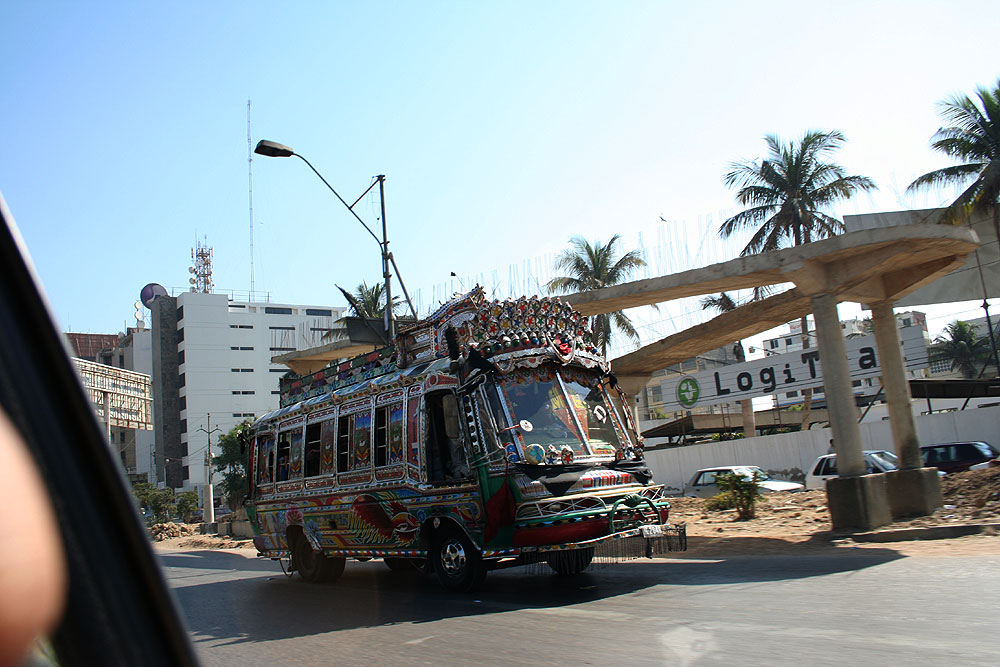
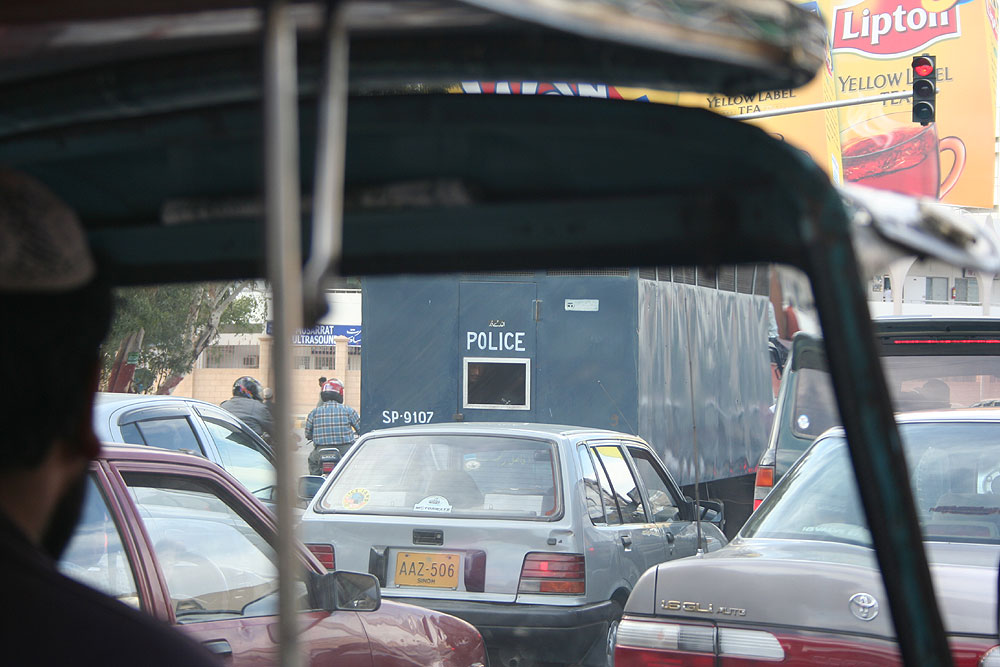
Yet, to soak in a city, I think one must eschew the exotic and revel in the everyday (though admittedly that means different things to different people, but you get what I mean). A travel writer who does not do that can mislead his readers about what a city is really like. For example, I could title the picture below “Karachi Streets” and you’d think Karachi was this quaint city full of charming vehicles like this one. But the city roads are strikingly modern, with the latest cars and SUVs and suchlike. A typical picture like that may not interest you, though.

I’ve done a bit of the exotic in Karachi – some charming Pakistani friends took me crabbing, which involves taking a boat ride from the port, going far enough into the sea so that the shore is just a tapestry of distant lights, and catching crabs, and then cooking and eating them in the boat. Utterly serene. Sadly, one is not allowed to take photographs at the port, so some striking portscapes remain in my mind’s eye.
The rest of the time, though, I’ve done ordinary things. I’ve checked out loads of shopping places, been to a rather nice mall called Park Towers (it’s Mumbai to In Orbit’s Karachi, for that sprawls a bit more) and eaten at this superb restaurant called Bar-B-Q Tonight, a massive multi-storey place where rockacious food is available. Lambiness was enjoyed.


One thing I’ve learnt, of course, is that you can’t come to a city for a week and come even close to really getting a sense of it. More time must be spent, more ordinary things done (ideally with an unjaded and keen eye). So maybe one day, when the cricket is done with, I shall come back and do just that. It’s back to the cricket now, and a run-up that goes on and on and on and … down the leg side. Jeez.
Now, I hadn’t heard of some of these places, and hadn’t been to many of them. In almost every city I’ve lived in, I’ve been rather unfamiliar with the tourist sites. I lived in Delhi for a while, but have never seen the Qutab Minar or the Red Fort or Chandi Chowk or suchlike. So I suggested to my friend that he come to the In Orbit mall in Malad and hang out there, and other such things that I normally do. He was taken aback. He wanted the sites, not the normal stuff; the exotic, not the ordinary.
Yet, to soak in a city, I think one must eschew the exotic and revel in the everyday (though admittedly that means different things to different people, but you get what I mean). A travel writer who does not do that can mislead his readers about what a city is really like. For example, I could title the picture below “Karachi Streets” and you’d think Karachi was this quaint city full of charming vehicles like this one. But the city roads are strikingly modern, with the latest cars and SUVs and suchlike. A typical picture like that may not interest you, though.
I’ve done a bit of the exotic in Karachi – some charming Pakistani friends took me crabbing, which involves taking a boat ride from the port, going far enough into the sea so that the shore is just a tapestry of distant lights, and catching crabs, and then cooking and eating them in the boat. Utterly serene. Sadly, one is not allowed to take photographs at the port, so some striking portscapes remain in my mind’s eye.
The rest of the time, though, I’ve done ordinary things. I’ve checked out loads of shopping places, been to a rather nice mall called Park Towers (it’s Mumbai to In Orbit’s Karachi, for that sprawls a bit more) and eaten at this superb restaurant called Bar-B-Q Tonight, a massive multi-storey place where rockacious food is available. Lambiness was enjoyed.

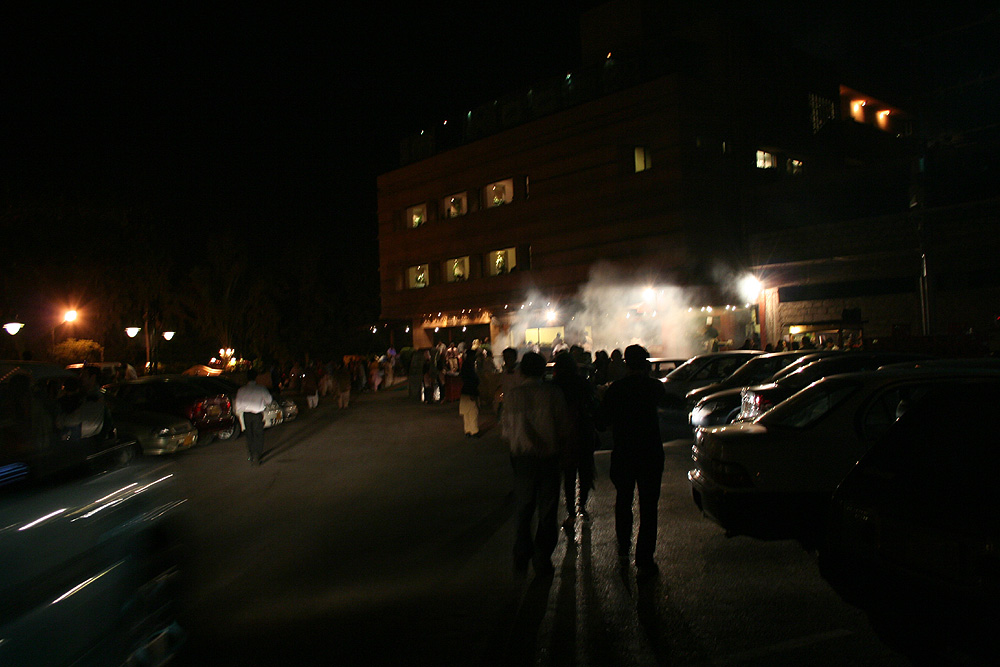

One thing I’ve learnt, of course, is that you can’t come to a city for a week and come even close to really getting a sense of it. More time must be spent, more ordinary things done (ideally with an unjaded and keen eye). So maybe one day, when the cricket is done with, I shall come back and do just that. It’s back to the cricket now, and a run-up that goes on and on and on and … down the leg side. Jeez.
Saturday, January 28, 2006
Karachi, normal
I never realised normalcy can be overwhelming, but when your expectations are of things out of the ordinary, the normal can surprise. One has heard so much about Karachi: unsafe city, teams don’t like to play here, don’t go out at night, yada yada yada. Well, at the risk of generalising, the city doesn’t seem unsafe to me at all. Last night I was out till past midnight with a charming Karachi couple, Mr and Mrs Teeth Maestro, and it felt like driving around in Mumbai or Delhi with old buddies. (And ah, Karachi’s much-spoken-of similarity to Mumbai is only in terms of weather; otherwise, the city sprawls serenly, and the roads are wider than even Delhi’s. Much rockacity.)
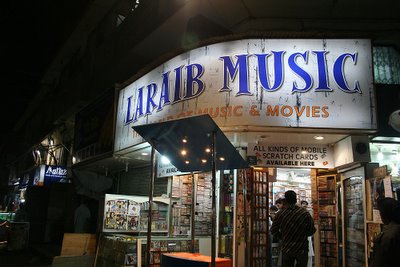
One does see a lot of cop-type people on the streets, but otherwise it doesn’t feel unsafe at all. It bustles and hustles and throbs androbs bobs, and immense fun can be had. Especially if you like movies. Many fine DVDs were bought at a fine place recommended by many noble souls, all at 100 Pakistani rupees (around 70 India rupees each). Take that.

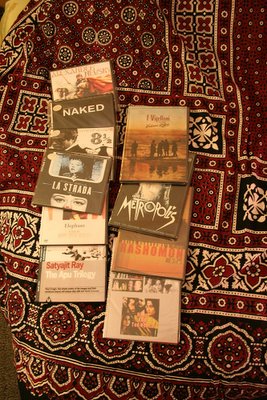
(The DVDs above are photographed on an Ajrak presented to me -- all Indian journalists there got one each -- at a function at the press club. Joyful hospitality. Some Indian journos would have preferred booze, but not being much of a drinker myself, I was satisfied.)
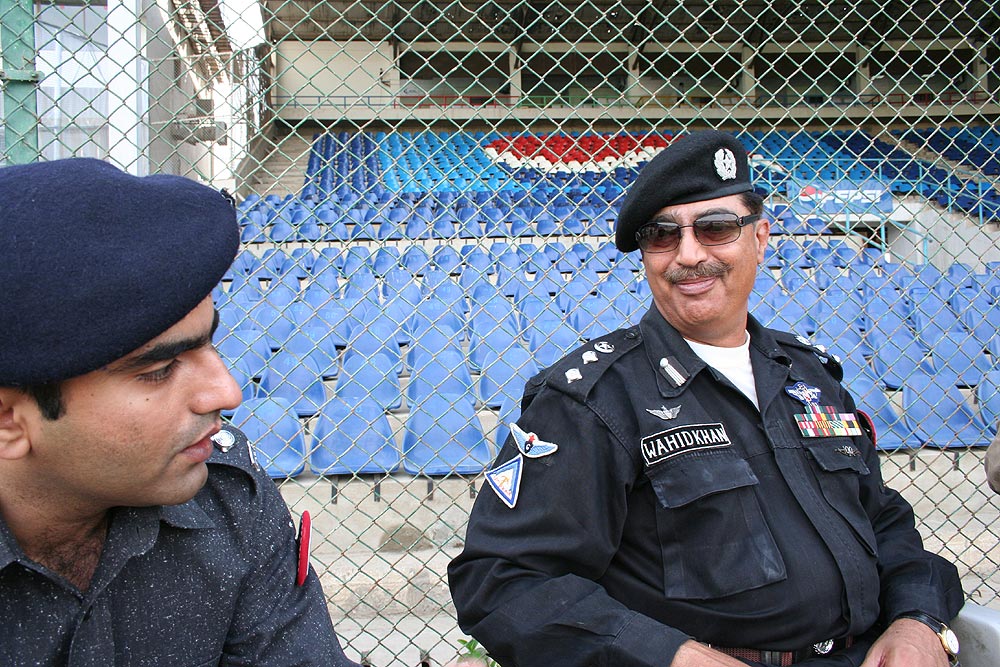
At the Stadium today morning, I met up with Abdul Wahid Khan, the assistant inspector general of Sindh Police in Karachi, and Javed Ali Mahar, an assistant superintendent of police. Mr Khan was a fine, jolly man, reminding me of the onetime MD of Wisden in India, Yajurvindra Singh, both in the way he looked and in his easygoing nature. He was serious when it came to work, though.
“We have over 1500 people manning the stadium,” he told me. “We have close-circuit cameras that will capture images of every single person entering the stadium. We have yada yada and blada blada and gadda gadda. [In other words, many impressive details were given which I won’t bore you with and, wink wink, I don’t remember.]"
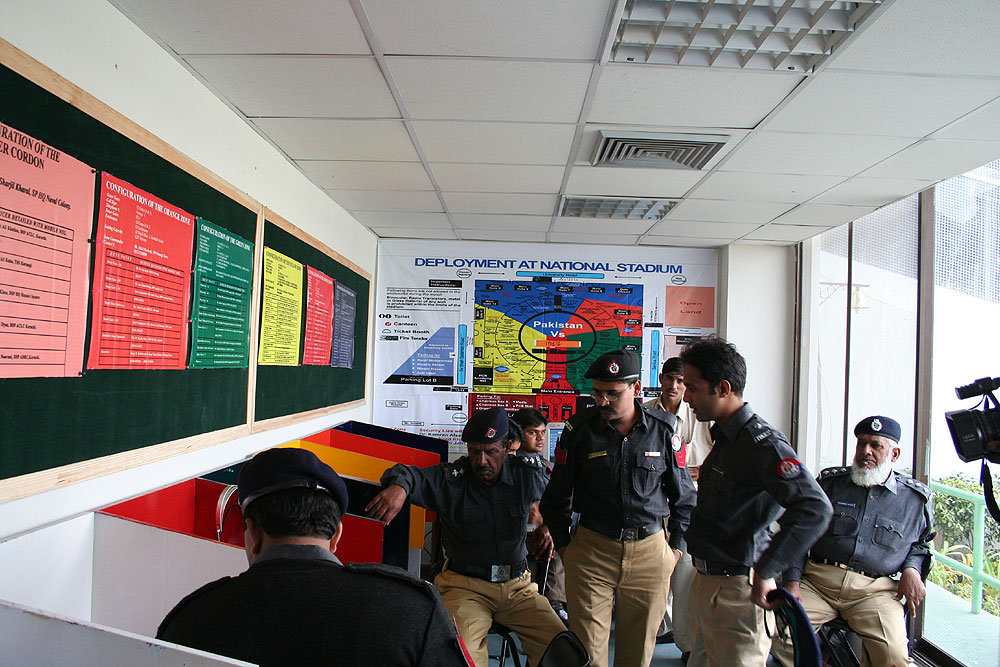
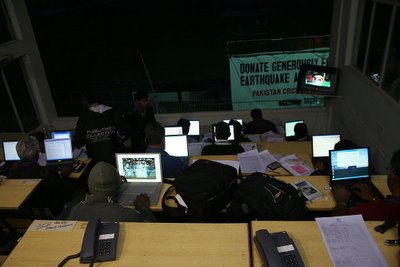
Afterwards, I also went and checked out the police control room. Colourful, as you can see below.
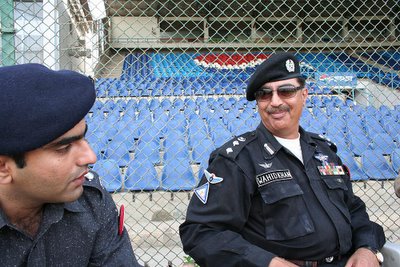

I asked Mr Khan about Karachi, and why people thought it was an unsafe city.
“Propaganda,” he boomed. “People who want Pakistan to do badly spread these lies. Karachi is a port city, and the stock market is booming, and they want to scare people away from here so that Pakistan does badly. But it is all untrue. Go out and see for yourself if it’s dangerous.”
I nodded wisely, having gone out the previous night and duly generalised. While I agreed with Mr Khan that people have the wrong impression of Karachi, I didn’t agree that there was conscious propaganda behind it. In fact, it is a common phenomenon for outsiders to believe that cities which have seen some terrorist activity are less safe than they actually are. I spent the first 12 years of my life in Chandigarh, and part of those years coincided with the terrorism in Punjab. I remember how outsiders then thought the city was terribly unsafe, but the residents felt no such thing.
The reason for this is the way the media functions. In such cities, all the crime, all the terrorist attacks and so on make news. Normalcy obviously doesn’t. All that readers from outside see reported is the bad news, and they form their impressions accordingly, and falsely. (I’m sure there is a term for this phenomenon, but I can’t remember it right now.)
Anyway, Karachi is a rocking city. Lahore also rocked, in a different way. Fun has come to Pakistan and found many cousins. Revelry, for example. Excuse me while I escort them somewhere.
One does see a lot of cop-type people on the streets, but otherwise it doesn’t feel unsafe at all. It bustles and hustles and throbs and
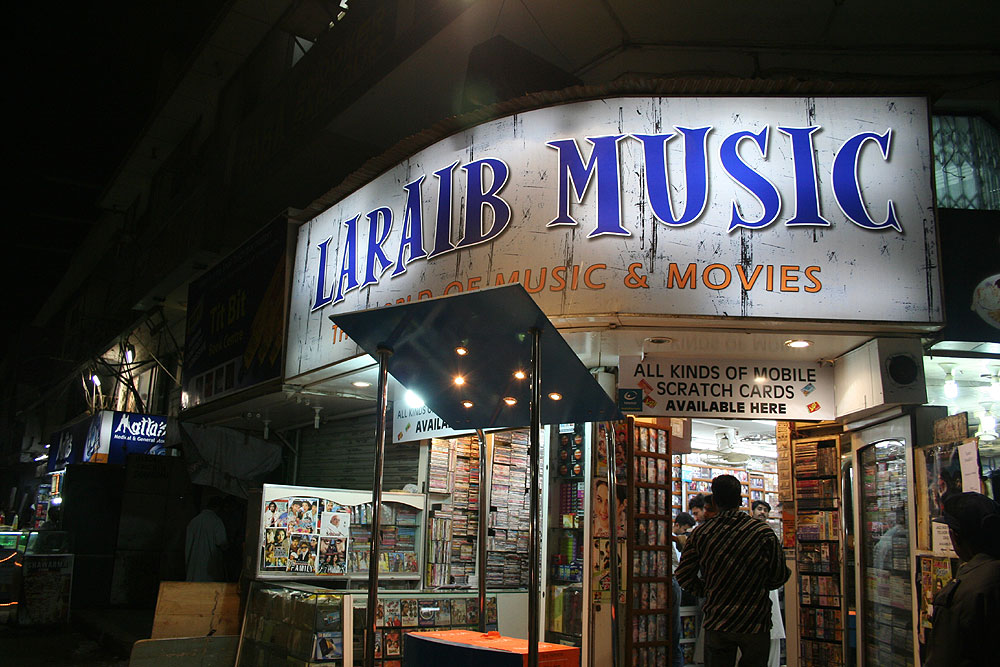

(The DVDs above are photographed on an Ajrak presented to me -- all Indian journalists there got one each -- at a function at the press club. Joyful hospitality. Some Indian journos would have preferred booze, but not being much of a drinker myself, I was satisfied.)
At the Stadium today morning, I met up with Abdul Wahid Khan, the assistant inspector general of Sindh Police in Karachi, and Javed Ali Mahar, an assistant superintendent of police. Mr Khan was a fine, jolly man, reminding me of the onetime MD of Wisden in India, Yajurvindra Singh, both in the way he looked and in his easygoing nature. He was serious when it came to work, though.
“We have over 1500 people manning the stadium,” he told me. “We have close-circuit cameras that will capture images of every single person entering the stadium. We have yada yada and blada blada and gadda gadda. [In other words, many impressive details were given which I won’t bore you with and, wink wink, I don’t remember.]"
Afterwards, I also went and checked out the police control room. Colourful, as you can see below.
I asked Mr Khan about Karachi, and why people thought it was an unsafe city.
“Propaganda,” he boomed. “People who want Pakistan to do badly spread these lies. Karachi is a port city, and the stock market is booming, and they want to scare people away from here so that Pakistan does badly. But it is all untrue. Go out and see for yourself if it’s dangerous.”
I nodded wisely, having gone out the previous night and duly generalised. While I agreed with Mr Khan that people have the wrong impression of Karachi, I didn’t agree that there was conscious propaganda behind it. In fact, it is a common phenomenon for outsiders to believe that cities which have seen some terrorist activity are less safe than they actually are. I spent the first 12 years of my life in Chandigarh, and part of those years coincided with the terrorism in Punjab. I remember how outsiders then thought the city was terribly unsafe, but the residents felt no such thing.
The reason for this is the way the media functions. In such cities, all the crime, all the terrorist attacks and so on make news. Normalcy obviously doesn’t. All that readers from outside see reported is the bad news, and they form their impressions accordingly, and falsely. (I’m sure there is a term for this phenomenon, but I can’t remember it right now.)
Anyway, Karachi is a rocking city. Lahore also rocked, in a different way. Fun has come to Pakistan and found many cousins. Revelry, for example. Excuse me while I escort them somewhere.
Friday, January 27, 2006
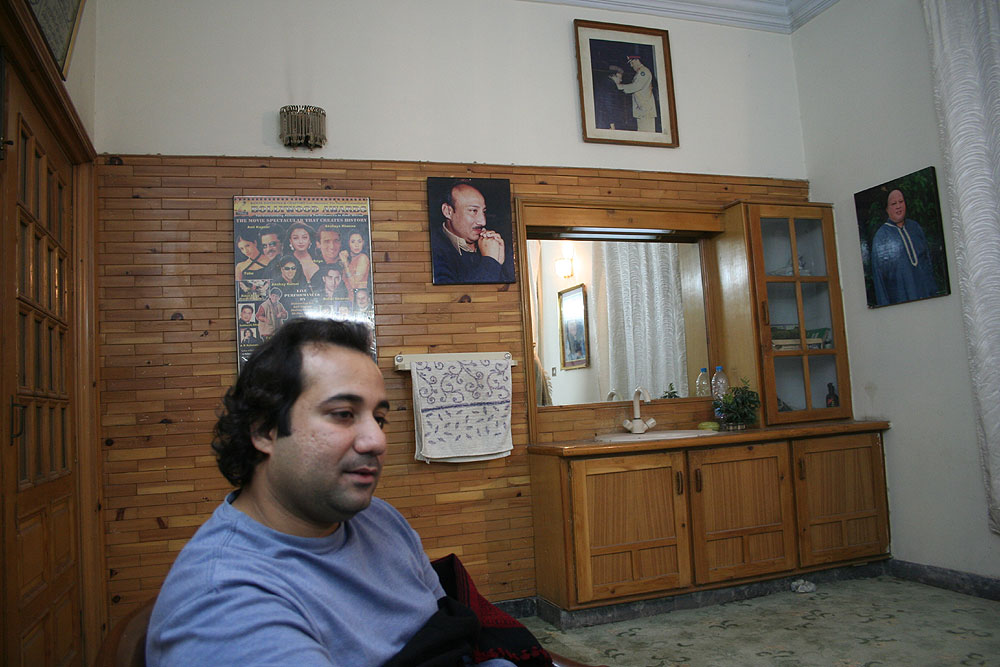
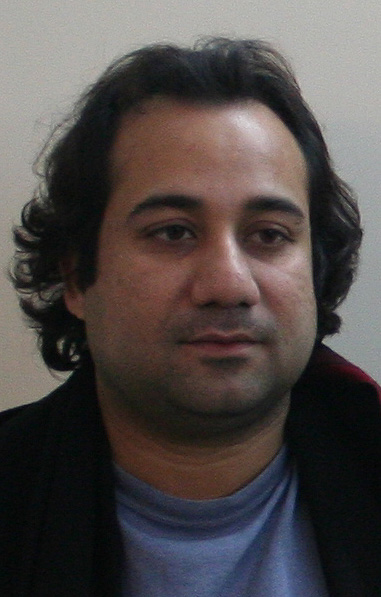
Rahat Fateh Ali Khan, 2 am
I don’t do many interviews, but very few journalists I know have conducted interviews at 2 in the morning. I had wanted to meet Rahat Fateh Ali Khan while in Faisalabad, but couldn’t make the time to do it during the days, when I had to be at the ground reporting on the cricket. His manager eventually told me that I could meet him on the evening of the last day of the game, and I was to call him in the evening. When I called him at seven, he gave me a time of 11 pm. Delays happened until I finally met the manager, Rahat’s ‘mamu’, an exceedingly pleasant gentleman named Khushnood, at around 1 am. He then insisted that I have kababs with him before we go to meet Rahat, but ordered the cook, who was roasting them on a platform by the street, not to reveal the recipe when I asked him which masalas he used in making them.
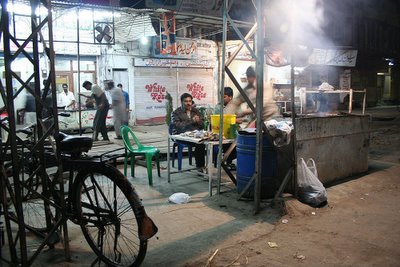
I was a little surprised at the timing of the interview, and asked him if Rahat would be awake now. “Oh yes,” he remarked, as if it was a ridiculous question to ask.
“So when does he sleep?” I asked.
“Around 10 in the morning,” he said. My eyes fairly goggled at this. Khushnood explained, “You see, he is busy giving live performances that generally happen all night. So he has to catch up with his sleep during the day.”
We proceed towards Rahat’s house, and on the way, at my request, he shows me the places where Nusrat Fateh Ali Khan
, Rahat’s uncle, was born and lived and gave his first performances and so on.
(I’m reproducing snippets of my long chat with Rahat below. I needed to meet him for a longer piece I’m trying to write on qawwali music in Pakistan, and I won’t really structure this stuff out and write a piece and so on – blogs don’t demand that formal structure.
A brief backgrounder: although Rahat is in the news in India these days for ‘Jiya Dhadak Dhadak’, that superb song from Kalyug, he’s had a fairly good international career so far. He joined Nusrat’s troupe in the mid-80s, when he was just a kid, and rose to being his main side singer in the 90s. He performed with him on quite a few of his albums, and after his death in 1997, became the main singer in the group. He sang for the soundtrack of the film Four Feathers
, and his first big international solo album, Rahat
, produced by Rick Rubin, was released in 2001.)
* * * * *
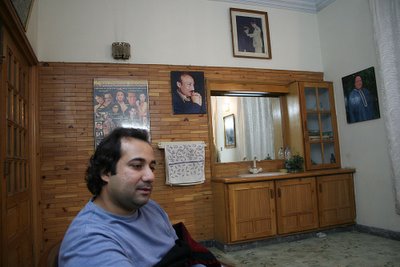
Rahat greets me in a casual and friendly way when we meet, and orders tea. We are in an outer room of his house that is full of pictures of Nusrat Fateh Ali Khan – both portraits and from performances. We start off by speaking a bit about his family and how he started learning music – as you’d expect, as a kid.
“No-one ever forced me to learn music when I was a child. In fact, I wanted to learn music, and that is why they taught me.”
Born in 1973, it was in 1980, at the age of seven, that Rahat performed on stage for the first time. It was on an occasion to mark the 15th death anniversary of his grandfather, Fatel Ali Khan, and eminences like Bade Ghulam Ali Khan, an early idol of Rahat’s, and Nusrat himself were present.
“So how was your performance received?” I ask.
Rahat laughs. “I was just a kid,” he says, “and for a kid I was pretty good, I suppose.”
* * * * *
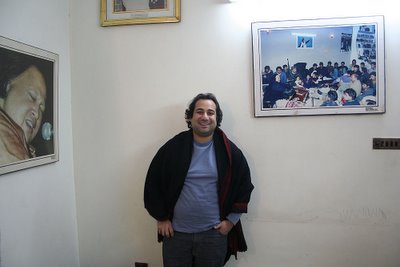
By the time Rahat joined his uncle’s troupe, in the mid-1980s, Nusrat was already a virtual legend in his own country. He was also a much criticised man, and the reasons for both the laudings and the lashings he received were the same: what he did with the form of the qawaali.
“Unhone ek guldasta banaaya,” says Rahat. “Usme qawwali, thumri, ghazal, muktalif kism ki musical forms ko shaamil kiya.” Nusrat made a bouquet of musical styles, but unlike what the purists say, he did not compromise while doing that. “Everthing he did retained the flavour of qawwali,” says Rahat. The essence of his music, in other words, drew from the same spiritual yearning that marks out qawwali music.
One of the biggest gripes around Nusrat – and, indeed, against Rahat today – is that he demeaned qawwali music by taking it out of its original setting of dargahs and suchlike, and into marriage functions and Bollywood. I ask Rahat about that, about how one can reconcile the original intent of qawwali as a spiritual tool with its use today for entertainment.
“You can listen to every qawwali in two ways,” he tells me. “When we sing of ‘sharaab’ and ‘suroor’, you can take the meaning to be either literal, or a metaphor for something spiritual. It depends on the person listening to it, not on the setting.”
* * * * *
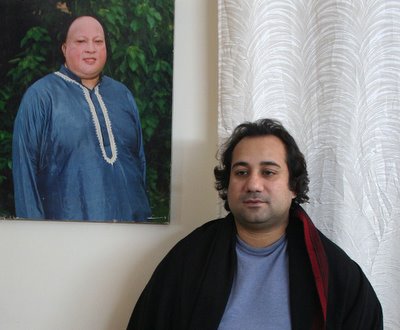
In 1985, Nusrat performed at a festival in Cornwall, and that is where the West sat up and took notice of him. As the years went by, collaborations, albums and concerts followed, most notably his remarkable series of albums with Real World.
“Did he adapt his music for Western Audiences?” I ask Rahat. “Was there a difference between the music he performed in Pakistan and that abroad?”
“There had to be,” says Rahat. “The music he performed abroad had much more of classical content. Foreigners didn’t understand our language and our lyrics, so the music had to work harder.”
Also, if I may speculate, foreigners unused to classical music were likely to be far more impressed by meandering alaaps than local audiences, who had seen plenty of that stuff, and whose expectations from the music were often different. In other words, Nusrat perhaps played to his Western audiences a bit, gave them the exotica he craved – but always without compromising the essence of his music.
I ask Rahat about Star Rise
, the Real World compilation of some of Nusrat’s music remixed by stars of the Asian Underground. It’s the only work featuring Nusrat’s voice that I simply can’t stand, and I ask Rahat what Nusrat thought of such remixes. Rahat laughs. “Nusrat hated it,” he says. “He felt they had destroyed his music.”
* * * * *
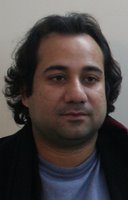
I ask him about his album, Rahat
, which was produced by Rick Rubin and released by Sony in 2001. “Your voice sounds very different in that than it does in some of the stuff you’ve recently done,” I say, “like ‘Jiya Dhadak Dhadak’. Why is that?”
Rahat laughs. “Rick came to me and he said that he wanted to use these four tracks that I’d recorded in 1996. I told him that I’ve changed since then, I’m a different singer now. I offered to sing those same songs for him again today. But he insisted on using those songs, he said that that is how he wanted to project me.”
“And how have you changed?” I asked.
“Oh, I’m much better now, I was so young then. [He was 23 in 1996.] I’ve learnt so much more, I can do a lot more with my voice now. Then, I couldn’t pull off everything I could conceive.”
“Can you do that now?”
“No. I’m not sure I ever will.”
“Could Nusrat do it.”
“Oh yes.” Rahat smiles, remembering. “He could do anything.”
* * * * *
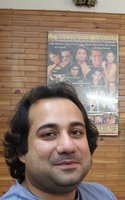
Rahat has performed with Eddie Vedder at the Central park in New York, and with Pearl Jam at the Shrine Auditorium in Los Angeles, where they performed “Long Road” together, the song from the soundtrack of Dead Man Walking
, for which Nusrat had collaborated with Pearl Jam. Rahat had participated in the recording of that.
“The recording was in a small room, not the kind of big studio we had expected. And when these guys came, holding guitars, we thought they must be musicians. I was surprised when Eddie started singing while recording, I had thought till then he was just a musician, playing guitar.”
“And how did you find his singing?” I ask.
“Oh, when he started singing, I couldn’t make anything out, we all had headphones on. But later, when I heard the track, I was amazed. He sounded so good!”
* * * * *
There is fierce competition among qawwali singers, Rahat tells me, which comes through in the format of the performances.
“When a group performs,” says Rahat, “it is understood that it doesn’t get up as long as the audience wants it to go on. So if two groups are scheduled to perform on one night, the first one will try to make sure that it pleases the audience, so that the second one can’t get on stage.
“So many times,” he continues with a smile, “Khansaab would perform so well that the people scheduled to perform after him never got a chance to come on stage.
“It is like a muqabla.”
* * * * *
Rahat isn’t just a singer, an interpreter, but also a composer, a creator. “I compose around 30-40 songs every year,” he tells me.
“Do you keep audiences in mind when you do this,” I ask, “or do you just create the kind of music that makes you happy?”
“Oh, I have to keep audiences in mind,” he says. “For example, if there is a fashion for Raga Bhairavi, I’ll sit down with that and create songs in it.”
After composing his music, Rahat tests them out among audiences. He gives between 20 to 25 live performances every month, and he plays his new songs at the concerts. “The ones which receive a good response stay in my repertoire,” he says. “The others I just drop. One has to go down to the level of the audience.”
“Can’t you lift the audience to your level?” I ask.
“No,” he says.
* * * *
Just before I leave I ask him if he would have been such an accomplished musician if he wasn’t from this family.
“No,” he says emphatically. “I would have been just another ordinary singer.”

I was a little surprised at the timing of the interview, and asked him if Rahat would be awake now. “Oh yes,” he remarked, as if it was a ridiculous question to ask.
“So when does he sleep?” I asked.
“Around 10 in the morning,” he said. My eyes fairly goggled at this. Khushnood explained, “You see, he is busy giving live performances that generally happen all night. So he has to catch up with his sleep during the day.”
We proceed towards Rahat’s house, and on the way, at my request, he shows me the places where Nusrat Fateh Ali Khan
(I’m reproducing snippets of my long chat with Rahat below. I needed to meet him for a longer piece I’m trying to write on qawwali music in Pakistan, and I won’t really structure this stuff out and write a piece and so on – blogs don’t demand that formal structure.
A brief backgrounder: although Rahat is in the news in India these days for ‘Jiya Dhadak Dhadak’, that superb song from Kalyug, he’s had a fairly good international career so far. He joined Nusrat’s troupe in the mid-80s, when he was just a kid, and rose to being his main side singer in the 90s. He performed with him on quite a few of his albums, and after his death in 1997, became the main singer in the group. He sang for the soundtrack of the film Four Feathers
* * * * *

Rahat greets me in a casual and friendly way when we meet, and orders tea. We are in an outer room of his house that is full of pictures of Nusrat Fateh Ali Khan – both portraits and from performances. We start off by speaking a bit about his family and how he started learning music – as you’d expect, as a kid.
“No-one ever forced me to learn music when I was a child. In fact, I wanted to learn music, and that is why they taught me.”
Born in 1973, it was in 1980, at the age of seven, that Rahat performed on stage for the first time. It was on an occasion to mark the 15th death anniversary of his grandfather, Fatel Ali Khan, and eminences like Bade Ghulam Ali Khan, an early idol of Rahat’s, and Nusrat himself were present.
“So how was your performance received?” I ask.
Rahat laughs. “I was just a kid,” he says, “and for a kid I was pretty good, I suppose.”
* * * * *

By the time Rahat joined his uncle’s troupe, in the mid-1980s, Nusrat was already a virtual legend in his own country. He was also a much criticised man, and the reasons for both the laudings and the lashings he received were the same: what he did with the form of the qawaali.
“Unhone ek guldasta banaaya,” says Rahat. “Usme qawwali, thumri, ghazal, muktalif kism ki musical forms ko shaamil kiya.” Nusrat made a bouquet of musical styles, but unlike what the purists say, he did not compromise while doing that. “Everthing he did retained the flavour of qawwali,” says Rahat. The essence of his music, in other words, drew from the same spiritual yearning that marks out qawwali music.
One of the biggest gripes around Nusrat – and, indeed, against Rahat today – is that he demeaned qawwali music by taking it out of its original setting of dargahs and suchlike, and into marriage functions and Bollywood. I ask Rahat about that, about how one can reconcile the original intent of qawwali as a spiritual tool with its use today for entertainment.
“You can listen to every qawwali in two ways,” he tells me. “When we sing of ‘sharaab’ and ‘suroor’, you can take the meaning to be either literal, or a metaphor for something spiritual. It depends on the person listening to it, not on the setting.”
* * * * *
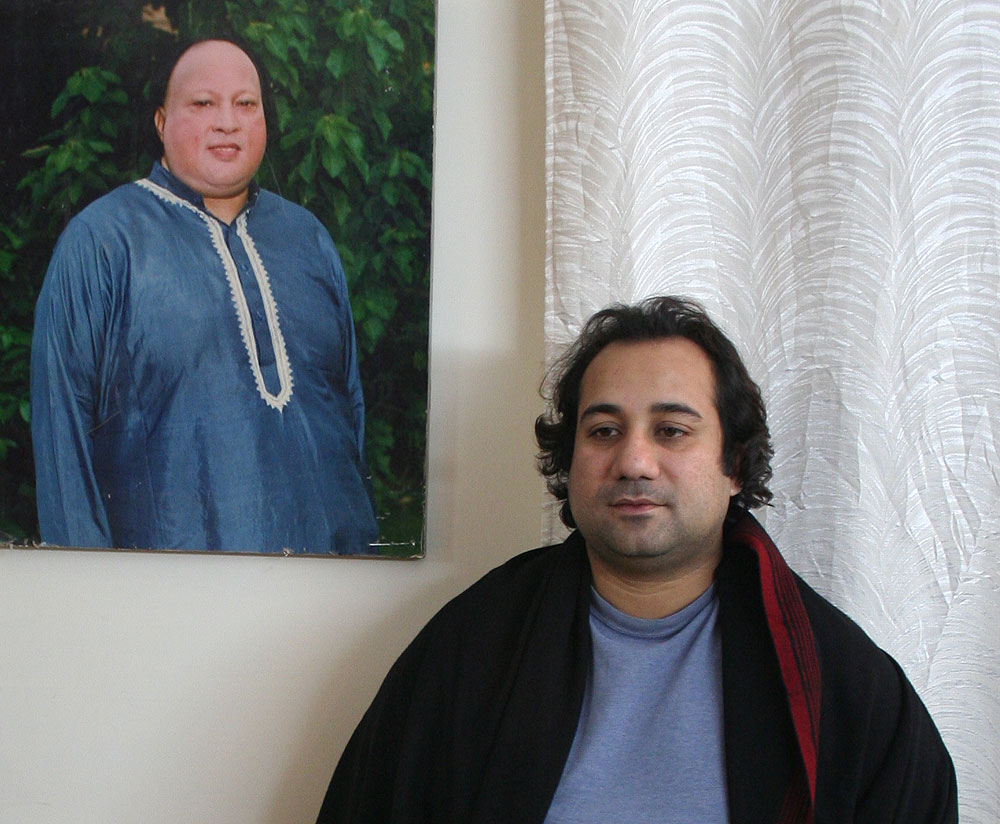
In 1985, Nusrat performed at a festival in Cornwall, and that is where the West sat up and took notice of him. As the years went by, collaborations, albums and concerts followed, most notably his remarkable series of albums with Real World.
“Did he adapt his music for Western Audiences?” I ask Rahat. “Was there a difference between the music he performed in Pakistan and that abroad?”
“There had to be,” says Rahat. “The music he performed abroad had much more of classical content. Foreigners didn’t understand our language and our lyrics, so the music had to work harder.”
Also, if I may speculate, foreigners unused to classical music were likely to be far more impressed by meandering alaaps than local audiences, who had seen plenty of that stuff, and whose expectations from the music were often different. In other words, Nusrat perhaps played to his Western audiences a bit, gave them the exotica he craved – but always without compromising the essence of his music.
I ask Rahat about Star Rise
* * * * *
I ask him about his album, RahatRahat laughs. “Rick came to me and he said that he wanted to use these four tracks that I’d recorded in 1996. I told him that I’ve changed since then, I’m a different singer now. I offered to sing those same songs for him again today. But he insisted on using those songs, he said that that is how he wanted to project me.”
“And how have you changed?” I asked.
“Oh, I’m much better now, I was so young then. [He was 23 in 1996.] I’ve learnt so much more, I can do a lot more with my voice now. Then, I couldn’t pull off everything I could conceive.”
“Can you do that now?”
“No. I’m not sure I ever will.”
“Could Nusrat do it.”
“Oh yes.” Rahat smiles, remembering. “He could do anything.”
* * * * *
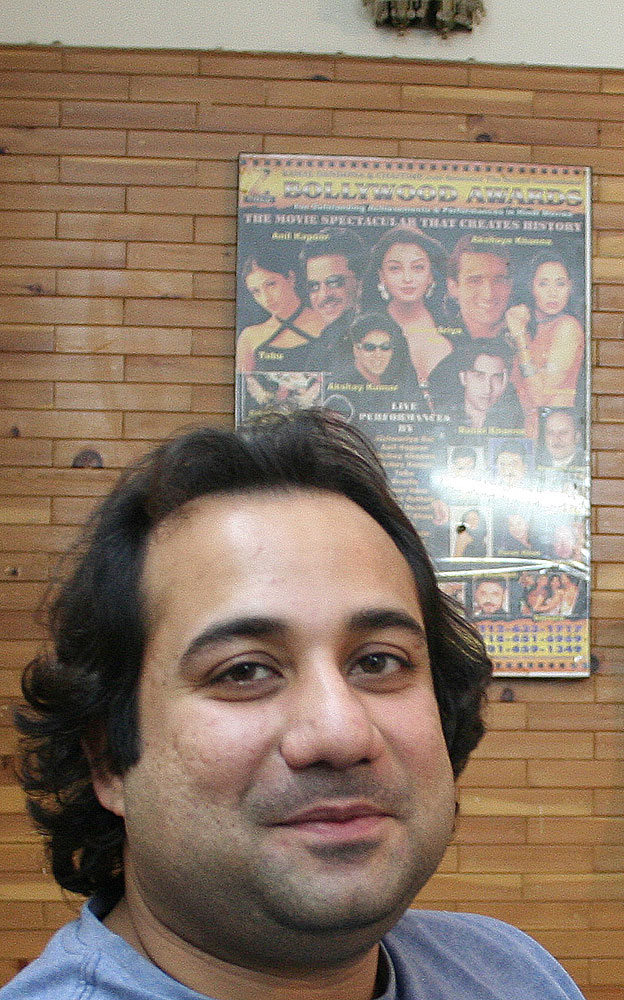
Rahat has performed with Eddie Vedder at the Central park in New York, and with Pearl Jam at the Shrine Auditorium in Los Angeles, where they performed “Long Road” together, the song from the soundtrack of Dead Man Walking“The recording was in a small room, not the kind of big studio we had expected. And when these guys came, holding guitars, we thought they must be musicians. I was surprised when Eddie started singing while recording, I had thought till then he was just a musician, playing guitar.”
“And how did you find his singing?” I ask.
“Oh, when he started singing, I couldn’t make anything out, we all had headphones on. But later, when I heard the track, I was amazed. He sounded so good!”
* * * * *
There is fierce competition among qawwali singers, Rahat tells me, which comes through in the format of the performances.
“When a group performs,” says Rahat, “it is understood that it doesn’t get up as long as the audience wants it to go on. So if two groups are scheduled to perform on one night, the first one will try to make sure that it pleases the audience, so that the second one can’t get on stage.
“So many times,” he continues with a smile, “Khansaab would perform so well that the people scheduled to perform after him never got a chance to come on stage.
“It is like a muqabla.”
* * * * *
Rahat isn’t just a singer, an interpreter, but also a composer, a creator. “I compose around 30-40 songs every year,” he tells me.
“Do you keep audiences in mind when you do this,” I ask, “or do you just create the kind of music that makes you happy?”
“Oh, I have to keep audiences in mind,” he says. “For example, if there is a fashion for Raga Bhairavi, I’ll sit down with that and create songs in it.”
After composing his music, Rahat tests them out among audiences. He gives between 20 to 25 live performances every month, and he plays his new songs at the concerts. “The ones which receive a good response stay in my repertoire,” he says. “The others I just drop. One has to go down to the level of the audience.”
“Can’t you lift the audience to your level?” I ask.
“No,” he says.
* * * *
Just before I leave I ask him if he would have been such an accomplished musician if he wasn’t from this family.
“No,” he says emphatically. “I would have been just another ordinary singer.”
Yeh jo halka halka saroor hai
Room service
Overheard in my hotel room at Karachi:
My room-mate: Hello, room service?
Disembodied voice: Yes.
Room-mate: I'm calling from room 225, can you help me with potty, please?
Voice: Certainly sir. For one person or two persons?
Half-an-hour later, pot tea came.
Tuesday, January 24, 2006
Scenes from a stadium
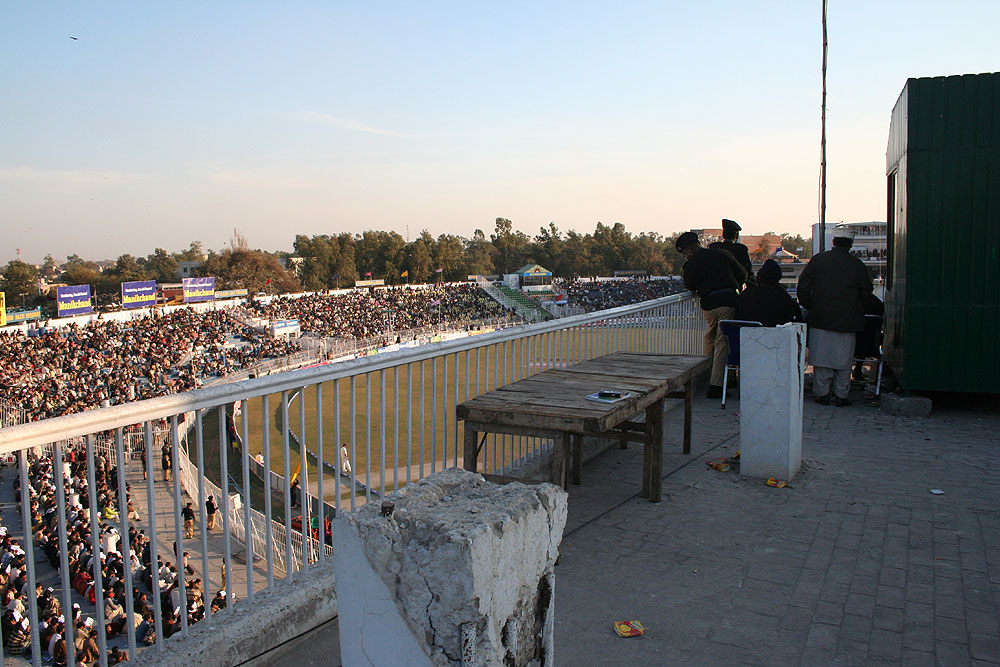
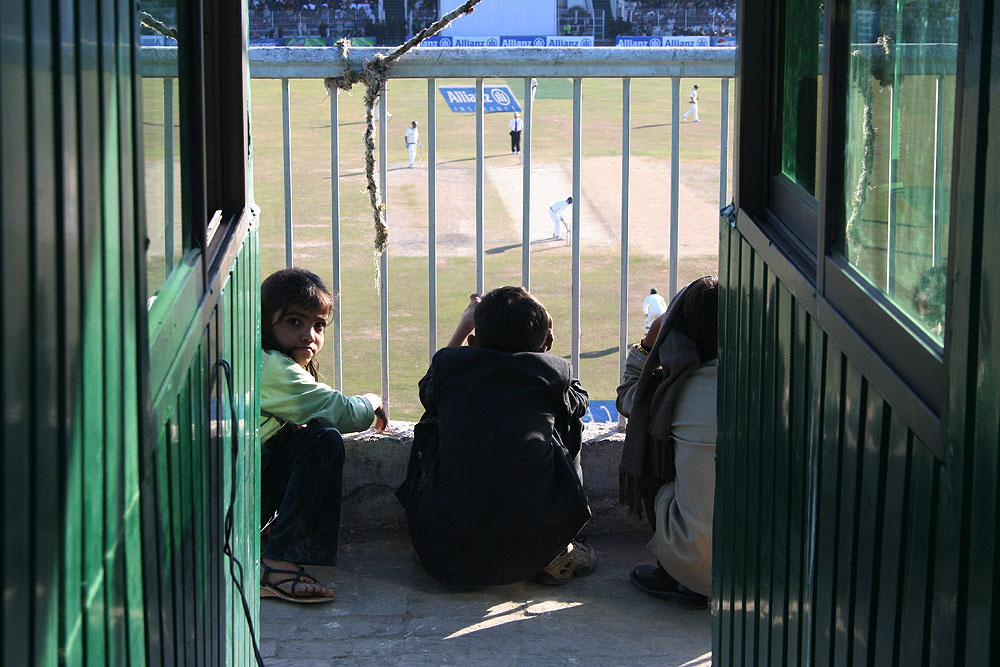
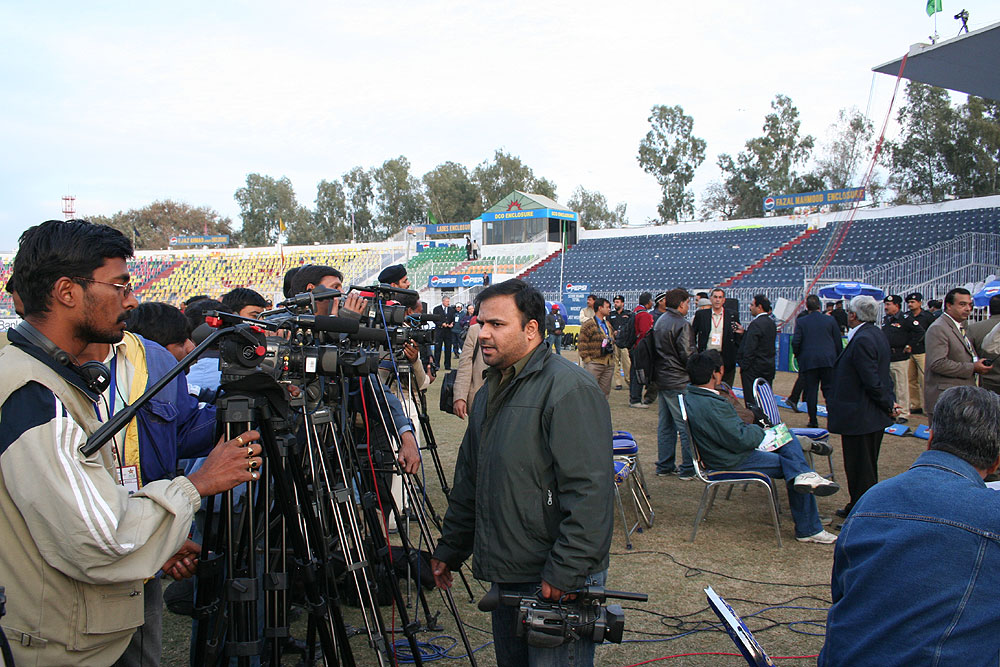
Damn, these tours are so tiring. Normally, during cricket tours, one gets time to work on pieces in the press box during the day, but because of my hourly radio updates for BBC, at which I'm sort of struggling, I don’t have time to work on anything else. And by the time I finish my daily Guardian report in the evening I'm rather tired and unfresh. So I have loads of material collected from Lahore, but no time to write the features I’m planning. Hardly any time for blogging, either, though I did get a few posts about Lahore done over the weekend. So, until I find more interesting things to blog about, here are some pictures from the ground.
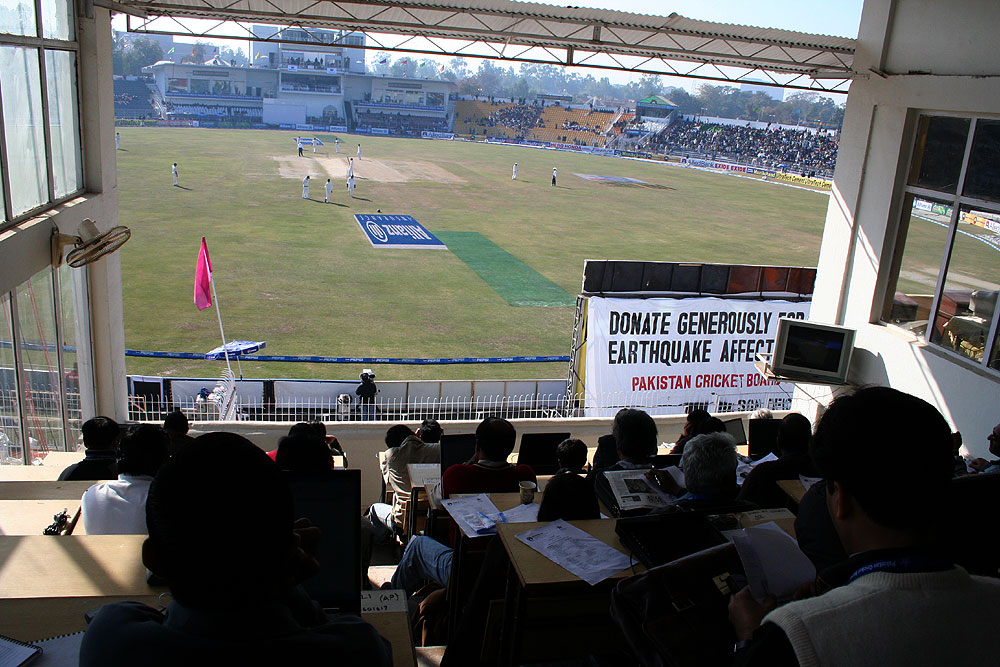
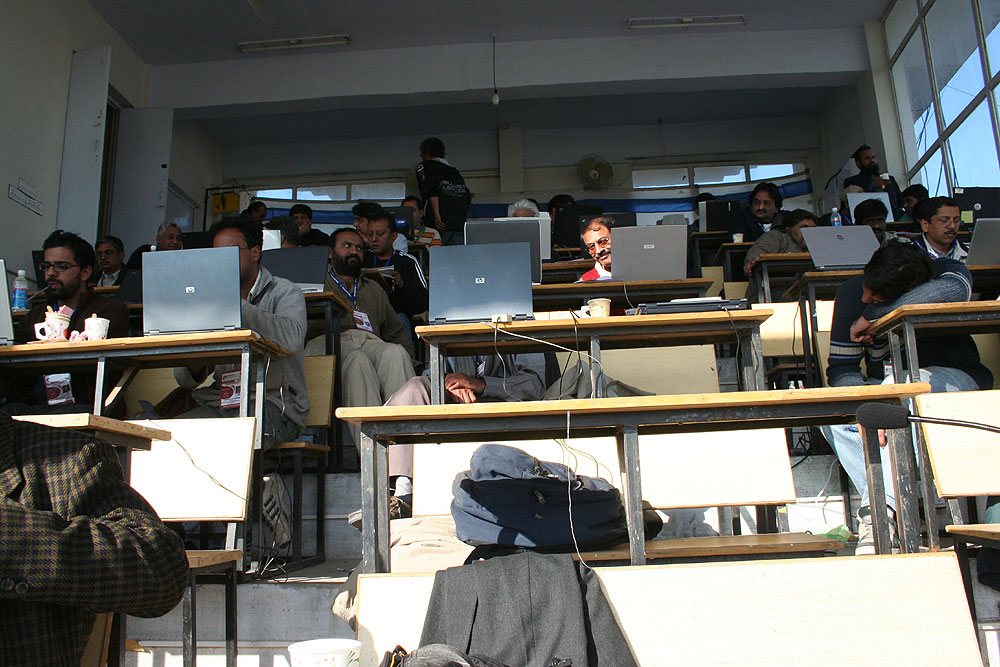
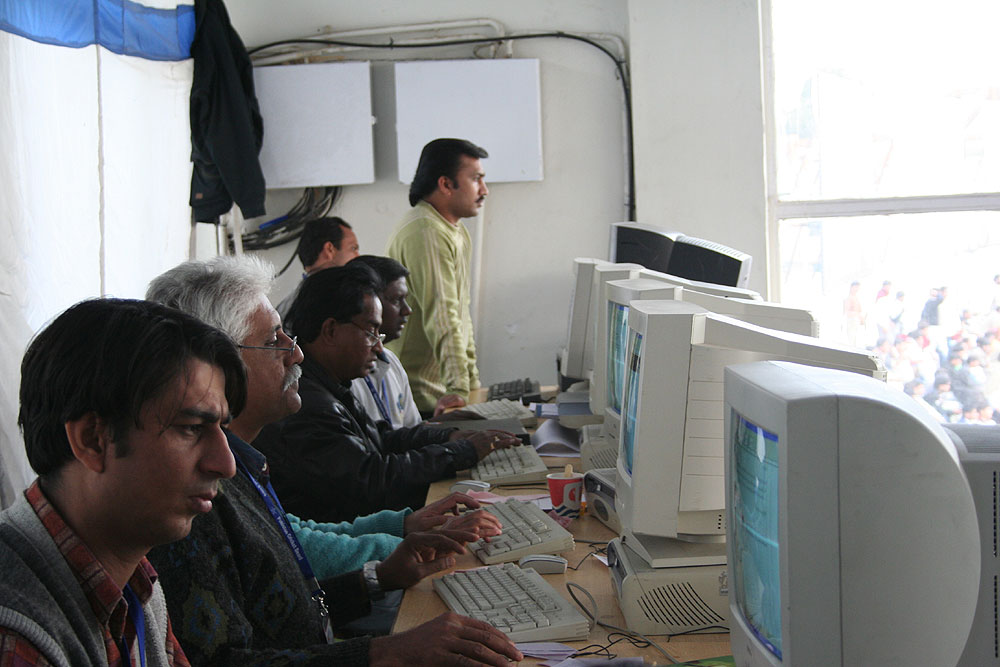
First, the press box. It’s just over a right-hander’s long-off at the Golf Club End and is open at the front. The view from it is great, but the sunshine at the front sometimes gets a bit harsh, and I can barely work on my laptop in the first half of the day because I can’t see anything on the screen. For those who don’t have laptops or haven’t taken telephone lines, there are a few computers at the back of the room where one can sit and surf and file.
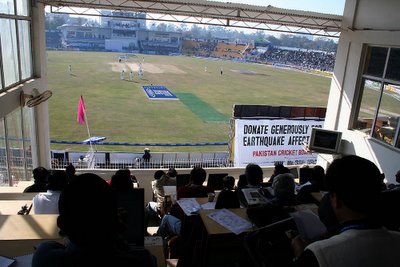
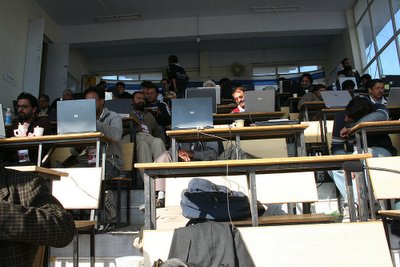

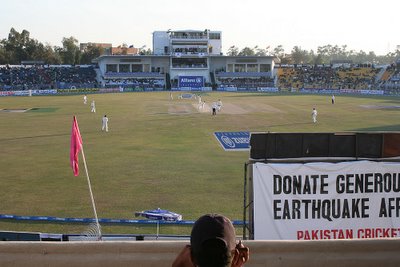
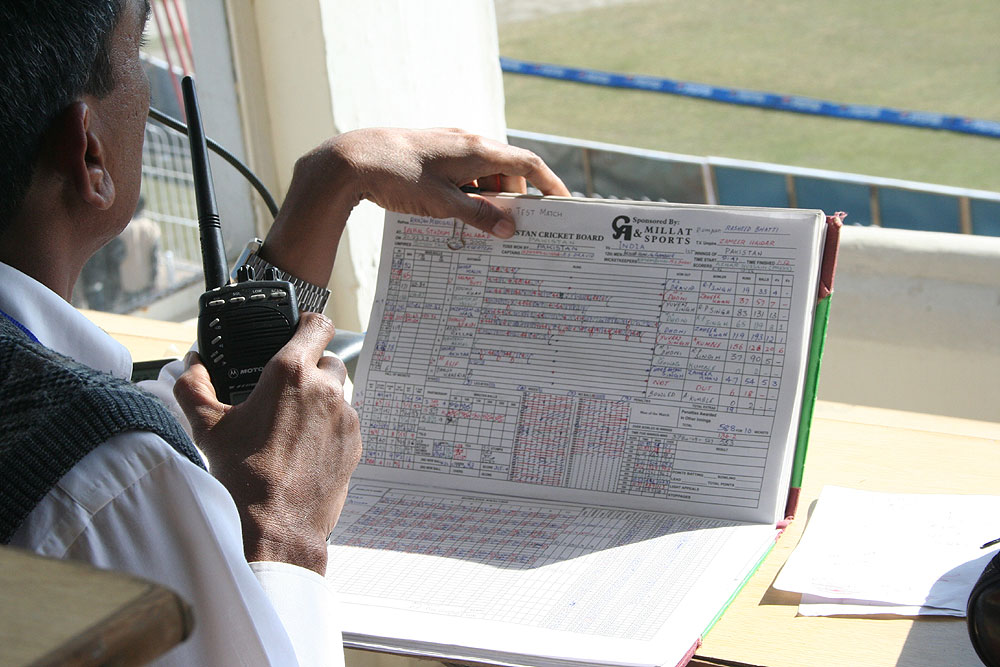
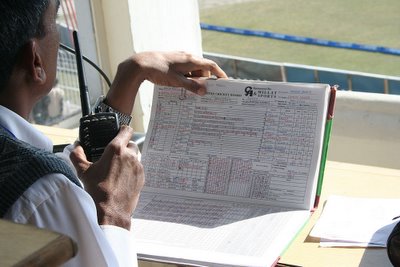
The most important person in any press box, bar none, is the scorer. At every dismissal and landmark he sits down and reels off the relevant stats on his microphone: so many minutes, so many balls etc. He also has a walkie-talkie to communicate with scorers in other parts of the ground. He has to watch every single ball. It’s a heck of a job, and in many places voluntary or very poorly paid. Most scorers do it just for the love of cricket, to be a part of the game they love.
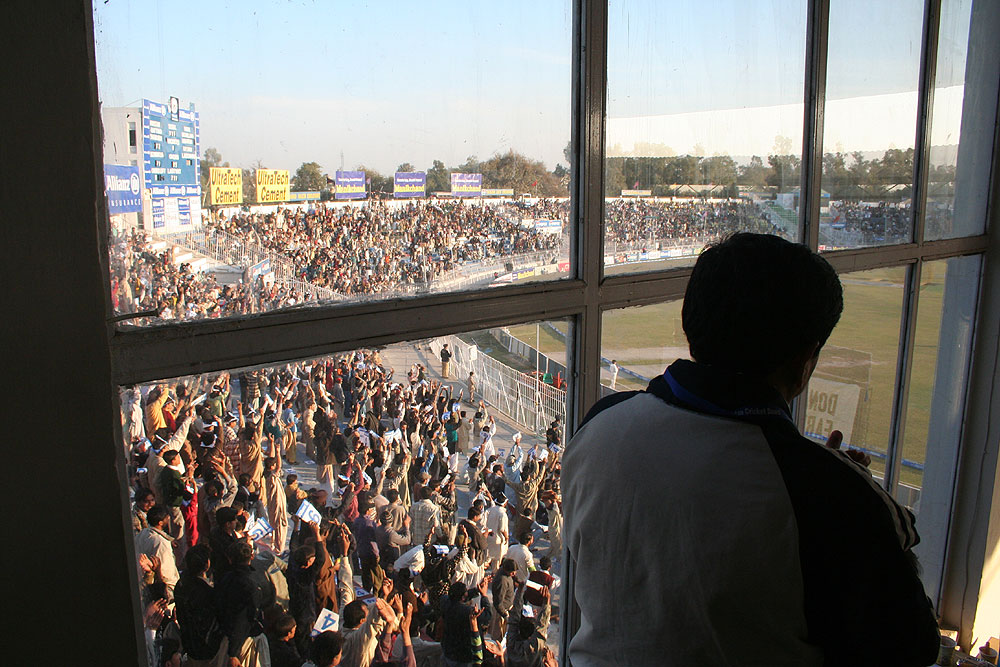
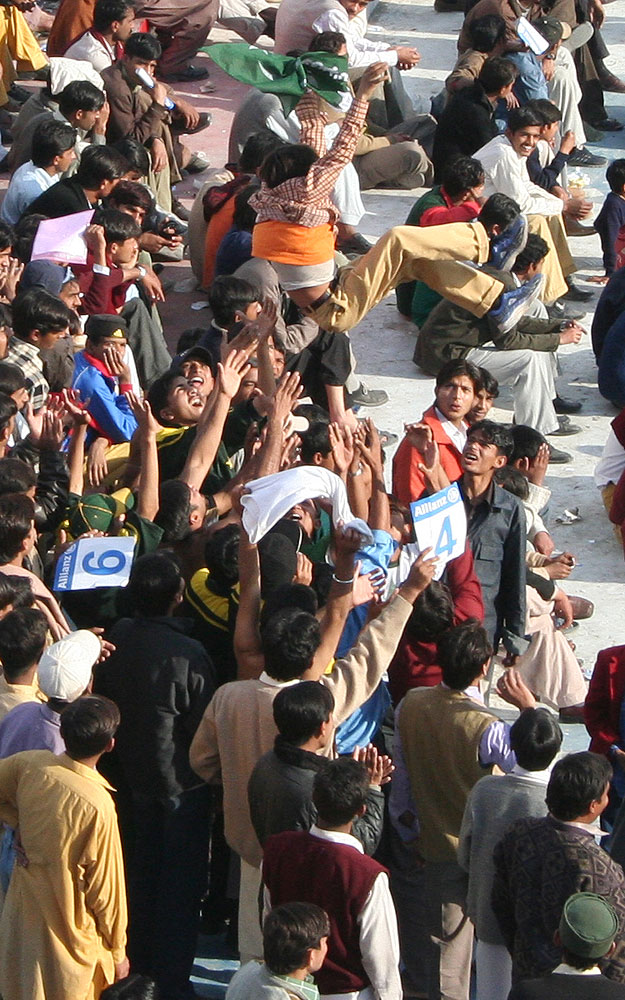
Faisalabad may be a sleepy town, but the crowds here rock. We’ve had a packed house from the second day onwards, and not only do they have a lot of fun, they’re also very bipartisan. Yesterday, when Rahul Dravid was on 99, slow handclaps urged him to his century and loud applause greeted the shot that got him there. There was loud spontaneous applause today when Yuvraj Singh pulled off a diving save. At one point today, when the grizzled occupants of the press box were close to sleep, a section of the crowd entertained itself by throwing a man up in the air again and again, presumably with his consent, as if it was a Pearl Jam concert. Fun came.

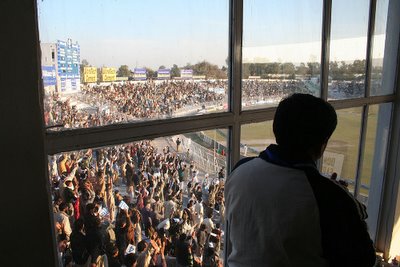
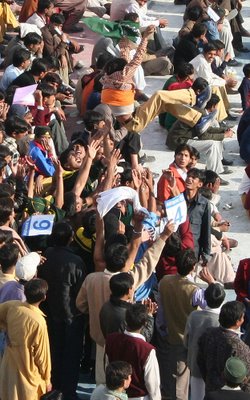
Sometimes I feel so old and cynical, and nothing seems to excite me. And then I think of the childlike joy with which I once watched the game. It comes sometimes, in fleeting moments, and then it passes, as all things must and all that.
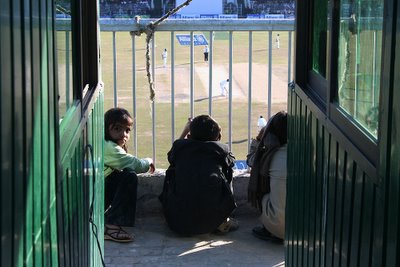
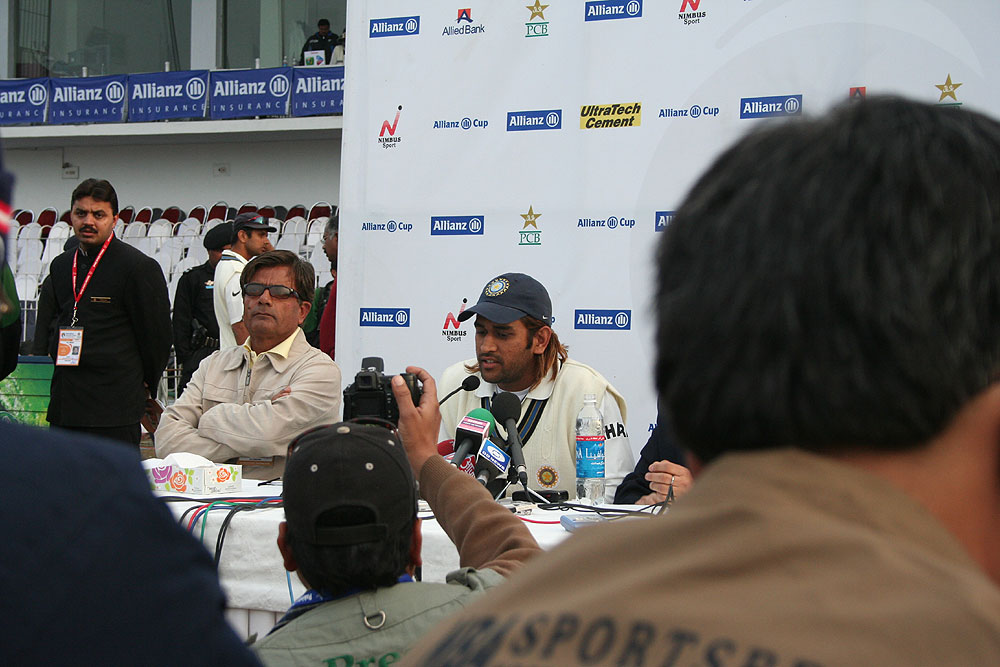
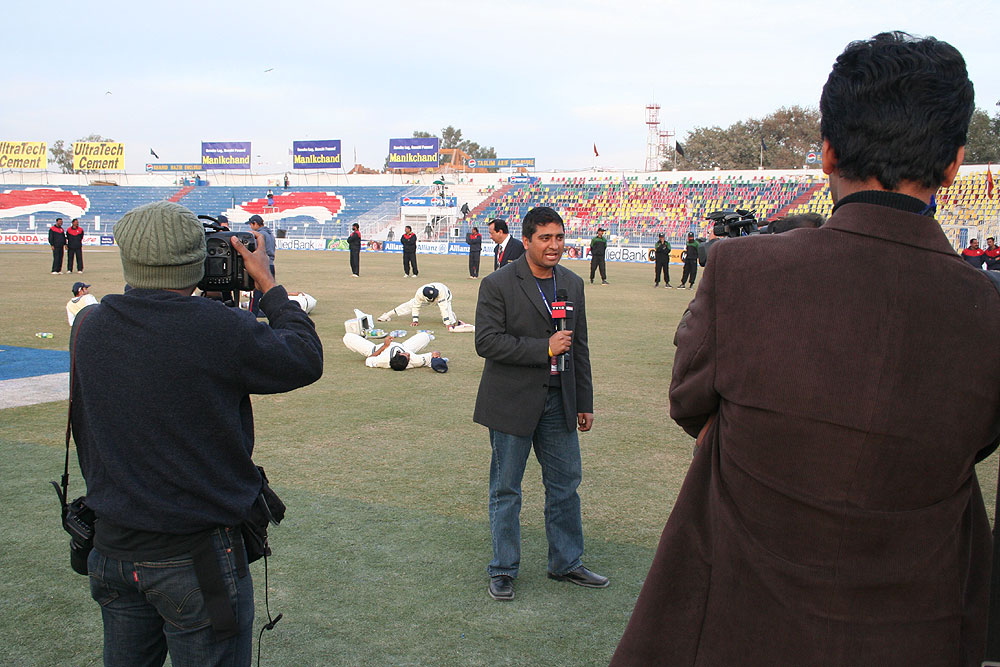
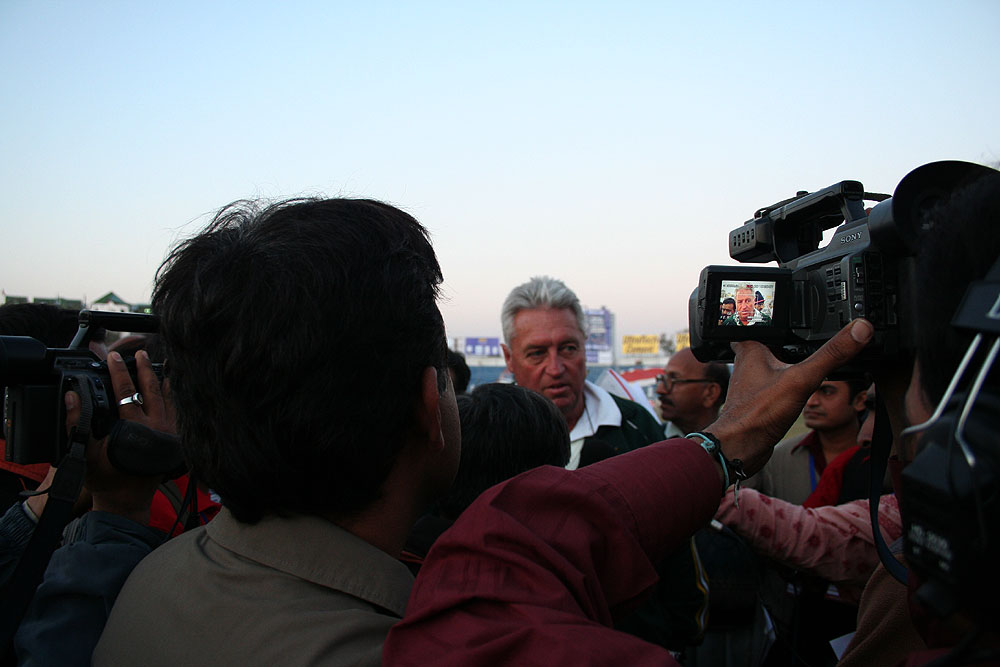
After the game, there’s a press conference in front of the sightscreen at the other end of the stadium. We walk across the ground, over the same turf where for hours today these men have done battle. Often, the players do cooling-down exercises on the ground, and an enterprising television journalist will invariably take the opportunity to use that as a background for his piece-to-camera. Apart from the main presser, some persistent journalists often get a quote or two from a coach or player standing by.
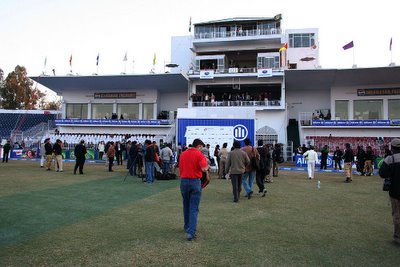
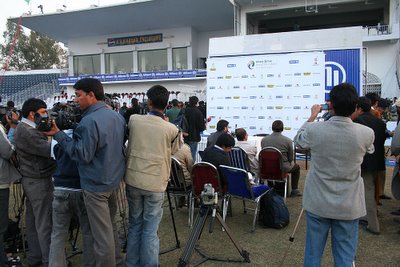
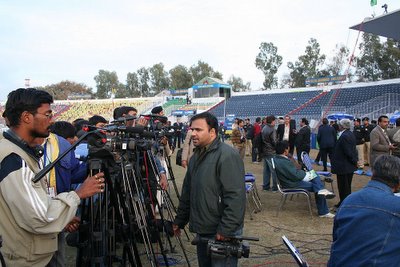

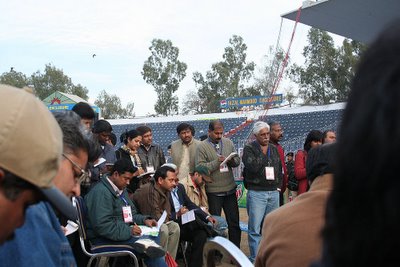
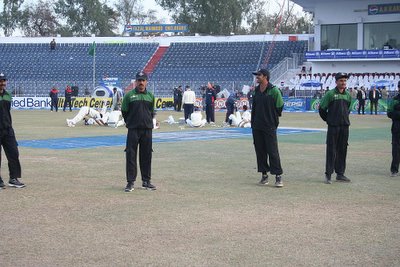
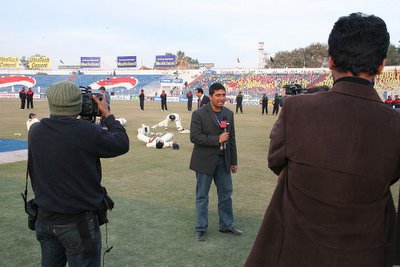
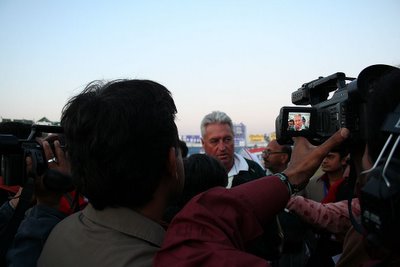
I like the way the ground looks in the evening: as journalists finish their copy in the press box, a tranquil calm descends on this fierce arena. (Well, look, it’s supposed to be fierce, but with a pitch like this…)
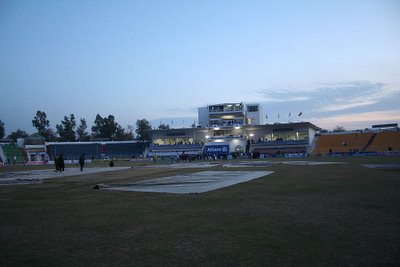
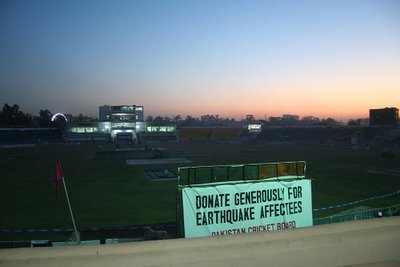
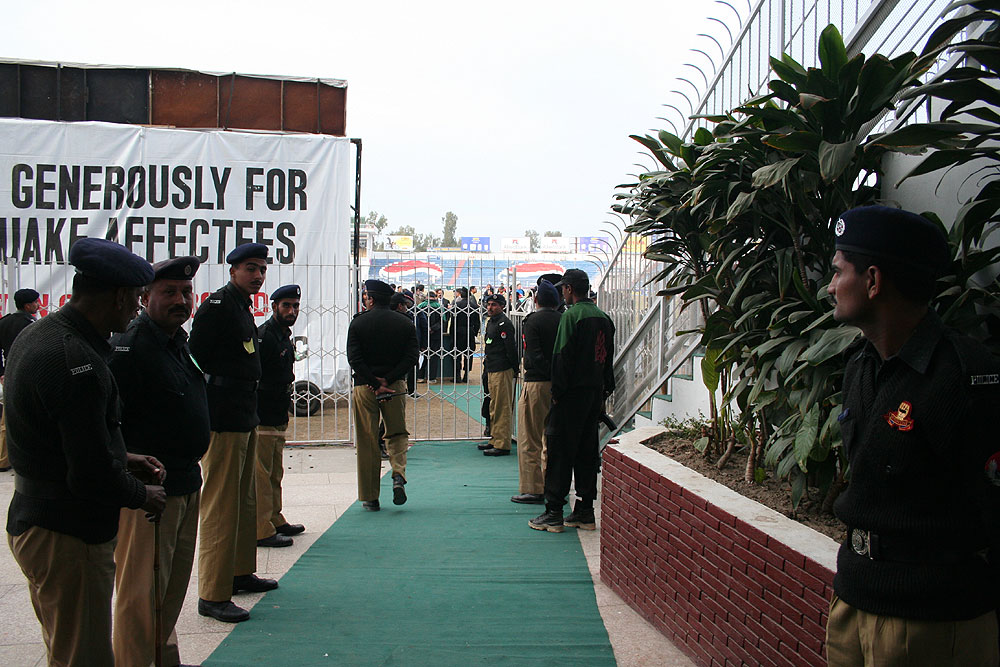
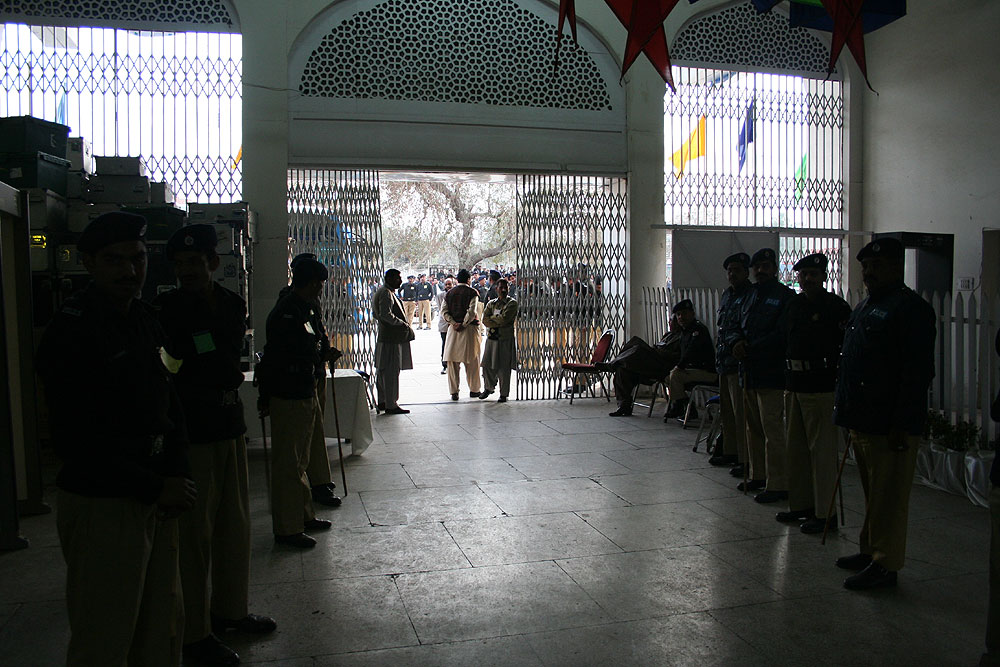
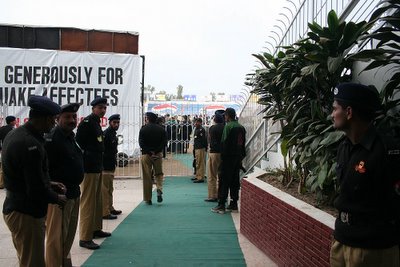
The Indian team doesn’t have much of a chance to catch the sights. A ring of security escorts them from ground to bus to hotel. Such is international cricket.
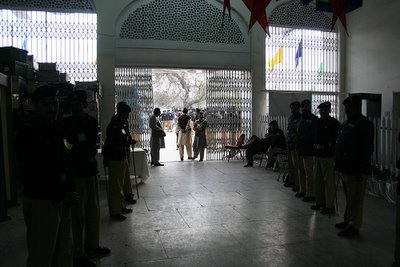


(Click on pics to enlarge.)
Monday, January 23, 2006
The Bloggies
I'm delighted to inform you that just a few days after winning the IndiBlog of the Year award, India Uncut has now been nominated for the prestigious Bloggies, in the Best Asian Weblog category. This is the only South Asian blog among the five finalists, and I guess that's an honour in itself. Thank you to all those of you who voted for me in the first phase of voting and made this possible. If you feel my blog deserves it, please do help me win this one by voting here. Hurry, voting's on for a just a limited period of time!
Back to work now.
Sunday, January 22, 2006
Sufi night
After an interesting afternoon spent listening to qawwalis (chronicled here and here), Swati, Furqan and I head on over to Regale Internet Inn, from where Malik is going to take us to the famous Sufi night, which takes place every Thursday at the shrine of Baba Shah Jamal. There are two quadrangles in this shrine: In one, the famous Pappu Saeen plays dhol, while in the other, Goonga Saeen and Mithu Saeen play dhol. (Goonga is deaf!) These chaps play furiously for hours, and in the middle of their performance, dervishes come and spin around madly, as the audience gets high on the music, the spinning and lots of charas and suchlike.
As we are on our way, Swati gets a call from Malik, who says that a French Television crew will also be there, and they have paid 50,000 Pakistani rupees to Mithu Saeen to see him perform. To avoid the possibility of him demanding money from NDTV, Malik has told him that we are students from the National College of Art in Lahore. This alarms us a bit, and we wonder if it is necessary. Then we reach Regale Internet Inn and meet Mithu Saeen.
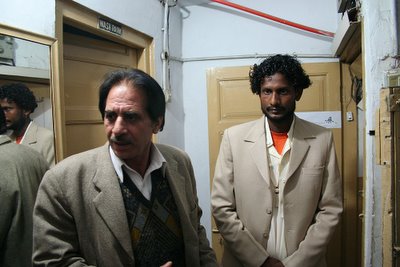
Mithu asks Malik gruffly if there is any money in this for him. Malik tells him that we’re just students. He looks at us suspiciously. Malik diverts his attention by asking him to show the money he’s been given by the French team. He takes out a bundle of dollars from his pocket. He looks at the money, and then at us. (My still camera isn't an issue, but as I'm with Swati and Furqan, I'm seen as part of the TV crew. In any case, I do want the guys to get their story.)
Malik hustles and bustles us out the door, and we drive down to the lane where the shrine is located.
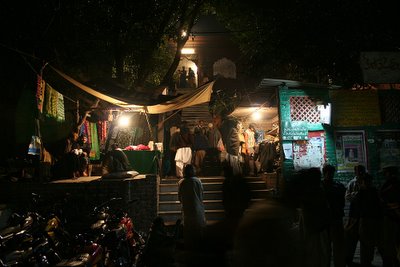
Before the event, the dhol players and a few hangers on sit inside a smoky room by the road, as we wait outside. Swati contemplates the meaning of life while Furqan contemplates the camera.
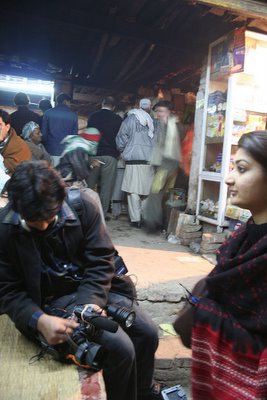
Then we head inside the shrine, shoes in hand, jostling through a busy bunch of people. As the evening proceeds, I realise that the audience consists of essentially two kinds of people: some foreigners who are here for the exotica; and many localites who are here to dope and space out. We don’t dope, so you know which category we’re in.
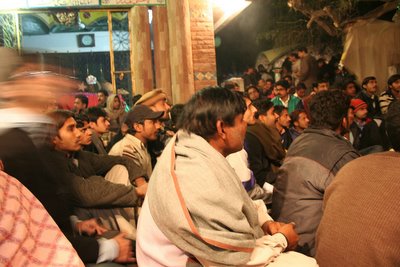
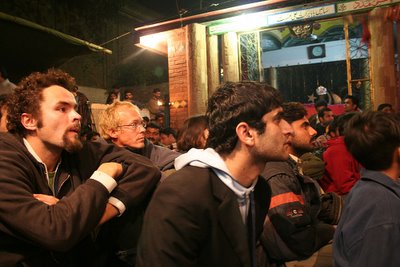
Goonga Saeen and Mithu Saeen then get going on their dhols. It’s percussion played at a furious pace, with a hypnotic rhythm to it that would numb the senses if you succumbed to it. They play incredibly well together, and Goonga seems quite at ease, while Mithu often seems to be hard at work, concentrating intently. They’re perfectly in synch all through, though, and this is probably dhol heaven for those who have a taste for the stuff. (I don’t think I do, I must confess.)
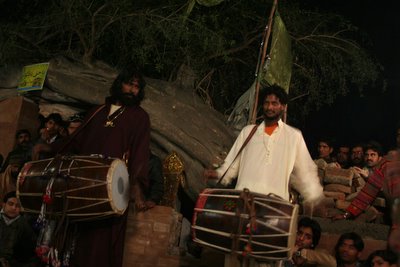
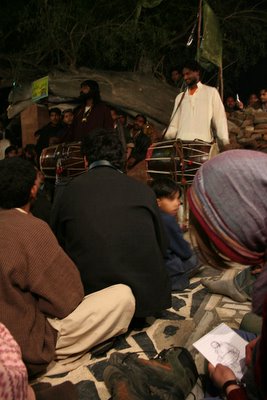
After an hour or so of frenetic dholing, the crowd at the front moves back, and dervishes take the floor. The place is abuzz now, and people are already lighting up.
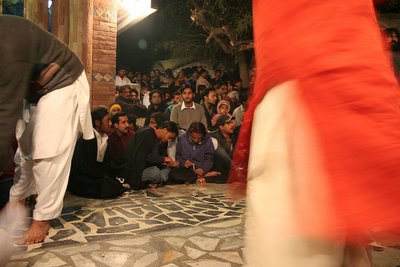
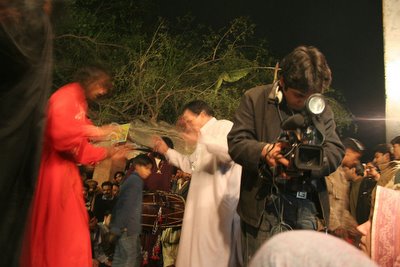
The dervishes now begin to whirl madly, round and round and round and round, without stopping. They spin and shake and shiver, they whirl and vibrate, they fill the place with so much mad energy that I feel dizzy myself, even though I’m sitting on the ground.
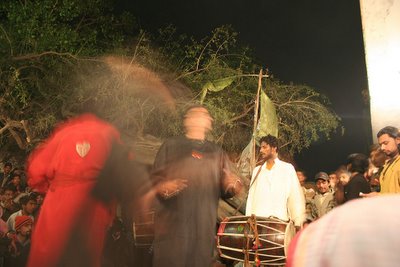
Don’t imagine that NDTV is doing nothing. Furqan is also spinning madly in his own way, taking shots of this and that and everything else.
Later, when we’ve had enough, we take Malik out on the road for some soundbytes.

I take photographs, and the one below is an apt one when you consider that the location is just outside a Sufi shrine. I’d set exposure to the levels of the street, but Malik had a camera light trained on his face, and it made him look as if he was an otherworldly body of light. Such fun.

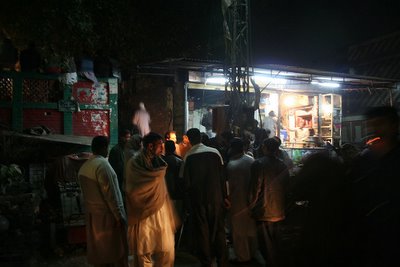
As Malik is finishing giving his bytes, I hang around at the other side of the street. A couple of chaps then come and stand menacingly from either side of me. “Are you from India?” asks one of them.
I’m suddenly a bit worried, given the crowd that hangs around here, and the way these guys are looking at me. “Er, yes, I say.”
“And are you Muslim?” asks the chap, a touch of menace in his voice. I’m suddenly, for the only time on this delightful trip and just for a few seconds, terrified. “Yes,” I reply. He asks me my name. I reply:
“Arif Khan.”
Badar Ali Khan
This post is about the second part of an afternoon of qawwali music at the shrine of Data Ganj Bakhsh Hajveri, where I’d gone with friends from NDTV who were shooting a feature on it. The first part is here.
As I wander around the hall listening to the music, I get chatting with a gentleman named Badar Ali Khan, a qawwali singer with matinee idol looks. He invites me to chat with him and his troupe, and we sit down on the floor in a semi-circle. He orders tea for me.

Badar was, you could say if you like cliches, born to qawwali. His forefathers sang qawwali in Jalandhar, and his uncle, Arshad Ali Achhen Main, and his father, Ilyas Ali Khan, were both accomplished singers.
“I started learning qawwali when I was very young,” he tells me. “It is the first thing I remembered learning.” Earlier, while taking pictures, I’d seen another kid on stage who was probably going through that same process. Here:

“So why do you come here to perform?” I ask Badar.
“Well, firstly I meet all my friends and fellow artists,” he says. “Also, a lot of concert promoters and so on come here, and they sign up people they are impressed with.
“And the audience,” he continues, “they are mostly people who can’t afford to listen to qawwali music in their own homes, so they come here.”
“Have you made any recordings of your own?” I ask.
“Oh yes,” he says. “You can get them at the store outside. [I tried later and couldn’t.] I have also done fusion recording with a Japanese artist named Takuya.”
“Do you know what is so special about Badar saab?” says a member of his troupe. “Every song he sings is composed by him. He only sings his own songs.”
Badar nods proudly. “I have composed between 100 to 200 songs so far,” he says. But making a living still isn’t easy, so he also gives music lessons – how to play tabla, harmonium etc – to foreign students, most of them backpackers who stay with Malik.
“Now take my photo,” he says. I get into position with my camera, and he poses, as if he's singing. I take pictures for a couple of minutes, and he maintains the pose in most of them. At first I find it slightly funny, but then it just seems poignant: that he should feel the need to sell himself like this.

By the end of the conversation Swati has joined us. Her story acquires a focal point, and she asks Badar out to take some soundbytes. He agrees, we go out, and she chats with him as Furqan sets up his camera, to get a sense of what to speak to him about, and to put him at ease. When he speaks on camera, he is superbly articulate and confident. If he sings as well as he presents himself, we agree, he can be quite a star.


Badar is due to perform soon, so we wait around eagerly. Soon, he goes on stage, and Furqan gets into position.

Badar sings with a lot of energy, and his group is pretty good as well, and, of course, he sings his own compositions. I’m no expert in this kind of music, so I won’t comment on his singing, but the man certainly has stage presence.

Finally we’re done. Swati checks out the footage Furqan has shot, and likes what she sees. Or maybe the content smile on her face comes because she is thinking of food. None of us have had lunch, so off we go to get ourselves a meal. And to prepare for the Sufi night ahead. (Update: An account of that is here.)
Qawwali afternoon
Every Thursday afternoon, qawwali singers from around Pakistan gather at the shrine of Data Ganj Bakhsh Hajveri to perform. Nusrat Fateh Ali Khan has performed here, and it is said to be quite an experience. I hadn’t had the time to go here on my first Thursday in Lahore, and most of my fellow journalists would be in Faisalabad by the second Thursday – with the second Test starting on Saturday, then needed to be. But I decided to stay back.
Then I ran into Swati Maheshwari of NDTV, who was in Lahore to do features. She wanted to come along for the qawwali afternoon, and I decided it might be fun to do a photo-narrative of how a TV crew shoots such stories, while also, hopefully, getting enough material for my own stuff. (All pics here shot and uploaded with permission.) So I fixed a time with the gentleman who had so kindly agreed to be my guide for the day: Mr Malik of the Regale Internet Inn. (Do note that Malik never asked for money and we never offered. His generosity for us flowed naturally, and we didn’t want to cheapen our gratitude for this fine man.)

After we arrived, he told Swati, “young lady, you need to wear a shalwar-kameez at the shrine. But no problem. Come with me.”
He took us upstairs to a room by the terrace in which there were many shelves full of the stuff. He started pulling dresses out, saying, “Take any one you want, they’re all new.” Swati said she’d rather change at home. (Eventually Malik said it would be okay if she just covered her head and came.)

Print journalists like to complain about how poorly paid they are, and TV journalists often complain about how hard they have to work. (Bloggers work hard and aren’t paid at all.) I’ve spent five years in television, though not in news, so it wasn’t a surprise to me to see that as I chilled in the car, Swati was already hard at work, checking her equipment – much of which was misbehaving – and briefing our cameraman, a friendly Lahoreite named Furqan. She had to make sure that she got all the shots she needed for her piece -- establishing shots, background shots, soundbytes, etc. All day, she'd be constructing the narrative inside her head. (Bad phrasing -- where else would construct it, in her liver?) Furqan leaped out of the car when we arrived, set up equipment, and started taking shots of the exterior, of Malik and gang – he had some foreign backpackers with him – entering the shrine, and so on.


The performances took place in a large, clean hall in the basement of the shrine. There was lots of space when we entered, but it filled up later as the afternoon went on. As in rock concerts, the best-known artists play last. Swati and Furqan set up their equipment, and Furqan spent the next hour or so shooting the performances, and the crowd, from lots of different vantage points. From all this footage, you are likely to see just a few seconds when the piece finally airs.


The sound system these guys were using was awful, but some of the performances were pretty good. You might imagine from listening to Nusrat that each qawwali troupe will have one main singer plus chorus, but all the groups I heard that day had two or three main vocalists. The dynamics within each group were fascinating: if one guy had energy and fire in his singing, another had a soothing voice – they would harmonise, play off each other, and move into impassioned choruses. The interplays were fascinating – and so was the way these chaps interacted with the audience.


The presence of TV cameras do strange things to people. One chap, when he saw Furqan shooting the singers, went in front of the stage and started performing for him. We must get get this guy to a cricket match, I thought to myself.


In an afternoon of two halves, this was the first half. And then we met Badar Ali Khan. More about that in the next post. (Update: this post.)
If your biological clock is ticking…
Missed
Ah, to think I missed this yesterday. Such sadness. The artist is a friend, but more to the point, the curator is the loved one, and two other shows curated by her this month have also been missed by this heartless blogger. Oh woe. Immense sighs emerge.
And I also missed this, thus no doubt saddening another friend. Such is Pakistan.
Saturday, January 21, 2006
A walk at night
After meeting Mr Malik, Mario and I went for a walk through Lahore, aiming to end up at one of the Food Streets. (One is at Goval Mandi, the other near Anarkali Bazaar.) As we left the lane in which Regale Internet Inn is located, we spotted the stall from which our appetite-spoiling shawarmas had been ordered.

So where would we go? We asked a nearby stallkeeper, and he suggested that we go to the food street near Anarkali Bazaar, and gave us directions. His stall was rather high, and I’m sure all his customers look up to him.

As we walked towards Anarkali Market, I was once again taken aback by how beautifully Lahore is lit at night. Its lighting gives it such grandeur and grace, and I could spend hours just walking through Lahore at night, enjoying the feeling of being in a beautiful urban setting. How rare is that?

Finally we reached the food street. We were too full to eat, so we just gazed at the food with longing hearts but sated stomachs. There was a lot more on offer than just food, by and by, and a greater variety of food avialable than I'd expected. Satisfaction came, vicariously.


Later, as we headed for home, our autorickshaw broke down near a MacDonald’s outlet, and we decided to have a quick coffee there. As we looked at the menu, I spotted an ad with a Pakistani Cyrus Oshidar lookalike. Hmm.

(Clink on pics to enlarge.)
The Lonely Planet legend
When I was reading up about Lahore, one of the many books I bought – yes, yes, shame on me – was Lonely Planet's guide to Pakistan. It spoke effusively of a gentleman named Malik, who runs an inn called The Regale Internet Inn. It was reputedly the best place in the city to go to for backpackers – Malik later tells me himself that it is the only one – and the gentleman reportedly takes you to the qawaali afternoons and Sufi nights I will blog about, with pictures, later.
Well, on getting to Lahore I found that a friend and fellow journalist, Mario Rodrigues of the Statesman, also had the same desire to meet him. So we figured we’d go together. I called up Mr Malik and fixed up a meeting. (This was more than a week ago.) We had a little bit of trouble finding his place, fending off the non-desire to eat in an AFC outlet, or to run into the Regal Theatre to watch a decidedly Bipasha Basu-less Jism.


Eventually we found the place, and climbed up a long flight of stairs, to be greeted effusively by Mr Malik, whose full name, we now discovered, was Malik Karamat Shams. He took us into his room, sat us down, and insisted on ordering Shawarmas for us. He struck us instantly as an inherently pleasant man, not someone being nice to us just because we were journalists. (I’ve met plenty of that kind.) Then he started talking to us about himself and how the Regale Internet Inn came to be.

Malik was the owner and editor of a progressive newspaper called Inquilab, a role he had inherited, but which he was eventually to give away. The internet was to blame, you could say.
Sometime in the mid-90s, he got a computer with an internet connection. He got it for his kids, but he soon spotted an opportunity. “The only internet connection in those days was at the British Council,” he says, “and I decided to start an internet café. If they were charging 100 rupees and hour, I decided I would charge 80. Ha ha ha.”
He soon found himself with a problem, though: the demand far outweighed the supply, as he had only one internet connection, on one computer, and many customers clamouring for his time.
Then a friend told him about networking. “He said that you can have ten computers, and only one connection. Can you believe it? So I went to my friends in the university and asked them about it, and they said, yes, it is possible. So I told them, if it is possible, then do it janaab. So they did it janaab!”
As Malik mused on life before networking, Mario allegedly started doodling. Here’s a picture.

Malik then decided that this was a business in the making, and he decided to start an internet café. Regal Cinema was nearby, and ‘Regal’ somehow, rather aptly, became ‘Regale” after he borrowed it. But he didn’t want to call it an “Internet café.” “If I put ‘café’ on the name,” he said, “people would think, there is tea available. They would come and harrass us and ask for tea. So I wanted to avoid that impression.”
Then a friend suggested that he use the word “Inn.” “I was very happy with it,” said Malik. “None of of my customers knew what it meant, and they would just see the word ‘internet’ and come.”
The “inn” part of the name soon began to cause him a little embarrasment. The office of Inquilab was still run from that building, and Malik says, “I would be sitting in my editor’s office interviewing an important personality, and these people would come and ask, is there a place to stay? Then one day Mr Brad came.”
‘Mr Brad’ was a tourist whose full name Malik does not remember, but he requested Malik that he be allowed to stay there. Malik put a prayer mat in the editor’s office, and allowed Mr Brad to stay there. There’s a picture on the wall of Malik and Mr Brad together. They look happy.

“Mr Brad stayed for a long time,” says Malik. “He made a series of documentary films, on the Pakistan film industry, on Sufi music in Pakistan society, on prostitutes.”
All these subjects interest me, and I ask Malik if he has copies of these documentaries anywhere. He laughs.
“I haven’t it seen it myself, janaab,” he says. “Even if Mr Brad wanted to send me those CDs, he wouldn’t be able to. The government does not allow us to receive CDs from abroad.”
As the days went by, more and more people came to stay, backpackers who had heard of the place through word of mouth. “It was embarrassing,” he said. “He opened up the terrace to them, allowing guests to sleep there after 9 pm as long as they left before 9 am. Eventually, Inquilab was shifted elsewhere, and all the rooms Malik had became guestrooms for backpackers: some of them dormitories, with four beds in a room. The terrace became a rite of passage for a while: if you wanted to stay in the Regale Internet Inn, you had to spend your first night on the terrace.
It wasn’t only backpackers Malik is known amongst, though. He is a big name among the musicians and artists of Pakistan. “I used to be a film journalist,” he tells me. “I became very friendly with all the struggling artists of the time. They are superstars now, but they still care for me. I can call them here, and they come and perform for me.”
Malik now got a phone call, perhaps from one of these artists, and as he spoke on the phone, Mario, shawarma in hand, allegedly started conducting a symphony playing in his head. Here’s a picture.

Malik spoke to us about so much else that it would be impossible to detail it all here. He had once been Benazir Bhutto’s press secretary, and he spoke of how her husband’s family took such advantage of her power. “Zardari’s family had never seen power,” he told me. “They became drunk on power. Hukumat ke jhooley par pehli baar baitthey.”
He spoke about cricket. “The British Empire introduced cricket in their colonies to depoliticise society,” he told us. And then he added mysteriously, “I don’t follow cricket any more. I know the result of every game before it starts.” I ask him what will happen in this series. “Oh, we have suffered because of the earthquake,” he says, “and you will give us reason for consolation.”
The bit I am rather charmed by is when he speaks about how society is changing, and how television is responsible for it. “Pakistan society used to be much more male-dominated,” he says. “But now women are being liberated. It is all because of Star Plus.”
“Ah!” I say. “How is that?”
“You see,” he says, “there was a time – and I am nostalgic about it now – when I would go home and get my roti on time. But now I go home and my wife is watching Star Plus. I ask her for my roti, and she says, ‘drama ke baad.’ I wait, and wait, but until 10.30 I don’t get my roti. Sometimes she will get up in the breaks, do a bit of work in the kitchen, then run back when her drama starts again.”
“So is this a bad thing or a good thing?” I ask.
“Ha ha ha,” he replies. “It is a good thing for her.” But he smiles, and I sense that he is happy that she is happy. Roti can wait.
Then, like the scoundrel journalist I am, I ask, “Can you tell us which serials she likes to watch?”
“Ha ha,” he says. “Janaab, I don’t know the names.”
“Can you call up and ask please?” I say.
He bursts out laughing, and calls his wife, a wide smile on his face.

As he questions her, she becomes either shy or suspicious, and refuses to divulge the names. This amuses him further. “Tell me for which dramas you make me wait for my roti,” he booms, his eyes twinkling.

And then, to stop the teasing, she gives him one name. Kasauti Zindagi Ki. Malik laughs, and the room is filled with happiness, and love.
Janaab-e-Aloo
During a pleasant conversation I was having with a Pakistani friend I'd newly made, he leaned forward called me, "Janaab-e-Ali!"
Needing to react appropriately, and not knowing fancy Urdu phrases, I recited back the first one that came to mind. "Huzoor-e-Ala!" I fancily declaimed.
And then it struck me, that had both of us been talking to Inzamam-ul-Haq, we would have called him...
Ok, ok, back to work now. Sorry.
Daewoo, Faisalabad
Much has been done in Lahore over the last few days, and I've constantly been faced with the choice of either collecting material for pieces/posts or writing them. With the limited time I've had, I've chosen to just soak up the experiences, and leave the writing for later. In fact, to be precise, for Faisalabad. This is supposed to be a rather dull town, and while other journos gather in the evenings to smoke and drink (water, of course, in case authorities are reading), I shall sit in my room, alone like a hermit, and write and post.
So there'll be stuff on qawwali afternoons and Sufi nights and dope and backpackers and whirling dervishes in the most happening city in South Asia, Lahore. Pictures as well, many of which I spent hours yesterday selecting and resizing. I shall begin posting all that soon, but for now, as an interim measure, here are some pictures from yesterday. Do note that if you're booking your ticket by phone, you should spell your name out. Else...


Thursday, January 19, 2006
Names
Quiz question: in which city would you find the following places: Laxmi Chowk, Ferozpur Road, Dhaniram Road, Charing Cross, The Mall, Bharat Nagar, Ram Gali, Lord Saab Ka Daftar?
Answer: Lahore. Many of these places were actually renamed by the Pakistan government -- Bharat Nagar became Pakistan Nagar, for example -- but none of the changes worked, and they are still referred to by their old names by the people of Lahore, which is how they like them. This is a city, I've noted, that prides itself on its culture and its history, and religion isn't as big a deal as its made out to be. This is just one illustration, of course, and I'm sure counter-illustrations can be found. But this is what struck me.
It was Murtaza Razvi, who I've also quoted here and here, who brought this to my attention.
Indian Muslims, Pakistani Muslims
One of the people I met while researching my WSJ op-ed on Pakistan was Murtaza Razvi, the resident editor of the Dawn in Lahore. I had a long, enlightening chat with him, and one bit in particular struck me. So here it is:
You know, people in India seem to have the impression that Pakistan is like Afghanistan. They assume that we are similar to the Muslims that exist in India's ghettoes. Well, no such ghettoes exist in Pakistan.
Before the 1992 World Cup, I remember I was in Nizamuddin [in Delhi], and these Muslims told us, "Ek bechaara musalman hai jo hindustan ke liye khelta hai, baaki sab tho Hindu hai, tho team kaise jeet sakti hai*."
We were so shocked, we were like, "Where are these people coming from? What a bunch of losers!" These Indian Muslims confine themselves to their ghettoes, on the periphery of society, hung up on ideas and aspirations sold to them by their leaders.
I have heard some Muslims say in India that they don't buy milk from Hindus because "woh tho usme sooar ki doodh mila denge**." It's ridiculous. Their leaders have misled them, have made them [feel like] victims. What hope do you have with a mullah being your leader?
Lest Murtaza's point be misconstrued, let me add that the point he is making is not that there are no fundamentalists in Pakistan, but that by and large the people of Pakistan are nothing like how they are perceived by some Indians, and certainly nothing like these ghettoised Muslims in India that he speaks of. (He doesn't imply that all Muslims in India are like that, but merely refers to the ones that are.) I've only been in Lahore for a couple of weeks, but I buy his point entirely. I am so blown away by how liberal and secular and tolerant the people of this city are, contrary to my expectations, and what a happening place it is.
A longer piece follows within a few days on Lahore, so more then.
* Translation: "There's is one poor Muslim [Mohammad Azharuddin] who plays for India, the rest are all Hindus. So how can the team win?" Note that in the original quote, the term "Hindustan" was used.
** Translation: "They will mix pig's milk in it."
Anti-Americanism in India and Pakistan
One more nugget from Ejaz Haider (also quoted here):
There is a difference between the anti-Americanism of India and Pakistan. Anti-Americanism in Pakistan is emotion-based, honour-based, and does not have an intellectual origin. In India, it is ideological.
I'm not sure I agree with him on the second part of that observation, as he is basing it on the Left parties, which have power in India disproportionate to their influence. Most common Indians don't share their ideology and intellectual reasoning. That does not mean that anti-Americanism in India is necessarily all "emotion-based," but it generally doesn't stem from the dogma of the Left.
Also, though it's fashionable (and great fun) to ridicule George Bush, there is much less anti-Americanism in India than in Pakistan. But that's a different matter entirely.
The general's dilemma
One of the people I met while researching my WSJ op-ed on Pakistan was Ejaz Haider, a noted columnist and the news editor of the Friday Times. We had a long, enlightening chat, and while I learned much from it, I was disappointed that I could use just half a quote in my piece. So here's an interesting snippet from our chat, about how it might have been necessary for General Pervez Musharraf to undermine Pakistan's institutions, and why his not rebuilding them is "Musharraf's biggest failure":
It is a paradoxical situation. When you’re a one-man show, when you want to effect a top-down approach to reform the system, you might need to undermine institutions that slow down that process of reform. But at some point, to be able to sustain the system you build, you need to strengthen the institutions again, to relinquish some of the authority you usurped. But by relinquishing authority, you risk other actors stepping into the power vacuums that result, and they could be a threat to you.
Ejaz offered many more fascinating insights about Pakistani politics during our chat, which would have merited a full interview on its own, but I was caught up in a flurry of work and simply had no time to work on it as an individual story. Some other time.
Left bhi, right bhi
I'm spread out madly across the spectrum. After reporting on the Lahore Test for the Guardian, I'm in the Wall Street Journal today, with an op-ed on Pakistan: "Musharraf's strong position." (It's a subscription link, and I don't have the final copy they used, so will upload the piece later here.)
Left bhi, Right bhi: as one might say in Lahore, "Janaab, humaare wide-wide baahein hain."
Wednesday, January 18, 2006
Early morning
I went out with a couple of friends two nights ago, and fun was had. We drank Pakistani beer and then went to the Pearl Continental Hotel, where the Indian team is staying, to pee -- the place was full of security guards, even in the loo, but not all were awake. Then we went to the famous shrine of Data Ganj Bakhsh Hajveri, hung around inside and outside it for a while, and bought some Pakistani CDs and VCDs outside. Here are some pics, click to enlarge. (Much more has been done since, more blogging will follow later, got to rush now.)


Monday, January 16, 2006
Blogger v Journalist
Yes, yes, I know my blogging frequency has dipped alarmingly during this trip, and there's a reason for that. I've been meeting interesting people and going to fascinating places, but all as research for feature stories. So I haven't been blogging about them to avoid having to write up the same stuff twice, which I simply don't have the time to do. I would have blogged those pictures as well, but am saving them for when those features appear (or are rejected) and I do blog about it. The interests of the blogger in me are colliding with those of the journalist in me, and the journalist pays the bills: I'm paying my own expenses on this trip, so every little bit of freelance work I do is important.
But all of that will be blogged eventually, and the pictures will be almost certainly exclusive to the blog. So there you go. Wait it out. Sorry!
In the meantime, three quick pics to leave you with: the first of how my workspace looks in the press box of the Gaddafi Stadium, the second of a terrace where the TV crews wait for play to resume under overcast skies, and the third of an intriguing headline-less newspaper clipping my Kipling-loving neighbour kindly pointed me to.


Update: A couple of other pics below: a police observation post just besides the press box, and a shot of the stands just besides it, which are rather, well, sparsely populated.

Sunday, January 15, 2006
Honey, orange, stocks
My neighbour in the press box, who is a Kipling fan, though that's not relevant here, kindly points my attention to these fine headlines in Pakistan's Daily Times:
"Pakistan now self-reliant in Honey"
"China allows import of Pakistani orange"
The first of those is alongside one that says:
"Thai stocks expected to rise"
So, you see, good news all around.
Pics from the Gaddafi Stadium
Yes, yes, I know, blogging has been infrequent, and I haven't been my usual voraciously bloggacious self, but I promise you better in the days to come. Until then, here are some pictures from the Gaddafi Stadium in Lahore. The first is of the main gate of the stadium as seen while entering it. The second is a view from the steps leading to the press enclosure, as a photographer sets himself up for a shot. The next three are from a press conference held by Sharad Pawar and Shaharyar Khan, and the final one is of journalists filing their stories from the press box at the end of day. Click on the pics to enlarge and, um, more later.


Saturday, January 14, 2006
IndiBlog of the Year
That's India Uncut! Thanks to all of you who voted for me. After an immensely stressful day at the press box in the Gaddafi Stadium, it made my day to return to my guesthouse and find that so many people think me deserving of this honour. Oops, music's started, got to wind up the speech now. Er, thank you again!
And congratulations to all the winners in the other categories: Prem and gang, Selva, the Desi Pundit gang, Shivam, Megha, Meenakshi, Nilesh, Guru, Sashi, Kanndave Nitya, Kalesh's World, Marathi Sahitya, Mugamoodi and Amazing Telugus. And special hugs to Jai and Sonia, two close buddies, whose wins in their respective categories makes me as happy almost as happy as my own win. Sonia's just had a book out, and after waiting for the launch for so many months, I'm a bit bummed to be here in Pakistan when it's happening.
And thanks to Debashish, who did such a wonderful job of organising the awards.
Rashomon
I had fun listening in to what people in the press box were speculating when the heated discussion between Sourav Ganguly and Rahul Dravid was taking place yesterday.
The Sourav-bashers said: "Oh, Rahul wants him to open and Ganguly is throwing a fit because he's scared of facing Shoaib Akhtar with the new ball."
The Sourav-lovers said: "Oh, Dravid has volunteered to open the batting himself for the sake of the team, and Sourav is fighting with him because he wants to open and show the world what he's made of."
As the second version shows everyone in a better light, I found myself rooting for it. And although I've long felt that Ganguly's time is up, oh, wouldn't a 70-ball century against Shoaib and Sami be so thrilling? Who can read the leaves?
Of course, the possibility remains that they were arguing about something else entirely.
"New Anarkali Market is better than Old Anarkali Market!"
"Is not!"
"Is!"
"Is not!"
Update: Turns out they were arguing about the opening position, but not in the ways earlier speculated. Ganguly was upset because he was apparently told only on the morning of the match that he would have to open, and he said that he should have been told about it and given time to prepare. Dravid then apparently offered to open himself. And so on.
Friday, January 13, 2006
The press box
I won't be able to blog from the press box during the first Test at Lahore, as I had done during Pakistan's tour of India last year (archived here and here), because I am giving radio updates for BBC constantly through the day, and that requires me to be always on the ball. So, with apologies for the reduced frequency of posting, I leave you with a picture of the press box at the Gaddafi Stadium. (Click on the pic to enlarge.)
Thursday, January 12, 2006
"Grass root is our original future"
Rahul Bhattacharya had written about it in "Pundits in Pakistan," his superb account of India's last tour to Pakistan, and I finally got to see it yesterday on the way to an afternoon nets session of the Indian team: the signboard for the Abdul Qadir International Cricket Academy. Here it is, below. Click on it to enlarge, there are priceless slogans there.

India's nets were at Pakistan's National Cricket Academy, which is next to the Gaddafi Stadium, where the Test match will be held. Oddly, it's ISO 9001 certified, as the sign below says. Whatever does that mean in the context of a cricket academy?

Inside, the Indians practised while journalists sat around and watched them.

Journalists often try to pick up cues about selection and personal relationships from what happens at the nets. If two people are contending for a spot in the side, which of them has a longer bat in the nets? Is X talking to Y? What are Y and Z laughing about there? Much guesswork happens, and as players speak a lot to journalists they like off the record, a lot of it is informed guesswork.

Photographers stand around, alert for good pictures. One superb photo-op came when Sourav Ganguly gave Rahul Dravid slip-catching practice.

Photographers immediately gathered at the angle from which they could capture both men.

Not all players got such media attention, though, and some were left in peace.

As players walked back one by one after finishing their practice, a journalist or two would accost them or walk besides them for the few seconds they could. There is tremendous competition for stories and quotes, and often a journalist will ask the cricketer three quick questions on this walk, the cricketer will give rushed answers, and the journalist will construct a quick story out of it, "exclusive" to whichever publication he or she works for.

Sometimes a player stops and gives a few bytes to a TV Channel. All the print journalists also gather around then, eager to pick up the stray quote, and keen not to miss anything. Sachin Tendulkar and Dravid complied yesterday, and were admirably calm and polite, though they would surely have much rather gone and rested after their workouts.

Wednesday, January 11, 2006
Goval Mandi
I have a busy day ahead, with not much time to blog, so here are some pictures I took three nights ago at Goval Mandi, Lahore's famous Food Street. Being a fan of the Minara Masjid food areas off Mohammad Ali Road in Mumbai, as well as some of the joints on Bohri Mohalla near there, I had been keen to visit Goval Mandi. This was the real deal, I was told, the Mumbai places flourish mainly during Ramzan, but this is open all year, and it rocks.
Well, I liked the place but was disappointed with the food, perhaps because my expectations were astronomically high. I intend to go again and see if I just picked the wrong things from the wrong place. The street itself is wider than the Minara Masjid road, well lit up, and above the sparkling shops at the side there are colourful, bright verandas, and we wondered at one point if they were inhabited, for no heads were seen peeping through, looking out at all the meat down below.
Anyway, here are the pics (click on them to enlarge), a longer piece will follow sometime later on food in Lahore. (Note: we went to Goval Mandi between 10 and 11 pm, which is why the street appears relatively empty. I am told it fills up after midnight.)


Dictaphones and spellcheck
One of the things that surprises me on cricket tours is that some journalists are so reliant on their dictaphones. I was reminded of this at the Indian team's press conference yesterday when all the Indian cricketers lined up in a bunch, and many journos were bewildered by how they would capture the quotes. "We only have one dicta each," said one of them, "and so many cricketers who will speak, all spread out. What do we do now?"

Now, as a rule, I never use a dictaphone. I prefer taking down notes, and have realised that the mind is much sharper when there is no dicta (if I may now call it that) to rely on, listening intently to every word, on the alert for nuance, remembering much more later. When people use a dicta, they switch it on and switch themselves off. Of course, you can leave both the dicta and yourself on, but whenever I've done that, even if I'm listening, I'm not listening so hard, I automatically ease up a bit. As Sambit Bal, who edits Cricinfo, once told me, "If you don't remember it, it's not worth remembering." The absence of a dicta also helps you sift out the banal, and focus on what matters.
Lest you get the wrong impression, I'm a huge fan of technology as an enabling tool, that helps us do drudge-work much faster, and aids us in areas where we could not do without it. But only to the extent that it complements and enhances what we do, and not when it causes us to switch off our mental faculties. Another example of this: I work in Microsoft Word but don't use spellcheck. This stops me from getting careless with my writing, though it does mean that when I'm in a hurry, as I often am on tour, spellos and typos creep into my copy. I think my readers are fairly understanding about it, and many often correct me -- Jai has corrected my spelling of 'wierd' 'weird' twice, in fact. That means I know how to spell that word now. If I used spellcheck, I'd never learn, even if the mistakes did not appear on my blog.
Gotta rsh now, ta.
Tuesday, January 10, 2006
Media interaction
Today was one day on India's tour of Pakistan that was supposed to belong to the media. The Indian team management announced that there would be "a media interaction" today. What generally happens at these is that players sit around the room in separate groups of two or three, and journalists wander around asking questions to whoever they feel like. Most journalists come prepared with particular questions for particular players, with story ideas in mind.
But on landing up at the venue, we discovered that what had been organised was just a big press conference, with all the players slated to be sitting side by side, as the journalists asked questions, one by one, to whoever they felt like. This meant that everyone would have all the answers, and no one would get any exclusive quotes, or be able to compile quotes for specific story ideas.

Needless to say, the journalists were pissed, and some spiritedly spoke of a walkout for taking the press for granted. But they stayed, and waited, as the players arrived. As they sat, the photographers milled around in front, taking pictures.

Well, we all know the price of fame, but the first time this happens to a player it must feel damn odd. You come, you sit, and then for two minutes people are just taking pictures of you. What expression do you make? You can't smile for the cameras, that would be cheesy. In fact, you're worried about appearing too conscious -- even though at first you certainly are -- so you chat with the fellow besides you, or just look down and appear preoccupied, or look around the room casually. If you're an old pro, it must begin to grate after a while.

I sat in the front row with my camera, and I found it fascinating to watch the players all through the PC, seeing their changing expressions. Consider the picture below, for example: doesn't the expression of each man tell you something about his general state of mind?

At one point, Raj Singh Dungarpur, the team's manager, got Wasim Jaffer's attention and pushed his glass towards him. He wanted Jaffer to pour water into it. Jaffer politely obliged.

And below, check out the expressions on the faces of some of the Indian team and their coach as Sourav Ganguly answers a routine question about how it feels to not be the captain of the side.

Later, Rahul Dravid is asked a question about Ganguly, and all the cameras, as Dravid answers, are pointed not at him but towards Ganguly, sitting in a corner. (The question was whether Ganguly was in contention to play in the first Test. Dravid diplomatically said that everyone in the squad was in contention. Rubbish!)

Many of the journalists, peeved at the way the event was organised, refused to ask questions. That led to some uneasy silences.

After the print media was disposed off, it was the turn of the electoric media. As each TV channel had just one or two mikes, and not the 13 or 14 required to cover the breadth of the room, the players spoke to them in groups of two or three. Why not us?

(Click on pictures to enlarge. All pics posted on this blog during this trip are by me, unless otherwise attributed.)
Polarising India
Here's a piece by me in the Guardian about Sourav Ganguly.
I've also been contracted by BBC Radio to provide regular updates through the first Test, at least, and have been doing updates from here since Sunday as well. Writing those quick little scripts for myself reminded me of my days as a TV scriptwriter in the 1990s, when I spent five years in MTV and Channel [V]. When you write for such mediums, you have to imagine the person you're writing for saying those words, and write only what sounds natural coming from them. So I wrote a short script for myself, then read it aloud, and then went chop, chop, chop, excising whatever sounded odd, changing bits here and there. It was interesting, and I think this process may well help me spot weaknesses in my writing that I would have been too lazy to discover otherwise. And, of course, fun will come.
I've been very busy the last two days meeting people and working on stories, and today will be another such day. But it will all lead to posts. Watch this space.
Monday, January 09, 2006
Votey daali, janaab?
As January 10 is the last date of voting, this is your last chance to vote for me for IndiBlog of the Year in this year's IndiBloggies. You only need to have a valid email address to vote, so do go forth and express your appreciation of the hard work I put into this blog, just for you. Unless you don't appreciate it, in which case, sigh, I'll try harder this year!
You could also nominate me for the 2006 Bloggies if you really want to be nice to me.
Meherbani!
I'm off to get my cholestrol count even higher now. I shall return to blogging after adequate consumption of protien.
Cooco's
When one travels, and writes, it is hard to keep one's balance. At home, in our cities, we walk around enclosed in the cocoons of our own world. But in a foreign land we look for significance, for beauty, for exotica, in every little thing we see. Every dustbin appears picture-worthy, street signs demand posterity, and buildings, windows, awnings, the way people dress and talk, even stray dogs appear remarkable. This is not a bad thing, of course: we view things in a fresh way while the locals are perhaps jaded, taking their cities for granted. But it leads, in too many cases, to a false glorification of the ordinary, to exaggeration, to creations of parallel cities that exist only in the mind.
I had decided when I came to Lahore that I would guard against this in my own writing. But how can one not be overwhelmed by Cooco's. Cooco's is a restaurant in Heera Mandi, Lahore's red-light area, to which a Lahori friend took four of us yesterday, and it is a place of which I've read a fair bit, and had wanted to visit. Cooco's is owned by Iqbal Hussain, a painter whose mother was a nautch girl, like others in his family. He grew up in Heera Mandi, and might well have ended up in the underworld had he not discovered painting. Starting out in 1971, Hussain began painting the people he had grown up with: the prostitutes and thugs of Heera Mandi. His work wasn't easily accepted in Pakistan, where his choice of subjects did not find approval.
I intend to meet up with Mr Hussain soon -- he was out of town today -- and I shall write more about his work and Heera Mandi later. For now, let me just write about the restuarant. Cooco's is located in a haveli where the restaurant is at a couple of levels on the rooftop, which one reaches by climbing a long and winding staircase. The kitchen is on the streetside below, though, as shown in the first picture below. Cooco's waiters stand at the edge of the terrace above them and use a pulley-system to lift food up (that's what the guys in the foreground of picture 4 are doing). And the setting is remarkable: the Lahore Fort is just besides Cooco's, magnificently lit up, as if announcing to the skies that this is the center of the earth. And the Badshahi Mosque inside, with its green domes, is quite as aweinspiring as religious monuments are ideally meant to be.
It isn't just the exterior but the interior which is breathtaking. Downstairs, there are paintings by Hussain all over, of the chisselled faces of the women of Heera Mandi with deep sad eyes and a dignity in their bearing. Upstairs, there are statues of Ganpati and Mother Mary, among others. The walls, the tiles, the furniture, everything evokes the magic of an era as if it is still alive and flourishing. So do the Jagjit Singh ghazals that are playing, though my local friend notes sadly that Mehdi Hassan would have been more appropriate.
The food is astoundingly good, but my words would not do justice to it, so here are some pictures (click on them to enlarge):


Moving music
In the hotel where I have been staying, and which I am checking out of soon to move to a guesthouse, there is just one place where music plays: the lift. So as I wait for the lift, I hear music getting sometimes louder, sometimes softer, and can make out from the sound how far it is from me. It's fine music, by and by: the Goo Goo Dolls and David Bowie and Coldplay and so on. But one can't keep going up and down in the lift, and one has to, at some point, say goodbye to the music. The lift moves away, and the music grows softer and softer, and then there is silence.
Sunday, January 08, 2006
Through the looking glass
I'd written earlier about how autorickshaws in Lahore are surprisingly tiny and cramped. Well, here's a picture of two journalist-friends sitting with me inside one. I was rather pleased with how I captured the faces of all the other three people in the auto through the mirrors there.
Somebody else's family
I stand at the start of the food street at Goval Mandi in Lahore and take a photograph, and suddenly this guard comes in front of me and demands that I not click pictures. I ask him why, and throw in a "janaab" because it sounds so cultured and suchlike. He says that I might accidently click a picture of someone else's family.
I understand where he's coming from, and it triggers off thoughts about a completely different context: the internet. Except for wide-angle, panoramic shots, or crowd pictures, I don't intend to post photos online without the consent of the people in the pictures. But there are thousands, maybe tens of thousands, maybe millions of personal pics of people posted online, often with the consent of their subjects, and these are frequently used in ways the subject and photographer would perhaps not approve of. I recently discovered one blog, for example, that just draws pictures of pretty Indian girls from Flickr as posts on itself. So you could take a picture of a friend chilling out at a party in a sleeveless t-shirt, post it on Flickr with her consent, and then some chap could just post the pic on his blog for people to lech at. To my knowledge, there are loads of such blogs which aggregate from Flickr. The issues involved here go beyond photo copyright and suchlike. Worrying, and I suspect the answer lies in technology itself.
(A longer post on Goval Mandi follows at a future date, after more trips there.)
See no evil, hear no evil, speak no evil
Dead chickens can't do any of those things. (Click on pic to enlarge.)

(Picture taken at Lahore's famous food street in Goval Mandi. A staunch non-vegetarian all my life, I had turned vegetarian a couple of years ago, but shifted back after a year. I've felt occasional pangs of guilt since, but have found it too hard to give up eating meat again. My reasons for turning veg, very broadly, had nothing to do with animal rights, which is a meaningless term, and much to do with animal suffering. We disassociate what the animals go through from the meal on our table, as if the chicken we eat and the chicken that dies in agony are two separate chickens. At least I do, or many of my meals would not be palatable. And there is a dishonesty there that bothered me. So I turned vegetarian. And for various reasons -- perhaps I shall elaborate on this some other time, but my own weakness is surely the main one -- I reverted.
By and by, much fuss was once made of Greg Chappell being vegan. I was impressed when I first heard that, it takes a bit of commitment. Then I read recently in an interview that he enjoys his fish when he goes to Kolkata. Hmmm.)
Trees watching games
Who would have thought an India-Pakistan series could start in such a tranquil environment? India's solitary tour game before the Test matches begin is against a Pakistan A team brimming with players on the verge of getting into, or getting back into, the Pakistan side. But if the players are tense, everyone else is chilled out. The venue has much to do with that.
Modern cricket is being played more and more in large concrete shells, but the romance of the game is evoked by open spaces, green grass, trees all around, the horizon a meeting of earth and sky, not cement and sky. Bagh-e-Jinnah in Lahore, where this game is played, is just such an old-styled venue. We reach the wrong gate in the morning, and find ourselves having to take a long walk through a park to get there, cops hanging around in considerable numbers, but not stopping us or asking questions, with some people jogging. (No lovers sitting together, alas.) Then we reach the ground itself, opposite a library that looks like a miniature version of the White House, get our press passes organised, and enter.
The ground is just a ground, nothing else. There are no stands. There are trees all along its perimeter, like silent spectators taking in the unnatural beauty of humans and their sport. People stand alongside the boundary and the trees, and watch. There's lots of green, much sky, and the press box, which is thankfully unboxlike, is also open-air, with the top covered by cloth, like a shamiana-kind-of-thing. The players are in a clubhouse on the side. All very nice and mid-20th-century.
Of course, the Test series begins not here but at the Gaddafi Stadium on the 13th. And that will be anything but tranquil.
(Click on pics below to enlarge. The first one is of photographers at the boundary, the second a view of long-off, with the press box right after the sightscreen and the clubhouse for the players just beyond.)

Saturday, January 07, 2006
Breadlike, after all
I always cringe when someone refers to rotis or parathas or naans as kinds of "breads," which doesn't come remotely close to conveying what they are to someone who knows what breads are, but not these. Well, my first dinner in Pakistan was brain masala, kababs and naan, and these naans, indeed, were rather breadline. Unlike typical Indian naans -- long and sensuously curvy -- these were perfectly round and rather thick, somewhat like a soft pizza base. In fact, it was more like bread than like the naans I know. Good stuff, if not quite what I expected.
I'm tempted to end this post with a conclusion unrelated to naans, but that would be a naan sequitur. So here's a pic (click on it to enlarge):

Update: History lover writes in to enlighten me that such breads are available in India as well. "Those breads are available in Delhi/UP at least and are called sheermals," he writes. "They are available in Muslim dhabas in Old Delhi."
And Peter writes in to say that he knows where to get them in Mumbai. Darn, why haven't I ever come across them?
Bright lights, big city
"It's a wonder that the men in Pakistan are so big and the autos are so small," remarked my friend and colleague Dileep Premachandran as we walked the streets of Lahore. Indeed, when three of later sat inside in an autorickshaw, we could barely sit properly, our heads almost hitting the roof, knees scrunched up, unable to move for fear of the last person to get in tumbling out. As Dileep wondered, how could the autos be so tiny in a land of Punjabis and Pathans?
And they are quick as well. One of the first things that struck me when we went for a walk on the streets of Lahore was how fast the traffic was. Crossing the road required adjusting that internal calculator that tells you when it is safe to walk across. You hesitate, move forward, scramble back, scamper across, getting used to the pace of the traffic. It's not just the cars here, but the autos that are frighteningly fast. This is also, of course, a land of fast bowlers.
The roads are conducive to this speed. Everywhere in Lahore we have seen wide, smooth roads -- with no garbage anywhere to be seen, unless we are in a self-deprecatory mood. Last night, when we got in, we were stunned by the lights of Lahore -- we saw glamorous shopping centres dressed in long lines of bright lights hanging down their length, all around them, like draperies. (I was later told that these were preparations for Id, which is on the 10th 11th.) It is a beautiful drive to our hotel, and although I had tried my best to come here with no preconceived notions of Lahore, I am surprised by how beautiful and modern this city looks.
This is just one tiny fragment of it all, of course: one road, one drive. One can't generalise about a city from one flicker of life in it: big cities, old cities, contain multitudes. I'll go out and see more tomorrow, I tell myself -- and then spend the next morning scrambling for my press pass, and then -- now -- blogging. The city awaits, and I'm off.
Update (January 10): I had written in this post that Id was on the 10th, as that is what a colleague had told me, but Dr Khalil Ahmad of the Alternate Solutions Institute informs me that it is on the 11th. The error is regretted.
Meeting Dr Ahmad, a classical liberal struggling to promote values of individual freedom in Pakistan, was one of the high points of my trip so far. I shall write more about it in a later post.
Vote for India Uncut
The Indibloggies polls are open for voting, and India Uncut has been nominated for IndiBlog of the year. If you read this blog regularly, please do go right over and vote for it: one works hard all year for no pay, just for the love of it, so come, give me some of that love back!
Here are my personal favourites in some of the categories:
IndiBlog of the year: [Ahem] India Uncut!
Best Humanities IndiBlog: The Middle Stage and Jabberwock
Best Sports IndiBlog: Sight Screen
Best IndiBlog directory/service/clique: Desi Pundit
Indiblog with the best tagline: Ceteris Paribus
Best Topical IndiBlog: The Indian Economy Blog and Sonia Faleiro. (Many excellent nominees in this category.)
Best new IndiBlog: Mercatus
IndiBloggies 2005 lifetime achiever: AnarCapLib and The Examined Life
Best Group Blog: Secular-Right India and Sepia Mutiny
Go forth and vote!
Friday, January 06, 2006
Onwards to Lahore
I'm off to Lahore later today, and I don't know how much time and internet access I'll have to blog there. But I'll try and keep writing about what I see and do. Filter blogging is almost certainly out for the next month, though I might do the occasional post with collected links. Let's see. I hope fun comes.
Just real estate
Mark Steyn, one of my favourite essayists, writes in the Wall Street Journal:
Most people reading this have strong stomachs, so let me lay it out as baldly as I can: Much of what we loosely call the Western world will not survive this century, and much of it will effectively disappear within our lifetimes, including many if not most Western European countries. There'll probably still be a geographical area on the map marked as Italy or the Netherlands--probably--just as in Istanbul there's still a building called St. Sophia's Cathedral. But it's not a cathedral; it's merely a designation for a piece of real estate. Likewise, Italy and the Netherlands will merely be designations for real estate.
Read the full thing. Even if you don't agree with parts of it, it's thought-provoking stuff.
Dumping on others
Pratap Bhanu Mehta writes in The Hoot:
[I]t could be argued that for the media and public culture in general bouts of self-righteousness are increasingly being used as a substitute for a moral life of discrimination. So long as we can find someone to dump upon, our moral task is complete; we are reassured of our own virtue. Discussions of public morality in India, especially among the middle classes are always amazing in one respect. Every such discussion is about all of us individually feeling superior to others: it is always others who are corrupt, others who are in the grip of the wrong morality, others who have shown bad taste, others who oppress other people. I have never understood how everyone could be so morally sanctimonious and yet society apparently not that moral. The only explanation is that we are interested in morality not for morality's sake but because it is an occasion for the assertion of self righteousness.
Heh. Know any bloggers like that?
(Link via email from Shivam.)
Big B and Big C
Amitabh Bachchan is being served a legal notice because he is shown smoking a cigar in an advertisement for a film. The complainants complained that Bachchan should have been smoking a beedi, which is an indigenous product, and not a "carcinogenic instrument" from another country.
Ok, ok, I made that second sentence up. But it's still ridiculous.
Thursday, January 05, 2006
Punctuation in Delhi
Delhi spoils my tongue. For most Delhi males, the most common bit of punctuation is "bhenchod." They can't say a sentence without "bhenchod" being part of it, sometimes more than once. Arre, lunch ka time ho gaya, bhenchod, they'll say. Bhenchod daaru mein dum hai, yaar, they'll inform you. Bhenchod kal flight ka kya time hai, bhenchod?
I wonder if they proposed to their loved ones like that. Abay bhenchod, shaadi karogi mujhse, they could ask. Aap bahut bhenchod sundar lag rahi ho.
And you know how habits form, I keep finding that word coming to my lips in the middle of a sentence, as if it's a comma or, if I'm trying to sound sophisticated, a semi-colon. Not good.
Update (January 6): Rahul Tyagi writes in:
I really wish you had avoided the sweeping generalization that you made in this post. "For most Delhi males" is the sort of line that people tend to use every once in a while without realizing how completely unfair they are being to a huge number of people. It is this attitude - and this habit of assuming that just because 50 out of 60 people of a particular class that you have seen, share a particular characteristic, then it can be used to draw a conclusion about the remaining members of the class even though they might number 50 lakhs - that leads to half of the problems that we face today. A Ganguly becomes just a Bengali, and every Bihari becomes a Lalu Yadav. [...]
You might think I'm overreacting on what was essentially a casual remark, but it is the casual nature in which such remarks get made that tells us how well all this is ingrained in out psyche.
Well, my post was made in a light vein, and I try and avoid generalisation in serious posts, but Rahul's point is well made. So if any Delhi-ites are offended, I bhenchod apologise.
Update 2 (Jan 6): Tanuj Suri writes in and quotes this excellent excerpt from Suketu Mehta's "Maximum City
":
I missed saying “bhenchod” to people who understood it. It does not mean “sister fucker.” That is too literal, too crude. It is, rather, punctuation, or emphasis, as innocuous a word as “shit” or “damn.” The different countries of India can be identified by the way each pronounces this word – from the Punjabi “bhaanchod” to the thin Bambaiyya “pinchud” to the Gujarati “bhenchow” to the Bhopali elaboration “bhen ka lowda.” Parsis use it all the time, grandmothers, five-year-olds, casually and without any discernable purpose except as filler: “Here, bhenchod, get me a glass of water.” “Arre, bhenchod, I went to the bhenchod bank today.” As a boy I would try consciously not to swear all day on the day of my birthday. I would take vows with the Jain kids: We will not use the B-word or the M-word.
Superbly put. Yet another on my list of books-I-should-have-read-by-now-but-will-read-in-2006. With about 4000 others. Sigh.
Viruses in washing machines?
Aadisht Khanna tears apart Chetan Bhagat's attempt at a book. And Ravikiran Rao adds his own two bits here:
It is Kaizad Gustad all over again. Write a mediocre first novel (or make a mediocre first movie). People go ga ga over it. You get encouraged, and your second work ends up as something so bad that people wonder what went wrong. I’ve said this before and I will say it again. Bad novelists (and film-makers) are not born. It is society that makes them this way. It is your toleration of mediocrity that makes them this way.
Tut-tut, itna gussa? I disagree with one point there. Bad novelists and film-makers are indeed born, and I have no issues with 'society' encouraging them. Everyone should read what they enjoy reading, and if they, heh, like Chetan Bhagat, or even Michael Moore or Deepak Chopra, fair enough. What goes of my father if people read authors I don't like, as long as I get to read what I want? Society pe mat daalo yaar, waisi koi cheez hai hi nahin, sab individuals hai, apni apni pasand hai.
The 2006 Bloggies are here
All year I toil for you, boil for you, post after post after manic post, all so that during your tea-break or coffee-break or toilet break you have something interesting to read. And all for free. Well, the 2006 Bloggies are here, and nominations are open. And, ahem, if you feel so inclined you could go and nominate me for whichever categories you feel I fit into.
The Indibloggies will also be open for voting soon, and I shall let you know when that time comes, and duly repeat this shameless spiel.
One way of getting rid of sewage
Wednesday, January 04, 2006
JAM takes on third-rate business school
Relax Arindam, take a chill pill: we're talking about Amity.
Reject maal, Booker maal
The Sunday Times reports:
They can’t judge a book without its cover. Publishers and agents have rejected two Booker prize-winning novels submitted as works by aspiring authors.
One of the books considered unworthy by the publishing industry was by VS Naipaul
, one of Britain’s greatest living writers, who won the Nobel prize for literature.
The exercise by The Sunday Times draws attention to concerns that the industry has become incapable of spotting genuine literary talent.
Typed manuscripts of the opening chapters of Naipaul’s In a Free State
and a second novel, Holiday
, by Stanley Middleton
, were sent to 20 publishers and agents. [...] Of the 21 replies, all but one were rejections. [Links inserted by me.]
I've always believed that if you write a good book, it'll find its way in the world somehow. Is that a naive perspective? I don't know. But I hope I find out someday.
(Link via email from Nikhil Pahwa.)
Welcome the baby
It's a rebirth, actually: Wisden Asia Cricket is reincarnated as Cricinfo Magazine. Immense fun. Do check out its homepage on the web, which contains a bunch of good stories, including Sambit Bal's editorial, a fine essay by Mukul Kesavan and a good feature on Rahul Dravid.
Mumbai autos, Delhi autos
In Mumbai, autowallahs go by the meter, and if you don't know the city you stand the risk of them going round and round, and you end up paying a bomb.
In Delhi, you negotiate a rate before you go, and if you don't know the city you stand the chance of being schmucked into paying a bomb.
Moral of the story: be a bomb.
Highway star
Yesterday, walking back to our guesthouse after an excellent lunch at the Andhra Bhavan, I passed a house that had a nameplate that said "TR Baalu," who I knew to be a minister-type thing. It was a languid afternoon, and on languid afternoons idle thoughts assail one. One such idle thought came to my mind: I wonder where Mr Baalu is now.
Well, now I know.
A very good evening to me
I had a memorable evening yesterday at Hurree Babu's place with Hurree and partner, as well as Jai and Chandrahas. "Hurree!" I remarked when I first set eyes on Hurree, and Hurree scurreed off.
Ok, I made that second sentence up. A good evening happened, as fine food was consumed, much stimulating conversation took place, and photos-that-will-not-be-blogged were snapped -- all in the passive voice. Hurree and partner are as hospitable as they are formidable, and I had to fight hard to refrain from asking for autographs. And to end this paragraph on an enigmatic note: there were cats.
Jai sat around saying funny things when he thought no one was listening, Chandrahas entertained us with his Russian-poet expressions, and even defended IWE by talking about Russian poets. My favourite Delhi journalist also dropped in for a while with wife. Zigzackly messaged, to add to the wild revelry. Hurree refused to give a speech, though, and at one point even offered me a book to eat, asking "Kitab khana?"
Er, sorry, that last sentence...
Ah, and I forgot one guest: fun came.
Tuesday, January 03, 2006
An oochie-coochie 2005
"Panda mania is not the only reason that 2005 proved an exceptionally cute year," says the New York Times.
All very well, but I'm sure you could find loads of cute things about every year. And you could also find loads of other qualities in 2005. But, what the hell, one's gotta fill the pages, so 'cute' can be the buzzword for now.
And just for a change, I wish you an utterly grotesque 2006.
The postman ain't going nowhere
I'm shacked up in Delhi with some friends at a guesthouse that is just off the road from Dak Bhavan. When my colleague and I first saw that noble building, we wondered aloud if post offices and snail mail would survive as the years went by and the internet became ubiquitous. Surely not, we snorted collectively and all-knowingly, as bloggers sometimes are prone to doing.
Well, in an excellent post titled "Letters, email, and man's love for paper," Shivaji Das writes that snail mail will survive because of a) corporates and b) man's affinity for paper. He makes some good pundits.
(I discovered Shivaji's blog via Saket.)
On getting personal
One of the things that most upsets me about the blogosphere is the tendency of people to get personal. I love it when people discuss issues, and there's disagreement and argument, and new points of view come out. But I hate it when suddenly, in the middle of these conversations, the focus shifts from the issues being discussed to the people discussing them.
It could happen with people attacking your motives. Or questioning your credentials. Or speculating on your parentage. Or just abusing you. In the time that I have been blogging, I have seen so many posts, so many comments, focussed on just attacking fellow bloggers or commenters.
It is actually an easy trap to fall into. Someone attacks your worldview, you take it personally, and get personal. Hell, I've made this mistake myself months ago in the comments of someone else's blog, and decided to never repeat it after that. And to address only issues that come up in a discussion, strands of thought, and to not get personal.
I've been at the receiving end of a lot of personal attacks recently. A lot of it has come from people who claim not to stand my blog, and to hate me personally, but who read my blog religiously, and remember details of posts I've written that I myself have forgotten. It raises the question, why do they read me so regularly if they hate my blog so much? Why don't they go get a life?
In fact, this world is full of both beautiful things that can make us happy, and bad things that irritate the hell out of us. To maximise enjoyment, it makes sense to focus just on the wonderful things and the wonderful people around you. Why look at the negatives? Concentrate on what makes you happy, and you'll be happy. No?
On logical fallacies
What is the role of logic in an argument? Well, let us take this example: Mintoo makes two statements:
1] Ministers are corrupt.
2] Therefore, free markets are bad.
Now, Chintoo pops up here, and feels that statement 2 does not necessarily follow from statement 1, and the "therefore" is misplaced. Perhaps Mintoo hasn't explained that thread of thought fully. So Chintoo asks for a clarification on that point, pointing out that statement 2 does not follow from statement 1: in other words, it's a non sequitur.
The best way for Mintoo to counter that statement is to show, in a series of logical steps, how statement 2 does follow from statement 1. Isn't it?
Pinky then pops in and says that if Chintoo supports free markets, then he must be in favour of private companies cheating people and committing fraud on a large scale. Chintoo, of course, believes no such thing. All free-market supporters, he points out, believe in the importance of the rule of law. What Pinky is doing, he feels, is creating a version of a free-market supporter that doesn't exist, but one that she can knock down easily to pretend she has won the argument. In other words, a straw man (or, in even simpler terms, a caricature). Chintoo says so.
The easiest way for Pinky to prove Chintoo wrong is to either a) show that free-market supporters do indeed support lawlessness or b) show that Chintoo misunderstood her, and to clarify what she meant to say. Isn't it?
Instead both Mintoo (accused of a non sequitur) and Pinky (accused of creating a straw man) turn on Chintoo and accuse him of using empty phrases (like 'non sequitur' and 'straw man' and 'caricature'), and they refuse to argue further on issues. Instead, the discussion degenerates into a discussion about Chintoo and his friends. The central point of the argument is lost.
It is like a human-rights activist calling Narendra Modi communal, and Modi, instead of proving that he is not communal, accuses the activists of using empty phrases like "communal". Suddenly, it is the activists under attack, as Modi turns all sanctimonious and suchlike. (And, of course, it provokes neutrals into thinking that Modi perhaps is communal, if he is shifting goalposts -- another empty phrase? -- in such a manner.)
That is why, if someone ever accuses you of committing a logical fallacy, the best course of action is to show that you haven't committed one. Non sequitur? Show how you reach statement B from statement A, and the person who made that accusation will be proved wrong. And the discussion will go forward in a productive manner. But if you then attack the person, and mock his pointing out logical fallacies, well, you've just demonstrated your inability to argue your point. Why do that?
This is a hypothetical example, of course. Heh.
Update: Also read this: "On getting personal."
Monday, January 02, 2006
Cool city, warm city
I was told Delhi would be terribly cold, and I came prepared to shiver and shudder and curse, curse, curse, as my bones crumbled and my blood stopped flowing. But to my delighted surprise, the weather here is fantastic, with just the kind of cool bracing breeze that one pines for in Mumbai but never gets. Terrific.
And there was warmth as well, in a bloggers' meet arranged by Shivam so that I could have the opportunity to meet some Delhi bloggers. I met some fine people -- I'll update this post later with names and links, as I might miss some now -- and had some stimulating conversations. So thank you Shivam, for this. Fun came.
Smaller, cheaper and talking to each other
Damon Darlin fills us in about "future gadgetry." He writes, "the biggest trend expected at the International Consumer Electronics Show, which begins this week in Las Vegas, is that these machines will be communicating with one another."
As long as they don't start fighting...
Celebration and hooliganism
The Guardian reports:
Thirty-five people were treated for stab wounds during New Year's Eve celebrations in London as the capital's ambulance service reported a "horrifying" spate of knife attacks and a record number of emergency calls.
[...]
"We are horrified that there have been so many stabbings on what is an evening of celebration for most people," said Russell Smith, deputy director of operations at the London Ambulance Service.
It's interesting, in fact, that occasions for celebration are so filled with hooliganism and violence. Holi and Ganpati are two festivals that, when celebrated as they are traditionally supposed to, are times of bonhomie and good cheer. But during both festivals in modern times, people drop their restraint in more ways than they are supposed to: in fact, Holi is virtually a time of socially sanctioned harrassment of women one doesn't know.
Of course, alcohol plays its part as well. What's celebration without a little booze? What good is a little booze? Ah, such a sexy babe/irritating fellow. Etc.
The RR Package
Sunday, January 01, 2006
Similarities and differences
America and France are quite alike, finds the Economist.
And Indian commies are rather different from Chinese ones, says Gurcharan Das.
On wanting
Do read this fine post and this fine essay by Don Boudreaux.
My New Year resolution...
... is not to blog when it's time for lunch.
Damn, broke it already.
Overheard in my hotel room at Karachi:
My room-mate: Hello, room service?Half-an-hour later, pot tea came.
Disembodied voice: Yes.
Room-mate: I'm calling from room 225, can you help me with potty, please?
Voice: Certainly sir. For one person or two persons?
Tuesday, January 24, 2006
Damn, these tours are so tiring. Normally, during cricket tours, one gets time to work on pieces in the press box during the day, but because of my hourly radio updates for BBC, at which I'm sort of struggling, I don’t have time to work on anything else. And by the time I finish my daily Guardian report in the evening I'm rather tired and unfresh. So I have loads of material collected from Lahore, but no time to write the features I’m planning. Hardly any time for blogging, either, though I did get a few posts about Lahore done over the weekend. So, until I find more interesting things to blog about, here are some pictures from the ground.
First, the press box. It’s just over a right-hander’s long-off at the Golf Club End and is open at the front. The view from it is great, but the sunshine at the front sometimes gets a bit harsh, and I can barely work on my laptop in the first half of the day because I can’t see anything on the screen. For those who don’t have laptops or haven’t taken telephone lines, there are a few computers at the back of the room where one can sit and surf and file.


The most important person in any press box, bar none, is the scorer. At every dismissal and landmark he sits down and reels off the relevant stats on his microphone: so many minutes, so many balls etc. He also has a walkie-talkie to communicate with scorers in other parts of the ground. He has to watch every single ball. It’s a heck of a job, and in many places voluntary or very poorly paid. Most scorers do it just for the love of cricket, to be a part of the game they love.

Faisalabad may be a sleepy town, but the crowds here rock. We’ve had a packed house from the second day onwards, and not only do they have a lot of fun, they’re also very bipartisan. Yesterday, when Rahul Dravid was on 99, slow handclaps urged him to his century and loud applause greeted the shot that got him there. There was loud spontaneous applause today when Yuvraj Singh pulled off a diving save. At one point today, when the grizzled occupants of the press box were close to sleep, a section of the crowd entertained itself by throwing a man up in the air again and again, presumably with his consent, as if it was a Pearl Jam concert. Fun came.


Sometimes I feel so old and cynical, and nothing seems to excite me. And then I think of the childlike joy with which I once watched the game. It comes sometimes, in fleeting moments, and then it passes, as all things must and all that.

After the game, there’s a press conference in front of the sightscreen at the other end of the stadium. We walk across the ground, over the same turf where for hours today these men have done battle. Often, the players do cooling-down exercises on the ground, and an enterprising television journalist will invariably take the opportunity to use that as a background for his piece-to-camera. Apart from the main presser, some persistent journalists often get a quote or two from a coach or player standing by.


I like the way the ground looks in the evening: as journalists finish their copy in the press box, a tranquil calm descends on this fierce arena. (Well, look, it’s supposed to be fierce, but with a pitch like this…)


The Indian team doesn’t have much of a chance to catch the sights. A ring of security escorts them from ground to bus to hotel. Such is international cricket.


(Click on pics to enlarge.)
First, the press box. It’s just over a right-hander’s long-off at the Golf Club End and is open at the front. The view from it is great, but the sunshine at the front sometimes gets a bit harsh, and I can barely work on my laptop in the first half of the day because I can’t see anything on the screen. For those who don’t have laptops or haven’t taken telephone lines, there are a few computers at the back of the room where one can sit and surf and file.


The most important person in any press box, bar none, is the scorer. At every dismissal and landmark he sits down and reels off the relevant stats on his microphone: so many minutes, so many balls etc. He also has a walkie-talkie to communicate with scorers in other parts of the ground. He has to watch every single ball. It’s a heck of a job, and in many places voluntary or very poorly paid. Most scorers do it just for the love of cricket, to be a part of the game they love.

Faisalabad may be a sleepy town, but the crowds here rock. We’ve had a packed house from the second day onwards, and not only do they have a lot of fun, they’re also very bipartisan. Yesterday, when Rahul Dravid was on 99, slow handclaps urged him to his century and loud applause greeted the shot that got him there. There was loud spontaneous applause today when Yuvraj Singh pulled off a diving save. At one point today, when the grizzled occupants of the press box were close to sleep, a section of the crowd entertained itself by throwing a man up in the air again and again, presumably with his consent, as if it was a Pearl Jam concert. Fun came.


Sometimes I feel so old and cynical, and nothing seems to excite me. And then I think of the childlike joy with which I once watched the game. It comes sometimes, in fleeting moments, and then it passes, as all things must and all that.

After the game, there’s a press conference in front of the sightscreen at the other end of the stadium. We walk across the ground, over the same turf where for hours today these men have done battle. Often, the players do cooling-down exercises on the ground, and an enterprising television journalist will invariably take the opportunity to use that as a background for his piece-to-camera. Apart from the main presser, some persistent journalists often get a quote or two from a coach or player standing by.


I like the way the ground looks in the evening: as journalists finish their copy in the press box, a tranquil calm descends on this fierce arena. (Well, look, it’s supposed to be fierce, but with a pitch like this…)


The Indian team doesn’t have much of a chance to catch the sights. A ring of security escorts them from ground to bus to hotel. Such is international cricket.


(Click on pics to enlarge.)
Monday, January 23, 2006
I'm delighted to inform you that just a few days after winning the IndiBlog of the Year award, India Uncut has now been nominated for the prestigious Bloggies, in the Best Asian Weblog category. This is the only South Asian blog among the five finalists, and I guess that's an honour in itself. Thank you to all those of you who voted for me in the first phase of voting and made this possible. If you feel my blog deserves it, please do help me win this one by voting here. Hurry, voting's on for a just a limited period of time!
Back to work now.
Back to work now.
Sunday, January 22, 2006
After an interesting afternoon spent listening to qawwalis (chronicled here and here), Swati, Furqan and I head on over to Regale Internet Inn, from where Malik is going to take us to the famous Sufi night, which takes place every Thursday at the shrine of Baba Shah Jamal. There are two quadrangles in this shrine: In one, the famous Pappu Saeen plays dhol, while in the other, Goonga Saeen and Mithu Saeen play dhol. (Goonga is deaf!) These chaps play furiously for hours, and in the middle of their performance, dervishes come and spin around madly, as the audience gets high on the music, the spinning and lots of charas and suchlike.
As we are on our way, Swati gets a call from Malik, who says that a French Television crew will also be there, and they have paid 50,000 Pakistani rupees to Mithu Saeen to see him perform. To avoid the possibility of him demanding money from NDTV, Malik has told him that we are students from the National College of Art in Lahore. This alarms us a bit, and we wonder if it is necessary. Then we reach Regale Internet Inn and meet Mithu Saeen.

Mithu asks Malik gruffly if there is any money in this for him. Malik tells him that we’re just students. He looks at us suspiciously. Malik diverts his attention by asking him to show the money he’s been given by the French team. He takes out a bundle of dollars from his pocket. He looks at the money, and then at us. (My still camera isn't an issue, but as I'm with Swati and Furqan, I'm seen as part of the TV crew. In any case, I do want the guys to get their story.)
Malik hustles and bustles us out the door, and we drive down to the lane where the shrine is located.

Before the event, the dhol players and a few hangers on sit inside a smoky room by the road, as we wait outside. Swati contemplates the meaning of life while Furqan contemplates the camera.

Then we head inside the shrine, shoes in hand, jostling through a busy bunch of people. As the evening proceeds, I realise that the audience consists of essentially two kinds of people: some foreigners who are here for the exotica; and many localites who are here to dope and space out. We don’t dope, so you know which category we’re in.


Goonga Saeen and Mithu Saeen then get going on their dhols. It’s percussion played at a furious pace, with a hypnotic rhythm to it that would numb the senses if you succumbed to it. They play incredibly well together, and Goonga seems quite at ease, while Mithu often seems to be hard at work, concentrating intently. They’re perfectly in synch all through, though, and this is probably dhol heaven for those who have a taste for the stuff. (I don’t think I do, I must confess.)


After an hour or so of frenetic dholing, the crowd at the front moves back, and dervishes take the floor. The place is abuzz now, and people are already lighting up.

The dervishes now begin to whirl madly, round and round and round and round, without stopping. They spin and shake and shiver, they whirl and vibrate, they fill the place with so much mad energy that I feel dizzy myself, even though I’m sitting on the ground.

Don’t imagine that NDTV is doing nothing. Furqan is also spinning madly in his own way, taking shots of this and that and everything else.

Later, when we’ve had enough, we take Malik out on the road for some soundbytes.

I take photographs, and the one below is an apt one when you consider that the location is just outside a Sufi shrine. I’d set exposure to the levels of the street, but Malik had a camera light trained on his face, and it made him look as if he was an otherworldly body of light. Such fun.

As Malik is finishing giving his bytes, I hang around at the other side of the street. A couple of chaps then come and stand menacingly from either side of me. “Are you from India?” asks one of them.
I’m suddenly a bit worried, given the crowd that hangs around here, and the way these guys are looking at me. “Er, yes, I say.”
“And are you Muslim?” asks the chap, a touch of menace in his voice. I’m suddenly, for the only time on this delightful trip and just for a few seconds, terrified. “Yes,” I reply. He asks me my name. I reply:
“Arif Khan.”
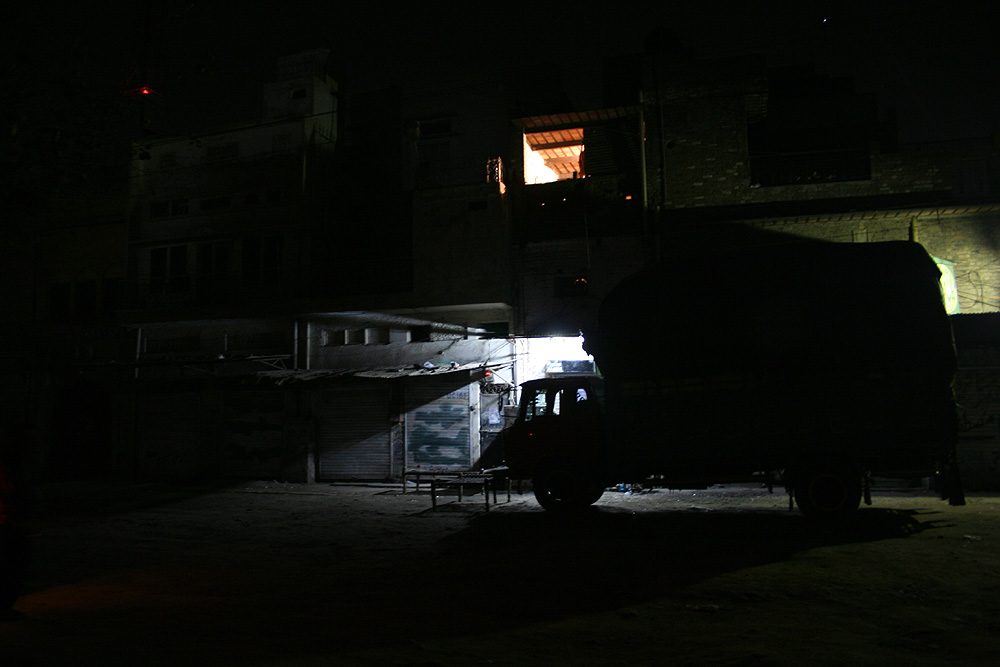
As we are on our way, Swati gets a call from Malik, who says that a French Television crew will also be there, and they have paid 50,000 Pakistani rupees to Mithu Saeen to see him perform. To avoid the possibility of him demanding money from NDTV, Malik has told him that we are students from the National College of Art in Lahore. This alarms us a bit, and we wonder if it is necessary. Then we reach Regale Internet Inn and meet Mithu Saeen.
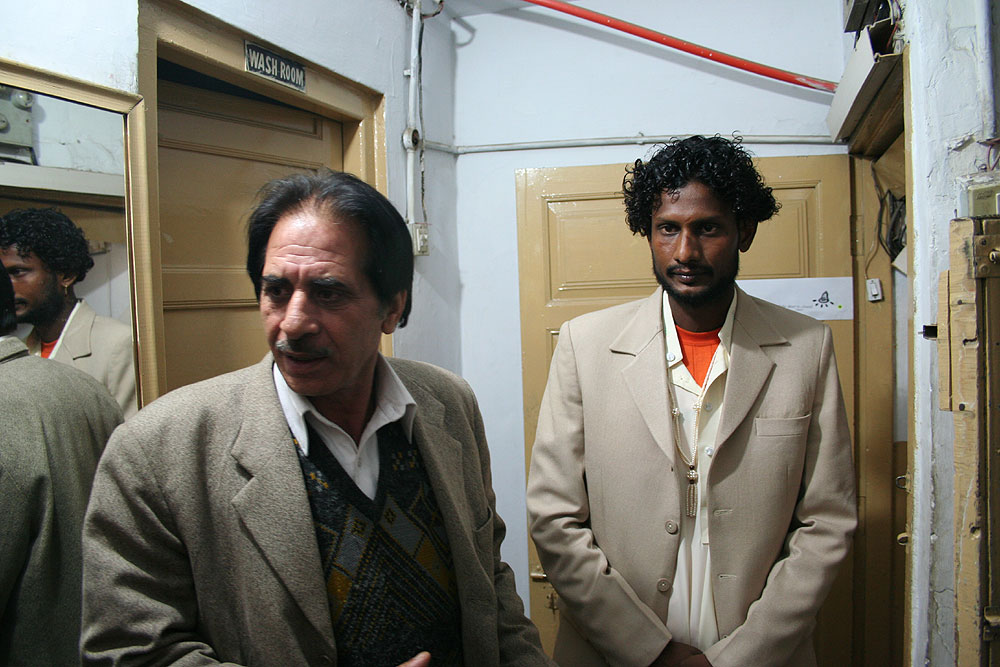
Mithu asks Malik gruffly if there is any money in this for him. Malik tells him that we’re just students. He looks at us suspiciously. Malik diverts his attention by asking him to show the money he’s been given by the French team. He takes out a bundle of dollars from his pocket. He looks at the money, and then at us. (My still camera isn't an issue, but as I'm with Swati and Furqan, I'm seen as part of the TV crew. In any case, I do want the guys to get their story.)
Malik hustles and bustles us out the door, and we drive down to the lane where the shrine is located.

Before the event, the dhol players and a few hangers on sit inside a smoky room by the road, as we wait outside. Swati contemplates the meaning of life while Furqan contemplates the camera.

Then we head inside the shrine, shoes in hand, jostling through a busy bunch of people. As the evening proceeds, I realise that the audience consists of essentially two kinds of people: some foreigners who are here for the exotica; and many localites who are here to dope and space out. We don’t dope, so you know which category we’re in.
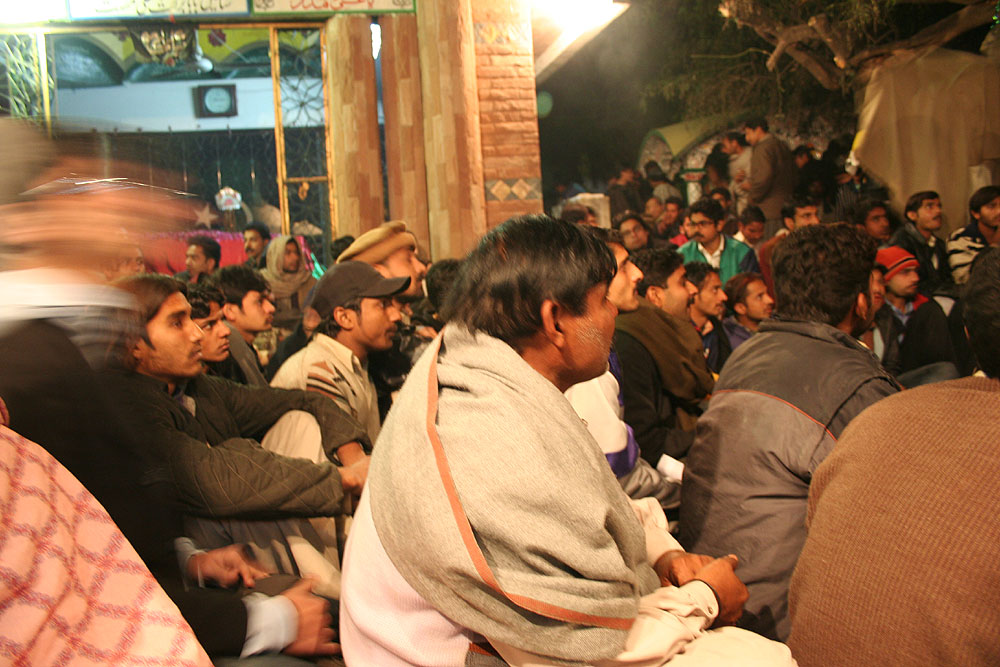

Goonga Saeen and Mithu Saeen then get going on their dhols. It’s percussion played at a furious pace, with a hypnotic rhythm to it that would numb the senses if you succumbed to it. They play incredibly well together, and Goonga seems quite at ease, while Mithu often seems to be hard at work, concentrating intently. They’re perfectly in synch all through, though, and this is probably dhol heaven for those who have a taste for the stuff. (I don’t think I do, I must confess.)
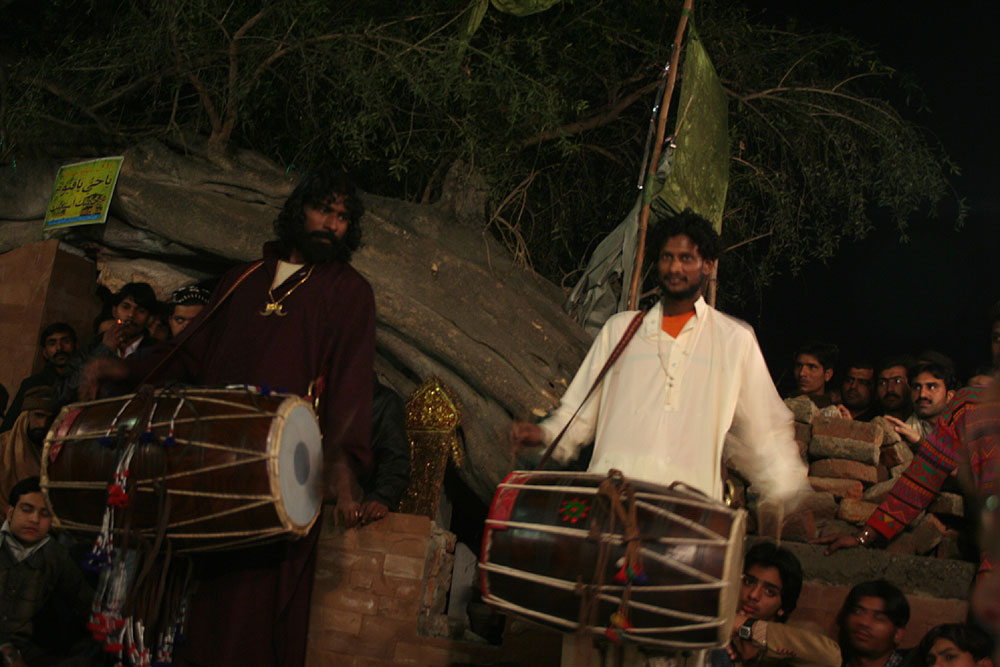

After an hour or so of frenetic dholing, the crowd at the front moves back, and dervishes take the floor. The place is abuzz now, and people are already lighting up.

The dervishes now begin to whirl madly, round and round and round and round, without stopping. They spin and shake and shiver, they whirl and vibrate, they fill the place with so much mad energy that I feel dizzy myself, even though I’m sitting on the ground.

Don’t imagine that NDTV is doing nothing. Furqan is also spinning madly in his own way, taking shots of this and that and everything else.
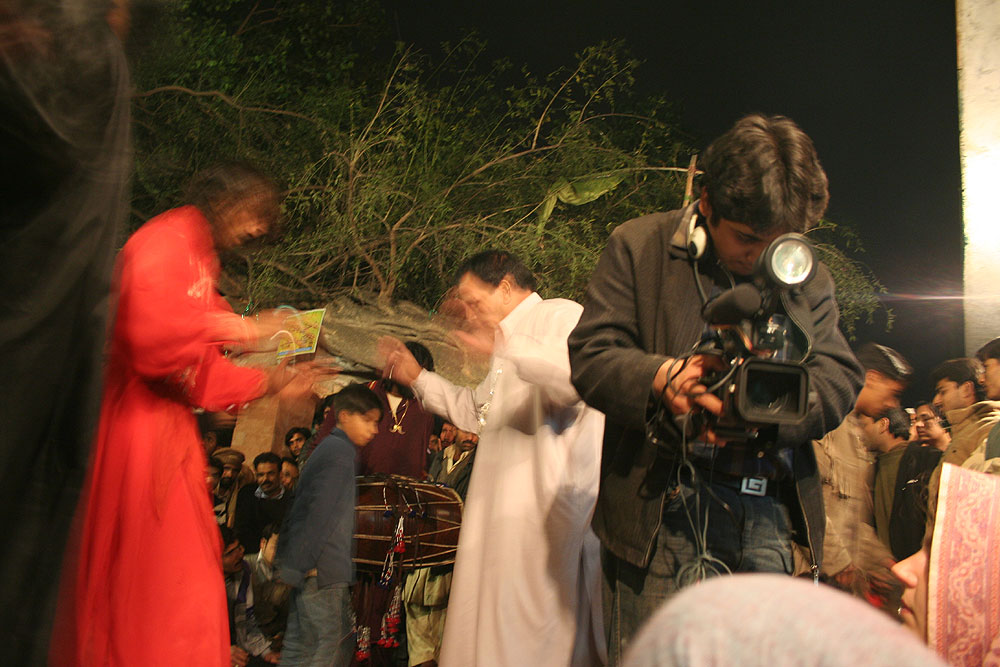
Later, when we’ve had enough, we take Malik out on the road for some soundbytes.

I take photographs, and the one below is an apt one when you consider that the location is just outside a Sufi shrine. I’d set exposure to the levels of the street, but Malik had a camera light trained on his face, and it made him look as if he was an otherworldly body of light. Such fun.

As Malik is finishing giving his bytes, I hang around at the other side of the street. A couple of chaps then come and stand menacingly from either side of me. “Are you from India?” asks one of them.
I’m suddenly a bit worried, given the crowd that hangs around here, and the way these guys are looking at me. “Er, yes, I say.”
“And are you Muslim?” asks the chap, a touch of menace in his voice. I’m suddenly, for the only time on this delightful trip and just for a few seconds, terrified. “Yes,” I reply. He asks me my name. I reply:
“Arif Khan.”
Badar Ali Khan
This post is about the second part of an afternoon of qawwali music at the shrine of Data Ganj Bakhsh Hajveri, where I’d gone with friends from NDTV who were shooting a feature on it. The first part is here.
As I wander around the hall listening to the music, I get chatting with a gentleman named Badar Ali Khan, a qawwali singer with matinee idol looks. He invites me to chat with him and his troupe, and we sit down on the floor in a semi-circle. He orders tea for me.

Badar was, you could say if you like cliches, born to qawwali. His forefathers sang qawwali in Jalandhar, and his uncle, Arshad Ali Achhen Main, and his father, Ilyas Ali Khan, were both accomplished singers.
“I started learning qawwali when I was very young,” he tells me. “It is the first thing I remembered learning.” Earlier, while taking pictures, I’d seen another kid on stage who was probably going through that same process. Here:

“So why do you come here to perform?” I ask Badar.
“Well, firstly I meet all my friends and fellow artists,” he says. “Also, a lot of concert promoters and so on come here, and they sign up people they are impressed with.
“And the audience,” he continues, “they are mostly people who can’t afford to listen to qawwali music in their own homes, so they come here.”
“Have you made any recordings of your own?” I ask.
“Oh yes,” he says. “You can get them at the store outside. [I tried later and couldn’t.] I have also done fusion recording with a Japanese artist named Takuya.”
“Do you know what is so special about Badar saab?” says a member of his troupe. “Every song he sings is composed by him. He only sings his own songs.”
Badar nods proudly. “I have composed between 100 to 200 songs so far,” he says. But making a living still isn’t easy, so he also gives music lessons – how to play tabla, harmonium etc – to foreign students, most of them backpackers who stay with Malik.
“Now take my photo,” he says. I get into position with my camera, and he poses, as if he's singing. I take pictures for a couple of minutes, and he maintains the pose in most of them. At first I find it slightly funny, but then it just seems poignant: that he should feel the need to sell himself like this.

By the end of the conversation Swati has joined us. Her story acquires a focal point, and she asks Badar out to take some soundbytes. He agrees, we go out, and she chats with him as Furqan sets up his camera, to get a sense of what to speak to him about, and to put him at ease. When he speaks on camera, he is superbly articulate and confident. If he sings as well as he presents himself, we agree, he can be quite a star.


Badar is due to perform soon, so we wait around eagerly. Soon, he goes on stage, and Furqan gets into position.

Badar sings with a lot of energy, and his group is pretty good as well, and, of course, he sings his own compositions. I’m no expert in this kind of music, so I won’t comment on his singing, but the man certainly has stage presence.

Finally we’re done. Swati checks out the footage Furqan has shot, and likes what she sees. Or maybe the content smile on her face comes because she is thinking of food. None of us have had lunch, so off we go to get ourselves a meal. And to prepare for the Sufi night ahead. (Update: An account of that is here.)
Qawwali afternoon
Every Thursday afternoon, qawwali singers from around Pakistan gather at the shrine of Data Ganj Bakhsh Hajveri to perform. Nusrat Fateh Ali Khan has performed here, and it is said to be quite an experience. I hadn’t had the time to go here on my first Thursday in Lahore, and most of my fellow journalists would be in Faisalabad by the second Thursday – with the second Test starting on Saturday, then needed to be. But I decided to stay back.
Then I ran into Swati Maheshwari of NDTV, who was in Lahore to do features. She wanted to come along for the qawwali afternoon, and I decided it might be fun to do a photo-narrative of how a TV crew shoots such stories, while also, hopefully, getting enough material for my own stuff. (All pics here shot and uploaded with permission.) So I fixed a time with the gentleman who had so kindly agreed to be my guide for the day: Mr Malik of the Regale Internet Inn. (Do note that Malik never asked for money and we never offered. His generosity for us flowed naturally, and we didn’t want to cheapen our gratitude for this fine man.)

After we arrived, he told Swati, “young lady, you need to wear a shalwar-kameez at the shrine. But no problem. Come with me.”
He took us upstairs to a room by the terrace in which there were many shelves full of the stuff. He started pulling dresses out, saying, “Take any one you want, they’re all new.” Swati said she’d rather change at home. (Eventually Malik said it would be okay if she just covered her head and came.)

Print journalists like to complain about how poorly paid they are, and TV journalists often complain about how hard they have to work. (Bloggers work hard and aren’t paid at all.) I’ve spent five years in television, though not in news, so it wasn’t a surprise to me to see that as I chilled in the car, Swati was already hard at work, checking her equipment – much of which was misbehaving – and briefing our cameraman, a friendly Lahoreite named Furqan. She had to make sure that she got all the shots she needed for her piece -- establishing shots, background shots, soundbytes, etc. All day, she'd be constructing the narrative inside her head. (Bad phrasing -- where else would construct it, in her liver?) Furqan leaped out of the car when we arrived, set up equipment, and started taking shots of the exterior, of Malik and gang – he had some foreign backpackers with him – entering the shrine, and so on.


The performances took place in a large, clean hall in the basement of the shrine. There was lots of space when we entered, but it filled up later as the afternoon went on. As in rock concerts, the best-known artists play last. Swati and Furqan set up their equipment, and Furqan spent the next hour or so shooting the performances, and the crowd, from lots of different vantage points. From all this footage, you are likely to see just a few seconds when the piece finally airs.


The sound system these guys were using was awful, but some of the performances were pretty good. You might imagine from listening to Nusrat that each qawwali troupe will have one main singer plus chorus, but all the groups I heard that day had two or three main vocalists. The dynamics within each group were fascinating: if one guy had energy and fire in his singing, another had a soothing voice – they would harmonise, play off each other, and move into impassioned choruses. The interplays were fascinating – and so was the way these chaps interacted with the audience.


The presence of TV cameras do strange things to people. One chap, when he saw Furqan shooting the singers, went in front of the stage and started performing for him. We must get get this guy to a cricket match, I thought to myself.


In an afternoon of two halves, this was the first half. And then we met Badar Ali Khan. More about that in the next post. (Update: this post.)
If your biological clock is ticking…
Missed
Ah, to think I missed this yesterday. Such sadness. The artist is a friend, but more to the point, the curator is the loved one, and two other shows curated by her this month have also been missed by this heartless blogger. Oh woe. Immense sighs emerge.
And I also missed this, thus no doubt saddening another friend. Such is Pakistan.
Saturday, January 21, 2006
A walk at night
After meeting Mr Malik, Mario and I went for a walk through Lahore, aiming to end up at one of the Food Streets. (One is at Goval Mandi, the other near Anarkali Bazaar.) As we left the lane in which Regale Internet Inn is located, we spotted the stall from which our appetite-spoiling shawarmas had been ordered.

So where would we go? We asked a nearby stallkeeper, and he suggested that we go to the food street near Anarkali Bazaar, and gave us directions. His stall was rather high, and I’m sure all his customers look up to him.

As we walked towards Anarkali Market, I was once again taken aback by how beautifully Lahore is lit at night. Its lighting gives it such grandeur and grace, and I could spend hours just walking through Lahore at night, enjoying the feeling of being in a beautiful urban setting. How rare is that?

Finally we reached the food street. We were too full to eat, so we just gazed at the food with longing hearts but sated stomachs. There was a lot more on offer than just food, by and by, and a greater variety of food avialable than I'd expected. Satisfaction came, vicariously.


Later, as we headed for home, our autorickshaw broke down near a MacDonald’s outlet, and we decided to have a quick coffee there. As we looked at the menu, I spotted an ad with a Pakistani Cyrus Oshidar lookalike. Hmm.

(Clink on pics to enlarge.)
The Lonely Planet legend
When I was reading up about Lahore, one of the many books I bought – yes, yes, shame on me – was Lonely Planet's guide to Pakistan. It spoke effusively of a gentleman named Malik, who runs an inn called The Regale Internet Inn. It was reputedly the best place in the city to go to for backpackers – Malik later tells me himself that it is the only one – and the gentleman reportedly takes you to the qawaali afternoons and Sufi nights I will blog about, with pictures, later.
Well, on getting to Lahore I found that a friend and fellow journalist, Mario Rodrigues of the Statesman, also had the same desire to meet him. So we figured we’d go together. I called up Mr Malik and fixed up a meeting. (This was more than a week ago.) We had a little bit of trouble finding his place, fending off the non-desire to eat in an AFC outlet, or to run into the Regal Theatre to watch a decidedly Bipasha Basu-less Jism.


Eventually we found the place, and climbed up a long flight of stairs, to be greeted effusively by Mr Malik, whose full name, we now discovered, was Malik Karamat Shams. He took us into his room, sat us down, and insisted on ordering Shawarmas for us. He struck us instantly as an inherently pleasant man, not someone being nice to us just because we were journalists. (I’ve met plenty of that kind.) Then he started talking to us about himself and how the Regale Internet Inn came to be.

Malik was the owner and editor of a progressive newspaper called Inquilab, a role he had inherited, but which he was eventually to give away. The internet was to blame, you could say.
Sometime in the mid-90s, he got a computer with an internet connection. He got it for his kids, but he soon spotted an opportunity. “The only internet connection in those days was at the British Council,” he says, “and I decided to start an internet café. If they were charging 100 rupees and hour, I decided I would charge 80. Ha ha ha.”
He soon found himself with a problem, though: the demand far outweighed the supply, as he had only one internet connection, on one computer, and many customers clamouring for his time.
Then a friend told him about networking. “He said that you can have ten computers, and only one connection. Can you believe it? So I went to my friends in the university and asked them about it, and they said, yes, it is possible. So I told them, if it is possible, then do it janaab. So they did it janaab!”
As Malik mused on life before networking, Mario allegedly started doodling. Here’s a picture.

Malik then decided that this was a business in the making, and he decided to start an internet café. Regal Cinema was nearby, and ‘Regal’ somehow, rather aptly, became ‘Regale” after he borrowed it. But he didn’t want to call it an “Internet café.” “If I put ‘café’ on the name,” he said, “people would think, there is tea available. They would come and harrass us and ask for tea. So I wanted to avoid that impression.”
Then a friend suggested that he use the word “Inn.” “I was very happy with it,” said Malik. “None of of my customers knew what it meant, and they would just see the word ‘internet’ and come.”
The “inn” part of the name soon began to cause him a little embarrasment. The office of Inquilab was still run from that building, and Malik says, “I would be sitting in my editor’s office interviewing an important personality, and these people would come and ask, is there a place to stay? Then one day Mr Brad came.”
‘Mr Brad’ was a tourist whose full name Malik does not remember, but he requested Malik that he be allowed to stay there. Malik put a prayer mat in the editor’s office, and allowed Mr Brad to stay there. There’s a picture on the wall of Malik and Mr Brad together. They look happy.

“Mr Brad stayed for a long time,” says Malik. “He made a series of documentary films, on the Pakistan film industry, on Sufi music in Pakistan society, on prostitutes.”
All these subjects interest me, and I ask Malik if he has copies of these documentaries anywhere. He laughs.
“I haven’t it seen it myself, janaab,” he says. “Even if Mr Brad wanted to send me those CDs, he wouldn’t be able to. The government does not allow us to receive CDs from abroad.”
As the days went by, more and more people came to stay, backpackers who had heard of the place through word of mouth. “It was embarrassing,” he said. “He opened up the terrace to them, allowing guests to sleep there after 9 pm as long as they left before 9 am. Eventually, Inquilab was shifted elsewhere, and all the rooms Malik had became guestrooms for backpackers: some of them dormitories, with four beds in a room. The terrace became a rite of passage for a while: if you wanted to stay in the Regale Internet Inn, you had to spend your first night on the terrace.
It wasn’t only backpackers Malik is known amongst, though. He is a big name among the musicians and artists of Pakistan. “I used to be a film journalist,” he tells me. “I became very friendly with all the struggling artists of the time. They are superstars now, but they still care for me. I can call them here, and they come and perform for me.”
Malik now got a phone call, perhaps from one of these artists, and as he spoke on the phone, Mario, shawarma in hand, allegedly started conducting a symphony playing in his head. Here’s a picture.

Malik spoke to us about so much else that it would be impossible to detail it all here. He had once been Benazir Bhutto’s press secretary, and he spoke of how her husband’s family took such advantage of her power. “Zardari’s family had never seen power,” he told me. “They became drunk on power. Hukumat ke jhooley par pehli baar baitthey.”
He spoke about cricket. “The British Empire introduced cricket in their colonies to depoliticise society,” he told us. And then he added mysteriously, “I don’t follow cricket any more. I know the result of every game before it starts.” I ask him what will happen in this series. “Oh, we have suffered because of the earthquake,” he says, “and you will give us reason for consolation.”
The bit I am rather charmed by is when he speaks about how society is changing, and how television is responsible for it. “Pakistan society used to be much more male-dominated,” he says. “But now women are being liberated. It is all because of Star Plus.”
“Ah!” I say. “How is that?”
“You see,” he says, “there was a time – and I am nostalgic about it now – when I would go home and get my roti on time. But now I go home and my wife is watching Star Plus. I ask her for my roti, and she says, ‘drama ke baad.’ I wait, and wait, but until 10.30 I don’t get my roti. Sometimes she will get up in the breaks, do a bit of work in the kitchen, then run back when her drama starts again.”
“So is this a bad thing or a good thing?” I ask.
“Ha ha ha,” he replies. “It is a good thing for her.” But he smiles, and I sense that he is happy that she is happy. Roti can wait.
Then, like the scoundrel journalist I am, I ask, “Can you tell us which serials she likes to watch?”
“Ha ha,” he says. “Janaab, I don’t know the names.”
“Can you call up and ask please?” I say.
He bursts out laughing, and calls his wife, a wide smile on his face.

As he questions her, she becomes either shy or suspicious, and refuses to divulge the names. This amuses him further. “Tell me for which dramas you make me wait for my roti,” he booms, his eyes twinkling.

And then, to stop the teasing, she gives him one name. Kasauti Zindagi Ki. Malik laughs, and the room is filled with happiness, and love.
Janaab-e-Aloo
During a pleasant conversation I was having with a Pakistani friend I'd newly made, he leaned forward called me, "Janaab-e-Ali!"
Needing to react appropriately, and not knowing fancy Urdu phrases, I recited back the first one that came to mind. "Huzoor-e-Ala!" I fancily declaimed.
And then it struck me, that had both of us been talking to Inzamam-ul-Haq, we would have called him...
Ok, ok, back to work now. Sorry.
Daewoo, Faisalabad
Much has been done in Lahore over the last few days, and I've constantly been faced with the choice of either collecting material for pieces/posts or writing them. With the limited time I've had, I've chosen to just soak up the experiences, and leave the writing for later. In fact, to be precise, for Faisalabad. This is supposed to be a rather dull town, and while other journos gather in the evenings to smoke and drink (water, of course, in case authorities are reading), I shall sit in my room, alone like a hermit, and write and post.
So there'll be stuff on qawwali afternoons and Sufi nights and dope and backpackers and whirling dervishes in the most happening city in South Asia, Lahore. Pictures as well, many of which I spent hours yesterday selecting and resizing. I shall begin posting all that soon, but for now, as an interim measure, here are some pictures from yesterday. Do note that if you're booking your ticket by phone, you should spell your name out. Else...


Thursday, January 19, 2006
Names
Quiz question: in which city would you find the following places: Laxmi Chowk, Ferozpur Road, Dhaniram Road, Charing Cross, The Mall, Bharat Nagar, Ram Gali, Lord Saab Ka Daftar?
Answer: Lahore. Many of these places were actually renamed by the Pakistan government -- Bharat Nagar became Pakistan Nagar, for example -- but none of the changes worked, and they are still referred to by their old names by the people of Lahore, which is how they like them. This is a city, I've noted, that prides itself on its culture and its history, and religion isn't as big a deal as its made out to be. This is just one illustration, of course, and I'm sure counter-illustrations can be found. But this is what struck me.
It was Murtaza Razvi, who I've also quoted here and here, who brought this to my attention.
Indian Muslims, Pakistani Muslims
One of the people I met while researching my WSJ op-ed on Pakistan was Murtaza Razvi, the resident editor of the Dawn in Lahore. I had a long, enlightening chat with him, and one bit in particular struck me. So here it is:
You know, people in India seem to have the impression that Pakistan is like Afghanistan. They assume that we are similar to the Muslims that exist in India's ghettoes. Well, no such ghettoes exist in Pakistan.
Before the 1992 World Cup, I remember I was in Nizamuddin [in Delhi], and these Muslims told us, "Ek bechaara musalman hai jo hindustan ke liye khelta hai, baaki sab tho Hindu hai, tho team kaise jeet sakti hai*."
We were so shocked, we were like, "Where are these people coming from? What a bunch of losers!" These Indian Muslims confine themselves to their ghettoes, on the periphery of society, hung up on ideas and aspirations sold to them by their leaders.
I have heard some Muslims say in India that they don't buy milk from Hindus because "woh tho usme sooar ki doodh mila denge**." It's ridiculous. Their leaders have misled them, have made them [feel like] victims. What hope do you have with a mullah being your leader?
Lest Murtaza's point be misconstrued, let me add that the point he is making is not that there are no fundamentalists in Pakistan, but that by and large the people of Pakistan are nothing like how they are perceived by some Indians, and certainly nothing like these ghettoised Muslims in India that he speaks of. (He doesn't imply that all Muslims in India are like that, but merely refers to the ones that are.) I've only been in Lahore for a couple of weeks, but I buy his point entirely. I am so blown away by how liberal and secular and tolerant the people of this city are, contrary to my expectations, and what a happening place it is.
A longer piece follows within a few days on Lahore, so more then.
* Translation: "There's is one poor Muslim [Mohammad Azharuddin] who plays for India, the rest are all Hindus. So how can the team win?" Note that in the original quote, the term "Hindustan" was used.
** Translation: "They will mix pig's milk in it."
Anti-Americanism in India and Pakistan
One more nugget from Ejaz Haider (also quoted here):
There is a difference between the anti-Americanism of India and Pakistan. Anti-Americanism in Pakistan is emotion-based, honour-based, and does not have an intellectual origin. In India, it is ideological.
I'm not sure I agree with him on the second part of that observation, as he is basing it on the Left parties, which have power in India disproportionate to their influence. Most common Indians don't share their ideology and intellectual reasoning. That does not mean that anti-Americanism in India is necessarily all "emotion-based," but it generally doesn't stem from the dogma of the Left.
Also, though it's fashionable (and great fun) to ridicule George Bush, there is much less anti-Americanism in India than in Pakistan. But that's a different matter entirely.
The general's dilemma
One of the people I met while researching my WSJ op-ed on Pakistan was Ejaz Haider, a noted columnist and the news editor of the Friday Times. We had a long, enlightening chat, and while I learned much from it, I was disappointed that I could use just half a quote in my piece. So here's an interesting snippet from our chat, about how it might have been necessary for General Pervez Musharraf to undermine Pakistan's institutions, and why his not rebuilding them is "Musharraf's biggest failure":
It is a paradoxical situation. When you’re a one-man show, when you want to effect a top-down approach to reform the system, you might need to undermine institutions that slow down that process of reform. But at some point, to be able to sustain the system you build, you need to strengthen the institutions again, to relinquish some of the authority you usurped. But by relinquishing authority, you risk other actors stepping into the power vacuums that result, and they could be a threat to you.
Ejaz offered many more fascinating insights about Pakistani politics during our chat, which would have merited a full interview on its own, but I was caught up in a flurry of work and simply had no time to work on it as an individual story. Some other time.
Left bhi, right bhi
I'm spread out madly across the spectrum. After reporting on the Lahore Test for the Guardian, I'm in the Wall Street Journal today, with an op-ed on Pakistan: "Musharraf's strong position." (It's a subscription link, and I don't have the final copy they used, so will upload the piece later here.)
Left bhi, Right bhi: as one might say in Lahore, "Janaab, humaare wide-wide baahein hain."
Wednesday, January 18, 2006
Early morning
I went out with a couple of friends two nights ago, and fun was had. We drank Pakistani beer and then went to the Pearl Continental Hotel, where the Indian team is staying, to pee -- the place was full of security guards, even in the loo, but not all were awake. Then we went to the famous shrine of Data Ganj Bakhsh Hajveri, hung around inside and outside it for a while, and bought some Pakistani CDs and VCDs outside. Here are some pics, click to enlarge. (Much more has been done since, more blogging will follow later, got to rush now.)


Monday, January 16, 2006
Blogger v Journalist
Yes, yes, I know my blogging frequency has dipped alarmingly during this trip, and there's a reason for that. I've been meeting interesting people and going to fascinating places, but all as research for feature stories. So I haven't been blogging about them to avoid having to write up the same stuff twice, which I simply don't have the time to do. I would have blogged those pictures as well, but am saving them for when those features appear (or are rejected) and I do blog about it. The interests of the blogger in me are colliding with those of the journalist in me, and the journalist pays the bills: I'm paying my own expenses on this trip, so every little bit of freelance work I do is important.
But all of that will be blogged eventually, and the pictures will be almost certainly exclusive to the blog. So there you go. Wait it out. Sorry!
In the meantime, three quick pics to leave you with: the first of how my workspace looks in the press box of the Gaddafi Stadium, the second of a terrace where the TV crews wait for play to resume under overcast skies, and the third of an intriguing headline-less newspaper clipping my Kipling-loving neighbour kindly pointed me to.


Update: A couple of other pics below: a police observation post just besides the press box, and a shot of the stands just besides it, which are rather, well, sparsely populated.

Sunday, January 15, 2006
Honey, orange, stocks
My neighbour in the press box, who is a Kipling fan, though that's not relevant here, kindly points my attention to these fine headlines in Pakistan's Daily Times:
"Pakistan now self-reliant in Honey"
"China allows import of Pakistani orange"
The first of those is alongside one that says:
"Thai stocks expected to rise"
So, you see, good news all around.
Pics from the Gaddafi Stadium
Yes, yes, I know, blogging has been infrequent, and I haven't been my usual voraciously bloggacious self, but I promise you better in the days to come. Until then, here are some pictures from the Gaddafi Stadium in Lahore. The first is of the main gate of the stadium as seen while entering it. The second is a view from the steps leading to the press enclosure, as a photographer sets himself up for a shot. The next three are from a press conference held by Sharad Pawar and Shaharyar Khan, and the final one is of journalists filing their stories from the press box at the end of day. Click on the pics to enlarge and, um, more later.


Saturday, January 14, 2006
IndiBlog of the Year
That's India Uncut! Thanks to all of you who voted for me. After an immensely stressful day at the press box in the Gaddafi Stadium, it made my day to return to my guesthouse and find that so many people think me deserving of this honour. Oops, music's started, got to wind up the speech now. Er, thank you again!
And congratulations to all the winners in the other categories: Prem and gang, Selva, the Desi Pundit gang, Shivam, Megha, Meenakshi, Nilesh, Guru, Sashi, Kanndave Nitya, Kalesh's World, Marathi Sahitya, Mugamoodi and Amazing Telugus. And special hugs to Jai and Sonia, two close buddies, whose wins in their respective categories makes me as happy almost as happy as my own win. Sonia's just had a book out, and after waiting for the launch for so many months, I'm a bit bummed to be here in Pakistan when it's happening.
And thanks to Debashish, who did such a wonderful job of organising the awards.
Rashomon
I had fun listening in to what people in the press box were speculating when the heated discussion between Sourav Ganguly and Rahul Dravid was taking place yesterday.
The Sourav-bashers said: "Oh, Rahul wants him to open and Ganguly is throwing a fit because he's scared of facing Shoaib Akhtar with the new ball."
The Sourav-lovers said: "Oh, Dravid has volunteered to open the batting himself for the sake of the team, and Sourav is fighting with him because he wants to open and show the world what he's made of."
As the second version shows everyone in a better light, I found myself rooting for it. And although I've long felt that Ganguly's time is up, oh, wouldn't a 70-ball century against Shoaib and Sami be so thrilling? Who can read the leaves?
Of course, the possibility remains that they were arguing about something else entirely.
"New Anarkali Market is better than Old Anarkali Market!"
"Is not!"
"Is!"
"Is not!"
Update: Turns out they were arguing about the opening position, but not in the ways earlier speculated. Ganguly was upset because he was apparently told only on the morning of the match that he would have to open, and he said that he should have been told about it and given time to prepare. Dravid then apparently offered to open himself. And so on.
Friday, January 13, 2006
The press box
I won't be able to blog from the press box during the first Test at Lahore, as I had done during Pakistan's tour of India last year (archived here and here), because I am giving radio updates for BBC constantly through the day, and that requires me to be always on the ball. So, with apologies for the reduced frequency of posting, I leave you with a picture of the press box at the Gaddafi Stadium. (Click on the pic to enlarge.)
Thursday, January 12, 2006
"Grass root is our original future"
Rahul Bhattacharya had written about it in "Pundits in Pakistan," his superb account of India's last tour to Pakistan, and I finally got to see it yesterday on the way to an afternoon nets session of the Indian team: the signboard for the Abdul Qadir International Cricket Academy. Here it is, below. Click on it to enlarge, there are priceless slogans there.

India's nets were at Pakistan's National Cricket Academy, which is next to the Gaddafi Stadium, where the Test match will be held. Oddly, it's ISO 9001 certified, as the sign below says. Whatever does that mean in the context of a cricket academy?

Inside, the Indians practised while journalists sat around and watched them.

Journalists often try to pick up cues about selection and personal relationships from what happens at the nets. If two people are contending for a spot in the side, which of them has a longer bat in the nets? Is X talking to Y? What are Y and Z laughing about there? Much guesswork happens, and as players speak a lot to journalists they like off the record, a lot of it is informed guesswork.

Photographers stand around, alert for good pictures. One superb photo-op came when Sourav Ganguly gave Rahul Dravid slip-catching practice.

Photographers immediately gathered at the angle from which they could capture both men.

Not all players got such media attention, though, and some were left in peace.

As players walked back one by one after finishing their practice, a journalist or two would accost them or walk besides them for the few seconds they could. There is tremendous competition for stories and quotes, and often a journalist will ask the cricketer three quick questions on this walk, the cricketer will give rushed answers, and the journalist will construct a quick story out of it, "exclusive" to whichever publication he or she works for.

Sometimes a player stops and gives a few bytes to a TV Channel. All the print journalists also gather around then, eager to pick up the stray quote, and keen not to miss anything. Sachin Tendulkar and Dravid complied yesterday, and were admirably calm and polite, though they would surely have much rather gone and rested after their workouts.

Wednesday, January 11, 2006
Goval Mandi
I have a busy day ahead, with not much time to blog, so here are some pictures I took three nights ago at Goval Mandi, Lahore's famous Food Street. Being a fan of the Minara Masjid food areas off Mohammad Ali Road in Mumbai, as well as some of the joints on Bohri Mohalla near there, I had been keen to visit Goval Mandi. This was the real deal, I was told, the Mumbai places flourish mainly during Ramzan, but this is open all year, and it rocks.
Well, I liked the place but was disappointed with the food, perhaps because my expectations were astronomically high. I intend to go again and see if I just picked the wrong things from the wrong place. The street itself is wider than the Minara Masjid road, well lit up, and above the sparkling shops at the side there are colourful, bright verandas, and we wondered at one point if they were inhabited, for no heads were seen peeping through, looking out at all the meat down below.
Anyway, here are the pics (click on them to enlarge), a longer piece will follow sometime later on food in Lahore. (Note: we went to Goval Mandi between 10 and 11 pm, which is why the street appears relatively empty. I am told it fills up after midnight.)


Dictaphones and spellcheck
One of the things that surprises me on cricket tours is that some journalists are so reliant on their dictaphones. I was reminded of this at the Indian team's press conference yesterday when all the Indian cricketers lined up in a bunch, and many journos were bewildered by how they would capture the quotes. "We only have one dicta each," said one of them, "and so many cricketers who will speak, all spread out. What do we do now?"

Now, as a rule, I never use a dictaphone. I prefer taking down notes, and have realised that the mind is much sharper when there is no dicta (if I may now call it that) to rely on, listening intently to every word, on the alert for nuance, remembering much more later. When people use a dicta, they switch it on and switch themselves off. Of course, you can leave both the dicta and yourself on, but whenever I've done that, even if I'm listening, I'm not listening so hard, I automatically ease up a bit. As Sambit Bal, who edits Cricinfo, once told me, "If you don't remember it, it's not worth remembering." The absence of a dicta also helps you sift out the banal, and focus on what matters.
Lest you get the wrong impression, I'm a huge fan of technology as an enabling tool, that helps us do drudge-work much faster, and aids us in areas where we could not do without it. But only to the extent that it complements and enhances what we do, and not when it causes us to switch off our mental faculties. Another example of this: I work in Microsoft Word but don't use spellcheck. This stops me from getting careless with my writing, though it does mean that when I'm in a hurry, as I often am on tour, spellos and typos creep into my copy. I think my readers are fairly understanding about it, and many often correct me -- Jai has corrected my spelling of 'wierd' 'weird' twice, in fact. That means I know how to spell that word now. If I used spellcheck, I'd never learn, even if the mistakes did not appear on my blog.
Gotta rsh now, ta.
Tuesday, January 10, 2006
Media interaction
Today was one day on India's tour of Pakistan that was supposed to belong to the media. The Indian team management announced that there would be "a media interaction" today. What generally happens at these is that players sit around the room in separate groups of two or three, and journalists wander around asking questions to whoever they feel like. Most journalists come prepared with particular questions for particular players, with story ideas in mind.
But on landing up at the venue, we discovered that what had been organised was just a big press conference, with all the players slated to be sitting side by side, as the journalists asked questions, one by one, to whoever they felt like. This meant that everyone would have all the answers, and no one would get any exclusive quotes, or be able to compile quotes for specific story ideas.

Needless to say, the journalists were pissed, and some spiritedly spoke of a walkout for taking the press for granted. But they stayed, and waited, as the players arrived. As they sat, the photographers milled around in front, taking pictures.

Well, we all know the price of fame, but the first time this happens to a player it must feel damn odd. You come, you sit, and then for two minutes people are just taking pictures of you. What expression do you make? You can't smile for the cameras, that would be cheesy. In fact, you're worried about appearing too conscious -- even though at first you certainly are -- so you chat with the fellow besides you, or just look down and appear preoccupied, or look around the room casually. If you're an old pro, it must begin to grate after a while.

I sat in the front row with my camera, and I found it fascinating to watch the players all through the PC, seeing their changing expressions. Consider the picture below, for example: doesn't the expression of each man tell you something about his general state of mind?

At one point, Raj Singh Dungarpur, the team's manager, got Wasim Jaffer's attention and pushed his glass towards him. He wanted Jaffer to pour water into it. Jaffer politely obliged.

And below, check out the expressions on the faces of some of the Indian team and their coach as Sourav Ganguly answers a routine question about how it feels to not be the captain of the side.

Later, Rahul Dravid is asked a question about Ganguly, and all the cameras, as Dravid answers, are pointed not at him but towards Ganguly, sitting in a corner. (The question was whether Ganguly was in contention to play in the first Test. Dravid diplomatically said that everyone in the squad was in contention. Rubbish!)

Many of the journalists, peeved at the way the event was organised, refused to ask questions. That led to some uneasy silences.

After the print media was disposed off, it was the turn of the electoric media. As each TV channel had just one or two mikes, and not the 13 or 14 required to cover the breadth of the room, the players spoke to them in groups of two or three. Why not us?

(Click on pictures to enlarge. All pics posted on this blog during this trip are by me, unless otherwise attributed.)
Polarising India
Here's a piece by me in the Guardian about Sourav Ganguly.
I've also been contracted by BBC Radio to provide regular updates through the first Test, at least, and have been doing updates from here since Sunday as well. Writing those quick little scripts for myself reminded me of my days as a TV scriptwriter in the 1990s, when I spent five years in MTV and Channel [V]. When you write for such mediums, you have to imagine the person you're writing for saying those words, and write only what sounds natural coming from them. So I wrote a short script for myself, then read it aloud, and then went chop, chop, chop, excising whatever sounded odd, changing bits here and there. It was interesting, and I think this process may well help me spot weaknesses in my writing that I would have been too lazy to discover otherwise. And, of course, fun will come.
I've been very busy the last two days meeting people and working on stories, and today will be another such day. But it will all lead to posts. Watch this space.
Monday, January 09, 2006
Votey daali, janaab?
As January 10 is the last date of voting, this is your last chance to vote for me for IndiBlog of the Year in this year's IndiBloggies. You only need to have a valid email address to vote, so do go forth and express your appreciation of the hard work I put into this blog, just for you. Unless you don't appreciate it, in which case, sigh, I'll try harder this year!
You could also nominate me for the 2006 Bloggies if you really want to be nice to me.
Meherbani!
I'm off to get my cholestrol count even higher now. I shall return to blogging after adequate consumption of protien.
Cooco's
When one travels, and writes, it is hard to keep one's balance. At home, in our cities, we walk around enclosed in the cocoons of our own world. But in a foreign land we look for significance, for beauty, for exotica, in every little thing we see. Every dustbin appears picture-worthy, street signs demand posterity, and buildings, windows, awnings, the way people dress and talk, even stray dogs appear remarkable. This is not a bad thing, of course: we view things in a fresh way while the locals are perhaps jaded, taking their cities for granted. But it leads, in too many cases, to a false glorification of the ordinary, to exaggeration, to creations of parallel cities that exist only in the mind.
I had decided when I came to Lahore that I would guard against this in my own writing. But how can one not be overwhelmed by Cooco's. Cooco's is a restaurant in Heera Mandi, Lahore's red-light area, to which a Lahori friend took four of us yesterday, and it is a place of which I've read a fair bit, and had wanted to visit. Cooco's is owned by Iqbal Hussain, a painter whose mother was a nautch girl, like others in his family. He grew up in Heera Mandi, and might well have ended up in the underworld had he not discovered painting. Starting out in 1971, Hussain began painting the people he had grown up with: the prostitutes and thugs of Heera Mandi. His work wasn't easily accepted in Pakistan, where his choice of subjects did not find approval.
I intend to meet up with Mr Hussain soon -- he was out of town today -- and I shall write more about his work and Heera Mandi later. For now, let me just write about the restuarant. Cooco's is located in a haveli where the restaurant is at a couple of levels on the rooftop, which one reaches by climbing a long and winding staircase. The kitchen is on the streetside below, though, as shown in the first picture below. Cooco's waiters stand at the edge of the terrace above them and use a pulley-system to lift food up (that's what the guys in the foreground of picture 4 are doing). And the setting is remarkable: the Lahore Fort is just besides Cooco's, magnificently lit up, as if announcing to the skies that this is the center of the earth. And the Badshahi Mosque inside, with its green domes, is quite as aweinspiring as religious monuments are ideally meant to be.
It isn't just the exterior but the interior which is breathtaking. Downstairs, there are paintings by Hussain all over, of the chisselled faces of the women of Heera Mandi with deep sad eyes and a dignity in their bearing. Upstairs, there are statues of Ganpati and Mother Mary, among others. The walls, the tiles, the furniture, everything evokes the magic of an era as if it is still alive and flourishing. So do the Jagjit Singh ghazals that are playing, though my local friend notes sadly that Mehdi Hassan would have been more appropriate.
The food is astoundingly good, but my words would not do justice to it, so here are some pictures (click on them to enlarge):


Moving music
In the hotel where I have been staying, and which I am checking out of soon to move to a guesthouse, there is just one place where music plays: the lift. So as I wait for the lift, I hear music getting sometimes louder, sometimes softer, and can make out from the sound how far it is from me. It's fine music, by and by: the Goo Goo Dolls and David Bowie and Coldplay and so on. But one can't keep going up and down in the lift, and one has to, at some point, say goodbye to the music. The lift moves away, and the music grows softer and softer, and then there is silence.
Sunday, January 08, 2006
Through the looking glass
I'd written earlier about how autorickshaws in Lahore are surprisingly tiny and cramped. Well, here's a picture of two journalist-friends sitting with me inside one. I was rather pleased with how I captured the faces of all the other three people in the auto through the mirrors there.
Somebody else's family
I stand at the start of the food street at Goval Mandi in Lahore and take a photograph, and suddenly this guard comes in front of me and demands that I not click pictures. I ask him why, and throw in a "janaab" because it sounds so cultured and suchlike. He says that I might accidently click a picture of someone else's family.
I understand where he's coming from, and it triggers off thoughts about a completely different context: the internet. Except for wide-angle, panoramic shots, or crowd pictures, I don't intend to post photos online without the consent of the people in the pictures. But there are thousands, maybe tens of thousands, maybe millions of personal pics of people posted online, often with the consent of their subjects, and these are frequently used in ways the subject and photographer would perhaps not approve of. I recently discovered one blog, for example, that just draws pictures of pretty Indian girls from Flickr as posts on itself. So you could take a picture of a friend chilling out at a party in a sleeveless t-shirt, post it on Flickr with her consent, and then some chap could just post the pic on his blog for people to lech at. To my knowledge, there are loads of such blogs which aggregate from Flickr. The issues involved here go beyond photo copyright and suchlike. Worrying, and I suspect the answer lies in technology itself.
(A longer post on Goval Mandi follows at a future date, after more trips there.)
See no evil, hear no evil, speak no evil
Dead chickens can't do any of those things. (Click on pic to enlarge.)

(Picture taken at Lahore's famous food street in Goval Mandi. A staunch non-vegetarian all my life, I had turned vegetarian a couple of years ago, but shifted back after a year. I've felt occasional pangs of guilt since, but have found it too hard to give up eating meat again. My reasons for turning veg, very broadly, had nothing to do with animal rights, which is a meaningless term, and much to do with animal suffering. We disassociate what the animals go through from the meal on our table, as if the chicken we eat and the chicken that dies in agony are two separate chickens. At least I do, or many of my meals would not be palatable. And there is a dishonesty there that bothered me. So I turned vegetarian. And for various reasons -- perhaps I shall elaborate on this some other time, but my own weakness is surely the main one -- I reverted.
By and by, much fuss was once made of Greg Chappell being vegan. I was impressed when I first heard that, it takes a bit of commitment. Then I read recently in an interview that he enjoys his fish when he goes to Kolkata. Hmmm.)
Trees watching games
Who would have thought an India-Pakistan series could start in such a tranquil environment? India's solitary tour game before the Test matches begin is against a Pakistan A team brimming with players on the verge of getting into, or getting back into, the Pakistan side. But if the players are tense, everyone else is chilled out. The venue has much to do with that.
Modern cricket is being played more and more in large concrete shells, but the romance of the game is evoked by open spaces, green grass, trees all around, the horizon a meeting of earth and sky, not cement and sky. Bagh-e-Jinnah in Lahore, where this game is played, is just such an old-styled venue. We reach the wrong gate in the morning, and find ourselves having to take a long walk through a park to get there, cops hanging around in considerable numbers, but not stopping us or asking questions, with some people jogging. (No lovers sitting together, alas.) Then we reach the ground itself, opposite a library that looks like a miniature version of the White House, get our press passes organised, and enter.
The ground is just a ground, nothing else. There are no stands. There are trees all along its perimeter, like silent spectators taking in the unnatural beauty of humans and their sport. People stand alongside the boundary and the trees, and watch. There's lots of green, much sky, and the press box, which is thankfully unboxlike, is also open-air, with the top covered by cloth, like a shamiana-kind-of-thing. The players are in a clubhouse on the side. All very nice and mid-20th-century.
Of course, the Test series begins not here but at the Gaddafi Stadium on the 13th. And that will be anything but tranquil.
(Click on pics below to enlarge. The first one is of photographers at the boundary, the second a view of long-off, with the press box right after the sightscreen and the clubhouse for the players just beyond.)

Saturday, January 07, 2006
Breadlike, after all
I always cringe when someone refers to rotis or parathas or naans as kinds of "breads," which doesn't come remotely close to conveying what they are to someone who knows what breads are, but not these. Well, my first dinner in Pakistan was brain masala, kababs and naan, and these naans, indeed, were rather breadline. Unlike typical Indian naans -- long and sensuously curvy -- these were perfectly round and rather thick, somewhat like a soft pizza base. In fact, it was more like bread than like the naans I know. Good stuff, if not quite what I expected.
I'm tempted to end this post with a conclusion unrelated to naans, but that would be a naan sequitur. So here's a pic (click on it to enlarge):

Update: History lover writes in to enlighten me that such breads are available in India as well. "Those breads are available in Delhi/UP at least and are called sheermals," he writes. "They are available in Muslim dhabas in Old Delhi."
And Peter writes in to say that he knows where to get them in Mumbai. Darn, why haven't I ever come across them?
Bright lights, big city
"It's a wonder that the men in Pakistan are so big and the autos are so small," remarked my friend and colleague Dileep Premachandran as we walked the streets of Lahore. Indeed, when three of later sat inside in an autorickshaw, we could barely sit properly, our heads almost hitting the roof, knees scrunched up, unable to move for fear of the last person to get in tumbling out. As Dileep wondered, how could the autos be so tiny in a land of Punjabis and Pathans?
And they are quick as well. One of the first things that struck me when we went for a walk on the streets of Lahore was how fast the traffic was. Crossing the road required adjusting that internal calculator that tells you when it is safe to walk across. You hesitate, move forward, scramble back, scamper across, getting used to the pace of the traffic. It's not just the cars here, but the autos that are frighteningly fast. This is also, of course, a land of fast bowlers.
The roads are conducive to this speed. Everywhere in Lahore we have seen wide, smooth roads -- with no garbage anywhere to be seen, unless we are in a self-deprecatory mood. Last night, when we got in, we were stunned by the lights of Lahore -- we saw glamorous shopping centres dressed in long lines of bright lights hanging down their length, all around them, like draperies. (I was later told that these were preparations for Id, which is on the 10th 11th.) It is a beautiful drive to our hotel, and although I had tried my best to come here with no preconceived notions of Lahore, I am surprised by how beautiful and modern this city looks.
This is just one tiny fragment of it all, of course: one road, one drive. One can't generalise about a city from one flicker of life in it: big cities, old cities, contain multitudes. I'll go out and see more tomorrow, I tell myself -- and then spend the next morning scrambling for my press pass, and then -- now -- blogging. The city awaits, and I'm off.
Update (January 10): I had written in this post that Id was on the 10th, as that is what a colleague had told me, but Dr Khalil Ahmad of the Alternate Solutions Institute informs me that it is on the 11th. The error is regretted.
Meeting Dr Ahmad, a classical liberal struggling to promote values of individual freedom in Pakistan, was one of the high points of my trip so far. I shall write more about it in a later post.
Vote for India Uncut
The Indibloggies polls are open for voting, and India Uncut has been nominated for IndiBlog of the year. If you read this blog regularly, please do go right over and vote for it: one works hard all year for no pay, just for the love of it, so come, give me some of that love back!
Here are my personal favourites in some of the categories:
IndiBlog of the year: [Ahem] India Uncut!
Best Humanities IndiBlog: The Middle Stage and Jabberwock
Best Sports IndiBlog: Sight Screen
Best IndiBlog directory/service/clique: Desi Pundit
Indiblog with the best tagline: Ceteris Paribus
Best Topical IndiBlog: The Indian Economy Blog and Sonia Faleiro. (Many excellent nominees in this category.)
Best new IndiBlog: Mercatus
IndiBloggies 2005 lifetime achiever: AnarCapLib and The Examined Life
Best Group Blog: Secular-Right India and Sepia Mutiny
Go forth and vote!
Friday, January 06, 2006
Onwards to Lahore
I'm off to Lahore later today, and I don't know how much time and internet access I'll have to blog there. But I'll try and keep writing about what I see and do. Filter blogging is almost certainly out for the next month, though I might do the occasional post with collected links. Let's see. I hope fun comes.
Just real estate
Mark Steyn, one of my favourite essayists, writes in the Wall Street Journal:
Most people reading this have strong stomachs, so let me lay it out as baldly as I can: Much of what we loosely call the Western world will not survive this century, and much of it will effectively disappear within our lifetimes, including many if not most Western European countries. There'll probably still be a geographical area on the map marked as Italy or the Netherlands--probably--just as in Istanbul there's still a building called St. Sophia's Cathedral. But it's not a cathedral; it's merely a designation for a piece of real estate. Likewise, Italy and the Netherlands will merely be designations for real estate.
Read the full thing. Even if you don't agree with parts of it, it's thought-provoking stuff.
Dumping on others
Pratap Bhanu Mehta writes in The Hoot:
[I]t could be argued that for the media and public culture in general bouts of self-righteousness are increasingly being used as a substitute for a moral life of discrimination. So long as we can find someone to dump upon, our moral task is complete; we are reassured of our own virtue. Discussions of public morality in India, especially among the middle classes are always amazing in one respect. Every such discussion is about all of us individually feeling superior to others: it is always others who are corrupt, others who are in the grip of the wrong morality, others who have shown bad taste, others who oppress other people. I have never understood how everyone could be so morally sanctimonious and yet society apparently not that moral. The only explanation is that we are interested in morality not for morality's sake but because it is an occasion for the assertion of self righteousness.
Heh. Know any bloggers like that?
(Link via email from Shivam.)
Big B and Big C
Amitabh Bachchan is being served a legal notice because he is shown smoking a cigar in an advertisement for a film. The complainants complained that Bachchan should have been smoking a beedi, which is an indigenous product, and not a "carcinogenic instrument" from another country.
Ok, ok, I made that second sentence up. But it's still ridiculous.
Thursday, January 05, 2006
Punctuation in Delhi
Delhi spoils my tongue. For most Delhi males, the most common bit of punctuation is "bhenchod." They can't say a sentence without "bhenchod" being part of it, sometimes more than once. Arre, lunch ka time ho gaya, bhenchod, they'll say. Bhenchod daaru mein dum hai, yaar, they'll inform you. Bhenchod kal flight ka kya time hai, bhenchod?
I wonder if they proposed to their loved ones like that. Abay bhenchod, shaadi karogi mujhse, they could ask. Aap bahut bhenchod sundar lag rahi ho.
And you know how habits form, I keep finding that word coming to my lips in the middle of a sentence, as if it's a comma or, if I'm trying to sound sophisticated, a semi-colon. Not good.
Update (January 6): Rahul Tyagi writes in:
I really wish you had avoided the sweeping generalization that you made in this post. "For most Delhi males" is the sort of line that people tend to use every once in a while without realizing how completely unfair they are being to a huge number of people. It is this attitude - and this habit of assuming that just because 50 out of 60 people of a particular class that you have seen, share a particular characteristic, then it can be used to draw a conclusion about the remaining members of the class even though they might number 50 lakhs - that leads to half of the problems that we face today. A Ganguly becomes just a Bengali, and every Bihari becomes a Lalu Yadav. [...]
You might think I'm overreacting on what was essentially a casual remark, but it is the casual nature in which such remarks get made that tells us how well all this is ingrained in out psyche.
Well, my post was made in a light vein, and I try and avoid generalisation in serious posts, but Rahul's point is well made. So if any Delhi-ites are offended, I bhenchod apologise.
Update 2 (Jan 6): Tanuj Suri writes in and quotes this excellent excerpt from Suketu Mehta's "Maximum City
":
I missed saying “bhenchod” to people who understood it. It does not mean “sister fucker.” That is too literal, too crude. It is, rather, punctuation, or emphasis, as innocuous a word as “shit” or “damn.” The different countries of India can be identified by the way each pronounces this word – from the Punjabi “bhaanchod” to the thin Bambaiyya “pinchud” to the Gujarati “bhenchow” to the Bhopali elaboration “bhen ka lowda.” Parsis use it all the time, grandmothers, five-year-olds, casually and without any discernable purpose except as filler: “Here, bhenchod, get me a glass of water.” “Arre, bhenchod, I went to the bhenchod bank today.” As a boy I would try consciously not to swear all day on the day of my birthday. I would take vows with the Jain kids: We will not use the B-word or the M-word.
Superbly put. Yet another on my list of books-I-should-have-read-by-now-but-will-read-in-2006. With about 4000 others. Sigh.
Viruses in washing machines?
Aadisht Khanna tears apart Chetan Bhagat's attempt at a book. And Ravikiran Rao adds his own two bits here:
It is Kaizad Gustad all over again. Write a mediocre first novel (or make a mediocre first movie). People go ga ga over it. You get encouraged, and your second work ends up as something so bad that people wonder what went wrong. I’ve said this before and I will say it again. Bad novelists (and film-makers) are not born. It is society that makes them this way. It is your toleration of mediocrity that makes them this way.
Tut-tut, itna gussa? I disagree with one point there. Bad novelists and film-makers are indeed born, and I have no issues with 'society' encouraging them. Everyone should read what they enjoy reading, and if they, heh, like Chetan Bhagat, or even Michael Moore or Deepak Chopra, fair enough. What goes of my father if people read authors I don't like, as long as I get to read what I want? Society pe mat daalo yaar, waisi koi cheez hai hi nahin, sab individuals hai, apni apni pasand hai.
The 2006 Bloggies are here
All year I toil for you, boil for you, post after post after manic post, all so that during your tea-break or coffee-break or toilet break you have something interesting to read. And all for free. Well, the 2006 Bloggies are here, and nominations are open. And, ahem, if you feel so inclined you could go and nominate me for whichever categories you feel I fit into.
The Indibloggies will also be open for voting soon, and I shall let you know when that time comes, and duly repeat this shameless spiel.
One way of getting rid of sewage
Wednesday, January 04, 2006
JAM takes on third-rate business school
Relax Arindam, take a chill pill: we're talking about Amity.
Reject maal, Booker maal
The Sunday Times reports:
They can’t judge a book without its cover. Publishers and agents have rejected two Booker prize-winning novels submitted as works by aspiring authors.
One of the books considered unworthy by the publishing industry was by VS Naipaul
, one of Britain’s greatest living writers, who won the Nobel prize for literature.
The exercise by The Sunday Times draws attention to concerns that the industry has become incapable of spotting genuine literary talent.
Typed manuscripts of the opening chapters of Naipaul’s In a Free State
and a second novel, Holiday
, by Stanley Middleton
, were sent to 20 publishers and agents. [...] Of the 21 replies, all but one were rejections. [Links inserted by me.]
I've always believed that if you write a good book, it'll find its way in the world somehow. Is that a naive perspective? I don't know. But I hope I find out someday.
(Link via email from Nikhil Pahwa.)
Welcome the baby
It's a rebirth, actually: Wisden Asia Cricket is reincarnated as Cricinfo Magazine. Immense fun. Do check out its homepage on the web, which contains a bunch of good stories, including Sambit Bal's editorial, a fine essay by Mukul Kesavan and a good feature on Rahul Dravid.
Mumbai autos, Delhi autos
In Mumbai, autowallahs go by the meter, and if you don't know the city you stand the risk of them going round and round, and you end up paying a bomb.
In Delhi, you negotiate a rate before you go, and if you don't know the city you stand the chance of being schmucked into paying a bomb.
Moral of the story: be a bomb.
Highway star
Yesterday, walking back to our guesthouse after an excellent lunch at the Andhra Bhavan, I passed a house that had a nameplate that said "TR Baalu," who I knew to be a minister-type thing. It was a languid afternoon, and on languid afternoons idle thoughts assail one. One such idle thought came to my mind: I wonder where Mr Baalu is now.
Well, now I know.
A very good evening to me
I had a memorable evening yesterday at Hurree Babu's place with Hurree and partner, as well as Jai and Chandrahas. "Hurree!" I remarked when I first set eyes on Hurree, and Hurree scurreed off.
Ok, I made that second sentence up. A good evening happened, as fine food was consumed, much stimulating conversation took place, and photos-that-will-not-be-blogged were snapped -- all in the passive voice. Hurree and partner are as hospitable as they are formidable, and I had to fight hard to refrain from asking for autographs. And to end this paragraph on an enigmatic note: there were cats.
Jai sat around saying funny things when he thought no one was listening, Chandrahas entertained us with his Russian-poet expressions, and even defended IWE by talking about Russian poets. My favourite Delhi journalist also dropped in for a while with wife. Zigzackly messaged, to add to the wild revelry. Hurree refused to give a speech, though, and at one point even offered me a book to eat, asking "Kitab khana?"
Er, sorry, that last sentence...
Ah, and I forgot one guest: fun came.
Tuesday, January 03, 2006
An oochie-coochie 2005
"Panda mania is not the only reason that 2005 proved an exceptionally cute year," says the New York Times.
All very well, but I'm sure you could find loads of cute things about every year. And you could also find loads of other qualities in 2005. But, what the hell, one's gotta fill the pages, so 'cute' can be the buzzword for now.
And just for a change, I wish you an utterly grotesque 2006.
The postman ain't going nowhere
I'm shacked up in Delhi with some friends at a guesthouse that is just off the road from Dak Bhavan. When my colleague and I first saw that noble building, we wondered aloud if post offices and snail mail would survive as the years went by and the internet became ubiquitous. Surely not, we snorted collectively and all-knowingly, as bloggers sometimes are prone to doing.
Well, in an excellent post titled "Letters, email, and man's love for paper," Shivaji Das writes that snail mail will survive because of a) corporates and b) man's affinity for paper. He makes some good pundits.
(I discovered Shivaji's blog via Saket.)
On getting personal
One of the things that most upsets me about the blogosphere is the tendency of people to get personal. I love it when people discuss issues, and there's disagreement and argument, and new points of view come out. But I hate it when suddenly, in the middle of these conversations, the focus shifts from the issues being discussed to the people discussing them.
It could happen with people attacking your motives. Or questioning your credentials. Or speculating on your parentage. Or just abusing you. In the time that I have been blogging, I have seen so many posts, so many comments, focussed on just attacking fellow bloggers or commenters.
It is actually an easy trap to fall into. Someone attacks your worldview, you take it personally, and get personal. Hell, I've made this mistake myself months ago in the comments of someone else's blog, and decided to never repeat it after that. And to address only issues that come up in a discussion, strands of thought, and to not get personal.
I've been at the receiving end of a lot of personal attacks recently. A lot of it has come from people who claim not to stand my blog, and to hate me personally, but who read my blog religiously, and remember details of posts I've written that I myself have forgotten. It raises the question, why do they read me so regularly if they hate my blog so much? Why don't they go get a life?
In fact, this world is full of both beautiful things that can make us happy, and bad things that irritate the hell out of us. To maximise enjoyment, it makes sense to focus just on the wonderful things and the wonderful people around you. Why look at the negatives? Concentrate on what makes you happy, and you'll be happy. No?
On logical fallacies
What is the role of logic in an argument? Well, let us take this example: Mintoo makes two statements:
1] Ministers are corrupt.
2] Therefore, free markets are bad.
Now, Chintoo pops up here, and feels that statement 2 does not necessarily follow from statement 1, and the "therefore" is misplaced. Perhaps Mintoo hasn't explained that thread of thought fully. So Chintoo asks for a clarification on that point, pointing out that statement 2 does not follow from statement 1: in other words, it's a non sequitur.
The best way for Mintoo to counter that statement is to show, in a series of logical steps, how statement 2 does follow from statement 1. Isn't it?
Pinky then pops in and says that if Chintoo supports free markets, then he must be in favour of private companies cheating people and committing fraud on a large scale. Chintoo, of course, believes no such thing. All free-market supporters, he points out, believe in the importance of the rule of law. What Pinky is doing, he feels, is creating a version of a free-market supporter that doesn't exist, but one that she can knock down easily to pretend she has won the argument. In other words, a straw man (or, in even simpler terms, a caricature). Chintoo says so.
The easiest way for Pinky to prove Chintoo wrong is to either a) show that free-market supporters do indeed support lawlessness or b) show that Chintoo misunderstood her, and to clarify what she meant to say. Isn't it?
Instead both Mintoo (accused of a non sequitur) and Pinky (accused of creating a straw man) turn on Chintoo and accuse him of using empty phrases (like 'non sequitur' and 'straw man' and 'caricature'), and they refuse to argue further on issues. Instead, the discussion degenerates into a discussion about Chintoo and his friends. The central point of the argument is lost.
It is like a human-rights activist calling Narendra Modi communal, and Modi, instead of proving that he is not communal, accuses the activists of using empty phrases like "communal". Suddenly, it is the activists under attack, as Modi turns all sanctimonious and suchlike. (And, of course, it provokes neutrals into thinking that Modi perhaps is communal, if he is shifting goalposts -- another empty phrase? -- in such a manner.)
That is why, if someone ever accuses you of committing a logical fallacy, the best course of action is to show that you haven't committed one. Non sequitur? Show how you reach statement B from statement A, and the person who made that accusation will be proved wrong. And the discussion will go forward in a productive manner. But if you then attack the person, and mock his pointing out logical fallacies, well, you've just demonstrated your inability to argue your point. Why do that?
This is a hypothetical example, of course. Heh.
Update: Also read this: "On getting personal."
Monday, January 02, 2006
Cool city, warm city
I was told Delhi would be terribly cold, and I came prepared to shiver and shudder and curse, curse, curse, as my bones crumbled and my blood stopped flowing. But to my delighted surprise, the weather here is fantastic, with just the kind of cool bracing breeze that one pines for in Mumbai but never gets. Terrific.
And there was warmth as well, in a bloggers' meet arranged by Shivam so that I could have the opportunity to meet some Delhi bloggers. I met some fine people -- I'll update this post later with names and links, as I might miss some now -- and had some stimulating conversations. So thank you Shivam, for this. Fun came.
Smaller, cheaper and talking to each other
Damon Darlin fills us in about "future gadgetry." He writes, "the biggest trend expected at the International Consumer Electronics Show, which begins this week in Las Vegas, is that these machines will be communicating with one another."
As long as they don't start fighting...
Celebration and hooliganism
The Guardian reports:
Thirty-five people were treated for stab wounds during New Year's Eve celebrations in London as the capital's ambulance service reported a "horrifying" spate of knife attacks and a record number of emergency calls.
[...]
"We are horrified that there have been so many stabbings on what is an evening of celebration for most people," said Russell Smith, deputy director of operations at the London Ambulance Service.
It's interesting, in fact, that occasions for celebration are so filled with hooliganism and violence. Holi and Ganpati are two festivals that, when celebrated as they are traditionally supposed to, are times of bonhomie and good cheer. But during both festivals in modern times, people drop their restraint in more ways than they are supposed to: in fact, Holi is virtually a time of socially sanctioned harrassment of women one doesn't know.
Of course, alcohol plays its part as well. What's celebration without a little booze? What good is a little booze? Ah, such a sexy babe/irritating fellow. Etc.
The RR Package
Sunday, January 01, 2006
Similarities and differences
America and France are quite alike, finds the Economist.
And Indian commies are rather different from Chinese ones, says Gurcharan Das.
On wanting
Do read this fine post and this fine essay by Don Boudreaux.
My New Year resolution...
... is not to blog when it's time for lunch.
Damn, broke it already.
As I wander around the hall listening to the music, I get chatting with a gentleman named Badar Ali Khan, a qawwali singer with matinee idol looks. He invites me to chat with him and his troupe, and we sit down on the floor in a semi-circle. He orders tea for me.

Badar was, you could say if you like cliches, born to qawwali. His forefathers sang qawwali in Jalandhar, and his uncle, Arshad Ali Achhen Main, and his father, Ilyas Ali Khan, were both accomplished singers.
“I started learning qawwali when I was very young,” he tells me. “It is the first thing I remembered learning.” Earlier, while taking pictures, I’d seen another kid on stage who was probably going through that same process. Here:

“So why do you come here to perform?” I ask Badar.
“Well, firstly I meet all my friends and fellow artists,” he says. “Also, a lot of concert promoters and so on come here, and they sign up people they are impressed with.
“And the audience,” he continues, “they are mostly people who can’t afford to listen to qawwali music in their own homes, so they come here.”
“Have you made any recordings of your own?” I ask.
“Oh yes,” he says. “You can get them at the store outside. [I tried later and couldn’t.] I have also done fusion recording with a Japanese artist named Takuya.”
“Do you know what is so special about Badar saab?” says a member of his troupe. “Every song he sings is composed by him. He only sings his own songs.”
Badar nods proudly. “I have composed between 100 to 200 songs so far,” he says. But making a living still isn’t easy, so he also gives music lessons – how to play tabla, harmonium etc – to foreign students, most of them backpackers who stay with Malik.
“Now take my photo,” he says. I get into position with my camera, and he poses, as if he's singing. I take pictures for a couple of minutes, and he maintains the pose in most of them. At first I find it slightly funny, but then it just seems poignant: that he should feel the need to sell himself like this.

By the end of the conversation Swati has joined us. Her story acquires a focal point, and she asks Badar out to take some soundbytes. He agrees, we go out, and she chats with him as Furqan sets up his camera, to get a sense of what to speak to him about, and to put him at ease. When he speaks on camera, he is superbly articulate and confident. If he sings as well as he presents himself, we agree, he can be quite a star.


Badar is due to perform soon, so we wait around eagerly. Soon, he goes on stage, and Furqan gets into position.

Badar sings with a lot of energy, and his group is pretty good as well, and, of course, he sings his own compositions. I’m no expert in this kind of music, so I won’t comment on his singing, but the man certainly has stage presence.

Finally we’re done. Swati checks out the footage Furqan has shot, and likes what she sees. Or maybe the content smile on her face comes because she is thinking of food. None of us have had lunch, so off we go to get ourselves a meal. And to prepare for the Sufi night ahead. (Update: An account of that is here.)
Every Thursday afternoon, qawwali singers from around Pakistan gather at the shrine of Data Ganj Bakhsh Hajveri to perform. Nusrat Fateh Ali Khan has performed here, and it is said to be quite an experience. I hadn’t had the time to go here on my first Thursday in Lahore, and most of my fellow journalists would be in Faisalabad by the second Thursday – with the second Test starting on Saturday, then needed to be. But I decided to stay back.
Then I ran into Swati Maheshwari of NDTV, who was in Lahore to do features. She wanted to come along for the qawwali afternoon, and I decided it might be fun to do a photo-narrative of how a TV crew shoots such stories, while also, hopefully, getting enough material for my own stuff. (All pics here shot and uploaded with permission.) So I fixed a time with the gentleman who had so kindly agreed to be my guide for the day: Mr Malik of the Regale Internet Inn. (Do note that Malik never asked for money and we never offered. His generosity for us flowed naturally, and we didn’t want to cheapen our gratitude for this fine man.)

After we arrived, he told Swati, “young lady, you need to wear a shalwar-kameez at the shrine. But no problem. Come with me.”
He took us upstairs to a room by the terrace in which there were many shelves full of the stuff. He started pulling dresses out, saying, “Take any one you want, they’re all new.” Swati said she’d rather change at home. (Eventually Malik said it would be okay if she just covered her head and came.)

Print journalists like to complain about how poorly paid they are, and TV journalists often complain about how hard they have to work. (Bloggers work hard and aren’t paid at all.) I’ve spent five years in television, though not in news, so it wasn’t a surprise to me to see that as I chilled in the car, Swati was already hard at work, checking her equipment – much of which was misbehaving – and briefing our cameraman, a friendly Lahoreite named Furqan. She had to make sure that she got all the shots she needed for her piece -- establishing shots, background shots, soundbytes, etc. All day, she'd be constructing the narrative inside her head. (Bad phrasing -- where else would construct it, in her liver?) Furqan leaped out of the car when we arrived, set up equipment, and started taking shots of the exterior, of Malik and gang – he had some foreign backpackers with him – entering the shrine, and so on.


The performances took place in a large, clean hall in the basement of the shrine. There was lots of space when we entered, but it filled up later as the afternoon went on. As in rock concerts, the best-known artists play last. Swati and Furqan set up their equipment, and Furqan spent the next hour or so shooting the performances, and the crowd, from lots of different vantage points. From all this footage, you are likely to see just a few seconds when the piece finally airs.


The sound system these guys were using was awful, but some of the performances were pretty good. You might imagine from listening to Nusrat that each qawwali troupe will have one main singer plus chorus, but all the groups I heard that day had two or three main vocalists. The dynamics within each group were fascinating: if one guy had energy and fire in his singing, another had a soothing voice – they would harmonise, play off each other, and move into impassioned choruses. The interplays were fascinating – and so was the way these chaps interacted with the audience.


The presence of TV cameras do strange things to people. One chap, when he saw Furqan shooting the singers, went in front of the stage and started performing for him. We must get get this guy to a cricket match, I thought to myself.


In an afternoon of two halves, this was the first half. And then we met Badar Ali Khan. More about that in the next post. (Update: this post.)
Then I ran into Swati Maheshwari of NDTV, who was in Lahore to do features. She wanted to come along for the qawwali afternoon, and I decided it might be fun to do a photo-narrative of how a TV crew shoots such stories, while also, hopefully, getting enough material for my own stuff. (All pics here shot and uploaded with permission.) So I fixed a time with the gentleman who had so kindly agreed to be my guide for the day: Mr Malik of the Regale Internet Inn. (Do note that Malik never asked for money and we never offered. His generosity for us flowed naturally, and we didn’t want to cheapen our gratitude for this fine man.)

After we arrived, he told Swati, “young lady, you need to wear a shalwar-kameez at the shrine. But no problem. Come with me.”
He took us upstairs to a room by the terrace in which there were many shelves full of the stuff. He started pulling dresses out, saying, “Take any one you want, they’re all new.” Swati said she’d rather change at home. (Eventually Malik said it would be okay if she just covered her head and came.)

Print journalists like to complain about how poorly paid they are, and TV journalists often complain about how hard they have to work. (Bloggers work hard and aren’t paid at all.) I’ve spent five years in television, though not in news, so it wasn’t a surprise to me to see that as I chilled in the car, Swati was already hard at work, checking her equipment – much of which was misbehaving – and briefing our cameraman, a friendly Lahoreite named Furqan. She had to make sure that she got all the shots she needed for her piece -- establishing shots, background shots, soundbytes, etc. All day, she'd be constructing the narrative inside her head. (Bad phrasing -- where else would construct it, in her liver?) Furqan leaped out of the car when we arrived, set up equipment, and started taking shots of the exterior, of Malik and gang – he had some foreign backpackers with him – entering the shrine, and so on.


The performances took place in a large, clean hall in the basement of the shrine. There was lots of space when we entered, but it filled up later as the afternoon went on. As in rock concerts, the best-known artists play last. Swati and Furqan set up their equipment, and Furqan spent the next hour or so shooting the performances, and the crowd, from lots of different vantage points. From all this footage, you are likely to see just a few seconds when the piece finally airs.


The sound system these guys were using was awful, but some of the performances were pretty good. You might imagine from listening to Nusrat that each qawwali troupe will have one main singer plus chorus, but all the groups I heard that day had two or three main vocalists. The dynamics within each group were fascinating: if one guy had energy and fire in his singing, another had a soothing voice – they would harmonise, play off each other, and move into impassioned choruses. The interplays were fascinating – and so was the way these chaps interacted with the audience.


The presence of TV cameras do strange things to people. One chap, when he saw Furqan shooting the singers, went in front of the stage and started performing for him. We must get get this guy to a cricket match, I thought to myself.


In an afternoon of two halves, this was the first half. And then we met Badar Ali Khan. More about that in the next post. (Update: this post.)
If your biological clock is ticking…
Missed
Ah, to think I missed this yesterday. Such sadness. The artist is a friend, but more to the point, the curator is the loved one, and two other shows curated by her this month have also been missed by this heartless blogger. Oh woe. Immense sighs emerge.
And I also missed this, thus no doubt saddening another friend. Such is Pakistan.
Saturday, January 21, 2006
A walk at night
After meeting Mr Malik, Mario and I went for a walk through Lahore, aiming to end up at one of the Food Streets. (One is at Goval Mandi, the other near Anarkali Bazaar.) As we left the lane in which Regale Internet Inn is located, we spotted the stall from which our appetite-spoiling shawarmas had been ordered.

So where would we go? We asked a nearby stallkeeper, and he suggested that we go to the food street near Anarkali Bazaar, and gave us directions. His stall was rather high, and I’m sure all his customers look up to him.

As we walked towards Anarkali Market, I was once again taken aback by how beautifully Lahore is lit at night. Its lighting gives it such grandeur and grace, and I could spend hours just walking through Lahore at night, enjoying the feeling of being in a beautiful urban setting. How rare is that?

Finally we reached the food street. We were too full to eat, so we just gazed at the food with longing hearts but sated stomachs. There was a lot more on offer than just food, by and by, and a greater variety of food avialable than I'd expected. Satisfaction came, vicariously.


Later, as we headed for home, our autorickshaw broke down near a MacDonald’s outlet, and we decided to have a quick coffee there. As we looked at the menu, I spotted an ad with a Pakistani Cyrus Oshidar lookalike. Hmm.

(Clink on pics to enlarge.)
The Lonely Planet legend
When I was reading up about Lahore, one of the many books I bought – yes, yes, shame on me – was Lonely Planet's guide to Pakistan. It spoke effusively of a gentleman named Malik, who runs an inn called The Regale Internet Inn. It was reputedly the best place in the city to go to for backpackers – Malik later tells me himself that it is the only one – and the gentleman reportedly takes you to the qawaali afternoons and Sufi nights I will blog about, with pictures, later.
Well, on getting to Lahore I found that a friend and fellow journalist, Mario Rodrigues of the Statesman, also had the same desire to meet him. So we figured we’d go together. I called up Mr Malik and fixed up a meeting. (This was more than a week ago.) We had a little bit of trouble finding his place, fending off the non-desire to eat in an AFC outlet, or to run into the Regal Theatre to watch a decidedly Bipasha Basu-less Jism.


Eventually we found the place, and climbed up a long flight of stairs, to be greeted effusively by Mr Malik, whose full name, we now discovered, was Malik Karamat Shams. He took us into his room, sat us down, and insisted on ordering Shawarmas for us. He struck us instantly as an inherently pleasant man, not someone being nice to us just because we were journalists. (I’ve met plenty of that kind.) Then he started talking to us about himself and how the Regale Internet Inn came to be.

Malik was the owner and editor of a progressive newspaper called Inquilab, a role he had inherited, but which he was eventually to give away. The internet was to blame, you could say.
Sometime in the mid-90s, he got a computer with an internet connection. He got it for his kids, but he soon spotted an opportunity. “The only internet connection in those days was at the British Council,” he says, “and I decided to start an internet café. If they were charging 100 rupees and hour, I decided I would charge 80. Ha ha ha.”
He soon found himself with a problem, though: the demand far outweighed the supply, as he had only one internet connection, on one computer, and many customers clamouring for his time.
Then a friend told him about networking. “He said that you can have ten computers, and only one connection. Can you believe it? So I went to my friends in the university and asked them about it, and they said, yes, it is possible. So I told them, if it is possible, then do it janaab. So they did it janaab!”
As Malik mused on life before networking, Mario allegedly started doodling. Here’s a picture.

Malik then decided that this was a business in the making, and he decided to start an internet café. Regal Cinema was nearby, and ‘Regal’ somehow, rather aptly, became ‘Regale” after he borrowed it. But he didn’t want to call it an “Internet café.” “If I put ‘café’ on the name,” he said, “people would think, there is tea available. They would come and harrass us and ask for tea. So I wanted to avoid that impression.”
Then a friend suggested that he use the word “Inn.” “I was very happy with it,” said Malik. “None of of my customers knew what it meant, and they would just see the word ‘internet’ and come.”
The “inn” part of the name soon began to cause him a little embarrasment. The office of Inquilab was still run from that building, and Malik says, “I would be sitting in my editor’s office interviewing an important personality, and these people would come and ask, is there a place to stay? Then one day Mr Brad came.”
‘Mr Brad’ was a tourist whose full name Malik does not remember, but he requested Malik that he be allowed to stay there. Malik put a prayer mat in the editor’s office, and allowed Mr Brad to stay there. There’s a picture on the wall of Malik and Mr Brad together. They look happy.

“Mr Brad stayed for a long time,” says Malik. “He made a series of documentary films, on the Pakistan film industry, on Sufi music in Pakistan society, on prostitutes.”
All these subjects interest me, and I ask Malik if he has copies of these documentaries anywhere. He laughs.
“I haven’t it seen it myself, janaab,” he says. “Even if Mr Brad wanted to send me those CDs, he wouldn’t be able to. The government does not allow us to receive CDs from abroad.”
As the days went by, more and more people came to stay, backpackers who had heard of the place through word of mouth. “It was embarrassing,” he said. “He opened up the terrace to them, allowing guests to sleep there after 9 pm as long as they left before 9 am. Eventually, Inquilab was shifted elsewhere, and all the rooms Malik had became guestrooms for backpackers: some of them dormitories, with four beds in a room. The terrace became a rite of passage for a while: if you wanted to stay in the Regale Internet Inn, you had to spend your first night on the terrace.
It wasn’t only backpackers Malik is known amongst, though. He is a big name among the musicians and artists of Pakistan. “I used to be a film journalist,” he tells me. “I became very friendly with all the struggling artists of the time. They are superstars now, but they still care for me. I can call them here, and they come and perform for me.”
Malik now got a phone call, perhaps from one of these artists, and as he spoke on the phone, Mario, shawarma in hand, allegedly started conducting a symphony playing in his head. Here’s a picture.

Malik spoke to us about so much else that it would be impossible to detail it all here. He had once been Benazir Bhutto’s press secretary, and he spoke of how her husband’s family took such advantage of her power. “Zardari’s family had never seen power,” he told me. “They became drunk on power. Hukumat ke jhooley par pehli baar baitthey.”
He spoke about cricket. “The British Empire introduced cricket in their colonies to depoliticise society,” he told us. And then he added mysteriously, “I don’t follow cricket any more. I know the result of every game before it starts.” I ask him what will happen in this series. “Oh, we have suffered because of the earthquake,” he says, “and you will give us reason for consolation.”
The bit I am rather charmed by is when he speaks about how society is changing, and how television is responsible for it. “Pakistan society used to be much more male-dominated,” he says. “But now women are being liberated. It is all because of Star Plus.”
“Ah!” I say. “How is that?”
“You see,” he says, “there was a time – and I am nostalgic about it now – when I would go home and get my roti on time. But now I go home and my wife is watching Star Plus. I ask her for my roti, and she says, ‘drama ke baad.’ I wait, and wait, but until 10.30 I don’t get my roti. Sometimes she will get up in the breaks, do a bit of work in the kitchen, then run back when her drama starts again.”
“So is this a bad thing or a good thing?” I ask.
“Ha ha ha,” he replies. “It is a good thing for her.” But he smiles, and I sense that he is happy that she is happy. Roti can wait.
Then, like the scoundrel journalist I am, I ask, “Can you tell us which serials she likes to watch?”
“Ha ha,” he says. “Janaab, I don’t know the names.”
“Can you call up and ask please?” I say.
He bursts out laughing, and calls his wife, a wide smile on his face.

As he questions her, she becomes either shy or suspicious, and refuses to divulge the names. This amuses him further. “Tell me for which dramas you make me wait for my roti,” he booms, his eyes twinkling.

And then, to stop the teasing, she gives him one name. Kasauti Zindagi Ki. Malik laughs, and the room is filled with happiness, and love.
Janaab-e-Aloo
During a pleasant conversation I was having with a Pakistani friend I'd newly made, he leaned forward called me, "Janaab-e-Ali!"
Needing to react appropriately, and not knowing fancy Urdu phrases, I recited back the first one that came to mind. "Huzoor-e-Ala!" I fancily declaimed.
And then it struck me, that had both of us been talking to Inzamam-ul-Haq, we would have called him...
Ok, ok, back to work now. Sorry.
Daewoo, Faisalabad
Much has been done in Lahore over the last few days, and I've constantly been faced with the choice of either collecting material for pieces/posts or writing them. With the limited time I've had, I've chosen to just soak up the experiences, and leave the writing for later. In fact, to be precise, for Faisalabad. This is supposed to be a rather dull town, and while other journos gather in the evenings to smoke and drink (water, of course, in case authorities are reading), I shall sit in my room, alone like a hermit, and write and post.
So there'll be stuff on qawwali afternoons and Sufi nights and dope and backpackers and whirling dervishes in the most happening city in South Asia, Lahore. Pictures as well, many of which I spent hours yesterday selecting and resizing. I shall begin posting all that soon, but for now, as an interim measure, here are some pictures from yesterday. Do note that if you're booking your ticket by phone, you should spell your name out. Else...


Thursday, January 19, 2006
Names
Quiz question: in which city would you find the following places: Laxmi Chowk, Ferozpur Road, Dhaniram Road, Charing Cross, The Mall, Bharat Nagar, Ram Gali, Lord Saab Ka Daftar?
Answer: Lahore. Many of these places were actually renamed by the Pakistan government -- Bharat Nagar became Pakistan Nagar, for example -- but none of the changes worked, and they are still referred to by their old names by the people of Lahore, which is how they like them. This is a city, I've noted, that prides itself on its culture and its history, and religion isn't as big a deal as its made out to be. This is just one illustration, of course, and I'm sure counter-illustrations can be found. But this is what struck me.
It was Murtaza Razvi, who I've also quoted here and here, who brought this to my attention.
Indian Muslims, Pakistani Muslims
One of the people I met while researching my WSJ op-ed on Pakistan was Murtaza Razvi, the resident editor of the Dawn in Lahore. I had a long, enlightening chat with him, and one bit in particular struck me. So here it is:
You know, people in India seem to have the impression that Pakistan is like Afghanistan. They assume that we are similar to the Muslims that exist in India's ghettoes. Well, no such ghettoes exist in Pakistan.
Before the 1992 World Cup, I remember I was in Nizamuddin [in Delhi], and these Muslims told us, "Ek bechaara musalman hai jo hindustan ke liye khelta hai, baaki sab tho Hindu hai, tho team kaise jeet sakti hai*."
We were so shocked, we were like, "Where are these people coming from? What a bunch of losers!" These Indian Muslims confine themselves to their ghettoes, on the periphery of society, hung up on ideas and aspirations sold to them by their leaders.
I have heard some Muslims say in India that they don't buy milk from Hindus because "woh tho usme sooar ki doodh mila denge**." It's ridiculous. Their leaders have misled them, have made them [feel like] victims. What hope do you have with a mullah being your leader?
Lest Murtaza's point be misconstrued, let me add that the point he is making is not that there are no fundamentalists in Pakistan, but that by and large the people of Pakistan are nothing like how they are perceived by some Indians, and certainly nothing like these ghettoised Muslims in India that he speaks of. (He doesn't imply that all Muslims in India are like that, but merely refers to the ones that are.) I've only been in Lahore for a couple of weeks, but I buy his point entirely. I am so blown away by how liberal and secular and tolerant the people of this city are, contrary to my expectations, and what a happening place it is.
A longer piece follows within a few days on Lahore, so more then.
* Translation: "There's is one poor Muslim [Mohammad Azharuddin] who plays for India, the rest are all Hindus. So how can the team win?" Note that in the original quote, the term "Hindustan" was used.
** Translation: "They will mix pig's milk in it."
Anti-Americanism in India and Pakistan
One more nugget from Ejaz Haider (also quoted here):
There is a difference between the anti-Americanism of India and Pakistan. Anti-Americanism in Pakistan is emotion-based, honour-based, and does not have an intellectual origin. In India, it is ideological.
I'm not sure I agree with him on the second part of that observation, as he is basing it on the Left parties, which have power in India disproportionate to their influence. Most common Indians don't share their ideology and intellectual reasoning. That does not mean that anti-Americanism in India is necessarily all "emotion-based," but it generally doesn't stem from the dogma of the Left.
Also, though it's fashionable (and great fun) to ridicule George Bush, there is much less anti-Americanism in India than in Pakistan. But that's a different matter entirely.
The general's dilemma
One of the people I met while researching my WSJ op-ed on Pakistan was Ejaz Haider, a noted columnist and the news editor of the Friday Times. We had a long, enlightening chat, and while I learned much from it, I was disappointed that I could use just half a quote in my piece. So here's an interesting snippet from our chat, about how it might have been necessary for General Pervez Musharraf to undermine Pakistan's institutions, and why his not rebuilding them is "Musharraf's biggest failure":
It is a paradoxical situation. When you’re a one-man show, when you want to effect a top-down approach to reform the system, you might need to undermine institutions that slow down that process of reform. But at some point, to be able to sustain the system you build, you need to strengthen the institutions again, to relinquish some of the authority you usurped. But by relinquishing authority, you risk other actors stepping into the power vacuums that result, and they could be a threat to you.
Ejaz offered many more fascinating insights about Pakistani politics during our chat, which would have merited a full interview on its own, but I was caught up in a flurry of work and simply had no time to work on it as an individual story. Some other time.
Left bhi, right bhi
I'm spread out madly across the spectrum. After reporting on the Lahore Test for the Guardian, I'm in the Wall Street Journal today, with an op-ed on Pakistan: "Musharraf's strong position." (It's a subscription link, and I don't have the final copy they used, so will upload the piece later here.)
Left bhi, Right bhi: as one might say in Lahore, "Janaab, humaare wide-wide baahein hain."
Wednesday, January 18, 2006
Early morning
I went out with a couple of friends two nights ago, and fun was had. We drank Pakistani beer and then went to the Pearl Continental Hotel, where the Indian team is staying, to pee -- the place was full of security guards, even in the loo, but not all were awake. Then we went to the famous shrine of Data Ganj Bakhsh Hajveri, hung around inside and outside it for a while, and bought some Pakistani CDs and VCDs outside. Here are some pics, click to enlarge. (Much more has been done since, more blogging will follow later, got to rush now.)


Monday, January 16, 2006
Blogger v Journalist
Yes, yes, I know my blogging frequency has dipped alarmingly during this trip, and there's a reason for that. I've been meeting interesting people and going to fascinating places, but all as research for feature stories. So I haven't been blogging about them to avoid having to write up the same stuff twice, which I simply don't have the time to do. I would have blogged those pictures as well, but am saving them for when those features appear (or are rejected) and I do blog about it. The interests of the blogger in me are colliding with those of the journalist in me, and the journalist pays the bills: I'm paying my own expenses on this trip, so every little bit of freelance work I do is important.
But all of that will be blogged eventually, and the pictures will be almost certainly exclusive to the blog. So there you go. Wait it out. Sorry!
In the meantime, three quick pics to leave you with: the first of how my workspace looks in the press box of the Gaddafi Stadium, the second of a terrace where the TV crews wait for play to resume under overcast skies, and the third of an intriguing headline-less newspaper clipping my Kipling-loving neighbour kindly pointed me to.


Update: A couple of other pics below: a police observation post just besides the press box, and a shot of the stands just besides it, which are rather, well, sparsely populated.

Sunday, January 15, 2006
Honey, orange, stocks
My neighbour in the press box, who is a Kipling fan, though that's not relevant here, kindly points my attention to these fine headlines in Pakistan's Daily Times:
"Pakistan now self-reliant in Honey"
"China allows import of Pakistani orange"
The first of those is alongside one that says:
"Thai stocks expected to rise"
So, you see, good news all around.
Pics from the Gaddafi Stadium
Yes, yes, I know, blogging has been infrequent, and I haven't been my usual voraciously bloggacious self, but I promise you better in the days to come. Until then, here are some pictures from the Gaddafi Stadium in Lahore. The first is of the main gate of the stadium as seen while entering it. The second is a view from the steps leading to the press enclosure, as a photographer sets himself up for a shot. The next three are from a press conference held by Sharad Pawar and Shaharyar Khan, and the final one is of journalists filing their stories from the press box at the end of day. Click on the pics to enlarge and, um, more later.


Saturday, January 14, 2006
IndiBlog of the Year
That's India Uncut! Thanks to all of you who voted for me. After an immensely stressful day at the press box in the Gaddafi Stadium, it made my day to return to my guesthouse and find that so many people think me deserving of this honour. Oops, music's started, got to wind up the speech now. Er, thank you again!
And congratulations to all the winners in the other categories: Prem and gang, Selva, the Desi Pundit gang, Shivam, Megha, Meenakshi, Nilesh, Guru, Sashi, Kanndave Nitya, Kalesh's World, Marathi Sahitya, Mugamoodi and Amazing Telugus. And special hugs to Jai and Sonia, two close buddies, whose wins in their respective categories makes me as happy almost as happy as my own win. Sonia's just had a book out, and after waiting for the launch for so many months, I'm a bit bummed to be here in Pakistan when it's happening.
And thanks to Debashish, who did such a wonderful job of organising the awards.
Rashomon
I had fun listening in to what people in the press box were speculating when the heated discussion between Sourav Ganguly and Rahul Dravid was taking place yesterday.
The Sourav-bashers said: "Oh, Rahul wants him to open and Ganguly is throwing a fit because he's scared of facing Shoaib Akhtar with the new ball."
The Sourav-lovers said: "Oh, Dravid has volunteered to open the batting himself for the sake of the team, and Sourav is fighting with him because he wants to open and show the world what he's made of."
As the second version shows everyone in a better light, I found myself rooting for it. And although I've long felt that Ganguly's time is up, oh, wouldn't a 70-ball century against Shoaib and Sami be so thrilling? Who can read the leaves?
Of course, the possibility remains that they were arguing about something else entirely.
"New Anarkali Market is better than Old Anarkali Market!"
"Is not!"
"Is!"
"Is not!"
Update: Turns out they were arguing about the opening position, but not in the ways earlier speculated. Ganguly was upset because he was apparently told only on the morning of the match that he would have to open, and he said that he should have been told about it and given time to prepare. Dravid then apparently offered to open himself. And so on.
Friday, January 13, 2006
The press box
I won't be able to blog from the press box during the first Test at Lahore, as I had done during Pakistan's tour of India last year (archived here and here), because I am giving radio updates for BBC constantly through the day, and that requires me to be always on the ball. So, with apologies for the reduced frequency of posting, I leave you with a picture of the press box at the Gaddafi Stadium. (Click on the pic to enlarge.)
Thursday, January 12, 2006
"Grass root is our original future"
Rahul Bhattacharya had written about it in "Pundits in Pakistan," his superb account of India's last tour to Pakistan, and I finally got to see it yesterday on the way to an afternoon nets session of the Indian team: the signboard for the Abdul Qadir International Cricket Academy. Here it is, below. Click on it to enlarge, there are priceless slogans there.

India's nets were at Pakistan's National Cricket Academy, which is next to the Gaddafi Stadium, where the Test match will be held. Oddly, it's ISO 9001 certified, as the sign below says. Whatever does that mean in the context of a cricket academy?

Inside, the Indians practised while journalists sat around and watched them.

Journalists often try to pick up cues about selection and personal relationships from what happens at the nets. If two people are contending for a spot in the side, which of them has a longer bat in the nets? Is X talking to Y? What are Y and Z laughing about there? Much guesswork happens, and as players speak a lot to journalists they like off the record, a lot of it is informed guesswork.

Photographers stand around, alert for good pictures. One superb photo-op came when Sourav Ganguly gave Rahul Dravid slip-catching practice.

Photographers immediately gathered at the angle from which they could capture both men.

Not all players got such media attention, though, and some were left in peace.

As players walked back one by one after finishing their practice, a journalist or two would accost them or walk besides them for the few seconds they could. There is tremendous competition for stories and quotes, and often a journalist will ask the cricketer three quick questions on this walk, the cricketer will give rushed answers, and the journalist will construct a quick story out of it, "exclusive" to whichever publication he or she works for.

Sometimes a player stops and gives a few bytes to a TV Channel. All the print journalists also gather around then, eager to pick up the stray quote, and keen not to miss anything. Sachin Tendulkar and Dravid complied yesterday, and were admirably calm and polite, though they would surely have much rather gone and rested after their workouts.

Wednesday, January 11, 2006
Goval Mandi
I have a busy day ahead, with not much time to blog, so here are some pictures I took three nights ago at Goval Mandi, Lahore's famous Food Street. Being a fan of the Minara Masjid food areas off Mohammad Ali Road in Mumbai, as well as some of the joints on Bohri Mohalla near there, I had been keen to visit Goval Mandi. This was the real deal, I was told, the Mumbai places flourish mainly during Ramzan, but this is open all year, and it rocks.
Well, I liked the place but was disappointed with the food, perhaps because my expectations were astronomically high. I intend to go again and see if I just picked the wrong things from the wrong place. The street itself is wider than the Minara Masjid road, well lit up, and above the sparkling shops at the side there are colourful, bright verandas, and we wondered at one point if they were inhabited, for no heads were seen peeping through, looking out at all the meat down below.
Anyway, here are the pics (click on them to enlarge), a longer piece will follow sometime later on food in Lahore. (Note: we went to Goval Mandi between 10 and 11 pm, which is why the street appears relatively empty. I am told it fills up after midnight.)


Dictaphones and spellcheck
One of the things that surprises me on cricket tours is that some journalists are so reliant on their dictaphones. I was reminded of this at the Indian team's press conference yesterday when all the Indian cricketers lined up in a bunch, and many journos were bewildered by how they would capture the quotes. "We only have one dicta each," said one of them, "and so many cricketers who will speak, all spread out. What do we do now?"

Now, as a rule, I never use a dictaphone. I prefer taking down notes, and have realised that the mind is much sharper when there is no dicta (if I may now call it that) to rely on, listening intently to every word, on the alert for nuance, remembering much more later. When people use a dicta, they switch it on and switch themselves off. Of course, you can leave both the dicta and yourself on, but whenever I've done that, even if I'm listening, I'm not listening so hard, I automatically ease up a bit. As Sambit Bal, who edits Cricinfo, once told me, "If you don't remember it, it's not worth remembering." The absence of a dicta also helps you sift out the banal, and focus on what matters.
Lest you get the wrong impression, I'm a huge fan of technology as an enabling tool, that helps us do drudge-work much faster, and aids us in areas where we could not do without it. But only to the extent that it complements and enhances what we do, and not when it causes us to switch off our mental faculties. Another example of this: I work in Microsoft Word but don't use spellcheck. This stops me from getting careless with my writing, though it does mean that when I'm in a hurry, as I often am on tour, spellos and typos creep into my copy. I think my readers are fairly understanding about it, and many often correct me -- Jai has corrected my spelling of 'wierd' 'weird' twice, in fact. That means I know how to spell that word now. If I used spellcheck, I'd never learn, even if the mistakes did not appear on my blog.
Gotta rsh now, ta.
Tuesday, January 10, 2006
Media interaction
Today was one day on India's tour of Pakistan that was supposed to belong to the media. The Indian team management announced that there would be "a media interaction" today. What generally happens at these is that players sit around the room in separate groups of two or three, and journalists wander around asking questions to whoever they feel like. Most journalists come prepared with particular questions for particular players, with story ideas in mind.
But on landing up at the venue, we discovered that what had been organised was just a big press conference, with all the players slated to be sitting side by side, as the journalists asked questions, one by one, to whoever they felt like. This meant that everyone would have all the answers, and no one would get any exclusive quotes, or be able to compile quotes for specific story ideas.

Needless to say, the journalists were pissed, and some spiritedly spoke of a walkout for taking the press for granted. But they stayed, and waited, as the players arrived. As they sat, the photographers milled around in front, taking pictures.

Well, we all know the price of fame, but the first time this happens to a player it must feel damn odd. You come, you sit, and then for two minutes people are just taking pictures of you. What expression do you make? You can't smile for the cameras, that would be cheesy. In fact, you're worried about appearing too conscious -- even though at first you certainly are -- so you chat with the fellow besides you, or just look down and appear preoccupied, or look around the room casually. If you're an old pro, it must begin to grate after a while.

I sat in the front row with my camera, and I found it fascinating to watch the players all through the PC, seeing their changing expressions. Consider the picture below, for example: doesn't the expression of each man tell you something about his general state of mind?

At one point, Raj Singh Dungarpur, the team's manager, got Wasim Jaffer's attention and pushed his glass towards him. He wanted Jaffer to pour water into it. Jaffer politely obliged.

And below, check out the expressions on the faces of some of the Indian team and their coach as Sourav Ganguly answers a routine question about how it feels to not be the captain of the side.

Later, Rahul Dravid is asked a question about Ganguly, and all the cameras, as Dravid answers, are pointed not at him but towards Ganguly, sitting in a corner. (The question was whether Ganguly was in contention to play in the first Test. Dravid diplomatically said that everyone in the squad was in contention. Rubbish!)

Many of the journalists, peeved at the way the event was organised, refused to ask questions. That led to some uneasy silences.

After the print media was disposed off, it was the turn of the electoric media. As each TV channel had just one or two mikes, and not the 13 or 14 required to cover the breadth of the room, the players spoke to them in groups of two or three. Why not us?

(Click on pictures to enlarge. All pics posted on this blog during this trip are by me, unless otherwise attributed.)
Polarising India
Here's a piece by me in the Guardian about Sourav Ganguly.
I've also been contracted by BBC Radio to provide regular updates through the first Test, at least, and have been doing updates from here since Sunday as well. Writing those quick little scripts for myself reminded me of my days as a TV scriptwriter in the 1990s, when I spent five years in MTV and Channel [V]. When you write for such mediums, you have to imagine the person you're writing for saying those words, and write only what sounds natural coming from them. So I wrote a short script for myself, then read it aloud, and then went chop, chop, chop, excising whatever sounded odd, changing bits here and there. It was interesting, and I think this process may well help me spot weaknesses in my writing that I would have been too lazy to discover otherwise. And, of course, fun will come.
I've been very busy the last two days meeting people and working on stories, and today will be another such day. But it will all lead to posts. Watch this space.
Monday, January 09, 2006
Votey daali, janaab?
As January 10 is the last date of voting, this is your last chance to vote for me for IndiBlog of the Year in this year's IndiBloggies. You only need to have a valid email address to vote, so do go forth and express your appreciation of the hard work I put into this blog, just for you. Unless you don't appreciate it, in which case, sigh, I'll try harder this year!
You could also nominate me for the 2006 Bloggies if you really want to be nice to me.
Meherbani!
I'm off to get my cholestrol count even higher now. I shall return to blogging after adequate consumption of protien.
Cooco's
When one travels, and writes, it is hard to keep one's balance. At home, in our cities, we walk around enclosed in the cocoons of our own world. But in a foreign land we look for significance, for beauty, for exotica, in every little thing we see. Every dustbin appears picture-worthy, street signs demand posterity, and buildings, windows, awnings, the way people dress and talk, even stray dogs appear remarkable. This is not a bad thing, of course: we view things in a fresh way while the locals are perhaps jaded, taking their cities for granted. But it leads, in too many cases, to a false glorification of the ordinary, to exaggeration, to creations of parallel cities that exist only in the mind.
I had decided when I came to Lahore that I would guard against this in my own writing. But how can one not be overwhelmed by Cooco's. Cooco's is a restaurant in Heera Mandi, Lahore's red-light area, to which a Lahori friend took four of us yesterday, and it is a place of which I've read a fair bit, and had wanted to visit. Cooco's is owned by Iqbal Hussain, a painter whose mother was a nautch girl, like others in his family. He grew up in Heera Mandi, and might well have ended up in the underworld had he not discovered painting. Starting out in 1971, Hussain began painting the people he had grown up with: the prostitutes and thugs of Heera Mandi. His work wasn't easily accepted in Pakistan, where his choice of subjects did not find approval.
I intend to meet up with Mr Hussain soon -- he was out of town today -- and I shall write more about his work and Heera Mandi later. For now, let me just write about the restuarant. Cooco's is located in a haveli where the restaurant is at a couple of levels on the rooftop, which one reaches by climbing a long and winding staircase. The kitchen is on the streetside below, though, as shown in the first picture below. Cooco's waiters stand at the edge of the terrace above them and use a pulley-system to lift food up (that's what the guys in the foreground of picture 4 are doing). And the setting is remarkable: the Lahore Fort is just besides Cooco's, magnificently lit up, as if announcing to the skies that this is the center of the earth. And the Badshahi Mosque inside, with its green domes, is quite as aweinspiring as religious monuments are ideally meant to be.
It isn't just the exterior but the interior which is breathtaking. Downstairs, there are paintings by Hussain all over, of the chisselled faces of the women of Heera Mandi with deep sad eyes and a dignity in their bearing. Upstairs, there are statues of Ganpati and Mother Mary, among others. The walls, the tiles, the furniture, everything evokes the magic of an era as if it is still alive and flourishing. So do the Jagjit Singh ghazals that are playing, though my local friend notes sadly that Mehdi Hassan would have been more appropriate.
The food is astoundingly good, but my words would not do justice to it, so here are some pictures (click on them to enlarge):


Moving music
In the hotel where I have been staying, and which I am checking out of soon to move to a guesthouse, there is just one place where music plays: the lift. So as I wait for the lift, I hear music getting sometimes louder, sometimes softer, and can make out from the sound how far it is from me. It's fine music, by and by: the Goo Goo Dolls and David Bowie and Coldplay and so on. But one can't keep going up and down in the lift, and one has to, at some point, say goodbye to the music. The lift moves away, and the music grows softer and softer, and then there is silence.
Sunday, January 08, 2006
Through the looking glass
I'd written earlier about how autorickshaws in Lahore are surprisingly tiny and cramped. Well, here's a picture of two journalist-friends sitting with me inside one. I was rather pleased with how I captured the faces of all the other three people in the auto through the mirrors there.
Somebody else's family
I stand at the start of the food street at Goval Mandi in Lahore and take a photograph, and suddenly this guard comes in front of me and demands that I not click pictures. I ask him why, and throw in a "janaab" because it sounds so cultured and suchlike. He says that I might accidently click a picture of someone else's family.
I understand where he's coming from, and it triggers off thoughts about a completely different context: the internet. Except for wide-angle, panoramic shots, or crowd pictures, I don't intend to post photos online without the consent of the people in the pictures. But there are thousands, maybe tens of thousands, maybe millions of personal pics of people posted online, often with the consent of their subjects, and these are frequently used in ways the subject and photographer would perhaps not approve of. I recently discovered one blog, for example, that just draws pictures of pretty Indian girls from Flickr as posts on itself. So you could take a picture of a friend chilling out at a party in a sleeveless t-shirt, post it on Flickr with her consent, and then some chap could just post the pic on his blog for people to lech at. To my knowledge, there are loads of such blogs which aggregate from Flickr. The issues involved here go beyond photo copyright and suchlike. Worrying, and I suspect the answer lies in technology itself.
(A longer post on Goval Mandi follows at a future date, after more trips there.)
See no evil, hear no evil, speak no evil
Dead chickens can't do any of those things. (Click on pic to enlarge.)

(Picture taken at Lahore's famous food street in Goval Mandi. A staunch non-vegetarian all my life, I had turned vegetarian a couple of years ago, but shifted back after a year. I've felt occasional pangs of guilt since, but have found it too hard to give up eating meat again. My reasons for turning veg, very broadly, had nothing to do with animal rights, which is a meaningless term, and much to do with animal suffering. We disassociate what the animals go through from the meal on our table, as if the chicken we eat and the chicken that dies in agony are two separate chickens. At least I do, or many of my meals would not be palatable. And there is a dishonesty there that bothered me. So I turned vegetarian. And for various reasons -- perhaps I shall elaborate on this some other time, but my own weakness is surely the main one -- I reverted.
By and by, much fuss was once made of Greg Chappell being vegan. I was impressed when I first heard that, it takes a bit of commitment. Then I read recently in an interview that he enjoys his fish when he goes to Kolkata. Hmmm.)
Trees watching games
Who would have thought an India-Pakistan series could start in such a tranquil environment? India's solitary tour game before the Test matches begin is against a Pakistan A team brimming with players on the verge of getting into, or getting back into, the Pakistan side. But if the players are tense, everyone else is chilled out. The venue has much to do with that.
Modern cricket is being played more and more in large concrete shells, but the romance of the game is evoked by open spaces, green grass, trees all around, the horizon a meeting of earth and sky, not cement and sky. Bagh-e-Jinnah in Lahore, where this game is played, is just such an old-styled venue. We reach the wrong gate in the morning, and find ourselves having to take a long walk through a park to get there, cops hanging around in considerable numbers, but not stopping us or asking questions, with some people jogging. (No lovers sitting together, alas.) Then we reach the ground itself, opposite a library that looks like a miniature version of the White House, get our press passes organised, and enter.
The ground is just a ground, nothing else. There are no stands. There are trees all along its perimeter, like silent spectators taking in the unnatural beauty of humans and their sport. People stand alongside the boundary and the trees, and watch. There's lots of green, much sky, and the press box, which is thankfully unboxlike, is also open-air, with the top covered by cloth, like a shamiana-kind-of-thing. The players are in a clubhouse on the side. All very nice and mid-20th-century.
Of course, the Test series begins not here but at the Gaddafi Stadium on the 13th. And that will be anything but tranquil.
(Click on pics below to enlarge. The first one is of photographers at the boundary, the second a view of long-off, with the press box right after the sightscreen and the clubhouse for the players just beyond.)

Saturday, January 07, 2006
Breadlike, after all
I always cringe when someone refers to rotis or parathas or naans as kinds of "breads," which doesn't come remotely close to conveying what they are to someone who knows what breads are, but not these. Well, my first dinner in Pakistan was brain masala, kababs and naan, and these naans, indeed, were rather breadline. Unlike typical Indian naans -- long and sensuously curvy -- these were perfectly round and rather thick, somewhat like a soft pizza base. In fact, it was more like bread than like the naans I know. Good stuff, if not quite what I expected.
I'm tempted to end this post with a conclusion unrelated to naans, but that would be a naan sequitur. So here's a pic (click on it to enlarge):

Update: History lover writes in to enlighten me that such breads are available in India as well. "Those breads are available in Delhi/UP at least and are called sheermals," he writes. "They are available in Muslim dhabas in Old Delhi."
And Peter writes in to say that he knows where to get them in Mumbai. Darn, why haven't I ever come across them?
Bright lights, big city
"It's a wonder that the men in Pakistan are so big and the autos are so small," remarked my friend and colleague Dileep Premachandran as we walked the streets of Lahore. Indeed, when three of later sat inside in an autorickshaw, we could barely sit properly, our heads almost hitting the roof, knees scrunched up, unable to move for fear of the last person to get in tumbling out. As Dileep wondered, how could the autos be so tiny in a land of Punjabis and Pathans?
And they are quick as well. One of the first things that struck me when we went for a walk on the streets of Lahore was how fast the traffic was. Crossing the road required adjusting that internal calculator that tells you when it is safe to walk across. You hesitate, move forward, scramble back, scamper across, getting used to the pace of the traffic. It's not just the cars here, but the autos that are frighteningly fast. This is also, of course, a land of fast bowlers.
The roads are conducive to this speed. Everywhere in Lahore we have seen wide, smooth roads -- with no garbage anywhere to be seen, unless we are in a self-deprecatory mood. Last night, when we got in, we were stunned by the lights of Lahore -- we saw glamorous shopping centres dressed in long lines of bright lights hanging down their length, all around them, like draperies. (I was later told that these were preparations for Id, which is on the 10th 11th.) It is a beautiful drive to our hotel, and although I had tried my best to come here with no preconceived notions of Lahore, I am surprised by how beautiful and modern this city looks.
This is just one tiny fragment of it all, of course: one road, one drive. One can't generalise about a city from one flicker of life in it: big cities, old cities, contain multitudes. I'll go out and see more tomorrow, I tell myself -- and then spend the next morning scrambling for my press pass, and then -- now -- blogging. The city awaits, and I'm off.
Update (January 10): I had written in this post that Id was on the 10th, as that is what a colleague had told me, but Dr Khalil Ahmad of the Alternate Solutions Institute informs me that it is on the 11th. The error is regretted.
Meeting Dr Ahmad, a classical liberal struggling to promote values of individual freedom in Pakistan, was one of the high points of my trip so far. I shall write more about it in a later post.
Vote for India Uncut
The Indibloggies polls are open for voting, and India Uncut has been nominated for IndiBlog of the year. If you read this blog regularly, please do go right over and vote for it: one works hard all year for no pay, just for the love of it, so come, give me some of that love back!
Here are my personal favourites in some of the categories:
IndiBlog of the year: [Ahem] India Uncut!
Best Humanities IndiBlog: The Middle Stage and Jabberwock
Best Sports IndiBlog: Sight Screen
Best IndiBlog directory/service/clique: Desi Pundit
Indiblog with the best tagline: Ceteris Paribus
Best Topical IndiBlog: The Indian Economy Blog and Sonia Faleiro. (Many excellent nominees in this category.)
Best new IndiBlog: Mercatus
IndiBloggies 2005 lifetime achiever: AnarCapLib and The Examined Life
Best Group Blog: Secular-Right India and Sepia Mutiny
Go forth and vote!
Friday, January 06, 2006
Onwards to Lahore
I'm off to Lahore later today, and I don't know how much time and internet access I'll have to blog there. But I'll try and keep writing about what I see and do. Filter blogging is almost certainly out for the next month, though I might do the occasional post with collected links. Let's see. I hope fun comes.
Just real estate
Mark Steyn, one of my favourite essayists, writes in the Wall Street Journal:
Most people reading this have strong stomachs, so let me lay it out as baldly as I can: Much of what we loosely call the Western world will not survive this century, and much of it will effectively disappear within our lifetimes, including many if not most Western European countries. There'll probably still be a geographical area on the map marked as Italy or the Netherlands--probably--just as in Istanbul there's still a building called St. Sophia's Cathedral. But it's not a cathedral; it's merely a designation for a piece of real estate. Likewise, Italy and the Netherlands will merely be designations for real estate.
Read the full thing. Even if you don't agree with parts of it, it's thought-provoking stuff.
Dumping on others
Pratap Bhanu Mehta writes in The Hoot:
[I]t could be argued that for the media and public culture in general bouts of self-righteousness are increasingly being used as a substitute for a moral life of discrimination. So long as we can find someone to dump upon, our moral task is complete; we are reassured of our own virtue. Discussions of public morality in India, especially among the middle classes are always amazing in one respect. Every such discussion is about all of us individually feeling superior to others: it is always others who are corrupt, others who are in the grip of the wrong morality, others who have shown bad taste, others who oppress other people. I have never understood how everyone could be so morally sanctimonious and yet society apparently not that moral. The only explanation is that we are interested in morality not for morality's sake but because it is an occasion for the assertion of self righteousness.
Heh. Know any bloggers like that?
(Link via email from Shivam.)
Big B and Big C
Amitabh Bachchan is being served a legal notice because he is shown smoking a cigar in an advertisement for a film. The complainants complained that Bachchan should have been smoking a beedi, which is an indigenous product, and not a "carcinogenic instrument" from another country.
Ok, ok, I made that second sentence up. But it's still ridiculous.
Thursday, January 05, 2006
Punctuation in Delhi
Delhi spoils my tongue. For most Delhi males, the most common bit of punctuation is "bhenchod." They can't say a sentence without "bhenchod" being part of it, sometimes more than once. Arre, lunch ka time ho gaya, bhenchod, they'll say. Bhenchod daaru mein dum hai, yaar, they'll inform you. Bhenchod kal flight ka kya time hai, bhenchod?
I wonder if they proposed to their loved ones like that. Abay bhenchod, shaadi karogi mujhse, they could ask. Aap bahut bhenchod sundar lag rahi ho.
And you know how habits form, I keep finding that word coming to my lips in the middle of a sentence, as if it's a comma or, if I'm trying to sound sophisticated, a semi-colon. Not good.
Update (January 6): Rahul Tyagi writes in:
I really wish you had avoided the sweeping generalization that you made in this post. "For most Delhi males" is the sort of line that people tend to use every once in a while without realizing how completely unfair they are being to a huge number of people. It is this attitude - and this habit of assuming that just because 50 out of 60 people of a particular class that you have seen, share a particular characteristic, then it can be used to draw a conclusion about the remaining members of the class even though they might number 50 lakhs - that leads to half of the problems that we face today. A Ganguly becomes just a Bengali, and every Bihari becomes a Lalu Yadav. [...]
You might think I'm overreacting on what was essentially a casual remark, but it is the casual nature in which such remarks get made that tells us how well all this is ingrained in out psyche.
Well, my post was made in a light vein, and I try and avoid generalisation in serious posts, but Rahul's point is well made. So if any Delhi-ites are offended, I bhenchod apologise.
Update 2 (Jan 6): Tanuj Suri writes in and quotes this excellent excerpt from Suketu Mehta's "Maximum City
":
I missed saying “bhenchod” to people who understood it. It does not mean “sister fucker.” That is too literal, too crude. It is, rather, punctuation, or emphasis, as innocuous a word as “shit” or “damn.” The different countries of India can be identified by the way each pronounces this word – from the Punjabi “bhaanchod” to the thin Bambaiyya “pinchud” to the Gujarati “bhenchow” to the Bhopali elaboration “bhen ka lowda.” Parsis use it all the time, grandmothers, five-year-olds, casually and without any discernable purpose except as filler: “Here, bhenchod, get me a glass of water.” “Arre, bhenchod, I went to the bhenchod bank today.” As a boy I would try consciously not to swear all day on the day of my birthday. I would take vows with the Jain kids: We will not use the B-word or the M-word.
Superbly put. Yet another on my list of books-I-should-have-read-by-now-but-will-read-in-2006. With about 4000 others. Sigh.
Viruses in washing machines?
Aadisht Khanna tears apart Chetan Bhagat's attempt at a book. And Ravikiran Rao adds his own two bits here:
It is Kaizad Gustad all over again. Write a mediocre first novel (or make a mediocre first movie). People go ga ga over it. You get encouraged, and your second work ends up as something so bad that people wonder what went wrong. I’ve said this before and I will say it again. Bad novelists (and film-makers) are not born. It is society that makes them this way. It is your toleration of mediocrity that makes them this way.
Tut-tut, itna gussa? I disagree with one point there. Bad novelists and film-makers are indeed born, and I have no issues with 'society' encouraging them. Everyone should read what they enjoy reading, and if they, heh, like Chetan Bhagat, or even Michael Moore or Deepak Chopra, fair enough. What goes of my father if people read authors I don't like, as long as I get to read what I want? Society pe mat daalo yaar, waisi koi cheez hai hi nahin, sab individuals hai, apni apni pasand hai.
The 2006 Bloggies are here
All year I toil for you, boil for you, post after post after manic post, all so that during your tea-break or coffee-break or toilet break you have something interesting to read. And all for free. Well, the 2006 Bloggies are here, and nominations are open. And, ahem, if you feel so inclined you could go and nominate me for whichever categories you feel I fit into.
The Indibloggies will also be open for voting soon, and I shall let you know when that time comes, and duly repeat this shameless spiel.
One way of getting rid of sewage
Wednesday, January 04, 2006
JAM takes on third-rate business school
Relax Arindam, take a chill pill: we're talking about Amity.
Reject maal, Booker maal
The Sunday Times reports:
They can’t judge a book without its cover. Publishers and agents have rejected two Booker prize-winning novels submitted as works by aspiring authors.
One of the books considered unworthy by the publishing industry was by VS Naipaul
, one of Britain’s greatest living writers, who won the Nobel prize for literature.
The exercise by The Sunday Times draws attention to concerns that the industry has become incapable of spotting genuine literary talent.
Typed manuscripts of the opening chapters of Naipaul’s In a Free State
and a second novel, Holiday
, by Stanley Middleton
, were sent to 20 publishers and agents. [...] Of the 21 replies, all but one were rejections. [Links inserted by me.]
I've always believed that if you write a good book, it'll find its way in the world somehow. Is that a naive perspective? I don't know. But I hope I find out someday.
(Link via email from Nikhil Pahwa.)
Welcome the baby
It's a rebirth, actually: Wisden Asia Cricket is reincarnated as Cricinfo Magazine. Immense fun. Do check out its homepage on the web, which contains a bunch of good stories, including Sambit Bal's editorial, a fine essay by Mukul Kesavan and a good feature on Rahul Dravid.
Mumbai autos, Delhi autos
In Mumbai, autowallahs go by the meter, and if you don't know the city you stand the risk of them going round and round, and you end up paying a bomb.
In Delhi, you negotiate a rate before you go, and if you don't know the city you stand the chance of being schmucked into paying a bomb.
Moral of the story: be a bomb.
Highway star
Yesterday, walking back to our guesthouse after an excellent lunch at the Andhra Bhavan, I passed a house that had a nameplate that said "TR Baalu," who I knew to be a minister-type thing. It was a languid afternoon, and on languid afternoons idle thoughts assail one. One such idle thought came to my mind: I wonder where Mr Baalu is now.
Well, now I know.
A very good evening to me
I had a memorable evening yesterday at Hurree Babu's place with Hurree and partner, as well as Jai and Chandrahas. "Hurree!" I remarked when I first set eyes on Hurree, and Hurree scurreed off.
Ok, I made that second sentence up. A good evening happened, as fine food was consumed, much stimulating conversation took place, and photos-that-will-not-be-blogged were snapped -- all in the passive voice. Hurree and partner are as hospitable as they are formidable, and I had to fight hard to refrain from asking for autographs. And to end this paragraph on an enigmatic note: there were cats.
Jai sat around saying funny things when he thought no one was listening, Chandrahas entertained us with his Russian-poet expressions, and even defended IWE by talking about Russian poets. My favourite Delhi journalist also dropped in for a while with wife. Zigzackly messaged, to add to the wild revelry. Hurree refused to give a speech, though, and at one point even offered me a book to eat, asking "Kitab khana?"
Er, sorry, that last sentence...
Ah, and I forgot one guest: fun came.
Tuesday, January 03, 2006
An oochie-coochie 2005
"Panda mania is not the only reason that 2005 proved an exceptionally cute year," says the New York Times.
All very well, but I'm sure you could find loads of cute things about every year. And you could also find loads of other qualities in 2005. But, what the hell, one's gotta fill the pages, so 'cute' can be the buzzword for now.
And just for a change, I wish you an utterly grotesque 2006.
The postman ain't going nowhere
I'm shacked up in Delhi with some friends at a guesthouse that is just off the road from Dak Bhavan. When my colleague and I first saw that noble building, we wondered aloud if post offices and snail mail would survive as the years went by and the internet became ubiquitous. Surely not, we snorted collectively and all-knowingly, as bloggers sometimes are prone to doing.
Well, in an excellent post titled "Letters, email, and man's love for paper," Shivaji Das writes that snail mail will survive because of a) corporates and b) man's affinity for paper. He makes some good pundits.
(I discovered Shivaji's blog via Saket.)
On getting personal
One of the things that most upsets me about the blogosphere is the tendency of people to get personal. I love it when people discuss issues, and there's disagreement and argument, and new points of view come out. But I hate it when suddenly, in the middle of these conversations, the focus shifts from the issues being discussed to the people discussing them.
It could happen with people attacking your motives. Or questioning your credentials. Or speculating on your parentage. Or just abusing you. In the time that I have been blogging, I have seen so many posts, so many comments, focussed on just attacking fellow bloggers or commenters.
It is actually an easy trap to fall into. Someone attacks your worldview, you take it personally, and get personal. Hell, I've made this mistake myself months ago in the comments of someone else's blog, and decided to never repeat it after that. And to address only issues that come up in a discussion, strands of thought, and to not get personal.
I've been at the receiving end of a lot of personal attacks recently. A lot of it has come from people who claim not to stand my blog, and to hate me personally, but who read my blog religiously, and remember details of posts I've written that I myself have forgotten. It raises the question, why do they read me so regularly if they hate my blog so much? Why don't they go get a life?
In fact, this world is full of both beautiful things that can make us happy, and bad things that irritate the hell out of us. To maximise enjoyment, it makes sense to focus just on the wonderful things and the wonderful people around you. Why look at the negatives? Concentrate on what makes you happy, and you'll be happy. No?
On logical fallacies
What is the role of logic in an argument? Well, let us take this example: Mintoo makes two statements:
1] Ministers are corrupt.
2] Therefore, free markets are bad.
Now, Chintoo pops up here, and feels that statement 2 does not necessarily follow from statement 1, and the "therefore" is misplaced. Perhaps Mintoo hasn't explained that thread of thought fully. So Chintoo asks for a clarification on that point, pointing out that statement 2 does not follow from statement 1: in other words, it's a non sequitur.
The best way for Mintoo to counter that statement is to show, in a series of logical steps, how statement 2 does follow from statement 1. Isn't it?
Pinky then pops in and says that if Chintoo supports free markets, then he must be in favour of private companies cheating people and committing fraud on a large scale. Chintoo, of course, believes no such thing. All free-market supporters, he points out, believe in the importance of the rule of law. What Pinky is doing, he feels, is creating a version of a free-market supporter that doesn't exist, but one that she can knock down easily to pretend she has won the argument. In other words, a straw man (or, in even simpler terms, a caricature). Chintoo says so.
The easiest way for Pinky to prove Chintoo wrong is to either a) show that free-market supporters do indeed support lawlessness or b) show that Chintoo misunderstood her, and to clarify what she meant to say. Isn't it?
Instead both Mintoo (accused of a non sequitur) and Pinky (accused of creating a straw man) turn on Chintoo and accuse him of using empty phrases (like 'non sequitur' and 'straw man' and 'caricature'), and they refuse to argue further on issues. Instead, the discussion degenerates into a discussion about Chintoo and his friends. The central point of the argument is lost.
It is like a human-rights activist calling Narendra Modi communal, and Modi, instead of proving that he is not communal, accuses the activists of using empty phrases like "communal". Suddenly, it is the activists under attack, as Modi turns all sanctimonious and suchlike. (And, of course, it provokes neutrals into thinking that Modi perhaps is communal, if he is shifting goalposts -- another empty phrase? -- in such a manner.)
That is why, if someone ever accuses you of committing a logical fallacy, the best course of action is to show that you haven't committed one. Non sequitur? Show how you reach statement B from statement A, and the person who made that accusation will be proved wrong. And the discussion will go forward in a productive manner. But if you then attack the person, and mock his pointing out logical fallacies, well, you've just demonstrated your inability to argue your point. Why do that?
This is a hypothetical example, of course. Heh.
Update: Also read this: "On getting personal."
Monday, January 02, 2006
Cool city, warm city
I was told Delhi would be terribly cold, and I came prepared to shiver and shudder and curse, curse, curse, as my bones crumbled and my blood stopped flowing. But to my delighted surprise, the weather here is fantastic, with just the kind of cool bracing breeze that one pines for in Mumbai but never gets. Terrific.
And there was warmth as well, in a bloggers' meet arranged by Shivam so that I could have the opportunity to meet some Delhi bloggers. I met some fine people -- I'll update this post later with names and links, as I might miss some now -- and had some stimulating conversations. So thank you Shivam, for this. Fun came.
Smaller, cheaper and talking to each other
Damon Darlin fills us in about "future gadgetry." He writes, "the biggest trend expected at the International Consumer Electronics Show, which begins this week in Las Vegas, is that these machines will be communicating with one another."
As long as they don't start fighting...
Celebration and hooliganism
The Guardian reports:
Thirty-five people were treated for stab wounds during New Year's Eve celebrations in London as the capital's ambulance service reported a "horrifying" spate of knife attacks and a record number of emergency calls.
[...]
"We are horrified that there have been so many stabbings on what is an evening of celebration for most people," said Russell Smith, deputy director of operations at the London Ambulance Service.
It's interesting, in fact, that occasions for celebration are so filled with hooliganism and violence. Holi and Ganpati are two festivals that, when celebrated as they are traditionally supposed to, are times of bonhomie and good cheer. But during both festivals in modern times, people drop their restraint in more ways than they are supposed to: in fact, Holi is virtually a time of socially sanctioned harrassment of women one doesn't know.
Of course, alcohol plays its part as well. What's celebration without a little booze? What good is a little booze? Ah, such a sexy babe/irritating fellow. Etc.
The RR Package
Sunday, January 01, 2006
Similarities and differences
America and France are quite alike, finds the Economist.
And Indian commies are rather different from Chinese ones, says Gurcharan Das.
On wanting
Do read this fine post and this fine essay by Don Boudreaux.
My New Year resolution...
... is not to blog when it's time for lunch.
Damn, broke it already.
Ah, to think I missed this yesterday. Such sadness. The artist is a friend, but more to the point, the curator is the loved one, and two other shows curated by her this month have also been missed by this heartless blogger. Oh woe. Immense sighs emerge.
And I also missed this, thus no doubt saddening another friend. Such is Pakistan.
Saturday, January 21, 2006
After meeting Mr Malik, Mario and I went for a walk through Lahore, aiming to end up at one of the Food Streets. (One is at Goval Mandi, the other near Anarkali Bazaar.) As we left the lane in which Regale Internet Inn is located, we spotted the stall from which our appetite-spoiling shawarmas had been ordered.

So where would we go? We asked a nearby stallkeeper, and he suggested that we go to the food street near Anarkali Bazaar, and gave us directions. His stall was rather high, and I’m sure all his customers look up to him.

As we walked towards Anarkali Market, I was once again taken aback by how beautifully Lahore is lit at night. Its lighting gives it such grandeur and grace, and I could spend hours just walking through Lahore at night, enjoying the feeling of being in a beautiful urban setting. How rare is that?

Finally we reached the food street. We were too full to eat, so we just gazed at the food with longing hearts but sated stomachs. There was a lot more on offer than just food, by and by, and a greater variety of food avialable than I'd expected. Satisfaction came, vicariously.


Later, as we headed for home, our autorickshaw broke down near a MacDonald’s outlet, and we decided to have a quick coffee there. As we looked at the menu, I spotted an ad with a Pakistani Cyrus Oshidar lookalike. Hmm.

(Clink on pics to enlarge.)

So where would we go? We asked a nearby stallkeeper, and he suggested that we go to the food street near Anarkali Bazaar, and gave us directions. His stall was rather high, and I’m sure all his customers look up to him.

As we walked towards Anarkali Market, I was once again taken aback by how beautifully Lahore is lit at night. Its lighting gives it such grandeur and grace, and I could spend hours just walking through Lahore at night, enjoying the feeling of being in a beautiful urban setting. How rare is that?

Finally we reached the food street. We were too full to eat, so we just gazed at the food with longing hearts but sated stomachs. There was a lot more on offer than just food, by and by, and a greater variety of food avialable than I'd expected. Satisfaction came, vicariously.


Later, as we headed for home, our autorickshaw broke down near a MacDonald’s outlet, and we decided to have a quick coffee there. As we looked at the menu, I spotted an ad with a Pakistani Cyrus Oshidar lookalike. Hmm.

(Clink on pics to enlarge.)
The Lonely Planet legend
When I was reading up about Lahore, one of the many books I bought – yes, yes, shame on me – was Lonely Planet's guide to Pakistan. It spoke effusively of a gentleman named Malik, who runs an inn called The Regale Internet Inn. It was reputedly the best place in the city to go to for backpackers – Malik later tells me himself that it is the only one – and the gentleman reportedly takes you to the qawaali afternoons and Sufi nights I will blog about, with pictures, later.
Well, on getting to Lahore I found that a friend and fellow journalist, Mario Rodrigues of the Statesman, also had the same desire to meet him. So we figured we’d go together. I called up Mr Malik and fixed up a meeting. (This was more than a week ago.) We had a little bit of trouble finding his place, fending off the non-desire to eat in an AFC outlet, or to run into the Regal Theatre to watch a decidedly Bipasha Basu-less Jism.


Eventually we found the place, and climbed up a long flight of stairs, to be greeted effusively by Mr Malik, whose full name, we now discovered, was Malik Karamat Shams. He took us into his room, sat us down, and insisted on ordering Shawarmas for us. He struck us instantly as an inherently pleasant man, not someone being nice to us just because we were journalists. (I’ve met plenty of that kind.) Then he started talking to us about himself and how the Regale Internet Inn came to be.

Malik was the owner and editor of a progressive newspaper called Inquilab, a role he had inherited, but which he was eventually to give away. The internet was to blame, you could say.
Sometime in the mid-90s, he got a computer with an internet connection. He got it for his kids, but he soon spotted an opportunity. “The only internet connection in those days was at the British Council,” he says, “and I decided to start an internet café. If they were charging 100 rupees and hour, I decided I would charge 80. Ha ha ha.”
He soon found himself with a problem, though: the demand far outweighed the supply, as he had only one internet connection, on one computer, and many customers clamouring for his time.
Then a friend told him about networking. “He said that you can have ten computers, and only one connection. Can you believe it? So I went to my friends in the university and asked them about it, and they said, yes, it is possible. So I told them, if it is possible, then do it janaab. So they did it janaab!”
As Malik mused on life before networking, Mario allegedly started doodling. Here’s a picture.

Malik then decided that this was a business in the making, and he decided to start an internet café. Regal Cinema was nearby, and ‘Regal’ somehow, rather aptly, became ‘Regale” after he borrowed it. But he didn’t want to call it an “Internet café.” “If I put ‘café’ on the name,” he said, “people would think, there is tea available. They would come and harrass us and ask for tea. So I wanted to avoid that impression.”
Then a friend suggested that he use the word “Inn.” “I was very happy with it,” said Malik. “None of of my customers knew what it meant, and they would just see the word ‘internet’ and come.”
The “inn” part of the name soon began to cause him a little embarrasment. The office of Inquilab was still run from that building, and Malik says, “I would be sitting in my editor’s office interviewing an important personality, and these people would come and ask, is there a place to stay? Then one day Mr Brad came.”
‘Mr Brad’ was a tourist whose full name Malik does not remember, but he requested Malik that he be allowed to stay there. Malik put a prayer mat in the editor’s office, and allowed Mr Brad to stay there. There’s a picture on the wall of Malik and Mr Brad together. They look happy.

“Mr Brad stayed for a long time,” says Malik. “He made a series of documentary films, on the Pakistan film industry, on Sufi music in Pakistan society, on prostitutes.”
All these subjects interest me, and I ask Malik if he has copies of these documentaries anywhere. He laughs.
“I haven’t it seen it myself, janaab,” he says. “Even if Mr Brad wanted to send me those CDs, he wouldn’t be able to. The government does not allow us to receive CDs from abroad.”
As the days went by, more and more people came to stay, backpackers who had heard of the place through word of mouth. “It was embarrassing,” he said. “He opened up the terrace to them, allowing guests to sleep there after 9 pm as long as they left before 9 am. Eventually, Inquilab was shifted elsewhere, and all the rooms Malik had became guestrooms for backpackers: some of them dormitories, with four beds in a room. The terrace became a rite of passage for a while: if you wanted to stay in the Regale Internet Inn, you had to spend your first night on the terrace.
It wasn’t only backpackers Malik is known amongst, though. He is a big name among the musicians and artists of Pakistan. “I used to be a film journalist,” he tells me. “I became very friendly with all the struggling artists of the time. They are superstars now, but they still care for me. I can call them here, and they come and perform for me.”
Malik now got a phone call, perhaps from one of these artists, and as he spoke on the phone, Mario, shawarma in hand, allegedly started conducting a symphony playing in his head. Here’s a picture.

Malik spoke to us about so much else that it would be impossible to detail it all here. He had once been Benazir Bhutto’s press secretary, and he spoke of how her husband’s family took such advantage of her power. “Zardari’s family had never seen power,” he told me. “They became drunk on power. Hukumat ke jhooley par pehli baar baitthey.”
He spoke about cricket. “The British Empire introduced cricket in their colonies to depoliticise society,” he told us. And then he added mysteriously, “I don’t follow cricket any more. I know the result of every game before it starts.” I ask him what will happen in this series. “Oh, we have suffered because of the earthquake,” he says, “and you will give us reason for consolation.”
The bit I am rather charmed by is when he speaks about how society is changing, and how television is responsible for it. “Pakistan society used to be much more male-dominated,” he says. “But now women are being liberated. It is all because of Star Plus.”
“Ah!” I say. “How is that?”
“You see,” he says, “there was a time – and I am nostalgic about it now – when I would go home and get my roti on time. But now I go home and my wife is watching Star Plus. I ask her for my roti, and she says, ‘drama ke baad.’ I wait, and wait, but until 10.30 I don’t get my roti. Sometimes she will get up in the breaks, do a bit of work in the kitchen, then run back when her drama starts again.”
“So is this a bad thing or a good thing?” I ask.
“Ha ha ha,” he replies. “It is a good thing for her.” But he smiles, and I sense that he is happy that she is happy. Roti can wait.
Then, like the scoundrel journalist I am, I ask, “Can you tell us which serials she likes to watch?”
“Ha ha,” he says. “Janaab, I don’t know the names.”
“Can you call up and ask please?” I say.
He bursts out laughing, and calls his wife, a wide smile on his face.

As he questions her, she becomes either shy or suspicious, and refuses to divulge the names. This amuses him further. “Tell me for which dramas you make me wait for my roti,” he booms, his eyes twinkling.

And then, to stop the teasing, she gives him one name. Kasauti Zindagi Ki. Malik laughs, and the room is filled with happiness, and love.
Janaab-e-Aloo
During a pleasant conversation I was having with a Pakistani friend I'd newly made, he leaned forward called me, "Janaab-e-Ali!"
Needing to react appropriately, and not knowing fancy Urdu phrases, I recited back the first one that came to mind. "Huzoor-e-Ala!" I fancily declaimed.
And then it struck me, that had both of us been talking to Inzamam-ul-Haq, we would have called him...
Ok, ok, back to work now. Sorry.
Daewoo, Faisalabad
Much has been done in Lahore over the last few days, and I've constantly been faced with the choice of either collecting material for pieces/posts or writing them. With the limited time I've had, I've chosen to just soak up the experiences, and leave the writing for later. In fact, to be precise, for Faisalabad. This is supposed to be a rather dull town, and while other journos gather in the evenings to smoke and drink (water, of course, in case authorities are reading), I shall sit in my room, alone like a hermit, and write and post.
So there'll be stuff on qawwali afternoons and Sufi nights and dope and backpackers and whirling dervishes in the most happening city in South Asia, Lahore. Pictures as well, many of which I spent hours yesterday selecting and resizing. I shall begin posting all that soon, but for now, as an interim measure, here are some pictures from yesterday. Do note that if you're booking your ticket by phone, you should spell your name out. Else...


Thursday, January 19, 2006
Names
Quiz question: in which city would you find the following places: Laxmi Chowk, Ferozpur Road, Dhaniram Road, Charing Cross, The Mall, Bharat Nagar, Ram Gali, Lord Saab Ka Daftar?
Answer: Lahore. Many of these places were actually renamed by the Pakistan government -- Bharat Nagar became Pakistan Nagar, for example -- but none of the changes worked, and they are still referred to by their old names by the people of Lahore, which is how they like them. This is a city, I've noted, that prides itself on its culture and its history, and religion isn't as big a deal as its made out to be. This is just one illustration, of course, and I'm sure counter-illustrations can be found. But this is what struck me.
It was Murtaza Razvi, who I've also quoted here and here, who brought this to my attention.
Indian Muslims, Pakistani Muslims
One of the people I met while researching my WSJ op-ed on Pakistan was Murtaza Razvi, the resident editor of the Dawn in Lahore. I had a long, enlightening chat with him, and one bit in particular struck me. So here it is:
You know, people in India seem to have the impression that Pakistan is like Afghanistan. They assume that we are similar to the Muslims that exist in India's ghettoes. Well, no such ghettoes exist in Pakistan.
Before the 1992 World Cup, I remember I was in Nizamuddin [in Delhi], and these Muslims told us, "Ek bechaara musalman hai jo hindustan ke liye khelta hai, baaki sab tho Hindu hai, tho team kaise jeet sakti hai*."
We were so shocked, we were like, "Where are these people coming from? What a bunch of losers!" These Indian Muslims confine themselves to their ghettoes, on the periphery of society, hung up on ideas and aspirations sold to them by their leaders.
I have heard some Muslims say in India that they don't buy milk from Hindus because "woh tho usme sooar ki doodh mila denge**." It's ridiculous. Their leaders have misled them, have made them [feel like] victims. What hope do you have with a mullah being your leader?
Lest Murtaza's point be misconstrued, let me add that the point he is making is not that there are no fundamentalists in Pakistan, but that by and large the people of Pakistan are nothing like how they are perceived by some Indians, and certainly nothing like these ghettoised Muslims in India that he speaks of. (He doesn't imply that all Muslims in India are like that, but merely refers to the ones that are.) I've only been in Lahore for a couple of weeks, but I buy his point entirely. I am so blown away by how liberal and secular and tolerant the people of this city are, contrary to my expectations, and what a happening place it is.
A longer piece follows within a few days on Lahore, so more then.
* Translation: "There's is one poor Muslim [Mohammad Azharuddin] who plays for India, the rest are all Hindus. So how can the team win?" Note that in the original quote, the term "Hindustan" was used.
** Translation: "They will mix pig's milk in it."
Anti-Americanism in India and Pakistan
One more nugget from Ejaz Haider (also quoted here):
There is a difference between the anti-Americanism of India and Pakistan. Anti-Americanism in Pakistan is emotion-based, honour-based, and does not have an intellectual origin. In India, it is ideological.
I'm not sure I agree with him on the second part of that observation, as he is basing it on the Left parties, which have power in India disproportionate to their influence. Most common Indians don't share their ideology and intellectual reasoning. That does not mean that anti-Americanism in India is necessarily all "emotion-based," but it generally doesn't stem from the dogma of the Left.
Also, though it's fashionable (and great fun) to ridicule George Bush, there is much less anti-Americanism in India than in Pakistan. But that's a different matter entirely.
The general's dilemma
One of the people I met while researching my WSJ op-ed on Pakistan was Ejaz Haider, a noted columnist and the news editor of the Friday Times. We had a long, enlightening chat, and while I learned much from it, I was disappointed that I could use just half a quote in my piece. So here's an interesting snippet from our chat, about how it might have been necessary for General Pervez Musharraf to undermine Pakistan's institutions, and why his not rebuilding them is "Musharraf's biggest failure":
It is a paradoxical situation. When you’re a one-man show, when you want to effect a top-down approach to reform the system, you might need to undermine institutions that slow down that process of reform. But at some point, to be able to sustain the system you build, you need to strengthen the institutions again, to relinquish some of the authority you usurped. But by relinquishing authority, you risk other actors stepping into the power vacuums that result, and they could be a threat to you.
Ejaz offered many more fascinating insights about Pakistani politics during our chat, which would have merited a full interview on its own, but I was caught up in a flurry of work and simply had no time to work on it as an individual story. Some other time.
Left bhi, right bhi
I'm spread out madly across the spectrum. After reporting on the Lahore Test for the Guardian, I'm in the Wall Street Journal today, with an op-ed on Pakistan: "Musharraf's strong position." (It's a subscription link, and I don't have the final copy they used, so will upload the piece later here.)
Left bhi, Right bhi: as one might say in Lahore, "Janaab, humaare wide-wide baahein hain."
Wednesday, January 18, 2006
Early morning
I went out with a couple of friends two nights ago, and fun was had. We drank Pakistani beer and then went to the Pearl Continental Hotel, where the Indian team is staying, to pee -- the place was full of security guards, even in the loo, but not all were awake. Then we went to the famous shrine of Data Ganj Bakhsh Hajveri, hung around inside and outside it for a while, and bought some Pakistani CDs and VCDs outside. Here are some pics, click to enlarge. (Much more has been done since, more blogging will follow later, got to rush now.)


Monday, January 16, 2006
Blogger v Journalist
Yes, yes, I know my blogging frequency has dipped alarmingly during this trip, and there's a reason for that. I've been meeting interesting people and going to fascinating places, but all as research for feature stories. So I haven't been blogging about them to avoid having to write up the same stuff twice, which I simply don't have the time to do. I would have blogged those pictures as well, but am saving them for when those features appear (or are rejected) and I do blog about it. The interests of the blogger in me are colliding with those of the journalist in me, and the journalist pays the bills: I'm paying my own expenses on this trip, so every little bit of freelance work I do is important.
But all of that will be blogged eventually, and the pictures will be almost certainly exclusive to the blog. So there you go. Wait it out. Sorry!
In the meantime, three quick pics to leave you with: the first of how my workspace looks in the press box of the Gaddafi Stadium, the second of a terrace where the TV crews wait for play to resume under overcast skies, and the third of an intriguing headline-less newspaper clipping my Kipling-loving neighbour kindly pointed me to.


Update: A couple of other pics below: a police observation post just besides the press box, and a shot of the stands just besides it, which are rather, well, sparsely populated.

Sunday, January 15, 2006
Honey, orange, stocks
My neighbour in the press box, who is a Kipling fan, though that's not relevant here, kindly points my attention to these fine headlines in Pakistan's Daily Times:
"Pakistan now self-reliant in Honey"
"China allows import of Pakistani orange"
The first of those is alongside one that says:
"Thai stocks expected to rise"
So, you see, good news all around.
Pics from the Gaddafi Stadium
Yes, yes, I know, blogging has been infrequent, and I haven't been my usual voraciously bloggacious self, but I promise you better in the days to come. Until then, here are some pictures from the Gaddafi Stadium in Lahore. The first is of the main gate of the stadium as seen while entering it. The second is a view from the steps leading to the press enclosure, as a photographer sets himself up for a shot. The next three are from a press conference held by Sharad Pawar and Shaharyar Khan, and the final one is of journalists filing their stories from the press box at the end of day. Click on the pics to enlarge and, um, more later.


Saturday, January 14, 2006
IndiBlog of the Year
That's India Uncut! Thanks to all of you who voted for me. After an immensely stressful day at the press box in the Gaddafi Stadium, it made my day to return to my guesthouse and find that so many people think me deserving of this honour. Oops, music's started, got to wind up the speech now. Er, thank you again!
And congratulations to all the winners in the other categories: Prem and gang, Selva, the Desi Pundit gang, Shivam, Megha, Meenakshi, Nilesh, Guru, Sashi, Kanndave Nitya, Kalesh's World, Marathi Sahitya, Mugamoodi and Amazing Telugus. And special hugs to Jai and Sonia, two close buddies, whose wins in their respective categories makes me as happy almost as happy as my own win. Sonia's just had a book out, and after waiting for the launch for so many months, I'm a bit bummed to be here in Pakistan when it's happening.
And thanks to Debashish, who did such a wonderful job of organising the awards.
Rashomon
I had fun listening in to what people in the press box were speculating when the heated discussion between Sourav Ganguly and Rahul Dravid was taking place yesterday.
The Sourav-bashers said: "Oh, Rahul wants him to open and Ganguly is throwing a fit because he's scared of facing Shoaib Akhtar with the new ball."
The Sourav-lovers said: "Oh, Dravid has volunteered to open the batting himself for the sake of the team, and Sourav is fighting with him because he wants to open and show the world what he's made of."
As the second version shows everyone in a better light, I found myself rooting for it. And although I've long felt that Ganguly's time is up, oh, wouldn't a 70-ball century against Shoaib and Sami be so thrilling? Who can read the leaves?
Of course, the possibility remains that they were arguing about something else entirely.
"New Anarkali Market is better than Old Anarkali Market!"
"Is not!"
"Is!"
"Is not!"
Update: Turns out they were arguing about the opening position, but not in the ways earlier speculated. Ganguly was upset because he was apparently told only on the morning of the match that he would have to open, and he said that he should have been told about it and given time to prepare. Dravid then apparently offered to open himself. And so on.
Friday, January 13, 2006
The press box
I won't be able to blog from the press box during the first Test at Lahore, as I had done during Pakistan's tour of India last year (archived here and here), because I am giving radio updates for BBC constantly through the day, and that requires me to be always on the ball. So, with apologies for the reduced frequency of posting, I leave you with a picture of the press box at the Gaddafi Stadium. (Click on the pic to enlarge.)
Thursday, January 12, 2006
"Grass root is our original future"
Rahul Bhattacharya had written about it in "Pundits in Pakistan," his superb account of India's last tour to Pakistan, and I finally got to see it yesterday on the way to an afternoon nets session of the Indian team: the signboard for the Abdul Qadir International Cricket Academy. Here it is, below. Click on it to enlarge, there are priceless slogans there.

India's nets were at Pakistan's National Cricket Academy, which is next to the Gaddafi Stadium, where the Test match will be held. Oddly, it's ISO 9001 certified, as the sign below says. Whatever does that mean in the context of a cricket academy?

Inside, the Indians practised while journalists sat around and watched them.

Journalists often try to pick up cues about selection and personal relationships from what happens at the nets. If two people are contending for a spot in the side, which of them has a longer bat in the nets? Is X talking to Y? What are Y and Z laughing about there? Much guesswork happens, and as players speak a lot to journalists they like off the record, a lot of it is informed guesswork.

Photographers stand around, alert for good pictures. One superb photo-op came when Sourav Ganguly gave Rahul Dravid slip-catching practice.

Photographers immediately gathered at the angle from which they could capture both men.

Not all players got such media attention, though, and some were left in peace.

As players walked back one by one after finishing their practice, a journalist or two would accost them or walk besides them for the few seconds they could. There is tremendous competition for stories and quotes, and often a journalist will ask the cricketer three quick questions on this walk, the cricketer will give rushed answers, and the journalist will construct a quick story out of it, "exclusive" to whichever publication he or she works for.

Sometimes a player stops and gives a few bytes to a TV Channel. All the print journalists also gather around then, eager to pick up the stray quote, and keen not to miss anything. Sachin Tendulkar and Dravid complied yesterday, and were admirably calm and polite, though they would surely have much rather gone and rested after their workouts.

Wednesday, January 11, 2006
Goval Mandi
I have a busy day ahead, with not much time to blog, so here are some pictures I took three nights ago at Goval Mandi, Lahore's famous Food Street. Being a fan of the Minara Masjid food areas off Mohammad Ali Road in Mumbai, as well as some of the joints on Bohri Mohalla near there, I had been keen to visit Goval Mandi. This was the real deal, I was told, the Mumbai places flourish mainly during Ramzan, but this is open all year, and it rocks.
Well, I liked the place but was disappointed with the food, perhaps because my expectations were astronomically high. I intend to go again and see if I just picked the wrong things from the wrong place. The street itself is wider than the Minara Masjid road, well lit up, and above the sparkling shops at the side there are colourful, bright verandas, and we wondered at one point if they were inhabited, for no heads were seen peeping through, looking out at all the meat down below.
Anyway, here are the pics (click on them to enlarge), a longer piece will follow sometime later on food in Lahore. (Note: we went to Goval Mandi between 10 and 11 pm, which is why the street appears relatively empty. I am told it fills up after midnight.)


Dictaphones and spellcheck
One of the things that surprises me on cricket tours is that some journalists are so reliant on their dictaphones. I was reminded of this at the Indian team's press conference yesterday when all the Indian cricketers lined up in a bunch, and many journos were bewildered by how they would capture the quotes. "We only have one dicta each," said one of them, "and so many cricketers who will speak, all spread out. What do we do now?"

Now, as a rule, I never use a dictaphone. I prefer taking down notes, and have realised that the mind is much sharper when there is no dicta (if I may now call it that) to rely on, listening intently to every word, on the alert for nuance, remembering much more later. When people use a dicta, they switch it on and switch themselves off. Of course, you can leave both the dicta and yourself on, but whenever I've done that, even if I'm listening, I'm not listening so hard, I automatically ease up a bit. As Sambit Bal, who edits Cricinfo, once told me, "If you don't remember it, it's not worth remembering." The absence of a dicta also helps you sift out the banal, and focus on what matters.
Lest you get the wrong impression, I'm a huge fan of technology as an enabling tool, that helps us do drudge-work much faster, and aids us in areas where we could not do without it. But only to the extent that it complements and enhances what we do, and not when it causes us to switch off our mental faculties. Another example of this: I work in Microsoft Word but don't use spellcheck. This stops me from getting careless with my writing, though it does mean that when I'm in a hurry, as I often am on tour, spellos and typos creep into my copy. I think my readers are fairly understanding about it, and many often correct me -- Jai has corrected my spelling of 'wierd' 'weird' twice, in fact. That means I know how to spell that word now. If I used spellcheck, I'd never learn, even if the mistakes did not appear on my blog.
Gotta rsh now, ta.
Tuesday, January 10, 2006
Media interaction
Today was one day on India's tour of Pakistan that was supposed to belong to the media. The Indian team management announced that there would be "a media interaction" today. What generally happens at these is that players sit around the room in separate groups of two or three, and journalists wander around asking questions to whoever they feel like. Most journalists come prepared with particular questions for particular players, with story ideas in mind.
But on landing up at the venue, we discovered that what had been organised was just a big press conference, with all the players slated to be sitting side by side, as the journalists asked questions, one by one, to whoever they felt like. This meant that everyone would have all the answers, and no one would get any exclusive quotes, or be able to compile quotes for specific story ideas.

Needless to say, the journalists were pissed, and some spiritedly spoke of a walkout for taking the press for granted. But they stayed, and waited, as the players arrived. As they sat, the photographers milled around in front, taking pictures.

Well, we all know the price of fame, but the first time this happens to a player it must feel damn odd. You come, you sit, and then for two minutes people are just taking pictures of you. What expression do you make? You can't smile for the cameras, that would be cheesy. In fact, you're worried about appearing too conscious -- even though at first you certainly are -- so you chat with the fellow besides you, or just look down and appear preoccupied, or look around the room casually. If you're an old pro, it must begin to grate after a while.

I sat in the front row with my camera, and I found it fascinating to watch the players all through the PC, seeing their changing expressions. Consider the picture below, for example: doesn't the expression of each man tell you something about his general state of mind?

At one point, Raj Singh Dungarpur, the team's manager, got Wasim Jaffer's attention and pushed his glass towards him. He wanted Jaffer to pour water into it. Jaffer politely obliged.

And below, check out the expressions on the faces of some of the Indian team and their coach as Sourav Ganguly answers a routine question about how it feels to not be the captain of the side.

Later, Rahul Dravid is asked a question about Ganguly, and all the cameras, as Dravid answers, are pointed not at him but towards Ganguly, sitting in a corner. (The question was whether Ganguly was in contention to play in the first Test. Dravid diplomatically said that everyone in the squad was in contention. Rubbish!)

Many of the journalists, peeved at the way the event was organised, refused to ask questions. That led to some uneasy silences.

After the print media was disposed off, it was the turn of the electoric media. As each TV channel had just one or two mikes, and not the 13 or 14 required to cover the breadth of the room, the players spoke to them in groups of two or three. Why not us?

(Click on pictures to enlarge. All pics posted on this blog during this trip are by me, unless otherwise attributed.)
Polarising India
Here's a piece by me in the Guardian about Sourav Ganguly.
I've also been contracted by BBC Radio to provide regular updates through the first Test, at least, and have been doing updates from here since Sunday as well. Writing those quick little scripts for myself reminded me of my days as a TV scriptwriter in the 1990s, when I spent five years in MTV and Channel [V]. When you write for such mediums, you have to imagine the person you're writing for saying those words, and write only what sounds natural coming from them. So I wrote a short script for myself, then read it aloud, and then went chop, chop, chop, excising whatever sounded odd, changing bits here and there. It was interesting, and I think this process may well help me spot weaknesses in my writing that I would have been too lazy to discover otherwise. And, of course, fun will come.
I've been very busy the last two days meeting people and working on stories, and today will be another such day. But it will all lead to posts. Watch this space.
Monday, January 09, 2006
Votey daali, janaab?
As January 10 is the last date of voting, this is your last chance to vote for me for IndiBlog of the Year in this year's IndiBloggies. You only need to have a valid email address to vote, so do go forth and express your appreciation of the hard work I put into this blog, just for you. Unless you don't appreciate it, in which case, sigh, I'll try harder this year!
You could also nominate me for the 2006 Bloggies if you really want to be nice to me.
Meherbani!
I'm off to get my cholestrol count even higher now. I shall return to blogging after adequate consumption of protien.
Cooco's
When one travels, and writes, it is hard to keep one's balance. At home, in our cities, we walk around enclosed in the cocoons of our own world. But in a foreign land we look for significance, for beauty, for exotica, in every little thing we see. Every dustbin appears picture-worthy, street signs demand posterity, and buildings, windows, awnings, the way people dress and talk, even stray dogs appear remarkable. This is not a bad thing, of course: we view things in a fresh way while the locals are perhaps jaded, taking their cities for granted. But it leads, in too many cases, to a false glorification of the ordinary, to exaggeration, to creations of parallel cities that exist only in the mind.
I had decided when I came to Lahore that I would guard against this in my own writing. But how can one not be overwhelmed by Cooco's. Cooco's is a restaurant in Heera Mandi, Lahore's red-light area, to which a Lahori friend took four of us yesterday, and it is a place of which I've read a fair bit, and had wanted to visit. Cooco's is owned by Iqbal Hussain, a painter whose mother was a nautch girl, like others in his family. He grew up in Heera Mandi, and might well have ended up in the underworld had he not discovered painting. Starting out in 1971, Hussain began painting the people he had grown up with: the prostitutes and thugs of Heera Mandi. His work wasn't easily accepted in Pakistan, where his choice of subjects did not find approval.
I intend to meet up with Mr Hussain soon -- he was out of town today -- and I shall write more about his work and Heera Mandi later. For now, let me just write about the restuarant. Cooco's is located in a haveli where the restaurant is at a couple of levels on the rooftop, which one reaches by climbing a long and winding staircase. The kitchen is on the streetside below, though, as shown in the first picture below. Cooco's waiters stand at the edge of the terrace above them and use a pulley-system to lift food up (that's what the guys in the foreground of picture 4 are doing). And the setting is remarkable: the Lahore Fort is just besides Cooco's, magnificently lit up, as if announcing to the skies that this is the center of the earth. And the Badshahi Mosque inside, with its green domes, is quite as aweinspiring as religious monuments are ideally meant to be.
It isn't just the exterior but the interior which is breathtaking. Downstairs, there are paintings by Hussain all over, of the chisselled faces of the women of Heera Mandi with deep sad eyes and a dignity in their bearing. Upstairs, there are statues of Ganpati and Mother Mary, among others. The walls, the tiles, the furniture, everything evokes the magic of an era as if it is still alive and flourishing. So do the Jagjit Singh ghazals that are playing, though my local friend notes sadly that Mehdi Hassan would have been more appropriate.
The food is astoundingly good, but my words would not do justice to it, so here are some pictures (click on them to enlarge):


Moving music
In the hotel where I have been staying, and which I am checking out of soon to move to a guesthouse, there is just one place where music plays: the lift. So as I wait for the lift, I hear music getting sometimes louder, sometimes softer, and can make out from the sound how far it is from me. It's fine music, by and by: the Goo Goo Dolls and David Bowie and Coldplay and so on. But one can't keep going up and down in the lift, and one has to, at some point, say goodbye to the music. The lift moves away, and the music grows softer and softer, and then there is silence.
Sunday, January 08, 2006
Through the looking glass
I'd written earlier about how autorickshaws in Lahore are surprisingly tiny and cramped. Well, here's a picture of two journalist-friends sitting with me inside one. I was rather pleased with how I captured the faces of all the other three people in the auto through the mirrors there.
Somebody else's family
I stand at the start of the food street at Goval Mandi in Lahore and take a photograph, and suddenly this guard comes in front of me and demands that I not click pictures. I ask him why, and throw in a "janaab" because it sounds so cultured and suchlike. He says that I might accidently click a picture of someone else's family.
I understand where he's coming from, and it triggers off thoughts about a completely different context: the internet. Except for wide-angle, panoramic shots, or crowd pictures, I don't intend to post photos online without the consent of the people in the pictures. But there are thousands, maybe tens of thousands, maybe millions of personal pics of people posted online, often with the consent of their subjects, and these are frequently used in ways the subject and photographer would perhaps not approve of. I recently discovered one blog, for example, that just draws pictures of pretty Indian girls from Flickr as posts on itself. So you could take a picture of a friend chilling out at a party in a sleeveless t-shirt, post it on Flickr with her consent, and then some chap could just post the pic on his blog for people to lech at. To my knowledge, there are loads of such blogs which aggregate from Flickr. The issues involved here go beyond photo copyright and suchlike. Worrying, and I suspect the answer lies in technology itself.
(A longer post on Goval Mandi follows at a future date, after more trips there.)
See no evil, hear no evil, speak no evil
Dead chickens can't do any of those things. (Click on pic to enlarge.)

(Picture taken at Lahore's famous food street in Goval Mandi. A staunch non-vegetarian all my life, I had turned vegetarian a couple of years ago, but shifted back after a year. I've felt occasional pangs of guilt since, but have found it too hard to give up eating meat again. My reasons for turning veg, very broadly, had nothing to do with animal rights, which is a meaningless term, and much to do with animal suffering. We disassociate what the animals go through from the meal on our table, as if the chicken we eat and the chicken that dies in agony are two separate chickens. At least I do, or many of my meals would not be palatable. And there is a dishonesty there that bothered me. So I turned vegetarian. And for various reasons -- perhaps I shall elaborate on this some other time, but my own weakness is surely the main one -- I reverted.
By and by, much fuss was once made of Greg Chappell being vegan. I was impressed when I first heard that, it takes a bit of commitment. Then I read recently in an interview that he enjoys his fish when he goes to Kolkata. Hmmm.)
Trees watching games
Who would have thought an India-Pakistan series could start in such a tranquil environment? India's solitary tour game before the Test matches begin is against a Pakistan A team brimming with players on the verge of getting into, or getting back into, the Pakistan side. But if the players are tense, everyone else is chilled out. The venue has much to do with that.
Modern cricket is being played more and more in large concrete shells, but the romance of the game is evoked by open spaces, green grass, trees all around, the horizon a meeting of earth and sky, not cement and sky. Bagh-e-Jinnah in Lahore, where this game is played, is just such an old-styled venue. We reach the wrong gate in the morning, and find ourselves having to take a long walk through a park to get there, cops hanging around in considerable numbers, but not stopping us or asking questions, with some people jogging. (No lovers sitting together, alas.) Then we reach the ground itself, opposite a library that looks like a miniature version of the White House, get our press passes organised, and enter.
The ground is just a ground, nothing else. There are no stands. There are trees all along its perimeter, like silent spectators taking in the unnatural beauty of humans and their sport. People stand alongside the boundary and the trees, and watch. There's lots of green, much sky, and the press box, which is thankfully unboxlike, is also open-air, with the top covered by cloth, like a shamiana-kind-of-thing. The players are in a clubhouse on the side. All very nice and mid-20th-century.
Of course, the Test series begins not here but at the Gaddafi Stadium on the 13th. And that will be anything but tranquil.
(Click on pics below to enlarge. The first one is of photographers at the boundary, the second a view of long-off, with the press box right after the sightscreen and the clubhouse for the players just beyond.)

Saturday, January 07, 2006
Breadlike, after all
I always cringe when someone refers to rotis or parathas or naans as kinds of "breads," which doesn't come remotely close to conveying what they are to someone who knows what breads are, but not these. Well, my first dinner in Pakistan was brain masala, kababs and naan, and these naans, indeed, were rather breadline. Unlike typical Indian naans -- long and sensuously curvy -- these were perfectly round and rather thick, somewhat like a soft pizza base. In fact, it was more like bread than like the naans I know. Good stuff, if not quite what I expected.
I'm tempted to end this post with a conclusion unrelated to naans, but that would be a naan sequitur. So here's a pic (click on it to enlarge):

Update: History lover writes in to enlighten me that such breads are available in India as well. "Those breads are available in Delhi/UP at least and are called sheermals," he writes. "They are available in Muslim dhabas in Old Delhi."
And Peter writes in to say that he knows where to get them in Mumbai. Darn, why haven't I ever come across them?
Bright lights, big city
"It's a wonder that the men in Pakistan are so big and the autos are so small," remarked my friend and colleague Dileep Premachandran as we walked the streets of Lahore. Indeed, when three of later sat inside in an autorickshaw, we could barely sit properly, our heads almost hitting the roof, knees scrunched up, unable to move for fear of the last person to get in tumbling out. As Dileep wondered, how could the autos be so tiny in a land of Punjabis and Pathans?
And they are quick as well. One of the first things that struck me when we went for a walk on the streets of Lahore was how fast the traffic was. Crossing the road required adjusting that internal calculator that tells you when it is safe to walk across. You hesitate, move forward, scramble back, scamper across, getting used to the pace of the traffic. It's not just the cars here, but the autos that are frighteningly fast. This is also, of course, a land of fast bowlers.
The roads are conducive to this speed. Everywhere in Lahore we have seen wide, smooth roads -- with no garbage anywhere to be seen, unless we are in a self-deprecatory mood. Last night, when we got in, we were stunned by the lights of Lahore -- we saw glamorous shopping centres dressed in long lines of bright lights hanging down their length, all around them, like draperies. (I was later told that these were preparations for Id, which is on the 10th 11th.) It is a beautiful drive to our hotel, and although I had tried my best to come here with no preconceived notions of Lahore, I am surprised by how beautiful and modern this city looks.
This is just one tiny fragment of it all, of course: one road, one drive. One can't generalise about a city from one flicker of life in it: big cities, old cities, contain multitudes. I'll go out and see more tomorrow, I tell myself -- and then spend the next morning scrambling for my press pass, and then -- now -- blogging. The city awaits, and I'm off.
Update (January 10): I had written in this post that Id was on the 10th, as that is what a colleague had told me, but Dr Khalil Ahmad of the Alternate Solutions Institute informs me that it is on the 11th. The error is regretted.
Meeting Dr Ahmad, a classical liberal struggling to promote values of individual freedom in Pakistan, was one of the high points of my trip so far. I shall write more about it in a later post.
Vote for India Uncut
The Indibloggies polls are open for voting, and India Uncut has been nominated for IndiBlog of the year. If you read this blog regularly, please do go right over and vote for it: one works hard all year for no pay, just for the love of it, so come, give me some of that love back!
Here are my personal favourites in some of the categories:
IndiBlog of the year: [Ahem] India Uncut!
Best Humanities IndiBlog: The Middle Stage and Jabberwock
Best Sports IndiBlog: Sight Screen
Best IndiBlog directory/service/clique: Desi Pundit
Indiblog with the best tagline: Ceteris Paribus
Best Topical IndiBlog: The Indian Economy Blog and Sonia Faleiro. (Many excellent nominees in this category.)
Best new IndiBlog: Mercatus
IndiBloggies 2005 lifetime achiever: AnarCapLib and The Examined Life
Best Group Blog: Secular-Right India and Sepia Mutiny
Go forth and vote!
Friday, January 06, 2006
Onwards to Lahore
I'm off to Lahore later today, and I don't know how much time and internet access I'll have to blog there. But I'll try and keep writing about what I see and do. Filter blogging is almost certainly out for the next month, though I might do the occasional post with collected links. Let's see. I hope fun comes.
Just real estate
Mark Steyn, one of my favourite essayists, writes in the Wall Street Journal:
Most people reading this have strong stomachs, so let me lay it out as baldly as I can: Much of what we loosely call the Western world will not survive this century, and much of it will effectively disappear within our lifetimes, including many if not most Western European countries. There'll probably still be a geographical area on the map marked as Italy or the Netherlands--probably--just as in Istanbul there's still a building called St. Sophia's Cathedral. But it's not a cathedral; it's merely a designation for a piece of real estate. Likewise, Italy and the Netherlands will merely be designations for real estate.
Read the full thing. Even if you don't agree with parts of it, it's thought-provoking stuff.
Dumping on others
Pratap Bhanu Mehta writes in The Hoot:
[I]t could be argued that for the media and public culture in general bouts of self-righteousness are increasingly being used as a substitute for a moral life of discrimination. So long as we can find someone to dump upon, our moral task is complete; we are reassured of our own virtue. Discussions of public morality in India, especially among the middle classes are always amazing in one respect. Every such discussion is about all of us individually feeling superior to others: it is always others who are corrupt, others who are in the grip of the wrong morality, others who have shown bad taste, others who oppress other people. I have never understood how everyone could be so morally sanctimonious and yet society apparently not that moral. The only explanation is that we are interested in morality not for morality's sake but because it is an occasion for the assertion of self righteousness.
Heh. Know any bloggers like that?
(Link via email from Shivam.)
Big B and Big C
Amitabh Bachchan is being served a legal notice because he is shown smoking a cigar in an advertisement for a film. The complainants complained that Bachchan should have been smoking a beedi, which is an indigenous product, and not a "carcinogenic instrument" from another country.
Ok, ok, I made that second sentence up. But it's still ridiculous.
Thursday, January 05, 2006
Punctuation in Delhi
Delhi spoils my tongue. For most Delhi males, the most common bit of punctuation is "bhenchod." They can't say a sentence without "bhenchod" being part of it, sometimes more than once. Arre, lunch ka time ho gaya, bhenchod, they'll say. Bhenchod daaru mein dum hai, yaar, they'll inform you. Bhenchod kal flight ka kya time hai, bhenchod?
I wonder if they proposed to their loved ones like that. Abay bhenchod, shaadi karogi mujhse, they could ask. Aap bahut bhenchod sundar lag rahi ho.
And you know how habits form, I keep finding that word coming to my lips in the middle of a sentence, as if it's a comma or, if I'm trying to sound sophisticated, a semi-colon. Not good.
Update (January 6): Rahul Tyagi writes in:
I really wish you had avoided the sweeping generalization that you made in this post. "For most Delhi males" is the sort of line that people tend to use every once in a while without realizing how completely unfair they are being to a huge number of people. It is this attitude - and this habit of assuming that just because 50 out of 60 people of a particular class that you have seen, share a particular characteristic, then it can be used to draw a conclusion about the remaining members of the class even though they might number 50 lakhs - that leads to half of the problems that we face today. A Ganguly becomes just a Bengali, and every Bihari becomes a Lalu Yadav. [...]
You might think I'm overreacting on what was essentially a casual remark, but it is the casual nature in which such remarks get made that tells us how well all this is ingrained in out psyche.
Well, my post was made in a light vein, and I try and avoid generalisation in serious posts, but Rahul's point is well made. So if any Delhi-ites are offended, I bhenchod apologise.
Update 2 (Jan 6): Tanuj Suri writes in and quotes this excellent excerpt from Suketu Mehta's "Maximum City
":
I missed saying “bhenchod” to people who understood it. It does not mean “sister fucker.” That is too literal, too crude. It is, rather, punctuation, or emphasis, as innocuous a word as “shit” or “damn.” The different countries of India can be identified by the way each pronounces this word – from the Punjabi “bhaanchod” to the thin Bambaiyya “pinchud” to the Gujarati “bhenchow” to the Bhopali elaboration “bhen ka lowda.” Parsis use it all the time, grandmothers, five-year-olds, casually and without any discernable purpose except as filler: “Here, bhenchod, get me a glass of water.” “Arre, bhenchod, I went to the bhenchod bank today.” As a boy I would try consciously not to swear all day on the day of my birthday. I would take vows with the Jain kids: We will not use the B-word or the M-word.
Superbly put. Yet another on my list of books-I-should-have-read-by-now-but-will-read-in-2006. With about 4000 others. Sigh.
Viruses in washing machines?
Aadisht Khanna tears apart Chetan Bhagat's attempt at a book. And Ravikiran Rao adds his own two bits here:
It is Kaizad Gustad all over again. Write a mediocre first novel (or make a mediocre first movie). People go ga ga over it. You get encouraged, and your second work ends up as something so bad that people wonder what went wrong. I’ve said this before and I will say it again. Bad novelists (and film-makers) are not born. It is society that makes them this way. It is your toleration of mediocrity that makes them this way.
Tut-tut, itna gussa? I disagree with one point there. Bad novelists and film-makers are indeed born, and I have no issues with 'society' encouraging them. Everyone should read what they enjoy reading, and if they, heh, like Chetan Bhagat, or even Michael Moore or Deepak Chopra, fair enough. What goes of my father if people read authors I don't like, as long as I get to read what I want? Society pe mat daalo yaar, waisi koi cheez hai hi nahin, sab individuals hai, apni apni pasand hai.
The 2006 Bloggies are here
All year I toil for you, boil for you, post after post after manic post, all so that during your tea-break or coffee-break or toilet break you have something interesting to read. And all for free. Well, the 2006 Bloggies are here, and nominations are open. And, ahem, if you feel so inclined you could go and nominate me for whichever categories you feel I fit into.
The Indibloggies will also be open for voting soon, and I shall let you know when that time comes, and duly repeat this shameless spiel.
One way of getting rid of sewage
Wednesday, January 04, 2006
JAM takes on third-rate business school
Relax Arindam, take a chill pill: we're talking about Amity.
Reject maal, Booker maal
The Sunday Times reports:
They can’t judge a book without its cover. Publishers and agents have rejected two Booker prize-winning novels submitted as works by aspiring authors.
One of the books considered unworthy by the publishing industry was by VS Naipaul
, one of Britain’s greatest living writers, who won the Nobel prize for literature.
The exercise by The Sunday Times draws attention to concerns that the industry has become incapable of spotting genuine literary talent.
Typed manuscripts of the opening chapters of Naipaul’s In a Free State
and a second novel, Holiday
, by Stanley Middleton
, were sent to 20 publishers and agents. [...] Of the 21 replies, all but one were rejections. [Links inserted by me.]
I've always believed that if you write a good book, it'll find its way in the world somehow. Is that a naive perspective? I don't know. But I hope I find out someday.
(Link via email from Nikhil Pahwa.)
Welcome the baby
It's a rebirth, actually: Wisden Asia Cricket is reincarnated as Cricinfo Magazine. Immense fun. Do check out its homepage on the web, which contains a bunch of good stories, including Sambit Bal's editorial, a fine essay by Mukul Kesavan and a good feature on Rahul Dravid.
Mumbai autos, Delhi autos
In Mumbai, autowallahs go by the meter, and if you don't know the city you stand the risk of them going round and round, and you end up paying a bomb.
In Delhi, you negotiate a rate before you go, and if you don't know the city you stand the chance of being schmucked into paying a bomb.
Moral of the story: be a bomb.
Highway star
Yesterday, walking back to our guesthouse after an excellent lunch at the Andhra Bhavan, I passed a house that had a nameplate that said "TR Baalu," who I knew to be a minister-type thing. It was a languid afternoon, and on languid afternoons idle thoughts assail one. One such idle thought came to my mind: I wonder where Mr Baalu is now.
Well, now I know.
A very good evening to me
I had a memorable evening yesterday at Hurree Babu's place with Hurree and partner, as well as Jai and Chandrahas. "Hurree!" I remarked when I first set eyes on Hurree, and Hurree scurreed off.
Ok, I made that second sentence up. A good evening happened, as fine food was consumed, much stimulating conversation took place, and photos-that-will-not-be-blogged were snapped -- all in the passive voice. Hurree and partner are as hospitable as they are formidable, and I had to fight hard to refrain from asking for autographs. And to end this paragraph on an enigmatic note: there were cats.
Jai sat around saying funny things when he thought no one was listening, Chandrahas entertained us with his Russian-poet expressions, and even defended IWE by talking about Russian poets. My favourite Delhi journalist also dropped in for a while with wife. Zigzackly messaged, to add to the wild revelry. Hurree refused to give a speech, though, and at one point even offered me a book to eat, asking "Kitab khana?"
Er, sorry, that last sentence...
Ah, and I forgot one guest: fun came.
Tuesday, January 03, 2006
An oochie-coochie 2005
"Panda mania is not the only reason that 2005 proved an exceptionally cute year," says the New York Times.
All very well, but I'm sure you could find loads of cute things about every year. And you could also find loads of other qualities in 2005. But, what the hell, one's gotta fill the pages, so 'cute' can be the buzzword for now.
And just for a change, I wish you an utterly grotesque 2006.
The postman ain't going nowhere
I'm shacked up in Delhi with some friends at a guesthouse that is just off the road from Dak Bhavan. When my colleague and I first saw that noble building, we wondered aloud if post offices and snail mail would survive as the years went by and the internet became ubiquitous. Surely not, we snorted collectively and all-knowingly, as bloggers sometimes are prone to doing.
Well, in an excellent post titled "Letters, email, and man's love for paper," Shivaji Das writes that snail mail will survive because of a) corporates and b) man's affinity for paper. He makes some good pundits.
(I discovered Shivaji's blog via Saket.)
On getting personal
One of the things that most upsets me about the blogosphere is the tendency of people to get personal. I love it when people discuss issues, and there's disagreement and argument, and new points of view come out. But I hate it when suddenly, in the middle of these conversations, the focus shifts from the issues being discussed to the people discussing them.
It could happen with people attacking your motives. Or questioning your credentials. Or speculating on your parentage. Or just abusing you. In the time that I have been blogging, I have seen so many posts, so many comments, focussed on just attacking fellow bloggers or commenters.
It is actually an easy trap to fall into. Someone attacks your worldview, you take it personally, and get personal. Hell, I've made this mistake myself months ago in the comments of someone else's blog, and decided to never repeat it after that. And to address only issues that come up in a discussion, strands of thought, and to not get personal.
I've been at the receiving end of a lot of personal attacks recently. A lot of it has come from people who claim not to stand my blog, and to hate me personally, but who read my blog religiously, and remember details of posts I've written that I myself have forgotten. It raises the question, why do they read me so regularly if they hate my blog so much? Why don't they go get a life?
In fact, this world is full of both beautiful things that can make us happy, and bad things that irritate the hell out of us. To maximise enjoyment, it makes sense to focus just on the wonderful things and the wonderful people around you. Why look at the negatives? Concentrate on what makes you happy, and you'll be happy. No?
On logical fallacies
What is the role of logic in an argument? Well, let us take this example: Mintoo makes two statements:
1] Ministers are corrupt.
2] Therefore, free markets are bad.
Now, Chintoo pops up here, and feels that statement 2 does not necessarily follow from statement 1, and the "therefore" is misplaced. Perhaps Mintoo hasn't explained that thread of thought fully. So Chintoo asks for a clarification on that point, pointing out that statement 2 does not follow from statement 1: in other words, it's a non sequitur.
The best way for Mintoo to counter that statement is to show, in a series of logical steps, how statement 2 does follow from statement 1. Isn't it?
Pinky then pops in and says that if Chintoo supports free markets, then he must be in favour of private companies cheating people and committing fraud on a large scale. Chintoo, of course, believes no such thing. All free-market supporters, he points out, believe in the importance of the rule of law. What Pinky is doing, he feels, is creating a version of a free-market supporter that doesn't exist, but one that she can knock down easily to pretend she has won the argument. In other words, a straw man (or, in even simpler terms, a caricature). Chintoo says so.
The easiest way for Pinky to prove Chintoo wrong is to either a) show that free-market supporters do indeed support lawlessness or b) show that Chintoo misunderstood her, and to clarify what she meant to say. Isn't it?
Instead both Mintoo (accused of a non sequitur) and Pinky (accused of creating a straw man) turn on Chintoo and accuse him of using empty phrases (like 'non sequitur' and 'straw man' and 'caricature'), and they refuse to argue further on issues. Instead, the discussion degenerates into a discussion about Chintoo and his friends. The central point of the argument is lost.
It is like a human-rights activist calling Narendra Modi communal, and Modi, instead of proving that he is not communal, accuses the activists of using empty phrases like "communal". Suddenly, it is the activists under attack, as Modi turns all sanctimonious and suchlike. (And, of course, it provokes neutrals into thinking that Modi perhaps is communal, if he is shifting goalposts -- another empty phrase? -- in such a manner.)
That is why, if someone ever accuses you of committing a logical fallacy, the best course of action is to show that you haven't committed one. Non sequitur? Show how you reach statement B from statement A, and the person who made that accusation will be proved wrong. And the discussion will go forward in a productive manner. But if you then attack the person, and mock his pointing out logical fallacies, well, you've just demonstrated your inability to argue your point. Why do that?
This is a hypothetical example, of course. Heh.
Update: Also read this: "On getting personal."
Monday, January 02, 2006
Cool city, warm city
I was told Delhi would be terribly cold, and I came prepared to shiver and shudder and curse, curse, curse, as my bones crumbled and my blood stopped flowing. But to my delighted surprise, the weather here is fantastic, with just the kind of cool bracing breeze that one pines for in Mumbai but never gets. Terrific.
And there was warmth as well, in a bloggers' meet arranged by Shivam so that I could have the opportunity to meet some Delhi bloggers. I met some fine people -- I'll update this post later with names and links, as I might miss some now -- and had some stimulating conversations. So thank you Shivam, for this. Fun came.
Smaller, cheaper and talking to each other
Damon Darlin fills us in about "future gadgetry." He writes, "the biggest trend expected at the International Consumer Electronics Show, which begins this week in Las Vegas, is that these machines will be communicating with one another."
As long as they don't start fighting...
Celebration and hooliganism
The Guardian reports:
Thirty-five people were treated for stab wounds during New Year's Eve celebrations in London as the capital's ambulance service reported a "horrifying" spate of knife attacks and a record number of emergency calls.
[...]
"We are horrified that there have been so many stabbings on what is an evening of celebration for most people," said Russell Smith, deputy director of operations at the London Ambulance Service.
It's interesting, in fact, that occasions for celebration are so filled with hooliganism and violence. Holi and Ganpati are two festivals that, when celebrated as they are traditionally supposed to, are times of bonhomie and good cheer. But during both festivals in modern times, people drop their restraint in more ways than they are supposed to: in fact, Holi is virtually a time of socially sanctioned harrassment of women one doesn't know.
Of course, alcohol plays its part as well. What's celebration without a little booze? What good is a little booze? Ah, such a sexy babe/irritating fellow. Etc.
The RR Package
Sunday, January 01, 2006
Similarities and differences
America and France are quite alike, finds the Economist.
And Indian commies are rather different from Chinese ones, says Gurcharan Das.
On wanting
Do read this fine post and this fine essay by Don Boudreaux.
My New Year resolution...
... is not to blog when it's time for lunch.
Damn, broke it already.
Well, on getting to Lahore I found that a friend and fellow journalist, Mario Rodrigues of the Statesman, also had the same desire to meet him. So we figured we’d go together. I called up Mr Malik and fixed up a meeting. (This was more than a week ago.) We had a little bit of trouble finding his place, fending off the non-desire to eat in an AFC outlet, or to run into the Regal Theatre to watch a decidedly Bipasha Basu-less Jism.


Eventually we found the place, and climbed up a long flight of stairs, to be greeted effusively by Mr Malik, whose full name, we now discovered, was Malik Karamat Shams. He took us into his room, sat us down, and insisted on ordering Shawarmas for us. He struck us instantly as an inherently pleasant man, not someone being nice to us just because we were journalists. (I’ve met plenty of that kind.) Then he started talking to us about himself and how the Regale Internet Inn came to be.

Malik was the owner and editor of a progressive newspaper called Inquilab, a role he had inherited, but which he was eventually to give away. The internet was to blame, you could say.
Sometime in the mid-90s, he got a computer with an internet connection. He got it for his kids, but he soon spotted an opportunity. “The only internet connection in those days was at the British Council,” he says, “and I decided to start an internet café. If they were charging 100 rupees and hour, I decided I would charge 80. Ha ha ha.”
He soon found himself with a problem, though: the demand far outweighed the supply, as he had only one internet connection, on one computer, and many customers clamouring for his time.
Then a friend told him about networking. “He said that you can have ten computers, and only one connection. Can you believe it? So I went to my friends in the university and asked them about it, and they said, yes, it is possible. So I told them, if it is possible, then do it janaab. So they did it janaab!”
As Malik mused on life before networking, Mario allegedly started doodling. Here’s a picture.

Malik then decided that this was a business in the making, and he decided to start an internet café. Regal Cinema was nearby, and ‘Regal’ somehow, rather aptly, became ‘Regale” after he borrowed it. But he didn’t want to call it an “Internet café.” “If I put ‘café’ on the name,” he said, “people would think, there is tea available. They would come and harrass us and ask for tea. So I wanted to avoid that impression.”
Then a friend suggested that he use the word “Inn.” “I was very happy with it,” said Malik. “None of of my customers knew what it meant, and they would just see the word ‘internet’ and come.”
The “inn” part of the name soon began to cause him a little embarrasment. The office of Inquilab was still run from that building, and Malik says, “I would be sitting in my editor’s office interviewing an important personality, and these people would come and ask, is there a place to stay? Then one day Mr Brad came.”
‘Mr Brad’ was a tourist whose full name Malik does not remember, but he requested Malik that he be allowed to stay there. Malik put a prayer mat in the editor’s office, and allowed Mr Brad to stay there. There’s a picture on the wall of Malik and Mr Brad together. They look happy.

“Mr Brad stayed for a long time,” says Malik. “He made a series of documentary films, on the Pakistan film industry, on Sufi music in Pakistan society, on prostitutes.”
All these subjects interest me, and I ask Malik if he has copies of these documentaries anywhere. He laughs.
“I haven’t it seen it myself, janaab,” he says. “Even if Mr Brad wanted to send me those CDs, he wouldn’t be able to. The government does not allow us to receive CDs from abroad.”
As the days went by, more and more people came to stay, backpackers who had heard of the place through word of mouth. “It was embarrassing,” he said. “He opened up the terrace to them, allowing guests to sleep there after 9 pm as long as they left before 9 am. Eventually, Inquilab was shifted elsewhere, and all the rooms Malik had became guestrooms for backpackers: some of them dormitories, with four beds in a room. The terrace became a rite of passage for a while: if you wanted to stay in the Regale Internet Inn, you had to spend your first night on the terrace.
It wasn’t only backpackers Malik is known amongst, though. He is a big name among the musicians and artists of Pakistan. “I used to be a film journalist,” he tells me. “I became very friendly with all the struggling artists of the time. They are superstars now, but they still care for me. I can call them here, and they come and perform for me.”
Malik now got a phone call, perhaps from one of these artists, and as he spoke on the phone, Mario, shawarma in hand, allegedly started conducting a symphony playing in his head. Here’s a picture.

Malik spoke to us about so much else that it would be impossible to detail it all here. He had once been Benazir Bhutto’s press secretary, and he spoke of how her husband’s family took such advantage of her power. “Zardari’s family had never seen power,” he told me. “They became drunk on power. Hukumat ke jhooley par pehli baar baitthey.”
He spoke about cricket. “The British Empire introduced cricket in their colonies to depoliticise society,” he told us. And then he added mysteriously, “I don’t follow cricket any more. I know the result of every game before it starts.” I ask him what will happen in this series. “Oh, we have suffered because of the earthquake,” he says, “and you will give us reason for consolation.”
The bit I am rather charmed by is when he speaks about how society is changing, and how television is responsible for it. “Pakistan society used to be much more male-dominated,” he says. “But now women are being liberated. It is all because of Star Plus.”
“Ah!” I say. “How is that?”
“You see,” he says, “there was a time – and I am nostalgic about it now – when I would go home and get my roti on time. But now I go home and my wife is watching Star Plus. I ask her for my roti, and she says, ‘drama ke baad.’ I wait, and wait, but until 10.30 I don’t get my roti. Sometimes she will get up in the breaks, do a bit of work in the kitchen, then run back when her drama starts again.”
“So is this a bad thing or a good thing?” I ask.
“Ha ha ha,” he replies. “It is a good thing for her.” But he smiles, and I sense that he is happy that she is happy. Roti can wait.
Then, like the scoundrel journalist I am, I ask, “Can you tell us which serials she likes to watch?”
“Ha ha,” he says. “Janaab, I don’t know the names.”
“Can you call up and ask please?” I say.
He bursts out laughing, and calls his wife, a wide smile on his face.

As he questions her, she becomes either shy or suspicious, and refuses to divulge the names. This amuses him further. “Tell me for which dramas you make me wait for my roti,” he booms, his eyes twinkling.

And then, to stop the teasing, she gives him one name. Kasauti Zindagi Ki. Malik laughs, and the room is filled with happiness, and love.
During a pleasant conversation I was having with a Pakistani friend I'd newly made, he leaned forward called me, "Janaab-e-Ali!"
Needing to react appropriately, and not knowing fancy Urdu phrases, I recited back the first one that came to mind. "Huzoor-e-Ala!" I fancily declaimed.
And then it struck me, that had both of us been talking to Inzamam-ul-Haq, we would have called him...
Ok, ok, back to work now. Sorry.
Needing to react appropriately, and not knowing fancy Urdu phrases, I recited back the first one that came to mind. "Huzoor-e-Ala!" I fancily declaimed.
And then it struck me, that had both of us been talking to Inzamam-ul-Haq, we would have called him...
Ok, ok, back to work now. Sorry.
Daewoo, Faisalabad
Much has been done in Lahore over the last few days, and I've constantly been faced with the choice of either collecting material for pieces/posts or writing them. With the limited time I've had, I've chosen to just soak up the experiences, and leave the writing for later. In fact, to be precise, for Faisalabad. This is supposed to be a rather dull town, and while other journos gather in the evenings to smoke and drink (water, of course, in case authorities are reading), I shall sit in my room, alone like a hermit, and write and post.
So there'll be stuff on qawwali afternoons and Sufi nights and dope and backpackers and whirling dervishes in the most happening city in South Asia, Lahore. Pictures as well, many of which I spent hours yesterday selecting and resizing. I shall begin posting all that soon, but for now, as an interim measure, here are some pictures from yesterday. Do note that if you're booking your ticket by phone, you should spell your name out. Else...


Thursday, January 19, 2006
So there'll be stuff on qawwali afternoons and Sufi nights and dope and backpackers and whirling dervishes in the most happening city in South Asia, Lahore. Pictures as well, many of which I spent hours yesterday selecting and resizing. I shall begin posting all that soon, but for now, as an interim measure, here are some pictures from yesterday. Do note that if you're booking your ticket by phone, you should spell your name out. Else...


Names
Quiz question: in which city would you find the following places: Laxmi Chowk, Ferozpur Road, Dhaniram Road, Charing Cross, The Mall, Bharat Nagar, Ram Gali, Lord Saab Ka Daftar?
Answer: Lahore. Many of these places were actually renamed by the Pakistan government -- Bharat Nagar became Pakistan Nagar, for example -- but none of the changes worked, and they are still referred to by their old names by the people of Lahore, which is how they like them. This is a city, I've noted, that prides itself on its culture and its history, and religion isn't as big a deal as its made out to be. This is just one illustration, of course, and I'm sure counter-illustrations can be found. But this is what struck me.
It was Murtaza Razvi, who I've also quoted here and here, who brought this to my attention.
Indian Muslims, Pakistani Muslims
One of the people I met while researching my WSJ op-ed on Pakistan was Murtaza Razvi, the resident editor of the Dawn in Lahore. I had a long, enlightening chat with him, and one bit in particular struck me. So here it is:
You know, people in India seem to have the impression that Pakistan is like Afghanistan. They assume that we are similar to the Muslims that exist in India's ghettoes. Well, no such ghettoes exist in Pakistan.
Before the 1992 World Cup, I remember I was in Nizamuddin [in Delhi], and these Muslims told us, "Ek bechaara musalman hai jo hindustan ke liye khelta hai, baaki sab tho Hindu hai, tho team kaise jeet sakti hai*."
We were so shocked, we were like, "Where are these people coming from? What a bunch of losers!" These Indian Muslims confine themselves to their ghettoes, on the periphery of society, hung up on ideas and aspirations sold to them by their leaders.
I have heard some Muslims say in India that they don't buy milk from Hindus because "woh tho usme sooar ki doodh mila denge**." It's ridiculous. Their leaders have misled them, have made them [feel like] victims. What hope do you have with a mullah being your leader?
Lest Murtaza's point be misconstrued, let me add that the point he is making is not that there are no fundamentalists in Pakistan, but that by and large the people of Pakistan are nothing like how they are perceived by some Indians, and certainly nothing like these ghettoised Muslims in India that he speaks of. (He doesn't imply that all Muslims in India are like that, but merely refers to the ones that are.) I've only been in Lahore for a couple of weeks, but I buy his point entirely. I am so blown away by how liberal and secular and tolerant the people of this city are, contrary to my expectations, and what a happening place it is.
A longer piece follows within a few days on Lahore, so more then.
* Translation: "There's is one poor Muslim [Mohammad Azharuddin] who plays for India, the rest are all Hindus. So how can the team win?" Note that in the original quote, the term "Hindustan" was used.
** Translation: "They will mix pig's milk in it."
Anti-Americanism in India and Pakistan
One more nugget from Ejaz Haider (also quoted here):
There is a difference between the anti-Americanism of India and Pakistan. Anti-Americanism in Pakistan is emotion-based, honour-based, and does not have an intellectual origin. In India, it is ideological.
I'm not sure I agree with him on the second part of that observation, as he is basing it on the Left parties, which have power in India disproportionate to their influence. Most common Indians don't share their ideology and intellectual reasoning. That does not mean that anti-Americanism in India is necessarily all "emotion-based," but it generally doesn't stem from the dogma of the Left.
Also, though it's fashionable (and great fun) to ridicule George Bush, there is much less anti-Americanism in India than in Pakistan. But that's a different matter entirely.
The general's dilemma
One of the people I met while researching my WSJ op-ed on Pakistan was Ejaz Haider, a noted columnist and the news editor of the Friday Times. We had a long, enlightening chat, and while I learned much from it, I was disappointed that I could use just half a quote in my piece. So here's an interesting snippet from our chat, about how it might have been necessary for General Pervez Musharraf to undermine Pakistan's institutions, and why his not rebuilding them is "Musharraf's biggest failure":
It is a paradoxical situation. When you’re a one-man show, when you want to effect a top-down approach to reform the system, you might need to undermine institutions that slow down that process of reform. But at some point, to be able to sustain the system you build, you need to strengthen the institutions again, to relinquish some of the authority you usurped. But by relinquishing authority, you risk other actors stepping into the power vacuums that result, and they could be a threat to you.
Ejaz offered many more fascinating insights about Pakistani politics during our chat, which would have merited a full interview on its own, but I was caught up in a flurry of work and simply had no time to work on it as an individual story. Some other time.
Left bhi, right bhi
I'm spread out madly across the spectrum. After reporting on the Lahore Test for the Guardian, I'm in the Wall Street Journal today, with an op-ed on Pakistan: "Musharraf's strong position." (It's a subscription link, and I don't have the final copy they used, so will upload the piece later here.)
Left bhi, Right bhi: as one might say in Lahore, "Janaab, humaare wide-wide baahein hain."
Wednesday, January 18, 2006
Early morning
I went out with a couple of friends two nights ago, and fun was had. We drank Pakistani beer and then went to the Pearl Continental Hotel, where the Indian team is staying, to pee -- the place was full of security guards, even in the loo, but not all were awake. Then we went to the famous shrine of Data Ganj Bakhsh Hajveri, hung around inside and outside it for a while, and bought some Pakistani CDs and VCDs outside. Here are some pics, click to enlarge. (Much more has been done since, more blogging will follow later, got to rush now.)


Monday, January 16, 2006
Blogger v Journalist
Yes, yes, I know my blogging frequency has dipped alarmingly during this trip, and there's a reason for that. I've been meeting interesting people and going to fascinating places, but all as research for feature stories. So I haven't been blogging about them to avoid having to write up the same stuff twice, which I simply don't have the time to do. I would have blogged those pictures as well, but am saving them for when those features appear (or are rejected) and I do blog about it. The interests of the blogger in me are colliding with those of the journalist in me, and the journalist pays the bills: I'm paying my own expenses on this trip, so every little bit of freelance work I do is important.
But all of that will be blogged eventually, and the pictures will be almost certainly exclusive to the blog. So there you go. Wait it out. Sorry!
In the meantime, three quick pics to leave you with: the first of how my workspace looks in the press box of the Gaddafi Stadium, the second of a terrace where the TV crews wait for play to resume under overcast skies, and the third of an intriguing headline-less newspaper clipping my Kipling-loving neighbour kindly pointed me to.


Update: A couple of other pics below: a police observation post just besides the press box, and a shot of the stands just besides it, which are rather, well, sparsely populated.

Sunday, January 15, 2006
Honey, orange, stocks
My neighbour in the press box, who is a Kipling fan, though that's not relevant here, kindly points my attention to these fine headlines in Pakistan's Daily Times:
"Pakistan now self-reliant in Honey"
"China allows import of Pakistani orange"
The first of those is alongside one that says:
"Thai stocks expected to rise"
So, you see, good news all around.
Pics from the Gaddafi Stadium
Yes, yes, I know, blogging has been infrequent, and I haven't been my usual voraciously bloggacious self, but I promise you better in the days to come. Until then, here are some pictures from the Gaddafi Stadium in Lahore. The first is of the main gate of the stadium as seen while entering it. The second is a view from the steps leading to the press enclosure, as a photographer sets himself up for a shot. The next three are from a press conference held by Sharad Pawar and Shaharyar Khan, and the final one is of journalists filing their stories from the press box at the end of day. Click on the pics to enlarge and, um, more later.


Saturday, January 14, 2006
IndiBlog of the Year
That's India Uncut! Thanks to all of you who voted for me. After an immensely stressful day at the press box in the Gaddafi Stadium, it made my day to return to my guesthouse and find that so many people think me deserving of this honour. Oops, music's started, got to wind up the speech now. Er, thank you again!
And congratulations to all the winners in the other categories: Prem and gang, Selva, the Desi Pundit gang, Shivam, Megha, Meenakshi, Nilesh, Guru, Sashi, Kanndave Nitya, Kalesh's World, Marathi Sahitya, Mugamoodi and Amazing Telugus. And special hugs to Jai and Sonia, two close buddies, whose wins in their respective categories makes me as happy almost as happy as my own win. Sonia's just had a book out, and after waiting for the launch for so many months, I'm a bit bummed to be here in Pakistan when it's happening.
And thanks to Debashish, who did such a wonderful job of organising the awards.
Rashomon
I had fun listening in to what people in the press box were speculating when the heated discussion between Sourav Ganguly and Rahul Dravid was taking place yesterday.
The Sourav-bashers said: "Oh, Rahul wants him to open and Ganguly is throwing a fit because he's scared of facing Shoaib Akhtar with the new ball."
The Sourav-lovers said: "Oh, Dravid has volunteered to open the batting himself for the sake of the team, and Sourav is fighting with him because he wants to open and show the world what he's made of."
As the second version shows everyone in a better light, I found myself rooting for it. And although I've long felt that Ganguly's time is up, oh, wouldn't a 70-ball century against Shoaib and Sami be so thrilling? Who can read the leaves?
Of course, the possibility remains that they were arguing about something else entirely.
"New Anarkali Market is better than Old Anarkali Market!"
"Is not!"
"Is!"
"Is not!"
Update: Turns out they were arguing about the opening position, but not in the ways earlier speculated. Ganguly was upset because he was apparently told only on the morning of the match that he would have to open, and he said that he should have been told about it and given time to prepare. Dravid then apparently offered to open himself. And so on.
Friday, January 13, 2006
The press box
I won't be able to blog from the press box during the first Test at Lahore, as I had done during Pakistan's tour of India last year (archived here and here), because I am giving radio updates for BBC constantly through the day, and that requires me to be always on the ball. So, with apologies for the reduced frequency of posting, I leave you with a picture of the press box at the Gaddafi Stadium. (Click on the pic to enlarge.)
Thursday, January 12, 2006
"Grass root is our original future"
Rahul Bhattacharya had written about it in "Pundits in Pakistan," his superb account of India's last tour to Pakistan, and I finally got to see it yesterday on the way to an afternoon nets session of the Indian team: the signboard for the Abdul Qadir International Cricket Academy. Here it is, below. Click on it to enlarge, there are priceless slogans there.

India's nets were at Pakistan's National Cricket Academy, which is next to the Gaddafi Stadium, where the Test match will be held. Oddly, it's ISO 9001 certified, as the sign below says. Whatever does that mean in the context of a cricket academy?

Inside, the Indians practised while journalists sat around and watched them.

Journalists often try to pick up cues about selection and personal relationships from what happens at the nets. If two people are contending for a spot in the side, which of them has a longer bat in the nets? Is X talking to Y? What are Y and Z laughing about there? Much guesswork happens, and as players speak a lot to journalists they like off the record, a lot of it is informed guesswork.

Photographers stand around, alert for good pictures. One superb photo-op came when Sourav Ganguly gave Rahul Dravid slip-catching practice.

Photographers immediately gathered at the angle from which they could capture both men.

Not all players got such media attention, though, and some were left in peace.

As players walked back one by one after finishing their practice, a journalist or two would accost them or walk besides them for the few seconds they could. There is tremendous competition for stories and quotes, and often a journalist will ask the cricketer three quick questions on this walk, the cricketer will give rushed answers, and the journalist will construct a quick story out of it, "exclusive" to whichever publication he or she works for.

Sometimes a player stops and gives a few bytes to a TV Channel. All the print journalists also gather around then, eager to pick up the stray quote, and keen not to miss anything. Sachin Tendulkar and Dravid complied yesterday, and were admirably calm and polite, though they would surely have much rather gone and rested after their workouts.

Wednesday, January 11, 2006
Goval Mandi
I have a busy day ahead, with not much time to blog, so here are some pictures I took three nights ago at Goval Mandi, Lahore's famous Food Street. Being a fan of the Minara Masjid food areas off Mohammad Ali Road in Mumbai, as well as some of the joints on Bohri Mohalla near there, I had been keen to visit Goval Mandi. This was the real deal, I was told, the Mumbai places flourish mainly during Ramzan, but this is open all year, and it rocks.
Well, I liked the place but was disappointed with the food, perhaps because my expectations were astronomically high. I intend to go again and see if I just picked the wrong things from the wrong place. The street itself is wider than the Minara Masjid road, well lit up, and above the sparkling shops at the side there are colourful, bright verandas, and we wondered at one point if they were inhabited, for no heads were seen peeping through, looking out at all the meat down below.
Anyway, here are the pics (click on them to enlarge), a longer piece will follow sometime later on food in Lahore. (Note: we went to Goval Mandi between 10 and 11 pm, which is why the street appears relatively empty. I am told it fills up after midnight.)


Dictaphones and spellcheck
One of the things that surprises me on cricket tours is that some journalists are so reliant on their dictaphones. I was reminded of this at the Indian team's press conference yesterday when all the Indian cricketers lined up in a bunch, and many journos were bewildered by how they would capture the quotes. "We only have one dicta each," said one of them, "and so many cricketers who will speak, all spread out. What do we do now?"

Now, as a rule, I never use a dictaphone. I prefer taking down notes, and have realised that the mind is much sharper when there is no dicta (if I may now call it that) to rely on, listening intently to every word, on the alert for nuance, remembering much more later. When people use a dicta, they switch it on and switch themselves off. Of course, you can leave both the dicta and yourself on, but whenever I've done that, even if I'm listening, I'm not listening so hard, I automatically ease up a bit. As Sambit Bal, who edits Cricinfo, once told me, "If you don't remember it, it's not worth remembering." The absence of a dicta also helps you sift out the banal, and focus on what matters.
Lest you get the wrong impression, I'm a huge fan of technology as an enabling tool, that helps us do drudge-work much faster, and aids us in areas where we could not do without it. But only to the extent that it complements and enhances what we do, and not when it causes us to switch off our mental faculties. Another example of this: I work in Microsoft Word but don't use spellcheck. This stops me from getting careless with my writing, though it does mean that when I'm in a hurry, as I often am on tour, spellos and typos creep into my copy. I think my readers are fairly understanding about it, and many often correct me -- Jai has corrected my spelling of 'wierd' 'weird' twice, in fact. That means I know how to spell that word now. If I used spellcheck, I'd never learn, even if the mistakes did not appear on my blog.
Gotta rsh now, ta.
Tuesday, January 10, 2006
Media interaction
Today was one day on India's tour of Pakistan that was supposed to belong to the media. The Indian team management announced that there would be "a media interaction" today. What generally happens at these is that players sit around the room in separate groups of two or three, and journalists wander around asking questions to whoever they feel like. Most journalists come prepared with particular questions for particular players, with story ideas in mind.
But on landing up at the venue, we discovered that what had been organised was just a big press conference, with all the players slated to be sitting side by side, as the journalists asked questions, one by one, to whoever they felt like. This meant that everyone would have all the answers, and no one would get any exclusive quotes, or be able to compile quotes for specific story ideas.

Needless to say, the journalists were pissed, and some spiritedly spoke of a walkout for taking the press for granted. But they stayed, and waited, as the players arrived. As they sat, the photographers milled around in front, taking pictures.

Well, we all know the price of fame, but the first time this happens to a player it must feel damn odd. You come, you sit, and then for two minutes people are just taking pictures of you. What expression do you make? You can't smile for the cameras, that would be cheesy. In fact, you're worried about appearing too conscious -- even though at first you certainly are -- so you chat with the fellow besides you, or just look down and appear preoccupied, or look around the room casually. If you're an old pro, it must begin to grate after a while.

I sat in the front row with my camera, and I found it fascinating to watch the players all through the PC, seeing their changing expressions. Consider the picture below, for example: doesn't the expression of each man tell you something about his general state of mind?

At one point, Raj Singh Dungarpur, the team's manager, got Wasim Jaffer's attention and pushed his glass towards him. He wanted Jaffer to pour water into it. Jaffer politely obliged.

And below, check out the expressions on the faces of some of the Indian team and their coach as Sourav Ganguly answers a routine question about how it feels to not be the captain of the side.

Later, Rahul Dravid is asked a question about Ganguly, and all the cameras, as Dravid answers, are pointed not at him but towards Ganguly, sitting in a corner. (The question was whether Ganguly was in contention to play in the first Test. Dravid diplomatically said that everyone in the squad was in contention. Rubbish!)

Many of the journalists, peeved at the way the event was organised, refused to ask questions. That led to some uneasy silences.

After the print media was disposed off, it was the turn of the electoric media. As each TV channel had just one or two mikes, and not the 13 or 14 required to cover the breadth of the room, the players spoke to them in groups of two or three. Why not us?

(Click on pictures to enlarge. All pics posted on this blog during this trip are by me, unless otherwise attributed.)
Polarising India
Here's a piece by me in the Guardian about Sourav Ganguly.
I've also been contracted by BBC Radio to provide regular updates through the first Test, at least, and have been doing updates from here since Sunday as well. Writing those quick little scripts for myself reminded me of my days as a TV scriptwriter in the 1990s, when I spent five years in MTV and Channel [V]. When you write for such mediums, you have to imagine the person you're writing for saying those words, and write only what sounds natural coming from them. So I wrote a short script for myself, then read it aloud, and then went chop, chop, chop, excising whatever sounded odd, changing bits here and there. It was interesting, and I think this process may well help me spot weaknesses in my writing that I would have been too lazy to discover otherwise. And, of course, fun will come.
I've been very busy the last two days meeting people and working on stories, and today will be another such day. But it will all lead to posts. Watch this space.
Monday, January 09, 2006
Votey daali, janaab?
As January 10 is the last date of voting, this is your last chance to vote for me for IndiBlog of the Year in this year's IndiBloggies. You only need to have a valid email address to vote, so do go forth and express your appreciation of the hard work I put into this blog, just for you. Unless you don't appreciate it, in which case, sigh, I'll try harder this year!
You could also nominate me for the 2006 Bloggies if you really want to be nice to me.
Meherbani!
I'm off to get my cholestrol count even higher now. I shall return to blogging after adequate consumption of protien.
Cooco's
When one travels, and writes, it is hard to keep one's balance. At home, in our cities, we walk around enclosed in the cocoons of our own world. But in a foreign land we look for significance, for beauty, for exotica, in every little thing we see. Every dustbin appears picture-worthy, street signs demand posterity, and buildings, windows, awnings, the way people dress and talk, even stray dogs appear remarkable. This is not a bad thing, of course: we view things in a fresh way while the locals are perhaps jaded, taking their cities for granted. But it leads, in too many cases, to a false glorification of the ordinary, to exaggeration, to creations of parallel cities that exist only in the mind.
I had decided when I came to Lahore that I would guard against this in my own writing. But how can one not be overwhelmed by Cooco's. Cooco's is a restaurant in Heera Mandi, Lahore's red-light area, to which a Lahori friend took four of us yesterday, and it is a place of which I've read a fair bit, and had wanted to visit. Cooco's is owned by Iqbal Hussain, a painter whose mother was a nautch girl, like others in his family. He grew up in Heera Mandi, and might well have ended up in the underworld had he not discovered painting. Starting out in 1971, Hussain began painting the people he had grown up with: the prostitutes and thugs of Heera Mandi. His work wasn't easily accepted in Pakistan, where his choice of subjects did not find approval.
I intend to meet up with Mr Hussain soon -- he was out of town today -- and I shall write more about his work and Heera Mandi later. For now, let me just write about the restuarant. Cooco's is located in a haveli where the restaurant is at a couple of levels on the rooftop, which one reaches by climbing a long and winding staircase. The kitchen is on the streetside below, though, as shown in the first picture below. Cooco's waiters stand at the edge of the terrace above them and use a pulley-system to lift food up (that's what the guys in the foreground of picture 4 are doing). And the setting is remarkable: the Lahore Fort is just besides Cooco's, magnificently lit up, as if announcing to the skies that this is the center of the earth. And the Badshahi Mosque inside, with its green domes, is quite as aweinspiring as religious monuments are ideally meant to be.
It isn't just the exterior but the interior which is breathtaking. Downstairs, there are paintings by Hussain all over, of the chisselled faces of the women of Heera Mandi with deep sad eyes and a dignity in their bearing. Upstairs, there are statues of Ganpati and Mother Mary, among others. The walls, the tiles, the furniture, everything evokes the magic of an era as if it is still alive and flourishing. So do the Jagjit Singh ghazals that are playing, though my local friend notes sadly that Mehdi Hassan would have been more appropriate.
The food is astoundingly good, but my words would not do justice to it, so here are some pictures (click on them to enlarge):


Moving music
In the hotel where I have been staying, and which I am checking out of soon to move to a guesthouse, there is just one place where music plays: the lift. So as I wait for the lift, I hear music getting sometimes louder, sometimes softer, and can make out from the sound how far it is from me. It's fine music, by and by: the Goo Goo Dolls and David Bowie and Coldplay and so on. But one can't keep going up and down in the lift, and one has to, at some point, say goodbye to the music. The lift moves away, and the music grows softer and softer, and then there is silence.
Sunday, January 08, 2006
Through the looking glass
I'd written earlier about how autorickshaws in Lahore are surprisingly tiny and cramped. Well, here's a picture of two journalist-friends sitting with me inside one. I was rather pleased with how I captured the faces of all the other three people in the auto through the mirrors there.
Somebody else's family
I stand at the start of the food street at Goval Mandi in Lahore and take a photograph, and suddenly this guard comes in front of me and demands that I not click pictures. I ask him why, and throw in a "janaab" because it sounds so cultured and suchlike. He says that I might accidently click a picture of someone else's family.
I understand where he's coming from, and it triggers off thoughts about a completely different context: the internet. Except for wide-angle, panoramic shots, or crowd pictures, I don't intend to post photos online without the consent of the people in the pictures. But there are thousands, maybe tens of thousands, maybe millions of personal pics of people posted online, often with the consent of their subjects, and these are frequently used in ways the subject and photographer would perhaps not approve of. I recently discovered one blog, for example, that just draws pictures of pretty Indian girls from Flickr as posts on itself. So you could take a picture of a friend chilling out at a party in a sleeveless t-shirt, post it on Flickr with her consent, and then some chap could just post the pic on his blog for people to lech at. To my knowledge, there are loads of such blogs which aggregate from Flickr. The issues involved here go beyond photo copyright and suchlike. Worrying, and I suspect the answer lies in technology itself.
(A longer post on Goval Mandi follows at a future date, after more trips there.)
See no evil, hear no evil, speak no evil
Dead chickens can't do any of those things. (Click on pic to enlarge.)

(Picture taken at Lahore's famous food street in Goval Mandi. A staunch non-vegetarian all my life, I had turned vegetarian a couple of years ago, but shifted back after a year. I've felt occasional pangs of guilt since, but have found it too hard to give up eating meat again. My reasons for turning veg, very broadly, had nothing to do with animal rights, which is a meaningless term, and much to do with animal suffering. We disassociate what the animals go through from the meal on our table, as if the chicken we eat and the chicken that dies in agony are two separate chickens. At least I do, or many of my meals would not be palatable. And there is a dishonesty there that bothered me. So I turned vegetarian. And for various reasons -- perhaps I shall elaborate on this some other time, but my own weakness is surely the main one -- I reverted.
By and by, much fuss was once made of Greg Chappell being vegan. I was impressed when I first heard that, it takes a bit of commitment. Then I read recently in an interview that he enjoys his fish when he goes to Kolkata. Hmmm.)
Trees watching games
Who would have thought an India-Pakistan series could start in such a tranquil environment? India's solitary tour game before the Test matches begin is against a Pakistan A team brimming with players on the verge of getting into, or getting back into, the Pakistan side. But if the players are tense, everyone else is chilled out. The venue has much to do with that.
Modern cricket is being played more and more in large concrete shells, but the romance of the game is evoked by open spaces, green grass, trees all around, the horizon a meeting of earth and sky, not cement and sky. Bagh-e-Jinnah in Lahore, where this game is played, is just such an old-styled venue. We reach the wrong gate in the morning, and find ourselves having to take a long walk through a park to get there, cops hanging around in considerable numbers, but not stopping us or asking questions, with some people jogging. (No lovers sitting together, alas.) Then we reach the ground itself, opposite a library that looks like a miniature version of the White House, get our press passes organised, and enter.
The ground is just a ground, nothing else. There are no stands. There are trees all along its perimeter, like silent spectators taking in the unnatural beauty of humans and their sport. People stand alongside the boundary and the trees, and watch. There's lots of green, much sky, and the press box, which is thankfully unboxlike, is also open-air, with the top covered by cloth, like a shamiana-kind-of-thing. The players are in a clubhouse on the side. All very nice and mid-20th-century.
Of course, the Test series begins not here but at the Gaddafi Stadium on the 13th. And that will be anything but tranquil.
(Click on pics below to enlarge. The first one is of photographers at the boundary, the second a view of long-off, with the press box right after the sightscreen and the clubhouse for the players just beyond.)

Saturday, January 07, 2006
Breadlike, after all
I always cringe when someone refers to rotis or parathas or naans as kinds of "breads," which doesn't come remotely close to conveying what they are to someone who knows what breads are, but not these. Well, my first dinner in Pakistan was brain masala, kababs and naan, and these naans, indeed, were rather breadline. Unlike typical Indian naans -- long and sensuously curvy -- these were perfectly round and rather thick, somewhat like a soft pizza base. In fact, it was more like bread than like the naans I know. Good stuff, if not quite what I expected.
I'm tempted to end this post with a conclusion unrelated to naans, but that would be a naan sequitur. So here's a pic (click on it to enlarge):

Update: History lover writes in to enlighten me that such breads are available in India as well. "Those breads are available in Delhi/UP at least and are called sheermals," he writes. "They are available in Muslim dhabas in Old Delhi."
And Peter writes in to say that he knows where to get them in Mumbai. Darn, why haven't I ever come across them?
Bright lights, big city
"It's a wonder that the men in Pakistan are so big and the autos are so small," remarked my friend and colleague Dileep Premachandran as we walked the streets of Lahore. Indeed, when three of later sat inside in an autorickshaw, we could barely sit properly, our heads almost hitting the roof, knees scrunched up, unable to move for fear of the last person to get in tumbling out. As Dileep wondered, how could the autos be so tiny in a land of Punjabis and Pathans?
And they are quick as well. One of the first things that struck me when we went for a walk on the streets of Lahore was how fast the traffic was. Crossing the road required adjusting that internal calculator that tells you when it is safe to walk across. You hesitate, move forward, scramble back, scamper across, getting used to the pace of the traffic. It's not just the cars here, but the autos that are frighteningly fast. This is also, of course, a land of fast bowlers.
The roads are conducive to this speed. Everywhere in Lahore we have seen wide, smooth roads -- with no garbage anywhere to be seen, unless we are in a self-deprecatory mood. Last night, when we got in, we were stunned by the lights of Lahore -- we saw glamorous shopping centres dressed in long lines of bright lights hanging down their length, all around them, like draperies. (I was later told that these were preparations for Id, which is on the 10th 11th.) It is a beautiful drive to our hotel, and although I had tried my best to come here with no preconceived notions of Lahore, I am surprised by how beautiful and modern this city looks.
This is just one tiny fragment of it all, of course: one road, one drive. One can't generalise about a city from one flicker of life in it: big cities, old cities, contain multitudes. I'll go out and see more tomorrow, I tell myself -- and then spend the next morning scrambling for my press pass, and then -- now -- blogging. The city awaits, and I'm off.
Update (January 10): I had written in this post that Id was on the 10th, as that is what a colleague had told me, but Dr Khalil Ahmad of the Alternate Solutions Institute informs me that it is on the 11th. The error is regretted.
Meeting Dr Ahmad, a classical liberal struggling to promote values of individual freedom in Pakistan, was one of the high points of my trip so far. I shall write more about it in a later post.
Vote for India Uncut
The Indibloggies polls are open for voting, and India Uncut has been nominated for IndiBlog of the year. If you read this blog regularly, please do go right over and vote for it: one works hard all year for no pay, just for the love of it, so come, give me some of that love back!
Here are my personal favourites in some of the categories:
IndiBlog of the year: [Ahem] India Uncut!
Best Humanities IndiBlog: The Middle Stage and Jabberwock
Best Sports IndiBlog: Sight Screen
Best IndiBlog directory/service/clique: Desi Pundit
Indiblog with the best tagline: Ceteris Paribus
Best Topical IndiBlog: The Indian Economy Blog and Sonia Faleiro. (Many excellent nominees in this category.)
Best new IndiBlog: Mercatus
IndiBloggies 2005 lifetime achiever: AnarCapLib and The Examined Life
Best Group Blog: Secular-Right India and Sepia Mutiny
Go forth and vote!
Friday, January 06, 2006
Onwards to Lahore
I'm off to Lahore later today, and I don't know how much time and internet access I'll have to blog there. But I'll try and keep writing about what I see and do. Filter blogging is almost certainly out for the next month, though I might do the occasional post with collected links. Let's see. I hope fun comes.
Just real estate
Mark Steyn, one of my favourite essayists, writes in the Wall Street Journal:
Most people reading this have strong stomachs, so let me lay it out as baldly as I can: Much of what we loosely call the Western world will not survive this century, and much of it will effectively disappear within our lifetimes, including many if not most Western European countries. There'll probably still be a geographical area on the map marked as Italy or the Netherlands--probably--just as in Istanbul there's still a building called St. Sophia's Cathedral. But it's not a cathedral; it's merely a designation for a piece of real estate. Likewise, Italy and the Netherlands will merely be designations for real estate.
Read the full thing. Even if you don't agree with parts of it, it's thought-provoking stuff.
Dumping on others
Pratap Bhanu Mehta writes in The Hoot:
[I]t could be argued that for the media and public culture in general bouts of self-righteousness are increasingly being used as a substitute for a moral life of discrimination. So long as we can find someone to dump upon, our moral task is complete; we are reassured of our own virtue. Discussions of public morality in India, especially among the middle classes are always amazing in one respect. Every such discussion is about all of us individually feeling superior to others: it is always others who are corrupt, others who are in the grip of the wrong morality, others who have shown bad taste, others who oppress other people. I have never understood how everyone could be so morally sanctimonious and yet society apparently not that moral. The only explanation is that we are interested in morality not for morality's sake but because it is an occasion for the assertion of self righteousness.
Heh. Know any bloggers like that?
(Link via email from Shivam.)
Big B and Big C
Amitabh Bachchan is being served a legal notice because he is shown smoking a cigar in an advertisement for a film. The complainants complained that Bachchan should have been smoking a beedi, which is an indigenous product, and not a "carcinogenic instrument" from another country.
Ok, ok, I made that second sentence up. But it's still ridiculous.
Thursday, January 05, 2006
Punctuation in Delhi
Delhi spoils my tongue. For most Delhi males, the most common bit of punctuation is "bhenchod." They can't say a sentence without "bhenchod" being part of it, sometimes more than once. Arre, lunch ka time ho gaya, bhenchod, they'll say. Bhenchod daaru mein dum hai, yaar, they'll inform you. Bhenchod kal flight ka kya time hai, bhenchod?
I wonder if they proposed to their loved ones like that. Abay bhenchod, shaadi karogi mujhse, they could ask. Aap bahut bhenchod sundar lag rahi ho.
And you know how habits form, I keep finding that word coming to my lips in the middle of a sentence, as if it's a comma or, if I'm trying to sound sophisticated, a semi-colon. Not good.
Update (January 6): Rahul Tyagi writes in:
I really wish you had avoided the sweeping generalization that you made in this post. "For most Delhi males" is the sort of line that people tend to use every once in a while without realizing how completely unfair they are being to a huge number of people. It is this attitude - and this habit of assuming that just because 50 out of 60 people of a particular class that you have seen, share a particular characteristic, then it can be used to draw a conclusion about the remaining members of the class even though they might number 50 lakhs - that leads to half of the problems that we face today. A Ganguly becomes just a Bengali, and every Bihari becomes a Lalu Yadav. [...]
You might think I'm overreacting on what was essentially a casual remark, but it is the casual nature in which such remarks get made that tells us how well all this is ingrained in out psyche.
Well, my post was made in a light vein, and I try and avoid generalisation in serious posts, but Rahul's point is well made. So if any Delhi-ites are offended, I bhenchod apologise.
Update 2 (Jan 6): Tanuj Suri writes in and quotes this excellent excerpt from Suketu Mehta's "Maximum City
":
I missed saying “bhenchod” to people who understood it. It does not mean “sister fucker.” That is too literal, too crude. It is, rather, punctuation, or emphasis, as innocuous a word as “shit” or “damn.” The different countries of India can be identified by the way each pronounces this word – from the Punjabi “bhaanchod” to the thin Bambaiyya “pinchud” to the Gujarati “bhenchow” to the Bhopali elaboration “bhen ka lowda.” Parsis use it all the time, grandmothers, five-year-olds, casually and without any discernable purpose except as filler: “Here, bhenchod, get me a glass of water.” “Arre, bhenchod, I went to the bhenchod bank today.” As a boy I would try consciously not to swear all day on the day of my birthday. I would take vows with the Jain kids: We will not use the B-word or the M-word.
Superbly put. Yet another on my list of books-I-should-have-read-by-now-but-will-read-in-2006. With about 4000 others. Sigh.
Viruses in washing machines?
Aadisht Khanna tears apart Chetan Bhagat's attempt at a book. And Ravikiran Rao adds his own two bits here:
It is Kaizad Gustad all over again. Write a mediocre first novel (or make a mediocre first movie). People go ga ga over it. You get encouraged, and your second work ends up as something so bad that people wonder what went wrong. I’ve said this before and I will say it again. Bad novelists (and film-makers) are not born. It is society that makes them this way. It is your toleration of mediocrity that makes them this way.
Tut-tut, itna gussa? I disagree with one point there. Bad novelists and film-makers are indeed born, and I have no issues with 'society' encouraging them. Everyone should read what they enjoy reading, and if they, heh, like Chetan Bhagat, or even Michael Moore or Deepak Chopra, fair enough. What goes of my father if people read authors I don't like, as long as I get to read what I want? Society pe mat daalo yaar, waisi koi cheez hai hi nahin, sab individuals hai, apni apni pasand hai.
The 2006 Bloggies are here
All year I toil for you, boil for you, post after post after manic post, all so that during your tea-break or coffee-break or toilet break you have something interesting to read. And all for free. Well, the 2006 Bloggies are here, and nominations are open. And, ahem, if you feel so inclined you could go and nominate me for whichever categories you feel I fit into.
The Indibloggies will also be open for voting soon, and I shall let you know when that time comes, and duly repeat this shameless spiel.
One way of getting rid of sewage
Wednesday, January 04, 2006
JAM takes on third-rate business school
Relax Arindam, take a chill pill: we're talking about Amity.
Reject maal, Booker maal
The Sunday Times reports:
They can’t judge a book without its cover. Publishers and agents have rejected two Booker prize-winning novels submitted as works by aspiring authors.
One of the books considered unworthy by the publishing industry was by VS Naipaul
, one of Britain’s greatest living writers, who won the Nobel prize for literature.
The exercise by The Sunday Times draws attention to concerns that the industry has become incapable of spotting genuine literary talent.
Typed manuscripts of the opening chapters of Naipaul’s In a Free State
and a second novel, Holiday
, by Stanley Middleton
, were sent to 20 publishers and agents. [...] Of the 21 replies, all but one were rejections. [Links inserted by me.]
I've always believed that if you write a good book, it'll find its way in the world somehow. Is that a naive perspective? I don't know. But I hope I find out someday.
(Link via email from Nikhil Pahwa.)
Welcome the baby
It's a rebirth, actually: Wisden Asia Cricket is reincarnated as Cricinfo Magazine. Immense fun. Do check out its homepage on the web, which contains a bunch of good stories, including Sambit Bal's editorial, a fine essay by Mukul Kesavan and a good feature on Rahul Dravid.
Mumbai autos, Delhi autos
In Mumbai, autowallahs go by the meter, and if you don't know the city you stand the risk of them going round and round, and you end up paying a bomb.
In Delhi, you negotiate a rate before you go, and if you don't know the city you stand the chance of being schmucked into paying a bomb.
Moral of the story: be a bomb.
Highway star
Yesterday, walking back to our guesthouse after an excellent lunch at the Andhra Bhavan, I passed a house that had a nameplate that said "TR Baalu," who I knew to be a minister-type thing. It was a languid afternoon, and on languid afternoons idle thoughts assail one. One such idle thought came to my mind: I wonder where Mr Baalu is now.
Well, now I know.
A very good evening to me
I had a memorable evening yesterday at Hurree Babu's place with Hurree and partner, as well as Jai and Chandrahas. "Hurree!" I remarked when I first set eyes on Hurree, and Hurree scurreed off.
Ok, I made that second sentence up. A good evening happened, as fine food was consumed, much stimulating conversation took place, and photos-that-will-not-be-blogged were snapped -- all in the passive voice. Hurree and partner are as hospitable as they are formidable, and I had to fight hard to refrain from asking for autographs. And to end this paragraph on an enigmatic note: there were cats.
Jai sat around saying funny things when he thought no one was listening, Chandrahas entertained us with his Russian-poet expressions, and even defended IWE by talking about Russian poets. My favourite Delhi journalist also dropped in for a while with wife. Zigzackly messaged, to add to the wild revelry. Hurree refused to give a speech, though, and at one point even offered me a book to eat, asking "Kitab khana?"
Er, sorry, that last sentence...
Ah, and I forgot one guest: fun came.
Tuesday, January 03, 2006
An oochie-coochie 2005
"Panda mania is not the only reason that 2005 proved an exceptionally cute year," says the New York Times.
All very well, but I'm sure you could find loads of cute things about every year. And you could also find loads of other qualities in 2005. But, what the hell, one's gotta fill the pages, so 'cute' can be the buzzword for now.
And just for a change, I wish you an utterly grotesque 2006.
The postman ain't going nowhere
I'm shacked up in Delhi with some friends at a guesthouse that is just off the road from Dak Bhavan. When my colleague and I first saw that noble building, we wondered aloud if post offices and snail mail would survive as the years went by and the internet became ubiquitous. Surely not, we snorted collectively and all-knowingly, as bloggers sometimes are prone to doing.
Well, in an excellent post titled "Letters, email, and man's love for paper," Shivaji Das writes that snail mail will survive because of a) corporates and b) man's affinity for paper. He makes some good pundits.
(I discovered Shivaji's blog via Saket.)
On getting personal
One of the things that most upsets me about the blogosphere is the tendency of people to get personal. I love it when people discuss issues, and there's disagreement and argument, and new points of view come out. But I hate it when suddenly, in the middle of these conversations, the focus shifts from the issues being discussed to the people discussing them.
It could happen with people attacking your motives. Or questioning your credentials. Or speculating on your parentage. Or just abusing you. In the time that I have been blogging, I have seen so many posts, so many comments, focussed on just attacking fellow bloggers or commenters.
It is actually an easy trap to fall into. Someone attacks your worldview, you take it personally, and get personal. Hell, I've made this mistake myself months ago in the comments of someone else's blog, and decided to never repeat it after that. And to address only issues that come up in a discussion, strands of thought, and to not get personal.
I've been at the receiving end of a lot of personal attacks recently. A lot of it has come from people who claim not to stand my blog, and to hate me personally, but who read my blog religiously, and remember details of posts I've written that I myself have forgotten. It raises the question, why do they read me so regularly if they hate my blog so much? Why don't they go get a life?
In fact, this world is full of both beautiful things that can make us happy, and bad things that irritate the hell out of us. To maximise enjoyment, it makes sense to focus just on the wonderful things and the wonderful people around you. Why look at the negatives? Concentrate on what makes you happy, and you'll be happy. No?
On logical fallacies
What is the role of logic in an argument? Well, let us take this example: Mintoo makes two statements:
1] Ministers are corrupt.
2] Therefore, free markets are bad.
Now, Chintoo pops up here, and feels that statement 2 does not necessarily follow from statement 1, and the "therefore" is misplaced. Perhaps Mintoo hasn't explained that thread of thought fully. So Chintoo asks for a clarification on that point, pointing out that statement 2 does not follow from statement 1: in other words, it's a non sequitur.
The best way for Mintoo to counter that statement is to show, in a series of logical steps, how statement 2 does follow from statement 1. Isn't it?
Pinky then pops in and says that if Chintoo supports free markets, then he must be in favour of private companies cheating people and committing fraud on a large scale. Chintoo, of course, believes no such thing. All free-market supporters, he points out, believe in the importance of the rule of law. What Pinky is doing, he feels, is creating a version of a free-market supporter that doesn't exist, but one that she can knock down easily to pretend she has won the argument. In other words, a straw man (or, in even simpler terms, a caricature). Chintoo says so.
The easiest way for Pinky to prove Chintoo wrong is to either a) show that free-market supporters do indeed support lawlessness or b) show that Chintoo misunderstood her, and to clarify what she meant to say. Isn't it?
Instead both Mintoo (accused of a non sequitur) and Pinky (accused of creating a straw man) turn on Chintoo and accuse him of using empty phrases (like 'non sequitur' and 'straw man' and 'caricature'), and they refuse to argue further on issues. Instead, the discussion degenerates into a discussion about Chintoo and his friends. The central point of the argument is lost.
It is like a human-rights activist calling Narendra Modi communal, and Modi, instead of proving that he is not communal, accuses the activists of using empty phrases like "communal". Suddenly, it is the activists under attack, as Modi turns all sanctimonious and suchlike. (And, of course, it provokes neutrals into thinking that Modi perhaps is communal, if he is shifting goalposts -- another empty phrase? -- in such a manner.)
That is why, if someone ever accuses you of committing a logical fallacy, the best course of action is to show that you haven't committed one. Non sequitur? Show how you reach statement B from statement A, and the person who made that accusation will be proved wrong. And the discussion will go forward in a productive manner. But if you then attack the person, and mock his pointing out logical fallacies, well, you've just demonstrated your inability to argue your point. Why do that?
This is a hypothetical example, of course. Heh.
Update: Also read this: "On getting personal."
Monday, January 02, 2006
Cool city, warm city
I was told Delhi would be terribly cold, and I came prepared to shiver and shudder and curse, curse, curse, as my bones crumbled and my blood stopped flowing. But to my delighted surprise, the weather here is fantastic, with just the kind of cool bracing breeze that one pines for in Mumbai but never gets. Terrific.
And there was warmth as well, in a bloggers' meet arranged by Shivam so that I could have the opportunity to meet some Delhi bloggers. I met some fine people -- I'll update this post later with names and links, as I might miss some now -- and had some stimulating conversations. So thank you Shivam, for this. Fun came.
Smaller, cheaper and talking to each other
Damon Darlin fills us in about "future gadgetry." He writes, "the biggest trend expected at the International Consumer Electronics Show, which begins this week in Las Vegas, is that these machines will be communicating with one another."
As long as they don't start fighting...
Celebration and hooliganism
The Guardian reports:
Thirty-five people were treated for stab wounds during New Year's Eve celebrations in London as the capital's ambulance service reported a "horrifying" spate of knife attacks and a record number of emergency calls.
[...]
"We are horrified that there have been so many stabbings on what is an evening of celebration for most people," said Russell Smith, deputy director of operations at the London Ambulance Service.
It's interesting, in fact, that occasions for celebration are so filled with hooliganism and violence. Holi and Ganpati are two festivals that, when celebrated as they are traditionally supposed to, are times of bonhomie and good cheer. But during both festivals in modern times, people drop their restraint in more ways than they are supposed to: in fact, Holi is virtually a time of socially sanctioned harrassment of women one doesn't know.
Of course, alcohol plays its part as well. What's celebration without a little booze? What good is a little booze? Ah, such a sexy babe/irritating fellow. Etc.
The RR Package
Sunday, January 01, 2006
Similarities and differences
America and France are quite alike, finds the Economist.
And Indian commies are rather different from Chinese ones, says Gurcharan Das.
On wanting
Do read this fine post and this fine essay by Don Boudreaux.
My New Year resolution...
... is not to blog when it's time for lunch.
Damn, broke it already.
Answer: Lahore. Many of these places were actually renamed by the Pakistan government -- Bharat Nagar became Pakistan Nagar, for example -- but none of the changes worked, and they are still referred to by their old names by the people of Lahore, which is how they like them. This is a city, I've noted, that prides itself on its culture and its history, and religion isn't as big a deal as its made out to be. This is just one illustration, of course, and I'm sure counter-illustrations can be found. But this is what struck me.
It was Murtaza Razvi, who I've also quoted here and here, who brought this to my attention.
One of the people I met while researching my WSJ op-ed on Pakistan was Murtaza Razvi, the resident editor of the Dawn in Lahore. I had a long, enlightening chat with him, and one bit in particular struck me. So here it is:
A longer piece follows within a few days on Lahore, so more then.
* Translation: "There's is one poor Muslim [Mohammad Azharuddin] who plays for India, the rest are all Hindus. So how can the team win?" Note that in the original quote, the term "Hindustan" was used.
** Translation: "They will mix pig's milk in it."
You know, people in India seem to have the impression that Pakistan is like Afghanistan. They assume that we are similar to the Muslims that exist in India's ghettoes. Well, no such ghettoes exist in Pakistan.Lest Murtaza's point be misconstrued, let me add that the point he is making is not that there are no fundamentalists in Pakistan, but that by and large the people of Pakistan are nothing like how they are perceived by some Indians, and certainly nothing like these ghettoised Muslims in India that he speaks of. (He doesn't imply that all Muslims in India are like that, but merely refers to the ones that are.) I've only been in Lahore for a couple of weeks, but I buy his point entirely. I am so blown away by how liberal and secular and tolerant the people of this city are, contrary to my expectations, and what a happening place it is.
Before the 1992 World Cup, I remember I was in Nizamuddin [in Delhi], and these Muslims told us, "Ek bechaara musalman hai jo hindustan ke liye khelta hai, baaki sab tho Hindu hai, tho team kaise jeet sakti hai*."
We were so shocked, we were like, "Where are these people coming from? What a bunch of losers!" These Indian Muslims confine themselves to their ghettoes, on the periphery of society, hung up on ideas and aspirations sold to them by their leaders.
I have heard some Muslims say in India that they don't buy milk from Hindus because "woh tho usme sooar ki doodh mila denge**." It's ridiculous. Their leaders have misled them, have made them [feel like] victims. What hope do you have with a mullah being your leader?
A longer piece follows within a few days on Lahore, so more then.
* Translation: "There's is one poor Muslim [Mohammad Azharuddin] who plays for India, the rest are all Hindus. So how can the team win?" Note that in the original quote, the term "Hindustan" was used.
** Translation: "They will mix pig's milk in it."
Anti-Americanism in India and Pakistan
One more nugget from Ejaz Haider (also quoted here):
There is a difference between the anti-Americanism of India and Pakistan. Anti-Americanism in Pakistan is emotion-based, honour-based, and does not have an intellectual origin. In India, it is ideological.
I'm not sure I agree with him on the second part of that observation, as he is basing it on the Left parties, which have power in India disproportionate to their influence. Most common Indians don't share their ideology and intellectual reasoning. That does not mean that anti-Americanism in India is necessarily all "emotion-based," but it generally doesn't stem from the dogma of the Left.
Also, though it's fashionable (and great fun) to ridicule George Bush, there is much less anti-Americanism in India than in Pakistan. But that's a different matter entirely.
The general's dilemma
One of the people I met while researching my WSJ op-ed on Pakistan was Ejaz Haider, a noted columnist and the news editor of the Friday Times. We had a long, enlightening chat, and while I learned much from it, I was disappointed that I could use just half a quote in my piece. So here's an interesting snippet from our chat, about how it might have been necessary for General Pervez Musharraf to undermine Pakistan's institutions, and why his not rebuilding them is "Musharraf's biggest failure":
It is a paradoxical situation. When you’re a one-man show, when you want to effect a top-down approach to reform the system, you might need to undermine institutions that slow down that process of reform. But at some point, to be able to sustain the system you build, you need to strengthen the institutions again, to relinquish some of the authority you usurped. But by relinquishing authority, you risk other actors stepping into the power vacuums that result, and they could be a threat to you.
Ejaz offered many more fascinating insights about Pakistani politics during our chat, which would have merited a full interview on its own, but I was caught up in a flurry of work and simply had no time to work on it as an individual story. Some other time.
Left bhi, right bhi
I'm spread out madly across the spectrum. After reporting on the Lahore Test for the Guardian, I'm in the Wall Street Journal today, with an op-ed on Pakistan: "Musharraf's strong position." (It's a subscription link, and I don't have the final copy they used, so will upload the piece later here.)
Left bhi, Right bhi: as one might say in Lahore, "Janaab, humaare wide-wide baahein hain."
Wednesday, January 18, 2006
Early morning
I went out with a couple of friends two nights ago, and fun was had. We drank Pakistani beer and then went to the Pearl Continental Hotel, where the Indian team is staying, to pee -- the place was full of security guards, even in the loo, but not all were awake. Then we went to the famous shrine of Data Ganj Bakhsh Hajveri, hung around inside and outside it for a while, and bought some Pakistani CDs and VCDs outside. Here are some pics, click to enlarge. (Much more has been done since, more blogging will follow later, got to rush now.)


Monday, January 16, 2006
Blogger v Journalist
Yes, yes, I know my blogging frequency has dipped alarmingly during this trip, and there's a reason for that. I've been meeting interesting people and going to fascinating places, but all as research for feature stories. So I haven't been blogging about them to avoid having to write up the same stuff twice, which I simply don't have the time to do. I would have blogged those pictures as well, but am saving them for when those features appear (or are rejected) and I do blog about it. The interests of the blogger in me are colliding with those of the journalist in me, and the journalist pays the bills: I'm paying my own expenses on this trip, so every little bit of freelance work I do is important.
But all of that will be blogged eventually, and the pictures will be almost certainly exclusive to the blog. So there you go. Wait it out. Sorry!
In the meantime, three quick pics to leave you with: the first of how my workspace looks in the press box of the Gaddafi Stadium, the second of a terrace where the TV crews wait for play to resume under overcast skies, and the third of an intriguing headline-less newspaper clipping my Kipling-loving neighbour kindly pointed me to.


Update: A couple of other pics below: a police observation post just besides the press box, and a shot of the stands just besides it, which are rather, well, sparsely populated.

Sunday, January 15, 2006
Honey, orange, stocks
My neighbour in the press box, who is a Kipling fan, though that's not relevant here, kindly points my attention to these fine headlines in Pakistan's Daily Times:
"Pakistan now self-reliant in Honey"
"China allows import of Pakistani orange"
The first of those is alongside one that says:
"Thai stocks expected to rise"
So, you see, good news all around.
Pics from the Gaddafi Stadium
Yes, yes, I know, blogging has been infrequent, and I haven't been my usual voraciously bloggacious self, but I promise you better in the days to come. Until then, here are some pictures from the Gaddafi Stadium in Lahore. The first is of the main gate of the stadium as seen while entering it. The second is a view from the steps leading to the press enclosure, as a photographer sets himself up for a shot. The next three are from a press conference held by Sharad Pawar and Shaharyar Khan, and the final one is of journalists filing their stories from the press box at the end of day. Click on the pics to enlarge and, um, more later.


Saturday, January 14, 2006
IndiBlog of the Year
That's India Uncut! Thanks to all of you who voted for me. After an immensely stressful day at the press box in the Gaddafi Stadium, it made my day to return to my guesthouse and find that so many people think me deserving of this honour. Oops, music's started, got to wind up the speech now. Er, thank you again!
And congratulations to all the winners in the other categories: Prem and gang, Selva, the Desi Pundit gang, Shivam, Megha, Meenakshi, Nilesh, Guru, Sashi, Kanndave Nitya, Kalesh's World, Marathi Sahitya, Mugamoodi and Amazing Telugus. And special hugs to Jai and Sonia, two close buddies, whose wins in their respective categories makes me as happy almost as happy as my own win. Sonia's just had a book out, and after waiting for the launch for so many months, I'm a bit bummed to be here in Pakistan when it's happening.
And thanks to Debashish, who did such a wonderful job of organising the awards.
Rashomon
I had fun listening in to what people in the press box were speculating when the heated discussion between Sourav Ganguly and Rahul Dravid was taking place yesterday.
The Sourav-bashers said: "Oh, Rahul wants him to open and Ganguly is throwing a fit because he's scared of facing Shoaib Akhtar with the new ball."
The Sourav-lovers said: "Oh, Dravid has volunteered to open the batting himself for the sake of the team, and Sourav is fighting with him because he wants to open and show the world what he's made of."
As the second version shows everyone in a better light, I found myself rooting for it. And although I've long felt that Ganguly's time is up, oh, wouldn't a 70-ball century against Shoaib and Sami be so thrilling? Who can read the leaves?
Of course, the possibility remains that they were arguing about something else entirely.
"New Anarkali Market is better than Old Anarkali Market!"
"Is not!"
"Is!"
"Is not!"
Update: Turns out they were arguing about the opening position, but not in the ways earlier speculated. Ganguly was upset because he was apparently told only on the morning of the match that he would have to open, and he said that he should have been told about it and given time to prepare. Dravid then apparently offered to open himself. And so on.
Friday, January 13, 2006
The press box
I won't be able to blog from the press box during the first Test at Lahore, as I had done during Pakistan's tour of India last year (archived here and here), because I am giving radio updates for BBC constantly through the day, and that requires me to be always on the ball. So, with apologies for the reduced frequency of posting, I leave you with a picture of the press box at the Gaddafi Stadium. (Click on the pic to enlarge.)
Thursday, January 12, 2006
"Grass root is our original future"
Rahul Bhattacharya had written about it in "Pundits in Pakistan," his superb account of India's last tour to Pakistan, and I finally got to see it yesterday on the way to an afternoon nets session of the Indian team: the signboard for the Abdul Qadir International Cricket Academy. Here it is, below. Click on it to enlarge, there are priceless slogans there.

India's nets were at Pakistan's National Cricket Academy, which is next to the Gaddafi Stadium, where the Test match will be held. Oddly, it's ISO 9001 certified, as the sign below says. Whatever does that mean in the context of a cricket academy?

Inside, the Indians practised while journalists sat around and watched them.

Journalists often try to pick up cues about selection and personal relationships from what happens at the nets. If two people are contending for a spot in the side, which of them has a longer bat in the nets? Is X talking to Y? What are Y and Z laughing about there? Much guesswork happens, and as players speak a lot to journalists they like off the record, a lot of it is informed guesswork.

Photographers stand around, alert for good pictures. One superb photo-op came when Sourav Ganguly gave Rahul Dravid slip-catching practice.

Photographers immediately gathered at the angle from which they could capture both men.

Not all players got such media attention, though, and some were left in peace.

As players walked back one by one after finishing their practice, a journalist or two would accost them or walk besides them for the few seconds they could. There is tremendous competition for stories and quotes, and often a journalist will ask the cricketer three quick questions on this walk, the cricketer will give rushed answers, and the journalist will construct a quick story out of it, "exclusive" to whichever publication he or she works for.

Sometimes a player stops and gives a few bytes to a TV Channel. All the print journalists also gather around then, eager to pick up the stray quote, and keen not to miss anything. Sachin Tendulkar and Dravid complied yesterday, and were admirably calm and polite, though they would surely have much rather gone and rested after their workouts.

Wednesday, January 11, 2006
Goval Mandi
I have a busy day ahead, with not much time to blog, so here are some pictures I took three nights ago at Goval Mandi, Lahore's famous Food Street. Being a fan of the Minara Masjid food areas off Mohammad Ali Road in Mumbai, as well as some of the joints on Bohri Mohalla near there, I had been keen to visit Goval Mandi. This was the real deal, I was told, the Mumbai places flourish mainly during Ramzan, but this is open all year, and it rocks.
Well, I liked the place but was disappointed with the food, perhaps because my expectations were astronomically high. I intend to go again and see if I just picked the wrong things from the wrong place. The street itself is wider than the Minara Masjid road, well lit up, and above the sparkling shops at the side there are colourful, bright verandas, and we wondered at one point if they were inhabited, for no heads were seen peeping through, looking out at all the meat down below.
Anyway, here are the pics (click on them to enlarge), a longer piece will follow sometime later on food in Lahore. (Note: we went to Goval Mandi between 10 and 11 pm, which is why the street appears relatively empty. I am told it fills up after midnight.)


Dictaphones and spellcheck
One of the things that surprises me on cricket tours is that some journalists are so reliant on their dictaphones. I was reminded of this at the Indian team's press conference yesterday when all the Indian cricketers lined up in a bunch, and many journos were bewildered by how they would capture the quotes. "We only have one dicta each," said one of them, "and so many cricketers who will speak, all spread out. What do we do now?"

Now, as a rule, I never use a dictaphone. I prefer taking down notes, and have realised that the mind is much sharper when there is no dicta (if I may now call it that) to rely on, listening intently to every word, on the alert for nuance, remembering much more later. When people use a dicta, they switch it on and switch themselves off. Of course, you can leave both the dicta and yourself on, but whenever I've done that, even if I'm listening, I'm not listening so hard, I automatically ease up a bit. As Sambit Bal, who edits Cricinfo, once told me, "If you don't remember it, it's not worth remembering." The absence of a dicta also helps you sift out the banal, and focus on what matters.
Lest you get the wrong impression, I'm a huge fan of technology as an enabling tool, that helps us do drudge-work much faster, and aids us in areas where we could not do without it. But only to the extent that it complements and enhances what we do, and not when it causes us to switch off our mental faculties. Another example of this: I work in Microsoft Word but don't use spellcheck. This stops me from getting careless with my writing, though it does mean that when I'm in a hurry, as I often am on tour, spellos and typos creep into my copy. I think my readers are fairly understanding about it, and many often correct me -- Jai has corrected my spelling of 'wierd' 'weird' twice, in fact. That means I know how to spell that word now. If I used spellcheck, I'd never learn, even if the mistakes did not appear on my blog.
Gotta rsh now, ta.
Tuesday, January 10, 2006
Media interaction
Today was one day on India's tour of Pakistan that was supposed to belong to the media. The Indian team management announced that there would be "a media interaction" today. What generally happens at these is that players sit around the room in separate groups of two or three, and journalists wander around asking questions to whoever they feel like. Most journalists come prepared with particular questions for particular players, with story ideas in mind.
But on landing up at the venue, we discovered that what had been organised was just a big press conference, with all the players slated to be sitting side by side, as the journalists asked questions, one by one, to whoever they felt like. This meant that everyone would have all the answers, and no one would get any exclusive quotes, or be able to compile quotes for specific story ideas.

Needless to say, the journalists were pissed, and some spiritedly spoke of a walkout for taking the press for granted. But they stayed, and waited, as the players arrived. As they sat, the photographers milled around in front, taking pictures.

Well, we all know the price of fame, but the first time this happens to a player it must feel damn odd. You come, you sit, and then for two minutes people are just taking pictures of you. What expression do you make? You can't smile for the cameras, that would be cheesy. In fact, you're worried about appearing too conscious -- even though at first you certainly are -- so you chat with the fellow besides you, or just look down and appear preoccupied, or look around the room casually. If you're an old pro, it must begin to grate after a while.

I sat in the front row with my camera, and I found it fascinating to watch the players all through the PC, seeing their changing expressions. Consider the picture below, for example: doesn't the expression of each man tell you something about his general state of mind?

At one point, Raj Singh Dungarpur, the team's manager, got Wasim Jaffer's attention and pushed his glass towards him. He wanted Jaffer to pour water into it. Jaffer politely obliged.

And below, check out the expressions on the faces of some of the Indian team and their coach as Sourav Ganguly answers a routine question about how it feels to not be the captain of the side.

Later, Rahul Dravid is asked a question about Ganguly, and all the cameras, as Dravid answers, are pointed not at him but towards Ganguly, sitting in a corner. (The question was whether Ganguly was in contention to play in the first Test. Dravid diplomatically said that everyone in the squad was in contention. Rubbish!)

Many of the journalists, peeved at the way the event was organised, refused to ask questions. That led to some uneasy silences.

After the print media was disposed off, it was the turn of the electoric media. As each TV channel had just one or two mikes, and not the 13 or 14 required to cover the breadth of the room, the players spoke to them in groups of two or three. Why not us?

(Click on pictures to enlarge. All pics posted on this blog during this trip are by me, unless otherwise attributed.)
Polarising India
Here's a piece by me in the Guardian about Sourav Ganguly.
I've also been contracted by BBC Radio to provide regular updates through the first Test, at least, and have been doing updates from here since Sunday as well. Writing those quick little scripts for myself reminded me of my days as a TV scriptwriter in the 1990s, when I spent five years in MTV and Channel [V]. When you write for such mediums, you have to imagine the person you're writing for saying those words, and write only what sounds natural coming from them. So I wrote a short script for myself, then read it aloud, and then went chop, chop, chop, excising whatever sounded odd, changing bits here and there. It was interesting, and I think this process may well help me spot weaknesses in my writing that I would have been too lazy to discover otherwise. And, of course, fun will come.
I've been very busy the last two days meeting people and working on stories, and today will be another such day. But it will all lead to posts. Watch this space.
Monday, January 09, 2006
Votey daali, janaab?
As January 10 is the last date of voting, this is your last chance to vote for me for IndiBlog of the Year in this year's IndiBloggies. You only need to have a valid email address to vote, so do go forth and express your appreciation of the hard work I put into this blog, just for you. Unless you don't appreciate it, in which case, sigh, I'll try harder this year!
You could also nominate me for the 2006 Bloggies if you really want to be nice to me.
Meherbani!
I'm off to get my cholestrol count even higher now. I shall return to blogging after adequate consumption of protien.
Cooco's
When one travels, and writes, it is hard to keep one's balance. At home, in our cities, we walk around enclosed in the cocoons of our own world. But in a foreign land we look for significance, for beauty, for exotica, in every little thing we see. Every dustbin appears picture-worthy, street signs demand posterity, and buildings, windows, awnings, the way people dress and talk, even stray dogs appear remarkable. This is not a bad thing, of course: we view things in a fresh way while the locals are perhaps jaded, taking their cities for granted. But it leads, in too many cases, to a false glorification of the ordinary, to exaggeration, to creations of parallel cities that exist only in the mind.
I had decided when I came to Lahore that I would guard against this in my own writing. But how can one not be overwhelmed by Cooco's. Cooco's is a restaurant in Heera Mandi, Lahore's red-light area, to which a Lahori friend took four of us yesterday, and it is a place of which I've read a fair bit, and had wanted to visit. Cooco's is owned by Iqbal Hussain, a painter whose mother was a nautch girl, like others in his family. He grew up in Heera Mandi, and might well have ended up in the underworld had he not discovered painting. Starting out in 1971, Hussain began painting the people he had grown up with: the prostitutes and thugs of Heera Mandi. His work wasn't easily accepted in Pakistan, where his choice of subjects did not find approval.
I intend to meet up with Mr Hussain soon -- he was out of town today -- and I shall write more about his work and Heera Mandi later. For now, let me just write about the restuarant. Cooco's is located in a haveli where the restaurant is at a couple of levels on the rooftop, which one reaches by climbing a long and winding staircase. The kitchen is on the streetside below, though, as shown in the first picture below. Cooco's waiters stand at the edge of the terrace above them and use a pulley-system to lift food up (that's what the guys in the foreground of picture 4 are doing). And the setting is remarkable: the Lahore Fort is just besides Cooco's, magnificently lit up, as if announcing to the skies that this is the center of the earth. And the Badshahi Mosque inside, with its green domes, is quite as aweinspiring as religious monuments are ideally meant to be.
It isn't just the exterior but the interior which is breathtaking. Downstairs, there are paintings by Hussain all over, of the chisselled faces of the women of Heera Mandi with deep sad eyes and a dignity in their bearing. Upstairs, there are statues of Ganpati and Mother Mary, among others. The walls, the tiles, the furniture, everything evokes the magic of an era as if it is still alive and flourishing. So do the Jagjit Singh ghazals that are playing, though my local friend notes sadly that Mehdi Hassan would have been more appropriate.
The food is astoundingly good, but my words would not do justice to it, so here are some pictures (click on them to enlarge):


Moving music
In the hotel where I have been staying, and which I am checking out of soon to move to a guesthouse, there is just one place where music plays: the lift. So as I wait for the lift, I hear music getting sometimes louder, sometimes softer, and can make out from the sound how far it is from me. It's fine music, by and by: the Goo Goo Dolls and David Bowie and Coldplay and so on. But one can't keep going up and down in the lift, and one has to, at some point, say goodbye to the music. The lift moves away, and the music grows softer and softer, and then there is silence.
Sunday, January 08, 2006
Through the looking glass
I'd written earlier about how autorickshaws in Lahore are surprisingly tiny and cramped. Well, here's a picture of two journalist-friends sitting with me inside one. I was rather pleased with how I captured the faces of all the other three people in the auto through the mirrors there.
Somebody else's family
I stand at the start of the food street at Goval Mandi in Lahore and take a photograph, and suddenly this guard comes in front of me and demands that I not click pictures. I ask him why, and throw in a "janaab" because it sounds so cultured and suchlike. He says that I might accidently click a picture of someone else's family.
I understand where he's coming from, and it triggers off thoughts about a completely different context: the internet. Except for wide-angle, panoramic shots, or crowd pictures, I don't intend to post photos online without the consent of the people in the pictures. But there are thousands, maybe tens of thousands, maybe millions of personal pics of people posted online, often with the consent of their subjects, and these are frequently used in ways the subject and photographer would perhaps not approve of. I recently discovered one blog, for example, that just draws pictures of pretty Indian girls from Flickr as posts on itself. So you could take a picture of a friend chilling out at a party in a sleeveless t-shirt, post it on Flickr with her consent, and then some chap could just post the pic on his blog for people to lech at. To my knowledge, there are loads of such blogs which aggregate from Flickr. The issues involved here go beyond photo copyright and suchlike. Worrying, and I suspect the answer lies in technology itself.
(A longer post on Goval Mandi follows at a future date, after more trips there.)
See no evil, hear no evil, speak no evil
Dead chickens can't do any of those things. (Click on pic to enlarge.)

(Picture taken at Lahore's famous food street in Goval Mandi. A staunch non-vegetarian all my life, I had turned vegetarian a couple of years ago, but shifted back after a year. I've felt occasional pangs of guilt since, but have found it too hard to give up eating meat again. My reasons for turning veg, very broadly, had nothing to do with animal rights, which is a meaningless term, and much to do with animal suffering. We disassociate what the animals go through from the meal on our table, as if the chicken we eat and the chicken that dies in agony are two separate chickens. At least I do, or many of my meals would not be palatable. And there is a dishonesty there that bothered me. So I turned vegetarian. And for various reasons -- perhaps I shall elaborate on this some other time, but my own weakness is surely the main one -- I reverted.
By and by, much fuss was once made of Greg Chappell being vegan. I was impressed when I first heard that, it takes a bit of commitment. Then I read recently in an interview that he enjoys his fish when he goes to Kolkata. Hmmm.)
Trees watching games
Who would have thought an India-Pakistan series could start in such a tranquil environment? India's solitary tour game before the Test matches begin is against a Pakistan A team brimming with players on the verge of getting into, or getting back into, the Pakistan side. But if the players are tense, everyone else is chilled out. The venue has much to do with that.
Modern cricket is being played more and more in large concrete shells, but the romance of the game is evoked by open spaces, green grass, trees all around, the horizon a meeting of earth and sky, not cement and sky. Bagh-e-Jinnah in Lahore, where this game is played, is just such an old-styled venue. We reach the wrong gate in the morning, and find ourselves having to take a long walk through a park to get there, cops hanging around in considerable numbers, but not stopping us or asking questions, with some people jogging. (No lovers sitting together, alas.) Then we reach the ground itself, opposite a library that looks like a miniature version of the White House, get our press passes organised, and enter.
The ground is just a ground, nothing else. There are no stands. There are trees all along its perimeter, like silent spectators taking in the unnatural beauty of humans and their sport. People stand alongside the boundary and the trees, and watch. There's lots of green, much sky, and the press box, which is thankfully unboxlike, is also open-air, with the top covered by cloth, like a shamiana-kind-of-thing. The players are in a clubhouse on the side. All very nice and mid-20th-century.
Of course, the Test series begins not here but at the Gaddafi Stadium on the 13th. And that will be anything but tranquil.
(Click on pics below to enlarge. The first one is of photographers at the boundary, the second a view of long-off, with the press box right after the sightscreen and the clubhouse for the players just beyond.)

Saturday, January 07, 2006
Breadlike, after all
I always cringe when someone refers to rotis or parathas or naans as kinds of "breads," which doesn't come remotely close to conveying what they are to someone who knows what breads are, but not these. Well, my first dinner in Pakistan was brain masala, kababs and naan, and these naans, indeed, were rather breadline. Unlike typical Indian naans -- long and sensuously curvy -- these were perfectly round and rather thick, somewhat like a soft pizza base. In fact, it was more like bread than like the naans I know. Good stuff, if not quite what I expected.
I'm tempted to end this post with a conclusion unrelated to naans, but that would be a naan sequitur. So here's a pic (click on it to enlarge):

Update: History lover writes in to enlighten me that such breads are available in India as well. "Those breads are available in Delhi/UP at least and are called sheermals," he writes. "They are available in Muslim dhabas in Old Delhi."
And Peter writes in to say that he knows where to get them in Mumbai. Darn, why haven't I ever come across them?
Bright lights, big city
"It's a wonder that the men in Pakistan are so big and the autos are so small," remarked my friend and colleague Dileep Premachandran as we walked the streets of Lahore. Indeed, when three of later sat inside in an autorickshaw, we could barely sit properly, our heads almost hitting the roof, knees scrunched up, unable to move for fear of the last person to get in tumbling out. As Dileep wondered, how could the autos be so tiny in a land of Punjabis and Pathans?
And they are quick as well. One of the first things that struck me when we went for a walk on the streets of Lahore was how fast the traffic was. Crossing the road required adjusting that internal calculator that tells you when it is safe to walk across. You hesitate, move forward, scramble back, scamper across, getting used to the pace of the traffic. It's not just the cars here, but the autos that are frighteningly fast. This is also, of course, a land of fast bowlers.
The roads are conducive to this speed. Everywhere in Lahore we have seen wide, smooth roads -- with no garbage anywhere to be seen, unless we are in a self-deprecatory mood. Last night, when we got in, we were stunned by the lights of Lahore -- we saw glamorous shopping centres dressed in long lines of bright lights hanging down their length, all around them, like draperies. (I was later told that these were preparations for Id, which is on the 10th 11th.) It is a beautiful drive to our hotel, and although I had tried my best to come here with no preconceived notions of Lahore, I am surprised by how beautiful and modern this city looks.
This is just one tiny fragment of it all, of course: one road, one drive. One can't generalise about a city from one flicker of life in it: big cities, old cities, contain multitudes. I'll go out and see more tomorrow, I tell myself -- and then spend the next morning scrambling for my press pass, and then -- now -- blogging. The city awaits, and I'm off.
Update (January 10): I had written in this post that Id was on the 10th, as that is what a colleague had told me, but Dr Khalil Ahmad of the Alternate Solutions Institute informs me that it is on the 11th. The error is regretted.
Meeting Dr Ahmad, a classical liberal struggling to promote values of individual freedom in Pakistan, was one of the high points of my trip so far. I shall write more about it in a later post.
Vote for India Uncut
The Indibloggies polls are open for voting, and India Uncut has been nominated for IndiBlog of the year. If you read this blog regularly, please do go right over and vote for it: one works hard all year for no pay, just for the love of it, so come, give me some of that love back!
Here are my personal favourites in some of the categories:
IndiBlog of the year: [Ahem] India Uncut!
Best Humanities IndiBlog: The Middle Stage and Jabberwock
Best Sports IndiBlog: Sight Screen
Best IndiBlog directory/service/clique: Desi Pundit
Indiblog with the best tagline: Ceteris Paribus
Best Topical IndiBlog: The Indian Economy Blog and Sonia Faleiro. (Many excellent nominees in this category.)
Best new IndiBlog: Mercatus
IndiBloggies 2005 lifetime achiever: AnarCapLib and The Examined Life
Best Group Blog: Secular-Right India and Sepia Mutiny
Go forth and vote!
Friday, January 06, 2006
Onwards to Lahore
I'm off to Lahore later today, and I don't know how much time and internet access I'll have to blog there. But I'll try and keep writing about what I see and do. Filter blogging is almost certainly out for the next month, though I might do the occasional post with collected links. Let's see. I hope fun comes.
Just real estate
Mark Steyn, one of my favourite essayists, writes in the Wall Street Journal:
Most people reading this have strong stomachs, so let me lay it out as baldly as I can: Much of what we loosely call the Western world will not survive this century, and much of it will effectively disappear within our lifetimes, including many if not most Western European countries. There'll probably still be a geographical area on the map marked as Italy or the Netherlands--probably--just as in Istanbul there's still a building called St. Sophia's Cathedral. But it's not a cathedral; it's merely a designation for a piece of real estate. Likewise, Italy and the Netherlands will merely be designations for real estate.
Read the full thing. Even if you don't agree with parts of it, it's thought-provoking stuff.
Dumping on others
Pratap Bhanu Mehta writes in The Hoot:
[I]t could be argued that for the media and public culture in general bouts of self-righteousness are increasingly being used as a substitute for a moral life of discrimination. So long as we can find someone to dump upon, our moral task is complete; we are reassured of our own virtue. Discussions of public morality in India, especially among the middle classes are always amazing in one respect. Every such discussion is about all of us individually feeling superior to others: it is always others who are corrupt, others who are in the grip of the wrong morality, others who have shown bad taste, others who oppress other people. I have never understood how everyone could be so morally sanctimonious and yet society apparently not that moral. The only explanation is that we are interested in morality not for morality's sake but because it is an occasion for the assertion of self righteousness.
Heh. Know any bloggers like that?
(Link via email from Shivam.)
Big B and Big C
Amitabh Bachchan is being served a legal notice because he is shown smoking a cigar in an advertisement for a film. The complainants complained that Bachchan should have been smoking a beedi, which is an indigenous product, and not a "carcinogenic instrument" from another country.
Ok, ok, I made that second sentence up. But it's still ridiculous.
Thursday, January 05, 2006
Punctuation in Delhi
Delhi spoils my tongue. For most Delhi males, the most common bit of punctuation is "bhenchod." They can't say a sentence without "bhenchod" being part of it, sometimes more than once. Arre, lunch ka time ho gaya, bhenchod, they'll say. Bhenchod daaru mein dum hai, yaar, they'll inform you. Bhenchod kal flight ka kya time hai, bhenchod?
I wonder if they proposed to their loved ones like that. Abay bhenchod, shaadi karogi mujhse, they could ask. Aap bahut bhenchod sundar lag rahi ho.
And you know how habits form, I keep finding that word coming to my lips in the middle of a sentence, as if it's a comma or, if I'm trying to sound sophisticated, a semi-colon. Not good.
Update (January 6): Rahul Tyagi writes in:
I really wish you had avoided the sweeping generalization that you made in this post. "For most Delhi males" is the sort of line that people tend to use every once in a while without realizing how completely unfair they are being to a huge number of people. It is this attitude - and this habit of assuming that just because 50 out of 60 people of a particular class that you have seen, share a particular characteristic, then it can be used to draw a conclusion about the remaining members of the class even though they might number 50 lakhs - that leads to half of the problems that we face today. A Ganguly becomes just a Bengali, and every Bihari becomes a Lalu Yadav. [...]
You might think I'm overreacting on what was essentially a casual remark, but it is the casual nature in which such remarks get made that tells us how well all this is ingrained in out psyche.
Well, my post was made in a light vein, and I try and avoid generalisation in serious posts, but Rahul's point is well made. So if any Delhi-ites are offended, I bhenchod apologise.
Update 2 (Jan 6): Tanuj Suri writes in and quotes this excellent excerpt from Suketu Mehta's "Maximum City
":
I missed saying “bhenchod” to people who understood it. It does not mean “sister fucker.” That is too literal, too crude. It is, rather, punctuation, or emphasis, as innocuous a word as “shit” or “damn.” The different countries of India can be identified by the way each pronounces this word – from the Punjabi “bhaanchod” to the thin Bambaiyya “pinchud” to the Gujarati “bhenchow” to the Bhopali elaboration “bhen ka lowda.” Parsis use it all the time, grandmothers, five-year-olds, casually and without any discernable purpose except as filler: “Here, bhenchod, get me a glass of water.” “Arre, bhenchod, I went to the bhenchod bank today.” As a boy I would try consciously not to swear all day on the day of my birthday. I would take vows with the Jain kids: We will not use the B-word or the M-word.
Superbly put. Yet another on my list of books-I-should-have-read-by-now-but-will-read-in-2006. With about 4000 others. Sigh.
Viruses in washing machines?
Aadisht Khanna tears apart Chetan Bhagat's attempt at a book. And Ravikiran Rao adds his own two bits here:
It is Kaizad Gustad all over again. Write a mediocre first novel (or make a mediocre first movie). People go ga ga over it. You get encouraged, and your second work ends up as something so bad that people wonder what went wrong. I’ve said this before and I will say it again. Bad novelists (and film-makers) are not born. It is society that makes them this way. It is your toleration of mediocrity that makes them this way.
Tut-tut, itna gussa? I disagree with one point there. Bad novelists and film-makers are indeed born, and I have no issues with 'society' encouraging them. Everyone should read what they enjoy reading, and if they, heh, like Chetan Bhagat, or even Michael Moore or Deepak Chopra, fair enough. What goes of my father if people read authors I don't like, as long as I get to read what I want? Society pe mat daalo yaar, waisi koi cheez hai hi nahin, sab individuals hai, apni apni pasand hai.
The 2006 Bloggies are here
All year I toil for you, boil for you, post after post after manic post, all so that during your tea-break or coffee-break or toilet break you have something interesting to read. And all for free. Well, the 2006 Bloggies are here, and nominations are open. And, ahem, if you feel so inclined you could go and nominate me for whichever categories you feel I fit into.
The Indibloggies will also be open for voting soon, and I shall let you know when that time comes, and duly repeat this shameless spiel.
One way of getting rid of sewage
Wednesday, January 04, 2006
JAM takes on third-rate business school
Relax Arindam, take a chill pill: we're talking about Amity.
Reject maal, Booker maal
The Sunday Times reports:
They can’t judge a book without its cover. Publishers and agents have rejected two Booker prize-winning novels submitted as works by aspiring authors.
One of the books considered unworthy by the publishing industry was by VS Naipaul
, one of Britain’s greatest living writers, who won the Nobel prize for literature.
The exercise by The Sunday Times draws attention to concerns that the industry has become incapable of spotting genuine literary talent.
Typed manuscripts of the opening chapters of Naipaul’s In a Free State
and a second novel, Holiday
, by Stanley Middleton
, were sent to 20 publishers and agents. [...] Of the 21 replies, all but one were rejections. [Links inserted by me.]
I've always believed that if you write a good book, it'll find its way in the world somehow. Is that a naive perspective? I don't know. But I hope I find out someday.
(Link via email from Nikhil Pahwa.)
Welcome the baby
It's a rebirth, actually: Wisden Asia Cricket is reincarnated as Cricinfo Magazine. Immense fun. Do check out its homepage on the web, which contains a bunch of good stories, including Sambit Bal's editorial, a fine essay by Mukul Kesavan and a good feature on Rahul Dravid.
Mumbai autos, Delhi autos
In Mumbai, autowallahs go by the meter, and if you don't know the city you stand the risk of them going round and round, and you end up paying a bomb.
In Delhi, you negotiate a rate before you go, and if you don't know the city you stand the chance of being schmucked into paying a bomb.
Moral of the story: be a bomb.
Highway star
Yesterday, walking back to our guesthouse after an excellent lunch at the Andhra Bhavan, I passed a house that had a nameplate that said "TR Baalu," who I knew to be a minister-type thing. It was a languid afternoon, and on languid afternoons idle thoughts assail one. One such idle thought came to my mind: I wonder where Mr Baalu is now.
Well, now I know.
A very good evening to me
I had a memorable evening yesterday at Hurree Babu's place with Hurree and partner, as well as Jai and Chandrahas. "Hurree!" I remarked when I first set eyes on Hurree, and Hurree scurreed off.
Ok, I made that second sentence up. A good evening happened, as fine food was consumed, much stimulating conversation took place, and photos-that-will-not-be-blogged were snapped -- all in the passive voice. Hurree and partner are as hospitable as they are formidable, and I had to fight hard to refrain from asking for autographs. And to end this paragraph on an enigmatic note: there were cats.
Jai sat around saying funny things when he thought no one was listening, Chandrahas entertained us with his Russian-poet expressions, and even defended IWE by talking about Russian poets. My favourite Delhi journalist also dropped in for a while with wife. Zigzackly messaged, to add to the wild revelry. Hurree refused to give a speech, though, and at one point even offered me a book to eat, asking "Kitab khana?"
Er, sorry, that last sentence...
Ah, and I forgot one guest: fun came.
Tuesday, January 03, 2006
An oochie-coochie 2005
"Panda mania is not the only reason that 2005 proved an exceptionally cute year," says the New York Times.
All very well, but I'm sure you could find loads of cute things about every year. And you could also find loads of other qualities in 2005. But, what the hell, one's gotta fill the pages, so 'cute' can be the buzzword for now.
And just for a change, I wish you an utterly grotesque 2006.
The postman ain't going nowhere
I'm shacked up in Delhi with some friends at a guesthouse that is just off the road from Dak Bhavan. When my colleague and I first saw that noble building, we wondered aloud if post offices and snail mail would survive as the years went by and the internet became ubiquitous. Surely not, we snorted collectively and all-knowingly, as bloggers sometimes are prone to doing.
Well, in an excellent post titled "Letters, email, and man's love for paper," Shivaji Das writes that snail mail will survive because of a) corporates and b) man's affinity for paper. He makes some good pundits.
(I discovered Shivaji's blog via Saket.)
On getting personal
One of the things that most upsets me about the blogosphere is the tendency of people to get personal. I love it when people discuss issues, and there's disagreement and argument, and new points of view come out. But I hate it when suddenly, in the middle of these conversations, the focus shifts from the issues being discussed to the people discussing them.
It could happen with people attacking your motives. Or questioning your credentials. Or speculating on your parentage. Or just abusing you. In the time that I have been blogging, I have seen so many posts, so many comments, focussed on just attacking fellow bloggers or commenters.
It is actually an easy trap to fall into. Someone attacks your worldview, you take it personally, and get personal. Hell, I've made this mistake myself months ago in the comments of someone else's blog, and decided to never repeat it after that. And to address only issues that come up in a discussion, strands of thought, and to not get personal.
I've been at the receiving end of a lot of personal attacks recently. A lot of it has come from people who claim not to stand my blog, and to hate me personally, but who read my blog religiously, and remember details of posts I've written that I myself have forgotten. It raises the question, why do they read me so regularly if they hate my blog so much? Why don't they go get a life?
In fact, this world is full of both beautiful things that can make us happy, and bad things that irritate the hell out of us. To maximise enjoyment, it makes sense to focus just on the wonderful things and the wonderful people around you. Why look at the negatives? Concentrate on what makes you happy, and you'll be happy. No?
On logical fallacies
What is the role of logic in an argument? Well, let us take this example: Mintoo makes two statements:
1] Ministers are corrupt.
2] Therefore, free markets are bad.
Now, Chintoo pops up here, and feels that statement 2 does not necessarily follow from statement 1, and the "therefore" is misplaced. Perhaps Mintoo hasn't explained that thread of thought fully. So Chintoo asks for a clarification on that point, pointing out that statement 2 does not follow from statement 1: in other words, it's a non sequitur.
The best way for Mintoo to counter that statement is to show, in a series of logical steps, how statement 2 does follow from statement 1. Isn't it?
Pinky then pops in and says that if Chintoo supports free markets, then he must be in favour of private companies cheating people and committing fraud on a large scale. Chintoo, of course, believes no such thing. All free-market supporters, he points out, believe in the importance of the rule of law. What Pinky is doing, he feels, is creating a version of a free-market supporter that doesn't exist, but one that she can knock down easily to pretend she has won the argument. In other words, a straw man (or, in even simpler terms, a caricature). Chintoo says so.
The easiest way for Pinky to prove Chintoo wrong is to either a) show that free-market supporters do indeed support lawlessness or b) show that Chintoo misunderstood her, and to clarify what she meant to say. Isn't it?
Instead both Mintoo (accused of a non sequitur) and Pinky (accused of creating a straw man) turn on Chintoo and accuse him of using empty phrases (like 'non sequitur' and 'straw man' and 'caricature'), and they refuse to argue further on issues. Instead, the discussion degenerates into a discussion about Chintoo and his friends. The central point of the argument is lost.
It is like a human-rights activist calling Narendra Modi communal, and Modi, instead of proving that he is not communal, accuses the activists of using empty phrases like "communal". Suddenly, it is the activists under attack, as Modi turns all sanctimonious and suchlike. (And, of course, it provokes neutrals into thinking that Modi perhaps is communal, if he is shifting goalposts -- another empty phrase? -- in such a manner.)
That is why, if someone ever accuses you of committing a logical fallacy, the best course of action is to show that you haven't committed one. Non sequitur? Show how you reach statement B from statement A, and the person who made that accusation will be proved wrong. And the discussion will go forward in a productive manner. But if you then attack the person, and mock his pointing out logical fallacies, well, you've just demonstrated your inability to argue your point. Why do that?
This is a hypothetical example, of course. Heh.
Update: Also read this: "On getting personal."
Monday, January 02, 2006
Cool city, warm city
I was told Delhi would be terribly cold, and I came prepared to shiver and shudder and curse, curse, curse, as my bones crumbled and my blood stopped flowing. But to my delighted surprise, the weather here is fantastic, with just the kind of cool bracing breeze that one pines for in Mumbai but never gets. Terrific.
And there was warmth as well, in a bloggers' meet arranged by Shivam so that I could have the opportunity to meet some Delhi bloggers. I met some fine people -- I'll update this post later with names and links, as I might miss some now -- and had some stimulating conversations. So thank you Shivam, for this. Fun came.
Smaller, cheaper and talking to each other
Damon Darlin fills us in about "future gadgetry." He writes, "the biggest trend expected at the International Consumer Electronics Show, which begins this week in Las Vegas, is that these machines will be communicating with one another."
As long as they don't start fighting...
Celebration and hooliganism
The Guardian reports:
Thirty-five people were treated for stab wounds during New Year's Eve celebrations in London as the capital's ambulance service reported a "horrifying" spate of knife attacks and a record number of emergency calls.
[...]
"We are horrified that there have been so many stabbings on what is an evening of celebration for most people," said Russell Smith, deputy director of operations at the London Ambulance Service.
It's interesting, in fact, that occasions for celebration are so filled with hooliganism and violence. Holi and Ganpati are two festivals that, when celebrated as they are traditionally supposed to, are times of bonhomie and good cheer. But during both festivals in modern times, people drop their restraint in more ways than they are supposed to: in fact, Holi is virtually a time of socially sanctioned harrassment of women one doesn't know.
Of course, alcohol plays its part as well. What's celebration without a little booze? What good is a little booze? Ah, such a sexy babe/irritating fellow. Etc.
The RR Package
Sunday, January 01, 2006
Similarities and differences
America and France are quite alike, finds the Economist.
And Indian commies are rather different from Chinese ones, says Gurcharan Das.
On wanting
Do read this fine post and this fine essay by Don Boudreaux.
My New Year resolution...
... is not to blog when it's time for lunch.
Damn, broke it already.
There is a difference between the anti-Americanism of India and Pakistan. Anti-Americanism in Pakistan is emotion-based, honour-based, and does not have an intellectual origin. In India, it is ideological.I'm not sure I agree with him on the second part of that observation, as he is basing it on the Left parties, which have power in India disproportionate to their influence. Most common Indians don't share their ideology and intellectual reasoning. That does not mean that anti-Americanism in India is necessarily all "emotion-based," but it generally doesn't stem from the dogma of the Left.
Also, though it's fashionable (and great fun) to ridicule George Bush, there is much less anti-Americanism in India than in Pakistan. But that's a different matter entirely.
One of the people I met while researching my WSJ op-ed on Pakistan was Ejaz Haider, a noted columnist and the news editor of the Friday Times. We had a long, enlightening chat, and while I learned much from it, I was disappointed that I could use just half a quote in my piece. So here's an interesting snippet from our chat, about how it might have been necessary for General Pervez Musharraf to undermine Pakistan's institutions, and why his not rebuilding them is "Musharraf's biggest failure":
It is a paradoxical situation. When you’re a one-man show, when you want to effect a top-down approach to reform the system, you might need to undermine institutions that slow down that process of reform. But at some point, to be able to sustain the system you build, you need to strengthen the institutions again, to relinquish some of the authority you usurped. But by relinquishing authority, you risk other actors stepping into the power vacuums that result, and they could be a threat to you.Ejaz offered many more fascinating insights about Pakistani politics during our chat, which would have merited a full interview on its own, but I was caught up in a flurry of work and simply had no time to work on it as an individual story. Some other time.
Left bhi, right bhi
I'm spread out madly across the spectrum. After reporting on the Lahore Test for the Guardian, I'm in the Wall Street Journal today, with an op-ed on Pakistan: "Musharraf's strong position." (It's a subscription link, and I don't have the final copy they used, so will upload the piece later here.)
Left bhi, Right bhi: as one might say in Lahore, "Janaab, humaare wide-wide baahein hain."
Wednesday, January 18, 2006
Left bhi, Right bhi: as one might say in Lahore, "Janaab, humaare wide-wide baahein hain."
Early morning
I went out with a couple of friends two nights ago, and fun was had. We drank Pakistani beer and then went to the Pearl Continental Hotel, where the Indian team is staying, to pee -- the place was full of security guards, even in the loo, but not all were awake. Then we went to the famous shrine of Data Ganj Bakhsh Hajveri, hung around inside and outside it for a while, and bought some Pakistani CDs and VCDs outside. Here are some pics, click to enlarge. (Much more has been done since, more blogging will follow later, got to rush now.)


Monday, January 16, 2006


Blogger v Journalist
Yes, yes, I know my blogging frequency has dipped alarmingly during this trip, and there's a reason for that. I've been meeting interesting people and going to fascinating places, but all as research for feature stories. So I haven't been blogging about them to avoid having to write up the same stuff twice, which I simply don't have the time to do. I would have blogged those pictures as well, but am saving them for when those features appear (or are rejected) and I do blog about it. The interests of the blogger in me are colliding with those of the journalist in me, and the journalist pays the bills: I'm paying my own expenses on this trip, so every little bit of freelance work I do is important.
But all of that will be blogged eventually, and the pictures will be almost certainly exclusive to the blog. So there you go. Wait it out. Sorry!
In the meantime, three quick pics to leave you with: the first of how my workspace looks in the press box of the Gaddafi Stadium, the second of a terrace where the TV crews wait for play to resume under overcast skies, and the third of an intriguing headline-less newspaper clipping my Kipling-loving neighbour kindly pointed me to.


Update: A couple of other pics below: a police observation post just besides the press box, and a shot of the stands just besides it, which are rather, well, sparsely populated.

Sunday, January 15, 2006
But all of that will be blogged eventually, and the pictures will be almost certainly exclusive to the blog. So there you go. Wait it out. Sorry!
In the meantime, three quick pics to leave you with: the first of how my workspace looks in the press box of the Gaddafi Stadium, the second of a terrace where the TV crews wait for play to resume under overcast skies, and the third of an intriguing headline-less newspaper clipping my Kipling-loving neighbour kindly pointed me to.


Update: A couple of other pics below: a police observation post just besides the press box, and a shot of the stands just besides it, which are rather, well, sparsely populated.

Honey, orange, stocks
My neighbour in the press box, who is a Kipling fan, though that's not relevant here, kindly points my attention to these fine headlines in Pakistan's Daily Times:
"Pakistan now self-reliant in Honey"
"China allows import of Pakistani orange"
The first of those is alongside one that says:
"Thai stocks expected to rise"
So, you see, good news all around.
Pics from the Gaddafi Stadium
Yes, yes, I know, blogging has been infrequent, and I haven't been my usual voraciously bloggacious self, but I promise you better in the days to come. Until then, here are some pictures from the Gaddafi Stadium in Lahore. The first is of the main gate of the stadium as seen while entering it. The second is a view from the steps leading to the press enclosure, as a photographer sets himself up for a shot. The next three are from a press conference held by Sharad Pawar and Shaharyar Khan, and the final one is of journalists filing their stories from the press box at the end of day. Click on the pics to enlarge and, um, more later.


Saturday, January 14, 2006
IndiBlog of the Year
That's India Uncut! Thanks to all of you who voted for me. After an immensely stressful day at the press box in the Gaddafi Stadium, it made my day to return to my guesthouse and find that so many people think me deserving of this honour. Oops, music's started, got to wind up the speech now. Er, thank you again!
And congratulations to all the winners in the other categories: Prem and gang, Selva, the Desi Pundit gang, Shivam, Megha, Meenakshi, Nilesh, Guru, Sashi, Kanndave Nitya, Kalesh's World, Marathi Sahitya, Mugamoodi and Amazing Telugus. And special hugs to Jai and Sonia, two close buddies, whose wins in their respective categories makes me as happy almost as happy as my own win. Sonia's just had a book out, and after waiting for the launch for so many months, I'm a bit bummed to be here in Pakistan when it's happening.
And thanks to Debashish, who did such a wonderful job of organising the awards.
Rashomon
I had fun listening in to what people in the press box were speculating when the heated discussion between Sourav Ganguly and Rahul Dravid was taking place yesterday.
The Sourav-bashers said: "Oh, Rahul wants him to open and Ganguly is throwing a fit because he's scared of facing Shoaib Akhtar with the new ball."
The Sourav-lovers said: "Oh, Dravid has volunteered to open the batting himself for the sake of the team, and Sourav is fighting with him because he wants to open and show the world what he's made of."
As the second version shows everyone in a better light, I found myself rooting for it. And although I've long felt that Ganguly's time is up, oh, wouldn't a 70-ball century against Shoaib and Sami be so thrilling? Who can read the leaves?
Of course, the possibility remains that they were arguing about something else entirely.
"New Anarkali Market is better than Old Anarkali Market!"
"Is not!"
"Is!"
"Is not!"
Update: Turns out they were arguing about the opening position, but not in the ways earlier speculated. Ganguly was upset because he was apparently told only on the morning of the match that he would have to open, and he said that he should have been told about it and given time to prepare. Dravid then apparently offered to open himself. And so on.
Friday, January 13, 2006
The press box
I won't be able to blog from the press box during the first Test at Lahore, as I had done during Pakistan's tour of India last year (archived here and here), because I am giving radio updates for BBC constantly through the day, and that requires me to be always on the ball. So, with apologies for the reduced frequency of posting, I leave you with a picture of the press box at the Gaddafi Stadium. (Click on the pic to enlarge.)
Thursday, January 12, 2006
"Grass root is our original future"
Rahul Bhattacharya had written about it in "Pundits in Pakistan," his superb account of India's last tour to Pakistan, and I finally got to see it yesterday on the way to an afternoon nets session of the Indian team: the signboard for the Abdul Qadir International Cricket Academy. Here it is, below. Click on it to enlarge, there are priceless slogans there.

India's nets were at Pakistan's National Cricket Academy, which is next to the Gaddafi Stadium, where the Test match will be held. Oddly, it's ISO 9001 certified, as the sign below says. Whatever does that mean in the context of a cricket academy?

Inside, the Indians practised while journalists sat around and watched them.

Journalists often try to pick up cues about selection and personal relationships from what happens at the nets. If two people are contending for a spot in the side, which of them has a longer bat in the nets? Is X talking to Y? What are Y and Z laughing about there? Much guesswork happens, and as players speak a lot to journalists they like off the record, a lot of it is informed guesswork.

Photographers stand around, alert for good pictures. One superb photo-op came when Sourav Ganguly gave Rahul Dravid slip-catching practice.

Photographers immediately gathered at the angle from which they could capture both men.

Not all players got such media attention, though, and some were left in peace.

As players walked back one by one after finishing their practice, a journalist or two would accost them or walk besides them for the few seconds they could. There is tremendous competition for stories and quotes, and often a journalist will ask the cricketer three quick questions on this walk, the cricketer will give rushed answers, and the journalist will construct a quick story out of it, "exclusive" to whichever publication he or she works for.

Sometimes a player stops and gives a few bytes to a TV Channel. All the print journalists also gather around then, eager to pick up the stray quote, and keen not to miss anything. Sachin Tendulkar and Dravid complied yesterday, and were admirably calm and polite, though they would surely have much rather gone and rested after their workouts.

Wednesday, January 11, 2006
Goval Mandi
I have a busy day ahead, with not much time to blog, so here are some pictures I took three nights ago at Goval Mandi, Lahore's famous Food Street. Being a fan of the Minara Masjid food areas off Mohammad Ali Road in Mumbai, as well as some of the joints on Bohri Mohalla near there, I had been keen to visit Goval Mandi. This was the real deal, I was told, the Mumbai places flourish mainly during Ramzan, but this is open all year, and it rocks.
Well, I liked the place but was disappointed with the food, perhaps because my expectations were astronomically high. I intend to go again and see if I just picked the wrong things from the wrong place. The street itself is wider than the Minara Masjid road, well lit up, and above the sparkling shops at the side there are colourful, bright verandas, and we wondered at one point if they were inhabited, for no heads were seen peeping through, looking out at all the meat down below.
Anyway, here are the pics (click on them to enlarge), a longer piece will follow sometime later on food in Lahore. (Note: we went to Goval Mandi between 10 and 11 pm, which is why the street appears relatively empty. I am told it fills up after midnight.)


Dictaphones and spellcheck
One of the things that surprises me on cricket tours is that some journalists are so reliant on their dictaphones. I was reminded of this at the Indian team's press conference yesterday when all the Indian cricketers lined up in a bunch, and many journos were bewildered by how they would capture the quotes. "We only have one dicta each," said one of them, "and so many cricketers who will speak, all spread out. What do we do now?"

Now, as a rule, I never use a dictaphone. I prefer taking down notes, and have realised that the mind is much sharper when there is no dicta (if I may now call it that) to rely on, listening intently to every word, on the alert for nuance, remembering much more later. When people use a dicta, they switch it on and switch themselves off. Of course, you can leave both the dicta and yourself on, but whenever I've done that, even if I'm listening, I'm not listening so hard, I automatically ease up a bit. As Sambit Bal, who edits Cricinfo, once told me, "If you don't remember it, it's not worth remembering." The absence of a dicta also helps you sift out the banal, and focus on what matters.
Lest you get the wrong impression, I'm a huge fan of technology as an enabling tool, that helps us do drudge-work much faster, and aids us in areas where we could not do without it. But only to the extent that it complements and enhances what we do, and not when it causes us to switch off our mental faculties. Another example of this: I work in Microsoft Word but don't use spellcheck. This stops me from getting careless with my writing, though it does mean that when I'm in a hurry, as I often am on tour, spellos and typos creep into my copy. I think my readers are fairly understanding about it, and many often correct me -- Jai has corrected my spelling of 'wierd' 'weird' twice, in fact. That means I know how to spell that word now. If I used spellcheck, I'd never learn, even if the mistakes did not appear on my blog.
Gotta rsh now, ta.
Tuesday, January 10, 2006
Media interaction
Today was one day on India's tour of Pakistan that was supposed to belong to the media. The Indian team management announced that there would be "a media interaction" today. What generally happens at these is that players sit around the room in separate groups of two or three, and journalists wander around asking questions to whoever they feel like. Most journalists come prepared with particular questions for particular players, with story ideas in mind.
But on landing up at the venue, we discovered that what had been organised was just a big press conference, with all the players slated to be sitting side by side, as the journalists asked questions, one by one, to whoever they felt like. This meant that everyone would have all the answers, and no one would get any exclusive quotes, or be able to compile quotes for specific story ideas.

Needless to say, the journalists were pissed, and some spiritedly spoke of a walkout for taking the press for granted. But they stayed, and waited, as the players arrived. As they sat, the photographers milled around in front, taking pictures.

Well, we all know the price of fame, but the first time this happens to a player it must feel damn odd. You come, you sit, and then for two minutes people are just taking pictures of you. What expression do you make? You can't smile for the cameras, that would be cheesy. In fact, you're worried about appearing too conscious -- even though at first you certainly are -- so you chat with the fellow besides you, or just look down and appear preoccupied, or look around the room casually. If you're an old pro, it must begin to grate after a while.

I sat in the front row with my camera, and I found it fascinating to watch the players all through the PC, seeing their changing expressions. Consider the picture below, for example: doesn't the expression of each man tell you something about his general state of mind?

At one point, Raj Singh Dungarpur, the team's manager, got Wasim Jaffer's attention and pushed his glass towards him. He wanted Jaffer to pour water into it. Jaffer politely obliged.

And below, check out the expressions on the faces of some of the Indian team and their coach as Sourav Ganguly answers a routine question about how it feels to not be the captain of the side.

Later, Rahul Dravid is asked a question about Ganguly, and all the cameras, as Dravid answers, are pointed not at him but towards Ganguly, sitting in a corner. (The question was whether Ganguly was in contention to play in the first Test. Dravid diplomatically said that everyone in the squad was in contention. Rubbish!)

Many of the journalists, peeved at the way the event was organised, refused to ask questions. That led to some uneasy silences.

After the print media was disposed off, it was the turn of the electoric media. As each TV channel had just one or two mikes, and not the 13 or 14 required to cover the breadth of the room, the players spoke to them in groups of two or three. Why not us?

(Click on pictures to enlarge. All pics posted on this blog during this trip are by me, unless otherwise attributed.)
Polarising India
Here's a piece by me in the Guardian about Sourav Ganguly.
I've also been contracted by BBC Radio to provide regular updates through the first Test, at least, and have been doing updates from here since Sunday as well. Writing those quick little scripts for myself reminded me of my days as a TV scriptwriter in the 1990s, when I spent five years in MTV and Channel [V]. When you write for such mediums, you have to imagine the person you're writing for saying those words, and write only what sounds natural coming from them. So I wrote a short script for myself, then read it aloud, and then went chop, chop, chop, excising whatever sounded odd, changing bits here and there. It was interesting, and I think this process may well help me spot weaknesses in my writing that I would have been too lazy to discover otherwise. And, of course, fun will come.
I've been very busy the last two days meeting people and working on stories, and today will be another such day. But it will all lead to posts. Watch this space.
Monday, January 09, 2006
Votey daali, janaab?
As January 10 is the last date of voting, this is your last chance to vote for me for IndiBlog of the Year in this year's IndiBloggies. You only need to have a valid email address to vote, so do go forth and express your appreciation of the hard work I put into this blog, just for you. Unless you don't appreciate it, in which case, sigh, I'll try harder this year!
You could also nominate me for the 2006 Bloggies if you really want to be nice to me.
Meherbani!
I'm off to get my cholestrol count even higher now. I shall return to blogging after adequate consumption of protien.
Cooco's
When one travels, and writes, it is hard to keep one's balance. At home, in our cities, we walk around enclosed in the cocoons of our own world. But in a foreign land we look for significance, for beauty, for exotica, in every little thing we see. Every dustbin appears picture-worthy, street signs demand posterity, and buildings, windows, awnings, the way people dress and talk, even stray dogs appear remarkable. This is not a bad thing, of course: we view things in a fresh way while the locals are perhaps jaded, taking their cities for granted. But it leads, in too many cases, to a false glorification of the ordinary, to exaggeration, to creations of parallel cities that exist only in the mind.
I had decided when I came to Lahore that I would guard against this in my own writing. But how can one not be overwhelmed by Cooco's. Cooco's is a restaurant in Heera Mandi, Lahore's red-light area, to which a Lahori friend took four of us yesterday, and it is a place of which I've read a fair bit, and had wanted to visit. Cooco's is owned by Iqbal Hussain, a painter whose mother was a nautch girl, like others in his family. He grew up in Heera Mandi, and might well have ended up in the underworld had he not discovered painting. Starting out in 1971, Hussain began painting the people he had grown up with: the prostitutes and thugs of Heera Mandi. His work wasn't easily accepted in Pakistan, where his choice of subjects did not find approval.
I intend to meet up with Mr Hussain soon -- he was out of town today -- and I shall write more about his work and Heera Mandi later. For now, let me just write about the restuarant. Cooco's is located in a haveli where the restaurant is at a couple of levels on the rooftop, which one reaches by climbing a long and winding staircase. The kitchen is on the streetside below, though, as shown in the first picture below. Cooco's waiters stand at the edge of the terrace above them and use a pulley-system to lift food up (that's what the guys in the foreground of picture 4 are doing). And the setting is remarkable: the Lahore Fort is just besides Cooco's, magnificently lit up, as if announcing to the skies that this is the center of the earth. And the Badshahi Mosque inside, with its green domes, is quite as aweinspiring as religious monuments are ideally meant to be.
It isn't just the exterior but the interior which is breathtaking. Downstairs, there are paintings by Hussain all over, of the chisselled faces of the women of Heera Mandi with deep sad eyes and a dignity in their bearing. Upstairs, there are statues of Ganpati and Mother Mary, among others. The walls, the tiles, the furniture, everything evokes the magic of an era as if it is still alive and flourishing. So do the Jagjit Singh ghazals that are playing, though my local friend notes sadly that Mehdi Hassan would have been more appropriate.
The food is astoundingly good, but my words would not do justice to it, so here are some pictures (click on them to enlarge):


Moving music
In the hotel where I have been staying, and which I am checking out of soon to move to a guesthouse, there is just one place where music plays: the lift. So as I wait for the lift, I hear music getting sometimes louder, sometimes softer, and can make out from the sound how far it is from me. It's fine music, by and by: the Goo Goo Dolls and David Bowie and Coldplay and so on. But one can't keep going up and down in the lift, and one has to, at some point, say goodbye to the music. The lift moves away, and the music grows softer and softer, and then there is silence.
Sunday, January 08, 2006
Through the looking glass
I'd written earlier about how autorickshaws in Lahore are surprisingly tiny and cramped. Well, here's a picture of two journalist-friends sitting with me inside one. I was rather pleased with how I captured the faces of all the other three people in the auto through the mirrors there.
Somebody else's family
I stand at the start of the food street at Goval Mandi in Lahore and take a photograph, and suddenly this guard comes in front of me and demands that I not click pictures. I ask him why, and throw in a "janaab" because it sounds so cultured and suchlike. He says that I might accidently click a picture of someone else's family.
I understand where he's coming from, and it triggers off thoughts about a completely different context: the internet. Except for wide-angle, panoramic shots, or crowd pictures, I don't intend to post photos online without the consent of the people in the pictures. But there are thousands, maybe tens of thousands, maybe millions of personal pics of people posted online, often with the consent of their subjects, and these are frequently used in ways the subject and photographer would perhaps not approve of. I recently discovered one blog, for example, that just draws pictures of pretty Indian girls from Flickr as posts on itself. So you could take a picture of a friend chilling out at a party in a sleeveless t-shirt, post it on Flickr with her consent, and then some chap could just post the pic on his blog for people to lech at. To my knowledge, there are loads of such blogs which aggregate from Flickr. The issues involved here go beyond photo copyright and suchlike. Worrying, and I suspect the answer lies in technology itself.
(A longer post on Goval Mandi follows at a future date, after more trips there.)
See no evil, hear no evil, speak no evil
Dead chickens can't do any of those things. (Click on pic to enlarge.)

(Picture taken at Lahore's famous food street in Goval Mandi. A staunch non-vegetarian all my life, I had turned vegetarian a couple of years ago, but shifted back after a year. I've felt occasional pangs of guilt since, but have found it too hard to give up eating meat again. My reasons for turning veg, very broadly, had nothing to do with animal rights, which is a meaningless term, and much to do with animal suffering. We disassociate what the animals go through from the meal on our table, as if the chicken we eat and the chicken that dies in agony are two separate chickens. At least I do, or many of my meals would not be palatable. And there is a dishonesty there that bothered me. So I turned vegetarian. And for various reasons -- perhaps I shall elaborate on this some other time, but my own weakness is surely the main one -- I reverted.
By and by, much fuss was once made of Greg Chappell being vegan. I was impressed when I first heard that, it takes a bit of commitment. Then I read recently in an interview that he enjoys his fish when he goes to Kolkata. Hmmm.)
Trees watching games
Who would have thought an India-Pakistan series could start in such a tranquil environment? India's solitary tour game before the Test matches begin is against a Pakistan A team brimming with players on the verge of getting into, or getting back into, the Pakistan side. But if the players are tense, everyone else is chilled out. The venue has much to do with that.
Modern cricket is being played more and more in large concrete shells, but the romance of the game is evoked by open spaces, green grass, trees all around, the horizon a meeting of earth and sky, not cement and sky. Bagh-e-Jinnah in Lahore, where this game is played, is just such an old-styled venue. We reach the wrong gate in the morning, and find ourselves having to take a long walk through a park to get there, cops hanging around in considerable numbers, but not stopping us or asking questions, with some people jogging. (No lovers sitting together, alas.) Then we reach the ground itself, opposite a library that looks like a miniature version of the White House, get our press passes organised, and enter.
The ground is just a ground, nothing else. There are no stands. There are trees all along its perimeter, like silent spectators taking in the unnatural beauty of humans and their sport. People stand alongside the boundary and the trees, and watch. There's lots of green, much sky, and the press box, which is thankfully unboxlike, is also open-air, with the top covered by cloth, like a shamiana-kind-of-thing. The players are in a clubhouse on the side. All very nice and mid-20th-century.
Of course, the Test series begins not here but at the Gaddafi Stadium on the 13th. And that will be anything but tranquil.
(Click on pics below to enlarge. The first one is of photographers at the boundary, the second a view of long-off, with the press box right after the sightscreen and the clubhouse for the players just beyond.)

Saturday, January 07, 2006
Breadlike, after all
I always cringe when someone refers to rotis or parathas or naans as kinds of "breads," which doesn't come remotely close to conveying what they are to someone who knows what breads are, but not these. Well, my first dinner in Pakistan was brain masala, kababs and naan, and these naans, indeed, were rather breadline. Unlike typical Indian naans -- long and sensuously curvy -- these were perfectly round and rather thick, somewhat like a soft pizza base. In fact, it was more like bread than like the naans I know. Good stuff, if not quite what I expected.
I'm tempted to end this post with a conclusion unrelated to naans, but that would be a naan sequitur. So here's a pic (click on it to enlarge):

Update: History lover writes in to enlighten me that such breads are available in India as well. "Those breads are available in Delhi/UP at least and are called sheermals," he writes. "They are available in Muslim dhabas in Old Delhi."
And Peter writes in to say that he knows where to get them in Mumbai. Darn, why haven't I ever come across them?
Bright lights, big city
"It's a wonder that the men in Pakistan are so big and the autos are so small," remarked my friend and colleague Dileep Premachandran as we walked the streets of Lahore. Indeed, when three of later sat inside in an autorickshaw, we could barely sit properly, our heads almost hitting the roof, knees scrunched up, unable to move for fear of the last person to get in tumbling out. As Dileep wondered, how could the autos be so tiny in a land of Punjabis and Pathans?
And they are quick as well. One of the first things that struck me when we went for a walk on the streets of Lahore was how fast the traffic was. Crossing the road required adjusting that internal calculator that tells you when it is safe to walk across. You hesitate, move forward, scramble back, scamper across, getting used to the pace of the traffic. It's not just the cars here, but the autos that are frighteningly fast. This is also, of course, a land of fast bowlers.
The roads are conducive to this speed. Everywhere in Lahore we have seen wide, smooth roads -- with no garbage anywhere to be seen, unless we are in a self-deprecatory mood. Last night, when we got in, we were stunned by the lights of Lahore -- we saw glamorous shopping centres dressed in long lines of bright lights hanging down their length, all around them, like draperies. (I was later told that these were preparations for Id, which is on the 10th 11th.) It is a beautiful drive to our hotel, and although I had tried my best to come here with no preconceived notions of Lahore, I am surprised by how beautiful and modern this city looks.
This is just one tiny fragment of it all, of course: one road, one drive. One can't generalise about a city from one flicker of life in it: big cities, old cities, contain multitudes. I'll go out and see more tomorrow, I tell myself -- and then spend the next morning scrambling for my press pass, and then -- now -- blogging. The city awaits, and I'm off.
Update (January 10): I had written in this post that Id was on the 10th, as that is what a colleague had told me, but Dr Khalil Ahmad of the Alternate Solutions Institute informs me that it is on the 11th. The error is regretted.
Meeting Dr Ahmad, a classical liberal struggling to promote values of individual freedom in Pakistan, was one of the high points of my trip so far. I shall write more about it in a later post.
Vote for India Uncut
The Indibloggies polls are open for voting, and India Uncut has been nominated for IndiBlog of the year. If you read this blog regularly, please do go right over and vote for it: one works hard all year for no pay, just for the love of it, so come, give me some of that love back!
Here are my personal favourites in some of the categories:
IndiBlog of the year: [Ahem] India Uncut!
Best Humanities IndiBlog: The Middle Stage and Jabberwock
Best Sports IndiBlog: Sight Screen
Best IndiBlog directory/service/clique: Desi Pundit
Indiblog with the best tagline: Ceteris Paribus
Best Topical IndiBlog: The Indian Economy Blog and Sonia Faleiro. (Many excellent nominees in this category.)
Best new IndiBlog: Mercatus
IndiBloggies 2005 lifetime achiever: AnarCapLib and The Examined Life
Best Group Blog: Secular-Right India and Sepia Mutiny
Go forth and vote!
Friday, January 06, 2006
Onwards to Lahore
I'm off to Lahore later today, and I don't know how much time and internet access I'll have to blog there. But I'll try and keep writing about what I see and do. Filter blogging is almost certainly out for the next month, though I might do the occasional post with collected links. Let's see. I hope fun comes.
Just real estate
Mark Steyn, one of my favourite essayists, writes in the Wall Street Journal:
Most people reading this have strong stomachs, so let me lay it out as baldly as I can: Much of what we loosely call the Western world will not survive this century, and much of it will effectively disappear within our lifetimes, including many if not most Western European countries. There'll probably still be a geographical area on the map marked as Italy or the Netherlands--probably--just as in Istanbul there's still a building called St. Sophia's Cathedral. But it's not a cathedral; it's merely a designation for a piece of real estate. Likewise, Italy and the Netherlands will merely be designations for real estate.
Read the full thing. Even if you don't agree with parts of it, it's thought-provoking stuff.
Dumping on others
Pratap Bhanu Mehta writes in The Hoot:
[I]t could be argued that for the media and public culture in general bouts of self-righteousness are increasingly being used as a substitute for a moral life of discrimination. So long as we can find someone to dump upon, our moral task is complete; we are reassured of our own virtue. Discussions of public morality in India, especially among the middle classes are always amazing in one respect. Every such discussion is about all of us individually feeling superior to others: it is always others who are corrupt, others who are in the grip of the wrong morality, others who have shown bad taste, others who oppress other people. I have never understood how everyone could be so morally sanctimonious and yet society apparently not that moral. The only explanation is that we are interested in morality not for morality's sake but because it is an occasion for the assertion of self righteousness.
Heh. Know any bloggers like that?
(Link via email from Shivam.)
Big B and Big C
Amitabh Bachchan is being served a legal notice because he is shown smoking a cigar in an advertisement for a film. The complainants complained that Bachchan should have been smoking a beedi, which is an indigenous product, and not a "carcinogenic instrument" from another country.
Ok, ok, I made that second sentence up. But it's still ridiculous.
Thursday, January 05, 2006
Punctuation in Delhi
Delhi spoils my tongue. For most Delhi males, the most common bit of punctuation is "bhenchod." They can't say a sentence without "bhenchod" being part of it, sometimes more than once. Arre, lunch ka time ho gaya, bhenchod, they'll say. Bhenchod daaru mein dum hai, yaar, they'll inform you. Bhenchod kal flight ka kya time hai, bhenchod?
I wonder if they proposed to their loved ones like that. Abay bhenchod, shaadi karogi mujhse, they could ask. Aap bahut bhenchod sundar lag rahi ho.
And you know how habits form, I keep finding that word coming to my lips in the middle of a sentence, as if it's a comma or, if I'm trying to sound sophisticated, a semi-colon. Not good.
Update (January 6): Rahul Tyagi writes in:
I really wish you had avoided the sweeping generalization that you made in this post. "For most Delhi males" is the sort of line that people tend to use every once in a while without realizing how completely unfair they are being to a huge number of people. It is this attitude - and this habit of assuming that just because 50 out of 60 people of a particular class that you have seen, share a particular characteristic, then it can be used to draw a conclusion about the remaining members of the class even though they might number 50 lakhs - that leads to half of the problems that we face today. A Ganguly becomes just a Bengali, and every Bihari becomes a Lalu Yadav. [...]
You might think I'm overreacting on what was essentially a casual remark, but it is the casual nature in which such remarks get made that tells us how well all this is ingrained in out psyche.
Well, my post was made in a light vein, and I try and avoid generalisation in serious posts, but Rahul's point is well made. So if any Delhi-ites are offended, I bhenchod apologise.
Update 2 (Jan 6): Tanuj Suri writes in and quotes this excellent excerpt from Suketu Mehta's "Maximum City
":
I missed saying “bhenchod” to people who understood it. It does not mean “sister fucker.” That is too literal, too crude. It is, rather, punctuation, or emphasis, as innocuous a word as “shit” or “damn.” The different countries of India can be identified by the way each pronounces this word – from the Punjabi “bhaanchod” to the thin Bambaiyya “pinchud” to the Gujarati “bhenchow” to the Bhopali elaboration “bhen ka lowda.” Parsis use it all the time, grandmothers, five-year-olds, casually and without any discernable purpose except as filler: “Here, bhenchod, get me a glass of water.” “Arre, bhenchod, I went to the bhenchod bank today.” As a boy I would try consciously not to swear all day on the day of my birthday. I would take vows with the Jain kids: We will not use the B-word or the M-word.
Superbly put. Yet another on my list of books-I-should-have-read-by-now-but-will-read-in-2006. With about 4000 others. Sigh.
Viruses in washing machines?
Aadisht Khanna tears apart Chetan Bhagat's attempt at a book. And Ravikiran Rao adds his own two bits here:
It is Kaizad Gustad all over again. Write a mediocre first novel (or make a mediocre first movie). People go ga ga over it. You get encouraged, and your second work ends up as something so bad that people wonder what went wrong. I’ve said this before and I will say it again. Bad novelists (and film-makers) are not born. It is society that makes them this way. It is your toleration of mediocrity that makes them this way.
Tut-tut, itna gussa? I disagree with one point there. Bad novelists and film-makers are indeed born, and I have no issues with 'society' encouraging them. Everyone should read what they enjoy reading, and if they, heh, like Chetan Bhagat, or even Michael Moore or Deepak Chopra, fair enough. What goes of my father if people read authors I don't like, as long as I get to read what I want? Society pe mat daalo yaar, waisi koi cheez hai hi nahin, sab individuals hai, apni apni pasand hai.
The 2006 Bloggies are here
All year I toil for you, boil for you, post after post after manic post, all so that during your tea-break or coffee-break or toilet break you have something interesting to read. And all for free. Well, the 2006 Bloggies are here, and nominations are open. And, ahem, if you feel so inclined you could go and nominate me for whichever categories you feel I fit into.
The Indibloggies will also be open for voting soon, and I shall let you know when that time comes, and duly repeat this shameless spiel.
One way of getting rid of sewage
Wednesday, January 04, 2006
JAM takes on third-rate business school
Relax Arindam, take a chill pill: we're talking about Amity.
Reject maal, Booker maal
The Sunday Times reports:
They can’t judge a book without its cover. Publishers and agents have rejected two Booker prize-winning novels submitted as works by aspiring authors.
One of the books considered unworthy by the publishing industry was by VS Naipaul
, one of Britain’s greatest living writers, who won the Nobel prize for literature.
The exercise by The Sunday Times draws attention to concerns that the industry has become incapable of spotting genuine literary talent.
Typed manuscripts of the opening chapters of Naipaul’s In a Free State
and a second novel, Holiday
, by Stanley Middleton
, were sent to 20 publishers and agents. [...] Of the 21 replies, all but one were rejections. [Links inserted by me.]
I've always believed that if you write a good book, it'll find its way in the world somehow. Is that a naive perspective? I don't know. But I hope I find out someday.
(Link via email from Nikhil Pahwa.)
Welcome the baby
It's a rebirth, actually: Wisden Asia Cricket is reincarnated as Cricinfo Magazine. Immense fun. Do check out its homepage on the web, which contains a bunch of good stories, including Sambit Bal's editorial, a fine essay by Mukul Kesavan and a good feature on Rahul Dravid.
Mumbai autos, Delhi autos
In Mumbai, autowallahs go by the meter, and if you don't know the city you stand the risk of them going round and round, and you end up paying a bomb.
In Delhi, you negotiate a rate before you go, and if you don't know the city you stand the chance of being schmucked into paying a bomb.
Moral of the story: be a bomb.
Highway star
Yesterday, walking back to our guesthouse after an excellent lunch at the Andhra Bhavan, I passed a house that had a nameplate that said "TR Baalu," who I knew to be a minister-type thing. It was a languid afternoon, and on languid afternoons idle thoughts assail one. One such idle thought came to my mind: I wonder where Mr Baalu is now.
Well, now I know.
A very good evening to me
I had a memorable evening yesterday at Hurree Babu's place with Hurree and partner, as well as Jai and Chandrahas. "Hurree!" I remarked when I first set eyes on Hurree, and Hurree scurreed off.
Ok, I made that second sentence up. A good evening happened, as fine food was consumed, much stimulating conversation took place, and photos-that-will-not-be-blogged were snapped -- all in the passive voice. Hurree and partner are as hospitable as they are formidable, and I had to fight hard to refrain from asking for autographs. And to end this paragraph on an enigmatic note: there were cats.
Jai sat around saying funny things when he thought no one was listening, Chandrahas entertained us with his Russian-poet expressions, and even defended IWE by talking about Russian poets. My favourite Delhi journalist also dropped in for a while with wife. Zigzackly messaged, to add to the wild revelry. Hurree refused to give a speech, though, and at one point even offered me a book to eat, asking "Kitab khana?"
Er, sorry, that last sentence...
Ah, and I forgot one guest: fun came.
Tuesday, January 03, 2006
An oochie-coochie 2005
"Panda mania is not the only reason that 2005 proved an exceptionally cute year," says the New York Times.
All very well, but I'm sure you could find loads of cute things about every year. And you could also find loads of other qualities in 2005. But, what the hell, one's gotta fill the pages, so 'cute' can be the buzzword for now.
And just for a change, I wish you an utterly grotesque 2006.
The postman ain't going nowhere
I'm shacked up in Delhi with some friends at a guesthouse that is just off the road from Dak Bhavan. When my colleague and I first saw that noble building, we wondered aloud if post offices and snail mail would survive as the years went by and the internet became ubiquitous. Surely not, we snorted collectively and all-knowingly, as bloggers sometimes are prone to doing.
Well, in an excellent post titled "Letters, email, and man's love for paper," Shivaji Das writes that snail mail will survive because of a) corporates and b) man's affinity for paper. He makes some good pundits.
(I discovered Shivaji's blog via Saket.)
On getting personal
One of the things that most upsets me about the blogosphere is the tendency of people to get personal. I love it when people discuss issues, and there's disagreement and argument, and new points of view come out. But I hate it when suddenly, in the middle of these conversations, the focus shifts from the issues being discussed to the people discussing them.
It could happen with people attacking your motives. Or questioning your credentials. Or speculating on your parentage. Or just abusing you. In the time that I have been blogging, I have seen so many posts, so many comments, focussed on just attacking fellow bloggers or commenters.
It is actually an easy trap to fall into. Someone attacks your worldview, you take it personally, and get personal. Hell, I've made this mistake myself months ago in the comments of someone else's blog, and decided to never repeat it after that. And to address only issues that come up in a discussion, strands of thought, and to not get personal.
I've been at the receiving end of a lot of personal attacks recently. A lot of it has come from people who claim not to stand my blog, and to hate me personally, but who read my blog religiously, and remember details of posts I've written that I myself have forgotten. It raises the question, why do they read me so regularly if they hate my blog so much? Why don't they go get a life?
In fact, this world is full of both beautiful things that can make us happy, and bad things that irritate the hell out of us. To maximise enjoyment, it makes sense to focus just on the wonderful things and the wonderful people around you. Why look at the negatives? Concentrate on what makes you happy, and you'll be happy. No?
On logical fallacies
What is the role of logic in an argument? Well, let us take this example: Mintoo makes two statements:
1] Ministers are corrupt.
2] Therefore, free markets are bad.
Now, Chintoo pops up here, and feels that statement 2 does not necessarily follow from statement 1, and the "therefore" is misplaced. Perhaps Mintoo hasn't explained that thread of thought fully. So Chintoo asks for a clarification on that point, pointing out that statement 2 does not follow from statement 1: in other words, it's a non sequitur.
The best way for Mintoo to counter that statement is to show, in a series of logical steps, how statement 2 does follow from statement 1. Isn't it?
Pinky then pops in and says that if Chintoo supports free markets, then he must be in favour of private companies cheating people and committing fraud on a large scale. Chintoo, of course, believes no such thing. All free-market supporters, he points out, believe in the importance of the rule of law. What Pinky is doing, he feels, is creating a version of a free-market supporter that doesn't exist, but one that she can knock down easily to pretend she has won the argument. In other words, a straw man (or, in even simpler terms, a caricature). Chintoo says so.
The easiest way for Pinky to prove Chintoo wrong is to either a) show that free-market supporters do indeed support lawlessness or b) show that Chintoo misunderstood her, and to clarify what she meant to say. Isn't it?
Instead both Mintoo (accused of a non sequitur) and Pinky (accused of creating a straw man) turn on Chintoo and accuse him of using empty phrases (like 'non sequitur' and 'straw man' and 'caricature'), and they refuse to argue further on issues. Instead, the discussion degenerates into a discussion about Chintoo and his friends. The central point of the argument is lost.
It is like a human-rights activist calling Narendra Modi communal, and Modi, instead of proving that he is not communal, accuses the activists of using empty phrases like "communal". Suddenly, it is the activists under attack, as Modi turns all sanctimonious and suchlike. (And, of course, it provokes neutrals into thinking that Modi perhaps is communal, if he is shifting goalposts -- another empty phrase? -- in such a manner.)
That is why, if someone ever accuses you of committing a logical fallacy, the best course of action is to show that you haven't committed one. Non sequitur? Show how you reach statement B from statement A, and the person who made that accusation will be proved wrong. And the discussion will go forward in a productive manner. But if you then attack the person, and mock his pointing out logical fallacies, well, you've just demonstrated your inability to argue your point. Why do that?
This is a hypothetical example, of course. Heh.
Update: Also read this: "On getting personal."
Monday, January 02, 2006
Cool city, warm city
I was told Delhi would be terribly cold, and I came prepared to shiver and shudder and curse, curse, curse, as my bones crumbled and my blood stopped flowing. But to my delighted surprise, the weather here is fantastic, with just the kind of cool bracing breeze that one pines for in Mumbai but never gets. Terrific.
And there was warmth as well, in a bloggers' meet arranged by Shivam so that I could have the opportunity to meet some Delhi bloggers. I met some fine people -- I'll update this post later with names and links, as I might miss some now -- and had some stimulating conversations. So thank you Shivam, for this. Fun came.
Smaller, cheaper and talking to each other
Damon Darlin fills us in about "future gadgetry." He writes, "the biggest trend expected at the International Consumer Electronics Show, which begins this week in Las Vegas, is that these machines will be communicating with one another."
As long as they don't start fighting...
Celebration and hooliganism
The Guardian reports:
Thirty-five people were treated for stab wounds during New Year's Eve celebrations in London as the capital's ambulance service reported a "horrifying" spate of knife attacks and a record number of emergency calls.
[...]
"We are horrified that there have been so many stabbings on what is an evening of celebration for most people," said Russell Smith, deputy director of operations at the London Ambulance Service.
It's interesting, in fact, that occasions for celebration are so filled with hooliganism and violence. Holi and Ganpati are two festivals that, when celebrated as they are traditionally supposed to, are times of bonhomie and good cheer. But during both festivals in modern times, people drop their restraint in more ways than they are supposed to: in fact, Holi is virtually a time of socially sanctioned harrassment of women one doesn't know.
Of course, alcohol plays its part as well. What's celebration without a little booze? What good is a little booze? Ah, such a sexy babe/irritating fellow. Etc.
The RR Package
Sunday, January 01, 2006
Similarities and differences
America and France are quite alike, finds the Economist.
And Indian commies are rather different from Chinese ones, says Gurcharan Das.
On wanting
Do read this fine post and this fine essay by Don Boudreaux.
My New Year resolution...
... is not to blog when it's time for lunch.
Damn, broke it already.
"Pakistan now self-reliant in Honey"
"China allows import of Pakistani orange"
The first of those is alongside one that says:
"Thai stocks expected to rise"
So, you see, good news all around.
Yes, yes, I know, blogging has been infrequent, and I haven't been my usual voraciously bloggacious self, but I promise you better in the days to come. Until then, here are some pictures from the Gaddafi Stadium in Lahore. The first is of the main gate of the stadium as seen while entering it. The second is a view from the steps leading to the press enclosure, as a photographer sets himself up for a shot. The next three are from a press conference held by Sharad Pawar and Shaharyar Khan, and the final one is of journalists filing their stories from the press box at the end of day. Click on the pics to enlarge and, um, more later.


Saturday, January 14, 2006
That's India Uncut! Thanks to all of you who voted for me. After an immensely stressful day at the press box in the Gaddafi Stadium, it made my day to return to my guesthouse and find that so many people think me deserving of this honour. Oops, music's started, got to wind up the speech now. Er, thank you again!
And congratulations to all the winners in the other categories: Prem and gang, Selva, the Desi Pundit gang, Shivam, Megha, Meenakshi, Nilesh, Guru, Sashi, Kanndave Nitya, Kalesh's World, Marathi Sahitya, Mugamoodi and Amazing Telugus. And special hugs to Jai and Sonia, two close buddies, whose wins in their respective categories makes meas happy almost as happy as my own win. Sonia's just had a book out, and after waiting for the launch for so many months, I'm a bit bummed to be here in Pakistan when it's happening.
And thanks to Debashish, who did such a wonderful job of organising the awards.
And congratulations to all the winners in the other categories: Prem and gang, Selva, the Desi Pundit gang, Shivam, Megha, Meenakshi, Nilesh, Guru, Sashi, Kanndave Nitya, Kalesh's World, Marathi Sahitya, Mugamoodi and Amazing Telugus. And special hugs to Jai and Sonia, two close buddies, whose wins in their respective categories makes me
And thanks to Debashish, who did such a wonderful job of organising the awards.
Rashomon
I had fun listening in to what people in the press box were speculating when the heated discussion between Sourav Ganguly and Rahul Dravid was taking place yesterday.
The Sourav-bashers said: "Oh, Rahul wants him to open and Ganguly is throwing a fit because he's scared of facing Shoaib Akhtar with the new ball."
The Sourav-lovers said: "Oh, Dravid has volunteered to open the batting himself for the sake of the team, and Sourav is fighting with him because he wants to open and show the world what he's made of."
As the second version shows everyone in a better light, I found myself rooting for it. And although I've long felt that Ganguly's time is up, oh, wouldn't a 70-ball century against Shoaib and Sami be so thrilling? Who can read the leaves?
Of course, the possibility remains that they were arguing about something else entirely.
"New Anarkali Market is better than Old Anarkali Market!"
"Is not!"
"Is!"
"Is not!"
Update: Turns out they were arguing about the opening position, but not in the ways earlier speculated. Ganguly was upset because he was apparently told only on the morning of the match that he would have to open, and he said that he should have been told about it and given time to prepare. Dravid then apparently offered to open himself. And so on.
Friday, January 13, 2006
The Sourav-bashers said: "Oh, Rahul wants him to open and Ganguly is throwing a fit because he's scared of facing Shoaib Akhtar with the new ball."
The Sourav-lovers said: "Oh, Dravid has volunteered to open the batting himself for the sake of the team, and Sourav is fighting with him because he wants to open and show the world what he's made of."
As the second version shows everyone in a better light, I found myself rooting for it. And although I've long felt that Ganguly's time is up, oh, wouldn't a 70-ball century against Shoaib and Sami be so thrilling? Who can read the leaves?
Of course, the possibility remains that they were arguing about something else entirely.
"New Anarkali Market is better than Old Anarkali Market!"
"Is not!"
"Is!"
"Is not!"
Update: Turns out they were arguing about the opening position, but not in the ways earlier speculated. Ganguly was upset because he was apparently told only on the morning of the match that he would have to open, and he said that he should have been told about it and given time to prepare. Dravid then apparently offered to open himself. And so on.
The press box
I won't be able to blog from the press box during the first Test at Lahore, as I had done during Pakistan's tour of India last year (archived here and here), because I am giving radio updates for BBC constantly through the day, and that requires me to be always on the ball. So, with apologies for the reduced frequency of posting, I leave you with a picture of the press box at the Gaddafi Stadium. (Click on the pic to enlarge.)
Thursday, January 12, 2006
"Grass root is our original future"
Rahul Bhattacharya had written about it in "Pundits in Pakistan," his superb account of India's last tour to Pakistan, and I finally got to see it yesterday on the way to an afternoon nets session of the Indian team: the signboard for the Abdul Qadir International Cricket Academy. Here it is, below. Click on it to enlarge, there are priceless slogans there.

India's nets were at Pakistan's National Cricket Academy, which is next to the Gaddafi Stadium, where the Test match will be held. Oddly, it's ISO 9001 certified, as the sign below says. Whatever does that mean in the context of a cricket academy?

Inside, the Indians practised while journalists sat around and watched them.

Journalists often try to pick up cues about selection and personal relationships from what happens at the nets. If two people are contending for a spot in the side, which of them has a longer bat in the nets? Is X talking to Y? What are Y and Z laughing about there? Much guesswork happens, and as players speak a lot to journalists they like off the record, a lot of it is informed guesswork.

Photographers stand around, alert for good pictures. One superb photo-op came when Sourav Ganguly gave Rahul Dravid slip-catching practice.

Photographers immediately gathered at the angle from which they could capture both men.

Not all players got such media attention, though, and some were left in peace.

As players walked back one by one after finishing their practice, a journalist or two would accost them or walk besides them for the few seconds they could. There is tremendous competition for stories and quotes, and often a journalist will ask the cricketer three quick questions on this walk, the cricketer will give rushed answers, and the journalist will construct a quick story out of it, "exclusive" to whichever publication he or she works for.

Sometimes a player stops and gives a few bytes to a TV Channel. All the print journalists also gather around then, eager to pick up the stray quote, and keen not to miss anything. Sachin Tendulkar and Dravid complied yesterday, and were admirably calm and polite, though they would surely have much rather gone and rested after their workouts.

Wednesday, January 11, 2006

India's nets were at Pakistan's National Cricket Academy, which is next to the Gaddafi Stadium, where the Test match will be held. Oddly, it's ISO 9001 certified, as the sign below says. Whatever does that mean in the context of a cricket academy?

Inside, the Indians practised while journalists sat around and watched them.

Journalists often try to pick up cues about selection and personal relationships from what happens at the nets. If two people are contending for a spot in the side, which of them has a longer bat in the nets? Is X talking to Y? What are Y and Z laughing about there? Much guesswork happens, and as players speak a lot to journalists they like off the record, a lot of it is informed guesswork.

Photographers stand around, alert for good pictures. One superb photo-op came when Sourav Ganguly gave Rahul Dravid slip-catching practice.

Photographers immediately gathered at the angle from which they could capture both men.

Not all players got such media attention, though, and some were left in peace.

As players walked back one by one after finishing their practice, a journalist or two would accost them or walk besides them for the few seconds they could. There is tremendous competition for stories and quotes, and often a journalist will ask the cricketer three quick questions on this walk, the cricketer will give rushed answers, and the journalist will construct a quick story out of it, "exclusive" to whichever publication he or she works for.

Sometimes a player stops and gives a few bytes to a TV Channel. All the print journalists also gather around then, eager to pick up the stray quote, and keen not to miss anything. Sachin Tendulkar and Dravid complied yesterday, and were admirably calm and polite, though they would surely have much rather gone and rested after their workouts.

Goval Mandi
I have a busy day ahead, with not much time to blog, so here are some pictures I took three nights ago at Goval Mandi, Lahore's famous Food Street. Being a fan of the Minara Masjid food areas off Mohammad Ali Road in Mumbai, as well as some of the joints on Bohri Mohalla near there, I had been keen to visit Goval Mandi. This was the real deal, I was told, the Mumbai places flourish mainly during Ramzan, but this is open all year, and it rocks.
Well, I liked the place but was disappointed with the food, perhaps because my expectations were astronomically high. I intend to go again and see if I just picked the wrong things from the wrong place. The street itself is wider than the Minara Masjid road, well lit up, and above the sparkling shops at the side there are colourful, bright verandas, and we wondered at one point if they were inhabited, for no heads were seen peeping through, looking out at all the meat down below.
Anyway, here are the pics (click on them to enlarge), a longer piece will follow sometime later on food in Lahore. (Note: we went to Goval Mandi between 10 and 11 pm, which is why the street appears relatively empty. I am told it fills up after midnight.)


Dictaphones and spellcheck
One of the things that surprises me on cricket tours is that some journalists are so reliant on their dictaphones. I was reminded of this at the Indian team's press conference yesterday when all the Indian cricketers lined up in a bunch, and many journos were bewildered by how they would capture the quotes. "We only have one dicta each," said one of them, "and so many cricketers who will speak, all spread out. What do we do now?"

Now, as a rule, I never use a dictaphone. I prefer taking down notes, and have realised that the mind is much sharper when there is no dicta (if I may now call it that) to rely on, listening intently to every word, on the alert for nuance, remembering much more later. When people use a dicta, they switch it on and switch themselves off. Of course, you can leave both the dicta and yourself on, but whenever I've done that, even if I'm listening, I'm not listening so hard, I automatically ease up a bit. As Sambit Bal, who edits Cricinfo, once told me, "If you don't remember it, it's not worth remembering." The absence of a dicta also helps you sift out the banal, and focus on what matters.
Lest you get the wrong impression, I'm a huge fan of technology as an enabling tool, that helps us do drudge-work much faster, and aids us in areas where we could not do without it. But only to the extent that it complements and enhances what we do, and not when it causes us to switch off our mental faculties. Another example of this: I work in Microsoft Word but don't use spellcheck. This stops me from getting careless with my writing, though it does mean that when I'm in a hurry, as I often am on tour, spellos and typos creep into my copy. I think my readers are fairly understanding about it, and many often correct me -- Jai has corrected my spelling of 'wierd' 'weird' twice, in fact. That means I know how to spell that word now. If I used spellcheck, I'd never learn, even if the mistakes did not appear on my blog.
Gotta rsh now, ta.
Tuesday, January 10, 2006
Media interaction
Today was one day on India's tour of Pakistan that was supposed to belong to the media. The Indian team management announced that there would be "a media interaction" today. What generally happens at these is that players sit around the room in separate groups of two or three, and journalists wander around asking questions to whoever they feel like. Most journalists come prepared with particular questions for particular players, with story ideas in mind.
But on landing up at the venue, we discovered that what had been organised was just a big press conference, with all the players slated to be sitting side by side, as the journalists asked questions, one by one, to whoever they felt like. This meant that everyone would have all the answers, and no one would get any exclusive quotes, or be able to compile quotes for specific story ideas.

Needless to say, the journalists were pissed, and some spiritedly spoke of a walkout for taking the press for granted. But they stayed, and waited, as the players arrived. As they sat, the photographers milled around in front, taking pictures.

Well, we all know the price of fame, but the first time this happens to a player it must feel damn odd. You come, you sit, and then for two minutes people are just taking pictures of you. What expression do you make? You can't smile for the cameras, that would be cheesy. In fact, you're worried about appearing too conscious -- even though at first you certainly are -- so you chat with the fellow besides you, or just look down and appear preoccupied, or look around the room casually. If you're an old pro, it must begin to grate after a while.

I sat in the front row with my camera, and I found it fascinating to watch the players all through the PC, seeing their changing expressions. Consider the picture below, for example: doesn't the expression of each man tell you something about his general state of mind?

At one point, Raj Singh Dungarpur, the team's manager, got Wasim Jaffer's attention and pushed his glass towards him. He wanted Jaffer to pour water into it. Jaffer politely obliged.

And below, check out the expressions on the faces of some of the Indian team and their coach as Sourav Ganguly answers a routine question about how it feels to not be the captain of the side.

Later, Rahul Dravid is asked a question about Ganguly, and all the cameras, as Dravid answers, are pointed not at him but towards Ganguly, sitting in a corner. (The question was whether Ganguly was in contention to play in the first Test. Dravid diplomatically said that everyone in the squad was in contention. Rubbish!)

Many of the journalists, peeved at the way the event was organised, refused to ask questions. That led to some uneasy silences.

After the print media was disposed off, it was the turn of the electoric media. As each TV channel had just one or two mikes, and not the 13 or 14 required to cover the breadth of the room, the players spoke to them in groups of two or three. Why not us?

(Click on pictures to enlarge. All pics posted on this blog during this trip are by me, unless otherwise attributed.)
Polarising India
Here's a piece by me in the Guardian about Sourav Ganguly.
I've also been contracted by BBC Radio to provide regular updates through the first Test, at least, and have been doing updates from here since Sunday as well. Writing those quick little scripts for myself reminded me of my days as a TV scriptwriter in the 1990s, when I spent five years in MTV and Channel [V]. When you write for such mediums, you have to imagine the person you're writing for saying those words, and write only what sounds natural coming from them. So I wrote a short script for myself, then read it aloud, and then went chop, chop, chop, excising whatever sounded odd, changing bits here and there. It was interesting, and I think this process may well help me spot weaknesses in my writing that I would have been too lazy to discover otherwise. And, of course, fun will come.
I've been very busy the last two days meeting people and working on stories, and today will be another such day. But it will all lead to posts. Watch this space.
Monday, January 09, 2006
Votey daali, janaab?
As January 10 is the last date of voting, this is your last chance to vote for me for IndiBlog of the Year in this year's IndiBloggies. You only need to have a valid email address to vote, so do go forth and express your appreciation of the hard work I put into this blog, just for you. Unless you don't appreciate it, in which case, sigh, I'll try harder this year!
You could also nominate me for the 2006 Bloggies if you really want to be nice to me.
Meherbani!
I'm off to get my cholestrol count even higher now. I shall return to blogging after adequate consumption of protien.
Cooco's
When one travels, and writes, it is hard to keep one's balance. At home, in our cities, we walk around enclosed in the cocoons of our own world. But in a foreign land we look for significance, for beauty, for exotica, in every little thing we see. Every dustbin appears picture-worthy, street signs demand posterity, and buildings, windows, awnings, the way people dress and talk, even stray dogs appear remarkable. This is not a bad thing, of course: we view things in a fresh way while the locals are perhaps jaded, taking their cities for granted. But it leads, in too many cases, to a false glorification of the ordinary, to exaggeration, to creations of parallel cities that exist only in the mind.
I had decided when I came to Lahore that I would guard against this in my own writing. But how can one not be overwhelmed by Cooco's. Cooco's is a restaurant in Heera Mandi, Lahore's red-light area, to which a Lahori friend took four of us yesterday, and it is a place of which I've read a fair bit, and had wanted to visit. Cooco's is owned by Iqbal Hussain, a painter whose mother was a nautch girl, like others in his family. He grew up in Heera Mandi, and might well have ended up in the underworld had he not discovered painting. Starting out in 1971, Hussain began painting the people he had grown up with: the prostitutes and thugs of Heera Mandi. His work wasn't easily accepted in Pakistan, where his choice of subjects did not find approval.
I intend to meet up with Mr Hussain soon -- he was out of town today -- and I shall write more about his work and Heera Mandi later. For now, let me just write about the restuarant. Cooco's is located in a haveli where the restaurant is at a couple of levels on the rooftop, which one reaches by climbing a long and winding staircase. The kitchen is on the streetside below, though, as shown in the first picture below. Cooco's waiters stand at the edge of the terrace above them and use a pulley-system to lift food up (that's what the guys in the foreground of picture 4 are doing). And the setting is remarkable: the Lahore Fort is just besides Cooco's, magnificently lit up, as if announcing to the skies that this is the center of the earth. And the Badshahi Mosque inside, with its green domes, is quite as aweinspiring as religious monuments are ideally meant to be.
It isn't just the exterior but the interior which is breathtaking. Downstairs, there are paintings by Hussain all over, of the chisselled faces of the women of Heera Mandi with deep sad eyes and a dignity in their bearing. Upstairs, there are statues of Ganpati and Mother Mary, among others. The walls, the tiles, the furniture, everything evokes the magic of an era as if it is still alive and flourishing. So do the Jagjit Singh ghazals that are playing, though my local friend notes sadly that Mehdi Hassan would have been more appropriate.
The food is astoundingly good, but my words would not do justice to it, so here are some pictures (click on them to enlarge):


Moving music
In the hotel where I have been staying, and which I am checking out of soon to move to a guesthouse, there is just one place where music plays: the lift. So as I wait for the lift, I hear music getting sometimes louder, sometimes softer, and can make out from the sound how far it is from me. It's fine music, by and by: the Goo Goo Dolls and David Bowie and Coldplay and so on. But one can't keep going up and down in the lift, and one has to, at some point, say goodbye to the music. The lift moves away, and the music grows softer and softer, and then there is silence.
Sunday, January 08, 2006
Through the looking glass
I'd written earlier about how autorickshaws in Lahore are surprisingly tiny and cramped. Well, here's a picture of two journalist-friends sitting with me inside one. I was rather pleased with how I captured the faces of all the other three people in the auto through the mirrors there.
Somebody else's family
I stand at the start of the food street at Goval Mandi in Lahore and take a photograph, and suddenly this guard comes in front of me and demands that I not click pictures. I ask him why, and throw in a "janaab" because it sounds so cultured and suchlike. He says that I might accidently click a picture of someone else's family.
I understand where he's coming from, and it triggers off thoughts about a completely different context: the internet. Except for wide-angle, panoramic shots, or crowd pictures, I don't intend to post photos online without the consent of the people in the pictures. But there are thousands, maybe tens of thousands, maybe millions of personal pics of people posted online, often with the consent of their subjects, and these are frequently used in ways the subject and photographer would perhaps not approve of. I recently discovered one blog, for example, that just draws pictures of pretty Indian girls from Flickr as posts on itself. So you could take a picture of a friend chilling out at a party in a sleeveless t-shirt, post it on Flickr with her consent, and then some chap could just post the pic on his blog for people to lech at. To my knowledge, there are loads of such blogs which aggregate from Flickr. The issues involved here go beyond photo copyright and suchlike. Worrying, and I suspect the answer lies in technology itself.
(A longer post on Goval Mandi follows at a future date, after more trips there.)
See no evil, hear no evil, speak no evil
Dead chickens can't do any of those things. (Click on pic to enlarge.)

(Picture taken at Lahore's famous food street in Goval Mandi. A staunch non-vegetarian all my life, I had turned vegetarian a couple of years ago, but shifted back after a year. I've felt occasional pangs of guilt since, but have found it too hard to give up eating meat again. My reasons for turning veg, very broadly, had nothing to do with animal rights, which is a meaningless term, and much to do with animal suffering. We disassociate what the animals go through from the meal on our table, as if the chicken we eat and the chicken that dies in agony are two separate chickens. At least I do, or many of my meals would not be palatable. And there is a dishonesty there that bothered me. So I turned vegetarian. And for various reasons -- perhaps I shall elaborate on this some other time, but my own weakness is surely the main one -- I reverted.
By and by, much fuss was once made of Greg Chappell being vegan. I was impressed when I first heard that, it takes a bit of commitment. Then I read recently in an interview that he enjoys his fish when he goes to Kolkata. Hmmm.)
Trees watching games
Who would have thought an India-Pakistan series could start in such a tranquil environment? India's solitary tour game before the Test matches begin is against a Pakistan A team brimming with players on the verge of getting into, or getting back into, the Pakistan side. But if the players are tense, everyone else is chilled out. The venue has much to do with that.
Modern cricket is being played more and more in large concrete shells, but the romance of the game is evoked by open spaces, green grass, trees all around, the horizon a meeting of earth and sky, not cement and sky. Bagh-e-Jinnah in Lahore, where this game is played, is just such an old-styled venue. We reach the wrong gate in the morning, and find ourselves having to take a long walk through a park to get there, cops hanging around in considerable numbers, but not stopping us or asking questions, with some people jogging. (No lovers sitting together, alas.) Then we reach the ground itself, opposite a library that looks like a miniature version of the White House, get our press passes organised, and enter.
The ground is just a ground, nothing else. There are no stands. There are trees all along its perimeter, like silent spectators taking in the unnatural beauty of humans and their sport. People stand alongside the boundary and the trees, and watch. There's lots of green, much sky, and the press box, which is thankfully unboxlike, is also open-air, with the top covered by cloth, like a shamiana-kind-of-thing. The players are in a clubhouse on the side. All very nice and mid-20th-century.
Of course, the Test series begins not here but at the Gaddafi Stadium on the 13th. And that will be anything but tranquil.
(Click on pics below to enlarge. The first one is of photographers at the boundary, the second a view of long-off, with the press box right after the sightscreen and the clubhouse for the players just beyond.)

Saturday, January 07, 2006
Breadlike, after all
I always cringe when someone refers to rotis or parathas or naans as kinds of "breads," which doesn't come remotely close to conveying what they are to someone who knows what breads are, but not these. Well, my first dinner in Pakistan was brain masala, kababs and naan, and these naans, indeed, were rather breadline. Unlike typical Indian naans -- long and sensuously curvy -- these were perfectly round and rather thick, somewhat like a soft pizza base. In fact, it was more like bread than like the naans I know. Good stuff, if not quite what I expected.
I'm tempted to end this post with a conclusion unrelated to naans, but that would be a naan sequitur. So here's a pic (click on it to enlarge):

Update: History lover writes in to enlighten me that such breads are available in India as well. "Those breads are available in Delhi/UP at least and are called sheermals," he writes. "They are available in Muslim dhabas in Old Delhi."
And Peter writes in to say that he knows where to get them in Mumbai. Darn, why haven't I ever come across them?
Bright lights, big city
"It's a wonder that the men in Pakistan are so big and the autos are so small," remarked my friend and colleague Dileep Premachandran as we walked the streets of Lahore. Indeed, when three of later sat inside in an autorickshaw, we could barely sit properly, our heads almost hitting the roof, knees scrunched up, unable to move for fear of the last person to get in tumbling out. As Dileep wondered, how could the autos be so tiny in a land of Punjabis and Pathans?
And they are quick as well. One of the first things that struck me when we went for a walk on the streets of Lahore was how fast the traffic was. Crossing the road required adjusting that internal calculator that tells you when it is safe to walk across. You hesitate, move forward, scramble back, scamper across, getting used to the pace of the traffic. It's not just the cars here, but the autos that are frighteningly fast. This is also, of course, a land of fast bowlers.
The roads are conducive to this speed. Everywhere in Lahore we have seen wide, smooth roads -- with no garbage anywhere to be seen, unless we are in a self-deprecatory mood. Last night, when we got in, we were stunned by the lights of Lahore -- we saw glamorous shopping centres dressed in long lines of bright lights hanging down their length, all around them, like draperies. (I was later told that these were preparations for Id, which is on the 10th 11th.) It is a beautiful drive to our hotel, and although I had tried my best to come here with no preconceived notions of Lahore, I am surprised by how beautiful and modern this city looks.
This is just one tiny fragment of it all, of course: one road, one drive. One can't generalise about a city from one flicker of life in it: big cities, old cities, contain multitudes. I'll go out and see more tomorrow, I tell myself -- and then spend the next morning scrambling for my press pass, and then -- now -- blogging. The city awaits, and I'm off.
Update (January 10): I had written in this post that Id was on the 10th, as that is what a colleague had told me, but Dr Khalil Ahmad of the Alternate Solutions Institute informs me that it is on the 11th. The error is regretted.
Meeting Dr Ahmad, a classical liberal struggling to promote values of individual freedom in Pakistan, was one of the high points of my trip so far. I shall write more about it in a later post.
Vote for India Uncut
The Indibloggies polls are open for voting, and India Uncut has been nominated for IndiBlog of the year. If you read this blog regularly, please do go right over and vote for it: one works hard all year for no pay, just for the love of it, so come, give me some of that love back!
Here are my personal favourites in some of the categories:
IndiBlog of the year: [Ahem] India Uncut!
Best Humanities IndiBlog: The Middle Stage and Jabberwock
Best Sports IndiBlog: Sight Screen
Best IndiBlog directory/service/clique: Desi Pundit
Indiblog with the best tagline: Ceteris Paribus
Best Topical IndiBlog: The Indian Economy Blog and Sonia Faleiro. (Many excellent nominees in this category.)
Best new IndiBlog: Mercatus
IndiBloggies 2005 lifetime achiever: AnarCapLib and The Examined Life
Best Group Blog: Secular-Right India and Sepia Mutiny
Go forth and vote!
Friday, January 06, 2006
Onwards to Lahore
I'm off to Lahore later today, and I don't know how much time and internet access I'll have to blog there. But I'll try and keep writing about what I see and do. Filter blogging is almost certainly out for the next month, though I might do the occasional post with collected links. Let's see. I hope fun comes.
Just real estate
Mark Steyn, one of my favourite essayists, writes in the Wall Street Journal:
Most people reading this have strong stomachs, so let me lay it out as baldly as I can: Much of what we loosely call the Western world will not survive this century, and much of it will effectively disappear within our lifetimes, including many if not most Western European countries. There'll probably still be a geographical area on the map marked as Italy or the Netherlands--probably--just as in Istanbul there's still a building called St. Sophia's Cathedral. But it's not a cathedral; it's merely a designation for a piece of real estate. Likewise, Italy and the Netherlands will merely be designations for real estate.
Read the full thing. Even if you don't agree with parts of it, it's thought-provoking stuff.
Dumping on others
Pratap Bhanu Mehta writes in The Hoot:
[I]t could be argued that for the media and public culture in general bouts of self-righteousness are increasingly being used as a substitute for a moral life of discrimination. So long as we can find someone to dump upon, our moral task is complete; we are reassured of our own virtue. Discussions of public morality in India, especially among the middle classes are always amazing in one respect. Every such discussion is about all of us individually feeling superior to others: it is always others who are corrupt, others who are in the grip of the wrong morality, others who have shown bad taste, others who oppress other people. I have never understood how everyone could be so morally sanctimonious and yet society apparently not that moral. The only explanation is that we are interested in morality not for morality's sake but because it is an occasion for the assertion of self righteousness.
Heh. Know any bloggers like that?
(Link via email from Shivam.)
Big B and Big C
Amitabh Bachchan is being served a legal notice because he is shown smoking a cigar in an advertisement for a film. The complainants complained that Bachchan should have been smoking a beedi, which is an indigenous product, and not a "carcinogenic instrument" from another country.
Ok, ok, I made that second sentence up. But it's still ridiculous.
Thursday, January 05, 2006
Punctuation in Delhi
Delhi spoils my tongue. For most Delhi males, the most common bit of punctuation is "bhenchod." They can't say a sentence without "bhenchod" being part of it, sometimes more than once. Arre, lunch ka time ho gaya, bhenchod, they'll say. Bhenchod daaru mein dum hai, yaar, they'll inform you. Bhenchod kal flight ka kya time hai, bhenchod?
I wonder if they proposed to their loved ones like that. Abay bhenchod, shaadi karogi mujhse, they could ask. Aap bahut bhenchod sundar lag rahi ho.
And you know how habits form, I keep finding that word coming to my lips in the middle of a sentence, as if it's a comma or, if I'm trying to sound sophisticated, a semi-colon. Not good.
Update (January 6): Rahul Tyagi writes in:
I really wish you had avoided the sweeping generalization that you made in this post. "For most Delhi males" is the sort of line that people tend to use every once in a while without realizing how completely unfair they are being to a huge number of people. It is this attitude - and this habit of assuming that just because 50 out of 60 people of a particular class that you have seen, share a particular characteristic, then it can be used to draw a conclusion about the remaining members of the class even though they might number 50 lakhs - that leads to half of the problems that we face today. A Ganguly becomes just a Bengali, and every Bihari becomes a Lalu Yadav. [...]
You might think I'm overreacting on what was essentially a casual remark, but it is the casual nature in which such remarks get made that tells us how well all this is ingrained in out psyche.
Well, my post was made in a light vein, and I try and avoid generalisation in serious posts, but Rahul's point is well made. So if any Delhi-ites are offended, I bhenchod apologise.
Update 2 (Jan 6): Tanuj Suri writes in and quotes this excellent excerpt from Suketu Mehta's "Maximum City
":
I missed saying “bhenchod” to people who understood it. It does not mean “sister fucker.” That is too literal, too crude. It is, rather, punctuation, or emphasis, as innocuous a word as “shit” or “damn.” The different countries of India can be identified by the way each pronounces this word – from the Punjabi “bhaanchod” to the thin Bambaiyya “pinchud” to the Gujarati “bhenchow” to the Bhopali elaboration “bhen ka lowda.” Parsis use it all the time, grandmothers, five-year-olds, casually and without any discernable purpose except as filler: “Here, bhenchod, get me a glass of water.” “Arre, bhenchod, I went to the bhenchod bank today.” As a boy I would try consciously not to swear all day on the day of my birthday. I would take vows with the Jain kids: We will not use the B-word or the M-word.
Superbly put. Yet another on my list of books-I-should-have-read-by-now-but-will-read-in-2006. With about 4000 others. Sigh.
Viruses in washing machines?
Aadisht Khanna tears apart Chetan Bhagat's attempt at a book. And Ravikiran Rao adds his own two bits here:
It is Kaizad Gustad all over again. Write a mediocre first novel (or make a mediocre first movie). People go ga ga over it. You get encouraged, and your second work ends up as something so bad that people wonder what went wrong. I’ve said this before and I will say it again. Bad novelists (and film-makers) are not born. It is society that makes them this way. It is your toleration of mediocrity that makes them this way.
Tut-tut, itna gussa? I disagree with one point there. Bad novelists and film-makers are indeed born, and I have no issues with 'society' encouraging them. Everyone should read what they enjoy reading, and if they, heh, like Chetan Bhagat, or even Michael Moore or Deepak Chopra, fair enough. What goes of my father if people read authors I don't like, as long as I get to read what I want? Society pe mat daalo yaar, waisi koi cheez hai hi nahin, sab individuals hai, apni apni pasand hai.
The 2006 Bloggies are here
All year I toil for you, boil for you, post after post after manic post, all so that during your tea-break or coffee-break or toilet break you have something interesting to read. And all for free. Well, the 2006 Bloggies are here, and nominations are open. And, ahem, if you feel so inclined you could go and nominate me for whichever categories you feel I fit into.
The Indibloggies will also be open for voting soon, and I shall let you know when that time comes, and duly repeat this shameless spiel.
One way of getting rid of sewage
Wednesday, January 04, 2006
JAM takes on third-rate business school
Relax Arindam, take a chill pill: we're talking about Amity.
Reject maal, Booker maal
The Sunday Times reports:
They can’t judge a book without its cover. Publishers and agents have rejected two Booker prize-winning novels submitted as works by aspiring authors.
One of the books considered unworthy by the publishing industry was by VS Naipaul
, one of Britain’s greatest living writers, who won the Nobel prize for literature.
The exercise by The Sunday Times draws attention to concerns that the industry has become incapable of spotting genuine literary talent.
Typed manuscripts of the opening chapters of Naipaul’s In a Free State
and a second novel, Holiday
, by Stanley Middleton
, were sent to 20 publishers and agents. [...] Of the 21 replies, all but one were rejections. [Links inserted by me.]
I've always believed that if you write a good book, it'll find its way in the world somehow. Is that a naive perspective? I don't know. But I hope I find out someday.
(Link via email from Nikhil Pahwa.)
Welcome the baby
It's a rebirth, actually: Wisden Asia Cricket is reincarnated as Cricinfo Magazine. Immense fun. Do check out its homepage on the web, which contains a bunch of good stories, including Sambit Bal's editorial, a fine essay by Mukul Kesavan and a good feature on Rahul Dravid.
Mumbai autos, Delhi autos
In Mumbai, autowallahs go by the meter, and if you don't know the city you stand the risk of them going round and round, and you end up paying a bomb.
In Delhi, you negotiate a rate before you go, and if you don't know the city you stand the chance of being schmucked into paying a bomb.
Moral of the story: be a bomb.
Highway star
Yesterday, walking back to our guesthouse after an excellent lunch at the Andhra Bhavan, I passed a house that had a nameplate that said "TR Baalu," who I knew to be a minister-type thing. It was a languid afternoon, and on languid afternoons idle thoughts assail one. One such idle thought came to my mind: I wonder where Mr Baalu is now.
Well, now I know.
A very good evening to me
I had a memorable evening yesterday at Hurree Babu's place with Hurree and partner, as well as Jai and Chandrahas. "Hurree!" I remarked when I first set eyes on Hurree, and Hurree scurreed off.
Ok, I made that second sentence up. A good evening happened, as fine food was consumed, much stimulating conversation took place, and photos-that-will-not-be-blogged were snapped -- all in the passive voice. Hurree and partner are as hospitable as they are formidable, and I had to fight hard to refrain from asking for autographs. And to end this paragraph on an enigmatic note: there were cats.
Jai sat around saying funny things when he thought no one was listening, Chandrahas entertained us with his Russian-poet expressions, and even defended IWE by talking about Russian poets. My favourite Delhi journalist also dropped in for a while with wife. Zigzackly messaged, to add to the wild revelry. Hurree refused to give a speech, though, and at one point even offered me a book to eat, asking "Kitab khana?"
Er, sorry, that last sentence...
Ah, and I forgot one guest: fun came.
Tuesday, January 03, 2006
An oochie-coochie 2005
"Panda mania is not the only reason that 2005 proved an exceptionally cute year," says the New York Times.
All very well, but I'm sure you could find loads of cute things about every year. And you could also find loads of other qualities in 2005. But, what the hell, one's gotta fill the pages, so 'cute' can be the buzzword for now.
And just for a change, I wish you an utterly grotesque 2006.
The postman ain't going nowhere
I'm shacked up in Delhi with some friends at a guesthouse that is just off the road from Dak Bhavan. When my colleague and I first saw that noble building, we wondered aloud if post offices and snail mail would survive as the years went by and the internet became ubiquitous. Surely not, we snorted collectively and all-knowingly, as bloggers sometimes are prone to doing.
Well, in an excellent post titled "Letters, email, and man's love for paper," Shivaji Das writes that snail mail will survive because of a) corporates and b) man's affinity for paper. He makes some good pundits.
(I discovered Shivaji's blog via Saket.)
On getting personal
One of the things that most upsets me about the blogosphere is the tendency of people to get personal. I love it when people discuss issues, and there's disagreement and argument, and new points of view come out. But I hate it when suddenly, in the middle of these conversations, the focus shifts from the issues being discussed to the people discussing them.
It could happen with people attacking your motives. Or questioning your credentials. Or speculating on your parentage. Or just abusing you. In the time that I have been blogging, I have seen so many posts, so many comments, focussed on just attacking fellow bloggers or commenters.
It is actually an easy trap to fall into. Someone attacks your worldview, you take it personally, and get personal. Hell, I've made this mistake myself months ago in the comments of someone else's blog, and decided to never repeat it after that. And to address only issues that come up in a discussion, strands of thought, and to not get personal.
I've been at the receiving end of a lot of personal attacks recently. A lot of it has come from people who claim not to stand my blog, and to hate me personally, but who read my blog religiously, and remember details of posts I've written that I myself have forgotten. It raises the question, why do they read me so regularly if they hate my blog so much? Why don't they go get a life?
In fact, this world is full of both beautiful things that can make us happy, and bad things that irritate the hell out of us. To maximise enjoyment, it makes sense to focus just on the wonderful things and the wonderful people around you. Why look at the negatives? Concentrate on what makes you happy, and you'll be happy. No?
On logical fallacies
What is the role of logic in an argument? Well, let us take this example: Mintoo makes two statements:
1] Ministers are corrupt.
2] Therefore, free markets are bad.
Now, Chintoo pops up here, and feels that statement 2 does not necessarily follow from statement 1, and the "therefore" is misplaced. Perhaps Mintoo hasn't explained that thread of thought fully. So Chintoo asks for a clarification on that point, pointing out that statement 2 does not follow from statement 1: in other words, it's a non sequitur.
The best way for Mintoo to counter that statement is to show, in a series of logical steps, how statement 2 does follow from statement 1. Isn't it?
Pinky then pops in and says that if Chintoo supports free markets, then he must be in favour of private companies cheating people and committing fraud on a large scale. Chintoo, of course, believes no such thing. All free-market supporters, he points out, believe in the importance of the rule of law. What Pinky is doing, he feels, is creating a version of a free-market supporter that doesn't exist, but one that she can knock down easily to pretend she has won the argument. In other words, a straw man (or, in even simpler terms, a caricature). Chintoo says so.
The easiest way for Pinky to prove Chintoo wrong is to either a) show that free-market supporters do indeed support lawlessness or b) show that Chintoo misunderstood her, and to clarify what she meant to say. Isn't it?
Instead both Mintoo (accused of a non sequitur) and Pinky (accused of creating a straw man) turn on Chintoo and accuse him of using empty phrases (like 'non sequitur' and 'straw man' and 'caricature'), and they refuse to argue further on issues. Instead, the discussion degenerates into a discussion about Chintoo and his friends. The central point of the argument is lost.
It is like a human-rights activist calling Narendra Modi communal, and Modi, instead of proving that he is not communal, accuses the activists of using empty phrases like "communal". Suddenly, it is the activists under attack, as Modi turns all sanctimonious and suchlike. (And, of course, it provokes neutrals into thinking that Modi perhaps is communal, if he is shifting goalposts -- another empty phrase? -- in such a manner.)
That is why, if someone ever accuses you of committing a logical fallacy, the best course of action is to show that you haven't committed one. Non sequitur? Show how you reach statement B from statement A, and the person who made that accusation will be proved wrong. And the discussion will go forward in a productive manner. But if you then attack the person, and mock his pointing out logical fallacies, well, you've just demonstrated your inability to argue your point. Why do that?
This is a hypothetical example, of course. Heh.
Update: Also read this: "On getting personal."
Monday, January 02, 2006
Cool city, warm city
I was told Delhi would be terribly cold, and I came prepared to shiver and shudder and curse, curse, curse, as my bones crumbled and my blood stopped flowing. But to my delighted surprise, the weather here is fantastic, with just the kind of cool bracing breeze that one pines for in Mumbai but never gets. Terrific.
And there was warmth as well, in a bloggers' meet arranged by Shivam so that I could have the opportunity to meet some Delhi bloggers. I met some fine people -- I'll update this post later with names and links, as I might miss some now -- and had some stimulating conversations. So thank you Shivam, for this. Fun came.
Smaller, cheaper and talking to each other
Damon Darlin fills us in about "future gadgetry." He writes, "the biggest trend expected at the International Consumer Electronics Show, which begins this week in Las Vegas, is that these machines will be communicating with one another."
As long as they don't start fighting...
Celebration and hooliganism
The Guardian reports:
Thirty-five people were treated for stab wounds during New Year's Eve celebrations in London as the capital's ambulance service reported a "horrifying" spate of knife attacks and a record number of emergency calls.
[...]
"We are horrified that there have been so many stabbings on what is an evening of celebration for most people," said Russell Smith, deputy director of operations at the London Ambulance Service.
It's interesting, in fact, that occasions for celebration are so filled with hooliganism and violence. Holi and Ganpati are two festivals that, when celebrated as they are traditionally supposed to, are times of bonhomie and good cheer. But during both festivals in modern times, people drop their restraint in more ways than they are supposed to: in fact, Holi is virtually a time of socially sanctioned harrassment of women one doesn't know.
Of course, alcohol plays its part as well. What's celebration without a little booze? What good is a little booze? Ah, such a sexy babe/irritating fellow. Etc.
The RR Package
Sunday, January 01, 2006
Similarities and differences
America and France are quite alike, finds the Economist.
And Indian commies are rather different from Chinese ones, says Gurcharan Das.
On wanting
Do read this fine post and this fine essay by Don Boudreaux.
My New Year resolution...
... is not to blog when it's time for lunch.
Damn, broke it already.
Well, I liked the place but was disappointed with the food, perhaps because my expectations were astronomically high. I intend to go again and see if I just picked the wrong things from the wrong place. The street itself is wider than the Minara Masjid road, well lit up, and above the sparkling shops at the side there are colourful, bright verandas, and we wondered at one point if they were inhabited, for no heads were seen peeping through, looking out at all the meat down below.
Anyway, here are the pics (click on them to enlarge), a longer piece will follow sometime later on food in Lahore. (Note: we went to Goval Mandi between 10 and 11 pm, which is why the street appears relatively empty. I am told it fills up after midnight.)


One of the things that surprises me on cricket tours is that some journalists are so reliant on their dictaphones. I was reminded of this at the Indian team's press conference yesterday when all the Indian cricketers lined up in a bunch, and many journos were bewildered by how they would capture the quotes. "We only have one dicta each," said one of them, "and so many cricketers who will speak, all spread out. What do we do now?"

Now, as a rule, I never use a dictaphone. I prefer taking down notes, and have realised that the mind is much sharper when there is no dicta (if I may now call it that) to rely on, listening intently to every word, on the alert for nuance, remembering much more later. When people use a dicta, they switch it on and switch themselves off. Of course, you can leave both the dicta and yourself on, but whenever I've done that, even if I'm listening, I'm not listening so hard, I automatically ease up a bit. As Sambit Bal, who edits Cricinfo, once told me, "If you don't remember it, it's not worth remembering." The absence of a dicta also helps you sift out the banal, and focus on what matters.
Lest you get the wrong impression, I'm a huge fan of technology as an enabling tool, that helps us do drudge-work much faster, and aids us in areas where we could not do without it. But only to the extent that it complements and enhances what we do, and not when it causes us to switch off our mental faculties. Another example of this: I work in Microsoft Word but don't use spellcheck. This stops me from getting careless with my writing, though it does mean that when I'm in a hurry, as I often am on tour, spellos and typos creep into my copy. I think my readers are fairly understanding about it, and many often correct me -- Jai has corrected my spelling of'wierd' 'weird' twice, in fact. That means I know how to spell that word now. If I used spellcheck, I'd never learn, even if the mistakes did not appear on my blog.
Gotta rsh now, ta.

Now, as a rule, I never use a dictaphone. I prefer taking down notes, and have realised that the mind is much sharper when there is no dicta (if I may now call it that) to rely on, listening intently to every word, on the alert for nuance, remembering much more later. When people use a dicta, they switch it on and switch themselves off. Of course, you can leave both the dicta and yourself on, but whenever I've done that, even if I'm listening, I'm not listening so hard, I automatically ease up a bit. As Sambit Bal, who edits Cricinfo, once told me, "If you don't remember it, it's not worth remembering." The absence of a dicta also helps you sift out the banal, and focus on what matters.
Lest you get the wrong impression, I'm a huge fan of technology as an enabling tool, that helps us do drudge-work much faster, and aids us in areas where we could not do without it. But only to the extent that it complements and enhances what we do, and not when it causes us to switch off our mental faculties. Another example of this: I work in Microsoft Word but don't use spellcheck. This stops me from getting careless with my writing, though it does mean that when I'm in a hurry, as I often am on tour, spellos and typos creep into my copy. I think my readers are fairly understanding about it, and many often correct me -- Jai has corrected my spelling of
Gotta rsh now, ta.
Tuesday, January 10, 2006
Today was one day on India's tour of Pakistan that was supposed to belong to the media. The Indian team management announced that there would be "a media interaction" today. What generally happens at these is that players sit around the room in separate groups of two or three, and journalists wander around asking questions to whoever they feel like. Most journalists come prepared with particular questions for particular players, with story ideas in mind.
But on landing up at the venue, we discovered that what had been organised was just a big press conference, with all the players slated to be sitting side by side, as the journalists asked questions, one by one, to whoever they felt like. This meant that everyone would have all the answers, and no one would get any exclusive quotes, or be able to compile quotes for specific story ideas.

Needless to say, the journalists were pissed, and some spiritedly spoke of a walkout for taking the press for granted. But they stayed, and waited, as the players arrived. As they sat, the photographers milled around in front, taking pictures.

Well, we all know the price of fame, but the first time this happens to a player it must feel damn odd. You come, you sit, and then for two minutes people are just taking pictures of you. What expression do you make? You can't smile for the cameras, that would be cheesy. In fact, you're worried about appearing too conscious -- even though at first you certainly are -- so you chat with the fellow besides you, or just look down and appear preoccupied, or look around the room casually. If you're an old pro, it must begin to grate after a while.

I sat in the front row with my camera, and I found it fascinating to watch the players all through the PC, seeing their changing expressions. Consider the picture below, for example: doesn't the expression of each man tell you something about his general state of mind?

At one point, Raj Singh Dungarpur, the team's manager, got Wasim Jaffer's attention and pushed his glass towards him. He wanted Jaffer to pour water into it. Jaffer politely obliged.

And below, check out the expressions on the faces of some of the Indian team and their coach as Sourav Ganguly answers a routine question about how it feels to not be the captain of the side.

Later, Rahul Dravid is asked a question about Ganguly, and all the cameras, as Dravid answers, are pointed not at him but towards Ganguly, sitting in a corner. (The question was whether Ganguly was in contention to play in the first Test. Dravid diplomatically said that everyone in the squad was in contention. Rubbish!)

Many of the journalists, peeved at the way the event was organised, refused to ask questions. That led to some uneasy silences.

After the print media was disposed off, it was the turn of the electoric media. As each TV channel had just one or two mikes, and not the 13 or 14 required to cover the breadth of the room, the players spoke to them in groups of two or three. Why not us?

(Click on pictures to enlarge. All pics posted on this blog during this trip are by me, unless otherwise attributed.)
But on landing up at the venue, we discovered that what had been organised was just a big press conference, with all the players slated to be sitting side by side, as the journalists asked questions, one by one, to whoever they felt like. This meant that everyone would have all the answers, and no one would get any exclusive quotes, or be able to compile quotes for specific story ideas.

Needless to say, the journalists were pissed, and some spiritedly spoke of a walkout for taking the press for granted. But they stayed, and waited, as the players arrived. As they sat, the photographers milled around in front, taking pictures.

Well, we all know the price of fame, but the first time this happens to a player it must feel damn odd. You come, you sit, and then for two minutes people are just taking pictures of you. What expression do you make? You can't smile for the cameras, that would be cheesy. In fact, you're worried about appearing too conscious -- even though at first you certainly are -- so you chat with the fellow besides you, or just look down and appear preoccupied, or look around the room casually. If you're an old pro, it must begin to grate after a while.

I sat in the front row with my camera, and I found it fascinating to watch the players all through the PC, seeing their changing expressions. Consider the picture below, for example: doesn't the expression of each man tell you something about his general state of mind?

At one point, Raj Singh Dungarpur, the team's manager, got Wasim Jaffer's attention and pushed his glass towards him. He wanted Jaffer to pour water into it. Jaffer politely obliged.

And below, check out the expressions on the faces of some of the Indian team and their coach as Sourav Ganguly answers a routine question about how it feels to not be the captain of the side.

Later, Rahul Dravid is asked a question about Ganguly, and all the cameras, as Dravid answers, are pointed not at him but towards Ganguly, sitting in a corner. (The question was whether Ganguly was in contention to play in the first Test. Dravid diplomatically said that everyone in the squad was in contention. Rubbish!)

Many of the journalists, peeved at the way the event was organised, refused to ask questions. That led to some uneasy silences.

After the print media was disposed off, it was the turn of the electoric media. As each TV channel had just one or two mikes, and not the 13 or 14 required to cover the breadth of the room, the players spoke to them in groups of two or three. Why not us?

(Click on pictures to enlarge. All pics posted on this blog during this trip are by me, unless otherwise attributed.)
Polarising India
Here's a piece by me in the Guardian about Sourav Ganguly.
I've also been contracted by BBC Radio to provide regular updates through the first Test, at least, and have been doing updates from here since Sunday as well. Writing those quick little scripts for myself reminded me of my days as a TV scriptwriter in the 1990s, when I spent five years in MTV and Channel [V]. When you write for such mediums, you have to imagine the person you're writing for saying those words, and write only what sounds natural coming from them. So I wrote a short script for myself, then read it aloud, and then went chop, chop, chop, excising whatever sounded odd, changing bits here and there. It was interesting, and I think this process may well help me spot weaknesses in my writing that I would have been too lazy to discover otherwise. And, of course, fun will come.
I've been very busy the last two days meeting people and working on stories, and today will be another such day. But it will all lead to posts. Watch this space.
Monday, January 09, 2006
I've also been contracted by BBC Radio to provide regular updates through the first Test, at least, and have been doing updates from here since Sunday as well. Writing those quick little scripts for myself reminded me of my days as a TV scriptwriter in the 1990s, when I spent five years in MTV and Channel [V]. When you write for such mediums, you have to imagine the person you're writing for saying those words, and write only what sounds natural coming from them. So I wrote a short script for myself, then read it aloud, and then went chop, chop, chop, excising whatever sounded odd, changing bits here and there. It was interesting, and I think this process may well help me spot weaknesses in my writing that I would have been too lazy to discover otherwise. And, of course, fun will come.
I've been very busy the last two days meeting people and working on stories, and today will be another such day. But it will all lead to posts. Watch this space.
Votey daali, janaab?
As January 10 is the last date of voting, this is your last chance to vote for me for IndiBlog of the Year in this year's IndiBloggies. You only need to have a valid email address to vote, so do go forth and express your appreciation of the hard work I put into this blog, just for you. Unless you don't appreciate it, in which case, sigh, I'll try harder this year!
You could also nominate me for the 2006 Bloggies if you really want to be nice to me.
Meherbani!
I'm off to get my cholestrol count even higher now. I shall return to blogging after adequate consumption of protien.
Cooco's
When one travels, and writes, it is hard to keep one's balance. At home, in our cities, we walk around enclosed in the cocoons of our own world. But in a foreign land we look for significance, for beauty, for exotica, in every little thing we see. Every dustbin appears picture-worthy, street signs demand posterity, and buildings, windows, awnings, the way people dress and talk, even stray dogs appear remarkable. This is not a bad thing, of course: we view things in a fresh way while the locals are perhaps jaded, taking their cities for granted. But it leads, in too many cases, to a false glorification of the ordinary, to exaggeration, to creations of parallel cities that exist only in the mind.
I had decided when I came to Lahore that I would guard against this in my own writing. But how can one not be overwhelmed by Cooco's. Cooco's is a restaurant in Heera Mandi, Lahore's red-light area, to which a Lahori friend took four of us yesterday, and it is a place of which I've read a fair bit, and had wanted to visit. Cooco's is owned by Iqbal Hussain, a painter whose mother was a nautch girl, like others in his family. He grew up in Heera Mandi, and might well have ended up in the underworld had he not discovered painting. Starting out in 1971, Hussain began painting the people he had grown up with: the prostitutes and thugs of Heera Mandi. His work wasn't easily accepted in Pakistan, where his choice of subjects did not find approval.
I intend to meet up with Mr Hussain soon -- he was out of town today -- and I shall write more about his work and Heera Mandi later. For now, let me just write about the restuarant. Cooco's is located in a haveli where the restaurant is at a couple of levels on the rooftop, which one reaches by climbing a long and winding staircase. The kitchen is on the streetside below, though, as shown in the first picture below. Cooco's waiters stand at the edge of the terrace above them and use a pulley-system to lift food up (that's what the guys in the foreground of picture 4 are doing). And the setting is remarkable: the Lahore Fort is just besides Cooco's, magnificently lit up, as if announcing to the skies that this is the center of the earth. And the Badshahi Mosque inside, with its green domes, is quite as aweinspiring as religious monuments are ideally meant to be.
It isn't just the exterior but the interior which is breathtaking. Downstairs, there are paintings by Hussain all over, of the chisselled faces of the women of Heera Mandi with deep sad eyes and a dignity in their bearing. Upstairs, there are statues of Ganpati and Mother Mary, among others. The walls, the tiles, the furniture, everything evokes the magic of an era as if it is still alive and flourishing. So do the Jagjit Singh ghazals that are playing, though my local friend notes sadly that Mehdi Hassan would have been more appropriate.
The food is astoundingly good, but my words would not do justice to it, so here are some pictures (click on them to enlarge):


Moving music
In the hotel where I have been staying, and which I am checking out of soon to move to a guesthouse, there is just one place where music plays: the lift. So as I wait for the lift, I hear music getting sometimes louder, sometimes softer, and can make out from the sound how far it is from me. It's fine music, by and by: the Goo Goo Dolls and David Bowie and Coldplay and so on. But one can't keep going up and down in the lift, and one has to, at some point, say goodbye to the music. The lift moves away, and the music grows softer and softer, and then there is silence.
Sunday, January 08, 2006
Through the looking glass
I'd written earlier about how autorickshaws in Lahore are surprisingly tiny and cramped. Well, here's a picture of two journalist-friends sitting with me inside one. I was rather pleased with how I captured the faces of all the other three people in the auto through the mirrors there.
Somebody else's family
I stand at the start of the food street at Goval Mandi in Lahore and take a photograph, and suddenly this guard comes in front of me and demands that I not click pictures. I ask him why, and throw in a "janaab" because it sounds so cultured and suchlike. He says that I might accidently click a picture of someone else's family.
I understand where he's coming from, and it triggers off thoughts about a completely different context: the internet. Except for wide-angle, panoramic shots, or crowd pictures, I don't intend to post photos online without the consent of the people in the pictures. But there are thousands, maybe tens of thousands, maybe millions of personal pics of people posted online, often with the consent of their subjects, and these are frequently used in ways the subject and photographer would perhaps not approve of. I recently discovered one blog, for example, that just draws pictures of pretty Indian girls from Flickr as posts on itself. So you could take a picture of a friend chilling out at a party in a sleeveless t-shirt, post it on Flickr with her consent, and then some chap could just post the pic on his blog for people to lech at. To my knowledge, there are loads of such blogs which aggregate from Flickr. The issues involved here go beyond photo copyright and suchlike. Worrying, and I suspect the answer lies in technology itself.
(A longer post on Goval Mandi follows at a future date, after more trips there.)
See no evil, hear no evil, speak no evil
Dead chickens can't do any of those things. (Click on pic to enlarge.)

(Picture taken at Lahore's famous food street in Goval Mandi. A staunch non-vegetarian all my life, I had turned vegetarian a couple of years ago, but shifted back after a year. I've felt occasional pangs of guilt since, but have found it too hard to give up eating meat again. My reasons for turning veg, very broadly, had nothing to do with animal rights, which is a meaningless term, and much to do with animal suffering. We disassociate what the animals go through from the meal on our table, as if the chicken we eat and the chicken that dies in agony are two separate chickens. At least I do, or many of my meals would not be palatable. And there is a dishonesty there that bothered me. So I turned vegetarian. And for various reasons -- perhaps I shall elaborate on this some other time, but my own weakness is surely the main one -- I reverted.
By and by, much fuss was once made of Greg Chappell being vegan. I was impressed when I first heard that, it takes a bit of commitment. Then I read recently in an interview that he enjoys his fish when he goes to Kolkata. Hmmm.)
Trees watching games
Who would have thought an India-Pakistan series could start in such a tranquil environment? India's solitary tour game before the Test matches begin is against a Pakistan A team brimming with players on the verge of getting into, or getting back into, the Pakistan side. But if the players are tense, everyone else is chilled out. The venue has much to do with that.
Modern cricket is being played more and more in large concrete shells, but the romance of the game is evoked by open spaces, green grass, trees all around, the horizon a meeting of earth and sky, not cement and sky. Bagh-e-Jinnah in Lahore, where this game is played, is just such an old-styled venue. We reach the wrong gate in the morning, and find ourselves having to take a long walk through a park to get there, cops hanging around in considerable numbers, but not stopping us or asking questions, with some people jogging. (No lovers sitting together, alas.) Then we reach the ground itself, opposite a library that looks like a miniature version of the White House, get our press passes organised, and enter.
The ground is just a ground, nothing else. There are no stands. There are trees all along its perimeter, like silent spectators taking in the unnatural beauty of humans and their sport. People stand alongside the boundary and the trees, and watch. There's lots of green, much sky, and the press box, which is thankfully unboxlike, is also open-air, with the top covered by cloth, like a shamiana-kind-of-thing. The players are in a clubhouse on the side. All very nice and mid-20th-century.
Of course, the Test series begins not here but at the Gaddafi Stadium on the 13th. And that will be anything but tranquil.
(Click on pics below to enlarge. The first one is of photographers at the boundary, the second a view of long-off, with the press box right after the sightscreen and the clubhouse for the players just beyond.)

Saturday, January 07, 2006
Breadlike, after all
I always cringe when someone refers to rotis or parathas or naans as kinds of "breads," which doesn't come remotely close to conveying what they are to someone who knows what breads are, but not these. Well, my first dinner in Pakistan was brain masala, kababs and naan, and these naans, indeed, were rather breadline. Unlike typical Indian naans -- long and sensuously curvy -- these were perfectly round and rather thick, somewhat like a soft pizza base. In fact, it was more like bread than like the naans I know. Good stuff, if not quite what I expected.
I'm tempted to end this post with a conclusion unrelated to naans, but that would be a naan sequitur. So here's a pic (click on it to enlarge):

Update: History lover writes in to enlighten me that such breads are available in India as well. "Those breads are available in Delhi/UP at least and are called sheermals," he writes. "They are available in Muslim dhabas in Old Delhi."
And Peter writes in to say that he knows where to get them in Mumbai. Darn, why haven't I ever come across them?
Bright lights, big city
"It's a wonder that the men in Pakistan are so big and the autos are so small," remarked my friend and colleague Dileep Premachandran as we walked the streets of Lahore. Indeed, when three of later sat inside in an autorickshaw, we could barely sit properly, our heads almost hitting the roof, knees scrunched up, unable to move for fear of the last person to get in tumbling out. As Dileep wondered, how could the autos be so tiny in a land of Punjabis and Pathans?
And they are quick as well. One of the first things that struck me when we went for a walk on the streets of Lahore was how fast the traffic was. Crossing the road required adjusting that internal calculator that tells you when it is safe to walk across. You hesitate, move forward, scramble back, scamper across, getting used to the pace of the traffic. It's not just the cars here, but the autos that are frighteningly fast. This is also, of course, a land of fast bowlers.
The roads are conducive to this speed. Everywhere in Lahore we have seen wide, smooth roads -- with no garbage anywhere to be seen, unless we are in a self-deprecatory mood. Last night, when we got in, we were stunned by the lights of Lahore -- we saw glamorous shopping centres dressed in long lines of bright lights hanging down their length, all around them, like draperies. (I was later told that these were preparations for Id, which is on the 10th 11th.) It is a beautiful drive to our hotel, and although I had tried my best to come here with no preconceived notions of Lahore, I am surprised by how beautiful and modern this city looks.
This is just one tiny fragment of it all, of course: one road, one drive. One can't generalise about a city from one flicker of life in it: big cities, old cities, contain multitudes. I'll go out and see more tomorrow, I tell myself -- and then spend the next morning scrambling for my press pass, and then -- now -- blogging. The city awaits, and I'm off.
Update (January 10): I had written in this post that Id was on the 10th, as that is what a colleague had told me, but Dr Khalil Ahmad of the Alternate Solutions Institute informs me that it is on the 11th. The error is regretted.
Meeting Dr Ahmad, a classical liberal struggling to promote values of individual freedom in Pakistan, was one of the high points of my trip so far. I shall write more about it in a later post.
Vote for India Uncut
The Indibloggies polls are open for voting, and India Uncut has been nominated for IndiBlog of the year. If you read this blog regularly, please do go right over and vote for it: one works hard all year for no pay, just for the love of it, so come, give me some of that love back!
Here are my personal favourites in some of the categories:
IndiBlog of the year: [Ahem] India Uncut!
Best Humanities IndiBlog: The Middle Stage and Jabberwock
Best Sports IndiBlog: Sight Screen
Best IndiBlog directory/service/clique: Desi Pundit
Indiblog with the best tagline: Ceteris Paribus
Best Topical IndiBlog: The Indian Economy Blog and Sonia Faleiro. (Many excellent nominees in this category.)
Best new IndiBlog: Mercatus
IndiBloggies 2005 lifetime achiever: AnarCapLib and The Examined Life
Best Group Blog: Secular-Right India and Sepia Mutiny
Go forth and vote!
Friday, January 06, 2006
Onwards to Lahore
I'm off to Lahore later today, and I don't know how much time and internet access I'll have to blog there. But I'll try and keep writing about what I see and do. Filter blogging is almost certainly out for the next month, though I might do the occasional post with collected links. Let's see. I hope fun comes.
Just real estate
Mark Steyn, one of my favourite essayists, writes in the Wall Street Journal:
Most people reading this have strong stomachs, so let me lay it out as baldly as I can: Much of what we loosely call the Western world will not survive this century, and much of it will effectively disappear within our lifetimes, including many if not most Western European countries. There'll probably still be a geographical area on the map marked as Italy or the Netherlands--probably--just as in Istanbul there's still a building called St. Sophia's Cathedral. But it's not a cathedral; it's merely a designation for a piece of real estate. Likewise, Italy and the Netherlands will merely be designations for real estate.
Read the full thing. Even if you don't agree with parts of it, it's thought-provoking stuff.
Dumping on others
Pratap Bhanu Mehta writes in The Hoot:
[I]t could be argued that for the media and public culture in general bouts of self-righteousness are increasingly being used as a substitute for a moral life of discrimination. So long as we can find someone to dump upon, our moral task is complete; we are reassured of our own virtue. Discussions of public morality in India, especially among the middle classes are always amazing in one respect. Every such discussion is about all of us individually feeling superior to others: it is always others who are corrupt, others who are in the grip of the wrong morality, others who have shown bad taste, others who oppress other people. I have never understood how everyone could be so morally sanctimonious and yet society apparently not that moral. The only explanation is that we are interested in morality not for morality's sake but because it is an occasion for the assertion of self righteousness.
Heh. Know any bloggers like that?
(Link via email from Shivam.)
Big B and Big C
Amitabh Bachchan is being served a legal notice because he is shown smoking a cigar in an advertisement for a film. The complainants complained that Bachchan should have been smoking a beedi, which is an indigenous product, and not a "carcinogenic instrument" from another country.
Ok, ok, I made that second sentence up. But it's still ridiculous.
Thursday, January 05, 2006
Punctuation in Delhi
Delhi spoils my tongue. For most Delhi males, the most common bit of punctuation is "bhenchod." They can't say a sentence without "bhenchod" being part of it, sometimes more than once. Arre, lunch ka time ho gaya, bhenchod, they'll say. Bhenchod daaru mein dum hai, yaar, they'll inform you. Bhenchod kal flight ka kya time hai, bhenchod?
I wonder if they proposed to their loved ones like that. Abay bhenchod, shaadi karogi mujhse, they could ask. Aap bahut bhenchod sundar lag rahi ho.
And you know how habits form, I keep finding that word coming to my lips in the middle of a sentence, as if it's a comma or, if I'm trying to sound sophisticated, a semi-colon. Not good.
Update (January 6): Rahul Tyagi writes in:
I really wish you had avoided the sweeping generalization that you made in this post. "For most Delhi males" is the sort of line that people tend to use every once in a while without realizing how completely unfair they are being to a huge number of people. It is this attitude - and this habit of assuming that just because 50 out of 60 people of a particular class that you have seen, share a particular characteristic, then it can be used to draw a conclusion about the remaining members of the class even though they might number 50 lakhs - that leads to half of the problems that we face today. A Ganguly becomes just a Bengali, and every Bihari becomes a Lalu Yadav. [...]
You might think I'm overreacting on what was essentially a casual remark, but it is the casual nature in which such remarks get made that tells us how well all this is ingrained in out psyche.
Well, my post was made in a light vein, and I try and avoid generalisation in serious posts, but Rahul's point is well made. So if any Delhi-ites are offended, I bhenchod apologise.
Update 2 (Jan 6): Tanuj Suri writes in and quotes this excellent excerpt from Suketu Mehta's "Maximum City
":
I missed saying “bhenchod” to people who understood it. It does not mean “sister fucker.” That is too literal, too crude. It is, rather, punctuation, or emphasis, as innocuous a word as “shit” or “damn.” The different countries of India can be identified by the way each pronounces this word – from the Punjabi “bhaanchod” to the thin Bambaiyya “pinchud” to the Gujarati “bhenchow” to the Bhopali elaboration “bhen ka lowda.” Parsis use it all the time, grandmothers, five-year-olds, casually and without any discernable purpose except as filler: “Here, bhenchod, get me a glass of water.” “Arre, bhenchod, I went to the bhenchod bank today.” As a boy I would try consciously not to swear all day on the day of my birthday. I would take vows with the Jain kids: We will not use the B-word or the M-word.
Superbly put. Yet another on my list of books-I-should-have-read-by-now-but-will-read-in-2006. With about 4000 others. Sigh.
Viruses in washing machines?
Aadisht Khanna tears apart Chetan Bhagat's attempt at a book. And Ravikiran Rao adds his own two bits here:
It is Kaizad Gustad all over again. Write a mediocre first novel (or make a mediocre first movie). People go ga ga over it. You get encouraged, and your second work ends up as something so bad that people wonder what went wrong. I’ve said this before and I will say it again. Bad novelists (and film-makers) are not born. It is society that makes them this way. It is your toleration of mediocrity that makes them this way.
Tut-tut, itna gussa? I disagree with one point there. Bad novelists and film-makers are indeed born, and I have no issues with 'society' encouraging them. Everyone should read what they enjoy reading, and if they, heh, like Chetan Bhagat, or even Michael Moore or Deepak Chopra, fair enough. What goes of my father if people read authors I don't like, as long as I get to read what I want? Society pe mat daalo yaar, waisi koi cheez hai hi nahin, sab individuals hai, apni apni pasand hai.
The 2006 Bloggies are here
All year I toil for you, boil for you, post after post after manic post, all so that during your tea-break or coffee-break or toilet break you have something interesting to read. And all for free. Well, the 2006 Bloggies are here, and nominations are open. And, ahem, if you feel so inclined you could go and nominate me for whichever categories you feel I fit into.
The Indibloggies will also be open for voting soon, and I shall let you know when that time comes, and duly repeat this shameless spiel.
One way of getting rid of sewage
Wednesday, January 04, 2006
JAM takes on third-rate business school
Relax Arindam, take a chill pill: we're talking about Amity.
Reject maal, Booker maal
The Sunday Times reports:
They can’t judge a book without its cover. Publishers and agents have rejected two Booker prize-winning novels submitted as works by aspiring authors.
One of the books considered unworthy by the publishing industry was by VS Naipaul
, one of Britain’s greatest living writers, who won the Nobel prize for literature.
The exercise by The Sunday Times draws attention to concerns that the industry has become incapable of spotting genuine literary talent.
Typed manuscripts of the opening chapters of Naipaul’s In a Free State
and a second novel, Holiday
, by Stanley Middleton
, were sent to 20 publishers and agents. [...] Of the 21 replies, all but one were rejections. [Links inserted by me.]
I've always believed that if you write a good book, it'll find its way in the world somehow. Is that a naive perspective? I don't know. But I hope I find out someday.
(Link via email from Nikhil Pahwa.)
Welcome the baby
It's a rebirth, actually: Wisden Asia Cricket is reincarnated as Cricinfo Magazine. Immense fun. Do check out its homepage on the web, which contains a bunch of good stories, including Sambit Bal's editorial, a fine essay by Mukul Kesavan and a good feature on Rahul Dravid.
Mumbai autos, Delhi autos
In Mumbai, autowallahs go by the meter, and if you don't know the city you stand the risk of them going round and round, and you end up paying a bomb.
In Delhi, you negotiate a rate before you go, and if you don't know the city you stand the chance of being schmucked into paying a bomb.
Moral of the story: be a bomb.
Highway star
Yesterday, walking back to our guesthouse after an excellent lunch at the Andhra Bhavan, I passed a house that had a nameplate that said "TR Baalu," who I knew to be a minister-type thing. It was a languid afternoon, and on languid afternoons idle thoughts assail one. One such idle thought came to my mind: I wonder where Mr Baalu is now.
Well, now I know.
A very good evening to me
I had a memorable evening yesterday at Hurree Babu's place with Hurree and partner, as well as Jai and Chandrahas. "Hurree!" I remarked when I first set eyes on Hurree, and Hurree scurreed off.
Ok, I made that second sentence up. A good evening happened, as fine food was consumed, much stimulating conversation took place, and photos-that-will-not-be-blogged were snapped -- all in the passive voice. Hurree and partner are as hospitable as they are formidable, and I had to fight hard to refrain from asking for autographs. And to end this paragraph on an enigmatic note: there were cats.
Jai sat around saying funny things when he thought no one was listening, Chandrahas entertained us with his Russian-poet expressions, and even defended IWE by talking about Russian poets. My favourite Delhi journalist also dropped in for a while with wife. Zigzackly messaged, to add to the wild revelry. Hurree refused to give a speech, though, and at one point even offered me a book to eat, asking "Kitab khana?"
Er, sorry, that last sentence...
Ah, and I forgot one guest: fun came.
Tuesday, January 03, 2006
An oochie-coochie 2005
"Panda mania is not the only reason that 2005 proved an exceptionally cute year," says the New York Times.
All very well, but I'm sure you could find loads of cute things about every year. And you could also find loads of other qualities in 2005. But, what the hell, one's gotta fill the pages, so 'cute' can be the buzzword for now.
And just for a change, I wish you an utterly grotesque 2006.
The postman ain't going nowhere
I'm shacked up in Delhi with some friends at a guesthouse that is just off the road from Dak Bhavan. When my colleague and I first saw that noble building, we wondered aloud if post offices and snail mail would survive as the years went by and the internet became ubiquitous. Surely not, we snorted collectively and all-knowingly, as bloggers sometimes are prone to doing.
Well, in an excellent post titled "Letters, email, and man's love for paper," Shivaji Das writes that snail mail will survive because of a) corporates and b) man's affinity for paper. He makes some good pundits.
(I discovered Shivaji's blog via Saket.)
On getting personal
One of the things that most upsets me about the blogosphere is the tendency of people to get personal. I love it when people discuss issues, and there's disagreement and argument, and new points of view come out. But I hate it when suddenly, in the middle of these conversations, the focus shifts from the issues being discussed to the people discussing them.
It could happen with people attacking your motives. Or questioning your credentials. Or speculating on your parentage. Or just abusing you. In the time that I have been blogging, I have seen so many posts, so many comments, focussed on just attacking fellow bloggers or commenters.
It is actually an easy trap to fall into. Someone attacks your worldview, you take it personally, and get personal. Hell, I've made this mistake myself months ago in the comments of someone else's blog, and decided to never repeat it after that. And to address only issues that come up in a discussion, strands of thought, and to not get personal.
I've been at the receiving end of a lot of personal attacks recently. A lot of it has come from people who claim not to stand my blog, and to hate me personally, but who read my blog religiously, and remember details of posts I've written that I myself have forgotten. It raises the question, why do they read me so regularly if they hate my blog so much? Why don't they go get a life?
In fact, this world is full of both beautiful things that can make us happy, and bad things that irritate the hell out of us. To maximise enjoyment, it makes sense to focus just on the wonderful things and the wonderful people around you. Why look at the negatives? Concentrate on what makes you happy, and you'll be happy. No?
On logical fallacies
What is the role of logic in an argument? Well, let us take this example: Mintoo makes two statements:
1] Ministers are corrupt.
2] Therefore, free markets are bad.
Now, Chintoo pops up here, and feels that statement 2 does not necessarily follow from statement 1, and the "therefore" is misplaced. Perhaps Mintoo hasn't explained that thread of thought fully. So Chintoo asks for a clarification on that point, pointing out that statement 2 does not follow from statement 1: in other words, it's a non sequitur.
The best way for Mintoo to counter that statement is to show, in a series of logical steps, how statement 2 does follow from statement 1. Isn't it?
Pinky then pops in and says that if Chintoo supports free markets, then he must be in favour of private companies cheating people and committing fraud on a large scale. Chintoo, of course, believes no such thing. All free-market supporters, he points out, believe in the importance of the rule of law. What Pinky is doing, he feels, is creating a version of a free-market supporter that doesn't exist, but one that she can knock down easily to pretend she has won the argument. In other words, a straw man (or, in even simpler terms, a caricature). Chintoo says so.
The easiest way for Pinky to prove Chintoo wrong is to either a) show that free-market supporters do indeed support lawlessness or b) show that Chintoo misunderstood her, and to clarify what she meant to say. Isn't it?
Instead both Mintoo (accused of a non sequitur) and Pinky (accused of creating a straw man) turn on Chintoo and accuse him of using empty phrases (like 'non sequitur' and 'straw man' and 'caricature'), and they refuse to argue further on issues. Instead, the discussion degenerates into a discussion about Chintoo and his friends. The central point of the argument is lost.
It is like a human-rights activist calling Narendra Modi communal, and Modi, instead of proving that he is not communal, accuses the activists of using empty phrases like "communal". Suddenly, it is the activists under attack, as Modi turns all sanctimonious and suchlike. (And, of course, it provokes neutrals into thinking that Modi perhaps is communal, if he is shifting goalposts -- another empty phrase? -- in such a manner.)
That is why, if someone ever accuses you of committing a logical fallacy, the best course of action is to show that you haven't committed one. Non sequitur? Show how you reach statement B from statement A, and the person who made that accusation will be proved wrong. And the discussion will go forward in a productive manner. But if you then attack the person, and mock his pointing out logical fallacies, well, you've just demonstrated your inability to argue your point. Why do that?
This is a hypothetical example, of course. Heh.
Update: Also read this: "On getting personal."
Monday, January 02, 2006
Cool city, warm city
I was told Delhi would be terribly cold, and I came prepared to shiver and shudder and curse, curse, curse, as my bones crumbled and my blood stopped flowing. But to my delighted surprise, the weather here is fantastic, with just the kind of cool bracing breeze that one pines for in Mumbai but never gets. Terrific.
And there was warmth as well, in a bloggers' meet arranged by Shivam so that I could have the opportunity to meet some Delhi bloggers. I met some fine people -- I'll update this post later with names and links, as I might miss some now -- and had some stimulating conversations. So thank you Shivam, for this. Fun came.
Smaller, cheaper and talking to each other
Damon Darlin fills us in about "future gadgetry." He writes, "the biggest trend expected at the International Consumer Electronics Show, which begins this week in Las Vegas, is that these machines will be communicating with one another."
As long as they don't start fighting...
Celebration and hooliganism
The Guardian reports:
Thirty-five people were treated for stab wounds during New Year's Eve celebrations in London as the capital's ambulance service reported a "horrifying" spate of knife attacks and a record number of emergency calls.
[...]
"We are horrified that there have been so many stabbings on what is an evening of celebration for most people," said Russell Smith, deputy director of operations at the London Ambulance Service.
It's interesting, in fact, that occasions for celebration are so filled with hooliganism and violence. Holi and Ganpati are two festivals that, when celebrated as they are traditionally supposed to, are times of bonhomie and good cheer. But during both festivals in modern times, people drop their restraint in more ways than they are supposed to: in fact, Holi is virtually a time of socially sanctioned harrassment of women one doesn't know.
Of course, alcohol plays its part as well. What's celebration without a little booze? What good is a little booze? Ah, such a sexy babe/irritating fellow. Etc.
The RR Package
Sunday, January 01, 2006
Similarities and differences
America and France are quite alike, finds the Economist.
And Indian commies are rather different from Chinese ones, says Gurcharan Das.
On wanting
Do read this fine post and this fine essay by Don Boudreaux.
My New Year resolution...
... is not to blog when it's time for lunch.
Damn, broke it already.
You could also nominate me for the 2006 Bloggies if you really want to be nice to me.
Meherbani!
I'm off to get my cholestrol count even higher now. I shall return to blogging after adequate consumption of protien.
When one travels, and writes, it is hard to keep one's balance. At home, in our cities, we walk around enclosed in the cocoons of our own world. But in a foreign land we look for significance, for beauty, for exotica, in every little thing we see. Every dustbin appears picture-worthy, street signs demand posterity, and buildings, windows, awnings, the way people dress and talk, even stray dogs appear remarkable. This is not a bad thing, of course: we view things in a fresh way while the locals are perhaps jaded, taking their cities for granted. But it leads, in too many cases, to a false glorification of the ordinary, to exaggeration, to creations of parallel cities that exist only in the mind.
I had decided when I came to Lahore that I would guard against this in my own writing. But how can one not be overwhelmed by Cooco's. Cooco's is a restaurant in Heera Mandi, Lahore's red-light area, to which a Lahori friend took four of us yesterday, and it is a place of which I've read a fair bit, and had wanted to visit. Cooco's is owned by Iqbal Hussain, a painter whose mother was a nautch girl, like others in his family. He grew up in Heera Mandi, and might well have ended up in the underworld had he not discovered painting. Starting out in 1971, Hussain began painting the people he had grown up with: the prostitutes and thugs of Heera Mandi. His work wasn't easily accepted in Pakistan, where his choice of subjects did not find approval.
I intend to meet up with Mr Hussain soon -- he was out of town today -- and I shall write more about his work and Heera Mandi later. For now, let me just write about the restuarant. Cooco's is located in a haveli where the restaurant is at a couple of levels on the rooftop, which one reaches by climbing a long and winding staircase. The kitchen is on the streetside below, though, as shown in the first picture below. Cooco's waiters stand at the edge of the terrace above them and use a pulley-system to lift food up (that's what the guys in the foreground of picture 4 are doing). And the setting is remarkable: the Lahore Fort is just besides Cooco's, magnificently lit up, as if announcing to the skies that this is the center of the earth. And the Badshahi Mosque inside, with its green domes, is quite as aweinspiring as religious monuments are ideally meant to be.
It isn't just the exterior but the interior which is breathtaking. Downstairs, there are paintings by Hussain all over, of the chisselled faces of the women of Heera Mandi with deep sad eyes and a dignity in their bearing. Upstairs, there are statues of Ganpati and Mother Mary, among others. The walls, the tiles, the furniture, everything evokes the magic of an era as if it is still alive and flourishing. So do the Jagjit Singh ghazals that are playing, though my local friend notes sadly that Mehdi Hassan would have been more appropriate.
The food is astoundingly good, but my words would not do justice to it, so here are some pictures (click on them to enlarge):


I had decided when I came to Lahore that I would guard against this in my own writing. But how can one not be overwhelmed by Cooco's. Cooco's is a restaurant in Heera Mandi, Lahore's red-light area, to which a Lahori friend took four of us yesterday, and it is a place of which I've read a fair bit, and had wanted to visit. Cooco's is owned by Iqbal Hussain, a painter whose mother was a nautch girl, like others in his family. He grew up in Heera Mandi, and might well have ended up in the underworld had he not discovered painting. Starting out in 1971, Hussain began painting the people he had grown up with: the prostitutes and thugs of Heera Mandi. His work wasn't easily accepted in Pakistan, where his choice of subjects did not find approval.
I intend to meet up with Mr Hussain soon -- he was out of town today -- and I shall write more about his work and Heera Mandi later. For now, let me just write about the restuarant. Cooco's is located in a haveli where the restaurant is at a couple of levels on the rooftop, which one reaches by climbing a long and winding staircase. The kitchen is on the streetside below, though, as shown in the first picture below. Cooco's waiters stand at the edge of the terrace above them and use a pulley-system to lift food up (that's what the guys in the foreground of picture 4 are doing). And the setting is remarkable: the Lahore Fort is just besides Cooco's, magnificently lit up, as if announcing to the skies that this is the center of the earth. And the Badshahi Mosque inside, with its green domes, is quite as aweinspiring as religious monuments are ideally meant to be.
It isn't just the exterior but the interior which is breathtaking. Downstairs, there are paintings by Hussain all over, of the chisselled faces of the women of Heera Mandi with deep sad eyes and a dignity in their bearing. Upstairs, there are statues of Ganpati and Mother Mary, among others. The walls, the tiles, the furniture, everything evokes the magic of an era as if it is still alive and flourishing. So do the Jagjit Singh ghazals that are playing, though my local friend notes sadly that Mehdi Hassan would have been more appropriate.
The food is astoundingly good, but my words would not do justice to it, so here are some pictures (click on them to enlarge):


Moving music
In the hotel where I have been staying, and which I am checking out of soon to move to a guesthouse, there is just one place where music plays: the lift. So as I wait for the lift, I hear music getting sometimes louder, sometimes softer, and can make out from the sound how far it is from me. It's fine music, by and by: the Goo Goo Dolls and David Bowie and Coldplay and so on. But one can't keep going up and down in the lift, and one has to, at some point, say goodbye to the music. The lift moves away, and the music grows softer and softer, and then there is silence.
Sunday, January 08, 2006
Through the looking glass
I'd written earlier about how autorickshaws in Lahore are surprisingly tiny and cramped. Well, here's a picture of two journalist-friends sitting with me inside one. I was rather pleased with how I captured the faces of all the other three people in the auto through the mirrors there.
Somebody else's family
I stand at the start of the food street at Goval Mandi in Lahore and take a photograph, and suddenly this guard comes in front of me and demands that I not click pictures. I ask him why, and throw in a "janaab" because it sounds so cultured and suchlike. He says that I might accidently click a picture of someone else's family.
I understand where he's coming from, and it triggers off thoughts about a completely different context: the internet. Except for wide-angle, panoramic shots, or crowd pictures, I don't intend to post photos online without the consent of the people in the pictures. But there are thousands, maybe tens of thousands, maybe millions of personal pics of people posted online, often with the consent of their subjects, and these are frequently used in ways the subject and photographer would perhaps not approve of. I recently discovered one blog, for example, that just draws pictures of pretty Indian girls from Flickr as posts on itself. So you could take a picture of a friend chilling out at a party in a sleeveless t-shirt, post it on Flickr with her consent, and then some chap could just post the pic on his blog for people to lech at. To my knowledge, there are loads of such blogs which aggregate from Flickr. The issues involved here go beyond photo copyright and suchlike. Worrying, and I suspect the answer lies in technology itself.
(A longer post on Goval Mandi follows at a future date, after more trips there.)
See no evil, hear no evil, speak no evil
Dead chickens can't do any of those things. (Click on pic to enlarge.)

(Picture taken at Lahore's famous food street in Goval Mandi. A staunch non-vegetarian all my life, I had turned vegetarian a couple of years ago, but shifted back after a year. I've felt occasional pangs of guilt since, but have found it too hard to give up eating meat again. My reasons for turning veg, very broadly, had nothing to do with animal rights, which is a meaningless term, and much to do with animal suffering. We disassociate what the animals go through from the meal on our table, as if the chicken we eat and the chicken that dies in agony are two separate chickens. At least I do, or many of my meals would not be palatable. And there is a dishonesty there that bothered me. So I turned vegetarian. And for various reasons -- perhaps I shall elaborate on this some other time, but my own weakness is surely the main one -- I reverted.
By and by, much fuss was once made of Greg Chappell being vegan. I was impressed when I first heard that, it takes a bit of commitment. Then I read recently in an interview that he enjoys his fish when he goes to Kolkata. Hmmm.)
Trees watching games
Who would have thought an India-Pakistan series could start in such a tranquil environment? India's solitary tour game before the Test matches begin is against a Pakistan A team brimming with players on the verge of getting into, or getting back into, the Pakistan side. But if the players are tense, everyone else is chilled out. The venue has much to do with that.
Modern cricket is being played more and more in large concrete shells, but the romance of the game is evoked by open spaces, green grass, trees all around, the horizon a meeting of earth and sky, not cement and sky. Bagh-e-Jinnah in Lahore, where this game is played, is just such an old-styled venue. We reach the wrong gate in the morning, and find ourselves having to take a long walk through a park to get there, cops hanging around in considerable numbers, but not stopping us or asking questions, with some people jogging. (No lovers sitting together, alas.) Then we reach the ground itself, opposite a library that looks like a miniature version of the White House, get our press passes organised, and enter.
The ground is just a ground, nothing else. There are no stands. There are trees all along its perimeter, like silent spectators taking in the unnatural beauty of humans and their sport. People stand alongside the boundary and the trees, and watch. There's lots of green, much sky, and the press box, which is thankfully unboxlike, is also open-air, with the top covered by cloth, like a shamiana-kind-of-thing. The players are in a clubhouse on the side. All very nice and mid-20th-century.
Of course, the Test series begins not here but at the Gaddafi Stadium on the 13th. And that will be anything but tranquil.
(Click on pics below to enlarge. The first one is of photographers at the boundary, the second a view of long-off, with the press box right after the sightscreen and the clubhouse for the players just beyond.)

Saturday, January 07, 2006
Breadlike, after all
I always cringe when someone refers to rotis or parathas or naans as kinds of "breads," which doesn't come remotely close to conveying what they are to someone who knows what breads are, but not these. Well, my first dinner in Pakistan was brain masala, kababs and naan, and these naans, indeed, were rather breadline. Unlike typical Indian naans -- long and sensuously curvy -- these were perfectly round and rather thick, somewhat like a soft pizza base. In fact, it was more like bread than like the naans I know. Good stuff, if not quite what I expected.
I'm tempted to end this post with a conclusion unrelated to naans, but that would be a naan sequitur. So here's a pic (click on it to enlarge):

Update: History lover writes in to enlighten me that such breads are available in India as well. "Those breads are available in Delhi/UP at least and are called sheermals," he writes. "They are available in Muslim dhabas in Old Delhi."
And Peter writes in to say that he knows where to get them in Mumbai. Darn, why haven't I ever come across them?
Bright lights, big city
"It's a wonder that the men in Pakistan are so big and the autos are so small," remarked my friend and colleague Dileep Premachandran as we walked the streets of Lahore. Indeed, when three of later sat inside in an autorickshaw, we could barely sit properly, our heads almost hitting the roof, knees scrunched up, unable to move for fear of the last person to get in tumbling out. As Dileep wondered, how could the autos be so tiny in a land of Punjabis and Pathans?
And they are quick as well. One of the first things that struck me when we went for a walk on the streets of Lahore was how fast the traffic was. Crossing the road required adjusting that internal calculator that tells you when it is safe to walk across. You hesitate, move forward, scramble back, scamper across, getting used to the pace of the traffic. It's not just the cars here, but the autos that are frighteningly fast. This is also, of course, a land of fast bowlers.
The roads are conducive to this speed. Everywhere in Lahore we have seen wide, smooth roads -- with no garbage anywhere to be seen, unless we are in a self-deprecatory mood. Last night, when we got in, we were stunned by the lights of Lahore -- we saw glamorous shopping centres dressed in long lines of bright lights hanging down their length, all around them, like draperies. (I was later told that these were preparations for Id, which is on the 10th 11th.) It is a beautiful drive to our hotel, and although I had tried my best to come here with no preconceived notions of Lahore, I am surprised by how beautiful and modern this city looks.
This is just one tiny fragment of it all, of course: one road, one drive. One can't generalise about a city from one flicker of life in it: big cities, old cities, contain multitudes. I'll go out and see more tomorrow, I tell myself -- and then spend the next morning scrambling for my press pass, and then -- now -- blogging. The city awaits, and I'm off.
Update (January 10): I had written in this post that Id was on the 10th, as that is what a colleague had told me, but Dr Khalil Ahmad of the Alternate Solutions Institute informs me that it is on the 11th. The error is regretted.
Meeting Dr Ahmad, a classical liberal struggling to promote values of individual freedom in Pakistan, was one of the high points of my trip so far. I shall write more about it in a later post.
Vote for India Uncut
The Indibloggies polls are open for voting, and India Uncut has been nominated for IndiBlog of the year. If you read this blog regularly, please do go right over and vote for it: one works hard all year for no pay, just for the love of it, so come, give me some of that love back!
Here are my personal favourites in some of the categories:
IndiBlog of the year: [Ahem] India Uncut!
Best Humanities IndiBlog: The Middle Stage and Jabberwock
Best Sports IndiBlog: Sight Screen
Best IndiBlog directory/service/clique: Desi Pundit
Indiblog with the best tagline: Ceteris Paribus
Best Topical IndiBlog: The Indian Economy Blog and Sonia Faleiro. (Many excellent nominees in this category.)
Best new IndiBlog: Mercatus
IndiBloggies 2005 lifetime achiever: AnarCapLib and The Examined Life
Best Group Blog: Secular-Right India and Sepia Mutiny
Go forth and vote!
Friday, January 06, 2006
Onwards to Lahore
I'm off to Lahore later today, and I don't know how much time and internet access I'll have to blog there. But I'll try and keep writing about what I see and do. Filter blogging is almost certainly out for the next month, though I might do the occasional post with collected links. Let's see. I hope fun comes.
Just real estate
Mark Steyn, one of my favourite essayists, writes in the Wall Street Journal:
Most people reading this have strong stomachs, so let me lay it out as baldly as I can: Much of what we loosely call the Western world will not survive this century, and much of it will effectively disappear within our lifetimes, including many if not most Western European countries. There'll probably still be a geographical area on the map marked as Italy or the Netherlands--probably--just as in Istanbul there's still a building called St. Sophia's Cathedral. But it's not a cathedral; it's merely a designation for a piece of real estate. Likewise, Italy and the Netherlands will merely be designations for real estate.
Read the full thing. Even if you don't agree with parts of it, it's thought-provoking stuff.
Dumping on others
Pratap Bhanu Mehta writes in The Hoot:
[I]t could be argued that for the media and public culture in general bouts of self-righteousness are increasingly being used as a substitute for a moral life of discrimination. So long as we can find someone to dump upon, our moral task is complete; we are reassured of our own virtue. Discussions of public morality in India, especially among the middle classes are always amazing in one respect. Every such discussion is about all of us individually feeling superior to others: it is always others who are corrupt, others who are in the grip of the wrong morality, others who have shown bad taste, others who oppress other people. I have never understood how everyone could be so morally sanctimonious and yet society apparently not that moral. The only explanation is that we are interested in morality not for morality's sake but because it is an occasion for the assertion of self righteousness.
Heh. Know any bloggers like that?
(Link via email from Shivam.)
Big B and Big C
Amitabh Bachchan is being served a legal notice because he is shown smoking a cigar in an advertisement for a film. The complainants complained that Bachchan should have been smoking a beedi, which is an indigenous product, and not a "carcinogenic instrument" from another country.
Ok, ok, I made that second sentence up. But it's still ridiculous.
Thursday, January 05, 2006
Punctuation in Delhi
Delhi spoils my tongue. For most Delhi males, the most common bit of punctuation is "bhenchod." They can't say a sentence without "bhenchod" being part of it, sometimes more than once. Arre, lunch ka time ho gaya, bhenchod, they'll say. Bhenchod daaru mein dum hai, yaar, they'll inform you. Bhenchod kal flight ka kya time hai, bhenchod?
I wonder if they proposed to their loved ones like that. Abay bhenchod, shaadi karogi mujhse, they could ask. Aap bahut bhenchod sundar lag rahi ho.
And you know how habits form, I keep finding that word coming to my lips in the middle of a sentence, as if it's a comma or, if I'm trying to sound sophisticated, a semi-colon. Not good.
Update (January 6): Rahul Tyagi writes in:
I really wish you had avoided the sweeping generalization that you made in this post. "For most Delhi males" is the sort of line that people tend to use every once in a while without realizing how completely unfair they are being to a huge number of people. It is this attitude - and this habit of assuming that just because 50 out of 60 people of a particular class that you have seen, share a particular characteristic, then it can be used to draw a conclusion about the remaining members of the class even though they might number 50 lakhs - that leads to half of the problems that we face today. A Ganguly becomes just a Bengali, and every Bihari becomes a Lalu Yadav. [...]
You might think I'm overreacting on what was essentially a casual remark, but it is the casual nature in which such remarks get made that tells us how well all this is ingrained in out psyche.
Well, my post was made in a light vein, and I try and avoid generalisation in serious posts, but Rahul's point is well made. So if any Delhi-ites are offended, I bhenchod apologise.
Update 2 (Jan 6): Tanuj Suri writes in and quotes this excellent excerpt from Suketu Mehta's "Maximum City
":
I missed saying “bhenchod” to people who understood it. It does not mean “sister fucker.” That is too literal, too crude. It is, rather, punctuation, or emphasis, as innocuous a word as “shit” or “damn.” The different countries of India can be identified by the way each pronounces this word – from the Punjabi “bhaanchod” to the thin Bambaiyya “pinchud” to the Gujarati “bhenchow” to the Bhopali elaboration “bhen ka lowda.” Parsis use it all the time, grandmothers, five-year-olds, casually and without any discernable purpose except as filler: “Here, bhenchod, get me a glass of water.” “Arre, bhenchod, I went to the bhenchod bank today.” As a boy I would try consciously not to swear all day on the day of my birthday. I would take vows with the Jain kids: We will not use the B-word or the M-word.
Superbly put. Yet another on my list of books-I-should-have-read-by-now-but-will-read-in-2006. With about 4000 others. Sigh.
Viruses in washing machines?
Aadisht Khanna tears apart Chetan Bhagat's attempt at a book. And Ravikiran Rao adds his own two bits here:
It is Kaizad Gustad all over again. Write a mediocre first novel (or make a mediocre first movie). People go ga ga over it. You get encouraged, and your second work ends up as something so bad that people wonder what went wrong. I’ve said this before and I will say it again. Bad novelists (and film-makers) are not born. It is society that makes them this way. It is your toleration of mediocrity that makes them this way.
Tut-tut, itna gussa? I disagree with one point there. Bad novelists and film-makers are indeed born, and I have no issues with 'society' encouraging them. Everyone should read what they enjoy reading, and if they, heh, like Chetan Bhagat, or even Michael Moore or Deepak Chopra, fair enough. What goes of my father if people read authors I don't like, as long as I get to read what I want? Society pe mat daalo yaar, waisi koi cheez hai hi nahin, sab individuals hai, apni apni pasand hai.
The 2006 Bloggies are here
All year I toil for you, boil for you, post after post after manic post, all so that during your tea-break or coffee-break or toilet break you have something interesting to read. And all for free. Well, the 2006 Bloggies are here, and nominations are open. And, ahem, if you feel so inclined you could go and nominate me for whichever categories you feel I fit into.
The Indibloggies will also be open for voting soon, and I shall let you know when that time comes, and duly repeat this shameless spiel.
One way of getting rid of sewage
Wednesday, January 04, 2006
JAM takes on third-rate business school
Relax Arindam, take a chill pill: we're talking about Amity.
Reject maal, Booker maal
The Sunday Times reports:
They can’t judge a book without its cover. Publishers and agents have rejected two Booker prize-winning novels submitted as works by aspiring authors.
One of the books considered unworthy by the publishing industry was by VS Naipaul
, one of Britain’s greatest living writers, who won the Nobel prize for literature.
The exercise by The Sunday Times draws attention to concerns that the industry has become incapable of spotting genuine literary talent.
Typed manuscripts of the opening chapters of Naipaul’s In a Free State
and a second novel, Holiday
, by Stanley Middleton
, were sent to 20 publishers and agents. [...] Of the 21 replies, all but one were rejections. [Links inserted by me.]
I've always believed that if you write a good book, it'll find its way in the world somehow. Is that a naive perspective? I don't know. But I hope I find out someday.
(Link via email from Nikhil Pahwa.)
Welcome the baby
It's a rebirth, actually: Wisden Asia Cricket is reincarnated as Cricinfo Magazine. Immense fun. Do check out its homepage on the web, which contains a bunch of good stories, including Sambit Bal's editorial, a fine essay by Mukul Kesavan and a good feature on Rahul Dravid.
Mumbai autos, Delhi autos
In Mumbai, autowallahs go by the meter, and if you don't know the city you stand the risk of them going round and round, and you end up paying a bomb.
In Delhi, you negotiate a rate before you go, and if you don't know the city you stand the chance of being schmucked into paying a bomb.
Moral of the story: be a bomb.
Highway star
Yesterday, walking back to our guesthouse after an excellent lunch at the Andhra Bhavan, I passed a house that had a nameplate that said "TR Baalu," who I knew to be a minister-type thing. It was a languid afternoon, and on languid afternoons idle thoughts assail one. One such idle thought came to my mind: I wonder where Mr Baalu is now.
Well, now I know.
A very good evening to me
I had a memorable evening yesterday at Hurree Babu's place with Hurree and partner, as well as Jai and Chandrahas. "Hurree!" I remarked when I first set eyes on Hurree, and Hurree scurreed off.
Ok, I made that second sentence up. A good evening happened, as fine food was consumed, much stimulating conversation took place, and photos-that-will-not-be-blogged were snapped -- all in the passive voice. Hurree and partner are as hospitable as they are formidable, and I had to fight hard to refrain from asking for autographs. And to end this paragraph on an enigmatic note: there were cats.
Jai sat around saying funny things when he thought no one was listening, Chandrahas entertained us with his Russian-poet expressions, and even defended IWE by talking about Russian poets. My favourite Delhi journalist also dropped in for a while with wife. Zigzackly messaged, to add to the wild revelry. Hurree refused to give a speech, though, and at one point even offered me a book to eat, asking "Kitab khana?"
Er, sorry, that last sentence...
Ah, and I forgot one guest: fun came.
Tuesday, January 03, 2006
An oochie-coochie 2005
"Panda mania is not the only reason that 2005 proved an exceptionally cute year," says the New York Times.
All very well, but I'm sure you could find loads of cute things about every year. And you could also find loads of other qualities in 2005. But, what the hell, one's gotta fill the pages, so 'cute' can be the buzzword for now.
And just for a change, I wish you an utterly grotesque 2006.
The postman ain't going nowhere
I'm shacked up in Delhi with some friends at a guesthouse that is just off the road from Dak Bhavan. When my colleague and I first saw that noble building, we wondered aloud if post offices and snail mail would survive as the years went by and the internet became ubiquitous. Surely not, we snorted collectively and all-knowingly, as bloggers sometimes are prone to doing.
Well, in an excellent post titled "Letters, email, and man's love for paper," Shivaji Das writes that snail mail will survive because of a) corporates and b) man's affinity for paper. He makes some good pundits.
(I discovered Shivaji's blog via Saket.)
On getting personal
One of the things that most upsets me about the blogosphere is the tendency of people to get personal. I love it when people discuss issues, and there's disagreement and argument, and new points of view come out. But I hate it when suddenly, in the middle of these conversations, the focus shifts from the issues being discussed to the people discussing them.
It could happen with people attacking your motives. Or questioning your credentials. Or speculating on your parentage. Or just abusing you. In the time that I have been blogging, I have seen so many posts, so many comments, focussed on just attacking fellow bloggers or commenters.
It is actually an easy trap to fall into. Someone attacks your worldview, you take it personally, and get personal. Hell, I've made this mistake myself months ago in the comments of someone else's blog, and decided to never repeat it after that. And to address only issues that come up in a discussion, strands of thought, and to not get personal.
I've been at the receiving end of a lot of personal attacks recently. A lot of it has come from people who claim not to stand my blog, and to hate me personally, but who read my blog religiously, and remember details of posts I've written that I myself have forgotten. It raises the question, why do they read me so regularly if they hate my blog so much? Why don't they go get a life?
In fact, this world is full of both beautiful things that can make us happy, and bad things that irritate the hell out of us. To maximise enjoyment, it makes sense to focus just on the wonderful things and the wonderful people around you. Why look at the negatives? Concentrate on what makes you happy, and you'll be happy. No?
On logical fallacies
What is the role of logic in an argument? Well, let us take this example: Mintoo makes two statements:
1] Ministers are corrupt.
2] Therefore, free markets are bad.
Now, Chintoo pops up here, and feels that statement 2 does not necessarily follow from statement 1, and the "therefore" is misplaced. Perhaps Mintoo hasn't explained that thread of thought fully. So Chintoo asks for a clarification on that point, pointing out that statement 2 does not follow from statement 1: in other words, it's a non sequitur.
The best way for Mintoo to counter that statement is to show, in a series of logical steps, how statement 2 does follow from statement 1. Isn't it?
Pinky then pops in and says that if Chintoo supports free markets, then he must be in favour of private companies cheating people and committing fraud on a large scale. Chintoo, of course, believes no such thing. All free-market supporters, he points out, believe in the importance of the rule of law. What Pinky is doing, he feels, is creating a version of a free-market supporter that doesn't exist, but one that she can knock down easily to pretend she has won the argument. In other words, a straw man (or, in even simpler terms, a caricature). Chintoo says so.
The easiest way for Pinky to prove Chintoo wrong is to either a) show that free-market supporters do indeed support lawlessness or b) show that Chintoo misunderstood her, and to clarify what she meant to say. Isn't it?
Instead both Mintoo (accused of a non sequitur) and Pinky (accused of creating a straw man) turn on Chintoo and accuse him of using empty phrases (like 'non sequitur' and 'straw man' and 'caricature'), and they refuse to argue further on issues. Instead, the discussion degenerates into a discussion about Chintoo and his friends. The central point of the argument is lost.
It is like a human-rights activist calling Narendra Modi communal, and Modi, instead of proving that he is not communal, accuses the activists of using empty phrases like "communal". Suddenly, it is the activists under attack, as Modi turns all sanctimonious and suchlike. (And, of course, it provokes neutrals into thinking that Modi perhaps is communal, if he is shifting goalposts -- another empty phrase? -- in such a manner.)
That is why, if someone ever accuses you of committing a logical fallacy, the best course of action is to show that you haven't committed one. Non sequitur? Show how you reach statement B from statement A, and the person who made that accusation will be proved wrong. And the discussion will go forward in a productive manner. But if you then attack the person, and mock his pointing out logical fallacies, well, you've just demonstrated your inability to argue your point. Why do that?
This is a hypothetical example, of course. Heh.
Update: Also read this: "On getting personal."
Monday, January 02, 2006
Cool city, warm city
I was told Delhi would be terribly cold, and I came prepared to shiver and shudder and curse, curse, curse, as my bones crumbled and my blood stopped flowing. But to my delighted surprise, the weather here is fantastic, with just the kind of cool bracing breeze that one pines for in Mumbai but never gets. Terrific.
And there was warmth as well, in a bloggers' meet arranged by Shivam so that I could have the opportunity to meet some Delhi bloggers. I met some fine people -- I'll update this post later with names and links, as I might miss some now -- and had some stimulating conversations. So thank you Shivam, for this. Fun came.
Smaller, cheaper and talking to each other
Damon Darlin fills us in about "future gadgetry." He writes, "the biggest trend expected at the International Consumer Electronics Show, which begins this week in Las Vegas, is that these machines will be communicating with one another."
As long as they don't start fighting...
Celebration and hooliganism
The Guardian reports:
Thirty-five people were treated for stab wounds during New Year's Eve celebrations in London as the capital's ambulance service reported a "horrifying" spate of knife attacks and a record number of emergency calls.
[...]
"We are horrified that there have been so many stabbings on what is an evening of celebration for most people," said Russell Smith, deputy director of operations at the London Ambulance Service.
It's interesting, in fact, that occasions for celebration are so filled with hooliganism and violence. Holi and Ganpati are two festivals that, when celebrated as they are traditionally supposed to, are times of bonhomie and good cheer. But during both festivals in modern times, people drop their restraint in more ways than they are supposed to: in fact, Holi is virtually a time of socially sanctioned harrassment of women one doesn't know.
Of course, alcohol plays its part as well. What's celebration without a little booze? What good is a little booze? Ah, such a sexy babe/irritating fellow. Etc.
The RR Package
Sunday, January 01, 2006
Similarities and differences
America and France are quite alike, finds the Economist.
And Indian commies are rather different from Chinese ones, says Gurcharan Das.
On wanting
Do read this fine post and this fine essay by Don Boudreaux.
My New Year resolution...
... is not to blog when it's time for lunch.
Damn, broke it already.
I stand at the start of the food street at Goval Mandi in Lahore and take a photograph, and suddenly this guard comes in front of me and demands that I not click pictures. I ask him why, and throw in a "janaab" because it sounds so cultured and suchlike. He says that I might accidently click a picture of someone else's family.
I understand where he's coming from, and it triggers off thoughts about a completely different context: the internet. Except for wide-angle, panoramic shots, or crowd pictures, I don't intend to post photos online without the consent of the people in the pictures. But there are thousands, maybe tens of thousands, maybe millions of personal pics of people posted online, often with the consent of their subjects, and these are frequently used in ways the subject and photographer would perhaps not approve of. I recently discovered one blog, for example, that just draws pictures of pretty Indian girls from Flickr as posts on itself. So you could take a picture of a friend chilling out at a party in a sleeveless t-shirt, post it on Flickr with her consent, and then some chap could just post the pic on his blog for people to lech at. To my knowledge, there are loads of such blogs which aggregate from Flickr. The issues involved here go beyond photo copyright and suchlike. Worrying, and I suspect the answer lies in technology itself.
(A longer post on Goval Mandi follows at a future date, after more trips there.)
I understand where he's coming from, and it triggers off thoughts about a completely different context: the internet. Except for wide-angle, panoramic shots, or crowd pictures, I don't intend to post photos online without the consent of the people in the pictures. But there are thousands, maybe tens of thousands, maybe millions of personal pics of people posted online, often with the consent of their subjects, and these are frequently used in ways the subject and photographer would perhaps not approve of. I recently discovered one blog, for example, that just draws pictures of pretty Indian girls from Flickr as posts on itself. So you could take a picture of a friend chilling out at a party in a sleeveless t-shirt, post it on Flickr with her consent, and then some chap could just post the pic on his blog for people to lech at. To my knowledge, there are loads of such blogs which aggregate from Flickr. The issues involved here go beyond photo copyright and suchlike. Worrying, and I suspect the answer lies in technology itself.
(A longer post on Goval Mandi follows at a future date, after more trips there.)
See no evil, hear no evil, speak no evil
Dead chickens can't do any of those things. (Click on pic to enlarge.)

(Picture taken at Lahore's famous food street in Goval Mandi. A staunch non-vegetarian all my life, I had turned vegetarian a couple of years ago, but shifted back after a year. I've felt occasional pangs of guilt since, but have found it too hard to give up eating meat again. My reasons for turning veg, very broadly, had nothing to do with animal rights, which is a meaningless term, and much to do with animal suffering. We disassociate what the animals go through from the meal on our table, as if the chicken we eat and the chicken that dies in agony are two separate chickens. At least I do, or many of my meals would not be palatable. And there is a dishonesty there that bothered me. So I turned vegetarian. And for various reasons -- perhaps I shall elaborate on this some other time, but my own weakness is surely the main one -- I reverted.
By and by, much fuss was once made of Greg Chappell being vegan. I was impressed when I first heard that, it takes a bit of commitment. Then I read recently in an interview that he enjoys his fish when he goes to Kolkata. Hmmm.)
Trees watching games
Who would have thought an India-Pakistan series could start in such a tranquil environment? India's solitary tour game before the Test matches begin is against a Pakistan A team brimming with players on the verge of getting into, or getting back into, the Pakistan side. But if the players are tense, everyone else is chilled out. The venue has much to do with that.
Modern cricket is being played more and more in large concrete shells, but the romance of the game is evoked by open spaces, green grass, trees all around, the horizon a meeting of earth and sky, not cement and sky. Bagh-e-Jinnah in Lahore, where this game is played, is just such an old-styled venue. We reach the wrong gate in the morning, and find ourselves having to take a long walk through a park to get there, cops hanging around in considerable numbers, but not stopping us or asking questions, with some people jogging. (No lovers sitting together, alas.) Then we reach the ground itself, opposite a library that looks like a miniature version of the White House, get our press passes organised, and enter.
The ground is just a ground, nothing else. There are no stands. There are trees all along its perimeter, like silent spectators taking in the unnatural beauty of humans and their sport. People stand alongside the boundary and the trees, and watch. There's lots of green, much sky, and the press box, which is thankfully unboxlike, is also open-air, with the top covered by cloth, like a shamiana-kind-of-thing. The players are in a clubhouse on the side. All very nice and mid-20th-century.
Of course, the Test series begins not here but at the Gaddafi Stadium on the 13th. And that will be anything but tranquil.
(Click on pics below to enlarge. The first one is of photographers at the boundary, the second a view of long-off, with the press box right after the sightscreen and the clubhouse for the players just beyond.)

Saturday, January 07, 2006
Breadlike, after all
I always cringe when someone refers to rotis or parathas or naans as kinds of "breads," which doesn't come remotely close to conveying what they are to someone who knows what breads are, but not these. Well, my first dinner in Pakistan was brain masala, kababs and naan, and these naans, indeed, were rather breadline. Unlike typical Indian naans -- long and sensuously curvy -- these were perfectly round and rather thick, somewhat like a soft pizza base. In fact, it was more like bread than like the naans I know. Good stuff, if not quite what I expected.
I'm tempted to end this post with a conclusion unrelated to naans, but that would be a naan sequitur. So here's a pic (click on it to enlarge):

Update: History lover writes in to enlighten me that such breads are available in India as well. "Those breads are available in Delhi/UP at least and are called sheermals," he writes. "They are available in Muslim dhabas in Old Delhi."
And Peter writes in to say that he knows where to get them in Mumbai. Darn, why haven't I ever come across them?
Bright lights, big city
"It's a wonder that the men in Pakistan are so big and the autos are so small," remarked my friend and colleague Dileep Premachandran as we walked the streets of Lahore. Indeed, when three of later sat inside in an autorickshaw, we could barely sit properly, our heads almost hitting the roof, knees scrunched up, unable to move for fear of the last person to get in tumbling out. As Dileep wondered, how could the autos be so tiny in a land of Punjabis and Pathans?
And they are quick as well. One of the first things that struck me when we went for a walk on the streets of Lahore was how fast the traffic was. Crossing the road required adjusting that internal calculator that tells you when it is safe to walk across. You hesitate, move forward, scramble back, scamper across, getting used to the pace of the traffic. It's not just the cars here, but the autos that are frighteningly fast. This is also, of course, a land of fast bowlers.
The roads are conducive to this speed. Everywhere in Lahore we have seen wide, smooth roads -- with no garbage anywhere to be seen, unless we are in a self-deprecatory mood. Last night, when we got in, we were stunned by the lights of Lahore -- we saw glamorous shopping centres dressed in long lines of bright lights hanging down their length, all around them, like draperies. (I was later told that these were preparations for Id, which is on the 10th 11th.) It is a beautiful drive to our hotel, and although I had tried my best to come here with no preconceived notions of Lahore, I am surprised by how beautiful and modern this city looks.
This is just one tiny fragment of it all, of course: one road, one drive. One can't generalise about a city from one flicker of life in it: big cities, old cities, contain multitudes. I'll go out and see more tomorrow, I tell myself -- and then spend the next morning scrambling for my press pass, and then -- now -- blogging. The city awaits, and I'm off.
Update (January 10): I had written in this post that Id was on the 10th, as that is what a colleague had told me, but Dr Khalil Ahmad of the Alternate Solutions Institute informs me that it is on the 11th. The error is regretted.
Meeting Dr Ahmad, a classical liberal struggling to promote values of individual freedom in Pakistan, was one of the high points of my trip so far. I shall write more about it in a later post.
Vote for India Uncut
The Indibloggies polls are open for voting, and India Uncut has been nominated for IndiBlog of the year. If you read this blog regularly, please do go right over and vote for it: one works hard all year for no pay, just for the love of it, so come, give me some of that love back!
Here are my personal favourites in some of the categories:
IndiBlog of the year: [Ahem] India Uncut!
Best Humanities IndiBlog: The Middle Stage and Jabberwock
Best Sports IndiBlog: Sight Screen
Best IndiBlog directory/service/clique: Desi Pundit
Indiblog with the best tagline: Ceteris Paribus
Best Topical IndiBlog: The Indian Economy Blog and Sonia Faleiro. (Many excellent nominees in this category.)
Best new IndiBlog: Mercatus
IndiBloggies 2005 lifetime achiever: AnarCapLib and The Examined Life
Best Group Blog: Secular-Right India and Sepia Mutiny
Go forth and vote!
Friday, January 06, 2006
Onwards to Lahore
I'm off to Lahore later today, and I don't know how much time and internet access I'll have to blog there. But I'll try and keep writing about what I see and do. Filter blogging is almost certainly out for the next month, though I might do the occasional post with collected links. Let's see. I hope fun comes.
Just real estate
Mark Steyn, one of my favourite essayists, writes in the Wall Street Journal:
Most people reading this have strong stomachs, so let me lay it out as baldly as I can: Much of what we loosely call the Western world will not survive this century, and much of it will effectively disappear within our lifetimes, including many if not most Western European countries. There'll probably still be a geographical area on the map marked as Italy or the Netherlands--probably--just as in Istanbul there's still a building called St. Sophia's Cathedral. But it's not a cathedral; it's merely a designation for a piece of real estate. Likewise, Italy and the Netherlands will merely be designations for real estate.
Read the full thing. Even if you don't agree with parts of it, it's thought-provoking stuff.
Dumping on others
Pratap Bhanu Mehta writes in The Hoot:
[I]t could be argued that for the media and public culture in general bouts of self-righteousness are increasingly being used as a substitute for a moral life of discrimination. So long as we can find someone to dump upon, our moral task is complete; we are reassured of our own virtue. Discussions of public morality in India, especially among the middle classes are always amazing in one respect. Every such discussion is about all of us individually feeling superior to others: it is always others who are corrupt, others who are in the grip of the wrong morality, others who have shown bad taste, others who oppress other people. I have never understood how everyone could be so morally sanctimonious and yet society apparently not that moral. The only explanation is that we are interested in morality not for morality's sake but because it is an occasion for the assertion of self righteousness.
Heh. Know any bloggers like that?
(Link via email from Shivam.)
Big B and Big C
Amitabh Bachchan is being served a legal notice because he is shown smoking a cigar in an advertisement for a film. The complainants complained that Bachchan should have been smoking a beedi, which is an indigenous product, and not a "carcinogenic instrument" from another country.
Ok, ok, I made that second sentence up. But it's still ridiculous.
Thursday, January 05, 2006
Punctuation in Delhi
Delhi spoils my tongue. For most Delhi males, the most common bit of punctuation is "bhenchod." They can't say a sentence without "bhenchod" being part of it, sometimes more than once. Arre, lunch ka time ho gaya, bhenchod, they'll say. Bhenchod daaru mein dum hai, yaar, they'll inform you. Bhenchod kal flight ka kya time hai, bhenchod?
I wonder if they proposed to their loved ones like that. Abay bhenchod, shaadi karogi mujhse, they could ask. Aap bahut bhenchod sundar lag rahi ho.
And you know how habits form, I keep finding that word coming to my lips in the middle of a sentence, as if it's a comma or, if I'm trying to sound sophisticated, a semi-colon. Not good.
Update (January 6): Rahul Tyagi writes in:
I really wish you had avoided the sweeping generalization that you made in this post. "For most Delhi males" is the sort of line that people tend to use every once in a while without realizing how completely unfair they are being to a huge number of people. It is this attitude - and this habit of assuming that just because 50 out of 60 people of a particular class that you have seen, share a particular characteristic, then it can be used to draw a conclusion about the remaining members of the class even though they might number 50 lakhs - that leads to half of the problems that we face today. A Ganguly becomes just a Bengali, and every Bihari becomes a Lalu Yadav. [...]
You might think I'm overreacting on what was essentially a casual remark, but it is the casual nature in which such remarks get made that tells us how well all this is ingrained in out psyche.
Well, my post was made in a light vein, and I try and avoid generalisation in serious posts, but Rahul's point is well made. So if any Delhi-ites are offended, I bhenchod apologise.
Update 2 (Jan 6): Tanuj Suri writes in and quotes this excellent excerpt from Suketu Mehta's "Maximum City
":
I missed saying “bhenchod” to people who understood it. It does not mean “sister fucker.” That is too literal, too crude. It is, rather, punctuation, or emphasis, as innocuous a word as “shit” or “damn.” The different countries of India can be identified by the way each pronounces this word – from the Punjabi “bhaanchod” to the thin Bambaiyya “pinchud” to the Gujarati “bhenchow” to the Bhopali elaboration “bhen ka lowda.” Parsis use it all the time, grandmothers, five-year-olds, casually and without any discernable purpose except as filler: “Here, bhenchod, get me a glass of water.” “Arre, bhenchod, I went to the bhenchod bank today.” As a boy I would try consciously not to swear all day on the day of my birthday. I would take vows with the Jain kids: We will not use the B-word or the M-word.
Superbly put. Yet another on my list of books-I-should-have-read-by-now-but-will-read-in-2006. With about 4000 others. Sigh.
Viruses in washing machines?
Aadisht Khanna tears apart Chetan Bhagat's attempt at a book. And Ravikiran Rao adds his own two bits here:
It is Kaizad Gustad all over again. Write a mediocre first novel (or make a mediocre first movie). People go ga ga over it. You get encouraged, and your second work ends up as something so bad that people wonder what went wrong. I’ve said this before and I will say it again. Bad novelists (and film-makers) are not born. It is society that makes them this way. It is your toleration of mediocrity that makes them this way.
Tut-tut, itna gussa? I disagree with one point there. Bad novelists and film-makers are indeed born, and I have no issues with 'society' encouraging them. Everyone should read what they enjoy reading, and if they, heh, like Chetan Bhagat, or even Michael Moore or Deepak Chopra, fair enough. What goes of my father if people read authors I don't like, as long as I get to read what I want? Society pe mat daalo yaar, waisi koi cheez hai hi nahin, sab individuals hai, apni apni pasand hai.
The 2006 Bloggies are here
All year I toil for you, boil for you, post after post after manic post, all so that during your tea-break or coffee-break or toilet break you have something interesting to read. And all for free. Well, the 2006 Bloggies are here, and nominations are open. And, ahem, if you feel so inclined you could go and nominate me for whichever categories you feel I fit into.
The Indibloggies will also be open for voting soon, and I shall let you know when that time comes, and duly repeat this shameless spiel.
One way of getting rid of sewage
Wednesday, January 04, 2006
JAM takes on third-rate business school
Relax Arindam, take a chill pill: we're talking about Amity.
Reject maal, Booker maal
The Sunday Times reports:
They can’t judge a book without its cover. Publishers and agents have rejected two Booker prize-winning novels submitted as works by aspiring authors.
One of the books considered unworthy by the publishing industry was by VS Naipaul
, one of Britain’s greatest living writers, who won the Nobel prize for literature.
The exercise by The Sunday Times draws attention to concerns that the industry has become incapable of spotting genuine literary talent.
Typed manuscripts of the opening chapters of Naipaul’s In a Free State
and a second novel, Holiday
, by Stanley Middleton
, were sent to 20 publishers and agents. [...] Of the 21 replies, all but one were rejections. [Links inserted by me.]
I've always believed that if you write a good book, it'll find its way in the world somehow. Is that a naive perspective? I don't know. But I hope I find out someday.
(Link via email from Nikhil Pahwa.)
Welcome the baby
It's a rebirth, actually: Wisden Asia Cricket is reincarnated as Cricinfo Magazine. Immense fun. Do check out its homepage on the web, which contains a bunch of good stories, including Sambit Bal's editorial, a fine essay by Mukul Kesavan and a good feature on Rahul Dravid.
Mumbai autos, Delhi autos
In Mumbai, autowallahs go by the meter, and if you don't know the city you stand the risk of them going round and round, and you end up paying a bomb.
In Delhi, you negotiate a rate before you go, and if you don't know the city you stand the chance of being schmucked into paying a bomb.
Moral of the story: be a bomb.
Highway star
Yesterday, walking back to our guesthouse after an excellent lunch at the Andhra Bhavan, I passed a house that had a nameplate that said "TR Baalu," who I knew to be a minister-type thing. It was a languid afternoon, and on languid afternoons idle thoughts assail one. One such idle thought came to my mind: I wonder where Mr Baalu is now.
Well, now I know.
A very good evening to me
I had a memorable evening yesterday at Hurree Babu's place with Hurree and partner, as well as Jai and Chandrahas. "Hurree!" I remarked when I first set eyes on Hurree, and Hurree scurreed off.
Ok, I made that second sentence up. A good evening happened, as fine food was consumed, much stimulating conversation took place, and photos-that-will-not-be-blogged were snapped -- all in the passive voice. Hurree and partner are as hospitable as they are formidable, and I had to fight hard to refrain from asking for autographs. And to end this paragraph on an enigmatic note: there were cats.
Jai sat around saying funny things when he thought no one was listening, Chandrahas entertained us with his Russian-poet expressions, and even defended IWE by talking about Russian poets. My favourite Delhi journalist also dropped in for a while with wife. Zigzackly messaged, to add to the wild revelry. Hurree refused to give a speech, though, and at one point even offered me a book to eat, asking "Kitab khana?"
Er, sorry, that last sentence...
Ah, and I forgot one guest: fun came.
Tuesday, January 03, 2006
An oochie-coochie 2005
"Panda mania is not the only reason that 2005 proved an exceptionally cute year," says the New York Times.
All very well, but I'm sure you could find loads of cute things about every year. And you could also find loads of other qualities in 2005. But, what the hell, one's gotta fill the pages, so 'cute' can be the buzzword for now.
And just for a change, I wish you an utterly grotesque 2006.
The postman ain't going nowhere
I'm shacked up in Delhi with some friends at a guesthouse that is just off the road from Dak Bhavan. When my colleague and I first saw that noble building, we wondered aloud if post offices and snail mail would survive as the years went by and the internet became ubiquitous. Surely not, we snorted collectively and all-knowingly, as bloggers sometimes are prone to doing.
Well, in an excellent post titled "Letters, email, and man's love for paper," Shivaji Das writes that snail mail will survive because of a) corporates and b) man's affinity for paper. He makes some good pundits.
(I discovered Shivaji's blog via Saket.)
On getting personal
One of the things that most upsets me about the blogosphere is the tendency of people to get personal. I love it when people discuss issues, and there's disagreement and argument, and new points of view come out. But I hate it when suddenly, in the middle of these conversations, the focus shifts from the issues being discussed to the people discussing them.
It could happen with people attacking your motives. Or questioning your credentials. Or speculating on your parentage. Or just abusing you. In the time that I have been blogging, I have seen so many posts, so many comments, focussed on just attacking fellow bloggers or commenters.
It is actually an easy trap to fall into. Someone attacks your worldview, you take it personally, and get personal. Hell, I've made this mistake myself months ago in the comments of someone else's blog, and decided to never repeat it after that. And to address only issues that come up in a discussion, strands of thought, and to not get personal.
I've been at the receiving end of a lot of personal attacks recently. A lot of it has come from people who claim not to stand my blog, and to hate me personally, but who read my blog religiously, and remember details of posts I've written that I myself have forgotten. It raises the question, why do they read me so regularly if they hate my blog so much? Why don't they go get a life?
In fact, this world is full of both beautiful things that can make us happy, and bad things that irritate the hell out of us. To maximise enjoyment, it makes sense to focus just on the wonderful things and the wonderful people around you. Why look at the negatives? Concentrate on what makes you happy, and you'll be happy. No?
On logical fallacies
What is the role of logic in an argument? Well, let us take this example: Mintoo makes two statements:
1] Ministers are corrupt.
2] Therefore, free markets are bad.
Now, Chintoo pops up here, and feels that statement 2 does not necessarily follow from statement 1, and the "therefore" is misplaced. Perhaps Mintoo hasn't explained that thread of thought fully. So Chintoo asks for a clarification on that point, pointing out that statement 2 does not follow from statement 1: in other words, it's a non sequitur.
The best way for Mintoo to counter that statement is to show, in a series of logical steps, how statement 2 does follow from statement 1. Isn't it?
Pinky then pops in and says that if Chintoo supports free markets, then he must be in favour of private companies cheating people and committing fraud on a large scale. Chintoo, of course, believes no such thing. All free-market supporters, he points out, believe in the importance of the rule of law. What Pinky is doing, he feels, is creating a version of a free-market supporter that doesn't exist, but one that she can knock down easily to pretend she has won the argument. In other words, a straw man (or, in even simpler terms, a caricature). Chintoo says so.
The easiest way for Pinky to prove Chintoo wrong is to either a) show that free-market supporters do indeed support lawlessness or b) show that Chintoo misunderstood her, and to clarify what she meant to say. Isn't it?
Instead both Mintoo (accused of a non sequitur) and Pinky (accused of creating a straw man) turn on Chintoo and accuse him of using empty phrases (like 'non sequitur' and 'straw man' and 'caricature'), and they refuse to argue further on issues. Instead, the discussion degenerates into a discussion about Chintoo and his friends. The central point of the argument is lost.
It is like a human-rights activist calling Narendra Modi communal, and Modi, instead of proving that he is not communal, accuses the activists of using empty phrases like "communal". Suddenly, it is the activists under attack, as Modi turns all sanctimonious and suchlike. (And, of course, it provokes neutrals into thinking that Modi perhaps is communal, if he is shifting goalposts -- another empty phrase? -- in such a manner.)
That is why, if someone ever accuses you of committing a logical fallacy, the best course of action is to show that you haven't committed one. Non sequitur? Show how you reach statement B from statement A, and the person who made that accusation will be proved wrong. And the discussion will go forward in a productive manner. But if you then attack the person, and mock his pointing out logical fallacies, well, you've just demonstrated your inability to argue your point. Why do that?
This is a hypothetical example, of course. Heh.
Update: Also read this: "On getting personal."
Monday, January 02, 2006
Cool city, warm city
I was told Delhi would be terribly cold, and I came prepared to shiver and shudder and curse, curse, curse, as my bones crumbled and my blood stopped flowing. But to my delighted surprise, the weather here is fantastic, with just the kind of cool bracing breeze that one pines for in Mumbai but never gets. Terrific.
And there was warmth as well, in a bloggers' meet arranged by Shivam so that I could have the opportunity to meet some Delhi bloggers. I met some fine people -- I'll update this post later with names and links, as I might miss some now -- and had some stimulating conversations. So thank you Shivam, for this. Fun came.
Smaller, cheaper and talking to each other
Damon Darlin fills us in about "future gadgetry." He writes, "the biggest trend expected at the International Consumer Electronics Show, which begins this week in Las Vegas, is that these machines will be communicating with one another."
As long as they don't start fighting...
Celebration and hooliganism
The Guardian reports:
Thirty-five people were treated for stab wounds during New Year's Eve celebrations in London as the capital's ambulance service reported a "horrifying" spate of knife attacks and a record number of emergency calls.
[...]
"We are horrified that there have been so many stabbings on what is an evening of celebration for most people," said Russell Smith, deputy director of operations at the London Ambulance Service.
It's interesting, in fact, that occasions for celebration are so filled with hooliganism and violence. Holi and Ganpati are two festivals that, when celebrated as they are traditionally supposed to, are times of bonhomie and good cheer. But during both festivals in modern times, people drop their restraint in more ways than they are supposed to: in fact, Holi is virtually a time of socially sanctioned harrassment of women one doesn't know.
Of course, alcohol plays its part as well. What's celebration without a little booze? What good is a little booze? Ah, such a sexy babe/irritating fellow. Etc.
The RR Package
Sunday, January 01, 2006
Similarities and differences
America and France are quite alike, finds the Economist.
And Indian commies are rather different from Chinese ones, says Gurcharan Das.
On wanting
Do read this fine post and this fine essay by Don Boudreaux.
My New Year resolution...
... is not to blog when it's time for lunch.
Damn, broke it already.

(Picture taken at Lahore's famous food street in Goval Mandi. A staunch non-vegetarian all my life, I had turned vegetarian a couple of years ago, but shifted back after a year. I've felt occasional pangs of guilt since, but have found it too hard to give up eating meat again. My reasons for turning veg, very broadly, had nothing to do with animal rights, which is a meaningless term, and much to do with animal suffering. We disassociate what the animals go through from the meal on our table, as if the chicken we eat and the chicken that dies in agony are two separate chickens. At least I do, or many of my meals would not be palatable. And there is a dishonesty there that bothered me. So I turned vegetarian. And for various reasons -- perhaps I shall elaborate on this some other time, but my own weakness is surely the main one -- I reverted.
By and by, much fuss was once made of Greg Chappell being vegan. I was impressed when I first heard that, it takes a bit of commitment. Then I read recently in an interview that he enjoys his fish when he goes to Kolkata. Hmmm.)
Who would have thought an India-Pakistan series could start in such a tranquil environment? India's solitary tour game before the Test matches begin is against a Pakistan A team brimming with players on the verge of getting into, or getting back into, the Pakistan side. But if the players are tense, everyone else is chilled out. The venue has much to do with that.
Modern cricket is being played more and more in large concrete shells, but the romance of the game is evoked by open spaces, green grass, trees all around, the horizon a meeting of earth and sky, not cement and sky. Bagh-e-Jinnah in Lahore, where this game is played, is just such an old-styled venue. We reach the wrong gate in the morning, and find ourselves having to take a long walk through a park to get there, cops hanging around in considerable numbers, but not stopping us or asking questions, with some people jogging. (No lovers sitting together, alas.) Then we reach the ground itself, opposite a library that looks like a miniature version of the White House, get our press passes organised, and enter.
The ground is just a ground, nothing else. There are no stands. There are trees all along its perimeter, like silent spectators taking in the unnatural beauty of humans and their sport. People stand alongside the boundary and the trees, and watch. There's lots of green, much sky, and the press box, which is thankfully unboxlike, is also open-air, with the top covered by cloth, like a shamiana-kind-of-thing. The players are in a clubhouse on the side. All very nice and mid-20th-century.
Of course, the Test series begins not here but at the Gaddafi Stadium on the 13th. And that will be anything but tranquil.
(Click on pics below to enlarge. The first one is of photographers at the boundary, the second a view of long-off, with the press box right after the sightscreen and the clubhouse for the players just beyond.)

Modern cricket is being played more and more in large concrete shells, but the romance of the game is evoked by open spaces, green grass, trees all around, the horizon a meeting of earth and sky, not cement and sky. Bagh-e-Jinnah in Lahore, where this game is played, is just such an old-styled venue. We reach the wrong gate in the morning, and find ourselves having to take a long walk through a park to get there, cops hanging around in considerable numbers, but not stopping us or asking questions, with some people jogging. (No lovers sitting together, alas.) Then we reach the ground itself, opposite a library that looks like a miniature version of the White House, get our press passes organised, and enter.
The ground is just a ground, nothing else. There are no stands. There are trees all along its perimeter, like silent spectators taking in the unnatural beauty of humans and their sport. People stand alongside the boundary and the trees, and watch. There's lots of green, much sky, and the press box, which is thankfully unboxlike, is also open-air, with the top covered by cloth, like a shamiana-kind-of-thing. The players are in a clubhouse on the side. All very nice and mid-20th-century.
Of course, the Test series begins not here but at the Gaddafi Stadium on the 13th. And that will be anything but tranquil.
(Click on pics below to enlarge. The first one is of photographers at the boundary, the second a view of long-off, with the press box right after the sightscreen and the clubhouse for the players just beyond.)

Saturday, January 07, 2006
I always cringe when someone refers to rotis or parathas or naans as kinds of "breads," which doesn't come remotely close to conveying what they are to someone who knows what breads are, but not these. Well, my first dinner in Pakistan was brain masala, kababs and naan, and these naans, indeed, were rather breadline. Unlike typical Indian naans -- long and sensuously curvy -- these were perfectly round and rather thick, somewhat like a soft pizza base. In fact, it was more like bread than like the naans I know. Good stuff, if not quite what I expected.
I'm tempted to end this post with a conclusion unrelated to naans, but that would be a naan sequitur. So here's a pic (click on it to enlarge):

Update: History lover writes in to enlighten me that such breads are available in India as well. "Those breads are available in Delhi/UP at least and are called sheermals," he writes. "They are available in Muslim dhabas in Old Delhi."
And Peter writes in to say that he knows where to get them in Mumbai. Darn, why haven't I ever come across them?
I'm tempted to end this post with a conclusion unrelated to naans, but that would be a naan sequitur. So here's a pic (click on it to enlarge):

Update: History lover writes in to enlighten me that such breads are available in India as well. "Those breads are available in Delhi/UP at least and are called sheermals," he writes. "They are available in Muslim dhabas in Old Delhi."
And Peter writes in to say that he knows where to get them in Mumbai. Darn, why haven't I ever come across them?
Bright lights, big city
"It's a wonder that the men in Pakistan are so big and the autos are so small," remarked my friend and colleague Dileep Premachandran as we walked the streets of Lahore. Indeed, when three of later sat inside in an autorickshaw, we could barely sit properly, our heads almost hitting the roof, knees scrunched up, unable to move for fear of the last person to get in tumbling out. As Dileep wondered, how could the autos be so tiny in a land of Punjabis and Pathans?
And they are quick as well. One of the first things that struck me when we went for a walk on the streets of Lahore was how fast the traffic was. Crossing the road required adjusting that internal calculator that tells you when it is safe to walk across. You hesitate, move forward, scramble back, scamper across, getting used to the pace of the traffic. It's not just the cars here, but the autos that are frighteningly fast. This is also, of course, a land of fast bowlers.
The roads are conducive to this speed. Everywhere in Lahore we have seen wide, smooth roads -- with no garbage anywhere to be seen, unless we are in a self-deprecatory mood. Last night, when we got in, we were stunned by the lights of Lahore -- we saw glamorous shopping centres dressed in long lines of bright lights hanging down their length, all around them, like draperies. (I was later told that these were preparations for Id, which is on the 10th 11th.) It is a beautiful drive to our hotel, and although I had tried my best to come here with no preconceived notions of Lahore, I am surprised by how beautiful and modern this city looks.
This is just one tiny fragment of it all, of course: one road, one drive. One can't generalise about a city from one flicker of life in it: big cities, old cities, contain multitudes. I'll go out and see more tomorrow, I tell myself -- and then spend the next morning scrambling for my press pass, and then -- now -- blogging. The city awaits, and I'm off.
Update (January 10): I had written in this post that Id was on the 10th, as that is what a colleague had told me, but Dr Khalil Ahmad of the Alternate Solutions Institute informs me that it is on the 11th. The error is regretted.
Meeting Dr Ahmad, a classical liberal struggling to promote values of individual freedom in Pakistan, was one of the high points of my trip so far. I shall write more about it in a later post.
Vote for India Uncut
The Indibloggies polls are open for voting, and India Uncut has been nominated for IndiBlog of the year. If you read this blog regularly, please do go right over and vote for it: one works hard all year for no pay, just for the love of it, so come, give me some of that love back!
Here are my personal favourites in some of the categories:
IndiBlog of the year: [Ahem] India Uncut!
Best Humanities IndiBlog: The Middle Stage and Jabberwock
Best Sports IndiBlog: Sight Screen
Best IndiBlog directory/service/clique: Desi Pundit
Indiblog with the best tagline: Ceteris Paribus
Best Topical IndiBlog: The Indian Economy Blog and Sonia Faleiro. (Many excellent nominees in this category.)
Best new IndiBlog: Mercatus
IndiBloggies 2005 lifetime achiever: AnarCapLib and The Examined Life
Best Group Blog: Secular-Right India and Sepia Mutiny
Go forth and vote!
Friday, January 06, 2006
Onwards to Lahore
I'm off to Lahore later today, and I don't know how much time and internet access I'll have to blog there. But I'll try and keep writing about what I see and do. Filter blogging is almost certainly out for the next month, though I might do the occasional post with collected links. Let's see. I hope fun comes.
Just real estate
Mark Steyn, one of my favourite essayists, writes in the Wall Street Journal:
Most people reading this have strong stomachs, so let me lay it out as baldly as I can: Much of what we loosely call the Western world will not survive this century, and much of it will effectively disappear within our lifetimes, including many if not most Western European countries. There'll probably still be a geographical area on the map marked as Italy or the Netherlands--probably--just as in Istanbul there's still a building called St. Sophia's Cathedral. But it's not a cathedral; it's merely a designation for a piece of real estate. Likewise, Italy and the Netherlands will merely be designations for real estate.
Read the full thing. Even if you don't agree with parts of it, it's thought-provoking stuff.
Dumping on others
Pratap Bhanu Mehta writes in The Hoot:
[I]t could be argued that for the media and public culture in general bouts of self-righteousness are increasingly being used as a substitute for a moral life of discrimination. So long as we can find someone to dump upon, our moral task is complete; we are reassured of our own virtue. Discussions of public morality in India, especially among the middle classes are always amazing in one respect. Every such discussion is about all of us individually feeling superior to others: it is always others who are corrupt, others who are in the grip of the wrong morality, others who have shown bad taste, others who oppress other people. I have never understood how everyone could be so morally sanctimonious and yet society apparently not that moral. The only explanation is that we are interested in morality not for morality's sake but because it is an occasion for the assertion of self righteousness.
Heh. Know any bloggers like that?
(Link via email from Shivam.)
Big B and Big C
Amitabh Bachchan is being served a legal notice because he is shown smoking a cigar in an advertisement for a film. The complainants complained that Bachchan should have been smoking a beedi, which is an indigenous product, and not a "carcinogenic instrument" from another country.
Ok, ok, I made that second sentence up. But it's still ridiculous.
Thursday, January 05, 2006
Punctuation in Delhi
Delhi spoils my tongue. For most Delhi males, the most common bit of punctuation is "bhenchod." They can't say a sentence without "bhenchod" being part of it, sometimes more than once. Arre, lunch ka time ho gaya, bhenchod, they'll say. Bhenchod daaru mein dum hai, yaar, they'll inform you. Bhenchod kal flight ka kya time hai, bhenchod?
I wonder if they proposed to their loved ones like that. Abay bhenchod, shaadi karogi mujhse, they could ask. Aap bahut bhenchod sundar lag rahi ho.
And you know how habits form, I keep finding that word coming to my lips in the middle of a sentence, as if it's a comma or, if I'm trying to sound sophisticated, a semi-colon. Not good.
Update (January 6): Rahul Tyagi writes in:
I really wish you had avoided the sweeping generalization that you made in this post. "For most Delhi males" is the sort of line that people tend to use every once in a while without realizing how completely unfair they are being to a huge number of people. It is this attitude - and this habit of assuming that just because 50 out of 60 people of a particular class that you have seen, share a particular characteristic, then it can be used to draw a conclusion about the remaining members of the class even though they might number 50 lakhs - that leads to half of the problems that we face today. A Ganguly becomes just a Bengali, and every Bihari becomes a Lalu Yadav. [...]
You might think I'm overreacting on what was essentially a casual remark, but it is the casual nature in which such remarks get made that tells us how well all this is ingrained in out psyche.
Well, my post was made in a light vein, and I try and avoid generalisation in serious posts, but Rahul's point is well made. So if any Delhi-ites are offended, I bhenchod apologise.
Update 2 (Jan 6): Tanuj Suri writes in and quotes this excellent excerpt from Suketu Mehta's "Maximum City
":
I missed saying “bhenchod” to people who understood it. It does not mean “sister fucker.” That is too literal, too crude. It is, rather, punctuation, or emphasis, as innocuous a word as “shit” or “damn.” The different countries of India can be identified by the way each pronounces this word – from the Punjabi “bhaanchod” to the thin Bambaiyya “pinchud” to the Gujarati “bhenchow” to the Bhopali elaboration “bhen ka lowda.” Parsis use it all the time, grandmothers, five-year-olds, casually and without any discernable purpose except as filler: “Here, bhenchod, get me a glass of water.” “Arre, bhenchod, I went to the bhenchod bank today.” As a boy I would try consciously not to swear all day on the day of my birthday. I would take vows with the Jain kids: We will not use the B-word or the M-word.
Superbly put. Yet another on my list of books-I-should-have-read-by-now-but-will-read-in-2006. With about 4000 others. Sigh.
Viruses in washing machines?
Aadisht Khanna tears apart Chetan Bhagat's attempt at a book. And Ravikiran Rao adds his own two bits here:
It is Kaizad Gustad all over again. Write a mediocre first novel (or make a mediocre first movie). People go ga ga over it. You get encouraged, and your second work ends up as something so bad that people wonder what went wrong. I’ve said this before and I will say it again. Bad novelists (and film-makers) are not born. It is society that makes them this way. It is your toleration of mediocrity that makes them this way.
Tut-tut, itna gussa? I disagree with one point there. Bad novelists and film-makers are indeed born, and I have no issues with 'society' encouraging them. Everyone should read what they enjoy reading, and if they, heh, like Chetan Bhagat, or even Michael Moore or Deepak Chopra, fair enough. What goes of my father if people read authors I don't like, as long as I get to read what I want? Society pe mat daalo yaar, waisi koi cheez hai hi nahin, sab individuals hai, apni apni pasand hai.
The 2006 Bloggies are here
All year I toil for you, boil for you, post after post after manic post, all so that during your tea-break or coffee-break or toilet break you have something interesting to read. And all for free. Well, the 2006 Bloggies are here, and nominations are open. And, ahem, if you feel so inclined you could go and nominate me for whichever categories you feel I fit into.
The Indibloggies will also be open for voting soon, and I shall let you know when that time comes, and duly repeat this shameless spiel.
One way of getting rid of sewage
Wednesday, January 04, 2006
JAM takes on third-rate business school
Relax Arindam, take a chill pill: we're talking about Amity.
Reject maal, Booker maal
The Sunday Times reports:
They can’t judge a book without its cover. Publishers and agents have rejected two Booker prize-winning novels submitted as works by aspiring authors.
One of the books considered unworthy by the publishing industry was by VS Naipaul
, one of Britain’s greatest living writers, who won the Nobel prize for literature.
The exercise by The Sunday Times draws attention to concerns that the industry has become incapable of spotting genuine literary talent.
Typed manuscripts of the opening chapters of Naipaul’s In a Free State
and a second novel, Holiday
, by Stanley Middleton
, were sent to 20 publishers and agents. [...] Of the 21 replies, all but one were rejections. [Links inserted by me.]
I've always believed that if you write a good book, it'll find its way in the world somehow. Is that a naive perspective? I don't know. But I hope I find out someday.
(Link via email from Nikhil Pahwa.)
Welcome the baby
It's a rebirth, actually: Wisden Asia Cricket is reincarnated as Cricinfo Magazine. Immense fun. Do check out its homepage on the web, which contains a bunch of good stories, including Sambit Bal's editorial, a fine essay by Mukul Kesavan and a good feature on Rahul Dravid.
Mumbai autos, Delhi autos
In Mumbai, autowallahs go by the meter, and if you don't know the city you stand the risk of them going round and round, and you end up paying a bomb.
In Delhi, you negotiate a rate before you go, and if you don't know the city you stand the chance of being schmucked into paying a bomb.
Moral of the story: be a bomb.
Highway star
Yesterday, walking back to our guesthouse after an excellent lunch at the Andhra Bhavan, I passed a house that had a nameplate that said "TR Baalu," who I knew to be a minister-type thing. It was a languid afternoon, and on languid afternoons idle thoughts assail one. One such idle thought came to my mind: I wonder where Mr Baalu is now.
Well, now I know.
A very good evening to me
I had a memorable evening yesterday at Hurree Babu's place with Hurree and partner, as well as Jai and Chandrahas. "Hurree!" I remarked when I first set eyes on Hurree, and Hurree scurreed off.
Ok, I made that second sentence up. A good evening happened, as fine food was consumed, much stimulating conversation took place, and photos-that-will-not-be-blogged were snapped -- all in the passive voice. Hurree and partner are as hospitable as they are formidable, and I had to fight hard to refrain from asking for autographs. And to end this paragraph on an enigmatic note: there were cats.
Jai sat around saying funny things when he thought no one was listening, Chandrahas entertained us with his Russian-poet expressions, and even defended IWE by talking about Russian poets. My favourite Delhi journalist also dropped in for a while with wife. Zigzackly messaged, to add to the wild revelry. Hurree refused to give a speech, though, and at one point even offered me a book to eat, asking "Kitab khana?"
Er, sorry, that last sentence...
Ah, and I forgot one guest: fun came.
Tuesday, January 03, 2006
An oochie-coochie 2005
"Panda mania is not the only reason that 2005 proved an exceptionally cute year," says the New York Times.
All very well, but I'm sure you could find loads of cute things about every year. And you could also find loads of other qualities in 2005. But, what the hell, one's gotta fill the pages, so 'cute' can be the buzzword for now.
And just for a change, I wish you an utterly grotesque 2006.
The postman ain't going nowhere
I'm shacked up in Delhi with some friends at a guesthouse that is just off the road from Dak Bhavan. When my colleague and I first saw that noble building, we wondered aloud if post offices and snail mail would survive as the years went by and the internet became ubiquitous. Surely not, we snorted collectively and all-knowingly, as bloggers sometimes are prone to doing.
Well, in an excellent post titled "Letters, email, and man's love for paper," Shivaji Das writes that snail mail will survive because of a) corporates and b) man's affinity for paper. He makes some good pundits.
(I discovered Shivaji's blog via Saket.)
On getting personal
One of the things that most upsets me about the blogosphere is the tendency of people to get personal. I love it when people discuss issues, and there's disagreement and argument, and new points of view come out. But I hate it when suddenly, in the middle of these conversations, the focus shifts from the issues being discussed to the people discussing them.
It could happen with people attacking your motives. Or questioning your credentials. Or speculating on your parentage. Or just abusing you. In the time that I have been blogging, I have seen so many posts, so many comments, focussed on just attacking fellow bloggers or commenters.
It is actually an easy trap to fall into. Someone attacks your worldview, you take it personally, and get personal. Hell, I've made this mistake myself months ago in the comments of someone else's blog, and decided to never repeat it after that. And to address only issues that come up in a discussion, strands of thought, and to not get personal.
I've been at the receiving end of a lot of personal attacks recently. A lot of it has come from people who claim not to stand my blog, and to hate me personally, but who read my blog religiously, and remember details of posts I've written that I myself have forgotten. It raises the question, why do they read me so regularly if they hate my blog so much? Why don't they go get a life?
In fact, this world is full of both beautiful things that can make us happy, and bad things that irritate the hell out of us. To maximise enjoyment, it makes sense to focus just on the wonderful things and the wonderful people around you. Why look at the negatives? Concentrate on what makes you happy, and you'll be happy. No?
On logical fallacies
What is the role of logic in an argument? Well, let us take this example: Mintoo makes two statements:
1] Ministers are corrupt.
2] Therefore, free markets are bad.
Now, Chintoo pops up here, and feels that statement 2 does not necessarily follow from statement 1, and the "therefore" is misplaced. Perhaps Mintoo hasn't explained that thread of thought fully. So Chintoo asks for a clarification on that point, pointing out that statement 2 does not follow from statement 1: in other words, it's a non sequitur.
The best way for Mintoo to counter that statement is to show, in a series of logical steps, how statement 2 does follow from statement 1. Isn't it?
Pinky then pops in and says that if Chintoo supports free markets, then he must be in favour of private companies cheating people and committing fraud on a large scale. Chintoo, of course, believes no such thing. All free-market supporters, he points out, believe in the importance of the rule of law. What Pinky is doing, he feels, is creating a version of a free-market supporter that doesn't exist, but one that she can knock down easily to pretend she has won the argument. In other words, a straw man (or, in even simpler terms, a caricature). Chintoo says so.
The easiest way for Pinky to prove Chintoo wrong is to either a) show that free-market supporters do indeed support lawlessness or b) show that Chintoo misunderstood her, and to clarify what she meant to say. Isn't it?
Instead both Mintoo (accused of a non sequitur) and Pinky (accused of creating a straw man) turn on Chintoo and accuse him of using empty phrases (like 'non sequitur' and 'straw man' and 'caricature'), and they refuse to argue further on issues. Instead, the discussion degenerates into a discussion about Chintoo and his friends. The central point of the argument is lost.
It is like a human-rights activist calling Narendra Modi communal, and Modi, instead of proving that he is not communal, accuses the activists of using empty phrases like "communal". Suddenly, it is the activists under attack, as Modi turns all sanctimonious and suchlike. (And, of course, it provokes neutrals into thinking that Modi perhaps is communal, if he is shifting goalposts -- another empty phrase? -- in such a manner.)
That is why, if someone ever accuses you of committing a logical fallacy, the best course of action is to show that you haven't committed one. Non sequitur? Show how you reach statement B from statement A, and the person who made that accusation will be proved wrong. And the discussion will go forward in a productive manner. But if you then attack the person, and mock his pointing out logical fallacies, well, you've just demonstrated your inability to argue your point. Why do that?
This is a hypothetical example, of course. Heh.
Update: Also read this: "On getting personal."
Monday, January 02, 2006
Cool city, warm city
I was told Delhi would be terribly cold, and I came prepared to shiver and shudder and curse, curse, curse, as my bones crumbled and my blood stopped flowing. But to my delighted surprise, the weather here is fantastic, with just the kind of cool bracing breeze that one pines for in Mumbai but never gets. Terrific.
And there was warmth as well, in a bloggers' meet arranged by Shivam so that I could have the opportunity to meet some Delhi bloggers. I met some fine people -- I'll update this post later with names and links, as I might miss some now -- and had some stimulating conversations. So thank you Shivam, for this. Fun came.
Smaller, cheaper and talking to each other
Damon Darlin fills us in about "future gadgetry." He writes, "the biggest trend expected at the International Consumer Electronics Show, which begins this week in Las Vegas, is that these machines will be communicating with one another."
As long as they don't start fighting...
Celebration and hooliganism
The Guardian reports:
Thirty-five people were treated for stab wounds during New Year's Eve celebrations in London as the capital's ambulance service reported a "horrifying" spate of knife attacks and a record number of emergency calls.
[...]
"We are horrified that there have been so many stabbings on what is an evening of celebration for most people," said Russell Smith, deputy director of operations at the London Ambulance Service.
It's interesting, in fact, that occasions for celebration are so filled with hooliganism and violence. Holi and Ganpati are two festivals that, when celebrated as they are traditionally supposed to, are times of bonhomie and good cheer. But during both festivals in modern times, people drop their restraint in more ways than they are supposed to: in fact, Holi is virtually a time of socially sanctioned harrassment of women one doesn't know.
Of course, alcohol plays its part as well. What's celebration without a little booze? What good is a little booze? Ah, such a sexy babe/irritating fellow. Etc.
The RR Package
Sunday, January 01, 2006
Similarities and differences
America and France are quite alike, finds the Economist.
And Indian commies are rather different from Chinese ones, says Gurcharan Das.
On wanting
Do read this fine post and this fine essay by Don Boudreaux.
My New Year resolution...
... is not to blog when it's time for lunch.
Damn, broke it already.
And they are quick as well. One of the first things that struck me when we went for a walk on the streets of Lahore was how fast the traffic was. Crossing the road required adjusting that internal calculator that tells you when it is safe to walk across. You hesitate, move forward, scramble back, scamper across, getting used to the pace of the traffic. It's not just the cars here, but the autos that are frighteningly fast. This is also, of course, a land of fast bowlers.
The roads are conducive to this speed. Everywhere in Lahore we have seen wide, smooth roads -- with no garbage anywhere to be seen, unless we are in a self-deprecatory mood. Last night, when we got in, we were stunned by the lights of Lahore -- we saw glamorous shopping centres dressed in long lines of bright lights hanging down their length, all around them, like draperies. (I was later told that these were preparations for Id, which is on the
This is just one tiny fragment of it all, of course: one road, one drive. One can't generalise about a city from one flicker of life in it: big cities, old cities, contain multitudes. I'll go out and see more tomorrow, I tell myself -- and then spend the next morning scrambling for my press pass, and then -- now -- blogging. The city awaits, and I'm off.
Update (January 10): I had written in this post that Id was on the 10th, as that is what a colleague had told me, but Dr Khalil Ahmad of the Alternate Solutions Institute informs me that it is on the 11th. The error is regretted.
Meeting Dr Ahmad, a classical liberal struggling to promote values of individual freedom in Pakistan, was one of the high points of my trip so far. I shall write more about it in a later post.
The Indibloggies polls are open for voting, and India Uncut has been nominated for IndiBlog of the year. If you read this blog regularly, please do go right over and vote for it: one works hard all year for no pay, just for the love of it, so come, give me some of that love back!
Here are my personal favourites in some of the categories:
IndiBlog of the year: [Ahem] India Uncut!
Best Humanities IndiBlog: The Middle Stage and Jabberwock
Best Sports IndiBlog: Sight Screen
Best IndiBlog directory/service/clique: Desi Pundit
Indiblog with the best tagline: Ceteris Paribus
Best Topical IndiBlog: The Indian Economy Blog and Sonia Faleiro. (Many excellent nominees in this category.)
Best new IndiBlog: Mercatus
IndiBloggies 2005 lifetime achiever: AnarCapLib and The Examined Life
Best Group Blog: Secular-Right India and Sepia Mutiny
Go forth and vote!
Here are my personal favourites in some of the categories:
IndiBlog of the year: [Ahem] India Uncut!
Best Humanities IndiBlog: The Middle Stage and Jabberwock
Best Sports IndiBlog: Sight Screen
Best IndiBlog directory/service/clique: Desi Pundit
Indiblog with the best tagline: Ceteris Paribus
Best Topical IndiBlog: The Indian Economy Blog and Sonia Faleiro. (Many excellent nominees in this category.)
Best new IndiBlog: Mercatus
IndiBloggies 2005 lifetime achiever: AnarCapLib and The Examined Life
Best Group Blog: Secular-Right India and Sepia Mutiny
Go forth and vote!
Friday, January 06, 2006
I'm off to Lahore later today, and I don't know how much time and internet access I'll have to blog there. But I'll try and keep writing about what I see and do. Filter blogging is almost certainly out for the next month, though I might do the occasional post with collected links. Let's see. I hope fun comes.
Just real estate
Mark Steyn, one of my favourite essayists, writes in the Wall Street Journal:
Most people reading this have strong stomachs, so let me lay it out as baldly as I can: Much of what we loosely call the Western world will not survive this century, and much of it will effectively disappear within our lifetimes, including many if not most Western European countries. There'll probably still be a geographical area on the map marked as Italy or the Netherlands--probably--just as in Istanbul there's still a building called St. Sophia's Cathedral. But it's not a cathedral; it's merely a designation for a piece of real estate. Likewise, Italy and the Netherlands will merely be designations for real estate.
Read the full thing. Even if you don't agree with parts of it, it's thought-provoking stuff.
Dumping on others
Pratap Bhanu Mehta writes in The Hoot:
[I]t could be argued that for the media and public culture in general bouts of self-righteousness are increasingly being used as a substitute for a moral life of discrimination. So long as we can find someone to dump upon, our moral task is complete; we are reassured of our own virtue. Discussions of public morality in India, especially among the middle classes are always amazing in one respect. Every such discussion is about all of us individually feeling superior to others: it is always others who are corrupt, others who are in the grip of the wrong morality, others who have shown bad taste, others who oppress other people. I have never understood how everyone could be so morally sanctimonious and yet society apparently not that moral. The only explanation is that we are interested in morality not for morality's sake but because it is an occasion for the assertion of self righteousness.
Heh. Know any bloggers like that?
(Link via email from Shivam.)
Big B and Big C
Amitabh Bachchan is being served a legal notice because he is shown smoking a cigar in an advertisement for a film. The complainants complained that Bachchan should have been smoking a beedi, which is an indigenous product, and not a "carcinogenic instrument" from another country.
Ok, ok, I made that second sentence up. But it's still ridiculous.
Thursday, January 05, 2006
Punctuation in Delhi
Delhi spoils my tongue. For most Delhi males, the most common bit of punctuation is "bhenchod." They can't say a sentence without "bhenchod" being part of it, sometimes more than once. Arre, lunch ka time ho gaya, bhenchod, they'll say. Bhenchod daaru mein dum hai, yaar, they'll inform you. Bhenchod kal flight ka kya time hai, bhenchod?
I wonder if they proposed to their loved ones like that. Abay bhenchod, shaadi karogi mujhse, they could ask. Aap bahut bhenchod sundar lag rahi ho.
And you know how habits form, I keep finding that word coming to my lips in the middle of a sentence, as if it's a comma or, if I'm trying to sound sophisticated, a semi-colon. Not good.
Update (January 6): Rahul Tyagi writes in:
I really wish you had avoided the sweeping generalization that you made in this post. "For most Delhi males" is the sort of line that people tend to use every once in a while without realizing how completely unfair they are being to a huge number of people. It is this attitude - and this habit of assuming that just because 50 out of 60 people of a particular class that you have seen, share a particular characteristic, then it can be used to draw a conclusion about the remaining members of the class even though they might number 50 lakhs - that leads to half of the problems that we face today. A Ganguly becomes just a Bengali, and every Bihari becomes a Lalu Yadav. [...]
You might think I'm overreacting on what was essentially a casual remark, but it is the casual nature in which such remarks get made that tells us how well all this is ingrained in out psyche.
Well, my post was made in a light vein, and I try and avoid generalisation in serious posts, but Rahul's point is well made. So if any Delhi-ites are offended, I bhenchod apologise.
Update 2 (Jan 6): Tanuj Suri writes in and quotes this excellent excerpt from Suketu Mehta's "Maximum City
":
I missed saying “bhenchod” to people who understood it. It does not mean “sister fucker.” That is too literal, too crude. It is, rather, punctuation, or emphasis, as innocuous a word as “shit” or “damn.” The different countries of India can be identified by the way each pronounces this word – from the Punjabi “bhaanchod” to the thin Bambaiyya “pinchud” to the Gujarati “bhenchow” to the Bhopali elaboration “bhen ka lowda.” Parsis use it all the time, grandmothers, five-year-olds, casually and without any discernable purpose except as filler: “Here, bhenchod, get me a glass of water.” “Arre, bhenchod, I went to the bhenchod bank today.” As a boy I would try consciously not to swear all day on the day of my birthday. I would take vows with the Jain kids: We will not use the B-word or the M-word.
Superbly put. Yet another on my list of books-I-should-have-read-by-now-but-will-read-in-2006. With about 4000 others. Sigh.
Viruses in washing machines?
Aadisht Khanna tears apart Chetan Bhagat's attempt at a book. And Ravikiran Rao adds his own two bits here:
It is Kaizad Gustad all over again. Write a mediocre first novel (or make a mediocre first movie). People go ga ga over it. You get encouraged, and your second work ends up as something so bad that people wonder what went wrong. I’ve said this before and I will say it again. Bad novelists (and film-makers) are not born. It is society that makes them this way. It is your toleration of mediocrity that makes them this way.
Tut-tut, itna gussa? I disagree with one point there. Bad novelists and film-makers are indeed born, and I have no issues with 'society' encouraging them. Everyone should read what they enjoy reading, and if they, heh, like Chetan Bhagat, or even Michael Moore or Deepak Chopra, fair enough. What goes of my father if people read authors I don't like, as long as I get to read what I want? Society pe mat daalo yaar, waisi koi cheez hai hi nahin, sab individuals hai, apni apni pasand hai.
The 2006 Bloggies are here
All year I toil for you, boil for you, post after post after manic post, all so that during your tea-break or coffee-break or toilet break you have something interesting to read. And all for free. Well, the 2006 Bloggies are here, and nominations are open. And, ahem, if you feel so inclined you could go and nominate me for whichever categories you feel I fit into.
The Indibloggies will also be open for voting soon, and I shall let you know when that time comes, and duly repeat this shameless spiel.
One way of getting rid of sewage
Wednesday, January 04, 2006
JAM takes on third-rate business school
Relax Arindam, take a chill pill: we're talking about Amity.
Reject maal, Booker maal
The Sunday Times reports:
They can’t judge a book without its cover. Publishers and agents have rejected two Booker prize-winning novels submitted as works by aspiring authors.
One of the books considered unworthy by the publishing industry was by VS Naipaul
, one of Britain’s greatest living writers, who won the Nobel prize for literature.
The exercise by The Sunday Times draws attention to concerns that the industry has become incapable of spotting genuine literary talent.
Typed manuscripts of the opening chapters of Naipaul’s In a Free State
and a second novel, Holiday
, by Stanley Middleton
, were sent to 20 publishers and agents. [...] Of the 21 replies, all but one were rejections. [Links inserted by me.]
I've always believed that if you write a good book, it'll find its way in the world somehow. Is that a naive perspective? I don't know. But I hope I find out someday.
(Link via email from Nikhil Pahwa.)
Welcome the baby
It's a rebirth, actually: Wisden Asia Cricket is reincarnated as Cricinfo Magazine. Immense fun. Do check out its homepage on the web, which contains a bunch of good stories, including Sambit Bal's editorial, a fine essay by Mukul Kesavan and a good feature on Rahul Dravid.
Mumbai autos, Delhi autos
In Mumbai, autowallahs go by the meter, and if you don't know the city you stand the risk of them going round and round, and you end up paying a bomb.
In Delhi, you negotiate a rate before you go, and if you don't know the city you stand the chance of being schmucked into paying a bomb.
Moral of the story: be a bomb.
Highway star
Yesterday, walking back to our guesthouse after an excellent lunch at the Andhra Bhavan, I passed a house that had a nameplate that said "TR Baalu," who I knew to be a minister-type thing. It was a languid afternoon, and on languid afternoons idle thoughts assail one. One such idle thought came to my mind: I wonder where Mr Baalu is now.
Well, now I know.
A very good evening to me
I had a memorable evening yesterday at Hurree Babu's place with Hurree and partner, as well as Jai and Chandrahas. "Hurree!" I remarked when I first set eyes on Hurree, and Hurree scurreed off.
Ok, I made that second sentence up. A good evening happened, as fine food was consumed, much stimulating conversation took place, and photos-that-will-not-be-blogged were snapped -- all in the passive voice. Hurree and partner are as hospitable as they are formidable, and I had to fight hard to refrain from asking for autographs. And to end this paragraph on an enigmatic note: there were cats.
Jai sat around saying funny things when he thought no one was listening, Chandrahas entertained us with his Russian-poet expressions, and even defended IWE by talking about Russian poets. My favourite Delhi journalist also dropped in for a while with wife. Zigzackly messaged, to add to the wild revelry. Hurree refused to give a speech, though, and at one point even offered me a book to eat, asking "Kitab khana?"
Er, sorry, that last sentence...
Ah, and I forgot one guest: fun came.
Tuesday, January 03, 2006
An oochie-coochie 2005
"Panda mania is not the only reason that 2005 proved an exceptionally cute year," says the New York Times.
All very well, but I'm sure you could find loads of cute things about every year. And you could also find loads of other qualities in 2005. But, what the hell, one's gotta fill the pages, so 'cute' can be the buzzword for now.
And just for a change, I wish you an utterly grotesque 2006.
The postman ain't going nowhere
I'm shacked up in Delhi with some friends at a guesthouse that is just off the road from Dak Bhavan. When my colleague and I first saw that noble building, we wondered aloud if post offices and snail mail would survive as the years went by and the internet became ubiquitous. Surely not, we snorted collectively and all-knowingly, as bloggers sometimes are prone to doing.
Well, in an excellent post titled "Letters, email, and man's love for paper," Shivaji Das writes that snail mail will survive because of a) corporates and b) man's affinity for paper. He makes some good pundits.
(I discovered Shivaji's blog via Saket.)
On getting personal
One of the things that most upsets me about the blogosphere is the tendency of people to get personal. I love it when people discuss issues, and there's disagreement and argument, and new points of view come out. But I hate it when suddenly, in the middle of these conversations, the focus shifts from the issues being discussed to the people discussing them.
It could happen with people attacking your motives. Or questioning your credentials. Or speculating on your parentage. Or just abusing you. In the time that I have been blogging, I have seen so many posts, so many comments, focussed on just attacking fellow bloggers or commenters.
It is actually an easy trap to fall into. Someone attacks your worldview, you take it personally, and get personal. Hell, I've made this mistake myself months ago in the comments of someone else's blog, and decided to never repeat it after that. And to address only issues that come up in a discussion, strands of thought, and to not get personal.
I've been at the receiving end of a lot of personal attacks recently. A lot of it has come from people who claim not to stand my blog, and to hate me personally, but who read my blog religiously, and remember details of posts I've written that I myself have forgotten. It raises the question, why do they read me so regularly if they hate my blog so much? Why don't they go get a life?
In fact, this world is full of both beautiful things that can make us happy, and bad things that irritate the hell out of us. To maximise enjoyment, it makes sense to focus just on the wonderful things and the wonderful people around you. Why look at the negatives? Concentrate on what makes you happy, and you'll be happy. No?
On logical fallacies
What is the role of logic in an argument? Well, let us take this example: Mintoo makes two statements:
1] Ministers are corrupt.
2] Therefore, free markets are bad.
Now, Chintoo pops up here, and feels that statement 2 does not necessarily follow from statement 1, and the "therefore" is misplaced. Perhaps Mintoo hasn't explained that thread of thought fully. So Chintoo asks for a clarification on that point, pointing out that statement 2 does not follow from statement 1: in other words, it's a non sequitur.
The best way for Mintoo to counter that statement is to show, in a series of logical steps, how statement 2 does follow from statement 1. Isn't it?
Pinky then pops in and says that if Chintoo supports free markets, then he must be in favour of private companies cheating people and committing fraud on a large scale. Chintoo, of course, believes no such thing. All free-market supporters, he points out, believe in the importance of the rule of law. What Pinky is doing, he feels, is creating a version of a free-market supporter that doesn't exist, but one that she can knock down easily to pretend she has won the argument. In other words, a straw man (or, in even simpler terms, a caricature). Chintoo says so.
The easiest way for Pinky to prove Chintoo wrong is to either a) show that free-market supporters do indeed support lawlessness or b) show that Chintoo misunderstood her, and to clarify what she meant to say. Isn't it?
Instead both Mintoo (accused of a non sequitur) and Pinky (accused of creating a straw man) turn on Chintoo and accuse him of using empty phrases (like 'non sequitur' and 'straw man' and 'caricature'), and they refuse to argue further on issues. Instead, the discussion degenerates into a discussion about Chintoo and his friends. The central point of the argument is lost.
It is like a human-rights activist calling Narendra Modi communal, and Modi, instead of proving that he is not communal, accuses the activists of using empty phrases like "communal". Suddenly, it is the activists under attack, as Modi turns all sanctimonious and suchlike. (And, of course, it provokes neutrals into thinking that Modi perhaps is communal, if he is shifting goalposts -- another empty phrase? -- in such a manner.)
That is why, if someone ever accuses you of committing a logical fallacy, the best course of action is to show that you haven't committed one. Non sequitur? Show how you reach statement B from statement A, and the person who made that accusation will be proved wrong. And the discussion will go forward in a productive manner. But if you then attack the person, and mock his pointing out logical fallacies, well, you've just demonstrated your inability to argue your point. Why do that?
This is a hypothetical example, of course. Heh.
Update: Also read this: "On getting personal."
Monday, January 02, 2006
Cool city, warm city
I was told Delhi would be terribly cold, and I came prepared to shiver and shudder and curse, curse, curse, as my bones crumbled and my blood stopped flowing. But to my delighted surprise, the weather here is fantastic, with just the kind of cool bracing breeze that one pines for in Mumbai but never gets. Terrific.
And there was warmth as well, in a bloggers' meet arranged by Shivam so that I could have the opportunity to meet some Delhi bloggers. I met some fine people -- I'll update this post later with names and links, as I might miss some now -- and had some stimulating conversations. So thank you Shivam, for this. Fun came.
Smaller, cheaper and talking to each other
Damon Darlin fills us in about "future gadgetry." He writes, "the biggest trend expected at the International Consumer Electronics Show, which begins this week in Las Vegas, is that these machines will be communicating with one another."
As long as they don't start fighting...
Celebration and hooliganism
The Guardian reports:
Thirty-five people were treated for stab wounds during New Year's Eve celebrations in London as the capital's ambulance service reported a "horrifying" spate of knife attacks and a record number of emergency calls.
[...]
"We are horrified that there have been so many stabbings on what is an evening of celebration for most people," said Russell Smith, deputy director of operations at the London Ambulance Service.
It's interesting, in fact, that occasions for celebration are so filled with hooliganism and violence. Holi and Ganpati are two festivals that, when celebrated as they are traditionally supposed to, are times of bonhomie and good cheer. But during both festivals in modern times, people drop their restraint in more ways than they are supposed to: in fact, Holi is virtually a time of socially sanctioned harrassment of women one doesn't know.
Of course, alcohol plays its part as well. What's celebration without a little booze? What good is a little booze? Ah, such a sexy babe/irritating fellow. Etc.
The RR Package
Sunday, January 01, 2006
Similarities and differences
America and France are quite alike, finds the Economist.
And Indian commies are rather different from Chinese ones, says Gurcharan Das.
On wanting
Do read this fine post and this fine essay by Don Boudreaux.
My New Year resolution...
... is not to blog when it's time for lunch.
Damn, broke it already.
Most people reading this have strong stomachs, so let me lay it out as baldly as I can: Much of what we loosely call the Western world will not survive this century, and much of it will effectively disappear within our lifetimes, including many if not most Western European countries. There'll probably still be a geographical area on the map marked as Italy or the Netherlands--probably--just as in Istanbul there's still a building called St. Sophia's Cathedral. But it's not a cathedral; it's merely a designation for a piece of real estate. Likewise, Italy and the Netherlands will merely be designations for real estate.Read the full thing. Even if you don't agree with parts of it, it's thought-provoking stuff.
Pratap Bhanu Mehta writes in The Hoot:
(Link via email from Shivam.)
[I]t could be argued that for the media and public culture in general bouts of self-righteousness are increasingly being used as a substitute for a moral life of discrimination. So long as we can find someone to dump upon, our moral task is complete; we are reassured of our own virtue. Discussions of public morality in India, especially among the middle classes are always amazing in one respect. Every such discussion is about all of us individually feeling superior to others: it is always others who are corrupt, others who are in the grip of the wrong morality, others who have shown bad taste, others who oppress other people. I have never understood how everyone could be so morally sanctimonious and yet society apparently not that moral. The only explanation is that we are interested in morality not for morality's sake but because it is an occasion for the assertion of self righteousness.Heh. Know any bloggers like that?
(Link via email from Shivam.)
Big B and Big C
Amitabh Bachchan is being served a legal notice because he is shown smoking a cigar in an advertisement for a film. The complainants complained that Bachchan should have been smoking a beedi, which is an indigenous product, and not a "carcinogenic instrument" from another country.
Ok, ok, I made that second sentence up. But it's still ridiculous.
Thursday, January 05, 2006
Ok, ok, I made that second sentence up. But it's still ridiculous.
Punctuation in Delhi
Delhi spoils my tongue. For most Delhi males, the most common bit of punctuation is "bhenchod." They can't say a sentence without "bhenchod" being part of it, sometimes more than once. Arre, lunch ka time ho gaya, bhenchod, they'll say. Bhenchod daaru mein dum hai, yaar, they'll inform you. Bhenchod kal flight ka kya time hai, bhenchod?
I wonder if they proposed to their loved ones like that. Abay bhenchod, shaadi karogi mujhse, they could ask. Aap bahut bhenchod sundar lag rahi ho.
And you know how habits form, I keep finding that word coming to my lips in the middle of a sentence, as if it's a comma or, if I'm trying to sound sophisticated, a semi-colon. Not good.
Update (January 6): Rahul Tyagi writes in:
I really wish you had avoided the sweeping generalization that you made in this post. "For most Delhi males" is the sort of line that people tend to use every once in a while without realizing how completely unfair they are being to a huge number of people. It is this attitude - and this habit of assuming that just because 50 out of 60 people of a particular class that you have seen, share a particular characteristic, then it can be used to draw a conclusion about the remaining members of the class even though they might number 50 lakhs - that leads to half of the problems that we face today. A Ganguly becomes just a Bengali, and every Bihari becomes a Lalu Yadav. [...]
You might think I'm overreacting on what was essentially a casual remark, but it is the casual nature in which such remarks get made that tells us how well all this is ingrained in out psyche.
Well, my post was made in a light vein, and I try and avoid generalisation in serious posts, but Rahul's point is well made. So if any Delhi-ites are offended, I bhenchod apologise.
Update 2 (Jan 6): Tanuj Suri writes in and quotes this excellent excerpt from Suketu Mehta's "Maximum City
":
I missed saying “bhenchod” to people who understood it. It does not mean “sister fucker.” That is too literal, too crude. It is, rather, punctuation, or emphasis, as innocuous a word as “shit” or “damn.” The different countries of India can be identified by the way each pronounces this word – from the Punjabi “bhaanchod” to the thin Bambaiyya “pinchud” to the Gujarati “bhenchow” to the Bhopali elaboration “bhen ka lowda.” Parsis use it all the time, grandmothers, five-year-olds, casually and without any discernable purpose except as filler: “Here, bhenchod, get me a glass of water.” “Arre, bhenchod, I went to the bhenchod bank today.” As a boy I would try consciously not to swear all day on the day of my birthday. I would take vows with the Jain kids: We will not use the B-word or the M-word.
Superbly put. Yet another on my list of books-I-should-have-read-by-now-but-will-read-in-2006. With about 4000 others. Sigh.
Viruses in washing machines?
Aadisht Khanna tears apart Chetan Bhagat's attempt at a book. And Ravikiran Rao adds his own two bits here:
It is Kaizad Gustad all over again. Write a mediocre first novel (or make a mediocre first movie). People go ga ga over it. You get encouraged, and your second work ends up as something so bad that people wonder what went wrong. I’ve said this before and I will say it again. Bad novelists (and film-makers) are not born. It is society that makes them this way. It is your toleration of mediocrity that makes them this way.
Tut-tut, itna gussa? I disagree with one point there. Bad novelists and film-makers are indeed born, and I have no issues with 'society' encouraging them. Everyone should read what they enjoy reading, and if they, heh, like Chetan Bhagat, or even Michael Moore or Deepak Chopra, fair enough. What goes of my father if people read authors I don't like, as long as I get to read what I want? Society pe mat daalo yaar, waisi koi cheez hai hi nahin, sab individuals hai, apni apni pasand hai.
The 2006 Bloggies are here
All year I toil for you, boil for you, post after post after manic post, all so that during your tea-break or coffee-break or toilet break you have something interesting to read. And all for free. Well, the 2006 Bloggies are here, and nominations are open. And, ahem, if you feel so inclined you could go and nominate me for whichever categories you feel I fit into.
The Indibloggies will also be open for voting soon, and I shall let you know when that time comes, and duly repeat this shameless spiel.
One way of getting rid of sewage
Wednesday, January 04, 2006
JAM takes on third-rate business school
Relax Arindam, take a chill pill: we're talking about Amity.
Reject maal, Booker maal
The Sunday Times reports:
They can’t judge a book without its cover. Publishers and agents have rejected two Booker prize-winning novels submitted as works by aspiring authors.
One of the books considered unworthy by the publishing industry was by VS Naipaul
, one of Britain’s greatest living writers, who won the Nobel prize for literature.
The exercise by The Sunday Times draws attention to concerns that the industry has become incapable of spotting genuine literary talent.
Typed manuscripts of the opening chapters of Naipaul’s In a Free State
and a second novel, Holiday
, by Stanley Middleton
, were sent to 20 publishers and agents. [...] Of the 21 replies, all but one were rejections. [Links inserted by me.]
I've always believed that if you write a good book, it'll find its way in the world somehow. Is that a naive perspective? I don't know. But I hope I find out someday.
(Link via email from Nikhil Pahwa.)
Welcome the baby
It's a rebirth, actually: Wisden Asia Cricket is reincarnated as Cricinfo Magazine. Immense fun. Do check out its homepage on the web, which contains a bunch of good stories, including Sambit Bal's editorial, a fine essay by Mukul Kesavan and a good feature on Rahul Dravid.
Mumbai autos, Delhi autos
In Mumbai, autowallahs go by the meter, and if you don't know the city you stand the risk of them going round and round, and you end up paying a bomb.
In Delhi, you negotiate a rate before you go, and if you don't know the city you stand the chance of being schmucked into paying a bomb.
Moral of the story: be a bomb.
Highway star
Yesterday, walking back to our guesthouse after an excellent lunch at the Andhra Bhavan, I passed a house that had a nameplate that said "TR Baalu," who I knew to be a minister-type thing. It was a languid afternoon, and on languid afternoons idle thoughts assail one. One such idle thought came to my mind: I wonder where Mr Baalu is now.
Well, now I know.
A very good evening to me
I had a memorable evening yesterday at Hurree Babu's place with Hurree and partner, as well as Jai and Chandrahas. "Hurree!" I remarked when I first set eyes on Hurree, and Hurree scurreed off.
Ok, I made that second sentence up. A good evening happened, as fine food was consumed, much stimulating conversation took place, and photos-that-will-not-be-blogged were snapped -- all in the passive voice. Hurree and partner are as hospitable as they are formidable, and I had to fight hard to refrain from asking for autographs. And to end this paragraph on an enigmatic note: there were cats.
Jai sat around saying funny things when he thought no one was listening, Chandrahas entertained us with his Russian-poet expressions, and even defended IWE by talking about Russian poets. My favourite Delhi journalist also dropped in for a while with wife. Zigzackly messaged, to add to the wild revelry. Hurree refused to give a speech, though, and at one point even offered me a book to eat, asking "Kitab khana?"
Er, sorry, that last sentence...
Ah, and I forgot one guest: fun came.
Tuesday, January 03, 2006
An oochie-coochie 2005
"Panda mania is not the only reason that 2005 proved an exceptionally cute year," says the New York Times.
All very well, but I'm sure you could find loads of cute things about every year. And you could also find loads of other qualities in 2005. But, what the hell, one's gotta fill the pages, so 'cute' can be the buzzword for now.
And just for a change, I wish you an utterly grotesque 2006.
The postman ain't going nowhere
I'm shacked up in Delhi with some friends at a guesthouse that is just off the road from Dak Bhavan. When my colleague and I first saw that noble building, we wondered aloud if post offices and snail mail would survive as the years went by and the internet became ubiquitous. Surely not, we snorted collectively and all-knowingly, as bloggers sometimes are prone to doing.
Well, in an excellent post titled "Letters, email, and man's love for paper," Shivaji Das writes that snail mail will survive because of a) corporates and b) man's affinity for paper. He makes some good pundits.
(I discovered Shivaji's blog via Saket.)
On getting personal
One of the things that most upsets me about the blogosphere is the tendency of people to get personal. I love it when people discuss issues, and there's disagreement and argument, and new points of view come out. But I hate it when suddenly, in the middle of these conversations, the focus shifts from the issues being discussed to the people discussing them.
It could happen with people attacking your motives. Or questioning your credentials. Or speculating on your parentage. Or just abusing you. In the time that I have been blogging, I have seen so many posts, so many comments, focussed on just attacking fellow bloggers or commenters.
It is actually an easy trap to fall into. Someone attacks your worldview, you take it personally, and get personal. Hell, I've made this mistake myself months ago in the comments of someone else's blog, and decided to never repeat it after that. And to address only issues that come up in a discussion, strands of thought, and to not get personal.
I've been at the receiving end of a lot of personal attacks recently. A lot of it has come from people who claim not to stand my blog, and to hate me personally, but who read my blog religiously, and remember details of posts I've written that I myself have forgotten. It raises the question, why do they read me so regularly if they hate my blog so much? Why don't they go get a life?
In fact, this world is full of both beautiful things that can make us happy, and bad things that irritate the hell out of us. To maximise enjoyment, it makes sense to focus just on the wonderful things and the wonderful people around you. Why look at the negatives? Concentrate on what makes you happy, and you'll be happy. No?
On logical fallacies
What is the role of logic in an argument? Well, let us take this example: Mintoo makes two statements:
1] Ministers are corrupt.
2] Therefore, free markets are bad.
Now, Chintoo pops up here, and feels that statement 2 does not necessarily follow from statement 1, and the "therefore" is misplaced. Perhaps Mintoo hasn't explained that thread of thought fully. So Chintoo asks for a clarification on that point, pointing out that statement 2 does not follow from statement 1: in other words, it's a non sequitur.
The best way for Mintoo to counter that statement is to show, in a series of logical steps, how statement 2 does follow from statement 1. Isn't it?
Pinky then pops in and says that if Chintoo supports free markets, then he must be in favour of private companies cheating people and committing fraud on a large scale. Chintoo, of course, believes no such thing. All free-market supporters, he points out, believe in the importance of the rule of law. What Pinky is doing, he feels, is creating a version of a free-market supporter that doesn't exist, but one that she can knock down easily to pretend she has won the argument. In other words, a straw man (or, in even simpler terms, a caricature). Chintoo says so.
The easiest way for Pinky to prove Chintoo wrong is to either a) show that free-market supporters do indeed support lawlessness or b) show that Chintoo misunderstood her, and to clarify what she meant to say. Isn't it?
Instead both Mintoo (accused of a non sequitur) and Pinky (accused of creating a straw man) turn on Chintoo and accuse him of using empty phrases (like 'non sequitur' and 'straw man' and 'caricature'), and they refuse to argue further on issues. Instead, the discussion degenerates into a discussion about Chintoo and his friends. The central point of the argument is lost.
It is like a human-rights activist calling Narendra Modi communal, and Modi, instead of proving that he is not communal, accuses the activists of using empty phrases like "communal". Suddenly, it is the activists under attack, as Modi turns all sanctimonious and suchlike. (And, of course, it provokes neutrals into thinking that Modi perhaps is communal, if he is shifting goalposts -- another empty phrase? -- in such a manner.)
That is why, if someone ever accuses you of committing a logical fallacy, the best course of action is to show that you haven't committed one. Non sequitur? Show how you reach statement B from statement A, and the person who made that accusation will be proved wrong. And the discussion will go forward in a productive manner. But if you then attack the person, and mock his pointing out logical fallacies, well, you've just demonstrated your inability to argue your point. Why do that?
This is a hypothetical example, of course. Heh.
Update: Also read this: "On getting personal."
Monday, January 02, 2006
Cool city, warm city
I was told Delhi would be terribly cold, and I came prepared to shiver and shudder and curse, curse, curse, as my bones crumbled and my blood stopped flowing. But to my delighted surprise, the weather here is fantastic, with just the kind of cool bracing breeze that one pines for in Mumbai but never gets. Terrific.
And there was warmth as well, in a bloggers' meet arranged by Shivam so that I could have the opportunity to meet some Delhi bloggers. I met some fine people -- I'll update this post later with names and links, as I might miss some now -- and had some stimulating conversations. So thank you Shivam, for this. Fun came.
Smaller, cheaper and talking to each other
Damon Darlin fills us in about "future gadgetry." He writes, "the biggest trend expected at the International Consumer Electronics Show, which begins this week in Las Vegas, is that these machines will be communicating with one another."
As long as they don't start fighting...
Celebration and hooliganism
The Guardian reports:
Thirty-five people were treated for stab wounds during New Year's Eve celebrations in London as the capital's ambulance service reported a "horrifying" spate of knife attacks and a record number of emergency calls.
[...]
"We are horrified that there have been so many stabbings on what is an evening of celebration for most people," said Russell Smith, deputy director of operations at the London Ambulance Service.
It's interesting, in fact, that occasions for celebration are so filled with hooliganism and violence. Holi and Ganpati are two festivals that, when celebrated as they are traditionally supposed to, are times of bonhomie and good cheer. But during both festivals in modern times, people drop their restraint in more ways than they are supposed to: in fact, Holi is virtually a time of socially sanctioned harrassment of women one doesn't know.
Of course, alcohol plays its part as well. What's celebration without a little booze? What good is a little booze? Ah, such a sexy babe/irritating fellow. Etc.
The RR Package
Sunday, January 01, 2006
Similarities and differences
America and France are quite alike, finds the Economist.
And Indian commies are rather different from Chinese ones, says Gurcharan Das.
On wanting
Do read this fine post and this fine essay by Don Boudreaux.
My New Year resolution...
... is not to blog when it's time for lunch.
Damn, broke it already.
I wonder if they proposed to their loved ones like that. Abay bhenchod, shaadi karogi mujhse, they could ask. Aap bahut bhenchod sundar lag rahi ho.
And you know how habits form, I keep finding that word coming to my lips in the middle of a sentence, as if it's a comma or, if I'm trying to sound sophisticated, a semi-colon. Not good.
Update (January 6): Rahul Tyagi writes in:
I really wish you had avoided the sweeping generalization that you made in this post. "For most Delhi males" is the sort of line that people tend to use every once in a while without realizing how completely unfair they are being to a huge number of people. It is this attitude - and this habit of assuming that just because 50 out of 60 people of a particular class that you have seen, share a particular characteristic, then it can be used to draw a conclusion about the remaining members of the class even though they might number 50 lakhs - that leads to half of the problems that we face today. A Ganguly becomes just a Bengali, and every Bihari becomes a Lalu Yadav. [...]Well, my post was made in a light vein, and I try and avoid generalisation in serious posts, but Rahul's point is well made. So if any Delhi-ites are offended, I
You might think I'm overreacting on what was essentially a casual remark, but it is the casual nature in which such remarks get made that tells us how well all this is ingrained in out psyche.
Update 2 (Jan 6): Tanuj Suri writes in and quotes this excellent excerpt from Suketu Mehta's "Maximum City
I missed saying “bhenchod” to people who understood it. It does not mean “sister fucker.” That is too literal, too crude. It is, rather, punctuation, or emphasis, as innocuous a word as “shit” or “damn.” The different countries of India can be identified by the way each pronounces this word – from the Punjabi “bhaanchod” to the thin Bambaiyya “pinchud” to the Gujarati “bhenchow” to the Bhopali elaboration “bhen ka lowda.” Parsis use it all the time, grandmothers, five-year-olds, casually and without any discernable purpose except as filler: “Here, bhenchod, get me a glass of water.” “Arre, bhenchod, I went to the bhenchod bank today.” As a boy I would try consciously not to swear all day on the day of my birthday. I would take vows with the Jain kids: We will not use the B-word or the M-word.Superbly put. Yet another on my list of books-I-should-have-read-by-now-but-will-read-in-2006. With about 4000 others. Sigh.
Aadisht Khanna tears apart Chetan Bhagat's attempt at a book. And Ravikiran Rao adds his own two bits here:
It is Kaizad Gustad all over again. Write a mediocre first novel (or make a mediocre first movie). People go ga ga over it. You get encouraged, and your second work ends up as something so bad that people wonder what went wrong. I’ve said this before and I will say it again. Bad novelists (and film-makers) are not born. It is society that makes them this way. It is your toleration of mediocrity that makes them this way.Tut-tut, itna gussa? I disagree with one point there. Bad novelists and film-makers are indeed born, and I have no issues with 'society' encouraging them. Everyone should read what they enjoy reading, and if they, heh, like Chetan Bhagat, or even Michael Moore or Deepak Chopra, fair enough. What goes of my father if people read authors I don't like, as long as I get to read what I want? Society pe mat daalo yaar, waisi koi cheez hai hi nahin, sab individuals hai, apni apni pasand hai.
The 2006 Bloggies are here
All year I toil for you, boil for you, post after post after manic post, all so that during your tea-break or coffee-break or toilet break you have something interesting to read. And all for free. Well, the 2006 Bloggies are here, and nominations are open. And, ahem, if you feel so inclined you could go and nominate me for whichever categories you feel I fit into.
The Indibloggies will also be open for voting soon, and I shall let you know when that time comes, and duly repeat this shameless spiel.
One way of getting rid of sewage
Wednesday, January 04, 2006
JAM takes on third-rate business school
Relax Arindam, take a chill pill: we're talking about Amity.
Reject maal, Booker maal
The Sunday Times reports:
They can’t judge a book without its cover. Publishers and agents have rejected two Booker prize-winning novels submitted as works by aspiring authors.
One of the books considered unworthy by the publishing industry was by VS Naipaul
, one of Britain’s greatest living writers, who won the Nobel prize for literature.
The exercise by The Sunday Times draws attention to concerns that the industry has become incapable of spotting genuine literary talent.
Typed manuscripts of the opening chapters of Naipaul’s In a Free State
and a second novel, Holiday
, by Stanley Middleton
, were sent to 20 publishers and agents. [...] Of the 21 replies, all but one were rejections. [Links inserted by me.]
I've always believed that if you write a good book, it'll find its way in the world somehow. Is that a naive perspective? I don't know. But I hope I find out someday.
(Link via email from Nikhil Pahwa.)
Welcome the baby
It's a rebirth, actually: Wisden Asia Cricket is reincarnated as Cricinfo Magazine. Immense fun. Do check out its homepage on the web, which contains a bunch of good stories, including Sambit Bal's editorial, a fine essay by Mukul Kesavan and a good feature on Rahul Dravid.
Mumbai autos, Delhi autos
In Mumbai, autowallahs go by the meter, and if you don't know the city you stand the risk of them going round and round, and you end up paying a bomb.
In Delhi, you negotiate a rate before you go, and if you don't know the city you stand the chance of being schmucked into paying a bomb.
Moral of the story: be a bomb.
Highway star
Yesterday, walking back to our guesthouse after an excellent lunch at the Andhra Bhavan, I passed a house that had a nameplate that said "TR Baalu," who I knew to be a minister-type thing. It was a languid afternoon, and on languid afternoons idle thoughts assail one. One such idle thought came to my mind: I wonder where Mr Baalu is now.
Well, now I know.
A very good evening to me
I had a memorable evening yesterday at Hurree Babu's place with Hurree and partner, as well as Jai and Chandrahas. "Hurree!" I remarked when I first set eyes on Hurree, and Hurree scurreed off.
Ok, I made that second sentence up. A good evening happened, as fine food was consumed, much stimulating conversation took place, and photos-that-will-not-be-blogged were snapped -- all in the passive voice. Hurree and partner are as hospitable as they are formidable, and I had to fight hard to refrain from asking for autographs. And to end this paragraph on an enigmatic note: there were cats.
Jai sat around saying funny things when he thought no one was listening, Chandrahas entertained us with his Russian-poet expressions, and even defended IWE by talking about Russian poets. My favourite Delhi journalist also dropped in for a while with wife. Zigzackly messaged, to add to the wild revelry. Hurree refused to give a speech, though, and at one point even offered me a book to eat, asking "Kitab khana?"
Er, sorry, that last sentence...
Ah, and I forgot one guest: fun came.
Tuesday, January 03, 2006
An oochie-coochie 2005
"Panda mania is not the only reason that 2005 proved an exceptionally cute year," says the New York Times.
All very well, but I'm sure you could find loads of cute things about every year. And you could also find loads of other qualities in 2005. But, what the hell, one's gotta fill the pages, so 'cute' can be the buzzword for now.
And just for a change, I wish you an utterly grotesque 2006.
The postman ain't going nowhere
I'm shacked up in Delhi with some friends at a guesthouse that is just off the road from Dak Bhavan. When my colleague and I first saw that noble building, we wondered aloud if post offices and snail mail would survive as the years went by and the internet became ubiquitous. Surely not, we snorted collectively and all-knowingly, as bloggers sometimes are prone to doing.
Well, in an excellent post titled "Letters, email, and man's love for paper," Shivaji Das writes that snail mail will survive because of a) corporates and b) man's affinity for paper. He makes some good pundits.
(I discovered Shivaji's blog via Saket.)
On getting personal
One of the things that most upsets me about the blogosphere is the tendency of people to get personal. I love it when people discuss issues, and there's disagreement and argument, and new points of view come out. But I hate it when suddenly, in the middle of these conversations, the focus shifts from the issues being discussed to the people discussing them.
It could happen with people attacking your motives. Or questioning your credentials. Or speculating on your parentage. Or just abusing you. In the time that I have been blogging, I have seen so many posts, so many comments, focussed on just attacking fellow bloggers or commenters.
It is actually an easy trap to fall into. Someone attacks your worldview, you take it personally, and get personal. Hell, I've made this mistake myself months ago in the comments of someone else's blog, and decided to never repeat it after that. And to address only issues that come up in a discussion, strands of thought, and to not get personal.
I've been at the receiving end of a lot of personal attacks recently. A lot of it has come from people who claim not to stand my blog, and to hate me personally, but who read my blog religiously, and remember details of posts I've written that I myself have forgotten. It raises the question, why do they read me so regularly if they hate my blog so much? Why don't they go get a life?
In fact, this world is full of both beautiful things that can make us happy, and bad things that irritate the hell out of us. To maximise enjoyment, it makes sense to focus just on the wonderful things and the wonderful people around you. Why look at the negatives? Concentrate on what makes you happy, and you'll be happy. No?
On logical fallacies
What is the role of logic in an argument? Well, let us take this example: Mintoo makes two statements:
1] Ministers are corrupt.
2] Therefore, free markets are bad.
Now, Chintoo pops up here, and feels that statement 2 does not necessarily follow from statement 1, and the "therefore" is misplaced. Perhaps Mintoo hasn't explained that thread of thought fully. So Chintoo asks for a clarification on that point, pointing out that statement 2 does not follow from statement 1: in other words, it's a non sequitur.
The best way for Mintoo to counter that statement is to show, in a series of logical steps, how statement 2 does follow from statement 1. Isn't it?
Pinky then pops in and says that if Chintoo supports free markets, then he must be in favour of private companies cheating people and committing fraud on a large scale. Chintoo, of course, believes no such thing. All free-market supporters, he points out, believe in the importance of the rule of law. What Pinky is doing, he feels, is creating a version of a free-market supporter that doesn't exist, but one that she can knock down easily to pretend she has won the argument. In other words, a straw man (or, in even simpler terms, a caricature). Chintoo says so.
The easiest way for Pinky to prove Chintoo wrong is to either a) show that free-market supporters do indeed support lawlessness or b) show that Chintoo misunderstood her, and to clarify what she meant to say. Isn't it?
Instead both Mintoo (accused of a non sequitur) and Pinky (accused of creating a straw man) turn on Chintoo and accuse him of using empty phrases (like 'non sequitur' and 'straw man' and 'caricature'), and they refuse to argue further on issues. Instead, the discussion degenerates into a discussion about Chintoo and his friends. The central point of the argument is lost.
It is like a human-rights activist calling Narendra Modi communal, and Modi, instead of proving that he is not communal, accuses the activists of using empty phrases like "communal". Suddenly, it is the activists under attack, as Modi turns all sanctimonious and suchlike. (And, of course, it provokes neutrals into thinking that Modi perhaps is communal, if he is shifting goalposts -- another empty phrase? -- in such a manner.)
That is why, if someone ever accuses you of committing a logical fallacy, the best course of action is to show that you haven't committed one. Non sequitur? Show how you reach statement B from statement A, and the person who made that accusation will be proved wrong. And the discussion will go forward in a productive manner. But if you then attack the person, and mock his pointing out logical fallacies, well, you've just demonstrated your inability to argue your point. Why do that?
This is a hypothetical example, of course. Heh.
Update: Also read this: "On getting personal."
Monday, January 02, 2006
Cool city, warm city
I was told Delhi would be terribly cold, and I came prepared to shiver and shudder and curse, curse, curse, as my bones crumbled and my blood stopped flowing. But to my delighted surprise, the weather here is fantastic, with just the kind of cool bracing breeze that one pines for in Mumbai but never gets. Terrific.
And there was warmth as well, in a bloggers' meet arranged by Shivam so that I could have the opportunity to meet some Delhi bloggers. I met some fine people -- I'll update this post later with names and links, as I might miss some now -- and had some stimulating conversations. So thank you Shivam, for this. Fun came.
Smaller, cheaper and talking to each other
Damon Darlin fills us in about "future gadgetry." He writes, "the biggest trend expected at the International Consumer Electronics Show, which begins this week in Las Vegas, is that these machines will be communicating with one another."
As long as they don't start fighting...
Celebration and hooliganism
The Guardian reports:
Thirty-five people were treated for stab wounds during New Year's Eve celebrations in London as the capital's ambulance service reported a "horrifying" spate of knife attacks and a record number of emergency calls.
[...]
"We are horrified that there have been so many stabbings on what is an evening of celebration for most people," said Russell Smith, deputy director of operations at the London Ambulance Service.
It's interesting, in fact, that occasions for celebration are so filled with hooliganism and violence. Holi and Ganpati are two festivals that, when celebrated as they are traditionally supposed to, are times of bonhomie and good cheer. But during both festivals in modern times, people drop their restraint in more ways than they are supposed to: in fact, Holi is virtually a time of socially sanctioned harrassment of women one doesn't know.
Of course, alcohol plays its part as well. What's celebration without a little booze? What good is a little booze? Ah, such a sexy babe/irritating fellow. Etc.
The RR Package
Sunday, January 01, 2006
Similarities and differences
America and France are quite alike, finds the Economist.
And Indian commies are rather different from Chinese ones, says Gurcharan Das.
On wanting
Do read this fine post and this fine essay by Don Boudreaux.
My New Year resolution...
... is not to blog when it's time for lunch.
Damn, broke it already.
The Indibloggies will also be open for voting soon, and I shall let you know when that time comes, and duly repeat this shameless spiel.
Wednesday, January 04, 2006
Relax Arindam, take a chill pill: we're talking about Amity.
Reject maal, Booker maal
The Sunday Times reports:
They can’t judge a book without its cover. Publishers and agents have rejected two Booker prize-winning novels submitted as works by aspiring authors.
One of the books considered unworthy by the publishing industry was by VS Naipaul
, one of Britain’s greatest living writers, who won the Nobel prize for literature.
The exercise by The Sunday Times draws attention to concerns that the industry has become incapable of spotting genuine literary talent.
Typed manuscripts of the opening chapters of Naipaul’s In a Free State
and a second novel, Holiday
, by Stanley Middleton
, were sent to 20 publishers and agents. [...] Of the 21 replies, all but one were rejections. [Links inserted by me.]
I've always believed that if you write a good book, it'll find its way in the world somehow. Is that a naive perspective? I don't know. But I hope I find out someday.
(Link via email from Nikhil Pahwa.)
Welcome the baby
It's a rebirth, actually: Wisden Asia Cricket is reincarnated as Cricinfo Magazine. Immense fun. Do check out its homepage on the web, which contains a bunch of good stories, including Sambit Bal's editorial, a fine essay by Mukul Kesavan and a good feature on Rahul Dravid.
Mumbai autos, Delhi autos
In Mumbai, autowallahs go by the meter, and if you don't know the city you stand the risk of them going round and round, and you end up paying a bomb.
In Delhi, you negotiate a rate before you go, and if you don't know the city you stand the chance of being schmucked into paying a bomb.
Moral of the story: be a bomb.
Highway star
Yesterday, walking back to our guesthouse after an excellent lunch at the Andhra Bhavan, I passed a house that had a nameplate that said "TR Baalu," who I knew to be a minister-type thing. It was a languid afternoon, and on languid afternoons idle thoughts assail one. One such idle thought came to my mind: I wonder where Mr Baalu is now.
Well, now I know.
A very good evening to me
I had a memorable evening yesterday at Hurree Babu's place with Hurree and partner, as well as Jai and Chandrahas. "Hurree!" I remarked when I first set eyes on Hurree, and Hurree scurreed off.
Ok, I made that second sentence up. A good evening happened, as fine food was consumed, much stimulating conversation took place, and photos-that-will-not-be-blogged were snapped -- all in the passive voice. Hurree and partner are as hospitable as they are formidable, and I had to fight hard to refrain from asking for autographs. And to end this paragraph on an enigmatic note: there were cats.
Jai sat around saying funny things when he thought no one was listening, Chandrahas entertained us with his Russian-poet expressions, and even defended IWE by talking about Russian poets. My favourite Delhi journalist also dropped in for a while with wife. Zigzackly messaged, to add to the wild revelry. Hurree refused to give a speech, though, and at one point even offered me a book to eat, asking "Kitab khana?"
Er, sorry, that last sentence...
Ah, and I forgot one guest: fun came.
Tuesday, January 03, 2006
An oochie-coochie 2005
"Panda mania is not the only reason that 2005 proved an exceptionally cute year," says the New York Times.
All very well, but I'm sure you could find loads of cute things about every year. And you could also find loads of other qualities in 2005. But, what the hell, one's gotta fill the pages, so 'cute' can be the buzzword for now.
And just for a change, I wish you an utterly grotesque 2006.
The postman ain't going nowhere
I'm shacked up in Delhi with some friends at a guesthouse that is just off the road from Dak Bhavan. When my colleague and I first saw that noble building, we wondered aloud if post offices and snail mail would survive as the years went by and the internet became ubiquitous. Surely not, we snorted collectively and all-knowingly, as bloggers sometimes are prone to doing.
Well, in an excellent post titled "Letters, email, and man's love for paper," Shivaji Das writes that snail mail will survive because of a) corporates and b) man's affinity for paper. He makes some good pundits.
(I discovered Shivaji's blog via Saket.)
On getting personal
One of the things that most upsets me about the blogosphere is the tendency of people to get personal. I love it when people discuss issues, and there's disagreement and argument, and new points of view come out. But I hate it when suddenly, in the middle of these conversations, the focus shifts from the issues being discussed to the people discussing them.
It could happen with people attacking your motives. Or questioning your credentials. Or speculating on your parentage. Or just abusing you. In the time that I have been blogging, I have seen so many posts, so many comments, focussed on just attacking fellow bloggers or commenters.
It is actually an easy trap to fall into. Someone attacks your worldview, you take it personally, and get personal. Hell, I've made this mistake myself months ago in the comments of someone else's blog, and decided to never repeat it after that. And to address only issues that come up in a discussion, strands of thought, and to not get personal.
I've been at the receiving end of a lot of personal attacks recently. A lot of it has come from people who claim not to stand my blog, and to hate me personally, but who read my blog religiously, and remember details of posts I've written that I myself have forgotten. It raises the question, why do they read me so regularly if they hate my blog so much? Why don't they go get a life?
In fact, this world is full of both beautiful things that can make us happy, and bad things that irritate the hell out of us. To maximise enjoyment, it makes sense to focus just on the wonderful things and the wonderful people around you. Why look at the negatives? Concentrate on what makes you happy, and you'll be happy. No?
On logical fallacies
What is the role of logic in an argument? Well, let us take this example: Mintoo makes two statements:
1] Ministers are corrupt.
2] Therefore, free markets are bad.
Now, Chintoo pops up here, and feels that statement 2 does not necessarily follow from statement 1, and the "therefore" is misplaced. Perhaps Mintoo hasn't explained that thread of thought fully. So Chintoo asks for a clarification on that point, pointing out that statement 2 does not follow from statement 1: in other words, it's a non sequitur.
The best way for Mintoo to counter that statement is to show, in a series of logical steps, how statement 2 does follow from statement 1. Isn't it?
Pinky then pops in and says that if Chintoo supports free markets, then he must be in favour of private companies cheating people and committing fraud on a large scale. Chintoo, of course, believes no such thing. All free-market supporters, he points out, believe in the importance of the rule of law. What Pinky is doing, he feels, is creating a version of a free-market supporter that doesn't exist, but one that she can knock down easily to pretend she has won the argument. In other words, a straw man (or, in even simpler terms, a caricature). Chintoo says so.
The easiest way for Pinky to prove Chintoo wrong is to either a) show that free-market supporters do indeed support lawlessness or b) show that Chintoo misunderstood her, and to clarify what she meant to say. Isn't it?
Instead both Mintoo (accused of a non sequitur) and Pinky (accused of creating a straw man) turn on Chintoo and accuse him of using empty phrases (like 'non sequitur' and 'straw man' and 'caricature'), and they refuse to argue further on issues. Instead, the discussion degenerates into a discussion about Chintoo and his friends. The central point of the argument is lost.
It is like a human-rights activist calling Narendra Modi communal, and Modi, instead of proving that he is not communal, accuses the activists of using empty phrases like "communal". Suddenly, it is the activists under attack, as Modi turns all sanctimonious and suchlike. (And, of course, it provokes neutrals into thinking that Modi perhaps is communal, if he is shifting goalposts -- another empty phrase? -- in such a manner.)
That is why, if someone ever accuses you of committing a logical fallacy, the best course of action is to show that you haven't committed one. Non sequitur? Show how you reach statement B from statement A, and the person who made that accusation will be proved wrong. And the discussion will go forward in a productive manner. But if you then attack the person, and mock his pointing out logical fallacies, well, you've just demonstrated your inability to argue your point. Why do that?
This is a hypothetical example, of course. Heh.
Update: Also read this: "On getting personal."
Monday, January 02, 2006
Cool city, warm city
I was told Delhi would be terribly cold, and I came prepared to shiver and shudder and curse, curse, curse, as my bones crumbled and my blood stopped flowing. But to my delighted surprise, the weather here is fantastic, with just the kind of cool bracing breeze that one pines for in Mumbai but never gets. Terrific.
And there was warmth as well, in a bloggers' meet arranged by Shivam so that I could have the opportunity to meet some Delhi bloggers. I met some fine people -- I'll update this post later with names and links, as I might miss some now -- and had some stimulating conversations. So thank you Shivam, for this. Fun came.
Smaller, cheaper and talking to each other
Damon Darlin fills us in about "future gadgetry." He writes, "the biggest trend expected at the International Consumer Electronics Show, which begins this week in Las Vegas, is that these machines will be communicating with one another."
As long as they don't start fighting...
Celebration and hooliganism
The Guardian reports:
Thirty-five people were treated for stab wounds during New Year's Eve celebrations in London as the capital's ambulance service reported a "horrifying" spate of knife attacks and a record number of emergency calls.
[...]
"We are horrified that there have been so many stabbings on what is an evening of celebration for most people," said Russell Smith, deputy director of operations at the London Ambulance Service.
It's interesting, in fact, that occasions for celebration are so filled with hooliganism and violence. Holi and Ganpati are two festivals that, when celebrated as they are traditionally supposed to, are times of bonhomie and good cheer. But during both festivals in modern times, people drop their restraint in more ways than they are supposed to: in fact, Holi is virtually a time of socially sanctioned harrassment of women one doesn't know.
Of course, alcohol plays its part as well. What's celebration without a little booze? What good is a little booze? Ah, such a sexy babe/irritating fellow. Etc.
The RR Package
Sunday, January 01, 2006
Similarities and differences
America and France are quite alike, finds the Economist.
And Indian commies are rather different from Chinese ones, says Gurcharan Das.
On wanting
Do read this fine post and this fine essay by Don Boudreaux.
My New Year resolution...
... is not to blog when it's time for lunch.
Damn, broke it already.
They can’t judge a book without its cover. Publishers and agents have rejected two Booker prize-winning novels submitted as works by aspiring authors.I've always believed that if you write a good book, it'll find its way in the world somehow. Is that a naive perspective? I don't know. But I hope I find out someday.
One of the books considered unworthy by the publishing industry was by VS Naipaul, one of Britain’s greatest living writers, who won the Nobel prize for literature.
The exercise by The Sunday Times draws attention to concerns that the industry has become incapable of spotting genuine literary talent.
Typed manuscripts of the opening chapters of Naipaul’s In a Free Stateand a second novel, Holiday
, by Stanley Middleton
, were sent to 20 publishers and agents. [...] Of the 21 replies, all but one were rejections. [Links inserted by me.]
(Link via email from Nikhil Pahwa.)
It's a rebirth, actually: Wisden Asia Cricket is reincarnated as Cricinfo Magazine. Immense fun. Do check out its homepage on the web, which contains a bunch of good stories, including Sambit Bal's editorial, a fine essay by Mukul Kesavan and a good feature on Rahul Dravid.
Mumbai autos, Delhi autos
In Mumbai, autowallahs go by the meter, and if you don't know the city you stand the risk of them going round and round, and you end up paying a bomb.
In Delhi, you negotiate a rate before you go, and if you don't know the city you stand the chance of being schmucked into paying a bomb.
Moral of the story: be a bomb.
Highway star
Yesterday, walking back to our guesthouse after an excellent lunch at the Andhra Bhavan, I passed a house that had a nameplate that said "TR Baalu," who I knew to be a minister-type thing. It was a languid afternoon, and on languid afternoons idle thoughts assail one. One such idle thought came to my mind: I wonder where Mr Baalu is now.
Well, now I know.
A very good evening to me
I had a memorable evening yesterday at Hurree Babu's place with Hurree and partner, as well as Jai and Chandrahas. "Hurree!" I remarked when I first set eyes on Hurree, and Hurree scurreed off.
Ok, I made that second sentence up. A good evening happened, as fine food was consumed, much stimulating conversation took place, and photos-that-will-not-be-blogged were snapped -- all in the passive voice. Hurree and partner are as hospitable as they are formidable, and I had to fight hard to refrain from asking for autographs. And to end this paragraph on an enigmatic note: there were cats.
Jai sat around saying funny things when he thought no one was listening, Chandrahas entertained us with his Russian-poet expressions, and even defended IWE by talking about Russian poets. My favourite Delhi journalist also dropped in for a while with wife. Zigzackly messaged, to add to the wild revelry. Hurree refused to give a speech, though, and at one point even offered me a book to eat, asking "Kitab khana?"
Er, sorry, that last sentence...
Ah, and I forgot one guest: fun came.
Tuesday, January 03, 2006
An oochie-coochie 2005
"Panda mania is not the only reason that 2005 proved an exceptionally cute year," says the New York Times.
All very well, but I'm sure you could find loads of cute things about every year. And you could also find loads of other qualities in 2005. But, what the hell, one's gotta fill the pages, so 'cute' can be the buzzword for now.
And just for a change, I wish you an utterly grotesque 2006.
The postman ain't going nowhere
I'm shacked up in Delhi with some friends at a guesthouse that is just off the road from Dak Bhavan. When my colleague and I first saw that noble building, we wondered aloud if post offices and snail mail would survive as the years went by and the internet became ubiquitous. Surely not, we snorted collectively and all-knowingly, as bloggers sometimes are prone to doing.
Well, in an excellent post titled "Letters, email, and man's love for paper," Shivaji Das writes that snail mail will survive because of a) corporates and b) man's affinity for paper. He makes some good pundits.
(I discovered Shivaji's blog via Saket.)
On getting personal
One of the things that most upsets me about the blogosphere is the tendency of people to get personal. I love it when people discuss issues, and there's disagreement and argument, and new points of view come out. But I hate it when suddenly, in the middle of these conversations, the focus shifts from the issues being discussed to the people discussing them.
It could happen with people attacking your motives. Or questioning your credentials. Or speculating on your parentage. Or just abusing you. In the time that I have been blogging, I have seen so many posts, so many comments, focussed on just attacking fellow bloggers or commenters.
It is actually an easy trap to fall into. Someone attacks your worldview, you take it personally, and get personal. Hell, I've made this mistake myself months ago in the comments of someone else's blog, and decided to never repeat it after that. And to address only issues that come up in a discussion, strands of thought, and to not get personal.
I've been at the receiving end of a lot of personal attacks recently. A lot of it has come from people who claim not to stand my blog, and to hate me personally, but who read my blog religiously, and remember details of posts I've written that I myself have forgotten. It raises the question, why do they read me so regularly if they hate my blog so much? Why don't they go get a life?
In fact, this world is full of both beautiful things that can make us happy, and bad things that irritate the hell out of us. To maximise enjoyment, it makes sense to focus just on the wonderful things and the wonderful people around you. Why look at the negatives? Concentrate on what makes you happy, and you'll be happy. No?
On logical fallacies
What is the role of logic in an argument? Well, let us take this example: Mintoo makes two statements:
1] Ministers are corrupt.
2] Therefore, free markets are bad.
Now, Chintoo pops up here, and feels that statement 2 does not necessarily follow from statement 1, and the "therefore" is misplaced. Perhaps Mintoo hasn't explained that thread of thought fully. So Chintoo asks for a clarification on that point, pointing out that statement 2 does not follow from statement 1: in other words, it's a non sequitur.
The best way for Mintoo to counter that statement is to show, in a series of logical steps, how statement 2 does follow from statement 1. Isn't it?
Pinky then pops in and says that if Chintoo supports free markets, then he must be in favour of private companies cheating people and committing fraud on a large scale. Chintoo, of course, believes no such thing. All free-market supporters, he points out, believe in the importance of the rule of law. What Pinky is doing, he feels, is creating a version of a free-market supporter that doesn't exist, but one that she can knock down easily to pretend she has won the argument. In other words, a straw man (or, in even simpler terms, a caricature). Chintoo says so.
The easiest way for Pinky to prove Chintoo wrong is to either a) show that free-market supporters do indeed support lawlessness or b) show that Chintoo misunderstood her, and to clarify what she meant to say. Isn't it?
Instead both Mintoo (accused of a non sequitur) and Pinky (accused of creating a straw man) turn on Chintoo and accuse him of using empty phrases (like 'non sequitur' and 'straw man' and 'caricature'), and they refuse to argue further on issues. Instead, the discussion degenerates into a discussion about Chintoo and his friends. The central point of the argument is lost.
It is like a human-rights activist calling Narendra Modi communal, and Modi, instead of proving that he is not communal, accuses the activists of using empty phrases like "communal". Suddenly, it is the activists under attack, as Modi turns all sanctimonious and suchlike. (And, of course, it provokes neutrals into thinking that Modi perhaps is communal, if he is shifting goalposts -- another empty phrase? -- in such a manner.)
That is why, if someone ever accuses you of committing a logical fallacy, the best course of action is to show that you haven't committed one. Non sequitur? Show how you reach statement B from statement A, and the person who made that accusation will be proved wrong. And the discussion will go forward in a productive manner. But if you then attack the person, and mock his pointing out logical fallacies, well, you've just demonstrated your inability to argue your point. Why do that?
This is a hypothetical example, of course. Heh.
Update: Also read this: "On getting personal."
Monday, January 02, 2006
Cool city, warm city
I was told Delhi would be terribly cold, and I came prepared to shiver and shudder and curse, curse, curse, as my bones crumbled and my blood stopped flowing. But to my delighted surprise, the weather here is fantastic, with just the kind of cool bracing breeze that one pines for in Mumbai but never gets. Terrific.
And there was warmth as well, in a bloggers' meet arranged by Shivam so that I could have the opportunity to meet some Delhi bloggers. I met some fine people -- I'll update this post later with names and links, as I might miss some now -- and had some stimulating conversations. So thank you Shivam, for this. Fun came.
Smaller, cheaper and talking to each other
Damon Darlin fills us in about "future gadgetry." He writes, "the biggest trend expected at the International Consumer Electronics Show, which begins this week in Las Vegas, is that these machines will be communicating with one another."
As long as they don't start fighting...
Celebration and hooliganism
The Guardian reports:
Thirty-five people were treated for stab wounds during New Year's Eve celebrations in London as the capital's ambulance service reported a "horrifying" spate of knife attacks and a record number of emergency calls.
[...]
"We are horrified that there have been so many stabbings on what is an evening of celebration for most people," said Russell Smith, deputy director of operations at the London Ambulance Service.
It's interesting, in fact, that occasions for celebration are so filled with hooliganism and violence. Holi and Ganpati are two festivals that, when celebrated as they are traditionally supposed to, are times of bonhomie and good cheer. But during both festivals in modern times, people drop their restraint in more ways than they are supposed to: in fact, Holi is virtually a time of socially sanctioned harrassment of women one doesn't know.
Of course, alcohol plays its part as well. What's celebration without a little booze? What good is a little booze? Ah, such a sexy babe/irritating fellow. Etc.
The RR Package
Sunday, January 01, 2006
Similarities and differences
America and France are quite alike, finds the Economist.
And Indian commies are rather different from Chinese ones, says Gurcharan Das.
On wanting
Do read this fine post and this fine essay by Don Boudreaux.
My New Year resolution...
... is not to blog when it's time for lunch.
Damn, broke it already.
In Delhi, you negotiate a rate before you go, and if you don't know the city you stand the chance of being schmucked into paying a bomb.
Moral of the story: be a bomb.
Yesterday, walking back to our guesthouse after an excellent lunch at the Andhra Bhavan, I passed a house that had a nameplate that said "TR Baalu," who I knew to be a minister-type thing. It was a languid afternoon, and on languid afternoons idle thoughts assail one. One such idle thought came to my mind: I wonder where Mr Baalu is now.
Well, now I know.
Well, now I know.
A very good evening to me
I had a memorable evening yesterday at Hurree Babu's place with Hurree and partner, as well as Jai and Chandrahas. "Hurree!" I remarked when I first set eyes on Hurree, and Hurree scurreed off.
Ok, I made that second sentence up. A good evening happened, as fine food was consumed, much stimulating conversation took place, and photos-that-will-not-be-blogged were snapped -- all in the passive voice. Hurree and partner are as hospitable as they are formidable, and I had to fight hard to refrain from asking for autographs. And to end this paragraph on an enigmatic note: there were cats.
Jai sat around saying funny things when he thought no one was listening, Chandrahas entertained us with his Russian-poet expressions, and even defended IWE by talking about Russian poets. My favourite Delhi journalist also dropped in for a while with wife. Zigzackly messaged, to add to the wild revelry. Hurree refused to give a speech, though, and at one point even offered me a book to eat, asking "Kitab khana?"
Er, sorry, that last sentence...
Ah, and I forgot one guest: fun came.
Tuesday, January 03, 2006
Ok, I made that second sentence up. A good evening happened, as fine food was consumed, much stimulating conversation took place, and photos-that-will-not-be-blogged were snapped -- all in the passive voice. Hurree and partner are as hospitable as they are formidable, and I had to fight hard to refrain from asking for autographs. And to end this paragraph on an enigmatic note: there were cats.
Jai sat around saying funny things when he thought no one was listening, Chandrahas entertained us with his Russian-poet expressions, and even defended IWE by talking about Russian poets. My favourite Delhi journalist also dropped in for a while with wife. Zigzackly messaged, to add to the wild revelry. Hurree refused to give a speech, though, and at one point even offered me a book to eat, asking "Kitab khana?"
Er, sorry, that last sentence...
Ah, and I forgot one guest: fun came.
An oochie-coochie 2005
"Panda mania is not the only reason that 2005 proved an exceptionally cute year," says the New York Times.
All very well, but I'm sure you could find loads of cute things about every year. And you could also find loads of other qualities in 2005. But, what the hell, one's gotta fill the pages, so 'cute' can be the buzzword for now.
And just for a change, I wish you an utterly grotesque 2006.
The postman ain't going nowhere
I'm shacked up in Delhi with some friends at a guesthouse that is just off the road from Dak Bhavan. When my colleague and I first saw that noble building, we wondered aloud if post offices and snail mail would survive as the years went by and the internet became ubiquitous. Surely not, we snorted collectively and all-knowingly, as bloggers sometimes are prone to doing.
Well, in an excellent post titled "Letters, email, and man's love for paper," Shivaji Das writes that snail mail will survive because of a) corporates and b) man's affinity for paper. He makes some good pundits.
(I discovered Shivaji's blog via Saket.)
On getting personal
One of the things that most upsets me about the blogosphere is the tendency of people to get personal. I love it when people discuss issues, and there's disagreement and argument, and new points of view come out. But I hate it when suddenly, in the middle of these conversations, the focus shifts from the issues being discussed to the people discussing them.
It could happen with people attacking your motives. Or questioning your credentials. Or speculating on your parentage. Or just abusing you. In the time that I have been blogging, I have seen so many posts, so many comments, focussed on just attacking fellow bloggers or commenters.
It is actually an easy trap to fall into. Someone attacks your worldview, you take it personally, and get personal. Hell, I've made this mistake myself months ago in the comments of someone else's blog, and decided to never repeat it after that. And to address only issues that come up in a discussion, strands of thought, and to not get personal.
I've been at the receiving end of a lot of personal attacks recently. A lot of it has come from people who claim not to stand my blog, and to hate me personally, but who read my blog religiously, and remember details of posts I've written that I myself have forgotten. It raises the question, why do they read me so regularly if they hate my blog so much? Why don't they go get a life?
In fact, this world is full of both beautiful things that can make us happy, and bad things that irritate the hell out of us. To maximise enjoyment, it makes sense to focus just on the wonderful things and the wonderful people around you. Why look at the negatives? Concentrate on what makes you happy, and you'll be happy. No?
On logical fallacies
What is the role of logic in an argument? Well, let us take this example: Mintoo makes two statements:
1] Ministers are corrupt.
2] Therefore, free markets are bad.
Now, Chintoo pops up here, and feels that statement 2 does not necessarily follow from statement 1, and the "therefore" is misplaced. Perhaps Mintoo hasn't explained that thread of thought fully. So Chintoo asks for a clarification on that point, pointing out that statement 2 does not follow from statement 1: in other words, it's a non sequitur.
The best way for Mintoo to counter that statement is to show, in a series of logical steps, how statement 2 does follow from statement 1. Isn't it?
Pinky then pops in and says that if Chintoo supports free markets, then he must be in favour of private companies cheating people and committing fraud on a large scale. Chintoo, of course, believes no such thing. All free-market supporters, he points out, believe in the importance of the rule of law. What Pinky is doing, he feels, is creating a version of a free-market supporter that doesn't exist, but one that she can knock down easily to pretend she has won the argument. In other words, a straw man (or, in even simpler terms, a caricature). Chintoo says so.
The easiest way for Pinky to prove Chintoo wrong is to either a) show that free-market supporters do indeed support lawlessness or b) show that Chintoo misunderstood her, and to clarify what she meant to say. Isn't it?
Instead both Mintoo (accused of a non sequitur) and Pinky (accused of creating a straw man) turn on Chintoo and accuse him of using empty phrases (like 'non sequitur' and 'straw man' and 'caricature'), and they refuse to argue further on issues. Instead, the discussion degenerates into a discussion about Chintoo and his friends. The central point of the argument is lost.
It is like a human-rights activist calling Narendra Modi communal, and Modi, instead of proving that he is not communal, accuses the activists of using empty phrases like "communal". Suddenly, it is the activists under attack, as Modi turns all sanctimonious and suchlike. (And, of course, it provokes neutrals into thinking that Modi perhaps is communal, if he is shifting goalposts -- another empty phrase? -- in such a manner.)
That is why, if someone ever accuses you of committing a logical fallacy, the best course of action is to show that you haven't committed one. Non sequitur? Show how you reach statement B from statement A, and the person who made that accusation will be proved wrong. And the discussion will go forward in a productive manner. But if you then attack the person, and mock his pointing out logical fallacies, well, you've just demonstrated your inability to argue your point. Why do that?
This is a hypothetical example, of course. Heh.
Update: Also read this: "On getting personal."
Monday, January 02, 2006
Cool city, warm city
I was told Delhi would be terribly cold, and I came prepared to shiver and shudder and curse, curse, curse, as my bones crumbled and my blood stopped flowing. But to my delighted surprise, the weather here is fantastic, with just the kind of cool bracing breeze that one pines for in Mumbai but never gets. Terrific.
And there was warmth as well, in a bloggers' meet arranged by Shivam so that I could have the opportunity to meet some Delhi bloggers. I met some fine people -- I'll update this post later with names and links, as I might miss some now -- and had some stimulating conversations. So thank you Shivam, for this. Fun came.
Smaller, cheaper and talking to each other
Damon Darlin fills us in about "future gadgetry." He writes, "the biggest trend expected at the International Consumer Electronics Show, which begins this week in Las Vegas, is that these machines will be communicating with one another."
As long as they don't start fighting...
Celebration and hooliganism
The Guardian reports:
Thirty-five people were treated for stab wounds during New Year's Eve celebrations in London as the capital's ambulance service reported a "horrifying" spate of knife attacks and a record number of emergency calls.
[...]
"We are horrified that there have been so many stabbings on what is an evening of celebration for most people," said Russell Smith, deputy director of operations at the London Ambulance Service.
It's interesting, in fact, that occasions for celebration are so filled with hooliganism and violence. Holi and Ganpati are two festivals that, when celebrated as they are traditionally supposed to, are times of bonhomie and good cheer. But during both festivals in modern times, people drop their restraint in more ways than they are supposed to: in fact, Holi is virtually a time of socially sanctioned harrassment of women one doesn't know.
Of course, alcohol plays its part as well. What's celebration without a little booze? What good is a little booze? Ah, such a sexy babe/irritating fellow. Etc.
The RR Package
Sunday, January 01, 2006
Similarities and differences
America and France are quite alike, finds the Economist.
And Indian commies are rather different from Chinese ones, says Gurcharan Das.
On wanting
Do read this fine post and this fine essay by Don Boudreaux.
My New Year resolution...
... is not to blog when it's time for lunch.
Damn, broke it already.
All very well, but I'm sure you could find loads of cute things about every year. And you could also find loads of other qualities in 2005. But, what the hell, one's gotta fill the pages, so 'cute' can be the buzzword for now.
And just for a change, I wish you an utterly grotesque 2006.
I'm shacked up in Delhi with some friends at a guesthouse that is just off the road from Dak Bhavan. When my colleague and I first saw that noble building, we wondered aloud if post offices and snail mail would survive as the years went by and the internet became ubiquitous. Surely not, we snorted collectively and all-knowingly, as bloggers sometimes are prone to doing.
Well, in an excellent post titled "Letters, email, and man's love for paper," Shivaji Das writes that snail mail will survive because of a) corporates and b) man's affinity for paper. He makes some good pundits.
(I discovered Shivaji's blog via Saket.)
Well, in an excellent post titled "Letters, email, and man's love for paper," Shivaji Das writes that snail mail will survive because of a) corporates and b) man's affinity for paper. He makes some good pundits.
(I discovered Shivaji's blog via Saket.)
On getting personal
One of the things that most upsets me about the blogosphere is the tendency of people to get personal. I love it when people discuss issues, and there's disagreement and argument, and new points of view come out. But I hate it when suddenly, in the middle of these conversations, the focus shifts from the issues being discussed to the people discussing them.
It could happen with people attacking your motives. Or questioning your credentials. Or speculating on your parentage. Or just abusing you. In the time that I have been blogging, I have seen so many posts, so many comments, focussed on just attacking fellow bloggers or commenters.
It is actually an easy trap to fall into. Someone attacks your worldview, you take it personally, and get personal. Hell, I've made this mistake myself months ago in the comments of someone else's blog, and decided to never repeat it after that. And to address only issues that come up in a discussion, strands of thought, and to not get personal.
I've been at the receiving end of a lot of personal attacks recently. A lot of it has come from people who claim not to stand my blog, and to hate me personally, but who read my blog religiously, and remember details of posts I've written that I myself have forgotten. It raises the question, why do they read me so regularly if they hate my blog so much? Why don't they go get a life?
In fact, this world is full of both beautiful things that can make us happy, and bad things that irritate the hell out of us. To maximise enjoyment, it makes sense to focus just on the wonderful things and the wonderful people around you. Why look at the negatives? Concentrate on what makes you happy, and you'll be happy. No?
On logical fallacies
What is the role of logic in an argument? Well, let us take this example: Mintoo makes two statements:
1] Ministers are corrupt.
2] Therefore, free markets are bad.
Now, Chintoo pops up here, and feels that statement 2 does not necessarily follow from statement 1, and the "therefore" is misplaced. Perhaps Mintoo hasn't explained that thread of thought fully. So Chintoo asks for a clarification on that point, pointing out that statement 2 does not follow from statement 1: in other words, it's a non sequitur.
The best way for Mintoo to counter that statement is to show, in a series of logical steps, how statement 2 does follow from statement 1. Isn't it?
Pinky then pops in and says that if Chintoo supports free markets, then he must be in favour of private companies cheating people and committing fraud on a large scale. Chintoo, of course, believes no such thing. All free-market supporters, he points out, believe in the importance of the rule of law. What Pinky is doing, he feels, is creating a version of a free-market supporter that doesn't exist, but one that she can knock down easily to pretend she has won the argument. In other words, a straw man (or, in even simpler terms, a caricature). Chintoo says so.
The easiest way for Pinky to prove Chintoo wrong is to either a) show that free-market supporters do indeed support lawlessness or b) show that Chintoo misunderstood her, and to clarify what she meant to say. Isn't it?
Instead both Mintoo (accused of a non sequitur) and Pinky (accused of creating a straw man) turn on Chintoo and accuse him of using empty phrases (like 'non sequitur' and 'straw man' and 'caricature'), and they refuse to argue further on issues. Instead, the discussion degenerates into a discussion about Chintoo and his friends. The central point of the argument is lost.
It is like a human-rights activist calling Narendra Modi communal, and Modi, instead of proving that he is not communal, accuses the activists of using empty phrases like "communal". Suddenly, it is the activists under attack, as Modi turns all sanctimonious and suchlike. (And, of course, it provokes neutrals into thinking that Modi perhaps is communal, if he is shifting goalposts -- another empty phrase? -- in such a manner.)
That is why, if someone ever accuses you of committing a logical fallacy, the best course of action is to show that you haven't committed one. Non sequitur? Show how you reach statement B from statement A, and the person who made that accusation will be proved wrong. And the discussion will go forward in a productive manner. But if you then attack the person, and mock his pointing out logical fallacies, well, you've just demonstrated your inability to argue your point. Why do that?
This is a hypothetical example, of course. Heh.
Update: Also read this: "On getting personal."
Monday, January 02, 2006
Cool city, warm city
I was told Delhi would be terribly cold, and I came prepared to shiver and shudder and curse, curse, curse, as my bones crumbled and my blood stopped flowing. But to my delighted surprise, the weather here is fantastic, with just the kind of cool bracing breeze that one pines for in Mumbai but never gets. Terrific.
And there was warmth as well, in a bloggers' meet arranged by Shivam so that I could have the opportunity to meet some Delhi bloggers. I met some fine people -- I'll update this post later with names and links, as I might miss some now -- and had some stimulating conversations. So thank you Shivam, for this. Fun came.
Smaller, cheaper and talking to each other
Damon Darlin fills us in about "future gadgetry." He writes, "the biggest trend expected at the International Consumer Electronics Show, which begins this week in Las Vegas, is that these machines will be communicating with one another."
As long as they don't start fighting...
Celebration and hooliganism
The Guardian reports:
Thirty-five people were treated for stab wounds during New Year's Eve celebrations in London as the capital's ambulance service reported a "horrifying" spate of knife attacks and a record number of emergency calls.
[...]
"We are horrified that there have been so many stabbings on what is an evening of celebration for most people," said Russell Smith, deputy director of operations at the London Ambulance Service.
It's interesting, in fact, that occasions for celebration are so filled with hooliganism and violence. Holi and Ganpati are two festivals that, when celebrated as they are traditionally supposed to, are times of bonhomie and good cheer. But during both festivals in modern times, people drop their restraint in more ways than they are supposed to: in fact, Holi is virtually a time of socially sanctioned harrassment of women one doesn't know.
Of course, alcohol plays its part as well. What's celebration without a little booze? What good is a little booze? Ah, such a sexy babe/irritating fellow. Etc.
The RR Package
Sunday, January 01, 2006
Similarities and differences
America and France are quite alike, finds the Economist.
And Indian commies are rather different from Chinese ones, says Gurcharan Das.
On wanting
Do read this fine post and this fine essay by Don Boudreaux.
My New Year resolution...
... is not to blog when it's time for lunch.
Damn, broke it already.
It could happen with people attacking your motives. Or questioning your credentials. Or speculating on your parentage. Or just abusing you. In the time that I have been blogging, I have seen so many posts, so many comments, focussed on just attacking fellow bloggers or commenters.
It is actually an easy trap to fall into. Someone attacks your worldview, you take it personally, and get personal. Hell, I've made this mistake myself months ago in the comments of someone else's blog, and decided to never repeat it after that. And to address only issues that come up in a discussion, strands of thought, and to not get personal.
I've been at the receiving end of a lot of personal attacks recently. A lot of it has come from people who claim not to stand my blog, and to hate me personally, but who read my blog religiously, and remember details of posts I've written that I myself have forgotten. It raises the question, why do they read me so regularly if they hate my blog so much? Why don't they go get a life?
In fact, this world is full of both beautiful things that can make us happy, and bad things that irritate the hell out of us. To maximise enjoyment, it makes sense to focus just on the wonderful things and the wonderful people around you. Why look at the negatives? Concentrate on what makes you happy, and you'll be happy. No?
What is the role of logic in an argument? Well, let us take this example: Mintoo makes two statements:
1] Ministers are corrupt.
2] Therefore, free markets are bad.
Now, Chintoo pops up here, and feels that statement 2 does not necessarily follow from statement 1, and the "therefore" is misplaced. Perhaps Mintoo hasn't explained that thread of thought fully. So Chintoo asks for a clarification on that point, pointing out that statement 2 does not follow from statement 1: in other words, it's a non sequitur.
The best way for Mintoo to counter that statement is to show, in a series of logical steps, how statement 2 does follow from statement 1. Isn't it?
Pinky then pops in and says that if Chintoo supports free markets, then he must be in favour of private companies cheating people and committing fraud on a large scale. Chintoo, of course, believes no such thing. All free-market supporters, he points out, believe in the importance of the rule of law. What Pinky is doing, he feels, is creating a version of a free-market supporter that doesn't exist, but one that she can knock down easily to pretend she has won the argument. In other words, a straw man (or, in even simpler terms, a caricature). Chintoo says so.
The easiest way for Pinky to prove Chintoo wrong is to either a) show that free-market supporters do indeed support lawlessness or b) show that Chintoo misunderstood her, and to clarify what she meant to say. Isn't it?
Instead both Mintoo (accused of a non sequitur) and Pinky (accused of creating a straw man) turn on Chintoo and accuse him of using empty phrases (like 'non sequitur' and 'straw man' and 'caricature'), and they refuse to argue further on issues. Instead, the discussion degenerates into a discussion about Chintoo and his friends. The central point of the argument is lost.
It is like a human-rights activist calling Narendra Modi communal, and Modi, instead of proving that he is not communal, accuses the activists of using empty phrases like "communal". Suddenly, it is the activists under attack, as Modi turns all sanctimonious and suchlike. (And, of course, it provokes neutrals into thinking that Modi perhaps is communal, if he is shifting goalposts -- another empty phrase? -- in such a manner.)
That is why, if someone ever accuses you of committing a logical fallacy, the best course of action is to show that you haven't committed one. Non sequitur? Show how you reach statement B from statement A, and the person who made that accusation will be proved wrong. And the discussion will go forward in a productive manner. But if you then attack the person, and mock his pointing out logical fallacies, well, you've just demonstrated your inability to argue your point. Why do that?
This is a hypothetical example, of course. Heh.
Update: Also read this: "On getting personal."
1] Ministers are corrupt.
2] Therefore, free markets are bad.
Now, Chintoo pops up here, and feels that statement 2 does not necessarily follow from statement 1, and the "therefore" is misplaced. Perhaps Mintoo hasn't explained that thread of thought fully. So Chintoo asks for a clarification on that point, pointing out that statement 2 does not follow from statement 1: in other words, it's a non sequitur.
The best way for Mintoo to counter that statement is to show, in a series of logical steps, how statement 2 does follow from statement 1. Isn't it?
Pinky then pops in and says that if Chintoo supports free markets, then he must be in favour of private companies cheating people and committing fraud on a large scale. Chintoo, of course, believes no such thing. All free-market supporters, he points out, believe in the importance of the rule of law. What Pinky is doing, he feels, is creating a version of a free-market supporter that doesn't exist, but one that she can knock down easily to pretend she has won the argument. In other words, a straw man (or, in even simpler terms, a caricature). Chintoo says so.
The easiest way for Pinky to prove Chintoo wrong is to either a) show that free-market supporters do indeed support lawlessness or b) show that Chintoo misunderstood her, and to clarify what she meant to say. Isn't it?
Instead both Mintoo (accused of a non sequitur) and Pinky (accused of creating a straw man) turn on Chintoo and accuse him of using empty phrases (like 'non sequitur' and 'straw man' and 'caricature'), and they refuse to argue further on issues. Instead, the discussion degenerates into a discussion about Chintoo and his friends. The central point of the argument is lost.
It is like a human-rights activist calling Narendra Modi communal, and Modi, instead of proving that he is not communal, accuses the activists of using empty phrases like "communal". Suddenly, it is the activists under attack, as Modi turns all sanctimonious and suchlike. (And, of course, it provokes neutrals into thinking that Modi perhaps is communal, if he is shifting goalposts -- another empty phrase? -- in such a manner.)
That is why, if someone ever accuses you of committing a logical fallacy, the best course of action is to show that you haven't committed one. Non sequitur? Show how you reach statement B from statement A, and the person who made that accusation will be proved wrong. And the discussion will go forward in a productive manner. But if you then attack the person, and mock his pointing out logical fallacies, well, you've just demonstrated your inability to argue your point. Why do that?
This is a hypothetical example, of course. Heh.
Update: Also read this: "On getting personal."
Monday, January 02, 2006
I was told Delhi would be terribly cold, and I came prepared to shiver and shudder and curse, curse, curse, as my bones crumbled and my blood stopped flowing. But to my delighted surprise, the weather here is fantastic, with just the kind of cool bracing breeze that one pines for in Mumbai but never gets. Terrific.
And there was warmth as well, in a bloggers' meet arranged by Shivam so that I could have the opportunity to meet some Delhi bloggers. I met some fine people -- I'll update this post later with names and links, as I might miss some now -- and had some stimulating conversations. So thank you Shivam, for this. Fun came.
Smaller, cheaper and talking to each other
Damon Darlin fills us in about "future gadgetry." He writes, "the biggest trend expected at the International Consumer Electronics Show, which begins this week in Las Vegas, is that these machines will be communicating with one another."
As long as they don't start fighting...
Celebration and hooliganism
The Guardian reports:
Thirty-five people were treated for stab wounds during New Year's Eve celebrations in London as the capital's ambulance service reported a "horrifying" spate of knife attacks and a record number of emergency calls.
[...]
"We are horrified that there have been so many stabbings on what is an evening of celebration for most people," said Russell Smith, deputy director of operations at the London Ambulance Service.
It's interesting, in fact, that occasions for celebration are so filled with hooliganism and violence. Holi and Ganpati are two festivals that, when celebrated as they are traditionally supposed to, are times of bonhomie and good cheer. But during both festivals in modern times, people drop their restraint in more ways than they are supposed to: in fact, Holi is virtually a time of socially sanctioned harrassment of women one doesn't know.
Of course, alcohol plays its part as well. What's celebration without a little booze? What good is a little booze? Ah, such a sexy babe/irritating fellow. Etc.
The RR Package
Sunday, January 01, 2006
Similarities and differences
America and France are quite alike, finds the Economist.
And Indian commies are rather different from Chinese ones, says Gurcharan Das.
On wanting
Do read this fine post and this fine essay by Don Boudreaux.
My New Year resolution...
... is not to blog when it's time for lunch.
Damn, broke it already.
As long as they don't start fighting...
The Guardian reports:
Of course, alcohol plays its part as well. What's celebration without a little booze? What good is a little booze? Ah, such a sexy babe/irritating fellow. Etc.
Thirty-five people were treated for stab wounds during New Year's Eve celebrations in London as the capital's ambulance service reported a "horrifying" spate of knife attacks and a record number of emergency calls.It's interesting, in fact, that occasions for celebration are so filled with hooliganism and violence. Holi and Ganpati are two festivals that, when celebrated as they are traditionally supposed to, are times of bonhomie and good cheer. But during both festivals in modern times, people drop their restraint in more ways than they are supposed to: in fact, Holi is virtually a time of socially sanctioned harrassment of women one doesn't know.
[...]
"We are horrified that there have been so many stabbings on what is an evening of celebration for most people," said Russell Smith, deputy director of operations at the London Ambulance Service.
Of course, alcohol plays its part as well. What's celebration without a little booze? What good is a little booze? Ah, such a sexy babe/irritating fellow. Etc.
The RR Package
Sunday, January 01, 2006
Similarities and differences
America and France are quite alike, finds the Economist.
And Indian commies are rather different from Chinese ones, says Gurcharan Das.
On wanting
Do read this fine post and this fine essay by Don Boudreaux.
My New Year resolution...
... is not to blog when it's time for lunch.
Damn, broke it already.
And Indian commies are rather different from Chinese ones, says Gurcharan Das.
Do read this fine post and this fine essay by Don Boudreaux.
My New Year resolution...
... is not to blog when it's time for lunch.
Damn, broke it already.